


Abstract
As organizations lean more heavily on their IT systems, managing cyber risk is gaining increasing importance. Organizations are often challenged to determine which cybersecurity risk framework they should adopt. Choosing the right framework can have a significant impact on the quality of governance, operational resilience, and assurance in risk reporting. However, most prevalent cybersecurity risk frameworks vary significantly in their intent, design, and analytical approach. This makes it difficult for organizations to understand how each framework may meet their business needs. This study presents an AI-enhanced multi-criteria decision support approach for evaluating cybersecurity risk frameworks. The model incorporates machine learning-driven risk scoring as a conceptual input layer, enhancing the objectivity and analytical rigor of the comparison without executing new predictive algorithms. The methodology includes a hybrid approach of literature review, document analysis, and multi-criteria decision analysis (MCDA) to compare and rank NIST CSF, ISO 27001, FAIR, OCTAVE, and CRAMM based on eight criteria that are designed to represent modern requirements for risk frameworks, including governance, scalability, quantitative focus, and interoperability. These criteria also reflect differences in security metrics supported by each framework to provide an organized means to compare qualitative versus quantitative measurement methodologies. The results indicate that NIST CSF performs the best overall in agility, business alignment, and interoperability. ISO 27001 outperforms all others in established governance and compliance. FAIR outperforms all others in quantitative risk analysis and provides superior analytical depth that other frameworks do not offer. OCTAVE and CRAMM function well in legacy systems but lack scalability and are not well-suited for modern distributed systems. Robustness analysis shows that the ranking of NIST CSF, ISO 27001, and FAIR is consistent under different weighting combinations and industry types. The result of this research demonstrates that a combined or hybrid approach to cybersecurity risk framework selection, such as using NIST CSF with FAIR, can give organizations a more well-rounded foundation for applying machine learning-enabled risk analytics with cyber controls. This research also offers a reusable decision support tool that organizations can leverage when aligning their risk priorities to the features of cybersecurity risk frameworks.
Keywords:
cybersecurity risk management; cybersecurity frameworks; NIST CSF; ISO 27001; FAIR; machine learning; artificial intelligence; multi-criteria decision analysis; decision support model; quantitative risk assessment; security metrics; framework selection; governance and compliance; cross-industry evaluation 1. Introduction
Cybersecurity frameworks have proliferated since digital infrastructures have become ubiquitous across industries. The migration of business and organizational functions to digital platforms has increased risk exposure and dependency and created strategic incentives for disciplined cybersecurity governance. Businesses increasingly operate distributed networks of cloud-based platforms and data-dependent services. These digital ecosystems expand cyber risk exposure and amplify risk impact, providing businesses with a need to understand their cybersecurity posture and consistently choose cybersecurity frameworks that are aligned with business objectives and regulatory requirements. Choosing a cybersecurity framework influences the quality of cybersecurity governance, risk reporting and investment decisions [1,2].
Frameworks like NIST CSF are organized around a set of security functions that describe capabilities commonly found in organizations today [3]. Standards like ISO 27001 mandate best practices for governance in a way that is certifiable [4]. Risk quantification frameworks like FAIR offer analytical depth not available in more qualitative governance frameworks [5]. FAIR’s analytic structure allows organizations to frame and analyze cybersecurity risk in financial terms. Other frameworks like OCTAVE and CRAMM suffer from outdated design assumptions about organizational infrastructure that fail to account for distributed enterprise architectures [6,7,8]. Though each framework exhibits unique strengths and weaknesses, cybersecurity frameworks have historically lacked critical capabilities in governance, risk analysis or operations. Prior work identifies gaps in framework coverage across these criteria, but no specific cybersecurity framework fully satisfies these criteria [9,10].
Cybersecurity frameworks have not yet kept pace with these trends. Standards organizations lack consensus on security metrics, leading to ambiguity about how to effectively compare cybersecurity risk [11]. In addition, artificial intelligence is transforming the way organizations detect and prioritize cyber risks. Machine learning algorithms predict risk exposure and are commonly used to identify anomalous activity and automate risk scoring [6,9,12,13,14,15]. Effective cybersecurity frameworks should allow organizations to link predictive, machine learning risk scoring with enterprise risk registers and quantitative methods for risk response prioritization. Current cybersecurity frameworks differ in how well they support machine learning risk scores, and most organizations apply hybrid solutions to address this deficiency [1,5]. These frameworks vary widely in the types of metrics they enable, from qualitative maturity scoring to quantitative, machine learning-aligned risk scoring. This presents an opportunity for a standardized framework metrics comparison.
This study aims to develop a replicable multi-criteria decision support model for cybersecurity framework selection enhanced by artificial intelligence. The proposed model leverages artificial intelligence to connect a decision support model (DSM) with current practices in machine learning-based risk scoring and prioritization. This model should help organizations holistically compare cybersecurity frameworks across criteria derived from prior studies while remaining adaptable to sector-specific risk scoring requirements. To date, no open-source decision model directly compares NIST CSF, ISO 27001, FAIR, OCTAVE, and CRAMM across criteria valued by the cybersecurity community. Prior studies discuss the relevance and use of cybersecurity frameworks, but do not provide a data-driven approach to model selection based on existing frameworks and related literature [16,17,18]. This study will use data collected from a systematic literature review, document analysis and a modified version of the multi-criteria decision analysis (MCDA) to present a reusable decision support model for cybersecurity framework selection. By embedding AI-driven risk scoring into an MCDA framework, cybersecurity standards can be compared more objectively, allowing a data-driven comparison of cybersecurity frameworks and associated metrics.
This gap motivates the central research questions of this study: (1) How can an AI-enhanced multi-criteria decision support model be designed to systematically evaluate and compare cybersecurity risk management frameworks, with specific emphasis on machine learning-aligned quantitative criteria? (2) What cybersecurity framework, or combination of frameworks, best balances governance with quantitative risk analysis for today’s machine learning-driven environment?
The DSM will systematically compare NIST CSF, ISO 27001, FAIR, OCTAVE, and CRAMM across eight criteria developed from evidence-based research and established cybersecurity frameworks. The selected criteria are independent of specific solution providers and should allow businesses to account for sector-specific risk scoring methodologies. Consistent with MCDA practices, this model will allow businesses to customize and weigh criteria according to their needs. This transparency enables reuse in a variety of contexts and should encourage organizations to adopt hybrid approaches to cybersecurity framework selection.
The remainder of this paper is organized as follows. The Background and Literature Review Section synthesizes prior work on cybersecurity risk management, frameworks, and AI/ML-enabled risk analytics. The Methodology Section describes the systematic literature review, document analysis, and multi-criteria decision analysis procedures, including the AI/ML alignment layer and scoring rubric. The Results Section presents criterion-level scores, aggregated performance values and criterion-level interpretation, and sensitivity analysis. The Discussion Section interprets the findings, examines trade-offs between governance and quantitative analytics, and provides practical guidelines for framework selection. The Conclusion summarizes the main contributions and outlines directions for future research and industry adoption.
2. Background and Literature Review
2.1. Cybersecurity Risk Management Principles
Cybersecurity risk management is the discipline by which organizations understand the process by which risks to the confidentiality, integrity, and availability of information assets are identified, analyzed and responded to. Risk management best practices today focus on continual evaluation, incremental improvement, and ensuring alignment to organizational goals and risk appetites [19,20]. With the increasing dependency upon technology and rapid advancement of adversary tactics and techniques, risk management has evolved from a once-yearly exercise toward a process requiring actionable visibility into developing risks and threats [21,22]. Today’s risk management methodologies focus on defining repeatable and tailored processes, transparency through metrics, and leveraging analytics to allow defendable decision-making [5,21,23]. These criteria serve as our foundational theory for quantitatively scoring security frameworks for risk-informed governance.
2.2. Overview of Widely Adopted Cybersecurity Frameworks
Different security frameworks have been implemented for benchmarking against security posture as well as designing a security program. The most common frameworks include NIST CSF (cybersecurity framework), ISO 27001, FAIR (Factor Analysis of Information Risk), OCTAVE, and CRAMM. NIST CSF enjoys broad popularity because it allows one to apply best practices to any operational model with its security categories derived from five main functions [3]. ISO 27001 prescribes a more rigid governance framework that seeks to establish a security information management system, following principles of continual improvement log and certification-driven assessment [4]. FAIR takes a quantitative approach that monetizes risk and delivers much greater accuracy than other governance frameworks [5]. OCTAVE and CRAMM are risk assessment frameworks that prioritize assets and vulnerabilities. While they are useful for certain situations, they were not built with today’s distributed/cloud environments in mind [8,24,25]. Given their wide range of objectives, formats, and granularity, many organizations will find it challenging to find a framework that meets all their needs [19,26].
2.3. Comparative Evaluations in Prior Research
Research has previously been conducted comparing security frameworks and explaining why most organizations utilize more than one framework [7,19,26]. Reasons that frameworks overlap come from research that states that no single framework could ever cover all aspects of governance, operational controls, and quantitative analysis [10,19,27]. Other comparative research discussed how the frameworks differ in areas such as scope of coverage, ease of implementation, and meeting regulations or requirements. It also specified that many organizations utilizing security frameworks tend to pick one that focuses on governance and then supplement it with operational or quantitative frameworks to fill in any gaps [19,25,26]. Through this research, it can be determined that there is a need for a standard comparison of frameworks using uniform criteria as well as clear explanations for the decisions [19,23]. While there have been comparisons of frameworks done, they do not allow for an easy-to-follow decision support model based on research and framework documentation [19,28].
2.4. Industry-Specific Adaptations
There are several reasons why different industries prioritize certain cybersecurity requirements over others. Industries have different regulatory compliance requirements, risk profiles, and levels of acceptable disruption. Industries like healthcare have very rigorous requirements around privacy and data security. As such, regulations and compliance create a need for governance-focused cybersecurity frameworks like ISO 27001 [4,29,30]. Financial services are another industry where cybersecurity risk and decisions have very direct consequences, which makes quantitative risk modeling and loss estimations like those put forth by FAIR much more applicable [2,5]. Finally, industries that make up critical infrastructure have prioritized standards that allow for resilience, uniformity, and interoperability between supply chain partners [3,7,31]. Industry-specific needs have resulted in industry-specific modifications to cybersecurity frameworks and have created a demand for evaluation models [19,24,25].
2.5. Implementation Challenges
Organizations face several limitations when implementing frameworks, even though there are many frameworks available. These limitations include resource constraints, a lack of skilled professionals, and issues integrating the framework with the current system of governance [7,21,32]. Also, a lack of security metrics allows limited comparisons between organizations or application domains [11,13]. Due to these limitations, the value of implementing a framework decreases. There should be evaluation models that help with giving clarity, consistency, and flexibility [23,28].
2.6. Emerging Trends in Cybersecurity Posture Assessment
Recent work has identified needs for approaches that are more flexible in how vulnerabilities are identified, how risk is quantified, and how posture is assessed [15,22,33]. Attack methodologies are advancing rapidly, and with increases in cloud computing and distributed architectures, many organizations require a framework that can dynamically adapt to their changing threat landscape [22,25,33]. In addition, there has been an increased focus on using artificial intelligence (AI) and machine learning (ML) approaches for cybersecurity threat detection and mitigation. ML models are now being used to help organizations perform large-scale risk scoring [6,9,30,34,35,36], as well as provide quantitative outputs that can be used for governance decisions [2,5,23]. This introduces the need for cybersecurity frameworks that are capable of integrating with these data-driven techniques as well as providing quantitative results for decision-making [15,23,33,36].
2.7. Synthesis and Research Gap
Existing research has validated that while the leading frameworks offer significant guidance, each differs in its analytical focus, governance model and quantitative ability [19,26,27]. Frameworks such as NIST CSF and ISO 27001 offer significant operational guidance, while frameworks such as FAIR allow for quantitative modeling [3,4,5,14]. Frameworks such as OCTAVE and CRAMM offer the ability to analyze assets from a structured perspective but fail to scale to larger enterprises or integrate with modern architectural needs [8,14,15,24,25]. While other groups have performed comparisons between these frameworks, there exists no publicly available transparent base model to rank these cybersecurity frameworks against modern criteria, including governance needs, scalability, quantitative analysis and integration with machine learning-based risk analytics [19,23,28]. Existing comparisons fall short in systematically analyzing security metrics supported by each framework, especially those needed for ML-enabled risk analytics. Scholars have asked for consistent means of comparing cybersecurity frameworks through literature reviews, framework whitepapers, and decision-making based upon multiple criteria [19,23,37]. To that end, this paper presents an artificial intelligence-informed multi-criteria decision support model to rank NIST CSF, ISO 27001, FAIR, OCTAVE, and CRAMM based on their ability to support an organization wanting to align predictive analytics with formal cybersecurity governance [23,36,38].
3. Methodology
The evaluation research methodology included: systematic literature review, document and framework analysis, and multi-criteria decision analysis. This approach was selected because it provided transparency in how decision criteria were defined and ensured the decision model could be replicated by other organizations. It also ensured conceptual validity, empirical validation, and methodological rigor and addressed calls for cybersecurity evaluation models that support governance-oriented frameworks and quantitative cyber risk measurement approaches [19,23,28]. This methodology also allowed the decision model to easily integrate machine learning-driven risk scoring in a transparent way.
3.1. Research Design Overview
This study uses three complementary research methods. First, a systematic literature review summarized the current academic and practitioner literature related to cybersecurity risk assessment frameworks, security metrics, and artificial intelligence/machine learning approaches to cyber risk prediction. Second, a document and framework analysis explored primary documentation associated with NIST CSF, ISO 27001, FAIR, OCTAVE, and CRAMM to identify structural attributes, embedded assumptions, and implementation guidelines. Third, multi-criteria decision analysis was used to comparatively evaluate each of the five frameworks against criteria developed through the literature review and document analysis. These methods were intentionally integrated to ensure the development of a decision support model that was grounded in the existing scholarship, validated through primary framework documentation, and could produce actionable results [19,23,28]. Integrating machine learning-driven risk scores into the MCDA model required criteria that could support both qualitative governance and quantitative scoring.
The AI/ML alignment layer operationalizes predictive analytics by mapping machine learning-generated probability estimates and risk scores directly to the quantitative capability, scalability, and integration/interoperability criteria. These ML-derived indicators function as structured inputs to the MCDA scoring process, ensuring that predictive analytics influence both criterion-level evaluations and the final aggregated rankings.
3.2. Systematic Literature Review (SLR)
3.2.1. Search Strategy
The search strategy for the systematic literature review was developed to include published research related to cybersecurity risk assessment frameworks, organizational cybersecurity, security metrics, multi-criteria decision analysis, and artificial intelligence/machine learning applications to cybersecurity governance or cyber risk prediction/prioritization. Searches were completed across IEEE Xplore, Scopus, Web of Science, ACM Digital Library, ScienceDirect, and four major standards development organizations. Search terms were designed to include synonyms and variations related to cybersecurity frameworks, organizational cybersecurity, security metrics, multi-criteria decision analysis, artificial intelligence, machine learning, and cyber risk prediction. Examples include cybersecurity risk assessment, National Institute of Standards and Technology Cybersecurity Framework, International Organization for Standardization 27001, Factor Analysis of Information Risk, security metrics, multi-criteria decision analysis, machine learning for cybersecurity, artificial intelligence in cybersecurity, AI risk assessment, machine learning cyber risk prediction, etc. This approach allowed search results to include both traditional cybersecurity framework-focused research as well as the recent literature focused on applying machine learning to cyber risk prediction and prioritization [9,12,30,35,36,39].
3.2.2. Inclusion and Exclusion Criteria
Records were included in the review if they: assessed or utilized at least one cybersecurity risk assessment framework; discussed security metrics as they relate to organizational cybersecurity; provided some form of structured framework comparison or multi-criteria decision analysis; and applied artificial intelligence or machine learning to cybersecurity risk prediction or prioritization, threat intelligence and modeling, anomaly detection, or risk-based decision support aligned with organizational cybersecurity governance. Records were excluded if they did not provide methodological detail necessary for inclusion, did not discuss organizational cybersecurity risk or governance, and/or were primarily opinion pieces or blogs that did not reference legitimate cybersecurity frameworks or metrics. Articles that focused exclusively on technical vulnerabilities were also excluded if they made no reference to cybersecurity risk assessment frameworks or applications of machine learning to risk prediction and scoring. These inclusion and exclusion criteria were used to create a collection of studies that represented both the traditional cybersecurity framework literature as well as emerging discussions on artificial intelligence/machine learning applications in cybersecurity [30,35,39].
3.2.3. Screening and Selection
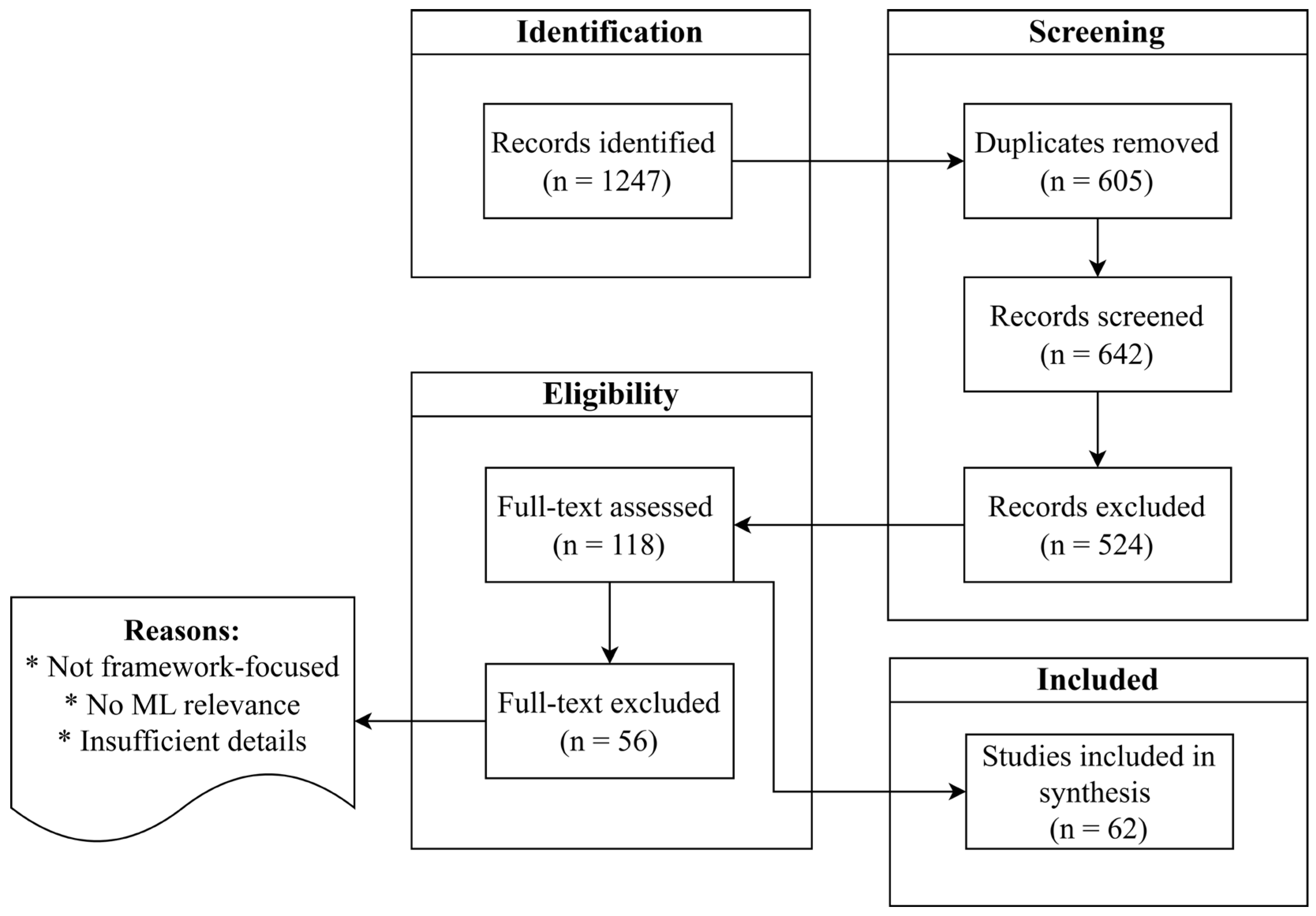
The screening and selection procedure was outlined using PRISMA guidelines. Initially, 1247 records were identified from the selected databases. After removing 605 duplicates, 642 records were screened by title and abstract. Duplicate records were removed and titles/abstracts were reviewed to ensure they met the inclusion criteria. Titles and abstracts that did not meet inclusion criteria were removed. Results from the eligibility stage of review are shown in Figure 1 below. Records that made it to this stage were full-text articles that were reviewed for relevance based on the previously established inclusion criteria. A total of 56 articles were removed during this stage because they did not provide sufficient methodological detail, did not discuss organizational cybersecurity posture/governance, or did not meaningfully discuss cybersecurity risk assessment frameworks or machine learning applications to risk prediction/prioritization. The remaining 62 studies were used in this research to provide context, direction, and substantive evidence on topics related to cybersecurity frameworks, security metrics, multi-criteria decision analysis, and artificial intelligence/machine learning applications to cyber risk prediction [30,35,39].
Figure 1.
PRISMA 2020 flow diagram illustrating the identification, screening, exclusion, and final inclusion of studies.
This PRISMA diagram follows the 2020 reporting guidelines and reflects the complete identification, screening, eligibility, and inclusion workflow used in this study.
The asterisks (*) in Figure 1 indicate the primary exclusion reasons applied during screening. Articles were removed if they lacked meaningful discussion of cybersecurity risk assessment frameworks (not framework-focused), did not address machine learning applications to risk prediction or prioritization (no ML relevance), or failed to provide adequate methodological detail (insufficient details).
3.3. Document and Framework Analysis
The document and framework analysis focuses on assessing publicly available official documentation on how each of NIST CSF, ISO 27001, FAIR, OCTAVE, and CRAMM is supposed to be used. This analysis highlights the scope, goals, analytical approach, as well as implicit assumptions built into the structure of each individual framework. This also separates out purely qualitative vs. quantitative frameworks and highlights each framework’s native support (if any) for integration with machine learning-driven risk analytics. This is to ensure that the multi-criteria analysis is testing each framework as it was designed and meant to be used, versus secondary reference material or frameworks [7,8,24,33].
3.4. AI and Machine Learning
Applications of artificial intelligence and machine learning to cybersecurity have expanded dramatically over the past several years. While earlier applications tended to focus on automating governance or compliance tasks, recent innovations involve applying machine learning to improve threat prediction, anomaly detection, and risk prioritization [9,12,30,34,35,36,39]. Models are currently being used to learn network behavior, identify probabilities of various attacks or adversaries, and create quantitative risk ratings that can inform organizational decision-making. While not used directly in this study, AI and ML clearly play a critical role in contemporary cybersecurity and risk management practices.
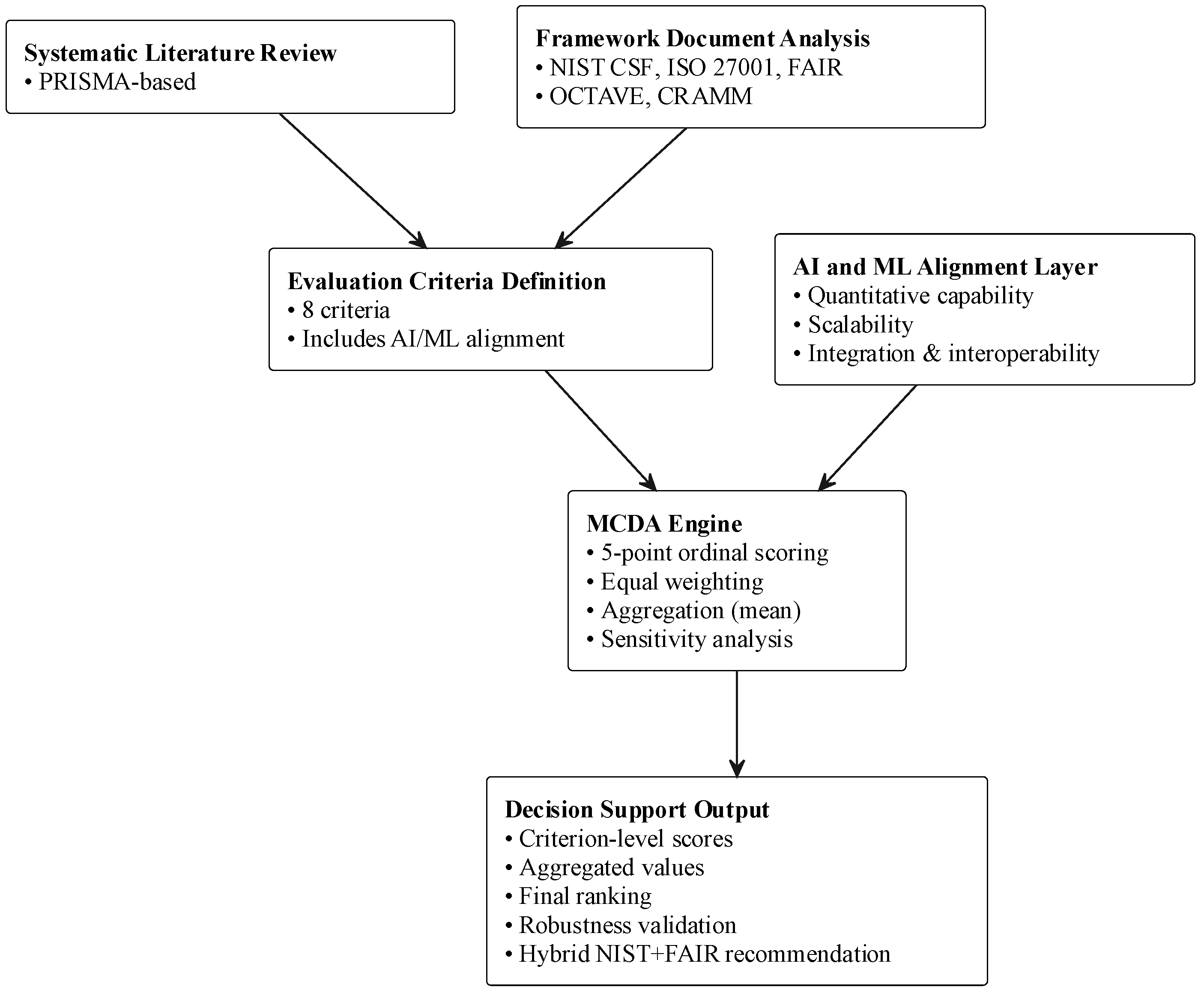
In this study, AI and ML serve a structural and conceptual role rather than an operational one. The decision support model does not train or execute machine learning algorithms; instead, it is explicitly designed to accept ML-generated risk scores, probability estimates, and anomaly indicators as inputs to the quantitative capability, scalability, and interoperability criteria. This conceptual alignment is consistent with the emerging literature on integrating ML outputs into governance-oriented cybersecurity frameworks [2,5,23]. This conceptual alignment is illustrated in the AI-enhanced MCDA model architecture (see Figure 2). The AI/ML alignment layer, therefore, specifies how predictive outputs can be mapped into the MCDA engine, rather than providing a new predictive model.
Figure 2.
AI-enhanced MCDA model architecture.
This research considers AI and ML throughout the multi-criteria decision analysis by using it to conceptually inform the selection of evaluation criteria and framework interpretation. The criteria of quantitative capability, scalability, and integration and interoperability were selected in part because they capture the attributes required for frameworks to incorporate ML-derived risk indicators into governance and risk management processes. FAIR was singled out because it provides a quantitative framework that can easily incorporate probability estimates generated using machine learning algorithms [5,33]. NIST CSF and ISO 27001 were highlighted because they allow predictive results to be interpreted through the lens of governance functions and controls [3,4,14].
This alignment ensures that the evaluation criteria reflect not only traditional governance requirements but also the emerging need for frameworks to support data-driven, probabilistic, and automation-ready risk management practices [15,22,33]. The AI/ML alignment layer is therefore a design construct that connects predictive analytics to the MCDA scoring and aggregation stages, rather than an operational machine learning pipeline.
This figure illustrates the end-to-end workflow used in this study, beginning with the systematic literature review and framework document analysis, followed by evaluation criteria definition and the AI/ML alignment layer. These components feed into the MCDA engine, which applies ordinal scoring, equal weighting, aggregation, and sensitivity analysis to generate criterion-level scores, aggregated performance values, final rankings, and the recommended hybrid NIST + FAIR model. This model architecture is original to this study and is included to clarify how the AI/ML alignment layer operationally connects to the MCDA scoring, weighting, and aggregation processes.
3.5. Evaluation Criteria
Criteria were determined based on the SLR, document analysis, and past comparisons. Considerations included factors mentioned in the different frameworks, along with aspects that organizations would consider when implementing a framework that supports predictive analytics and quantitative risk assessment. These criteria were chosen because they represent legacy governance needs as well as emerging needs for ML-enabled risk analytics. The following eight criteria were used: comprehensiveness, applicability across industries, ease of implementation, alignment with best practices, quantitative capability, scalability, integration and interoperability, and cost effectiveness. A summary of these eight evaluation criteria is provided in Table 1. The criteria represent functional, analytical, and operational attributes of the frameworks which may affect their use in modern cybersecurity contexts [7,19,23,26].
Table 1.
Evaluation criteria used in the MCDA model.
3.6. Multi-Criteria Decision Analysis (MCDA)
To compare the five frameworks across the eight criteria, multi-criteria decision analysis is performed. MCDA is common in the cybersecurity research literature and allows for a structured way to compare options across multiple factors [19,23,26]. This process uses a scoring model, where each framework is given an ordinal score for each criterion. The scores are assigned based on how well the framework meets the indicators for each criterion. The scores are based on evidence found during the literature review and document analysis phase, and attempt to limit subjective judgment [7,19,23].
3.6.1. Weighting Scheme
Weights have been applied equally across each criterion in the baseline model to provide a neutral reference point for comparison. This approach is consistent with prior MCDA studies in cybersecurity that begin with equal weights before conducting robustness analysis [23]. Equal weighting prevents the initial evaluation from embedding unexamined assumptions about sector-specific priorities into the scoring process and allows the baseline model to serve as a common reference that can be systematically perturbed during sensitivity analysis. In subsequent robustness tests, alternative weighting schemes were derived from governance-centric and analytics-centric scenarios to reflect the priorities of regulated industries [4,29] and data-driven organizations [2,5]. This combination of a neutral baseline and scenario-specific weight sets ensures that the decision support model can be adapted to sector-specific priorities without undermining the underlying methodology.
3.6.2. Scoring Procedure
A five-point ordinal scale is employed to assign scores. An explicit scoring rubric was defined for each criterion, where 1 represents minimal support, 3 represents moderate support, and 5 represents strong native support for the corresponding capability. This rubric aligns with established cybersecurity maturity assessment practices [26]. Intermediate scores of 2 and 4 were used when evidence indicated partial or above-average support that did not fully meet the threshold for the next anchor point.
Scoring was accomplished through triangulation of three sources of evidence. These sources consist of official framework documentation, results of the systematic literature review, and a comparison of framework maturity models. Triangulation is widely recommended in cybersecurity risk assessment research to reduce subjectivity and strengthen reproducibility [19,23].
For each criterion, candidate scores were first derived from framework documentation [3,4,5,8], then cross-checked against empirical and conceptual findings from the literature [7,14,15], and, finally, reconciled with existing maturity assessments [26]. Scores were only assigned when all three sources converged on a consistent interpretation of the framework’s capabilities.
To compute the overall performance of each framework, an equal-weight aggregation method was used in the baseline model. The aggregated score for each framework was calculated using the following formula:
where represents the score assigned to framework for criterion , and is the total number of evaluation criteria. Scenario-specific weight vectors were then applied in the sensitivity analysis to examine how rankings change when governance, quantitative capability, or interoperability are emphasized, consistent with prior MCDA cybersecurity studies [23,28].
3.6.3. Aggregation and Ranking
Each framework’s scores are summed according to the weights given to achieve a single performance score. The resultant performance scores are then utilized to rank the frameworks and highlight their strengths and weaknesses. Sensitivity analysis was achieved by varying the weights of the criteria. This highlights how the rankings may differ if alternative weights were used. It allows us to see how sturdy the decision support model is and if it is flexible enough to meet organizations with different objectives [19,23,28].
3.7. Validity and Reliability
Validity and reliability were addressed through methodological triangulation. The combined use of systematic literature review, document analysis, and multi-criteria decision analysis reduced threats to validity and reliability by integrating multiple sources of evidence into the decision model. Reliability was also strengthened by strictly following best practices for conducting systematic literature reviews and clearly defining evaluation criteria and scoring procedures [7,19,23]. Evidence supporting construct validity came from basing all criteria on information obtained from the literature and the foundational framework document itself. Internal consistency of the scoring process was assessed by re-applying the rubric to a subset of criteria at a later stage in the study and confirming that the same scores were obtained when using the documented evidence base. Sensitivity analysis was used to provide additional support for reliability by showing that the ranking of alternatives remains the same when weights are adjusted. Although the model does not yet incorporate a formal inter-rater reliability study or an external industrial case, the combination of transparent scoring rules, documented evidence, and robustness analysis demonstrates that the results are stable with respect to reasonable variations in weights and interpretations. This limitation is acknowledged, and future work will extend the validation with expert panels and real-world deployments.
3.8. Ethical Considerations
All data used in this study was publicly available secondary data. No primary data or human subjects were used. Based on these factors, this study did not require ethical clearance or approval.
4. Results
The Results Section outlines the output of the AI-enhanced multi-criteria decision support model along with the performance of NIST CSF, ISO 27001, FAIR, OCTAVE, and CRAMM against the eight criteria. The results reflect synthesized evidence captured during the systematic literature review, document analysis, and multi-criteria decision analysis portions of this study. The decision model also illustrates how performance was assessed to support machine learning-enabled interpretation via relative weighting of criteria that emphasize quantitative capability, interoperability, and analytical depth. The four components of the results are displayed below and include the criterion-level scoring, aggregated performance values, overall ranking of cybersecurity frameworks, and robustness analysis. Triangulation of framework documentation, literature evidence, and existing maturity models was used to ensure that scores were consistent and defensible.
4.1. Criterion Level Scoring
The scoring presented at the criterion level indicates fairly large margins of differentiation between the five selected frameworks. The scoring rubric used to assign 1–5 ordinal values is shown in Table 2, which defines the anchor points for minimal, moderate, and strong support across each criterion. Criterion-level scores for all five frameworks are presented in Table 3. A consolidated summary of each framework’s strengths and weaknesses is provided in Table 4, offering interpretive context for how individual criterion-level patterns contribute to overall performance.
Table 2.
Scoring rubric for cybersecurity framework evaluation (1–5 scale).
Table 3.
Criterion-level scores for cybersecurity frameworks (1–5 scale).
Table 4.
Summary of strengths and weaknesses of evaluated frameworks.
NIST CSF scored the highest in the areas of comprehensiveness, industry best-practices alignment, agility, and interoperability. Framework designers integrated structural flexibility and modularity into NIST CSF, which allows organizations to adopt machine learning-generated cybersecurity indicators into existing governance structures without requiring organization redesign [3,7,19].
ISO 27001 scored highest in the areas of governance alignment, compliance assurance, and formal controls accountability. The certification-centric nature of ISO 27001 generates a mature governance foundation but does not natively support interoperability with analytical frameworks used to process predictive analytics and machine learning outputs. Additional adaptation is required, which reduces ISO 27001′s scores in scalability and quantitative capability.
FAIR scored highest in quantitative capability, analytical depth, and machine learning risk score interoperability. FAIR was specifically designed to support probabilistic modeling, which aligns directly with machine learning risk estimation [7,33]. Adoption of FAIR can facilitate machine learning-enabled data-driven decision-making. FAIR ranked lowest in ease of implementation due to the specialized expertise required to adopt the framework.
OCTAVE and CRAMM both scored well in best practices for structured assessments and traditional legacy environments, but scored low in scalability, interoperability, and machine learning-enabled risk analytics. The risk assessment assumptions made by OCTAVE and CRAMM align with previous generations of cybersecurity that predate modern distributed architectures.
Using the scoring rubric presented above, each framework was evaluated systematically across the eight MCDA criteria. The resulting criterion-level scores are shown in Table 3, reflecting evidence-based assessments derived from documented framework characteristics and literature findings.
4.2. Aggregated Performance Values and Criterion-Level Interpretation
Aggregate performance values were computed using equal weights for each of the eight criteria, consistent with baseline MCDA practice [23]. The aggregated MCDA scores and final ranking are shown in Table 5. NIST CSF attained the highest weighted average score due to its balance across governance alignment, agility, and interoperability [3,7,19]. ISO 27001 and FAIR achieved identical aggregated scores in the baseline model, reflecting the trade-off between ISO 27001′s governance strength [4,20] and FAIR’s quantitative depth [5,33]. OCTAVE and CRAMM ranked lower due to limited scalability and interoperability [8,24,25].
Table 5.
Aggregated MCDA scores and final ranking.
Criterion-level scoring provides additional insight into these aggregated results. NIST CSF scored highest in comprehensiveness, best-practices alignment, scalability, and interoperability, confirming its suitability for organizations requiring flexible governance structures. ISO 27001 scored highest in governance alignment and compliance assurance, consistent with its certification-driven design. FAIR scored highest in quantitative capability and ML-aligned analytical depth, reflecting its probabilistic modeling foundation. OCTAVE and CRAMM performed adequately in structured assessments but scored poorly in scalability and ML-enabled interoperability due to legacy architectural assumptions.
Combining aggregated and criterion-level results provides a unified interpretation: NIST CSF offers the strongest overall balance, ISO 27001 excels in governance, FAIR excels in quantitative analytics, and OCTAVE/CRAMM are best suited for legacy environments.
4.3. Sensitivity Analysis
To determine how the rankings may shift based on weighting changes, a robustness analysis was performed. Sensitivity was tested by creating scenarios where governance factors were weighted more heavily than others, as well as scenarios where quantitative and machine learning alignment were weighted more heavily.
NIST CSF, ISO 27001, and FAIR remained constant across all models. Due to its consistent performance across criteria, NIST CSF ranked first among all models. ISO 27001 performed best in models that weighted the governance and compliance criteria more heavily. FAIR moved up and down depending on the weight of governance criteria relative to the analytical criteria. Due to limited performance in numerous criteria, OCTAVE and CRAMM did not change positions in any model.
Since the top three rankings remained the same despite changes in weighting, it can be concluded that the decision support model is sufficiently robust and the results of the evaluation are not sensitive to some degree of fluctuation in organizational priorities.
4.4. Results Summary
This section highlighted that NIST CSF performs best overall due to its agile nature, alignment to business needs, and interoperability with other systems. ISO 27001 enables the best cybersecurity governance foundation. FAIR enables the best quantitative risk analysis and aligns with machine learning capabilities. Legacy organizations could still use OCTAVE or CRAMM, but they do not scale to support modern distributed architectures. These results further highlight the value of choosing frameworks that support machine learning-driven risk scoring and predictive analytics.
Hybrid approaches were also validated in this section. The optimal mix is NIST CSF and FAIR due to their ability to meet each other’s weaknesses. This NIST CSF + FAIR hybrid approach is illustrated in Figure 3, which presents the AI/ML-Enabled Hybrid Governance–Analytics Model. Organizations could start with either NIST or FAIR and supplement it with the other framework to create an integrated cybersecurity and machine learning risk scoring capability.
Figure 3.
AI/ML-enabled NIST CSF + FAIR hybrid governance–analytics model.
This figure presents the integrated hybrid model validated by the MCDA results. AI and ML models generate predictive indicators that feed into FAIR’s quantitative risk modeling (loss frequency and loss magnitude). FAIR outputs are then mapped into NIST CSF governance functions, producing a combined operating model that unifies governance, controls, and compliance with quantitative analytics and machine learning-enabled risk scoring. This hybrid was supported by the highest overall MCDA ranking and remained robust across all sensitivity analyses.
5. Discussion
This research aimed to analyze current cybersecurity risk frameworks and determine how well they align with organizational priorities. This section discusses the results and provides a detailed analysis of their implications for industry adoption and AI-enhanced risk analytics. First, the implications of individual framework rankings are interpreted based on their respective strengths. Second, the contributions of the research to machine learning-enabled risk analytics are discussed. Third, guidelines for industry professionals who are considering framework selection or modification are presented. Fourth, implications for industry adoption are discussed. Finally, this research is positioned within the context of cybersecurity research and practice.
5.1. Interpretation of Results Based on Framework Strengths
NIST CSF had the highest aggregate score due to its flexibility. NIST CSF is easily tailored to fit most organizational environments because of its modular design, functional focus, and wide industry adoption. Additionally, NIST CSF scores highly in agility and interoperability because its controls can incorporate machine learning-generated indicators without requiring foundational changes to its governance structure.
ISO 27001 achieved the highest score in governance and compliance. This stems from its certification-based standards, which create formal methods of accountability and assurance. However, ISO 27001 scores comparatively lower in scalability and quantitative capability, which indicates that it lacks the analytic layers necessary for machine learning-driven risk scoring. This does not indicate a weakness in the model itself, but rather that additional frameworks may be necessary to support machine learning when organizations choose ISO 27001.
FAIR achieved the highest scores in quantitative capability and analytical depth due to its probabilistic approach to risk modeling. FAIR aligns perfectly with machine learning risk estimation, which allows data-driven organizations to adopt it as a means of supporting decision-making. FAIR scores comparatively lower in effort to implement and industry applicability because it requires a deep understanding of its structure in order to be applied correctly. The scoring for FAIR confirms that this framework is the superior choice for quantitative analysts and organizations who value data-driven decision-making over governance functionality.
OCTAVE and CRAMM scored similarly across all criteria. They achieved moderate scores in structured assessment and legacy support while scoring low in scalability and loosely coupled systems. This is due to their design assumptions, which were based on previous iterations of cybersecurity technology and do not fully support machine learning capabilities. The study’s outcomes confirm that older architectures are deficient in the architectural agility needed for integrating ML-derived risk metrics.
The results also highlight clear trade-offs between achieved benefits and implementation costs. NIST CSF offers strong agility and interoperability with moderate implementation effort, making it attractive for organizations seeking broad coverage without excessive overhead. ISO 27001 provides superior governance assurance but requires substantial investment in certification, documentation, and ongoing compliance activities. FAIR delivers the highest analytical depth and ML alignment but demands specialized quantitative expertise and tooling, which increases training and maintenance costs. OCTAVE and CRAMM are less costly to adopt in legacy environments but do not justify investment in modern distributed architectures due to their limited scalability and interoperability. Evaluating these trade-offs through the cost-effectiveness criterion provides a more realistic view of the practical value of each framework in different organizational contexts.
5.2. Implications for Machine Learning-Enabled Risk Analytics
This study’s findings have several implications for organizations looking to improve their cybersecurity posture. First, assessment frameworks that blend operational flexibility and customizable guidance with governance rigor perform best in MCDA analyses. NIST CSF serves as an excellent base framework for many companies due to its common usage in industry and modular approach. However, if your organization needs formal direction and outside certification, coupling NIST CSF with ISO 27001 can satisfy both conditions.
Second, FAIR greatly outperformed its competitors in the risk-analysis aspects of this study. Cybersecurity professionals making purchasing and budgeting decisions without quantitative analysis will fall short of other executives requiring returns on security investments. If your organization already uses a guidance-oriented cybersecurity posture assessment model, embedding FAIR will help you better communicate risk to stakeholders.
Third, OCTAVE and CRAMM may serve your needs if your organization is unable to access more modern cybersecurity frameworks. That is not to say these two frameworks are without merit; companies operating smaller inventories of assets will find OCTAVE’s scripted methodology more straightforward. Likewise, organizations interested in performing stringent asset-based analysis should consider adopting CRAMM. However, if your environment demands scalability, consistent compliance checks, or integration with other cybersecurity standards, a newer framework will likely serve you better.
5.3. Practical Implications for Framework Selection
The results of this study provide industry professionals with several guidelines to consider when adopting cybersecurity risk frameworks. Organizations that value compliance and governance effectiveness should consider adopting ISO 27001 as their primary risk framework. Organizations that prioritize agility, interoperability, and wide industry support should adopt NIST CSF. Organizations that want to support machine learning initiatives and value quantitative analysis should use FAIR.
While adopting a single framework may be ideal for certain organizations, the results clearly demonstrate that hybrid frameworks provide the highest overall performance. Combining NIST CSF and FAIR gives organizations the benefits of governance alignment and quantitative analysis. This allows organizations to adopt machine learning into their risk analytics without sacrificing regulatory compliance. Hybrid adoption excels in organizations transitioning from qualitative governance frameworks to quantitative, machine learning-enabled risk analytics.
5.4. Implications for Industry Adoption
The results of this study have important implications for industry-specific framework adoption. Highly regulated industries should consider adopting or prioritizing ISO 27001 due to its compliance benefits. Organizations in technologically advanced industries might lean towards FAIR, considering its pronounced quantitative orientation and its ability to integrate machine learning for risk estimations. Large organizations that operate in multiple industries may want to utilize NIST CSF because its high flexibility allows it to meet the needs of virtually any environment. OCTAVE and CRAMM should be applied to legacy operational environments rather than modern distributed systems.
This research demonstrates that the decision support model produces stable results across different weighting scenarios, which implies that industry-specific research would not significantly alter the ranking of frameworks.
5.5. Contribution to Research and Practice
This research advances cybersecurity governance by demonstrating how organizations can develop and utilize transparent and replicable processes for evaluating cybersecurity risk frameworks. By adopting this decision support model, organizations can effectively communicate their risk priorities to determine which frameworks best align with their current needs.
This research also benefits cybersecurity professionals by providing them with a decision support tool that they can use to select and adapt cybersecurity frameworks. This decision support tool can be further customized to meet the needs of specific industries and professionals who desire supplemental analytics. Because the model is transparent and criteria-driven, it can be replicated or extended by future researchers to evaluate additional frameworks or emerging ML-enabled risk methodologies.
6. Conclusions
The creation of an AI-enhanced multi-criteria decision support model for selecting cybersecurity risk frameworks supporting machine learning-enabled risk analytics successfully addressed the research objective. This model blends SLR, document analysis, and MCDA techniques to offer organizations a repeatable and transparent assessment mechanism. Using this model, NIST CSF, ISO 27001, FAIR, OCTAVE, and CRAMM frameworks were compared against the eight criteria that address modern cybersecurity expectations. The assessment shows that frameworks differ structurally, conceptually, and analytically in ways that matter to organizations looking to modernize their cybersecurity risk management practices.
NIST CSF performed best overall because of its agility, business focus, and interoperability. Its flexible structure allows security teams to incorporate machine learning-generated indicators into their current governance structures. ISO 27001 excelled in the areas of governance and compliance. It is a certifiable framework that will satisfy stakeholders who need formalized accountability. FAIR offered the best quantitative capabilities and analytical depth. It supports probabilistic risk estimation, which maps directly to ML risk prediction and encourages data-driven decision-making. OCTAVE and CRAMM showed average marks in structured assessment and legacy support, but they struggled to scale and fell short in distributed systems environments.
Two major takeaways from this study are that organizations should select a cybersecurity risk management framework that meets their governance needs and enables machine learning-based analytics as inputs to quantitative risk assessment, and that hybrid approaches offer the greatest benefits. By pairing NIST CSF and FAIR, organizations can attain governance alignment and analytical depth. This pairing gives organizations the best chance at leveraging machine learning for risk prediction purposes.
This research contributes to the cybersecurity field by providing practitioners with a decision support model they can use to assess cybersecurity risk frameworks against standards they should meet. This model can help organizations align their risk management priorities with the strengths of different cybersecurity risk management frameworks. Additionally, this research fills a gap in cybersecurity evaluation methods by providing a model that assesses frameworks using machine learning-based criteria. This research contributes to industry by providing cybersecurity organizations with a decision support tool they can use to justify decisions about framework selection, how to best adopt multiple frameworks, and how to best leverage predictive analytics to meet governance requirements.
Researchers may build on this work by using the model in industry-specific settings, by integrating real-time risk indicators generated by ML algorithms, or by adding newly developed cybersecurity risk management frameworks to this study. Cybersecurity organizations should consider how they can adopt cybersecurity risk management frameworks that allow them to meet governance standards and support machine learning-based cybersecurity analytics. Organizations can future-proof their analytics investments by standardizing on frameworks that enable governance as well as machine learning-powered analytics by adopting a hybrid approach when appropriate.
Author Contributions
Conceptualization, O.J.O. and A.F.A.; methodology, O.J.O.; software, O.J.O. and A.F.A.; validation, O.J.O. and A.F.A.; formal analysis, O.J.O.; investigation, O.J.O.; resources, O.J.O. and A.F.A.; data curation, O.J.O.; writing—original draft preparation, O.J.O.; writing—review and editing, A.F.A.; visualization, O.J.O.; supervision, A.F.A.; project administration, O.J.O. and A.F.A.; funding acquisition, O.J.O. All authors have read and agreed to the published version of the manuscript.
Funding
This research received no external funding.
Data Availability Statement
All data generated and analyzed in this study are contained within the manuscript. The full multi-criteria decision analysis dataset, including the evaluation criteria, scoring rubric, framework-level scores, aggregated scores and final rankings, and a summary of strengths and weaknesses of evaluated frameworks, is presented in Table 1, Table 2, Table 3, Table 4 and Table 5. No additional datasets were generated or used.
Conflicts of Interest
The authors declare no conflicts of interest.
References
- Georgiadou, A.; Mouzakitis, S.; Bounas, K.; Askounis, D. A Cyber-Security Culture Framework for Assessing Organization Readiness. J. Comput. Inf. Syst. 2022, 62, 452–462. [Google Scholar] [CrossRef] [Scilit]
- Santos, J.R.; Haimes, Y.Y.; Lian, C. A Framework for Linking Cybersecurity Metrics to the Modeling of Macroeconomic Interdependencies. Risk Anal. 2007, 27, 1283–1297. [Google Scholar] [CrossRef] [Scilit] [PubMed]
- National Institute of Standards and Technology. Framework for Improving Critical Infrastructure Cybersecurity, Version 1.1; NIST CSWP 04162018; National Institute of Standards and Technology: Gaithersburg, MD, USA, 2018. [CrossRef] [Scilit]
- Calder, A.; Watkins, S. IT Governance–An International Guide to Data Security and ISO 27001/ISO 27002, 8th ed; IT Governance Publishing: Ely, UK, 2024. [CrossRef] [Scilit]
- Freund, J.; Jones, J. Measuring and Managing Information Risk; Elsevier: Amsterdam, The Netherlands, 2026. [Google Scholar] [CrossRef] [Scilit]
- Kurt, E.S.; Yaşar, A.; Terzioğlu, K.; Demirkıran, S. A New Generation Method for Assessing Information Security Risks: OCTAVE Allegro. In Proceedings of the International Conference on Eurasian Economies, Baku, Azerbaijan, 1 September 2022; pp. 208–214. [Google Scholar] [CrossRef] [Scilit]
- Efunwoye, I.O.; Gogate, M.; Hussain, A.; Asim, M.; Ahmad, J.; Hussain, A.; Dashtipour, K. Evaluating the Efficacy and Applicability of Contemporary Cybersecurity Frameworks and Standards in Cybersecurity, Cybercrimes, and Smart Emerging Technologies, 1st ed.; CRC Press: London, UK, 2025; pp. 365–372. [Google Scholar] [CrossRef] [Scilit]
- Alberts, C.J.; Behrens, S.; Pethia, R.D.; Wilson, W.R. Operationally Critical Threat, Asset, and Vulnerability Evaluation (OCTAVE) Framework, Version 1.0; Software Engineering Institute: Pittsburgh, PA, USA, 1999; Available online: https://www.sei.cmu.edu/library/operationally-critical-threat-asset-and-vulnerability-evaluation-octave-framework-version-10/ (accessed on 20 December 2025).
- Alshahrani, A.A.; Ghazalah, S.A. AI-Based Predictive Analytics for Cybersecurity Risk Prioritization Using Machine Learning. In Proceedings of the 2025 IEEE/ACS 22nd International Conference on Computer Systems and Applications (AICCSA); IEEE: Doha, Qatar, 2025; pp. 1–5. [Google Scholar] [CrossRef] [Scilit]
- Singh, U.K.; Joshi, C. Comparative Study of Information Security Risk Assessment Frameworks. Int. J. Comput. Appl. 2018, 2, 1797–2250. [Google Scholar] [CrossRef] [Scilit]
- Arabsorkhi, A.; Ghaffari, F. Security Metrics: Principles and Security Assessment Methods. In Proceedings of the 2018 9th International Symposium on Telecommunications (IST); IEEE: Tehran, Iran, 2018; pp. 305–310. [Google Scholar] [CrossRef] [Scilit]
- Rahman, M.M.; Kshetri, N.; Sayeed, S.A.; Rana, M.M. AssessITS: Integrating Procedural Guidelines and Practical Evaluation Metrics for Organizational IT and Cybersecurity Risk Assessment. J. Inf. Secur. 2024, 15, 564–588. [Google Scholar] [CrossRef]
- Milousi, K.; Kiriakidis, P.; Mengidis, N.; Rizos, G.; Mazi, M.S.; Voulgaridis, A.; Votis, K.; Tzovaras, D. Evaluating Cybersecurity Risk: A Comprehensive Comparison of Vulnerability Scoring Methodologies. In Proceedings of the 19th International Conference on Availability, Reliability and Security, Vienna Austria, 30 July–2 August 2024; ACM: New York, NY, USA, 2024; pp. 1–11. [Google Scholar] [CrossRef] [Scilit]
- Krumay, B.; Bernroider, E.W.N.; Walser, R. Evaluation of Cybersecurity Management Controls and Metrics of Critical Infrastructures: A Literature Review Considering the NIST Cybersecurity Framework. In Secure IT Systems; Lecture Notes in Computer Science; Gruschka, N., Ed.; Springer International Publishing: Cham, Switzerland, 2018; Volume 11252, pp. 369–384. [Google Scholar] [CrossRef] [Scilit]
- Ekstedt, M.; Afzal, Z.; Mukherjee, P.; Hacks, S.; Lagerström, R. Yet another cybersecurity risk assessment framework. Int. J. Inf. Secur. 2023, 22, 1713–1729. [Google Scholar] [CrossRef] [Scilit]
- Shpachuk, V.; Markova, O.; Adamyk, B. AI-Driven Financial Fraud: Key Risks and Legal Protections for Financial Institutions. J. Bank. Regul. 2026, 27, 6. [Google Scholar] [CrossRef] [Scilit]
- Oruc, A.; Amro, A.; Gkioulos, V. Assessing Cyber Risks of an INS Using the MITRE ATT&CK Framework. Sensors 2022, 22, 8745. [Google Scholar] [CrossRef] [Scilit] [PubMed]
- Bello, A. Ethical Risk Modeling for Trustworthy ML-Based Cyber Defense. In Proceedings of the 2025 IEEE International Conference on eScience (eScience), Chicago, IL, USA, 2025; IEEE: Manama, Bahrain, 2024; pp. 333–334. [Google Scholar] [CrossRef] [Scilit]
- Sánchez-García, I.D.; Mejía, J.; Gilabert, T.S.F. Cybersecurity Risk Assessment: A Systematic Mapping Review, Proposal, and Validation. Appl. Sci. 2022, 13, 395. [Google Scholar] [CrossRef] [Scilit]
- Field, A. Risk Management and ISO 31000: A Pocket Guide; IT Governance Publishing: Ely, UK, 2023. [CrossRef] [Scilit]
- Lee, I. Cybersecurity: Risk management framework and investment cost analysis. Bus. Horiz. 2021, 64, 659–671. [Google Scholar] [CrossRef] [Scilit]
- Armenia, S.; Franco, E.F.; Nonino, F.; Spagnoli, E.; Medaglia, C.M. Towards the Definition of a Dynamic and Systemic Assessment for Cybersecurity Risks. Syst. Res. Behav. Sci. 2019, 36, 404–423. [Google Scholar] [CrossRef] [Scilit]
- Ganin, A.A.; Quach, P.; Panwar, M.; Collier, Z.A.; Keisler, J.M.; Marchese, D.; Linkov, I. Multicriteria Decision Framework for Cybersecurity Risk Assessment and Management. Risk Anal. 2020, 40, 183–199. [Google Scholar] [CrossRef] [Scilit] [PubMed]
- Islam, M.T.; Mission, M.R.; Refat, T.K.; Kynatun, M. Cybersecurity Risk Assessment Frameworks For Engineering Databases: A Systematic Literature Review. Strateg. Data Manag. Innov. 2025, 2, 224–243. [Google Scholar] [CrossRef] [Scilit]
- Kandasamy, K.; Srinivas, S.; Achuthan, K.; Rangan, V.P. IoT cyber risk: A holistic analysis of cyber risk assessment frameworks, risk vectors, and risk ranking process. EURASIP J. Inf. Secur. 2020, 2020, 8. [Google Scholar] [CrossRef] [Scilit]
- Georgiev, V. Comparative Analysis of Models for Assessing the Maturity of Cybersecurity Capabilities. In IT4Sec Reports; IICT-BAS: Sofia, Bulgaria, 2021. [Google Scholar] [CrossRef] [Scilit]
- Taherdoost, H. Understanding Cybersecurity Frameworks and Information Security Standards—A Review and Comprehensive Overview. Electronics 2022, 11, 2181. [Google Scholar] [CrossRef] [Scilit]
- Goel, R.; Kumar, A.; Haddow, J. PRISM: A strategic decision framework for cybersecurity risk assessment. Inf. Comput. Secur. 2020, 28, 591–625. [Google Scholar] [CrossRef] [Scilit]
- Kant, R.; Thallada, R.R.; Pandey, B.; Srivastava, P. AI-Based Cybersecurity in Healthcare: A Data-Driven, Governance-Aware Framework for Secure Clinical Systems. In Proceedings of the 2026 IEEE 5th International Conference on AI in Cybersecurity (ICAIC), Houston, TX, USA, 18–20 February 2026; IEEE: Piscataway, NJ, USA, 2025; pp. 1–5. [Google Scholar] [CrossRef] [Scilit]
- Kumar, P.S.; Karthiga, M.; Balamurugan, E. Cyber ML-Based Cyberattack Prediction Framework in Healthcare Cyber-Physical Systems. In Computational Intelligence in Robotics and Automation, 1st ed.; CRC Press: Boca Raton, FL, USA, 2022; pp. 141–159. [Google Scholar] [CrossRef] [Scilit]
- Bernroider, E.W.N.; Margiol, S.; Taudes, A. Towards a General Information Security Management Assessment Framework to Compare Cyber-Security of Critical Infrastructure Organizations. In Research and Practical Issues of Enterprise Information Systems; Lecture Notes in Business Information Processing; Tjoa, A.M., Xu, L.D., Raffai, M., Novak, N.M., Eds.; Springer International Publishing: Cham, Germany, 2016; Volume 268, pp. 127–141. [Google Scholar] [CrossRef] [Scilit]
- Edwards, D.J. Risk and Compliance in Cybersecurity. In Mastering Cybersecurity; Apress: Berkeley, CA, USA, 2024; pp. 635–675. [Google Scholar] [CrossRef] [Scilit]
- Cheimonidis, P.; Rantos, K. Dynamic Risk Assessment in Cybersecurity: A Systematic Literature Review. Future Internet 2023, 15, 324. [Google Scholar] [CrossRef] [Scilit]
- Chithralekha, T.; Shivakumar, E.; Legapriyadharshini, N. Adversarial Machine Learning in Cybersecurity Attacks and Defense Mechanisms. In Machine Learning and Deep Learning Techniques for Cybersecurity Risk Prediction and Anomaly Detection, 25th ed.; RADemics Research Institute: Coimbatore, India, 2025; pp. 199–231. [Google Scholar] [CrossRef] [Scilit]
- Liu, H.-M. AI-Enabled Adaptive Cybersecurity Response Using Reinforcement Learning. Front. Artif. Intell. Res. 2025, 2, 1–12. [Google Scholar] [CrossRef] [Scilit]
- Sarkar, P.; Khanapuri, V.B.; Tiwari, M.K. Integrating machine learning with dynamic multi-objective optimization for real-time decision-making. Inf. Sci. 2025, 690, 121524. [Google Scholar] [CrossRef] [Scilit]
- Brennan, S.E.; Munn, Z. PRISMA 2020: A reporting guideline for the next generation of systematic reviews. JBI Evid. Synth. 2021, 19, 906–908. [Google Scholar] [CrossRef] [Scilit] [PubMed]
- Gupta, S.K.; Srivastava, A.; Kumar, V. Integrating predictive machine learning with transparent decision-making: A LightGBM–TOPSIS approach to supplier selection. Frankl. Open 2026, 15, 100519. [Google Scholar] [CrossRef] [Scilit]
- Sukeerthi, M.K.; Vaishnavi, B.S.; Raju, J.A.; Shetty, S.S.; Ali, M.D.H. Real-Time Cyber Attack Prediction Using ML Algorithms. Int. J. Res. Publ. Rev. 2025, 6, 4905–4911. [Google Scholar] [CrossRef] [Scilit]



Disclaimer/Publisher’s Note: The statements, opinions and data contained in all publications are solely those of the individual author(s) and contributor(s) and not of MDPI and/or the editor(s). MDPI and/or the editor(s) disclaim responsibility for any injury to people or property resulting from any ideas, methods, instructions or products referred to in the content. |
© 2026 by the authors. Licensee MDPI, Basel, Switzerland. This article is an open access article distributed under the terms and conditions of the Creative Commons Attribution (CC BY) license.