


Abstract
Tetracycline hydrochloride (TCH) contamination poses serious environmental risks due to its persistence and bioaccumulation. Here we present an oxygen-vacancy-enriched BiVO4/TiO2 S-scheme heterojunction (5% BVO/TO) synthesized via a one-step solvothermal method. Under visible light (λ > 420 nm), this composite achieves 78.8% TCH degradation in 80 min, outperforming TiO2 (69.5%) and BiVO4 (34.1%). Its rate constant (0.0198 min−1) is 1.4 and 4.0 times higher than TiO2 and BiVO4, respectively, while retaining over 70% activity after four cycles. XPS and EPR confirm that oxygen vacancies serve as electron traps to suppress recombination, and UPS combined with DFT calculations validates directional electron transfer from BiVO4 to TiO2. Radical scavenging tests and in situ EPR reveal h+ > •OH > •O2− as the dominant reactive species. This study offers a robust design strategy for OV-enhanced S-scheme photocatalysts toward efficient, sustainable degradation of antibiotic pollutants.
1. Introduction
The extensive application of antibiotics has intensified environmental contamination by antibiotic residues, particularly tetracycline antibiotics, such as tetracycline hydrochloride [1,2,3]. Due to their high chemical stability and poor biodegradability, these antibiotics readily enter aquatic ecosystems through wastewater discharge, facilitating the dissemination of microbial resistance genes and posing significant threats to ecological safety and human health [4,5]. Currently, treatment methods for antibiotic pollution primarily include biodegradation, adsorption and advanced oxidation processes (AOPs) [6]. However, biological methods show limited efficacy in treating antibiotics at high concentrations [7]; adsorption techniques merely transfer pollutants without actual degradation [8]; and traditional AOPs, such as Fenton’s reaction, depend heavily on potent oxidizing agents and can potentially cause secondary pollution [9]. Recently, photocatalytic technology utilizing semiconductor materials has emerged as a promising research direction due to its high efficiency, low energy consumption, and avoidance of secondary pollution. Nevertheless, current photocatalytic system still faces considerable challenges, such as limited visible-light utilization and high recombination rates of charge carriers. Consequently, developing novel, highly efficient photocatalysts remains critically important [10,11].
Photocatalytic technology effectively achieves non-selective degradation of organic pollutants by forming reactive oxygen species (ROS) from photogenerated electron-hole pairs. Titanium dioxide (TiO2), a classical photocatalyst, has attracted extensive attention due to its non-toxicity, chemical stability, and affordability [12]. However, its wide bandgap (~3.2 eV) confines its activation spectrum to ultraviolet (UV) light, constituting only approximately 4% of the solar spectrum, while its rapid carrier recombination significantly restricts practical application efficiency [13]. To overcome these limitations, researchers have explored various modification strategies: noble metal deposition (e.g., Ag/TiO2) enhances visible-light absorption via surface plasma resonance; doping with nonmetal elements (e.g., N, C) effectively narrows the bandgap; and the construction of heterojunction structures facilitates charge separation through appropriate band alignment. Nevertheless, modified TiO2 faces high preparation cost and inadequate long-term stability, underscoring the necessity for innovative composite photocatalytic systems [14].
Bismuth vanadate (BiVO4), a visible-light-responsive photocatalyst with a narrow bandgap (~2.4 eV), exhibits outstanding photocatalytic activity due to its excellent optical absorption capacity and strong oxidation potential [15]. As a result, BiVO4 has become highly promising for applications in the degradation of organic pollutants and water-splitting reactions [16]. By modifying its morphology, such as forming porous structures or nanosheets, the monoclinic crystal structure and carrier transport characteristics of BiVO4 can be significantly enhanced. However, pristine BiVO4 still faces intrinsic limitations, including rapid recombination of photogenerated electron-hole pairs and sluggish surface reaction kinetics, hindering its practical efficiency [17]. Construction heterojunctions have proven effective in mitigating these drawbacks by improving the charge separation efficiency [18]. In addition, through interface engineering strategies such as oxygen vacancy modulation and surface modification, the light response range and stability of BiVO4-based materials can be further optimized [19,20]. These modification strategies can enable it to exhibit excellent performance over a wide pH range and in multiple cycles.
In this work, BVO/TO S-scheme heterojunction photocatalysts with enriched oxygen vacancies (OVs) were synthesized at various compositional ratios using a solvothermal method. The prepared photocatalysts’ morphology, crystal structure, chemical composition, and photoelectrochemical properties were thoroughly characterized. Subsequently, their photocatalytic activity and stability were evaluated through the degradation of tetracycline hydrochloride under visible-light irradiation. Furthermore, the formation mechanism of the S-scheme heterojunction and the detailed photocatalytic degradation pathways of tetracycline hydrochloride were systematically elucidated via a combination of experimental investigations and theoretical calculations. The insights gained from this study provide valuable theoretical guidance and practical implications for designing advanced heterojunction photocatalysts, contributing significantly to the efficient degradation of tetracycline hydrochloride and other persistent organic pollutants.
2. Materials and Methods
2.1. Preparation of Catalysts
The BVO/TO composite catalyst was prepared by a solvothermal method [21], in which 3 mL of HNO3 solution with a concentration of 2 mol/L was firstly configured, and then 0.9701 g of Bi(NO3)3·5H2O was added to it and dissolved by stirring, after which 50 mL of deionized water was added and mixed by stirring. Then 0.2340 g NH4VO3 was added to the above solution again and stirred for 30 min to obtain the MT-BiVO4 mother liquor. A certain amount of MT-BiVO4 mother liquor was taken separately, diluted to 50 mL with deionized water, and then the pH was adjusted to 2 by ammonia, to which 0.40 g of prepared TiO2 was added, stirred and transferred to a 100 mL PTFE-lined autoclave, and kept at 150 °C for 24 h. After cooled down to room temperature, it was washed with deionized water with ethanol for three times, and dried at 80 °C. The MT-BiVO4 was obtained by mixing 0.2340 g of NH4VO3 into the above solution and stirring for 30 min. The MT-BiVO4/TiO2 catalyst was obtained and named as BVO/TO. Meanwhile, in order to configure different ratios of catalysts, 0.30, 1.50, and 6.20 mL of the mother liquor of BiVO4 were taken, and the catalysts obtained were named as 1% BVO/TO, 5% BVO/TO, and 20% BVO/TO, respectively.
The MT-BiVO4 catalyst was also prepared by a solvothermal method [22]. First, 0.9701 g of Bi(NO3)3·5H2O was dissolved in 3 mL of HNO3 solution at a concentration of 2 mol/L. Subsequently, 50 mL of deionized water was added to this solution and stirred for 10 min. Next, 0.2340 g of NH4VO3 was put into this solution and stirring was continued for 30 min. Then, the pH of the solution was adjusted to 2 using ammonia. After that, the mixed solution was poured into a 100 mL autoclave reactor with a polytetrafluoroethylene liner, and was subjected to 24 h of 150 °C. The reactor was heated at 150 °C for 24 h. After the reactor cooled down naturally, the resulting mixture was washed by centrifugation three times using anhydrous ethanol and deionized water sequentially. Finally, the washed samples were dried at 80 °C overnight to obtain the MT-BiVO4 catalyst, which was named as BiVO4 catalyst.
Synthesis of TiO2: TiO2 nanosheets were prepared by hydrothermal calcination method [23], with modifications. Firstly, 25 mL of tetrabutyl titanate and 2 mL of hydrofluoric acid were added to the beaker respectively, sonicated for 30 min, stirred for 30 min, and then transferred to an 80 mL autoclave, reacted at 180 °C for 24 h. After cooling, the product was washed with water and anhydrous ethanol until neutral, dried at 80 °C and ground to powder, then calcined in a muffle furnace at 550 °C for 2 h, ground and stored.
2.2. Characterization of Catalysts
The crystal structure of the synthesized materials was characterized using X-ray diffraction (XRD; D8 Advance, Bruker AXS GmbH, Karlsruhe, Germany). The morphology and microstructure were analyzed using scanning electron microscopy (SEM; Thermo Fisher Scientific, Waltham, MA, USA) and high-resolution transmission electron microscopy (HRTEM; Tecnai G2 F30, FEI Company, Hillsboro, OR, USA). The surface elemental composition and binding energy of the synthesized materials were determined by X-ray photoelectron spectroscopy (XPS; ESCALAB 250Xi, Thermo Fisher Scientific, Waltham, MA, USA). Absorption spectra were obtained using a UV-Vis-NIR spectrophotometer (UV-2600, Shimadzu Corporation, Kyoto, Japan). The defects in the materials and the associated free radicals were characterized using electron paramagnetic resonance (EPR) spectroscopy (JES-FA200, JEOL Ltd., Akishima, Tokyo, Japan). Solid-state steady-state fluorescence spectra were measured using a fluorescence spectrometer (FLS920, Edinburgh Instruments Ltd., Livingston, UK). Impedance and photocurrent measurements were conducted using an electrochemical workstation (PGSTAT204, Metrohm Autolab B.V., Utrecht, The Netherlands).
2.3. Photocatalytic Experiment
The photocatalytic degradation activity of the prepared catalysts was assessed using tetracycline hydrochloride as the target pollutant [24]. The procedure was as follows: initially, 50 mg of photocatalyst was added to 100 mL of a 20 mg/L tetracycline hydrochloride solution and thoroughly mixed. The mixture was then irradiated using a 300 W xenon lamp (PLS-SXE300, Beijing Perfectlight Technology Co., Ltd., Beijing, China equipped with a 420 nm filter) to simulate sunlight. Prior to irradiation, the mixture was stirred in the dark for 30 min to achieve adsorption–desorption equilibrium. The entire reaction was conducted in a condensing system to minimize the impact of temperature changes during light exposure on the catalytic performance. Samples were collected every 10 min throughout the reaction, and the supernatant was separated by filtration and centrifugation. The photocatalytic degradation efficiency was determined by measuring the concentration of residual tetracycline hydrochloride in the supernatant at 357 nm using a UV-Vis spectrophotometer. To assess the reproducibility and stability of the photocatalysts, the experiments were repeated four times.
3. Results and Discussion
3.1. Morphological and Structural Analysis
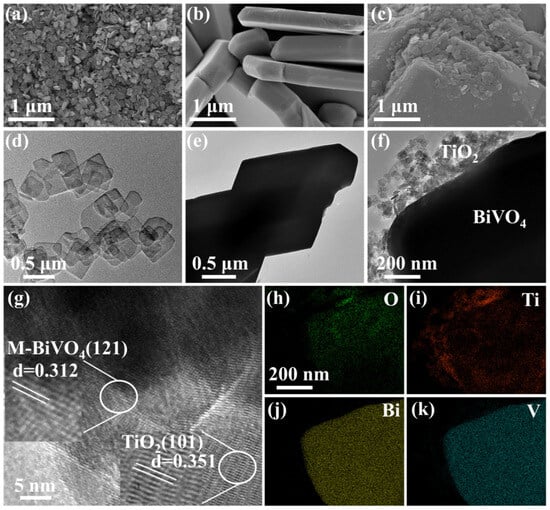
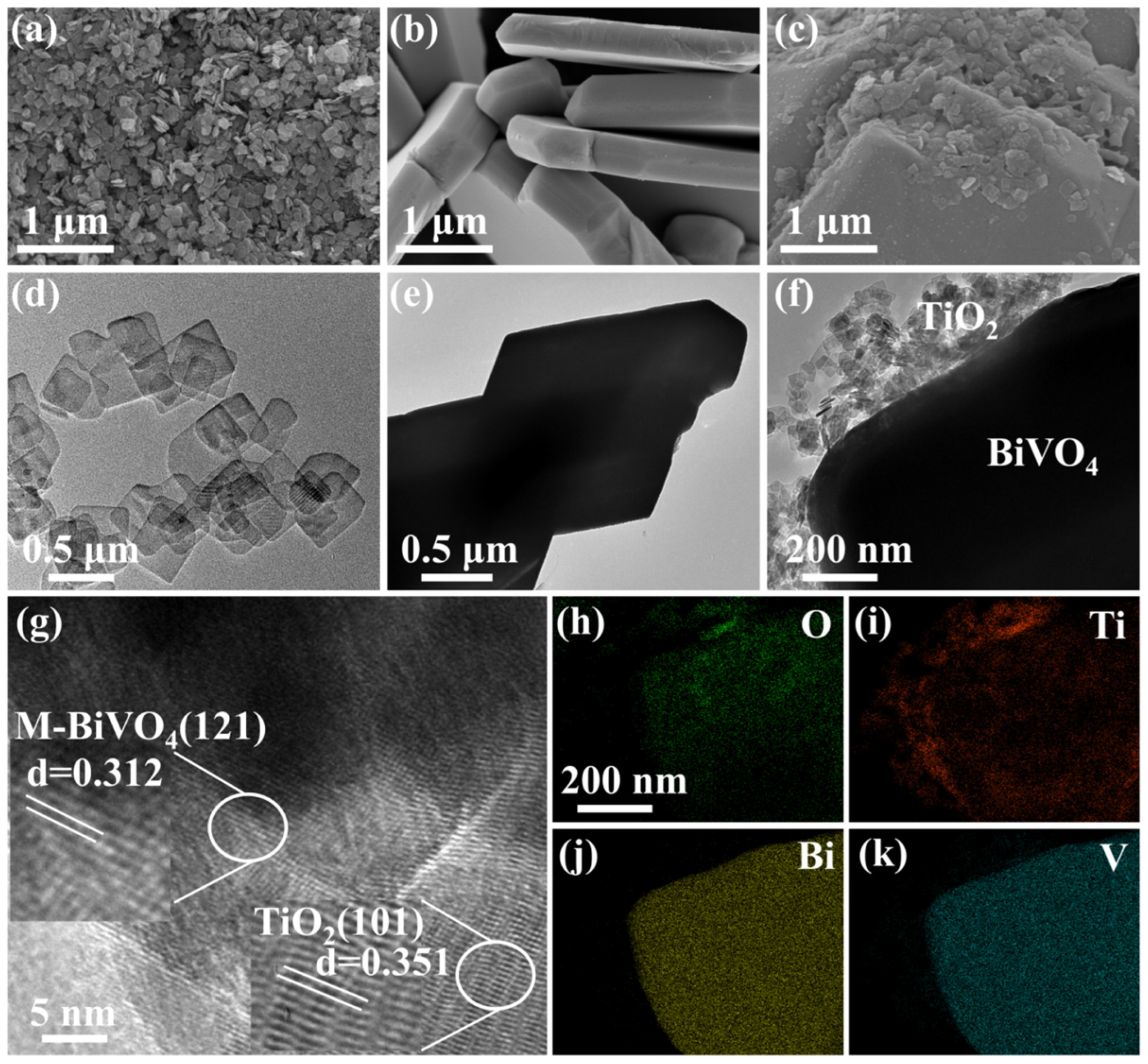
To investigate the morphology and microstructure of TiO2, and the 5% BVO/TO catalysts, SEM and TEM characterization tests were conducted. Figure 1a–c present SEM images of the samples. As shown in Figure 1a, the pure TiO2 catalyst exhibited a distinct nanosheet morphology [23], while the pure BiVO4 catalyst (Figure 1b) displayed a square-block structure [25]. Figure 1c demonstrates that the 5% BVO/TO composite exhibited an identifiable 2D/2D layered heterostructure, with TiO2 nanosheets intimately attached to the BiVO4 blocks.
Figure 1.
(a–c) SEM images of TiO2, MT-BiVO4 and BVO/TO, respectively; (d–g) TEM images of TiO2, MT-BiVO4 and BVO/TO, respectively; (h–k) elemental facies distribution of BVO/TO2.
TEM images (Figure 1d–f) further reveal detailed morphological features. Pure TiO2 exhibited thin nanosheet-like structures (Figure 1d), consistent with the SEM observations. BiVO4 (Figure 1e) presented irregular block-like structures with darker contrast, likely due to their increased thickness or stacking, corroborating the SEM findings. For the 5% BVO/TO composite (Figure 1f), both TiO2 nanosheet and BiVO4 block morphologies were visible, and a well-defined heterogeneous interface was observed, confirming the successful formation of the composite catalyst.
To further confirm the heterojunction interface, HRTEM characterization was performed on the 5% BVO/TO composite catalyst, as shown in Figure 1g. Distinct lattice fringes with spacings of 0.312 nm and 0.351 nm were observed, corresponding to the (121) crystal plane of monoclinic BiVO4 (M-BiVO4) and the (101) crystal plane of anatase TiO2, respectively. Notably, no lattice fringes attributable to tetragonal BiVO4 (T-BiVO4) were detected. In addition, elemental mapping images (Figure 1h–k) revealed the homogeneous distribution of O, Ti, Bi, and V elements throughout the composite, further confirming the successful preparation of the 5% BVO/TO composite catalyst. Moreover, the distribution patterns of Bi and V further verify the square-block morphology of the BiVO4 phase within the heterojunction.
3.2. Component and Structural Analysis of Catalysts
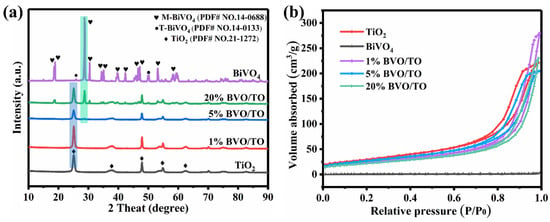
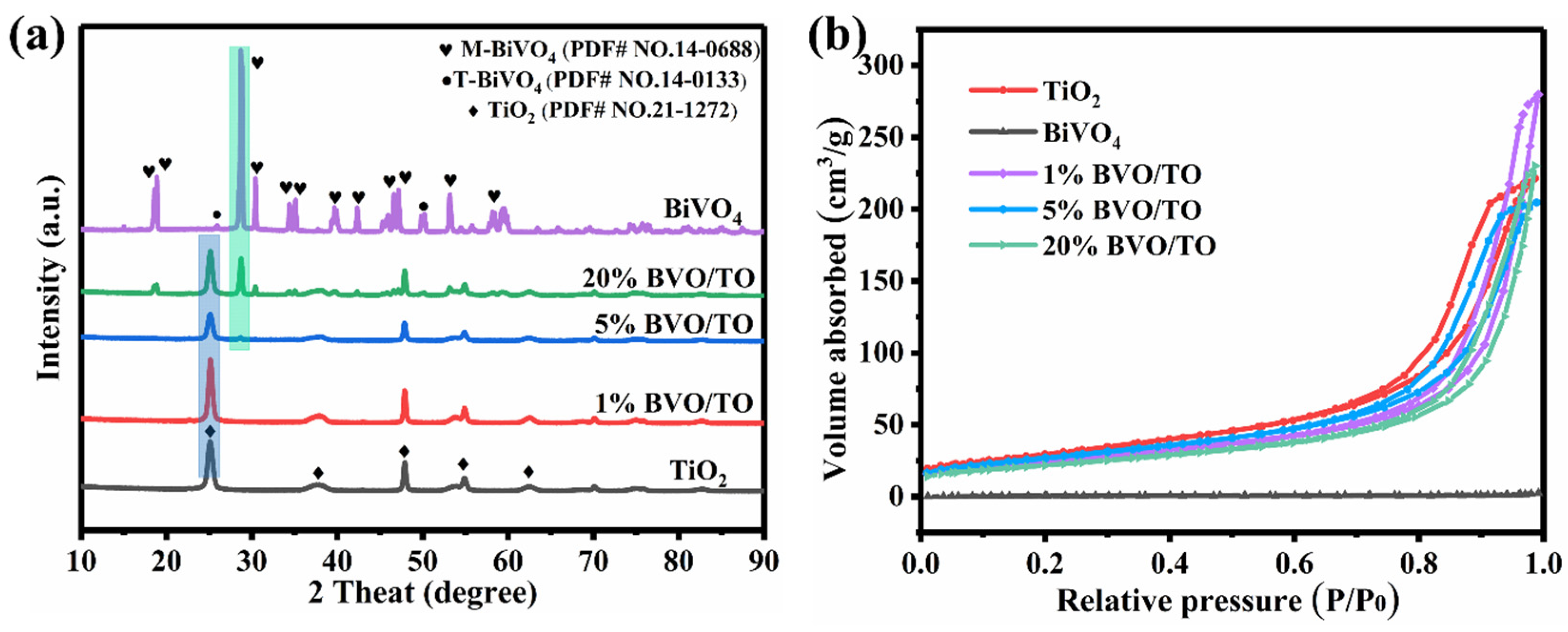
The crystal phases and structures of the prepared TiO2, BiVO4, 1% BVO/TO, 5% BVO/TO, and 20% BVO/TO catalysts were analyzed by XRD, as shown in Figure 2a. The TiO2 sample exhibited characteristic diffraction peaks at 25.2°, 37.8°, 48.1°, 55.1°, and 62.7°, corresponding respectively to the anatase (101), (004), (200), (211), and (204) crystal planes (JCPDS: 21-1272) [26]. In the BiVO4 sample, two phases were observed [22]: M-BiVO4 and T- BiVO4. The M-BiVO4 phase dominated, exhibiting diffraction peaks at 18.7°, 19.0°, 28.9°, 30.5°, 34.5°, 35.2°, 39.8°, 42.5°, 46.7°, 47.3°, 53.3°, and 58.5°, corresponding to the (110), (011), (121), (040), (200), (002), (211), (051), (240), (042), (161), and (321) planes (JCPDS: 14-0688), respectively. Additionally, characteristic diffraction peaks of the T-BiVO4 phase appeared at 24.3° and 48.0°, corresponding to the (200) and (312) crystal planes, respectively (JCPDS: 14-0133).
Figure 2.
(a) XRD spectra of TiO2, BiVO4, 5% BVO/TO sample; (b) N2 adsorption–desorption isotherm of TiO2, BiVO4, 5% BVO/TO sample.
For the composite BVO/TO catalysts, no characteristic peaks of BiVO4 were detectable in the 1% BVO/TO catalyst, likely due to low BiVO4 loading and limited crystallinity. In contrast, 5% BVO/TO and 20% BVO/TO catalysts exhibited partial characteristic peaks corresponding to M-BiVO4 but no detectable peaks for the T-BiVO4 phase. This result aligns with the HRTEM observations, suggesting the successful formation of BVO/TO heterostructures and indicating interactions between TiO2 and BiVO4.
Furthermore, the textural properties of TiO2, BiVO4, and the BVO/TO composite catalysts (1%, 5%, and 20%) were evaluated via N2 adsorption–desorption measurements, as illustrated in Figure 2b. All samples, except the BiVO4 sample, displayed type IV isotherms accompanied by distinct H3-type hysteresis loops, indicative of mesoporous structures [27]. Specific surface area, average pore size, and pore volume data for these catalysts are summarized in Table 1. The TiO2, BiVO4, 1% BVO/TO, 5% BVO/TO, and 20% BVO/TO catalysts possessed specific surface areas of 107.72, 1.90, 87.19, 98.48, and 77.94 m2/g, respectively. Correspondingly, their average pore sizes were 12.72, 7.38, 19.79, 12.86, and 18.26 nm, and pore volumes were 0.34, 0.01, 0.43, 0.32, and 0.36 cm3/g, respectively. Compared with pristine TiO2, all composite catalysts exhibited reduced specific surface areas due to partial overlap and integration between TiO2 and BiVO4 structures. Nevertheless, these composites maintained relatively large surface areas favorable for pollutant adsorption, enhancing their performance in photocatalytic degradation reactions [28].
Table 1.
BET specific surface areas, pore volumes and average pore diameter of TiO2, BiVO4 and 5% BVO/TO samples.
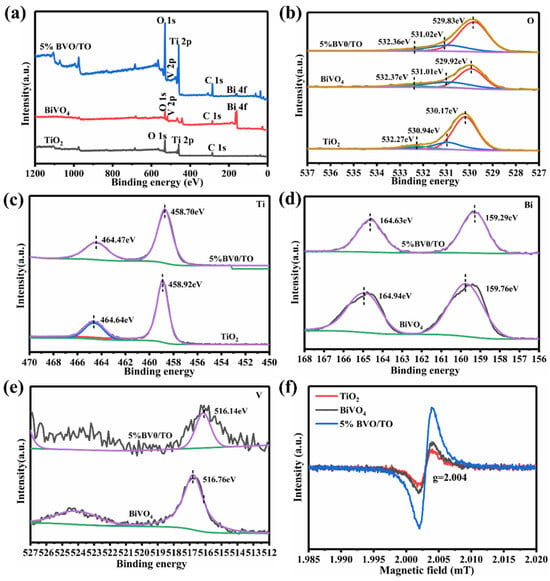
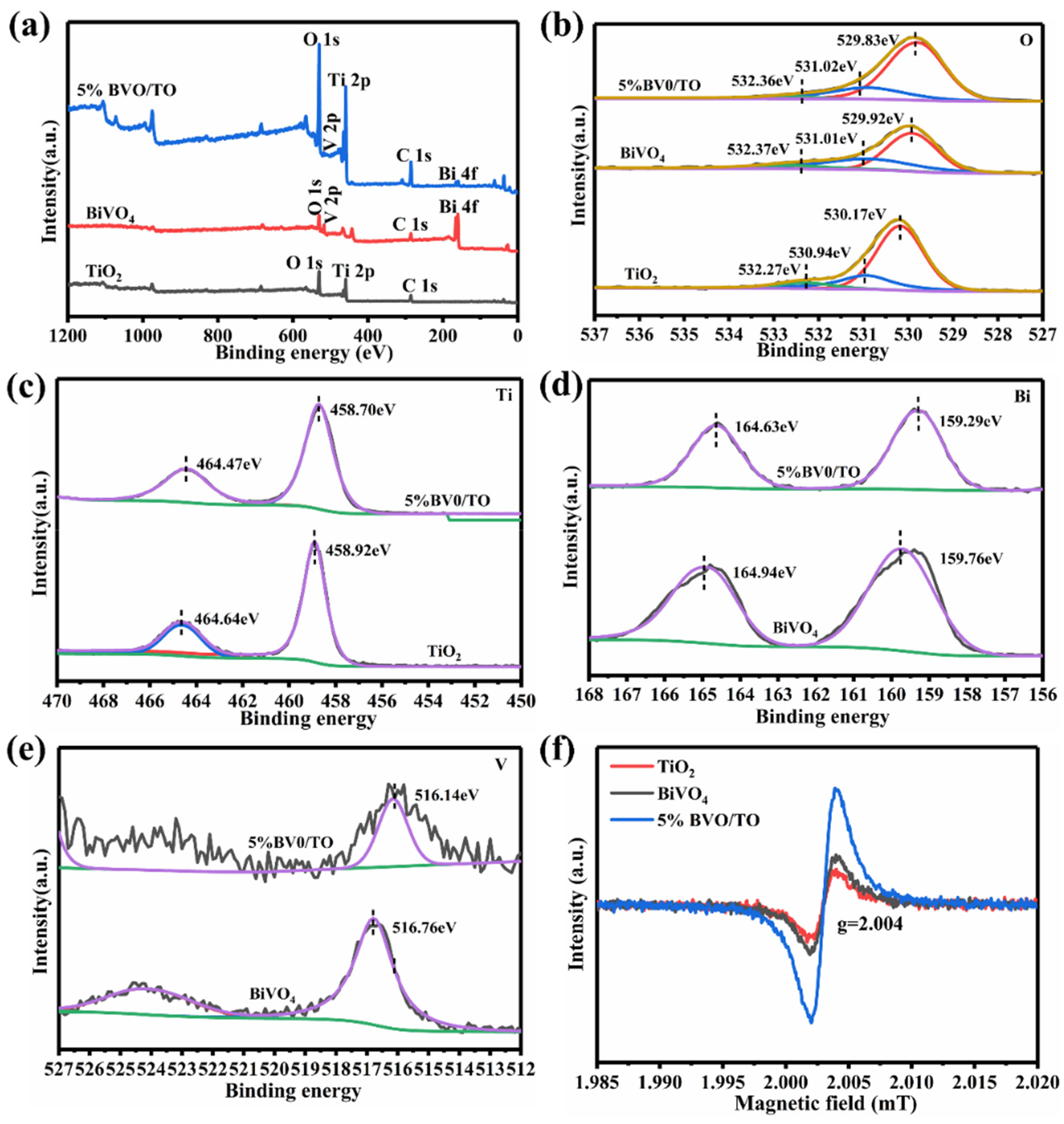
The chemical compositions and surface chemical states of the prepared TiO2, BiVO4, and 5% BVO/TO catalysts were investigated by XPS, with the results shown in Figure 3. Figure 3a presents the high-resolution survey spectra of all the samples. Ti, O, and C elements were detected in TiO2; Bi, V, O, and C in BiVO4; and Ti, Bi, V, O, and C simultaneously in the 5% BVO/TO composite catalyst, confirming the successful combination of TiO2 and BiVO4 in the composite.
Figure 3.
XPS spectra of TiO2, BiVO4, 5% BVO/TO: (a) full spectrum, (b) O 1s, (c) Ti 2p; (d) Bi 4f, (e) V 2p, (f) EPR spectra.
The high-resolution O 1s XPS spectra in Figure 3b were deconvoluted into three distinct peaks at approximately 529.83 eV, 531.01 eV, and 532.36 eV for the 5% BVO/TO composite catalyst, which corresponded to lattice oxygen, defective oxygen associated with oxygen vacancies, and adsorbed oxygen species, respectively [29]. Similar oxygen species were also detected in both pristine TiO2 and BiVO4 catalysts.
The Ti 2p spectrum for the 5% BVO/TO catalyst in Figure 3c shows two characteristic peaks located at 458.70 eV and 464.70 eV, assigned respectively to Ti 2p3/2 and Ti 2p1/2. These peaks matched closely with those observed for pristine TiO2, indicating that the valence state of Ti remained predominantly as Ti4+ after compositing [30].
The Bi 4f XPS spectrum in Figure 3d exhibited two prominent peaks at binding energies of 159.29 eV (Bi 4f7/2) and 164.44 eV (Bi 4f5/2) in the 5% BVO/TO composite catalyst, consistent with the Bi3+ oxidation state in BiVO4. The V 2p spectrum (Figure 3e) revealed a notable peak at approximately 516.64 eV, corresponding to V 2p3/2. The absence of a distinct V 2p1/2 peak near 524.00 eV was possibly due to the relatively low content of V in the composite catalyst [31].
Notably, the binding energies of Ti, Bi, and V in the 5% BVO/TO composite were shifted slightly compared to those in pure TiO2 and BiVO4, indicating interfacial charge transfer and electronic interaction between TiO2 and MT-BiVO4 components. The XPS results further confirmed the successful formation of the heterojunction structure in the 5% BVO/TO catalyst and suggested effective interfacial charge transfer.
Electron paramagnetic resonance (EPR) spectroscopy was performed to further analyze the presence of oxygen vacancies (OVs) in TiO2, BiVO4, and the 5% BVO/TO composite catalysts. As depicted in Figure 3f, all three samples exhibited a characteristic EPR signal at g = 2.004, confirming the existence of oxygen vacancies [32], in good agreement with the XPS observations. Importantly, the EPR signal intensity for the 5% BVO/TO composite was significantly stronger than those for the individual TiO2 and BiVO4 catalysts. This indicates an enhanced concentration of oxygen vacancies in the composite, which can facilitate visible-light absorption, improve charge carrier transfer, and serve as electron traps [33]. Consequently, these oxygen vacancies can promote the formation of superoxide radicals (·O2−), thus enhancing the photocatalytic degradation of organic pollutants.
3.3. Photocatalytic Performance
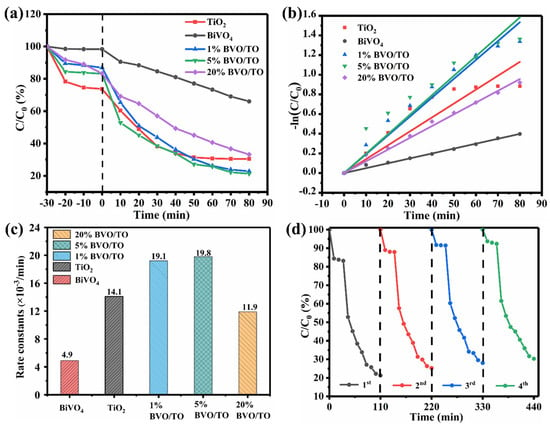
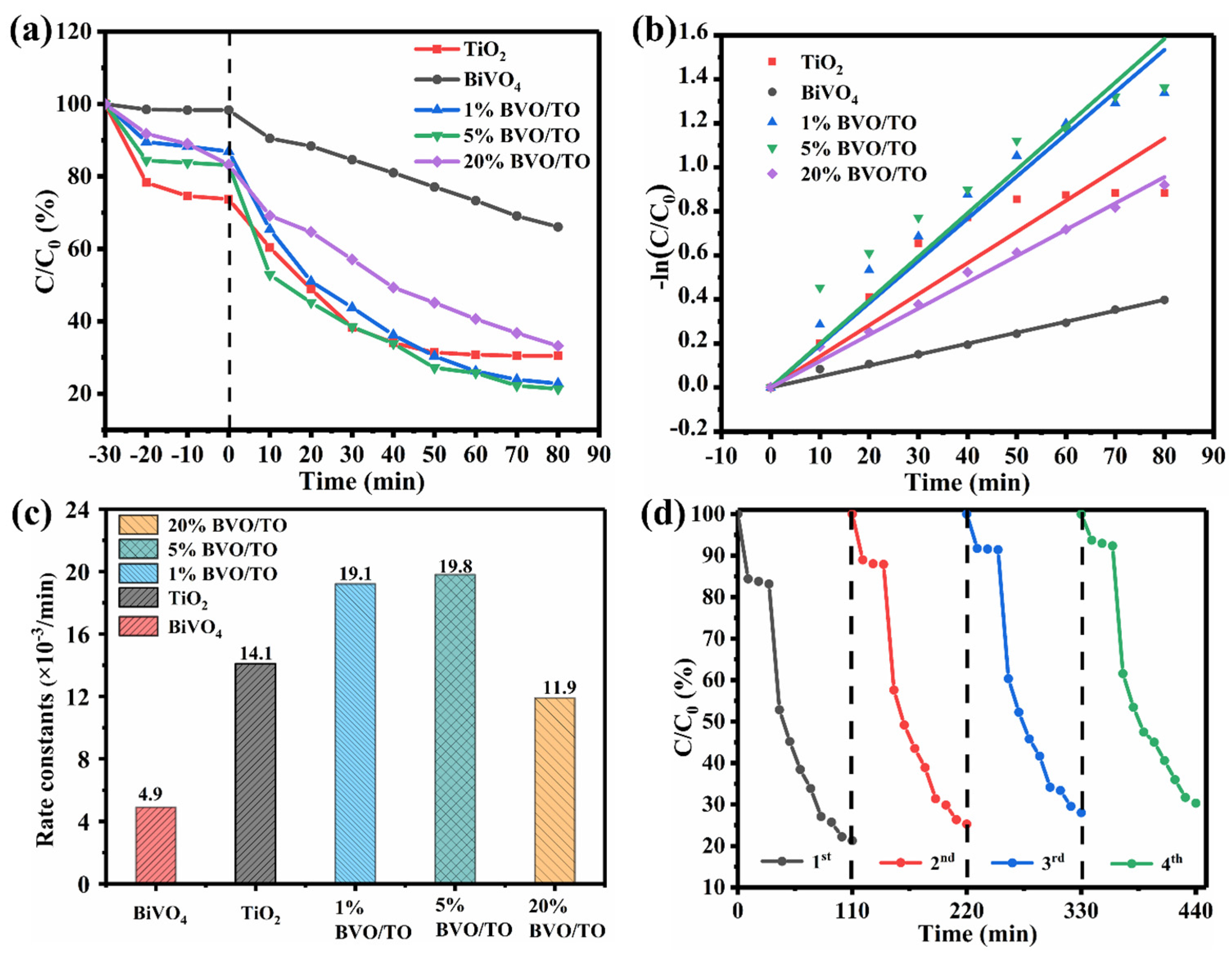
To assess visible-light-driven photocatalytic activity (>420 nm) toward antibiotic degradation, we selected tetracycline hydrochloride (20 mg L−1) as the target contaminant. We compared the performance of TiO2, BiVO4, and BVO/TO composites with 1%, 5%, and 20% BiVO4 loading. Prior to irradiation, each catalyst (50 mg) was equilibrated with the tetracycline solution under dark stirring to achieve adsorption–desorption equilibrium (Figure 4a). Control experiments confirmed that visible light alone exhibited negligible tetracycline degradation, indicating that any observed removal arises from photocatalysis rather than photolysis.
Figure 4.
(a) Photocatalytic degradation properties of the material. (b) Pseudo-first-order kinetic curves of the material degradation. (c) Photocatalytic degradation rate constants. (d) Cycle diagram of BVO/TO photocatalytic degradation of tetracycline hydrochloride.
Under visible-light irradiation for 80 min, TiO2 and BiVO4 achieved tetracycline removal efficiencies of 69.5% and 34.1%, respectively. The 1%, 5%, and 20% BVO/TO composites delivered 77.2%, 78.8%, and 66.9% removal, respectively. These results demonstrate that photocatalytic efficiency initially increases with BiVO4 content-peaking at 5% BiVO4 and then declines at higher loadings. The optimal 5% BVO/TO composite benefits from effective S-scheme heterojunction formation and oxygen-vacancy-mediated charge separation, whereas excessive BiVO4 (20%) introduces additional recombination centers that diminish carrier separation and reduce activity. The 5% BVO/TO heterojunction exhibits the highest photocatalytic degradation performance for tetracycline hydrochloride under visible light.
The photocatalytic degradation of tetracycline hydrochloride over the five catalysts was found to obey a quasi-first-order kinetic model based on Langmuir–Hinshelwood mechanism, as expressed by Equation (1) [34,35]:
where C0 and Ct are the pollutant concentration (mg L−1) at time zero and t minutes, respectively, and k (min−1) is the apparent rate constant. The linear fits (Figure 4b,c) yield rate constants of 0.0141 min−1 for TiO2 and 0.0049 min−1 for BiVO4. Among the composites, 5% BVO/TO exhibits the highest rate constant of 0.0198 min−1, 1.4 times greater than TiO2 and 4.0 times greater than BiVO4. The 1% BVO/TO and 20% BVO/TO catalysts also show enhanced kinetics (0.0191 min−1 and 0.0119 min−1, respectively), confirming that an optimal BiVO4 loading (5 wt%) in the S-scheme heterojunction maximizes photocatalytic performance.
To assess durability, the 5% BVO/TO catalyst was subjected to four consecutive tetracycline-degradation cycles under identical conditions (Figure 4d). After four cycles, the catalyst maintained over 70% degradation efficiency. A slight drop-in activity during the first two cycles stabilized by cycle four, likely due to minimal catalyst loss during recovery rather than intrinsic deactivation. These results demonstrate the excellent stability of the optimized 5% BVO/TO heterojunction for repeated photocatalytic applications.
3.4. Photocatalytic Mechanism
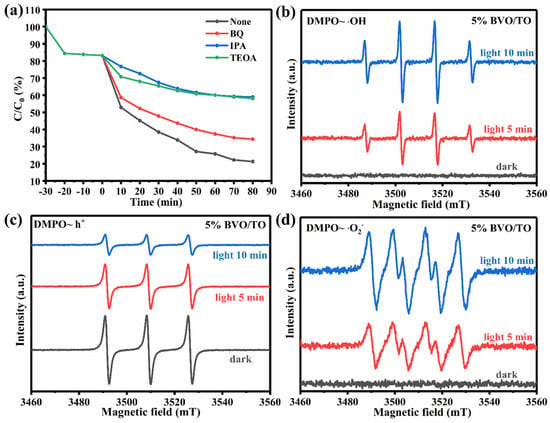
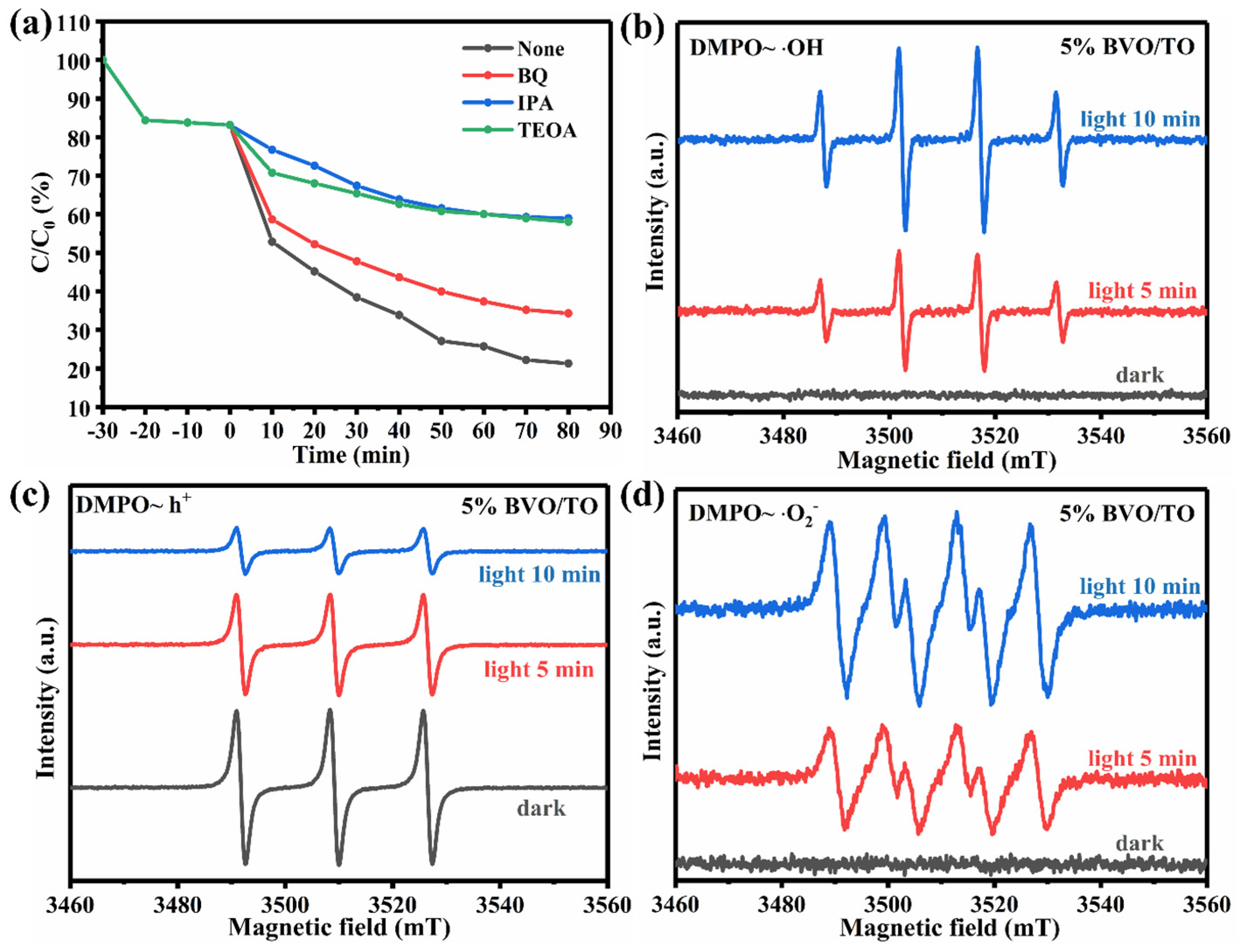
Free-radical scavenging experiments and EPR spectroscopy were employed to identify the reactive species responsible for tetracycline hydrochloride degradation over the 5% BVO/TO photocatalyst. Isopropanol (IPA), triethanolamine (TEOA), and benzoquinone (BQ) were used as scavengers for ·OH, h+, and ·O2−, respectively [36]. As shown in Figure 5a, adding IPA lowered the degradation efficiency from 78.8% to 42.0%, indicating a significant role for hydroxyl radicals. Introducing TEOA reduced the degradation efficiency to 42.9%, confirming that photogenerated holes are critical to the reaction. In contrast, BQ decreased efficiency only to 65.7%, demonstrating a secondary but still significant contribution from superoxide radicals. These results establish the hierarchy of active species in the 5% BVO/TO system as h+ > ·OH > ·O2−.
Figure 5.
(a) Free radical trapping experiments; (b–d) EPR spectra of DMPO~∙OH, DMPO~h+, DMPO~∙O2−.
Figure 5b–d presents EPR spin-trapping spectra recorded during the photocatalytic degradation of tetracycline hydrochloride over the 5% BVO/TO catalyst. ·OH radicals were undetectable in the dark. Upon visible-light irradiation, however, a characteristic quartet signal (intensity ratio 1:2:2:1) emerged after 5 min and further intensified at 10 min (Figure 5b), confirming light-induced ·OH formation. In contrast, the h+ spin adduct exhibited a strong signal in the dark that progressively diminished at 5 min and 10 min of irradiation (Figure 5c), indicating active consumption of photogenerated holes during the reaction. Finally, the ·O2− spectrum displayed no signal in the dark, but a triplet (1:1:1) appeared under illumination and grew in intensity over time (Figure 5d), verifying the generation of superoxide radicals. Collectively, these EPR results corroborate that ·OH, h+, and ·O2− are all key reactive species driving the photocatalytic degradation of tetracycline hydrochloride over the 5% BVO/TO S-scheme heterojunction.
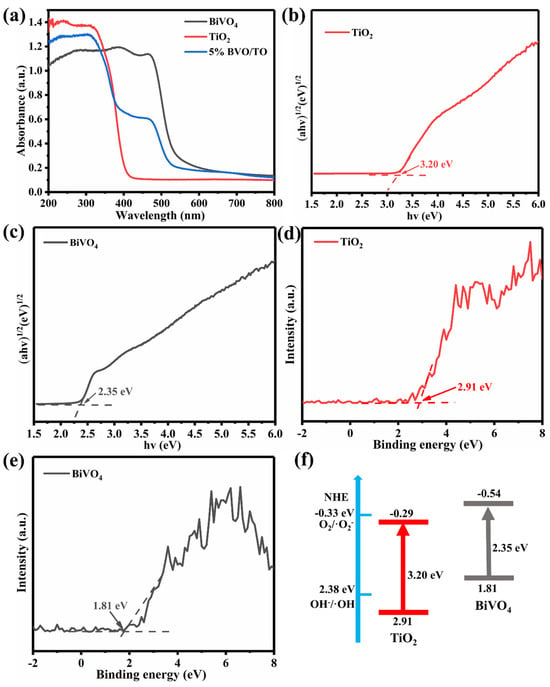
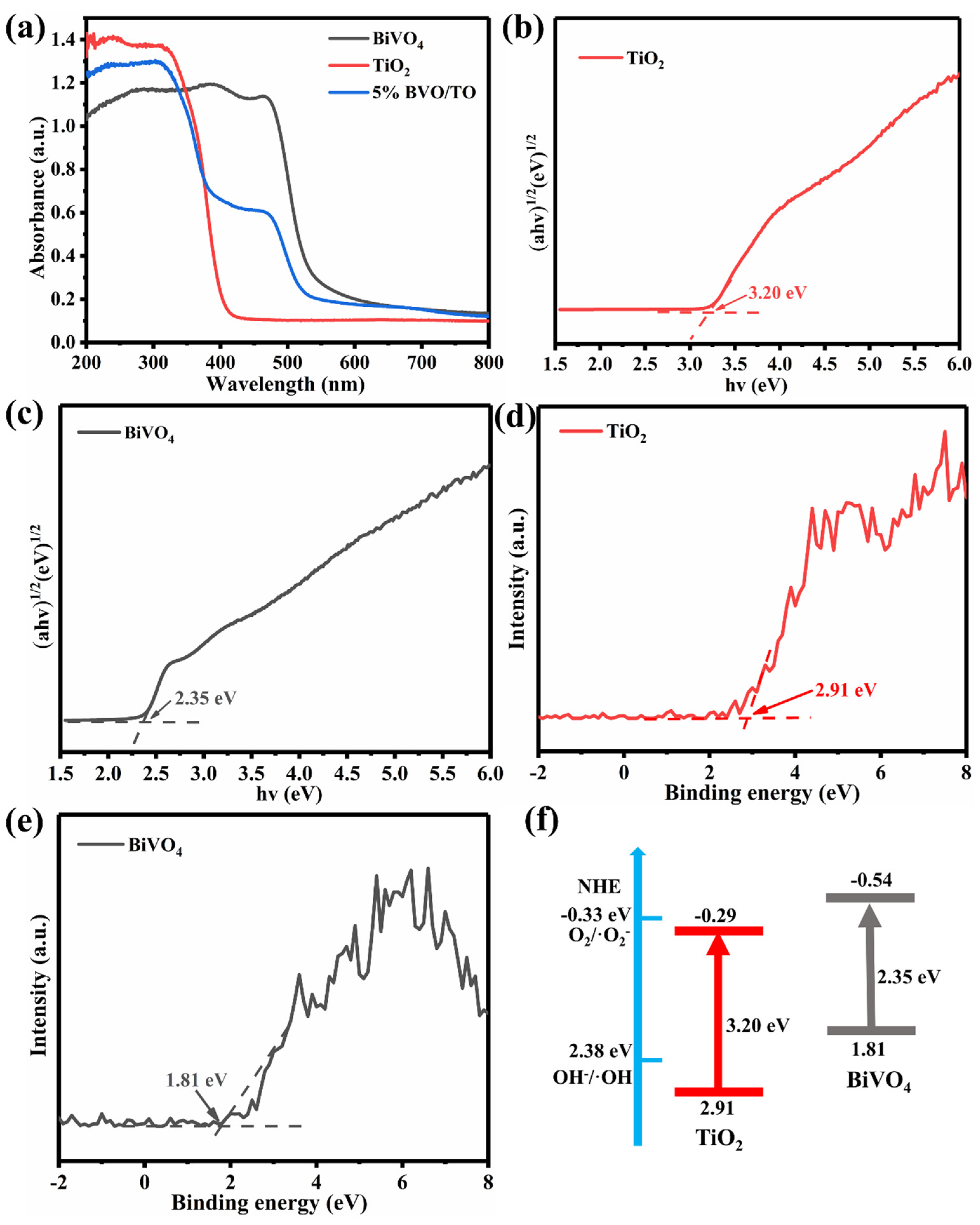
The optical absorption characteristics of TiO2, BiVO4, and the 5% BVO/TO composite were measured by UV~Vis diffuse reflectance spectroscopy (DRS) (Figure 6a). Pristine BiVO4 exhibits a visible-light absorption edge around 550 nm, whereas TiO2 absorbs only up to ca. 400 nm, confirming its ultraviolet-limited response. The 5% BVO/TO heterojunction shows a pronounced red shift relative to TiO2, extending its absorption well into the visible region due to the vigorous visible-light activity of BiVO4, which is one factor that contributes to the enhanced photocatalytic degradation of tetracycline hydrochloride.
Figure 6.
(a) UV-Vis DRS spectra of different samples; (b,c) band gap diagrams of BiVO4 and TiO2; (d,e) XPS-VB spectra of BiVO4 and TiO2; (f) energy band structure diagrams.
To further analyze the electronic band structures of TiO2 and BiVO4 catalysts, the band gap values were estimated according to Equation (2), and the results are shown in Figures. Figure 6b,c, with the band gaps of TiO2 and BiVO4 catalysts being 3.20 and 2.35 eV, respectively, and the valence bands of the TiO2 and BiVO4 catalysts were also tested by using VB-XPS, respectively, and the results are shown in Figure 6d,e. The analysis shows that the valence bands of TiO2 and BiVO4 catalysts are 2.91 and 1.81 eV, respectively. Then the conduction band positions of TiO2 and BiVO4 catalysts were calculated according to Equation (3), and the calculations show that the conduction band positions are −0.29 and −0.54 eV, respectively [37]. Therefore, we can get the energy band structures as shown in Figure 6f.
α, h, ν, e.g., and A in Equation (2) are the absorption coefficient, Planck’s constant (eV-s), optical frequency (s−1), bandgap energy (eV), and constant, respectively, and n = 1 for direct transition semiconductors. Equation ECB (eV) and EVB (eV) are the conduction and valence bands, respectively.
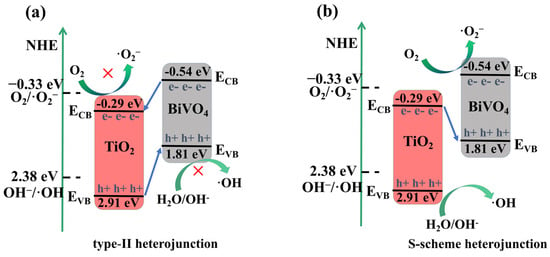
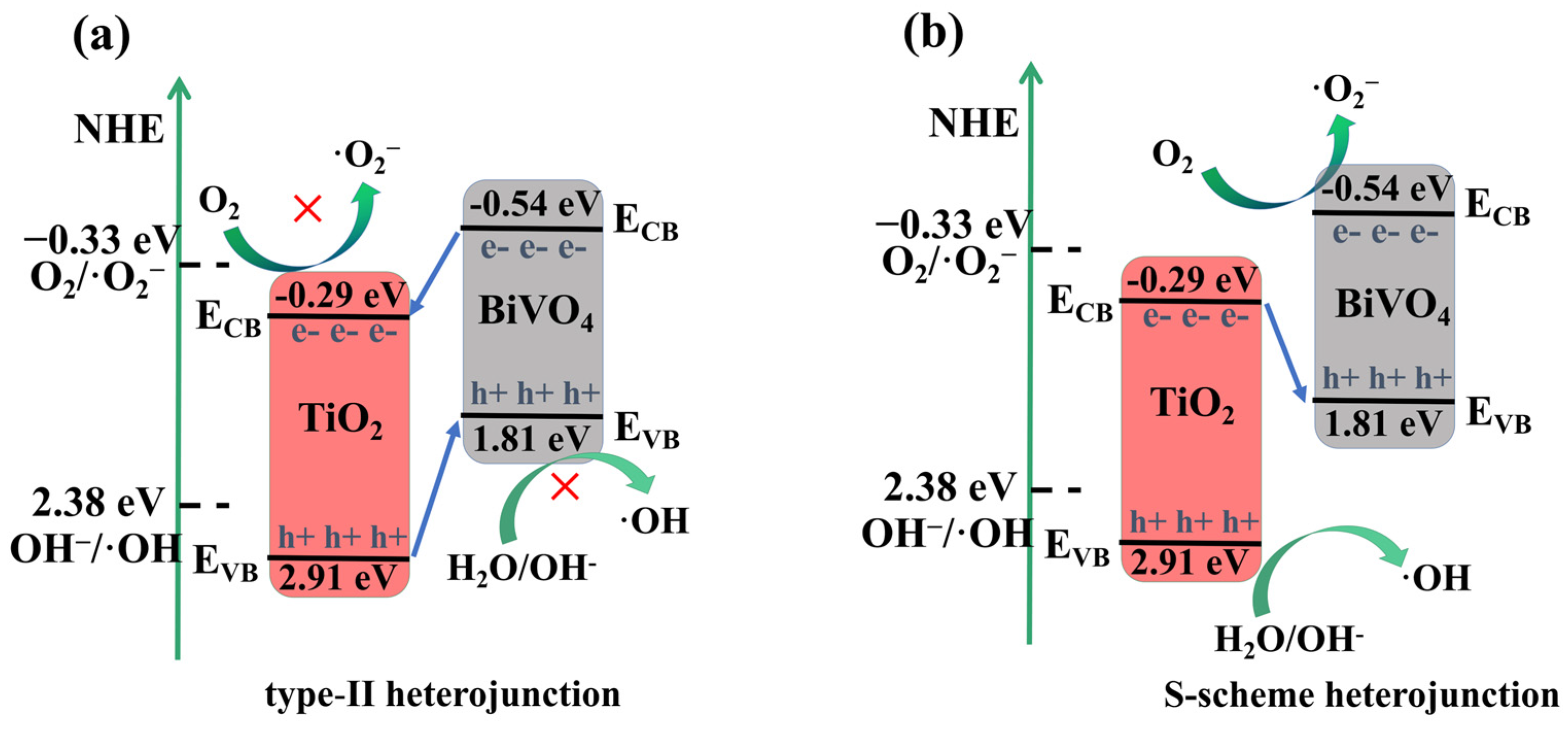
Combined with the energy band structures of TiO2 and BiVO4 determined above, a type II heterojunction or a type S heterojunction may be formed between TiO2 and BiVO4 [38]. If a type II heterojunction is formed between TiO2 and BiVO4, as in Figure 7a. When TiO2 and BiVO4 are photoexcited by visible-light irradiation, the photogenerated electrons are transferred to the top of their respective conduction bands, while photogenerated holes are left in the valence band position. At this time, the photogenerated electrons in the conduction band of BiVO4 will be transferred to the conduction band of TiO2, and the photogenerated holes on the valence band of TiO2 are transferred to the valence band of BiVO4. However, BiVO4 (1.81 eV vs. NHE) is more negative than OH−/·OH (2.38 eV vs. NHE), which suggests that the photogenerated holes in VB-BiVO4 are unable to oxidize OH− to ·OH radicals, and similarly, TiO2 (−0.29 eV vs. NHE) is more positive than O2/∙O2− (−0.33 eV vs. NHE), which indicates that the photogenerated electrons in CB-TiO2 cannot reduce O2 to ∙O2−, which is contrary to the results of free radical trapping experiments and EPR tests, so the formation of a type II heterojunction between TiO2 and BiVO4 is not valid.
Figure 7.
(a) Formation of II scheme heterojunction between BiVO4 and TiO2. (b) Formation of S-scheme heterojunction between BiVO4 and TiO2.
If the S-scheme heterojunction is formed between TiO2 and BiVO4, as in Figure 7b, when TiO2 and BiVO4 are photoexcited by visible-light irradiation, the photogenerated electrons are transferred to the top of their respective conduction bands, while photogenerated holes are left in the position of the valence band; at this time, the photogenerated electrons in the conduction band of TiO2 will be combined with the photogenerated charges on the valence band of BiVO4, and the photogenerated holes on the valence band of TiO2 and BiVO4 will be combined with photogenerated holes on the valence band of BiVO4. The photogenerated holes on the TiO2 valence band and the photogenerated electrons on the BiVO4 conduction band are retained individually, and the photogenerated holes on the TiO2 valence band can oxidize OH− to ·OH radicals, and the photogenerated electrons on the BiVO4 conduction band can reduce O2 to ∙O2− radicals, which is consistent with the results of the radical trapping experiments and the EPR tests, and so the formation of an S-scheme heterojunction between TiO2 and BiVO4 is established.
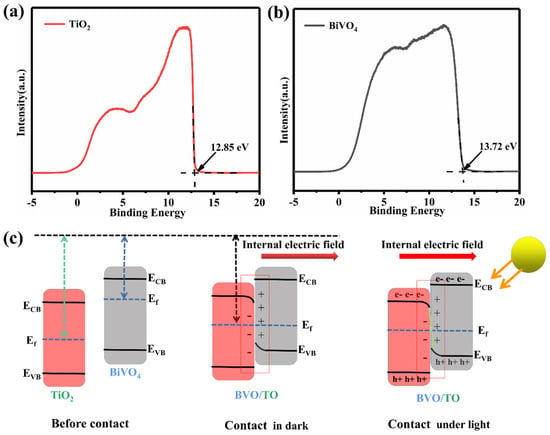
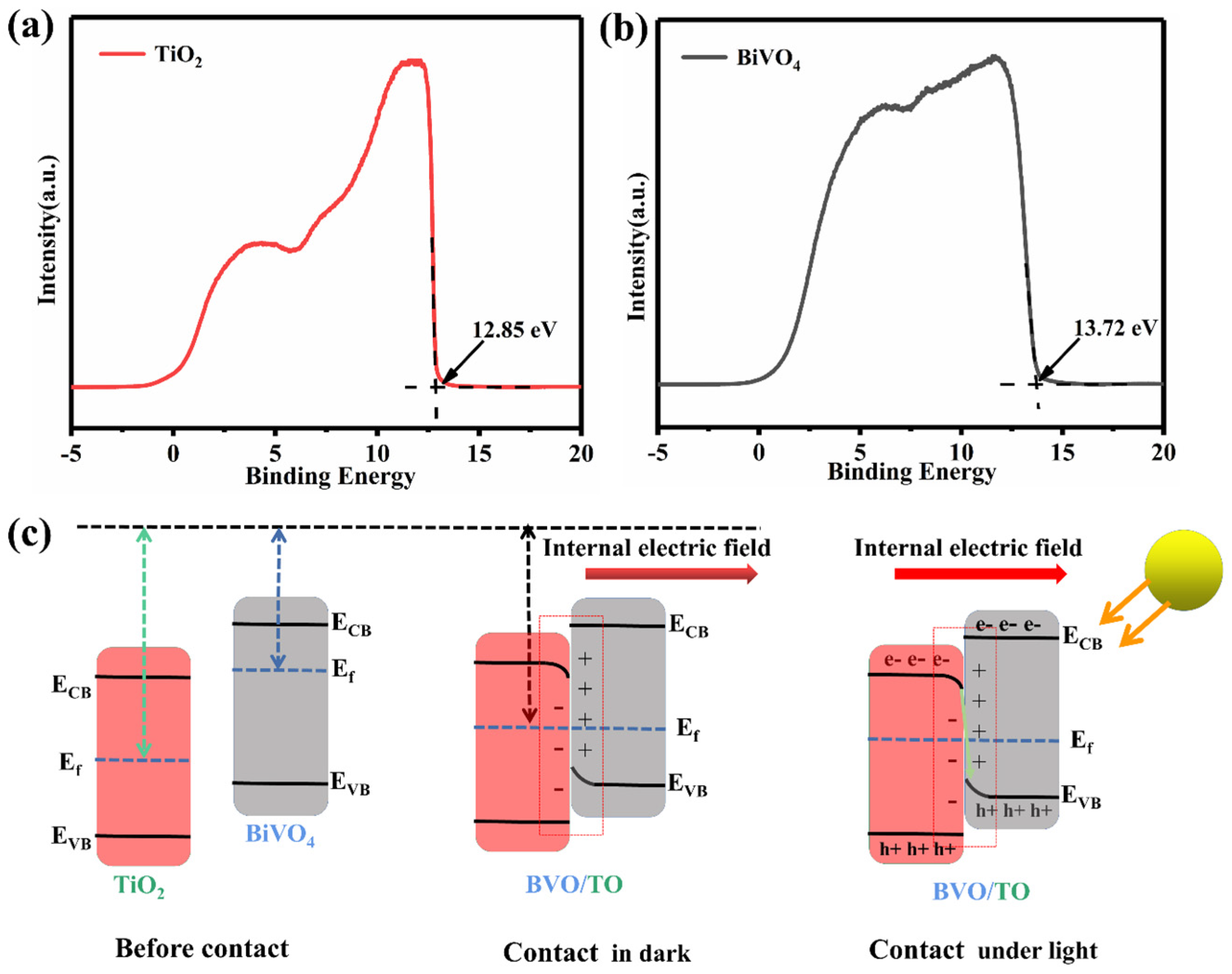
In order to further prove the formation of S-scheme heterojunction between TiO2 and BiVO4, we firstly determined the Ecutoff of TiO2 and BiVO4 by UPS [39], and the results are shown in Figure 8a,b; the Ecutoff values of TiO2 and BiVO4 are 12.85 eV and 13.72 eV, respectively, and then by Equation (4) the work function (Φ) is calculated.
Φ = 21.22 eV − Ecutoff
Figure 8.
UPS spectra of (a) TiO2, (b) BiVO4 and (c) formation of internal electric field S-scheme heterojunction.
According to the calculation, we can see that the work function of TiO2 and BiVO4 are 8.37 eV and 7.50 eV, respectively, which shows that TiO2 has a larger work function than BiVO4; then, the Fermi energy level of TiO2 is lower than the Fermi energy level of BiVO4. Thus, we deduce the S-scheme heterojunction formation process as shown in Figure 8c. The Fermi energy level of TiO2 is lower than that of BiVO4, and when TiO2 and BiVO4 are in contact, their Fermi energy levels in order to tend to equilibrium; then, the electrons will be transferred from BiVO4 to TiO2, which will form an internal electric field between them, with the BiVO4 side carrying a positive charge and TiO2 side with negative charge. When there is light irradiation, TiO2 and BiVO4 are excited by light to produce photogenerated electrons and photogenerated holes. Due to the existence of the internal electric field, the photogenerated electrons on TiO2 are transferred to the photogenerated holes of BiVO4 to reorganize under the influence of the electric field. Meanwhile, TiO2 retains the highly oxidative photogenerated holes, whereas BiVO4 retains the highly reductive photogenerated electrons. Overall, this charge-transfer process constitutes the BiVO4/TiO2 S-scheme heterojunction.
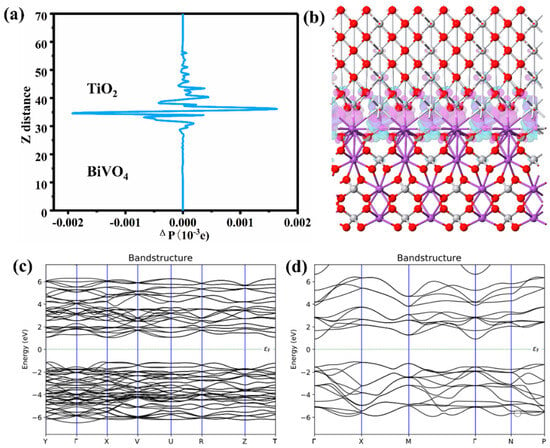
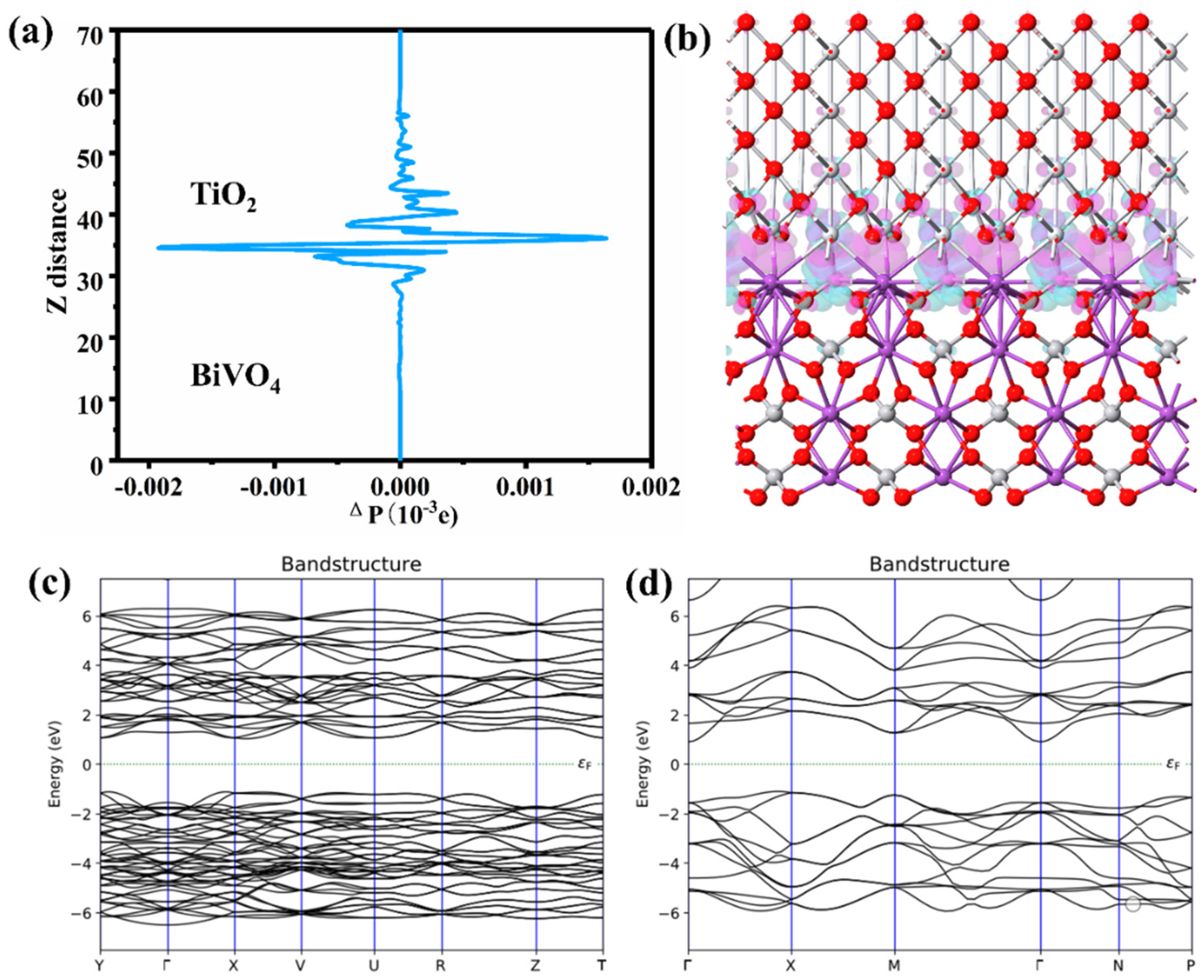
In order to explain the direction of electron transfer between TiO2 and BiVO4 from above the theoretical level, we calculated the difference in charge density in the Z direction perpendicular to the surface using density functional theory (DFT), respectively, and the results are shown in Figure 9a, where the positive and negative values represent the accumulation and depletion of the charge, respectively. After the formation of 5% BVO/TO S-scheme heterojunctions, the BiVO4 neighborhood of the electron depletion and electron accumulation near TiO2, while the calculated 3D isosurfaces of differential charge density correspond to it, as shown in Figure 9b, where the pink and blue colors represent electron gain and loss, respectively, which also indicates that the electrons will be transferred from BiVO4 to TiO2, in agreement with the previous experimental results. In addition to this, the band gap values of TiO2 and BiVO4 were further calculated using DFT. The calculated results are shown in Figure 9c,d. The theoretical energy bandgaps of TiO2 and BiVO4 are 2.46 and 2.18 eV, respectively. Compared with the experimentally determined results (the experimentally tested values of TiO2 and BiVO4 are 3.20 and 2.35 eV, respectively), the calculated values are slightly smaller, which may be due to the lack of an accurate exchange correlation function in the DFT method [40], but in general, the trends of the calculated and experimental values remain basically the same.
Figure 9.
(a) Difference in charge density perpendicular to the surface in the z-direction. (b) Three-dimensional isosurfaces of charge density. Theoretical energy band gaps of (c) TiO2 and (d) BiVO4.
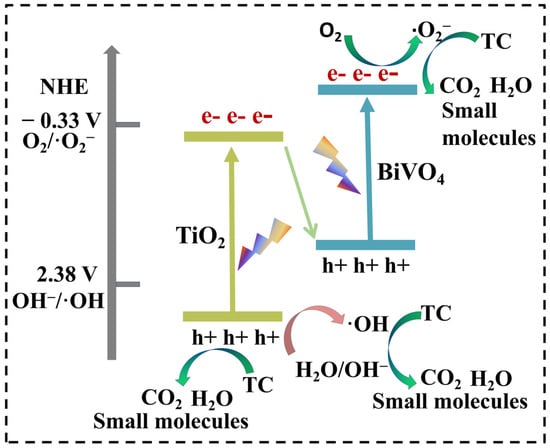
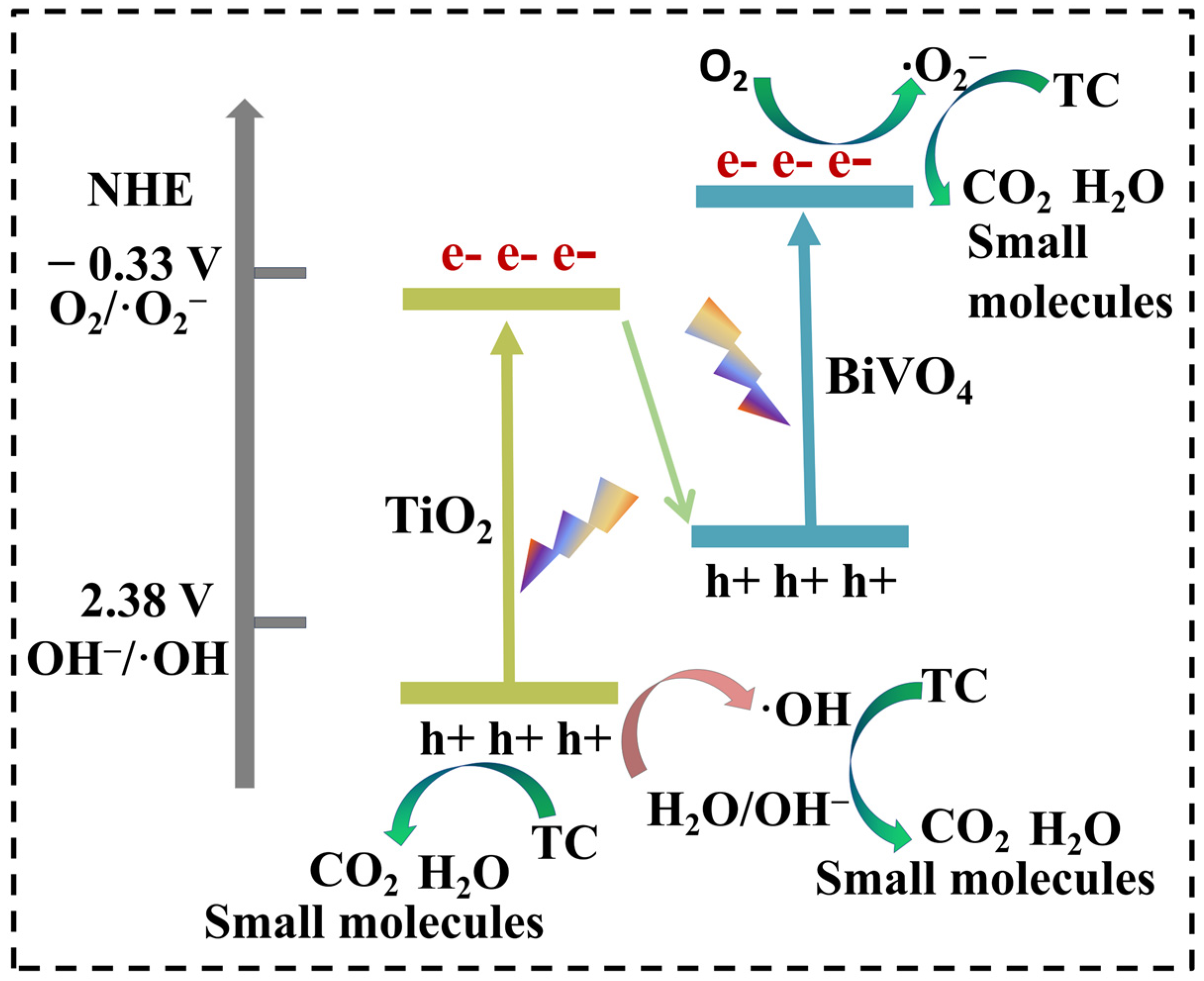
Based on the above experimental results and theoretical calculations, we propose the mechanism as shown in Figure 10. The BiVO4/TiO2 S-scheme heterojunction catalysts, under the action of visible light, the photogenerated electrons in TiO2 and BiVO4 jump from their respective valence bands to conduction bands under the excitation of light irradiation. Under the effect of built-in electric field, the photogenerated electrons of TiO2 combine with the photogenerated holes of BiVO4, and the TiO2 photogenerated holes can oxidize H2O/OH− to ·OH radicals, and the photogenerated electrons of BiVO4 can reduce O2 to ·O2− radicals, thus generating more active radicals [41]. Meanwhile the abundant oxygen vacancies can be used as traps for capturing photogenerated electrons, effectively inhibiting the recombination of photoexcited electron-hole pairs. Finally, ·OH, ·O2− and h+ will attack tetracycline hydrochloride to degrade it into CO2, H2O and some small molecules.
Figure 10.
Mechanism diagram of BVO/TO photocatalytic degradation of tetracycline hydrochloride.
4. Discussion
The OV-rich BiVO4/TiO2 S-scheme heterojunction (5% BVO/TO) was successfully synthesized via a solvothermal method, demonstrating superior visible-light photocatalytic activity for TCH degradation. Interfacial engineering analyses through HRTEM and XPS confirm intimate 2D/2D contact between BiVO4 blocks and TiO2 nanosheets, with lattice fringes corresponding to TiO2 (101, 0.351 nm) and BiVO4 (121, 0.312 nm). Oxygen vacancies, evidenced by an EPR signal at g = 2.004, are enriched at the interface, serving as electron traps to suppress charge recombination. The S-scheme charge transfer mechanism is validated by UPS and DFT calculations, which confirm the formation of a built-in electric field due to the work function difference (TiO2: 8.37 eV; BiVO4: 7.50 eV). This electric field drives the recombination of low-energy electrons (TiO2 conduction band) and holes (BiVO4 valence band), preserving high-potential holes (TiO2 valence band, +2.91 eV) for ·OH generation and electrons (BiVO4 conduction band, −0.54 eV) for ·O2− production. Radical trapping and in situ EPR experiments prove that h+, ·OH, and ·O2− collaboratively decompose TCH. The 5% BVO/TO achieves a high degradation rate constant (0.0198 min−1) and maintains over 70% efficiency after four cycles, attributed to its structural stability and OV-mediated charge separation. DFT calculations align with experimental band structures (TiO2: 3.20 eV; BiVO4: 2.35 eV) and confirm electron transfer from BiVO4 to TiO2 via charge density difference analysis. This work establishes a universal strategy for designing OV-enhanced S-scheme photocatalysts toward practical antibiotic remediation.
Author Contributions
Conceptualization, Q.W. and C.Z.; methodology, Q.W.; software, Y.T.; validation, Z.Z., M.G., Q.W. and X.Y.; data curation, T.L.; project administration, F.Y.; funding acquisition, F.Y., X.Z. and J.Y. All authors have read and agreed to the published version of the manuscript.
Funding
The authors would like to thank the financial support from Xinjiang Science and Technology Program (2023TSYCCX0118).
Data Availability Statement
The data supporting the findings of this study are available from the corresponding authors upon reasonable request.
Conflicts of Interest
The authors declare no conflicts of interest.
References
- Bhattarai, S.; Janaswamy, S. Biodegradable films from the lignocellulosic residue of switchgrass. Resour. Conserv. Recycl. 2024, 201, 107322. [Google Scholar] [CrossRef] [Scilit]
- Zhan, L.; Xia, Z.; Xu, Z.; Wang, Y.; Liu, H.; Chen, J.; Li, P. Study on the remediation of tetracycline antibiotics and roxarsone contaminated soil. Environ. Pollut. 2021, 271, 116312. [Google Scholar] [CrossRef] [Scilit] [PubMed]
- Zhu, G.; Wang, J.; Zhao, X.; Liu, Y.; Zhang, H.; Zhou, M. Effective removal of tetracycline antibiotics from water by in-situ nitrogen-doped porous biochar derived from waste antibiotic fermentation residues. J. Environ. Chem. Eng. 2024, 12, 114433. [Google Scholar] [CrossRef] [Scilit]
- Yu, H. Climate change unveils hidden microbial dangers. Environ. Sci. Ecotechnol. 2025, 24, 100544. [Google Scholar] [CrossRef] [Scilit] [PubMed]
- Li, R.; Liu, L.; Wu, H.C. Tunable Metal-Free COFs for Photocatalytic Degradation of Water Pollutants. ACS Appl. Mater. Interfaces 2025, 17, 26671–26678. [Google Scholar] [CrossRef] [Scilit] [PubMed]
- Lyu, C.; Zhang, L.; He, D.; Wang, X.; Guo, Y. Micrometer-sized NiOOH hierarchical spheres for enhanced degradation of sulfadiazine via synergistic adsorption and catalytic oxidation in peroxymonosulfate system. Chin. Chem. Lett. 2022, 33, 930–934. [Google Scholar] [CrossRef] [Scilit]
- Wang, Z.; Zeng, Y.; Tan, Q.; Lin, S.; Huang, J. Novel combination of iron-carbon composite and Fenton oxidation processes for high-concentration antibiotic wastewater treatment. J. Environ. Manag. 2024, 354, 120383. [Google Scholar] [CrossRef] [Scilit]
- Jin, Y.; Liu, T.; Mao, Y.; Li, F.; Hu, C. Enhancing the photocatalytic efficiency by the molecular modification effect derived from pollutant adsorption on highly crystalline BiOBr. J. Environ. Sci. 2025, 148, 263–273. [Google Scholar] [CrossRef] [Scilit]
- Ning, R.; Yu, S.; Li, L.; Wang, H.; Zhang, Y.; Li, J. Micro and nanobubbles-assisted advanced oxidation processes for water decontamination: The importance of interface reactions. Water Res. 2024, 265, 122295. [Google Scholar] [CrossRef] [Scilit] [PubMed]
- Xu, M.L.; Jiang, X.J.; Li, J.R.; Wang, F.J.; Li, K.; Cheng, X. Self-Assembly of a 3D Hollow BiOBr@Bi-MOF Heterostructure with Enhanced Photocatalytic Degradation of Dyes. ACS Appl. Mater. Interfaces 2021, 13, 56171–56180. [Google Scholar] [CrossRef] [Scilit] [PubMed]
- Sun, W.; He, Z.; Chen, Q.; Yang, X.D.; Chen, L.; Duan, J.; Ji, H.D.; Liu, W. Carbon quantum dots decoration induced spin polarization of potassium titanate nanotubes for enhanced photocatalytic degradation of naproxen. Appl. Catal. B Environ. Energy 2025, 371, 125247. [Google Scholar] [CrossRef] [Scilit]
- Lu, J.; Lan, L.; Liu, X.T.; Wang, N.; Fan, X.L. Plasmonic Au nanoparticles supported on both sides of TiO2 hollow spheres for maximising photocatalytic activity under visible light. Front. Chem. Sci. Eng. 2019, 13, 665–671. [Google Scholar] [CrossRef] [Scilit]
- Niknejad, P.; Azizi, S.M.M.; Hillier, K.; Gupta, R.K.; Dhar, B.R. Biodegradability and transformation of biodegradable disposables in high-solids anaerobic digestion followed by hydrothermal liquefaction. Resour. Conserv. Recycl. 2023, 193, 106979. [Google Scholar] [CrossRef] [Scilit]
- Sun, K.; Zhang, C.; Yang, C.; Liu, D.D.; Wang, Y.Q.; Li, X.H.; Zhao, L.; Zhou, J.; Wang, H.; Chen, L.; et al. A review on conductive polymers-modified TiO2 photocatalyst for environmental remediation. J. Environ. Chem. Eng. 2025, 13, 116518. [Google Scholar] [CrossRef] [Scilit]
- Wang, W.; Li, B.; Shi, J.; Zhu, K.; Zhang, Y.; Liu, X.; Li, C.; Hu, F.; Xi, X.; Kawi, S. High-efficiency photocatalytic hydrogen and oxygen evolution properties by Z-scheme electron transfer in BiVO4/C3N5 heterostructure. Appl. Catal. B Environ. Energy 2025, 362, 124766. [Google Scholar] [CrossRef] [Scilit]
- Zhang, D.; Hao, J.; Wan, P.; Zhang, D.; Sun, Q.; Liu, Z.J.; Li, F.F.; Fang, H.T.; Wang, Y. Synergy of charge pre-separation and direct Z-scheme bridge in BiVO4{040}/Ag6Si2O7 photocatalyst boosting organic pollutant degradation. Appl. Surf. Sci. 2020, 513, 145832. [Google Scholar] [CrossRef] [Scilit]
- Long, X.; Shen, C.; Wei, J.; Zhou, X. Both Hole Transfer and Cocatalysis Exhibited by Organometallic Complexes for Enhancing Water-Splitting Performance of the Photoreducing BiVO4 Photoanode. ACS Appl. Energy Mater. 2025, 8, 1700–1708. [Google Scholar] [CrossRef] [Scilit]
- Zhang, B.; Wu, W.; Yin, G.; Li, S. A Multifunctional Synergistic Solar-Driven Interfacial Evaporator for Desalination and Photocatalytic Degradation. ACS Appl. Mater. Interfaces 2025, 17, 6948–6956. [Google Scholar] [CrossRef] [Scilit] [PubMed]
- Xin, Y.; Tian, J.; Xiong, X.; Wu, C.; Carabineiro, S.A.C.; Li, R. Enhanced Photocatalytic Efficiency Through Oxygen Vacancy-Driven Molecular Epitaxial Growth of Metal–Organic Frameworks on BiVO4. Adv. Mater. 2025, 37, 2417589. [Google Scholar] [CrossRef] [Scilit]
- Tian, K.; Xu, Z.; Yang, H.; Zhang, T.; Liu, S.; Wang, Y.; Li, X.; Zhou, H. Interfacial Engineering-Assisted Energy Level Modulation Enhances the Photoelectrochemical Water Oxidation Performance of Bismuth Vanadate Photoanodes. Adv. Energy Mater. 2024, 15, 2404477. [Google Scholar] [CrossRef] [Scilit]
- Chen, W.-W.; Huang, F.-F.; Qu, Q.-Y.; Li, L.; Jia, J.-F.; Wang, D.-S.; Li, Y.-D. Construction of BiVO4/CdS Z-type heterojunction for sunlight-driven degradation of quinolone antibiotics. Rare Met. 2025, 44, 3970–3980. [Google Scholar] [CrossRef] [Scilit]
- Baral, B.; Reddy, K.H.; Parida, K.M. Construction of M-BiVO4/T-BiVO4 isotype heterojunction for enhanced photocatalytic degradation of Norfloxacine and Oxygen evolution reaction. J. Colloid Interface Sci. 2019, 554, 278–295. [Google Scholar] [CrossRef] [Scilit] [PubMed]
- Wang, Q.; Tang, Y.; Li, Y.; Li, T.; Wang, C.; Yu, F. 2D/2D SnOx/TiO2 Z-scheme heterojunction with oxygen vacancies for boosted photocatalytic performance and mechanistic insight. Appl. Surf. Sci. 2024, 668, 160436. [Google Scholar] [CrossRef] [Scilit]
- Wu, X.; Fu, M.; Lu, P.; Ren, Q.Y.; Wang, C. Unique electronic structure of Mg/O co-decorated amorphous carbon nitride enhances the photocatalytic tetracycline hydrochloride degradation. Chin. J. Catal. 2019, 40, 776–785. [Google Scholar] [CrossRef] [Scilit]
- Mohamed, R.M.; Mkhalid, I.A.; Shawky, A. Facile synthesis of Pt–In2O3/BiVO4 nanospheres with improved visible-light photocatalytic activity. J. Alloys Compd. 2019, 775, 542–548. [Google Scholar] [CrossRef] [Scilit]
- Sangare, S.; Belaidi, S.; Belahlou, K.; Bouaziz, C.; Seraghni, N.; Sehili, T. Metoprolol removal and mineralization by TiO2 and iron pillared clay nanocomposite: Impact of operating parameters, water matrices, and solar light. J. Environ. Manag. 2025, 386, 125781. [Google Scholar] [CrossRef] [Scilit]
- Ahmadi, M.; Alavi, S.M.; Larimi, A. Highly active platinum decorated BiVO4 nanosheet/TiO2 nanobelt heterojunction for photocatalytic CO2 reduction. Surf. Interfaces 2024, 45, 103908. [Google Scholar] [CrossRef] [Scilit]
- Yang, J.; Chen, D.; Zhu, Y.; Zhang, L.; Dong, F. 3D-3D porous Bi2WO6/graphene hydrogel composite with excellent synergistic effect of adsorption-enrichment and photocatalytic degradation. Appl. Catal. B Environ. 2017, 205, 228–237. [Google Scholar] [CrossRef] [Scilit]
- Luo, H.; Zhan, C.; Uddin, A.; Jiang, F.; Chen, H. Oxygen Vacancy-Mediated unraveling active species sources in BiO2-x Catalysts: The significance of lattice and molecular oxygen in catalytic reaction in aqueous solution. Chem. Eng. J. 2024, 483, 149144. [Google Scholar] [CrossRef] [Scilit]
- He, Y.; Sun, Q.; Sun, L.; Gan, Z.; Yu, L.; Dong, L. Design and mechanism insight on SiC quantum dots sensitized inverse opal TiO2 with superior photocatalytic activities under sunlight. Front. Chem. Sci. Eng. 2023, 17, 1913–1924. [Google Scholar] [CrossRef] [Scilit]
- Harris-Lee, T.R.; Surman, M.K.; Straiton, A.J.; Marken, F.; Johnson, A.L. Precursor Development and Aerosol-Assisted Chemical Vapour Deposition for BiVO4 and W-Doped BiVO4 Photoanodes: A Universal Ligand Approach. ChemSusChem 2024, 18, e202401452. [Google Scholar] [CrossRef] [Scilit] [PubMed]
- Li, G.; Huang, R.; Zhu, C.; Jia, G.; Zhang, S.L.; Zhong, Q. Effect of oxygen vacancies and its quantity on photocatalytic oxidation performance of titanium dioxide for NO removal. Colloids Surf. A Physicochem. Eng. Asp. 2021, 614, 126156. [Google Scholar] [CrossRef] [Scilit]
- Zhang, M.; Lai, C.; Li, B.; Huang, D.L.; Liu, S.Y.; Qin, L.; Yi, H.; Fu, Y.K.; Xu, F.H.; Li, M.F.; et al. Ultrathin oxygen-vacancy abundant WO3 decorated monolayer Bi2WO6 nanosheet: A 2D/2D heterojunction for the degradation of Ciprofloxacin under visible and NIR light irradiation. J. Colloid Interface Sci. 2019, 556, 557–567. [Google Scholar] [CrossRef] [Scilit] [PubMed]
- You, C.; Zhang, X.; Zhao, Y.; Yan, R.Y.; Shen, Y.W.; Xue, Q.Q.; Li, W.Y.; Liu, T.; Jiang, J.H.; Chen, X.B.; et al. Plasmonic effect augmented S-scheme mechanism in Ag/Ag2O/C3N5 photocatalyst enables efficient photocatalytic degradation of antibiotics. J. Mater. Sci. Technol. 2026, 242, 64–74. [Google Scholar] [CrossRef] [Scilit]
- Trifoglio, A.; Tunioli, F.; Favaretto, L.; Zambianchi, M.; Bettini, C.; Manet, I.; Mariani, L.; Barra Caracciolo, A.; Grenni, P.; Di Sante, M.; et al. Alginate–oligothiophene aerogels as photocatalysts for the degradation of emerging organic contaminants in water. J. Mater. Chem. A 2025, 13, 4587–4599. [Google Scholar] [CrossRef] [Scilit]
- Mladenova, R.B.; Aleksieva, K.; Taneva, S.; Sabotinov, O.; Teneva, D. EPR characterization of the gamma irradiation effect on antiradical activity and free radicals generation of dried rosehip (Rosa canina L.) seeds. J. Food Meas. Charact. 2023, 18, 529–537. [Google Scholar] [CrossRef] [Scilit]
- Zhu, Y.; Ji, H.; He, K.; Blaney, L.; Xu, T.Y.; Zhao, D.Y. Photocatalytic degradation of GenX in water using a new adsorptive photocatalyst. Water Res. 2022, 220, 118650. [Google Scholar] [CrossRef] [Scilit] [PubMed]
- Zhang, Y.; Cui, Z.; Yuan, R.; Chen, H.; Zhou, B. Novel inorganic/organic Z-scheme heterojunction rGO@PANI/SnO2 with enhanced photocatalytic activity for degradation of sulfadiazine. Process Saf. Environ. Prot. 2025, 195, 106744. [Google Scholar] [CrossRef] [Scilit]
- Titov, V.V.; Lisachenko, A.A.; Akopyan, I.K.; Labzowskaya, M.E.; Novikov, B.V. On the nature of the effect of adsorbed oxygen on the excitonic photoluminescence of ZnO. J. Lumin. 2018, 195, 153–158. [Google Scholar] [CrossRef] [Scilit]
- Lin, Y.M.; Cheng, W.W.; Zhang, L.C.; Chen, X.-F.; Chen, R.; Wang, S.; Yang, Q.; Wang, J.; Xiao, J.-D. Defects Calculation and Accelerated Interfacial Charge Transfer in a Photoactive MOF-Based Heterojunction. Small 2025, 21, 2411388. [Google Scholar] [CrossRef] [Scilit]
- Li, W.; Meng, A.; Li, Z.; Xiong, G.; Li, Z.; Zhang, J. CeO2/WO2.72 nanocomposites with S-scheme heterojunctions and oxygen vacancies for enhanced photocatalytic degradation of dichlorvos. J. Mater. Sci. Technol. 2025, 242, 200–212. [Google Scholar]

Disclaimer/Publisher’s Note: The statements, opinions and data contained in all publications are solely those of the individual author(s) and contributor(s) and not of MDPI and/or the editor(s). MDPI and/or the editor(s) disclaim responsibility for any injury to people or property resulting from any ideas, methods, instructions or products referred to in the content. |
© 2026 by the authors. Licensee MDPI, Basel, Switzerland. This article is an open access article distributed under the terms and conditions of the Creative Commons Attribution (CC BY) license.