


Abstract
Aquaculture intensification increases waste generation, whose composition may influence methane emissions. This study evaluated the effects of dietary protein and energy sources on nutrient digestibility and the methane production potential of Nile tilapia feces. Nine experimental diets were tested in digestibility assays: one reference diet (RD) and eight test diets containing 80% RD and 20% of an animal or plant ingredient. Feces were collected and subjected to batch anaerobic digestion. Soybean meal and meat and bone meal diets showed the highest apparent digestibility coefficients (ADC) for dry matter (84.1 and 82.6%) and energy (87.3 and 87.9%), whereas poultry by-product meal presented the lowest values. Crude protein digestibility ranged from 78.74% for blood meal diet to 94.3% for soybean meal diet. Feces from poultry by-product meal generated the highest methane potential (260.9 L kg−1 VS), whereas blood meal exhibited the highest methane production per unit of COD removed (310.5 mL g−1 reduced COD). After 10 days, poultry by-product meal accumulated the highest biogas volume, while soybean meal and blood meal showed the lowest. Principal component analysis suggested inverse relationships between nutrient digestibility and fecal biodegradability. Overall, dietary composition influenced nutrient digestibility, physicochemical characteristics of fish feces, and their methane generation potential. This integrated assessment suggests that feed formulation could contribute to strategies aimed at reducing the methane generation potential of aquaculture wastes.
1. Introduction
The growing demand for high-quality protein sources, coupled with the need for more sustainable production systems, has driven the expansion of aquaculture in Brazil [1]. In this context, Nile tilapia (Oreochromis niloticus) stands out as the main fish species farmed in the country, with production reaching record levels in recent years [2]. Because feed represents one of the major costs in intensive aquaculture systems, the evaluation of alternative protein and energy ingredients is essential to reduce dependence on conventional feedstuffs and improve diet formulation strategies [3]. As aquaculture continues to expand, fishmeal (FM), one of the major feed ingredients used in fish diets, has become an increasingly expensive and potentially limited resource, further intensifying the search for nutritionally valuable alternative ingredients [3].
The nutritional value of fish diets is commonly assessed using apparent digestibility coefficients (ADCs), which indicate the proportion of nutrients and energy effectively utilized by the animal [4]. The replacement of FM with plant-based [5] and animal-derived ingredients [4] has shown promising results, improving dietary ADCs and, in some cases, increasing production yield per kilogram of fish produced [6]. Diets with higher digestibility can improve feed efficiency and reduce the excretion of undigested organic matter and nutrients into the aquatic environment [7]. Conversely, ingredients with lower digestibility may increase the amounts of organic matter, nitrogen, and phosphorus excreted in feces [7], thereby increasing the organic load of aquaculture effluents and the need for appropriate residue management strategies.
The residues generated during fish production should not be regarded solely as an environmental liability but also as a biomass stream, as nutrients that are not assimilated by fish are ultimately transferred to the fecal fraction. Thus, the effects of diet composition extend beyond nutrient utilization and fish performance, potentially influencing both the quantity and characteristics of residues generated during production [8], as well as their potential for subsequent valorization. Despite the growing interest in sustainable aquaculture nutrition and residue valorization, nutritional studies in aquaculture have predominantly focused on digestibility and productive performance [4,5,6], whereas the implications of dietary differences for the characteristics and bioenergy potential of the resulting fecal residues have received comparatively limited attention [8].
Fish feces constitute a nutrient-rich organic residue with potential for treatment and valorization through anaerobic digestion, followed by the use of the resulting biofertilizer in agriculture [9]. This process promotes the microbial degradation of organic matter under anaerobic conditions, enabling both nutrient recovery through the digestate and energy recovery through the production of biogas and methane [10]. Moreover, the anaerobic digestion of feces generated under different dietary conditions may provide complementary insights into how feed formulations influence not only nutrient utilization by fish but also the bioenergy potential of the resulting residues. However, studies integrating diet composition, nutrient digestibility, fecal residue characterization, and the bioenergy potential of these residues remain limited, particularly for waste streams generated in aquaculture systems.
An integrated assessment of these processes can provide a broader understanding of production efficiency in fish farming by connecting the different stages of the production chain, from feed intake and nutrient utilization by fish to the subsequent management and valorization of the resulting residues. Therefore, this study aimed to evaluate different protein and energy ingredients in diets for Nile tilapia, considering their effects on nutrient digestibility, the characteristics of the residues generated, and the bioenergy potential of feces through anaerobic digestion.
2. Materials and Methods
2.1. Diets
A reference diet (Rd) was formulated to meet the nutritional requirements of Nile Tilapia, containing approximately 13.5 kJ g−1 of digestible energy and 30% of crude protein [10]. To evaluate the effect of the test ingredient, the experimental diets were formulated by replacing 20% of the reference diet with the test ingredient, resulting in test diets composed of 80% reference diet and 20% test ingredient [11]. The evaluated ingredients comprised five protein sources: fish meal (FMd), soybean meal (SBMd), poultry by-product meal (PMd), meat and bone meal (MBMd), and blood meal (BMd), and three energy sources: corn meal (CMd), broken rice (BRd), and wheat bran (WBd). Chromium oxide was added to the diets at a level of 0.20% as an inert marker to determine the apparent digestibility coefficients [12]. The composition and proximate analyses (dry-matter basis) of these diets are given in Table 1.
Table 1.
Composition of diets fed Nile tilapia during the experiment.
The experimental diets were manufactured at the Aquatic Species Nutrition Laboratory (LABNUTRI, at the Federal University of Santa Catarina, Florianópolis, Brazil), using a laboratory-scale single-screw extruder (Model MX40; Inbramaq, Ribeirão Preto, SP, Brazil) to produce 4 mm sinking pellets. After extrusion, the pellets were dried in a forced-air circulation oven at 55 °C for 4 h, cooled to room temperature, packaged in hermetically sealed containers, and stored under refrigerated conditions until use [12].
2.2. Fish, Rearing Conditions, Feces Collection and Digestibility Measurements
The experiment was conducted at Embrapa Agropecuária Oeste, Dourados, MS, Brazil (22°16′ S, 54°49′ W, altitude of 408 m). The laboratory operates an indoor recirculating aquaculture system equipped with a plastic-bead biofilter coupled to a sand-filtering system, controlled aeration, temperature, and photoperiod.
Two growth phases of sex-reversed male Nile tilapia (Oreochromis niloticus) were evaluated. During Phase I, 135 fish (127.6 ± 23.0 g) were randomly distributed into nine conical fiberglass tanks (400 L) fitted with feces collectors adapted from the modified Guelph system [13]. Water temperature, pH, and dissolved oxygen averaged 26.3 ± 0.8 °C, 7.67 ± 0.0, and 6.0 ± 0.3 mg L−1, respectively. During Phase II, 90 fish (454.6 ± 31.5 g) were maintained in the same recirculating system under identical management and feces collection procedures. Water temperature, dissolved oxygen, and pH were 28.6 ± 0.4 °C, 6.0 ± 0.4 mg L−1, and 7.3 ± 0.1, respectively. In both phases, individual air diffusers were installed in each tank to maintain dissolved oxygen concentrations above 90% saturation, and a 12 h light:12 h dark photoperiod was adopted.
Fish were hand-fed to apparent satiation twice a day for eight days. The tanks were cleaned after each feeding process to remove uneaten pellets. Feces were collected once daily (16:00 h to 07:00 h) over a 3-day period for each replicate. During collection and to minimize the bacterial decomposition of feces, the collector of each conical bottom tank was kept on ice. Feces collected from each tank during the three-day period were pooled to obtain one representative sample per experimental unit, homogenized, and stored at −20 °C until physicochemical analyses and anaerobic assays.
The same groups of fish remained in their respective tanks throughout the experiment, and the tank was considered the experimental unit for the digestibility trial. As all experimental diets could not be evaluated simultaneously, the experiment was conducted in three successive periods. At the end of each period, diets were reassigned among tanks using a partially randomized allocation to ensure that each diet was evaluated once in per period and never assigned to the same tank more than once. Fish were then adapted to the newly assigned diet for eight days before fecal collection.
The apparent digestibility coefficients (ADCs) for nutrients and energy were calculated as follows: ADC (%) = (100 − [Crfeed/Crfeces] × [Parameterfeces/Parameterfeed] × 100), where Crdiet and Crfeces represent the chromium content of the diet and feces, respectively; and Parameterdiet and Parameterfeces represent the nutritional parameter of concern (dry matter, protein, or energy) content of the diet and feces, respectively [13].
Given the greater fecal availability during Phase II, feces collected in this phase were used as substrate for the anaerobic digestion assay.
All experimental procedures involving animals were approved by the Animal Care and Use Committee (CEUA) of Embrapa Pantanal under Protocol No. 05/2022 and were conducted in accordance with the approved experimental protocol.
2.3. Anaerobic Digestion Experimental Design
This assay was carried out at the Experimental Warehouse and Agricultural Waste Management Laboratory of the Faculty of Agricultural Sciences of the Federal University of Grande Dourados (UFGD), located in Dourados, MS, Brazil (22°13′18″ S, 54°48′23″ W).
The experiment followed a completely randomized design represented by feces obtained during the second collection phase from the nine experimental diets evaluated in the digestibility trial. Batch digesters were used as experimental units, with three replicates per treatment. The substrates were formulated to achieve a total solids (TS) concentration of 2.5%. The inoculum used in the digestion process was previously obtained from the anaerobic fermentation of fish-processing residues in order to accelerate the initial degradation of the substrates. It was considered stabilized after a 90-day fermentation period, and once methane content exceeded 70% of the biogas composition. Based on a preliminary fermentation assay (Supplementary Materials, Method and Table S1), the digesters were fed using an inoculum-to-feces ratio of 50:50 on a volatile solids (VS) basis, meaning that 50% of the total VS was supplied by the inoculum and 50% by the fecal substrate, which resulted in superior biogas and methane production. To account for the residual gas production from the inoculum, a control biodigester containing only inoculum was included, and its biogas and methane production were discounted from the corresponding values obtained for the experimental treatments.
The quantities of inoculum and fish feces added were adjusted according to their original volatile solids (VS) concentration of each component. Tap water was added to standardize the substrate concentration, and the homogenized substrates were randomly distributed into 30 bench-scale batch biodigesters with a working volume of 500 mL. The mixtures were prepared by targeting for a final TS concentration of approximately 2.5%. The total substrate VS and total volume of the mixtures (fish feces and inoculum) are presented in Table 2.
Table 2.
Experimental design using a 1:1 inoculum-to-substrate ratio (by VS). All treatments were conducted in triplicate.
The biodigesters consisted of two interconnected PVC cylinders, one functioning as a hydraulic seal and the other as a gasometer for biogas storage, equipped with a discharge valve for gas release, as previously described by [14]. The digestion period varied according to the biogas production dynamics of each treatment. Hydraulic retention time was defined based on daily biogas production and terminated when gas generation decreased to approximately 1% of the cumulative biogas volume, following the recommendations of VDI 4630 [15].
All biodigesters were maintained under sheltered conditions at ambient temperature within the laboratory facilities, protected from direct sunlight and rainfall. During the experimental period the average daily temperature was 28.5 °C. Biogas production was monitored daily, and methane concentration was determined whenever gas production occurred. Biogas volume was estimated from the vertical displacement of the gasometers, considering the internal cross-sectional area and displacement height, with subsequent correction to standard temperature and pressure conditions [16,17]. Gas composition was not analyzed at fixed daily intervals. Instead, biogas samples were collected using 20 mL syringes whenever a sufficient volume of gas had accumulated in the gasometer to allow complete sampling. The collected biogas was transferred to evacuated vials and stored until chromatographic analysis. Consequently, the frequency of methane determination varied according to the gas production rate of each biodigester, and methane composition was therefore assessed at discrete sampling intervals rather than on a daily basis.
Biogas composition was analyzed by gas chromatography (Thermo Scientific (Waltham, MA, USA), Trace 1310) equipped with Porapak Q/N columns, dual detectors (ECD, electron-capture detector and FID, flame-ionization detector), and a TriPlus RSH autosampler (Thermo Fisher Scientific). Calibration curves were generated using certified gas standards before each analytical run. Specific biogas and methane yields were calculated relative to the amounts of TS and volatile solids (VS) added to the digesters. Reductions in TS, VS, and COD (chemical oxygen demand) were determined from the difference between influent and effluent concentrations at the beginning and end of the digestion process, respectively.
Samples collected before and after anaerobic digestion were dried (fresh for COD) and ground before laboratory analyses. Total solids, volatile solids, COD and pH were determined according to the standard methods described by [18].
The following formula was used to calculate TS, VS and COD reductions (%):
These formulas were used for the calculations of biogas and methane production by solids (L kg−1 of added VS or reduced COD).
The temporal dynamics of biogas production was evaluated using cumulative production curves generated from the daily gas measurements obtained throughout the anaerobic digestion period. Because methane concentration was determined at discrete sampling intervals according to the amount of biogas accumulated in each gasometer, methane production kinetics were not modeled separately.
2.4. Analytical Analysis
Dry matter and ash content of feeds and feces were analyzed according to standard methods [19]. Moisture content was determined by gravimetric analysis following the drying of samples to a constant weight at 105 °C in an oven. Nitrogen content was determined using the Dumas method, and crude protein content was estimated by multiplying the nitrogen content by 6.25. The gross ash content of each sample was determined gravimetrically following the loss of mass after combustion of a sample in a muffle furnace at 550 °C for 12 h, and gross energy content was assessed using an adiabatic bomb calorimeter. Chromic oxide levels were determined using inductively coupled plasma optical emission spectrophotometry (ICP-OES) after perchloric acid digestion (adapted from [18,20].
The TS, VS, COD, and biochemical oxygen demand (BOD) contents in the influent and effluent of the fermentation process were measured according to the methodology described by [15], and the material pH was determined using the method described by Brazilian Normative Instruction 17/2007 [21].
2.5. Statistical Analysis
The experimental results were initially evaluated for compliance with the assumptions of parametric analysis through the Shapiro–Wilk test for residual normality and Levene’s test for homogeneity of variances. Data were subsequently analyzed using one-way analysis of variance (ANOVA), considering the experimental diets as treatments. Whenever significant effects were detected (p < 0.05), treatment means were compared using Tukey’s honestly significant difference (HSD) test at the 5% significance level. Results are presented as mean ± standard deviation. When the assumptions of normality and/or homogeneity of variances were not met, data were analyzed using the Kruskal–Wallis test, followed by Dunn’s post hoc test with Benjamini–Hochberg adjustment for multiple comparisons.
To investigate the relationships between nutrient digestibility and anaerobic digestion performance, principal component analysis (PCA) was performed using standardized data from selected variables, including apparent digestibility coefficients and biogas and methane yields expressed on volatile solids and reduced chemical oxygen demand basis. Variables were standardized to zero mean and unit variance prior to PCA to eliminate scale effects. Treatment distribution patterns and variable associations were interpreted based on the first two principal components. Given the limited number of treatment-level observations, PCA was used as an exploratory tool to visualize multivariate patterns rather than for inferential purposes. All statistical analyses were performed using the R R version 4.5.3 (R Core Team, Vienna, Austria) statistical computing environment [22]. The authors used ChatGPT-5 (OpenAI, version 5,0, San Francisco, CA, USA) to assist with the preparation of illustrative elements and visual composition of the graphical abstract. The authors reviewed and edited all outputs generated by the tool and take full responsibility for the content of this publication.
3. Results
3.1. Feces Characterization
The physicochemical characteristics of the fish feces differed among the experimental diets in both growth phases (Table 3). Significant differences were observed for total solids (TS), mineral matter (MM), crude protein (CP), and biochemical oxygen demand (BOD) in both phases, whereas chemical oxygen demand (COD) differed only in Phase II. Fecal pH varied within a narrow range (5.7–6.7).
Table 3.
Characteristics of the fish feces used collected in the digestibility assay.
In Phase I, fish feces from MBMd and BMd showed the highest TS contents, whereas BRd and CMd showed the lowest values. Mineral matter concentrations were highest in fish feces from MBMd and FMd and lowest in those from BMd and WBd. The highest BOD were observed in fish feces from the Rd and SBMd. Crude protein concentration was highest in BMd and lowest in those from MBMd and CMd.
In Phase II, fish feces from WBd showed the highest TS and VS contents, whereas FMd produced the lowest values. A similar pattern was observed for BOD, with SBMd and Rd presenting the highest values and CMd the lowest. SBMd also showed the highest COD concentrations, whereas BRd and CMd exhibited the lowest. Crude protein remained highest in BMd, while SBMd presented the lowest values. Mineral matter concentrations were highest in fish feces from MBMd and FMd and lowest in those from Rd and BRd.
3.2. Apparent Digestibility Coefficients of Experimental Diets
Apparent digestibility coefficients differed among the experimental diets (Table 4). SBMd consistently showed the highest digestibility coefficients of dry matter and crude protein, whereas MBMd presented the highest energy digestibility. PMd resulted in the lowest digestibility coefficients for dry matter and energy, while BMd showed the lowest crude protein digestibility.
Table 4.
Apparent digestibility coefficients of dry matter, crude protein, and energy of experimental diets evaluated during phases I and II of the digestibility assay in Nile tilapia.
A direct comparison between the two growth phases revealed that the ADCs for dry matter, crude protein, and energy remained remarkably consistent as the fish progressed from Phase I to Phase II. For instance, SBMd maintained the highest ADC for dry matter and crude protein, while PMd and BMd exhibited consistently lower values across both phases (Table 4). Overall, no significant differences or major shifts in nutrient digestibility trends were detected between the two weight classes, indicating that the digestive capacity and ingredient utilization efficiency in Nile tilapia are stable within this body weight range.
3.3. Substrate Degradation and Biogas and Methane Production Potential
Substrate degradation during anaerobic digestion was evidenced by reductions in total solids (TS), volatile solids (VS), and chemical oxygen demand (COD) across all dietary treatments (Table 5). Volatile solids reduction ranged from 59.4 to 75.0%, whereas TS reduction ranged from 46.1 to 69.5%. Chemical oxygen demand reduction varied between 42.8 and 64.8%.
Table 5.
Calculated mass of total and volatile solids, chemical oxygen demand in pre- and post-digested fish feces, after subtracting inoculum contributions.
Table 6.
Effect of different feed ingredients on pH, volatile solids reduction, and biogas potential, and methane potential, expressed on volatile solids (VS) and reduced chemical oxygen demand (COD) basis after anaerobic digestion.
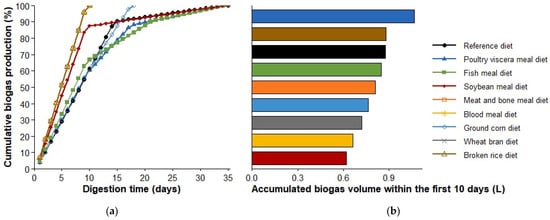
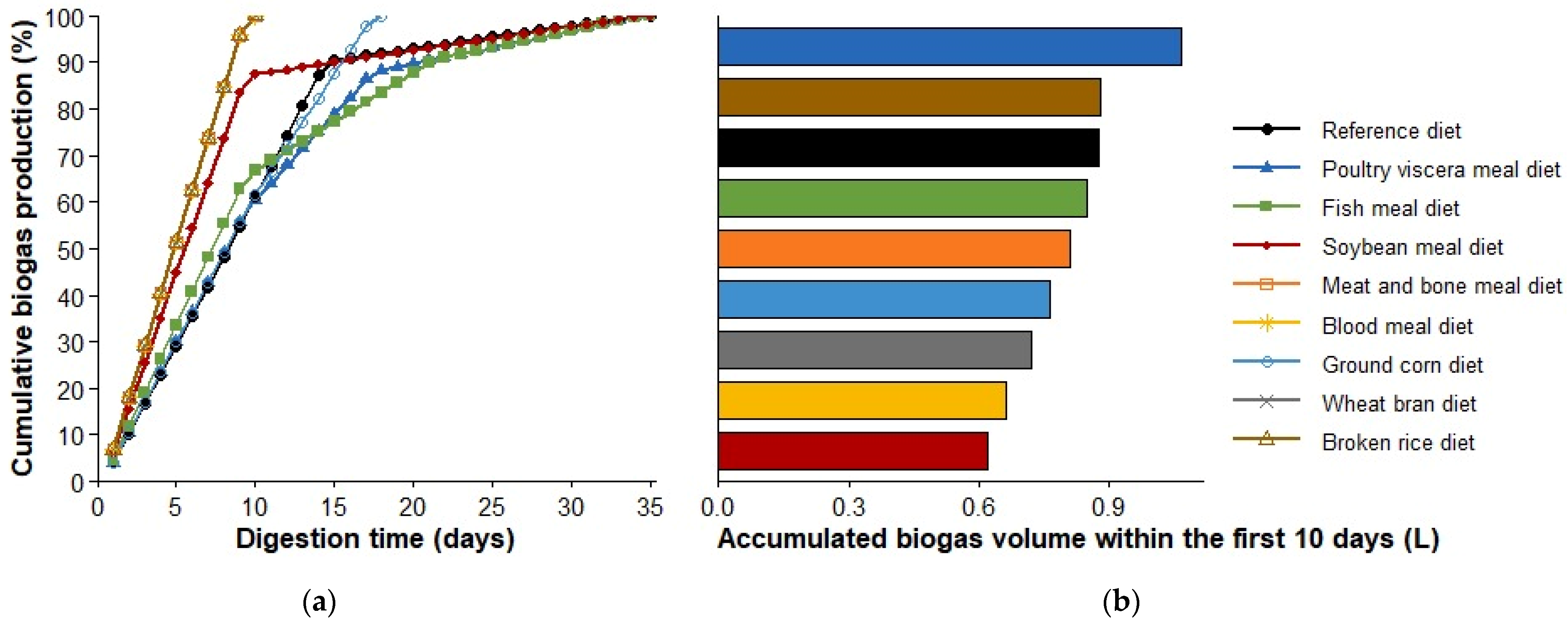
Distinct cumulative biogas production kinetics were observed among the dietary treatments (Figure 1). BMd, WBd, MBMd, and BRd showed rapid stabilization, reaching approximately 90% of cumulative biogas production within 9–10 days of anaerobic digestion (Figure 1a). In contrast, fish meal and poultry viscera meal exhibited slower production profiles, requiring 22 and 21 days, respectively, to reach the same threshold. Intermediate stabilization patterns were observed for ground corn, soybean meal, and the reference diet, which reached 90% of cumulative biogas production after 16, 15, and 15 days, respectively (Figure 1a).
Figure 1.
Cumulative biogas production kinetics during anaerobic digestion of feces from Nile tilapia fed diets containing different protein and energy sources. (a) Cumulative biogas production curves over digestion time. (b) Biogas volume reached production for each dietary treatment after 10 days.
The short-term bioenergy recovery pattern after 10 days of digestion is presented in Figure 1b. PMd showed the highest accumulated biogas volume, followed by BRd, the reference diet, and FMd. Conversely, SBMd and BMd resulted in the lowest biogas recovery during the same period. Overall, the results indicate that dietary ingredients influenced both the degradation kinetics and the short-term bioenergy recovery of fish feces during anaerobic digestion.
3.4. Relationship Between Diet Digestibility and Bioenergy Recovery Potential
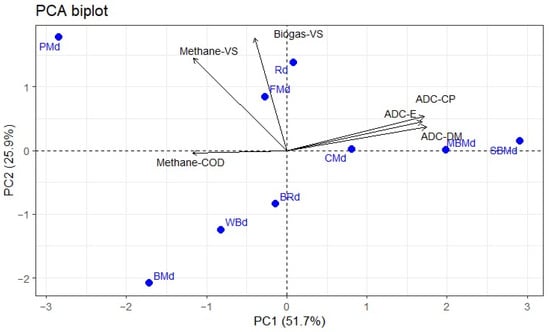
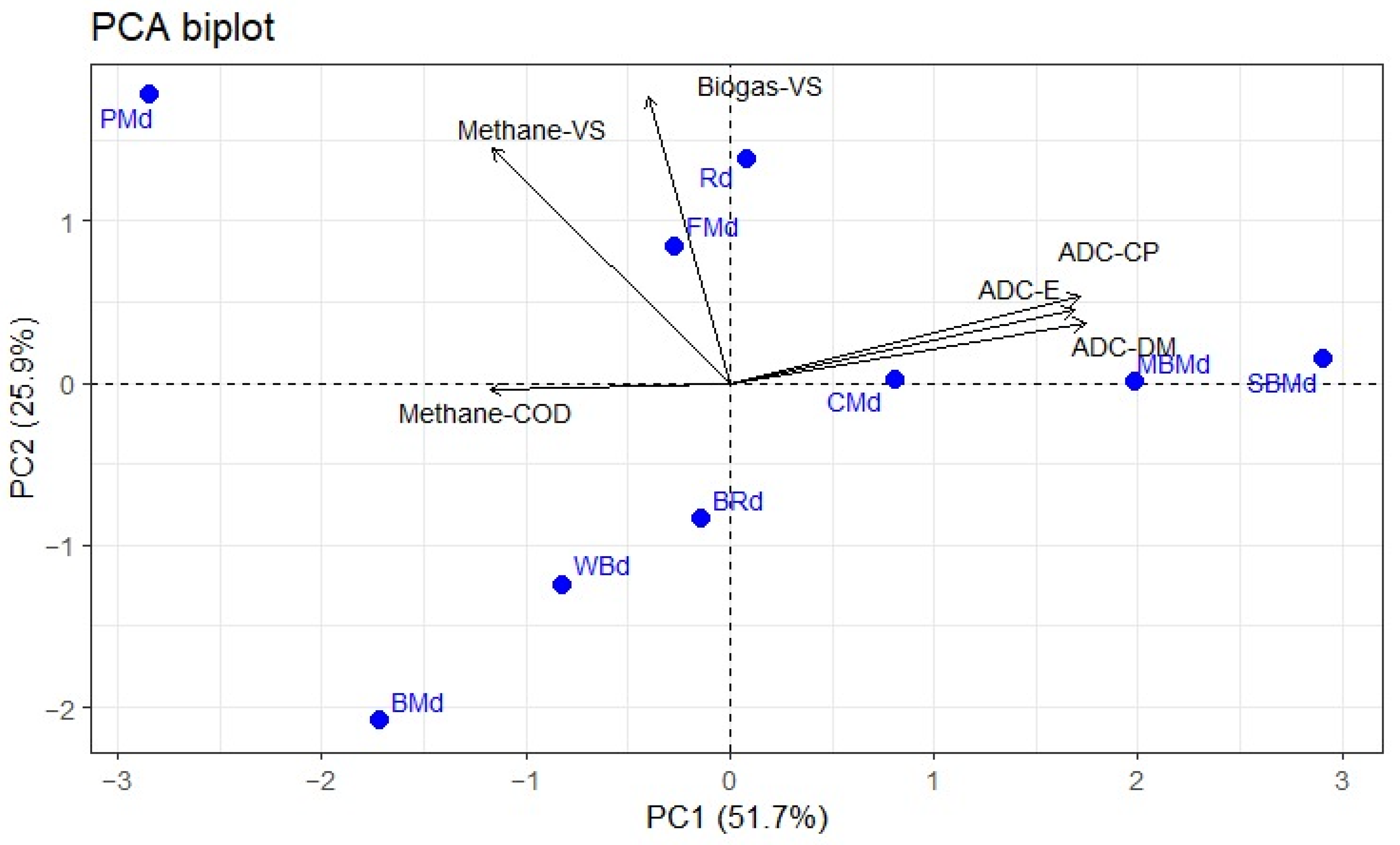
Principal component analysis (PCA) explained 77.6% of the total variance, with PC1 and PC2 accounting for 51.7% and 25.9%, respectively (Figure 2). The ordination separated apparent digestibility coefficients (ADC-DM, ADC-CP, and ADC-E) from anaerobic digestion variables. Digestibility coefficients were positioned opposite to methane and biogas yields, indicating an inverse relationship between diet digestibility and biomethane potential. PMd was associated with higher methane and biogas yields, whereas SBMd and MBMd were associated with higher digestibility coefficients. The reference diet (Rd) and FMd occupied intermediate positions. BMd and WBd were associated with lower methane and biogas yields, while BRd and CMd showed intermediate responses. BMd was associated with methane production per COD removed.
Figure 2.
Principal component analysis (PCA) biplot showing the relationships between apparent digestibility coefficients and anaerobic digestion performance of feces from Nile tilapia fed different experimental diets. Biogas-VS and Methane-VS represent biogas and methane yields expressed per kilogram of volatile solids, respectively.
4. Discussion
The physicochemical characteristics of the fish feces observed in the present study were within the range reported for fish feces and aquaculture sludge across different fish species. Previous studies have described pH values ranging from approximately 5.4 to 6.7, total solids (TS) from 2.0 to 9.3%, volatile solids (VS) from 63 to 86% of TS, chemical oxygen demand (COD) from 45 to 155 g L−1, biochemical oxygen demand (BOD) from 18 to 34 g L−1, crude protein (CP) from 12 to 36% DM, and mineral matter (MM) from 14 to 38% DM, depending on fish species, dietary composition, waste collection methodology and waste concentration [23,24,25]. The differences observed in TS may reflect both the amount of undigested material excreted and the physical characteristics of the feces. Dietary ingredients differing in digestibility, particularly in their content of non-starch polysaccharides (NSP) and starch, modify fecal cohesiveness, particle stability and sedimentation behavior, thereby influencing solids recovery during collection. Consequently, more fragile feces are prone to fragmentation and loss of fine particles, which may contribute to differences in the TS measured in the recovered material [25,26,27,28,29]. Since fecal stability and marker or nutrient leaching were not evaluated in the present study, differential loss of soluble components or fine fecal particles among diets cannot be excluded.
The residual nutrient composition of the feces closely reflected both the chemical composition and apparent digestibility of the dietary ingredients. The differences observed among diets were consistent with the apparent digestibility coefficients determined in Phase II, confirming that feed formulation influences nutrient retention by the fish and consequently the quantity and composition of nutrients excreted in the feces. The lower crude protein and lipid concentrations observed in SBMd feces were consistent with the higher digestibility of these nutrients in this diet, indicating more efficient nutrient utilization by fish. Conversely, the higher crude protein concentrations observed in PMd and particularly BMd feces were consistent with the lower protein digestibility of these diets, indicating that a greater proportion of dietary protein escaped digestion and was excreted. Similar relationships between ingredient digestibility and fecal nutrient composition have been reported by [8,25], who demonstrated that ingredients differing in nutrient digestibility produce marked changes in the chemical composition of fish feces. Likewise, the elevated mineral matter content observed in FMd and MBMd probably reflects the high ash content of fish meal and meat-and-bone meal [8,25,30,31,32], which results in greater mineral concentrations in the feces.
Because fish feces consist predominantly of the undigested fraction of the feed, ingredient digestibility is expected to influence the amount of oxidizable organic matter remaining in the feces, commonly assessed as chemical oxygen demand (COD) [33]. However, this relationship was not evident in the present study, as the SBMd diet exhibited the highest apparent digestibility coefficients for dry matter, crude protein and energy while producing feces with relatively high COD. This apparent discrepancy is likely explained by differences in the chemical composition of the residual organic matter rather than by the amount of undigested material alone. Previous studies have demonstrated that ingredient digestibility and dietary composition alter the chemical composition of fish feces [8,25,29], while [33] showed that these compositional differences modify the characteristics of the organic matter during subsequent fermentation. Consequently, diets with similar or even higher nutrient digestibility may still produce feces with comparable or greater COD if the composition of the residual organic matter differs among diets.
Apparent digestibility coefficients differed among the dietary treatments, reflecting differences in ingredient composition, nutrient availability, and the resulting nutritional profile. SBMd showed the highest dry matter, crude protein and energy digestibility, in agreement with the high nutritional quality of properly processed soybean products, in which heat treatment reduces the activity of protease inhibitors and improves protein utilization [34,35,36]. In contrast, the lower digestibility observed for poultry by-product meal and blood meal diets is consistent with the inherent variability of rendered animal protein ingredients. Their nutritional quality depends on both the composition of the raw materials and the rendering conditions, and excessive temperature–time combinations during processing reduce the availability of essential amino acids such as lysine, methionine and cysteine [32,37,38].
The reductions in TS, VS and COD observed confirmed the degradation of fecal organic matter during anaerobic digestion, although the extent of degradation varied among diets. The comparative evaluation between Phase I and Phase II demonstrated that Nile tilapia maintain a highly consistent digestive capacity across these developmental stages. The stability observed in the ADCs for dry matter, crude protein, and energy indicates that tilapia utilize dietary nutrients with similar efficiency within the evaluated body weight interval. Therefore, utilizing the feces from Phase II for the subsequent anaerobic digestion assays provided a representative evaluation of the waste stream generated during the finishing stage—the period characterized by the highest feed consumption and waste generation in commercial aquaculture operations.
Fish feces, usually collected as aquaculture sludge or fish sludge (and including uneaten feed), have been shown to produce methane-rich biogas under anaerobic digestion. The methane yields obtained in the present study (85–261 mL CH4 g−1 VS) were generally lower than those reported for freshwater RAS sludge in previous BMP studies, which typically ranged from 279 to 519 mL CH4 g−1 VS [23,24,39]. These differences may also reflect species-related waste characteristics, as the previous studies [23,24,39] evaluated sludge from Atlantic salmon (Salmo salar) and/or rainbow trout (Oncorhynchus mykiss), as well as methodological and substrate-related factors. Previous studies evaluated concentrated RAS sludge containing not only feces but also uneaten feed particles, biofilm and other suspended organic solids, whereas the present study used feces collected directly from digestibility trials. Moreover, the sludge used by [23] underwent approximately two weeks of storage in a gravity thickener before digestion, allowing partial hydrolysis and VFA accumulation that enhanced methane conversion efficiency. In contrast, the fresh fecal material evaluated here required hydrolysis to occur within the digester itself. Additional differences, including the lower inoculum-to-substrate ratio (1:1 vs. 2:1–4:1 on a VS basis) and digestion at ambient temperature (~28.5 °C instead of controlled mesophilic conditions at 35 °C), probably also contributed to the lower methane yields. Conversely, the inoculum used in the present study originated from a digester treating fish-processing residues and was likely already acclimated to this type of substrate [40], although this potential advantage did not result in higher methane yields.
Differences in the biochemical composition of fecal organic matter, including the relative contribution and degradability of proteins, carbohydrates, lipids and other organic fractions, likely influenced substrate biodegradability and, consequently, methane production [41]. Among the evaluated diets, BMd showed the highest methane yield per unit of COD removed and produced feces with the highest crude protein concentration. This response is consistent with the high anaerobic biodegradability and methane potential commonly associated with protein- and lipid-rich fish-derived residues [41]. However, methane production is not determined by crude protein concentration alone, but by the overall balance among organic fractions, substrate biodegradability and process stability. Although protein-rich substrates generally exhibit high methane potential, excessive protein degradation may promote ammonia accumulation, while lipid degradation can lead to volatile fatty acid and long-chain fatty acid accumulation, which may inhibit methanogenesis under unfavorable conditions [41,42]. Therefore, methane production depends on the interaction among substrate composition, C/N balance, biodegradability and the accumulation of inhibitory compounds rather than on crude protein concentration alone [42,43].
The cumulative biogas curves indicate that dietary composition influenced not only the ultimate methane yield but also the kinetics of anaerobic degradation. Fish feces derived from PMd, BMd, WBd and BRd exhibited a more rapid onset of biogas production, suggesting that they initially contained larger proportions of readily biodegradable organic compounds. However, rapid initial gas production did not necessarily translate into greater final methane yields. PMd maintained biogas production over a longer period and ultimately achieved the highest methane yield per unit of VS, suggesting that its fecal organic matter contained biodegradable fractions with different degradation rates, thereby sustaining substrate conversion throughout the digestion period. In contrast, although BMd exhibited rapid initial biogas production, methane generation remained comparatively low. One possible explanation is that degradation of the protein-rich organic matter may have promoted ammonia or volatile fatty acid accumulation, both of which have been reported to inhibit methanogenesis under excessive concentrations, although these variables were not measured in the present study. Likewise, the rapid initial gas production observed for WBd and BRd may reflect the availability of readily fermentable carbohydrates, while less biodegradable structural polysaccharides may have constrained subsequent degradation. Differences in the temporal pattern and extent of gas production have been reported for fish sludge [23], whereas Refs. [41,44] demonstrated that methane production is primarily governed by the biodegradable quality of the organic matter and may be constrained by inhibitory intermediates in protein- and lipid-rich substrates.
The PCA integrated the relationships among nutrient digestibility and anaerobic digestion variables, reinforcing the patterns discussed above. The inverse association between apparent digestibility coefficients and methane and biogas production indicates that diets promoting greater nutrient utilization by fish generally reduced the amount of biodegradable organic matter remaining in the feces. However, the distinct positioning of blood meal diet relative to methane yield per unit of COD removed indicates that apparent digestibility alone was insufficient to explain the anaerobic behavior of the fecal material.
Overall, these findings indicate that classifying feed ingredients simply as plant- or animal-derived is insufficient to explain either nutrient utilization by Nile tilapia or the anaerobic biodegradability of the resulting feces. Rather, the observed responses reflect the combined effects of the nutritional composition of the experimental diets, nutrient digestibility, and the chemical and biodegradable characteristics of the residual organic matter in the feces.
These findings also have broader implications for aquafeed sustainability. Environmental assessments of feed ingredients generally emphasize upstream impacts associated with ingredient production, such as land-use change for soybean meal or pressure on wild fish stocks for fish meal. However, the present results demonstrate that ingredient selection also influences the biochemical quality of the organic matter excreted, thereby affecting the methane generation potential of aquaculture wastes. Soybean meal diet, despite its recognized upstream environmental burden, produced feces with the lowest methane generation potential, consistent with its high nutrient digestibility and reduced residual organic matter available for anaerobic degradation. Conversely, fish meal diet, although frequently targeted for replacement because of concerns regarding resource availability, combined high nutrient digestibility with only intermediate methane production from the resulting feces. Nevertheless, because methane production was expressed per unit of fecal substrate rather than per unit of fish biomass produced, the overall greenhouse gas implications of each diet at the production-system level cannot be inferred directly. A comprehensive environmental assessment would require integrating the methane generation potential of the feces with animal performance, fecal output and life cycle impacts associated with ingredient production. Therefore, the present findings should be interpreted as demonstrating differences in the intrinsic methane generation potential of fecal organic matter rather than in the total greenhouse gas emissions attributable to each dietary formulation.
5. Conclusions
Among the evaluated diets, soybean meal diet promoted the highest nutrient digestibility, indicating greater efficiency of nutrient utilization by fish. In contrast, feces from fish fed the poultry by-product meal diet exhibited the greatest methane potential on a volatile solid basis and the highest cumulative methane production during anaerobic digestion. These findings demonstrate that maximizing feed utilization and maximizing the biodegradability of the residual organic matter are not necessarily concurrent objectives, highlighting an important trade-off between nutritional efficiency and downstream waste management.
Despite the differences among diets, feces from all treatments contained sufficient biodegradable organic matter to sustain anaerobic digestion, confirming that this technology is a suitable treatment strategy regardless of dietary ingredient composition. Rather than allowing the uncontrolled decomposition of organic waste and its associated greenhouse gas emissions, anaerobic digestion provides a controlled biological pathway for stabilizing organic matter while capturing methane that could otherwise be released into the atmosphere. Integrating feed formulation with anaerobic treatment therefore represents a promising cleaner production strategy for aquaculture waste management, contributing to more circular production systems.
Supplementary Materials
The following supporting information can be downloaded at https://www.mdpi.com/article/10.3390/agriengineering8090356/s1, Method S1: Anaerobic digestion assay with different inoculum-to-fish feces ratios; Table S1: Effects of inoculum inclusion level on biogas potential, methane potential, and final pH during anaerobic digestion of feces waste from fish farming.
Author Contributions
Conceptualization, A.C.A.O. and T.S.d.C.S.; methodology, A.C.A.O., T.S.d.C.S., L.A.K.A.I. and M.A.P.O.J.; formal analysis, E.d.C.O.; investigation, A.L.d.E., E.d.C.O., I.d.S.M.; L.A.K.A.I., L.A.R. and T.S.d.C.S.; resources, A.C.A.O. and T.S.d.C.S.; data curation, A.C.A.O., B.K.V.L., E.d.C.O., I.d.S.M., T.S.d.C.S.; writing—original draft preparation, E.d.C.O. and B.K.V.L.; writing—review and editing, A.C.A.O., B.K.V.L. and E.d.C.O.; visualization, T.S.d.C.S.; supervision, A.C.A.O. and T.S.d.C.S.; project administration, A.C.A.O. and T.S.d.C.S.; funding acquisition, A.C.A.O. and T.S.d.C.S. All authors have read and agreed to the published version of the manuscript.
Funding
This research was funded by the National Council for Scientific and Technological Development (CNPq), grant number 407906/2023-1, and by the Fundação de Apoio ao Desenvolvimento do Ensino, Ciência e Tecnologia do Estado de Mato Grosso do Sul (FUNDECT), project numbers 83/026.783/2024 (Fundect number: 112/2024) and 83/044.416/2024 (Fundect number: 330/2024).
Institutional Review Board Statement
The animal study protocol was approved by the Animal Care and Use Committee (CEUA) of Embrapa Pantanal (Protocol No. 05/2022).
Informed Consent Statement
Not applicable.
Data Availability Statement
The original contributions presented in this study are included in the article and its Supplementary Materials. Further inquiries can be directed to the corresponding author.
Acknowledgments
The authors acknowledge the Fundação de Apoio ao Desenvolvimento do Ensino, Ciência e Tecnologia do Estado de Mato Grosso do Sul (FUNDECT) for granting undergraduate research scholarships, and the Coordenação de Aperfeiçoamento de Pessoal de Nível Superior (CAPES) for granting doctoral and postdoctoral scholarships. The authors also acknowledge the Post-Graduate Program in Animal Science (PPGZ) at the Federal University of Grande Dourados (UFGD) for institutional support. During the preparation of this study, the authors used ChatGPT-5 (OpenAI, version 5.0, San Francisco, CA, USA) for assistance with R scripting for data processing and visualization and with the preparation and visual composition of the graphical abstract. All AI-assisted outputs were reviewed and edited by the authors, who take full responsibility for the content of this publication.
Conflicts of Interest
Luís Antonio Kioshi Aoki Inoue, Brenda Kelly Viana Leite, Laurindo André Rodrigues and Alfredo Leonel de Encarnação are employed by Embrapa (Brazilian Agricultural Research Corporation), which is a public research institution owned by the Brazilian Federal Government. Embrapa is not a private or for-profit company and does not have commercial interests related to the outcomes of this research. Its institutional mission is to promote scientific research, technological innovation, and cooperation for the advancement of Brazilian agriculture and society. The authors declare no conflicts of interest.
Abbreviations
The following abbreviations are used in this manuscript:
| ADC | Apparent digestibility coefficient |
| ADC-CP | Apparent digestibility coefficient of crude protein |
| ADC-DM | Apparent digestibility coefficient of dry matter |
| ADC-E | Apparent digestibility coefficient of energy |
| BHT | Butylated hydroxytoluene |
| BMd | Blood meal diet |
| BOD | Biochemical oxygen demand |
| BRd | Broken rice diet |
| CMd | Corn meal diet |
| COD | Chemical Oxygen Demand |
| CP | Crude protein |
| DM | Dry matter |
| ECD | Electron capture detector |
| FID | Flame ionization detector |
| FMd | Fish meal diet |
| ICP-OES | Inductively coupled plasma optical emission spectrometry |
| MBMd | Meat and bone meal diet |
| MM | Mineral matter |
| NSP | Non-starch polysaccharides |
| PCA | Principal component analysis |
| PMd | Poultry by-product meal diet |
| RAS | Recirculating aquaculture system |
| Rd | Reference diet |
| SBMd | Soybean meal diet |
| TS | Total solids |
| VS | Volatile solids |
| WBd | Wheat bran diet |
References
- Amorim, M.D.J.; Tosta, M.D.C.R. A Piscicultura Como Alternativa Para Diminuir Os Impactos Ambientais Da de Carne Bovina. Rev. Bras. Meio Ambient. 2020, 8, 81–101. [Google Scholar] [CrossRef] [Scilit]
- Peixe, B.R. Anuário Brasileiro Da Piscicultura Peixe BR 2026; Associação Brasileira da Piscicultura: São Paulo, Brazil, 2026. [Google Scholar]
- Serra, V.; Pastorelli, G.; Eurosia, D.; Tedesco, A.; Turin, L.; Guerrini, A. Alternative Protein Sources in Aquafeed: Current Scenario and Future Perspectives. Vet. Anim. Sci. 2024, 25, 100381. [Google Scholar] [CrossRef] [Scilit] [PubMed]
- da Silva, M.F.O.; Romaneli, R.d.S.; Mussoi, L.F.; Masagounder, K.; Fracalossi, D.M. Impact of Reference Diet Composition on Apparent Digestibility Coefficients of Two Protein-Rich Ingredients in Nile Tilapia. Sci. Agric. 2023, 80, e20220189. [Google Scholar] [CrossRef] [Scilit]
- Arriaga-hernández, D.; Hernández, C.; Martínez-montaño, E.; Ibarra-castro, L.; Lizárraga-velázquez, E.; Leyva-lópez, N. Fish Meal Replacement by Soybean Products in Aquaculture Feeds for White Snook, Centropomus Viridis: Effect on Growth, Diet Digestibility, and Digestive Capacity. Aquaculture 2021, 530, 735823. [Google Scholar] [CrossRef] [Scilit]
- Stockhausen, L.; Vilvert, M.P.; Silva, M.; Dartora, A.; Ferreira, G.B.; Rafaela, L.; Jatobá, A. Practical Diet with Total Replacement of Fishmeal by Soybean Meal for Nile Tilapia: Growth performance and health effects. Ciênc. Anim. Bras. 2021, 23, e71567E. [Google Scholar] [CrossRef] [Scilit]
- Van Vo, B.; Siddik, M.A.; Fotedar, R.; Chaklader, R.; Foysal, J.; Pham, H.D. Digestibility and Water Quality Investigations on the Processed Peanut (Arachis hypogaea) Meal Fed Barramundi (Lates calcarifer) at Various Inclusion Levels. Aquac. Rep. 2020, 18, 100474. [Google Scholar] [CrossRef] [Scilit]
- Prakash, S.; Maas, R.M.; Fransen, P.M.M.M.; Kokou, F.; Schrama, J.W.; Philip, A.J.P. Effect of Feed Ingredients on Nutrient Digestibility, Waste Production and Physical Characteristics of Rainbow Trout (Oncorhynchus mykiss) Faeces. Aquaculture 2023, 574, 739621. [Google Scholar] [CrossRef] [Scilit]
- Khiari, Z.; Kaluthota, S.; Savidov, N. Aerobic Bioconversion of Aquaculture Solid Waste into Liquid Fertilizer: Effects of Bioprocess Parameters on Kinetics of Nitrogen Mineralization. Aquaculture 2019, 500, 492–499. [Google Scholar] [CrossRef] [Scilit]
- Orrico, A.C.A.; Leite, B.K.V.; de Oliveira, J.D.; Blans, K.F.; Menezes, I.d.S.; Souza, V.; Gimenes, R.M.T.; Aspilcueta Borquis, R.R.; Orrico Junior, M.A.P. Anaerobic Digestion of Broiler Litter from Different Commercial Farm Flocks. Poultry 2025, 4, 19. [Google Scholar] [CrossRef] [Scilit]
- Glencross, B.; Muñoz-Lopez, P.; Matthew, C.; Mackenzie, S.; Powell, A.; Longshaw, M.; Leblanc, A. Digestibility of Bacterial Protein by Atlantic Salmon (Salmo salar) Is Affected by Both Inclusion Level and Acclimation Time. Aquaculture 2023, 565, 739137. [Google Scholar] [CrossRef] [Scilit]
- Gonçalves, L.U.; Cerozi, B.S.; Souzade, T.S.C.; Zanon, R.B.; Cyrino, J.E.P. Crude Glycerin as Dietary Energy Source for Nile Tilapia. Aquaculture 2015, 437, 230–234. [Google Scholar] [CrossRef] [Scilit]
- NRC. Nutrient Requirements of Fish and Shrimp; The National Academy Press: Washington, DC, USA, 2011. [Google Scholar]
- de Oliveira, J.D.; Orrico, A.C.A.; Leite, B.K.V.; Schwingel, A.W.; Junior, M.A.P.O.; de Avila, M.R.; Machado, J.F.; Dias, A.M.D.F.; Macena, I.A.; dos Santos, W. Anaerobic Co-Digestion of Swine Manure and Forage at Two Harvesting Ages. Ciênc. Rural 2022, 52, e20200760. [Google Scholar] [CrossRef] [Scilit]
- Verein Deutscher Ingenieure (VDI). VDI 4630: Fermentation of Organic Materials—Characterisation of the Substrate, Sampling, Collection of Material Data, Fermentation Tests; Beuth Verlag: Berlin, Germany, 2006. [Google Scholar]
- Pigosso, A.; Kunz, A.; Amaral, A.C.; Wuaden, C.R.; Barros, E.C.; Antes, F.G.; Bortoli, M.; Silva, M.L.B.; Prá, M.C.; Mezzari, M.P.; et al. Fundamentos Da Digestão Anaeróbia, Purificação Do Biogás, Uso e Tratamento Do Digestato; Kunz, A., Steinmetz, R.L.R., Amaral, A.C., Eds.; Embrapa Suínos e Aves: Concórdia, Brazil, 2019. [Google Scholar]
- Leite, B.K.V.; Orrico, A.C.A.; Orrico Junior, M.A.P.; Aspilcueta Borquis, R.R.; Oliveira, J.D.; Macena, I.A.; Ota, E.C.; Vilela, R.N.S.; Silva, T.S.C.; Inoue, L.A.K.A. Valorization of Fish Waste Using Biochar and Crude Glycerin as Additives in Composting. ACS Omega 2025, 10, 18501–18509. [Google Scholar] [CrossRef] [Scilit] [PubMed]
- American Public Health Association. Standard Methods for the Examination of Water and Wastewater, 22nd ed.; APHA: Washington, DC, USA, 2012. [Google Scholar]
- AOAC. The Official Methods of Analysis, 19th ed.; Association of Official Agricultural Chemists International (AOAC): Gaithersburg, MD, USA, 2012. [Google Scholar]
- Boyd, A.G.C.E. A Digestion Procedure for the Simultaneous Determination of Total Nitrogen and Total Phosphorus in Pond Water. J. World Aquac. Soc. 1998, 29, 300–303. [Google Scholar] [CrossRef] [Scilit]
- MAPA. Manual De Métodos Analíticos Oficiais Para Fertilizantes e Corretivos; Ministério da Agricultura, Pecuária e Abastecimento Secretaria de Defesa Agropecuária: Brasília, Brazil, 2017.
- R Core Team. R: A Language and Environment for Statistical Computing 2021. Available online: https://www.R-project.org (accessed on 4 June 2026).
- Choudhury, A.; Lepine, C.; Good, C. Methane and Hydrogen Sulfide Production from the Anaerobic Digestion of Fish Sludge from Recirculating Aquaculture Systems: Effect of Varying Initial Solid Concentrations. Fermentation 2023, 9, 94. [Google Scholar] [CrossRef] [Scilit]
- Choudhury, A.; Lepine, C.; Hersom, M.; Good, C. Aquacultural Engineering Characteristics of Aquaculture Sludge Produced from Two Different Fish Diets and Its Impact on Biogas Production. Aquac. Eng. 2025, 111, 102597. [Google Scholar] [CrossRef] [Scilit]
- Fountoulaki, E.; Vasilaki, A.; Nikolopoulou, D.; Schrama, J.; Kaushik, S.J.; Antony Jesu Prabhu, P. Faecal Waste Production, Characteristics and Recovery in European Seabass (Dicentrarchus labrax) Is Affected by Dietary Ingredient Composition. Aquaculture 2022, 548, 737582. [Google Scholar] [CrossRef] [Scilit]
- Amirkolaie, A.K.; Leenhouwers, J.I.; Verreth, J.A.J.; Schrama, J.W. Type of Dietary Fibre (Soluble versus Insoluble) Influences Digestion, Faeces Characteristics and Faecal Waste Production in Nile Tilapia (Oreochromis niloticus L.). Aquac. Res. 2005, 36, 1157–1166. [Google Scholar] [CrossRef] [Scilit]
- Amirkolaie, A.K.; Verreth, J.A.J.; Schrama, J.W. Effect of Gelatinization Degree and Inclusion Level of Dietary Starch on the Characteristics of Digesta and Faeces in Nile Tilapia (Oreochromis niloticus (L.)). Aquaculture 2006, 260, 194–205. [Google Scholar] [CrossRef] [Scilit]
- Antony Jesu Prabhu, P.; Fountoulaki, E.; Maas, R.; Heinsbroek, L.T.N.; Eding, E.H.; Kaushik, S.J.; Schrama, J.W. Dietary Ingredient Composition Alters Faecal Characteristics and Waste Production in Common Carp Reared in Recirculation System. Aquaculture 2019, 512, 734357. [Google Scholar] [CrossRef] [Scilit]
- Syropoulou, E.; Prakash, S.; Smeenge, D.; Sipkema, D. Carbohydrates in Dietary Ingredients for European Seabass: Impact on Nutrient Digestibility and Waste Production When Reared in Recirculating Aquaculture Systems. Aquaculture 2025, 599, 742182. [Google Scholar] [CrossRef] [Scilit]
- Hardy, R.W. Alternate Protein Sources for Salmon and Trout Diets. Anim. Feed. Sci. Technol. 1996, 59, 71–80. [Google Scholar] [CrossRef] [Scilit]
- Meurer, F.; Hayashi, C.; Boscolo, W.R. Digestibilidade Aparente de Alguns Alimentos Protéicos Pela Tilápia Do Nilo (Oreochromis niloticus) Apparent Digestibility of Some Protein Sources for Nile Tilapia (Oreochromis niloticus). Rev. Bras. Zootec. 2003, 32, 1801–1809. [Google Scholar] [CrossRef] [Scilit]
- Pastore, S.C.G.; Gaiotto, J.R.; Ribeiro, F.A.S.; Nunes, A.J.P. Formulação de Rações e Boas Práticas de Fabricação. In Nutriaqua: Nutrição e Alimentação de Espécies de Interesse para a Aquicultura Brasileira; Fracalossi, D.M., Cyrino, J.E.P., Eds.; Sociedade Brasileira de Aquicultura e Biologia Aquática: Florianópolis, Brazil, 2012; pp. 325–353. [Google Scholar]
- Letelier-gordo, C.O.; Larsen, B.K.; Dalsgaard, J.; Pedersen, P.B. The Composition of Readily Available Carbon Sources Produced by Fermentation of Fish Faeces Is Affected by Dietary Protein:Energy Ratios. Aquac. Eng. 2017, 77, 75–82. [Google Scholar] [CrossRef] [Scilit]
- Furuya, W.M.; Pezzato, L.E.; Barros, M.M.; Pezzato, A.C.; Furuya, V.R.B.; Miranda, E.C. Use of Ideal Protein Concept for Precision Formulation of Amino Acid Levels in Fish-Meal-Free Diets for Juvenile Nile Tilapia (Oreochromis niloticus L.). Aquac. Res. 2004, 35, 1110–1116. [Google Scholar] [CrossRef] [Scilit]
- Francis, G.; Makkar, H.P.S.; Becker, K. Antinutritional Factors Present in Plant-Derived Alternate Fish Feed Ingredients and Their Effects in Fish. Aquaculture 2001, 19, 197–227. [Google Scholar] [CrossRef] [Scilit]
- Vidal, L.V.O.; Xavier, T.O.; Moura, L.B.; Graciano, T.S.; Martins, E.N.; Furuya, W.M. Apparent Digestibility of Soybean Coproducts in Extruded Diets for Nile Tilapia, Oreochromis Niloticus. Aquac. Nutr. 2017, 23, 228–235. [Google Scholar] [CrossRef] [Scilit]
- Awonorin, S.O.; Ayoade, J.A.; Bamiro, B.O.; Oyewole, L.O. Relationship of Rendering Process Temperature and Time to Selected Quality Parameters of Poultry By-Product Meal. LWT—Food Sci. Technol. 1995, 28, 129–134. [Google Scholar] [CrossRef] [Scilit]
- Hua, K.; Cobcroft, J.M.; Cole, A.; Condon, K.; Jerry, D.R.; Mangott, A.; Praeger, C.; Vucko, M.J.; Zeng, C.; Zenger, K.; et al. The Future of Aquatic Protein: Implications for Protein Sources in Aquaculture Diets. One Earth 2025, 1, 316–329. [Google Scholar] [CrossRef] [Scilit]
- Suhr, K.I.; Letelier-Gordo, C.O.; Lund, I. Anaerobic Digestion of Solid Waste in RAS: Effect of Reactor Type on the Biochemical Acidogenic Potential (BAP) and Assessment of the Biochemical Methane Potential (BMP) by a Batch Assay. Aquac. Eng. 2015, 65, 65–71. [Google Scholar] [CrossRef] [Scilit]
- Chen, Y.; Cheng, J.J.; Creamer, K.S. Inhibition of Anaerobic Digestion Process: A Review. Biosour. Techonol. 2008, 99, 4044–4064. [Google Scholar] [CrossRef] [Scilit] [PubMed]
- Wu, Y.; Song, K. Source, Treatment, and Disposal of Aquaculture Solid Waste: A Review. J. Environ. Eng. 2021, 147, 03120012. [Google Scholar] [CrossRef] [Scilit]
- Netshivhumbe, R.; Faloye, F.; Tolessa, A.; Görgens, J.; Goosen, N. Anaerobic Co-Digestion of Fish Sludge Originating from a Recirculating Aquaculture System. Waste Biomass Valorization 2024, 15, 5589–5605. [Google Scholar] [CrossRef] [Scilit]
- Syropoulou, E.; Sipkema, D.; Elise, S.; Schrama, J.W.; Kokou, F. Aquaculture Faecal Waste Generates Different Products during Anaerobic Digestion Depending on Nutrient Composition. J. Environ. Manag. 2024, 370, 122826. [Google Scholar] [CrossRef] [Scilit] [PubMed]
- Wu, Y.; Song, K. Process Performance of Anaerobic Co-Digestion of Waste Activated Sludge and Aquaculture Sludge. Aquac. Eng. 2020, 90, 102090. [Google Scholar] [CrossRef] [Scilit]

Disclaimer/Publisher’s Note: The statements, opinions and data contained in all publications are solely those of the individual author(s) and contributor(s) and not of MDPI and/or the editor(s). MDPI and/or the editor(s) disclaim responsibility for any injury to people or property resulting from any ideas, methods, instructions or products referred to in the content. |
© 2026 by the authors. Licensee MDPI, Basel, Switzerland. This article is an open access article distributed under the terms and conditions of the Creative Commons Attribution (CC BY) license.