


Abstract
Aguamiel is a naturally sweet sap obtained from some mature maguey (Agave) plants and is the raw material subsequently fermented to produce pulque, a traditional Mexican beverage of cultural and economic importance. Traditionally, aguamiel is harvested by experienced workers known as tlachiqueros, who extract the sap from the plant cavity using an acocote, a traditional hollow, elongated tool operated by mouth suction. Although culturally significant, this extraction stage relies strongly on operator-specific suction skills and practical experience, limiting its accessibility to non-specialized workers. This study presents the design, development, and field performance evaluation of a portable, frugal mechatronic system conceived as a mechanized alternative for the liquid-extraction stage of traditional aguamiel harvesting under small-scale agricultural conditions. The prototype integrates a diaphragm pump, a 10 L interchangeable collection container, an embedded controller, and a human–machine interface implementing supervised on/off extraction and time-based volume estimation. A sequential–iterative mechatronic design methodology was used to integrate mechanical, hydraulic, electronic, and control requirements while preserving portability and operational simplicity. Field testing indicated an extraction rate of approximately 5 L min−1. Two complete-discharge tests yielded a mean operating duration of 44.2 min, corresponding to an estimated 221 L per charge at the reference flow rate. The results demonstrate the technical feasibility of the developed prototype as an alternative extraction tool for small-scale maguey production.
1. Introduction
Mexico hosts a wide variety of traditional fermented beverages, among which pulque is one of the oldest and most culturally significant [1,2]. Pulque is produced through the spontaneous fermentation of agave sap (aguamiel), extracted from mature agave plants that grow mainly in arid and semi-arid regions of Mexico [3,4]. Of the more than 200 agave species, approximately 76% are found in Mexico, with species such as A. salmiana, A. mapisaga, A. hookeri, and A. americana commonly used for pulque production [5,6].
Traditional aguamiel harvesting is performed by a skilled worker known as a tlachiquero. After the maguey has been prepared for sap production, the accumulated aguamiel is extracted from the plant cavity using an acocote, a traditional hollow, elongated tool operated by mouth suction. Although this practice represents an important component of the traditional production system, the extraction operation relies strongly on operator-specific suction skills and practical experience. Consequently, the liquid-recovery stage represents an opportunity for mechanization aimed at reducing dependence on specialized suction skills while preserving the traditional knowledge required for plant preparation and management [7].
Agricultural mechanization can reduce operator dependence in repetitive agricultural operations and standardize specific task stages that otherwise rely strongly on manual execution. In parallel, advances in embedded electronics, compact electric actuators, and low-cost control platforms have enabled the development of portable agricultural equipment for small-scale operations [8]. However, technological adoption in small-scale rural production remains constrained by acquisition cost, maintenance requirements, energy availability, and system complexity. Within this context, frugal engineering provides a suitable design approach by prioritizing essential functionality, affordability, maintainability, and the use of commercially available off-the-shelf (COTS) components while limiting unnecessary system complexity [9,10,11]. Accordingly, mechanization solutions intended for small-scale rural environments should combine functional effectiveness with portability, operational simplicity, local maintainability, and accessible implementation costs.
Portable pumping technologies have been investigated for several agricultural applications. Battery-supported solar irrigation systems have been developed [12], while the influence of operating head on photovoltaic pumping performance has been examined [13]. Energy requirements and design trade-offs for smallholder agricultural pumping have also been investigated [14], along with the integration of pumping, renewable energy, and electronic monitoring in smart agricultural systems [15]. These studies demonstrate the applicability of integrated pumping technologies in agriculture, although their primary focus differs from the extraction of aguamiel from maguey plants.
Despite the cultural and economic relevance of maguey-derived products, the mechanization of the aguamiel extraction stage has received limited engineering attention. In particular, portable systems designed to mechanize the mouth-suction operation traditionally performed with the acocote, while remaining suitable for small-scale field conditions, have been scarcely investigated. This gap motivates the development of an accessible mechatronic alternative specifically focused on the liquid-extraction stage preceding pulque fermentation.
Previous research by Blas Yañez and Padilla-García in [16] examined traditional and modern aguamiel harvesting methods from user-centered and sociocultural perspectives, including an electromechanical extractor and its usability. However, that study did not document the extractor’s engineering design, mathematical modeling, subsystem integration, or construction. Building on this background, the present work provides a detailed engineering account of a portable aguamiel extraction system, encompassing mechanical and hydraulic design, CAD development, electrical and electronic systems, control implementation, and quantitative performance characterization.
Social Implications for Rural Production Systems
Beyond its technical function, mechanizing the aguamiel extraction stage may have relevant implications for small-scale rural production. Traditional extraction involves tacit knowledge and operator-specific suction skills acquired through experience. By replacing mouth suction with an electrically driven pumping mechanism, the proposed approach specifically mechanizes this liquid-recovery operation, thereby reducing the technical dependence of the extraction mechanism itself on the operator’s suction ability.
This approach is not intended to replace the traditional knowledge associated with maguey cultivation, plant preparation, or sap production. Instead, it is conceived as a complementary mechanization strategy focused exclusively on the liquid-extraction stage while preserving the broader traditional production context. Its potential use by operators with different levels of experience remains to be evaluated through dedicated user-centered field studies.
Therefore, this work presents the design, development, and field performance evaluation of a portable, frugal mechatronic system conceived as a mechanized alternative for the liquid-extraction stage of traditional aguamiel harvesting under small-scale agricultural conditions.
2. Contribution
The main contributions of this work are as follows:
- The design and development of a portable mechatronic system that mechanizes the mouth-suction liquid-extraction stage traditionally performed with an acocote.
- A frugal mechatronic implementation based on commercially available off-the-shelf (COTS) components, integrating mechanical, hydraulic, electronic, and control subsystems while prioritizing portability, operational simplicity, and maintainability for small-scale agricultural use.
- Field performance evaluation of the developed prototype under real aguamiel harvesting conditions, including hydraulic performance, electrical demand, operating autonomy, and estimated transferable volume.
The remainder of this paper is organized as follows. Section 3 describes the mechatronic design methodology and the engineering requirements adopted for system development. Section 4 presents the design and implementation of the integrated prototype, including its mechanical, hydraulic, electronic, and control subsystems. Section 5 reports the field performance evaluation and discusses the experimental behavior of the developed prototype under real aguamiel harvesting conditions. Finally, Section 6 summarizes the main conclusions, limitations, and practical implications for small-scale agricultural mechanization.
3. Design Methodology and Engineering Requirements
The proposed aguamiel harvesting system was developed through a requirements-driven mechatronic design process oriented toward small-scale agricultural operation. Mechanical, hydraulic, electrical/electronic, and control requirements were considered jointly to obtain a portable and field-operable solution.
This section presents the sequential–iterative design methodology, the field and operational requirements, the resulting engineering parameters and constraints, and the analytical models used for subsystem sizing and operating-point estimation. The resulting system architecture and physical implementation are subsequently presented in Section 4.
3.1. Sequential–Iterative Mechatronic Design Approach
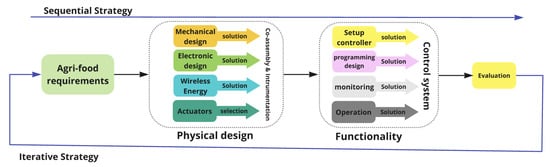
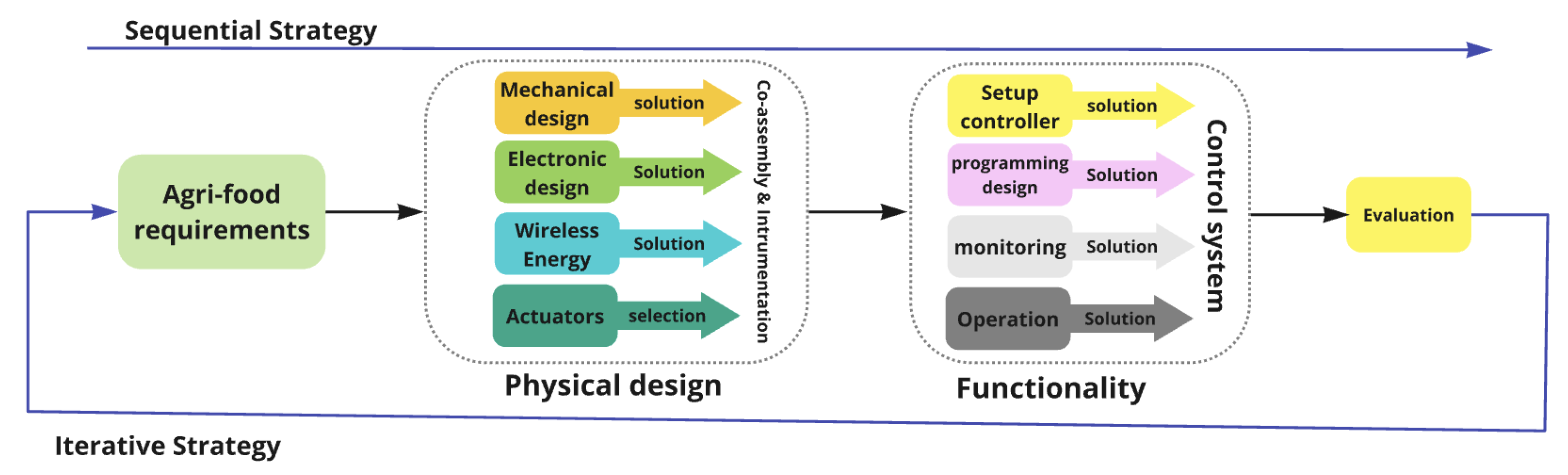
Mechatronic design requires the coordinated development of mechanical, electrical/electronic, and control domains because decisions within one domain can directly affect the requirements and performance of the others [17,18]. A sequential design process provides a structured progression from requirements definition to engineering design, system integration, and performance evaluation. However, the multidisciplinary coupling inherent to mechatronic systems generally requires iterative feedback between these stages when subsystem interactions reveal incompatible or suboptimal design decisions [18]. Therefore, the sequential–iterative approach adopted here combines a defined development sequence with feedback loops that allow previous design decisions to be revised as the integrated system evolves.
The integration of analytical design and experimental evaluation is well established in agricultural engineering. Examples include the theoretical development and traction testing of cultivator-point profiles [19], numerical and experimental optimization of paddy-field blades [20], and the design and testing of a single-disc opener for no-till planting [21]. These studies illustrate how component geometry and operating parameters can be assessed against measurable performance criteria. At the system level, Saeed et al. [22] combined mechanical and electronic design, control software, and experimental assessment in a reconfigurable vehicle for emulated agricultural tasks. Similarly, Kumar et al. [23] developed an agricultural mobile manipulator through requirements definition, CAD modeling, mathematical analysis, simulation, fabrication, calibration, and testing. Together, these applications provide context for linking component design, mechatronic integration, and performance evaluation within the development stages adopted in the present work.
Based on this approach, the proposed aguamiel harvesting system was developed through five main stages: (i) identification of field and operational requirements; (ii) definition of engineering specifications; (iii) subsystem design and component selection; (iv) system integration and prototype development; and (v) field performance evaluation under real harvesting conditions. The overall procedure is illustrated in Figure 1.
Figure 1.
Sequential–iterative mechatronic design methodology.
The iterative character of the methodology is particularly relevant to the coupling between the hydraulic and electrical subsystems. For example, pump selection determines the expected flow rate and electrical power demand, which subsequently constrain battery capacity, operating autonomy, hydraulic sizing, and container filling time. These interactions require the corresponding design variables to be evaluated jointly rather than as independent subsystem parameters.
Frugal engineering criteria were incorporated during this process by prioritizing essential functionality and commercially available off-the-shelf (COTS) components. Component selection considered technical compatibility, acquisition cost, availability, replaceability, and implementation complexity. These criteria provided the basis for the engineering requirements and design constraints defined in the following subsections.
3.2. Field Context and Operational Requirements
The prototype was conceived for small-scale maguey production in Jiquipilco, State of Mexico, where aguamiel harvesting remains associated with traditional pulque production. The operational context was characterized through direct observation and interaction with local producers during prototype development and field testing. These observations were used as engineering input to define the conditions under which the proposed system should operate.
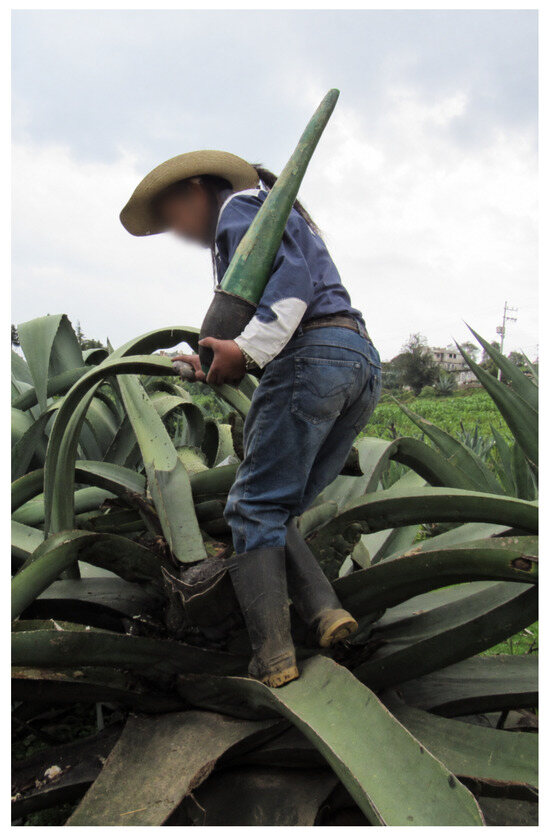
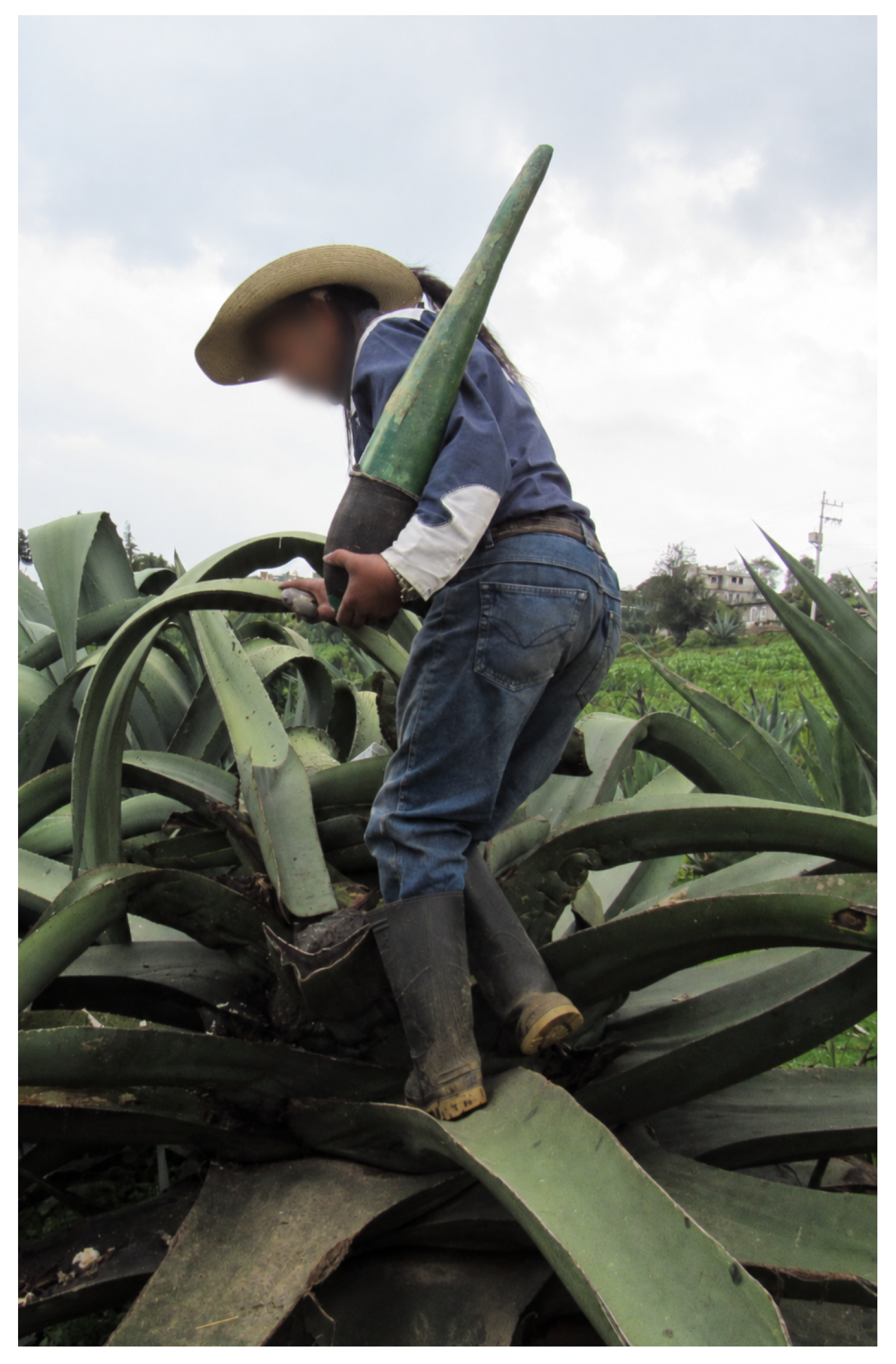
In the traditional process, an experienced worker (tlachiquero) performs the preparation and maintenance of the maguey cavity and subsequently removes the accumulated aguamiel using an acocote operated by mouth suction, as illustrated in Figure 2. The proposed system does not address the agronomic knowledge required for plant selection, preparation, scraping, or management. Instead, its scope is restricted to mechanizing the liquid-recovery stage shown in the figure by replacing mouth-generated suction with an electrically driven pumping mechanism. Therefore, the proposed system is not intended to replace the tlachiquero, but to provide a mechanized alternative for the extraction operation that reduces its dependence on operator-specific suction skills.
Figure 2.
Traditional aguamiel harvesting using an acocote. The liquid-recovery stage relies on manual handling and operator-generated suction to transfer aguamiel from the agave cavity to a collection container.
The field context imposed several practical requirements on the system. The prototype had to be transportable between plants, operate independently of the electrical grid, provide sufficient suction and hydraulic reach to transfer the liquid from the maguey cavity to a collection container, and allow direct operator supervision of the extraction process. In addition, the system was required to use a removable collection container and a simple human–machine interface suitable for field operation.
Based on these conditions, the following operational requirements were defined:
- 1.
- Portable operation with a target total mass not exceeding approximately 20 kg;
- 2.
- Autonomous operation from a rechargeable battery;
- 3.
- Mobility over typical field terrain and transport between individual maguey plants;
- 4.
- A hydraulic extraction line with a reach of approximately 1 m from the prototype to the plant cavity;
- 5.
- Electrically driven suction without requiring mouth-generated suction;
- 6.
- Continuous transfer of the extracted aguamiel to a removable collection container;
- 7.
- Operator-controlled START/STOP operation and visual feedback of the extraction process;
- 8.
- Estimation of the transferred liquid volume during operation.
These operational requirements were subsequently translated into the quantitative design parameters and engineering constraints presented in the following subsection.
3.3. Design Parameters and Constraints
The operational requirements identified in Section 3.2 were translated into the engineering specifications summarized in Table 1. These values define the design targets used for analytical sizing and component selection rather than experimentally measured performance. The specifications were selected to balance hydraulic capacity, energy autonomy, portability, and implementation simplicity within the intended small-scale field application.
Table 1.
Main parameters and design constraints adopted for the proposed harvesting system.
The 12 V DC architecture was adopted to allow battery-powered operation and direct compatibility with the selected diaphragm pump. A 4.2 Ah rechargeable battery and a pump with a nominal electrical power of approximately 60 W were considered for the initial energy sizing. A target flow rate of 5 L min−1 was established for the hydraulic design, while a removable 10 L container was selected to limit the amount of liquid transported within the mobile unit at each filling cycle.
A simple on/off control architecture was adopted because the primary functional requirement is supervised liquid transfer rather than closed-loop regulation of flow rate. Accordingly, the prototype does not require a flow sensor for its basic operation; transferred volume is estimated from the elapsed pumping time and the assumed operating flow rate. The assumptions and validation limitations of this approximation are discussed in Section 5.
3.4. Analytical Sizing Model
A first-order analytical model was formulated to size the main electrical, hydraulic, and storage components before prototype integration. The objective was not to reproduce the complete transient behavior of the system, but to obtain engineering estimates of electrical power demand, battery autonomy, hydraulic requirements, extraction capacity, and container filling time. These estimates provided a quantitative basis for component selection and were subsequently compared with the implemented system under experimental operating conditions.
3.4.1. Electrical Power and Battery Autonomy
The electrical subsystem was sized considering the diaphragm pump as the dominant load during extraction. The electrical power demanded by the pump is
where is the supply voltage and is the pump current. The selected diaphragm pump operates at a nominal voltage of 12 V and has a rated electrical power of approximately 60 W. Therefore, the nominal current used for preliminary sizing is
The nominal energy stored in the battery is approximated by
where is the nominal battery voltage and is its rated capacity in ampere-hours. For the selected , battery,
Assuming constant nominal pump power and ideal utilization of the rated battery capacity, the theoretical continuous operating time is
This value represents an ideal sizing estimate based on nominal component ratings. During actual battery discharge, the terminal voltage and available capacity depend on the electrical load and battery state; consequently, pump speed and delivered flow may also vary toward the end of the discharge cycle. Therefore, was used as a theoretical reference rather than as an expected experimental autonomy. Operating autonomy was subsequently assessed through two complete-discharge tests. Electrical power was calculated from nominal reference values rather than measured during discharge. Transferable volume per charge was estimated from the mean observed operating duration and the reference flow rate, as described in Section 5.
3.4.2. Hydraulic Sizing
The hydraulic subsystem was sized to estimate the head required to transfer aguamiel from the maguey cavity to the collection container at the target flow rate. A steady, incompressible-flow approximation was adopted for first-order sizing. The required hydraulic head was expressed as
where is the elevation difference between the intake and discharge reference levels, represents distributed losses along the hose, and accounts for local losses associated with fittings, connections, and other flow disturbances.
The target flow rate was established as
For a hose with an internal diameter of approximately , the corresponding mean fluid velocity is
Distributed losses were estimated using the Darcy–Weisbach equation,
where f is the Darcy friction factor, L is the total modeled flow-path length, and g is gravitational acceleration. The approximately flow path includes the rigid extraction tube and both flexible hoses and was idealized as a uniform internal-diameter conduit.
For preliminary sizing, was assumed. As an additional consistency check, the published aguamiel viscosity of 1.74 at 40 °C [24], together with the assumed density and design flow rate, gives . Assuming hydraulically smooth turbulent flow, the Blasius correlation [25] gives , supporting the approximate magnitude of the adopted value. This comparison does not establish the friction factor under field conditions, since viscosity was not measured in the present trials. Using , , and gives
Local losses were approximated as
where is an equivalent local-loss coefficient, referenced to the velocity in the hose. The resistance-coefficient method follows Crane Technical Paper 410 [26]. For preliminary sizing, was assumed as a lumped allowance for the foot-valve/strainer assembly, connections, and discharge configuration. This numerical value was not derived from a verified component-by-component calculation or measured for the assembled circuit. The resulting estimated local head loss is
Considering the maximum static elevation specified for prototype operation,
the estimated total required head at the design flow rate becomes
The hydraulic power associated with this design condition can be estimated as
where denotes the aguamiel density. Published characterizations report approximately [27] and for fresh aguamiel [24]. Since density was not measured in the present trials, and based on these published measurements, a representative density of
was adopted for first-order hydraulic sizing. Density and viscosity were treated as constant during each short transfer of fresh aguamiel. Nevertheless, differences in soluble solids content between plants or harvesting sessions may affect both properties. The intake strainer retains larger suspended particles but does not remove dissolved constituents. At fixed flow rate, geometry, and resistance coefficients, calculated pressure and hydraulic power vary proportionally with density. Viscosity changes may additionally affect the Reynolds number, friction factor, and hydraulic losses.
Using and , the hydraulic power is
The corresponding estimated pressure difference is
A density sensitivity check using 1025 and , with flow rate, geometry, and resistance coefficients held constant, gives pressure requirements of approximately – and hydraulic powers of –. These correspond to changes of to relative to the adopted density. This assessment isolates density effects; viscosity-related changes were not experimentally characterized.
To examine the influence of the assumed local-loss coefficient, a sensitivity analysis was performed by varying while holding the other model parameters constant: , , , , and . The total flow path was represented by an idealized uniform conduit. Under these assumptions, , and the required head can be expressed as
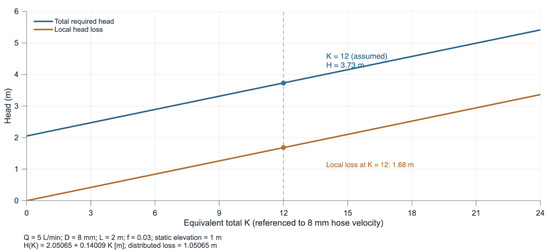
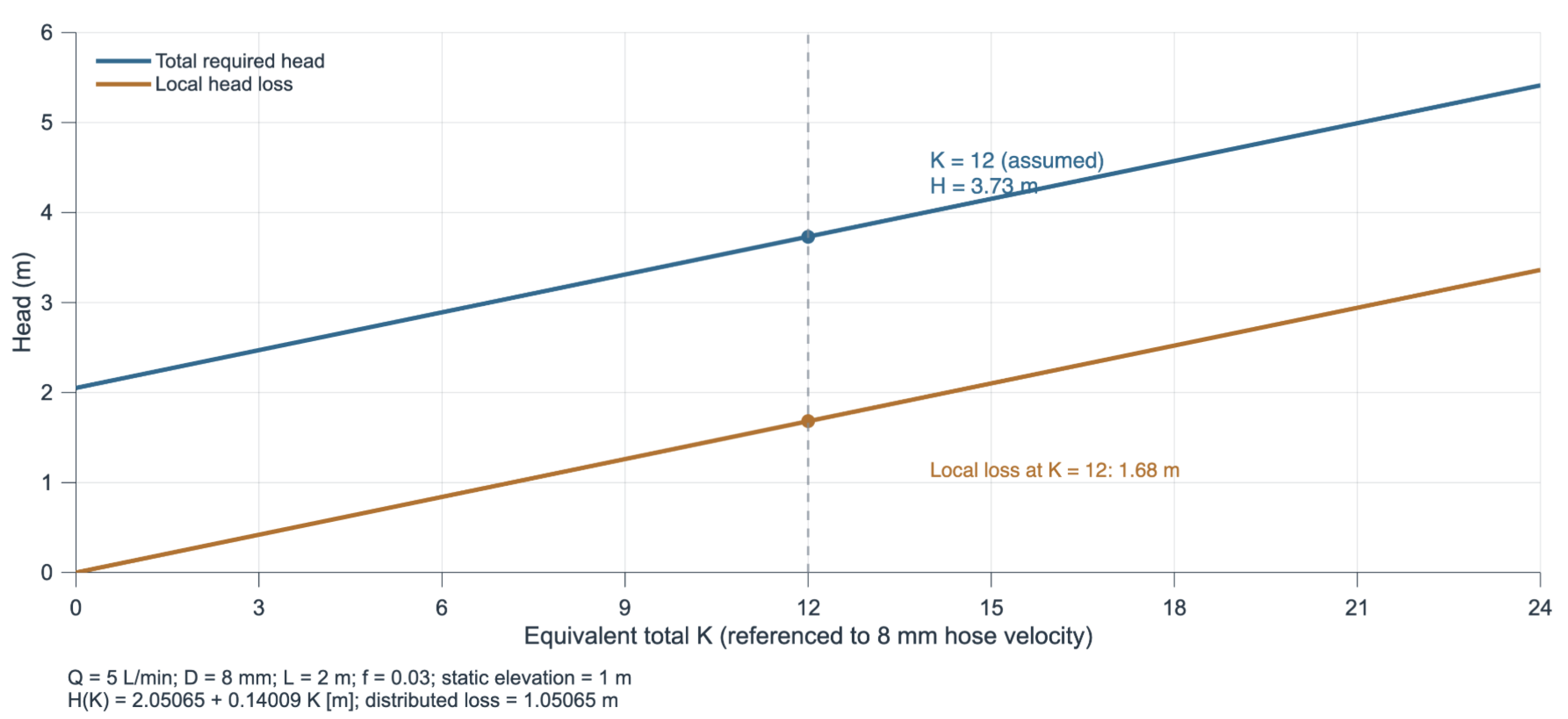
Figure 3 shows the calculated local losses and total required head for an illustrative coefficient sweep from 0 to 24. For example, increasing from 6 to 18 increases the required head from approximately 2.89 to 4.57 m, compared with 3.73 m at . These scenarios quantify the influence of the assumed coefficient; they do not establish its actual value, an uncertainty interval, or an upper bound for the assembled circuit. Since the flow rate is held constant, the analysis predicts the head required to sustain that flow rather than the resulting pump operating flow.
Figure 3.
Sensitivity of calculated hydraulic head to the assumed equivalent local-loss coefficient, referenced to the velocity in the 8 mm hose. The blue line represents total required head, and the orange line represents local head loss. The dashed line marks the assumed value . All results are analytical estimates at a fixed flow rate of .
The selected diaphragm pump is rated at 12 V and 60 W, with a supplier-listed maximum flow rate of . The previously stated maximum pressure of (40 psi) could not be verified against manufacturer documentation for the installed unit and is therefore not treated as a confirmed specification.
The estimated requirement of () represents the analytical design condition. Without a verified pump pressure–flow curve, the available operating margin at the target flow rate cannot be established. The assembled prototype’s flow performance was evaluated separately under field conditions, as reported in Section 5.
3.4.3. Extraction Capacity and Container Sizing
The theoretical extraction capacity was estimated by combining the target flow rate with the ideal continuous battery autonomy. For a constant flow rate , the theoretical transferable volume during one battery charge is
Using and gives
This value represents an ideal upper estimate because it assumes continuous operation at the design flow rate throughout the complete theoretical battery autonomy. In practice, battery voltage and pump operating conditions can vary during discharge, causing the instantaneous flow rate to deviate from its reference value. Therefore, the transferable volume per battery charge was subsequently estimated from the experimentally determined operating autonomy and the reference flow rate, as described in Section 5, rather than treated as a directly measured cumulative volume.
For the selected removable collection container,
the theoretical filling time at the target flow rate is
Accordingly, the ideal number of complete container-equivalent volumes transferable per battery charge is
Thus, the analytical model predicts approximately 25 complete container-equivalent transfers per battery charge under ideal continuous-operation conditions. These quantities are used exclusively as design references and are compared in Section 5 with the experimentally measured operating autonomy and the corresponding estimated transferable volume.
3.5. Scope and Assumptions of the Analytical Model
The analytical model was intentionally formulated as a first-order engineering tool for component sizing rather than as a high-fidelity representation of the complete electrohydraulic system.
The hydraulic analysis assumes steady, incompressible flow and represents distributed and local losses through approximate coefficients and , respectively. In addition, the adopted aguamiel density, , is a representative modeling value based on reported physicochemical properties of fresh agave sap [27], rather than a direct measurement of the liquid used in the present experiments. Consequently, the calculated and should be interpreted as engineering estimates for the specified design condition.
Furthermore, the maximum flow and pressure ratings of the selected diaphragm pump were not used to reconstruct a pressure–flow characteristic, because these limiting specifications do not define simultaneous operating conditions. Instead, the analytical model was complemented by direct experimental verification of the relevant design condition: at a supply and the maximum static elevation considered for prototype operation (), the implemented hydraulic assembly delivered approximately . Therefore, the model is used to support engineering sizing and consistency with the observed prototype performance within the investigated operating range, without claiming a complete characterization of the pump or prediction outside these conditions.
The electrical analysis assumes nominal battery voltage, rated capacity, and approximately constant pump power to estimate an ideal operating autonomy. Battery discharge dynamics, terminal-voltage reduction under load, and the associated variation in pump operating conditions were not explicitly modeled. Their combined influence was instead assessed through the experimental operating-autonomy measurements reported in Section 5.
4. Mechatronic System Design and Development
Based on the engineering requirements and analytical sizing presented in Section 3, the proposed harvesting device was implemented as an integrated portable mechatronic system for the mechanized extraction of aguamiel. The prototype combines mechanical transport and liquid storage, a hydraulic extraction circuit, an autonomous electrical power supply, embedded electronic control, and a simple human–machine interface.
The system was intentionally designed around commercially available components and a low-complexity architecture to facilitate assembly, replacement, and maintenance under small-scale agricultural conditions. Rather than introducing closed-loop flow regulation or additional instrumentation, the implemented prototype prioritizes supervised extraction, portability, and straightforward operation. The following subsections describe the system architecture and the mechanical, hydraulic, electrical, electronic, and control subsystems of the implemented prototype.
4.1. System Architecture
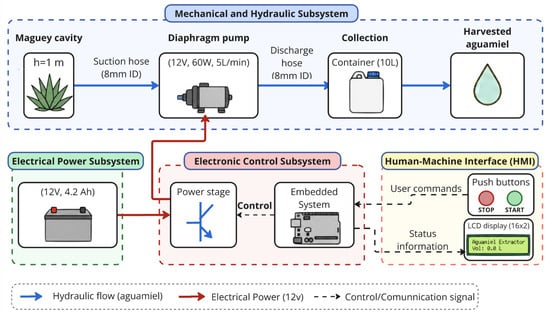
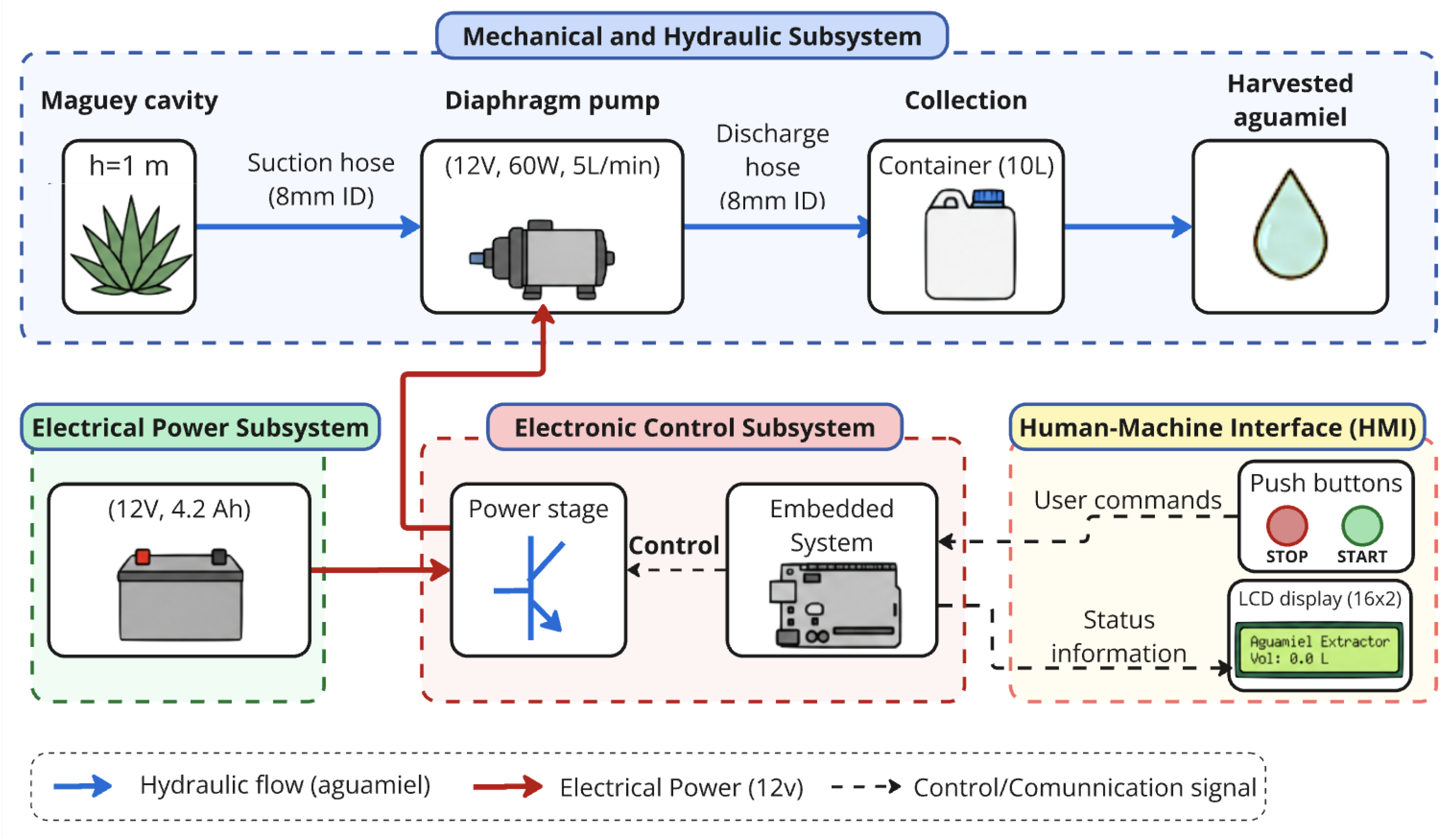
The implemented prototype can be organized into four interacting functional subsystems: (i) the mechanical and hydraulic subsystem, which provides the portable structure and transfers aguamiel from the maguey cavity to the collection container; (ii) the electrical power subsystem, which supplies energy to the pump and embedded electronics; (iii) the electronic control subsystem, which processes the operator commands and controls pump activation; and (iv) the human–machine interface (HMI), which provides START/STOP commands and visual information during extraction.
The overall functional architecture is shown in Figure 4. The extraction process begins at the maguey cavity, where the suction hose is manually positioned by the operator. The liquid is transported through the hydraulic line by a diaphragm pump and discharged into a removable collection container. The pump is supplied by the onboard rechargeable battery and is switched through the electronic power stage according to commands generated by the embedded controller. Operator interaction is intentionally limited to a small number of functions.
Figure 4.
Functional architecture of the implemented mechatronic system for aguamiel harvesting.
During operation, the operator initiates the extraction process using the START command and can interrupt it at any time using the STOP command. The embedded controller supervises pump activation and estimates the transferred volume from the accumulated operating time and the nominal flow-rate reference. The current operating state and estimated volume are displayed on the LCD, providing the operator with direct feedback during the extraction process.
4.2. Mechanical and Hydraulic Design
The mechanical and hydraulic subsystems were designed jointly to provide a compact and portable platform capable of operating directly at the maguey plant. The mechanical structure integrates the collection module, hydraulic components, battery, and control electronics within a single mobile assembly. The design criteria included portability, accessibility of the main components, ease of container replacement, and physical separation between the liquid-transfer and electrical subsystems.
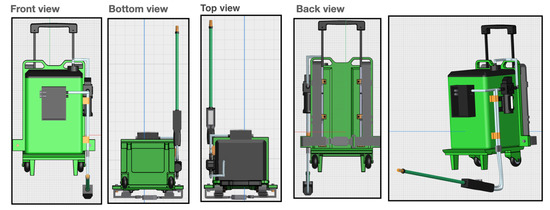
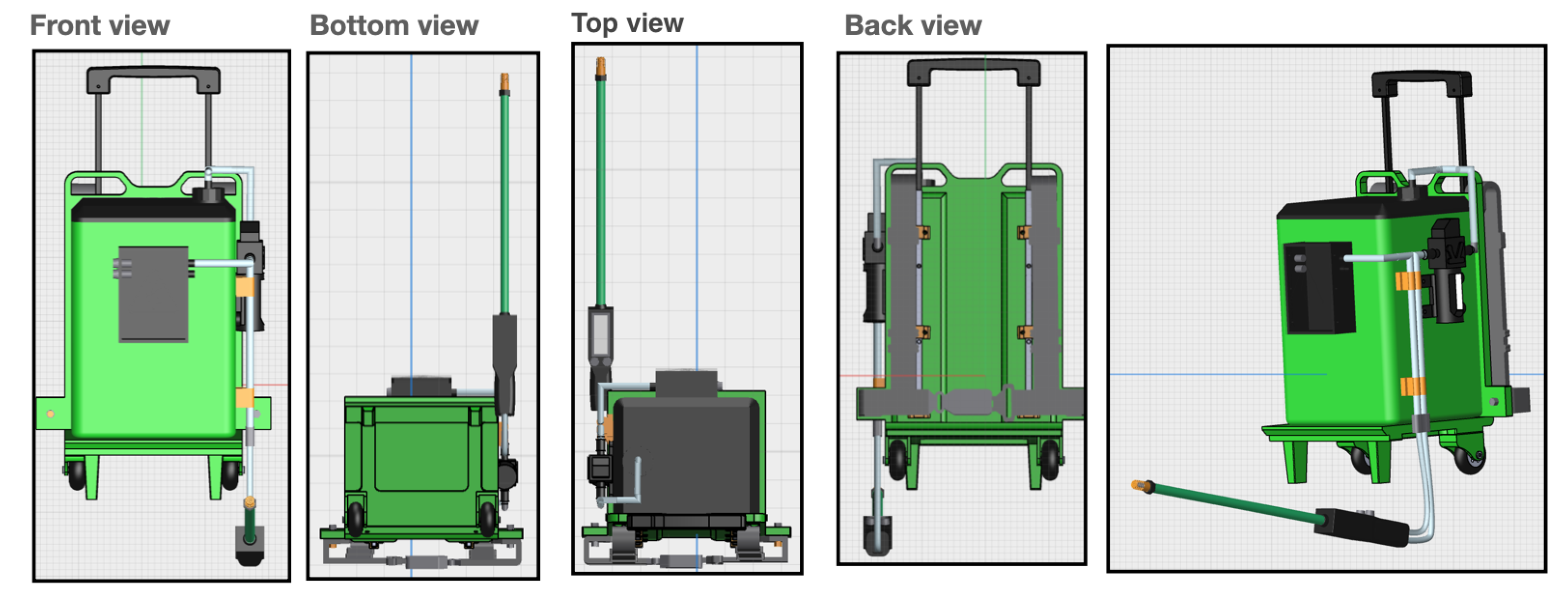
The mechanical configuration was first developed in CAD to verify the spatial arrangement of the principal components before prototype assembly. Figure 5 shows the front, bottom, top, and rear views of the resulting design, together with the extraction assembly. The collection module was designed to accommodate a commercially available, removable container inside the portable structure.
Figure 5.
CAD design of the portable aguamiel harvesting system, showing the principal views used to define the mechanical arrangement and component integration.
The removable collection container is housed within a casing and can be removed independently for emptying or replacement. Its adapted lid accommodates the hydraulic discharge line while allowing air exchange to prevent vacuum formation during filling. The battery and control electronics are located in a separate enclosure, physically separating the electrical components from the liquid-collection module and facilitating maintenance.
4.2.1. Mass and Portability Constraint
Portability was incorporated as a mechanical design constraint because the system is intended to be transported and operated directly in the field. Accordingly, the maximum allowable mass of the fully loaded prototype was established as
The total loaded-system mass was expressed as the sum of the main structural, hydraulic, electrical, and liquid contributions:
where is the structural mass, is the pump mass, is the battery mass, is the mass of the electronic subsystem, is the mass of the empty collection container, is the mass of the hoses and hydraulic accessories, and is the mass of the collected aguamiel.
For the portability analysis, an aguamiel density of was adopted as a design value.
Considering the selected maximum collection volume of , the corresponding liquid mass was
Using nominal masses of approximately for the 12 diaphragm pump and for the 12 , battery, the mass constraint becomes
Therefore, the maximum allowable combined mass of the structure, electronic subsystem, empty container, hoses, and hydraulic accessories was
The value of represents a design mass allowance for these components and should not be interpreted as the measured empty mass of the prototype. After including the nominal pump and battery masses, the maximum allowable mass of the complete empty prototype was . This mass budget was used as a design constraint during component selection and mechanical integration.
The experimentally measured mass of the complete empty prototype, including the pump, battery, and empty collection container, was around .
4.2.2. Mechanical Integration and Mobility
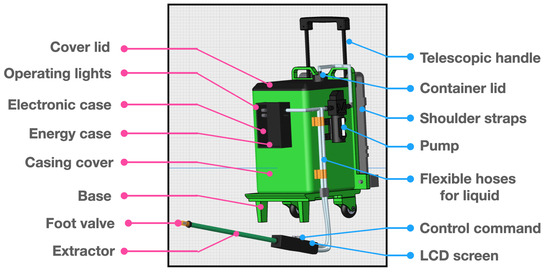
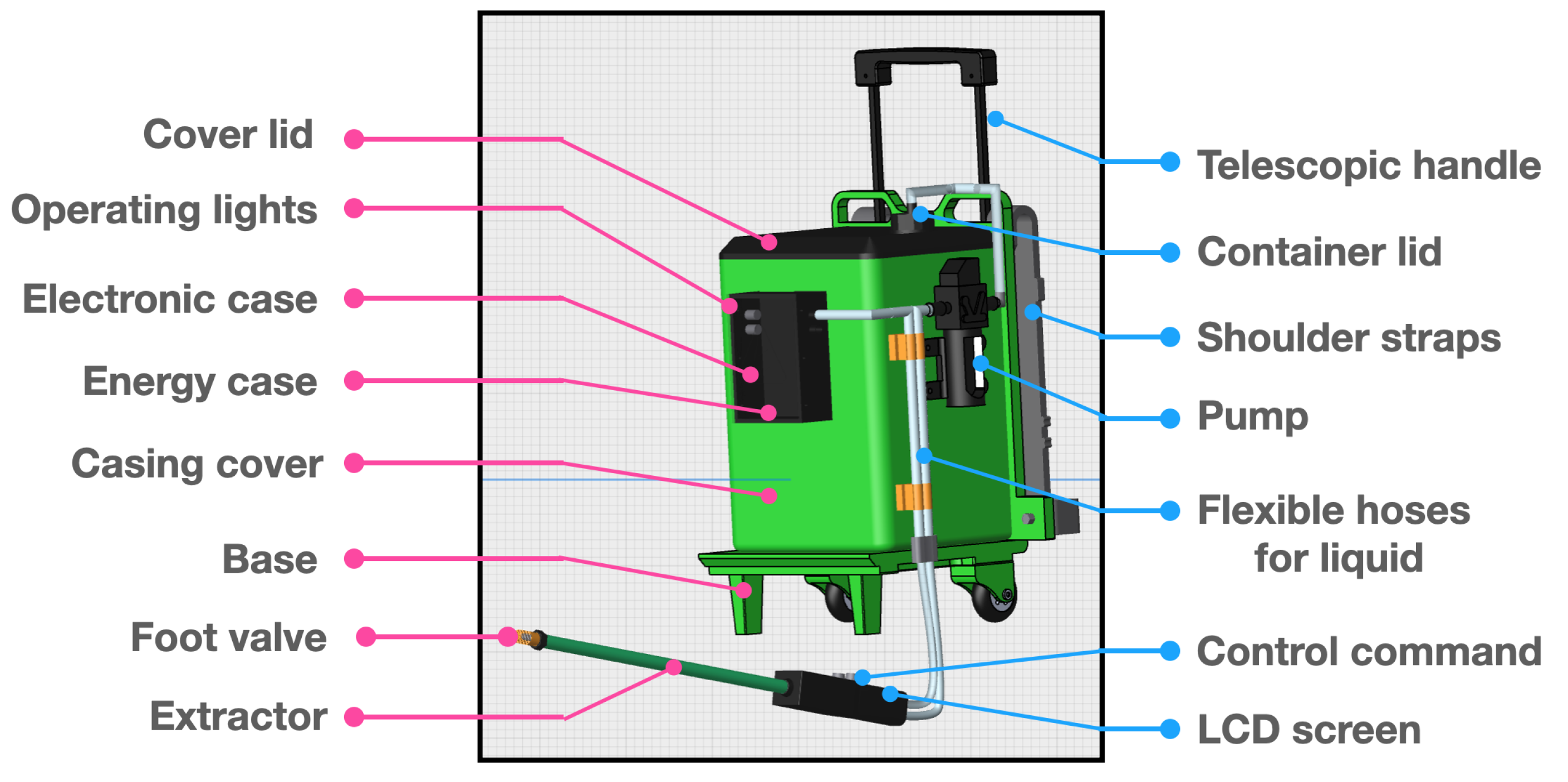
Mobility is provided by two rear wheels, front stabilizing supports, and a telescopic handle extendable up to approximately . Shoulder straps provide an alternative for carrying the system when rolling transport is impractical. The integrated component arrangement is shown in Figure 6.
Figure 6.
Integrated configuration of the portable aguamiel harvesting system, identifying the principal mechanical, hydraulic, power, control, and user-interface components.
The main components identified in Figure 6 are summarized in Table 2, together with their function, main dimensions, and construction material.
Table 2.
Main mechanical and functional components of the proposed prototype.
The hydraulic circuit comprises a extraction element, a non-return foot valve, a diaphragm pump, flexible diameter hoses, and the removable collection container. During operation, the extraction element is manually positioned inside the maguey cavity, and the pump transfers the accumulated aguamiel to the container. The hydraulic dimensions and pump selection were established from the analytical sizing presented in Section 3.4.2 and subsequently evaluated under field operating conditions in Section 5.
4.3. Electronic and Power System
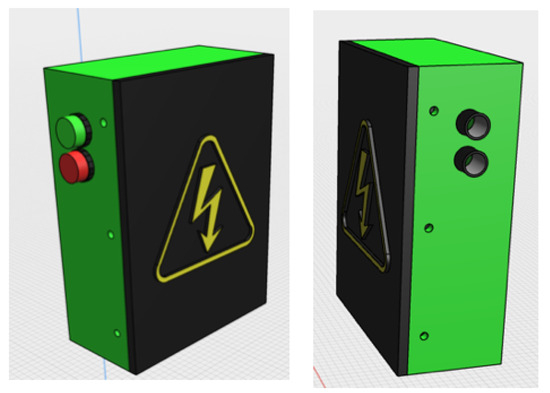
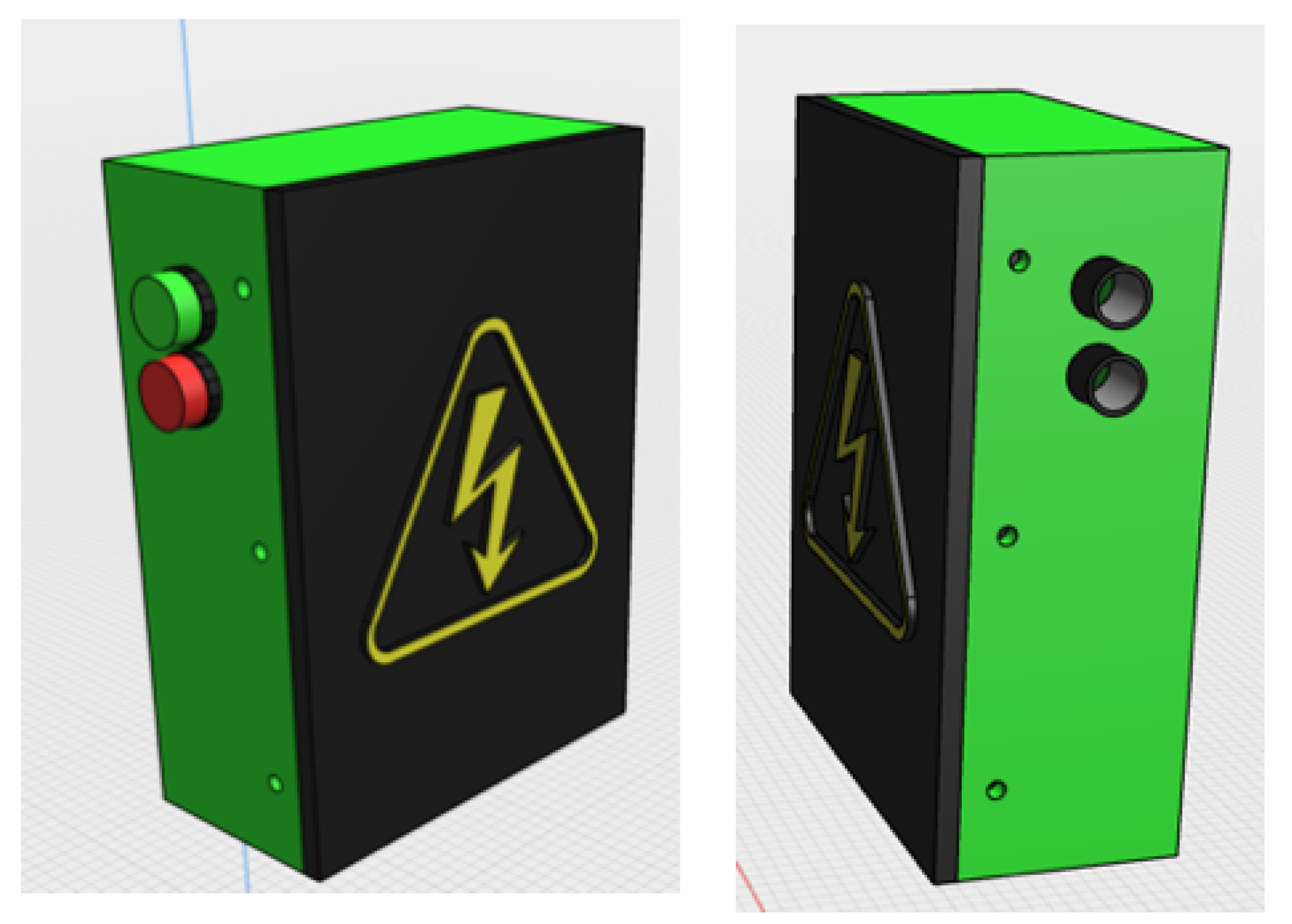
The prototype is powered by an onboard , rechargeable battery sized according to Section 3.4.1. The diaphragm pump, rated at approximately , constitutes the dominant electrical load. The battery and control electronics are housed separately from the liquid-collection module, as shown in Figure 7.
Figure 7.
CAD design of the energy and electronic enclosure integrated into the portable harvesting system.
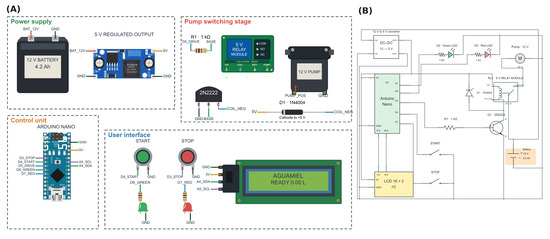
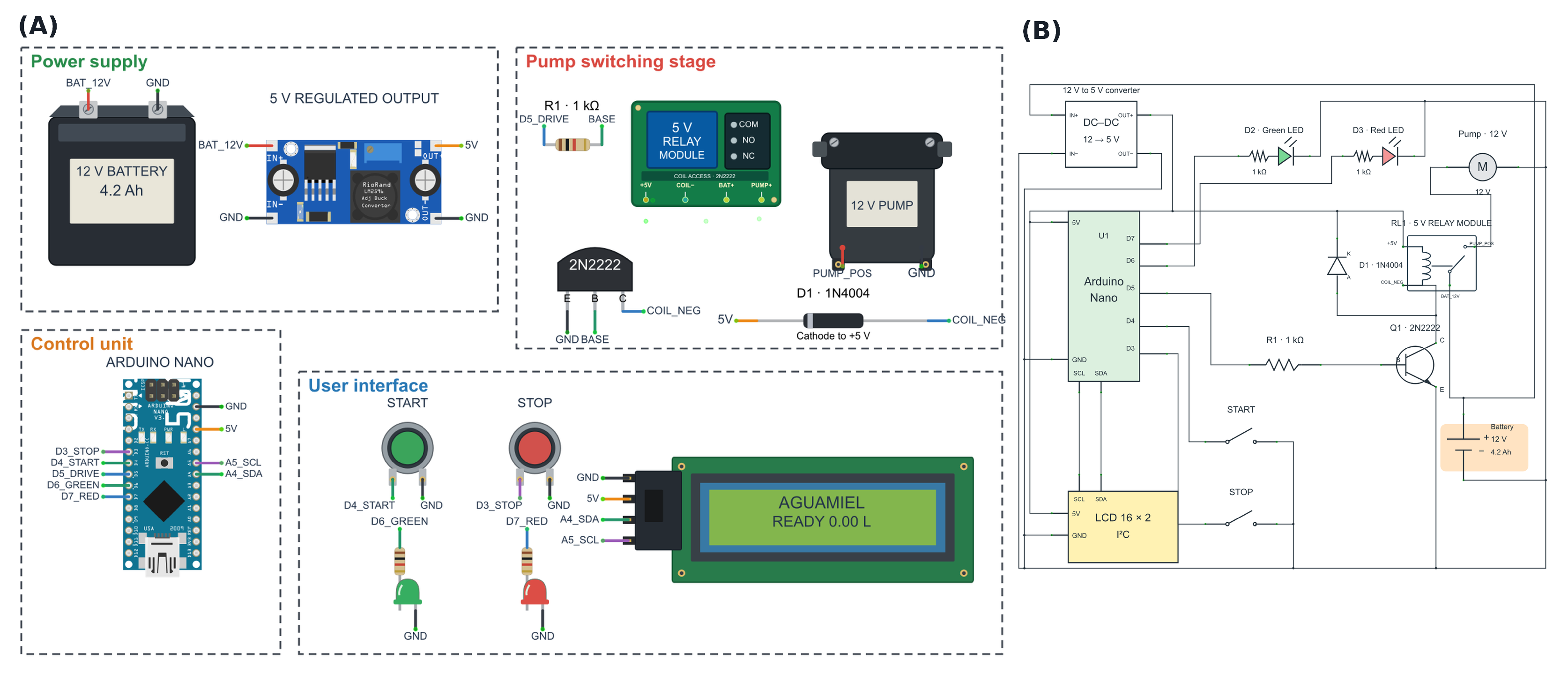
An Arduino Nano was used as the embedded controller. Because the pump current exceeds the output capability of the microcontroller, pump activation is implemented through a 5 V relay board with an external transistor-driving stage. The board provides access to the relay coil and switching contacts. The external stage comprises a 2N2222 transistor, a 1 k base resistor, and a 1N4004 flyback diode, as shown in Figure 8.
Figure 8.
Electronic hardware configuration: (A) component representation prepared in Fritzing and (B) corresponding circuit schematic of the Arduino Nano-based prototype. The 5 V relay board is controlled by an external 2N2222 transistor, 1 k base resistor, and 1N4004 flyback diode.
The relay-driving stage uses a 2N2222 transistor with a base resistor of , identified as R1 in Figure 8. Assuming and , the estimated base current is
where is the transistor base current, is the controller output voltage, is the base–emitter voltage drop, and is the base resistance. The relay-coil current of was a preliminary sizing assumption rather than a measured value. Under this assumption, the corresponding forced current gain would be approximately .
This configuration was tested in Proteus and subsequently constructed using the same transistor type and base-resistor value. Relay-driven pump activation was observed during prototype operation, confirming functional operation under the tested conditions. Base current and collector–emitter voltage were not measured; consequently, this functional verification does not quantify the transistor’s saturation margin.
The hardware configuration is presented in Figure 8. The component-based representation prepared in Fritzing identifies the main devices and their connections, while the corresponding schematic shows the electrical topology.
The battery supplies the pump at 12 V and feeds a DC–DC converter that provides a regulated 5 V supply to the Arduino Nano through its 5V pin, the LCD, and the relay coil. These circuits share a common ground.
The Nano’s D5 output drives the base of the external 2N2222 transistor through the 1 k resistor R1. The transistor emitter is connected to ground, and its collector is connected to the relay board’s COIL- terminal. The opposite coil terminal is connected to +5 V. The external 1N4004 diode is connected across the coil, with its cathode at +5 V and its anode at COIL-, to suppress the inductive voltage transient when the transistor switches OFF.
The relay’s COM contact receives the battery’s 12 V supply, and its normally open contact supplies the pump. The pump negative terminal is connected to battery ground.
4.4. Control Architecture and Human–Machine Interface
The electronic interface incorporates START/STOP commands, status indicators, and a LCD. The prototype implements an on/off control architecture in which the operator retains direct authority to start, stop, or restart the diaphragm pump. No closed-loop flow regulation or direct volume sensing is employed. Instead, the transferred volume is estimated from the accumulated pump operating time. In discrete form, the embedded controller updates this estimate as
where and denote pump ON and OFF, respectively, is the sampling interval, and
is the reference flow rate. Therefore, is a time-based estimate rather than a direct measurement of transferred volume.
The supervisory switching logic is expressed as
where denotes a new START button press and denotes an active STOP command. The term maintains pump activation after START is released. A new START command from Standby or Full/Stop resets the volume estimate before the switching condition is evaluated. START commands during Extraction do not reset the ongoing cycle.
Both are binary variables, with 1 indicating an active command. The variable is the nominal collection capacity. For , the corresponding nominal filling time is
The supervisory controller comprises three states: Standby, Extraction, and Full/Stop. A brief START command initiates Extraction, and the pump remains ON after the button is released. The operator may interrupt extraction at any time by pressing STOP, which switches the pump OFF, returns the controller to Standby, and resets the volume estimate.
The removable collection container is positioned inside the housing, with the discharge tube above its opening to discharge the extracted aguamiel freely into it. When the estimated transferred volume reaches 10 L, the controller enters Full/Stop and switches the pump OFF.
The operator may initiate another cycle by pressing START, which resets the volume estimate. Before starting a new 10 L collection cycle, the operator manually empties or replaces the container. The controller does not perform or detect container emptying or replacement.
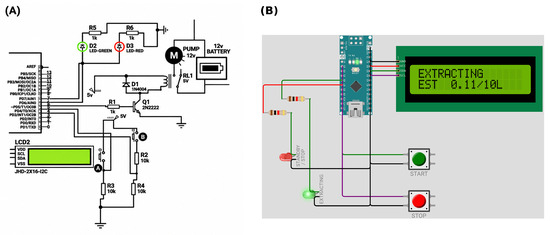
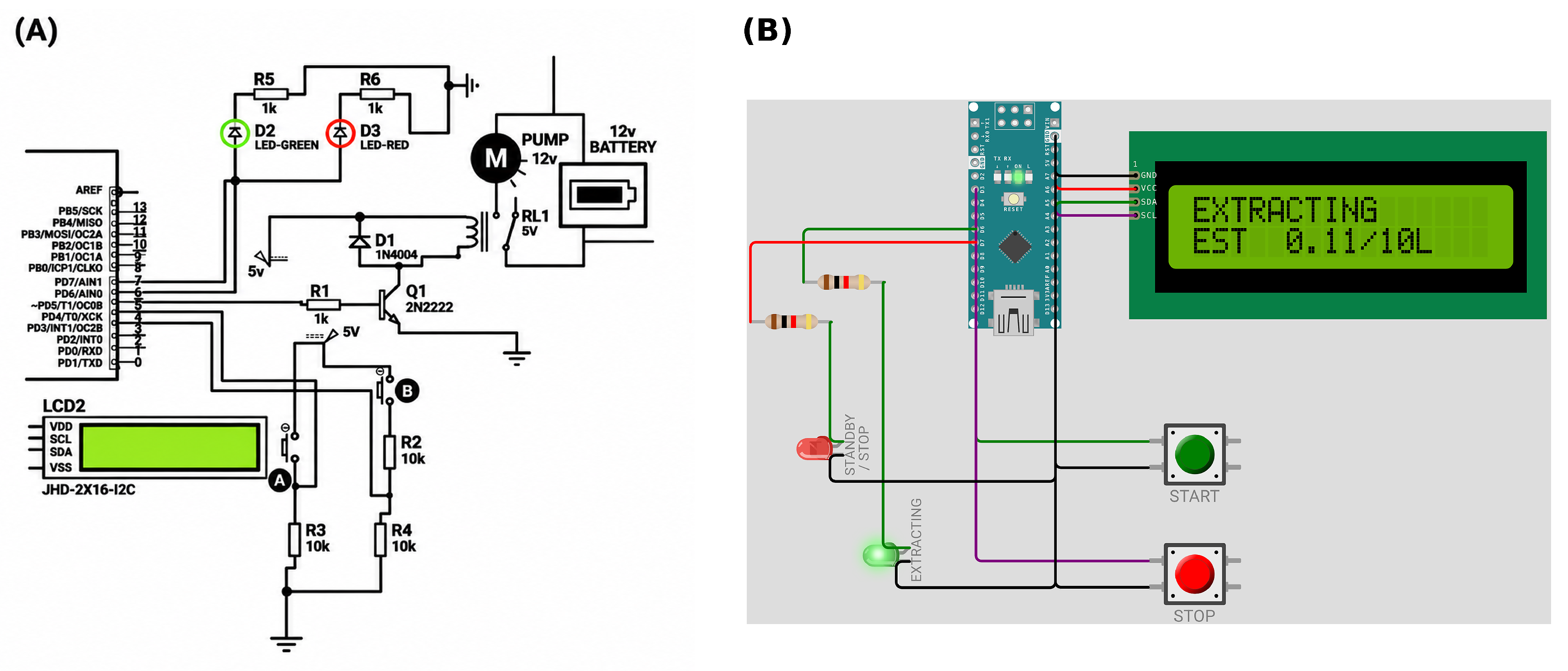
The control and relay-switching circuit was initially evaluated in Proteus before prototype construction. An Arduino Uno represented the Arduino Nano implemented in the prototype; both use the ATmega328P microcontroller and provide the digital I/O and timing functions required by the control logic.
Figure 9 presents the Proteus representation alongside an additional Wokwi simulation performed during revision. The Wokwi check addresses START/STOP handling, status indications, LCD updates, and the automatic stop based on time-estimated volume. It does not characterize transistor saturation, relay-coil current, power-supply transients, or hydraulic pump performance.
Figure 9.
Control evaluation: (A) relay-switching evaluation in Proteus using an Arduino Uno to represent the Arduino Nano implemented in the prototype and (B) additional Arduino Nano control-logic and LCD simulation in Wokwi.
Continuous flow measurement was not identified as a priority during consultations with local producers. Instead, the control architecture was designed to support operator-supervised collection and approximate filling-time estimation. Accordingly, an inline flow sensor was not incorporated into the prototype.
The proposed sensor-minimal architecture reduces instrumentation requirements while preserving direct operator supervision. Its main limitation is that the volume estimate in Equation (31) assumes a constant reference flow rate; therefore, deviations in actual pump flow directly affect the estimated transferred volume.
4.5. Prototype Implementation and Operation
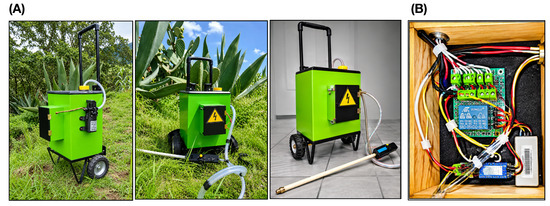
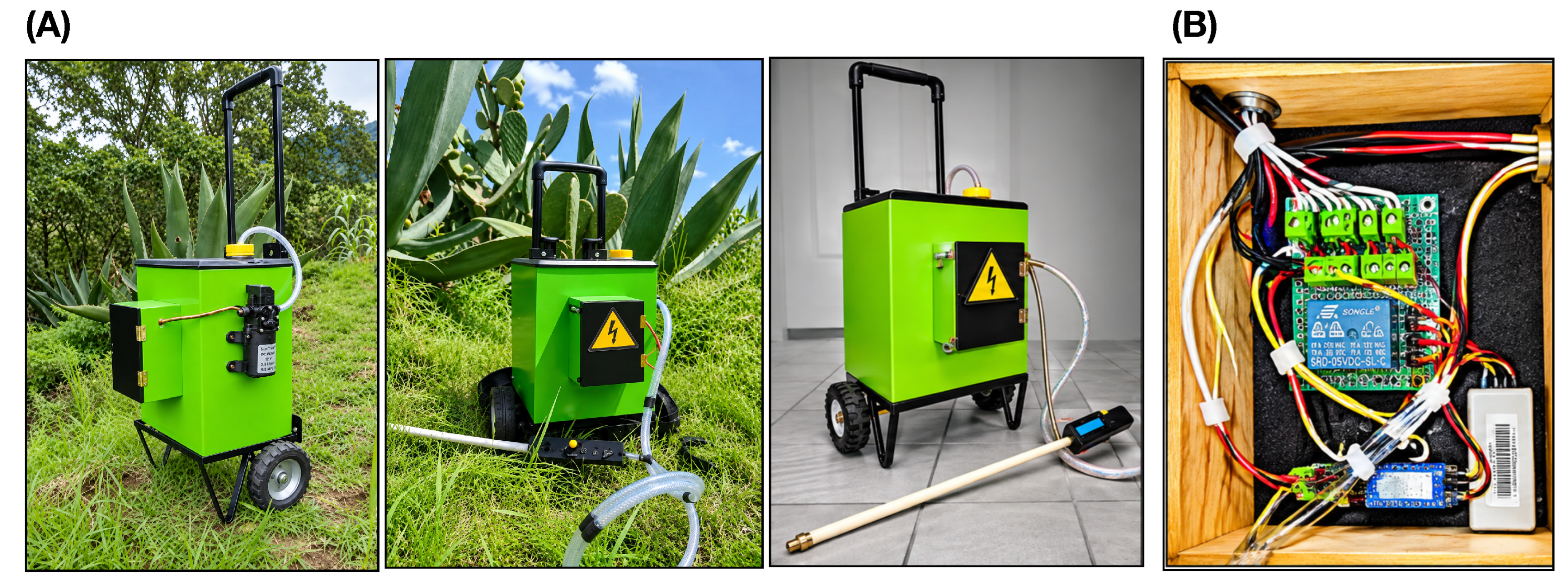
Following the CAD, hydraulic, electrical, and control design stages, the subsystems were integrated into the field-operable prototype shown in Figure 10. The final assembly incorporates the removable collection container, extraction line, diaphragm pump, battery, embedded controller, and HMI within the portable structure.
Figure 10.
Physical implementation of the portable aguamiel extraction prototype: (A) exterior views of the assembled system, showing the collection enclosure, telescopic handle, shoulder straps, diaphragm pump, and hydraulic extraction line; (B) internal arrangement of the electronic components and electrical wiring, including the Arduino Nano, 5 V relay board, power supply, and associated connections.
For operation, the extraction element is manually positioned inside the maguey cavity and the operator initiates pumping through the START command. Aguamiel is transferred to the removable container while the controller accumulates the pumping time and displays the estimated transferred volume. Extraction can be interrupted at any time using the STOP command or terminated when the programmed filling condition is reached.
After extraction, the collection container can be removed independently for emptying or replacement, while the hydraulic, power, and control components remain integrated into the portable structure. This operating sequence completes the transition from the subsystem-level design described above to the field performance evaluation presented in Section 5.
At the end of each harvesting day, rather than between individual extractions, the collection container and extraction circuit were rinsed with water, washed using powdered detergent diluted in water, and subsequently rinsed to remove detergent residues. This routine cleaning procedure was not validated for disinfection effectiveness.
5. Field Performance Evaluation and Discussion
The implemented prototype was evaluated under field operating conditions to assess whether the integrated system achieved the main performance targets established during the design stage. The experimental evaluation focused on hydraulic performance, electrical demand, and operating autonomy. The transferable volume per battery charge was subsequently estimated from the experimentally determined operating autonomy and the reference flow rate. These measured and estimated performance indicators were used to compare the implemented prototype with the first-order analytical design estimates presented in Section 3.4.
5.1. Experimental Protocol and Performance Metrics
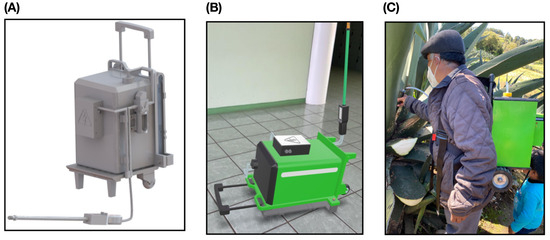
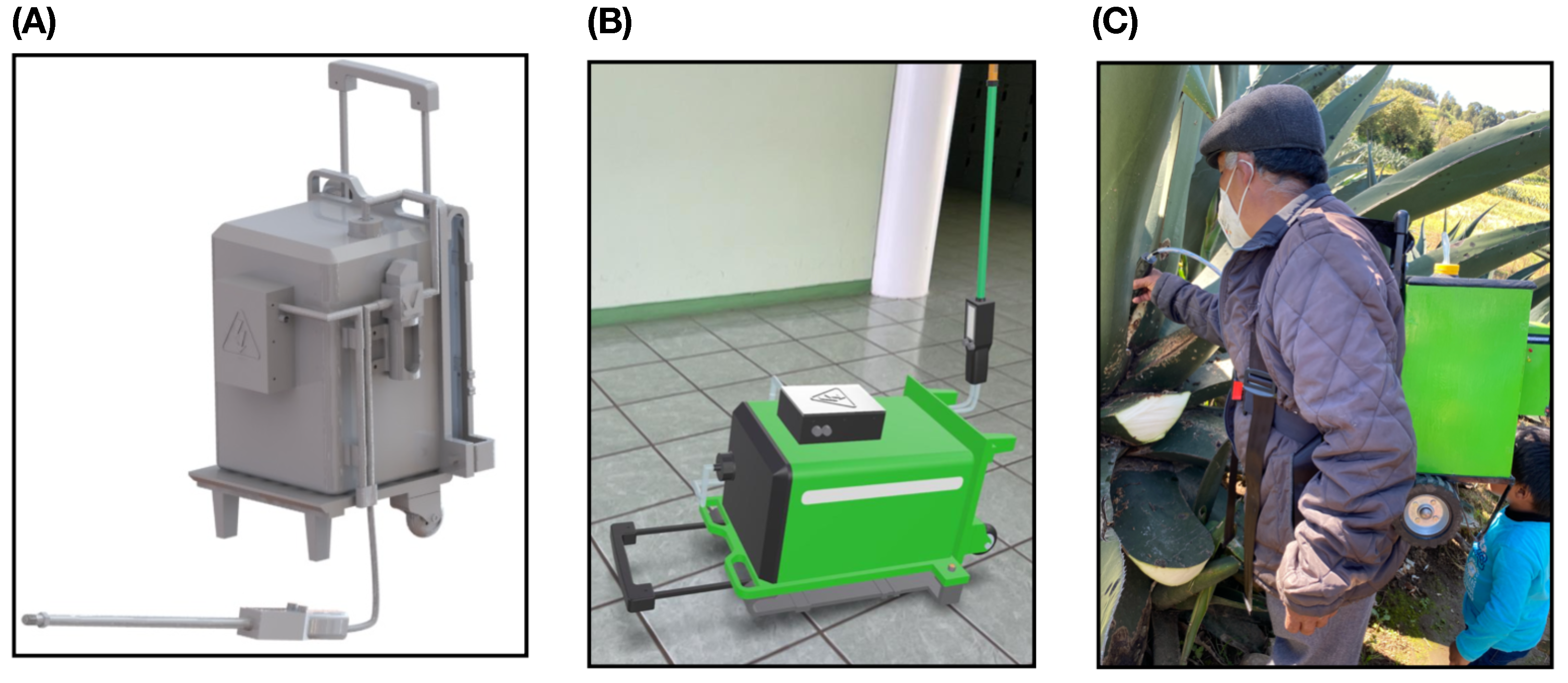
The fully assembled prototype was experimentally evaluated under field conditions by extracting aguamiel directly from maguey plants into the removable 10 collection containers. Figure 11 shows the progression from CAD design to physical implementation and in-field operation of the proposed system.
Figure 11.
Development and field evaluation of the proposed system: (A) CAD assembly, (B) augmented-reality visualization of the prototype, and (C) experimental aguamiel extraction directly from a maguey plant.
Field testing was conducted at a family-operated production site in Manzana Sexta, Jiquipilco, State of Mexico, Mexico. Hydraulic performance was characterized through extraction trials conducted on 20 aguamiel-producing maguey plants, locally identified as the Ayoteco variety. The plants were selected through non-probability convenience sampling and had been in their productive harvesting stage for approximately 1.5 months. One extraction trial was performed per plant between 14:00 and 18:00 h, corresponding to the second daily extraction under traditional harvesting practices. The hydraulic circuit comprised a rigid CPVC extraction tube and two flexible hoses, with a combined length of approximately 2 m. For preliminary hydraulic sizing, this circuit was idealized as a uniform conduit with an internal diameter of 8 mm. A static elevation difference of 1 m between the source liquid surface and the discharge level was assumed for sizing; it was not measured separately in every trial.
Each extraction trial involved a nominal volume of 10 L, approximately verified through two successive 5 L measurements using a graduated container. The corresponding pumping time was recorded using a digital stopwatch. Instrument resolution and measurement uncertainty were not independently characterized.
The 20 extraction trials were conducted in two groups of ten. Each group began with a fully charged battery, which was recharged before the second group. No recharging was performed between individual trials within a group; therefore, identical battery conditions across all trials cannot be assumed.
Manual observations during actual aguamiel extraction were used to establish the programmed filling interval. However, the individual records required to compare controller estimates with independently measured volumes are no longer available. Consequently, the estimation error and stopping accuracy at the nominal 10 L cutoff could not be quantified.
A supply-voltage reading of was obtained using a multimeter. Voltage was not monitored continuously during discharge. Pump current was not measured; was adopted as a reference value. Using the nominal voltage of gives an estimated reference power of , rather than measured electrical consumption. The original sizing value corresponds to the pump’s rated power.
The prototype used a rechargeable lithium battery rated at 12 V and 4.2 Ah. Its manufacturer and model designation were not retained. Battery autonomy was assessed through two complete-discharge tests, each beginning with a fully charged battery and continuing until the device stopped functioning. The mean operating duration was 44.2 min.
Battery voltage was not monitored during discharge, and the endpoint voltage was not recorded. Consequently, no measured cutoff voltage can be specified. The individual test durations are no longer available, preventing calculation of their standard deviation or range. The mean operating duration is therefore reported as a preliminary descriptive result.
The measured and derived performance metrics were defined as
where is the nominal total volume collected in each extraction trial, verified through two successive measurements, and is the corresponding total pumping time. The number of trials is , and the reference flow rate is .
The supply voltage was measured as 12.0 V using a multimeter, but was not monitored continuously during battery discharge. Pump current was not measured; 5.5 A was used as a reference value to estimate electrical power as 66 W. This estimate does not represent measured power throughout discharge. The quantity min denotes the mean duration of two separate complete-discharge tests. The transferable volume per charge is estimated from this mean duration and the reference flow rate, rather than measured directly.
5.2. Field Performance Results
The prototype successfully performed aguamiel extraction from maguey plants under the evaluated field conditions. The resulting measured and derived performance indicators are summarized in Table 3.
Table 3.
Field performance of the integrated aguamiel extraction prototype.
The reported flow rate of approximately represents the mean value obtained from the 20 field extraction trials. The present evaluation was intended as an engineering feasibility assessment of the integrated prototype under the selected design condition, rather than as a comprehensive statistical characterization of its field performance. Consequently, the mean flow rate is used as a descriptive performance indicator.
These results demonstrate the operation of the integrated hydraulic, electrical, control, and user-interface subsystems during actual aguamiel extraction from maguey plants. The field evaluation therefore provides an experimental reference for assessing the first-order design model under the intended operating conditions.
5.3. Analytical–Experimental Comparison
Table 4 compares the first-order analytical design estimates with the performance obtained during field aguamiel extraction. Agreement between the first-order analytical estimates and experimental field performance was quantified using the relative deviation defined as
Table 4.
Comparison between analytical design estimates and field performance.
The mean operating duration of 44.2 min from two complete-discharge tests was approximately 12.3% below the original ideal estimate of 50.4 min, which assumed a constant pump power of 60 W. The estimated transferable volume of 221 L per charge was calculated using the same reference flow rate of 5 L min−1. Its corresponding 12.3% difference therefore follows directly from the autonomy comparison and is not an independent experimental result.
As an additional consistency check, the nominal reference values of 12 V and 5.5 A give a calculated power of 66 W. Using the nominal battery energy of 50.4 Wh gives ≈. This value is close to the reported mean duration, but the comparison does not validate the actual discharge profile or usable battery capacity. Because voltage and current were not monitored, the autonomy difference cannot be attributed quantitatively to increased electrical consumption.
These results provide a preliminary comparison with the analytical sizing estimates. The two discharge tests do not establish robust repeatability or characterize runtime variability under different harvesting conditions.
5.4. Comparison with Traditional Aguamiel Harvesting
The proposed system was conceived as a mechanized alternative to the liquid-recovery stage of traditional aguamiel harvesting rather than as a replacement for the agronomic knowledge of the tlachiquero. Traditional harvesting uses an acocote operated by mouth-generated suction, whereas the prototype replaces this specific action with an electrically driven diaphragm pump. Consequently, plant selection, cavity preparation, scraping, and other maguey-management activities remain under operator responsibility.
Table 5 summarizes the main functional differences between both approaches. Because a controlled comparative experiment with experienced tlachiqueros was not conducted, the comparison is restricted to characteristics directly derived from the operating principles and implemented prototype.
Table 5.
Comparison between traditional aguamiel harvesting and the proposed mechanized system.
The principal mechanization contribution is therefore the substitution of operator-generated suction with an electrically powered pumping mechanism. This reduces dependence on the specific suction technique required to operate the acocote, while preserving human supervision and the traditional agronomic operations preceding liquid extraction. The prototype additionally introduces direct collection and time-based volume estimation, although at the cost of greater technical complexity and dependence on stored electrical energy.
Accordingly, the present results demonstrate the technical feasibility of an alternative extraction mechanism, but do not establish superiority over traditional harvesting in extraction time, labor demand, operator effort, or product quality. Quantitative comparison of these factors requires a dedicated controlled study involving traditional operators and is therefore identified as future work.
5.5. Prototype Cost and Technical Feasibility Evaluation
The prototype was developed following a frugal engineering approach based on commercially available components, implementation simplicity, regional accessibility, replaceability, and maintainability. Rather than relying on specialized equipment or components that must be sourced exclusively from international suppliers, the system was assembled primarily from components available through regional commercial suppliers and commonly accessible distribution channels.
To provide a transparent component-level cost assessment, the bill of materials was divided into mechanical and structural components and electrical and electronic components. All costs reported in this subsection correspond to acquisition prices in 2026 and are expressed in U.S. dollars (USD). Table 6 and Table 7 summarize the components used in the implemented prototype and their corresponding 2026 acquisition costs.
Table 6.
Mechanical and structural components of the implemented prototype and their 2026 acquisition costs.
Table 7.
Electrical and electronic components of the implemented prototype and their 2026 acquisition costs.
The mechanical and structural subsystem accounted for USD 155.58. The largest individual cost within this group corresponded to the Nylamid sheet (USD 72.33), followed by the four-point seat belt (USD 43.29). The remaining components correspond mainly to the portable structure, hydraulic lines, collection module, mobility elements, and assembly hardware. Most of these elements correspond to standard commercial materials and components that can be obtained or replaced without requiring specialized agricultural machinery suppliers.
The electrical and electronic subsystem accounted for USD 68.98. Within this group, the battery (USD 23.69) and diaphragm pump (USD 15.53) represented the largest individual component costs. The remaining cost was distributed among the embedded controller, human–machine interface, switching electronics, connections, and auxiliary electrical components. These elements were selected from commonly available commercial technologies rather than specialized industrial control or sensing equipment, facilitating component replacement and maintenance.
The resulting component-level cost distribution is summarized in Table 8.
Table 8.
Summary of the approximate 2026 component cost of the implemented prototype.
The complete research prototype therefore had an approximate 2026 component-level cost of USD 224.56, with the mechanical and structural subsystem accounting for 69.3% of the total and the electrical and electronic subsystem accounting for 30.7%. Beyond the absolute component cost, the frugal character of the proposed system derives from the deliberate use of a simple architecture, commercially available components, sensor-minimal control, and components that can be acquired through regional suppliers without requiring specialized equipment sourced exclusively from international suppliers.
From a practical perspective, this component-selection strategy favors accessibility, replacement, and maintenance under small-scale agricultural conditions. Major elements such as the diaphragm pump, battery, hydraulic lines, embedded controller, display, and electrical components can be individually replaced. The use of a rechargeable low-voltage power supply and a sensor-minimal control architecture further limits the need for specialized instrumentation, calibration equipment, or complex maintenance procedures.
The reported values represent the 2026 acquisition costs of the components used in the research prototype and should not be interpreted as a commercial production price. Component prices may vary according to supplier, geographic location, exchange rate, and purchase date. Manufacturing labor, tooling, transportation, maintenance, battery replacement, and production-scale costs were not included. Therefore, the reported USD 224.56 provides a quantitative reference for the component-level implementation cost of the proposed frugal system. In this work, frugality is understood primarily in terms of functional simplicity, regional component accessibility, replaceability, maintainability, and contained implementation cost, rather than as evidence of an economic advantage over traditional harvesting.
5.6. Limitations and Future Work
The present study demonstrates the technical feasibility of the proposed mechanized extraction concept, but several limitations remain.
First, the field evaluation was focused on prototype functionality and engineering performance; a controlled comparison with traditional acocote-based harvesting was not conducted. Consequently, the present results do not quantify differences in extraction time, operator effort, labor requirements, or harvesting performance between the two approaches.
Second, the controller estimates transferred volume from pumping time using a constant reference flow rate. This estimate supports operator-supervised collection rather than precise volumetric dispensing. The operator observes container filling and may interrupt extraction or initiate another pumping cycle as required. Because the individual records needed for a paired comparison are no longer available, volumetric estimation error and stopping accuracy at the nominal 10 L cutoff have not been established.
The original trial-level flow-rate records are no longer available for retrospective statistical analysis. Although the experimental flow rate was determined from collected volumes and corresponding extraction times, the absence of individual records prevents the retrospective calculation of standard deviations and confidence intervals.
A dedicated study of field usability and instrumented harvesting under documented operating conditions is planned as future work. It will compare controller estimates with independently measured volumes and quantify cutoff error, variability, and repeatability across plants, battery states, hydraulic configurations, and operators. The resulting measurements will support statistical analysis and assessment of field reproducibility.
Third, the usability of the proposed system by operators with different levels of harvesting experience has not been experimentally evaluated. Controlled field studies involving novice and experienced operators, multiple maguey plants, and repeated harvesting cycles are required to assess extraction time, directly measured transferred volume, repeatability, operator-related variability, and potential skill-related benefits. Longer-term evaluation is proposed as future work to address component durability, battery degradation, maintenance requirements, and performance under varying field conditions to assess the system’s broader applicability beyond the conditions investigated.
Fourth, battery autonomy was assessed through only two complete-discharge tests, yielding a mean operating duration of 44.2 min. Although a supply-voltage reading was obtained using a multimeter, voltage was not monitored continuously during discharge, current was not measured, and no endpoint voltage was recorded. The individual test durations and the battery’s manufacturer and model designation were not retained. Consequently, the reported autonomy is a preliminary descriptive result, without a quantified standard deviation, range, or measured cutoff voltage.
Future work will characterize autonomy under documented harvesting conditions, including observed pumping and idle periods, repeated operating cycles, and simultaneous voltage and current measurements. This evaluation will quantify usable energy and runtime variability and establish a defined operational stopping criterion under representative field use.
Fifth, food-contact suitability of the complete wetted circuit and the effectiveness of cleaning were not validated. Material compatibility, microbiological assessment, chemical migration testing, and validation of cleaning and disinfection procedures are therefore identified as priorities for a dedicated future study.
6. Conclusions
This study presented the design, development, and field performance evaluation of a portable, frugal mechatronic system conceived as a mechanized alternative for the liquid-extraction stage of traditional aguamiel harvesting. The prototype integrates a diaphragm pump, a removable collection container, battery-powered electronics, supervised on/off control, and time-based volume estimation within a portable architecture based primarily on commercially available and regionally accessible components.
Field testing indicated an extraction rate of approximately 5 L min−1 under the investigated conditions. Two complete-discharge tests yielded a mean operating duration of 44.2 min. Using this duration and the reference flow rate gives an estimated transferable volume of 221 L per charge, rather than a directly measured cumulative volume.
The mean operating duration was approximately 12.3% below the original ideal estimate of 50.4 min based on the pump’s rated power of 60 W. An alternative calculation using the nominal reference values of 12 V and 5.5 A gives 66 W and an ideal duration of approximately 45.8 min. This comparison provides a preliminary energy-balance consistency check. It does not establish actual electrical consumption, the battery discharge profile, or runtime repeatability. Because transferable volume was derived from the same reference flow rate, its corresponding difference is not an independent experimental measurement. Overall, the comparison supports the analytical model as a first-order sizing tool while highlighting the influence of actual battery and pump operating conditions.
The principal contribution of the proposed system is the mechanization of the suction-based liquid-recovery operation traditionally performed with an acocote. The prototype substitutes operator-generated mouth suction with an electrically driven pumping mechanism while retaining direct human supervision and leaving plant selection, cavity preparation, scraping, and other maguey-management activities under operator responsibility. Therefore, the system should be regarded as an alternative extraction tool that reduces the technical dependence of the extraction mechanism on operator-specific suction skills, rather than as a replacement for the traditional knowledge of experienced tlachiqueros.
The implemented prototype had an approximate 2026 component-level cost of USD 224.56. Its frugal character derives not only from the contained implementation cost, but also from the use of a simple sensor-minimal architecture and commercially available components that can be acquired through regional suppliers and individually replaced or maintained. These characteristics support the technical feasibility of the proposed system for small-scale maguey production without requiring specialized instrumentation or components sourced exclusively from international suppliers.
Further evaluation should incorporate direct flow measurement and instrumented battery-discharge characterization, controlled comparisons with traditional harvesting, multiple operators with different levels of experience, multiple harvesting cycles and maguey plants, and longer-term assessment of component durability and maintenance requirements. Such studies will be necessary to quantify operator-related effects, directly measure transferred volume, and assess the broader practical applicability and scalability of the proposed mechanized extraction approach.
7. Patents
No patents have resulted from the work reported in this manuscript.
Author Contributions
Conceptualization, S.B.-Y. and E.A.P.-G.; methodology, S.B.-Y. and E.A.P.-G.; software, E.A.P.-G., A.A.F.-C., J.E.C.-Q. and H.C.-C.; validation, E.A.P.-G., H.C.-C., C.S.-V. and J.E.C.-Q.; formal analysis, S.B.-Y., C.S.-V. and E.A.P.-G.; investigation, H.C.-C., J.E.C.-Q., C.S.-V. and A.A.F.-C.; resources, S.B.-Y., H.C.-C. and J.E.C.-Q.; data curation, A.A.F.-C.; writing—original draft preparation, S.B.-Y., E.A.P.-G., A.A.F.-C., H.C.-C. and C.S.-V.; writing—review and editing, S.B.-Y., E.A.P.-G., A.A.F.-C. and C.S.-V.; visualization, S.B.-Y., E.A.P.-G., H.C.-C., A.A.F.-C. and C.S.-V.; supervision, S.B.-Y., E.A.P.-G., C.S.-V. and A.A.F.-C.; project administration, S.B.-Y., E.A.P.-G., J.E.C.-Q. and C.S.-V.; funding acquisition, S.B.-Y., H.C.-C. and J.E.C.-Q. All authors have read and agreed to the published version of the manuscript.
Funding
The authors acknowledge the financial support provided by the Consejo Mexiquense de Ciencia y Tecnología (COMECyT) through research projects CIKAS-FICDTEM-25-070, “Gestión de procesos de innovación en la agroindustria rural del maguey pulquero: un recurso estratégico para el desarrollo” (Management of Innovation Processes in the Rural Agroindustry of Pulque Maguey: A Strategic Resource for Development), and C-SINERGIA-FICDTEM-25-053. The authors funded the APC.
Institutional Review Board Statement
Not applicable.
Informed Consent Statement
Not applicable.
Data Availability Statement
The engineering materials, including CAD files, electronic schematics, Arduino source code, programming, and simulation files, are publicly available at https://github.com/erickaxelpadillagarcia/aguamiel-extractor (accessed on 1 November 2026).
Acknowledgments
The authors gratefully acknowledge the valuable collaboration and support of the association Productores de maguey pulquero y derivados de Jiquipilco A.L.P.R., whose participation was essential for the development and field testing of the proposed device under real field conditions. Also, the authors acknowledge the students of the Universidad Politécnica de Atlacomulco for their valuable support during this work.
Conflicts of Interest
The authors declare that the research was conducted in the absence of any commercial or financial relationships that could be construed as potential conflicts of interest.
References
- Ramírez-Guzmán, K.N.; Torres-León, C.; Martinez-Medina, G.A.; de la Rosa, O.; Hernández-Almanza, A.; Alvarez-Perez, O.B.; Araujo, R.; González, L.R.; Londoño, L.; Ventura, J.; et al. Traditional Fermented Beverages in Mexico. In Fermented Beverages; Grumezescu, A.M., Holban, A.M., Eds.; Woodhead Publishing: Cambridge, UK, 2019; Volume 5, pp. 605–635. [Google Scholar] [CrossRef] [Scilit]
- Correa-Ascencio, M.; Robertson, I.G.; Cabrera-Cortés, O.; Cabrera-Castro, R.; Evershed, R.P. Pulque Production from Fermented Agave Sap as a Dietary Supplement in Prehispanic Mesoamerica. Proc. Natl. Acad. Sci. USA 2014, 111, 14223–14228. [Google Scholar] [CrossRef] [Scilit]
- Giles-Gómez, M.; Sandoval García, J.G.; Matus, V.; Campos Quintana, I.; Bolívar, F.; Escalante, A. In Vitro and In Vivo Probiotic Assessment of Leuconostoc mesenteroides P45 Isolated from Pulque, a Mexican Traditional Alcoholic Beverage. SpringerPlus 2016, 5, 708. [Google Scholar] [CrossRef] [Scilit]
- Lindsay, D.L.; Swift, J.F.; Lance, R.F.; Edwards, C.E. A Comparison of Patterns of Genetic Structure in Two Co-Occurring Agave Species (Asparagaceae) That Differ in the Patchiness of Their Geographical Distributions and Cultivation Histories. Bot. J. Linn. Soc. 2018, 186, 361–373. [Google Scholar] [CrossRef] [Scilit]
- Álvarez-Ríos, G.D.; Pacheco-Torres, F.; Figueredo-Urbina, C.J.; Casas, A. Management, Morphological and Genetic Diversity of Domesticated Agaves in Michoacán, México. J. Ethnobiol. Ethnomedicine 2020, 16, 3. [Google Scholar] [CrossRef] [Scilit]
- Álvarez-Ríos, G.D.; Casas, A.; Pérez-Volkow, L.; Figueredo-Urbina, C.J.; de Dios Páramo-Gómez, J.; Vallejo, M. Pulque and Pulquerías of Mexico City: A Traditional Fermented Beverage and Spaces of Biocultural Conservation. J. Ethn. Foods 2022, 9, 40. [Google Scholar] [CrossRef] [Scilit]
- Escalante, A.; López Soto, D.R.; Velazquez Gutierrez, J.E.; Giles-Gómez, M.; Bolívar, F.; López-Munguía, A. Pulque, a Traditional Mexican Alcoholic Fermented Beverage: Historical, Microbiological, and Technical Aspects. Front. Microbiol. 2016, 7, 1026. [Google Scholar] [CrossRef] [Scilit]
- Moreno, J.C.; Berenguel, M.; Donaire, J.G.; Rodríguez, F.; Sánchez-Molina, J.A.; Guzmán, J.L.; Giagnocavo, C.L. A Pending Task for the Digitalisation of Agriculture: A General Framework for Technologies Classification in Agriculture. Agric. Syst. 2024, 213, 103794. [Google Scholar] [CrossRef] [Scilit]
- Upadhyay, P.; Punekar, R.M. A Framework for Designing Frugal Innovations in Marginalised Contexts. J. Clean. Prod. 2023, 410, 137170. [Google Scholar] [CrossRef] [Scilit]
- Rossetto, D.E.; Borini, F.M.; Bernardes, R.C.; Frankwick, G.L. Measuring Frugal Innovation Capabilities: An Initial Scale Proposition. Technovation 2023, 121, 102674. [Google Scholar] [CrossRef] [Scilit]
- Hossain, M.; Park, S.; Shahid, S. Frugal Innovation for Sustainable Rural Development. Technol. Forecast. Soc. Change 2023, 193, 122662. [Google Scholar] [CrossRef] [Scilit]
- Deveci, O.; Onkol, M.; Unver, H.O.; Ozturk, Z. Design and Development of a Low-Cost Solar Powered Drip Irrigation System Using Systems Modeling Language. J. Clean. Prod. 2015, 102, 529–544. [Google Scholar] [CrossRef] [Scilit]
- Tiwari, A.K.; Kalamkar, V.R. Effects of total head and solar radiation on the performance of solar water pumping system. Renew. Energy 2018, 118, 919–927. [Google Scholar] [CrossRef] [Scilit]
- Liang, Z.; Shorter, A.L.; Winter, A.G. Quantifying the energetic cost tradeoffs of photovoltaic pumping systems for Sub-Saharan African smallholder farms. Irrig. Sci. 2024, 42, 149–161. [Google Scholar] [CrossRef] [Scilit]
- Bouali, E.T.; Abid, M.R.; Boufounas, E.M.; Hamed, T.A.; Benhaddou, D. Renewable energy integration into cloud & IoT-based smart agriculture. IEEE Access 2021, 10, 1175–1191. [Google Scholar] [CrossRef] [Scilit]
- Yañez, S.B.; Padilla-García, E.A. User-centered innovation approach: Agave mead extractor. Int. J. Comb. Optim. Probl. Inform. 2026, 17, 368–377. [Google Scholar] [CrossRef] [Scilit]
- Vazquez-Santacruz, E.; Gamboa-Zuniga, M.; Castillo, I.; Chairez, I. A Model-Based Design Methodology for the Development of Mechatronic Systems. Mechatronics 2014, 24, 833–843. [Google Scholar] [CrossRef] [Scilit]
- Zheng, C.; Bricogne, M.; Le Duigou, J.; Eynard, B. Multidisciplinary Design Methodology for Mechatronic Systems Based on Interface Model. Res. Eng. Des. 2017, 28, 333–356. [Google Scholar] [CrossRef] [Scilit]
- Syromyatnikov, Y.N.; Orekhovskaya, A.A.; Dzjasheev, A.M.S.; Kalimullin, M.N.; Tikhonov, E.A.; Luchinovich, A.A.; Bielykh, A.V. Cultivator points of the rotary tillage loosening and separating machine of the stratifier. J. Phys. Conf. Ser. 2021, 2094, 042024. [Google Scholar] [CrossRef] [Scilit]
- Xie, Y.; Ferng, Y.; Miao, J.; Ren, J.; Zhang, X. Numerical and experimental study on optimization of paddy field blade used in initial mud-cutting process. Comput. Electron. Agric. 2020, 170, 105243. [Google Scholar] [CrossRef] [Scilit]
- Zhong, G.; Li, H.; He, J.; Wang, Q.; Lu, C.; Wang, C.; Tong, Z.; Cui, D.; He, D. Design and Test of Single-Disc Opener for No-Till Planter Based on Support Cutting. Agriculture 2023, 13, 1635. [Google Scholar] [CrossRef] [Scilit]
- Saeed, R.A.; Tomasi, G.; Carabin, G.; Vidoni, R.; von Ellenrieder, K.D. Conceptualization and Implementation of a Reconfigurable Unmanned Ground Vehicle for Emulated Agricultural Tasks. Machines 2022, 10, 817. [Google Scholar] [CrossRef] [Scilit]
- Kumar, S.; Mohan, S.; Skitova, V. Designing and Implementing a Versatile Agricultural Robot: A Vehicle Manipulator System for Efficient Multitasking in Farming Operations. Machines 2023, 11, 776. [Google Scholar] [CrossRef] [Scilit]
- Castro-Díaz, S.; Cid-Ortega, S.; Guerrero-Beltrán, J.A. Physicochemical, Microbiological, Antioxidant and Sensory Characteristics of “Aguamiel” Microencapsulated by Spray Drying. J. Food Res. 2017, 6, 11–21. [Google Scholar] [CrossRef] [Scilit]
- Basse, N.T. Turbulence Intensity and the Friction Factor for Smooth- and Rough-Wall Pipe Flow. Fluids 2017, 2, 30. [Google Scholar] [CrossRef] [Scilit]
- Co, C. Flow of Fluids Through Valves, Fittings, and Pipe; Number 410; Crane Company: Stamford, CT, USA, 1988. [Google Scholar]
- Medina-Mendoza, C.; Roldán-Cruz, E.I.; Vázquez-Jahuey, M. Physicochemical, Microbiological and Organoleptic Characterization of Aguamiel and Pulque from Alto Mezquital, Hidalgo. Agric. Soc. Y Desarro. 2022, 19, 448–462. [Google Scholar] [CrossRef] [Scilit]
- International Organization for Standardization. ISO 228-1:2000; Pipe Threads Where Pressure-Tight Joints Are Not Made on the Threads—Part 1: Dimensions, Tolerances and Designation. International Organization for Standardization: Geneva, Switzerland, 2000.

Disclaimer/Publisher’s Note: The statements, opinions and data contained in all publications are solely those of the individual author(s) and contributor(s) and not of MDPI and/or the editor(s). MDPI and/or the editor(s) disclaim responsibility for any injury to people or property resulting from any ideas, methods, instructions or products referred to in the content. |
© 2026 by the authors. Licensee MDPI, Basel, Switzerland. This article is an open access article distributed under the terms and conditions of the Creative Commons Attribution (CC BY) license.