


Abstract
To address the problems of high labor intensity and unstable decortication quality regarding ramie decortication, this study designed a lightweight fold-line ramie decorticator using “Chuanzhu No. 16” ramie as the research object. First, a five-stage continuous decortication scheme comprising pressing, conveying, decorticating, throwing, and receiving was adopted. Structural design and theoretical analysis were conducted on main components, such as the decorticating device, to determine working parameters including fin shape, drum speed, and fin number. By analyzing the beating-decortication process of ramie stalks and constructing a simulation model, single-factor dynamic simulation experiments of decortication were carried out using the ANSYS 2024 R1/LS-DYNA module to compare three fin structures: straight tooth, inclined tooth, and curved tooth. The results showed that the curved tooth had the worst overall performance, with the lowest fresh-stem fiber extraction rate and the highest impurity content of raw fiber; the inclined tooth had the highest fiber extraction rate but higher impurity content than the straight tooth; the straight tooth had the lowest impurity content but a slightly lower fiber extraction rate than the inclined tooth. The fin inclination angle was the key to balancing these two indicators, providing a basis for subsequent inclination angle experiments. According to a three-factor, three-level quadratic orthogonal combination experimental design, experiments were carried out. By means of analysis of variance and response surface analysis, the optimal working parameters of the lightweight fold-line ramie decorticator were determined as follows: a fin inclination angle of 5°, a decorticating drum speed of 550 r·min−1, and a fin number of 18. For prototype verification, the decorticating drum speed was set to 550 r·min−1, the fin inclination angle to 5°, and the fin number to 18. The measured average fresh-stem fiber extraction rate was 4.82%, and the average impurity content of raw fiber was 1.25%, which satisfies the technical standards for ramie decorticators. This direct-feeding device can realize continuous flattening, conveying, and beating-decortication of ramie, simplify the structure of the decorticator, and improve its operational performance and decortication quality. The research results can provide a reference for the development of fiber beating-decortication prototypes.
1. Introduction
Ramie is a characteristic economic fiber crop in the hilly regions of southern China, with the world’s largest planting output. Its fibers possess excellent properties and are widely used in high-end textile and composite material fields, highlighting its remarkable industrial value [1,2]. Ramie is classified into three harvests—first cutting, second cutting, and third cutting—harvested three times a year. The stalks undergo a series of processes, including harvesting, decortication, degumming, and drying to ultimately become high-quality textile raw materials [3,4]. Decortication is the core critical process determining fiber quality. However, this step still predominantly relies on manual labor or small-scale decorticators, which involve high labor intensity, low operational efficiency, high labor costs, and poor safety [5,6]. To reduce manual labor burden, enhance production efficiency, lower labor costs, improve machine safety, and increase farmers’ income, small-scale reverse-pull decorticating equipment has been adopted in major ramie-producing areas to partially replace manual decortication. Nevertheless, the reverse-pull method requires two feeding and retrieving operations per single decortication cycle, still resulting in considerable labor intensity [7,8]. Therefore, the development of a labor-reducing and efficiency-enhancing ramie decorticator is of great significance for promoting the high-quality development of the ramie industry.
Currently, scholars both domestically and internationally have conducted extensive research on the design and performance of decorticating devices for ramie decorticators. Domestic research on ramie decorticators mainly focuses on single-drum reverse-pull decorticators, double-drum reverse-pull decorticators, automatic reverse-pull decorticators, manual-simulating scraping decorticators, transverse-feed decorticators, and continuous clamping-and-conveying decorticators [9], while foreign research, mainly in Japan and France, primarily used small special-purpose reverse-pull and direct-feed decorticators in the early years, with limited development and application in recent years [10,11,12,13]. The BM-C single-drum reverse-pull decorticator developed earlier by Jiangxi University of Technology basically achieved the decortication function, while the double-drum reverse-pull decorticator developed by the Institute of Bast Fiber Crops, Chinese Academy of Agricultural Sciences, improved the beating efficiency compared with the single-drum type [14]. The automatic reverse-pull ramie decorticator developed by Pu Yingjun [15] et al. still adopts a double-drum structure but adds a transverse conveying device and a clamping device at the front of the decorticating drum, enabling automatic reverse clamping and decortication. Both single-drum and double-drum reverse-pull decorticators rely on manual feeding and reverse pulling to achieve decortication; although they improve efficiency, they still suffer from high labor intensity and poor safety. Wang Ying [16], referring to the working principle of manual scrapers, developed a wheel-type ramie scraping machine that can reduce labor intensity; however, due to its intermittent working mechanism, gap adjustment is difficult, resulting in low efficiency and poor reliability. The transverse ramie decorticator developed by Lü Jiangnan [17] et al. by increasing the beating drum diameter and adding feeding and leveling devices, realized a multifunctional combination of feeding, decortication, cleaning, and collecting, greatly reducing labor; however, the integration of multiple functions led to relatively low efficiency. Xiang Wei [18] et al., based on the characteristics of transverse-feed decorticators, developed a continuous clamping-and-conveying decorticator; by improving the clamping-conveying device and the decortication device, they enhanced the continuity of beating and the decortication quality. However, the above decorticators share common problems such as oversized dimensions, heavy labor load, redundant transmission mechanisms, and poor economic viability. Therefore, for the special operating environment in the hilly and mountainous areas of southern China, there is an urgent need to develop a new zigzag-type decorticator that combines lightweight design, ease of use, and excellent decortication performance.
To address the above issues, this paper, in accordance with the process requirements of ramie decortication, adopts a five-stage continuous decortication technical scheme of pressing–transporting–decorticating–throwing–collecting, and designs a lightweight fold-line ramie decorticator. Structural design and theoretical analysis are carried out for the main components, such as the decortication device, to identify the key factors affecting decortication quality, and a kinematic model of the ramie decortication process is established. Through dynamic simulation combined with orthogonal experiments, the interaction mechanisms among fin shape and inclination angle, drum rotational speed, and fin number are investigated, and the optimal operating parameters of the lightweight fold-line ramie decorticator are determined. This is expected to provide a theoretical basis and reference for the subsequent development of a lightweight fold-line ramie decorticator and research on integrated ramie decorticating machines.
2. Overall Structure and Operating Principle
2.1. Overall Structure
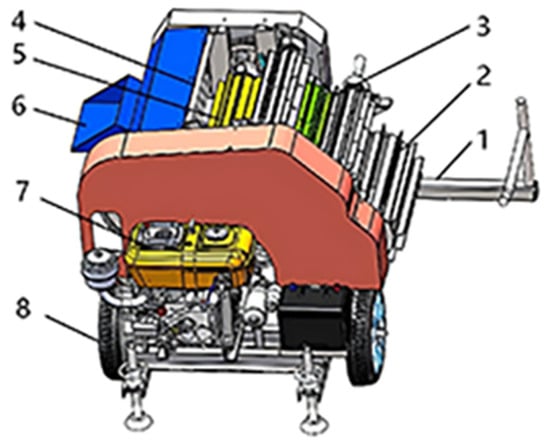
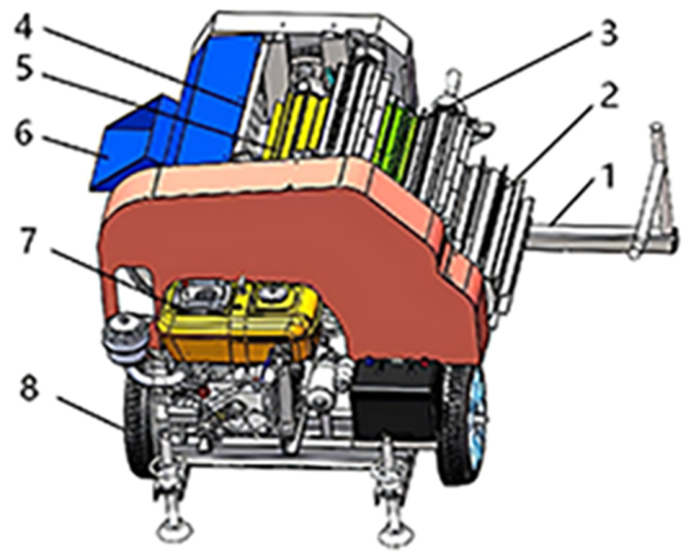
The lightweight fold-line ramie decorticator designed in this study mainly consists of a feeding device, a pressing roller, a conveying device, a decorticating device, a fiber discharging device, a power unit, a fiber receiving device, and a traveling device. The feeding device is located at the front of the machine, with the pressing roller immediately behind it. The conveying device connects the pressing roller with the decorticating drum device at the rear. The fiber discharging device is installed at the discharge end of the decorticating drum, and the fiber receiving device is arranged below the fiber discharging device. The power unit is integrated on the side of the frame, and the forward device is mounted at the bottom of the frame. All components are arranged in an orderly manner and work cooperatively. The overall structure of the machine is shown in Figure 1.
Figure 1.
Overall structure of the lightweight fold-line ramie decorticator. 1. Feeding device; 2. Pressing roller; 3. Conveying device; 4. Decorticating device; 5. Fiber discharging device; 6. Power unit; 7. Fiber receiving device; 8. Traveling device.
2.2. Operating Principle
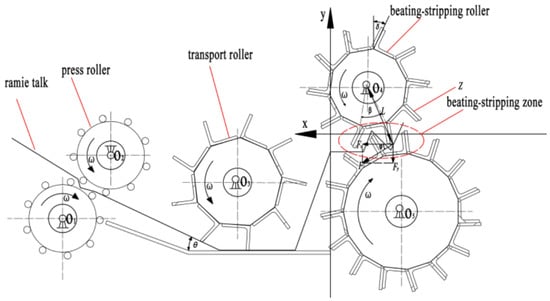
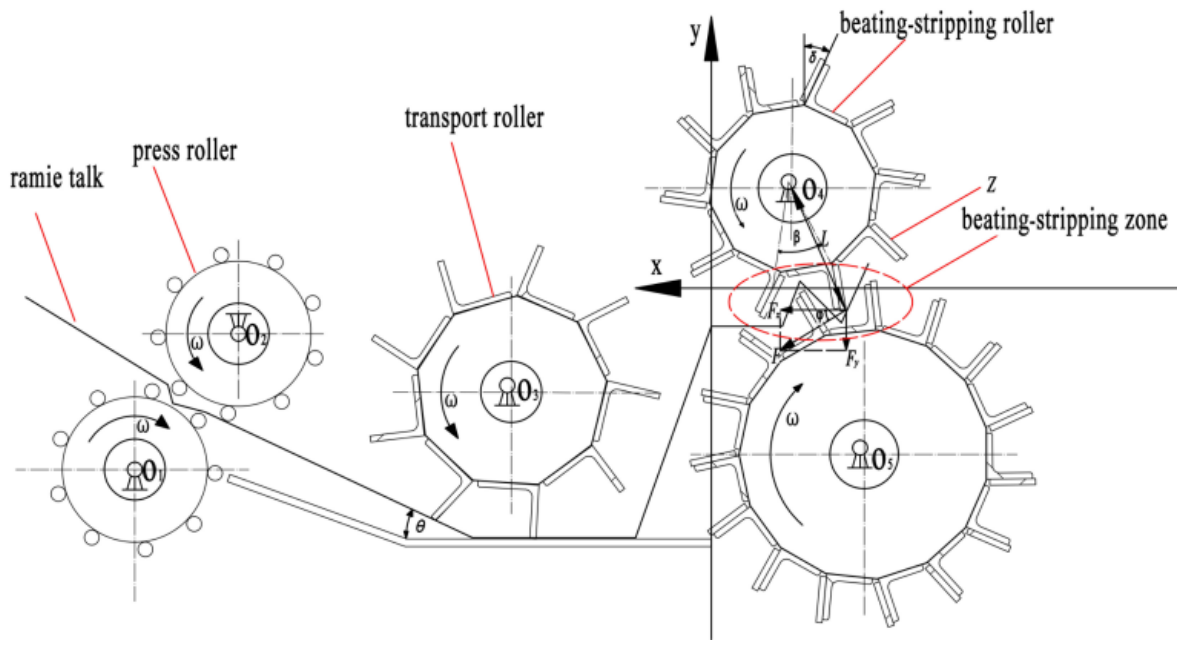
The lightweight fold-line ramie decorticator is driven by a power unit and can perform continuous automated decortication of ramie. During operation, ramie stalks are fed at an inclined angle through the feeding device at the front and are then extruded and flattened by the pressing roller to crush the xylem for pretreatment. Subsequently, the stalks are transported by the conveying device to the decorticating drum device, where the phloem is separated from woody residues by the high-speed beating of the drum. The separated fibers are thrown centrifugally by the fiber discharging device and then fall into the fiber receiving device. To reveal the separation mechanism of ramie stalks, the static instantaneous state of stalk separation by the roller teeth was selected for force analysis. A planar rectangular coordinate system was established, with the line connecting the centers of the meshing teeth of the beating roller as the X-axis and the vertical direction as the Y-axis. The force analysis is shown in Figure 2, and Equations (1)–(6) are used to calculate the theoretical dimensions and parameters of the decorticator. The force F at the end of the decorticating drum teeth can be decomposed into a component Fy perpendicular to the stalk and a component Fx along the stalk movement direction, where Fy is used to break the stalk, Fx achieves phloem stripping, δ is the deviation angle of the drum teeth, φ is the stripping angle of the teeth against the stalk, β is the included angle between the teeth, Z is the number of drum teeth, b is the meshing depth, L is the radius of the decorticating teeth, and l is the stalk breaking length. To comprehensively analyze the variation pattern of forces, the stalk segment within the interval between two consecutive collisions of the drum teeth is taken as the research object to carry out force characteristics analysis [19,20,21,22].
F = Fx + Fy
Figure 2.
Schematic diagram of forces on a ramie stalk.
2.3. Different Fin Structures
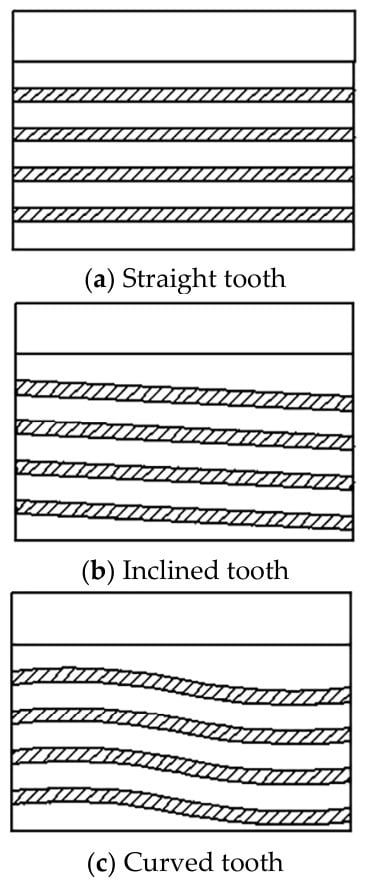
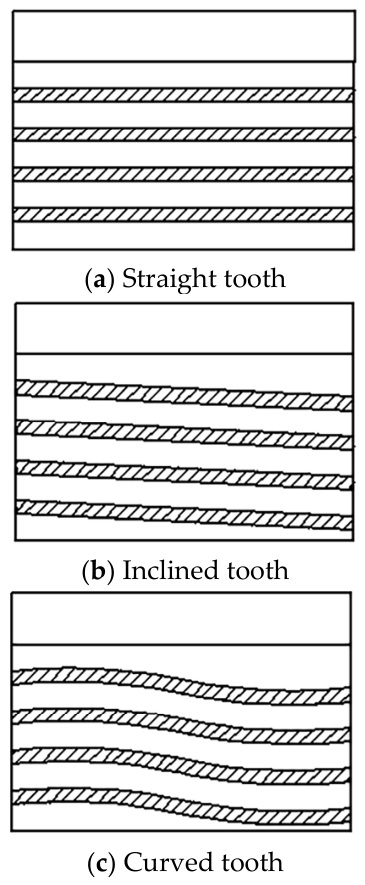
The structural morphology of the fins on the beating device of the ramie decorticator directly affects the stalk impact and stripping performance and is thus a key component determining the overall decortication quality of the machine. To investigate the influence of fin shape on ramie decortication performance and to optimize the beating device structure, three different fin configurations—straight tooth, inclined tooth, and curved tooth—were specifically designed in this study, with their structures shown in Figure 3. To compare the actual beating and decortication performance of the three fin types, subsequent simulation tests will be carried out for comparative verification, using the fresh-stem fiber extraction rate and the impurity content of the raw fiber as the core evaluation indices. The effects of different fin structures on ramie stripping efficiency and fiber cleanliness will be comprehensively analyzed, and the fin configuration with the best overall performance will be selected, thereby providing a structural basis for improving the operational performance of the lightweight fold-line ramie decorticator.
Figure 3.
Three types of fin structures.
2.4. Key Technical Specifications
Based on the external dimensions and mechanical properties of fresh ramie stalks, and through structural design and theoretical calculations, the main technical parameters of the lightweight fold-line ramie decorticator were determined. In accordance with the decortication quality requirements specified in national standards such as GB/T7699-1999 [23] “Ramie decorticator” and GB/T20793-2015 [24] “Degummed ramie”, the core operational performance indices of the machine were defined as follows: a fresh-stem fiber extraction rate greater than 4% and an impurity content of the raw fiber lower than 2%. In conjunction with the overall structural configuration, operating conditions, and design requirements, the main technical parameters of the lightweight fold-line ramie decorticator were compiled and are presented in Table 1.
Table 1.
Main technical parameters of lightweight fold-line ramie decorticator.
3. Analysis of Parameters in the Ramie Stripping Process
3.1. One-Factor Design
To investigate the effects of various structural and motion parameters on the decortication quality of the lightweight fold-line ramie decorticator and to determine the optimal operating parameter combination, this study conducted single-factor comparative tests based on finite element simulation. Considering the structural characteristics of the prototype, three core adjustable parameters—fin shape, decorticating drum rotational speed, and fin number—are selected as independent experimental variables, with the fresh-stem fiber extraction rate and the impurity content of the raw fiber as the evaluation indices for decortication quality. Controlled trials were carried out by setting fixed parameters in groups. To study the influence of fin shape on decortication quality, the drum rotational speed is fixed at 550 r·min−1, and the fin number is set at 10, and simulation tests are conducted using three fin structures—straight teeth, inclined teeth, and curved teeth—respectively. To study the influence of fin number on decortication quality, the drum rotational speed is fixed at 550 r·min−1, and the fin shape is set to straight teeth, while the fin numbers are set to 10, 12, 14, 16, and 18 for comparative tests. To study the influence of decorticating drum rotational speed on decortication quality, straight-tooth fins are adopted, and the fin number is fixed at 14; single-factor simulation tests are performed by setting drum speeds of 400, 475, 550, 625, and 700 r·min−1. Finally, the test results from all groups are compared to analyze the influence mechanism of each parameter on the decortication performance.
3.2. Simulation Setup and Model Creation
The dynamic decortication simulation of ramie stalks is based on simulation modeling methods for flexible stalks such as sugarcane, mulberry branches, and crop straw. SolidWorks 2025 software was used to construct the three-dimensional models of the decorticating drum of the lightweight fold-line ramie decorticator and the ramie stalk. The established 3D models were exported in the general Parasolid (*.x-t) format and imported into ANSYS 2024 R1/LS-DYNA simulation software. Regarding model parameter settings, Pu et al. [15] conducted a detailed study on the mechanical properties of ramie; therefore, the ramie stalk material parameters in this study were adopted from that research. The stalk adopted the Hashin failure criterion combined with element erosion, SOLID164 hexahedral solid elements, and the Pure Penalty contact algorithm. The simulation duration was 0.02 s, the time step was 50,000, and other simulation settings and ramie material parameters are listed in Table 2.
Table 2.
Simulation material parameters and mechanical properties of ramie stalk.
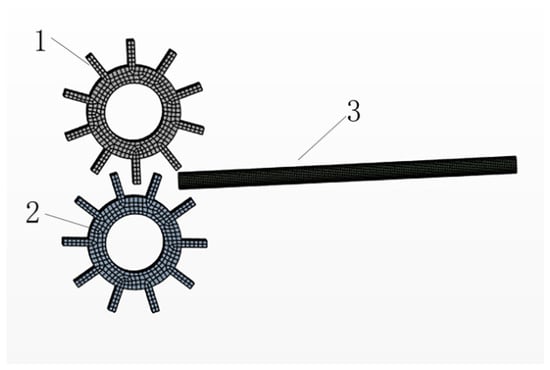
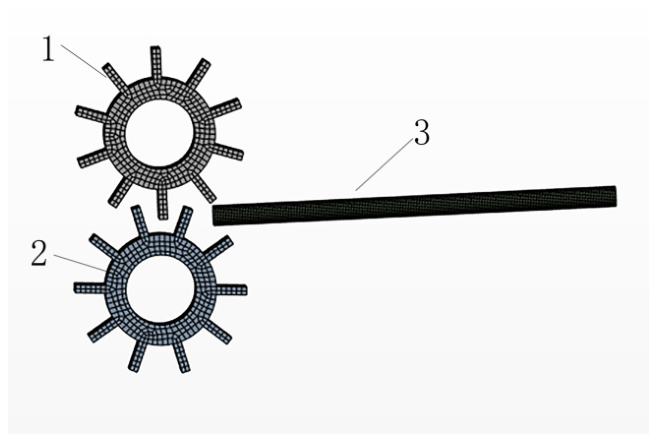
The ramie beating-decortication model is shown in Figure 4. In the simulation model, the diameter of the decorticating drum was set to 180 mm. To investigate the effects of three different fin structures, i.e., straight tooth, inclined tooth, and curved tooth, on the decortication quality of ramie, decorticating drum models with three tooth profiles were established. The decorticating drum was set as a rigid body and assigned structural steel properties, while the ramie stalk was set as a flexible body. Based on preliminary experimental results, the top part of the ramie stalk is more prone to fiber loss and more difficult to separate than the middle and base parts. Therefore, the simulation model was built according to the dimensional parameters of the top part of the ramie stalk in Table 1. The total length of the stalk was set to 1000 mm, with a xylem thickness of 3.2 mm and a minimum phloem thickness of 0.8 mm. In addition, the interface between the phloem and xylem of the ramie stalk was set as frictional contact, and each structure was set as self-surface contact.
Figure 4.
Establishment of beating-decortication simulation model for decorticating roller. 1. Driving decorticating roller; 2. Driven decorticating roller; 3. Ramie stem (outer phloem, inner xylem).
3.3. Mesh Independence Verification
Mesh refinement was applied to the core region of the stalk beating-decortication operation. All simulation parameters, including the material model, contact algorithm, friction coefficient, boundary conditions, drum speed, feeding speed, simulation duration, and time step, were kept completely consistent, and only the mesh size was changed to perform mesh independence verification. The mesh schemes are listed in Table 3. As shown in Table 3, the deviations in Equivalent Stress, Contact Normal Pressure, and Contact Shear Stress between the medium and fine meshes were 3.91%, 4.17%, and 4.55%, respectively, all less than 5%. The deviations in these three indicators between the coarse and fine meshes were 9.46%, 8.33%, and 9.09%, respectively, all greater than 5%. This indicates that the coarse mesh produced relatively large deviations, while the results of the medium and fine meshes tended to be consistent; the medium mesh satisfied the convergence requirement of mesh independence. Although the fine mesh had slightly higher accuracy, its computational cost was higher, and the medium mesh could already meet the accuracy requirements. Therefore, considering both computational accuracy and efficiency, the mesh scheme with an overall stalk mesh of 4 mm, local refinement of 2 mm in the feeding section, and a drum mesh of 10 mm was finally adopted.
Table 3.
Mesh independence verification scheme and results.
3.4. Analysis of Simulation Results
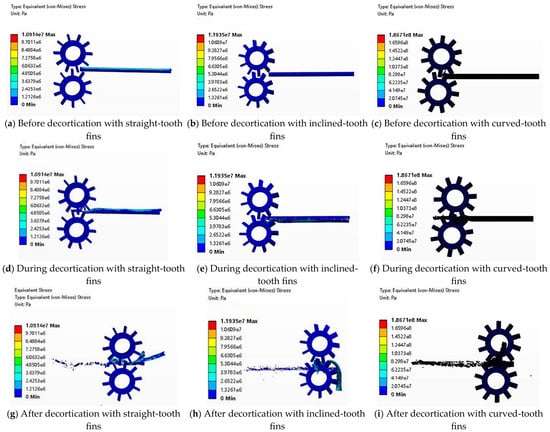
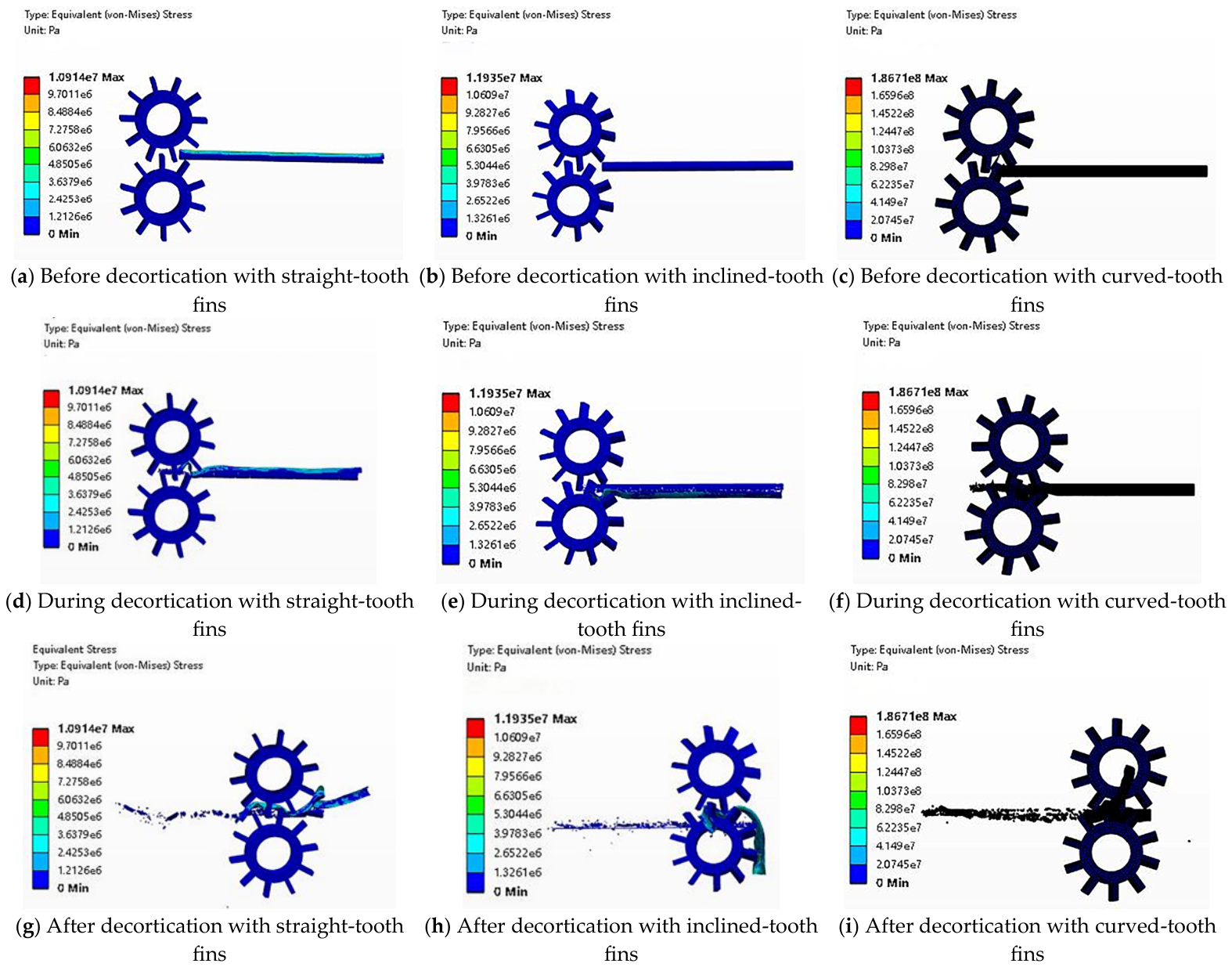
Figure 5 shows the comparison of decortication simulation results for the three fin shapes. Because the simulation simplifies the pith, green skin layer, and small branches, and does not consider moisture content, fiber continuity, or collection rate, the fresh-stem fiber extraction rate and the impurity content of raw fiber cannot be directly obtained. In this paper, the xylem node removal amount and phloem node loss amount in the feeding section are used for indirect characterization; these two quantities only represent relative trends and are not equivalent to measured values. Specifically, the xylem node removal amount is the number of failed xylem nodes divided by the total number of xylem nodes, and the phloem node loss amount is the number of failed phloem nodes divided by the total number of phloem nodes. From the perspective of the fresh-stem fiber extraction rate and the phloem node loss amount (inclined tooth 5.1% < straight tooth 7.2% < curved tooth 9.7%), under the inclined tooth, the phloem node loss amount was the smallest, the fibers were retained most completely, and thus the fiber extraction rate was the highest; the straight tooth was second; for the curved tooth, due to gentle impact but prolonged contact time, the fibers were repeatedly rubbed, resulting in the largest phloem node loss amount, severe fiber breakage, and the lowest fiber extraction rate. From the perspective of the impurity content of raw fiber and the xylem node removal amount (straight tooth 98.8% > inclined tooth 98.2% > curved tooth 96.5%), the pure radial impact of the straight tooth provided the strongest crushing kinetic energy, the xylem removal nodes were the most, and the woody residue was most thoroughly stripped, so the impurity content was the lowest; the inclined tooth decomposed part of the impact kinetic energy due to its inclination angle, so the xylem removal amount was intermediate; the curved tooth, due to arc-shaped gradual loading, had an insufficient impact peak, resulting in the fewest xylem removal nodes, and a large amount of woody debris remained attached to the phloem surface, leading to the highest impurity content. Due to the limitations of model simplification, the simulation did not consider stalk feeding slippage, fiber scattering, or collection loss. The above two indicators are only used to compare the relative trends of separation performance under different fin structures and cannot be directly equated to the experimentally measured fresh-stem fiber extraction rate and the impurity content of raw fiber. Among the three tooth shapes, the curved tooth had the lowest fresh-stem fiber extraction rate and the highest impurity content of raw fiber, both of which were the worst, so it was not further studied. The inclined tooth had the highest fiber extraction rate but higher impurity content than the straight tooth, while the straight tooth had the lowest impurity content but a lower fiber extraction rate than the inclined tooth, indicating that the fin inclination angle is the key to balancing the two, and the simulation has provided a basis for the next step of inclination angle experiments.
Figure 5.
Simulation results of decortication with different fin shapes.
4. Performance Testing and Parameter Optimization
4.1. Test Equipment and Materials
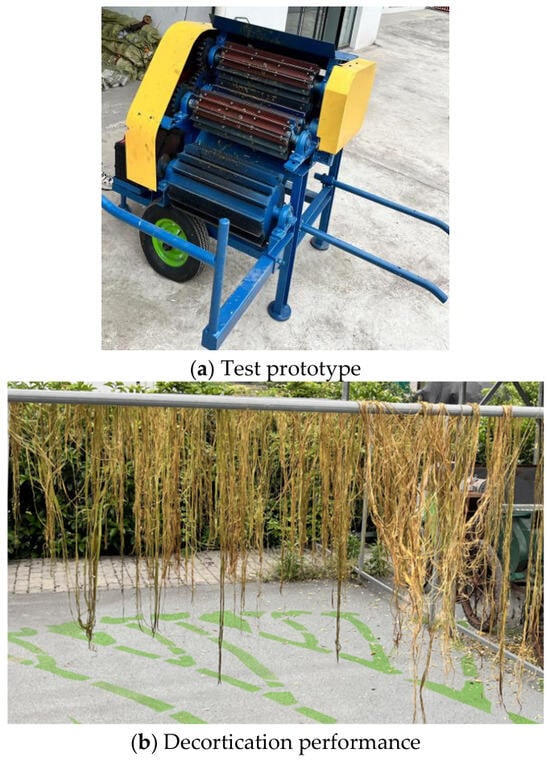
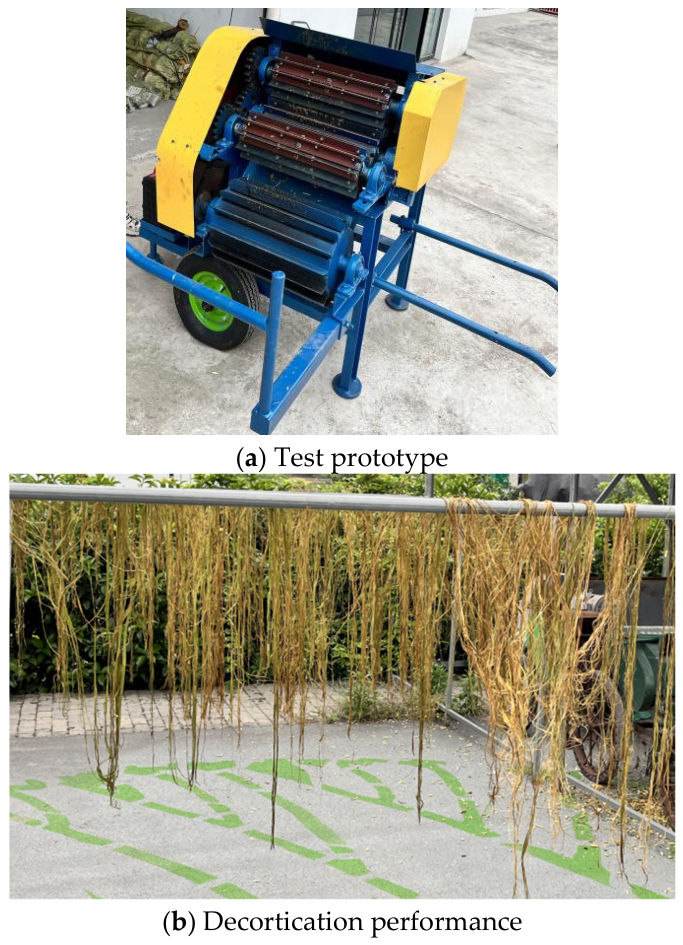
To investigate the optimal decortication quality and working parameters of the lightweight fold-line ramie decorticator, prototype decortication performance tests were carried out in Dazhu County, Sichuan Province, in May and July 2025. The test site is shown in Figure 6. This decorticator is patent-pending, as shown in Supplementary Materials. The ramie variety used in this test was “Chuanzhu No. 16,” and the test samples were fresh stalks of first-crop and second-crop ramie collected from the ramie experimental base of the Sichuan Academy of Agricultural Machinery Sciences. A random sampling with immediate collection and immediate measurement was adopted during the test, and the first-cut and second-cut ramie stalks were allocated to each treatment group at the same ratio. After defoliation, the ramie stalk length ranged from 800 to 2600 mm with a standard deviation of 310 mm, the stalk diameter ranged from 6.5 to 17.9 mm with a standard deviation of 2.85 mm, and the moisture content ranged from 71.23% to 84.16% with a standard deviation of 3.23%. After each group of decortication tests, the raw fiber was placed on a dedicated drying rack to avoid mildew, oxidation, and discoloration caused by fiber accumulation, thereby ensuring the accuracy and integrity of the test data and samples. The main instruments and equipment included a direct-feeding decorticator prototype, a high-precision electronic scale (range 10 kg, accuracy 0.1 g), a portable hanging scale, a tachometer, a moisture meter, a stopwatch, a vernier caliper, and a tape measure.
Figure 6.
Test of lightweight fold-line ramie decorticator.
4.2. Test Methods and Specifications
Based on the structural design and simulation analysis results of the lightweight fold-line ramie decorticator, combined with the laws obtained from previous single-factor simulation experiments, fin inclination angle, decorticating drum speed, and fin number were selected as field performance test factors. The levels of each test factor are shown in Table 4. During the tests, 20 fresh ramie stalks were uniformly decorticated in each group, and each test was repeated three times, with the average of the three measurements taken as the result. According to the national standard GB/T 20793-2015, Ramie Degummed Fiber, and in combination with actual working conditions, the fresh-stem fiber extraction rate and the impurity content of raw fiber were determined as evaluation indicators of decortication quality. The calculations of the fresh-stem fiber extraction rate and the impurity content of raw fiber are shown in Equations (7) and (8).
where Y1 is the fresh-stem fiber extraction rate (%); Y2 is the impurity content of the raw fiber (%); Wg is the mass of ramie fiber at a moisture content of 14% (kg); Wz is the mass of the defoliated ramie stalk (kg); Wq is the mass of the ramie fiber sample before impurity removal (g); and Wh is the mass of the ramie fiber sample after impurity removal (g).
Table 4.
Test factors and levels.
4.3. Test Results
Design-Expert 12 software was used to perform second-order response surface regression fitting analysis on the experimental data [25,26,27,28], and a quadratic polynomial mathematical model was established among the fresh-stem fiber extraction rate Y1, the impurity content of raw fiber Y2, and the Fin inclination angle X1, drum rotational speed X2, and fin number X3. Significance tests were performed on the model and each parameter, and the effects of individual factors and their interactions on decortication quality were analyzed. The test results are shown in Table 5.
Table 5.
Experimental scheme and test results.
Second-order regression fitting and analysis of variance (ANOVA) were performed on the data in the table, with the results shown in Table 6. The statistical evaluation and validation of the model are shown in Table 7. For the fresh-stem fiber extraction rate (Y1), the analysis indicates that a p-value less than 0.05 signifies that the model term is significant. Under this condition, X1, X2, X3, X1X2, X2X3, X12, X22, and X32 are all significant model terms, while X1X3 is not significant. For the impurity content of raw fiber (Y2), X1, X12, X22, and X32 are significant model terms, while the remaining terms are insignificant. The model for the fresh-stem fiber extraction rate is significant with a non-significant lack of fit; the model for the impurity content is also significant with a non-significant lack of fit. After removing the insignificant variable terms, the regression equation is:
Table 6.
Analysis of variance.
Table 7.
Statistical evaluation and validation of the model.
4.4. Response Surface Analysis
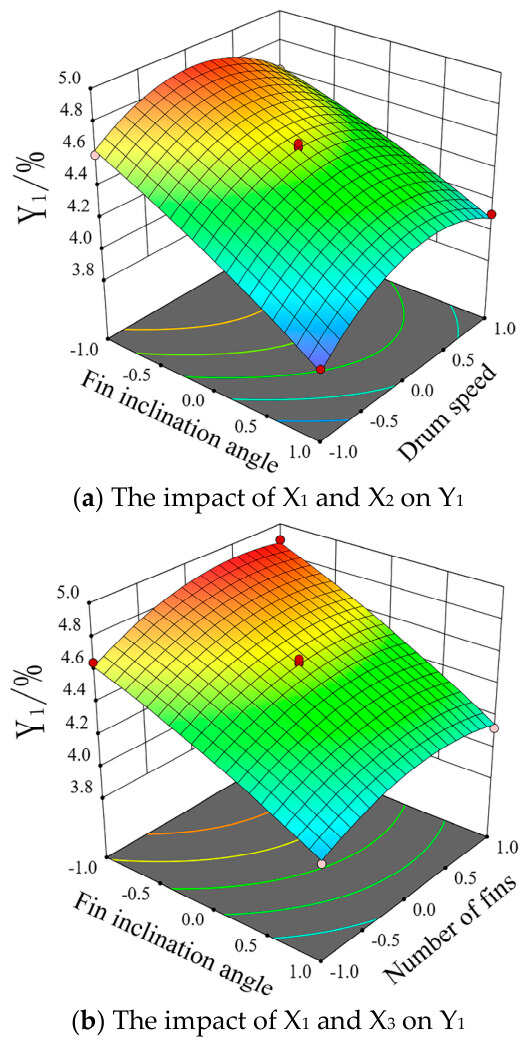
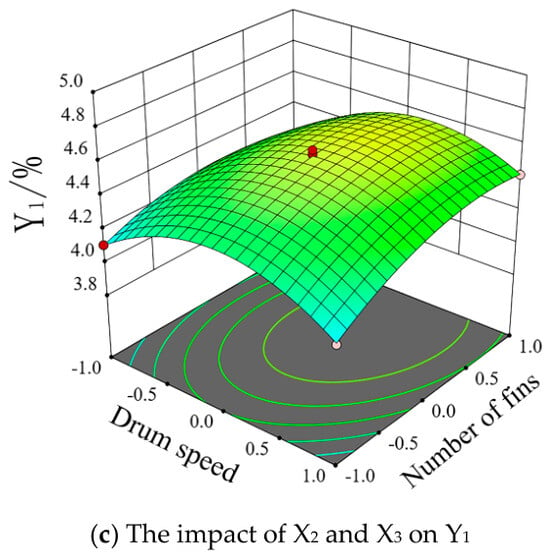
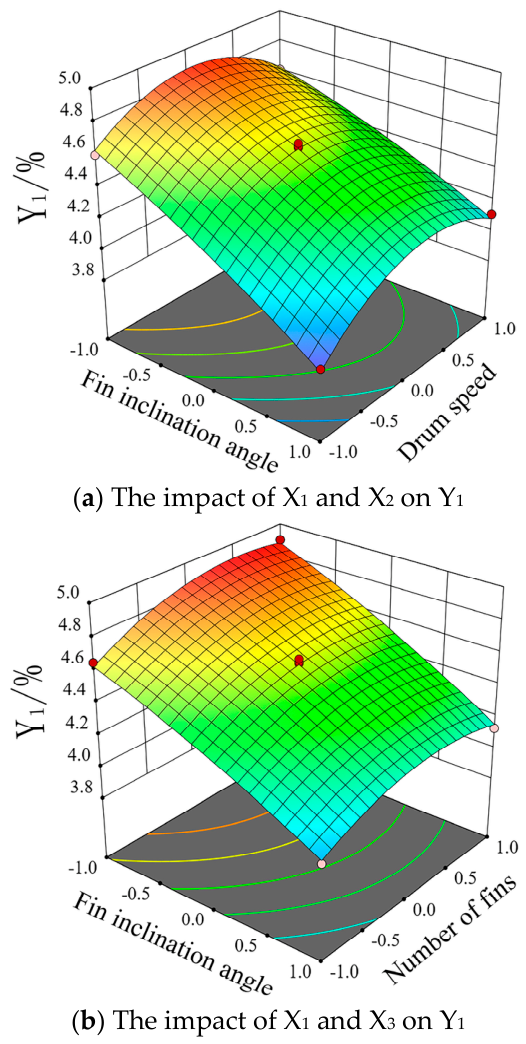
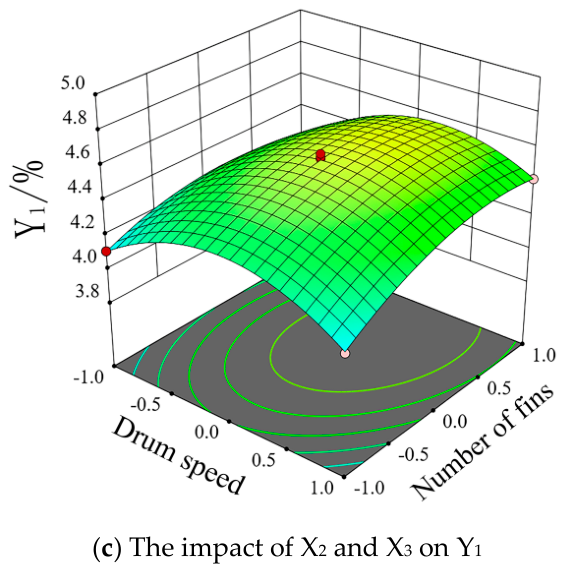
Figure 7 shows the effects of the interactions among fin inclination angle, drum rotational speed, and fin number on the fresh-stem fiber extraction rate Y1, where (a) is the response surface plot of fin inclination angle and drum rotational speed versus Y1, (b) is that of fin inclination angle and fin number versus Y1, and (c) is that of fin number and drum rotational speed versus Y1. It can be seen from the figure that, when the drum rotational speed and fin number are fixed, the fresh-stem fiber extraction rate decreases with the increase in the fin inclination angle. A possible reason is that, when the fin inclination angle increases, the impact force is decomposed by the inclined surface, the pure radial impact component is reduced, and axial tearing occurs simultaneously; this weakens the breaking kinetic energy acting on the ramie core. The peak impact force drops, making it difficult to trigger brittle fracture of the fresh ramie core. Inadequate fragmentation of the ramie core and residual tough connecting fibers tend to occur, and complete separation between bast fiber and ramie core cannot be realized, which ultimately leads to a reduction in the fresh-stem fiber extraction rate. When the fin inclination angle and fin number are fixed, the fresh-stem fiber extraction rate first increases and then decreases with increasing rotational speed. This may be because, at the initial stage of speed increase, the impact kinetic energy and core-breaking effect are enhanced, promoting separation; however, once the speed exceeds a critical value, the number of impacts per unit time increases sharply, and the high-frequency repeated impacts instead aggravate fiber fatigue breakage and loss, causing the extraction rate to rise first and then fall. When the fin inclination angle and drum rotational speed are fixed, the fresh-stem fiber extraction rate also first increases and then decreases with increasing fin number. This may be because the impact frequency per unit time changes from insufficient to moderate, which is adequate for fully breaking the core and promoting separation; However, when the number is too large, the overly dense impacts cause the stalk to suffer repeated crushing and striking, leading to a sharp increase in fiber breakage loss, thus resulting in a rise-before-fall trend.
Figure 7.
Response surfaces showing the effects of factor interactions on the fresh-stem fiber extraction rate (Y1).
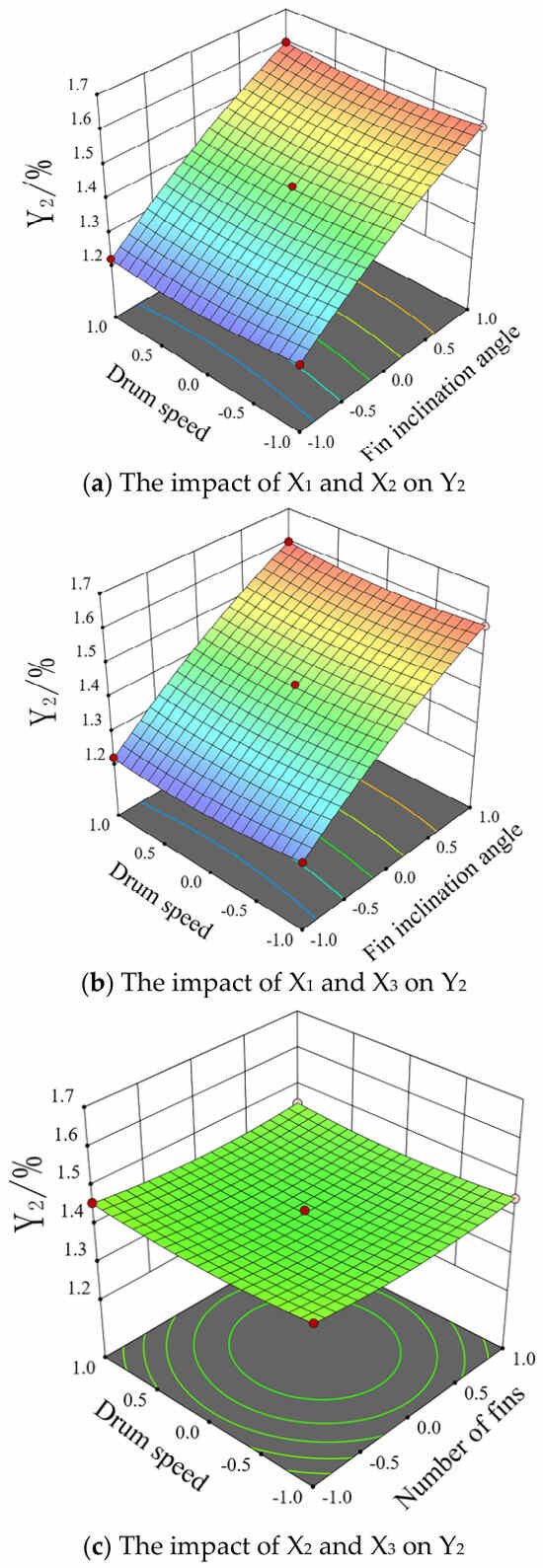
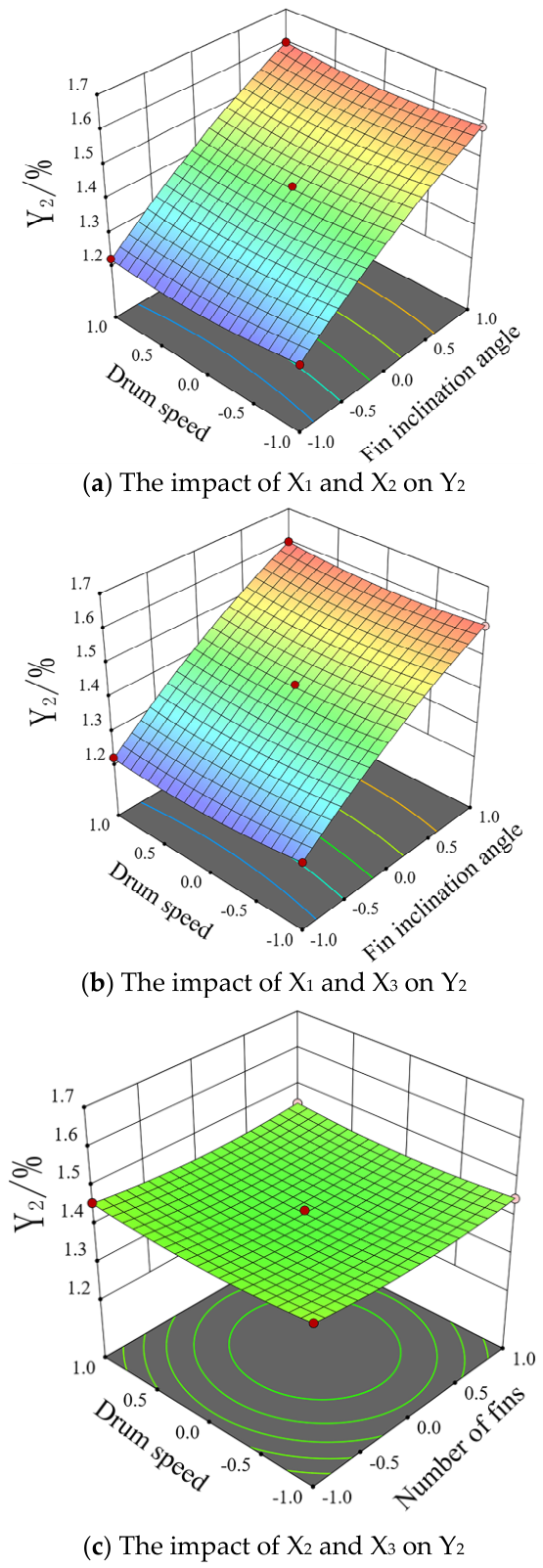
Figure 8 illustrates the effects of the interactions among fin inclination angle, drum rotational speed, and fin number on the impurity content of the raw fiber Y2, where (a) is the response surface plot of fin inclination angle and drum rotational speed versus Y2, (b) is that of fin inclination angle and fin number versus Y2, and (c) is that of fin number and drum rotational speed versus Y2. It can be observed from the figure that, when the drum rotational speed and fin number are fixed, the impurity content of raw fiber decreases with the increase of Fin inclination angle. A possible reason is that when the Fin inclination angle increases, the impact force is decomposed, the radial impact effect is weakened, and the axial tearing effect is enhanced. The inclined fins produce continuous axial stripping and pulling action on ramie stalks. During the separation of bast fibers, fine ramie core fragments and epidermal impurities attached to the fibers can be torn off and separated simultaneously. Although the capacity for brittle fracture of the ramie core is reduced, violent impact that pulverizes ramie core into fine powder embedded in fiber gaps is mitigated, lowering the retention probability of fine impurities and thus reducing the impurity content of raw fiber. When the fin inclination angle and fin number are fixed, the impurity content first decreases and then slightly increases with increasing rotational speed, although the change is not significant. As the speed rises, the improved core fragmentation and separation reduce the impurity content; however, once the speed exceeds a critical value, the stalk becomes excessively pulverized, generating fine powder that re-adheres to the fiber surface and is difficult to remove completely, causing a slight rebound in impurity content. When the fin inclination angle and drum rotational speed are fixed, the fin number has little effect on the impurity content. A possible explanation is that the impurity content is primarily determined by the impact energy per single strike and the tooth action mode (both of which are fixed); increasing the fin number merely raises the frequency of repeated impacts. Since the residual impurities are mostly core particles tightly bonded to the fibers, and the ultimate stripping depth per single strike is already fixed, additional repeated strikes are unlikely to further remove them.
Figure 8.
Response surfaces showing the effects of factor interactions on the impurity content of raw fiber (Y2).
4.5. Parameter Optimization and Results
To obtain the optimal decortication performance of the lightweight fold-line ramie decorticator, the highest fresh-stem fiber extraction rate and the lowest impurity content of raw fiber were taken as the optimization objectives, and the three key parameters, namely fin inclination angle, drum speed, and fin number, were optimized. The results showed that the optimal parameter combination was as follows: fin inclination angle of 5°, decorticating drum speed of 550 r·min−1, and fin number of 18. Under these conditions, the model-predicted fresh-stem fiber extraction rate was 4.90%, and the impurity content of raw fiber was 1.22%. The objective function and the constraint conditions of each parameter variable were established as shown in Equation (11).
To ensure the accuracy and reliability of the parameter optimization model, prototype tests were carried out for verification using the above optimal parameter combination. In actual experiments, the decorticating drum speed was set to 550 r·min−1, the fin inclination angle was set to 5°, and the fin number was set to 18. Under these conditions, the decortication test was repeated three times, and the average of the three results was taken as the experimental value. The comparison results showed that the relative errors between the experimental and optimized values were 1.54% for the fresh-stem fiber extraction rate and 2.18% for the impurity content of raw fiber, both within a reasonable error range, indicating that the established parameter optimization model was accurate and reliable. Under this optimized scheme, the actual measured fresh-stem fiber extraction rate was 4.82%, and the impurity content of raw fiber was 1.25%. The comparison among the model prediction, adjusted working conditions, and experimental verification is shown in Table 8, which verifies the effectiveness and practicality of the optimization results and can provide a reference for subsequent design improvement and experimental optimization of the lightweight fold-line ramie decorticator.
Table 8.
Comparison of predicted optimal values and measured performance.
5. Conclusions
- A lightweight fold-line ramie decorticator was designed. Through theoretical analysis, key working parameters such as fin shape, drum speed, and fin number were determined, laying a foundation for simulation modeling and experimental research.
- A kinematic simulation model of the dual-drum decortication process was constructed. Taking fin shape, drum speed, and fin number as single factors, and xylem removal amount and phloem loss amount as evaluation indicators, ANSYS/LS-DYNA simulation software was used to analyze the decortication effect under different single-factor values. Within the ranges of drum speed 400–700 r·min−1 and fin number 10–18, the ramie stalk beating-decortication effect was relatively good. The curved-tooth structure had the lowest fresh-stem fiber extraction rate, the highest impurity content of raw fiber, and the worst overall performance. The fin inclination angle was a key parameter affecting the fresh-stem fiber extraction rate and the impurity content of raw fiber, providing a basis for subsequent experiments on fin inclination angle.
- Taking fin inclination angle, drum speed, and fin number as experimental factors, and the fresh-stem fiber extraction rate and the impurity content of raw fiber as experimental indicators, a three-factor, three-level quadratic orthogonal combination experiment was carried out. Through optimization experiments, the optimal parameters were obtained as follows: fin inclination angle of 5°, decorticating drum speed of 550 r·min−1, and fin number of 18. Under these conditions, the model-predicted fresh-stem fiber extraction rate was 4.90%, and the impurity content of raw fiber was 1.22%. In actual experimental operations, the decorticating drum speed was set to 550 r·min−1, the fin inclination angle was set to 5°, and the fin number was set to 18 for prototype verification. The measured average fresh-stem fiber extraction rate was 4.82%, and the average impurity content of raw fiber was 1.25%, meeting the technical requirements of ramie decorticators.
Supplementary Materials
The following supporting information can be downloaded at: https://www.mdpi.com/article/10.3390/agriengineering8110482/s1, Figure S1: Residual diagnostic plots for the regression model of fresh-stem fiber extraction rate; Figure S2: Residual diagnostic plots for the regression model of impurity content of raw fiber. Sichuan Academy of Agricultural Machinery Sciences. Diameter screening roller pressing assembly for a decorticator: Chinese Patent 202522084579.0[P]. 21 August 2026. The following supporting information can be downloaded at: https://kns.cnki.net/kns8s/defaultresult/index?crossids=YSTT4HG0%2CLSTPFY1C%2CEMRPGLPA%2CJUP3MUPD%2CMPMFIG1A%2CVUDIXAIY%2CWQ0UVIAA%2CBLZOG7CK%2CPWFIRAGL%2CNLBO1Z6R%2CNN3FJMUV&korder=SU&kw=%E4%B8%80%E7%A7%8D%E5%89%A5%E9%BA%BB%E6%9C%BA%E7%94%A8%E7%9A%84%E7%9B%B4%E5%BE%84%E7%AD%9B%E5%88%86%E8%BE%8A%E5%8E%8B%E7%BB%84%E4%BB%B6.
Author Contributions
J.L. (Conceptualization; Methodology; Software; Formal analysis; Investigation; Data curation; Writing–original draft preparation; Writing–review & editing; Visualization); B.L. (Conceptualization; Investigation; Resources; Data curation; Supervision; Project administration; Funding acquisition); J.G. (Validation; Investigation); Y.L. (Validation; Investigation); R.X. (Validation; Investigation; Data curation); C.R. (Validation; Investigation). All authors have read and agreed to the published version of the manuscript.
Funding
This research was supported by Ramie harvesting and decorticating integrated machine; the Sichuan Provincial Basic Scientific Research Project in 2025: Development of test bench for ramie decorticator (Grant No. 2025JDKY0030-03), The Sichuan Provincial Integrated Pilot Project for R&D, Manufacturing, Promotion and Application of Agricultural Machinery in 2024; and the Project of Key Technology Research and Complete-Set Equipment Development for Silkworm Rearing and Mulberry Branch Utilization (Grant No. 2024YFCY0008).
Data Availability Statement
All data generated or analyzed during this study are included in this published article.
Conflicts of Interest
The authors declare that there are no conflicts of interest regarding the publication of this paper.
References
- Lyu, Z.R.; Li, Z.F.; Jiang, H.L.; Sun, Z.Y. Research progress on ramie fiber preparation. Cotton Text. Technol. 2020, 48, 68–72. (In Chinese) [Google Scholar]
- Xu, H.Y.; Sun, Z.Y.; Liu, W.G.; Dong, X.H.; Gong, Y.F.; Cao, H.F. Design and test of high-efficiency grain-dividing and flax-pulling header for self-propelled flax harvester. J. Agric. Mech. Res. 2026, 1–8. (In Chinese) [Google Scholar]
- Jia, B.; Cao, H.F.; Gao, Y.; Gong, Y.F. Design and test of industrial hemp decorticator based on Ansys Workbench. J. Agric. Mech. Res. 2026, 1–8. (In Chinese) [Google Scholar]
- Hu, Y.R.; Liu, X.F.; Wu, H.; Wang, X.Y.; Zhao, G.K.; Zhang, Q.Z. Design and test of baler for fine-crushed straw feed. J. Agric. Mech. Res. 2026, 48, 76–83. (In Chinese) [Google Scholar] [CrossRef]
- Hao, J.J.; Jin, D.X.; Gao, Z.; Zhao, J.G.; Zhang, K.L. Design and test of vibrating soil-breaking device for Chinese yam harvester based on EDEM. Trans. Chin. Soc. Agric. Eng. 2025, 41, 90–98. (In Chinese) [Google Scholar]
- Liu, J.J.; Ma, L.; Xiang, W.; Yan, B.; Wen, Q.H.; Lyu, J.N. Structural design and test of header for 4QM-4.0 type forage-hemp combine harvester. J. Chin. Agric. Mech. 2022, 43, 20–25. (In Chinese) [Google Scholar] [CrossRef]
- Yang, A.M.; Wu, M.L.; Lü, J.N.; Xiang, W. Design and test of chopping system for forage ramie harvester. J. Agric. Sci. Technol. 2020, 22, 110–118. (In Chinese) [Google Scholar] [CrossRef]
- Yan, B.; Ma, L.; Liu, J.J.; Xiang, W.; Hu, Y.; Lyu, J.N. Design and test of concave-plate mountain-type ramie decorticator. J. Chin. Agric. Mech. 2022, 43, 87. (In Chinese) [Google Scholar] [CrossRef]
- Xiang, W.; Ma, L.; Liu, J.J.; Yan, B.; Qiu, H.J.; Lyu, J.N. Development of continuous clamping-conveying ramie decorticator. Trans. Chin. Soc. Agric. Eng. 2021, 37, 19–27. (In Chinese) [Google Scholar]
- Liu, L.J.; Lao, C.Y.; Zhang, N.; Chen, H.Q.; Deng, G.; Zhu, C.; Peng, D.X. The effect of new continuous harvest technology of ramie (Boehmeria nivea L. Gaud.) on fiber yield and quality. Ind. Crops Prod. 2013, 44, 677–683. [Google Scholar] [CrossRef] [Scilit]
- Pari, L.; Baraniecki, P.; Kaniewski, R.; Scarfone, A. Harvesting strategies of bast fiber crops in Europe and in China. Ind. Crops Prod. 2015, 68, 90–96. [Google Scholar] [CrossRef] [Scilit]
- Luo, W.H.; Wang, Y.X.; Tang, Y.Q.; Qiu, Z.G.; Zhao, Q.X.; Ren, G.F.; Ye, Z.L. Numerical simulation and experiment on wrapping characteristics between sugarcane leaves and rotating roller of returning machine. Comput. Electron. Agric. 2022, 202, 107441. [Google Scholar] [CrossRef] [Scilit]
- Meng, Y.M.; Wei, J.D.; Wei, J.; Chen, H.; Cui, Y.S. An ANSYS/LS-DYNA simulation and experimental study of circular saw blade cutting system of mulberry cutting machine. Comput. Electron. Agric. 2019, 157, 38–48. [Google Scholar] [CrossRef] [Scilit]
- Liu, J.J.; Ma, L.; Xiang, W.; Yan, B.; Duan, Y.P.; Wen, Q.H.; Lyu, J.N. Finite element analysis and structural optimization of the frame of 4BM-250 ramie decorticator based on ANSYS-Workbench. China Ramie Sci. 2023, 45, 287–294. (In Chinese) [Google Scholar]
- Pu, Y.J.; Liu, Y.; Yang, M.J.; Yang, S.; Shen, C.; Lyu, J.N.; Yang, L. Design and parameter optimization of automatic reverse-pull transposition-clamping ramie decorticator. Trans. Chin. Soc. Agric. Eng. 2023, 39, 44–54. (In Chinese) [Google Scholar]
- Wang, Y.; Tan, D.M.; Liu, D.W.; Zheng, W.F.; Luo, G. Brief discussion on type-selection and application of ramie decorticator. South Agric. Mach. 2020, 51, 3–4. (In Chinese) [Google Scholar]
- Lü, J.N.; Long, C.H.; Ma, L.; Liu, J.J.; Zhao, J. Design of fully-automatic ramie fiber separator. J. Chin. Agric. Mech. 2014, 35, 159–163. (In Chinese) [Google Scholar]
- Xiang, W.; Ma, L.; Liu, J.J.; Xiao, L.; Long, C.H.; Wen, Q.H.; Lyu, J.N. Research progress of ramie fiber decortication technology and equipment in China. J. Agric. Sci. Technol. 2019, 21, 59–69. (In Chinese) [Google Scholar] [CrossRef]
- Zhu, J.G.; Guo, K.J.; Man, D.W.; Su, N. Design and test of reverse-pull degumming device for new-type ramie decorticator based on PLC. J. Agric. Mech. Res. 2020, 42, 101–105. (In Chinese) [Google Scholar] [CrossRef]
- Tan, X.J.; Guo, K.J.; Zhang, D.S.; Su, N.; Man, D.W.; Yuan, X.J. Design of pull-up ramie decorticator. J. For. Eng. 2019, 4, 106–111. (In Chinese) [Google Scholar] [CrossRef]
- Zou, S.C.; Su, G.B.; Shao, Y.G. Simulation optimization and test of ramie stalk separation device based on discrete element method. J. Chin. Agric. Mech. 2017, 38, 60–67. (In Chinese) [Google Scholar] [CrossRef]
- Zou, S.C.; Su, G.B.; Shao, Y.G.; Meng, L. Mechanical modeling and experimental analysis of ramie stalk mechanical separation process. Hubei Agric. Sci. 2017, 56, 348–352. (In Chinese) [Google Scholar] [CrossRef]
- GB/T 7699-1999; Ramie. Standards Press of China: Beijing, China, 1999.
- GB/T 20793-2015; Degummed Ramie. Standards Press of China: Beijing, China, 2015.
- Yin, Z.; Yuan, J.N.; Li, X.W.; Zhang, B.; Shen, C.; Huang, J.C.; Tian, K.P. Experimental study on mechanical properties of kenaf stalk. J. Agric. Mech. Res. 2021, 43, 166–173. (In Chinese) [Google Scholar] [CrossRef]
- Yang, J.H.; Qiang, H.; Wang, X.Y.; Wu, S.H.; Wu, S.F.; Yuan, Y. Design and test of bionic chopping blade for rape straw. J. Agric. Mech. Res. 2026, 1–10. (In Chinese) [Google Scholar] [CrossRef]
- Cheng, T.L.; Li, M. Aerodynamic performance research and parameter analysis design of multi-wing combined paddle based on orthogonal test. J. Mach. Des. 2026, 1–10. (In Chinese) [Google Scholar]
- Liu, W.L.; Wang, J.Q.; Liu, F.; Jiang, C.Y.; Guo, W.H.; Wei, C.Y. Experimental research on snapping device of corn combine harvester. J. Agric. Sci. Technol. 2026, 28, 117–124. (In Chinese) [Google Scholar] [CrossRef]

Disclaimer/Publisher’s Note: The statements, opinions and data contained in all publications are solely those of the individual author(s) and contributor(s) and not of MDPI and/or the editor(s). MDPI and/or the editor(s) disclaim responsibility for any injury to people or property resulting from any ideas, methods, instructions or products referred to in the content. |
© 2026 by the authors. Licensee MDPI, Basel, Switzerland. This article is an open access article distributed under the terms and conditions of the Creative Commons Attribution (CC BY) license.