


Abstract
In Mexico, forage maize is crucial for cattle feed; however, its cultivation relies on synthetic fertilizers that can contaminate water, soil, and the environment, creating a need to adopt organic production models. The objective was to evaluate the growth, yield, and nutritional composition of forage maize fertilized with biosolids. An experiment was conducted in Gómez Palacio, Durango, Mexico, between March and June 2020, in a semi-arid climate and on soil with a clay–loam texture. A randomized complete block design with five treatments and three repetitions was used: three with biosolids [B240 (12 t ha−1), B200 (10 t ha−1) and B160 (8 t ha−1)], one chemically fertilized (CFT, 180-90-00 NPK) and one control (CT). The variables of growth (plant height), yield (corn cob diameter, fresh weight of corn cob, fresh plant weight), and nutritional composition (nitrogen content, crude protein) responded differently to the biosolids (LSD test, 0.05). Treatment B240 stood out in terms of plant height and number of leaves, showing higher fresh and dry forage yields; however, treatments B160 and CFT improved nutritional composition by exhibiting low acid detergent fiber content and high levels of neutral detergent fiber, nitrogen, and crude protein. Biosolid fertilization represents a sustainable alternative for forage maize cultivation.
1. Introduction
Globally, corn is among the most important cereals due to its use in human food and livestock. In 2024, the United States and China were the leading producers, with outputs exceeding 377 million and 294 million tons, respectively; Mexico ranked seventh, producing over 24 million tons with an economic value of 7555 million dollars [1]. In 2025, the country produced more than 16 million tons of green forage maize, generating an economic value of 15, 692 million pesos; Jalisco, Zacatecas and Durango were the states with the highest production of this crop, generating 4.3, 2.7, and 2.2 million tons and an economic value of 4893, 2634, and, 2005 million pesos [2].
Between the borders of Coahuila and Durango lies “La Comarca Lagunera”, one of the most important dairy basins in the country; between these two states they have 822, 503 head of cattle [2]. Cattle feeding in the region relies primarily on alfalfa, maize, sorghum, oats, and wheat, which are utilized as green forage or silage [3,4,5,6]. Forage maize is one of the most complete feeds for cattle, due to its high amount of fiber, energy content (starches and carbohydrates), and nutritional composition (crude protein, nitrogen, neutral detergent fiber, acid detergent fiber, etc.) [5,7,8,9,10].
In the “Comarca Lagunera” region, forage production shortages have been caused by drought and a lack of rainfall linked to climate change, limited irrigation water availability [6,11], and the presence of saline soils that interfere with nutrient absorption and translocation (low soil fertility); this situation has led to high demand and elevated costs for acquiring forage. This challenge has been addressed through extensive and intensive production methods, leading to increased use of pesticides and synthetic fertilizers [12,13]; however, these practices can increase contamination of water, soil, and plants. Organic fertilization with biosolids is a sustainable alternative for improving forage production; as a waste product, it is accessible and free of charge, which benefits the producers’ economy.
Biosolids—or sewage sludge—are a by-product of municipal wastewater treatment plants and sewage effluent [14]. Their application to soil can lead to the accumulation of trace elements, pathogens, and toxic substances [15,16,17,18]. The United States Environmental Protection Agency determined that biosolids with high concentrations of contaminants and pathogens must be treated and classified according to their intended use (Type A, B, or C); Type C classification is recommended for agricultural crops used as organic fertilizers [19,20] because they can supply the soil with organic matter and nutrients—primarily nitrogen, phosphorus, and potassium [21].
Various studies indicate that organic fertilization with biosolids enhances the growth, yield, and nutritional composition of forage crops; some examples include sorghum [22], grasslands in arid and semi-arid zones [23,24], sugar cane [25], and maize [7,26,27,28]. Biosolid fertilization in maize has improved growth, forage yield, and nutritional composition—specifically crude protein, nitrogen content, acid detergent fiber, neutral detergent fiber, and total ash.
In the Lagunera region, the few studies on biosolids applied to forage maize focus on hybrid varieties; therefore, this study concentrated on a maize variety native to Mexico (San Lorenzo). Therefore, the objective of this research was to evaluate the effect of organic fertilization with biosolids on the growth, yield, and nutritional composition of forage maize under semi-arid conditions.
2. Materials and Methods
2.1. Experiment and Organic Fertilizer
The experiment was conducted in the Faculty of Agriculture and Animal Science of the Juarez University of the State of Durango, located in Gomez Palacio, Durango, Mexico, from March to June 2020. According to the nearest weather station in the study area, from the National Weather Service [29], the climatic conditions during the experiment period presented maximum temperatures of 33 °C and minimum temperatures of 15 °C, with an average of 24 °C. In terms of precipitation, the average was 9 mm, a climate considered semi-desert and dry. Different doses of biosolids were used to evaluate the growth and yield of forage maize (Native maize, San Lorenzo variety) under field conditions.
To carry out the research, biosolids were collected from the wastewater treatment plant in the municipality of Lerdo, Durango. The biosolids were solarized for eight months and sieved for subsequent application in the field. Their characteristics were a pH of 7.6, total N of 2.01%, phosphorus of 13,000 mg kg-1, and potassium of 7,600 mg kg−1; moreover, the ranges of major contaminants were below the maximum permissible limits according to Mexican Official Standard 004-SEMARNAT-2002 [20], and below the maximum concentration limits for all biosolids applied to the soil according to the US EPA [19], giving it a C classification suitable for agricultural use (Table 1). The soil where the experiment was conducted is loamy–clay in texture, with a pH of 8.36, electrical conductivity of 3.25 dSm−1, organic matter of 2.29%, phosphorus content of 20.24 mg kg−1, and, inorganic nitrogen of 30.8 mg kg−1.
Table 1.
Chemical characteristics of the biosolids and soil used in the forage maize.
2.2. Treatments and Experimental Design
An experiment was established using a randomized complete block design with three replications. Each replication consisted of a 25 m2 plot. Each plot represented one treatment, with a total of three repetitions. Treatments were randomly assigned considering spatial variability and environmental gradients, primarily those related to soil type and irrigation management. Five treatments were evaluated: three doses of nitrogen from biosolids [B240 = 240 kg N ha−1 (12 t of biosolids ha−1); B200 = 200 kg N ha−1 (10 t of biosolids ha−1) and B160 = 160 kg N ha−1 (8 t of biosolids ha−1)], a chemically fertilized treatment (CFT = 180-90-00 NPK) and a control treatment (CT = no biosolids and no chemicals).
Six rows were planted in each quadrant, at 0.75 m between rows and one meter between each furrow, with plants spaced every 0.15 m. Seven plants were evaluated by repetition, with each repetition (plot) considered an experimental unit. Each plot was treated with 30, 25, and 20 kg of biosolids to complete the previously specified nitrogen dose. The applied biosolid doses were calculated based on total nitrogen content (2.01%) and drew upon research by other authors who applied and recommended rates similar to those used in this study [30,31]. The chemical fertilization rate was similar to that applied by producers in the region; urea and monoammonium phosphate (MAP) were used to supply 180 kg ha−1 of nitrogen and 90 kg ha−1 of phosphorus.
2.3. Management of Forage Maize Crops
Sowing and land preparation were carried out in March 2020 using a conventional system, with one pass of plowing and two passes of agricultural harrow, followed by irrigation and the application of different doses of biosolids (Figure S1). To control weeds, two manual weedings were carried out, 15 and 45 days after sowing. To control pests, an insecticide was applied 30 days after the emergence of the plants, especially to control the maize borer (Spodoptera frugiperda).
Following the application of the biosolids, flood irrigation was undertaken; thereafter, depending on the crop’s water requirements, four irrigations were performed at intervals of 18 to 25 days. To facilitate irrigation, the plots were separated by embankments. Organic fertilization with biosolids was carried out seven days before planting according to the doses specified above. Fertilization with urea and monoammonium phosphate (MAP) was carried out by applying 874 g of urea and 433 g of MAP per repetition, distributed across two applications: 50% at the first fertilization 15 days after germination, and the remaining 50% prior to crop flowering; the nitrogen quantity in the urea was calculated based on the nitrogen content of the urea itself and the nitrogen added via the MAP fertilizer.
2.4. Evaluation of Variables
All variables were evaluated at the end of the experiment, 90 days after planting; plant height was obtained by measuring seven plants per replicate, evaluating a total of 21 plants per treatment, from the base of the stem to the apex of the plant with a tape measure graduated in centimeters. The number of leaves was counted visually. Stem diameter, corn cob length, and corn cob diameter were measured with an electronic Vernier caliper graduated in millimeters. The number of fruits was quantified directly and visually, and the weight was determined with an OAHUS analytical balance, as were the fresh and dry biomass of the plant. The leaf area was measured by taking the leaves and using a LI-COR (Model LI-3100 Area Meter, LI-COR Environmental, Lincoln, Nebraska, USA).
The bromatological composition of maize was obtained by analyzing the percentage of acid detergent fiber (ADF), neutral detergent fiber (NDF), total ash, nitrogen content, and crude protein. ADF and NDF were measured using the technique described by Van Soest et al. [32]. To determine ADF, 1.0 g of ground sample was first weighed and placed in a reflux flask; it was digested with 100 mL of neutral detergent, heated until boiling, and refluxed for 60 min after boiling. The sample was decanted into a pre-weighed crucible prepared for vacuum suction, dried at 105 °C for 12 h, and weighed. To determine NDF, 0.5 g of ground sample was first weighed and placed in a reflux flask; it was digested, heated, and dried following the previous steps. The ADF and NDF content were determined using the following formula: ADF/NDF = ((weight of crucible with residue − weight of empty crucible)/weight of dry sample) × 100).
Total ash (TA), nitrogen content (NC), and crude protein (CP) were obtained using the micro-Kjeldahl method [33]. First, 0.5 g of dried, ground sample was weighed and placed in a micro-Kjeldahl flask. 10 mL of sulfuric acid (H2SO4) was added, and the mixture was placed in a digester until a color change to emerald green was obtained. Once cooled, 40 mL of 40% sodium hydroxide was added, followed by distillation using an Erlenmeyer flask containing 15 mL of 4% boric acid. Finally, the solution was titrated with hydrochloric acid (0.1 N) until a color change from yellow to pink was achieved. Finally, the following formulas were applied NC = [((Sample volume − Blank volume) × Acid normal × 14.007 × 100)/sample weight]; and CP = NT × 6.25. To measure total ash, 0.5 g of dry sample was used and subjected to a muffle furnace (with crucibles) for 4 h at 550 °C. After cooling, the crucibles were weighed on an analytical balance, and total ash was calculated using the following formula: TA = [(Sample crucible − white crucible)/sample weight] × 100.
2.5. Statistical Analysis
The results for the variables were analyzed using the SAS Version 9.0 for Windows statistical package [34]. Normality (Shapiro–Wilk) and homogeneity (Levene) tests were performed on all variables, followed by an analysis of variance and mean comparison using Fisher’s Least Significant Difference (LSD) test (p ≤ 0.05). The statistical model used was for a Randomized Complete Block Design (RCBD): Yij = μ + Ti + Bj + Eij. Variables that did not meet the assumptions of normality and homogeneity were transformed using the formula proposed by Barbosa et al. [35]: Log (x + 1).
3. Results
3.1. Effect of Biosolids on the Growth of Forage Maize
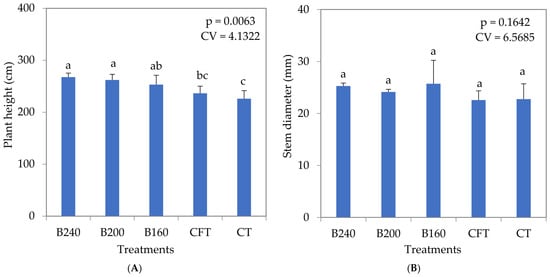
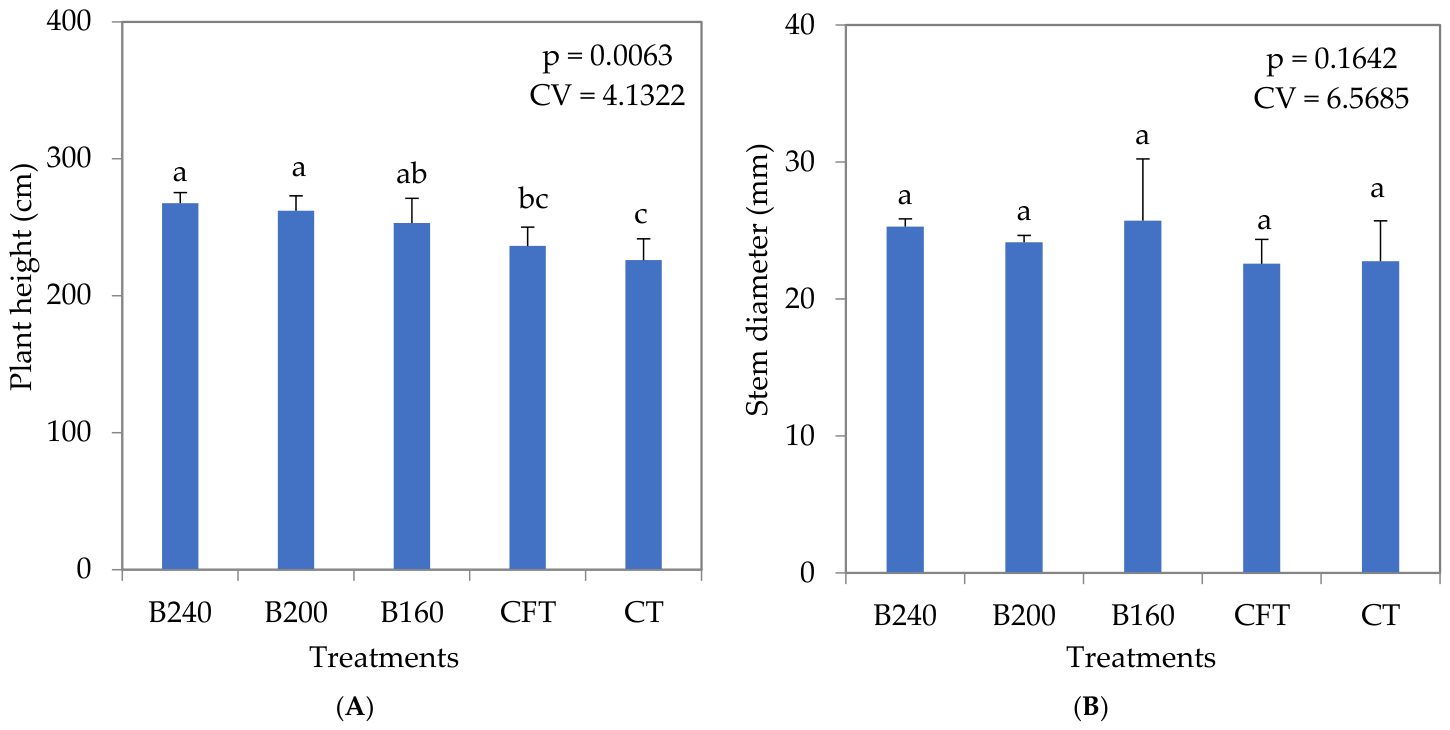
The different biosolid application doses for forage maize showed statistically significant differences in plant height but were not significant for the other growth variables (stem diameter, number of leaves, leaf area) (LSD test, p ≤ 0.05) (Table S1). Of the five treatments evaluated with different doses of biosolids, two of them showed greater height of the forage maize plants. The treatment with B240 (240 kg of N from biosolids) and B200 (200 kg of N from biosolids) showed heights of 268 cm and 262 cm, respectively. However, the largest stem diameter was obtained by treatment B160 with 26 mm, while the control treatment (CT) had the lowest values for height (226 cm) and stem diameter (23 mm) (Figure 1).
Figure 1.
Plant height (A) and stem diameter (B) of forage maize according to the effect of different doses of biosolids. Different letters (a, b, c) on the bars indicate statistically significant differences (LSD test, 0.05). Means ± SE. N = 3. B240, B200, and B160 = 240, 200, and 160 kg of N ha−1 from biosolids; CFT = Chemical fertilization treatment (180-90-00 NPK); CT = Control treatment.
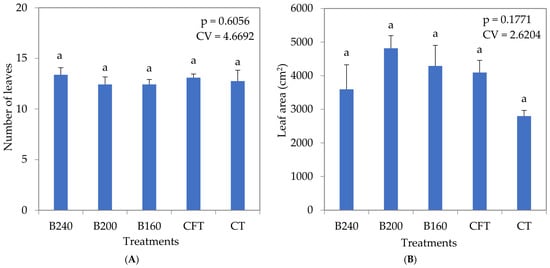
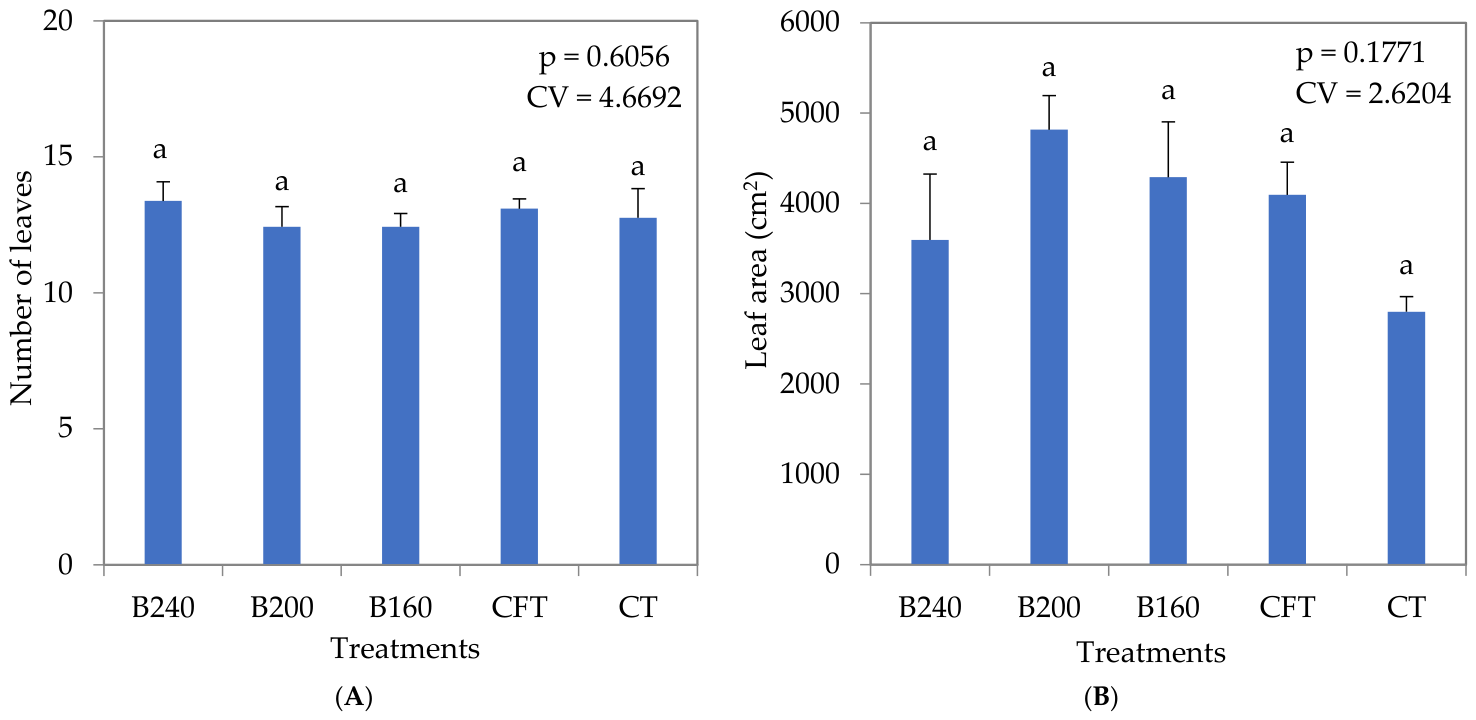
The highest number of leaves was found in the plants treated with B240 and CFT (13.4 and 13.1 leaves), while the lowest number of leaves was found in treatments B200 and B160 (12.4 leaves). The highest leaf area values were obtained in plants fertilized with B200 with 4816 cm2, followed by B160 with 4289 cm2. Plants without organic or chemical fertilization (CT) had the lowest leaf area with 2800 cm2 (Figure 2).
Figure 2.
Number of leaves (A) and leaf area (B) in forage maize according to the effect of different doses of biosolids. Different letters (a) on the bars indicate statistically significant differences (LSD test, 0.05). Means ± SE. N = 3. B240, B200, and B160 = 240, 200, and 160 kg of N ha−1 from biosolids; CFT = chemical fertilization treatment (180-90-00 NPK); and CT = control treatment.
3.2. Forage Yield and Biomass Production in Forage Maize
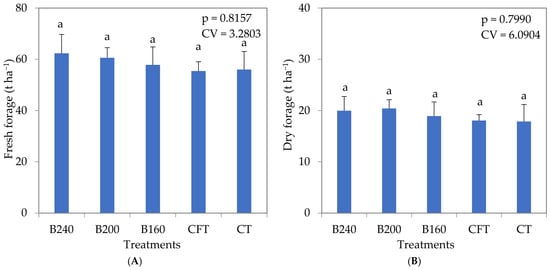
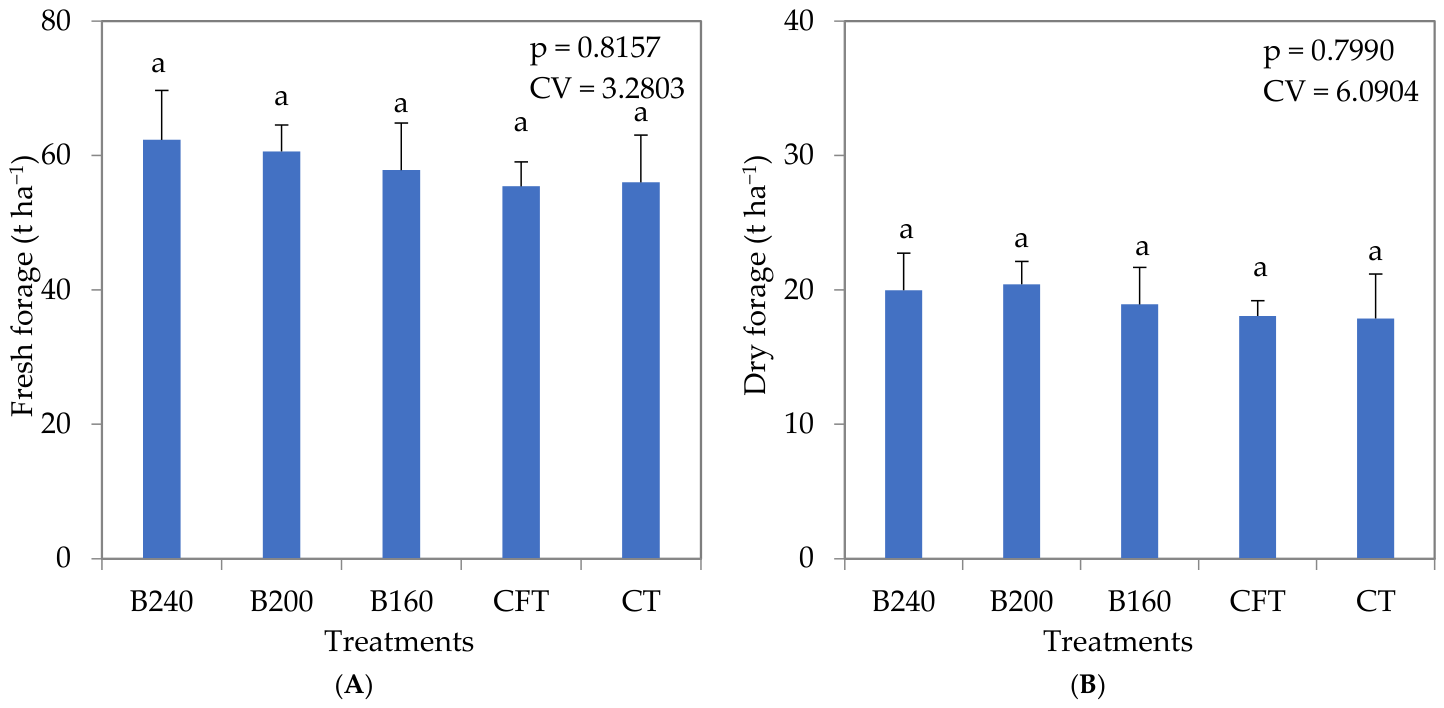
The yield of fresh forage and dry forage in maize plants, according to biosolid doses, showed no statistically significant differences between treatments (LSD test, p ≤ 0.05) (Figure 3, Table S1). However, all biosolid doses numerically improved forage production, with treatment B240 standing out with a yield of 62.3 and 20.0 t ha−1 of fresh and dry forage, while treatments with B200 and B160 yielded 60.6 and 57.8 t ha−1 of fresh forage, and 20.4 and 18.9 t ha−1 of dry forage. Plants without fertilization (CT) and with chemical fertilization (CFT) showed lower fresh forage production (56.0 and 55.4 t ha−1) and dry forage production (17.9 and 18.1 t ha−1), respectively (Figure 3).
Figure 3.
Fresh (A) and dry (B) forage yield in forage maize according to the effect of different doses of biosolids. Different letters (a) on the bars indicate statistically significant differences (LSD test, p ≤ 0.05). Means ± SE. N = 3. B240, B200 and B160 = 240, 200 and 160 kg of N ha−1 from biosolids; CFT = Chemical fertilization treatment (180-90-00 NPK) and CT = control treatment.
The different biosolids treatments had a positive effect on corn cob diameter (CCD), corn cob length (CCL), fresh weight of corn cob (FWCC), fresh plant weight (FPW), and total fresh plant weight (TFPW); with the exception of CCL and FPW, the other variables showed statistically significant differences between treatments (LSD test, p ≤ 0.05) (Table 2). The B240 and B200 treatments exhibited the largest CCD, both measuring 4.8 cm; the fruit diameter observed in these treatments showed increases of 6.3% and 8.3% compared to the CCD recorded in the CT (4.5 cm) and CFT (4.4 cm) plants. For its part, the CCL ranged from 16.1 to 18.0 cm; the highest value was obtained in B200 and the lowest in CFT. The increases in B200 were 10.6% and 1.1% compared to CFT and CT, which showed values of 16.1 cm and 17.8 cm, respectively.
Table 2.
Effect of biosolids on corn cob diameter (CCD), corn cob length (CCL), fresh weight of corn cob (FWCC), fresh plant weight (FPW), and total fresh plant weight (TFPW) of forage maize.
The FWCC fluctuated between 191 and 258 g; the treatments B240 and B200 presented the highest FWCC (258 and 255 g), while the lowest was found in the CT treatment with 191 g. Some biosolid dosages resulted in higher fresh biomass production; the B240 treatment showed the best performance in terms of fresh plant weight (FPW) at 505 g, while plants in the CT group showed the lowest FPW at 434 g. Regarding total fresh plant weight (TFPW), the B200 treatment performed best at 757 g, whereas plants in the CT group produced the lowest TFPW at 620 g (Table 2).
3.3. Effect of Biosolids on the Bromatological Characteristics of Forage Maize
The effects of biosolids on the bromatological variables of forage maize showed statistically significant differences only for nitrogen content and crude protein (LSD test, 0.05) (Table 3, Table S1). Acid detergent fiber (ADF) was higher in plants treated with B200 (44%), whereas the most efficient value for this variable (29%) was obtained with the B160 treatment. The percentage of neutral detergent fiber (NDF) in forage maize plants ranged from 71% to 87%, with treatment B160 having the highest NDF at 87%, while the lowest value was found in chemically fertilized plants (CFT) at 71%. The total ash content (TA) in forage maize plants fluctuated between 7.7 and 11.1%, with the organic fertilizer treatments yielding the best results. The highest value was in treatment B200 (11.1%), followed by B240 (9.5%); the lowest value was found in CT (7.7%) (Table 3).
Table 3.
Acid detergent fiber (ADF), neutral detergent fiber (NDF), total ash (TA), nitrogen content (NC), and crude protein (CP) according to the effect of biosolids on forage maize.
The effect of different doses of biosolids on nitrogen content (NC) in maize plants ranged from 0.78 to 1.07%. The highest values were quantified in plants treated with CFT (1.07%) and B160 (1.05%), while plants treated with B240 and B200 reflected lower N content, both with 0.78% and 0.86%, respectively. The CFT and B160 treatments showed a 13% and 11% increase in nitrogen content compared to the control treatment. The effect of different doses of biosolids on crude protein (CP) content in maize plants fluctuated between 4.9 and 6.7%. The highest CP content was obtained in treatment CFT (6.7%) and B160 (6.6%), with the lowest values found in B240 (4.9%), B200 (5.4%), and CT (6.0%) of crude protein.
4. Discussion
4.1. Effect of Biosolids on the Growth and Yield of Forage Maize
In this study, agronomic and nutritional variables of forage maize responded differently to the applied biosolids dosages. Plants fertilized with B240 excelled in height, number of leaves, forage yield, and ear size (CCD, FWCC, FPW); B200 stood out in leaf area, ear size (CCD and CCL), and total fresh plant weight; B160 showed the best performance regarding stem diameter. The positive response in forage growth and production observed in the biosolid-fertilized treatments is likely related to the application dose, the amount of organic matter supplied, and the nutrient content provided—specifically nitrogen (2.01%), phosphorus (13,000 mg kg−1), potassium (7600 mg kg−1), and calcium (74,000 mg kg−1). These findings have been corroborated by various authors. For example, Palacios et al. [28] reported 2.46, 2.10, and, 0.64% of N, P, and, K; Buchanan et al. [36] reported 4.1, 1.6, and 0.2 of N, P, and K; Pampana et al. [37] reported 7.9 and 1.2% of N and P; and Tesfamariam & Ngoetjana [31] reported 2.5% total nitrogen. Finally, Rigby et al. [38] indicated that biosolids contain between 1.5 and 7.5% total nitrogen, most of which is released rapidly in the first year of application, because it provides up to 47% mineralized nitrogen.
The similar forage yield in the CFT and CT treatments is likely due to the amount of nutrients available in the soil (such as nitrogen), which competed with the chemical fertilization. The biosolid application doses in this study were low, with the aim of avoiding potential soil and plant contaminants—factors that were not addressed in this study. The application of biosolids to maize crops can result in plants that are more resistant to lodging, improve stem thickness, and lead to sturdier plants with larger ears [7,27].
The application of 18 t ha−1 of biosolids to maize crops resulted in greater plant height (2.40 m), number of leaves (9.12), leaf area (396.83 cm2) and higher grain yield (5.22 t ha−1) compared with chemically fertilized plants (150-75-30); the increases were 4.8, 1.9, 1.3, and 27.6% for the aforementioned variables [26].
The use of biosolids in maize crops (10, 20, 30, and 40 t ha−1) improves soil fertility and promotes the nutrient cycle, increasing soil organic carbon and nitrogen content by 32% and 28% [39]; it also increases the ammonium and nitrate content between 40 and 70%, and phosphorus by 50%, leading to higher maize productivity [39]. Similarly, Nascimiento et al. [40] noted that the application of different doses of biosolids (10-60 t ha−1) improves the content of organic matter, nitrogen, phosphorus, calcium, and magnesium in maize-cultivated soil, which results in a greater amount of dry biomass.
4.2. Effect of Biosolids on the Bromatological Characteristics of Forage Maize
The bromatological variables ADF, NDF, and TC were higher in the treatments with B200 and B240 biosolids, whereas the lowest values were obtained with B160 and TFQ. High fiber concentrations (ADF and NDF) can reduce digestibility and the amount of energy available to ruminants [41,42]; in forage, they may indicate a lower crude protein content [43]. The B160 and TFQ treatments performed better; because they had lower levels of these fibers, they exhibited high nitrogen and crude protein contents, indicating greater digestibility of this forage by ruminants. The higher forage production at the B240 rate and the lower nitrogen and protein content are likely related to a dilution effect. At high doses of biosolids (B240), there was greater forage growth and yield, which allowed for greater dilution of nitrogen and protein in the plant. At low doses (B160), the plant produced less forage, indicating greater efficiency in nitrogen and protein concentration. In this regard, Koenig et al. [44], confirmed that the protein content in wheat grains fertilized with biosolids was equal to or lower than that of chemically fertilized grain, attributing this to the dilution of nitrogen due to the high yields achieved with the biosolids.
In the maize varieties DM 94 and African Tall, ADF values of 30.44% and 35.02% have been found, with NDF contents of 46.45% and 55.20%; crude protein contents in these varieties were 12.96% and 10.11% [8]. Kozera et al. [9], applying different rates of chemical fertilization to maize, reported NDF levels between 403 and 416 g kg−1 (i.e., values between 40% and 41%) and crude protein levels between 69.8 and 83.9 g kg−1; ammoniacal nitrogen was 9.2 and 12.0 g kg−1, equivalent to 0.9% and 1.2%.
The application of 18 t ha−1 of biosolids to maize crops resulted in 11% ADF, 24.7% NDF, 11% protein, and 1.76% nitrogen [26]; according to Vera-Garcia et al. [7]; maize plants fertilized with biosolids at 15% and 20% (volume/weight) exhibited nitrogen contents of 4.2% and 4.4%, representing increases of approximately 14% and 28% compared to plants not treated with biosolids. Organic fertilization with wastewater at rates of 150, 300, 450, and 600 t ha−1 in maize crops resulted in crude protein levels of 1.31–1.88%, acid detergent fiber (ADF) levels of 6.6–7.5%, and neutral detergent fiber (NDF) levels of 12.35–13.9% [45].
The effects of biosolid fertilization have also been documented in other forage crops. Liu et al. [46], applying nitrogen from biosolids (77 and 154 kg ha−1) to Panicum virgatum L. grass, found NDF levels of 669 and 675 g kg−1 (66% and 67%) and ADF levels of 387 and 397 g kg−1 (38% and 39%); these values were very low compared to plants not treated with biosolids (701 g kg−1). The application of 1.5 t ha−1 of biosolids to alfalfa resulted in contents of 30% ADF, 22% crude protein, and 61% NDF [47]. In Sesbania bispinosa, the application of 5%, 10%, and 15% biosolids yielded 7.2% ash, 28.1–32.7% crude fiber, and 14.1–15.9% crude protein [21]. The application of 15 t ha−1 of biosolids to barley, wheat, and oats resulted in total nitrogen levels of 40 to 65 mg per plant, representing increases of 400% and 550% compared to the control [37].
5. Conclusions
Biosolids provide large amounts of nutrients essential for plant growth and yield. The application of 12, 10, and 8 t ha−1 of biosolids (B240, B200, and B160) to maize plants increased plant height, stem diameter, number of leaves, leaf area, forage production, ear size, and biomass per plant. The nutritional characteristics of the forage maize improved only with the B160 treatment, which exhibited low acid detergent fiber (ADF) content and higher nitrogen (N) and crude protein (CP) content. Under the conditions of this study, biosolids represent sustainable alternatives for forage maize production.
Supplementary Materials
The following supporting information can be downloaded at https://www.mdpi.com/article/10.3390/agriengineering8100429/s1, Figure S1. Left: Preparation of the land for planting the crop, and Right: growing corn crop. Table S1. F-value and P-value n the study variables.
Author Contributions
Conceptualization, P.V.-L., L.X.Z.-M., A.E.-R., U.N.G.-G. and A.G.-M.; methodology, P.V.-L., L.X.Z.-M., N.C.G.-d.l.P., J.Á.M.-S., A.E.-R. and A.G.-M.; software, P.V.-L., J.Á.M.-S., R.G.-M. and A.E.-R.; validation, P.V.-L., J.Á.M.-S., A.E.-R., U.N.G.-G. and A.G.-M.; formal analysis, P.V.-L., L.X.Z.-M., N.C.G.-d.l.P., J.Á.M.-S., A.E.-R., U.N.G.-G., E.C.-A., J.M.V.-N. and A.G.-M.; investigation, P.V.-L., L.X.Z.-M., N.C.G.-d.l.P., J.Á.M.-S., R.G.-M., A.E.-R., U.N.G.-G., J.A.B.-A., H.D.G.-S. and A.G.-M.; resources, R.G.-M., J.A.B.-A., E.C.-A., J.M.V.-N., H.D.G.-S. and A.G.-M.; data curation, L.X.Z.-M., N.C.G.-d.l.P., J.Á.M.-S., R.G.-M., J.A.B.-A., E.C.-A., J.M.V.-N., H.D.G.-S. and A.G.-M.; writing—original draft preparation, P.V.-L., L.X.Z.-M., N.C.G.-d.l.P., J.Á.M.-S., A.E.-R., U.N.G.-G., J.A.B.-A., E.C.-A., J.M.V.-N., H.D.G.-S. and A.G.-M.; writing—review and editing, P.V.-L., L.X.Z.-M., N.C.G.-d.l.P., J.Á.M.-S., R.G.-M., A.E.-R., U.N.G.-G., J.A.B.-A., E.C.-A., J.M.V.-N., H.D.G.-S. and A.G.-M.; visualization, N.C.G.-d.l.P., R.G.-M., U.N.G.-G., J.A.B.-A., E.C.-A., J.M.V.-N. and H.D.G.-S.; supervision, A.G.-M.; project administration, H.D.G.-S. and A.G.-M.; funding acquisition, A.G.-M. All authors have read and agreed to the published version of the manuscript.
Funding
This research received no external funding.
Institutional Review Board Statement
Not applicable.
Informed Consent Statement
Not applicable.
Data Availability Statement
The data presented in this study are available on request from the corresponding author.
Conflicts of Interest
The authors declare no conflicts of interest.
Abbreviations
| CCD | Corn cob diameter |
| CCL | Corn cob length |
| FWCC | Fresh weight of corn cob |
| FPW | Fresh plant weight |
| TFPW | Total fresh plant weight |
| ADF | Acid detergent fiber |
| NDF | Neutral detergent fiber |
| TA | Total ash |
| NC | Nitrogen content |
| CP | Crude protein |
| CFT | Chemically fertilized treatment |
| CT | Control treatment |
References
- FAOSTAT. Crops and Livestock Products. Food and Agriculture Organization of the United Nations. 2026. Available online: https://www.fao.org/faostat/es/#data/QCL (accessed on 1 September 2026).
- SIAP-SIACON. Servicio de Información Agroalimentaria y Pesquera. Sistema de Información Agroalimentaria de Consulta, Agrícola Estatal 2003–2023, México. 2026. Available online: https://www.gob.mx/siap/documentos/siacon-ng-161430 (accessed on 2 September 2026).
- Ríos, F.J.L.; Torres, M.M.; Castro, F.R.; Torres, M.M.A.; Ruiz, T.J. Determinación de la huella hídrica azul en los cultivos forrajeros del DR-017, Comarca Lagunera, México. Rev. Fac. Cienc. Agrar. Univ. Nac. Cuyo 2015, 47, 93–107. [Google Scholar]
- Ávalos, C.M.A.; Figueroa, V.U.; García, H.J.L.; Vázquez, V.C.; Gallegos, R.M.A.; Orona, C.I. Bioinoculantes y abonos orgánicos en la producción de maíz forrajero. Nova Sci. 2018, 10, 170–189. [Google Scholar] [CrossRef] [Scilit]
- Granados-Niño, J.A.; Sánchez-Duarte, J.I.; Ochoa-Martínez, E.; Rodríguez-Hernández, K.; Reta-Sánchez, D.G.; López-Calderón, M.J. Efecto del ciclo de producción sobre el potencial de rendimiento y calidad nutricional del maíz forrajero en la Comarca Lagunera. Rev. Mex. Cienc. Agríc. 2022, 13, 207–217. [Google Scholar] [CrossRef] [Scilit]
- Cruz-González, A.; Arteaga-Ramírez, R.; Soria-Ruiz, J.; Monterroso-Rivas, A.I.; Pérez-Rodríguez, G.; Rojas-López, A. Projection of the IrrigationWater Requirement of Forage Corn Under Climate-Change Conditions in the North of Mexico. Crops 2026, 6, 23. [Google Scholar] [CrossRef] [Scilit]
- Vera-García, S.L.; Rodríguez-Casasola, F.N.; Barrera-Cortés, J.; Albores-Medina, A.; Muñoz-Páez, K.M.; Cañizares-Villanueva, R.O.; Montes-Horcasitas, M.C. Enhancing Phosphorus and Nitrogen Uptake in Maize Crops with Food Industry Biosolids and Azotobacter nigricans. Plants 2023, 12, 3052. [Google Scholar] [CrossRef] [Scilit] [PubMed]
- Dash, P.K.; Subramani, P.; Nalliappan, G.K.; Narayana, M.; Sampathrajan, V.; Natesan, S. Identification of QTLs Responsible for Fodder Quality Traits in Fodder Maize (Zea mays L.). Indian J. Genet. Plant Breed. 2026, 86, 11–16. [Google Scholar] [CrossRef] [Scilit]
- Kozera, W.; Lemanowicz, J.; Dudzińska, W.; Knapowski, T. Nitrogen Fertilization and Its Effect on Silage Maize Quality in the Context of Sustainable Fertilization Practices. Sustainability 2026, 18, 7625. [Google Scholar] [CrossRef] [Scilit]
- Ssempiira, J.B.; Sserumaga, J.P.; Obua, T.; Namazzi, C.; Herbert, G.; Kiggundu, M.; Matovu, M.; Bigirwa, S.A.; Kigozi, A.; Robert, M.; et al. Genetic variation in silage nutritional composition traits of tropical maize germplasm evaluated across multiple environments. Discov. Plants 2026, 3, 376. [Google Scholar] [CrossRef] [Scilit]
- Zepeda-Cancino, R.M.; Jiménez-Jiménez, R.A.; Martínez-Rosales, A.; Cruz-Torres, J.A. El campesino productor de leche ante el cambio climático: Vulnerabilidad de las prácticas alimentarias del ganado ante la sequía. Rev. Econ. Sociol. Rural 2026, 64, e303472. [Google Scholar] [CrossRef] [Scilit]
- Muro-Pérez, G.; Sánchez-Salas, J.; Alba-Ávila, J.A. Desarrollo agroindustrial: Reseña y perspectiva en la Comarca Lagunera, México. Rev. Chapingo Ser. Zonas Arid. 2012, 11, 1–7. [Google Scholar] [CrossRef] [Scilit]
- Góngora-Echeverría, V.R.; Castro-Larragoitia, J.; Giácoman-Vallejos, G.; Cardona-Benavides, A.; González-Sánchez, A.; Cauich-Kau, D.; García-Vargas, G.G. Spatial evaluation of groundwater pollution by pesticides in the agroindustrial hub “La Comarca Lagunera” in México: The anthropogenic activity and local factors’ impact. Environ. Monit. Assess. 2026, 198, 238. [Google Scholar] [CrossRef] [Scilit] [PubMed]
- Kumar, V.; Chopra, A.K.; Kumar, A. A review on sewage sludge (Biosolids) a resource for sustainable agriculture. Arch. Agric. Environ. Sci. 2017, 2, 340–347. [Google Scholar] [CrossRef] [Scilit]
- Flores, F.E.; Moreno, C.H.; Figueroa, V.U.; Potisek, T.M. Disponibilidad de nitrógeno y desarrollo de avena forrajera (Avena sativa L.) con aplicación de biosólidos. Terra Latinoam. 2014, 32, 99–104. [Google Scholar]
- Contangelo, A.; Esperschuetz, J.; Robinson, B.H. Trace Element Uptake by Willows Used for the Phytoremediation of Biosolids. Life 2023, 13, 243. [Google Scholar] [CrossRef] [Scilit] [PubMed]
- Pozzebon, E.A.; Seifert, L. Emerging environmental health risks associated with the land application of biosolids: A scoping review. Environ. Health 2023, 22, 57. [Google Scholar] [CrossRef] [Scilit] [PubMed]
- Levine, A.J.; Bean, E.Z.; Hinz, F.O.; Wilson, P.C.; Reisinger, A.J. Leaching of select per-/poly-fluoroalkyl substances, pharmaceuticals, and hormones through soils amended with composted biosolids. J. Environ. Manag. 2023, 343, 118185. [Google Scholar] [CrossRef] [Scilit] [PubMed]
- US EPA: United States Environmental Protection Agency. Process Design Manual. Land Application of Sewage Sludge and Minicipal Septage; EPA/625/R-95/001; Office of Research and Development: Cincinnati, OH, USA, 1995. [Google Scholar]
- NOM-004-SEMARNAT-2002; Norma Oficial Mexicana, Protección Ambiental—Lodos y Biosólidos—Especificaciones y Límites Máximos Permisibles de Contaminantes para su Aprovechamiento y Disposición Final. Official Gazette of the Federation: Mexico City, Mexico, 2002.
- Siric, I.; AL-Huqail, A.A.; Kumar, P.; Goala, M.; Abu, F.S.; Adelodun, B.; Ajibade, F.O.; Alrumman, S.A.; Alamri, S.A.M.; Taher, M.A.; et al. Sustainable Management of Sewage Sludge Using Dhaincha (Sesbania bispinosa (Jacq.) W.Wight) Cultivation: Studies on Heavy Metal Uptake and Characterization of Fibers. Agronomy 2023, 13, 1066. [Google Scholar] [CrossRef] [Scilit]
- Hernández-Herrera, J.M.; Olivares-Sáenz, E.; Villanueva-Fierro, I.; Rodríguez-Fuentes, H.; Vázquez-Alvarado, R.; Pissani-Zúñiga, J.F. Aplicación de lodos residuales, estiércol bovino y fertilizante químico en el cultivo de sorgo forrajero. Rev. Int. Contam. Ambient. 2005, 21, 31–36. [Google Scholar]
- Jurado, G.P.; Luna, M.L.; Hernández, R.B. Aprovechamiento de biosólidos como abonos orgánicos en pastizales áridos y semiáridos. Rev. Mex. Cienc. Pecu. 2004, 42, 379–395. [Google Scholar]
- Lara-Villa, M.A.; Flores-Flores, J.L.; Alatriste-Mondragon, F.; Mata-González, R. Plant Production in Semiarid Shrubland Communities Amended with Biosolids in Central Mexico. Rangel. Ecol. Manag. 2022, 81, 34–43. [Google Scholar] [CrossRef] [Scilit]
- Silva-Leal, J.A.; Perez-Vidala, A.; Torres-Lozada, P. Effect of biosolids on the nitrogen and phosphorus contents of soil used for sugarcane cultivation. Heliyon 2021, 7, e06360. [Google Scholar] [CrossRef] [Scilit] [PubMed]
- Vaca, R.; Lugo, J.; Martinez, R.; Esteller, M.V.; Zavaleta, H. Effects of sewage sludge and sewage sludge compost amendment on soil properties and Zea mays L. plants (heavy metals, quality and productivity). Rev. Int. Contam. Ambient. 2011, 27, 303–311. [Google Scholar]
- González-Flores, E.; Ramos-Barragán, J.E.; Tornero-Campante, M.A.; Murillo-Murillo, M. Evaluación de dosis de biosólidos urbanos en maíz bajo condiciones de invernadero. Rev. Mex. Cienc. Agríc. 2017, 8, 119–132. [Google Scholar] [CrossRef] [Scilit][Green Version]
- Palacios, R.R.; Melo, W.J.; Rocha, A.M.S.; Araújo, A.S.F.; Restrepo-Sánchez, N.; Jaramillo, C.A.P. Evaluation of the Incidence of Mineral Fertilizer Entrapment in Organic Matrix of Residual Biosolids, Cellulose and Sawdust in Maize (Zea mays) Crop. AgriEngineering 2025, 7, 343. [Google Scholar] [CrossRef] [Scilit]
- NMS (National Meteorological Service). National Water Commission. General Coordination of the National Meteorological Service, National Climatological Database. Government of Mexico. 2026. Available online: https://smn.conagua.gob.mx/es/climatologia/informacion-climatologica/informacion-estadistica-climatologica (accessed on 15 May 2026).
- Montes, H.R.U.; Sánchez, N.C.; Hernández, G.O.; Valdez, M.S.E. Biosólidos digeridos anaeróbicamente en la producción de maíz forrajero. Agric. Téc. Mex. 2003, 29, 25–34. [Google Scholar]
- Tesfamariam, E.H.; Ngoetjana, M.P. Balancing soil fertility and emerging contaminants risk: Insights from a 15-year biosolid application study under maize production. Sustainability 2026, 18, 1618. [Google Scholar] [CrossRef] [Scilit]
- Van Soest, P.J.; Robertson, J.B.; Lewis, B.A. Methods for dietary fiber, neutral detergent fiber, and nonstarch polysaccharides in relation to animal nutrition. J. Dairy Sci. 1991, 74, 3583–3597. [Google Scholar] [CrossRef] [Scilit] [PubMed]
- AOAC International. Official Methods of Analysis, 21st ed.; AOAC International: Arlington, VA, USA, 2012. [Google Scholar]
- SAS Institute Inc. (Statistical Analysis System). Software: The SAS System for Windows, Version 9.0; SAS Institute Inc.: Cary, NC, USA, 2002.
- Barbosa, M.V.; Pedroso, D.F.; Curi, N.; Carneiro, M.A.C. Do different arbuscular mycorrhizal fungi affect the formation and stability of soil aggregates? Ciênc. Agrotecnol. 2019, 43, e003519. [Google Scholar] [CrossRef] [Scilit]
- Buchanan, C.M.; Ippolito, J.A. Long-term biosolids applications to overgrazed rangelands improve soil health. Agronomy 2021, 11, 1339. [Google Scholar] [CrossRef] [Scilit]
- Pampana, S.; Rossi, A.; Arduini, I. Biosolids Benefit Yield and Nitrogen Uptake in Winter Cereals without Excess Risk of N Leaching. Agronomy 2021, 11, 1482. [Google Scholar] [CrossRef] [Scilit]
- Rigby, H.; Clarke, B.O.; Pritchard, D.L.; Meehan, B.; Beshah, F.; Smith, S.R.; Porter, N.A. A critical review of nitrogen mineralization in biosolids-amended soil, the associated fertilizer value for crop production and potential for emissions to the environment. Sci. Total Environ. 2016, 541, 1310–1338. [Google Scholar] [CrossRef] [Scilit] [PubMed]
- da Silva, W.R.; do Nascimento, C.W.A.; Fracetto, F.J.C.; de Araújo Pereira, A.P.; Ximenes, D.H.D.S.V.; da Silva Lins, S.A.; Gouveia, D.A.C.C.; Fracetto, G.G.M. Thermal versus chemical stabilization of sewage sludge: Effects on soil chemical properties, microbial functionality, and maize yield in a tropical soil. Waste Manag. 2026, 211, 115316. [Google Scholar] [CrossRef] [Scilit] [PubMed]
- Nascimento, C.W.A.; Barros, D.A.S.; Melo, E.E.C.; Oliveira, A.B. Soil chemical alterations and growth of maize and bean plants after sewage sludge application. Rev. Bras. Cienc. Solo 2004, 28, 385–392. [Google Scholar] [CrossRef] [Scilit]
- Asekova, S.; Kulkarni, K.P.; Kim, M.; Kim, J.; Song, J.T.; Shannon, J.G.; Lee, J. Novel quantitative trait loci for forage quality traits in a cross between PI 483463 and ‘Hutcheson’ in soybean. Crop Sci. 2016, 56, 2600–2611. [Google Scholar] [CrossRef] [Scilit]
- Karnatam, K.S.; Mythri, B.; Un Nisa, W.; Sharma, H.; Meena, T.K.; Rana, P.; Vikal, Y.; Gowda, M.; Dhillon, B.S.; Sandhu, S. Silage maize as a potent candidate for sustainable animal husbandry development—Perspectives and strategies for genetic enhancement. Front. Genet. 2023, 14, 1150132. [Google Scholar] [CrossRef] [Scilit] [PubMed]
- Jančík, F.; Homolka, P.; Čermák, B.; Lád, F. Determination of indigestible neutral detergent fibre contents of grasses and its prediction from chemical composition. Czech J. Anim. Sci. 2008, 53, 128–135. [Google Scholar] [CrossRef] [Scilit]
- Koenig, R.T.; Cogger, C.G.; Bary, A.I. Dryland winter wheat yield, grain protein, and soil nitrogen responses to fertilizer and biosolids applications. Appl. Environ. Soil Sci. 2011, 2011, 925462. [Google Scholar] [CrossRef] [Scilit]
- Bürün, B.; Tuna, A.L.; Yokaş, İ.; Özkul, H. Effect of alkaline stabilized domestic wastewater on soil properties and yield, quality and nutrition of silage maize. Anadolu J. Agric. Sci. 2012, 27, 31–40. [Google Scholar] [CrossRef] [Scilit]
- Liu, X.J.A.; Fike, J.H.; Galbraith, J.M.; Fike, W.B. Switchgrass response to cutting frequency and biosolids amendment: Biomass yield, feedstock quality, and theoretical ethanol yield. BioEnergy Res. 2014, 7, 1191–1200. [Google Scholar] [CrossRef] [Scilit]
- Qiu, Y.; Wang, Y.; Fan, Y.; Hao, X.; Li, S.; Kang, S. Root, Yield, and Quality of Alfalfa Affected by Soil Salinity in Northwest China. Agriculture 2023, 13, 750. [Google Scholar] [CrossRef] [Scilit]

Disclaimer/Publisher’s Note: The statements, opinions and data contained in all publications are solely those of the individual author(s) and contributor(s) and not of MDPI and/or the editor(s). MDPI and/or the editor(s) disclaim responsibility for any injury to people or property resulting from any ideas, methods, instructions or products referred to in the content. |
© 2026 by the authors. Licensee MDPI, Basel, Switzerland. This article is an open access article distributed under the terms and conditions of the Creative Commons Attribution (CC BY) license.