


Abstract
Cage-raised chicken farming is influenced by multiple environmental and husbandry factors, making it prone to various types of abnormal eggs, such as in-cage eggs, broken eggs, dirty eggs, and undersized eggs. Automated coop inspections require simultaneous monitoring of chickens and eggs to ensure farming safety. However, computer vision-based inspection robots are susceptible to interference from complex backgrounds, cage mesh obstructions, and uneven lighting, making it difficult for their abnormal egg recognition accuracy to meet practical requirements. To overcome this problem, this study proposes an improved object detection network, EGG-DEIM: It employs a phased dynamic data augmentation strategy, utilizing different data augmentation techniques at different training stages. It incorporates Partial Dynamic Convolution (PDConv) modules to reduce redundant features in the backbone network while mitigating interference from cage mesh occlusion; introduces a Spatial-Frequency Modulation (SMF) module to enhance the representation of high-, medium-, and low-frequency features in eggs; and incorporates a Pyramid Sparse Transformer (PST) module for multi-scale feature fusion to address feature transmission discontinuities in occluded scenes, thereby enabling multi-class classification of eggs and improving detection accuracy. Experimental results on the collected caged-poultry dataset show that EGG-DEIM attains 92.6% mAP@50 and 77.5% mAP@50:95 with only 7.43 GFLOPs and 5.04 M parameters, achieving higher accuracy within a limited computational budget than the baseline and mainstream detectors of comparable size.
1. Introduction
Chickens and eggs have become a cornerstone of the livestock and poultry industry, as well as an indispensable component of the human diet, owing to their outstanding production performance, significant economic value, and comprehensive nutritional benefits. In recent years, with the development of intensive and large-scale farming models, Sinclair et al. [1] noted that global egg production has experienced exponential growth.
Eggs trapped by cage floor mesh, forming in-cage eggs, are a common occurrence in cage-rearing systems. This is particularly true in tiered “one hen per cage” systems, where the design of the cage floor mesh’s angle of inclination directly affects egg collection efficiency. If the slope of the bottom mesh is too shallow, eggs will become trapped in the mesh. Not only will they fail to be collected in a timely manner—affecting egg freshness—but they will also be prone to being crushed by the hens’ feet or contaminated by feces, leading to bacterial growth. Conversely, if the slope is too steep, eggs may collide as they roll onto the egg conveyor belt, resulting in broken eggs. Shucai et al. [2] drew similar conclusions in studies on caged egg-laying ducks. If these broken or dirty eggs are not promptly removed, they may also lead to cross-contamination, affecting economic returns and posing a threat to food safety. Elnesr et al. [3] noted that poor egg quality results in economic losses, whereas improving quality helps increase the value of the egg products.
Image-based egg inspection technologies can be categorized into two types: traditional methods and deep learning methods. Narin et al. [4] designed a system for detecting cracked eggs using methods such as grayscale processing, the Canny edge detector, and template matching of crack images; this approach remained a mainstream method for crack feature extraction both at the time and in subsequent periods. Haoran et al. [5] proposed a method for detecting and identifying cracked eggs based on support vector machines (SVMs) and machine vision. By employing techniques such as grayscale conversion, median filtering, linear sharpening, and threshold segmentation to extract feature parameters from images of cracked eggs, the authors established an SVM model for egg identification and detection. Conventional egg detection methods can be broadly divided into acoustic-response analysis, which identifies cracked eggs from the vibration or frequency signature of a tapped shell, and machine-vision methods that combine hand-crafted features with classifiers such as SVMs. These methods generally require manually designed preprocessing steps such as grayscale conversion and threshold segmentation, and they tend to struggle with the uneven lighting and irregular object orientations typical of cage-rearing environments.
In recent years, machine vision has been increasingly utilized by researchers for crack detection in eggs. Wang et al. [6] proposed a method for identifying and evaluating black spots on eggshells, employing the K-means clustering algorithm to convert RGB images into the LAB color space and calculate Euclidean distances to separate the eggshell foreground from the background. Although this method demonstrated high-quality segmentation, fast processing speeds, and low computational complexity, it was limited to the quantitative assessment of a single defect. Botta and co-workers [7] put forward a CNN-oriented scheme for eggshell crack detection. Multiple image patches sampled from eggshell images were utilized for model training, and this approach achieves reliable recognition of complicated crack patterns at 96.92% accuracy. Turkoglu [8] input six sets of depth features from a single egg into a bidirectional long short-term memory (BiLSTM) network in a time series to capture the correlation information between images taken from different angles, thereby addressing the issue of defect misclassification caused by the insufficiency of single-angle features. The author also designed a hardware system for multi-defect full-surface detection. By comparing the model with nine pre-trained CNN models, SVM classifiers, and traditional machine learning methods, the author validated the model’s superiority. Taspinar and Cinar [9] addressed the economic losses and food-safety issues caused by physical damage during egg production. They constructed a dataset comprising 569 images categorized into three classes—crack, empty, and good (corresponding to cracked, hollow, and intact eggs)—and employed transfer learning with the VGG16 and VGG19 convolutional neural networks to classify egg damage. Experimental results showed that the VGG16 model achieved an accuracy of 93.8%, while the VGG19 model reached 95.1%.Chaowalittawin et al. [10] optimized the recognition of cracks in white eggshells using multiple light channels. They reported 100% accuracy and recall for crack recognition in both the red and blue channels; these saturated scores were, however, measured under controlled illumination on uniformly colored white eggshells, and whether they hold under the uneven lighting, varied shell appearance, and occlusion of cage-rearing scenes remains unverified, so such perfect metrics should not be generalized directly to in-cage detection. Wong et al. [11] utilized a convolutional neural network (CNN) to identify irregular stains on eggshells. This approach performed classification of eggshell stain patterns by means of a pre-trained CNN model, and benchmarked its classification outputs against human assessment results, delivering an overall classification accuracy of 91.8%. Nakaguchi et al. [12] integrated Deep SORT tracking with K-Means clustering to address the challenges of continuous identification and adaptive size range classification of quail eggs on a dynamic conveyor belt, meeting the requirements for quail egg grading.
The studies mentioned above all utilized CNN-based architectures. Although CNNs excel at extracting local features, their reliance on the locality of convolution operations results in insufficient capture of global contextual information regarding eggs in egg trays and eggs left in cages under real-world cage-rearing conditions, leading to incomplete feature representations. Since semantic segmentation models are adept at fine-grained defect segmentation, some researchers have applied them to the detection of egg cracks.
Shi et al. [13] achieved segmentation of microcracks in eggs with widths less than 20 μm using a modified U-Net, achieving an average Mean Intersection over Union (MIoU) of 82.24%; however, the study did not address multi-class recognition, and the model lacked sufficient lightweight optimization. Regarding instance segmentation models, Jiang et al. [14] proposed the CEV-YOLO model, an enhancement of YOLOv11. By integrating Central Differential Convolution with the EfficientViT backbone network, it achieved segmentation accuracy and recall rates of 98.9% and 97.5%, respectively, in egg collection and conveyor line scenarios. When combined with the ByteTrack algorithm, it enables continuous mask output of eggs in video streams, balancing pixel-level segmentation accuracy with real-time deployment requirements. Soontornnapar et al. [15] proposed a training-free segmentation method for egg regions and crack defects based on Grounded SAM. This is an automatic egg-cracking detection solution that requires no pre-training and is independent of annotations, constructing an end-to-end prompt-based detection pipeline. This method employs Grounding DINO combined with text prompts to locate egg targets, uses SAM to segment the egg region, and then extracts crack features through image processing. It innovatively introduces a saliency score with a threshold of 0.30% to accurately distinguish intact eggs from cracked eggs. Experiments were conducted using 1500 egg images, and the proposed method achieved a detection accuracy of 99.56%, with a precision of 100% and a recall of 99.12%. An exact precision of 100% denotes zero false positives only on that specific test set; given its moderate size, single-scene coverage, and the threshold-dependent, training-free design (saliency threshold 0.30%), this value is sensitive to the test distribution and should be read as a benchmark-specific result rather than evidence of error-free operation in unseen environments. This solution requires no training, has low annotation costs, and is highly resistant to lighting and stain interference.
The YOLO series of algorithms offer the core advantages of single-stage end-to-end detection and high inference efficiency. Huang et al. [16] proposed the YOLOv5_add model, which enhances defect feature extraction by adding CA attention to an improved backbone network, employs BiFPN in the neck network to strengthen multi-scale feature fusion capabilities, and introduces GSConv to reduce computational complexity. In a dynamic sorting line scenario, it achieved a detection accuracy of 96.4% for cracked eggs. Additionally, Jiang et al. [17] presented a lightweight detection model termed YOLOv8-PG targeting pigeon egg identification. For the backbone network, the Bottleneck structure within the C2f module was substituted with a FasterNet-EMA block, while the Bottleneck in the neck network’s C2f module was replaced by a standard FasterNet block to further cut down computational complexity. Meanwhile, a Dysample dynamic upsampler was integrated to boost detection performance for small targets, and a dedicated EMASlideLoss classification loss function was devised to tackle the class imbalance problem. Experimental findings indicated that compared with the baseline YOLOv8n, the proposed model improves F1-score, mAP@50:95 and mAP@75 by 0.76%, 1.56% and 4.45% respectively, while reducing the parameter count and computational complexity (measured in GFLOPs) by 24.69% and 22.89% respectively. Building upon these architectural improvements, Wang et al. [18] proposed a two-stage deep learning framework and developed a lightweight object detection algorithm based on improved YOLOv8. It first rapidly locates chicken regions from cage-rearing surveillance videos, then extracts key biological features (such as comb color) from chicken ROIs, and inputs them into an improved CNN classification model to distinguish low-laying hens from normal laying hens. Integrating both hardware and software innovations, Wu et al. [19] improved YOLOv8s to build a dual monitoring system combining robot patrol and fixed cameras in a multi-tier cage-rearing environment. By optimizing network transmission in the chicken coop, the system realized anomaly detection including egg counting and egg breakage, with an accuracy of 94.0% and a recall rate of 92.8%. The egg recognition rate reached 98.9% for robot patrol and 100% for fixed cameras. The system can upload data to the cloud in real time, greatly improving the production and management efficiency of caged laying hens.
All the above studies are based on the YOLO series of models. However, Ge et al. [20] noted that YOLO series models adopt a one-to-many (O2M) assignment strategy. Although it can provide dense supervision signals to accelerate convergence, it generates multiple overlapping bounding boxes, which rely on manually designed non-maximum suppression (NMS) to eliminate redundancy. This introduces latency and recognition instability in scenarios with densely distributed eggs inside chicken cages.
Transformer-based models, such as DETRs, employ a one-to-one (O2O) matching strategy. Luo et al. [21] employed the Kuhn–Munkres algorithm to construct a one-to-one mapping between predicted bounding boxes and ground-truth objects during training, which removes the requirement for non-maximum suppression (NMS) to eliminate redundant predictions. Nevertheless, slow convergence remains a fundamental limitation of DETR-based models, preventing their rapid adaptation to real-world production requirements. To address this, Huang et al. [22] proposed the DEIM detector, which employs a dense one-to-one (dense O2O) matching strategy to increase the number of targets and positive samples in each training image, effectively resolving the slow convergence issue caused by supervision scarcity in DETRs.
Wang and Liu [23,24] put forward VDD-Net, a detector built upon YOLOv10. It combines widened receptive fields, adaptive channel-wise feature fusion and global contextual attention to better detect small lesions in cluttered farming scenes. It achieved an mAP@0.5 of 95.2% with only 7.78 M parameters. The authors further presented AgriMM, a framework combining visual and textual modalities. Through contrastive fusion between regional visual features and textual content, this framework improved mAP by 11.6% compared with unimodal baselines. These advances, however, target plant-disease targets with comparatively stable appearance and do not address the occlusion, contamination, small target size, and inter-class similarity specific to caged-poultry egg detection, which motivate the present study.
In summary, existing technologies still exhibit four significant shortcomings in detecting features specific to tiered cage-rearing scenarios: First, there is a lack of a comprehensive classification system, as in-cage eggs are not included as a separate category in the detection process. Second, they have insufficient environmental robustness, making it difficult to handle complex conditions such as cage mesh obstruction and uneven lighting. Third, they have weak multi-class simultaneous recognition capabilities, making it impossible to distinguish between normal eggs, defective eggs, and in-cage eggs at the same time. Fourth, the core models suffer from scene adaptation issues and lack multi-class functionality: CNNs lack the ability to capture global context, making it impossible to distinguish between densely packed eggs in egg trays and in-cage eggs within cages; the YOLO model’s reliance on NMS leads to increased false positive rates for in-cage eggs in dense scenes. Although DEIM resolves the convergence issues of DETR, it still performs unsatisfactorily on the multi-category egg task—the simultaneous recognition of normal eggs, broken eggs, dirty eggs, mini eggs (mini eggs refer to eggs smaller than 50% of a normal egg), and in-cage eggs—leaving considerable room for improvement in real-world poultry house environments.
Therefore, this study focuses on the tiered “one hen per cage” caged rearing scenario to identify multiple categories of eggs within the cage, including in-cage eggs, broken eggs, dirty eggs, mini eggs, and normal eggs. By improving the DEIM-n model, this study proposes an EGG-DEIM model to explore a technical solution that balances global information capture, real-time performance, high accuracy, and multi-class recognition. The aim is to enhance egg production efficiency, reduce breakage rates, and improve economic conversion rates, thereby providing data support for egg production and chicken culling operations.
The main contributions of this study are as follows:
- (1)
- We constructed a five-class cage-laid egg dataset (CageEgg-5), comprising 11,691 egg instances—including normal eggs, in-cage eggs, broken eggs, dirty eggs, and mini eggs—along with 10,719 synchronously annotated black-feathered chicken instances. This dataset addresses the gap in existing datasets regarding the annotation of multi-class eggs in cage trays and in-cage eggs within cages.
- (2)
- We designed the Partial Dynamic Convolution (PDConv) module. Building on the occlusion masking mechanism of Partial Convolution (PConv) and integrating the expert kernel dynamic weighting strategy of Dynamic Convolution (DynamicConv), this module was integrated into Stages 2–3 of the Transformer backbone network. To suppress background noise from the cage mesh, the module generates dynamic masks. Concurrently, it utilizes multiple expert kernels to adaptively match egg edge features. This dual mechanism effectively mitigates feature extraction distortion caused by cage mesh occlusion.
- (3)
- We designed a Spatial-Frequency Modulation (SMF) feedforward module, which is optimized based on FMFFN and introduces 2 × 2 and 4 × 4 dual-window frequency-domain modulation. By dynamically assigning weights to different windows via an adaptive window selector, it enhances the fine-grained differences in high-frequency features of broken eggshell edges, mid-frequency features of dirty egg textures, and low-frequency features of mini-eggs, thereby resolving the confusion caused by feature similarity among eggs.
- (4)
- We introduced a Pyramid Sparse Transformer (PST) module. In the neck network, cross-layer attention in the coarse stage and top-k dynamic selection in the fine stage correlate the occlusion-resistant features from PDConv with the fine-grained features from SMF, thereby resolving the issue of feature transmission disruption in occlusion scenarios and achieving effective multi-scale feature fusion.
- (5)
- This study evaluated the performance of the EGG-DEIM model in a real-world cage-rearing environment. By comparing it with models such as the YOLO series, RT-DETR, and D-FINE across seven metrics—precision (P), recall (R), mAP@50, mAP@50:95, model parameters, GFLOPs, and model size—we validated the superior performance of the proposed method in multi-class egg detection and instance discrimination.
2. Materials and Methods
2.1. Data Collection
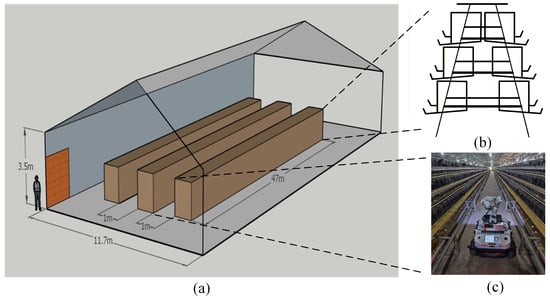
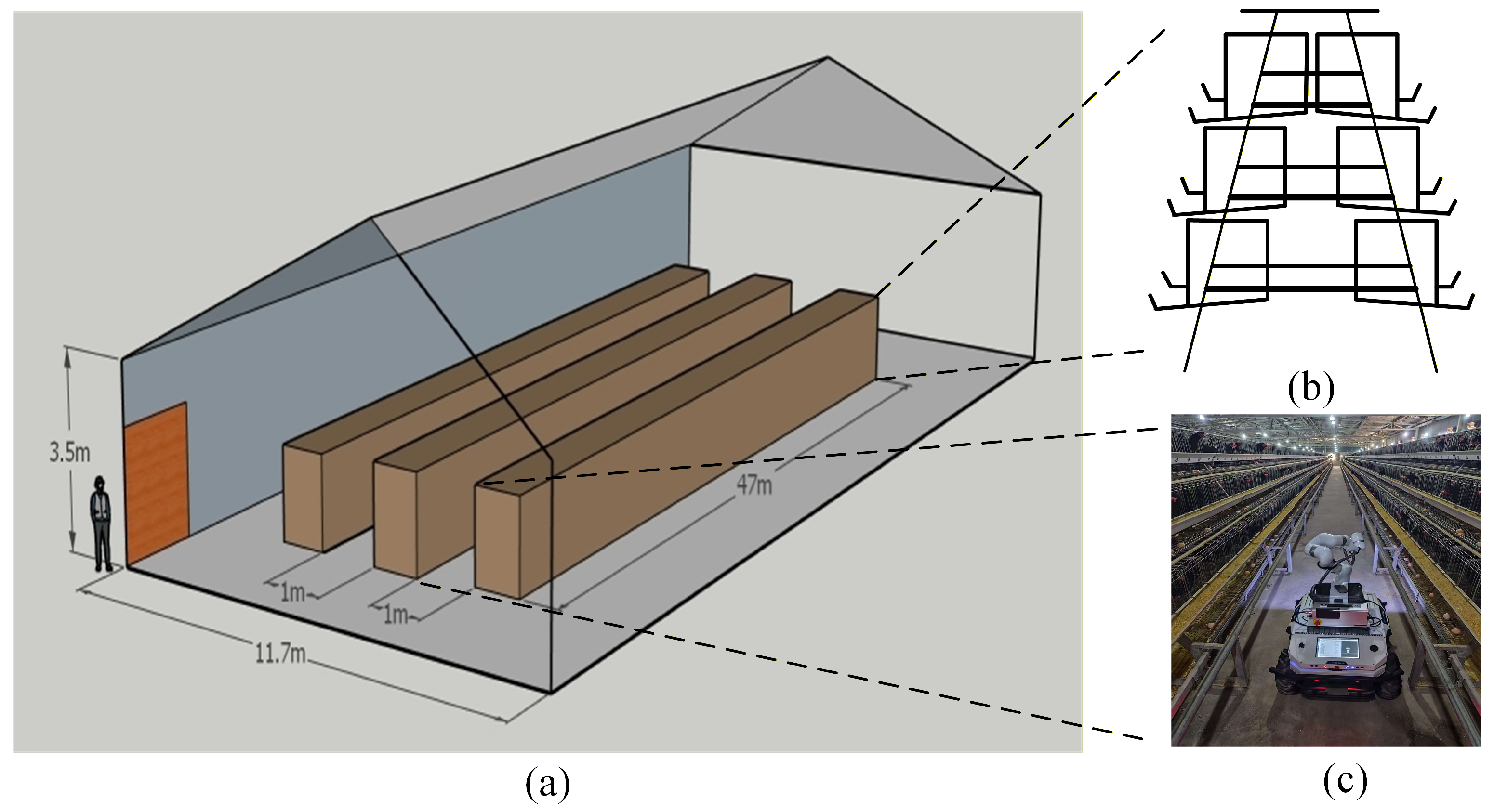
This study aims to propose a real-time detection method for laying hens and eggs applicable to inspection robots operating in cage-rearing environments. Figure 1 presents the 3D schematic of the poultry house, the cross-section of tiered cage structures, and the working scenario of the inspection robot. The research targets black-feathered laying hens and multi-category eggs within tiered cage facilities. Data were collected from a large-scale cage-rearing poultry farm in Yucheng District, Ya’an City, Sichuan Province, China. Adult laying hens were raised in a three-tier cage system, with one hen per cage. Each cage measures 42 cm in length, 28 cm in width, and 50 cm in height. The poultry house is equipped with automatic feeding systems, nipple drinkers, periodic manure removal systems, evaporative cooling equipment and dedicated ventilation fans, which enable precise regulation of temperature, humidity, ventilation and air quality and represent the typical environmental conditions of commercial large-scale cage-rearing farms.
Figure 1.
(a) Three-dimensional schematic of the poultry breeding house. (b) Cross-section of the tiered cage structure. (c) Working scenario of the inspection robot.
The data collection objects are black-feathered laying hens and eggs. The hens in the dataset are black-feathered laying hens with black plumage and red combs, aged over 380 days. The collected eggs include eggs remaining inside cages and various types of eggs on egg trays, covering the practical inspection scenarios of the inspection robot comprehensively. An iPhone 13 was adopted to simulate the image acquisition module of the inspection robot. The device supports 4K UHD video recording at a resolution of 3840 × 2160 pixels (16:9 aspect ratio), and the frame rate was set to 60 FPS. The shooting angle strictly simulates the inspection path of the robot. Video sampling was conducted daily from 10:00 to 12:00 and 14:00 to 16:00. The daytime illumination combines artificial lighting and natural light. Data collection lasted for seven consecutive days to capture diverse lighting conditions inherent to cage-rearing environments.
2.2. Data Set Annotation and Processing
To avoid data leakage between temporally adjacent frames, the continuous videos were first partitioned into training, validation, and test sets at the video level, and frames were then extracted from each subset using FFmpeg at a rate of one frame every two seconds. The extracted frames were cleaned by removing highly similar, blurry, or overexposed images. The remaining valid images were manually annotated in COCO format using LabelImg (https://github.com/HumanSignal/LabelImg, accessed on 1 September 2025), with bounding boxes tightly fitted around the chickens and eggs. This procedure yielded 1822 training, 260 validation, and 522 test images (2604 in total), and the proportion of each category was kept consistent across subsets to minimize distribution bias.
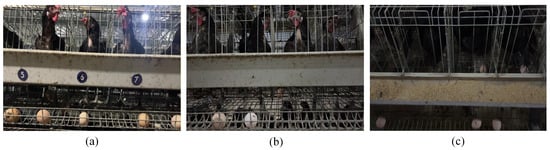
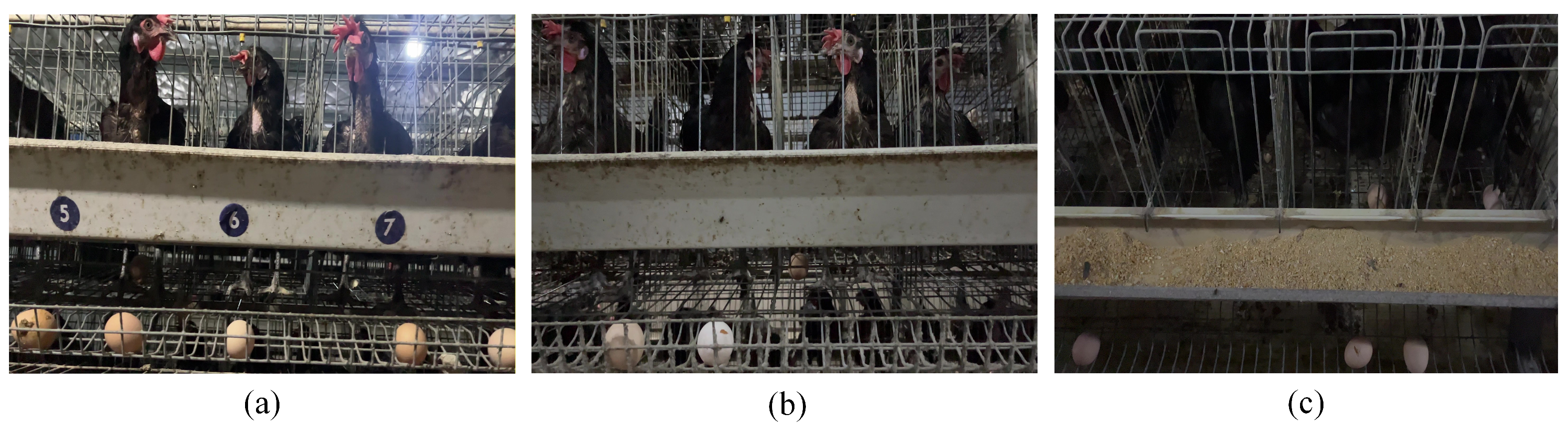
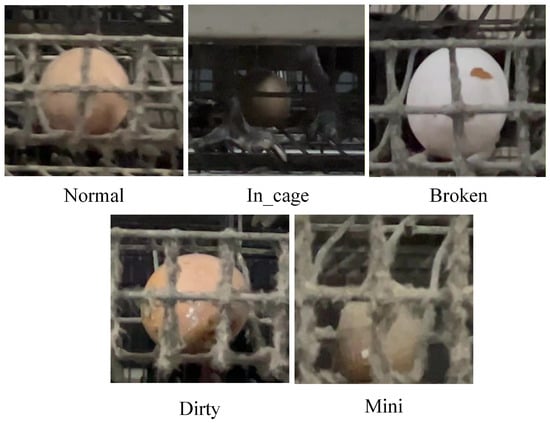
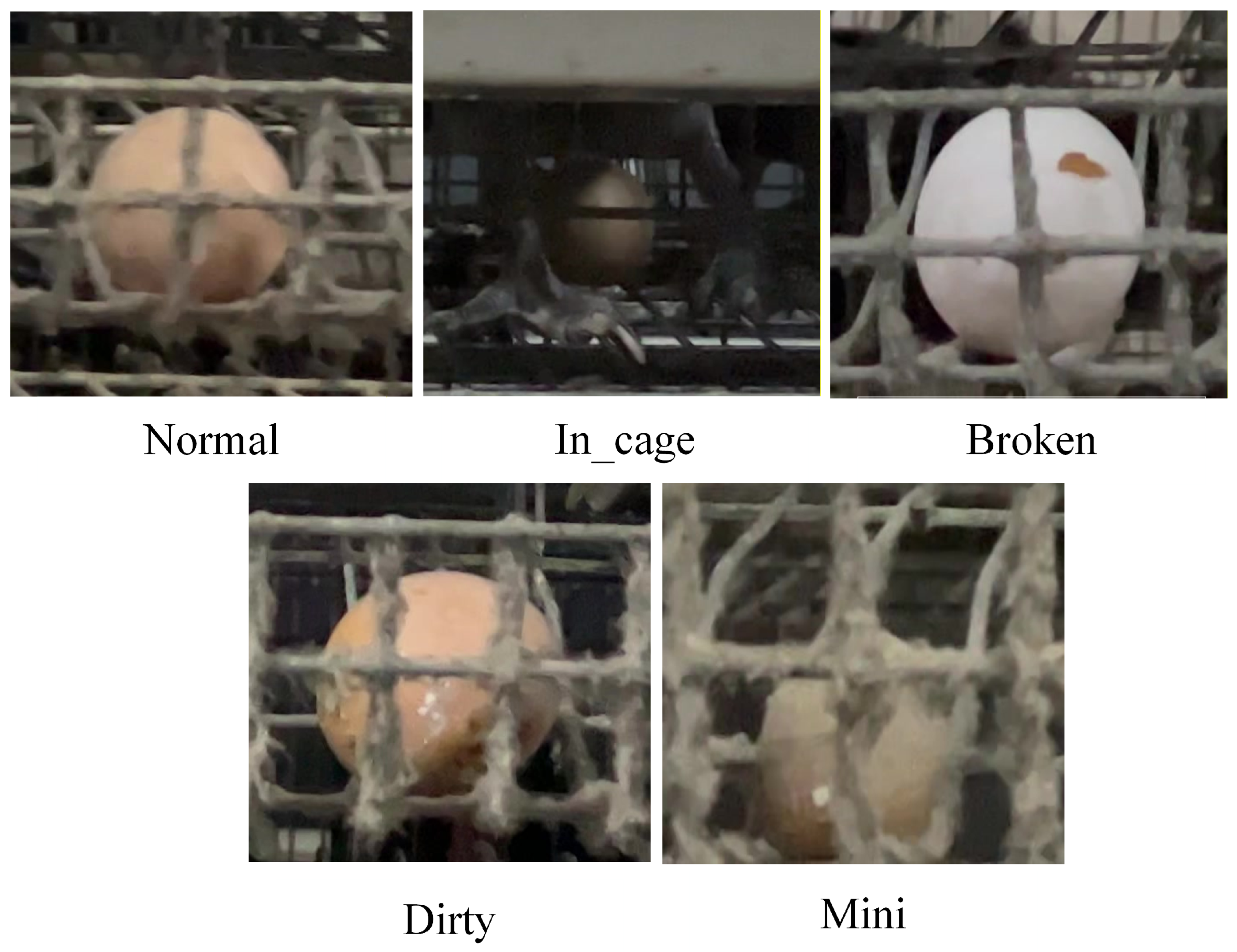
A total of six detection categories were defined, comprising one chicken category and five egg categories. The eggs were classified as normal eggs, in-cage eggs, broken eggs, dirty eggs, and mini eggs. Normal eggs have a smooth shell surface free of stains or cracks. In-cage eggs are trapped inside the cage by the cage floor mesh or obstructed by hens’ legs because of the cage inclination angle. Broken eggs are damaged by hen pecking or collisions while rolling into the egg collection trough. Dirty eggs have feces or bloodstains of any size on the shell surface. Mini eggs are defined as eggs smaller than 50% of the size of a normal egg. Representative samples from the constructed dataset are illustrated in Figure 2, while sample images of the egg categories are shown in Figure 3. Detailed information regarding the dataset distribution is provided in Table 1, and the definitions of the categories are summarized in Table 2.
Figure 2.
Dataset sample images captured inside tiered cage facilities: (a) top-tier cages, (b) middle-tier cages, and (c) bottom-tier cages. Images contain black-feathered laying hens and multi-category eggs under complex breeding conditions.
Figure 3.
Sample images of eggs from the dataset.
Table 1.
Dataset Distribution Across Different Categories.
Table 2.
Label Definitions for Dataset Categories.
2.3. Data Augmentation Configuration
This study employed a phased dynamic data augmentation strategy. By switching the type and intensity of augmentation at different training stages, it balanced the model’s generalization ability with convergence accuracy, thereby better addressing the challenges of detection in low-light, high-occlusion environments typical of tiered cage settings. The augmentation strategies included geometric transformations, scene simulation, and Mixup augmentation. Geometric transformation-based augmentation affected the position and shape of objects, while scene simulation-based augmentation was tailored to low-light, long-distance scenarios typical of cage environments. Mixup augmentation generated new samples by blending two images at random ratios, thereby increasing the ambiguity of class boundaries. The data augmentation strategies used throughout this study are summarized in Table 3. The boundaries follow the optimization schedule. Epoch 4 coincides with the end of the 2000-iteration learning-rate warm-up, so all strong augmentations remain off before this point to avoid disturbing the still randomly initialized model. At epoch 80, Mixup was retired to prevent the model from being persistently biased toward the synthetic distribution, while single-image photometric and geometric augmentations are retained. In the final 10 epochs, no augmentation is applied except horizontal flipping. The 210 epochs were divided into four stages:
Table 3.
Data Augmentation Strategies.
- Stage 1 (1–4) applied only RandomHorizontalFlip, allowing the model to initialize basic features such as egg contours and positions under minimal perturbation while adapting to the dataset distribution.
- Stage 2 (5–80) enabled all five operators—RandomHorizontalFlip, RandomIoUCrop, RandomPhotometricDistort, RandomZoomOut, and Mixup—combining geometric transformation, scene simulation, and sample blending to strengthen robustness against occlusion and illumination variation in complex cage-rearing scenes.
- Stage 3 (81–200) disabled Mixup while retaining RandomHorizontalFlip, RandomIoUCrop, RandomPhotometricDistort, and RandomZoomOut so as to focus on fine-grained defect feature extraction and improve recognition of dirty, broken, and other defective eggs.
- Stage 4 (201–210) retained only RandomHorizontalFlip as a weak augmentation to stabilize the final accuracy. The enabling/disabling schedule and parameters of all operators strictly followed the training configuration, ensuring reproducibility and scenario-specific applicability.
2.4. Methods
2.4.1. DEIM Network
DEIM is an efficient training framework for Transformer-based architectures (DETR), designed to overcome the core bottlenecks of traditional DETR, namely slow convergence and weak small-object detection capabilities. Its core innovations revolve around three major technical modules: First, to address the sparse supervision problem inherent in DETR’s one-to-one (O2O) matching, DEIM adopts Mosaic augmentation to pack more targets into each training sample, thereby enriching positive samples and accelerating convergence. Second, although dense O2O matching improves convergence efficiency, it may introduce low-quality matches. To address this, DEIM introduces the Matching-Aware Loss (MAL), which dynamically adjusts the loss weights for matches of varying quality through a weighted fusion of IoU and classification confidence. This approach strengthens optimization for high-quality matches while mitigating unnecessary penalties for low-quality matches, thereby ensuring the training effectiveness of dense matching. Finally, to enhance the ability to capture features of multi-scale objects, DEIM adopts a feature scale adaptation module after the backbone network, which extracts multi-scale features through bilinear interpolation and lightweight convolutions. The core objective of DEIM is to achieve dual improvements in fast convergence and high-precision detection while maintaining the simplicity of the end-to-end DETR framework, rendering it highly applicable to real-time detection applications featuring densely distributed small targets and complex scenarios.
2.4.2. EGG-DEIM Network
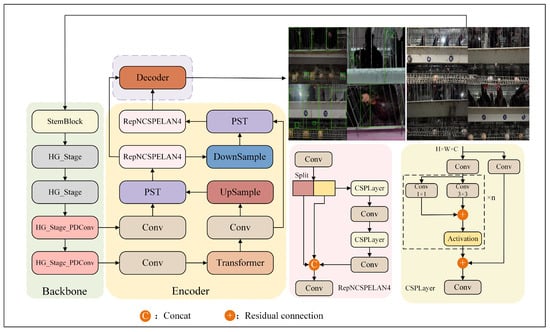
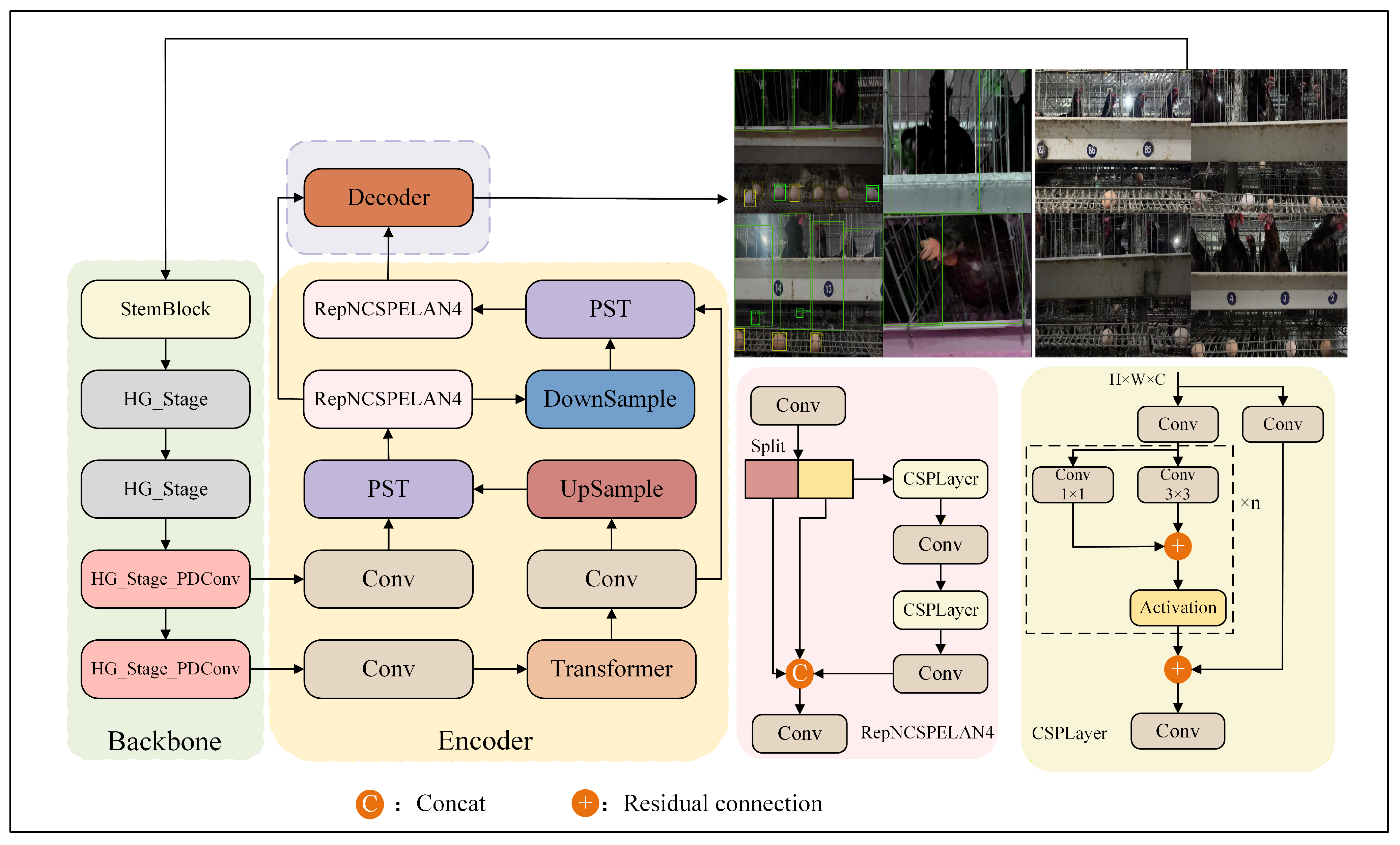
The EGG-DEIM network architecture developed in this work is depicted in Figure 4, and it represents an improved iteration of the DEIM-n baseline detector.
Figure 4.
EGG-DEIM Network Diagram.
Three dominant difficulties characterize caged-poultry egg detection: occlusion and contamination that weaken local textures (cracks, dirt and cage mesh), uneven and low illumination that degrades contours and defect signals, and large scale variation together with small and inter-class-similar targets—all under a strict lightweight budget for onboard robot deployment. The three proposed modules are assigned to these difficulties at different network stages. PDConv acts in the backbone to overcome the static-kernel and low-FLOPs limitations discussed in Section 2.4.3, strengthening local features resilient to occlusion and contamination. SMF acts in the encoder feed-forward path to restore the spatial–frequency information that the MLP-FFN loses under uneven, low-illumination conditions (Section 2.4.4). PST acts in the encoder FPN and PAN pathways, replacing simple concatenation with coarse-to-fine sparse attention to model cross-scale and global spatial relations for small and visually similar targets at low cost (Section 2.4.5). They form a sequential complementary chain—local enhancement (PDConv), spatial–frequency modulation (SMF) and multi-scale aggregation (PST)—which is why only their full combination achieves the best result (Section 3.2.2).
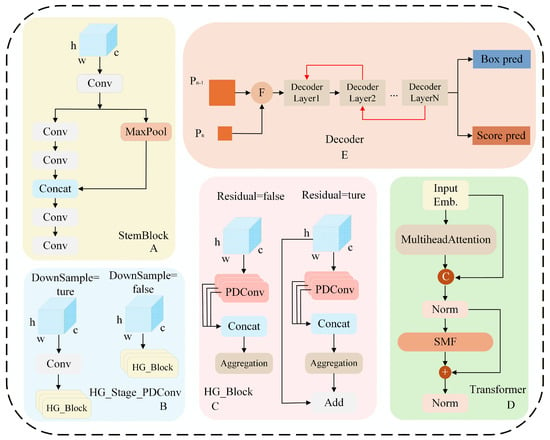
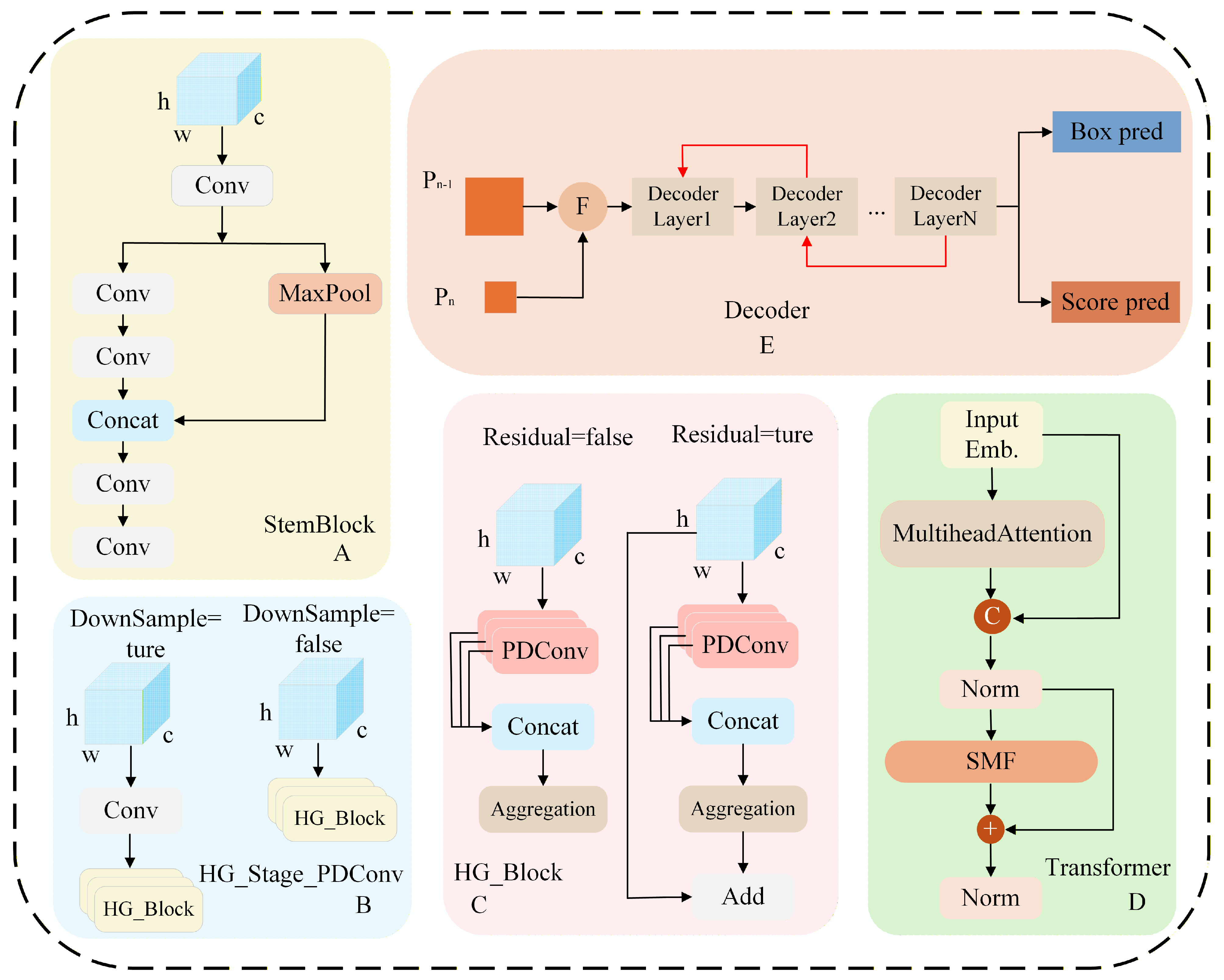
To better address feature redundancy in confined cage-rearing environments and achieve higher feature extraction efficiency, this study designed the Partial Dynamic Convolution (PDConv) module to replace the original lightweight convolution blocks (LightConvBNAct) in Stages 2 and 3 of the backbone network, thereby reducing redundant features while effectively improving detection accuracy. In the encoder section, the original MLP structure in the TransformerLayer has limitations: it achieves feature mapping solely through linear transformations and activation functions, lacking interaction between local and global features. Furthermore, a point-wise MLP-FFN operates on flattened tokens and cannot model the two-dimensional spatial and local–global dependencies of egg features; without an explicit residual or frequency-aware pathway, the weak defect signals in low-illumination and occluded regions are progressively attenuated through the feed-forward layers, which limits robustness in complex cage-rearing scenes. This study optimized the FMFFN by designing a Spatial-Frequency Modulation (SMF) module to replace the original MLP in the TransformerLayer. A Pyramid Sparse Transformer (PST) module was introduced into the upsampling and downsampling processes of the feature streams in Stages 2 and 3 fusing the occlusion-resistant features from PDConv with the fine-grained features from SMF. A detailed architectural diagram is provided in Figure 5.
Figure 5.
Detailed Diagram of Key Modules in the EGG-DEIM Network.
2.4.3. PDConv
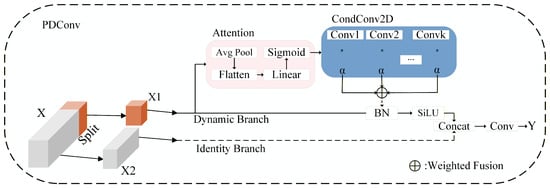
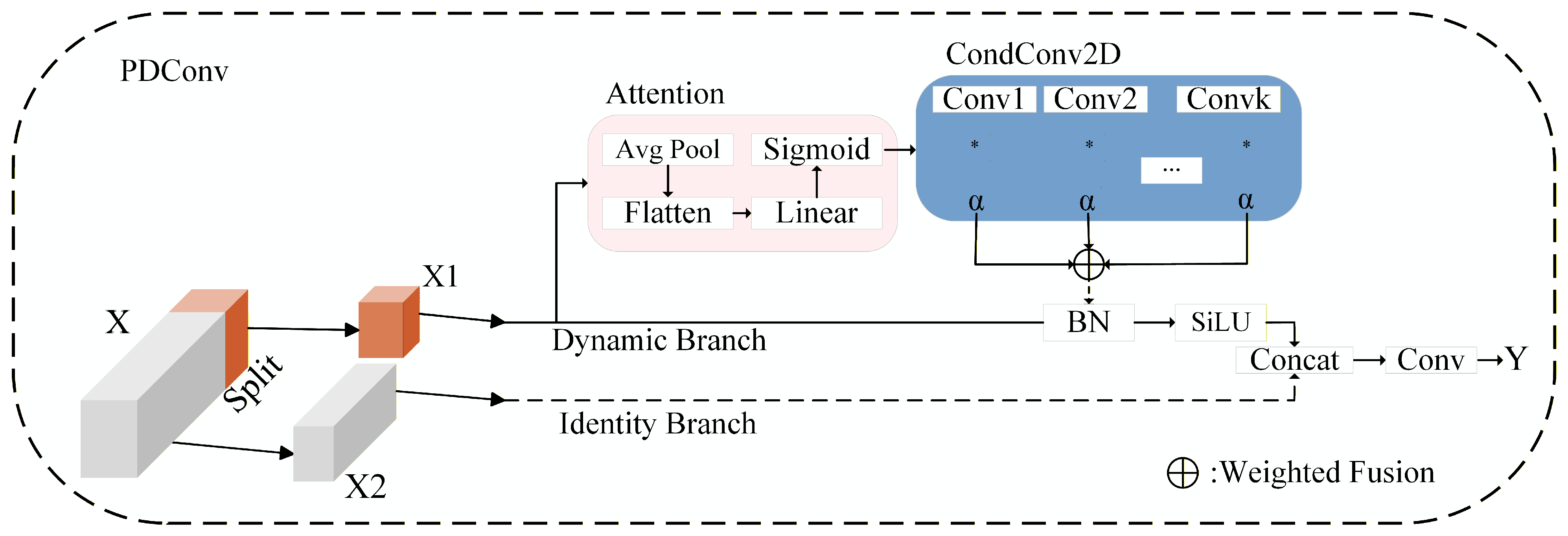
Many channels produce overlapping feature representations, resulting in wasted computational resources. To leverage this redundancy and reduce computational complexity, Chen et al. [25] proposed Partial Convolution (PConv). The core design of PConv relies on the configurable parameter ndiv (default 4) to split the input channels into two parts. The first part consists of dynamically processed channels, which are fed into a fixed 3 × 3 convolutional kernel for feature extraction, while the second part consists of identically mapped channels that directly retain their original features. After processing, the two channel parts are concatenated, and the number of output channels is adjusted as needed via a 1 × 1 convolution. However, the PConv design has inherent limitations: the fixed channel splitting ratio and the 3 × 3 fixed convolution kernel cannot adapt to the dynamic feature demands of multi-category egg detection in cage-rearing environments, where occlusion levels and illumination intensity vary. Although partial channel processing reduces computational load, its static feature extraction capability is insufficient, making it difficult to capture fine-grained differences such as eggshell cracks and cage-mesh occlusion and potentially leading to an excessive reduction in FLOPs at the expense of feature representation. Chen et al. [26] proposed DynamicConv to achieve scene-adaptive feature extraction: first, a routing network (Attention) is used to perform global perception of the input features, which generates dynamic weighting coefficients; subsequently, conditional convolution layers encapsulate k independent expert convolution kernels, which are weighted and combined using the coefficients generated by the routing network to obtain a dynamic kernel W adapted to the current input; finally, scene-adaptive feature extraction is achieved through convolution between the dynamic kernel and the input features. Although this mechanism enhances feature representation capabilities, full-channel dynamic processing introduces significant computational overhead. Building on the complementary nature of these methods, this study combines the channel-splitting and lightweighting approach of PConv with the dynamic kernel adaptation principle of DynamicConv to propose the Partial Dynamic Convolution (PDConv) module: PDConv retains the framework of PConv, which features ndiv = 4 channel splitting and identity mapping, while replacing the 3 × 3 fixed convolution kernel with a full DynamicConv module to achieve a balance between partial channel dynamic adaptation and partial channel retention. The detailed structure of PDConv is depicted in Figure 6.
Figure 6.
PDConv Structure Diagram.
2.4.4. SMF
The feedforward network (FFN) of the Transformer encoder is implemented by default using a multi-layer perceptron (MLP). Its primary drawback is the loss of spatial topological information: an MLP can only process features in the sequence format (B, N, C), whereas egg detection features are originally in the 2D spatial format (B, C, H, W). These features must first be flattened into sequence format () before being fed into the MLP. This limitation leads to two critical challenges for practical egg detection in cage-rearing environments:
- In regions with uneven illumination caused by tiered cage structures, egg contour features are weakened owing to the loss of spatial correlation.
- Under low-light conditions, the loss of spatial correlation for fine-grained defects such as eggshell cracks and stains causes a decreased feature signal-to-noise ratio.
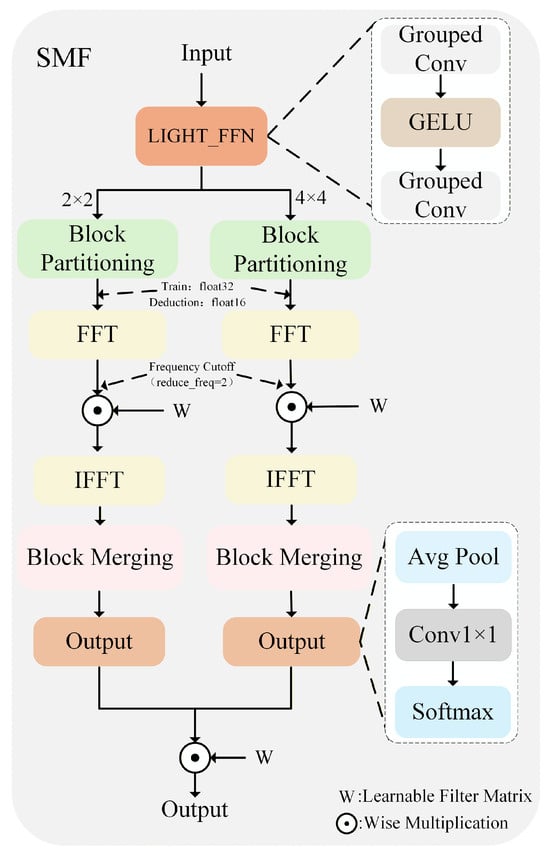
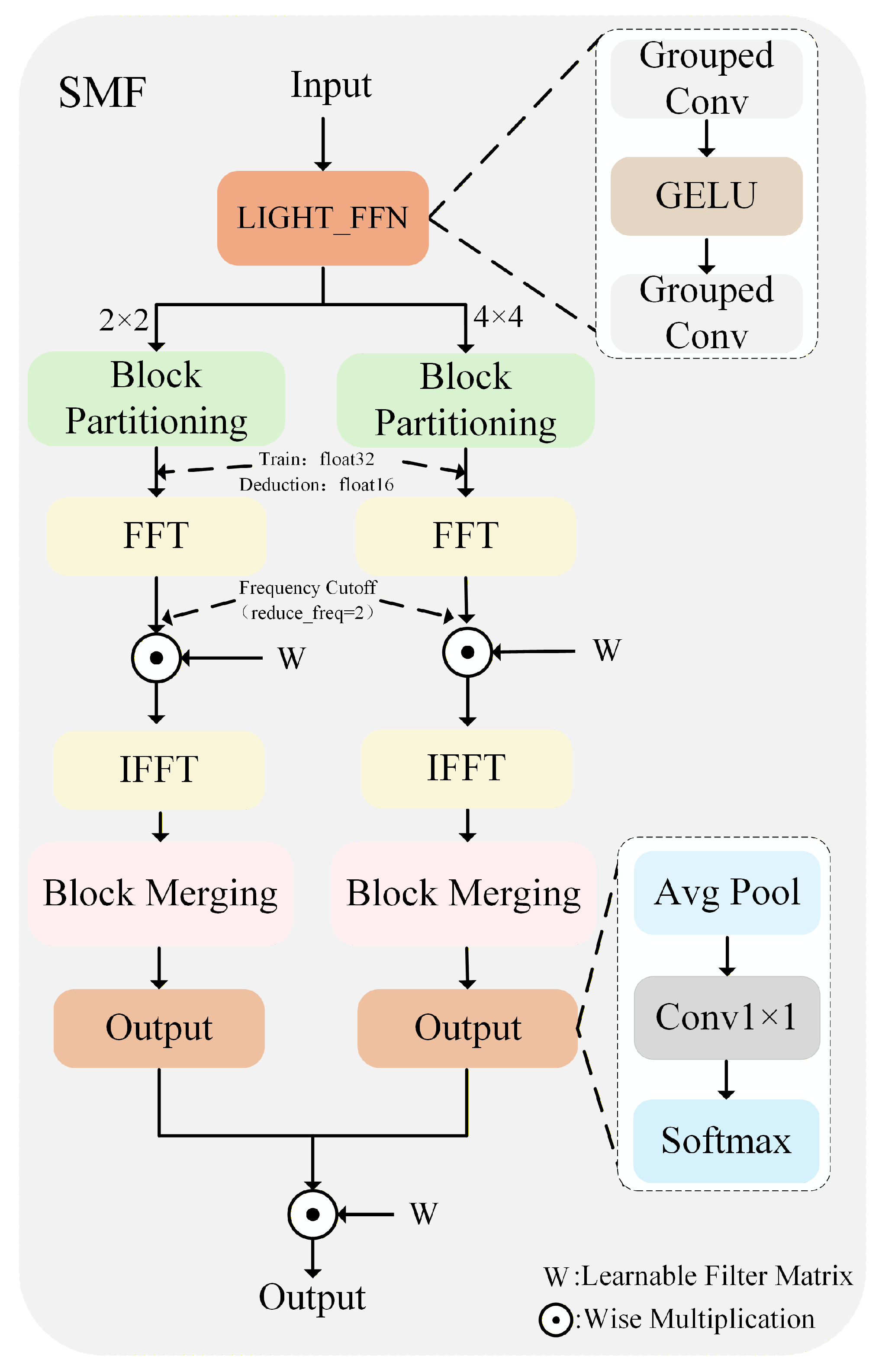
The Frequency-Modulated Feedforward Network (FMFFN) [27] incorporates joint frequency-domain and spatial-domain feature enhancement and effectively preserves multi-scale spatial features in visual tasks. Nevertheless, the original FMFFN suffers from two obvious drawbacks: full-frequency-domain calculation induces excessive computational overhead, and the fixed feature transformation strategy lacks adaptive adjustment capabilities for complex illumination and multi-scale defect characteristics in cage-rearing scenarios. To overcome these limitations, we design a Spatial-Frequency Modulation (SMF) module to substitute the original MLP inside the encoder’s TransformerLayer, as illustrated in Figure 7. The core improvement strategies of SMF are summarized as follows:
Figure 7.
SMF Structure Diagram.
- Frequency-domain dimension reduction: To mitigate the excessive computational overhead brought by full-frequency-domain processing in the original FMFFN, we set reduce_freq = 2. This reduces the frequency-domain dimension by a factor of 2 after Fourier transform and truncates redundant high-frequency components, achieving lightweight frequency-domain feature learning.
- Training–inference adaptive precision mechanism: because the 2-D FFT operates on complex spectra and is numerically sensitive, SMF dispatches the precision of its frequency branch according to the running state rather than to image brightness. During training, or whenever automatic mixed precision (AMP) is disabled, the windowed tokens are kept in 32-bit floating-point (float32) throughout the Fourier transform and complex-weight modulation, so that the small-magnitude high-frequency components of fine cracks and stains are preserved. At inference with AMP autocast enabled, the tokens are temporarily cast to float16 for the Fourier transform and complex-weight modulation to reduce latency, and are converted back to float32 immediately after the inverse transform, so that all subsequent encoder layers still operate in float32. This switch is governed by the training flag and the is_autocast_enabled() state; no image-brightness threshold is involved.
- Adaptive window weight adjustment: Two spatial window sizes ( and ) are adopted for local feature partitioning. A lightweight selector consisting of global average pooling, a convolution, and Softmax produces a content-adaptive weight for each window, and only windows whose weight exceeds (, i.e., 0.5) are accumulated. The small window captures fine-grained crack and stain features, whereas the large window retains global spatial structural information, allowing SMF to emphasize the appropriate scale for each local region.
2.4.5. PST
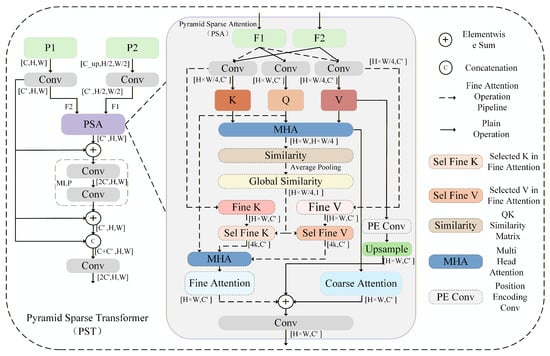
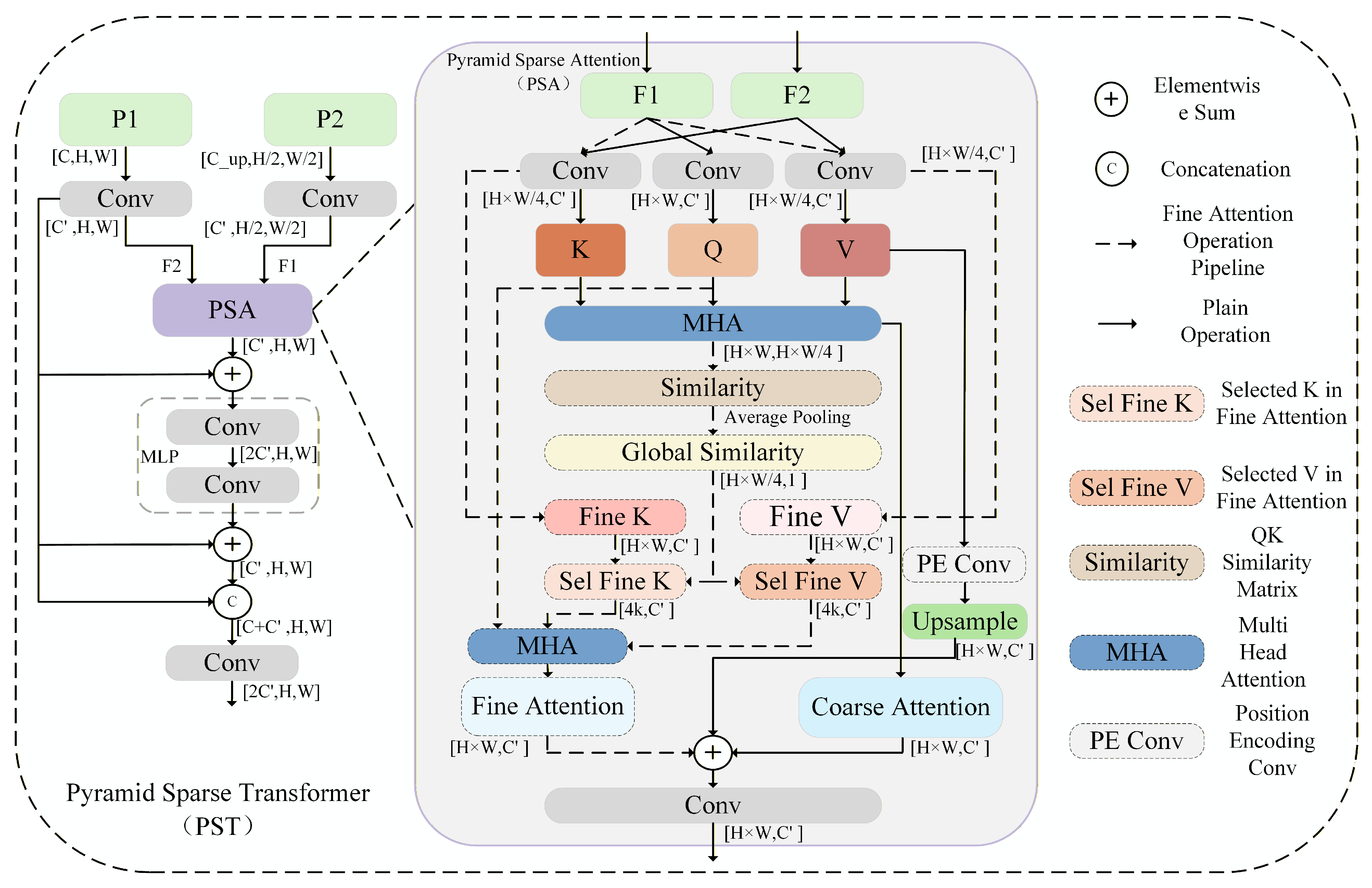
During the feature fusion stage within the network encoder, the top-down Feature Pyramid Network (FPN) and bottom-up Path Aggregation Network (PAN) pipelines have conventionally relied exclusively on simple channel concatenation to fuse multi-scale features. This mechanism fails to model spatial correlations and cross-scale semantic dependencies, thereby losing both global spatial relationships between hens and in-cage eggs and local fine-grained defect features, including eggshell cracks and stains, in complex cage-rearing scenarios. To address the insufficient feature fusion capability of conventional concatenation operations, Hu et al. [28] proposed the Pyramid Sparse Transformer (PST) module. It adopts a coarse-to-fine sparse attention strategy to retain critical spatial details while reducing computational complexity (GFLOPs), achieving efficient and robust multi-scale feature enhancement. Specifically, only the coarse cross-layer attention across the up-sampled pyramid is activated; the fine-stage token-selection branch is disabled by setting the per-head selection number to in favor of a lighter fusion path. Each lateral FPN and PAN fusion uses PST block with an MLP expansion ratio of 1.5. In this study, the PST module is embedded into the FPN and PAN pathways of the Transformer encoder. A structure with two parallel branches (downsampling and upsampling) is constructed to achieve simultaneous capture of both global semantic information and local fine-grained features, tailored for multi-class egg detection in cage-rearing scenarios. The core advantages of PST lie in coarse-to-fine pyramid sparse attention and convolutional spatial encoding. The sparse attention mechanism effectively enhances cross-feature spatial correlations and accurately models spatial interaction relationships among in-cage eggs, cage mesh, and hens’ legs. Meanwhile, the PST module maintains a parameter volume equivalent to a single 4 × 4 convolution, introducing low computational overhead. The detailed PST architecture is illustrated in Figure 8.
Figure 8.
PST Structure Diagram.
3. Results
3.1. Test Environment
3.1.1. Hardware Environment and Training Parameters
The experimental environment was based on PyCharm 2024.1.4 development environment. The hardware configuration and software environment are shown in Table 4. The experiment used the AdamW optimizer with an initial learning rate of 0.0008, a weight decay of 0.0001, a batch size of 4, and 210 training epochs. The specific training hyperparameters are shown in Table 5.
Table 4.
Hardware Environment Configuration.
Table 5.
Training Hyperparameters.
3.1.2. Training Evaluation Metrics
To evaluate detection performance on both eggs and chickens along with model efficiency, seven indicators are reported: precision (P), recall (R), mAP@50, mAP@50:95, GFLOPs, parameter count (Params), and disk footprint (ModelSize). P and R measure how accurately each object class is localized; mAP@50 summarizes performance at a single IoU of 0.5, whereas mAP@50:95 averages over IoUs from 0.5 to 0.95 to penalize loosely matched boxes. These two metrics are widely adopted benchmarks for object detection. Apart from detection accuracy, the computational overhead of the model is also critical, and computational complexity is commonly quantified by GFLOPs. Model parameters represent the total number of parameters of all network layers; a larger value corresponds to a heavier model. Model size refers to the storage space occupied by the model weight file, and throughout this paper it is reported for 32-bit floating-point (FP32) weights, i.e., 4 bytes per parameter, measured as the serialized state_dict file size rather than an FP16 footprint; FP16 is used only transiently within the SMF frequency branch under automatic mixed precision at inference and is converted back to FP32 immediately, so it does not alter the stored weight precision. Precision (P) is defined as:
Here, , , and are the counts of true positives, false positives, and false negatives, respectively; larger P therefore reflects tighter box localization. Recall (R) quantifies the proportion of real positive targets successfully detected by the model and is formulated as:
A higher recall means stronger capability to identify all real targets [29]. Regarding mean average precision, mAP@50 is a widely adopted standard metric for object detection. It quantifies the average precision across all target categories at an intersection over union (IoU) threshold of 0.5, and its mathematical expression is defined as follows:
In this equation, N denotes the total number of target classes, and corresponds to the average precision of the i-th category at IoU threshold t. is derived by first averaging across all N categories, while mAP@50:95 is further computed by averaging over ten IoU thresholds ranging from 0.50 to 0.95 at 0.05 intervals, which enables a more rigorous assessment of detection performance, as defined below:
The total FLOPs (TotalFLOPs) of the model are obtained by summing the computational overhead across all network layers, and GFLOPs are computed as follows:
3.2. Comparative Experiments
3.2.1. Effectiveness of PDConv Deployed in Different Layers
The backbone of EGG-DEIM adopts HGNetV2 for feature extraction, consisting of one StemBlock and four StageBlock modules. To explore the optimal deployment position in the backbone, we sequentially replaced the original lightweight convolution inside StageBlock with PDConv from shallow to deep layers. “Base” denotes the original HGNetV2 feature-extraction branch, while “Stage0–3” refers to sequentially replacing the built-in lightweight convolution (LightConvBNAct) in the StageBlock at different depths. The experimental results are shown in Table 6. Using PDConv in every layer did not continuously improve performance: accuracy peaked at Stage 2 and declined when the replacement was extended to deeper stages. Starting from Stage 2, embedding PDConv kept GFLOPs, parameter count and model size comparable to those of the n-version baseline, while improving mAP@50 and mAP@50:95 by 1.4 and 0.7 percentage points, respectively. These results confirm that replacing the standard convolution with PDConv beginning at the second backbone stage yields the best performance. In brief, proper deployment of PDConv is essential for accuracy improvement.
Table 6.
Ablation Study on PDConv Stages.
To validate the complementary benefits of partial and dynamic convolution, we compared the proposed PDConv with several state-of-the-art convolution modules, as listed in Table 7. For a fair comparison, every candidate kernel is embedded under the same partial-channel scheme, so that the comparison isolates the kernel design rather than the channel-processing strategy. Note that the DynamicConv candidate evaluated under this scheme is exactly the proposed PDConv, which corresponds to Model 1 in Table 8; the two entries therefore report the same experiment and share identical values. Compared with FDConv [30], PConv [25], ConvAttn [31], GCConv [32], and DySnakeConv [33], the combination of partial and dynamic convolution achieves stronger feature-extraction capability under the occlusion conditions of cage-rearing scenarios.
Table 7.
Performance Comparison of Different Convolutional Modules.
Table 8.
Ablation Study on Module Combinations.
3.2.2. Ablation Experiment
Ablation studies are next reported to assess how each of the three modules embedded within EGG-DEIM—PDConv, SMF, and PST—contributes to the final detector. Five axes are examined: mAP@50, mAP@50:95, GFLOPs, parameter count, and model size. Table 8 lists the effect of each module. Model 1: inserting PDConv alone lifts mAP@50 and mAP@50:95 by 1.4 and 0.7 points, respectively, confirming its strong feature-extraction benefit. Model 2: introducing SMF on its own drops both mAP@50 and mAP@50:95 by 0.2%, down to 90.8% and 76.1%. Model 3: adding PST by itself keeps mAP@50 at 91% while raising mAP@50:95 by 0.4%. Models 4–6: beyond the single-module trials, all three pairs of modules were also tested. Taken together, these ablations confirm that stacking the three designs yields a coherent, consistent gain rather than isolated improvements. It is worth explaining that SMF is effective only when spatial–frequency modulation is applied to sufficiently discriminative features. When added alone, it operates on the weak, noisy features extracted by the lightweight HGNetV2 under occlusion, low illumination, and small-egg conditions, without the local-feature enhancement of PDConv or the multi-scale aggregation of PST; the perturbation introduced by spatial–frequency decomposition and recombination therefore cannot be offset, and both mAP@50 and mAP@50:95 decrease by 0.2 percentage points relative to DEIM-n.
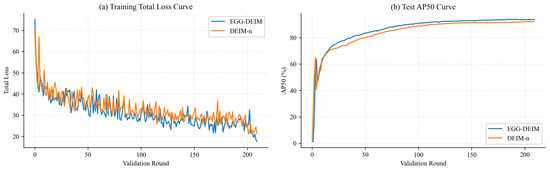
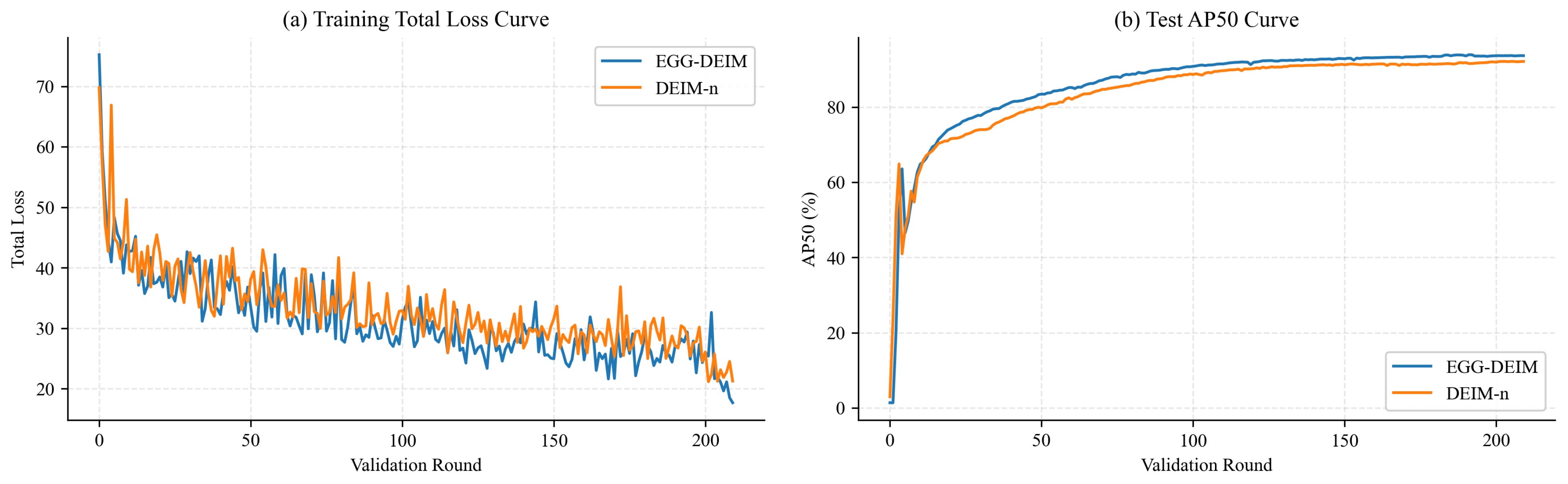
Finally, the full EGG-DEIM, which brings together all three designs, is the strongest detector across all ablation variants. Taken together, the three additions work in concert to raise overall detection quality. The training total loss and test-set mAP@50 over validation rounds for EGG-DEIM and the baseline network are shown in Figure 9. EGG-DEIM reaches a higher test mAP@50 and a lower final training loss than DEIM-n, indicating faster and more stable convergence.
Figure 9.
Training convergence and test-set performance over validation rounds: (a) training total loss and (b) test mAP@50 for EGG-DEIM and DEIM-n.
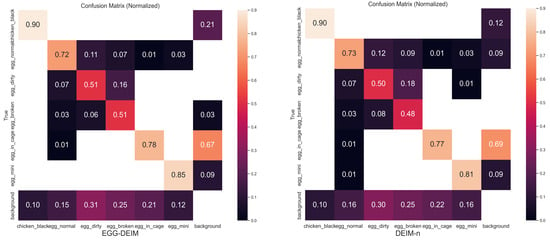
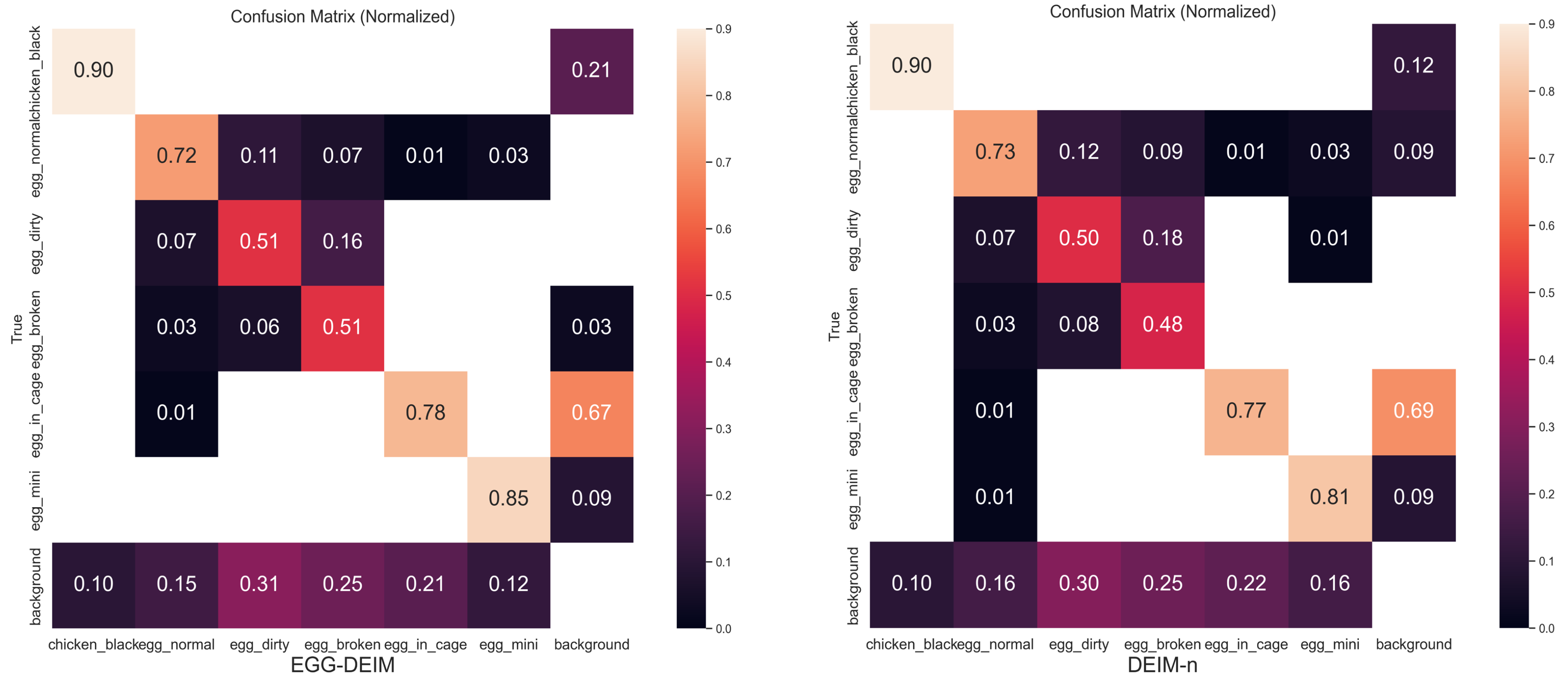
Furthermore, to compare the detection performance of EGG-DEIM and DEIM-n across categories, confusion matrices for both models were generated on the test set and are contrasted in Figure 10. All values displayed in the matrices are normalized. We observed that EGG-DEIM achieves higher accuracy in the recognition task of chickens and multi-category eggs. Notably, in-cage eggs and mini eggs exhibited visually similar sizes due to differences in shooting distance; the confusion matrix results proved that in-cage eggs are not misidentified as mini eggs, nor are mini eggs misidentified as in-cage eggs, satisfying the detection requirements of the poultry house inspection robot for chickens and multi-category eggs.
Figure 10.
Column-normalized confusion matrices of EGG-DEIM and DEIM-n on the test set.
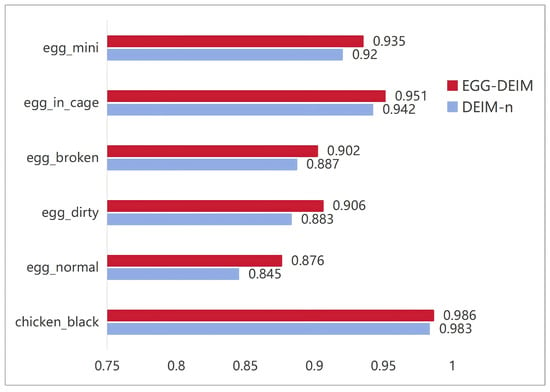
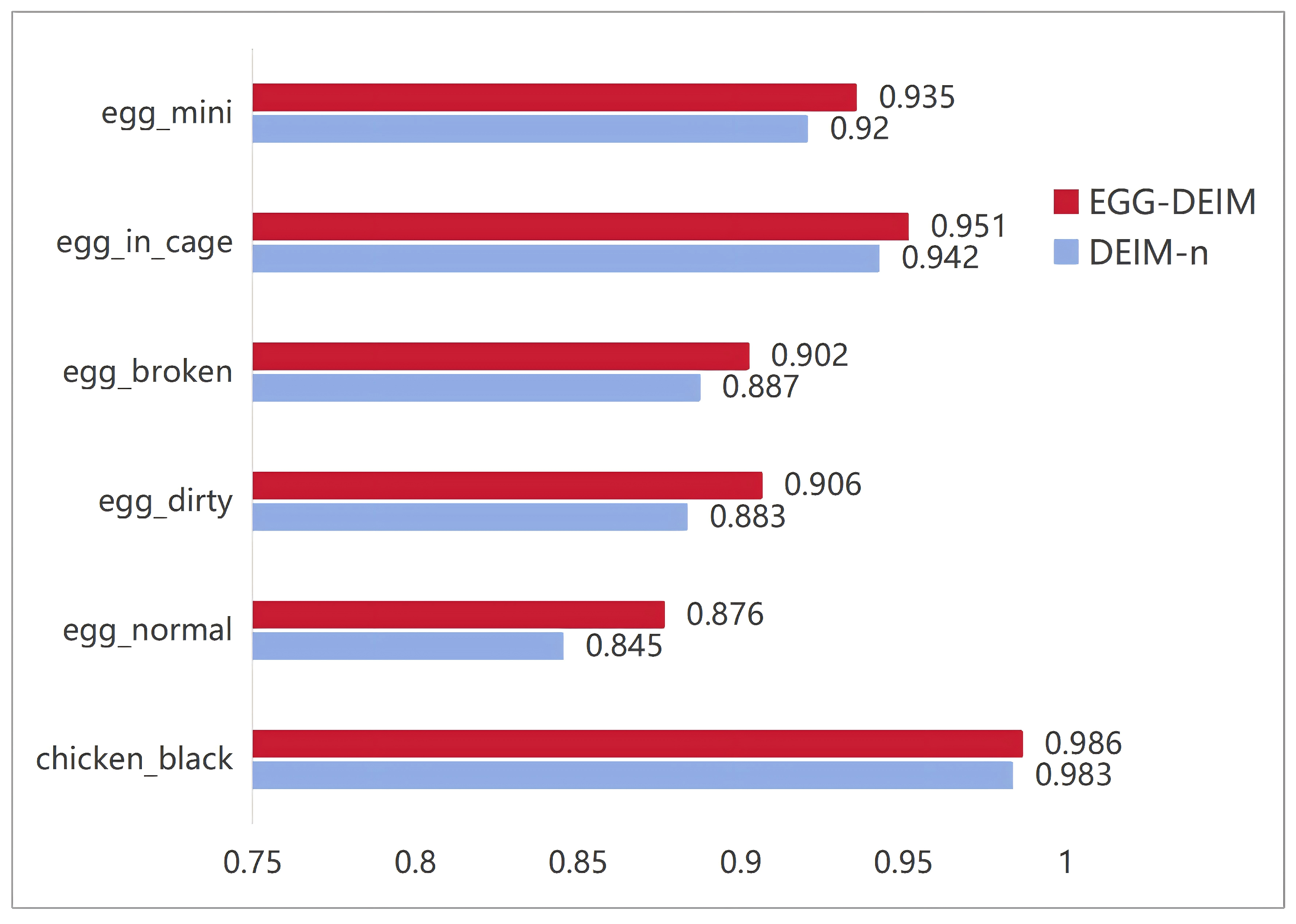
We further evaluated the detection performance of the baseline and enhanced models for chickens and multiple egg categories. Since mAP@50:95 corresponds to stricter evaluation criteria, we adopt mAP@50 for category-level comparison. The comparison results are visualized in Figure 11. EGG-DEIM brings consistent accuracy improvements for all egg categories. Specifically, the mAP@50 of normal eggs, in-cage eggs, broken eggs, dirty eggs, mini eggs and chickens rises by 3.1, 0.9, 1.5, 2.3, 1.5, and 0.3 percentage points, respectively. To fully reflect the performance gain, we report mAP@50 and mAP@50:95 of the baseline and improved model for each category, as summarized in Table 9.
Figure 11.
Comparison of mAP@50 for Each Category Before and After Improvement.
Table 9.
Performance Comparison Between DEIM-n and EGG-DEIM.
3.2.3. Comparative Tests with Mainstream Object Detection Models
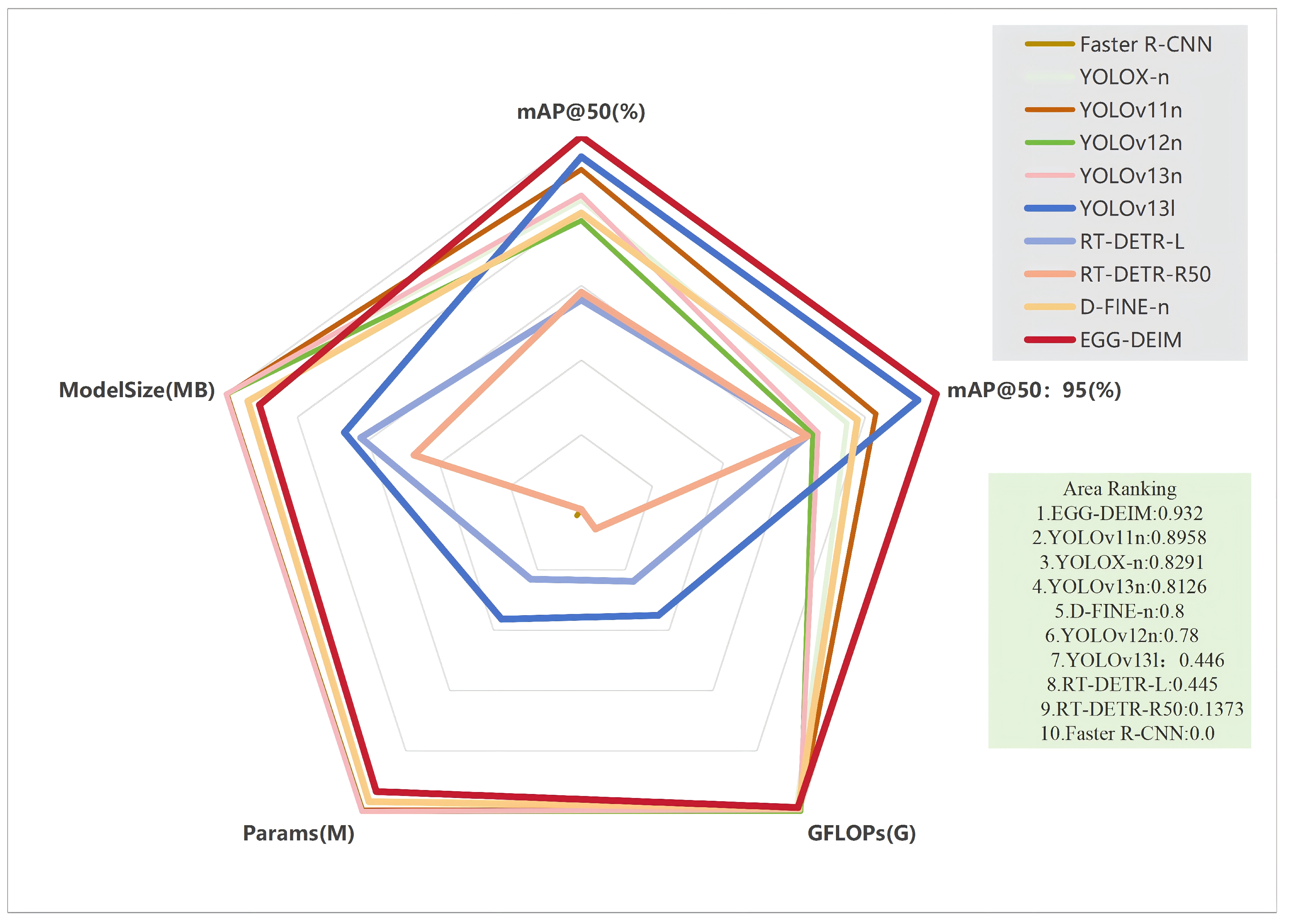
EGG-DEIM is next benchmarked against several representative detectors to position it within the current object-detection landscape. Seven criteria are used for this benchmark, namely Precision (P), Recall (R), mAP@50, mAP@50:95, GFLOPs, parameter count, and model size, all measured under the same data and training recipe; the full numbers are listed in Table 10. To visualize the accuracy–efficiency trade-off at a glance, five of these criteria—mAP@50, mAP@50:95, GFLOPs, parameter count, and model size—are further fed into a radar chart. Each axis is normalized so that larger is better: the two performance axes (mAP@50, mAP@50:95) are used as is, whereas the three cost axes (GFLOPs, parameter count, and model size) are inverted, so that a larger polygon consistently denotes a stronger, lighter model.
Table 10.
Performance Comparison of State-of-the-Art Methods.
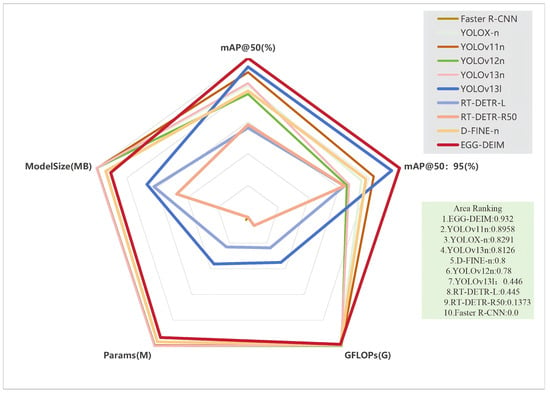
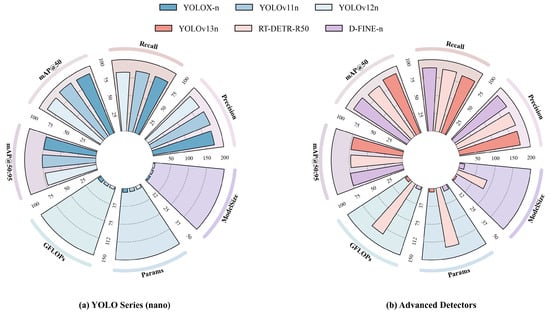
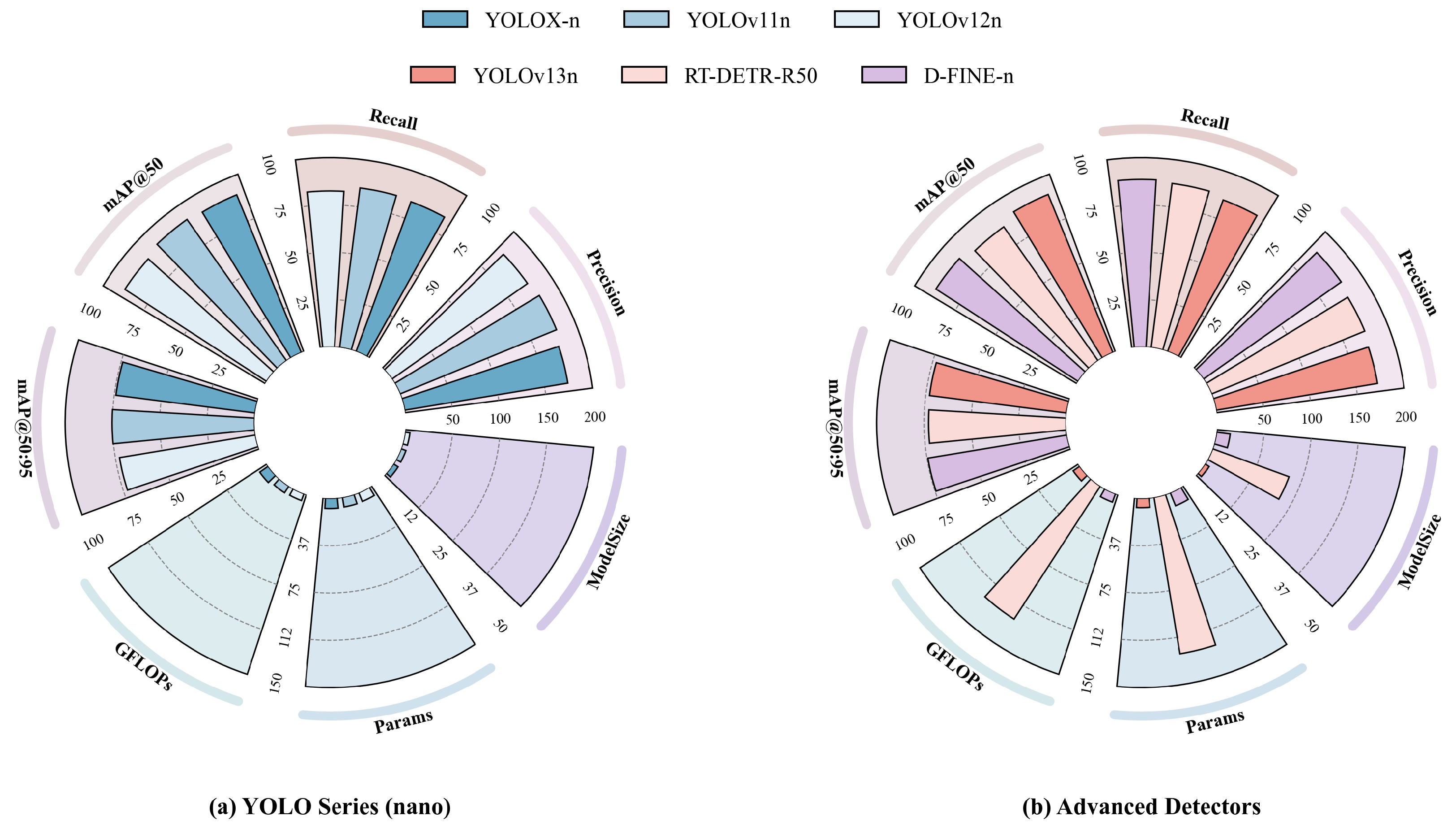
To balance the two accuracy metrics (higher is better) and the three cost metrics (lower is better), all five indicators were min–max normalized per metric; for the three cost metrics (GFLOPs, parameter count, and model size), the normalization is reversed so that every axis is oriented such that larger values indicate better performance. Based on the normalized data, we plotted the radar chart and calculated the corresponding polygon areas for each model, as shown in Figure 12. Through comparison, EGG-DEIM attains the largest polygon area and thus shows the most favourable overall trade-off among the compared models. Figure 13 presents the radial bar chart for six mainstream object detection models, covering both accuracy metrics and resource overhead indicators. Figure 13a compares YOLO series models, in which all four achieved comparable accuracy while maintaining lightweight properties; Figure 13b compares the advanced detectors (YOLOv13n, RT-DETR-R50 and D-FINE-n): among them, YOLOv13n attains the highest mAP@50 (90.3%) while keeping the smallest GFLOPs, parameter count and model size, whereas D-FINE-n achieves higher mAP@50:95, precision and recall and thus provides a more favourable overall balance between accuracy and efficiency.
Figure 12.
Radar Chart of Comprehensive Performance for Mainstream Models.
Figure 13.
Radial bar chart of mainstream models.
3.3. Visualization of Results and Analysis
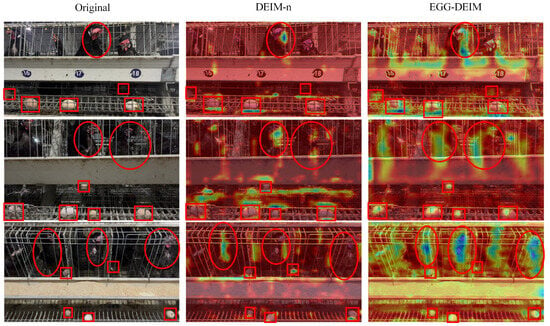
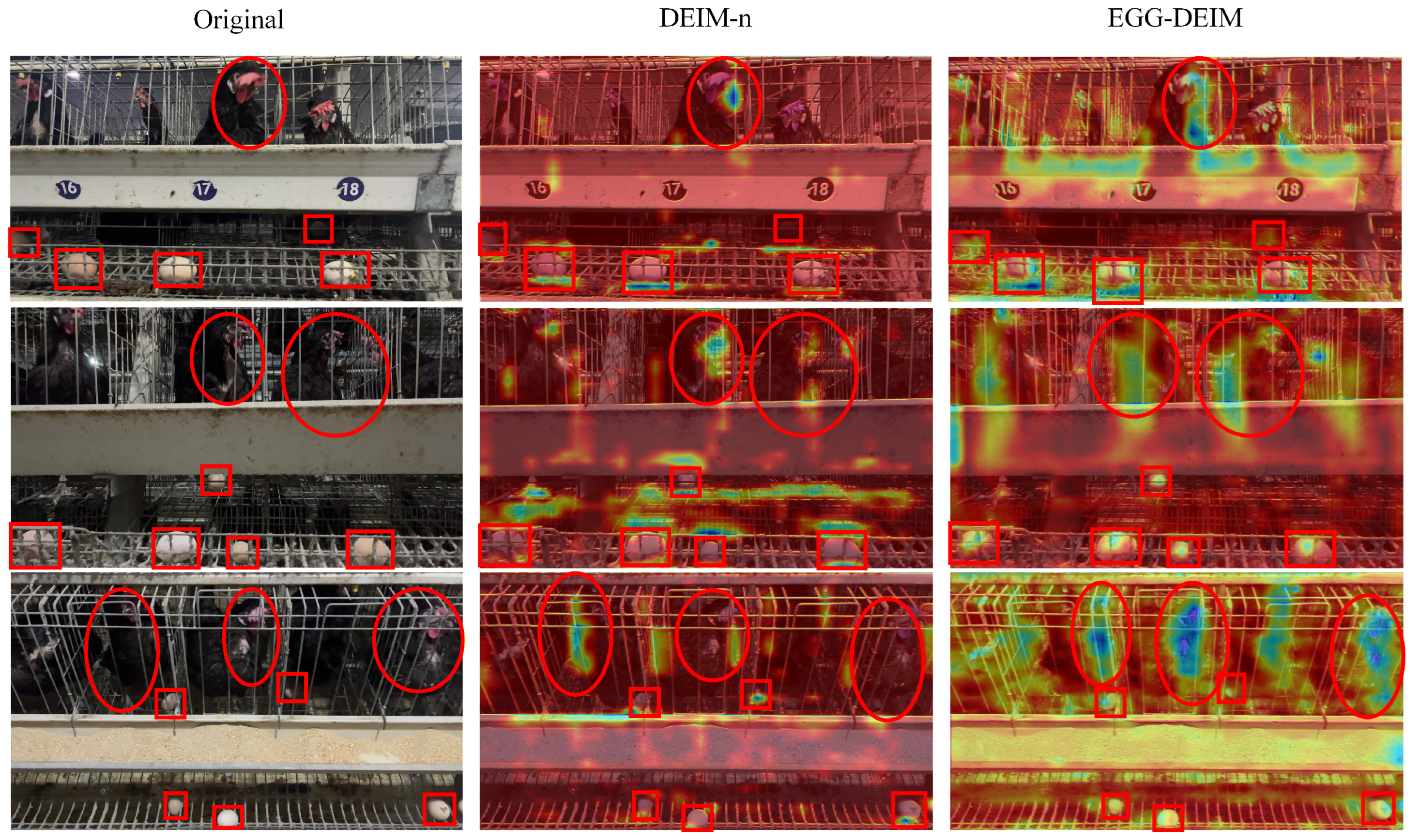
To inspect where the detector actually looks, Grad-CAM heatmaps [34] are generated for both EGG-DEIM and DEIM-n and overlaid on the same input frames (Figure 14). When PDConv, SMF, and PST are all active, EGG-DEIM localizes its attention tightly on the eggs and hens themselves, instead of spreading it across the surrounding cage environment. The tighter localization traces back to the more effective feature extraction and fusion introduced by these modules: cage-wire and tray-mesh responses are suppressed, so that egg classification is no longer distracted by mesh clutter and the salient regions are attended more precisely. In Figure 14, red rectangles mark attention concentrated on eggs, while red ellipses mark attention concentrated on hens.
Figure 14.
Comparison of Grad-CAM heatmaps between DEIM-n and EGG-DEIM. Red rectangles denote attention-focused regions on eggs, and red ellipses denote attention-focused regions on chickens.
4. Limitations and Future Prospects
Although EGG-DEIM achieves accurate multi-category egg detection and chicken monitoring on the collected caged-poultry dataset, several limitations remain.
First, the detection performance may not generalize beyond the studied environment. All images were collected from a single commercial poultry farm over seven consecutive days, using one fixed camera, one tiered-cage setup, and one breed of laying hens. Although frames were sampled across different days and time periods, the illumination, cage structure, background, and eggshell appearance remain comparatively homogeneous; cross-farm, cross-breed, and cross-device generalization therefore could not be assessed.
Second, although we split the continuous videos at the video level and extracted frames at one frame every two seconds within each subset to prevent temporal leakage, neighboring frames from the same recording session still share highly similar scenes. Because all footage originates from the same cages within one week, this split is less independent than a fully cross-day or cross-farm partition, and the reported numbers should be read as performance under the studied cage conditions rather than fully independent generalization.
Third, the six categories are not equally represented: mini eggs contain only 428 instances, far fewer than the 4938 normal-egg instances and 2765 dirty-egg instances. No resampling or class-balanced loss was applied, so the recall and stability of such rare categories may be lower than the overall mAP suggests.
Fourth, although EGG-DEIM reduces computational cost from 7.80 to 7.43 GFLOPs, the efficiency evaluation was reported only through GFLOPs, parameter count, and FP32 model size. Per-image latency and throughput (FPS) on the target embedded or inspection-robot hardware were not measured; GFLOPs alone cannot establish real-time performance, so EGG-DEIM should be regarded as a promising candidate rather than a validated real-time deployment.
Fifth, all results were obtained with a single random seed (seed 0), and the improvements over DEIM-n are moderate (+1.6 and +1.2 percentage points in mAP@50 and mAP@50:95). Multi-seed runs with mean ± standard deviation or confidence intervals were not conducted, so the statistical variability of these gains could not be quantified.
Finally, this study addresses frame-level detection only. Downstream functions such as egg production statistics, culling decisions, and farm-level management were neither implemented nor validated and require separate system integration.
Addressing these limitations, future work will focus on the following directions:
- Cross-farm and cross-season validation: The model will be evaluated on data collected from additional farms, breeds, camera devices, and housing conditions to test generalization.
- On-device efficiency benchmarking: Inference latency and throughput will be measured on representative embedded/robot hardware, together with model acceleration and memory optimization.
- Robust statistics: Multi-seed repetitions will be conducted to report mean±standard deviation and confirm the significance of the gains.
- Downstream integration: The detector will be combined with inspection-robot hardware and with egg-counting and poultry-monitoring modules for field validation.
In summary, EGG-DEIM provides accurate and efficient multi-category egg detection under the caged-poultry conditions represented in the current dataset; however, cross-farm validation and embedded-hardware testing are still required to establish its generalization and practical deployment in real-world poultry farming.
5. Conclusions
This study presents EGG-DEIM, a detector designed for caged laying hens and multi-category eggs in tiered cage systems. Two modules, Partial Dynamic Convolution (PDConv) and Spatial-Frequency Modulation (SMF), are proposed in this study to reduce feature redundancy and mitigate cage-mesh occlusion and uneven illumination. In addition, the existing Pyramid Sparse Transformer (PST) module is incorporated to replace simple feature concatenation and strengthen multi-scale feature fusion. Experiments on the collected caged-poultry dataset confirm the effectiveness of these designs. Relative to the DEIM-n baseline, EGG-DEIM raises mAP@50 by 1.6 percentage points to 92.6% and mAP@50:95 by 1.2 percentage points to 77.5%, and lowers the computational cost from 7.80 to 7.43 GFLOPs, representing a 4.7% reduction, at the cost of only a modest increase in parameters to 5.04 M. When compared with lightweight and mainstream detectors re-implemented under identical data and training settings, EGG-DEIM achieves the highest mAP@50 on this dataset and, within its constrained GFLOPs/parameter budget, strikes a favorable accuracy–efficiency balance; it is not, however, the smallest or fastest model overall. These properties make it a promising candidate for real-time applications such as cage-side inspection robots, although on-device latency and throughput were not benchmarked here, and realized real-time deployment is therefore not claimed. The per-frame outputs of the detector could potentially feed downstream functions such as automatic egg counting and poultry health monitoring. Decisions concerning production statistics, bird culling and farm management, however, would demand additional system integration and independent validation, and are accordingly regarded as future work rather than conclusions warranted by the present experiments. Future work will therefore benchmark inference latency and throughput on the target embedded/robot hardware to establish real-time feasibility, evaluate the model on data collected across more farms, evaluate days and housing conditions to test its generalization, and integrate the detector with inspection-robot hardware and with the downstream modules described above.
Author Contributions
F.P.: Conceptualization, Funding Acquisition, Writing—Original Draft, and Writing—Review & Editing. Y.R.: Conceptualization, Writing—Original Draft, and Writing—Review & Editing. H.Y.: Methodology and Resources. M.H.: Data Curation. L.Z.: Investigation. C.Z.: Data Curation. S.W.: Writing—Review & Editing. J.L.: Writing—Review & Editing. J.X.: Supervision. All authors have read and agreed to the published version of the manuscript.
Funding
This work was supported by the Natural Science Foundation of Sichuan Province (No.2026NSFSC0916).
Institutional Review Board Statement
Not applicable.
Informed Consent Statement
Not applicable.
Data Availability Statement
The raw data supporting the conclusions of this article will be made available by the authors upon request. The source code will be released in a public repository upon acceptance of the manuscript.
Acknowledgments
The authors would like to thank the editor, associate editor and anonymous reviewers for their constructive comments and suggestions that significantly improved this paper.
Conflicts of Interest
The author Junsen Xiao was employed by Sichuan Zhujia Technology Company Limited. All authors declare that the research was conducted in the absence of any commercial or financial relationships that could be construed as a potential conflict of interest.
References
- Sinclair, M.; Lee, N.Y.P.; Hötzel, M.J.; de Luna, M.C.T.; Sharma, A.; Idris, M.; Islam, M.A.; Iyasere, O.S.; Navarro, G.; Ahmed, A.A.; et al. Consumer attitudes towards egg production systems and hen welfare across the world. Front. Anim. Sci. 2022, 3, 995430. [Google Scholar] [CrossRef] [Scilit]
- Shucai, W.; Yuquan, W.; Zhenqiang, L. Optimization design of bottom wire mesh used in cascading cage-rearing laying duck for improving duck egg cleanliness. Trans. Chin. Soc. Agric. Eng. (Trans. CSAE) 2019, 35, 211–217. [Google Scholar]
- Elnesr, S.S.; Mahmoud, B.Y.; da Silva Pires, P.G.; Moraes, P.; Elwan, H.A.M.; El-Shall, N.A.; El-Kholy, M.S.; Alagawany, M. Trace minerals in laying hen diets and their effects on egg quality. Biol. Trace Elem. Res. 2024, 202, 5664–5679. [Google Scholar] [CrossRef] [Scilit] [PubMed]
- Narin, B.; Buntan, S.; Chumuang, N.; Ketcham, M. Crack on eggshell detection system based on image processing technique. In Proceedings of the 18th International Symposium on Communications and Information Technologies (ISCIT); IEEE: Piscataway, NJ, USA, 2018; pp. 1–6. [Google Scholar]
- Haoran, C.; Chuchu, H.; Minlan, J.; Xiaoxiao, L. Egg crack detection based on support vector machine. In Proceedings of the 2020 International Conference on Intelligent Computing and Human-Computer Interaction (ICHCI); IEEE: Piscataway, NJ, USA, 2020; pp. 80–83. [Google Scholar]
- Wang, C.; Zhou, J.; Wu, H.; Li, J.; Chunjiang, Z.; Liu, R. Research on the evaluation method of eggshell dark spots based on machine vision. IEEE Access 2020, 8, 160116–160125. [Google Scholar] [CrossRef] [Scilit]
- Botta, B.; Gattam, S.S.R.; Datta, A.K. Eggshell crack detection using deep convolutional neural networks. J. Food Eng. 2022, 315, 110798. [Google Scholar] [CrossRef] [Scilit]
- Turkoglu, M. Defective egg detection based on deep features and Bidirectional Long-Short-Term-Memory. Comput. Electron. Agric. 2021, 185, 106152. [Google Scholar] [CrossRef] [Scilit]
- Taspinar, Y.S.; Cinar, I. Detection of broken eggs with deep CNNs and performance analysis of models. In Proceedings of the 2023 IEEE 12th International Conference on Intelligent Data Acquisition and Advanced Computing Systems: Technology and Applications (IDAACS); IEEE: Piscataway, NJ, USA, 2023; Volume 1, pp. 724–728. [Google Scholar]
- Chaowalittawin, V.; Krungseanmuang, W.; Sathaporn, P.; Purahong, B. Duck Egg Crack Detection Using an Adaptive CNN Ensemble with Multi-Light Channels and Image Processing. Appl. Sci. 2025, 15, 7960. [Google Scholar] [CrossRef] [Scilit]
- Wong, H.-C.; Ng, E.-Y.; Cheng, L.-H.; Gun, S.; Yen, K.-S. Classification of inhomogeneous eggshell-mottling patterns using a pretrained convolutional neural network. J. Electron. Imaging 2020, 29, 013013. [Google Scholar] [CrossRef] [Scilit]
- Nakaguchi, V.M.; Abeyrathna, R.M.R.D.; Ahamed, T. Development of a new grading system for quail eggs using a deep learning-based machine vision system. Comput. Electron. Agric. 2024, 226, 109433. [Google Scholar] [CrossRef] [Scilit]
- Shi, C.; Li, Y.; Cheng, Y.; Wang, Y.; Zhu, C.; Wang, K.; Zhang, C. Detection of microcrack in eggs based on improved U-Net. In Proceedings of the 9th International Conference on Cloud Computing and Intelligent Systems (CCIS); IEEE: Piscataway, NJ, USA, 2023; pp. 409–413. [Google Scholar]
- Jiang, Y.; Atwa, E.M.; He, P.; Zhang, J.; Di, M.; Pan, J.; Lin, H. Computer Vision-Based Multi-Feature Extraction and Regression for Precise Egg Weight Measurement in Laying Hen Farms. Agriculture 2025, 15, 2035. [Google Scholar] [CrossRef] [Scilit]
- Soontornnapar, T.; Praneenatthavee, N.; Ploysuwan, T. Revolutionizing egg quality control: Advanced Prompt-Based Models for automated detection of broken eggs without the need for training. Int. J. Control Autom. Syst. 2025, 23, 541–551. [Google Scholar] [CrossRef] [Scilit]
- Huang, Y.; Luo, Y.; Cao, Y.; Lin, X.; Wei, H.; Wu, M.; Yang, X.; Zhao, Z. Damage detection of unwashed eggs through video and deep learning. Foods 2023, 12, 2179. [Google Scholar] [CrossRef] [Scilit] [PubMed]
- Jiang, T.; Zhou, J.; Xie, B.; Liu, L.; Ji, C.; Liu, Y.; Liu, B.; Zhang, B. Improved YOLOv8 model for lightweight pigeon egg detection. Animals 2024, 14, 1226. [Google Scholar] [CrossRef] [Scilit] [PubMed]
- Wang, Y.; Cuan, K.; Pei, W.; Yan, X.; Lin, W.; Shi, W.; Wang, K. A two-stage deep learning approach for identifying low-yield hens in stacked cage systems. Comput. Electron. Agric. 2025, 231, 109958. [Google Scholar] [CrossRef] [Scilit]
- Wu, Z.; Zhang, H.; Fang, C. Research on machine vision online monitoring system for egg production and quality in cage environment. Poult. Sci. 2025, 104, 104552. [Google Scholar] [CrossRef] [Scilit] [PubMed]
- Ge, Z.; Liu, S.; Wang, F.; Li, Z.; Sun, J. Yolox: Exceeding yolo series in 2021. arXiv 2021, arXiv:2107.08430. [Google Scholar]
- Luo, H.; Huang, J.; Ju, H.; Zhou, T.; Ding, W. Multimodal multi-instance evidence fusion neural networks for cancer survival prediction. Sci. Rep. 2025, 15, 10470. [Google Scholar] [CrossRef] [Scilit] [PubMed]
- Huang, S.; Lu, Z.; Cun, X.; Yu, Y.; Zhou, X.; Shen, X. Deim: Detr with improved matching for fast convergence. In Proceedings of the IEEE/CVF Conference on Computer Vision and Pattern Recognition; IEEE: Piscataway, NJ, USA, 2025; pp. 15162–15171. [Google Scholar]
- Wang, X.; Liu, J. Enhancing plant disease detection through multi-modal integration of visual and textual data. Plant Methods 2026, 22, 30. [Google Scholar] [CrossRef] [Scilit] [PubMed]
- Wang, X.; Liu, J. A Feature-Enhanced Network for Vegetable Disease Detection in Complex Environments. Plants 2026, 15, 1182. [Google Scholar] [CrossRef] [Scilit] [PubMed]
- Chen, J.; Kao, S.-H.; He, H.; Zhuo, W.; Wen, S.; Lee, C.-H.; Chan, S.-H.G. Run, don’t walk: Chasing higher FLOPS for faster neural networks. In Proceedings of the IEEE/CVF Conference on Computer Vision and Pattern Recognition; IEEE: Piscataway, NJ, USA, 2023; pp. 12021–12031. [Google Scholar]
- Chen, Y.; Dai, X.; Liu, M.; Chen, D.; Yuan, L.; Liu, Z. Dynamic convolution: Attention over convolution kernels. In Proceedings of the IEEE/CVF Conference on Computer Vision and Pattern Recognition (CVPR); IEEE: Piscataway, NJ, USA, 2020; pp. 11027–11036. [Google Scholar]
- Li, H.; Li, S.; Dai, W.; Li, C.; Zou, J.; Xiong, H. Frequency-aware transformer for learned image compression. In Proceedings of the International Conference on Learning Representations (ICLR); IEEE: Piscataway, NJ, USA, 2024; pp. 30447–30465. [Google Scholar]
- Hu, J.; Bai, T.; Wu, F.; Peng, Z.; Zhang, Y. Pyramid Sparse Transformer: Enhancing Multi-Scale Feature Fusion with Dynamic Token Selection. arXiv 2025, arXiv:2505.12772. [Google Scholar]
- Cao, W.; Zhang, Z.; Wang, Z.; Wei, A.; Chen, Q.; Igathinathane, C.; Zhang, F.; Abdelhamid, M.A.; Ye, D.; Ampatzidis, Y. GLS-YOLOv8n: A lightweight ‘Guiqi’ mango detection model via RGB-depth-thermal image fusion. Comput. Electron. Agric. 2026, 242, 111355. [Google Scholar] [CrossRef] [Scilit]
- Chen, L.; Gu, L.; Li, L.; Yan, C.; Fu, Y. Frequency dynamic convolution for dense image prediction. In Proceedings of the Computer Vision and Pattern Recognition Conference; IEEE: Piscataway, NJ, USA, 2025; pp. 30178–30188. [Google Scholar]
- Lee, D.; Yun, S.; Ro, Y.-M. Emulating self-attention with convolution for efficient image super-resolution. In Proceedings of the IEEE/CVF International Conference on Computer Vision; IEEE: Piscataway, NJ, USA, 2025; pp. 24467–24477. [Google Scholar]
- Yang, G.; Wang, Y.; Shi, D.; Wang, Y. Golden cudgel network for real-time semantic segmentation. In Proceedings of the IEEE/CVF Conference on Computer Vision and Pattern Recognition; IEEE: Piscataway, NJ, USA, 2025; pp. 25367–25376. [Google Scholar]
- Qi, Y.; He, Y.; Qi, X.; Yang, G. Dynamic snake convolution based on topological geometric constraints for tubular structure segmentation. In Proceedings of the IEEE/CVF International Conference on Computer Vision; IEEE: Piscataway, NJ, USA, 2023; pp. 6070–6079. [Google Scholar]
- Selvaraju, R.R.; Cogswell, M.; Das, A.; Vedantam, R.; Parikh, D.; Batra, D. Grad-CAM: Visual explanations from deep networks via gradient-based localization. Int. J. Comput. Vis. 2020, 128, 336–359. [Google Scholar] [CrossRef] [Scilit]

Disclaimer/Publisher’s Note: The statements, opinions and data contained in all publications are solely those of the individual author(s) and contributor(s) and not of MDPI and/or the editor(s). MDPI and/or the editor(s) disclaim responsibility for any injury to people or property resulting from any ideas, methods, instructions or products referred to in the content. |
© 2026 by the authors. Licensee MDPI, Basel, Switzerland. This article is an open access article distributed under the terms and conditions of the Creative Commons Attribution (CC BY) license.