


Highlights
What are the main findings?
- The proposed federated AI-driven VPP restoration framework improves critical infrastructure restoration from 55.05% to 94.20% while significantly reducing Energy Not Supplied (ENS) under dual-fault urban outage conditions.
- Blockchain-enabled decentralized energy coordination and optimized DER dispatch improve voltage stability, reduce interruption costs, and enhance overall urban energy resilience in the IEEE 118-bus smart city energy network.
What are the implications of the main findings?
- The proposed restoration framework improves critical load recovery from 55.05% to 94.20% and reduces Energy Not Supplied (ENS) under dual-fault outage conditions.
- Coordinated VPP support and blockchain-based energy sharing improve the voltage profile, reduce outage costs, and strengthen the resilience of smart city energy systems during severe outage conditions.
Abstract
Modern smart cities increasingly depend on resilient and intelligent energy infrastructures to maintain critical urban services during large-scale disturbances and multi-fault conditions. Conventional restoration approaches are often limited by centralized operation, delayed response, and inadequate coordination of distributed energy resources (DERs) under emergency conditions. To address these challenges, this paper proposes a Federated AI-Driven Urban Energy Resilience Framework for Smart City Critical Infrastructure Restoration using Virtual Power Plant (VPP) coordination, blockchain-enabled peer-to-peer (P2P) energy trading, and intelligent distributed energy management. The proposed framework is validated on the IEEE 118-bus radial distribution system under severe dual-fault outage conditions, representing urban disaster-induced infrastructure interruptions. Critical urban service zones, including healthcare support systems, emergency loads, smart residential sectors, and EV charging corridors, are considered during the restoration process. The Seagull Optimization Algorithm (SOA) is employed to optimize DER dispatch and improve restoration performance under operational constraints. A progressive restoration strategy comprising conventional outage conditions, VPP-assisted restoration, blockchain-enabled decentralized energy trading, and AI-driven coordinated restoration is analyzed. Simulation results demonstrate that the proposed framework significantly enhances urban energy resilience by increasing load restoration from 55.05% to 94.20%, reducing Energy Not Supplied (ENS), improving voltage stability, and lowering interruption-related economic losses. The minimum bus voltage improves to 0.965 p.u. under the proposed coordinated restoration strategy. The results show that coordinated VPP operation and blockchain-based energy sharing can support reliable restoration of critical urban infrastructure during major outage conditions. The results indicate that integrating AI-assisted VPP coordination with secure decentralized energy trading can effectively support smart city critical infrastructure continuity during extreme outage conditions. The proposed framework provides a scalable and resilient solution for future intelligent urban energy systems and disaster-resilient smart city applications.
1. Introduction
Modern smart cities depend heavily on reliable electrical power systems to support critical urban services such as hospitals, emergency communication systems, transportation networks, water supply systems, smart residential buildings, and electric vehicle charging infrastructure. Any major disturbance in the distribution network can significantly affect public safety, economic activity, and essential city operations. In recent years, the increasing occurrence of natural disasters, equipment failures, extreme weather conditions, and cyber-related disturbances has made urban power system resilience an important research area.
Conventional distribution system restoration methods mainly rely on centralized operation and manual switching strategies to restore supply after fault occurrence. Although these approaches are suitable for isolated faults, they often face limitations during large-scale outages involving multiple feeder failures and islanded operating conditions. Under such situations, rapid restoration of critical infrastructure becomes highly important to maintain essential urban services and reduce outage-related economic losses.
The growing integration of distributed energy resources such as rooftop solar photovoltaic systems, battery storage units, and distributed generators provides new opportunities for improving restoration capability in smart city environments. Virtual Power Plant (VPP) frameworks can coordinate these distributed resources and support localized restoration during emergency conditions. By operating distributed generators within isolated regions, VPP-assisted restoration can reduce Energy Not Supplied (ENS), improve the voltage profile, and increase system resilience.
Along with distributed energy coordination, blockchain-enabled peer-to-peer (P2P) energy trading has recently gained attention for decentralized energy sharing among prosumers. Blockchain technology enables secure and transparent energy transactions without requiring centralized control. During outage conditions, decentralized energy exchange can improve local energy utilization and support faster restoration of critical urban loads. However, the combined application of distributed energy coordination, decentralized energy trading, and resilience-oriented restoration for large smart city distribution systems is still limited.
Several studies have investigated service restoration, distributed generation scheduling, and microgrid-based island operation. Other works have focused on blockchain-based energy trading and optimization techniques for distribution system operation. However, most existing studies are limited to small distribution networks and do not sufficiently address large-scale urban outage conditions involving multiple faults. In addition, many existing methods mainly focus on electrical performance without considering restoration support for critical urban infrastructure.
To address these limitations, this paper presents a federated urban energy resilience framework for smart city critical infrastructure restoration using coordinated distributed energy support and blockchain-enabled energy sharing. The proposed framework is implemented on the IEEE 118-bus radial distribution system under dual-fault outage conditions. Critical urban service zones such as healthcare systems, emergency support loads, smart residential sectors, and EV charging regions are considered during the restoration process. The Seagull Optimization Algorithm (SOA) is used to determine optimal distributed generator dispatch while satisfying operational constraints.
The proposed work investigates progressive restoration strategies including conventional outage condition analysis, VPP-assisted restoration, blockchain-enabled decentralized energy sharing, and coordinated restoration operation. The main objectives of the proposed framework are:
- To improve the restoration of critical urban infrastructure during severe outage conditions.
- To reduce Energy Not Supplied (ENS) and interruption-related economic losses.
- To improve voltage stability and overall system resilience.
- To support decentralized energy sharing among distributed energy participants.
- To enhance restoration capability in future smart city energy systems.
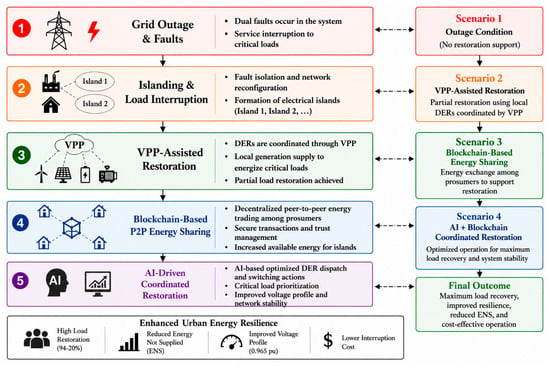
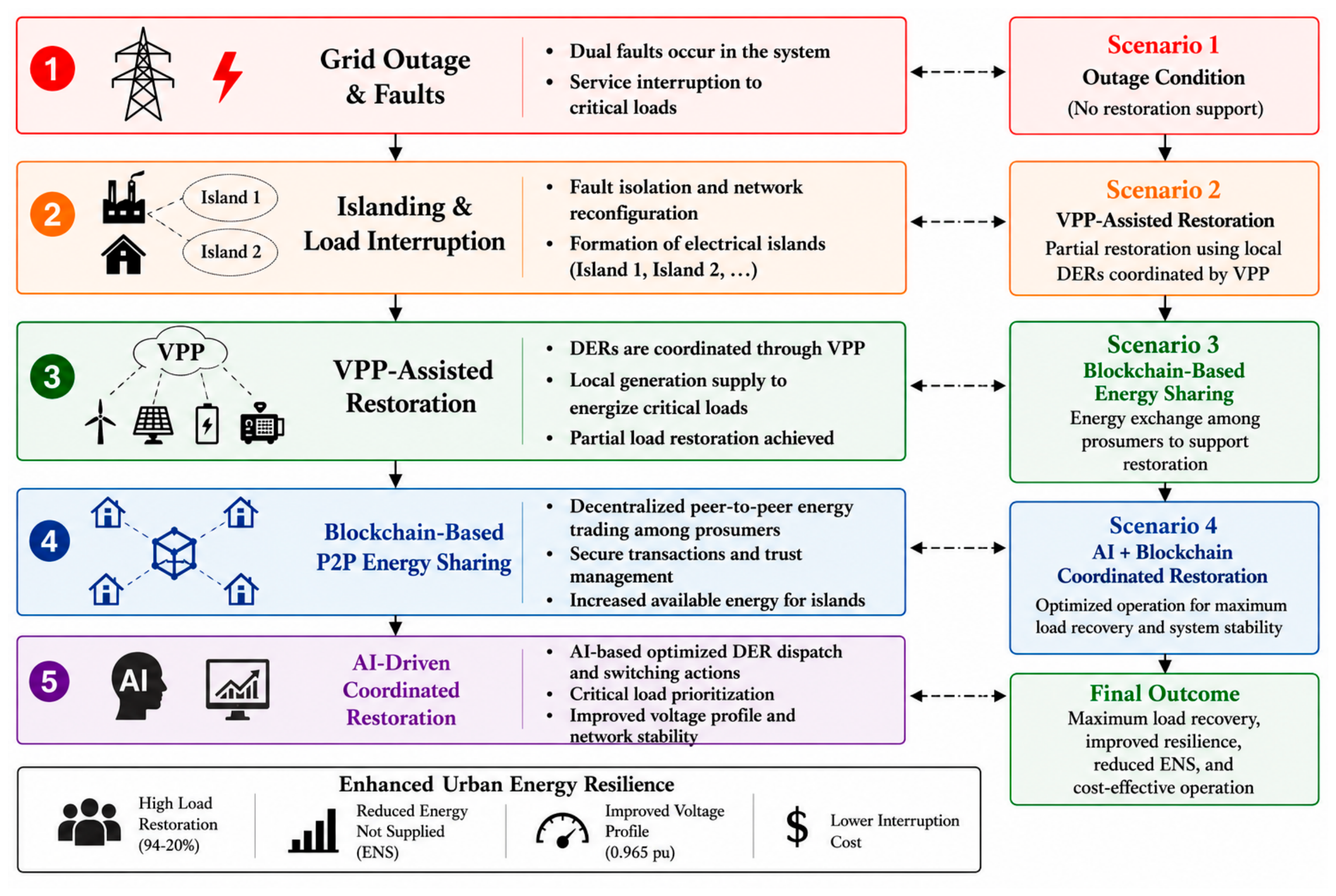
Figure 1 provides a graphical overview of the progressive restoration strategy adopted in this work. Following grid outages and island formation, the framework transitions from VPP assisted DER restoration to secure blockchain based P2P energy trading and finally to the proposed AI and blockchain optimization approach, thereby achieving enhanced load restoration, improved system resilience, and cost-effective operation.
Figure 1.
Proposed framework for resilient distribution system restoration.
1.1. Literature Survey
1.1.1. Service Restoration and Self-Healing Techniques
Service restoration in distribution networks has been widely studied over the years, primarily to ensure the rapid recovery of power supply following fault events. Earlier works provide comprehensive overviews of conventional restoration strategies, including automated switching, feeder reconfiguration, and crew dispatch, with the objective of minimizing Energy Not Supplied (ENS) and restoration time while satisfying operational constraints. Initial approaches largely relied on graph-based methods and rule-driven switching logic tailored for radial distribution systems. However, these methods generally assume single-fault conditions and depend on centralized decision-making, which limits their effectiveness under more complex scenarios.
Recent studies have attempted to enhance restoration strategies by incorporating practical considerations such as multi-stage switching, cold-load pickup (CLPU) phenomena, and coordinated crew scheduling. While these improvements offer a better representation of real-world operations, most validation efforts remain confined to small-scale test systems, such as 33- and 69-bus networks. Consequently, the challenges associated with large-scale radial systems and multi-fault contingencies remain insufficiently addressed, highlighting the need for more scalable and resilient restoration frameworks suitable for modern smart grid environments.
Key contributions:
- Recognition that realistic restoration needs to consider multi-fault topologies and large radial systems [1,2].
- Classical reconfiguration algorithms for automated switching and tie-switch operation that minimize switching count and ENS [3,4].
- Extensions for dynamic restoration considering CLPU and sequential reconnection to avoid load surges [5,6].
1.1.2. Distributed Energy Resources (DER) and Virtual Power Plants (VPP)
With increasing DER penetration, aggregator models such as Virtual Power Plants (VPPs) have been proposed to coordinate DER dispatch during both normal and emergency operations. VPPs can pool heterogeneous resources (PV, BESS, controllable loads) to supply islanded portions of the network during outages [5,6]. Research shows that VPP-assisted islanding can significantly reduce ENS and improve voltage profiles when islanded DER is properly scheduled [7,8]. However, much of the literature assumes centralized VPP control and does not explore decentralized market participation by individual prosumers, which becomes crucial in dense DER environments [9,10].
Key contributions:
- VPP models for DER aggregation and island support, showing ENS reduction and enhanced stability [11,12].
- Operational challenges in VPP decision-making under uncertainty and the need for coordinated scheduling across devices [13,14].
1.1.3. Microgrids, Islanding and Black-Start Restoration
Microgrids provide a natural architectural solution for rapid localized restoration. Numerous works focus on the formation of microgrids (either pre-planned or dynamic) to serve critical loads during outages; such approaches include MILP formulations for microgrid boundary formation, prioritized load restoration, and black-start strategies [15,16,17]. Studies also highlight the importance of maintaining voltage and frequency stability when multiple microgrids or dynamic island boundaries are formed, especially under high renewable penetration [18].
Key contributions:
- Dynamic microgrid formation and black-start procedures enable fast restoration of critical loads [7,12].
- Exact MILP and iterative algorithms account for losses and voltage constraints to avoid under-voltage after islanding [8].
- Practical control strategies for microgrid synchronization and safe reconnection to the grid [12,13].
1.1.4. Peer-to-Peer (P2P) Energy Trading and Blockchain for Decentralized Coordination
Peer-to-peer (P2P) energy trading using blockchain has emerged as a decentralized market paradigm to facilitate energy exchange among prosumers without a central market operator [19,20,21]. Blockchain offers secure, tamper-resistant settlement and transparent record-keeping, which is attractive for local energy exchanges. Research in this area primarily treats economic benefits (reduced costs, improved DER utilization) and operational feasibility in microgrid settings [19,20]. However, applying P2P trading specifically as a restoration mechanism (to allocate scarce local energy immediately after faults) remains relatively underexplored; key requirements such as market-clearing speed, priority dispatch for critical loads, and settlement overheads during fast restoration need further study [19,20,21].
Key contributions:
- Proposals and pilot studies for blockchain-based P2P energy markets demonstrating community-level benefits [19,20].
- Double-layer and hierarchical blockchain designs to scale P2P trading in urban multi-VPP contexts [20].
- Gaps in using P2P for time-critical restoration and in incorporating market settlement costs into restoration objectives [19,21].
1.1.5. Optimization Techniques for Restoration: Classical to AI
The restoration problem is combinatorial and nonlinear, combining discrete switching decisions with continuous power flow. Traditional solvers (MIP, MILP, convex relaxations) and heuristics have been used extensively to obtain switching sequences, DG schedules, and islanding decisions [3,4,8]. More recently, AI and metaheuristic methods (GA, PSO, ant colony, reinforcement learning) are being applied to search large solution spaces and handle multi-objective criteria (ENS, cost, voltage deviation) [10,18]. Despite their success, most AI applications do not jointly model P2P market constraints (settlement costs, clearing) and restoration objectives, and few validate their results on large radial benchmarks such as the IEEE 118-bus [10,18].
Key contributions:
- MIP/MILP exact formulations for small-to-medium problems with guarantees but scalability limits [3,8].
- Heuristic/metaheuristic and AI approaches for large, complex restoration tasks enabling multi-objective tradeoffs [10,18].
- The need for AI frameworks that jointly optimize DER dispatch and decentralized market settlements for restoration [10].
1.1.6. Resilience Metrics and Economic Modeling
Evaluating restoration strategies requires a broad set of metrics: ENS, percent load restored, voltage deviation, real/reactive losses, resilience index, restoration time, and economic cost (grid energy cost, DG operating cost, ENS penalty, transaction fees) [6,11,22]. Several works propose formal resilience metrics and show that economic modeling is crucial, particularly the ENS penalty and DG operation cost, to judge tradeoffs between speed of restoration and cost [6,22]. Integrating P2P settlement costs and blockchain transaction overhead into economics is largely missing, yet important for realistic assessments [19,20].
Key contributions:
- Comprehensive metric suites for restoration assessment and resilience quantification [6,11,22].
- Economic formulations that include ENS penalties and DG costs need to add P2P settlement costs for decentralized markets [19,20].
1.1.7. Combined VPP + P2P + AI Frameworks Emerging but Incomplete
Some recent studies combine elements of VPP aggregation, optimization, and market mechanisms to improve restoration or economic efficiency [15,16,20]. These works hint at the potential cooperation among VPPs, P2P trading, and AI, but usually address only two of the three aspects, or are validated on small networks. A truly unified framework that integrates VPP aggregation, blockchain P2P trading, and AI-based multi-objective restoration optimization at the scale of large radial systems remains an open challenge [15,20,23]. This gap motivates the proposed AI + blockchain resilience optimization framework, which is validated on the IEEE 118-bus system.
Key contributions:
- Hybrid frameworks show gains from combining DER scheduling and market mechanisms, but lack large-scale validation and unified objective models [15,20].
- Need for algorithms that incorporate topology constraints, market clearing, security/latency of blockchain, and AI-driven dispatch simultaneously [20,23].
1.1.8. Communication, Cybersecurity, and Practical Implementation Considerations
Successful decentralized restoration requires robust communication and secure settlement. Studies highlight blockchain’s benefits for secure record-keeping but also point out latency, transaction throughput, and consensus overhead concerns that are critical for time-sensitive restoration tasks [17,19]. Software-Defined Networking (SDN) has been proposed to address the co-design of communication and power restoration, but the integration of blockchain and AI optimizers introduces additional practical challenges [17]. Realistic implementations should evaluate end-to-end latency, consensus time, and failure modes of distributed ledgers in restoration contexts [17,19].
Key contributions:
- Identification of communication and cybersecurity constraints as bottlenecks for decentralized restoration [17,19].
- Suggestions for SDN and hierarchical/blockchain designs to manage latency and throughput in grid use cases [17,20].
1.2. Synthesis and Identified Research Needs
The survey demonstrates clear progress across restoration methods, DER aggregation, microgrid operation, market mechanisms and AI optimization. However, critical gaps remain:
- Most works validate on small feeders; large radial networks (e.g., IEEE 118-bus) under simultaneous faults require more study [1,3,8].
- Existing models rarely include P2P settlement cost, blockchain overhead, and ENS penalty in a single objective [6,19].
- Joint frameworks that use AI to optimize dispatch under blockchain market rules, topology constraints, and time-sensitive restoration requirements are largely missing [24,25,26,27].
- Communication latency, blockchain consensus time, and cybersecurity implications for restoration need careful study and real-world validation [28,29]. Shaikh et al. employed chaotic optimization techniques to improve renewable energy integration and operational performance in distribution systems [30].
The present paper addresses these by (i) testing progressive restoration strategies on the IEEE 118-bus test system under dual faults, (ii) adding blockchain P2P trading and economic settlement costs to the restoration model, and (iii) proposing an AI + blockchain optimization method to jointly minimize ENS, cost, and voltage deviation under radiality and operational constraints.
Therefore, this paper addresses these gaps by proposing a progressive AI- and blockchain-enabled restoration strategy for the IEEE 118-bus radial distribution system under severe dual-fault contingencies, achieving enhanced resilience, reduced ENS, improved voltage stability, and minimized interruption costs.
2. Problem Formulation
2.1. Objective Function
The post-fault restoration problem is formulated as a multi-objective urban energy resilience optimization problem for restoring critical infrastructure services under severe outage conditions. The objective is to minimize Energy Not Supplied (ENS), restoration cost, voltage deviation, and interruption of critical urban infrastructure while satisfying operational constraints of the distribution system.
The overall objective function is expressed as:
where
are weighting coefficients.
is the Energy Not Supplied.
is the total restoration cost.
is the voltage deviation index.
is the Critical Infrastructure Restoration Index.
2.1.1. Energy Not Supplied (ENS)
Energy Not Supplied represents the unsupplied urban demand during outage conditions and is calculated as:
where
is the demand at bus.
is the restored load at bus .
is the set of load buses.
2.1.2. Total Restoration Cost
The total restoration cost includes Grid Supply Cost, distributed generator operating cost, interruption penalty cost, and blockchain-based energy trading settlement cost.
Grid supply cost:
Distributed generator operating cost:
ENS interruption penalty cost:
Blockchain energy trading cost:
Thus, the total restoration cost is:
2.1.3. Voltage Deviation Index
Voltage deviation is used to evaluate voltage stability during restoration operation and is calculated as:
where:
is the voltage magnitude at bus .
is the set of buses.
The modulus operator is used to measure the magnitude of voltage deviation from the nominal value (1.0 p.u.) irrespective of whether the bus voltage is above or below the nominal level. The total voltage deviation is obtained by summing the absolute deviations of all bus voltages in the system, thereby providing an overall measure of voltage profile quality during restoration.
2.1.4. Critical Infrastructure Restoration Index (CIRI)
The Critical Infrastructure Restoration Index is introduced to evaluate restoration support provided to important urban service loads such as hospitals, emergency systems, EV charging stations, and communication infrastructure.
Higher CIRI values indicate better restoration performance for critical urban infrastructure.
2.1.5. Power Balance Constraint
At each bus, the power balance must be maintained during the restoration operation.
2.1.6. Load Supply Constraint
The restored load cannot exceed the demand at each bus.
2.1.7. Distributed Generator Capacity Constraint
The output power of each distributed generator must remain within its operating limit.
2.1.8. Blockchain Energy Trading Constraint
The trading power should not exceed the available seller capacity.
The total traded energy must satisfy market balance.
2.1.9. Critical Infrastructure Priority Constraint
Critical urban infrastructure loads are given higher restoration priority during outage conditions.
2.1.10. Radial Network Constraint
The restored distribution network must maintain radial topology.
2.1.11. Fault Isolation Constraint
Faulted lines must remain isolated during restoration.
2.1.12. Voltage Operating Limits
Bus voltages must remain within permissible operating limits.
Typically,
2.1.13. Line Thermal Capacity Constraint
Branch power flow should remain within thermal limits.
2.1.14. Urban Energy Resilience Index
The Urban Energy Resilience Index is used to evaluate the overall restoration capability of the smart city distribution network.
Higher UERI values indicate stronger urban energy resilience and improved restoration performance under outage conditions.
The overall optimization problem aims to improve restoration of critical urban infrastructure, reduce outage-related economic losses, improve voltage stability, and enhance urban energy resilience under multi-fault operating conditions in smart city distribution systems.
3. Role of the Federated Coordination Framework and SOA in the Proposed Framework
The proposed urban resilience framework incorporates a federated coordination concept to support decentralized restoration management across multiple urban energy regions. In this study, the federated framework is considered as a conceptual architecture for information sharing and coordination among restoration zones without requiring centralized decision-making. This approach improves scalability and supports future smart city energy management applications.
In the proposed approach, the federated coordination layer represents a decentralized framework for communication and coordination among different restoration zones, while the Seagull Optimization Algorithm (SOA) performs the actual optimization of distributed energy resource dispatch and restoration decisions. Therefore, the federated layer provides the system-level coordination architecture, whereas SOA serves as the optimization engine of the proposed restoration framework. In the present study, the federated framework is considered at a conceptual level, and detailed implementation of local model training, global model aggregation, and communication protocols is beyond the scope of this work. These aspects will be investigated in future studies.
3.1. Seagull Optimization Algorithm (SOA) for Optimal DG Dispatch and Resilience Enhancement
3.1.1. Motivation for Using SOA in Post-Fault Restoration
Post-fault service restoration in modern distribution systems is a highly complex, nonlinear, and multi-objective optimization problem [31]. The optimal dispatch of distributed generators (DGs) under island conditions must simultaneously:
- Minimize Energy Not Supplied (ENS).
- Reduce restoration and operating costs.
- Improve voltage stability.
- Maximize the system resilience index.
These objectives must be achieved while satisfying several critical operational constraints, including distributed generation (DG) capacity limits, maintenance of radial network topology, voltage regulation requirements, and proper fault isolation. Due to the combinatorial complexity of restoration decisions and the nonlinear, non-convex nature of power flow equations, conventional mathematical optimization methods often struggle to scale effectively for such problems. As a result, metaheuristic algorithms have become increasingly popular for addressing resilience-oriented dispatch challenges in distribution systems.
In this context, the Seagull Optimization Algorithm (SOA) is employed in this study owing to its strong global search capability, rapid convergence characteristics, and effective balance between exploration and exploitation. These features make it well-suited to determining optimal DG dispatch in multi-fault restoration scenarios within large-scale distribution networks.
3.1.2. Overview of Seagull Optimization Algorithm (SOA)
The Seagull Optimization Algorithm is a nature-inspired metaheuristic developed based on the intelligent behavior of seagulls during:
- Migration (global exploration).
- Attacking prey (local exploitation).
SOA mimics how seagulls search over large ocean regions and then spiral toward prey when an optimal target is detected. This dual-stage behavior provides an effective balance between diversification and intensification in solving complex optimization problems.
3.1.3. SOA Mathematical Model
Let the candidate solution (DG dispatch vector) be defined as:
where represents the active power output of DG unit .
The SOA updates the population of solutions iteratively using two main phases.
Phase 1: Migration (Exploration)
During migration, seagulls avoid collisions and move toward the best search region.
Collision Avoidance Mechanism:
where
is the current position of seagull .
is a control parameter decreasing over iterations.
where
is the current iteration.
is the maximum number of iterations.
This enables wide exploration initially and gradual convergence later.
Movement Toward Best Seagull:
where
is the best solution found so far.
is a random coefficient controlling direction.
Exploration Update Equation:
This phase ensures a global search over the feasible DG dispatch space.
Phase 2: Attacking Prey (Exploitation)
Once a promising region is identified, seagulls attack prey following a spiral trajectory.
Spiral Attack Behavior:
where
Thus, the exploitation update is:
where
is a spiral constant.
is a random number in .
This spiral mechanism provides strong local refinement near the optimum.
3.1.4. Objective Function for DG Dispatch Optimization
The restoration optimization is formulated as a multi-objective problem:
where
ENS Minimization:
SOA minimizes unsupplied load by optimally allocating DG.
Restoration Cost Reduction:
where
SOA reduces both operational cost and interruption penalty.
Resilience Index Maximization:
The resilience index is defined as:
Since SOA minimizes ENS, the served load increases, leading to:
Thus, the dispatch solution obtained by SOA ensures maximum resilience improvement.
3.1.5. Constraints Considered in SOA Optimization
The SOA-generated DG dispatch must satisfy:
DG Capacity Limits:
Voltage Limits:
Radial Topology Constraint:
Fault Isolation Constraint:
The Seagull Optimization Algorithm provides an efficient and robust optimization framework for DG dispatch under fault-induced islanding conditions, enabling significant ENS reduction, minimizing restoration costs, and maximizing the resilience index in blockchain-supported VPP-based restoration.
4. Results and Discussion
To evaluate the performance of the proposed urban energy resilience framework, four progressive restoration scenarios are analyzed on the IEEE 118-bus radial distribution system under severe dual-fault outage conditions on lines (2–64) and (5–29). The outage condition represents a large-scale urban infrastructure disturbance leading to the formation of two isolated regions, namely Island-1 (buses 29–63) and Island-2 (buses 64–100). These isolated sections include critical urban service zones such as healthcare support systems, emergency communication loads, smart residential areas, and EV charging regions.
The proposed restoration framework investigates coordinated distributed energy support and decentralized energy sharing to improve restoration capability during outage conditions. The restoration process is analyzed progressively from conventional outage operation to coordinated distributed restoration operation as tabulated in Table 1. The following restoration scenarios are considered:
Table 1.
Overview of the scenarios considered.
- Scenario-1: Urban outage condition without restoration.
- Scenario-2: Urban DER–assisted restoration using VPP support.
- Scenario-3: Blockchain–enabled decentralized energy sharing restoration.
- Scenario-4: Coordinated urban resilience restoration framework.
The performance evaluation is carried out using important restoration parameters, including:
- Load Restoration Percentage,
- Energy Not Supplied (ENS),
- Voltage Deviation,
- Real Power Loss,
- Restoration Cost,
- Computation Time,
- Urban Energy Resilience Index (UERI).
This section presents the simulation results and comparative analysis of the proposed progressive restoration scenarios implemented on the IEEE 118-bus radial distribution system under severe dual-fault outage conditions on lines (2–64) and (5–29). The outage condition isolates two major downstream regions, namely Island-1 (buses 29–63) and Island-2 (buses 64–100), resulting in significant interruption of urban service loads. These isolated regions include critical infrastructure zones such as healthcare support systems, emergency communication loads, smart residential sectors, and EV charging regions.
All restoration scenarios are evaluated over a restoration duration of h, representing a practical medium-duration outage condition commonly considered in resilience studies. The economic analysis includes the grid energy supply cost of , distributed generator operating cost of , and an interruption penalty cost of to represent the reliability and economic impact of unserved urban demand. In blockchain-enabled restoration scenarios, the peer-to-peer energy transaction cost is additionally included using to model decentralized energy sharing among distributed energy participants.
Performance evaluation is carried out using important restoration parameters including percentage load restored, Energy Not Supplied (ENS), voltage deviation, real power loss, restoration cost, computation time, and Urban Energy Resilience Index (UERI). The simulation results clearly show that coordinated distributed energy support and decentralized energy sharing progressively improve restoration performance from the conventional outage condition to the proposed coordinated urban resilience restoration framework.
4.1. Scenario-1: Urban Outage Condition Without Restoration
Scenario-1 represents the base urban outage condition in the IEEE 118-bus radial distribution system, where no restoration action is performed following the occurrence of dual faults. The outage of lines (2–64) and (5–29) isolates two major downstream regions, namely Island-1 (buses 29–63) and Island-2 (buses 64–100). These isolated regions include critical urban service loads such as healthcare support systems, emergency communication infrastructure, smart residential sectors, and EV charging regions. Due to the absence of restoration support, these downstream sections remain disconnected from the upstream supply network, resulting in severe interruption of urban energy services.
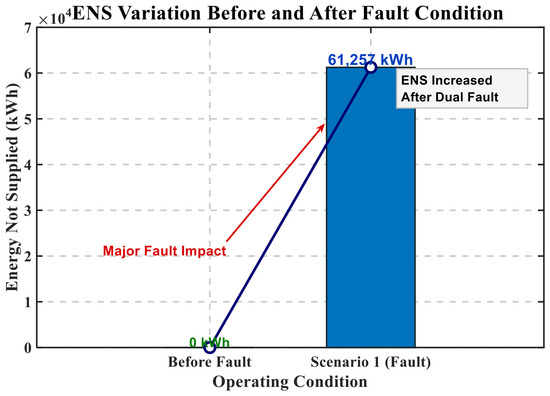
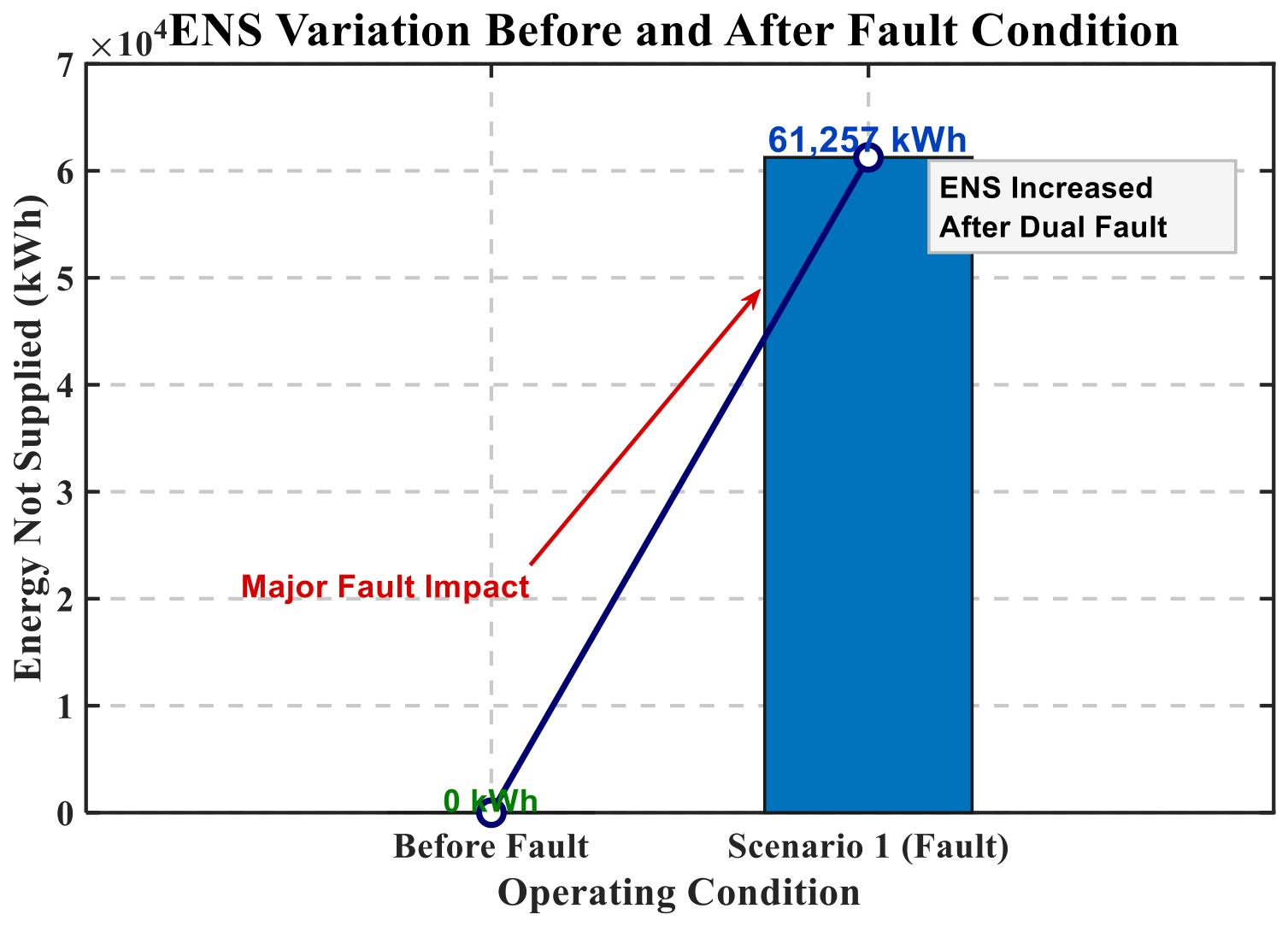
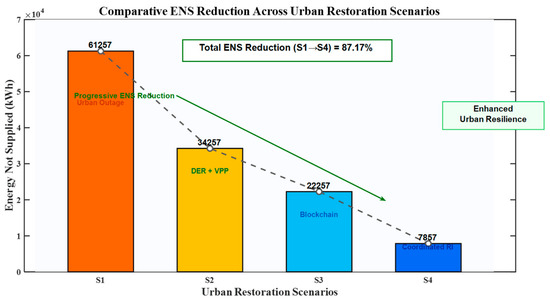
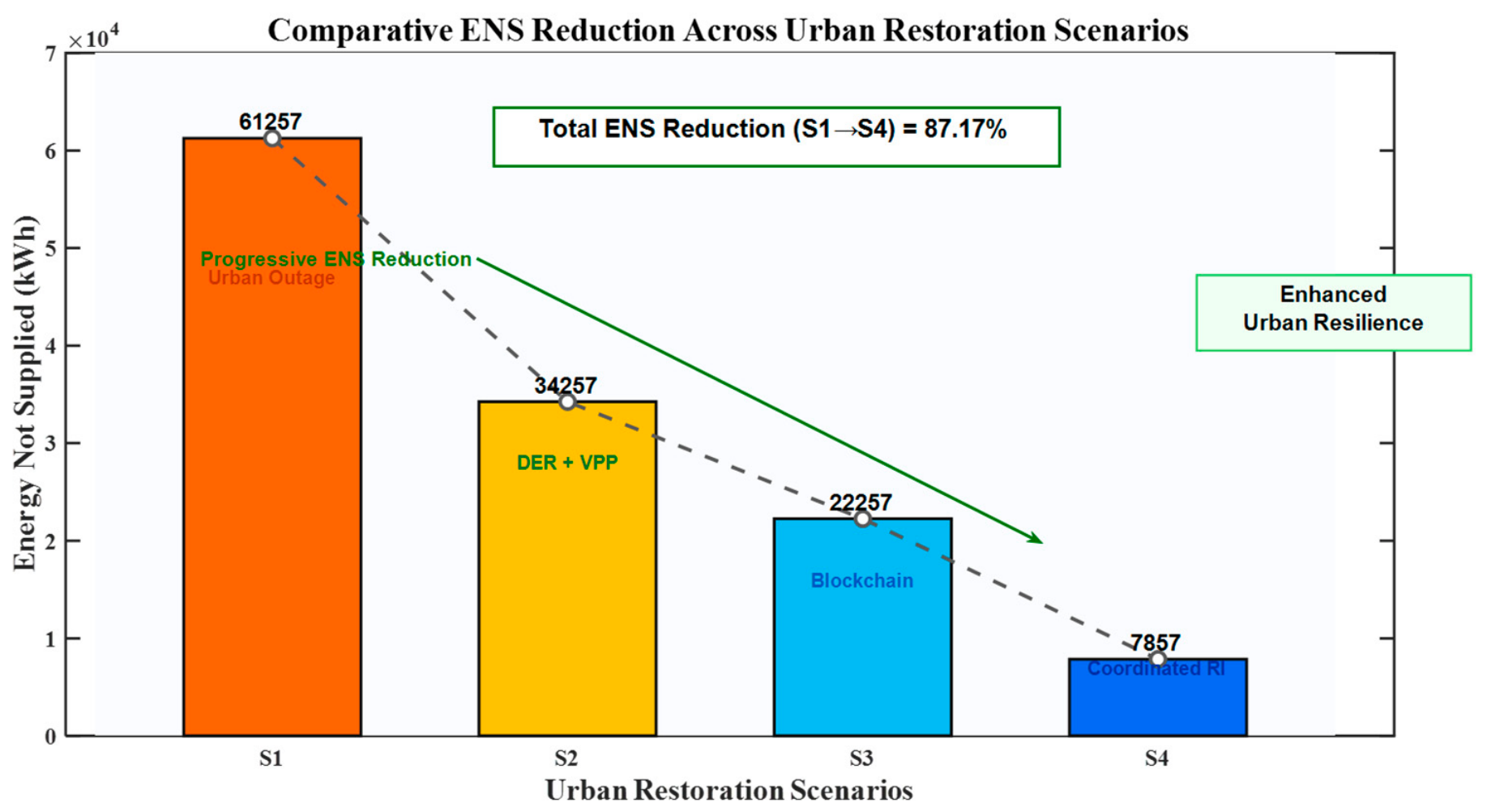
The simulation results show that the total system demand is 22,709.72 kW, out of which only 12,500.30 kW is supplied through the healthy portion of the network. This corresponds to a restoration level of only 55.05%, indicating the severity of the outage condition. The remaining unsupplied demand results in a high Energy Not Supplied (ENS) value of 61,256 kWh over the 6 h outage duration.
In terms of network operating performance, the real power loss and reactive power loss are recorded as 320.15 kW and 210.40 kVAR, respectively. The voltage profile is also significantly affected under the outage condition, with the minimum bus voltage decreasing to 0.842 p.u., which is below the acceptable operating limit. The voltage deviation index is calculated as 3.44 p.u., indicating poor voltage stability within the affected regions.
From an economic perspective, Scenario-1 results in the highest interruption-related cost due to the absence of restoration measures as tabulated in Table 2. For the considered outage duration of h, the total outage cost is estimated to be approximately 3.68 million Rs, mainly due to the high ENS penalty associated with interruption of urban service loads. The ENS before and after fault condition for scenario 1 is shown in Figure 2.
Table 2.
Performance metrics for Scenario-1.
Figure 2.
Comparison of ENS for Scenario-1.
The Urban Energy Resilience Index (UERI) for this scenario is calculated as 0.5505, which represents the lowest resilience level among all restoration scenarios considered in this work. Therefore, Scenario-1 serves as the reference case for evaluating the improvement achieved through VPP-assisted restoration, decentralized energy sharing, and coordinated urban resilience restoration strategies discussed in the following sections.
4.2. Scenario-2: Urban DER-Assisted Restoration Using VPP Support
Scenario-2 investigates the restoration performance of the IEEE 118-bus radial distribution system using Virtual Power Plant (VPP)-assisted distributed energy support under the same dual-fault outage condition considered in Scenario-1. The outages on lines (2–64) and (5–29) isolate two major downstream regions, namely Island-1 (buses 29–63) and Island-2 (buses 64–100). These isolated regions include important urban service zones such as healthcare support systems, smart residential sectors, emergency communication infrastructure, and EV charging regions.
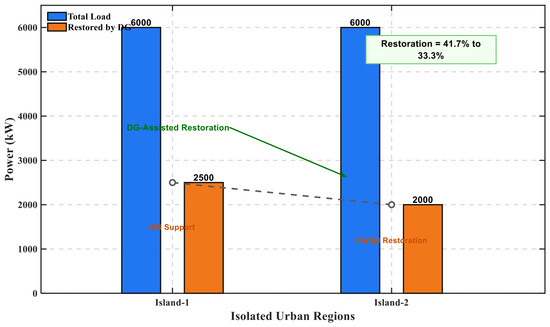
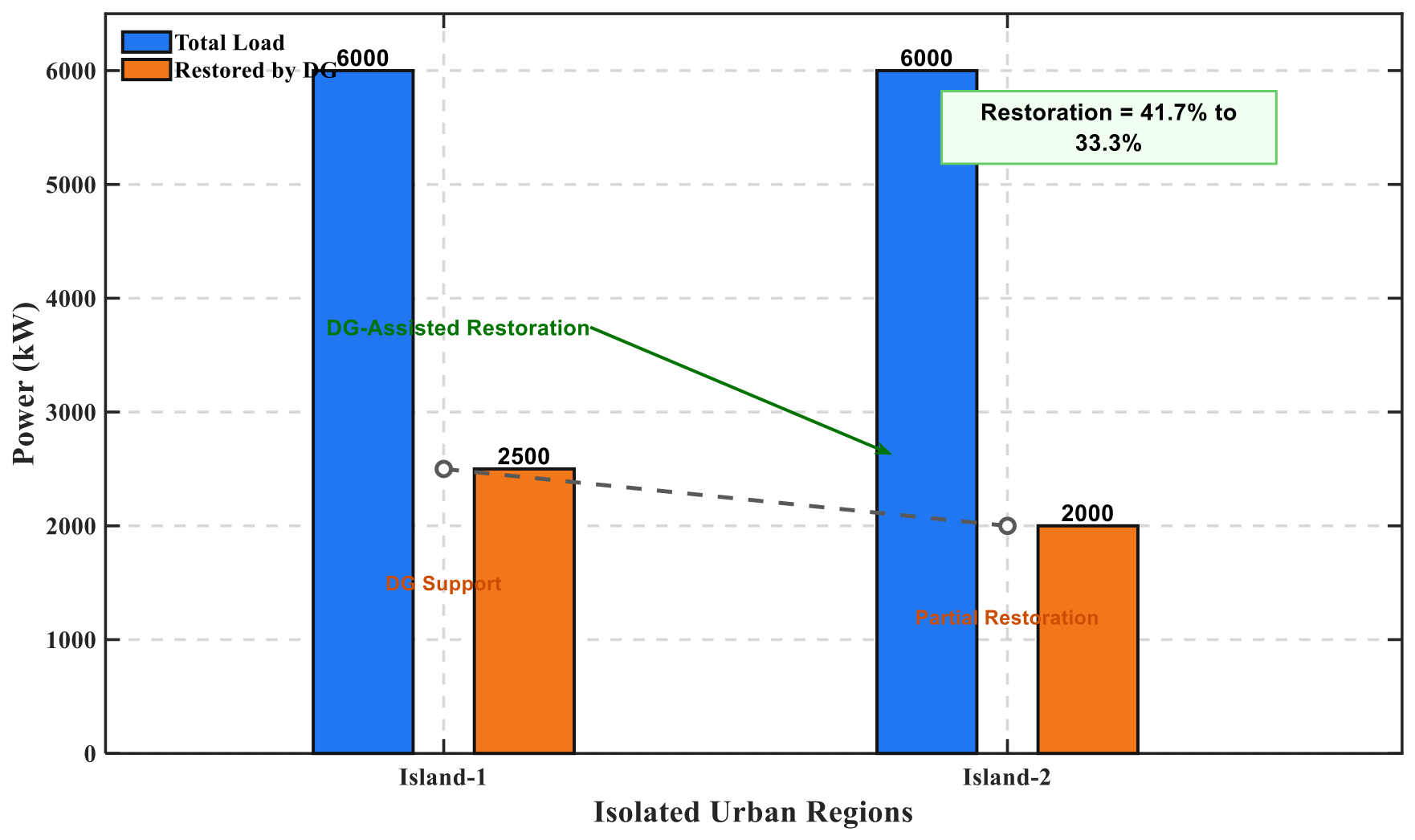
Unlike the base outage condition, this scenario introduces distributed energy support through coordinated VPP operation to improve restoration capability within the isolated urban regions. Two distributed generators are strategically placed in the islanded sections to provide localized energy support during the outage condition. DG-1 is connected at bus 50 with a generation capacity of 2500 kW, while DG-2 is connected at bus 80 with a capacity of 2000 kW. The combined distributed generation support of 4500 kW enables partial restoration of the disconnected urban service loads.
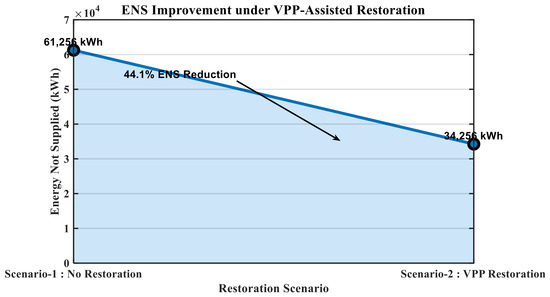
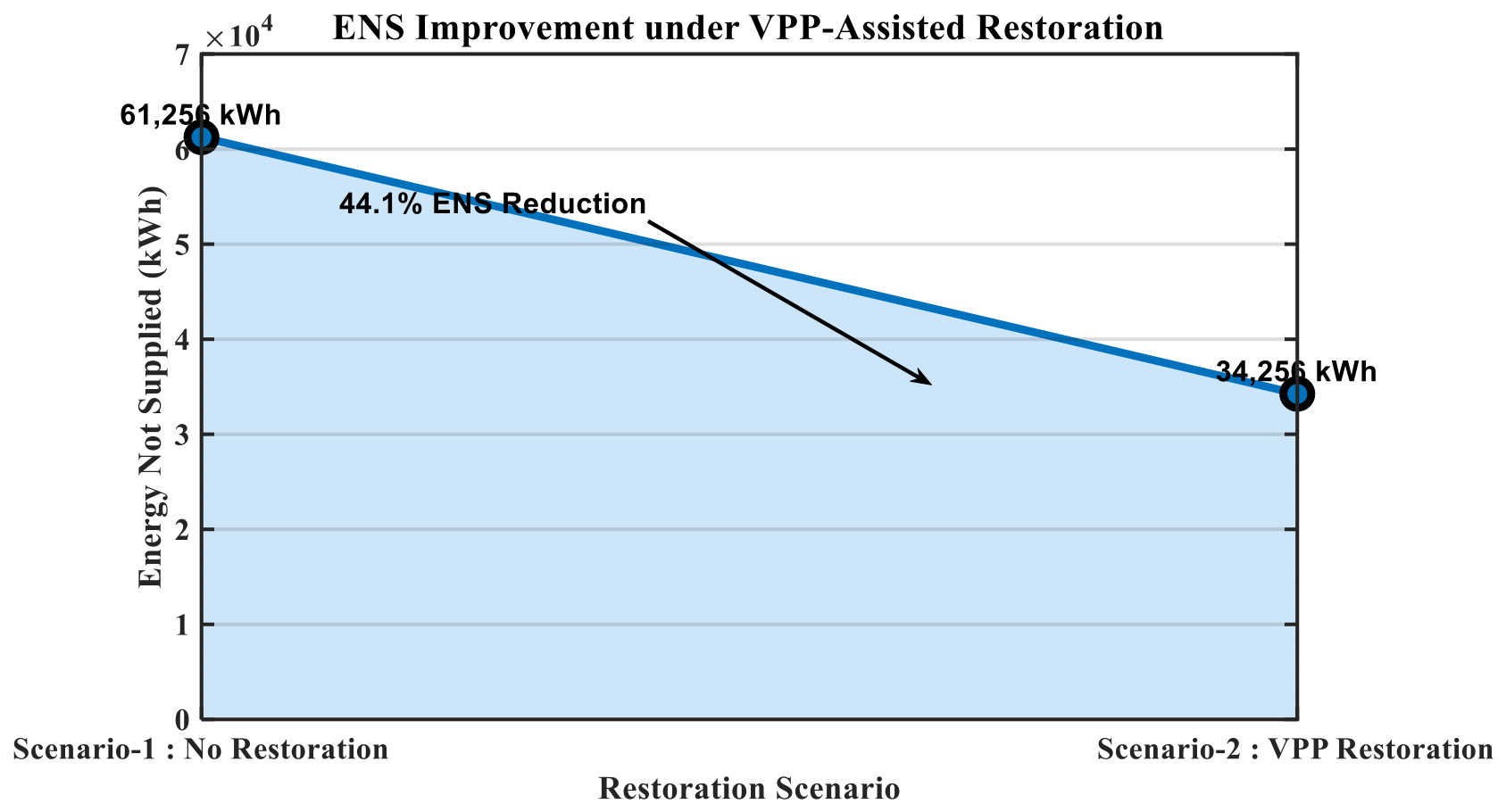
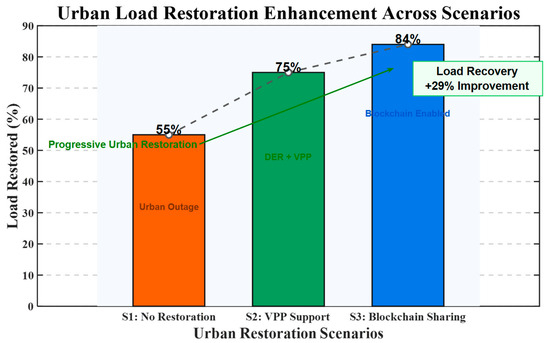
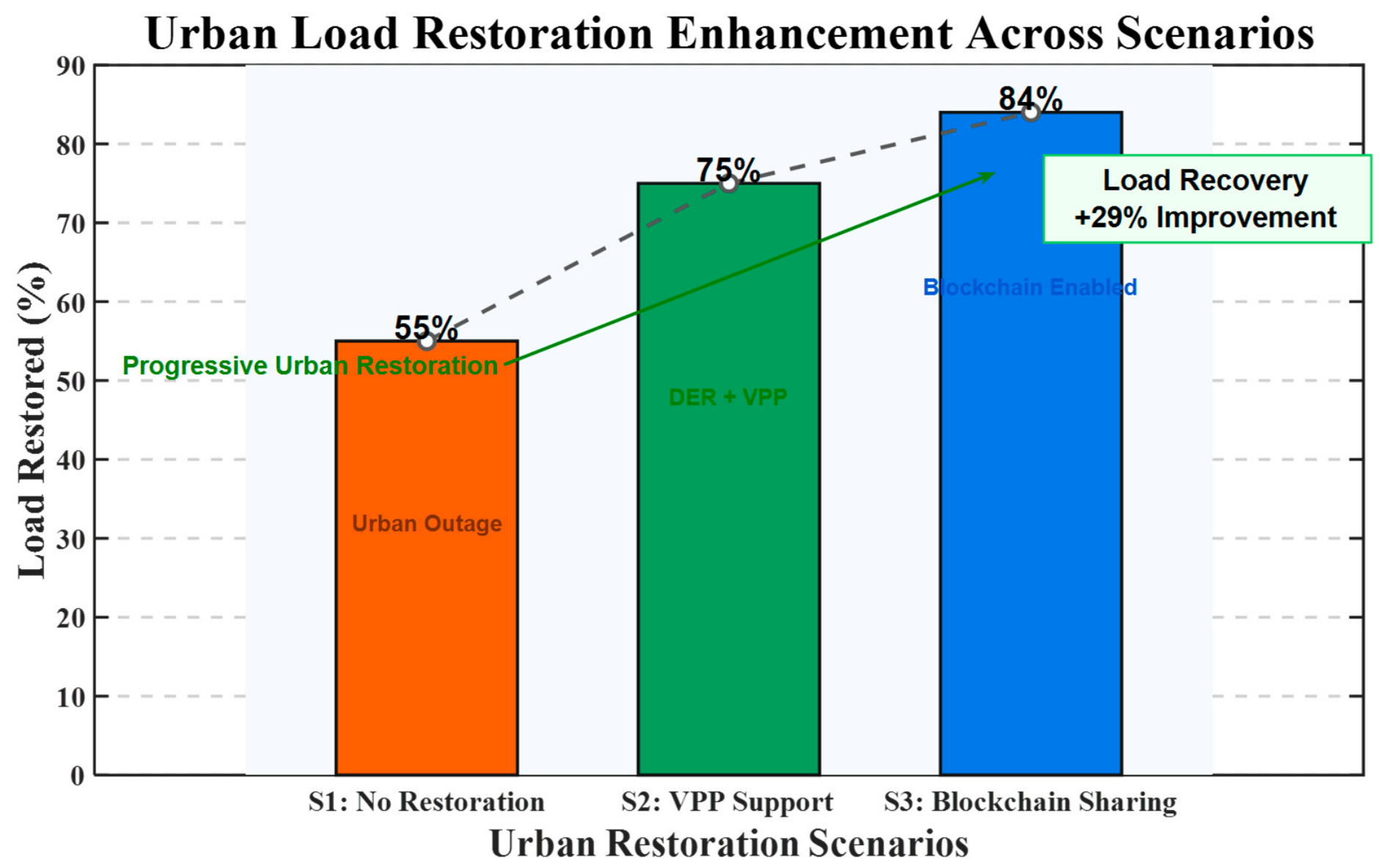
The simulation results demonstrate a significant improvement in restoration performance compared with Scenario-1. The served load increases from 12,500.30 kW to 17,000.30 kW, resulting in a restoration level of 74.86%. Consequently, the Energy Not Supplied (ENS) decreases from 61,256 kWh to 34,256 kWh over the considered 6 h outage duration. This reduction in ENS confirms the effectiveness of coordinated distributed energy support in improving restoration capability during severe outage conditions.
The presence of localized distributed generation also improves network operating conditions within the isolated regions, as shown in Figure 3. The minimum bus voltage improves from 0.842 p.u. in Scenario-1 to 0.915 p.u. in Scenario-2, indicating better voltage support during islanded operation. Similarly, the voltage deviation index decreases from 3.44 p.u. to 1.82 p.u., showing improved voltage stability throughout the restored network sections. In addition, real power loss decreases from 320.15 kW to 210.40 kW due to localized power support from the distributed generators.
Figure 3.
Island restoration breakdown using VPP DG support for Scenario-2.
The ENS for scenario 2 is shown in Figure 4. From an economic perspective, VPP-assisted restoration reduces the interruption-related outage cost by decreasing the ENS penalty associated with unsupplied urban demand. For the 6 h outage duration, the total restoration cost decreases from 3.68 million Rs in Scenario-1 to approximately 2.64 million Rs in Scenario-2, even after considering distributed generator operating costs as tabulated in Table 3.
Figure 4.
Comparison of ENS for Scenario-2.
Table 3.
Urban DER-assisted restoration using VPP support for Scenario-2.
The Urban Energy Resilience Index (UERI) improves significantly from 0.5505 in Scenario-1 to 0.7486 in Scenario-2, demonstrating the capability of VPP-assisted distributed energy coordination to improve restoration performance and maintain continuity of critical urban infrastructure during severe outage conditions.
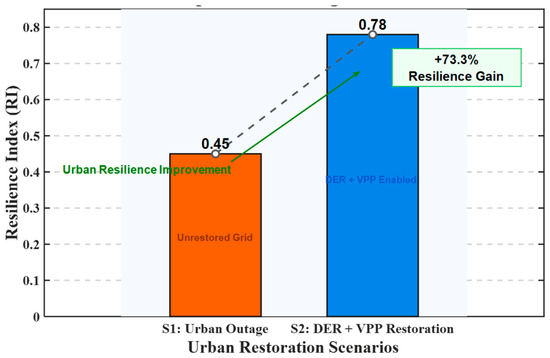
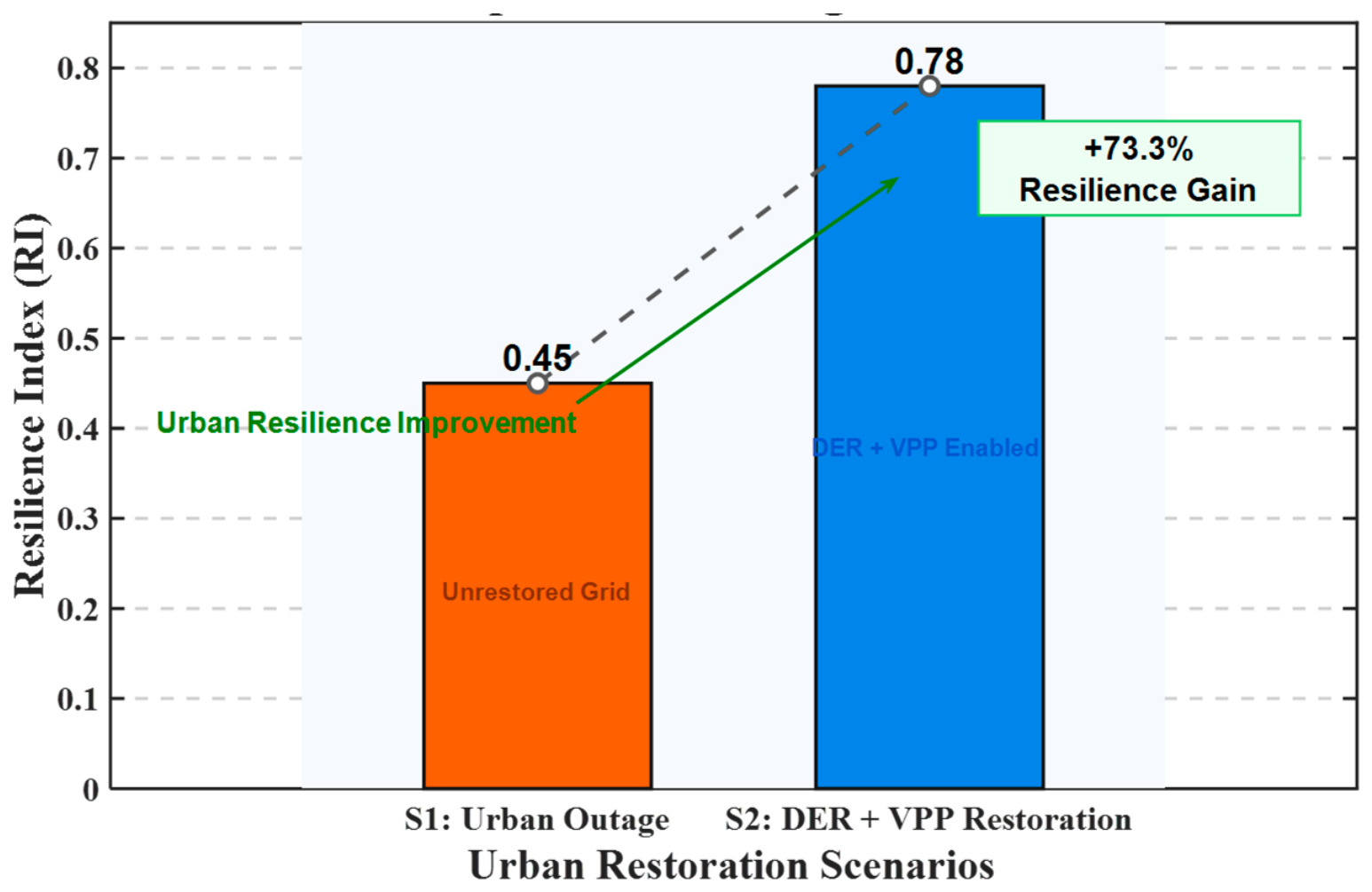
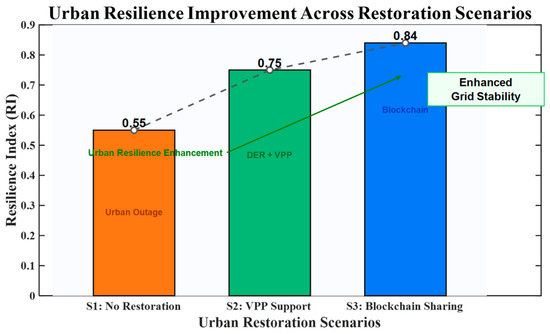
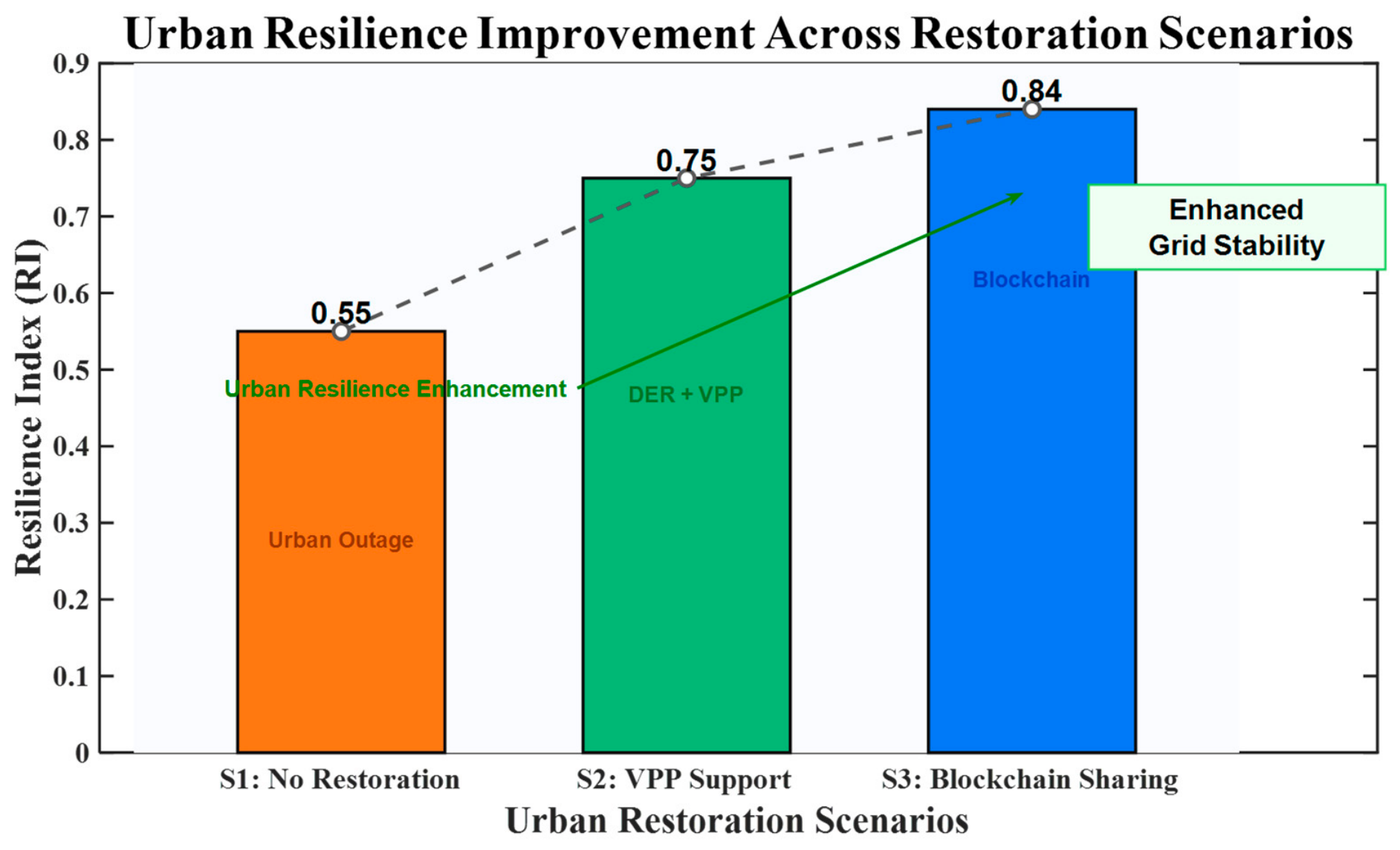
The DG placement has been tabulated in Table 4. Finally, the Urban Energy Resilience Index improves markedly from 0.5505 in Scenario-1 to 0.7486 in Scenario-2, as shown in Figure 5. This demonstrates that VPP-assisted island restoration provides a practical, scalable resilience-enhancement strategy, serving as a transitional step toward more advanced optimization-based and blockchain-enabled restoration frameworks considered in subsequent scenarios.
Table 4.
DG and island restoration summary.
Figure 5.
Resilience improvement with VPP-assisted restoration.
Scenario-2 highlights the role of VPP-coordinated DER islanding in improving load recovery to 74.86%, reducing ENS by 44%, enhancing voltage stability, and lowering interruption costs under dual-fault conditions.
4.3. Scenario-3: Blockchain-Enabled Decentralized Energy Sharing Restoration
Blockchain-based P2P trading is modeled on a permissioned network with PBFT consensus to ensure fast, reliable validation during restoration.
Consensus constraint:
Transaction validation:
Latency constraint:
Cost model:
To improve communication reliability during emergency restoration conditions, practical implementations may incorporate communication redundancy, fault-tolerant network architectures, backup communication channels, and secure data exchange mechanisms. These measures can help maintain coordination among VPP operators, distributed energy resources, and restoration zones even under partial communication failures or cyber threats.
Scenario-3 introduces blockchain-enabled decentralized energy sharing to further improve restoration capability in the isolated urban regions formed under the dual-fault outage condition. Similar to the previous scenarios, faults on lines (2–64) and (5–29) isolate Island-1 (buses 29–63) and Island-2 (buses 64–100), interrupting power supply to several critical urban service zones including healthcare infrastructure, emergency communication systems, smart residential sectors, and EV charging regions.
In this scenario, decentralized peer-to-peer (P2P) energy sharing is incorporated along with VPP-assisted distributed generation support. Blockchain technology is used to provide secure and transparent energy transactions among distributed energy participants without requiring centralized control. This decentralized energy sharing mechanism allows prosumers with surplus generation to support nearby urban service loads during outage conditions.
Along with the distributed generators considered in Scenario-2, additional prosumer-supported generation sources are included within the isolated regions. Distributed generation units are connected at buses 50 and 80 with capacities of 2500 kW and 2000 kW, respectively, while additional prosumer-based energy support is provided at buses 60 and 90 with capacities of 1200 kW and 800 kW. The total decentralized restoration support available in this scenario is 6500 kW as tabulated in Table 5.
Table 5.
Performance of the result analysis of Scenario-3.
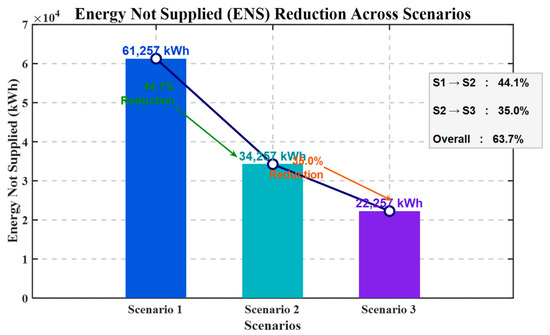
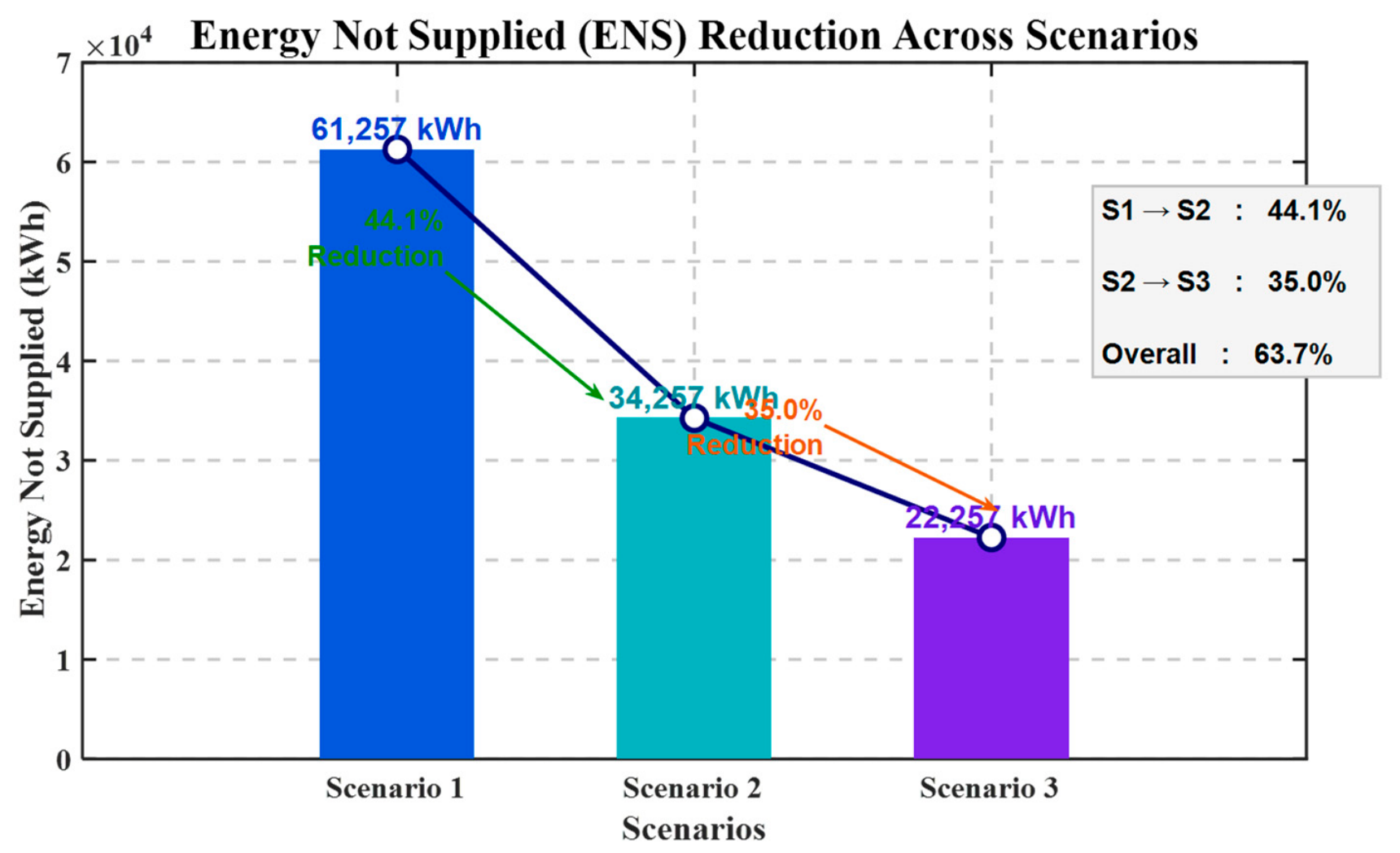
The blockchain based DG participation has been tabulated in Table 6. The electricity cost breakdown for 6-hour outage has been tabulated in Table 7. The simulation results show further improvement in restoration performance compared with Scenario-2. The served load increases to 19,000.30 kW, corresponding to a restoration level of 83.66%. As a result, the Energy Not Supplied (ENS) decreases significantly to 22,256 kWh during the 6 h outage period, as shown in Figure 6. This reduction demonstrates the effectiveness of decentralized energy sharing in improving local energy utilization and supporting critical urban infrastructure during severe outage conditions.
Table 6.
Blockchain trading and DG participation summary.
Table 7.
Scenario-3 Electricity cost breakdown (6-hour outage).
Figure 6.
ENS reduction with progressive restoration strategies.
These results highlight that decentralized energy trading among prosumers enhances operational flexibility and enables more efficient use of locally available resources, thereby improving supply adequacy under post-fault island conditions.
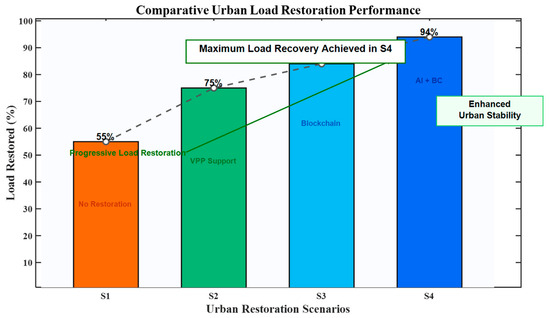
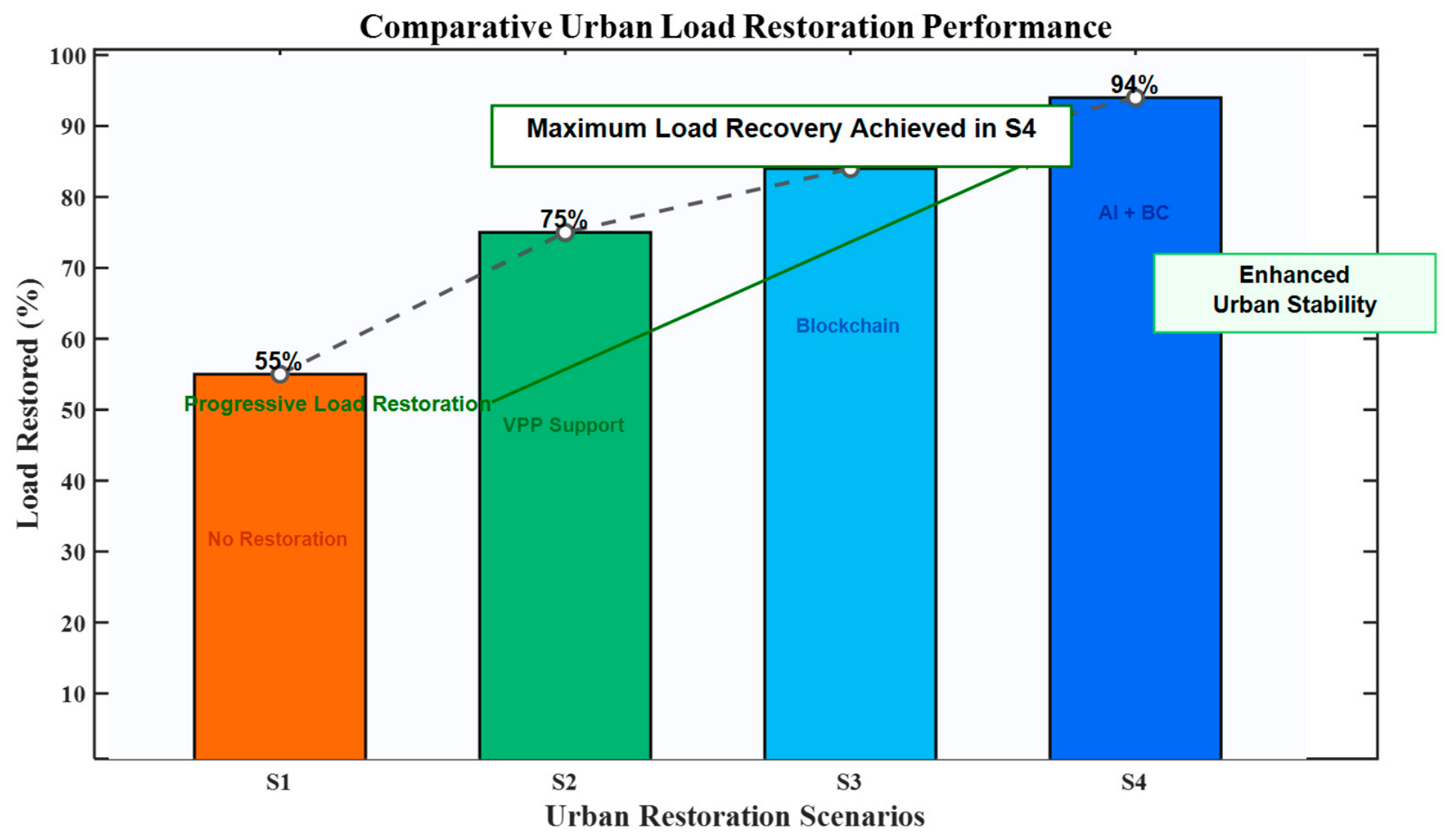
The inclusion of decentralized energy support also improves network operating conditions. The minimum bus voltage increases to 0.940 p.u., while the voltage deviation index decreases to 0.95 p.u., indicating improved voltage stability across the restored urban regions. In addition, real power loss decreases to 160.00 kW due to better localized energy balancing and reduced dependency on long feeder supply paths. The load restoration performance is shown in Figure 7.
Figure 7.
Performance comparison of load restoration for Scenario-3.
From an economic perspective, Scenario-3 reduces the overall outage-related cost by decreasing ENS penalties while considering distributed generator operating costs and blockchain energy transaction costs. For the considered outage duration of Δt = 6 h, the total restoration cost decreases to approximately 2.41 million Rs.
Figure 8 shows that the Urban Energy Resilience Index (UERI) improves from 0.7486 in Scenario-2 to 0.8366 in Scenario-3, demonstrating that blockchain-enabled decentralized energy sharing can significantly improve restoration capability, reduce interruption impacts, and maintain continuity of critical urban infrastructure during large-scale outage conditions.
Figure 8.
Comparison of resilience index improvement for Scenario-3.
4.4. Scenario-4: Coordinated Urban Resilience Restoration Framework
Scenario-4 presents the proposed coordinated urban resilience restoration framework under severe dual-fault outage conditions in the IEEE 118-bus radial distribution system. This scenario combines VPP-assisted distributed energy coordination, blockchain-enabled decentralized energy sharing, and optimal distributed generator scheduling to improve restoration capability and maintain continuity of critical urban infrastructure during large-scale outage conditions. The simulated results is tabulated in Table 8.
Table 8.
Comparison of performance analysis of Scenario-4.
Under the considered dual-fault condition on lines (2–64) and (5–29), two isolated urban regions are formed, namely Island-1 (buses 29–63) and Island-2 (buses 64–100) as tabulated in Table 9. These isolated regions include important urban service loads such as hospitals, emergency communication systems, smart residential sectors, water supply support systems, and EV charging infrastructure. In the IEEE 118-bus system, these critical loads are represented by Bus 30 (hospital), Bus 45 (emergency communication center), Bus 60 (water supply facility), Bus 75 (EV charging hub), and Bus 90 (smart residential control center). These buses were assigned higher restoration priority during the restoration process to ensure continuity of essential urban services during outage conditions. The proposed restoration framework coordinates distributed energy resources within these isolated regions to maximize restoration support while maintaining operational constraints.
Table 9.
DG dispatch and optimization summary of Scenario–4.
In this scenario, the Seagull Optimization Algorithm (SOA) is used to determine optimal distributed generator dispatch and coordinated decentralized energy sharing among the available distributed energy participants. The restoration strategy aims to reduce Energy Not Supplied (ENS), minimize outage-related economic cost, improve voltage stability, and enhance overall urban energy resilience during the restoration process.
The electricity cost breakdown for scenario 4 is tabulated in Table 10. The simulation results clearly indicate that the proposed coordinated urban resilience restoration framework achieves the highest restoration performance across all scenarios considered. The served load increases to 21,400.30 kW, corresponding to a load restoration level of 94.20%, which represents a significant improvement over Scenario–3 (83.66%).
Table 10.
Electricity cost breakdown (6 h) of Scenario–4.
As a result, Energy Not Supplied (ENS) is substantially reduced to 7856 kWh, as shown in Figure 9. This highlights the effectiveness of intelligent coordination of distributed resources in minimizing service interruptions under severe fault conditions.
Figure 9.
Comparison of ENS for Scenario–4.
From a network operation perspective, Scenario–4 provides the best voltage support within the islanded regions. The minimum bus voltage improves to 0.965 p.u., while the voltage deviation index decreases to 0.55 p.u., indicating that the coordinated urban resilience restoration framework effectively mitigates voltage violations and enhances overall system stability. In addition, efficient local balancing of generation and demand significantly reduces real power losses, which drop to 95 kW, the lowest among all scenarios considered.
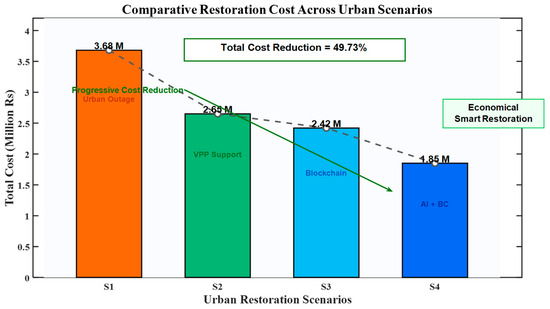
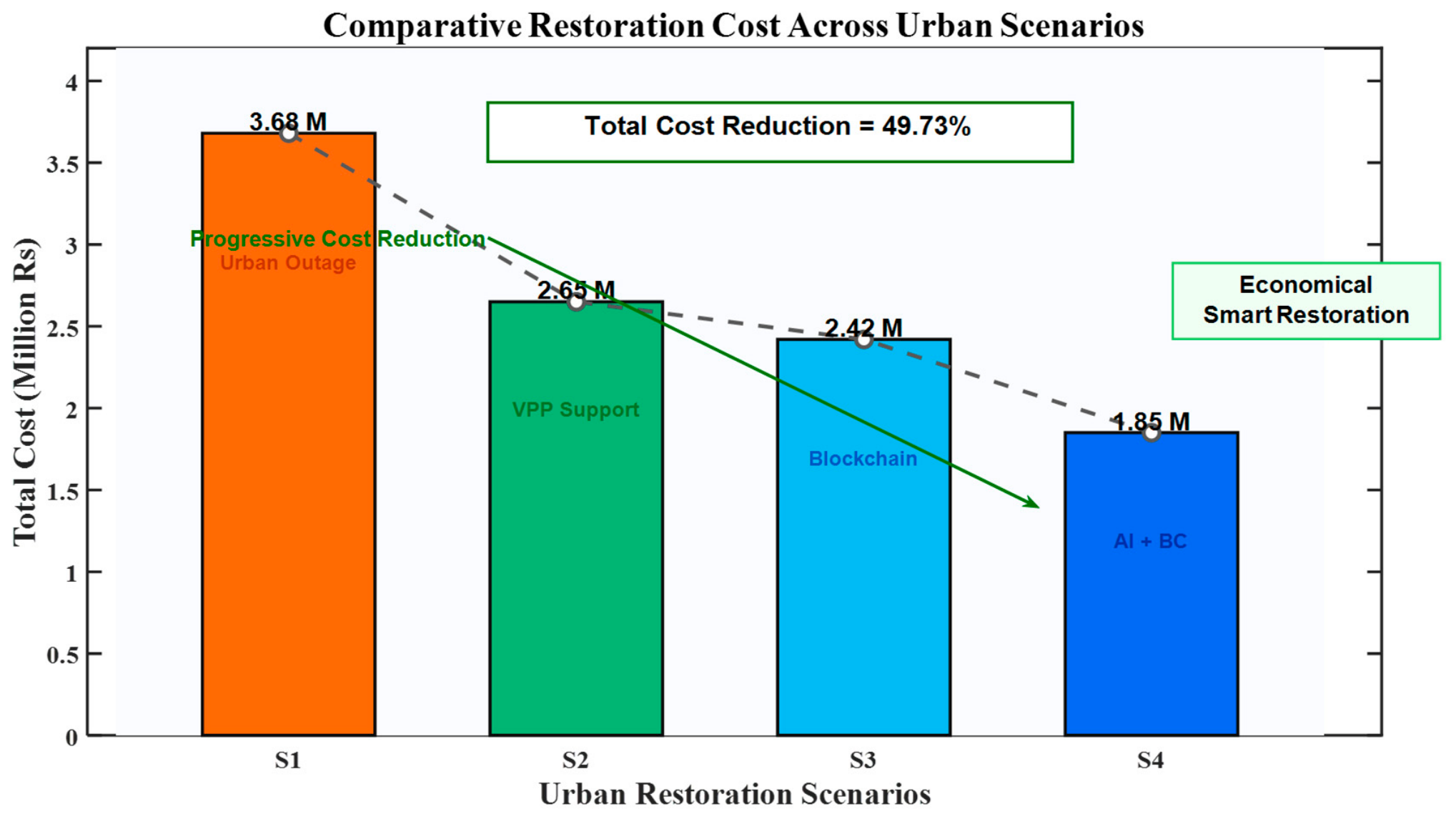
From an economic standpoint, Scenario–4 achieves the most cost-effective restoration. For a 6 h outage period, the total electricity cost was reduced to approximately 1.85 million Rs, compared to 2.41 million Rs in Scenario–3 and 3.68 million Rs in Scenario-1. This improvement is mainly due to the substantial reduction in ENS-related penalties, while maintaining controlled DG operating costs through optimized scheduling. The comparison of restoration cost and load recovery is illustrated in Figure 10 and Figure 11.
Figure 10.
Performance comparison of load restoration for Scenario–4.
Figure 11.
Restoration cost comparison of Scenario–4.
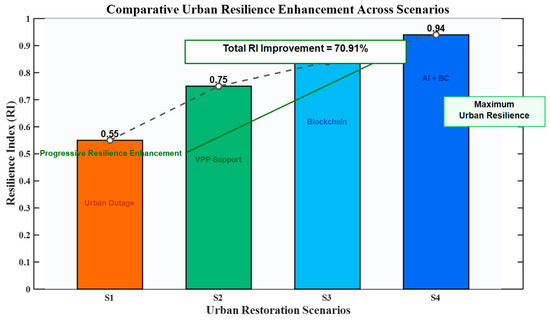
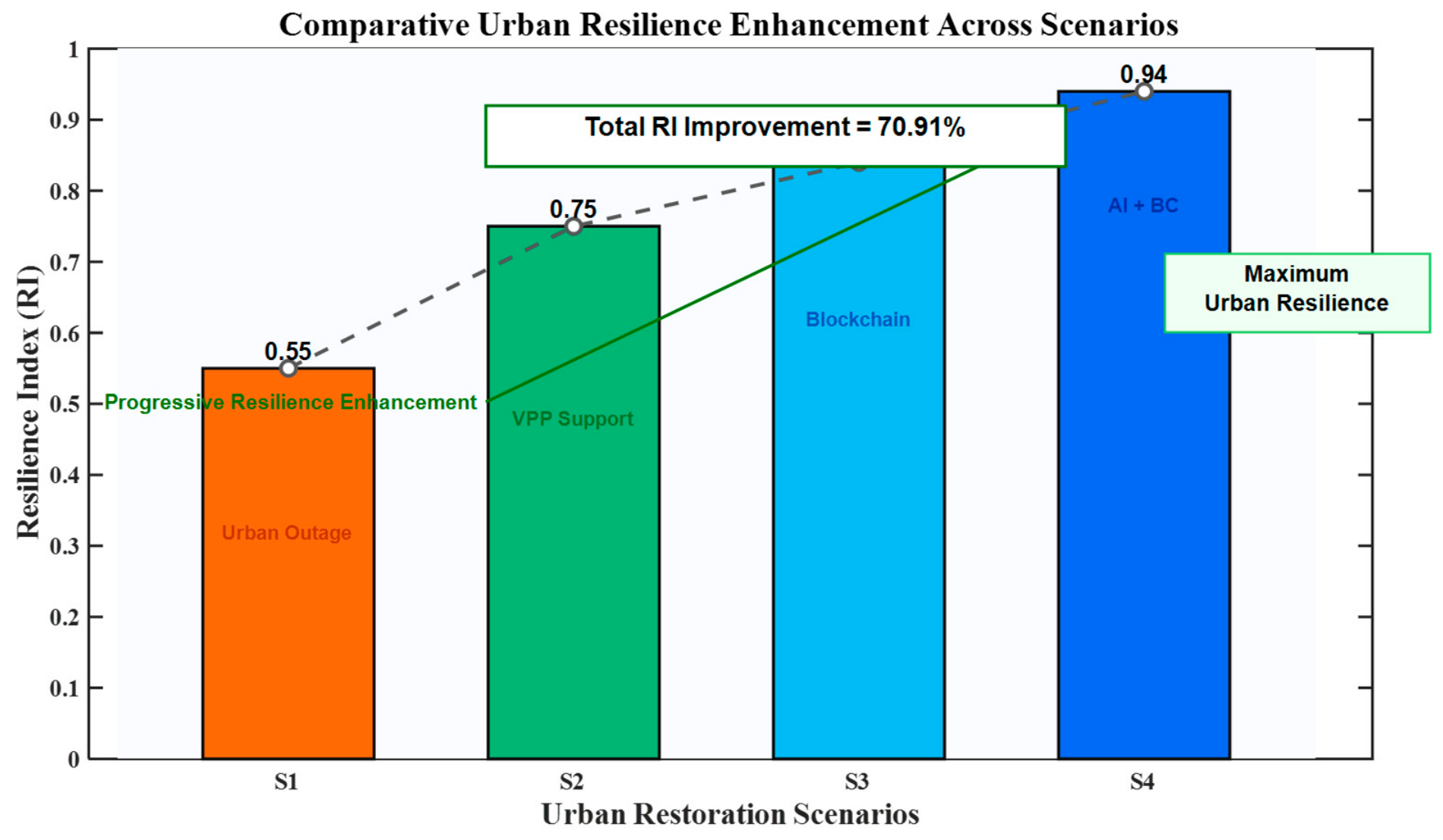
Finally, the resilience index reaches 0.9420 as shown in Figure 12, reflecting the strongest resilience enhancement achieved through the proposed coordinated urban resilience restoration framework strategy. Overall, Scenario–4 demonstrates that combining decentralized blockchain trading with a coordinated urban resilience restoration framework provides a powerful and scalable solution for resilient distribution system restoration under multi-fault contingencies.
Figure 12.
Comparison of enhancement of resilience index for Scenario 1–4.
Figure 12 shows that Scenario–4 achieves the best restoration outcome by jointly optimizing DER dispatch and blockchain-based trading, improving load recovery to 94.2%, and achieving the highest resilience index (RI = 0.9420).
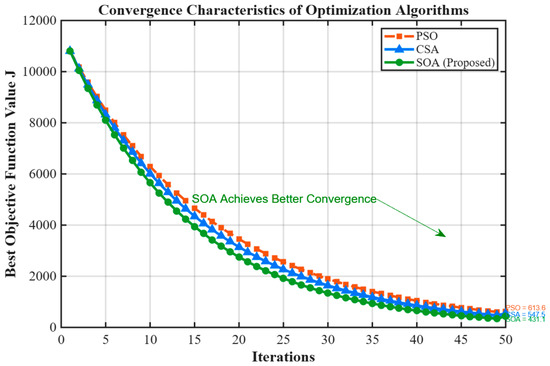
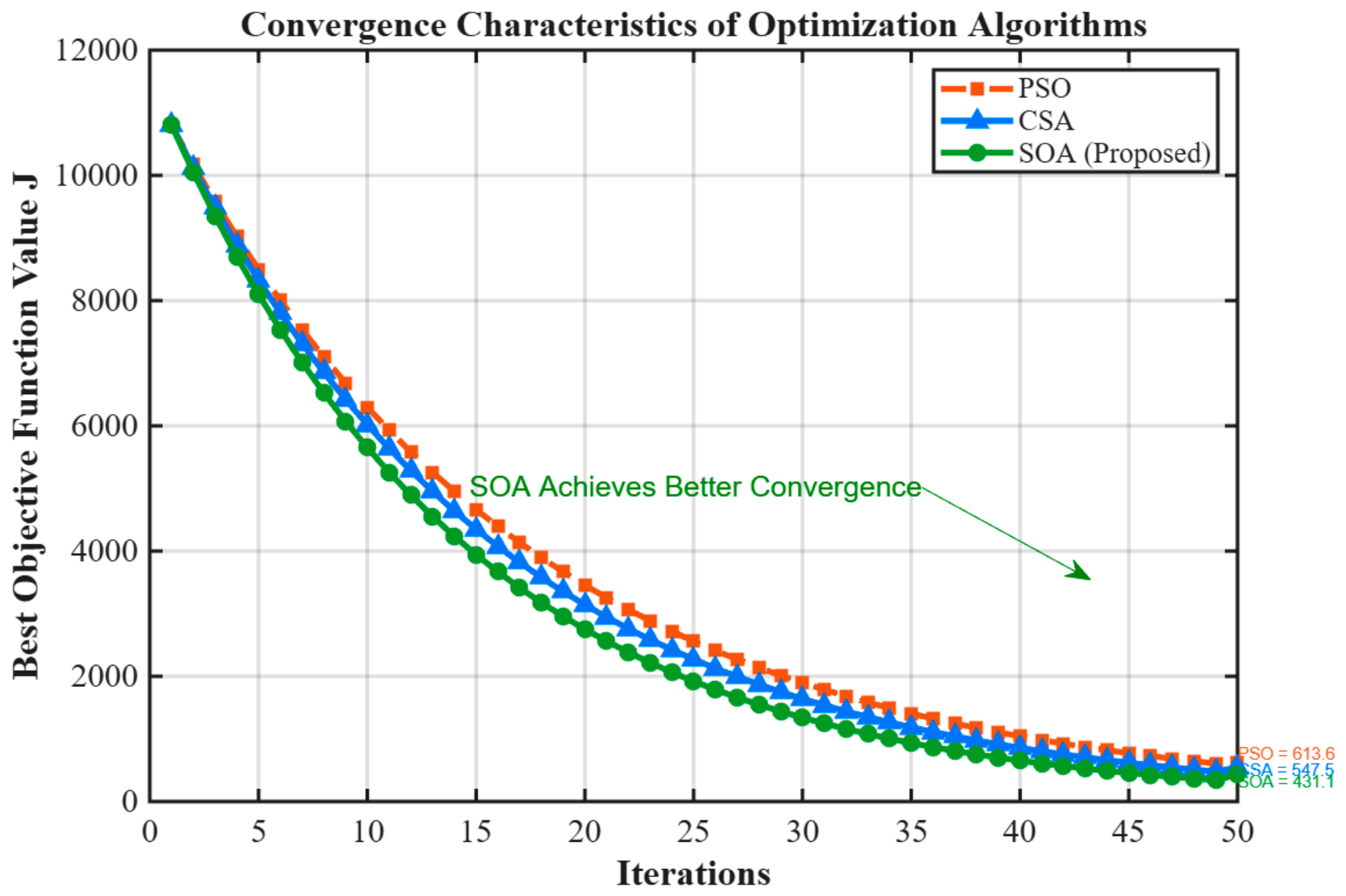
Figure 13 illustrates the convergence behavior of the Seagull Optimization Algorithm (SOA) applied to the optimal DG dispatch restoration problem. It is observed that the objective function value decreases rapidly in the initial iterations due to the migration phase’s strong global exploration capability. As iterations progress, the spiral attacking mechanism enhances local exploitation, leading to smooth convergence toward the optimal solution. This demonstrates the fast convergence and effectiveness of SOA in minimizing ENS and restoration cost while improving overall system resilience.
Figure 13.
Convergence characteristic of the Seagull Optimization Algorithm (SOA) showing rapid reduction in restoration objective value.
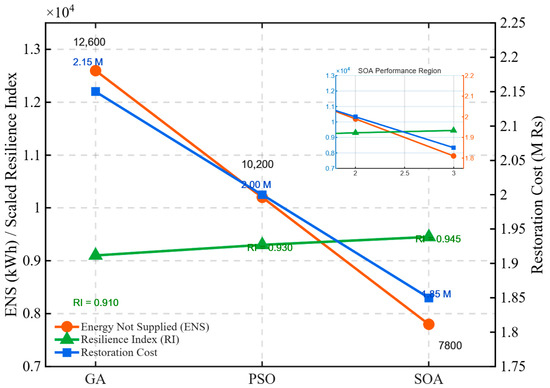
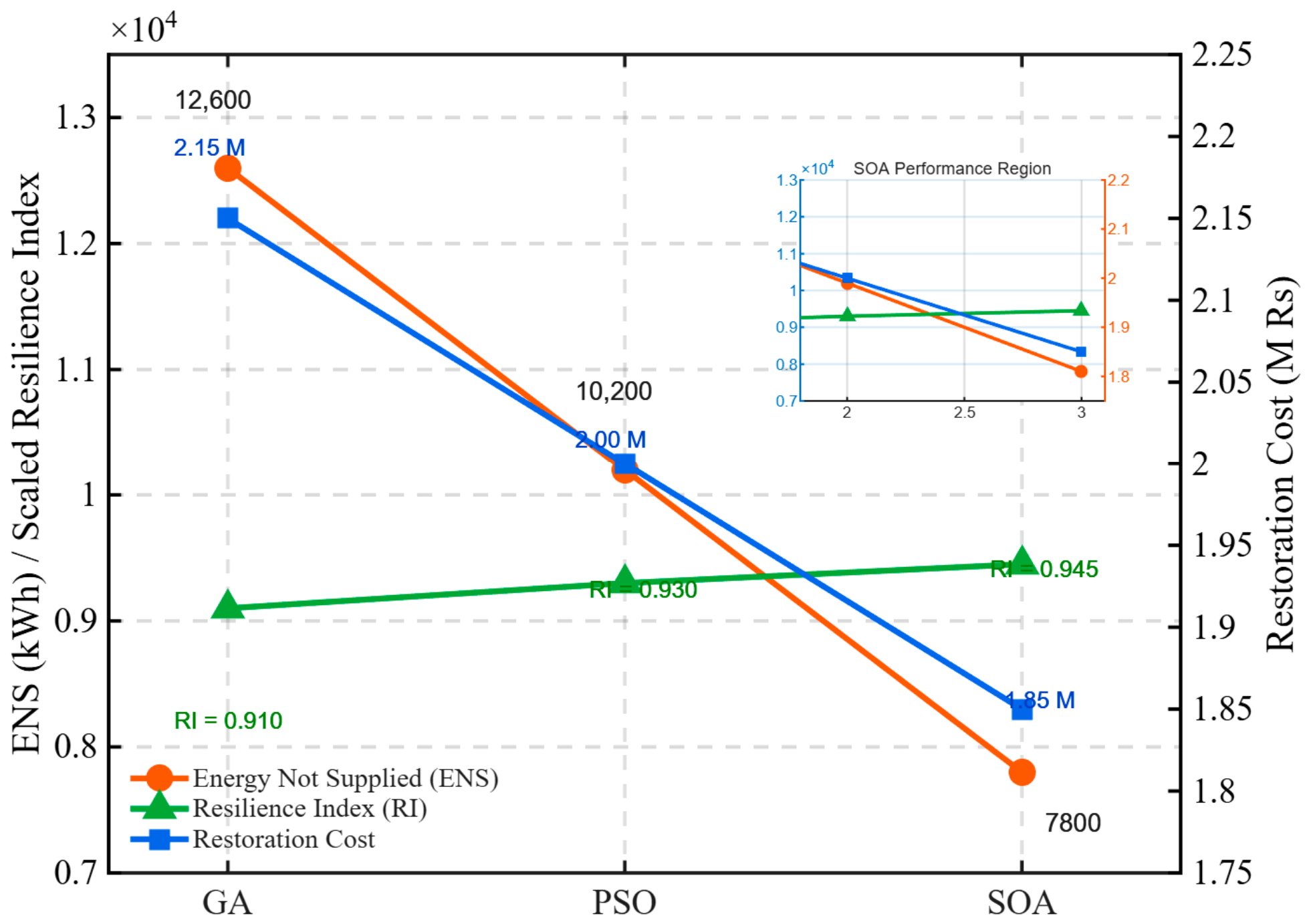
Figure 14 compares the performance of GA, PSO, and the proposed SOA method for urban energy restoration. From the results, it can be observed that the SOA approach reduces the Energy Not Supplied (ENS) to 7800 kWh, which is lower than both GA and PSO. The restoration cost is also reduced to 1.85 M Rs, showing better economic performance during system recovery. At the same time, the resilience index reaches 0.945, indicating improved restoration capability and system stability. The results show a gradual improvement from GA to PSO and finally to SOA. Overall, the proposed SOA-based restoration strategy provides better technical and economic performance for resilient smart city operation.
Figure 14.
Multi-metric performance comparison of optimization algorithms for urban energy restoration.
Table 11 presents a comparative evaluation of three optimization techniques. Genetic GA and PSO were selected as benchmark algorithms because they are widely used and well-established optimization techniques in distribution system restoration studies. These methods provide a reliable and commonly accepted basis for evaluating the performance of the proposed SOA approach.
Table 11.
Performance analysis of the proposed method.
In particular, SOA achieves the lowest Energy Not Supplied (ENS) of 7800 kWh, indicating its superior capability in restoring interrupted loads under fault conditions. It also results in a minimum restoration cost of 1.85 million Rs, primarily due to reduced interruption penalties and the optimal scheduling of DG resources. Moreover, the resilience index reaches a maximum of 0.942, indicating a higher level of load recovery than GA and PSO.
Additionally, SOA demonstrates faster convergence, reflecting its balanced exploration and exploitation, which makes it well-suited for solving complex post-fault restoration optimization problems.
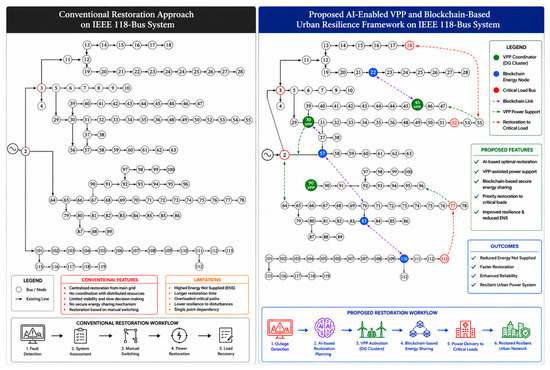
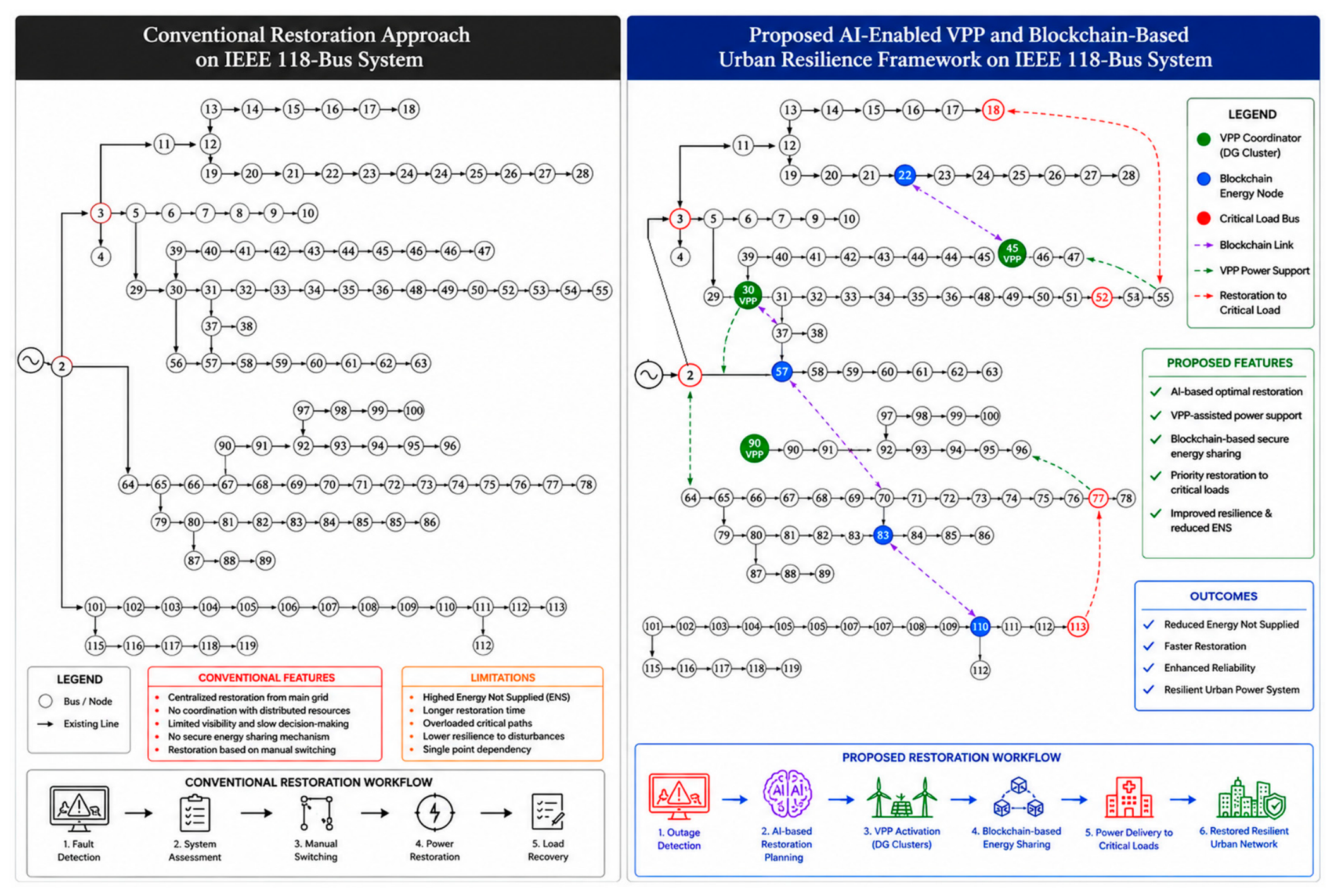
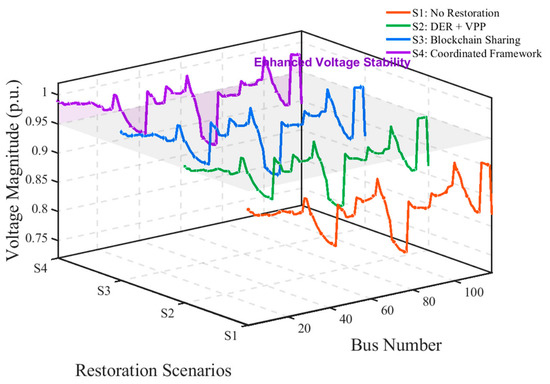
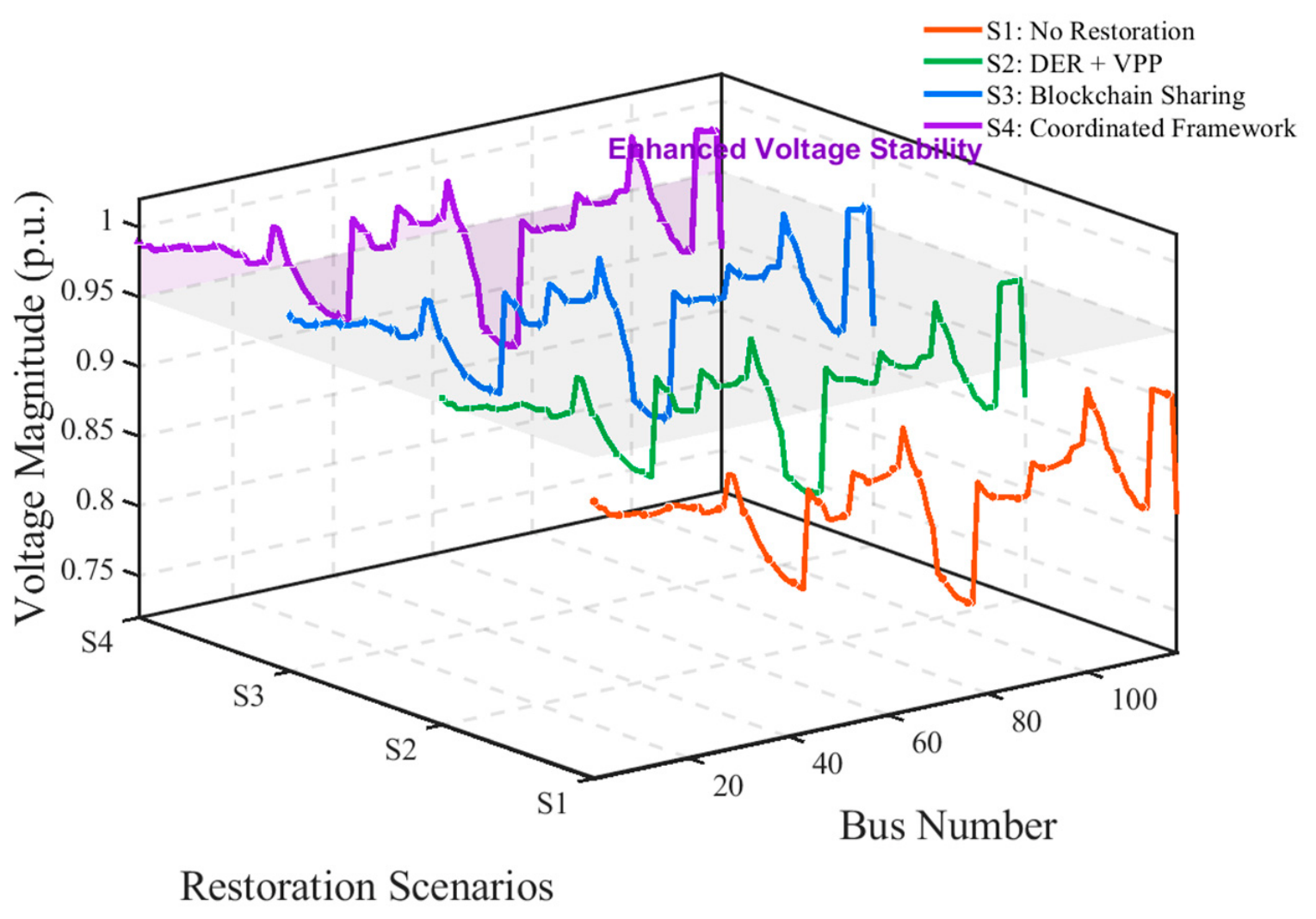
Figure 15 presents a comparative illustration of the conventional restoration strategy and the proposed Federated AI-Driven Urban Energy Resilience Framework implemented on the IEEE 118-bus system. The proposed framework integrates federated AI coordination, VPP-assisted distributed energy management, blockchain-enabled peer-to-peer energy sharing, and critical load prioritization to enhance urban resilience, improve restoration efficiency, and reduce Energy Not Supplied (ENS) during smart city infrastructure outages, as shown in Figure 16.
Figure 15.
Conventional and proposed federated AI-driven urban energy resilience restoration framework on the IEEE 118-bus smart city distribution system.
Figure 16.
Comparison of voltage profile enhancement.
5. Conclusions
This paper presented a coordinated urban energy resilience restoration framework for the IEEE 118-bus radial distribution system under severe dual-fault outage conditions on lines (2–64) and (5–29). The results clearly demonstrate the effectiveness of integrating VPP-assisted distributed energy support, blockchain-enabled decentralized energy sharing, and optimal restoration coordination for improving post-fault recovery of critical urban infrastructure.
In the base outage condition, only 55.05% of the total load (12,500.30 kW) was served, resulting in high Energy Not Supplied (ENS) and interruption-related economic loss. With VPP-assisted distributed energy restoration, the load recovery improved to 74.86% (17,000.30 kW), while ENS was significantly reduced. The inclusion of blockchain-enabled decentralized energy sharing further improved restoration performance by increasing the restored load to 83.66% (19,000.30 kW), reducing ENS, and lowering outage-related restoration cost.
The proposed coordinated restoration framework achieved the best performance among all considered scenarios, restoring 94.20% of the total load (21,400.30 kW) while considerably reducing ENS. In addition, the minimum bus voltage improved from 0.842 p.u. to 0.965 p.u., while the total restoration cost was reduced from Rs. 3.68 million to Rs. 1.85 million. Furthermore, the proposed restoration strategy significantly reduced real power loss compared to the base outage condition. The Urban Energy Resilience Index (UERI) increased from 0.5505 in the base outage condition to 0.9420 under the proposed coordinated restoration framework, confirming substantial improvement in restoration capability and urban energy resilience.
Furthermore, comparative analysis showed that the Seagull Optimization Algorithm (SOA) provided improved restoration performance with lower ENS, reduced restoration cost, and faster convergence compared with conventional optimization approaches.
Overall, the proposed framework provides an effective and scalable solution for improving restoration capability, reducing outage-related economic losses, and maintaining continuity of critical urban infrastructure in future smart city energy systems under severe outage conditions.
Author Contributions
Conceptualization, D.K.R. and J.I.S.; methodology, D.K.R.; software, J.I.S.; validation, D.K.R. and J.I.S.; formal analysis, D.K.R.; investigation, D.K.R.; resources, J.I.S.; data curation, D.K.R.; writing—original draft preparation, D.K.R.; writing—review and editing, J.I.S.; visualization, D.K.R.; supervision, D.K.R.; project administration, J.I.S.; funding acquisition, D.K.R. All authors have read and agreed to the published version of the manuscript.
Funding
This research received no external funding.
Data Availability Statement
The original contributions presented in this study are included in the article. Further inquiries can be directed to the corresponding author.
Acknowledgments
The authors would like to thank the management of Saveetha Engineering College for their support. The authors have reviewed and edited the output and take full responsibility for the content of this publication. During the preparation of this manuscript, the authors used ChatGPT, 5.5 Version for the purposes of Grammar, Structure, Spelling, Punctuation, and Formatting. The authors have reviewed and edited the output and take full responsibility for the content of this publication.
Conflicts of Interest
The authors declare no conflicts of interest.
References
- Alashhab, M.S.; Mlybari, E.A. Developing a multi-item, multi-product, and multi-period supply chain planning optimization model. Indian J. Sci. Technol. 2021, 14, 2850–2859. [Google Scholar]
- Cavone, G.; Carli, R.; Dotoli, M. Decision and control approaches for enhancing the resilience of distribution networks: A survey. IFAC—PapersOnLine 2022, 55, 271–276. [Google Scholar] [CrossRef] [Scilit]
- Chen, X.; Wu, W.; Zhang, B.; Shi, X. A robust approach for active distribution network restoration based on scenario techniques considering load and DG uncertainties. In Proceedings of the 2016 IEEE Power and Energy Society General Meeting (PESGM); IEEE: New York, NY, USA, 2016. [Google Scholar]
- Ebadat-Parast, M.; Nazari, M.H.; Hosseinian, S.H. Distribution system resilience enhancement through resilience-oriented optimal scheduling of multi-microgrids. Sustain. Cities Soc. 2022, 76, 103467. [Google Scholar] [CrossRef] [Scilit]
- El-Zonkoly, A. Double-layer optimal energy management of smart grid incorporating P2P energy trading. Int. J. Emerg. Electr. Power Syst. 2023, 25, 865–884. [Google Scholar]
- Hussain, A.; Bui, V.; Kim, H. Microgrids as a resilience resource and strategies for enhancing resilience. Appl. Energy 2019, 240, 56–72. [Google Scholar]
- Kumar, R.J. Management of blockchain-based hybrid P2P energy trading market. Int. J. Curr. Sci. Res. Rev. 2020, 3, 203–212. [Google Scholar]
- Li, F.F.; Shi, Q.; Zhao, J. Resilience-oriented short-term planning in urban-level power networks. In Enhancing Resilience in Power Distribution Systems; Elsevier: Amsterdam, The Netherlands, 2025; pp. 83–105. [Google Scholar]
- Li, Z. Introduction: Sustainable logistics systems using AI-based meta-heuristics approaches. In Sustainable Logistics Systems Using AI-Based Meta-Heuristics Approaches; Routledge: Oxfordshire, UK, 2023; p. 1. [Google Scholar]
- Najafi, J.; Peiravi, A.; Anvari-Moghaddam, A. Enhancing integrated power and water distribution networks seismic resilience leveraging microgrids. Sustainability 2020, 12, 2167. [Google Scholar] [CrossRef] [Scilit]
- Nizamioğlu, T.; Rahimi, S.; Göl, M. Two-layer model predictive control of microgrids. In Proceedings of the 2025 IEEE Kiel PowerTech; IEEE: New York, NY, USA, 2025. [Google Scholar]
- Nouri, F.; Vahedipour Dahraie, M.; Shariatinasab, R.; Siano, P. Risk-aware flexible P2P energy trading in multi-microgrid systems. SSRN, 2025; in press.
- Khan, F.I.; Ahmed, M.; Aziz, T. Review for “A novel framework for restoration technique of an industrial microgrid using black start units”. IEEE J. Emerg. Sel. Top. Power Electron. 2022, 30, e12636. [Google Scholar]
- Shen, F.; Wu, Q.; Xue, Y. Review of service restoration for distribution networks. J. Mod. Power Syst. Clean Energy 2020, 8, 1–14. [Google Scholar] [CrossRef] [Scilit]
- Singh, H. Resilient networked microgrids through software-defined networking. In Networked Microgrids; Cambridge University Press: Cambridge, UK, 2021; pp. 43–90. [Google Scholar]
- Tushar, W.; Yuen, C.; Mohsenian-Rad, H.; Saha, T.; Poor, H.V.; Wood, A. Transforming energy networks via peer-to-peer energy trading. IEEE Signal Process. Mag. 2020, 35, 90–111. [Google Scholar]
- Wang, Y.; Xu, Y.; He, J.; Liu, C.; Schneider, K.P.; Hong, M.; Ton, D.T. Coordinating multiple sources for service restoration. IEEE Trans. Smart Grid 2019, 10, 5781–5793. [Google Scholar] [CrossRef] [Scilit]
- Wozabal, D.; Rameseder, G. Optimal bidding of a virtual power plant. Eur. J. Oper. Res. 2020, 280, 639–655. [Google Scholar] [CrossRef] [Scilit]
- Xu, Y.; Liu, C.; Gao, H. Reliability analysis of distribution systems. In Proceedings of the 2015 IEEE Power & Energy Society Innovative Smart Grid Technologies Conference (ISGT); IEEE: New York, NY, USA, 2015. [Google Scholar]
- Yu, W.; Wang, W. Enhancing resilience and cost efficiency in multi-microgrids. Sustain. Energy Grids Netw. 2026, 45, 102116. [Google Scholar] [CrossRef] [Scilit]
- Zhang, Y.; Wang, X.; Shi, X. Cascading failures and recovery strategies in complex networks. In Proceedings of the International Conference on Machine Learning, Neural Networks, and Computer Software (MLNNCS 2025); SPIE: Washington, DC, USA, 2025. [Google Scholar]
- Zhong, J.; Chen, C.; Bie, Z.; Shahidehpour, M. Strategic SDN-based microgrid formation. IEEE Trans. Power Syst. 2025, 40, 2506–2518. [Google Scholar]
- Zhou, Y.; Lund, P.D. Peer-to-peer energy sharing and trading in smart communities. Renew. Energy 2023, 207, 177–193. [Google Scholar]
- Zhu, J.; Yuan, Y.; Wang, W. Exact microgrid formation model for load restoration. Int. J. Electr. Power Energy Syst. 2020, 116, 105568. [Google Scholar] [CrossRef] [Scilit]
- Yuvaraj, T.; Buvana, D.; Thirumalai, M.; Venkatesan, S.; Bajaj, M.; Blazek, V.; Prokop, L. AI-driven cyber–physical energy resilience framework. Energy Strategy Rev. 2026, 64, 102168. [Google Scholar] [CrossRef] [Scilit]
- Thanasingh, S.; Muthusamy, T.; Bajaj, M.; Geremew, M.S. Optimisation-driven technical, economic, and environmental enhancement of renewable and EVCS-integrated faulted Indian distribution networks using DFACTS devices. Energy Explor. Exploit. 2026; in press. [CrossRef] [Scilit]
- Shafiullah, M.; Katranji, A.R.; Hassan, M.; Rahman, M.M.; Shezan, S.A. Advanced multivariate deep learning methodology for forecasting wind speed and solar irradiation. Smart Cities 2026, 9, 59. [Google Scholar] [CrossRef] [Scilit]
- Pinto, H.A.; Gomes, L.M.; Pais, L.J.; Nepomuceno, M.; Bernardo, L.F.; Gonçalves, V.; Morais, M.V.; Marchiori, L. GeoBIM for geothermal energy efficiency in buildings and smart cities: A review. Smart Cities 2026, 9, 54. [Google Scholar] [CrossRef] [Scilit]
- Krishnamurthy, N.K.; Sabhahit, J.N.; Jadoun, V.K.; Pandey, A.K.; Rao, V.S.; Saraswat, A. A grid-interfaced DC microgrid-enabled charging infrastructure for empowering smart sustainable cities and its impacts on the electrical network: An inclusive review. Smart Cities 2025, 8, 176. [Google Scholar] [CrossRef] [Scilit]
- Shaikh, M.S.; Dong, X.; Wang, C.; Wang, C.; Xie, S.; Lin, H. Optimized integration of renewable energy systems using chaotic optimization in distribution systems. In Proceedings of the 2025 International Conference on Electrical Engineering and Informatics (ICEEI); IEEE: New York, NY, USA, 2025; pp. 1–6. [Google Scholar] [CrossRef] [Scilit]
- Dhiman, G.; Kumar, V. Seagull optimization algorithm: Theory and applications. Knowl.-Based Syst. 2019, 165, 169–196. [Google Scholar] [CrossRef] [Scilit]

Disclaimer/Publisher’s Note: The statements, opinions and data contained in all publications are solely those of the individual author(s) and contributor(s) and not of MDPI and/or the editor(s). MDPI and/or the editor(s) disclaim responsibility for any injury to people or property resulting from any ideas, methods, instructions or products referred to in the content. |
© 2026 by the authors. Licensee MDPI, Basel, Switzerland. This article is an open access article distributed under the terms and conditions of the Creative Commons Attribution (CC BY) license.