


Abstract
As the core power equipment of the deep-sea mining system, the deep-sea mineral lifting pump continuously operates under harsh service conditions coupled with high hydrostatic pressure, complex marine environments, and solid particle media. Its operating state shows obvious strong nonlinearity, time-varying fluctuation, and local abrupt change features. Therefore, time series health state prediction of the deep-sea mineral lifting pump is of vital engineering significance for realizing predictive maintenance and ensuring the safety of offshore trials and mining operations. Taking the 500 m-level offshore sea trial conducted in the Xisha area of the South China Sea as the engineering background, four critical health characteristic parameters, including shaft power, pump efficiency, motor winding temperature, and outlet radial vibration, are selected to construct a hybrid CNN-LSTM time series prediction model. Comprehensive model evaluation metrics and ablation comparison experiments are adopted to analyze the multi-step-ahead prediction performance of the proposed model. The results show that the CNN-LSTM model achieves optimal comprehensive evaluation indices in one-step prediction and possesses excellent tracking capability for inflection points and amplitude fluctuations of time series data. Although the prediction accuracy decreases gradually with the increase in prediction steps, the model can still effectively characterize the evolutionary trend of pump operating states, and its overall prediction performance is significantly superior to that of single models. This study provides model support and technical reference for the health evaluation, early fault alarm, and maintenance optimization of deep-sea mineral lifting pumps in offshore trials.
1. Introduction
With the accelerated development of global deep-sea mineral resources, deep-sea mining systems have become an important support for the marine power strategy and the supplement of scarce mineral resources on land [1,2,3]. As the core power component of the deep-sea mining conveying system, the deep-sea mineral lifting pump undertakes the long-distance and large-flow transportation of seafloor slurry mixtures. Its operational health status determines the operational safety and efficiency of mining equipment [4]. Affected by the characteristics of the deep-sea operating environment, the deep-sea mineral lifting pump operates under variable working conditions for a long time and is prone to performance degradation. Failure to predict the evolution trend of its health status in advance may lead to accidents [5,6]. Therefore, researching the time series prediction of the health status of deep-sea mineral lifting pumps under offshore test conditions and establishing high-precision time series forecasting models are of great significance for realizing predictive maintenance of equipment, reducing operation and maintenance costs, and ensuring the safety of deep-sea mining operations.
Conducting offshore sea trials is a direct and effective way to verify the hydraulic design, structural reliability, and marine environmental adaptability of deep-sea mineral lifting pump prototypes. Researchers completed the first offshore test of 500 m-class intelligent deep-sea mineral multi-phase transportation equipment in the Xisha waters of the South China Sea. The deep-sea mineral lifting pump prototype operated stably for 56 consecutive hours and achieved steady slurry transportation, which indicates that the research and development of deep-sea mineral lifting pumps in China has entered the stage of real sea condition verification. Nevertheless, restricted by the enclosed deep-sea environment and the arrangement of underwater monitoring facilities, the high-frequency continuous sampling scheme adopted for onshore pumps is unavailable in field tests, and only time series monitoring data at fixed intervals can be collected. Meanwhile, the coupling of wave motion and other multiple factors causes key state parameters to present obvious temporal characteristics, nonlinear fluctuations, and local abrupt changes. Conventional methods can hardly accurately describe their dynamic evolution laws and fail to satisfy the demands of long-term and multi-step state prediction under complex sea conditions [2].
Time series prediction for the health status of mechanical equipment has become a research hotspot in the field of Prognostics and Health Management (PHM). Existing studies are mainly divided into three categories: mechanism analysis methods, classical machine learning methods, and deep learning methods [7,8]. Mechanism modeling relies on professional theories, which features complex model structures and numerous undetermined parameters. It shows poor adaptability to varying operating conditions and its generalization ability cannot meet the requirements of variable working conditions in deep-sea environments [9]. Classical machine learning methods such as Radial Basis Function Neural Network (RBFNN) possess certain regression and fitting capabilities, yet they are insufficient in mining deep features of noisy and strongly nonlinear time series signals acquired from sea trials, leading to a significant decline in accuracy for multi-step prediction [10]. Convolutional Neural Network (CNN) and Long Short-Term Memory (LSTM) are mainstream deep learning models that have been widely applied in mechanical condition assessment and time series prediction. CNN can automatically extract local deep features of one-dimensional time series signals and suppress noise via convolutional and pooling layers [11]. With the introduction of gating mechanisms, LSTM addresses the long-term dependency problem of traditional recurrent neural networks and can accurately capture the correlation rules within time series data. It has been extensively adopted for time series prediction of rotating machinery [12].
Single models have inherent limitations. CNN performs well in extracting local spatial features yet cannot effectively model temporal dependencies. LSTM performs poorly in filtering features from original noisy time series signals, and redundant information will degrade prediction accuracy. Traditional models such as RBF also struggle to fit the nonlinear degradation process of the health status of deep-sea mineral lifting pumps. Concerning hybrid models, Gated Recurrent Unit (GRU) simplifies the structure of LSTM networks to improve computational efficiency, yet its memory capacity is slightly compromised when modeling extremely long sequences [13]. Although Bi-directional LSTM networks integrate information from both forward and backward directions, they violate causality constraints and are thus unsuitable for online streaming prediction [14]. Temporal Convolutional Network (TCN) leverages dilated convolutions to capture long-range features; however, their deep architectures incur substantial computational overhead and exhibit sensitivity to hyperparameter configurations on small datasets [15]. The Temporal Fusion Transformer (TFT) employs attention mechanisms to achieve superior performance in multivariate forecasting, but its high complexity poses a significant risk of overfitting when training samples are scarce [16]. Leveraging the characteristics of the aforementioned hybrid models, the CNN-LSTM architecture offers the following advantages. Firstly, CNN extracts local features and realizes noise reduction and dimensionality reduction from monitored time series data. The obtained high-dimensional feature sequences are then fed into the LSTM network to explore temporal evolution rules. This model integrates feature extraction and temporal dependency modeling, and outperforms the aforementioned models in prediction accuracy, stability, and multi-step prediction performance. At present, CNN-LSTM models are mostly applied to conventional scenarios such as onshore pump sets, power load, and wind speed prediction. There is a lack of systematic research on the multi-index collaborative, single-step, and multi-step time series prediction of health status for deep-sea mineral lifting pumps under real offshore test conditions. In addition, a complete system for model construction, parameter optimization, and performance verification adapted to the sampling characteristics of sea trials is still absent [17,18].
Against this background, this paper takes the 500 m-class deep-sea mineral lifting pump tested offshore in the South China Sea as the research object. Four key health characterization indicators are selected, namely shaft power, pump efficiency, motor winding temperature, and outlet radial vibration, to establish a CNN-LSTM hybrid time series prediction model. The time series data acquired from offshore and onshore tests are preprocessed via normalization, followed by the division of training and test sets and the optimization of network hyperparameters. The coefficient of determination (R2), root mean square error (RMSE), mean absolute error (MAE), and mean absolute percentage error (MAPE) are adopted as evaluation criteria. Ablation comparison experiments are conducted using CNN, LSTM, and RBF models, and the single-step and multi-step prediction performance is analyzed respectively to verify the superiority of the proposed CNN-LSTM model in the health status prediction of deep-sea mineral lifting pumps. The research results can provide data and model support for health assessment and predictive maintenance strategy formulation of deep-sea mineral lifting pumps under real sea conditions, and also offer references for intelligent state prediction modeling of similar deep-sea fluid machinery.
2. Challenges of Deep-Sea Mineral Lifting Pump Offshore Tests
As the core power component of deep-sea mineral mining equipment, the deep-sea mineral lifting pump plays a vital role in the overall system in terms of operational efficiency and stability. Operating in the complicated and changeable deep-sea environment, the deep-sea mineral lifting pump is prone to abnormal performance. Predicting its health status during operation serves as an effective approach to formulate and optimize predictive maintenance strategies. Accordingly, this chapter constructs multiple time series forecasting models to carry out single-step and multi-step prediction based on experimental data. The CNN-LSTM prediction model outperforms single models in prediction accuracy and multi-step prediction capability. Instead of directly adopting the pre-existing CNN-LSTM model, this study proposes three distinct contributions as follows:
- ①
- This study proposes a tailored lightweight CNN-LSTM model constructed via Bayesian hyperparameter optimization, which is specifically designed to adapt to the sparse and noisy offshore monitoring samples collected from deep-sea mineral lifting pumps;
- ②
- Different from mainstream research on onshore single-phase pumps, this work validates multi-step forecasting performance using authentic sea trial data under complicated gas–liquid–solid multi-phase flow conditions;
- ③
- A two-stage experimental strategy combining onshore prototype training and offshore field verification is proposed to tackle the problem of insufficient field data for deep-sea equipment.
As the core power component of deep-sea mining equipment, the comprehensive performance of the prototype deep-sea mineral lifting pump is critical to the whole system. Therefore, to comprehensively verify the hydraulic efficiency and structural reliability of the pump prototype, conducting real-sea offshore trials in mineral-rich marine areas is the most direct and effective approach to examine its overall performance. Meanwhile, implementing health status prediction for deep-sea mineral lifting pumps provides an enabling method for the deployment of effective predictive maintenance strategies.
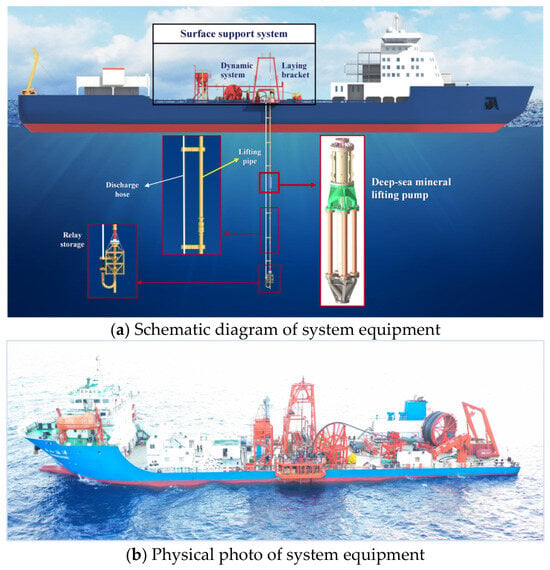
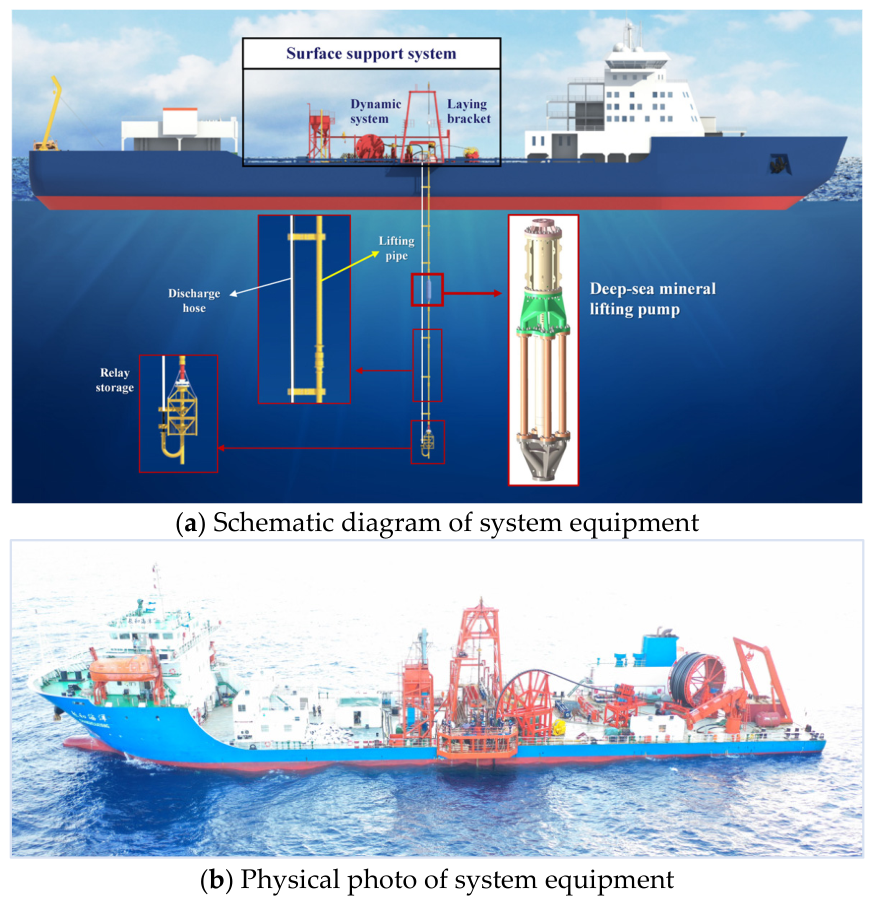
Mounted on the Changyuan vessel, the prototype deep-sea mineral lifting pump completed China’s first 500 m-class offshore sea trial of intelligent deep-sea mineral multi-phase transportation equipment at the South China Sea Xisha sea area (110°48.03′ E, 17°21.08′ N). As the core power facility of the multi-phase conveying system, the deep-sea mineral lifting pump ran continuously and stably for 56 h during the offshore test, with a maximum flow rate of 356.8 m3/h, a maximum pump efficiency of 72.4%, and a solid volume concentration of mineral particles of 11.7%. The offshore test system of the deep-sea mineral lifting pump is shown in Figure 1.
Figure 1.
Deep-sea mineral lifting pump sea test system equipment.
3. Methodology
3.1. Data Sources
Limited by the deep-sea operating environment, the monitoring of deep-sea mineral lifting pump operating conditions cannot adopt the real-time sampling and analysis scheme applied in onshore monitoring. As the core power component of deep-sea mining systems, the high-efficiency and stable operation of the deep-sea mineral lifting pump is essential for the whole equipment system.
The health status of the pump is determined by two aspects. First, pump efficiency is a critical indicator of hydraulic performance, and vibration reflects structural reliability. Therefore, pump efficiency and outlet radial vibration signals are selected to characterize the hydraulic performance and structural reliability of the deep-sea mineral lifting pump. Second, the wet stator motor serves as the pump’s power source, whose working state is evaluated by parameters such as temperature, power, insulation performance, and noise. Accordingly, shaft power and motor winding temperature are chosen to assess the operating health of the wet stator motor.
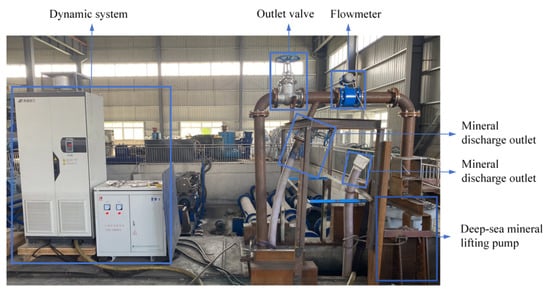
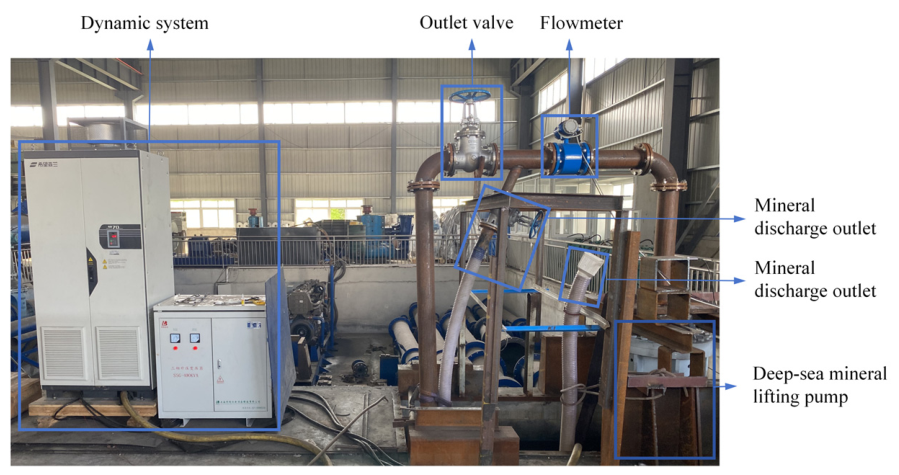
The controlled mineral circulation test bench for the prototype of the deep-sea mineral lifting pump is set up in the Solid–Liquid Two-Phase Flow Laboratory of the National Pump and System Engineering Technology Research Center. According to the national standard “Submersible Electric Pump Test Method (GB/T 12785-2014)”, the controlled mineral circulation test bench for the slurry pump prototype mainly consists of the mineral-controlled circulation pump pipe system, data acquisition system, and power system. The physical image of the test bench is shown in Figure 2.
Figure 2.
The onshore test bench of the deep-sea mineral lifting pump.
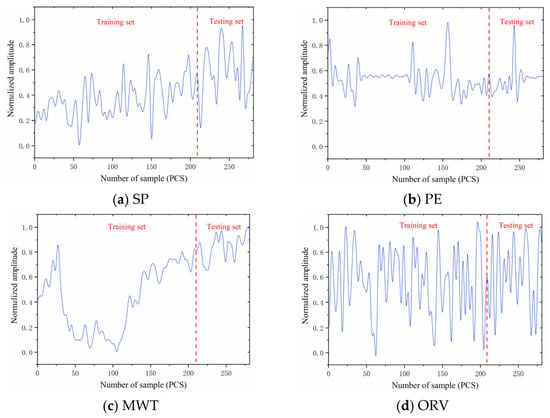
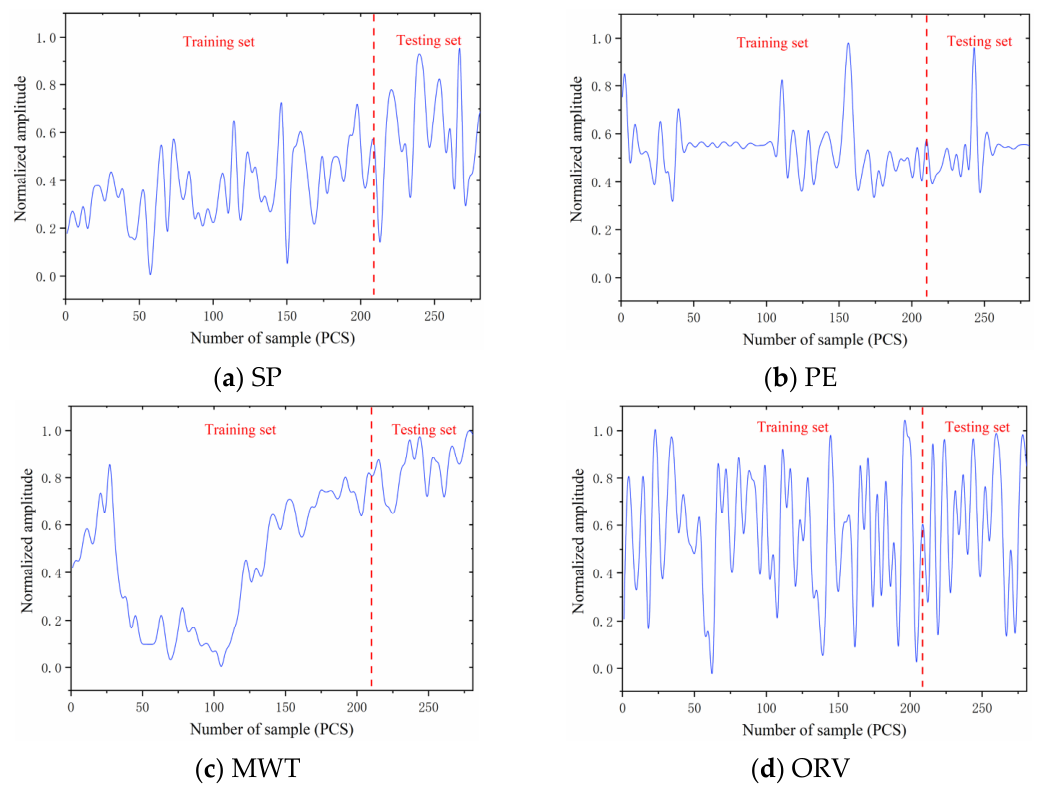
This study mainly performs operating condition prediction based on data collected from onshore tests of the deep-sea mineral lifting pump prototype. A hybrid CNN-LSTM prediction model is adopted to predict the health status with four time series signals of the pump, namely shaft power (SP), pump efficiency (PE), motor winding temperature (MWT), and outlet radial vibration (ORV), as shown in Figure 3. The sampling interval of the time series signals is 15 min, which means one prediction step corresponds to 15 min. The dataset is split into a training set and a test set at a ratio of 7:3, and normalization is implemented on the four groups of original data.
Figure 3.
Normalized time series signals of the deep-sea mineral lifting pump.
3.2. Preprocessing
To evaluate the performance of each model, four statistical indicators including R2, RMSE, MAE, and MAPE are employed to compare the prediction results. Their calculation formulas are given as follows:
where and denote the predicted value and the true value, respectively; is the average value of the original data.
Prediction models for each signal component are established using the LSTM neural network. The architecture of the LSTM prediction model mainly includes an input layer, an LSTM layer, a dropout layer, a fully connected layer, an L2 regularization layer, and a regression layer. Among them, the core functions of the dropout layer and L2 regularization layer are to prevent overfitting during network training.
In the training process of the LSTM model, important hyperparameters, such as the initial learning rate, the number of hidden layer neurons, and the dropout parameter, exert a significant influence on the prediction performance of the model. Therefore, this study takes the RMSE of the test set as the objective function and adopts an optimization algorithm to automatically optimize the hyperparameters. The hyperparameter search ranges are shown in Table 1.
Table 1.
Hyperparameter search ranges of the LSTM neural network.
3.3. Model Description
3.3.1. Convolutional Neural Network
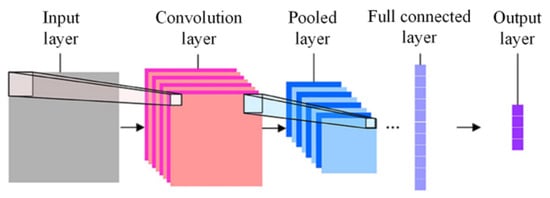
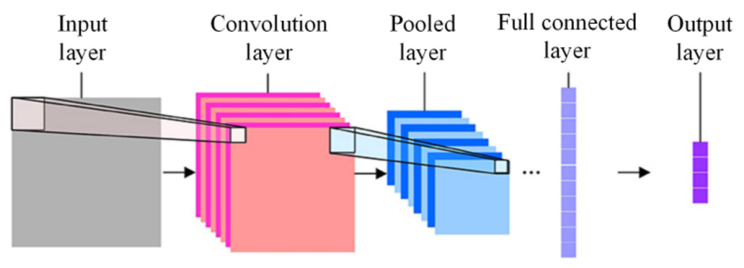
CNN is a deep learning model first proposed by Yann LeCun et al. in 1989 [19]. It has been widely applied in fields such as computer vision [20] and battery management [21] and achieves favorable performance in image recognition and other computer vision tasks. The structural schematic of the CNN is presented in Figure 4.
Figure 4.
CNN structure diagram.
Optimization algorithms are commonly adopted to tune network parameters during CNN training for accuracy improvement. The core of CNN lies in feature extraction and classification via convolutional layers, pooling layers, and fully connected layers. Its main components are summarized as follows:
- ①
- Convolutional Layer: As the core component of CNN, the convolutional layer extracts local features from input signals by convolution operations with convolution kernels. Each filter yields one feature map, and diverse features can be captured using different kernels.
- ②
- Activation Function: After convolution, activation functions are applied to conduct nonlinear transformation on signals and enhance the representation capability of networks. Typical activation functions include ReLU, Sigmoid, and Tanh.
- ③
- Pooling Layer: The pooling layer downsamples feature maps while retaining critical feature information. Max pooling and average pooling are two mainstream pooling operations.
- ④
- Fully Connected Layer: The fully connected layer flattens the feature maps output from pooling layers into one-dimensional vectors and completes classification or regression through full connection calculation.
3.3.2. Long Short-Term Memory
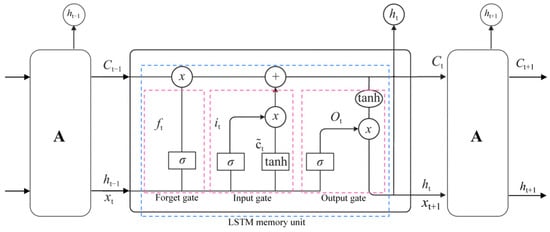
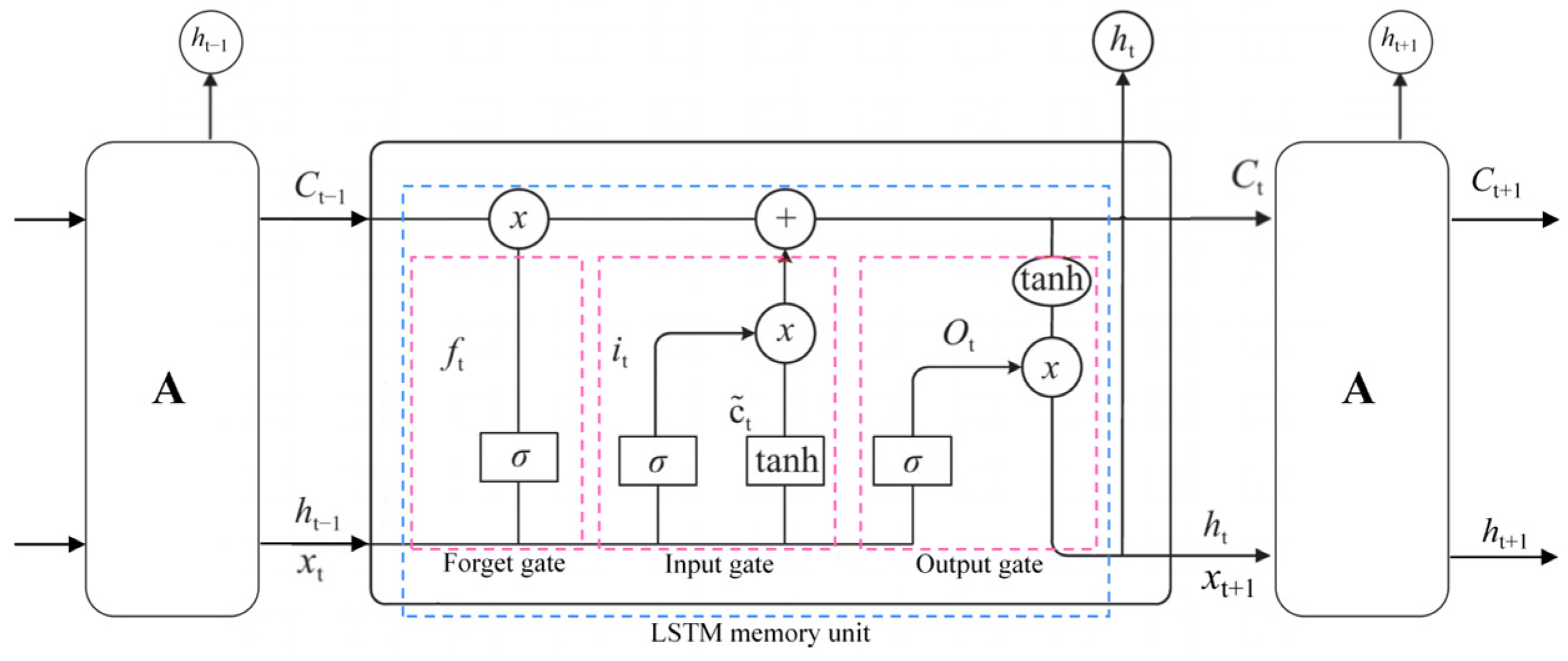
LSTM was first proposed by German computer scientists in 1997 [22]. Equipped with gated units and memory cells, LSTM alleviates the long-term dependency problem and has been widely adopted for time series prediction in machinery, electric power, finance, and other industries [23]. At each time step t, an LSTM cell is defined as a vector set in ℜd, consisting of the forget gate, input gate, cell state Ct, output gate, and hidden state ht. The structural schematic of the LSTM network is shown in Figure 5.
Figure 5.
LSTM network diagram.
3.3.3. LSTM Network
The implementation process of internal neurons in LSTM is as follows:
- ①
- Update the output of the forget gate: The forget gate controls whether to forget the previous hidden cell state with a certain probability, and its calculation formula is:
- ②
- Update the output of the input gate: The input gate supplements information after the forget gate discards redundant data and processes the input at the current time step. The sigmoid activation function yields it, while the Tanh activation function produces it. The product of these two outputs determines the update amount of the cell state, and its computational formulas are expressed as:
- ③
- Update the cell state: The cell state stores historical information. The outputs from the forget gate and input gate act on the cell state via element-wise multiplication, and the corresponding calculation formula is:
- ④
- Update the output of the output gate: The output gate screens information to generate the final hidden output, and its calculation formula is:
- ⑤
- Update the predicted output at the current time step: As a special variant of recurrent neural network (RNN), LSTM introduces cell states on the basis of standard RNN cells to store key information, discard invalid data, and transmit memory information from the start to the end of the sequence. Although LSTM overcomes some drawbacks of conventional RNN, it still has two limitations. First, calculations are executed sequentially along the time dimension; when the length of time series increases drastically, gradient vanishing and gradient explosion may still occur. Second, its serial computation pattern leads to difficult model training and high hardware requirements.
3.3.4. Radial Basis Function
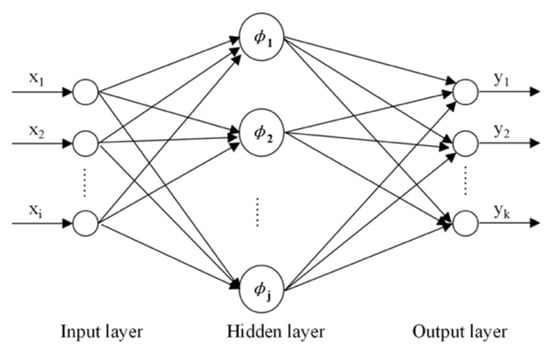
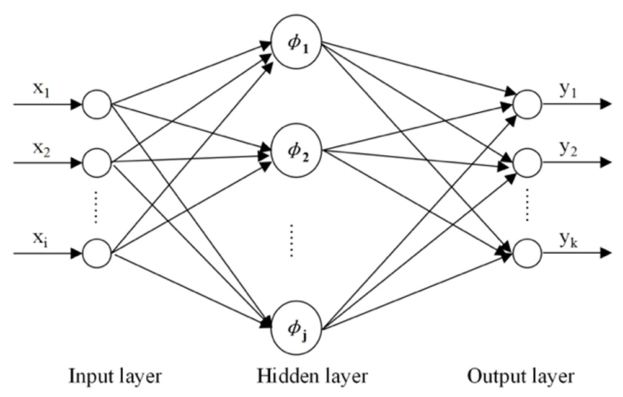
Radial Basis Function (RBF) Neural Network is a kind of feedforward neural network consisting of three typical layers: input layer, hidden layer, and output layer. Distinguished from other neural networks, the RBF Neural Network adopts Radial Basis Function as its activation function. The hidden layer receives data from the input layer via nonlinear transformation. Weights are set between the hidden layer and the output layer; after being processed by Radial Basis Functions in the hidden layer, data are transmitted to the output layer through connection weights. Its network structure is shown in Figure 6.
Figure 6.
RBFNN structure diagram.
The input layer transmits input data to the hidden layer. If i sample vectors are fed into the input layer, the number of input nodes equals i. The hidden layer consists of several RBF neurons, whose quantity is determined according to practical requirements; equipped with radial basis activation functions, it maps input vectors into a high-dimensional space. The output layer receives the transformed data from the hidden layer, and the final output is obtained via linear weighted summation of outputs from all hidden-layer nodes.
3.3.5. Health State Prediction Model of the Pump Based on CNN-LSTM
The proposed hybrid CNN-LSTM model possesses 128.6 k parameters and 0.34 GFLOPs, outperforming deep multi-layer LSTM and stacked CNN models. Evaluated on low-power Raspberry Pi 4B for offshore pump monitoring, it delivers 18.7 ms single-sample inference, 142.3 MB peak memory, and 53 samples/s throughput. Benefiting from shallow convolution and optimized single-layer LSTM, it suppresses redundant computation and runs stably on memory-constrained edge hardware, verifying its practicality for on-site predictive maintenance of deep-sea mineral lifting pumps.
The reconstructed signals are fed into CNN for feature extraction. As a deep network built upon convolution operations, CNN exhibits powerful representation capability for spatial data. The operating condition of the deep-sea mineral lifting pump evolves gradually following a nonlinear dynamic process. To accurately characterize such nonlinear evolution, LSTM is adopted to predict pump operating states. Capable of dynamically memorizing historical information, LSTM has achieved satisfactory performance in numerous fields including predictive early warning of nuclear main pumps and trajectory forecasting. When applied to the original monitoring data, LSTM learns new features while retaining historical data information, making full use of its inherent superiority in time series analysis for the time-sequential prediction of mixed pump operating conditions [24].
The LSTM model is adopted for the sea trial state prediction of deep-sea mineral lifting pumps to model the feature sequences extracted and reconstructed by CNN. By learning the time series of pump test data features and the nonlinear process of state evolution, the model can more accurately predict the future values of state characteristic parameters for deep-sea mineral lifting pumps.
The constructed CNN-LSTM model can be divided into two parts: the CNN part and the LSTM part. The former is used for low-level representation and extraction of feature information from reconstructed vectors, which serves as the input of LSTM. The latter receives the output features extracted by CNN, and accurately captures time series features using its temporal memory characteristic to predict the future state of deep-sea mineral lifting pumps and generate prediction results.
The main process of the CNN-LSTM model for predicting the future state values of operating characteristic parameters of deep-sea mineral lifting pumps is as follows:
- ①
- The CNN takes one-dimensional time series data as input and employs one or more convolutional layers to extract local patterns contained in the input data. A convolution kernel with fixed size slides over the sequential input data, and high-dimensional feature information is extracted via the convolution function shown in Formula (5). An activation function is introduced to add nonlinearity, followed by a pooling layer to screen dominant features. Afterwards, a fully connected layer converts the processed data into a fixed-length vector, and a time series containing high-dimensional feature information is finally output.
- ②
- The LSTM module takes the time series output from CNN as its input. To tackle the long-distance dependency problem, LSTM introduces a gating mechanism and significantly improves the data representation capability. In this paper, parameter regularization (weight decay) is adopted by adding a regularization term to the objective function to pull weights closer to the origin via weight attenuation. The computational formula of the optimized objective function with weight decay is expressed as:
- ③
- Training of the CNN-LSTM prediction model: The dataset is first divided into a training set and a test set. The prediction model is trained on the training data to extract temporal features of the evolution of reconstructed phase-space data.
- ④
- After the CNN-LSTM model is well trained, the test set is fed into the model to obtain prediction results.
- ⑤
- Evaluate the prediction accuracy obtained in Step ④. If the accuracy exceeds the preset threshold, proceed to next step; otherwise return to Step ③ and repeat the training until model convergence is achieved.
This study applies the well-trained model to perform one-step-ahead prediction of the deep-sea mineral lifting pump’s operating condition. This study adopts a rolling prediction strategy without training separate models for different horizons. Specifically, the same CNN-LSTM model first predicts the next step using real historical data; this prediction is then treated as a valid observation, appended to the input window, and used to replace the oldest reading for subsequent inference. This process repeats iteratively until the 3rd or 5th step ahead is reached.
4. Results and Discussion
4.1. Ablation Study
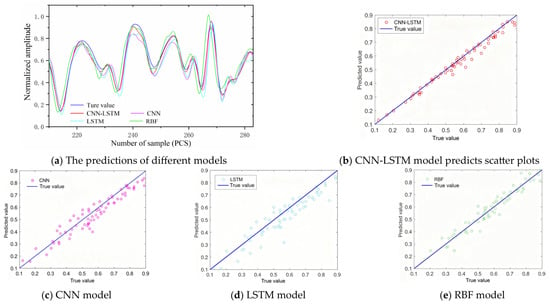
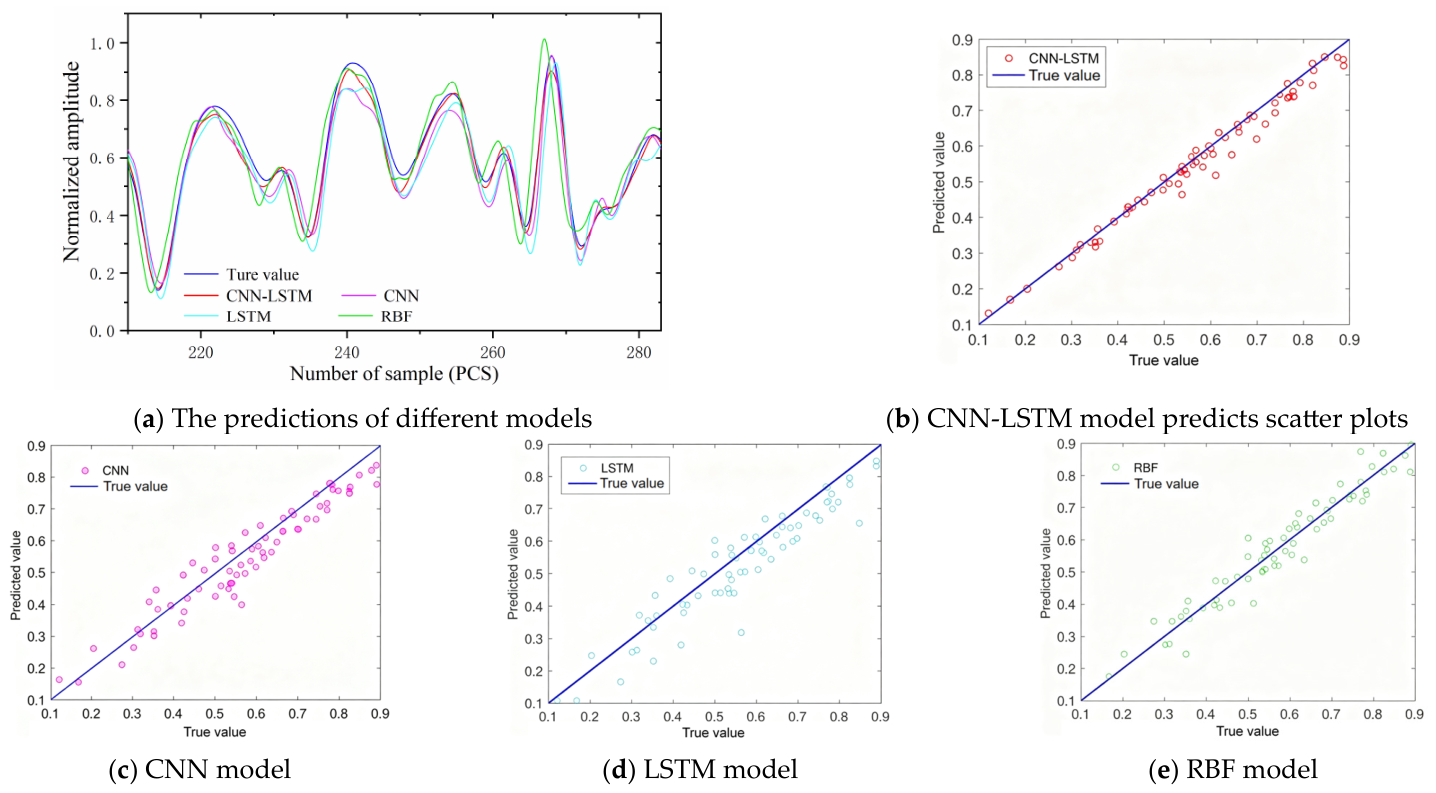
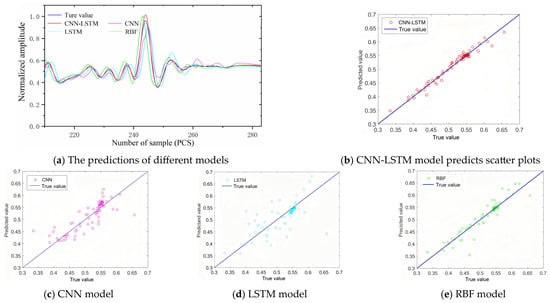
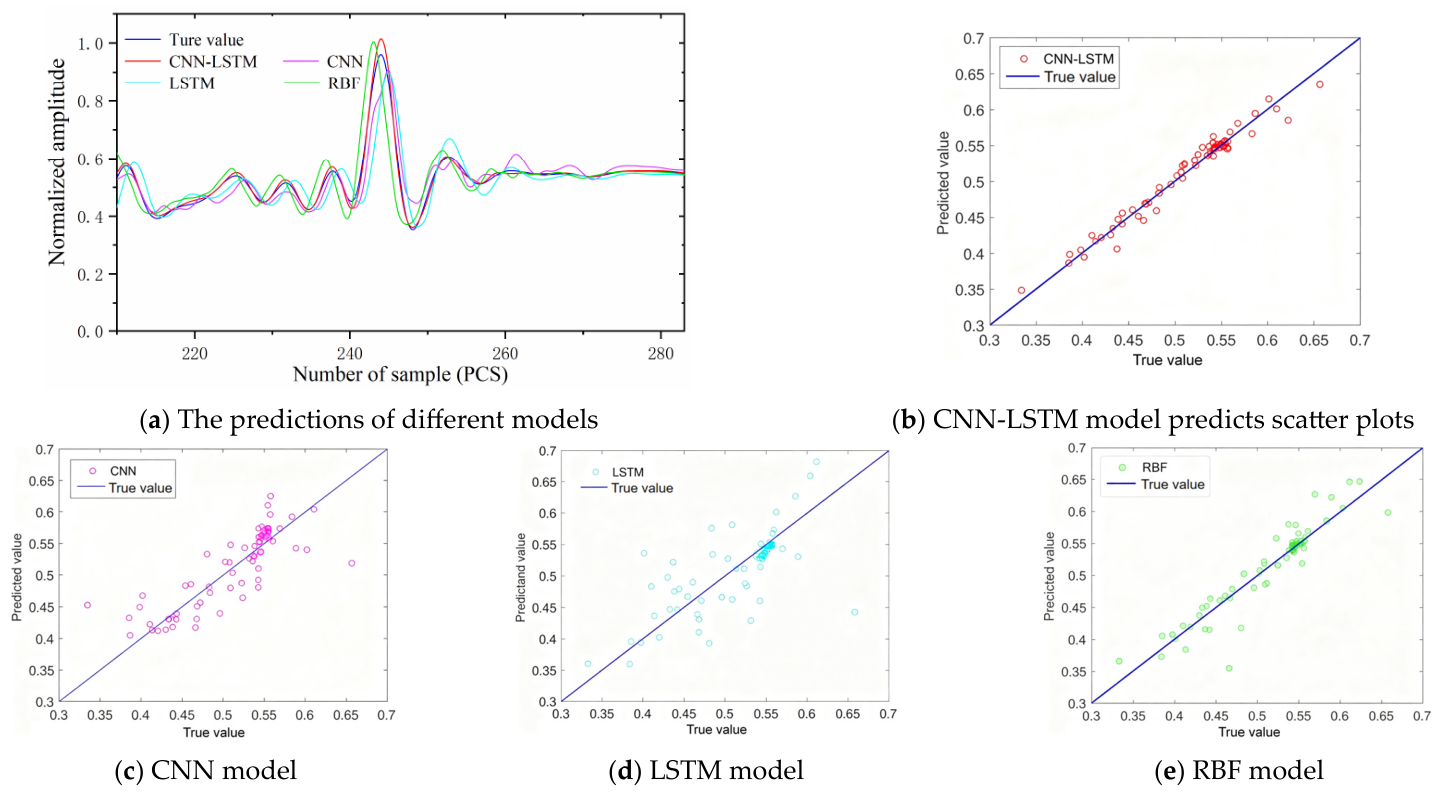
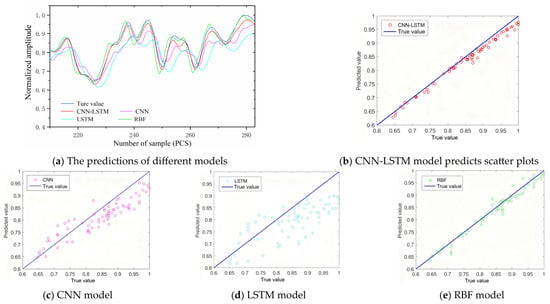
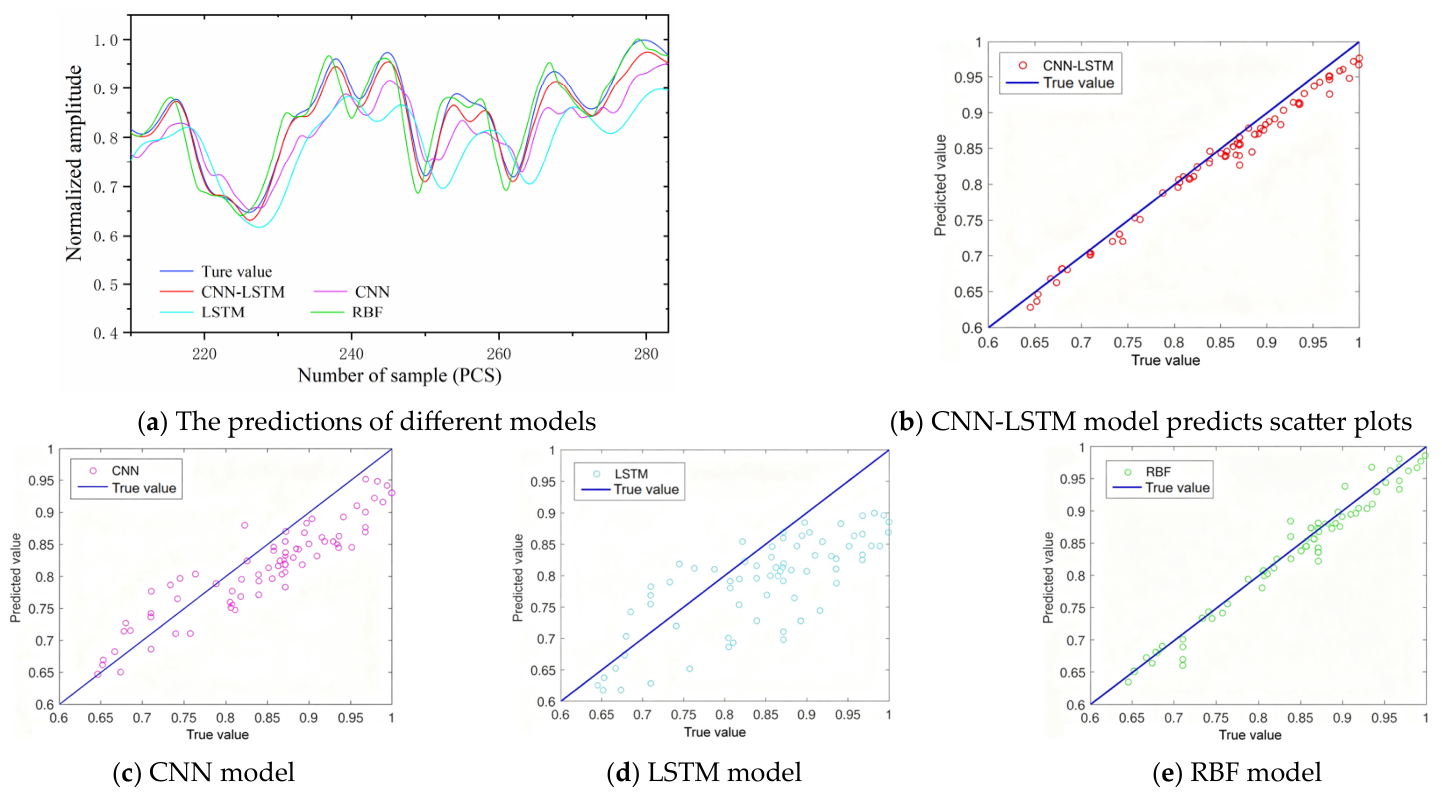
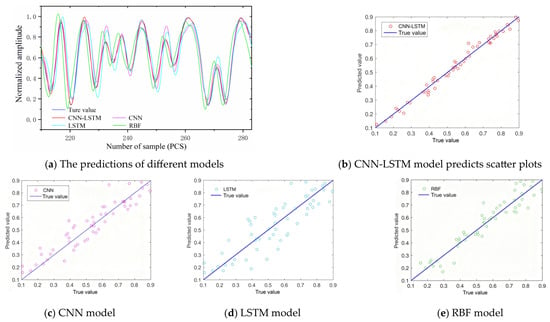
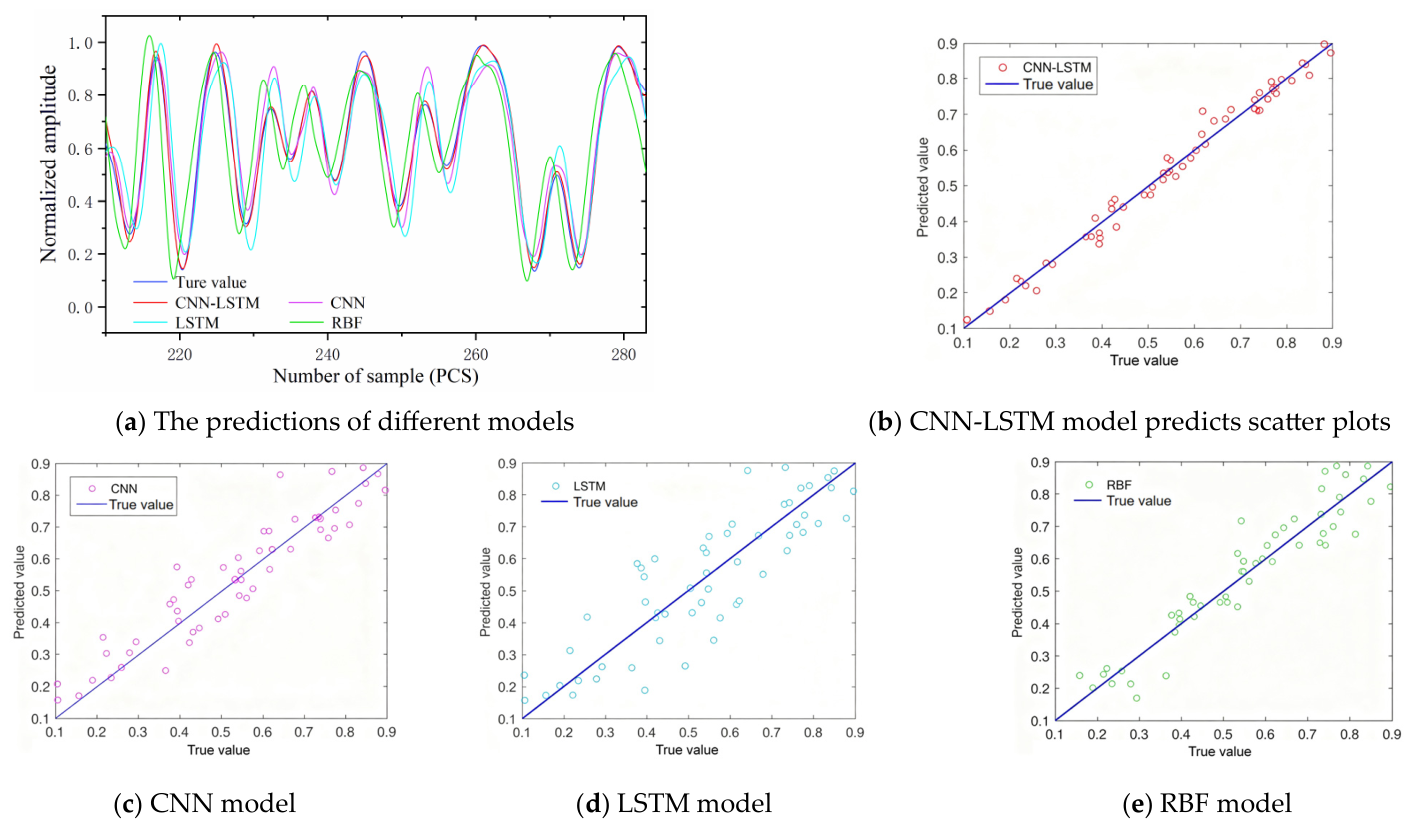
To highlight the superiority of the hybrid CNN-LSTM prediction model, comparative experiments are performed with the CNN, LSTM, and RBF models, which are employed for one-step-ahead prediction on four groups of time series signals of the deep-sea mineral lifting pump. The prediction comparison results and scatter diagrams of all models are presented in Figure 7, Figure 8, Figure 9 and Figure 10, and Table 2 lists the quantitative performance indicators of one-step-ahead prediction for four sets of pump time series data across different models.
Figure 7.
Comparison of the prediction results of different models for SP 1 step ahead.
Figure 8.
Comparison of the prediction results of different models for PE 1 step ahead.
Figure 9.
Comparison of the prediction results of different models for MWT 1 step ahead.
Figure 10.
Comparison of the prediction results of different models for ORV 1 step ahead.
Table 2.
Prediction performance results of different models: 1 step ahead.
4.2. Prediction Results
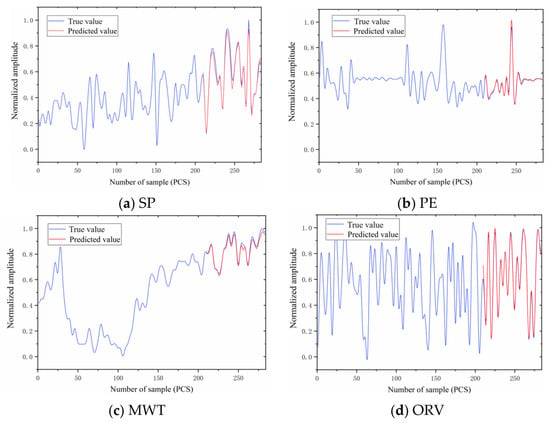
Figure 11 presents the one-step-ahead state prediction results obtained by the CNN-LSTM model. As illustrated, the predicted values of the deep-sea mineral lifting pump closely fit the corresponding true values. Even for hard-to-predict inflection points in pump efficiency and motor winding temperature datasets, as well as regions with drastic amplitude fluctuations in shaft power and outlet radial vibration datasets, the predicted values can effectively track the dynamic trends and amplitude variations of the time series data in general. The results demonstrate that the proposed CNN-LSTM model is capable of accurate one-step-ahead prediction for the time series state signals of the deep-sea mineral lifting pump.
Figure 11.
The prediction results of time series signals: 1 step ahead.
4.3. Comparison and Analysis of Prediction Results Among Different Models
As shown in Figure 7a, on the whole, the predicted values of all models match the true values well in both trend and magnitude, and each time series prediction model can accurately forecast the shaft power of the deep-sea mineral lifting pump. Nevertheless, evident discrepancies can be observed from the scatter plots in Figure 7b: the CNN-LSTM model outperforms other alternatives in prediction accuracy, though the superiority is not prominent. A further comparison of evaluation metrics in Table 2 reveals that CNN-LSTM achieves slightly better prediction performance than the other three models.
The prediction results for motor winding temperature in Figure 9 fully demonstrate the outstanding performance of the CNN-LSTM model, which fits the true time series data more precisely than the other three methods. Similar conclusions can be drawn from the remaining two groups of prediction cases.
Two rounds of 24 h cyclic tests were carried out during the offshore sea trial of the deep-sea mineral lifting pump prototype. The actual runtime of the first test was 28 h and 52 min, while the second lasted 27 h and 16 min. During the sea trial, the operating parameters of the pump prototype were collected via the test system. The measured data of shaft power, pump efficiency, motor winding temperature, and radial vibration from the second 24 h cyclic test were selected as research objects for operating condition prediction. The sampling interval was set to 15 min, generating a total of 109 valid data samples throughout the 27 h 16 min test period.
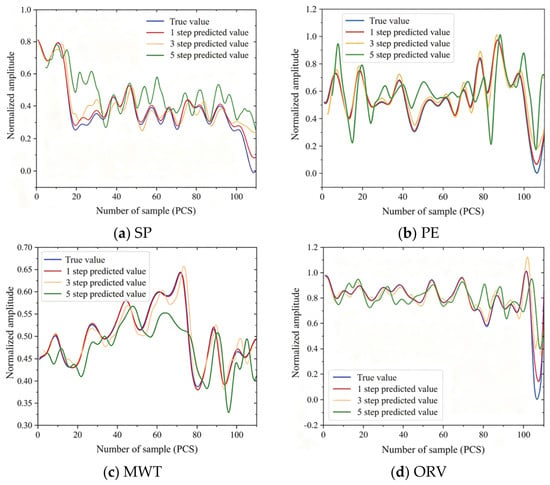
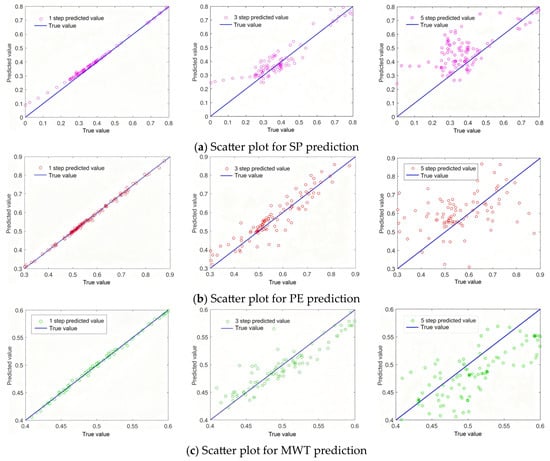
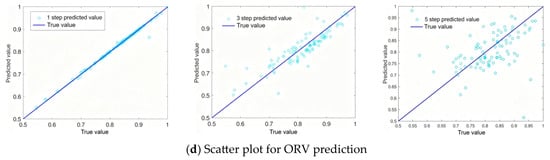
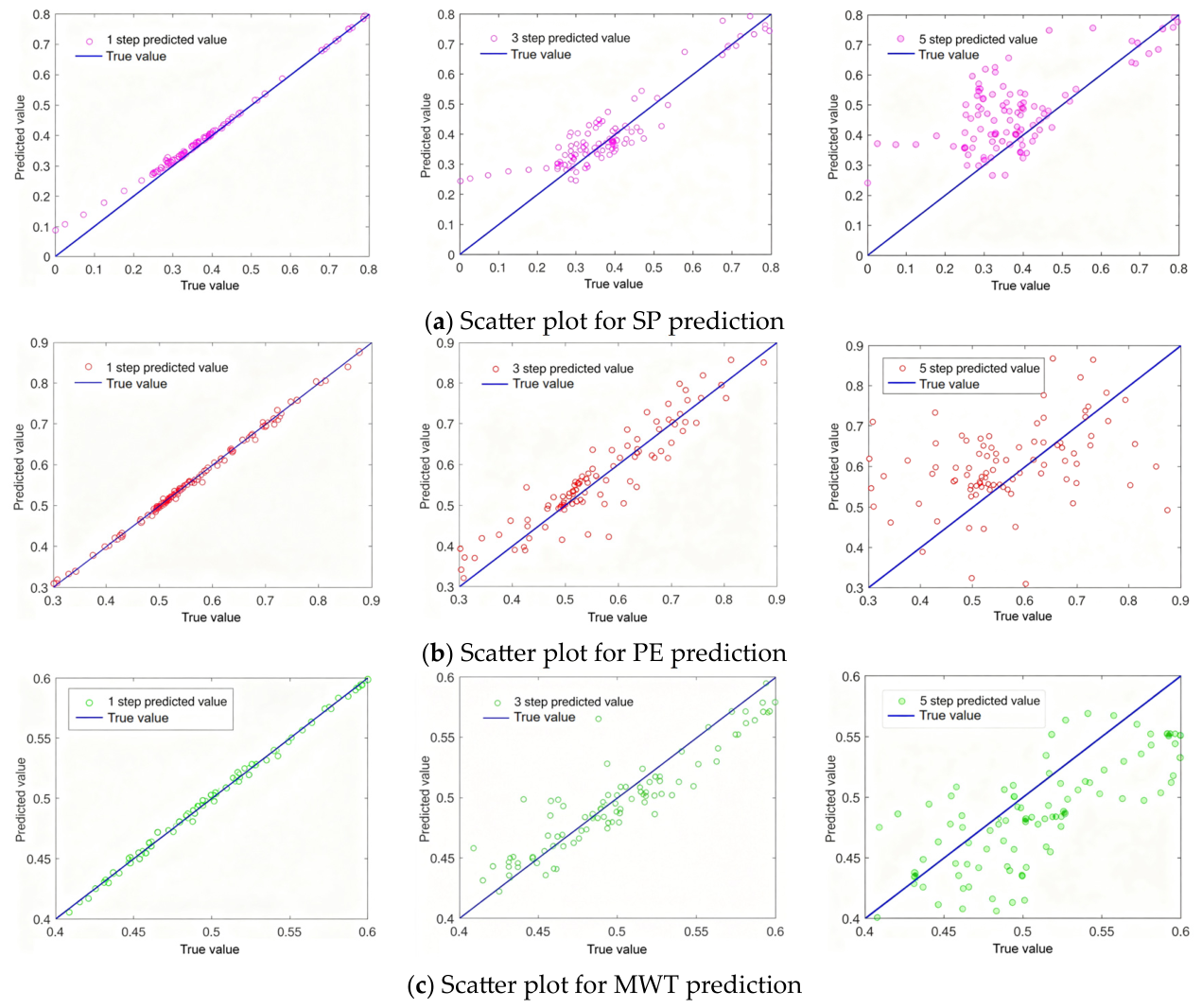
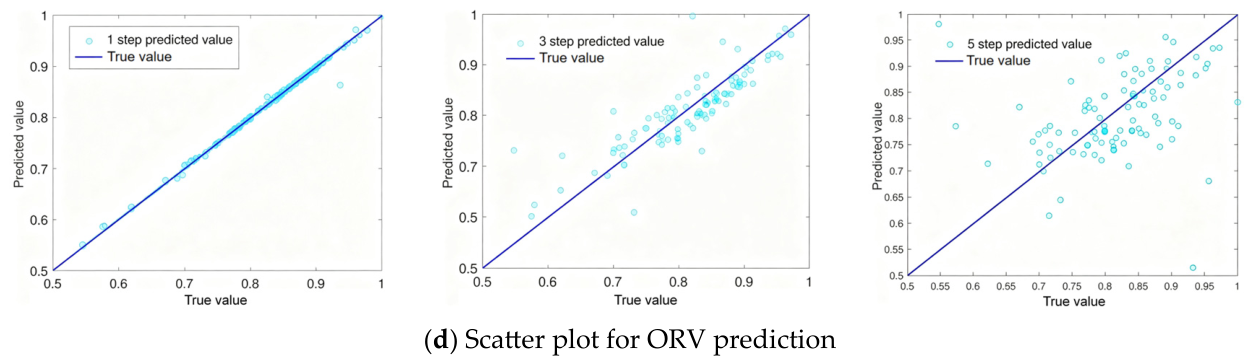
The prediction results for offshore operating conditions of the deep-sea mineral lifting pump prototype based on the CNN-LSTM model are illustrated in Figure 12 and Figure 13. For one-step-ahead prediction of the four groups of parameters, the coefficient of determination for all datasets exceeds 0.95, which indicates a favorable fitting effect and high prediction accuracy. As the prediction step size increases, the prediction accuracy declines gradually, yet the model can still capture the overall changing trend effectively. The prediction performance under different forecast horizons is summarized in Table 3.
Figure 12.
Prediction results of sea trial operation of deep-sea mineral lifting pump prototype.
Figure 13.
Multi-step prediction scatter plot.
Table 3.
Different steps predict performance.
The discussion and analysis based on the above content are as follows:
- ①
- This study explicitly interprets why CNN-LSTM outperforms all benchmarks: The CNN branch extracts local abrupt noise features from low-frequency offshore pump signals, while the optimized single-layer LSTM captures long-term degradation trends; the two modules complement each other to address the inherent drawbacks of single models, namely weak denoising capability or insufficient long-sequence fitting performance.
- ②
- This study links the performance superiority of the model to unique sea trial signal characteristics (15 min sparse sampling, wave interference, and multi-index coupled abrupt peaks), verifying that the hybrid structure is tailor-made for such monitoring data.
- ③
- This study supplemented systematic analysis covering the model’s core strengths, minor application limitations, and practical implications for on-site predictive maintenance, thereby enhancing the manuscript’s scientific depth and engineering value.
5. Conclusions
To accurately monitor the health status of the deep-sea mineral lifting pump, four characteristic indicators were selected, and a lightweight CNN-LSTM hybrid model with globally optimized hyperparameters was established. Validation on onshore data confirms its feasibility, and comparative experiments demonstrate its superiority over single CNN, LSTM, and RBF models in one-step accuracy and trend fitting, while maintaining a compact size suitable for edge deployment. Prediction performance is horizon-dependent: the model achieves reliable short-term forecasts but exhibits considerable degradation at the five-step horizon (e.g., R2 = 0.0974 for PE, MAPE = 40.709% for MWT) due to recursive error accumulation and signal nonlinearity. Therefore, the proposed model is best suited for real-time health monitoring on low-power edge devices, with five-step outputs serving strictly as coarse trend references rather than precise forecasts.
This study verifies that the CNN-LSTM model delivers satisfying predictions on sparse, noisy offshore pump data, albeit with limitations. The dataset in this study covers data under regular sea conditions but lacks storm surge records and marine environmental features. Future work will construct models that optimize fault warning thresholds and integrate marine environmental features and multi-source signals.
Author Contributions
Conceptualization, Z.C. and K.W.; methodology, H.T.; software, Z.C.; resources, R.Z. and X.Y.; validation, K.W.; formal analysis, K.W.; investigation, H.T.; writing—original draft, Z.C.; writing—review and editing, H.T. and R.Z.; supervision, K.W. and R.Z. All authors have read and agreed to the published version of the manuscript.
Funding
This research was funded by the Zhenjiang Key Laboratory for Intelligent Collaboration, Integration and Application of Industrial Internet (No. SS2025007), the Science and Technology Plan Project of Zhenjiang City of China (GY2025040), the Natural Science Foundation of Jiangsu Province (BK20250880), and the Fourth Batch of Scientific Research Teams of Zhenjiang College (GZKYTD2025001).
Data Availability Statement
The raw data supporting the conclusions of this article will be made available by the authors upon request.
Conflicts of Interest
Author Xiao Yuan is employed by the company Jiangsu Zhenhua Haike Equipment Technology Co., Ltd. The remaining authors declare that the research was conducted in the absence of any commercial or financial relationships that could be construed as a potential conflict of interest.
References
- Vadakkepuliyambatta, S.; Roy, P.; Ingole, B.S.; Raju, K.A.K.; Kurian, P.J.; Meloth, T. Potential of deep-sea mineral resources for the blue economy. Curr. Sci. 2024, 126, 192–199. [Google Scholar] [CrossRef] [Scilit]
- Du, K.; Xi, W.; Huang, S.; Zhou, J. Deep-sea Mineral Resource Mining: A Historical Review, Developmental Progress, and Insights. Min. Metall. Explor. 2024, 41, 173–192. [Google Scholar] [CrossRef] [Scilit]
- Hu, Q.; Li, Z.; Zhai, X.; Zheng, H. Development of Hydraulic Lifting System of Deep-Sea Mineral Resources. Minerals 2022, 12, 1319. [Google Scholar] [CrossRef] [Scilit]
- Cheng, Z.; Liu, H.; Zhang, R.; Kim, H.-B.; Dong, L.; Wang, X.; Zhou, R. Energy characteristics of a deep-sea mining pump under solid-phase interaction. Ocean Eng. 2024, 311, 118835. [Google Scholar] [CrossRef] [Scilit]
- Li, X.; Lin, D.; Xu, M.; Liu, W.; Gu, H. A multi-objective optimization framework for the global configuration of vertical transportation system in deep-sea mining. Ocean Eng. 2026, 343, 123250. [Google Scholar] [CrossRef] [Scilit]
- Hu, Q.; Feng, J.; Kang, Y.; Liu, S.; Huang, J.; Wang, K. Research on the Scheme and System Parameter Matching of a Wastewater-Driven Diaphragm Pump Group for Slurry Transport in Deep-Sea Mining. J. Mar. Sci. Eng. 2025, 13, 1934. [Google Scholar] [CrossRef] [Scilit]
- Huang, S.-C.; Tsay, R.S. Time Series Forecasting with Many Predictors. Mathematics 2024, 12, 2336. [Google Scholar] [CrossRef] [Scilit]
- Chomiak, T.; Hu, B. Time-series forecasting through recurrent topology. Commun. Eng. 2024, 3, 9. [Google Scholar] [CrossRef] [Scilit]
- Xu, W.-H.; Li, C.-H.; Xu, P.-M.; Wang, W.; Zhang, Y.-B.; Yang, M.; Cui, X.; Li, B.-K.; Liu, M.-Z.; Gao, T.; et al. Grinding mechanics of ceramics: From mechanism to modeling. Adv. Manuf. 2026, 14, 4–42. [Google Scholar] [CrossRef] [Scilit]
- Xu, Y.; Xia, M.; Hu, K.; Zhou, S.; Weng, L. Style Transfer Review: Traditional Machine Learning to Deep Learning. Information 2025, 16, 157. [Google Scholar] [CrossRef] [Scilit]
- Zhang, H.; Hu, H.; Zhou, D.; Cao, B.; Zhang, X. Feature Diversity Learning for a Compact CNN Module. IEEE Trans. Emerg. Top. Comput. Intell. 2026, 10, 181–190. [Google Scholar] [CrossRef] [Scilit]
- Dhake, H.; Kashyap, Y.; Kosmopoulos, P. Algorithms for Hyperparameter Tuning of LSTMs for Time Series Forecasting. Remote Sens. 2023, 15, 2076. [Google Scholar] [CrossRef] [Scilit]
- Yang, F.; Hao, X.; Yang, J.; Sun, X.; Gao, Y.; Zhang, Y. Track Condition Evaluation for Multi-vehicle Performance Prediction Model Based on Convolutional Neural Network and Gated Recurrent Unit. J. Southwest Jiaotong Univ. 2023, 58, 322–331. [Google Scholar]
- Hu, G.; Sun, M.; Zhang, C. A High-Accuracy Advanced Persistent Threat Detection Model: Integrating Convolutional Neural Networks with Kepler-Optimized Bidirectional Gated Recurrent Units. Electronics 2025, 14, 1772. [Google Scholar] [CrossRef] [Scilit]
- Kong, Y.; Ge, Y.; Guo, Z. A Lightweight Denoising Network with TCN-Mamba Fusion for Modulation Classification. Electronics 2026, 15, 188. [Google Scholar] [CrossRef] [Scilit]
- Lim, B.; Arık, S.Ö.; Loeff, N.; Pfister, T. Temporal Fusion Transformers for interpretable multi-horizon time series forecasting. Int. J. Forecast. 2021, 37, 1748–1764. [Google Scholar] [CrossRef] [Scilit]
- Jebari, O.; Jin, C.; Kang, B.; Hong, S.H.; Lee, C.; Jeon, Y.H. Motion Prediction of Moored Platform Using CNN-LSTM for Eco-Friendly Operation. J. Mar. Sci. Eng. 2026, 14, 531. [Google Scholar] [CrossRef] [Scilit]
- Wu, X.; Xie, P.; Chen, S.; Zhang, J. A hybrid CNN-LSTM framework for spatiotemporal prediction of dynamic power cable behaviors. Ocean Eng. 2026, 343, 123475. [Google Scholar] [CrossRef] [Scilit]
- LeCun, Y.; Boser, B.; Denker, J.S.; Henderson, D.; Howard, R.E.; Hubbard, W.; Jackel, L.D. Backpropagation applied to handwritten zip code recognition. Neural Comput. 1989, 1, 541–551. [Google Scholar] [CrossRef] [Scilit]
- Liu, R.; Meng, G.; Yang, B.; Sun, C.; Chen, X. Dislocated time series convolutional neural architecture: An intelligent fault diagnosis approach for electric machine. IEEE Trans. Ind. Inform. 2016, 13, 1310–1320. [Google Scholar] [CrossRef] [Scilit]
- Shen, S.; Sadoughi, M.; Chen, X.; Hong, M.; Hu, C. A deep learning method for online capacity estimation of lithium-ion batteries. J. Energy Storage 2019, 25, 100817. [Google Scholar] [CrossRef] [Scilit]
- Hochreiter, S.; Schmidhuber, J. Long short-term memory. Neural Comput. 1997, 9, 1735–1780. [Google Scholar] [CrossRef] [Scilit] [PubMed]
- Zhang, Z.; Ye, L.; Qin, H.; Liu, Y.; Wang, C.; Yu, X.; Yin, X.; Li, J. Wind speed prediction method using shared weight long short-term memory network and Gaussian process regression. Appl. Energy 2019, 247, 270–284. [Google Scholar] [CrossRef] [Scilit]
- Song, S.; Huang, H.; Ruan, T. Abstractive text summarization using LSTM-CNN based deep learning. Multimed. Tools Appl. 2019, 78, 857–875. [Google Scholar] [CrossRef] [Scilit]

Disclaimer/Publisher’s Note: The statements, opinions and data contained in all publications are solely those of the individual author(s) and contributor(s) and not of MDPI and/or the editor(s). MDPI and/or the editor(s) disclaim responsibility for any injury to people or property resulting from any ideas, methods, instructions or products referred to in the content. |
© 2026 by the authors. Licensee MDPI, Basel, Switzerland. This article is an open access article distributed under the terms and conditions of the Creative Commons Attribution (CC BY) license.