


Abstract
Spectral degradation disrupts the rapid, incremental processes that support spoken word recognition, but most studies quantify endpoint accuracy rather than the time course of lexical access, and the extent to which cognitive resources compensate for this disruption remains unclear. This study examined the influence of spectral resolution and cognition on lexical access using a gated word recognition paradigm. Thirty adults with normal hearing identified monosyllabic words presented in progressively longer fragments under full-spectrum and 8-channel sine-wave vocoded conditions. Isolation points (IPs), the shortest segment required for stable identification, were measured. Speech perception was assessed using vocoded AzBio sentences in quiet and noise (+10 dB and +5 dB SNR) and vocoded Consonant-Nucleus-Consonant (CNC) words in quiet. Working memory and executive function were evaluated using the Abbreviated Reading Span Test and Trail Making Test. Full-spectrum speech supported efficient lexical access, whereas vocoded speech required nearly complete word information (62.7% vs. 98.9% of word duration), indicating severe delays in incremental processing. Near-ceiling CNC and AzBio scores in quiet did not correlate with IPs, but IPs were strongly associated with AzBio performance in noise. Cognitive measures were intercorrelated but not significantly associated with IPs or speech perception scores after correction for multiple comparisons, although the sample was powered to detect only large associations. These findings suggest that the efficiency of incremental lexical access under spectral degradation captures variability in speech-in-noise perception that is not evident in endpoint accuracy in quiet.
1. Introduction
Successful speech comprehension in challenging listening environments relies on rapid and efficient processing of the acoustic signal. Spoken word recognition unfolds incrementally and in parallel. As speech proceeds, listeners activate a cohort of lexical candidates and suppress those that are inconsistent with the incoming signal [1,2]. Under favorable acoustic conditions, this process is fast and largely automatic and often resolves the target before its acoustic offset [1,2,3]. When the signal is degraded, lexical access slows, competition among candidates increases, and listeners rely more heavily on compensatory linguistic or cognitive mechanisms.
The word gating paradigm provides a direct measure of the temporal dynamics of lexical processing [4,5]. Unlike traditional accuracy-based measures, gating focuses on the timing of lexical decisions. In this paradigm, a word is presented in progressively longer acoustic segments, or “gates,” beginning with a brief initial fragment. After each gate, the listener provides their best guess for the word. The key metric derived from this task is the Isolation Point (IP), defined as the shortest acoustic segment required for correct identification that remains stable across the subsequent gates (three in the present study). The IP thus reflects the minimum amount of acoustic information needed to reduce the lexical cohort to a single viable candidate [6,7,8,9,10,11,12,13].
Under conditions of full acoustic fidelity, listeners with normal hearing (NH) typically reach IPs quickly, often after hearing just over half of the word’s duration [7,8]. This efficiency reflects an interactive process in which bottom-up acoustic–phonetic information is continuously mapped onto lexical representations, while top-down linguistic knowledge constrains lexical competition. When the acoustic signal is degraded, however, this dynamic mapping process is disrupted. Vocoded speech, commonly used to simulate the reduced spectral and temporal resolution of CI processing, restricts access to fine-grained phonetic detail [14,15,16,17,18,19], delaying the point at which lexical candidates can be confidently differentiated [20,21]. Consequently, CI users and NH listeners exposed to vocoded speech exhibit later IPs, reflecting impaired access to early acoustic cues that normally drive rapid lexical disambiguation [11,12,17,18,22,23]. This breakdown in real-time lexical processing highlights the broader consequences of signal degradation for speech understanding, setting the stage for examining how listeners compensate when automatic, bottom-up mechanisms are insufficient.
As the acoustic signal becomes increasingly degraded, listeners are forced to rely less on automatic, bottom-up phonetic cues and more on compensatory mechanisms to resolve lexical ambiguity [24]. Such degradation places additional demands on cognitive systems that support speech processing, particularly under conditions where automatic, bottom-up mechanisms are insufficient [25]. These increased processing demands raise an important question: what cognitive resources support successful word recognition when the acoustic input is inadequate? To address this, researchers have turned to domain-general cognitive mechanisms, specifically Working Memory (WM) and Executive Function (EF), which are known to facilitate speech comprehension under adverse listening conditions [26,27,28].
WM enables listeners to maintain and manipulate information during effortful listening, often assessed through complex span tasks like the Reading-Span test [29]. According to the ease of language understanding (ELU) model, mismatches between incoming speech and stored phonological representations trigger WM-based processing, facilitating comprehension in adverse listening conditions [24,25]. Research consistently shows that individuals with greater WM capacity perform better in speech-in-noise tasks, highlighting its role in managing increased processing demands [25,28,30,31,32]. Gated word recognition studies reveal that individuals with higher WM capacity identify words in noise more rapidly, requiring less of the signal to reach the IPs [6,9]. This suggests that WM facilitates lexical access when bottom-up cues are masked, enabling listeners to maintain and test hypotheses about word identity. In contrast, under optimal listening conditions, word recognition proceeds more automatically and shows minimal reliance on WM resources [6,8,9]. While vocoded speech has been extensively used to simulate CI processing and examine delays in lexical activation, the role of WM in gated word recognition under such degraded conditions remains underexplored. Given the profound disruption to fine-grained phonetic detail in vocoded input, it is unclear whether domain-general cognitive mechanisms like WM support lexical access in CI users as they do in NH listeners exposed to noise.
Beyond WM, EF represents another critical cognitive resource that may facilitate speech understanding when perceptual information is limited. EF encompasses higher-order cognitive processes such as inhibition, cognitive flexibility, and task switching, which enable listeners to regulate attention, suppress irrelevant input, and adapt to fluctuating listening demands [27,28,33,34]. EF is often assessed using tasks such as the Trail Making Test (TMT), which measures cognitive flexibility and the efficiency of set-shifting abilities [35]. Stronger EF has been associated with better speech-in-noise perception [36,37,38], particularly in situations requiring rapid adaptation to competing talkers or fluctuating maskers [39,40,41,42,43,44]. Despite this, EF’s contribution to gated word recognition remains unexplored. Conceptually, both EF and gated word recognition rely on domain-general controlled processing: EF manages attention and inhibitory control during lexical competition, while gating measures the dynamics of incremental lexical access. Thus, stronger EF may allow listeners to more efficiently resolve competition as speech unfolds, especially under degraded or ambiguous conditions. Given that vocoded speech disrupts fine-grained phonetic cues and increases lexical uncertainty, EF may be particularly critical for suppressing competing interpretations, paralleling the compensatory role of WM.
Although spectral degradation is known to delay IPs [12,13,22], three questions remain open. First, previous gating studies have used vocoders whose noise carriers distort the temporal envelope, so the delays they report cannot be attributed specifically to reduced spectral detail. Second, links between cognition and gated word recognition have been reported mainly for speech in noise and in older listeners with hearing loss [6,8,9]; whether WM or EF is related to incremental lexical access under CI-like spectral degradation is unknown. Third, it is unclear whether the time course of lexical access under degradation carries information about everyday listening that standard accuracy-based tests do not capture. The present study used the same gated-word paradigm as our earlier work [10,11,13,22] but is based on a new, independent sample of young normal-hearing listeners; no participants, stimuli or data overlap with those reports. Unlike [10,11,13,22], the present study examined whether isolation points relate to vocoded sentence and monosyllabic word recognition (AzBio, CNC) and to working memory and executive function within the same listeners.
The present study investigates the role of WM and EF in incremental lexical access measured via gated word recognition. First, we aim to replicate prior findings showing that NH listeners reach IPs after hearing just over half of a word under full-spectrum listening [6,9,13,22]. Second, we aim to examine how vocoded speech delays lexical processing by reducing spectral resolution. Previous studies have shown that vocoding disrupts access to fine-grained phonetic cues, but most have treated vocoding as a uniform degradation without considering how specific vocoder parameters shape the perceptual experience [6,9,12,13,22]. Carrier type is particularly critical because it determines the fidelity of temporal envelope cues, which are essential for incremental lexical processing. Noiseband vocoders [45], commonly used in CI simulations [46,47], introduce random amplitude fluctuations that distort imposed envelopes and distort the temporal cues [48]. In contrast, sinewave vocoders preserve envelope modulations with high precision, offering a cleaner manipulation of spectral resolution while maintaining temporal integrity [49]. This distinction is important because if lexical delays under vocoding stem primarily from loss of spectral detail rather than envelope corruption, sinewave carriers provide a more controlled test of how degraded spectral information alone impacts real-time word recognition. Moreover, spectral spread itself can delay lexical access by reducing the distinctiveness of phonetic cues across channels, thereby increasing lexical uncertainty and pushing the IPs later in gating tasks [22]. By isolating spectral degradation while minimizing envelope distortion, the present study moves beyond prior work to examine whether reduced spectral resolution alone, with temporal envelope cues largely preserved, is sufficient to disrupt incremental lexical processing. Third, we evaluate the relationships between WM and EF and gated word recognition under both full-spectrum and vocoded conditions. Finally, we assess whether gated word recognition predicts speech perception in noise in a multitalker environment beyond word recognition in quiet, providing insight into whether automatic lexical processing supports comprehension under real-world listening conditions. We hypothesize that under full-spectrum conditions, lexical access will proceed largely automatically, showing no association with WM or EF. In contrast, vocoded speech is expected to engage WM and EF, facilitating faster and more accurate lexical access. Moreover, gated word recognition under degraded conditions is predicted to correlate with speech-in-noise performance, reflecting the importance of efficient incremental lexical access for understanding speech in challenging listening environments.
2. Materials and Methods
2.1. Participants
A total of thirty participants (21 females) took part in the study, ranging in age from 23 to 35 years (M = 24.6, SD = 2.21). One participant was 35 years old; all others were ≤27 years. Participants were recruited via word of mouth and from the student body of the Speech-Language Pathology and Audiology Department at Towson University. All participants were native speakers of American English. All had normal hearing, defined as bilateral pure-tone thresholds of ≤15 dB HL across octave frequencies from 250 Hz to 8000 Hz, with no interaural asymmetries exceeding 10 dB at any frequency. Twenty-seven of the thirty participants were unfamiliar with vocoded or gated speech prior to the study; the remaining three had prior exposure to vocoded speech. Twenty-five participants were enrolled in the Speech-Language Pathology and Audiology program, of whom twenty had completed a phonetics course; the others had no formal phonetic training. The experiment used a within-subjects design, with each participant completing all test conditions, enabling direct comparisons across conditions. The sample size (n = 30) was based on sample sizes in our prior gated-word studies [10,11,13,22] and was not determined by an a priori power analysis. A sensitivity analysis indicates that, with n = 30, the paired comparison of IPs had 80% power (α = 0.05, two-tailed) to detect effects of dz = 1.22, well below the observed effect (d = 1.22), whereas the correlational analyses had 80% power only for |ρ| ≥ 0.66 at the Bonferroni-corrected α = 0.001. The study was conducted in accordance with the Institutional Review Board approval at Towson University and each participant provided informed written consent before testing began.
2.2. Stimuli and Procedure
Monosyllabic word stimuli were selected from the CNC test [50] for use in the study. To ensure balanced lexical characteristics, words were chosen based on their frequency of occurrence and neighborhood density. Only words with medium to high frequency (10–20 occurrences per million words in the HAL corpus, as provided by the English Lexicon Project) and an average neighborhood size of 10–25 phonologically similar words were included. Frequency and lexical density metrics were obtained using the online Elexicon calculator (Washington University in St. Louis, St. Louis, MO, USA; https://elexicon.wustl.edu/index.html; accessed on 20 December 2024), developed by Balota et al. [51]. The two lists did not differ significantly in duration (517.5 vs. 496.5 ms; t(38) = 1.83, p = 0.075), frequency (15.0 vs. 14.8 per million; t(38) = 0.17, p = 0.87), or neighborhood density (16.8 vs. 17.6; t(38) = –0.51, p = 0.61). The 40 words, with their durations, frequencies, and neighborhood densities, are listed in Appendix A.
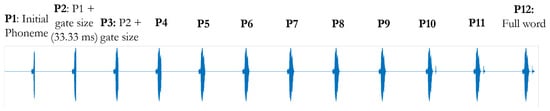
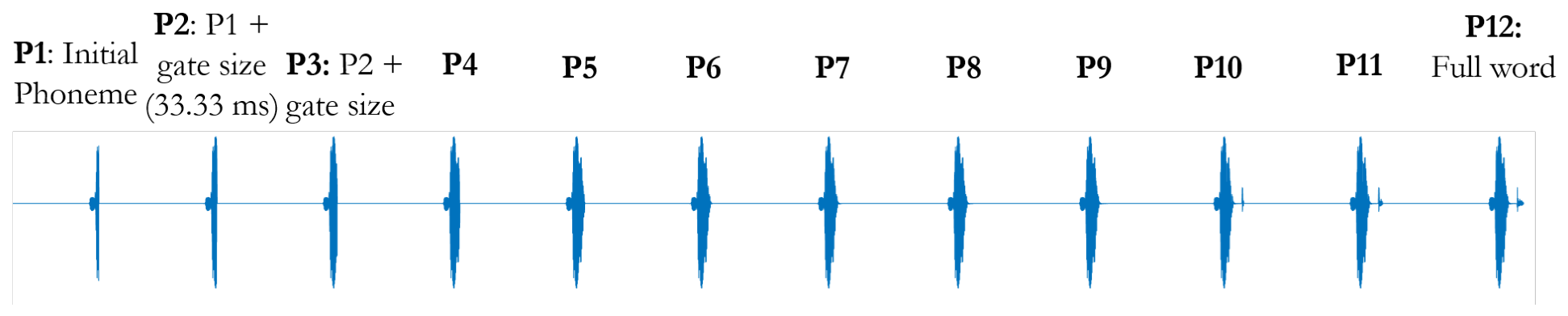
A total of 40 words were selected for the experiment, with 20 words allocated to the full-spectrum condition and 20 to the vocoder condition. The same two lists were used for all participants; the order of the two conditions was randomized across participants. Each word was processed using a time-gating procedure to create successive truncated versions, following established methods [6,7,8,22]. To balance temporal resolution and minimize participant fatigue, gating was applied in 33.33 ms increments, starting from the second phoneme of each word. The second-phoneme boundary was determined by visual and auditory inspection of the waveform and spectrogram. Gates were windowed with 5 ms raised-cosine onset and offset ramps. Truncation was applied to the unprocessed words, and each gate was then passed through the vocoder. MATLAB R2024a (MathWorks, Natick, MA, USA) was used to generate these progressively longer fragments for each stimulus. Figure 1 schematically illustrates the gated word recognition paradigm.
Figure 1.
Schematic representation of the gated word recognition paradigm (P denotes presentation). In this example, the word “ditch” was incrementally revealed through time gating. Gating began at the second phoneme, with each gate adding 33.33 ms of speech. Successive gates provided progressively longer segments until the entire word was presented.
For the vocoder condition, spectral degradation was introduced using a sine-wave vocoder designed to simulate CI signal processing [49]. This approach replaces the fine spectral detail of speech with pure-tone carriers while preserving the slow temporal envelope cues that CIs primarily convey. Each gated word stimulus was divided into eight frequency bands between 150 and 7000 Hz (Table 1). The frequency boundaries for each channel were determined using the Greenwood [52] frequency–place function to approximate the cochlear tonotopic mapping. Within each band, the temporal envelope was extracted using half-wave rectification and low-pass filtering to retain amplitude modulation cues essential for speech perception [17,18,47,53]. The extracted envelope in each channel was then used to modulate a sinusoidal carrier tuned to the center frequency of the corresponding analysis band (Table 1; center frequency = geometric mean of the band edges). Analysis and synthesis filters were implemented as fourth-order Butterworth bandpass filters with the band edges given in Table 1 (150 and 7000 Hz are the lower edge of the first band and the upper edge of the eighth band) and a roll-off of 24 dB/octave on each side of the passband, consistent with previous CI simulation studies aimed at mimicking the spectral constraints of implant processing. The eight modulated sine-wave carriers were summed to form the final vocoded signal, which was presented unilaterally at 65 dB SPL. The vocoded output was not level-equalized to the unprocessed signal; both were presented at the same nominal level (65 dB SPL). Because vocoding also removes temporal fine structure and fundamental-frequency cues, the manipulation reduces spectral resolution together with these cues. With an envelope cutoff of 150 Hz, envelope periodicity cues below 150 Hz were preserved.
Table 1.
Band edges and carrier frequencies of the 8-channel sine-wave vocoder.
Participants received written instructions and completed a brief practice session prior to data collection to ensure task familiarity. All testing was conducted inside a double-walled, sound-attenuating booth (IAC Acoustics, Naperville, IL, USA). Stimuli were presented monaurally at 65 dB SPL through Sennheiser HD650 headphones (Sennheiser, Wedemark, Germany) driven by a Lynx Hilo sound card (Lynx Studio Technology, Costa Mesa, CA, USA) connected to a computer (sampling rate = 48 kHz, bit depth = 24-bit)running Microsoft Windows 11 Pro (Microsoft Corp., Redmond, WA, USA). Each gate was saved as a separate .wav file and played by the experimenter, one gate at a time, using using WavePad Sound Editor, version 19.70 (NCH Software Pty Ltd., Canberra, ACT, Australia). Stimulus levels were calibrated using a Larson Davis Model 831 sound level meter coupled to a Larson Davis AEC201 ear simulator, with a 1 kHz pure tone adjusted to match the RMS level of the speech stimuli. The experimenter, a single trained rater, seated outside the booth, heard the participant’s responses through a talkback system and scored them online as correct only if they matched the target word exactly; homophones were not accepted as correct. During the task, participants heard progressively longer fragments (“gates”) of each target word and verbally reported their best guess after each presentation, irrespective of confidence. Gating continued until the target was identified correctly, after which three additional gates were presented to confirm the stability of the response. If a word was not correctly identified by the end of its full duration, the IP was assigned as the total word duration plus one gate increment (33.33 ms), consistent with prior methods [7,8,12]. IPs were defined as the shortest gate at which the participant correctly identified the target word and maintained the same response across the three consecutive gates. To account for differences in total word duration, IPs measured in milliseconds were converted to percentages using Equation (1):
where IP_ms is the isolation point in milliseconds (word duration plus one 33.33 ms gate when the word was not identified) and D_ms is the total word duration in milliseconds. This normalization provided a consistent index of lexical access timing across stimuli. The presentation order of the full-spectrum and vocoder conditions was randomized across participants, and the ear of presentation was counterbalanced. A short familiarization session using three example words per condition preceded testing. All tasks were completed in a single session of approximately 60–75 min, in the following order: gated word recognition, AzBio, CNC, ARST, and TMT. Condition order was randomized within each task.
IP (%) = (IP_ms/D_ms) × 100
Speech perception was assessed using the AzBio sentence test [54] and CNC monosyllabic words [50], with all procedures matched to the presentation setup used for the gating task. Each AzBio listening condition used two sentence lists (20 sentences each), and the CNC test used two lists (50 words each); no list was repeated for a given participant. Participants received written instructions and completed a brief practice session before testing. All materials were presented monaurally at 65 dB SPL using the equipment and calibration described in Section 2.2. Importantly, AzBio and CNC stimuli were presented to the same ear used for the gated word recognition task and were processed using the same 8-channel sine-wave vocoder applied in the gating condition, ensuring consistent spectral degradation across all speech perception tasks. For the AzBio sentences, the target speech level was fixed at 65 dB SPL across all conditions. Three listening conditions were administered: quiet, +10 dB SNR, and +5 dB SNR. In the noise conditions, 10-talker babble (from the AzBio test materials) was presented at levels 10 dB or 5 dB below the fixed 65 dB SPL target to yield the corresponding SNRs. The sentences and the babble were vocoded separately and then mixed at the specified SNR. Participants verbally repeated each sentence, and guessing was encouraged. CNC words were presented in quiet at 65 dB SPL using the same headphone-based setup, and participants repeated each word aloud; importantly, none of the CNC words used in the gating task were included in CNC testing to prevent stimulus repetition across tasks. CNC responses were scored at the phoneme level following standard procedures and converted to percent-correct scores. The order of the three listening conditions was randomized across participants. Together, the AzBio and CNC measures provided complementary indices of sentence- and word-level speech recognition under both favorable and adverse listening conditions.
Working memory capacity was assessed using the abbreviated version [41] of the classic Reading Span Test (ARST) originally developed by Daneman and Carpenter [55]. The task consisted of 54 sentences, each segmented into three syntactic units: a subject phrase, a verb phrase, and an object phrase. Sentences were presented visually, one phrase at a time, at a rate of either one-word cluster (e.g., “the captain”) or a single word (e.g., “sailed”) every 0.8 s. The sentence set included both meaningful (e.g., “The captain sailed his boat”) and absurd examples (e.g., “The train sang a song”), presented in randomized order to minimize predictability. Participants viewed sentence sets that increased systematically in length from two to five sentences per set, progressively increasing the working memory load. After each sentence, they made a sensibility judgment (“makes sense”/“does not make sense”), ensuring continuous engagement with sentence content. Following each set, participants were prompted to recall either the first or last words of the sentences in that set, introducing a delayed recall component that taxed both storage and retrieval processes in working memory. Test administration and scoring procedures followed those described in our recent studies on cognitive–auditory interactions in speech processing [41,56]. Two performance indices were calculated: (1) total recall, representing the percentage of all correctly recalled words, and (2) serial recall, representing the percentage of correctly recalled words reproduced in their original order. Total recall reflected overall working memory capacity, while serial recall emphasized ordered retrieval, indexing the efficiency of controlled processing and attentional maintenance.
Executive function was assessed using the computerized Trail Making Test (TMT) implemented in the Psychology Experiment Building Language (PEBL), version 2.0.4 (PEBL Project, https://pebl.sourceforge.net) [57]. The ARST and TMT were administered on a Laptop computer with a 15.6-inch display. Responses were made with a mouse. The task consisted of two parts: TMT-A and TMT-B. In TMT-A, participants were required to click, in ascending order, on encircled numbers (1–25) distributed randomly across the computer screen. This part primarily indexes processing speed, visual scanning, and psychomotor coordination. In TMT-B, participants alternated between numbers and letters in an ascending sequence (1-A-2-B-3-C, etc.), a process that imposes greater demands on cognitive flexibility, memory updating, and inhibitory control [58]. All participants completed a brief practice trial before the actual test to ensure task familiarity. For both subtests, completion time and accuracy were recorded automatically. Participants were instructed to perform as quickly and accurately as possible, minimizing errors. The primary measures were the total completion times for TMT-A and TMT-B [59]. A difference score (TMT-B minus TMT-A) was also computed to index set-shifting while controlling for processing speed and visuomotor demands [58,59]. Test administration and analysis procedures were consistent with those adopted in our recent work examining cognitive predictors of speech perception performance [41,60]. A summary of the experimental design, including participant characteristics, stimuli, testing conditions, outcome measures and equipment, is provided in Table 2.
Table 2.
Summary of the experimental design.
3. Results
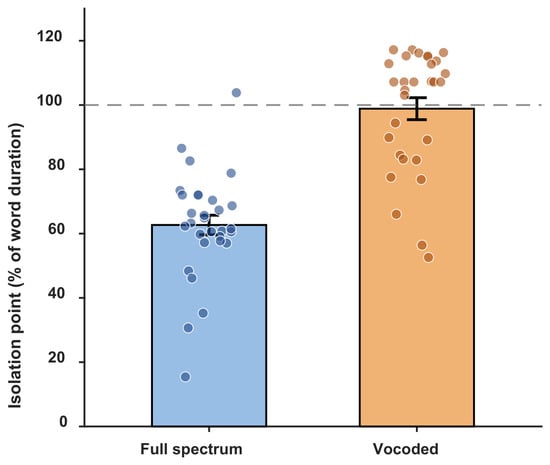
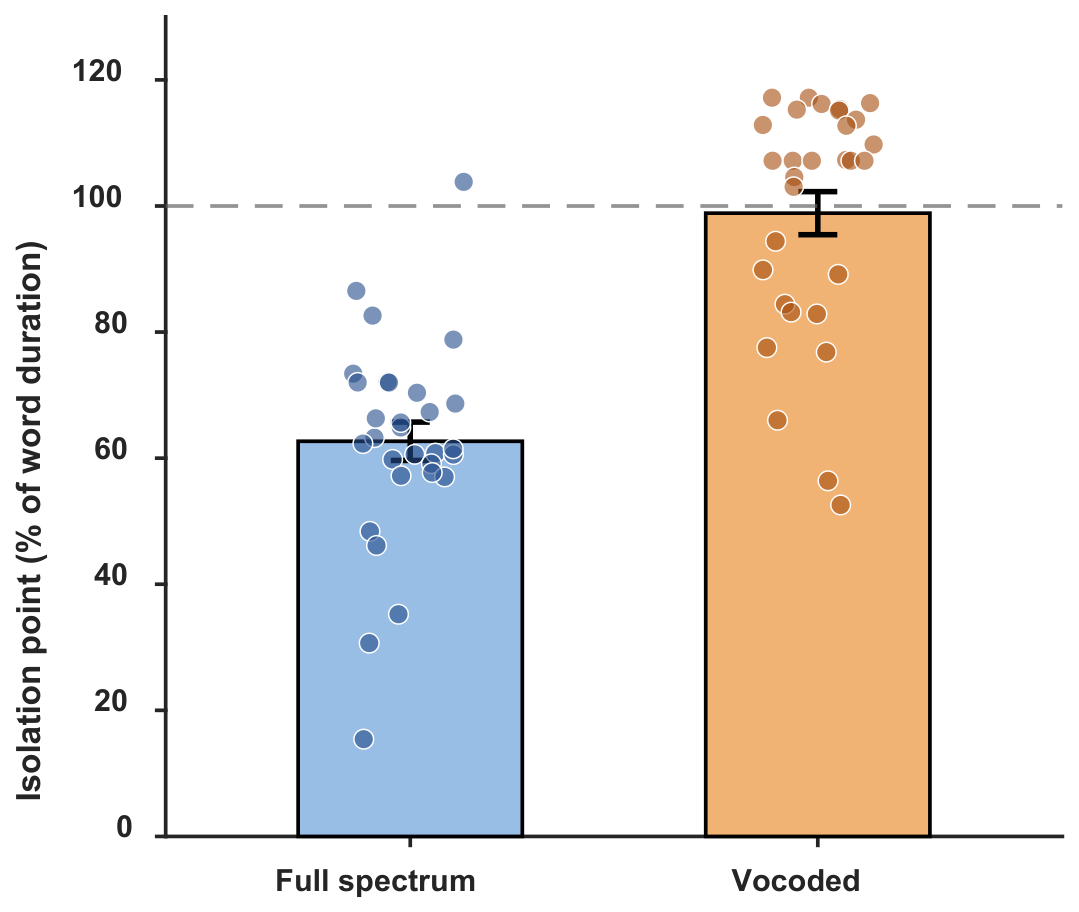
As shown in Figure 2, listeners required substantially different amounts of word onset information across conditions in the gated word recognition task. Full-spectrum speech yielded the shortest isolation points (IPs), indicating highly efficient lexical access, whereas vocoder-processed speech resulted in markedly delayed IPs, requiring nearly the entire word for correct identification. A paired-samples t-test confirmed that IPs were significantly lower for full-spectrum speech (M = 62.68%, SD = 16.66) than for vocoder speech (M = 98.86%, SD = 18.70), t(29) = −6.70, p < 0.001, two-tailed, with a mean difference of −36.18% (95% CI [−47.23, −25.14]). The effect size was large, Cohen’s d_z = −1.22 (95% CI [−1.69, −0.74]), indicating a robust advantage for full-spectrum speech over vocoded speech in gated word recognition. These findings underscore that spectral degradation severely disrupts early lexical activation, forcing listeners to rely on nearly complete word information to resolve lexical ambiguity, whereas access to rich spectral cues enables rapid and efficient word recognition. Because words not identified by the end of the stimulus were assigned a value of word duration plus one gate, IPs above 100% reflect unidentified words. In the vocoded condition, 40% of words were not identified (full-spectrum: 0.7%), and the maximum possible IP was 106.7% (mean across words). Individual participants’ mean IPs are shown in Figure 2.
Figure 2.
Mean isolation points (IPs, in %) for full-spectrum speech (green) and 8-channel sinewave vocoder speech (orange). Lower IP values indicate more efficient lexical access in the gated word recognition task. Error bars represent ±1 standard error. Circles show individual participants. The dashed line indicates 100% of the word duration (i.e., the point at which the complete word has been presented).
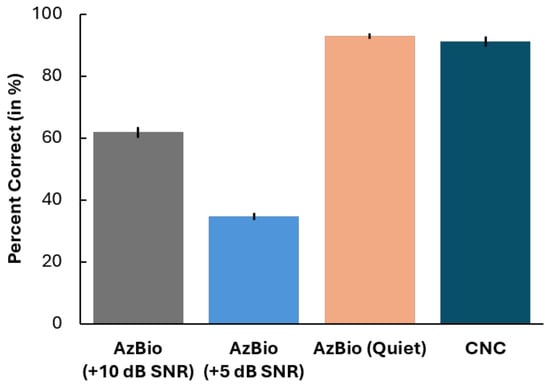
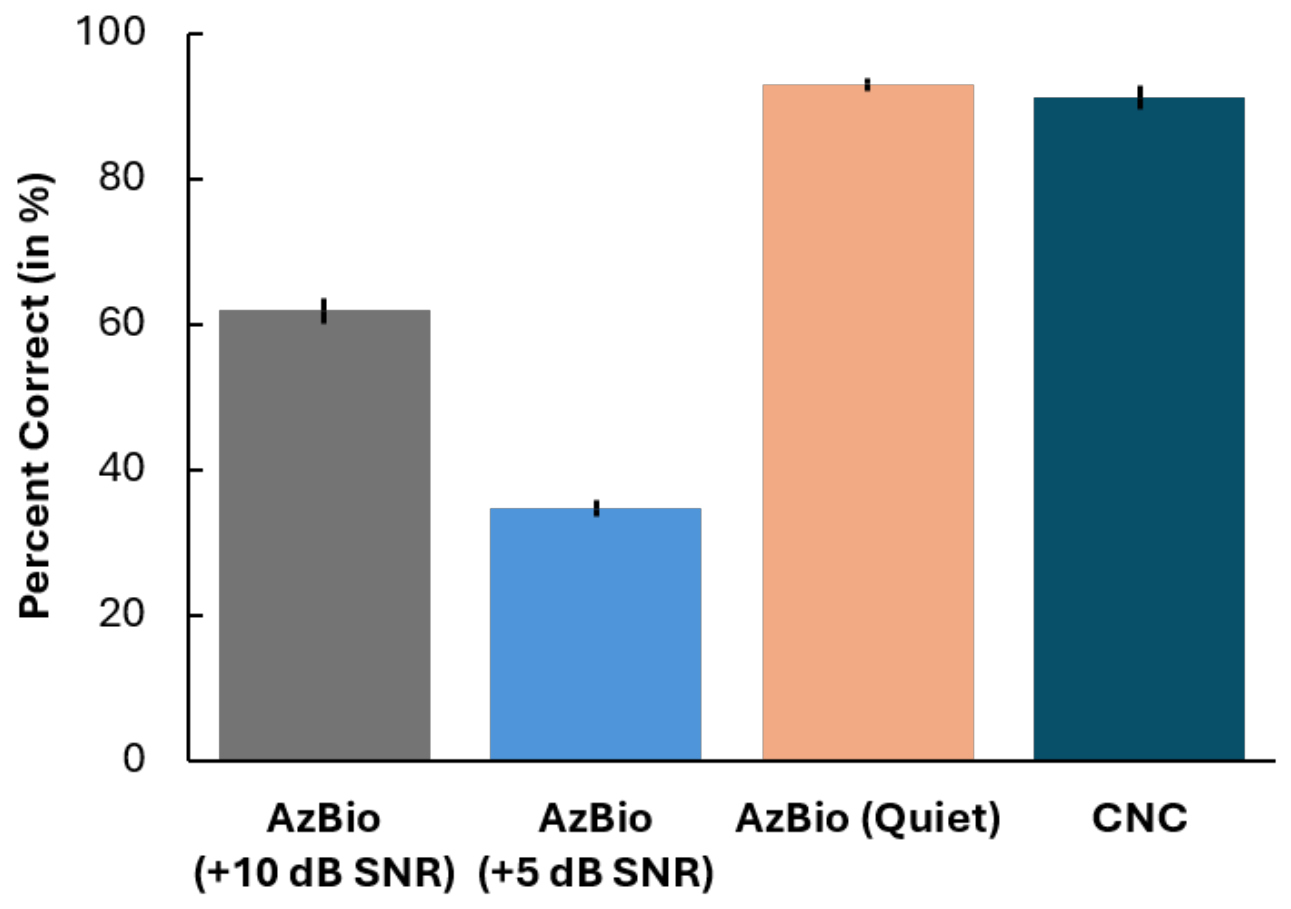
As shown in Figure 3, speech perception performance with sinewave vocoder speech varied substantially across listening conditions. A repeated-measures ANOVA with Greenhouse–Geisser correction revealed a significant main effect of condition, F(2.69, 78.04) = 434.75, p < 0.001, partial η2 = 0.94, indicating large differences in recognition scores across tasks. Post hoc comparisons (Bonferroni-adjusted) confirmed that AzBio sentences in quiet yielded the highest scores (M = 92.93%, SD = 5.09), closely followed by CNC word recognition (M = 91.13%, SD = 8.38). In contrast, performance declined sharply in noise, with AzBio at +10 dB SNR (M = 61.80%, SD = 9.42) and +5 dB SNR (M = 34.60%, SD = 6.06). All pairwise differences were significant (p < 0.001), except between AzBio in quiet and CNC, which did not differ statistically (mean difference = 1.80%, p = 1.00). Multivariate tests corroborated these findings (Wilks’ Λ = 0.014, F(3, 27) = 632.50, p < 0.001, partial η2 = 0.99), underscoring the strong effect of listening condition on speech perception. These results demonstrate that while listeners achieve near-ceiling performance in quiet even with vocoded input, modest reductions in SNR impose severe perceptual challenges. CNC was scored at the phoneme level and AzBio at the word level, so comparisons between these tests are descriptive.
Figure 3.
Mean percent-correct scores for vocoded AzBio sentences and CNC words across listening conditions. Bars represent AzBio at +10 dB SNR (gray), AzBio at +5 dB SNR (blue), AzBio in quiet (peach), and CNC words in quiet (dark blue). Error bars indicate ±1 standard error. Higher values reflect better speech perception performance.
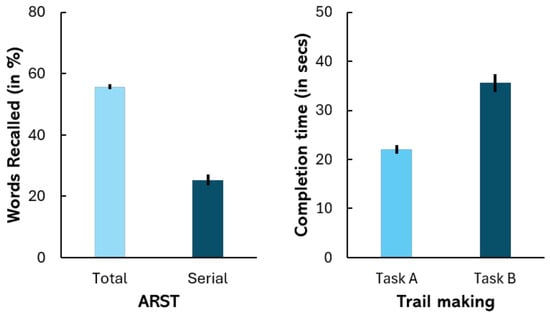
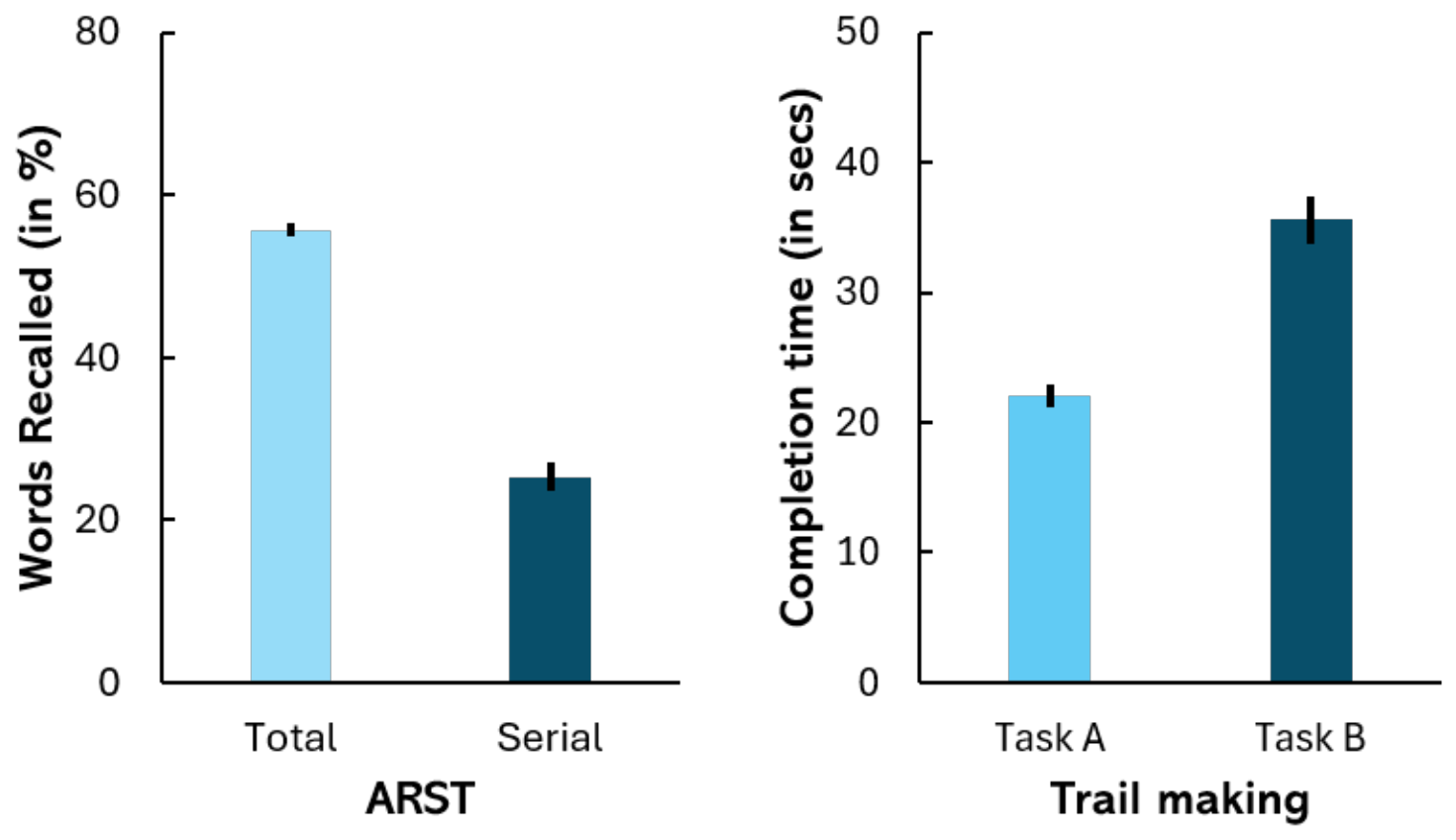
Participants showed a marked difference in recall performance between the two scoring methods of the ARST. Total recall, which reflects the percentage of all correctly recalled words regardless of order, was higher (M = 55.72%, SD = 9.68) than serial recall, which requires words to be reproduced in their original sequence (M = 25.29%, SD = 10.46). Results are plotted in Figure 4.
Figure 4.
Performance on cognitive measures. Left panel: Words recalled on the Abbreviated Reading Span Test (ARST) for Total recall (light blue) and Serial recall (dark blue), expressed as percentage correct. Right panel: Completion times for the Trail Making Test (TMT) converted to seconds, showing Task A (light blue) and Task B (dark blue). Error bars represent ±1 standard error.
As shown in the right panel of Figure 4, TMT-B completion times were longer than TMT-A completion times, as expected given the added set-shifting demand. Participants completed TMT-A in an average of 22.07 s (SD = 4.70) and TMT-B in 35.58 s (SD = 9.75), giving a B−A difference of 13.51 s (SD = 10.64).
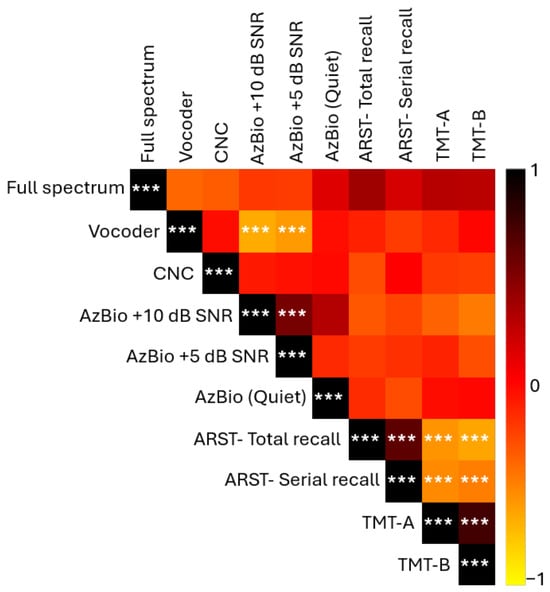
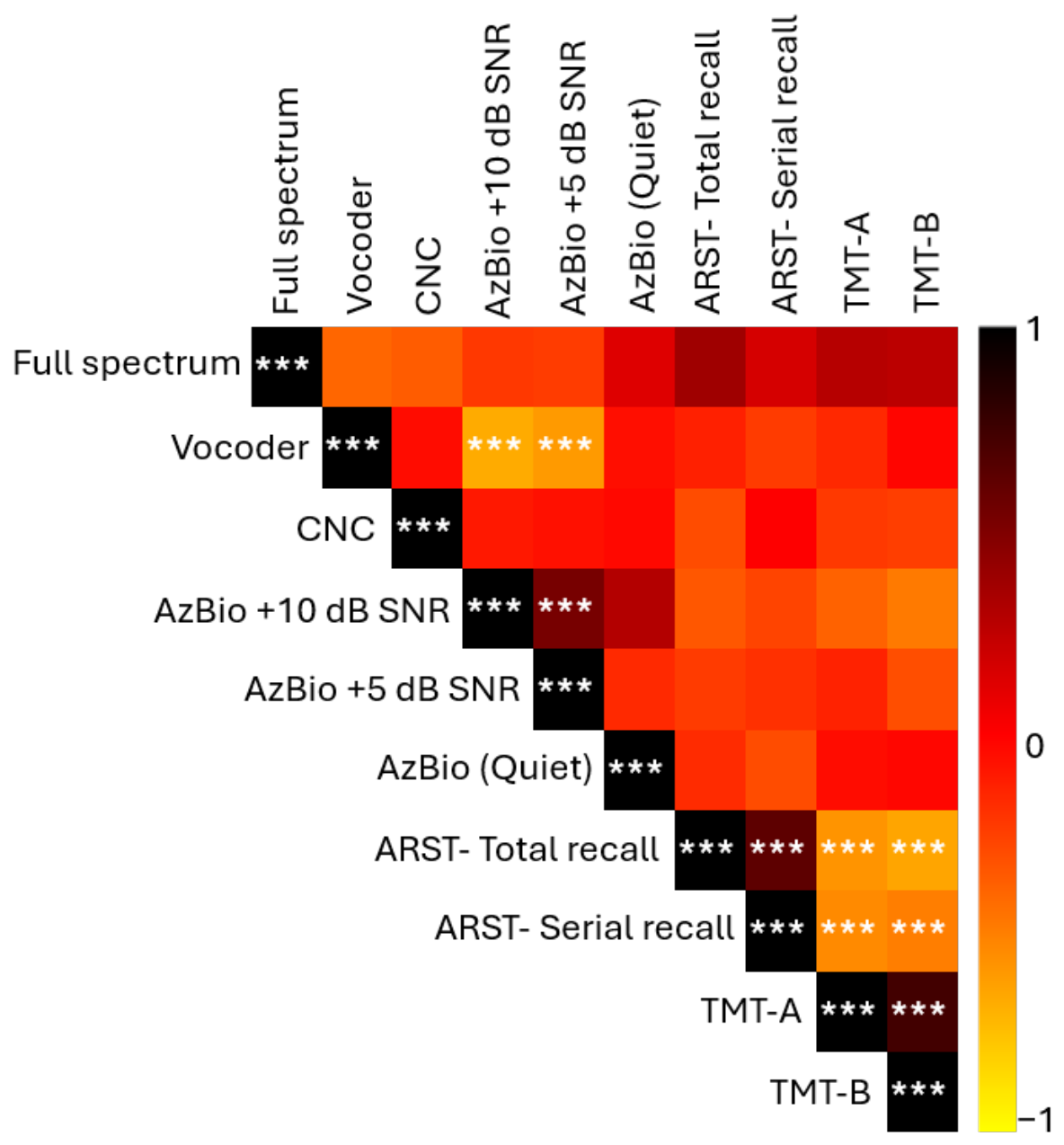
The heatmap (Figure 5) summarizes pairwise correlations among gated word recognition measures (Full-spectrum and Vocoded IPs), speech perception scores (AzBio in quiet and noise, CNC), and cognitive measures (ARST Total and Serial Recall, TMT-A, TMT-B). There were no missing data; all analyses included all 30 participants. To control for inflated Type I error across the 45 pairwise correlations among 10 measures, a Bonferroni correction was applied, yielding an adjusted significance level of α = 0.001 (0.05 ÷ 45). Accordingly, a correlation was considered statistically significant only if its associated p-value ≤ 0.001. With n = 30 and α = 0.001, only correlations of r ≥ 0.57 could reach significance, and power was 80% only for population correlations of ρ ≥ 0.66 (5% for ρ = 0.30; 14% for ρ = 0.40). Nonsignificant correlations with the cognitive measures therefore cannot rule out moderate associations. Of the correlations between the cognitive measures and the IP or speech-perception measures, three had 95% confidence intervals that excluded zero and were of moderate size: full-spectrum IP with ARST Total recall (r = 0.38, 95% CI [0.02, 0.65]), and AzBio at +10 dB SNR with TMT-A (r = –0.38, [–0.65, –0.03]) and TMT-B (r = –0.48, [–0.72, –0.14]). All other intervals included zero and were wide (about 0.7 in width), so they are compatible with both no association and moderate associations.
Figure 5.
Heatmap of pairwise correlations among gated word recognition measures (Full-spectrum and Vocoded IPs), speech perception scores (AzBio in quiet and noise, CNC), and cognitive measures (ARST Total and Serial Recall, TMT-A, TMT-B). Colors represent the Pearson correlation coefficient (r) according to the color bar, from r = –1 (yellow) to r = +1 (black). *** p ≤ 0.001 (Bonferroni-adjusted α for 45 comparisons). Diagonal cells show each measure’s correlation with itself (r = 1) and are not tested; asterisks in these cells carry no meaning. Correlation coefficients for the key associations are reported in the text.
Performance on the gated word recognition task for vocoder-processed speech showed strong negative correlations with AzBio sentence recognition in noise (r = –0.670, p < 0.001 for +10 dB SNR; r = –0.601, p < 0.001 for +5 dB SNR). This indicates that listeners who required nearly the entire word to identify vocoded speech also performed poorly on sentence recognition under adverse listening conditions. AzBio scores at +10 dB and +5 dB SNR were also strongly correlated (r = 0.605, p < 0.001). In contrast, vocoded IPs showed virtually no association with CNC word recognition (r = –0.045, p = 0.82) and nonsignificant correlations with cognitive measures: ARST Total Recall (r = –0.124, p = 0.52), ARST Serial Recall (r = –0.229, p = 0.23), TMT-A (r = –0.155, p = 0.41), and TMT-B (r = –0.017, p = 0.92).
Beyond these relationships, several other correlations reached significance after Bonferroni correction. ARST Total Recall and Serial Recall were strongly correlated (r = 0.636, p < 0.001), confirming shared working memory demands. TMT-A and TMT-B were highly correlated (r = 0.743, p < 0.001), reflecting consistency within executive function measures. Additionally, ARST Total Recall correlated negatively with TMT-A (r = –0.577, p < 0.001) and TMT-B (r = –0.647, p < 0.001), indicating that better working memory capacity was associated with faster completion times on executive function tasks.
Other noteworthy patterns include the absence of significant associations between Full-spectrum IPs and speech perception scores (CNC: r = –0.357; AzBio +10 dB SNR: r = –0.216; AzBio +5 dB SNR: r = –0.233; all p > 0.001) and between Full-spectrum IPs and cognitive measures (ARST Total: r = 0.377; Serial Recall: r = 0.168; TMT-A: r = 0.288; TMT-B: r = 0.267; all nonsignificant). The positive correlation between full-spectrum IPs and ARST Total (r = 0.377, 95% CI [0.02, 0.65], uncorrected p = 0.04) is opposite in direction to what would be expected if better WM supported earlier lexical access. It did not survive correction for 45 comparisons, and with this many tests about two uncorrected p-values below 0.05 are expected by chance. We therefore do not interpret it. Similarly, CNC word recognition showed no significant relationship with cognitive measures (all p > 0.001). The TMT B−A index was also not significantly associated with vocoded IPs (r = 0.097, p = 0.61) or full-spectrum IPs (r = 0.112, p = 0.56). Full-spectrum and vocoded IPs were negatively correlated (r = –0.40, 95% CI [–0.66, –0.05], p = 0.029), which did not survive Bonferroni correction. We therefore found no evidence that IP reflects a stable listener characteristic across conditions, although different word lists were used in each condition and the reliability of IPs was not assessed.
Finally, cognition measures demonstrated only modest associations with AzBio performance across conditions, none of which survived correction for multiple comparisons: in quiet (ARST Total: r = –0.167, p = 0.38; Serial Recall: r = –0.295, p = 0.11; TMT-A: r = –0.046, p = 0.81; TMT-B: r = –0.022, p = 0.91), at +10 dB SNR (ARST Total: r = –0.339, p = 0.07; Serial Recall: r = –0.264, p = 0.16; TMT-A: r = –0.382, p = 0.037; TMT-B: r = –0.478, p = 0.008), and at +5 dB SNR (ARST Total: r = –0.231, p = 0.22; Serial Recall: r = –0.187, p = 0.32; TMT-A: r = –0.133, p = 0.48; TMT-B: r = –0.303, p = 0.10). None of these met the Bonferroni-adjusted threshold (α = 0.001). Thus, the cognitive measures were strongly intercorrelated, but none was significantly associated with gated word recognition or speech perception after correction for multiple comparisons.
4. Discussion
4.1. Summary of Findings
The present study examined how spectral degradation and cognitive resources influence the time course of spoken word recognition, as indexed by IPs in a gated word recognition task. The results of this study showed clear differences in lexical access efficiency across conditions: full-spectrum speech supported rapid and accurate word identification, whereas vocoder-processed speech substantially delayed IPs, requiring nearly complete word information for recognition. Importantly, WM and EF measures were not significantly correlated with IPs in the gated word recognition paradigm. Vocoded IPs were strongly associated with sentence recognition in noise but not with CNC scores in quiet, which were near ceiling.
4.2. Effects of Reduced Spectral Resolution on Gated Word Recognition
The present study replicates the previous findings on the role of spectral fidelity in spoken word recognition. In the full-spectrum condition, listeners identified target words after hearing just over half of their duration, consistent with interactive models of lexical processing that emphasize the continuous interplay between bottom-up acoustic cues and top-down linguistic knowledge [6,7,9,10,11,12]. Access to rich onset information enabled early resolution of lexical competition, often before the acoustic offset of the word. In contrast, vocoder-processed speech substantially delayed IPs, requiring nearly complete word information for accurate identification [12,13,22]. This delay likely reflects the loss of fine spectral detail, which compromises recognition of initial consonant and vowel segments, critical for activating the correct lexical cohort. When these early cues are misperceived, listeners must rely on later-arriving information, such as word-final segments, to disambiguate competing candidates, slowing the recognition process [24]. These results align with prior research showing that adverse listening conditions increase reliance on extended acoustic evidence and reduce the efficiency of lexical activation [7]. Spectral degradation not only limits access to phonetic detail but also increases activation of competing lexical candidates and reduces suppression of irrelevant alternatives [20,21]. This lexical uncertainty forces listeners to maintain multiple interpretations until sufficient evidence accumulates, delaying integration and increasing processing demands. From a practical standpoint, these findings are relevant for CI users, as vocoder simulations with eight channels approximate the spectral constraints of typical CI processing [20]. The observed delays in incremental word recognition suggest the potential value of assessment tools that capture processing dynamics rather than endpoint accuracy alone, which should be tested in implant users.
4.3. Cognitive Skills and Gated Word Recognition
The ELU model predicts that WM becomes critical when the incoming signal is degraded and fails to match stored phonological representations, triggering explicit processing to maintain and manipulate partial information [25]. Contrary to our hypothesis that vocoded speech would engage WM and EF, neither was significantly associated with IPs in either condition. This absence of association may reflect, in part, the gating paradigm. Unlike sentence-in-noise tasks, which require listeners to store multiple words and integrate them across time [31,32,37], gated word recognition focuses on a single lexical item presented incrementally. Because listeners receive progressively more acoustic detail until identification is possible, they can rely on bottom-up evidence rather than maintaining hypotheses in memory. This may reduce WM load even under vocoded conditions. Thus, while WM predicts performance in continuous speech tasks with high contextual and storage demands [8], it was not significantly associated with IPs here, where perceptual constraints dominate and task design minimizes memory requirements. The study could detect only large correlations (ρ ≥ 0.66), so moderate associations cannot be excluded.
EF encompasses processes such as inhibition, cognitive flexibility, and attentional control, which support speech perception when listeners must suppress competing interpretations or switch strategies under adverse conditions [27,33,42,61]. In theory, vocoded speech could increase lexical uncertainty and require EF to manage competition among candidates [21,24]. However, the gating paradigm mitigates these demands by presenting repeated fragments of the same word without time pressure. This design may reduce the need for rapid set-shifting or inhibitory control because listeners are not required to juggle multiple competing streams or maskers, as in multitalker environments. Consequently, EF measures such as the Trail Making Test did not predict IPs in either condition, including the B−A difference score that isolates set-shifting. A further consideration is that the TMT is a non-linguistic, visuomotor task, which may not capture the language-specific executive processes involved in speech perception. While TMT indexes general cognitive flexibility and sequencing, it does not directly assess the ability to inhibit lexical competitors or allocate attention to phonological detail, skills that are critical in resolving ambiguity during degraded speech processing. Tasks that incorporate linguistic material (e.g., Stroop or verbal fluency tests) may better reflect the executive demands of speech perception. The null correlations observed here are compatible with the possibility that gating primarily taps perceptual efficiency rather than executive control, and that cross-modal EF measures like TMT may lack sensitivity to language-based inhibitory and switching processes required for real-time lexical access.
In the present study, the vocoder condition imposed such severe spectral degradation that listeners required nearly the entire word for identification (mean IP ≈ 99% of word duration). Under these circumstances, additional cognitive resources may have had little opportunity to compensate for the lack of bottom-up detail. Similarly, full-spectrum speech provided rich phonetic cues that enabled automatic mapping to lexical representations, leaving little room for cognitive involvement.
4.4. Relationship Between Gated Word Recognition and Speech Perception
Beyond the absence of cognitive effects, several noteworthy patterns emerged. First, the IPs obtained using vocoder-processed speech were strongly associated with sentence recognition in noise, indicating that the ability to process degraded speech incrementally is associated with speech-in-noise performance (although shared adaptation to vocoded speech may contribute; see Limitations). In contrast, CNC word recognition scores showed no significant correlation with IPs for vocoded speech. Because CNC scores were near ceiling (M = 91.1%, SD = 8.4), this may reflect range restriction rather than a failure of accuracy-based measures to capture lexical timing. This finding aligns with prior work demonstrating that accuracy measures can obscure timing deficits in degraded speech perception [62,63,64]. For example, Başkent [65] demonstrated that baseline word recognition scores do not reliably predict the extent of top-down restoration in degraded speech, indicating that conventional accuracy-based measures fail to capture listeners’ compensatory strategies during lexical reconstruction. The lack of association between CNC scores and IPs may motivate evaluating time-sensitive measures like gating in clinical populations, although range restriction limits what can be concluded here.
Secondly, performance patterns across speech perception tasks revealed that listeners achieved near-ceiling scores for AzBio sentences and CNC words in quiet. This finding is consistent with prior studies on vocoder-processed speech, which demonstrate that when the number of spectral channels is sufficiently high, typically around eight or more, listeners can achieve near-perfect recognition of words and sentences in quiet conditions [14,45,49,66]. All AzBio and CNC tests were vocoded and the preservation of critical spectral cues at this channel density supports robust speech perception, minimizing the perceptual challenge despite the signal degradation.
Finally, correlations among cognitive measures showed the expected relationships: ARST Total and Serial recall were correlated with each other, as were TMT-A and TMT-B, and higher ARST Total recall was associated with faster TMT completion times. However, these relationships did not extend to speech outcomes.
4.5. Clinical Implications
Current clinical assessments of speech perception typically rely on accuracy-based measures, such as CNC word lists or AzBio sentences, which may not capture the dynamic nature of lexical processing. In the present simulation, vocoded IPs were associated with sentence recognition in noise, whereas near-ceiling scores in quiet were not. We hypothesize that gating-based tasks may help identify implant users who perform well in quiet yet struggle in noise; this needs to be tested in implant users. Whether gating-based measures could inform rehabilitation or device programming is a question for future work.
4.6. Limitations
Despite its contributions, this study has several limitations that warrant consideration. First, the use of normal-hearing participants exposed to vocoded speech limits generalizability to actual CI users. Vocoder simulations approximate spectral constraints but do not fully capture real-world factors such as electrode-neural interface variability, channel interaction, or long-term adaptation. CI users develop frequency-to-electrode maps and adapt to processing strategies over years, whereas NH participants lack this experience. Consequently, vocoder-based findings should be interpreted as indicative of performance trends rather than precise quantitative estimates. In addition, the same two word lists were used for all participants, so the effect of vocoding on IPs cannot be fully separated from item differences, although the lists were similar in duration, frequency, and neighborhood density. Only three practice words were provided per condition, and AzBio followed the gated word recognition task, so shared adaptation to vocoded speech could have contributed to the association between vocoded IPs and AzBio performance. Also, vocoded IPs were close to their upper bound and partly censored, and AzBio scores in quiet and CNC scores were near ceiling; this range restriction limits the correlations that could be observed, and we did not fit item-level or censored models. In addition, 20 of the 30 participants had completed a phonetics course, which may have helped them identify words from partial acoustic information; training status was not balanced across participants or analyzed, and the sample is likely more experienced with speech analysis than the general population.
Second, the gating paradigm, while informative about incremental lexical access, differs from natural listening situations. It removes time pressure and allows repeated exposure to the same word fragments, reducing cognitive load compared to continuous speech in multitalker environments. This design may partly explain the absence of cognitive effects, as real-world listening requires rapid integration of multiple words and active suppression of competing streams. Because the vocoded output was not level-equalized, small loudness differences between conditions cannot be ruled out.
Third, the cognitive measures employed, ARST for WM and TMT for EF, may not fully capture language-specific processes involved in speech perception. The TMT, for example, is a non-linguistic visuomotor task that indexes general cognitive flexibility but does not assess inhibitory control over lexical competitors or attentional allocation to phonological detail. Future studies should incorporate linguistically relevant EF tasks, such as Stroop or verbal fluency tests, to better evaluate cognitive contributions. Because the present data come from normal-hearing listeners listening to vocoded speech, the results are not directly comparable with those from cochlear implant users [11]; whether the same pattern holds in implant users remains to be tested.
Finally, the sample size was modest and restricted to young adults with normal hearing, limiting generalizability to older adults or individuals with hearing loss. Age-related changes in cognition and auditory processing could alter the relationship between perceptual and cognitive factors, warranting replication in more diverse populations. Moreover, the study employed a single vocoder configuration, an eight-channel sine-wave vocoder, which preserves temporal envelope cues while degrading spectral detail. Other vocoder configurations may impose different perceptual challenges and could influence the degree to which cognitive resources are recruited. Future research should systematically vary vocoder parameters to disentangle the effects of spectral and temporal degradation on incremental lexical processing. Responses were scored online by a single rater who was not blind to condition, and inter-rater agreement was not assessed; scoring was objective (exact-match), which limits but does not eliminate rater bias. Moreover, cognition was measured in a homogeneous sample of young adults, whereas acoustic fidelity was manipulated experimentally, so the two factors were not placed on an equal footing; the sample could also detect only large correlations.
5. Conclusions
This study demonstrates that the efficiency of spoken word recognition under spectral degradation is strongly constrained by the quality of the acoustic signal. Using a gated word recognition paradigm, we found that listeners identified words rapidly under full-spectrum conditions but required nearly complete word information when speech was vocoded, reflecting severe delays in incremental lexical access. These timing deficits were not significantly associated with WM or EF, although only large associations could be detected with this sample. Importantly, vocoded isolation points were associated with sentence recognition in noise. In contrast, vocoded CNC and AzBio scores in quiet were near ceiling and unrelated to isolation points, which may reflect range restriction. These findings raise the hypothesis that time-sensitive measures such as gating may provide information beyond accuracy-based clinical measures for cochlear implant users, which remains to be tested. Future research should extend these findings to actual cochlear implant users, test whether gating adds information beyond accuracy-based clinical measures, use larger samples with greater variability in cognition, and explore the impact of varying vocoder parameters.
Author Contributions
Conceptualization, C.P. and N.K.S.; methodology, A.B., C.P. and N.K.S.; software, A.B.; validation, A.B., C.P. and N.K.S.; formal analysis, A.B.; investigation, A.B.; resources, C.P. and N.K.S.; data curation, A.B.; writing—original draft preparation, A.B.; writing—review and editing, A.B., C.P. and N.K.S.; visualization, A.B.; supervision, C.P. and N.K.S.; project administration, C.P.; funding acquisition, C.P. and N.K.S. All authors have read and agreed to the published version of the manuscript.
Funding
This work received support from a grant awarded to C.P. from the Faculty Academic Center of Excellence at Towson University. No grant number was assigned to this award.
Institutional Review Board Statement
The study was conducted in accordance with ethical standards for research involving human participants and was approved by the Institutional Review Board of Towson University (IRB Protocol #1717).
Informed Consent Statement
All participants provided written informed consent prior to participation in the study.
Data Availability Statement
The data presented in this study are available on request from the corresponding author.
Acknowledgments
Google Gemini 3.5 flashwas used solely to assist with language editing, including grammar, clarity, and sentence-level correction. It was not used to generate the manuscript in whole or in part, develop the study design, analyze the data, interpret the results, or formulate the scientific conclusions. All content was reviewed and approved by the authors, who take full responsibility for the manuscript.
Conflicts of Interest
The authors declare no conflicts of interest.
Appendix A
| Condition | Word | IPA | Duration (ms) | Frequency (Per Million) | Neighborhood Density |
| Full-spectrum | Beam | /bim/ | 520 | 15 | 18 |
| Full-spectrum | Bell | /bɛl/ | 480 | 17 | 21 |
| Full-spectrum | Cab | /kæb/ | 450 | 12 | 22 |
| Full-spectrum | Dawn | /dɔn/ | 560 | 16 | 14 |
| Full-spectrum | Dive | /daɪv/ | 540 | 13 | 15 |
| Full-spectrum | Dull | /dʌl/ | 500 | 15 | 23 |
| Full-spectrum | Fan | /fæn/ | 460 | 18 | 24 |
| Full-spectrum | Keen | /kin/ | 500 | 14 | 16 |
| Full-spectrum | Lawn | /lɔn/ | 550 | 11 | 12 |
| Full-spectrum | Lean | /lin/ | 500 | 16 | 19 |
| Full-spectrum | Lock | /lɑk/ | 470 | 19 | 21 |
| Full-spectrum | Loud | /laʊd/ | 560 | 14 | 13 |
| Full-spectrum | Mode | /moʊd/ | 530 | 17 | 15 |
| Full-spectrum | Pause | /pɔz/ | 590 | 12 | 11 |
| Full-spectrum | Pine | /paɪn/ | 540 | 18 | 18 |
| Full-spectrum | Pose | /poʊz/ | 520 | 16 | 14 |
| Full-spectrum | Rage | /reɪdʒ/ | 550 | 10 | 10 |
| Full-spectrum | Raid | /reɪd/ | 500 | 15 | 13 |
| Full-spectrum | Sail | /seɪl/ | 510 | 20 | 25 |
| Full-spectrum | Sung | /sʌŋ/ | 520 | 11 | 12 |
| Vocoded | Calf | /kæf/ | 500 | 14 | 17 |
| Vocoded | Cheek | /tʃik/ | 540 | 16 | 18 |
| Vocoded | Chin | /tʃɪn/ | 490 | 15 | 22 |
| Vocoded | Dumb | /dʌm/ | 500 | 12 | 16 |
| Vocoded | Gin | /dʒɪn/ | 480 | 13 | 15 |
| Vocoded | Juice | /dʒus/ | 570 | 18 | 11 |
| Vocoded | Knit | /nɪt/ | 470 | 11 | 24 |
| Vocoded | Knock | /nɑk/ | 500 | 17 | 19 |
| Vocoded | Map | /mæp/ | 450 | 19 | 23 |
| Vocoded | Mess | /mɛs/ | 470 | 15 | 25 |
| Vocoded | Mill | /mɪl/ | 480 | 14 | 21 |
| Vocoded | Mob | /mɑb/ | 460 | 12 | 16 |
| Vocoded | Pan | /pæn/ | 450 | 20 | 24 |
| Vocoded | Rag | /ræg/ | 460 | 10 | 20 |
| Vocoded | Ripe | /raɪp/ | 530 | 13 | 12 |
| Vocoded | Rug | /rʌg/ | 470 | 16 | 13 |
| Vocoded | Shade | /ʃeɪd/ | 560 | 17 | 11 |
| Vocoded | Sore | /sɔr/ | 550 | 18 | 14 |
| Vocoded | Tar | /tɑr/ | 500 | 15 | 18 |
| Vocoded | Wing | /wɪŋ/ | 500 | 11 | 12 |
| Full-spectrum, M (SD) | 20 words | 517.5 (36.3) | 15.0 (2.8) | 16.8 (4.6) | |
| Vocoded, M (SD) | 20 words | 496.5 (36.3) | 14.8 (2.8) | 17.6 (4.6) |
References
- Marslen-Wilson, W.D. Function and Process in Spoken Word Recognition: A Tutorial Review. In Attention and Performance X: Control of Language Processes; Bouma, H., Bouwhuis, D.G., Eds.; Lawrence Erlbaum Associates: Hillsdale, NJ, USA, 1984; pp. 125–150. [Google Scholar]
- Marslen-Wilson, W.D.; Welsh, A. Processing Interactions and Lexical Access during Word Recognition in Continuous Speech. Cogn. Psychol. 1978, 10, 29–63. [Google Scholar] [CrossRef] [Scilit]
- Marslen-Wilson, W.D. Functional Parallelism in Spoken Word-Recognition. Cognition 1987, 25, 71–102. [Google Scholar] [CrossRef] [Scilit]
- Grosjean, F. Spoken Word Recognition Processes and the Gating Paradigm. Percept. Psychophys. 1980, 28, 267–283. [Google Scholar] [CrossRef] [Scilit]
- Tyler, L.K. The Structure of the Initial Cohort: Evidence from Gating. Percept. Psychophys. 1984, 36, 417–427. [Google Scholar] [CrossRef] [Scilit]
- Moradi, S.; Lidestam, B.; Hällgren, M.; Rönnberg, J. Gated Auditory Speech Perception in Elderly Hearing Aid Users and Elderly Normal-Hearing Individuals: Effects of Hearing Impairment and Cognitive Capacity. Trends Hear. 2014, 18, 2331216514545406. [Google Scholar] [CrossRef] [Scilit]
- Moradi, S.; Lidestam, B.; Rönnberg, J. Gated Audiovisual Speech Identification in Silence vs. Noise: Effects on Time and Accuracy. Front. Psychol. 2013, 4, 359. [Google Scholar] [CrossRef] [Scilit]
- Moradi, S.; Lidestam, B.; Saremi, A.; Rönnberg, J. Gated Auditory Speech Perception: Effects of Listening Conditions and Cognitive Capacity. Front. Psychol. 2014, 5, 531. [Google Scholar] [CrossRef] [Scilit]
- Moradi, S.; Wahlin, A.; Hällgren, M.; Rönnberg, J.; Lidestam, B. The Efficacy of Short-Term Gated Audiovisual Speech Training for Improving Auditory Sentence Identification in Noise in Elderly Hearing Aid Users. Front. Psychol. 2017, 8, 368. [Google Scholar] [CrossRef] [Scilit]
- Patro, C.; Bennaim, A.; Srinivasan, N.K. The Role of Working Memory in Gated Word Recognition under Varying Degrees of Acoustic Degradation. Proc. Mtgs. Acoust. 2025, 56, 050011. [Google Scholar] [CrossRef] [Scilit]
- Patro, C.; Bennaim, A.; Srinivasan, N.K. Gated Word Recognition in Cochlear Implant Listeners: The Role of Spectral Resolution and Cognitive Abilities. J. Acoust. Soc. Am. 2025, 157, A35. [Google Scholar] [CrossRef] [Scilit]
- Patro, C.; Mendel, L.L. Gated Word Recognition by Postlingually Deafened Adults with Cochlear Implants: Influence of Semantic Context. J. Speech Lang. Hear. Res. 2018, 61, 145–158. [Google Scholar] [CrossRef] [Scilit]
- Patro, C.; Shephard, E.; Srinivasan, N.K. Effects of Electro-Acoustic Stimulation on Gated Word Recognition. Cochlear Implants Int. 2025, 26, 63–72. [Google Scholar] [CrossRef] [Scilit]
- Friesen, L.M.; Shannon, R.V.; Baskent, D.; Wang, X. Speech Recognition in Noise as a Function of the Number of Spectral Channels: Comparison of Acoustic Hearing and Cochlear Implants. J. Acoust. Soc. Am. 2001, 110, 1150–1163. [Google Scholar] [CrossRef] [Scilit]
- Fu, Q.J.; Chinchilla, S.; Galvin, J.J. The Role of Spectral and Temporal Cues in Voice Gender Discrimination by Normal-Hearing Listeners and Cochlear Implant Users. J. Assoc. Res. Otolaryngol. 2004, 5, 253–260. [Google Scholar] [CrossRef] [Scilit]
- Henry, B.A.; Turner, C.W.; Behrens, A. Spectral Peak Resolution and Speech Recognition in Quiet: Normal Hearing, Hearing Impaired, and Cochlear Implant Listeners. J. Acoust. Soc. Am. 2005, 118, 1111–1121. [Google Scholar] [CrossRef] [Scilit]
- Patro, C.; Mendel, L.L. Role of Contextual Cues on the Perception of Spectrally Reduced Interrupted Speech. J. Acoust. Soc. Am. 2016, 140, 1336. [Google Scholar] [CrossRef] [Scilit]
- Patro, C.; Mendel, L.L. Semantic Influences on the Perception of Degraded Speech by Individuals with Cochlear Implants. J. Acoust. Soc. Am. 2020, 147, 1778. [Google Scholar] [CrossRef] [Scilit]
- Won, J.H.; Drennan, W.R.; Rubinstein, J.T. Spectral-Ripple Resolution Correlates with Speech Reception in Noise in Cochlear Implant Users. J. Assoc. Res. Otolaryngol. 2007, 8, 384–392. [Google Scholar] [CrossRef] [Scilit]
- Farris-Trimble, A.; McMurray, B.; Cigrand, N.; Tomblin, J.B. The Process of Spoken Word Recognition in the Face of Signal Degradation. J. Exp. Psychol. Hum. Percept. Perform. 2014, 40, 308–327. [Google Scholar] [CrossRef] [Scilit]
- McMurray, B.; Farris-Trimble, A.; Rigler, H. Waiting for Lexical Access: Cochlear Implants or Severely Degraded Input Lead Listeners to Process Speech Less Incrementally. Cognition 2017, 169, 147–164. [Google Scholar] [CrossRef] [Scilit]
- Patro, C.; Bennaim, A.; Shephard, E. Effects of Spectral Degradation on Gated Word Recognition. JASA Express Lett. 2023, 3, 065203. [Google Scholar] [CrossRef] [Scilit]
- Gianakas, S.P.; Winn, M.B. Lexical Bias in Word Recognition by Cochlear Implant Listeners. J. Acoust. Soc. Am. 2019, 146, 3373. [Google Scholar] [CrossRef] [Scilit]
- Rönnberg, J.; Lunner, T.; Zekveld, A.; Sörqvist, P.; Danielsson, H.; Lyxell, B.; Dahlström, O.; Signoret, C.; Stenfelt, S.; Pichora-Fuller, M.K.; et al. The Ease of Language Understanding (ELU) Model: Theoretical, Empirical, and Clinical Advances. Front. Syst. Neurosci. 2013, 7, 31. [Google Scholar] [CrossRef] [Scilit]
- Dryden, A.; Allen, H.A.; Henshaw, H.; Heinrich, A. The Association between Cognitive Performance and Speech-in-Noise Perception for Adult Listeners: A Systematic Literature Review and Meta-Analysis. Trends Hear. 2017, 21, 2331216517744675. [Google Scholar] [CrossRef] [Scilit]
- Rönnberg, J.; Rudner, M.; Lunner, T.; Zekveld, A.A. When Cognition Kicks In: Working Memory and Speech Understanding in Noise. Noise Health 2010, 12, 263–269. [Google Scholar] [CrossRef] [Scilit]
- Rudner, M.; Signoret, C. The Role of Working Memory and Executive Function in Communication under Adverse Conditions. Front. Psychol. 2016, 7, 148. [Google Scholar] [CrossRef] [Scilit]
- Stenbäck, V.; Hällgren, M.; Larsby, B. Executive Functions and Working Memory Capacity in Speech Communication under Adverse Conditions. Speech Lang. Hear. 2016, 19, 218–226. [Google Scholar] [CrossRef] [Scilit]
- Rudner, M.; Foo, C.; Rönnberg, J.; Lunner, T. Cognition and Aided Speech Recognition in Noise: Specific Role for Cognitive Factors Following Nine-Week Experience with Adjusted Compression Settings in Hearing Aids. Scand. J. Psychol. 2009, 50, 405–418. [Google Scholar] [CrossRef] [Scilit]
- Rudner, M.; Foo, C.; Sundewall-Thorén, E.; Lunner, T.; Rönnberg, J. Phonological Mismatch and Explicit Cognitive Processing in a Sample of 102 Hearing-Aid Users. Int. J. Audiol. 2008, 47, S91–S98. [Google Scholar] [CrossRef] [Scilit]
- Rudner, M.; Rönnberg, J.; Lunner, T. Working Memory Supports Listening in Noise for Persons with Hearing Impairment. J. Am. Acad. Audiol. 2011, 22, 156–167. [Google Scholar] [CrossRef] [Scilit]
- Eckert, M.A.; Matthews, L.J.; Vaden, K.I.; Dubno, J.R. Executive Function Associations with Audibility-Adjusted Speech Perception in Noise. J. Speech Lang. Hear. Res. 2024, 67, 4811–4828. [Google Scholar] [CrossRef] [Scilit]
- Kong, E.J.; Edwards, J. Individual Differences in Categorical Perception of Speech: Cue Weighting and Executive Function. J. Phon. 2016, 59, 40–57. [Google Scholar] [CrossRef] [Scilit]
- Moberly, A.C.; Patel, T.R.; Castellanos, I. Relations between Self-Reported Executive Functioning and Speech Perception Skills in Adult Cochlear Implant Users. Otol. Neurotol. 2018, 39, 250–257. [Google Scholar] [CrossRef] [Scilit]
- Reitan, R.M. The Relation of the Trail Making Test to Organic Brain Damage. J. Consult. Psychol. 1955, 19, 393–394. [Google Scholar] [CrossRef] [Scilit]
- Ellis, R.J.; Molander, P.; Rönnberg, J.; Lyxell, B.; Andersson, G.; Lunner, T. Predicting Speech-in-Noise Recognition from Performance on the Trail Making Test: Results from a Large-Scale Internet Study. Ear Hear. 2016, 37, 73–79. [Google Scholar] [CrossRef] [Scilit]
- Merten, N.; Boenniger, M.M.; Herholz, S.C.; Breteler, M.M. The Associations of Hearing Sensitivity and Different Cognitive Functions with Perception of Speech-in-Noise. Ear Hear. 2022, 43, 984–992. [Google Scholar] [CrossRef] [Scilit]
- Füllgrabe, C.; Moore, B.C.; Stone, M.A. Age-Group Differences in Speech Identification despite Matched Audiometrically Normal Hearing: Contributions from Auditory Temporal Processing and Cognition. Front. Aging Neurosci. 2014, 6, 347. [Google Scholar] [CrossRef] [Scilit]
- Neher, T.; Behrens, T.; Carlile, S.; Jin, C.; Kragelund, L.; Petersen, A.S.; Schaik, A. Benefit from Spatial Separation of Multiple Talkers in Bilateral Hearing-Aid Users: Effects of Hearing Loss, Age, and Cognition. Int. J. Audiol. 2009, 48, 758–774. [Google Scholar] [CrossRef] [Scilit]
- Patro, C.; Kreft, H.A.; Wojtczak, M. The Search for Correlates of Age-Related Cochlear Synaptopathy: Measures of Temporal Envelope Processing and Spatial Release from Speech-on-Speech Masking. Hear. Res. 2021, 409, 108333. [Google Scholar] [CrossRef] [Scilit]
- Patro, C.; Monfiletto, A.; Singer, A.; Srinivasan, N.K.; Mishra, S.K. Midlife Speech Perception Deficits: Impact of Extended High-Frequency Hearing, Peripheral Neural Function, and Cognitive Abilities. Ear Hear. 2024, 45, 1149–1164. [Google Scholar] [CrossRef] [Scilit]
- Shehabi, S.; Comstock, D.C.; Mankel, K.; Bormann, B.M.; Das, S.; Brodie, H.; Sagiv, D.; Miller, L.M. Individual Differences in Cognition and Perception Predict Neural Processing of Speech in Noise for Audiometrically Normal Listeners. eNeuro 2025, 12, ENEURO-0381. [Google Scholar] [CrossRef] [Scilit]
- Woods, W.S.; Kalluri, S.; Pentony, S.; Nooraei, N. Predicting the Effect of Hearing Loss and Audibility on Amplified Speech Reception in a Multi-Talker Listening Scenario. J. Acoust. Soc. Am. 2013, 133, 4268–4278. [Google Scholar] [CrossRef] [Scilit]
- Zekveld, A.A.; Rudner, M.; Kramer, S.E.; Lyzenga, J.; Rönnberg, J. Cognitive Processing Load during Listening Is Reduced More by Decreasing Voice Similarity than by Increasing Spatial Separation between Target and Masker Speech. Front. Neurosci. 2014, 8, 88. [Google Scholar] [CrossRef] [Scilit]
- Shannon, R.V.; Zeng, F.G.; Kamath, V.; Wygonski, J.; Ekelid, M. Speech Recognition with Primarily Temporal Cues. Science 1995, 270, 303–304. [Google Scholar] [CrossRef] [Scilit]
- Fu, Q.J.; Nogaki, G. Noise Susceptibility of Cochlear Implant Users: The Role of Spectral Resolution and Smearing. J. Assoc. Res. Otolaryngol. 2005, 6, 19–27. [Google Scholar] [CrossRef] [Scilit]
- Cychosz, M.; Winn, M.B.; Goupell, M.J. How to Vocode: Using Channel Vocoders for Cochlear-Implant Research. J. Acoust. Soc. Am. 2024, 155, 2407–2437. [Google Scholar] [CrossRef] [Scilit]
- Oxenham, A.J.; Kreft, H.A. Speech Perception in Tones and Noise via Cochlear Implants Reveals Influence of Spectral Resolution on Temporal Processing. Trends Hear. 2014, 18, 2331216514553783. [Google Scholar] [CrossRef] [Scilit]
- Dorman, M.F.; Loizou, P.C.; Rainey, D. Speech Intelligibility as a Function of the Number of Channels of Stimulation for Signal Processors Using Sine-Wave and Noise-Band Outputs. J. Acoust. Soc. Am. 1997, 102, 2403–2411. [Google Scholar] [CrossRef] [Scilit]
- Peterson, G.E.; Lehiste, I. Revised CNC Lists for Auditory Tests. J. Speech Hear. Disord. 1962, 27, 62–70. [Google Scholar] [CrossRef] [Scilit]
- Balota, D.A.; Yap, M.J.; Cortese, M.J.; Hutchison, K.A.; Kessler, B.; Loftis, B.; Neely, J.H.; Nelson, D.L.; Simpson, G.B.; Treiman, R. The English Lexicon Project. Behav. Res. Methods 2007, 39, 445–459. [Google Scholar] [CrossRef] [Scilit]
- Greenwood, D.D. A Cochlear Frequency-Position Function for Several Species—29 Years Later. J. Acoust. Soc. Am. 1990, 87, 2592–2605. [Google Scholar] [CrossRef] [Scilit]
- Başkent, D. Effect of Speech Degradation on Top-Down Repair: Phonemic Restoration with Simulations of Cochlear Implants and Combined Electric-Acoustic Stimulation. J. Assoc. Res. Otolaryngol. 2012, 13, 683–692. [Google Scholar] [CrossRef] [Scilit]
- Spahr, A.J.; Dorman, M.F.; Litvak, L.M.; Van Wie, S.; Gifford, R.H.; Loizou, P.C.; Loiselle, L.M.; Oakes, T.; Cook, S. Development and Validation of the AzBio Sentence Lists. Ear Hear. 2012, 33, 112–117. [Google Scholar] [CrossRef] [Scilit]
- Daneman, M.; Carpenter, P.A. Individual Differences in Working Memory and Reading. J. Verbal Learn. Verbal Behav. 1980, 19, 450–466. [Google Scholar] [CrossRef] [Scilit]
- O’Neill, S.; Barkhouse, M.; Patro, C.; Srinivasan, N. Estimating Working Memory Based on a Divided-Attention Version of the Spatial Release from Masking Task. JASA Express Lett. 2025, 5, 104403. [Google Scholar] [CrossRef] [Scilit]
- Mueller, S.T.; Piper, B.J. The Psychology Experiment Building Language (PEBL) and PEBL Test Battery. J. Neurosci. Methods 2014, 222, 250–259. [Google Scholar] [CrossRef] [Scilit]
- Bowie, C.R.; Harvey, P.D. Administration and Interpretation of the Trail Making Test. Nat. Protoc. 2006, 1, 2277–2281. [Google Scholar] [CrossRef] [Scilit]
- Sánchez-Cubillo, I.; Periáñez, J.A.; Adrover-Roig, D.; Rodríguez-Sánchez, J.M.; Ríos-Lago, M.; Tirapu, J.; Barceló, F. Construct Validity of the Trail Making Test: Role of Task-Switching, Working Memory, Inhibition/Interference Control, and Visuomotor Abilities. J. Int. Neuropsychol. Soc. 2009, 15, 438–450. [Google Scholar] [CrossRef] [Scilit]
- Strelcyk, O.; Zahorik, P.; Shehorn, J.; Patro, C.; Derleth, R.P. Sensitivity to Interaural Phase in Older Hearing-Impaired Listeners Correlates with Nonauditory Trail Making Scores and with a Spatial Auditory Task of Unrelated Peripheral Origin. Trends Hear. 2019, 23, 2331216519864499. [Google Scholar] [CrossRef] [Scilit]
- Clayton, K.K.; Swaminathan, J.; Yazdanbakhsh, A.; Zuk, J.; Patel, A.D.; Kidd, G., Jr. Executive Function, Visual Attention and the Cocktail Party Problem in Musicians and Non-Musicians. PLoS ONE 2016, 11, e0157638. [Google Scholar] [CrossRef] [Scilit]
- Colby, S.; McMurray, B. Cognitive and Physiological Measures of Listening Effort during Degraded Speech Perception: Relating Dual-Task and Pupillometry Paradigms. J. Speech Lang. Hear. Res. 2021, 64, 3627–3652. [Google Scholar] [CrossRef] [Scilit]
- Kaandorp, M.W.; Smits, C.; Merkus, P.; Festen, J.M.; Goverts, S.T. Lexical-Access Ability and Cognitive Predictors of Speech Recognition in Noise in Adult Cochlear Implant Users. Trends Hear. 2017, 21, 2331216517743887. [Google Scholar] [CrossRef] [Scilit]
- Nagels, L.; Bastiaanse, R.; Başkent, D.; Wagner, A. Individual Differences in Lexical Access among Cochlear Implant Users. J. Speech Lang. Hear. Res. 2020, 63, 286–304. [Google Scholar] [CrossRef] [Scilit]
- Başkent, D. Phonemic Restoration in Sensorineural Hearing Loss Does Not Depend on Baseline Speech Perception Scores. J. Acoust. Soc. Am. 2010, 128, EL169–EL174. [Google Scholar] [CrossRef] [Scilit]
- Shannon, R.V.; Fu, Q.-J.; Galvin, J.; Friesen, L. Speech Perception with Cochlear Implants. In Cochlear Implants: Auditory Prostheses and Electric Hearing; Zeng, F.-G., Popper, A.N., Fay, R.R., Eds.; Springer: New York, NY, USA, 2004; pp. 334–376. [Google Scholar]

Disclaimer/Publisher’s Note: The statements, opinions and data contained in all publications are solely those of the individual author(s) and contributor(s) and not of MDPI and/or the editor(s). MDPI and/or the editor(s) disclaim responsibility for any injury to people or property resulting from any ideas, methods, instructions or products referred to in the content. |
© 2026 by the authors. Licensee MDPI, Basel, Switzerland. This article is an open access article distributed under the terms and conditions of the Creative Commons Attribution (CC BY) license.