


Abstract
Background/Objectives: The enteric nervous system (ENS) is essential for gastrointestinal homeostasis and is vulnerable to oxidative imbalance associated with inflammatory, metabolic, and neurodegenerative disorders. However, research linking the ENS and oxidative stress has not been comprehensively mapped. This study characterized the temporal evolution, productivity patterns, collaboration networks, geographical distribution, and thematic structure of this field. Methods: Original research articles were retrieved from the Web of Science Core Collection, Scopus, and PubMed from database inception to 12 September 2026. Records were merged, deduplicated, screened, and harmonized before analysis. Bibliometrix/Biblioshiny and VOSviewer were used to assess annual production, Lotka’s and Bradford’s laws, author and journal productivity, collaboration networks, keyword co-occurrence, trend topics, thematic evolution, and thematic mapping. Results: A total of 251 original articles published between 1989 and 2026 were included. Scientific production showed an annual growth rate of 6.95%, with peaks in 2016 and 2021. Author productivity followed a Lotka-type distribution, and journal dispersion was compatible with Bradford’s law. Brazil had the largest number of corresponding-author publications, followed by the United States and China. Keyword analyses identified recurrent themes involving diabetes mellitus, inflammation, enteric glial cells, Parkinson’s disease, antioxidant mechanisms, neuroprotection, and aging. Temporal analyses indicated increasing integration of neurodegenerative, glial, and gut–brain-related topics. Conclusions: Research linking the ENS and oxidative stress has expanded and diversified over time. The field combines established metabolic and redox-oriented research with increasing attention to inflammatory, neurodegenerative, glial, and gut–brain perspectives within heterogeneous international collaboration networks.
1. Introduction
The enteric nervous system (ENS) is an extensive network of neurons and glial cells located within the gastrointestinal tract and is capable of regulating many digestive functions with a considerable degree of autonomy from the central nervous system (CNS) [1]. It plays a major role in gastrointestinal motility, secretion, local blood flow, epithelial function, and communication between the gastrointestinal tract and the CNS [1,2]. Because of its structural and functional complexity, the ENS has become increasingly relevant to understanding gastrointestinal homeostasis and disease.
Oxidative stress describes a disruption of cellular redox homeostasis in which oxidant production and antioxidant defenses become imbalanced, potentially leading to molecular damage and altered redox signaling [3]. Within the ENS, oxidative imbalance may affect enteric neurons and other cellular components involved in gastrointestinal neuromuscular function, contributing to structural and functional alterations [4,5]. Experimental and clinical evidence has associated oxidative stress and enteric dysfunction with inflammatory gastrointestinal disorders, including colitis and inflammatory bowel disease [6,7,8], as well as with metabolic conditions such as obesity and diabetes [9,10] and neurodegenerative diseases [11].
Previous reviews have examined specific aspects of the relationship between oxidative stress and the ENS, including antioxidant and nutritional approaches, gastrointestinal inflammatory disorders, and enteric neuropathies [4,5,12]. Bibliometric studies have also investigated more specific components or related fields, such as enteric glial cells [13], interstitial cells of Cajal [14], and the gut microbiome [15,16]. For example, the bibliometric analysis by Li et al. [13] examined global trends in enteric glial research and identified inflammation, intestinal motility, and gut microbiota among relevant areas of investigation.
However, these previous analyses have focused on individual components of the ENS or on related thematic domains rather than specifically mapping the scientific literature at the interface between the ENS and oxidative stress. Consequently, the temporal development, collaborative structure, geographical distribution, and conceptual organization of research connecting these two domains have not been comprehensively characterized.
Scientometric analysis provides quantitative and network-based approaches for examining the structure and development of scientific fields, including publication growth, productivity patterns, collaboration networks, and conceptual relationships among research topics [17,18]. The integration of more than one bibliographic database can broaden literature coverage because Web of Science, Scopus, and PubMed differ in disciplinary scope, indexing practices, and database coverage [19].
Therefore, this study aimed to map the global scientific literature addressing the relationship between the ENS and oxidative stress using records retrieved from the Web of Science Core Collection, Scopus, and PubMed. Specifically, we examined the temporal evolution of scientific production, author and journal productivity, collaboration patterns among authors, institutions, and countries, geographical distribution, and the conceptual and thematic structure of the field. By integrating productivity, collaboration, and keyword-based analyses, this study seeks to provide a reproducible overview of how research at the interface between the ENS and oxidative stress has developed and diversified over time.
2. Materials and Methods
2.1. Study Design and Reporting Framework
This study was designed as a descriptive and analytical scientometric mapping of the scientific literature addressing the relationship between the enteric nervous system (ENS) and oxidative stress. The analysis focused on the temporal evolution of scientific production, author and source productivity, collaboration patterns, geographical distribution, and the conceptual and thematic structure of the field. No clinical outcome data were extracted from individual studies, and no quantitative synthesis of intervention effects was performed.
The identification and selection of records were reported using a flow diagram adapted from the Preferred Reporting Items for Systematic Reviews and Meta-Analyses (PRISMA) 2020 framework to improve transparency and reproducibility of the literature identification and screening process [20]. PRISMA was used exclusively as a reporting framework for record identification and selection, rather than as a claim that all elements of a conventional systematic-review protocol were applicable. The present investigation was conceived as a scientometric mapping rather than a conventional systematic review of clinical evidence. No prospective protocol was developed or registered. Instead, reproducibility was supported by reporting the complete search strategy, operational eligibility criteria, database-integration and deduplication workflow, metadata-harmonization procedures, and analytical settings, together with the supplementary data.
2.2. Information Sources and Search Strategy
Bibliographic records were retrieved from three databases: Web of Science Core Collection (WoSCC), Scopus, and PubMed. These sources were combined because they differ in disciplinary scope, indexing practices, and database coverage; integrating them was intended to broaden retrieval rather than to imply that the resulting corpus was exhaustive or fully representative of all published research [19].
The final search was conducted on 12 September 2026, and publications indexed from database inception to that date were considered. The same search strategy was maintained throughout the study to preserve methodological consistency and longitudinal comparability:
(“enteric nervous system” OR “ENS” OR “enteric neuron*” OR “myenteric plexus” OR “submucosal plexus”) AND (“oxidative stress” OR “oxidative damage” OR “reactive oxygen species” OR “ROS” OR “free radical*”)
In WoSCC, the search was performed in the Topic field, which includes title, abstract, author keywords, and Keywords Plus. In Scopus, the search was conducted using the TITLE-ABS-KEY field. In PubMed, the complete search expression was entered into the default search interface without manually restricting individual terms to specific PubMed field tags. No language restriction, document-type restriction, or other database-level filter was applied at the search stage; document types were handled during eligibility screening as described below.
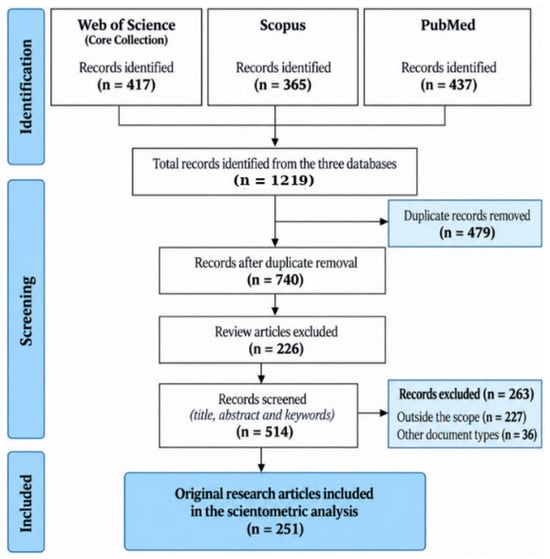
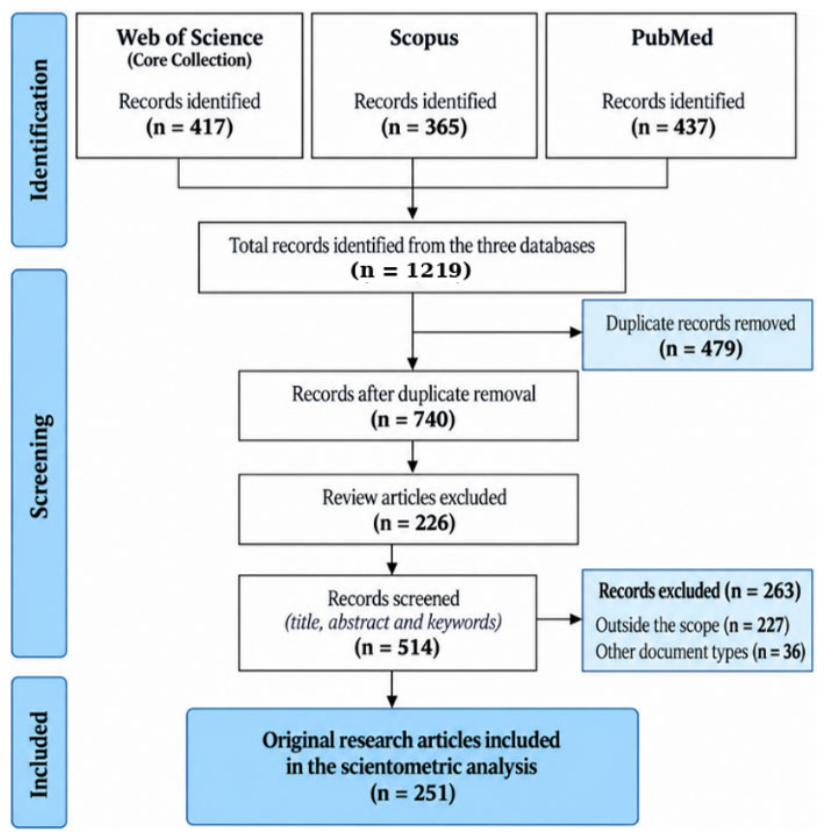
The searches identified 417 records in WoSCC, 365 in Scopus, and 437 in PubMed, resulting in 1219 records before duplicate removal.
The original search strategy was retained during the final update rather than expanded to include additional specific cellular components, such as “enteric glial cells”, as independent retrieval terms. This decision was made to preserve the original retrieval framework and comparability throughout the study period. Studies specifically addressing enteric glial cells remained eligible when retrieved through the broader ENS-related terminology. Consequently, highly specific studies that did not use any of the broader ENS-related terms may not have been retrieved.
2.3. Eligibility Criteria and Study Selection
Eligible records were required to be original research articles directly investigating the ENS or relevant enteric cellular and anatomical components, including enteric neurons, enteric glial cells, the myenteric plexus, the submucosal plexus, or closely associated enteric neuromuscular cellular components, in relation to oxidative stress or redox biology.
Oxidative stress was considered relevant when it was experimentally measured, manipulated, or mechanistically evaluated through reactive oxygen species, oxidative damage markers, antioxidant defenses, redox-sensitive pathways, or related mechanisms. Relevant indicators included, for example, ROS, lipid or protein oxidation markers, glutathione, superoxide dismutase, nitric oxide-related pathways, and antioxidant signaling pathways.
Human, animal, in vitro, and ex vivo original experimental studies were eligible. Studies were excluded when the ENS or oxidative stress was mentioned only as background information without experimental assessment of the relationship between them. Records in which the acronym “ENS” referred to concepts unrelated to the enteric nervous system were also excluded.
Reviews, systematic reviews, meta-analyses, editorials, letters, conference proceedings, book chapters, and other non-original document types were excluded from the final scientometric corpus because the analysis was designed to characterize primary research output and to avoid treating secondary syntheses as original research contributions.
Eligibility screening was based primarily on title, abstract, and keywords. Full texts were consulted only when eligibility could not be reliably determined from these elements. Study selection was independently performed by two researchers, and disagreements were resolved by consensus.
Of the 1219 records initially retrieved, 479 duplicates were removed, leaving 740 unique records. Subsequently, 226 review articles were excluded. The remaining 514 records underwent eligibility screening, during which 227 records were excluded because they did not meet the predefined scope and 36 were excluded because they represented other document types. The final corpus comprised 251 original research articles (Figure 1).
Figure 1.
Flow diagram of the study identification, screening, and inclusion process. Records were identified in the Web of Science Core Collection, Scopus, and PubMed. Screening was based on title, abstract, and keywords; full texts were consulted only when eligibility could not be determined from these elements.
The complete list of included studies is provided in Supplementary Table S1.
2.4. Data Export, Integration, and Deduplication
WoSCC and Scopus records were exported in BibTeX format, whereas PubMed records were exported in plain-text format. The files were imported into R and converted to a common bibliographic data structure using the Bibliometrix package [21].
Database conversion was performed using the convert2df() function, and records from the three databases were subsequently integrated using mergeDbSources() with duplicate removal enabled (remove.duplicated = TRUE) [21]. During database conversion, Bibliometrix applied database-specific duplicate checks based on DOI and source-specific record identifiers. During database merging, duplicate records were first identified by DOI when available and were subsequently checked using normalized document titles combined with publication year. Title normalization included removal of non-alphanumeric characters and redundant whitespace before comparison. Thus, records lacking a DOI could still be identified as duplicates when the normalized title and publication year matched. No further manual verification of duplicates was performed after the automated merge. The resulting merged database was exported to Microsoft Excel for subsequent eligibility screening, metadata harmonization, and scientometric analyses.
2.5. Metadata Cleaning and Harmonization
Before the scientometric analyses, bibliographic metadata were systematically reviewed and harmonized to minimize fragmentation caused by differences in indexing and metadata structure among the databases.
Author names were standardized using the AU and AF fields, with attention to differences in initials, punctuation, surname presentation, and database-specific formatting.
Institutional information was harmonized across the C1, AU_UN, and AU1_UN fields. Different textual variants referring to the same institution were consolidated under a single standardized institutional form. Country names and affiliation information were similarly standardized before geographical and collaboration analyses.
Journal and source titles were reviewed to reduce fragmentation caused by abbreviations and alternative source-name formats.
Author keywords (DE) were harmonized with respect to capitalization, punctuation, hyphenation, singular/plural forms, and clearly equivalent lexical variants while preserving the scientific meaning of the original terms.
The resulting cleaned and harmonized dataset constituted the master database used for all subsequent analyses.
The cleaned bibliographic dataset and the normalization dictionary used for author-keyword and institutional harmonization are provided as Supplementary Files S1 and S3, respectively.
Cited-reference metadata were not consistently available across records originating from the three databases. Consequently, analyses requiring complete cited-reference information, such as formal co-citation and bibliographic-coupling analyses based on the CR field, were not performed.
2.6. General Scientometric Analysis
Bibliographic conversion, database integration, descriptive scientometric analyses, and science mapping were performed using Bibliometrix/Biblioshiny version 5.0 in R version 4.5.3 [21,22].
The analyses included annual scientific production, publication language, author productivity, authors’ production over time, journal productivity, corpus-specific citation indicators, collaboration networks, geographical distribution, international collaboration, keyword frequency, keyword co-occurrence, temporal keyword patterns, thematic evolution, and thematic mapping.
Annual scientific production was calculated according to publication year. Because the final search was conducted on 12 September 2026, the publication count for 2026 represented an incomplete calendar year and was interpreted accordingly.
Citation counts were derived from the TC (Times Cited) field retained in the merged Bibliometrix database. Citation counts from the different databases were not summed or averaged. When duplicate records were identified during database merging, the metadata of the retained record, including its TC value, were preserved according to the database-priority and deduplication procedure implemented by mergeDbSources(). The h-indices reported for authors and journals were subsequently calculated by Bibliometrix from the TC values of publications represented in the final corpus. Therefore, these h-indices are corpus-specific with respect to the set of publications considered and should not be interpreted as unrestricted career- or journal-level h-indices.
2.7. Author Productivity and Lotka’s Law
Author productivity was formally evaluated according to Lotka’s law [23]. The number of publications per author was used to estimate the power-law distribution of scientific productivity.
The fitted distribution was characterized by the estimated Lotka beta coefficient and coefficient of determination (R2). Agreement between the observed and fitted author-productivity distributions was additionally evaluated using the Kolmogorov–Smirnov test.
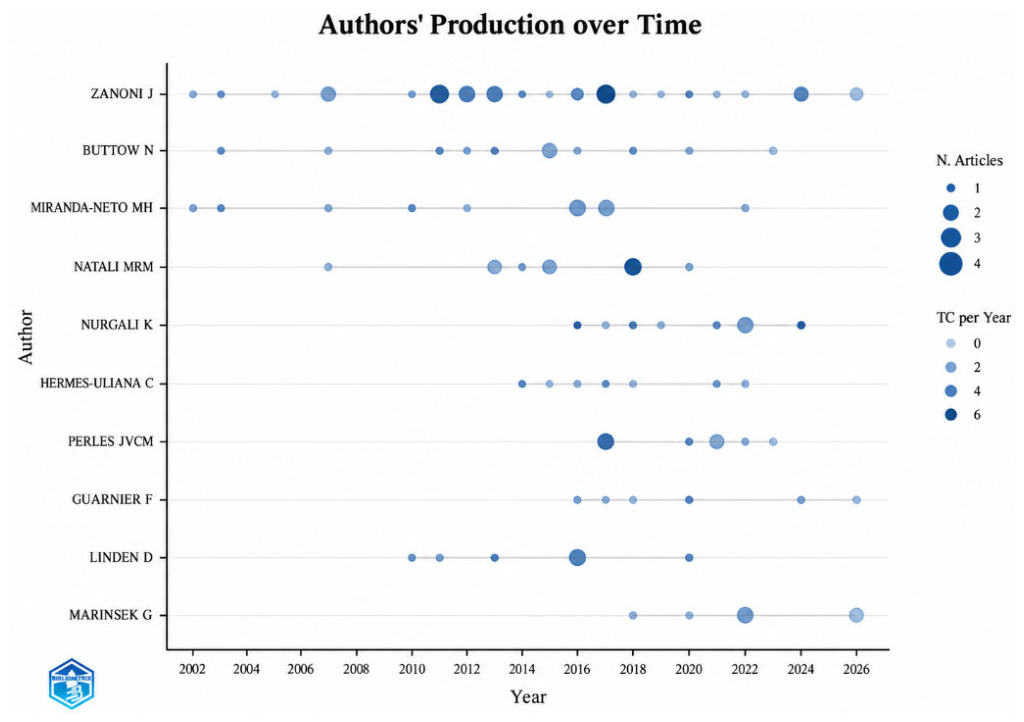
Authors’ scientific production over time was visualized using Bibliometrix/Biblioshiny [21]. Node size represented the number of publications associated with each author in a given year, whereas the temporal span represented the period between each author’s first and most recent publication within the analyzed corpus.
Fractionalized author productivity was also calculated to account for the proportional contribution of each author according to the number of co-authors in individual publications.
2.8. Journal Productivity and Bradford’s Law
Publication sources were ranked according to the number of articles included in the final corpus. For the most productive journals, the number and percentage of articles, corpus-specific local h-index, and first publication year within the dataset were reported.
Source dispersion was formally evaluated according to Bradford’s law [24,25]. Journals were ranked according to decreasing productivity and partitioned into Bradford zones.
The Bradford multiplier (k) and goodness of fit of the fitted distribution were estimated. Compatibility between the observed and fitted Bradford distributions was assessed using the coefficient of determination (R2) and the Kolmogorov–Smirnov test.
2.9. Author and Institutional Collaboration Analyses
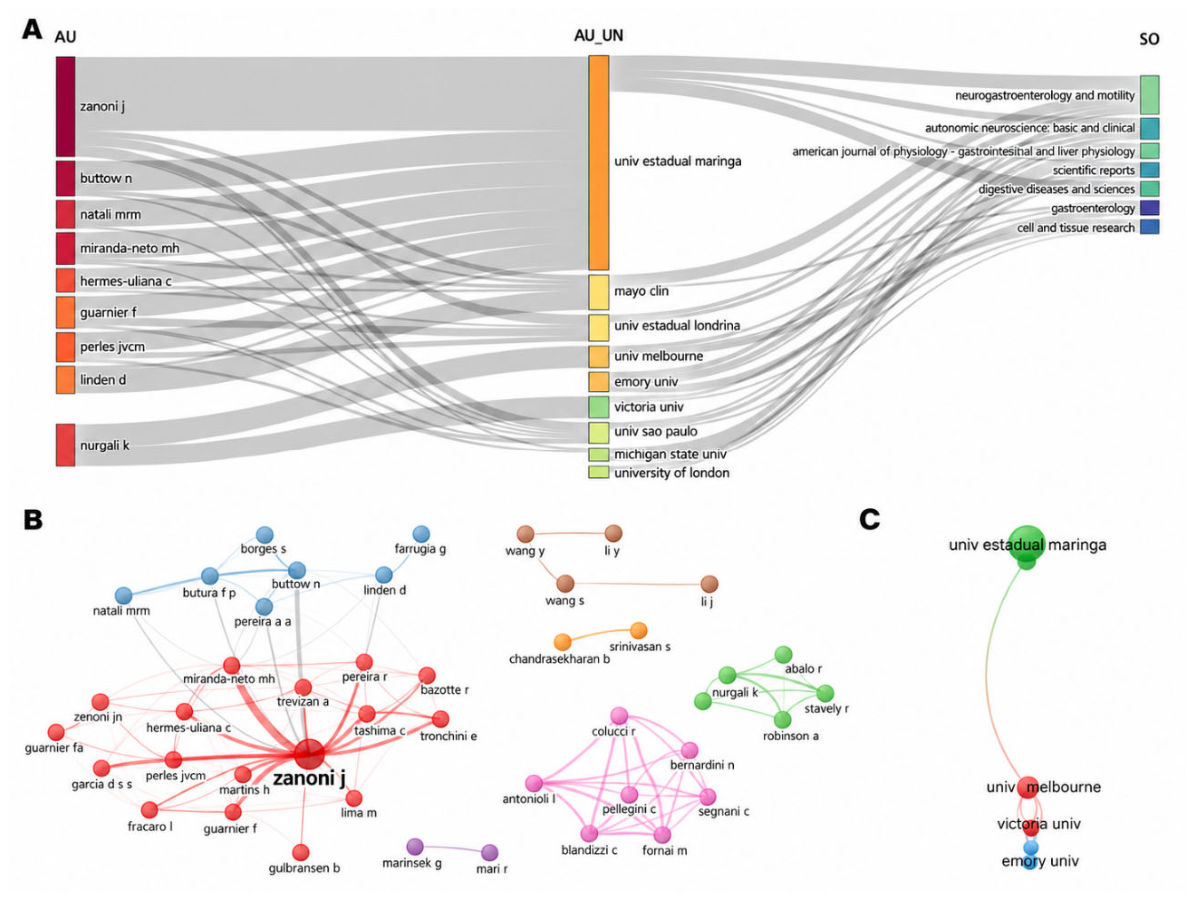
A three-field plot was generated using Bibliometrix/Biblioshiny [21] to visualize relationships among the most productive authors (AU), their affiliated institutions (AU_UN), and the principal publication sources (SO). Up to 10 representative elements per field were displayed. Link width was proportional to the frequency of relationships among the three bibliographic fields.
Co-authorship relationships among authors were evaluated using a collaboration network generated in Bibliometrix/Biblioshiny. The network was normalized using the Jaccard similarity measure, and community structure was identified using the Walktrap clustering algorithm. Link thickness represented collaboration strength. Node size was treated as a descriptive visualization attribute of the Bibliometrix network output; author-level centrality metrics were not used to rank authors or to infer scientific leadership.
Institutional collaboration was independently evaluated using VOSviewer version 1.6.20 [26]. Co-authorship was selected as the type of analysis and organizations as the unit of analysis. The full-counting method was applied.
Documents co-authored by more than 25 organizations were excluded to reduce the disproportionate influence of exceptionally large multi-institutional collaborations. A minimum threshold of five documents per organization was applied, with no minimum citation requirement. Of the 480 organizations identified in the dataset, 18 met this threshold. Because the resulting network included disconnected organizations, only the largest connected component, comprising 12 organizations, was displayed in the final visualization.
2.10. Geographical and International Collaboration Analyses
Geographical patterns were evaluated using country information derived from author affiliations and corresponding-author metadata.
The geographical distribution of corresponding authors was analyzed using Single Country Publications (SCP) and Multiple Country Publications (MCP). SCP was defined as a publication in which all contributing authors were affiliated with institutions located in the same country, whereas MCP represented publications involving authors affiliated with institutions from more than one country.
Country-level collaboration was additionally evaluated using a collaboration network generated in Bibliometrix/Biblioshiny [21], with Countries selected as the network field.
The network was normalized using the association method, and clusters were identified using the Louvain clustering algorithm. Automatic network layout was used, with a maximum of 50 nodes and a repulsion force of 0.5. Isolated nodes were removed, and the minimum number of edges was set to 1. The option to exclude articles containing more than 20 authors was not activated.
The resulting network was characterized using collaboration links, cluster membership, betweenness centrality, and PageRank. These measures were interpreted descriptively to characterize countries’ connectivity and bridging positions within the international collaboration network and were not treated as measures of scientific superiority or research quality.
2.11. Keyword Frequency and Co-Occurrence Analysis
Conceptual-structure analyses were primarily based on author keywords (DE), as these terms directly reflect the terminology selected by the authors of the included publications.
A word cloud containing the 30 most frequent author keywords was generated using Bibliometrix/Biblioshiny [21]. Word size was proportional to the frequency of each term.
Because several of the most frequent keywords were also components of the original retrieval strategy, their high frequencies were interpreted descriptively and not considered independent evidence of thematic importance.
Keyword co-occurrence analysis was performed using VOSviewer version 1.6.20 [26]. Co-occurrence was selected as the type of analysis, Author keywords as the unit of analysis, and Full counting as the counting method.
A minimum occurrence threshold of five was applied. Of the 674 unique author keywords identified in the corpus, 40 met this threshold and were included in the complete co-occurrence analysis.
In the network visualization, node size represented keyword occurrence frequency, link thickness represented co-occurrence strength, and colors represented clusters of closely associated terms. Total link strength (TLS) was used as a quantitative indicator of each keyword’s overall connectivity within the co-occurrence network.
An overlay visualization was generated from the same keyword network. Node color represented the average publication year associated with each keyword, allowing temporal variation in terminology to be examined. These differences were interpreted as variations in average publication year rather than definitive evidence that individual topics were emerging or declining.
2.12. Sensitivity Analysis of Search-Derived Keywords
Because several highly frequent keywords were also directly included in the original search strategy, a sensitivity analysis was performed to determine whether the observed conceptual organization was predominantly driven by the retrieval terms.
The keyword co-occurrence analysis was repeated after manually excluding the three dominant search-related terms “enteric nervous system,” “oxidative stress,” and “myenteric plexus” from the final network visualization. All other analytical parameters were maintained.
The persistence of coherent biological, experimental, and disease-related clusters after exclusion of these search-derived terms was used to assess the robustness of the conceptual structure identified in the corpus.
2.13. Trend Topics and Thematic Evolution
Temporal patterns in research terminology were examined using Bibliometrix/Biblioshiny version 5.0 [21], based on the harmonized author keywords.
Trend-topic analysis was used to visualize the temporal distribution of recurrent author keywords across the study period. Bubble size represented keyword frequency, whereas the horizontal line associated with each term represented its temporal span within the analyzed corpus.
Thematic evolution analysis was performed using one temporal cutting point at 2018, resulting in two periods: 1989–2018 and 2019–2026. This division was used to compare the earlier development of the field with its more recent thematic configuration.
Relationships among themes across the two periods were visualized using a thematic-evolution diagram. The flows connecting themes represented continuity and thematic relationships between the two time intervals.
2.14. Thematic Mapping
The thematic structure of the scientific field was further investigated using co-word analysis based on author keywords.
Thematic maps were generated separately for the 1989–2018 and 2019–2026 periods according to the co-word analytical framework described by Callon et al. [27].
Themes were positioned according to Callon centrality, representing their degree of interaction with other themes in the network, and Callon density, representing the internal development of individual thematic clusters.
The resulting maps were interpreted according to the conventional four-quadrant structure. Motor Themes were characterized by high centrality and high density; Basic Themes by high centrality and lower density; Niche Themes by lower centrality and high density; and Emerging or Declining Themes by lower centrality and lower density.
Placement in the lower-left quadrant was interpreted cautiously because a static thematic map cannot independently distinguish an emerging topic from a declining one. Temporal interpretations were therefore considered together with the trend-topic analysis, thematic-evolution analysis, and VOSviewer overlay visualization.
2.15. Software and Reproducibility
Bibliographic conversion, database integration, descriptive scientometric analyses, and science mapping were performed using Bibliometrix/Biblioshiny version 5.0 [21] in R version 4.5.3 [22].
Institutional collaboration networks and keyword co-occurrence and overlay analyses were generated using VOSviewer version 1.6.20 [26].
Metadata cleaning and harmonization procedures were completed before the final analyses, and the same cleaned master dataset was used across subsequent analytical procedures to ensure internal consistency. Raw database exports were retained separately from the harmonized dataset, and normalization decisions and analytical settings were documented to support reproducibility.
3. Results
3.1. Temporal Trends in Publication and Authorship
Across the three databases, 1219 records were identified. After duplicate removal and application of the predefined eligibility criteria, 251 original research articles addressing the relationship between the enteric nervous system and oxidative stress were included in the final scientometric analysis.
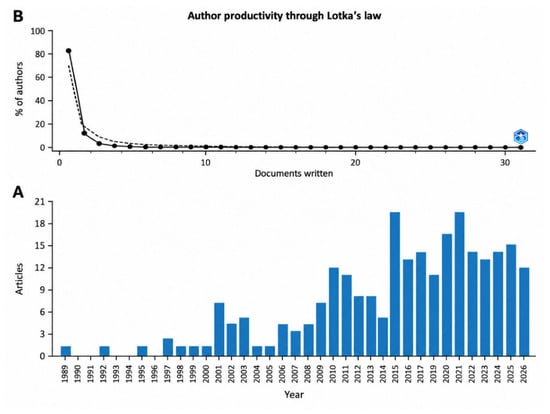
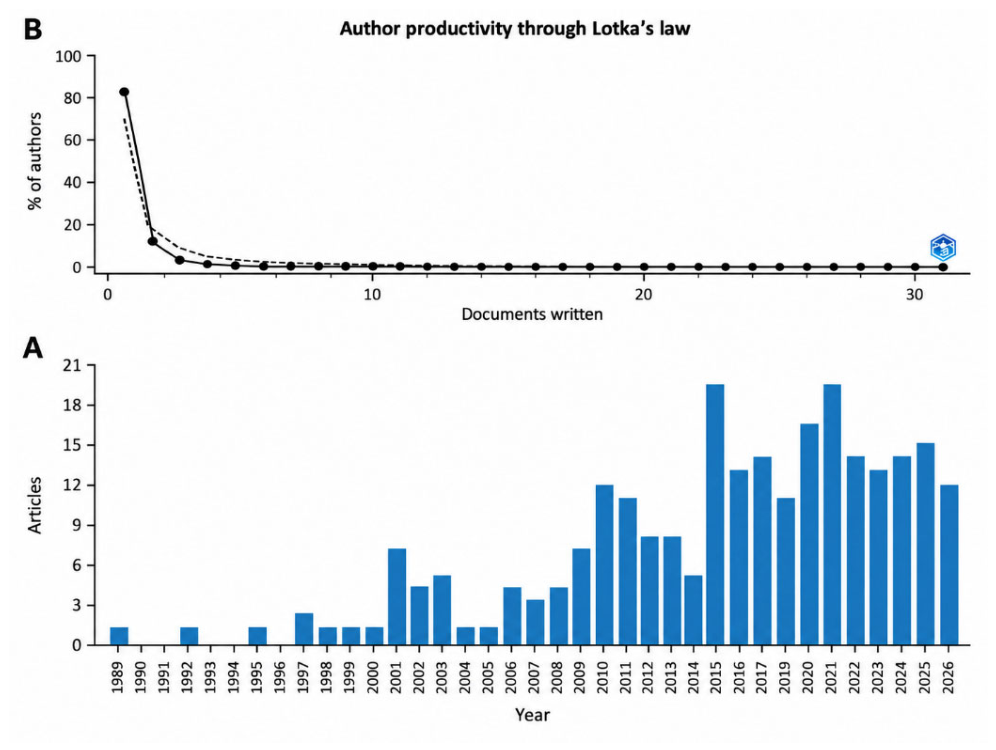
The earliest publication identified in the corpus was published in 1989. Scientific production showed an overall upward trend during the study period, with an annual growth rate of 6.95%. Publication output remained relatively limited during the 1990s and increased more consistently from the early 2000s onward. The highest annual outputs were observed in 2016 and 2021, with 19 publications each. A temporary decrease was observed in 2015, followed by a marked increase in 2016. Publication activity remained comparatively high thereafter, with 15 articles published in 2025. Because the search was conducted on 12 September 2026, the 12 publications identified for 2026 represent an incomplete calendar year and should not be interpreted as evidence of a decline in scientific production (Figure 2A).
Figure 2.
Annual scientific production and author productivity according to Lotka’s law. (A) Annual distribution of publications addressing the relationship between the enteric nervous system and oxidative stress from 1989 to 2026. Data for 2026 represent an incomplete calendar year because the final search was conducted on 12 September 2026. (B) Distribution of author productivity according to Lotka’s law. The fitted model yielded β = 2.45 and R2 = 0.8429, with no significant difference between the observed and fitted distributions according to the Kolmogorov–Smirnov test (p = 0.249). In panel (B), the solid line with black circles represents the observed author-productivity distribution, whereas the dashed line represents the fitted Lotka distribution. The blue symbol is the Bibliometrix/Biblioshiny logo.
Most publications were written in English (n = 249; 99.2%), whereas Spanish and Chinese accounted for one publication each (0.4% each).
A total of 1473 unique authors contributed to the 251 publications, with an average of 7.88 co-authors per document. Author productivity showed a strongly skewed distribution, with 1202 authors (81.6%) contributing to only one publication, whereas a much smaller proportion of authors contributed to multiple documents. Formal assessment of Lotka’s law yielded an estimated beta coefficient of 2.45 and a coefficient of determination of R2 = 0.8429. The fitted distribution showed no statistically significant deviation from the observed author-productivity distribution (Kolmogorov–Smirnov p = 0.249), supporting the compatibility of the dataset with a Lotka-type productivity pattern (Figure 2B).
3.2. Top Authors’ Production over Time
Zanoni J. was the most productive author in the analyzed corpus, with 33 publications, followed by Buttow N. (n = 11), Miranda-Neto M.H. (n = 10), Natali M.R.M. (n = 9), and Nurgali K. (n = 8). Hermes-Uliana C. and Perles J.V.C.M. contributed seven publications each, whereas Guarnier F., Linden D., and Marinsek G. contributed six publications each (Table 1).
Table 1.
Most productive authors and their publication trajectories within the analyzed corpus.
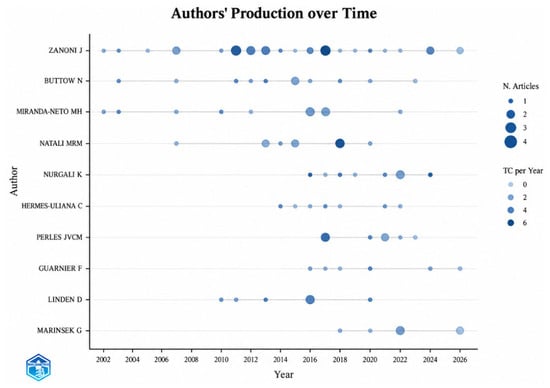
The temporal distribution of publications showed different patterns of scientific activity among the most productive authors (Figure 3). Zanoni J. exhibited the longest and most sustained trajectory, with publications spanning from 2002 to 2026. Buttow N. and Miranda-Neto M.H. also showed long-term participation in the field, with contributions extending from 2003 to 2023 and from 2002 to 2022, respectively. Natali M.R.M. contributed between 2007 and 2020, whereas Nurgali K. showed a more recent trajectory, with publications concentrated between 2016 and 2024.
Figure 3.
Production of the most productive authors over time. The visualization was generated using Bibliometrix/Biblioshiny [21]. Node size is proportional to the number of articles published by each author in a given year. Horizontal lines indicate the period between each author’s first and most recent publication within the analyzed corpus.
Among the other highly productive authors, Hermes-Uliana C. contributed between 2014 and 2022, Perles J.V.C.M. between 2017 and 2023, Guarnier F. between 2016 and 2026, Linden D. between 2010 and 2020, and Marinsek G. between 2018 and 2026. Overall, the temporal patterns indicate the coexistence of long-standing contributors and more recently active authors, suggesting continuity alongside renewal in research addressing the relationship between the ENS and oxidative stress.
When h-index values were calculated using the publications represented in the analyzed corpus, Zanoni J. also presented the highest local h-index (h = 13), followed by Buttow N. (h = 9), Miranda-Neto M.H. and Natali M.R.M. (h = 7 each), and Nurgali K. and Linden D. (h = 6 each). These values are corpus-specific with respect to the set of publications considered and should not be interpreted as the authors’ unrestricted global h-indices.
3.3. Distribution of Publications by Journal
The 251 articles included in the final corpus were distributed across 137 journals, demonstrating substantial dispersion of publications across sources. The most productive journals listed in Table 2 accounted for 80 articles, corresponding to 31.9% of the total corpus.
Table 2.
Most productive journals in research on the enteric nervous system and oxidative stress.
Neurogastroenterology and Motility was the most productive source, with 19 publications (7.6%), followed by the American Journal of Physiology—Gastrointestinal and Liver Physiology with 10 publications (4.0%). Digestive Diseases and Sciences and the International Journal of Molecular Sciences each published seven articles (2.8%), whereas Autonomic Neuroscience: Basic and Clinical and Scientific Reports each contributed six articles (2.4%). Five additional journals, namely Arquivos de Gastroenterologia, Cell and Tissue Research, European Journal of Pharmacology, Gastroenterology, and PLOS ONE, published five articles each (2.0%) (Table 2).
Within the analyzed corpus, Neurogastroenterology and Motility also presented the highest local h-index (h = 12), followed by the American Journal of Physiology—Gastrointestinal and Liver Physiology (h = 9). The remaining highly productive journals showed local h-indices ranging from 2 to 5. These indicators were calculated using the citation counts associated with publications represented in the analyzed corpus and should not be interpreted as the journals’ unrestricted global h-indices.
Formal assessment of source dispersion according to Bradford’s law identified a core zone comprising 12 journals, followed by 42 journals in Zone 2 and 83 journals in Zone 3. The fitted distribution showed a strong goodness of fit (R2 = 0.9504), with a Bradford multiplier of k = 2.74. The Kolmogorov–Smirnov test indicated no statistically significant deviation between the observed and fitted distributions (p = 0.0584), supporting the compatibility of the journal distribution with Bradford’s law. Thus, although the literature is distributed across a large number of publication sources, a relatively small group of journals accounts for a substantial proportion of the scientific output in this field. Authorship and institutional collaboration patterns are presented in Figure 4 and discussed below.
Figure 4.
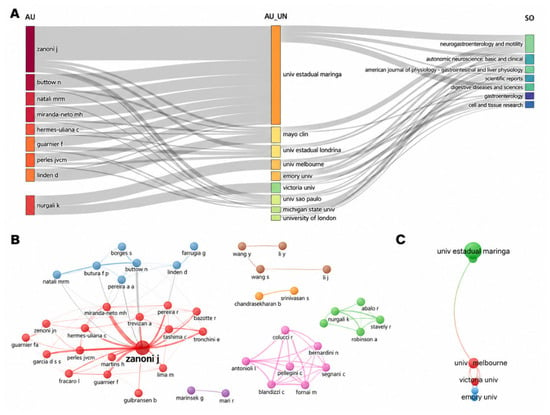
Authorship and institutional collaboration patterns in research on the enteric nervous system and oxidative stress. (A) Three-field plot generated using Bibliometrix/Biblioshiny [21], showing the relationships among the most productive authors, their affiliated institutions, and the main publication sources. Link width is proportional to the frequency of relationships among the three fields. (B) Co-authorship network among authors generated using Bibliometrix/Biblioshiny [21]; link thickness represents collaboration strength, colors indicate collaboration clusters, and node size is treated descriptively rather than as a quantitative ranking of author centrality. (C) Institutional co-authorship network generated using VOSviewer [26]. The analysis used full counting, organizations as the unit of analysis, a minimum threshold of five documents per organization, and exclusion of documents co-authored by more than 25 organizations. Because the network contained disconnected items, only the largest connected component is displayed.
3.4. Geographical Distribution and International Collaboration
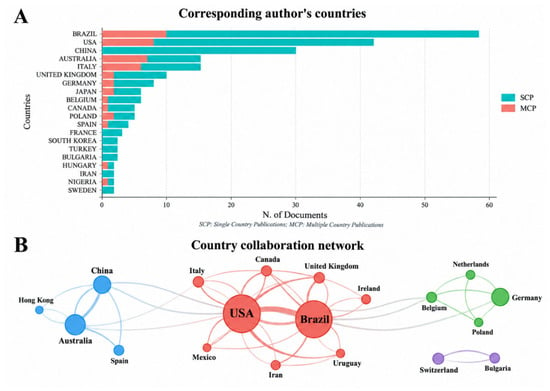
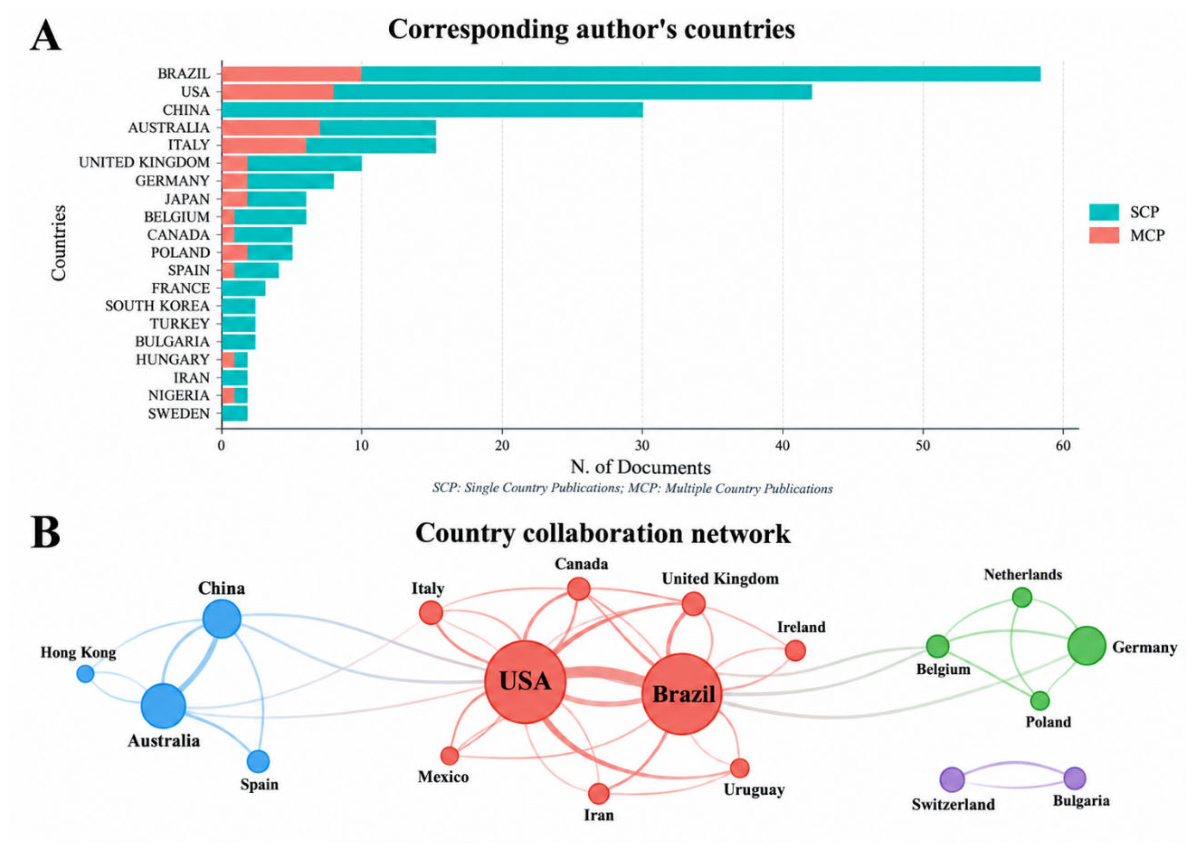
The geographical distribution of corresponding authors showed that Brazil contributed the largest number of publications, with 59 documents, followed by the United States with 42 and China with 30 (Figure 5A). Brazil and the United States presented a combination of single-country publications (SCP) and multiple-country publications (MCP), whereas China’s corresponding-author publications were entirely classified as SCP. Australia and Italy showed lower overall publication volumes but comparatively higher proportions of MCP, indicating a greater relative contribution from internationally collaborative studies.
Figure 5.
Geographical distribution and international collaboration in research on the enteric nervous system and oxidative stress. (A) Corresponding author countries classified according to single-country publications (SCP) and multiple-country publications (MCP). SCP represents publications in which all authors were affiliated with institutions from the same country, whereas MCP represents publications involving authors from more than one country. (B) Country collaboration network based on co-authorship relationships. Node size reflects the relative prominence of countries within the collaboration network, link thickness represents collaboration strength, and colors indicate collaboration clusters identified using the Louvain algorithm. The network was normalized using the association method, isolated nodes were removed, and a minimum edge threshold of 1 was applied.
The country collaboration network revealed a structured pattern of international cooperation organized into four main clusters (Figure 5B). The United States occupied the most prominent intermediary position in the network, with the highest betweenness centrality (100.85) and PageRank value (0.2024), indicating a strong bridging role between different national collaboration groups. Germany also showed a high betweenness value (42.51), whereas Australia (20.17), Brazil (20.11), and Canada (19.71) showed intermediate betweenness values.
The network further showed strong collaborative links involving the United States and Brazil, as well as connections between North American, European, Asian, and Oceanian countries. The clustering pattern indicated that international collaboration in this field is not evenly distributed across countries, but rather organized around a limited number of interconnected national groups. Overall, these findings demonstrate a geographically diverse research landscape, with substantial contributions from Brazil, the United States, China, Australia, Italy, and European countries, alongside heterogeneous levels of international collaboration.
3.5. Keyword Analysis and Thematic Structure
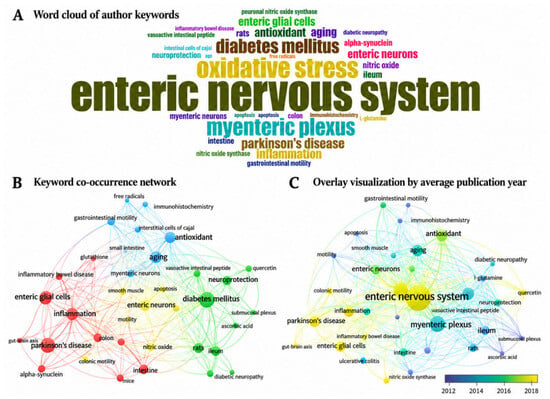
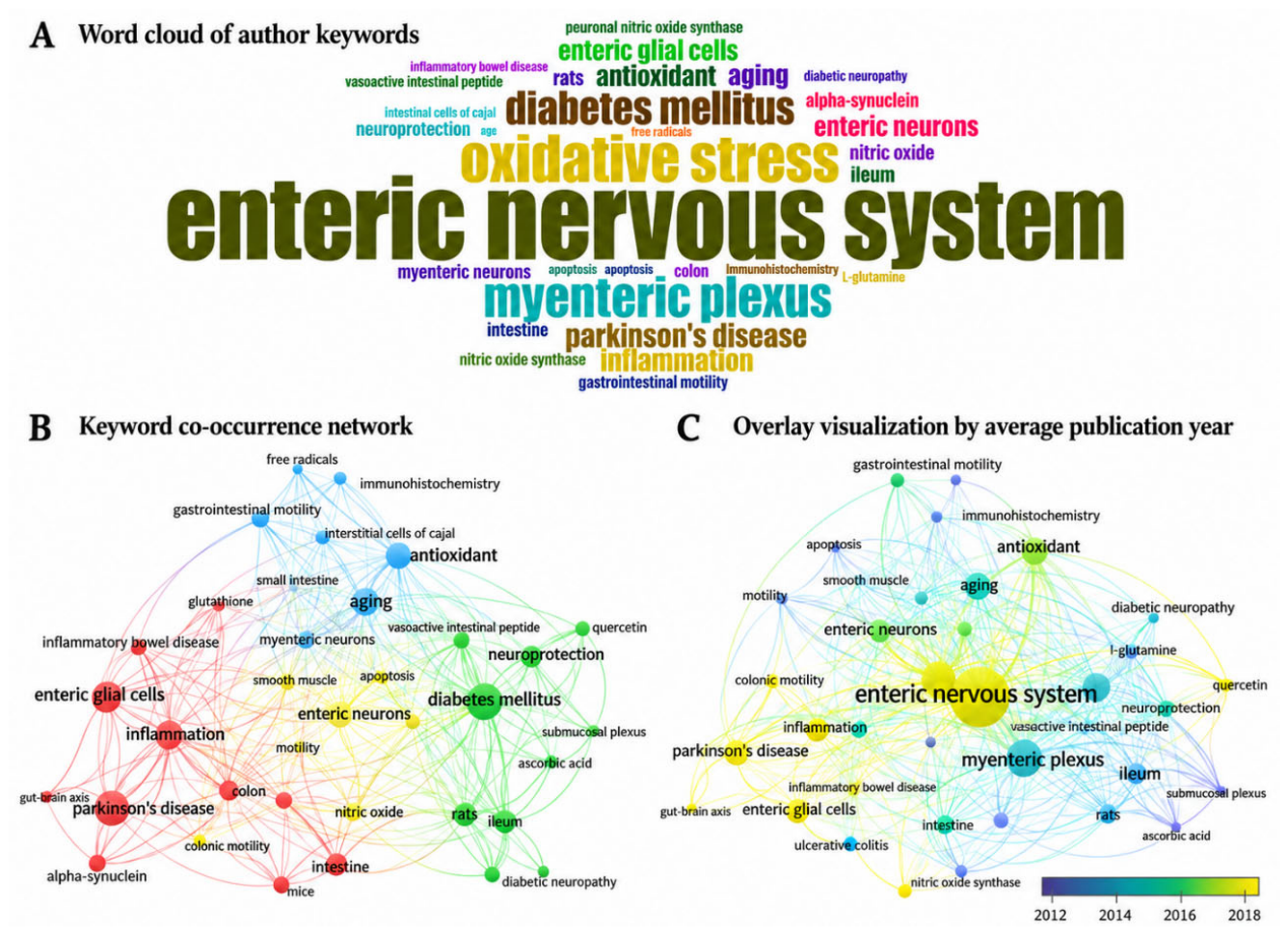
A total of 674 unique author keywords were identified in the final corpus. The word cloud of the 30 most frequent author keywords showed that enteric nervous system, oxidative stress, and myenteric plexus were the most prominent terms, followed by diabetes mellitus, Parkinson’s disease, inflammation, antioxidant, enteric glial cells, enteric neurons, and aging (Figure 6A). Because the three most prominent terms were directly related to the search strategy, their high frequency was interpreted descriptively and not as independent evidence of thematic centrality.
Figure 6.
Keyword analysis of the literature on the enteric nervous system and oxidative stress. (A) Word cloud of author keywords, in which word size is proportional to keyword frequency. (B) Co-occurrence network of author keywords generated in VOSviewer, showing the main thematic clusters and the relationships among terms; node size represents the number of occurrences of each keyword, line thickness indicates co-occurrence strength, and colors denote clusters. For better visualization, the highly recurrent broad terms enteric nervous system, oxidative stress, and myenteric plexus were omitted from the network display. (C) Overlay visualization of author keywords according to the average publication year, where node size reflects keyword frequency and the color scale ranges from earlier to more recent topics. Overall, the analyses show recurrent associations involving diabetes mellitus, inflammation, enteric glial cells, neuroprotection, and Parkinson’s disease beyond the dominant search-related terms.
For the co-occurrence analysis, a minimum threshold of five occurrences was applied. Of the 674 author keywords identified, 40 met this criterion. In the complete network, enteric nervous system showed the highest frequency and connectivity (74 occurrences; total link strength [TLS] = 117), followed by oxidative stress (40 occurrences; TLS = 83), myenteric plexus (35 occurrences; TLS = 83), and diabetes mellitus (26 occurrences; TLS = 72). Other highly connected terms included antioxidant (19 occurrences; TLS = 46), Parkinson’s disease (21; TLS = 43), inflammation (19; TLS = 41), aging (16; TLS = 37), ileum (12; TLS = 36), rats (13; TLS = 35), alpha-synuclein (12; TLS = 30), neuroprotection (11; TLS = 30), enteric neurons (17; TLS = 29), and enteric glial cells (18; TLS = 24).
To assess whether the conceptual structure of the network was driven by the terms used in the search strategy, a sensitivity analysis was performed by excluding enteric nervous system, oxidative stress, and myenteric plexus from the final network visualization. The remaining terms continued to form a well-structured co-occurrence network (Figure 6B), with prominent nodes involving diabetes mellitus, Parkinson’s disease, inflammation, enteric glial cells, antioxidant, aging, enteric neurons, ileum, neuroprotection, and alpha-synuclein. This persistence of coherent thematic relationships after removal of the search-derived terms indicates that the conceptual organization of the corpus was not solely determined by the retrieval strategy.
The overlay visualization provided a temporal perspective on the author-keyword network (Figure 6C). Terms associated with more traditional experimental and anatomical approaches, including myenteric plexus, ileum, rats, submucosal plexus, and ascorbic acid, were concentrated in earlier average publication years. In contrast, terms such as Parkinson’s disease, enteric glial cells, inflammation, antioxidant, and gut–brain axis were associated with more recent average publication years, suggesting a gradual broadening of the field toward neurodegenerative, inflammatory, glial, and gut–brain-related research. These temporal differences should be interpreted as shifts in the average publication year of the indexed terms rather than as proof that a topic is necessarily emerging or declining.
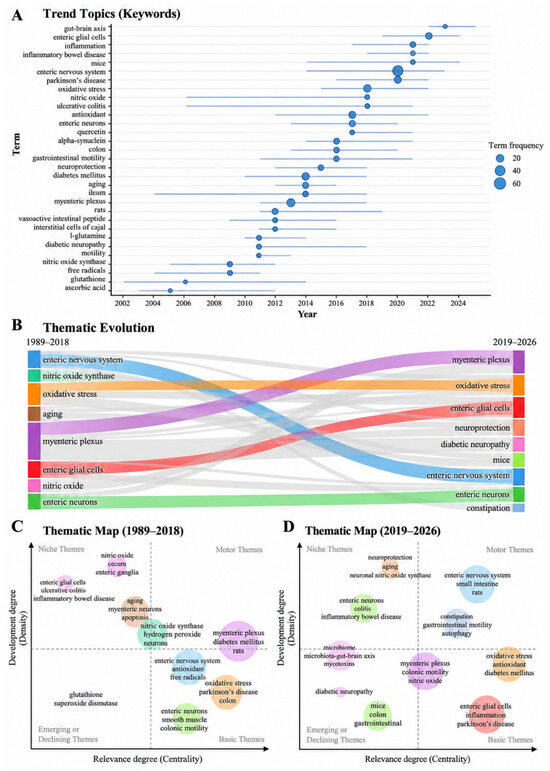
The thematic evolution analysis further demonstrated both continuity and diversification of research topics over time (Figure 7). Between 1989 and 2018, the conceptual structure was dominated by broad themes such as enteric nervous system, oxidative stress, myenteric plexus, enteric glial cells, enteric neurons, nitric oxide, and aging. During 2019–2026, several of these themes persisted, particularly myenteric plexus, oxidative stress, enteric nervous system, and enteric neurons, while additional topics such as neuroprotection, diabetic neuropathy, and constipation became more visible. The continued presence of enteric glial cells in the later period also indicates sustained interest in the contribution of glial biology to enteric nervous system dysfunction.
Figure 7.
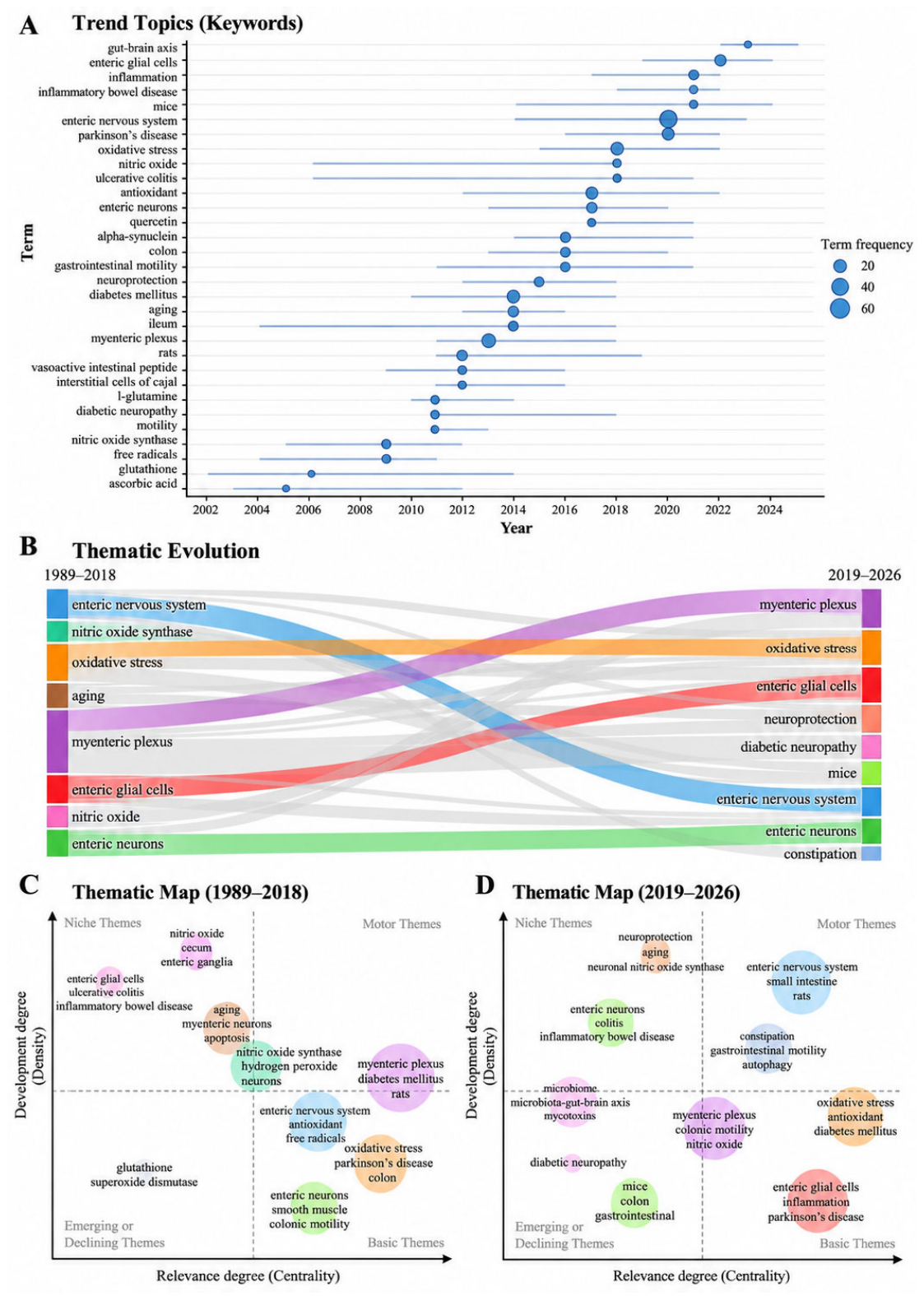
Temporal and thematic evolution of author keywords in publications on the enteric nervous system and oxidative stress. (A) Trend Topics analysis based on harmonized author keywords, showing the temporal distribution of recurrent terms across the study period; bubble size represents keyword frequency, and horizontal lines indicate the temporal span of each term within the corpus. (B) Thematic evolution map showing the continuity and transformation of the main keyword-based themes between 1989–2018 and 2019–2026; connecting flows represent thematic relationships between the two periods. (C) Thematic map for 1989–2018 and (D) thematic map for 2019–2026, in which themes are positioned according to Callon centrality and Callon density. The four quadrants represent Motor Themes, Basic Themes, Niche Themes, and Emerging or Declining Themes. The latter quadrant was interpreted cautiously, as low centrality and density alone do not distinguish emerging from declining topics. In panels (C,D), the dashed horizontal and vertical lines indicate the quadrant boundaries based on relative Callon centrality and density.
The thematic maps showed differences in the structural position of topics between the earlier and more recent periods (Figure 7). In the 1989–2018 period, themes related to myenteric plexus, diabetes mellitus, and rats occupied a relatively central position, whereas enteric glial cells, inflammatory bowel disease, and ulcerative colitis were more specialized. In the 2019–2026 period, themes involving enteric nervous system, small intestine, and rats showed higher centrality and density, while oxidative stress, antioxidant, and diabetes mellitus remained highly relevant but comparatively less densely developed. Themes involving enteric glial cells, inflammation, and Parkinson’s disease also occupied a central but less densely developed position, indicating growing integration of neuroinflammatory and neurodegenerative perspectives into the field.
Overall, the keyword-based analyses indicate that research linking the enteric nervous system and oxidative stress has evolved from a predominantly anatomical, experimental, and redox-oriented framework toward a broader conceptual landscape incorporating metabolic disease, neurodegeneration, inflammation, enteric glial biology, neuroprotection, and gut–brain interactions.
4. Discussion
This study provides an updated scientometric mapping of research addressing the relationship between the enteric nervous system (ENS) and oxidative stress, integrating records from the Web of Science Core Collection, Scopus, and PubMed. The final corpus comprised 251 original research articles published between 1989 and 2026. Overall, the findings indicate progressive expansion of this field, accompanied by a highly skewed distribution of author productivity, dispersion of publications across a broad range of journals, geographically heterogeneous collaboration patterns, and a conceptual structure that has diversified over time from predominantly anatomical and redox-oriented research toward metabolic, inflammatory, neurodegenerative, glial, and gut–brain-related themes.
Scientific production increased more consistently from the early 2000s onward, reaching its highest annual outputs in 2016 and 2021. This pattern is broadly compatible with the growing scientific interest in the ENS as a component of gastrointestinal and systemic pathophysiology. Previous studies have described similar expansion in related research domains, including enteric glial biology [13], interstitial cells of Cajal [14], and gut microbiome research [15,16]. More recent reviews have likewise emphasized the increasing integration of ENS biology with gastrointestinal innervation, neuroimmune signaling, and gut–brain communication [28,29]. However, the present findings should not be interpreted as demonstrating a continuous year-to-year increase, because publication output fluctuated across the study period. Furthermore, the 2026 count represents only publications indexed up to 12 September and therefore cannot be directly compared with complete calendar years.
The author-productivity distribution was strongly asymmetric, with 81.6% of authors contributing to only one publication. Formal fitting to Lotka’s law yielded a beta coefficient of 2.45, R2 = 0.8429, and no statistically significant departure between the observed and fitted distributions. These findings support the interpretation that scientific production in this field follows a Lotka-type pattern, in which a relatively small group of authors contributes repeatedly while a much larger proportion appears only once or infrequently [23]. The long publication trajectories observed for authors such as Zanoni J., Buttow N., and Miranda-Neto M.H. indicate sustained participation in the field, whereas the presence of more recently active authors suggests continuing renewal of the research community. Importantly, productivity and local h-index values are restricted to the publications represented in the analyzed corpus and should not be interpreted as unrestricted global measures of scientific influence or as evidence of individual research superiority.
The distribution of publications among journals also showed marked dispersion. The 251 articles were distributed across 137 journals, although a relatively small number of sources accounted for a substantial proportion of the corpus. The compatibility of this distribution with Bradford’s law, supported by the fitted model and Bradford zones, indicates the existence of a relatively concentrated group of recurrent publication outlets within a much broader set of less frequently represented journals [24,25]. Neurogastroenterology and Motility and the American Journal of Physiology—Gastrointestinal and Liver Physiology were the most productive journals in the corpus. Their prominence is consistent with the physiological and neurogastroenterological orientation of much of the literature, but the presence of journals from molecular, pharmacological, neurological, and multidisciplinary fields also reflects the interdisciplinary expansion of research on ENS dysfunction and oxidative stress. Recent reviews of neurogastroenterology similarly emphasize the increasing overlap among enteric neurobiology, gastrointestinal motility, immune regulation, and systemic disease [29].
The collaboration analyses revealed a field organized around several relatively distinct author groups and a more restricted connected institutional network. Brazilian institutions, particularly the Universidade Estadual de Maringá, were highly represented among the most productive authors and institutional relationships. This pattern is consistent with the strong contribution of Brazilian investigators to experimental studies of enteric neuropathy, oxidative stress, diabetes, and antioxidant interventions [30,31]. Nevertheless, productivity and network position should not be interpreted as indicators of “leadership” or “centers of excellence”. These measures describe publication frequency and connectivity within the retrieved corpus rather than institutional quality, scientific prestige, or broader impact.
The inclusion of country-level analyses provided a more direct view of the global structure of the literature. Brazil had the largest number of corresponding-author publications, followed by the United States and China. However, national publication volume and international collaboration showed different patterns. Whereas Brazil and the United States included both single-country and multiple-country publications, the corresponding-author publications attributed to China were classified as single-country publications in this dataset. Australia and Italy showed proportionally greater participation in multiple-country publications despite lower total publication counts. These results demonstrate that productivity and internationalization are distinct dimensions and should not be interpreted interchangeably.
The country collaboration network was organized into four major clusters, with heterogeneous degrees of connectivity among countries. The United States showed the highest betweenness centrality and PageRank values within the analyzed network, indicating a comparatively prominent bridging position among national collaboration groups. Germany also showed high betweenness, whereas Australia, Brazil, and Canada occupied intermediate positions. These network measures describe structural positions within the observed collaboration network rather than scientific quality or national superiority. The existence of connections among North American, South American, European, Asian, and Oceanian countries supports the international character of the field, while the uneven distribution of collaborative links indicates that international cooperation remains concentrated within particular groups.
The keyword analyses further illustrate the conceptual organization of research at the interface between the ENS and oxidative stress. As expected, “enteric nervous system”, “oxidative stress”, and “myenteric plexus” were among the most frequent and highly connected terms. However, because these expressions were components of the retrieval strategy, their prominence cannot be considered independent evidence of thematic centrality. This potential circularity was addressed through a sensitivity analysis in which these dominant search-derived terms were excluded from the network visualization. The remaining network retained coherent associations involving diabetes mellitus, Parkinson’s disease, inflammation, enteric glial cells, antioxidant mechanisms, aging, enteric neurons, neuroprotection, and alpha-synuclein. This suggests that the broader conceptual organization identified in the corpus was not solely an artifact of the search terms.
The prominence of inflammation, Parkinson’s disease, enteric glial cells, and alpha-synuclein is consistent with increasing attention to interactions between the ENS, neuroinflammation, and neurodegenerative processes. Enteric glial cells are increasingly recognized as active regulators of intestinal homeostasis, epithelial barrier function, immune signaling, neuronal support, and gut–brain communication rather than merely structural support cells [13,28,32]. The recent literature also highlights their responsiveness to oxidative stress and their potential involvement in neuroprotective and maladaptive responses depending on the intensity and duration of redox imbalance. Likewise, the presence of Parkinson’s disease and alpha-synuclein within the keyword network is consistent with literature examining gastrointestinal and ENS involvement in neurodegenerative disease [11,33]. A recent review further places ENS dysfunction, neuroinflammation, and microbiota-related signaling within the broader context of neurological disease and gut–brain interactions [34]. These findings indicate increasing integration between neurogastroenterology and neurodegenerative research, although keyword frequency alone does not establish mechanistic importance or clinical relevance.
Metabolic disease also represented a recurrent component of the conceptual structure. Diabetes mellitus, diabetic neuropathy, antioxidant-related terms, and neuroprotection were prominent across the analyses. Experimental studies have demonstrated associations among diabetes, oxidative stress, enteric neuronal loss, gastrointestinal dysmotility, and alterations in antioxidant defenses [10,30,31]. More recent literature also reinforces the relevance of obesity-related oxidative stress and inflammation to ENS dysfunction and discusses the potential modulatory effects of antioxidant and bioactive compounds in this context [35]. The recurrence of these terms therefore reflects an established experimental line of investigation linking metabolic dysfunction, redox imbalance, and enteric neuronal injury. However, the scientometric results do not establish the effectiveness of specific antioxidant interventions and should not be interpreted as evidence supporting particular therapeutic strategies.
The temporal analyses suggest a gradual diversification of research topics. Terms associated with more traditional anatomical and experimental approaches, including myenteric plexus, ileum, rats, submucosal plexus, and ascorbic acid, tended to have earlier average publication years. More recent average publication years were observed for terms including Parkinson’s disease, enteric glial cells, inflammation, and gut–brain axis. Similarly, thematic evolution between 1989–2018 and 2019–2026 showed continuity of established themes while also revealing greater visibility of neuroprotection, diabetic neuropathy, constipation, glial biology, and neurodegenerative topics in the more recent period. Recent reviews published in 2025–2026 likewise describe broader integration of ENS biology with neuroinflammatory, metabolic, glial, and gut–brain pathways [28,29,34,35]. These patterns are compatible with conceptual broadening of the field; however, average publication year and thematic-map position alone cannot demonstrate that a topic is definitively “emerging” or “declining”.
The thematic maps further reinforce this need for cautious interpretation. In the earlier period, themes involving myenteric plexus, diabetes mellitus, and experimental animal models occupied relatively central positions, whereas enteric glial cells and inflammatory bowel disease were more specialized. In the more recent period, oxidative stress, antioxidant mechanisms, diabetes mellitus, enteric glial cells, inflammation, Parkinson’s disease, and gastrointestinal motility occupied different combinations of centrality and density. These positions describe the internal and external connectivity of keyword clusters and should not be interpreted as direct measures of clinical relevance, research maturity, or research priority. In particular, themes located in the lower-left quadrant may represent either emerging or declining topics, and their direction can only be evaluated in conjunction with temporal analyses.
Chronic inflammatory disorders remain biologically relevant to the relationship between the ENS and oxidative stress, as supported by experimental and review literature on colitis and inflammatory bowel disease [6,7,8]. Nevertheless, the current scientometric results do not support describing Crohn’s disease or other specific conditions as definitive “research gaps” solely because of lower keyword frequency or peripheral thematic position. Rather, their lower representation indicates that they were less prominent within the retrieved corpus relative to other topics. The same caution applies to obesity and other clinically relevant conditions that appeared infrequently or did not meet the keyword-network threshold. The recent literature on obesity-related oxidative stress in the ENS illustrates why low keyword prominence should not be equated with biological irrelevance.
From a translational perspective, the diversification of themes toward enteric glial biology, gut–brain communication, neurodegeneration, and advanced experimental models may facilitate greater integration between basic enteric neuroscience and gastrointestinal disease research. Organoids, co-culture systems, microfluidic platforms, and organ-on-a-chip technologies have expanded experimental possibilities for studying complex interactions among neural, epithelial, immune, and microbial components [36,37]. However, the present scientometric study cannot determine whether these technologies will lead to specific therapeutic advances; rather, their presence in the broader literature illustrates methodological directions that may support future mechanistic studies. Future mechanistic studies could therefore test how defined oxidative perturbations alter neuron–glia interactions, redox-sensitive signaling, and neuromuscular function in disease-specific experimental models, including organoids and co-culture systems.
Several limitations should be considered. First, although three major databases were integrated to broaden coverage, no bibliographic database provides complete representation of the scientific literature, and differences in indexing practices may have influenced retrieval. Second, the original search strategy was intentionally preserved across the study period; consequently, highly specific studies that did not use one of the broader ENS-related search terms may have been missed. Third, 27 of the 251 articles did not contain author keywords, corresponding to approximately 10.8% of the corpus, which may have affected keyword-based analyses. Fourth, the prominence of terms explicitly included in the search strategy introduces an expected circularity; this was partially addressed through the sensitivity analysis, but it cannot be completely eliminated. Fifth, cited-reference metadata were incomplete across the integrated databases, precluding reliable co-citation and bibliographic-coupling analyses. Finally, the 2026 publication count represents an incomplete calendar year and should not be interpreted as a complete annual estimate.
Despite these limitations, the integration of three databases, explicit eligibility criteria, metadata harmonization, formal assessment of Lotka’s and Bradford’s laws, country-level collaboration analysis, and sensitivity analysis of search-derived keywords strengthen the internal consistency and interpretability of the mapping. Overall, the findings indicate that research connecting the ENS and oxidative stress has expanded and diversified over time, with recurrent contributions from metabolic, inflammatory, neurodegenerative, glial, and antioxidant-related research domains and with internationally distributed, but unevenly connected, collaboration networks.
5. Conclusions
This scientometric mapping shows that research linking the enteric nervous system and oxidative stress has expanded and diversified over time, with increasing integration of metabolic, inflammatory, neurodegenerative, glial, and gut–brain-related research domains. The final corpus also revealed a strongly skewed pattern of author productivity, a concentrated group of recurrent publication sources consistent with Bradford-type dispersion, and internationally distributed but unevenly connected collaboration networks.
The conceptual analyses indicate that, beyond the expected prominence of search-related terms, the field is structured around recurrent themes including diabetes mellitus, inflammation, enteric glial cells, Parkinson’s disease, antioxidant mechanisms, neuroprotection, and aging. Temporal analyses further suggest a broadening of the research landscape toward neurodegenerative, glial, and gut–brain perspectives. Together, these findings provide an updated overview of the development and organization of this research field and may support future studies aimed at strengthening interdisciplinary approaches and international collaboration.
Supplementary Materials
The following supporting information can be downloaded at: https://www.mdpi.com/article/10.3390/gidisord8040063/s1, Table S1: Complete list of the 251 original research articles included in the final scientometric corpus; File S1: Cleaned and harmonized bibliographic dataset used for the scientometric analyses; File S2: Normalization dictionary documenting the harmonization of author keywords and institutional names.
Author Contributions
Conceptualization, C.H.-U.; Methodology, C.H.-U. and J.Y.O.; Formal Analysis, C.H.-U.; Investigation, C.H.-U. and J.Y.O.; Data Curation, J.Y.O. and M.U.; Writing—Original Draft Preparation, C.H.-U.; Writing—Review and Editing, N.M.M., M.U. and M.B.G.; Visualization, C.H.-U.; Supervision, C.H.-U. All authors have read and agreed to the published version of the manuscript.
Funding
This research did not receive any specific grant or financial support.
Institutional Review Board Statement
Not applicable.
Informed Consent Statement
Not applicable.
Data Availability Statement
The complete list of included studies, the cleaned and harmonized bibliographic dataset used for the analyses, and the normalization dictionary for author keywords and institutional names are provided as Supplementary Materials. Raw database exports are not redistributed because they may be subject to database-specific licensing restrictions.
Conflicts of Interest
The authors declare no conflicts of interest.
References
- Furness, J.B. The enteric nervous system and neurogastroenterology. Nat. Rev. Gastroenterol. Hepatol. 2012, 9, 286–294. [Google Scholar] [CrossRef] [Scilit]
- Furness, J.B. The Enteric Nervous System; Blackwell Publishing: Malden, MA, USA, 2006. [Google Scholar] [CrossRef] [Scilit]
- Sies, H. Oxidative stress: A concept in redox biology and medicine. Redox Biol. 2015, 4, 180–183. [Google Scholar] [CrossRef] [Scilit]
- Almeida, P.P.; Tavares-Gomes, A.L.; Stockler-Pinto, M.B. Relaxing the “second brain”: Nutrients and bioactive compounds as a therapeutic and preventive strategy to alleviate oxidative stress in the enteric nervous system. Nutr. Rev. 2022, 80, 2206–2224. [Google Scholar] [CrossRef] [Scilit]
- Stavely, R.; Ott, L.C.; Rashidi, N.; Sakkal, S.; Nurgali, K. The oxidative stress and nervous distress connection in gastrointestinal disorders. Biomolecules 2023, 13, 1586. [Google Scholar] [CrossRef] [Scilit]
- Sahakian, L.; Filippone, R.T.; Stavely, R.; Robinson, A.M.; Yan, X.S.; Abalo, R.; Eri, R.; Bornstein, J.C.; Kelley, M.R.; Nurgali, K. Inhibition of APE1/Ref-1 redox signaling alleviates intestinal dysfunction and damage to myenteric neurons in a mouse model of spontaneous chronic colitis. Inflamm. Bowel Dis. 2021, 27, 388–406. [Google Scholar] [CrossRef] [Scilit]
- Stavely, R.; Abalo, R.; Nurgali, K. Targeting enteric neurons and plexitis for the management of inflammatory bowel disease. Curr. Drug Targets 2020, 21, 1428–1439. [Google Scholar] [CrossRef] [Scilit]
- Muro, P.; Zhang, L.; Li, S.; Zhao, Z.; Jin, T.; Mao, F.; Mao, Z. The emerging role of oxidative stress in inflammatory bowel disease. Front. Endocrinol. 2024, 15, 1390351. [Google Scholar] [CrossRef] [Scilit]
- Almeida, P.P.; Valdetaro, L.; Thomasi, B.B.M.; Stockler-Pinto, M.B.; Tavares-Gomes, A.L. High-fat diets on the enteric nervous system: Possible interactions and mechanisms underlying dysmotility. Obes. Rev. 2022, 23, e13404. [Google Scholar] [CrossRef] [Scilit]
- Chandrasekharan, B.; Anitha, M.; Blatt, R.; Shahnavaz, N.; Kooby, D.; Staley, C.; Mwangi, S.; Jones, D.P.; Sitaraman, S.V.; Srinivasan, S. Colonic motor dysfunction in human diabetes is associated with enteric neuronal loss and increased oxidative stress. Neurogastroenterol. Motil. 2011, 23, 131-e26. [Google Scholar] [CrossRef] [Scilit]
- Chalazonitis, A.; Rao, M. Enteric nervous system manifestations of neurodegenerative disease. Brain Res. 2018, 1693, 207–213. [Google Scholar] [CrossRef] [Scilit]
- López-Pingarrón, L.; Almeida, H.; Soria-Aznar, M.; Reyes-Gonzales, M.C.; Rodríguez-Moratinos, A.B.; Muñoz-Hoyos, A.; García, J.J. Interstitial cells of Cajal and enteric nervous system in gastrointestinal and neurological pathology, relation to oxidative stress. Curr. Issues Mol. Biol. 2023, 45, 3552–3572. [Google Scholar] [CrossRef] [Scilit]
- Li, H.-Y.; Yan, W.-X.; Li, J.; Ye, J.; Wu, Z.-G.; Hou, Z.-K.; Chen, B. Global research status and trends of enteric glia: A bibliometric analysis. Front. Pharmacol. 2024, 15, 1403767. [Google Scholar] [CrossRef] [Scilit]
- Li, P.; Xiao, Y.; Zhou, L.; Zhang, X.; Xu, Y.; Wang, X.; Zou, M.; Guo, X. A bibliometric analysis of interstitial cells of Cajal research. Front. Med. 2024, 11, 1391545, Corrigendum in Front. Med. 2024, 11, 1522574. https://doi.org/10.3389/fmed.2024.1391545.. [Google Scholar] [CrossRef] [Scilit]
- Deng, R.; Wang, M.; Song, Y.; Shi, Y. A bibliometric analysis on the research trend of exercise and the gut microbiome. Microorganisms 2023, 11, 903. [Google Scholar] [CrossRef] [Scilit]
- Zyoud, S.H.; Smale, S.; Waring, W.S.; Sweileh, W.; Al-Jabi, S.W. Global research trends in the microbiome related to irritable bowel syndrome: A bibliometric and visualized study. World J. Gastroenterol. 2021, 27, 1341–1353. [Google Scholar] [CrossRef] [Scilit]
- Bornmann, L.; Leydesdorff, L. Scientometrics in a changing research landscape: Bibliometrics has become an integral part of research quality evaluation and has been changing the practice of research. EMBO Rep. 2014, 15, 1228–1232. [Google Scholar] [CrossRef] [Scilit]
- Khokhlov, A.N. How scientometrics became the most important science for researchers of all specialties. Mosc. Univ. Biol. Sci. Bull. 2020, 75, 159–163. [Google Scholar] [CrossRef] [Scilit]
- AlRyalat, S.A.S.; Malkawi, L.W.; Momani, S.M. Comparing bibliometric analysis using PubMed, Scopus, and Web of Science databases. J. Vis. Exp. 2019, 152, e58494. [Google Scholar] [CrossRef] [Scilit]
- Page, M.J.; McKenzie, J.E.; Bossuyt, P.M.; Boutron, I.; Hoffmann, T.C.; Mulrow, C.D.; Shamseer, L.; Tetzlaff, J.M.; Akl, E.A.; Brennan, S.E.; et al. The PRISMA 2020 statement: An updated guideline for reporting systematic reviews. Syst. Rev. 2021, 10, 89. [Google Scholar] [CrossRef] [Scilit]
- Aria, M.; Cuccurullo, C. Bibliometrix: An R-tool for comprehensive science mapping analysis. J. Informetr. 2017, 11, 959–975. [Google Scholar] [CrossRef] [Scilit]
- R Core Team. R: A Language and Environment for Statistical Computing; R Foundation for Statistical Computing: Vienna, Austria, 2026; Available online: https://www.R-project.org/ (accessed on 16 September 2026).
- Lotka, A.J. The frequency distribution of scientific productivity. J. Wash. Acad. Sci. 1926, 16, 317–323. [Google Scholar]
- Bradford, S.C. Sources of information on specific subjects. Engineering 1934, 137, 85–86. [Google Scholar]
- Brookes, B.C. Bradford’s law and the bibliography of science. Nature 1969, 224, 953–956. [Google Scholar] [CrossRef] [Scilit]
- van Eck, N.J.; Waltman, L. Software survey: VOSviewer, a computer program for bibliometric mapping. Scientometrics 2010, 84, 523–538. [Google Scholar] [CrossRef] [Scilit]
- Callon, M.; Courtial, J.P.; Laville, F. Co-word analysis as a tool for describing the network of interactions between basic and technological research: The case of polymer chemistry. Scientometrics 1991, 22, 155–205. [Google Scholar] [CrossRef] [Scilit]
- Stahlke, S.; Lappe, F.; Matschke, V.; Theiss, C. Enteric glial cells as regulators of the gut-brain axis: Hormonal signaling, stress responses and progenitor potential. Front. Neurosci. 2026, 20, 1922802. [Google Scholar] [CrossRef] [Scilit]
- Chmelir, T.; Jarkovska, D.; Pandey, S.; Chottova Dvorakova, M. Neurogastroenterology: Current insights into gastrointestinal innervation in health and disease. Auton. Neurosci. 2025, 261, 103339. [Google Scholar] [CrossRef] [Scilit]
- Hermes-Uliana, C.; Frez, F.C.V.; Sehaber, C.C.; Ramalho, F.V.; de Souza Neto, F.P.; Cecchini, R.; Guarnier, F.A.; Zanoni, J.N. Supplementation with L-glutathione improves oxidative status and reduces protein nitration in myenteric neurons in the jejunum in diabetic Rattus norvegicus. Exp. Mol. Pathol. 2018, 104, 227–234. [Google Scholar] [CrossRef] [Scilit]
- Sehaber-Sierakowski, C.C.; Vieira-Frez, F.C.; Hermes-Uliana, C.; Martins, H.A.; Bossolani, G.D.P.; Lima, M.M.; Blegniski, F.P.; Guarnier, F.A.; Baracat, M.M.; Perles, J.V.C.M.; et al. Protective effects of quercetin-loaded microcapsules on the enteric nervous system of diabetic rats. Auton. Neurosci. 2021, 230, 102759. [Google Scholar] [CrossRef] [Scilit]
- Claudino dos Santos, J.C.; Lima, M.P.P.; Brito, G.A.C.; Viana, G.S.B. Role of enteric glia and microbiota-gut-brain axis in Parkinson disease pathogenesis. Ageing Res. Rev. 2023, 84, 101812. [Google Scholar] [CrossRef] [Scilit]
- Natale, G.; Ryskalin, L.; Morucci, G.; Lazzeri, G.; Frati, A.; Fornai, F. The baseline structure of the enteric nervous system and its role in Parkinson’s disease. Life 2021, 11, 732. [Google Scholar] [CrossRef] [Scilit]
- Hajjeh, O.; Rajab, I.; Bdair, M.; Saife, S.; Zahran, A.; Nazzal, I.; AbuZahra, M.I.; Jallad, H.; Abukhalil, M.M.; Hallak, M.; et al. Enteric nervous system dysfunction as a driver of central nervous system disorders: The forgotten brain in neurological disease. Neuroscience 2025, 572, 232–247. [Google Scholar] [CrossRef] [Scilit]
- Bellitto, V.; Tomassoni, D.; Martinelli, I.; Nittari, G.; Tayebati, S.K. Obesity-related oxidative stress and antioxidant properties of natural compounds in the enteric nervous system: A literature overview. Antioxidants 2026, 15, 83. [Google Scholar] [CrossRef] [Scilit]
- Fung, C.; Vanden Berghe, P. Functional circuits and signal processing in the enteric nervous system. Cell. Mol. Life Sci. 2020, 77, 4505–4522. [Google Scholar] [CrossRef] [Scilit]
- Zheng, L.; Zhan, Y.; Wang, C.; Fan, Q.; Sun, D.; Li, Y.; Xiong, Y. Technological advances and challenges in constructing complex gut organoid systems. Front. Cell Dev. Biol. 2024, 12, 1432744. [Google Scholar] [CrossRef] [Scilit]

Disclaimer/Publisher’s Note: The statements, opinions and data contained in all publications are solely those of the individual author(s) and contributor(s) and not of MDPI and/or the editor(s). MDPI and/or the editor(s) disclaim responsibility for any injury to people or property resulting from any ideas, methods, instructions or products referred to in the content. |
© 2026 by the authors. Licensee MDPI, Basel, Switzerland. This article is an open access article distributed under the terms and conditions of the Creative Commons Attribution (CC BY) license.