


Abstract
European colorectal cancer screening remains largely age-defined despite changing epidemiology, heterogeneous risk, non-participation and finite colonoscopy capacity. European guidance already anticipates risk-based thresholds, intervals and test allocation; how to test these across heterogeneous health systems remains unresolved. We propose a four-decision policy and research framework, not a validated clinical protocol, addressing when screening should begin or recur, which first-line test should be offered, what result or risk trajectory should trigger escalation, and how diagnosis and treatment should be completed. Quantitative faecal immunochemical testing (FIT) should remain a principal population-based strategy and high-quality colonoscopy the confirmatory and therapeutic standard, while national programmes may differ. Previous quantitative FIT results, age, sex, family history, comorbidity and screening behaviour can be prospectively evaluated as modifiers of interval and threshold. Multitarget stool tests, blood-based cell-free DNA, microbiome or volatile-organic-compound classifiers, colon capsule endoscopy and CT colonography should address defined pathway failures rather than act as interchangeable competitors. Because evidence for risk adaptation remains modelled or observational, implementation should proceed only through prospectively governed pilots. Evaluation should prioritise sustained participation, advanced neoplasia removed, interval cancer, colonoscopy use, equity and societal cost. Risk adaptation should optimise existing workflows through prospectively validated programmatic rules, not unvetted diagnostic layers.
1. An Epidemiology No Longer Captured by Age Alone
Colorectal cancer (CRC) remains the third most frequently diagnosed cancer and the second leading cause of cancer death worldwide. GLOBOCAN 2024 estimates 2,041,007 new cases and 917,895 deaths annually [1]. Europe accounts for approximately one-quarter of this burden despite containing less than one-tenth of the global population. Organised screening has contributed to important reductions in CRC incidence and mortality, but the residual burden is too large for programme design to remain static.
The epidemiological shift is most apparent in younger adults. Registry data from 50 countries show increasing CRC incidence at ages 25–49 years in 27 countries, often with a steeper relative rise than at older ages [2]. Age-period-cohort analysis indicates progressively greater risk in more recent birth cohorts [3]. Nevertheless, the increase in relative incidence among younger adults should not be confused with the absolute burden, which remains substantially greater after 50 [1,2,3]. Early-onset CRC therefore does not justify universal colonoscopy from age 40. It demonstrates instead that chronological age alone is an increasingly crude proxy for risk.
2. Risk Adaptation Is Already a European Policy Direction
Current European Commission Initiative on Colorectal Cancer (ECICC) guidance strongly recommends organised population screening at ages 50–69, suggests biennial FIT and continuation to age 74, and conditionally suggests against population screening below 50; the latter recommendation is based on very-low-certainty evidence [4,5]. Importantly, ECICC also identifies more nuanced risk-based approaches as work in progress, including age- and sex-specific FIT thresholds and use of previous quantitative FIT results to alter intervals or allocate different tests [4,5]. The novelty required now is therefore not another general call for personalisation, but a practical framework for testing it.
That framework must protect what already works. In COLONPREV, invitation to biennial FIT was non-inferior to invitation to one-time colonoscopy for 10-year CRC mortality [6]. A subsequent post hoc analysis among screening initiators found similar weighted 10-year CRC incidence and all-cause mortality for sustained FIT and one-time colonoscopy; CRC mortality was numerically lower with colonoscopy (0.072% with FIT vs. 0.042% with colonoscopy), but the estimate was imprecise and the per-protocol design does not constitute a second randomised comparison [7]. FIT is inexpensive, scalable and embedded in mature invitation, laboratory and quality-assurance systems. For organised average-risk screening, we therefore treat quantitative FIT as a pragmatic population-level default rather than a universal mandate. National programmes may justifiably use different first-line approaches according to participation, capacity and healthcare organisation, and defined high-risk groups may require colonoscopy-first pathways that are conceptually distinct from average-risk population screening. Risk adaptation should strengthen effective existing pathways rather than displace them without evidence of superior population benefit.
3. Screening Is a Pathway, Not a Specimen
The preventive effect of screening is produced by a sequence: invitation, participation, lesion signal, confirmatory examination, complete removal, pathology and surveillance. A test may perform well at one step while weakening the sequence as a whole. Four principles follow. Prevention remains the benchmark; performance should be measured from invitation to completed treatment; every gain in sensitivity must be interpreted against the colonoscopy, pathology and surveillance capacity it consumes; and risk adaptation must reduce rather than amplify unequal access.
FIT exemplifies these trade-offs. It detects faecal haemoglobin rather than malignant potential. Its single-round sensitivity is high for CRC but lower for advanced precursors, and performance varies with threshold, age, sex and anatomical location [8,9]. A single-region population-based study published online reported that, following introduction of organised FIT screening, left-sided colon cancer incidence fell whereas right-sided incidence rose with age in both sexes [10]. Right-sided cancers surpassed left-sided cancers earlier in women, while right-sided cancers were more often advanced-stage in ageing men [10]. These observations require confirmation in other European programmes. A uniform FIT threshold is consequently both a diagnostic rule and a capacity-allocation decision that risks reinforcing subsite inequities. Lowering the threshold increases advanced-neoplasia detection and colonoscopy referrals simultaneously.
Repeated participation is equally important. Across organised FIT programmes, 47.1% of invitees participated consistently, 22.7% participated intermittently and 30.3% never participated [11]. In Catalonia, 46.2% of 2.81 million invitees never completed FIT and only 29.2% completed every offered round [12]. Attrition after a positive result is still more consequential: 10-year CRC mortality in an Italian programme was 16.0 per 1000 among people who did not complete colonoscopy compared with 6.8 per 1000 among completers [13]. Uptake, positivity, diagnostic completion and lesion removal should therefore be reported as one chain. We propose participation-adjusted preventive yield (advanced neoplasia removed per 1000 people invited and per colonoscopy performed) as a candidate programme outcome for prospective pilot evaluation. It has not been externally validated and should not be treated as an established standard metric.
4. Risk Adaptation Means Four Programme Decisions
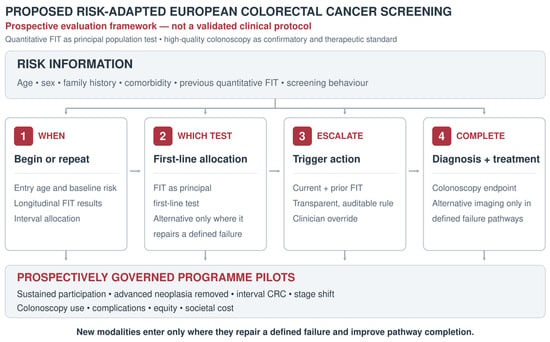
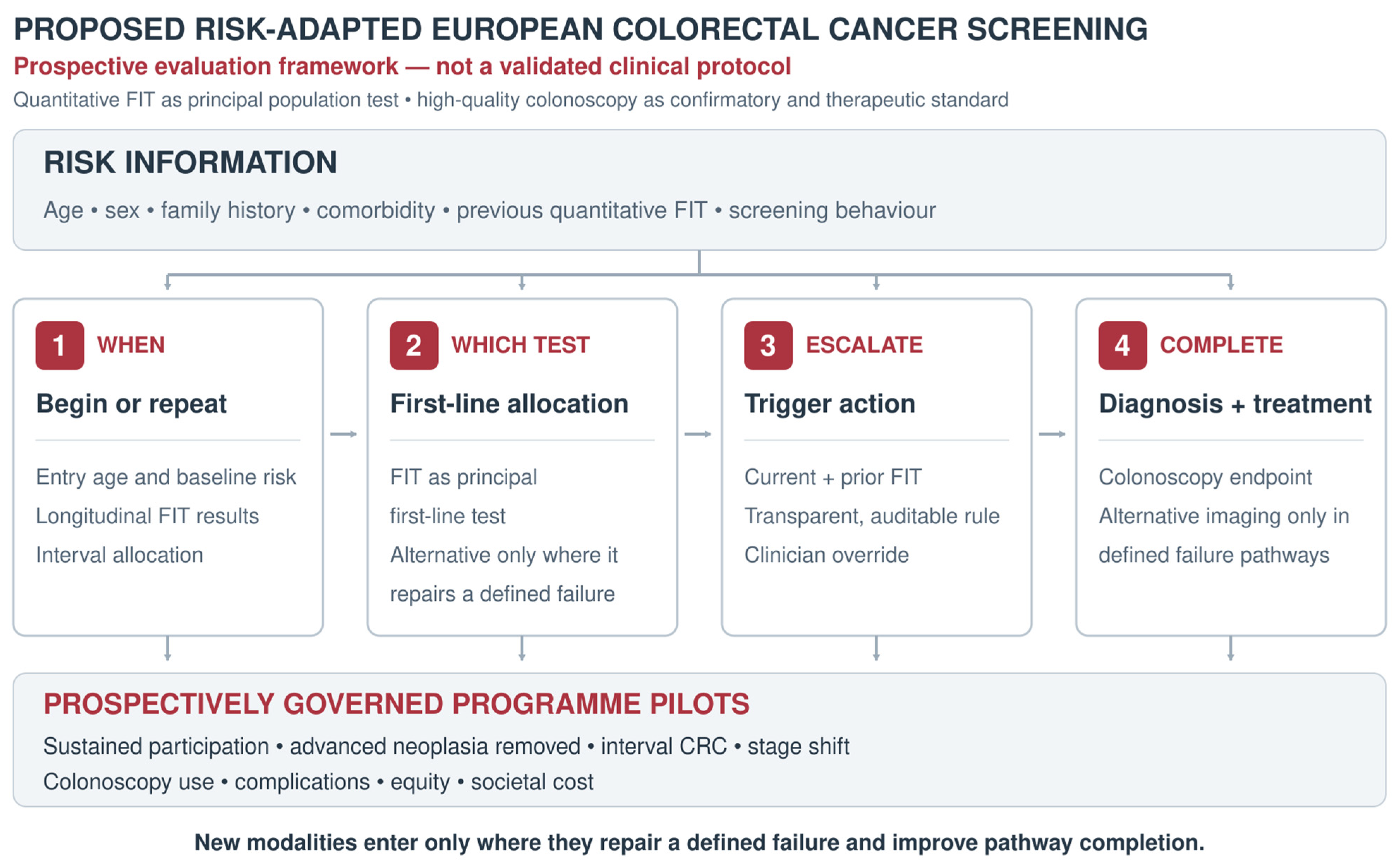
Risk-adapted screening is often reduced to adding a polygenic score to an age threshold. A broader and more useful definition is that accumulating information alters outcome through one or more of four programme decisions: when to screen, which test to offer, when to escalate and how to complete diagnosis. The framework and its programme-level safeguards are summarised in Figure 1. It is a conceptual policy and research framework, not a validated intervention. Throughout this section we distinguish established programme components (for example, quantitative FIT and diagnostic colonoscopy), modelled or observational candidates (for example, integrated risk models and longitudinal FIT), and author-proposed rules that require prospective testing. The four decisions intentionally cover population screening from invitation through completed diagnosis and treatment; post-polypectomy surveillance is addressed as a downstream capacity consequence rather than as a fifth population-screening decision.
Figure 1.
A four-decision framework for risk-adapted European colorectal cancer screening. The framework is a policy and research proposal for prospective evaluation, not a validated clinical protocol. Risk modifiers can alter when screening begins or recurs, which first-line test is offered, when escalation occurs, and how diagnosis and treatment are completed. Quantitative FIT is shown as the principal first-line test for organised average-risk screening, not as a universal mandate across all national programmes or defined high-risk pathways. New tests are assigned to defined pathway failures and evaluated through prospectively governed pilots using participation, advanced neoplasia removed, interval cancer, stage shift, colonoscopy use, complications, equity and societal cost as programme-level outcomes. Horizontal arrows show the sequence of decisions; downward arrows connect risk information to the framework and each decision to shared pilot outcomes.
4.1. Decision 1: When Should Screening Begin or Recur?
A 2026 meta-analysis of 7.2 million colonoscopies estimated advanced-neoplasia prevalence at 3.3% at ages 40–44 and 4.5% at ages 45–49 [14]. Lowering invitation to 45 would depart from current ECICC guidance and should be evaluated only where local epidemiology and health-economic modelling support it and colonoscopy capacity can absorb the additional demand without displacing higher-risk symptomatic care. Universal age reduction is an incomplete answer because it still treats markedly different risks as equivalent.
Phenotypic and genetic risk models show potential but not a universal solution. UK modelling estimated that risk assessment at age 40 to determine FIT initiation could prevent 218 CRCs and 156 deaths and gain 418 quality-adjusted life-years per 100,000 people [15]. Other analyses using real-world genetic and environmental data have produced smaller average gains [16], whereas prospective UK Biobank analyses suggest that integrated risk can concentrate benefit in intermediate- and high-risk groups [17]. These remain modelled or observational findings, not evidence that population genotyping improves screening outcomes.
Longitudinal quantitative FIT is a more immediately available candidate. Repeated undetectable faecal haemoglobin may identify people suitable for a longer interval, whereas persistent subthreshold concentrations may identify a group for earlier repeat testing or lower-threshold escalation. This is a testable programme hypothesis, already aligned with ECICC priorities [4,5], and requires prospective validation with rigid interval-cancer monitoring.
4.2. Decision 2: Which First-Line Test Should Be Offered?
In organised average-risk screening, quantitative FIT should usually remain a principal first-line strategy because it combines evidence, affordability and existing infrastructure. This is not a universal mandate: programme architecture differs across Europe, and a colonoscopy-first approach may be justified for defined high-risk strata or in systems where participation, capacity and evidence support it. Such high-risk pathways should remain conceptually distinct from average-risk population screening. Individuals already meeting criteria for hereditary or familial high-risk surveillance, inflammatory bowel disease surveillance, symptomatic diagnostic assessment or post-neoplasia surveillance fall outside this average-risk framework; family history is considered here only as a graded risk modifier within population screening. A different non-invasive first-line test is justified only when it addresses a defined limitation: inadequate precursor detection in a selected risk stratum, persistent refusal of stool collection or inability to complete the conventional pathway. Any alternative should therefore be judged against its equity and capacity consequences, not diagnostic performance alone. Table 1 summarises the evidence-supported contribution, principal limitation and proposed programme position of each modality.
Pathway-compatible stool innovation is the most mature extension. A multitarget FIT combining haemoglobin with additional stool proteins improved advanced-neoplasia detection at matched specificity in a paired Dutch population study [18]. Next-generation multitarget stool DNA achieved high CRC sensitivity and greater detection of advanced precancerous lesions than conventional FIT, but at lower specificity [19]. The additional financial and colonoscopy burden must be assessed separately and depends on price, interval and adherence [20].
Blood-based cell-free DNA (cfDNA) testing has a legitimate but narrower role. It may reach people who decline stool sampling, and earlier cancer detection may still reduce mortality. However, comparative population effectiveness, optimal testing interval and long-term prevention are not established. ECLIPSE reported 83.1% sensitivity for CRC and 13.2% for advanced precancerous lesions [21]; PREEMPT CRC reported 79.2% and 12.5%, respectively [22]. This low precursor sensitivity shifts the paradigm from true cancer prevention (polyp interception and resection) to early detection and stage shift. Current blood tests should therefore be evaluated as targeted alternatives for persistent non-participants, with longitudinal evaluation focused on advanced precursor yield and interval CRC rather than uptake alone as primary endpoints [23]. Emerging liquid biopsy platforms combining cell-free and exosomal microRNAs (such as the ENCODER classifier in early-onset CRC) suggest that multimodal transcriptomic profiling may partly overcome the precursor sensitivity ceiling of conventional cfDNA, reporting 61.5% sensitivity for high-grade dysplasia alongside high early-stage cancer detection in younger cohorts [24]. However, such multi-analyte assays remain case–control biomarker discoveries that require prospective screening-cohort validation, cost-effectiveness modelling, and direct comparison with stool testing before programmatic consideration.
Microbiome and volatile-organic-compound (VOC) signatures may reflect early tumour–host biology. Cross-cohort studies identify reproducible microbial features across disease stages [25,26], and faecal VOC meta-analysis suggests diagnostic signal [27]. Yet sampling, laboratory processing, classifiers and external validation remain heterogeneous; a multicentre breath-VOC study in FIT-positive participants showed poor discrimination despite high acceptability [28]. A meta-analysis concluded that sequential FIT and VOC testing could improve CRC detection in symptomatic populations [29]. International consensus concludes that clinical usefulness of microbiome testing remains unproven and provides a framework to minimise inappropriate use [30]. These approaches remain research candidates.
4.3. Decision 3: What Should Trigger Escalation?
Binary positivity discards potentially useful information. A future escalation rule could combine current quantitative FIT concentration, previous results, baseline risk and test-specific predictive value. The proposition that the same low FIT concentration may carry different CRC risk after several undetectable rounds than in a person with persistently measurable haemoglobin is biologically and operationally plausible—but remains a hypothesis requiring prospective validation.
Sex and anatomical subsite require particular caution. FIT performance varies with sex and lesion location [8,9,10], but current evidence does not justify routine sex-specific thresholds, and a truly subsite-specific threshold cannot be applied prospectively because lesion location is unknown before diagnosis. Lower thresholds in groups with lower FIT sensitivity could reduce missed lesions but would simultaneously increase colonoscopy demand. Sex-specific thresholds should therefore be tested prospectively with calibration, advanced-neoplasia yield and capacity endpoints, while right-sided interval CRC should be a prespecified safety outcome rather than assuming that threshold modification will correct subsite-specific biology.
Before implementation, escalation algorithms must prioritise clinical interpretability and avoid opaque machine learning models. Public screening programmes require transparent, reproducible rule sets (such as validated risk-score matrices or logistic models) where the contribution of age, sex, prior faecal haemoglobin kinetics and clinical modifiers can be audited and communicated clearly to both primary care clinicians and participants. Any model must specify its target population, input parameters, missing-data rules, escalation thresholds, reassessment intervals and explicit clinician override mechanisms. Programme authorities must define who owns the algorithm, who can override it and who investigates failure. Participants should receive one understandable recommendation and an explanation of why their pathway differs from the standard pathway.
4.4. Decision 4: How Should Diagnosis and Treatment Be Completed?
Colonoscopy remains the diagnostic and therapeutic endpoint because it detects, characterises and removes precursor lesions. Alternative imaging is valuable when it raises the probability of completing the pathway, not when it merely inserts another investigation.
Colon capsule endoscopy (CCE) reflects this limitation. In a multicentre symptomatic cohort of 10,369 patients, 4878 underwent CCE. Among paired examinations that were complete and adequately prepared, per-patient sensitivity was 97% for both 6–9 mm and at least 10 mm polyps. However, only 3035 CCE examinations (63%) were both complete and adequately prepared; CCE performed a filter function in 86% [31]. These results arose in a symptomatic pathway with different pretest risk, objectives and referral rules and cannot be transferred directly to FIT-positive screening.
In the Danish CareForColon randomised trial, diagnostic uptake was already high with default colonoscopy (91.1%) and was not increased by offering CCE (91.7%). Although 45.8% initially selected CCE, 69.9% subsequently underwent colonoscopy and advanced-neoplasia detection did not improve [32]. CCE should therefore not replace post-FIT colonoscopy in high-adherence endoscopic programmes. CCE has specific roles where there is participant refusal, contraindication or incomplete colonoscopy, and deliberately redesigned remote pathways with explicit referral thresholds. CT colonography is the established radiological alternative when colonoscopy is incomplete or unfeasible, but it uses radiation, may generate extracolonic findings (with subsequent unnecessary investigations) and cannot provide therapy [33].
Post-polypectomy surveillance is deliberately not presented as a fifth population-screening decision. It begins only after a lesion has been detected and removed, and European guidance already stratifies surveillance intervals according to index findings [34]. Nevertheless, it is a major consumer of colonoscopy capacity. Any risk-adapted screening pilot that changes lesion yield must therefore quantify downstream surveillance demand, adherence and displacement effects; future studies may also test whether longitudinal FIT or other validated risk information can safely refine surveillance, but such adaptation should not precede evidence.
Table 1.
Modalities within a risk-adapted screening pathway.
5. From Principle to a European Implementation Programme
Programme rollout begins with routine workflow optimisation: reliable invitation, rapid reporting, navigation, timely colonoscopy, high-quality preparation, complete resection and surveillance. No biomarker compensates for failure at these steps. Programmes should retain quantitative FIT results longitudinally and treat persistent non-participation as an active safety problem.
Subsequent stratification integrates demographic and longitudinal data within current registry architectures. Programmes can prospectively test whether age, sex, previous FIT, family history, comorbidity and screening behaviour safely support differentiated intervals or thresholds. Complexity may sit within the information system, but the rule, rationale and consequences must be publicly documented and individually explained. This requires interoperable registries, transparent data governance, version-controlled algorithms and clear responsibility across screening authorities, primary care and endoscopy. Primary care is not merely a communication endpoint: where it functions as the gateway to screening, it can identify symptomatic or high-risk individuals who should leave the average-risk pathway, reinforce invitations, interpret risk-adjusted recommendations, support shared decision-making and ensure follow-up after abnormal results. Responsibilities, data access and resourcing must be explicit so that programme complexity is not simply transferred to individual clinicians.
Targeted rescue interventions then address persistent non-participation. Navigation should precede another test: where a barrier persists, one validated alternative should be evaluated against that barrier rather than offered as an undifferentiated menu. Otherwise, choice can shift attrition downstream and increase duplicated investigation. Table 2 sets out the minimum decision-specific prospective evaluation framework.
Table 2.
A minimum prospective evaluation framework.
Risk adaptation also creates harms that uniform programmes can obscure. Misclassification may provide false reassurance or expose people to low-value testing (unnecessary colonoscopy); repeated risk labels may generate anxiety; intensified surveillance may produce overdiagnosis and cumulative procedural burden; and algorithms using deprivation, comorbidity or genomic data may reproduce discrimination. Public reporting should therefore include calibration, subgroup performance, overrides, adverse events and participant-reported experience. Patient and public co-design is necessary for both the invitation language and the governance of secondary data use.
Economic evaluation should take a societal perspective. CRC cost Europe an estimated EUR19.1 billion in 2015, of which EUR11.6 billion arose from productivity loss, premature mortality and informal care rather than direct healthcare expenditure [35]. FIT remains the most cost-effective non-invasive option in many models, while newer tests are highly sensitive to price, interval and adherence assumptions [20]. The Accelerating Colorectal Cancer Screening and Follow-up through Implementation Science (ACCSIS) framework appropriately treats screening and follow-up as multilevel problems involving patients, clinicians, organisations and policy [36].
Several adjacent technologies may improve components of the pathway without constituting population-screening strategies themselves. Artificial intelligence (AI)-assisted colonoscopy using computer-aided detection (CADe) increases adenoma detection and reduces miss rates, but gains have been concentrated largely in small lesions, with no consistent improvement in advanced adenoma detection and an increase in non-neoplastic resection in a recent meta-analysis [37]. Deep-learning analysis of colorectal histopathology may support slide triage, diagnostic support or quality control, but current validation remains too limited for autonomous diagnostic replacement [38]. Healthcare staff screening is best regarded as an implementation laboratory rather than a separate biological risk stratum: even in an academic hospital, FIT participation and repeated adherence were poor, particularly among physicians and nurses [39]. Finally, low serum cholinesterase and butyrylcholinesterase (BCHE)-related measures have been associated with prognosis in patients with established CRC, including tumour-marker-negative disease, but this is prognostic evidence after diagnosis rather than validation as an asymptomatic screening marker [40]. These technologies should therefore be evaluated at the pathway step they can plausibly improve, without allowing downstream diagnostic or prognostic tools to redefine population screening eligibility.
The proposed evaluation framework is resource-intensive, and no single pilot should attempt to measure every endpoint at full scale. A tiered approach is more realistic. Tier 1 feasibility pilots should establish reach, participation, data completeness, diagnostic completion, colonoscopy demand and subgroup calibration. Tier 2 comparative pilots should estimate advanced-neoplasia yield, interval-cancer safety and resource displacement using cluster-randomised, stepped-wedge or controlled designs where feasible. Tier 3 programme-level adoption should add stage distribution, quality-adjusted life-years, budget impact and societal cost. A minimum viable pilot therefore requires prespecified eligibility, a locked rule, a concurrent comparator where feasible, linkage to endoscopy and cancer registries, and stopping rules for interval cancer, capacity overload or widening inequity. Funding and governance will necessarily be country-specific, but evaluation should be commissioned through screening programmes, public research agencies or European implementation mechanisms with independent oversight, rather than depend on technology-provider sponsorship alone. A common European outcome set can then support cross-programme comparison without requiring every pilot to collect every endpoint from the outset.
6. Limitations
This Commentary has several limitations. It contributes no primary data, and the four-decision framework has not been prospectively validated. Much of the evidence for changing entry age, FIT thresholds or screening intervals is modelled or observational, while evidence for newer tests often derives from selected cohorts rather than organised population programmes. European systems differ in baseline participation, FIT thresholds, endoscopy capacity, primary-care involvement, data infrastructure and funding, which limits direct transferability. Risk adaptation may also create false reassurance, overdiagnosis, algorithmic bias and additional downstream surveillance burden. Participation-adjusted preventive yield is a candidate metric rather than an externally validated standard. The framework should therefore be regarded as a structure for testing policy options in prospectively governed pilots, not as a protocol for routine clinical adoption.
7. Conclusions
The present evidence does not justify population genotyping, universal screening from age 45, routine microbiome or VOC testing, replacement of completed FIT with blood testing, or routine CCE after positive FIT where colonoscopy completion is already high. Nor does it justify changing FIT thresholds or intervals outside prospective evaluation. The four-decision framework is a policy and research proposition rather than a validated intervention or ready-to-implement clinical protocol. Its value will depend on country-specific epidemiology, infrastructure, colonoscopy capacity, primary-care organisation and public acceptability. Its intent is to move programme evaluation beyond diagnostic accuracy alone towards cost-effectiveness, equitable access and completed prevention. Europe does not need to choose between established FIT programmes and new technologies. It needs to make established pathways responsive to risk. Age should remain an important predictor, but not the sole gatekeeper. Quantitative FIT should remain a principal population-based strategy in organised average-risk screening, while quantitative history, clinical risk and participation can be evaluated as modifiers of when testing occurs, which test is offered and when escalation is warranted. New modalities should enter only where they repair a defined failure and improve completion of prevention. The governing standard is not convenience or analytical sensitivity in isolation, but whether the programme removes more advanced neoplasia, prevents or downstages more cancers, preserves equitable access and uses colonoscopy and surveillance capacity responsibly.
Author Contributions
Conceptualisation, A.K., R.A. and W.M.; validation, R.A., P.C.V. and E.T.; visualisation, G.K.; writing—original draft preparation, A.K. and W.M.; writing—review and editing, A.K., R.A., P.C.V., G.K., E.T. and W.M.; supervision, A.K. All authors have read and agreed to the published version of the manuscript.
Funding
This research received no external funding.
Institutional Review Board Statement
Not applicable.
Informed Consent Statement
Not applicable.
Data Availability Statement
No new data were created or analysed in this study. Data sharing is not applicable to this article.
Acknowledgments
The four-decision framework and all substantive clinical, scientific and policy judgments presented in this Commentary were determined and approved by the authors. During preparation and revision of the manuscript, the authors used OpenAI ChatGPT (GPT-5.6 Sol; accessed August–September 2026) for language refinement, organisation of manuscript text and preparation and revision of the conceptual process-flow illustration in Figure 1. The tool was not used as a source of evidence and does not meet the criteria for authorship. All factual statements, numerical data and references were independently verified by the authors against the cited primary or authoritative sources. The authors reviewed and edited all outputs and take full responsibility for the originality, validity and integrity of the content of this publication.
Conflicts of Interest
Anastasios Koulaouzidis reports being a co-founder and shareholder of AJM Med-i-caps Ltd. and having been a co-founder and director of iCERV Ltd. He has received consultancy fees from Jinshan Science & Technology Ltd.; lecture honoraria from Jinshan Science & Technology Ltd. and Covidien/Medtronic; travel support from Jinshan Science & Technology Ltd., Aquilant, DiagMed Healthcare Ltd. and Dr Falk Pharma; research grant support from Given Imaging Ltd. through the European Society of Gastrointestinal Endoscopy; material research support from IntroMedic/SynMed; and participation in advisory boards for Tillotts Pharma, ANKON, Dr Falk Pharma and Norgine. He has also held editorial or guest-editor roles for medical journals. Ramesh Arasaradnam declares no competing interests. Pablo Cortegoso Valdivia reports receiving lecture honoraria, travel support and research grant support from Jinshan Science & Technology Ltd. George Koulaouzidis declares no competing interests. Ervin Toth reports consultancy and lecture fees from Medtronic and Olympus; consultancy and research support from AnX Robotica; consultancy, research support and lecture honoraria from Jinshan Science & Technology Ltd.; research support and lecture honoraria from Norgine; and lecture honoraria from Tillotts Pharma. He has also held editorial or guest-editor roles for medical journals. Wojciech Marlicz reports being a co-founder and shareholder of Sanprobi sp. z o.o. sp. k. and Endoklinika sp. z o.o.; he reports speaking honoraria from Alfasigma, Promed Poland, Ferring, Novo Nordisk and Polpharma. The authors declare no other financial or non-financial competing interests relevant to this manuscript.
Abbreviations
The following abbreviations are used in this manuscript:
| ACCSIS | Accelerating Colorectal Cancer Screening and Follow-up through Implementation Science |
| AI | artificial intelligence |
| BCHE | butyrylcholinesterase |
| CADe | computer-aided detection |
| CCE | colon capsule endoscopy |
| cfDNA | cell-free DNA |
| CRC | colorectal cancer |
| CT | computed tomography |
| ECICC | European Commission Initiative on Colorectal Cancer |
| FIT | faecal immunochemical test |
| VOC | volatile organic compound |
References
- Sung, H.; Filho, A.M.; Laversanne, M.; Ferlay, J.; Siegel, R.L.; Soerjomataram, I.; Jemal, A.; Bray, F. Global cancer statistics 2024: GLOBOCAN estimates of incidence and mortality worldwide for 34 cancers in 186 countries. CA Cancer J. Clin. 2026, 76, e70090. [Google Scholar] [CrossRef] [Scilit]
- Sung, H.; Siegel, R.L.; Laversanne, M.; Jiang, C.; Morgan, E.; Zahwe, M.; Cao, Y.; Bray, F.; Jemal, A. Colorectal cancer incidence trends in younger versus older adults: An analysis of population-based cancer registry data. Lancet Oncol. 2025, 26, 51–63. [Google Scholar] [CrossRef] [Scilit]
- Downham, L.; Laversanne, M.; Perdomo, S.; Filho, A.M.; Bray, F.; Brennan, P. Increase of early-onset colorectal cancer: A cohort effect. J. Natl. Cancer Inst. 2026, 118, 751–756. [Google Scholar] [CrossRef] [Scilit]
- European Commission Initiative on Colorectal Cancer. European Colorectal Cancer Guidelines: Screening Age Range, Frequency and Test. European Commission Joint Research Centre. Available online: https://cancer-screening-and-care.jrc.ec.europa.eu/en/ecicc/european-colorectal-cancer-guidelines?topic=345&usertype=282 (accessed on 14 August 2026).
- European Commission Initiative on Colorectal Cancer. European Guidelines on Colorectal Cancer Primary Prevention, Screening and Diagnosis: GRADE Evidence-to-Decision Framework for Screening Across Tests. European Commission Joint Research Centre. 25 February 2026. Available online: https://cancer-screening-and-care.jrc.ec.europa.eu/sites/default/files/2026-07/ECICC_GLs_EtD_screening_across_tests_comparison.pdf (accessed on 14 August 2026).
- Castells, A.; Quintero, E.; Bujanda, L.; Castán-Cameo, S.; Cubiella, J.; Díaz-Tasende, J.; Lanas, Á.; Ono, A.; Serra-Burriel, M.; Frías-Arrocha, E.; et al. COLONPREV Study Investigators. Effect of invitation to colonoscopy versus faecal immunochemical test screening on colorectal cancer mortality (COLONPREV): A pragmatic, randomised, controlled, non-inferiority trial. Lancet 2025, 405, 1231–1239, Erratum in Lancet 2025, 405, 1230. [Google Scholar] [CrossRef] [Scilit]
- Castells, A.; Quintero, E.; Chen, H.; Bujanda, L.; Castán-Cameo, S.; Cubiella, J.; Díaz-Tasende, J.; Lanas, Á.; Ono, A.; Serra-Burriel, M. COLONPREV Study Investigators. Colonoscopy versus biennial FIT screening: A post hoc sustained-strategy analysis of the COLONPREV trial. Gut 2026. [Google Scholar] [CrossRef] [Scilit]
- Imperiale, T.F.; Gruber, R.N.; Stump, T.E.; Emmett, T.W.; Monahan, P.O. Performance characteristics of fecal immunochemical tests for colorectal cancer and advanced adenomatous polyps: A systematic review and meta-analysis. Ann. Intern. Med. 2019, 170, 319–329. [Google Scholar] [CrossRef] [Scilit]
- Selby, K.; Levine, E.H.; Doan, C.; Gies, A.; Brenner, H.; Quesenberry, C.; Lee, J.K.; Corley, D.A. Effect of sex, age, and positivity threshold on fecal immunochemical test accuracy: A systematic review and meta-analysis. Gastroenterology 2019, 157, 1494–1505, Erratum in Gastroenterology 2026. [Google Scholar] [CrossRef] [Scilit]
- Kayali, S.; Rubbino, F.; Riani, M.; Negri, F.; Gaiani, F.; Guidouh, L.; Sgargi, P.; Cortegoso Valdivia, P.; Cavallaro, L.; Michiara, M.; et al. The influence of tumor side, sex, and screening on colon cancer stage and survival: A 25-year population-based study. Dig. Liver. Dis. 2026. [Google Scholar] [CrossRef] [Scilit]
- Baile-Maxía, S.; Pimienta, M.; Sánchez-Ardila, C.; Castells, A.; Jover, R.; Ladabaum, U. Systematic review of participation, positivity, and yield over time in fecal immunochemical test-based organised colorectal cancer screening programmes. Clin. Gastroenterol. Hepatol. 2026, 24, 2094–2107. [Google Scholar] [CrossRef] [Scilit]
- Ladabaum, U.; Font Marimon, R.; Castells, X.; Balaguer, F.; Pellisé, M.; Sola, J.; Piñol, J.A.E.; Castells, A. Effect of long-term adherence on faecal immunochemical test positivity rate, positive predictive value and detection rate in organised population-based colorectal cancer screening. Gut 2026, 75, 984–994. [Google Scholar] [CrossRef] [Scilit]
- Zorzi, M.; Battagello, J.; Selby, K.; Capodaglio, G.; Baracco, S.; Rizzato, S.; Chinellato, E.; Guzzinati, S.; Rugge, M. Non-compliance with colonoscopy after a positive faecal immunochemical test doubles the risk of dying from colorectal cancer. Gut 2022, 71, 561–567. [Google Scholar] [CrossRef] [Scilit]
- Bernardes, C.; Bodião, S.; Rocha, M.; Canena, J.; Pimentel-Nunes, P. Adenoma detection and advanced neoplasia prevalence in average-risk adults aged 40 to 49 years: A systematic review and meta-analysis of colonoscopy-based studies. Gastrointest. Endosc. 2026. [Google Scholar] [CrossRef] [Scilit]
- Thomas, C.; Mandrik, O.; Saunders, C.L.; Thompson, D.; Whyte, S.; Griffin, S.; Usher-Smith, J.A. The costs and benefits of risk stratification for colorectal cancer screening based on phenotypic and genetic risk: A health economic analysis. Cancer Prev. Res. 2021, 14, 811–822. [Google Scholar] [CrossRef] [Scilit]
- van den Puttelaar, R.; Meester, R.G.S.; Peterse, E.F.P.; Zauber, A.G.; Zheng, J.; Hayes, R.B.; Su, Y.-R.; Lee, J.K.; Thomas, M.; Sakoda, L.C.; et al. Risk-stratified screening for colorectal cancer using genetic and environmental risk factors: A cost-effectiveness analysis based on real-world data. Clin. Gastroenterol. Hepatol. 2023, 21, 3415–3423.e29. [Google Scholar] [CrossRef] [Scilit]
- Zhang, Y.; Sheng, C.; Lyu, Z.; Dai, H.; Song, F.; Song, F.; Huang, Y.; Chen, K. Effectiveness of colorectal cancer screening integrating non-genetic and genetic risk: A prospective study based on UK Biobank data. Cancer Biol. Med. 2024, 21, 712–723. [Google Scholar] [CrossRef] [Scilit]
- Wisse, P.H.A.; de Klaver, W.; van Wifferen, F.; van Maaren-Meijer, F.G.; E van Ingen, H.; Meiqari, L.; Huitink, I.; Bierkens, M.; Lemmens, M.; E Greuter, M.J.; et al. The multitarget faecal immunochemical test for improving stool-based colorectal cancer screening programmes: A Dutch population-based, paired-design, intervention study. Lancet Oncol. 2024, 25, 326–337. [Google Scholar] [CrossRef] [Scilit]
- Imperiale, T.F.; Porter, K.; Zella, J.; Gagrat, Z.D.; Olson, M.C.; Statz, S.; Garces, J.; Lavin, P.T.; Aguilar, H.; Brinberg, D.; et al. Next-generation multitarget stool DNA test for colorectal cancer screening. N. Engl. J. Med. 2024, 390, 984–993. [Google Scholar] [CrossRef] [Scilit]
- Shaukat, A.; Levin, T.R.; Liang, P.S.; Weiss, J.M.; Smare, C.; Boller, E.; Venkatachalam, M.; Barnell, E.K. Cost-effectiveness of novel noninvasive screening tests for colorectal neoplasia. Clin. Gastroenterol. Hepatol. 2026, 24, 2007–2018. [Google Scholar] [CrossRef] [Scilit]
- Chung, D.C.; Gray, D.M., 2nd; Singh, H.; Issaka, R.B.; Raymond, V.M.; Eagle, C.; Hu, S.; Chudova, D.I.; Talasaz, A.; Greenson, J.K.; et al. A cell-free DNA blood-based test for colorectal cancer screening. N Engl. J. Med. 2024, 390, 973–983. [Google Scholar] [CrossRef] [Scilit]
- Shaukat, A.; Burke, C.A.; Chan, A.T.; Grady, W.M.; Gupta, S.; Katona, B.W.; Ladabaum, U.; Liang, P.S.; Liu, J.J.; Putcha, G.; et al. Clinical validation of a circulating tumour DNA-based blood test to screen for colorectal cancer. JAMA 2025, 334, 56–63. [Google Scholar] [CrossRef] [Scilit]
- Dominitz, J.A.; Patel, S.G.; Lieberman, D.A. Blood-based colorectal cancer screening: The illusion of simplicity and the cancer prevention paradox. JAMA 2025, 334, 29–31. [Google Scholar] [CrossRef] [Scilit]
- Mannucci, A.; Balaguer, F.; Yamada, Y.; Nagasaka, T.; Toiyama, Y.; Okugawa, Y.; Martí-Gallostra, M.; Jiménez-Toscano, M.; Vidal-Tocino, R.; Jiménez, F.; et al. An Exosome-Based Liquid Biopsy for the Detection of Early-Onset Colorectal Cancer: The ENCODER Multicenter Study. Gastroenterology 2026, 170, 330–343. [Google Scholar] [CrossRef] [Scilit]
- Thomas, A.M.; Manghi, P.; Asnicar, F.; Pasolli, E.; Armanini, F.; Zolfo, M.; Beghini, F.; Manara, S.; Karcher, N.; Pozzi, C.; et al. Metagenomic analysis of colorectal cancer datasets identifies cross-cohort microbial diagnostic signatures. Nat. Med. 2019, 25, 667–678, Erratum in Nat. Med. 2019, 25, 1948. [Google Scholar] [CrossRef] [Scilit]
- Piccinno, G.; Thompson, K.N.; Manghi, P.; Ghazi, A.R.; Thomas, A.M.; Blanco-Míguez, A.; Asnicar, F.; Mladenovic, K.; Pinto, F.; Armanini, F.; et al. Pooled analysis of 3,741 stool metagenomes from 18 cohorts for cross-stage and strain-level reproducible microbial biomarkers of colorectal cancer. Nat. Med. 2025, 31, 2416–2429. [Google Scholar] [CrossRef] [Scilit]
- Bhattacharyya, N.; Sastimoglu, Z.; Armstrong, D.; Selvaganapathy, P.R.; Deen, M.J. Faecal volatile organic compounds for colorectal cancer detection: A systematic review and meta-analysis. Comput Biol. Med. 2025, 195, 110561. [Google Scholar] [CrossRef] [Scilit]
- van Riswijk, M.L.M.; van Keulen, K.E.; Tan, A.C.I.T.L.; Schrauwen, R.W.M.; Cappel, W.H.d.V.T.N.; Siersema, P.D. Breath testing for colorectal cancer detection in patients with a positive faecal immunochemical test: A multicentre prospective cross-sectional study with external validation. Aliment Pharmacol. Ther. 2025, 62, 208–213. [Google Scholar] [CrossRef] [Scilit]
- Chandrapalan, S.; Bosch, S.; Cubiella, J.; Guardiola, J.; Kimani, P.; Mulder, C.; Persaud, K.; de Meij, T.G.J.; Altomare, D.F.; Brenner, H.; et al. Systematic review with meta-analysis: Volatile organic compound analysis to improve faecal immunochemical testing in the detection of colorectal cancer. Aliment. Pharmacol. Ther. 2021, 54, 14–23. [Google Scholar] [CrossRef] [Scilit]
- Porcari, S.; Mullish, B.H.; Asnicar, F.; Ng, S.C.; Zhao, L.; Hansen, R.; O’TOole, P.W.; Raes, J.; Hold, G.; Putignani, L.; et al. International consensus statement on microbiome testing in clinical practice. Lancet Gastroenterol. Hepatol. 2025, 10, 154–167. [Google Scholar] [CrossRef] [Scilit]
- Turvill, J.; Haritakis, M.; Pygall, S.; Bryant, E.; Cox, H.; Forshaw, G.; Musicha, C.; Allgar, V.; Logan, R.; McAlindon, M.; et al. Multicentre study of 10,369 symptomatic patients comparing the diagnostic accuracy of colon capsule endoscopy, colonoscopy and CT colonography. Aliment Pharmacol. Ther. 2025, 61, 1532–1544. [Google Scholar] [CrossRef] [Scilit]
- Baatrup, G.; Bjørsum-Meyer, T.; Kaalby, L.; Schelde-Olesen, B.; Kobaek-Larsen, M.; Koulaouzidis, A.; Kroijer, R.; Al-Najami, I.; Buch, N.; Høgh, A.; et al. CareForColon2015 Study Group. Choice of colon capsule or colonoscopy versus default colonoscopy in FIT-positive patients in the Danish screening programme: A parallel-group randomised controlled trial. Gut 2025, 74, 1616–1623. [Google Scholar] [CrossRef] [Scilit]
- Spada, C.; Hassan, C.; Bellini, D.; Burling, D.; Cappello, G.; Carretero, C.; Dekker, E.; Eliakim, R.; de Haan, M.; Kaminski, M.F.; et al. Imaging alternatives to colonoscopy: CT colonography and colon capsule. European Society of Gastrointestinal Endoscopy and European Society of Gastrointestinal and Abdominal Radiology guideline—Update 2020. Endoscopy 2020, 52, 1127–1141. [Google Scholar] [CrossRef] [Scilit]
- Hassan, C.; Antonelli, G.; Dumonceau, J.M.; Regula, J.; Bretthauer, M.; Chaussade, S.; Dekker, E.; Ferlitsch, M.; Gimeno-Garcia, A.; Jover, R.; et al. Post-polypectomy colonoscopy surveillance: European Society of Gastrointestinal Endoscopy (ESGE) Guideline—Update 2020. Endoscopy 2020, 52, 687–700. [Google Scholar] [CrossRef] [Scilit]
- Henderson, R.H.; French, D.; Maughan, T.; Adams, R.; Allemani, C.; Minicozzi, P.; Coleman, M.P.; McFerran, E.; Sullivan, R.; Lawler, M. The economic burden of colorectal cancer across Europe: A population-based cost-of-illness study. Lancet Gastroenterol. Hepatol. 2021, 6, 709–722. [Google Scholar] [CrossRef] [Scilit]
- Kobrin, S.; Subramanian, S.; Hoover, S.A.; McCarthy, S.; Castañeda, S.F.; Mishra, S.I. A framework for advancing colorectal cancer screening, follow-up, and care delivery for all. Health Educ. Behav. 2026, 53, 44–51. [Google Scholar] [CrossRef] [Scilit]
- Makar, J.; Abdelmalak, J.; Con, D.; Hafeez, B.; Garg, M. Use of artificial intelligence improves colonoscopy performance in adenoma detection: A systematic review and meta-analysis. Gastrointest. Endosc. 2025, 101, 68–81.e8. [Google Scholar] [CrossRef] [Scilit]
- Yong, X.; Li, Z.; Wu, Q.; Hu, H. Diagnostic accuracy of deep learning models for colorectal cancer detection in histopathological whole-slide images: A systematic review and diagnostic test accuracy meta-analysis. Front. Oncol. 2026, 16, 1885546. [Google Scholar] [CrossRef] [Scilit]
- Vlachonikolou, G.; Gkolfakis, P.; Sioulas, A.D.; Papanikolaou, I.S.; Melissaratou, A.; Moustafa, G.-A.; Xanthopoulou, E.; Tsilimidos, G.; Tsironi, I.; Filippidis, P.; et al. Academic hospital staff compliance with a fecal immunochemical test-based colorectal cancer screening program. World J. Gastrointest. Oncol. 2016, 8, 629–634. [Google Scholar] [CrossRef] [Scilit]
- Alburiahi, T.A.H.; Liang, L.; Liu, W.; Kou, Z.; Zhang, Y.; Xu, N.; Yang, J. Low cholinesterase is a potential poor prognostic factor in colorectal cancer presenting with tumor markers negative. Cancer Rep. 2025, 8, e70266. [Google Scholar] [CrossRef] [Scilit]

Disclaimer/Publisher’s Note: The statements, opinions and data contained in all publications are solely those of the individual author(s) and contributor(s) and not of MDPI and/or the editor(s). MDPI and/or the editor(s) disclaim responsibility for any injury to people or property resulting from any ideas, methods, instructions or products referred to in the content. |
© 2026 by the authors. Licensee MDPI, Basel, Switzerland. This article is an open access article distributed under the terms and conditions of the Creative Commons Attribution (CC BY) license.