


Abstract
The use of alternative water sources in construction, especially in regions with limited freshwater availability, makes the influence of mixing water composition on the durability of cement mortars a critical issue, particularly under aggressive conditions such as ammonium exposure (XA3). A clear difference in material behavior was observed before and after exposure to an aggressive aqueous environment, highlighting the importance of durability assessment under realistic service conditions. Cement mortar specimens prepared with tap water, distilled water, and modified waters containing Cl−, Ca2+, SO42−, and PO43− ions were tested. The experimental program included flexural and compressive strength, water absorption, and residual properties after exposure to an NH4Cl solution. Statistical analysis was performed using one-way ANOVA, correlation analysis, a heatmap, and PCA. Compressive strength varied within a narrow range (33.85–47.24 MPa), while flexural strength showed larger differences (5.21–10.40 MPa). After exposure, residual flexural strength decreased to 1.16–5.87 MPa and compressive strength to 23.92–37.68 MPa. The most severe degradation was observed for sulfate- and chloride-modified waters. Correlation analysis revealed weak dependence between flexural and compressive strength. ANOVA confirmed a significant influence of water composition (p < 0.05), with the strongest effect observed for residual compressive strength (η2 = 0.81). The results demonstrate that mixing water composition is a key factor controlling durability in an XA3 environment. Compressive strength alone is not a reliable durability indicator. Durability is governed primarily by transport properties and microstructure. A multi-parameter approach is required for an accurate durability assessment.
1. Introduction
The limited availability of high-quality water for concrete production represents a significant challenge, particularly in regions characterized by adverse climatic conditions. In many cases, construction practice does not allow the use of water of potable quality, which necessitates the utilization of alternative water sources [1]. Such sources include rivers, lakes, groundwater, and industrial water supply systems; however, these waters frequently fail to meet the required quality standards and therefore require appropriate treatment prior to use [2,3].
In practice, water treatment typically involves sedimentation and filtration processes, often combined with chemical methods such as coagulation–flocculation using aluminum or iron salts (e.g., Al2(SO4)3, FeCl3) to remove suspended solids and colloidal particles [4]. Recycled water from concrete plants is also used after treatment (approximately 1–5% solid particles). Water quality is verified in accordance with the EN 1008 standard [5].
The quality of mixing water is a key parameter governing the performance and long-term durability of cement-based materials. Depending on its origin, mixing water may contain various dissolved ions, including Cl−, SO42−, NH4+, Na+, and Mg2+, which can significantly influence cement hydration processes [6]. This issue is particularly pronounced in regions with limited freshwater availability or high levels of industrialization, such as the Middle East (e.g., Saudi Arabia and the United Arab Emirates) [7,8]. Even when the water–cement ratio remains within the conventional range of 0.35–0.60, the chemical composition of mixing water may substantially affect hydration kinetics, microstructural development, and the durability performance of concrete [9]. According to EN 1008, the chloride content in mixing water should generally not exceed 500–1000 mg/L, while the sulfate concentration is typically limited to approximately 2000 mg/L [5]. Exceeding these thresholds may lead to increased capillary porosity and permeability, modification of the interfacial transition zone, and acceleration of degradation mechanisms. Therefore, strict control of water quality remains a critical requirement in modern concrete technology.
Water used for mixing cement-based materials significantly influences hydration processes and the durability of hardened cement mortars. Sulfate ions (SO42−) react with calcium hydroxide Ca(OH)2 and aluminate phases (C3A) forming gypsum (CaSO4·2H2O) and secondary ettringite (C6AŜ3H32), causing expansion and microcracking [10,11]. These reactions may result in a strength reduction of approximately 20–40%, and in porous systems (w/c > 0.55) even up to 50–60% [12]. Increased ionic content may raise capillary porosity from about 10–15% to 15–25%, increase permeability by 2–5 times, and increase diffusion coefficients from 10−12–10−11 m2/s to 10−10–10−9 m2/s, significantly accelerating degradation processes [13,14]. Ammonium ions (NH4+) additionally promote the decalcification of C–S–H phases, further weakening the cement matrix [15,16]. These mechanisms primarily affect the microstructure and interfacial transition zone, which explains why flexural strength is more sensitive to chemical attack than compressive strength.
Despite the importance of controlling the initial properties of concrete, its long-term performance largely depends on the service environment. Even well-designed concrete may degrade under aggressive exposure [17]. In practice, structures are often subjected to chemically aggressive media that influence durability regardless of their initial strength or water–cement ratio. According to EN 206 [18], such environments include ammonium (NH4+), magnesium (Mg2+), sulfate (SO42−), and acidic conditions. Sulfate concentrations above approximately 600–3000 mg/L may lead to ettringite formation and expansion. Magnesium ions above about 300 mg/L can destabilize C–S–H phases. Ammonium compounds promote the dissolution of Ca(OH)2 and reduce the alkalinity of the cement matrix. Acidic environments with pH < 6, and especially <4, cause the dissolution of cement hydrates. These thresholds show that durability depends not only on material properties but also on environmental conditions [19].
Ammonium rarely occurs as an isolated component in real environments. It is typically present together with chlorides (Cl−) and sulfates (SO42−), forming a combined chemical impact. Such conditions are characteristic of wastewater, manure storage systems, and industrial environments. The concentrations of NH4+ may range from 20 to over 500 mg/L, while SO42− may reach 600–3000 mg/L and Cl− 200–1000 mg/L or higher. According to EN 206, such environments are classified under chemical exposure classes XA (XA1–XA3), while the presence of chlorides additionally corresponds to exposure classes XD or XS.
Such environments are commonly encountered in wastewater and industrial infrastructure, where concrete is exposed to combined ammonium, sulfate, and chloride attacks. Ammonium ions (NH4+) play a critical role in the degradation of cement-based materials through a decalcification mechanism, which differs fundamentally from the expansive nature of a sulfate attack [20]. In such environments, NH4+ concentrations often exceed 100–300 mg/L and coexist with sulfates and chlorides. This results in combined chemical deterioration of concrete.
The interaction of NH4+ with hydroxyl ions leads to the formation of ammonia (NH3), resulting in a reduction of pH and destabilization of calcium hydroxide [21], according to the following mechanism:
Ca(OH)2 + 2NH4Cl → CaCl2 + 2NH3 + 2H2O
xCaO·SiO2·nH2O + 2xNH4Cl → SiO2·nH2O + xCaCl2 + 2xNH3 + xH2O
This process promotes the dissolution of portlandite and subsequent leaching of calcium ions from the cement matrix. Furthermore, NH4+ induces the decalcification of C–S–H phases, reducing the Ca/Si ratio and transforming the binding phase into a weak, silica-rich gel. As a result, porosity increases from approximately 10–15% to 15–25%, while diffusion coefficients may rise from 10−12–10−11 to 10−10–10−9 m2/s, significantly accelerating degradation processes [22,23].
Mixing water composition represents one of the key factors affecting the initial properties of cement-based materials. Another important factor is the aggressive service environment. The second independent factor is the ammonium service environment, where NH4+ induces the decalcification of C–S–H and increases porosity and transport properties. In durability studies of cement-based materials, researchers analyze not only the relationship between flexural and compressive strength but also correlations between strength, water absorption, mass change, porosity, diffusion coefficient, and permeability [24]. These parameters reflect different degradation mechanisms: flexural strength is more sensitive to microcracking and deterioration of the interfacial transition zone, whereas compressive strength characterizes overall matrix densification, and water absorption and mass change describe transport properties [25]. The correlation between compressive strength and durability indicators is typically moderate (R ≈ 0.30–0.70), while correlations between water absorption, porosity, and diffusion coefficient are considerably higher (R ≈ 0.70–0.90), indicating that compressive strength alone is not a reliable durability indicator [26].
Analysis of variance (ANOVA) is commonly used to evaluate the simultaneous influence of multiple factors, such as mixing water composition, curing conditions, and an aggressive environment, on material properties [27,28]. The method is applied when comparing several sample groups or factorial combinations (e.g., water type × exposure medium × exposure time). ANOVA determines whether differences between mean values are statistically significant (typically p < 0.05) and quantifies the contribution of each factor [29]. From a practical perspective, this approach identifies the parameters that most strongly affect durability, separates the influence of water composition from curing conditions, and supports the selection of reliable indicators of resistance to a chemical attack. However, most existing studies focus on the influence of aggressive environments on cement-based materials, while the role of mixing water composition as an independent factor affecting degradation mechanisms remains insufficiently investigated, particularly under an ammonium attack.
The aim of the study is to determine the influence of the ionic composition of mixing water on the mechanical and physical properties of cement mortars and on their resistance in an aggressive ammonium environment (XA3). Particular attention is given to the comparison of material behavior before and after exposure to an NH4Cl solution. This study also evaluates whether compressive strength can be used as a durability indicator.
The use of NH4Cl makes it possible to investigate the effect of ammonium ions on the cement matrix. Unlike sulfates, chloride ions do not promote the formation of expansive corrosion products such as ettringite and gypsum. Their impact on concrete is primarily associated with reinforcement corrosion and is considered separately under the XD and XS exposure classes defined in EN 206.
The scientific contribution of this study is the identification of mixing water composition as an independent factor affecting both the initial properties and the degradation behavior of cement mortars under an ammonium attack. The practical significance of the work is that a durability assessment should not be based solely on compressive strength. A combination of mixing water quality, transport properties, and degradation indicators provides a more reliable assessment of long-term performance in aggressive environments.
2. Methodology
2.1. Preparation of Molds for Cement Mortar Specimens
For the purposes of this study, cement mortars were prepared, which can be considered as the active phase of concrete responsible for its mechanical performance and durability. The use of mortars allows for controlled analysis of physicochemical processes occurring in the cement matrix without the influence of coarse aggregate.
Prismatic specimens with dimensions of 40 × 40 × 160 mm were cast using standard plastic molds. Prior to casting, the molds were thoroughly cleaned, dried, and coated with a thin and uniform layer of release agent to prevent adhesion and ensure easy demolding. The molds were placed on a jolting table, which provided controlled and repeatable compaction conditions for all tested series (ID), minimizing variability in density and pore structure.
2.2. Cement and Sand Characteristics
CEM III blast furnace slag cement was used to prepare the cement mortars. The typical chemical composition of this cement is characterized by CaO ≈ 40–50%, SiO2 ≈ 30–35%, Al2O3 ≈ 8–12%, and MgO ≈ 5–10%, with a high slag content (≈50–80%) [11]. CEM III is characterized by a lower heat of hydration, slower early strength development, and increased resistance to aggressive media.
Natural quartz sand was used as fine aggregate (SiO2 > 90–95%), ensuring chemical inertness. The sand corresponded to standard construction sand 0–2 mm (EN 196-1) [30] with a medium grading (fineness modulus 2.2). It contained low amounts of fines and organic impurities, providing stable packing density and controlled pore structure.
2.3. Mixing and Casting of Cement Mortars
The cement mortar components were proportioned according to the adopted mix composition. Mixing was carried out mechanically using a standard mortar mixer in accordance with [30]. First, water and cement were introduced into the mixing bowl and mixed at low speed. After 30 s of mixing, sand was gradually added over the next 30 s without interrupting the mixer operation. Subsequently, the mixer was switched to high speed and mixing continued for 30 s. This was followed by a 90 s pause, during which the cement mortar was scraped from the bowl walls and returned to the center. After the pause, mixing was resumed at high speed for an additional 60 s.
Immediately after mixing, the cement mortar was placed into plastic molds (40 × 40 × 160 mm) mounted on a jolting table. Each mold compartment was filled in two layers. After placing each layer, compaction was performed using 60 jolts. After filling the second layer, the surface was levelled, excess mortar was removed, and the specimens were marked with the corresponding ID and specimen number.
2.4. Testing Program
After 28 days of curing, the specimens were removed from the water, surface-dried, and subjected to testing [31]. The experimental program included:
- Flexural strength;
- Compressive strength;
- Water absorption (gravimetric method);
- Exposure in an aggressive NH4Cl solution.
2.5. Flexural Strength
Flexural strength was determined in accordance with EN 196-1 using the three-point bending method on prisms of 40 × 40 × 160 mm. The specimen was placed on two supports with the span: l = 100 mm. The load was applied at mid-span until failure. The maximum breaking force Ff recorded immediately before failure was used for calculations. Due to deviations of the actual specimen dimensions from the nominal values, cross-sectional dimensions were measured in two perpendicular directions [22]. The average side dimension was calculated as:
where b1, b2 are the measured the cross-section dimensions, in mm.
The flexural strength was calculated:
where Rf is flexural strength, in MPa; Ff is the maximum breaking force, in N; l is support spacing, in mm; and is the average specimen width, in mm.
The average flexural strength for each series was calculated from three specimens:
2.6. Compressive Strength
Compressive strength was determined according to EN 196-1 using halves of the prisms obtained after flexural testing [31]. For each series, three prisms were tested, resulting in six compression values.
The specimens were placed axially between the platens of the testing machine. Load was applied until failure, and the maximum force Fc was recorded. The actual cross-sectional area was calculated as:
where b1, b2 are the measured specimen dimensions, in mm.
Compressive strength was calculated using
where Rc is compressive strength, in MPa; Fc is the maximum load, in N; and A is the loaded area, in mm2.
The average compressive strength for each ID was determined from six values:
2.7. Water Absorption (Gravimetric Method)
Water absorption was determined to evaluate the influence of mixing water quality on the water uptake capacity of cement mortars. The test was treated as supplementary and performed under identical conditions for all series.
After curing, the specimens were removed from the water, surface dried, and weighed to obtain the saturated mass mn. The specimens were then dried in a laboratory oven at 105 °C until a constant mass was achieved. After cooling to room temperature, the dry mass ms was determined [23]. Water absorption was calculated as:
where N is water absorption, in %; mn is saturated mass, in g; and ms is dry mass, in g.
All results were reported with accuracy to two decimal places.
2.8. Preparation of Cement Mortar Specimens and Composition of Mixing Water
Six variants of cement mortars were prepared depending on the quality and chemical composition of the mixing water (Table 1). Tap water was used as the reference mixing water (WatW), while distilled water served as the control (WatD). Additionally, modified mixing waters were prepared by dissolving the following selected salts in tap water: sodium chloride (WatCl), calcium nitrate tetrahydrate (WatCa), sodium sulfate decahydrate (WatS), and trisodium phosphate dodecahydrate (WatP).
Table 1.
Ion concentrations used in the study and their relevance to alternative mixing water sources [32,33,34,35].
The selected ion concentrations simulate alternative water sources used for concrete production in regions with limited freshwater availability. These include seawater, brackish groundwater, recycled wastewater, and agricultural runoff. The adopted values represent typical and upper-bound concentrations to assess their influence on hydration and microstructure. Chloride and sulfate ions model saline and geologically affected waters, while ammonium and phosphate ions represent treated or contaminated sources. Elevated concentrations enable accelerated evaluation while maintaining relevance to real construction conditions.
The mixing water was prepared using inorganic salts, namely NaCl, Na2SO4, Ca(NO3)2, and Na3PO4. These salts form slightly alkaline aqueous solutions, whereas Na3PO4 forms a strongly alkaline solution. Therefore, the model solutions were not expected to be acidic. For this reason, the initial pH was not considered a critical parameter within the scope of this study.
2.9. Chemical Degradation Testing in XA3 Environment
To evaluate the durability of cement mortars prepared with different mixing water qualities, the specimens were exposed to a chemically aggressive aqueous environment corresponding to exposure class XA3 in accordance with EN 206 [18]. The exposure of cement mortar specimens to the NH4Cl solution was conducted at a controlled temperature of 20 ± 0.5 °C throughout the testing period. This class represents severe chemical attack conditions with high concentrations of aggressive ions typical of wastewater and industrial environments. The experimental program was complemented by a correlation analysis, heatmap visualization, descriptive statistics, and one-way ANOVA.
After curing, the specimens were divided into groups designated for mechanical testing, water absorption determination, and chemical exposure. The exposure was conducted in an aqueous NH4Cl solution with a concentration of 100 g/L, providing a combined action of NH4+ and Cl− ions. This solution was selected to simulate aggressive conditions promoting the decalcification of hydration products and changes in the microstructure of the cement matrix [18]. The same NH4Cl concentration was used for all cement mortar series. Therefore, the objective was not to reproduce the exact conditions found in wastewater or industrial facilities, but to compare the relative resistance of mortars prepared with different mixing water compositions under identical aggressive conditions.
The exposure procedure was introduced to allow a comparison of the mechanical properties of cement mortars prepared with different mixing water qualities after a chemical attack. This approach makes it possible to evaluate the behavior of materials in aggressive environments and to identify differences between specimens tested only after standard curing (non-exposed) and those subjected to chemically aggressive conditions, reflecting more realistic service environments.
2.10. Correlation Analysis and Heatmap Visualization with Descriptive Statistics
To assess the relationships between the analyzed parameters, a correlation analysis was performed and visualized using a heatmap [36]. Pearson correlation coefficients were calculated to quantify linear dependencies between mechanical properties, water absorption, and degradation indicators obtained before and after exposure [37,38]. The correlation matrix was then presented in the form of a heatmap, allowing the identification of strong positive and negative relationships as well as independent variables. This approach enabled an evaluation of interactions between parameters and facilitated an interpretation of the influence of mixing water quality on mechanical performance and degradation behavior in aggressive environments.
Additionally, basic descriptive statistics were calculated for each parameter, including mean values and standard deviation. The standard deviation was determined using the following relationship [39]:
where SD is the standard deviation, xi are individual measurements, is the mean value, and n is the number of observations. The calculated SD values were used to evaluate data dispersion and to interpret the variability of mechanical properties and degradation parameters [40].
To evaluate the statistical significance of differences between cement mortars prepared to various mixing water compositions, a one-way analysis of variance (ANOVA) was performed for flexural strength Rf, compressive strength Rc, water absorption N, residual strengths after exposure to the NH4Cl solution, and mass change Δm. Individual measurements for the series WatW, WatD, WatCl, WatCa, WatS, and WatP were treated as independent groups. The null hypothesis assumed equality of group means, and the significance level was set to α = 0.05. The ANOVA F-statistic was calculated as the ratio of between-group variance to within-group variance [41]:
F = MSbetween/MSwithin
Statistical analysis was performed using one-way analysis of variance (ANOVA) in Microsoft Excel with the Data Analysis ToolPak (ANOVA: Single Factor). For each parameter (Rf, Rc, N, Δm), experimental results were grouped according to the series, WatW, WatD, WatCl, WatCa, WatS, and WatP, and were used as input data. The F-statistic and p-value were calculated automatically, and differences were considered statistically significant at a significance level of α = 0.05.
The relationship between flexural strength and compressive strength was evaluated using Pearson and Spearman correlation coefficients calculated in Microsoft Excel. The Pearson coefficient was determined using the CORREL() function, which calculates the linear correlation between two datasets. The Spearman coefficient was obtained by ranking the data (RANK.AVG()) and applying the CORREL() function to the ranked variables [42].
3. Results and Discussion
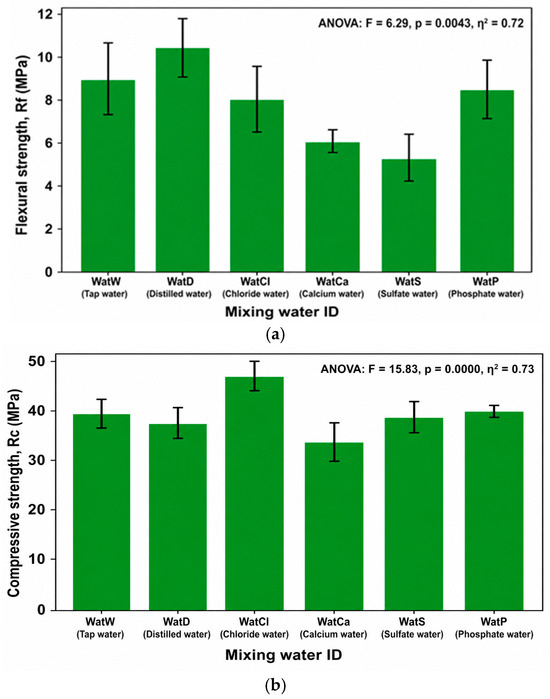
The bar chart presents the mean flexural strength Rf of cement mortars prepared with different mixing water compositions, together with standard deviation (±SD). The results show clear differences between the analyzed series. The highest flexural strength was obtained for WatD (10.40 MPa), followed by WatW (8.91 MPa) and WatP (8.43 MPa) (Figure 1). Slightly lower values were observed for WatCl (7.98 MPa), while the lowest strengths were recorded for WatCa (6.02 MPa) and WatS (5.21 MPa).
Figure 1.
(a) Comparison of flexural (Rf) and (b) compressive strength (Rc) of cement mortars as a function of mixing water composition with ANOVA statistical evaluation.
The error bars indicate moderate variability within individual series. Some dispersion differences are observed between mixtures; however, the overall trends remain consistent, showing clear differentiation between higher- and lower-strength groups. This confirms that the composition of mixing water influences the flexural behavior of cement mortars.
Statistical evaluation using one-way ANOVA indicated a significant effect of mixing water type on flexural strength (p < 0.05), with a strong effect size. These results demonstrate that flexural strength is sensitive to the ionic composition of mixing water and that the observed differences between series are systematic rather than random. For compressive strength, noticeable differences between mixtures were also observed, although the values remained within a relatively narrow range. Statistical analysis confirmed a significant influence of mixing water composition on compressive strength (p < 0.05) with a strong effect size. This indicates that mixing water chemistry affects not only flexural performance but also the compressive behavior of cement mortars.
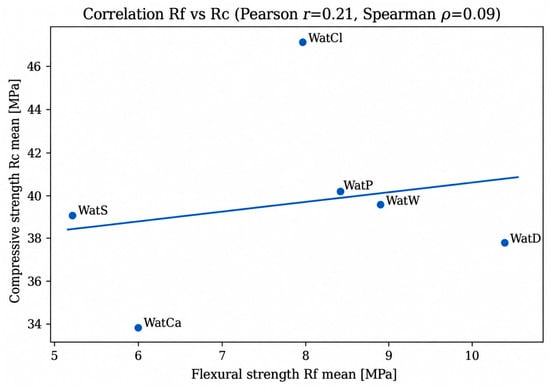
Figure 2 presents the correlation between the mean flexural strength and compressive strength of cement mortars prepared with different mixing water compositions, allowing an assessment of the relationships between these mechanical parameters. A very weak correlation between flexural strength and compressive strength was observed. The Pearson coefficient (r = 0.21) indicates a weak positive relationship, while the Spearman coefficient (ρ = 0.09) confirms the absence of a monotonic dependence between the parameters. This means that an increase in flexural strength is not accompanied by a proportional increase in compressive strength.
Figure 2.
Relationship between flexural strength and compressive strength with Pearson and Spearman correlation coefficients.
The most representative case is WatCl, which shows the highest compressive strength (~47 MPa) at a moderate flexural strength (~8 MPa). In contrast, WatD exhibits the highest flexural strength (~10.4 MPa) but only an average compressive strength (~37.8 MPa). These results confirm that the mechanisms governing flexural and compressive strength development differ and are influenced differently by the chemical composition of mixing water.
The obtained results indicate that a durability assessment based solely on compressive strength may be insufficient. Flexural strength appears more sensitive to degradation processes occurring within the cement matrix, while compressive strength reflects overall matrix densification, which explains the weak correlation between these parameters.
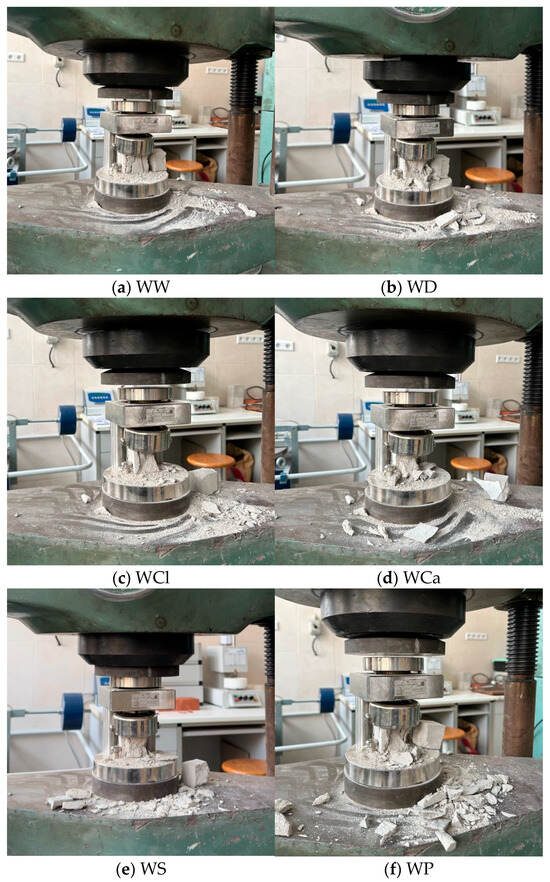
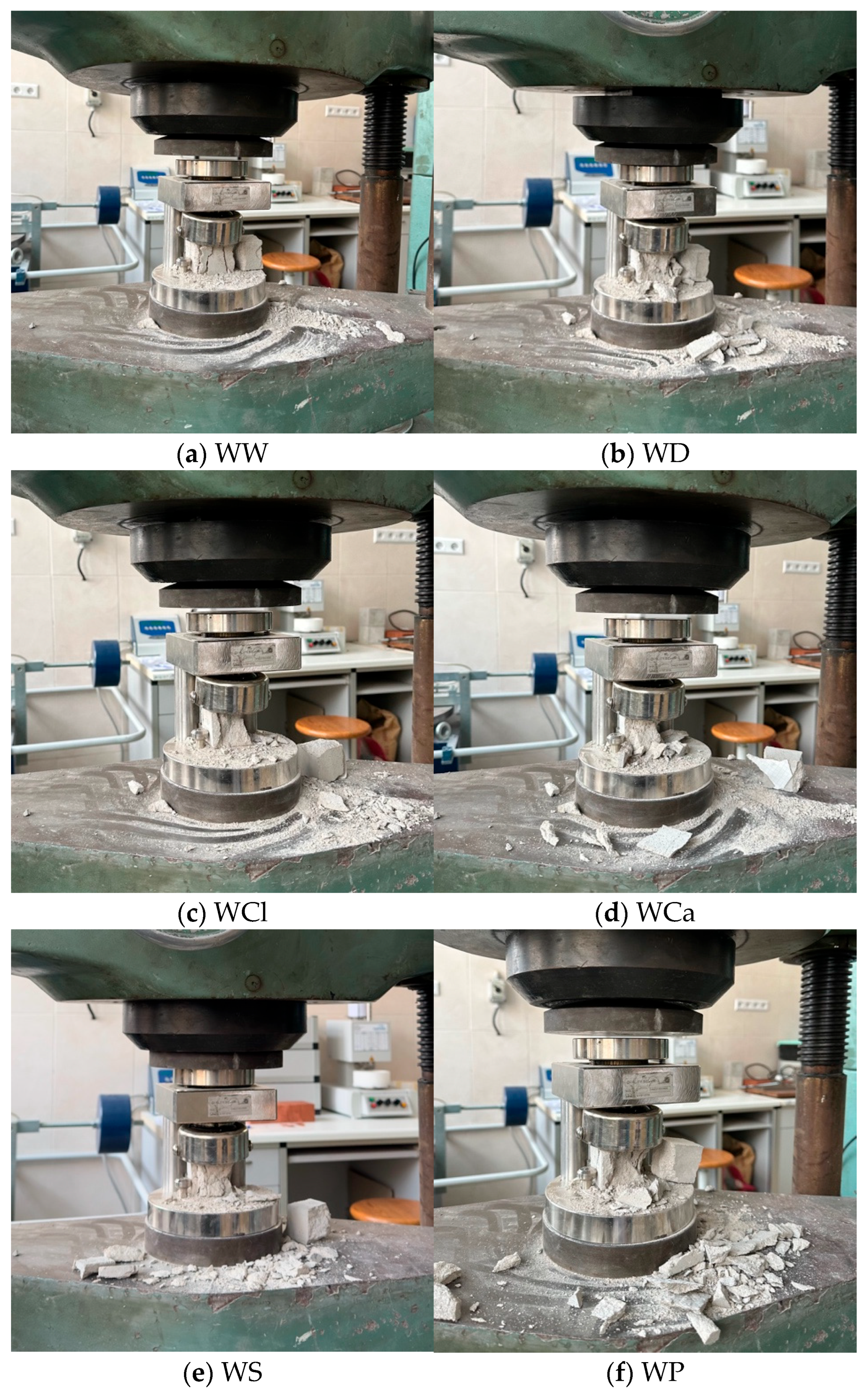
The fracture behavior of the tested specimens was analyzed both before and after exposure to an aggressive aqueous environment corresponding to class XA3. Prior to exposure, the differences between the specimens were limited, and the failure mode was generally similar across all series. After exposure, the differences became clearly visible, indicating the combined influence of the ionic composition of the mixing water and the degradation processes occurring in the aggressive environment.
The visual differences in the fracture behavior shown in Figure 3 reflect the influence of the composition of the mixing water on hydration kinetics and microstructure development. In particular, the crack morphology, fragment size, and fracture localization vary depending on porosity and structural density distribution. First, the specimens prepared with distilled water (WatD) showed fine fragmentation and local crushing near the loading plates. This behavior may indicate high porosity and weak cohesion. This is consistent with slower hydration due to the absence of dissolved ions. In contrast, the specimens prepared with tap water (WatW) exhibited well-developed axial cracks and larger fragments. The structure was more homogeneous and the density was moderate. As a result, the fracture occurred mainly through the propagation of macrocracks.
Figure 3.
General view of failure patterns of cement mortar specimens after compressive strength testing following exposure to an aggressive aqueous environment (XA3).
A different mechanism was observed for the modified waters containing specific ions. The WatCa samples showed sudden failure and pronounced lateral delamination. This is consistent with accelerated hydration and rapid strength development. However, it also may indicate the formation of internal stresses and structural heterogeneity. Similarly, the Wat-S samples showed granular and explosive failure. Macrocracks were not clearly visible. This behavior may be associated with degradation mechanisms commonly reported for sulfate-containing systems, including ettringite formation. For the WatCl, the cracks were shorter and less developed. Fragmentation was relatively uniform and fine. This behavior may be associated with a denser but more brittle structure resulting from accelerated early-stage hydration. Finally, the WatP samples showed a mixed failure mechanism. Both large fragments and fine particles were observed. The crack pattern was irregular and poorly developed. This is consistent with delayed hydration and the formation of a heterogeneous structure with local weak zones.
Overall, the observed fracture patterns confirm that fragment size, crack propagation, and failure mode are strongly controlled by hydration kinetics and microstructural evolution. These processes are directly dependent on the ionic composition of the mixing water, especially under aggressive environmental conditions (XA3).
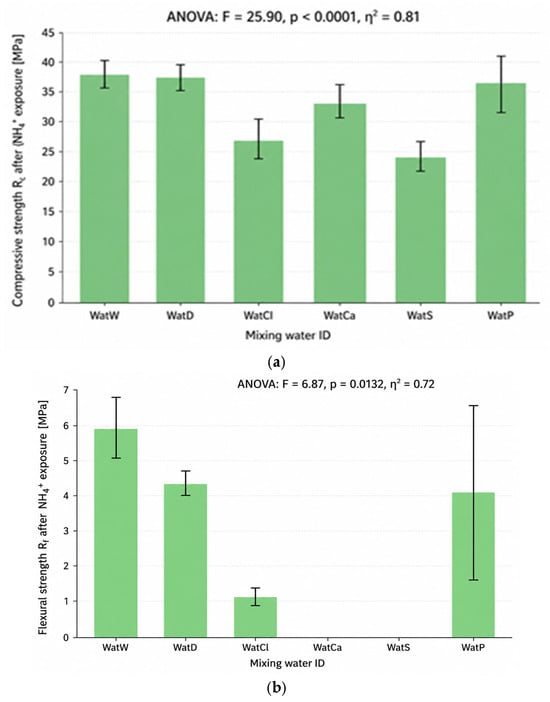
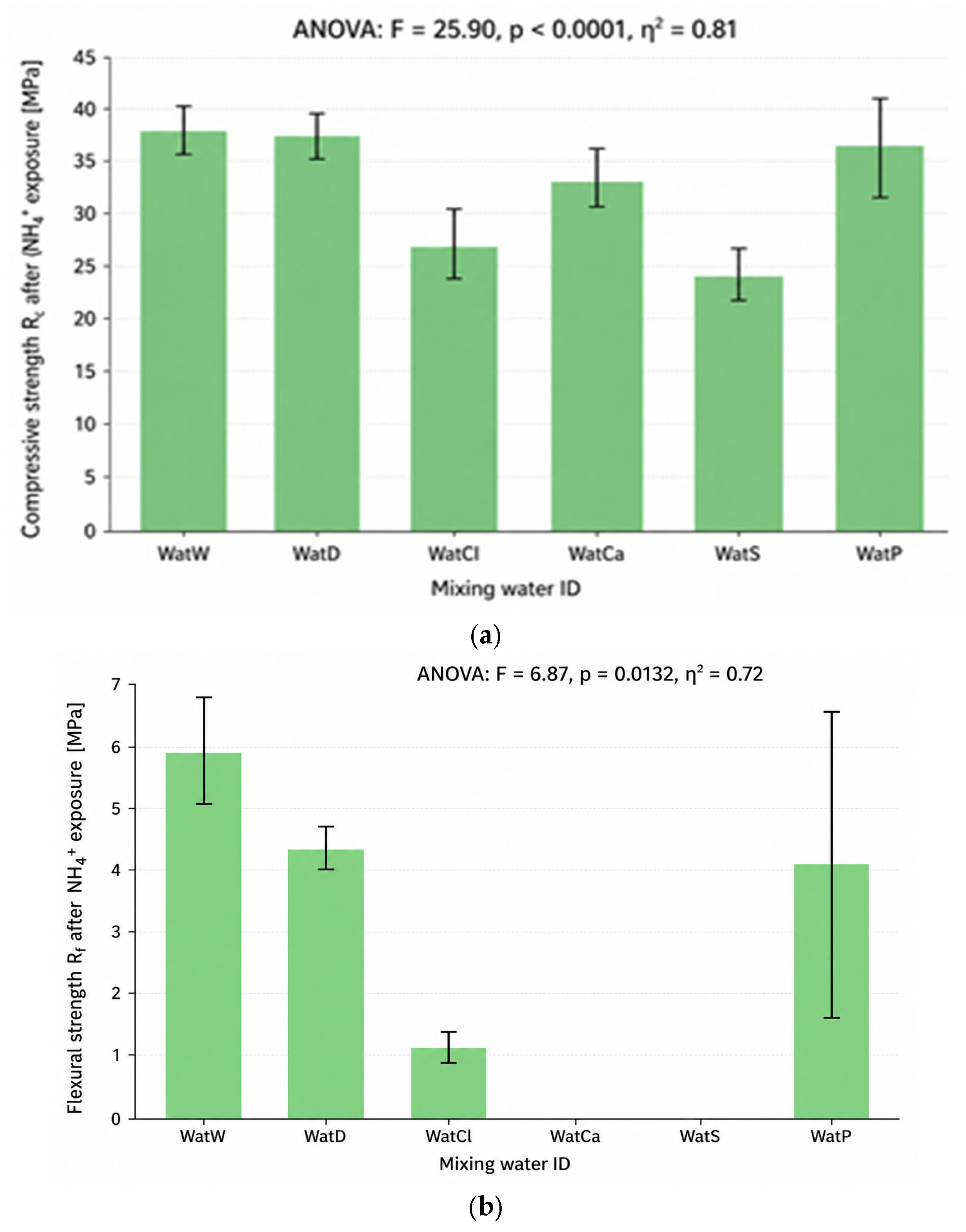
Figure 4 presents the residual flexural and compressive strengths of the cement mortars after exposure to the aggressive NH4Cl solution (mean ± SD). A significant reduction in flexural strength was observed for all the measurable series compared to the initial values. The highest residual flexural strength was recorded for WatW (5.87 MPa), followed by WatD (4.39 MPa) and WatP (4.12 MPa), while a drastic decrease was observed for WatCl (1.16 MPa). For WatCa and WatS, flexural strength fell below the measurement threshold, indicating very low resistance to an ammonium attack. The error bars indicate moderate variability for WatW and WatD and larger dispersion for WatP, reflecting non-uniform degradation.
Figure 4.
Residual compressive (a) and flexural (b) strength of cement mortars after exposure to an NH4Cl solution for different mixing water compositions (mean ± SD, one-way ANOVA).
Compressive strength after exposure remained relatively high for WatW (37.68 MPa), WatD (37.43 MPa), and WatP (36.55 MPa), while lower values were obtained for WatCa (33.04 MPa) and WatCl (27.24 MPa), with the lowest strength observed for WatS (23.92 MPa). One-way ANOVA confirmed a statistically significant effect of mixing water composition on both residual flexural strength (F = 6.87, p = 0.0132, η2 = 0.72) and residual compressive strength (F = 25.90, p < 0.001, η2 = 0.81), indicating a strong influence of mixing water chemistry on degradation behavior.
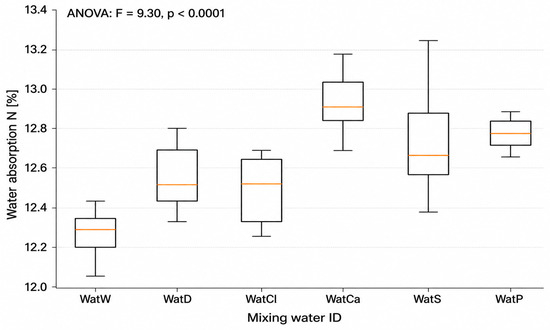
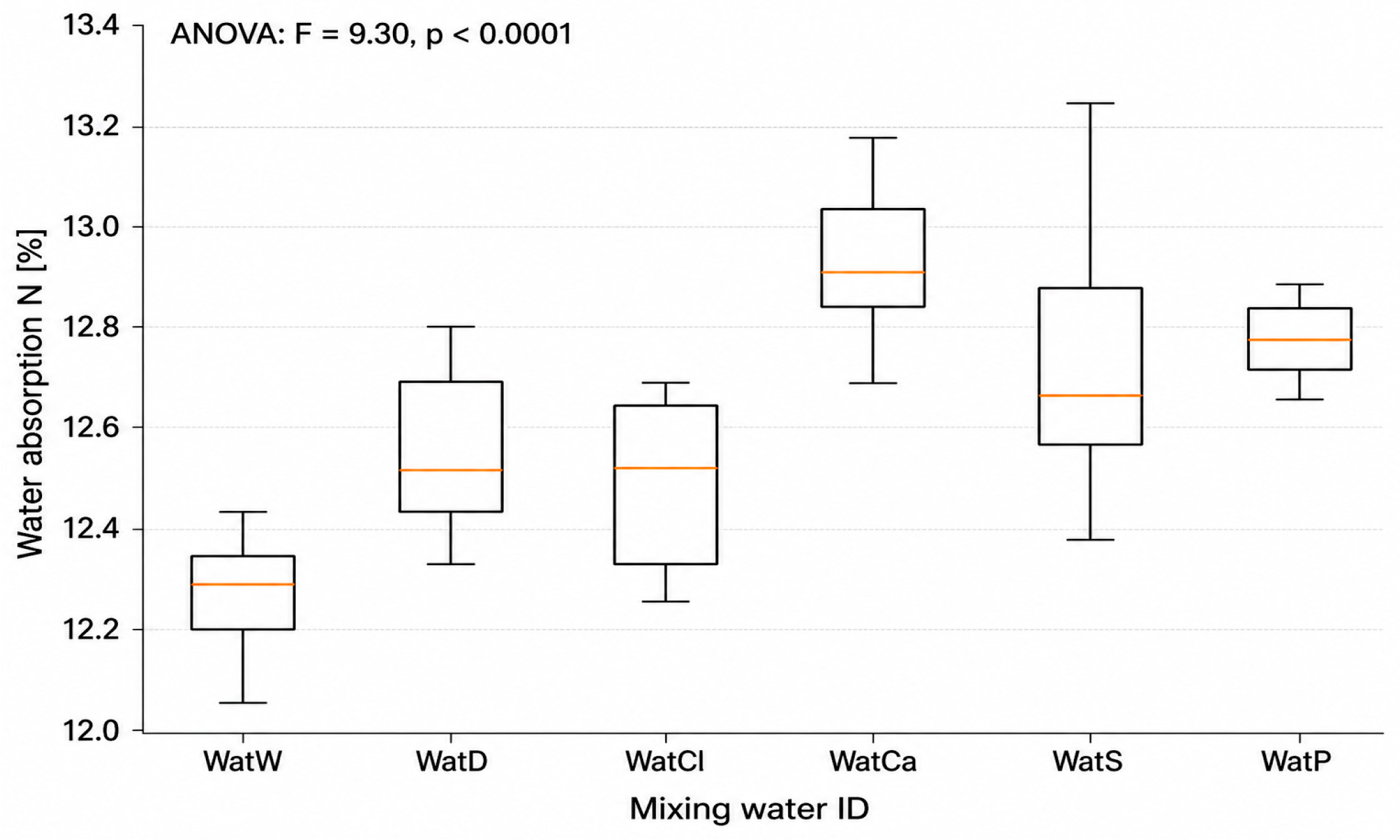
Figure 5 presents the distribution of water absorption values for cement mortars prepared with different mixing water qualities. The results show noticeable differences between series despite relatively small absolute variation (12.05–13.24%). The lowest absorption was observed for the reference series WatW (≈12.26%), while the highest values were recorded for WatCa (≈12.92%) and WatS (≈12.73%). Intermediate behavior was observed for WatD (≈12.54%), WatCl (≈12.48%), and WatP (≈12.77%).
Figure 5.
Water absorption of cement mortars before exposure.
The spread of values within individual series is relatively small, indicating good repeatability of measurements. However, the shift of medians between series confirms that mixing water chemistry influences pore structure and water uptake capacity. The higher absorption observed for WatCa and WatS suggests a greater susceptibility to the transport of aggressive ions, which may promote the transport of aggressive ions during exposure.
One-way ANOVA confirmed statistically significant differences between groups (F = 9.30, p < 0.001), indicating that mixing water composition significantly affects water absorption of cement mortars. These results suggest that even small differences in absorption (≈0.5–0.7%) may correspond to meaningful changes in transport properties and durability performance in aggressive environments.
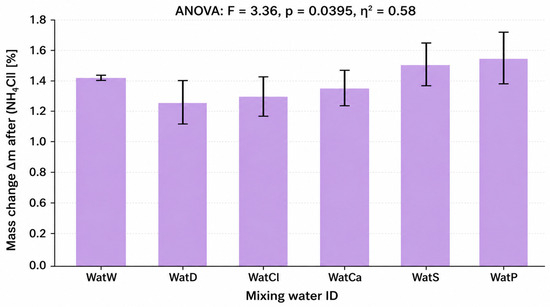
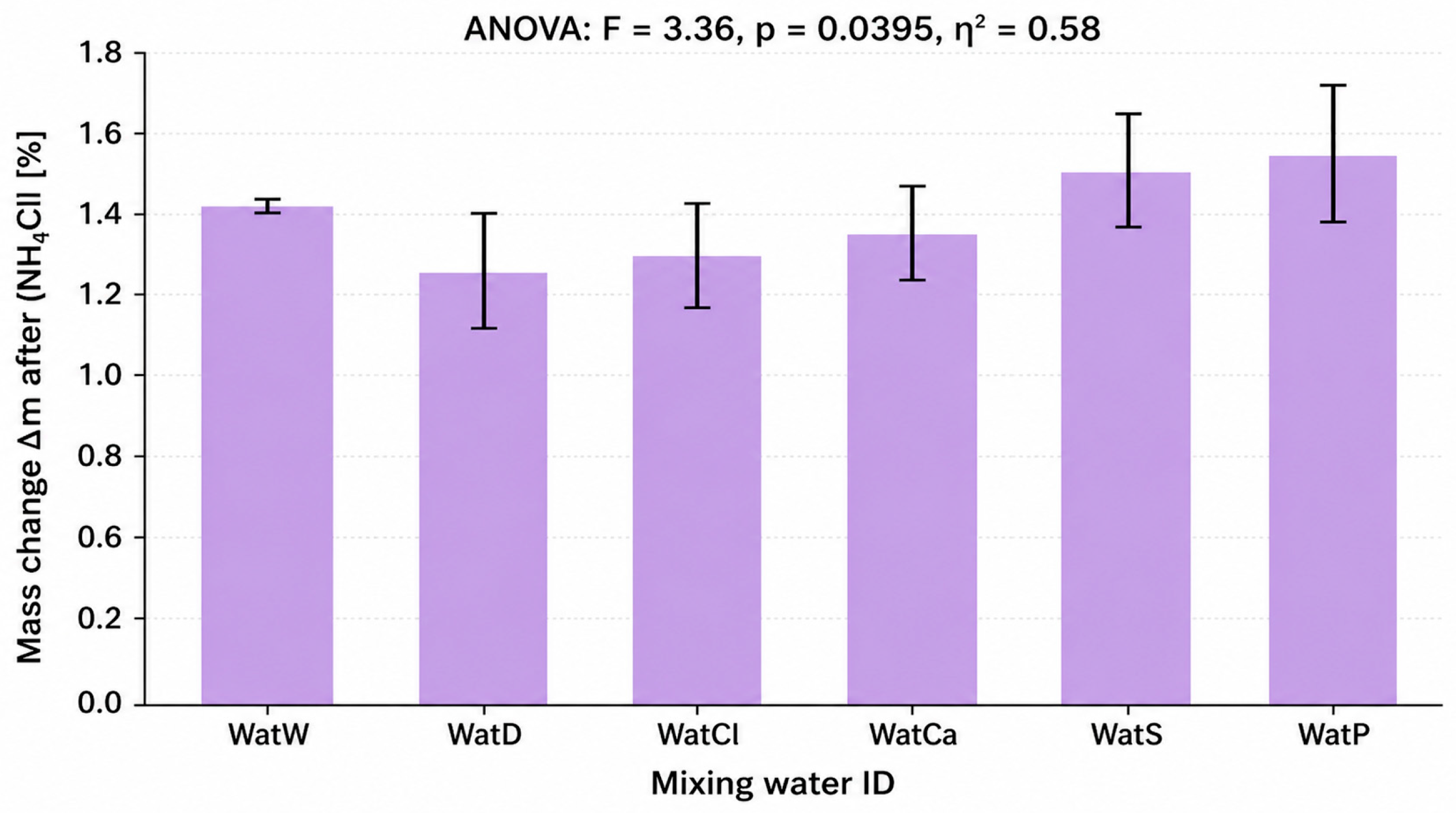
Figure 6 presents the mass change of cement mortar specimens after 14 days of exposure to the NH4Cl solution. All series exhibited an increase in mass, indicating penetration of the aggressive solution and the formation of reaction products within the pore structure. The highest mass increases were observed for WatP (1.54%) and WatS (1.50%), while the lowest values were recorded for WatD (1.27%) and WatCl (1.30%). The reference series WatW showed intermediate behavior with Δm = 1.42%.
Figure 6.
Mass change of cement mortars after exposure to NH4Cl solution for different mixing water compositions.
The relatively small differences between series suggest similar levels of solution uptake; however, the highest values for WatS and WatP indicate a more intensive ingress of the sulfate-ammonium solution and possible crystallization of the reaction products in pores. The moderate standard deviations confirm a consistent mass increase within the individual series.
One-way ANOVA revealed a statistically significant effect of mixing water composition on mass change after exposure (F = 3.36, p = 0.0395). The effect size (η2 = 0.58) indicates a moderate to strong influence, meaning that approximately 58% of the variance in mass change is explained by mixing water chemistry. These results suggest that the chemical composition of mixing water affects transport processes and the accumulation of aggressive products during ammonium exposure.
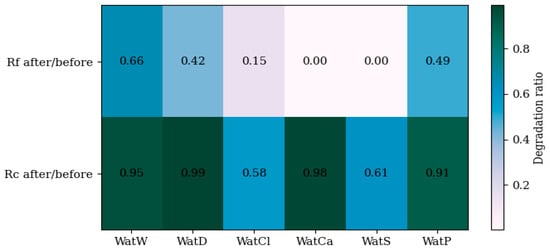
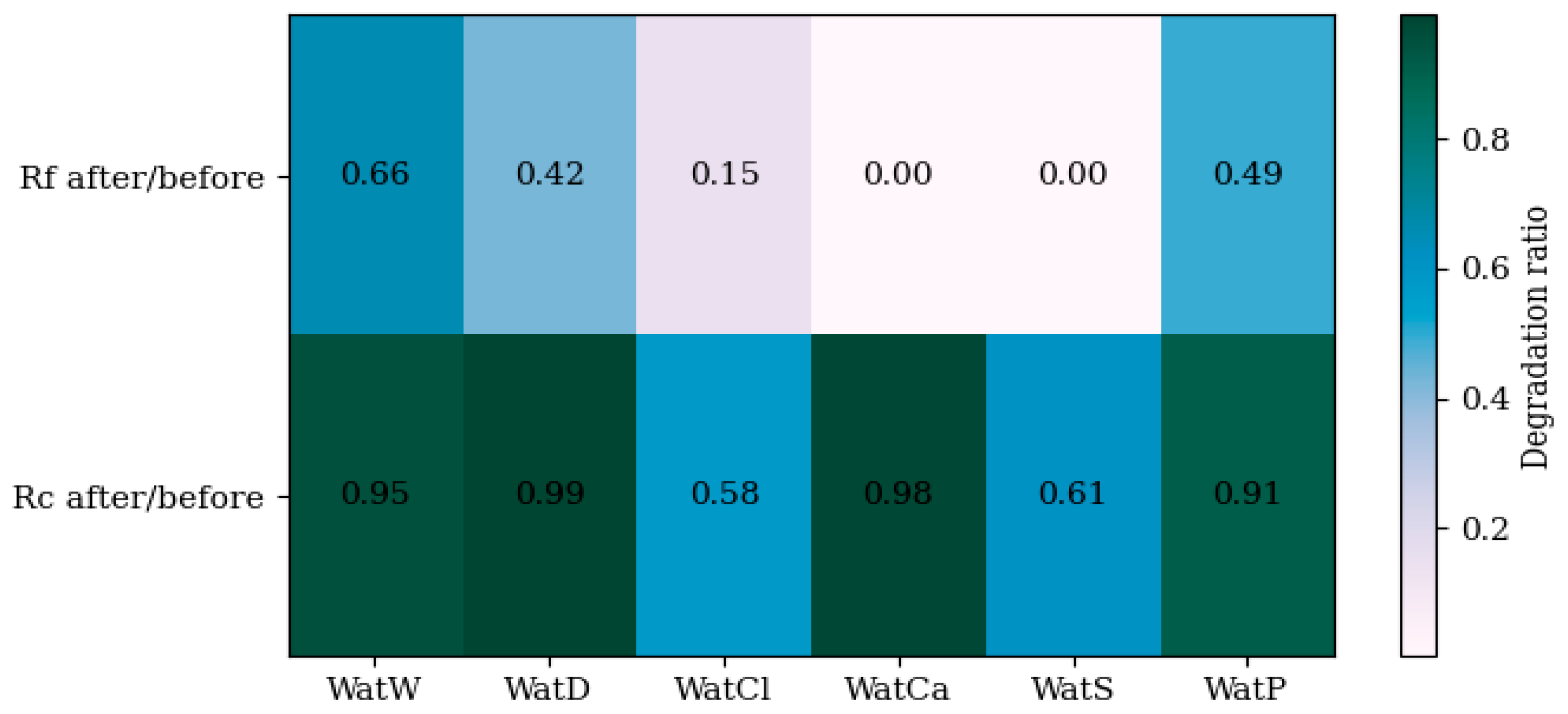
The degradation heatmap (Figure 7) presents the ratio of residual mechanical properties after exposure to the NH4Cl solution relative to their initial values. The highest flexural durability was observed for WatW (0.66), followed by WatP (0.49) and WatD (0.42), whereas severe strength loss occurred for WatCl (0.15). For WatCa and WatS, flexural strength decreased to values close to the measurement limit. In contrast, compressive strength remained relatively stable for WatD (0.99), WatCa (0.98), and WatW (0.95), while more pronounced reductions were observed for WatCl (0.58) and WatS (0.61). These results indicate that flexural strength is more sensitive to the degradation processes occurring during ammonium exposure than compressive strength. This behavior suggests that flexural strength is more strongly influenced by changes occurring in the cement matrix and transport-related properties. The strongest degradation observed for WatS and WatCl was accompanied by higher water absorption and mass increase, indicating more intensive penetration of the aggressive solution into the material.
Figure 7.
Degradation heatmap of residual mechanical properties after NH4Cl exposure.
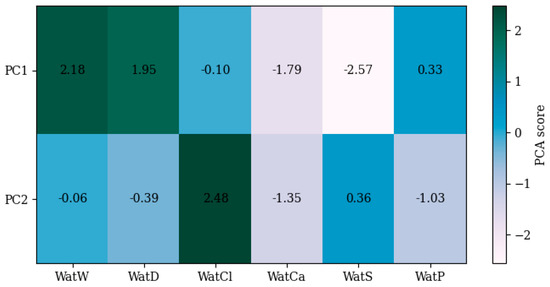
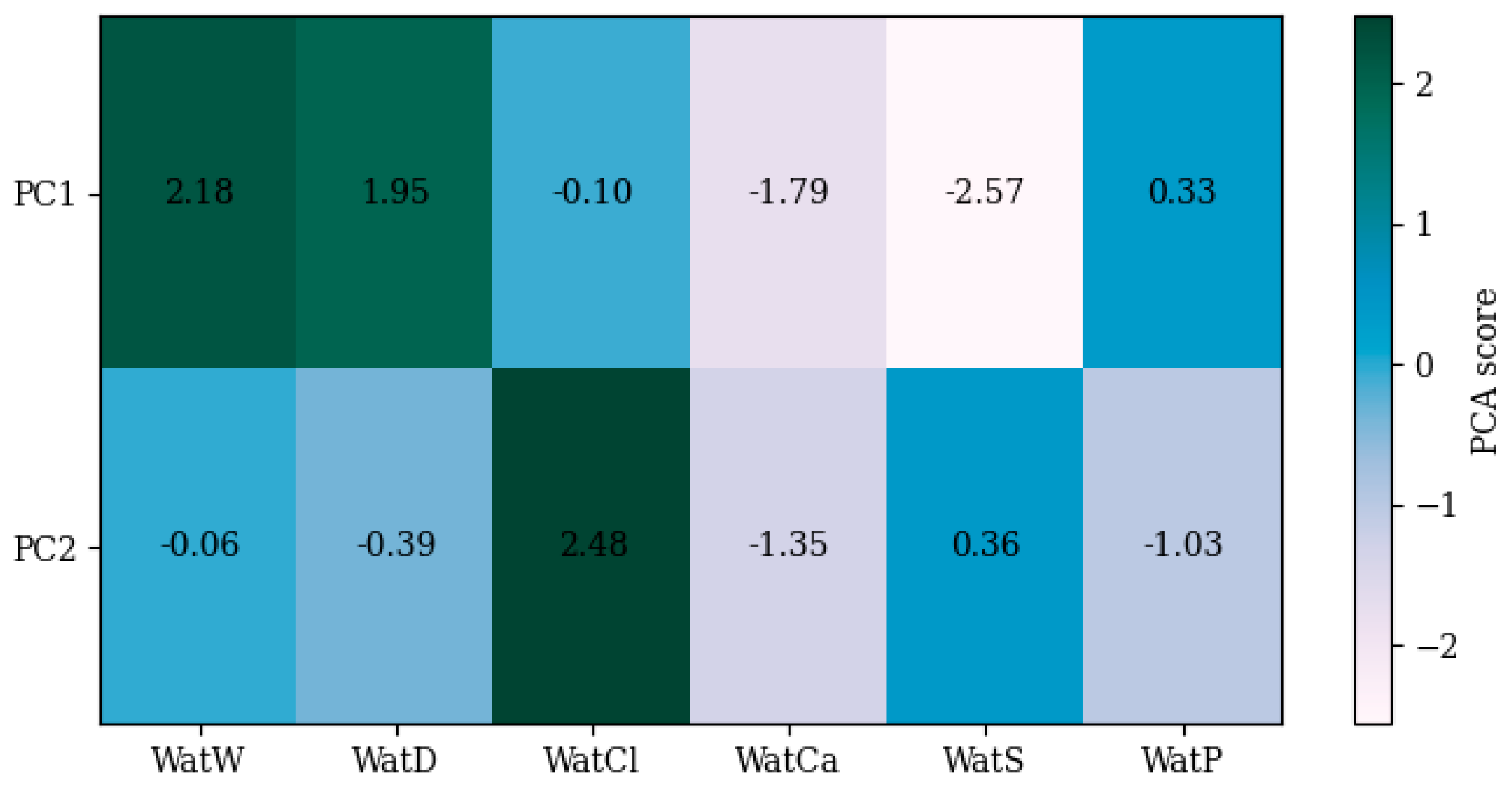
The PCA supports these observations (Figure 8). The first principal component represents a durability gradient, with the highest values for WatW and WatD and the lowest for WatS and WatCa, indicating the dominant influence of transport properties and residual strength. The second component is associated with initial mechanical properties, with WatCl showing a high initial strength but low durability. Overall, the results demonstrate that performance in the NH4Cl environment is governed primarily by transport properties and microstructural changes related to mixing water composition rather than by initial strength.
Figure 8.
PCA heatmap of durability-related parameters for cement mortars.
The ANOVA results (Table 2) confirm that mixing water composition significantly affects all evaluated parameters (p < 0.05). The strongest influence was observed for residual compressive strength (F = 25.90, η2 = 0.81), indicating that durability after ammonium exposure is mainly controlled by water chemistry.
Table 2.
Analysis of variance (ANOVA) results for the evaluated parameters.
High effect sizes were also obtained for compressive strength (η2 = 0.73) and flexural strength (η2 = 0.72), showing that mixing water composition influences both initial mechanical properties and degradation behavior. Water absorption showed significant differences (F = 9.30, p < 0.001), confirming the impact of water chemistry on pore structure and transport properties.
Mass change exhibited the lowest but still significant effect (F = 3.36, η2 = 0.58), indicating that solution uptake is influenced by mixing water composition but also depends on microstructural factors. Overall, the results demonstrate that mixing water chemistry is a key factor controlling the durability of cement mortars in an XA3 environment.
Discussion
The results confirm that the ionic composition of mixing water significantly influences both the initial properties and durability of cement mortars in an aggressive XA3 environment. Although compressive strength after 28 days varied within a relatively narrow range, the degradation behavior after exposure differed substantially between series. This observation is consistent with previous studies, which indicate that compressive strength alone is not a reliable indicator of durability, as it does not adequately reflect transport properties and microstructural changes [26,43].
The results demonstrate that degradation in an XA3 environment is controlled by a coupled transport-reaction mechanism. Transport properties govern the ingress and diffusion of aggressive ions into the cement matrix, whereas subsequent chemical reactions drive the progressive deterioration of the material.
The behavior of the investigated cement mortars is consistent with well-established degradation mechanisms reported in the literature [12]. The lower durability observed for the sulfate-containing system (WatS) is consistent with the degradation mechanisms commonly associated with a sulfate attack, where the formation of gypsum and ettringite may lead to expansion, microcracking, and a strength reduction of 20–40% [13]. In contrast, an ammonium attack is primarily associated with the decalcification of cement hydrates and a progressive deterioration of the cement matrix.
Chloride-modified systems (WatCl) showed a high initial compressive strength but reduced durability. This behavior may be associated with the formation of a denser but more brittle structure [9]. The results suggest a dual role of chloride ions. Chlorides may accelerate cement hydration, which may result in a higher initial compressive strength [44]. However, after exposure to the NH4Cl solution, the chloride-rich system exhibited a significantly lower residual strength. This finding indicates that a high initial strength does not necessarily correspond to high durability under an ammonium attack. Similar trends have been reported for cementitious systems prepared with chloride-containing or seawater-based mixing water, where enhanced early strength was accompanied by reduced long-term durability.
Calcium- and phosphate-modified systems (WatCa and WatP) demonstrate different hydration kinetics, also consistent with previous studies [2,15]. Accelerated hydration (WatCa) may reduce durability due to the development of a more heterogeneous structure, while phosphate systems (WatP) delay hydration and may promote the development of a more stable but heterogeneous structure [15].
Similar studies have demonstrated that ammonium-containing environments lead to the decalcification of cement hydrates and a progressive deterioration of the cement matrix [45]. The influence of ammonium salts, including NH4Cl, has also been investigated as an aggressive exposure medium in the context of mixing water composition, where a reduction in pH and increased leaching of calcium phases were observed [46]. Furthermore, field investigations in wastewater treatment plants have shown that concrete structures may be exposed to combined NH4+, SO42−, and Cl− attacks, resulting in complex degradation mechanisms [47].
The present results are consistent with previous studies indicating that a durability assessment requires a multi-parameter approach, as compressive strength does not fully reflect degradation processes. It has been found that the correlation between compressive strength and transport characteristics is usually moderate (R ≈ 0.30–0.70), while significantly higher values are observed for porosity, water absorption, and diffusion coefficients (R ≈ 0.70–0.90) [48,49], which indicates the determining role of microstructure in shaping durability [23,50].
Statistical approaches, such as analysis of variance (ANOVA), are widely used to quantify the influence of various factors on the durability of concrete. According to the literature, environmental conditions often have a dominant contribution (η2 ≈ 0.60–0.85), while material parameters such as mix composition or water chemistry show a medium or high influence (η2 ≈ 0.40–0.75) depending on the system and exposure regime [29]. Statistical significance is usually set at p < 0.05, confirming the decisive role of both intrinsic material properties and external operating conditions in the degradation processes.
4. Conclusions
The ionic composition of mixing water significantly affected both the initial properties and the durability of cement mortars exposed to the NH4Cl solution. Statistically significant differences were confirmed by one-way ANOVA for flexural strength, compressive strength, water absorption, mass change, and residual mechanical properties (p < 0.05).
Cement mortars prepared with different mixing waters exhibited a relatively similar initial compressive strength. However, after exposure to the aggressive NH4Cl environment, substantial differences in residual flexural and compressive strength were observed. This indicates that similar initial mechanical properties do not necessarily correspond to similar durability.
The highest durability was observed for the reference series prepared with tap water (WatW), while the lowest resistance was recorded for the sulfate- and chloride-modified waters (WatS and WatCl). These series showed the greatest reductions in residual mechanical properties after exposure.
Correlation analysis revealed a weak relationship between flexural and compressive strength. The obtained results indicate that compressive strength alone is not a reliable indicator of durability in ammonium environments and should be supplemented with transport-related and degradation parameters.
The use of NH4Cl as the aggressive medium enabled the investigation of ammonium-induced degradation without the influence of a sulfate attack. The results confirm that mixing water composition should be considered an important factor in the durability assessment of cement-based materials exposed to aggressive XA3 environments.
Author Contributions
Conceptualization, Y.T., M.K. and R.T.; methodology, I.K., R.T. and O.Z.; software, O.B. and I.L.; validation, P.S. and I.P.; formal analysis, Y.T. and R.T.; investigation, Y.T., R.T. and M.K.; resources, Y.T. and R.T.; data curation, I.K., O.Z. and R.T.; writing—original draft preparation, Y.T., M.K. and R.T.; writing—review and editing, Y.T. and R.T.; visualization, O.B., I.L. and I.P.; supervision, Y.T. and R.T.; project administration, Y.T., R.T. and I.K.; funding acquisition, M.K., Y.T. and R.T. All authors have read and agreed to the published version of the manuscript.
Funding
This research received no external funding.
Data Availability Statement
The data presented in this study are available from the corresponding author upon reasonable request.
Conflicts of Interest
The authors declare no conflicts of interest.
References
- Kokoszka, W. Impact of Water Quality on Concrete Mix and Hardened Concrete Parameters. Civ. Environ. Eng. Rep. 2019, 29, 174–182. [Google Scholar] [CrossRef] [Scilit]
- Babu, G.R.; Reddy, B.M.; Ramana, N.V. Quality of Mixing Water in Cement Concrete “A Review”. Mater. Today Proc. 2018, 5, 1313–1320. [Google Scholar] [CrossRef] [Scilit]
- Hassan, I.; Abdul-Kareem, O.; Shihab, A. Effect of Using Well Water as Mixing Water in Concrete. Al-Rafidain Eng. J. 2014, 22, 17–28. [Google Scholar]
- Klus, L.; Václavík, V.; Dvorský, T.; Svoboda, J.; Papesch, R. The Properties of Waste Water from a Concrete Plant. IOP Conf. Ser. Earth Environ. Sci. 2017, 92, 012028. [Google Scholar] [CrossRef] [Scilit]
- CSN EN 1008; Mixing Water for Concrete-Specification for Sampling, Testing and Assessing the Suitability of Water, Including Water Recovered from Processes in the Concrete Industry, as Mixing Water for Concrete. ÚNMZ: Prague, Czech Republic, 2003.
- Dhondy, T.; Remennikov, A.; Shiekh, M.N. Benefits of Using Sea Sand and Seawater in Concrete: A Comprehensive Review. Aust. J. Struct. Eng. 2019, 20, 280–289. [Google Scholar] [CrossRef] [Scilit]
- Yousuf, S.; Shafigh, P.; Muda, Z.C.; Katman, H.Y.B.; Latif, A. Alternatives for Fresh Water in Cement-Based Materials: A Review. Water 2023, 15, 2828. [Google Scholar] [CrossRef] [Scilit]
- Sosa, M.E.; Zaccardi, Y.A.V.; Zega, C.J. A Critical Review of the Resulting Effective Water-to-Cement Ratio of Fine Recycled Aggregate Concrete. Constr. Build. Mater. 2021, 313, 125536. [Google Scholar]
- Dhondy, T.; Xiang, Y.; Yu, T.; Teng, J.-G. Effects of Mixing Water Salinity on the Properties of Concrete. Adv. Struct. Eng. 2021, 24, 1150–1160. [Google Scholar]
- Lv, K.; Xu, C.; Song, C.; Gao, S.; Zhang, P.; Guo, Y.; Yu, Q.; Sui, S.; Li, Q. Effect of Sulfate Attack on Multiple Interfacial Transition Zones of High-Belite Sulfoaluminate Cement Recycled Concrete. Case Stud. Constr. Mater. 2024, 21, e03730. [Google Scholar] [CrossRef] [Scilit]
- Taylor, H.F. Cement Chemistry; Thomas Telford: London, UK, 1997. [Google Scholar]
- Whittaker, M.; Black, L. Current Knowledge of External Sulfate Attack. Adv. Cem. Res. 2015, 27, 532–545. [Google Scholar] [CrossRef] [Scilit]
- Al Fuhaid, A.F.; Alanazi, H. Prediction of Chloride Diffusion Coefficient in Concrete Modified with Supplementary Cementitious Materials Using Machine Learning Algorithms. Materials 2023, 16, 1277. [Google Scholar] [CrossRef] [Scilit] [PubMed]
- Dashti, P.; Moodi, F.; Ramezanianpour, A.A.; Banar, R. Finite Element Analysis of Chloride Ion Penetration and Service Life Prediction in Concrete with Supplementary Cementitious Materials. Sci. Rep. 2025, 15, 30023. [Google Scholar] [CrossRef] [Scilit] [PubMed]
- Babu, S.; Ramaswamy, K.; Nazeer, M. A Review on the Deterioration of Cement-Based Materials in Ammonium Salt Solutions. IOP Conf. Ser. Earth Environ. Sci. 2020, 491, 012041. [Google Scholar] [CrossRef] [Scilit]
- Khumtorn, T.; Chotickai, P. Evaluation of the Compressive Mechanical Properties of Sulfate-Damaged Concrete Using Linear and Nonlinear Ultrasonic Techniques. Res. Eng. Struct. Mat. 2025, 11, 843–859. [Google Scholar] [CrossRef] [Scilit]
- Martins, M.C.; Silva, A.S.; Capraro, A.P.B.; Remenche, I.R.; Medeiros, M.H.F.; Souza, D.J.D. Reinforced Concrete Exposed to External Ammonium Sulfate Attack in Fertilizer Factories: Test Method Focused on Reinforcement Corrosion, Migration Coefficient, and Microstructural Changes. J. Build. Eng. 2025, 104, 112112. [Google Scholar] [CrossRef] [Scilit]
- EN 206:2013+A2:2021; Concrete—Specification, Performance, Production and Conformity. European Committee for Standardization (CEN): Brussels, Belgium, 2021.
- Rashad, A.M. Sustainable Utilization of Concrete Wash Water: A Critical Overview of Fresh and Hardened Properties. Environ. Sci. Pollut. Res. 2026, 33, 3100–3121. [Google Scholar] [CrossRef] [Scilit] [PubMed]
- Maqdasi, B.; Alhseinat, E.; Rodríguez, J.; Al-Ali, K. Ammonia Recovery from Wastewater: A Critical Review of Technologies with Emphasis on Capacitive Deionization. Chem. Eng. J. Adv. 2025, 24, 100901. [Google Scholar] [CrossRef] [Scilit]
- Ibrahim, A.M.; Bassuoni, M.T.; Carroll, J.; Ghazy, A. Evaluation of Nanoparticle-Enhanced Silane and Vinyl Ester Coatings for Protecting Concrete from Ammonium Sulfate. Results Eng. 2024, 23, 102545. [Google Scholar] [CrossRef] [Scilit]
- Xu, J.; Zhao, T.; Lu, W. Effects of Applied Load and Its Direction on the Permeability Behavior of Concrete: A Case Study. Case Stud. Constr. Mater. 2021, 15, e00643. [Google Scholar] [CrossRef] [Scilit]
- Al-lami, M. Correlation between Permeability and Porosity with Other Properties of Concrete. J. Appl. Eng. Sci. 2021, 19, 542–550. [Google Scholar] [CrossRef] [Scilit]
- Zhang, S.; Zong, L. Evaluation of Relationship between Water Absorption and Durability of Concrete Materials. Adv. Mater. Sci. Eng. 2014, 2014, 650373. [Google Scholar] [CrossRef] [Scilit]
- Ruiz Espejo, M. Design of Experiments for Engineers and Scientists. Technometrics 2006, 48, 304–305. [Google Scholar] [CrossRef] [Scilit]
- Sonebi, M.; Bassuoni, M. Investigating the Effect of Mixture Design Parameters on Pervious Concrete by Statistical Modelling. Constr. Build. Mater. 2013, 38, 147–154. [Google Scholar] [CrossRef] [Scilit]
- Tebbal, N.; Maza, M.; Rahmouni, Z.E.A. Use of a Full Factorial Design to Study the Relationship between Water Absorption and Porosity of GP and BW Mortar Activated. Adv. Civ. Eng. 2022, 2022, 2016157. [Google Scholar] [CrossRef] [Scilit]
- EN 196-1:2016; Methods of Testing Cement—Part 1: Determination of Strength. European Committee for Standardization (CEN): Brussels, Belgium, 2016.
- Hary Yanto, F. The Impact of Utilizing Red Brick Powder and Plastic Pellets as Fine Particles on the Compressive Strength and Absorption of Water in Paving Blocks. Sci. Rev. Eng. Environ. Sci. 2024, 33, 372–387. [Google Scholar] [CrossRef] [Scilit]
- Aryanto; Sutandar, E.; Prasetijo, J. The Influence of Quartz Powder Addition on the Production of Paving Blocks: English. Sci. Rev. Eng. Environ. Sci. 2025, 34, 221–240. [Google Scholar] [CrossRef] [Scilit]
- Hamideche, R.; Mezhoud, S.; Toumi, Y. Study on the Mechanical Performance of Sustainable Earth Blocks from Sandy Granite Saprolite and Marble Waste. Sci. Rev. Eng. Environ. Sci. 2025, 34, 327–347. [Google Scholar] [CrossRef] [Scilit]
- Raza, A.; Shah, S.A.R.; Kazmi, S.N.H.; Ali, R.Q.; Akhtar, H.; Fakhar, S.; Khan, F.N.; Mahmood, A. Performance Evaluation of Concrete Developed Using Various Types of Wastewater: A Step towards Sustainability. Constr. Build. Mater. 2020, 262, 120608. [Google Scholar] [CrossRef] [Scilit]
- Su, N.; Miao, B.; Liu, F.-S. Effect of Wash Water and Underground Water on Properties of Concrete. Cem. Concr. Res. 2002, 32, 777–782. [Google Scholar] [CrossRef] [Scilit]
- Dabbebi, R.; De Aguiar, J.B.; Camões, A.; Samet, B.; Baklouti, S. Effect of the Calcinations Temperatures of Phosphate Washing Waste on the Structural and Mechanical Properties of Geopolymeric Mortar. Constr. Build. Mater. 2018, 185, 489–498. [Google Scholar] [CrossRef] [Scilit]
- Cayanan, F.; Dela Cruz, O.G.; Bornales, A.P.P.; Domalaon, R.M.; Marbella, J.B. A Review of the Effect of Mixing Water Quality on Concrete. In Proceedings of the International Conference on Geosynthetics and Environmental Engineering; Springer: Berlin/Heidelberg, Germany, 2023; pp. 125–135. [Google Scholar]
- Paquot, M.; Larsson, T. Descriptive Statistics and Visualization with R. In A Practical Handbook of Corpus Linguistics; Springer: Berlin/Heidelberg, Germany, 2021; pp. 375–399. [Google Scholar]
- Croucher, S.M.; Cronn-Mills, D. Descriptive Statistics. In Understanding Communication Research Methods; Routledge: Oxfordshire, UK, 2021; pp. 201–219. [Google Scholar]
- Trach, R. A Model Classifying Four Classes of Defects in Reinforced Concrete Bridge Elements Using Convolutional Neural Networks. Infrastructures 2023, 8, 123. [Google Scholar] [CrossRef] [Scilit]
- Trach, R.; Khomenko, O.; Trach, Y.; Kulikov, O.; Druzhynin, M.; Kishchak, N.; Ryzhakova, G.; Petrenko, H.; Prykhodko, D.; Obodianska, O. Application of Fuzzy Logic and SNA Tools to Assessment of Communication Quality between Construction Project Participants. Sustainability 2023, 15, 5653. [Google Scholar] [CrossRef] [Scilit]
- Trach, R.; Ryzhakova, G.; Trach, Y.; Shpakov, A.; Tyvoniuk, V. Modeling the Cause-and-Effect Relationships between the Causes of Damage and External Indicators of RC Elements Using ML Tools. Sustainability 2023, 15, 5250. [Google Scholar] [CrossRef] [Scilit]
- Ewing, R.; Park, K. (Eds.) Basic Quantitative Research Methods for Urban Planners, 1st ed.; Routledge: Oxfordshire, UK, 2020. [Google Scholar]
- Hauke, J.; Kossowski, T. Comparison of Values of Pearson’s and Spearman’s Correlation Coefficients on the Same Sets of Data. Quaest. Geogr. 2011, 30, 87–93. [Google Scholar] [CrossRef] [Scilit]
- Aïtcin, P.-C.; Mindess, S. Sustainability of Concrete; CRC Press: Boca Raton, FL, USA, 2011. [Google Scholar]
- Hewlett, P.C.; Liska, M. Lea’s Chemistry of Cement and Concrete; Elsevier: Amsterdam, The Netherlands, 2019. [Google Scholar]
- Słomka-Słupik, B.; Labus, K. Laboratory Test and Geochemical Modeling of Cement Paste Degradation, in Contact with Ammonium Chloride Solution. Materials 2022, 15, 2930. [Google Scholar] [CrossRef] [Scilit] [PubMed]
- Tang, Y.; Yin, G.; Chen, F.; Zhang, J. Solid–Liquid Equilibrium State and Equation of Cement-Based Materials in Ammonium Chloride Solution. Mater. Struct. 2022, 55, 220. [Google Scholar]
- Woyciechowski, P.; Łukowski, P.; Szmigiera, E.; Adamczewski, G.; Chilmon, K.; Spodzieja, S. Concrete Corrosion in a Wastewater Treatment Plant—A Comprehensive Case Study. Constr. Build. Mater. 2021, 303, 124388. [Google Scholar] [CrossRef] [Scilit]
- Al-Amoudi, O.S.B.; Al-Kutti, W.A.; Ahmad, S.; Maslehuddin, M. Correlation between Compressive Strength and Certain Durability Indices of Plain and Blended Cement Concretes. Cem. Concr. Compos. 2009, 31, 672–676. [Google Scholar] [CrossRef] [Scilit]
- Yu, F.; Chu, W.; Zhang, R.; Gao, Z.; Yang, Y. Predicting the Permeability and Compressive Strength of Pervious Concrete Using a Stacking Ensemble Machine Learning Approach. Sci. Rep. 2025, 15, 22506. [Google Scholar] [CrossRef] [Scilit] [PubMed]
- Zhang, J.; Bian, F.; Zhang, Y.; Fang, Z.; Fu, C.; Guo, J. Effect of Pore Structures on Gas Permeability and Chloride Diffusivity of Concrete. Constr. Build. Mater. 2018, 163, 402–413. [Google Scholar] [CrossRef] [Scilit]

Disclaimer/Publisher’s Note: The statements, opinions and data contained in all publications are solely those of the individual author(s) and contributor(s) and not of MDPI and/or the editor(s). MDPI and/or the editor(s) disclaim responsibility for any injury to people or property resulting from any ideas, methods, instructions or products referred to in the content. |
© 2026 by the authors. Licensee MDPI, Basel, Switzerland. This article is an open access article distributed under the terms and conditions of the Creative Commons Attribution (CC BY) license.