


Abstract
Polypyrrole was chemically synthesized by in situ polymerization in the presence of surfactant dopant on cotton denim fabric. Shape and size of the particles are characterized by SEM micrographs. Electrical and thermal conductivity of fabric samples were measured and it was found that electrical conductivity can be increased by increasing the concentration of polypyrrole, but there is no significant relation between electrical and thermal conductivities.
1. Introduction
Several works have been devoted to the coating of fibres or fibrous materials with Conducting Electroactive Polymers (CEP). All these works involve a vapour-phase treatment of oxidantcontaining carriers with the monomers [1]. Polymers with conjugated π-electron backbones can be oxidized or reduced more easily and are more reversible than conventional polymers. Dopants, which act as charge transfer agents, affect this oxidation or reduction process and render these polymers conductive.
The ultimate goal of electrically conductive polymer research is to combine the process ability of polymers with the electronic properties of metal or semi-conductors [2]. Unfortunately, most of these conductive polymers are intractable and cannot be processed into useful articles. This is particularly true for polypyrrole (PPy) and polyaniline (PANi), which are preferred for their high conductivity and stability under environmental conditions [3,4].
In the mid-1970s, the first polymer capable of conducting electricity was discovered in a new form of polyacetylene. The announcement of this discovery quickly reverberated around scientific community, and the intensity of the search for others magnified dramatically [5,6,7].
Among the first commercial products incorporating conductive polymers there was Contex, a line of conductive textile products originally manufactured by Milliken [8], starting around 1990, and now produced by Eeonyx Corp., under the trade name of EeonTexTM.
There has been little attention devoted to the determination of the thermal conductivity properties of polypyrrole. Kanazawa et al. [9] reported a thermal conductivity value of 3.77 [Wm−1·K−1] for a copolymer of pyrrole and N-methylpyrrole. No information was given regarding the measurement technique or temperature at which the test was made.
For metals the Wiedemann-Franz law states that the ratio of thermal to electrical conductivity is proportional to temperature. The proportionality constant is the Lorenz number and it is a constant for a wide range of metals. This behavior may be explained by applying Fermi Dirac statistics to the “free” electrons in the material [10,11]. Hence, it can be shown that the ratio of the electronic component of thermal conductivity λ [Wm−1·K−1] to electrical conductivity σ [S·m−1] is given by Eq. (1).
where k is the Boltzmann constant [JK−1], e the charge on an electron [C] and T the absolute temperature [K], the Lorenz number for metals is given by (π2/3)(k/e)2 and is equal to 2.45 × 10⁻⁸ [W·Ω·K−2].
λ/σ = (π2/3)(k/e)2T
In this study PPy was chemically polymerized in different concentrations on cotton denim fabric by surfactant dopant. Cotton fibre surface was characterized by SEM. Volume and surface electrical conductivity of fabric samples was measured together with thermal conductivity.
2. Methodology
Cotton denim fabric was desized and washed thoroughly for complete removal of finishing additives. Construction of the fabric sample is mentioned in Table 1.
Table 1.
Description of the fabric sample.
2.1. Sample Preparation
PPy was chemically synthesized in different concentrations on cotton denim fabric by in situ polymerization in the presence of surfactant dopant. Five different aqueous emulsions of Pyrrole (Sigma) with concentrations 1% to 5% were prepared by adding Dodecyl benzenesulphonate (DBSA) (Sigma) 0.05 M in each solution.
Five samples of fabric were immersed completely in each emulsion for 5 hours. Each sample was then taken out from emulsion and immersed in 0.1M FeCl3 (Sigma) for further 10 hours in order to complete polymerization of PPy. Each sample was then taken out and washed with ethanol followed by distilled water several times in order to remove (DBSA) from the fabric surface. Fabric samples were then dried at 25±4 ℃ for 24 hours and marked as A1 to A5 with respective concentrations, 1% to 5% of Pyrrole and the untreated sample was marked as A0.
2.2. SEM Micrographs
Fibers coated with PPy were collected from each fabric sample and analyzed from SEM (VEGA TESCAN Inc. USA) at 30kV. Samples were not coated with gold deliberately in order to take contrast image of shiny PPy particles.
2.3. Electrical Conductivity
Surface as well as volume electric conductivity were measured three times from both face and back of each fabric sample and the average was recorded with the help of HP Agilent 4339A High Resistance Meter. Concentric ring electrodes were used for this purpose in order to avoid errors caused by textural unevenness of denim fabric.
2.4. Thermal Conductivity
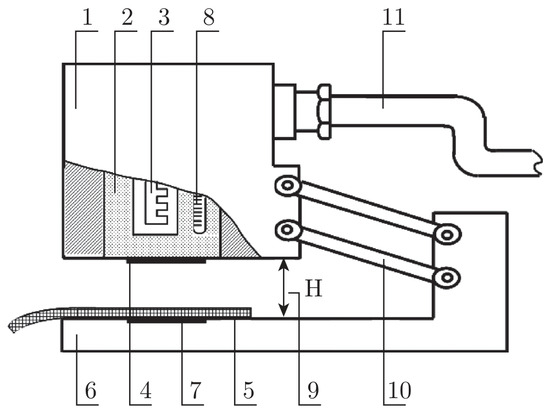
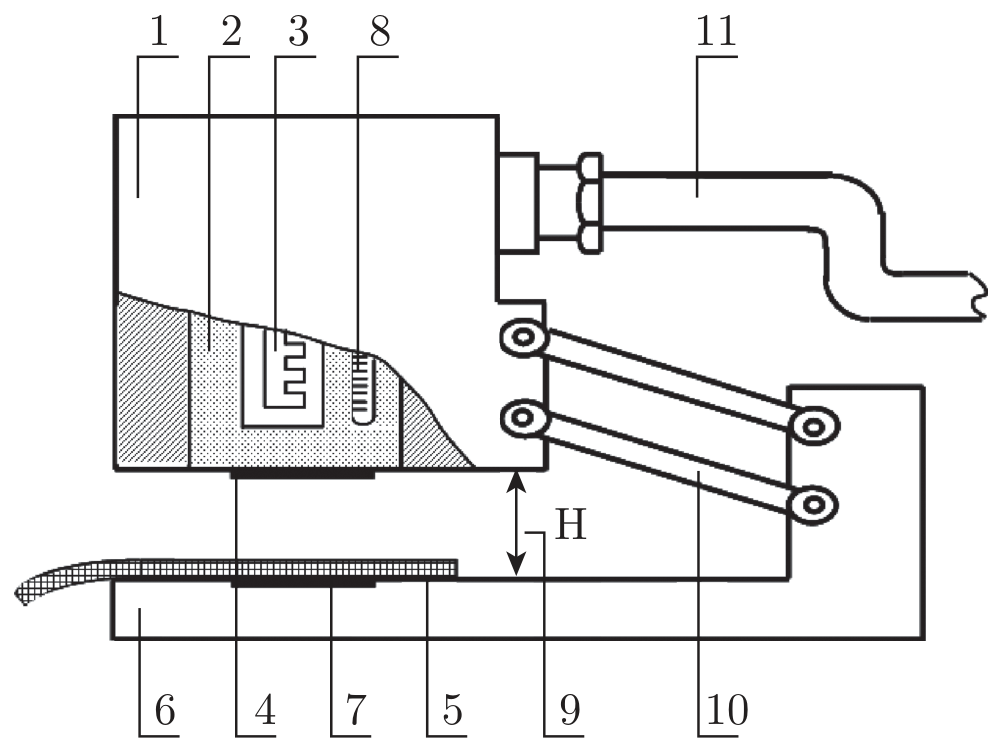
All treated and untreated fabric samples were conditioned for 24 hours at 25±2 ℃ and 65% R.H before measuring thermal conductivity. It was measured with the help of ALAMBETA from Sensora Czech Republic. It calculates all the statistic parameters of the measurement and exhibits the instrument auto-diagnostics, which avoids faulty instrument operation. The simplified scheme of the instrument is shown on Figure 1.
Figure 1.
Schematic diagram of ALAMBETA instrument.
The principle of this instrument is based on the hot plate (7). The ultra-thin heat flow sensor (4) is attached to a metal block (2) with a constant temperature different from the sample temperature which records the difference. When the measurement starts, the measuring head (1) containing the heat flow sensor drops down with the help of assembly (10) and touches the planar measured sample (5), which is located on the instrument base (6) under the measuring head. At this moment, the surface temperature of the sample suddenly changes and the instrument computer registers the heat flow course through connection wires (11). Simultaneously, a photoelectric sensor measures the sample thickness. To simulate the real conditions of warm-cool feeling evaluation, the instrument measuring head is heated to 32 ℃ (see the heater (3) and the thermometer (8)) [12].
3. Results
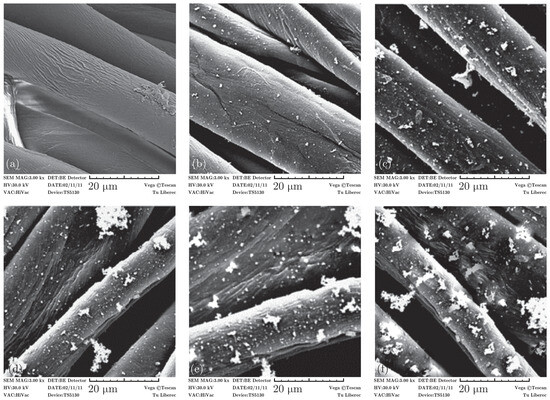
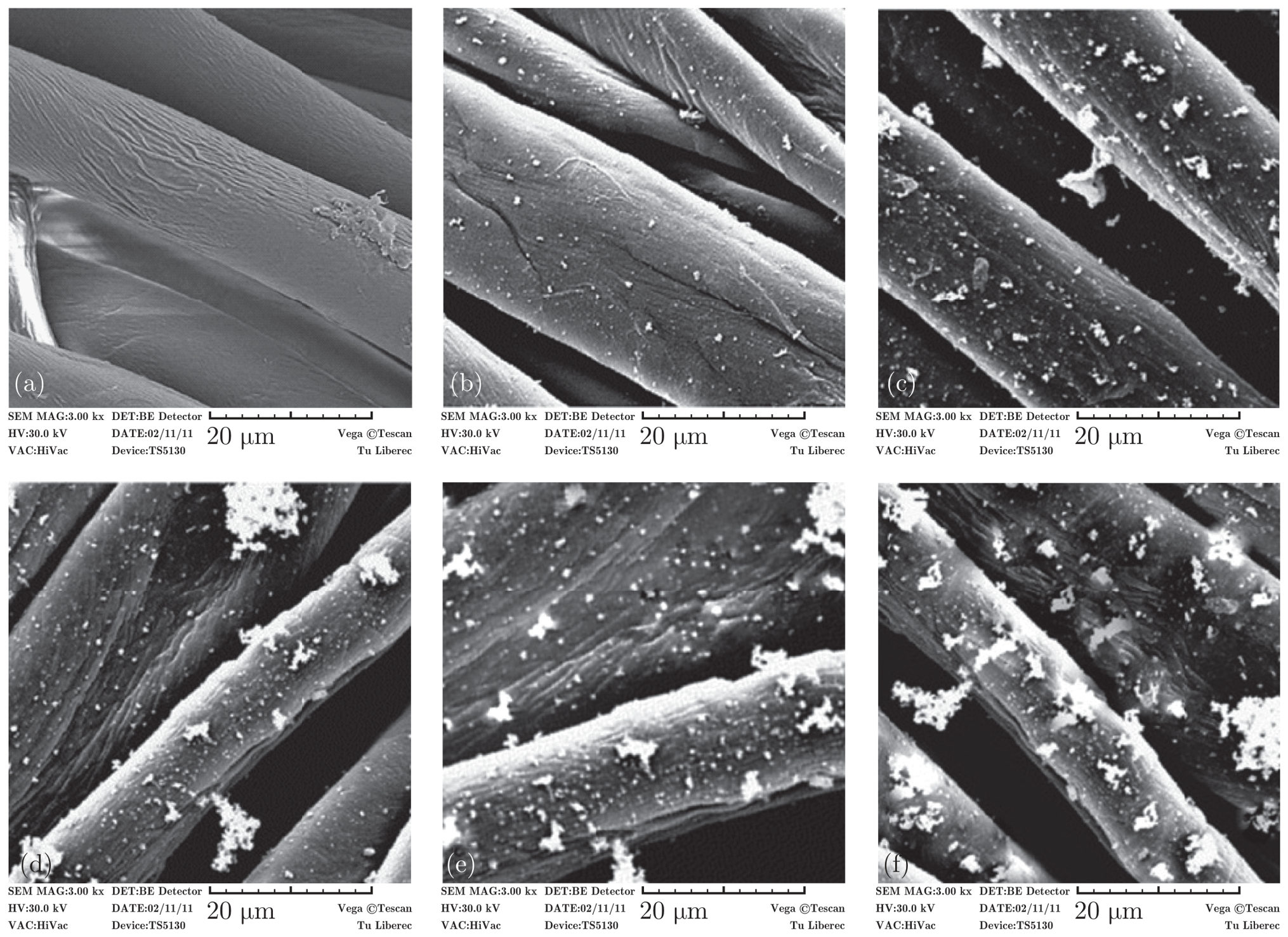
Figure 2 shows the deposition of PPy on cotton fibers of fabric samples. It can be seen that with increase in pyrrole concentration in the polymerizing emulsion, there is a significant increment in the amount of particles on the fiber surface, Figure 2b–f.
Figure 2.
SEM micrographs of PPy coated cotton fibers (a) Untreated A0 (b) A1 (c) A2 (d) A3 (e) A4 and (f) A5.
From the micrographs it can also be seen that there is no noticeable change in the surface of the cotton fiber after deposition of PPy on it but tiny particles of PPy stick with the surface only.
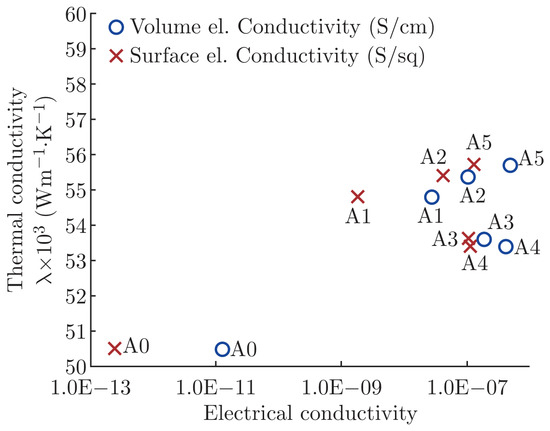
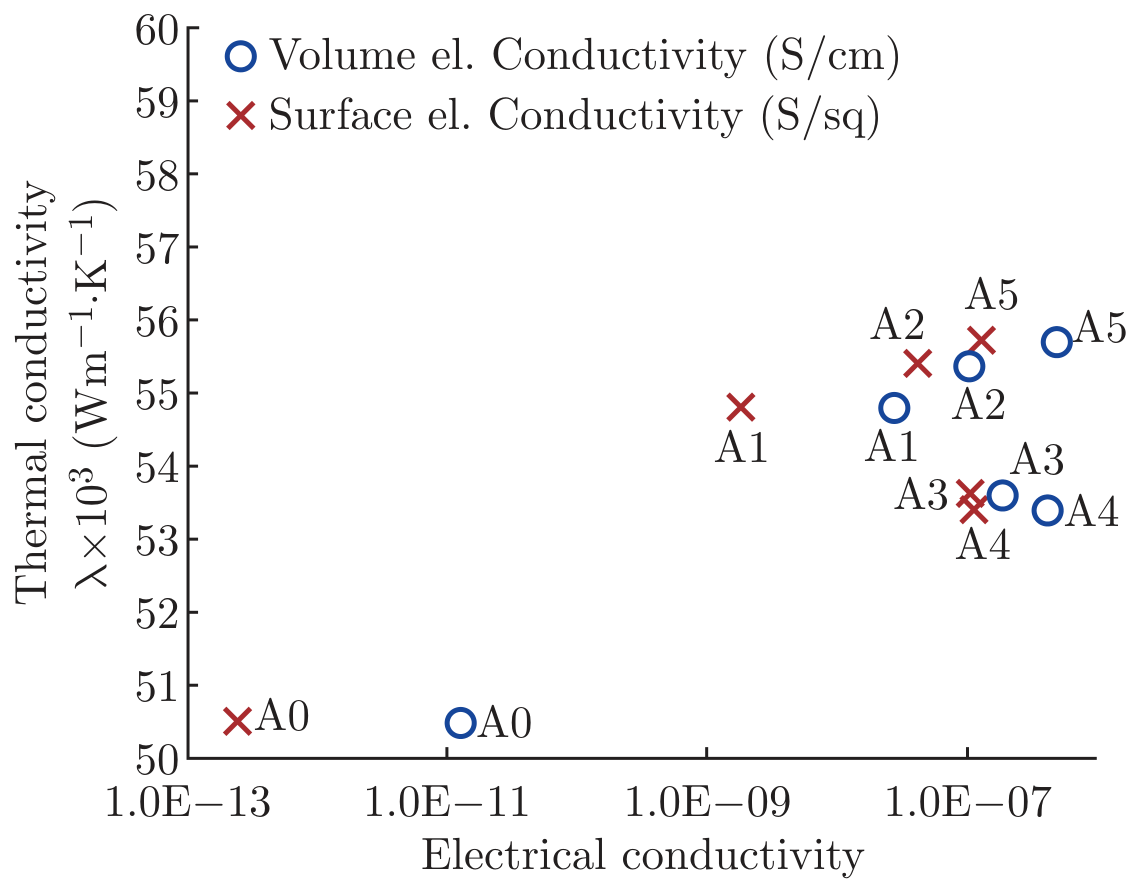
Thermal conductivity of a material works by energy transfer through the material by excitation of the following particles: electrons, phonons, photons and molecules [13]. In this particular work, there is a noticeable increase in the thermal conductivity of untreated fabric sample and the sample treated with the lowest concentration of pyrrole, but no relationship has been found between the concentration of PPy and thermal conductivity Figure 3. Surface and volume electrical conductivity values can be seen in Table 2.
Figure 3.
Thermal conductivity plotted against volume and surface electrical conductivity.
Table 2.
Electrical and thermal properties of PPy coated cotton denim fabric samples.
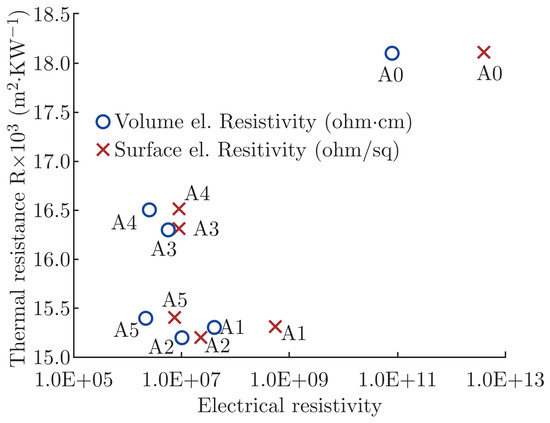
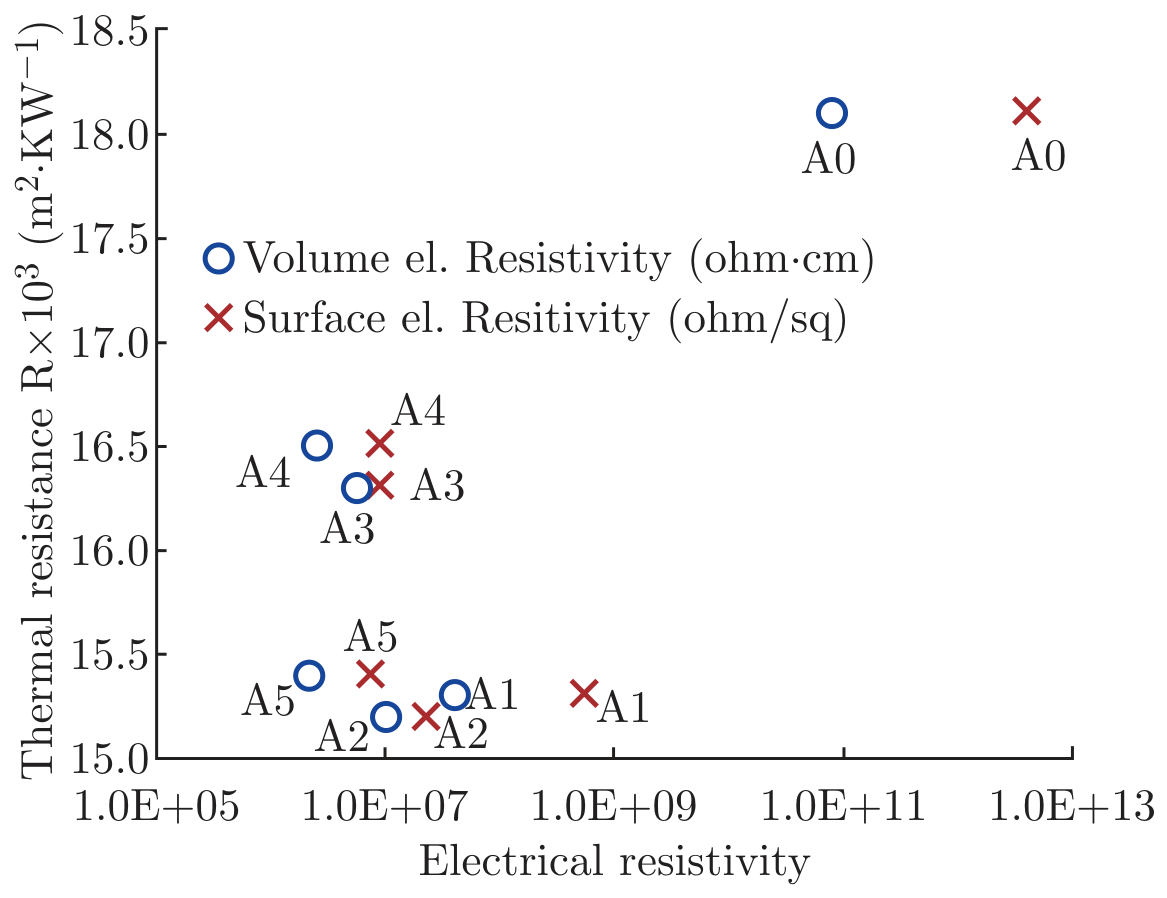
Similar effect was observed while plotting relationship between thermal resistance, volume and the surface electrical resistance of fabric samples as shown in Figure 4.
Figure 4.
Thermal resistance plotted against volume and surface electrical resistivity.
4. Conclusion
PPy was synthesized on cotton denim fabric by in situ polymerization in the presence of surfactant dopant. Electrical and thermal properties were measured and it was found that there is a significant increase in thermal conductivity due to small amount of PPy particles which were formed on the surface of the cotton fiber. Further increase in particle concentration cause drastic increase in electrical conductivity but it doesn’t affect thermal conductivity so much. Therefore the relationship between thermal and electrical conductivity for PPy coated fabric does not follow a simple Wiedemann-Franz proportionality over this range of concentration and/or for this technique of polymerization of PPy which is presented in this work.
Acknowledgments
Research was financed by Student Grant Scheme (SGS 2012) in Technical University of Liberec Czech Republic.
References
- Heisey, C.I.; Wightman, J.P.; Pittman, E.H.; Kuhn, H.H. Surface and adhesion properties of polypyrrole coated textiles. Text. Res. 1993, 63, 247–256. [Google Scholar] [CrossRef] [Scilit]
- Frommer, J.E.; Chance, R.R. Electrically conductive polymers and composites. In High performance polymers and composites; Kroschwitz, J.I., Ed.; John Wiley: New York, 1991; pp. 174–219. [Google Scholar]
- Gregory, R.V.; Kimbrell, W.C.; Kuhn, H.H. Conductive textiles. Synth. Met. 1989, 28, C823–C835. [Google Scholar] [CrossRef] [Scilit]
- Hosseini, S.H.; Entezami, A.A. Preparation and characterization of polyaniline blends with polystyrene, poly(vinyl chloride) and poly(vinyl acetate) for toxic gas sensors. Polym. Adv. Technol. 2001, 12, 482–493. [Google Scholar] [CrossRef] [Scilit]
- Chiang, C.K.; Fincher, C.R.; Park, Y.W.; Heeger, A.J.; Shirakawa, H.; Louis, E.J.; Gau, S.C.; MacDiarmid, A.G. Phys. Rev. Lett. 1997, 39, 1098.
- MacDiarmid, A.G. Polyaniline and polypyrrole: Where are we headed? Synth. Met. 1997, 84, 27–34. [Google Scholar] [CrossRef] [Scilit]
- Cao, Y.; Smith, P.; Heeger, A.J. Counter-ion induced processibility of conducting polyaniline. Synth. Met. 1993, 57, 3514–3519. [Google Scholar] [CrossRef] [Scilit]
- Milliken and Co. Available online: http://www.milliken.com.
- Kanazawa, K.K.; Diaz, A.F.; Krounbi, M.T.; Street, G.B. Electrical properties of pyrrole and its copolymers. Synth. Met. 1981, 4, 119–130. [Google Scholar] [CrossRef] [Scilit]
- Goldsmid, H.J. Thermal Properties of Solids; Routledge: London, 1965; pp. 49–62. [Google Scholar]
- Parrott, J.E.; Stukes, A.D. Thermal Conductivity of Solids; Pion: London, 1975; p. 101-104 and 110-119. [Google Scholar]
- Hes, L.; Araujo, M.; Djulay, V. Effect of mutual bonding of textile layers on thermal insulation and thermal-contact properties of fabric assemblies. Text. Res. J. 1996, 66, 245–250. [Google Scholar] [CrossRef] [Scilit]
- Qi, T.G. Thermal properties of inorganic materials; Shanghai Sci & Tech Press, 1981. [Google Scholar]

© 2012 Textile Bioengineering and Informatics Society. This article is an open access article distributed under the terms and conditions of the Creative Commons Attribution (CC BY) license (https://creativecommons.org/licenses/by/4.0/).