


Abstract
In this paper the perspectives of structural colored fibers based on photonic crystal structures are discussed. These fibers display the distinctive colors, which are determined by the lattice constants of the photonic crystals. The color-changing capability of photonic fibers with potential applications in dynamic signage and environmentally adaptive coloration is demonstrated. The fibers are fabricated by the silica or polystyrene colloidal particles to the periodically ordered interconnecting structure in a cylindrical shape. The visible light is coherently diffracted on the surface of the fibers, which produces a shinning color in a narrow range of wavelength. Importantly, no dyes or colorants are used in fabrication of such fibers, thus making the fibers resistant to color fading. This method of making colorful fibers could be a promising way to reduce environmental pollution in the dying industry. Additionally, by changing the reflective index or lattice constant of a photonic fiber, its reflected colors change proportionally to the shift of reflective index or lattice constant, thus enabling visually interactive and sensing textiles responsive to the external stimuli.
1. Introduction
Dyeing is one of the key steps in the textile industry. The purpose of dyeing is to let the fabrics appear in different colors for human’s sensory enjoyment. The chemical colorant or pigment is attached onto the fabrics to produce the colour during the dyeing process. This process requires a huge amount of fresh water to dissolve the pigments and flush the fabrics. Eventually the unabsorbed remains of the pigments in the water form the industrial sewage. If it was discharged into the surrounding area, it will give rise to severe pollution issues to the environment. This kind of dyeing sewage contains highly-concentrated organic pollutants and is extremely difficult to be degraded by chemical or biological methods. Hence the dyeing sewage is impossible to be regenerated and recycled. Due to the above mentioned disadvantages, the dyeing sewage becomes one of the main sources of the industrial pollutions on earth.
To reduce the sewage discharge from the textile industries, many green and clear production processes are adopted by the textile manufacturers, e.g., pre-processing techniques and improved dyeing methods [1,2]. All these methods significantly reduce the pollution discharge and save the energy and mass consumption in the dyeing process; nevertheless, they are still based on the chemical molecular adsorption. Consequently the problems in the textile industries are hardly solved without a revolutionary way. Moreover, the global climate change caused by excessive greenhouse gas emissions results in mankind suffering from frequent disasters. The recent Copenhagen conference conveys a clear message that the reduction of the pollution, hazardous gases and resource-consumption is a vital action for stopping the global warming [3].
In this work a coloring strategy through a structural color method is proposed by incorporating the photonic crystal structures onto the thin fibers. In the second section, the basic concepts on the photonic crystals are introduced. In the third part, the primary results of the experiments are presented. Finally, a brief conclusion is derived and explained.
When the visible light is incidenting onto certain periodic structures, only the light with a specific wavelength will be diffracted. Thereby, the objects with the periodic structures are exhibiting a specific color. Since this coloring is due primarily to the lattice spacing owned by the periodic structures, it is called as “structural color” [4]. Whereas, the dielectrics with a spatial periodic structure are given by the name of “photonic crystals” [5]. The concept of photonic crystal is proposed by E.Yablonovitch and S. John in 1987 [6,7].
2. Photonic crystal and structural color
In this section, the mechanism of the structural color produced by the photonic crystals will be introduced.
The current trends on the structural colors will be reviewed. Consequently, the fabrication method on the photonic crystals will be discussed.
2.1. Photonic crystal
Photonic crystals are regular arrays of materials with different refractive indices. The simplest case is that two materials with the distinctive reflective indices are stacked alternately in one dimension. The spatial period of the stack is called the lattice constant, since it corresponds to the lattice constant of ordinary crystals composed of a regular array of atoms. Actually, many basic ideas are common to both crystals and they will be utilized to build fundamental theories of the photonic crystals. However, one big difference between them is the scale of the lattice constant. In the case of ordinary atomic crystals, the lattice constant is on the order of angstroms. On the other hand, it is on the order of the wavelength of the relevant electromagnetic waves for the photonic crystals. For example, it is about 1 μm or less for visible light, and is about 1 cm for microwaves.
If a 3D photonic crystal is designed appropriately, there appears a frequency range where no electromagnetic eigenmode exists. Frequency ranges of this kind are called photonic band gaps, since they correspond to band gaps of electronic eigenstates in ordinary crystals.
The transmission spectra of photonic crystals reflect their band structure directly. They are often used for the experimental characterization of real specimens. Generally, the numerical calculation, such as the planewave expansion method, is utilized to calculate the transmittance and the Bragg reflectivity of 2D crystals. It has been demonstrated that the band gaps and the uncoupled modes lead to opaque frequency ranges, which correspond to the reflective light. It will also be shown that the small group velocity peculiar to the 2D and 3D crystals, that is, the group-velocity anomaly, is equivalent to a large effective refractive index. However, the behavior of the light on the surface of cylindrical photonic crystals, especially the diameter of the fibers is close to the wavelength of light, is still puzzling.
2.2. Structural color
The structural color is a common phenomenon in nature, especially among living things. The study of structural color based on the biological microstructure is one of the most important research areas in biomimicry [8,9,10]. Microstructure plays many important roles in living things. For example, the charming blue color of the Morpho sulkowskyi butterfly originates from light diffraction and scattering, which results from the ordered microstructure of its scales. The animals and insects are usually utilizing the structural color both for protection and warning. Today, the study of structural color has been extended from biology to optics [11]. The structural color is caused by the Bragg diffraction of visible light from the ordered voids regarded as crystallites. The peak values of reflection spectra, λmax, for the periodic colloidal crystal are obtained by
 where d is the diameter of a colloidal particle, m is an integral representing the order of diffraction, na is the refractive index of the colloidal particles at a certain condition, and θ is the angle measured from the normal to the plane of the crystal.
Currently the tunable structural color devices based on the photonic crystals have been intensively investigated by the frontiers, such as Seung-Man Yang [12] and Yukikazu Takeoka [13] etc. The recent progress focuses on the application of the photonic structural colors in the areas of inkless printing, reflective flat display and gas sensing [14,15,16].
2.3. Fabrication of photonic crystal
Photonic crystals are classified mainly into three categories, that is, one-dimensional (1D), twodimensional (2D), and three-dimensional (3D) crystals according to the dimensionality of the stack [17]. The natural photonic crystal is very rare. Therefore, the photonic crystals are artificially made by the dielectric materials owing to the periodic structures. The photonic crystals that work in the microwave and farinfrared regions are relatively easy to fabricate. Those that work in the visible region, especially 3D ones are difficult to fabricate because of their small lattice constants. However, various technologies have been developed and applied to their fabrication in the last ten years, and many good crystals with a lattice constant less than 1 μm are now available. There are three kinds of methods to fabricate the photonic crystals by utilizing nanostructure fabrication (e-beam lithography, etc.), laser holography and colloidal assembly etc. The method of lithographic fabrication has the disadvantages of sophisticated technical flows and high costs; the method of laser holography is limited by the types of photosensitive resin materials.
Nevertheless, both methods are not suitable to fabricate large number of photonic crystals with relatively complex structures. Therefore, the colloidal assembly method is employed to fabricate the photonic crystal fibers which is described in the next section.
3. Experiments and results
To demonstrate the structural colors produced by the photonic crystal fibers, a simple experiment was conducted to fabricate the photonic crystal fibers through colloidal assembly based on our extensive experience on the control of colloidal crystallization [18,19,20,21,22].
3.1. Experiments
The capillary glass tubes with a diameter of 100 µm are filled by the aqueous colloidal suspensions. The colloidal suspensions contain the monodisperse silica particles in different sizes, which are 230nm, 280nm and 340nm respectively. The concentration of the colloidal suspension is about 10% in volume fraction.
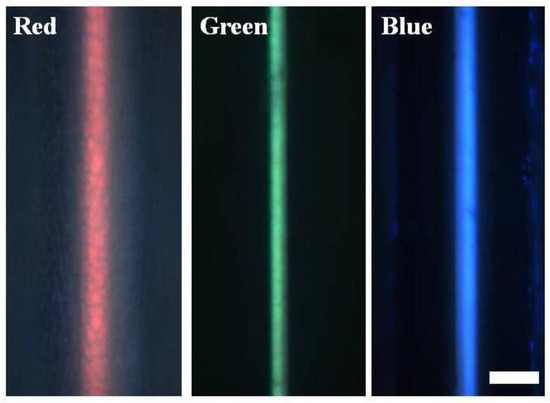
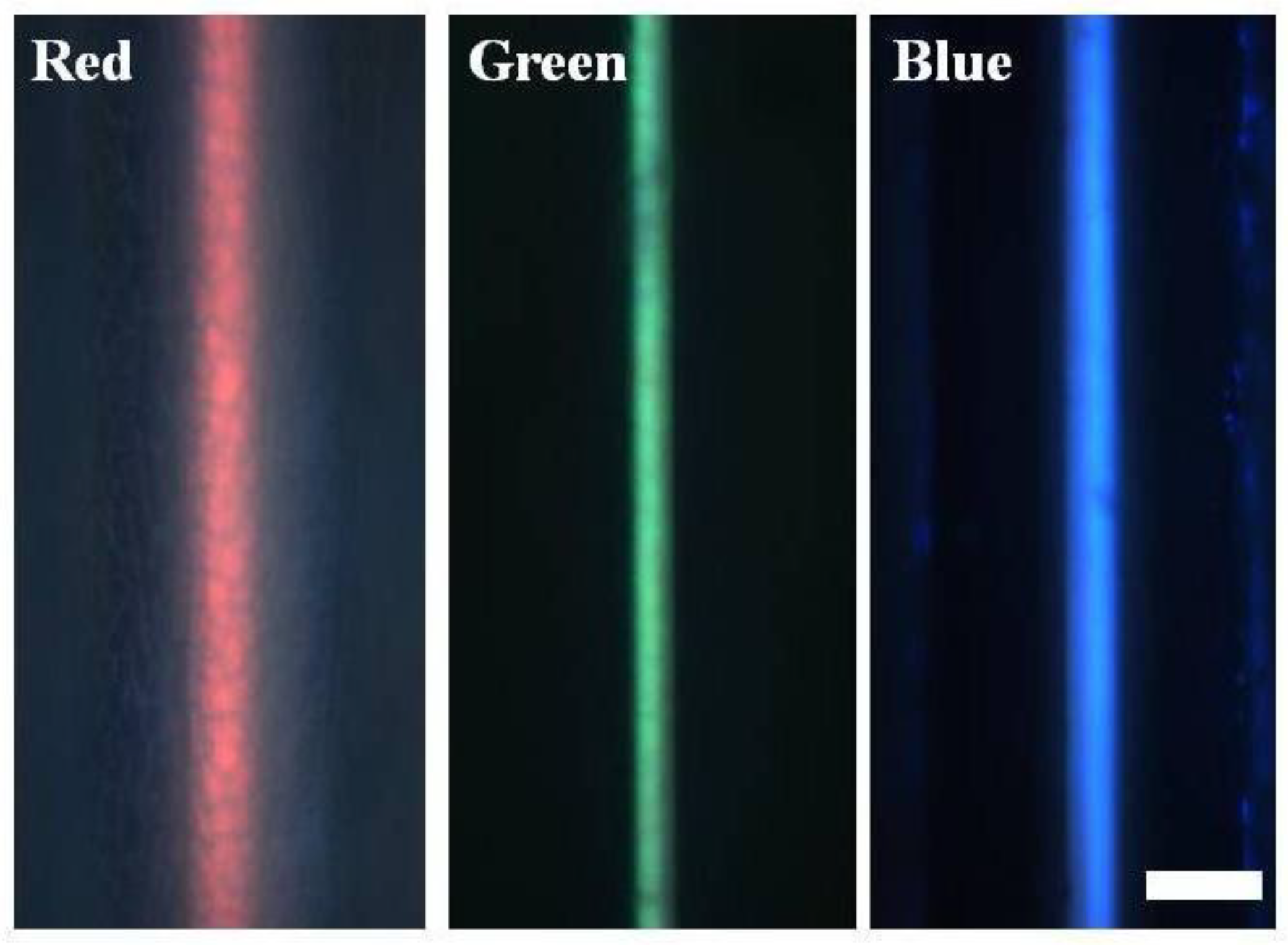
The capillary tubes are sent into the oven under the temperature of 80 °C for 4 hours. Eventually, the silica particles deposit and form solids in the capillary tubes after the evaporation of the solvent. Figure 1 shows the red, green and blue colors of the colloidal particle fibers under the dark field of optical microscope, which corresponds to different sizes of the particles, 230nm, 280nm and 340nm. These indicate that the structural colors of photonic crystal fibers can be tuned by changing the size of the particles.
Figure 1.
The red, green and blue structural colors of the photonic crystal fibers fabricated by the colloidal assembly method under the dark field of optical microscope. The scale bar is 50 µm.
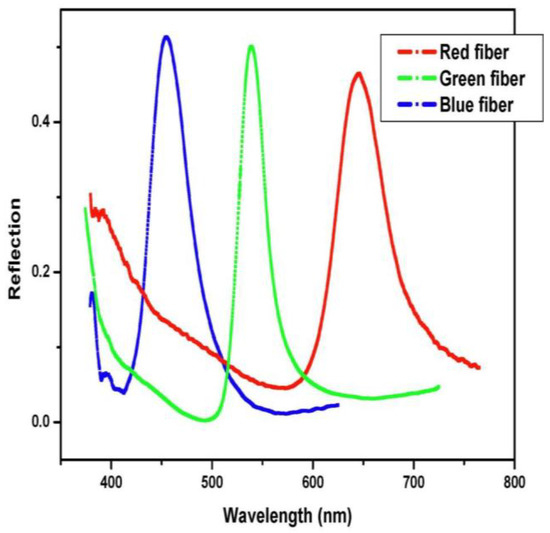
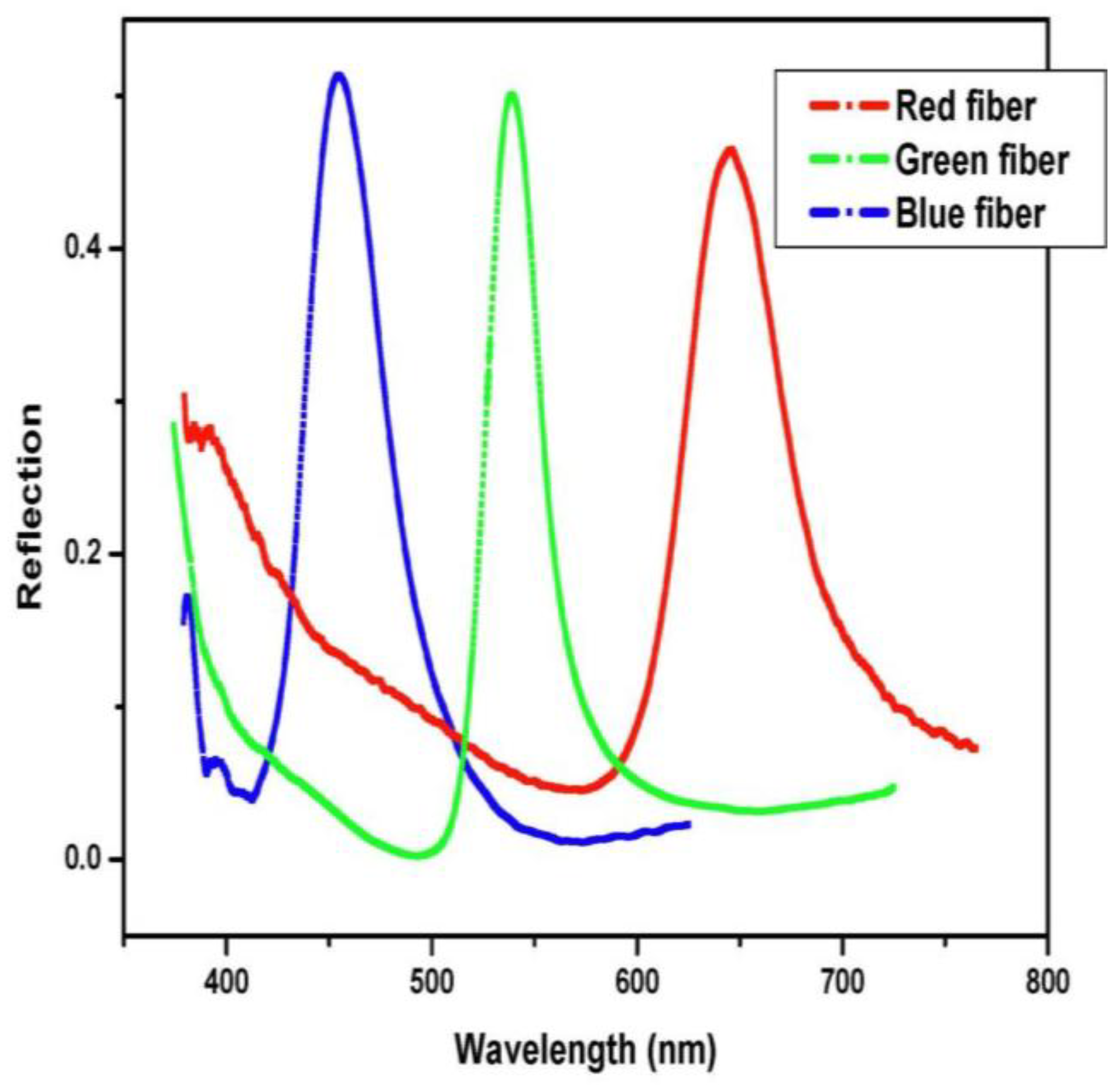
Simultaneously, the spectra of the structural colors are measured by the micro-area spectrometer under the microscope. Figure 2 shows the spectra of three colors of the fibers. The peak of red color is located at 642nm; the peak of green color at 538nm; the peak of blue color at 455nm. The different peaks in the spectra correspond to the fibers by the different-sized colloidal particles.
Figure 2.
The spectra of structural colors of red, green and blue fibers.
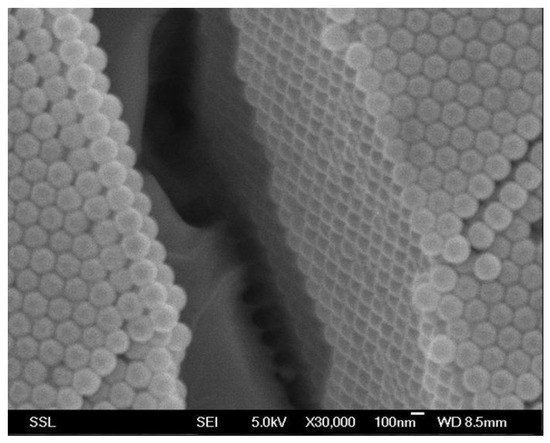
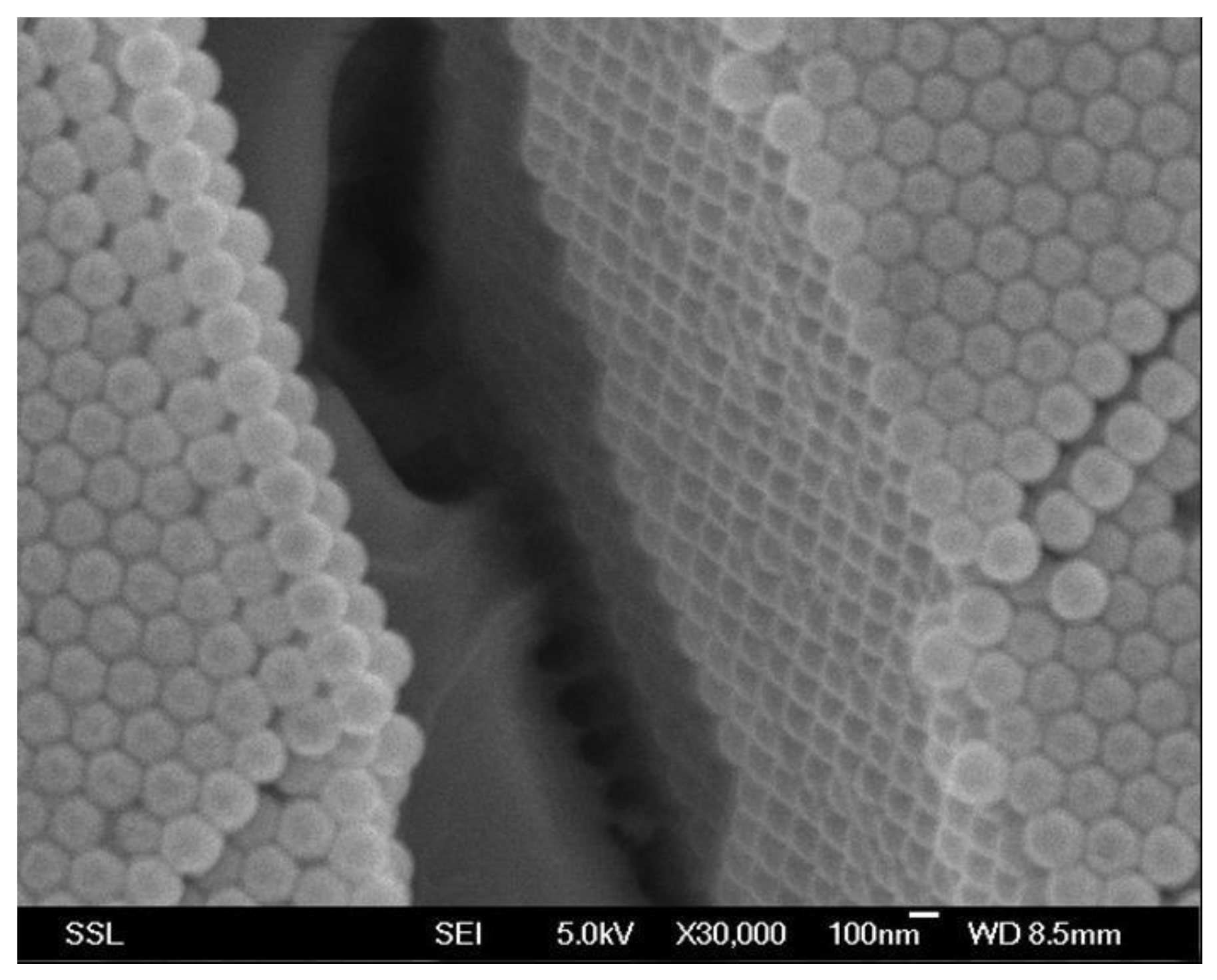
The detailed structure of the fibers is checked by the scanning electronic microscope (SEM). The SEM micrograph shows that the typical structure of colloidal assembled fibers in a face-centered cubic crystal as shown in Figure 3.
Figure 3.
SEM micrograph of a typical photonic crystal fiber fabricated by the silica particles with a diameter of 240nm.
Our experimental results demonstrate that the colloidal particles are able to form fiber-like photonic crystals which are displaying various structural colors. The structural colors can be easily tuned by changing the lattice constants of photonic crystals. However, the method of colloidal assembly in the capillary tube can only produce a short fiber with the photonic structure which has low mechanical strength. This fiber in the capillary tube is a model system in the laboratory. To produce a flexible and strong fiber, electrospinning and colloidal assembly were combined.
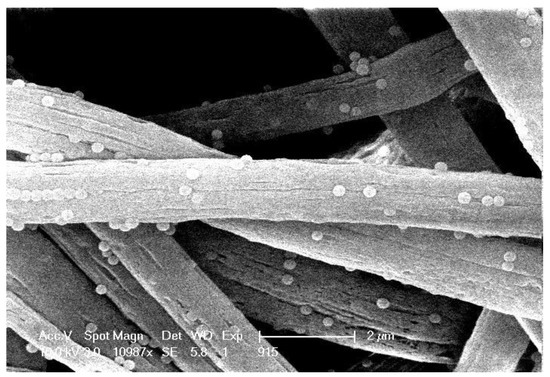
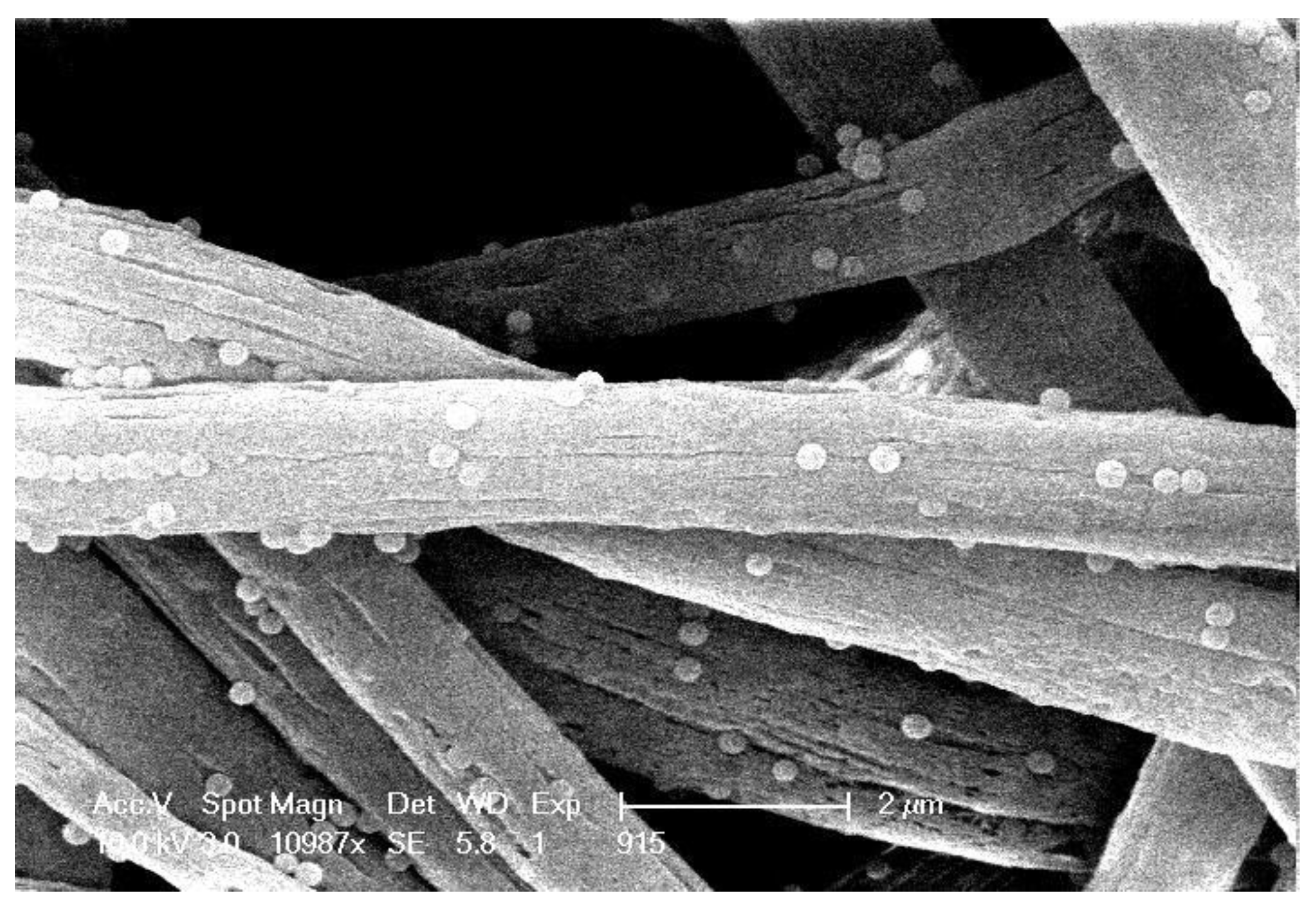
The silica particles suspended in methyl sulfoxide (10% in volume fraction) are mixed with the polystyrene. This solution is electrospun under a 10~20kV electric field to form the fibers as shown in the Figure 4. From the SEM picture, it can be seen that the diameter of electrospun fibers is between 1 and 2 µm. There is a small quantity of scattered particles that stick on the fibers. This indicates that the majority of the particles have been embedded into the fibers.
Figure 4.
SEM micrograph of electospun colloid-polymer fibers.
4. Conclusion
In this paper, an implementation of a structural color fiber, based on photonic crystal by colloidal assembly method has been presented for potential applications in smart clothes, signage and art. It was established that photonic crystal fibers appear colored due to Bragg diffraction on their ordered microstructure. As the colors of photonic crystal fibers uniquely depend on their ordered microstructure the fibers produce the structural colors without any chemical dyes and pigments, which is its key advantage over traditional dyeing and finishing fibers. This technology may pave a new way to color the fibers and reduce the pollution in the current textile industry. Moreover, in this paper it is demonstrated that the eletrospinning could be utilized to make the mass production for the fibers. However, there are still many problems to be tackled in the future investigation. The first thing is the interaction between the light and cylindrical photonic crystal in particular, the diameter of the photonic crystal fibers which is approaching the visible light wavelength. The understanding of this issue is critical for the design of photonic crystal fibers. The second one is the structure control of the electrospun fibers.
The process of colloidal assembly during electrospinning is unclear. The addition of polymers may play the role of glue to improve the mechanical properties of the fibers consisting of silica particles. This could be the key problem for the photonic crystal fibers during practical application in textiles. Although there is yet a long way to achieve the target, the structural colored fibers based on the photonic crystal offer a green, non-fading and economic coloration solution required by the current textile industry [23].
References
- Kumbasar, E.P.A.; Atav, R.; Bahtiyari, M.I. Effects of Alkali Proteases on Dyeing Properties of Various Proteinous Materials with Natural Dyes. Textile Research Journal 2009, 79(6), 517–522. [Google Scholar] [CrossRef] [Scilit]
- Muthukumar, M.; Sargunamani, D.; Senthilkumar, M.; et al. Studies on decolouration, toxicity and the possibility for recycling of acid dye effluents using ozone treatment. Dyes and Pigments 2005, 64(1), 39–44. [Google Scholar] [CrossRef] [Scilit]
- Trevors, J.T.; Saier, M.H. UN Climate Change Conference, Copenhagen 2009: Whatever Works? Water Air and Soil Pollution 2010, 207(1-4), 1–3. [Google Scholar] [CrossRef] [Scilit]
- Gu, Z.Z.; Uetsuka, H.; Takahashi, K.; Nakajima, R.; Onishi, H.; Fujishima, A.; Sato, O. Structural color and the lotus effect. Angew. Chem. Int. Ed. 2003, 42(8), 894–897. [Google Scholar] [CrossRef] [Scilit] [PubMed]
- Yablonovitch, E.; Gmitter, T.J.; Leung, K.M. Photonic band structure: The face-centered-cubic case employing nonspherical atoms. Phys. Rev. Lett. 1991, 67, 2295–2298. [Google Scholar] [CrossRef] [Scilit] [PubMed]
- Yablonovitch, E. Inhibited spontaneous emission in so1id-state physics and electronics. Phys. Rev. Lett. 1987, 58, 2059–2062. [Google Scholar] [CrossRef] [Scilit] [PubMed]
- John, S. Strong localization of photons in certain disordered dielectric superlattices. Phys. Rev. Lett. 1987, 58, 2486–2489. [Google Scholar] [CrossRef] [Scilit] [PubMed]
- Vukusic, P.; Sambles, J.R. Photonic structures in biology. Nature 2003, 424(6950), 852–855. [Google Scholar] [CrossRef] [Scilit] [PubMed]
- Zi, J.; Yu, X.D.; Li, Y.Z.; et al. Coloration strategies in peacock feathers. Proc. Natl. Acad. Sci. USA 2003, 100(22), 12576–12578. [Google Scholar] [CrossRef] [Scilit] [PubMed]
- Sharma, V.; Crne, M.; Park, J.O.; Srinivasarao, M. Structural origin of circularly polarized iridescence in jeweled beetles. Science 2009, 325(5939), 449–451. [Google Scholar] [CrossRef] [Scilit] [PubMed]
- Fudouzi, H.; Xia, Y. Colloidal crystals with tunable colors and their use as photonic papers. Langmuir 2003, 19, 9653–9660. [Google Scholar] [CrossRef] [Scilit]
- Kim, S.H.; Lim, J.M.; Jeong, W.C.; Choi, D.G.; Yang, S.M. Patterned colloidal photonic domes and balls derived from viscous photocurable suspensions. Adv. Mater. 2008, 20(17), 3211–3217. [Google Scholar] [CrossRef] [Scilit]
- Honda, M.; Seki, T.; Takeoka, Y. Dual tuning of the photonic band-gap structure in soft photonic crystals. Adv. Mater. 2009, 21(18), 1801–1804. [Google Scholar] [CrossRef] [Scilit]
- Singh, M.; Haverinen, H.M.; Dhagat, P.; Jabbour, G.E. Inkjet printing-process and its applications. Adv. Mater. 2010, 22(6), 673–685. [Google Scholar] [CrossRef] [Scilit] [PubMed]
- O’Brien, P.G.; Puzzo, D.P.; Chutinan, A.; Bonifacio, L.D.; Ozin, G.A.; Kherani, N.P. Selectively transparent and conducting photonic crystals. Adv. Mater. 2010, 22(5), 611–616. [Google Scholar] [CrossRef] [Scilit] [PubMed]
- Bonifacio, L.D.; Puzzo, D.P.; Breslav, S.; Willey, B.M.; McGeer, A.; Ozin, G.A. Towards the photonic nose: A novel platform for molecule and bacteria identification. Adv. Mater. 2010, 22(12), 13511354. [Google Scholar] [CrossRef] [Scilit] [PubMed]
- Sakoda, K. Optical properties of photonic crystals (2nd version); Springer: Berlin Heidelberg New York, 2004; pp. 1–13. [Google Scholar]
- Zhang, K.Q.; Liu, X.Y. In-situ observations of colloidal monolayer nucleation driven by an alternating electric field. Nature 2004, 429(6993), 739–743. [Google Scholar] [CrossRef] [Scilit] [PubMed]
- Zhang, K.Q.; Liu, X.Y. Two scenarios of the colloidal phase transitions. Phys. Rev. Lett. 2006, 96(10), 105701. [Google Scholar] [CrossRef] [Scilit] [PubMed]
- Zhang, K.Q.; Liu, X.Y. Determination of elastic constants of two-dimensional colloidal closepacked crystals. Langmuir 2009, 25(10), 54325436. [Google Scholar] [CrossRef] [Scilit] [PubMed]
- Zhang, K.Q.; Liu, X.Y. Controlled formation of colloidal structures by an alternating electric field and its mechanisms. Journal of Chemical Physics 2009, 130(8), 184901. [Google Scholar] [CrossRef] [Scilit] [PubMed]
- Zhang, K.Q.; Liu, X.Y. Size-dependent planar colloidal crystals guided by alternating electric field. Applied Physics Letters 2007, 90(11), 111911. [Google Scholar] [CrossRef] [Scilit]
- Gauvreau, B.; Guo, N.; Schicker, K.; Stoeffler, K.; Boismenu, F.; Ajji, A.; Wingfield, R.; Dubois, C.; Skorobogatiy, M. Color-changing and colortunable photonic bandgap fiber textiles. Optics Express 2008, 16(20), 15677–15693. [Google Scholar] [CrossRef] [Scilit] [PubMed]
© 2010 Textile Bioengineering and Informatics Society. This article is an open access article distributed under the terms and conditions of the Creative Commons Attribution (CC BY) license (https://creativecommons.org/licenses/by/4.0/).