


Abstract
Reactive quaternary ammonium salt of chitosan (RQC) with quaternary ammonium salt and reactive carbon double bonds were synthesized in two steps in order to improve the solubility and reactive properties of chitosan. Quaternized chitosan was first obtained by heterogeneous reaction of chitosan and 2, 3-epoxypropyltrimethyl ammonium chloride using isopropyl alcohol as dispersing solvent. Then RQC was prepared using the quaternized chitosan and N-(hydroxymethyl)-acrylamide. FTIR was used to characterize the structure of the synthesized RQC, and the results show that H of -NH2 in chitosan molecules was substituted with -CH2CH(OH)CH2N+(CH3)3 and H of OH in RQC molecule was substituted with CH2NHCOCH=CH2. Antheraea pernyi (A. pernyi) silk was then modified with RQC by padding and curing method. The results revealed that the dyeing depth of treated A. pernyi silk dyed with reactive dyes increased greatly in comparison with the untreated and chitosan treated ones, and the bacterial reduction against S. aureus and E. coli of the treated A. pernyi silk fabric was more than 98% even after 20 launderings.
1. Introduction
Chitosan, as an environment protective material, has the advantage of being abundant in resources, nontoxic, pollution-free, renewable, having excellent biocompatibility and biodegradation. It had been widely applied in the fields of environmental protection, medicine and agriculture, as well as in cosmetic and food industries [1,2]. In textile industry, it is expected to look for eco-friendly processes that substitute for some toxic textile chemicals. In this point of view, chitosan is an excellent candidate for an ecofriendly textile chemical treatment. The various applications of chitosan in textile dyeing and finishing were reviewed in a recent paper. For example, chitosan has been used as a pretreatment agent in dyeing of cotton, textile printing, wool dyeing and shrink proofing and durable press finish [3,4,5]. However, the application and development of chitosan is limited to poor solubility above pH of 6.5. Thus, water soluble chitosan derivatives which are soluble in both acid and basic aqueous solution might be good candidates for a polycationic anti-bacterial agent and other uses.
Chitosan can be formed into its soluble derivatives by quaternized modification, N-acylation reaction, carboxy methylation reaction, and hydroxylethyl reaction by introducing some functional groups such as quaternary ammonium salt to its molecules [6,7]. As for as quaternized chitosan was concerned, it was reported to have a favorable antibacterial property, water solubility, hygroscopicity and moisture retention [8,9]. In textile fields, quaternized chitosan was used to improve anti-bacterial property and increase dyeing property of natural fabrics [10,11].
This study attempts to prepare RQC in two steps: 2, 3-epoxypropyltrimethyl ammonium chloride was first applied to prepare quaternary ammonium salt of chitosan by heterogeneous reaction in isopropanol medium, then N-(hydroxymethyl)-acrylamide was applied to react with quaternary ammonium salt of chitosan to prepare RQC with reactive double bonds. RQC was then allowed to react directly with A. pernyi silk fiber in the absence of crosslinking agents. As a result, A. pernyi silk fabric modified with the RQC can provide good anti-bacterial property and enhanced dyeing property.
2. Experimental
2.1. Materials
A. pernyi silk fabric (type 5023, 100 g/m2, degumming rate of 14.0%) was purchased from Dandong Software Silk Co. Ltd. in China; Chitosan (the viscosity-average molecular weight is 15000, degree of deacetylation is 92.0%) was prepared by degrading commercial chitosan (the viscosity average molecular weight is 40 0000) according to the reference [12]. N-(2,3-glycidyl) trimethyl ammonium chloride was purchased from Sangong Chemical Industry Co. Ltd.(Yantai, China); Acid red B (C. I. Acid Red 14), acid brilliant blue G (CI Acid blue 90), Cibacron red FN-R (C.I. Reactive red 238) and Cibacron blue FN-G (C.I. Reactive blue 235) were selected for the typical dyestuffs in the experiment. N-(hydroxymethyl)-2-propenamide, sodium sulphate, acetic acid, 4-methoxyphenol, ammonium chloride, sodium hydroxide, methyl alcohol, ethanol, acetone and isopropanol were all chemically pure reagents.
Tested micro-organism included gram positive bacteria Staphylococcus aureus (S. aureus, ATCC 6538) and the gram negative bacteria Escherichia coli (E. coli, ATCC 8099).
2.2. Preparation of RQC
Quaternary ammonium salt of chitosan was synthesized using heterogeneous method [13]. The heterogeneous system contained 5g chitosan and 20g N-(2, 3-glycidyl) trimethyl ammonium chloride with 250 ml isopropanol as the dispersion medium, under stirring at 80 ℃ for 10 hrs. Then the product of the above reaction was washed in the mixture of acetone and alcohol (1:1), subsequently filtered and dried in a vacuum drying oven at 40 ℃.
The synthesis of RQC was carried out as described in the earlier method [14]. Briefly, the prepared quaternary ammonium salt of chitosan (10g), N(hydroxymethyl)-2-propenamide (25g), 4methoxyphenol (0.1g) and ammonium chloride (5g) were dissolved in 50ml aqueous solution at room temperature by stirring. The above solutions were reacted at 140℃ for 15 min. To the reaction solution, methyl alcohol (100mL) was added and stirred for 10 seconds. The product was precipitated in acetone and then washed thoroughly with a mixture of 1:1 acetoneethanol and finally with ether. The nearly white reaction product was dried at 40 ℃ for 48hrs in a vacuum drying oven.
2.3. FT-IR measurement of RQC
Infrared spectra of RQC and chitosan were recorded on a Nicolet 5700 FT-IR spectrophotometer by using KBr disk. The measurements were performed at 20 °C and a relative humidity of 65% with scanning times of 32 and a resolution of 4 cm−1. The ranges of determination were 4000~400cm−1.
2.4. Solubility of the RQC in water
Solubility in water, also known as aqueous solubility, is the maximum amount of RQC that can dissolve in water at equilibrium at a given temperature 25℃. It was tested in water in a broad range of pH (4-10). The pH value of RQC aqueous solution was adjusted using 5g/l acetic acid and 5g/l sodium hydroxide.
2.5. Treatment of A. pernyi silk fabric with RQC aqueous solution
A. pernyi silk samples were immersed in treatment solution (RQC 5g/l, sodium bicarbonate 1% o.w.f.) at 60 °C for 30 min, using a laboratory padder (AO type, Taiwan Labortex Co., Ltd.) at 90% wet pick-up. The A. pernyi silk samples were then dried at 80 °C for 5 min and cured at 160 °C for 3 min. Next, the treated samples were washed with tap water until neutral to pH paper and further washed in deionized water in ultrasonic cleaner for 5 min to remove unfixed materials. Finally, the samples were dried at 80 °C in a laboratory oven.
2.6. Dyeing process of A. pernyi silk fabric
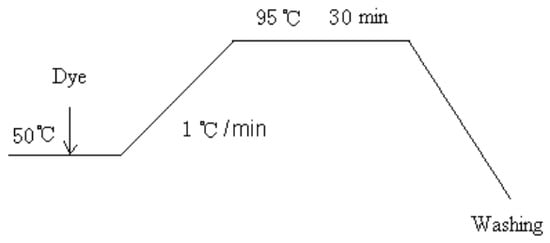
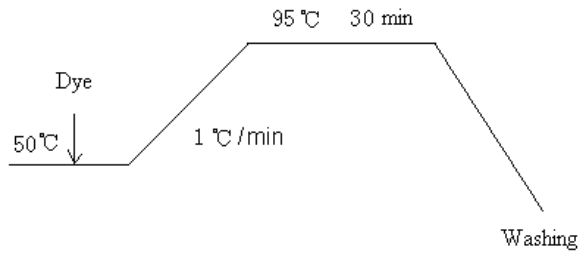
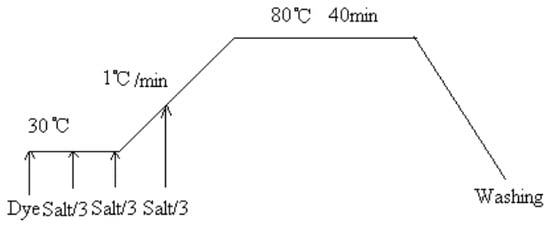
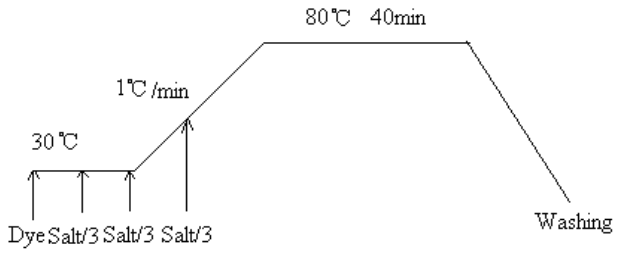
Depending on the class and particular kind of dyestuffs used in the study, different dyeing recipes and dyeing technologies were used. All dyeing processes were carried out at 2% (o.w.f.) dyestuff shade. Acetic acid was used to maintain pH values during the dyeing process of acid dyestuffs. Sodium sulphate (15 g/l) was used in reactive dyeing for acceleration. Dyeing cycles for the acid dyestuffs and reactive dyestuffs used in this experiment are presented below. The dyeing process of the acid dyestuffs and reactive dyestuffs were all carried out using exhaustion method at a liquor ratio of 1:40 in a laboratory water bath. Dyeing process for A. pernyi silk fabric with two acid dyes and two reactive dyes were performed according to the cycles shown in Figure 1 and Figure 2 respectively.
Figure 1.
Dyeing cycles for A. pernyi fabric with acid dyes.
Figure 2.
Dyeing cycles for A. pernyi fabric with reactive dyes.
2.7. Dyeing properties of A. pernyi silk fabric measurement
The absorbance values of dye solutions were measured at λmax, by a UV-VIS spectrophotometer 751MC (Shanghai Instrument Factory, China). The depth of dyeing samples was evaluated with K/S by an Ultrascan XE spectrophotometer (Colour Eye 7000A, GretagMacbeth products made in United States). The reflectance values at maximum absorption wavelength were converted into K/S values and calculated at the wavelength of maximum absorption for each sample. The equations of dye uptake, fixation and K/S of A. pernyi silk fabric are as follows.
where A0 is the absorption of the original solution before dyeing, A1 is the absorption of the residuary solution after dyeing.
where A0 is the absorption of the original solution before dyeing, A1 is the absorption of the residuary solution after dyeing. A2 is the absorption of the residuary solution after washing.
where K/S is the value of colour deepness of dyeing samples and R is the reflected spectrum of dyeing sample.
2.8. Anti-bacterial efficacy of A. pernyi silk fabric testing
Antibacterial efficacy of the treated A. pernyi silk fabrics was assessed according to the shake flask method [15]. It is a standard test method to measure a percent reduction of bacteria described as follows.
1±0.1 g of sample fabric, cut into small pieces of approximately 0.5×0.5 cm, was dipped into a flask containing 50 mL of 0.5 mM PBS (monopotassium phosphate) culture solution with a cell concentration of 1.0~1.5×10⁴/mL. The flask was then shaken at 250 rpm on a rotary shaker at 37℃ for 1 hr. Before and after shaking, 1 ml of the test solution was extracted, diluted and spread onto an agar plate. After incubation at 37℃ for 24 hrs, the number of colonies formed on the agar plate was counted and the number of live bacterial cells in the flask before and after the shaking was calculated. Antimicrobial efficacy was determined based on duplicated test results. Percentage bacterial reduction was calculated according to the Equation (4).
where B and A are the number of live bacterial cells in the flask before and after 1h shaking, respectively.
The pre-treated A. pernyi silk fabric was washed 20 times according to the standard procedure “Antibacterial Knitwear”: Appendix C, then the washed A. pernyi silk fabric samples were tested together with untreated, treated before washing samples against S. aureus and E. coli.
3. Results and discussion
3.1. FT-IR analysis of chitosan and RQC
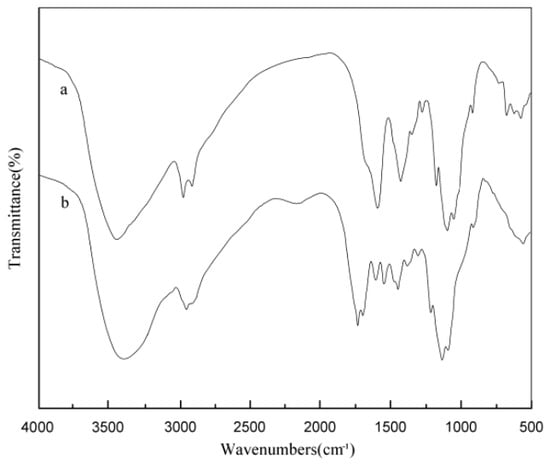
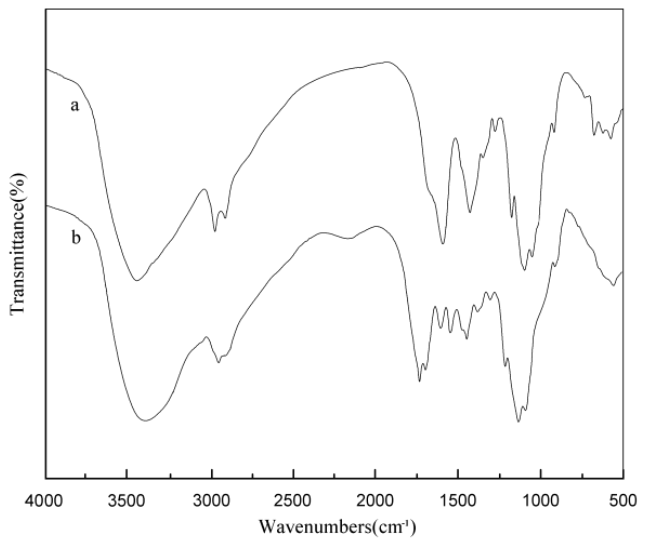
In order to characterize the structure of the synthesized RQC, FT-IR spectra of the RQC and chitosan are shown in Figure 3.
Figure 3.
FT-IR spectra: (a) chitosan; (b) RQC.
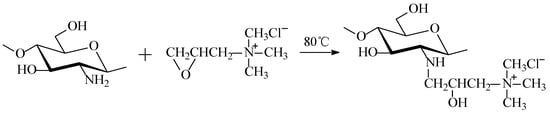
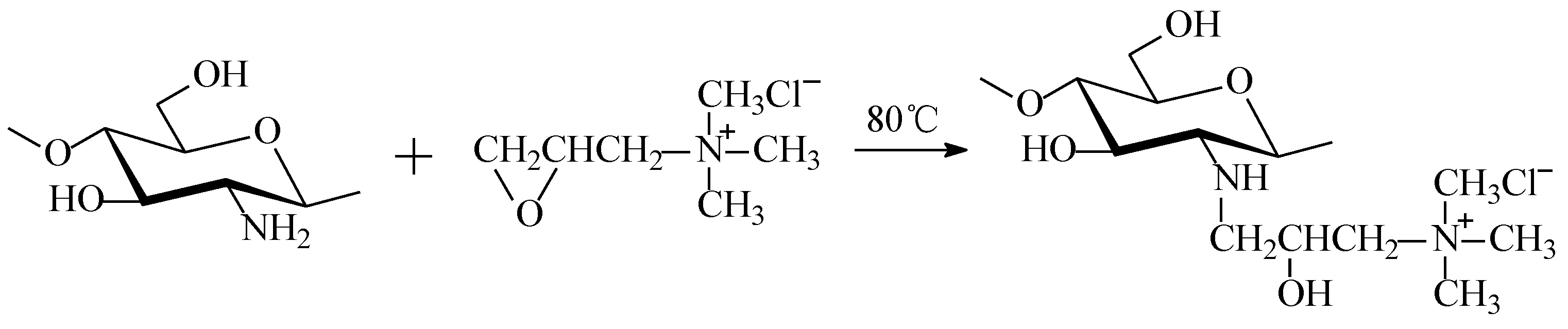
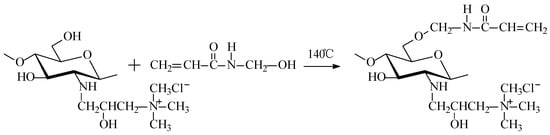
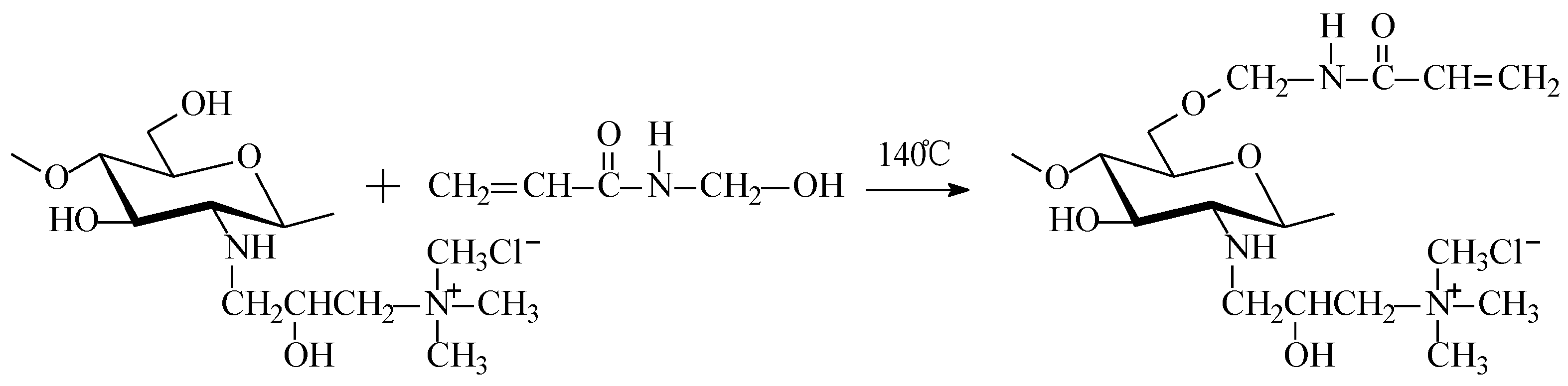
In comparison with chitosan (Figure 3a), the N-H stretching vibration frequency of chitosan at 1597cm−1 became weak, and the new peaks at 1480cm−1 and 1640cm−1 which correspond to the deformation and stretching vibration of -CH3 respectively appeared. It was shown that H of -NH2 in the nucleophilic centre of chitosan molecule was substituted by the group CH2CH(OH)CH2N+(CH3)3 in the preparation process of quaternized chitosan [16] (see Figure 3b). Three characteristic peaks of the deformation vibration frequency of -NH in secondary amino group at 1540cm−1, the stretching vibration frequency of -C=O at 1670 cm−1 and -C=C- at 1630 cm−1 in Figure 3b exhibited that the groups with double bonds of CH2NHCOCH=CH2 in N-(hydroxymethyl)-2-propenamide was eventually introduced into the molecule of chitosan. And as a result, the synthesized RQC was given to the reactive groups (-C=C-) which can react with the silk fibroin directly without crosslinking agents. Scheme 1 and Scheme 2 show the reaction mechanism that result in the chitosan quaternary ammonium salt and RQC with both quaternary ammonium groups and double bonds which can react with A. pernyi silk fibroin.
Scheme 1.
Synthesis reaction of chitosan quaternary ammonium salt.
Scheme 2.
Synthesis reaction of RQC.
3.2. Water solubility of RQC
After synthesis, the RQC was expected to have better solubility characteristics for its quaternized group compared to its precursor chitosan. Solubility of the chitosan and RQC are listed in Table 1.
Table 1.
Solubility of the chitosan and RQC.
It is shown in Table 1 that the RQC is soluble in a wide range of pH values in acidic and alkaline media, while chitosan is soluble only below pH 6. This result is attributed to the following reasons. The quaternary ammonium group was introduced into H in –NH2 of chitosan molecule and H of -OH in chitosan molecule were substituted with N-(hydroxymethyl)-2propenamide group in the two preparation steps of RQC. Therefore the intermolecular forces among molecules were weakened, and then the crystal structure of chitosan was interrupted. As a result, the water molecules get easily accessed by RQC molecules in comparison with the precursor chitosan molecules. On the other hand, the introduction of quaternized group with highly hydrophilic property of cationic side chain in hydroxypropyltrimethyl ammonium chloride increased the water solubility of RQC. The solubility of RQC in this experiment was tested for 10.2 wt% at 25℃, pH 7.0 by averaging 3 test samples.
3.3. Dyeing property of A. pernyi silk fabric
As mainly dyestuff types, acid dyes and reactive dyes have negative charges in the dyeing process, in order to investigate the dye property of A. pernyi silk fabric dyed with the two kinds of dyes, the dye uptake, K/S values of acid dyestuffs and the dye uptake, fixation and K/S values of reactive dyestuffs were measured using Colour Eye 7000A Spectrophotometer. The dye uptake and K/S of A. pernyi silk fabrics with acid dyes is listed in Table 2, and the dye uptake, fixation and K/S of A. pernyi silk fabrics with reactive dyes is listed in Table 3.
Table 2.
Acid dye uptake and K/S of A. pernyi silk fabrics.
Table 3.
Reactive dye uptake, fixation and K/S of A. pernyi silk fabrics.
Table 2 shows the dye uptake and K/S value of the untreated and RQC treated A. pernyi silk fabrics dyed with Acid red B and Acid brilliant blue G. In comparison with the untreated A. pernyi silk samples, the dye uptake of the treated one dyed with Acid red B and Acid brilliant blue G increased by 16.8% and 17.9% respectively, and the depth value (K/S) increased by 5.17 and 4.59, respectively. Table 3 shows the dye uptake, fixation and K/S value of the untreated and RQC treated A. pernyi silk fabrics dyed with the two different reactive dyes. In comparison with the untreated samples, the dye uptake of the treated one dyed with Cibacron Red FN-R and Cibacron Blue FN-G increased by 17.4% and 19.2% respectively, the dye fixation increased by 18.6% and 14.2% respectively, and the depth value (K/S) increased by 2.24 and 2.72, respectively.
The increased dye uptake, fixation and depth can be attributed to the following factors. When RQC was applied to A. pernyi silk fabric pre-treatment, the quaternary ammonium group in RQC decreased the negative charge of the silk fabric in the dyeing process, thus reduce the Coulomb repulsive force between the negative charge in the silk fabric and acid dyes or reactive dyes. Besides, amino groups of evenly distributed RQC in/on the silk fabric acted as the dyeing centres in anion-type dyeing process. As a result, the dye uptake increased and meanwhile the depth of treated A. pernyi silk fabric increased in comparison with the untreated one. Namely, the RQC treatment of A. pernyi silk fabric provided obvious deepening effect.
3.4. Antibacterial activity of A. pernyi silk fabrics
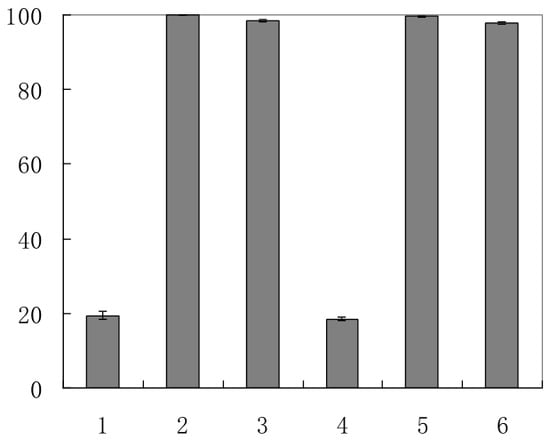
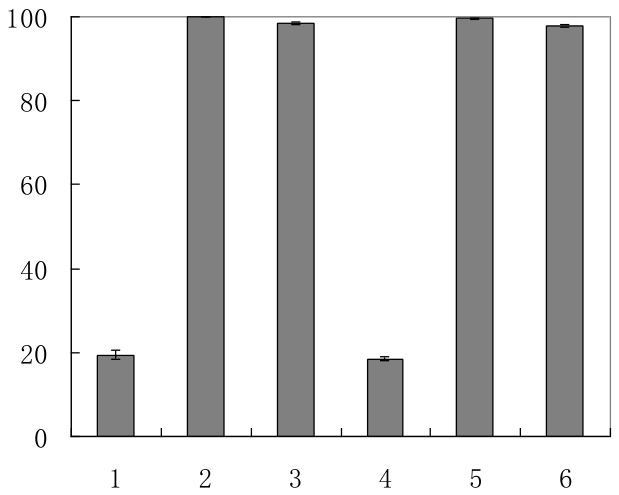
It is well recognized that chitosan has good antimicrobial activity, especially against the growth of S. aureus [17]. However, the quaternized chitosan can be given better antimicrobial activity than chitosan [18]. The antibacterial activity of the untreated and RQC treated A. pernyi fabrics against S. aureus and E. coli is shown in Figure 4.
Figure 4.
Bacterial reduction rate of A. pernyi silk fabric (1. untreated against S. aureus; 2. treated before 20 laundering against S. aureus; 3. treated after 20 laundering against S. aureus; 4. untreated against E. coli; 5. treated before 20 laundering against E. coli; 6. treated after 20 laundering against E. coli.).
As expected, the untreated samples gave a low antibacterial activity of less than 20% while all finished A. pernyi before 20 launderings showed over 99% bacterial reduction, and maintained over 98% bacterial reduction even after 20 launderings. This may be because the untreated A. pernyi silk fabrics have only a few antibacterial groups in its macromolecules such as -NH2. However, there are great amounts of quaternized groups in RQC treated silk fibroin. When contacted with bacterial cells of S. aureus and E. coli, these quatenrized groups can adsorb these bacterial cells and then promoted the deformation and shrinkage of cell membranes [19]. As a result, the contact area between the treated silk fabric and bacteria increased and more bacteria could be killed. The slight decrease of antimicrobial activity of the A. pernyi silk fabrics treated with RQC after 20 launderings was because of the crosslinking reaction between RQC and the silk fibroin by the double bond in RQC, and therefore the finished silk sample provide high antibacterial activity even after 20 launderings.
4. Conclusion
RQC with quaternary ammonium groups and reactive carbon double bonds were synthesized in two steps. It is soluble in a wide rang of pH values, and the solubility of RQC in water was 10.2 wt% at 25℃, pH 7.0. The result of FTIR show that synthesized RQC was given the quaternary ammonium groups and double bonds in comparison with chitosan. RQC treatment conferred A. pernyi silk fabric with improved dyeing property and good antibacterial activity. The dye uptake and depth of A. pernyi silk dyed with acid dyes (Acid red B, Acid brilliant blue G) and reactive dyes (Cibacron red FN-R, Cibacron blue FN-G) were all improving greatly. The bacterial reduction against S. aureus and E. coli of the RQC treated A. pernyi silk fabric was more than 98% even after 20 launderings.
Acknowledgments
The authors would like to express their sincere appreciation to the Education Department Funds of Liaoning Province P. R. China (Proj. No. L2010144) and the Science and Technology Foundation Project of Dandong P. R. China (Proj. No.07143) for the financial support extended to this research.
References
- Kean, T.; Thanou, M. Biodegradation, biodistribution and toxicity of chitosan. Adv. Drug Deliv. Rev. 2010, 1, 3–11. [Google Scholar] [CrossRef] [Scilit] [PubMed]
- Yang, J.D.; Deng, S.X.; Zhou, S. Determination of chitosan in serum albumin-Cu(II)-chitosan ternary system using resonance rayleigh scattering spectra. Chin. J. Anal. Chem. 2007, 11, 1619–1624. [Google Scholar] [CrossRef] [Scilit]
- Nasr, H.E.; Sayyah, S.M.; Essa, D.M.; Samaha, S.H.; Rabie, A.M. Utilization of acrylates emulsion terpolymer with chitosan as a finishing agent for cotton fabrics. Carbohydr. Polym. 2009, 1, 36–45. [Google Scholar] [CrossRef] [Scilit]
- Hsieh, S.H.; Huang, Z.K.; Huang, Z.Z.; Tseng, Z.S. Chemical modification of chitosan with cationic hyperbranched dendritic polyamidoamine and its antimicrobial activity on cotton fabric. Carbohydr. Polym. 2010, 1, 197–207. [Google Scholar] [CrossRef] [Scilit]
- Qin, C.Q.; Xiao, Q.; Li, H.R. Calorimetric studies of the action of chitosan-N-2-hydroxypropyl trimethyl ammonium chloride on the growth of microorganisms. Biol. Macromol. 2004, 34, 121126. [Google Scholar] [CrossRef] [Scilit] [PubMed]
- Sajomsang, W.; Gonil, P.; Tantayanon, S. Antibacterial activity of quaternary ammonium chitosan containing mono or disaccharide moieties: Preparation and characterization. Inter J. Bio Macromol. 2009, 5, 419–427. [Google Scholar] [CrossRef] [Scilit] [PubMed]
- Lim, S.H.; Hudson, S.M. Review of chitosan and its derivatives as antimicrobial agents and their uses as textile chemicals. J. Macro Mol. Sci.-Pol. R 2003, 2, 223–269. [Google Scholar] [CrossRef] [Scilit]
- Jia, Z.S.; Shen, D.F.; Xu, W.L. Synthesis and antibacterial of quaternary ammonium salt of chitosan. Carbohydr. Res. 2001, 1, 1–6. [Google Scholar] [CrossRef] [Scilit] [PubMed]
- Seong, H.S.; Whang, H.S.; Ko, S.W. Synthesis of a quaternary ammonium derivative of chitooligosaccharide as antimicrobial agent for cellulosic fibers. J. Appl. Polym. Sci. 2000, 14, 2009–2015. [Google Scholar] [CrossRef] [Scilit]
- Chen, Z.H.; Wang, Z.Z.; Deng, Q.G.; Lou, C.H.; Zou, C.L. Application of degraded chitosan with quaternary ammonium salt to linen dyeing. J. Dye Finish 2009, 17, 13–16. [Google Scholar]
- Shin, Y.; Yoo, D.I.; Jang, J. Molecular weight effect on antibacterial activity of chitosan treated cotton fabrics. J. Appl. Polym. Sci. 2001, 80, 2495–2501. [Google Scholar] [CrossRef] [Scilit]
- Jia, Z.S.; Shen, D.F.; Xu, W.L. Synthesis and antibacterial activities of quaternary ammonium salt of chitosan. Carbohyd Res. 2001, 333, 1–6. [Google Scholar] [CrossRef] [Scilit] [PubMed]
- Lim, S.H.; Hudson, S.M. Synthesis and antimicrobial activity of a water-soluble chitosan derivative with a fiber-reactive group. Carbohyd Res. 2004, 339, 313–319. [Google Scholar] [CrossRef] [Scilit] [PubMed]
- Ye, W.J.; Xin, J.H.; Li, P.; Lee, K.L.D.; Kwong, T.L. Durable antibacterial finish on cotton fabric by using chitosan-based polymeric core-shell particles. J. Appl. Polym. Sci. 2006, 2, 1787–1793. [Google Scholar] [CrossRef] [Scilit]
- Yang, C.H.; Cai, Z.S.; Wang, J.T.; Xu, Q.; Yan, J.L. Optimization of synthetic condition and the structure characterization of chitosan quaternized with CTA. J. Funct. Polym. 2004, 12, 649–656. [Google Scholar]
- Lee, S.; Cho, J.S.; Cho, G. Antimicrobial and blood repellent finishes for cotton and nonwoven fabrics based on chitosan and fluoropolymers. J. Text. Res. 1999, 69, 104–112. [Google Scholar] [CrossRef] [Scilit]
- Jia, Z.S.; Shen, D.F.; Xu, W.L. Synthesis and antibacterial activities of quaternary ammonium salt of chitosan. Carbohyd Res. 2001, 333, 1–6. [Google Scholar] [CrossRef] [Scilit] [PubMed]
- El-tahlawya, K.F.; El-bendaryb, M.A.; Elhendawyc, A.G.; Hudsond, S.M. The antimicrobial activity of cotton fabrics treated with different crosslinking agents and chitosan. Carbohydr. Polym. 2005, 60, 421–430. [Google Scholar] [CrossRef] [Scilit]

© 2010 Textile Bioengineering and Informatics Society. This article is an open access article distributed under the terms and conditions of the Creative Commons Attribution (CC BY) license (https://creativecommons.org/licenses/by/4.0/).