


Abstract
There are two major camouflage protections in modern military tactics: the UV-protection and the near infrared camouflage. However, not all natural and composite dyestuffs provide the mentioned properties. In this study, green leaves were chosen as the simulating object, and the camouflage properties of cotton dyed with Lithospermum were evaluated. It was observed that the dyed cotton fabric had good UV-protection and near-infrared camouflage properties. The UV- protection effect was strongly dependent on the absorption characteristics of Lithospermum of UV radiation. The near infrared camouflage effect was mainly dependent on the reflection spectrum characteristics of Lithospermum in the near infrared waveband.
1. Introduction
Ultraviolet radiation (UVR) is the major environmental cause for skin damage. UVB exposure to human skin induces skin alterations, including erythema, which is characteristic of sunburn cells, and prolonged UVB exposure results in the formation of wrinkles, the degradation of matrix molecules, the development of elastosis, and an increased risk of epithelial skin cancer. If all current exposure to solar UVR could be significantly reduced, the incidence of skin cancer would eventually decrease significantly [1,2]. So it is necessary to improve the UV-protection performance of the military uniforms.
The equipment of infrared camouflage uniforms with high performance not only increases the chance of survival and safety of soldiers in the battlefield, but also strengthens the battle effectiveness of the army. Through years, the art of camouflage has been long established, the main aim was to make soldiers, their guns, vehicles, etc. blend into the surroundings by adopting confusing patterns in colors appropriate to the surroundings. With the advent of IR detection systems it became necessary to take into account the IR reflectivity of paints and garments in the near IR region (700-1200 nm). Therefore, it became necessary for camouflage patterns to be painted or printed with selected dyes and pigments having IR reflectivity that matched the expected surrounding topography [3,4]. Now the study of UV-protection and infrared camouflage fabrics has derived great attention in the military affairs across the world [5,6].
In previous years, the application of natural dyes in textile dyeing had been explored worldwide. In general, natural dyes are environmental friendly and nontoxic compared to synthetic dyes. They exhibit better biodegradability and have higher compatibility with the environment. Therefore, correlative research work on the application of natural dyes is globally under way [7,8,9,10,11,12].
Lithospermum has been traditionally used as a medicine in China and also as a dye for staining fabrics and food colorants. Previous phytochemistry studies reported that this plant contains mainly red pigments which were composed of naphthoquinone compounds, such as shikonin and its derivatives. However, previous research on Lithospermum had been focused on wound healing, antitumor, anti-fungus, anti-HIV and contraceptive biological activities [13,14,15,16,17] and little attention was paid to other functions such as UV-protection and near infrared camouflage.
In this paper, we studied the camouflage property of the cotton fabrics dyed with Lithospermum. The relationship between Lithospermum structure and camouflage property was discussed. It is believed that this study will pave a new way for the natural dyestuff development and provide a good insight into camouflage property of natural dyes.
2. Experimental
2.1. Experimental materials
Lithospermum root was purchased from the Chinese Traditional Medicine Hospital of Zhejiang. Plain weave cotton fabric was provided by Guangdong Yida Co. Ltd. (China).
2.2. Experimental methods
2.2.1. Preparation of the fabrics
The plain weave cotton fabric was soaked in a detergent solution for about 60 mins, followed by extensive washing with tap water until free from any detergent. The clean fabrics were then washed with de-ionized water, squeezed, and allowed to dry in an air oven at 60 ℃, and were then stored in a vacuum desiccator ready for use.
2.2.2. Extraction of colorant
Before extraction of the dyestuffs, the plant materials were dried and ground to powder. In this experiment, the Lithospermum was crushed and dipped in distilled water for 24hrs and allowed to boil in a beaker kept over water bath for quick extraction for 1h. All the colors were extracted from the plant by the end of 1hr. The solution was filtered for further use.
2.2.3. Dyeing
The dyeing procedures were performed in accordance with the general dyeing method. A ratio of dyestuff to fabric of 1:10 was chosen based on the weight of the fresh natural dyes extracted from the fabrics used in the experiment. The fabric was immersed in a dye-bath composed of 0.25% aqueous solution of the dye. The dye liquor ratio (1:40) was kept constant for all samples. The temperature of the dye bath was then gradually raised (about 1 ℃/min) to about 90℃, and was kept at this temperature for about 60 mins. The temperature of the dye-bath was then allowed to cool to about 60℃; then the dyed fabric was squeezed, rinsed thoroughly with water and air dried.
2.2.4. UV-protective properties and camouflage performance testing
The ultraviolet light transmittances of un-dyed and dyed fabrics were determined using the Lambda 900 UV/Visible/NIR spectrometer in the range of 280-400 nm. The UPF standard in this paper was referred to the As/NZS 4399-1996.
The IR reflectivity of the samples in the near IR wavebands (700-1200 nm) was determined using the Lambda 900 UV/Visible/NIR spectrometer. The pattern painting camouflage reflectance spectrum evaluation was referred to the American military standard HIL-C-44031D 1989.8.22.
3. Results and Discussion
3.1. Ultraviolet transmittance spectra
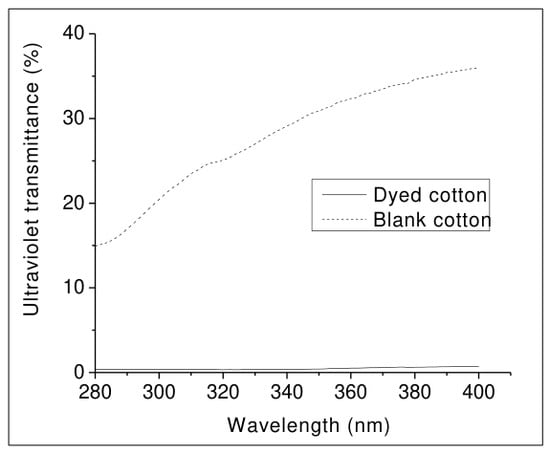
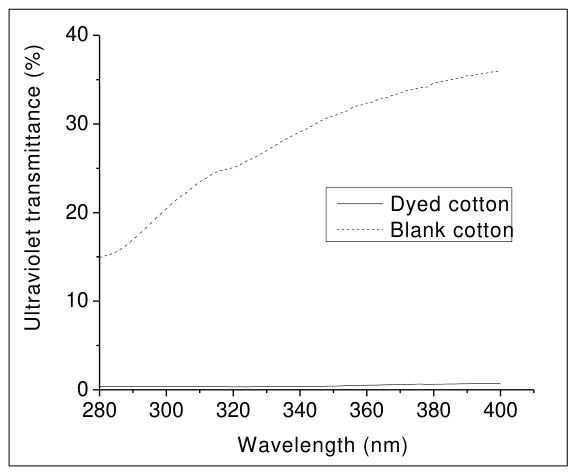
In order to investigate the UV-protective property of Lithospermum, the ultraviolet transmittance spectra of the un-dyed fabrics were compared with those of the dyed fabrics. As shown in Figure 1, there was a noticeable difference between the dyed fabrics and the un-dyed fabrics in terms of ultraviolet transmittance spectra. The un-dyed fabrics had a higher ultraviolet transmittance, which was above 15% in the UV-B band (280-315nm) and above 25% in the UV-A band (315-400nm). This indicated that the resistance of un-dyed fabrics to ultraviolet rays was very poor. Meanwhile, the ultraviolet transmittance of the fabrics dyed with Lithospermum was lower than 1% in both UV-A and UV-B bands. Generally, the UV-protective properties of fabrics are considered good when the ultraviolet transmittance is less than 5%. It was evident that the good UV-protective properties occurred in cotton when it was dyed with Lithospermum.
Figure 1.
Ultraviolet transmittance spectra of the fabrics dyed with Lithospermum.
3.2. Ultraviolet reflectivity spectra
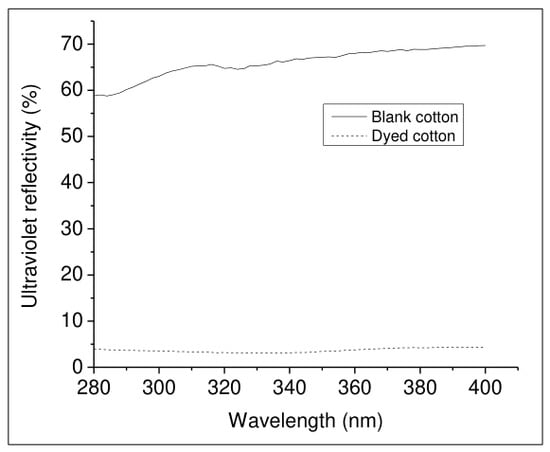
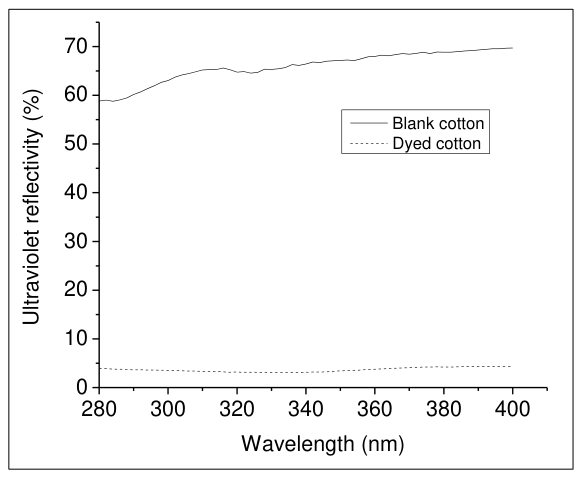
Apart from the ultraviolet transmittance spectra, the ultraviolet reflectivity spectra of the cotton fabrics dyed with Lithospermum were also measured in this experiment. The reflectivity values of the dyed cotton were about 5% among the ultraviolet band, while those of the un-dyed fabrics were above 60%. As shown in Figure 1, the ultraviolet transmission value of the fabrics dyed with Lithospermum was about 1%. Figure 2 shows that its reflectivity was about 5%. According to the energy distributing principle: α+ρ+г = 1 (α- absorptivity, ρ- reflectivity, and г-transmittance), the fabrics dyed with Lithospermum absorbed above 90% of ultraviolet light. Thus, it was clear that the UV-protective properties of Lithospermum were mainly attributed to its ability to absorb solar ultraviolet rays.
Figure 2.
Ultraviolet reflectivity spectra of the cotton dyed with Lithospermum.
3.3. Reflectance spectrum of green leaves
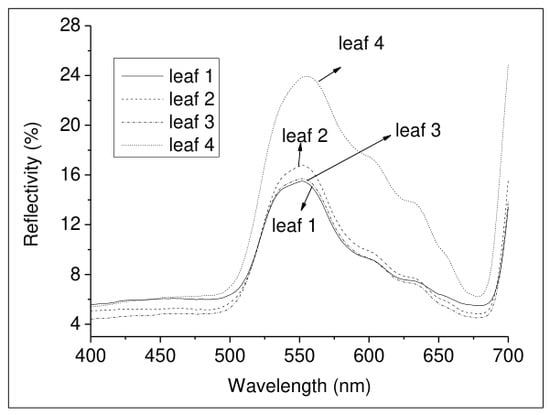
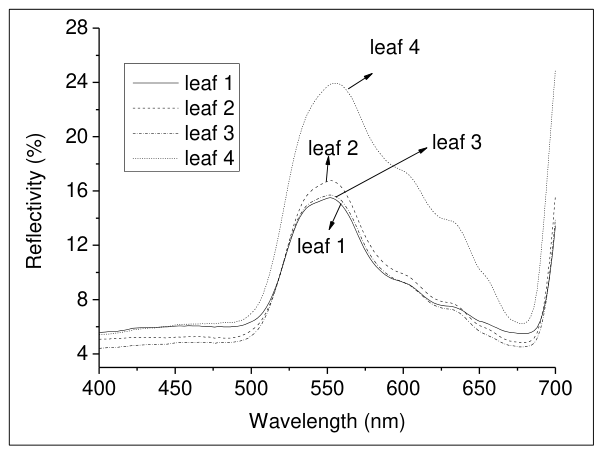
In this study, the green leaves were chosen as a simulating object. Figure 3 shows the reflectance spectrum of different green leaves in the visible light waveband. As shown in Figure 3, different green leaves had similar reflectance spectrum and low reflectivity in 480 nm and 670 nm, which were the chlorophyll absorption bands.
Figure 3.
Reflectance spectra of green leaves in visible light waveband.
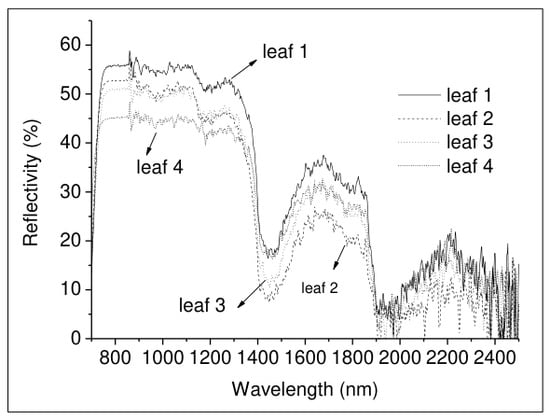
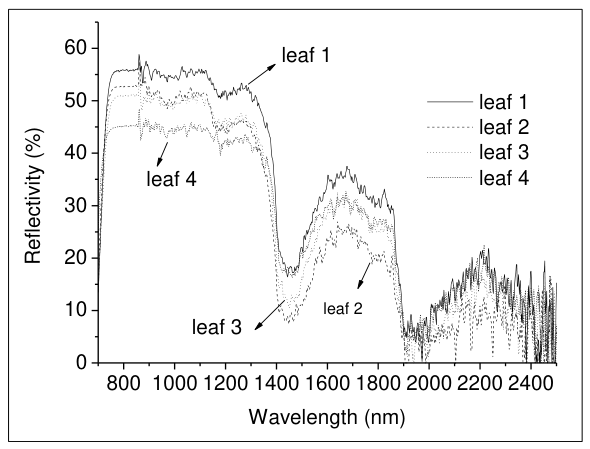
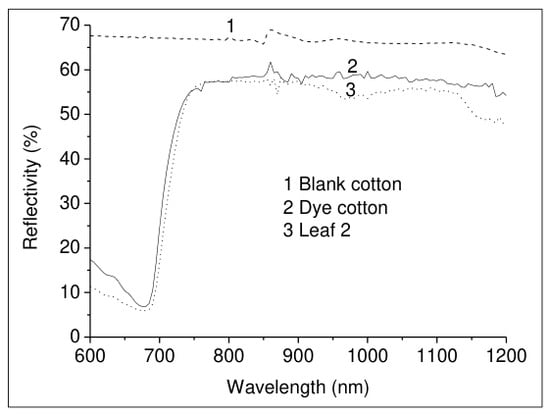
Figure 4 shows the reflection spectrum of different green leaves in the near IR waveband. From Figure 4, it can be concluded that the different green leaves had similar near IR reflection spectrum. In the range of 670-780 nm, reflectance increased promptly and formed the IR reflectance peak, which was called reflection red shift region. However, the reflectivity had little change and become a platform in the range of 780-1200 nm, which was named as reflection brightness region. If the near IR reflection spectrum of dyed fabrics were in the range of green leaves’ reflection spectra, the fabrics would have the near IR camouflage ability.
Figure 4.
Reflectance spectrum of green leaves in near IR waveband.
3.4. Camouflage protective performance
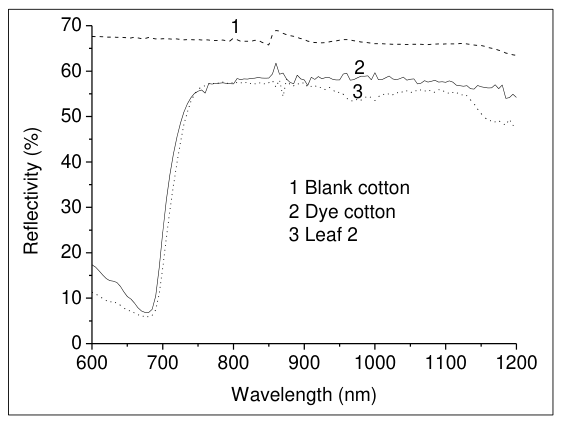
Figure 5 shows the camouflage performance test results of Lithospermum. As shown in this figure, although blank cotton fabric had a very weak camouflage performance, the reflectivity spectrum of cotton fabric dyed with Lithospermum was similar to the green leaves’ in the near IR wavebands thus indicating good camouflage performance.
Figure 5.
Camouflage performance of Lithospermum.
3.5. Camouflage mechanism
It is well known that, the lesser the energy level gap between the excited state and the ground state is, the lower the absorption spectrum frequency is. As a type of visual and near-infrared camouflage dye, its main absorptive wavelength is within the range of 400-1200 nm. Moreover, the relative energy level gap is determined by the valence electron excitation energy and vibration energy. In fact, the camouflage dye is a type of infrared fluorescent dye. As shown in Figure 5, the chromophoric reflectivity value was low in 650-700 nm and became high after 700 nm promptly. The primary mission of pattern painting camouflage is to reduce the differences between the goal and the background. The main differences are color contrast difference, brightness contrast and shadow difference. The choice of camouflage dyes is the key technology involved in pattern painting camouflage, which guards against near-infrared reconnaissance performance. Regarding forest land camouflage, the main solution was to simulate green plants. As shown in Figure 5, the spectrum reflectivity curve of Lithospermum was similar to that of green plants. If the spectrum reflectivity curve of pattern painting camouflage is the same as that of green plants, the optics reconnaissance system would show a slight color difference.
Due to two conjugated carbonyl groups in the Lithospermum molecule, Lithospermum could absorb visible light energy from 650 to 700 nm, thus jumping into a higher excited state. When the molecule in the excited state jumps to the ground state and emits longer near-infrared light, the near-infrared reflectance value increases.
4. Conclusions
This study demonstrated that the cotton fabrics dyed with Lithospermum had favorable UV-protection ability and camouflage performance. Therefore, it can be concluded that cotton fabrics dyed with Lithospermum can be applied in the manufacture of high-quality UV-protective and camouflage garments.
Acknowledgements
The authors express their sincere thanks to nonprofit technology projects of Science and Technology Department of Zhejiang Province (Grant No. 2010C31115) and Zhejiang Top Academic Discipline of Applied Chemistry and Eco-Dyeing & Finishing and Innovative Research Team in University (Grant No. IRT0654).
References
- Feng, X.X.; Zhang, L.L.; Chen, J.Y.; Zhang, J.C. New insights into solar UV-protective properties of natural dye. J. Clean. Prod. 2007, 15, 366–372. [Google Scholar] [CrossRef] [Scilit]
- Afaq, F.; Mukhtar, H. Effects of solar radiation on cutaneous detoxification pathways. J. Photochem Photobiol. B 2001, 63, 61–69. [Google Scholar] [CrossRef] [Scilit] [PubMed]
- Squire, J.; Gaspar, N. Military clothing and personal protection. Text. Asia 1998, 29(10), 51–54. [Google Scholar]
- Hu, J.Y.; Li, Y.; Wang, S.X.; et al. Fabric IR radiation property characterization and relationships to tactile properties. Textile Bioengineering and Informatics Symposium Proceedings, HongKong, China, 14-16 August; 2008; pp. 146–154. [Google Scholar]
- Han, Y.X.; Hu, J.Y.; Yang, W.; et al. Enhancement ultravioletprotective properties of cotton fabric applied nano keratin. Textile Bioengineering and Informatics Symposium Proceedings, Hong Kong, China, 14-16 August; 2008; pp. 622–625. [Google Scholar]
- Hu, J.Y.; Li, Y.; Wang, S.X.; et al. Fabric IR radiation property characterization and relationships to tactile properties. Textile Bioengineering and Informatics Symposium Proceedings, HongKong, China, 14-16 August; 2008; pp. 146–154. [Google Scholar]
- Daniela, C.; Gerard, V. Improving light fastness of natural dyes on cotton yarn. Dye. Pigment. 2006, 70(3), 238–245. [Google Scholar] [CrossRef] [Scilit]
- Sancun, H.; Jihuai, W.; Yunfang, H.; et al. Natural dyes as photosensitizers for dye-sensitized solar cell. Sol. Energy 2006, 80(2), 209–214. [Google Scholar] [CrossRef] [Scilit]
- Rajni, S.; Astha, J.; Shikha, P.; et al. Antimicrobial activity of some natural dyes. Dye. Pigment. 2005, 66(2), 99–102. [Google Scholar] [CrossRef] [Scilit]
- Bechtold, T.; Turcanu, A.; Ganglberger, E.; Geissler, S. Natural dyes in moderntextile dyehouses-How to combine experiences of two centuries to meet the demands of the future? J. Clean. Prod. 2003, 11(5), 499–509. [Google Scholar] [CrossRef] [Scilit]
- Sharma, N.; Jahan, S. Dyeing wool by a combination of natural dyes obtained from onion skin and kilmora roots. Colourage 2003, 1, 43–44. [Google Scholar]
- Micheal, M.N.; Tera, F.M.; Aboelanwar, S.A. Colour measurements and colourant estimation of natural red dyes on natural fabrics using different mordants. Colourage 2003, 1, 31–42. [Google Scholar]
- Han, J.; Weng, X.C.; Bi, K.S. Antioxidants from a Chinese medicinal herb-Lithospermum erythrorhizon. Food Chem. 2008, 10, 2–10. [Google Scholar] [CrossRef] [Scilit]
- Weng, X.C.; Xiang, G.Q.; Jiang, A.L.; Liu, Y.P.; Wu, L.L.; Dong, X.W.; Duan, S. Antioxidant properties of components extracted from puccoon (Lithospermum erythrorhizon Sieb. et Zucc.). Food Chem. 2000, 69, 143–146. [Google Scholar] [CrossRef] [Scilit]
- An, S.J.; Park, Y.D.; Paik, Y.K.; Jeong, T.S.; Lee, W.S. Human ACAT inhibitory effects of shikonin derivatives from Lithospermum erythrorhizon. Bioorganic Med. Chem. Lett. 2007, 17, 112–1116. [Google Scholar] [CrossRef] [Scilit] [PubMed]
- Touno, Kaori; Tamaoka, Jin; Ohashi, Yuko; Shimomura, Koichiro. Ethylene induced shikonin biosynthesis in shoot culture of Lithospermum erythrorhizon. Plant Physiol. Biochem. 2005, 4(2), 101–105. [Google Scholar] [CrossRef] [Scilit] [PubMed]
- Lu, H.T.; Jiang, Y.; Chen, F. Preparative high-speed counter-current chromatography for purification of shikonin from the Chinese medicinal plant Lithospermum erythrorhizon. J. Chromatogr. A 2004, 1023(1), 159–163. [Google Scholar] [CrossRef] [Scilit]
© 2009 Textile Bioengineering and Informatics Society. This article is an open access article distributed under the terms and conditions of the Creative Commons Attribution (CC BY) license (https://creativecommons.org/licenses/by/4.0/).