


Abstract
Sanitary napkins are indispensable personal care products for women. China is the largest market for feminine hygiene products in the world. China’s sanitary napkin industry is also large and stable, with annual sales reaching billions. However, despite the promise and potential of China’s sanitary napkin industry, there are few studies on it. In this study, anchored on industrial organisation theory and the structure-conduct-performance (SCP) paradigm, the characteristics of China’s sanitary napkin industry will be explored through three specific aspects: structure, conduct, and performance. Structure refers to the degree and nature of competition for products and services of an industry. Conduct is the market policies sellers adopt to achieve certain objectives, such as pricing and non-pricing. Performance is the outcomes reflecting the effects of market operation. The analysis will be conducted from the three aspects respectively. The results demonstrate that: (i) the market type of China’s sanitary napkin industry has shifted from competition to oligopoly V and has highly advertising-dependent product differentiation; (ii) cost-plus pricing conduct is adopted, and advertising sponsorship and channels construction have become a focus in this industry; (iii) the profit level of China’s sanitary napkin industry is relatively high but declining, and the industry scale structure needs to be improved. This study provides a theoretical perspective on the current standing of China’s sanitary napkin industry, which can assist the industry in growing steadily.
1. Introduction
Sanitary napkins, or sanitary pads, are disposable feminine hygiene products (GB/T 8939-2018).
According to the Euromonitor compiled by Forward, the economist, China’s feminine hygiene products industry can be subdivided into sheet sanitary napkins, pads, and tampons. Among them, the sheet sanitary napkins industry dominates with 91.06% of the shares, followed by pads (8.14%) and tampons (0.8%). This study refers to sheet sanitary napkins [1].
Sanitary napkins play a vital and indispensable role in women’s daily life. In China, the sanitary napkin market is large and stable. According to the seventh national census released by the National Bureau of Statistics of China, the population of China was 1.41 billion, with 688 million women. Notably, menstrual women account for about 63.35% [2]. The younger age of menarche and the older age of menopause make the age width of menstrual women even larger, and the group of menstrual women will be further expanded. Also, with the popularisation of science education, the concept of timely replacement of sanitary napkins has gradually gained ground. Chinese women gradually realise the harm of long-term non-replacement of sanitary napkins, so they consciously increase the frequency of replacements of sanitary napkins. In addition, female consumers’ functional and non-functional requirements for sanitary napkins have improved, and female consumers have gradually become high-end in product selection. The increased penetration rate of high-end products will further broaden the market size. Under the influence of these factors, the market scale of sanitary napkins in China will be further expanded. In 2022, the market size of Chinese feminine hygiene products reached 74.31 billion yuan, of which the market size of sanitary napkins was 63.59 billion yuan. The rise of environmental awareness and more frequent utilisation of higher-quality and environment-friendly raw materials play a key role in the evolution and growth of China’s sanitary napkin industry.
China’s sanitary napkin industry is not developed overnight, and its development can be divided into four stages: introductory period, stable development period, integration growth period, and consumer upgrading period. China’s sanitary napkin industry is now in the fourth stage. In this stage, this market is saturated, domestic brands are relying on the Internet to develop, the importance of brand concept is rising, and the added value of products is increasing.
However, in contrast to its importance, few academic studies have examined this thriving industry, and some studies only focus on sanitary napkins themselves (material, kind, and function) rather than the industry. Therefore, based on the SCP paradigm, this study explores China’s sanitary napkin industry in three aspects: market structure, conduct, and performance. The specific research questions are as follows:
(i) How is China’s sanitary napkin industry like under the framework of structure-conductperformance?
(ii) What are the reasons behind the status quo of China’s sanitary napkin industry?
This paper aims to provide a theoretical reference for sanitary napkin companies to optimise their organisational structure and compete more effectively by analysing these two aspects.
2. Literature Review
2.1. Industrial Organization
The theory of Industrial Organization (IO) is an important branch of microeconomics, which deals with the structure of industries and the behaviour of firms and individuals in imperfectly competitive markets [3]. In other words, IO mainly concerns the firm, markets, and industries [4]. To be more specific, IO takes the market structure, market conduct, market performance and their internal relations within a specific industry as the main research objects to reveal the inherent regularity of industrial organisation activities, provide a decision-making basis for participants in real economic activities, and make policy recommendations to policymakers [3].
The origin of the theory of IO can be traced back to the end of 19C [3]. In 1990, Corley classified the history of IO into several stages, which are the Alfred Marshall Era, Cournot Legacy (1890-1933), Era of Controversy (1933-1951), The Emergence of Industrial Organization Studies (1950s) and developments after 1960 onwards, and regard Marshal as the pioneer to put forward the concept of IO [5]. By the end of the 1930s, the IO theory started taking shape [6]. From then on, the theory of IO can be further classified into three groups based on the dominating school of thought: Harvard School, Chicago School, and new industrial organisation. On behalf of Harvard School, Mason and Bain exerted a notable influence on the development of the theory of IO. In particular, Bain, in his book Industrial Organization, summarized all the past accomplishments in the field of IO and expounded the theoretical system of IO systematically and thoroughly for the first time. He also certified the aim and method of IO research and established the structure-conduct-performance or SCP paradigm. Since then, IO has started to become a relatively independent discipline.
2.2. The Structure-Conduct-Performance (SCP) Paradigm
The structure-conduct-performance (SCP) paradigm is an important analytical tool for studying industries and is defined as the relationship between market structure, firm conduct and firm performance. SCP stemmed from the pioneering work of a Harvard research group led by Edward Mason in the late 1930s and then was developed by Joe S. Bain in the 1950s [7]. Bain claimed that it depicts a causal one-way relationship between market structure, market conduct, and the performance of the industry and the producers [8,9], but Clarke and Davies proved it wrong in 1982 [10]. Later, Lipczynski and Wilson extended the relationship from one-way to multiway [11]. Specifically, structure refers to the degree and nature of competition for products and services of an industry, which can be measured through several indicators like industrial concentration, product differentiation, and entry barriers; conduct means actions that companies take, including pricing and non-pricing conduct; performance refers to the outcomes of the industry, usually represented by profits.
Several empirical research studies apply SCP theory to provide the theoretical justification for industry policy. The US government originally used SCP as a theoretical explanation for crafting an antitrust policy. However, the SCP model didn’t gain popularity among corporate strategists until Michael Porter applied it to assist companies in competing within a market in 1980 [9]. Since then, the SCP model has been frequently used as the theoretical underpinning to analyse certain industrial markets, including the transporting industry, car industry, insurance market, banking industry, apparel industry, carbon trading market, photovoltaic industry, mobile phone industry, so on [12,13,14,15,16,17,18,19,20,21,22,23,24,]. Chinese scholars mainly use the SCP paradigm to analyse market performance and industrial organisation, while foreign scholars focus more on the efficiency structure of the industry and value chain enhancement. Those studies provide a good theoretical basis for applying the SCP paradigm. However, as listed above, it’s easy to find that early studies based on the SCP paradigm have covered many industries, but the remaining sanitary napkin industry is unexplored.
3. Data and Methodology
3.1. Data
We extracted data mainly from three origins. First, data from the official site of government authorities, including the National Bureau of Statistics of China and Standardization Administration of P.R.C. Second, research data on the sanitary napkin industry released by various research institutes (Euromonitor, Forward-the Economist, Huaon, Guosheng Securities). Third, leading sanitary napkin companies revealed data from annual reports (Heng An, Baiya, Unicharm).
3.2. Measurement of Structure-Conduct-Performance
This study selects the SCP paradigm in industrial organisation theory as the theoretical framework to study China’s sanitary napkin industry, and the specific research methods are shown as follows.
3.2.1. Measurement of Structure
According to Lu et al., the main factors that determine the market are market concentration, degree of product differentiation, barriers to entry and exit, the growth rate of market demand, price elasticity of market demand, and the ratio of fixed to variable costs in the short term [3]. The first three are the most important factors influencing the market structure or the relationship between competition and monopoly. Given that, three factors are used in this study to measure the market structure of China’s sanitary napkin industry: market concentration, product differentiation, and barriers to entry.
First, according to Bain’s theory, market concentration indicates the market share held by a few of the largest firms (usually 4 or 8 firms) in a certain industry or market. Previous scholars usually adopt two measuring methods — the absolute method and the relative method. The former chooses concentration ratio (hereafter CR) as the measuring indicator, while the latter chooses the Lorenz curve and Gini coefficient to represent market structure. This study chooses the former to measure CR of China’s sanitary napkin industry, which is obtained by calculating CR4 and CR8, i.e., the total market shares of the industry’s top largest 4 and 8 enterprises. The formula is as follows:
Where Xi is the value of output, production, sales, number of employees, or total assets of the enterprise in the industry; n denotes the number of enterprises in the industry; N is the total number of enterprises in the industry.
Second, product differentiation. Product differentiation is another critical indicator for distinguishing the type of market structure. It means that the product has characteristics special enough to trigger customers’ preference so that customers can effectively distinguish it from other homogenous products, thus giving the company an advantage in market competition [3]. In this case, products in this industry are imperfect substitutes or have low substitutability. Product substitutability is inversely proportional to the degree of monopoly in the market, and product differentiation is proportional to the degree of competition.
Table 1.
Market structure classification table [1].
Advertising can help people know the nature of the product, expand the role of psychological preferences, and have an astronomical impact on the degree of product differentiation. Considering that Masu Uekusa held that advertising density could be used to measure the degree of product differentiation [25]. He estimates advertising density as follows:
d = AD/SL,
where d represents advertising density, AD is the absolute value of advertising spend, and SL denotes the sales. Masu Uekusa also gave some instructions for reference: (i) when d > 3.5%, it is a high product differentiation industry; (ii) when 3.5% > d > 1%, there exists relatively high product differentiation in the industry; (iii) when d < 1%, it is an industry with medium product differentiation.
Third, barriers to entry are the disadvantages and restrictions newcomers encounter when entering the industry [26]. Given the situation of China’s sanitary napkin industry, this study will explore barriers to entry from three aspects: initial capital, channels, and customer loyalty.
3.2.2. Market Conduct
Market conduct is the action a company takes to adjust to the market’s requirements to achieve its set goals [3], including pricing conduct, M&A conduct, promotion conduct and so on. Considering the importance of price issues in the sanitary napkin industry, this study will mainly explore market conduct through price issues, based on which market conduct will be divided into pricing and non-pricing conduct in this study.
Firstly, pricing conduct controls and influences the price as a basic feature and direct purpose. Particularly, cost-oriented pricing is one of the primary pricing methods. The calculation formula is:
where P is the unit price of the good, c is the total unit cost of the good, and r is the plus rate of the good.
P = c × (1 + r)
Secondly, non-pricing conduct. Among all the non-pricing conduct, advertising is an important and powerful tool for companies to compete in price. Advertisement has different roles and features in different industries. Advertising density in the consumer goods industry is generally higher than in the industrial products industry. Advertising has a strong influence on consumers’ subjective preferences and facilitates the formation of product differentiation. Therefore, companies often try hard to influence consumers’ choices and build brand loyalty by investing heavily in advertising. Sponsorship is often seen as a stepping stone to brand growth.
Thirdly, multi-level and wide coverage sales channels are among the most important factors for sanitary napkin companies to win market share. Companies that leverage e-commerce and new retail channels are more likely to gain a competitive edge.
3.2.3. Market Performance
The study of market performance includes resource allocation, industry scale structure, and technological innovation. This paper uses the gross profit margin of representative companies to reflect the market’s resource allocation efficiency. Whether the industry has formed an average profit margin is the most basic indicator to measure whether resource allocation in this industry is optimal. We estimate the gross profit margin as follows:
Gross Margin = (Revenue − COGS)/Revenue
Revenue is the total amount a company earns from selling its products or services; COGS is the direct cost of producing or purchasing the products or services a company sells. Technological progress reflects the efficiency of economic resource utilisation and is an important indicator of market performance. Spending on research and development is one of technological progress’s most important factors.
4. Results and Discussion
4.1. Market Structure Analysis
Overall, the market concentration of China’s sanitary napkin industry is rising gradually, and the market competition situation has shifted from price competition to comprehensive competition of brand, quality, and channels.
4.1.1. Low Market Concentration and Fierce Market Competition
Referring to Bain’s methodology, this study calculated the CR of China’s sanitary napkin industry.
As Table 2 shows, from 2017 to 2018, CR4 of China’s sanitary napkin industry was less than 30%, which means it’s a competition type market with intense competition. In 2019, CR4 rose to over 30%, and the market type shifted to oligopolistic type V with an increase in industry concentration, which indicates that the competitive landscape of China’s sanitary napkin industry is relatively fragmented and highly competitive, with leading brands in a strong position.
Table 2.
Brand share of China’s sanitary napkin market share (%).
With the strengthening of Chinese women’s attention to menstrual hygiene and the increase in disposable income per capita, the consumption of sanitary napkin products has been upgraded significantly. In terms of brands themselves, the market share of high-end brands is increasing, while that of middle and low-end brands is being squeezed. Between 2017 and 2021, Japanese middle and high-end brand Sophie benefited from the change in consumer psychology, and its market share has increased from 10.10% to 12.2%, while the market share of cost-effective brand Space7 has shrunk from 11.50% to 9.90%.
Therefore, enterprises should launch upgraded, high-end products to enhance their brand image, cater to the high-end trend in the feminine care products market and meet consumers’ demands.
4.1.2. Highly Advertising-dependent Product Differentiation
According to Masu Uekusa’s theory, the sanitary napkin industry’s advertising density is high, meaning the advertising spend accounts for a large proportion of the sales. As shown in Table 3, the advertising spend of Baiya has increased year by year, from 76.1 million yuan in 2020 to 177 million yuan in 2022; advertising density (AD/SL) is also rising year by year, from 6.1% in 2020 to 12.3% in 2022. Meanwhile, Heng An’s advertising expenses have decreased, and the figures are higher than 3.5%, which indicates that highly advertising-dependent product differentiation exists.
Table 3.
Advertising density of selected companies (Million Yuan).
Product differentiation is mainly reflected in the material, function, physical form, psychology, etc. Almost all current sanitary napkin companies have the same technical research and development capabilities, specifically for sanitary napkins. Sanitary napkins’ physical form and function are fixed, and the product homogenisation is relatively high. However, advertisements can convey information about product quality, service, and other product characteristics, making it easy for consumers to recognise product differences and expand their psychological preferences. Therefore, at present, China’s sanitary napkin industry is highly advertising-dependent. Sanitary napkin companies are inclined to depend on content marketing or other similar ways to make product distinctions.
Besides, as women’s consumption level rises and health awareness increases, their demand for sanitary napkins becomes more personalised and diversified. Consumption of high-end sanitary napkins, which are characterised by “Extreme thinness”, “Health”, and “Comfort”, continues to increase. For instance, sanitary napkin pants have been a popular trend recently, and their market share continues to expand. Major sanitary napkin companies are also continuing to reform their products to differentiate from other products.
4.1.3. High Entry Barriers and Solid Leading Enterprises
High entry barriers and entrenched market leaders characterise the sanitary napkin industry. The entry barriers stem from three main factors: capital, channels, and customer loyalty.
First, regarding capital barriers, the sanitary napkin industry is capital-intensive, requiring large upfront investments in plants and equipment and ongoing expenditures in R&D and marketing. Second, the sanitary napkin industry relies on extensive distribution networks to reach consumers, which are costly and time-consuming to establish for new entrants. Third, the sanitary napkin industry benefits from strong brand recognition and reputation, which foster customer loyalty and preference for established firms.
To sum up, the barriers to entry in the sanitary napkin industry are mutual. The large capital scale of the leading companies reinforces their advantages in channels. When a relatively high market share is obtained, high customer loyalty and the enhanced ability of risk avoidance follow. In other words, small and medium-sized enterprises may face multiple barriers, resulting in shrinking market share. Top companies in the sanitary napkin industry are becoming more and more prominent. In other words, the sanitary napkin industry favours incumbents and excludes newcomers.
4.2. Market Conduct Analysis
4.2.1. Cost-plus Pricing and High Terminal Price
The sanitary napkin industry adopts a cost-plus pricing strategy, which is a type of cost-oriented pricing method. Guosheng Securities analysed the prospectus of Baiya and found that the company’s average cost per unit of production is only CNY0.19, while its factory price was CNY0.42. The primary distributors and the terminal retailers add markups of CNY0.33 and CNY0.49, respectively, resulting in a final retail price of CNY1.24. The markups of each dealer range from 20-30%, and the total channel markup is more than double the factory price. The demand for sanitary napkins is influenced by factors like timeliness and convenience, which affect the pricing of different channels. Offline channels have the highest price, followed by supermarkets, which offer prices at about 80% of the terminal retail guide price. Convenience stores have lower prices, at about 70% of the terminal retail guide price. On e-commerce platforms, higher discounts are given, or online-exclusive products are offered at different prices.
4.2.2. Advertising and Sponsorship Focus
The sanitary napkin industry has high advertising density, or the advertising spend accounts for a large proportion of the sales. In the Internet era, sanitary napkin companies deliver brand value, seek consumer empathy, and establish a deeper emotional connection with consumers through online advertising and sponsorship, such as naming popular variety shows, celebrity endorsements, KOL soft marketing, etc. In addition to multiple forms of advertisement, companies also tend to spend more money on advertisement and sponsorship. For example, Baiya’s advertising spending has increased from 76.1 million yuan in 2017 to 177.0 million yuan in 2022. Moreover, Heng An’s marketing expenses are even higher, reaching as much as $1 billion. Given the brand positioning, Heng An has launched diversified promotional activities, such as spokesperson live broadcasting, targeting the young girl consumer group and so on. Those activities inject youthful vigour into the brand, further enhancing the brand image and penetrating the young crowd. High-intensity marketing investment optimises the marketing matrix layout, steadily increasing the market share of related sanitary napkin companies [27].
4.2.3. New Channels Development Creates New Revenue Growth Points
Consumers prioritise timeliness and convenience when buying sanitary napkins, which makes offline channels dominate. However, the popularity of e-commerce has altered women’s consumption patterns, i.e., from monthly purchases to bulk buying. Online channels have emerged as a new source of revenue growth, with community group buying and O2O models constantly innovating. The new consumption pattern accelerates the fragmentation of sales channels. Besides promoting their brands on traditional large online platforms, major companies actively explore emerging online channels to capture business opportunities and increase their market share.
Sanitary napkin companies endeavour to capture the opportunities of new consumption trends, actively expand emerging channels, and maintain the leading edge in traditional channels. All those actions can effectively increase the sales of sanitary napkin businesses and help them maintain market share. For instance, Heng An’s new retail sales revenue grew to CNY6.1 billion in 2022 (2021: CNY4.8 billion), and its share of overall sales also increased to 26.9% (2012: 23.1%). Other new sales channels (including online-to-offline (O2O) platforms and community group-buying) have also made good progress, with their sales accounting for over 13.0% of total sales. Meanwhile, Baiya is also increasing its investment in comparative advantage platforms like TikTok. The continuous development of new channels can also drive the accelerated expansion of the national market [27].
4.3. Market Performance Analysis
4.3.1. Relatively High-Profit Margin
The production technology of sanitary napkins is advanced, and the production process is standardised, resulting in a relatively low marginal cost and high profitability. As indicated in Table 4, the average gross margin of China’s sanitary napkin industry can reach around 50%. Moreover, some brands may have higher gross profits, such as Space 7’s gross margins of over 65%.
Table 4.
Profitability levels of major sanitary napkin brands in 2021-2022.
In recent years, the recurrence of the epidemic and the international unrest events that affected the supply chain led to oil and commodity prices soaring, resulting in a significant rise in sanitary napkins’ main raw material prices. This increased the production costs of sanitary napkins and squeezed their profits, so the profit margins of the entire industry declined. However, the overall profits of the sanitary napkin industry remain very substantial. This indicates that the market demand for sanitary napkins in China is strong, and the profitability of sanitary napkin products is still very impressive.
4.3.2. Capacity Utilization Rate to be Improved
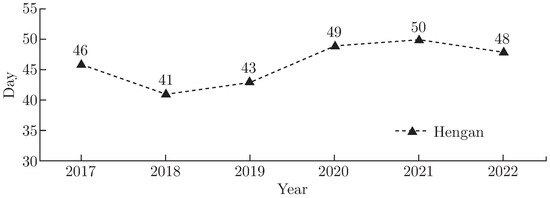
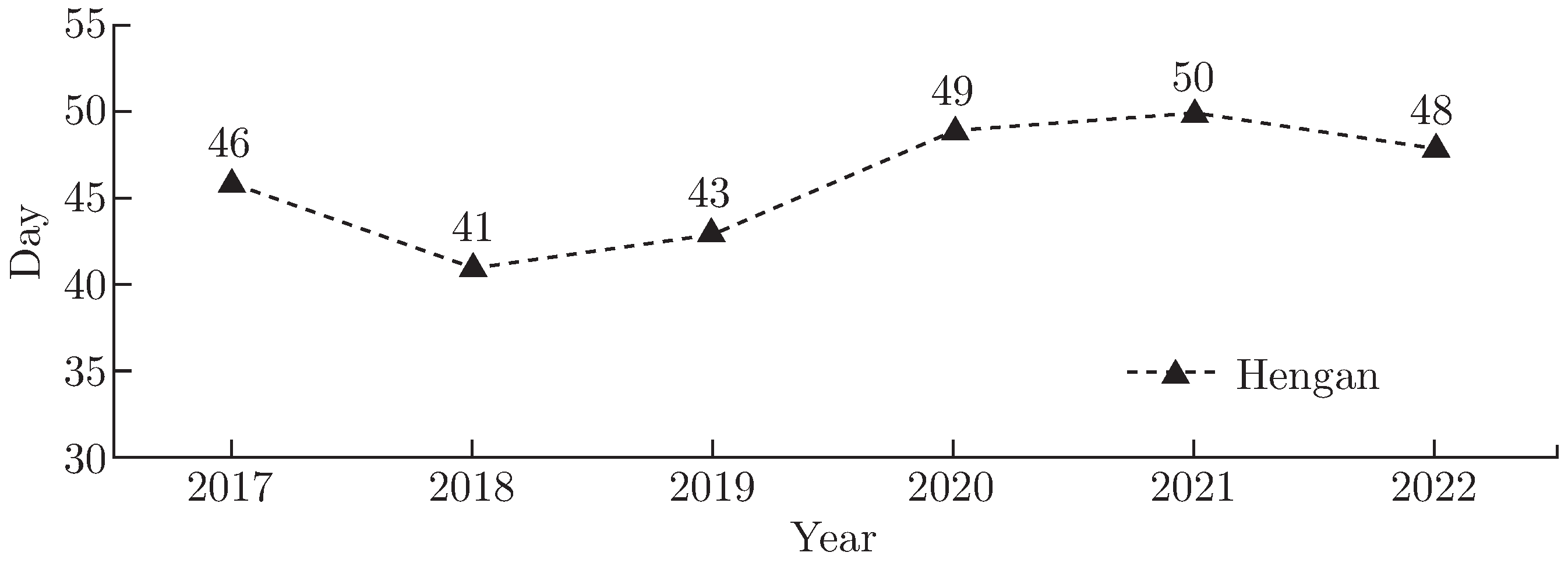
Capacity utilisation rate can also reflect market performance. Overall, the industry has a significant economic scale. However, the output is insufficient, and there is surplus capacity. Sanitary napkin production has a high level of automation. The leading brands have been established for many years, with a complete product matrix developed and a certain brand recognition achieved. But there is also the problem of a long inventory cycle, which causes low efficiency. As Figure 1 illustrates, the average inventory cycle for Space 7 decreased in 2018. However, since the epidemic, the average inventory cycle has increased yearly, reaching 50 days in 2021. Although there is a slight decrease in 2022, the average inventory cycle still reaches 48 days, more than 2018 and 2019. This may expose the sanitary napkin industry to serious product backlogs and insufficient production, leading to an inefficient industry structure.
Figure 1.
Heng An Inventory Cycle in 2017-2022. Data source: Company Annual Report of Heng An, Unicharm.
4.3.3. Continuous Technological Innovation
China’s sanitary napkin industry has experienced significant progress in technology, processes, products, and markets under over 40 years of development. The industry has now achieved maturity in manufacturing technology. The focus of product competition has also shifted from price to technological innovation. For example, Unicharm collaborated with Kanagawa University to launch heat-sensitive sanitary napkins, and Whisper launched liquid sanitary napkins, which initiated an innovation revolution in the industry.
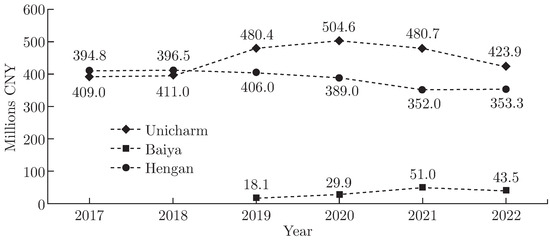
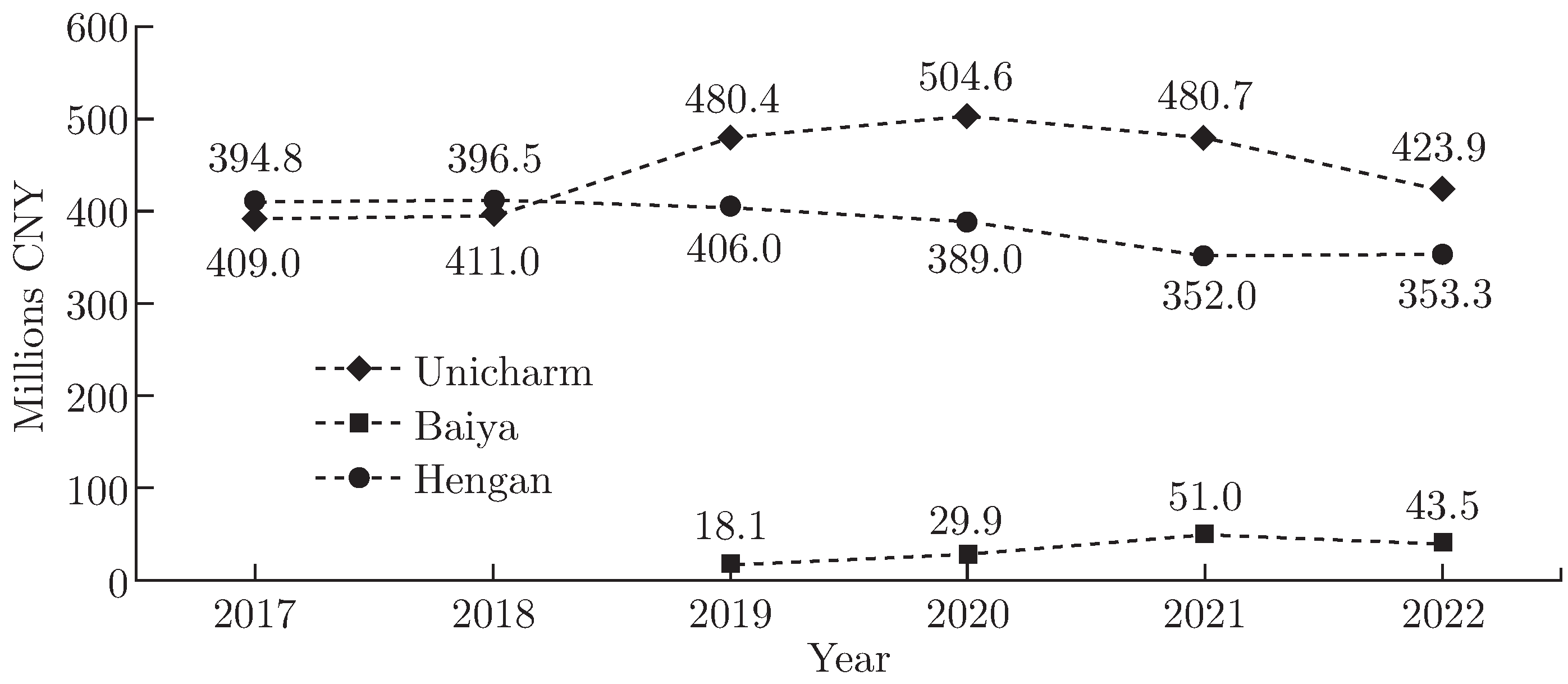
As shown in Figure 2, sanitary napkin companies can be divided into two groups. One, represented by Unicharm, adopts a technological innovation strategy and invests substantially in R&D yearly to continuously develop new products. The other is represented by Heng An, which spends little money on R&D. The former participates in market competition with new products. At the same time, the latter competes in the industry with traditional products. The latter focuses more on exploring new channels and attaining market share through innovative channels or dependent on advertisement. The two groups altogether reflect different business strategies of companies in the highly saturated sanitary napkin industry.
Figure 2.
R&D Expenses of Selected Companies in 2017-2022. Data source: Company Annual Report of Heng An, Unicharm, Baiya.
5. Conclusion
This paper studies and analyses China’s sanitary napkin industry through the SCP theoretical framework and draws the following conclusions.
First, in terms of market structure, CR4 of the industry shows that the market type of China’s sanitary napkin industry has shifted from competition type to oligopolistic type V. The performance is as follows: high product substitutability but highly advertising-dependent product differentiation, relatively low market concentration, and dispersed industry competition pattern. Moreover, industry entry barriers are high, and the status of the head enterprises is solid. This can be seen from the following aspects: the initial capital investment is large, the channel network is difficult to lay, and customer loyalty is difficult to establish. In addition, from the perspective of brand positioning, we find that the market share of high-end brands is increasing while the market of low-end products is being squeezed. This enlightens us that enterprises should change the direction of competition and can adjust brand positioning, quality, and channel when necessary.
As for market conduct, China’s sanitary napkin industry adopts cost-plus pricing. At the same time, companies tend to convey brand value and build brand loyalty through advertisement and sponsorship. Enterprises conform to the trend of changing consumption scenarios, actively explore new retail channels, and increase investment in online marketing resources. Companies should continue to pay attention to consumer demand, fully use innovative technologies, and increase resource investment in e-commerce and new retail channels. With the help of new consumption patterns such as community group buying and live-streaming, brands can expand market coverage and contact with consumers better. When expanding the channel, it should be noted that consumers attracted by new channels may not have a high awareness of the company’s brand. Therefore, the company needs to formulate and implement corresponding marketing plans, enhance the company’s local brand image, and compete with other local retail enterprises to cope with the risk of marketing network expansion. In that case, companies that can seize the opportunities brought by the digital economy may have more opportunities for rapid development.
From the perspective of market performance, the average profit level of China’s sanitary napkin industry is relatively high. Still, it has declined, and the scale structure of the industry needs to be improved. With the gradual awakening of consumers’ brand awareness, health awareness, and environmental awareness, the form of competition within the industry has shifted from price competition to innovation competition. This requires companies to provide more high-quality and differentiated products and services. Therefore, sanitary napkin companies should adjust their competitive concepts, improve product differentiation, and increase R&D investment to adapt to market changes and consumption upgrading. By doing these, companies have the potential to grasp the growth opportunities brought by the upgrading of domestic consumption.
In short, on the one hand, China’s sanitary napkin companies actively adapt to changes nowadays, stabilising market structure, consolidating industry status, and promoting industrial collaborative innovation through market conduct such as product specialisation and differentiation, product price regulation, and mergers and acquisitions. On the other hand, there are still some pending issues. With the complex international trade environment and other uncertainties, China’s sanitary napkin industry is still facing certain risks, which requires companies to have the ability to manage and avoid risk effectively.
Overall, the study offers a better understanding of the structure, conduct, and performance of China’s sanitary napkin industry and can be used by brands to improve market policies. Moreover, this study fills the vacancy in the sanitary napkin industry research field and can provide a reference for follow-up research. However, the study has limitations as few representatives are chosen to help analyse the whole industry, while other small enterprises may have different traits. Furthermore, the scarcity of revealed data may lead to relatively low accuracy. In addition, future research can investigate the traits of small companies in China’s sanitary napkin industry and explore the differences and similarities between them and the leading companies.
Acknowledgments
We acknowledge the Graduate Research Innovation Project of the Beijing Institute of Fashion program (X2023-092) for supporting this paper.
References
- Forward-the economist, https://www.qianzhan.com/analyst/detail/220/210514-53422f29.html.
- National Bureau of Statistics of China, http://www.stats.gov.cn/english/PressRelease/202105/t20210510_1817185.html.
- Lu, A.; Hao, S.L. Organisation of the apparel industry; People’s Publishing House, 2013. [Google Scholar]
- Boru, Tesfaye; Kuhil, Abdurezak. The Structure Conduct Performance Model and Competing Hypothesis - a Review of Literature. J. Financ. Manag. Anal. 2018, 8, 11–25. [Google Scholar]
- Corley, T. Emergence of the theory of industrial organisation, 1890-1990. Bus. Econ. Hist. 1990, 19, 83–92. [Google Scholar]
- Schmalensee, R. From “Green Growth” to Sound Policies: An Overview. Energy Econ. 2012, 34, S2–S6. [Google Scholar] [CrossRef] [Scilit]
- Mason, E.S. Price and production policies of large scale enterprise. Am. Econ. Rev. 1939, 29, 61–74. [Google Scholar]
- Lipczynski, J.; Wilson, J. Industrial organisation: an analysis of competitive markets; Prentice Hall: Harlow, 2001. [Google Scholar]
- Michael, A.C.; Kentaro, N. Strategy, structure, and performance in product development: observations from the auto industry; MIT Sloan School of Management: Cambridge, 2002. [Google Scholar]
- Clarke, R.; Davies, S.W. Market structure and price-cost margins. Economica 1982, 49(195), 277. [Google Scholar] [CrossRef] [Scilit]
- Cusumano, Michael A.; Nobeoka, Kentaro. Strategy, structure and performance in product development: Observations from the auto industry. Res. Policy 1992, 21(03), 265–293. [Google Scholar] [CrossRef] [Scilit]
- Ma, Tongtong. The impact of market structure on business performance of commercial banks in China; Shandong University, 2016. [Google Scholar]
- Yuen, K.F.; Wang, X.Q.; Wong, Y. D.; Li, K.X. The role of stakeholder participation and sustainability integration in maritime transport: A structure-conduct-performance analysis. Transp. Policy 2020, 99, 44–53. [Google Scholar] [CrossRef] [Scilit]
- Dionne, Georges; Cummins, J. Dynamics of insurance markets: Structure, conduct, and performance in the 21st century. J. Bank. Financ. 2008, 32, 1–3. [Google Scholar] [CrossRef] [Scilit]
- Zhang, L. The Structure, Behavior, and Performance of Banking: Industrial Organization Approach to Banking. Foreign Econ. Manag. 2000, 03, 2–9. [Google Scholar]
- Samad, A. Market structure, conduct and performance: Evidence from the Bangladesh banking industry. J. Asian Econ. [Google Scholar] [CrossRef] [Scilit]
- Samad, A. Market structure, conduct and performance: Evidence from the Bangladesh banking industry. J. Asian Econ. 2008, 19(2), 181–193. [Google Scholar] [CrossRef] [Scilit]
- Theophilus, L.; Gregory, A.; et al. Interbank market structure, bank conduct, and performance: Evidence from the UK. J. Econ. Behav. Organ. 2023, 210, 1–25. [Google Scholar] [CrossRef] [Scilit]
- Li, M.J.; Li, S.N.; Lu, A. Study of athletic apparel industry market of China on SCP model. Wool. Text. J. 2018, 46(02), 81–86. [Google Scholar]
- Tan, X.P.; Wang, X.Y. The market performance of carbon trading in China: A theoretical framework of structure-conduct-performance. J. Clean. Prod. 2017. [Google Scholar] [CrossRef] [Scilit]
- Cai, J.; Chen, Y.K. Market analysis of China’s Western wear industry based on the SCP paradigm [J]. West. Leather 2023, 45(03), 36–38. [Google Scholar]
- Dionne, Georges; Cummins, J. Dynamics of insurance markets: Structure, conduct, and performance in the 21st century. J. Bank. Financ. 2008, 32, 1–3. [Google Scholar] [CrossRef] [Scilit]
- Yuen, K.F.; Wang, X.Q.; Wong, Y.D.; Li, K.X. The role of stakeholder participation and sustainability integration in maritime transport: A structure-conduct-performance analysis. Transp. Policy 2020, 99, 44–53. [Google Scholar] [CrossRef] [Scilit]
- Lartey, T.; James, G. A.; Danso, A.; Boateng, A. Interbank market structure, bank conduct, and performance: Evidence from the UK. J. Econ. Behav. Organ. 2023, 210, 1–25. [Google Scholar] [CrossRef] [Scilit]
- Caves, Richard E.; Uekusa, Masu. Industrial Organization in Japan; The Brookings Institution, 1976. [Google Scholar]
- Waldman, Don E. Industrial Organization: Theory and Practice; Pearson, 2014. [Google Scholar]
- Guosheng Securities, https://pdf.dfcfw.com/pdf/H3_AP202206171572695352_1.pdf?1655454211000.pdf.

© 2023 Textile Bioengineering and Informatics Society. This article is an open access article distributed under the terms and conditions of the Creative Commons Attribution (CC BY) license (https://creativecommons.org/licenses/by/4.0/).