


Abstract
Over several decades, digital cultural heritage has been increasingly reused across research, education, creative practice and through public community engagement. However, these activities remain undescribed or inconsistently documented and difficult to compare. Organisations typically rely on ‘proxy metrics’ such as downloads, page views or reverse searches to assess use/reuse. However, these metrics reveal little about how materials were transformed, interpreted, or how they generated value and impact. GLAMs often rely on unstructured anecdotes to capture/trace reuse, as it is difficult to retrospectively document reuse when GLAMs publish cultural heritage data openly without the expectation of users to tell the organisation what they did with the digital cultural heritage they accessed and used. Documenting reuse approaches often focuses on single dimensions or factors such as sector, content type, audience or impact. This has resulted in fragmented knowledge about digital cultural heritage reuse, which has created limitations in carrying out evaluations across examples, learning from good practice and planning digital cultural heritage initiatives. This article introduces and empirically grounds a flexible, multi-dimensional schema for documenting and planning digital cultural heritage reuse. Using an abductive methodology that combines literature analysis and synthesis, practitioner interviews, user-journey examinations and iterative prototyping, we developed a six-category framework capturing (1) organisation and context, (2) heritage assets and technologies, (3) purpose and process, (4) users and engagement modes, (5) nature of use and availability, and (6) impact and sustainability. Applied across real-world examples, this framework can reveal forms of value, dependency and risk, often absent from conventional reporting in the reuse of digital cultural heritage. We argue that reuse documentation functions as a form of socio-technical infrastructure, enabling a shared vocabulary and understanding for cross-case comparison, cumulative learning and strategic design of digital heritage initiatives. By shifting categorisation from retrospective description to include prospective planning, the framework supports a more meaningful impact assessment and sustainable reuse of digital cultural heritage as a societal resource.
1. Introduction
The amount of digital cultural heritage available has rapidly increased over several decades [1,2] as galleries, libraries, archives and museums (GLAMs) digitise more collections and steward born-digital [3] and hybrid materials [4,5]. These resources now circulate widely across research, education, creative industries and tourism, as well as through community activities and practices. Yet while access has increased, understanding of what happens after publication, how digital heritage is used and reused remains surprisingly hidden or seldom discussed, as humans and machines are not obliged to document what they did with the digital cultural heritage. Institutions routinely report downloads, page views or social media interactions, but such proxy metrics reveal very little about transformation, meaning making or societal impact. Other computational techniques have used reverse image searches [6,7] to statistically deduce where GLAMs’ digital content might have ended up elsewhere on the web, either in its original form or transformed in some way.
Recent studies emphasise that reuse, and not only access, is where much of the cultural, educational and economic value and impact of digitisation emerges [8]. ‘Use’ encompasses accessing, consuming and potentially reformatting without contextual changes; ‘reuse’ includes remixing, reinterpretation, computational analysis, storytelling, teaching, co-curation and other forms of recontextualization [8]. Documenting these practices collectively has been problematic; definitions vary, cases are often described inconsistently or not at all, and existing categorisations tend to focus on single dimensions such as sector (education, research, creative industries), content type, audience or impact outcomes. As a result, knowledge about reuse remains fragmented, limiting cross-case comparison, impact assessment and strategic planning [8].
This fragmentation presents both a research problem and a practical one. Without systematic documentation of the reuse of digital cultural heritage, GLAM institutions may struggle to demonstrate value, design services aligned to their user needs, or build on lessons learned across digital heritage initiatives, especially those that encourage reuse or where reuse happens unintentionally or serendipitously. Reuse often only becomes visible through informally recorded/remembered anecdotes rather than through a planned approach using structured documentation. What is missing is a flexible yet structured schema capable of capturing reuse as a socio-technical process.
This article addresses that gap by introducing and empirically grounding a six-category framework for documenting and planning digital cultural heritage reuse. Developed through an abductive methodology that iterates between literature analysis and synthesis, practitioner interviews, user-journey examinations and iterative spreadsheet categorisation and describing, this framework integrates organisational contexts, heritage assets and technologies, project purposes and processes, users and engagement modes, the nature of use and availability, and impact and sustainability within a single coherent structure.
This article makes four contributions:
- A synthesis of existing reuse categorisation approaches across GLAMs, digital humanities and infrastructure research.
- An empirically derived, multi-dimensional schema for documenting reuse.
- Demonstration of the framework through examples.
- A conceptualisation of reuse documentation as an infrastructural and planning practice rather than solely retrospective reporting.
Literature Review
Research on digital cultural heritage reuse has produced a range of partial categorisation approaches, but no integrative schema.
First, definitional studies distinguish between “use” and “reuse,” with Refs. [8,9,10] emphasising that downloads and views do not capture transformative engagement [10]. Projects such as D-CRAFT [11] catalogue reuse cases and impact stories but stop short of systematic cross-case classification [12].
Second, tracing and content-based mappings follow how heritage objects circulate online (e.g., Wikimedia reuse studies), identifying where reuse occurs but not why or with what effects [10,13].
Third, sector and audience typologies organise reuse by domains such as research, education, creative industries or community practice [14,15,16,17]. These approaches are operationally useful for reporting but collapse diverse motivations and processes into broad labels.
Fourth, ‘collections-as-data’ initiatives [18,19,20] focus on enabling computational reuse through licencing, structure and documentation. These frameworks prioritise technical readiness rather than social or cultural outcomes.
Fifth, narrative and participatory perspectives highlight storytelling, memory-making [21,22] and identity formation [23], demonstrating how reuse generates meaning and value [24,25,26,27,28,29]. However, whilst these approaches provide rich details through qualitative case studies, they lack standardised structure that would support systematisation.
Finally, value-chain and impact models map benefits across ecosystems and articulate outcome domains such as learning, well-being or innovation [24]. While useful for evaluation, they often disconnect impacts from the concrete practices that produced them.
Across these strands, categorisation tends to privilege a single dimension, sector, content, audience, readiness or impact rather than integrating them. Consequently, reuse remains difficult to compare across contexts or to document consistently at scale. A multi-dimensional yet practical schema that connects assets, actors, processes and outcomes is still lacking. This paper proposes such a framework.
By treating documentation as a part of infrastructure, the framework supports both systematic analysis and forward-looking design. It enables practitioners to narrate impact more meaningfully, researchers to compare cases more consistently, and institutions to plan for sustainable reuse beyond what could be described as “publish and hope” strategies.
2. Materials and Methods
This study employed an abductive research design, iterating between theory, empirical observation, analysis and practical experimentation to develop a usable categorisation framework. Abduction was chosen because reuse practices are heterogeneous and evolving; rather than testing predefined categories, the aim was to allow patterns to emerge through engagement with real-world cases.
The research combined four sources of evidence, as noted below.
2.1. Literature Synthesis
We reviewed academic and sector publications on digital cultural heritage reuse [8,9,10,11,12,13,14,15], collections-as-data [18,19], impact assessments [23,24], metadata designs and quality [30,31,32], datasheets for cultural heritage data [33] and TRUST principles for digital repositories [18] to identify recurring dimensions and limitations in existing typologies.
2.2. User Journeys and Case Documentation
We documented 132 digital cultural heritage reuse examples and 11 user journeys drawn from GLAM initiatives, research projects and community activities. For each case, we traced how users discovered, accessed, transformed and shared heritage materials. These examples and journeys revealed practical decision points, barriers and outcomes that are often absent from formal reports.
2.3. Practitioner Interviews
We conducted 67 semi-structured interviews with GLAM professionals, researchers and creative practitioners who are involved in reuse projects. Interviews focused on motivations, processes, technical choices, challenges and perceived impacts. Transcripts for interviews were thematically coded to identify recurring descriptors and informational needs and fed into iterative prototyping.
2.4. Iterative Prototyping
Insights from literature and empirical material informed the development of a spreadsheet-based documentation instrument. Version 1 contained 32 fields based on previous attempts to describe reuse from literature and the introduction of new categories based on gaps. Through testing with colleagues and applying it to examples, we identified challenges related to redundancy, inconsistent interpretation of questions, and the amount of time required in completing the template. Therefore, fields were merged, reworded or removed to reduce redundancy and improve clarity. For example, separate fields describing “data type,” “content format” and “technical solution” were consolidated under a broader “Heritage Assets and Technologies” grouping, while questions about goals, activities and challenges were reorganised under “Purpose and Process”. Clustering revealed natural groupings of questions, resulting in six higher-level categories. Version 2 contained 28 fields organised within these categories.
Validation occurred through application of the revised framework to multiple cases and feedback from practitioners regarding usability, completeness and relevance. Categories were retained when they consistently supported understanding or planning decisions.
This iterative process prioritised economy, efficiency and practical value while maintaining conceptual coverage, thus producing a schema that balances flexibility with systematicity.
3. Results
3.1. Recurring Dimensions of Reuse
Across our literature synthesis, examination of user-journey documentation and practitioner interviews, reuse was consistently described not as isolated acts but as multi-stage socio-technical processes. Participants rarely spoke solely about “using data” or “publishing collections.” Instead, they framed reuse in terms of organisational conditions, available materials, motivations, audiences, technical affordances and longer-term consequences. These descriptors clustered naturally into six recurring dimensions: (1) organisation and context, for example, institutional context and resources; (2) heritage assets and technologies; (3) purpose and process (e.g., project aims and workflows); (4) users and engagement modes [34,35]; (5) nature of use and availability (e.g., constraints relating to licencing, temporality and availability); and (6) impact and sustainability [24].
These dimensions appeared across diverse settings, including research projects, creative remixes, educational initiatives and GLAM Lab experiments, which suggested a common underlying structure to reuse practices despite surface-level differences.
The six-category structure (Figure 1) is a result of abductive analysis, where reuse was considered both from the perspectives of previous literature and empirical examples.
Figure 1.
Six-category framework for documenting digital cultural heritage reuse.
3.2. Illustrative Case Studies
To assess the explanatory power and practical usability of the framework, it was applied to three contrasting reuse contexts: a national cultural programme, a participatory creative event and computational reuse of heritage datasets. These cases represent community-led and research-led reuse, respectively, enabling a comparison across organisational structures, audiences and technical conditions.
Rather than providing narrative project descriptions, each case was documented using the six-category template. The summaries below highlight what became analytically visible through structured categorisation.
3.2.1. Case 1: National Heritage Storytelling Competition—Estonian Book 500 (Appendix B.1 for Completed Evaluation)
- (1)
- Organisation and Context
The Estonian National Museum Book 500 competition invited schoolchildren and adults to creatively reuse and remix digitised heritage, with 160 submissions received. It was initiated by a research project funded by the Estonian Ministry of Culture with extra resources provided by the museum. The competition highlighted a need for a digital space to showcase digital heritage reuse and remix projects into the future.
- (2)
- Heritage Assets and Technologies
Digitised photographs, audio, video, folklore and texts taken from a range of Estonian online digital heritage platforms such as repositories, catalogues and co-creation websites (list of links included).
- (3)
- Purpose and Process
Reinvigorating, popularising and having fun by reusing and remixing digital cultural heritage with children at school and adults at home across Estonia, with special prizes offered. Challenges for users included difficulty in searching for items and for the institution knowing the best way to promote the reuse afterwards.
- (4)
- Users and Engagement modes
Target audiences emerged as those who were school children and adults interested in creativity and/or cultural heritage, either by working individually or collaboratively, needing basic digital skills like browsing pictures or video editing. In the case of school children, engagement occurred through school workshops and playful independent activities with intellectual, emotional and social support provided by museum and school staff when needed.
- (5)
- Nature of Use and Availability
The competition involved physical, digital or hybrid dimensions, drawing on fictional, documentary or hybrid approaches. Whilst the initial plan for the competition was temporary, there is an ambition for it to become permanent (this will be re-run in 2026). The outputs are accessible anywhere online, and they demonstrate single and collaborative use. The copyright status of the competition submissions was not described or defined; works were based on open data (free for non-commercial use).
- (6)
- Impact and Sustainability
Heritage institutions and creative users benefited. Impact is evidenced by the online exhibition of the competition submissions and subsequent press coverage. Societal impact included users feeling part of the ‘learning society’, having a sense of a collective identity, demonstrating innovative use of digital cultural heritage, improved knowledge of how cultural heritage is being used, and well-being. The duration of the competition was five months, with the main challenge being sustainability: being able to maintain the competition platform page so as to conduct this contest annually.
3.2.2. Case 2: Participatory Creative Reuse—The University of Tartu Pro Game Jam 2026 (Appendix B.2 for Completed Evaluation)
- (1)
- Organisation and Context
This was organised by the research department of the Estonian National Museum and the Computer Graphics and Virtual Reality Study Lab of the Institute of Computer Science at the University of Tartu. The University of Tartu Pro Game Jam invited students and game developers to create video games by using patterns from the digitised textile collections of the Estonian National Museum. The event was funded through the Estonian Ministry of Culture, a European Union Horizon grant, and supported by the Estonian National Museum and the University of Tartu.
- (2)
- Heritage Assets and Technologies
Digitised textile collections of the Estonian National Museum in the form of .jpeg images with associated metadata were used and obtained from the Estonian Museum Information System (MuIs). Co-creation also took place using the ‘I-game’ platform.
- (3)
- Purpose and Process
This involved testing usability and the development of a video game co-creation platform (I-game) by working with game enthusiasts online over 48 h. Challenges included how to explain the heritage context in a meaningful way to users and how they would access the cultural heritage in a manageable way. The activity facilitated opportunities for heritage experts, creatives and tech experts to work collaboratively.
- (4)
- Users and Engagement modes
Users included students, game enthusiasts, programmers, artists, designers, musicians or people who were just curious about game development at the University of Tartu. They needed technical, creative and collaborative skills to use and adapt digital tools, as well as communication skills and the ability to work in interdisciplinary teams. Engagement was activity-driven and strongly supported by collaboration, with users viewing, discussing and co-creating, involving intellectual, social and emotional engagement.
- (5)
- Nature of use and availability
There is potential for finished games to be used beyond game jam; some will be displayed temporarily online and are accessible anywhere, supporting single or multiple users. Games are displayed at the temporary Heritage Arcade exhibition at the Estonian National Museum. Use is likely to be closed for reinterpretation because of the nature of the specific game mechanics, and authors retain their intellectual rights; however, further copyright aspects beyond the Heritage Arcade exhibition are not clear.
- (6)
- Impact and Sustainability
Game players, cultural heritage institutions and creative industries benefited, as evidenced by the number of participants in game jam, finished games and user feedback, as well as those games chosen to be temporarily displayed at the museum. Social impact includes users learning about cultural understanding, identity, empowerment, innovation and well-being. The game jam included preparation time, game jam and follow-ups with winning teams for a week after (7.5 days). While the University of Tartu Pro Game Jam is a recurring event supported by the university, from the museum perspective, challenges in sustaining a collaboration in the long term are planned but would require financial support for sustainability, such as resources for a producer, manager and spaces to exhibit items, as well as available time for different partners to organise, participate and collaborate.
3.2.3. Case 3: Computational Reuse—Jupyter Notebook-Based Dataset Experimentation (Appendix B.3 for Completed Evaluation)
- (1)
- Organisation and Context
A researcher/lecturer in Computer Science, Gustavo Candela, from the University of Alicante, created editable computational uses of digital cultural heritage from various organisations around the world using browser-based Jupyter Notebooks. Technical skills were required in setting up these notebooks and to connect them to digital cultural heritage, though reuse and editing of the notebooks requires a lower threshold of technical skills for users.
- (2)
- Heritage Assets and Technologies
This involved digital cultural heritage datasets in the form of images and metadata, and technical platforms such as Jupyter Notebooks and GitHub to host the data and to facilitate computational analyses such as querying and visualisation of the data.
- (3)
- Purpose and Process
Purpose and process demonstrate how data published by cultural heritage organisations can be reused computationally, especially when they may not have the resources to do this themselves. Intervention by the researcher carried out online facilitates use/reuse for other users for research and educational purposes. Challenges included having to make requests to some GLAMs to procure the data online before it could be used. The initiative shows the potential for computational reuse of cultural heritage data that GLAMs publish.
- (4)
- Users and Engagement Modes
Users include curious researchers with basic digital literacy skills who want to carry out experiments with cultural heritage data through the computational platforms that were set up by the researcher.
- (5)
- Nature of Use and Availability
The Jupyter Notebooks exist online if the technology behind them continues to be supported and is accessible through a browser. Use/reuse of data depends on how it was published in the first instance; for example, if the data were freely available under openly licenced conditions.
- (6)
- Impact and Sustainability
The institutions providing their cultural heritage data demonstrate that it can be used computationally. The researcher demonstrates their own computational skills from the publication of the notebooks and related research around them. The work won various awards and has had an impact in areas such as innovation, knowledge and entrepreneurship. Long-term sustainability depends on continued investment, maintenance and support of the notebooks, as well as unfettered access to datasets and ongoing local technical support to ensure the notebooks remain functional.
3.2.4. Cross-Case Comparison
Applying the framework across these three example cases demonstrates the model’s capability to support cross-case comparison that narrative descriptions alone would not support. For instance, from these cases, we can see that licensing and technical openness strongly support diversity of reuse. To encourage reuse, human mediation and skills support are at least as important as data availability. An important dimension of the impact is related to relationships and capacity building since outputs are not the only evidence of such an impact. These three cases differ when it comes to ensuring sustainability of such reuse initiatives. Staffing for exhibitions, partnerships for events and infrastructure for computational works are needed and demand different types of interventions to make the reuse initiatives sustainable. These findings suggest that reuse outcomes depend on coordinated socio-technical conditions rather than simply releasing digital assets. The framework provides a means to reveal such dependencies and inform future design decisions.
When we look at the broader categorisation of cases conducted, we have identified some additional points worthy of further investigation. Organisational and funding contexts influenced reuse outcomes. Projects with dedicated technical or mediation staff demonstrated strong engagement and clearer impact evidence than those relying solely on short-term funding and support, which is rarely recorded in conventional project descriptions but became explicit when captured systematically over projects.
The “Heritage Assets and Technologies” category exposed dependencies between data formats, licencing and feasible reuse practices. Open licencing and machine-readable formats enabled computational and creative remixing, while restrictive rights or closed systems make it more difficult. Data and licencing constraints often explained differences in engagement more than the content type alone.
Documenting users and engagement modes highlighted variations within the same project. For example, some initiatives designed for individual consumption were, in practice, used collaboratively, while others expected co-creation but observed working independently. Recording these mismatches supported a more realistic evaluation and redesign.
The impact and sustainability category revealed benefits that extended beyond immediate outputs. Interviewees frequently described skills development, institutional learning and community relationships as key outcomes, yet these were rarely captured. Structure helped make these forms of value explicit.
3.3. Framework Performance as Documentation and a Planning Tool
Using the framework prospectively during project design could also influence planning decisions. Practitioners reported that early consideration of audience skills, licencing and maintenance requirements could prompt adjustments such as simplifying interfaces, adopting open licences or allocating resources for long-term hosting. In this way, the framework can function not only as a descriptive instrument but can also serve as a reflective planning aid. For example, at some of the authors’ home institution, the Estonian National Museum (ERM), the ongoing development of the framework has begun to support a more confident and proactive approach to planning digital interventions. Rather than treating the potential risks of digital heritage reuse primarily as sources of uncertainty, the framework helps ensure that relevant considerations have been identified and addressed systematically at an early stage. This provides practitioners with a clearer basis for moving forward, reducing the likelihood that overlooked issues will emerge later as unexpected problems or require reactive responses. In this sense, the framework can function not only as a descriptive instrument but also as a reflective planning aid, enabling institutions to approach digital reuse in a more holistic, deliberate and assured manner. Further testing and application are required to examine this potential.
3.4. Synthesis of Findings
Across the empirical work process, the six-category framework has proven itself as an analytical and planning tool for developing digital cultural heritage reuse. The reuse cases we have identified share common informational dimensions despite emerging from different practical contexts. This means that the generalisable schema we propose here has use-value for a diverse range of digital heritage contexts. The iterative process for the framework’s development has meant that we have been able to reduce complexity while maintaining nuances and preserving explanatory power. Systematic use of the framework can help to reveal issues related to impacts, dependencies, risks, and sustainability conditions that might be overlooked when relying on success stories or narrative case analyses. In Table 1, we have summarised the core elements of the analytical framework, while Appendix A provides a more detailed overview, including relevant prompts and support questions.
Table 1.
Six-category framework for documenting digital cultural heritage reuse with core questions, what is captured, example indicators, and why it matters (with illustrative examples taken from Case 2: Pro Game Jam in italics).
4. Discussion
This study addresses a persistent weakness in digital cultural heritage practice: although reuse is widely acknowledged as the primary site of cultural, educational and social value creation, it remains inconsistently documented and poorly comparable across different contexts. Existing approaches tend to privilege single perspectives, sectors, content types, audiences, or impacts, resulting in fragmented knowledge and limiting both evaluation and strategic planning. The six-category framework proposed here responds directly to this gap by integrating assets, actors, processes and outcomes within a single systematic structure.
Our central argument is that documenting reuse is not merely an evaluative exercise but an infrastructural one supporting core GLAM work such as curatorial decision-making, public engagement, research and interpretation of digital heritage. Documentation practices in GLAMs shape what becomes visible, measurable and therefore governable. When reuse is recorded only through proxy metrics such as downloads or views, institutions implicitly prioritise reach over meaning. By contrast, the framework developed here foregrounds motivations, engagement modes, interpretation and sustainability, reframing reuse as a socio-technical process rather than a transaction. In this sense, the framework functions as a form of coordination infrastructure: a shared vocabulary that enables practitioners, researchers and policy actors to align descriptions of practice and learn cumulatively across cases.
Empirically, the abductive and iterative development process demonstrated that practitioners consistently think about reuse in clustered dimensions such as organisational conditions, materials and tools, purposes and workflows, users and interactions, impacts, and constraints of availability. Consolidating these dimensions into six categories reduced redundancy while preserving the power to understand and explain reuse. The application of the framework to pilot cases revealed forms of value and risk that had previously gone undocumented, particularly around licencing, maintenance responsibilities and longer-term sustainability. These findings suggest that systematic categorisation can reveal hidden dependencies and support more realistic planning for reuse beyond initial publication.
The framework also shifts categorisation from retrospective reporting to a prospective tool for designing new digital heritage interventions. Many GLAM initiatives assume that making collections available will automatically generate reuse. In practice, reuse depends on explicit decisions about audiences the digital heritage is aimed at, technical affordances, skills, and whether support structures are in place or not. By prompting these considerations at the outset, the schema acts as a planning instrument, helping institutions anticipate who might engage, how engagement will occur, and what evidence of value might be captured. In this way, documentation becomes part of project design rather than an afterthought.
At the same time, comprehensive documentation introduces practical and ethical challenges. Detailed recording requires time to complete for each digital heritage item/collection under consideration, as well as skills and institutional commitment, which might be unevenly distributed across organisations. Overly complex schemas risk becoming burdensome or inconsistently applied. The framework therefore emphasises progressive adoption: institutions can begin with first-level questions, particularly where resources are limited. The schema can selectively be expanded with second-level questions as institutions’ capacity and needs develop. However, completing the in-depth analysis will support further interventions and organisational development.
Ethical considerations, including licensing, representation and community agency, also require and facilitate critical, reflexive application, which helps focus attention on institutional perspectives on reuse. Systematic implementation of the schema helps organisations to evaluate institutions’ digital heritage reuse in detail to potentially reveal biased or unbalanced approaches. Categorisation must support and not constrain interpretations and community narratives, though it will be interesting to see if this is the case with many examples of reuse documented using the framework.
From a broader ecosystem perspective, the framework offers potential for interoperability and benchmarking with other documentation/metadata creation methods (such as Comité International de Documentation - Conceptual Reference Model (CIDOC CRM), Data Catalog Vocabulary (DCAT), etc.) and related initiatives such as collections-as-data, datasheets for cultural heritage datasets, and impact assessment models. Shared descriptors enable a cross-case comparison without imposing rigid taxonomies, supporting benchmarking, meta-analysis and evidence-informed policy. As reuse practices increasingly involve computational analysis, machine learning and immersive technologies, such lightweight standardisation becomes more, not less, necessary for coordination across infrastructures.
However, several limitations remain. The framework has been tested primarily within GLAM and digital humanities contexts and requires further evaluation and validation across diverse institutional scales, cultural settings and technological environments. Future work should explore lightweight digital implementations based on practical use of the framework (e.g., what institutions found easier or prioritised to document), integration with repository workflows and metadata creation, and semi-automated approaches to capturing indicators of reuse. Further reflections as to how documenting digital reuse through this framework supports future developments should also encourage under-resourced institutions to see the value in systematic reflections when planning future implementations.
Additional studies could assess inter-rater reliability and usability to strengthen reproducibility and identify contexts where the framework excels and where it may fall short in practice, with further examples of its implementation in different contexts such as the reuse of 3D and n-dimensional data in shared digital spaces for data sharing. Future research could consider the roles that new machine learning/artificial intelligence tools may have in the process of capturing digital heritage reuse and how they might complement the framework proposed in this paper.
Despite these limitations, this research demonstrates that systematic, yet flexible categorisation of digital cultural heritage reuse is both feasible and valuable. By making reuse legible as a structured process, this framework supports richer accounts of impact, more strategic planning, and cumulative learning across projects. Ultimately, treating reuse documentation as infrastructure helps to reposition digital cultural heritage not simply as a collection of assets to be published but as an evolving societal resource whose value emerges through ongoing interaction, interpretation and care.
5. Conclusions
This paper has presented a systematic yet flexible framework for documenting digital cultural heritage reuse that brings together organisational contexts, heritage assets, technologies, users, processes, impacts and sustainability within a coherent structure. By addressing the fragmentation of existing approaches, this framework provides a common vocabulary that supports more consistent documentation, comparisons and evaluations of reuse across diverse GLAM contexts.
Beyond improving documentation, the framework positions reuse as an infrastructural process that underpins research, public engagement, institutional learning and evidence-based decision-making. It demonstrates that documentation is not simply a mechanism for recording outcomes but an integral component of planning, designing and sustaining digital heritage initiatives. In doing so, it supports richer understandings of how value is created through ongoing interactions with digital cultural heritage.
Although additional validation across a wider range of contexts is required, the framework provides a practical foundation for future research and professional practice. As digital cultural heritage ecosystems continue to evolve through artificial intelligence, immersive technologies and increasingly interconnected research infrastructures, systematic approaches to documenting reuse will become essential for enabling collaboration, benchmarking and long-term societal impact. Ultimately, treating reuse documentation as infrastructure helps reposition digital cultural heritage not merely as a collection of digital assets but as an evolving societal resource whose value is continually created through interpretation, participation and care.
Author Contributions
Original conceptualisation, methodology, validation, formal analysis, investigation, resources, data curation, initiating, leading the development and writing—original draft preparation, writing—review and editing, visualisation and funding acquisition by M.M. Conceptualisation, methodology, validation, formal analysis, investigation, resources, writing—original draft preparation, writing—review and editing, supervision, project administration and funding acquisition by P.P.-V. Conceptualisation, methodology, validation, formal analysis, investigation, resources, writing—original draft preparation, writing—review and editing, supervision, project administration and funding acquisition by P.R. All authors have read and agreed to the published version of the manuscript.
Funding
This research was supported by the Estonian Ministry of Culture’s research and development programme “Estonian Culture Research and Development Program 2023–2026” under grant KUM-TA 43 “Digital Cultural Heritage as a Societal Resource”. This research was supported by the Horizon Europe project 101132449 i-Game: Building a Community for the Co-creation of Games with High Impact on Innovation, Sustainability, Social Cohesion and Growth. This research was also supported by the University of Strathclyde as part of the PhD studies for Mahendra Mahey.
Institutional Review Board Statement
The ethics of the study were reviewed by the Ethics Board at Estonian National Museum, and while written informed consent was acquired for each interview, the study did not require additional approval as it involved non-interventional research, in accordance with institutional guidelines.
Informed Consent Statement
Informed consent for participation was obtained from all subjects involved in the study.
Data Availability Statement
Anonymised interview data (including transcripts, coded and analysed transcripts) are available through the Estonian National Museum on request. User journeys of digital cultural heritage reuse are available on request. The mapping of examples of digital cultural heritage reuse available to framework for digital cultural heritage reuse are available through the Estonian National Museum on request. Appendix A and Appendix B section contains: A blank template for digital cultural heritage framework for reuse; completed template for digital cultural heritage framework for reuse: national heritage storytelling competition—Estonian Book 500 (2025) by the Estonian National Museum; completed template digital cultural heritage framework for reuse: participatory creative reuse—Pro Game Jam (2026) by the Estonian National Museum and the University of Tartu; completed template digital cultural heritage framework for reuse: computational reuse—Jupyter Notebook-based dataset experimentation (2022–2023) by Mahendra Mahey and Gustavo Candela.
Acknowledgments
The authors would like to acknowledge the “Digital Cultural Heritage as a Societal Resource” project team’s support with interviews and conducting the case studies. Mahendra would additionally like to thank his PhD supervisor, Milena Dobreva, at the University of Strathclyde, Scotland, for discussions around the conceptualisation of the digital cultural heritage reuse schema. The authors have also used ChatGPT 5.2 for analysing interview transcripts and visualising the digital cultural heritage reuse framework, and Google NotebookLM for the initial analysis of research articles for review and preliminary assessment of relevance regarding the selected publications for literature review. Claude AI was also used for language and editing support. The authors have reviewed and edited the output and take full responsibility for the content of this publication.
Conflicts of Interest
The authors declare no conflicts of interest.
Abbreviations
The following abbreviations are used in this manuscript:
| GLAMs | Galleries, Libraries, Archives and Museums |
Appendix A. The ‘Six Category Framework for Categorising Digital Cultural Heritage Use/Reuse’—Version 0.2 [Field Names in Square Brackets]. All Fields Are Free Text
| 0.1 Brief title of reuse: [0.1_Title_Reuse] | |
| 0.2 Date completed: [0.2_Date_completed] | |
| 0.3 Name and role person(s) completing this document: [0.3_Name_completing] | |
| 0.4 Contact details: [0.4_Contact_details] | |
| 0.5 Relevant URLs for reuse: [0.5_Relevant_URLs] | |
| 0.6 Language(s) of use / reuse: [0.6_Languages_Of_Use-Reuse] | |
| 1. Organisation and Context [1.0_Organisational_Context] The organisational and funding context of reuse, helping explain the resources, motivations, constraints, and sustainability of the resulting output such as an application, exhibit, or artwork. | 1.1 What organisation(s) is/are involved in this reuse? [1.1_Organisations_Involved] [Insert text here] 1.2 What type(s) of organisation(s) is it? [1.2_Organisations_Types] [Insert text here] 1.3 How has the project been funded? [1.3_Project_Funded_Info] [Insert text here] 1.4 What other resources have been involved? [1.4_Other_Resources_Involved] [Insert text here] 1.5 What skills are needed in the organisation to support this work? [1.5_Skills_Need_From_Organisation] [Insert text here] 1.6 Further notes [1.6_Further_Notes] [Insert text here] |
| 2. Heritage Assets and Technologies [2.0_Heritage_Assets_&_technologies] The digital heritage assets being reused and the technologies enabling access and reuse, highlighting how material type and technical openness (e.g., formats, APIs, licensing) shape what reuse is possible and by whom. | 2.1 Describe types of digital cultural heritage are used? [2.1_Types_DCH_used] [Insert text here] 2.2. What is the content type and format? [2.2_Content_Type_Format] [Insert text here] 2.3 How were materials found and accessed? [2.3_How_Materials_Found_Accessed] [Insert text here] 2.4 Describe how materials are accessible for both/either humans and/or machines? [2.4_Materials_Accessible_Humans_Machines] [Insert text here] 2.5. What technical solutions are employed? [2.5_Technical_Solutions_Employed] [Insert text here] 2.6 What platforms support the work? [2.6_Platforms_Supporting_Work] [Insert text here] 2.7 What is done with the data (aggregation, computation, display, enhancement)? [2.7_What_Done_With_Data] [Insert text here] 2.8 Further notes [2.8_Further_Notes] [Insert text here] |
| 3. Project Purpose and Process [3_Project_Purpose_&_Process] Aims, methods, settings, and types of digital heritage reuse while also capturing narrative functions such as storytelling, collective memory, identity formation, and meaning making. | 3.1 What is the aim and purpose? [3.1_Aim_Purpose] [Insert text here] 3.2 What was done, how, by whom and their motivation(s)? [3.2_What_Done_How_Who_Motivation] [Insert text here] 3.3 How the project was promoted/communicated, how others got to find out about it? [3.3_Project_Promoted] 3.4 Where did/does the intervention take place? [3.4_Where_Intervention_Take_Place] [Insert text here] 3.5 What kind of use is involved (educational, creative, research, commercial, community, policy)? [3.5_Kind_Of_Use] [Insert text here] 3.6 What functions does the reuse serve (storytelling, collective memory, identity formation, meaning making)? [3.6_Functions_Use_Serves] [Insert text here] 3.7 What challenges were encountered? [3.7_Challenges_Encountered] [Insert text here] 3.8 What opportunities emerged? [3.8_Opportunities_Emerged] [Insert text here] 3.9. What lessons were learned? [3.9_Lessons_Learned] [Insert text here] 3.10 What innovative aspects are present? [3.10_Innovative_Aspects] [Insert text here] 3.11 Further notes [3.11_Further_Notes] [Insert text here] |
| 4. Users and Engagement Modes [4_Users_&_Engagement_Modes] Who reuses the digital cultural heritage, the skills and digital literacy required, and the ways audiences engage—ranging from private–public and solo–social interactions to intellectual, emotional, spiritual, and social engagement. | 4.1 Who is the target audience? [4.1_Target_Audience] [Insert text here] 4.2 Was this considered from the start or did it emerge later? [4.2_Target_Audience_Start_Emerge] [Insert text here] 4.3 What skills do end users need? [4.3_Skills_End_Users] [Insert text here] 4.4 What kind of digital literacy skills are needed? [4.4_Digital_Literacy_Skills_Needed] [Insert text here] 4.5 Is engagement collaborative, narrative-driven or activity-driven? [4.5_Describe_Engangememt] [Insert text here] 4.6 How do users interact with materials (viewing, commenting, remixing, co-creating etc.)? [4.6_Users_Interact_Materials] [Insert text here] 4.7 What modes of engagement are supported (intellectual, emotional, social, spiritual etc.)? [4.7_Modes_Engagement_Supported] [Insert text here] 4.8 Further notes [Insert text here] |
| 5. Nature of Use and Availability [5_Nature_Use_&_Availability] How heritage is reused in terms of form, persistence, accessibility, interpretive openness, and legal permissions, showing how design choices and licensing shape what reuse is possible. | 5.1 Is the use temporary or permanent? [5.1_Use_Temporary_Permanent] [Insert text here] 5.2 Does it involve physical, digital or hybrid dimensions? [5.2_Physical_Digital_Hybrid] [Insert text here] 5.3 Does it draw on fictional, documentary or hybrid approaches? [5.3_Fictional_Documentary_Hybrid] [Insert text here] 5.4 Is it spatially bound or accessible anywhere? [5.4_Spatially_Bound_Accessible_Anywhere] [Insert text here] 5.5 Does it support single users; collaborative uses or both? [5.5_Single_Collaborative_Uses] [Insert text here] 5.6 What is the maintenance and status of availability? [5.6_Maintennance_Status_Availability] [Insert text here] 5.7 How open or closed is the use for interpretation? [5.7_Open_Closed_Interpretation] [Insert text here] 5.8 What is the copyright status and licensing of reuse? [5.8_Copyright_Status_License_Reuse] [Insert text here] 5.9 Further notes [5.9_Further_Notes] [Insert text here] |
| 6. Impact and Sustainability [6_Impact_&_Sustainability] Who benefits from digital heritage reuse, what evidence of impact exists across domains (e.g., innovation, wellbeing, social cohesion, identities), and how sustainability is addressed beyond simplistic metrics, especially after funding ends (if relevant). | 6.1 Who benefits from this reuse? [6.1_Who_Benefits_From_Use] [Insert text here] 6.2 What evidence or measures of impact exist? [6.2_Evidence_Measures_Impact] [Insert text here] 6.3 Which social impact areas are affected (innovation and knowledge, well-being, sustainability, social cohesion, soft power, entrepreneurship, learning society, collective identities)? [6.3_Social_Impact_Areas] [Insert text here] 6.4 What is the duration of the intervention? [6.4_Duration_Intervention] [Insert text here] 6.5 Is it ongoing or has it ended? [6.5_Intervention_Ongoing_Ended] [Insert text here] 6.6 What are the challenges of maintenance or long-term sustainability? [6.6_Challenges_Maintennance_Long_Term_Sustainability] [Insert text here] 6.7 What resources are needed for continuation? [6.7_Resources_Needed_Continuation] [Insert text here] 6.8 Further notes [6.8_Further_Notes] [Insert text here] |
Appendix B
Appendix B.1. Estonian Book 500 Competition (2025)
| 0.1 Brief title of reuse: Estonian Book 500 Competition (2025) | |
| 0.2 Date completed: 18/01/2026 | |
| 0.3 Name and role person(s) completing this document: Mart Alaru, organiser, researcher | |
| 0.4 Contact details: Contact details: mart.alaru@erm.ee | |
| 0.5 Relevant URLs for reuse: Relevant URLs: https://blog.erm.ee/?cat=46 | |
| 0.6 Language(s) of use / reuse: Estonian | |
| 1. Organisation and Context The organisational and funding context of reuse, helping explain the resources, motivations, constraints, and sustainability of the resulting output such as an application, exhibit, or artwork. | 1.1 What organisation(s) is/are involved in this reuse? Estonian National Museum 1.2 What type(s) of organisation(s) is it? Ethnographic museum 1.3 How has the project been funded? Project-based (KUM-TA43: “Digital cultural heritage as a resource for social development”) 1.4 What other resources have been involved? Resources allocated for marketing by the museum 1.5 What skills are needed in the organisation to support this work? Heritage-related academic specialisation, (ethnographic) research skills, marketing, communication, education, management 1.6 Further notes Ideally, it would also require an established space for digital exhibitions - in the case of this project, such a thing was not really in place and was invented with tools at hand; however, a need for a properly developed digital exhibition space still stands – it might be possible to build upon ‘Pildiait’ for it to also accommodate digital heritage reuse and remix items. |
| 2. Heritage Assets and Technologies The digital heritage assets being reused and the technologies enabling access and reuse, highlighting how material type and technical openness (e.g., formats, APIs, licensing) shape what reuse is possible and by whom. | 2.1 What types of digital cultural heritage are used? Digitised photographs, audio, video, publications; participants also used digitised folklore and texts 2.2. What is the content type and format? The output was intentionally left open. The instruction of the contest was to basically do anything; however various examples were given to make it more accessible for participants. 2.3 How were materials found and accessed? Via digital heritage databases and platforms. There was a list (https://www.erm.ee/eesti-digiandmebaasid/) given. This included various databases, some general-purpose, some with specific focuses; the list also included a co-creation platform which compounded data from various databases and organised it on a map. 2.4 Are materials accessible for both humans and machines? Probably? 2.5. What technical solutions are employed? Institutional repositories, catalogues, co-creation platform 2.6 What platforms support the work? Various (https://www.erm.ee/eesti-digiandmebaasid/) 2.7 What is done with the data (aggregation, computation, display, enhancement)? Aggregation, display, enhancement, mapping on a real-world map 2.8 Further notes |
| 3. Project Purpose and Process Aims, methods, settings, and types of digital heritage reuse while also capturing narrative functions such as storytelling, collective memory, identity formation, and meaning making. | 3.1 What is the aim and purpose? Invigorating the use of digitised heritage, popularising (digital) heritage, having fun (with heritage). 3.2 What was done, how, by whom and their motivation(s)? There were many target groups from schoolchildren to all adults. The children who participated were more often motivated by teachers and/or submitted their work as an optional assignment in class; yet some of the children did it from their own personal interest in the assignment. The contest also had prizes: iPhone, monetary prizes, bookstore gift cards and boxes of ice cream. Some contestants were motivated by the prizes (both adults and children), it even more seemed to be just a good excuse to do something creative which many of the participants reported. Many of the participants also regularly participated in creative contests. 3.3 Where did/does the intervention take place? Across Estonia in people’s homes and schools. 3.4 What kind of use is involved (educational, creative, research, commercial, community, policy)? Creative, educational, goofing around, experimental, research… 3.5 What functions does the reuse serve (storytelling, collective memory, identity formation, meaning making)? Celebratory, identity formation, fun, storytelling, laughter, meaning making. 3.6 What challenges were encountered? On the users’ side: Browsability issues, accustomedness to serendipitous browsing, needing to know exact search terms, not knowing what to look for; experimentation with search terms; messy and fragmented multitude of databases; usability issues like ending up at the very beginning of the page after finding something deep into search. On the practitioner’s side: Communication and promotion of the competition was lagging because the communication office of the museum was overworked. 3.7 What opportunities emerged? User’s side: Going into rabbit holes of secondary interests via databases, doing things together, having a watch-party of old videos Practitioner’s side: collaboration with schools and teachers; collaboration with students’ union 3.8. What lessons were learned? Discovering digital heritage databases, improving creative skills, improving digital skills. 3.9 What innovative aspects are present? This open-ended format of the competition was unique. 3.10 Further notes |
| 4. Users and Engagement Modes Who reuses the digital cultural heritage, the skills and digital literacy required, and the ways audiences engage—ranging from private–public and solo–social interactions to intellectual, emotional, spiritual, and social engagement. | 4.1 Who is the target audience? Initially there were two general target audiences, schoolchildren and adults. The latter category was disambiguated into creative adults and adults with interest in heritage. 4.2 Was this considered from the start or did it emerge later? It emerged later. 4.3 What skills do end users need? Basic computer skills like browsing and searching, plus minimal skills with picture or video editing software. 4.4 What kind of digital literacy skills are needed? See previous answer. 4.5 Is engagement collaborative, narrative-driven or activity-driven? Individual, collaborative, narrative-driven, activity-driven; the aim of the intervention is to open the different affordances of digital heritage engagement. 4.6 How do users interact with materials (viewing, commenting, remixing, co-creating etc.)? Remixing, co-creating, using for inspiration for creative exercise, commenting. 4.7 What modes of engagement are supported (intellectual, emotional, social, spiritual etc.)? We organised workshops by which we gave intellectual, emotional, social support such as inspiring or coming up with playful activities; some support also involved replying to technical and managerial questions about the contest. 4.8 Further notes Some support was also passive in that the competition page gave some examples for what could be done as a submission and gave encouragement to be creative with the format, “go crazy” and have fun, which, reportedly, some users were empowered by. |
| 5. Nature of Use and Availability How heritage is reused in terms of form, persistence, accessibility, interpretive openness, and legal permissions, showing how design choices and licensing shape what reuse is possible. | 5.1 Is the use temporary or permanent? Currently it is temporary, but we are striving for permanence :) 5.2 Does it involve physical, digital or hybrid dimensions? It involves all the above. 5.3 Does it draw on fictional, documentary or hybrid approaches? All the above. 5.4 Is it spatially bound or accessible anywhere? Accessible anywhere. 5.5 Does it support single users; collaborative uses or both? Both. 5.6 What is the maintenance and status of availability? About to plan the next competition. 5.7 How open or closed is the use for interpretation? Open. 5.8 What is the copyright status and licensing? Not defined. 5.9 Further notes |
| 6. Impact and Sustainability Who benefits from digital heritage reuse, what evidence of impact exists across domains (e.g., innovation, wellbeing, social cohesion, identities), and how sustainability is addressed beyond simplistic metrics, especially after funding ends (if relevant). | 6.1 Who benefits from this reuse? Heritage institutions, (creative) people 6.2 What evidence or measures of impact exist? The main evidence is the online “exhibition” (https://www.erm.ee/digiloomingu-konkursi-tulemused-ja-galerii/), which contains all of the final submissions. The competition exhibition was also featured in the local newspaper. (https://tartu.postimees.ee/8341698/vaata-pilte-ermi-digiloomingu-konkursile-esitati-160-eriilmelist-voistlustood) (160 submissions). 6.3 Which social impact areas are affected (innovation and knowledge, well-being, sustainability, social cohesion, soft power, entrepreneurship, learning society, collective identities)? Learning society, collective identities, innovation and knowledge, education, well-being. 6.4 What is the duration of the intervention? Five months: April to September 2025. 6.5 Is it ongoing or has it ended? It has ended. 6.6 What are the challenges of maintenance or long-term sustainability? Maintaining a platform or page for doing this contest continually. This would ideally need a specialised person or team who kept the effort and maintenance going. 6.7 What resources are needed for continuation? A paid professional working specifically on co-creation :)? 6.8 Further notes |
Appendix B.2. Pro Game Jam (ERM, 2026)
| 0.1 Brief title of reuse: Pro Game Jam (ERM, 2026) | |
| 0.2 Date completed: 25/01/2026 | |
| 0.3 Name and role person(s) completing this document: Pille Runnel, organizer, researcher | |
| 0.4 Contact details: pille.runnel@erm.ee | |
| 0.5 Relevant URLs for reuse: https://www.facebook.com/events/853730314047479 https://cs.ut.ee/et/sisu/mangujamm-university-tartu-pro-game-jam-2026 https://cgvr.cs.ut.ee/ https://igameproject.eu | |
| 0.6 Language(s) of use / reuse: English, Estonian | |
| 1. Organisation and Context The organisational and funding context of reuse helping explain the resources, motivations, constraints, and sustainability of the resulting output, such as an application, exhibit, or artwork. | 1.1 What organisation(s) is/are involved in this reuse? Estonian National Museum, University of Tartu. 1.2 What type(s) of organisation(s) is it? Research department, Estonian National Museum (research institution), The Computer Graphics and Virtual Reality Study Lab @ University of Tartu, Institute of Computer Science. 1.3 How has the project been funded? Research and development funding:
Marketing department, Estonian National Museum, costs of the registered participants. 1.5 What skills are needed in the organisation to support this work? Ethnography, heritage and museums, communication and marketing, collections knowledge, game development (basic skills). 1.6 Further notes As a merger of two projects - one developing a platform for co-creating video games and the other studying digital cultural heritage as a resource across different fields - game jam tests the applicability of heritage content in the creation of video games through the established game jam format. |
| 2. Heritage Assets and Technologies The digital heritage assets being reused and the technologies enabling access and reuse, highlighting how material type and technical openness (e.g., formats, APIs, licensing) shape what reuse is possible and by whom. | 2.1 What types of digital cultural heritage are used? Digitised textile collections of the Estonian National Museum. 2.2. What is the content type and format? Photos of the objects in .jpg, as well as additional description (textual information regarding the objects on the photos). 2.3 How were materials found and accessed? Estonian Museum Information System (MuIs), but the data was separately downloaded and prepared by the museum professionals (IT department) to lower the access barriers. 2.4 Are materials accessible for both humans and machines? Humans. 2.5. What technical solutions are employed? [Insert text here] 2.6 What platforms support the work? i-Game platform in development. 2.7 What is done with the data (aggregation, computation, display, enhancement)? [Insert text here] 2.8 Further notes [Insert text here] |
| 3. Project Purpose and Process Aims, methods, settings, and types of digital heritage reuse while also capturing narrative functions such as storytelling, collective memory, identity formation, and meaning making. | 3.1 What is the aim and purpose? For the museum, the goal was to test the usability of the video game co-creation platform (I-game) and to learn about collaboration of different sectors and groups around digital heritage and digital media formats. 3.2 What was done, how, by whom and their motivation(s)? Task: students and game enthusiasts: programmers, artists, designers, musicians or people just curious about game development participate in an intensive 48-hour game jam to create their best game to collaborate, learn, and turn ideas into playable games. 3.3 Where did/does the intervention take place? University of Tartu, Institute of Computer Science (onsite, online) - Discord 3.4 What kind of use is involved (educational, creative, research, commercial, community, policy)? Educational, creative, research, user testing (platform). 3.5 What functions does the reuse serve (storytelling, collective memory, identity formation, meaning making)? Storytelling (video game development), creativity of video-game designers. 3.6 What challenges were encountered? Explaining the heritage context in a useful way. Accessing the data in a manageable format. 3.7 What opportunities emerged? Collaboration of heritage experts with creative and tech fields for mutual learning and knowledge transfer. 3.8. What lessons were learned? [Insert text here] 3.9 What innovative aspects are present? Contribution to the development of a platform which facilitates the creation of an accessible platform for the design and development of open-source games. This platform will facilitate the co-creation of games by different interested parties in ecosystems of cultural and creative sectors and industries (CCSI), to enhance innovation with a positive impact on social cohesion and sustainability. 3.10 Further notes An important approach of i-Game is facilitating inclusive game development, prompting and practising inclusivity (including the availability of guidelines developed by an expert advocacy organisation). |
| 4. Users and Engagement Modes Who reuses the digital cultural heritage, the skills and digital literacy required, and the ways audiences engage—ranging from private–public and solo–social interactions to intellectual, emotional, spiritual, and social engagement. | 4.1 Who is the target audience? Game enthusiasts (pro level game jam). 4.2 Was this considered from the start or did it emerge later? Game jam as a format to test digital heritage re-use was considered from the start (part of the project design in i-Game and added as one of the intervention methodologies to “Digital heritage” projects during the project. 4.3 What skills do end users need? Game jam participants need both technical, creative and collaboration skills. Their task is to develop games accessible and engaging to the general audiences. 4.4 What kind of digital literacy skills are needed? Ability to confidently use and adapt digital tools (such as game engines and collaboration platforms); communicate ideas effectively in digital environment; basic concepts of coding, design, digital ethics; the capacity to learn new tools quickly; work in interdisciplinary teams; notice and troubleshoot upcoming problems; provide useful feedback to the i-Game platform under development. 4.5 Is engagement collaborative, narrative-driven or activity-driven? Activity-driven, strongly supported by collaboration. 4.6 How do users interact with materials (viewing, commenting, remixing, co-creating etc.)? Viewing, discussing, co-creating. 4.7 What modes of engagement are supported (intellectual, emotional, social, spiritual etc.)? Game jam supports intellectual engagement (problem-solving, learning, creativity); social engagement (teamwork, networking, peer learning), and emotional engagement (excitement, pride, stress etc). 4.8 Further notes [Insert text here] |
| 5. Nature of Use and Availability How heritage is reused in terms of form, persistence, accessibility, interpretive openness, and legal permissions, showing how design choices and licensing shape what reuse is possible. | 5.1 Is the use temporary or permanent? Potential for finished games to be used beyond the game jam, if set up in appropriate contexts (such as displayed in the museums). 5.2 Does it involve physical, digital or hybrid dimensions? Games are digital, they will be displayed temporarily in a particular physical setting. 5.3 Does it draw on fictional, documentary or hybrid approaches? We strive for hybrid approach, but video-game format is per-se fictional. 5.4 Is it spatially bound or accessible anywhere? Potentially accessible anywhere, but in the case, will be displayed in a spatially bounded setting. 5.5 Does it support single users; collaborative uses or both? Both. 5.6 What is the maintenance and status of availability? N/A] 5.7 How open or closed is the use for interpretation? N/A, as work in progress. Likely limited (closed) due to the game mechanics and game logics, i.e.ie interactive, but outcome for the end users limited. 5.8 What is the copyright status and licensing? Authors retain their intellectual rights, but further aspects not clear at the time of documenting this event. 5.9 Further notes [Insert text here] |
| 6. Impact and Sustainability Who benefits from digital heritage reuse, what evidence of impact exists across domains (e.g., innovation, wellbeing, social cohesion, identities), and how sustainability is addressed beyond simplistic metrics, especially after funding ends (if relevant). | 6.1 Who benefits from this reuse? players/learners (increased heritage awareness, learning, engagement), heritage communities (representation); cultural heritage institutions (new audiences, new interpretation formats); creative industries (new partnerships, new IP). 6.2 What evidence or measures of impact exist? Number of participants, number of finished games, potentially user/visitor feedback, as the winning works are temporarily displayed at the museum after the game jam. 6.3 Which social impact areas are affected (innovation and knowledge, well-being, sustainability, social cohesion, soft power, entrepreneurship, learning society, collective identities)? Learning and cultural understanding, identity and empowerment (game jams potentially contributing to sustaining cultural heritage), innovation (collaboration and re-use approaches), identity and cultural empowerment; wellbeing likely indirectly affected, perhaps context dependent. 6.4 What is the duration of the intervention? 2,5 days + preparation and follow-up for up to week for the institutions and winning teams. 6.5 Is it ongoing or has it ended? It is a single event with a potential to collaborate also in the future through this established format. 6.6 What are the challenges of maintenance or long-term sustainability? Game jams are largely volunteer based, even if the particular game jam is an asset of the computer department. 6.7 What resources are needed for continuation? Producer, manager, spaces, time and motivation of different partners to collaborate; some financial support. 6.8 Further notes [Insert text here] |
Appendix B.3. Jupyter Notebooks and GLAM Data (2022/2023)
| 0.1 Brief title of reuse: Jupyter Notebooks and GLAM Data (2022/2023) | |
| 0.2 Date completed: 18/01/2026 | |
| 0.3 Name and role person(s) completing this document: Mahendra Mahey, PhD candidate at the University of Strathclyde, Researcher Estonian National Museum and Research Data Analyst (Humanities) at Tallinn University and Gustavo Candela, Computer Science Lecturer, University of Alicante | |
| 0.4 Contact details: mahendra.mahey@strath.ac.uk or mahendra.mahey@tlu.ee | |
| 0.5 Relevant URLs for reuse:
| |
| 0.6 Language(s) of use / reuse: English | |
| 1. Organisation and Context The organisational and funding context of reuse, helping explain the resources, motivations, constraints, and sustainability of the resulting output such as an application, exhibit, or artwork. | 1.1 What organisation(s) is/are involved in this reuse? University of Alicante. 1.2 What type(s) of organisation(s) is it? University (Higher Education). 1.3 How has the project been funded? Some of the work was carried out as a fellowship with support from the National Library of Scotland of £7500 to cover travel and subsistence and the rest was in the researcher’s own time, Gustavo Candela. 1.4 What other resources have been involved? Datasets from other cultural heritage organisations. 1.5 What skills are needed in the organisation to support this work? Technical skills in how to create Jupyter Notebooks, to connect them or use cultural heritage datasets. 1.6 Further notes [Insert text here] |
| 2. Heritage Assets and Technologies The digital heritage assets being reused and the technologies enabling access and reuse, highlighting how material type and technical openness (e.g., formats, APIs, licensing) shape what reuse is possible and by whom. | 2.1 What types of digital cultural heritage are used? Cultural Heritage datasets. 2.2. What is the content type and format? Various, metadata and images. 2.3 How were materials found and accessed? Various ways, through institutional data portals or through communication with the heritage organisations to obtain samples. 2.4 Are materials accessible for both humans and machines? There is an attempt to use both. 2.5. What technical solutions are employed? Jupyter Notebooks. 2.6 What platforms support the work? Jupyter Notebooks, GitHub and Binder. 2.7 What is done with the data (aggregation, computation, display, enhancement)? Various computational analyses, including visualising data, querying data and enrichment with external repositories. 2.8 Further notes [Insert text here] |
| 3. Project Purpose and Process Aims, methods, settings, and types of digital heritage reuse while also capturing narrative functions such as storytelling, collective memory, identity formation, and meaning making. | 3.1 What is the aim and purpose? To demonstrate how data published by cultural heritage organisations can be reused computationally, especially when the organisations may not have the resources to do this themselves, through the setup of Jupyter Notebooks. 3.2 What was done, how, by whom and their motivation(s)? Collecting data from various cultural heritage organisations, setting up Jupyter Notebooks. It was carried out by Gustavo Candela, and their aim was to show how computational things can be done with data that is published by GLAMs. 3.3 Where did/does the intervention take place? This happened virtually and online. 3.4 What kind of use is involved (educational, creative, research, commercial, community, policy)? Research and educational use. 3.5 What functions does the reuse serve (storytelling, collective memory, identity formation, meaning making)? The reuse demonstrates how the materials can be reused computationally to transform, enrich and visualise the data. 3.6 What challenges were encountered? At that time, reusing large repositories in local computers was complex (e.g., BOSLIT dataset), he had to create an additional code to be store the data generated. Data was enriched manually using Wikidata for https://data.nls.uk/data/metadata-collections/moving-image-archive/ Also, Binder provided limited resources and for large repositories this might not be enough. 3.7 What opportunities emerged? It was not always possible to get the data directly from the organisations, sometimes requests needed to be made. Published an article https://doi.org/10.1177/01655515231174386 and attended the Collections as Data event in Vancouver thanks to the fellowship. 3.8. What lessons were learned? If there is a resource to carry out computational things with data, then this project clearly shows how is it is possible to do so. 3.9 What innovative aspects are present? Demonstrating the computational reuse potential of cultural heritage datasets. 3.10 Further notes [Insert text here] |
| 4. Users and Engagement Modes Who reuses the digital cultural heritage, the skills and digital literacy required, and the ways audiences engage—ranging from private–public and solo–social interactions to intellectual, emotional, spiritual, and social engagement. | 4.1 Who is the target audience? Researchers, those with technical skills wanting to carry out experiments with cultural heritage data. 4.2 Was this considered from the start or did it emerge later? Yes, it was considered from the beginning. In terms of who uses it, that can be answered in another question. 4.3 What skills do end users need? Skills in setting up Jupyter Notebooks, programming, knowing how to get access to cultural heritage datasets from organisations. 4.4 What kind of digital literacy skills are needed? High level of digital literacy needed, computational skills, programming, working with data. 4.5 Is engagement collaborative, narrative-driven or activity-driven? Engagement with the Jupyter Notebooks will depend on users’ skills levels. People with basic skills can view the Jupyter Notebooks easily. 4.6 How do users interact with materials (viewing, commenting, remixing, co-creating etc.)? Users can run the code, edit the code or even use research platforms such as EOSC to run the code. Binder in some cases is limited. 4.7 What modes of engagement are supported (intellectual, emotional, social, spiritual etc.)? Those who are curious and want to experiment with data through computational means. 4.8 Further notes [Insert text here] |
| 5. Nature of Use and Availability How heritage is reused in terms of form, persistence, accessibility, interpretive openness, and legal permissions, showing how design choices and licensing shape what reuse is possible. | 5.1 Is the use temporary or permanent? Permanent if technology is supported. 5.2 Does it involve physical, digital or hybrid dimensions? Involves digital. 5.3 Does it draw on fictional, documentary or hybrid approaches? It draws on practical approaches. 5.4 Is it spatially bound or accessible anywhere? Accessible anywhere if users have a modern (updated) browser. 5.5 Does it support single users; collaborative uses or both? Both. 5.6 What is the maintenance and status of availability? The Jupyter Notebooks are available currently. 5.7 How open or closed is the use for interpretation? It remains dependent on the licensing of the original published cultural heritage dataset. 5.8 What is the copyright status and licensing? Various. 5.9 Further notes [Insert text here] |
| 6. Impact and Sustainability Who benefits from digital heritage reuse, what evidence of impact exists across domains (e.g., innovation, wellbeing, social cohesion, identities), and how sustainability is addressed beyond simplistic metrics, especially after funding ends (if relevant). | 6.1 Who benefits from this reuse? The institution, as they can show examples of computational use for their published cultural heritage data. The researcher can demonstrate their own computational skills in wrangling the data and possibility being used for their own publications. 6.2 What evidence or measures of impact exist? The researcher won an award, BL Labs Award (2021) for the public vote for the use of cultural heritage data. Others with similar profiles were able to browse examples of computational use. The work helped Gustavo with a new/permanent position at the University. Published an article https://doi.org/10.1177/01655515231174386 and attended the Collections as Data event in Vancouver thanks to the fellowship. 6.3 Which social impact areas are affected (innovation and knowledge, well-being, sustainability, social cohesion, soft power, entrepreneurship, learning society, collective identities)? It matches innovation and knowledge, well-being, soft power, entrepreneurship, learning society and democratise access to and use of data. 6.4 What is the duration of the intervention? The intervention for the awards took place between 2020 and 2022. The work spurned other work. 6.5 Is it ongoing or has it ended? The Award examples are finished but Gustavo continues to publish examples of computational use of cultural heritage data. 6.6 What are the challenges of maintenance or long-term sustainability? Keeping JNs functioning are an issue over the long term, they need to be checked from time to time to ensure they are still working. 6.7 What resources are needed for continuation? Time from the original researcher to keep it going. 6.8 Further notes [Insert text here] |
References
- Terras, M.; Coleman, S.; Drost, S.; Elsden, C.; Helgason, I.; Lechelt, S.; Osborne, N.; Panneels, I.; Pegado, B.; Schafer, B.; et al. The Value of Mass-Digitised Cultural Heritage Content in Creative Contexts. Big Data Soc. 2021, 8, 20539517211006164. [Google Scholar] [CrossRef] [Scilit]
- Tartari, M.; Sacco, P.L.; Manfredini, F.; Pilati, F. Deliverable 1.7 Guidelines for the Best Practices Regarding the Maximisation of the Impact of Digitisation of Cultural Heritage. 2022. Available online: https://zenodo.org/records/7486639 (accessed on 19 February 2026).
- Brazier, C. born.digital@british.library: The opportunities and challenges of implementing a digital collection development strategy. In Proceedings of the IFLA WLIC 2013, Singapore, 17–23 August 2013. [Google Scholar]
- Bekele, M.K.; Perdiccas, R.; Frontoni, E.; Malinverni, E.S.; Gain, J. A Survey of Augmented, Virtual, and Mixed Reality for Cultural Heritage. J. Comput. Cult. Herit. 2018, 11, 7. [Google Scholar] [CrossRef] [Scilit]
- Ipalakova, M.; Daineko, Y.; Bolatov, Z.; Tsoy, D.; Reznikova, Y.; Bazarbekov, I.; Gabdullin, D. Immersive Technologies for Cultural Heritage: Bridging History and Technology in Museums. In Extended Reality: International Conference, XR Salento 2025; Lecture Notes in Computer Science; De Paolis, L.T., Arpaia, P., Sacco, M., Eds.; Springer: Cham, Switzerland, 2025; Volume 15737. [Google Scholar] [CrossRef] [Scilit]
- Kelly, E.J. Reverse image lookup of a small academic library digital collection. Codex J. La. Chapter ACRL 2015, 3, 80–92. [Google Scholar]
- Kirton, I.; Terras, M. Where Do Images of Art Go Once They Go Online? A Reverse Image Lookup Study to Assess the Dissemination of Digitized Cultural Heritage; Proctor, N., Cherry, R., Eds.; Museums and the Web: Silver Spring, MD, USA, 2013. [Google Scholar]
- Vasileva, S.; McNeilly, N. Measuring the Instances and Value of Digital Cultural Heritage Reuse, Europeana Foundation. 2024. Available online: https://pro.europeana.eu/files/Europeana_Professional/Publications/Measuring_the_instances_and_value_of_digital_cultural_heritage_reuse_europeana_foundation_2024.pdf (accessed on 19 February 2026).
- van de Sandt, S.; Dallmeier-Tiessen, S.; Lavasa, A.; Petras, V. The Definition of Reuse. Data Sci. J. 2019, 18, 22. [Google Scholar] [CrossRef] [Scilit]
- Kenfield, A.S.; Woolcott, L.; Thompson, S.; Kelly, E.J.; Shiri, A.; Muglia, C.; Masood, K.; Chapman, J.; Jefferson, D.; Morales, M.E. Toward a Definition of Digital Object Reuse. Digit. Libr. Perspect. 2022, 38, 378–394. [Google Scholar] [CrossRef] [Scilit]
- D-CRAFT. Measure the Impact of Your Digital Collections. Available online: https://reuse.diglib.org/ (accessed on 19 February 2026).
- Shiri, A.; Muglia, C.; Thompson, S.; Chapman, J.; Kelly, E.J.; Kenfield, A.S.; Woolcott, L. Digital Content Reuse Assessment: An Emerging Framework for Future Digital Library Research and Development. In Proceedings of the Annual Conference of CAIS, Virtual Conference, 7–10 June 2022. [Google Scholar] [CrossRef] [Scilit]
- Kelly, E.J. Reuse of Wikimedia Commons Cultural Heritage Images on the Wider Web. Evid. Based Libr. Inform. Pract. 2019, 14, 28–51. [Google Scholar] [CrossRef] [Scilit]
- Digital Projects Archive. British Library Labs. Available online: https://tiny.cc/bl-labs-project-archive (accessed on 19 February 2026).
- Europeana Reuse—Be Inspired|Europeana PRO. Available online: https://pro.europeana.eu/page/europeana-reuse-be-inspired (accessed on 19 February 2026).
- TRUST Principles. Digital Repository of Ireland. Available online: https://dri.ie/trust-principles/ (accessed on 19 February 2026).
- Lin, D.; Crabtree, J.; Dillo, I.; Downs, R.R.; Edmunds, R.; Giaretta, D.; De Giusti, M.; L’Hours, H.; Hugo, W.; Jenkyns, R.; et al. The TRUST Principles for Digital Repositories. Sci. Data 2020, 7, 144. [Google Scholar] [CrossRef] [Scilit] [PubMed]
- Candela, G.; Gabriëls, N.; Chambers, S.; Pham, T.-A.; Ames, S.; Fitzgerald, N.; Hofmann, K.; Harbo, V.; Potter, A.; Ferriter, M.; et al. A Checklist to Publish Collections as Data in GLAM Institutions. arXiv 2023, arXiv:2304.02603. [Google Scholar] [CrossRef] [Scilit]
- Candela, G.; Holownia, O.; Odsbjerg, M.; Cuper, M.; Gabriëls, N.; Hofmann, K.; Gray, E.J.; Chambers, S.; Mahey, M. Promoting Computational Access to Digital Collections in the Nordic and Baltic Countries: An Icelandic Use Case. J. Open Humanit. Data 2025, 11, 7. [Google Scholar] [CrossRef] [Scilit]
- Candela, G.; Dobreva, M.; Alkemade, H.; Holownia, O.; Mahey, M.; Ames, S.; Renaud, K.; Vodopivec, I.; Lee, B.C.; Padilla, T.; et al. A Use Case Lens on Digital Cultural Heritage. arXiv 2025, arXiv:2509.08710. [Google Scholar] [CrossRef] [Scilit]
- Sun, Y.; Dong, F. Digital Storytelling and Narratives in Cultural Heritage Sites: A Case Study on Interactive Museum Experience Design. In Proceedings of the 27th International Conference on Human-Computer Interaction; HCI International 2025 Posters; Stephanidis, C., Antona, M., Ntoa, S., Salvendy, G., Eds.; Springer: Cham, Switzerland, 2025; pp. 112–120. [Google Scholar] [CrossRef] [Scilit]
- Kasemsarn, K.; Nickpour, F. Digital Storytelling in Cultural and Heritage Tourism: A Review of Social Media Integration and Youth Engagement Frameworks. Heritage 2025, 8, 200. [Google Scholar] [CrossRef] [Scilit]
- Tanner, S. Measuring the Impact of Digital Resources: The Balanced Value Impact Model; King’s College: London, UK, 2020. [Google Scholar]
- inDICEs. Impact Assessment Framework for Participatory Digital Cultural Heritage; inDICEs: Rome, Italy, 2021. [Google Scholar] [CrossRef]
- Nora, P. Between Memory and History: Les Lieux de Mémoire. Representations 1989, 26, 7–24. [Google Scholar] [CrossRef] [Scilit]
- Jenkins, H. Convergence Culture: Where Old and New Media Collide; New York University Press: New York, NY, USA, 2006. [Google Scholar]
- Giaccardi, E. (Ed.) Heritage and Social Media: Understanding Heritage in a Participatory Culture; Routledge: Oxfordshire, UK, 2012. [Google Scholar] [CrossRef] [Scilit]
- Ridge, M. (Ed.) Crowdsourcing Our Cultural Heritage; Routledge: London, UK, 2016. [Google Scholar] [CrossRef] [Scilit]
- DOORS. Sparkles Report. Digital Cultural Heritage for Audience Development. DOORS Project, 2022. Available online: https://ars.electronica.art/doors/en/ (accessed on 19 February 2026).
- Gilliland, A.J. Setting the Stage. In Introduction to Metadata, 3rd ed.; Baca, M., Ed.; Getty Research Institute: Los Angeles, CA, USA, 2016. [Google Scholar]
- Huvila, I. Information Services and Digital Literacy; Chandos: Oxford, UK, 2012. [Google Scholar] [CrossRef] [Scilit]
- Hillmann, D.; Phipps, J. Application Profiles: Exposing and Enforcing Metadata Quality. In Proceedings of the DC-2007—International Conference on Dublin Core and Metadata Applications, Singapore, 27–31 August 2007. [Google Scholar] [CrossRef]
- Alkemade, H.; Candela, G.; Claeyssens, S.; Colavizza, G.; Eren, S.; Freire, N.; Irollo, A.; Isaac, A.; Lehmann, J.; Neudecker, C.; et al. Datasheets for Digital Cultural Heritage Datasets; Version 2; Zenodo: Geneva, Switzerland, 2025. [Google Scholar] [CrossRef]
- Runnel, P.; Pruulmann-Vengerfeldt, P.; Lepik, K. Why is This Exhibit Digital? Dimensions of Digital Exhibits in the Museum Space. In Emerging Technologies and the Digital Transformation of Museums and Heritage Sites; Shehade, M., Stylianou-Lambert, T., Eds.; Springer: Cham, Switzerland, 2021; pp. 47–60. [Google Scholar] [CrossRef] [Scilit]
- Morris Hargreaves McIntyre. Ready to Engage: Deepening Public Engagement with Newcastle Gateshead Cultural Venues. 2010. Available online: https://ojs.erm.ee/index.php/ermer/article/download/178/224 (accessed on 19 February 2026).
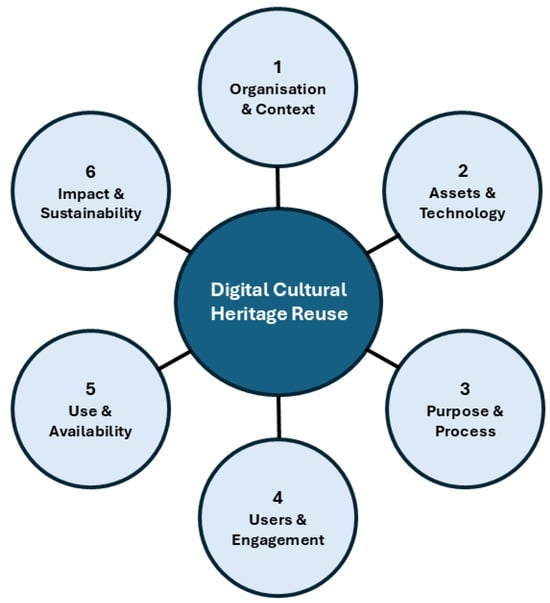
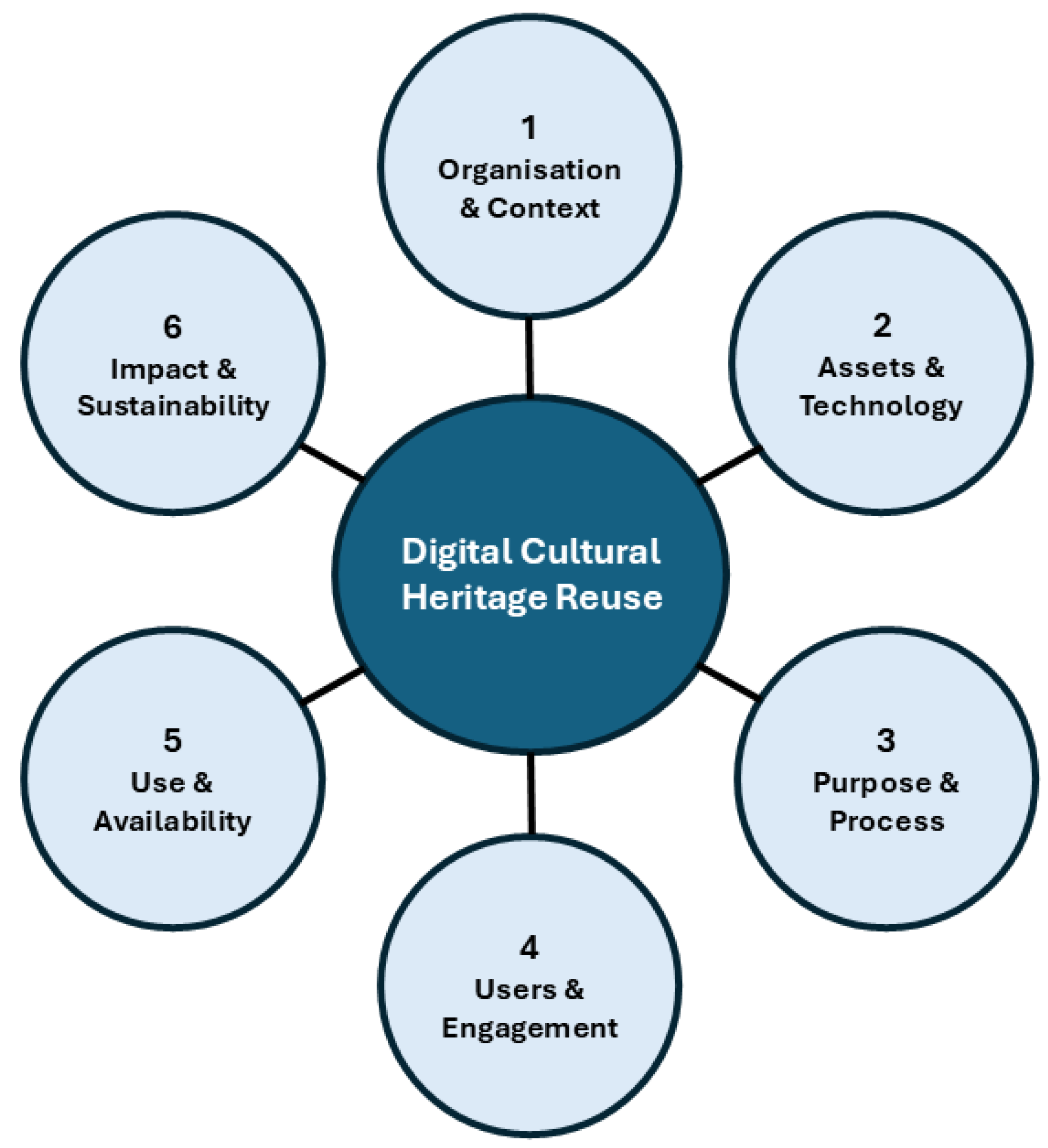

Disclaimer/Publisher’s Note: The statements, opinions and data contained in all publications are solely those of the individual author(s) and contributor(s) and not of MDPI and/or the editor(s). MDPI and/or the editor(s) disclaim responsibility for any injury to people or property resulting from any ideas, methods, instructions or products referred to in the content. |
© 2026 by the authors. Licensee MDPI, Basel, Switzerland. This article is an open access article distributed under the terms and conditions of the Creative Commons Attribution (CC BY) license.