


Abstract
Traditional Chinese paper cutting represents an important intangible cultural heritage. Can artificial intelligence (AI) reactivate the heritage in a new style? The aim of this study was to use AI to reactivate temple arts and paintings by converting them into the style of traditional Chinese paper cuttings. Thirty sets of old images taken 18 years ago and 10 images of ancient paintings from the National Palace Museum were restyled in Nano Banana (Pro)®. Related design elements included integrated isolated parts, visual depth, details, and solid and void alternation. Three-dimensional stone and wood sculptures were reconstructed using Rodin® or Meshy® and converted into AR models in Sketchfab®. From the generated 2D images and their 3D representations, a reactivated style of Chinese paper cutting was developed that can be interacted with in the AR smartphone platform or RP in the physical world. Approximately 370 images were regenerated, and 167 versions of models were reconstructed. AI should be considered part of culture. Rethinking traditional folk art highlights demand for the cross-reference and cross-reactivation of heterogeneous art forms. This AI model interprets novel 3D structural and visual details and creates a unique 2D and 3D identity for each subject.
1. Introduction
In traditional Chinese paper cutting, scissors are used to cut through folded red paper to create symmetric patterns of folk art. The whole piece of art is structured on one single layer with interconnected visual elements. The removed pieces of paper configure void strokes or edges of visually annotated subjects. The alternation of void edges and solid infills delivers a simple yet complicated context of culture.
This distinctive yet disappearing heritage should be reactivated in a broader media paradigm that embraces a new artificial intelligence (AI) ecology. Should the solid–void narratives be strictly followed, or can the initial void-based annotation be revised from a normal sketch process, and the solid and void composition later be switched with various levels of line weights reversed? Can the 2D form be transferred to 3D to facilitate a new situated interaction with a broader perspective of the environment instead of just attaching a layer of art to a flat panel with an opening like a window? The concept and execution of art should involve important subjects or types of cultural heritage to form a richer collaborative ecology.
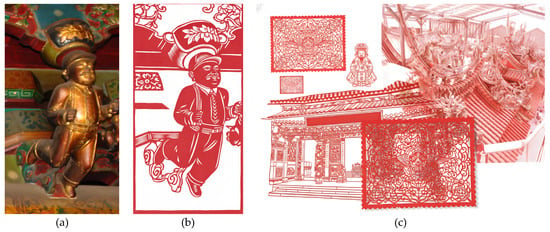
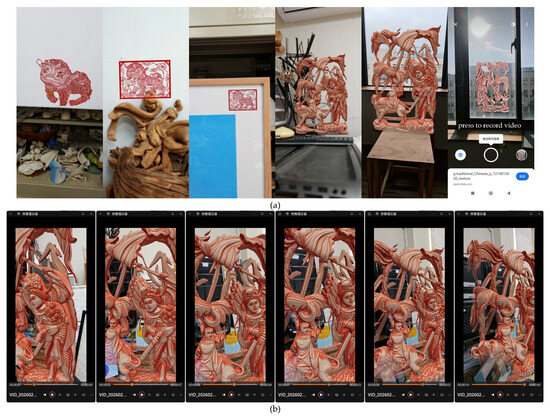
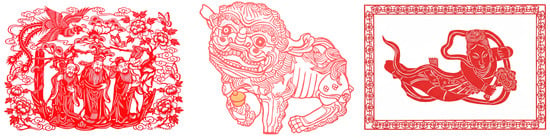
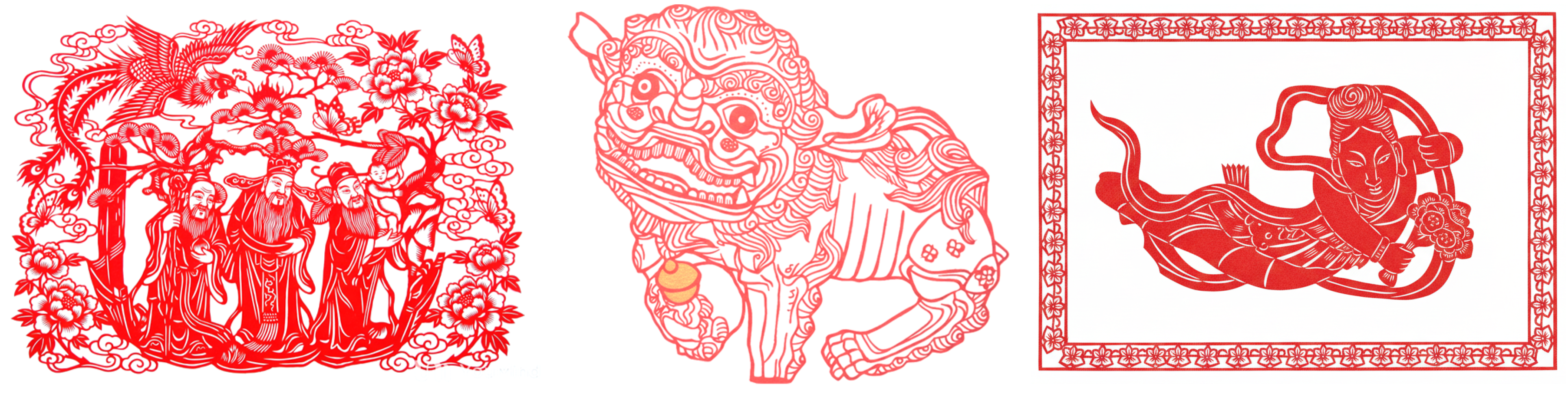
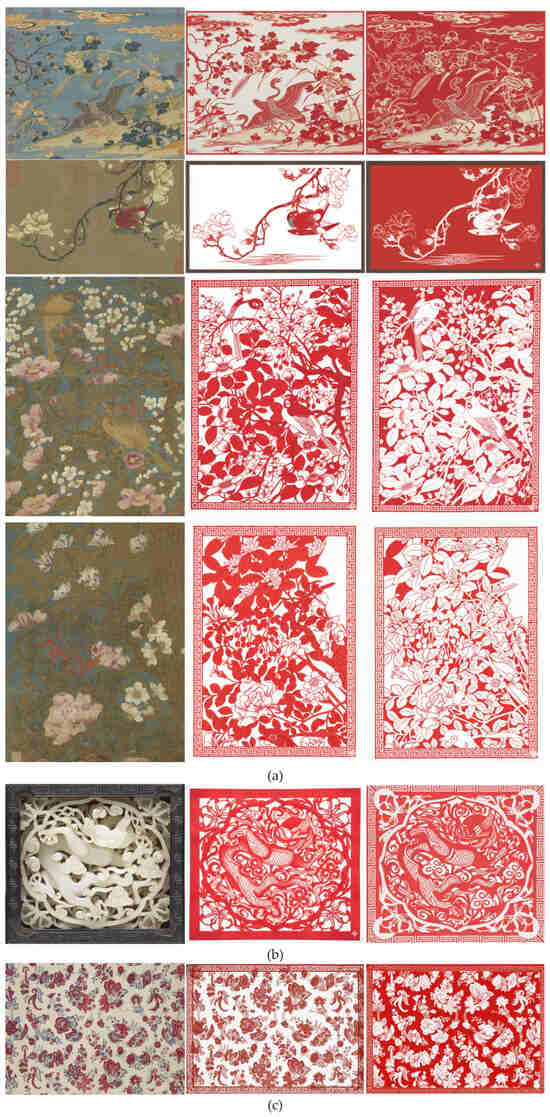
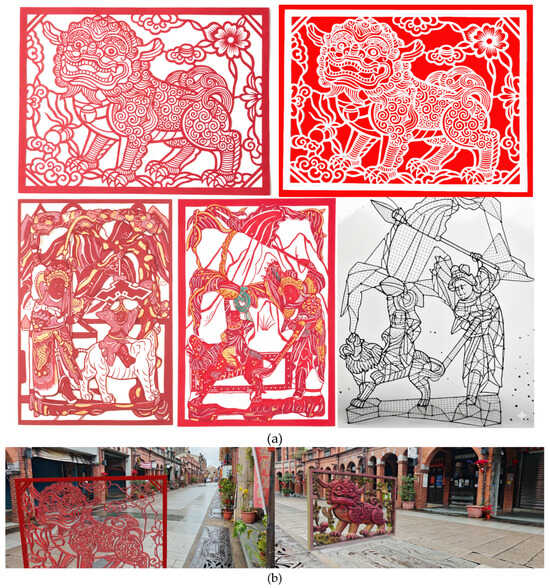
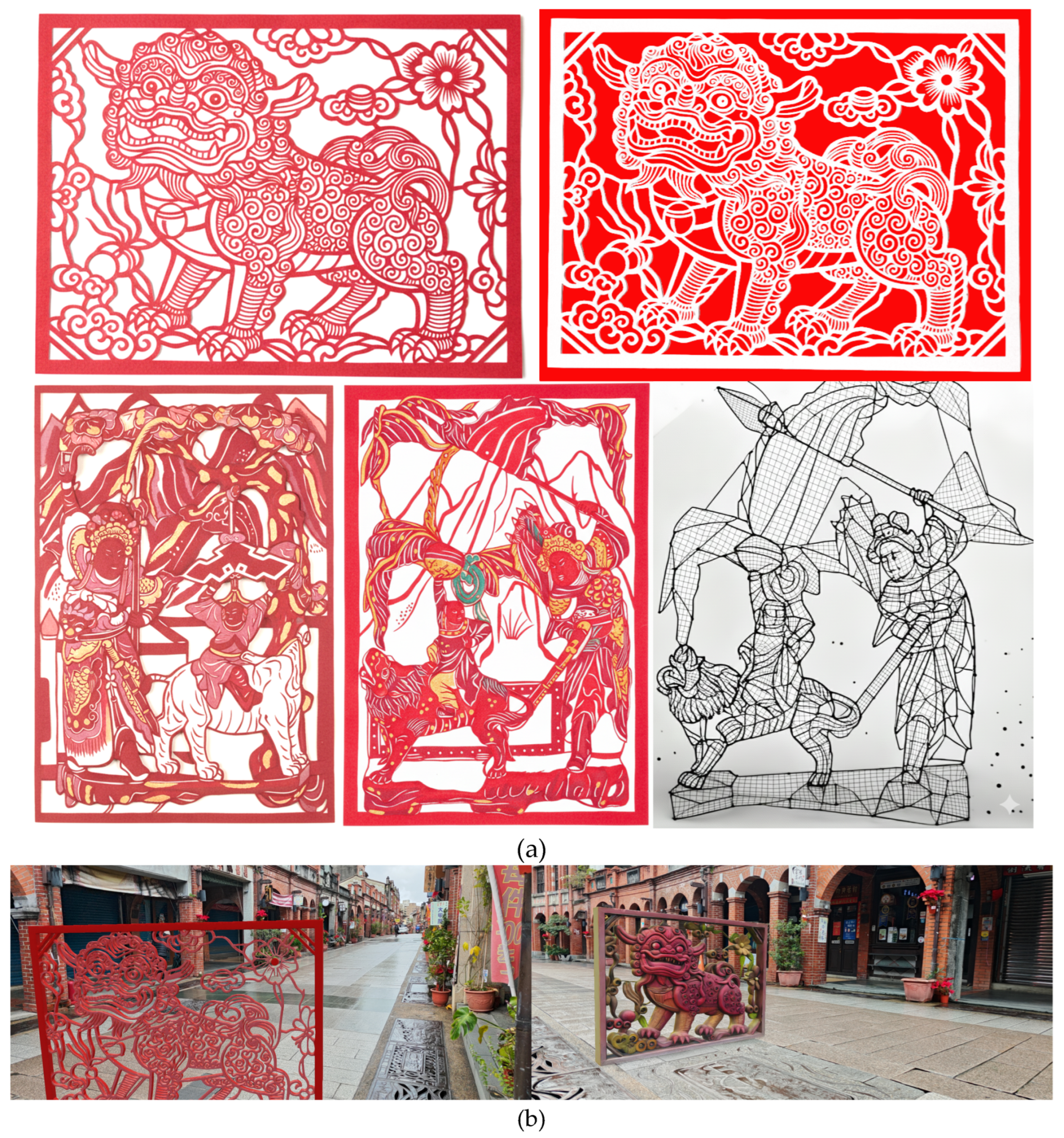
In terms of traditional Chinese paper cutting, AI, AR, and 3D models should be used to create a relationship between cultural heritage and new technology. This promising relationship should start with reconsidering traditional iconic images as media, reinterpreting them using AI (Figure 1), and adding new depth to a space through simple, smartphone-based interaction. Further dynamic dialogue with architectural components should come from the ubiquitous presentation of cloud-accessible AR models on smartphones to enable new situated interactions with the real physical environment.
Figure 1.
AI-generated paper cutting. (a) Source image; (b) transferred image; (c) other examples.
1.1. Research Goal
The Six Mazus have been worshiped in Gongfan Temple, Mailiao Township, Yunlin, Taiwan, since 1685. The temple was digitally preserved using 3D laser scanning technology in 2008 [1]. A number of images were taken for documentation purposes. How can these 18-year-old images help with renewed preservation efforts? Moreover, are these preservation efforts applicable to images of ancient paintings?
The aim of this study was to apply AI to reactivate temple arts and reinterpret sculptures by transforming them into the style of traditional Chinese paper cutting. The 3D stone and wood sculptures were reconstructed in two ways: 2D line-based images and 3D models. The former were AI-generated using relevant prompts in Nano Banana (Pro)® (Google LLC, Mountain View, CA, USA), while the latter were generated using Rodin® (Deemos Tech, Shanghai, China, Gen-2, v1.9) or Meshy® (Meshy LLC, Sunnyvale, CA, USA, v6). From the generated 2D images and their 3D representations, a new 3D style of Chinese paper cutting was developed that can be interacted with using AR smartphone platforms for cultural reactivation.
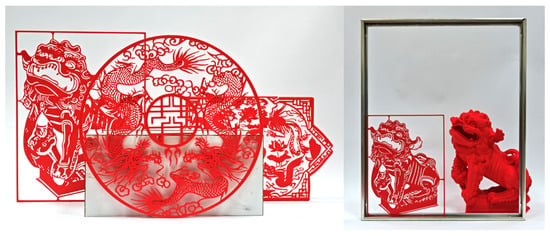
In order to promote new types of paper cutting, the aim of the research was to create heterogeneous heritage that preserves the connection between paper cutting and heritage subjects in three ways: extracting the structural and visual elements of sculptures from a temple; extracting the structural and visual elements of traditional Chinese artifacts, such as paintings, jade sculpture patterns, or fabrics from the National Palace Museum; and the propagation of 3D reconstruction and 3D AR deployment.
1.2. Related Studies
Studies on paper cutting have highlighted its significance in terms of style, frameworks, and specific applications. The visual narration of artworks serves as a medium for identity construction [2]. The development of folk art is of great significance to the promotion and inheritance of Chinese traditional culture [3,4]. Paper-cutting artworks reflect broader cultural and artistic transformations in contemporary China [2]. The art and practice of paper cutting have created a folk practice with the recovery of a lost Chinese civilization [5].
Chinese culture is repackaged through visual grammar and the visual narrative of paper cutting [6]. This unique style of art involves symmetrical structures and hollowed hierarchical patterns [7]. For example, previous studies have examined the production and development of Chinese ink deckle-edged paper cutting in animation [8], and a 3D model was annotated with the parameterized control of paper-cut pattern size, orientation, and shape in animation [9]. A study involving feature extraction for Hubei folk art presented a multi-dimensional perspective of carved paper cutting [10]. Knowledge organization methods have been proposed for the construction of an ontology model to achieve the systematization, standardization, and digitization of traditional Chinese paper cutting [11], and a metadata framework has been developed for paper cutting in the context of intangible cultural heritage (ICH) [12].
The emotions involved in paper-cutting folk art have also been incorporated into visual communication design [13]. In practice, the artistic expression of paper-cutting elements was applied to the design of wallpaper, cabins, and guest rooms within a boat’s interior [14]. By learning and practicing traditional Chinese paper cutting, workers with occupational injuries and diseases can be rehabilitated with vocational skills [15]. Home chemistry experiments have also been incorporated into coloring and paper cutting [16].
Algorithmic digital extraction and segmentation have been used to detect patterns in paper cutting, with AI-generated content being applied in paper-cut design using the low-rank adaptation (LoRA) model [17]. Generative adversarial networks have been utilized to generate paper-cut images [18], and stable diffusion LoRA models have also been used to develop paper cutting [19].
In artistic creativity and practice, AI imaging technologies induce both excitement and anxiety [20]. AI represents a fundamental shift in the creation process, moving to the use of datasets to compile and generate art compared to the use of personal experiences and emotional depth by human artists [21]. AI art is limited in its connection to reality, with some AI models generating surprising results [22]. The relationship between AI-generated art and human creativity can be complementary [21]. Many works of art can reflect how people and computational systems are intertwined [23]. During the creation process, machines may suggest new ways for us to see ourselves, as they can be taught to see like humans [23]. AI-assisted image analyses have been implemented in medical practice using volume data reconstruction [24]. AI should be embraced as an extension of our collective consciousness [25].
Most 2D artwork originated from 3D models in the real world. For reverse engineering, 3D reconstruction can be achieved using a single image of the human body [26] or face [27]. Surveys have shown that 3D Gaussian splatting (3DGS), which represents a paradigm shift in neural rendering, has the potential to become a mainstream method for the 3D representation of characters. It effectively transforms multi-view images into 3D Gaussian images in real time [28]. High-precision, real-time rendered reconstruction can be applied to cultural relics and buildings in large scenes [29] for the purpose of preserving the brick warehouse [30].
However, a single 2D image does not usually allow effective 3D reconstruction. Rodin® utilizes a generative model to sculpt 3D digital avatars using diffusion [31], with the 3D NeRF (neural radiance field) model presenting computational efficiency. Three-dimensional content generation has benefited from advanced neural representations and generative models [32], for instance, creating virtual painting characters [33] and historical temple art [34] using generative AI.
Digital preservation should evolve with a new perspective on ICH. Virtual reality (VR) technology has been applied to protect and disseminate the practice of Chinese paper cutting [35]. Reconstructed 3D character-related images should reactivate the tangible features of painting or sculpture by adapting characteristic details and composition through AI. AR should be used to provide more first-person-involved interactive experiences. In addition to promoting the distinctive identity of style, folk art should embrace an ICH framework with more advanced AI tools for more specific applications.
2. Materials and Methods
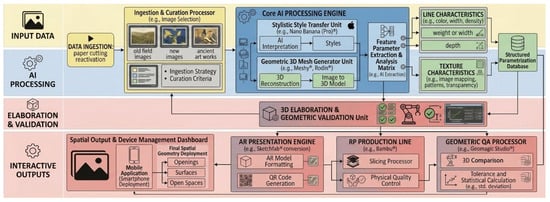
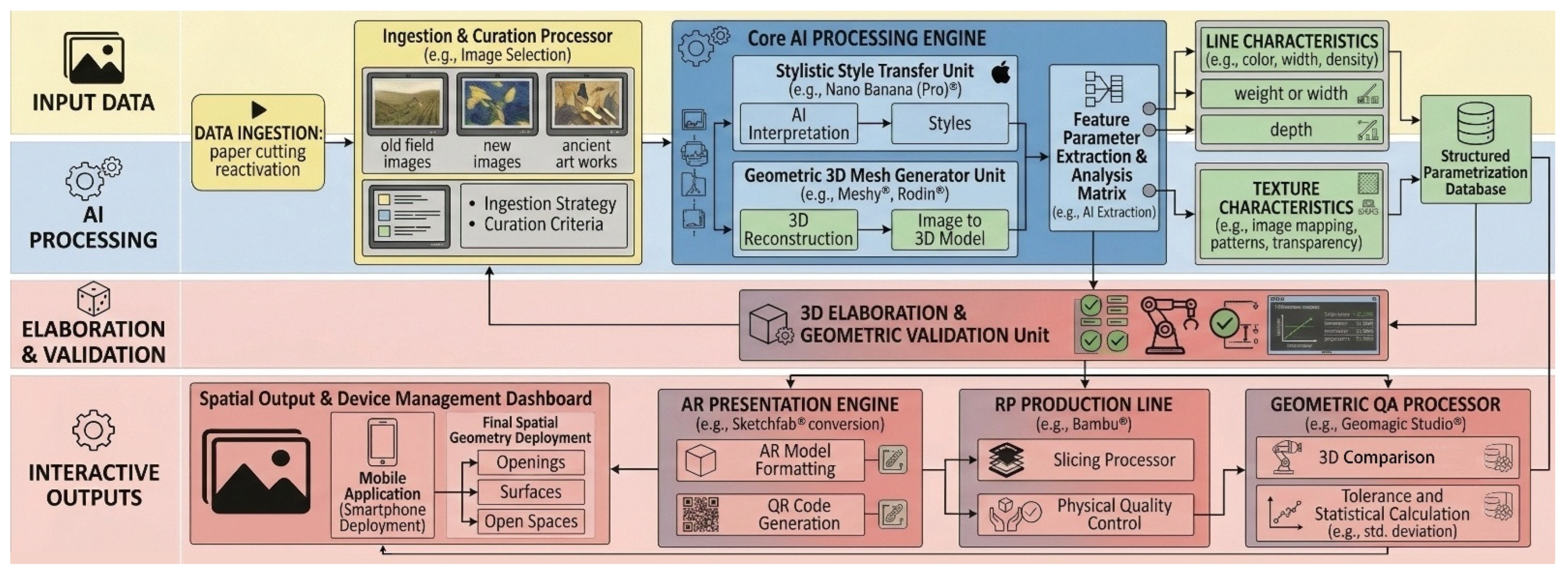
The aim of this study was to create paper-cutting art using 18-year-old heritage field images and ancient artwork via 3D modeling. In Figure 2, colored zones are used to highlight major processes, from data input (image selection), AI processing I (AI interpretation), and AI processing II (3D reconstruction) to interactive output (3D elaboration). The process starts with image preparation and moves on to the prompt- or option-based control of 3D model reconstruction for reactivation in AR and RP. These major processes involve applied resources, processed detailed elements, and AI-related tools. Descriptive prompts were tested to enable more regeneration potential for artistic images. Then, 3D graphics and AR models were reconstructed as supporting formats for the reactivation of art. Approximately 370 images were regenerated, and 167 versions of models were reconstructed.
Figure 2.
Flowchart of the paper-cutting reactivation system architecture.
2.1. Chained AI Generation from Image to 3D Model
A series of chained AI layers was applied, ranging from prompts, 2D image editing, new image regeneration, 3D model reconstruction, and 3D part differentiation to new media (Table 1). First, the 2D image was reconstructed to generate 3D models. Second, AI-generated images were manipulated into new media types, such as AR models by Sketchfab® (Epic Game, New York, NY, USA) or RP models by Bambu® (Shenzhen Tuozhu Technology Co., Ltd., Shenzhen, China, v02.05.00.66).
Table 1.
Chained AI-generated images and 3D models.
Paper cutting is a style with design characteristics that can be generated, interpreted, and elaborated using AI. Each image should be revised and recursively trained or reconstructed in order to purposely enrich or alternate vocabularies and composition. In this study, the old images were regenerated into 2D images or reconstructed into 3D models using the AI programs Gemini® 3.0 (Google LLC, Mountain View, CA, USA, v3.0) and Rodin®. The generated prompts were usually straightforward and feature-based.
In image-to-3D generation, the number of permitted views or images is between 1 and 4. The higher the image resolution, the better the details are under a maximum polygon count of 1,000,000 in the Rodin® program and 20,000,000 in Meshy®. AI or 3D reconstruction did not generate models with 100% resemblance since missing information regarding the back of a subject had to be created by referring to the configuration and texture of the front. Each model was repeatedly adjusted for a maximum of 20 redos in Rodin® and 8 redos in Meshy®. Each trial generated a 3D model similar to the provided image, with a slight difference in the outline, allocation of parts, or size of the body. Then, the one with the best resemblance was selected.
2.2. Prompts
The prompts were arranged according to specific narratives and sequences. Vocabulary included verbs, such as convert, reverse, swap, generate, change, enlarge, or combine; nouns, such as red color, Chinese paper-cutting art, background, 3D wires, frame, calligraphic stroke, width, and number of times; and adjectives, such as hollow, cut-through, see-through, colors, or in rectified orientation.
The combinations of prompts are listed below.
- Generate from 3D images
- “Convert this image into a see-through Chinese paper cutting art using a piece of red paper, all image in red color only, with a frame, remove the three stamps.”
- “Convert edges of this 3D jade to white lines in thicker weights on a red paper like Chinese paper-cutting.”
- “Convert this image into a see-through Chinese paper-cutting art using a piece of red paper.”
- Regenerate images
- “Convert it to a line drawing, change all lines to red color, switch the color of foreground line drawing and the background, expand all the line width three times.”
- “Reverse the red and white areas into Chinese paper-cutting style.”
- “Enlarge the width of all the white lines five times.”
From a 3D sculpture to a 2D wireframe-like paper-cutting pattern, the emphasis shifts in terms of context, main subjects, depth, molding, line weights, frame, foreground and background, and the alternation between adjacent void and solid infill areas. The main set of subjects may have solid infill areas surrounded by void areas to stand out from the peripheral areas.
The applied prompts include phrases with or without a specific definition of the subject, like “stone sculpture” or just “this image”. Multiple variations should be continuously requested from the AI, while the compromise between visual and structural details should be considered. For example, prompts for AI generation vary, from typical images like “red paper” to refined descriptions, such as “without frame and background”, “rectified orientation”, or “calligraphic strokes”. Sophisticated generation involves the combination of more than one image (two, in this case) from the same subject to enhance detail.
2.3. Abstract Forms of Tangible Heritage
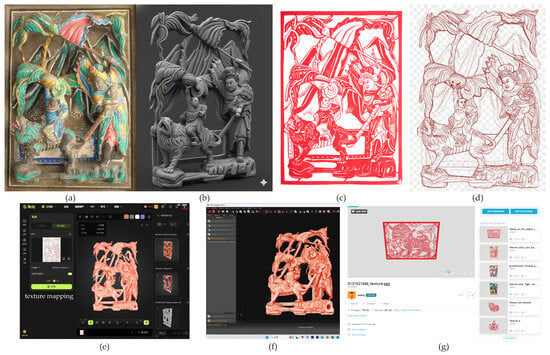
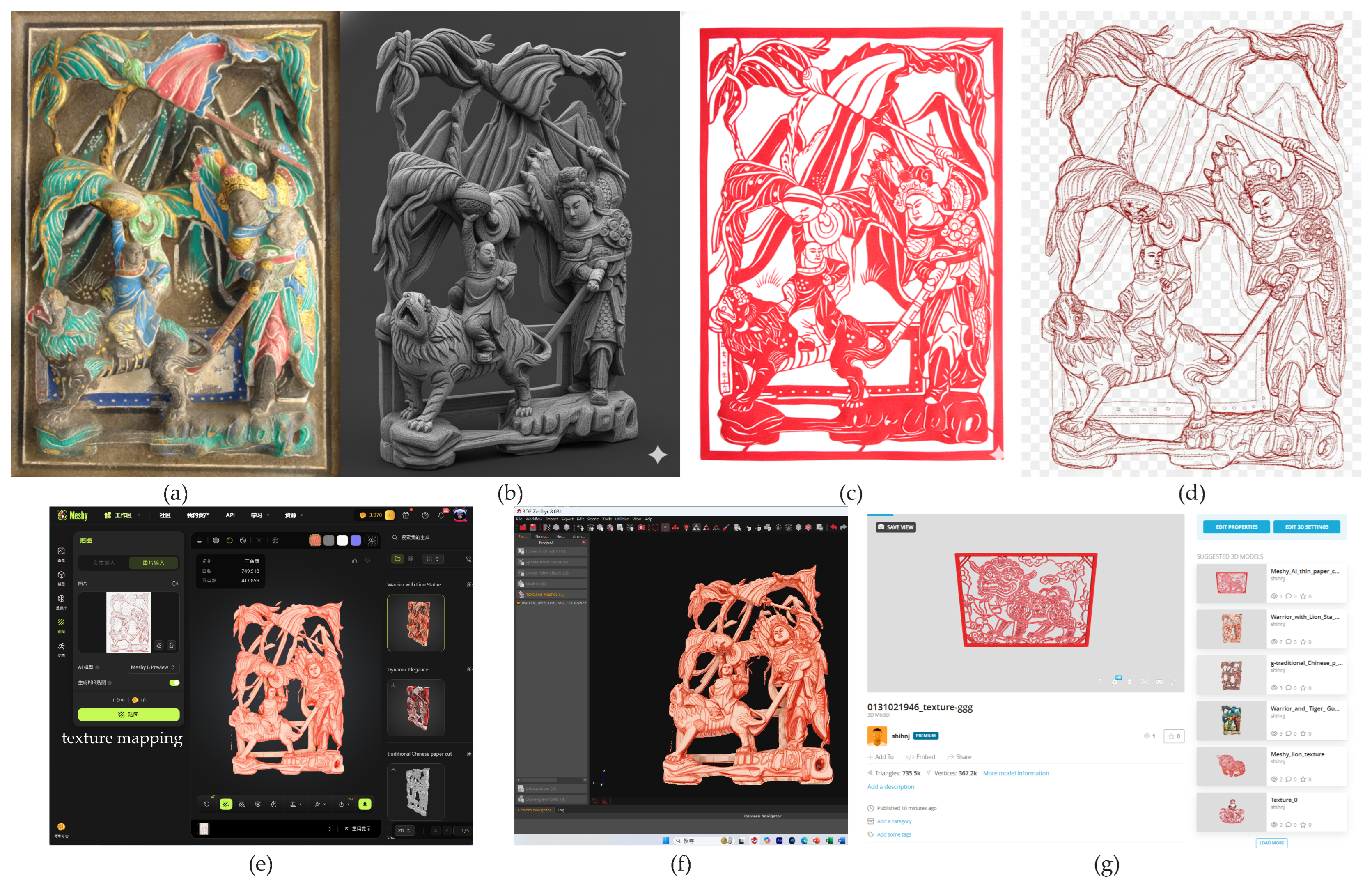
This AI interpretation was used to restyle 30 sets of old images taken 18 years ago in a series of styles and formats (Figure 3a). In total, about 1500 field images were taken using Sony® (Sony Group Corp., Tokyo, Japan) DSC-R1 (3888 × 2592 pixels, 24 bit, and 72 dpi resolution) or Panasonic® (Panasonic Holdings Corp., Osaka, Japan) DMC-FX100 (4000 × 3000 pixels, 24 bit, and 72 dpi resolution).
Figure 3.
Converting process. (a) Original image; (b) creating the 3D-like abstract form from 2D images; (c) converting images to a traditional 2D- or 3D-like paper-cutting planar form; (d) converting images to a 2D paper-cutting line form; (e) creating 3D models of the images; (f) verifying the 3D models in other 3D programs; (g) generating AR models for field deployment.
This AI interpretation comprised three aspects: (1) converting images to traditional 2D- or 3D-like planar paper-cutting form in Gemini® or Google Nano Banana (Pro)® (Figure 3b–d); (2) creating 3D models of the images using Rodin® or Meshy® (Figure 3e,f) as a more elaborate interpretation of the structural details; and (3) generating AR models using Sketchfab® (Epic Game, New York, NY, USA) for field deployment (Figure 3g). It is important to visualize the lines under different weights and widths (Figure 3d), obtaining visual depth from the picture of the original 3D sculpture.
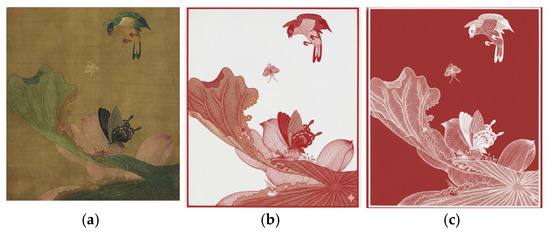
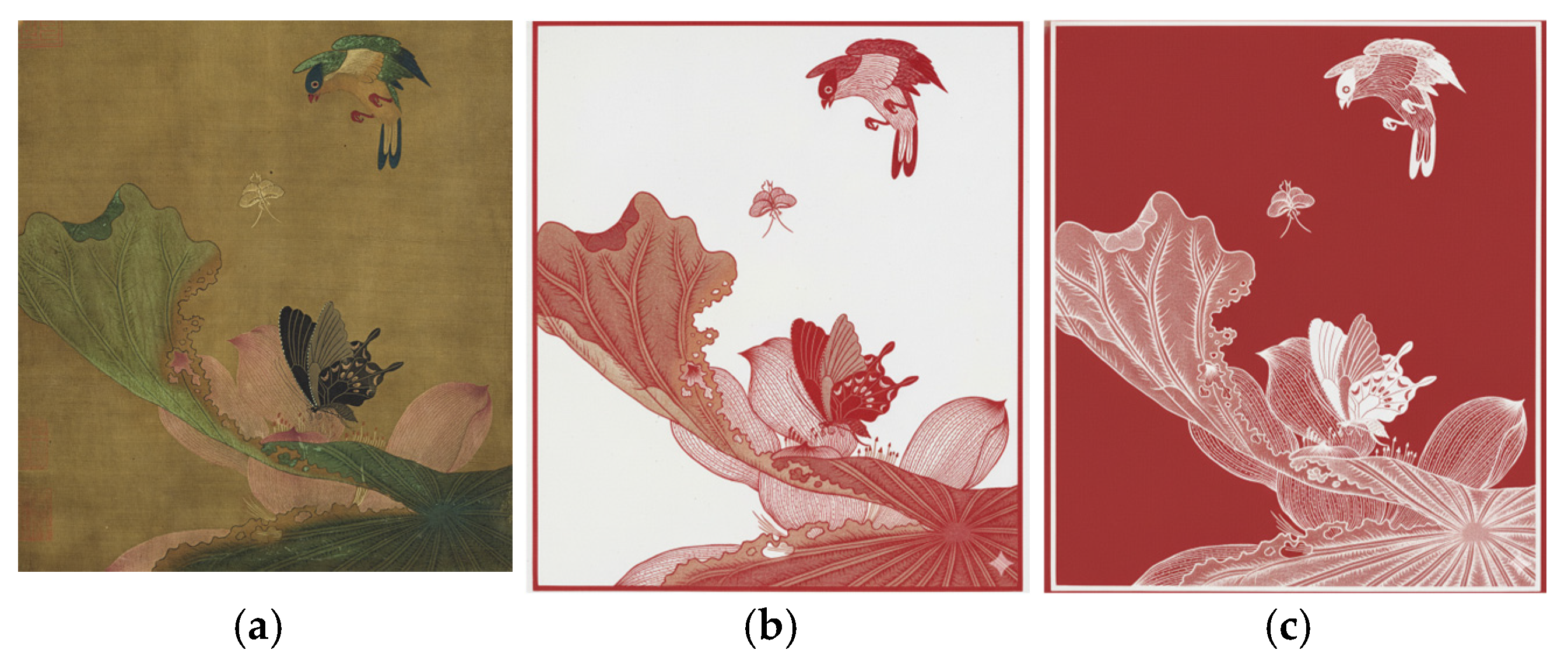
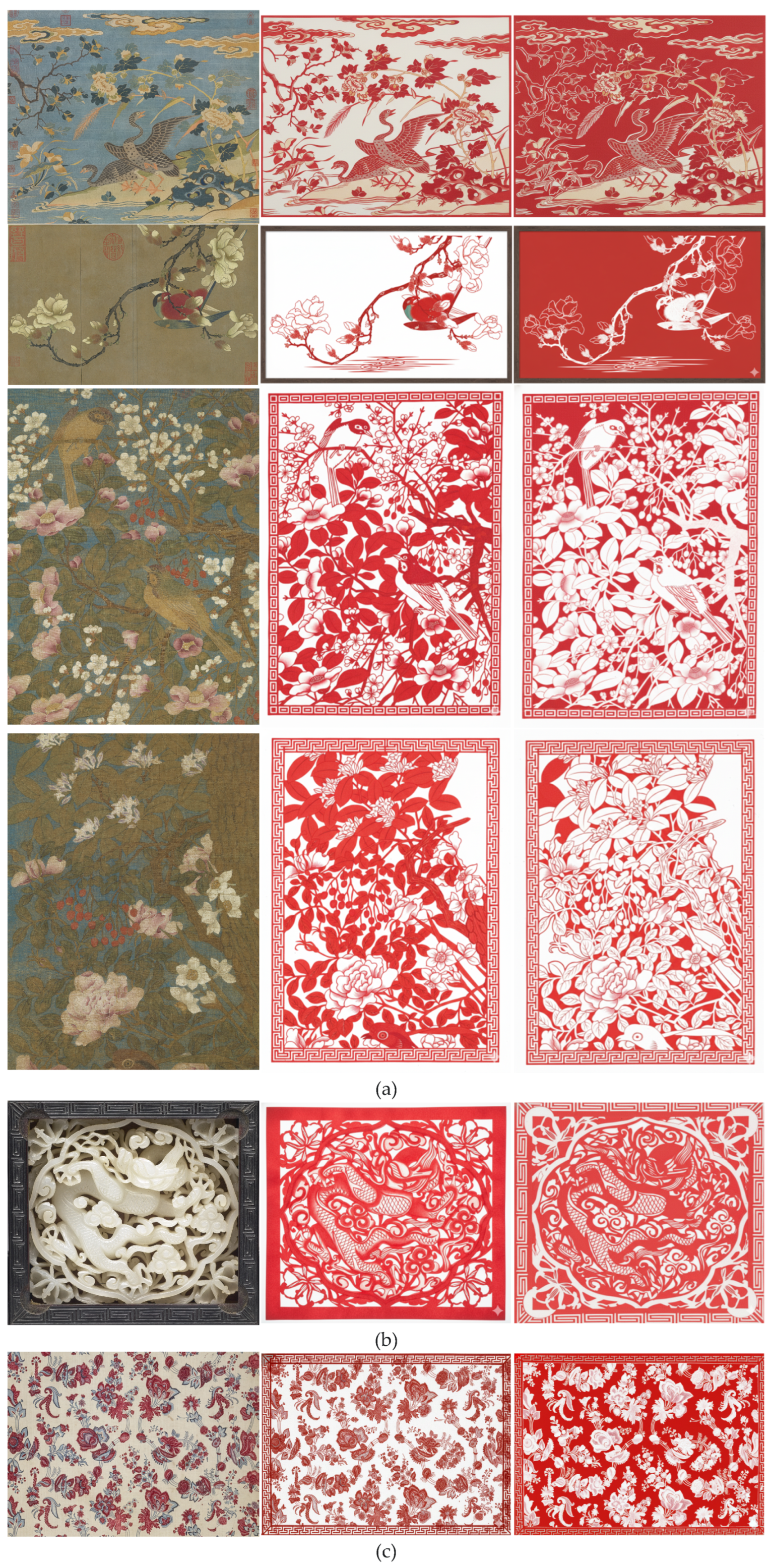
Ten images from the National Palace Museum were also reinterpreted with novel 3D structural and visual details (Figure 4). A painting was framed and AI-trained at least twice, with the first prompt attempting to convert the subject to a red-colored cutting pattern and the second attempting to reverse the order of the solid and void infill regions. The solid and void switch is very helpful, not only to highlight the minuscule strokes in a meticulous brush painting but also to enable the inspection of brush strokes in a traditional cut-through etching pattern.
Figure 4.
Ancient painting [36]. (a) Part of the original work; (b) the first AI-generated result in red with the first prompt attempt: “convert this image into a see-through Chinese paper-cutting art using a piece of red paper only with frame, all image only in red color with a frame, remove all the stamps”; (c) the second AI-generated result with colors in reverse, with the second prompt attempt: “convert it to a red line drawing, switch the color of foreground line drawing and the background, expand all the line width three times.”
2.4. AR Tests and Verification
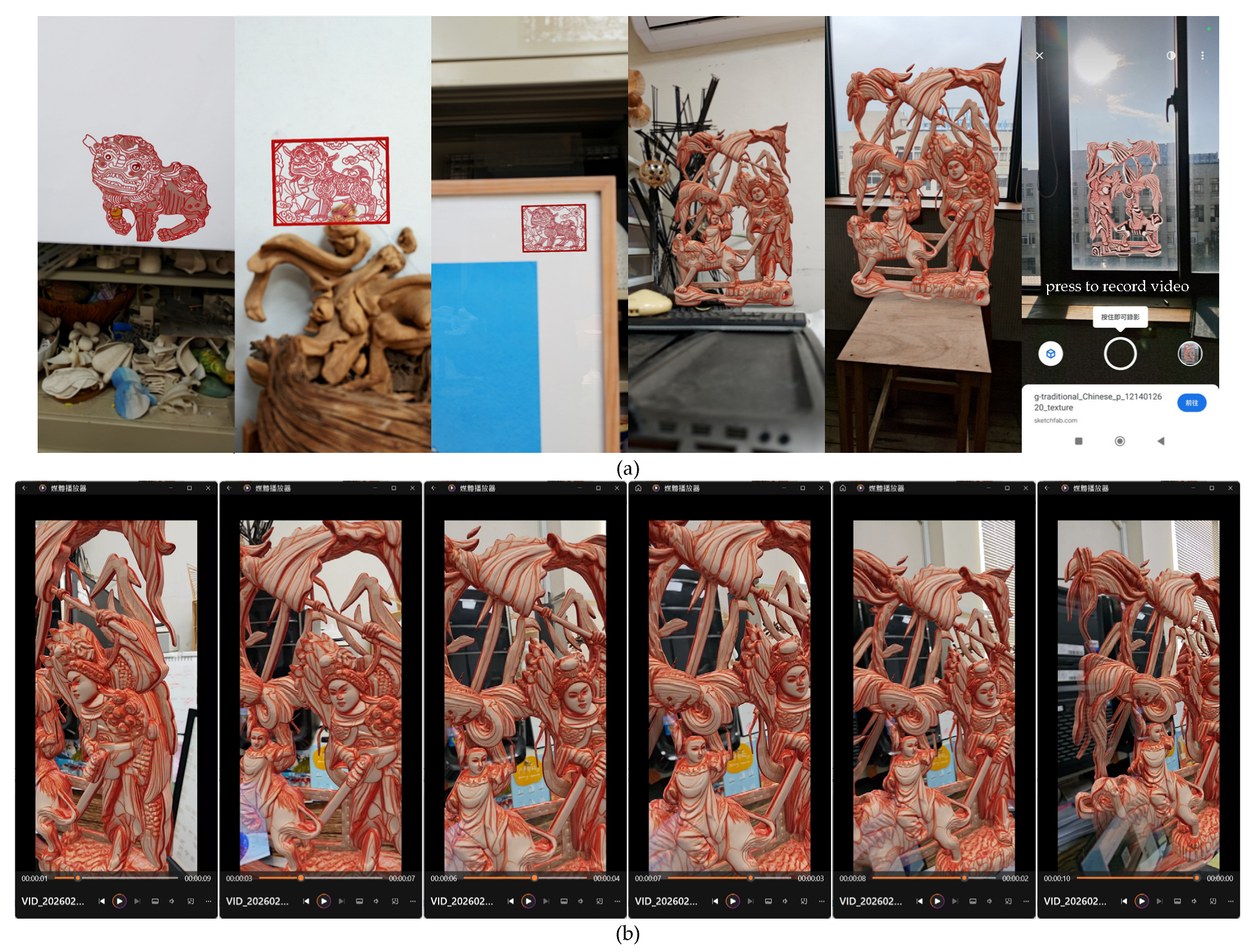
AR tests were carried out indoors initially to verify the feasibility of deployment. The tests verified the possibility of rescaling 2D and 3D see-through patterns on a plain background (Figure 5a) or viewing from different angles of the 3D see-through model, as shown in different frames of a video recorded on a smartphone against a complicated background (Figure 5b).
Figure 5.
AR deployment test and verification. (a) 2D and 3D see-through patterns against various backgrounds; (b) 3D see-through model recorded in a video clip filmed from different angles.
The virtual AR deployment must go through several steps: (a) use a smartphone to scan the QR code and download the corresponding 3D AR model; (b) point the smartphone to a flat surface like a tabletop or the ground to define the working plane; (c) use fingers to relocate, rotate, or resize the model as wanted; and (d) take screenshots or videos of the AR model.
2.5. Field Propagation of 3D AR Deployment
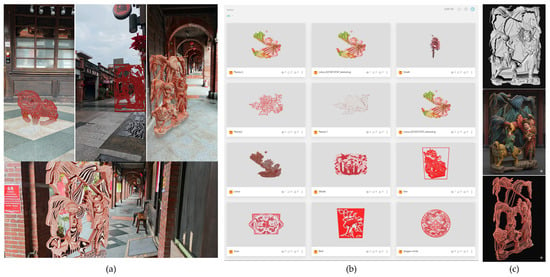
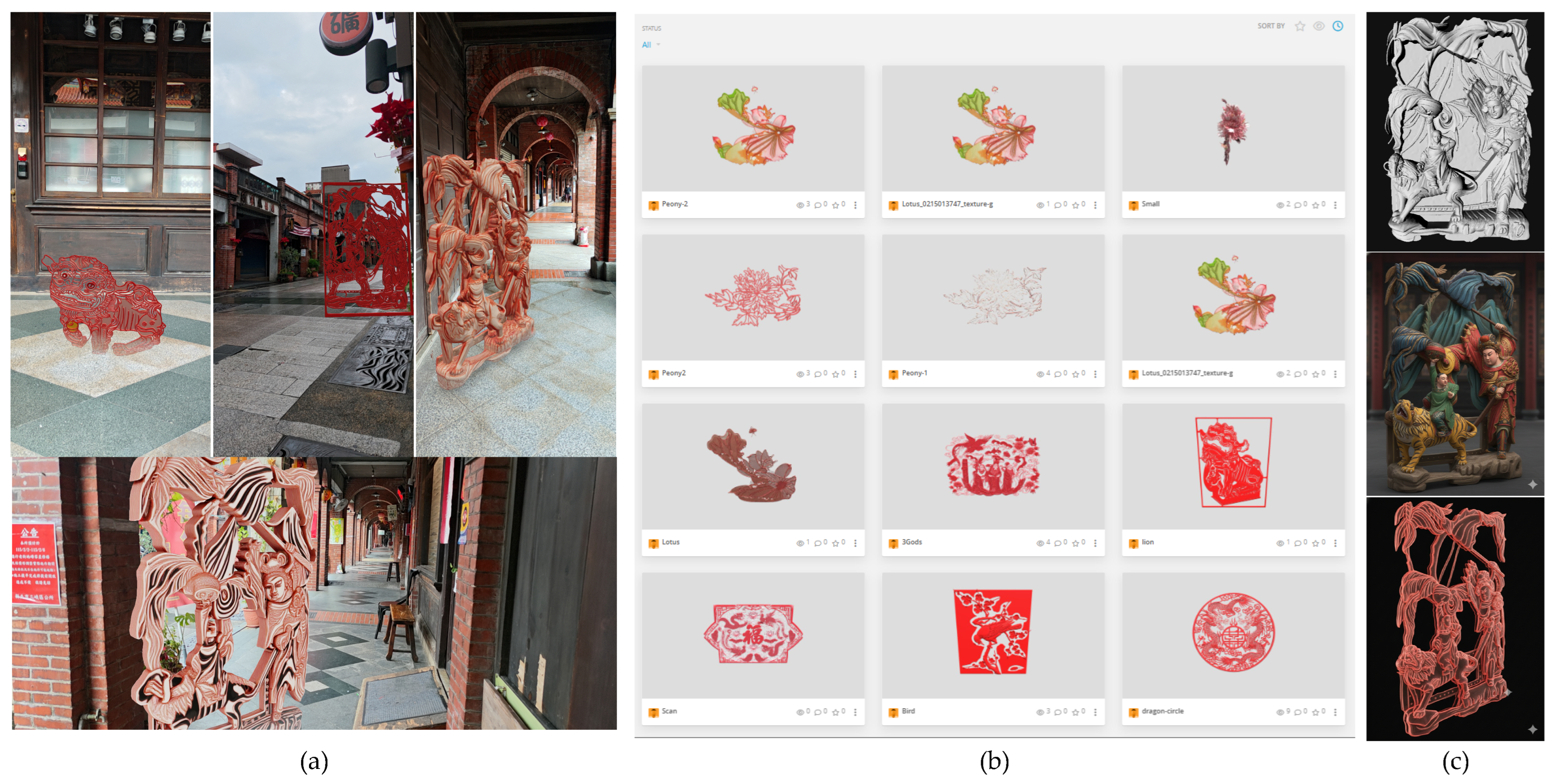
The deployments of the 3D AR paper-cutting art were applied (Figure 6a). The propagation exemplifies 3D sculptures with additional AR formats, supporting smartphone field interaction with cloud accessibility (Figure 6b). This may be applied by either following a traditional opening setup, like on a window, or freestanding as an installation on a stage or within an open space. A freestanding installation would present the traditional element with a modern artistic setup more easily.
Figure 6.
(a) Various outdoor deployments of AR paper-cutting subjects; (b) AR models in the cloud; (c) regenerated 2D images of 3D models.
The original 3D forms were transferred into styles with different structural and visual details, such as a plain model, cartoon style, or 3D wireframe with semi-transparent infill (Figure 6c). This reactivates intangible tradition by carrying the tangible visual forms of traditional heritage in a smartphone. The traditional opening-based deployment can now be extended to a broader perspective by considering it as an installation for various situations.
3. Results
The original 3D forms were transferred into different versions: 2D with various styles or texture patterns; solid or void infills with linear edges; featured foreground with void background; with or without frames; AR format; and RP outputs. The approximate numbers of photographs and artworks are summarized in Table 2.
Table 2.
Number of source images and regenerated outcomes.
3.1. Regenerated 2D Images from 3D Sculpture
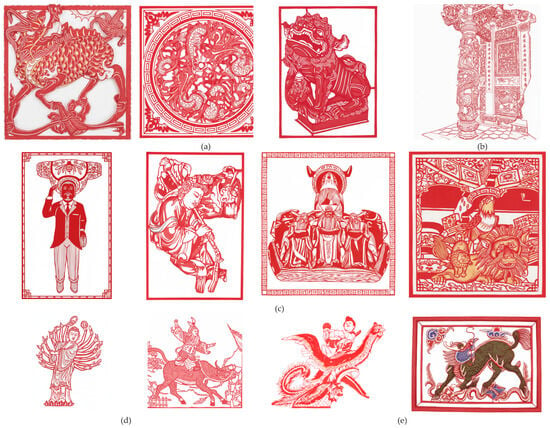
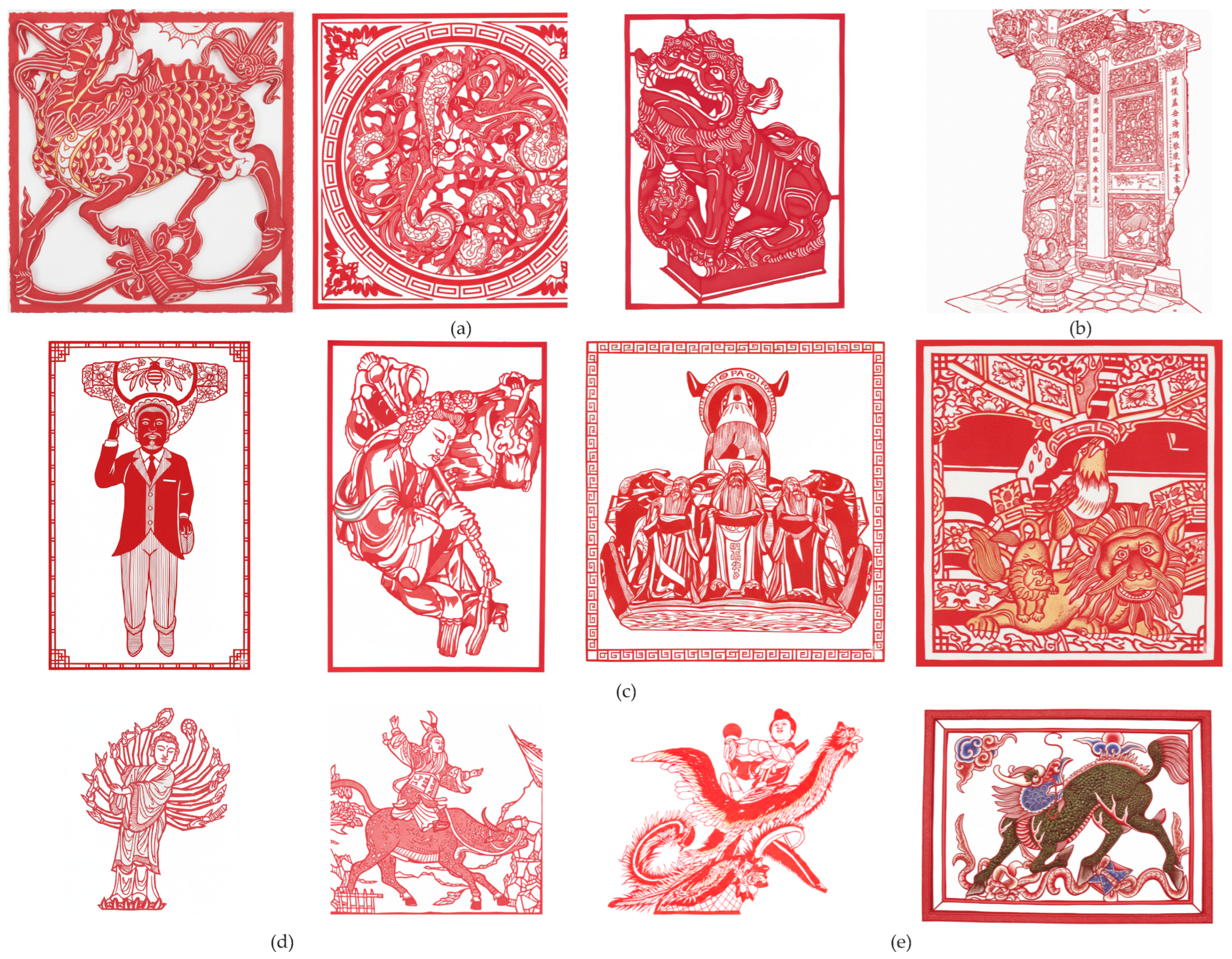
Three-dimensional sculptures made of stone, wood, or clay and cut-and-paste ceramic art were reinterpreted as paper cuttings (Figure 7). Paper cuttings can be purposely generated without a frame as an independent installation suitable for situated deployment, in addition to being aligned with the existing configuration of an opening. Depending on the distance, the connection between the subject and frame was made by joints located at the closest part to the vertical or horizontal frame.
Figure 7.
Reinterpreted paper-cutting examples. (a) Stone sculpture; (b) column at entrance; (c) wood sculpture; (d) clay sculpture; (e) cut-and-paste ceramic art.
3.2. Interpretation of Infill and Line Patterns
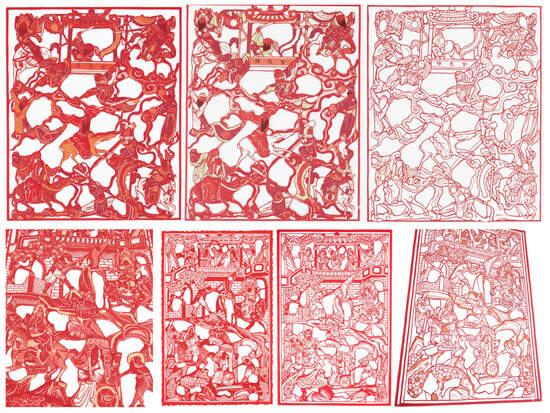
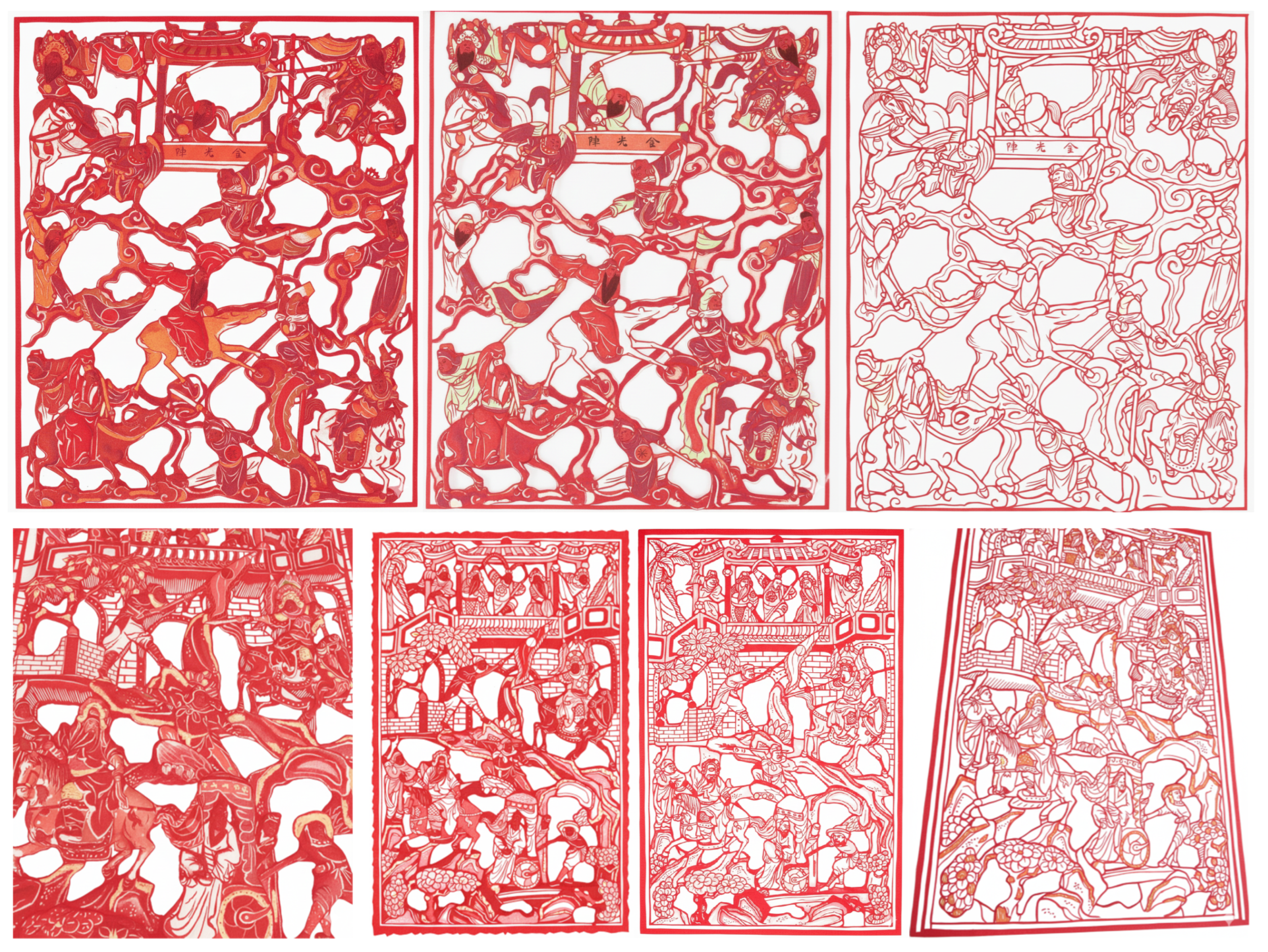
The original 3D forms were transferred into 2D planar form with various versions of patterns, such as solid infills with linear edges, void infills, or a featured foreground with a void background (Figure 8). The propagation also exemplifies 3D sculptures with additional decorative patterns in different line densities (Figure 9).
Figure 8.
Reinterpreted 2D patterns of sculptures from two legendary stories.
Figure 9.
Reinterpreted 2D patterns in different line densities, with or without frames.
3.3. Reinterpretation of Ancient Artworks
The collaboration between heterogeneous subjects was also extended to ancient Chinese and foreign artworks from the National Palace Museum for their distinguishing visual and structural details. The artworks, which were preserved under CC 4.0, include traditional Chinese paintings, jade sculptures, and fabrics.
The artworks were transformed into different versions of paper-cutting styles in a series of steps (Figure 10), including the prompt “convert this image into a see-through Chinese paper cutting art using a piece of red paper only with frame, all image in red color only, with a frame, remove the three stamps, convert it to a line drawing, change all lines to red color, switch the color of foreground and the background, expand all the line width three times.”
Figure 10.
Reinterpreted and reconstructed artworks. (a) Ancient Chinese painting [37,38,39]; (b) jade sculpture [40]; (c) fabric [41].
Most of the artworks faded to a certain level, and their fine textures were not clearly displayed initially. With the assistance of Nano Banana (Pro)®, textures were filtered with exquisite line patterns before being converted to the paper-cutting style.
3.4. RP-Assisted Paper Cutting
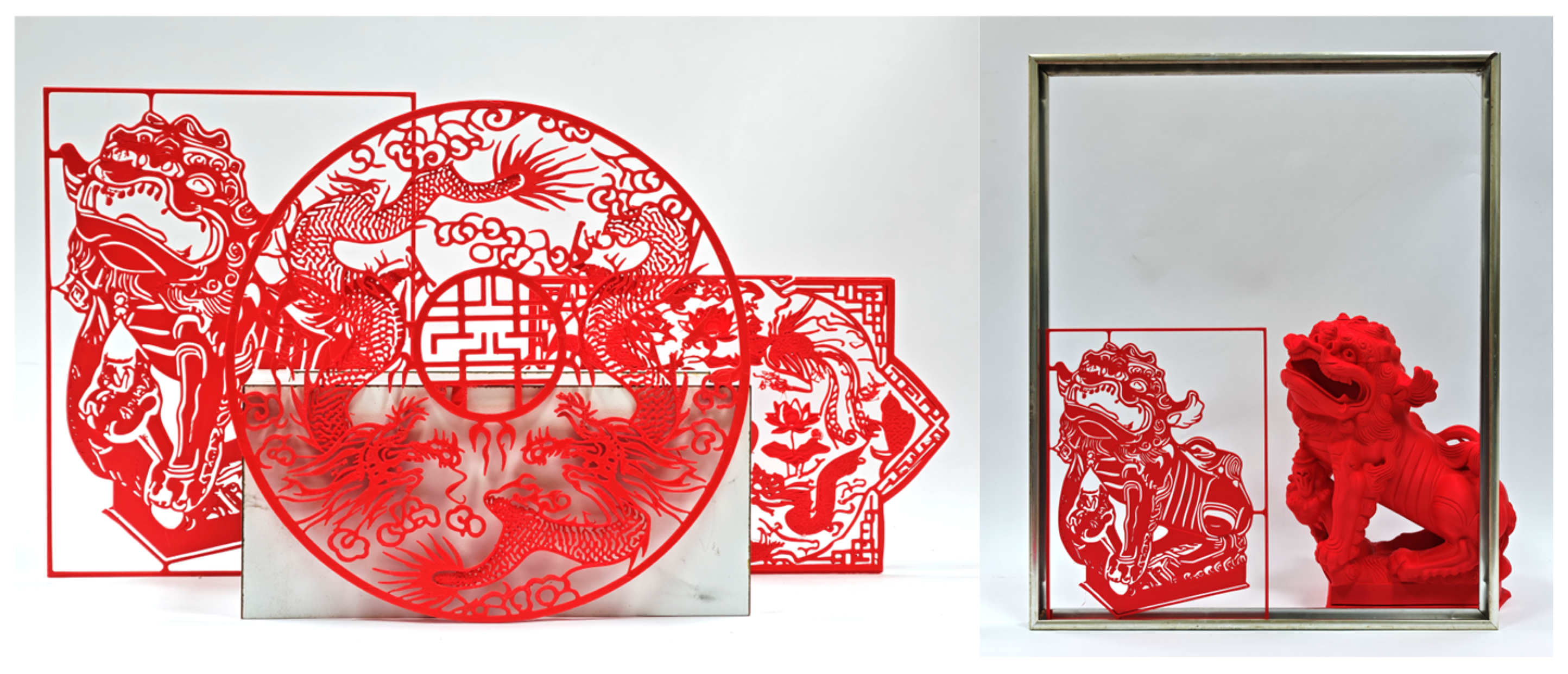
The ability of the RP tool used in the current study to print paper cuttings has been proven feasible (Figure 11). Prints measuring 25 cm (maximum width, length, or height) have also been used as freestanding installations.
Figure 11.
3D RP prints of paper-cutting installations.
3.5. Promotion in Today’s Social Ecology
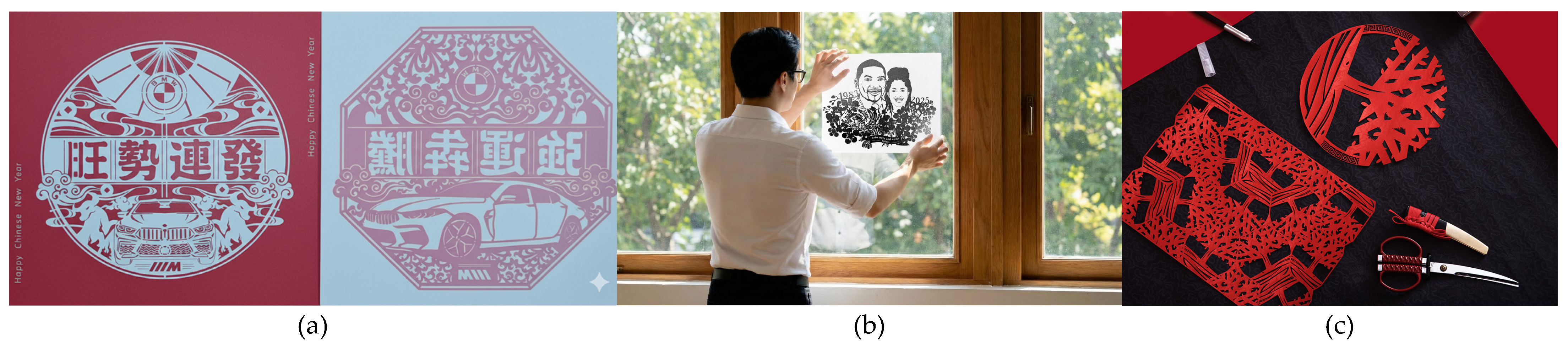
How paper cutting will adapt to the current business model of cultural creation remains to be seen, but examples include promoting the corporate image of an automobile company (Figure 12a), a gift for foreign diplomats (Figure 12b), and personal statements of art (Figure 12c).
Figure 12.
New uses for paper cutting. (a) Business identity; (b) gift for foreign diplomats; (c) personal statements of art.
The original 3D forms were transformed into paper-cutting styles for specific occasions, not just for the traditional celebration of the lunar new year. The results demonstrate new types of paper cutting within today’s social ecology.
4. Discussion
The aim of this study was to transform the elements of 3D sculptures into 2D paper cuttings. The smooth curvature and molding on sculptures usually differ from the lines annotated in traditional 2D paper cutting. With the assistance of AI for image enhancement, feature-revised images were converted into a thickened 3D paper-cutting installation with the help of an AI-assisted 3D regeneration program. This achievement proves that this approach is able to take advantage of all kinds of 3D heritage-associated items and images as resources, thus increasing preservation by digitally reactivating intangible heritage through displaying and interacting with available tangible forms.
The integration of digital and traditional methods may include digital cultural mediation in public environments to make them more enjoyable [42]. In contrast to just a thin piece of red paper, the regenerated images are transformed into 3D paper-cutting models for AR interaction and assessment or RP verification. The images originally converted from 3D models or paintings were reconstructed as different versions of 3D models again, and their differences were quantitatively assessed.
4.1. Design Elements
The digital exploration of the original materials and the context in which they were used highlights the skills associated with how traditional art was made. For example, a stone or wood sculpture can be converted to line drawings, and in the process, many details along the smooth and free-formed body are revealed. After conversion, the figure–ground relationships are used to switch the solid and void parts of the paper-cut figures. Most importantly, AI can be used to enhance linear elements; for example, during the conversion process, it can align the outcome with traditional manual carving or scissoring skills by incorporating adjustable widths along curves to demonstrate different skill levels.
The design elements, including an updated scale of integrity, visualization, and design languages, are described below.
- Integrity of isolated parts: Traditional paper cutting involves the use of a single piece of paper with no isolated or unattached parts. AI-generated cutting arranges the links between the subject and the four edges of the frame automatically. Prompts can be used to add decorative patterns to what would traditionally be solid red frame edges. A new setup holds all pieces on a transparent layer by attaching isolated parts to fixed locations. The same idea of integrity is also applied to the AR model.
- Visual depth: Image-based transformation generates more diversified cutting patterns than vector drawing, as it interprets images based on the richer layers of depth described in 3D models. Although most of the molding initially came from the original image, minor distortions in perspective create more variations than orthogonal projections. By converging at distant vanishing points, an illusion of 3D depth is created on a 2D surface. This minor differentiation makes the whole structure of the context more attractive.
- Visualization of details: The paper-cutting transfer process enables painting details to be more clearly illustrated; originally, these were so blurred that Nano Banana® was used to clarify lines and to differentiate parts or depth on a 2D painting.
- Similar design languages: The same decorative method is also applicable to window partitions in wood panels. The alternation of solid and void emphasizes the main context on the front or the see-through scenes behind the panel.
4.2. Solid and Void Alternations
AI helps to facilitate solid and void alternations. All of the elements are complementary both in creation and during AI regeneration. Rather than the cutting of real red paper, the AI-retained approach explores traditional rules, old heritage field images, and ancient artworks. AI can be used to regenerate, enrich, or analyze the representation of structural and visual details or decorations in folk art. Although the color red is a traditional symbolic icon, traditional paper cutting involves more than just color. The cut-through lines add another dimension of depth emerging from the background. The solid and void alternations enable the inspection of a space, not just regions of white color.
According to the discussion of lines in the literature review, solid and void alternations have inspired creativity in terms of line and area patterns (Figure 13). This leads to a reconsideration of the styles and vocabularies defined by the following categories.
Figure 13.
The effect of solid and void alternations in (a) lines and infills; (b) field AR deployment.
- Line weights and highlights of the subject: The alternation between solid and void highlights the main figure relative to the other parts of the piece. The line patterns vary from consistent widths to multiple levels of weight. The latter differentiates and highlights the silhouette of foreground subjects and the grouped patterns of specific infill textures. Line weights are also very important in architectural drawing, in which thick lines usually highlight object boundaries and visually bring the object to the front. A uniform light weight usually leads to a plainer depth of context.
- Intermediate tone and the additional deployment of color infill: AI generates an intermediate tone of color, which might not occur in traditional paper cutting, as the majority are uniformly red in color, with interlaced edges between the red and void regions in a dogtooth pattern. Additional color was filled between lines to highlight or differentiate between the main subjects. Colors enrich the context and add depth to the original design.
- Connection between frame and main subject: Regenerated images connect to the frame at 2–4 locations vertically or horizontally. Void spaces are left in between to enhance the main subject. The frame presents a newly developed domain in reactivating intangible experience. Similar to the composition of a painting, the design or generation of a frame represents the boundary or edges of the red paper. The frame may overlap the original graphic pattern. An image without a frame represents a diversified interaction experience, for example, in AR deployment in a real scene.
- General control of graphics: Compared to the algorithmic approach discussed in the literature review, providing prompts in Nana Banana (Pro)® allows the author to focus on features in general instead of functions and variables for each dedicated curve.
4.3. Line Weights and Highlights of the Subject
Line weights are a very important architectural drawing representation, in which thick lines usually highlight object boundaries and visually bring the object to the front. Uniform light weight usually leads to a plainer visual depth of the context.
The architecture-based or architecture-oriented approach is very helpful in articulating or enriching the visual context in 2D. The experience is associated with (1) the symbolic representation of drawings at the construction documentation delivery level and (2) the articulated spatial representation of plans, elevations, or sections in 2D. Flat and traditional paper cutting, which is more likely a symbolic representation, is different from the result generated by retrieving geometric features after being projected or filmed from 3D space to a 2D image, like a photo.
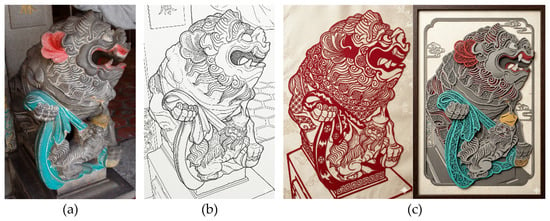
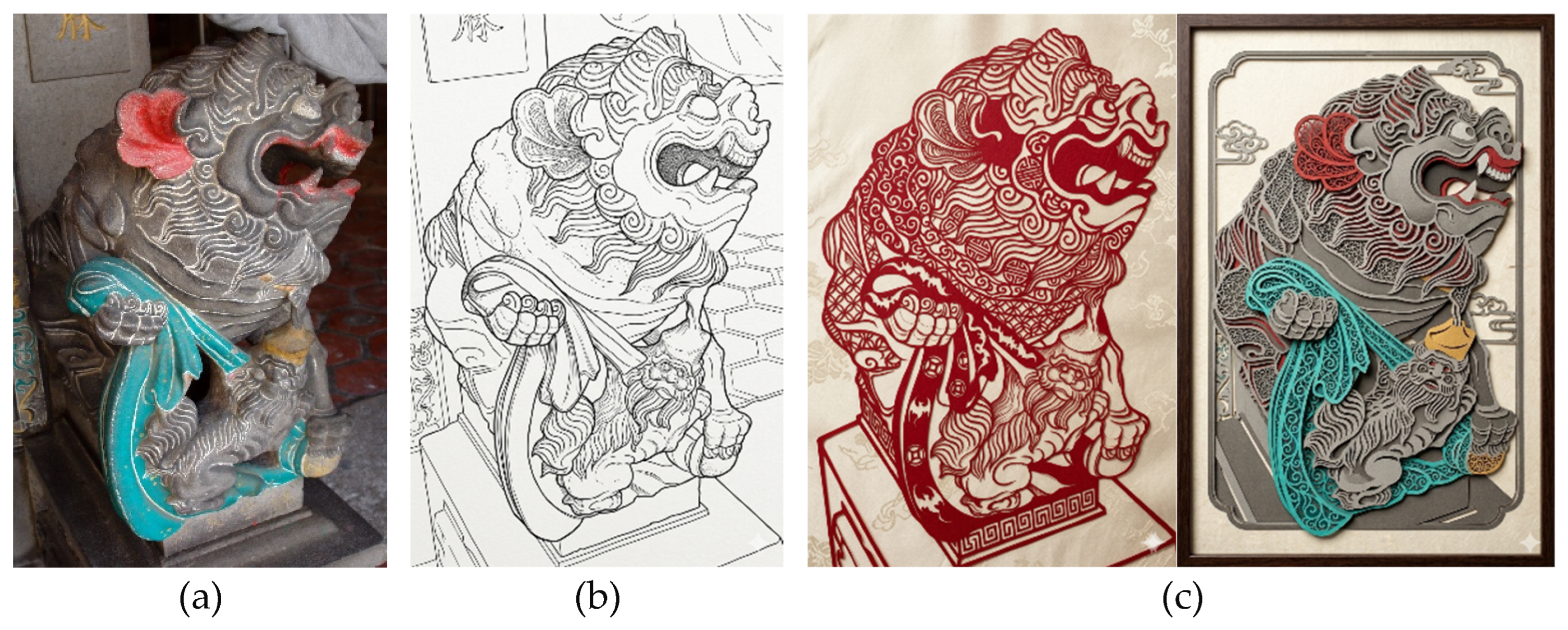
This is an important finding indicating that lines were articulated or grouped within another set of lines of different widths after being regenerated by Gemini® or Nano Banana (or Pro, 2)®, as shown in Figure 14. Images were regenerated with the prompt for lines: “convert this image to a line drawing”, and the prompt for paper cutting: “convert the line drawing to Chinese paper cutting.” The regenerated lines and associated paper cutting were articulated or grouped in terms of the outline of the whole body or larger parts.
Figure 14.
Image test: (a) original image; (b) line drawing; (c) paper cutting.
4.4. Merging of Heterogeneous Styles
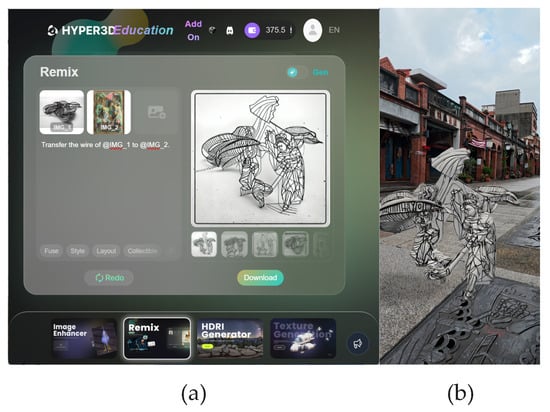
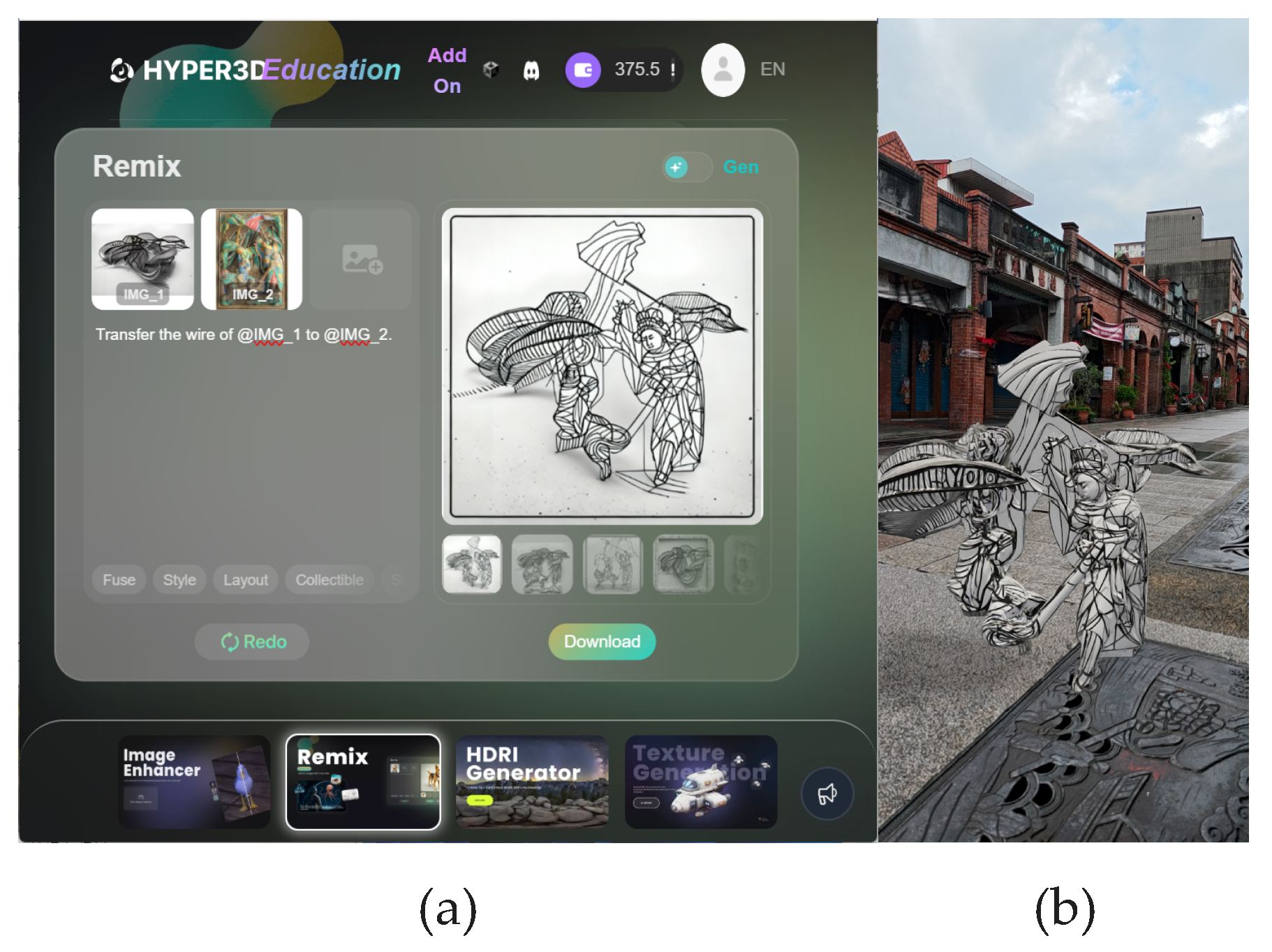
Creativity based on paper cutting should not be restricted to or defined by its own graphic representation. This extended interpretation also includes the fused style of two images in totally heterogeneous contexts (Figure 15). The process reveals a novel inspection paradigm by highlighting the interface between old and new structural and visual elements as inspiration.
Figure 15.
(a) Style-merging process in Rodin® Remix using two heterogeneous images; (b) field deployment.
4.5. Decomposition of Sculpture
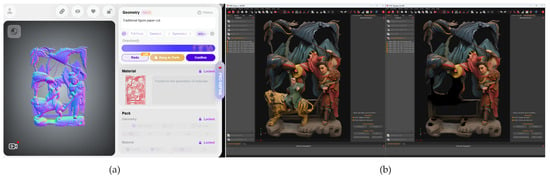
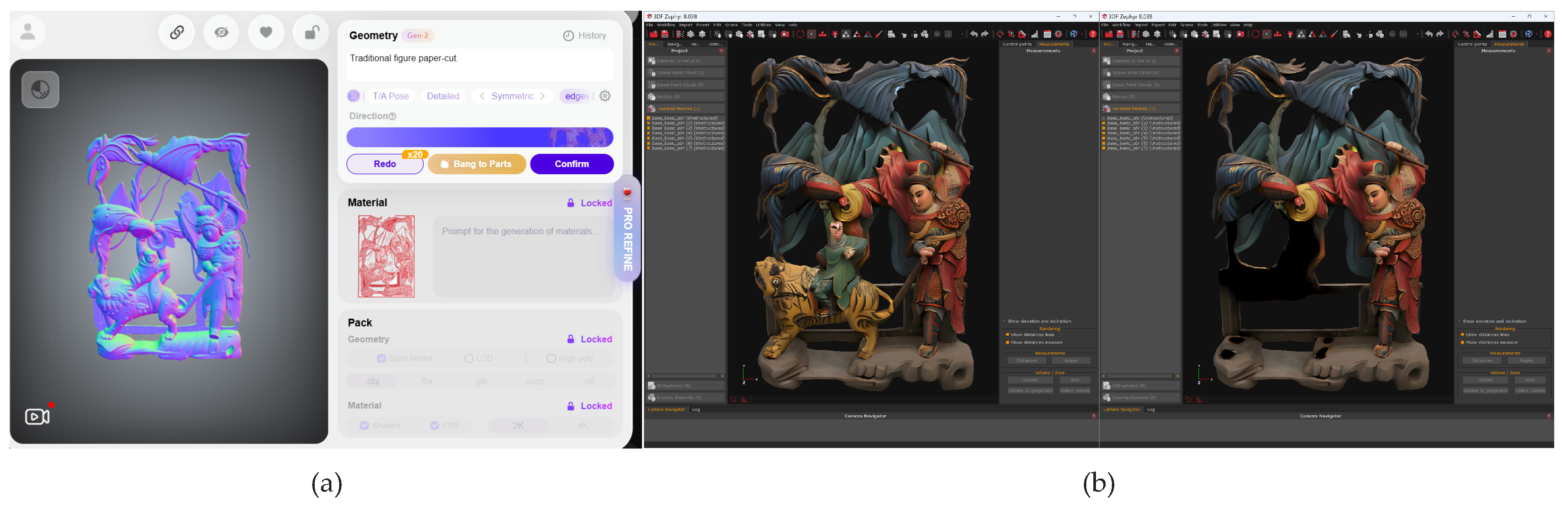
Each sculpture represents a significant artistic effort made by ancient masters. An attempt was made to interpret the vocabulary applied during the design or creation process. By decomposing the whole piece into separate parts in Rodin®, seven different elements were identified in the model, represented by many different AI versions of the same image (Figure 16). Although the intention behind the original design cannot be known, this process provides an alternative way to analyze and appreciate temple art with the assistance of AI tools.
Figure 16.
(a) Decomposition process in Rodin® using the function “Bring to Parts”; (b) change in the visualization of certain parts.
4.6. Assessment of AI-Assisted 3D Model Regenerations
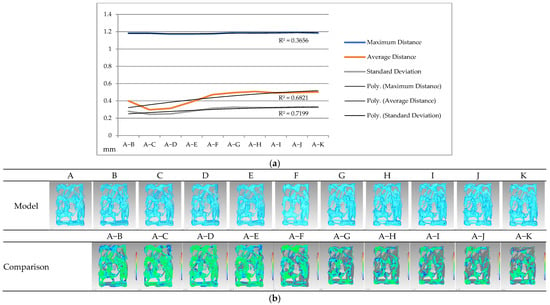
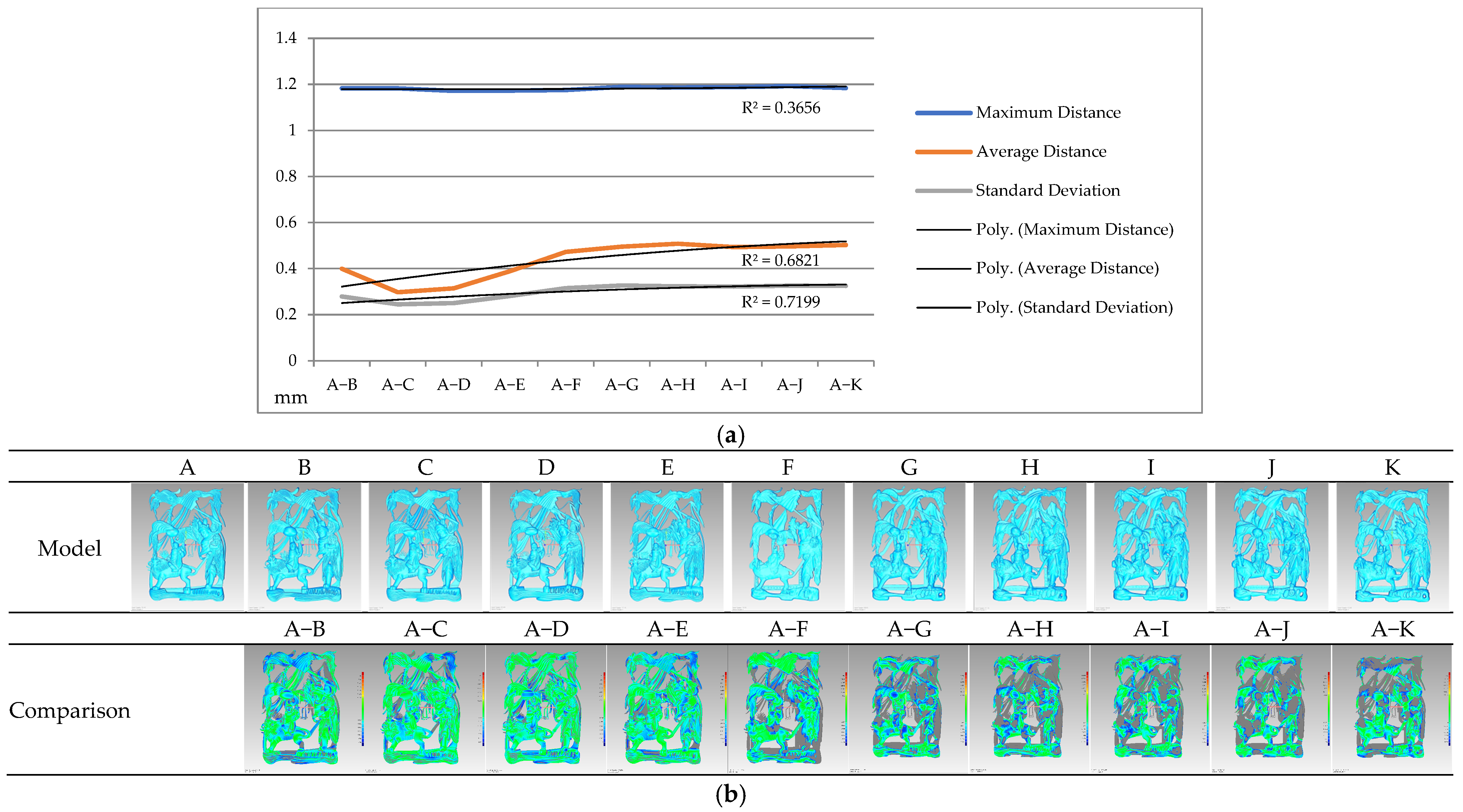
Regenerated 3D models can be assessed [43]. A systematic evaluation framework was developed based on the assessment of the global registered models in Geomagic Studio® (Geomagic, Inc., Morrisville, NC, USA, v2014.1.0.1706). Eleven AI-assisted 3D-generated images were assessed in 10 pairs in terms of maximum distance, average distance, and standard deviation (Figure 17) for a sculpture about 750 mm high. The model was scaled from the original output of the 3D reconstruction program. The results showed that each regeneration might bear a certain amount of difference in configuration, although the same image was used initially.
Figure 17.
The 10 paired sets of assessments were made by referring to the configuration of model A: (a) comparison chart; (b) various model features.
The established benchmarks should be observable as a flat line across all three assessment measures. However, AI rarely produces the same results for each regenerated model or image. As a result, the level of deviation from the horizontal line was used to determine the quantity of the model sets applied by the author. The types of assessed categories included the configurations and composition in terms of the structural and visual details of the 2D paper cutting and 3D model. The standard deviations were found to be lower for the A-B/C/D/E sets than those for the A-F/G/H/I/J/K sets. The maximum distance was found for the A-G set. In preliminary tests and observations, it was important to emphasize the slightly different versions of the configuration upon each regeneration—for example, on the linear moldings—as the most influential indicators.
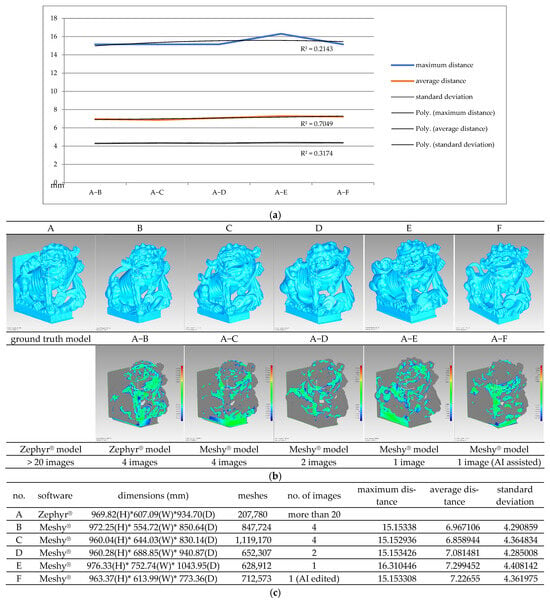
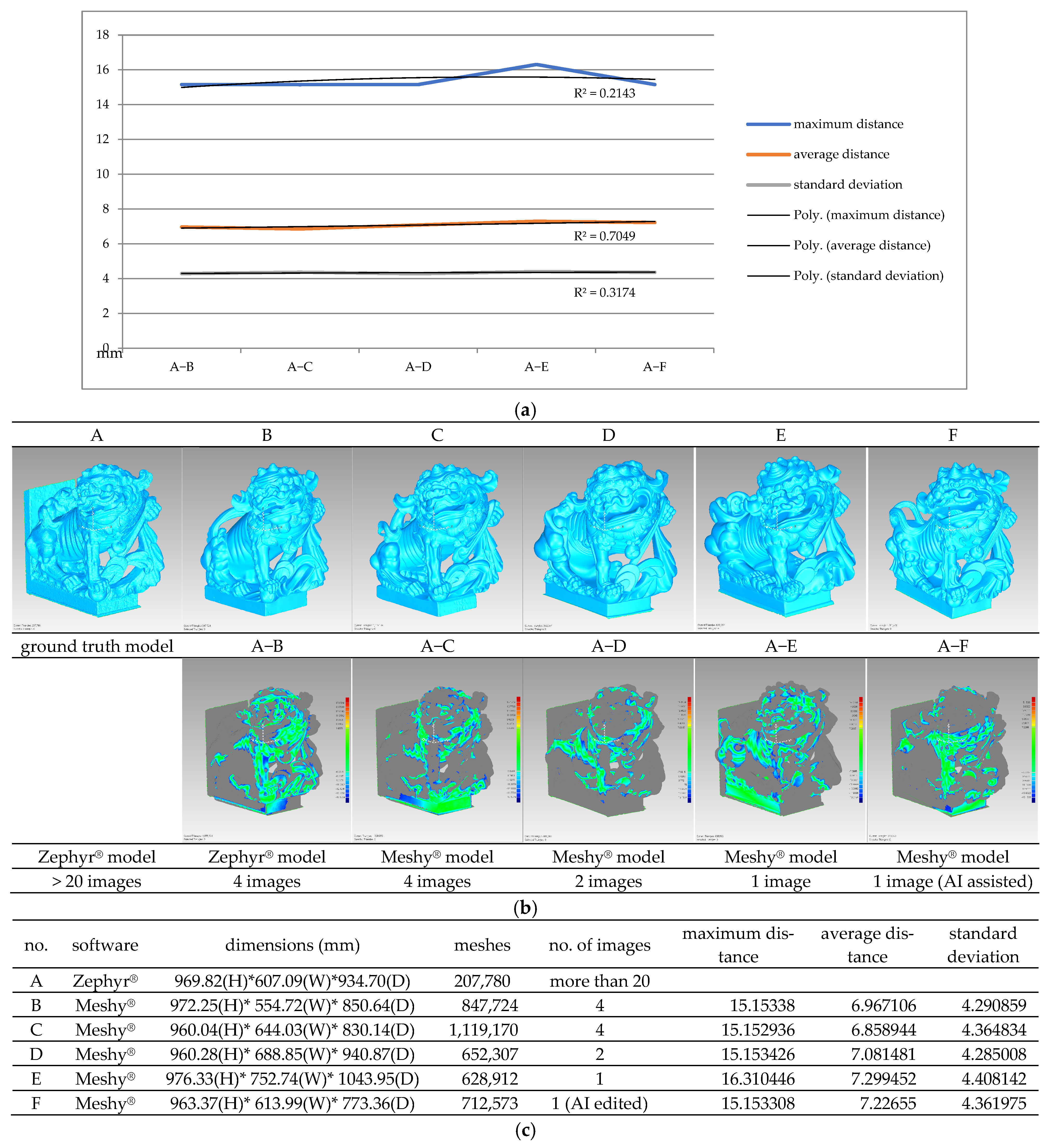
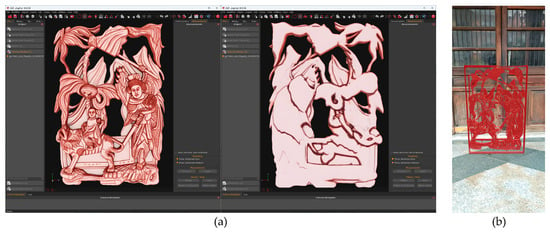
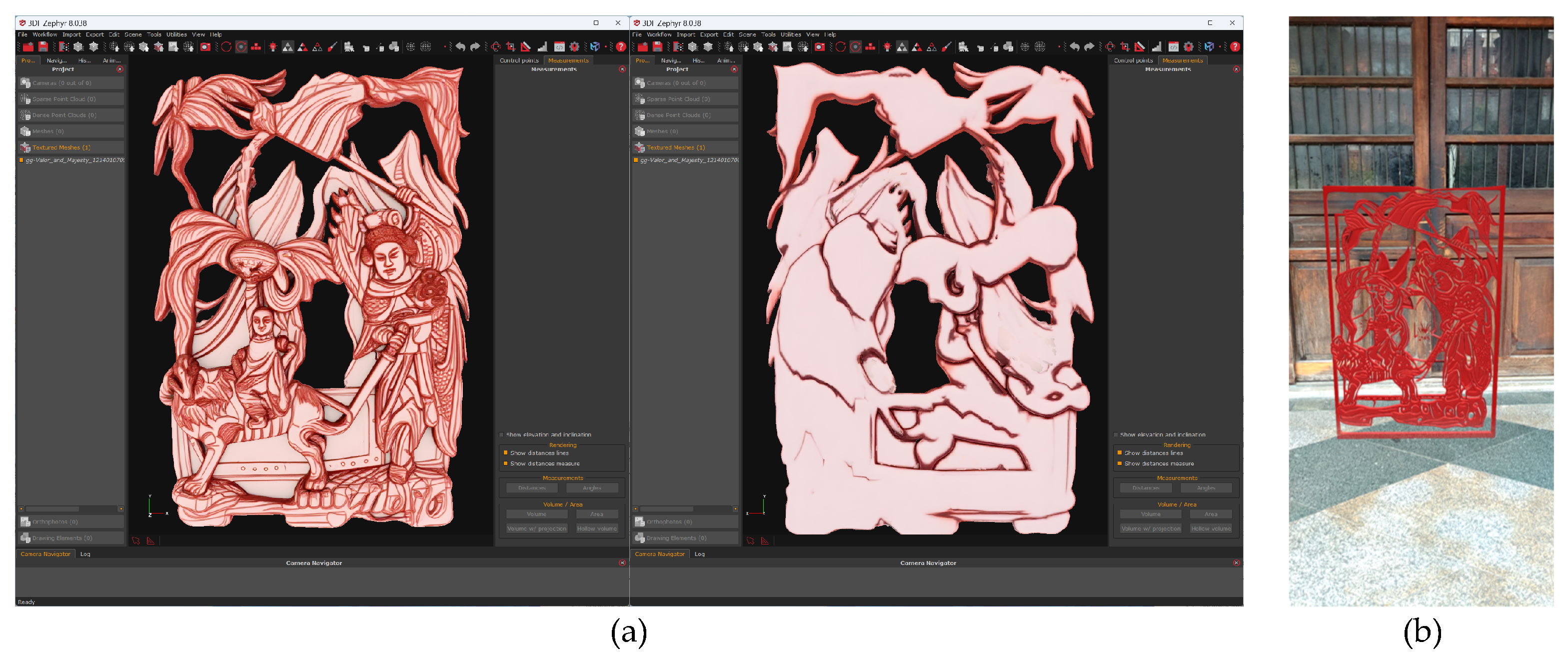
The three-dimensional models made by Zephyr® (using the photogrammetry method) and Meshy® were also cross-assessed (Figure 18). The Zephyr® result represents a ground truth model created using more than 20 images of the lion, taken from almost 300 degrees. The Meshy® models can be trained with rich details matching many sub-parts using one to four images; however, the models are unscaled and deformed and have to be enlarged by referring to measurements made from the Zephyr® model. The assessments included tests twice for four images, once for two images, and twice for one image (including once using AI to remove the white frame in front of the lion).
Figure 18.
Assessment between models created by Meshy® and Zephyr®: (a) comparison chart; (b) various model features; (c) table of assessed values.
The 3D polygon models in OBJ format were globally registered with the model created by Zephyr® in Geomagic Studio®. All the models presented a high level of fidelity; however, larger tolerances were encountered. The large gray areas illustrated that most parts of the regenerated 3D models had different configurations.
The deviations contribute to the diverse 3D possibilities of the original image. The quantitative assessment of the variations illustrated how AI was applied to heritage reactivation. In contrast to how an algorithmic approach identifies the best result, a general AI tool regenerates variations out of the best result. The first sculpture had better assessment results than the second one, as more orthogonal views of the image were taken. The multiple detailed features highlight the study of vocabularies under the same geometric framework of configuration. The context of heritage reactivation is enriched under the enlightening form of paper cutting.
4.7. Consistency Between Front and Back
The new approach was used to reconstruct the model using symbolized line patterns to generate a see-through effect from either side, particularly for smartphone AR. Each paper cutting should include views from both the front and back, since they are usually installed in a space where they can be viewed from both sides. However, in one case, the original sculpture was front-facing only because it was attached to the wall. As a result, the 3D-reconstructed model did not have consistent geometry and texture on both sides (Figure 19a). The design was later modified to reduce the thickness to create a see-through wireframe (Figure 19b).
Figure 19.
(a) Inconsistency between front and back; (b) see-through wireframe.
5. Conclusions
Heritage cross-reactivation is defined as the creation of a unique AI identity for cross-referenced heterogeneous art forms, such as sculptures and ancient paintings. The identities include prompted element descriptions, 3D reconstructed models, AR interaction, and physical RP prints. This ubiquitous feature and representation of AI models is applicable to all art forms. The application of AI to traditional heritage can be considered a new, intangible approach to diversified forms of heritage.
The features and character of any piece of tangible art can evolve or become obsolete over its lifespan. In 2026, folk art can be considered a modern skill as well as a cultural identity established 200 years ago. How to retain its significance and meaningful identity over time remains to be studied; it is an evolving process with social value, and contemporary technology should be used as part of this.
AI can and should be part of cultural heritage, as it is as useful as any other cultural form or activity. People who criticize the value of AI-based heritage should consider the reasons why an open-minded reactivation would be considered inappropriate. The segmentation of AI and non-AI approaches should be resolved to offer an opportunity to emphasize how traditional vocabularies can evolve meaningfully.
A paradigm shift in heritage preservation is occurring. Three-dimensional modeling and paper cutting represent two ends of heritage reactivation, from 3D configuration to filtered feature characteristics. A single AI platform that can conduct both would be the best approach to substantiate the feature-based geometries. Meshy® and prompts can achieve this goal. Based on the major features mentioned in the literature review, AI approaches can develop linear moldings, switch solid and void regions, and create framed boundaries and infill patterns, in addition to providing parametric control. The AI-generated outcomes can also be assessed.
AI-assisted media transformation is a feasible tool to reactivate and propagate heritage. The application of AI has been proven feasible in reactivating cultural heritage in different tangible and intangible forms, such as physical RP outputs, cloud AR databases, and verbal descriptions using prompts. Both paper and AR deployments represent a sustainable extension of this cultural heritage. A new interaction paradigm has been enabled by creating relationships between physical reality and AR. Now, new AI-assisted media enables the development of better interaction with traditional heritage by adding a tangible touch to the intangible spirit. The paradigm has shifted from hand-crafted, static displays to interaction and conversation with urban fabrics.
The concept and execution of art have been shared among many art forms, such as jade sculptures, fabrics, and paintings. Traditional heritage represents a style with design factors that can be generated, interpreted, and elaborated using AI. In this study, chained applications were used under a series of operations. It was found that the novel AI approach can create results that meet the needs of reactivation. The heritage ecology can be expanded and enriched with a new range of collaborative contexts. The 3D sculptures reconstructed here reinterpreted 3D physical reality under the new tangible and intangible propagation of 3D AR. As a sustainable deployment paradigm, interactions between physical reality and AR were made possible.
An image is everything. Since the paper-cutting images used in this study were obtained from field documentation, the realistic 3D as-built model can be used to reconstruct images with details that enrich the comprehension or creation of paper cutting. Paper cutting is also a process that can be repeatedly revised and recursively reconstructed in order to purposefully revisualize contexts. The 3D model, which was used to redefine the geometries of sculptures in a reversed manner, still maintains numerical identity with an accessible spatial structure.
Future studies should include the decomposition of images to interpret novel vocabularies beyond merged geometries. The use of information accessible through cited web-sharing platforms and through AR content is also promising and should be applied in future studies and applications to ensure that users are exposed to deeper historical messages.
Author Contributions
Conceptualization N.-J.S.; methodology, N.-J.S.; software, validation, N.-J.S.; formal analysis, N.-J.S.; investigation, N.-J.S.; resources, N.-J.S.; data curation, N.-J.S.; writing—original draft preparation, N.-J.S.; writing—review and editing, N.-J.S.; visualization, N.-J.S.; supervision, N.-J.S.; project administration, N.-J.S.; funding acquisition, N.-J.S.; “3.5. Promotion in today’s social ecology”, Y.-T.C. All authors have read and agreed to the published version of the manuscript.
Funding
This research was funded by the National Science and Technology Council in Taiwan, with grant number NSTC 114-2221-E-011-020. The authors sincerely appreciate its assistance.
Data Availability Statement
The data are contained within the article.
Acknowledgments
Ancient Chinese paintings [36,37,38,39], jade sculptures [40], and fabrics [41] are archived at the National Palace Museum in Taiwan. The digital resources are open for downloading and use for academic purposes at 600 dpi under the copyright of “CC BY 4.0@www.npm.gov.tw”,  . The authors would like to express their sincere appreciation. The open data for this academic research consist of intermediate-level images (6 million pixels) of cultural relics such as calligraphy and paintings. As indicated at upload, intermediate-level images and texts can be used publicly without application, without restriction on use, and without payment. Proper attribution should be provided where appropriate. The reference format recommended by the National Palace Museum is used; moreover, it is included to fulfill the MDPI manuscript’s reference format requirements.
Conflicts of Interest
The authors declare no conflicts of interest.
References
- Shih, N.J. Application of Laser 3D Scanning to the Architectural Art Project of Mailiao Gongfan Palace; Project Number: 9708132, 2008.08–2009.03; Preparatory Office of the Cultural Assets General Management Office of the Council for Cultural Development of the Executive Yuan: Taichung, Taiwan, 2009.
- Yunwei, W.; Ismail, R. A case study of Tian Yali and the contemporary revival of Chinese folk art. Cogent Arts Humanit. 2025, 12, 2493462. [Google Scholar] [CrossRef] [Scilit]
- Liu, Q.; Shan, X. Chinese Paper-Cutting; Nanjing University Press: Nanjing, China, 2024; 153p. [Google Scholar]
- Tian, F.; Abd Razak, H.B.; Noh, L.M.B.M.; Isa, M.J.B.M. The Embodiment of Philosophy in Traditional Chinese Color Paper-Cutting. Art. Int. J. Philos. Cult. Axiolog. 2025, 22, 104–120. [Google Scholar]
- Wu, K. Paper-Cuts in Modern China: The Search for Modernity, Cultural Tradition, and Women’s Liberation: The Search for Modernity, Cultural Tradition, and Women’s Liberation. Mod. China 2014, 41, 90–127. [Google Scholar] [CrossRef] [Scilit]
- Chen, X. Repackaging Chinese Culture Through Diverse Visual Arts: A Multimodal Approach to Contemporary Chinese Picturebooks. Bookbird A J. Int. Child. Lit. 2021, 59, 4–15. [Google Scholar] [CrossRef] [Scilit]
- Wu, C.; Ren, Y.; Zhou, Y.; Lou, M.; Zhang, Q. Chinese Paper-Cutting Style Transfer via Vision Transformer. Entropy 2025, 27, 754. [Google Scholar] [CrossRef] [Scilit] [PubMed]
- Dong, X.L. Studies on Artistic Style of Chinese Ink Deckle-Edged Paper-Cutting Animation. Trans. Edutainment XIV 2018, 10790, 225–231. [Google Scholar] [CrossRef] [Scilit]
- Li, Y.; Yu, J.; Ma, K.L.; Shi, J.Y. 3D paper-cut modeling and animation. Comput. Animat. Virtual Worlds 2007, 18, 395–403. [Google Scholar] [CrossRef] [Scilit]
- Yang, Z.; Liu, Y.; Wang, W.; Li, Y.; Yuan, X. An empirical study of feature extraction for Hubei folk art of carved paper-cutting. PLoS ONE 2024, 19, e0311923. [Google Scholar] [CrossRef] [Scilit] [PubMed]
- Fan, Q.; Fu, D. Research on Knowledge Organization of Chinese Traditional Paper-Cutting Intangible Cultural Heritage. Knowl. Organ. 2025, 52, 44313. [Google Scholar] [CrossRef] [Scilit]
- Li, C.; Zhao, S.; Xuan, Y.; Chen, C.; Chansanam, W. Metadata description framework for Chinese paper-cutting as traditional art in the context of intangible cultural heritage inheritance. J. Doc. 2025, 81, 657–683. [Google Scholar] [CrossRef] [Scilit]
- Gao, Y. Feature Extraction Technology-Guided Visual Communication Design for Folk Paper-Cutting. Sci. Program. 2022, 2022, 1–9. [Google Scholar] [CrossRef] [Scilit]
- Liu, X.; Shi, K.; Deng, W. In-depth analysis of the artistic expression of paper-cut elements in the design of boat space. Appl. Math. Nonlinear Sci. 2023, 8, 733–744. [Google Scholar] [CrossRef] [Scilit]
- Mai, G.Z.; Chan, K.K.; Lo, H.Y.L.K. Work rehabilitation for migrant workers with work injury—The magic of Chinese paper cutting. Work A J. Prev. Assess. Rehabil. 2008, 30, 55–59. [Google Scholar] [CrossRef] [Scilit]
- Xu, W.Q.; Huang, D.E.; Li, J.; Dai, Y.L.; Feng, X.; Pang, A.Q.; Lin, L.; Chen, M.C.; Liu, W.T.; Zhong, J.X. A Home Chemistry Experiment Based on Chinese Traditional Culture: Anthocyanins in Peking Opera Facial Makeup and Paper-Cutting. J. Chem. Educ. 2025, 102, 372–378. [Google Scholar] [CrossRef] [Scilit]
- Chen, D.; Cheng, P. AIGC empowers the sustainable development of traditional Chinese paper-cut. Digit. Scholarsh. Humanit. 2025, 40, 1115–1125. [Google Scholar] [CrossRef] [Scilit]
- Liao, Y.; Yan, L.; Hou, Z.; Shi, S.; Fu, Z.; Ma, Y. CutGAN: Dual-Branch generative adversarial network for paper-cut image generation. Multimed. Tools Appl. 2024, 83, 55867–55888. [Google Scholar] [CrossRef] [Scilit]
- Dai, M.; Feng, Y.; Wang, R.; Jung, J. Enhancing the Digital Inheritance and Development of Chinese Intangible Cultural Heritage Paper-Cutting Through Stable Diffusion LoRA Models. Appl. Sci. 2024, 14, 11032. [Google Scholar] [CrossRef] [Scilit]
- O’Meara, J.; Murphy, C. Aberrant AI creations: Co-creating surrealist body horror using the DALL-E Mini text-to-image generator. Convergence 2023, 29, 1070–1096. [Google Scholar] [CrossRef] [Scilit]
- TOMAAS, Surrealism Turns 100: How AI Positions It at the Forefront of Art. Available online: https://medium.com/@Tomaas.eth/surrealism-turns-100-how-ai-positions-it-at-the-forefront-of-art-fa2c0d80fd81 (accessed on 29 June 2025).
- Kratky, A. Poetic Automatisms: A comparison of surrealist automatisms and artificial intelligence for creative expression. In ArtsIT, Interactivity and Game Creation, ArtsIT 2021; Wölfel, M., Bernhardt, J., Thiel, S., Eds.; Lecture Notes of the Institute for Computer Sciences, Social Informatics and Telecommunications Engineering; Springer: Cham, Switzerland, 2022; Volume 422, pp. 359–378. [Google Scholar] [CrossRef] [Scilit]
- Willis, H. Blurry, Morphing and Surreal—A New AI Aesthetic Is Emerging in Film. The Conversation. 20 November 2024 1.33pm GMT. Available online: https://theconversation.com/blurry-morphing-and-surreal-a-new-ai-aesthetic-is-emerging-in-film-242098 (accessed on 21 September 2025).
- Wang, D.; Huai, B.; Ma, X.; Jin, B.; Wang, Y.; Chen, M.; Sang, J.; Liu, R. Application of Artificial Intelligence-Assisted Image Diagnosis Software Based on Volume Data Reconstruction Technique in Medical Imaging Practice Teaching. BMC Med. Educ. 2024, 24, 405. [Google Scholar] [CrossRef] [Scilit]
- Surrealism Today. AI Surrealism: Exploring Digital Dreamscapes and the Collective Unconscious. Available online: https://surrealismtoday.com/ai-surrealism-collective-unconscious/ (accessed on 29 June 2025).
- Kim, M.; Kim, T.; Lee, K.-T. 3D Digital Human Generation from a Single Image Using Generative AI with Real-Time Motion Synchronization. Electronics 2025, 14, 777. [Google Scholar] [CrossRef] [Scilit]
- Fathallah, M.; Eletriby, S.; Alsabaan, M.; Ibrahem, M.I.; Farok, G. Advanced 3D Face Reconstruction from Single 2D Images Using Enhanced Adversarial Neural Networks and Graph Neural Networks. Sensors 2024, 24, 6280. [Google Scholar] [CrossRef] [Scilit] [PubMed]
- Bao, Y.; Ding, T.; Huo, J.; Liu, Y.; Li, Y.; Li, W.; Gao, Y.; Luo, J. 3d gaussian splatting: Survey, technologies, challenges, and opportunities. IEEE Trans. Circuits Syst. Video Technol. 2025, 35, 6832–6852. [Google Scholar] [CrossRef] [Scilit]
- Wang, W. Real-Time Fast 3D Reconstruction of Heritage Buildings Based on 3D Gaussian Splashing. In Proceedings of the 2024 IEEE 2nd International Conference on Sensors, Electronics and Computer Engineering (ICSECE), Jinzhou, China, 29–31 August 2024; pp. 1014–1018. [Google Scholar] [CrossRef] [Scilit]
- Shih, N.-J.; Wu, Y.-C. AR-Based 3D Virtual Reconstruction of Brick Details. Remote Sens. 2022, 14, 748. [Google Scholar] [CrossRef] [Scilit]
- Wang, T.; Zhang, B.; Zhang, T.; Gu, S.; Bao, J.; Baltrusaitis, T.; Shen, J.; Chen, D.; Wen, F.; Chen, Q.; et al. Rodin: A generative model for sculpting 3d digital avatars using diffusion. In Proceedings of the IEEE/CVF Conference on Computer Vision and Pattern Recognition, Vancouver, BC, Canada, 17–24 June 2023; pp. 4563–4573. [Google Scholar] [CrossRef] [Scilit]
- Li, X.; Zhang, Q.; Kang, D.; Cheng, W.; Gao, Y.; Zhang, J.; Liang, Z.; Liao, J.; Cao, Y.P.; Shan, Y. Advances in 3d generation: A survey. arXiv 2024, arXiv:2401.17807. [Google Scholar] [CrossRef] [Scilit]
- Shih, N.-J. AI- and AR-Assisted 3D Reactivation of Characters in Paintings. Heritage 2025, 8, 207. [Google Scholar] [CrossRef] [Scilit]
- Shih, N.-J. Using AI to Reconstruct and Preserve 3D Temple Art with Old Images. Technologies 2025, 13, 229. [Google Scholar] [CrossRef] [Scilit]
- Zhao, L.; Kim, J.W. The impact of traditional Chinese paper-cutting in digital protection for intangible cultural heritage under virtual reality technology. Heliyon 2024, 10, e38073. [Google Scholar] [CrossRef] [Scilit]
- Butterfly, Bird, and Flowers; National Palace Museum: Taipei, Taiwan, Years Unknown. Available online: https://digitalarchive.npm.gov.tw/Collection/Detail/14579?dep=P (accessed on 4 February 2026). (In Chinese)
- Pair of Wild Geese and Hibiscus; National Palace Museum: Taipei, Taiwan, Song Dynasty. Available online: https://digitalarchive.npm.gov.tw/Collection/Detail/13677?dep=P (accessed on 4 February 2026). (In Chinese)
- Lyn, C. A Parrot on the Blossoming Yulan Magnolia; National Palace Museum: Taipei, Taiwan, Song Dynasty. Available online: https://digitalarchive.npm.gov.tw/Collection/Detail/10852?dep=P (accessed on 4 February 2026). (In Chinese)
- Lee, D. Birds and Flowers; National Palace Museum: Taipei, Taiwan, Song Dynasty. Available online: https://digitalarchive.npm.gov.tw/Collection/Detail/1471?dep=P (accessed on 4 February 2026). (In Chinese)
- Jade Plague with Dragon Decoration; National Palace Museum: Taipei, Taiwan, Yuan Dynasty, 1271–1368. Available online: https://digitalarchive.npm.gov.tw/Collection/Detail/2739?dep=U (accessed on 4 February 2026). (In Chinese)
- Dyed Cotton Cloth with White Flower Pattern, India; National Palace Museum: Taipei, Taiwan, 19–20 Century. Available online: https://digitalarchive.npm.gov.tw/Collection/Detail/203?dep=X#:~:text=%E5%8D%B0%E5%BA%A6%E6%89%8B%E5%B7%A5%E7%B9%AA%E6%9F%93%E5%B8%83,%E5%85%B7%E7%AD%89%E5%AE%B6%E5%85%B7%E6%8E%9B%E9%A3%BE%E3%80%82 (accessed on 4 February 2026). (In Chinese)
- Scolari, C.A. From (New)Media to (Hyper)Mediations. Recovering Jesús MartínBarbero’s Mediation Theory in the Age of Digital Communication and Cultural Convergence. Inf. Commun. Soc. 2015, 18, 1092–1107. [Google Scholar] [CrossRef] [Scilit]
- Shih, N.-J. Surreal AI: The Generation, Reconstruction, and Assessment of Surreal Images and 3D Models. Technologies 2025, 13, 577. [Google Scholar] [CrossRef] [Scilit]

Disclaimer/Publisher’s Note: The statements, opinions and data contained in all publications are solely those of the individual author(s) and contributor(s) and not of MDPI and/or the editor(s). MDPI and/or the editor(s) disclaim responsibility for any injury to people or property resulting from any ideas, methods, instructions or products referred to in the content. |
© 2026 by the authors. Licensee MDPI, Basel, Switzerland. This article is an open access article distributed under the terms and conditions of the Creative Commons Attribution (CC BY) license.