


Abstract
Romania joined the UNESCO Convention in 1990. The fortified church of Biertan was inscribed on the World Heritage List in 1993, followed by six additional Transylvanian fortified church villages in 1999. An interesting feature of this heritage landscape is that settlements with different demographic and development trajectories share the same World Heritage designation. In our research, we collected demographic and tourism data from these seven municipalities. Subsequently, a standard questionnaire was sent to municipal decision-makers (mayors) in 2023 to map tourism development in their municipalities. The communication activities of the municipalities were analysed using a content analysis method, which was observation-based and based only on online content. In our experience, there is no common strategy to turn this heritage into a tourist attraction; each of the seven municipalities has faced this challenge separately. The main result of the research was to explore how heritage tourism works in municipalities with different demographic, linguistic-cultural heritage and with different levels of management.
1. Introduction
Heritage is the physical and non-physical legacy of the past (values, memories, arts, customs, rituals, ways of life and traditions) that a community finds worth preserving. Ashworth [1] emphasizes that heritage is not an objective and immutable given, but a socially constructed phenomenon shaped by contemporary perceptions and values. In this sense, heritage is not simply about the past itself, but about the selective reinterpretation of the past in the present. A legacy becomes heritage when it is capable of fulfilling cultural, social or economic objectives, most notably through tourism-related valorisation [1].
Recent heritage studies further stress that heritage functions as a symbolic system embedded in landscapes and settlements, where architectural forms and spatial structures convey identity, memory and meaning [2]. In rural heritage contexts, tangible structures and intangible practices are inseparably connected, forming complex cultural landscapes rather than isolated monuments [3].
Heritage plays a fundamental role in the formation of individual and collective identity. Identity is shaped through shared values, narratives and symbols that influence both collective representations and individual behaviour [1]. In multicultural regions such as Transylvania, heritage becomes a key medium through which cultural continuity and difference are negotiated [4]. Human ethology highlights that group identity is an innate human characteristic, reinforcing the importance of heritage transmission across generations [5].
The creation of tradition and the protection of heritage are therefore closely interlinked processes. The UNESCO Convention concerning the Protection of the World Cultural and Natural Heritage [6] established an international framework for safeguarding heritage of outstanding universal value. Subsequent debates on authenticity, integrity and community participation have highlighted that heritage preservation must integrate social, cultural and economic dimensions [7]. UNESCO’s understanding of heritage has continuously expanded to include vernacular architecture, cultural landscapes and intangible heritage elements, which is particularly relevant for rural heritage sites [6].
1.1. Heritage Tourism
Heritage tourism has become one of the most dynamic segments of contemporary tourism, closely linked to identity construction, place attachment and experiential consumption [8,9,10]. Heritage tourism focuses on assets transmitted across generations, but its development is inherently local and place-based. Consequently, the success of heritage tourism products largely depends on local governance structures, community involvement and management capacity [8,11,12].
Recent international research highlights that rural heritage tourism increasingly relies on integrated service systems combining cultural attractions, landscape values, local products and community-based experiences [13]. Experiential authenticity and interaction with local communities have become central motivations for heritage tourists [10,14].
At the same time, most heritage attractions were not originally created for tourism purposes, posing significant challenges for tourism management. Digital documentation, interpretation and communication tools are increasingly seen as key instruments in making heritage accessible while safeguarding authenticity [15,16]. In rural contexts, heritage tourism development must align with soft tourism principles, emphasizing sustainability, small-scale development and respect for local cultural identity [17,18,19].
1.2. Heritage Protection and Fortified Churches in Romania
The institutionalisation of heritage protection in Romania dates back to the mid-20th century. Romania joined the UNESCO World Heritage Convention in 1990, and the villages with fortified churches in Transylvania were inscribed on the World Heritage List in 1993 and 1999. These sites represent one of the most emblematic forms of rural heritage in Romania, combining architectural, historical, social and landscape values [7].
Fortified churches were constructed in Transylvania from the 12th century onwards as defensive and community-centred structures. Beyond their military function, they structured settlement patterns, land-use systems and social organisation, becoming dominant visual and symbolic elements of the rural landscape [15]. Their continued presence contributes significantly to regional identity and collective memory [2].
Despite their outstanding universal value, fortified church villages face multiple challenges, including demographic decline, uneven tourism development, fragmented management strategies and limited inter-municipal cooperation [13]. Existing research has predominantly focused on architectural conservation or individual case studies [12,20]. There remains a clear research gap in comparative, data-driven analyses examining how demographic structure, governance capacity, communication practices and service development influence heritage tourism performance across multiple fortified church settlements.
Addressing this research gap, the aim of this study is to explore how UNESCO World Heritage fortified church villages in Transylvania, Romania, utilize their shared cultural heritage within the context of tourism, with particular attention to demographic, cultural, and management-related differences. The study focuses on how divergent development trajectories and local strategies influence the functioning and effectiveness of heritage tourism across the seven municipalities examined.
Building on the literature on heritage tourism, rural cultural landscapes and local governance, this study adopts a comparative perspective to examine how shared heritage resources are mobilised under different demographic and institutional conditions. The research addresses the following questions:
- (1)
- How do demographic structures and local governance capacities influence tourism development in fortified church municipalities?
- (2)
- What differences can be observed in tourism performance and communication strategies among the seven settlements?
- (3)
- To what extent does the shared World Heritage status generate opportunities for collaborative development between municipalities?
2. Materials and Methods
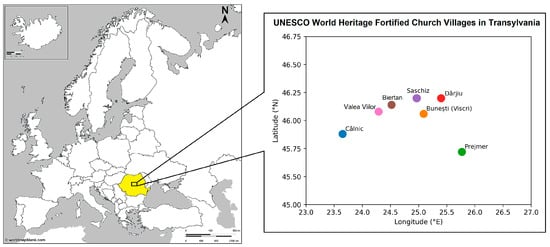
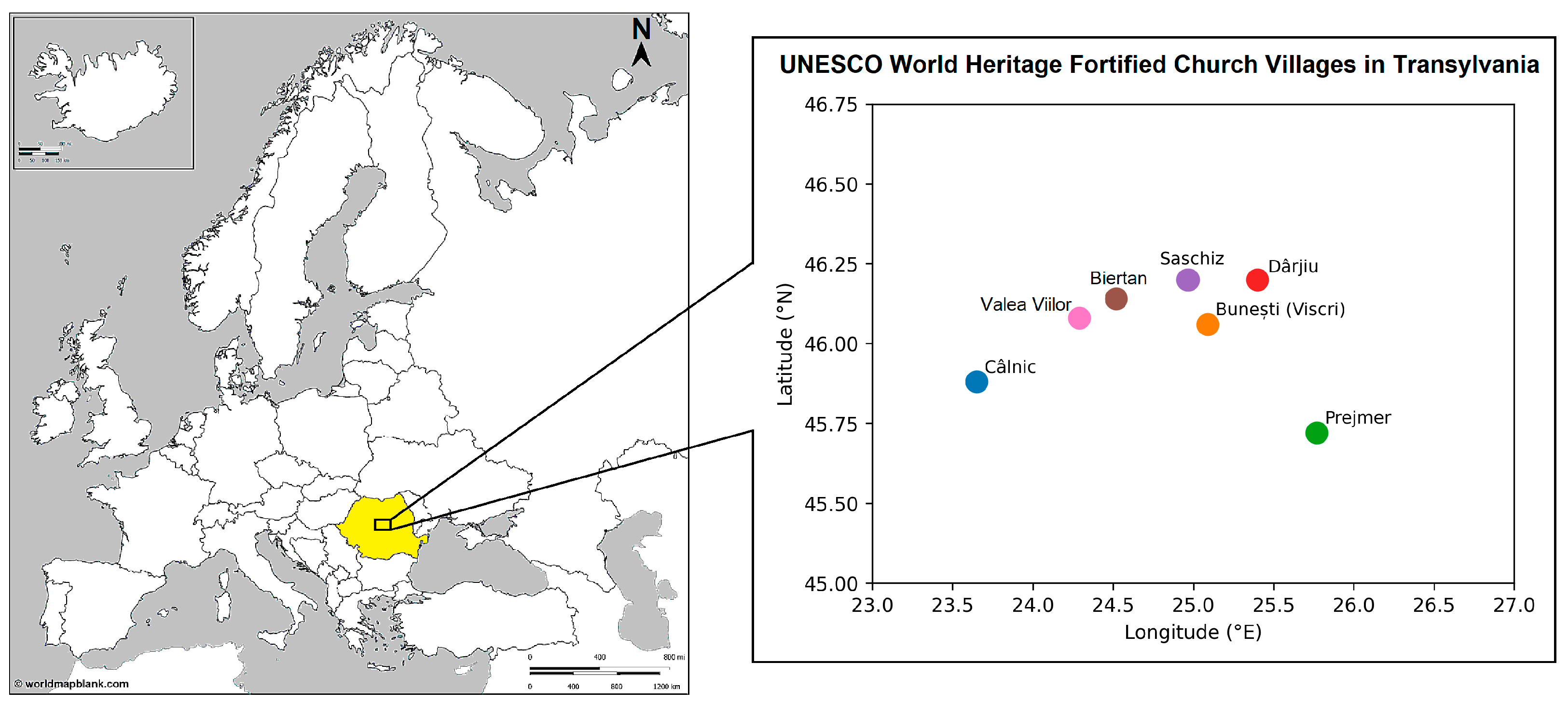
The seven fortified churches included in the UNESCO World Heritage property “Villages with Fortified Churches in Transylvania” are located in Câlnic (Kelnek), Bunești (Szászbuda), Prejmer (Prázsmár), Dârjiu (Székelyderzs), Saschiz (Szászkéz), Biertan (Berethalom) and Valea Viilor (Nagybaromlak). The sites are situated in southern and central Transylvania. Most of them historically formed part of the Saxon “King’s Land” (Königsboden), while Dârjiu is located in a Szekler (Hungarian) settlement area with a distinct historical-administrative tradition. The Saxon territories were originally established in the 12th century as sparsely populated frontier areas of the medieval Kingdom of Hungary. Today, the seven municipalities are administratively located in Romania’s Central Development Region. Five counties are concerned: Câlnic in Alba County; Bunești and Prejmer in Brașov County; Dârjiu in Harghita County; Saschiz in Mureș County; and Biertan and Valea Viilor in Sibiu County. The geographical location of the seven fortified church villages within Romania and their spatial distribution in Transylvania are illustrated in Figure 1. The geographical coordinates of the fortified church villages are as follows: Biertan (46°08′09″ N, 24°46′23″ E), Prejmer (45°43′21″ N, 25°46′32″ E), Viscri (46°03′19″ N, 25°05′25″ E), Dârjiu (46°12′14″ N, 25°12′03″ E), Saschiz (46°11′41″ N, 25°05′18″ E), Câlnic (45°53′00″ N, 23°40′00″ E), and Valea Viilor (46°05′05″ N, 24°17′34″ E).
Figure 1.
Location of the UNESCO World Heritage fortified church villages in Transylvania, Romania (Câlnic, Bunești–Viscri, Prejmer, Dârjiu, Saschiz, Biertan and Valea Viilor). The left panel shows the geographical position of Romania within Europe, while the right panel presents the spatial distribution of the seven settlements in Transylvania. The highlighted markers indicate the locations of the fortified church villages.
The study covers the complete set of settlements included in the UNESCO World Heritage property “Villages with Fortified Churches in Transylvania,” therefore the research examines the entire population of municipalities associated with this heritage site rather than a selected sample.
As a first step in our research [21], we collected demographic and tourism data from seven municipalities. Secondary data were obtained from the Romanian National Statistical Office [22] and the Tempo online database [23]. The years 2011 and 2021 were selected because they correspond to the most recent national census periods in Romania, allowing a consistent comparison of demographic indicators across the municipalities.
As for the primary research, a standard questionnaire was sent to decision-makers in the relevant municipalities in 2023 to map the tourism development of their municipalities with the help of mayors. In the Transylvanian fortified church villages, the legal ownership and operational gatekeeping of the monuments typically lie with ecclesiastical institutions—primarily the Evangelical Church of the Augsburg Confession in the Saxon sites and the Unitarian Church in Dârjiu—rather than with municipalities. In this study, the term “management capacity” therefore refers specifically to municipal tourism governance capacity (local development strategy, communication practices, and partnership orientation), as assessed through mayoral questionnaires and municipal online content. It does not constitute a full assessment of ecclesiastical site management, conservation control, or revenue administration. This distinction aligns with recent scholarship describing hybrid and multi-actor governance arrangements in the Transylvanian fortified church context [3,7,24,25,26,27]. The questionnaire survey was designed to answer the following questions:
- How can tourism in each municipality be described?
- What is the main contributor to the number of visitors in each municipality?
- Is there cooperation between fortified church communities?
The questionnaire consisted of 12 short questions addressing key aspects of tourism development in the municipalities, including tourism characteristics, perceived drivers of visitor arrivals, the impact of UNESCO World Heritage status, sources of local development funding, cooperation between municipalities, and the level of local community involvement in tourism. The questionnaire was distributed electronically to the mayors of the seven municipalities hosting the fortified church sites in 2023. All municipalities returned completed questionnaires, resulting in a response rate of 100%. The survey was conducted in Romanian, except in the case of Dârjiu where a Hungarian-language version was provided due to the Hungarian-speaking local administration. Given the limited number of municipalities included in the UNESCO property, the questionnaire functioned as a structured expert survey among local decision-makers rather than a large-scale statistical instrument. A sample of the questionnaire used in the survey is provided in the Supplementary Materials (Appendices SA–SD).
The communication activities of the municipalities were analysed using a content analysis method, which was observation-based and based only on online content, including the municipalities’ websites [19,20,21,22,23,24,25,26,27,28,29,30,31,32,33,34,35,36,37,38,39,40,41,42] and Facebook [43,44,45,46,47,48,49]. The online content analysis was conducted between January and March 2023. The coding process was conducted by a single researcher using a predefined coding framework. To reduce subjectivity, the coding was double-checked through repeated review of the collected online materials and cross-verification of the coded categories. The analysis followed a structured coding approach focusing on tourism-related information, presentation of heritage attractions, language availability, visual communication elements, and references to tourism services or events. Of the aspects examined, the main focus was on the fortified church as a tourist attraction, followed by the natural features, the title of the website, the language of the site, the visual elements, the design elements, colour harmony, images, clarity, information content and its topicality. On the Facebook page [43,44,45,46,47,48,49], we monitored the announced events and tourism-related content. On the pages of tourism operators who operate accommodation or other services, we looked at the services offered to users, attractions, programs and entertainment opportunities. On the Tripadvisor portal [30,31,37,38,39,40,41,42], we looked at tourists’ feedback, which focused on the positives and shortcomings of the municipality, the fortified church and the services.
3. Results
The results are presented in a comparative framework in order to identify similarities and differences in demographic structure, tourism performance, and service development across the seven municipalities.
3.1. Social Potential of the Fortified Church Settlements
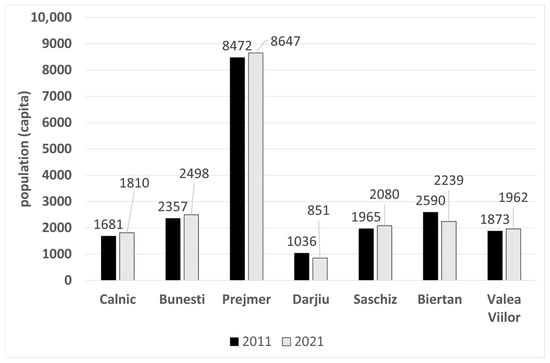
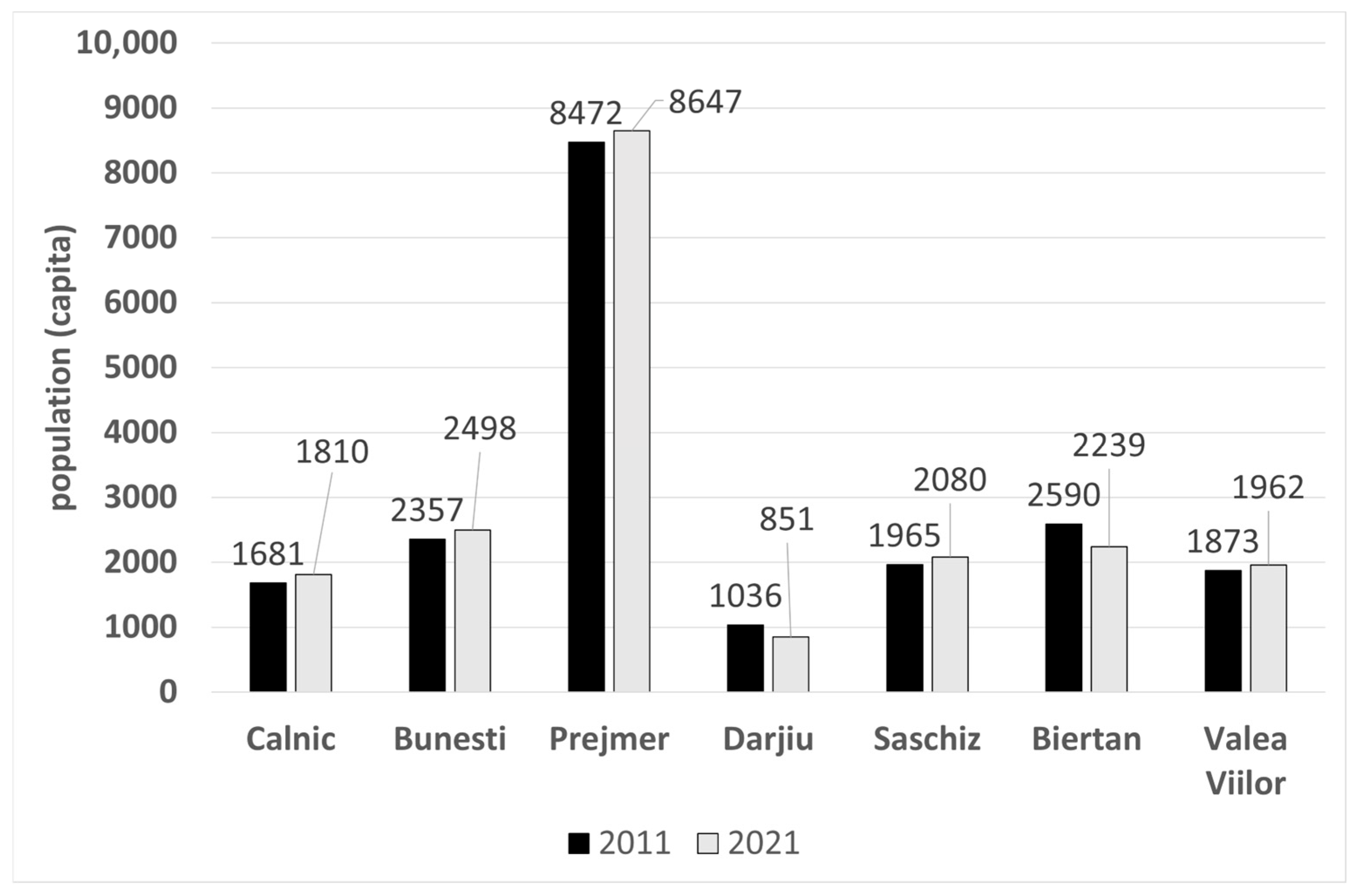
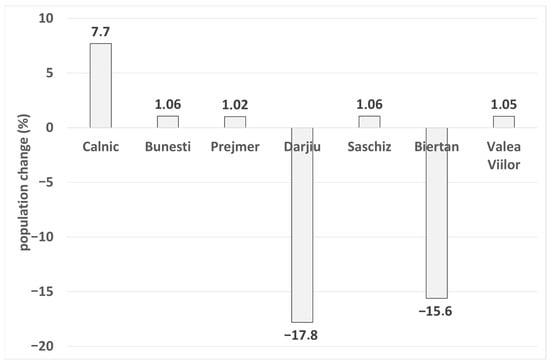
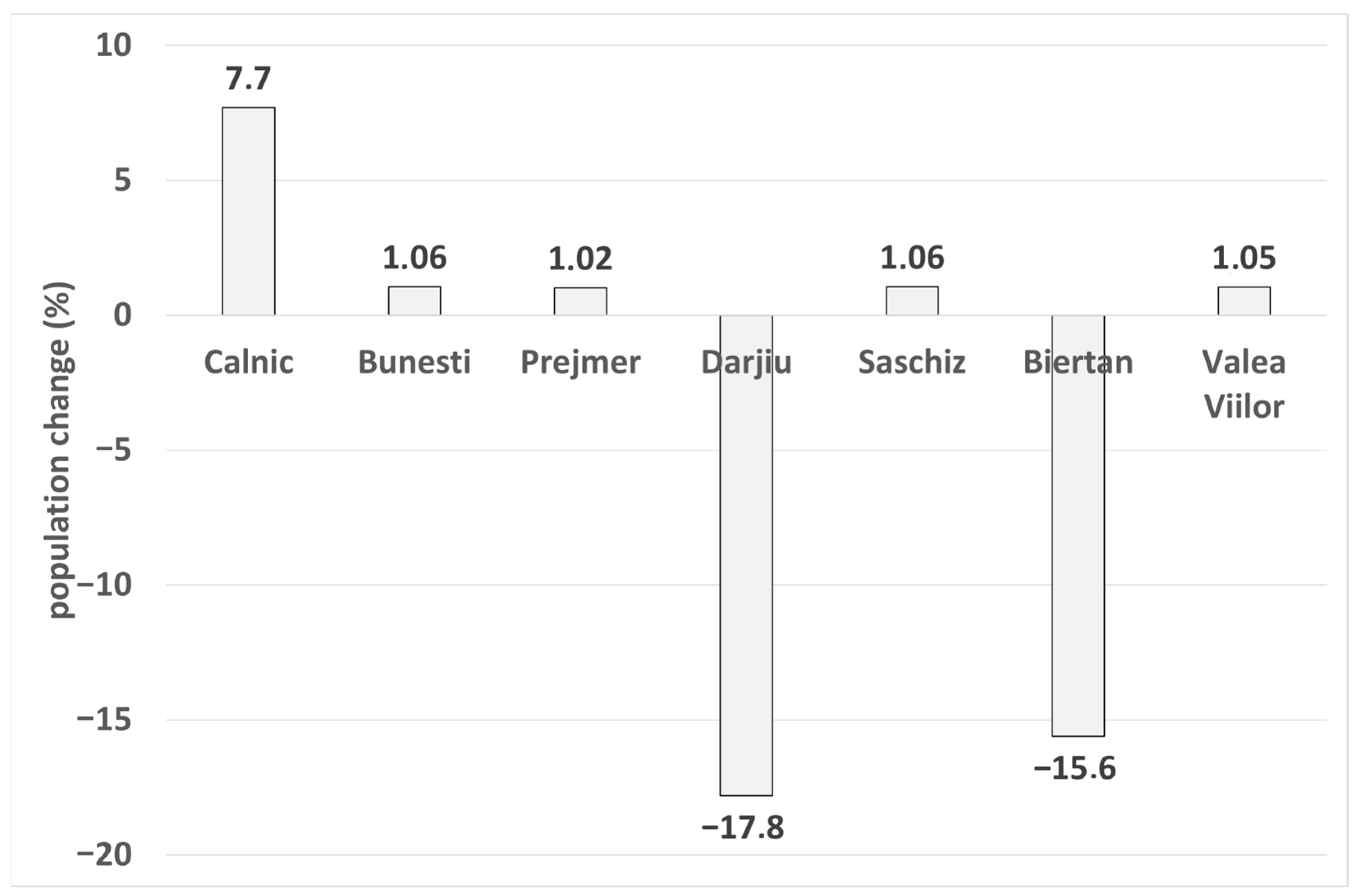
The seven municipalities have a total population of about 20,000 inhabitants (19,974 in 2011, 20,870 in 2021), the most populous being Prejmer and the smallest Dârjiu. Figure 2 illustrates the population distribution across the seven municipalities, highlighting the strong demographic asymmetry between the largest settlement (Prejmer) and the smallest one (Dârjiu). As for the change in population over time (2011–2021), the trend varies from village to village. Two municipalities show a very sharp population decline between 2011 and 2021: Dârjiu and Biertan. As shown in Figure 3, demographic trajectories differ considerably among the settlements, with some municipalities experiencing population decline while others show relative stability or moderate growth. This means that while in 2011 the difference in population between the largest (Prejmer) and the smallest (Dârjiu) municipality was eight times greater, in 2021 it was ten times greater.
Figure 2.
Population of fortified church villages in Transylvania 2011, 2021 Source: [22].
Figure 3.
Population change in the fortified church villages in Transylvania between 2011 and 2021 Source: [22].
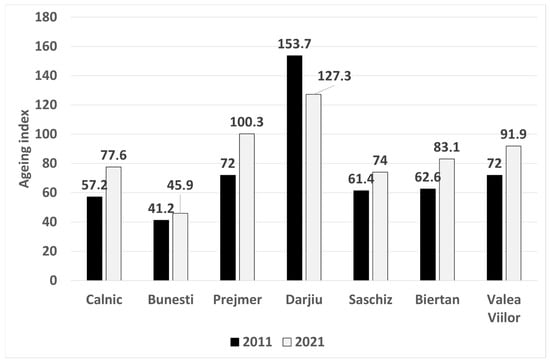
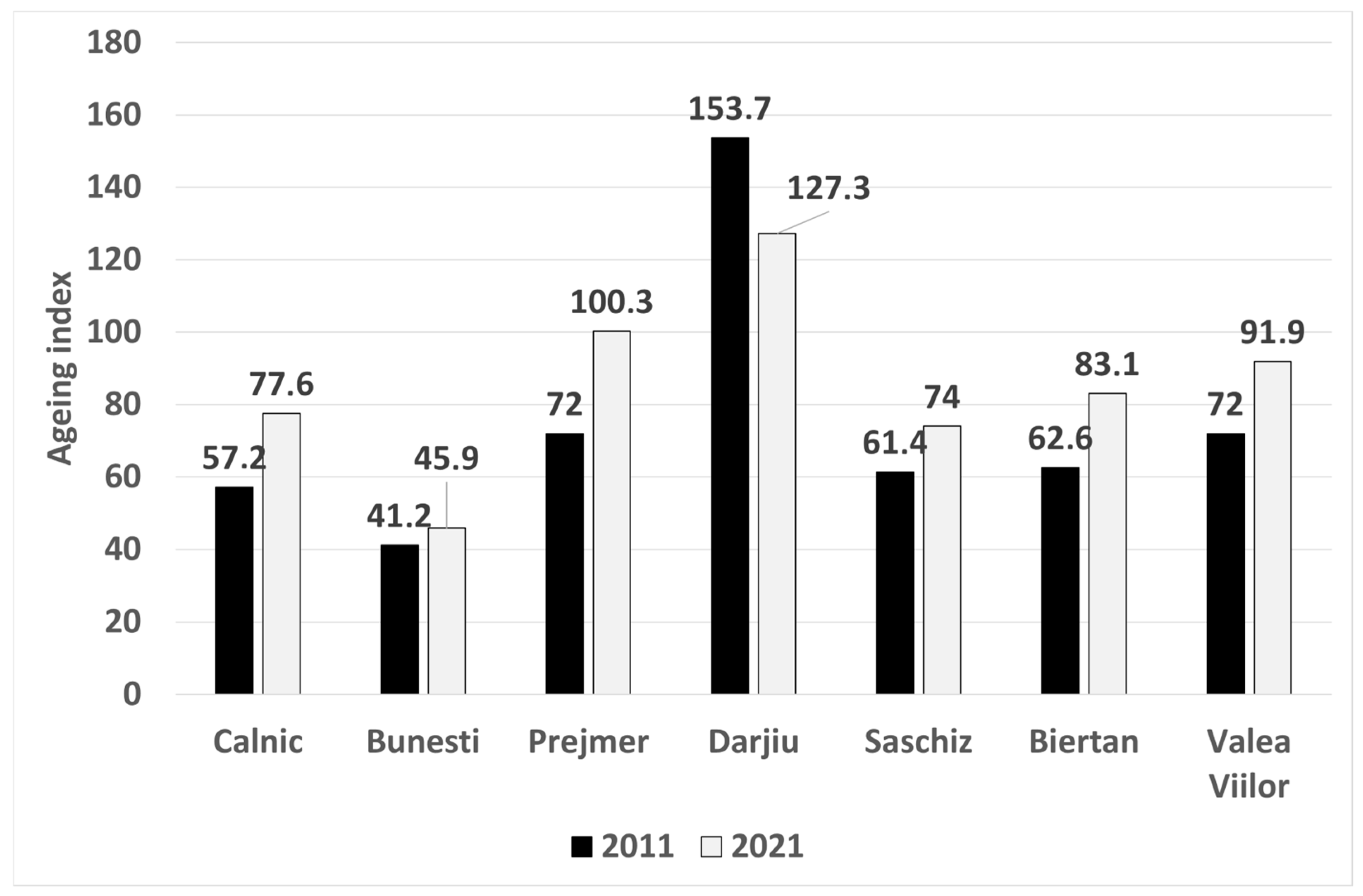
Dârjiu shows a more pronounced ageing demographic profile compared to the other municipalities. Nevertheless, the change over time in these municipalities can also be described by an increase in the ageing index, i.e., the proportion of people aged 65 and over is increasing compared to those under 14. Figure 4 illustrates the ageing index across the municipalities, indicating that Dârjiu faces the most pronounced ageing process compared to the other settlements. This demographic trend is particularly relevant for heritage tourism development, as ageing populations may limit the availability of local human resources needed to support tourism services and heritage management.
Figure 4.
Ageing index of Transylvanian villages with fortified churches in 2021 Source: [22].
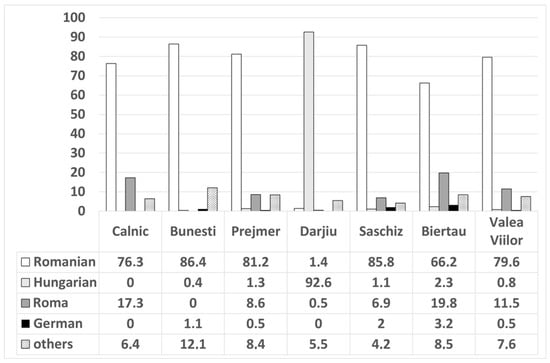
Most of the fortified church villages (with the exception of Dârjiu) historically formed part of the Universitas Saxorum, whose autonomy—rooted in the 1224 Privilegium Andreanum—established a legally distinct and corporatively organized Saxon community on the Königsboden [50,51,52]. This estate-based and territorially defined system structured local governance and ethnic boundaries for centuries, until its gradual erosion in the 18th–19th centuries [53,54,55,56,57,58,59]. The present demographic configuration reflects later historical transformations rather than a longstanding multi-ethnic equilibrium. As a result, the historical Saxon population almost disappeared from many of these rural settlements. The demographic decline of the Transylvanian Saxon population unfolded in several distinct phases. Approximately 70,000 ethnic Germans were deported to Soviet labour camps in 1944–1945, marking a major rupture in community continuity [60,61]. From the late 1960s, organized emigration to the Federal Republic of Germany under the Ceaușescu regime led to the transfer of more than 200,000 ethnic Germans between 1967 and 1989 [61,62]. After 1989, a further mass exodus fundamentally reshaped the demographic structure of Saxon settlements, contributing to the near disappearance of the rural Saxon population and significantly affecting ecclesiastical and local institutional capacities [61,63,64,65,66,67,68]. The majority of the population is now of Romanian origin. The only difference is Dârjiu (Székelyderzs), which has a clear Hungarian majority. The presence of Roma communities has also increased in several settlements, reflecting broader demographic changes in rural Transylvania. As presented in Figure 5, the ethnic composition of the municipalities has undergone substantial transformation, with Romanian populations now forming the majority in most settlements, while Dârjiu retains a strong Hungarian majority.
Figure 5.
Ethnic composition of the fortified church villages in Transylvania (2021) Source: [22].
3.2. Touristic Statistics of the Fortified Church Settlements
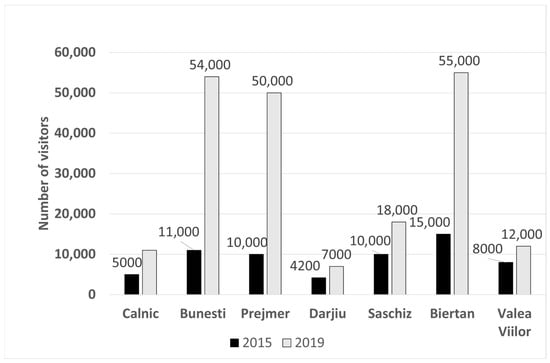
The importance of tourism is illustrated by the fact that the municipalities of the seven municipalities surveyed reported a significant increase in the number of visitors to their municipalities. In 2015, the seven municipalities recorded only 63,000 visitors, but in 2019 they recorded more than 200,000 (Romanian National Statistical Office). On average, the number of visitors has therefore tripled. This rapid increase indicates the growing tourism relevance of fortified church villages within the regional tourism system of Transylvania. However, the role of each municipality in attracting tourists is not the same. Figure 6 clearly demonstrates the uneven distribution of tourist visitation among the municipalities, with Prejmer and Bunești showing the most dynamic growth, while Saschiz, Valea Viilor and Dârjiu record more modest increases. The most spectacular increases were recorded in Prejmer (the number of tourists increased 5.0 times) and Bunești (the number of tourists increased 4.9 times), but Biertan also recorded an above average increase in tourist arrivals (3.7). Valea Viilor (1.5 times increase), Dârjiu (1.7 times increase) and Saschiz (1.8 times increase) recorded the most modest increases (Figure 6).
Figure 6.
Tourist visitation in the fortified church villages of Transylvania Source: [22].
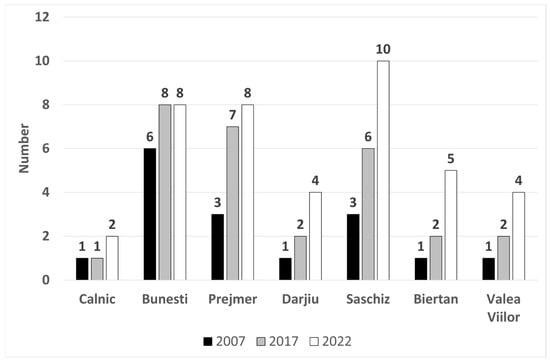
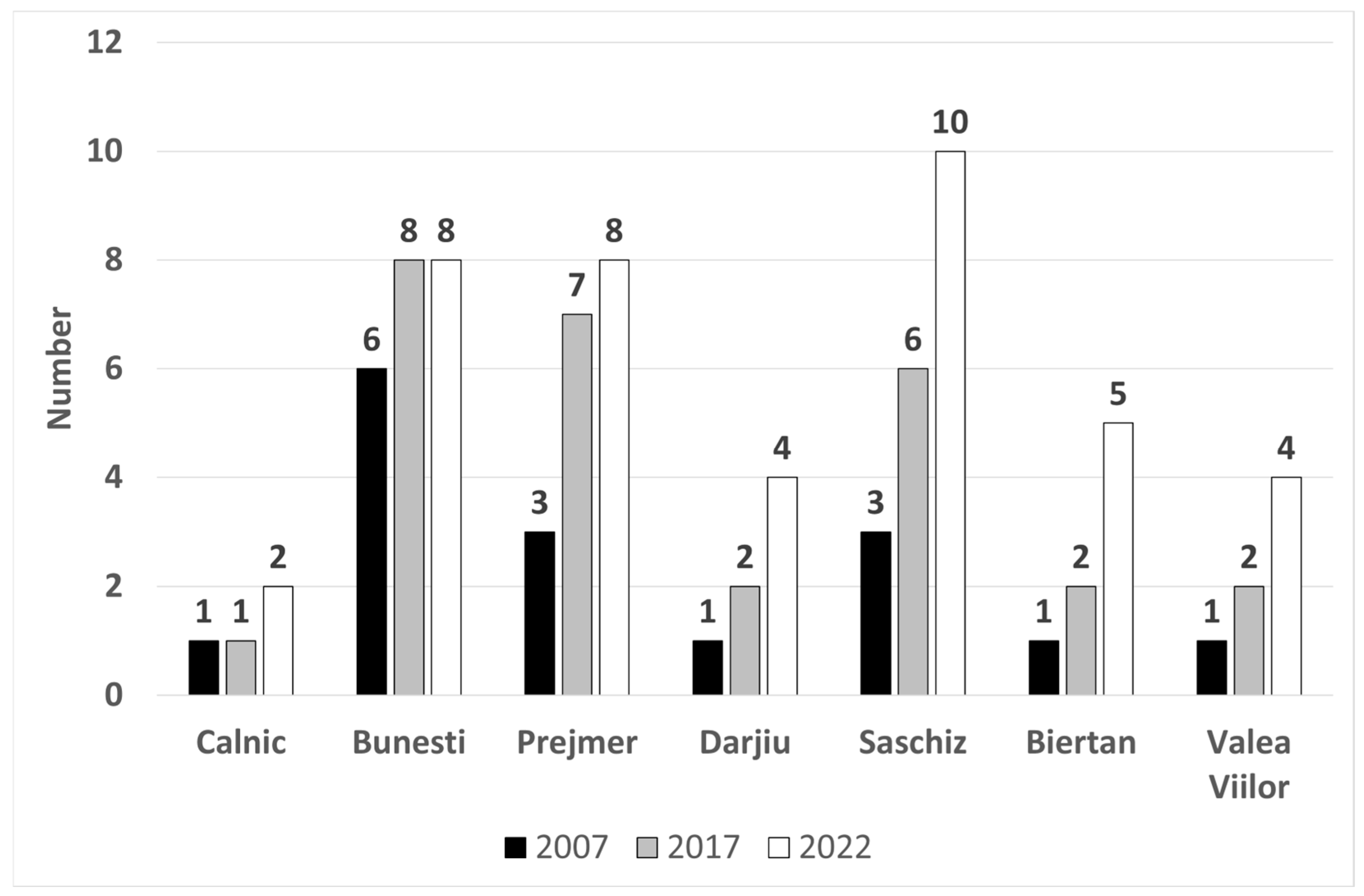
Let us look at the situation of tourism through the development of accommodation capacity in the case of the settlements with a fortified church. We can say that there is an increase in this area in all settlements. As illustrated in Figure 7, accommodation capacity has expanded in all municipalities over time, although the scale of growth varies significantly between settlements. This has also had a positive impact on the number of nights spent in these areas. Table 1 shows the number of overnight stays at five points in time. The data presented in Table 1 highlight substantial differences in tourism intensity, with Prejmer and Bunești showing the strongest growth in overnight stays over the analysed period. The data clearly show that the number of overnight stays has increased in all settlements compared to 2007. In 2020, the coronavirus epidemic and related restrictive measures caused a significant decline in all but Câlnic, with Saschiz, Biertan and Valea Viilor in particular experiencing a dramatic drop. In 2021, as rural tourism was less affected by the restrictions compared to the previous year, tourist arrivals started to increase again. This is reflected everywhere, but in the case of Câlnic, Bunești, Dârjiu and Biertan, it was able to surpass the figures of previous years.
Figure 7.
Number of accommodations in Transylvanian villages with fortified churches 2007, 2017, 2022. Source: [23].
Table 1.
Number of overnight stays in the villages with fortified churches in Transylvania 2007, 2017, 2019, 2020, 2021.
If we look at the tourism offer of the municipalities, the experience is that the fortified church is a key attraction in all municipalities, but most of them recognise that it is not enough as a stand-alone offer. Table 2 summarises the diversity of tourism attractions available in the municipalities, showing that while the fortified church represents the central heritage asset, additional cultural, gastronomic and nature-based attractions complement the tourism offer. It is therefore becoming increasingly clear to the municipalities concerned that their cultural heritage must be based on a combination of services aimed at satisfying tourist needs and satisfaction. In the context of heritage tourism, the beautiful landscape, local history collections and the presentation of tradition are present in all municipalities as tourist attractions. Bunești is the only municipality among the municipalities where traditional folk crafts have been revived through local initiative and with the involvement of the population. Visits to the workshops, which include the making of slippers and hats, and the blacksmith’s workshop, where horseshoes and ironwork are made with a hammer, can be made through seminar visits. Today, Dârjiu still preserves its centuries-old tradition in the bastion rooms, where the residents’ meat products are still displayed on hooks. A wide range of handicrafts and local food products can be found in other villages. Gastronomy has also become an integral part of the local offer. This diversification reflects a broader shift from monument-based tourism towards integrated rural tourism experiences combining cultural heritage, local gastronomy, and nature-based activities. They are also building on the growing demand for active tourism, cycling, hiking, fishing, kayaking, paragliding, and hunting is also available in some settlements (Table 2).
Table 2.
Attractiveness map of Transylvanian villages with fortified churches 2023.
Events also play an important role in promoting the settlements, stimulating the economy and increasing visitor numbers. Of course, the level of development is not evenly spread: most municipalities do not have a calendar of events for the whole year. However, there are a number of events that go back several years. Table 3 provides an overview of the main recurring cultural and gastronomic events organised in the municipalities, illustrating how local festivals contribute to tourism attractiveness and community identity. These include art exhibitions and gastronomic festivals in Câlnic, the gastronomic festival in Bunești, the pancake festival in Prejmer, the hailstorm day tour in Dârjiu, the rhubarb festival in Saschiz, the World Saxon Meeting in Biertan, and the festival in memory of Martian Negrea in Valea Viilor (Table 3). These traditional events enrich the area and contribute to the unique identity of the municipalities.
Table 3.
Events in Transylvanian villages with fortified churches, 2023.
The perception of a municipality by tourists also depends on the quality of the underlying tourism structures in the municipality. As summarised in Table 4, the availability of tourism-related services varies between municipalities, particularly in the case of cafés, bakeries and larger retail facilities. All the municipalities except Dârjiu have one or more restaurants. All municipalities have pubs, but only two municipalities, Bunești and Prejmer, have a café. Most of the settlements have retail units serving the basic needs of the local population. The small shops are well equipped and have everything that people need for their daily lives. Prejmer is the only municipality with a discount chain. Handicraft products can be bought in all municipalities. Three municipalities have bakeries offering fresh bakery products to the population and tourists (Table 4).
Table 4.
Background tourism structures in Transylvanian villages with fortified churches 2023.
The common tourism value would suggest that the 7 municipalities are strategic partners, and that the common cultural value is a sufficient incentive for cooperation between the municipalities. However, the municipal leaders interviewed reported that there is no extensive cooperation between them, but rather cooperation on a single source of funding and/or exchange of experience, and rather only with one partner municipality. This limited level of cooperation highlights an institutional gap between shared heritage designation and coordinated tourism governance.
3.3. Marketing Activities of the Fortified Church Municipalities
To increase the visibility of the settlements, to present their cultural values and traditions, it is essential to provide information in a conscious and continuous way. The development of municipalities is inconceivable without effective communication, which helps to raise their profile and reputation outwards and build their image inwards.
The fortified church municipalities do not have joint marketing activities, but each municipality separately presents itself online. Based on the Romanian names of the municipalities, it is worth starting the analysis by examining the official municipal websites of the municipalities. As the municipalities are largely composed of ethnic Romanian inhabitants, the websites are mostly in Romanian. For three municipalities, it was possible to choose another language. German for Prejmer, Hungarian for Dârjiu and English for Bunești. In almost all cases, the home pages of the websites include the municipal coat of arms, pictures about the municipality, such as the UNESCO World Heritage fortified church, other village representation and natural features. For several municipalities, similarities can be found between the websites. The structure and the use of colours are the same for the Saschiz and Biertan websites, only the content of the information is different. The websites are transparent. The logical structure and layout of the site make it easy to navigate within the site. As they also function as a municipal website, they contain information for the public and forms to help with administrative tasks. In terms of content, each page contains a general description of the municipality (location, history, tradition). For each municipality, there is tourist information on the cultural assets present in the municipality. For some of the municipalities, in addition to the attractions of the municipality, there is useful information such as the opening hours of the fortified church, the price of admission tickets and information on where to eat and other services.
The Facebook page was analysed in terms of the number of likes and followers, the page being up-to-date and the tourist content. The Facebook pages of the municipalities have thousands of likes and followers, which represents the popularity of the municipalities. Bunești is the only municipality where the pictures, videos and posts uploaded to the Facebook page depict the municipality or its attractions. For the other municipalities, the content uploaded to the Facebook page tends to contain information for the residents. The content for tourists is poor, with no information related to tourism. There are few posts about attractions, accommodation, events, activities and tourist services. It was also not possible to find reports, photos or videos of events in the municipalities from the past. The lack of updates and posts makes Facebook seem less functional, as it has no visitor incentive effect.
As for the tourism service providers surveyed, most of them make good use of communication opportunities. They present UNESCO World Heritage sites, local attractions, various leisure activities, different service packages, traditional events, natural and landscape values, accommodation offers and booking opportunities. The analysis of the Tourism Blog sites has been carried out to assess the authenticity of the presentation of the municipalities’ fortified churches and the tourist services on offer in the municipalities. The travelminit.ro blog gives a lovely presentation of all seven fortified churches, their history and traditions. You can find information about the visiting hours and the ticket prices of the fortified church. With the exception of Dârjiu, most of the tourist service providers present in the municipality have taken advantage of the presentation of their accommodation offer and the possibility of booking accommodation for tourists on the Travelminit interface.
The Tripadvisor portal was also used to analyse tourist feedback, based on the positives and shortcomings of the settlement, the fortified church and the services. Table 5 summarises the evaluation scores and number of reviews recorded for each municipality revealing significant differences in visitor engagement despite similar average satisfaction ratings. The fortified church in Câlnic was evaluated by the tourists visiting the site as a tourist attraction, a well maintained, beautiful and peaceful space, that is open all year round and displays local crafts. They recommend visiting the fortified church “if you are in the area, visit the fortress, it is worth it” [38].
Table 5.
Tourists’ feedback on Tripadvisor, rated on a scale of 1–5 (2023).
The municipality of Bunești includes the village of Viscri, internationally known for its association with HM King Charles III, whose long-standing philanthropic involvement has contributed significantly to the international visibility of the village and its heritage [69,70]. Visitors were impressed by the fortified church and the old traditional village life, which is reflected in the traditional dress of the inhabitants. Visitors appreciate the sense of time standing still, the unspoilt, authentic environment, geese, chickens, horse-drawn carts on the roads. Visitors describe it as the best-preserved Saxon village. Visitors were impressed by the language skills of the reception lady, who speaks German, English, Romanian and French. Everyone is very satisfied with the services and the accommodation, but the road to the village is considered to be terrible. Some perceive the lack of a guided tour as a shortcoming: “the lack of a guide has marred the experience” [41].
The fortified church of Prejmer is considered by visitors to be the most spectacular and heavily fortified fortress in Transylvania, “the pinnacle of fortified churches”. The hundreds of rooms within the walls, where the villagers lived when the village was attacked, are said to be fabulous and impressive. Visiting the fortified church is described as a unique experience that “takes you back in history and makes you feel how people lived here”. On the negative side, they perceive the entrance as being provided by a ticket machine, “… the entrance is rather impersonal” [31].
Dârjiu has few reviews on Tripadvisor. Visitors describe the village as picturesque. The fort is described as “…an immaculate little fortified church”, the wall paintings are considered beautiful and the surviving tradition is considered a defining value [30].
During their visit to the fortified church in Saschiz, tourists were positively impressed by the Saxon pastor’s narration of the church’s history. Visitors find the clock tower fascinating and many mention its similarity to Sighisoara. Many recommend visiting the artisan food producers and attending the Haferland festival [39].
Visitors to the Biertan fortified church were impressed by the largest winged altar in Transylvania, the Gothic sacristy door and the reconciliation room. One tourist describes the spirituality of the fortified church exquisitely: “the soul of the fortified church weaves its memories around your mind and whispers its secrets into the air”. On the negative side, the admission price is higher and more crowded compared to other fortresses [37].
The fortified church in Valea Viilor can be visited also after opening hours, and the church caretaker is available outside the opening hours, too, to show visitors around. This is appreciated by tourists. They also find the Saxon museum beautiful and interesting. The accommodation within the fortified walls of the church is also a unique experience. On the negative side, the fortified church is in need of renovation [42].
4. Discussion
Heritage tourism is based on a heritage that lives with the local community. In this context, the fortified church villages of Transylvania provide an important case for examining how shared World Heritage status interacts with local demographic, institutional, and tourism development conditions. In the case of villages with fortified churches, the heritage built in the Middle Ages is deeply embedded in the identity of the local society. However, it is also a fact that, as this heritage was not built as a tourist attraction, it has been a challenge for tourism management how to turn the fortified church into a tourist attraction [16].
Our experience shows that the 7 villages that have embarked on the World Heritage tourism path are thinking of separate strategies and developments. Although the common tourism value would justify it, there is still no joint strategic planning between the 7 villages, but rather cooperation on a single source of funding and/or exchange of experience, and rather only with one partner village [12].
Developments have taken individual paths from one municipality to the next, resulting in a tourism product offer of uneven quality. What they have in common is that the church is at the heart of the tourism product offer in all the villages with a fortified church. However, there is also a clear recognition in all the villages that they need to further develop this attraction. Development has been undertaken in a variety of areas (hunting tourism, cycling tourism, green tourism, fishing tourism, gastronomy tourism, etc.) and events play a significant role in the offer of the villages [16].
Currently, the fortified church villages attract several hundred thousand visitors annually. It is also true, however, that tourist visitation varies quite spectacularly from one village to another. For example, Dârjiu attracted a tenth of the number of tourists in 2019 compared to Biertan, Bunești and Prejmer, which had over 50,000 visitors in 2019 [22]. The 7 municipalities with the same World Heritage status are therefore not equally integrated in the Romanian tourism market. This was also striking in our marketing communication study, and in our content analysis on online advertising platforms and social media. In the tourist satisfaction survey conducted on Tripadvisor, the average tourist rating was relatively similar for all municipalities, while there was a difference of 2 orders of magnitude in the tourist feedback (9 people rated Dârjiu, 328 in Bunești) [30,41]. The reasons behind these huge differences are manifold. Dârjiu stands out the most. Although it is not possible to attribute the findings to a single cause, one of the biggest problems is undoubtedly the fact that the village has an age index that is extremely high compared to other municipalities, i.e., it is ageing rapidly [22]. Without the presence of young generations, even if there are development plans, it is not easy to implement them. Where there are no human resources to implement the plans, tourism is not viable [16,20].
A defining feature of heritage performance in the fortified church villages is the fragmented governance structure: ecclesiastical institutions typically retain legal ownership and gatekeeping functions (including access regulation, maintenance priorities, and in some cases tourism-related revenues), while municipalities shape destination promotion, infrastructure development, and local economic integration. This church–municipality interface often requires negotiated partnership arrangements, particularly in contexts of shrinking congregations and limited ecclesiastical resources. Recent studies on Transylvanian fortified churches and rural World Heritage governance highlight the increasing reliance on hybrid management models involving church authorities, municipalities, NGOs, and external donors [3,7,24,25,27]. Differences in tourism performance across settlements may therefore partly reflect variations in the effectiveness of these multi-actor governance configurations.
Within this fragmented governance framework, additional actors beyond the local institutional setting often assume complementary roles in sustaining heritage functions. An additional structural factor influencing tourism dynamics and heritage maintenance in several fortified church villages is the continued engagement of the Transylvanian Saxon diaspora. Nostalgia-driven return visits, large-scale Saxon meetings, and financial as well as organizational support from Saxon associations in Germany contribute to the preservation, visibility, and international recognition of these sites. In settlements where the resident Saxon population has nearly disappeared, diaspora networks often function as symbolic stakeholders and indirect co-managers of heritage assets. This transnational dimension represents an important complementary layer of governance beyond the municipal level.
As far as related services are concerned, the expansion is visible everywhere. All municipalities have recognised the need for a background structure to serve (also) the needs of tourists as they become tourist destinations. Accommodation services have undergone the most visible change; they have developed everywhere. Some have seen an 80-fold increase in the number of overnight stays (Prejmer) between 2007 and 2021 [22,23]. Other areas of hospitality, on the other hand, are rather uneven in quality: pubs, small grocery shops, local produce shops are everywhere, but cafés and buffet restaurants are not everywhere. These also influence tourists’ choices when planning their activities.
In any case, the conclusion must be drawn that as long as planning is done as competitors and not as a coordinated strategy of integrating the tourism offer of each municipality, the positive spill-over effects of synergies cannot be realised. Without this, the current supply imbalances will continue to exist, with some municipalities (the more successful) taking a larger share of the benefits generated by tourism and others a smaller one. Overall, this situation may limit the realization of potential synergies for both tourism development and heritage conservation. It would be important to engage in an optimal development that would be a step forward for all municipalities, in which each municipality could develop its own profile and a favourable competitive position, based on a common strategy, while at the same time giving each municipality the chance to move up a level. The linguistic and cultural historical diversity of the three nations (Hungarian, Romanian and German) and an ethnic group (Roma) living in settlements with fortified churches could also be of great value. Of the seven settlements, six were historically Saxon villages (Câlnic, Bunești, Prejmer, Saschiz, Biertan, and Valea Viilor), while Dârjiu represents a historically Szekler (Hungarian) settlement. Due to the demographic transformations of the 20th century, most of these villages are today predominantly inhabited by Romanian populations, while Dârjiu retains a strong Hungarian majority. Linguistic and cultural diversity is an opportunity for each settlement to find its own unique character, while the added value of the fortified church World Heritage Site could also be added to the common tourist offer.
5. Conclusions
The results demonstrate that, despite sharing the same World Heritage status, the fortified church villages follow markedly different development trajectories. Tourism performance is strongly influenced by demographic structure, the availability of local human resources, the quality of background tourism infrastructure, and the effectiveness of communication and marketing activities. While visitor satisfaction levels are relatively high across all municipalities, significant disparities exist in visitor numbers and tourism intensity, indicating uneven integration into the regional and national tourism market.
A key finding of the study is the absence of coordinated, inter-municipal tourism strategies. Although the common heritage value would provide a strong foundation for cooperation, tourism development is currently pursued in a fragmented manner, limiting the realization of potential synergies and positive spill-over effects. As a consequence, more successful municipalities capture a disproportionate share of tourism benefits, while others remain underutilized despite their heritage value.
The analysis also highlights that fortified churches alone are insufficient as stand-alone tourist attractions. Successful heritage tourism development increasingly relies on integrated service systems that combine cultural heritage with landscape values, local gastronomy, events, active tourism opportunities, and authentic community-based experiences. In this context, digital communication and online visibility play a crucial role in shaping destination image and visitor engagement, particularly for smaller and less accessible settlements. The findings must also be interpreted within the context of a fragmented governance system in which ecclesiastical ownership and municipal tourism development operate in parallel rather than within a unified management framework.
From a policy perspective, several practical steps could support more balanced heritage tourism development in the fortified church villages. First, the creation of an inter-municipal tourism network could facilitate joint marketing, coordinated event calendars and shared visitor information systems. Second, cooperation with ecclesiastical institutions, NGOs and diaspora organisations could strengthen the long-term management capacity of the fortified churches. Third, improved digital communication strategies and multilingual online content could significantly enhance international visibility, particularly for smaller municipalities.
From a practical perspective, the findings underline the need for a common strategic framework that supports cooperation while allowing municipalities to develop distinct profiles based on their specific cultural, linguistic, and historical characteristics. The multicultural heritage of the region—rooted in Hungarian, Romanian, Saxon, and Roma traditions—represents a significant but underutilized asset that could strengthen both individual destination identities and the collective tourism offer of the fortified church villages.
Overall, this research contributes to heritage tourism studies by demonstrating that World Heritage designation alone does not guarantee balanced tourism development. Long-term success depends on coordinated governance, local capacity building, strategic communication, and the integration of heritage values into diversified, sustainable tourism products. The study also has several limitations that should be acknowledged. First, the research relies primarily on municipal-level data and expert questionnaires rather than direct visitor surveys. Second, the analysis covers a relatively limited time period, which may not fully capture longer-term tourism development trends. Future research could extend this approach by incorporating visitor surveys, longitudinal analyses, or comparative studies with other rural World Heritage sites in Central and Eastern Europe. Future research could also explore comparative analyses with other rural World Heritage sites in Central and Eastern Europe in order to better understand how different governance models and demographic contexts influence heritage tourism development.
Supplementary Materials
The following supporting information can be downloaded at: https://www.mdpi.com/article/10.3390/heritage9030116/s1, Appendices SA–SD: Questionnaires used in the survey of municipal decision-makers.
Author Contributions
Conceptualization, M.N.M. and E.N.; methodology, M.N.M. and E.N.; validation, M.N.M. and J.G.N.; formal analysis, J.G.N. and T.C.; investigation, M.N.M. and E.N.; resources, M.N.M., E.N. and J.G.N.; data curation, M.N.M. and E.N.; writing—original draft preparation, M.N.M. and E.N.; writing—review and editing, M.N.M. and J.G.N.; visualization, M.N.M., T.C. and J.G.N.; supervision, M.N.M. and J.G.N. All authors have read and agreed to the published version of the manuscript.
Funding
This research received no external funding.
Data Availability Statement
The data presented in this study are available from the corresponding author upon reasonable request.
Conflicts of Interest
Author Enikő Nemes is affiliated with Gruns Trans SRL. The company had no role in the design of the study; in the collection, analyses, or interpretation of data; in the writing of the manuscript; or in the decision to publish the results. The other authors declare no conflicts of interest.
References
- Ashworth, G.J. Heritage Planning: Conservation as the Management of Urban Change; Geo Pers: Groningen, The Netherlands, 1991; ISBN 978-90-71971-30-3. [Google Scholar]
- Dincă, I. Derivate Iconic and Symbolic from the Composition of the Rural Landscapes Dominated by the Fortified Churches from Transylvania, Romania. Geoj. Tour. Geosites 2016, 17, 32–46. [Google Scholar]
- Cristini, V.; García-Soriano, L.; Vegas, F. Villages with Fortified Churches in Transylvania: Architecture, History and Intangible Culture. Int. Arch. Photogramm. Remote Sens. Spat. Inf. Sci. 2020, XLIV-M-1–2020, 249–254. [Google Scholar] [CrossRef] [Scilit]
- Bodocan, V.; Rusu, R.; Egresi, I.; Schreiber, W. Regional Identity and Sustainable Development in Transylvania: German Cultural Heritage. Misc. Geogr. 2025, 29, 155–164. [Google Scholar] [CrossRef] [Scilit]
- Csányi, V. Az Emberi Természet; Akadémiai Kiadó: Budapest, Hungary, 2016; ISBN 978-963-05-9805-7. [Google Scholar]
- Centre, U.W.H. Convention Concerning the Protection of the World Cultural and Natural Heritage. Available online: https://whc.unesco.org/en/conventiontext/ (accessed on 26 January 2026).
- Musteață, S. Rural Heritage on the World Heritage List: The Case of Villages with Fortified Churches from Romania. In Proceedings of the ICOMOS Advisory Committee Scientific Symposium “Rural Heritage—Landscapes and Beyond”, Marrakesh, Morocco, 17 October 2019. [Google Scholar] [CrossRef]
- Alejziak, W. Krzysztof Przeclawski: Sociology, Philosophy and the Ethics of Tourism. In Early Framers of Tourism Knowledge; Routledge: London, UK, 2023; Volume III, pp. 71–77. ISBN 978-1-003-39321-4. [Google Scholar]
- Swarbrooke, J. The Future of the Past: Heritage Tourism into the 21st Century. In Tourism the State of the Art; John Wiley & Sons: Chichester, UK; New York, NY, USA, 1994; pp. 222–229. ISBN 978-0-471-95092-9. [Google Scholar]
- Hall, C.M.; Zeppel, H. History, Architecture, Environment: Cultural Heritage and Tourism. J. Travel Res. 1990, 29, 54–55. [Google Scholar] [CrossRef] [Scilit]
- Kundi, V.; Ernszt, I. Safeguarding Natural Environment in Tourism and the Phenomenon of Greenwashing. J. Infrastruct. Policy Dev. 2024, 8, 5000. [Google Scholar] [CrossRef] [Scilit]
- Alsyoof, S.M.S.; Vasa, L.; Sneider, T. Humane-oriented CSR on Social Media: The Roles of Other-praising Emotions and Social Justice Values. J. Int. Stud. 2025, 18, 46–67. [Google Scholar] [CrossRef] [Scilit]
- Gabor, D.; Csősz, I.; Martin, S.; Ianosivici, O.; Iosim, I. Possibilities for Rural Tourism Development around Fortified Churches. Lucr. Ştiinţ. 2013, 15, 259–262. [Google Scholar]
- Kupi, M.; Kundi, V.; Szabó, T. Deciphering the Cryptocurrency Impact on Tourism Dynamics: Legal Insights from Spain, France, Croatia, and the Netherlands. Geoj. Tour. Geosites 2025, 58, 422–432. [Google Scholar] [CrossRef] [Scilit]
- Duguleana, M.; Postelnicu, C.C. Towards Preserving Transylvanian Fortified Churches in Virtual Reality. In VR Technologies in Cultural Heritage; Duguleană, M., Carrozzino, M., Gams, M., Tanea, I., Eds.; Communications in Computer and Information Science; Springer International Publishing: Cham, Switzerland, 2019; Volume 904, pp. 34–45. ISBN 978-3-030-05818-0. [Google Scholar]
- Ivancsóné Horváth, Z.; Kupi, M. Digitalization and Tourism: How X, Y, and Z Generations Make Travel Decisions in the Online Era. Geoj. Tour. Geosites 2025, 60, 1302–1314. [Google Scholar] [CrossRef] [Scilit]
- Pearce, C.L.; Barkus, B. The Future of Leadership: Combining Vertical and Shared Leadership to Transform Knowledge Work [and Executive Commentary]. Acad. Manag. Exec. 2004, 18, 47–57. [Google Scholar]
- Fekete, M. Hétköznapi Turizmus. A Turizmuselmélettől a Gyakorlatig. Ph.D. Thesis, Nyugat-Magyarországi Egyetem, Sopron, Hungary, 2006. [Google Scholar]
- Tasnádi, J. A Turizmus Rendszere: [Tankönyv]; Kereskedelmi és Gazdasági Főiskola: Szolnok, Hungary, 1998; ISBN 978-963-03-6196-5. [Google Scholar]
- Ivancsóné Horváth, Z.; Raffay, Z.; Happ, É. How x, y, and z Generations Make Travel Decisions in the Online Era. Geoj. Tour. Geosites 2025, 58, 42–51. [Google Scholar] [CrossRef] [Scilit]
- Nemes, E. Falusi Turizmus és Lehetőségei a Vidék Fejlődésben—Egy Kiaknázatlan Világörökségi Helyszín Perspektívájából (Rural Tourism and Its Opportunities in Rural Development—From the Perspective of an Untapped World Heritage Site). Master’s Thesis, Hungarian University of Agriculture and Life Sciences, Csíkszereda, Romania, 2023. [Google Scholar]
- National Institute of Statistics. Welcome to National Institute of Statistics. Available online: https://insse.ro/cms/en (accessed on 27 January 2026).
- INSSE—Statistical DB. TEMPO-Online Time Series. Available online: http://statistici.insse.ro/shop/?lang=en (accessed on 27 January 2026).
- Vegheș, C.; Popescu, I.C. Cultural Heritage, Tourism and the Sustainable Development of the Local Communities: The Case of the Saxons’ Fortified Churches of Transylvania. In Innovative Business Development—A Global Perspective; Orăștean, R., Ogrean, C., Mărginean, S.C., Eds.; Springer Proceedings in Business and Economics; Springer International Publishing: Cham, Switzerland, 2018; pp. 397–414. ISBN 978-3-030-01877-1. [Google Scholar]
- Morgan, D. Examining Transylvanian Saxon Fortified Churches from the 13th to the 16th Centuries; the History and Archaeology of the Saxon Rural Church in Romania: Roles and Identities. Ph.D. Thesis, University of Leicester, Leicester, UK, 2009. [Google Scholar]
- Philippi, P. The Lutheran Church in Romania in the Aftermath of Communism. Relig. State Soc. 1994, 22, 345–352. [Google Scholar] [CrossRef] [Scilit]
- König, H. Sacred Spaces in Transition: A Glimpse into the Situation of the Evangelical (Lutheran) Church A.C. in Romania. Rev. Ecum. Stud. Sibiu 2021, 13, 239–255. [Google Scholar] [CrossRef] [Scilit]
- Casa Dives. Calnic—Cetatea in Care Poti Innopta. Available online: https://www.casadives.ro/calnic-cetatea-in-care-poti-innopta (accessed on 26 January 2026).
- Orbán Panzió. Available online: https://www.orbanpanzio.ro (accessed on 26 January 2026).
- Exceptionally Lovely Place to Visit—Review of Darjiu Fortified Church, Darjiu, Romania. Available online: http://www.tripadvisor.com/ShowUserReviews-g8648079-d8642202-r539015691-Darjiu_Fortified_Church-Darjiu_Harghita_County_Central_Romania_Transylvania.html (accessed on 26 January 2026).
- Peasant Fortified Church at Prejmer—All You Need to Know BEFORE You Go (with Reviews). 2026. Available online: https://www.tripadvisor.com/Attraction_Review-g815578-d1866252-Reviews-or100-Peasant_Fortified_Church_at_Prejmer-Prejmer_Brasov_County_Central_Romania_T.html (accessed on 26 January 2026).
- Rezultate de Căutare Pentru „Comuna Saschiz”—Primaria Biertan. Available online: https://comunabiertan.ro/?s=Comuna+Saschiz (accessed on 26 January 2026).
- Valea Viilor. Wikipedia. Available online: https://hu.wikipedia.org/wiki/Nagybaromlak (accessed on 26 January 2026).
- Biertan. Wikipedia. Available online: https://hu.wikipedia.org/wiki/Berethalom (accessed on 26 January 2026).
- Prejmer. Wikipedia. Available online: https://hu.wikipedia.org/wiki/Prázsmár (accessed on 26 January 2026).
- Viscri. Wikipedia. Available online: https://hu.wikipedia.org/wiki/Szászfehéregyháza (accessed on 26 January 2026).
- Biertan Fortified Church. Available online: https://www.tripadvisor.com/Attraction_Review-g815577-d3199035-Reviews-or50-Biertan_Fortified_Church-Biertan_Sibiu_County_Central_Romania_Transylvania.html (accessed on 26 January 2026).
- Calnic Fortress. Available online: https://www.tripadvisor.com/Attraction_Review-g2412634-d2394579-Reviews-Calnic_Fortress-Calnic_Alba_County_Central_Romania_Transylvania.html (accessed on 26 January 2026).
- Top Things to Do in Saschiz. Available online: https://www.tripadvisor.com/Attractions-g2203968-Activities-Saschiz_Mures_County_Central_Romania_Transylvania.html (accessed on 26 January 2026).
- Viscri Fortified Church—All You Need to Know BEFORE You Go (with Reviews). 2026. Available online: https://www.tripadvisor.com/Attraction_Review-g2161286-d6761234-Reviews-or40-Viscri_Fortified_Church-Viscri_Brasov_County_Central_Romania_Transylvania.html (accessed on 26 January 2026).
- Bunesti, Romania: All You Must Know Before You Go. 2026. Available online: https://www.tripadvisor.com/Tourism-g7725999-Bunesti_Brasov_County_Central_Romania_Transylvania-Vacations.html (accessed on 27 January 2026).
- Valea Viilor, Romania: All You Must Know Before You Go. 2026. Available online: https://www.tripadvisor.com/Tourism-g7233062-Valea_Viilor_Sibiu_County_Central_Romania_Transylvania-Vacations.html (accessed on 27 January 2026).
- Municipality of Biertan Facebook Page. Available online: https://www.facebook.com/Biertan (accessed on 26 January 2026).
- Municipality of Câlnic Facebook Page. Available online: https://www.facebook.com/profile.php?id=100064841766632 (accessed on 26 January 2026).
- Municipality of Prejmer Facebook Page. Available online: https://www.facebook.com/primariaprejmer (accessed on 26 January 2026).
- Municipality of Saschiz Facebook Page. Available online: https://www.facebook.com/people/Comuna-Saschiz-Mures/100068719052318 (accessed on 26 January 2026).
- Municipality of Dârjiu Facebook Page. Available online: https://www.facebook.com/szekelyderzs (accessed on 26 January 2026).
- Municipality of Viscri Facebook Page. Available online: https://www.facebook.com/people/Viscri/100063509643402 (accessed on 26 January 2026).
- Municipality of Valea Viilor Facebook Page. Available online: https://www.facebook.com/valeaviilor1964 (accessed on 26 January 2026).
- Gündisch, K. Das „Privilegium Andreanum” von 1224: Ein „goldener Freibrief” Für Die Siebenbürger Sachsen. Anu. Institutului Istor. George Bariţiu Ser. Hist. 2024, 63, 13–36. [Google Scholar] [CrossRef] [Scilit]
- Homoki-Nagy, M. Private Law in Transylvania as Part of the Kingdom of Hungary. Acta Univ. Sapientiae Leg. Stud. 2021, 9, 225–254. [Google Scholar] [CrossRef] [Scilit]
- Cosma, E. Customary Law of Central and Southeast Europe in Medieval and Early Modern Times. A Comparative Approach and a Few South Slav, German, Transylvanian Saxon, Hungarian, Vlach and Romanian Enactments. Swed. J. Rom. Stud. 2025, 8, 168–190. [Google Scholar] [CrossRef] [Scilit]
- Oborni, T. The Union of the Estates in the Principality of Transylvania: The Basis of the Constitution. Hist. Stud. Cent. Eur. 2024, 4, 95–115. [Google Scholar] [CrossRef] [Scilit]
- Pál, J. Parallel Nation-Building in Transylvania and the Issue of the Union with Hungary Prior to the Austro-Hungarian Compromise. In The Creation of the Austro-Hungarian Monarchy; Routledge: New York, NY, USA, 2021; pp. 174–199. ISBN 978-1-003-19516-0. [Google Scholar]
- Szabó, B.P. Legal Reform Efforts and the Legal Traditions of the Transylvanian Saxons up to the End of the 16th Century. Acta Ethnogr. Hung. 2023, 67, 167–187. [Google Scholar] [CrossRef] [Scilit]
- Kwan, J. Transylvanian Saxon Politics and Imperial Germany, 1871–1876. Hist. J. 2018, 61, 991–1015. [Google Scholar] [CrossRef] [Scilit]
- Kwan, J. Transylvanian Saxon Politics, Hungarian State Building and the Case of the Allgemeiner Deutscher Schulverein (1881–82). Engl. Hist. Rev. 2012, CXXVII, 592–624. [Google Scholar] [CrossRef] [Scilit]
- Popov, K. Austro-Hungarian Press on the Resistance of the Transylvanian Saxons against the Toponyms Law IV/1898. Cent.-Eur. Stud. 2022, 14, 392–414. [Google Scholar] [CrossRef] [Scilit]
- Dincă, A.C. Ulrich A. Wien. Crossing Borders–Impact of Reformation in Transylvania since the 1520s: Diversity of Faith and Religious Freedom in the Ottoman Zone of Influence. Hiperboreea 2023, 10, 108–111. [Google Scholar] [CrossRef] [Scilit]
- Murádin, J.K. The Deportation of Germans from Romania to the Soviet Union in 1944–1945. Acta Univ. Sapientiae Eur. Reg. Stud. 2015, 7, 41–49. [Google Scholar] [CrossRef] [Scilit]
- Tibor, E. Social, Economic and Population Processes in Transylvania in the Hundred Years after Trianon. Wschodnioznawstwo 2020, 14, 27–48. [Google Scholar] [CrossRef] [Scilit]
- Costachie, S.; Weckmüller, D.; Lixandrescu, G. From Romania to Germany: A Complex Motivation of Post-Communist Ethnic Migration: Case Study: Germans of Romania. Zb. Rad. Departmana Za Geogr. Turiz. Hotel. 2019, 48–2, 143–159. [Google Scholar] [CrossRef] [Scilit]
- Koranyi, J.; Wittlinger, R. From Diaspora to Diaspora: The Case of Transylvanian Saxons in Romania and Germany. Natl. Ethn. Polit. 2011, 17, 96–115. [Google Scholar] [CrossRef] [Scilit]
- Kommer, A.-R. Endzeitstimmung. Der Umgang Der Evangelischen Kirche A.B. Mit Der Aussiedlung Der Siebenbürger Sachsen. Acta Univ. Sapientiae Philol. 2021, 13, 103–120. [Google Scholar] [CrossRef] [Scilit]
- Kordel, S.; Lutsch, S. Status Quo and Potential of Remigration Among Transylvanian Saxons to Rural Romania. Eur. Countrys. 2018, 10, 614–633. [Google Scholar] [CrossRef] [Scilit]
- Pătru-Stupariu, I.; Pascu, M.; Bürgi, M. Exploring Tangible and Intangible Heritage and Its Resilience as a Basis to Understand the Cultural Landscapes of Saxon Communities in Southern Transylvania (Romania). Sustainability 2019, 11, 3102. [Google Scholar] [CrossRef] [Scilit]
- Baier, H.; Besoiu, R.; Radu, S. Săsesc Fără Sași? Studii de Caz Asupra Instituției Vecinătății, Tradiției Fuga Lolelor Și Dansurilor Săsești. Transilvania 2023, 7, 83. [Google Scholar] [CrossRef] [Scilit]
- Dragan, A.; Ispas, R.T.; Crețan, R. Recent Urban-to-Rural Migration and Its Impact on the Heritage of Depopulated Rural Areas in Southern Transylvania. Heritage 2024, 7, 4282–4299. [Google Scholar] [CrossRef] [Scilit]
- Pásztor, G.; Buzogány, I. The Reinvention of Architectural Tradition: The Case of a Transylvanian Saxon Community. Acad. Tur.-Tour. Innov. J. 2015, 8, 35–45. [Google Scholar]
- Vijulie, I.; Preda, M.; Nita, A.; Tudoricu, A. Opportunities to Capitalize on Transylvanian Wood Pastures through Nature-Based Tourism: A Case Study of Viscri Village, Brașov County, Romania. Forests 2024, 15, 704. [Google Scholar] [CrossRef] [Scilit]

Disclaimer/Publisher’s Note: The statements, opinions and data contained in all publications are solely those of the individual author(s) and contributor(s) and not of MDPI and/or the editor(s). MDPI and/or the editor(s) disclaim responsibility for any injury to people or property resulting from any ideas, methods, instructions or products referred to in the content. |
© 2026 by the authors. Licensee MDPI, Basel, Switzerland. This article is an open access article distributed under the terms and conditions of the Creative Commons Attribution (CC BY) license.