


Abstract
Liangzhou Xianxiao is a narrative–singing tradition of north-west China recognised as intangible cultural heritage. This study asks which recurrent performance procedures constitute transmissible heritage knowledge and how they are reconfigured across contrasting narrative contexts. A purposive maximum-contrast corpus of six pieces drawn from public–historical, family–ethical and mixed/contemporary repertory is examined using post-approval interviews and observations, consent-based audio-visual documentation, local audio and score collections, and analytical transcription. A three-layer procedure links textual–narrative action, musicological detail and situated interpretation. Five recurrent procedures were identified: dialectal prosody, tonal stability, leap–descent contrast, rhythmic density and vocal–instrumental dialogue. Their recurrence is not a fixed sonic code: the same procedure acquires different functions as narrative context changes. We describe this bounded pattern as procedural heritage continuity—the maintenance of recognisability through the transmission and reconfiguration of practical relations among voice, dialect, timing, melodic return and sanxian rather than through exact replication of musical texts. This case-specific formulation adds an operational level to heritage analysis by specifying what performance knowledge can be compared and documented. Safeguarding should therefore document not only repertory but also the relational procedures through which performers make it transmissible and adaptable.
1. Introduction
Liangzhou Xianxiao is an oral narrative–singing practice associated with Liangzhou District in Wuwei, Gansu Province, China. It is performed in the Liangzhou dialect and commonly supported by sanxian, with repertories that address loyalty, filial conduct, family relations, historical memory and changing social experience. The official national intangible-cultural-heritage record classifies Xianxiao (Liangzhou Xianxiao) as quyi, item V-19, inscribed in the first national list in 2006; Wuwei City is the reporting locality and the Liangzhou District Cultural Center is the project protection unit [1]. The same record states that the tradition’s historical formation can be traced at least to the late Yuan and early Ming periods and describes a master–apprentice oral mode of transmission, historically involving many blind performers, in which spoken narration, singing, sanxian accompaniment and improvisatory interaction are combined [1]. These statements provide a temporal and institutional frame for the present study without requiring this article to adjudicate among the different origin narratives found in local historical accounts.
Recognition operates within a multi-level legal and administrative system. China’s Intangible Cultural Heritage Law provides for state-level and provincial representative lists and for the recognition and support of representative inheritors [2]. In Gansu, the provincial regulation requires governments at the county level and above to establish representative lists, use expert review and public notice, designate project protection units, document representative projects and support inheritors [3]. A 2021 national policy further requires governments at county level and above to include intangible-cultural-heritage protection funds in their budgets and permits targeted subsidies and other financial measures [4]. Listing can therefore carry institutional responsibilities and access to support, but designation alone does not demonstrate the continuity of a living practice. The present study does not evaluate competition for public funding or the effectiveness of particular policy instruments; it treats listing as the governance context within which the more specific question of transmissible performance knowledge is examined.
This distinction between an inventoried cultural form and the knowledge enacted in performance is central to contemporary work on intangible cultural heritage. Studies of music as heritage have emphasised that safeguarding concerns not only songs, scores and recordings but also the communities, practices and interpretive knowledge through which music continues to be performed [5,6]. Recent scholarship likewise demonstrates that sound, listening and performance can themselves constitute heritage dimensions. Prodi describes the acoustical experience of historical opera houses as intangible heritage embedded within built form [7]; Bellia approaches listening and sonic reconstruction as routes to understanding past performative spaces [8]; Bellia and Bevilacqua connect acoustics, performance and architecture in the recovery of intangible dimensions of historical theatres [9]; and Pietroni treats soundscape as a form of cultural representation [10]. Recent research has also framed musical cultural heritage as a domain requiring historically accountable interpretation and the retention of human expertise [11]. These studies establish that performance and situated knowledge matter to heritage; the present article takes that proposition as a starting point rather than claiming it as this study’s novelty.
Chinese-language scholarship on Liangzhou Xianxiao has already established important dimensions of the tradition, including dialect and linguistic form, performance formation, social functions, local ethical order and mechanisms of transmission [12,13,14,15]. Earlier work identifies cultural transmission, moral education, entertainment, emotional release and communication among the functions historically associated with Xianxiao [13]. What remains less developed is not the general proposition that performance is important but an operational account of the performance knowledge itself: which recurrent procedures can be identified across contrasting pieces, how their functions shift with narrative context, and how such recurrence can be distinguished from simple replication of a fixed musical text. This methodological gap between recognising performance as heritage and specifying comparable units of transmissible performance knowledge is the focus of the present article.
This gap matters because living heritage is sustained through processes of transmission, selection and adaptation. Heritage studies show that traditional knowledge can persist when communities and practitioners rework procedures in response to present conditions rather than treating inherited forms as static objects [16,17]. Research on an intangible hunting tradition in Extremadura similarly documents intergenerational knowledge, specialised vocabulary and adaptation to modernity as integral to continued practice [18]. In a sung ritual tradition, Botella-Quirant and colleagues show that transmission, collective memory and local experience remain central to the significance of performance for a community [19]. Work on traditional opera engagement in China and Italy further illustrates that audience engagement is shaped by the conditions under which audiences encounter and interpret performance [20]. The analytical problem addressed here is therefore more specific than whether living heritage adapts: it is how recurrence and reconfiguration can be evidenced at the micro-level of performed relations among speech, melody, rhythm and accompaniment.
The present study therefore approaches Liangzhou Xianxiao as living and embodied musical heritage and uses the term procedural heritage continuity as a case-specific analytical formulation. The term refers here to continuity evidenced when recurrent practical relations—ways of voicing dialect, pacing narration, departing from and returning to tonal centres, and coordinating voice with sanxian—remain recognisable while their narrative functions and relative emphasis change. It is not proposed as a universal theory of intangible heritage, nor does it imply that musical features possess fixed symbolic meanings. The phrase ‘moral sound’ is retained only as a secondary descriptive lens for asking how recurrent sonic actions acquire ethical force within particular narratives. Musical meaning is treated as situated social action rather than as a fixed property of intervals, rhythms or timbres [21,22,23]. Studies of Chinese musical life likewise show that performance can mediate ethical relations, collective imaginaries and social identity [24,25,26], while research on voice and envoicement foregrounds the social work accomplished by vocal sound [27]. Harris’s study of Uyghur Qur’anic recitation provides an important methodological caution against treating sonic form as an automatic code for emotion or value [28].
Narrative performance is not merely a container for words. Timing, voicing, repetition and sonic framing contribute to how narratives are organised and interpreted in performance [29,30]. In oral traditions, pronunciation and vocal delivery can index locally situated social experience [31,32]. Forms of speech also become socially recognisable through processes of enregisterment and indexicality [32,33]. For Liangzhou Xianxiao, these perspectives are especially relevant because the boundary between recitation and singing is flexible: repeated pitches, short fluctuations, elongated vowels, filler syllables and local interjections allow the sung line to remain close to speech while extending it musically. Research comparing speech and music supports the value of examining rhythm and contour together [34,35], and work on Chinese speech–song forms demonstrates that apparently speech-like practices may contain complex musical organisation [36].
The sanxian participates in this heritage process as more than harmonic support. In the project recordings and transcriptions, it can share a skeletal melodic contour with the voice while diverging in ornament, rhythm and timing. It fills pauses, sustains motion beneath prolonged tones, marks cadential points and creates continuity between narrated phrases. These actions are analysed here as part of an embodied performance grammar: a set of recurrent procedures through which voice, dialect, timing and instrument coordinate the narration without implying that any single musical feature carries a universal moral meaning.
This study addresses two linked questions. First, which recurrent performance procedures can be identified across a purposive maximum-contrast six-song corpus, and how do their narrative functions change across public–historical, family–ethical and mixed/contemporary contexts? Second, what does the pattern of recurrence with reconfiguration reveal about the procedural continuity of Liangzhou Xianxiao as intangible cultural heritage? By integrating close musical–textual analysis with field observation and practitioner knowledge, this article seeks a deliberately bounded contribution: not to reassert that performance matters to intangible heritage but to specify an operational level at which transmissible performance knowledge can be identified, compared and documented.
2. Materials and Methods
2.1. Research Design and Field Archive
This article presents a focused ethnomusicological and heritage study based on a bounded field archive rather than claiming long-term immersive ethnography. The wider research project combined documentary review, face-to-face interviews, observation, performance-related audio-visual documentation, locally available audio materials, song-score collections and musical transcription. Human-participant materials used in this article were generated only after institutional exemption approval had been granted on 21 April 2026 and were collected in accordance with the approved procedures.
The post-approval field archive includes interviews and observations involving experienced Liangzhou Xianxiao practitioners, together with consent-based audio, video and photographic documentation of performance. Additional locally available audio materials and four books of Liangzhou Xianxiao scores were obtained from the Liangzhou District Cultural Center. The present article re-analyses a bounded subset of these materials for close musical–textual comparison. Identifiable raw recordings and participant-specific materials are not reproduced in this article or Supplementary Materials.
2.2. Interlocutors, Interviews and Observation
The wider project identified five key adult interlocutors: one national-level Xianxiao inheritor-performer, one provincial-level inheritor-performer, an academic specialist in local music and culture, a cultural researcher involved in heritage documentation, and a municipal-level inheritor and professional performing practitioner. The five interlocutors were aged 42–70 years at the time of fieldwork and were locally based in Wuwei/Liangzhou, China. Nationality was not recorded as a separate demographic variable; participants were recruited according to their heritage roles, local residence or professional association, and relevant expertise. They were selected purposively because relevant knowledge is concentrated among a relatively small number of experienced performers and local specialists. Project records indicate that the principal inheritor-performers had many years of performance and teaching experience and had participated in local cultural activities, while the municipal-level practitioner had repeated public-performance and dissemination experience.
Interviews were conducted face to face using topic guides adapted to interlocutors’ roles. Interviews were conducted in Mandarin Chinese, with partial dialect code-switching where appropriate. Topics included repertory categories, singing method, sanxian accompaniment, historical development, personal performance experience, transmission and perceived cultural value. Observation focused on speech–song delivery, vocal technique, gesture, emotional projection, accompaniment and performance context. Project records state that organised interview content was returned to interviewees for checking, supplementation and correction. Because the archive does not consistently preserve a uniform verbatim translation/transcription workflow for every interview, interlocutor materials are used primarily for contextual verification, repertory selection and triangulation rather than for reconstructed quotation-based ethnography.
2.3. Six-Song Corpus and Selection Criteria
The analytical corpus comprises six pieces selected purposively from the wider repertory materials as a maximum-contrast comparative set: two state-letter/public–historical pieces (‘Liangzhou Ci’ and ‘Gunpo Diao’), two family–letter/family–ethical pieces (‘Tian Bei Yin’, glossed in the project materials as ‘Sweet and Sad Music’, and ‘Wu Dian Hong’, ‘Five Red Points’), and two variety or mixed/contemporary pieces (‘Ba Shan Wei Ping’ and ‘Nan Shan Zhong Shu Le Tao Tao’). Selection followed four criteria: each piece had to (1) be recognised within the project repertory; (2) contain a clear narrative or evaluative dimension; (3) provide analysable musical features such as tonal centre, contour, intervallic movement, rhythm, cadence, filler syllables or sanxian punctuation; and (4) add contrast across narrative function and musical organisation. The design therefore balances three narrative/repertory groupings while maximising contrast along two analytical axes—narrative world and dominant musical organisation. It is a purposive analytical design, not a probabilistic sample and not a claim that the six pieces are statistically representative of the complete repertory. Repertory outside the six-song set is not treated as less important; it falls outside this bounded comparison when it does not satisfy all four criteria or does not add a distinct contrast required by the present research questions. Table 1 makes the selection logic and the analytical role of each included piece explicit.
Table 1.
Analytical corpus, narrative worlds and performance-heritage functions.
2.4. Analytical Procedure and Triangulation
Analysis proceeded in three linked layers. The textual–narrative layer identified the social or moral action of each piece: the relationship being staged, the judgement or tension organising the story and the interpretive position made available by the narrative. The musicological layer examined pitch centres or tonal orientation, melodic contour, intervallic emphasis, rhythmic organisation, cadence, filler syllables and accompaniment. The interpretive layer then asked how those musical procedures shape the narrative as a performed event. Particular attention was given to high openings, wave-like or stepwise descent, fourth- and fifth-based expansion, dotted rhythm, syncopation, sustained notes, speech-like repetition and the ‘you pause, I move’ relationship between voice and sanxian described in the source analysis.
The staff notation used in this article is a modern analytical transcription and should not be read as evidence that Liangzhou Xianxiao has historically been transmitted through Western notation. Official heritage documentation describes master–apprentice oral transmission and improvisatory performance [1], and the project treats written scores as documentary aids within a primarily oral/aural practice. The transcription maps approximate pitch classes, durations and phrase relations onto Western staff notation to permit cross-song comparison. It necessarily regularises features that staff notation captures only imperfectly, including flexible intonation, speech-derived timing, timbre, micro-inflection, ornamentation and improvisatory variation. Interval labels and notated pitch positions therefore indicate analytical orientation rather than proof of strict twelve-tone equal-tempered tuning. No special compensation is claimed for deviations from equal temperament. Symbols such as Sprechgesang could increase descriptive granularity in a dedicated transcription study but were not introduced here because the archive does not provide uniform acoustic resolution across all six pieces and because the present aim is comparative heritage analysis rather than reconstruction of every phonetic and timbral detail.
The evidence streams were treated as complementary rather than interchangeable. Performer and practitioner accounts assisted with repertory categories, performance practice and accompaniment; academic and heritage specialists supplied contextual interpretation; audio-visual materials and observation notes supported analysis of timing, vocal delivery, gesture, timbre and instrumental interaction; and song-score materials enabled comparison of melodic and rhythmic procedures. Cross-song comparison was then used to identify recurrent procedures while retaining the narrative context of each piece. Because notation is partial, claims about timing, delivery and interaction were checked against audio-visual and observational evidence rather than inferred from scores alone. The resulting interpretation is therefore a close, situated reading of a bounded corpus rather than a statistical claim about the entire repertory.
Three analytical safeguards were applied. First, intervals, contours, rhythms and timbres were not treated as universal moral codes. Second, heritage continuity was inferred only at the level supported by the selected performances and documented practitioner knowledge, not as proof of the condition of Liangzhou Xianxiao as a whole. Third, interview material was used for contextual verification and triangulation without manufacturing translated quotations where a uniform verbatim translation workflow was not preserved.
2.5. Ethics Approval and Informed Consent
This study was conducted in accordance with the Declaration of Helsinki. The human-participant component was reviewed and granted exemption under the Exemption Review procedure by the Mahasarakham University Ethics Committee for Research Involving Human Subjects, Thailand (Certificate of Exemption, Approval No. 322-290/2026; Project No. 69/290; approved 21 April 2026; valid until 20 April 2027). Human-participant research activities used in this article, including interviews, field observations and consent-based audio-visual documentation, were conducted only after the exemption had been granted and in accordance with the approved research procedures; the committee’s Standard Operating Procedures, Version 1.0, particularly SOP 09/1.0, ‘Exemption and Expedited Review’; and the Mahasarakham University Regulation on Requirements for Human Research, B.E. 2562.
All interlocutors whose materials contributed to this study were adults aged 18 years or older. The purpose and procedures of the research were explained before participation. Participation was voluntary, and informed consent and permission were obtained before each applicable interview, observation, recording or documentation activity. This article uses de-identified interview summaries, observation records and musical materials and does not disclose direct participant-identifying information. Raw identifiable recordings remain restricted in accordance with participant consent, privacy requirements, ethical conditions and applicable cultural or copyright restrictions.
3. Results
3.1. Public–Historical Narration: Projection, Descent and Collective Memory
The public–historical pieces ‘Liangzhou Ci’ and ‘Gunpo Diao’ place moral narration on a collective scale. Their stories are organised around warfare, regional landscape and historical memory rather than primarily around domestic relations. The two pieces do this differently: in the present reading, ‘Liangzhou Ci’ juxtaposes heroic projection with the possibility of loss, while ‘Gunpo Diao’ uses extended descending motion to organise a landscape-oriented narrative.
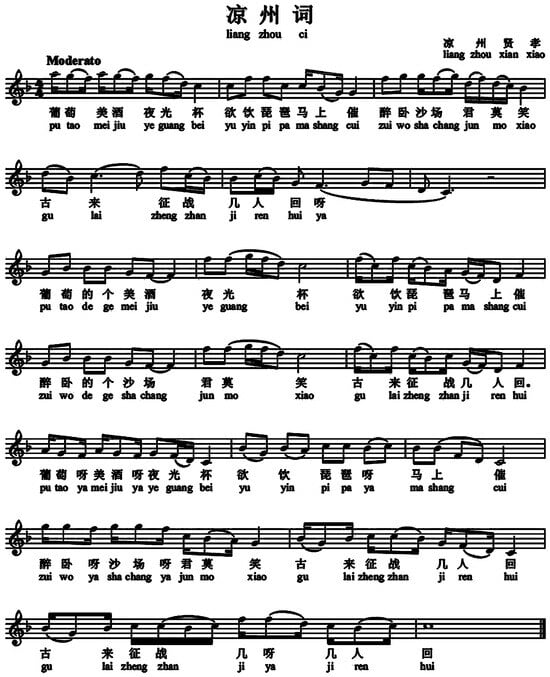
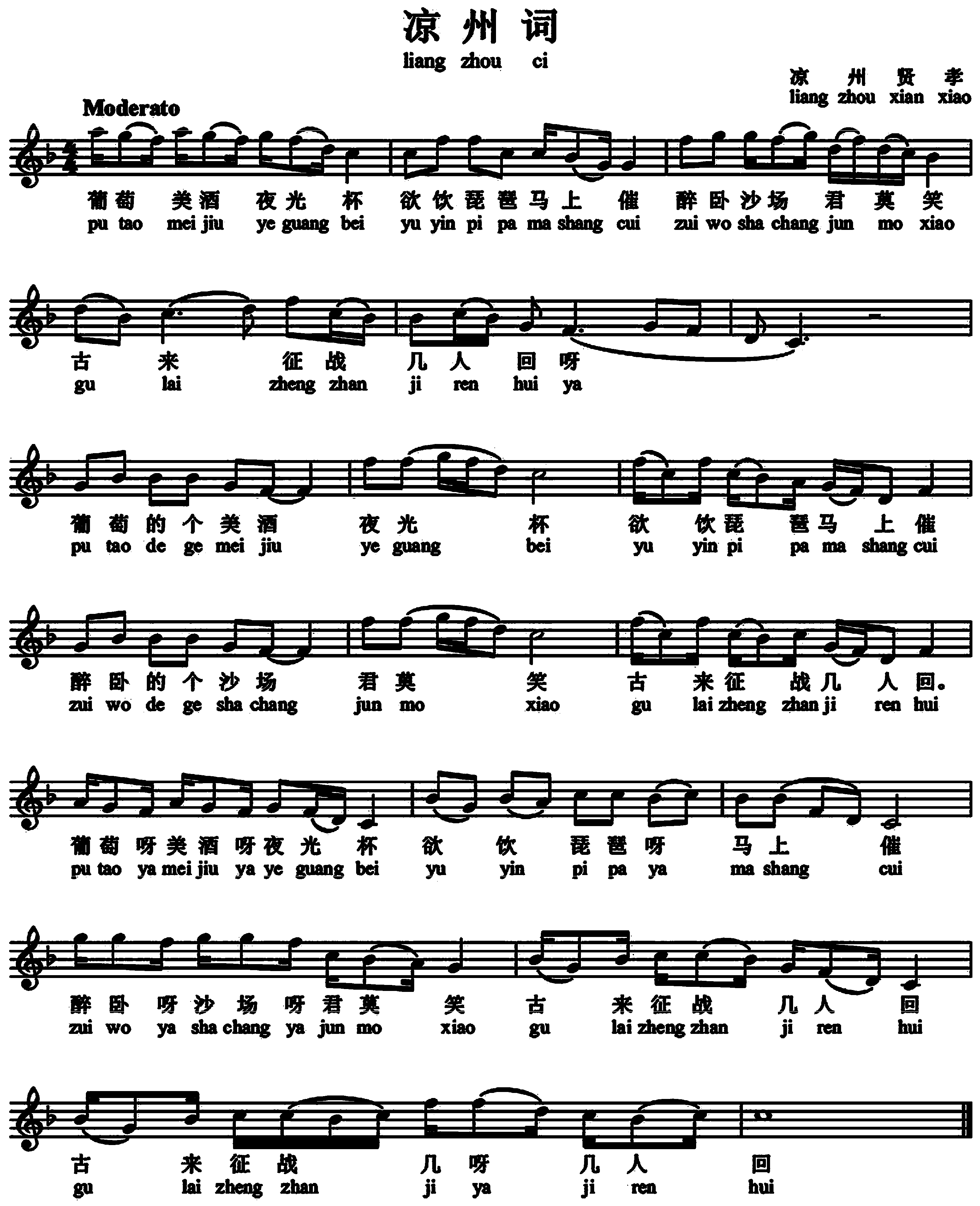
‘Liangzhou Ci’ is organised around the doubleness of frontier heroism. The narrative invokes drinking, battle and the possibility that those who leave for war may not return. In the analysed transcription, phrases frequently begin relatively high and then descend. High openings can project a broader public scale, while subsequent descent returns the line towards more speech-like narration. Stepwise seconds and thirds maintain continuity, while wider intervals appear at points of expansion or emphasis. Rather than assigning ‘heroism’ to a particular interval, the analysis treats the contrast between projection and return as one way in which the performance differentiates narrative stance.
Rhythmic design supports this alternation. Main narrative text tends to remain comparatively stable, while interjections and filler syllables compress into denser rhythmic motion. This contrast can preserve verbal clarity while creating points of heightened emphasis. In the present reading, the ethical and historical weight of the text is therefore shaped partly through timing and density, not only through lexical content.
The original transcription prepared from the field materials makes this interaction visible (Figure 1). The example shows the high-register opening, repeated speech-related pitches, stepwise descent and moments of wider intervallic motion that underpin the analysis. Because the transcription is analytical rather than prescriptive, it should not be read as a complete representation of every performance detail. Its purpose is to make audible relationships discussable without reducing performance to notation.
Figure 1.
Musical transcription of ‘Liangzhou Ci’, showing a high-register opening, stepwise melodic descent and leap–descent contrast. Original research transcription prepared from field materials and simplified for analytical clarity; no third-party published notation is reproduced. The Western staff notation is a modern analytical approximation rather than historical transmission notation and should not be read as an exact encoding of flexible intonation, timbre or twelve-tone equal-tempered tuning.
‘Gunpo Diao’ creates a different relationship between sound and public memory. Its focus is regional landscape and historical depth rather than warfare. In the analysed material, phrases often begin with a sustained higher sound and then descend through a turning, wave-like contour. Extended vowels and filler syllables allow single words to unfold across several melodic turns. The title’s image of rolling downward offers one contextual association with this contour, but this article treats that association as an interpretation of the piece rather than as a fixed meaning carried by the melodic shape.
In this reading, the descending and turning contour can be heard as a sonic analogue for movement through the landscape described by the text. The sanxian contributes by sustaining temporal continuity across vocal pauses and adding ornament around longer sung tones. Across both public–historical pieces, the analytical point is therefore not that the instrument ‘represents’ memory but that vocal–instrumental interaction helps to organise pacing while the voice moves among declaration, description and reflection.
Taken together, these pieces show one way in which the working idea of ‘moral sound’ operates within living heritage practice: collective values are shaped through relationships among register, contour, timing and accompaniment. High register and wider contour can enlarge the scale of projection, while recurrent returns to stable tones and descending motion can restore narrative restraint. As heritage knowledge, the relevant continuity lies not in a fixed meaning attached to an interval but in performers’ recurrent ways of managing projection, return and narrative pacing.
3.2. Family–Ethical Narration: Lament, Satire and Behavioural Judgement
‘Tian Bei Yin’ and ‘Wu Dian Hong’ shift the analysis to household and everyday ethical relations. The project materials gloss the former as ‘Sweet and Sad Music’ and the latter as ‘Five Red Points’. Their narrative worlds encompass suffering, deprivation, behavioural judgement and social correction. Chinese-language research on Liangzhou Xianxiao likewise shows that family–letter repertories frequently stage domestic conflict to articulate filial and behavioural norms [13,14].
‘Tian Bei Yin’ is organised around an alternation between heightened projection and repeated descent. The melody frequently begins in a higher register before falling through wave-like motion, with stepwise movement and small turns making the descent persistent rather than abrupt. This recurring contour provides a musical frame for a narrative of hardship and sorrow. Its significance lies not in any inherent association between descent and grief but in the repeated use of descending motion within this particular textual and tonal context.
The piece is organised around a stable pentatonic centre, which provides recognisable points of return within passages of descending or ornamented motion. Decorative inflections colour the line without disrupting its tonal orientation. The analytical emphasis therefore falls not on any single pitch as an emotional sign but on the way stable return points frame repeated movement and release.
Rhythm adds further expressive weight. Dotted figures and syncopations pull the line away from evenly measured narration and towards the stresses of speech-like delivery. Phrase endings may be prolonged through vocal ornament while the sanxian continues beneath or between them. In this performance texture, instrumental continuation extends moments of vocal hesitation rather than simply filling them.
‘Wu Dian Hong’ operates differently. Its moral force is organised through repetition, count-like structure and satirical directness. Recurring melodic openings provide a framework into which different behavioural examples can be inserted. The cumulative form supports extended narration and gives repeated judgements a recognisable musical frame without requiring identical melodic detail at every moment.
Proximity to speech is especially important in this piece. Repeated notes and narrow intervallic fluctuations keep the melody close to declamation. At phrase endings, stepwise descent creates closure, while local leaps and denser interjections interrupt the smoother surface at warning words or moments of heightened judgement. This alternation allows moral correction to remain embedded within a lively performed narrative rather than becoming detached instruction.
The sanxian reinforces this organisation by filling spaces left by the voice, aligning attacks with emphasised words and providing rhythmic counterforce. Rather than implying a particular audience response, the analysis treats this instrumental continuation as a means of linking one narrated example to the next and maintaining momentum across repeated moral statements.
Taken together, the two family–ethical pieces demonstrate that moral narration is not organised through a single expressive register. ‘Tian Bei Yin’ gives greater weight to descent, prolongation and tonal return, whereas ‘Wu Dian Hong’ relies more strongly on repetition, enumeration and rhythmic contrast. What unites them is the use of local speech–song relationships and sanxian interaction to frame ethical material within everyday narrative situations.
3.3. Conflict, Labour and Renewal: Adaptive Reuse of Performance Procedures
The mixed and contemporary pieces ‘Ba Shan Wei Ping’ and ‘Nan Shan Zhong Shu Le Tao Tao’ show how familiar Xianxiao procedures can be redirected towards different narrative affects. The first centres on conflict between emotional attachment and family obligation; the second is associated in the project materials with collective labour and ecological renewal. Their contrast is analytically useful because it tests whether the working idea of ‘moral sound’ depends on a single emotional register or can accommodate different narrative configurations.
‘Ba Shan Wei Ping’ is marked by hesitation and interior pressure in the present reading. Its melodic lines often begin relatively high, move through circular or wave-like descent and settle lower at phrase endings. Wider leaps appear around moments of textual or vocal intensification, after which the line contracts again. This alternation between expansion and descent can be interpreted as one sonic means of differentiating pressure from return within the narrative.
Dotted rhythm and syncopation keep the performance close to speech-like stress even when the voice moves into more sustained melody. Phrase endings can stretch through ornament and elastic timing. The sanxian’s ‘you pause, I move’ relationship is especially clear in the source analysis: instrumental continuation extends the temporal space around vocal hesitation rather than merely accompanying a completed statement.
‘Nan Shan Zhong Shu Le Tao Tao’ shifts the affective horizon. Its theme of collective labour and ecological renewal is more affirmative than the family-lament material. The analysed score and transcription show upward leaps, active dotted rhythms and a comparatively agile sanxian texture. Fourths and fifths at phrase openings contribute to a sense of ascent, but this article treats that effect as context-dependent rather than as an inherent meaning of the intervals. Local filler syllables and speech–song delivery remain part of the texture while being used in a more energetic narrative setting.
This contrast is useful for thinking about continuity. The contemporary piece retains dialectal interjection, pentatonic orientation, flexible speech–song movement and vocal–instrumental exchange while applying them to a different subject. Within this bounded corpus, continuity therefore appears partly through the reuse and reconfiguration of performance procedures rather than through the preservation of a single repertory or moral message.
The two pieces also caution against treating ‘moral sound’ as a stable expressive vocabulary. Similar broad procedures—dialectal prosody, leaps, descent, dotted rhythm and sanxian response—can occur in narratives of conflict and in narratives of optimism. Their significance emerges from configuration and context. What persists is not a one-to-one mapping between musical device and moral value but a flexible set of performance resources through which different values can be voiced.
3.4. Cross-Song Procedural Continuity: Recurrence, Redistribution and Voice–Sanxian Coordination
Across the six pieces, five recurring processes connect musical detail to narrative action. The first is dialectal prosody. Speech-like repetition, elongated vowels, filler syllables and local interjections keep the vocal line close to narrated speech even when it becomes melodically extended. Chinese-language studies likewise emphasise regional linguistic features and the role of dialect in locally situated performance and community identity [14,15]. In the present corpus, dialect therefore operates as a musical resource as well as a linguistic marker: it is part of the locally recognisable knowledge through which narration is performed.
The second process is tonal stability. Recurrent pentatonic centres and cadential return points provide orientation across pieces that contain grief, conflict, satire or celebration. Stability does not remove emotional ambiguity; rather, it gives the analysis a framework for describing how passages depart from and return to recurring pitch centres.
The third process is leap–descent contrast. Wider upward movement frequently appears at moments of enlarged scale or vocal pressure, while descending motion brings the line back towards a lower or more stable register. This pattern is prominent in the public–historical pieces and in ‘Ba Shan Wei Ping’, but its effect changes with narrative context. The analytical value lies in the relationship between expansion and return, not in assigning a fixed emotion to a particular interval.
The fourth process is rhythmic density. Stable narrative delivery alternates with compressed interjections, dotted rhythms, syncopations and ornamented phrase endings. This allows the performance to differentiate relatively even narration from moments of emphasis. Rather than making claims about measured audience attention, this article treats these changes in density as formal points of contrast within long-form narration.
The fifth process is vocal–instrumental dialogue. The sanxian fills pauses, ornaments sustained notes, marks cadential points and maintains momentum between phrases. Its role is therefore temporal as well as melodic. The instrument enables the performer to suspend verbal delivery without suspending the musical flow, producing a distributed continuity across voice and instrument.
These five processes are summarised in Table 2. The principal cross-song result is not simple recurrence but recurrence with redistribution: similar procedures reappear across different narrative worlds, while their relative prominence and narrative function change. Dialectal prosody can support lament, satire or public narration; descent and return can organise both historical projection and family hardship; and sanxian continuation can sustain pacing around both hesitation and declarative narration. The corpus therefore supports a cautious interpretation of a flexible performance grammar in which recognisability is maintained through reusable relations rather than one-to-one mappings between musical devices and meanings. This pattern provides the empirical basis for the case-specific concept of procedural heritage continuity developed in the Discussion.
Table 2.
Cross-song processes through which moral narration and performance knowledge are made audible.
Three observations delimit this result. First, recurrence is cross-contextual rather than identical replication: procedures recur but not as fixed tokens with invariant meanings. Second, continuity is relational: pitch, timing, dialectal delivery and accompaniment operate in coordinated bundles rather than as isolated traits. Third, the contemporary material shows that inherited procedures can remain locally recognisable while narrative content changes. These observations are the evidential bridge between the musicological analysis and the heritage argument; they do not establish a single grammar for all Liangzhou Xianxiao performers or repertories.
4. Discussion
4.1. Procedural Heritage Continuity: From an Established Principle to an Operational Contribution
Heritage scholarship has long established that intangible heritage depends on performance, transmission, community practice and processes of heritage making [37,38]; this study does not claim that general principle as new. Its contribution is narrower and operational. Across a purposive maximum-contrast corpus, it identifies recurrent performance procedures as analysable units and then tests whether they recur unchanged or are redistributed across contrasting narrative contexts. We use procedural heritage continuity to name the bounded pattern that emerges when recognisability is carried by reusable relations—between dialect and melody, expansion and return, rhythmic density and narrative emphasis, or vocal suspension and sanxian continuation—rather than by exact replication of a musical text.
This formulation adds an intermediate analytical level between broad heritage principles and fine-grained musicological description. Heritage research already explains why situated knowledge and performance matter [5,6,7,8,9,10,11,16,17,18,19,20]; the present case specifies what counts as evidence of continuity within a performance tradition: (1) a procedure can be identified in more than one contrasting context; (2) its narrative function can change without the procedure disappearing; and (3) its interpretation is supported by more than one evidential stream, including musical materials and practitioner or observational context. The unit of continuity is therefore not an isolated interval, rhythm or timbre but a relation that performers repeatedly enact. This makes the heritage claim inspectable without converting a living practice into a fixed inventory of sonic traits.
The term ‘moral sound’ remains useful only as a descriptive lens for the way those procedures participate in particular narratives; it is not this article’s principal heritage contribution, and it does not convert recurrent procedures into fixed codes. DeNora’s emphasis on music in use and Turino’s account of signs grounded in social experience help explain why the same melodic procedure can acquire different force in different narrative contexts [21,23]. Studies of speech, music and affect likewise caution against one-to-one expressive mappings [28,39]. A high opening therefore matters in relation to what is being projected; descent matters in relation to what precedes it; and rhythmic compression matters in relation to surrounding temporal organisation. The heritage significance lies in the transmissibility of these relations and in their capacity for contextual reconfiguration.
4.2. Dialect and Voice as Transmissible Local Knowledge
The findings also clarify the heritage role of dialect. In Liangzhou Xianxiao, dialect is not only the language in which a story happens to be told. It shapes rhyme, filler syllables, speech-like contour, rhythmic stress and the movement between recitation and sustained singing. The boundary between speech and song is therefore partly a repository of practical local knowledge. Silverstein and Agha describe how forms of speech become socially recognisable through indexicality and enregisterment [32,33]; in the present corpus, recognisability is intensified by the musical extension of dialectal forms. Chinese-language studies reinforce this point by showing that the Liangzhou dialect functions as a locally embedded resource in Xianxiao lyrics, performance and community identity [14,15].
This interpretation resonates with recent heritage research that frames continuity through specialised vocabulary, embodied know-how and intergenerational transmission. Rengifo-Gallego and colleagues show how a living heritage practice combines knowledge, vocabulary, ritual and adaptation [18], while Hamidi and Ferhati emphasise the transmission of practical know-how under changing conditions [16]. For Liangzhou Xianxiao, the comparable heritage unit is not a construction technique or hunting vocabulary but a way of voicing narrative through locally intelligible speech–song procedures. Such knowledge is difficult to safeguard through score preservation alone because timing, vocal placement and interaction are only partly captured by notation.
4.3. Voice–Sanxian Interaction and Continuity Through Adaptive Reconfiguration
The cross-song comparison provides a restrained account of procedural continuity. Similar broad procedures—dialectal prosody, tonal return, leaps followed by descent, dotted rhythm and sanxian response—appear across narratives of warfare, family hardship, satire, conflict and contemporary optimism. Their recurrence does not prove that the entire repertory shares one grammar. What it demonstrates within this bounded corpus is a pattern of reuse with functional redistribution: inherited procedures remain available to performers while being redirected towards different narrative worlds. This is the empirical form of adaptive reconfiguration referred to here as procedural heritage continuity.
This finding is consistent with recent heritage research that rejects static preservation as the sole model for living cultural traditions. Shen and colleagues argue for living transmission that remains responsive to a changing socio-cultural environment [17], and Hamidi and Ferhati show how heritage knowledge may be reintroduced and adapted to practical necessity [16]. The contemporary piece ‘Nan Shan Zhong Shu Le Tao Tao’ provides a local example: dialectal interjection, pentatonic orientation, flexible speech–song movement and voice–sanxian exchange remain recognisable even when the narrative turns towards collective labour and ecological renewal. The continuity lies in the procedures available to performers, not in the preservation of one unchanging moral message.
The role of the sanxian is especially important in this respect. The instrument enables verbal delivery to pause without suspending the musical flow. It answers, fills, ornaments and propels, creating a distributed temporal continuity across performer and instrument. This coordination is an example of tacit, embodied heritage knowledge: it must be learned as timing and interaction, not simply read from a melodic line. For safeguarding and teaching, documentation should therefore capture not only repertory and pitch sequence but also the relational procedures through which singer and instrument negotiate phrase endings, hesitation, emphasis and transition.
4.4. Safeguarding Implications, Limitations and Future Research
The safeguarding implications are more specific than the generic recommendation to record performances. The five procedures identified in the Results indicate concrete relations that documentation and teaching should make observable: how dialectal syllables move between speech and sustained melody; how departures from and returns to tonal centres are timed; how rhythmic density changes around interjections and evaluative words; how expansion and descent organise projection and return; and how sanxian activity maintains continuity during vocal pauses and phrase endings. Recording multiple instances of these relations would preserve a range of practicable options rather than fixing a single authorised version. In China’s institutional context, representative lists, project protection units and inheritor-support mechanisms provide channels through which such documentation and transmission can be organised [2,3,4]. This emphasis on practitioners and knowledge holders is also consistent with international heritage scholarship that places communities, groups and individuals within safeguarding mechanisms [40]. The present study, however, does not evaluate the adequacy, distribution or contestation of safeguarding funds, so no claim is made about the effectiveness of those policy mechanisms in Liangzhou.
The argument remains necessarily limited in scope. The principal field archive is focused and bounded, and this study does not claim long-term ethnographic immersion. Six pieces cannot represent the full Liangzhou Xianxiao repertory, and the project did not systematically measure audience response. The available interview archive supports contextual triangulation more strongly than quotation-based ethnography because a uniform verbatim translation/transcription workflow was not preserved for every interview. A stable public audio or audio-visual link would also allow readers to hear parameters that notation cannot fully represent, especially timbre, flexible intonation and speech-derived timing. The current consent, privacy, ethical, cultural and copyright conditions do not permit unrestricted public dissemination of the raw field recordings, so such a link cannot responsibly be provided for this dataset. Future projects should seek explicit repository-level consent at the point of collection where culturally appropriate. They could also compare multiple performers’ versions of the same piece, document listener interpretations, analyse vocal timbre acoustically and examine how younger practitioners learn dialectal prosody and sanxian timing.
These limitations define the scale of the contribution. This article does not propose a universal theory of heritage or claim that performance itself has been newly discovered as important. Rather, by treating musical detail as situated action and triangulating it with field observation, practitioner knowledge and documentary context, it operationalises a case-specific form of procedural heritage continuity. The analytical contribution lies in showing how recurrence, redistribution and coordination can be used as evidence that locally recognisable performance knowledge persists across different pieces and changing social themes. This formulation is intended to make the bridge between musicological evidence and heritage-process analysis explicit and testable in future comparative work.
5. Conclusions
Within the selected six-song corpus, Liangzhou Xianxiao organises moral narration through interactions among dialectal voice, melodic contour, rhythmic timing and sanxian accompaniment. Public–historical pieces place warfare and landscape within collective narrative frames; family–ethical pieces organise suffering and behavioural judgement through combinations of descent, repetition and rhythmic contrast; and mixed/contemporary pieces demonstrate how similar performance resources can be redirected towards conflict, labour and ecological renewal.
The heritage contribution of this study is not the already-established proposition that performance matters to intangible cultural heritage. It is the case-specific operationalisation of what, within this corpus, is being transmitted. Dialectal prosody, tonal orientation and return, melodic expansion and descent, rhythmic density and voice–sanxian coordination recur as relational procedures whose functions are redistributed across contrasting narratives. We describe this recurrence with reconfiguration as procedural heritage continuity. The formulation remains bounded to the evidence, but it offers a way to connect micro-level musical analysis with the heritage question of how recognisability can persist without requiring exact replication.
For safeguarding, the practical implication is to document the relations that make repertory performable, not merely to accumulate more scores or recordings. In Liangzhou Xianxiao this means capturing speech-to-song transitions, the timing of tonal return, density shifts around interjections, and the coordination through which the sanxian sustains musical flow during vocal suspension. The present evidence does not establish how all performers or listeners understand those procedures, nor does it represent the complete repertory. It does support a focused claim that locally recognisable heritage is carried partly through repeatable yet adaptable relations among dialect, voice, timing and instrument. Future comparative research can test whether the same analytical logic holds across performers, generations and other orally transmitted musical heritage traditions.
Supplementary Materials
The following supporting information can be downloaded at: https://www.mdpi.com/article/10.3390/heritage9110471/s1. The following supporting information is provided with the submission: S1, Six-song corpus and analysis matrix; S2, Coding and analytical procedure; S3, De-identified fieldwork, interview and observation documentation; S4, Access and restriction matrix.
Author Contributions
Conceptualization, Z.L. and S.C.; methodology, W.S. (Warakorn Seeyo) and W.S. (Weerayut Seekhunlio); validation, W.S. (Warakorn Seeyo) and W.S. (Weerayut Seekhunlio); formal analysis, Z.L.; investigation, Z.L.; data curation, Z.L.; writing—original draft preparation, Z.L.; writing—review and editing, W.S. (Warakorn Seeyo), S.C. and W.S. (Weerayut Seekhunlio); supervision, W.S. (Warakorn Seeyo) and S.C.; project administration, W.S. (Warakorn Seeyo); funding acquisition, W.S. (Warakorn Seeyo) and Z.L. All authors have read and agreed to the published version of the manuscript.
Funding
This research was funded by the College of Music, Mahasarakham University, grant number 002-3/2569.
Institutional Review Board Statement
This study was conducted in accordance with the Declaration of Helsinki. The human-participant component was reviewed and granted exemption under the Exemption Review procedure by the Mahasarakham University Ethics Committee for Research Involving Human Subjects, Thailand (Certificate of Exemption, Approval No. 322-290/2026; Project No. 69/290; approved 21 April 2026; valid until 20 April 2027). Human-participant research activities reported in this article were conducted only after the exemption had been granted and in accordance with the approved research procedures.
Informed Consent Statement
Informed consent and applicable recording/documentation permission were obtained from all participants involved in this study before interviews, observations or audio-visual documentation. No direct participant-identifying information is disclosed in this article.
Data Availability Statement
The de-identified analytical materials supporting the central findings are included in the article and Supplementary Materials. Complete raw interview recordings, full field notes, raw audio-visual recordings and materials containing identifiable participant or performer information are not publicly available because access is restricted by participant consent, privacy requirements, ethical conditions and applicable cultural or copyright restrictions. These conditions do not permit the unrestricted posting of the analysed raw audio-visual materials at a stable public link. Additional non-identifying analytical materials may be available from the corresponding author upon reasonable request, subject to these conditions.
Acknowledgments
The authors thank the local performers and cultural practitioners who shared their knowledge of Liangzhou Xianxiao and permitted fieldwork documentation. During the preparation of this manuscript, the authors used OpenAI ChatGPT (GPT-5.6 Sol) to assist with language refinement, structural reorganisation, and the drafting and editing of manuscript text. The tool was not used to collect, generate, or analyse research data. The research design, musical analysis, interpretation, argumentation, and conclusions were developed and verified by the authors. All AI-assisted text, factual claims, citations, and interpretations were reviewed, verified, and revised by the authors, who take full responsibility for the content of this publication.
Conflicts of Interest
The authors declare no conflicts of interest. The funder had no role in the design of the study; in the collection, analysis or interpretation of data; in the writing of the manuscript; or in the decision to submit the results for publication.
References
- China Intangible Cultural Heritage Network. 贤孝 (凉州贤孝) [Xianxiao (Liangzhou Xianxiao)]. Available online: https://www.ihchina.cn/project_details/13618/ (accessed on 21 June 2026).
- Ministry of Culture and Tourism of the People’s Republic of China. 中华人民共和国非物质文化遗产法 [Intangible Cultural Heritage Law of the People’s Republic of China]. Available online: https://zwgk.mct.gov.cn/zfxxgkml/zcfg/fl/202012/t20201214_919523.html (accessed on 28 October 2026).
- Standing Committee of the Gansu Provincial People’s Congress. 甘肃省非物质文化遗产条例 [Regulations of Gansu Province on Intangible Cultural Heritage]. Available online: https://zwfw.gansu.gov.cn/tanchang/zczx/zwgg/art/2022/art_ba140581a73945c794c12112e0558277.html (accessed on 28 October 2026).
- General Office of the CPC Central Committee; General Office of the State Council. 关于进一步加强非物质文化遗产保护工作的意见 [Opinions on Further Strengthening the Protection of Intangible Cultural Heritage]. Available online: https://www.mct.gov.cn/preview/whhlyqyzcxxfw/zhgl/202108/t20210823_927299.html (accessed on 28 October 2026).
- Seeger, A.; Schippers, H. Introduction: Approaching Music as Intangible Cultural Heritage. In Music, Communities, Sustainability: Developing Policies and Practices; Seeger, A., Schippers, H., Eds.; Oxford University Press: New York, NY, USA, 2022; pp. 1–18. [Google Scholar] [CrossRef] [Scilit]
- Howard, K. (Ed.) Music as Intangible Cultural Heritage: Policy, Ideology and Practice in the Preservation of East Asian Traditions; Routledge: Abingdon, UK, 2016. [Google Scholar] [CrossRef] [Scilit]
- Prodi, N. From Tangible to Intangible Heritage inside Italian Historical Opera Houses. Heritage 2019, 2, 826–835. [Google Scholar] [CrossRef] [Scilit]
- Bellia, A. Towards a Digital Approach to the Listening to Ancient Places. Heritage 2021, 4, 2470–2480. [Google Scholar] [CrossRef] [Scilit]
- Bellia, A.; Bevilacqua, A. Rediscovering the Intangible Heritage of Past Performative Spaces: Interaction between Acoustics, Performance, and Architecture. Heritage 2023, 6, 319–332. [Google Scholar] [CrossRef] [Scilit]
- Pietroni, E. Mapping the Soundscape in Communicative Forms for Cultural Heritage: Between Realism and Symbolism. Heritage 2021, 4, 4495–4523. [Google Scholar] [CrossRef] [Scilit]
- Giuriati, S.; Zuccante, A.; Russo, A.; Fiordelmondo, A.; Spanio, M.; Rodà, A.; Canazza, S. Artificial Intelligence for Musical Cultural Heritage: Preservation, Interpretation, and Human-Centered Creativity at the Centro Di Sonologia Computazionale. Heritage 2026, 9, 344. [Google Scholar] [CrossRef] [Scilit]
- Wu, Y.T. Research on the Generation Mechanism of Liangzhou Xianxiao. Chin. Music. 2024, 1, 109–119. [Google Scholar] [CrossRef]
- Li, G. Origin, Ritual and Function: Liangzhou Xianxiao from a Folklore Perspective. J. South China Agric. Univ. (Soc. Sci. Ed.) 2009, 8, 129–135. [Google Scholar]
- Wang, S.Y. 五缘民俗学视角下凉州贤孝的社会文化功能研究 [Sociocultural Functions of Liangzhou Xianxiao from the Perspective of Wuyuan Folklore]. J. Hexi Univ. 2026, 42, 17–25. [Google Scholar] [CrossRef]
- Zhao, Y. 甘肃凉州贤孝唱词的地域性语言特点研究 [A Study of the Regional Linguistic Features of Liangzhou Xianxiao Lyrics in Gansu]. J. Jiangxi Sci. Technol. Norm. Univ. 2014, 5, 51–56. [Google Scholar]
- Hamidi, N.; Ferhati, B. Between Tradition and Practical Necessities, the Transmission of the Construction Know-How of Salt Stone Known as Agharf. Heritage 2025, 8, 144. [Google Scholar] [CrossRef] [Scilit]
- Shen, Z.; Cai, Y.; Yu, Y.; Kong, X.; Cang, S. Activating Cultural Genes: A Generative Ecosystem Approach for the Living Transmission of Tianjin Yangliuqing New Year Paintings. Heritage 2026, 9, 113. [Google Scholar] [CrossRef] [Scilit]
- Rengifo-Gallego, J.I.; Cruzada, S.M.; Delgado, L.M.M. Traditional Hunting of the Red-Legged Partridge with a Decoy in Extremadura as Intangible Cultural Heritage. Heritage 2026, 9, 224. [Google Scholar] [CrossRef] [Scilit]
- Botella-Quirant, M.T.; Esteve-Faubel, R.P.; Esteve-Faubel, J.M. The Significance of the Mystery Play of Elche for the Local Community. Heritage 2023, 6, 417–434. [Google Scholar] [CrossRef] [Scilit]
- Han, T. Young Audiences’ Perspectives on Traditional Opera Engagement: A Comparative Study of Infrastructural Conditions in China and Italy. Heritage 2026, 9, 217. [Google Scholar] [CrossRef] [Scilit]
- DeNora, T. How Is Extra-Musical Meaning Possible? Music as a Place and Space for “Work.”. Sociol. Theory 1986, 4, 84–94. [Google Scholar] [CrossRef] [Scilit] [PubMed]
- Samuels, D.W.; Meintjes, L.; Ochoa, A.M.; Porcello, T. Soundscapes: Toward a Sounded Anthropology. Annu. Rev. Anthropol. 2010, 39, 329–345. [Google Scholar] [CrossRef] [Scilit]
- Turino, T. Signs of Imagination, Identity, and Experience: A Peircian Semiotic Theory for Music. Ethnomusicology 1999, 43, 221–255. [Google Scholar] [CrossRef] [Scilit] [PubMed]
- Tang, K. Social Imaginary and Musical Persuasion in Twenty-First Century China: A Partial Ethnography of ‘Floating’ Migrant Music. Ethnomusicol. Forum 2020, 29, 187–212. [Google Scholar] [CrossRef] [Scilit]
- Li, K. Identity, Migration, and Performance: Overseas Chinese Community Music in Contemporary New Zealand. Ethnomusicol. Forum 2025, 34, 358–389. [Google Scholar] [CrossRef] [Scilit]
- Horlor, S. Permeable Frames: Intersections of the Performance, the Everyday, and the Ethical in Chinese Street Singing. Ethnomusicol. Forum 2019, 28, 3–25. [Google Scholar] [CrossRef] [Scilit]
- Nissen, J. Give Us a Voice!’: Voice, Envoicement, and the Politics of ‘World Music’ at WOMAD. Ethnomusicol. Forum 2022, 31, 236–259. [Google Scholar] [CrossRef] [Scilit]
- Harris, R. ‘The Oil Is Sizzling in the Pot’: Sound and Emotion in Uyghur Qur’anic Recitation. Ethnomusicol. Forum 2014, 23, 331–359. [Google Scholar] [CrossRef] [Scilit]
- Margulis, E.H.; Wong, P.C.M.; Simchy-Gross, R.; McAuley, J.D. What the Music Said: Narrative Listening across Cultures. Palgrave Commun. 2019, 5, 146. [Google Scholar] [CrossRef] [Scilit]
- Bauman, R. Verbal Art as Performance. Am. Anthropol. 1975, 77, 290–311. [Google Scholar] [CrossRef] [Scilit]
- Faudree, P. Music, Language, and Texts: Sound and Semiotic Ethnography. Annu. Rev. Anthropol. 2012, 41, 519–536. [Google Scholar] [CrossRef] [Scilit]
- Silverstein, M. Indexical Order and the Dialectics of Sociolinguistic Life. Lang. Commun. 2003, 23, 193–229. [Google Scholar] [CrossRef] [Scilit]
- Agha, A. Voice, Footing, Enregisterment. J. Linguist. Anthropol. 2005, 15, 38–59. [Google Scholar] [CrossRef] [Scilit]
- Patel, A.D.; Daniele, J.R. An Empirical Comparison of Rhythm in Language and Music. Cognition 2003, 87, B35–B45. [Google Scholar] [CrossRef] [Scilit] [PubMed]
- Patel, A.D.; Iversen, J.R.; Rosenberg, J.C. Comparing the Rhythm and Melody of Speech and Music: The Case of British English and French. J. Acoust. Soc. Am. 2006, 119, 3034–3047. [Google Scholar] [CrossRef] [Scilit] [PubMed]
- Lawson, F.R.S. Hidden Musicality in Chinese Xiangsheng: A Response to the Call for Interdisciplinary Research in Studying Speech and Song. Humanit. Soc. Sci. Commun. 2020, 7, 24. [Google Scholar] [CrossRef] [Scilit]
- Smith, L. Uses of Heritage; Routledge: Abingdon, UK, 2006. [Google Scholar] [CrossRef] [Scilit]
- Kirshenblatt-Gimblett, B. Intangible Heritage as Metacultural Production. Mus. Int. 2004, 56, 52–65. [Google Scholar] [CrossRef] [Scilit]
- Quinto, L.; Thompson, W.F.; Keating, F.L. Emotional Communication in Speech and Music: The Role of Melodic and Rhythmic Contrasts. Front. Psychol. 2013, 4, 184. [Google Scholar] [CrossRef] [Scilit] [PubMed]
- Blake, J. Engaging “Communities, Groups and Individuals” in the International Mechanisms of the 2003 Intangible Heritage Convention. Int. J. Cult. Prop. 2019, 26, 113–137. [Google Scholar] [CrossRef] [Scilit]

Disclaimer/Publisher’s Note: The statements, opinions and data contained in all publications are solely those of the individual author(s) and contributor(s) and not of MDPI and/or the editor(s). MDPI and/or the editor(s) disclaim responsibility for any injury to people or property resulting from any ideas, methods, instructions or products referred to in the content. |
© 2026 by the authors. Licensee MDPI, Basel, Switzerland. This article is an open access article distributed under the terms and conditions of the Creative Commons Attribution (CC BY) license.