You are currently viewing a new version of our website. To view the old version click .

Heritage, Volume 4, Issue 3

September 2021 - 90 articles

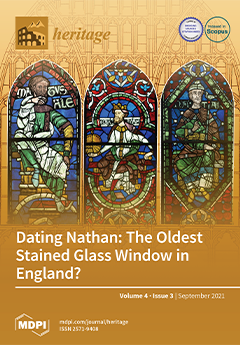
Cover Story: Relatively little is known about stained glass windows in England predating 1170. Caviness (1987) argued that four figures from the Canterbury Cathedral “Ancestors series”, usually dated to the early 13th century, are stylistically consistent with an earlier date (c. 1130-1160). This would place them amongst the earliest extant stained glass in England, and the world. The hypothesis is addressed here using a methodology based on analysis of a few well-measured heavy trace elements and a 3D-printed attachment for a pXRF spectrometer that enables non-destructive in situ analysis. The results are consistent with Caviness’s argument that at least one figure predates the 1174 fire and was reused in the 1200s. Moreover, the results suggest ornamental borders were also reused, indicating the presence of more early glass than previously thought. View this paper.
  • Issues are regarded as officially published after their release is announced to the table of contents alert mailing list .
  • You may sign up for email alerts to receive table of contents of newly released issues.
  • PDF is the official format for papers published in both, html and pdf forms. To view the papers in pdf format, click on the "PDF Full-text" link, and use the free Adobe Reader to open them.

Articles (90)

  • Article
  • Open Access
10 Citations
3,638 Views
19 Pages

20 September 2021

In this work, a protocol of a partially invasive sampling for the archaeometric characterization of ancient mortars from the little Roman Bath of Nora (Sardinia, Italy) is presented. Optical microscopy and different analytical techniques such as X-ra...

  • Article
  • Open Access
9 Citations
5,905 Views
17 Pages

20 September 2021

Pigments from paint palettes and a grindstone excavated from the pharaonic town of Amara West (c. 1300–1050 BCE), which lies between the Second and Third Cataracts of the Nile, were examined using polarized light microscopy, attenuated total reflecti...

  • Article
  • Open Access
5 Citations
3,968 Views
18 Pages

19 September 2021

The results of the analysis on some fragments of bronze belts and a bowl discovered from southwestern Armenia at the Yegheghnadzor archaeological site are discussed. The samples are dated to the 7–6th millennium BCE from the Urartian period. The arte...

  • Article
  • Open Access
19 Citations
15,480 Views
11 Pages

18 September 2021

This paper focuses on the presentation of some of the main critical reflections concerning the current debate about conservation and restoration of contemporary murals in the Street and Urban Art field. More and more, the operations thought of for th...

  • Article
  • Open Access
3 Citations
3,399 Views
21 Pages

Investigation of Building Materials Belonging to the Ruins of the Tsogt Palace in Mongolia

  • Alessandro Sardella,
  • Sonia Canevarolo,
  • Elena Marrocchino,
  • Francesca Tittarelli and
  • Alessandra Bonazza

17 September 2021

This work focuses on the characterisation of the heritage building materials (plasters, mortars, bricks and glazed tiles) of the Tsogt Palace’s ruins located in the Bulgan Province of Mongolia. In addition, contribution is also given to a preliminary...

  • Article
  • Open Access
7 Citations
3,343 Views
13 Pages

16 September 2021

Mummies in museums are exposed to different deterioration factors like microorganisms, especially unwrapped mummies, such as the screaming mummy. This screaming mummy in the store of the Egyptian museum is suffering from stains due to microbial infec...

  • Article
  • Open Access
3 Citations
5,224 Views
16 Pages

15 September 2021

This paper describes the protocol currently used at the Victoria and Albert Museum for the scientific analysis of water, oil and lacquer gilding in cultural heritage objects. The purpose of the protocol is to guide scientists, curators and conservato...

  • Article
  • Open Access
4 Citations
3,640 Views
18 Pages

Unexpected Findings in 16th Century Wall Paintings: Identification of Aragonite and Unusual Pigments

  • Laura Rampazzi,
  • Cristina Corti,
  • Ludovico Geminiani and
  • Sandro Recchia

15 September 2021

Sixteenth century wall paintings were analyzed from a church in an advanced state of decay in the Apennines of central Italy, now a remote area but once located along the salt routes from the Po Valley to the Ligurian Sea. Infrared spectroscopy (FTIR...

  • Article
  • Open Access
27 Citations
10,299 Views
21 Pages

15 September 2021

The archaeological site of Umm Qais is a popular tourist destination for both local and foreign tourists who come to appreciate the site’s archaeological history, scenic landscape, and panoramic perspective. The site was the focus of tourism planning...

  • Article
  • Open Access
9 Citations
4,294 Views
11 Pages

15 September 2021

This paper aims to investigate digital heritage and acoustical techniques for exploring sonic heritage of archaeological sites and performative spaces. Through the analysis of case studies in Greece and in Italy, this paper intends to highlight a new...

of 9

Get Alerted

Add your email address to receive forthcoming issues of this journal.

XFacebookLinkedIn
Heritage - ISSN 2571-9408