


Highlights
What are the main findings?
- An integrated framework combining waste characterization, kinetic modeling, process simulation, and techno-economic assessment was developed for municipal solid waste pyrolysis.
- Multivariable predictive models and kinetic analyses showed strong statistical performance and supported the evaluation of industrial-scale pyrolysis scenarios.
- The proposed framework provides a practical tool for the preliminary technical and economic evaluation of municipal solid waste pyrolysis projects.
- Municipal solid waste pyrolysis can support waste valorization, renewable energy production, and circular economy strategies under region-specific conditions.
Abstract
Municipal solid waste (MSW) pyrolysis is a promising route for recovering energy from non-recyclable fractions while reducing landfill volumes, yet most previous studies address waste characterization, kinetics, process simulation, and economic feasibility separately. This study integrates all four dimensions for representative MSW fractions from Guatemala City, combining laboratory-scale slow-pyrolysis experiments, Arrhenius-based kinetic modeling, industrial-scale process simulation, and a discounted-cash-flow economic evaluation, with the resulting kinetic and multivariable yield models demonstrating strong statistical performance, with coefficients of determination ranging from 0.90 to 0.98 based on validation using representative municipal solid waste fractions. Plastic fractions produced the highest bio-oil yields and calorific values, approaching those of fossil fuels, while organic and lignocellulosic fractions favored biochar formation. Multivariable regression models for predicting biofuel yields and calorific values as a function of feedstock chemical composition demonstrated good predictive performance based on the validation statistics obtained. The presence of chlorine and sulfur in co-plasticized materials restricts utilization of bio-oil in combustion engines. Process Simulation has shown that integrating bio-oil refinery into the petrochemical industry is feasible. However, the economic analysis indicated that project viability depends on the successful integration of waste-treatment services with revenues generated from biofuels and energy recovery. These integrated results confirm the technical and economic viability of pyrolysis as a circular-economy waste-management strategy for Central American cities, provided the business model combines a waste-treatment-service component with energy recovery.
1. Introduction
Municipal solid waste (MSW) management has become one of the most significant environmental and engineering challenges associated with rapid urbanization and population growth. Increasing waste generation rates, limited landfill capacity, and growing environmental concerns have stimulated interest in alternative technologies capable of recovering energy and valuable resources from non-recyclable waste streams. Thermochemical conversion technologies, particularly pyrolysis, have received increasing attention because of their ability to transform heterogeneous waste materials into useful products such as bio-oil, synthesis gas, and biochar while reducing landfill dependency and contributing to circular economy objectives [1,2,3,4,5,6,7].
Among the different waste-to-energy technologies, slow pyrolysis offers several operational advantages for the treatment of municipal solid waste. The process can accommodate highly heterogeneous feedstocks with relatively low preprocessing requirements and allows simultaneous recovery of liquid, gaseous, and solid products. Previous studies have demonstrated that product yields and energy properties are strongly influenced by feedstock composition, operating temperature, heating rate, and residence time [2,6,7,8,9]. However, significant variability in waste composition between regions continues to complicate the design, optimization, and scale-up of industrial pyrolysis systems. Recent reviews have also highlighted the need for improved process optimization strategies and integrated engineering methodologies capable of supporting the transition from laboratory-scale experimentation to industrial deployment of municipal solid waste pyrolysis technologies [10].
The transition toward circular economy models has increased interest in integrated approaches that combine waste characterization, resource recovery, process optimization, and environmental sustainability assessment [5,11,12,13]. In this context, several authors have emphasized the importance of developing integrated assessment approaches capable of supporting engineering decision-making and improving the planning of waste valorization systems [4,13]. Despite notable advances in the literature, existing studies on municipal solid waste pyrolysis typically address individual dimensions of the process, such as experimental characterization, kinetic analysis, process simulation, or economic assessment, independently [14]. Integrated approaches that combine these technical and economic dimensions within a unified evaluation framework remain limited in the literature [15]. Relatively few investigations have integrated these components into a unified engineering framework capable of linking laboratory-scale experimentation with industrial-scale implementation and economic decision-making. For Guatemala City, and more broadly for Central American urban contexts, no previous study was identified that simultaneously combines experimentally measured pyrolysis yields, kinetic parameters, composition-based predictive modeling, industrial-scale process simulation, and discounted-cash-flow economic analysis. This gap limits the development of comprehensive decision-support tools for evaluating waste-to-energy strategies. Therefore, the present study proposes an integrated methodology that connects these complementary elements within a single analytical framework.
For developing countries, the availability of integrated engineering tools is particularly important because waste-management decisions are frequently constrained by limited financial resources, infrastructure deficiencies, and inadequate treatment capacity. Guatemala City presents a representative case where large quantities of municipal solid waste are still disposed of in landfills despite the considerable potential for resource recovery and energy generation. The development of robust models capable of predicting process performance and supporting feasibility evaluations may therefore facilitate the implementation of sustainable waste-to-energy strategies in the region.
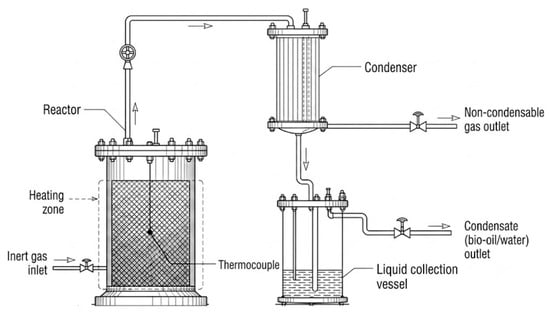
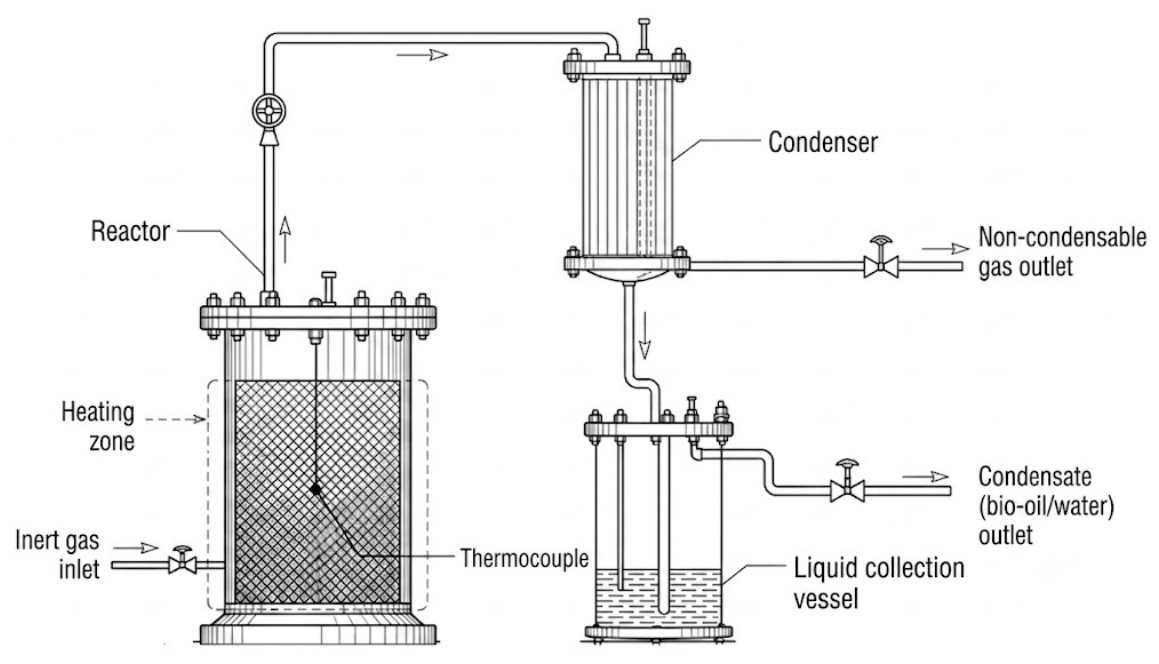
Accordingly, the objective of this study is to evaluate the technical and economic feasibility of municipal solid waste pyrolysis through an integrated framework combining experimental characterization, kinetic modeling, multivariable predictive equations, industrial-scale process simulation, and techno-economic assessment. Unlike previous studies that analyze these components independently, the proposed methodology provides a comprehensive engineering approach intended to support resource recovery, process design, and decision-making associated with waste-to-energy systems operating under circular economy principles. Existing studies on MSW pyrolysis typically address one dimension at a time: product characterization [6,7,15,16], kinetic analysis by thermogravimetry [16,17,18,19], process simulation [20,21], or techno-economic assessment [22,23]. Integrated studies are scarce and have mostly been conducted for Asian and European waste compositions [8,9,13], whose high plastic content and waste-management fee structures differ substantially from those of Central America. For Guatemala City, where approximately 56% of municipal solid waste is organic and only 13% is plastic [17], no previous study has linked experimentally measured yields, kinetic parameters, composition-based predictive modeling, industrial-scale process simulation, and discounted cash-flow analysis, nor quantitatively assessed the dependence of project viability on waste-treatment fees. The present study addresses this gap by integrating these complementary elements within a unified engineering framework for technical and economic evaluation of waste-to-energy systems [2,7,9]. A schematic representation of the laboratory-scale experimental system used for the pyrolysis tests, including the reactor, heating unit, condensation system, and product collection modules, is presented in Figure 1.
Figure 1.
Schematic of the laboratory-scale pyrolysis system.
2. Materials and Methods
2.1. Experimental Design and System Configuration
This study was developed using an experimental-computational approach focused on the slow pyrolysis of MSW, integrating laboratory-scale tests, kinetic modeling, and process simulation. Slow pyrolysis was selected due to its suitability for heterogeneous raw materials, extended residence times, and greater operational stability, characteristics widely documented for MSW and mixed plastic fractions [2,3]. In contrast to fast pyrolysis, which operates with high heating rates (>100 °C s−1) and residence times on the order of seconds, this work was carried out under controlled heating rates (<10 °C min−1), prioritizing the completion of mass and energy balances and the detailed characterization of the products, following the approach of Lu et al. [15].
The four stages of the methodological framework adopted in this study were implemented as follows: first, actual municipal solid waste samples from Guatemala City were characterized in terms of their composition and physicochemical properties; next, slow decomposition experiments were conducted in the laboratory under optimal conditions to analyze the solid, liquid, and gaseous products generated; then, kinetic parameters and multi-stage predictive models were developed and verified based on experimental measurements and literature data; finally, the evaluated models were incorporated into large-scale simulations and used in economic analysis to assess the feasibility, scale, installation requirements, and economic efficiency of the process under various waste-management scenarios.
2.2. Materials and Equipment
The samples consisted of municipal solid waste collected from selected collection centres in Guatemala City during the period 2023–2025, classified according to the national waste characterization regulations published by the Ministry of Environment and Natural Resources of Guatemala (MARN, by its Spanish acronym) [24]. The waste collection centres were selected to provide representative coverage of the principal municipal solid waste streams generated within Guatemala City. Experimental characterization, proximate analysis, elemental composition determination, and laboratory pyrolysis tests were performed directly on the collected samples as part of the present study. Information obtained from MARN [24] was used exclusively to define waste classification criteria, establish representative waste categories, and contextualize regional waste-generation patterns, whereas all thermochemical characterization data, kinetic parameters, predictive models, and process-simulation results were generated by the authors.
In this study, we analyzed the organic, paper/cardboard, plastic, and sanitary waste fractions. We excluded glass and metals because they make a negligible contribution to thermochemical conversion processes [3]. It is important to mention that the sanitary waste fraction (14%) contains has disposable diapers and sanitary napkins. These absorbent materials may contain cellulose fiber and superabsorbent polymers, which may introduce some disruptions to the degradation process and kinetics compared to regular paper.
Additionally, multivariable models for predicting yields and calorific values were developed based on the elemental composition of the waste, using experimental data for typical waste from the categories defined for Guatemala by the Ministry of Environment and Natural Resources [24].
Slow pyrolysis tests were performed in a fixed-bed batch reactor (Centro de Procesos Industriales, Department of Chemical Engineering, Faculty of Engineering, Universidad del Valle de Guatemala, Guatemala City, Guatemala) with a nominal capacity of 100 g, constructed of AISI 304 stainless steel and coupled to a Thermo Scientific F6030CM electric muffle furnace (Thermo Fisher Scientific, Waltham, MA, USA) (operating range 25–1200 °C; accuracy ±1 °C). The generated vapours were directed to a glass condenser with countercurrent water cooling. Mass quantification of samples and products was performed using an Ohaus Value 300 Xtreme semi-analytical balance (OHAUS Corporation, Parsippany, NJ, USA) with a resolution of ± 0.1 g.
Preliminary thermal characterization of the residues was carried out using a Pyris TGA 9 analyzer (PerkinElmer, Shelton, CT, USA) to identify characteristic degradation ranges associated with slow-pyrolysis regimes, following characterization and kinetic-modelling approaches previously validated for mixed MSW streams [16,17,18]. The calorific value of the liquid and solid products was determined using an IKA C200 bomb calorimeter (IKA-Werke GmbH & Co. KG, Staufen, Germany), while the elemental chemical composition was analyzed using CHNS/O analysis and gas chromatography coupled to mass spectrometry (GC-MS, Mass QSight® 500 LC/MS/MS system; PerkinElmer, Shelton, CT, USA), following protocols commonly applied to pyrolysis oils [6].
Determination of the calorific value and classification of the recovered fuels was carried out in accordance with international standards for recovered liquid and solid fuels and petroleum derivatives, ensuring comparability with industrial and regulatory practice [25,26].
2.3. Experimental Protocol and Process Simulation
Representative samples of each waste fraction identified for Guatemala City were subjected to experimental pyrolysis. Each experiment included preparation of the feedstock, thermal degradation, under oxygen-limited conditions, product recovery, and the characterization of the solid, liquid, and gaseous fractions. The data from laboratory-scale experiments were the basis for the construction of kinetic and process models.
The evolution of the pyrolysis reaction was represented using a simplified kinetic approach based on mass conversion. The adopted kinetic formulation follows approaches commonly applied to biomass and heterogeneous waste pyrolysis systems [16].
The rate of degradation of the feedstock was described according to Equation (1):
where W is the remaining mass of the feedstock, t is the reaction time, k is the kinetic rate constant, and n is the reaction order.
The temperature dependence of the kinetic constant was represented using the Arrhenius equation:
where A is the pre-exponential factor, Ea is the activation energy, R is the universal gas constant, and T is the absolute temperature.
Substitution of Equation (2) into Equation (1) yields:
The formation of pyrolysis products was estimated using product-specific yields according to:
where Ni represents the accumulated amount of product i and Yi is the corresponding product yield coefficient.
Because the heating rate β was expressed in K min−1, reaction time was expressed in minutes. Consequently, the conversion rate (dα/dt) was obtained in min−1, requiring the Arrhenius pre-exponential factor (A) to be reported in min−1 to preserve dimensional consistency. Likewise, activation energies were converted from kJmol−1 to Jmol−1 prior to kinetic calculations to ensure consistency with the universal gas constant (R = 8.31446 Jmol−1 k−1).
The kinetic equations were coded in Berkeley Madonna® (version 10.2.6) using a fourth-order Runge–Kutta numerical integration scheme. Simulations using experimentally determined heating profiles and product yields were performed to model reaction progression, product generation and conversion over time [16].
Then, the process was modelled using SuperPro Designer® (version 14) for industrial-scale assessment. The elements were feed preparation, pyrolysis, condensation, product recovery and auxiliary equipment sizes that were included in the simulation.
Equipment capacities, material balances, and utility requirements obtained from the simulations were later used as inputs for the economic feasibility analysis [20,21].
The integration of kinetic modeling and process simulation enabled the evaluation of laboratory-scale reaction behavior and industrial-scale process performance within a unified engineering framework. This approach facilitated the identification of critical operating parameters, equipment requirements, and scale-up opportunities for municipal solid waste valorization systems.
Fixed-bed pyrolysis, condensation, and by-product removal operations were included in the simulation. The experimental plan followed a stepwise approach that integrated characterization of feedstock, laboratory-scale production of pyrolysis resulting in the formulation of kinetic models, and assessment of the industrial-scale production pro-cess. Representative samples of municipal solid waste were first fully characterized, and explicitly slowed pyrolysis tests were performed on them. The data obtained from the tests were used to determine kinetic parameters and formulate multivariable pre-diction models. Finally, the validated models were used to simulate various industrial operations in order to analyze their efficiency, the necessary machinery, their scalability, and their feasibility [27,28].
2.4. Data Analysis and Validation
The waste elemental prediction equations are formed from seven variables (C, N, H, O, S, Cl, and metals). During equation development, other variables were included, but only the aforementioned seven were included in the final prediction equations.
While equation development is not the main focus of this work, it was important to determine the accuracy and precision of the equations developed; therefore, models were assessed based on relative errors and correlation coefficients. Relative errors were used as complementary indicators of predictive performance and were interpreted together with the coefficient of determination (R2), adjusted R2, and standard error statistics. Lower prediction errors indicate better agreement between experimental observations and model predictions [6,16,29].
Furthermore, the methodological approach adopted is consistent with the general principles of life cycle assessment, allowing the technical and energy results obtained to serve as a basis for integrated environmental assessments in later stages of project development [30].
The general form of the multivariable predictive model is given by Equation (5):
where is the predicted value of the response variable, β0 is the intercept of the corresponding regression model, β1–β7 are the regression coefficients, and X1–X7 correspond to the elemental composition variables of the waste stream.
X1 = Carbon (C)
X2 = Nitrogen (N)
X3 = Hydrogen (H)
X4 = Oxygen (O)
X5 = Sulfur (S)
X6 = Chlorine (Cl)
X7 = Metals/Ash content
Multivariable linear regression models were built based on the experimental and bibliographic datasets constructed over the course of this research. The generated equations were then employed to forecast biofuel production and heating values as functions of residue composition.
To evaluate the accuracy of the models, the coefficient of determination (R2) and Mean Absolute Percentage Error (MAPE) were calculated. These indicators were selected to quantify the goodness-of-fit of the predictive equations and to assess their predictive performance. The predictive performance of the models was evaluated using a combination of statistical indicators, including the coefficient of determination (R2) and the Mean Absolute Percentage Error (MAPE). These metrics were used to assess the agreement between experimental observations and model predictions across the different waste fractions analyzed.
A. Coefficient of Determination R2. The coefficient of determination was calculated according to Equation (6):
B. Mean Absolute Percentage Error (MAPE). The Mean Absolute Percentage Error was determined using Equation (7):
where Yexp,i: Value measured experimentally in the laboratory (or reported in simulated databases).
Ypred,i: Numerical value predicted by the regression equation or by the Runge–Kutta integration.
Arithmetic mean of the experimental values.
m: Total number of data points or runs evaluated.
Lower MAPE values indicate better predictive performance and provide a quantitative measure of the agreement between experimental observations and model predictions.
The predictive equations were validated using a dataset composed of 15 representative waste categories compiled from experimental measurements and high-quality literature sources. Validation was performed through direct comparison between reported values and model predictions. Model performance was assessed using the coefficient of determination (R2), adjusted R2, standard error estimates, and Mean Absolute Percentage Error (MAPE). The resulting models achieved coefficients of determination between 0.90 and 0.98, indicating strong predictive capability for engineering evaluations, preliminary feasibility studies, and process-design applications. The corresponding validation statistics are reported in Section 3.3.
3. Results and Discussion
3.1. Composition of Municipal Solid Waste and Suitability for Pyrolysis
The characterization of MSW in Guatemala City showed that approximately 89% by mass of the total stream is technically viable for treatment through pyrolysis, including organic waste, non-recyclable sanitary waste, plastics, and paper/cardboard. The organic fraction represents about 56% by mass, followed by sanitary waste (14%), plastics (13%), and paper/cardboard (6%). The glass and metal fractions, which together represent less than 5%, were excluded due to their low organic content and lack of thermochemical reactivity [2].
Plastic waste showed a high carbon content (>75% by mass) and virtually zero moisture, while organic and lignocellulosic waste showed high oxygen and moisture content (30–50%), factors that directly influence the reaction kinetics and the energy efficiency of the process, consistent with Márquez et al. [17].
The characterization identified eight main categories of MSW in Guatemala City. The average composition showed a predominance of organic waste, followed by sanitary waste, plastics, and paper/cardboard (Table 1); the remaining fractions corresponded to mixed waste, glass, hazardous waste, and metals. The characterization of municipal solid waste in Guatemala City based on MARN [24] revealed a clear predominance of the organic fraction, which accounted for approximately 56% of the total stream. Sanitary waste accounted for 14% of all types of waste generated. Plastics and paper/cardboard accounted for 13% and 6%, respectively. The rest comprised mixed waste, 4%; glass, 3%; hazardous waste, 2%; and metals, 2%. The analysis showed that about 89% of the total waste generated in the region could be converted to various chemicals by applying heat and/or steam, justifying the application of pyrolysis to convert the waste to energy in the region. The high proportion of organic and plastic residues further suggests opportunities for the simultaneous production of biochar and high-energy liquid fuels, respectively.
Table 1.
Average composition of municipal solid waste in Guatemala City.
3.2. Product Yields and Calorific Values of Pyrolysis Products
The distribution of pyrolysis products showed a strong dependence on waste type and composition. Organic and garden-waste fractions generated bio-oil yields in the mid-range of 35–60%, accompanied by relatively high solid fractions (on average 30–45%). The calorific values of the bio-oils were lower than those of fossil fuels, while biochar showed values comparable to commercial solid fuels (24–36 MJ kg−1) (Table 2). Biochar derived from food waste showed an ash content greater than 25%, which reduces its calorific value and limits its use as a high-quality solid fuel, a behavior commonly reported for biochars produced from heterogeneous organic residues [31].
Table 2.
Typical yields and calorific values of pyrolysis products derived from representative municipal solid waste fractions.
In contrast, plastic waste showed the capacity to reach higher calorific values, implying better energy performance. The yields and energy properties obtained for representative plastic waste fractions are summarized in Table 2. Bio-oil yields reached 60–80%, with calorific values between 41.7 and 44.2 MJ kg−1, fully comparable to conventional diesel or gasoline [6]. These results confirm that plastic waste maximizes energy recovery, while organic waste is better integrated into combined valorization schemes.
Paper and cardboard waste yielded bio-oil between 40 and 60% and biochar between 20 and 40%. The liquid fraction generated calorific values between 22 and 30 MJ kg−1, and the solid fraction between 14 and 20 MJ kg−1, values comparable to those obtained for traditional solid fuels such as coal or wood [32,33]. The corresponding product yields and calorific values for representative paper and cardboard waste fractions are presented in Table 2.
Multivariable models were developed to predict yields and energy properties from elemental composition (C, H, O, N, S, Cl, and metals). The resulting regression coefficients for each model are presented in Table 3. These models showed good predictive performance across the evaluated waste categories, as confirmed by the validation statistics presented in Table 4.
Table 3.
Regression coefficients of the multivariable models for predicting biofuel yields and calorific values.
Table 4.
Validation statistics of the multivariable predictive models (n = 15 observations).
The statistical performance of the predictive models was evaluated using multiple regression indicators. The models achieved coefficients of determination (R2) between 0.90 and 0.98 and adjusted R2 values between 0.79 and 0.95 based on 15 observations. These results indicate strong agreement between model predictions and the reference dataset used for model development.
Additional validation was conducted by comparing predicted values with reference and experimentally measured data for representative waste fractions. The resulting prediction deviations remained within the acceptance thresholds established for the study, thereby supporting the suitability of the proposed equations for preliminary engineering evaluations and waste-to-energy feasibility analyses.
These models reveal an inverse relationship between the proportion of bio-oil (and its calorific value) and the percentage of oxygen, nitrogen, sulfur, and chlorine contained in each residue-whether as part of the chemical structure or as a contaminant introduced during pyrolysis. This finding is consistent with previous reports on plastic pyrolysis [6].
3.3. Multivariable Predictive Equations
The regression coefficients reported in Table 3 were subsequently incorporated into predictive equations describing product yields and energy properties as a function of waste elemental composition. These equations constitute practical engineering tools that permit rapid estimation of pyrolysis performance indicators without requiring extensive experimental campaigns, thereby supporting preliminary feasibility studies, process design, and waste-to-energy planning activities.
Using the regression coefficients reported in Table 3, the final predictive equations for biofuel yields and calorific values were formulated as follows.
Solid biofuel calorific value
(Mj kg−1) HHVsolid = 152.77 − 132.04X1 − 84.37X2 − 93.34X3 − 154.43X4 − 158.26X5 − 149.24X6 − 142.59X7
Liquid biofuel calorific value
(Mj kg−1) HHVliquid = 231.43 − 194.90X1 − 191.87X2 − 162.80X3 − 214.20X4 − 219.61X5 − 210.88X6 − 239.84X7
Gaseous biofuel calorific value
(Mj m−3) HHVgas = 144.59 − 119.37X1 − 71.14X2 − 116.30X3 − 154.39X4 − 153.20X5 − 141.61X6 − 132.66X7
Gaseous biofuel yield (%)
Yieldgas = 3.44 − 3.20X1 − 3.15X2 − 4.04X3 − 3.19X4 − 3.45X5 − 3.14X6 − 2.84X7
Liquid biofuel yield (%)
Yieldliquid = −2.88 + 3.67X1 + 4.15X2 + 3.71X3 + 3.03X4 + 3.26X5 + 3.27X6 + 3.01X7
Solid biofuel yield (%)
where X1 is the carbon content (%), X2 is the nitrogen content (%), X3 is the hydrogen content (%), X4 is oxygen content (%), X5 is the sulfur content (%), X6 chlorine content (%), and X7 is the metal content (%) in the original waste stream. Oxygen content was calculated by difference and excluded from the regression models to avoid multicollinearity effects.
Yieldsolid = 0.39 − 0.43X1 − 0.94X2 + 0.47X3 + 0.19X4 + 0.23X5 − 0.09X6 − 0.21X7
The coefficients demonstrate that elemental composition strongly influences both product yield and energy characteristics. From an engineering perspective, these predictive equations provide a quantitative framework for screening potential feedstocks, evaluating resource recovery opportunities, and identifying waste streams with greater suitability for thermochemical conversion. Feedstocks with high oxygen, sulfur, chlorine, and metal contents tend to generate biofuels with lower calorific values and reduced fuel quality, whereas feedstocks rich in carbon and hydrogen generally produce higher-energy fuels with superior combustion potential. To further assess the predictive capability and robustness of the developed multivariable equations, the main statistical validation parameters obtained during model development are summarized in Table 4. These indicators include the coefficient of determination (R2), adjusted coefficient of determination (Adjusted R2), standard error, and the number of observations used for model calibration. Table 4 presents the statistical validation.
As shown in Table 4, all models exhibited strong predictive performance, with R2 values ranging from 0.90 to 0.98 and adjusted R2 values between 0.79 and 0.95. The models were calibrated using 15 representative municipal solid waste fractions, providing a statistically sound basis for estimating pyrolysis product yields and heating values.
3.4. Reaction Kinetics and Residence Times
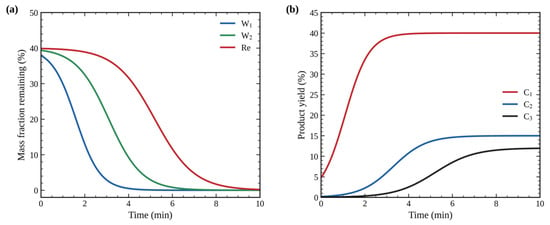
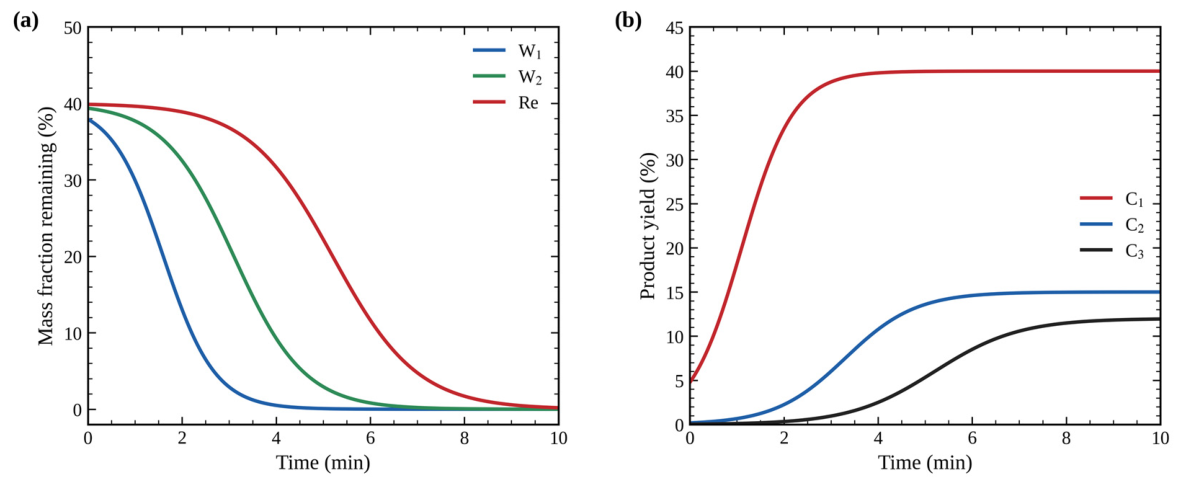
The kinetic analysis showed significant differences between the waste categories. Plastic waste reached almost complete conversion in considerably shorter times than organic and cellulosic waste (Figure 2). After fitting temperature ramps using sigmoidal functions in Berkeley Madonna®, the kinetic models reached correlation coefficients greater than 0.90, substantially improving on the initial fits based on linear heating, in line with co-pyrolysis kinetic studies of mixed organic and plastic feedstocks reported for other waste streams [17,19].
Figure 2.
Kinetic model predictions for representative municipal solid waste fractions: (a) evolution of the remaining mass fraction (%) during pyrolysis (W1 = HDPE, W2 = Paper, Re = Food Waste); and (b) predicted accumulation of liquid pyrolysis products, expressed as product yield (%), as (a) function of reaction time (C1 = HDPE, C2 = Paper, C3 = Food Waste).
Representative kinetic parameters obtained from the literature and experimental adjustment procedures are summarized in Table 5. The reported activation energies and frequency factors illustrate the substantial variability in pyrolysis behavior among organic, lignocellulosic, and plastic waste streams. In general, plastic fractions exhibited higher activation energies and frequency factors than organic fractions, explaining their faster degradation kinetics under thermochemical conversion conditions.
Table 5.
Representative kinetic parameters for selected municipal solid waste fractions.
Machine-learning-assisted kinetic fitting has similarly been shown to improve the description of synergistic effects between co-processed waste fractions [34]. In Figure 2, the vertical axis shows the mass of reactants remaining in the pyrolysis reactor (kg) and the horizontal axis the reaction time (h); the red curve represents food waste, the green curve sanitary (toilet-paper) waste, and the blue curve high-density polyethylene. The vertical axis in Figure 2b refers to mass of liquid product accumulated (kg), and the horizontal one to reaction time (h); here, the black curve stands for organic waste, the blue curve for paper waste, and the red curve for high-density polyethylene. Plastic waste, as shown in Figure 2b, has a much higher overall conversion than the organic and cellulosic fractions, with practically complete degradation at very short residence times. Similarly, plastic feedstocks were found to yield bio-oil at higher rates than the other evaluated waste categories (see Figure 2b).
The activation energies determined for plastic waste ranged from 190 to 240 kJ mol−1, which explains its rapid thermal degradation. From a waste-management perspective, this behavior translates into higher processing capacities and smaller reactor volumes for plastic-rich streams. The predicted evolution of reactant consumption during pyrolysis for representative waste fractions is shown in Figure 2.
3.5. Process Simulation and Scale-Up Evaluation
The industrial process simulation using SuperPro Designer® was performed considering base cases with different waste flows. The simulation framework was developed not only to evaluate process performance but also to support engineering decision-making during technology selection, scale-up assessment, and preliminary design of municipal solid waste valorization facilities. By integrating experimentally derived kinetic and yield data into the process model, the simulation provided a consistent basis for evaluating technical feasibility under industrial operating conditions.
The simulation of industrial-scale processes (3 to 35 t d−1) allowed for the sizing of critical equipment. The sizing results showed deviations of less than 20% compared to reference industrial plants, acceptable for pre-feasibility studies. A deviation threshold of 20% was considered acceptable because the simulations were performed at a conceptual engineering and pre-feasibility level, where uncertainties associated with scaling assumptions, feedstock variability, equipment selection, and operating conditions are expected. Similar tolerance ranges are commonly reported in early-stage engineering evaluations and process-design studies, where the primary objective is to identify technically feasible configurations prior to detailed engineering and pilot-scale validation [20,21].
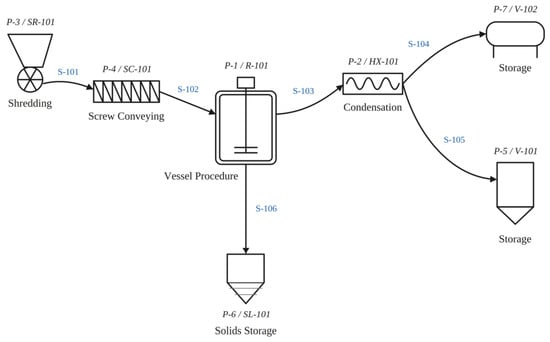
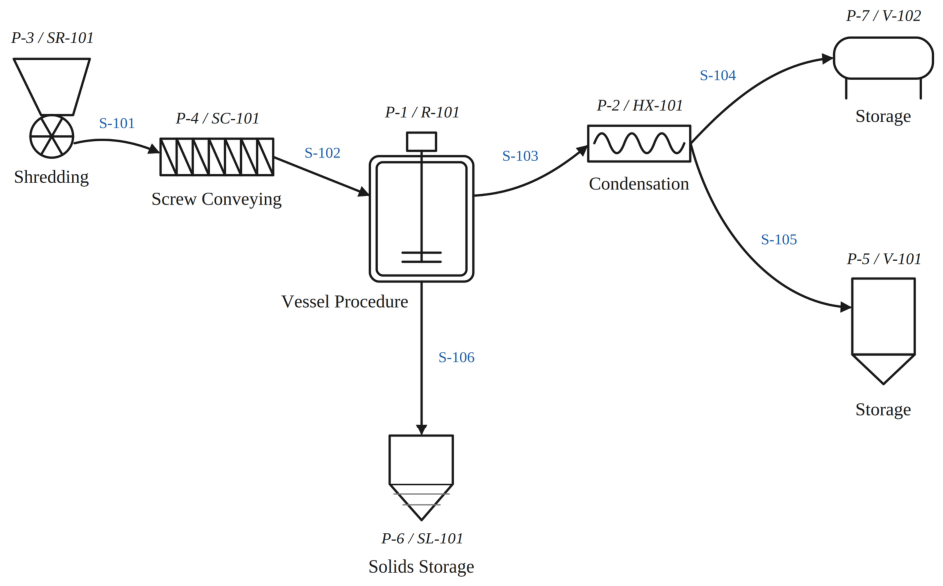
The reactor and the condensation system were identified as the critical equipment for scale-up. It was also found that the gas-cleaning system (alkaline scrubber) represents between 12% and 18% of total investment cost when processing mixtures with more than 10% PVC, making its inclusion essential in realistic scenarios, consistent with the additional dechlorination costs reported for PVC-containing waste streams [22,35]. The simulation procedure and preliminary estimation of capital and operating costs were based on classic chemical-plant design and economics methodologies, widely accepted for industrial pre-feasibility studies [20,21]. The overall process flow diagram implemented in SuperPro Designer® for industrial-scale simulation is presented in Figure 3.
Figure 3.
General diagram of the simulated industrial-scale pyrolysis process. Source: simulation in SuperPro Designer®.
The industrial-scale equipment sizing obtained from the simulation, compared against reference values reported for commercial pyrolysis plants, is summarized in Table 6. The comparison with commercially available systems allowed the identification of design margins, equipment-sizing requirements, and potential optimization opportunities for future waste-to-energy facilities.
Table 6.
Comparison of reference and simulated values for key equipment design characteristics of the plastic-waste pyrolysis process at different feed flows.
In all simulations, the required pyrolysis reactor volume was smaller than what is currently commercially available and the condensation areas that were indicated by the simulation were larger than are generally seen in commercial applications. This difference indicates that commercial designs may be out of scale for the reactor and under scaled for the condensation step for Guatemalan MSW composition and represents an optimization opportunity. The variations in predictions due to simplifying assumptions not considering unexpected operation conditions were well within the ranges of physically realizable equipment and commercially available equipment simulations. The results achieved are in accordance with the recent developments on the technical applicability of pyrolysis as a part of sustainable municipal solid-waste-management systems. The simulated procedure exhibited satisfactory technical performance reflecting a means that could be used for the assessment of waste-to-energy technologies based on circular economy criteria.
3.6. Economic Performance and Sensitivity of the Business Model
The economic analysis and scenario-based sensitivity assessment indicated that financial viability depends heavily on the waste-management model adopted. Three alternative revenue scenarios were evaluated to assess the influence of waste-treatment fees and biofuel sales on project performance [22]: Scenario 1 charges treatment fees for 100% of the waste processed by the plant, in addition to biofuel sales; Scenario 2 applies the treatment charge to 50% of the waste processed, in addition to biofuel sales; and Scenario 3 relies solely on biofuel sales. This scenario design reflects the premise that pyrolysis should be conceived primarily as a waste-management service with associated energy recovery, and not as an isolated fuel-production plant, in agreement with environmental and economic assessments of decentralized waste-to-energy models that similarly identify treatment-fee revenue as decisive for project feasibility [33]. The economic assessment considered capital investment costs derived from the process simulation, operating expenditures associated with utilities, labor, maintenance, and consumables, as well as revenues generated from bio-oil production and waste-treatment fees. A weighted average cost of capital (WACC) of 12% was adopted to represent financing conditions commonly applied to infrastructure and waste-management projects in developing economies. Similar approaches have been applied in waste-to-energy feasibility assessments and integrated municipal solid waste management studies, where treatment-fee revenues and resource-recovery mechanisms were identified as major determinants of project viability and long-term sustainability [8,9,13]. To further evaluate the robustness of the economic results, a one-at-a-time sensitivity analysis was performed.
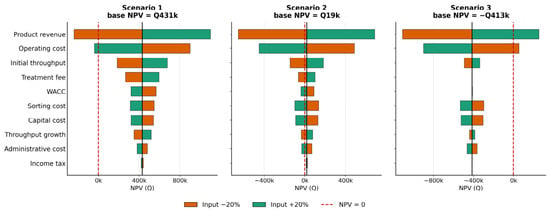
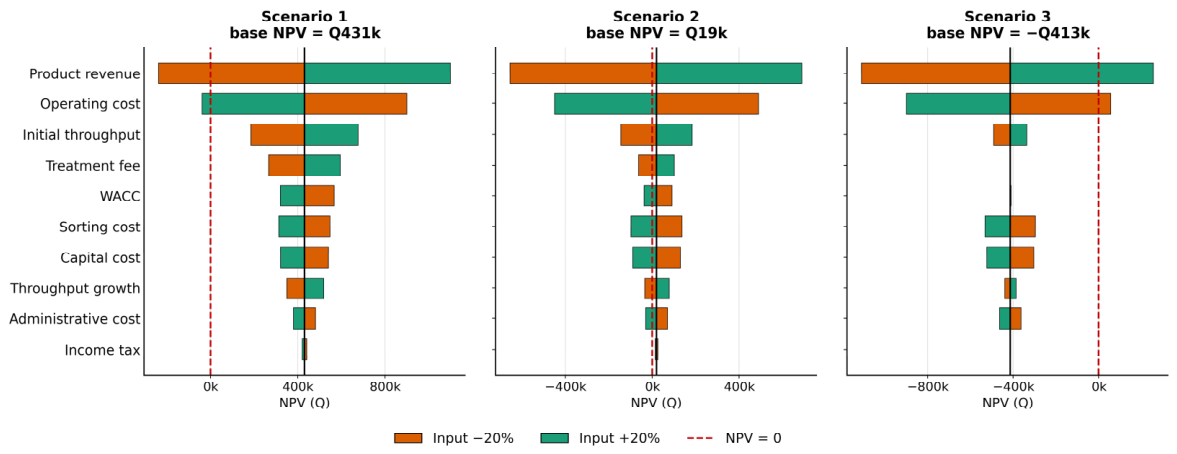
The effects of ±20% variations in the principal economic and operational parameters on project net present value (NPV) are presented in Figure 4.
Figure 4.
One-at-a-time sensitivity of NPV for the three scenarios (WACC 12%). Bars show the effect of −20% and +20% on each input; the dashed line marks NPV = 0.
The sensitivity results indicate that biofuel revenue and operating costs exert the greatest influence on project profitability across all scenarios. Scenario 1 remains economically attractive under most parameter variations, whereas Scenario 2 exhibits marginal robustness and Scenario 3 remains economically unfavorable. These findings highlight the importance of revenue stabilization and operational cost control for the successful implementation of municipal solid waste pyrolysis projects.
The corresponding economic indicators for the three scenarios are summarized in Table 7 and complement the sensitivity analysis presented in Figure 4. The economic assessment framework developed in this work extends beyond the evaluation of a single facility and may be adapted to different plant capacities, waste compositions, and regional conditions. Consequently, the methodology provides a practical tool for evaluating the financial feasibility of waste-to-energy projects during early planning and investment stages.
Table 7.
Economic indicators for plastic-waste pyrolysis, cash flow over 10 years, plant scale of 6 t/d.
The economic indicators were calculated using discounted-cash-flow analysis over a 10-year project horizon, incorporating cash inflows from energy-product sales and waste-treatment services as well as capital and operating expenditures. The economic evaluation framework followed conventional engineering-economics methodologies commonly applied in chemical process design, project appraisal, and industrial feasibility studies [20,21,37].
The economic evaluation followed standard project-management practice for capital-intensive investments, incorporating profitability, risk, and time-horizon criteria consistent with internationally recognized project-management frameworks [37]. The waste-treatment-fee model achieved internal rates of return exceeding 20% and payback periods between 3 and 5 years. However, the analysis did not consider decommissioning costs or potential environmental liabilities (e.g., hazardous-waste management from the gas scrubber), so it is recommended that these be included in more detailed feasibility studies at the conceptual engineering stage.
4. Conclusions
The present study indicates that pyrolysis represents a technically promising and potentially economically viable strategy for the management of non-recyclable municipal solid waste fractions in Guatemala City.
The integration of experimental characterization, kinetic modeling, multivariable predictive equations, process simulation, and techno-economic assessment provided a comprehensive framework for evaluating waste-to-energy alternatives under a circular economy approach.
Plastic-rich waste fractions generated the highest bio-oil yields and calorific values, whereas organic and lignocellulosic fractions favored biochar production. The predictive models developed in this work successfully related product yields and energy properties to elemental waste composition, achieving satisfactory prediction accuracy (R2 = 0.90–0.98) and supporting preliminary engineering assessments of alternative feedstocks.
The process simulation results supported the technical feasibility of industrial-scale implementation and identified the reactor and condensation systems as critical design units for scale-up. The economic analysis demonstrated that project viability depends strongly on integrating waste-treatment fees with revenues derived from energy recovery, highlighting the importance of adopting integrated, circular-economy-oriented, and financially sustainable waste-management business models.
Beyond the specific case study evaluated, the methodology developed in this work provides a potentially transferable framework that combines experimentation, predictive modeling, process simulation, and economic evaluation. The applicability of the proposed approach to other regions should be assessed considering local waste composition, operating conditions, regulatory frameworks, and economic assumptions. Nevertheless, the methodology may support engineering decision-making, preliminary process design, and planning of waste-to-energy projects in regions with similar municipal solid waste characteristics.
Author Contributions
L.E.N.-G.: Conceptualization, Methodology, Investigation, Data curation, Formal analysis, Writing—original draft; A.N.V.-S.: Investigation, Formal analysis, Visualization, Writing—review and editing; G.G.Z.-R.: Software, Process simulation, Validation, Formal analysis; Á.d.J.R.-B.: Investigation, Experimental work, Validation, Data curation; A.L.L.: Validation, Formal analysis, Writing—review and editing; E.G.E.-M.: Formal analysis, Data curation, Validation, Writing—review and editing; M.Á.C.P.: Methodology, Validation, Supervision, Writing—review and editing; L.V.L.: Validation, Formal analysis, Writing—review and editing; M.A.Z.-A.: Conceptualization, Supervision, Project administration, Resources, Writing—review and editing. All authors have read and agreed to the published version of the manuscript.
Funding
This research received no external funding.
Data Availability Statement
The raw data supporting the conclusions of this article will be made available by the authors on request.
Acknowledgments
This manuscript is from the doctoral dissertation of Luis Ernesto Núñez González, “Desarrollo de herramientas de evaluación técnica y económica basadas en métodos de modelado para la aplicación industrial de la pirólisis de residuos sólidos en la Ciudad de Guatemala”, completed at Universidad de Investigación e Innovación de México (UIIX). The scientific results presented in this article originate from the research conducted within that doctoral work. During the preparation of this manuscript, the authors used ChatGPT-4.0 (OpenAI), Claude Sonnet 4 (Anthropic), and Microsoft 365 Copilot (September 2026) to assist with English language editing, grammatical correction, improvement of text clarity, and manuscript revision. All generated outputs were critically reviewed, verified, and edited by the authors. The authors take full responsibility for the content of this publication. ChatGPT-4.0 was used exclusively to improve the visual clarity and presentation quality of Figure 1, Figure 2, Figure 3 and Figure 4, and correct a few words in the document. After using these tools, the authors reviewed and edited the content as needed and take full responsibility for the content of the published article. No generative AI tools were used to create, analyze, interpret, validate, or modify research data, results, or scientific conclusions. The scientific results reported in this manuscript originate from the doctoral thesis entitled “Desarrollo de herramientas de evaluación técnica y económica basadas en métodos de modelación para la aplicación industrial de pirólisis de residuos sólidos en la ciudad de Guatemala”, developed by the first author. The manuscript is unpublished original scientific work that has yet to appear in a scientific journal of peer review. AI assistance has been integrated into the manuscript, but has been critically reviewed and edited by authors, who take full responsibility for the manuscript.
Conflicts of Interest
The authors declare no conflicts of interest.
References
- Kaza, S.; Yao, L.; Bhada-Tata, P.; Van Woerden, F.; Levine, D. What a Waste 2.0: A Global Snapshot of Solid Waste Management to 2050; World Bank: Washington, DC, USA, 2018; Available online: https://openknowledge.worldbank.org/handle/10986/30317 (accessed on 9 September 2026).
- Nandhini, R.; Berslin, D.; Sivaprakash, B.; Rajamohan, N.; Vo, D.-V.N. Thermochemical conversion of municipal solid waste into energy and hydrogen: A review. Environ. Chem. Lett. 2022, 20, 1645–1669. [Google Scholar] [CrossRef] [Scilit] [PubMed]
- Arena, U. Process and technological aspects of municipal solid waste gasification. Waste Manag. 2014, 34, 625–639. [Google Scholar] [CrossRef] [Scilit] [PubMed]
- Kasiński, S.; Dębowski, M. Municipal Solid Waste as a Renewable Energy Source: Advances in Thermochemical Conversion Technologies and Environmental Impacts. Energies 2024, 17, 4704. [Google Scholar] [CrossRef] [Scilit]
- Geissdoerfer, M.; Savaget, P.; Bocken, N.; Hultink, E. The circular economy—A new sustainability paradigm? J. Clean. Prod. 2017, 143, 757–768. [Google Scholar] [CrossRef] [Scilit]
- Al-Salem, S.M.; Antelava, A.; Constantinou, A.; Manos, G.; Dutta, A. A review on thermal and catalytic pyrolysis of plastic solid waste (PSW). J. Environ. Manag. 2017, 197, 177–198. [Google Scholar] [CrossRef] [Scilit] [PubMed]
- Chen, D.; Yin, L.; Wang, H.; He, P. Pyrolysis technologies for municipal solid waste: A review. Waste Manag. 2014, 34, 2466–2486. [Google Scholar] [CrossRef] [Scilit] [PubMed]
- Ram, C.; Kumar, A.; Rani, P. Municipal solid waste management: A review of waste to energy (WtE) approaches. BioResources 2021, 16, 4275–4320. [Google Scholar] [CrossRef] [Scilit]
- Inuwa, A.M.; Aliyu, U.M.; Tetteh, E.K.; Rathilal, S. Thermochemical conversion of municipal solid waste to energy: Challenges, advancements and future prospects—A review. Front. Energy Res. 2026, 14, 1848148. [Google Scholar] [CrossRef] [Scilit]
- Cuevas, A.B.; Leiva-Candia, D.E.; Dorado, M.P. An Overview of Pyrolysis as Waste Treatment to Produce Eco-Energy. Energies 2024, 17, 2852. [Google Scholar] [CrossRef] [Scilit]
- European Commission. A New Circular Economy Action Plan for a Cleaner and More Competitive Europe. COM(2020) 98 Final. 2020. Available online: https://eur-lex.europa.eu/legal-content/EN/TXT/?uri=COM:2020:98:FIN (accessed on 7 September 2026).
- EPA. Advancing Sustainable Materials Management, 2022. Available online: https://www.epa.gov/smm (accessed on 15 September 2026).
- Lara-Topete, G.O.; Yebra-Montes, C.; Orozco-Nunnelly, D.A.; Robles-Rodríguez, C.E.; Gradilla-Hernández, M.S. An Integrated Environmental Assessment of MSW Management in a Large City of a Developing Country: Taking the First Steps Towards a Circular Economy Model. Front. Environ. Sci. 2022, 10, 838542. [Google Scholar] [CrossRef] [Scilit]
- Núñez González, L.E. Desarrollo de Herramientas de Evaluación Técnica y Económica Mediante Modelación para la Aplicación Industrial de la Pirólisis de Residuos Sólidos en la Ciudad de Guatemala. Ph.D. Thesis, Universidad de Investigación e Innovación de México (UIIX), Tuxtla Gutiérrez, Mexico, 2025. Available online: http://hdl.handle.net/20.500.14680/114 (accessed on 19 October 2026).
- Lu, J.-S.; Chang, Y.; Poon, C.-S.; Lee, D.-J. Slow pyrolysis of municipal solid waste (MSW): A review. Bioresour. Technol. 2020, 312, 123615. [Google Scholar] [CrossRef] [Scilit] [PubMed]
- White, J.E.; Catallo, W.J.; Legendre, B.L. Biomass pyrolysis kinetics. J. Anal. Appl. Pyrolysis 2011, 91, 1–33. [Google Scholar] [CrossRef] [Scilit]
- Márquez, A.; Patlaka, E.; Sfakiotakis, S.; Ortiz, I.; Sánchez-Hervás, J.M. Pyrolysis of municipal solid waste: A kinetic study through multi-step reaction models. Waste Manag. 2023, 172, 171–181. [Google Scholar] [CrossRef] [Scilit] [PubMed]
- Chhabra, V.; Bhattacharya, S.; Shastri, Y. Pyrolysis of mixed municipal solid waste: Characterisation, interaction effect and kinetic modelling using the thermogravimetric approach. Waste Manag. 2019, 90, 152–167. [Google Scholar] [CrossRef] [Scilit] [PubMed]
- Chen, R.; Zhang, S.; Yang, X. Thermal behaviour and kinetic study of co-pyrolysis of microalgae with different plastics. Waste Manag. 2021, 126, 331–339. [Google Scholar] [CrossRef] [Scilit] [PubMed]
- Tabatabaei, M.; Aghbashlo, M.; Dehhaghi, M.; Panahi, H.K.S.; Mollahosseini, A.; Hosseini, M.; Soufiyan, M.M. Reactor technologies for biodiesel production and processing: A review. Prog. Energy Combust. Sci. 2019, 74, 239–303. [Google Scholar] [CrossRef] [Scilit]
- Turton, R.; Shaeiwitz, J.A.; Bhattacharyya, D.; Whiting, W.B. Analysis, Synthesis, and Design of Chemical Processes, 5th ed.; Pearson: Boston, MA, USA, 2018. [Google Scholar]
- Cudjoe, D.; Brahim, T.; Zhu, B. Assessing the economic and ecological viability of generating electricity from oil derived from pyrolysis of plastic waste in China. Waste Manag. 2023, 168, 354–365. [Google Scholar] [CrossRef] [Scilit] [PubMed]
- Liu, H.; Liu, T.; Wei, G.; Zhao, H.; Li, T.; Weng, F.; Guo, X.; Wang, Y.; Lin, Y. Environmental and economic assessment of rural domestic waste gasification models in China. Waste Manag. 2022, 154, 160–174. [Google Scholar] [CrossRef] [Scilit] [PubMed]
- MARN. Guía para Elaborar Estudios de Caracterización de Residuos Sólidos Comunes; Ministerio de Ambiente y Recursos Naturales: Guatemala City, Guatemala, 2021. Available online: https://reciclalos.com/assets/downloads/1634839935-Guia_Caracterizaci%C3%B3n_de_Residuos_S%C3%B3lidos_Comunes.pdf (accessed on 5 September 2026).
- ISO 8217:2024; Products from Petroleum, Synthetic and Renewable Sources—Fuels (Class F)—Specifications of Marine Fuels. International Organization for Standardization: Geneva, Switzerland, 2024. Available online: https://www.iso.org/standard/80579.html (accessed on 1 September 2026).
- Iacovidou, E.; Hahladakis, J.; Deans, I.; Velis, C.; Purnell, P. Technical properties of biomass and solid recovered fuel (SRF) co-fired with coal: Impact on multi-dimensional resource recovery value. Waste Manag. 2017, 73, 535–545. [Google Scholar] [CrossRef] [Scilit] [PubMed]
- Towler, G.; Sinnott, R. Chemical Engineering Design: Principles, Practice and Economics of Plant and Process Design, 3rd ed.; Butterworth-Heinemann (Elsevier): Oxford, UK, 2021; Available online: https://www.elsevier.com/books/chemical-engineering-design/towler/978-0-12-821179-3 (accessed on 12 October 2026).
- Kourdi, S.E.; Aboudaoud, S.; Abderafi, S.; Cheddadi, A.; Ammar, A.M. Pyrolysis Technology Choice to Produce Bio-oil, from Municipal Solid Waste, Using Multi-criteria Decision-making Methods. Waste Biomass Valoriz. 2023, 14, 3705–3722. [Google Scholar] [CrossRef] [Scilit]
- Syguła, E.; Świechowski, K.; Hejna, M.; Kunaszyk, I.; Białowiec, A. Municipal Solid Waste Thermal Analysis—Pyrolysis Kinetics and Decomposition Reactions. Energies 2021, 14, 4510. [Google Scholar] [CrossRef] [Scilit]
- ISO 14040:2006; Environmental Management—Life Cycle Assessment—Principles and Framework. International Organization for Standardization: Geneva, Switzerland, 2006. Available online: https://www.iso.org/standard/37456.html (accessed on 15 September 2026).
- Lehmann, J.; Joseph, S. Biochar for Environmental Management; Routledge: London, UK, 2015. [Google Scholar] [CrossRef] [Scilit]
- Mohan, D.; Pittman, C.U.; Steele, P. Biochar production and applications. Energy Fuels 2019, 20, 848–889. [Google Scholar] [CrossRef] [Scilit]
- Varkolu, M.; Gundekari, S.; Omvesh; Palla, V.C.S.; Kumar, P.; Bhattacharjee, S.; Vinodkumar, T. Recent Advances in Biochar Production, Characterization, and Environmental Applications. Catalysts 2025, 15, 243. [Google Scholar] [CrossRef] [Scilit]
- Li, S.; Qu, R.; Hu, E.; Liu, Z.; Xiong, Q.; Yu, J.; Zeng, Y.; Li, M. Co-pyrolysis kinetics and enhanced synergy for furfural residues and polyethylene using artificial neural network and fast heating. Waste Manag. 2025, 195, 177–188. [Google Scholar] [CrossRef] [Scilit] [PubMed]
- Yuan, G.; Chen, D.; Yin, L.; Wang, Z.; Zhao, L.; Wang, J.Y. High efficiency chlorine removal from polyvinyl chloride (PVC) pyrolysis with a gas-liquid fluidized bed reactor. Waste Manag. 2014, 34, 1045–1050. [Google Scholar] [CrossRef] [Scilit] [PubMed]
- Beston Group. Waste Plastic Pyrolysis Plant Technology Overview. 2023. Available online: https://bestoncompany.com (accessed on 15 September 2026).
- Project Management Institute (PMI). PMBOK Guide. 2021. Available online: https://www.pmi.org (accessed on 15 September 2026).

Disclaimer/Publisher’s Note: The statements, opinions and data contained in all publications are solely those of the individual author(s) and contributor(s) and not of MDPI and/or the editor(s). MDPI and/or the editor(s) disclaim responsibility for any injury to people or property resulting from any ideas, methods, instructions or products referred to in the content. |
© 2026 by the authors. Licensee MDPI, Basel, Switzerland. This article is an open access article distributed under the terms and conditions of the Creative Commons Attribution (CC BY) license.