


Abstract
Upgrading biogas to biomethane quality requires efficient removal of carbon dioxide (CO2) while minimizing energy consumption and equipment size. Conventional packed columns are limited by their large height, high solvent circulation rates, and significant regeneration energy requirements. Most previous studies on Rotating Packed Beds (RPBs) have focused primarily on the absorber, whereas the RPB stripper—especially for biogas upgrading—has received little attention. This study develops and analyzes an integrated RPB absorber–stripper system using a deep eutectic solvent (DES) composed of choline chloride and monoethanolamine (ChCl–MEA, 1:6 molar ratio) to intensify gas–liquid mass transfer for CO2 capture. The model employs experimentally validated correlations from the literature for interfacial area, mass-transfer coefficients, and pressure drop to ensure methodological transparency and reliability. Key design parameters—including packing geometry, solvent flow rate, and rotational speed—were optimized. Simulation results predict CO2 removal efficiencies above 97% for a 500 m3 h−1 biogas stream, with approximately 70% reduction in absorber and stripper volume. The specific reboiler duty ranges between 1.5 and 2.11 GJ t−1 CO2, substantially lower than that of conventional MEA-based packed columns (typically 3–4 GJ t−1 CO2). These results demonstrate the effectiveness of integrating RPB absorber and stripper units for biogas upgrading and highlight the potential of DES–RPB systems as compact, energy-efficient CO2 capture technologies.
1. Introduction
1.1. CO2 Capture and Climate Context
Carbon dioxide (CO2) emissions are widely recognized as a major contributor to climate change, driving global warming, ocean acidification, and extreme weather events. International agreements such as the Paris Agreement have emphasized the urgent need to deploy carbon capture, utilization, and storage (CCUS) technologies across energy and industrial sectors [1,2]. Global CO2 emissions reached approximately 37 Gt in 2023, accelerating global warming and environmental degradation.
Among existing capture technologies, amine-based absorption is the most mature method for post-combustion CO2 capture [3,4]. However, conventional packed columns present several well-known limitations, including large column dimensions, high solvent circulation rates, high regeneration energy demand (3.5–4.0 GJ t−1 CO2), and solvent degradation leading to corrosion [5]. These drawbacks reduce cost-effectiveness and drive the search for intensified processes and alternative solvents that can overcome these challenges.
1.2. Biogas Upgrading
Biogas upgrading generally involves pretreatment to remove H2S and moisture, followed by CO2 separation to produce high-purity biomethane. Common upgrading technologies include water scrubbing, chemical absorption, and membrane separation, and their performance depends on gas composition, temperature, pressure, and solvent circulation rate [6]. Biogas is generated by the anaerobic digestion of biomass, agricultural residues, and municipal waste and typically contains 50–65% methane (CH4), 35–45% CO2, and small amounts of hydrogen sulfide (H2S) and water vapor. To meet biomethane standards suitable for grid injection or use as vehicle fuel, CO2 must be removed to increase the CH4 concentration above 95% [7,8,9]. Conventional upgrading methods such as water scrubbing, pressure swing adsorption (PSA), and membrane separation are commercially established but have major drawbacks: water scrubbing requires large amounts of water, PSA is capital intensive, and membranes often suffer from methane slip and high replacement costs [8,10]. Chemical absorption with aqueous amines offers high selectivity but demands tall, packed columns, large solvent inventories, and considerable regeneration energy. These limitations highlight the need for compact and energy-efficient alternatives [11,12].
1.3. CO2 Management Pathways (CCUS Framework)
Beyond capture, CO2 management includes several utilization and storage strategies that support emission reduction. Enhanced oil recovery (EOR) injects CO2 into depleted oil fields to improve crude recovery while storing part of the gas underground [13]. Mineral carbonation converts CO2 into stable carbonates through reactions with alkaline minerals [14]. Catalytic conversion transforms CO2 into fuels and value-added chemicals via thermochemical or electrochemical processes [15]. Geological storage in deep saline aquifers and depleted gas reservoirs provides a secure, large-capacity option for long-term sequestration [16]. These complementary pathways form the broader CCUS framework. Within this framework, the present study focuses on CO2 absorption using a rotating packed bed (RPB), a compact and energy-efficient technology for intensified gas–liquid contact.
1.4. Rotating Packed Beds in CO2 Capture
Rotating Packed Beds (RPBs) represent a promising alternative through process intensification [1]. In an RPB, a rotor filled with structured or random packing rotates at high speed within a stationary casing. The gas enters radially and flows counter-current or co-current to the liquid, which is introduced at the rotor center and forced outward by centrifugal acceleration. This generates a high-gravity field (up to 1000 g) that promotes intense mixing, thin liquid films, and large interfacial areas [11,17,18].
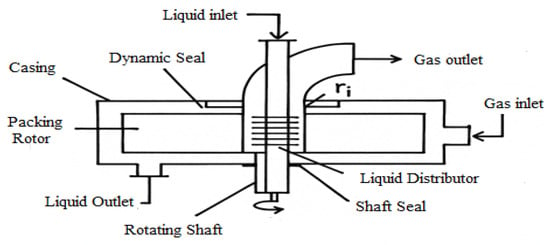
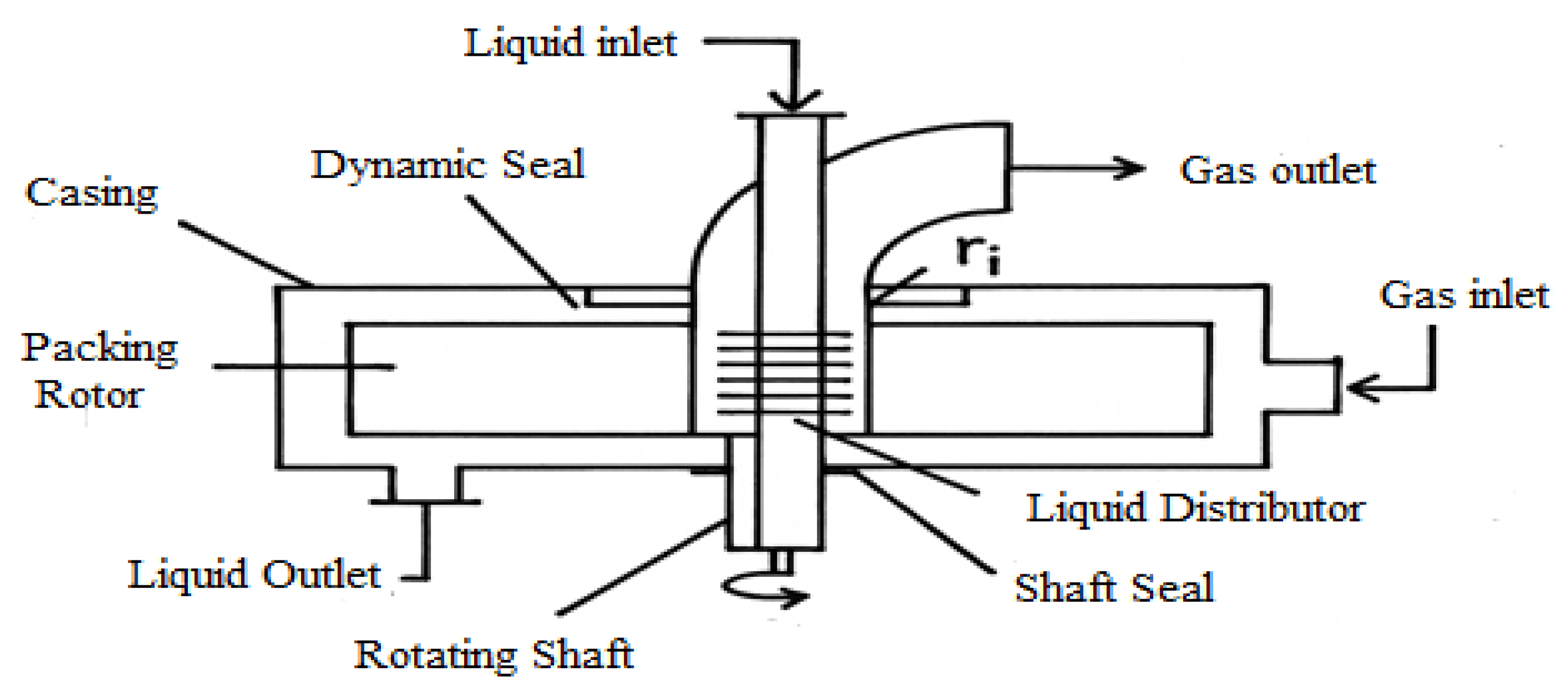
One of the operational benefits of using RPB absorber is its ability to be operated at higher gas and/or liquid flow rates owing to the low tendency of flooding compared to that in the conventional packed bed [19].Consequently, RPBs achieve mass-transfer coefficients two to five times higher than conventional packed beds, reduce absorber volume by 50–80%, require smaller solvent inventories, and lower capital costs for gas–liquid operations [8] studies have demonstrated their potential for CO2 capture. Ref. [1] achieved over 90% CO2 removal in a pilot-scale RPB using MEA while occupying much less space than a comparable packed column. Other researchers [12,20,21] reported that amino acid salts in RPBs achieved >98% capture efficiency and that RPB regenerators reduced energy requirements by about 20% compared with conventional designs. Simulations were performed on a CO2 capture system for a 250 MW power plant that utilized a 9.7 m diameter RPB absorber with a 55–75 wt% MEA solvent [18]. While the results indicated potential for cost and volume savings, the research did not thoroughly explore the practical integration of such massive rotating devices into current systems. Furthermore, research that optimized the RPB CO2 capture process by manipulating variables like MEA concentration, reboiler temperature, and stripping pressure lacked an accompanying economic assessment [22]. Overall, the body of work confirms that RPBs are effective, combining high capture efficiency with a smaller footprint, less solvent circulation, and lower operating expenses. The main components and flow paths of the rotating packed bed (RPB) system are illustrated in Figure 1 [23].
Figure 1.
Detailed Schematic of a Rotating Packed Bed (RPB) Reactor.
1.5. Solvents Performance for CO2 Capture
Alongside equipment intensification, solvent selection plays a crucial role in improving CO2 capture processes. Monoethanolamine (MEA) remains the benchmark solvent because of its rapid reaction kinetics, but it requires regeneration energies of 3.5–4.0 GJ t−1 CO2 and suffers from oxidative degradation, thermal instability, and corrosion issues [17,24]. Blended amines such as MEA–piperazine mixtures enhance absorption kinetics but still impose high energy penalties, while potassium carbonate is low-cost and stable yet reacts too slowly for many applications [25,26,27]. Amino acid salts have gained attention for their environmental compatibility and stability, and their application in RPBs has already produced promising results. Ionic liquids have also been investigated extensively because of their negligible vapor pressure and tunable properties, though their high viscosity and cost limit large-scale deployment [21].
In recent years, deep eutectic solvents (DESs) have emerged as a promising alternative. Formed by combining a hydrogen-bond donor such as an amine with a hydrogen-bond acceptor such as choline chloride, DESs exhibit unique physicochemical properties including negligible volatility, high stability, and lower toxicity and cost compared with ionic liquids [17,28,29]. Previous studies reviewed DESs for CO2 capture and highlighted their high absorption capacity and lower regeneration energy compared with conventional amines. Adeyemi et al. [5] further demonstrated that a ChCl–MEA mixture showed similar kinetics to aqueous MEA but required substantially less energy for desorption. Despite these advantages, experimental research integrating DESs into intensified contactors such as RPBs remains limited [30]. The main advantages and disadvantages of common solvent types are summarized in Table 1.
Table 1.
Advantages and disadvantages of common solvent types for CO2 capture.
1.6. Scope of This Work
This study addresses the existing research gap by developing a conceptual and modeling framework for CO2 capture from biogas using an integrated rotating packed bed (RPB) absorber–stripper system with a choline chloride–monoethanolamine (ChCl–MEA) deep eutectic solvent. The proposed model incorporates RPB design parameters, solvent properties, and literature-based correlations to evaluate absorption and regeneration performance under intensified conditions.
The novelty of this work lies in coupling the high-gravity mass-transfer enhancement of RPBs with the thermodynamic advantages of DES solvents, achieving high CO2 removal efficiency with substantially lower regeneration energy and a reduced equipment footprint. Previous RPB–MEA studies have mainly examined absorption and hydrodynamics, while few have investigated integrated absorber–stripper configurations for biogas upgrading. This work fills that gap by developing a comprehensive RPB absorber–stripper model using the ChCl–MEA solvent, addressing both CO2 capture performance and regeneration energy reduction for sustainable biogas upgrading.
2. Materials and Methods
2.1. Biogas Feed Characteristics
The feed-gas composition and operating conditions were selected to represent typical biogas-upgrading requirements. These are summarized in Table 2.
Table 2.
Biogas feed composition and operating conditions.
2.2. Solvent Characterization
Choline chloride acts as a hydrogen-bond acceptor and monoethanolamine (MEA) as a donor, forming a hydrophilic deep-eutectic mixture. A 1:6 molar ratio (ChCl:MEA) was selected because it minimizes viscosity and maximizes CO2 absorption according to previous optimization studies [31]. The thermophysical and transport properties of the ChCl–MEA (1:6) solvent at 40 °C and 1 atm are listed in Table 3 [31].
Table 3.
Thermophysical and Transport Properties of ChCl–MEA (1:6) at 40 °C and 1 atm.
The physical properties of the ChCl–MEA (1:6) solvent, including viscosity, surface tension, and Henry’s constant, were adopted from published data measured at 40 °C. The dynamic viscosity of 0.024 Pa·s (~24 cP) is consistent with literature reports for DES-based solvents and reflects the higher hydrogen-bond network density of the mixture. While higher viscosity may slightly reduce film renewal and mass transfer at low rotation speeds, the high centrifugal acceleration in RPB operation mitigates this limitation by enhancing liquid dispersion and interfacial renewal.
2.3. Process Stream Conditions
The main process streams and their steady-state operating conditions in this study are summarized in Table 4. These data describe the inlet and outlet conditions of the absorber, stripper, condenser, and heat-exchange units and serve as the basis for the subsequent mass- and energy-balance analysis.
Table 4.
Major process streams in the ChCl–MEA (1:6) RPB CO2-capture system at steady-state conditions.
2.4. RPB Absorber and Stripper Design Parameters
Both absorber and stripper were designed as Rotating Packed Beds (RPBs) equipped with stainless-steel wire-mesh packing selected for its high specific surface area and low pressure drop. In RPBs, the packing is arranged in concentric annular layers around the rotor hub, promoting liquid-film renewal and uniform radial gas–liquid contact.
Liquid distribution plays a crucial role in RPB efficiency. Here, a central liquid distributor positioned at the rotor inlet ensures even solvent spreading across the packing. The distributor divides the liquid stream into fine jets or films, achieving rapid wetting of the mesh surfaces under centrifugal acceleration. This minimizes maldistribution and enhances mass-transfer efficiency.
The design parameters of the RPB absorber and stripper were determined using the HiGee design methodology developed by Agarwal et al. [33]. The method calculates key geometric and operational variables—such as packing dimensions, rotation speed, and liquid-distribution characteristics—to ensure efficient mass transfer and prevent flooding. The final values, summarized in Table 5, fall within the typical operating ranges reported for CO2-absorption systems.
Table 5.
Design parameters of Absorber and Stripper RPB.
2.5. Process Flow and Energy Inputs
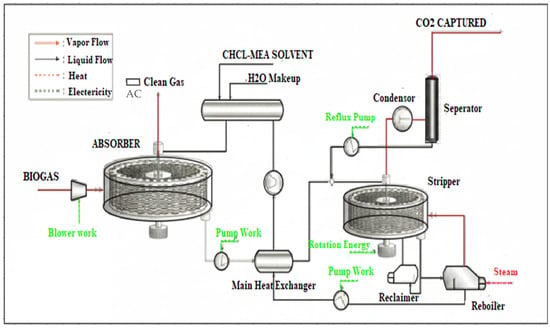
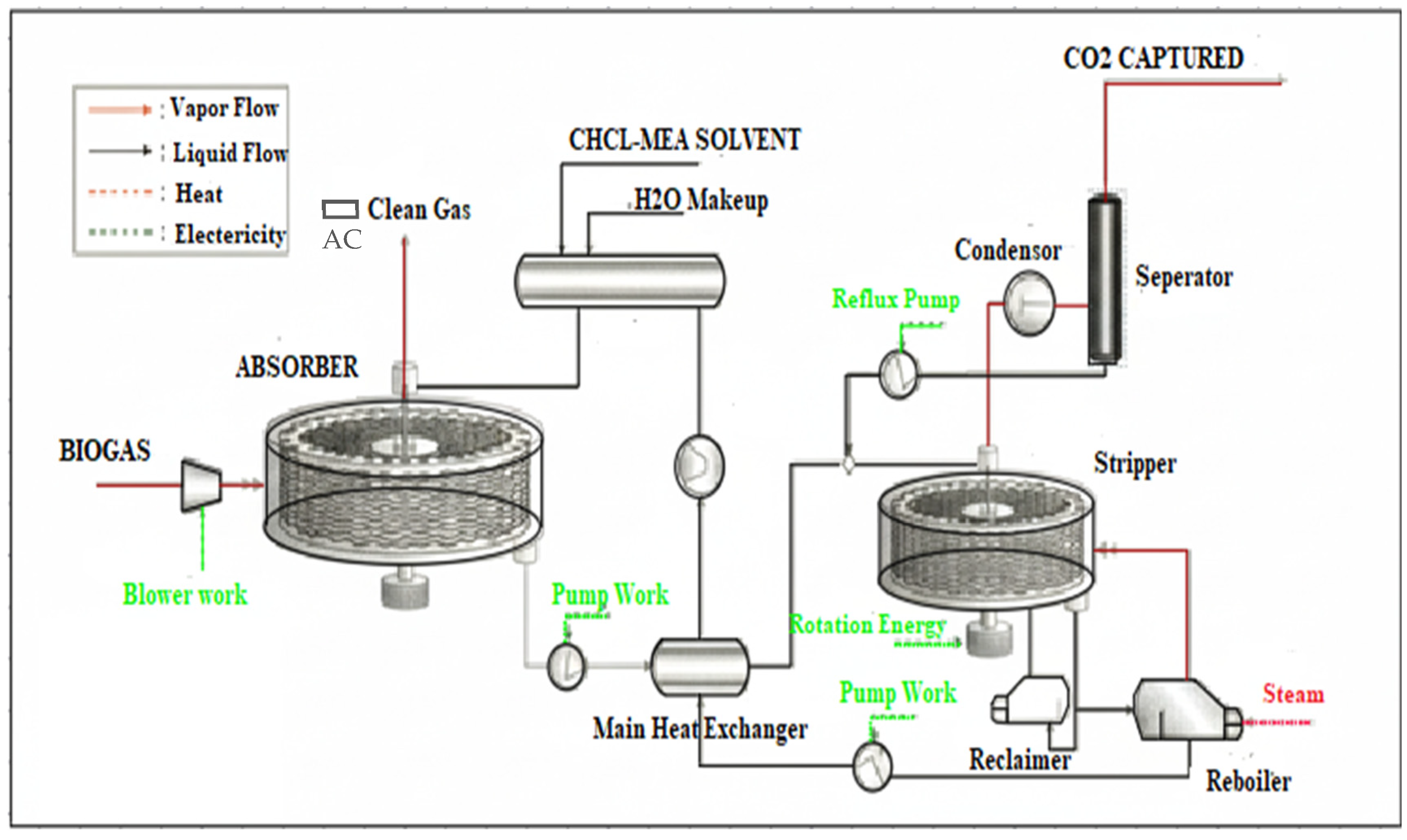
Figure 2 presents the process-flow diagram of the integrated biogas-upgrading system employing RPB absorber and stripper units. Biogas enters the RPB absorber after compression, where it contacts the ChCl–MEA solvent under high-gravity conditions. The CO2-rich solvent leaving the absorber is pumped through a lean/rich heat exchanger to recover sensible heat before entering the RPB stripper, which operates at elevated temperature and pressure [34].
Figure 2.
process flow diagram of the biogas upgrading system using RPB absorber and stripper.
Inside the stripper, CO2 is released from the solvent by reboiler heat input, and the regenerated lean solvent is recycled to the absorber. The desorbed CO2 then passes through a condenser and separator to remove entrained moisture, producing a purified CO2 stream. Solvent and water makeup lines compensate for evaporation and process losses.
The main energy inputs to the system are:
- Blower work for biogas compression before absorption;
- Pump work for solvent circulation and reflux;
- Rotational power for the RPB units;
- Steam supply to the reboiler for solvent regeneration.
This compact and intensified process design significantly reduces absorber volume and regeneration energy compared with conventional packed-column systems.
2.6. Governing Equations
The performance of the RPB absorber–stripper system in this study is governed by hydrodynamic and energy-balance relations adapted for high-gravity operation. The key equations are summarized below:
2.6.1. Interfacial Area
The effective gas–liquid interfacial area is a critical design parameter because it directly determines the volumetric mass-transfer coefficient. [35] proposed an empirical correlation for conventional packed beds that was later modified for high-gravity systems. In an RPB, gravitational acceleration is replaced by centrifugal acceleration (g → gc) [35].
where
= effective interfacial area (m2/m3);
= total geometric surface area of packing (m2/m3);
= liquid surface tension (N/m);
= critical surface tension (N/m);
= liquid Reynolds number;
= Weber number;
= Froude number based on centrifugal acceleration;
, where ω is angular velocity (rad/s) and r is radial position (m).
An alternative correlation frequently applied is that of Bravo & Fair correlation [35], which was developed for conventional packed columns and later extended to structured packings:
In this study, the Onda correlation modified with centrifugal acceleration was selected because: (i) it has been successfully applied in several RPB modeling studies [35,36], (ii) it captures the effect of liquid properties such as viscosity and surface tension that are particularly relevant for DES solvents, and (iii) it provides a conservative estimate of wetted area for mesh packings. Bravo–Fair was reviewed for comparison but was deemed less suitable due to its development basis in conventional packed columns rather than high-gravity devices.
2.6.2. Mass Transfer Coefficients
The gas-side mass transfer coefficient was calculated by the Onda correlation (1968):
where
gas diffusivity (m2/s);
characteristic packing size (m);
gas Reynolds number;
gas Schmidt number.
The liquid-side mass transfer coefficient was estimated using the Tung–Mah correlation (1991) [35], adapted for RPB hydrodynamics:
where
liquid diffusivity (m2/s);
liquid Reynolds number;
liquid Schmidt number;
is the Froude number under centrifugal acceleration.
The overall volumetric mass transfer coefficient was then expressed as:
where H is Henry’s law constant for CO2 in the solvent. [35]
The gas- and liquid-phase diffusivities (DL and DG) used in the model were adopted from literature correlations. The gas-phase diffusivity of CO2 was calculated using the correlation proposed by [35] for multicomponent gas mixtures [37], while the liquid-phase diffusivity was estimated using the [38]. Both parameters were evaluated at the absorber operating temperature (40 °C). These correlations are consistent with those used in previous RPB-based CO2 absorption studies.
2.6.3. Liquid Holdup
Liquid holdup represents the fraction of the bed volume occupied by liquid and directly impacts interfacial area and residence time. In RPBs, holdup is strongly influenced by centrifugal acceleration (gc), liquid superficial velocity (U), and solvent viscosity (ν).
The Burns correlation [39], widely adopted in RPB studies, is given by:
where
= 100 m/s2;
= 0.01 m/s;
= 1.0 × 10⁻⁶ m2/s.
Recent CFD and experimental studies [36] confirmed that liquid holdup decreases radially from the inner to the outer edge of the bed, and that higher rotational speed reduces holdup, while increasing the L/G ratio increases holdup. Their simulations showed good agreement with the Burns correlation near the liquid inlet region, validating its use in RPB design [40].
Overall, the consensus in the literature [23,36,39,41] is that RPBs exhibit much lower liquid holdup than conventional packed beds, which contributes to thin-film formation and high mass transfer efficiency.
2.6.4. Pressure Drop
Prediction of pressure drop in RPBs differs from conventional Ergun-type models. Refs. [37,39] developed a semi-empirical model where the overall pressure drop is expressed as the sum of drag force (ΔPI), rotational term (ΔPII), and slip effects (ΔPIII).
The drag force is given by:
The rotational contribution is given by:
Slip terms (ΔPIII) account for gas–liquid and gas–packing velocity differences.
a, b, and c are fitting parameters given as:
a = −0.08 m3/s, b=2000(rpm)c and c =1.22
packing diameter is:
dp = 6(1 − ε)/ap
Ref. [35] also applied the pressure drop correlation [42], where dry pressure drop is modeled as the additive effects of drag, centrifugal forces, and gas–solid slip.
These models highlight a unique RPB phenomenon: pressure drop in irrigated beds can be lower than in dry beds, due to liquid acting as a lubricant for gas flow [43].
2.6.5. Energy Balance and Reboiler Duty
For the RPB stripper–reboiler system, the total reboiler duty is decomposed into the heat of reaction released upon CO2 desorption, the sensible heat required to raise the rich solvent to regeneration temperature, the latent heat associated with water vaporization, and unavoidable heat losses. Following [44], the overall energy balance is written as:
where is obtained by difference between the measured reboiler duty and the sum of the calculated contributions. measured reboiler duty and the sum of the calculated contributions.
The heat of reaction term is given as:
where
= CO2 desorption rate;
= specific enthalpy of desorption at stripper conditions.
The sensible heat is expressed as:
The latent heat of vaporization is:
where
is the vaporized water mass flow rate.
In practice, is measured directly using an electrical power meter connected to the reboiler [45]. The same study showed that heat losses typically account for about 6–7% of the total reboiler duty, even under insulated conditions.
Finally, the specific regeneration energy (reboiler duty normalized per ton of CO2 released) is calculated as:
Values in conventional MEA systems are typically reported between 4.5 and 6 GJ·t−1 CO2, while integration of RPBs into regeneration units has demonstrated substantial reductions in reported studies of alkanolamine systems [46].
The hydrodynamic and mass-transfer correlations employed in this study were selected from literature sources that had been experimentally validated for RPB systems operating with similar liquids. The Onda-type correlation for interfacial area and the [1] pressure-drop model were previously compared with pilot-scale RPB data and showed deviations within ±10–15%. To evaluate the robustness of the present model, a simple sensitivity analysis was performed. When the liquid viscosity was varied by ±5%, the predicted overall mass-transfer coefficient () changed by less than 3%, and the CO2 removal efficiency altered by approximately 2%. Likewise, a ±5% change in gas-flow rate resulted in less than 4% deviation in calculated pressure drop and under 3% variation in reboiler duty. These limited variations indicate that the adopted correlations and process assumptions are reasonably reliable for conceptual design and energy-performance comparison of the RPB system.
3. Results
3.1. Absorption Performance
The RPB absorber was operated at 40 °C, 1 atm, and 800 rpm, with a solvent circulation rate of 2120 kg h−1. At a biogas feed rate of 500 m3 h−1 (39.84% CO2, 59.75% CH4, 0.411% H2S), the absorber achieved approximately 97% CO2 removal, enriching the methane fraction to above 95%, which satisfies biomethane-quality standards.
This high performance is attributed to the large specific surface area of the stainless-steel mesh packing (1660 m2 m−3) and the high centrifugal acceleration (>250 g at the packing edge). These conditions promote thin-film formation, uniform solvent wetting, and enhanced interfacial mass transfer.
The designed RPB absorber has a packed-bed volume of 0.0619 m3, compared with approximately 0.205 m3 for a conventional packed column operating under similar gas–liquid conditions, representing a ≈70% reduction in equipment volume. This result agrees with previous reports indicating that RPBs typically achieve 60–80% volume reduction relative to conventional packed beds [1,11,23].
3.2. Solvent Loading and Cyclic Capacity
The ChCl–MEA (1:6) deep-eutectic solvent operated between a rich loading of 0.30 mol CO2 mol−1 MEA and a lean loading of 0.012 mol CO2 mol−1 MEA, resulting in a cyclic capacity (Δα) of 0.30 mol CO2 mol−1 MEA. This corresponded to approximately 331 kg h−1 of CO2 absorbed in the rich solvent and 317 kg h−1 released in the stripper.
The cyclic capacity obtained in this study is higher than that of conventional MEA systems, which typically operate in the range of 0.20–0.25 mol CO2 mol−1 MEA. This finding demonstrates the advantage of the DES solvent in enhancing CO2 uptake and facilitating efficient solvent regeneration and recycling.
3.3. Hydrodynamics and Pressure Drop
The absorber exhibited a pressure drop of 0.8 kPa, while the stripper showed 0.27 kPa at a rotational speed of 800 rpm. These values are 20–30% lower than those reported for conventional packed columns, which typically range between 0.6 and 2.0 kPa under comparable gas–liquid throughputs [47].
This reduction is primarily attributed to the high void fractions of the mesh packing (0.82 for the absorber and 0.93 for the stripper) and the lubricating effect of liquid films in irrigated RPBs, which diminish gas–solid drag relative to dry-bed operation.
3.4. Solvent Regeneration and Energy Requirement
The RPB stripper was operated at 2 atm and 110 °C, incorporating a lean/rich heat exchanger and a kettle-type reboiler. The measured reboiler duties were:
- 153 kW, assuming no water vaporization in the solvent;
- 251 kW, accounting for 5% water vaporization.
At a CO2 release rate of 317 kg h−1, the corresponding specific regeneration energies were:
- 1.50 GJ t−1 CO2 for the dry-solvent case;
- 2.11 GJ t−1 CO2 when 5 wt% water was present.
The energy analysis assumed a CO2 desorption enthalpy of 85 kJ mol−1, an overall heat loss of 5%, and a latent heat of vaporization of 2257 kJ kg−1 for the water content. These results are consistent with literature data for DES- and MEA-based systems. The relatively low reboiler duty (1.5–2.11 GJ t−1 CO2) observed in this study is attributed to the smaller solvent inventory in the RPB, the lower specific heat capacity of the ChCl–MEA solvent, and the reduced vaporization heat resulting from its low water content. These findings are in good agreement with trends reported by [39].
Furthermore, the obtained energy requirements are significantly below the conventional MEA benchmark of 3.3–4.2 GJ t−1 CO2 [8], and even lower than ≈3.0 GJ t−1 CO2 reported for piperazine (PZ) blends in RPB systems [25,26]. The observed reduction arises from the lower heat of desorption of the ChCl–MEA solvent, minimal water evaporation, and the decreased sensible-heat demand in the compact RPB design with low liquid holdup.
3.5. Comparison with Literature
The main performance indicators obtained in this study are compared with literature data in Table 6. As shown, the ChCl–MEA-based RPB system achieves high CO2-removal efficiency, along with a lower pressure drop and significantly reduced regeneration energy demand compared with conventional solvents and column configurations.
Table 6.
Comparison of Absorber/Stripper performance with literature Value.
These results confirm that deep-eutectic-solvent (DES) systems, when integrated with RPB absorbers and strippers, can simultaneously deliver process intensification and energy savings, providing a promising route for efficient biogas-upgrading applications.
4. Discussion
Although the present study demonstrates the potential of combining ChCl–MEA deep-eutectic solvents with rotating packed-bed (RPB) technology, further research is required to validate and extend these findings. Experimental investigations are necessary to verify the hydrodynamic correlations for DES-based systems and to evaluate the long-term solvent stability under cyclic operation. Scale-up studies should also examine equipment durability, liquid distributor performance, and the influence of impurities such as H2S and siloxanes present in real biogas streams. In addition, techno-economic assessments and process-integration strategies with existing biogas-upgrading facilities will be crucial to establish the industrial feasibility of the proposed intensified system.
A brief model uncertainty analysis indicated that the empirical correlations employed for interfacial area and pressure drop introduce less than ±10–15% deviation compared with reported experimental data. The sensitivity analysis further confirmed that small variations in solvent viscosity or gas flow rate produced only minor effects (<4%) on CO2 removal efficiency and energy requirement, thereby supporting the robustness of the developed model.
The reduced regeneration energy observed for the ChCl–MEA system can be attributed to its deep-eutectic nature, in which hydrogen-bond interactions between choline chloride and MEA enable reversible CO2 absorption through weaker carbamate bonding. Furthermore, the low water content and high thermal stability of the DES decrease both the latent heat of vaporization and the sensible heat demand during regeneration, resulting in a significant reduction in overall energy consumption compared with conventional aqueous MEA systems.
5. Conclusions
This study investigated the performance of a Rotating Packed Bed (RPB) system for CO2 capture from biogas using a deep-eutectic solvent (ChCl–MEA, 1:6 molar ratio). Both the absorber and stripper were designed and analyzed in terms of CO2-removal efficiency, hydrodynamics, and energy demand, representing one of the first integrated evaluations of dual RPB absorber–stripper operation with a DES solvent for biogas upgrading.
The RPB absorber achieved a CO2-removal efficiency of approximately 97%, enriching the methane fraction above biomethane standards (>95% CH4). This was accomplished with a low pressure drop of only 0.8 kPa, considerably lower than that of conventional packed columns (1.5–2.0 kPa), confirming the favorable hydrodynamic performance of the RPB. The ChCl–MEA solvent exhibited a cyclic loading of 0.288 mol CO2 mol−1 MEA, corresponding to ≈331 kg h−1 CO2 absorption and ≈317 kg h−1 desorption, demonstrating stable and reversible operation under continuous cyclic conditions.
The RPB stripper, operating at 2 atm and 110 °C, required reboiler duties of 156 kW (dry solvent) and 251 kW (5 wt% water), equivalent to 1.5–2.11 GJ t−1 CO2 of specific regeneration energy. This represents a 40–60% reduction compared with conventional MEA systems (3.3–4.2 GJ t−1 CO2). The lower regeneration energy primarily arises from the intrinsic properties of the ChCl–MEA deep-eutectic solvent: its strong hydrogen-bond network weakens CO2–amine bonding and reduces the heat of desorption, while its low water content minimizes the latent heat of vaporization.
The integration of DES chemistry with intensified RPB hydrodynamics provides synergistic advantages, namely, enhanced gas–liquid mass transfer, reduced solvent circulation rate, and compact equipment design, resulting in lower energy demand and pressure drop compared with conventional packed beds. In comparison with literature data [12,19,35,45], the present RPB–DES system achieved equal or superior CO2-removal efficiency with substantially lower regeneration energy and a smaller equipment footprint.
Overall, this work demonstrates the novelty and feasibility of coupling a ChCl–MEA deep-eutectic solvent with dual RPB absorber–stripper operation for biogas upgrading. The proposed system achieves compact design, enhanced energy efficiency, and stable solvent performance, offering a promising pathway toward intensified and sustainable CO2-capture technologies. Future research will focus on experimental validation, long-term solvent stability under cyclic operation, and pilot-scale implementation.
Author Contributions
Conceptualization, S.P. and V.U.; methodology, S.P.; software, S.P.; validation, S.P. and V.U.; formal analysis, S.P.; investigation, S.P.; resources, V.U.; data curation, S.P.; writing—original draft preparation, S.P.; writing—review and editing, S.P. and V.U.; visualization, S.P.; supervision, V.U.; project administration, V.U.; funding acquisition, V.U. All authors have read and agreed to the published version of the manuscript.
Funding
This research received no external funding. The APC was funded by the authors.
Data Availability Statement
The original contributions presented in this study are included in the article. Further inquiries can be directed to the corresponding author.
Acknowledgments
The authors gratefully acknowledge the support and facilities provided by Istanbul Technical University during the course of this research. Generative artificial intelligence (ChatGPT, Open AI GPT-5) was used to assist in drafting and refining the Introduction and Materials and Methods sections. All scientific content, data interpretation, and conclusions were generated and verified by the authors.
Conflicts of Interest
The authors declare no conflicts of interest.
Abbreviations
The following abbreviations are used in this manuscript:
| Symbol/Abbreviation | Definition | Unit |
| a | Effective interfacial area | m2/m3 |
| at | Geometric surface area of packing | m2/m3 |
| C | Empirical constant in correlations | – |
| Cₚ | Specific heat capacity | J·kg−1·K−1 |
| dp | Characteristic packing size | m |
| DG | Gas diffusivity | m2/s |
| DL | Liquid diffusivity | m2/s |
| Ereg | Specific regeneration energy | GJ·t−1 CO2 |
| Fr | Froude number | – |
| gc | Centrifugal acceleration | m/s2 |
| H | Henry’s law constant | Pa·m3·mol−1 |
| Hrxn | Heat of reaction | kW |
| Hsen | Sensible heat | kW |
| Hvap | Heat of vaporization | kW |
| Hloss | Heat losses | kW |
| Liquid holdup | – | |
| kG | Gas-side mass transfer coefficient | m/s |
| kL | Liquid-side mass transfer coefficient | m/s |
| KG a | Overall volumetric mass transfer coefficient | mol·m−3·s−1·Pa−1 |
| mi | Mass flow rate of component i | kg/s |
| Mass flow rate of CO2 | kg/s or kg/h | |
| Mass flow rate of vaporized water | kg/s | |
| ΔHrxn | Enthalpy of CO2 desorption | kJ/mol |
| ΔHvap | Latent heat of water vaporization | kJ/kg |
| ΔP | Pressure drop | kPa |
| Qreb | Reboiler duty | kW |
| Gas Reynolds number | – | |
| Liquid Reynolds number | – | |
| ri | Inner and outer radii of packing | m |
| Gas Schmidt number | – | |
| Liquid Schmidt number | – | |
| uL | Superficial liquid velocity | m/s |
| Weber number | – | |
| ω | Angular velocity | rad/s |
| AC | Activated Carbon | – |
| CCUS | Carbon Capture, Utilization, and Storage | – |
| DES | Deep Eutectic Solvent | – |
| MEA | Monoethanolamine | – |
| PZ | Piperazine | – |
| RPB | Rotating Packed Bed | – |
References
- Kolawole, T.O. Intensified Post-Combustion Carbon Capture Using a Pilot Scale Rotating Packed Bed and Monoethanolamine Solutions. Ph.D. Thesis, Newcastle University, Newcastle, UK, 2019. [Google Scholar]
- Global Energy Review 2025. Available online: https://www.iea.org/ (accessed on 24 March 2025).
- Samuel, A.R. Biogas Upgrading and Solvent Regeneration in Monoethanolamine and Ionic Liquids for Carbon Dioxide Utilisation. Ph.D. Thesis, University of Sheffield, Sheffield, UK, 2014. [Google Scholar]
- Joel, A.S.; Isa, Y.M. Application of rotating packed bed technology for biogas upgrading. E3S Web Conf. 2023, 470, 01004. [Google Scholar] [CrossRef] [Scilit]
- Adeyemi, I.; Abu-Zahra, M.R.M.; Alnashef, I. Experimental Study of the Solubility of CO2 in Novel Amine Based Deep Eutectic Solvents. Energy Procedia 2017, 105, 1394–1400. [Google Scholar] [CrossRef] [Scilit]
- Rani, A.; Negi, S.; Chen, Y.N.; Yu, C.H.; Pan, S.Y. Electrochemical Biogas Upgrading: Energy, Environmental, Economic, and Engineering Considerations. GCB Bioenergy 2025, 17, e70063. [Google Scholar] [CrossRef] [Scilit]
- Meng, F.; Han, S.; Lin, L.; Li, J.; Chen, K.; Jiang, J. Process optimization and mechanism study of ionic liquid-based mixed amine biphasic solvents for CO2 capture in biogas upgrading procedure. Front. Environ. Sci. Eng. 2024, 18, 95. [Google Scholar] [CrossRef] [Scilit]
- Ghadyanlou, F.; Azari, A.; Vatani, A. A review of modeling rotating packed beds and improving their parameters: Gas–Liquid contact. Sustainability 2021, 13, 8046. [Google Scholar] [CrossRef] [Scilit]
- Mohammed, K.; Al-Jaafari, K. Comprehensive Assessment of an Environmentally Friendly Biogas Upgrading Process Using Deep Eutectic Solvents. Master’s Thesis, Sultan Qaboos University, Muscat, Oman, 2024. [Google Scholar]
- Xie, P. Hydrodynamics and Mass Transfer of Rotating Packed Beds for CO2 Capture. Ph.D. Thesis, University of Sheffield, Sheffield, UK, 2019. [Google Scholar]
- Kang, J.L.; Wong, D.S.H.; Jang, S.S.; Tan, C.S. A comparison between packed beds and rotating packed beds for CO2 capture using monoethanolamine and dilute aqueous ammonia solutions. Int. J. Greenh. Gas Control 2016, 46, 228–239. [Google Scholar] [CrossRef] [Scilit]
- Thiels, M.; Wong, D.S.; Yu, C.-H.; Kang, J.-L.; Jang, S.S.; Tan, C.-S. Modelling and Design of Carbon Dioxide Absorption in Rotating Packed Bed and Packed Column. IFAC-PapersOnLine 2016, 49, 895–900. [Google Scholar] [CrossRef] [Scilit]
- Chen, Z.; Chen, J.; Zhang, X. A comprehensive review of minimum miscibility pressure determination and reduction strategies between CO2 and crude oil in CCUS processes. Fuel 2025, 384, 134053. [Google Scholar] [CrossRef] [Scilit]
- Thonemann, N.; Zacharopoulos, L.; Fromme, F.; Nühlen, J. Environmental impacts of carbon capture and utilization by mineral carbonation: A systematic literature review and meta life cycle assessment. J. Clean. Prod. 2022, 332, 130067. [Google Scholar] [CrossRef] [Scilit]
- Gao, D.; Li, W.; Wang, H.; Wang, G.; Cai, R. Heterogeneous Catalysis for CO2 Conversion into Chemicals and Fuels. Trans. Tianjin Univ. 2022, 28, 245–264. [Google Scholar] [CrossRef] [Scilit]
- Chen, Z.; Zhou, Y.; Li, H. A Review of Phase Behavior Mechanisms of CO2 EOR and Storage in Subsurface Formations. Ind. Eng. Chem. Res. 2022, 61, 10298–10318. [Google Scholar] [CrossRef] [Scilit]
- Otitoju, O.; Oko, E.; Wang, M. Modelling, scale-up and techno-economic assessment of rotating packed bed absorber for CO2 capture from a 250 MWe combined cycle gas turbine power plant. Appl. Energy 2023, 335, 120747. [Google Scholar] [CrossRef] [Scilit]
- Hassan-Beck, H.M. Process Intensification: Mass Transfer and Pressure Drop for Countercurrent Rotating Packed Beds. Ph.D. Thesis, Newcastle University, Newcastle, UK, 1997. [Google Scholar]
- Lin, C.C.; Lin, Y.H.; Tan, C.S. Evaluation of alkanolamine solutions for carbon dioxide removal in cross-flow rotating packed beds. J. Hazard. Mater. 2010, 175, 344–351. [Google Scholar] [CrossRef] [Scilit] [PubMed]
- Joel, A.S.; Wang, M.; Ramshaw, C.; Oko, E. Modelling, simulation and analysis of intensified regenerator for solvent based carbon capture using rotating packed bed technology. Appl. Energy 2017, 203, 11–25. [Google Scholar] [CrossRef] [Scilit]
- Chen, H.; Tsai, T.C.; Tan, C.S. CO2 capture using amino acid sodium salt mixed with alkanolamines. Int. J. Greenh. Gas Control 2018, 79, 127–133. [Google Scholar] [CrossRef] [Scilit]
- Im, D.; Jung, H.; Lee, J.H. Modeling, simulation and optimization of the rotating packed bed (RPB) absorber and stripper for MEA-based carbon capture. Comput. Chem. Eng. 2020, 143, 107102. [Google Scholar] [CrossRef] [Scilit]
- Hacking, J.A.; Delsing, N.F.E.J.; de Beer, M.M.; van der Schaaf, J. Improving liquid distribution in a rotating packed bed. Chem. Eng. Process.-Process Intensif. 2020, 149, 107861. [Google Scholar] [CrossRef] [Scilit]
- Alhammadi, M.I. Design of Carbon Dioxide Capture Plant using Amine Based Ternary Deep Eutectic Solvents: DFT and Simulation. Master’s Thesis, Khalifa University of Science, Abu Dhabi, United Arab Emirates, 2024. [Google Scholar]
- Zhang, T.; Yu, Y.; Zhang, Z. An interactive chemical enhancement of CO2 capture in the MEA/PZ/AMP/DEA binary solutions. Int. J. Greenh. Gas Control 2018, 74, 119–129. [Google Scholar] [CrossRef] [Scilit]
- Wu, T.W.; Hung, Y.T.; Chen, M.T.; Tan, C.S. CO2 capture from natural gas power plants by aqueous PZ/DETA in rotating packed bed. Sep. Purif. Technol. 2017, 186, 309–317. [Google Scholar] [CrossRef] [Scilit]
- Dugas, R.; Rochelle, G. Absorption and desorption rates of carbon dioxide with monoethanolamine and piperazine. Energy Procedia 2009, 1, 1163–1169. [Google Scholar] [CrossRef] [Scilit]
- Shukla, C.; Mishra, P.; Dash, S.K. A review of process intensified CO2 capture in RPB for sustainability and contribution to industrial net zero. Front. Energy Res. 2023, 11, 1135188. [Google Scholar] [CrossRef] [Scilit]
- Gong, H.; Yalikun, N.; Wang, Q.; Liu, C.; Ziyawudong, Z.; Huo, T.; Musa, B. Amino acid-based deep eutectic solvents for CO2 capture: Performance evaluation and mechanistic insights. Chem. Eng. J. 2025, 522, 167372. [Google Scholar] [CrossRef] [Scilit]
- Li, Z.; Wang, L.; Li, C.; Cui, Y.; Li, S.; Yang, G.; Shen, Y. Absorption of Carbon Dioxide Using Ethanolamine-Based Deep Eutectic Solvents. ACS Sustain. Chem. Eng. 2019, 7, 10403–10414. [Google Scholar] [CrossRef] [Scilit]
- Adeyemi, I.; Abu-Zahra, M.R.M.; AlNashef, I.M. Physicochemical properties of alkanolamine-choline chloride deep eutectic solvents: Measurements, group contribution and artificial intelligence prediction techniques. J. Mol. Liq. 2018, 256, 581–590. [Google Scholar] [CrossRef] [Scilit]
- Ibrahim, T.H.; Sabri, M.A.; Jabbar, N.A.; Nancarrow, P.; Mjalli, F.S.; AlNashef, I. Thermal Conductivities of Choline Chloride-Based Deep Eutectic Solvents and Their Mixtures with Water: Measurement and Estimation. Molecules 2020, 25, 3816. [Google Scholar] [CrossRef] [Scilit]
- Agarwal, L.; Pavani, V.; Rao, D.P.; Kaistha, N. Process intensification in HiGee absorption and distillation: Design procedure and applications. Ind. Eng. Chem. Res. 2010, 49, 10046–10058. [Google Scholar] [CrossRef] [Scilit]
- Jung, H.; Park, N.; Lee, J.H. Optimizing economic feasibility of CO2 capture processes with rotating packed bed (RPB): Strategies for scale and modularization. J. Clean. Prod. 2024, 479, 143998. [Google Scholar] [CrossRef] [Scilit]
- Joel, A.S.; Wang, M.; Ramshaw, C.; Oko, E. Process analysis of intensified absorber for post-combustion CO2 capture through modelling and simulation. Int. J. Greenh. Gas Control 2014, 21, 91–100. [Google Scholar] [CrossRef] [Scilit]
- Lu, X.; Xie, P.; Ingham, D.B.; Ma, L.; Pourkashanian, M. Modelling of CO2 absorption in a rotating packed bed using an Eulerian porous media approach. Chem. Eng. Sci. 2019, 199, 302–318. [Google Scholar] [CrossRef] [Scilit]
- Fairbanks, D.F.; Wilke, C.R. Diffusion Coefficients in Multicomponent Gas Mixtures. Ind. Eng. Chem. 1950, 42, 471–475. [Google Scholar] [CrossRef] [Scilit]
- Borhani, T.N.; Oko, E.; Wang, M. Process modelling, validation and analysis of rotating packed bed stripper in the context of intensified CO2 capture with MEA. J. Ind. Eng. Chem. 2019, 75, 285–295. [Google Scholar] [CrossRef] [Scilit]
- Burns, J.R.; Jamil, J.N.; Ramshaw, C. Process intensification: Operating characteristics of rotating packed beds—Determination of liquid hold-up for a high-voidage structured packing. Chem. Eng. Sci. 2000, 55, 2401–2415. [Google Scholar] [CrossRef] [Scilit]
- Liu, Y.; Luo, Y.; Chu, G.W.; Luo, J.Z.; Arowo, M.; Chen, J.F. 3D numerical simulation of a rotating packed bed with structured stainless steel wire mesh packing. Chem. Eng. Sci. 2017, 170, 365–377. [Google Scholar] [CrossRef] [Scilit]
- Zhang, W.; Xie, P.; Li, Y.; Teng, L.; Zhu, J. CFD analysis of the hydrodynamic characteristics in a rotating packed bed with multi-nozzles. Chem. Eng. Process.-Process Intensif. 2020, 158, 108107. [Google Scholar] [CrossRef] [Scilit]
- Liu, X.; Jing, M.; Chen, S.; Du, L. Experimental study of gas pressure drop in rotating packed bed with rotational-stationary packing. Can. J. Chem. Eng. 2018, 96, 590–596. [Google Scholar] [CrossRef] [Scilit]
- Lashkarbolooki, M. A general model for pressure drop prediction across a rotating packed bed. Sep. Sci. Technol. 2017, 52, 1843–1851. [Google Scholar] [CrossRef] [Scilit]
- Llerena-Chavez, H.; Larachi, F. Analysis of flow in rotating packed beds via CFD simulations—Dry pressure drop and gas flow maldistribution. Chem. Eng. Sci. 2009, 64, 2113–2126. [Google Scholar] [CrossRef] [Scilit]
- Cheng, H.H.; Lai, C.C.; Tan, C.S. Thermal regeneration of alkanolamine solutions in a rotating packed bed. Int. J. Greenh. Gas Control 2013, 16, 206–216. [Google Scholar] [CrossRef] [Scilit]
- Jassim, M.S.; Rochelle, G.; Eimer, D.; Ramshaw, C. Carbon dioxide absorption and desorption in aqueous monoethanolamine solutions in a rotating packed bed. Ind. Eng. Chem. Res. 2007, 46, 2823–2833. [Google Scholar] [CrossRef] [Scilit]
- Son, Y.; Won, W. Liquid holdup and pressure drop in packed column with structured packing under offshore conditions. Chem. Eng. Sci. 2019, 195, 894–903. [Google Scholar] [CrossRef] [Scilit]

Disclaimer/Publisher’s Note: The statements, opinions and data contained in all publications are solely those of the individual author(s) and contributor(s) and not of MDPI and/or the editor(s). MDPI and/or the editor(s) disclaim responsibility for any injury to people or property resulting from any ideas, methods, instructions or products referred to in the content. |
© 2026 by the authors. Licensee MDPI, Basel, Switzerland. This article is an open access article distributed under the terms and conditions of the Creative Commons Attribution (CC BY) license.