


Abstract
Soil cadmium (Cd) pollution has emerged as one of the key environmental issues threatening the safety of agricultural products worldwide, yet clean and low-cost intervention strategies that reduce Cd accumulation in edible crops without disrupting agricultural production remain scarce. Grafting onto tolerant rootstocks represents an emerging clean agronomic technology that achieves in situ Cd risk reduction within a single growing season. However, the molecular mechanisms by which rootstocks regulate scion phenotypes remain poorly understood. MicroRNAs (miRNAs) act as critical long-distance signals in plants, yet their roles in rootstock-mediated growth promotion and Cd reduction remain largely unclear. In this study, we used Solanum torvum as rootstock and purple eggplant (Solanum melongena) as scion to investigate growth, fruit quality, Cd accumulation, and miRNA-mediated regulatory mechanisms. Grafting significantly increased plant height (by 18%), stem diameter (by 12%), and yield without obvious effects on fruit quality. Under Cd stress, the Cd content in grafted eggplant fruits was reduced by 76%, whereas leaf potassium (K), calcium (Ca), and magnesium (Mg) contents were elevated by 21%, 17%, and 10%, respectively. High-throughput sequencing and quantitative real-time polymerase chain reaction identified five key differentially expressed miRNAs, including miR164a and miR166b, four of which were related to Cd stress. Gene Ontology (GO) enrichment analyzes that their target genes were mainly involved in hormone signal transduction and ion transport. Further validation suggested that grafting improved growth and reduced Cd accumulation by regulating genes of the NAC, SPL, and HD-ZIP III families. These results suggested that suitable rootstocks can enhance crop productivity and reduce toxic metal accumulation in edible parts through miRNA-mediated regulation.
1. Introduction
Cadmium (Cd) contamination of agricultural soils is one of the most pressing threats to food safety and human health worldwide. Approximately 14–17% of global arable land contains Cd concentrations exceeding regulatory thresholds, with Cd being the most prevalent heavy metal pollutant in contaminated farmlands [1]. Major anthropogenic sources of Cd in agricultural soils include mining and smelting activities, phosphate fertilizer application, sewage irrigation, and industrial emissions. In addition, soil microbiome and rhizosphere processes, such as microbial-mediated Cd speciation changes and root exudate-driven Cd mobilization, play important roles in Cd bioavailability and plant uptake. A study by Cao et al. indicated that the global area of land with excessive heavy metal concentrations exceeds 20 million hectares [2]. Due to variations in metal concentrations across habitats, the plants of the same genus often exhibit distinct Cd accumulation characteristics [3]. Conventional remediation technologies—including soil washing, chemical stabilization, and electrokinetic remediation—are often associated with high costs, secondary pollution risks, and the disruption of agricultural production continuity [4]. Additionally, significant differences exist in Cd uptake and accumulation among plant species. For example, Vetiveria zizanioides, Pteris vittata, and Sedum alfredii are classified as Cd hyperaccumulators, in sharp contrast to common low-accumulating varieties. Investigations into different genotypes of the same species can advance our understanding of the mechanisms underlying heavy metal accumulation in plants and facilitate the screening and breeding of crop cultivars with low Cd accumulation [5]. However, traditional research has mostly focused on comparing Cd accumulation among plant genotypes, which does not allow for in-depth elucidation of the transport processes and regulatory mechanisms of Cd within plants. Clean agronomic approaches that can reduce Cd translocation to edible parts without altering the soil environment are therefore urgently needed.
In agroecosystems, Cd undergoes complex cycling processes spanning atmospheric deposition, soil retention and transformation, root uptake, and translocation through the soil–crop–food chain continuum. From the perspective of soil health and the Food and Agriculture Organization of the United Nations (FAO) framework for sustainable soil management, addressing Cd contamination requires strategies that not only reduce Cd transfer to edible crop tissues but also preserve soil biological functions and long-term agricultural productivity. Grafting onto tolerant rootstocks is an emerging clean agronomic technology that achieves in situ Cd risk mitigation within a single growing season, without chemical inputs or soil disturbance, while simultaneously maintaining crop productivity. For example, grafting tomato onto disease-resistant rootstocks has been reported to increase fruit yield by 15–40% and biomass by 20–35% [6]; grafting cucumber onto pumpkin rootstocks reduced Cu concentration in shoots by approximately 50% under Cu stress [7]. By fusing scions and rootstocks with distinct genetic backgrounds, grafting establishes an intergenomic network enabling the bidirectional exchange of macromolecules including microRNAs (miRNAs), small RNAs, and proteins, which regulate plant morphology, development, stress resistance, and nutrient transport [8,9,10,11,12].
Grafting offers a novel approach to elucidate the mechanisms underlying Cd transport and accumulation in crops. By physically disassembling and reconstructing the long-distance transport systems of plants, grafting can markedly alter heavy metal concentrations in edible plant tissues. This phenomenon has been documented in a wide range of crops, including eggplant, tomato, cucumber, and oilseed rape [7,13,14,15,16]. Our previous research demonstrated that grafting eggplant (Solanum melongena), tomato (Solanum lycopersicum L.), and pepper (Capsicum annuum L.) onto Solanum torvum, a rootstock with a low Cd accumulation capacity, reduced Cd concentrations in fruits by 60–80% [15]. However, the molecular mechanisms by which grafting decreases Cd accumulation in scion fruits remain poorly understood. Importantly, vegetable grafting is already a mature industrial practice. In Japan, over 95% of greenhouse tomatoes, eggplants, and cucumbers are grown using grafted plants, while in South Korea, more than 90% of solanaceous transplants are grafted. In southern Europe, protected cultivation of grafted vegetables covers over 40,000 hectares, and China alone produces more than six billion grafted vegetable seedlings each year. Mechanized grafting robots can achieve 800–1200 grafts per hour with a success rate above 95%, resulting in a seedling premium of only USD 0.10–0.20 per plant.
In grafted plants, the rootstock and scion form interconnected vascular tissues through wound healing, enabling the exchange of water, nutrients, and signaling molecules. Recent studies have shown that miRNAs, important endogenous non-coding small RNAs, not only exert post-transcriptional regulatory functions within cells but also act as mobile signaling molecules to mediate the systemic regulation of plant nutritional homeostasis [17,18]. In cucumber and pumpkin grafting systems, miRNA transcripts derived from rootstocks have been detected in scion meristems [19]. More than 30 miRNAs responsive to sulfur (S), copper (Cu), and phosphorus (P) stress have been identified in the phloem sap of grafted Brassica napus plants [7]. Arabidopsis grafting experiments have confirmed that miR399 can move from rootstocks to scions and regulate P transport [20]. Importantly, the long-distance transport of miRNAs is not a random diffusion process but a finely regulated process [18]. The phloem RNA-binding protein SRBP1 specifically binds to and regulates the direction and efficiency of miRNA transport [21]. Functional studies have demonstrated that mobile miRNAs can regulate nutrient transport by altering gene expression in scion tissues. For example, Arabidopsis scions overexpressing miR399 can downregulate PHO2 expression in wild-type rootstocks, leading to excessive P accumulation in aboveground tissues [20]. These lines of evidence suggest that the grafting-induced differential expression of miRNAs and their precise regulation of target genes may represent a key molecular mechanism underlying the reduction in Cd concentrations in scion tissues. However, relevant research remains scarce. It should be noted that not all miRNAs are capable of systemic long-distance transport; rather, only a sub-set of miRNAs (e.g., miR399, miR395, miR399) have been experimentally confirmed to move across graft junctions, and their mobility is selectively regulated by phloem RNA-binding proteins such as SRBP1 [21]. The majority of miRNAs function locally at the site of biosynthesis and do not undergo systemic translocation. Moreover, most evidence for miRNA mobility derives from model plants such as Arabidopsis, and the extent to which these findings apply to Solanaceae crops remains to be fully validated.
Elements accumulated in aboveground plant tissues are primarily derived from root uptake; thus, the root capacity for Cd absorption and upward translocation represents a key determinant of Cd accumulation in the aboveground parts [22]. S. torvum, a wild eggplant species, serves as an excellent rootstock with low Cd accumulation capacity and additional desirable traits, including disease and stress resistance [23], whereas S. melongena (cultivated purple eggplant) is a major economic crop grown worldwide. X-ray fluorescence (XRF) spectroscopy analysis of roots from these two S. species revealed a striking difference in Cd sequestration patterns. In S. torvum, Cd predominantly accumulates in the endodermis and pericycle, whereas in cultivated eggplants, Cd is mainly localized in the cortex and stele [24]. This finding suggests that the inherent biological characteristics of S. torvum roots may act as a critical physical barrier that impedes Cd translocation from the soil to the aboveground plant tissues. Therefore, investigating how S. torvum rootstocks confer low Cd accumulation to scion crops through grafting is essential for advancing our understanding of the processes and regulatory mechanisms governing long-distance Cd transport in plants. Furthermore, evaluating the agronomic performance, including fruit quality and yield, of grafted crops is of paramount importance, as these traits directly influence farmers’ acceptance and the large-scale adoption of grafting cultivation techniques.
The present study utilized a grafting system consisting of S. torvum rootstocks and S. melongena scions to address three specific objectives: (1) to evaluate whether S. torvum rootstock exerts a positive effect on the fruit quality and yield of S. melongena scions grown in Cd-contaminated soil; (2) to identify the candidate differentially expressed miRNAs induced by grafting in scion leaves; (3) to validate the regulatory relationships between these miRNAs and their predicted target genes and to explore the potential molecular mechanisms underlying the reduction in Cd accumulation in scion fruits. This study highlights the role of miRNAs as key mobile signaling molecules and regulatory hubs in plant Cd transport processes, and the findings provide important theoretical insights and practical implications for the development of grafted eggplant varieties with a high yield, superior quality, and reduced Cd accumulation risk.
2. Materials and Methods
2.1. Plant Materials
In this study, commercially available seedlings of purple cultivated eggplant (S. melongena) together with its wild relative S. torvum were selected as the plant materials, which were purchased from Beijing Dongsheng Seed Industry Co., Ltd. (Beijing, China). Uniformly growing seedlings with healthy growth performance were selected for the experiment.
2.2. Cd-Contaminated Soil
The Cd-contaminated soil was collected from the Zhangshi Sewage Irrigation Area (41°39′ N, 123°02′ E) in Shenyang City, Liaoning Province, China. This site serves as the National Field Scientific Observation and Research Station of the Shenyang Agroecosystem, and functions as an experimental base for the remediation and safe utilization of agriculturally contaminated soils in Liaoning Province. The soil in the experimental area is classified as meadow brown soil, whose physical and chemical properties are shown in Table 1. The control soil had a pH of 6.82 ± 0.05, organic matter content of 22.4 ± 1.1 g kg−1, cation-exchange capacity (CEC) of 18.6 ± 0.9 cmol(+) kg−1, total N of 1.42 ± 0.07 g kg−1, available P of 24.1 ± 1.5 mg kg−1 and available K of 138 ± 6 mg kg−1. The Cd-contaminated soil had a pH of 6.65 ± 0.06, organic matter content of 23.8 ± 1.3 g kg−1, CEC of 18.9 ± 1.0 cmol(+) kg−1 and comparable macronutrient status (Table 1). Total concentrations of Cu, Fe, Al, and Zn in the control and Cd-contaminated soil are shown in Table S1. Both soils were therefore weakly acidic to near-neutral, a pH range under which Cd is generally bioavailable to plants and within which the GB 15618-2018 risk-screening value of 0.3 mg kg−1 applies [25]. The Cd concentration in the contaminated plots of the experimental area was 3.16 ± 0.32 mg kg−1 (dry weight), with a 25-year history of Cd contamination. This concentration exceeds the Chinese risk-screening value for agricultural land by approximately 10-fold, representing a severely contaminated scenario with direct relevance to food safety risk assessment. The background Cd concentration of the local soil was 0.21 ± 0.01 mg kg−1 (dry weight), which was used as the control soil in this study. Accordingly, two Cd exposure concentrations were set in the experiment: (1) CK (0.21 mg kg−1) and (2) Cd-contaminated treatment (3.16 ± 0.32 mg kg−1). All aforementioned Cd concentrations refer to the total Cd content in the soil. The DTPA-extractable Cd concentration in the contaminated soil was 1.82 ± 0.15 mg kg−1, accounting for approximately 57.6% of the total Cd.
Table 1.
Physical and chemical properties of the control and Cd-contaminated soils used in this study (n = five composite samples per soil; values are mean ± SD).
2.3. Grafting Treatment and Pot Experiment
The purchased seedlings of cultivated eggplant and S. torvum (Section 2.1) were pre-cultured for approximately 10 d to acclimatize them to the experimental conditions. When all seedlings developed five to six true leaves, cleft grafting was performed with S. torvum as the rootstock and cultivated eggplant as the scion, following a previously described method [13]. The grafting success rate was approximately 90%, and no significant plant mortality occurred during the acclimatization period. After a 10-day recovery period for the grafted seedlings, uniformly growing individuals were transplanted into ceramic pots (25 cm inner diameter and 30 cm height), each filled with 20 kg of soil. In combination with the soil treatments specified in Section 2.2, four treatments were established in this study: (1) ungrafted S. melongena (UG) grown in the control soil (Cd: 0.21 mg kg−1); (2) grafted S. melongena (EG; S. torvum rootstock with S. melongena scion) grown in control soil; (3) ungrafted S. melongena (UG) grown in the Cd-contaminated soil (Cd: 3.16 mg kg−1); and (4) grafted S. melongena (EG) grown in Cd-contaminated soil. Each treatment included 10 replicate pots, with one seedling per pot, arranged in a completely randomized block design.
A pot experiment was carried out in a greenhouse located within the experimental zone. The greenhouse conditions were set as follows: a 16 h/8 h (light/dark) photoperiod, day and night temperatures maintained at 28 ± 2 °C and 22 ± 2 °C, respectively, with ambient relative humidity kept within 65 ± 5%. Compound fertilizer (N:P2O5:K2O = 15:15:15, containing no additional micronutrients) was applied as a basal dressing at a rate equivalent to 160 kg of pure nitrogen per hectare. Soil moisture content was maintained at 60% during the experiment, and regular irrigation, weeding, and pest control were performed to ensure normal plant growth. At the commercial maturity stage of eggplants across all treatments, the roots, leaves, and fruits were harvested from both grafted and non-grafted plants.
2.4. Analyses of Element Concentrations, Fruit Quality, and Yield Traits
At the commercial maturity stage of eggplants across all treatments (approximately 45 d after transplantation), leaves and fruits were harvested from both grafted and non-grafted plants. The collected tissues were rinsed with tap water followed by two rinses with distilled water. After air-drying, the samples were weighed. They were subsequently transferred to an oven, first subjected to enzyme inactivation at 105 °C for 30 min, and then oven-dried at 75 °C until a constant mass was reached. The samples were weighed again to determine the moisture content (used to calculate element concentrations based on the plant fresh weight). For elemental analysis, 0.2 g of the ground plant sample was weighed into a crucible, to which 12 mL of HNO3 and 3 mL of HClO4 were added. The crucible was covered and allowed to stand overnight. On the following day, the samples were digested on a hot plate until a translucent paste was obtained in the crucible. The digested samples were transferred to volumetric flasks, adjusted to a final volume of 10 mL, covered, and left to settle. The concentrations of Cd, calcium (Ca), potassium (K), S, Cu, aluminum (Al), magnesium (Mg), iron (Fe), and zinc (Zn) in the samples were determined. The concentrations of the above elements in the samples were quantified with an inductively coupled plasma optical emission spectrometer (Agilent 5100 ICP-OES, Agilent, Santa Clara, CA, USA). For analytical quality assurance, a certified reference material (GBW07603 GSV-2, bush branches and leaves) was digested and analyzed alongside each batch of samples. The recovery rates for all elements ranged from 92% to 108%. The limit of detection (LOD) for Cd was 0.001 mg kg−1, and the limit of quantification (LOQ) was 0.003 mg kg−1. Fruit Cd concentrations were subsequently compared against the maximum permissible limit for vegetables stipulated by Chinese food safety standards (GB 2762-2022, 0.05 mg kg−1 fresh weight) to evaluate food safety compliance [26]. For total nitrogen (TN) measurement, the harvested leaves were dried at 65 °C, ground into a fine powder, passed through a 0.149 mm sieve, and TN content was analyzed using a CN elemental analyzer (Vario Macro Elemental Analyzer System, Langenselbold, Germany).
In addition, a set of agronomic traits related to plant growth, fruit quality, and yield was determined, including plant height, stem diameter, fresh root weight, single fruit weight, per-plant yield, chlorophyll content, soluble sugar content, and titratable acid content. The methods for determining these traits were based on our previously published protocol [15]. Notably, chlorophyll content was determined at approximately 30 d of growth using the ethanol–acetone method.
To assess the food safety risk and the effectiveness of grafting in restricting Cd movement within the plant, we calculated the bioaccumulation factor (BAF) and the transfer factor (TF) as follows: BAF = [Cd]_fruit/[Cd]_soil; TF_root → leaf = [Cd]_leaf/[Cd]_root; TF_root → fruit = [Cd]_fruit/[Cd]_root; TF_leaf → fruit = [Cd]_fruit/[Cd]_leaf. All concentrations are expressed on a dry weight basis. Values closer to zero indicate stronger restriction of Cd uptake (BAF) or Cd translocation (TF).
2.5. Detection of Differentially Expressed miRNAs
2.5.1. RNA Extraction and Quality Assessment
Roots and newly developed leaves were sampled from plants grown under natural light for 30 d, rinsed twice with deionized water, and immediately frozen in liquid nitrogen for subsequent RNA extraction. Samples were thoroughly pulverized under liquid nitrogen, after which total RNA was isolated according to the instructions accompanying the Plant RNA Extraction Kit (Takara Bio, Dalian, China); the integrity of the extracted RNA was examined by agarose gel electrophoresis. For RNA purity analysis, 60 μL of RNase-free ddH2O containing 2 μL of the RNA solution was added to an RNase-free cuvette, and the absorbance ratios of OD260/OD230 and OD260/OD280 were measured and analyzed.
Total RNA samples that passed the quality assessment were sent to the Beijing Genomics Institute (BGI) for BGISEQ-500 sequencing. Quality control of the RNA samples was performed using an Invitrogen Qubit® fluorometer (Invitrogen / Thermo Fisher Scientific, Waltham, MA, USA), a Thermo Fisher NanoDrop™ ND-1000/ND-8000 spectrophotometer, an Agilent 2100 Bioanalyzer, a CaliperLabChip GX system, agarose gel electrophoresis, and an ABI StepOnePlus Real-Time PCR System. The strict quality control criteria were as follows: RNA concentration ≥ 20 ng/μL, RNA Integrity Number ≥ 6.5, 28S/18S rRNA ratio ≥ 1.0, and OD260/OD280 ratio ≥ 1.8.
2.5.2. Library Construction and Bioinformatic Analysis
Four miRNA libraries were constructed using the BGISEQ-500 high-throughput sequencing platform with three biological replications. The libraries were constructed corresponding to the following samples: ungrafted S. melongena leaves (UGLf), ungrafted S. melongena roots (UGRt), grafted S. melongena leaves (EGLf), and grafted S. melongena roots (EGRt). Library construction was performed using BGI. After obtaining the raw sequencing reads, quality control was conducted to filter out adapter contaminants and low-quality reads. The resulting clean tags were subjected to a series of bioinformatic analyses, including sequence alignment, classification and annotation, novel miRNA prediction, miRNA expression quantification, target gene prediction, screening of differentially expressed miRNAs, and Gene Ontology (GO) and Kyoto Encyclopedia of Genes and Genomes pathway enrichment analyses. Differentially expressed miRNAs were screened as described by Audic and Claverie [27]. This method is based on the Poisson distribution and is specifically designed for digital gene expression profiling without biological replication. The criteria for defining differentially expressed miRNAs were |log2 fold change| ≥ 1 and p-value < 0.05.
2.5.3. Quantitative Real-Time PCR (qRT-PCR) for miRNAs
Total RNA was subjected to reverse transcription to synthesize first-strand cDNA, which was carried out using the PrimeScript™ 1st Strand cDNA Synthesis Kit (provided by Takara Bio Inc. (Kusatsu, Japan)) in strict accordance with the instructions provided by the manufacturer. qRT-PCR assays were executed on a LightCycler® 96 Real-Time PCR System, with the miRcute Enhanced miRNA qPCR Detection Kit (SYBR Green) purchased from Tiangen Biotech Co., Ltd. (Beijing, China) being used for the reaction. Each reaction was run in triplicate to ensure the reliability of the results.
U6 snRNA was employed as the endogenous control for normalizing target miRNA expression, and relative expression values were calculated via the 2−ΔΔCt algorithm (where Ct refers to the cycle number at which the fluorescent signal of the amplification product reaches a pre-set threshold value). The relative expression level of each miRNA in the control group was normalized to one as the reference standard. A specialized qPCR data analysis system was employed to process and analyze the qRT-PCR data. All PCR primers utilized in the experiment were synthesized by BGI Genomics, and the specific sequences of these primers are detailed in Table S2.
2.6. Target Genes of Differentially Expressed miRNAs
The psRNATarget database (accessible at https://www.zhaolab.org/psRNATarget/) was employed to predict the target genes of differentially expressed miRNAs. Mature sequences of the candidate miRNAs were input as query sequences into the cDNA database of S. melongena for target gene prediction. The parameters for this prediction analysis were set to the following values: expectation value of 0.5, a penalty score of one for non-specific mismatches, and an additional weight of 1.5 assigned to the seed region. From all the predicted outcomes, high-confidence target genes that aligned with the research hypotheses of this study were screened and selected. In accordance with universal primer design criteria, specific primers for the screened target genes were designed with rigorous consideration of multiple key factors, including primer length, GC content, melting temperature, and primer specificity. All designed primers were synthesized by BGI Genomics, and their detailed sequences are provided in Table S3. The validation of these target genes via qRT-PCR was conducted following the experimental procedures detailed in Section 2.5.3.
2.7. Quality Control and Data Analysis
In the present study, each grafting treatment was carried out with 10 biological replicates, and each qPCR reaction was performed in three technical replicates to ensure the reliability of the results. Prior to parametric analyses, the normality of residuals was tested using the Shapiro–Wilk test, and the homogeneity of variances was assessed using Levene’s test; all datasets satisfied both assumptions (p > 0.05). Statistical analyses were implemented using the SPSS software (version 22.0, IBM Corporation, Armonk, NY, USA). Results are presented as means ± standard deviation (SD). Differences between two groups were examined by the independent-samples t-test, whereas comparisons involving three or more groups were first analyzed by one-way analysis of variance and subsequently by the least significant difference multiple comparison test to detect inter-group significance. Statistical significance was defined as p < 0.05. Additionally, all figures were constructed using Origin 2017 (Northampton, MA, USA) and Adobe Photoshop 21 (San Jose, CA, USA).
3. Results
3.1. Grafting Enhances Scion Vigor Without Compromising Fruit Quality
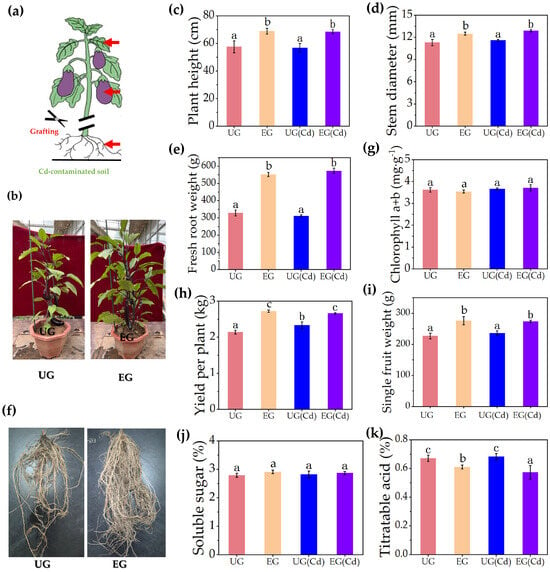
In the present study, we assessed how grafting affected the growth, quality, and yield of S. melongena cultivated in both non-contaminated control soil and Cd-polluted soil to evaluate the impact of S. torvum rootstock application on the growth performance of the plants (Figure 1a). No apparent disease symptoms or adverse growth effects were detected in eggplants under all experimental treatments throughout the period from seedling emergence to full maturity (Figure 1b). This suggests that the Cd concentrations applied in this study did not cause visible phytotoxic symptoms, although subclinical physiological stress cannot be excluded without further assessment of sensitive indicators such as antioxidant enzyme activity. Compared with ungrafted S. melongena, as shown in Figure 1c,d, grafted S. melongena exhibited significantly increased plant height and stem diameter, with increments of 18% and 12% (p < 0.05), respectively. The roots of grafted eggplants exhibited significant changes, with root fresh weight increasing by 68% (p < 0.05) (Figure 1e,f). However, there was no significant change in the chlorophyll content of the plants grafted onto S. torvum rootstocks (Figure 1g). In addition, both the fruit weight and crop yield were significantly improved by grafting (p < 0.05) (Figure 1h,i). Soluble sugar and titratable acid are key factors affecting fruit flavor and quality. Soluble sugar content remained unchanged (Figure 1j), whereas titratable acid content in grafted eggplant fruits decreased by 10% (p < 0.05) (Figure 1k). Collectively, grafting exerted a positive effect on the growth and yield of eggplants compared with their non-grafted counterparts, confirming the potential of S. torvum as an effective rootstock. These results indicate that grafting onto S. torvum enhances the vigor of the cultivated S. melongena scions without compromising fruit quality.
Figure 1.
Effects of grafting (using S. torvum as rootstock) on the growth, yield, and quality of eggplants under control and Cd-contaminated soil conditions. (a): Experimental simplified diagram. (b) and (f): Photographs of the shoots (b) and roots (f) of grafted (EG) and ungrafted (UG) eggplants using S. torvum as rootstock. (c–e) and (g–k): Effects of grafting on plant height (c), stem diameter (d), fresh root weight (e), chlorophyll content (g), yield per plant (h), single fruit weight (i), soluble sugar content (j), and titratable acidity (k) of scion eggplants under control and Cd-contaminated soil conditions. Error bars show ± SD (n = 10). Different letters above the columns indicate a significant difference (p < 0.05) among the different treatments.
3.2. Grafting Reduces Cd Accumulation in Edible Tissues to Below Food Safety Thresholds
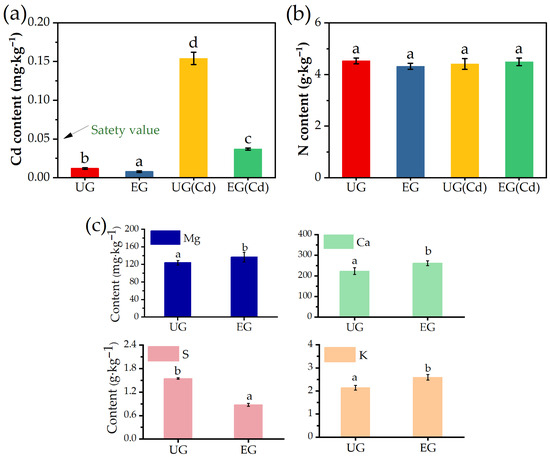
After being grafted onto S. torvum rootstock, Cd levels in both the leaves and fruits of the scion exhibited a marked downward trend (p < 0.05), with the fruit Cd concentration in Cd-contaminated soil decreasing by 76% and falling below the maximum permissible limit for vegetables stipulated by Chinese food safety standards (GB 2762-2022, 0.05 mg kg−1 fresh weight) (Figure 2a). These results confirm that the S. torvum rootstock is the key factor underlying the decreased Cd accumulation in aboveground plant tissues. Furthermore, no statistically significant difference was found in the total N content of leaves between ungrafted and grafted S. melongena plants (Figure 2b).
Figure 2.
Effects of grafting using S. torvum as rootstock on the absorption of Cd and mineral nutrients (N, Mg, Ca, S, and K) by scion eggplants. (a): Cd content in the fruits of UG and EG eggplants under normal conditions and under Cd stress; the horizontal line indicates the national food-safety threshold for Cd in vegetables (0.05 mg·kg−1). (b): N content in the fruits of UG, EG, UG(Cd), and EG(Cd) eggplants. (c): Mg, Ca, S, and K contents in the fruits of UG and EG eggplants under normal conditions. Data are mean ± SD; different letters indicate significant differences among treatments (p < 0.05).
To elucidate the influence of grafting on macronutrient accumulation in the aboveground scion tissues during Cd immobilization, we determined the contents of K, S, Ca, Mg, Fe, Cu, Zn and Al across all experimental treatments. As presented in Figure 2c, the results revealed that the leaf contents of K, Ca, and Mg in grafted S. melongena were elevated by 21%, 17%, and 10%, respectively, compared with those in ungrafted plants (p < 0.05), while the leaf S content was reduced by 32% (p < 0.05). Notably, the contents of Cu, Fe, Zn and Al in scion leaves and fruits did not differ significantly between grafted and ungrafted plants under either control or Cd-contaminated soil (Figure S1; p > 0.05). The exclusion effect of S. torvum rootstock is therefore Cd-selective rather than a general suppression of cation uptake, which is agronomically desirable because it preserves the nutritional value of the fruits.
To quantify the strength of the rootstock barrier, we computed the bioaccumulation factor (BAF) and three organ-to-organ transfer factors (TFs) for both treatments (Table 2). Under Cd-contaminated soil, grafting reduced the BAF from 0.043 to 0.010 (a 4.3-fold decrease), the root-to-fruit TF from 0.21 to 0.05 (a 4.2-fold decrease), and the leaf-to-fruit TF from 0.39 to 0.20 (a 2.0-fold decrease). The root-to-leaf TF showed a smaller change (0.54 → 0.25), indicating that the most pronounced restriction of Cd movement occurs at the root–shoot loading step rather than at the leaf–fruit redistribution step. These factor-level patterns are entirely consistent with the organ-level Cd concentrations shown in Figure 2a and provide a quantitative assessment of food safety risk that can be compared directly across studies. Together with the results reported in Section 3.1, these findings demonstrate that S. torvum rootstocks can markedly decrease Cd accumulation in S. melongena fruits, exerting only a slight effect on fruit quality while concurrently enhancing crop yield. These findings suggested that grafting onto S. torvum has the potential to serve as a clean agronomic intervention for producing eggplant with Cd concentrations below food safety thresholds in Cd-contaminated soils, although validation across multiple soil types and growing seasons is needed.
Table 2.
Bioaccumulation factor (BAF) and organ-to-organ transfer factors (TFs) of Cd in ungrafted (UG) and grafted (EG) eggplants under control and Cd-contaminated soil. Values are mean ± SD (n = 10 biological replicates).
3.3. Screening, Alignment, and Functional Analysis of Differentially Expressed miRNAs
3.3.1. Grafting Induces Differential Expression of miRNAs
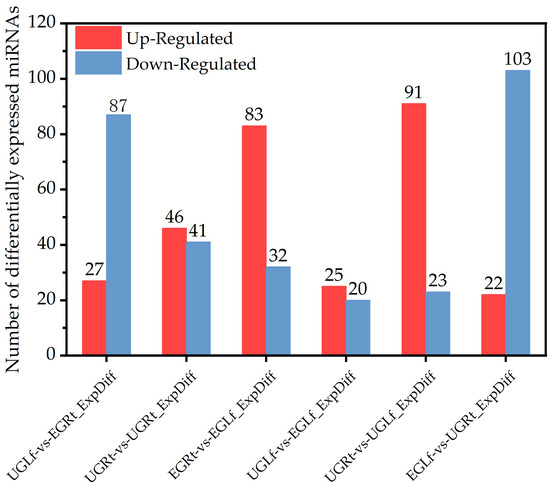
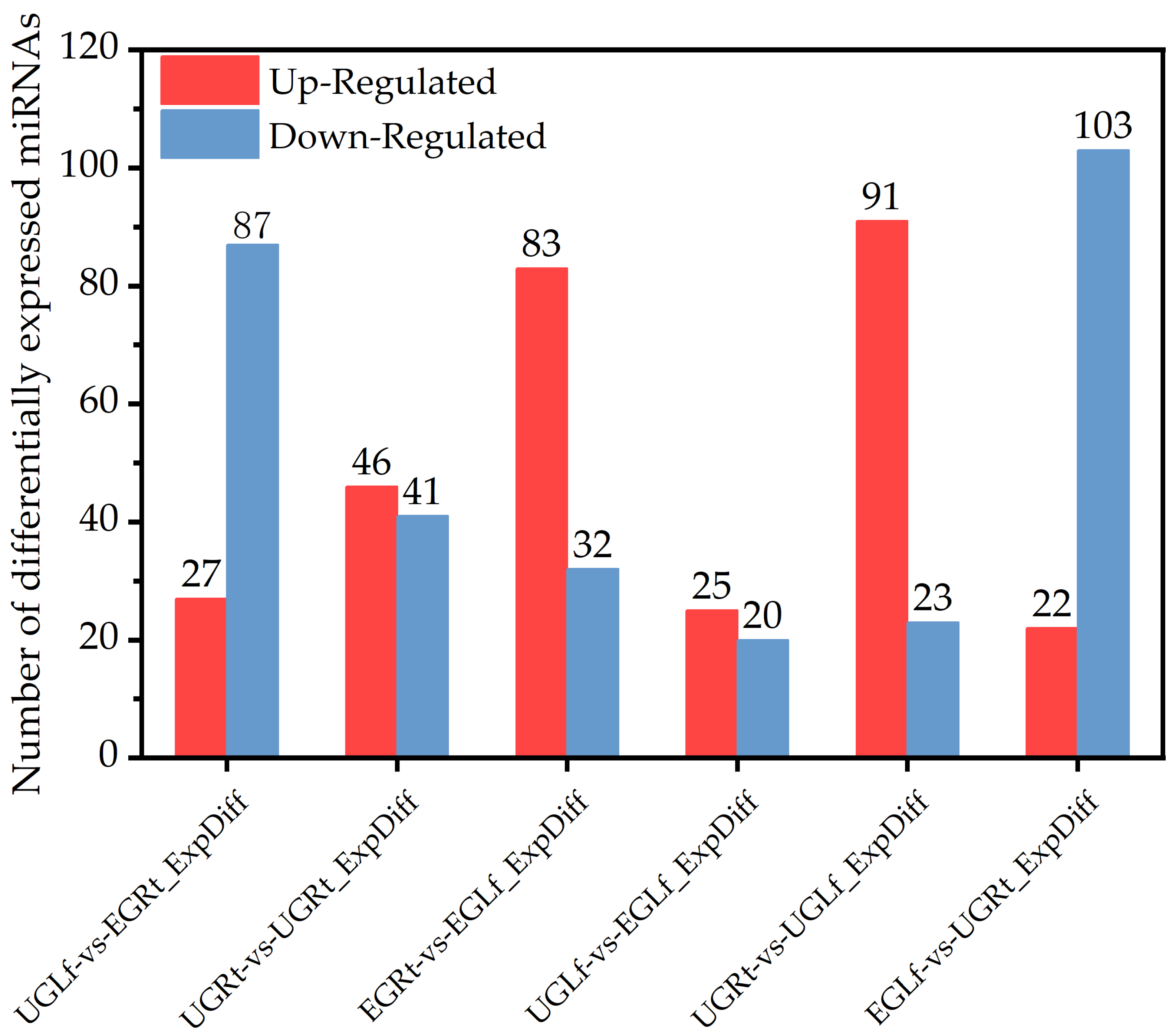
To identify miRNAs responsive to grafting, four miRNA libraries were constructed using the BGISEQ-500 high-throughput sequencing technology, corresponding to UGLf, UGRt, EGLf, and EGRt (Table S4). In total, 95, 82, 102, and 77 known miRNAs were detected in UGLf, UGRt, EGLf, and EGRt, respectively, after alignment with the corresponding databases. Differentially expressed miRNAs were screened using the Poisson method (Figure 3), which identified 45 miRNAs with differential expression between UGLf and EGLf. Among these, 21 exhibited significant differential expression; compared with UGLf, 12 miRNAs were upregulated, and nine were downregulated in EGLf (Table 3).
Figure 3.
Statistics of differentially expressed miRNAs. The X-axis represents the comparison groups, and the Y-axis represents the corresponding number of miRNAs. Blue indicates down-regulation, and red indicates up-regulation.
Table 3.
Statistics of significantly differentially expressed miRNAs in leaves between UG and EG eggplants.
To validate the reliability of the differentially expressed miRNAs identified by sequencing, the selected miRNAs were subjected to qPCR verification. The melting curves of the miRNAs from qPCR are shown in Figure S2. As shown in Table 4, miR164a, miR1919b, miR168b, and miR319b exhibited decreased expression in EGLf, whereas miR166b, miR156c, miR177, and miR395b were upregulated. The expression trends of these miRNAs detected by qPCR were consistent with those detected by BGISEQ-500 high-throughput sequencing. Collectively, the sequencing and qPCR results confirmed that miR164a, miR156c, miR166b, miR168b, and miR319b were the five most prominent candidate differentially expressed miRNAs induced by grafting.
Table 4.
Validation of eight grafting-responsive miRNAs by qPCR against BGISEQ-500 high-throughput sequencing in eggplant leaves. RLE, Relative Log Expression (log2 of EG/UG ratio); U6 snRNA was used as the internal reference for qPCR; sequencing counts were Poisson-normalized prior to log2 transformation. Data are mean ± SD (n = 3 technical replicates for qPCR; one library per group for sequencing).
3.3.2. Some Differentially Expressed miRNAs Are Closely Related to Cd Accumulation
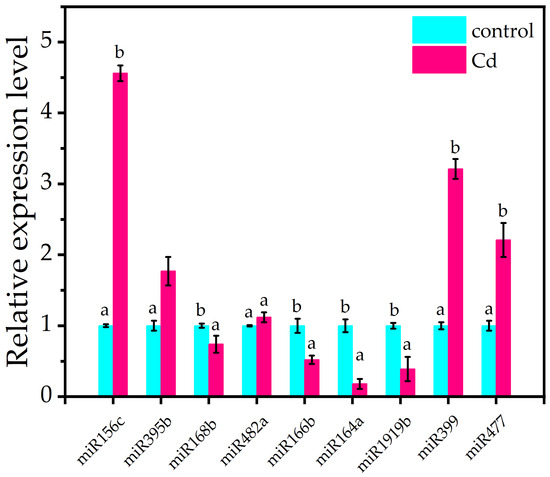
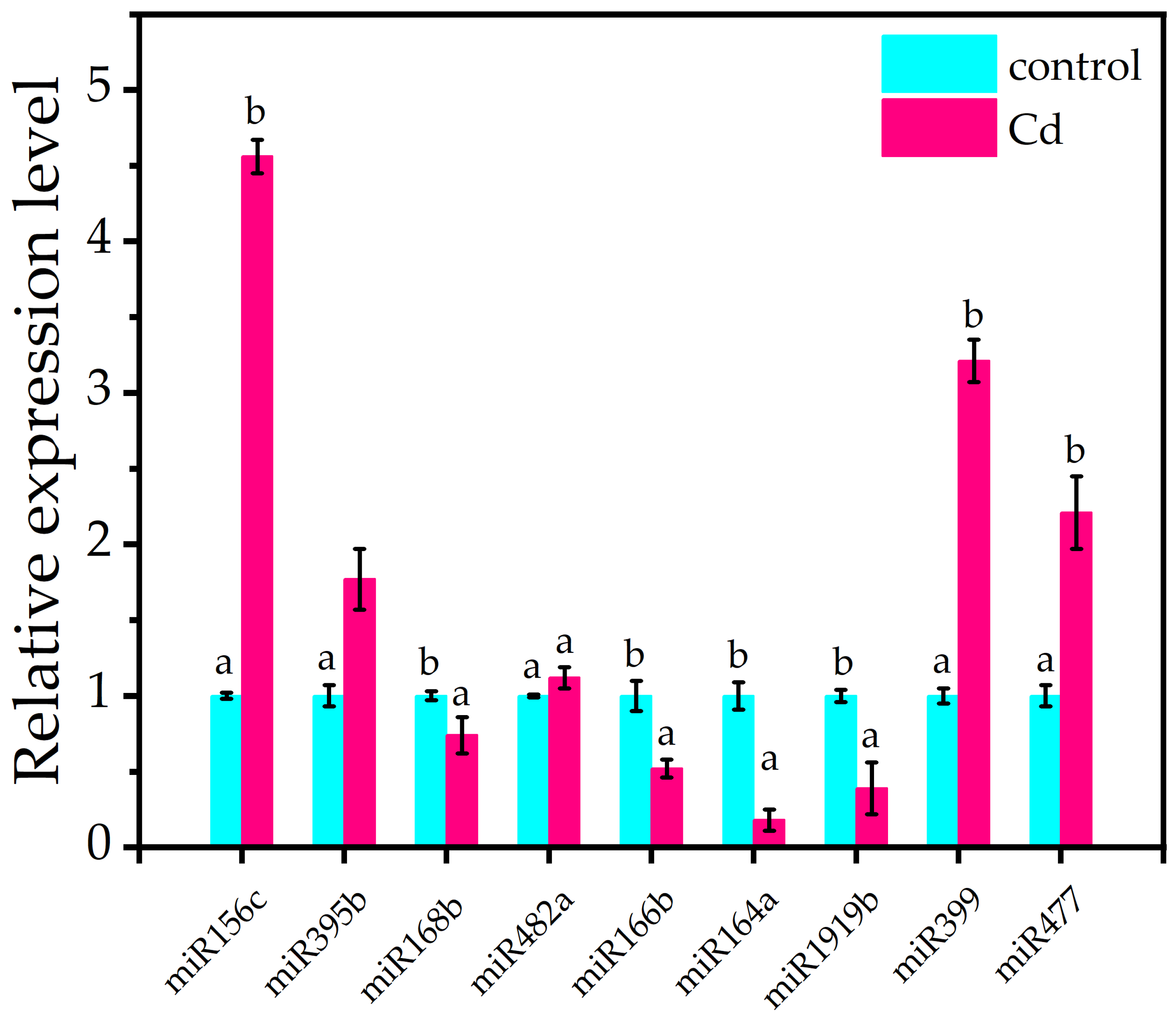
Those differentially expressed miRNAs responsive to Cd accumulation were further screened in this study. As shown in Figure 4, Cd contamination induced the differential expression of several miRNAs in the leaves of ungrafted eggplants compared with ungrafted eggplants grown in control soil. The relative expression levels of miR164a, miR168b, miR166b, and miR1919b were significantly downregulated in the leaves of ungrafted eggplants under Cd stress, whereas those of miR395b, miR399, miR156c, and miR477 were significantly upregulated. Combined with the findings presented in Section 3.3.1, it is evident that among the five most significant grafting-induced differentially expressed miRNAs, miR164a, miR156c, miR168b, and miR166b were all associated with plant responses to Cd stress to varying degrees.
Figure 4.
Relative expression levels of miRNAs in leaves of UG eggplants under the control and 3.16 mg·kg−1 Cd treatments. U6 was used as the internal reference, and the control group was set to one. Data are mean ± SD; different letters indicate significant differences among treatments (p < 0.05).
3.3.3. GO Enrichment Analysis
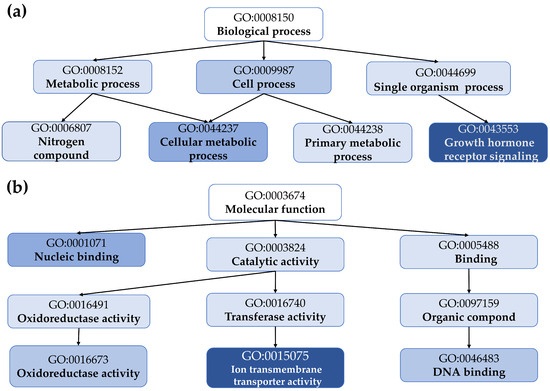
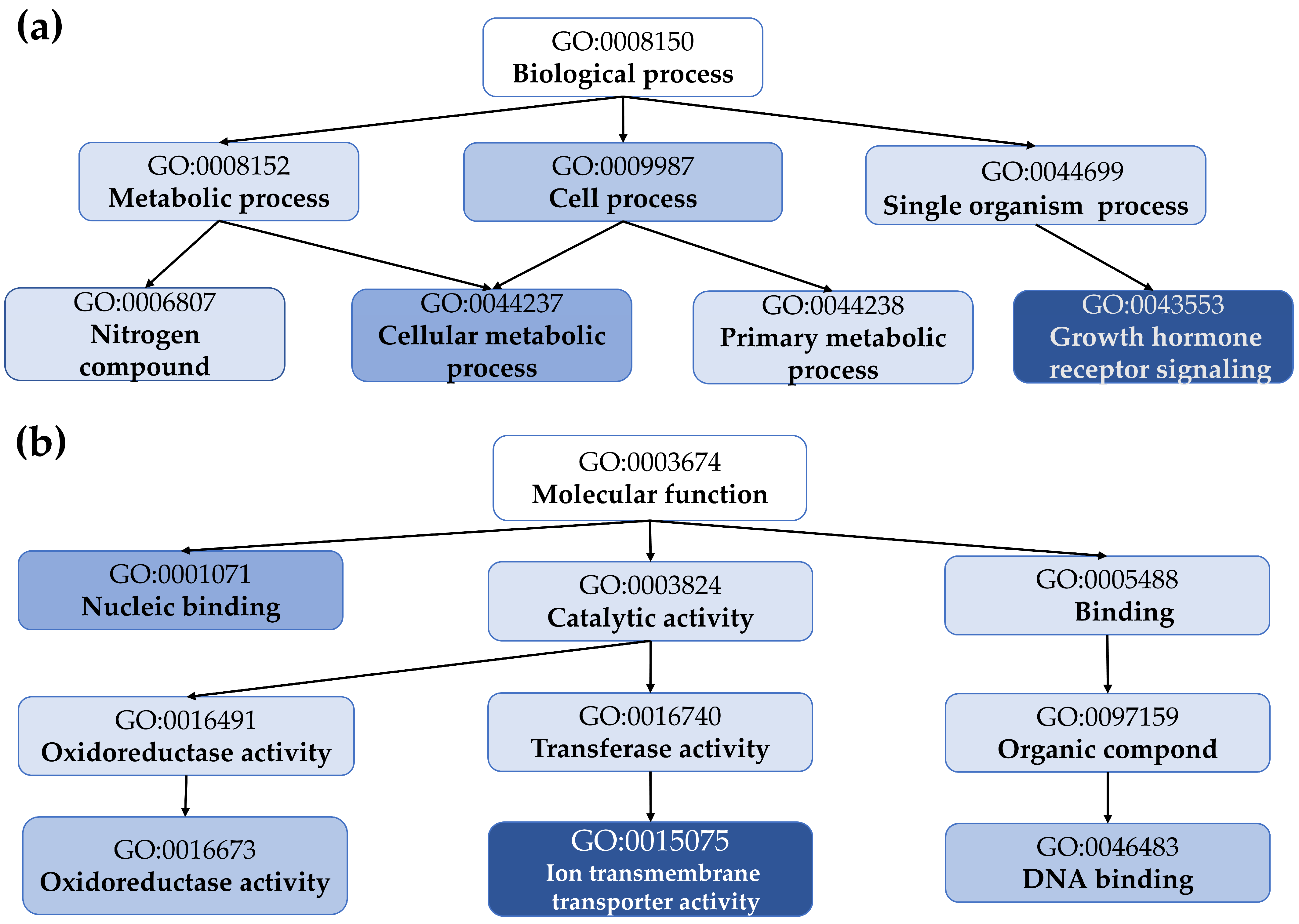
GO enrichment analysis of the target genes of the differentially expressed miRNAs revealed two main functional pathways (Figure 5): biological processes and molecular functions. The most significantly enriched terms in these two pathways, marked by yellow nodes, were GO:0043553 and GO:0015075, which correspond to growth hormone receptor and ion transmembrane transporter activity, respectively. These differentially expressed miRNAs target and regulate a series of key genes associated with plant growth, development, elemental transport, and stress responses.
Figure 5.
Top GO analysis of biological processes (a) and molecular functions (b) for differentially expressed miRNA target genes in leaves of UG and EG eggplants. The darker the color, the more significant the difference.
3.3.4. Target Gene Prediction and Expression Analysis
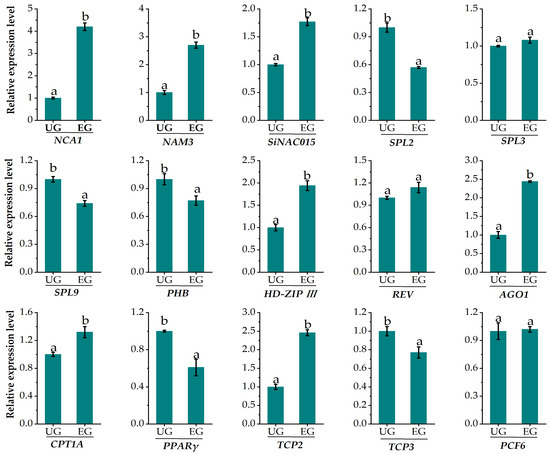
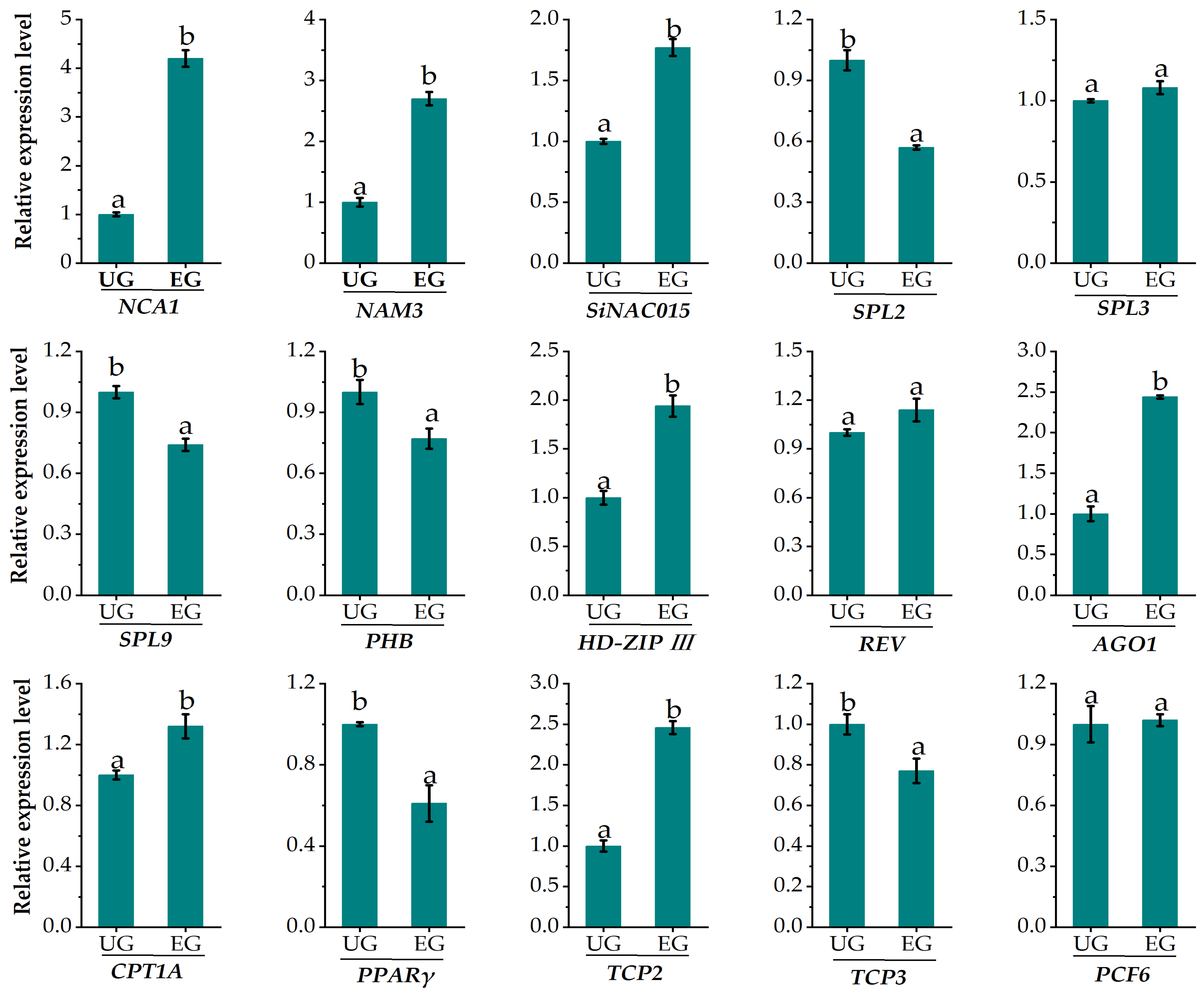
Table S3 lists several high-scoring target genes of the five most significantly grafting-induced differentially expressed miRNAs. The predicted target genes were as follows: NAC1, NAM3, and SiNAC015 for miR164a; SPL2/3/9 for miR156c; PHB, class III homeodomain-leucine zipper (HD-ZIP III), and REV for miR166b; AGO1, CPT1A and PPARγ for miR168b; and TCP2/3 and PCF6 for miR319b. All 15 target genes mentioned above were successfully amplified, and the relative expression levels of these genes under different experimental treatments are illustrated in Figure 6. In comparison with ungrafted eggplants, the relative expression levels of NAC1, NAM3, SiNAC015, HD-ZIP III, AGO1, CPT1A, and TCP2 in the leaves of grafted plants grown in Cd-contaminated soil (with S. torvum serving as the rootstock) were upregulated by 322%, 163%, 64%, 92%, 147%, 14%, and 147%, respectively. In contrast, the relative expression levels of SPL2, SPL9, PHB, PPARγ, and TCP3 were downregulated by 44%, 25%, 22%, 38%, and 23%, respectively. The expression patterns of these target genes were consistent between the qRT-PCR results and the high-throughput sequencing data. This consistency further suggests that the grafting-induced differential expression of these genes plays a crucial role in enhancing the growth vigor of grafted eggplants and reducing their Cd accumulation.
Figure 6.
Differential expression of miRNA target genes in leaves of UG and EG eggplants exposed to Cd-contaminated soil (using S. torvum as rootstock). House-keeping gene U6 was used as an internal control. Data are mean ± SD; different letters indicate significant differences among treatments (p < 0.05).
4. Discussion
4.1. Grafting Shows Potential as a Clean Technology Reduces Cd Toxicity Risk While Improving Crop Performance
Grafting reduced Cd accumulation in eggplant leaves and fruits (Figure 2), demonstrating its potential as an artificial control technique for heavy metal Cd enrichment in agricultural products and highlighting its significance for the safe utilization of Cd-contaminated farmland soils. Consistent with our findings, Arao et al. reported that grafting eggplant cultivar ‘Senryou2’ onto wild S. torvum rootstocks reduced fruit Cd content by 63–74% in soils contaminated with 1.9 mg/kg Cd and uncontaminated soils [28]. Although increasing soil pH can reduce Cd uptake by crops, the reduction efficiency typically does not exceed 50%, indicating that grafting with appropriate rootstocks is more effective in mitigating Cd accumulation in aboveground tissues than adjusting the soil pH.
Rootstock roots serve as the primary organs for water and mineral nutrient uptake in plants, and their morphological structure, physiological activity, and transporter expression patterns directly influence nutrient acquisition efficiency. In tomatoes and cucumbers, rootstocks with well-developed root systems and strong nutrient absorption capacity increase the uptake of N and P by grafted plants by 20–40%, thereby promoting scion growth and improving fruit quality [29]. This may be attributed to rootstocks, enhancing the bioavailability of micronutrients and their translocation to scions through regulated strategic root responses such as phytosiderophore secretion, rhizosphere pH modification, and the induction of transporter expression [30].
In the present study, we evaluated the effects of grafting on the uptake and accumulation of selected nutrients (Figure 2) and found that it was associated with elevated leaf concentrations of certain macronutrients (e.g., Mg, K, and Ca), although the mechanistic basis for this observation remains unclear. This may be associated with the root characteristics of S. torvum, whose root activity is significantly higher than that of the common high-yield cultivars. Additionally, both the efficiency of root absorption of bioavailable nutrients and the signals produced by scions may contribute to enhanced nutrient uptake and utilization in grafted plants. Consistent with previous findings—such as increased K uptake and accumulation in small-fruited watermelons grafted onto pumpkin ‘PS1313’ rootstocks [16] and cucumber seedlings grafted onto pumpkin ‘Chaojiquanwang’ rootstocks [31]—our study observed elevated K accumulation in the leaves of eggplant scions grafted onto wild S. torvum rootstocks. However, the mechanism underlying this increase in the leaf K concentration remains unclear.
The high mobility of Ca in fruits induced by grafting is particularly important in solanaceous crops because these fruits are highly susceptible to Ca-related blossom-end rot [32]. The impact of grafting on Mg uptake is largely determined by the genotype of the rootstock. For instance, when exposed to Mn treatment, tomato plants grafted onto the tomato hybrid ‘He-Man’ (a cross between S. lycopersicum and S. habrochaites) showed a significant reduction in leaf Mg content. Additionally, the ‘He-Man’ rootstock also restricted the accumulation of Fe and Cu in both the leaves and roots of the grafted plants [29]. S is an indispensable nutrient for plant growth, serving as a key component of proteins and being present in the amino acids, cysteine and methionine. As reported by Yuan et al. [13], there is a significant positive correlation between the sulfate content in plants and their Cd accumulation, which underscores the close link between sulfur uptake and Cd absorption in plants. Similarly, Adhikari et al. found that a reduced S supply decreased Fe absorption, whereas Fe deficiency regulated sulfate synthesis, with Fe concentrations in stems and roots decreasing by 84% under S deficiency [33]. Although Cd is non-essential for plant growth and development, S transporters (carrier proteins involved in sulfate uptake and translocation) can also influence the absorption of other elements (including Cd) [34]. However, we observed no changes in the Fe concentrations in the leaves and fruits of the grafted eggplants, which may be attributed to rootstock genotype-specific effects.
Unlike soil remediation approaches requiring pre-treatment and extended timelines, grafting achieves these outcomes within a single growing season without chemical inputs, confirming its viability as a clean, immediately deployable strategy for Cd-contaminated farmland management [35]. Additionally, S. torvum exhibits low Cd accumulation along with desirable traits such as disease and salt resistance, making it an excellent rootstock candidate for grafting-based agronomic management systems aimed at reducing Cd accumulation in the edible parts of eggplants and tomatoes. The far greater reduction in root-to-fruit TF (4.2-fold) relative to root-to-leaf TF (2.2-fold) further indicates that the rootstock selectively blocks phloem-transported Cd allocated to developing fruits—a finding with direct food safety relevance, as fruit serves as the edible organ (Table 5). Table 5 summarizes the Cd reduction percentages, growth/yield outcomes, soil Cd concentrations, and rootstock–scion combinations from the present study and several representative grafting studies on Solanaceae and Cucurbitaceae crops (2008–2024). The table clearly shows that the 76% reduction in fruit Cd content reported in this study is at the upper end of the published range for the S. torvum/S. melongena combination.
Table 5.
Comparison of Cd reduction by grafting in selected published studies and in the present study.
Notably, the aforementioned grafting-induced changes in aboveground nutrient concentrations were observed under normal nutrient supply conditions. Therefore, it remains unknown whether grafting can enhance plant nutrient uptake under nutrient-deficient conditions, or if such enhanced uptake can further improve crop yield. Future research should establish causal relationships to clarify whether grafting improves nutrient absorption and the subsequent crop yield when nutrient availability is insufficient.
4.2. miRNA-Mediated Regulatory Mechanisms Underlying Grafting-Induced Trait Improvements
We previously hypothesized that the reduced Cd accumulation in grafted crops might be associated with the roots or root exudates of the rootstock S. torvum, which could decrease the bioavailability of Cd in the soil. However, experimental verification showed that there were no significant differences in the content of bioavailable Cd in the soil or the structure of the soil microbial community between the grafted treatment and the control group. Meanwhile, grafted eggplant experiments conducted on various types of soils consistently demonstrated a stable and significant Cd-controlling effect. These results indicate that the Cd-reducing effect of grafting mainly originates from regulatory mechanisms within the plant itself, rather than changes in the soil environment. Therefore, only the typical meadow brown soil in Northeast China was selected as the test soil in this study. It should be noted that eggplant was chosen as the test material in this study based on the following considerations: S. torvum rootstock exhibits the most significant Cd-controlling effect, and it has strong graft compatibility and high survival rate with solanaceous crops. In contrast, other crops (e.g., soybeans) have thin and brittle stems, making grafting difficult with low survival rates. Additionally, there is currently a lack of high-quality soybean-specific rootstocks with outstanding Cd-reducing effects. Thus, eggplant is an ideal material for exploring the Cd-reducing effect of grafting and its epigenetic mechanisms.
In this study, BGISEQ-500 high-throughput sequencing was used to identify multiple significant differentially expressed miRNAs induced by grafting. These miRNAs not only regulate plant growth and metabolism but also enhance plant resistance to abiotic stress. The most critical target genes of miR164 belong to the NAC transcription factor family, which is involved in root–shoot meristem development, organ differentiation, and the growth–stress tolerance trade-off [37]. Aberrant expression of miR164 disrupts auxin signaling and plant hormone pathways, thereby modulating root growth [38]. Under heavy metal stress, miR164 is upregulated to repress NAC genes, thereby facilitating the reallocation of resources from growth to heavy metal tolerance [37,39]. Consistent with this regulatory framework, miR164a was significantly downregulated in the grafted eggplants in the present study, leading to the up-regulation of NAC1. NAC1 further inhibited the expression of HMA2/HMA4 (key transporters mediating Cd loading into the xylem) and FRD3 (a citrate transporter promoting Cd mobility in the xylem), thereby blocking Cd loading from the root stele to the xylem and suppressing long-distance upward transport of Cd.
miR156c is a core functional member of the miR156 family and acts synergistically with miR156a/b. The mature sequence is highly conserved and negatively regulates the expression of SPL transcription factors via targeted cleavage. This miRNA dominates age-dependent developmental phase transitions, flowering regulation, plant architecture establishment, seed dormancy/ear germination, and responses to abiotic stresses (including Cd stress). In Arabidopsis, the loss of miR156c function results in SPL accumulation, leading to abnormal petal/stamen development and reduced pollen viability [36]. Studies on rice and apples have demonstrated that miR156c overexpression inhibits SPL genes, downregulates Nramp5/NRAMP1 (high-affinity Cd uptake transporters), reduces root Cd absorption and aboveground/grain Cd accumulation, and enhances Cd tolerance. Conversely, silencing miR156c significantly increases Cd uptake and accumulation [40,41].
Compared with non-grafted eggplants, grafting notably upregulated the expression of miR166b in eggplant scions. As one of the most ancient and evolutionarily conserved miRNA families in plants, miR166 mainly targets transcription factors belonging to the HD-ZIP III family. The HD-ZIP III family, which includes HB4, PHB, and REV, is highly conserved among terrestrial plants and is involved in a variety of essential developmental processes—such as vascular bundle differentiation, shoot apical meristem formation, and the establishment of organ polarity [42]. In transgenic rice plants overexpressing miR166, better growth performance was observed compared to wild-type plants under Cd stress; this was manifested by increased chlorophyll content and reduced levels of malondialdehyde and hydrogen peroxide, indicating that miR166 alleviates Cd-induced oxidative damage [42]. More notably, overexpression of miR166 significantly reduced the translocation of Cd from roots to aboveground tissues as well as Cd accumulation in grains. Analysis of xylem and phloem sap revealed lower Cd contents in miR166-overexpressing transgenic lines, suggesting that miR166 suppresses the long-distance transport of Cd in plants. In rice, overexpression of OsHB4 enhanced Cd sensitivity, leading to significantly higher Cd levels in leaves and grains; in contrast, RNA interference (RNAi)-mediated silencing of OsHB4 improved Cd tolerance [43]. This bidirectional verification suggests that OsHB4 acts as a key regulatory factor in Cd accumulation. Collectively, these findings indicate that the miR166b-OsHB4 module may modulate Cd distribution in plants by regulating the downstream transporter network.
miR168 is another highly conserved miRNA in plants and its primary target gene is ARGONAUTE1 (AGO1). Recent studies have revealed that the miR168-AGO1 module not only serves as a core regulatory unit of the miRNA system but also directly participates in responses to various abiotic stresses, including potassium deficiency and salt stress [44]. miR168b shares high sequence homology with miR168a, with overlapping target genes, but distinct expression patterns and tissue specificity. Under Cd stress, miR168b-5p was downregulated, relieving its inhibitory effects on AGO1 and CPT1A. The up-regulation of AGO1 promotes the maturation of Cd-responsive miRNAs, enhancing plant adaptability to Cd stress [45]. CPT1A is involved in fatty acid β-oxidation, providing energy for Cd detoxification processes (e.g., phytochelatin synthesis). Down-regulation of miR168b upregulates CPT1A expression, enhances fatty acid catabolism, and increases ATP supply, thereby ensuring cellular energy demand under Cd stress.
miR395 and miR399 have been widely reported to respond positively to environmental stresses in various plant species. miR395 is typically activated under S deficiency, whereas miR399 exhibits abnormal expression under P deficiency [46,47]. Our qRT-PCR validation showed that miR395b expression was elevated in eggplants grafted onto S. torvum rootstocks, with increases of 81% between the control soil and the contaminated soil with 3.16 mg·kg−1 Cd (Figure 4). Previous studies indicate that miR395 is closely involved in the S regulatory network. In Arabidopsis, there are five target genes with fewer than three nucleotide mismatches to miR395, four of which are associated with S regulation. ATP sulfurylases (APS1, APS3, and APS4) participate in S assimilation, and the S transporter SULTR2;1 is responsible for S transport [48]. Additionally, an excess sulfate supply has been shown to significantly reduce Cd accumulation, possibly through the competitive occupation of S transporters [34]. Thus, grafting-induced miR395b may reduce Cd accumulation in eggplant by inhibiting transmembrane sulfate transport, which may explain the correlation between Cd and S accumulation observed in our elemental analysis (Figure 2).
4.3. Grafting as a Clean Agronomic Strategy for Safe Vegetable Production in Cd-Contaminated Farmlands
The pot experiment in the present study was performed with soil from a single severely contaminated site (Zhangshi, Liaoning) so as to provide a controlled mechanistic test of miRNA-mediated Cd restriction. The agronomic outcome reported here is, however, consistent with our previous work in different soil–climate combinations: grafted S. melongena and S. lycopersicum scions on S. torvum rootstocks reduced fruit Cd by 63–74% on a Cd-contaminated paddy soil [15] and by ~70% on Cd-contaminated vegetable soil [12]. The 76% reduction reported here therefore lies within the published 60–80% range observed across multiple soil types and contamination levels, supporting the broader applicability of the technique. The findings of this study position grafting not merely as a horticultural technique but as a clean agronomic technology that reprograms miRNA expression profiles in scion tissues to achieve food-safe Cd levels in edible fruits. Compared to conventional soil remediation technologies, grafting offers several distinctive advantages. Soil washing and chemical stabilization require extensive infrastructure, generate secondary waste streams, and render land temporarily unusable. Phytoremediation by hyperaccumulators requires multiple growing seasons and cannot simultaneously produce food-safe crops [2]. By contrast, grafting achieved a 76% reduction in fruit Cd concentration within a single growing season, produced vegetables meeting food safety standards, required no chemical inputs, and is implementable using existing horticultural infrastructure at minimal additional cost.
A summary of unit costs for the main Cd-remediation pathways is given in Table 6. Beyond its molecular and agronomic merits, grafting is economically attractive relative to conventional Cd-remediation strategies. Conventional technologies require substantial capital outlay and frequently render the land unusable for one or more cropping seasons. Soil washing typically costs USD 60,000–80,000 ha−1 and produces a contaminated leachate that requires further treatment [49,50]; chemical stabilization (e.g., lime, biochar, phosphate amendments) costs USD 3000–15,000 ha−1 per application and must be repeated as the soil pH drifts [35,51]; electrokinetic remediation costs USD 50,000–100,000 ha−1 and is energy-intensive [52]; and phytoextraction with hyperaccumulators removes the land from food production for 3–7 years [53]. By contrast, the only incremental cost of grafting is the price premium of grafted seedlings, which is typically USD 0.10–0.20 per plant or USD 600–1200 ha−1 yr−1 at standard eggplant planting densities (3000–6000 plants ha−1) [54]. This premium is offset, often several-fold, by the 12–40% yield gain consistently reported for grafted Solanaceae and confirmed in the present study (Figure 1h,i).
Table 6.
Indicative cost comparison of Cd-remediation technologies for agricultural soils.
Emerging evidence suggests that grafting-induced epigenetic changes can be stably inherited across generations. A study using MSH1-mutant Arabidopsis as a rootstock found that grafted tomato scions achieved a 10% yield increase that was stably maintained for five generations [6]. In soybeans grafted onto luffa rootstocks, grain Cd content was reduced by over 60% and this trait persisted for three generations [12]. Grafting can also modulate crop signal transduction; suitable rootstocks promote anthocyanin biosynthesis in apples and confer stable heritability to this trait [55]. If the miRNA expression changes identified in this study can be similarly stabilized, grafting could serve as a platform for producing low Cd-accumulating crop seeds at scale. Future research should investigate the heritability of grafting-induced miRNA profiles, validate miRNA–target interactions through functional approaches in S. melongena, and evaluate the performance of this grafting system across multiple field sites with varying Cd contamination levels to confirm its scalability as a clean technology for contaminated farmland management.
The limitations of the grafting strategy must also be acknowledged. First, graft incompatibility—characterized by poor union formation, delayed senescence, or sudden post-fruit-set decline—has been reported between S. torvum and some S. melongena cultivars. Thus, cultivar-specific compatibility screening is essential before large-scale deployment. Second, while the seedling premium of USD 0.10–0.20 per plant is small relative to avoided remediation costs (Table 3), it still requires either skilled labor or capital investment in grafting robots—a potential barrier for smallholders in low-income regions. Third, rootstocks are not metabolically neutral: our data show a ~10% decrease in titratable acidity in grafted fruits (Figure 1k), and rootstock-induced shifts in fruit flavor, sugar/acid balance, or shelf-life have also been reported in tomatoes and peppers. Fourth, S. torvum has a limited host range: it is suitable for eggplant, tomato, and pepper but cannot be used for grafting cereals, leafy greens, root vegetables, or cucurbits, restricting its application to only a portion of Cd-contaminated farmland. Finally, the heritability of grafting-induced miRNA reprogramming and the long-term stability of the Cd restriction phenotype across multiple cropping seasons remain unconfirmed and require multi-generational, multi-site field trials. These constraints define clear priorities for future research and deployment but do not undermine our conclusion that grafting is a clean, immediately deployable strategy for the Cd-contaminated farmlands and crop types to which it is applicable.
5. Conclusions
This study provides evidence suggesting that grafting S. melongena onto S. torvum rootstocks shows potential as a clean agronomic strategy for reducing Cd toxicity risk in eggplant fruits while simultaneously improving crop performance. Grafting reduced the fruit Cd concentration by 76% in Cd-contaminated soil, bringing levels below the maximum permissible limit stipulated by Chinese food safety standards (GB 2762-2022), and significantly enhanced plant height, root biomass, and fruit yield without compromising fruit quality. These results indicate the potential of S. torvum as a rootstock for safe eggplant production in Cd-contaminated farmlands without soil disturbance or chemical inputs.
At the molecular level, grafting induced significant differential expression of miR164a, miR156c, miR166b, miR168b, and miR395b in scion leaves. Through coordinated post-transcriptional regulation, these miRNAs suppress key Cd transport genes—including HMA2/HMA4, Nramp5, and SULTR2;1—while upregulating NAC, HD-ZIP III, and TCP family transcription factors, collectively blocking Cd loading into the xylem and limiting its translocation to edible fruits. The miR168b–AGO1 module further amplifies this regulatory network by enhancing the biogenesis of other Cd-responsive miRNAs, suggesting that miRNA-mediated regulatory reprogramming may represent a key molecular mechanism underlying Cd toxicity reduction in scion fruits, although further functional validation is required.
Overall, grafting represents a low-cost, soil-non-invasive clean technology that can be used to achieve food safety compliance within a single growing season, offering a potentially complementary strategy to conventional soil remediation for Cd-contaminated agricultural land. However, these findings are based on a single soil type and growing season, and the high-throughput sequencing analysis lacked biological replication; therefore, multi-site, multi-season field trials with adequate biological replicates are needed to confirm the generalizability of these results. The identification of candidate miRNA–transporter regulatory axes provides potential molecular targets for the future breeding of low Cd-accumulating eggplant varieties, pending functional validation through transgenic or gene-editing approaches.
Supplementary Materials
The following supporting information can be downloaded at https://www.mdpi.com/article/10.3390/cleantechnol8030083/s1; Table S1: Total concentrations of Cu, Fe, Al, and Zn in the control and Cd-contaminated soil; Table S2: MiRNAs-qPCR primers; Table S3: Names and primers of several high-scoring target genes of the five most significantly grafting-induced differentially expressed miRNAs; Table S4: Statistics of sequencing data volume of each sample after filtering adapter contamination and low-quality reads; Figure S1: Effects of grafting using S. torvum as rootstock on element (Cu, Fe, Al, and Zn) absorption of scion eggplants; Figure S2: Melting curves of partial miRNAs from qPCR.
Author Contributions
Conceptualization, L.S. and S.K.; data curation, C.M.; formal analysis, C.M. and L.S.; funding acquisition, S.K.; investigation, C.M. and S.K.; methodology, C.M.; software, C.M.; supervision, L.S. and S.K.; validation, L.S. and S.K.; writing—original draft, C.M.; writing—review and editing, L.S. and S.K. All authors have read and agreed to the published version of the manuscript.
Funding
This research was funded by the Liaoning Provincial Department of the Education Higher Education Project (LJ212411035007).
Institutional Review Board Statement
Not applicable.
Informed Consent Statement
Informed consent was obtained from all subjects involved in the study.
Data Availability Statement
The data presented in this study are available upon request from the corresponding authors.
Conflicts of Interest
The authors have no conflicts of interest to declare.
References
- Hou, D.Y.; Jia, X.Y.; Wang, L.W.; McGrath, S.P.; Zhu, Y.G.; Hu, Q.; Zhao, F.J.; Bank, M.S.; O’Connor, D.; Nriagu, J. Global soil pollution by toxic metals threatens agriculture and human health. Science 2025, 388, 316–321. [Google Scholar] [CrossRef] [Scilit] [PubMed]
- Cao, X.R.; Dong, Q.; Mao, L.H.; Yang, X.; Wang, X.Z.; Zou, Q.C. Enhanced Phytoextraction Technologies for the Sustainable Remediation of Cadmium-Contaminated Soil Based on Hyperaccumulators—A Review. Plants 2025, 14, 115. [Google Scholar] [CrossRef] [Scilit]
- Ahmadi, H.; Corso, M.; Weber, M.; Verbruggen, N.; Clemens, S. CAX1 suppresses Cd-induced generation of reactive oxygen species in Arabidopsis halleri. Plant Cell Environ. 2018, 41, 2435–2448. [Google Scholar] [CrossRef] [Scilit]
- Shahid, M.; Dumat, C.; Khalid, S.; Niazi, N.K.; Antunes, P.M.C. Cadmium Bioavailability, Uptake, Toxicity and Detoxification in Soil-Plant System. Rev. Environ. Contam. Toxicol. 2017, 241, 73–137. [Google Scholar] [CrossRef] [Scilit]
- Rabelo, F.H.S.; Gaziola, S.A.; Rossi, M.L.; Silveira, N.M.; Wojcik, M.; Bajguz, A.; Piotrowska-Niczyporuk, A.; Lavres, J.; Linhares, F.S.; Azevedo, R.A.; et al. Unraveling the mechanisms controlling Cd accumulation and Cd-tolerance in Brachiaria decumbens and Panicum maximum under summer and winter weather conditions. Physiol. Plant. 2020, 173, 20–44. [Google Scholar] [CrossRef] [Scilit] [PubMed]
- Hardik, K.; Xiaodong, Y.; Kyla, M.; Robersy, S.; Michael, J.; Samuel, F.; Michael, F.; Sally, A. MSH1-induced heritable enhanced growth vigor through grafting is associated with the RdDM pathway in plants. Nat. Commun. 2020, 11, 5343. [Google Scholar] [CrossRef] [Scilit]
- Rouphael, Y.; Cardarelli, M.; Rea, E.; Colla, G. Grafting of cucumber as a means to minimize copper toxicity. Environ. Exp. Bot. 2008, 63, 49–58. [Google Scholar] [CrossRef] [Scilit]
- Thomas, H.R.; Frank, M.H. Connecting the pieces: Uncovering the molecular basis for long-distance communication through plant grafting. New Phytol. 2019, 223, 582–589. [Google Scholar] [CrossRef] [Scilit] [PubMed]
- Haywood, V.; Yu, T.-S.; Huang, N.-C.; Lucas, W.J. Phloem long-distance trafficking of GIBBERELLIC ACID-INSENSITIVE RNA regulates leaf development. Plant J. 2005, 42, 49–68. [Google Scholar] [CrossRef] [Scilit]
- Chen, X.; Yao, Q.; Gao, X.; Jiang, C.; Harberd, N.P.; Fu, X. Shoot-to-root mobile transcription factor HY5 coordinates plant carbon and nitrogen acquisition. Curr. Biol. 2016, 26, 640–646. [Google Scholar] [CrossRef] [Scilit]
- Shahid, S.; Kim, G.; Johnson, N.R.; Wafula, E.; Wang, F.; Coruh, C.; Bernal-Galeano, V.; Phifer, T.; dePamphilis, C.W.; Westwood, J.H.; et al. MicroRNAs from the parasitic plant Cuscuta campestris target host messenger RNAs. Nature 2018, 553, 82–85. [Google Scholar] [CrossRef] [Scilit]
- Xue, C.Y.; Sun, L.Z.; Liu, W.B.; Gao, Y.M.; Pan, X.W.; Yang, X.Y.; Tai, P.D. Decreased cadmium content in Solanum melongena induced by grafting was related to glucosinolates synthesis. Sci. Total Environ. 2024, 915, 170115. [Google Scholar] [CrossRef] [Scilit] [PubMed]
- Yuan, H.H.; Sun, L.Z.; Tai, P.D.; Liu, W.; Li, X.J.; Hao, L. Effects of grafting on root-to-shoot cadmium translocation in plants of eggplant (Solanum melongena) and tomato (Solanum lycopersicum). Sci. Total Environ. 2019, 652, 989–995. [Google Scholar] [CrossRef] [Scilit] [PubMed]
- Cui, W.N.; Tai, P.D.; Li, X.J.; Jia, C.Y.; Yuan, H.H.; He, L.; Sun, L.Z. A reduction in cadmium accumulation and sulphur containing compounds resulting from grafting in eggplants (Solanum melogena) is associated with DNA methylation. Plant Soil 2021, 468, 183–196. [Google Scholar] [CrossRef] [Scilit]
- Yuan, H.H.; Tai, P.D.; Gustave, W.; Xue, F.; Sun, L.Z. Grafting as a mitigation strategy to reduce root-to-shoot cadmium translocation in plants of Solanaceae family. J. Clean. Prod. 2021, 319, 128708. [Google Scholar] [CrossRef] [Scilit]
- Buhtz, A.; Springer, F.; Chappell, L.; Baulcombe, D.C.; Kehr, J. Identification and characterization of small RNAs from the phloem of Brassica napus. Plant J. 2008, 53, 739–749. [Google Scholar] [CrossRef] [Scilit]
- Stegemann, S.; Bock, R. Exchange of genetic material between cells in plant tissue grafts. Science 2019, 324, 649–651. [Google Scholar] [CrossRef] [Scilit]
- Li, S.; Wang, X.T.; Xu, W.Y.; Liu, T.; Cai, C.M.; Chen, L.Y.; Clark, C.B.; Ma, J.X. Unidirectional movement of small RNAs from shoots to roots in interspecific heterografts. Nat. Plants 2021, 7, 50–59. [Google Scholar] [CrossRef] [Scilit]
- Palauqui, J.C.; Vaucheret, H. Transgenes are Dispensable for the RNA Degradation Step of Cosuppression. Proc. Natl. Acad. Sci. USA 1998, 95, 9675–9680. [Google Scholar] [CrossRef] [Scilit]
- Pant, B.D.; Buhtz, A.; Kehr, J.; Scheible, W.R. MicroRNA399 is a long-distance signal for the regulation of plant phosphate homeostasis. Plant J. 2008, 53, 731–738. [Google Scholar] [CrossRef] [Scilit]
- Yan, Y.; Ham, B.-K.; Chong, Y.H.; Yeh, S.D.; Lucas, W.J. A plant SMALL RNA-BINDING PROTEIN 1 family mediates cell-to-cell trafficking of RNAi signals. Mol. Plant 2020, 13, 321–335. [Google Scholar] [CrossRef] [Scilit]
- Sun, L.Z.; Jia, C.Y.; Xue, C.Y.; Guo, C.; Li, X.J.; Tai, P.D. Mechanism and stability of low cadmium accumulation in grafted soybeans induced by rootstocks. Plant Soil 2023, 483, 313–329. [Google Scholar] [CrossRef] [Scilit]
- Zhang, R.M.; Zhu, Y.Z.; Li, H.; Sun, N. Recent advances in understanding the mechanisms of plant cadmium accumulation as affected by grafting in vegetable production. Front. Plant Sci. 2026, 17, 1526041. [Google Scholar] [CrossRef] [Scilit] [PubMed]
- Yamaguchi, N.; Mori, S.; Baba, K.; Kaburagi-Yada, S.; Arao, T.; Kitajima, N.; Hokura, A.; Terada, Y. Cadmium distribution in the root tissues of solanaceous plants with contrasting root-to-shoot Cd translocation efficiencies. Environ. Exp. Bot. 2011, 71, 198–206. [Google Scholar] [CrossRef] [Scilit]
- GB 15618-2018; Soil Environment Quality Risk Control Standard for Soil Contamination of Agriculture Land. Ministry of Ecology and Environment of the People’s Republic of China & State Administration for Market Regulation: Beijing, China, 2018.
- GB 2762-2022; National Food Safety Standard—Maximum Levels of Contaminants in Foods. National Health Commission of the People’s Republic of China & State Administration for Market Regulation: Beijing, China, 2022.
- Audic, S.; Claverie, J.M. The significance of digital gene expression profiles. Genome Res. 1997, 7, 986–995. [Google Scholar] [CrossRef] [Scilit] [PubMed]
- Arao, T.; Takeda, H.; Nishihara, E. Reduction of cadmium translocation from roots to shoots in eggplant (Solanum melongena) by grafting onto Solanum torvum rootstock. Soil Sci. Plant Nutr. 2008, 54, 555–559. [Google Scholar] [CrossRef] [Scilit]
- Savvas, D.; Papastavrou, D.; Ntatsi, G.; Ropokis, A.; Olympios, C.; Hartmann, H.; Schwarz, D. Interactive effects of grafting and manganese supply on growth, yield, and nutrient uptake by tomato. HortScience 2009, 44, 1978–1982. [Google Scholar] [CrossRef] [Scilit]
- Nawaz, M.A.; Imtiaz, M.; Kong, Q.S.; Cheng, F.; Ahmed, W.; Huang, Y.; Bie, Z.L. Grafting: A Technique to Modify Ion Accumulation in Horticultural Crops. Front. Plant Sci. 2016, 7, 1457. [Google Scholar] [CrossRef] [Scilit]
- Zhu, J.; Bie, Z.L.; Huang, Y.; Han, X.Y. Effect of grafting on the growth and ion concentrations of cucumber seedlings under NaCl stress. Soil Sci. Plant Nutr. 2010, 54, 895–902. [Google Scholar] [CrossRef] [Scilit]
- López-Serrano, L.; Calatayud, A.; Cardarelli, M.; Colla, G.; Rouphael, Y. Improving Bell Pepper Crop Performance and Fruit Quality under Suboptimal Calcium Conditions by Grafting onto Tolerant Rootstocks. Agronomy 2022, 12, 1644. [Google Scholar] [CrossRef] [Scilit]
- Zuchi, S.; Cesco, S.; Varanini, Z.; Pinton, R.; Astolfi, S. Sulphur deprivation limits Fe-deficiency responses in tomato plants. Planta 2009, 230, 85–94. [Google Scholar] [CrossRef] [Scilit]
- Adhikari, S.; Ghosh, S.; Azahar, I.; Adhikari, A.; Shaw, A.K.; Konar, S.; Roy, S.; Hossain, Z. Sulfate improves cadmium tolerance by limiting cadmium accumulation, modulation of sulfur metabolism and antioxidant defense system in maize. Environ. Exp. Bot. 2018, 153, 143–162. [Google Scholar] [CrossRef] [Scilit]
- Bolan, N.; Kunhikrishnan, A.; Thangarajan, R.; Kumpiene, J.; Park, J.; Makino, T.; Kirkham, M.B.; Scheckel, K. Remediation of heavy metal(loid)s contaminated soils—To mobilize or to immobilize? J. Hazard. Mater. 2014, 266, 141–166. [Google Scholar] [CrossRef] [Scilit] [PubMed]
- He, J.; Xu, M.L.; Willmann, M.R.; McCormick, K.; Hu, T.Q.; Yang, L.; Starker, C.G.; Voytas, D.F.; Meyers, B.C.; Poethig, R.S. Threshold-dependent repression of SPL gene expression by miR156/miR157 controls vegetative phase change in Arabidopsis thaliana. PLoS Genet. 2017, 14, e1007337. [Google Scholar] [CrossRef] [Scilit]
- Nie, G.; Liao, Z.; Zhong, M.; Zhou, J.; Cai, J.; Liu, A.; Wang, X.; Zhang, X. MicroRNA-Mediated Responses to Chromium Stress Provide Insight Into Tolerance Characteristics of Miscanthus sinensis. Front. Plant Sci. 2021, 12, 666117. [Google Scholar] [CrossRef] [Scilit]
- Guo, H.S.; Xie, Q.; Fei, J.F.; Chua, N.H. MicroRNA directs mRNA cleavage of the transcription factor NAC1 to downregulate auxin signals for Arabidopsis lateral root development. Plant Cell 2005, 17, 1376–1386. [Google Scholar] [CrossRef] [Scilit] [PubMed]
- Yang, Y.; Huang, J.; Sun, Q.; Wang, J.; Huang, L.; Fu, S.; Qin, S.; Xie, X.; Ge, S.; Li, X.; et al. microRNAs: Key Players in Plant Response to Metal Toxicity. Int. J. Mol. Sci. 2022, 23, 8642. [Google Scholar] [CrossRef] [Scilit]
- Lu, L.; Chen, X.Y.; Chen, J.M.; Zhang, Z.L.; Zhang, Z.; Sun, Y.Y.; Wang, Y.; Xie, S.W.; Ma, Y.N.; Song, Y.Y.; et al. MicroRNA-encoded regulatory peptides modulate cadmium tolerance and accumulation in rice. Plant Cell Environ. 2024, 47, 458–472. [Google Scholar] [CrossRef] [Scilit]
- Song, J.F.; Yan, J.H.; Sun, B.Z.; Lv, J.X.; Chen, B.; Zhang, X.J.; Zhu, X.Y.; Zhang, W.W.; Yang, H.Q. The miR156u/v-MhDIV3 Module Modulates Cadmium Uptake and Damage via Enhancing MhNRAMP1 Expression in Malus hupehensis. Plant Cell Environ. 2025, 48, 7900–7913. [Google Scholar] [CrossRef] [Scilit]
- Floyd, S.K.; Bowman, J.L. Gene regulation: Ancient microRNA target sequences in plants. Nature 2004, 428, 485–486. [Google Scholar] [CrossRef] [Scilit]
- Ding, Y.F.; Gong, S.H.; Wang, Y.; Wang, F.J.; Bao, H.; Sun, J.W.; Cai, C.; Yi, K.K.; Chen, Z.X.; Zhu, C. MicroRNA166 Modulates Cadmium Tolerance and Accumulation in Rice. Plant Physiol. 2018, 177, 1691–1703. [Google Scholar] [CrossRef] [Scilit]
- Li, W.; Cui, X.; Meng, Z.L.; Huang, X.H.; Xie, Q.; Wu, H.; Jin, H.L.; Zhang, D.B.; Liang, W.Q. Transcriptional regulation of Arabidopsis MIR168a and ARGONAUTE1 homeostasis in abscisic acid and abiotic stress responses. Plant Physiol. 2012, 158, 1279–1292. [Google Scholar] [CrossRef] [Scilit] [PubMed]
- Wan, J.; Meng, S.J.; Wang, Q.Y.; Zhao, J.W.; Qiu, X.Q.; Wang, L.F.; Li, J.; Lin, Y.; Mu, L.Q.; Dang, K.T.; et al. Suppression of microRNA168 enhances salt tolerance in rice (Oryza sativa L.). BMC Plant Biol. 2022, 22, 563. [Google Scholar] [CrossRef] [Scilit]
- Jones-Rhoades, M.W.; Bartel, D.P. Computational identification of plant microRNAs and their targets, including a stress-induced miRNA. Mol. Cell 2004, 14, 787–799. [Google Scholar] [CrossRef] [Scilit] [PubMed]
- Liu, T.-Y.; Lin, W.-Y.; Huang, T.-K.; Chiou, T.-J. MicroRNA-mediated surveillance of phosphate transporters on the move. Trends Plant Sci. 2014, 19, 647–655. [Google Scholar] [CrossRef] [Scilit]
- Liang, G.; Yang, F.X.; Yu, D.Q. MicroRNA395 mediates regulation of sulfate accumulation and allocation in Arabidopsis thaliana. Plant J. 2010, 62, 1046–1057. [Google Scholar] [CrossRef] [Scilit]
- Khalid, S.; Shahid, M.; Niazi, N.K.; Murtaza, B.; Bibi, I.; Dumat, C. A comparison of technologies for remediation of heavy metal contaminated soils. J. Geochem. Explor. 2017, 182, 247–268. [Google Scholar] [CrossRef] [Scilit]
- Xu, Z.Y.; dos Muchangos, L.S.; Ito, L.; Toki, A. Cost and health benefit analysis of remediation alternatives for the heavy-metal-contaminated agricultural land in a mining town in China. J. Clean. Prod. 2023, 397, 136503. [Google Scholar] [CrossRef] [Scilit]
- Yang, H.; Tian, H.L.; Xing, T.; Yan, M.; Wen, C.Y.; Sun, Y.M.; Tan, Q. Life cycle assessment and cost analysis of typical remediation technologies for cadmium-contaminated soil. J. Environ. Chem. Eng. 2025, 13, 118765. [Google Scholar] [CrossRef] [Scilit]
- Zhao, M.M.; Jia, X.Y.; Ma, D.G.; Xu, X.; Wang, L.Y.; Song, C.F. Comprehensive assessment of the impact of voltage gradient on electrokinetic remediation of cadmium-contaminated clays: Performance, soil environment, and environmental impact. J. Soils Sediments 2025, 25, 780–793. [Google Scholar] [CrossRef] [Scilit]
- Wan, X.M.; Lei, M.; Chen, T.B. Cost–benefit calculation of phytoremediation technology for heavy-metal-contaminated soil. Sci. Total Environ. 2016, 563–564, 796–802. [Google Scholar] [CrossRef] [Scilit]
- Djidonou, D.; Gao, Z.; Zhao, X. Economic analysis of grafted tomato production in sandy soils in northern Florida. HortTechnology 2013, 23, 613–621. [Google Scholar] [CrossRef] [Scilit]
- Zhao, M.; Wang, S.; Chen, L.; Zhang, J.; Yao, Y.; Tian, J. Transcriptomic analyses reveal the effects of grafting on anthocyanin biosynthesis in crabapple. Ornam. Plant Res. 2024, 4, e021. [Google Scholar] [CrossRef] [Scilit]

Disclaimer/Publisher’s Note: The statements, opinions and data contained in all publications are solely those of the individual author(s) and contributor(s) and not of MDPI and/or the editor(s). MDPI and/or the editor(s) disclaim responsibility for any injury to people or property resulting from any ideas, methods, instructions or products referred to in the content. |
© 2026 by the authors. Licensee MDPI, Basel, Switzerland. This article is an open access article distributed under the terms and conditions of the Creative Commons Attribution (CC BY) license.