


Abstract
Understanding Cd and Pb in vitro bioaccessibility (IVBA) is important for evaluating human health risks in mine-impacted soils. In this field study, we assessed Cd and Pb bioaccessibility in a heavy metal contaminated mine impacted soil that received Low and High Compost applications (180 and 360 Mg ha−1, respectively), and Native Prairie soils within close proximity to the impacted soil, using three in vitro methods (Unites States Environmental Protection Agency (US EPA) pH 1.5, US EPA pH 2.5, and Ohio State University pH 1.8). Total Cd concentrations under High Compost (10.3 mg kg−1) exceeded the US EPA regional screening level (RSL)–residential soil Cd concentration for ingestion non-cancer risk in children (7.8 mg kg−1), while Low Compost and Native Prairie soils were below the RSL. Total Pb (<75 mg kg−1) in all sites was below the US EPA RSL for Pb for non-cancer risk in children (200 mg kg−1). Within each extraction method, Cd IVBA remained consistently high (>70% of total) across all three sites for at least US EPA pH 1.5 and OSU pH 1.8. In contrast, Pb IVBA varied across methods, with the pH 2.5 extraction consistently yielding lower Pb IVBA as compared to the other IVBA methods. These findings suggest that Cd poses a challenge for risk mitigation at this site, while Pb shows more promising stabilization outcomes. Findings highlight the importance of tailoring amendment strategies and selecting appropriate in vitro assays when assessing remediation effectiveness and risk within multi-metal contaminated mine-impacted sites, while emphasizing the need for long-term field validation of metal stability under real-world conditions.
Keywords:
cadmium; lead; OSU pH 1.8; reclamation; regional screening level; USEPA pH 1.5; USEPA pH 2.5 1. Introduction
Heavy metals, particularly Cd and Pb, have garnered significant attention from both the mining industry and researchers due to their environmental and health implications [1]. A fraction of these metals is typically extracted during mining for industrial production; however, this process generates substantial waste, including heavy metal-containing mine tailings and waste rock. These byproducts contribute to environmental contamination, impacting soil, water, and surrounding ecosystems. Furthermore, mining waste poses potential risks to human health through exposure pathways, including the consumption of contaminated food and water, inhalation of dust, and incidental ingestion of heavy metals [2]. Of these pathways, soil ingestion is considered one of the major routes of toxic heavy metal exposure [3]. In order to further our understanding of the ingestion exposure pathway, some researchers assess the human health impact from heavy metals through in vivo and in vitro studies, with the latter being more cost-effective.
In vitro bioaccessibility (IVBA) involves estimating the fraction of heavy metal released from soil to become bioavailable within the gastrointestinal tract and subsequently enter systemic circulation; in vitro heavy metal bioaccessibility concentrations can be used for the estimation of relative bioavailability and exposure risk [4]. It is important to note that bioaccessibility refers to the fraction of a heavy metal that is released from the soil matrix into the gastrointestinal fluids that are available for intestinal absorption, whereas bioavailability refers to the fraction that is ultimately absorbed into systemic circulation, such as the bloodstream [5]. The in vitro method has not only been used to assess contaminant bioaccessibility, but also to evaluate how different organic amendments, such as compost, influence IVBA [6].
Compost is a stabilized organic amendment produced by aerobic decomposition of organic wastes such as plant residues, manure, and municipal solid waste. It is widely used in soil remediation because it improves soil properties and reduces heavy metal mobility and bioavailability through organic matter complexation, formation of stable organo-metallic complexes, and increased adsorption onto mineral surfaces such as iron and manganese (hydr)oxides. For example, Attanayake et al. [7] assessed the effects of compost amendment and compost aging on Pb IVBA using physiologically based extraction tests at pH 2.5. Their results showed that compost amendment reduced Pb IVBA as compost aged, primarily by increasing the organically complexed Pb fraction in soil and stabilizing Pb through sorption onto Fe oxy(hydr)oxides. Similarly, Liang et al. [8] used IVBA (pH 2.5) to study Pb-spiked soils (150 or 1500 mg kg−1), observing that prolonged aging reduced Pb bioaccessibility to a stable level after 76 weeks. Brown et al. [9] reported that biosolids composts, enriched with iron from water treatment residuals, decreased Pb IVBA (pH 2.2) by approximately 20% when applied at 10% (w/w) to Pb-contaminated soils. The authors also found that, despite compost reducing Pb IVBA in a laboratory incubation trial, Pb IVBA was unfortunately not reduced in a field trial. Similarly, Cai et al. [10,11] used an IVBA (pH 2.5) and determined that urban garden soils exhibited lower Pb IVBA compared to orchard soils. These findings were attributed to the urban garden containing greater organic matter content, leading to higher Pb complexation rates.
However, the reductions in heavy metal availability outlined above are not always observed with compost application. For example, Attanayake et al. [12] used IVBA (pH 2.5) for urban garden soils contaminated with Pb. In this case, the authors found that compost amendment decreased IVBA Pb concentrations by only 12 to 13% after 528 days, suggesting that compost properties were not adequate to enhance Pb sorption. Yang et al. [13] found that sewage sludge compost increased Pb IVBA by up to 10% at 25% (w/w) application rates, when extracted with a simplified physiologically based extraction test (pH 1.5). This outcome was observed despite raising soil organic matter content from 0.5% to 5.7%.
Sharp and Brabander [14] used US EPA method 1340, reporting that soil carbon content was inversely correlated with Pb IVBA (R2 = 0.6), consistent with increased Pb sorption to organic matter as observed by Brown et al. [15] but opposite to that found by Yang et al. [13]. Garau et al. [16] further investigated the effects of municipal solid waste compost applied at 2% and 4% on Cd and Pb bioaccessibility. The authors noted that the amendment significantly decreased the labile fractions of Cd and Pb, and in vitro assays, such as the Solubility Bioaccessibility Research Consortium in vitro assay, incorporating both gastric (pH 1.5) and intestinal phases (pH 7.0), showed a 19% reduction in Cd gastric IVBA at a 4% compost treatment; however, Pb IVBA remained unaffected by compost amendment. Lima et al. [17] used the gastric phase (pH 1.2) of the Unified Bioaccessibility Method [18], showing that Pb IVBA in municipal solid waste compost decreased with higher Pb loadings, from 52 to 59% at 5 to 300 mg Pb kg−1 and from 33 to 45% at 1000 mg Pb kg−1. In contrast, Cd remained highly bioaccessible (90–92%) regardless of metal loading rate, suggesting that while compost may sorb Cd, it does little to reduce Cd bioaccessibility [17]. The contrasting responses of Pb and Cd to compost amendment are thought to reflect differences in their geochemical behavior. Lead generally exhibits stronger sorption to organic matter and phosphate minerals than Cd, which may contribute to greater Pb immobilization; however, the effectiveness of compost remains dependent on soil properties, compost characteristics, and metal speciation. These factors may explain the inconsistent responses reported for Cd and Pb bioaccessibility across studies.
The above studies suggest that compost may play a role in potentially controlling Pb and Cd bioaccessibility, with outcomes likely dependent on compost composition, chemistry, and soil properties. Furthermore, several in vitro gastrointestinal assays were used above to estimate the oral bioaccessibility of metals in soils; those wishing to utilize in vitro assays have several choices. For example, the US EPA Method 1340 is a standardized single-phase gastric assay that uses 0.4 M glycine at pH 1.5 (with some applications also tested using US EPA Method 1340 at pH 2.5) incubated at 37 °C for 1 h, and is widely applied in site risk assessments [19]. In contrast, the Ohio State University (OSU) in vitro method employs a pepsin–NaCl gastric solution adjusted to pH 1.8, incubated at 37 °C for 1 h, to simulate gastric digestion [20]. These methods are gastric-only extractions that differ in their solution chemistry and acidity, providing complementary perspectives on metal bioaccessibility. Comparing results across assays may help evaluate how extraction conditions influence measured in vitro bioaccessibility (IVBA) and the interpretation of potential human health risks. However, limited field-based studies have directly compared these methods in compost-amended mine soils, particularly in relation to how methodological choice influences human health risk interpretation.
This study was conducted on restored soils within the Oronogo–Duenweg Mining Belt, where residual Pb and Cd contamination persists despite remediation efforts. The site’s proximity to residential areas underscores the importance of assessing the effectiveness of compost-based remediation strategies in reducing metal bioaccessibility and potential human exposure. Accordingly, the objective of this study was to evaluate the potential human health risks associated with Cd and Pb in soils collected from compost-amended and native sites within a mining-impacted landscape. Specifically, we aimed to quantify bioaccessible Cd and Pb using multiple in vitro extraction methods and compare measured total concentrations against US EPA regional screening level RSLs for residential and industrial land use. Importantly, this study provides a direct comparison of multiple in vitro extraction methods under identical field conditions, highlighting how assay selection influences estimates of metal bioaccessibility and risk interpretation in compost-amended mine soils.
2. Materials and Methods
2.1. Study Site Establishment, Soil Sampling and Basic Soil Analysis
The study was conducted in the Oronogo-Duenweg mining belt near Webb City, Missouri, USA, where upper soil horizons were removed by the US EPA in order to reduce soil Pb concentrations to below 400 mg kg−1 (more detailed information can be found in Umeobi et al. [21]). The study site was located ~ 0.5 km from housing development. In 2016, two ~ 0.2 ha sites were treated with lime (13.9 Mg ha−1) along with compost (a blend of cattle manure, green waste, vegetable waste, and wood chips) applied at rates of 180 or 360 Mg ha−1 (Low and High Compost, respectively). The compost was surface-applied with no incorporation, as compost incorporation was impossible due to the cobbles, rocks, and clay content that significantly sealed the soil. After compost application, the site was reseeded with a tallgrass prairie mixture. After six years, the sites were visited for soil sample collection (0–15 cm depth) at four randomly collected areas within the two compost-treated sites and from an undisturbed native prairie ~50–100 m away from the two treated sites. Soils were air-dried, sieved to <250 um, and then stored prior to analysis. The plant species and soil health characteristics are provided in Umeobi et al. [19]. Approximately 0.50 g of the sieved soil was weighed into a Teflon digestion tube. Samples were spiked with Spex CeriPrep standard (Thermo Fisher Scientific, Waltham, MA, USA) for quality control (when applicable), digested using US EPA Method 3051a [22], and then total Cd and Pb concentrations were determined using inductively coupled plasma-optical emission spectrometry (ICP-OES; [23]). All extractions were performed for all four pseudo-replicates per sample site and metal concentrations were normalized to the dry weight of the soil used.
2.2. In Vitro Bioaccessibility Assays
Soil samples were subjected to in vitro bioaccessibility assays using three different gastric phase methods as outlined below:
2.2.1. Method 1: US EPA In Vitro Method 1340 at pH 1.5
Bioaccessibility of Cd and Pb was first evaluated following US EPA Method 1340 [19]. Briefly, 1.0 ± 0.01 g of air-dried soil (<250 μm) was weighed into a 125 mL high-density polyethylene (HDPE) bottle, to which 100 mL of gastric solution (0.4 M glycine adjusted to pH 1.5) was added. In order to account for the soil buffering capacity, the pH was further adjusted to 1.5 with dropwise additions of trace-metal grade 50% HCl. Samples were rotated at 30 ± 2 rpm and maintained at 37 °C for 1 h, with pH frequently checked and readjusted to 1.5 ± 0.05 using 50% NaOH or HCl as needed. After incubation, aliquots were collected, syringe-filtered (0.45 μm), and analyzed for Cd and Pb concentrations using ICP–OES following US EPA Method 6010C [20].
2.2.2. Method 2: US EPA In Vitro Method 1340 at pH 2.5
The same procedure described above was repeated, except the extraction was conducted at pH 2.5. Prior studies have shown that this pH modification to EPA Method 1340 improves sensitivity to treatment effects, correlates with in vivo data for some soils, with the modification better reflecting gastric conditions [24,25,26].
2.2.3. Method 3: The Ohio State University (OSU) In Vitro Method at pH 1.8
A third method was performed using the OSU in vitro method [18]. Here, 1.0 ± 0.01 g of soil (<250 μm) was weighed into a 175 mL HDPE bottle and extracted with 150 mL of gastric solution containing 20 g of pepsin and 11.7 g of NaCl, maintained at 37 °C and pH 1.8. The pH was adjusted dropwise with trace-metal grade 50% HCl to account for soil buffering capacity. Samples were rotated at 30 ± 2 rpm and incubated at 37 °C for 1 h, with frequent checks to maintain the pH at 1.8 ± 0.05 using 50% NaOH and/or HCl. After incubation, aliquots were collected, syringe-filtered (0.45 μm), and analyzed by ICP–OES.
The IVBA concentrations of Cd and Pb were determined using the three in vitro methods and expressed as a percentage of the total metal concentration according to Equation (1):
%IVBA (Cd or Pb) = (IVBA-extractable Cd or Pb [mg·kg−1] ÷ total soil Cd or Pb [mg·kg−1]) × 100
2.3. Statistical Analysis
All statistical analyses were performed in R (version 4.2.0; RStudio version 2024.12.1.563). For each treatment (i.e., Low Compost, High Compost, Native Prairie), the four collected pseudo-replicate samples were analyzed. Prior to analysis, data were tested for normality (Shapiro–Wilk test) and homogeneity of variances using a Fligner-Killeen test. A one-way analysis of variance (ANOVA) was used to evaluate differences among treatments for each metal (Cd and Pb), while a two-way ANOVA was used to evaluate the differences across in vitro extraction methods for each metal. When significant effects were observed (p-value < 0.05), Tukey’s HSD post hoc test was applied to identify pairwise differences.
3. Results and Discussion
3.1. Total and Bioaccessible Soil Cd and Pb Concentrations
The total soil Cd and Pb concentrations are shown in Table 1. Total Cd was greatest in the High Compost (10.32 ± 2.43 mg kg−1), intermediate in Low Compost (5.42 ± 0.90 mg kg−1), and lowest in Native Prairie (1.94 ± 0.15 mg kg−1). The High Compost mean Cd concentration exceeded the US EPA RSL for ingestion non-cancer risk in residential soil (7.8 mg kg−1; [27]), while Low Compost and Native Prairie were below the US EPA RSL. The compost likely contained elevated Cd concentrations; although this is unverifiable, compost applications utilized in nearby locations contained between 12.0 and 19.6 mg Cd kg−1. Regardless, considering housing development is approximately 0.5 km from the site, if this compost were to be utilized again at this location, application rates should be much lower than the High Compost application rate of 360 Mg ha−1 in order to protect against human health risks.
Table 1.
Total mean and in vitro bioaccessibility Cd and Pb concentrations from three locations (High Compost–360 Mg ha−1, Low Compost–180 Mg ha−1, and Native Prairie). Values inside parentheses represent the standard error of the mean (n = 4). Different letters within a column, for Cd or Pb, indicate significant differences among treatments based on Tukey’s HSD (p-value < 0.05). The US EPA risk screening levels (RSL) for Cd and Pb are also presented for context.
Total Pb differed by location, increasing from High Compost (34.4 ± 7.9 mg kg−1) to Low Compost (57.2 ± 5.4 mg kg−1) and Native Prairie (75.1 ± 9.9 mg kg−1. Based on the amount of compost added ha−1 and the approximate soil weight to a 15 cm depth within a ha (2240 Mg ha−1), Pb dilution via compost addition would have only accounted for between an 8 and 14% reduction with the Low or High compost additions, respectively. Therefore, Pb dilution via compost application did not significantly occur, and thus long-term Pb stabilization processes (i.e., organically complexed Pb or Pb sorption onto Fe oxy(hydr)oxides) [28] may have occurred within the Low and High compost-amended soils. Despite these differences, all total Pb concentrations were below the US EPA RSL for non-cancer risk (200 mg kg−1 in residential soil; 100 mg kg−1 in multi-source settings; [27,29]), suggesting reduced exposure risk. Although contradictory to the Cd findings, this Pb finding is positive considering housing development is approximately 0.5 km from the site.
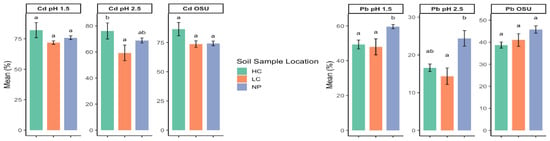
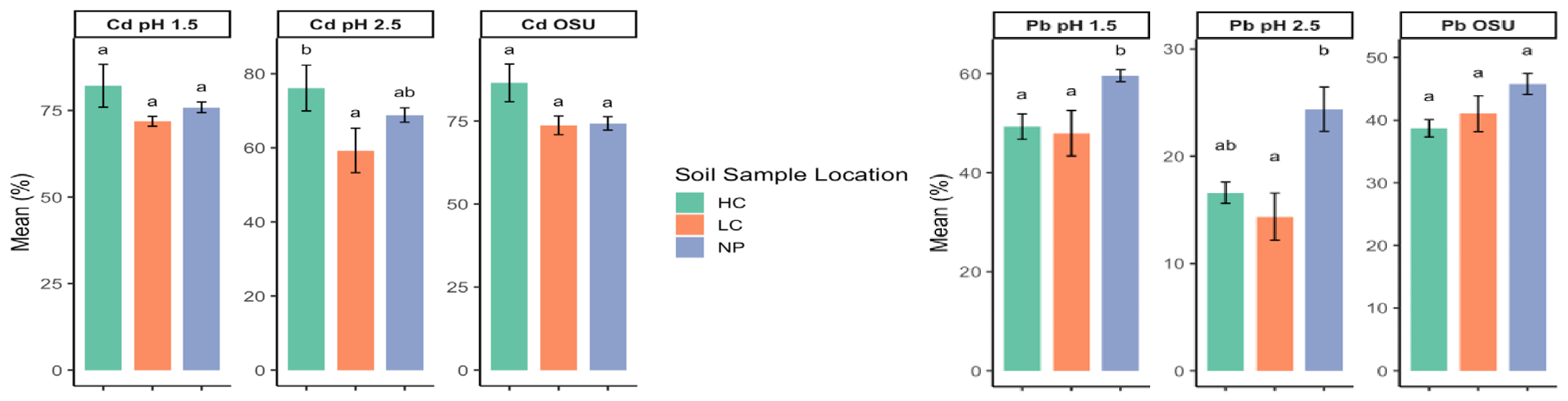
Bioaccessible Cd concentrations, as determined by IVBA (Figure 1), tended to be greatest in the High Compost, intermediate in the Low Compost, and lowest in the Native Prairie site. Similar to the total Cd concentrations, bioaccessible Cd concentrations were likely a function of the compost addition containing relatively bioavailable Cd, especially influenced by the High Compost application.
Figure 1.
Mean percent soil bioaccessibility of Cd and Pb across High Compost (HC), Low Compost (LC), and Native Prairie (NP) sites within each of the three in vitro bioaccessibility extraction methods (US EPA pH 1.5, US EPA pH 2.5, OSU pH 1.8). Bars represent mean ± SE (n = 4). Different letters above bars indicate significant differences between sites within each in vitro method based on Tukey’s HSD test (p < 0.05).
On the other hand, compost applications tended to reduce Pb bioavailability (Figure 1). Compost amendments have been shown to reduce Pb bioaccessibility by stabilizing Pb via organic matter and Fe oxide associations [7,9,12]. Similar to our findings, urban garden soils with higher organic carbon exhibited lower Pb bioaccessibility [8,9]. Other studies have also reported an inverse relationship between Pb bioaccessibility and organic carbon content [14,15].
3.2. Effect of In Vitro Methods on Bioaccessible Cd and Pb Percentages
The bioaccessible Cd and Pb percentages were determined based on Equation (1). In this analysis, within each extraction method, Cd IVBA remained consistently high (>70%) across High Compost, Low Compost, and Native Prairie soils for at least USEPA pH 1.5 and OSU pH 1.8 (Figure 1). Differences were observed between sites, with slightly elevated values in High Compost as compared to Low Compost soils within the USEPA pH 2.5 method. These relatively small differences reinforce prior findings that compost amendments have only a limited effect on Cd stabilization [16,17]. In terms of percent bioaccessibility, Cd remained highly bioaccessible regardless of compost addition, consistent with findings that compost has only a modest effect on Cd stabilization; Cd does not readily form insoluble mineral precipitates, it binds weakly to soil mineral surfaces, and can form soluble complexes with organic matter from compost. Compost amendments often increase soil pH (e.g., as shown in these plots [19]) and add competing cations (Ca2+, Mg2+) which may displace Cd into the soil solution [16,17]. Previous studies have shown that Cd bioaccessibility often exceeds 90% in gastric extractions, reinforcing its potential as a health-risk driver [8,12]. In terms of bioavailability, the major issue at this site appears to be potential Cd content in the compost as well as the High Compost rate utilized. Lower compost rates should be considered in the future.
In contrast to Cd, Pb IVBA tended to vary across sites within each IVBA method. Native Prairie soils consistently showed significantly greater Pb IVBA percentages compared to compost-amended soils, particularly under the USEPA pH 1.5 and pH 2.5 methods. The OSU method was the only IVBA method to show no differences in Pb IVBA as a function of soil sample location. These results support the previous contention that compost addition is more effective in reducing Pb IVBA than Cd, likely through enhanced sorption to organic matter and the formation of insoluble Pb–mineral complexes.
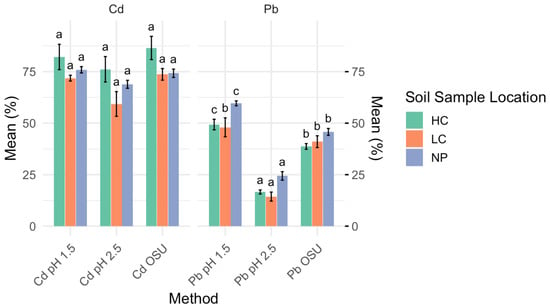
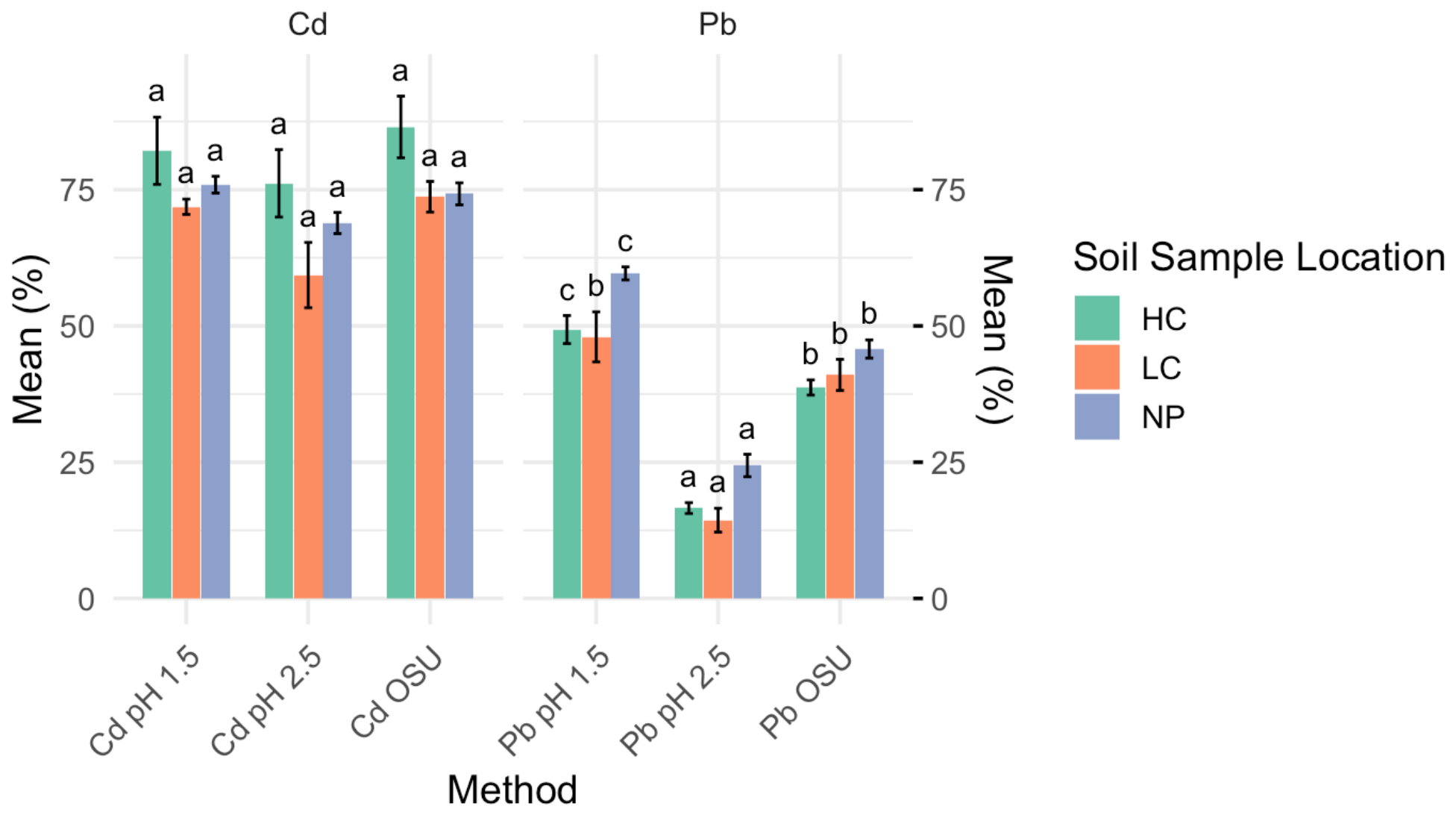
When comparing Cd and Pb IVBA percentages simultaneously across methods and sites, clear contrasts emerge (Figure 2). Cd IVBA was uniformly elevated across soils and methods, reinforcing its greater environmental mobility and reduced potential to form insoluble mineral phases [17]. Pb IVBA, however, was both lower and more variable as compared to Cd, with compost-amended soils generally exhibiting reduced Pb IVBA compared to NP soils. These trends suggest that compost amendments provide stabilization pathways such as organic matter binding or mineral precipitation that may be more effective for Pb than Cd. Lead IVBA percentages followed the order USEPA pH 2.5 < OSU pH 1.8 < USEPA pH 1.5. This suggests that methodological differences may substantially influence Pb IVBA estimates [24], whereas Cd assessments remain comparatively robust across methods. The observed method dependence for Pb emphasizes the importance of careful selection and interpretation of extraction procedures when assessing Pb risk in soils.
Figure 2.
Mean percent soil Cd and Pb bioaccessibility across the High Compost (HC), Low Compost (LC), and Native Prairie (NP) sites within each of the three in vitro bioaccessibility extraction methods (US EPA pH 1.5, US EPA pH 2.5, OSU pH 1.8). Bars represent mean ± SE (n = 4). Different letters indicate significant differences among soil × method combinations based on Tukey’s HSD test (p < 0.05).
3.3. In Vitro Gastric Method Selection
Regarding in vitro gastric method selection, each IVBA approach has distinct weaknesses and strengths. In this study, all three methods showed similar Cd bioaccessibility percentages; no assay was superior to the others. In terms of Pb, however, the US EPA method 1340 may overestimate Pb IVBA due to its pH of 1.5. The US EPA method 1340 (pH 2.5) may better simulate stomach dissolution and is often more sensitive to pH-raising amendments [25], making it useful for Pb remediation evaluation and risk assessment. The OSU method (pH 1.8) is well documented for Pb, but its predictive reliability is less established for Cd [25,30]; the current study showed the OSU method to be similar to US EPA method 1340 at both pH 1.5 and 2.5.
Previous studies have identified limitations of the official US EPA method 1340 (pH 1.5) when assessing soils amended with compost, as the acid concentration often overestimates Pb solubility and fails to detect treatment effects [31]. Instead, more physiologically relevant methods, such as the OSU method (pH 1.8), the modified USEPA method 1340 (pH 2.5), or the physiologically based extraction test at pH 2.5 [32] should be considered for evaluating Pb (and potentially Cd) bioaccessibility in amended soils. Unfortunately, the US EPA does not recognize the pH 2.5 modification; however, the selection of Method 1340 (pH 1.5) for evaluating soil amendments at this and similar sites may influence the estimation of bioaccessibility and treatment effects.
3.4. Pathways Forward for This Mine Land Site
Looking ahead, a practical pathway forward for these sites should target lower compost application rates (i.e., 180 Mg ha−1 or less) to reduce Cd risk, especially if the same compost is to be utilized. A lower application rate (i.e., 180 Mg ha−1 or less) was also suggested by Umeobi et al. [21] from the standpoint of maximizing soil health outcomes at this location. Even at reduced application rates (≤180 Mg ha−1), careful consideration of compost quality and metal content is necessary to prevent long-term buildup and potential exposure in surrounding communities. Another future pathway could involve testing amendment blends that integrate compost (for soil health improvements and reductions in bioavailable Pb) with targeted Cd-immobilizing materials such as biochar that may enhance Cd binding [33,34,35]. Field validation after greenhouse studies would be essential, since Cd behavior depends strongly on soil pH, redox potential, competing cations, and variable climatic conditions. Selection of an appropriate IVBA method should be considered, as each approach presents distinct trade-offs in sensitivity, physiological relevance, and regulatory acceptance. Integrating amendment selection with evaluation of IVBA methods should further clarify which remediation strategies are most effective and which assays provide the most reliable guidance for long-term risk management at this site.
4. Conclusions
This study demonstrated that compost amendment reduced the in vitro bioaccessibility of Pb in mine-impacted soils of the Oronogo-Duenweg mining belt in the USA. In contrast, Cd bioaccessibility remained consistently high across all treatments and in vitro extraction methods, indicating that compost incorporation alone does not immobilize Cd to the same extent as Pb. Cadmium results showed that in the High Compost site, total concentrations exceeded the US EPA RSL for non-cancer risk in residential soils, while the Low Compost and Native Prairie sites were below the RSL. Total and IVBA Pb concentrations in all study sites were below the US EPA RSL for non-cancer Pb risk. The % Cd extracted via IVBA remained consistently high (>59%) across all three sites regardless of IVBA method. In contrast, the % Pb extracted via IVBA generally varied among treatment and IVBA method. Across methods, Cd IVBA was relatively uniform, while Pb responses were method-dependent, with the US EPA pH 2.5 in vitro extraction consistently yielding lower Pb IVBA as compared to the US EPA pH 1.5 or OSU pH 1.8. These findings suggest that Pb risk may be mitigated through organic amendments, whereas Cd presents a persistent exposure concern. Compost amendment is suitable for reducing Pb bioaccessibility in this contaminated soil. For Cd, complementary strategies such as utilizing application rates at or lower than 180 Mg ha−1, in combination with other stabilizing amendments, may be required to improve overall environmental quality while reducing potential human health risks. These highlight that the choice of an in vitro bioaccessibility method can substantially affect estimates of Cd and Pb exposure risk, emphasizing the importance of method selection when evaluating remediation effectiveness in compost-amended mine soils. Future studies should evaluate the long-term field stability of integrated amendment approaches to enhance Cd immobilization and support more sustainable remediation of multi-metal contaminated sites.
Author Contributions
E.C.U.: Conceptualized the study, conducted data sampling and design of analysis and analysis for the experiments, performed statistical analysis, interpreted the results, drafted the manuscript, and contributed to manuscript review and revisions. T.F.D.: Contributed to securing funding and reviewed the manuscript. N.T.B. participated in the validation and manuscript review. J.A.I.: Conceptualized the study, conducted data sampling for the experiments, contributed to the experimental design, supervised the project, provided resources and critical feedback throughout the study, secured funding, and contributed to manuscript review and editing. All authors have read and agreed to the published version of the manuscript.
Funding
The US EPA through its Office of Research and Development partially funded and collaborated in the research described here under Interagency Assistance Agreement number 59–6082-4–001 to the U.S. Department of Agriculture (USDA) Agricultural Research Service (ARS).
Institutional Review Board Statement
Not applicable.
Informed Consent Statement
Not applicable.
Data Availability Statement
Data that support the findings of this study are available upon reasonable request to the corresponding authors.
Acknowledgments
The views expressed in this article are those of the authors and do not necessarily reflect the views or policies of the US EPA or USDA. Any mention of trade names, products, or services does not imply an endorsement by the U.S. Government or the EPA or the USDA. The US EPA or the USDA does not endorse any commercial products, services, or enterprises. The USDA is an equal opportunity employer. We appreciate Mark G. Johnson for support in securing funding. We also appreciate Randy Haas, John Nichols, and Scott Hamilton for their efforts in maintaining the composted sites, as well as the City of Webb City for granting us access to these sites.
Conflicts of Interest
The authors declare no conflicts of interest.
References
- Sohrabizadeh, Z.; Sodaeizadeh, H.; Hakimzadeh, M.A.; Taghizadeh-Mehrjardi, R.; Ghanei Bafghi, M.J. A statistical approach to study the spatial heavy metal distribution in soils in the Kushk Mine, Iran. Geosci. Data J. 2022, 9, 315–327. [Google Scholar] [CrossRef] [Scilit]
- Li, S.-W.; Sun, H.-J.; Li, H.-B.; Luo, J.; Ma, L.Q. Assessment of cadmium bioaccessibility to predict its bioavailability in contaminated soils. Environ. Int. 2016, 94, 600–606. [Google Scholar] [CrossRef] [Scilit] [PubMed]
- Walraven, N.; Bakker, M.; van Os, B.J.H.; Klaver, G.T.; Middelburg, J.J.; Davies, G.R. Factors controlling the oral bioaccessibility of anthropogenic Pb in polluted soils. Sci. Total Environ. 2015, 506–507, 149–163. [Google Scholar] [CrossRef] [Scilit] [PubMed]
- Lake, L.; Basta, N. Ineffectiveness of phosphorus-containing amendments to reduce Pb bioaccessibility in an urban alkaline soil. J. Environ. Qual. 2024, 53, 743–757. [Google Scholar] [CrossRef] [Scilit] [PubMed]
- National Research Council. Bioavailability of Contaminants in Soils and Sediments: Processes, Tools, and Applications; National Academies Press: Washington, DC, USA, 2003. [CrossRef] [Scilit] [PubMed]
- Newell, J.; Cox, S.F.; Doherty, R. Oral bioaccessibility trends for As, Cd, Cr, Ni, and Pb in vegetables grown in contaminated soils: A systematic review. Urban Agric. Reg. Food Syst. 2025, 10, e70009. [Google Scholar] [CrossRef] [Scilit]
- Attanayake, C.P.; Hettiarachchi, G.M.; Ma, Q.; Pierzynski, G.M.; Ransom, M.D. Lead speciation and in vitro bioaccessibility of compost-amended urban garden soils. J. Environ. Qual. 2017, 46, 1215–1224. [Google Scholar] [CrossRef] [Scilit] [PubMed]
- Liang, S.; Guan, D.-X.; Li, J.; Zhou, C.-Y.; Luo, J.; Ma, L.Q. Effect of aging on bioaccessibility of arsenic and lead in soils. Chemosphere 2016, 151, 94–100. [Google Scholar] [CrossRef] [Scilit] [PubMed]
- Brown, S.L.; Clausen, I.; Chappell, M.A.; Scheckel, K.G.; Newville, M.; Hettiarachchi, G.M. High-iron biosolids compost–induced changes in lead and arsenic speciation and bioaccessibility in co-contaminated soils. J. Environ. Qual. 2012, 41, 1612–1622. [Google Scholar] [CrossRef] [Scilit] [PubMed]
- Cai, M.; McBride, M.B.; Li, K. Bioaccessibility of Ba, Cu, Pb, and Zn in urban garden and orchard soils. Environ. Pollut. 2016, 208, 145–152. [Google Scholar] [CrossRef] [Scilit] [PubMed]
- Cai, M.; McBride, M.B.; Li, K.; Li, Z. Bioaccessibility of As and Pb in orchard and urban soils amended with phosphate, Fe oxide and organic matter. Chemosphere 2017, 173, 153–159. [Google Scholar] [CrossRef] [Scilit] [PubMed]
- Attanayake, C.P.; Hettiarachchi, G.M.; Palomo, M.; Pierzynski, G.M.; Calderon, B. Phytoavailability of lead for vegetables in urban garden soils. ACS Agric. Sci. Technol. 2021, 1, 173–181. [Google Scholar] [CrossRef] [Scilit]
- Yang, K.; Zhang, T.; Shao, Y.; Tian, C.; Cattle, S.R.; Zhu, Y.; Song, J. Fractionation, bioaccessibility, and risk assessment of heavy metals in the soil of an urban recreational area amended with composted sewage sludge. Int. J. Environ. Res. Public Health 2018, 15, 613. [Google Scholar] [CrossRef] [Scilit] [PubMed]
- Sharp, R.M.; Brabander, D.J. Lead (Pb) bioaccessibility and mobility assessment of urban soils and composts: Fingerprinting sources and refining risks to support urban agriculture. GeoHealth 2017, 1, 333–345. [Google Scholar] [CrossRef] [Scilit] [PubMed]
- Brown, S.L.; Chaney, R.L.; Hallfrisch, J.G.; Xue, Q. Effect of biosolids processing on lead bioavailability in an urban soil. J. Environ. Qual. 2003, 32, 100–108. [Google Scholar] [CrossRef] [PubMed]
- Garau, M.; Garau, G.; Diquattro, S.; Roggero, P.P.; Castaldi, P. Mobility, bioaccessibility and toxicity of potentially toxic elements in a contaminated soil treated with municipal solid waste compost. Ecotoxicol. Environ. Saf. 2019, 186, 109766. [Google Scholar] [CrossRef] [Scilit] [PubMed]
- Lima, J.Z.; Ferreira da Silva, E.; Patinha, C.; Rodrigues, V.G.S. Sorption and post-sorption performances of Cd, Pb and Zn onto peat, compost and biochar. J. Environ. Manag. 2022, 321, 115968. [Google Scholar] [CrossRef] [Scilit] [PubMed]
- Wragg, J.; Cave, J.; Basta, N.; Brandon, E.; Casteel, S.; Denys, S.; Gron, C.; Oomen, A.; Reimer, K.; Tack, K.; et al. An inter-laboratory trial of the unified BARGE bioaccessibility method for arsenic, cadmium and lead in soil. Sci. Total Environ. 2011, 401, 4016–4030. [Google Scholar] [CrossRef] [Scilit] [PubMed]
- US EPA. U.S. EPA Method 1340: In Vitro Bioaccessibility for Lead in Soil. 2017. Available online: https://www.epa.gov/sites/default/files/2017-03/documents/method_1340_update_vi_final_3-22-17.pdf (accessed on 15 July 2026).
- Basta, N.T.; Foster, J.N.; Dayton, E.A.; Rodriguez, R.R.; Casteel, S.W. The effect of dosing vehicle on arsenic bioaccessibility in smelter-contaminated soils. J. Environ. Sci. Health Part A 2007, 42, 1275–1281. [Google Scholar] [CrossRef] [Scilit] [PubMed]
- Umeobi, E.C.; Ducey, T.F.; Johnson, M.G.; Ippolito, J.A. Soil health alterations via compost additions to natural and remediated heavy metal-contaminated mineland soils. Environ. Sci. Pollut. Res. 2025, 32, 14968–14979. [Google Scholar] [CrossRef] [Scilit] [PubMed]
- US EPA. U.S. EPA Method 3051A: Microwave Assisted Acid Digestion of Sediments, Sludges, and Oils. 2007. Available online: https://www.epa.gov/sites/default/files/2015-12/documents/3051a.pdf (accessed on 15 July 2026).
- US EPA. EPA Method 6010C (SW-846): Inductively Coupled Plasma—Atomic Emission Spectrometry, Revision 3. 2000. Available online: https://19january2017snapshot.epa.gov/sites/production/files/2015-07/documents/epa-6010c.pdf (accessed on 15 July 2026).
- Obrycki, J.F.; Basta, N.T.; Scheckel, K.; Stevens, B.N.; Minca, K.K. Phosphorus amendment efficacy for in situ remediation of soil lead depends on the bioaccessible method. J. Environ. Qual. 2016, 45, 37–44. [Google Scholar] [CrossRef] [Scilit] [PubMed]
- Mayer, M.M.; Basta, N.T.; Scheckel, K.G. Using phosphate amendments to reduce bioaccessible Pb in contaminated soils: A meta-analysis. Front. Soil Sci. 2022, 2, 1028328. [Google Scholar] [CrossRef] [Scilit] [PubMed]
- Koralegedara, N.H.; Al-Abed, S.R.; Rodrigo, S.K.; Karna, R.R.; Scheckel, K.G.; Dionysiou, D.D. Alterations of lead speciation by sulfate from addition of flue gas desulfurization gypsum (FGDG) in two contaminated soils. Sci. Total Environ. 2017, 575, 1522–1529. [Google Scholar] [CrossRef] [Scilit] [PubMed]
- US EPA. Regional Screening Level (RSL) Resident Soil Table. 2024. Available online: https://semspub.epa.gov/work/HQ/405273.pdf (accessed on 15 July 2026).
- Suda, A.; Makino, T. Functional effects of manganese and iron oxides on the dynamics of trace elements in soils with a special focus on arsenic and cadmium: A review. Geoderma 2016, 270, 68–75. [Google Scholar] [CrossRef] [Scilit]
- US EPA. Updated Soil Lead Guidance for CERCLA Sites and RCRA Corrective Action Facilities. 2024. Available online: https://www.epa.gov/superfund/updated-soil-lead-guidance-cercla-sites-and-rcra-corrective-action-facilities (accessed on 15 July 2026).
- Kierulf, A.; Ollson, C.; Whitehead, C.; Beauchemin, D.; Koch, I. Literature review and meta-analysis of gastric and intestinal bioaccessibility for nine inorganic elements in soils and soil-like media for use in human health risk assessment. Int. J. Hyg. Environ. Health 2022, 240, 113929. [Google Scholar] [CrossRef] [Scilit] [PubMed]
- Henry, H.; Naujokas, M.F.; Attanayake, C.; Basta, N.T.; Cheng, Z.; Hettiarachchi, G.M.; Maddaloni, M.; Schadt, C.; Scheckel, K.G. Bioavailability-based in situ remediation to meet future lead (Pb) standards in urban soils and gardens. Environ. Sci. Technol. 2015, 49, 8948–8958. [Google Scholar] [CrossRef] [Scilit] [PubMed]
- Hettiarachchi, G.M.; Pierzynski, G.M.; Ransom, M.D. In situ stabilization of soil lead using phosphorus. J. Environ. Qual. 2021, 30, 1214–1221. [Google Scholar] [CrossRef] [Scilit] [PubMed]
- Chen, D.; Wang, X.; Wang, X.; Feng, K.; Su, J.; Dong, J. The mechanism of cadmium sorption by sulphur-modified wheat straw biochar and its application cadmium-contaminated soil. Sci. Total Environ. 2020, 714, 136550. [Google Scholar] [CrossRef] [Scilit] [PubMed]
- Ippolito, J.A.; Ducey, T.F.; Spokas, K.A.; Trippe, K.M.; Johnson, M.G. A biochar selection method for remediating heavy metal contaminated mine tailings. Int. J. Environ. Sci. Technol. 2024, 21, 9611–9622. [Google Scholar] [CrossRef] [Scilit] [PubMed]
- Liu, H.; Chen, C.; Li, X.; Yang, P. Meta-analysis compares the effectiveness of modified biochar on cadmium availability. Front. Environ. Sci. 2024, 12, 1413047. [Google Scholar] [CrossRef] [Scilit]

Disclaimer/Publisher’s Note: The statements, opinions and data contained in all publications are solely those of the individual author(s) and contributor(s) and not of MDPI and/or the editor(s). MDPI and/or the editor(s) disclaim responsibility for any injury to people or property resulting from any ideas, methods, instructions or products referred to in the content. |
© 2026 by the authors. Licensee MDPI, Basel, Switzerland. This article is an open access article distributed under the terms and conditions of the Creative Commons Attribution (CC BY) license.