


Abstract
This study is the first to investigate volcanic ash (VA) as a soil amendment to mitigate nitrous oxide (N2O) emissions, a potent greenhouse gas mainly produced through nitrification and denitrification processes in agricultural soils. The experiment assessed the effects of VA mixed with soil and combined with mineral (NH4NO3, N) or organic (poultry manure, O) fertilizer on N2O emissions, soil mineral nitrogen (NO3− and NH4+), trace metals (Zn, Cu, Mn), and crop yield in a 4-month pot experiment including treatments with and without VA. Results showed that VA reduced N2O emissions by 55% in mineral fertilizer treatments and 71% in organic fertilizer treatments compared to soils without VA. This reduction was associated with significant changes in nitrogen availability. In mineral fertilizer treatments with VA, soil NO3− concentrations remained high, potentially limiting denitrifier activity, while in organic treatments VA appeared to inhibit nitrogen mineralization. Additionally, VA increased soil concentrations of Zn, Cu, and Mn, which were negatively correlated with N2O emissions, suggesting an influence on microbial processes. Importantly, crop yields were not affected by VA application. Although promising, these preliminary findings highlight the need for further research to optimize application rates and evaluate long-term effects across soil types and management systems.
1. Introduction
Global population growth has intensified the massive use of agricultural products to maintain food consumption and production. This situation has led to high levels of environmental pollution and potentially destructive effects on the planet, since agriculture is one of the main contributors to greenhouse gas (GHG) emissions [1]. The Food and Agriculture Organization of the United Nations (FAO) reports that agriculture contributes approximately 14% of global GHG emissions [2], of which more than 40% of these are nitrous oxide (N2O) [3]. Nitrous oxide emissions are particularly concerning since their warming potential is 298 times that of carbon dioxide (CO2) [1]. According to the United Nations, this situation is expected to get worse since half of all habitable land is projected to be used for agricultural purposes. For this reason, agriculture is facing an unprecedented challenge: to maintain global food production and be environmentally sustainable at the same time. Meeting this challenge is difficult because emissions of GHGs are subject to soil microbial processes inherent in the nitrogen (N) cycle and its links with the carbon (C) cycle.
Nitrous oxide is mainly produced through the processes of nitrification and denitrification [4]. The activation of one or other of these processes depends on a combination of factors such as climate, soil, fertilizer and water, among others. Although parallel processes have been described that could also be responsible for N2O emissions such as nitrification by denitrifiers [5], in general, nitrification is favored by ammonium (NH4+) availability and well aerated soils, below a water-filled pore space (WFPS) of 60% [6]. By contrast, denitrification is favored by a high availability of labile C and nitrate (NO3−) and poorly aerated soils (with a WFPS above 60%).
A wide range of mitigation strategies have been developed, such as improved nitrogen management (e.g., optimized fertilizer rates and split applications), the use of nitrification inhibitors, and agronomic practices including cover crops and optimized irrigation management. However, their effectiveness remains variable and often strongly dependent on site-specific conditions such as soil type, climate and management practices [7]. In addition, economic costs and practical constraints may limit their widespread adoption.
To date, many studies have tried to find the perfect combination of fertilizer and water/soil management for a given soil type and climate to mitigate the impact of agricultural practices on the environment without reducing production [7,8,9,10,11]. However, in recent years, the need for sustainable agriculture that aims to reduce synthetic fertilizer use and increase the use of agricultural and livestock waste by promoting circular agriculture is gaining importance [12]. Different studies have investigated the agricultural reutilization of organic materials, such as manure, sewage sludge or crop residues as fertilizers [13,14], but the use of inorganic materials from nature itself has scarcely been studied.
In September 2021, the Tajogaite volcano on the island of La Palma, Spain, erupted, leading to long-lasting environmental, social, and economic impacts [15].
It is well known that soils derived from volcanic rocks (Andosols) are some of the most fertile and carbon-rich mineral soils in the world. This is because over time minerals from ash and other volcanic material are incorporated into the soil. These soils also have the capacity to incorporate C by sequestering CO2 from the atmosphere (sink effect) [16]. However, the formation of these soils takes time and long before their formation populations near erupting volcanoes need to find ways to dispose of the ash that is deposited on all surfaces.
The use of volcanic ash (VA) as a mineral fertilizer or amendment is a possible solution to the social and environmental problems that the deposited ash can produce. Although populations living near active volcanoes are aware of the potential of VAs as fertilizers, it is only in recent decades that scientific studies on this topic have been carried out. Ciriminna et al. [17]; Desoky et al. [18]; Minasny et al. [16]; De la Rosa et al. [19] are among the studies that confirm the feasibility of the use of ashes as fertilizers and their agricultural potential. Desoky et al. [18], for example, studied how the use of VA as a soil amendment improves the physico-chemical conditions of the soil, increasing its fertility. One of the most recent studies [19] highlights the advantages of using VA as a stable long-term soil amendment.
The first open-field agricultural experiments using VA were carried out by Zakharikhina et al. [20]. These authors amended soil with volcanic ash in combination with traditional mineral fertilizers in a potato crop. They concluded that the increased potato yields were due to the catalytic activity of numerous trace metals present in the VA such as Mn, Zn, Mo, Cu, and Fe, which enhance microbiological processes in the soil. It is well known that enzymes involved in nitrification require trace metals such as Cu, and possibly Zn and Fe, for activation [21]. Furthermore, the presence of Cu can regulate nosZI gene activity, which promotes the complete reduction of N2O to N2, thereby mitigating N2O emissions to the atmosphere [22]. In addition, Montoya et al. [23] demonstrated that Zn application via synthetic chelates can effectively reduce N2O emissions.
Based on these findings, we hypothesize that the application of VA in combination with nitrogen fertilizers could mitigate N2O emissions with respect to soils without VA, due to the presence of Cu, Zn, and other micronutrients in the volcanic ash. However, to our knowledge, there are no studies that directly explore how the application of VA combined with nitrogen fertilizers affects N2O emissions. Therefore, the objective of this study was to assess the feasibility of using VA, mixed with agricultural soil and combined with nitrogen fertilizers (mineral or organic), in a ryegrass crop, specifically evaluating its impact on N2O emissions and crop performance (yield and nutrient uptake) during the growing season.
2. Materials and Methods
2.1. Soil and Volcanic Ashes
A pot experiment was conducted in the Soil Science Laboratory at the School of Agricultural, Food and Biosystems Engineering, Technical University of Madrid (Spain). The soil used in this study was classified as a Typic Xerofluvent [24] and was collected from the top 0–25 cm layer at the “La Chimenea” experimental field station (IMIDRA), located in Madrid, Spain (40°03′1.31″ N, 3°31′45.07″ W; 550 m a.s.l.). Prior to the experiment, the soil was air-dried, passed through a 4 mm sieve, and thoroughly homogenized. To improve water infiltration and drainage, the soil was mixed with clean sand at a ratio of 5:1 (soil:sand). Selected physico-chemical characteristics of this mixture are presented in Table 1.
Table 1.
Physico-chemical properties of the soil-sand mixture (5:1).
The ash used for the present study was obtained from the eruption of the Tajogaite volcano on the island of “La Palma”, Spain, in September 2021 (28°22′12.7″ N, 17°31′12.9″ W). In this area, the VA contained a fraction of lapilli, which is volcanic ash with a granular size between 2 mm and 6.4 mm. The ashes were analyzed by atomic spectrophotometry, (SCAI-Málaga University, Málaga, Spain). Its chemical composition is shown in Table 2. The main component was SiO2 followed by Fe2O3, Al2O3 and CaO. The amount of MgO∼8 wt.% and TiO2∼3.7 wt.% indicate that it had a basanite composition [25]. The pH was 5.8 ± 0.2 and the electrical conductivity was 65.49 ± 2 µS cm−1.
Table 2.
Chemical composition of Tajogaite volcano ash from the eruption on La Palma, Spain, in September 2021.
2.2. Experimental Design and Management
The ash sample included a lapilli fraction (2–6.4 mm); however, prior to application all material was crushed and sieved to <2 mm and mixed with the soil at a ratio of 1:9, ensuring a homogeneous mixture. The bulk density and cation exchange capacity (CEC) of the resulting soil–ash mixture were 1.13 g cm−3 and 16 meq 100 g−1, respectively [26]. A total of 500 g of either ash-amended soil or unamended soil was placed into 54 PVC pots (11 cm in diameter and 21.5 cm in height), which were organized into three independent sets of 18 pots each. One set was designated for greenhouse gas (GHG) emission measurements using non-destructive sampling, a second set for determining soil mineral nitrogen (NH4+ and NO3−) throughout the crop growth period using destructive sampling, and a third set was used for soil trace metal analysis, as the soil structure in these pots was not disturbed at any point during the experiment. The experimental design included six treatments, each with three replicates per pot set. These treatments comprised both ash-amended and non-amended soils to assess the effect of volcanic ash (VA). The ash-amended treatments were: soil + volcanic ash (S + VA), soil + volcanic ash + ammonium nitrate (NH4NO3) (S + VA + N), and soil + volcanic ash + poultry manure (S + VA + O). The corresponding non-amended treatments were: control soil (S), soil + NH4NO3 (S + N), and soil + poultry manure (S + O).
Fertilizers were applied at a rate equivalent to 100 kg N ha−1. For the organic treatment, whose chemical characterization is shown in Table 3 , the amount of poultry manure applied was calculated based on its total nitrogen (Nt) content, whereas in the mineral treatment all nitrogen was supplied in mineral form (NH4NO3). This design ensured equal total nitrogen inputs across treatments while accounting for differences in nitrogen form, particularly the proportion of readily available N. Prior to fertilization, soils in the pots were adjusted to field capacity, defined gravimetrically as the moisture content retained after saturation and free drainage (~24–48 h). This pre-incubation period was used to reactivate soil microbial activity [27]. After 48 h, fertilizers were applied and ryegrass (Lolium multiflorum Lam.) seeds were sown at 22 g m−2, evenly distributed on the soil surface and lightly covered with soil. All treatments were maintained under identical environmental and management conditions. Pots were kept in an incubation chamber (RADIBER, AGP-360-HR) at 21 °C under a 12 h light/12 h dark cycle. Soil moisture was maintained at 55% water-filled pore space (WFPS) throughout the experiment by daily weighing and replacement of water losses with distilled water.
Table 3.
Chemical characterization of poultry manure.
2.3. GHG Sampling and Analysis
Gas sampling was carried out three times per week during the first two weeks following fertilizer application, with the first sample taken the day before application, and twice per week thereafter for the remainder of the 120-day experiment. Nitrous oxide emissions were determined using the static chamber technique [28], in which each pot functioned as an individual chamber sealed with a tightly fitting lid for a maximum of 45 min. The lids were designed to fit the diameter of each pot and were sealed with a rubber gasket to ensure airtight closure, even in the presence of plants. The same lids were used throughout the experiment, as they were sufficiently large to accommodate plant growth while maintaining an appropriate headspace volume. This closure time was established based on preliminary tests using the same treatments to ensure a linear increase in gas concentration during chamber deployment. Accordingly, three gas samples (0, 20, and 45 min) were collected on each sampling day to verify the linearity of N2O concentration increase. Fluxes were calculated only when a linear relationship was observed; otherwise, the data were discarded. Gas samples (30 mL) were collected from the headspace through a three-way valve installed in the lid and stored in 20 mL pre-evacuated vials until analysis. The sampling port was located at the center of the upper part of the lid. The chamber was closed immediately after the initial sampling (t0), ensuring an appropriate ratio between headspace volume (1.6 L) and the total sampled air volume after t0 (60 mL), in accordance with the recommendations of Pavelka et al. [29]. N2O concentrations were determined by gas chromatography using an HP-6890 system (Agilent Technologies, Barcelona, Spain) equipped with a Turbomatrix autosampler (Perkin Elmer, Madrid, Spain). Samples were carried by helium through HP-PLOT Q capillary columns maintained at 35 °C, and detection was performed using a 63Ni micro electron capture detector (µECD) with an Ar/CH4 gas mixture as the make-up gas, achieving an approximate detection limit of 0.1 ppb. The GC–µECD system was calibrated on each sampling day using standard gases with N2O concentrations of 257, 515, 1050, and 2100 ppb. In addition, control standards were periodically included within the sample sequence to verify calibration stability and analytical accuracy over time. Fluxes were calculated based on the temporal change in N2O concentration within the chamber head-space during the enclosure period and were expressed as ng N2O-N g−1 soil h−1. Air temperature and atmospheric pressure were accounted for in the flux calculations using standard correction procedures. Air temperature was controlled by the incubation chamber, although it was also measured using a digital thermometer during the sampling period (45 min) outside the chamber; no differences were observed between measurements. Atmospheric pressure was obtained from a nearby meteorological station (40°26′13.7″ N 3°43′53.6″ W). These variables were incorporated into the flux calculations following established methods [30].
2.4. Soil Sampling and Analysis
Soil Nmin (NH4+ and NO3−) was monitored throughout the 120-day experimental period to capture both the active phase of N transformations and the subsequent stabilization phase. Soil sampling was conducted once a week during the first 60 days, coinciding with gas sampling days, in order to relate Nmin dynamics to N2O emissions. From day 60 to day 120, after gas sampling had ceased, soil sampling was performed every ten days to verify the stabilization of soil inorganic N pools and to confirm that no further significant N mineralization occurred. On each sampling date, a soil core (2 cm diameter, 6.2 cm depth) was collected using a soil auger. The resulting hole was refilled with inert sand to minimize disturbance and preserve the surrounding soil structure for subsequent measurements.
Soil Nmin was extracted from 8 g of soil using 50 mL of 1 M KCl solution. The resulting extracts were then passed through 0.45 µm cellulose syringe filters (Agilent Captiva, Agilent Technologies, Waldbronn, Germany) and stored at −20 °C until further analysis. Concentrations of NH4+ and NO3− were quantified using colorimetric techniques with a discontinuous flow injection analyzer (AMS Alliance, Frepillon, France) fitted with a UV–Vis spectrophotometric detector. Soil moisture content was adjusted on a daily basis throughout the experiment and periodically checked on selected sampling days using a thermogravimetric balance (MA 30, Sartorius, Göttingen, Germany) to ensure consistent moisture conditions. Water-filled pore space (WFPS) was calculated as the ratio of volumetric water content to total soil porosity. Soil porosity was estimated from bulk density using the equation: porosity = 1 − (bulk density/2.65), assuming a particle density of 2.65 Mg m−3 [26].
At the end of the experimental period, the soil from the undisturbed sets (the first set for GHG measurements and the third set for soil analysis)was air dried and passed through a 2 mm sieve for soil trace metal analysis. Total Zn, Cu, Fe and Mn in the soil samples was determined after treating a 1 g dried sample with an acid mixture of HNO3:HF:double deionized water (1:1:1) followed by digestion in Teflon bombs in a sample preparation block system (SPB Probe, Perkin-Elmer). Concentrations were determined using flame/graphite furnace atomic absorption spectrometry, with the choice of method depending on the concentration range (Perkin-Elmer, AAnalyst 700) [31].
2.5. Plant Analysis
Plant biomass was harvested five times starting from the third week after planting in order to capture temporal changes in plant growth and nutrient uptake. During the first week of sampling, plants were cut once, while in the following two weeks they were harvested twice per week to increase temporal resolution during the period of most rapid growth.
Plants were cut leaving 3 cm of aboveground biomass above the soil surface, and all pots were harvested at each sampling date to ensure consistent management across treatments. The fresh material was weighed, and total biomass yield was calculated as the cumulative sum of all biomass harvested during the experimental period. After weighing, the plant material was air-dried to analyze trace metals (Zn, Mn, Cu and Fe) For this procedure, 0.5 g of dry plant material was used together with 10 mL of an acid mixture composed of 5 mL HNO3 (65%), 2 mL HF (48%), and 3 mL H2O. The digestion was carried out under controlled temperature conditions until complete mineralization of the organic matrix was achieved by wet digestion in a sample preparation block system (SPB PROBE, PerkinElmer) [32]. Concentrations of trace metals (Zn, Mn, Cu, and Fe) were determined by flame atomic absorption spectrometry (AAS) using a PerkinElmer AAnalyst 700 instrument.
2.6. Calculations and Statistical Analyses
Cumulative gas emissions over the experimental period were estimated by integrating the fluxes between consecutive sampling events. Specifically, the mean flux between two sampling dates was multiplied by the time interval between them, and the resulting values were summed to obtain total emissions. Cumulative emissions were calculated for each replicate within each treatment, and treatment means were subsequently obtained from these replicate values. Cumulative emissions were reported as ng N g−1 soil. All statistical analyses were conducted using Statgraphics 19-X64. Prior to analysis, data were evaluated for normality and homogeneity of variance using the Shapiro–Wilk and Levene’s tests, respectively. When required, data were log-transformed to meet the assumptions of parametric tests. Treatment effects at each sampling date, as well as differences in mean and cumulative emissions, were assessed by analysis of variance (ANOVA) at a significance level of p < 0.05. When significant effects were detected, mean comparisons were performed using the least significant difference (LSD) test (p < 0.05). In addition, N2O emissions were further examined using a two-way ANOVA, considering volcanic ash application and fertilizer type as fixed factors.
Pearson’s correlation coefficients were used to assess relationships between variables. Correlation analyses were organized into six predefined families of tests: (1) soil Nmin (NH4+ and NO3−) versus N2O, (2) N2O emissions versus soil transition metals (Zn, Mn, and Cu), (3) crop yield versus soil Nmin, N2O emissions and soil transition metals. To control for type I error, p-values were adjusted separately within each family of related correlations using the Holm–Bonferroni method. Only correlations that remained statistically significant after adjustment within each family are reported.
3. Results
3.1. Soil Nmin
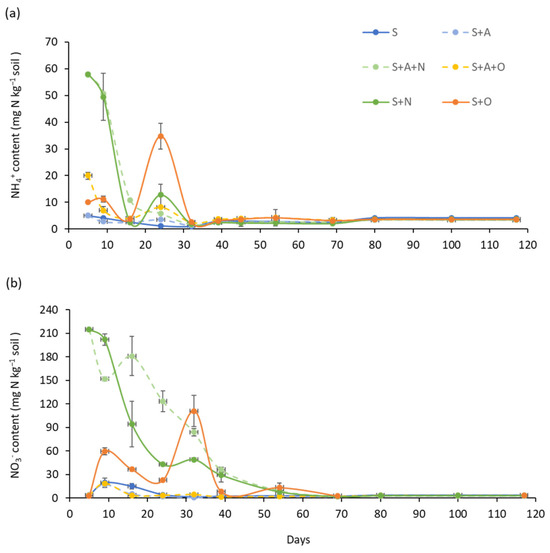
The dynamics of soil Nmin differed significantly among treatments, and the effect of VA varied depending on the fertilizer type. During the first five days after treatment application, marked differences in soil NH4+ concentrations were observed among treatments. Mineral fertilizer treatments (S + N and S + VA + N), regardless of VA addition, showed substantially higher NH4+ levels than both organic-fertilized and control soils, with mean concentrations approximately 3.8 times greater than those in the organic treatments (S + O and S + VA + O) and 11.6 times higher than those in the unfertilized soils (S and S + VA) (Figure 1a). Thereafter, NH4+ concentrations declined progressively in all treatments. In the mineral fertilized soils, values decreased from about 58 to 6.6 mg NH4+-N kg−1, whereas in the organic treatments they declined from 15 to 3.7 mg NH4+-N kg−1. By day 24, the highest NH4+ concentration was recorded in S + O (34.7 mg NH4+-N kg−1), which was considerably higher than in the other treatments, being 2.7 times higher than S + N and 5.9 times higher than S + VA + N. By day 32, NH4+ levels had further decreased and stabilized at approximately 3–5 mg NH4+-N kg−1 across treatments. The mean NH4+ and NO3− concentrations for each treatment were calculated as the average of all measurements within three periods: the first 15 days after application, the period after day 15, and the entire experimental duration (Table 4). During the first 15 days, no significant differences in NH4+ concentrations were observed between treatments receiving the same N source, regardless of VA addition. However, significant differences were detected among fertilizer types. Mineral N fertilized treatments exhibited NH4+concentrations that were 6.1 and 3.6 times higher than those of the control and organic treatments, respectively.
Figure 1.
Daily soil Nmin concentrations, NH4+ (a) and NO3− (b) in different treatments (soil (S), blue line, ammonium nitrate (N), green line and poultry manure (O), orange line) with (dashed line) and without (continuous line) volcanic ash (VA). The vertical bars indicate standard errors (n = 3).
Table 4.
Mean Soil Nmin (NH4+ and NO3−) concentrations in different treatments (soil (S), ammonium nitrate (N), and poultry manure (O)) with and without volcanic ash (VA) during various periods of the experiment.
From day 15 onwards, the highest mean NH4+ concentration was recorded in S + O (13.5 mg NH4+-N kg−1), which was 2.3 times higher than that observed in S + N. In contrast, NH4+ concentrations in the S + VA + O treatment did not show any noticeable increase throughout the experimental period.
In the mineral fertilizer treatments (S + N and S + VA + N), soil NO3− concentrations peaked within the first few days following the application of NH4NO3 (Figure 1b). From approximately day 9 onwards, NO3− levels gradually decreased in both treatments. A notable difference between them was the duration of elevated NO3− concentrations, which remained above 60 mg NO3−-N kg−1 for nearly 40 days in the S + VA + N treatment, whereas this period was shorter in the treatment without VA.
In the organic fertilizer treatment without VA (S + O), two clear peaks in soil NO3− concentrations were observed, occurring on days 9 and 32, with the latter reaching the highest value (110 mg NO3−-N kg−1). By contrast, when poultry manure was applied in the presence of VA, no marked increases in soil NO3− concentrations were detected over the course of the experiment.
Similarly to NH4+, mean soil NO3− concentrations were calculated for different periods of the experiment (Table 4). Mineral-fertilized treatments (S + N and S + VA + N) consistently exhibited significantly higher NO3− concentrations than organically fertilized treatments over most of the experimental period. The presence of VA significantly influenced NO3− dynamics, although its effect varied depending on the type of fertilizer applied. In mineral-fertilized soils, mean NO3− concentrations in S + VA + N were 37% higher than in S + N across the whole experiment. In contrast, in organically fertilized soils, NO3− levels in S + VA + O were 85% lower than those recorded in S + O.
The correlations between soil NH4+ and NO3− were positive and highly significant, with stronger associations during the first 15 days of the experiment (r = 0.96; n = 18; padj < 0.001) than over the entire experimental period (r = 0.89; n = 18; padj < 0.001).
3.2. N2O Emissions
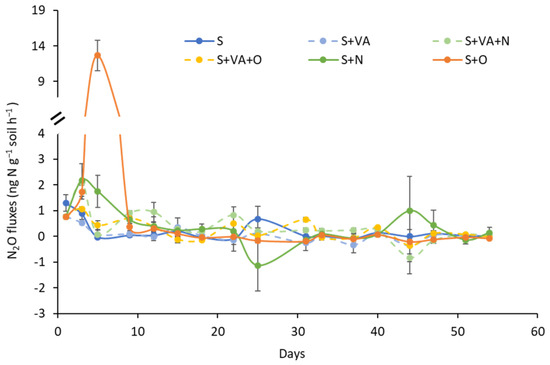
Nitrous oxide emission patterns differed among treatments depending on fertilizer type and VA application. Mineral fertilizer treatments peaked on the third day of the experiment, regardless of VA addition, with fluxes in S + N and S + VA + N reaching 2.1–2.2 ng N2O-N g−1 soil h−1. By contrast, the peak emission from the organic fertilizer without VA occurred on day 5, reaching 12.6 ng N2O-N g−1 soil h−1, approximately 5.7 times higher than the mineral fertilizer peaks (Figure 2).
Figure 2.
Daily soil N2O fluxes for the different treatments (soil (S), blue line, ammonium nitrate (N), green line and poultry manure (O), orange line) with (dashed line) and without (continuous line) volcanic ash (VA). The vertical bars indicate standard errors (n = 3).
After 10 days, fluxes declined to between 1 and −1 ng N2O-N g−1 soil h−1, with significant differences among treatments observed only on some sampling days. Notably, the organic treatment combined with VA (S + VA + O) exhibited N2O fluxes similar to the control throughout the experiment, indicating that VA mitigated the initial peak emissions. These temporal patterns are consistent with the cumulative trends reported in Table 5, where the presence of VA generally reduced total N2O emissions. While emissions were higher in S + O than in S + N during the first 15 days, the highest cumulative emissions were observed in S + N (24.48 ng N2O-N g−1 soil h−1). Overall, fertilizer type had no significant effect on N2O emissions over the entire experimental period. The addition of VA, regardless of fertilizer type, significantly reduced total N2O losses, with reductions of 55% for mineral fertilizer and 71% for organic fertilizer compared to treatments without VA. In mineral fertilizer treatments, VA consistently lowered emissions throughout the experiment, whereas in the organic fertilization treatment, fluxes became negative during the final 15 days, likely due to depletion of available N. The combination of VA and poultry manure (S + O + VA) produced N2O emissions similar to the control, highlighting VA’s role in mitigating peak emissions and even converting the soil into a temporary N2O sink.
Table 5.
Cumulative N2O emissions in fertilizer treatments (soil (S), ammonium nitrate (N), and poultry manure (O)) with and without volcanic ash (VA) during various periods of the experiment.
The cumulative N2O emissions were significantly and positively correlated with mean soil NH4+ and NO3− concentrations (r = 0.72; n = 18; padj < 0.001 and r = 0.52; n = 18; padj < 0.05, respectively) over the entire experimental period. However, correlations calculated for each treatment and period indicated that N2O fluxes were mainly associated with soil NH4+ concentrations. During the first 15 days, significant positive correlations with NH4+ were observed for both mineral and organic treatments (r = 0.716; n = 12; padj < 0.05 and r = 0.851; n = 12; padj < 0.05, respectively). From day 15 until the end of the experiment, correlations remained significant (r = 0.582; n = 24; padj < 0.001 and r = 0.743; n = 24; padj < 0.05 for mineral and organic treatments, respectively).
3.3. Yield
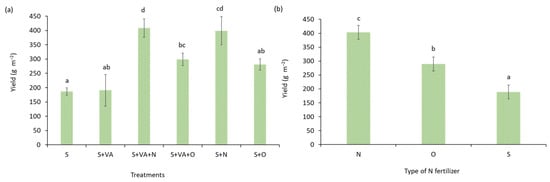
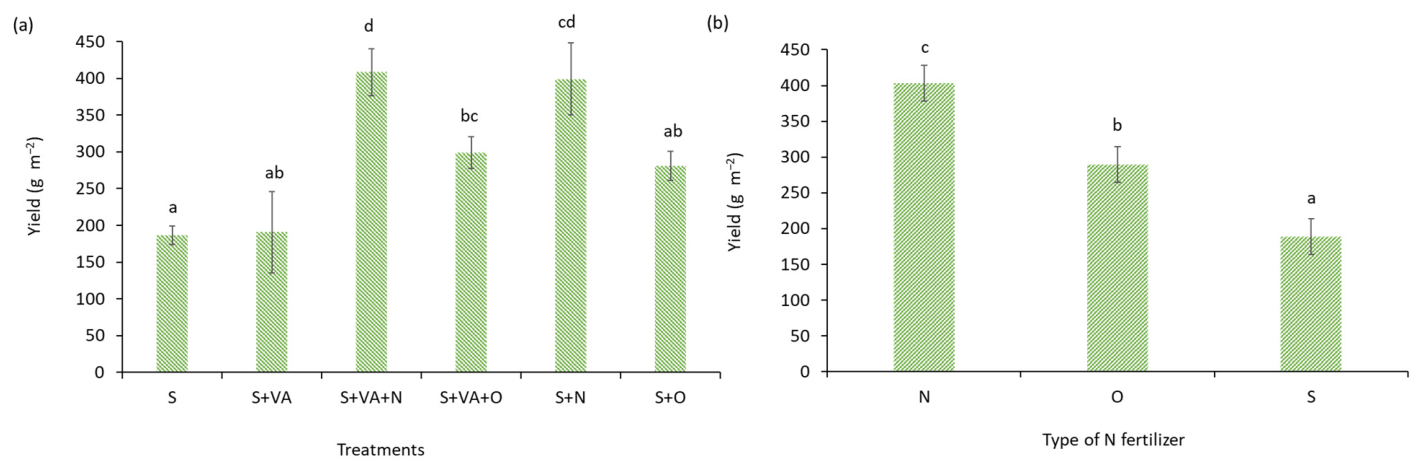
Plant biomass production was primarily driven by fertilizer type, whereas the addition of VA had only a minor effect (Figure 3a). Although VA did not significantly increase plant growth, a slight positive trend in yield was observed in the VA-amended treatments. By contrast, fertilizer type played a key role in determining final yield. The mineral-fertilized treatment produced 1.4 and 2.1 times more plant biomass than the organic treatment and the control, respectively (Figure 3b). Most growth occurred after day 15, during which approximately 74% of the total biomass was accumulated. Overall, plant biomass was strongly correlated with soil Nmin levels.
Figure 3.
Total plant yield (cumulative fresh biomass) obtained at the end of the experimental period, calculated as the sum of all harvests conducted during the experiment. (a) for different treatments (soil (S), ammonium nitrate (N) and poultry manure (O)) with and without volcanic ash (VA) and (b) for each N fertilizer type. The vertical bars indicate standard errors (n = 3). Significant differences (p < 0.05) between treatments are indicated by different letters.
For the entire experimental period, plant biomass was positively correlated with soil NH4+ (r = 0.736; n = 18; padj < 0.001) and NO3− (r = 0.771; n = 18; padj < 0.001). It is important to highlight that, during the period after 15 days, plant growth was significantly correlated only with soil NO3− (r = 0.71; n = 18; padj < 0.001).
3.4. Content of Zn, Cu and Mn in Soil and Plant
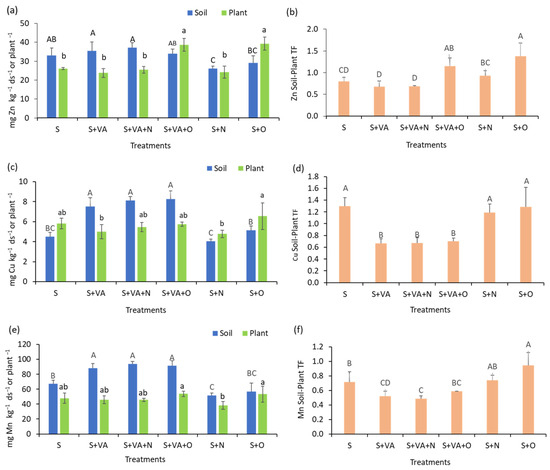
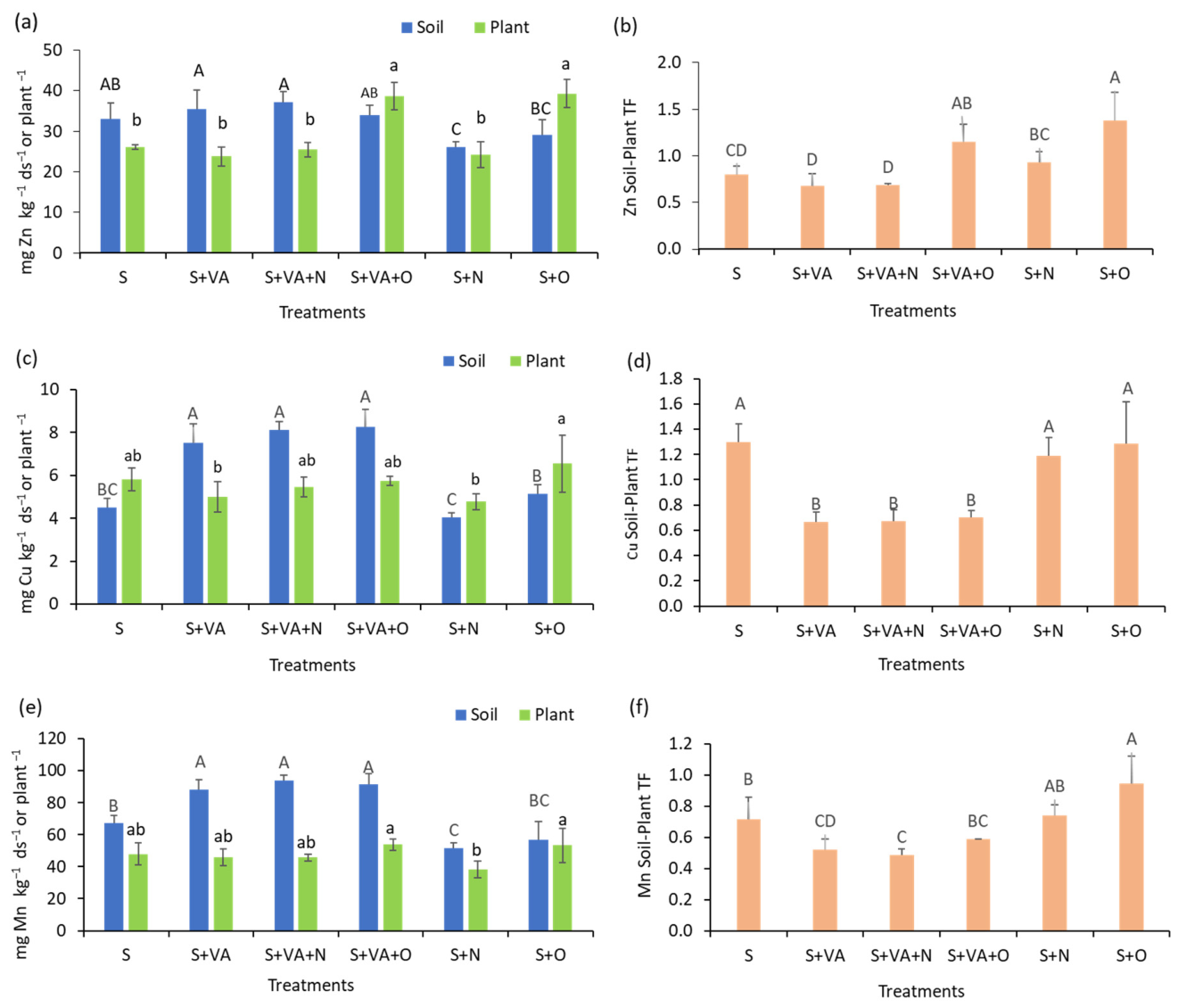
Trace metal dynamics in the soil–plant system were influenced by both VA addition and fertilizer type. Soil Cu and Mn concentrations increased significantly (p < 0.05) following VA addition, including in the control treatment (S + VA) (Figure 4c,e; blue columns). In contrast, Zn responses to VA depended on fertilizer type. Under mineral fertilization, Zn concentrations increased by 30% with VA addition (Figure 4a; blue columns), whereas under organic fertilization this increase was not statistically significant.
Figure 4.
Total Zn (a), Cu (c) and Mn (e) at the end of the experimental period in the soil (blue bars) and plant (green bars) for the different treatments (soil (S), ammonium nitrate (N) and poultry manure (O)) with and without volcanic ash (VA). Significant differences (p < 0.05) between treatments are indicated by different capital and lowercase letters for soil and plant, respectively. The soil–plant transfer factor (TF) of Zn, Cu and Mn are also shown in (b,d,f), respectively. Significant differences (p < 0.05) between treatments are indicated by different capital letters. The vertical bars indicate standard errors (n = 3).
The statistical analyses show that ash application influenced the soil–plant transfer factor (TF) of Zn, Cu and Mn. TF values ranged for Zn from 0.680 (S + VA) to 1.381 (S + O), for Cu from 0.666 (S + VA) to 1.295 (S), and for Mn from 0.487 (S + VA + N) to 0.947 (S + O). In general, treatments without VA showed higher TF values than those with VA, particularly for Zn and Cu. Ecologically, TF values < 1 indicate restricted translocation from soil to plant aerial parts, whereas TF > 1 suggests efficient uptake and accumulation in shoots.
As a result of this, there was no significant effect of VA addition on plant contents of Zn, Cu and Mn for any treatment (Figure 4a,c,e, green columns). On the other hand, the type of fertilizer applied had a significant effect on the plant metal contents. The application of organic fertilizer to soil without VA, increased plant contents of Zn, Cu and Mn by 62%, 37% and 39%, respectively, with respect to the mineral treatment without VA (Figure 4a,c,e, green columns).
Notably, significant negative correlations were observed between total N2O emissions and soil metal contents, including Zn (r = −0.590; n = 18; padj < 0.05), Mn (r = −0.639; n = 18; padj < 0.05), and Cu (r = −0.484; n = 18; padj < 0.05). Iron (Fe) was not included in the analysis because no significant differences were observed in soil or plant Fe contents across treatments.
4. Discussion
4.1. Effect of Volcanic Ash on Soil Nmin
It is important to highlight that, to the best of our knowledge, no studies have been conducted in agricultural soils amended with VA to evaluate soil Nmin dynamics and their influence on N2O emissions. For this reason, most of the literature cited here refers to volcanic soils rather than agricultural systems amended with VA. Soil moisture conditions (WFPS ~55%) likely favored both nitrification and denitrification processes, as reported by Wolf and Russow [33]. Under these conditions, microbial N transformations are mainly controlled by substrate availability (NH4+ and NO3−).
Following the application of mineral fertilizer, the amount of Nmin in the soil was high due to the combined presence of NH4+ and NO3−, which likely led to nitrification and denitrification processes occurring simultaneously. Although no significant differences were detected between treatments with and without VA during this initial phase, VA altered the temporal patterns of NH4+ and NO3− consumption. In S + VA + N, NH4+ declined at a similar rate to S + N, indicating that nitrification was not inhibited by VA under these conditions. The high initial availability of N may have masked the subtle effects of ash during the first days of the experiment. These results contrast with those reported in volcanic soils, where reduced NO3− formation has been associated with dissimilatory nitrate reduction to ammonium (DNRA) and NH4+ adsorption onto clay minerals [34,35]. These mechanisms can delay nitrification over longer periods (up to 200 days). In the present study, Nmin returned to baseline levels by day 60 and remained stable thereafter, suggesting that VA had no medium-term effect under our experimental conditions. However, NO3− consumption from day 15 onwards was slower in S + VA + N than in S + N, resulting in higher average NO3− concentrations. This pattern may indicate reduced denitrifier activity in the presence of VA, although this requires further confirmation.
In the organic treatments, mineralization was the dominant process controlling N availability. Initial NH4+ and NO3− levels were lower due to the predominance of organic N in poultry manure (68%), with a C/N ratio of 16.4. According to Nicolardot et al. [36], this C/N ratio suggests net mineralization rather than immobilization. The NH4+ peak observed on day 24 in the S + O treatment likely reflects active mineralization [37], followed by nitrification leading to a delayed NO3− peak (day 32). The faster decline of NO3− in S + O compared to mineral treatments can be explained by increased microbial respiration and the formation of anaerobic microsites that promote denitrification [38,39]. It should be noted that organic fertilizers were applied based on total N content rather than immediately available mineral N. Therefore, not all organic N is expected to be mineralized within the experimental period, which may partially explain the observed differences in N dynamics between organic and mineral treatments. In contrast, the S + VA + O treatment showed a markedly reduced Nmin dynamics throughout the experiment. This behavior contrasts with the pronounced mineralization-driven N dynamics observed in S + O, where distinct NH4+ and NO3− peaks indicated active transformation of organic N into plant-available forms. In S + VA + O, however, these peaks were absent or strongly attenuated, suggesting that VA altered the microbial processes responsible for N release from organic matter. Although organic fertilizers are typically associated with rapid N mineralization under favorable conditions, as observed in S + O and reported in previous studies [37], the presence of VA appears to have modified this expected trajectory. This represents a novel observation in agricultural soils amended with VA, suggesting that it may have delayed or limited microbial mineralization activity. However, the underlying mechanisms remain unclear and may involve indirect effects on microbial activity, substrate accessibility, or microsite conditions, as microbial communities were not directly assessed in this study.
4.2. The Influence of Volcanic Ashes on N2O Losses
The experimental results show that the presence of VA significantly reduced N2O emissions, regardless of the type of fertilizer. In the mineral fertilization treatments (with or without VA), the highest N2O emissions were observed at the beginning of the experiment (day 3), coinciding with peak concentrations of NH4+ and NO3− in the soil. Although higher fluxes might be expected under these conditions, the values obtained were comparable to those reported in similar studies [40,41]. These initial emission peaks were likely due to the combined action of nitrification and denitrification under soil moisture conditions of this trial [33]. However, statistical analysis suggests that emissions were more closely associated with nitrification processes, as cumulative N2O emissions correlated more strongly with soil NH4+ (r = 0.72) than with NO3− (r = 0.52). This pattern was also observed in the daily data, where N2O fluxes primarily depended on NH4+ availability.
To better understand the effect of VA on N2O emissions, it is useful to consider the different phases of the experiment. During the first 15 days, no significant differences in N2O emissions were observed between mineral treatments, likely because the high levels of applied mineral N masked any potential effects of VA. From day 15 onwards, however, total N2O emissions in S + VA + N were approximately five times lower than in S + N, despite higher NO3−concentrations. Importantly, NH4+ depletion rates were similar in both treatments, indicating that nitrification was not inhibited by VA. In contrast, NO3− consumption was slower in S + VA + N than in S + N, resulting in significantly higher NO3− concentrations for most of this period. Despite this accumulation, no significant N2O fluxes were detected. The slower decline in NO3− suggests reduced denitrifier activity, likely reflecting partial inhibition of denitrifying microorganisms. A similar slowdown in NO3− consumption was reported in [42], where N2O emissions from denitrification were expected but not observed. Likewise, Senbayram et al. [43] found that high NO3− concentrations in soil (up to 50 mg kg−1) can suppress denitrification activity, which may explain the absence of N2O peaks in our study. During this period, plant growth was at its maximum, likely due to reduced competition with soil microorganisms for NO3−, which may have enhanced plant N uptake and contributed to higher yields.
In the organic treatments, the highest N2O emissions were recorded in S + O, which also showed the greatest cumulative N2O losses during the first 15 days (Table 5). This behavior is consistent with the addition of organic fertilizers, which supply easily degradable carbon, thereby promoting the formation of anaerobic microsites and the activity of heterotrophic denitrifying bacteria [44,45]. However, despite the increase in soil NO3− from day 30 onwards, no additional N2O peaks were observed. This pattern may be explained by conditions that favor the complete reduction of N2O to N2 under denitrification. In particular, a manure C/N ratio of around 15, together with alkaline soil pH and sustained NO3− availability, can enhance the efficiency of the denitrification process, thereby reducing N2O emissions [7,46].
The addition of VA did not produce the same effect under organic fertilization as under mineral fertilization. As discussed previously, mineralization was inhibited in S + VA + O, resulting in low availability of NH4+ and NO3− and, consequently, the absence of N2O pulses. This contrasts with the findings of Akiyama et al. [47], who reported higher N2O emissions from organic amendments such as poultry manure in volcanic soils. This discrepancy suggests that the behavior of organic fertilizers in VA-amended agricultural soils differs substantially from that observed in volcanic soils, highlighting the need for further studies to better understand these processes.
4.3. Effects of Volcanic Ash Metals on Yield and N2O Emissions
It is important to note that VA introduces a wide range of elements and compounds whose influence on soil processes is not yet fully understood. On the one hand, VA may contain potentially toxic elements [48]; however, in this study, no negative effects on plant growth were observed, and the concentrations of toxic metals remained below regulatory thresholds [12,49]. Although no plant toxicity was detected, yields were similar between treatments with and without VA, in contrast to previous studies. Ciriminna et al. [17] described volcanic ash as a multi-nutrient mineral fertilizer capable of improving soil processes through the supply of trace metals involved in key biogeochemical cycles. These authors reported yield increases of 79% and 10% in tomato and potato, respectively, when VA was incorporated into fertilizers. Similarly, Zakharikhina et al. [20] observed significant increases in potato yield (≈47–52%) when volcanic ash was applied together with NPK fertilizers under field conditions. These effects were attributed to the presence of trace elements such as Mn, Zn, Mo, Cu, and Fe, which can stimulate microbial activity and enhance nutrient availability.
In the present study, although VA application increased Zn, Cu, and Mn concentrations in the soil, this did not translate into a significant increase in plant uptake. Most of the treatments with VA resulted in TF < 1, suggesting a reduced mobility of Zn, Cu, and Mn from soil to plant, which may indicate a stabilizing effect of volcanic ash on nutrient availability and plant uptake. A possible explanation is the alkaline nature of the soil, which may have promoted the immobilization of these metals, reducing both their bioavailability [50] and the risk of phytotoxicity [51]. Unlike our experiment, previous studies do not report soil pH, suggesting that this factor may be key in explaining the differences observed in crop response. Nevertheless, despite differences in soil and management conditions among studies, the available evidence suggests that VA has the potential to improve agricultural productivity. Under our experimental conditions, only a slight positive trend was observed in VA-amended soils (Figure 3a).
What was more evident in our study was the influence of VA on increasing Cu, Zn, and Mn concentrations in the soil and its role in mitigating N2O emissions. Based on our observations and the well-documented role of Cu and Zn as cofactors in nitrous oxide reductase (N2O reductase) [21,22,23,52,53], an enzyme responsible for reducing N2O to N2, we hypothesize that the increase in these metals may have enhanced key microbial enzymatic processes involved in the nitrogen cycle, including nitrification and N2O reduction [52,53,54]. These interpretations are supported by the negative correlations observed between Cu, Zn, and Mn concentrations and N2O emissions under both fertilization regimes.
Although this exploratory study did not directly assess microbial communities or functional genes, future research should evaluate this hypothesis and also include soil structural characterization (e.g., using X-ray-based techniques) to validate and refine the proposed mechanisms. Our results indicate that VA can have positive environmental impacts by reducing N2O emissions under both mineral and organic fertilization. However, its use should be approached with caution in alkaline soils, especially when fertilizers such as NH4NO3 are applied, as the slowdown of denitrification may lead to NO3− accumulation in the soil and increase the risk of leaching and water contamination. Therefore, the use of volcanic ash in combination with ammonium-based mineral fertilizers, such as urea, is recommended as a more suitable strategy to reduce N2O emissions associated with denitrification processes. In the case of organic fertilizers, longer-term studies are needed to determine whether mineralization–nitrification processes are delayed or require more time to establish.
5. Conclusions
According to the hypothesis of this study, the combined application of VA with nitrogen fertilizers (NH4NO3 and poultry manure) can effectively reduce soil N2O emissions, one of the main greenhouse gases emitted from agricultural systems, without compromising crop yield. Although the type of fertilizer strongly influenced soil Nmin dynamics and associated emissions, the addition of VA consistently reduced N2O losses by 55% under mineral fertilization and by 71% under organic fertilization.
In mineral-fertilized soils, the presence of VA was associated with a slower decline in NO3−, suggesting a possible reduction in denitrification processes. In contrast, under organic fertilization, nitrogen dynamics were primarily driven by mineralization, a process that appeared to be limited in the presence of VA, resulting in lower availability of inorganic N forms and, consequently, reduced N2O emissions. Although the slowdown of mineralization and denitrification was evident, soil microbial communities were not directly assessed. Nevertheless, the increase in Cu, Zn, and Mn concentrations induced by VA, together with the negative correlations observed with N2O emissions, suggests a relevant role of these elements in emission mitigation. Given that these metals act as cofactors in key enzymes of the nitrogen cycle, their greater availability in the soil may have promoted microbial processes involved in N2O reduction. In addition, the alkaline soil pH likely contributed to their retention in the soil matrix, limiting their transfer to plants and enhancing their interaction with microorganisms.
Overall, the results point to an indirect role of VA in modulating soil nitrogen dynamics and reducing N2O emissions. However, further studies integrating microbial analyses and evaluating different fertilization strategies are needed to confirm the proposed mechanisms. From an applied perspective, volcanic ash represents a promising strategy within circular agriculture by valorizing a natural by product as an agronomic input. However, due to its compositional variability, prior characterization, particularly in terms of pH, nutrient content, and potentially toxic elements, is essential before agricultural use. Future research should address this variability under different soil and management conditions to develop safe and robust application guidelines.
Author Contributions
All authors contributed to the study conception and design. L.S.-M., P.A. and J.U. prepared materials, collected data, and analyzed them. L.S.-M. and M.R.T. analyzed and worked on gas data. P.A., A.M.M. and G.G. analyzed and worked on soil and plant data. The first draft of the manuscript was written by L.S.-M., and all authors commented on previous versions of the manuscript. All authors have read and agreed to the published version of the manuscript.
Funding
This research was funded by UPM grants to research groups (VAGI24GGG) and Fondo Europeo de Desarrollo Regional, Comunidad de Madrid (Spain) and Structural Funds 2014–2020 (project AGRISOST-CM S2018/BAA-4330).
Institutional Review Board Statement
Not applicable.
Informed Consent Statement
Not applicable.
Data Availability Statement
Data sets supporting the conclusions of this article are available from the corresponding author upon reasonable request.
Acknowledgments
We thank Jhoeel for his hard work in sampling and analyzing samples, and the technicians at the Department of Chemistry and Food Technology of ETSIAAB (particularly Pilar Ortiz, Estrella Revenga, and Rocío Rodríguez) for their collaboration. We also thank Antonio Vallejo for allowing the use of various equipment for the data analysis presented in this study, and we extend special thanks to Veterinary Colonel Luis Enrique Martín Otero for providing us with the volcanic ashes.
Conflicts of Interest
Authors declare no conflicts of interest.
Abbreviations
The following abbreviations are used in this manuscript:
| GHG | GreenHouse Gas |
| FAO | The Food and Agriculture Organization |
| WFPS | Water-Filled Pore Space |
| S + VA | Soil + Volcanic Ash |
| S + VA + N | Soil + Volcanic Ash + Nitrogen |
| S + VA + O | Soil + Volcanic Ash + Organic fertilizer |
| S | Soil |
| S + N | Soil + Nitrogen |
| S + O | Soil + Organic fertilizer |
| Nmin | mineral Nitrogen |
References
- IPCC. Climate Change 2014: Synthesis Report. Contribution of Working Groups I, II and III to the Fifth Assessment Report of the Intergovernmental Panel on Climate Change; Pachauri, R.K., Meyer, L.A., Eds.; IPCC: Geneva, Switzerland, 2014. [Google Scholar]
- FAO. Greenhouse Gas Emissions from Agrifood Systems: Global, Regional and Country Trends, 2000–2020; FAOSTAT Analytical Brief Series No. 50; FAO: Rome, Italy, 2022. [Google Scholar]
- Tian, H.; Pan, N.; Thompson, R.L.; Canadell, J.G.; Suntharalingam, P.; Regnier, P.; Davidson, E.A.; Prather, M.; Ciais, P.; Muntean, M.; et al. Global nitrous oxide budget (1980–2020). Earth Syst. Sci. Data 2024, 16, 2543–2604. [Google Scholar] [CrossRef] [Scilit]
- Ussiri, D.; Lal, R. Soil Emission of Nitrous Oxide and Its Mitigation; Springer Science & Business Media: New York, NY, USA, 2013. [Google Scholar] [CrossRef] [Scilit]
- Wrage, N.; Velthof, G.L.; Van Beusichem, M.L.; Oenema, O. Role of nitrifier denitrification in the production of nitrous oxide. Soil Biol. Biochem. 2001, 33, 1723–1732. [Google Scholar]
- Davidson, E.A. Fluxes of nitrous oxide and nitric oxide from terrestrial ecosystems. In Microbial Production and Consumption of Greenhouse Gases: Methane, Nitrous Oxide, and Halomethanes; Rogers, J.E., Ed.; American Society for Microbiology: Washington, DC, USA, 1991; pp. 219–235. [Google Scholar]
- Abalos, D.; Jeffery, S.; Sanz-Cobena, A.; Guardia, G.; Vallejo, A. Meta-analysis of the effect of urease and nitrification inhibitors on crop productivity and nitrogen use efficiency. Agric. Ecosyst. Environ. 2014, 189, 136–144. [Google Scholar] [CrossRef] [Scilit]
- Guardia, G.; Cangani, M.T.; Sanz-Cobena, A.; Junior, J.L.; Vallejo, A. Management of pig manure to mitigate NO and yield-scaled N2O emissions in an irrigated Mediterranean crop. Agric. Ecosyst. Environ. 2017, 238, 55–66. [Google Scholar] [CrossRef] [Scilit]
- Koudahe, K.; Allen, S.C.; Djaman, K. Critical review of the impact of cover crops on soil properties. Int. Soil Water Conserv. Res. 2022, 10, 343–354. [Google Scholar] [CrossRef] [Scilit]
- Sánchez-Martín, L.; Arce, A.; Barba, A.; Garcia-Torres, L.; Vallejo, A. Influence of drip and furrow irrigation systems on nitrogen oxide emissions from a horticultural crop. Soil Biol. Biochem. 2008, 40, 1698–1706. [Google Scholar] [CrossRef] [Scilit]
- Yuan, J.; Sadiq, M.; Rahim, N.; Li, G.; Yan, L.; Wu, J.; Xu, G. Tillage strategy and nitrogen fertilization methods influences on selected soil quality indicators and spring wheat yield under semi-arid environmental conditions of the Loess Plateau, China. Appl. Sci. 2022, 12, 1101. [Google Scholar] [CrossRef] [Scilit]
- European Union. Regulation (EU) 2019/1009 of the European Parliament and of the Council of 5 June 2019 laying down rules on the making available on the market of EU fertilising products and amending Regulations (EC) No 1069/2009 and (EC) No 1107/2009 and repealing Regulation (EC) No 2003/2003 (Text with EEA relevance). Off. J. Eur. Union 2019, L 170, 1–114. [Google Scholar]
- Aguilera, E.; Lassaletta, L.; Sanz-Cobena, A.; Garnier, J.; Vallejo, A. The potential of organic fertilisers and water management to reduce N2O emissions in Mediterranean climate cropping systems: A review. Agric. Ecosyst. Environ. 2013, 164, 32–52. [Google Scholar] [CrossRef] [Scilit]
- Rosemarin, A.; Macura, B.; Carolus, J.; Barquet, K.; Ek, F.; Järnberg, L.; Okruszko, T. Circular nutrient solutions for agriculture and wastewater: A review of technologies and practices. Curr. Opin. Environ. Sustain. 2020, 45, 78–91. [Google Scholar] [CrossRef] [Scilit]
- Benito, M.B.; Alvarado, G.E.; Marchamalo, M.; Rejas, J.G.; Murphy, P.; Franco, R.; Castro, D.; Garcia-Lanchares, C.; Sanchez, J. Temporal and spatial evolution of the 2021 eruption in the Tajogaite volcano (Cumbre Vieja Rift Zone, La Palma, Canary Islands) from geophysical and geodetic parameter analyses. Nat. Hazards 2023, 118, 2245–2284. [Google Scholar] [CrossRef] [Scilit]
- Minasny, B.; Fiantis, D.; Hairiah, K.; Van Noordwijk, M. Applying volcanic ash to croplands: The untapped natural solution. Soil Secur. 2021, 3, 100006. [Google Scholar] [CrossRef] [Scilit]
- Ciriminna, R.; Scurria, A.; Tizza, G.; Pagliaro, M. Volcanic ash as multi-nutrient mineral fertiliser: Science and early applications. ChemRxiv 2022. [Google Scholar] [CrossRef] [Scilit]
- El-Desoky, A.I.; Hassan, A.Z.A.; Mahmoud, A.M. Volcanic ash as a material for soil conditioner and fertility. J. Soil Sci. Agric. Eng. 2018, 9, 491–495. [Google Scholar] [CrossRef] [Scilit]
- De la Rosa, J.M.; Pérez-Dalí, S.M.; Campos, P.; Sánchez-Martín, Á.; González-Pérez, J.A.; Miller, A.Z. Suitability of volcanic ash, rice husk ash, green compost, and biochar as amendments for a Mediterranean alkaline soil. Agronomy 2023, 13, 1097. [Google Scholar] [CrossRef] [Scilit]
- Zakharikhina, L.V.; Litvinenko, Y.S.; Ryakhovskaya, N.I.; Gainatulina, V.V.; Arguneeva, N.Y.; Makarova, M.A. The geochemical transformation of natural soils and enhancement of agricenosis productivity due to volcanic ejecta entering the soil. J. Volcanol. Seismol. 2016, 10, 203–217. [Google Scholar] [CrossRef] [Scilit]
- Glass, J.; Orphan, V.J. Trace metal requirements for microbial enzymes involved in the production and consumption of methane and nitrous oxide. Front. Microbiol. 2012, 3, 61. [Google Scholar] [CrossRef] [Scilit]
- Shen, W.; Xue, H.; Gao, N.; Shiratori, Y.; Kamiya, T.; Fujiwara, T.; Isobe, K.; Senoo, K. Effects of copper on nitrous oxide (N2O) reduction in denitrifiers and N2O emissions from agricultural soils. Biol. Fertil. Soils 2020, 56, 39–51. [Google Scholar] [CrossRef] [Scilit]
- Montoya, M.; Castellano-Hinojosa, A.; Vallejo, A.; Alvarez, J.M.; Bedmar, E.J.; Recio, J.; Guardia, G. Zinc fertilisers influence greenhouse gas emissions and nitrifying and denitrifying communities in a non-irrigated arable cropland. Geoderma 2018, 325, 208–217. [Google Scholar] [CrossRef] [Scilit]
- Soil Survey Staff. Keys to Soil Taxonomy, 12th ed.; USDA, Natural Resources Conservation Service: Washington, DC, USA, 2014.
- Day, J.M.D.; Troll, V.R.; Aulinas, M.; Deegan, F.M.; Geiger, H.; Carracedo, J.C.; Gisbert Pinto, G.; Perez-Torrado, F.J. Mantle Source Characteristics and Magmatic Processes during the 2021 La Palma Eruption. Earth Planet. Sci. Lett. 2022, 597, 117793. [Google Scholar] [CrossRef] [Scilit]
- Danielson, R.E.; Sutherland, P.L. Porosity. In Methods of Soil Analysis, Part 1—Physical and Mineralogical Methods; Klute, A., Ed.; American Society of Agronomy: Madison, WI, USA, 1986; pp. 443–460. [Google Scholar]
- Hammerl, V.; Kastl, E.M.; Schloter, M.; Walch, S.; Schmidt, H.; Welzl, G.; Jentsch, A.; Beierkuhnlein, C.; Gschwendtner, S. Influence of Rewetting on Microbial Communities Involved in Nitrification and Denitrification in a Grassland Soil after a Prolonged Drought Period. Sci. Rep. 2019, 9, 2280. [Google Scholar] [CrossRef] [Scilit]
- Sánchez-Martín, L.; Beccaccia, A.; De Blas, C.; Sanz-Cobena, A.; García-Rebollar, P.; Estellés, F.; Marsden, K.A.; Chadwick, D.R.; Vallejo, A. Diet management to effectively abate N2O emissions from surface applied pig slurry. Agric. Ecosyst. Environ. 2017, 239, 1–11. [Google Scholar] [CrossRef] [Scilit]
- Pavelka, M.; Acosta, M.; Kiese, R.; Altimir, N.; Brümmer, C.; Crill, P.; Darenova, E.; Fuß, R.; Gielen, B.; Graf, A.; et al. Standardisation of chamber technique for CO2, N2O and CH4 fluxes measurements from terrestrial ecosystems. Int. Agrophys. 2018, 32, 569–587. [Google Scholar] [CrossRef] [Scilit]
- Millar, N.; Urrea, A.; Kahmark, K.; Shcherbak, I.; Robertson, G.P.; Ortiz-Monasterio, I. Nitrous Oxide (N2O) Flux Responds Exponentially to Nitrogen Fertilizer in Irrigated Wheat in the Yaqui Valley, Mexico. Agric. Ecosyst. Environ. 2018, 261, 125–132. [Google Scholar] [CrossRef] [Scilit]
- Almendros, P.; González, D.; Ibañez, M.A.; Smolders, E.; Fernández, M.D.; García-Gomez, C.; Obrador, A. Influence of ZnO particle size and soil characteristics on the estimation of long-term Zn bioavailability by chemical extraction methods and diffusive gradients in thin-films (DGT). J. Soil Sci. Plant Nutr. 2022, 22, 3901–3913. [Google Scholar] [CrossRef] [Scilit]
- Jones, J.B. Laboratory Guide for Conducting Soil Tests and Plant Analysis; CRC Press: Boca Raton, FL, USA, 2001. [Google Scholar]
- Wolf, I.; Russow, R. Different pathways of formation of N2O, N2 and NO in black earth soil. Soil Biol. Biochem. 2000, 32, 229–243. [Google Scholar] [CrossRef] [Scilit]
- Cardenas, L.M.; Hatch, D.J.; Scholefield, D.; Jhurreea, D.; Clark, I.M.; Hirsch, P.R.; Salazar, F.; Rao-Ravella, S.; Alfaro, M. Potential mineralization and nitrification in volcanic grassland soils in Chile. Soil Sci. Plant Nutr. 2013, 59, 380–391. [Google Scholar] [CrossRef] [Scilit]
- Huygens, D.; Rütting, T.; Boeckx, P.; Van Cleemput, O.; Godoy, R.; Müller, C. Soil nitrogen conservation mechanisms in a pristine south Chilean Nothofagus forest ecosystem. Soil Biol. Biochem. 2007, 39, 2448–2458. [Google Scholar] [CrossRef] [Scilit]
- Nicolardot, B.; Recous, S.; Mary, B. Simulation of C and N mineralisation during crop residue decomposition: A simple dynamic model based on the C:N ratio of the residues. Plant Soil 2001, 228, 83–103. [Google Scholar] [CrossRef] [Scilit]
- Bitzer, C.C.; Sims, J.T. Estimating the availability of nitrogen in poultry manure through laboratory and field studies. J. Environ. Qual. 1988, 17, 47–54. [Google Scholar] [CrossRef] [Scilit]
- Meijide, A.; García-Torres, L.; Arce, A.; Vallejo, A. Nitrogen oxide emissions affected by organic fertilization in a non-irrigated Mediterranean barley field. Agric. Ecosyst. Environ. 2009, 132, 106–115. [Google Scholar] [CrossRef] [Scilit]
- Vallejo, A.; Skiba, U.M.; García-Torres, L.; Arce, A.; López-Fernández, S.; Sánchez-Martín, L. Nitrogen oxides emission from soils bearing a potato crop as influenced by fertilization with treated pig slurries and composts. Soil Biol. Biochem. 2006, 38, 2782–2793. [Google Scholar] [CrossRef] [Scilit]
- Sánchez-Martín, L.; Vallejo, A.; Dick, J.; Skiba, U.M. The influence of soluble carbon and fertiliser nitrogen on nitric oxide and nitrous oxide emissions from two contrasting agricultural soils. Soil Biol. Biochem. 2008, 40, 142–151. [Google Scholar] [CrossRef] [Scilit]
- Paulino, L.; Flores, M.; Muñoz, C.; Dörner, J.; Zagal, E.; Cuevas, J.G. Land use on volcanic ash soils and its influence on greenhouse gases emissions under laboratory conditions. J. Soil Sci. Plant Nutr. 2023, 23, 1713–1726. [Google Scholar] [CrossRef] [Scilit]
- Saggar, S.; Jha, N.; Deslippe, J.; Bolan, N.S.; Luo, J.; Giltrap, D.L.; Kim, D.-G.; Zaman, M.; Tillman, R.W. Denitrification and N2O:N2 production in temperate grasslands: Processes, measurements, modelling and mitigating negative impacts. Sci. Total Environ. 2013, 465, 173–195. [Google Scholar] [CrossRef] [Scilit]
- Senbayram, M.; Chen, R.; Budai, A.; Bakken, L.; Dittert, K. N2O emission and the N2O/(N2O+N2) product ratio of denitrification as controlled by available carbon substrates and nitrate concentrations. Agric. Ecosyst. Environ. 2012, 147, 4–12. [Google Scholar] [CrossRef] [Scilit]
- Thomas, B.W.; Hao, X. Nitrous oxide emitted from soil receiving anaerobically digested solid cattle manure. J. Environ. Qual. 2017, 46, 741–750. [Google Scholar] [CrossRef] [Scilit]
- Dungan, R.S.; Leytem, A.B.; Tarkalson, D.D. Greenhouse gas emissions from an irrigated cropping rotation with dairy manure utilization in a semiarid climate. Agron. J. 2021, 113, 1222–1237. [Google Scholar] [CrossRef] [Scilit]
- Geng, Y.; Wang, J.; Sun, Z.; Ji, C.; Huang, M.; Zhang, Y.; Zou, J. Soil N-oxide emissions decrease from intensive greenhouse vegetable fields by substituting synthetic N fertiliser with organic and bio-organic fertilisers. Geoderma 2021, 383, 114730. [Google Scholar] [CrossRef] [Scilit]
- Akiyama, H.; Sano, T.; Nishina, K.; Sudo, S.; Oura, N.; Fujimori, M.; Uezono, I.; Yano, S.; Ohkoshi, S.; Fujita, Y.; et al. N2O emission factors for organic amendments in Japan from measurement campaign and systematic review. Sci. Total Environ. 2023, 864, 161088. [Google Scholar] [CrossRef] [Scilit]
- Mihai, R.A.; Espinoza-Caiza, I.A.; Melo-Heras, E.J.; Cubi-Insuaste, N.S.; Pinto-Valdiviezo, E.A.; Catana, R.D. Does the mineral composition of volcanic ashes have a beneficial or detrimental impact on the soils and cultivated crops of Ecuador? Toxics 2023, 11, 846. [Google Scholar] [CrossRef] [Scilit] [PubMed]
- López-Núñez, R. Portable X-ray fluorescence analysis of organic amendments: A review. Appl. Sci. 2022, 12, 6944. [Google Scholar] [CrossRef] [Scilit]
- Barrow, N.J.; Hartemink, A.E. The Effects of pH on Nutrient Availability Depend on Both Soils and Plants. Plant Soil 2023, 487, 21–37. [Google Scholar] [CrossRef] [Scilit]
- Campos, P.; Knicker, H.; López, R.; De la Rosa, J.M. Application of biochar produced from crop residues on trace elements contaminated soils: Effects on soil properties, enzymatic activities and Brassica rapa growth. Agronomy 2021, 11, 1394. [Google Scholar] [CrossRef] [Scilit]
- Pomowski, A.; Zumft, W.G.; Kroneck, P.M.; Einsle, O. N2O binding at a [4Cu:2S] copper–sulphur cluster in nitrous oxide reductase. Nature 2011, 477, 234–237. [Google Scholar] [CrossRef] [Scilit]
- Hallin, S.; Philippot, L.; Loffler, F.E.; Sanford, R.A.; Jones, C.M. Genomics and ecology of novel N2O-reducing microorganisms. Trends Microbiol. 2018, 26, 43–55. [Google Scholar] [CrossRef] [Scilit] [PubMed]
- Corrochano-Monsalve, M.; González-Murua, C.; Bozal-Leorri, A.; Lezama, L.; Artetxe, B. Mechanism of action of nitrification inhibitors based on dimethylpyrazole: A matter of chelation. Sci. Total Environ. 2021, 752, 141885. [Google Scholar] [CrossRef] [Scilit]

Disclaimer/Publisher’s Note: The statements, opinions and data contained in all publications are solely those of the individual author(s) and contributor(s) and not of MDPI and/or the editor(s). MDPI and/or the editor(s) disclaim responsibility for any injury to people or property resulting from any ideas, methods, instructions or products referred to in the content. |
© 2026 by the authors. Licensee MDPI, Basel, Switzerland. This article is an open access article distributed under the terms and conditions of the Creative Commons Attribution (CC BY) license.