


Abstract
Background/Objectives: Feedforward—viewing a self-representation performing at a level not yet achieved—is increasingly delivered through virtual reality, avatars and generative artificial intelligence. This critical review synthesizes the evidence base for feedforward, video self-modeling and avatar-based observational learning on motor skill performance, self-efficacy and state anxiety, and appraises the methodological quality of that evidence. Methods: Source identification followed snowballing guidelines across four streams: a start set, a targeted supplementary search (six databases, one academic search engine, two conference series; 1999–2026), and backward and forward citation chaining. Of 24 core sources, 18 were primary empirical studies; the 17 testing an intervention effect were coded independently by two raters across five methodological quality dimensions, without summing them. Results: In only four of the 18 primary studies does the observed movement belong to the participant; three use a hybrid stimulus combining another person’s movement with the participant’s identity, and one tests a generative AI implementation. Sixteen of the 17 appraised studies fell below the sample required to detect a medium effect (d = 0.50) at α = 0.05 with power = 0.80, and no between-subjects study reached it. Assessor blinding was reported in two studies, and a delayed retention or transfer test in seven. A between-condition difference in self-efficacy could not be demonstrated in six of the seven studies measuring it, none of which reported an equivalence test. Conclusions: The evidence does not support practice recommendations, least of all for the AI-supported variant, which rests on one conference paper. The weakness lies in statistical power, assessor blinding and retention testing rather than in an overall quality ranking.
1. Introduction
Motor skill learning is a shared concern across domains ranging from sport science to rehabilitation, and the acquisition of complex skills is shaped not only by physical repetition but also by cognitive, affective and motivational processes. Among these, observational learning is one of the most thoroughly documented empirically. In their meta-analysis [1], found a significant advantage of observational modeling over practice-only control conditions but showed that the effect size varied markedly by outcome type (δ = 0.77 for movement dynamics measures; δ = 0.17 for movement outcome measures), indicating that observation primarily conveys the formal pattern of a movement while its contribution to outcome performance is more limited and task-dependent [2,3] framed this heterogeneity through the Applied Model for the Use of Observation, which systematizes observation interventions along the 5 Ws and 1 H structure.
Video self-modeling (VSM) refers to a scenario where the individual acts as the observer. Two distinct subtypes are identified: positive self-review, which involves compiling an individual’s top past performances, and feedforward, which involves creating and displaying a performance level that has not yet been reached. Functionally, feedforward is different from traditional feedback [4]. The augmented feedback literature has shown that frequent knowledge of results improves acquisition but weakens retention (the guidance hypothesis; [5]), whereas feedforward carries no error information about a performance that has occurred: it shows the individual not what they did but what they could do, resting on the reconfiguration of component behaviors already in the repertoire [6,7]. It may therefore not structurally carry the dependency risk the guidance hypothesis predicts, although this remains untested.
One of the most fundamental distinctions in the motor learning field must be stated at the outset: performance improvement during acquisition is not, on its own, evidence of learning. Learning can be inferred only from delayed retention and transfer tests administered after the intervention has been withdrawn, since advantages observed during acquisition may reflect transient performance effects [8,9]. This distinction is decisive for reading the evidence base presented below, since the great majority of the studies reviewed include no retention measurement (see Section 3.1.2).
When feedforward is effective is bound up with the staged nature of motor learning. Ref. [10] proposed that skill acquisition proceeds through cognitive, associative and autonomous stages, so viewing a representation of the target performance should carry its highest value in the cognitive stage. The Challenge Point Framework of [11] adds a testable prediction: as an external information source, feedforward may produce gains in novices by bringing functional difficulty into the optimal range while limiting gains in advanced learners. The framework defines no independent quantitative criterion for functional difficulty, and in the literature reviewed here, skill level is mostly reported only as “novice”, with no level-based moderation analysis.
Generative artificial intelligence and deepfake technologies have given feedforward a new application dimension. Traditional feedforward videos were assembled from an individual’s existing recordings and so remained limited to component movements performed at least once; generative models make it possible, through face swapping, to place the observer’s face onto a recording of a better-performing individual, producing a convincing self-representation of a performance never executed [12]. This raises a definitional question: when the observed movement belongs to another person while the observed identity belongs to the individual, is the stimulus a pure self-model in the sense of [4] or a hybrid positioned between self-model and external model? The question is unanswered and is revisited in Section 4.2. Here, “deepfake” is used as a neutral technical term, and only educational applications based on informed consent are addressed. A parallel trajectory of technological advancement has emerged in virtual reality (VR)-based motor training, with research examining its potential for transfer to real-world motor performance [13] and exploring the integration of action observation and motor imagery within immersive 360° VR environments [14]. Collectively, these developments reflect the evolution of the field from early conceptual frameworks [4] to empirical investigations of video self-modeling (VSM) in sports performance [15,16], followed by the incorporation of VR and avatar-based technologies [17,18] and, more recently, the integration of artificial intelligence into feedforward learning approaches [12].
Despite this accumulation, the literature is fragmented in three respects. First, the effect of feedforward on psychological outcomes other than motor performance—particularly self-efficacy and state anxiety—is mostly measured as a secondary variable, with inconsistent results. Second, the evidence base is distributed across five research traditions with no common methodological language. Third and most importantly, the methodological quality of these studies has not been systematically appraised, although in neighboring studies, low statistical power and reporting bias have been shown meta-analytically to inflate effect sizes [19,20]. This is also a theoretical warning: Ref. [20] jointly target autonomy support and enhanced expectancies, the two motivational components of OPTIMAL theory [21], the second of which overlaps directly with the assumed mechanism of feedforward. Those meta-analyses cover the self-controlled practice and enhanced expectancies literature; whether the same power and reporting profile characterizes the feedforward and video self-modeling literature has not been examined. The explanatory confidence generated by early mirror-neuron accounts of observational learning, which were at their most influential over much of the period covered here, may also have made such an examination appear unnecessary; the empirical standing of those accounts is itself now contested (Section 4.4).
This critical review aims to bring these research traditions together within a common framework and to provide an explicit-criterion methodological quality appraisal of the experimental studies covered. Three research questions are addressed: At what level and with what methodological quality does the current literature provide evidence on the effects of feedforward, VSM, and related technology-supported methods on motor skill performance, self-efficacy, and state anxiety? What are the strengths and limitations of the evidence base specific to the integration of artificial intelligence technologies with feedforward? What priorities do the identified methodological weaknesses establish for a future research agenda? The intended contribution is threefold: a classification of the studies by the provenance of the observed movement rather than by technological substrate; a non-summed, explicit-criterion appraisal of a literature that has not previously been appraised in this way; and the location of the weakness of that evidence base in three directly countable features rather than in an overall quality verdict.
2. Materials and Methods
2.1. Research Design
This study was designed as a critical review [22], a format involving more reviewer judgement in study selection and synthesis than a systematic review but centering on explicit interrogation of the quality of the evidence base. It was chosen because the field is heterogeneous and at an early stage, with too few primary studies for meta-analytic synthesis and fewer still specific to the AI-supported variant. The search strategy, inclusion/exclusion criteria and selection flow were nevertheless documented in line with systematic review reporting conventions, and source identification followed the snowballing guidelines of [23]. Reporting was structured with reference to the SANRA criteria [24]; no self-assessment table is reported, because a score authors assign to their own work is not independent evidence of quality.
2.2. Search Strategy
Snowballing was chosen because of the structure of the field: traditional feedforward and VSM studies contain no technology terms, while VR/avatar and generative artificial intelligence studies mostly do not use the term “feedforward”, so capturing both lines through a single Boolean string is structurally impossible. In their audit of 495 primary sources, Ref. [25] showed that protocol-driven searching produced only 30% of the sources, whereas 51% came from citation chaining. Database searching is therefore positioned not as the primary access mechanism but as a targeted supplementary search. It was intended to test the inclusiveness of the snowballing process, but its yield was too low to serve that purpose; it is accordingly reported as a supplementary search rather than as a verification of coverage (Figure 1; Section 2.4 and Section 4.5, item b).
Stream 2 was conducted across nine sources: six bibliographic databases (PubMed, Web of Science Core Collection, Scopus, PsycINFO via the EBSCOhost platform, IEEE Xplore and DergiPark), one academic search engine (Google Scholar) and two conference proceedings series (ACM CHI, IEEE VR). The publication period covered is January 1999 to August 2026, the start year being that in which the feedforward concept was systematically defined by [4]. The final search was completed on 14 August 2026.
The search was structured around four concept sets (intervention, technology, outcome, context); in the strings actually executed, the first three were combined with AND, while the fourth was operationalized through database-level filters. The full content of the concept sets, the strings executed in each database, the Google Scholar stopping rule and the full-text access routes are documented in the Supplementary Materials (Section S1, Table S1).
This architecture carries a structural constraint that determined the review’s methodological choice: joining the intervention and technology sets with AND means that feedforward and video self-modeling studies containing no technology term could not enter the search pool. Only two of the 16 start-set core sources [26,27] were independently detected there, consistent with [25]. A corrected architecture is given in the Supplementary Materials (Table S2) and recommended for future updates (Section 4.6).
The ACM CHI and IEEE VR proceedings were also hand-searched to reduce publication bias. Two ACM CHI papers were included [12,28], and no eligible record was found in the IEEE VR series. The hand search was confined to full papers in the main proceedings volumes, so a CHI extended abstract whose title contains “feedforward” [29] entered the review through Stream 4 instead. Preprints were out of scope because peer review was a mandatory criterion; the consequence for publication bias is discussed in Section 4.5.
2.3. Inclusion and Exclusion Criteria
Inclusion: (a) publication in a peer-reviewed journal or in the proceedings of an international peer-reviewed conference (including full papers and peer-reviewed extended abstracts; extended-abstract status is noted separately); (b) direct treatment of at least one of the following topics: feedforward, video self-modeling, motor skill learning, self-efficacy, state anxiety, the neurocognitive foundations of action observation, VR/avatar applications, or generative artificial intelligence; (c) publication in English or Turkish, or accessibility of the full bibliographic record, abstract, methods and results in an English version.
Criterion (c) was applied in extended form for one record only [30], whose full text is in Persian with an English extended abstract. It was retained as one of the few studies applying a direct feedforward intervention, and data extraction and quality coding were conducted on the Persian full text rather than the abstract alone (see Section 4.5).
Criterion (b) is deliberately broad, and the breadth is carried by the core/grounding distinction rather than by the criterion itself. It defines eligibility for the reference list as a whole, within which only sources reporting or synthesizing empirical work on the review’s interventions and outcomes were admitted as core sources; the remainder serve as theoretical and methodological references and are not appraised. A narrower criterion would have excluded the analogue VR/avatar and neurocognitive studies, and with them the mechanism-level evidence on which Section 3.2.2 and Section 4.4 depend, while a classification by provenance of the observed movement (Section 2.5) rather than by topic is what keeps the heterogeneity interpretable. The cost of the breadth is that 11 of the 18 primary studies provide analogue rather than direct evidence, a proportion reported wherever the synthesis draws on them.
Exclusion: (a) intervention studies confined to clinical populations; (b) case reports and single-subject designs; (c) records whose full text could not be obtained; (d) records not peer-reviewed (including preprints). Records excluded at full-text level and the reasons for exclusion are listed in the Supplementary Materials (Section S2, Table S3).
2.4. Study Selection Process
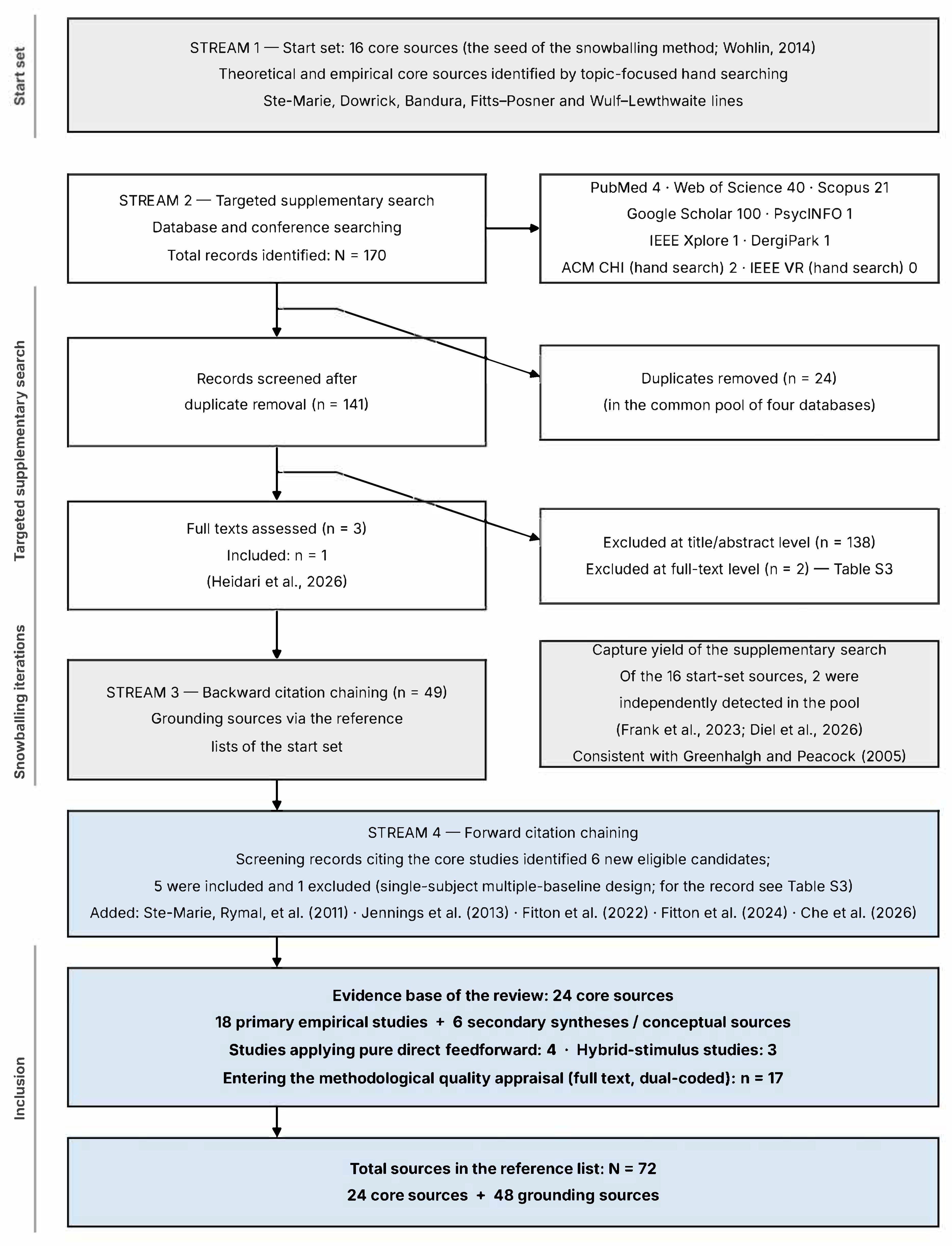
The sources included in the review were identified through four streams. The whole process is presented as a flow diagram in Figure 1; the record counts obtained per source in the supplementary database search and the fate of each record are given in Table 1.
Table 1.
Records Identified per Source in the Targeted Supplementary Search and Their Disposition.
Stream 1—start set. Sixteen core sources were identified through topic-focused hand searching so as to represent the field’s five research traditions. The hand search was carried out by the first author and preceded the database search of 14 August 2026; it was not logged record by record, so the start set is documented here by its composition rather than by a search log, and the 16 sources are listed individually in the Supplementary Materials (Section S3, Table S4). Measured against the diversification criteria, the set spans 2002–2026 across 11 distinct publication years, has 16 distinct first authors and appears in 14 distinct outlets, the only repetition being three articles in one journal [23]. Its distribution across the classification of Section 2.5 is uneven: eight sources are VR/Avatar (one of them a hybrid-stimulus study), three Expert/External Model, two Neurological Foundations, and one each VSM/Feedforward, VSM/PSR and Generative Artificial Intelligence. The feedforward and video self-modeling strand was therefore the most thinly represented part of the start set; two of the five studies later added by forward citation chaining fall in that strand, which is one reason the chaining streams rather than the start set determined the final shape of the corpus (Section 4.5, item b). Stream 2—targeted supplementary search. PubMed, Web of Science, Scopus and Google Scholar results were combined in a common pool (N = 165); after duplicate removal (n = 24, Rayyan [31]) the remaining 141 records were screened at title and abstract level, and 138 excluded. Of the three full texts obtained, two were excluded as content-overlapping earlier versions, and one [30] was included. ACM CHI hand searching yielded two studies [12,28]; one record each from PsycINFO, IEEE Xplore and DergiPark was excluded for access restriction or failure to meet the criteria.
Stream 3—backward citation chaining. The reference lists of the start-set studies yielded 49 grounding sources, 47 of which were used in the final text; these serve as theoretical and methodological reference and are not appraised in Table 2. Among them are meta-analyses establishing the effect size and bias profile of neighboring studies in the literature [1,19,20,32]. Stream 4—forward citation chaining. Records citing the core studies [4,12,16,28] were screened, yielding six candidates; five were included [29,33,34,35,36], and one excluded for a single-subject multiple-baseline design. The process ended when a second iteration yielded no new eligible record.
The streams contributed 16, 3 and 5 core sources, respectively (Stream 3 produced grounding sources only), giving 24 core sources; with the 47 grounding sources cited from Stream 3 and the methodological reference for the de-duplication software [31], these constitute the 72-item reference list. Of the 24, 18 are primary empirical studies, and 6 secondary syntheses or conceptual sources (Table 3). In four primary studies [16,28,30,33], the observed movement belongs to the participant, constituting pure direct feedforward. In three further studies, the movement belongs to another person, while the identity or appearance belongs to the participant [12,26,29]; these are kept separate as hybrid-stimulus studies (Section 2.5 and Section 4.2). The remaining 11 provide analogue evidence. Seventeen of the 18 entered the quality appraisal; Ref. [37] was left out because it tests no intervention effect. The proportion applying pure direct feedforward (4/18, or 7/18 with the hybrid-stimulus studies) should be kept in mind throughout the synthesis below.
2.5. Thematic Classification
The core studies were classified under five main categories: (1) VSM/Feedforward, (2) Expert/External Model, (3) Neurological Foundations, (4) VR/Avatar, (5) Generative Artificial Intelligence. Two subcategories were defined for borderline studies: VSM/PSR (positive self-review; a non-feedforward self-modeling variant based on viewing an individual’s best past performances) and Technology-Supported Feedforward (interventions applying the feedforward principle through digital systems but without generative image synthesis). Across the 24 core sources, the distribution is VR/Avatar 9, with a further 2 classified as VR/Avatar (hybrid stimulus); VSM/Feedforward 3; Expert/External Model 3; VSM/PSR 2; Generative Artificial Intelligence 2; Neurological Foundations 2; and Technology-Supported Feedforward 1 (Table 3). Avatar-based observation is therefore the largest single strand of the corpus, while the generative artificial intelligence strand comprises one primary study and one scoping review.
The taxonomy has two axes: category assignment follows primarily the source of the observed content (self-model/external model), with the technological substrate used only as a secondary criterion, so the VR/Avatar category is a technological superordinate heading containing studies with different content sources. Studies in which the observed movement belongs to another person were accordingly placed in the Expert/External Model category [38,39,40]; the assignment of [39], who treat expert modeling and self-modeling with equal weight, rests on the predominance of external-model-based video feedback in that review and is open to debate. In three studies, movement was derived from another individual, whereas the avatar’s identity or visual appearance was matched to the participant. Specifically, this was achieved through face-swapping technology [12], animating a participant-specific scanned avatar using movements performed by a skilled individual [26], or customizing the self-avatar’s visual appearance without modifying the underlying movement patterns [29].These are not pure self-models in the sense of [4] and are kept separate as hybrid-stimulus studies (Section 4.2).
Figure 1.
Flow Diagram of the Study Selection Process. Stream 1 is the start set, Stream 2 the targeted supplementary database and conference search, Stream 3 backward citation chaining, and Stream 4 forward citation chaining. Stream 2 was not a verification of the coverage achieved by snowballing; its independent detection rate was two of the 16 start-set sources (Section 4.5, item b). The grounding sources identified in Stream 3 were not included in the quality appraisal. The included count in the Stream 2 box (n = 1) refers to the database sub-stream only; with the two ACM CHI studies, this stream contributed three core sources (Table 1). Figure created by the authors. The sources presented in the figure are cited as follows: Wohlin [23], Greenhalgh and Peacock [25], Frank et al. [26], Diel et al. [27], Fitton et al. [29], Heidari et al. [30], Ste-Marie et al. [33], Jennings et al. [34], Fitton et al. [35], and Che et al. [36]. Among these, two start-set sources [26,27] were independently identified through the database search, whereas one additional record [30] was included from the database pool. Five further studies [29,33,34,35,36] were incorporated through Stream 4. The author names displayed in the start-set box represent five distinct research traditions underpinning the initial selection rather than individual publications. The complete list of the 16 start-set sources is provided in Supplementary Table S4.
2.6. Methodological Quality and Risk-of-Bias Appraisal
The quality appraisal was applied to experimental and quasi-experimental studies whose full texts were obtained and could be coded by both raters (n = 17). The only primary study left out is [37]; the appraisal could not be applied because it tests no intervention effect.
No composite quality score or band was produced. Composite scores are sensitive to item selection, weighting and cut points and can conceal risk of bias [41], and current tools produce dimension-level judgements rather than totals (RoB 2: [42]; ROBINS-I: [43]). Established tools were not applied directly because of design heterogeneity: the checklist of [44] cannot be adapted to within-subjects field designs, and the Mixed Methods Appraisal Tool [45] uses design-specific criterion sets. Earlier versions used a five-item summable scale, but sensitivity analyses showed the classification to be sensitive to a single item and to sample differences of two participants; a non-summed, dimension-level profile was therefore adopted (Table 2). The criterion for selecting the five dimensions was that each had to be applicable, with the same meaning, to every design in the pool. Four domains covered by RoB 2 and ROBINS-I fail that criterion and are therefore not assessed. Allocation concealment and baseline equivalence presuppose assignment to parallel groups, and in six of the 17 appraised studies, the main analysis is within-subjects (Table 2), so neither domain is defined for them; for the remaining 11, baseline comparability is addressed indirectly through the randomization dimension. Attrition is not scored separately because the power-ratio dimension is computed throughout on the analyzed rather than the enrolled sample, so sample loss is already carried as a penalty within that dimension. Selective outcome reporting is assessable only against a pre-registered protocol or trial registration, which is not established practice in this literature—the reason it is recommended in Section 4.6. Table 2 is accordingly a partial profile, covering the domains that can be applied uniformly across the pool, and not a complete risk-of-bias assessment.
Dimensions and Their Operational Definitions
Five dimensions were coded: (1) randomization, (2) assessor blinding, (3) the ratio of the analyzed sample to the power requirement, (4) measurement evidence for self-report outcomes and subjective rater scores, and (5) retention or transfer testing. For the third dimension, the analyzed sample was divided by the sample required to detect d = 0.50 at α = 0.05 with power = 0.80 (between-subjects total n = 128, [46]; within-subjects n = 34, computed for a paired-samples t test using the noncentral t distribution), at the level of comparison at which the main feedforward effect was tested; for multi-experiment articles, the smallest experiment was used. For designs with more than two arms, the ratio is calculated on the total analyzed sample and is therefore an upper bound that understates the power deficit. Because the within-subjects requirement is expressed on paired differences, the two thresholds are not directly comparable, and the ratio rests on a single uniform benchmark rather than on each study’s own power analysis. The fifth dimension was coded separately because of the centrality of the acquisition–learning distinction [8,9]. Coding rules and constraints for each dimension are given in the Supplementary Materials (Section S4, Table S5).
Coding was carried out independently by two raters (E.M.K., Ö.E.) on the basis of a written protocol prepared in advance. The second rater is also a co-author of this article and therefore does not provide the independence an external rater would, and no external verification of the final codes was obtained. The two raters agreed on all 85 paired decisions, so Cohen κ is 1.00 for every dimension and for the pooled set. That value is reported for completeness but is uninformative here: a chance-corrected coefficient quantifies consistency between raters, not accuracy against the source text, and in this coding exercise, the two came apart. Across six full-text verification rounds conducted before submission, 18 of the 85 codes (21.2%) were corrected for 13 of the 17 studies (76.5%); some of the corrected codes had been assigned erroneously by both raters, and the corrections ran in both directions, with criteria counted as unmet although evidence was present and counted as met although no statement existed. Perfect inter-rater agreement therefore coexisted with an initial code error rate above one in five. Where coding turns on what authors did not report, agreement between raters is a weak quality signal, and repeated verification against the source texts is the binding constraint. The round-by-round record is given in the Supplementary Materials (Section S4.2).
2.7. Data Extraction and Synthesis
The descriptive data in Table 3 were extracted from the full texts by the first author, verified against the source texts by the second author, and disagreements were resolved by consensus; no separate agreement coefficient was computed. Only values actually reported in the source article were transferred to the effect size column, with consistency computations performed by the authors placed in the table note.
The synthesis is organized thematically around three dependent variables (motor skill performance, self-efficacy, state anxiety); because of the small number of studies and design heterogeneity, no meta-analytic pooling was performed. No formal framework for grading certainty of evidence (e.g., [47]) was applied; instead, the direction of the findings (Table 3) and the risk of bias profile of the studies producing them (Table 2) are reported separately.
Use of generative artificial intelligence. A large language model-based assistant was used for editorial review of the draft text, restructuring of sections and language editing. The formulation of the research questions, the literature search, study selection, quality coding, and all scientific interpretation and conclusions are the work of the authors. No AI-generated content was used without verification, and the authors take full responsibility for the manuscript.
Table 2.
Methodological Quality and Risk-of-Bias Profile of the Experimental and Quasi-Experimental Studies (n = 17).
Table 3.
Characteristics and Reported Effect Sizes of the 24 Core Sources Included in the Review.
3. Results
The synthesis is presented in three subsections corresponding to the three dependent variables; within each, the evidence is first summarized and then appraised against the methodological profile reported in Table 2.
3.1. Effects on Motor Skill Performance
3.1.1. Synthesis of the Evidence
Positive effects of feedforward and VSM methods on motor skill performance have been observed across different sports. Using a within-subjects design, Ref. [16] found significantly higher skill acquisition in the feedforward self-modeling condition, reporting effect sizes only on the partial eta squared scale. The same team tested feedforward self-modeling under field conditions in [33]: 22 competitive gymnasts were alternately placed in viewing and no-viewing conditions across a season (20 analyzed), and beam scores were significantly higher in the viewing condition (η2 = 0.26), with no difference in self-efficacy (η2 = 0.002). Ref. [15] found a positive self-review group superior to controls in swimming performance, intrinsic interest and self-satisfaction, an intervention representing the PSR subtype of VSM rather than feedforward. Ref. [38], randomly assigning 116 children to two groups, found expert video modeling superior to self-video viewing in volleyball skill outcome and form, and is included as an Expert/External Model comparison point. By contrast [34], randomly assigning 19 novice cyclists and including a retention test, reported no significant advantage of video self-modeling over verbal feedback alone in performance or self-efficacy; the reported degrees of freedom (F(2, 27) = 2.83, p = 0.08; F(2, 24) = 0.53, p = 0.59) are incompatible with the stated sample size, an inconsistency the source text does not explain.
In their systematic review of video-based visual feedback in physical education (11 studies from 2030 records), Ref. [39] reported that visual feedback supported by verbal feedback can contribute to motor learning. This should be read alongside the debate on feedback frequency: the guidance hypothesis proposes that reduced frequency improves retention [5], whereas a positive effect of frequency has been reported for feedback inducing an external focus of attention [52], although part of that literature carries the low-power and reporting-bias problems documented by [20].
The VR and avatar literature, although it does not involve feedforward directly, provides indirect evidence on the mechanism of observing one’s own digital representation. Ref. [26] compared participants watching their own avatar perform at a skilled level with concurrent motor imagery against those watching their own novice performance. Neither group approached the skilled level, and no group main effect was significant; the group × time interaction was significant on two measures (F(3, 72) = 5.32, p = 0.002; F(3, 72) = 7.72, p < 0.001), arising from change in the novice-model group. For cognitive representation structure, a within-condition change is reported in the skilled-model condition without any between-group interaction test; because an effect significant in one condition and non-significant in another does not show that the two differ [53], this is not evidence of a group difference. Given the sample size (n = 26), it is best read as a hypothesis.
Ref. [28] showed that interactive feedforward in a VR cycling exergame significantly improved performance while preserving intrinsic motivation. The manipulation contrasts an unaltered replay of the participant’s own past performance with an enhanced self-model version; the within-subjects main effect of game mode was significant (F(1, 33) = 63.2, p < 0.001, ω2 = 0.63, Cohen d 95% CI [0.88, 1.80]; n = 36). The same study framed largely the same stimulus either as the participant’s own performance or as a “virtual opponent”, and the group framed as viewing themselves performed significantly better (d = 1.30; n = 24), suggesting that the effect depends on the observer’s identity attribution as well as on stimulus content. The two values differ in kind: ω2 = 0.63 pertains to a within-subjects main effect, whereas d = 1.30 comes from an independent-groups comparison with n = 24 and risks inflation.
Self-avatar-based observation is addressed in three studies. Ref. [29] compared participants watching contemporary dance sequences through a self-avatar or a generic avatar (n = 16): similarity, liking, identification and immersion were significantly higher in the self-avatar condition, but no learning or performance advantage was reported, and because the animations came from the experimenter’s movement, the study falls among the hybrid-stimulus studies. In a larger follow-up, Ref. [35] manipulated the demonstrator avatar’s visual similarity at three levels against active learning (N = 102): observational learning with practice improved far transfer, but self-similarity had no significant effect on any learning outcome. Ref. [36], testing an adaptive self-avatar VR exercise system in older adults, reported that performance declined significantly in the self-avatar condition (p = 0.03) although participants preferred its real-time feedback. The two do not share a manipulation and therefore do not corroborate each other; together, they show only that a unidirectional positive effect of self-similarity is unsupported (Section 4.2). Finally, Ref. [40] showed, in an 11-week randomized controlled trial (n = 55), that VR-supported video modeling improved motor skill acquisition, but participants watched another person from a first-person perspective, evidencing technology-supported visual modeling rather than self-modeling.
The methodologically strongest study applying direct feedforward is [30]. The researchers screened 210 students with the Children’s Motor Imagery Questionnaire and randomized the 72 meeting the imagery criterion (M age = 11.63 ± 1.12) to six conditions crossing feedforward self-modeling, non-feedforward self-modeling and expert model with simultaneous or alternating AOMI. Over 6 weeks, participants performed 40 free throws per session 3 days per week with PETTLEP imagery, and retention and transfer tests followed 1 week after the post-test—the only direct feedforward design including both; Ref. [16] included a retention test only. The feedforward and expert model groups were significantly superior to the non-feedforward groups on performance and self-efficacy (all p = 0.001), and feedforward with simultaneous AOMI also surpassed the expert model with simultaneous AOMI (p = 0.01), while the group × time interaction was reported as non-significant for performance. That statistic (F(15, 198) = 2.93, p = 0.14) is internally inconsistent, since the critical value at α = 0.05 is approximately 1.72, and the p value computed for the reported F and degrees of freedom is 0.0003. The self-efficacy interaction (F(10, 132) = 0.65, p = 0.6) is consistent in the direction of non-significance; the p value computed for it is 0.77 rather than the reported 0.6, but both lie far above the threshold, so the discrepancy does not affect the inference. The most rigorously tested link in the evidence base therefore cannot be evaluated as reported on differentiation over time.
Motor performance evidence specific to AI-supported feedforward is limited to the single conference paper of [12]. The FakeForward method produces a self-model video by placing the participant’s face onto a recording of a better-performing individual. In Experiment 1, the manipulated video was compared with an unmanipulated recording of a peer model, and participants watching FakeForward videos showed significant performance increases on four of six physical exercises (wall-sit, squat, sit-up, squat jump); for plank and press-ups, the difference did not reach significance, and given the sample size (n = 24), the direction of those differences is not interpretable. Experiment 2, which compared the manipulated video with an unmanipulated video of a professional speaker, belongs to a public-speaking rather than a motor skill context and is addressed in Section 3.3.
3.1.2. Critical Appraisal of the Performance Evidence
Acquisition or learning? One constraint applies to all findings in this section and takes precedence over individual methodological shortcomings. An intervention’s contribution to learning can be inferred only from delayed retention and transfer tests administered after its withdrawal; acquisition advantages may reflect transient performance effects [8,9]. The distinction is especially critical for feedforward, because the guidance hypothesis [5] predicts precisely a dissociation between acquisition and retention. Seven of the 17 appraised studies report a delayed retention or transfer test [15,16,26,30,34,35,38]; in the remaining 10, measurement is confined to acquisition. Only two of the four pure direct feedforward studies include a delayed measurement, and the relevant interaction statistic of [30] is not interpretable; of the three hybrid-stimulus studies, only [26] includes one. The claim that feedforward supports motor skill performance is therefore defensible predominantly at the acquisition level; at the learning level, it has been tested once for direct feedforward and was not clearly supported.
Methodological problems. (a) Sample insufficiency is structural. Sixteen of the 17 appraised studies do not reach the sample required to detect a medium effect (d = 0.50) at α = 0.05 with power = 0.80; the sole exception is [28], which tested the main feedforward effect within subjects (n = 36; within-subjects requirement n ≥ 34). None of the 11 studies conducting between-subjects comparisons meets the requirement of total n = 128, the highest ratio remaining at 91% ([38]; n = 116; [46]; see Table 2 and Table 4).
Table 4.
Sensitivity Checks on the Power Analysis and Coding Decisions.
(b) Assessor blinding meets the criterion in only two studies [16,18]; Ref. [34] blinded only one of two coaches and [15] state that blinding was not complete, and partial blinding was not counted as met (Table 4, Analysis 3). Participant blinding was not possible in any study. (c) A retention or transfer test is present in seven of the 17 studies (see above). (d) Demand characteristics were addressed in only three studies: Refs. [17] (Experiment 3) and [18] blind-coded participants’ guesses about the purpose of the experiment, and Ref. [28] limited Hawthorne effects through comparisons between similar conditions. (e) Ref. [19] documented reporting bias and inflated effect sizes in the self-controlled motor learning literature, and Ref. [20] in both that and the enhanced expectancies literature; this pattern is likely to hold here.
(f) The principal problem in effect size reporting is not absence but the lack of a common scale. Only two of the 17 studies report no point value [36,38]; eight report variance-explained values only, and seven report point values on the Cohen d scale. Variance-explained proportions depend on the comparison structure and design and cannot be combined across designs, and the reported d values derive variously from between-subjects, within-subjects and paired comparisons. A confidence interval around a standardized effect size is reported in only two studies [28,35]. Quantitative pooling of this evidence base is therefore not possible at present.
(g) The type of outcome measured constrains the expected effect size. Ref. [1] reported that observational modeling produces a substantial effect on movement dynamics measures (δ = 0.77) but a small one on movement outcome measures (δ = 0.17). Ref. [12], the only direct evidence on AI-supported feedforward, used predominantly movement outcome measures, obtaining its effects in the category where observational learning is weakest; including movement dynamics measures is a priority for future studies. (h) Individual differences have not been tested as moderators, and because skill level is not systematically classified, the level-based moderation predicted by the Challenge Point Framework [11] has not been possible. The dimensions of the Applied Model of [2,3] are likewise not reported consistently, so the source of differences among findings cannot be disentangled.
3.2. Effects on Self-Efficacy
3.2.1. Theoretical Framework and Synthesis of the Evidence
Self-efficacy is the central construct of the social cognitive theory of [54,55] and draws on four sources; feedforward carries the potential to activate direct (enactive) and vicarious experience simultaneously. In a meta-analysis based on 45 studies, Ref. [32] found a mean relationship of r = 0.38 between self-efficacy and sport performance and reported that the strongest moderator was the concordance between the self-efficacy and performance measures.
The assumption that feedforward operates through self-efficacy is formulated explicitly in OPTIMAL theory [21]: practice conditions strengthening the learner’s expectancy of success improve both immediate performance and durable learning. This ground has been shaken: Ref. [20] showed meta-analytically that in both the self-controlled practice and the enhanced expectancies studies, reporting bias combined with underpowered designs markedly exaggerated motor learning gains, and Ref. [19] documented the same for the former separately. Inconsistent self-efficacy findings are therefore an expectable extension of that pattern rather than an isolated anomaly.
The evidence pool comprises studies that measured self-efficacy as an outcome, entered the quality appraisal and included a self-modeling or feedforward component (n = 7): [12,15,16,26,30,33,34]. Refs. [35,49] measured self-efficacy but contain no self-modeling component and are treated as indirect evidence; neither reports a between-condition difference. The empirical picture largely fails to support the theoretical expectation. Ref. [15] found no significant self-efficacy difference despite performance gains; Ref. [16] repeated the pattern for trampoline skills, and Ref. [33] found no difference despite higher beam scores; Ref. [34] found none in cyclists. In [26], the main effect of time on general self-efficacy is non-significant (F(2, 48) = 1.04, p = 0.361), with increases confined to squat-specific subscales. Ref. [12] detected a significant advantage on only one of six exercises without multiple-comparison correction, which was not counted as positive evidence at study level.
The sole exception is [30], the only study whose total sample meets the minimum sample floor (Table 4, Analysis 2), although each pairwise comparison in its six-arm design falls well below it. A significant between-group advantage is reported where feedforward self-modeling was combined with action observation and motor imagery (p = 0.001), but the group × time interaction was non-significant (F(10, 132) = 0.65, p = 0.6)—not evidence that the effect did not differentiate over time, but that differentiation could not be demonstrated. Because no equivalence test or Bayes factor is reported, attributing the post-test difference to the intervention can be neither supported nor refuted.
The seven studies entering the pool indicate that the effect of feedforward on self-efficacy, although theoretically expected, has not yet been demonstrated empirically; Ref. [12] themselves state that the performance gains could not be explained by the psychological variables measured. In the light of the measurement-concordance finding of [32], it should be tested whether this inconsistency arises partly from self-efficacy measures that are not task-specific.
The VR literature provides indirect evidence from studies sharing the mechanism of digital self-observation without involving feedforward. Ref. [17] found in two of three experiments that participants watching their own virtual self-model exercising exercised more than those watching another person; Ref. [18] showed that avatar characteristics influenced behavior inside the virtual environment (the Proteus Effect) without measuring transfer outside it; and Ref. [48] found that personalized avatars increased body ownership, presence and perceived dominance. Ref. [49] report a within-condition increase in self-efficacy but no between-group difference, and a within-condition increase cannot be read as a between-group advantage [53]. Ref. [40] did not measure self-efficacy.
3.2.2. Critical Appraisal of the Self-Efficacy Evidence
A decisive constraint governs the null findings: none of the six studies failing to find a significant self-efficacy difference reaches the sample required by the criterion of [46] (n = 33, 27, 20, 19, 26 and 24/20, respectively), none reports an a priori power analysis for self-efficacy, and none presents an equivalence test or Bayes factor. In the only study meeting the minimum sample floor [30], a between-group advantage is reported, while the interaction remains non-significant. The picture therefore indicates not that feedforward has no effect on self-efficacy but that this effect has not yet been tested reliably; for a claim of absence to acquire evidential value, an equivalence test (e.g., TOST; [56]) or a Bayes factor must be reported.
A second constraint operates at the level of measurement: the psychometric properties of the task-specific self-efficacy scales are not reported in most studies, and no distinction is drawn between self-efficacy change as a direct product of the intervention and as an effect of subsequent performance feedback, the timing of measurement not having been designed to disentangle the two.
A third constraint concerns the direction of self-similarity. Ref. [35] detected no significant effect of similarity level on any learning outcome, while [36] reported a significant decline in exercise performance in the self-avatar condition (p = 0.03). Neither is conclusive alone (Table 2), but their common implication is that a unidirectional positive effect of self-similarity on vicarious experience is unsupported, so the path through which feedforward is assumed to act on self-efficacy (Section 4.4, Path C) has met partly negative evidence. Emotional valence may be involved: Ref. [26] note that watching one’s own avatar was novel for most participants and may generate unmeasured emotional responses, which together with [48] suggests that the initial period of such an experience should be structured carefully. Neither study measured the uncanny valley effect [57] directly.
3.3. Effects on State Anxiety
3.3.1. Theoretical Framework and Mapping the Absence of Evidence
This section rests not on a synthesis of direct evidence but on mapping its absence. State anxiety is a transient state experienced in a particular situation [58], operationalized in sport contexts through multicomponent frameworks [59]. The contemporary account of how anxiety impairs motor performance rests on Attentional Control Theory: anxiety weakens the dominance of the goal-directed attentional system over the stimulus-driven system and so impairs the central executive, with performance declining only where compensatory effort becomes insufficient [60]; Ref. [61] adapted this to perceptual-motor performance. The inverted-U reading of the arousal–performance relationship is not used here, because it is not supported by the study of [62] to which it is frequently attributed [63].
As a theoretical inference by the authors, the anxiety-reducing potential of feedforward can be attributed to three untested mechanisms. (1) Repeated exposure may reduce threat value through habituation and extinction; this must be distinguished from the mere exposure effect [64], which concerns liking rather than anxiety and was demonstrated with initially unfamiliar stimuli, whereas one’s own face is already a high-exposure stimulus. (2) The inverse relationship between self-efficacy and anxiety posited by [54,55]. (3) An extension of the cognitive restructuring framework of [65]; because restructuring there is an active, guided operation, whether passive viewing initiates the same process is hypothetical.
Direct empirical evidence is extremely limited. Ref. [12] reported a significant reduction in speaking anxiety among participants who gave a talk after watching a FakeForward video, but the finding belongs to a public-speaking context, and anxiety was not measured in motor skill tasks. Ref. [37] compared a VR stress scenario with measurements after a real competition and found no significant difference (p > 0.05); without an equivalence test or Bayes factor, this states only that a difference could not be demonstrated [56], and because the study tests no intervention effect, it was not appraised. No study was found that directly tests the effect of AI-supported feedforward on state anxiety in a sport context.
3.3.2. Critical Appraisal of the Anxiety Evidence
The evidence base for state anxiety is by far the weakest of the three dependent variables, and all inferences in this section rest on indirect evidence from different task domains or intervention types. Anxiety was not measured with instruments established in sport psychology (e.g., CSAI-2R, STAI-S). The divergence between the anxiety-reducing finding of [12] and the anxiety-increasing deepfake findings reviewed by [27] need not indicate opposing theoretical predictions: framing, emotional valence of awareness, task domain, population, outcome measure and design are equally plausible explanations, and because these have not been compared in a controlled design, the source of the divergence remains an open empirical question. The appraisals here should be read as hypotheses awaiting testing.
4. Discussion
4.1. Answers to the Research Questions
Answer to RQ1: The findings of studies applying direct feedforward are directionally consistent for motor skill acquisition but limited in number, and some self-similarity-based analogue studies report effects in the opposite direction. An effect on self-efficacy could not be demonstrated in six of the seven studies measuring it with a self-modeling or feedforward component; the only exception is [30], whose self-efficacy interaction statistic is consistent in the direction of non-significance, while the one reported for performance is not (Section 3.1.1). An effect on anxiety reduction has never been tested in a sport context. Answer to RQ2: The evidence base specific to generative AI-supported feedforward is confined to a single conference paper [12]. Answer to RQ3: Small samples, absent assessor blinding, rare retention and transfer measurement, and effect sizes without a common scale or confidence intervals are the prominent weaknesses.
The evidence–quality relationship is reported across five dimensions without a composite score or band (Table 2). This is a methodological necessity: sensitivity analyses on the summable scale used in earlier versions showed the classification to be sensitive to a single item and to sample differences of two participants (Table 4, Analyses 2 and 4), and established warnings about composite scores point the same way [41,42]. The findings below therefore rest not on a quality ranking but on three directly countable structural features.
Three findings stand independently of any quality classification and constitute the review’s central contribution. First and most robust, 16 of the 17 appraised studies lack a sample capable of detecting a medium effect (d = 0.50) at α = 0.05 with power = 0.80 (Table 4, Analysis 1): none of the 11 between-subjects studies reaches total n = 128, the highest ratio being 91% [38], and the sole exception is [28], which tested the main effect within subjects (n = 36). Second, assessor blinding is reported in only two of the 17 studies [16,18] and in one of the four applying pure direct feedforward. Third, a delayed retention or transfer test was administered in seven of the 17 and in two of those four. None of the three depends on a quality score or threshold decision. To these is added an outcome-level observation: a between-condition difference could not be demonstrated in six of the seven studies measuring self-efficacy, none of which reported an equivalence test.
The resulting picture is more specific than a verdict of “low quality”. The point at which the evidence base has been tested most rigorously is also where the causal claim is weakest: the only direct feedforward study that both meets the minimum sample floor and administers retention and transfer tests is [30], whose group × time interaction statistic for performance is internally inconsistent (Section 3.1.1), while [28], the other study meeting that floor, includes no delayed measurement. The strongest link in the evidence base is, for precisely that reason, the least interpretable.
The evidential strength of these inferences is limited by the small number of studies applying pure direct feedforward (n = 4; n = 7 including the hybrid-stimulus studies) and by the fact that the dimension-level coding has not undergone external verification.
4.2. Comparison of Traditional and AI-Supported Feedforward
At the theoretical level, AI-supported feedforward promises an advantage in production cost, data requirement and visual realism: a traditional feedforward video requires that the individual have performed the component behaviors at least once and demands extensive filming and editing [6], whereas generative models overcome this through face swapping [12]. No dimension of this promise has been tested in a direct comparative study, and Table 5 states the evidential status of each. What is decisive is the shared limit: in both traditions, only [28] has a sample capable of detecting a medium effect at accepted power, and assessor blinding is reported in only one of the five studies [16].
Table 5.
Dimension-by-Dimension Comparison of Traditional and AI-Supported Feedforward.
A more fundamental theoretical question is unanswered. In traditional feedforward, both the observed movement and the identity belong to the individual; in generative approaches, the movement belongs to another person, while the identity belongs to the individual. Whether this hybrid stimulus satisfies the self-model definition of [4] has not been tested experimentally. This is the field’s most pressing conceptual gap, because a negative answer would reclassify the method as personalized external modeling rather than feedforward. The framing finding of [28] showed that identity attribution can be functional independently of the actual source of the stimulus, but the two studies added through forward citation chaining do not support that expectation: Ref. [35] reported that similarity level had no significant effect on near transfer, far transfer or delayed retention (N = 102), and Ref. [36] found performance declining significantly in the self-avatar condition (p = 0.03). Because the two share no manipulation and one is null while the other is significant in the negative direction, their common result is the absence of a positive mechanism claim. The effect may yet be task-dependent, but this has not been tested; hypothesis H4 in Section 4.6 should therefore separate identity attribution from visual self-similarity and from the source of the movement, with task type as a moderator.
4.3. Ethical Dimensions
AI-supported feedforward carries a qualitatively different ethical risk profile from that of the traditional method. The three issues below are set out as protocol-design requirements and research agenda items rather than as a legal analysis. First, the status of a facial image differs across regimes: under GDPR Art. 4(14), it counts as biometric data only when processed in a way that permits unique identification, whereas Art. 6 of the Turkish Personal Data Protection Law treats biometric data as special-category data irrespective of purpose [66,67]. A single consent form may therefore not satisfy both, and it must address storage, use in model training, retention period and destruction on withdrawal. Art. 50 of the EU Artificial Intelligence Act adds marking and disclosure obligations, while Art. 2(6) places systems used solely for scientific research outside its scope [68].
Second, psychological harm is a structural rather than incidental risk: Ref. [27] report that deepfake exposure has been associated with anxiety, distress, distrust in media and reduced self-efficacy, and whether this generalizes to consented, positively framed educational use is unknown. Third, the uncanny valley hypothesis [57] and a self-similarity threshold are plausible moderators but have not been measured in any feedforward study. None of the three has been tested in this context. They are therefore carried into Section 4.6 as governance requirements—psychological risk assessment and mandatory debriefing, on the precautionary principle—rather than presented as established findings.
4.4. Proposed Conceptual Model
The integrated model derived from the current literature contains four effect paths (Figure 2). (A) Mirror neuron activation → motor simulation → increased motor performance [50,69]. (B) Repeated exposure → reduction in threat value through habituation and extinction → reduced state anxiety. (C) Vicarious experience, enhanced expectancies and the Proteus Effect → increased expectancy of success → increased self-efficacy [18,21,54,55]. (D) Cognitive restructuring → reduction in negative self-evaluation → reduced anxiety and increased self-efficacy [65]. The moderators—self-similarity threshold, the uncanny valley hypothesis, expectancy effects and the learner’s skill level [11]—affect the entire relationship between exposure and all four paths rather than a single path.
Figure 2.
Proposed Conceptual Model for AI-Supported Feedforward. Note. None of paths A–D has been tested directly in the AI-supported feedforward context, and all are shown with dashed lines. The solid line is reserved for the Proteus component of Path C [18], the only element with experimental evidence outside the context; that study did not measure self-efficacy and did not test transfer outside the virtual environment. The moderators affect the whole relationship between exposure and all four paths. Figure created by the authors. The sources named in the figure are cited as follows: Guadagnoli and Lee [11]; Yee and Bailenson [18]; McKay et al. [19,20]; Rizzolatti and Craighero [50]; Ramsey et al. [51]; Bandura [54,55]; Mori [57]; Zajonc [64]; Beck [65]; Holmes and Calmels [69]; Hickok [70]; and Heyes and Catmur [71].
The model is speculative: none of the four paths has been tested in the AI-supported feedforward context, and the theoretical basis of two is contested. For Path A, the causal role of the mirror neuron system in action understanding has been criticized [70]; Ref. [71] report weak evidence for its contribution to high-level action interpretation, and [51] argue that observational learning rests on distributed systems encompassing executive control, reward and social cognition. Path C is questioned from two directions: the evidential value of enhanced expectancies [19,20], and the self-similarity assumption, unsupported in both studies that manipulated it directly [35,36]. In Path D, the difference between active, guided restructuring and passive viewing has not been tested. The model is therefore a hypothesis-generating heuristic rather than an explanation.
4.5. Limitations
(a) The critical review format involves more reviewer judgement in study selection and synthesis than a systematic review; the grounds for choosing it are given in Section 2.1 and are not repeated here. There is no pre-registered protocol for the review, and full PRISMA 2020 [72] compliance is not claimed.
(b) The snowballing method is structurally dependent on the start set and cannot capture isolated studies having no citation relationship with any core study. This was reduced by diversifying the start set and by forward citation chaining, which produced five new eligible studies and reached saturation in the second round. The supplementary database search had low sensitivity: because the intervention and technology sets were joined with AND, feedforward and VSM studies containing no technology term could not enter the pool, and only two of the 16 start-set sources were independently detected there. That search therefore did not verify the coverage achieved by snowballing, and the counts in Table 1 should be read as a record of its yield rather than as a coverage estimate (Supplementary Materials, Section S1). Its net contribution to the corpus was one core source of 24 [30], so the screening of that pool carries correspondingly little weight on the composition of the evidence base.
(c) Screening and study selection were carried out by a single reviewer, and the dual rating in the quality coding does not remove the risk of selection bias at that stage; a cross-check in Rayyan showed that two core studies [26,27] were present in the pool but had been erroneously excluded at title/abstract screening, and both were recovered. The reasons for excluding the 138 records screened out at that level were not retained record by record, and the screening project is no longer available, so these reasons cannot be reconstructed even in aggregate categories; three excluded records could not be reported bibliographically. This is an irreversible traceability gap and is reported as such. Its bearing on the corpus is bounded: that pool contributed one of the 24 core sources [30], and the two records erroneously excluded from it were both recovered through the other streams, so the composition of the evidence base does not rest on the screening decisions that cannot be documented.
(d) Only English- and Turkish-language publications were included, with the criterion applied in extended form for one Persian-language record [30], coded first from the English extended abstract and then recoded from the full text before submission; coding through translation risks not preserving intra-linguistic nuance. Because preprints were excluded, unpublished null findings are not reflected in the evidence base.
(e) The five dimensions were chosen to be applicable in common to heterogeneous designs and were not taken from a validated tool; the choice rests on reviewer judgement. Allocation concealment, baseline equivalence, attrition and selective outcome reporting are not covered, for the reasons set out in Section 2.6, so the profile in Table 2 is partial rather than complete. On the retention dimension, the nature of the test was not coded, so a 24-hour retention test and a one-week transfer test are marked identically. Because the appraisal could be applied only to designs testing an intervention effect, Ref. [37] fell outside its scope.
(f) Inter-rater agreement was complete (85 of 85 decisions; κ = 1.00), but 18 of those 85 codes (21.2%) were subsequently corrected against the source texts across six verification rounds, affecting 13 of the 17 studies; the dissociation between agreement and accuracy, and its implications, are set out in Section 2.6 and in the Supplementary Materials (Section S4.2). Two residual constraints apply here: the second rater is also a co-author, which does not reach the independence an external rater would provide, and no external verification was obtained, and there is no guarantee that a seventh verification round would produce no further corrections.
(g) The number of studies applying a pure direct feedforward intervention (n = 4), the total including hybrid-stimulus studies (n = 7) and the number specific to generative AI-supported feedforward (n = 1) fundamentally limit the evidential strength of the inferences. The conclusions therefore apply to the feedforward and video self-modeling line as a whole, together with the avatar-based observational learning studies that share its mechanism; they do not constitute an evaluation of generative AI-supported feedforward, for which a single primary study exists.
4.6. Recommendations for Future Research
The agenda below follows from the three structural weaknesses identified above. (1) Design: randomized controlled trials comparing at least four conditions (AI-supported feedforward, traditional feedforward, expert model, control), with assessor blinding, a sample determined in advance by power analysis—for a between-subjects contrast at d = 0.50, this means a total of at least 128 participants, four times the median analyzed sample of the present pool (n = 32)—both movement outcome and movement dynamics measures, delayed retention and transfer tests, and standardized effect sizes with confidence intervals. (2) Conceptual gap: the hybrid-stimulus question of Section 4.2 requires a design that crosses the provenance of the observed movement (the participant’s own recording vs. a skilled performer’s recording) with the identity displayed (the participant’s face vs. another face), yielding the four cells that separate identity attribution from movement source; visual self-similarity should be manipulated as a third, graded factor rather than confounded with either, and task type entered as a moderator, contrasting a fine motor skill whose criterion is movement form with a whole-body skill whose criterion is an outcome score (H1–H2, H4). (3) Inference: equivalence tests (e.g., TOST; [56]) or Bayes factors should be reported so that null findings on self-efficacy become interpretable, with the smallest effect size of interest specified in advance, and self-efficacy measures matched to the performance measure [32]. (4) Measurement: state anxiety should be assessed with instruments of known psychometric properties together with the attentional measures predicted by Attentional Control Theory [60], and habituation effects tested longitudinally with repeated exposure sessions (H3). (5) Moderators: samples stratified by skill level should test the Challenge Point Framework prediction with functional difficulty operationalized in advance through a proxy independent of the learning outcome, such as task constraint or feedback frequency ([11]; H5). (6) Governance: every study should carry a standard ethical protocol—informed consent covering biometric processing, psychological risk assessment and mandatory debriefing—and a pre-registered analysis plan, and the divergence between the anxiety-reducing and anxiety-increasing findings discussed in Section 3.3.2 should be resolved through controlled moderator studies. (7) Updating: subsequent searches should use the corrected architecture in the Supplementary Materials (Table S2), with a pre-registered protocol published on a platform such as PROSPERO, a second independent screener, and record-level retention of exclusion reasons at title/abstract stage.
5. Conclusions
This critical review examined the evidence base for feedforward, video self-modeling and avatar-based observational learning, and its effects on motor skill performance, self-efficacy and state anxiety, from the perspective of a methodological critique. The asymmetry it reveals between theoretical framework and empirical evidence arises not from a quality ranking but from the statistical power of the evidence base, from blinding practice and from the rarity of retention measurement.
Three structural findings stand independently of any quality classification: 16 of the 17 appraised studies lack a sample capable of detecting a medium effect, assessor blinding is present in only two, and a delayed retention or transfer test was administered in only seven. Despite a clear theoretical and meta-analytic expectation [21,32], an effect on self-efficacy could not be demonstrated in six of the seven studies measuring it, none of which reported an equivalence test, and for state anxiety, there is no direct evidence in a sport context.
Only two of the four studies applying pure direct feedforward include a delayed retention or transfer test, and only one includes both, so much of the current evidence reflects performance during acquisition rather than motor learning [8,9]. Where the method has been tested best—the only pure direct feedforward study meeting the minimum sample floor with both retention and transfer tests—the reported group × time interaction statistic is internally inconsistent, so the causal inference cannot be evaluated as reported.
The theoretical status of the method also remains unclarified. Whether a hybrid stimulus in which the observed movement belongs to another person while the identity belongs to the individual can count as self-modeling has not been tested, and neither study manipulating the self-similarity assumption directly supports it [35,36]. The current level of evidence is therefore insufficient to support any recommendation about translating the method into practice.
The minimum methodological standard required to close the gaps listed in Section 4.6 is clear: a sample determined by power analysis, assessor blinding, both movement outcome and movement dynamics measures, retention and transfer tests, standardized effect sizes with confidence intervals, a pre-registered analysis plan, and an explicit ethical framework covering biometric data processing. Until these standards are met, studies accumulating in this field will merely repeat the promise rather than broaden the evidence base.
Supplementary Materials
The following supporting information can be downloaded at: https://www.mdpi.com/article/10.3390/reports9040384/s1, Section S1, search strategy, including Table S1 (search strings actually executed in the targeted supplementary search) and Table S2 (search strings recommended for future searches); Section S2, excluded records, including Table S3 (records excluded at full-text and targeted-search level); Section S3, composition of the start set, including Table S4 (composition of the start set used in the snowballing process); Section S4, risk-of-bias coding protocol and inter-rater agreement, including Table S5 (operational definitions, distribution and inter-rater agreement of the risk-of-bias dimensions).
Funding
This research received no external funding.
Institutional Review Board Statement
Not applicable. This study is a review of previously published research and involved no new data collection from human participants.
Informed Consent Statement
Not applicable.
Data Availability Statement
No new data were created in this study. The start set of the snowballing process, the outputs of the four streams and the capture yield of the targeted supplementary search are reported in Section 2.4 and Figure 1. The risk-of-bias coding protocol with the dimension-level agreement table, the full search strings with platform information, and the excluded records with reasons for exclusion are provided as Supplementary Materials.
Acknowledgments
During the preparation of this manuscript, the authors used a large language model-based assistant for editorial review, restructuring of sections and language editing. The authors have reviewed and edited the output and take full responsibility for the content of this publication.
Conflicts of Interest
M.I.A. is a Guest Editor of the Special Issue to which this manuscript is submitted and took no part in any stage of its editorial assessment. The other authors declare no conflicts of interest.
Abbreviations
The following abbreviations are used in this manuscript:
| AI | Artificial intelligence |
| AOMI | Action observation and motor imagery |
| CI | Confidence interval |
| GDPR | General Data Protection Regulation |
| PSR | Positive self-review |
| RCT | Randomized controlled trial |
| TOST | Two one-sided tests |
| VR | Virtual reality |
| VSM | Video self-modeling |
References
- Ashford, D.; Bennett, S.J.; Davids, K. Observational modeling effects for movement dynamics and movement outcome measures across differing task constraints: A meta-analysis. J. Mot. Behav. 2006, 38, 185–205. [Google Scholar] [CrossRef] [Scilit] [PubMed]
- Ste-Marie, D.M.; Law, B.; Rymal, A.M.; O, J.; Hall, C.; McCullagh, P. Observation interventions for motor skill learning and performance: An applied model for the use of observation. Int. Rev. Sport Exerc. Psychol. 2012, 5, 145–176. [Google Scholar] [CrossRef] [Scilit]
- Ste-Marie, D.M.; Lelievre, N.; St. Germain, L. Revisiting the applied model for the use of observation: A review of articles spanning 2011–2018. Res. Q. Exerc. Sport 2020, 91, 594–617. [Google Scholar] [CrossRef] [Scilit] [PubMed]
- Dowrick, P.W. A review of self modeling and related interventions. Appl. Prev. Psychol. 1999, 8, 23–39. [Google Scholar] [CrossRef] [Scilit]
- Salmoni, A.W.; Schmidt, R.A.; Walter, C.B. Knowledge of results and motor learning: A review and critical reappraisal. Psychol. Bull. 1984, 95, 355–386. [Google Scholar] [CrossRef]
- Dowrick, P.W. Self model theory: Learning from the future. WIREs Cogn. Sci. 2012, 3, 215–230. [Google Scholar] [CrossRef] [Scilit] [PubMed]
- Dowrick, P.W. Self modeling: Expanding the theories of learning. Psychol. Sch. 2012, 49, 30–41. [Google Scholar] [CrossRef] [Scilit]
- Kantak, S.S.; Winstein, C.J. Learning–performance distinction and memory processes for motor skills: A focused review and perspective. Behav. Brain Res. 2012, 228, 219–231. [Google Scholar] [CrossRef] [Scilit] [PubMed]
- Soderstrom, N.C.; Bjork, R.A. Learning versus performance: An integrative review. Perspect. Psychol. Sci. 2015, 10, 176–199. [Google Scholar] [CrossRef] [Scilit] [PubMed]
- Fitts, P.M.; Posner, M.I. Human Performance; Brooks/Cole: Belmont, CA, USA, 1967. [Google Scholar]
- Guadagnoli, M.A.; Lee, T.D. Challenge point: A framework for conceptualizing the effects of various practice conditions in motor learning. J. Mot. Behav. 2004, 36, 212–224. [Google Scholar] [CrossRef] [Scilit] [PubMed]
- Clarke, C.; Xu, J.; Zhu, Y.; Dharamshi, K.; McGill, H.; Black, S.; Lutteroth, C. FakeForward: Using deepfake technology for feedforward learning. In Proceedings of the 2023 CHI Conference on Human Factors in Computing Systems, Hamburg, Germany, 23–28 April 2023; ACM: New York, NY, USA, 2023; p. 715. [Google Scholar] [CrossRef] [Scilit]
- Richlan, F.; Weiß, M.; Kastner, P.; Braid, J. Virtual training, real effects: A narrative review on sports performance enhancement through interventions in virtual reality. Front. Psychol. 2023, 14, 1240790. [Google Scholar] [CrossRef] [Scilit] [PubMed]
- Lindsay, R.; Kittel, A.; Spittle, M. Motor imagery and action observation: A case for the integration of 360° VR. Front. Psychol. 2022, 13, 880185. [Google Scholar] [CrossRef] [Scilit] [PubMed]
- Clark, S.E.; Ste-Marie, D.M. The impact of self-as-a-model interventions on children’s self-regulation of learning and swimming performance. J. Sports Sci. 2007, 25, 577–586. [Google Scholar] [CrossRef] [Scilit] [PubMed]
- Ste-Marie, D.M.; Vertes, K.; Rymal, A.M.; Martini, R. Feedforward self-modeling enhances skill acquisition in children learning trampoline skills. Front. Psychol. 2011, 2, 155. [Google Scholar] [CrossRef] [Scilit] [PubMed]
- Fox, J.; Bailenson, J.N. Virtual self-modeling: The effects of vicarious reinforcement and identification on exercise behaviors. Media Psychol. 2009, 12, 1–25. [Google Scholar] [CrossRef] [Scilit]
- Yee, N.; Bailenson, J.N. The Proteus effect: The effect of transformed self-representation on behavior. Hum. Commun. Res. 2007, 33, 271–290. [Google Scholar] [CrossRef] [Scilit]
- McKay, B.; Yantha, Z.D.; Hussien, J.; Carter, M.J.; Ste-Marie, D.M. Meta-analytic findings of the self-controlled motor learning literature: Underpowered, biased, and lacking evidential value. Meta-Psychol. 2022, 6, MP.2021.2803. [Google Scholar] [CrossRef] [Scilit]
- McKay, B.; Bacelar, M.F.B.; Parma, J.O.; Miller, M.W.; Carter, M.J. The combination of reporting bias and underpowered study designs has substantially exaggerated the motor learning benefits of self-controlled practice and enhanced expectancies: A meta-analysis. Int. Rev. Sport Exerc. Psychol. 2025, 18, 242–262. [Google Scholar] [CrossRef] [Scilit]
- Wulf, G.; Lewthwaite, R. Optimizing performance through intrinsic motivation and attention for learning: The OPTIMAL theory of motor learning. Psychon. Bull. Rev. 2016, 23, 1382–1414. [Google Scholar] [CrossRef] [Scilit] [PubMed]
- Grant, M.J.; Booth, A. A typology of reviews: An analysis of 14 review types and associated methodologies. Health Inf. Libr. J. 2009, 26, 91–108. [Google Scholar] [CrossRef] [Scilit] [PubMed]
- Wohlin, C. Guidelines for snowballing in systematic literature studies and a replication in software engineering. In Proceedings of the 18th International Conference on Evaluation and Assessment in Software Engineering, London, UK, 13–14 May 2014; ACM: New York, NY, USA, 2014; p. 38. [Google Scholar] [CrossRef] [Scilit]
- Baethge, C.; Goldbeck-Wood, S.; Mertens, S. SANRA—A scale for the quality assessment of narrative review articles. Res. Integr. Peer Rev. 2019, 4, 5. [Google Scholar] [CrossRef] [Scilit] [PubMed]
- Greenhalgh, T.; Peacock, R. Effectiveness and efficiency of search methods in systematic reviews of complex evidence: Audit of primary sources. BMJ 2005, 331, 1064–1065. [Google Scholar] [CrossRef] [Scilit] [PubMed]
- Frank, C.; Hülsmann, F.; Waltemate, T.; Wright, D.J.; Eaves, D.L.; Bruton, A.; Botsch, M.; Schack, T. Motor imagery during action observation in virtual reality: The impact of watching myself performing at a level I have not yet achieved. Int. J. Sport Exerc. Psychol. 2023, 21, 401–427. [Google Scholar] [CrossRef] [Scilit]
- Diel, A.; Lalgi, T.; Mellis, F.S.; Teufel, M.; Bäuerle, A. The harm of deepfakes: A scoping review of deepfakes’ negative effects on human mind and behavior. AI Soc. 2026, 41, 5971–5987. [Google Scholar] [CrossRef] [Scilit]
- Barathi, S.C.; Finnegan, D.J.; Farrow, M.; Whaley, A.; Heath, P.; Buckley, J.; Dowrick, P.W.; Wünsche, B.C.; Bilzon, J.L.J.; O’Neill, E.; et al. Interactive feedforward for improving performance and maintaining intrinsic motivation in VR exergaming. In Proceedings of the 2018 CHI Conference on Human Factors in Computing Systems, Montreal, QC, Canada, 21–26 April 2018; ACM: New York, NY, USA, 2018; p. 408. [Google Scholar] [CrossRef] [Scilit]
- Fitton, I.S.; Dalton, J.; Proulx, M.J.; Lutteroth, C. Dancing with the avatars: Feedforward learning from self-avatars. In Proceedings of the Extended Abstracts of the 2022 CHI Conference on Human Factors in Computing Systems, New Orleans, LA, USA, 29 April–5 May 2022; ACM: New York, NY, USA, 2022; p. 458. [Google Scholar] [CrossRef] [Scilit]
- Heidari, A.; RafeiBoroujeni, M.; Nezakat Alhosseini, M. The effect of feedforward self-modeling in combining action observation and motor imagery on self-efficacy and learning basketball free throws in children. Mot. Behav. 2026, 17, 17–38, (In Persian, with an extended English abstract). [Google Scholar] [CrossRef]
- Ouzzani, M.; Hammady, H.; Fedorowicz, Z.; Elmagarmid, A. Rayyan—A web and mobile app for systematic reviews. Syst. Rev. 2016, 5, 210. [Google Scholar] [CrossRef] [Scilit] [PubMed]
- Moritz, S.E.; Feltz, D.L.; Fahrbach, K.R.; Mack, D.E. The relation of self-efficacy measures to sport performance: A meta-analytic review. Res. Q. Exerc. Sport 2000, 71, 280–294. [Google Scholar] [CrossRef] [Scilit] [PubMed]
- Ste-Marie, D.M.; Rymal, A.M.; Vertes, K.; Martini, R. Self-modeling and competitive beam performance enhancement examined within a self-regulation perspective. J. Appl. Sport Psychol. 2011, 23, 292–307. [Google Scholar] [CrossRef] [Scilit]
- Jennings, C.T.; Reaburn, P.; Rynne, S.B. The effect of a self-modelling video intervention on motor skill acquisition and retention of a novice track cyclist’s standing start performance. Int. J. Sports Sci. Coach. 2013, 8, 467–480. [Google Scholar] [CrossRef] [Scilit]
- Fitton, I.S.; Dark, E.; Oliveira da Silva, M.M.; Dalton, J.; Proulx, M.J.; Clarke, C.; Lutteroth, C. Watch this! Observational learning in VR promotes better far transfer than active learning for a fine psychomotor task. In Proceedings of the CHI Conference on Human Factors in Computing Systems, Honolulu, HI, USA, 11–16 May 2024; ACM: New York, NY, USA, 2024; pp. 1–19. [Google Scholar] [CrossRef] [Scilit]
- Che, R.; Li, J.; Deng, C.; Mao, Q.; Ho, J.C.F.; Nah, F.; Or, C.K.L.; Wang, H. Self-avatar-supported observational learning: Designing and evaluating VR-based physical exercise tutorial systems for older adults. Int. J. Hum.-Comput. Stud. 2026, 212, 103826. [Google Scholar] [CrossRef] [Scilit]
- Trpkovici, M.; Makai, A.; Prémusz, V.; Ács, P. The possible application of virtual reality for managing anxiety in athletes. Front. Sports Act. Living 2025, 7, 1493544. [Google Scholar] [CrossRef] [Scilit] [PubMed]
- Zetou, E.; Tzetzis, G.; Vernadakis, N.; Kioumourtzoglou, E. Modeling in learning two volleyball skills. Percept. Mot. Ski. 2002, 94, 1131–1142. [Google Scholar] [CrossRef] [PubMed]
- Mödinger, M.; Woll, A.; Wagner, I. Video-based visual feedback to enhance motor learning in physical education—A systematic review. Ger. J. Exerc. Sport Res. 2022, 52, 447–460. [Google Scholar] [CrossRef] [Scilit]
- Namlı, S.; Özdemir, K.; Şen, İ.; Bedir, D. Virtual reality-supported video modeling for enhancing motor skill acquisition in swimming. BMC Sports Sci. Med. Rehabil. 2025, 17, 182. [Google Scholar] [CrossRef] [Scilit] [PubMed]
- Jüni, P.; Witschi, A.; Bloch, R.; Egger, M. The hazards of scoring the quality of clinical trials for meta-analysis. JAMA 1999, 282, 1054–1060. [Google Scholar] [CrossRef] [Scilit] [PubMed]
- Sterne, J.A.C.; Savović, J.; Page, M.J.; Elbers, R.G.; Blencowe, N.S.; Boutron, I.; Cates, C.J.; Cheng, H.-Y.; Corbett, M.S.; Eldridge, S.M.; et al. RoB 2: A revised tool for assessing risk of bias in randomised trials. BMJ 2019, 366, l4898. [Google Scholar] [CrossRef] [Scilit] [PubMed]
- Sterne, J.A.C.; Hernán, M.A.; Reeves, B.C.; Savović, J.; Berkman, N.D.; Viswanathan, M.; Henry, D.; Altman, D.G.; Ansari, M.T.; Boutron, I.; et al. ROBINS-I: A tool for assessing risk of bias in non-randomised studies of interventions. BMJ 2016, 355, i4919. [Google Scholar] [CrossRef] [Scilit] [PubMed]
- Downs, S.H.; Black, N. The feasibility of creating a checklist for the assessment of the methodological quality both of randomised and non-randomised studies of health care interventions. J. Epidemiol. Community Health 1998, 52, 377–384. [Google Scholar] [CrossRef] [Scilit] [PubMed]
- Hong, Q.N.; Fàbregues, S.; Bartlett, G.; Boardman, F.; Cargo, M.; Dagenais, P.; Gagnon, M.-P.; Griffiths, F.; Nicolau, B.; O’Cathain, A.; et al. The Mixed Methods Appraisal Tool (MMAT) version 2018 for information professionals and researchers. Educ. Inf. 2018, 34, 285–291. [Google Scholar] [CrossRef] [Scilit]
- Cohen, J. A power primer. Psychol. Bull. 1992, 112, 155–159. [Google Scholar] [CrossRef] [PubMed]
- Oxford Centre for Evidence-Based Medicine. The Oxford 2011 Levels of Evidence. University of Oxford. Available online: https://www.cebm.ox.ac.uk/resources/levels-of-evidence/ocebm-levels-of-evidence (accessed on 14 August 2026).
- Waltemate, T.; Gall, D.; Roth, D.; Botsch, M.; Latoschik, M.E. The impact of avatar personalization and immersion on virtual body ownership, presence, and emotional response. IEEE Trans. Vis. Comput. Graph. 2018, 24, 1643–1652. [Google Scholar] [CrossRef] [Scilit] [PubMed]
- Radhakrishnan, U.; Chinello, F.; Koumaditis, K. Investigating the effectiveness of immersive VR skill training and its link to physiological arousal. Virtual Real. 2023, 27, 1091–1115. [Google Scholar] [CrossRef] [Scilit] [PubMed]
- Rizzolatti, G.; Craighero, L. The mirror-neuron system. Annu. Rev. Neurosci. 2004, 27, 169–192. [Google Scholar] [CrossRef] [Scilit] [PubMed]
- Ramsey, R.; Kaplan, D.M.; Cross, E.S. Watch and learn: The cognitive neuroscience of learning from others’ actions. Trends Neurosci. 2021, 44, 478–491. [Google Scholar] [CrossRef] [Scilit] [PubMed]
- Wulf, G.; Chiviacowsky, S.; Schiller, E.; Ávila, L.T.G. Frequent external-focus feedback enhances motor learning. Front. Psychol. 2010, 1, 190. [Google Scholar] [CrossRef] [Scilit] [PubMed]
- Gelman, A.; Stern, H. The difference between “significant” and “not significant” is not itself statistically significant. Am. Stat. 2006, 60, 328–331. [Google Scholar] [CrossRef] [Scilit]
- Bandura, A. Self-efficacy: Toward a unifying theory of behavioral change. Psychol. Rev. 1977, 84, 191–215. [Google Scholar] [CrossRef] [PubMed]
- Bandura, A. Self-Efficacy: The Exercise of Control; W. H. Freeman: New York, NY, USA, 1997. [Google Scholar]
- Lakens, D. Equivalence tests: A practical primer for t tests, correlations, and meta-analyses. Soc. Psychol. Personal. Sci. 2017, 8, 355–362. [Google Scholar] [CrossRef] [Scilit] [PubMed]
- Mori, M.; MacDorman, K.F.; Kageki, N., Translators; The uncanny valley. IEEE Robot. Autom. Mag. 2012, 19, 98–100, (Original work published 1970). [Google Scholar] [CrossRef] [Scilit]
- Spielberger, C.D. Anxiety as an emotional state. In Anxiety: Current Trends in Theory and Research; Spielberger, C.D., Ed.; Academic Press: New York, NY, USA, 1972; Volume 1, pp. 23–49. [Google Scholar] [CrossRef] [Scilit]
- Martens, R.; Vealey, R.S.; Burton, D. Competitive Anxiety in Sport; Human Kinetics: Champaign, IL, USA, 1990. [Google Scholar]
- Eysenck, M.W.; Derakshan, N.; Santos, R.; Calvo, M.G. Anxiety and cognitive performance: Attentional control theory. Emotion 2007, 7, 336–353. [Google Scholar] [CrossRef] [Scilit] [PubMed]
- Nieuwenhuys, A.; Oudejans, R.R.D. Anxiety and perceptual-motor performance: Toward an integrated model of concepts, mechanisms, and processes. Psychol. Res. 2012, 76, 747–759. [Google Scholar] [CrossRef] [Scilit] [PubMed]
- Yerkes, R.M.; Dodson, J.D. The relation of strength of stimulus to rapidity of habit-formation. J. Comp. Neurol. Psychol. 1908, 18, 459–482. [Google Scholar] [CrossRef] [Scilit]
- Teigen, K.H. Yerkes-Dodson: A law for all seasons. Theory Psychol. 1994, 4, 525–547. [Google Scholar] [CrossRef] [Scilit]
- Zajonc, R.B. Attitudinal effects of mere exposure. J. Personal. Soc. Psychol. 1968, 9, 1–27. [Google Scholar] [CrossRef] [Scilit]
- Beck, A.T. Cognitive Therapy and the Emotional Disorders; International Universities Press: New York, NY, USA, 1976. [Google Scholar]
- Regulation (EU) 2016/679 of the European Parliament and of the Council of 27 April 2016 on the protection of natural persons with regard to the processing of personal data and on the free movement of such data (General Data Protection Regulation). Off. J. Eur. Union 2016, L 119, 1–88. Available online: https://eur-lex.europa.eu/eli/reg/2016/679/oj (accessed on 14 August 2026).
- Personal Data Protection Law, Law No. 6698. Official Gazette of the Republic of Türkiye, No. 29677, 2016; Amended by Law No. 7499, in Force 1 June 2024. Available online: https://www.mevzuat.gov.tr/mevzuat?MevzuatNo=6698&MevzuatTur=1&MevzuatTertip=5 (accessed on 14 August 2026).
- Regulation (EU) 2024/1689 of the European Parliament and of the Council of 13 June 2024 laying down harmonised rules on artificial intelligence (Artificial Intelligence Act). Off. J. Eur. Union 2024, L, 2024/1689. Available online: https://eur-lex.europa.eu/eli/reg/2024/1689/oj (accessed on 14 August 2026).
- Holmes, P.S.; Calmels, C. A neuroscientific review of imagery and observation use in sport. J. Mot. Behav. 2008, 40, 433–445. [Google Scholar] [CrossRef] [Scilit] [PubMed]
- Hickok, G. Eight problems for the mirror neuron theory of action understanding in monkeys and humans. J. Cogn. Neurosci. 2009, 21, 1229–1243. [Google Scholar] [CrossRef] [Scilit] [PubMed]
- Heyes, C.; Catmur, C. What happened to mirror neurons? Perspect. Psychol. Sci. 2022, 17, 153–168. [Google Scholar] [CrossRef] [Scilit] [PubMed]
- Page, M.J.; McKenzie, J.E.; Bossuyt, P.M.; Boutron, I.; Hoffmann, T.C.; Mulrow, C.D.; Shamseer, L.; Tetzlaff, J.M.; Akl, E.A.; Brennan, S.E.; et al. The PRISMA 2020 statement: An updated guideline for reporting systematic reviews. BMJ 2021, 372, n71. [Google Scholar] [CrossRef] [Scilit] [PubMed]
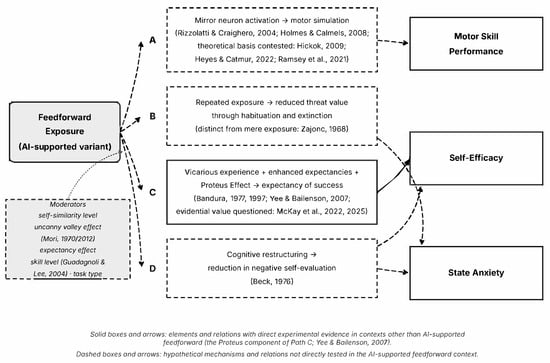
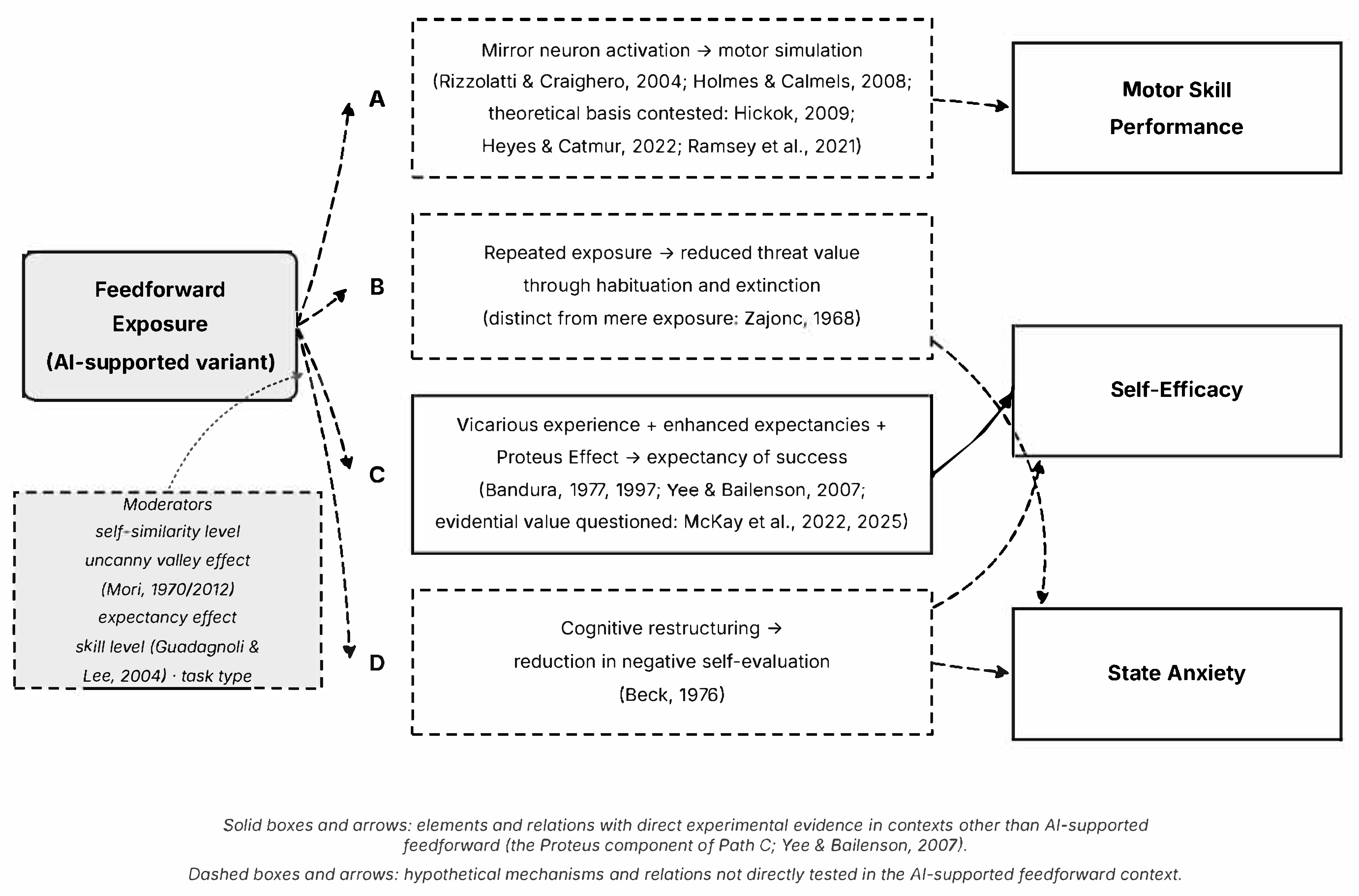

Disclaimer/Publisher’s Note: The statements, opinions and data contained in all publications are solely those of the individual author(s) and contributor(s) and not of MDPI and/or the editor(s). MDPI and/or the editor(s) disclaim responsibility for any injury to people or property resulting from any ideas, methods, instructions or products referred to in the content. |
© 2026 by the authors. Licensee MDPI, Basel, Switzerland. This article is an open access article distributed under the terms and conditions of the Creative Commons Attribution (CC BY) license.