


Abstract
Background and Clinical Significance: Patent Blue V (PBV) is widely used for sentinel lymph node mapping but may rarely cause severe hypersensitivity reactions. These reactions can present atypically, with predominant cardiovascular collapse and minimal cutaneous manifestations, potentially delaying recognition and treatment. Case Presentation: We report the case of a 52-year-old woman who developed sudden and prolonged refractory hypotension shortly after PBV injection during melanoma surgery. The reaction initially occurred in the absence of bronchospasm or early significant cutaneous manifestations. Profound cardiovascular collapse preceded the delayed appearance of erythema and piloerection, making early recognition of perioperative anaphylaxis particularly challenging. Hemodynamic instability required aggressive fluid resuscitation and prolonged vasopressor support. Subsequent diagnostic work-up, including serum tryptase measurement and allergological evaluation, confirmed PBV-induced anaphylaxis. PBV-induced anaphylaxis may present with isolated cardiovascular collapse without typical clinical features. Conclusions: Early recognition and prompt hemodynamic support are essential to optimize outcomes in the perioperative setting.
1. Introduction and Clinical Significance
Perioperative hypersensitivity reactions are most commonly triggered by neuromuscular blocking agents (70%), antibiotics, and latex (10%); however, emerging causative agents have been increasingly recognized in recent years [1,2]. Among these, hypersensitivity reactions to Patent Blue V (PBV) dye have been increasingly reported [3,4,5,6,7,8]. PBV dye finds its application in the identification of sentinel lymph nodes in patients with melanoma, breast cancer and other malignancies [9]. PBV-induced reactions are thought to be predominantly IgE-mediated, although the exact immunological mechanism remains incompletely understood and additional pathways have been proposed.
Immediate hypersensitivity reactions to Patent Blue V have been classified into four severity grades. Across published series, the reported frequencies are approximately as follows: Grade 1 (69–87%): urticaria, pruritus, blue wheals and generalized rash; Grade 2 (3.2–8%): transient hypotension (systolic blood pressure < 70 mmHg) without the need for vasopressors and/or bronchospasm/laryngospasm; Grade 3 (1.1%): severe cardiovascular collapse requiring vasopressors and/or interruption of the planned procedure and/or admission to the intensive care unit; and Grade 4 (<1%): respiratory or cardiorespiratory failure [2].
Here, we report the case of a 52-year-old woman with lumbar and right shoulder melanoma who developed a life-threatening anaphylactic reaction following Patent Blue V injection, characterized by severe cardiovascular collapse with delayed onset of cutaneous manifestations. The patient had no previous exposure to Patent Blue V and initially presented without cutaneous manifestations or bronchospasm. Cutaneous signs developed only after the onset of severe cardiovascular collapse, making the early recognition and management of perioperative anaphylaxis particularly challenging.
2. Case Presentation
A 52-year-old woman with right shoulder and lumbar melanoma was scheduled for sentinel lymph node biopsy and wide local excision. She had no history of drug allergies and had previously undergone three surgical procedures without complications. No prior medical exposure to Patent Blue V was documented.
A detailed perioperative timeline, including hemodynamic parameters, clinical manifestations, and therapeutic interventions, is reported in Table 1. The drugs administered during the perioperative and intensive care management are summarized in Table 2.
Table 1.
Perioperative timeline, hemodynamic parameters and management.
Table 2.
Drugs administered during perioperative management.
After mild sedation we administered in the lumbar scar’s dermal layer 1 mL of Patent Blue V Sodium Guerbet 2.5%, for the identification of the sentinel lymph node in the left inguinal region, where subsequently lidocaine and ropivacaine hydrochloride were applied. Before Patent Blue V injection, the patient received prophylactic cefazolin and dexamethasone (6 mg IV) according to the institutional perioperative protocol. Several minutes after Patent Blue V injection, the patient developed mild oxygen desaturation, which was managed by deepening anaesthesia and securing the airway with a laryngeal mask. This was followed by progressive severe hypotension that proved refractory to rapid fluid resuscitation. At the onset of cardiovascular collapse, no bronchospasm or early significant cutaneous manifestations were observed. Erythema and piloerection appeared later during the clinical course, while urticaria, angioedema and bronchospasm remained absent throughout the event. These symptoms were promptly treated with intravenous administration of ephedrine and continuous infusion of norepinephrine 0.4 mcg/kg/min, with haemodynamic stabilization of the severe hypotension. Subsequently the patient was intubated on continuous infusion of propofol. Surgical intervention was interrupted after sentinel lymph node biopsy and wide local excision was not performed. The patient was transported to the intensive care unit (ICU) intubated on continuous infusion of norepinephrine 0.5 mg/h, haemodynamically stable, with skin rash and goosebumps. Blood samples, including serum tryptase measurement, were collected during the acute phase of the reaction, within the recommended 1–4-h diagnostic window. A second serum tryptase measurement was obtained 18 h later.
During ICU hospitalization, norepinephrine was gradually de-escalated without any haemodynamic instability. After 14 h of admission to ICU, the patient was extubated, promptly awake, without any neurocognitive deficit and with stable and normal vital parameters. Another serum tryptase dosage was performed at 18 h since ICU admission. First and second results of s-triptase were respectively 16.4 μg/L and 8.2 μg/L (normal range 1–11 μg/L). The increase in s-tryptase is considered significant when its value measured within 1–4 h from the event is 20% basal value +2 μg/L [10].
Following complete clinical recovery, the patient underwent allergological evaluation. The initial assessment included skin and challenge tests for lidocaine, mepivacaine, ropivacaine and articaine, all of which were negative. The patient subsequently underwent wide local excision under local anesthesia without complications. Further allergological investigation included intradermal testing with Patent Blue V Sodium Guerbet 2.5% and cefazolin according to the local Allergy Unit protocol. The patient tested negative for cefazolin and positive for Patent Blue V at an intradermal dilution of 1:100. A positive wheal response compared with the negative control was considered indicative of sensitization.
3. Discussion
This case illustrates an atypical presentation of Patent Blue V-induced perioperative anaphylaxis in which severe cardiovascular collapse represented the predominant initial manifestation, whereas cutaneous signs appeared only later during the clinical course. Such delayed cutaneous manifestations may reduce the clinical suspicion of anaphylaxis during the early phase of shock and contribute to delayed recognition [11]. The typical and less common clinical manifestations of Patent Blue V hypersensitivity are summarized in Table 3.
Table 3.
Clinical manifestations of hypersensitivity reactions to Patent Blue V.
The main differential diagnoses of acute intraoperative hypotension in this clinical setting are summarized in Table 4. During surgery, the agents most frequently implicated in drug-related allergic reactions are neuromuscular blockers, antibiotics, induction anesthetics, opioids, colloids, NSAIDs, topical antiseptics, and latex [2]. Although latex and antiseptics were not tested by skin-prick methods in this patient, they are unlikely culprits, as the same products were tolerated uneventfully during a subsequent operation.
Table 4.
Differential diagnosis of acute intraoperative hypotension following Patent Blue V injection.
Diagnostic tools for suspected PBV hypersensitivity—serum tryptase, skin-prick testing, and intradermal testing—show reported sensitivities of 54%, 80%, and 100%, respectively [12]. In this patient, elevations in tryptase together with a positive intradermal test supported PBV as the causative agent. Although the patient had no documented previous medical exposure to blue dyes, this is consistent with most published cases, which also lack clear prior PBV contact [1,9]. The exact mechanisms underlying Patent Blue V hypersensitivity remain incompletely understood; however, the reaction is thought to result predominantly from IgE-mediated mast-cell activation following prior sensitization, although additional immunological mechanisms have also been proposed.
PBV (also known as E131, disulfide blue, or acid blue 3) is a triphenylmethane dye widely incorporated into numerous consumer and industrial products—foods, textiles, paper, agricultural materials, cosmetics, and medical supplies—which may lead to unrecognized sensitization [13]. Patent Blue V-induced hypersensitivity is an uncommon but well-recognized complication of sentinel lymph node mapping procedures [14].
Incidence of PBV-related anaphylaxis range between 0.1% and 2.8% [5,9,15,16,17], with symptom onset typically occurring 20–30 min after administration, though a broad range from 0 to 90 min has been described [18]. The frequency of severe, life-threatening events is estimated at approximately 0.06% [5,12]. PBV reactions typically involve skin manifestations—such as blue discoloration of the injection area—accompanied by hypotension, while respiratory symptoms are uncommon. Cutaneous discoloration at the injection site with associated hypotension is the classic presentation, whereas respiratory involvement is less common. More severe reactions tend to appear earlier, often within 15–30 min [19,20]. Immediate anaphylaxis is rare [12,21]. In this case, shock developed within the first minutes following Patent Blue V administration, accompanied by refractory hypotension and piloerection. Comparable rapid-onset events have been documented: Šitum et al. described a patient with severe hypotension resistant to epinephrine and ventricular fibrillation [13]; Barthelmes et al. reported several cases occurring within 1–5 min [12]; and Telgenkamp et al. described cardiac arrest shortly after dye administration [22]. The diagnosis of perioperative anaphylaxis was supported by the combination of a clear temporal relationship with Patent Blue V administration, severe refractory hypotension requiring continuous vasopressor support, elevated serum tryptase levels, positive intradermal testing, and the absence of recurrence during subsequent surgery performed without Patent Blue V exposure. Collectively, these findings fulfill the accepted diagnostic framework for perioperative anaphylaxis and make alternative causes of intraoperative cardiovascular collapse highly unlikely.
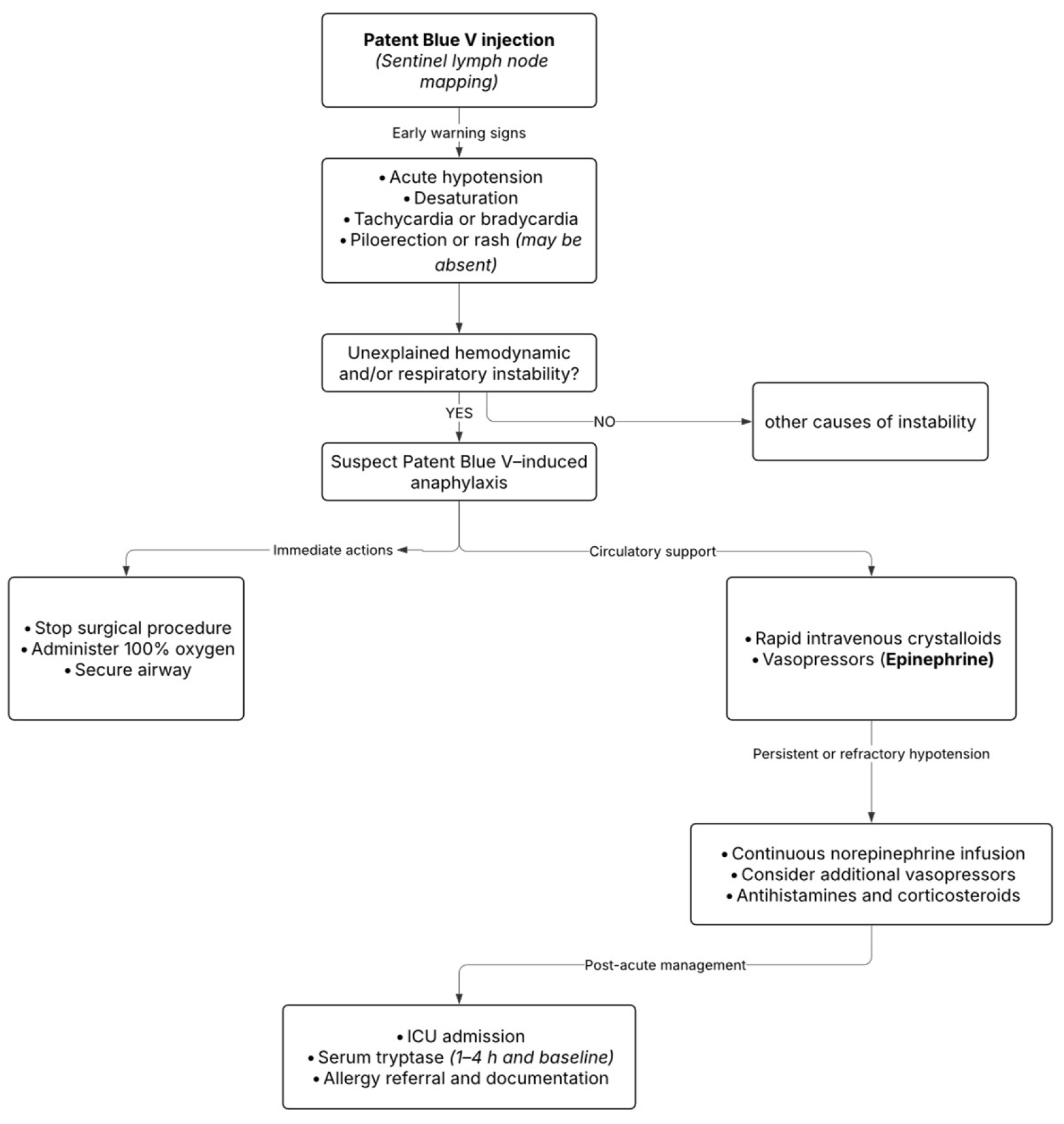
Although Patent Blue V-induced anaphylaxis has been previously reported, the present case illustrates several distinctive features. Cardiovascular collapse represented the predominant initial manifestation and preceded the delayed appearance of cutaneous signs. The preoperative administration of dexamethasone may also have contributed to attenuating the initial cutaneous manifestations, although it did not prevent the development of severe cardiovascular collapse. In addition, prolonged vasopressor support was required because of persistent refractory hypotension. The diagnosis was further strengthened by both elevated serum tryptase levels and positive intradermal testing, and by the absence of recurrence during subsequent surgery performed without Patent Blue V exposure [23]. The diagnostic work-up leading to the identification of Patent Blue V as the causative agent is summarized in Figure 1. PBV clearance occurs primarily through the urine over 24–48 h, with a smaller proportion eliminated in bile [9,23]. In our patient, hypotension persisted for hours and required extended norepinephrine support. Although intravenous epinephrine is recommended by current international guidelines as the first-line treatment for perioperative anaphylaxis because of its combined α- and β-adrenergic effects, the present patient initially manifested isolated severe cardiovascular collapse in the absence of bronchospasm or airway edema [24,25,26,27]. Intravenous epinephrine was not administered because the initial clinical presentation was not immediately recognized as perioperative anaphylaxis, and alternative causes of acute intraoperative hypotension were initially considered during the differential diagnostic process. Once the diagnosis became more evident, the patient’s hemodynamic status had progressively improved following aggressive fluid resuscitation, ephedrine administration and continuous norepinephrine infusion. This observation should not be interpreted as suggesting that norepinephrine replaces epinephrine, which remains the recommended first-line treatment according to current international guidelines. Immediate aggressive fluid resuscitation, ephedrine administration, and continuous norepinephrine infusion were therefore initiated to rapidly restore hemodynamic stability. Because persistent refractory hypotension remained the predominant clinical feature, norepinephrine support was progressively escalated, resulting in gradual cardiovascular stabilization. This atypical presentation reinforces the importance of maintaining a high index of suspicion during sentinel lymph node procedures, even when the classical features of anaphylaxis are not shortly evident. Alternative sentinel lymph node mapping techniques, including radioisotope-only mapping, indocyanine green fluorescence and superparamagnetic iron oxide, may represent valuable alternatives in patients with previous Patent Blue V hypersensitivity or in selected high-risk patients.
Figure 1.
Diagnostic work-up following suspected Patent Blue V-induced perioperative anaphylaxis. The diagram summarizes the sequential diagnostic pathway adopted in the present case, including the acute clinical suspicion, serum tryptase measurements obtained during the acute phase and at follow-up, subsequent allergological evaluation, intradermal testing with cefazolin and Patent Blue V, and the final confirmation of Patent Blue V sensitization. This diagnostic approach supported the identification of Patent Blue V as the causative agent and guided the safe management of subsequent surgical treatment.
4. Conclusions
Anaphylaxis caused by PBV remains a serious complication that demands careful vigilance [22]. Prompt management—cardiopulmonary resuscitation, adrenergic agents, mast-cell stabilizers, and corticosteroids—is crucial. Vasopressors may have a rapid effect or may necessitate prolonged infusion, and ongoing cardiovascular depression often calls for intensive care management. In patients at elevated risk, prophylactic anti-allergic medications may be considered before PBV injection. To the best of our knowledge, fatalities associated with Patent Blue V-induced anaphylaxis appear to be exceptionally rare in the published literature. Patients undergoing procedures involving PBV should be informed preoperatively of potential adverse reactions. Patent Blue V-induced anaphylaxis, although rare, may initially present with severe cardiovascular collapse before the appearance of delayed and often subtle cutaneous manifestations. Clinicians should therefore be aware that the absence of early skin signs does not exclude perioperative anaphylaxis. High clinical suspicion, prompt recognition, and early hemodynamic support are essential to optimize patient outcomes. This case highlights the importance of maintaining a high index of suspicion for Patent Blue V-induced anaphylaxis in the operating theatre, particularly when cardiovascular collapse occurs without typical cutaneous manifestations.
Author Contributions
Conceptualization, F.R., V.P., C.B., M.C. and D.B.; writing—original draft preparation, F.R., V.P. and D.B.; writing—review and editing, F.R. and P.D.F. All authors have read and agreed to the published version of the manuscript.
Funding
This research received no external funding, and the APC was funded by ‘Current Research’ funds from the Italian Ministry of Health to cover publication.
Institutional Review Board Statement
According to the policies of the Istituto Oncologico Veneto (IOV-IRCCS), formal ethical approval was not required for this single-patient case report.
Informed Consent Statement
Written informed consent has been obtained from the patient to publish this case report.
Data Availability Statement
The data supporting the findings of this case report are available from the corresponding author upon reasonable request, subject to institutional regulations and patient privacy requirements. CARE Guidelines: This case report has been prepared in accordance with the CARE (CAse REport) reporting guidelines.
Conflicts of Interest
The authors declare no conflicts of interest.
References
- Joshi, M.; Hart, M.; Ahmed, F.; McPherson, S. Adverse reaction; patent blue turning patient blue. BMJ Case Rep. 2012, 2012, bcr2012007339. [Google Scholar] [CrossRef] [Scilit] [PubMed] [PubMed Central]
- Azevedo, J.P.; Alves, M.; Ribeiro, C.; Todo Bom, A. Anaphylactic shock perioperative to patent blue dye. BMJ Case Rep. 2018, 2018, bcr2018224330. [Google Scholar] [CrossRef] [Scilit] [PubMed] [PubMed Central]
- Perenyei, M.; Barber, Z.E.; Gibson, J.; Hemington-Gorse, S.; Dobbs, T.D. Anaphylactic reaction rates to blue dyes used for sentinel lymph node mapping: Systematic review and meta-analysis. Ann. Surg. 2021, 273, 1087–1093. [Google Scholar] [CrossRef] [Scilit] [PubMed]
- Parvaiz, M.A.; Isgar, B. Anaphylaxis and blue urticaria associated with Patent Blue V injection. Anaesthesia 2012, 67, 1275–1276. [Google Scholar] [CrossRef] [Scilit] [PubMed]
- Barthelmes, L.; Goyal, A.; Newcombe, R.G.; McNeill, F.; Mansel, R.E. NEW START and ALMANAC Study Groups. Adverse reactions to Patent Blue V dye: The NEW START and ALMANAC experience. Eur. J. Surg. Oncol. 2010, 36, 399–403. [Google Scholar] [CrossRef] [Scilit] [PubMed]
- Hamelin, A.; Vial-Dupuy, A.; Lebrun-Vignes, B.; Francès, C.; Soria, A.; Barete, S. Acute blue urticaria following subcutaneous injection of Patent Blue dye. Ann. Dermatol. Venereol. 2015, 142, 670–674. [Google Scholar] [CrossRef] [Scilit] [PubMed]
- Wu, T.T.; Chang, Y.C.; Lee, J.M.; Hung, M.H. Anaphylactic reaction to Patent Blue V used in preoperative computed tomography-guided dye localization of small lung nodules. J. Formos. Med. Assoc. 2016, 115, 288–289. [Google Scholar] [CrossRef] [Scilit] [PubMed]
- Beenen, E.; de Roy van Zuidewijn, D.B. Patients blue on Patent Blue: An adverse reaction during four sentinel node procedures. Surg. Oncol. 2005, 14, 151–154. [Google Scholar] [CrossRef] [Scilit] [PubMed]
- Haque, R.A.; Wagner, A.; Whisken, J.A.; Nasser, S.M.; Ewan, P.W. Anaphylaxis to Patent Blue V: A case series and proposed diagnostic protocol. Allergy 2010, 65, 396–400. [Google Scholar] [CrossRef] [Scilit] [PubMed]
- Lobbes, H.; Reynaud, Q.; Mainbourg, S.; Lega, J.C.; Durieu, I.; Durupt, S. Tryptase: A practical guide for the physician. Rev. Med. Interne 2020, 41, 748–755. [Google Scholar] [CrossRef] [Scilit] [PubMed]
- Mirakian, R.; Ewan, P.W.; Durham, S.R.; Youlten, L.J.; Dugué, P.; Friedmann, P.S.; English, J.S.; Huber, P.A.J.; Nasser, S.M. BSACI guidelines for the management of drug allergy. Clin. Exp. Allergy 2009, 39, 43–61. [Google Scholar] [CrossRef] [Scilit] [PubMed]
- Barthelmes, L.; Goyal, A.; Sudheer, P.; Mansel, R.E. Investigation of anaphylactic reaction after Patent Blue V dye injection. Breast 2010, 19, 516–520. [Google Scholar] [CrossRef] [Scilit] [PubMed]
- Misir Šitum, S.; Korečić Zrinjščak, I.; Pečvarac, M.; Šoštar, A.; Žaja, A.; Tot, T. Atypical anaphylactic reaction to Patent Blue V dye during breast cancer surgery: A case report. Front. Oncol. 2022, 12, 979393. [Google Scholar] [CrossRef] [Scilit] [PubMed]
- Haddad, C.F.; Ferreira, D.M.; Cortez, I.L.; Vicente, A.J.O.; Silva, A.A.G.; Naback, C.P. Severe anaphylactic reaction to Patent Blue in breast cancer surgery. Mastology 2020, 30, e20200051. [Google Scholar] [CrossRef] [Scilit]
- Leung, M.; McCusker, C.; Ben-Shoshan, M. Anaphylaxis to Patent Blue dye in a 17-year-old boy. BMJ Case Rep. 2019, 12, e226191. [Google Scholar] [CrossRef] [Scilit] [PubMed] [PubMed Central]
- Brenet, O.; Lalourcey, L.; Queinnec, M.; Dupoiron, D.; Jayr, C.; Rosay, H.; Mavoungou, P.; Monnin, D.; Ancel, B.; Maget, B.; et al. Hypersensitivity reactions to Patent Blue V in breast cancer surgery: A prospective multicentre study. Acta Anaesthesiol. Scand. 2013, 57, 106–111. [Google Scholar] [CrossRef] [Scilit] [PubMed]
- Bézu, C.; Coutant, C.; Salengro, A.; Daraï, E.; Rouzier, R.; Uzan, S. Anaphylactic response to blue dye during sentinel lymph node biopsy. Surg. Oncol. 2011, 20, e55–e59. [Google Scholar] [CrossRef] [Scilit] [PubMed]
- Wong, A.; Spillane, A.; Breast Surgeons of Australia and New Zealand Incorporated (BreastSurgANZ). Patent Blue V dye anaphylaxis: Experience of Australian and New Zealand surgeons. ANZ J. Surg. 2014, 84, 37–41. [Google Scholar] [CrossRef] [Scilit] [PubMed]
- Martín-Lázaro, J.; Núñez-Orjales, R.; Battikhi-Precedo, N.; López-Freire, S.; Carballada-González, F. Allergy to blue dye. J. Investig. Allergol. Clin. Immunol. 2016, 26, 381–383. [Google Scholar] [CrossRef] [Scilit] [PubMed]
- Hunting, A.S.; Nopp, A.; Johansson, S.G.O.; Andersen, F.; Wilhelmsen, V.; Guttormsen, A.B. Anaphylaxis to Patent Blue V. I. Clinical aspects. Allergy 2010, 65, 117–123. [Google Scholar] [CrossRef] [Scilit] [PubMed]
- Woltsche-Kahr, I.; Komericki, P.; Kränke, B.; Brabek, E.; Horn, M.; Schuller-Petrovic, S.; Richtig, E.; Aberer, W. Anaphylactic shock following peritumoral injection of Patent Blue in sentinel lymph node biopsy procedure. Eur. J. Surg. Oncol. 2000, 26, 313–314. [Google Scholar] [CrossRef] [Scilit] [PubMed]
- Telgenkamp, B.; Japink, D.; van Haaren, E. Cardiac arrest after Patent Blue V injection for sentinel lymph node biopsy in breast cancer. Breast Care 2010, 5, 411–413. [Google Scholar] [CrossRef] [Scilit] [PubMed] [PubMed Central]
- Jlali, A.; Gara, M.; Mehdi, M.; Grati, L. A case of intra-operative anaphylaxis to Patent Blue dye during sentinel lymph node biopsy. Obstet. Gynecol. Cases Rev. 2018, 5, 129. [Google Scholar] [CrossRef] [Scilit]
- Simons, F.E.; Ardusso, L.R.; Bilò, M.B.; El-Gamal, Y.M.; Ledford, D.K.; Ring, J.; Sanchez-Borges, M.; Senna, G.E.; Sheikh, A.; Thong, B.Y.; et al. World Allergy Organization anaphylaxis guidelines: Summary. J. Allergy Clin. Immunol. 2011, 127, 587–593.e22. [Google Scholar] [CrossRef] [Scilit] [PubMed]
- Takazawa, T.; Horiuchi, T.; Nagumo, K.; Sugiyama, Y.; Akune, T.; Amano, Y.; Fukuda, M.; Haraguchi, T.; Ishibashi, C.; Kanemaru, E.; et al. The Japanese Epidemiologic Study for Perioperative Anaphylaxis, a prospective nationwide study: Allergen exposure, epidemiology, and diagnosis of anaphylaxis during general anaesthesia. Br. J. Anaesth. 2023, 131, 159–169. [Google Scholar] [CrossRef] [Scilit] [PubMed]
- Savic, L.; Volcheck, G.W.; Garvey, L.H. Treatment of perioperative anaphylaxis: Room for improvement? Br. J. Anaesth. 2023, 131, 17–19. [Google Scholar] [CrossRef] [Scilit] [PubMed]
- Dodd, A.; Turner, P.J.; Soar, J.; Savic, L.; on behalf of the UK Perioperative Allergy Network. Emergency treatment of peri-operative anaphylaxis: Resuscitation Council UK algorithm for anaesthetists. Anaesthesia 2024, 79, 535–541. [Google Scholar] [CrossRef] [Scilit] [PubMed]

Disclaimer/Publisher’s Note: The statements, opinions and data contained in all publications are solely those of the individual author(s) and contributor(s) and not of MDPI and/or the editor(s). MDPI and/or the editor(s) disclaim responsibility for any injury to people or property resulting from any ideas, methods, instructions or products referred to in the content. |
© 2026 by the authors. Licensee MDPI, Basel, Switzerland. This article is an open access article distributed under the terms and conditions of the Creative Commons Attribution (CC BY) license.