


Abstract
The nucleon spin–orbit interaction is a cornerstone of nuclear structure theory, yet its isospin dependence remains insufficiently constrained within modern nuclear energy density functional (EDF) theory. It was recently shown that, within the framework of extended Skyrme EDFs, the charge-weak form factor difference in 48Ca exhibits remarkable sensitivity to the effective isovector spin–orbit (IVSO) interaction, whereas in 208Pb is much less sensitive to this channel. Extending this analysis to other nuclei, we find that 90Zr, with its ten spin–orbit unpaired neutrons, displays a sensitivity to the IVSO strength similar to that of 48Ca, arising from modifications to the central mean-field potential rather than the one-body spin–orbit potential. In contrast, 62Ni, like 208Pb, remains largely insensitive to the IVSO interaction. This structure-driven distinction suggests an experimental strategy: future parity-violating electron scattering measurements, e.g., the MREX experiment at the MESA facility, on 48Ca and 90Zr would help constrain the effective IVSO strength, while measurements on 208Pb and 62Ni can provide a cleaner probe of the density dependence of the symmetry energy with reduced IVSO sensitivity.
1. Introduction
The spin–orbit (SO) interaction plays a crucial role across many branches of physics—from elementary quark–gluon dynamics [1,2] to macroscopic phenomena in condensed matter and optics [3,4]—and has long been recognized as a fundamental ingredient of nuclear structure [5,6,7,8]. Historically, it was first introduced in atomic physics in the 1920s to explain the fine structure of atomic spectra [5,9]. In 1949, Mayer [10] and Jensen [11] incorporated a strong nucleon SO interaction into the nuclear shell model, successfully explaining the emergence of magic numbers in nuclei. This achievement marked a milestone in nuclear theory, establishing SO interaction as a key mechanism for understanding nuclear structure, stability, and shell evolution.
Since nuclei are composed of protons and neutrons, a natural question then arises: is the SO interaction identical for protons and neutrons in the nuclei? One of its most direct manifestations is the spin–orbit splitting, namely, the splitting of a single-particle level with a given orbital angular momentum l () into two sublevels with different total angular momenta . For nuclei close to the -stability line, the isospin asymmetry (measuring difference between neutron and proton numbers) is small, leading to similar magnitudes of spin–orbit splitting for protons and neutrons. In contrast, the nuclei far from stability, particularly those with a large neutron excess, exhibit marked differences between proton and neutron spin–orbit splittings [12]. This observation suggests the isospin-dependent nature of the SO interaction, i.e., an isovector spin–orbit (IVSO) interaction. However, since the single-nucleon energy levels cannot be directly measured and the impact of SO interaction has a complex interplay with, e.g., tensor force [13] and nucleon effective masses [14], the quantitative strength of the IVSO channel remains model dependent and insufficiently constrained at the energy-density-functional (EDF) level [15].
In modern nuclear EDF theory, the origin and predictive content of spin–orbit couplings depend on how the functional is constructed. In covariant mean-field models, a strong SO potential emerges naturally from the Dirac structure of the scalar and vector mean fields, while the isospin dependence is weak in conventional -- parametrizations [16,17]. Additional isovector degrees of freedom, such as the isovector-scalar meson and exchange terms in covariant EDFs, can modify the effective isospin dependence of the SO channel [18]. In nonrelativistic Skyrme EDFs, the SO term is usually introduced phenomenologically [15], and the conventional zero-range two-body form gives an IVSO strength only one third of the isoscalar one [19]. A different baseline is provided by EDFs constrained by pion-nucleon dynamics, where the analytical form and density-dependent couplings are derived from the many-body perturbation theory and few-nucleon interactions [20,21]. These calculations generate nontrivial density-dependent SO couplings and predict an IVSO strength about twice as large as that in conventional Skyrme EDFs [20]. Subsequent studies of chiral forces found a sizable enhancement of the isoscalar SO interaction [21] due to the three-body contributions but did not provide a corresponding analysis of the IVSO channel. This model dependence highlights the need for effective experimental probes of the IVSO channel.
Recent studies have identified the charge-weak form factor difference in 48Ca as a sensitive probe of the IVSO interaction [22,23,24]. In particular, the model-independent determination of in 48Ca by the Calcium Radius Experiment (CREX) [25] at Jefferson Lab (JLab), together with the PREX-II result in 208Pb [26], has highlighted the difficulty of accommodating both measurements simultaneously within conventional EDFs [27,28,29,30,31,32,33,34,35,36,37] as well as in ab initio calculations [25,38]. Within the extended Skyrme EDF framework, a stronger IVSO channel has been found to improve the simultaneous accommodation of the CREX and PREX-II data, while also highlighting the distinct sensitivities of different nuclei to the IVSO interaction [22]. Very recently, a study based on covariant density-dependent point-coupling EDFs with an isovector tensor coupling reported a similar phenomenological trend [39].
In this work, through an analysis of the single-particle levels in 48Ca and 208Pb, we demonstrate that the conventional shell closures, including the magic numbers, are well reproduced and retain their robustness even in the presence of a strong IVSO interaction. Extending this analysis, we identify a structural correspondence between 90Zr and 48Ca, as well as between 62Ni and 208Pb, based on their analogous spin–orbit saturation properties. This analogy implies that the charge-weak form factor difference , and thereby the neutron skin, exhibits significant sensitivity to the IVSO strength in 90Zr while remaining largely insensitive in 62Ni. The broader implications of this nucleus-dependent sensitivity are discussed in what follows.
2. Methods
2.1. Extended Skyrme EDF Within Hartree-Fock-Bogoliubov (HFB) Framework
In the present work, we use a nonrelativistic nuclear EDF based on an extended Skyrme interaction [40] supplemented by a zero-range tensor force [41]. The extended Skyrme interaction differs from the conventional Skyrme interaction by including momentum-dependent many-body terms , namely,
The full interaction used in this work consists of the extended Skyrme part together with the zero-range tensor force introduced below.
The conventional Skyrme interaction reads (see, e.g., Ref. [42]):
and
Here, , , is the relative momentum, with being its conjugate acting on the left; the are Pauli spin operators, is the spin exchange operator, and is the total local density, with and being neutron and proton densities, respectively. , , , and are adjustable “Skyrme parameters”, and is the SO interaction parameter. For simplicity, both and are set to unity as in Ref. [43].
For the tensor force, we use the following zero-range form [41]
where T and U quantify the magnitude of the tensor force in states of even and odd relative motion, respectively. In practical calculations, the parameters and are employed in place of U and T, where and are expressed as:
The explicit zero-range tensor force contributes to the EDF through the - and -dependent and terms in Equation (10).
In addition, for calculations of open-shell nuclei, we take into account the standard mixed volume-surface density-dependent contact pairing force of the form [44]
where is the pairing strength and .
Based on the above extended Skyrme interaction, tensor force and pairing force, we derive the EDF within the HFB framework. Under the assumption of time-reversal invariance, the energy of a nucleus can be written as the integral of a purely local EDF . For details on the HFB calculation based on Skyrme EDF, see e.g., Ref. [45]. In the following, we focus on the potential-energy density associated with the extended Skyrme interaction and tensor force, which can be expressed in terms of local density , kinetic-energy density , and vector spin-current density of neutrons () and protons () defined by
Here, is the wave function of canonical state i, is the corresponding occupation probability, and the sum runs over all states for the same species t. By further defining the isoscalar densities
and isovector densities
the can be written as
The coefficients , , and are uniquely related to the Skyrme parameters and by
The and characterize the isoscalar and isovector SO strengths, respectively. For the standard zero-range two-body SO term in the Skyrme interaction, one has , where is the Skyrme SO parameter. In the present work, however, following Ref. [17], and are treated as independent phenomenological EDF-level couplings, rather than as parameters of a strict short-range two-body SO interaction, in order to explore the sensitivity of finite-nucleus observables to the IVSO channel within the adopted EDF framework.
Following Ref. [22], we employ the eS53 and eS250 Skyrme EDFs constructed therein. Among them, eS250 is a fully optimized strong-IVSO functional with MeV·fm5. As shown in Ref. [22], eS250 gives predictions for 48Ca and 208Pb that are consistent with the CREX and PREX-II data within their respective uncertainties. The functional eS53, with MeV·fm5 corresponding to the conventional relation , is obtained from eS250 by modifying the IVSO strength while keeping the other EDF parameters unchanged. For reference, we also discuss the reference functional eS500T from Ref. [22], which is likewise fully optimized and adopts a very strong IVSO coupling with MeV·fm5.
In Equation (10), the coefficients and collect the and contributions associated with the momentum-dependent central part of the extended Skyrme interaction, whereas the zero-range tensor force contributes separately through the - and -dependent terms. In the EDF implementation, the parameter is used as a bookkeeping switch to control whether the central contribution to the sector is retained [14]. For the EDFs employed in this work, for both eS53 and eS250, whereas for eS500T.
Based on the above EDF, nuclear ground-state properties are calculated by solving the HFB equations. The single nucleon Hamiltonian entering into the HFB equation can be expressed as
where the single-nucleon fields can be derived from the energy density by
From Equation (10), one can obtain the nucleon effective mass , i.e.,
the single nucleon potential (without Coulomb potential)
and the SO potential
where and for and p, respectively. The parameters and in the SO potentials are defined by
with the central-exchange parameters given by
As can be seen from Equations (15) and (16), the coupling constants and appear in both the central potential and the SO potential . In contrast, the tensor force contributes only to and does not affect .
2.2. Charge and Weak Form Factors
The normalized nuclear form factors, namely, the charge form factor and the weak charge form factor , are calculated by folding the point-nucleon form factors and SO current form factors () with the corresponding intrinsic nucleon electromagnetic and weak form factors [46]. The point-nucleon and SO current form factors are defined from the local density and spin-current density as
The charge and weak-charge form factors are then given by
where is the neutron (proton) number, and and are proton and neutron weak charges, respectively. The electromagnetic form factors are constructed from the isospin-coupled Sachs form factors with the inclusion of the relativistic Darwin correction. Following Ref. [46], the weak intrinsic nucleon form factors are obtained from the standard neutral-current decomposition and are expressed in terms of the proton, neutron, and strange electromagnetic form factors (see, e.g., Ref. [47] for details):
where the strange-quark electromagnetic form factors are taken as
Here, [48,49], [50], and [50] are adopted for the strange electric coupling, strange magnetic moment, and strange magnetic radius, respectively. The center-of-mass correction to and is approximately taken into account by renormalizing the nucleon mass to in the HFB calculation (see, e.g., Ref. [15] for details).
3. Results
3.1. Single-Particle Energy Spectrum of 48Ca and 208Pb
As shown in Ref. [22], compared with the conventional-IVSO reference eS53, the eS250 functional with MeV·fm5 provides a representative strong-IVSO case: it selectively shifts the calculated of 48Ca toward the CREX value while leaving the corresponding 208Pb prediction essentially unchanged and still consistent with PREX-II within the reported uncertainty. For this EDF, the description of ground-state nuclear properties, such as binding energies, charge radii, and spin–orbit splittings of single-particle levels, as well as selected excited-state observables including the giant monopole resonance in 208Pb and the electric dipole polarizability , remains in good agreement with experimental data [22]. In addition, the pure neutron matter (PNM) equation of state (EOS) predicted by this EDF is consistent with microscopic chiral effective field theory (ChEFT) [22].
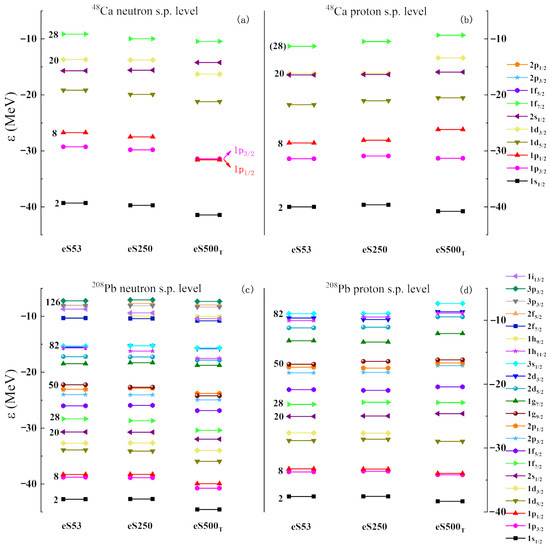
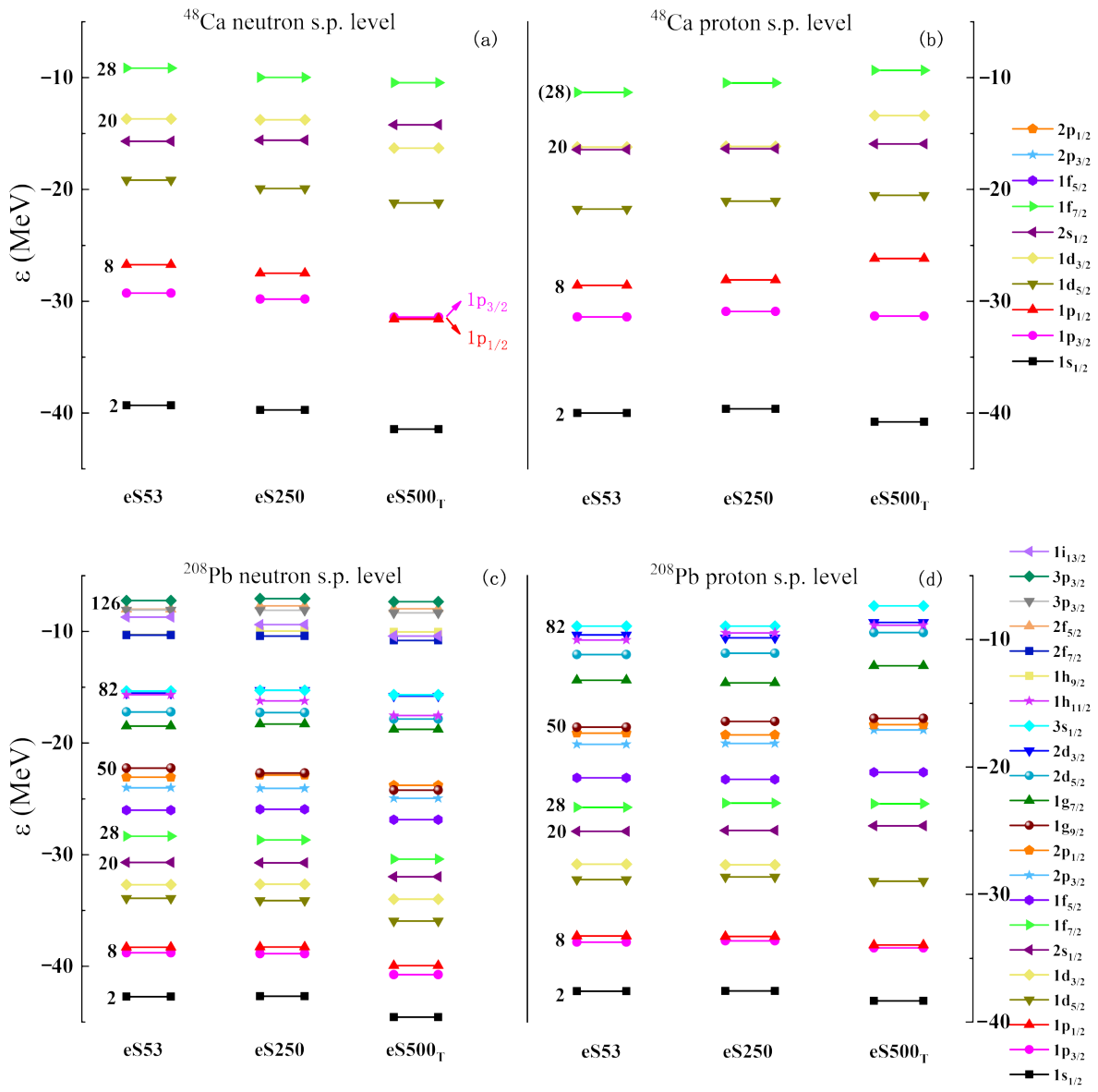
Moreover, owing to the enhanced IVSO interaction, which further promotes spin–orbit splitting, the single-particle levels and shell structure of many nuclei are affected, with potential implications for magic numbers. A further examination of the single-particle spectra of 208Pb and 48Ca, as shown in Figure 1, reveals that eS250 reproduces the magic shell closures as well as the conventional IVSO-strength EDF eS53 [22]. However, when the IVSO interaction is further enhanced using the EDF eS500T with extreme strength from Ref. [22], the single-particle energies in 48Ca and 208Pb exhibit certain shifts compared to those obtained with eS53 and eS250. Nevertheless, the magic number structure remains well reproduced, although it slightly violates the usual energy level ordering of the neutron and states in 48Ca. It is worth emphasizing that when is set to as high as 500 MeV·fm5 as in the eS500T, such an extremely large IVSO strength significantly alters the spin–orbit splittings. To partially compensate for these effects, the tensor force is included in the eS500T EDF (see Supplemental Material (SM) in Ref. [22]). Moreover, the eS500T fails to reproduce the in 208Pb and violates the PNM EOS from microscopic ChEFT calculations. This indicates that a value of 500 MeV·fm5 is excessively large, whereas MeV·fm5 represents a more suitable strong-IVSO choice within the adopted EDF family.
Figure 1.
Single-particle energy levels for 48Ca and 208Pb. Panel (a) shows neutron levels in 48Ca; panels (b–d) display proton levels in 48Ca, neutron levels in 208Pb, and proton levels in 208Pb, respectively.
3.2. Sensitivity of to the IVSO Interaction for 48Ca, 208Pb, 90Zr, and 62Ni
3.2.1. 48Ca and 208Pb
As elucidated in Ref. [22], the sensitivity of 48Ca to the IVSO interaction originates from the eight neutrons occupying the orbital. This distinction between 48Ca and 208Pb can be traced to the IVSO energy term in Equation (10). As shown in Ref. [22], in 48Ca, all proton spin–orbit partners are filled, while the neutron orbital is fully occupied and its partner is empty. This configuration produces a large , enabling the IVSO interaction to modify the central mean field and induce global density rearrangements that alter the contribution of every orbital to . In 208Pb, by contrast, the spin–orbit unsaturated orbitals ( for protons and for neutrons) yield comparable positive contributions to and , resulting in a small and hence a weak IVSO effect. A detailed orbital-by-orbital analysis of and for 48Ca and 208Pb, comparing the eS53 and eS250 EDFs, can be found in the lower panel of Figure S5 in the SM of Ref. [22]. As shown there, the contributions in 48Ca exhibit clear differences across all orbitals when varying the IVSO interaction strength, with the most pronounced variation appearing in the rather than orbital—a consequence of the mean-field rearrangement induced by the IVSO interaction. In contrast, the orbital contributions in 208Pb remain almost unchanged, confirming its insensitivity to the IVSO interaction.
From this perspective, one can understand why an effective IVSO interaction can change the predictions for 48Ca and 208Pb in different ways within the extended Skyrme EDF framework. If one instead maintains the IVSO interaction at its conventional strength (i.e., ) and attempts to adjust the tensor force strengths and , one finds that the CREX and PREX-II values cannot be simultaneously described by such tensor-force adjustments, despite the fact that the tensor force and the IVSO interaction often appear similar in certain respects, such as their ability to modify the ordering of single-particle levels as noted in Ref. [22]. The key distinction between the two can be seen from Equations (15) and (16). The IVSO interaction contributes to both the central potential U and the spin–orbit potential W, whereas the tensor force contributes only to the spin–orbit potential W. It is precisely this modification of the central potential U by the IVSO interaction that significantly alters the contributions of all orbitals to and [22].
3.2.2. 90Zr and 62Ni
Following the same line of reasoning used in Ref. [22] to analyze the contribution of single-particle orbitals to the IVSO term in the energy density (Equation (10)), one can infer that nuclei with a spin–orbit pattern analogous to 48Ca, such as 90Zr, should also exhibit sensitivity to the IVSO interaction in their values. Conversely, nuclei similar to 208Pb, such as 62Ni, are expected to be insensitive to the IVSO interaction. Applying the analysis framework of Ref. [22], one finds that in 90Zr, the proton orbitals are spin–orbit saturated, whereas the neutron orbitals are spin–orbit unsaturated, with ten neutrons occupying the orbital playing a role analogous to that of the eight neutrons in the orbital of 48Ca. In contrast, 62Ni exhibits spin–orbit unsaturation in both proton and neutron channels: eight protons occupy the orbital, and eight neutrons occupy the same orbital. Consequently, the IVSO contribution to the energy density, which is proportional to , becomes negligible.
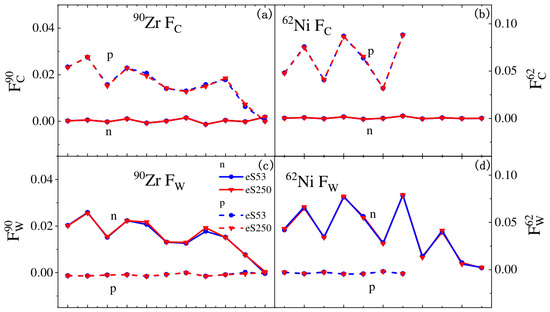
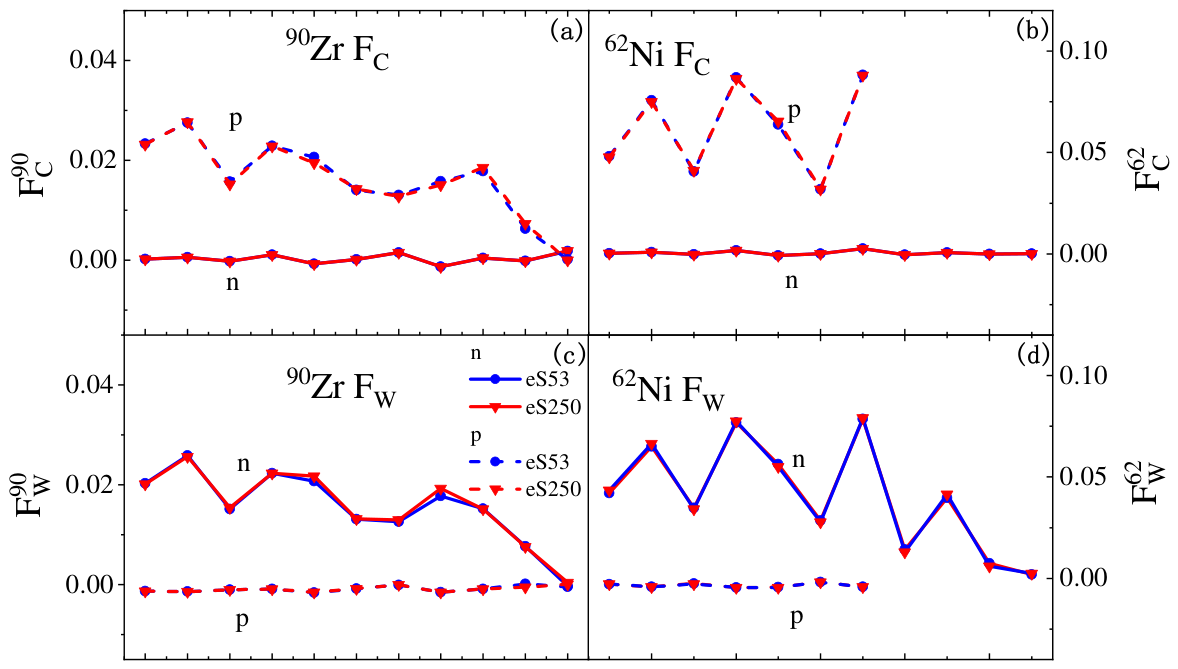
To illustrate this point, we perform an analysis for 90Zr and 62Ni analogous to that presented in the lower panel of Figure S5 in the SM of Ref. [22] for 48Ca and 208Pb. As these nuclei are open-shelled, pairing effects must be taken into account. We again compare results obtained with the eS53 and eS250 EDFs, with the proton and neutron pairing strengths determined by fitting the pairing gaps of 144Sm and 120Sn [51], respectively, using eS250. The resulting orbital-by-orbital contributions to and are presented in Figure 2a–d. For 90Zr, as shown in Figure 2a,c, each orbital exhibits noticeable differences in its contribution when comparing eS53 and eS250. The most pronounced difference in the contribution to appears in the orbital, while for , the largest difference is observed in the orbital. For 62Ni, as shown in Figure 2b,d, the orbital contributions to both and are almost identical between eS53 and eS250, confirming our expectation. Meanwhile, we note that the differences in the orbital contributions to and between eS53 and eS250 are not as pronounced for 90Zr as they are for 48Ca, nor are they as negligible for 62Ni as they are for 208Pb. This behavior can be attributed, on the one hand, to the diminished influence of the IVSO interaction in heavier nuclei relative to lighter ones and, on the other hand, to the increased number of orbitals contributing in heavier nuclear systems.
Figure 2.
Orbital contributions to and obtained with the eS53 and eS250 EDFs. Panels (a,c) show the contributions to and for 90Zr, respectively. Panels (b,d) show the corresponding results for 62Ni. The analyzed orbitals (from left to right) include , , , , , , , , , , and , both for 90Zr and 62Ni.
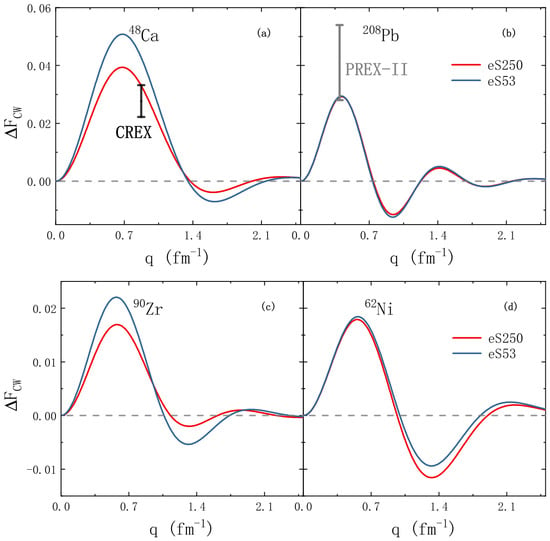
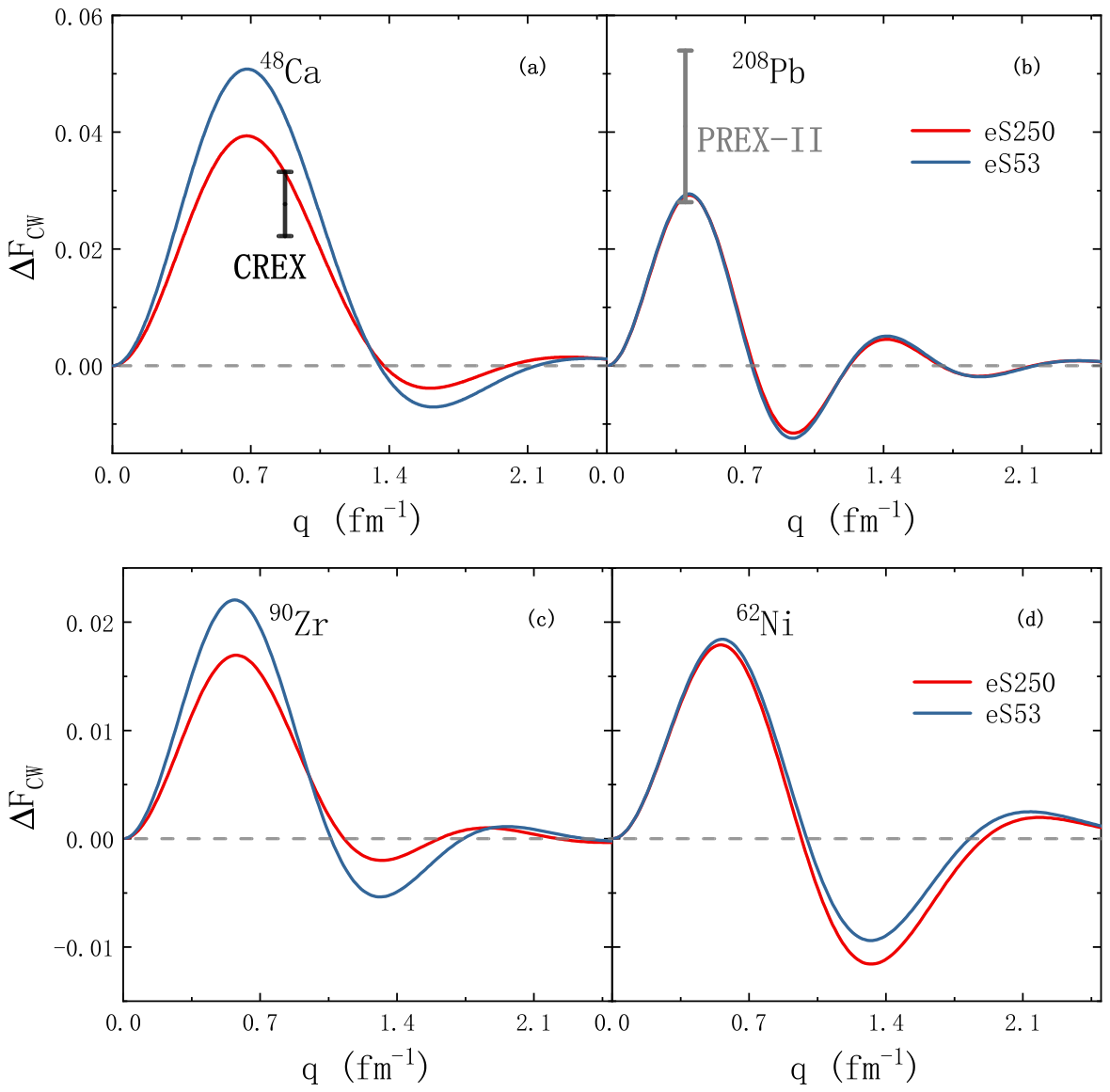
A complementary perspective on this sensitivity is provided by the momentum-transfer dependence of . Figure 3 displays this quantity for 90Zr and 62Ni in panels (c) and (d), respectively, with panels (a) and (b) showing the corresponding results for 48Ca and 208Pb for comparison. The comparison reveals that both 48Ca and 90Zr exhibit sensitivity to the IVSO interaction. For 90Zr, this sensitivity is most pronounced at fm−1. In contrast, 62Ni and 208Pb are both insensitive to the IVSO interaction.
Figure 3.
Momentum-transfer dependence of for various nuclei. Panels (a–d) show the results for 48Ca, 208Pb, 90Zr, and 62Ni, respectively, as functions of the momentum transfer q (in fm−1).
The contrasting behavior between the pairs (48Ca, 90Zr) and (208Pb, 62Ni) makes comprehensive experimental measurements on these nuclei particularly meaningful and important. 90Zr is a stable natural isotope of zirconium with an abundance of 51.45% in nature [52], while 62Ni is likewise a stable natural isotope of nickel with an abundance of 3.63% [52]. Both are suitable for experimental measurements. Owing to the insensitivity of 208Pb and 62Ni to the IVSO interaction, parity-violating electron scattering (PVES) experiments measuring (or the neutron skin thickness) on these two nuclei would provide a combined constraint on the symmetry energy that is more precise than that obtained from PREX-II alone. Meanwhile, PVES measurements on 90Zr, when combined with the CREX results, would enable a more accurate determination of the IVSO interaction strength . Such measurements can be realistically performed at existing and upcoming facilities. The MESA accelerator in Mainz, with its planned PVES program MREX [53], is well suited for precision measurements on nuclei including 90Zr and 62Ni as well as 48Ca and 208Pb. Complementary measurements at JLab, building on the successful PREX-II and CREX experiments, are also feasible, as demonstrated by recent proposals and feasibility studies [54,55]. This would have a positive and significant impact on deepening our understanding of both the symmetry energy and the IVSO interaction.
3.3. Neutron Skin Rnp of 48Ca, 208Pb, 90Zr, 62Ni, 22O and 24O
Compared to , the neutron skin thickness is a more intuitive and frequently discussed quantity, which, like , characterizes the overall difference between neutron and proton distributions. Beyond 48Ca and 90Zr, following the analysis in Ref. [22], one can readily identify 22O and 24O as nuclei that are also sensitive to the IVSO interaction, with evidence supporting their double magic nature [56,57]. Table 1 presents the calculated values for 48Ca, 208Pb, 90Zr, 62Ni, 22O, and 24O obtained with the eS53 and eS250 EDFs. For 208Pb and 62Ni, the results from the two EDFs, are nearly identical. In contrast, for 48Ca, 90Zr, 22O, and 24O, the eS250 predictions are smaller than those of eS53, reflecting a behavior similar to that observed for . It is worth noting that the charge-exchange reaction measurement by Ref. [58] reported fm for 90Zr, with the central value of 0.07 fm lying between the eS250 and eS53 predictions, indicating the need for more precise experimental determinations. Furthermore, future measurements of for 22O and 24O, e.g., by charge-changing cross sections [59,60], would be highly desirable to validate the predictions of the present work.
Table 1.
Neutron skin (in fm) of 48Ca, 208Pb, 90Zr, 62Ni, 242O and 24O with eS53 and eS250.
4. Conclusions
In this work, we have systematically investigated the sensitivity of the charge-weak form factor difference to the IVSO interaction in 48Ca, 208Pb, 90Zr, and 62Ni using the extended Skyrme EDFs eS53 and eS250. Relative to eS53, the strong-IVSO functional eS250 with MeV·fm5 selectively shifts the calculated of 48Ca toward the CREX value while leaving the corresponding prediction for 208Pb essentially unchanged [22]. At the same time, eS250 preserves the established magic shell closures in 48Ca and 208Pb and maintains a good description of global nuclear properties.
By examining the orbital-by-orbital contributions to and , we demonstrate that the sensitivity of 48Ca originates from the eight neutrons, which modify the central mean-field potential and thereby influence all orbitals. A similar mechanism is identified in 90Zr, where ten neutrons play an analogous role, leading to a pronounced IVSO sensitivity in its and neutron skin thickness . In contrast, 208Pb and 62Ni, characterized by near-cancellation of the isovector spin–orbit density , exhibit little sensitivity to the IVSO interaction.
This structural distinction between the pairs (48Ca, 90Zr) and (208Pb, 62Ni) offers a controlled experimental strategy for disentangling the IVSO interaction from the density dependence of the symmetry energy. The natural abundances and experimental accessibility of 90Zr and 62Ni make them ideal candidates for future PVES measurements. Such measurements could be performed at MREX and JLab. Once available, they can be combined with existing PREX-II and CREX observables to help separate EDF-level IVSO effects from symmetry-energy effects and thereby constrain both the density dependence of the symmetry energy and the IVSO strength .
Furthermore, our predictions for the neutron skin thickness in 22O and 24O, which could be measured by charge-changing cross sections, suggest that these neutron-rich oxygen isotopes are also sensitive to the IVSO interaction, offering additional testing grounds for the proposed strong IVSO scenario. Overall, our results show that the sensitivity of to the IVSO interaction is strongly nucleus-dependent and is closely tied to the underlying spin–orbit saturation pattern. In this respect, PVES measurements across different nuclei offer a valuable way to constrain the isovector spin–orbit channel in nuclear EDFs.
Author Contributions
T.-G.Y. performed the theoretical calculations. Z.Z. and L.-W.C. supervised the theoretical calculations. All authors jointly analyzed the data and contributed to the interpretation of the results and to the writing of the manuscript. All authors have read and agreed to the published version of the manuscript.
Funding
This work was supported in part by the National Natural Science Foundation of China under Grant Nos. 12235010 and 12575137, the National SKA Program of China No. 2020SKA0120300, and the Science and Technology Commission of Shanghai Municipality under Grant No. 23JC1402700.
Data Availability Statement
All the data supporting the findings in this work are available within the manuscript, and any additional data are available from the corresponding authors upon reasonable request.
Acknowledgments
The authors would like to thank Wei-Zhou Jiang, Yifei Niu, Yifeng Sun, and Yu-Min Zhao for useful discussions.
Conflicts of Interest
The authors declare that they have no conflicts of interest.
References
- Liang, Z.T.; Wang, X.N. Globally polarized quark-gluon plasma in non-central A+A collisions. Phys. Rev. Lett. 2005, 94, 102301, Erratum in Phys. Rev. Lett. 2006, 96, 039901. https://doi.org/10.1103/PhysRevLett.94.102301. [Google Scholar] [CrossRef] [Scilit] [PubMed]
- The STAR Collaboration. Global Λ hyperon polarization in nuclear collisions: Evidence for the most vortical fluid. Nature 2017, 548, 62–65. [Google Scholar] [CrossRef] [Scilit]
- Bihlmayer, G.; Noel, P.; Vyalikh, D.V.; Chulkov, E.V.; Manchon, A. Rashba-like physics in condensed matter. Nat. Rev. Phys. 2022, 4, 642–659. [Google Scholar] [CrossRef] [Scilit]
- Bliokh, K.Y.; Rodríguez-Fortuño, F.J.; Nori, F.; Zayats, A.V. Spin–orbit interactions of light. Nat. Photon. 2015, 9, 796–808. [Google Scholar] [CrossRef] [Scilit]
- Thomas, L.H. The motion of a spinning electron. Nature 1926, 117, 514. [Google Scholar] [CrossRef] [Scilit]
- Dirac, P.A.M. The quantum theory of the electron. Proc. R. Soc. Lond. A 1928, 117, 610–624. [Google Scholar] [CrossRef] [Scilit]
- Kaiser, N.; Brockmann, R.; Weise, W. Peripheral nucleon-nucleon phase shifts and chiral symmetry. Nucl. Phys. A 1997, 625, 758–788. [Google Scholar] [CrossRef] [Scilit]
- Kaiser, N. Spin–orbit coupling in nuclei and realistic nucleon-nucleon potentials. Phys. Rev. C 2004, 70, 034307. [Google Scholar] [CrossRef] [Scilit]
- Goudschmidt, S.A.; Uhlenbeck, G.H. Spinning electrons and the structure of spectra. Nature 1926, 117, 264–265. [Google Scholar] [CrossRef] [Scilit]
- Mayer, M.G. On closed shells in nuclei. 2. Phys. Rev. 1949, 75, 1969–1970. [Google Scholar] [CrossRef] [Scilit]
- Haxel, O.; Jensen, J.H.D.; Suess, H.E. On the ”Magic Numbers” in Nuclear Structure. Phys. Rev. 1949, 75, 1766. [Google Scholar] [CrossRef] [Scilit]
- Isakov, V.I.; Erokhina, K.I.; Mach, H.; Sanchez-Vega, M.; Fogelberg, B. On the difference between proton and neutron spin orbit splittings in nuclei. Eur. Phys. J. A 2002, 14, 29–36. [Google Scholar] [CrossRef] [Scilit]
- Lesinski, T.; Bender, M.; Bennaceur, K.; Duguet, T.; Meyer, J. The Tensor part of the Skyrme energy density functional. I. Spherical nuclei. Phys. Rev. C 2007, 76, 014312. [Google Scholar] [CrossRef] [Scilit]
- Klupfel, P.; Reinhard, P.G.; Burvenich, T.J.; Maruhn, J.A. Variations on a theme by Skyrme: A systematic study of adjustments of model parameters. Phys. Rev. C 2009, 79, 034310. [Google Scholar] [CrossRef] [Scilit]
- Bender, M.; Heenen, P.H.; Reinhard, P.G. Self-consistent mean-field models for nuclear structure. Rev. Mod. Phys. 2003, 75, 121–180. [Google Scholar] [CrossRef] [Scilit]
- Sharma, M.M.; Lalazissis, G.; Konig, J.; Ring, P. Isospin Dependence of the Spin–orbit Force and Effective Nuclear Potentials. Phys. Rev. Lett. 1995, 74, 3744–3747. [Google Scholar] [CrossRef] [Scilit]
- Reinhard, P.G.; Flocard, H. Nuclear effective forces and isotope shifts. Nucl. Phys. A 1995, 584, 467–488. [Google Scholar] [CrossRef] [Scilit]
- Ebran, J.P.; Mutschler, A.; Khan, E.; Vretenar, D. Spin–orbit interaction in relativistic nuclear structure models. Phys. Rev. C 2016, 94, 024304. [Google Scholar] [CrossRef] [Scilit]
- Vautherin, D.; Brink, D.M. Hartree-Fock calculations with Skyrme’s interaction. 1. Spherical nuclei. Phys. Rev. C 1972, 5, 626–647. [Google Scholar] [CrossRef] [Scilit]
- Kaiser, N. Nuclear energy density functional from chiral pion-nucleon dynamics: Isovector terms. Eur. Phys. J. A 2010, 45, 61–68. [Google Scholar] [CrossRef] [Scilit]
- Holt, J.W.; Kaiser, N.; Weise, W. Nuclear energy density functional from chiral two- and three-nucleon interactions. Eur. Phys. J. A 2011, 47, 128. [Google Scholar] [CrossRef] [Scilit]
- Yue, T.G.; Zhang, Z.; Chen, L.W. Evidence for strong isovector nuclear spin–orbit interaction. Sci. Bull. 2026, 71, 1270–1272. [Google Scholar] [CrossRef] [Scilit] [PubMed]
- Zhao, T.; Lin, Z.; Kumar, B.; Steiner, A.W.; Prakash, M. Characterizing the nuclear models informed by PREX and CREX: A view from Bayesian inference. Phys. Rev. Res. 2025, 7, 043335. [Google Scholar] [CrossRef] [Scilit]
- Kunjipurayil, A.; Piekarewicz, J.; Salinas, M. Role of the isovector spin–orbit potential in mitigating the CREX-PREX dilemma. Phys. Rev. C 2025, 112, 014310. [Google Scholar] [CrossRef] [Scilit]
- Adhikari, D.; Albataineh, H.; Androic, D.; Aniol, K.A.; Armstrong, D.S.; Averett, T.; Ayerbe Gayoso, C.; Barcus, S.K.; Bellini, V.; Beminiwattha, R.S.; et al. Precision Determination of the Neutral Weak Form Factor of Ca48. Phys. Rev. Lett. 2022, 129, 042501. [Google Scholar] [CrossRef] [Scilit] [PubMed]
- Adhikari, D.; Albataineh, H.; Androic, D.; Aniol, K.; Armstrong, D.S.; Averett, T.; Ayerbe Gayoso, C.; Barcus, S.; Bellini, V.; Beminiwattha, R.S.; et al. Accurate Determination of the Neutron Skin Thickness of 208Pb through Parity-Violation in Electron Scattering. Phys. Rev. Lett. 2021, 126, 172502. [Google Scholar] [CrossRef] [Scilit] [PubMed]
- Reinhard, P.G.; Roca-Maza, X.; Nazarewicz, W. Combined Theoretical Analysis of the Parity-Violating Asymmetry for Ca48 and Pb208. Phys. Rev. Lett. 2022, 129, 232501. [Google Scholar] [CrossRef] [Scilit]
- Yüksel, E.; Paar, N. Implications of parity-violating electron scattering experiments on 48Ca (CREX) and 208Pb (PREX-II) for nuclear energy density functionals. Phys. Lett. B 2023, 836, 137622. [Google Scholar] [CrossRef] [Scilit]
- Zhang, Z.; Chen, L.W. Bayesian inference of the symmetry energy and the neutron skin in Ca48 and Pb208 from CREX and PREX-2. Phys. Rev. C 2023, 108, 024317. [Google Scholar] [CrossRef] [Scilit]
- Mondal, C.; Gulminelli, F. Nucleonic metamodeling in light of multimessenger, PREX-II, and CREX data. Phys. Rev. C 2023, 107, 015801. [Google Scholar] [CrossRef] [Scilit]
- Tagami, S.; Wakasa, T.; Yahiro, M. Slope parameters determined from CREX and PREX2 (published in Results in Physics). arXiv 2022, arXiv:2210.03313. [Google Scholar] [CrossRef] [Scilit]
- Miyatsu, T.; Cheoun, M.K.; Kim, K.; Saito, K. Can the PREX-2 and CREX results be understood by relativistic mean-field models with the astrophysical constraints? Phys. Lett. B 2023, 843, 138013. [Google Scholar] [CrossRef] [Scilit]
- Sammarruca, F. The Neutron Skin of 48Ca and 208Pb: A Critical Analysis. Symmetry 2024, 16, 34. [Google Scholar] [CrossRef] [Scilit]
- Papakonstantinou, P. Nuclear symmetry energy and the PREX-CREX neutron skin puzzle within the KIDS framework. arXiv 2022, arXiv:2210.02696. [Google Scholar] [CrossRef] [Scilit]
- Kumar, M.; Kumar, S.; Thakur, V.; Kumar, R.; Agrawal, B.K.; Dhiman, S.K. CREX- and PREX-II-motivated relativistic interactions and their implications for the bulk properties of nuclear matter and neutron stars. Phys. Rev. C 2023, 107, 055801. [Google Scholar] [CrossRef] [Scilit]
- Lattimer, J.M. Constraints on Nuclear Symmetry Energy Parameters. Particles 2023, 6, 30–56. [Google Scholar] [CrossRef] [Scilit]
- Liliani, N.; Nugraha, A.M.; Diningrum, J.P.; Sulaksono, A. Tensor and isovector–isoscalar terms of relativistic mean field model: Impacts on neutron-skin thickness, charge radius, and nuclear matter. Nucl. Phys. A 2024, 1042, 122812. [Google Scholar] [CrossRef] [Scilit]
- Hu, B.; Jiang, W.; Miyagi, T.; Sun, Z.; Ekström, A.; Forssén, C.; Hagen, G.; Holt, J.D.; Papenbrock, T.; Stroberg, S.R.; et al. Ab initio predictions link the neutron skin of 208Pb to nuclear forces. Nat. Phys. 2022, 18, 1196–1200, Erratum in Nat. Phys. 2024, 20, 169. https://doi.org/10.1038/s41567-023-02324-9. [Google Scholar] [CrossRef] [Scilit] [PubMed]
- Qiu, M.; Yue, T.G.; Zhang, Z.; Chen, L.W. Resolving the PREX-CREX puzzle in covariant density functional theory. arXiv 2025, arXiv:2511.15385. [Google Scholar] [CrossRef] [Scilit]
- Chamel, N.; Goriely, S.; Pearson, J.M. Further explorations of Skyrme-Hartree-Fock-Bogoliubov mass formulas. XI. Stabilizing neutron stars against a ferromagnetic collapse. Phys. Rev. C 2009, 80, 065804. [Google Scholar] [CrossRef] [Scilit]
- Stancu, F.; Brink, D.M.; Flocard, H. The tensor part of Skyrme’s interaction. Phys. Lett. B 1977, 68, 108–112. [Google Scholar] [CrossRef] [Scilit]
- Chabanat, E.; Meyer, J.; Bonche, P.; Schaeffer, R.; Haensel, P. A Skyrme parametrization from subnuclear to neutron star densities. Nucl. Phys. A 1997, 627, 710–746. [Google Scholar] [CrossRef] [Scilit]
- Zhang, Z.; Chen, L.W. Extended Skyrme interactions for nuclear matter, finite nuclei and neutron stars. Phys. Rev. C 2016, 94, 064326. [Google Scholar] [CrossRef] [Scilit]
- Dobaczewski, J.; Nazarewicz, W.; Stoitsov, M.V. Nuclear ground state properties from mean field calculations. Eur. Phys. J. A 2002, 15, 21–26. [Google Scholar] [CrossRef] [Scilit]
- Stoitsov, M.V.; Dobaczewski, J.; Nazarewicz, W.; Ring, P. Axially deformed solution of the Skyrme-Hartree-Fock-Bogolyubov equations using the transformed harmonic oscillator basis: The Program HFBTHO (v1.66p). Comput. Phys. Commun. 2005, 167, 43–63. [Google Scholar] [CrossRef] [Scilit]
- Reinhard, P.G.; Roca-Maza, X.; Nazarewicz, W. Information Content of the Parity-Violating Asymmetry in Pb208. Phys. Rev. Lett. 2021, 127, 232501. [Google Scholar] [CrossRef] [Scilit] [PubMed]
- Horowitz, C.J.; Piekarewicz, J. Impact of spin–orbit currents on the electroweak skin of neutron-rich nuclei. Phys. Rev. C 2012, 86, 045503. [Google Scholar] [CrossRef] [Scilit]
- Acha, A.; Aniol, K.A.; Armstrong, D.S.; Arrington, J.; Averett, T.; Bailey, S.L.; Barber, J.; Beck, A.; Benaoum, H.; Benesch, J.; et al. Precision Measurements of the Nucleon Strange Form Factors at Q**2 ~ 0.1-GeV**2. Phys. Rev. Lett. 2007, 98, 032301. [Google Scholar] [CrossRef] [Scilit]
- Liu, J.; McKeown, R.D.; Ramsey-Musolf, M.J. Global Analysis of Nucleon Strange Form Factors at Low Q**2. Phys. Rev. C 2007, 76, 025202. [Google Scholar] [CrossRef] [Scilit]
- Alexandrou, C.; Bacchio, S.; Constantinou, M.; Finkenrath, J.; Hadjiyiannakou, K.; Jansen, K.; Koutsou, G. Nucleon strange electromagnetic form factors. Phys. Rev. D 2020, 101, 031501. [Google Scholar] [CrossRef] [Scilit]
- Bender, M.; Rutz, K.; Reinhard, P.G.; Maruhn, J.A. Pairing gaps from nuclear mean field models. Eur. Phys. J. A 2000, 8, 59–75. [Google Scholar] [CrossRef] [Scilit]
- National Nuclear Data Center, Information Extracted from the NuDat Database. Available online: https://www.nndc.bnl.gov/nudat/ (accessed on 23 April 2026).
- Schlimme, S.; Aulenbacher, K.; Baunack, S.; Berger, N.; Denig, A.; Doria, L.; Khoukaz, A.; Maas, F.; Merkel, H.; Sfienti, C.; et al. The MESA physics program. EPJ Web Conf. 2024, 303, 06002. [Google Scholar] [CrossRef] [Scilit]
- Esser, A.; Kozyrev, N.; Aulenbacher, K.; Baunack, S.; Dehn, M.; Del Vincio, A.; Doria, L.; Hoek, M.; Keil, F.; Maas, F.; et al. Beam-Normal Single-Spin Asymmetry in Pb208 at Low Energy: Discrepancy Resolved or New Kinematic Puzzle? Phys. Rev. Lett. 2025, 135, 232502. [Google Scholar] [CrossRef] [Scilit] [PubMed]
- Gal, C.; Ghosh, C.; Park, S.; Adhikari, D.; Armstrong, D.; Beminiwattha, R.; Camsonne, A.; Chandrasena, S.; Dalton, M.; Deshpande, A.; et al. Nuclear Dependence of Beam Normal Single Spin Asymmetry in Elastic Scattering from Nuclei. arXiv 2024, arXiv:2411.10267. [Google Scholar] [CrossRef] [Scilit]
- Ozawa, A.; Kobayashi, T.; Suzuki, K.; Yoshida, K.; Tanihata, I. A new magic number, N=16, Near to the neutron drip-line. Phys. Rev. Lett. 2000, 84, 5493–5495. [Google Scholar] [CrossRef] [Scilit]
- Becheva, E.; Blumenfeld, Y.; Khan, E.; Beaumel, D.; Daugas, J.M.; Delaunay, F.; Demonchy, C.E.; Drouart, A.; Fallot, M.; Gillibert, A.; et al. N = 14 Shell Closure in O-22 Viewed through a Neutron Sensitive Probe. Phys. Rev. Lett. 2006, 96, 012501. [Google Scholar] [CrossRef] [Scilit]
- Yako, K.; Sagawa, H.; Sakai, H. Neutron skin thickness of Zr-90 determined by charge exchange reactions. Phys. Rev. C 2006, 74, 051303. [Google Scholar] [CrossRef] [Scilit]
- Zhang, J.; Sun, B.; Tanihata, I.; Kanungo, R.; Scheidenberger, C.; Terashima, S.; Wang, F.; Ameil, F.; Atkinson, J.; Ayyad, Y.; et al. A new approach for deducing rms proton radii from charge-changing reactions of neutron-rich nuclei and the reaction-target dependence. Sci. Bull. 2024, 69, 1647–1652. [Google Scholar] [CrossRef] [Scilit]
- Hasan, Z.; Imran, M.; Usmani, A.A.; Khan, Z.A. Theoretical investigation of charge-changing cross section and interaction cross section for Be, B, C, N, O, and F isotopes on C12 at 200–1050 MeV/nucleon. Phys. Rev. C 2025, 111, 064601. [Google Scholar] [CrossRef] [Scilit]

Disclaimer/Publisher’s Note: The statements, opinions and data contained in all publications are solely those of the individual author(s) and contributor(s) and not of MDPI and/or the editor(s). MDPI and/or the editor(s) disclaim responsibility for any injury to people or property resulting from any ideas, methods, instructions or products referred to in the content. |
© 2026 by the authors. Licensee MDPI, Basel, Switzerland. This article is an open access article distributed under the terms and conditions of the Creative Commons Attribution (CC BY) license.