


Abstract
The primary objective of this study is a comprehensive investigation of the self-bound properties of strange quark matter (SQM), which is hypothesized to represent the absolute ground state of superdense strongly interacting matter. An analysis is performed within the framework of the MIT bag model, including first-order perturbative QCD corrections and the finite strange quark mass. By systematically varying the vacuum pressure (bag constant, ) and the strong coupling constant () over a broad parameter space, while assuming a finite strange quark mass (), we explicitly compute the thermodynamic characteristics of the system including pressure, energy density, baryon number density, and the chemical potentials of quarks and charge-neutralizing electrons under conditions of -equilibrium and global charge neutrality. Particular emphasis is placed on determining the minimum energy per baryon, which serves as the criterion for absolute stability. For parameter sets satisfying the self-binding condition, the integral properties of strange stars are derived via the numerical integration of the Tolman–Oppenheimer–Volkoff equations. The resulting mass–radius and mass–central density relations are analyzed, yielding the maximum stellar masses in the range . This study identifies the regions in the space of phenomenological parameters that allow for pure self-bound strange stars and demonstrates the sensitivity of stability and stellar properties to the underlying bag model parameters.
1. Introduction
The pioneering theoretical investigations by Landau [1], Baade and Zwicky [2], and Oppenheimer [3] into the structure of superdense stellar configurations initiated sustained interest in the properties of matter at densities exceeding nuclear saturation density. At sufficiently high densities, it is expected that hadronic matter undergoes deconfinement, leading to the liberation of quarks from baryonic confinement and the formation of quark matter [4,5].
Among the possible phases of deconfined matter, strange quark matter (SQM) composed of up (u), down (d), and strange (s) quarks in weak equilibrium has attracted particular attention. The hypothesis originally proposed by Bodmer [5] and later developed by Witten [4] suggests that, under certain conditions, three-flavor quark matter may possess a lower energy per baryon than the most stable atomic nucleus. In such a case, SQM could represent the absolute ground state of strongly interacting matter. If realized in nature, this would allow for the existence of self-bound compact configurations known as strange stars (SSs).
Observational advances in pulsar timing and gravitational-wave astronomy have significantly constrained the equation of state (EoS) of dense matter. Precisely measured heavy pulsars provide important benchmarks for theoretical models, including , with [6]; , with [7]; , with [8]; , with [9]; and , with [10], as well as compact objects detected in binary mergers such as , with [11]. Any viable EoS must be capable of supporting stellar masses of at least . To further constrain the model parameters, we compare the obtained mass–radius relations with observational limits from [8], [12], the [13] merger event, and the compact object [14]. The comparison shows that only a subset of parameter combinations ( and ) simultaneously satisfies both the maximum mass and radius constraints. These observational bounds, therefore, provide additional restrictions on the allowed MIT bag model parameter space.
The macroscopic properties of strange stars are determined entirely by the equation of state of SQM. Several theoretical frameworks have been developed to describe deconfined quark matter, including the Nambu–Jona-Lasinio (NJL) model [15], quark mass density-dependent models [16], and phenomenological approaches based on the MIT bag model [17,18]. Despite its simplicity, the MIT bag model remains a widely used and transparent framework for exploring the parametric dependence of SQM stability and stellar structure.
Within the bag model, the behavior of SQM is governed by phenomenological parameters, primarily the vacuum pressure (bag constant, ), the quark–gluon coupling constant , and the strange quark mass [19]. While the masses of the and quarks are non-zero, their small values lead only to minor quantitative corrections to macroscopic stellar properties. The realization of absolutely stable SQM depends sensitively on the interplay between .
Previous studies have examined the stability windows and stellar configurations arising within modified or extended bag model formulations [20,21,22,23,24,25,26,27]. In particular, in our recent work [28], stellar configurations compatible with heavy pulsars were investigated for selected parameter values. However, a comprehensive mapping of the multidimensional parameter space, including systematic variation in both and with finite SQM, remains necessary to delineate the full domain of self-bound solutions.
The primary objective of the present work is therefore to identify and categorize the regions of the MIT bag model parameter space that allow for absolutely stable SQM, characterized by a negative binding energy per baryon, and to determine the corresponding integral properties of strange stars obtained from the numerical integration of the Tolman–Oppenheimer–Volkoff (TOV) equations. Particular attention is paid to the sensitivity of the stability condition and maximum stellar masses to variations in the phenomenological parameters. This approach enables a systematic assessment of the conditions under which pure self-bound strange stars may exist, rather than hybrid configurations involving phase coexistence [20,21]. In contrast to our previous study, which considered a density-dependent bag pressure , the present work focuses on the standard MIT bag model with constant vacuum pressure and systematically explores the dependence of SQM properties on the fundamental parameters . This complementary approach allows us to isolate the role of perturbative QCD corrections and strange quark mass in determining the absolute stability window and the maximum masses of self-bound strange stars.
In the present study, we focus on the range , which corresponds to moderate binding energies and allows for a clearer assessment of the sensitivity of the EoS to variations in the bag constant and the strong coupling parameter . Smaller values of the bag constant () lead to very strongly bound SQM and an extremely stiff EoS, resulting in unusually large maximum masses of strange stars. Therefore, restricting the analysis to provides a more realistic parameter range for comparison with observational constraints on compact star properties.
2. Materials and Methods
In [22], the state of self-bound SQM was examined within the MIT bag model for specific values of its three phenomenological parameters, focusing on configurations for which the minimum energy per baryon satisfies the absolute stability criterion, . Consistent with the discussion in [4], it was demonstrated that the energy per baryon of three-flavor ) matter, even in the approximation of vanishing quark masses, can be lower than that of non-strange ) matter and the most tightly bound atomic nucleus .
The resulting energy deficit, which remains of order even in the massless limit [19], supports the hypothesis that the introduction of the strange degree of freedom allows for a more efficient filling of Fermi levels due to the Pauli exclusion principle. Consequently, under appropriate conditions, the inequalities and may be fulfilled, indicating the possible absolute stability of SQM. Interest in the ground state of SQM has led to several extensions of the original MIT bag model. In the original formulation [1], quarks are treated as a non-interacting Fermi gas confined by a constant vacuum pressure (bag constant), and absolute stability is achieved when the energy per baryon satisfies . Later, perturbative QCD corrections were introduced through the strong coupling parameter [2], accounting for quark–gluon interactions in first-order approximation while keeping the bag constant fixed. Subsequent studies [23,24,25] considered a density-dependent bag parameter , often using a Gaussian parametrization, which modifies the stiffness of the equation of state and alters the SQM stability window. In addition, repulsive vector interactions between quarks were introduced in Refs. [26,27], leading to an additional contribution characterized by the coupling constant . Such interactions stiffen the equation of state and allow for the description of massive strange stars with . The combined effects of strong interactions and density-dependent vacuum pressure were also explored in Ref. [25], where maintaining thermodynamic consistency is essential. These different approaches demonstrate that both interaction effects and the behavior of the bag parameter significantly influence the absolute stability of SQM and the corresponding mass constraints of strange stars.
The renewed interest in SQM is further motivated by developments of the vector interaction MIT (vMIT) model, in which quark interactions are mediated by a repulsive vector field [26,27]. Within both the standard MIT framework [23,24] and its vector extensions [25], including formulations with density-dependent vacuum pressure, the characterization of SQM remains fundamentally based on the absolute stability hypothesis, defined through the minimization of the energy per baryon.
To perform a systematic parametric investigation, we consider discrete values of the vacuum pressure and include perturbative QCD corrections to the first order in the strong coupling constant, . The constituent quark masses are taken as , , and , in accordance with phenomenological constraints [19].
Restricting the expansion to the first order in , the thermodynamic potential density for each quark flavor is written in the form derived in [22]:
where represents the renormalization scale introduced in the perturbative treatment.
For electrons, they are treated as an ultra-relativistic free Fermi gas
The particle number densities follow from . Chemical equilibrium under weak interactions (-equilibrium) requires and , while global charge neutrality is imposed through .
Using a numerical C++ framework and adopting the up quark chemical potential as the independent variable, the thermodynamic potentials are evaluated for each selected parameter set. For a given bag constant , the total pressure, energy density, baryon number density, and baryon chemical potential are calculated as , , and , respectively.
At zero pressure, the baryon chemical potential equals the energy per baryon, . Defining , the self-binding condition is satisfied if , meaning that the minimum energy per baryon in SQM is lower than that of (approximately ). The aim of this study is to numerically determine the regions of the multidimensional parameter space () that satisfy this absolute stability criterion.
3. Results and Discussion
For the selected values of the vacuum pressure and quark–gluon coupling constant, calculations were previously performed in [28] for and strange quark masses , treating the up and down quark masses as zero. In these cases, the minimum energy per baryon satisfied the self-binding condition (), and the resulting strange star configurations exhibited maximum masses comparable to those of observed pulsars.
In the present work, we extend the analysis to a broader parameter space defined by and for a fixed strange quark mass . The resulting integral parameters of the corresponding strange star configurations, obtained from the numerical integration of the TOV equations, are summarized in Table 1. The calculated quantities include:
Table 1.
Integral parameters of SQM EoS and SS configurations, when .
- The minimum energy per baryon .
- The minimum baryon number density .
- The maximum stellar mass .
- The corresponding radius .
- The gravitational surface redshift .
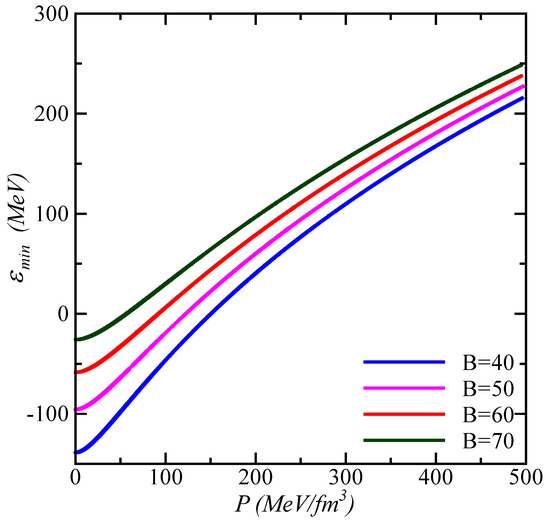
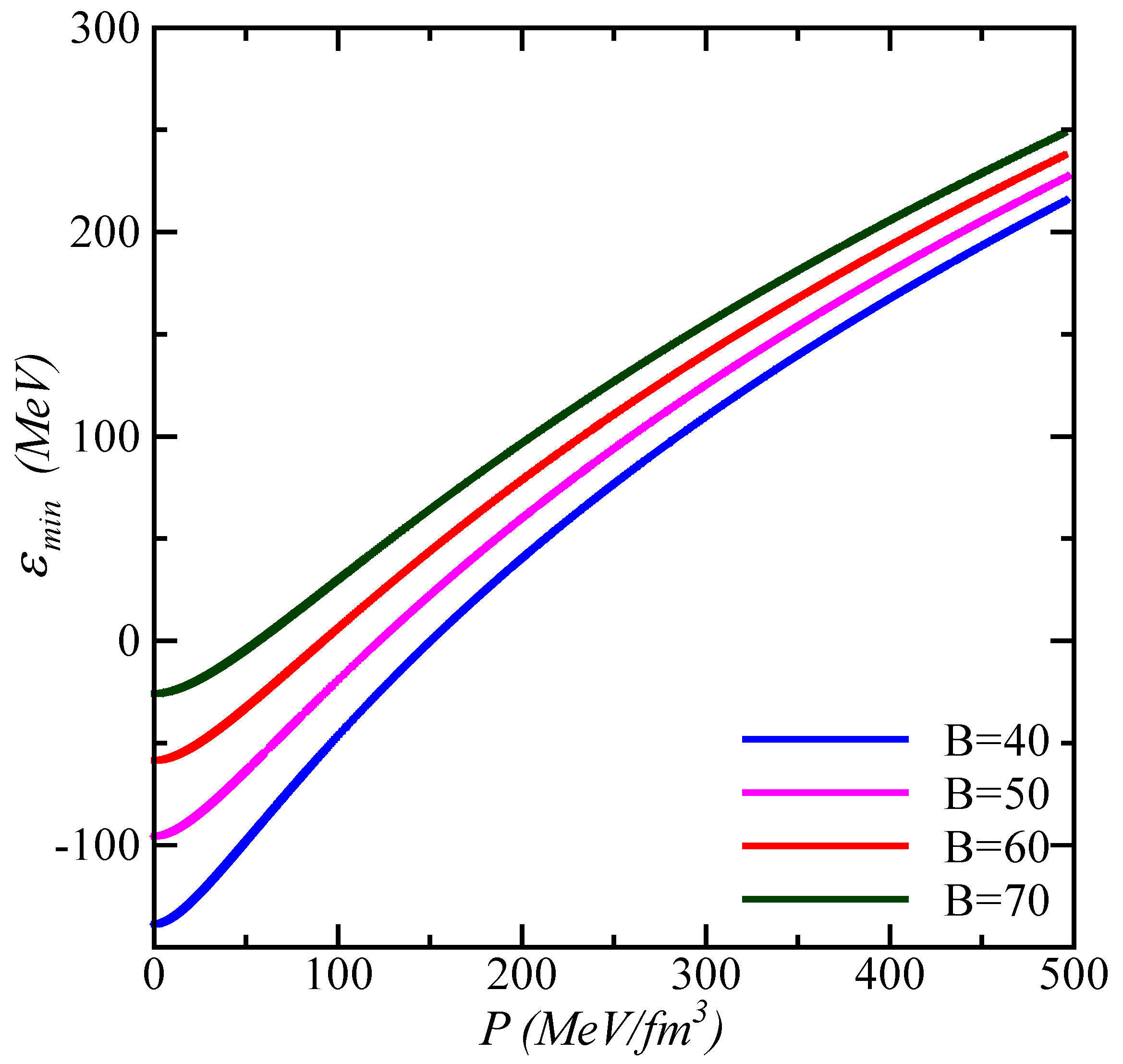
Figure 1 shows the dependence of the energy per baryon on pressure for representative values of at fixed . The calculations show that self-bound SQM is not realized for all parameter combinations. The condition depends sensitively on both and . For small coupling constants (), negative values of are obtained for the entire considered range of (see Figure 1).
Figure 1.
Energy per baryon as a function of pressure for and with .
For example,
At : , , , and .
At : , , , and .
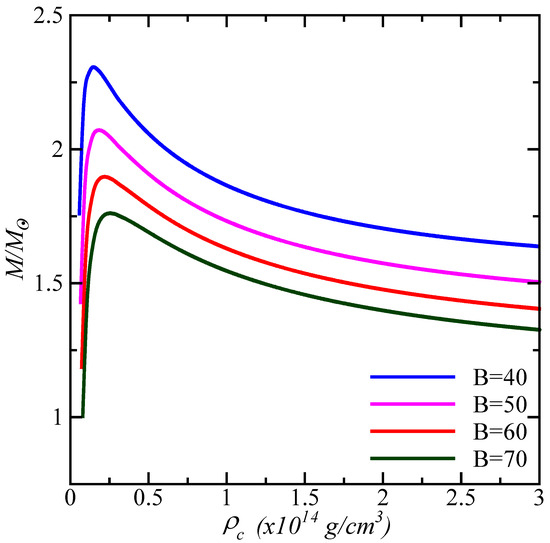
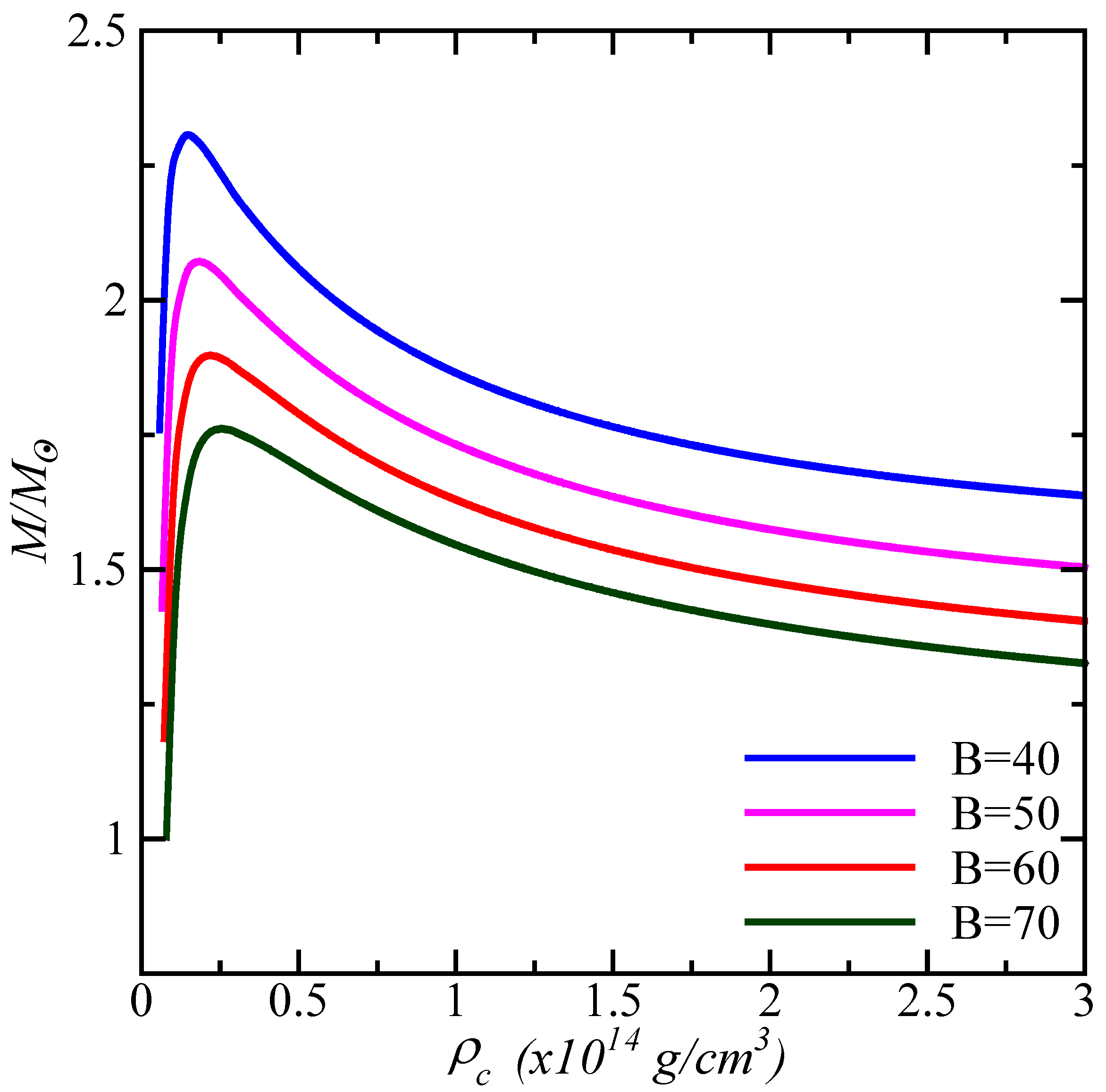
Thus, decreasing leads to a stronger binding energy, lower minimum baryon concentration, and larger maximum mass and radius, as illustrated in Figure 2.
Figure 2.
The maximum stellar mass as a function of central density for , calculated for and .
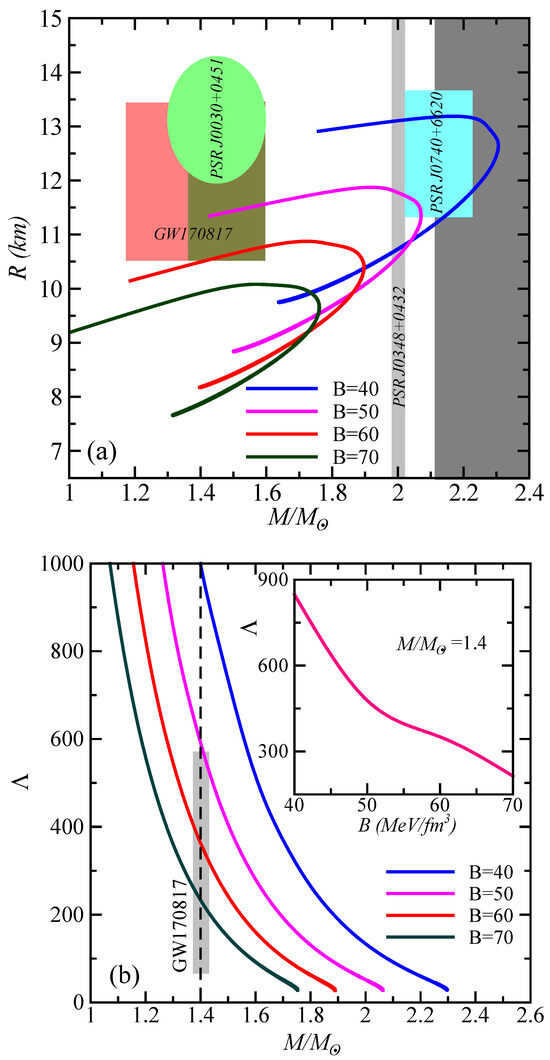
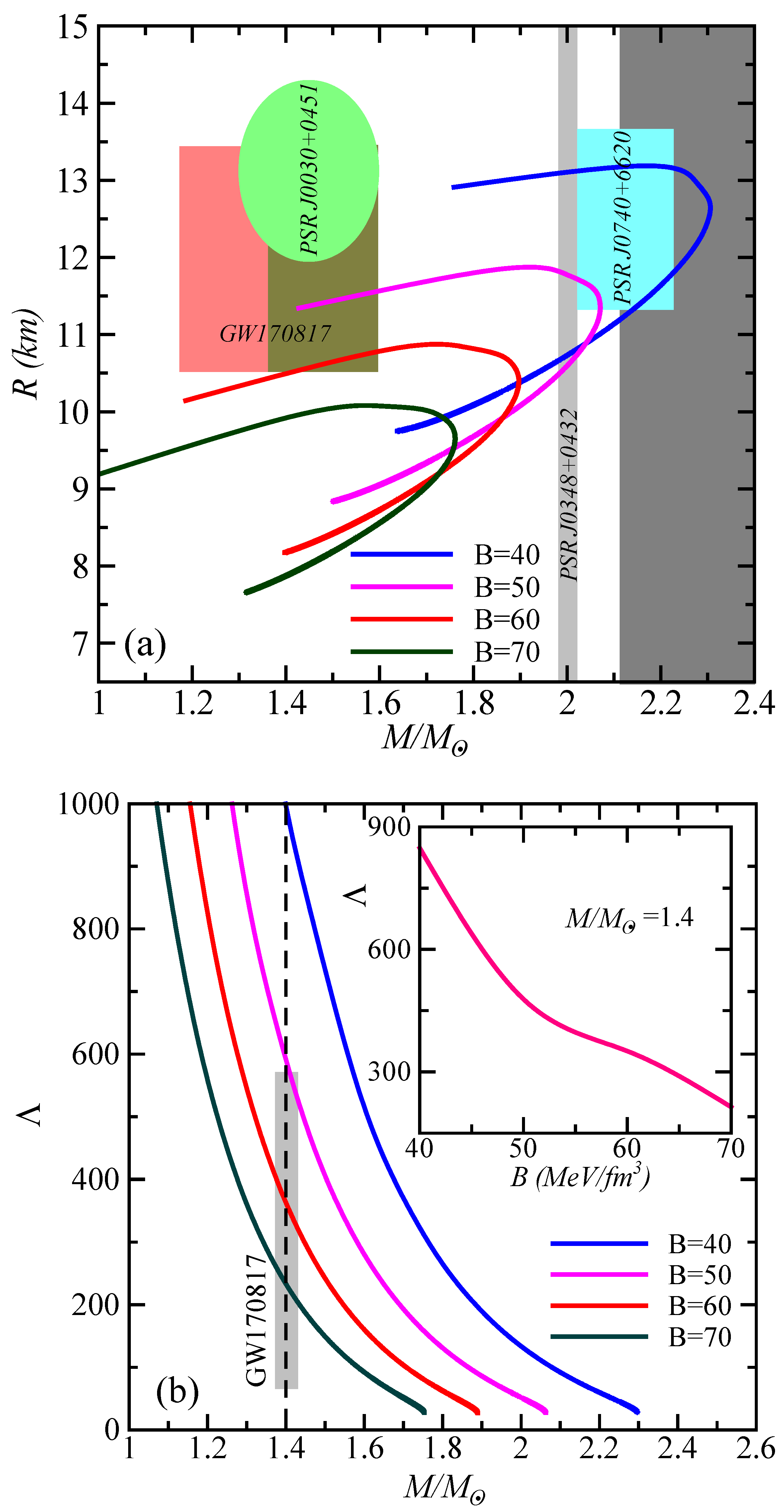
To further constrain the model parameters, we compare the resulting mass–radius relations with observational limits from , , and the binary neutron star merger. The corresponding confidence regions are shown individually in Figure 3a. For , the inferred mass and radius are and km [29]. For , the measurements yield and km [12]. The binary neutron star merger constrains the total mass to and suggests typical stellar radii in the range km [13]. These observational limits provide simultaneous constraints on both mass and radius.
Figure 3.
(a) Mass–radius relations for strange quark stars with , , and . The shaded regions indicate the observational mass–radius constraints for light (light gray) and heavy (dark gray) compact stars [6,7,8,9,10,11,12,13]. (b) Dimensionless tidal deformability as a function of stellar mass for the same parameter sets. The vertical dashed line marks the reference mass . The inset shows the dependence of on the bag constant .
The comparison shown in Figure 3a indicates that only a subset of parameter combinations ( and ) satisfies these constraints simultaneously. In particular, parameter sets with and are consistent with the observational mass–radius regions, whereas the case predicts larger radii and is consistent with the preferred constraints. These astrophysical bounds therefore provide additional restrictions on the allowed MIT bag model parameter space.
The compact object has been proposed as a low-mass candidate (), which lies significantly below the typical mass range of stable strange star configurations obtained within the present parameter space. For this reason, it is not included in Figure 3a, which focuses on the mass range relevant to the TOV solutions considered here. The existence of such a low-mass object may indicate either a different formation channel or the need to extend the model, such as by including density-dependent effects or additional interactions, which are beyond the scope of the present study.
In addition to the mass–radius constraints, we also calculated the dimensionless tidal deformability for the same parameter sets shown in Figure 3a. The results are presented in Figure 3b, where is plotted as a function of stellar mass for , with . The observational constraint derived from the event, (corresponding approximately to ), is shown as a shaded region in Figure 3b [30]. For the parameter sets , the obtained values are , respectively, which satisfy the observational bound. The corresponding radii are . In contrast, for , the calculated value exceeds the allowed limit, with a corresponding radius . Therefore, this parameter set is disfavored by the tidal deformability constraint. The remaining parameter sets satisfy the tidal deformability bound and remain consistent with the mass–radius constraints shown in Figure 3a. These results show that the inclusion of tidal deformability further restricts the allowed parameter space of the MIT bag model. In particular, the range () simultaneously satisfies both the mass–radius constraints shown in Figure 3a and the tidal deformability bound derived from .
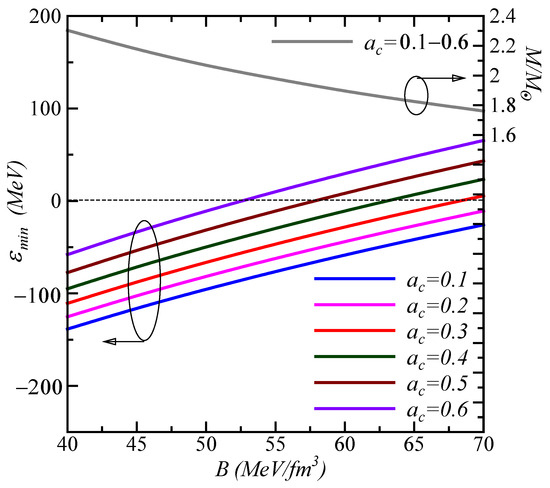
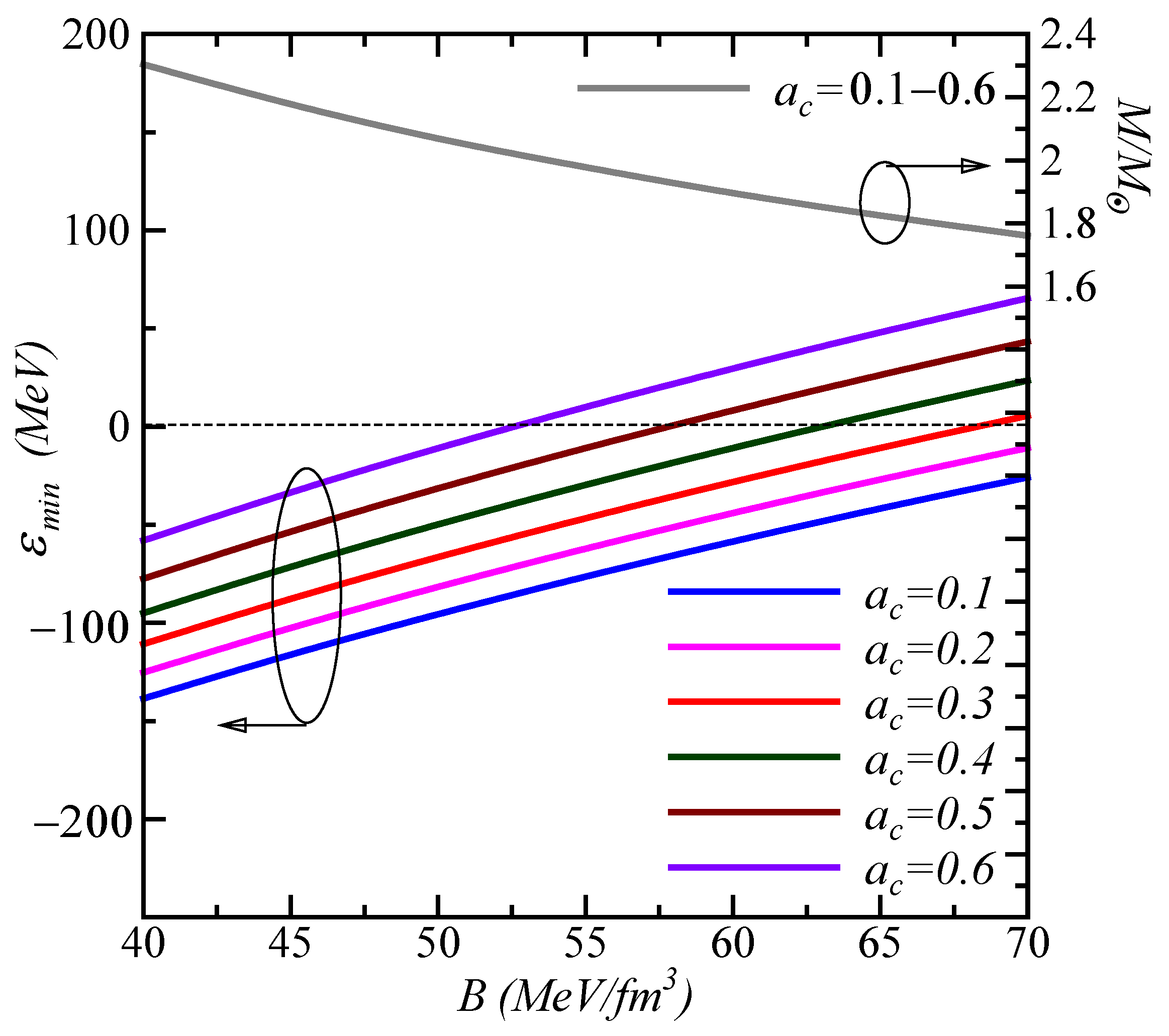
However, as the coupling constant increases, the stability window narrows. This behavior is clearly evident in Figure 4, where the minimum energy per baryon is plotted as a function of the vacuum pressure for different values of .
Figure 4.
The minimum energy per baryon as a function of vacuum pressure for and . The horizontal dashed line separates self-bound () and non-self-bound () configurations. The right vertical axis shows the corresponding dependence of the maximum stellar mass on .
For example,
For within , and for .
For : becomes positive at , respectively.
In contrast, for , self-boundness is maintained for all considered values of .
The mass curves for different values of nearly coincide over the considered parameter range, indicating a weak sensitivity of to compared to its stronger dependence on (see Figure 4).
These results indicate that both parameters act in opposite directions: (i) increasing increases the vacuum energy contribution, reducing stability, and (ii) increasing enhances perturbative interaction effects, also increasing the energy per baryon. Therefore, only a restricted region of the () parameter space allows for absolutely stable SQM.
The maximum stellar masses obtained in the explored parameter space lie within , with corresponding central densities in the range , and .
For and , , and .
A clear correlation is observed: as decreases, both the maximum mass and radius increase (Figure 2 and Figure 3). This reflects the reduced effective confinement and the corresponding stiffening of the equation of state at high densities.
The shaded region in Figure 3 corresponds to the observational mass interval , associated with heavy pulsars [6,7,8,9,10,11,12,13,14]. Only a subset of the parameter space satisfies both the self-binding condition and the observational lower bound of approximately .
For larger values of (), the condition is realized over most of the parameter space (Figure 4). In such cases, SQM cannot exist as a self-bound phase and would instead appear in equilibrium with hadronic matter, leading to hybrid star configurations with a quark core, consistent with the Maxwell construction scenario [20,21].
The presented results are obtained within the first-order perturbative approximation . Extension to higher orders, [31], and the inclusion of repulsive vector interactions (vMIT model) [23,24] may further modify the stability window and generally increase the maximum supported masses. Therefore, the explored range of vacuum pressure values remains relevant for future refinements of the model.
4. Conclusions
In this work, the equations of state of SQM were investigated within the framework of the MIT bag model. The energy per baryon, minimum baryon concentration, and chemical potentials of quarks were calculated over a wide range of phenomenological parameters and , for a fixed strange quark mass . The integral parameters of the corresponding stellar configurations, maximum masses, radii, and central densities, were obtained through the numerical integration of the TOV equations.
It is noteworthy that the considered ranges of the parameters and predominantly yield self-bound strange quark matter characterized by a negative minimum energy per baryon. The resulting maximum stellar masses lie in the range , which is comparable to the accurately measured masses of heavy pulsars, including:
- ().
- ).
- ).
- ()).
- The companion of ).
- ().
- Compact object ().
- Binary merger event ().
These results demonstrate that, within the first-order perturbative approximation , the MIT bag model can produce equations of state compatible with the observed mass range of compact stars.
From this perspective, it is natural to consider extensions of the present analysis to higher-order perturbative corrections and to formulations incorporating repulsive vector interactions (vMIT model). Such refinements may further modify the stability window and increase the maximum supported masses. The explored ranges of the phenomenological parameters, therefore, provide a meaningful basis for future investigations of dense quark matter in compact stars.
Author Contributions
Conceptualization, H.S. and T.S.; methodology, H.S.; software, T.S.; formal analysis, H.S. and T.S.; investigation, H.S.; writing—original draft preparation, H.S.; writing—review and editing, H.S. and A.B.; supervision, A.B. All authors have read and agreed to the published version of the manuscript.
Funding
This work was supported by the Scientific Research Grants through the Republic Armenia MoESCS Higher Education and Science Committee (21AG-1C061).
Data Availability Statement
The data presented in this study are available on request.
Conflicts of Interest
Tigran Sargsyan was employed by the company Synopsys Armenia CJSC, Yerevan, Armenia. The remaining authors declare that the research was conducted in the absence of any commercial or financial relationships that could be construed as a potential conflict of interest
Abbreviations
The following abbreviations are used in this manuscript:
| SQM | Strange Quark Matter |
| SS | Strange Star |
| EoS | Equation of State |
| TOV | Tolman–Oppenheimer–Volkoff |
| MIT | Massachusetts Institute of Technology (MIT Bag Model) |
| vMIT | Vector Interaction MIT Bag Model |
| QCD | Quantum Chromodynamics |
| NJL | Nambu–Jona-Lasinio |
References
- Landau, L.D. On the theory of stars. Phys. Z. USSR 1932, 1, 285. [Google Scholar]
- Baade, W.; Zwicky, F. Remarks on Supernovae and cosmic rays. Phys. Rev. 1934, 45, 138. [Google Scholar] [CrossRef] [Scilit]
- Oppenheimer, J.R.; Serber, R. On the stability of stellar neutron cores. Phys. Rev. 1938, 56, 540. [Google Scholar] [CrossRef] [Scilit]
- Witten, E. Cosmic separation of phases. Phys. Rev. D 1984, 30, 272. [Google Scholar] [CrossRef] [Scilit]
- Bodmer, A.R. Collapsed nuclei. Phys. Rev. D 1971, 4, 1601. [Google Scholar] [CrossRef] [Scilit]
- Demorest, P.B.; Pennucci, T.; Ransom, S.M.; Roberts, M.S.E.; Hessels, J.W.T. A two-solar-mass neutron star measured using Shapiro delay. Nature 2010, 467, 1081–1083. [Google Scholar] [CrossRef] [Scilit] [PubMed]
- Lynch, R.S.; Boyles, J.; Ransom, S.M.; Stairs, I.H.; Lorimer, D.R.; McLaughlin, M.A.; Hessels, J.W.T.; Kaspi, V.M.; Kondratiev, V.I.; Archibald, A.M.; et al. The Green Bank Telescope 350 MHz drift-scan survey II: Data analysis and the timing of 10 new pulsars, including a relativistic binary. Astrophys. J. 2013, 763, 81. [Google Scholar] [CrossRef] [Scilit]
- Cromartie, H.T.; Fonseca, E.; Ransom, S.M.; Demorest, P.B.; Arzoumanian, Z.; Blumer, H.; Brook, P.R.; DeCesar, M.E.; Dolch, T.; Ellis, J.A.; et al. Relativistic Shapiro delay measurements of an extremely massive millisecond pulsar. Nat. Astron. 2020, 4, 72–76. [Google Scholar] [CrossRef] [Scilit]
- Linares, M.; Shahbaz, T.; Casares, J. Peering into the dark side: Magnesium lines establish a massive neutron star in PSR J2215+5135. Astrophys. J. 2018, 859, 54. [Google Scholar] [CrossRef] [Scilit]
- Romani, R.W.; Kandel, D.; Filippenko, A.V.; Brink, T.G.; Zheng, W. PSR J0952−0607: The fastest and heaviest known Galactic neutron star. Astrophys. J. Lett. 2022, 934, L17. [Google Scholar] [CrossRef] [Scilit]
- LIGO Scientific Collaboration. GW190814: Gravitational waves from the coalescence of a 23 solar mass black hole with a 2.6 solar mass compact object. Phys. Rev. D 2020, 102, 043015. [Google Scholar] [CrossRef] [Scilit]
- Miller, M.C.; Lamb, F.K.; Dittmann, A.J.; Bogdanov, S.; Arzoumanian, Z.; Gendreau, K.C.; Guillot, S.; Harding, A.K.; Ho, W.C.G.; Lattimer, J.M.; et al. PSR J0030+0451 Mass and radius from NICER data and implications for the properties of Neutron star matter. Astrophys. J. Lett. 2019, 887, L24. [Google Scholar] [CrossRef] [Scilit]
- Abbott, B.P.; Abbott, R.; Abbott, T.D.; Acernese, F.; Ackley, K.; Adams, C.; Adams, T.; Addesso, P.; Adhikari, R.X.; Adya, V.B.; et al. GW170817: Observation of gravitational waves from a binary Neutron star inspiral. Phys. Rev. Lett. 2017, 119, 161101. [Google Scholar] [CrossRef] [Scilit]
- Sagun, V.; Giangrandi, E.; Dietrich, T.; Ivanytskyi, O.; Negreiros, R.; Providência, C. What is the nature of the HESS J1731-347 compact object? Astrophys. J. 2023, 958, 49. [Google Scholar] [CrossRef] [Scilit]
- Nambu, Y.; Jona-Lasinio, G. Dynamical model of elementary particles based on an analogy with superconductivity. Phys. Rev. 1961, 122, 345. [Google Scholar] [CrossRef] [Scilit]
- Lugones, G.; Grunfeld, A.G. Cold dense quark matter with phenomenological medium effects: A self-consistent formulation of the quark-mass density-dependent model. Phys. Rev. D 2023, 107, 043025. [Google Scholar] [CrossRef] [Scilit]
- Chodos, A.; Jaffe, R.L.; Johnson, K.; Thorn, C.B.; Weisskopf, V.F. New extended model of hadrons. Phys. Rev. D 1974, 9, 3471. [Google Scholar] [CrossRef] [Scilit]
- Chodos, A.; Jaffe, R.L.; Johnson, K.; Thorn, C.B.; Weisskopf, V.F. Baryon structure in the bag theory. Phys. Rev. D 1974, 10, 2599. [Google Scholar] [CrossRef] [Scilit]
- Olive, K.A. Review of particle physics. Chin. Phys. C 2014, 38, 090001. [Google Scholar] [CrossRef] [Scilit]
- Lopes, L.L.; Biesdorf, C.; Menezes, D.P. Modified MIT bag models—Part I: Thermodynamic consistency, stability windows and symmetry group. Phys. Scr. 2021, 96, 065303. [Google Scholar] [CrossRef] [Scilit]
- Glendenning, N.K. Compact Stars: Nuclear Physics, Particle Physics, and General Relativity; Springer: New York, NY, USA, 1997; pp. 289–302. [Google Scholar] [CrossRef] [Scilit]
- Farhi, E.; Jaffe, R.L. Strange matter. Phys. Rev. D 1984, 30, 2379. [Google Scholar] [CrossRef] [Scilit]
- Burgio, G.F.; Baldo, M.; Sahu, P.K.; Schulze, H.-J. Hadron-quark phase transition in dense matter and neutron stars. Phys. Rev. C 2002, 66, 025802. [Google Scholar] [CrossRef] [Scilit]
- Issifu, A.; da Silva, F.M.; Menezes, D.P. Hybrid stars built with density-dependent models. Mon. Not. R. Astron. Soc. 2023, 525, 5512–5519. [Google Scholar] [CrossRef] [Scilit]
- Podder, S.; Pal, S.; Sen, D.; Chaudhuri, G. Constraints on density dependent MIT bag model parameters for quark and hybrid stars. Nucl. Phys. A 2024, 1042, 122796. [Google Scholar] [CrossRef] [Scilit]
- Klähn, T.; Fischer, T. Vector interaction enhanced bag model for astrophysical applications. Astrophys. J. 2015, 810, 134. [Google Scholar] [CrossRef] [Scilit]
- Lopes, L.L.; Jiménez, J.C.; Castro, L.B.; Flores, C.V. Oscillatory properties of strange quark stars described by the vector MIT bag model. Eur. Phys. J. C 2025, 85, 515. [Google Scholar] [CrossRef] [Scilit]
- Shahinyan, H.; Sargsyan, T.; Babajanyan, A. Pulsars with the masses 2.14 M⊙ and 2.27 M⊙ as strange star candidates. J. High Energy Astrophys. 2024, 43, 126. [Google Scholar] [CrossRef] [Scilit]
- Riley, T.E.; Watts, A.L.; Ray, P.S.; Bogdanov, S.; Guillot, S.; Morsink, S.M.; Bilous, A.V.; Arzoumanian, Z.; Choudhury, D.; Deneva, J.S.; et al. A NICER view of the massive pulsar PSR J0740+6620 informed by radio timing and XMM-Newton spectroscopy. Astrophys. J. Lett. 2021, 918, L27. [Google Scholar] [CrossRef] [Scilit]
- Abbott, B.P.; Abbott, R.; Abbott, T.D.; Acernese, F.; Ackley, K.; Adams, C.; Adams, T.; Addesso, P.; Adhikari, R.X.; Adya, V.B.; et al. GW170817: Measurements of neutron star radii and equation of state. Phys. Rev. Lett. 2018, 121, 161101. [Google Scholar] [CrossRef] [Scilit]
- Restrepo, T.E.; Kneur, J.-L.; Providência, C.; Pinto, M.B. Comparing strange and nonstrange quark stars within resumed QCD at NLO. Phys. Rev. D 2025, 112, 054013. [Google Scholar] [CrossRef] [Scilit]

Disclaimer/Publisher’s Note: The statements, opinions and data contained in all publications are solely those of the individual author(s) and contributor(s) and not of MDPI and/or the editor(s). MDPI and/or the editor(s) disclaim responsibility for any injury to people or property resulting from any ideas, methods, instructions or products referred to in the content. |
© 2026 by the authors. Licensee MDPI, Basel, Switzerland. This article is an open access article distributed under the terms and conditions of the Creative Commons Attribution (CC BY) license.