


Abstract
The ICARUS experiment is part of the Short-Baseline Neutrino program at Fermilab and aims to search for the possible existence of sterile neutrinos in the O (1 eV) mass range, addressing anomalies observed by the LSND and MiniBooNE experiments. The ICARUS-T600 detector is a Liquid Argon Time Projection Chamber that provides high-resolution three-dimensional imaging and precise calorimetric measurements of ionizing particles. This technology enables detailed studies of neutrino interactions over a wide energy range, from a few to several hundred . Event reconstruction relies on a software framework that applies pattern recognition algorithms to transform raw detector signals into fully reconstructed interaction topologies, including vertices, particle tracks, and electromagnetic showers. In some cases, however, a single particle track may be incorrectly split into multiple segments, leading to underestimated energy reconstruction and potential failures in particle identification. Since these effects can result in the loss of otherwise valid events, we designed a stitching algorithm that identifies the broken tracks and reconnects (“stitches”) the segments. This approach improves track reconstruction quality, energy estimation and overall event reconstruction efficiency.
1. Introduction
The ICARUS experiment is a fundamental element of the Short-Baseline Neutrino (SBN) program at Fermilab [1], which is designed to investigate neutrino oscillations at short baselines and to search for possible sterile neutrinos. In addition, ICARUS plays an important role in the precise measurement of neutrino–argon cross-interaction sections, which are essential for future experiments such as DUNE, and in searches for physics Beyond the Standard Model (BSM).
2. ICARUS-T600 Detector
ICARUS-T600 is a Liquid Argon Time Projection Chamber (LArTPC). This technology, proposed by Carlo Rubbia in 1977 [2], is particularly well suited for neutrino physics, because it provides high-resolution event reconstruction together with a full three-dimensional visualization of neutrino interactions.
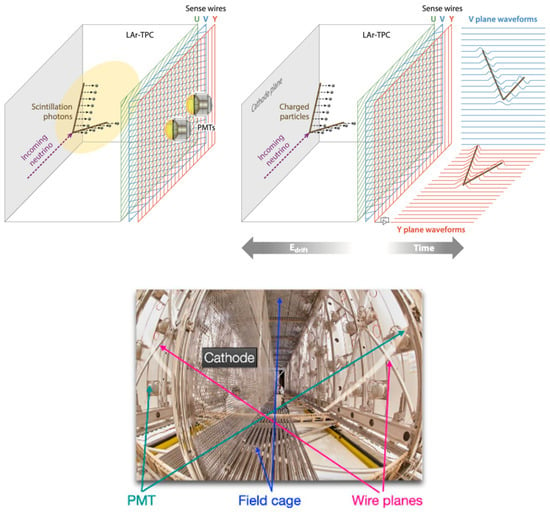
The charged particles that cross the detector ionize the liquid argon. These ionization electrons are drifted toward the anode by a uniform electric field. The anode consists of three wire planes—Induction-1, Induction-2 and Collection—comprising a total of 54,000 wires oriented at and , which record the ionization signal. The ionization charge is collected by the collection plane, while Induction-1 and Induction-2 provide a non-destructive measurement of the drifting charge through appropriate voltage biasing. By combining the information from the three planes, the spatial position of the particle can be reconstructed, enabling excellent three-dimensional imaging and calorimetric reconstruction of ionizing particles with a resolution at the millimeter scale.
The ICARUS-T600 detector [3] consists of two identical cryostats, each with dimensions of , containing a total of 760 of ultrapure liquid argon, of which 470 constitutes the active mass. Each cryostat hosts two TPCs separated by a common central cathode, providing a maximum drift distance of . Figure 1 shows an internal view of one module and illustrates the readout principle of a single TPC.
Figure 1.
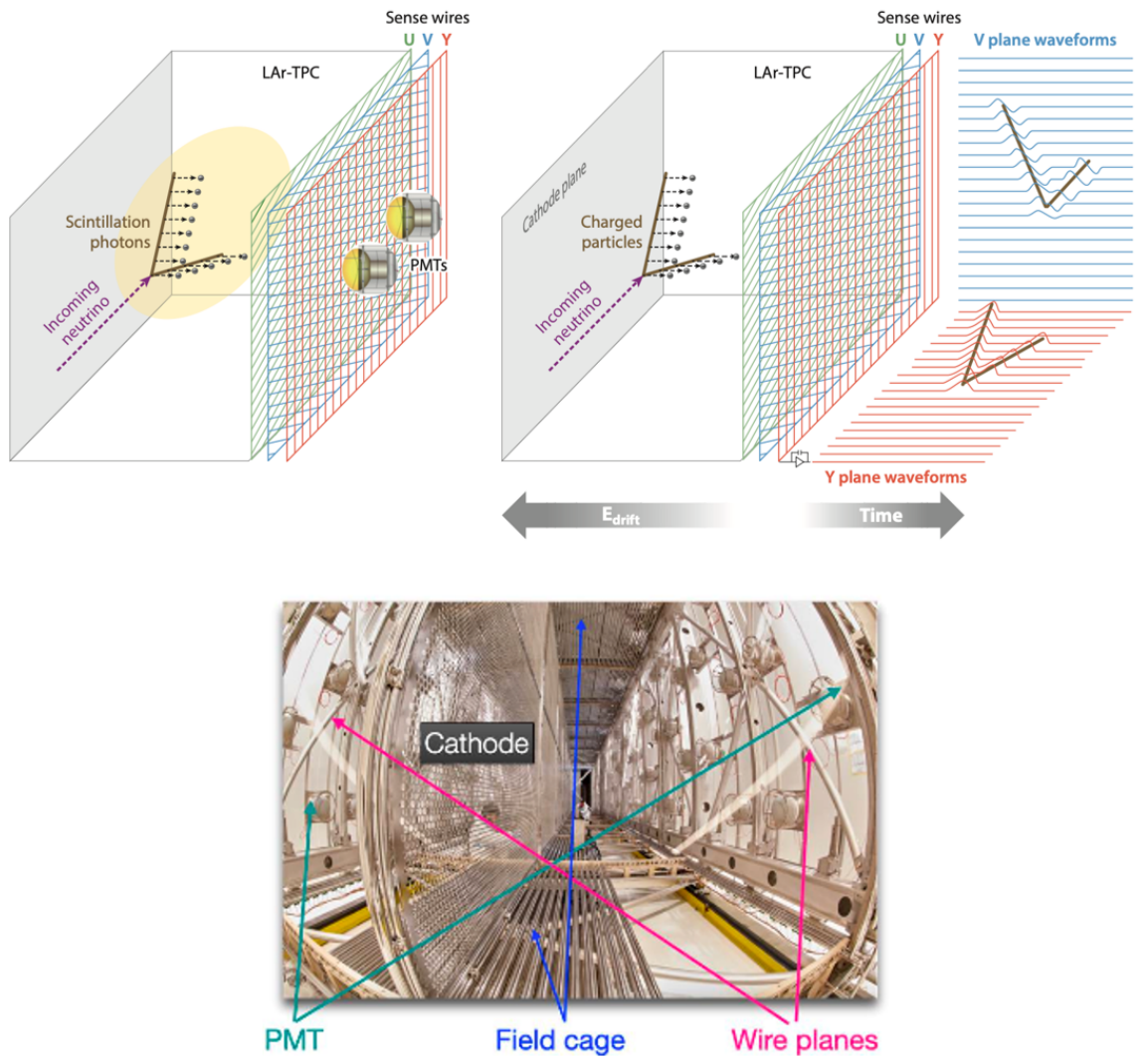
Top: Schematic representation of the ICARUS-T600 readout principle for a single TPC. Charged particles ionize the argon, producing excited molecules that emit scintillation light, which is detected by photomultiplier tubes (PMTs) to generate the event trigger [4]. Simultaneously, the ionization process produces electrons that are drifted by an electric field toward the anode, where they are collected by three wire planes. Bottom: Internal view of one ICARUS-T600 module, illustrating the main components of its two TPCs.
Previously in operation at LNGS in Italy, ICARUS began physics data collection again in June 2022 at FNAL and has since completed five physics runs.
3. Track Breaking and Stitching Algorithm
The reconstruction procedure is organized into two main stages:
- 1.
- Hit Search: Deconvolved wire waveforms are scanned to identify signals corresponding to physical interactions, which are then converted into temporal and spatial coordinates.
- 2.
- Track Reconstruction: The reconstructed hits are passed to the Pandora framework [5], a pattern recognition toolkit that performs full three-dimensional event reconstruction, including the identification of interaction vertices, tracks, and electromagnetic showers.
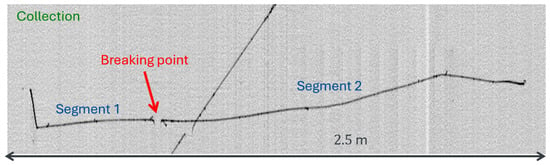
In certain events, inefficiencies in hit detection, deviations in particle trajectories, or particles crossing the cathode or the Induction-1 wire support can cause Pandora to incorrectly break a trajectory of a single particle into multiple tracks. Each resulting segment is then treated as a track of an independent particle, giving rise to reconstruction artifacts. In some cases, these split tracks are associated with poorly reconstructed events, where the start and end points of the segments may be inverted or the interaction vertex may be incorrectly positioned between them. In more severe cases, track segments originating from one neutrino interaction may be mistakenly associated with a different interaction. Figure 2 illustrates an example of a muon track with a total length of 286 that is split by Pandora into two segments of 86 and 200 , with the latter treated as a track of an independent particle. Assuming an average energy loss of , this leads to an underestimation of the muon energy of approximately 400 , which consequently impacts the reconstructed neutrino energy. Furthermore, particle identification based on the versus residual range may fail, potentially resulting in the loss of the event. Monte Carlo studies show that about of muon tracks in charged-current events are affected by this type of track splitting.
Figure 2.
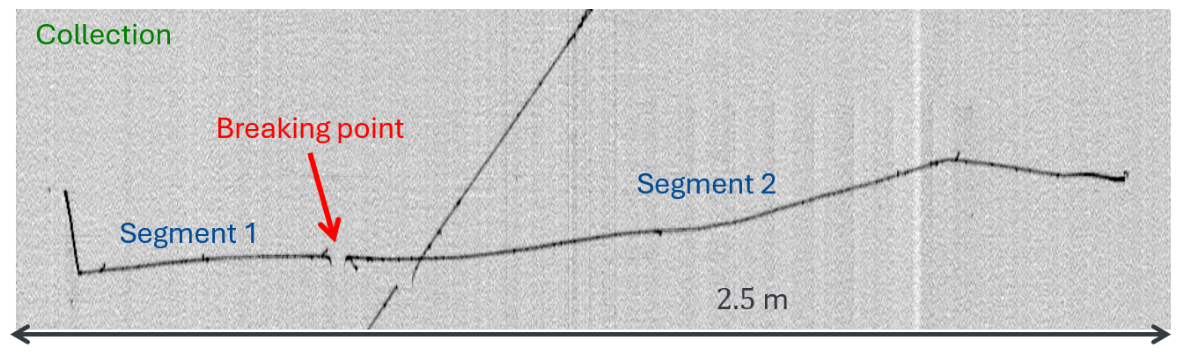
2D view of a charged-current (CC) interaction in the collection plane. The muon track is incorrectly split after the first 86 into two segments, which are erroneously treated as independent particles.
To mitigate this issue, we designed a dedicated algorithm that identifies and reconnects track segments originating from the same particle [6]. The algorithm considers all possible pairs of segments associated with the same interaction. The pairs that satisfy all criteria are reconnected into a single reconstructed track.
4. Event Selection
Two sets of selection criteria were applied to identify tracks compatible with charged-current candidate events (CC). The stitching algorithm was applied only to tracks satisfying these requirements.
4.1. Inclusive Selection
This selection is intentionally more inclusive and can be adopted in multiple ICARUS analyses:
- The interaction vertex must be located at least 25 away from the boundaries of the active volume;
- The track must be contained within 5 of the active volume edges;
- The track must be associated with a reconstructed particle rather than an electromagnetic shower;
- The particle must be identified as a muon using the energy loss curves versus residual range, applying loose-fitting thresholds;
- The reconstructed muon track must be at least 20 long in order to reject delta rays.
4.2. 1 Selection
A more restrictive selection is applied to isolate fully contained charged-current interaction events () with a () final state, i.e., one muon and protons in the final state. This event selection was used in the disappearance analysis [7]:
- The TPC track must be associated with a PMT light signal occurring within from the beam spill, with no coincident CRT signal;
- The reconstructed muon track length must be at least 50 ;
- There must be at least one proton present with kinetic energy greater than 50 , corresponding to a reconstructed proton track length greater than ;
- Additional pion or photon candidates must be absent.
5. Calibration
The calibration was performed using a Monte Carlo (MC) simulation in which a simulated charged-current interaction () is overlaid onto a real background event. This type of hybrid simulation is known as the Overlay technique. The algorithm considers only those segments that Pandora assigns to the same interaction (intra-slice). Segments of the same muon that are incorrectly attributed to different interactions typically correspond to very large separations (up to 2 of track missing). In such events, associating the two segments with a single physical track would require excessively large tolerances.
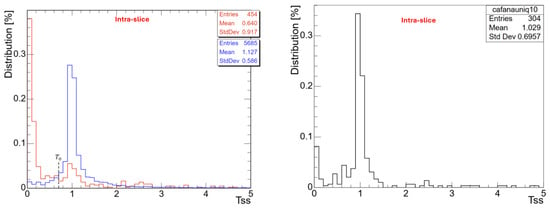
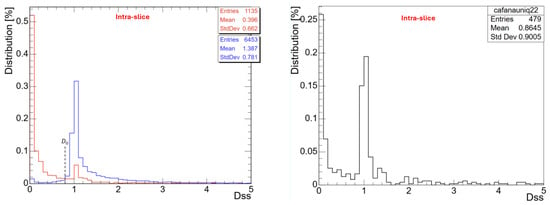
We first selected all cases in which the stitching algorithm evaluates two segments belonging to the same muon track. We then selected instances in which the algorithm evaluates a muon segment paired with a background segment. The corresponding distributions are shown in Figure 3, left. All histograms were normalized to enable a direct comparison. The intersection point between the distributions obtained for same-muon segments (red) and muon–background segment pairs (blue) was chosen as the overlap threshold, yielding a value of . This value maximizes the performance of the stitching algorithm.
Figure 3.
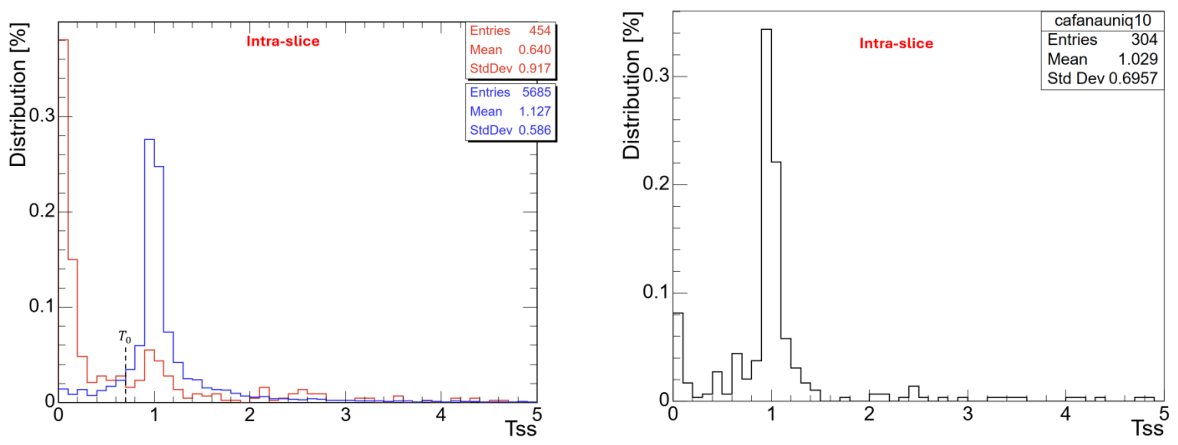
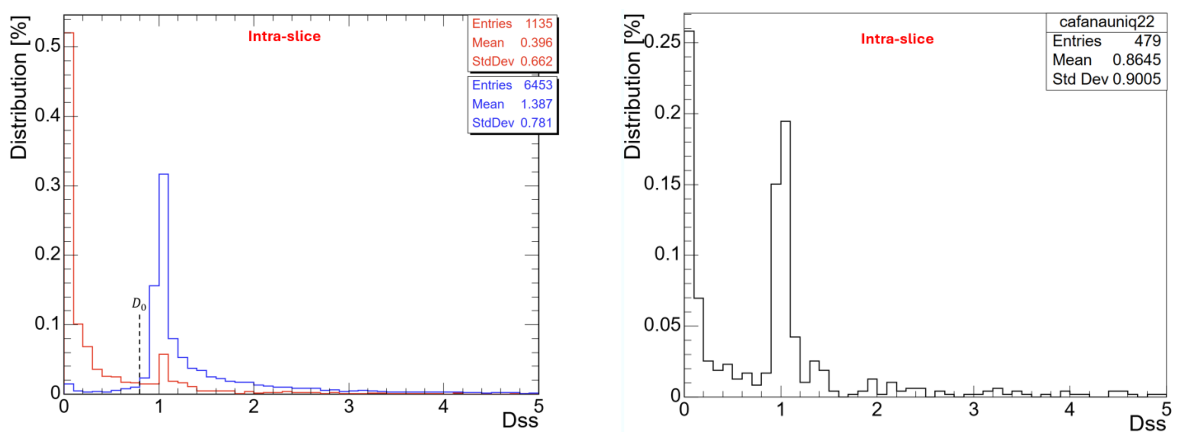
Left: Normalized distributions of the parameter for cases where the stitching algorithm evaluates two segments of the same muon track (red) and a muon segment paired with a background segment (blue). The intersection point defines the overlap threshold . Entries with correspond to cases in which the shorter segment is fully overlapped by the longer one. Right: The same distribution obtained using of the data collected during Run 2. The distribution is compatible with the Monte Carlo prediction, except for the first bin, where the data exhibit a significantly lower peak.
The same distribution was produced using of the data collected during Run 2 (Figure 3, right) in order to compare Monte Carlo simulations with real data. Overall, good agreement is observed, except for the first bin, where the data distribution shows a lower peak with respect to the Monte Carlo Overlay.
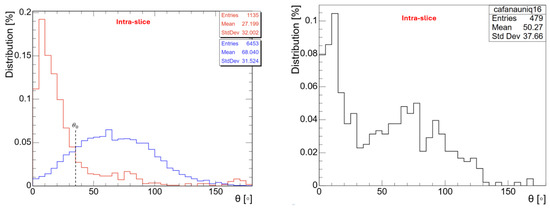
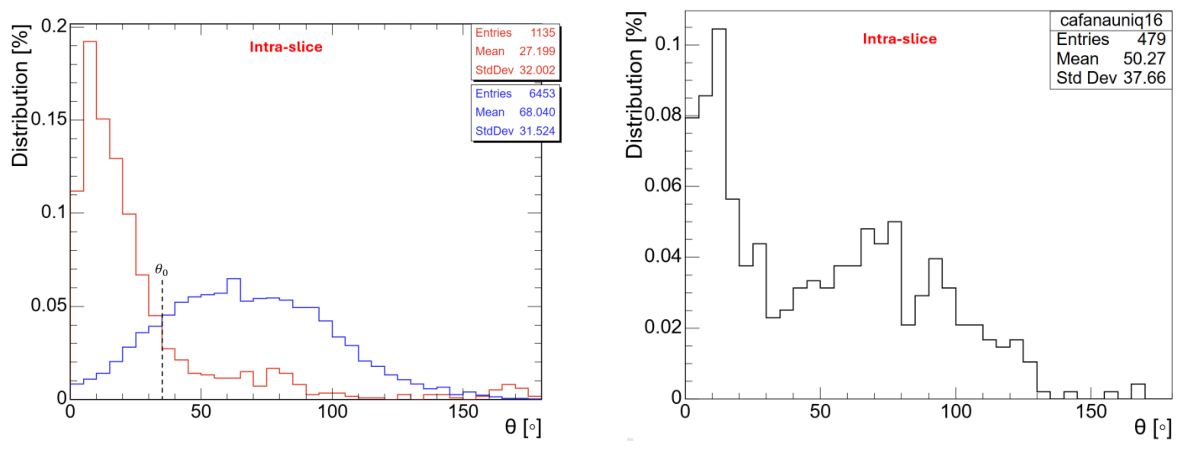
An analogous procedure was applied to calibrate the angular parameter (Figure 4) and the spatial continuity parameter (Figure 5). For both variables, the threshold values were chosen at the intersection points between the red and blue distributions, resulting in and . The corresponding normalized distributions for of the Run 2 data are compatibles with the Monte Carlo Overlay.
Figure 4.
Left: Normalized distributions of the angle for cases in which the stitching algorithm evaluates two segments of the same muon track (red) and a muon segment paired with a background segment (blue). The intersection point between the red and blue distributions is chosen as the threshold value . Right: Normalized distribution of the parameters for of the Run 2 data. The distribution is consistent with the Monte Carlo Overlay.
Figure 5.
Left: Normalized distributions of the parameter for cases in which the stitching algorithm evaluates two segments of the same muon track (red) and a muon segment paired with a background segment (blue). The intersection point of the red and blue distributions is selected as the threshold value . Right: Normalized distribution of the parameter for of the Run 2 data. The distribution is consistent with the Monte Carlo Overlay.
6. Algorithm Performance
To assess the performance of the stitching algorithm, the purity (P) and efficiency (E) were defined over all muon tracks considered by the algorithm, including both broken and unbroken tracks:
where a track is classified as reparable if Pandora does not place the interaction vertex between its segments.
The performance was evaluated using the Monte Carlo (MC) Overlay. The sample contains 35,093 muons from charged-current interactions with MC track length > 50 cm and a reconstructed track passing the loose selection. Broken tracks are defined as those reconstructed as two or more segments that share the same MC particle identifier, indicating that they originate from the same true muon. A summary of the algorithm performance is reported in Table 1.
Table 1.
Algorithm performance as estimated in Monte Carlo Overlay applying the inclusive selection.
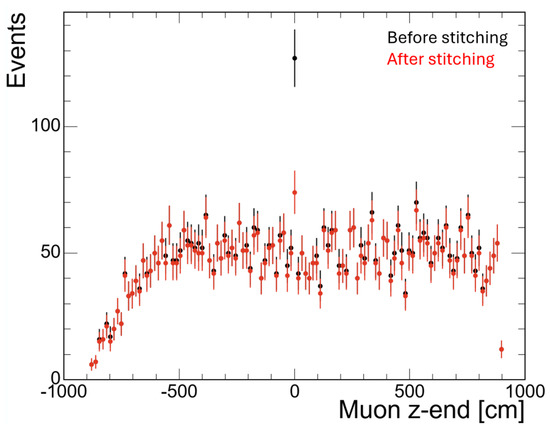
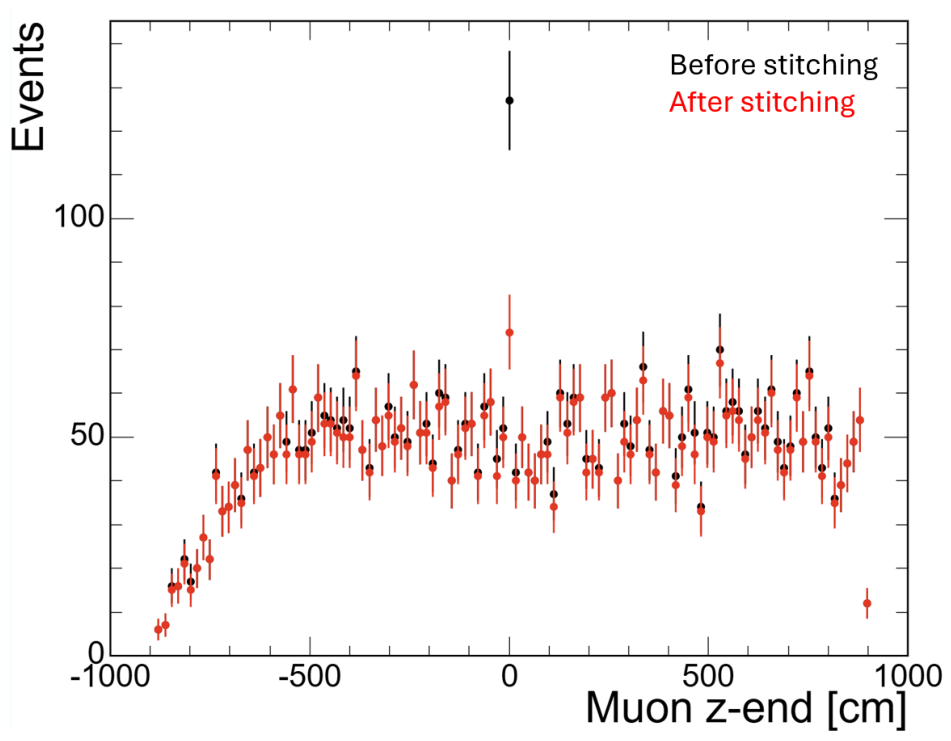
The algorithm performance was also evaluated on of the Run 2 data passing the selection. In this sample, stitching is applied in approximately of the selected events. Figure 6 shows the distribution of muon track end points along the z-axis before and after stitching. Track fragmentation introduced by Pandora results in an excess of tracks terminating at , corresponding to the position of the Induction-1 wire support. The stitching algorithm significantly reduces the fraction of tracks ending at from to of the total.
Figure 6.
Distribution of muon track end points along the z-axis before and after applying the stitching algorithm to of the data collected during Run 2.
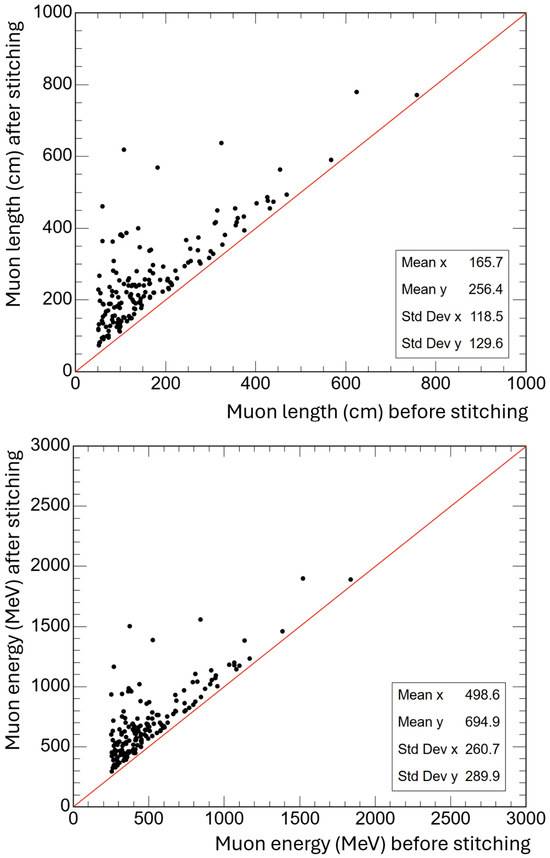
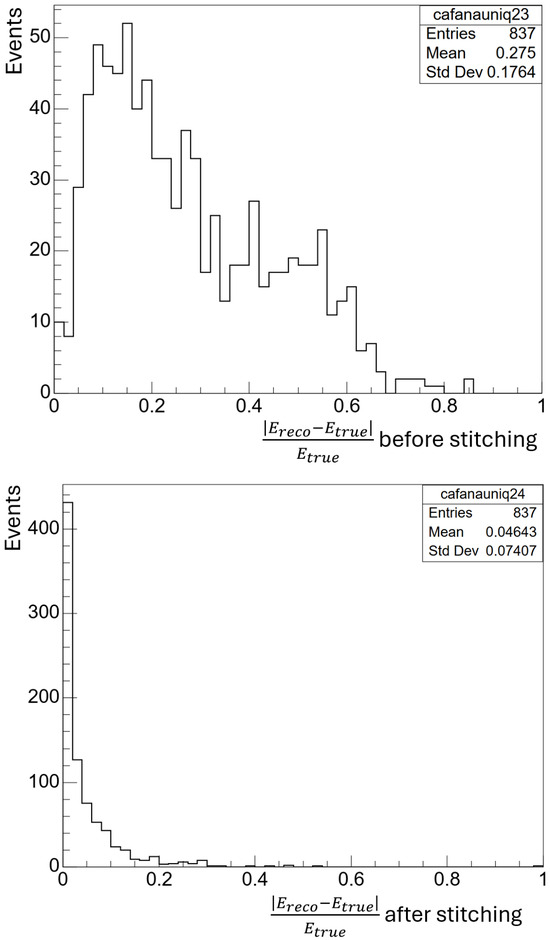
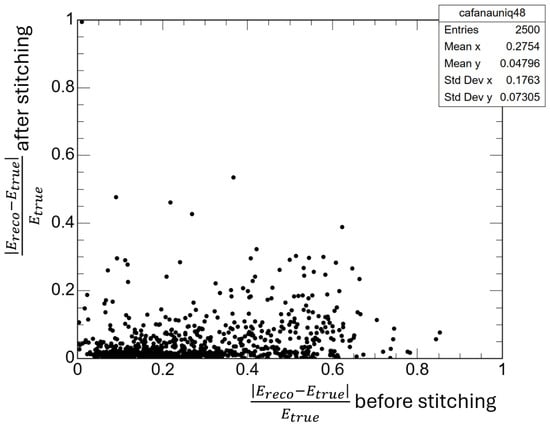
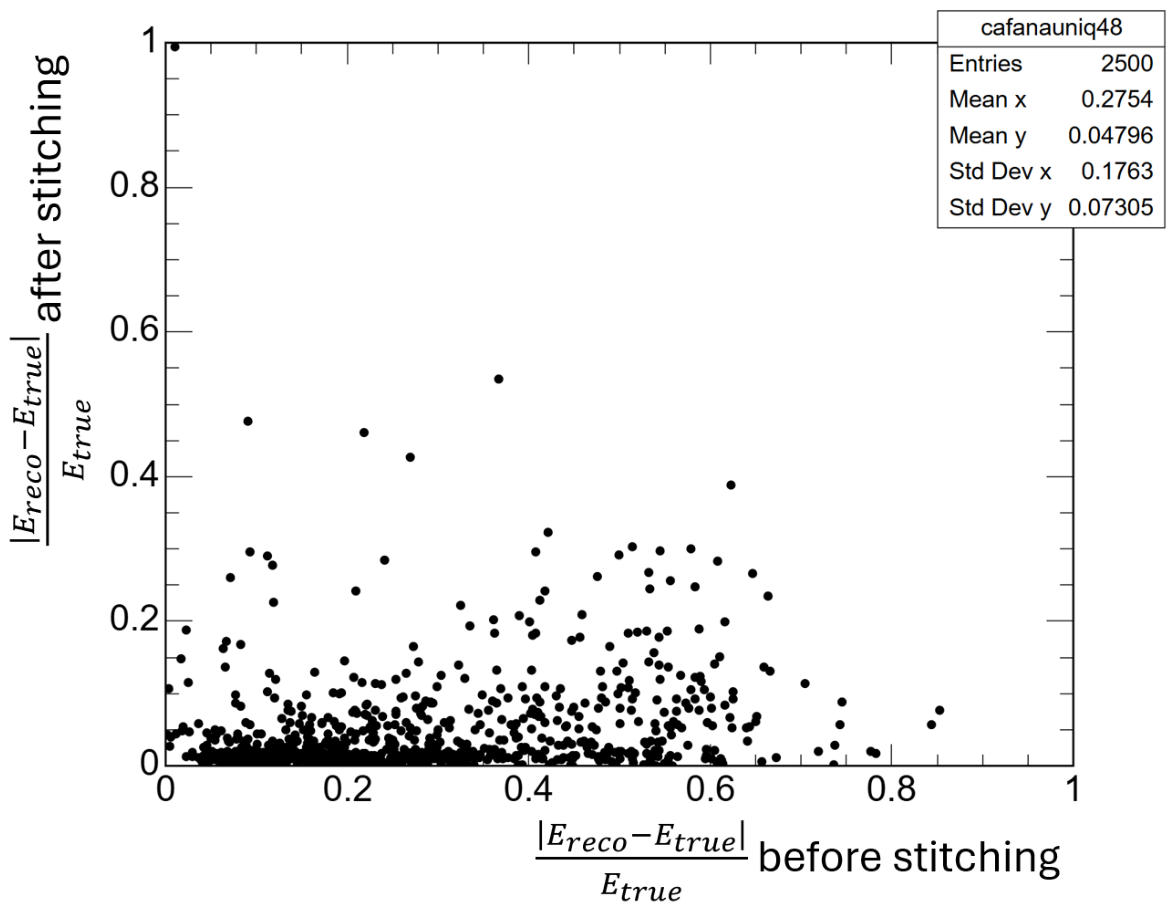
Figure 7 presents the reconstructed muon track length before and after stitching. The scatter plot indicates an average increase in track length of approximately 91 , corresponding to an average recovered energy of about 196 . Using Monte Carlo information, the ratio was computed, where is the true muon energy and is the reconstructed energy before stitching (Figure 8, left). The same ratio after stitching is shown in Figure 8, right. Figure 9 displays the correlation between the two ratios before and after stitching. In approximately of cases, the stitching procedure degrades the energy reconstruction due to poor initial track reconstruction by Pandora. The energy loss caused by track fragmentation, which is recovered through stitching, is estimated to be , consistent with the expected energy loss of a minimum ionizing particle in liquid argon.
Figure 7.
Top: Reconstructed muon track length after stitching versus reconstructed track length before stitching for of the Run 2 data. Bottom: Reconstructed muon energy after stitching versus reconstructed energy before stitching for of the Run 2 data. The scatter plots show an average increase in track length of approximately 91 corresponding to an average recovered energy of about 196 .
Figure 8.
Top: Distribution of the ratio , where is the muon energy reconstructed before stitching and is the Monte Carlo energy. Bottom: The same ratio computed after stitching. Only cases where two segments of the same muon are stitched are shown.
Figure 9.
Scatter plot of the ratio before and after stitching. Here, is the reconstructed muon energy and is the Monte Carlo energy. In about of cases, stitching worsens the energy reconstruction due to incorrect Pandora track reconstruction.
7. Conclusions
In certain events, the ICARUS reconstruction algorithms can incorrectly break the trajectory of a single particle in multiple tracks. Each resulting segment is then treated as an independent particle, giving rise to reconstruction artifacts. We studied this phenomenon using a signal of events reconstructed in Monte Carlo Overlay and ICARUS data. This study showed that about of the muon tracks are split in multiple segments. This leads to underestimating the muon and neutrino energy, which generates a reduction in the neutrino signal selection efficiency and is a systematic uncertainty in the analysis.
We designed a stitching algorithm that identifies split muon tracks and merges their segments, restoring the original track. The algorithm was validated through Monte Carlo Overlay, demonstrating an efficiency of about and a purity of about . The algorithm was applied to a selected set of reconstructed events in real data. It performs the stitching procedure in approximately of the events, leading to a substantial reduction in the excess of fragmented tracks at , corresponding to the location of the Induction-1 wire support. The method is planned to be incorporated into the ICARUS reconstruction chain to enhance the overall reconstruction performance.
Funding
This work was supported by the EU Horizon 2020 Research and Innovation Program under Marie Sklodowska-Curie Grant Agreement Nos. 734303, 822185, 858199 and 101003460, and the Horizon Europe Research and Innovation Program under Marie Sklodowska-Curie Grant Agreement Nos. 101081478 and 101230211.
Data Availability Statement
The datasets presented in this article are not readily available. The Research Data Policies of the ICARUS Experiment at Fermilab can be found at https://icarus-exp.fnal.gov.
Acknowledgments
This document was prepared using the resources of the Fermi National Accelerator Laboratory (Fermilab), an HEP User Facility at the U.S. Department of Energy, Office of Science, Office of High Energy Physics. Fermilab is managed by Fermi Forward Discovery Group, LLC, acting under Contract No. 89243024CSC000002.
Conflicts of Interest
The author declares no conflicts of interest.
Abbreviations
The following abbreviations are used in this manuscript:
| ICARUS | Imaging Cosmic And Rare Underground Signals |
| SBN | Short-Baseline Neutrino |
| DUNE | Deep Underground Neutrino Experiment |
| BSM | Beyond Standard Model |
| LArTPC | Liquid Argon Time Projection Chamber |
| PMT | Photomultiplier Tube |
| TPC | Time Projection Chamber |
References
- Machado, P.A.N.; Palamara, O.; Schmitz, D.W. The Short-Baseline Neutrino Program at Fermilab. Annu. Rev. Nucl. Part. Sci. 2019, 69, 363–387. [Google Scholar] [CrossRef] [Scilit]
- Rubbia, C. The Liquid-Argon Time Projection Chamber: A New Concept for Neutrino Detector. CERN. CERN-EP/77-08. 1977. Available online: https://cds.cern.ch/record/117852 (accessed on 6 August 2026).
- Abratenko, P.; Aduszkiewicz, A.; Akbar, F.; Artero Pons, M.; Asaadi, J.; Aslin, M.; Babicz, M.; Badgett, W.F.; Bagby, L.F.; Baibussinov, B.; et al. ICARUS at the Fermilab Short-Baseline Neutrino Program: Initial Operation. Eur. Phys. J. C 2023, 83, 467. [Google Scholar] [CrossRef] [Scilit] [PubMed]
- Abd Alrahman, F.; Abratenko, P.; Abrego-Martinez, N.; Aduszkiewicz, A.; Akbar, F.; Aliaga Soplin, L.; Artero Pons, M.; Asaadi, J.; Badgett, W.F.; Baibussinov, B.; et al. Operation of the trigger system for the ICARUS detector at Fermilab. J. Instrum. 2025, 20, P10044. [Google Scholar] [CrossRef] [Scilit]
- Thomson, M.A. Particle Flow Calorimetry and the PandoraPFA Algorithm. Nucl. Instrum. Methods A 2009, 611, 25. [Google Scholar] [CrossRef] [Scilit]
- Ricci, A.M. Improving ICARUS track reconstruction algorithms. J. Instrum. 2026, 21, C04007. [Google Scholar] [CrossRef] [Scilit]
- ICARUS Collaboration. First search for sterile neutrino oscillation leading to νμ disappearance in the Booster Neutrino Beam at ICARUS. arXiv 2026, arXiv:2603.22557v1. [Google Scholar]

Disclaimer/Publisher’s Note: The statements, opinions and data contained in all publications are solely those of the individual author(s) and contributor(s) and not of MDPI and/or the editor(s). MDPI and/or the editor(s) disclaim responsibility for any injury to people or property resulting from any ideas, methods, instructions or products referred to in the content. |
© 2026 by Fermi Forward Discovery Group, LLC. Licensee MDPI, Basel, Switzerland. This article is an open access article distributed under the terms and conditions of the Creative Commons Attribution (CC BY) 4.0 license.