


Abstract
We solve the Goldstone-boson-exchange (GBE) relativistic constituent quark model of light and strange baryons by using the Faddeev approach. The model reproduces the vacuum mass spectrum of light and strange baryons below 2 GeV reasonably well. To test the sensitivity of the model to possible medium-induced effects, we vary the masses of the constituent quarks and the exchange bosons, the confinement strength, and the quark–meson coupling constant. In a parametric study, we consider a set of power-law scaling relations for these parameters, including some motivated by constituent quark-level current algebra relations. We find that the baryon spectrum is most sensitive to the quark–meson coupling constant, and generally observe a decrease in baryon mass with decreasing constituent quark mass. We qualitatively estimate the impact of these mass shifts on ideal-gas baryon yields and yield ratios. Absolute yields can already change significantly for mass shifts of a few 10 MeV, whereas yield ratios are strongly modified only when the compared baryons have different constituent quark mass dependence.
PACS:
11.30.Rd; 12.39.Pn; 25.75.Nq; 21.45.+v
1. Introduction
When embedded in a medium at extreme density or temperature, baryons are often described within a quasiparticle picture in which medium effects are encoded through medium-dependent masses and chemical potentials. For instance, the saturation properties of nuclear matter imply an effective or screened nucleon mass due to a large attractive scalar self-energy [1]. Already at saturation density fm−3, it is significantly reduced in comparison to the vacuum nucleon mass . Typical relativistic mean-field (RMF) and covariant density-functional approaches give a reduced Dirac mass at saturation of order [2,3]; see also [4] for a review of dense matter equations of state based on RMF models. Relativistic mean-field and nucleon potential models essentially tie this effective mass reduction to meson exchange between nucleons. More fundamentally, the constituent quark mass scale underlying the low-energy baryon mass spectrum in QCD is associated with chiral symmetry breaking [5]. Consequently, a partial restoration of chiral symmetry in hot or dense matter is expected to modify in-medium hadron properties, including the baryon spectrum [6,7]. In the following, we use the term in-medium mass in an effective sense. It denotes a generally model-dependent quasiparticle mass parameter that encodes medium effects, including interactions with the surrounding medium and changes in the dynamical quark mass scale associated with partial chiral symmetry restoration. It should therefore not be confused with a directly observable vacuum mass or with a bare mass parameter of QCD.
The connection between dynamical chiral symmetry breaking (DSB) and hadron masses is particularly relevant near the QCD crossover temperature, MeV [8], where lattice QCD and Dyson–Schwinger studies indicate a smooth crossover from hadron-dominated and deconfined quark–gluon degrees of freedom accompanied by a chiral transition, signaled by pronounced susceptibility peaks in close vicinity to [9,10,11].
Hadron-resonance gas (HRG) models are commonly used to interpret thermodynamic observables in terms of an ensemble of thermal, (nearly) non-interacting hadrons with constant vacuum hadron masses [12]. While this is a useful and successful approximation, it is still a model assumption. If the dynamical mass of the constituent quarks changes significantly, we expect a change in the hadron spectrum as well.
A self-consistent computation of the full baryon spectrum from QCD remains difficult. Relativistic mean-field models describe medium effects in terms of baryonic self-energies, motivated by meson exchanges which induce large vector and scalar mean fields. Although attempts to account for medium-dependent baryon masses exist (e.g., in a mean-field approach [13]), thermodynamic models often prescribe the baryon spectrum rather than deriving it as three-quark bound states with underlying chiral dynamics [14]. Complementary phase-shift approaches reduce the dependence on an assumed resonance spectrum by encoding interactions through scattering information [15].
In this work, instead of aiming at a full thermodynamic description of three-quark bound states, we address the more limited question of how the baryon spectrum reacts to changes in the dynamical constituent quark mass scale in the quark sector. To do so, we solve the relativistic Faddeev equations within a potential model [16,17,18] that reproduces the vacuum spectrum of light and strange baryons below 2 GeV. In vacuum, this Goldstone-boson-exchange chiral quark model [19,20,21,22] reproduces the correct level ordering for the light and strange baryons without requiring different sets of parameters for each spectrum. Section 2, Section 3 and Section 4 review the model and provide the vacuum parameterization.
To estimate a possible medium-induced response of the baryon spectrum, we vary the constituent quark masses as effective model parameters. This keeps the interaction structure fixed but at the same time enables us to investigate the role of the dynamical mass scale. To account for the medium dependence of the underlying potential itself, we perform a systematic parameter study in which we employ different scaling relations between quark masses and the exchange boson masses, meson–quark couplings, and confinement strength. We do so to identify which model pieces affect the baryon spectrum most strongly. As a general trend, we find that most of the considered parameterizations predict decreasing baryon masses with decreasing constituent quark masses. The strongest sensitivity arises from the scaling of the quark–meson coupling and the confinement strength. The scaling relations are introduced in Section 5; their effect on the baryon spectrum is discussed in Section 6.
While different variations in scaling schemes show quantitatively significant variations with respect to the constituent quark mass dependence and certainly probe the limits of applicability of our model, the qualitative trend is a reduction in the baryon mass with decreasing constituent quark mass. In Section 7, we illustrate how the resulting baryon mass shifts may affect particle yields and yield ratios in comparison to a model with constant, medium-independent, vacuum baryon masses. Here, we focus on representative cases to illustrate the central qualitative behavior, rather than presenting scheme-by-scheme analyses. Mainly, differences in yield ratios are expected only for baryons with different constituent quark mass dependence, whereas the actual yields will always differ from the vacuum mass yields exponentially with the mass defect. The main results of the paper are summarized in Section 8.
2. Goldstone-Boson-Exchange Model for Baryons
We consider a three-particle Hamiltonian
where is the kinetic energy operator and , with , are the mutual interactions of the quarks. We represent this through the usual configuration-space Jacobi coordinates: e.g., is the coordinate between particles 2 and 3 and is the coordinate between the center of mass of the pair and particle 1.
The kinetic energy operator is given in the relativistic form
where is the quark masses and is the three momenta of the quarks in the rest frame, where the total three-momentum .
The quark–quark interaction is a long-range confinement potential plus a Goldstone-boson-exchange short-range hyperfine interaction [17,19,20,21,22]
where the confinement potential has the linear form
The hyperfine potential consists of the pseudo-scalar meson exchanges for the octet
and for the singlet
where and are the quark spin and flavor matrices, respectively.
So, in an angular momentum basis, we get a flavor-dependent quark–quark interaction between light quarks
between light and strange quarks
and between strange quarks
The quarks are spin- particles and the isospin of the light quarks is , while the isospin of the strange quark equals 0. Therefore, the symmetry coefficients are
and
and the and isospin–isospin and spin–spin factors are given by
and
respectively.
3. Faddeev Approach to Three-Quark Problems
The Faddeev approach is exceptionally well suited for three-quark problems. It can take into account the short-range correlations, the confinement asymptotics, and the possible exchange symmetry of particles. To accomplish this, we split the quark–quark potential into confining and non-confining terms
where c and s stand for confining and short-range, respectively [16,17,18]. Then the Schrödinger equation takes the form
with
The Faddeev method amounts to splitting the wave function naturally into three components
The Faddeev components satisfy the equation
where the channel Green’s operators are given by
We need to introduce the appropriate orbital angular momentum basis. The orbital angular momenta associated with coordinates and are denoted by and , respectively, and they are coupled to the total orbital angular momentum L. The spin of particles and , and and , respectively, are coupled to , which is with the spin of particles and coupled to the total spin S. Similarly, the isospins of particles and , and and , respectively, are coupled to , which is with the isospin of particles and coupled to the total isospin T. The angular momentum L and spin S are coupled to total angular momentum J. So, we adopted coupling, which is appropriate if the quark–quark interaction does not have tensor terms.
A further advantage of the Faddeev method is that the identity of particles greatly simplifies the equations. If particles and are identical, the wave function must be symmetric with respect to the exchange of these particles. We denote as the operator that exchanges particles and . Then
where
if particles carry spin and isospin.
Putting everything together and assuming that particles 2 and 3 are identical, the three-component Faddeev equations simplify to
If all three particles are identical, Equation (22) gets further reduced to one single equation
where is the operator for cyclic permutation of all three particles .
4. Results for Light and Strange Baryons
In the GBE model, the spatial part of the potential is given as a sum of two Yukawa potentials
where stands for the exchange mesons , K, , and . The term is assumed to have a linear dependence on meson masses
with and fitted parameters. In this model, the masses of the constituent quarks and exchange mesons are fixed parameters in the vacuum calculation, MeV, MeV, MeV, MeV, MeV, MeV, and the meson octet–quark coupling constant . The other vacuum parameters were obtained by fitting the model to the experimental baryon spectrum and excellent agreement was found with MeV, , , , and .
If in Equation (16) has bound states, we may get non-vanishing Faddeev components from a vanishing total wave function. These are spurious states. To avoid them, we should push the possible bound states of out of the spectrum of physical interest. We take
and
with and . With this choice of parameters, we guarantee the absence of spurious solutions in the energy range below GeV.
5. In-Medium Scaling of Model Parameters
This study investigates how strongly the constituent quark model responds to parameter changes that could arise from a medium dependence, i.e., due to finite temperature and/or density effects. In the GBE model, a single interaction potential naturally handles the different masses of the light and strange quarks. This mass dependence is a promising entry point for exploring medium effects that vary the constituent quark masses. To narrow our scope, we make a series of simplifying assumptions:
- We assume that all model parameters vary as a function of temperature T and chemical potential only through their dependence on the light quark mass gapwhere tends from its vacuum value to zero. In an analogy to a Nambu–Jona-Lasino (NJL) model [23,24,25], we associate the mass gap directly with the light quark mean-field condensate .
- We take the strange quarks to vary aswhere is set to match the vacuum constituent mass and the current mass of the strange quark. This is a deliberate oversimplification that, while masking underlying dynamics, makes simple scaling relations tractable.
- We hold constant as a function of several model parameters: , the ratio between the singlet and octet couplings; and , which control the meson mass-dependent smearing of the delta function; and , the offset energy. Section 6 discusses the effect of lifting these assumptions.
The meson–quark–quark couplings , exchange boson masses , and the linear coefficients of confinement are taken to scale in medium as power laws of :
We calculate the baryon spectra as a function of for different choices of scaling exponents , , and .
We organize our study into different ‘schemes’ which determine and , while is handled separately (Table 1). For each scaling scheme, we consider and . The former is motivated by the expectation that confinement weakens with chiral restoration. The latter neglects the weakening of confinement.
Table 1.
Scaling schemes used in this study. The table shows the scaling of the coupling constants and meson masses for each scheme. Schemes C–F are determined by the scaling of the pion decay constant , while schemes O–B are not.
The first three scaling schemes are chosen to provide a baseline and to isolate the effects of varying and from each other. Scheme O does not scale the couplings or meson masses. Scheme A approximately scales the interaction potential linearly . Scheme B scales both the coupling constants and meson masses linearly.
In schemes C–F, we constrain the couplings and exchange boson masses to vary based on a single dependence on the behavior of the pion decay constant . The scaling relations in these schemes are inspired by Brown–Rho scaling [26,27,28]. We work with the approximations that the Gell-Mann–Oakes–Renner relation [29]
and the constituent quark-level Goldberger–Treiman relation
hold for in-medium values far from chiral restoration, and take the axial charge of the constituent quark to be . These approximations hold when working at the tree level and in a mean-field approximation, and are consistent, for example, with a two-flavor NJL model [30].
We make the Ansatz that the pion decay constant varies with the quark condensate in a power-law relationship
In the different parameterization schemes C–F, we explore different Ansätze for the value of the exponent a. Approximating sets the pion–quark–quark coupling and pion mass to vary with the quark condensate as
Finally, for simplicity and tractability, we make the Ansatz that these scaling relations can be extended to each coupling constant and meson mass equivalently:
An alternative choice of extending the scaling only to the octet mesons and not the singlet will be discussed in Section 6. Schemes C–F explore , , , and 1.
The GBE constituent quark model should not be expected to hold at large deviations from vacuum. At higher energy scales, gluon degrees of freedom become increasingly important at mediating interactions between quarks, which is neglected in the GBE potential. Additionally, the scaling relations were motivated by current algebra relations (Equations (33) and (34)), which neglect contributions of orders and [30]. As such, we restrict our calculation to the regime MeV, corresponding to a constituent light quark mass MeV.
6. Results and Discussion
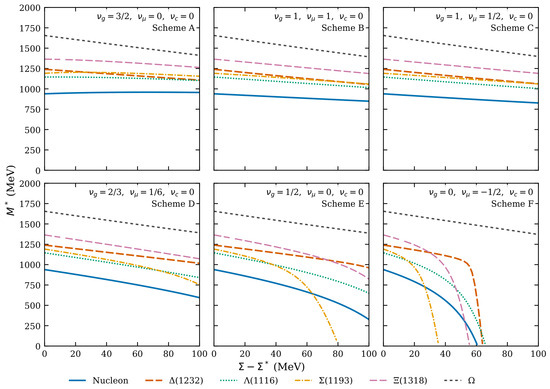
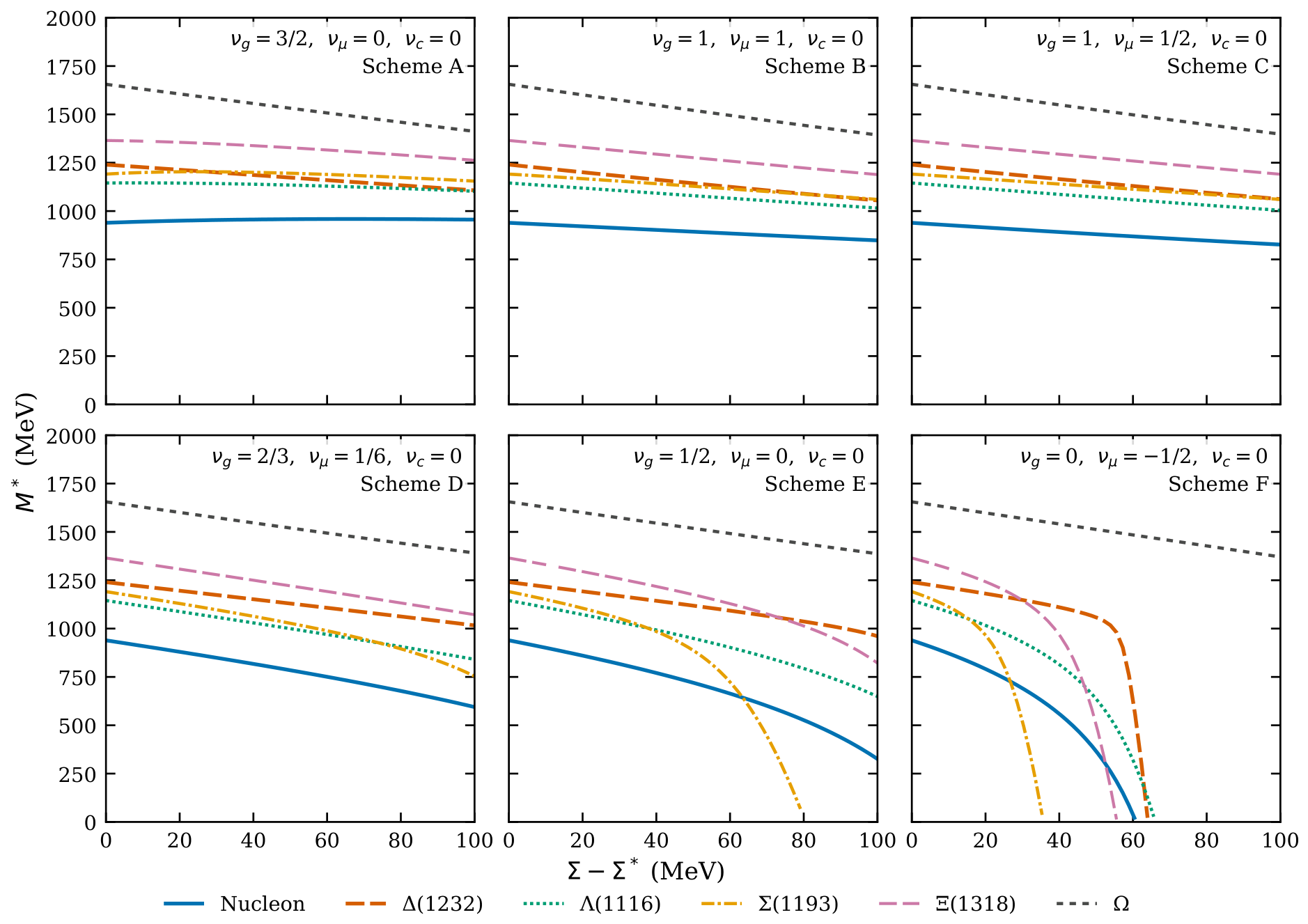
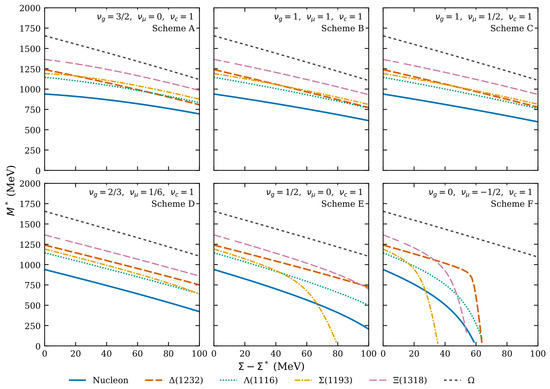
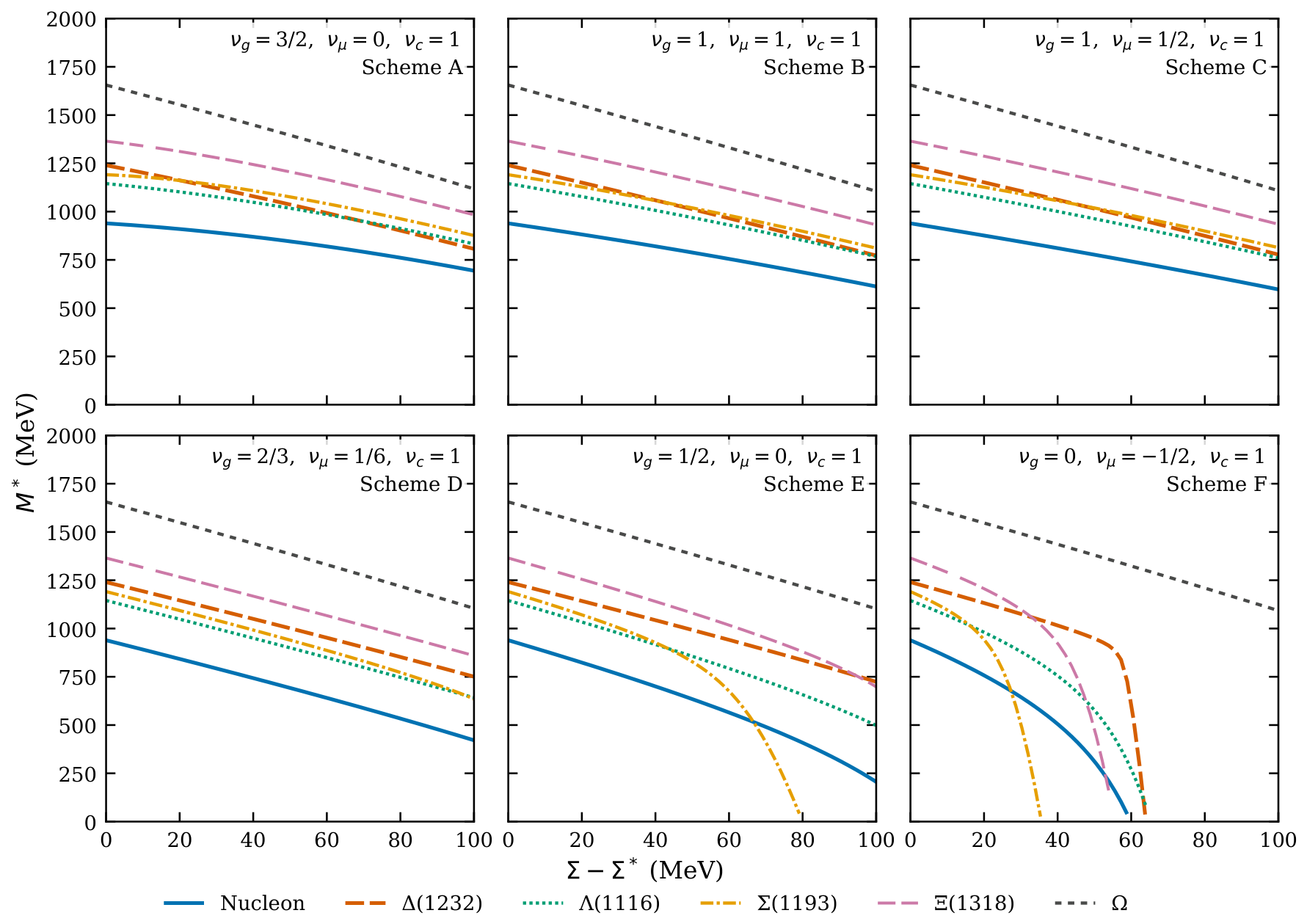
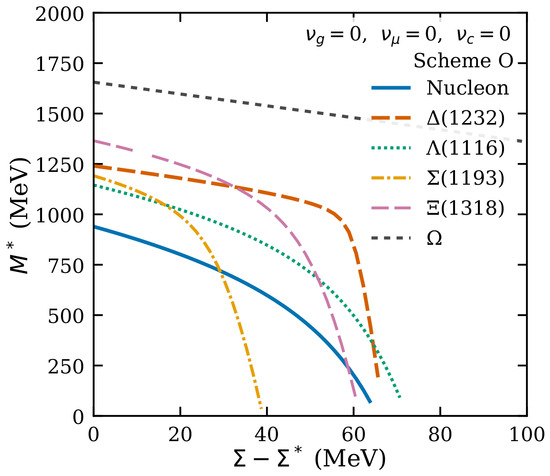
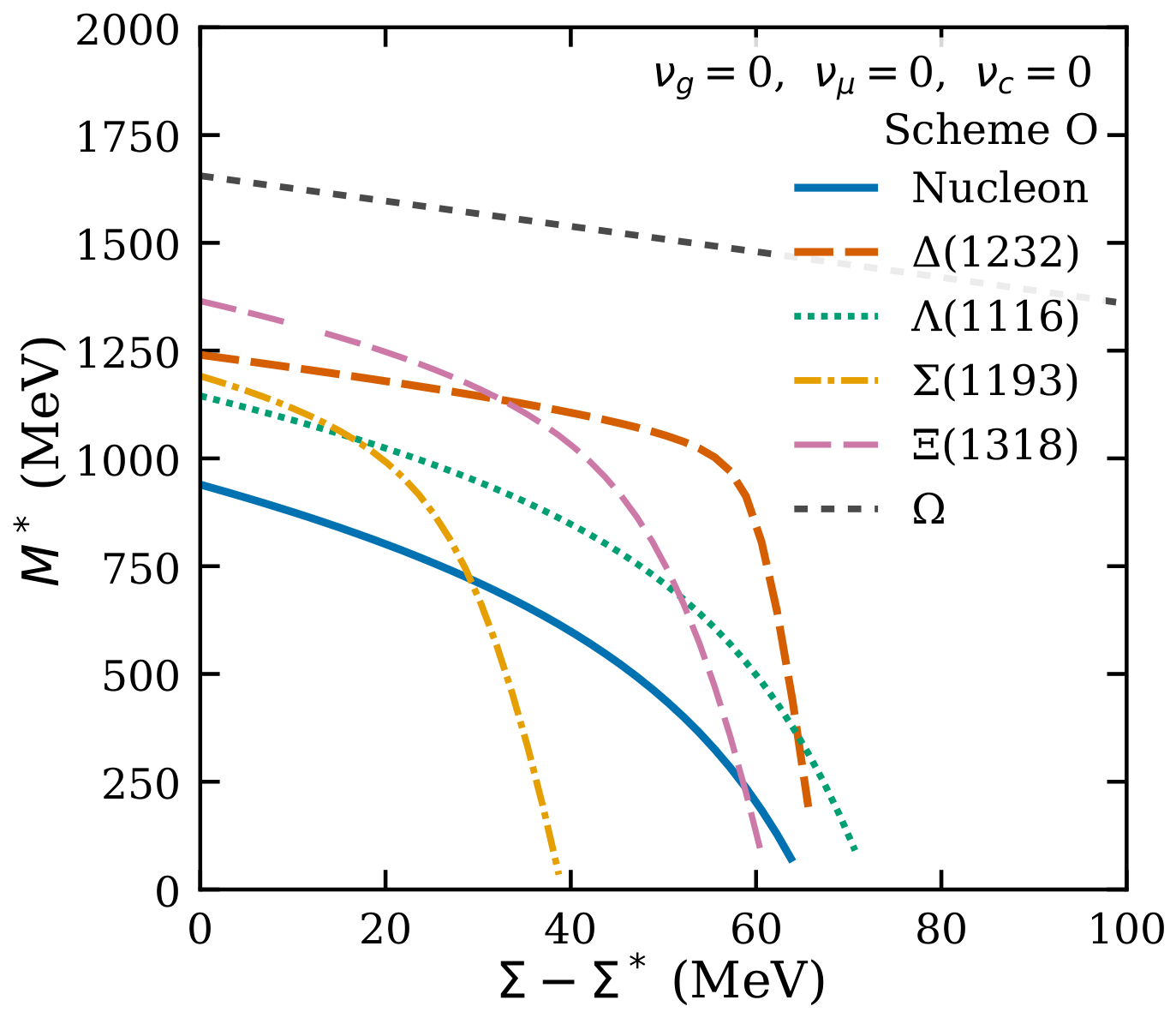
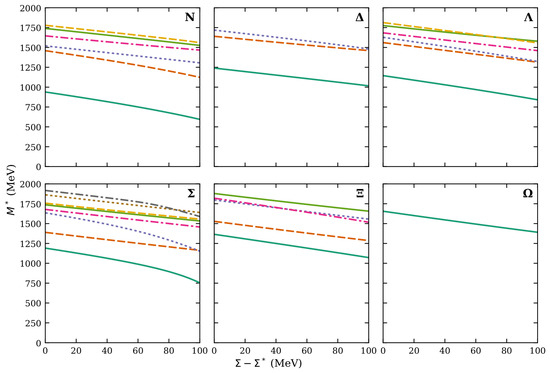
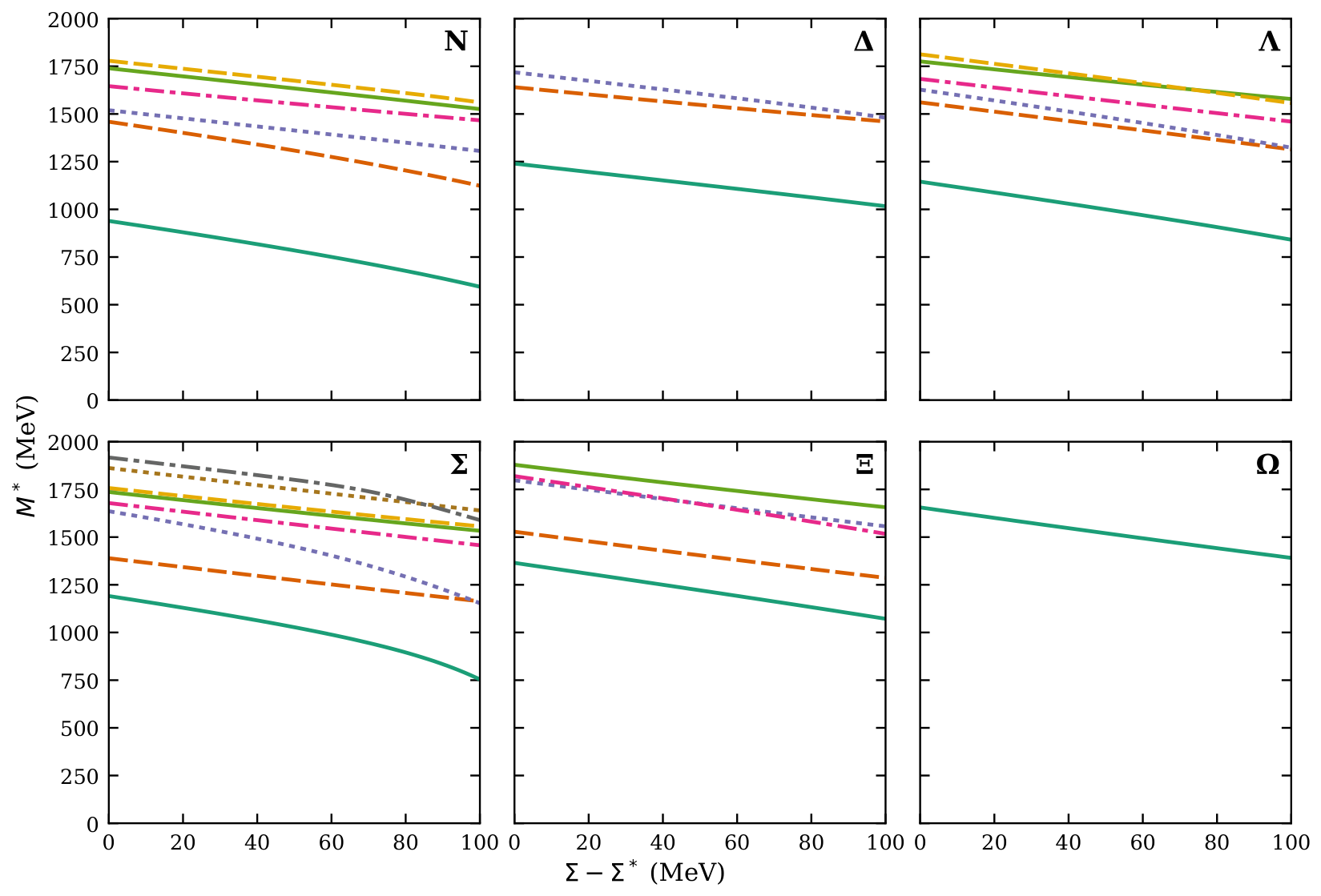
For schemes A–F, the lowest-lying states in each family are plotted in Figure 1 for and Figure 2 for . Figure 3 shows the behavior when only the constituent quark masses are scaled. For Scheme D, all calculated states from the N, , , , , and families are plotted in Figure 4. We observe a decreasing baryon mass as constituent quark mass decreases for nearly all baryons across considered scaling schemes. The dominant effect on the baryon spectra comes from the scaling of the couplings . The scaling of the confinement parameter has a smaller but noticeable effect, and the scaling of the meson masses has a minimal effect.
Figure 1.
Comparison of schemes A–F. Baryon spectra as a function of , with the linear confinement term not scaled (). The lowest-lying state of each baryon family is plotted.
Figure 2.
Comparison of schemes A–F. Baryon spectra as a function of , with the linear confinement term scaled linearly (). The lowest-lying state of each baryon family is plotted.
Figure 3.
Baryon spectra as a function of for baseline scheme O, which keeps all model parameters constant besides the constituent quark masses. The lowest-lying state of each baryon family is plotted.
Figure 4.
All calculated baryons masses shown as a function of for scheme D (, , ). Plotted baryons listed by family in ascending order of calculated vacuum mass: (): Nucleon (solid teal), (dashed orange), (dotted purple), (dash-dot magenta), (solid olive green), (dashed gold); (): (solid teal), (dashed orange), (dotted purple); (): (solid teal), (dashed orange), (dotted purple), (dash-dot magenta), (solid olive green), (dashed gold); (): (solid teal), (dashed orange), (dotted purple), (dash-dot magenta), (solid olive green), (dashed gold), (dotted brown), (dash-dot gray); (): (solid teal), (dashed orange), (dotted purple), (dash-dot magenta), (solid olive green); (): (solid teal). States that are degenerate in the model are listed together.
The effect of scaling can be understood by inspecting the leading prefactor of the potential (Equation (24)), . When scales faster than , as occurs in scheme A, the total strength of the hyperfine interaction decreases as chiral symmetry is restored. However, if scales slower than , the opposite occurs, as is the case in schemes D–F.
The less prominent effect produced by scaling the meson mass can be understood as follows. In the GBE potential (Equation (24)), the coupling enters solely as a quadratic prefactor. Tuning this coupling increases or decreases the total strength of the GBE interaction. In the first Yukawa term, the meson mass similarly enters as a quadratic prefactor, but it also appears in the exponential term, controlling the range of the interaction. Tuning down simultaneously makes the interaction weaker and lengthens its range, producing counteracting effects on the baryon spectra. In the second Yukawa term, scales linearly but not proportionally to the meson mass, so the effect of meson mass scaling is further muted compared to the effect of scaling the coupling.
For schemes E and F, we observe a breakdown of the model occurring at relatively small deviations from vacuum, marked by several baryon states reaching negative energies, a nonphysical result.
To investigate whether this behavior is caused by the assumptions made in Section 5, we test a few simple alternate assumptions for the in-medium scaling of the offset energy , delta function smearing , singlet meson mass , and singlet coupling . Table 2 shows the effect these alternative assumptions have upon the pathology. While these alternatives do affect the pathology, none remove it, indicating this behavior is not solely an artifact of these choices.
Table 2.
Alternative scaling choices and their effect on onset of model breakdown, marked by the last point where the nucleon mass is positive. The five studied cases: 1. Scaling , achieved by scaling the parameter . 2. Scaling , achieved by scaling the parameter . 3. Holding constant, achieved by scaling the parameter . 4. Holding constant, instead of scaling it with the octet meson masses. 5. Holding constant, instead of scaling it with the octet couplings. In each case, the modification is applied to scheme F (), except for the final case, in which it is applied to scheme E ().
Two other possible causes of the pathology are the initial assumption that the constituent quark model can be extended to medium in this manner and the choice of scaling scheme. The minimal effect that meson mass scaling has on the baryon spectra implies that the pathology is a result of the relative scaling of and , and in particular does not depend on the current algebra relations motivating schemes C–F. We can attribute the pathology to an excessively strong hyperfine contribution, consistent with the fact that the breakdown becomes more prominent for smaller values of where grows more rapidly. Thus, our result can be considered as evidence against certain scaling relations for holding at small deviations from vacuum, as a bound on the region of validity of an ad hoc extension of the constituent quark model to medium, or both.
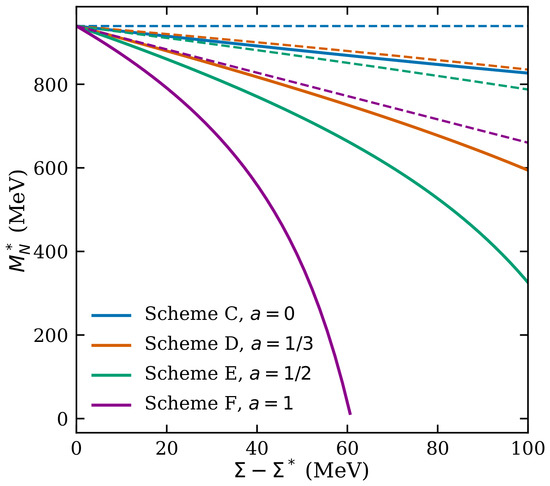
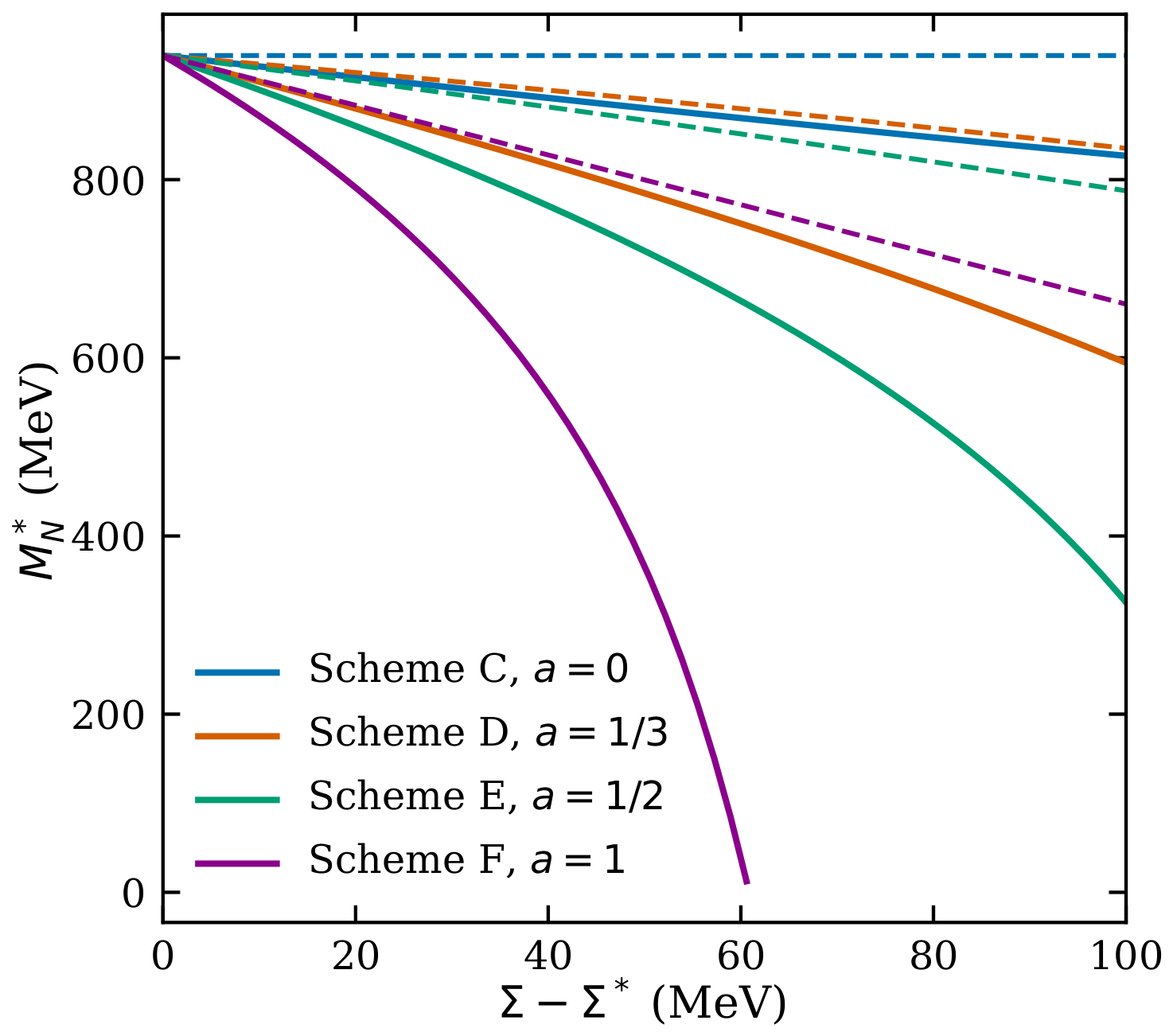
An interesting point of comparison is to Brown–Rho scaling, which proposes that the nucleon mass varies linearly with the pion decay constant
Different scaling relations between the pion decay constant and the quark condensate
have appeared in the Brown–Rho literature. Early work suggested the scaling exponent to be [26]. Later, scaling with [27], which maintains a constant pion mass, and [31], Nambu scaling, were explored. In schemes C–F, we make a matching Ansatz (Equation (35)) for the scaling of the pion decay constant. In our calculation, this Ansatz fixes the scaling relations for and , with which we calculate . This gives us a natural point of comparison between the in-medium nucleon mass that we calculate and the mass predicted by Brown–Rho scaling. This comparison is shown in Figure 5, where we have also included the case as a baseline. We observe the nucleon mass decreasing faster for larger values of the scaling exponent a, as would be expected. However, in each scheme, the calculated change in the nucleon mass is greater than these scaling relations would predict
7. Sensitivity of Ideal-Gas Estimates to Baryon Mass Defects
The main focus of this work is the study of medium-motivated changes in the hadron spectrum as outlined in the previous sections. In this last section, we illustrate how sensitive particle yields and yield ratios can be to baryon mass shifts of the size generated in the model study above. In this context, it is important to us to emphasize that we add this section for illustration of possible effects without the intent to offer a full, self-consistent thermodynamic model.
As a preliminary exploration of the thermodynamic implications of this calculation, we note the elementary consequence of a mass shift on an ideal gas. The HRG model, in its traditional form, assumes a non-interacting relativistic gas of hadrons, with each species having constant mass M at all temperatures and chemical potentials. We take this as a guide and make the trial assumption that at some temperature this system can still be described as an ideal gas, but with a shifted effective mass .
For baryons, their relatively large mass motivates the taking of non-relativistic and Boltzmann limits. At zero chemical potential () for a single species ideal gas, the ratio of shifted to unshifted pressure and of shifted to unshifted density is, to first order,
In order to quantify the effect of dynamically reduced baryon masses, we introduce the dimensionless quantity
For small values of , an expansion results in
Since is positive, for masses
we expect an increase in the ideal-gas pressure. At a crossover temperature of , this condition is satisfied for all known baryons. Further, this enables us to estimate what value of would result in negligible changes in the pressure, viz.
We obtain approximately
For the neutron at , we find that the ideal-gas pressure changes less than if the difference between vacuum and in-medium mass is less than . The changes in pressure at fixed are more pronounced for heavier baryons. In general, the effect in the baryonic sector seems negligible only for , which, near the expected crossover temperature MeV, corresponds to mass shifts of the order 10–20 or less.
This rough approximation neglects any self-consistent thermodynamic picture and any interactions between hadrons. Accordingly, we do not imply that replacing is sufficient to provide a thermodynamically consistent or necessarily phenomenologically improved HRG equation of state. As Ref. [13] indicates, quasiparticle mass shifts alone do not necessarily improve the thermodynamic consistency of the HRG model with lattice QCD and heavy-ion data. In most relevant cases, this shifted-mass ideal gas without interactions will have a higher pressure than an ideal HRG. It is however known from RMF models that interaction contributions to the pressure; for instance, those of exchange mesons tend to counter the pressure increase due to decreasing in-medium masses. The full impact of medium-dependent quark masses on the thermodynamics of the full baryon ensemble therefore cannot be determined without specifying the underlying interaction contributions to the net pressure.
If mass shifts of only a few 10 MeV were inserted into an ideal HRG description, they would be amplified by exponential Boltzmann factors and produce non-negligible changes in hadron yields. We illustrate this by approximating the number densities as an ideal Boltzmann gas with
We expect non-negligible modifications of the nucleon yield, even at moderate differences between vacuum and in-medium masses, as these differences enter exponentially, viz.
The yield ratios between different baryons change accordingly as
If is of the same magnitude as , this relation implies only small variations in the yield ratios due to cancellations in the exponent which leave the prefactor as the dominant source of variations.
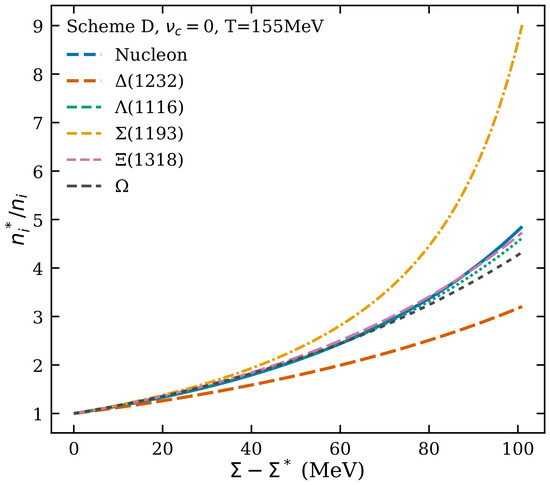
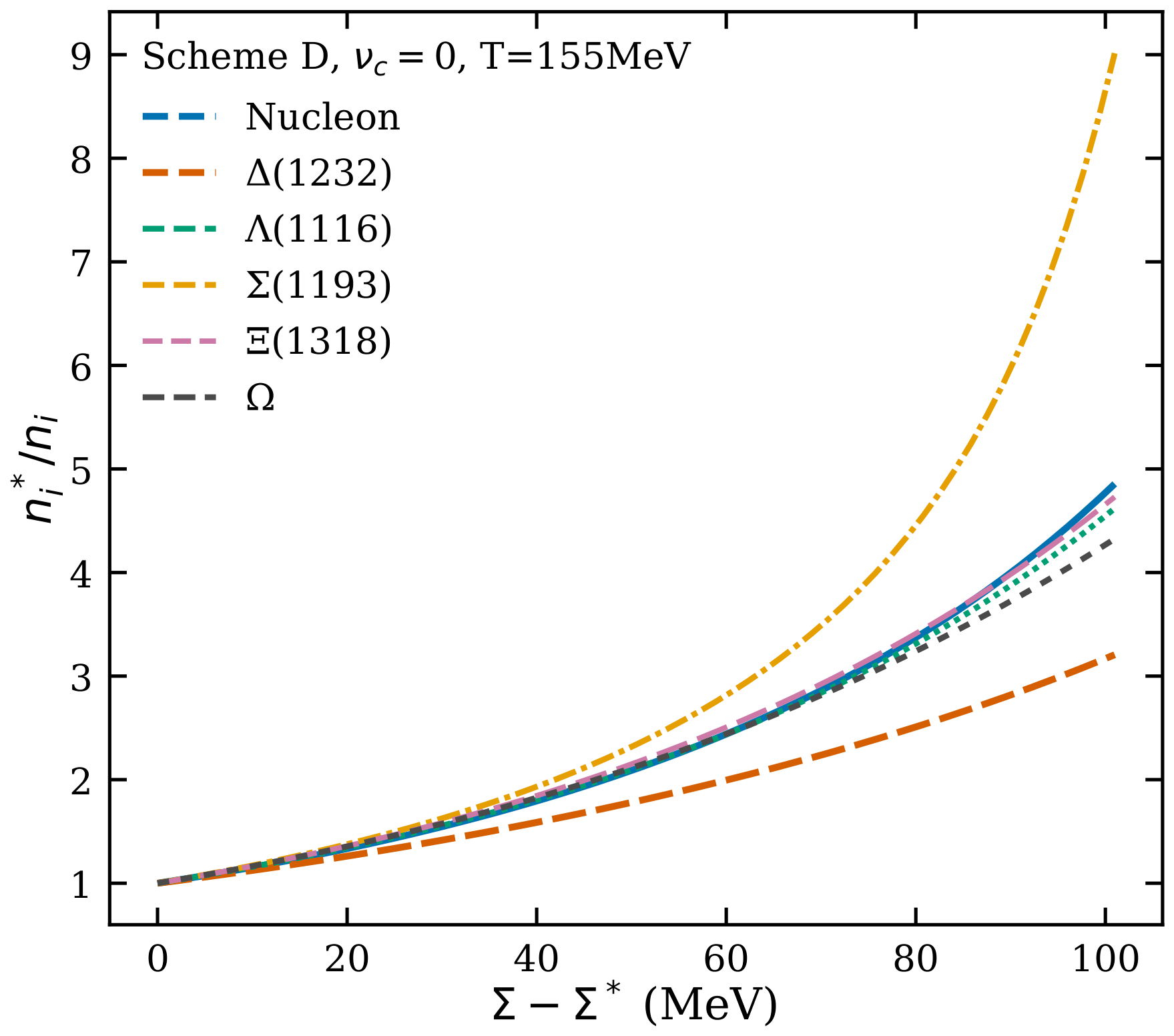
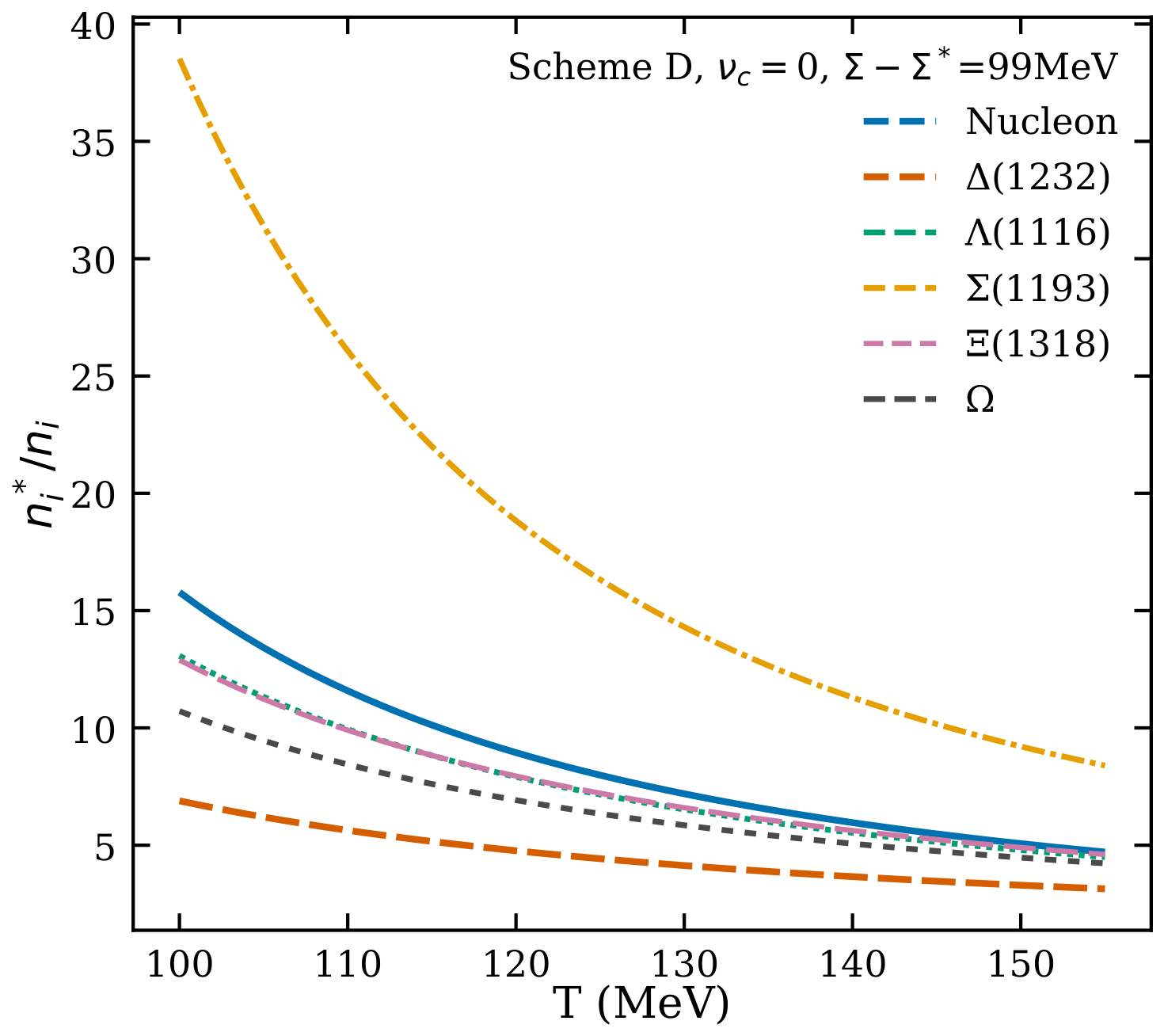
We illustrate yield variations as described by Equation (49) with scheme D, which shows only a moderate constituent quark mass dependence (Figure 6). Here, the baryon with the steepest mass decrease shows the strongest deviations from particle yields as calculated with constant mass. As Figure 7 shows, deviations are more pronounced with decreasing temperature. Practically, this can result in a competition of a temperature-induced yield enhancement with yield stabilization due to reduced baryon mass defects. As we do not offer an explicit relation for the temperature dependence of the constituent quark masses, further elaboration on this effect would go beyond the setup of this work.
Figure 6.
Effect of moderate changes in the baryon mass spectrum (illustrated with scheme D, MeV): Relative baryon yields as approximated by Equation (48) for different species (labeled in legend) as an estimate of the effect of in-medium vs. vacuum baryon mass. Notably, small variations in lead to significant deviations from the vacuum mass yield. While most baryons show the same yield variation, and notably deviate.
Figure 7.
Temperature sensitivity of yield deviations from fixed vacuum mass HRG estimates at a constant mass defect (illustrated with scheme D, MeV): At a fixed mass defect, deviations are larger at lower temperatures, illustrating the explicit sensitivity of the Boltzmann factor in . Unlike in this fixed mass comparison, in a consistent model, the mass defect would correlate with temperature and chemical potential.
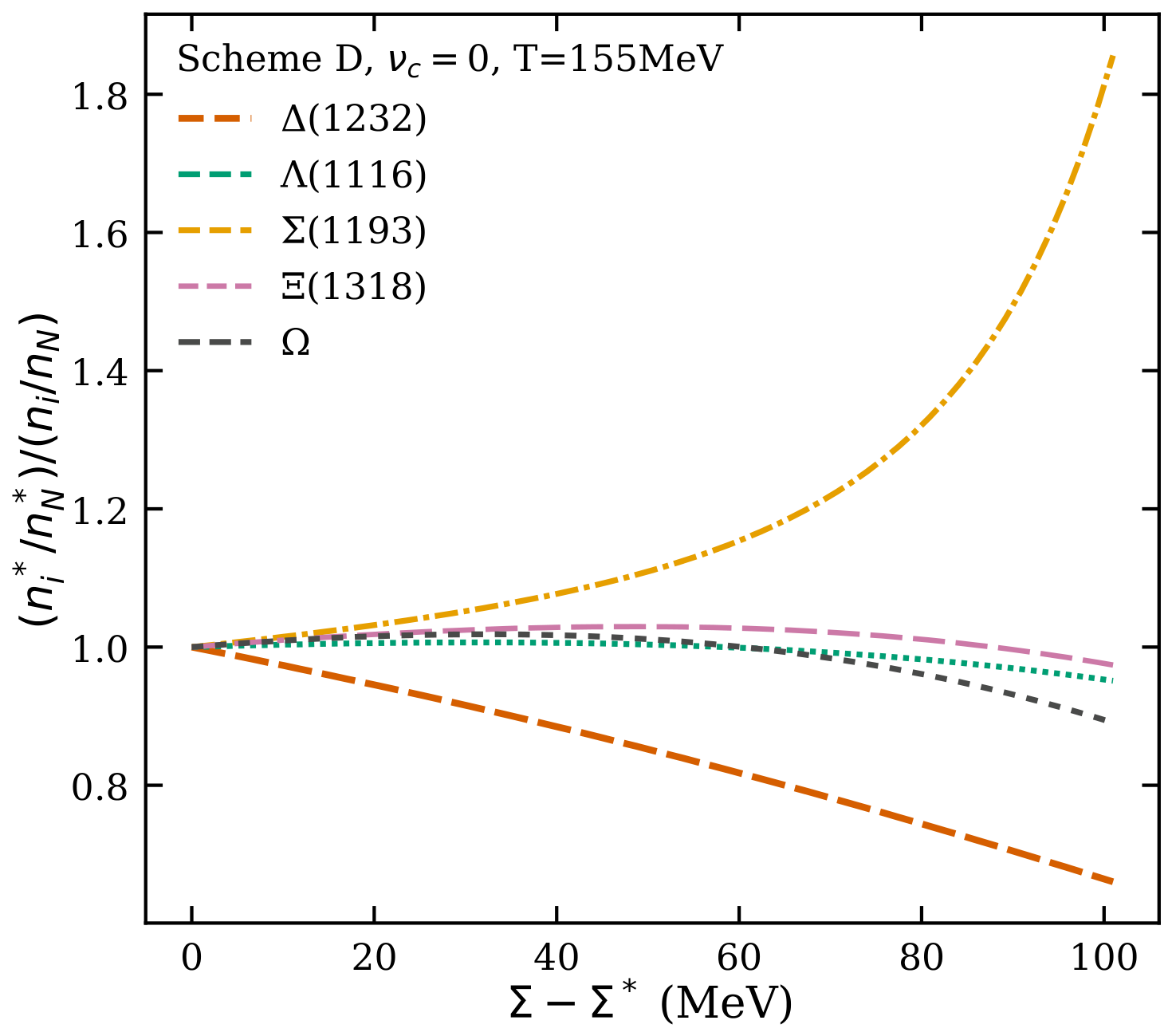
For yield ratios, the cancellation of mass defects of two different baryons in the exponential of Equation (49) can lead to minimal deviations from the yield ratios in a constant mass model. Figure 8 illustrates this with scheme D. At the same time, the figure shows, by example of and , that mass defects are not guaranteed to cancel and thus can lead to notable deviations from constant mass yield ratios. In general, however, yield ratios show smaller deviations than the particle yields themselves. Within our approach, baryons with mass defects of comparable magnitude will necessarily show similar yield variations and thus cancellations in yield ratio variations. Considering the small number of parameters (in-medium masses and scaling parameters) used to encode the in-medium behavior of an otherwise vacuum-calibrated Hamiltonian, the emergence of species-dependent gaps is a non-trivial result. Deviations from this general trend would point to medium effects beyond the presented bound-state parameterization. For instance, the proton– ratio measured by ALICE exhibits non-trivial behavior with a decreasing yield ratio at increasing temperature [32]. Such behavior may require to account for medium effects that are not captured by folding the thermal environment solely into constituent masses and parameter scaling of a bound-state Hamiltonian.
Figure 8.
Effect of moderate changes in the baryon mass spectrum (illustrated with scheme D, MeV): The baryon yield relative to nucleon yield, viz. , normalized to the same relative yield for medium-independent (vacuum) mass, viz. . Although the yields from Figure 6 differ from the vacuum mass result, yield deviations similar to the nucleon yield result in yield ratios close to one. As in Figure 6, this does not hold for and . In general, yield ratios are less affected by medium-shifted baryon masses than particle yields themselves.
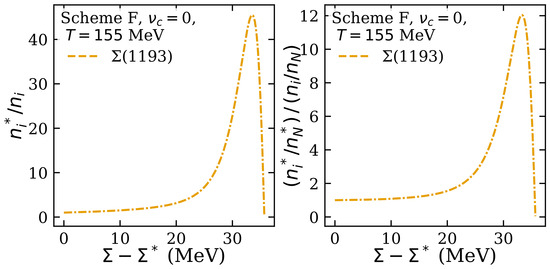
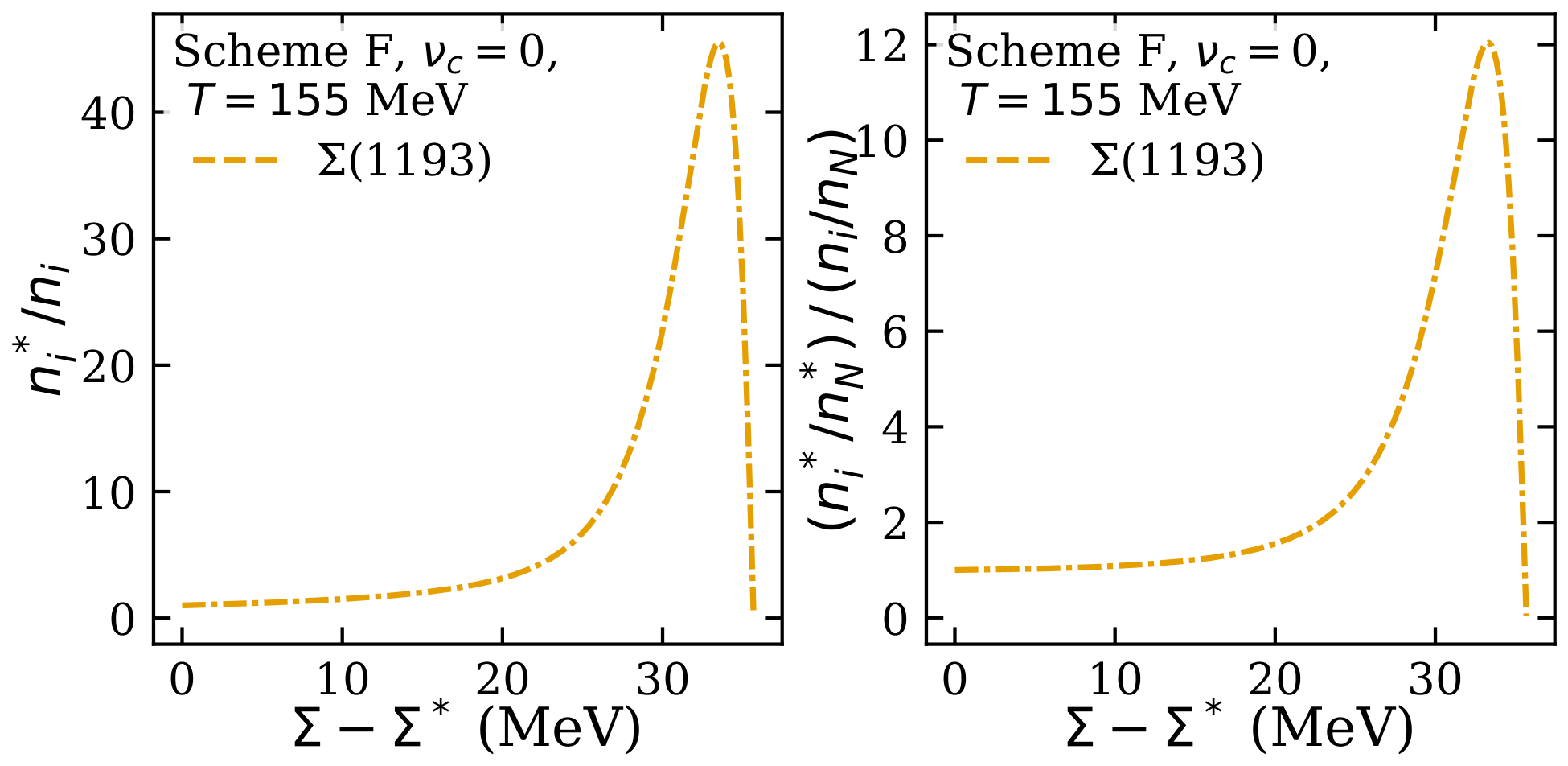
As a final note, we illustrate how yields and yield ratios can differ if mass defects are strongly species-dependent. To do so, we show both quantities for the in scheme F, which develops a steep drop of the baryon mass at MeV. We should not interpret this parameter region as a quantitative prediction for the physical yield, since the rapid mass drop signals the breakdown of the constituent quark model. Rather, we perform a stress test of the ideal-gas estimate; if one baryonic species develops a larger mass defect than the rest of the spectrum, the cancellation in yield ratios no longer occurs.
As seen from Figure 9, both the yield and the yield ratio can deviate by an order of magnitude from the constant mass expectation. At small and moderate mass defects, the exponential factor dominates, while at very low baryon masses, the explicit mass-dependent prefactor in Equations (48) and (49) suppresses the yield and yield ratio estimates. While explicitly not intended as a predictive study, we use this extreme and model breaking scenario to demonstrate that the stability of yield ratios, even in domains with moderate mass shifts, is not generic, but crucially relies on similar mass defects among the compared baryons.
Figure 9.
Effect of significant changes in the baryon mass spectrum (illustrated for baryon, scheme F, MeV): (Left panel): yield normalized to constant (vacuum mass) yield. Larger mass defects result in exponentially increasing yield deviations (see Equation (48)). At very low baryon masses, the mass dependence of the prefactor in Equation (48) leads to a drop in yield deviations. (Right panel): While yield ratios are not as affected by mass defects due to cancellations, the yield ratio of particles with different mass defects can differ significantly from vacuum mass ideal-gas yield ratios. While our model is not reliable beyond the peak in both panels, the figure illustrates that strongly species-dependent mass defects can produce notable yield and yield ratio deviations from the ideal-gas behavior with constant baryon masses.
8. Conclusions
We have studied the sensitivity of the light and strange baryon spectrum to medium-motivated changes in the parameters of a GBE relativistic constituent quark model. The three-quark bound-state problem was solved using a Faddeev approach, with a vacuum parameterization that reproduces the light and strange baryon spectrum reasonably well below about 2 GeV. To approximate the effect of chiral symmetry restoration in the quark sector, we accounted for possible scalings of the quark–meson coupling, exchange meson masses, and confinement strength.
Across most scaling schemes, the baryon masses decrease with decreasing constituent quark mass. The strongest sensitivity comes from the scaling of the quark–meson coupling. Changes in the confinement strength have a visible but smaller effect. Scaling the exchange meson masses has comparatively little impact.
We observe that some scaling choices drive the spectrum into nonphysical negative-energy states. This could indicate either a domain of non-applicability of the model itself or of the chosen scaling relations. The calculated nucleon masses generally drop faster than suggested by Brown–Rho-type scaling. It seems worthwhile to investigate whether a more sophisticated treatment, such as proper handling of strange quark condensate, different in-medium handling of the delta function in the GBE potential, or alternative scaling choices, could remove the pathological behavior or match Brown–Rho scaling. As an illustration of possible consequences, we estimated the effect of changes in the mass spectrum on particle yields and compared them to ideal-gas baryon yields. Even mass shifts of a few tens of MeV change absolute yields notably. The effect on yield ratios is less pronounced unless the shifts are strongly species-dependent. Overall, this work should be understood as a sensitivity study which shows that medium-dependent baryon spectra can respond strongly to implied scaling laws. A self-consistent connection to thermodynamics and a full in-medium hadron-resonance gas treatment remain natural next steps.
Author Contributions
Conceptualization, T.K. and Z.P.; methodology, T.M., T.K. and Z.P.; software, T.M. and Z.P.; validation, Z.P.; formal analysis, T.M. and T.K.; investigation, T.M.; writing—original draft preparation, T.M., T.K. and Z.P.; writing—review and editing, T.M. and T.K.; visualization, T.M.; supervision, T.K. and Z.P. All authors have read and agreed to the published version of the manuscript.
Funding
This research received no external funding.
Data Availability Statement
The original contributions presented in this study are included in the article. Further inquiries can be directed to the corresponding authors.
Acknowledgments
The authors are grateful to Craig D. Roberts for sharing his insights and suggestions which provided valuable momentum to start this project.
Conflicts of Interest
The authors declare no conflicts of interest.
References
- Serot, B.D.; Walecka, J.D. Recent Progress in Quantum Hadrodynamics. Int. J. Mod. Phys. E 1997, 6, 515–631. [Google Scholar] [CrossRef] [Scilit]
- Dutra, M.; Lourenço, O.; Avancini, S.S.; Carlson, B.V.; Delfino, A.; Menezes, D.P.; Providência, C.; Typel, S.; Stone, J.R. Relativistic Mean-Field Hadronic Models under Nuclear Matter Constraints. Phys. Rev. C 2014, 90, 055203. [Google Scholar] [CrossRef] [Scilit]
- Niksic, T.; Vretenar, D.; Ring, P. Relativistic Nuclear Energy Density Functionals: Mean-Field and Beyond. Prog. Part. Nucl. Phys. 2011, 66, 519–548. [Google Scholar] [CrossRef] [Scilit]
- Oertel, M.; Hempel, M.; Klähn, T.; Typel, S. Equations of state for supernovae and compact stars. Rev. Mod. Phys. 2017, 89, 015007. [Google Scholar] [CrossRef] [Scilit]
- Roberts, C.D. Perspective on the origin of hadron masses. Few Body Syst. 2017, 58, 5. [Google Scholar] [CrossRef] [Scilit]
- Pisarski, R.D.; Wilczek, F. Remarks on the Chiral Phase Transition in Chromodynamics. Phys. Rev. D 1984, 29, 338–341. [Google Scholar] [CrossRef] [Scilit]
- Fukushima, K.; Hatsuda, T. The phase diagram of dense QCD. Rept. Prog. Phys. 2011, 74, 014001. [Google Scholar] [CrossRef] [Scilit]
- Bazavov, A.; Ding, H.-T.; Hegde, P.; Kaczmarek, O.; Karsch, F.; Karthik, N.; Laermann, E.; Lahiri, A.; Larsen, R.; Li, S.-T.; et al. Chiral crossover in QCD at zero and non-zero chemical potentials. Phys. Lett. B 2019, 795, 15–21. [Google Scholar] [CrossRef] [Scilit]
- Heller, U.M.; Karsch, F.; Laermann, E.; Levkova, L.; Mukherjee, S.; Petreczky, P.; Schmidt, C.; Soltz, R.A.; Soeldner, W.; Sugar, R.; et al. The chiral and deconfinement aspects of the QCD transition. Phys. Rev. D 2012, 85, 054503. [Google Scholar] [CrossRef] [Scilit]
- Fischer, C.S. QCD at finite temperature and chemical potential from Dyson–Schwinger equations. Prog. Part. Nucl. Phys. 2019, 105, 1–60. [Google Scholar] [CrossRef] [Scilit]
- Roberts, C.D.; Schmidt, S.M. Dyson-Schwinger equations: Density, temperature and continuum strong QCD. Prog. Part. Nucl. Phys. 2000, 45, S1–S103. [Google Scholar] [CrossRef]
- Andronic, A.; Braun-Munzinger, P.; Redlich, K.; Stachel, J. Decoding the phase structure of QCD via particle production at high energy. Nature 2018, 561, 321–330. [Google Scholar] [CrossRef] [Scilit] [PubMed]
- Morita, K.; Sasaki, C.; Lo, P.M.; Redlich, K. Overlap between Lattice QCD and HRG with in-medium effects and parity doubling. EPJ Web Conf. 2018, 171, 05001. [Google Scholar] [CrossRef] [Scilit]
- Karsch, F.; Redlich, K.; Tawfik, A. Hadron resonance mass spectrum and lattice QCD thermodynamics. Eur. Phys. J. C 2003, 29, 549–556. [Google Scholar] [CrossRef] [Scilit]
- Andronic, A.; Braun-Munzinger, P.; Friman, B.; Lo, P.M.; Redlich, K.; Stachel, J. The thermal proton yield anomaly in Pb-Pb collisions at the LHC and its resolution. Phys. Lett. B 2019, 792, 304–309. [Google Scholar] [CrossRef] [Scilit]
- Papp, Z. Treatment of confinement in three-quark calculations. Few-Body Syst. 1999, 26, 99–103. [Google Scholar] [CrossRef] [Scilit]
- Day, J.P.; Papp, Z. Treatment of broken symmetry in the Faddeev approach to the strange baryon spectra. Phys. Rev. D 2012, 85, 114042. [Google Scholar] [CrossRef] [Scilit]
- Papp, Z.; Krassnigg, A.; Plessas, W. Faddeev approach to confined three-quark problems. Phys. Rev. C 2000, 62, 044004. [Google Scholar] [CrossRef] [Scilit]
- Glozman, L.Y.; Riska, D.O. The spectrum of the nucleons and the strange hyperons and chiral dynamics. Phys. Rep. 1996, 268, 263–303. [Google Scholar] [CrossRef] [Scilit]
- Glozman, L.Y.; Papp, Z.; Plessas, W. Light baryons in a constituent quark model with chiral dynamics. Phys. Lett. B 1996, 381, 311–316. [Google Scholar] [CrossRef] [Scilit]
- Glozman, L.Y.; Papp, Z.; Plessas, W.; Varga, K.; Wagenbrunn, R. Effective Q- Q interactions in constituent quark models. Phys. Rev. C 1998, 57, 3406. [Google Scholar] [CrossRef] [Scilit]
- Glozman, L.Y.; Plessas, W.; Varga, K.; Wagenbrunn, R. Unified description of light-and strange-baryon spectra. Phys. Rev. D 1998, 58, 094030. [Google Scholar] [CrossRef] [Scilit]
- Nambu, Y.; Jona-Lasinio, G. Dynamical model of elementary particles based on an analogy with superconductivity. I. Phys. Rev. 1961, 122, 345. [Google Scholar] [CrossRef] [Scilit]
- Nambu, Y.; Jona-Lasinio, G. Dynamical model of elementary particles based on an analogy with superconductivity. II. Phys. Rev. 1961, 124, 246. [Google Scholar] [CrossRef] [Scilit]
- Klevansky, S.P. The Nambu-Jona-Lasinio model of quantum chromodynamics. Rev. Mod. Phys. 1992, 64, 649–708. [Google Scholar] [CrossRef] [Scilit]
- Brown, G.; Rho, M. Scaling Effective Lagrangians in a Dense Medium. Phys. Rev. Lett. 1991, 66, 2720. [Google Scholar] [CrossRef] [Scilit] [PubMed]
- Brown, G.E.; Rho, M. Chiral restoration in hot and/or dense matter. Phys. Rep. 1996, 269, 333–380. [Google Scholar] [CrossRef] [Scilit]
- Brown, G.E.; Rho, M. On the manifestation of chiral symmetry in nuclei and dense nuclear matter. Phys. Rep. 2002, 363, 85–171. [Google Scholar] [CrossRef] [Scilit]
- Gell-Mann, M.; Oakes, R.J.; Renner, B. Behavior of current divergences under SU 3× SU 3. Phys. Rev. 1968, 175, 2195. [Google Scholar] [CrossRef] [Scilit]
- Hatsuda, T.; Kunihiro, T. QCD phenomenology based on a chiral effective Lagrangian. Phys. Rep. 1994, 247, 221–367. [Google Scholar] [CrossRef] [Scilit]
- Koch, V.; Brown, G. Model of the thermodynamics of the chiral restoration transition. Nucl. Phys. A 1993, 560, 345–364. [Google Scholar] [CrossRef] [Scilit]
- Cleymans, J.; Lo, P.M.; Redlich, K.; Sharma, N. Multiplicity dependence of (multi)strange baryons in the canonical ensemble with phase shift corrections. Phys. Rev. C 2021, 103, 014904. [Google Scholar] [CrossRef] [Scilit]

Disclaimer/Publisher’s Note: The statements, opinions and data contained in all publications are solely those of the individual author(s) and contributor(s) and not of MDPI and/or the editor(s). MDPI and/or the editor(s) disclaim responsibility for any injury to people or property resulting from any ideas, methods, instructions or products referred to in the content. |
© 2026 by the authors. Licensee MDPI, Basel, Switzerland. This article is an open access article distributed under the terms and conditions of the Creative Commons Attribution (CC BY) license.