


Abstract
We examine the leading-power fragmentation of fully heavy pentaquarks in high-energy hadronic collisions. To this end, we complete the release of the hadron structure-oriented PQ5Q1.0 fragmentation functions by discussing the set and delivering the one. These functions incorporate an improved computation of the initial-scale input for the constituent heavy-quark fragmentation channel, making them particularly suitable for describing both the direct formation of a compact multicharm state and the hadronization from a diquark–antiquark–diquark configuration. For phenomenological applications, we employ the data-validated (sym)Jethad framework to compute and analyze NLL/NLO+ semi-inclusive production rates of pentaquark-plus-jet systems at the upcoming HL-LHC and the future FCC. This study marks a further step toward connecting hadronic structure, precision QCD, and the emerging physics of exotic matter.
1. Introductory Remarks
The production of heavy-flavored particles in high-energy hadronic collisions plays a key role in unraveling the fundamental dynamics of strong interactions. Heavy-quark signatures serve as key probes for exploring the core principles of particle physics, offering potential signatures of New Physics through interactions between heavy quarks and Beyond-the-Standard-Model (BSM) particles. At the same time, the large masses of heavy quarks allow for precise perturbative Quantum ChromoDynamics (QCD) calculations, enabling detailed studies of strong interactions at next-generation colliding machines, such as the High-Luminosity Large Hadron Collider (HL-LHC) [1,2,3,4], the Electron–Ion Collider (EIC) [5,6,7,8,9,10], and the Future Circular Collider (FCC) [11,12,13,14,15,16,17].
QCD, the theory governing the strong force, is a fundamental pillar of the Standard Model (SM) of particle physics. Formulated as a non-Abelian gauge theory based on the group with , QCD describes quarks—fermionic fields in the fundamental triplet representation—and gluons—massless spin-1 bosons mediating strong interactions, represented in the adjoint octet representation [18,19,20,21]. Beyond its established role in the SM, QCD also provides fertile ground for potential BSM extensions, including axions for resolving the strong CP problem [22,23,24,25], non-Abelian dark gauge forces [26,27], quarkyonic matter [28,29,30], and higher-dimensional QCD operators [31,32,33,34]. These possibilities open new avenues for exploring the frontiers of particle physics and searching for physics beyond the SM.
A crucial domain within QCD is the study of hadrons containing two or more heavy quarks. Among these, mesons formed by a heavy quark–antiquark pair () are known as quarkonia. The origins of quarkonium studies date back to the so-called “Quarkonium November Revolution” of 1974, when the meson was independently discovered at SLAC [35] and BNL [36], later confirmed by the Frascati ADONE experiment [37]. This breakthrough significantly advanced the understanding of the strong interaction and the quark substructure of hadrons.
While quarkonia are categorized as conventional hadrons, the color-neutrality of QCD allows for the formation of more intricate bound states, leading to the emergence of exotic hadrons. These states possess quantum numbers that cannot be accommodated within the traditional quark–antiquark or three-quark configurations. Exotic hadrons can be further divided into two primary classes: those containing explicit gluonic degrees of freedom, such as hybrids and glueballs [38,39,40,41,42,43,44,45,46], and those formed by multiple quarks, such as tetraquarks and pentaquarks [19,47,48,49]. The first experimental observation of an exotic hadron, the , occurred in 2003 at Belle [50], marking the start of the “Second Quarkonium Revolution”. More recently, in 2021, the was observed by LHCb [51], providing the first evidence of an exotic state with open-charm flavor.
Despite the progress in characterizing their mass spectra and decay channels, the production mechanisms of exotic hadrons remain an open question. Theoretical descriptions of these states include meson molecules [52,53,54,55,56,57,58,59,60,61,62,63,64,65,66,67,68,69,70], compact diquark models [71,72,73,74,75,76,77,78,79,80,81,82,83,84], and hadroquarkonium configurations [85,86,87,88,89,90,91,92], each offering different perspectives on their internal dynamics.
A decisive breakthrough in the exploration of fully heavy exotics was achieved with the LHC observation of a family of fully-charmed tetraquark candidates—labeled as , , and —in the double- and -plus- invariant-mass channels [93]. These resonances, lying in the region , are currently the only confirmed fully heavy exotic states. Their experimental interpretation has recently been strengthened by a dedicated spin-parity analysis [94] favoring a assignment for the leading structure. Such findings disfavor loosely bound molecular explanations and support compact tetraquark configurations, possibly dominated by spin-1 diquark components. These results provide strong motivation for extending phenomenological studies to other multiquark systems with heavy content.
The quest for exotic hadrons has remained a central theme in experimental particle physics over the past two decades. A decade after the landmark discovery of the , further evidence supporting the existence of tetraquarks came with the simultaneous observation of the charged charmonium-like state by BESIII [95] and Belle [96]. This resonance, emerging as a decay product of the anomalous , strengthened the case for multiquark configurations beyond the conventional meson–baryon classification. More recently, in 2021, the LHCb Collaboration reported the observation of the resonance [51], marking the first clear instance of an exotic hadron with open-charm flavor.
Pentaquark candidates have also attracted considerable experimental interest. However, their detection poses additional challenges. The presence of an antiquark in the minimal Fock configuration opens the possibility of flavor cancellation: if the antiquark shares the same flavor as one of the four quarks in the system, the resulting state may mimic the quantum numbers of an ordinary three-quark baryon, making it experimentally elusive. To mitigate this ambiguity, early experimental searches concentrated on configurations where such cancellations were not possible.
The first claimed pentaquark signal dates back to 2003, when the LEPS and DIANA Collaborations reported evidence for the baryon [97,98], consistent with a theoretical prediction made in 1997 for a pentaquark state near 1530 MeV [99]. However, subsequent searches produced conflicting results [100,101,102,103], leading to widespread skepticism and a reassessment of early claims.
A decisive breakthrough came in 2015, when the LHCb Collaboration discovered two pentaquark candidates, and , in the invariant-mass distribution of pairs from decays [104]. These structures, interpreted as hidden-charm pentaquark states, marked the first robust identification of five-quark configurations with a clear experimental signature and narrow width.
This discovery was later consolidated by further observations. In 2019, LHCb announced the detection of three additional pentaquark states, , , and , with improved mass resolution and larger statistics [105]. In 2021, the same experiment reported the first evidence for a strange charmonium-like pentaquark, , seen in the spectrum from decays [106]. A year later, in 2022, the resonance was observed in flavor-untagged decays [107]. Additional experimental studies on the sector can be found in Refs. [108,109].
Despite significant advances in identifying mass spectra and decay modes of exotic baryons, the underlying mechanisms responsible for their formation remain elusive. Only a limited number of theoretical frameworks have been proposed to describe their production, most of which rely on model-dependent assumptions. Among these are approaches based on color evaporation [110] and hadron–quark duality [111,112].
Complementary insights have been provided by Lattice QCD calculations and effective field theories, which have deepened our understanding of multiquark interactions and the conditions for resonance formation [113,114,115,116,117,118]. More recently, studies have emphasized the critical role of heavy-quark dynamics in pentaquark systems, particularly the interactions between heavy mesons and baryons [119]. In parallel, the interplay between long-range pion exchange and short-distance quark–gluon dynamics has been investigated as a possible binding mechanism, yielding predictions for new states with diverse spin-parity quantum numbers [120,121].
From a theoretical perspective, fully heavy tetraquarks and pentaquarks represent some of the most tractable exotic states to study. Owing to the large heavy-quark mass , these systems are well above the perturbative threshold and can be modeled as nonrelativistic bound states: for tetraquarks and for pentaquarks. Their lowest Fock states lack valence light quarks and dynamical gluons, closely resembling quarkonia, whose dominant component is .
This analogy implies that methods developed for quarkonia can be extended to the fully heavy sector. While charmonia are often seen as QCD “hydrogen atoms” [122], fully charmed tetraquarks could be interpreted as QCD “helium-2 atoms” or “hydrogen molecules”, and their pentaquark counterparts as “helium-3 atoms”.
Large cross sections for production at high transverse momentum observed at the LHC [123,124,125] offer key insight into production mechanisms, highlighting the relevance of leading-power, single-parton fragmentation in exotic hadron formation.
To systematically address this, we recently introduced two novel families of Zero-Mass Variable-Flavor Number Scheme (ZM-VFNS) Fragmentation Functions (FFs): TQHL1.1 for doubly heavy tetraquarks () and TQ4Q1.1 for fully heavy ones () [126,127,128]. These functions merge nonrelativistic initial-scale inputs [129,130,131,132] with a Next-to-Leading Order (NLO) DGLAP-based evolution framework [133,134,135,136] that properly includes heavy-quark thresholds (see Refs. [137,138] for recent applications).
More broadly, heavy-hadron fragmentation at leading power bridges hadronic structure and perturbative QCD. The presence of heavy quarks in the lowest Fock state demands a dual approach: nonperturbative modeling at the input and high-precision perturbative treatment at short distances. A reliable description requires the synergy of both components, thus combining structural insight with precision evolution.
In Ref. [139], we investigated the leading-power fragmentation of fully charmed pentaquark states (S-wave pentacharms, or simply ) at new-generation hadron colliders. There, we introduced a new set of collinear FFs, denoted as PQ5Q1.0, based on an enhanced treatment of the initial-scale input for the (anti)charm fragmentation channel. These functions were designed to describe the short-distance emission of either compact multicharm states or dicharm–charm–dicharm configurations.
Establishing a flexible framework that accommodates multiple initial-scale inputs within leading-power fragmentation is essential to capture the full dynamics of pentacharm production. Due to the finite mass and spatial motion of quarks, even a tightly bound state may evolve into a meson-cluster configuration. At the quantum level, such transitions arise from fluctuations that couple the compact state to its internal meson substructures, gradually deforming it into a more extended, diquark- or molecular-like object [140].
This phenomenon represents a dynamical mechanism whose precise nature requires solving the four- or five-body bound-state problem in the presence of confining forces. A general and complete solution to this problem remains elusive. Therefore, our PQ5Q1.0 multimodal FFs can serve as a useful guidance for future analyses aimed at discriminating between the (relative weight and connections among) distinct exotic formation dynamics. In this context, we use the term “multimodal” to indicate that the initial fragmentation input is modeled through multiple, physically motivated structural components, reflecting different possible internal configurations of the exotic hadron.
In the present review, we extend and complete the study initiated in Ref. [139], finalizing the release of the hadron structure-oriented PQ5Q1.0 functions by fully presenting the set and delivering, for the first time, their bottom-flavored counterpart, .
Our phenomenological analysis relies on the hybrid-factorization scheme, which embeds the resummation of Leading Logarithmic (LL), Next-to-Leading Logarithmic (NLL), and selected higher-order (NLL+) high-energy logarithms into collinear factorization at NLO. The notation, first introduced in studies of Mueller–Navelet jets [141] and later extended to exotic hadron production [126,142], updates traditional terminology to reflect both logarithmic and fixed-order accuracy, in line with modern QCD-resummation standards. Among various hybrid approaches developed for forward production, we adopt one where high-energy resummation is consistently integrated with fixed-order collinear elements. This structure, already applied in prior studies [143,144,145], ensures a coherent treatment of rapidity-differential observables while preserving compatibility with collinear inputs. Here, we specifically focus on the production of fully heavy pentaquarks with bottom flavor, , exploring their fragmentation and inclusive features within this hybrid framework.
The structure of this review is organized as follows. Section 2 outlines the technical foundations of our strategy for modeling pentaquark collinear fragmentation. In Section 3, we introduce the hybrid scheme, which combines collinear factorization with high-energy resummation. Our phenomenological results and final conclusions are presented in Section 4 and Section 5, respectively.
2. Heavy-Flavor Fragmentation: From Heavy-Light Hadrons to Tetraquarks
In this section, we outline the strategy adopted to construct the hadron structure-oriented, multimodal PQ5Q1.0 FF family. These functions describe the collinear ZM-VFNS fragmentation of S-wave and pentaquarks, starting from an initial-scale input for the charm channel that can be modeled either through a direct fragmentation picture or via a scalar-diquark configuration.
For completeness, we begin in Section 2.1 with a brief overview of the main features of heavy-flavor fragmentation, spanning heavy-light hadrons, quarkonia, and exotic states. We then turn to the pentacharm case: the direct and diquark-inspired inputs are detailed in Section 2.2. Finally, in Section 2.3, we present and discuss the energy evolution of the PQ5Q1.0 FFs.
All symbolic manipulations required for the construction of the PQ5Q1.0 set were carried out using symJethad, a dedicated Mathematica [146] plugin of the data-validated Jethad framework [147,148,149,150,151,152], designed for the analytical treatment of hadronic-structure and precision-QCD expressions.
2.1. Essentials of Heavy-Flavor Fragmentation
Unlike light hadrons, the fragmentation of heavy-flavored hadrons involves a layered mechanism due to the perturbative nature of heavy-quark masses in the lowest Fock state. This sets them apart from light-hadron FFs, which are entirely nonperturbative, as the initial-scale input for heavy-hadron FFs must account for a perturbative component.
For singly heavy systems like D, B, or , the input structure can be understood as a sequential process [153,154,155,156,157,158,159]. In the first step, a high- parton fragments into a heavy quark Q. This part is governed by perturbative dynamics, as the strong coupling evaluated at remains moderate. The so-called Short-Distance Coefficient (SDC) describes the transition, calculated over a short time scale before hadronization sets in. The NLO formulation of this stage was first established in [160,161], with next-to-NLO refinements presented in [162,163,164,165,166,167] (see also Refs. [159,168,169,170,171,172,173,174,175,176,177]).
In the second stage, the heavy quark undergoes hadronization into a color-neutral state. This part is inherently nonperturbative and modeled using either phenomenological parametrizations [178,179,180,181,182,183] or EFT-inspired approaches [155,184,185,186,187].
To obtain a complete ZM-VFNS FF set, evolution effects must be included. Starting from initial inputs with no scaling violations, the FFs are evolved numerically by solving the DGLAP equations at the target perturbative accuracy.
This two-step structure extends naturally to quarkonium fragmentation, where the lowest Fock state involves a pair. Its treatment requires additional care, as both production and binding mechanisms must be accounted for. NRQCD provides the appropriate formalism [188,189,190,191,192,193,194], offering a systematic expansion in and (the relative velocity of the heavy constituents). The pair is produced at short distances (encoded in SDCs), while the formation of the physical bound state is captured by the so-called Long-Distance Matrix Elements (LDMEs). A full state is built as a sum over Fock components with increasing complexity [195,196,197,198,199].
NRQCD offers a powerful framework to study quarkonium production across a wide kinematic range in transverse momentum (). At low , the prevailing mechanism is the short-distance creation of the pair within the hard subprocess, followed by its nonperturbative evolution into a physical quarkonium state. As increases, this picture changes: the fragmentation of a single parton into the final-state hadron (accompanied by inclusive radiation) becomes progressively more important and eventually takes over as the dominant production mode.
Short-distance production aligns with the Fixed-Flavor Number Scheme (FFNS) approach (see, e.g., Ref. [200]) and can be interpreted as a two-parton fragmentation mechanism, encoding genuine power-suppressed contributions [133,134,135,136,201,202,203,204]. By contrast, the single-parton fragmentation process is embedded within the ZM-VFNS framework and evolves through the DGLAP formalism.
Initial Leading Order (LO) evaluations of the fragmentation input for gluon and constituent heavy-quark channels into S-wave vector quarkonia (in color-singlet states) date back to the early 1990s [205,206], while NLO refinements have only emerged in more recent years [207,208,209,210]. Building upon these, the ZCW19+ ZM-VFNS fragmentation set was constructed in Refs. [144,149], incorporating DGLAP evolution for vector quarkonia. The formalism was then extended to and states via the ZCFW22 set [211,212].
Phenomenological analyses using ZCFW22 revealed that the and rapidity spectra of charmed B mesons reproduced the LHCb findings [212,213,214], which reported that the production rate of mesons is below 0.1% of that for singly bottomed B mesons [212]. This result served as an important benchmark for validating the ZM-VFNS approach at high transverse momentum.
Shifting to the exotic sector, recent works suggest that NRQCD factorization can shed light on the nature of double- final states [93,215,216], which may be interpreted as manifestations of fully charmed compact tetraquarks [217,218].
In this framework, the production of a state originates from a short-distance mechanism in which two charm and two anticharm quarks are generated at a scale set by the inverse charm mass. Much like in the case of singly heavy hadrons and quarkonia, asymptotic freedom allows one to model heavy-tetraquark fragmentation as a two-step convolution process: a perturbatively controlled short-distance contribution followed by a long-distance, nonperturbative transition.
The first NRQCD-based calculation of the initial input for the S-wave fragmentation channel in the color-singlet configuration was reported in Ref. [131]. Subsequently, our work on the TQ4Q1.0 ZM-VFNS FFs combined this gluon-induced input with a component obtained by adapting a calculation based on the Suzuki model [129,130,219,220], previously employed to describe the fragmentation into doubly heavy states [130].
Building on this strategy, the first ZM-VFNS FF set for heavy-light tetraquarks—the TQHL1.0 family—was introduced in Ref. [221] (see also the review in Ref. [150]). Later, the public release of TQ4Q1.1 and TQHL1.1 extended this program: NRQCD-based modeling of the input was included [132], the fragmentation into states was refined, and the analysis was generalized to include axial-vector and bottomonium-like tetraquarks [126,222,223,224].
2.2. From Direct to Diquark: Exploring Competing Channels
We begin by presenting the case of direct multiquark fragmentation. Our modeling strategy for the initial-scale input of constituent heavy-quark fragmentation into a color-singlet S-wave pentaquark state, within the direct scenario (see Figure 1), builds upon the formalism developed in Ref. [225]. That work employed a Suzuki-inspired framework [129,219,220], enriched with spin-structure considerations and transverse-momentum dependence. The collinear limit was obtained by neglecting the internal motion of the constituent quarks inside the bound state [220,226,227].
This approach mirrors the NRQCD factorization structure, where the perturbative production of a pair is followed by its nonperturbative transition into a quarkonium via LDMEs. Analogously, in our framework, a multiquark system is generated through above-threshold splittings of an outgoing heavy quark Q, as illustrated in Figure 1. The resulting amplitude is then convoluted with a bound-state wave function that encodes the nonperturbative hadronization dynamics, following the Suzuki prescription.
The representative channels depicted in Figure 1 correspond to the subprocess—that is, the SDC for direct fragmentation. By exchanging all heavy quarks and antiquarks, one obtains the corresponding SDC for fragmentation.
In this study, we assume symmetry in the production mechanisms of and states and thus in their fragmentation probabilities. We restrict our phenomenological analysis to inclusive observables that average over both particle and antiparticle emissions. Under this assumption, FFs initiated by Q and are treated on equal footing (for comparison with light-hadron cases, see, e.g., Ref. [228]).
By working with symJethad [147,148,149,150,151,152], interfaced with FeynCalc [229,230,231], we obtained the explicit form of the initial-scale PQ5Q1.0 FF in the direct scenario (not given in Ref. [225]). It reads
where we have defined the dimensionless mass and transverse-momentum ratios as and , with GeV and GeV being the charm-quark mass and the bottom-quark one, respectively. As a reasonable assumption suitable for exploratory studies, we set the pentacharm mass to . The overall factor in Equation (1) is
where GeV is the hadron decay constant [232] and denotes the Casimir factor for gluon emission from a quark. Then, the numerator of Equation (1) reads
with the coefficients listed in Appendix A of Ref. [139].
Our treatment of the function enhances Ref. [225]. First, in line with the expectations from LO kinematics (see Figure 1), we do not impose a fixed normalization on the overall constant in Equations (1) and (2). Instead, we compute it explicitly at the initial scale .
Then, the original formulation by Suzuki accounts for spin correlations and serves as an effective proxy for Transverse Momentum-Dependent (TMD) FFs. To extract the collinear limit, rather than integrating over the transverse-momentum squared of the outgoing heavy quark, one replaces it with an average value, denoted as . This average then acts as a free parameter, to be fixed through phenomenological arguments. As noted in Ref. [233], increasing shifts the peak of the resulting FF toward lower z and simultaneously suppresses its normalization.
The study of Ref. [225] adopted the choice as a maximal estimate, corresponding to an upper bound on the squared transverse momentum. In the present work, we refine this prescription by introducing a more balanced choice of , aligned with the exploratory character of our analysis.
This refinement follows the strategy previously introduced in the study of fragmentation [142], where a phenomenological calibration was proposed. In that context, data-driven considerations on fragmentation in hadronic collisions suggested that heavy-quark FFs, both for light hadrons [147,234,235,236] and heavy ones [144,145,211,237,238], are typically probed at longitudinal momentum fractions above .
Moreover, it was assumed that the constituent-quark FFs are comparable in size to their gluon counterparts. This assumption is supported by the case of scalar S-wave quarkonium, such as , whose gluon and charm FFs at LO are similar in size for [205,206].
Figure 1.
Representative leading-order diagrams for the initial-scale collinear fragmentation of a constituent heavy antiquark into a color-singlet S-wave state within the direct multiquark scenario. The nonperturbative hadronization component of the corresponding FFs is depicted by blue ovals. Diagrams produced using JaxoDraw 2.0 [239].
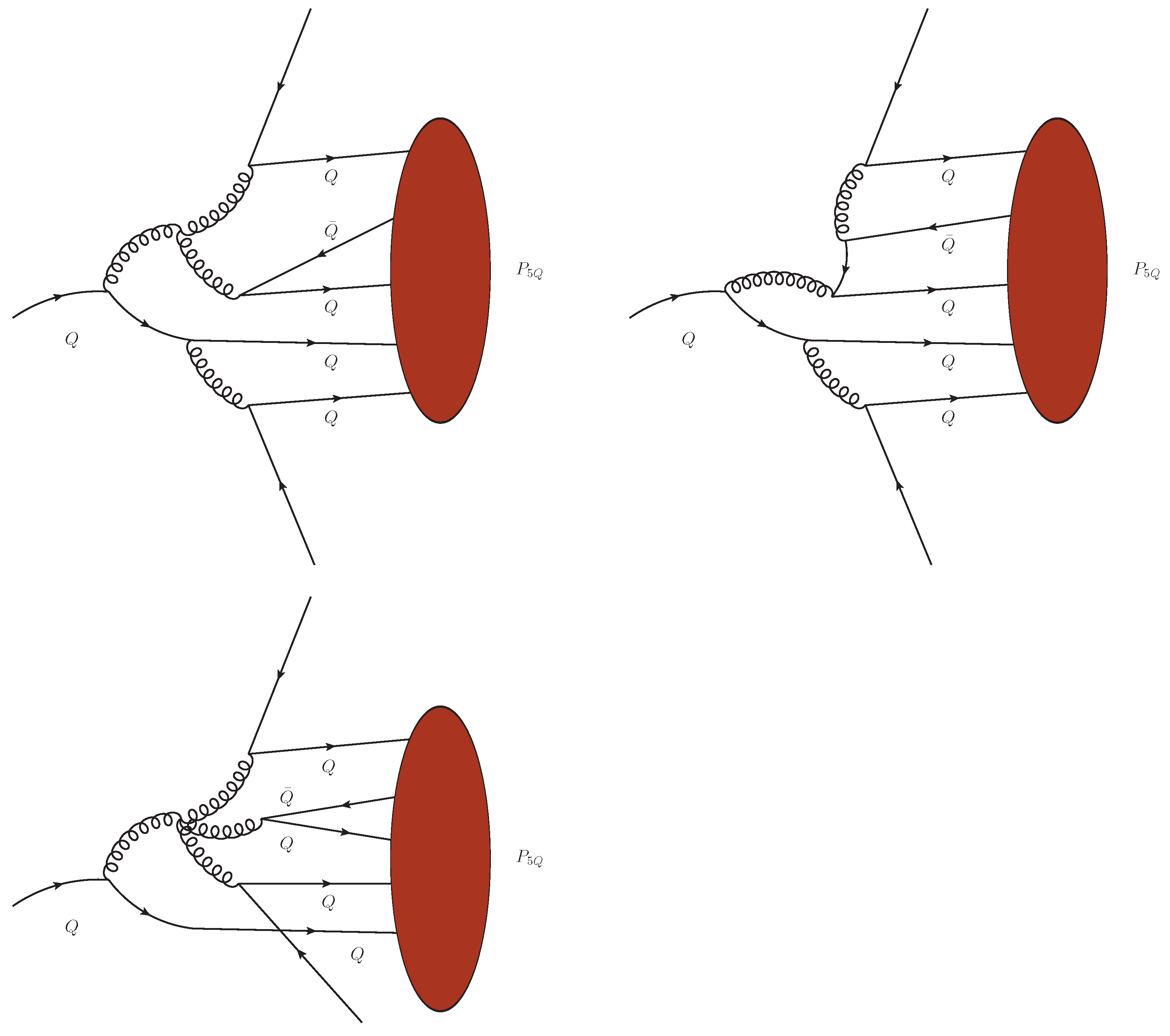
For fragmentation, numerical scans in Ref. [142] showed that setting ensures both and consistency in size between the quark and gluon channels.
At present, no dedicated calculations are available for gluon-initiated FFs into pentacharm states. As a result, the value of must be chosen based solely on the features of the constituent-quark channel. Following the same procedure used for , we performed a scan over and selected the value as a phenomenologically motivated benchmark.
We now turn our attention to the diquark-based scenario. The interacting quark–diquark picture assumes that two quarks can form a colored, quasi-bound state—the diquark—as first proposed in Ref. [19]. This framework has seen wide application in hadron spectroscopy and has been extended to describe the production and decay of baryons, especially those containing heavy flavors [57,71,240,241]. Diquarks are typically classified as scalar (spin-0) or axial-vector (spin-1) states. Their internal structure is incorporated via nonperturbative form factors, which encode their compositeness. Scalar diquarks require a single form factor, while axial-vector configurations typically involve multiple ones.
Early applications of the diquark model to describe fragmentation into octet baryons and singly heavy baryons were developed in Refs. [242,243,244] and [245,246,247,248], respectively. Studies of the mass spectra of doubly and fully heavy tetraquarks using a relativistic quasi-potential diquark–antidiquark framework were presented in Refs. [249,250,251]. A detailed discussion of pentaquarks within a diquark-based approach can be found in Ref. [252].
In this work, we adopt the methodology developed in Ref. [253] to model the initial-scale input for constituent heavy-quark fragmentation into S-wave, color-singlet pentaquarks within the diquark-based picture (see Figure 2). Following the same Suzuki-inspired framework used for the direct-channel analysis [129,219,220], we now assume that the dominant Fock-state configuration of the pentaquark is , where denotes a colored heavy diquark composed of two heavy quarks. At LO, the splitting is described by three main classes of diagrams, as illustrated in Figure 2.
Figure 2.
Representative leading-order diagrams for the initial-scale collinear fragmentation of a constituent heavy antiquark into a color-singlet S-wave pentaquark in the scalar-diquark scenario. Double lines denote or heavy-diquark configurations, while black dots represent effective gluon–diquark–antidiquark interaction vertices. The nonperturbative hadronization stage of the associated FFs is indicated by blue ovals. Diagrams produced using JaxoDraw 2.0 [239].
We note that the representative channels depicted in Figure 2 correspond to the diquark-based SDC. By reversing all heavy-quark flavors—interchanging [] throughout—one obtains the complementary transition, describing the SDC within the diquark picture. As in the direct scenario discussed above, we adopt a symmetric treatment of particle and antiparticle formation mechanisms. Accordingly, we assume equal production rates for pentaquarks and antipentaquarks and thus work with fully symmetric Q and fragmentation channels.
Describing the lowest Fock component of the pentaquark as a diquark–quark–diquark system leads to significantly more compact analytical expressions compared to the direct multiquark setup. This simplification is particularly beneficial in symbolic computations, which were carried out using symJethad [147,148,149,150,151,152] in combination with FeynCalc [229,230,231]. Following this strategy, we reproduce the explicit analytical form of the initial-scale FF in the diquark-based PQ5Q1.0 family. We get
with . The overall factor in Equation (4) is
with being a form factor entering the description of the gluon–diquark–antidiquark effective vertex (the black bullet in Figure 2). Then, the numerator and the denominator respectively read
and
As discussed earlier, our analysis adopts the calculation in Ref. [253] as a benchmark reference for modeling the initial-scale quark-to-pentaquark FF in the diquark scenario. That function was derived under the simplifying assumption that only scalar diquark states contribute, with pseudovector configurations being neglected.
Our treatment of the function refines and extends the strategy of Ref. [253] in several key aspects. First, as in the direct-channel analysis of the previous section, we do not impose a fixed normalization on the overall constant in Equations (4) and (5). Instead, we compute it explicitly at the initial scale , in accordance with LO kinematics (see Figure 2).
Second, rather than treating as a free parameter, we fix its value by applying the same phenomenologically motivated procedure used in the direct case. Third, to isolate the dynamical features of the genuine scalar-diquark setup with respect to the multiquark picture, we set the gluon–diquark–antidiquark form factor to , a notable reduction from the value adopted in Ref. [253].
Figure 3 shows a comparative overview of initial-scale constituent-quark FFs for scalar pentaquarks (left panels) and (right panels), modeled within the direct (upper) and scalar-diquark (lower) frameworks. All distributions are multiplied by z and shown after diagonal DGLAP evolution from the reference scale , varied in the range to to estimate the impact of factorization-scale choices.
Figure 3.
Constituent heavy-quark to (left) and (right) initial-scale fragmentation channels in the direct (upper) and scalar-diquark (lower) picture. For the sake of illustration, an expanded diagonal DGLAP evolution is performed in the range to .
In the direct scenario (upper panels), the initial scale is set to , where (left) or b (right), in accordance with the treatment discussed in Section 2.2. In both cases, the FFs exhibit a pronounced peak in the moderate-z region and rapidly vanish toward the endpoints and .
The peaks of the bottom-quark FFs are noticeably shifted toward higher z values compared to their charm counterparts. This behavior is consistent with theoretical expectations: heavier quarks tend to fragment with a harder spectrum, transferring a larger fraction of their initial momentum to the produced hadron [161,254,255]. Such a trend is a direct consequence of the reduced phase space for collinear and soft radiation in the fragmentation of heavier partons.
In the diquark scenario (lower panels), the initial scale is increased to , reflecting the higher invariant mass of the pentaquark Fock state involving two heavy diquarks. While the shape of the FFs remains similar to the direct case, the overall magnitude is enhanced—particularly in the charm sector—with a peak value ∼ higher than the direct counterpart. This result suggests that, under otherwise equal assumptions, the diquark production mechanism may yield slightly higher cross sections at moderate to high energies.
We note that bottom FFs (right panels) are significantly more peaked and broader than their charm analogs, consistent with the expected hierarchy in heavy-quark fragmentation. These findings will be quantitatively explored in the phenomenological study presented in Section 4.
2.3. The PQ5Q1.0 Determinations from HF-NRevo
The final stage in constructing the PQ5Q1.0 functions for states involves performing a consistent DGLAP evolution of the initial-scale inputs discussed above. Based on leading-order kinematics, the minimum invariant mass for the direct-channel splitting is (see Figure 1), while the corresponding threshold for the diquark-based splitting is (see Figure 2). These values are adopted as the starting scales for the evolution of the constituent heavy-quark FFs in the two respective scenarios.
As previously emphasized, achieving a fully consistent treatment of heavy-flavor fragmentation requires merging structure-informed input functions with the collinear factorization formalism, thereby establishing well-defined DGLAP evolution thresholds for all relevant parton channels. This strategy is implemented through the Heavy-flavor NonRelativistic evolution (HF-NRevo) scheme introduced in Refs. [133,134,135,136].
Originally developed to evolve FFs from nonrelativistic inputs, HF-NRevo has been extended to accommodate more general input models [126,142,221,222,223,256]. It is structured around three essential components: the physical interpretation of the input, the evolution procedure itself, and the associated uncertainty quantification.
Focusing on the evolution step, the DGLAP procedure implemented in HF-NRevo follows a two-phase approach. First, an extended semi-analytical decoupled evolution, referred to as EDevo, ensures precise handling of threshold effects across all parton species. This is followed by the numerical all-order evolution phase, denoted AOevo.
The HF-NRevo framework was initially applied to the collinear fragmentation of fully heavy tetraquarks, incorporating both gluon and heavy-quark channels (see Ref. [142] for the TQ4Q1.0 set and Section 2.3.4 of Ref. [126] for the 1.1 update).
When only a single initial FF channel is available, a reduced version of HF-NRevo is employed. This applies, for example, to the TQHL1.0 and TQHL1.1 sets for the fragmentation of doubly heavy tetraquarks, constructed using only the channel (see Ref. [221] and Section 2.2.2 of Ref. [126]). In such cases, the EDevo step is omitted, and the procedure proceeds directly to the numerical AOevo phase. This second step is currently implemented using the APFEL++ evolution library [257,258,259], while future developments will enable interfacing symJethad with the EKO framework [260,261].
Turning back to the fragmentation of fully heavy pentaquarks, we note that, to the best of our knowledge, only the constituent-quark channel has been modeled at the initial scale so far. As done for the tetraquarks [126,221], our PQ5Q1.0 sets are constructed by directly applying the AOevo evolution to the input functions. All other partonic channels are generated dynamically through DGLAP evolution.
In our formulation, the heavy-quark mass explicitly enters the initial condition for the constituent channel via the mass-dependent dual-mode scenario introduced in previous sections. This reflects the physical expectation that fragmentation into a state occurs near threshold, where finite-mass effects are non-negligible.
Accordingly, the evolution is carried out within a fixed-flavor scheme with , where no crossing of heavy-quark thresholds takes place. The evolution itself is performed in the ZM-VFNS, where all partons—including charm and bottom—are treated as massless. This choice is standard in studies of heavy-hadron fragmentation (see, e.g., Ref. [177]), based on the assumption that mass effects become negligible at large scales.
One might question the absence of initial-scale inputs for light partons and nonconstituent heavy quarks, which in our setup emerge only radiatively at higher energies. However, previous analyses, such as Refs. [130,212,221] for doubly heavy tetraquarks and Refs. [144,149] for vector quarkonia, indicate that these contributions are subdominant at low scales. A more complete treatment including all relevant initial channels is left for future developments.
In Figure 4, we present the factorization-scale dependence of our PQ5Q1.0 FFs at NLO within the ZM-VFNS scheme. The plots show as a function of for both (left column) and (right column), distinguishing between the direct (top) and scalar-diquark (bottom) initial-scale configurations. The hadron momentum fraction is fixed at , consistent with typical values probed in semi-inclusive observables (see Refs. [144,145,147,211,212,234,235,237,238,262]).
Figure 4.
Factorization-scale dependence of the PQ5Q1.0 NLO FFs portraying the ZM-VFNS fragmentation of (left) and (right) pentaquarks within direct (upper) or scalar-diquark (bottom) initial-scale inputs. The hadron momentum fraction is set to .
In all four panels, we observe that the FFs originating from constituent heavy quarks, namely for and for , dominate over all other partonic channels across the full range shown. These FFs are typically larger by one to two orders of magnitude compared to the gluon contribution, and even more so with respect to those from light quarks or nonconstituent heavy flavors. This behavior reflects the strong localization of fragmentation near threshold, where constituent dynamics play a central role. The overall pattern is preserved when switching from the direct to the diquark mode, although the absolute normalization and -slopes may vary slightly depending on the input configuration.
Then, consistent with previous findings for exotic hadrons, the gluon FFs for pentaquark production exhibit a smooth and monotonic growth with increasing . This pattern closely resembles what was previously observed in the case of doubly heavy tetraquarks, as illustrated in the upper panels of Figure 5, where the TQHL1.1 NLO sets [126] are shown. A similar trend is also visible for the gluon FFs in the lower panels, corresponding to scalar tetraquarks, described by the TQ4Q1.1 functions [222,223]. Such stability and gradual enhancement with energy make the gluon channel an important secondary source in semi-inclusive production mechanisms—even though it remains subleading with respect to the constituent heavy-quark channel at the initial scale.
Figure 5.
Upper plots: factorization-scale dependence of the TQHL1.1 NLO FFs [126] portraying the ZM-VFNS fragmentation of (left) and (right) tetraquarks. Lower plots: factorization-scale dependence of the TQ4Q1.1 NLO FFs [222,223] portraying the ZM-VFNS fragmentation of (left) and (right) tetraquarks. The hadron momentum fraction is set to .
Finally, recent studies have shown that gluon FFs, characterized by a smooth dependence on the factorization scale , act as effective stabilizers for high-energy observables sensitive to the semi-inclusive production of singly [237,238] and multiply [139,144,211,221,223,256] heavy-flavored hadrons. This behavior underpins the so-called natural stability of high-energy resummation [263] (see Section 3), a key feature that will play a prominent role in the phenomenological analyses presented in Section 4.
3. NLL/NLO+ Hybrid Factorization for Pentaquark + Jet Systems
The first part of this section contains a brief recap of recent phenomenological progresses of high-energy resummation in QCD (see Section 3.1). The second part provides us with a formal description of the our pentaquark-sensitive observables described by the hands of the hybrid high-energy and collinear factorization at (see Section 3.2).
3.1. High-Energy QCD Phenomenology: An Incomplete Summary
Accurate predictions for high-energy observables rely on the ability to separate long-distance dynamics from short-distance effects in hadronic scatterings. This separation enables the factorization of nonperturbative contributions from perturbative calculations through the well-established collinear framework [264,265].
However, specific regions of phase space present challenges due to the emergence of large logarithmic corrections. These logarithms grow with the perturbative order, eventually compensating the smallness of the QCD running coupling and undermining the convergence of the perturbative series. In such regimes, the standard collinear factorization must be supplemented by all-order resummations.
In the semi-hard regime of QCD [266], characterized by a strong hierarchy among energy scales, , logarithms of the type enter perturbative expansions with powers increasing at each order, thus requiring resummation [267,268,269,270].
The Balitsky–Fadin–Kuraev–Lipatov (BFKL) approach [271,272,273,274] provides the most suitable framework for performing resummation at high energies. Specifically, BFKL resums all terms of the form (the so-called LL approximation) as well as terms proportional to , corresponding to the NLL accuracy.
Within the BFKL formalism, a given scattering amplitude can be factorized into a convolution of a universal Green’s function with two singly off-shell, transverse momentum-dependent emission vertices—also known as impact factors—describing the production of a forward-state particle from the remnants of each incoming hadron. In BFKL terminology, these are referred to as forward-production impact factors.
The Green’s function evolves according to an integral equation, whose kernel has been determined at NLO accuracy [275,276,277,278,279,280,281] (see also ongoing efforts in higher-order corrections [282,283,284,285,286,287]).
The predictive power of high-energy resummation within the BFKL framework at NLL accuracy is currently limited by the availability of off-shell emission functions computed at NLO. These include (a) impact factors for incoming partons (quarks and gluons) [288,289], which are essential for calculating (b) forward jet [290,291,292,293,294] and (c) forward light-hadron [295] emission functions.
Additional NLO-calculated impact factors include: (d) virtual photon to light vector meson transitions [296], (e) light-by-light scattering contributions [297,298,299,300,301,302], and (f) forward Higgs boson production in the infinite top-mass limit [303,304,305] and at finite top mass [306,307] (see Ref. [308] for pioneering extensions to the next-to-NLO accuracy).
At LO accuracy, several additional channels have been studied, such as: Drell–Yan pair production [309,310], heavy-quark pair production [311,312,313], and forward production at low transverse momentum [314] (see also Refs. [315,316,317]).
Among the most promising observables for testing high-energy QCD at hadron colliders are those associated with so-called gold-plated channels. These include a variety of semi-inclusive processes that are particularly sensitive to BFKL dynamics, such as: Mueller–Navelet dijet production at NLO [141,294,318,319,320,321,322,323,324,325,326,327,328,329,330,331], correlated dihadron emissions [234,235,332,333,334], multi-jet configurations tagged at large rapidity intervals [335,336,337,338,339,340,341,342,343,344,345,346,347], as well as more exclusive configurations such as hadron-plus-jet [147,236,262,348,349,350], Higgs-plus-jet final states [351,352,353,354,355], heavy-light dijets [143,356], and heavy-flavored hadron production [144,145,211,212,237,238,263,311,312,313,314,357,358,359,360,361].
A particularly clean and sensitive probe of BFKL dynamics is offered by processes involving the detection of single forward particles. These are directly linked to the behavior of the proton’s Unintegrated Gluon Distribution (UGD) at small x, whose energy evolution is governed by the BFKL Green function. Examples include: light vector meson leptoproduction, extensively studied at HERA [362,363,364,365,366,367,368,369,370] and projected for future EIC measurements [371,372,373,374,375], exclusive quarkonium photoproduction [376,377,378,379,380], inclusive Drell–Yan dilepton detection [310,381,382,383], and the emission of bottom-tagged jets [384,385,386].
The insights provided by the BFKL UGD at small x have proven essential for improving the theoretical description of collinear Parton Distribution Functions (PDFs) supplemented by small-x resummation [387,388,389,390,391,392,393]. In parallel, they establish a bridge with model-based studies of twist-two gluon TMD distributions enhanced at low x [394,395,396,397,398,399,400,401,402,403,404,405].
Further developments in Refs. [406,407] offer a more precise characterization of the relationship between low-x dynamics and the TMD formalism, while recent work [408,409] explores how the UGD connects to dipole cross sections in color-glass-like frameworks.
Analyses of small-x resummed inclusive and differential distributions for Higgs and heavy-flavor production have also been pursued via the Hell method [390,410], based on the Altarelli–Ball–Forte (ABF) formalism [411,412,413,414,415,416,417]. This approach merges collinear factorization with small-x resummation, incorporating high-energy factorization theorems [418,419,420,421,422,423,424,425], and provides a complementary view on high-energy QCD dynamics.
A major challenge in the BFKL description of Mueller–Navelet jet production arises from the destabilizing role of NLL corrections. Although these next-to-leading logarithmic terms are formally of the same order as the LL contributions, they come with opposite sign. This results in significant instabilities within the resummed series, especially when analyzing Missing Higher-Order Uncertainties (MHOUs) by varying the energy scales around their natural values.
As a consequence, Mueller–Navelet observables can yield unphysical predictions when the rapidity separation between the jets becomes large. Similarly, azimuthal-angle correlations exhibit abnormal behaviors both at low and high rapidities. Several strategies have been developed to mitigate these effects. Among them, the Brodsky–Lepage–Mackenzie (BLM) scale-setting procedure [426,427,428,429], specifically adapted to semi-hard processes [322], has shown partial success in restoring stability—particularly in azimuthal distributions—leading to modest improvements in agreement with experimental data.
However, the effectiveness of the BLM method proves limited—especially in observables involving light dihadron or hadron-plus-jet emissions in semi-hard regimes. This limitation stems from the fact that the optimal renormalization scales suggested by BLM tend to lie significantly above the natural physical scales of the processes under consideration [147,236,267]. As a result, total cross sections in these channels suffer from a marked suppression, leading to poor event statistics.
Encouraging signs of improved stability in high-energy resummation—under both higher-order corrections and scale variations—have recently emerged in processes involving final states that are sensitive to Higgs boson production [351,430,431,432,433,434,435,436,437,438]. This stabilizing trend was first clearly observed in studies of semi-inclusive emissions of hyperons [237] and singly bottom-flavored hadrons [238] at the LHC. Notably, it was found that such stability is intimately linked to the distinctive behavior of ZM-VFNS collinear FFs, which govern the production of these singly heavy-flavored hadrons at high transverse momentum.
Subsequent analyses on vector quarkonia [144,149], charmed B mesons [211,212], heavy tetraquarks [126,142,150,221,222,223], and rare baryons [256] clarified that this remarkable property, known as natural stability of the high-energy resummation in QCD [263], emerges as an intrinsic feature inherently associated with final states sensitive to heavy flavor.
3.2. Hybrid-Factorization Studies at and Beyond
We investigate the reaction represented in Figure 6:
where a fully bottomed pentaquark is emitted in association with a light-flavored jet. The final-state particles possess large transverse momenta, , and their rapidity separation is .
Figure 6.
Sketch of the pentaquark + jet semi-inclusive hadroproduction within factorization (diagram made with JaxoDraw 2.0 [239]). Red ovals portray collinear PDFs. The off-shell vertex, part of the hadron (jet) emission function, is depicted by green (blue) blobs. Pentaquarks’ emissions are depicted by indigo arrows. The big orange oval at the center of the diagram stands for the BFKL Green’s function.
Large observed transverse momenta and large rapidity distances are needed for dealing with semi-hard final-state configurations. Furthermore, transverse-momentum ranges have to be large enough to make the validity of the ZM-VFNS collinear fragmentation be the dominant mechanism for the production of heavy hadrons.
Incoming protons’ four-momenta can decomposed as Sudakov vectors satisfying and . In this way, and can be cast as
Final-state objects’ longitudinal fractions, , depend on rapidities as . Thus, one has , and .
The LO cross section of our reaction (Equation (8)) in pure collinear QCD would take the form of a one-dimensional convolution among protons’ PDFs, hadrons’ FFs, and partonic hard factors. One has
where the () indices run over quarks, antiquarks, and the gluon, are proton PDFs, denote pentaquark FFs, stand for the longitudinal fractions of the struck partons, z is the longitudinal fraction of the outgoing parton fragmenting into , and are partonic-subprocess cross sections.
In contrast, deriving the high-energy resummed cross section within our hybrid factorization framework involves a two-step procedure. The first step consists of applying the high-energy factorization scheme dictated by BFKL resummation. This is then supplemented by a collinear refinement through the inclusion of PDFs and FFs. The resulting differential cross section is naturally written as a Fourier series in the azimuthal-angle difference, with coefficients that encode the dynamics of the process. We write
with being the final-state azimuthal angles and . The azimuthal coefficients are evaluated within the BFKL framework and encapsulate the effects of LL and NLL resummation of high-energy logarithms. Our calculation is carried out in the renormalization scheme [439], which provides a consistent setup for organizing perturbative corrections and handling ultraviolet divergences. One has
Here, , with the number of colors, and is the leading coefficient of the QCD -function, with denoting the number of active flavors. We employ a two-loop running coupling, initialized at , and account for a dynamic flavor number throughout the evolution. The resummation kernel appearing in the exponent of Equation (12) is given by
where
represent the LO kernel eigenvalues, the Euler–Mascheroni constant, and the logarithmic derivative of the Gamma function. The function in Equation (13) stands for the NLO kernel correction:
The mass of the pentaquark is fixed at , where denotes the mass of the constituent heavy quark, Q. Since the jet on the light-flavor side does not involve a heavy mass scale, its transverse mass simply reduces to its transverse momentum, . The characteristic function entering the BFKL exponent was derived in Refs. [440,441], and it reads
where
with
and
The expressions for the singly off-shell emissions functions are
Here, the LO functions depicting the production of a forward hadron and a forward jet are
and
with and being the Casimir QCD factors. The function encodes the logarithmic derivative of LO functions:
In Equation (12), the remaining ingredients are the NLO corrections to the emission functions, denoted as . The NLO term associated with the forward hadron was derived in Ref. [295], and its explicit expression is reported in Appendix A of this review. For the forward jet, we adopt the prescription of Refs. [293,295]. To facilitate numerical implementation, we rely on a jet selection function (jet algorithms are generally classified into two main categories: cone-type and sequential-clustering algorithms. For a detailed discussion, see Refs. [442,443] and references therein. A prominent example of the latter is the (anti-) algorithm [444,445]) evaluated within the Small-Cone Algorithm (SCA) [446,447], using its cone-type version [294] with jet radius . The analytical form of the NLO jet emission function is provided in Appendix B.
A rigorous phenomenological comparison between our hybrid factorization framework and fixed-order predictions would require a dedicated numerical setup capable of evaluating NLO distributions for two-particle production in hadronic collisions. To the best of our knowledge, such a tool is currently not available. As a pragmatic alternative, we benchmark our results against fixed-order estimates by truncating the azimuthal-coefficient expansion in Equation (12) at . This yields an effective high-energy fixed-order approximation (), which retains the leading-power asymptotic behavior of full NLO calculations while discarding all terms suppressed by inverse powers of the partonic center-of-mass energy. We report here the formula for the azimuthal coefficients at :
where the resummation kernel has been expanded and truncated at . For comparison, we will also present results at a pure LL accuracy:
Equations (12)–(25) outline the construction of our hybrid factorization framework. In accordance with the BFKL approach, the hadronic cross section is expressed as a transverse-momentum convolution of the Green’s function with two off-shell emission functions (impact factors). These impact factors incorporate collinear PDFs and FFs, effectively linking high-energy and collinear dynamics.
The label signals that energy logarithms are fully resummed at next-to-leading logarithmic accuracy using NLO-calculated perturbative ingredients. The “+” superscript in Equation (12) indicates that certain next-to-NLL contributions—specifically, those arising from the cross-product of the two NLO impact-factor corrections—are also included.
Renormalization and factorization scales are chosen according to the natural kinematic prescription,
where denotes the transverse mass of final-state particles.
For the collinear PDFs, we employ the NNPDF4.0 NLO set [448,449], accessed through the LHAPDFv6.5.4 interface [450]. These distributions are obtained via global fits using the replica method [451], a technique originally introduced in neural-network training and now widely used in multidimensional proton-structure analyses [452,453,454,455,456,457]. For a critical assessment of inter-set correlations and associated uncertainties, we refer to Ref. [458].
All results in this review are derived within the renormalization scheme [439].
4. Fully Heavy Pentaquarks from HL-LHC to FCC with Jethad
All predictions presented in this review were obtained using Jethad, a hybrid, multimodular interface that integrates both Python- and Fortran-based components. Designed for the computation, management, and processing of physical distributions across different theoretical frameworks [147,148,149,150,151,152], Jethad enabled precise numerical evaluations of our pentaquark-sensitive observables. Specifically, differential distributions were computed using selected Fortran 2008 modular routines within Jethad, while the built-in Python 3.0 analyzer was employed for final data processing and elaboration.
Section 4.1 summarizes the key features of the current Jethad framework (v0.5.3). Its (super)modules have been validated against collider data in related processes; see Section 4.1 for a brief overview. A comprehensive discussion of the uncertainty quantification strategy is presented in Section 4.2, while Section 4.3 details the kinematic cuts applied to final-state particles. Numerical predictions for the -plus-jet system, including rapidity-interval and transverse-momentum distributions, are provided in Section 4.4 and Section 4.5, respectively. The present phenomenological study expands and completes the analysis in Section 4.2 of Ref. [139], which focused exclusively on -plus-jet final states.
4.1. The Jethad v0.5.3 Technology
The Jethad project originated in late 2017, driven by the need for accurate predictions of semi-hard hadron [234,235] and jet [236,324,326] final states at the LHC. These processes, proposed as key channels to explore high-energy resummation in QCD, called for the development of a dedicated numerical framework to compute and analyze high-energy observables.
The first named release, Jethad v0.2.7, facilitated an initial quantitative study comparing BFKL and DGLAP dynamics in the context of semi-inclusive hadron-plus-jet emissions at the LHC [147]. Subsequent updates introduced new functionalities, such as the selection of forward heavy-quark pair observables (v0.3.0 [313]), the study of Higgs emissions and transverse-momentum spectra (v0.4.2 [351]), and the integration of a Python analyzer with the core Fortran module (v0.4.3 [143]).
Progress continued with the inclusion of heavy-flavored hadrons within the ZM-VFNS framework at NLO (v0.4.4 [237]). The  (DYnamis) package, dedicated to forward Drell–Yan dilepton production [383], was incorporated in v0.4.5. Additionally, integration with the LExA modular code enabled investigations into proton structure at low-x using small-x TMD densities in v0.4.6 [371].
The release of v0.4.7 [144] introduced quarkonium-sensitive observables derived from NRQCD leading-power fragmentation. Further developments in v0.5.0 [149] and v0.5.1 [212] featured an improved system for MHOU studies, an expanded suite of observables (including singly and doubly differential transverse-momentum distributions [141,212,262]) and capabilities for matching procedures with collinear factorization [430,431,432,433,435]. The most notable addition in v0.5.2 is symJethad, a Mathematica [146] plugin designed for symbolic computations in high-energy QCD and proton structure studies. Version v0.5.3 added major support to exotic matter studies [126].
From its foundational core to specialized modules and routines, Jethad is engineered for high computational efficiency. The multidimensional integrators are optimized for parallel computing, allowing the software to dynamically select the most effective integration algorithm based on the specific characteristics of the integrand.
Processes implemented within Jethad can be flexibly managed through an intuitive, structure-based smart interface. Final-state particles are represented as object prototypes, encapsulating physical attributes such as mass, charge, kinematic limits, and rapidity labels. These objects are initially retrieved from a master database through a particle generation routine, with support for user-defined particles. They are then cloned into a final-state vector and injected into the corresponding process module via a dedicated controller.
The flexibility in constructing final states extends to the selection of initial-state conditions. A unique particle-ascendancy attribute enables Jethad to automatically determine whether an object originates from hadroproduction, electroproduction, photoproduction, or another mechanism. This adaptive feature ensures that only relevant computational modules are initialized, optimizing performance.
Designed as an object-based system, Jethad operates independently of the specific process being studied. While initially developed for high-energy QCD and TMD factorization, its modular architecture facilitates the straightforward incorporation of alternative theoretical approaches through additional (super)modules. These new components can be seamlessly integrated into the framework via the built-in point-to-routine system, making Jethad a versatile computational tool for particle physics.
With the goal of providing the scientific community with a standardized computational environment capable of handling diverse processes across different theoretical formalisms, we anticipate releasing the first public version of Jethad in the near future.
Validation Against Collider Data
Our framework has already undergone data-driven checks in channels that are sensitive to the same high-energy dynamics relevant here. A first validation was presented in Ref. [147], where predictions for Mueller–Navelet dijet azimuthal correlations at TeV were confronted with CMS measurements [459]. This was later strengthened in Ref. [141], upgrading the accuracy to , benchmarking against the expansion, and validating both full and truncated azimuthal moments.
A second validation used Drell–Yan lepton pair data from LHCb [460] and ATLAS [461], providing a direct test of the (DYnamis) supermodule of Jethad [383] at partial accuracy. Since these are semi-inclusive processes, the agreement offers an almost direct check of the ingredients that also enter the observables studied in this review.
(DYnamis) supermodule of Jethad [383] at partial accuracy. Since these are semi-inclusive processes, the agreement offers an almost direct check of the ingredients that also enter the observables studied in this review.Within BFKL, semi-hard cross sections have a universal convolution structure—two singly off-shell emission functions linked by Green’s function. This universality underpins the above validations and supports the reliability of our numerical implementation. While current hadron-initiated datasets do not yet include identified light or heavy hadrons plus a companion jet at large rapidity separations, forthcoming measurements will enable a dedicated validation in hadron-tagged channels, to which our setup is readily applicable.
An additional, more indirect validation comes from exclusive processes. Within Jethad, the LExA supermodule has been benchmarked via helicity amplitudes for leptoproduction computed in our approach [365], which describe HERA data [462,463]; the same machinery has been extended to polarized observables and to EIC projections [371].
4.2. Uncertainty Estimation
A standard approach to estimating the impact of MHOUs is to analyze how our observables respond to variations in the renormalization and factorization scales around their characteristic values. MHOUs are recognized as a major contributor to theoretical uncertainties [148]. To evaluate their influence, we simultaneously vary and in the range to . The parameter , displayed in the figures of Section 4.4 and Section 4.5, is defined as .
Another source of uncertainty is related to proton PDFs. Studies on high-energy production processes indicate that different choices of PDF parametrizations or members within the same set have only a minor impact on predictions [147,148,236,238]. Consequently, we base our calculations on the central member of the NNPDF4.0 set.
Further uncertainties may arise from the collinear improvement of the NLO kernel, which introduces renormalization-group (RG) terms to ensure a smooth transition between the BFKL and DGLAP equations in the collinear limit, as well as from changes in the renormalization scheme [464,465,466,467,468,469,470]. However, the impact of these refinements on semi-hard rapidity-dependent distributions remains within the uncertainty bands associated with MHOUs [148].
The transition from the [439] to the MOM [471,472] renormalization scheme was explored in Ref. [148], showing that MOM predictions for rapidity distributions tend to be systematically larger. However, these deviations still fall within the uncertainty bands induced by MHOUs. A fully self-consistent MOM study would require the availability of PDFs and FFs evolved in the MOM scheme, which are not yet available.
Finally, uncertainty bands in our distributions are obtained by combining MHOUs with the numerical errors inherent to multidimensional integration (see Section 4.3). The latter remains consistently below , thanks to the efficiency of the Jethad integrators.
4.3. Final-State Kinematic Ranges
We consider two main observables: the rapidity-interval distribution, which represents the cross section differential in the rapidity separation, , between the two produced particles and the transverse-momentum distribution differential in .
The first observable directly relates to the angular coefficient, defined in Section 3.2, integrated over transverse momenta and rapidities of the final-state particles and evaluated at fixed rapidity the separation between the pentaquark and the light jet. It is given by
where the label “” denotes different resummation schemes: , , or . To eliminate one of the rapidity integrations, specifically over , we employed the constraint .
The transverse momenta of the forward state are constrained within , ensuring compatibility with the ZM-VFNS-based fragmentation approach, where energy scales must be sufficiently above the thresholds for DGLAP evolution of heavy quarks. The jet is selected in a transverse-momentum range slightly different yet aligned with current LHC and future HL-LHC studies [459], namely .
This asymmetric transverse-momentum selection helps distinguish high-energy dynamics from fixed-order effects [147,324,325]. Additionally, it suppresses large Sudakov logarithms associated with nearly back-to-back configurations, which would otherwise require further resummation [473,474,475,476,477,478]. Furthermore, this choice mitigates instabilities from radiative corrections [479,480] and prevents violations of energy-momentum conservation [481].
For rapidity coverage, we follow constraints used in current LHC studies. Pentacharm states are exclusively detected in the barrel calorimeter region [482], spanning to , while light jets can also be identified in the endcap regions [459], extending from to .
The second observable is the transverse-momentum spectrum:
This distribution is differential in the transverse momentum but integrated over the jet transverse-momentum range within a given bin. The same rapidity cuts for pentacharm and jet detection apply.
This distribution provides a useful testbed for investigating potential connections between the factorization and alternative formalisms. Allowing to vary from 10 to enables exploration of a broad kinematic range, where additional resummation effects may become relevant. Recent studies on high-energy Higgs [351] and heavy-jet [143] tagging confirm the reliability of our hybrid approach in the moderate transverse-momentum domain, specifically when and are of similar magnitude.
Conversely, large values are expected to enhance threshold logarithms in the hard regime (), while soft logarithms become dominant in the low-momentum region (). Thus, analyzing distributions serves both as a consistency check for our framework and as a step toward incorporating additional resummation techniques.
4.4. Rapidity-Interval Rates
Figure 7 presents our resummed predictions for -plus-jet rapidity-interval () distributions at the 14 TeV HL-LHC (left panel) and the 100 TeV FCC (right panel). To support meaningful comparisons with forthcoming experimental measurements, we adopt uniform bins of fixed width throughout the analysis.
Figure 7.
Rapidity-interval rates for the semi-inclusive production of -plus-jet systems at TeV (HL-LHC, left) and 100 TeV (nominal FCC, right). The first set of ancillary panels beneath the main plots displays the ratio between and predictions. The second set illustrates the relative weight of the diquark-induced and direct fragmentation channels at the initial scale. The uncertainty bands represent the combined effect of MHOUs and multidimensional phase-space integration.
The first set of sub-panels beneath the main distributions shows the ratio of pure results to those obtained at accuracy. The second set displays the relative contribution of the diquark fragmentation mechanism compared to the direct channel.
Cross section values span a promising range, from about pb up to 20 pb. Notably, the overall event yield increases by roughly an order of magnitude when moving from HL-LHC to FCC energies (we emphasize that the vertical scales differ between the two panels).
All distributions display a consistent pattern: the cross section decreases as increases. This behavior emerges from the interplay between two competing mechanisms. On one side, the partonic hard factor grows with energy (and thus with ), as expected from high-energy resummation. On the other, this growth is counteracted by suppression effects originating from collinear convolutions with PDFs and FFs within the emission functions (see Equations (21) and (22)).
From a resummation standpoint, two important observations can be made. First, the predictions demonstrate a remarkable degree of stability against MHOUs. The relative size of the uncertainty bands remains below a factor of 1.5 for the HL-LHC setup and tightens further to around 1.25 at FCC energies (see first ancillary panels). While these bands may seem broad when compared to fixed-order benchmarks, they are notably narrow within the context of high-energy resummation. Indeed, in standard BFKL analyses of light-particle production, such as dijet or hadron-jet final states [147,234,235,236], NLL or NLO(+) corrections often induce variations spanning one or even two orders of magnitude. In contrast, our results for exotic baryons remain well-behaved across the full range.
Second, we observe clear signs of convergence when moving from to accuracy: the bands are systematically narrower than the ones and gradually approach them at large rapidity intervals, eventually exhibiting partial overlap in that region. This behavior echoes previous findings in the production of doubly and fully charmed tetraquarks [142,221] and further supports the idea that forward semi-inclusive production of exotic states via single-parton fragmentation constitutes a highly stable channel for exploring high-energy QCD dynamics.
Turning to the fragmentation mechanisms, we find that the diquark-induced channel consistently dominates over the direct channel, particularly in the moderate and low region. This enhancement points to a potentially strong interplay between heavy-flavor fragmentation dynamics and high-energy resummation, which deserves further dedicated investigation.
4.5. Transverse-Momentum Rates
The upper panels of Figure 8 display the transverse-momentum () rates for the production of -plus-jet systems at the 14 TeV HL-LHC (left) and the 100 TeV FCC (right). These predictions are integrated over a “lower” rapidity-interval bin, , and use fixed-width transverse-momentum bins of 10 GeV to facilitate future comparisons with experimental data.
Figure 8.
Transverse-momentum rates for the semi-inclusive production of -plus-jet systems at TeV (HL-LHC, left) and 100 TeV (nominal FCC, right), and for (lower) or (lower). The first set of ancillary panels beneath the main plots displays the ratio between or and predictions. The second set illustrates the relative weight of the diquark-induced and direct fragmentation channels at the initial scale. The uncertainty bands represent the combined effect of MHOUs and multidimensional phase-space integration.
The lower panels of Figure 8 show the same rates computed in the adjacent “upper” bin, . In all panels, the first set of ancillary subplots shows the ratio of resummed results—either or , collectively labeled as —to the baseline. The second ancillary panels show the relative contribution from the diquark versus direct initial-scale fragmentation mechanisms.
Across both collider energies and rapidity bins, the transverse-momentum spectra exhibit the expected steep falloff with increasing . The predictions also display notable stability under energy-scale variations, with the uncertainty bands in the first ancillary panels remaining below a relative width of 20%.
We observe that the to ratio typically stays below unity and decreases further as increases. In contrast, the to ratio follows an opposite trend: starting below one at low transverse momentum and rising progressively with increasing . This contrasting behavior stems from a complex interplay of dynamical effects.
On the one hand, previous studies have shown that the relative behavior between NLL-resummed signals and NLO high-energy backgrounds can vary significantly depending on the observable. For instance, in cascade-baryon-plus-jet production, the to ratio remains above one across all values (see Figure 7 of Ref. [262]). By contrast, preliminary results on Higgs-jet observables, evaluated within a partially matched NLL/NLO framework, suggest a more nuanced picture [434].
The fact that the to ratio remains below one for -plus-jet systems appears to be a distinctive signature of this specific process. Interestingly, similar suppression patterns are found in transverse-momentum spectra for tetraquark-plus-jet final states [126,142,221], pointing to unique dynamics in exotic-hadron production that amplify the interplay between heavy-flavor fragmentation and high-energy resummation.
On the other hand, the trend of the to ratio is closely tied to the structure of NLO corrections to the underlying emission functions. For jet production, the NLO corrections to the jet function are known to be predominantly negative [293,294]. In contrast, the hadron-side contributions receive mixed NLO corrections: the coefficient contributes positively, while the , , and coefficients yield negative terms [295]. This compensation can lead to partial cancellations in certain kinematic regions, modifying the shape and magnitude of the to ratio.
For example, in the case of -plus-jet final states, the to ratio exceeds one across most of the spectrum [262]. However, this enhancement is much milder in channels such as doubly charmed tetraquark-plus-jet production [221], underscoring the process-dependent nature of the balance between leading and subleading logarithmic contributions.
These differences become especially relevant at large , where the system moves away from the quasi-symmetric regime (). Such asymmetric configurations lie at the edge of the formal applicability of high-energy resummation. They are more sensitive to subleading effects and to the interplay between resummed and fixed-order contributions, often resulting in wider uncertainty bands and more pronounced deviations between and results. This behavior is consistent with earlier observations in forward observables involving heavy-flavored final states [126,143,223] and reflects an intrinsic limitation of high-energy resummation when applied far from its optimal domain.
Finally, an inspection of the second ancillary panels in Figure 8 reveals that the diquark-like initial-scale fragmentation of the state yields systematically higher rates than the direct channel. In most cases, the diquark contribution increases with , and this enhancement becomes more pronounced when either truncated or fully resummed NLL corrections are included.
5. Final Remarks
In this work, we studied the leading-power fragmentation of fully heavy S-wave pentaquark states at future high-energy hadron colliders. To this end, we introduced a new set of hadron structure-oriented, multimodal collinear FFs, labeled PQ5Q1.0, which incorporate an improved modeling of the initial-scale input for the constituent (anti)bottom fragmentation channel. These functions are designed to capture short-distance emissions of both compact multiquark states and diquark-like configurations.
To assess the phenomenological impact of these functions, we employed the data-validated JETHAD numerical framework and its symbolic plugin, (sym)JETHAD [147,148,149,150,151,152], analyzing semi-inclusive production rates for systems within a hybrid factorization formalism that combines NLL high-energy and NLO+ collinear resummation. Our predictions span a wide energy range, from 14 TeV (HL-LHC) up to 100 TeV (FCC).
We found that applying ZM-VFNS collinear fragmentation to describe production at high transverse momentum significantly stabilizes the high-energy resummation framework. In particular, it suppresses instabilities driven by NLL corrections and unresummed threshold logarithms. This emergent natural stability enhances the predictive power and convergence of our approach across the full collider energy spectrum considered.
To reach a higher level of precision, we plan to upgrade our factorization framework through a multilateral strategy that incorporates additional resummation techniques. An initial step will involve establishing connections with soft-gluon [477,478,483,484] and jet-radius resummations [485,486,487,488,489]. In parallel, exploring potential synergies with ongoing developments in the study of jet angularities [490,491,492] represents an exciting direction for future investigation.
The leading-power fragmentation of heavy-flavored hadrons offers a unique and valuable intersection between hadronic structure and precision QCD. The presence of one or more heavy quarks in the lowest Fock state has a twofold implication. On the one hand, it complicates the modeling of the initial-scale fragmentation, compared to light hadrons, requiring a hadron structure-oriented treatment of the nonperturbative component, potentially encoding momentum and spin correlations among constituent partons. On the other hand, the large mass of the heavy quarks relative to allows for a controlled application of perturbative methods in computing the short-distance component. As such, a precise description of heavy-flavor fragmentation demands a hybrid approach that draws from both hadron-structure modeling and high-precision QCD techniques.
Further progress will also depend on establishing connections between our framework and NLO studies of single-forward or nearly back-to-back semi-inclusive emissions within the gluon saturation formalism (see, for instance, Refs. [493,494,495,496,497,498,499,500,501,502,503,504,505,506,507,508,509] and references therein). These analyses have addressed the role of soft-gluon radiation in generating angular asymmetries in dijet and dihadron production (see Refs. [477,478,483,484,510]).
The NLO saturation framework opens access to the (un)polarized gluon content of protons and nucleons in the small-x regime [511,512,513,514,515,516,517,518]. In this context, several works have explored heavy-hadron production in proton–proton and proton–nucleus collisions while incorporating small-x effects [519,520,521,522,523]. A natural extension of our current program is to investigate the interplay between tetraquark production via NLLp hybrid factorization and NLO saturation-based calculations for exclusive emissions of heavy particles [524,525].
A key milestone in refining our understanding of tetraquark fragmentation will involve benchmarking our PQ5Q1.0 FFs against those extracted from global data. In this direction, machine-learning-based techniques—already employed for the collinear fragmentation of lighter hadron species [228,526,527,528,529,530,531,532]—will serve as a valuable tool.
A key milestone in advancing our understanding of exotic pentaquark fragmentation will be the benchmarking of the PQ5Q1.0 FFs against determinations extracted from global data. In this context, machine learning-based methodologies, already applied to the collinear fragmentation of lighter hadron species [228,526,527,528,529,530,531,532], will represent a powerful tool for both fitting and modeling purposes.
Looking ahead, we aim to enhance our framework by extending the HF-NRevo scheme [133,134,135,136] with systematic uncertainty quantification, potentially incorporating MHOU-related effects [533,534,535,536,537,538]. In parallel, the inclusion of additional fragmentation channels—such as those initiated by light and bottom quarks—will allow for a more complete and threshold-aware implementation of DGLAP evolution. This, in turn, will provide deeper insight into the distinct production mechanisms of fully heavy and heavy-light pentaquark states.
A deeper understanding of hadron structure will emerge as we further unravel the fundamental dynamics governing quarkonium formation and the genesis of exotic matter. This progress will be fueled by data from the FCC [11,12,13,14,15,16,17] and other next-generation collider facilities [4,539,540,541,542,543,544,545,546,547,548]. A particularly promising channel for probing the proton’s intrinsic charm content was recently proposed: unresolved photoproduction of a accompanied by a charmed jet [549] at the future EIC [5,6,7,8,9,10]. Such measurements would enable a direct probe of valence-like intrinsic-charm PDFs [550,551,552,553,554,555,556,557], potentially bridging intrinsic-charm dynamics and the phenomenology of exotic hadrons [558].
A connection between intrinsic charm and the formation of doubly charmed pentaquarks was explored in Ref. [559], while the role of intrinsic charm in decays to pentaquark final states was examined in Ref. [560]. Furthermore, multi- production events observed by the NA3 experiment in the 1980s, and later revisited at the LHC and Tevatron, may offer supporting evidence for mechanisms involving pion-induced double intrinsic charm and intermediate tetraquark resonances [561,562].
Another compelling avenue involves exploiting tetraquark and tetraquark-in-jet observables to probe the QCD “dead-cone effect”, a distinctive suppression of collinear gluon radiation from heavy quarks first predicted in the early 1990s [563] and recently observed at the ALICE experiment [564]. Programs focused on the high-energy production of exotic states will provide fertile ground for investigating this and other emergent QCD phenomena.
Studies on pentaquark structure and formation mechanisms offer a novel testbed for QCD in its nonperturbative domain, where confinement and hadronization shape the spectrum of observable states [565,566,567,568,569]. In addition, their study contributes to a broader effort to map the internal quark–gluon structure of hadrons, complementing the physics of conventional baryons and mesons [570,571].
Although further research is needed, both on theoretical and phenomenological grounds, we believe that the present study paves the way for new discovery opportunities. It offers a compelling avenue to deepen our understanding of the underlying structure of exotic matter, potentially accessible at HL-LHC and next-generation colliders [4,5,6,7,8,9,11,12,13,14,15,16,17,539,540,541,542,543,544,545,547,548,572,573,574,575,576,577,578,579,580,581,582,583,584,585,586,587,588,589,590,591,592].
Funding
This work was supported by the Atracción de Talento Grant n. 2022-T1/TIC-24176 of the Comunidad Autónoma de Madrid, Spain.
Data Availability Statement
The two grids for the PQ5Q1.0 FF family (NLO, : PQ5Q10_cs_P5c_nlo; NLO, : PQ5Q10_cs_P5b_nlo) can be publicly accessed from the following URL: https://github.com/FGCeliberto/Collinear_FFs/, accessed on 2 February 2026. The central value (replica 0) of each set is for the direct fragmentation channel, whereas replica 1 portrays the diquark channel. Data underlying figures presented in this review can be made available upon reasonable request.
Acknowledgments
The author thanks colleagues of Quarkonia As Tools and EXOTICO conferences for fruitful conversations. The author is grateful to Alessandro Papa, Seyed Mohammad Moosavi Nejad, and Alessandro Pilloni for insightful discussions.
Conflicts of Interest
The author declares no conflicts of interest.
Acronyms
| ABF | Altarelli–Ball–Forte |
| BFKL | Balitsky–Fadin–Kuraev–Lipatov |
| BLM | Brodsky–Lepage–Mackenzie |
| BSM | Beyond-the-Standard-Model |
| EIC | Electron–Ion Collider |
| FCC | Future Circular Collider |
| FFNS | Fixed-Flavor Number Scheme |
| FFs | Fragmentation Functions |
| HF-NRevo | Heavy-flavor NonRelativistic evolution |
| HL-LHC | High-Luminosity Large Hadron Collider |
| LDMEs | Long-Distance Matrix Elements |
| LL | Leading Logarithmic |
| LO | Leading Order |
| MHOUs | Missing Higher-Order Uncertainties |
| NLL | Next-to-Leading Logarithmic |
| NLO | Next-to-Leading Order |
| PDFs | Parton Distribution Functions |
| QCD | Quantum Chromo Dynamics |
| SCA | Small-Cone Algorithm |
| SDC | Short-Distance Coefficient |
| SM | Standard Model |
| TMD | Transverse Momentum-Dependent |
| UGD | Unintegrated Gluon Distribution |
| ZM-VFNS | Zero-Mass Variable-Flavor Number Scheme |
Appendix A. NLO Correction to the Heavy-Hadron Impact Factor
The analytical expression for the NLO correction to the forward heavy-hadron singly off-shell emission function reads [295]
with the partonic coefficients being
and
The scale is a BFKL-typical energy-normalization parameter, usually set to . Furthermore, one has and . The LO DGLAP splitting functions read
while the functions are
and
Moreover, stands for the Gauss hypergeometric function.
Appendix B. The NLO Correction to the Light-Jet Impact Factor
The analytical expression for the NLO correction to the forward light-jet singly off-shell emission function within the small-cone algorithm reads [294]
with denoting the jet-cone radius.
References
- Apollinari, G.; Brüning, O.; Nakamoto, T.; Rossi, L. High Luminosity Large Hadron Collider HL-LHC; CERN Yellow Reports; CERN: Genève, Switzerland, 2015; pp. 1–19. [Google Scholar] [CrossRef]
- Apollinari, G.; Bejar Alonso, I.; Brüning, O.; Lamont, M.; Rossi, L. (Eds.) High-Luminosity Large Hadron Collider (HL-LHC): Preliminary Design Report; CERN: Genève, Switzerland, 2015. [Google Scholar] [CrossRef]
- Apollinari, G.; Bejar Alonso, I.; Brüning, O.; Fessia, P.; Lamont, M.; Rossi, L.; Tavian, L. (Eds.) High-Luminosity Large Hadron Collider (HL-LHC); Technical Design Report V. 0.1; CERN: Genève, Switzerland, 2017; Volume 4. [Google Scholar] [CrossRef]
- Chapon, E.; d’Enterria, D.; Ducloué, B.; Echevarria, M.G.; Gossiaux, P.-B.; Kartvelishvili, V.; Kasemets, T.; Lansberg, J.-P.; McNulty, R.; Price, D.D.; et al. Prospects for quarkonium studies at the high-luminosity LHC. Prog. Part. Nucl. Phys. 2022, 122, 103906. [Google Scholar] [CrossRef] [Scilit]
- Khalek, R.A.; Accardi, A.; Adam, J.; Adamiak, D.; Akers, W.; Albaladejo, M.; Al-bataineh, A.; Alexeev, M.G.; Ameli, F.; Antonioli, P.; et al. Science Requirements and Detector Concepts for the Electron-Ion Collider: EIC Yellow Report. Nucl. Phys. A 2022, 1026, 122447. [Google Scholar] [CrossRef] [Scilit]
- Abdul Khalek, R.; D’Alesio, U.; Arratia, M.; Bacchetta, A.; Battaglieri, M.; Begel, M.; Boglione, M.; Boughezal, R.; Boussarie, R.; Bozzi, G.; et al. Snowmass 2021 White Paper: Electron Ion Collider for High Energy Physics. In Proceedings of the 2022 Snowmass Summer Study, Seattle, WA, USA, 17–26 July 2022. [Google Scholar]
- Hentschinski, M.; Royon, C.; Peredo, M.A.; Baldenegro, C.; Bellora, A.; Boussarie, R.; Celiberto, F.G.; Cerci, S.; Chachamis, G.; Contreras, J.G.; et al. White Paper on Forward Physics, BFKL, Saturation Physics and Diffraction. Acta Phys. Pol. B 2023, 54, 3-A2. [Google Scholar] [CrossRef] [Scilit]
- Amoroso, S.; Apyan, A.; Armesto, N.; Ball, R.D.; Bertone, V.; Bissolotti, C.; Bluemlein, J.; Boughezal, R.; Bozzi, G.; Britzger, D.; et al. Snowmass 2021 whitepaper: Proton structure at the precision frontier. Acta Phys. Pol. B 2022, 53, 12-A1. [Google Scholar] [CrossRef] [Scilit]
- Abir, R.; Akushevich, I.; Altinoluk, T.; Anderle, D.P.; Aslan, F.P.; Bacchetta, A.; Balantekin, B.; Barata, J.; Battaglieri, M.; Bertulani, C.A.; et al. The case for an EIC Theory Alliance: Theoretical Challenges of the EIC. arXiv 2023, arXiv:2305.14572. [Google Scholar] [CrossRef] [Scilit]
- Allaire, C.; Ammendola, R.; Aschenauer, E.-C.; Balandat, M.; Battaglieri, M.; Bernauer, J.; Bondì, M.; Branson, N.; Britton, T.; Butter, A.; et al. Artificial Intelligence for the Electron Ion Collider (AI4EIC). Comput. Softw. Big Sci. 2024, 8, 5. [Google Scholar] [CrossRef] [Scilit]
- Abada, A.; Abbrescia, M.; AbdusSalam, S.S.; Abdyukhanov, I.; Abelleira Fernandez, J.; Abramov, A.; Aburaia, M.; Acar, A.O.; Adzic, P.R.; Agrawal, P.; et al. FCC Physics Opportunities: Future Circular Collider Conceptual Design Report Volume 1. Eur. Phys. J. C 2019, 79, 474. [Google Scholar] [CrossRef] [Scilit]
- Abada, A.; Abbrescia, M.; AbdusSalam, S.S.; Abdyukhanov, I.; Abelleira Fernandez, J.; Abramov, A.; Aburaia, M.; Acar, A.O.; Adzic, P.R.; Agrawal, P.; et al. FCC-ee: The Lepton Collider: Future Circular Collider Conceptual Design Report Volume 2. Eur. Phys. J. Spec. Top. 2019, 228, 261–623. [Google Scholar] [CrossRef] [Scilit]
- Abada, A.; Abbrescia, M.; AbdusSalam, S.S.; Abdyukhanov, I.; Abelleira Fernandez, J.; Abramov, A.; Aburaia, M.; Acar, A.O.; Adzic, P.R.; Agrawal, P.; et al. FCC-hh: The Hadron Collider: Future Circular Collider Conceptual Design Report Volume 3. Eur. Phys. J. Spec. Top. 2019, 228, 755–1107. [Google Scholar] [CrossRef] [Scilit]
- Abada, A.; Abbrescia, M.; AbdusSalam, S.S.; Abdyukhanov, I.; Abelleira Fernandez, J.; Abramov, A.; Aburaia, M.; Acar, A.O.; Adzic, P.R.; Agrawal, P.; et al. HE-LHC: The High-Energy Large Hadron Collider: Future Circular Collider Conceptual Design Report Volume 4. Eur. Phys. J. Spec. Top. 2019, 228, 1109–1382. [Google Scholar] [CrossRef] [Scilit]
- Benedikt, M.; Zimmermann, F.; Auchmann, B.; Bartmann, W.; Burnet, J.P.; Carli, C.; Chancé, A.; Craievich, P.; Giovannozzi, M.; Grojean, C.; et al. Future Circular Collider Feasibility Study Report: Volume 1, Physics, Experiments, Detectors. Eur. Phys. J. C 2025, 85, 1468. [Google Scholar] [CrossRef] [Scilit]
- Benedikt, M.; Zimmermann, F.; Auchmann, B.; Bartmann, W.; Burnet, J.P.; Carli, C.; Chancé, A.; Craievich, P.; Giovannozzi, M.; Grojean, C.; et al. Future Circular Collider Feasibility Study Report: Volume 2, Accelerators, Technical Infrastructure and Safety. Eur. Phys. J. Spec. Top. 2025, 234, 5713–6197. [Google Scholar] [CrossRef] [Scilit]
- Benedikt, M.; Zimmermann, F.; Auchmann, B.; Bartmann, W.; Burnet, J.P.; Carli, C.; Chancé, A.; Craievich, P.; Giovannozzi, M.; Grojean, C.; et al. Future Circular Collider Feasibility Study Report: Volume 3, Civil Engineering, Implementation and Sustainability. Eur. Phys. J. Spec. Top. 2025, 234, 5113–5383, Erratum in Eur. Phys. J. Spec. Top. 2025, 234, 33–44. [Google Scholar] [CrossRef] [Scilit]
- Gell-Mann, M. Symmetries of baryons and mesons. Phys. Rev. 1962, 125, 1067–1084. [Google Scholar] [CrossRef] [Scilit]
- Gell-Mann, M. A Schematic Model of Baryons and Mesons. Phys. Lett. 1964, 8, 214–215. [Google Scholar] [CrossRef] [Scilit]
- Zweig, G. An SU(3) Model for Strong Interaction Symmetry and Its Breaking; Version 2; CERN: Genève, Switzerland, 1964; pp. 22–101. [Google Scholar]
- Fritzsch, H.; Gell-Mann, M.; Leutwyler, H. Advantages of the Color Octet Gluon Picture. Phys. Lett. B 1973, 47, 365–368. [Google Scholar] [CrossRef] [Scilit]
- Peccei, R.D.; Quinn, H.R. CP Conservation in the Presence of Instantons. Phys. Rev. Lett. 1977, 38, 1440–1443. [Google Scholar] [CrossRef] [Scilit]
- Peccei, R.D.; Quinn, H.R. Constraints Imposed by CP Conservation in the Presence of Instantons. Phys. Rev. D 1977, 16, 1791–1797. [Google Scholar] [CrossRef] [Scilit]
- Peccei, R.D. The Strong CP problem and axions. Lect. Notes Phys. 2008, 741, 3–17. [Google Scholar] [CrossRef] [Scilit]
- Duffy, L.D.; van Bibber, K. Axions as Dark Matter Particles. New J. Phys. 2009, 11, 105008. [Google Scholar] [CrossRef] [Scilit]
- Forestell, L.; Morrissey, D.E.; Sigurdson, K. Cosmological Bounds on Non-Abelian Dark Forces. Phys. Rev. D 2018, 97, 075029. [Google Scholar] [CrossRef] [Scilit]
- Huang, W.C.; Reichert, M.; Sannino, F.; Wang, Z.W. Testing the dark SU(N) Yang-Mills theory confined landscape: From the lattice to gravitational waves. Phys. Rev. D 2021, 104, 035005. [Google Scholar] [CrossRef] [Scilit]
- McLerran, L.; Pisarski, R.D. Phases of cold, dense quarks at large N(c). Nucl. Phys. A 2007, 796, 83–100. [Google Scholar] [CrossRef] [Scilit]
- Hidaka, Y.; McLerran, L.D.; Pisarski, R.D. Baryons and the phase diagram for a large number of colors and flavors. Nucl. Phys. A 2008, 808, 117–123. [Google Scholar] [CrossRef] [Scilit]
- McLerran, L.; Reddy, S. Quarkyonic Matter and Neutron Stars. Phys. Rev. Lett. 2019, 122, 122701. [Google Scholar] [CrossRef] [Scilit]
- Buchmuller, W.; Wyler, D. Effective Lagrangian Analysis of New Interactions and Flavor Conservation. Nucl. Phys. B 1986, 268, 621–653. [Google Scholar] [CrossRef] [Scilit]
- Witten, E. Baryons in the 1/n Expansion. Nucl. Phys. B 1979, 160, 57–115. [Google Scholar] [CrossRef] [Scilit]
- Dudek, J.J.; Edwards, R.G.; Peardon, M.J.; Richards, D.G.; Thomas, C.E. Toward the excited meson spectrum of dynamical QCD. Phys. Rev. D 2010, 82, 034508. [Google Scholar] [CrossRef] [Scilit]
- Afonin, S.S. The effect of higher dimensional QCD operators on the spectroscopy of bottom-up holographic models. Universe 2021, 7, 102. [Google Scholar] [CrossRef] [Scilit]
- Augustin, J.E.; Boyarski, A.M.; Breidenbach, M.; Bulos, F.; Dakin, J.T.; Feldman, G.J.; Fischer, G.E.; Fryberger, D.; Hanson, G.; Abrams, G.S.; et al. Discovery of a Narrow Resonance in e+e− Annihilation. Phys. Rev. Lett. 1974, 33, 1406–1408. [Google Scholar] [CrossRef] [Scilit]
- Aubert, J.J.; Becker, U.; Biggs, P.J.; Burger, J.; Chen, M.; Everhart, G.; Goldhagen, P.; Leong, J.; McCorriston, T.; Lee, Y.Y. Experimental Observation of a Heavy Particle J. Phys. Rev. Lett. 1974, 33, 1404–1406. [Google Scholar] [CrossRef] [Scilit]
- Bacci, C.; Balbini Celio, R.; Berna-Rodini, M.; Caton, G.; del Fabbro, R.; Grilli, M.; Iarocci, E.; Locci, M.; Mencuccini, C.; Murtas, G.P.; et al. Preliminary Result of Frascati (ADONE) on the Nature of a New 3.1-GeV Particle Produced in e+ e- Annihilation. Phys. Rev. Lett. 1974, 33, 1408, Erratum in Phys. Rev. Lett. 1974, 33, 1649. [Google Scholar] [CrossRef] [Scilit]
- Close, F. Glueballs and exotic matter. Nature 1991, 349, 368–369. [Google Scholar] [CrossRef] [Scilit]
- Close, F.E. Glueballs and hybrids: New states of matter. Contemp. Phys. 1997, 38, 1–12. [Google Scholar] [CrossRef] [Scilit]
- Close, F.E. Glueballs and the pomeron: A central mystery. In Proceedings of the 33rd Rencontres de Moriond: QCD and High-Energy Hadronic Interactions, Les Arcs, France, 21–28 March 1998; pp. 589–602. [Google Scholar]
- Minkowski, P.; Ochs, W. Identification of the glueballs and the scalar meson nonet of lowest mass. Eur. Phys. J. C 1999, 9, 283–312. [Google Scholar] [CrossRef]
- Close, F.E. Glueballs: A Central mystery. Acta Phys. Pol. B 2000, 31, 2557–2565. [Google Scholar]
- Mathieu, V.; Kochelev, N.; Vento, V. The Physics of Glueballs. Int. J. Mod. Phys. E 2009, 18, 1–49. [Google Scholar] [CrossRef] [Scilit]
- Hsiao, Y.K.; Geng, C.Q. Identifying Glueball at 3.02 GeV in Baryonic B Decays. Phys. Lett. B 2013, 727, 168–171. [Google Scholar] [CrossRef] [Scilit]
- Abazov, V.M.; Abbott, B.; Acharya, B.S.; Adams, M.; Adams, T.; Agnew, J.P.; Alexeev, G.D.; Alkhazov, G.; Alton, A.; Alves, G.A.; et al. Odderon Exchange from Elastic Scattering Differences between pp and p Data at 1.96 TeV and from pp Forward Scattering Measurements. Phys. Rev. Lett. 2021, 127, 062003. [Google Scholar] [CrossRef] [Scilit]
- Csörgő, T.; Novak, T.; Pasechnik, R.; Ster, A.; Szanyi, I. Evidence of Odderon-exchange from scaling properties of elastic scattering at TeV energies. Eur. Phys. J. C 2021, 81, 180. [Google Scholar] [CrossRef] [Scilit]
- Jaffe, R.L. Multi-Quark Hadrons. 1. The Phenomenology of (2 Quark 2 anti-Quark) Mesons. Phys. Rev. D 1977, 15, 267. [Google Scholar] [CrossRef] [Scilit]
- Jaffe, R.L. Multi-Quark Hadrons. 2. Methods. Phys. Rev. D 1977, 15, 281. [Google Scholar] [CrossRef] [Scilit]
- Ader, J.P.; Richard, J.M.; Taxil, P. Do narrow heavy multiquark states exist? Phys. Rev. D 1982, 25, 2370. [Google Scholar] [CrossRef] [Scilit]
- Choi, S.-K.; Olsen, S.L.; Abe, K.; Abe, T.; Adachi, I.; Ahn, B.S.; Aihara, H.; Akai, K.; Akatsu, M.; Akemoto, M.; et al. Observation of a narrow charmonium-like state in exclusive B± → K±π+π−J/ψ decays. Phys. Rev. Lett. 2003, 91, 262001. [Google Scholar] [CrossRef] [Scilit] [PubMed]
- Aaij, R.; Abellán Beteta, C.; Ackernley, T.; Adeva, B.; Adinolfi, M.; Afsharnia, H.; Aidala, C.A.; Aiola, S.; Ajaltouni, Z.; Akar, S.; et al. A model-independent study of resonant structure in B+ → D+D−K+ decays. Phys. Rev. Lett. 2020, 125, 242001. [Google Scholar] [CrossRef] [Scilit]
- Tornqvist, N.A. From the deuteron to deusons, an analysis of deuteron-like meson meson bound states. Z. Phys. C 1994, 61, 525–537. [Google Scholar] [CrossRef] [Scilit]
- Braaten, E.; Kusunoki, M. Low-energy universality and the new charmonium resonance at 3870-MeV. Phys. Rev. D 2004, 69, 074005. [Google Scholar] [CrossRef] [Scilit]
- Braaten, E.; Hammer, H.W.; Mehen, T. Scattering of an Ultrasoft Pion and the X(3872). Phys. Rev. D 2010, 82, 034018. [Google Scholar] [CrossRef] [Scilit]
- Braaten, E.; He, L.P.; Ingles, K.; Jiang, J. Charm-meson triangle singularity in e+e− annihilation into D*00+γ. Phys. Rev. D 2020, 101, 096020. [Google Scholar] [CrossRef] [Scilit]
- Guo, F.K.; Hidalgo-Duque, C.; Nieves, J.; Valderrama, M.P. Consequences of Heavy Quark Symmetries for Hadronic Molecules. Phys. Rev. D 2013, 88, 054007. [Google Scholar] [CrossRef] [Scilit]
- Guo, F.K.; Hidalgo-Duque, C.; Nieves, J.; Valderrama, M.P. Heavy-antiquark–diquark symmetry and heavy hadron molecules: Are there triply heavy pentaquarks? Phys. Rev. D 2013, 88, 054014. [Google Scholar] [CrossRef] [Scilit]
- Cleven, M.; Guo, F.K.; Hanhart, C.; Wang, Q.; Zhao, Q. Employing spin symmetry to disentangle different models for the XYZ states. Phys. Rev. D 2015, 92, 014005. [Google Scholar] [CrossRef] [Scilit]
- Fleming, S.; Hodges, R.; Mehen, T. decays: Differential spectra and two-body final states. Phys. Rev. D 2021, 104, 116010. [Google Scholar] [CrossRef] [Scilit]
- Dai, L.; Fleming, S.; Hodges, R.; Mehen, T. Strong decays of Tcc+ at NLO in an effective field theory. Phys. Rev. D 2023, 107, 076001. [Google Scholar] [CrossRef] [Scilit]
- Fleming, S.; Kusunoki, M.; Mehen, T.; van Kolck, U. Pion interactions in the X(3872). Phys. Rev. D 2007, 76, 034006. [Google Scholar] [CrossRef] [Scilit]
- Fleming, S.; Mehen, T. Hadronic Decays of the X(3872) to chi(cJ) in Effective Field Theory. Phys. Rev. D 2008, 78, 094019. [Google Scholar] [CrossRef] [Scilit]
- Fleming, S.; Mehen, T. The decay of the X(3872) into χcJ and the Operator Product Expansion in XEFT. Phys. Rev. D 2012, 85, 014016. [Google Scholar] [CrossRef] [Scilit]
- Mehen, T. Hadronic loops versus factorization in effective field theory calculations of X(3872) → χcJπ0. Phys. Rev. D 2015, 92, 034019. [Google Scholar] [CrossRef] [Scilit]
- Mutuk, H. Molecular interpretation of X(3960) as state. Eur. Phys. J. C 2022, 82, 1142. [Google Scholar] [CrossRef] [Scilit]
- Wang, Z.G. Analysis of the Hidden-charm Tetraquark molecule mass spectrum with the QCD sum rules. Int. J. Mod. Phys. A 2021, 36, 2150107. [Google Scholar] [CrossRef] [Scilit]
- Wang, Z.G.; Huang, T. Possible assignments of the X(3872), Zc(3900) and Zb(10610) as axial-vector molecular states. Eur. Phys. J. C 2014, 74, 2891. [Google Scholar] [CrossRef] [Scilit]
- Xin, Q.; Wang, Z.G. Analysis of the doubly-charmed tetraquark molecular states with the QCD sum rules. Eur. Phys. J. A 2022, 58, 110. [Google Scholar] [CrossRef] [Scilit]
- Wang, Z.G. Landau equation and QCD sum rules for the tetraquark molecular states. Phys. Rev. D 2020, 101, 074011. [Google Scholar] [CrossRef] [Scilit]
- Wang, Z.G. Reanalysis of the Y(3940), Y(4140), Zc(4020), Zc(4025) and Zb(10650) as molecular states with QCD sum rules. Eur. Phys. J. C 2014, 74, 2963. [Google Scholar] [CrossRef] [Scilit]
- Maiani, L.; Piccinini, F.; Polosa, A.D.; Riquer, V. Diquark-antidiquarks with hidden or open charm and the nature of X(3872). Phys. Rev. D 2005, 71, 014028. [Google Scholar] [CrossRef] [Scilit]
- ’t Hooft, G.; Isidori, G.; Maiani, L.; Polosa, A.D.; Riquer, V. A Theory of Scalar Mesons. Phys. Lett. B 2008, 662, 424–430. [Google Scholar] [CrossRef] [Scilit]
- Maiani, L.; Riquer, V.; Faccini, R.; Piccinini, F.; Pilloni, A.; Polosa, A.D. A JPG = 1++ Charged Resonance in the Y(4260) → π+π−J/ψ Decay? Phys. Rev. D 2013, 87, 111102. [Google Scholar] [CrossRef] [Scilit]
- Maiani, L.; Piccinini, F.; Polosa, A.D.; Riquer, V. The Z(4430) and a New Paradigm for Spin Interactions in Tetraquarks. Phys. Rev. D 2014, 89, 114010. [Google Scholar] [CrossRef] [Scilit]
- Maiani, L.; Polosa, A.D.; Riquer, V. A Theory of X and Z Multiquark Resonances. Phys. Lett. B 2018, 778, 247–251. [Google Scholar] [CrossRef] [Scilit]
- Mutuk, H. Nonrelativistic treatment of fully-heavy tetraquarks as diquark-antidiquark states. Eur. Phys. J. C 2021, 81, 367. [Google Scholar] [CrossRef] [Scilit]
- Mutuk, H. The status of baryon: Investigating quark–diquark model. Eur. Phys. J. Plus 2022, 137, 10. [Google Scholar] [CrossRef] [Scilit]
- Mutuk, H.; Azizi, K. Investigation of Δ0Δ0 dibaryon in QCD. Phys. Rev. D 2022, 105, 094021. [Google Scholar] [CrossRef] [Scilit]
- Mutuk, H. Spectrum of cc, bc, and bc tetraquark states in the dynamical diquark model. Phys. Lett. B 2022, 834, 137404. [Google Scholar] [CrossRef] [Scilit]
- Wang, Z.G. Decipher the width of the X(3872) via the QCD sum rules. Phys. Rev. D 2024, 109, 014017. [Google Scholar] [CrossRef] [Scilit]
- Wang, Z.G. Analysis of the hidden-charm tetraquark mass spectrum with the QCD sum rules. Phys. Rev. D 2020, 102, 014018. [Google Scholar] [CrossRef] [Scilit]
- Wang, Z.G.; Huang, T. Analysis of the X(3872), Zc(3900) and Zc(3885) as axial-vector tetraquark states with QCD sum rules. Phys. Rev. D 2014, 89, 054019. [Google Scholar] [CrossRef] [Scilit]
- Wang, Z.G. Reanalysis of the Zc(4020), Zc(4025), Z(4050) and Z(4250) as tetraquark states with QCD sum rules. Commun. Theor. Phys. 2015, 63, 466–480. [Google Scholar] [CrossRef] [Scilit]
- Wang, Z.G. Analysis of the Zc(4020), Zc(4025), Y(4360) and Y(4660) as vector tetraquark states with QCD sum rules. Eur. Phys. J. C 2014, 74, 2874. [Google Scholar] [CrossRef] [Scilit]
- Dubynskiy, S.; Voloshin, M.B. Hadro-Charmonium. Phys. Lett. B 2008, 666, 344–346. [Google Scholar] [CrossRef] [Scilit]
- Dubynskiy, S.; Gorsky, A.; Voloshin, M.B. Holographic Hadro-Quarkonium. Phys. Lett. B 2009, 671, 82–86. [Google Scholar] [CrossRef] [Scilit]
- Li, X.; Voloshin, M.B. Y(4260) and Y(4360) as mixed hadrocharmonium. Mod. Phys. Lett. A 2014, 29, 1450060. [Google Scholar] [CrossRef] [Scilit]
- Voloshin, M.B. Zc(3900)—What is inside? Phys. Rev. D 2013, 87, 091501. [Google Scholar] [CrossRef] [Scilit]
- Guo, F.K.; Hanhart, C.; Meißner, U.G.; Wang, Q.; Zhao, Q.; Zou, B.S. Hadronic molecules. Rev. Mod. Phys. 2018, 90, 015004, Erratum in Rev. Mod. Phys. 2022, 94, 029901. [Google Scholar] [CrossRef] [Scilit]
- Ferretti, J.; Santopinto, E.; Naeem Anwar, M.; Bedolla, M.A. The baryo-quarkonium picture for hidden-charm and bottom pentaquarks and LHCb Pc(4380) and Pc(4450) states. Phys. Lett. B 2019, 789, 562–567. [Google Scholar] [CrossRef] [Scilit]
- Ferretti, J.; Santopinto, E. Threshold corrections of χc (2 P ) and χb (3 P ) states and J /ψρ and J /ψω transitions of the χ (3872) in a coupled-channel model. Phys. Lett. B 2019, 789, 550–555. [Google Scholar] [CrossRef] [Scilit]
- Ferretti, J.; Santopinto, E. Hidden-charm and bottom tetra- and pentaquarks with strangeness in the hadro-quarkonium and compact tetraquark models. J. High Energy Phys. 2020, 4, 119. [Google Scholar] [CrossRef] [Scilit]
- Hayrapetyan, A.; Tumasyan, A.; Adam, W.; Andrejkovic, J.W.; Bergauer, T.; Chatterjee, S.; Damanakis, K.; Dragicevic, M.; Del Valle, A.E.; Hussain, P.S.; et al. New Structures in the J/ψJ/ψ Mass Spectrum in Proton-Proton Collisions at s = 13 TeV. Phys. Rev. Lett. 2024, 132, 111901. [Google Scholar] [CrossRef] [Scilit]
- Hayrapetyan, A.; Makarenko, V.; Tumasyan, A.; Adam, W.; Andrejkovic, J.W.; Benato, L.; Bergauer, T.; Dragicevic, M.; Giordano, C.; Hussain, P.S.; et al. Determination of the spin and parity of all-charm tetraquarks. Nature 2025, 648, 58–63. [Google Scholar] [CrossRef] [Scilit]
- Ablikim, M.; Achasov, M.N.; Ai, X.C.; Albayrak, O.; Ambrose, D.J.; An, F.F.; An, Q.; Bai, J.Z.; Ferroli, R.B.; Ban, Y.; et al. Observation of a Charged Charmoniumlike Structure in e+e− → π+π−J/ψ at =4.26 GeV. Phys. Rev. Lett. 2013, 110, 252001. [Google Scholar] [CrossRef] [Scilit] [PubMed]
- Liu, Z.Q.; Shen, C.P.; Yuan, C.Z.; Adachi, I.; Aihara, H.; Asner, D.M.; Aulchenko, V.; Aushev, T.; Aziz, T.; Bakich, A.M.; et al. Study of e+e−→π+π−J/ψ and Observation of a Charged Charmoniumlike State at Belle. Phys. Rev. Lett. 2013, 110, 252002, Erratum in Phys. Rev. Lett. 2013, 111, 019901. [Google Scholar] [CrossRef] [Scilit] [PubMed]
- Nakano, T.; Ahn, D.S.; Ahn, J.K.; Akimune, H.; Asano, Y.; Chang, W.C.; Daté, S.; Ejiri, H.; Fujimura, H.; Fujiwara, M.; et al. Evidence for a narrow S = +1 baryon resonance in photoproduction from the neutron. Phys. Rev. Lett. 2003, 91, 012002. [Google Scholar] [CrossRef] [Scilit]
- Barmin, V.V.; Borisov, V.S.; Davidenko, G.V.; Dolgolenko, A.G.; Guaraldo, C.; Larin, I.F.; Matveev, V.A.; Petrascu, C.; Shebanov, V.A.; Shishov, N.N.; et al. Observation of a baryon resonance with positive strangeness in K+ collisions with Xe nuclei. Phys. Atom. Nucl. 2003, 66, 1715–1718. [Google Scholar] [CrossRef] [Scilit]
- Diakonov, D.; Petrov, V.; Polyakov, M.V. Exotic anti-decuplet of baryons: Prediction from chiral solitons. Z. Phys. A 1997, 359, 305–314. [Google Scholar] [CrossRef] [Scilit]
- Battaglieri, M.; De Vita, R.; Kubarovsky, V.; Guo, L.; Mutchler, G.S.; Stoler, P.; Weygand, D.P.; Ambrozewicz, P.; Anghinolfi, M.; Asryan, G.; et al. Search for Theta+(1540) pentaquark in high statistics measurement of gamma p —> anti-K0 K+ n at CLAS. Phys. Rev. Lett. 2006, 96, 042001. [Google Scholar] [CrossRef] [Scilit] [PubMed]
- Hicks, K.H. Experimental search for pentaquarks. Prog. Part. Nucl. Phys. 2005, 55, 647–676. [Google Scholar] [CrossRef] [Scilit]
- Amsler, C.; Doser, M.; Antonelli, M.; Asner, D.; Babu, K.; Baer, H.; Band, H.; Barnett, R.; Bergren, E.; Beringer, J.; et al. Review of Particle Physics. Phys. Lett. B 2008, 667, 1–6. [Google Scholar] [CrossRef] [Scilit]
- Praszalowicz, M. Odyssey of the elusive Θ+. arXiv 2024, arXiv:2411.08429. [Google Scholar] [CrossRef] [Scilit]
- Aaij, R.; Adeva, B.; Adinolfi, M.; Affolder, A.; Ajaltouni, Z.; Akar, S.; Albrecht, J.; Alessio, F.; Alexander, M.; Ali, S.; et al. Observation of J/ψp Resonances Consistent with Pentaquark States in → J/ψK−p Decays. Phys. Rev. Lett. 2015, 115, 072001. [Google Scholar] [CrossRef] [Scilit]
- Aaij, R.; Beteta, C.A.; Adeva, B.; Adinolfi, M.; Aidala, C.A.; Ajaltouni, Z.; Akar, S.; Albicocco, P.; Albrecht, J.; Alessio, F.; et al. Observation of a narrow pentaquark state, Pc(4312)+, and of two-peak structure of the Pc(4450)+. Phys. Rev. Lett. 2019, 122, 222001. [Google Scholar] [CrossRef] [Scilit]
- Aaij, R.; Beteta, C.A.; Ackernley, T.; Adeva, B.; Adinolfi, M.; Afsharnia, H.; Aidala, C.A.; Aiola, S.; Ajaltouni, Z.; Akar, S.; et al. Evidence of a J/ψΛ structure and observation of excited Ξ− states in the →J/ψΛK− decay. Sci. Bull. 2021, 66, 1278–1287. [Google Scholar] [CrossRef] [Scilit]
- Aaij, R.; Abdelmotteleb, A.S.W.; Beteta, C.A.; Abudinén, F.; Ackernley, T.; Adeva, B.; Adinolfi, M.; Adlarson, P.; Afsharnia, H.; Agapopoulou, C.; et al. Observation of a J/ψΛ Resonance Consistent with a Strange Pentaquark Candidate in B−J/ψΛ Decays. Phys. Rev. Lett. 2023, 131, 031901. [Google Scholar] [CrossRef] [Scilit]
- Aaij, R.; Beteta, C.A.; Adeva, B.; Adinolfi, M.; Ajaltouni, Z.; Akar, S.; Albrecht, J.; Alessio, F.; Alexander, M.; Ali, S.; et al. Evidence for exotic hadron contributions to → J/ψpπ− decays. Phys. Rev. Lett. 2016, 117, 082003, Addendum in Phys. Rev. Lett. 2016, 117, 109902. Addendum in Phys. Rev. Lett. 2017, 118, 119901. [Google Scholar] [CrossRef] [Scilit] [PubMed]
- Aaij, R.; Abdelmotteleb, A.S.W.; Beteta, C.A.; Ackernley, T.; Adeva, B.; Adinolfi, M.; Afsharnia, H.; Aidala, C.A.; Aiola, S.; Ajaltouni, Z.; et al. Evidence for a new structure in the J/ψp and J/ψ systems in → J/ψp decays. Phys. Rev. Lett. 2022, 128, 062001. [Google Scholar] [CrossRef] [Scilit] [PubMed]
- Maciuła, R.; Schäfer, W.; Szczurek, A. On the mechanism of T4c(6900) tetraquark production. Phys. Lett. B 2021, 812, 136010. [Google Scholar] [CrossRef] [Scilit]
- Karliner, M.; Nussinov, S.; Rosner, J.L. QQ states: Masses, production, and decays. Phys. Rev. D 2017, 95, 034011. [Google Scholar] [CrossRef] [Scilit]
- Becchi, C.; Giachino, A.; Maiani, L.; Santopinto, E. Search for bb tetraquark decays in 4 muons, B+B−, B00 and channels at LHC. Phys. Lett. B 2020, 806, 135495. [Google Scholar] [CrossRef] [Scilit]
- Francis, A.; Hudspith, R.J.; Lewis, R.; Maltman, K. Evidence for charm-bottom tetraquarks and the mass dependence of heavy-light tetraquark states from lattice QCD. arXiv 2019. [Google Scholar] [CrossRef] [Scilit]
- Leskovec, L.; Meinel, S.; Pflaumer, M.; Wagner, M. Lattice QCD investigation of a doubly-bottom ud tetraquark with quantum numbers I(JP) = 0(1+). Phys. Rev. D 2019, 100, 014503. [Google Scholar] [CrossRef] [Scilit]
- Liu, M.Z.; Pan, Y.W.; Peng, F.Z.; Sánchez Sánchez, M.; Geng, L.S.; Hosaka, A.; Pavon Valderrama, M. Emergence of a complete heavy-quark spin symmetry multiplet: Seven molecular pentaquarks in light of the latest LHCb analysis. Phys. Rev. Lett. 2019, 122, 242001. [Google Scholar] [CrossRef] [Scilit]
- Bicudo, P. Tetraquarks and pentaquarks in lattice QCD with light and heavy quarks. Phys. Rep. 2023, 1039, 1–49. [Google Scholar] [CrossRef] [Scilit]
- Alexandrou, C.; Finkenrath, J.; Leontiou, T.; Meinel, S.; Pflaumer, M.; Wagner, M. ud and us tetraquarks from lattice QCD using symmetric correlation matrices with both local and scattering interpolating operators. Phys. Rev. D 2024, 110, 054510. [Google Scholar] [CrossRef] [Scilit]
- Prelovsek, S. Spectroscopy of hadrons with heavy quarks from lattice QCD. Il Nuovo C. C 2024, 47, 147. [Google Scholar] [CrossRef]
- Xiao, C.W.; Nieves, J.; Oset, E. Heavy quark spin symmetric molecular states from (*) and other coupled channels in the light of the recent LHCb pentaquarks. Phys. Rev. D 2019, 100, 014021. [Google Scholar] [CrossRef] [Scilit]
- Ali, A.; Lange, J.S.; Stone, S. Exotics: Heavy Pentaquarks and Tetraquarks. Prog. Part. Nucl. Phys. 2017, 97, 123–198. [Google Scholar] [CrossRef] [Scilit]
- Yamaguchi, Y.; Giachino, A.; Hosaka, A.; Santopinto, E.; Takeuchi, S.; Takizawa, M. Hidden-charm and bottom meson-baryon molecules coupled with five-quark states. Phys. Rev. D 2017, 96, 114031. [Google Scholar] [CrossRef] [Scilit]
- Pineda, A. Review of Heavy Quarkonium at weak coupling. Prog. Part. Nucl. Phys. 2012, 67, 735–785. [Google Scholar] [CrossRef] [Scilit]
- Chatrchyan, S.; Khachatryan, V.; Sirunyan, A.M.; Tumasyan, A.; Adam, W.; Aguilo, E.; Bergauer, T.; Dragicevic, M.; Erö, J.; Fabjan, C.; et al. Measurement of the X(3872) Production Cross Section Via Decays to J/ψπ+π− in pp collisions at = 7 TeV. J. High Energy Phys. 2013, 4, 154. [Google Scholar] [CrossRef] [Scilit]
- Aaboud, M.; Aad, G.; Abbott, B.; Abdallah, J.; Abdinov, O.; Abeloos, B.; Aben, R.; AbouZeid, O.S.; Abraham, N.L.; Abramowicz, H.; et al. Measurements of ψ(2S) and X(3872)→J/ψπ+π− production in pp collisions at = 8 TeV with the ATLAS detector. J. High Energy Phys. 2017, 1, 117. [Google Scholar] [CrossRef] [Scilit]
- Aaij, R.; Abdelmotteleb, A.S.W.; Beteta, C.A.; Gallego, F.J.A.; Ackernley, T.; Adeva, B.; Adinolfi, M.; Afsharnia, H.; Agapopoulou, C.; Aidala, C.A.; et al. Measurement of χc1(3872) production in proton-proton collisions at = 8 and 13 TeV. J. High Energy Phys. 2022, 1, 131. [Google Scholar] [CrossRef] [Scilit]
- Celiberto, F.G.; Gatto, G. Bottomoniumlike states in proton collisions: Fragmentation and resummation. Phys. Rev. D 2025, 111, 034037. [Google Scholar] [CrossRef] [Scilit]
- Celiberto, F.G.; Gatto, G. TQHL1.1: TetraQuarks with Heavy and Light Flavor Collinear VFNS FFs. 2024. Available online: https://github.com/FGCeliberto/Collinear_FFs/ (accessed on 2 February 2026).
- Celiberto, F.G. TQ4Q1.1: TetraQuarks with 4 Heavy Quarks VFNS FFs. 2024. Available online: https://github.com/FGCeliberto/Collinear_FFs/ (accessed on 2 February 2026).
- Suzuki, M. Fragmentation of Hadrons from Heavy Quark Partons. Phys. Lett. B 1977, 71, 139–141. [Google Scholar] [CrossRef] [Scilit]
- Moosavi Nejad, S.M.; Amiri, N. Ground state heavy tetraquark production in heavy quark fragmentation. Phys. Rev. D 2022, 105, 034001. [Google Scholar] [CrossRef] [Scilit]
- Feng, F.; Huang, Y.; Jia, Y.; Sang, W.L.; Xiong, X.; Zhang, J.Y. Fragmentation production of fully-charmed tetraquarks at the LHC. Phys. Rev. D 2022, 106, 114029. [Google Scholar] [CrossRef] [Scilit]
- Bai, X.W.; Feng, F.; Gan, C.M.; Huang, Y.; Sang, W.L.; Zhang, H.F. Producing fully-charmed tetraquarks via charm quark fragmentation in colliders. J. High Energy Phys. 2024, 9, 2. [Google Scholar] [CrossRef] [Scilit]
- Celiberto, F.G. Towards Quarkonium Fragmentation from NRQCD in a Variable-Flavor Number Scheme. In Proceedings of the 58th Rencontres de Moriond on QCD and High Energy Interactions, La Thuile, Italy, 31 March–7 April 2024. [Google Scholar] [CrossRef] [Scilit]
- Celiberto, F.G. Quarkonium fragmentation in a variable-flavor number scheme: Towards NRFF1.0. PoS 2025, DIS2024, 168. [Google Scholar] [CrossRef] [Scilit]
- Celiberto, F.G. On the Quarkonium-in-jet Collinear Fragmentation at Moderate-to-large Transverse Momentum. Acta Phys. Pol. Supp. 2025, 18, 1-A22. [Google Scholar] [CrossRef] [Scilit]
- Celiberto, F.G.; Lonigro, F. Heavy-Flavor Fragmentation and Jet Structure from HF-NRevo: Bridging to Heavy-Ion Collisions. PoS 2026, EPS-HEP2025, 191. [Google Scholar] [CrossRef] [Scilit]
- Ma, H.H.; Tao, Z.K.; Niu, J.J. Application of fragmentation function to the indirect production of fully charmed tetraquark. Eur. Phys. J. C 2025, 85, 397. [Google Scholar] [CrossRef] [Scilit]
- Nakhaei, H.S.; Boroun, G.R. Analysis of the fragmentation function of gluon at next-to-leading order approximation. Phys. Rev. D 2025, 112, 054039. [Google Scholar] [CrossRef] [Scilit]
- Celiberto, F.G. Heavy-flavor multimodal fragmentation to S-wave pentacharms at next-generation hadron colliders. Eur. Phys. J. C 2025, 85, 1395. [Google Scholar] [CrossRef] [Scilit]
- Sazdjian, H. The Interplay between Compact and Molecular Structures in Tetraquarks. Symmetry 2022, 14, 515. [Google Scholar] [CrossRef] [Scilit]
- Celiberto, F.G.; Papa, A. Mueller-Navelet jets at the LHC: Hunting data with azimuthal distributions. Phys. Rev. D 2022, 106, 114004. [Google Scholar] [CrossRef] [Scilit]
- Celiberto, F.G.; Gatto, G.; Papa, A. Fully charmed tetraquarks from LHC to FCC: Natural stability from fragmentation. Eur. Phys. J. C 2024, 84, 1071. [Google Scholar] [CrossRef] [Scilit]
- Bolognino, A.D.; Celiberto, F.G.; Fucilla, M.; Ivanov, D.Y.; Papa, A. Inclusive production of a heavy-light dijet system in hybrid high-energy and collinear factorization. Phys. Rev. D 2021, 103, 094004. [Google Scholar] [CrossRef] [Scilit]
- Celiberto, F.G.; Fucilla, M. Diffractive semi-hard production of a J/ψ or a Υ from single-parton fragmentation plus a jet in hybrid factorization. Eur. Phys. J. C 2022, 82, 929. [Google Scholar] [CrossRef] [Scilit]
- Celiberto, F.G.; Lonigro, F. Pseudoscalar heavy-quarkonium hadroproduction from nonrelativistic fragmentation at NLL/NLO+. Phys. Rev. D 2025, 112, 114040. [Google Scholar] [CrossRef] [Scilit]
- Mathematica, version 14.2; Wolfram Mathematica Inc.: Champaign, IL, USA, 2024. Available online: https://www.wolfram.com/mathematica (accessed on 2 February 2026).
- Celiberto, F.G. Hunting BFKL in semi-hard reactions at the LHC. Eur. Phys. J. C 2021, 81, 691. [Google Scholar] [CrossRef] [Scilit]
- Celiberto, F.G. High-energy emissions of light mesons plus heavy flavor at the LHC and the Forward Physics Facility. Phys. Rev. D 2022, 105, 114008. [Google Scholar] [CrossRef] [Scilit]
- Celiberto, F.G. Vector Quarkonia at the LHC with JETHAD: A High-Energy Viewpoint. Universe 2023, 9, 324. [Google Scholar] [CrossRef] [Scilit]
- Celiberto, F.G. Exotic Tetraquarks at the HL-LHC with JETHAD: A High-Energy Viewpoint. Symmetry 2024, 16, 550. [Google Scholar] [CrossRef] [Scilit]
- Celiberto, F.G. Forward & Far-Forward Heavy Hadrons with JETHAD: A High-Energy Viewpoint. Particles 2024, 7, 502–542. [Google Scholar] [CrossRef] [Scilit]
- Celiberto, F.G. Triply Heavy Ω Baryons with with JETHAD: A High-Energy Viewpoint. Symmetry 2026, 18, 29. [Google Scholar] [CrossRef] [Scilit]
- Cacciari, M.; Greco, M.; Rolli, S.; Tanzini, A. Charmed mesons fragmentation functions. Phys. Rev. D 1997, 55, 2736–2740. [Google Scholar] [CrossRef] [Scilit]
- Cacciari, M.; Greco, M. Large pT hadroproduction of heavy quarks. Nucl. Phys. B 1994, 421, 530–544. [Google Scholar] [CrossRef] [Scilit]
- Jaffe, R.L.; Randall, L. Heavy quark fragmentation into heavy mesons. Nucl. Phys. B 1994, 412, 79–105. [Google Scholar] [CrossRef] [Scilit]
- Kniehl, B.A.; Kramer, G.; Schienbein, I.; Spiesberger, H. Collinear subtractions in hadroproduction of heavy quarks. Eur. Phys. J. C 2005, 41, 199–212. [Google Scholar] [CrossRef] [Scilit]
- Helenius, I.; Paukkunen, H. Revisiting the D-meson hadroproduction in general-mass variable flavour number scheme. J. High Energy Phys. 2018, 5, 196. [Google Scholar] [CrossRef] [Scilit]
- Helenius, I.; Paukkunen, H. B-meson hadroproduction in the SACOT-mT scheme. J. High Energy Phys. 2023, 7, 54. [Google Scholar] [CrossRef] [Scilit]
- Generet, T. B-Hadron Production at Higher Orders in QCD. Ph.D. Thesis, RWTH Aachen University, Aachen, Germany, 2023. [Google Scholar]
- Mele, B.; Nason, P. Next-to-leading QCD calculation of the heavy quark fragmentation function. Phys. Lett. B 1990, 245, 635–639. [Google Scholar] [CrossRef] [Scilit]
- Mele, B.; Nason, P. The Fragmentation function for heavy quarks in QCD. Nucl. Phys. B 1991, 361, 626–644, Erratum in Nucl. Phys. B 2017, 921, 841–842. [Google Scholar] [CrossRef] [Scilit]
- Rijken, P.J.; van Neerven, W.L. O (alpha-s**2) contributions to the longitudinal fragmentation function in e+ e− annihilation. Phys. Lett. B 1996, 386, 422–428. [Google Scholar] [CrossRef] [Scilit]
- Mitov, A.; Moch, S.O. QCD Corrections to Semi-Inclusive Hadron Production in Electron-Positron Annihilation at Two Loops. Nucl. Phys. B 2006, 751, 18–52. [Google Scholar] [CrossRef] [Scilit]
- Blumlein, J.; Ravindran, V. O (alpha**2(s)) Timelike Wilson Coefficients for Parton-Fragmentation Functions in Mellin Space. Nucl. Phys. B 2006, 749, 1–24. [Google Scholar] [CrossRef] [Scilit]
- Melnikov, K.; Mitov, A. Perturbative heavy quark fragmentation function through (). Phys. Rev. D 2004, 70, 034027. [Google Scholar] [CrossRef] [Scilit]
- Mitov, A. Perturbative heavy quark fragmentation function through (): Gluon initiated contribution. Phys. Rev. D 2005, 71, 054021. [Google Scholar] [CrossRef] [Scilit]
- Biello, C.; Bonino, L. Time-Like heavy-flavour thresholds for fragmentation functions: The light-quark matching condition at NNLO. Eur. Phys. J. C 2024, 84, 1192. [Google Scholar] [CrossRef] [Scilit]
- Fickinger, M.; Fleming, S.; Kim, C.; Mereghetti, E. Effective field theory approach to heavy quark fragmentation. J. High Energy Phys. 2016, 11, 095. [Google Scholar] [CrossRef] [Scilit]
- Maltoni, F.; Ridolfi, G.; Ubiali, M.; Zaro, M. Resummation effects in the bottom-quark fragmentation function. J. High Energy Phys. 2022, 10, 27. [Google Scholar] [CrossRef] [Scilit]
- Czakon, M.L.; Generet, T.; Mitov, A.; Poncelet, R. B-hadron production in NNLO QCD: Application to LHC t events with leptonic decays. J. High Energy Phys. 2021, 10, 216. [Google Scholar] [CrossRef] [Scilit]
- Czakon, M.; Generet, T.; Mitov, A.; Poncelet, R. NNLO B-fragmentation fits and their application to t production and decay at the LHC. J. High Energy Phys. 2023, 3, 251. [Google Scholar] [CrossRef] [Scilit]
- Aglietti, U.; Di Giustino, L.; Ferrera, G.; Renzaglia, A.; Ricciardi, G.; Trentadue, L. Threshold Resummation in B—> X(c) l nu(l) Decays. Phys. Lett. B 2007, 653, 38–52. [Google Scholar] [CrossRef] [Scilit]
- Aglietti, U.G.; Ferrera, G. Improved factorization for threshold resummation in heavy quark to heavy quark decays. Eur. Phys. J. C 2023, 83, 335. [Google Scholar] [CrossRef] [Scilit]
- Gaggero, D.; Ghira, A.; Marzani, S.; Ridolfi, G. Soft logarithms in processes with heavy quarks. J. High Energy Phys. 2022, 9, 058. [Google Scholar] [CrossRef] [Scilit]
- Ghira, A.; Marzani, S.; Ridolfi, G. A consistent resummation of mass and soft logarithms in processes with heavy flavours. J. High Energy Phys. 2023, 11, 120. [Google Scholar] [CrossRef] [Scilit]
- Bonino, L.; Cacciari, M.; Stagnitto, G. Heavy quark fragmentation in e+e− collisions to NNLO+NNLL accuracy in perturbative QCD. J. High Energy Phys. 2024, 6, 040. [Google Scholar] [CrossRef] [Scilit]
- Cacciari, M.; Ghira, A.; Marzani, S.; Ridolfi, G. An improved description of charm fragmentation data. Eur. Phys. J. C 2024, 84, 889. [Google Scholar] [CrossRef] [Scilit]
- Kartvelishvili, V.; Likhoded, A.; Petrov, V. On the Fragmentation Functions of Heavy Quarks Into Hadrons. Phys. Lett. B 1978, 78, 615–617. [Google Scholar] [CrossRef] [Scilit]
- Bowler, M.G. e+ e− Production of Heavy Quarks in the String Model. Z. Phys. C 1981, 11, 169. [Google Scholar] [CrossRef] [Scilit]
- Peterson, C.; Schlatter, D.; Schmitt, I.; Zerwas, P.M. Scaling Violations in Inclusive e+ e− Annihilation Spectra. Phys. Rev. D 1983, 27, 105. [Google Scholar] [CrossRef] [Scilit]
- Andersson, B.; Gustafson, G.; Soderberg, B. A General Model for Jet Fragmentation. Z. Phys. C 1983, 20, 317. [Google Scholar] [CrossRef] [Scilit]
- Collins, P.D.B.; Spiller, T.P. The Fragmentation of Heavy Quarks. J. Phys. G 1985, 11, 1289. [Google Scholar] [CrossRef] [Scilit]
- Colangelo, G.; Nason, P. A Theoretical study of the c and b fragmentation function from e+ e− annihilation. Phys. Lett. B 1992, 285, 167–171. [Google Scholar] [CrossRef] [Scilit]
- Georgi, H. An Effective Field Theory for Heavy Quarks at Low-energies. Phys. Lett. B 1990, 240, 447–450. [Google Scholar] [CrossRef] [Scilit]
- Eichten, E.; Hill, B.R. An Effective Field Theory for the Calculation of Matrix Elements Involving Heavy Quarks. Phys. Lett. B 1990, 234, 511–516. [Google Scholar] [CrossRef] [Scilit]
- Grinstein, B. Light quark, heavy quark systems. Ann. Rev. Nucl. Part. Sci. 1992, 42, 101–145. [Google Scholar] [CrossRef]
- Neubert, M. Heavy quark symmetry. Phys. Rep. 1994, 245, 259–396. [Google Scholar] [CrossRef] [Scilit]
- Caswell, W.E.; Lepage, G.P. Effective Lagrangians for Bound State Problems in QED, QCD, and Other Field Theories. Phys. Lett. B 1986, 167, 437–442. [Google Scholar] [CrossRef] [Scilit]
- Thacker, B.A.; Lepage, G.P. Heavy quark bound states in lattice QCD. Phys. Rev. D 1991, 43, 196–208. [Google Scholar] [CrossRef] [Scilit] [PubMed]
- Bodwin, G.T.; Braaten, E.; Lepage, G.P. Rigorous QCD analysis of inclusive annihilation and production of heavy quarkonium. Phys. Rev. D 1995, 51, 1125–1171, Erratum in Phys. Rev. D 1997, 55, 5853. https://doi.org/10.1103/PhysRevD.55.5853. [Google Scholar] [CrossRef] [Scilit]
- Cho, P.L.; Leibovich, A.K. Color octet quarkonia production. Phys. Rev. D 1996, 53, 150–162. [Google Scholar] [CrossRef] [Scilit]
- Cho, P.L.; Leibovich, A.K. Color octet quarkonia production. 2. Phys. Rev. D 1996, 53, 6203–6217. [Google Scholar] [CrossRef] [Scilit] [PubMed]
- Leibovich, A.K. Psi-prime polarization due to color octet quarkonia production. Phys. Rev. D 1997, 56, 4412–4415. [Google Scholar] [CrossRef] [Scilit]
- Bodwin, G.T.; Braaten, E.; Lee, J. Comparison of the color-evaporation model and the NRQCD factorization approach in charmonium production. Phys. Rev. D 2005, 72, 014004. [Google Scholar] [CrossRef] [Scilit]
- Grinstein, B. A Modern introduction to quarkonium theory. Int. J. Mod. Phys. A 2000, 15, 461–496. [Google Scholar] [CrossRef] [Scilit]
- Krämer, M. Quarkonium production at high-energy colliders. Prog. Part. Nucl. Phys. 2001, 47, 141–201. [Google Scholar] [CrossRef] [Scilit]
- Brambilla, N.; Krämer, M.; Mussa, R.; Vairo, A.; Bali, G.; Bodwin, G.T.; Braaten, E.; Eichten, E.; Eidelman, S.; Godfrey, S.; et al. Heavy Quarkonium Physics; CERN: Genève, Switzerland, 2004. [Google Scholar] [CrossRef]
- Lansberg, J.P. Quarkonium Production at High-Energy Hadron Colliders: A Systematic Gauge-Invariant Approach to Relativistic Effects of J/ψ, ψ′ and υ Production. Ph.D. Thesis, Liege University, Liège, Belgium, 2005. [Google Scholar]
- Lansberg, J.P. New Observables in Inclusive Production of Quarkonia. Phys. Rep. 2020, 889, 1–106. [Google Scholar] [CrossRef] [Scilit]
- Alekhin, S.; Blumlein, J.; Klein, S.; Moch, S. The 3, 4, and 5-flavor NNLO Parton from Deep-Inelastic-Scattering Data and at Hadron Colliders. Phys. Rev. D 2010, 81, 014032. [Google Scholar] [CrossRef] [Scilit]
- Fleming, S.; Leibovich, A.K.; Mehen, T.; Rothstein, I.Z. The Systematics of Quarkonium Production at the LHC and Double Parton Fragmentation. Phys. Rev. D 2012, 86, 094012. [Google Scholar] [CrossRef] [Scilit]
- Kang, Z.B.; Ma, Y.Q.; Qiu, J.W.; Sterman, G. Heavy Quarkonium Production at Collider Energies: Factorization and Evolution. Phys. Rev. D 2014, 90, 034006. [Google Scholar] [CrossRef] [Scilit]
- Echevarria, M.G. Proper TMD factorization for quarkonia production: pp → ηc,b as a study case. J. High Energy Phys. 2019, 10, 144. [Google Scholar] [CrossRef] [Scilit]
- Boer, D.; Bor, J.; Maxia, L.; Pisano, C.; Yuan, F. Transverse momentum dependent shape function for J/ψ production in SIDIS. J. High Energy Phys. 2023, 8, 105. [Google Scholar] [CrossRef] [Scilit]
- Braaten, E.; Yuan, T.C. Gluon fragmentation into heavy quarkonium. Phys. Rev. Lett. 1993, 71, 1673–1676. [Google Scholar] [CrossRef] [Scilit]
- Braaten, E.; Cheung, K.m.; Yuan, T.C. Z0 decay into charmonium via charm quark fragmentation. Phys. Rev. D 1993, 48, 4230–4235. [Google Scholar] [CrossRef] [Scilit]
- Zheng, X.C.; Chang, C.H.; Feng, T.F.; Wu, X.G. QCD NLO fragmentation functions for c or b¯ quark to Bc or Bc* meson and their application. Phys. Rev. D 2019, 100, 034004. [Google Scholar] [CrossRef] [Scilit]
- Zheng, X.C.; Chang, C.H.; Wu, X.G. Fragmentation functions for gluon into Bc or meson. J. High Energy Phys. 2022, 5, 036. [Google Scholar] [CrossRef] [Scilit]
- Feng, F.; Jia, Y.; Yang, D. Gluon fragmentation into Bc(*) in NRQCD factorization. Phys. Rev. D 2022, 106, 054030. [Google Scholar] [CrossRef] [Scilit]
- Zheng, X.C.; Wu, X.G. Fragmentation functions for gluon into P-wave Bc mesons. arXiv 2026, arXiv:2602.01211. [Google Scholar] [CrossRef] [Scilit]
- Celiberto, F.G. The high-energy spectrum of QCD from inclusive emissions of charmed B-mesons. Phys. Lett. B 2022, 835, 137554. [Google Scholar] [CrossRef] [Scilit]
- Celiberto, F.G. High-energy QCD dynamics from bottom flavor fragmentation at the Hi-Lumi LHC. Eur. Phys. J. C 2024, 84, 384. [Google Scholar] [CrossRef] [Scilit]
- Aaij, R.; Adeva, B.; Adinolfi, M.; Affolder, A.; Ajaltouni, Z.; Akar, S.; Albrecht, J.; Alessio, F.; Alexander, M.; Ali, S.; et al. Precision measurement of CP violation in → J/ψK+K− decays. Phys. Rev. Lett. 2015, 114, 041801. [Google Scholar] [CrossRef] [Scilit] [PubMed]
- Aaij, R.; Adeva, B.; Adinolfi, M.; Ajaltouni, Z.; Akar, S.; Albrecht, J.; Alessio, F.; Alexander, M.; Ali, S.; Alkhazov, G.; et al. Measurement of the b-quark production cross-section in 7 and 13 TeV pp collisions. Phys. Rev. Lett. 2017, 118, 052002, Erratum in Phys. Rev. Lett. 2017, 119, 169901. [Google Scholar] [CrossRef] [Scilit]
- Aaij, R.; Beteta, C.A.; Ackernley, T.; Adeva, B.; Adinolfi, M.; Afsharnia, H.; Aidala, C.A.; Aiola, S.; Ajaltouni, Z.; Akar, S.; et al. Observation of structure in the J/ψ-pair mass spectrum. Sci. Bull. 2020, 65, 1983–1993. [Google Scholar] [CrossRef] [Scilit]
- Aad, G.; Abbott, B.; Abeling, K.; Abicht, N.J.; Abidi, S.H.; Aboulhorma, A.; Abramowicz, H.; Abreu, H.; Abulaiti, Y.; Abusleme Hoffman, A.C.; et al. Observation of an Excess of Dicharmonium Events in the Four-Muon Final State with the ATLAS Detector. Phys. Rev. Lett. 2023, 131, 151902. [Google Scholar] [CrossRef] [Scilit]
- Zhang, H.F.; Ma, Y.Q.; Sang, W.L. Perturbative QCD evidence for spin-2 particles in the di-J/ψ resonances. Sci. Bull. 2025, 70, 1915–1917. [Google Scholar] [CrossRef] [Scilit]
- Zhu, R. Fully-heavy tetraquark spectra and production at hadron colliders. Nucl. Phys. B 2021, 966, 115393. [Google Scholar] [CrossRef] [Scilit]
- Suzuki, M. Spin Property of Heavy Hadron in Heavy Quark Fragmentation: A Simple Model. Phys. Rev. D 1986, 33, 676. [Google Scholar] [CrossRef] [Scilit]
- Amiri, F.; Ji, C.R. Perturbative Quantum Chromodynamic Prediction for the Heavy Quark Fragmentation Function. Phys. Lett. B 1987, 195, 593–598. [Google Scholar] [CrossRef] [Scilit]
- Celiberto, F.G.; Papa, A. A high-energy QCD portal to exotic matter: Heavy-light tetraquarks at the HL-LHC. Phys. Lett. B 2024, 848, 138406. [Google Scholar] [CrossRef] [Scilit]
- Celiberto, F.G. Fragmentation functions for axial-vector heavy tetraquarks: A TQ4Q1.1 update. Phys. Rev. D 2025, 111, L111501. [Google Scholar] [CrossRef] [Scilit]
- Celiberto, F.G. Fragmentation of fully heavy tetraquarks: The TQ4Q1.1 functions as a case study. Phys. Rev. D 2025, 112, 074041. [Google Scholar] [CrossRef] [Scilit]
- Celiberto, F.G.; Giannini, A.V.; Gonçalves, V.P.; Lima, Y.N. Fully charmed tetraquark production in forward rapidity pp collisions at LHC and FCC energies. arXiv 2025, arXiv:2511.18984. [Google Scholar] [CrossRef] [Scilit]
- Farashaeian, R.; Moosavi Nejad, S.M. Ground state fully heavy pentaquark production in the pair annihilation process. Eur. Phys. J. A 2024, 60, 65. [Google Scholar] [CrossRef] [Scilit]
- Lepage, G.P.; Brodsky, S.J. Exclusive Processes in Perturbative Quantum Chromodynamics. Phys. Rev. D 1980, 22, 2157. [Google Scholar] [CrossRef] [Scilit]
- Brodsky, S.J.; Ji, C.R. Exclusive Production of Higher Generation Hadrons and Form-factor Zeros in Quantum Chromodynamics. Phys. Rev. Lett. 1985, 55, 2257. [Google Scholar] [CrossRef] [Scilit]
- Bertone, V.; Hartland, N.P.; Nocera, E.R.; Rojo, J.; Rottoli, L. Charged hadron fragmentation functions from collider data. Eur. Phys. J. C 2018, 78, 651, Erratum in Eur. Phys. J. C 2024, 84, 155. [Google Scholar] [CrossRef] [Scilit]
- Mertig, R.; Bohm, M.; Denner, A. FEYN CALC: Computer algebraic calculation of Feynman amplitudes. Comput. Phys. Commun. 1991, 64, 345–359. [Google Scholar] [CrossRef] [Scilit]
- Shtabovenko, V.; Mertig, R.; Orellana, F. New Developments in FeynCalc 9.0. Comput. Phys. Commun. 2016, 207, 432–444. [Google Scholar] [CrossRef] [Scilit]
- Shtabovenko, V.; Mertig, R.; Orellana, F. FeynCalc 9.3: New features and improvements. Comput. Phys. Commun. 2020, 256, 107478. [Google Scholar] [CrossRef] [Scilit]
- Zyla, P.A.; Barnett, R.M.; Beringer, J.; Dahl, O.; Dwyer, D.A.; Groom, D.E.; Lin, C.-J.; Lugovsky, K.S.; Pianori, E.; Robinson, D.J.; et al. Review of Particle Physics. PTEP 2020, 2020, 083C01. [Google Scholar] [CrossRef] [Scilit]
- Gomshi Nobary, M.A. Heavy quark fragmentation functions. J. Phys. G 1994, 20, 65–72. [Google Scholar] [CrossRef] [Scilit]
- Celiberto, F.G.; Ivanov, D.Y.; Murdaca, B.; Papa, A. High energy resummation in dihadron production at the LHC. Phys. Rev. D 2016, 94, 034013. [Google Scholar] [CrossRef] [Scilit]
- Celiberto, F.G.; Ivanov, D.Y.; Murdaca, B.; Papa, A. Dihadron production at the LHC: Full next-to-leading BFKL calculation. Eur. Phys. J. C 2017, 77, 382. [Google Scholar] [CrossRef] [Scilit]
- Bolognino, A.D.; Celiberto, F.G.; Ivanov, D.Y.; Mohammed, M.M.A.; Papa, A. Hadron-jet correlations in high-energy hadronic collisions at the LHC. Eur. Phys. J. C 2018, 78, 772. [Google Scholar] [CrossRef] [Scilit]
- Celiberto, F.G.; Fucilla, M.; Ivanov, D.Y.; Papa, A. High-energy resummation in Λc baryon production. Eur. Phys. J. C 2021, 81, 780. [Google Scholar] [CrossRef] [Scilit]
- Celiberto, F.G.; Fucilla, M.; Ivanov, D.Y.; Mohammed, M.M.A.; Papa, A. Bottom-flavored inclusive emissions in the variable-flavor number scheme: A high-energy analysis. Phys. Rev. D 2021, 104, 114007. [Google Scholar] [CrossRef] [Scilit]
- Binosi, D.; Collins, J.; Kaufhold, C.; Theussl, L. JaxoDraw: A Graphical user interface for drawing Feynman diagrams. Version 2.0 release notes. Comput. Phys. Commun. 2009, 180, 1709–1715. [Google Scholar] [CrossRef] [Scilit]
- Jaffe, R.L.; Wilczek, F. Diquarks and exotic spectroscopy. Phys. Rev. Lett. 2003, 91, 232003. [Google Scholar] [CrossRef] [Scilit]
- De Sanctis, M.; Ferretti, J.; Magaña Vsevolodovna, R.; Saracco, P.; Santopinto, E. An interacting quark-diquark model. Strange and nonstrange baryon spectroscopy and other observables. Few Body Syst. 2016, 57, 1177–1184. [Google Scholar] [CrossRef] [Scilit]
- Nzar, M.; Hoodbhoy, P. Quark fragmentation functions in a diquark model for proton and Lambda hyperon production. Phys. Rev. D 1995, 51, 32–36. [Google Scholar] [CrossRef] [Scilit] [PubMed]
- Ma, B.Q.; Schmidt, I.; Soffer, J.; Yang, J.J. Quark distributions of octet baryons from SU(3) symmetry. Phys. Rev. D 2002, 65, 034004. [Google Scholar] [CrossRef] [Scilit]
- Yang, J.J. Flavor and spin structure of quark fragmentation functions in a diquark model for octet baryons. Phys. Rev. D 2002, 65, 094035. [Google Scholar] [CrossRef] [Scilit]
- Falk, A.F.; Luke, M.E.; Savage, M.J.; Wise, M.B. Heavy quark fragmentation to baryons containing two heavy quarks. Phys. Rev. D 1994, 49, 555–558. [Google Scholar] [CrossRef] [Scilit]
- Adamov, A.D.; Goldstein, G.R. Fragmentation functions for baryons in a quark-diquark model. Phys. Rev. D 1997, 56, 7381–7391. [Google Scholar] [CrossRef] [Scilit]
- Moosavi Nejad, S.M. NLO QCD corrections to triply heavy baryon fragmentation function considering the effect of nonperturbative dynamics of baryon bound states. Phys. Rev. D 2017, 96, 114021. [Google Scholar] [CrossRef] [Scilit]
- Delpasand, M.; Moosavi Nejad, S.M. Gluon fragmentation into triply heavy baryons considering two various scenarios. Phys. Rev. D 2019, 99, 114028. [Google Scholar] [CrossRef] [Scilit]
- Faustov, R.N.; Galkin, V.O.; Savchenko, E.M. Masses of the QQ tetraquarks in the relativistic diquark–antidiquark picture. Phys. Rev. D 2020, 102, 114030. [Google Scholar] [CrossRef] [Scilit]
- Faustov, R.N.; Galkin, V.O.; Savchenko, E.M. Heavy tetraquarks in the relativistic quark model. Universe 2021, 7, 94. [Google Scholar] [CrossRef] [Scilit]
- Faustov, R.N.; Galkin, V.O.; Savchenko, E.M. Fully Heavy Tetraquark Spectroscopy in the Relativistic Quark Model. Symmetry 2022, 14, 2504. [Google Scholar] [CrossRef] [Scilit]
- Maiani, L.; Polosa, A.D.; Riquer, V. The New Pentaquarks in the Diquark Model. Phys. Lett. B 2015, 749, 289–291. [Google Scholar] [CrossRef] [Scilit]
- Farashaeian, R.; Moosavi Nejad, S.M. Fragmentation production of S-wave heavy pentaquark in diquark model. Eur. Phys. J. A 2024, 60, 143. [Google Scholar] [CrossRef] [Scilit]
- Cacciari, M.; Nason, P.; Oleari, C. A Study of heavy flavored meson fragmentation functions in e+ e- annihilation. J. High Energy Phys. 2006, 4, 006. [Google Scholar] [CrossRef] [Scilit]
- Kniehl, B.A.; Kramer, G.; Schienbein, I.; Spiesberger, H. Finite-mass effects on inclusive B meson hadroproduction. Phys. Rev. D 2008, 77, 014011. [Google Scholar] [CrossRef] [Scilit]
- Celiberto, F.G. Unwinding the rare Ω sector: Fragmentation of fully charmed baryons from HL-LHC to FCC. Phys. Rev. D 2025, 112, 074023. [Google Scholar] [CrossRef] [Scilit]
- Bertone, V.; Carrazza, S.; Rojo, J. APFEL: A PDF Evolution Library with QED corrections. Comput. Phys. Commun. 2014, 185, 1647–1668. [Google Scholar] [CrossRef] [Scilit]
- Carrazza, S.; Ferrara, A.; Palazzo, D.; Rojo, J. APFEL Web: A web-based application for the graphical visualization of parton distribution functions. J. Phys. G 2015, 42, 057001. [Google Scholar] [CrossRef] [Scilit]
- Bertone, V. APFEL++: A new PDF evolution library in C++. PoS 2018, DIS2017, 201. [Google Scholar] [CrossRef] [Scilit]
- Candido, A.; Hekhorn, F.; Magni, G. EKO: Evolution kernel operators. Eur. Phys. J. C 2022, 82, 976. [Google Scholar] [CrossRef] [Scilit]
- Hekhorn, F.; Magni, G. DGLAP evolution of parton distributions at approximate N3LO. arXiv 2023, arXiv:2306.15294. [Google Scholar]
- Celiberto, F.G. Emergence of high-energy dynamics from cascade-baryon detections at the LHC. Eur. Phys. J. C 2023, 83, 332. [Google Scholar] [CrossRef] [Scilit]
- Celiberto, F.G. Stabilizing BFKL via Heavy-flavor and NRQCD Fragmentation. Acta Phys. Pol. Supp. 2023, 16, 41. [Google Scholar] [CrossRef] [Scilit]
- Collins, J.C.; Soper, D.E.; Sterman, G.F. Factorization of Hard Processes in QCD. Adv. Ser. Direct. High Energy Phys. 1989, 5, 1–91. [Google Scholar] [CrossRef] [Scilit]
- Sterman, G.F. Partons, factorization and resummation, TASI 95. In Proceedings of the Theoretical Advanced Study Institute in Elementary Particle Physics (TASI 95): QCD and Beyond, Boulder, CO, USA, 4–30 June 1995; pp. 327–408. [Google Scholar] [CrossRef] [Scilit]
- Gribov, L.V.; Levin, E.M.; Ryskin, M.G. Semihard Processes in QCD. Phys. Rep. 1983, 100, 1–150. [Google Scholar] [CrossRef] [Scilit]
- Celiberto, F.G. High-Energy Resummation in Semi-Hard Processes at the LHC. Ph.D Thesis, Università della Calabria and INFN-Cosenza, Calabria, Italy, 2017. [Google Scholar]
- Bolognino, A.D. From Semi-Hard Processes to the Unintegrated Gluon Distribution: A Phenomenological Path in the High-Energy Framework. Ph.D Thesis, Università della Calabria, Calabria, Italy, 2021. [Google Scholar]
- Mohammed, M.M.A. Hunting Stabilization Effects of the High-Energy Resummation at the LHC. Ph.D Thesis, Università della Calabria and INFN-Cosenza, Calabria, Italy, 2022. [Google Scholar]
- Gatto, G. High-Energy Dynamics of QCD: Theoretical and Phenomenological Results. Ph.D Thesis, Università della Calabria and INFN-Cosenza, Calabria, Italy, 2025. [Google Scholar]
- Fadin, V.S.; Kuraev, E.; Lipatov, L. On the Pomeranchuk Singularity in Asymptotically Free Theories. Phys. Lett. B 1975, 60, 50–52. [Google Scholar] [CrossRef] [Scilit]
- Kuraev, E.A.; Lipatov, L.N.; Fadin, V.S. Multireggeon Processes in the Yang-Mills Theory. Sov. Phys. JETP 1976, 44, 443–450. [Google Scholar]
- Kuraev, E.; Lipatov, L.; Fadin, V.S. The Pomeranchuk Singularity in Nonabelian Gauge Theories. Sov. Phys. JETP 1977, 45, 199–204. [Google Scholar]
- Balitsky, I.; Lipatov, L. The Pomeranchuk Singularity in Quantum Chromodynamics. Sov. J. Nucl. Phys. 1978, 28, 822–829. [Google Scholar]
- Fadin, V.S.; Lipatov, L.N. BFKL pomeron in the next-to-leading approximation. Phys. Lett. B 1998, 429, 127–134. [Google Scholar] [CrossRef] [Scilit]
- Ciafaloni, M.; Camici, G. Energy scale(s) and next-to-leading BFKL equation. Phys. Lett. B 1998, 430, 349–354. [Google Scholar] [CrossRef] [Scilit]
- Fadin, V.S.; Fiore, R.; Papa, A. The Quark part of the nonforward BFKL kernel and the ’bootstrap’ for the gluon Reggeization. Phys. Rev. D 1999, 60, 074025. [Google Scholar] [CrossRef] [Scilit]
- Fadin, V.S.; Gorbachev, D.A. Nonforward color octet BFKL kernel. JETP Lett. 2000, 71, 222–226. [Google Scholar] [CrossRef] [Scilit]
- Fadin, V.S.; Gorbachev, D.A. Nonforward color-octet kernel of the Balitsky-Fadin-Kuraev-Lipatov equation. Phys. Atom. Nucl. 2000, 63, 2157–2172. [Google Scholar] [CrossRef] [Scilit]
- Fadin, V.S.; Fiore, R. Non-forward BFKL pomeron at next-to-leading order. Phys. Lett. B 2005, 610, 61–66, Erratum in Phys. Lett. B 2005, 621, 320. https://doi.org/10.1016/j.physletb.2005.06.074. [Google Scholar] [CrossRef] [Scilit]
- Fadin, V.S.; Fiore, R. Non-forward NLO BFKL kernel. Phys. Rev. D 2005, 72, 014018. [Google Scholar] [CrossRef] [Scilit]
- Caola, F.; Chakraborty, A.; Gambuti, G.; von Manteuffel, A.; Tancredi, L. Three-Loop Gluon Scattering in QCD and the Gluon Regge Trajectory. Phys. Rev. Lett. 2022, 128, 212001. [Google Scholar] [CrossRef] [Scilit]
- Falcioni, G.; Gardi, E.; Maher, N.; Milloy, C.; Vernazza, L. Disentangling the Regge Cut and Regge Pole in Perturbative QCD. Phys. Rev. Lett. 2022, 128, 132001. [Google Scholar] [CrossRef] [Scilit]
- Del Duca, V.; Marzucca, R.; Verbeek, B. The gluon Regge trajectory at three loops from planar Yang-Mills theory. J. High Energy Phys. 2022, 1, 149. [Google Scholar] [CrossRef] [Scilit]
- Byrne, E.P.; Del Duca, V.; Dixon, L.J.; Gardi, E.; Smillie, J.M. One-loop central-emission vertex for two gluons in = 4 super Yang-Mills theory. J. High Energy Phys. 2022, 8, 271. [Google Scholar] [CrossRef] [Scilit]
- Fadin, V.S.; Fucilla, M.; Papa, A. One-loop Lipatov vertex in QCD with higher ϵ-accuracy. J. High Energy Phys. 2023, 4, 137. [Google Scholar] [CrossRef] [Scilit]
- Byrne, E.P. One-loop five-parton amplitudes in the NMRK limit. arXiv 2023, arXiv:2312.15051. [Google Scholar] [CrossRef] [Scilit]
- Fadin, V.S.; Fiore, R.; Kotsky, M.I.; Papa, A. The Gluon impact factors. Phys. Rev. D 2000, 61, 094005. [Google Scholar] [CrossRef] [Scilit]
- Fadin, V.S.; Fiore, R.; Kotsky, M.I.; Papa, A. The Quark impact factors. Phys. Rev. D 2000, 61, 094006. [Google Scholar] [CrossRef] [Scilit]
- Bartels, J.; Colferai, D.; Vacca, G.P. The NLO jet vertex for Mueller-Navelet and forward jets: The Quark part. Eur. Phys. J. C 2002, 24, 83–99. [Google Scholar] [CrossRef] [Scilit]
- Bartels, J.; Colferai, D.; Vacca, G.P. The NLO jet vertex for Mueller-Navelet and forward jets: The Gluon part. Eur. Phys. J. C 2003, 29, 235–249. [Google Scholar] [CrossRef] [Scilit]
- Caporale, F.; Ivanov, D.Y.; Murdaca, B.; Papa, A.; Perri, A. The next-to-leading order jet vertex for Mueller-Navelet and forward jets revisited. J. High Energy Phys. 2012, 2, 101. [Google Scholar] [CrossRef] [Scilit]
- Ivanov, D.Y.; Papa, A. The next-to-leading order forward jet vertex in the small-cone approximation. J. High Energy Phys. 2012, 5, 86. [Google Scholar] [CrossRef] [Scilit]
- Colferai, D.; Niccoli, A. The NLO jet vertex in the small-cone approximation for kt and cone algorithms. J. High Energy Phys. 2015, 4, 71. [Google Scholar] [CrossRef] [Scilit]
- Ivanov, D.Y.; Papa, A. Inclusive production of a pair of hadrons separated by a large interval of rapidity in proton collisions. J. High Energy Phys. 2012, 7, 45. [Google Scholar] [CrossRef] [Scilit]
- Ivanov, D.Y.; Kotsky, M.I.; Papa, A. The Impact factor for the virtual photon to light vector meson transition. Eur. Phys. J. C 2004, 38, 195–213. [Google Scholar] [CrossRef] [Scilit]
- Bartels, J.; Gieseke, S.; Qiao, C.F. The (gamma* —> q anti-q) Reggeon vertex in next-to-leading order QCD. Phys. Rev. D 2001, 63, 056014, Erratum in Phys. Rev. D 2002, 65, 079902. [Google Scholar] [CrossRef] [Scilit]
- Bartels, J.; Gieseke, S.; Kyrieleis, A. The Process gamma*(L) + q —> (q anti-q g) +q: Real corrections to the virtual photon impact factor. Phys. Rev. D 2002, 65, 014006. [Google Scholar] [CrossRef] [Scilit]
- Bartels, J.; Colferai, D.; Gieseke, S.; Kyrieleis, A. NLO corrections to the photon impact factor: Combining real and virtual corrections. Phys. Rev. D 2002, 66, 094017. [Google Scholar] [CrossRef] [Scilit]
- Bartels, J.; Kyrieleis, A. NLO corrections to the gamma* impact factor: First numerical results for the real corrections to gamma*(L). Phys. Rev. D 2004, 70, 114003. [Google Scholar] [CrossRef] [Scilit]
- Fadin, V.S.; Ivanov, D.Y.; Kotsky, M.I. Photon Reggeon interaction vertices in the NLA. Phys. Atom. Nucl. 2002, 65, 1513–1527. [Google Scholar] [CrossRef] [Scilit]
- Balitsky, I.; Chirilli, G.A. Photon impact factor and kT-factorization for DIS in the next-to-leading order. Phys. Rev. D 2013, 87, 014013. [Google Scholar] [CrossRef] [Scilit]
- Hentschinski, M.; Kutak, K.; van Hameren, A. Forward Higgs production within high energy factorization in the heavy quark limit at next-to-leading order accuracy. Eur. Phys. J. C 2021, 81, 112, Erratum in Eur. Phys. J. C 2021, 81, 262. [Google Scholar] [CrossRef] [Scilit]
- Celiberto, F.G.; Fucilla, M.; Ivanov, D.Y.; Mohammed, M.M.A.; Papa, A. The next-to-leading order Higgs impact factor in the infinite top-mass limit. J. High Energy Phys. 2022, 8, 092. [Google Scholar] [CrossRef] [Scilit]
- Hentschinski, M. Forward Higgs production at NLO using Lipatov’s high energy effective action. SciPost Phys. Proc. 2022, 8, 136. [Google Scholar] [CrossRef] [Scilit]
- Celiberto, F.G.; Delle Rose, L.; Fucilla, M.; Gatto, G.; Papa, A. The next-to-leading order Higgs impact factor at physical top mass: The real corrections. J. High Energy Phys. 2024, 12, 61. [Google Scholar] [CrossRef] [Scilit]
- Celiberto, F.G.; Delle Rose, L.; Gatto, G.; Papa, A.; Fucilla, M. The Real Corrections to the Higgs Impact Factor at Next-to-leading Order with Finite Top Mass. Acta Phys. Pol. Supp. 2025, 18, 1-A37. [Google Scholar] [CrossRef] [Scilit]
- Del Duca, V.; Falcioni, G. The two-loop Higgs impact factor. J. High Energy Phys. 2025, 7, 18. [Google Scholar] [CrossRef] [Scilit]
- Hentschinski, M.; Salas, C. Forward Drell-Yan plus backward jet as a test of BFKL evolution. In Proceedings of the 20th International Workshop on Deep-Inelastic Scattering and Related Subjects, Bonn, Germany, 26–30 March 2012. [Google Scholar] [CrossRef] [Scilit]
- Motyka, L.; Sadzikowski, M.; Stebel, T. Twist expansion of Drell-Yan structure functions in color dipole approach. J. High Energy Phys. 2015, 5, 087. [Google Scholar] [CrossRef] [Scilit]
- Celiberto, F.G.; Ivanov, D.Y.; Murdaca, B.; Papa, A. High-energy resummation in heavy-quark pair photoproduction. Phys. Lett. B 2018, 777, 141–150. [Google Scholar] [CrossRef] [Scilit]
- Bolognino, A.D.; Celiberto, F.G.; Fucilla, M.; Ivanov, D.Y.; Murdaca, B.; Papa, A. Inclusive production of two rapidity-separated heavy quarks as a probe of BFKL dynamics. PoS 2019, DIS2019, 067. [Google Scholar] [CrossRef] [Scilit]
- Bolognino, A.D.; Celiberto, F.G.; Fucilla, M.; Ivanov, D.Y.; Papa, A. High-energy resummation in heavy-quark pair hadroproduction. Eur. Phys. J. C 2019, 79, 939. [Google Scholar] [CrossRef] [Scilit]
- Boussarie, R.; Ducloué, B.; Szymanowski, L.; Wallon, S. Forward J/ψ and very backward jet inclusive production at the LHC. Phys. Rev. D 2018, 97, 014008. [Google Scholar] [CrossRef] [Scilit]
- Boussarie, R.; Ducloué, B.; Szymanowski, L.; Wallon, S. Production of a forward J/psi and a backward jet at the LHC. In Proceedings of the International Conference on the Structure and Interactions of the Photon and 21st International Workshop on Photon-Photon Collisions and International Workshop on High Energy Photon Linear Colliders, Novosibirsk, Russia, 15–19 June 2015. [Google Scholar] [CrossRef] [Scilit]
- Boussarie, R.; Ducloue, B.; Szymanowski, L.; Wallon, S. Production of a forward J/ψ and a backward jet at the LHC. PoS 2016, DIS2016, 204. [Google Scholar] [CrossRef] [Scilit]
- Boussarie, R.; Ducloué, B.; Szymanowski, L.; Wallon, S. QCD resummation effects in forward J/ψ and very backward jet inclusive production at the LHC. PoS 2018, DIS2017, 063. [Google Scholar] [CrossRef] [Scilit]
- Mueller, A.H.; Navelet, H. An Inclusive Minijet Cross-Section and the Bare Pomeron in QCD. Nucl. Phys. B 1987, 282, 727–744. [Google Scholar] [CrossRef] [Scilit]
- Colferai, D.; Schwennsen, F.; Szymanowski, L.; Wallon, S. Mueller Navelet jets at LHC—complete NLL BFKL calculation. J. High Energy Phys. 2010, 12, 026. [Google Scholar] [CrossRef] [Scilit]
- Ducloué, B.; Szymanowski, L.; Wallon, S. Confronting Mueller-Navelet jets in NLL BFKL with LHC experiments at 7 TeV. J. High Energy Phys. 2013, 5, 96. [Google Scholar] [CrossRef] [Scilit]
- Caporale, F.; Murdaca, B.; Sabio Vera, A.; Salas, C. Scale choice and collinear contributions to Mueller-Navelet jets at LHC energies. Nucl. Phys. B 2013, 875, 134–151. [Google Scholar] [CrossRef] [Scilit]
- Caporale, F.; Ivanov, D.Y.; Murdaca, B.; Papa, A. Brodsky-Lepage-Mackenzie optimal renormalization scale setting for semihard processes. Phys. Rev. D 2015, 91, 114009. [Google Scholar] [CrossRef] [Scilit]
- Ducloué, B.; Szymanowski, L.; Wallon, S. Evaluating the double parton scattering contribution to Mueller-Navelet jets production at the LHC. Phys. Rev. D 2015, 92, 076002. [Google Scholar] [CrossRef] [Scilit]
- Celiberto, F.G.; Ivanov, D.Y.; Murdaca, B.; Papa, A. Mueller–Navelet Jets at LHC: BFKL Versus High-Energy DGLAP. Eur. Phys. J. C 2015, 75, 292. [Google Scholar] [CrossRef] [Scilit]
- Celiberto, F.G.; Ivanov, D.Y.; Murdaca, B.; Papa, A. Mueller–Navelet Jets at the LHC: Discriminating BFKL from DGLAP by Asymmetric Cuts. Acta Phys. Pol. Supp. 2015, 8, 935. [Google Scholar] [CrossRef] [Scilit]
- Celiberto, F.G.; Ivanov, D.Y.; Murdaca, B.; Papa, A. Mueller–Navelet jets at 13 TeV LHC: Dependence on dynamic constraints in the central rapidity region. Eur. Phys. J. C 2016, 76, 224. [Google Scholar] [CrossRef] [Scilit]
- Celiberto, F.G.; Ivanov, D.Y.; Murdaca, B.; Papa, A. BFKL effects and central rapidity dependence in Mueller-Navelet jet production at 13 TeV LHC. PoS 2016, DIS2016, 176. [Google Scholar] [CrossRef] [Scilit]
- Caporale, F.; Celiberto, F.G.; Chachamis, G.; Gordo Gómez, D.; Sabio Vera, A. Inclusive dijet hadroproduction with a rapidity veto constraint. Nucl. Phys. B 2018, 935, 412–434. [Google Scholar] [CrossRef] [Scilit]
- de León, N.B.; Chachamis, G.; Sabio Vera, A. Multiperipheral final states in crowded twin-jet events at the LHC. Nucl. Phys. B 2021, 971, 115518. [Google Scholar] [CrossRef] [Scilit]
- de León, N.B.; Chachamis, G.; Sabio Vera, A. Average minijet rapidity ratios in Mueller–Navelet jets. Eur. Phys. J. C 2021, 81, 1019. [Google Scholar] [CrossRef] [Scilit]
- Baldenegro, C.; Chachamis, G.; Kampshoff, M.; Klasen, M.; Milhano, G.J.; Royon, C.; Sabio Vera, A. Multijet event shape variables for Mueller-Navelet jet topologies. Phys. Rev. D 2024, 110, 114027. [Google Scholar] [CrossRef] [Scilit]
- Celiberto, F.G.; Ivanov, D.Y.; Murdaca, B.; Papa, A. Dihadron Production at LHC: BFKL Predictions for Cross Sections and Azimuthal Correlations. AIP Conf. Proc. 2017, 1819, 060005. [Google Scholar] [CrossRef] [Scilit]
- Celiberto, F.G.; Ivanov, D.Y.; Murdaca, B.; Papa, A. Inclusive charged light di-hadron production at 7 and 13 TeV LHC in the full NLA BFKL approach. In Proceedings of the 25th Low-x Meeting, Bari, Italy, 13–17 June 2017. [Google Scholar] [CrossRef] [Scilit]
- Celiberto, F.G.; Ivanov, D.Y.; Murdaca, B.; Papa, A. Inclusive dihadron production at the LHC in NLA BFKL. In Proceedings of the 17th conference on Elastic and Diffractive Scattering, Prague, Czech Republic, 26–30 June 2017. [Google Scholar] [CrossRef] [Scilit]
- Caporale, F.; Chachamis, G.; Murdaca, B.; Sabio Vera, A. Balitsky-Fadin-Kuraev-Lipatov Predictions for Inclusive Three Jet Production at the LHC. Phys. Rev. Lett. 2016, 116, 012001. [Google Scholar] [CrossRef] [Scilit]
- Caporale, F.; Celiberto, F.G.; Chachamis, G.; Sabio Vera, A. Multi-Regge kinematics and azimuthal angle observables for inclusive four-jet production. Eur. Phys. J. C 2016, 76, 165. [Google Scholar] [CrossRef] [Scilit]
- Caporale, F.; Celiberto, F.G.; Chachamis, G.; Gordo Gómez, D.; Sabio Vera, A. BFKL azimuthal imprints in inclusive three-jet production at 7 and 13 TeV. Nucl. Phys. B 2016, 910, 374–386. [Google Scholar] [CrossRef] [Scilit]
- Caporale, F.; Celiberto, F.G.; Chachamis, G.; Sabio Vera, A. Inclusive four-jet production: A study of Multi-Regge kinematics and BFKL observables. PoS 2016, DIS2016, 177. [Google Scholar] [CrossRef] [Scilit]
- Caporale, F.; Celiberto, F.G.; Chachamis, G.; Gordo Gómez, D.; Sabio Vera, A. Inclusive Four-jet Production at 7 and 13 TeV: Azimuthal Profile in Multi-Regge Kinematics. Eur. Phys. J. C 2017, 77, 5. [Google Scholar] [CrossRef] [Scilit]
- Celiberto, F.G. BFKL phenomenology: Resummation of high-energy logs in semi-hard processes at LHC. Frascati Phys. Ser. 2016, 63, 43–48. [Google Scholar]
- Caporale, F.; Celiberto, F.G.; Chachamis, G.; Gordo Gómez, D.; Sabio Vera, A. Inclusive three- and four-jet production in multi-Regge kinematics at the LHC. AIP Conf. Proc. 2017, 1819, 060009. [Google Scholar] [CrossRef] [Scilit]
- Caporale, F.; Celiberto, F.G.; Chachamis, G.; Gordo Gomez, D.; Murdaca, B.; Sabio Vera, A. High energy effects in multi-jet production at LHC. In Proceedings of the 24th Low-x Meeting, Gyöngÿos, Hungary, 6–11 June 2017; Volume 5, p. 47. [Google Scholar]
- Chachamis, G.; Caporale, F.; Celiberto, F.; Gomez Gordo, D.; Sabio Vera, A. Inclusive three jet production at the LHC for 7 and 13 TeV collision energies. PoS 2016, DIS2016, 178. [Google Scholar] [CrossRef] [Scilit]
- Caporale, F.; Celiberto, F.G.; Chachamis, G.; Gordo Gómez, D.; Sabio Vera, A. Probing the BFKL dynamics in inclusive three jet production at the LHC. EPJ Web Conf. 2017, 164, 07027. [Google Scholar] [CrossRef] [Scilit]
- Caporale, F.; Celiberto, F.G.; Chachamis, G.; Gordo Gómez, D.; Sabio Vera, A. Stability of Azimuthal-angle Observables under Higher Order Corrections in Inclusive Three-jet Production. Phys. Rev. D 2017, 95, 074007. [Google Scholar] [CrossRef] [Scilit]
- Caporale, F.; Celiberto, F.G.; Gordo Gomez, D.; Sabio Vera, A.; Chachamis, G. Multi-jet production in the high energy limit at LHC. In Proceedings of the 25th Low-x Meeting, Bari, Italy, 13–17 June 2017. [Google Scholar]
- Chachamis, G.; Caporale, F.; Celiberto, F.G.; Gordo Gomez, D.; Sabio Vera, A. Azimuthal-angle Observables in Inclusive Three-jet Production. PoS 2018, DIS2017, 067. [Google Scholar] [CrossRef] [Scilit]
- Bolognino, A.D.; Celiberto, F.G.; Ivanov, D.Y.; Mohammed, M.M.A.; Papa, A. High-energy effects in forward inclusive dijet and hadron-jet production. PoS 2019, DIS2019, 049. [Google Scholar] [CrossRef] [Scilit]
- Bolognino, A.D.; Celiberto, F.G.; Ivanov, D.Y.; Mohammed, M.M.A.; Papa, A. Inclusive hadron-jet production at the LHC. Acta Phys. Pol. Supp. 2019, 12, 773. [Google Scholar] [CrossRef] [Scilit]
- Celiberto, F.G.; Ivanov, D.Y.; Papa, A. Diffractive production of Λ hyperons in the high-energy limit of strong interactions. Phys. Rev. D 2020, 102, 094019. [Google Scholar] [CrossRef] [Scilit]
- Celiberto, F.G.; Ivanov, D.Y.; Mohammed, M.M.A.; Papa, A. High-energy resummed distributions for the inclusive Higgs-plus-jet production at the LHC. Eur. Phys. J. C 2021, 81, 293. [Google Scholar] [CrossRef] [Scilit]
- Celiberto, F.G.; Ivanov, D.Y.; Mohammed, M.M.A.; Papa, A. High-energy resummation in inclusive hadroproduction of Higgs plus jet. SciPost Phys. Proc. 2022, 8, 039. [Google Scholar] [CrossRef] [Scilit]
- Celiberto, F.G.; Fucilla, M.; Papa, A.; Ivanov, D.Y.; Mohammed, M.M.A. Higgs-plus-jet inclusive production as stabilizer of the high-energy resummation. PoS 2022, EPS-HEP2021, 589. [Google Scholar] [CrossRef] [Scilit]
- Celiberto, F.G.; Fucilla, M.; Ivanov, D.Y.; Mohammed, M.M.A.; Papa, A. Higgs boson production in the high-energy limit of pQCD. PoS 2022, PANIC2021, 352. [Google Scholar] [CrossRef] [Scilit]
- Celiberto, F.G.; Fucilla, M.; Ivanov, D.Y.; Mohammed, M.M.A.; Papa, A. BFKL phenomenology: Resummation of high-energy logs in inclusive processes. SciPost Phys. Proc. 2022, 10, 002. [Google Scholar] [CrossRef] [Scilit]
- Bolognino, A.D.; Celiberto, F.G.; Fucilla, M.; Ivanov, D.Y.; Papa, A. Hybrid high-energy/collinear factorization in a heavy-light dijets system reaction. SciPost Phys. Proc. 2022, 8, 068. [Google Scholar] [CrossRef] [Scilit]
- Bolognino, A.D.; Celiberto, F.G.; Fucilla, M.; Ivanov, D.Y.; Papa, A. Heavy flavored emissions in hybrid collinear/high energy factorization. PoS 2022, EPS-HEP2021, 389. [Google Scholar] [CrossRef] [Scilit]
- Bolognino, A.D.; Celiberto, F.G.; Fucilla, M.; Ivanov, D.Y.; Mohammed, M.M.A.; Papa, A. High-energy Signals from Heavy-flavor Physics. Acta Phys. Pol. Supp. 2023, 16, 17. [Google Scholar] [CrossRef] [Scilit]
- Celiberto, F.G.; Fucilla, M.; Papa, A. The high-energy limit of perturbative QCD: Theory and phenomenology. EPJ Web Conf. 2022, 270, 00001. [Google Scholar] [CrossRef] [Scilit]
- Celiberto, F.G.; Fucilla, M.; Mohammed, M.M.A.; Papa, A. Ultraforward production of a charmed hadron plus a Higgs boson in unpolarized proton collisions. Phys. Rev. D 2022, 105, 114056. [Google Scholar] [CrossRef] [Scilit]
- Celiberto, F.G.; Fucilla, M. Inclusive J/ψ and Υ emissions from single-parton fragmentation in hybrid high-energy and collinear factorization. In Proceedings of the 29th International Workshop on Deep-Inelastic Scattering and Related Subjects, Santiago de Compostela, Spain, 2–6 May 2022. [Google Scholar] [CrossRef]
- Anikin, I.; Ivanov, D.Y.; Pire, B.; Szymanowski, L.; Wallon, S. QCD factorization of exclusive processes beyond leading twist: impact factor with twist three accuracy. Nucl. Phys. B 2010, 828, 1–68. [Google Scholar] [CrossRef] [Scilit]
- Anikin, I.; Besse, A.; Ivanov, D.Y.; Pire, B.; Szymanowski, L.; Wallon, S. A phenomenological study of helicity amplitudes of high energy exclusive leptoproduction of the rho meson. Phys. Rev. D 2011, 84, 054004. [Google Scholar] [CrossRef] [Scilit]
- Besse, A.; Szymanowski, L.; Wallon, S. Saturation effects in exclusive rhoT, rhoL meson electroproduction. J. High Energy Phys. 2013, 11, 062. [Google Scholar] [CrossRef] [Scilit]
- Bolognino, A.D.; Celiberto, F.G.; Ivanov, D.Y.; Papa, A. Unintegrated gluon distribution from forward polarized ρ-electroproduction. Eur. Phys. J. 2018, C78, 1023. [Google Scholar] [CrossRef] [Scilit]
- Bolognino, A.D.; Celiberto, F.G.; Ivanov, D.Y.; Papa, A. ρ-meson leptoproduction as testfield for the unintegrated gluon distribution in the proton. Frascati Phys. Ser. 2018, 67, 76–82. [Google Scholar]
- Bolognino, A.D.; Celiberto, F.G.; Ivanov, D.Y.; Papa, A. Leptoproduction of ρ-mesons as discriminator for the unintegrated gluon distribution in the proton. Acta Phys. Pol. Supp. 2019, 12, 891. [Google Scholar] [CrossRef] [Scilit]
- Bolognino, A.D.; Szczurek, A.; Schaefer, W. Exclusive production of ϕ meson in the γ*p → ϕp reaction at large photon virtualities within kT-factorization approach. Phys. Rev. D 2020, 101, 054041. [Google Scholar] [CrossRef] [Scilit]
- Celiberto, F.G. Unraveling the Unintegrated Gluon Distribution in the Proton via ρ-Meson Leptoproduction. Il Nuovo C. C 2019, C42, 220. [Google Scholar] [CrossRef] [Scilit]
- Łuszczak, A.; Łuszczak, M.; Schäfer, W. Unintegrated gluon distributions from the color dipole cross section in the BGK saturation model. Phys. Lett. B 2022, 835, 137582. [Google Scholar] [CrossRef] [Scilit]
- Bolognino, A.D.; Celiberto, F.G.; Ivanov, D.Y.; Papa, A.; Schäfer, W.; Szczurek, A. Exclusive production of ρ-mesons in high-energy factorization at HERA and EIC. Eur. Phys. J. C 2021, 81, 846. [Google Scholar] [CrossRef] [Scilit]
- Bolognino, A.D.; Celiberto, F.G.; Ivanov, D.Y.; Papa, A. Exclusive emissions of rho-mesons and the unintegrated gluon distribution. SciPost Phys. Proc. 2022, 8, 089. [Google Scholar] [CrossRef] [Scilit]
- Bolognino, A.D.; Celiberto, F.G.; Fucilla, M.; Ivanov, D.Y.; Papa, A.; Schäfer, W.; Szczurek, A. Hadron structure at small-x via unintegrated gluon densities. Rev. Mex. Fis. Suppl. 2022, 3, 0308109. [Google Scholar] [CrossRef] [Scilit]
- Celiberto, F.G. Phenomenology of the hadronic structure at small-x. arXiv 2022, arXiv:2202.04207. [Google Scholar]
- Bolognino, A.D.; Celiberto, F.G.; Ivanov, D.Y.; Papa, A.; Schäfer, W.; Szczurek, A. Exclusive emissions of polarized ρ mesons at the EIC and the proton content at low x. In Proceedings of the 29th International Workshop on Deep-Inelastic Scattering and Related Subjects, Santiago de Compostela, Spain, 2–6 May 2022; Available online: https://zenodo.org/records/7112750 (accessed on 2 February 2026).
- Bautista, I.; Fernandez Tellez, A.; Hentschinski, M. BFKL evolution and the growth with energy of exclusive J/ψ and Υ photoproduction cross sections. Phys. Rev. D 2016, 94, 054002. [Google Scholar] [CrossRef] [Scilit]
- Arroyo Garcia, A.; Hentschinski, M.; Kutak, K. QCD evolution based evidence for the onset of gluon saturation in exclusive photo-production of vector mesons. Phys. Lett. B 2019, 795, 569–575. [Google Scholar] [CrossRef] [Scilit]
- Hentschinski, M.; Padrón Molina, E. Exclusive J/Ψ and Ψ(2s) photo-production as a probe of QCD low x evolution equations. Phys. Rev. D 2021, 103, 074008. [Google Scholar] [CrossRef] [Scilit]
- Peredo, M.A.; Hentschinski, M. Ratio of J/Ψ and Ψ(2s) exclusive photoproduction cross-sections as an indicator for the presence of non-linear QCD evolution. Phys. Rev. D 2024, 109, 014032. [Google Scholar] [CrossRef] [Scilit]
- Hentschinski, M.; Ramírez, R.R. The energy dependence of exclusive heavy vector meson photoproduction cross-sections and NLO BFKL evolution. arXiv 2025, arXiv:2508.11545. [Google Scholar] [CrossRef] [Scilit]
- Brzeminski, D.; Motyka, L.; Sadzikowski, M.; Stebel, T. Twist decomposition of Drell-Yan structure functions: Phenomenological implications. J. High Energy Phys. 2017, 1, 005. [Google Scholar] [CrossRef] [Scilit]
- Motyka, L.; Sadzikowski, M.; Stebel, T. Lam-Tung relation breaking in Z0 hadroproduction as a probe of parton transverse momentum. Phys. Rev. 2017, D95, 114025. [Google Scholar] [CrossRef] [Scilit]
- Celiberto, F.G.; Gordo Gómez, D.; Sabio Vera, A. Forward Drell-Yan production at the LHC in the BFKL formalism with collinear corrections. Phys. Lett. 2018, B786, 201–206. [Google Scholar] [CrossRef] [Scilit]
- Chachamis, G.; Deak, M.; Hentschinski, M.; Rodrigo, G.; Sabio Vera, A. Single bottom quark production in k⊥-factorisation. J. High Energy Phys. 2015, 9, 123. [Google Scholar] [CrossRef] [Scilit]
- Chachamis, G.; Deak, M.; Rodrigo, G. Heavy quark impact factor in kT-factorization. J. High Energy Phys. 2013, 12, 066. [Google Scholar] [CrossRef] [Scilit]
- Chachamis, G.; Hentschinski, M.; Sabio Vera, A.; Salas, C. Exclusive central production of heavy quarks at the LHC. arXiv 2009, arXiv:0911.2662. [Google Scholar] [CrossRef] [Scilit]
- Ball, R.D.; Bertone, V.; Bonvini, M.; Marzani, S.; Rojo, J.; Rottoli, L. Parton distributions with small-x resummation: Evidence for BFKL dynamics in HERA data. Eur. Phys. J. 2018, C78, 321. [Google Scholar] [CrossRef] [Scilit]
- Abdolmaleki, H.; Bertone, V.; Britzger, D.; Camarda, S.; Cooper-Sarkar, A.; Giuli, F.; Glazov, A.; Kusina, A.; Luszczak, A.; Olness, F.; et al. Impact of low-x resummation on QCD analysis of HERA data. Eur. Phys. J. C 2018, 78, 621. [Google Scholar] [CrossRef] [Scilit] [PubMed]
- Bonvini, M.; Giuli, F. A new simple PDF parametrization: Improved description of the HERA data. Eur. Phys. J. Plus 2019, 134, 531. [Google Scholar] [CrossRef] [Scilit]
- Silvetti, F.; Bonvini, M. Differential heavy quark pair production at small x. Eur. Phys. J. C 2023, 83, 267. [Google Scholar] [CrossRef] [Scilit]
- Silvetti, F. Resummation Phenomenology and PDF Determination for Precision QCD at the LHC. Ph.D Thesis, University of Rome, Rome, Italy, 2023. [Google Scholar]
- Rinaudo, A. Towards the Resummation of High-Energy Next-to-Leading Logarithms in QCD. Ph.D Thesis, University of Genoa, Genoa, Italy, 2024. [Google Scholar] [CrossRef]
- Celiberto, F.G.; Bonvini, M. Towards Precision Gluon Densities at Small xx: From Resummation to Collider Observables. PoS 2026, EPS-HEP2025, 222. [Google Scholar] [CrossRef] [Scilit]
- Bacchetta, A.; Celiberto, F.G.; Radici, M.; Taels, P. Transverse-momentum-dependent gluon distribution functions in a spectator model. Eur. Phys. J. C 2020, 80, 733. [Google Scholar] [CrossRef] [Scilit]
- Celiberto, F.G. 3D tomography of the nucleon: Transverse-momentum-dependent gluon distributions. Il Nuovo C. C 2021, C44, 36. [Google Scholar] [CrossRef]
- Bacchetta, A.; Celiberto, F.G.; Radici, M.; Taels, P. A spectator-model way to transverse-momentum-dependent gluon distribution functions. SciPost Phys. Proc. 2022, 8, 040. [Google Scholar] [CrossRef] [Scilit]
- Bacchetta, A.; Celiberto, F.G.; Radici, M. Toward twist-2 T-odd transverse-momentum-dependent gluon distributions: The f-type Sivers function. PoS 2022, EPS-HEP2021, 376. [Google Scholar] [CrossRef] [Scilit]
- Bacchetta, A.; Celiberto, F.G.; Radici, M. Toward twist-2 T-odd transverse-momentum-dependent gluon distributions: The f-type linearity function. PoS 2022, PANIC2021, 378. [Google Scholar] [CrossRef] [Scilit]
- Bacchetta, A.; Celiberto, F.G.; Radici, M. Towards Leading-twist T-odd TMD Gluon Distributions. JPS Conf. Proc. 2022, 37, 020124. [Google Scholar] [CrossRef] [Scilit]
- Bacchetta, A.; Celiberto, F.G.; Radici, M. Unveiling the proton structure via transverse-momentum-dependent gluon distributions. Rev. Mex. Fis. Suppl. 2022, 3, 0308108. [Google Scholar] [CrossRef] [Scilit]
- Bacchetta, A.; Celiberto, F.G.; Radici, M.; Signori, A. Phenomenology of gluon TMDs from ηb,c production. In Proceedings of the 29th International Workshop on Deep-Inelastic Scattering and Related Subjects, Santiago de Compostela, Spain, 2–6 May 2022; Available online: https://zenodo.org/records/7085045 (accessed on 2 February 2026).
- Celiberto, F.G. A Journey into the Proton Structure: Progresses and Challenges. Universe 2022, 8, 661. [Google Scholar] [CrossRef] [Scilit]
- Bacchetta, A.; Celiberto, F.G.; Radici, M. Spectator-model studies for spin-dependent gluon TMD PDFs at the LHC and EIC. PoS 2024, EPS-HEP2023, 247. [Google Scholar] [CrossRef] [Scilit]
- Bacchetta, A.; Celiberto, F.G.; Radici, M. T-odd gluon distribution functions in a spectator model. Eur. Phys. J. C 2024, 84, 576. [Google Scholar] [CrossRef] [Scilit]
- Bacchetta, A.; Celiberto, F.G.; Radici, M. Proton 3D reconstruction with T-odd TMD gluon densities. PoS 2024, SPIN2023, 049. [Google Scholar] [CrossRef] [Scilit]
- Hentschinski, M. Transverse momentum dependent gluon distribution within high energy factorization at next-to-leading order. Phys. Rev. D 2021, 104, 054014. [Google Scholar] [CrossRef] [Scilit]
- Mukherjee, S.; Skokov, V.V.; Tarasov, A.; Tiwari, S. Unified description of DGLAP, CSS, and BFKL evolution: TMD factorization bridging large and small x. Phys. Rev. D 2024, 109, 034035. [Google Scholar] [CrossRef] [Scilit]
- Boroun, G.R. Dipole cross section from the unintegrated gluon distribution at small x. Phys. Rev. D 2023, 108, 034025. [Google Scholar] [CrossRef] [Scilit]
- Boroun, G.R. The unintegrated gluon distribution from the GBW and BGK models. Eur. Phys. J. A 2024, 60, 48. [Google Scholar] [CrossRef] [Scilit]
- Bonvini, M.; Marzani, S. Double resummation for Higgs production. Phys. Rev. Lett. 2018, 120, 202003. [Google Scholar] [CrossRef] [Scilit]
- Ball, R.D.; Forte, S. Summation of leading logarithms at small x. Phys. Lett. B 1995, 351, 313–324. [Google Scholar] [CrossRef] [Scilit]
- Ball, R.D.; Forte, S. Asymptotically free partons at high-energy. Phys. Lett. B 1997, 405, 317–326. [Google Scholar] [CrossRef] [Scilit]
- Altarelli, G.; Ball, R.D.; Forte, S. Factorization and resummation of small x scaling violations with running coupling. Nucl. Phys. B 2002, 621, 359–387. [Google Scholar] [CrossRef] [Scilit]
- Altarelli, G.; Ball, R.D.; Forte, S. An Anomalous dimension for small x evolution. Nucl. Phys. B 2003, 674, 459–483. [Google Scholar] [CrossRef] [Scilit]
- Altarelli, G.; Ball, R.D.; Forte, S. Perturbatively stable resummed small x evolution kernels. Nucl. Phys. B 2006, 742, 1–40. [Google Scholar] [CrossRef] [Scilit]
- Altarelli, G.; Ball, R.D.; Forte, S. Small x Resummation with Quarks: Deep-Inelastic Scattering. Nucl. Phys. B 2008, 799, 199–240. [Google Scholar] [CrossRef] [Scilit]
- White, C.; Thorne, R. A Global Fit to Scattering Data with NLL BFKL Resummations. Phys. Rev. D 2007, 75, 034005. [Google Scholar] [CrossRef] [Scilit]
- Catani, S.; Ciafaloni, M.; Hautmann, F. Gluon contributions to small x heavy flavor production. Phys. Lett. B 1990, 242, 97–102. [Google Scholar] [CrossRef] [Scilit]
- Catani, S.; Ciafaloni, M.; Hautmann, F. High-energy factorization and small x heavy flavor production. Nucl. Phys. B 1991, 366, 135–188. [Google Scholar] [CrossRef] [Scilit]
- Collins, J.C.; Ellis, R. Heavy quark production in very high-energy hadron collisions. Nucl. Phys. B 1991, 360, 3–30. [Google Scholar] [CrossRef] [Scilit]
- Catani, S.; Ciafaloni, M.; Hautmann, F. High-energy factorization in QCD and minimal subtraction scheme. Phys. Lett. B 1993, 307, 147–153. [Google Scholar] [CrossRef] [Scilit]
- Catani, S.; Hautmann, F. Quark anomalous dimensions at small x. Phys. Lett. B 1993, 315, 157–163. [Google Scholar] [CrossRef] [Scilit]
- Catani, S.; Hautmann, F. High-energy factorization and small x deep inelastic scattering beyond leading order. Nucl. Phys. B 1994, 427, 475–524. [Google Scholar] [CrossRef] [Scilit]
- Ball, R.D. Resummation of Hadroproduction Cross-sections at High Energy. Nucl. Phys. B 2008, 796, 137–183. [Google Scholar] [CrossRef] [Scilit]
- Caola, F.; Forte, S.; Marzani, S. Small x resummation of rapidity distributions: The Case of Higgs production. Nucl. Phys. B 2011, 846, 167–211. [Google Scholar] [CrossRef] [Scilit]
- Brodsky, S.J.; Hautmann, F.; Soper, D.E. Probing the QCD pomeron in e+ e− collisions. Phys. Rev. Lett. 1997, 78, 803–806, Erratum in Phys. Rev. Lett. 1997, 79, 3544. [Google Scholar] [CrossRef] [Scilit]
- Brodsky, S.J.; Hautmann, F.; Soper, D.E. Virtual photon scattering at high-energies as a probe of the short distance pomeron. Phys. Rev. D 1997, 56, 6957–6979. [Google Scholar] [CrossRef] [Scilit]
- Brodsky, S.J.; Fadin, V.S.; Kim, V.T.; Lipatov, L.N.; Pivovarov, G.B. The QCD pomeron with optimal renormalization. JETP Lett. 1999, 70, 155–160. [Google Scholar] [CrossRef] [Scilit]
- Brodsky, S.J.; Fadin, V.S.; Kim, V.T.; Lipatov, L.N.; Pivovarov, G.B. High-energy QCD asymptotics of photon-photon collisions. JETP Lett. 2002, 76, 249–252. [Google Scholar] [CrossRef] [Scilit]
- Celiberto, F.G.; Papa, A. The high-energy QCD dynamics from Higgs-plus-jet correlations at the FCC. arXiv 2023, arXiv:2305.00962. [Google Scholar] [CrossRef] [Scilit]
- Celiberto, F.G.; Delle Rose, L.; Fucilla, M.; Gatto, G.; Papa, A. High-energy resummed Higgs-plus-jet distributions at NLL/NLO* with Powheg+Jethad. In Proceedings of the 57th Rencontres de Moriond on QCD and High Energy Interactions, La Thuile, Italy, 25 March–1 April 2023. [Google Scholar]
- Celiberto, F.G.; Delle Rose, L.; Fucilla, M.; Gatto, G.; Papa, A. NLL/NLO− studies on Higgs-plus-jet production with POWHEG+JETHAD. PoS 2024, RADCOR2023, 069. [Google Scholar] [CrossRef] [Scilit]
- Celiberto, F.G.; Delle Rose, L.; Fucilla, M.; Gatto, G.; Papa, A. Towards high-energy Higgs+jet distributions at NLL matched to NLO. PoS 2024, EPS-HEP2023, 390. [Google Scholar] [CrossRef] [Scilit]
- Celiberto, F.G.; Fucilla, M.; Ivanov, D.Y.; Mohammed, M.M.A.; Papa, A. Higgs boson production at next-to-leading logarithmic accuracy. In Proceedings of the 57th Rencontres de Moriond on QCD and High Energy Interactions, La Thuile, Italy, 25 March–1 April 2023. [Google Scholar]
- Celiberto, F.G.; Fucilla, M.; Mohammed, M.M.A.; Ivanov, D.Y.; Papa, A. High-energy resummation in Higgs production at the next-to-leading order. PoS 2024, RADCOR2023, 091. [Google Scholar] [CrossRef] [Scilit]
- Celiberto, F.G.; Delle Rose, L.; Fucilla, M.; Gatto, G.; Papa, A. Towards Higgs and Z boson plus jet distributions at NLL/NLO+. PoS 2025, DIS2024, 126. [Google Scholar] [CrossRef] [Scilit]
- Celiberto, F.G.; Delle Rose, L.; Fucilla, M.; Gatto, G.; Ivanov, D.Y.; Mohammed, M.M.A.; Papa, A. Higgs production at NLL accuracy in the BFKL approach. PoS 2025, DIS2024, 101. [Google Scholar] [CrossRef] [Scilit]
- Celiberto, F.G.; Delle Rose, L.; Papa, A. Matching NLL to NLO in Higgs and Z plus jet at the LHC and FCC. PoS 2026, EPS-HEP2025, 352. [Google Scholar] [CrossRef] [Scilit]
- Bardeen, W.A.; Buras, A.J.; Duke, D.W.; Muta, T. Deep-inelastic scattering beyond the leading order in asymptotically free gauge theories. Phys. Rev. D 1978, 18, 3998–4017. [Google Scholar] [CrossRef] [Scilit]
- Kotikov, A.V.; Lipatov, L.N. NLO corrections to the BFKL equation in QCD and in supersymmetric gauge theories. Nucl. Phys. B 2000, 582, 19–43. [Google Scholar] [CrossRef] [Scilit]
- Kotikov, A.V.; Lipatov, L.N. DGLAP and BFKL equations in the N = 4 supersymmetric gauge theory. Nucl. Phys. B 2003, 661, 19–61, Erratum in Nucl. Phys. B 2004, 685, 405–407. [Google Scholar] [CrossRef] [Scilit]
- Chekanov, S.V. Jet algorithms: A Minireview. In Proceedings of the 14th Topical Conference on Hadron Collider Physics (HCP 2002), Karlsruhe, Germany, 29 September–4 October 2002; pp. 478–486. [Google Scholar]
- Salam, G.P. Towards Jetography. Eur. Phys. J. C 2010, 67, 637–686. [Google Scholar] [CrossRef] [Scilit]
- Catani, S.; Dokshitzer, Y.L.; Seymour, M.H.; Webber, B.R. Longitudinally invariant Kt clustering algorithms for hadron hadron collisions. Nucl. Phys. B 1993, 406, 187–224. [Google Scholar] [CrossRef] [Scilit]
- Cacciari, M.; Salam, G.P.; Soyez, G. The anti-kt jet clustering algorithm. J. High Energy Phys. 2008, 4, 63. [Google Scholar] [CrossRef] [Scilit]
- Furman, M. Study of a Nonleading {QCD} Correction to Hadron Calorimeter Reactions. Nucl. Phys. B 1982, 197, 413–445. [Google Scholar] [CrossRef] [Scilit]
- Aversa, F.; Chiappetta, P.; Greco, M.; Guillet, J.P. QCD Corrections to Parton-Parton Scattering Processes. Nucl. Phys. B 1989, 327, 105. [Google Scholar] [CrossRef] [Scilit]
- Ball, R.D.; Carrazza, S.; Cruz-Martinez, J.; Del Debbio, L.; Forte, S.; Giani, T.; Iranipour, S.; Kassabov, Z.; Latorre, J.I.; Nocera, E.R.; et al. An open-source machine learning framework for global analyses of parton distributions. Eur. Phys. J. C 2021, 81, 958. [Google Scholar] [CrossRef] [Scilit]
- Ball, R.D.; Carrazza, S.; Cruz-Martinez, J.; Del Debbio, L.; Forte, S.; Giani, T.; Iranipour, S.; Kassabov, Z.; Latorre, J.I.; Nocera, E.R.; et al. The path to proton structure at 1% accuracy. Eur. Phys. J. C 2022, 82, 428. [Google Scholar] [CrossRef] [Scilit]
- Buckley, A.; Ferrando, J.; Lloyd, S.; Nordström, K.; Page, B.; Rüfenacht, M.; Schönherr, M.; Watt, G. LHAPDF6: Parton density access in the LHC precision era. Eur. Phys. J. C 2015, 75, 132. [Google Scholar] [CrossRef] [Scilit]
- Forte, S.; Garrido, L.; Latorre, J.I.; Piccione, A. Neural network parametrization of deep inelastic structure functions. J. High Energy Phys. 2002, 5, 62. [Google Scholar] [CrossRef] [Scilit]
- Bacchetta, A.; Delcarro, F.; Pisano, C.; Radici, M.; Signori, A. Extraction of partonic transverse momentum distributions from semi-inclusive deep-inelastic scattering, Drell-Yan and Z-boson production. J. High Energy Phys. 2017, 6, 81, Erratum in J. High Energy Phys. 2019, 6, 51. [Google Scholar] [CrossRef] [Scilit]
- Scimemi, I.; Vladimirov, A. Non-perturbative structure of semi-inclusive deep-inelastic and Drell-Yan scattering at small transverse momentum. J. High Energy Phys. 2020, 6, 137. [Google Scholar] [CrossRef] [Scilit]
- Bacchetta, A.; Bertone, V.; Bissolotti, C.; Bozzi, G.; Delcarro, F.; Piacenza, F.; Radici, M. Transverse-momentum-dependent parton distributions up to N3LL from Drell-Yan data. J. High Energy Phys. 2020, 7, 117. [Google Scholar] [CrossRef] [Scilit]
- Bacchetta, A.; Bertone, V.; Bissolotti, C.; Bozzi, G.; Cerutti, M.; Piacenza, F.; Radici, M.; Signori, A. Unpolarized transverse momentum distributions from a global fit of Drell-Yan and semi-inclusive deep-inelastic scattering data. J. High Energy Phys. 2022, 10, 127. [Google Scholar] [CrossRef] [Scilit]
- Bury, M.; Hautmann, F.; Leal-Gomez, S.; Scimemi, I.; Vladimirov, A.; Zurita, P. PDF bias and flavor dependence in TMD distributions. J. High Energy Phys. 2022, 10, 118. [Google Scholar] [CrossRef] [Scilit]
- Moos, V.; Scimemi, I.; Vladimirov, A.; Zurita, P. Extraction of unpolarized transverse momentum distributions from the fit of Drell-Yan data at N4LL. J. High Energy Phys. 2024, 5, 036. [Google Scholar] [CrossRef] [Scilit]
- Ball, R.D.; Forte, S.; Stegeman, R. Correlation and combination of sets of parton distributions. Eur. Phys. J. C 2021, 81, 1046. [Google Scholar] [CrossRef] [Scilit]
- Khachatryan, V.; Sirunyan, A.M.; Tumasyan, A.; Adam, W.; Asilar, E.; Bergauer, T.; Brandstetter, J.; Brondolin, E.; Dragicevic, M.; Erö, J.; et al. Azimuthal decorrelation of jets widely separated in rapidity in pp collisions at = 7 TeV. J. High Energy Phys. 2016, 8, 139. [Google Scholar] [CrossRef] [Scilit]
- Aaij, R.; Adeva, B.; Adinolfi, M.; Affolder, A.; Ajaltouni, Z.; Akar, S.; Albrecht, J.; Alessio, F.; Alexander, M.; Ali, S.; et al. Measurement of the forward Z boson production cross-section in pp collisions at = 7 TeV. J. High Energy Phys. 2015, 8, 39. [Google Scholar] [CrossRef] [Scilit]
- Aad, G.; Abajyan, T.; Abbott, B.; Abdallah, J.; Khalek, S.A.; Abdinov, O.; Aben, R.; Abi, B.; Abolins, M.; AbouZeid, O.S.; et al. Measurement of the low-mass Drell-Yan differential cross section at = 7 TeV using the ATLAS detector. J. High Energy Phys. 2014, 6, 112. [Google Scholar] [CrossRef] [Scilit]
- Aaron, F.D.; Martin, M.A.; Alexa, C.; Andreev, V.; Antunovic, B.; Asmone, A.; Backovic, S.; Baghdasaryan, A.; Barrelet, E.; Bartel, W.; et al. Diffractive Electroproduction of rho and phi Mesons at HERA. J. High Energy Phys. 2010, 5, 32. [Google Scholar] [CrossRef] [Scilit]
- Chekanov, S.; Derrick, M.; Magill, S.; Musgrave, B.; Nicholass, D.; Repond, J.; Yoshida, R.; Mattingly, M.C.K.; Jechow, M.; Pavel, N.; et al. Exclusive rho0 production in deep inelastic scattering at HERA. PMC Phys. A 2007, 1, 6. [Google Scholar] [CrossRef] [Scilit]
- Salam, G.P. A Resummation of large subleading corrections at small x. J. High Energy Phys. 1998, 7, 19. [Google Scholar] [CrossRef] [Scilit]
- Ciafaloni, M.; Colferai, D.; Salam, G.P.; Stasto, A.M. Renormalization group improved small x Green’s function. Phys. Rev. D 2003, 68, 114003. [Google Scholar] [CrossRef] [Scilit]
- Ciafaloni, M.; Colferai, D.; Colferai, D.; Salam, G.P.; Stasto, A.M. Extending QCD perturbation theory to higher energies. Phys. Lett. B 2003, 576, 143–151. [Google Scholar] [CrossRef] [Scilit]
- Ciafaloni, M.; Colferai, D.; Salam, G.P. On factorization at small x. J. High Energy Phys. 2000, 7, 54. [Google Scholar] [CrossRef] [Scilit]
- Ciafaloni, M.; Colferai, D.; Salam, G.P. Renormalization group improved small x equation. Phys. Rev. D 1999, 60, 114036. [Google Scholar] [CrossRef] [Scilit]
- Ciafaloni, M.; Colferai, D. The BFKL equation at next-to-leading level and beyond. Phys. Lett. B 1999, 452, 372–378. [Google Scholar] [CrossRef] [Scilit]
- Sabio Vera, A. An ’All-poles’ approximation to collinear resummations in the Regge limit of perturbative QCD. Nucl. Phys. B 2005, 722, 65–80. [Google Scholar] [CrossRef] [Scilit]
- Barbieri, R.; d’Emilio, E.; Curci, G.; Remiddi, E. Strong Radiative Corrections to Annihilations of Quarkonia in QCD. Nucl. Phys. B 1979, 154, 535–546. [Google Scholar] [CrossRef] [Scilit]
- Celmaster, W.; Gonsalves, R.J. Quantum-Chromodynamics Perturbation Expansions in a Coupling Constant Renormalized by Momentum-Space Subtraction. Phys. Rev. Lett. 1979, 42, 1435–1438. [Google Scholar] [CrossRef] [Scilit]
- Mueller, A.; Xiao, B.W.; Yuan, F. Sudakov double logarithms resummation in hard processes in the small-x saturation formalism. Phys. Rev. D 2013, 88, 114010. [Google Scholar] [CrossRef] [Scilit]
- Marzani, S. Combining QT and small-x resummations. Phys. Rev. D 2016, 93, 054047. [Google Scholar] [CrossRef] [Scilit]
- Mueller, A.; Szymanowski, L.; Wallon, S.; Xiao, B.W.; Yuan, F. Sudakov Resummations in Mueller-Navelet Dijet Production. J. High Energy Phys. 2016, 3, 96. [Google Scholar] [CrossRef] [Scilit]
- Xiao, B.W.; Yuan, F. BFKL and Sudakov Resummation in Higgs Boson Plus Jet Production with Large Rapidity Separation. Phys. Lett. B 2018, 782, 28–33. [Google Scholar] [CrossRef] [Scilit]
- Hatta, Y.; Xiao, B.W.; Yuan, F.; Zhou, J. Anisotropy in Dijet Production in Exclusive and Inclusive Processes. Phys. Rev. Lett. 2021, 126, 142001. [Google Scholar] [CrossRef] [Scilit]
- Hatta, Y.; Xiao, B.W.; Yuan, F.; Zhou, J. Azimuthal angular asymmetry of soft gluon radiation in jet production. Phys. Rev. D 2021, 104, 054037. [Google Scholar] [CrossRef] [Scilit]
- Andersen, J.R.; Del Duca, V.; Frixione, S.; Schmidt, C.R.; Stirling, W.J. Mueller-Navelet jets at hadron colliders. J. High Energy Phys. 2001, 2, 7. [Google Scholar] [CrossRef] [Scilit]
- Fontannaz, M.; Guillet, J.P.; Heinrich, G. Is a large intrinsic k(T) needed to describe photon + jet photoproduction at HERA? Eur. Phys. J. C 2001, 22, 303–315. [Google Scholar] [CrossRef] [Scilit]
- Ducloué, B.; Szymanowski, L.; Wallon, S. Violation of energy–momentum conservation in Mueller–Navelet jets production. Phys. Lett. B 2014, 738, 311–316. [Google Scholar] [CrossRef] [Scilit]
- Chatrchyan, S.; Khachatryan, V.; Sirunyan, A.M.; Tumasyan, A.; Adam, W.; Bergauer, T.; Dragicevic, M.; Erö, J.; Fabjan, C.; Friedl, M.; et al. Measurement of the Λb cross section and the to Λb ratio with J/ΨΛ decays in pp collisions at = 7 TeV. Phys. Lett. B 2012, 714, 136–157. [Google Scholar] [CrossRef] [Scilit]
- Caucal, P.; Salazar, F.; Schenke, B.; Venugopalan, R. Back-to-back inclusive dijets in DIS at small x: Sudakov suppression and gluon saturation at NLO. J. High Energy Phys. 2022, 11, 169. [Google Scholar] [CrossRef] [Scilit]
- Taels, P.; Altinoluk, T.; Beuf, G.; Marquet, C. Dijet photoproduction at low x at next-to-leading order and its back-to-back limit. J. High Energy Phys. 2022, 10, 184. [Google Scholar] [CrossRef] [Scilit]
- Dasgupta, M.; Dreyer, F.; Salam, G.P.; Soyez, G. Small-radius jets to all orders in QCD. J. High Energy Phys. 2015, 4, 039. [Google Scholar] [CrossRef] [Scilit]
- Dasgupta, M.; Dreyer, F.A.; Salam, G.P.; Soyez, G. Inclusive jet spectrum for small-radius jets. J. High Energy Phys. 2016, 6, 057. [Google Scholar] [CrossRef] [Scilit]
- Banfi, A.; Monni, P.F.; Salam, G.P.; Zanderighi, G. Higgs and Z-boson production with a jet veto. Phys. Rev. Lett. 2012, 109, 202001. [Google Scholar] [CrossRef] [Scilit] [PubMed]
- Banfi, A.; Caola, F.; Dreyer, F.A.; Monni, P.F.; Salam, G.P.; Zanderighi, G.; Dulat, F. Jet-vetoed Higgs cross section in gluon fusion at N3LO+NNLL with small-R resummation. J. High Energy Phys. 2016, 4, 49. [Google Scholar] [CrossRef] [Scilit]
- Liu, X.; Moch, S.O.; Ringer, F. Threshold and jet radius joint resummation for single-inclusive jet production. Phys. Rev. Lett. 2017, 119, 212001. [Google Scholar] [CrossRef] [Scilit] [PubMed]
- Luisoni, G.; Marzani, S. QCD resummation for hadronic final states. J. Phys. G 2015, 42, 103101. [Google Scholar] [CrossRef] [Scilit]
- Caletti, S.; Fedkevych, O.; Marzani, S.; Reichelt, D.; Schumann, S.; Soyez, G.; Theeuwes, V. Jet angularities in Z+jet production at the LHC. J. High Energy Phys. 2021, 7, 76. [Google Scholar] [CrossRef] [Scilit]
- Reichelt, D.; Caletti, S.; Fedkevych, O.; Marzani, S.; Schumann, S.; Soyez, G. Phenomenology of jet angularities at the LHC. J. High Energy Phys. 2022, 3, 131. [Google Scholar] [CrossRef] [Scilit]
- Gelis, F.; Iancu, E.; Jalilian-Marian, J.; Venugopalan, R. The Color Glass Condensate. Ann. Rev. Nucl. Part. Sci. 2010, 60, 463–489. [Google Scholar] [CrossRef] [Scilit]
- Kovchegov, Y.V.; Levin, E. Quantum Chromodynamics at High Energy; Cambridge University Press: Cambridge, UK, 2012; Volume 33. [Google Scholar] [CrossRef] [Scilit]
- Chirilli, G.A.; Xiao, B.W.; Yuan, F. Inclusive Hadron Productions in pA Collisions. Phys. Rev. D 2012, 86, 054005. [Google Scholar] [CrossRef] [Scilit]
- Boussarie, R.; Grabovsky, A.V.; Szymanowski, L.; Wallon, S. Impact factor for high-energy two and three jets diffractive production. J. High Energy Phys. 2014, 9, 026. [Google Scholar] [CrossRef] [Scilit]
- Benic, S.; Fukushima, K.; Garcia-Montero, O.; Venugopalan, R. Probing gluon saturation with next-to-leading order photon production at central rapidities in proton-nucleus collisions. J. High Energy Phys. 2017, 1, 115. [Google Scholar] [CrossRef] [Scilit]
- Benić, S.; Fukushima, K.; Garcia-Montero, O.; Venugopalan, R. Constraining unintegrated gluon distributions from inclusive photon production in proton–proton collisions at the LHC. Phys. Lett. B 2019, 791, 11–16. [Google Scholar] [CrossRef] [Scilit]
- Roy, K.; Venugopalan, R. NLO impact factor for inclusive photon+dijet production in e + A DIS at small x. Phys. Rev. D 2020, 101, 034028. [Google Scholar] [CrossRef] [Scilit]
- Roy, K.; Venugopalan, R. Extracting many-body correlators of saturated gluons with precision from inclusive photon+dijet final states in deeply inelastic scattering. Phys. Rev. D 2020, 101, 071505. [Google Scholar] [CrossRef] [Scilit]
- Beuf, G.; Hänninen, H.; Lappi, T.; Mäntysaari, H. Color Glass Condensate at next-to-leading order meets HERA data. Phys. Rev. D 2020, 102, 074028. [Google Scholar] [CrossRef] [Scilit]
- Iancu, E.; Mueller, A.H.; Triantafyllopoulos, D.N. Probing Parton Saturation and the Gluon Dipole via Diffractive Jet Production at the Electron-Ion Collider. Phys. Rev. Lett. 2022, 128, 202001. [Google Scholar] [CrossRef] [Scilit]
- Iancu, E.; Mueller, A.H.; Triantafyllopoulos, D.N.; Wei, S.Y. Probing gluon saturation via diffractive jets in ultra-peripheral nucleus-nucleus collisions. Eur. Phys. J. C 2023, 83, 1078. [Google Scholar] [CrossRef] [Scilit]
- van Hameren, A.; Kakkad, H.; Kotko, P.; Kutak, K.; Sapeta, S. Searching for saturation in forward dijet production at the LHC. Eur. Phys. J. C 2023, 83, 947. [Google Scholar] [CrossRef] [Scilit]
- Wallon, S. The QCD Shockwave Approach at NLO: Towards Precision Physics in Gluonic Saturation. Acta Phys. Pol. Supp. 2023, 16, 26. [Google Scholar] [CrossRef] [Scilit]
- Agostini, P.; Altinoluk, T.; Armesto, N. Next-to-eikonal corrections to dijet production in Deep Inelastic Scattering in the dilute limit of the Color Glass Condensate. J. High Energy Phys. 2024, 7, 137. [Google Scholar] [CrossRef] [Scilit]
- Altinoluk, T.; Beuf, G.; Czajka, A.; Marquet, C. Back-to-back dijet production in DIS at next-to-eikonal accuracy and twist-3 gluon TMDs. Phys. Rev. D 2025, 111, 014010. [Google Scholar] [CrossRef] [Scilit]
- Altinoluk, T.; Bergabo, F.; Jalilian-Marian, J.; Marquet, C.; Shi, Y. SIDIS at small x at next-to-leading order: Transverse photon. Phys. Rev. D 2025, 112, 054020. [Google Scholar] [CrossRef] [Scilit]
- Altinoluk, T.; Beuf, G.; Penttala, J. Exploring rapidity regularization schemes at low x with the DIS longitudinal structure function. arXiv 2025, arXiv:2510.08550. [Google Scholar] [CrossRef] [Scilit]
- Caucal, P.; Salazar, F.; Venugopalan, R. Dijet impact factor in DIS at next-to-leading order in the Color Glass Condensate. J. High Energy Phys. 2021, 11, 222. [Google Scholar] [CrossRef] [Scilit]
- Kotko, P.; Kutak, K.; Marquet, C.; Petreska, E.; Sapeta, S.; van Hameren, A. Improved TMD factorization for forward dijet production in dilute-dense hadronic collisions. J. High Energy Phys. 2015, 9, 106. [Google Scholar] [CrossRef] [Scilit]
- van Hameren, A.; Kotko, P.; Kutak, K.; Marquet, C.; Petreska, E.; Sapeta, S. Forward di-jet production in p+Pb collisions in the small-x improved TMD factorization framework. J. High Energy Phys. 2016, 12, 34, Erratum in J. High Energy Phys. 2019, 2, 158. [Google Scholar] [CrossRef] [Scilit]
- Altinoluk, T.; Boussarie, R.; Marquet, C.; Taels, P. Photoproduction of three jets in the CGC: Gluon TMDs and dilute limit. J. High Energy Phys. 2020, 7, 143. [Google Scholar] [CrossRef] [Scilit]
- Altinoluk, T.; Marquet, C.; Taels, P. Low-x improved TMD approach to the lepto- and hadroproduction of a heavy-quark pair. J. High Energy Phys. 2021, 6, 085. [Google Scholar] [CrossRef] [Scilit]
- Boussarie, R.; Mäntysaari, H.; Salazar, F.; Schenke, B. The importance of kinematic twists and genuine saturation effects in dijet production at the Electron-Ion Collider. J. High Energy Phys. 2021, 9, 178. [Google Scholar] [CrossRef] [Scilit]
- Caucal, P.; Salazar, F.; Schenke, B.; Stebel, T.; Venugopalan, R. Back-to-back inclusive dijets in DIS at small x: Gluon Weizsäcker-Williams distribution at NLO. J. High Energy Phys. 2023, 8, 062. [Google Scholar] [CrossRef] [Scilit]
- Cheung, V.; Kang, Z.B.; Salazar, F.; Vogt, R. Direct quarkonium production in DIS from a joint CGC and NRQCD framework. Phys. Rev. D 2024, 110, 094039. [Google Scholar] [CrossRef] [Scilit]
- Caucal, P.; Iancu, E.; Salazar, F.; Yuan, F. Gluon splitting at small x: A unified derivation for the JIMWLK, DGLAP and CSS equations. arXiv 2025, arXiv:2510.08454. [Google Scholar] [CrossRef] [Scilit]
- Kang, Z.B.; Ma, Y.Q.; Venugopalan, R. Quarkonium production in high energy proton-nucleus collisions: CGC meets NRQCD. J. High Energy Phys. 2014, 1, 56. [Google Scholar] [CrossRef] [Scilit]
- Ma, Y.Q.; Venugopalan, R. Comprehensive Description of J/ψ Production in Proton-Proton Collisions at Collider Energies. Phys. Rev. Lett. 2014, 113, 192301. [Google Scholar] [CrossRef] [Scilit]
- Ma, Y.Q.; Venugopalan, R.; Zhang, H.F. J/ψ production and suppression in high energy proton-nucleus collisions. Phys. Rev. D 2015, 92, 071901. [Google Scholar] [CrossRef] [Scilit]
- Ma, Y.Q.; Stebel, T.; Venugopalan, R. J/ψ polarization in the CGC+NRQCD approach. J. High Energy Phys. 2018, 12, 57. [Google Scholar] [CrossRef] [Scilit]
- Stebel, T.; Watanabe, K. Jψ polarization in high multiplicity pp and pA collisions: CGC + NRQCD approach. Phys. Rev. D 2021, 104, 034004. [Google Scholar] [CrossRef] [Scilit]
- Mäntysaari, H.; Penttala, J. Exclusive heavy vector meson production at next-to-leading order in the dipole picture. Phys. Lett. B 2021, 823, 136723. [Google Scholar] [CrossRef] [Scilit]
- Mäntysaari, H.; Penttala, J. Complete calculation of exclusive heavy vector meson production at next-to-leading order in the dipole picture. J. High Energy Phys. 2022, 8, 247. [Google Scholar] [CrossRef] [Scilit]
- Nocera, E.R. Towards a Neural Network Determination of Charged Pion Fragmentation Functions. In Proceedings of the 22nd International Symposium on Spin Physics, Urbana, IL, USA, 25–30 September 2017. [Google Scholar]
- Bertone, V.; Carrazza, S.; Nocera, E.R.; Hartland, N.P.; Rojo, J. Towards a Neural Network determination of Pion Fragmentation Functions. In Proceedings of the Parton radiation and fragmentation from LHC to FCC-ee, Genève, Switzerland, 21–22 November 2017; pp. 19–25. [Google Scholar]
- Bertone, V.; Carrazza, S.; Hartland, N.P.; Nocera, E.R.; Rojo, J. A determination of the fragmentation functions of pions, kaons, and protons with faithful uncertainties. Eur. Phys. J. C 2017, 77, 516. [Google Scholar] [CrossRef] [Scilit]
- Abdul Khalek, R.; Bertone, V.; Nocera, E.R. Determination of unpolarized pion fragmentation functions using semi-inclusive deep-inelastic-scattering data. Phys. Rev. D 2021, 104, 034007. [Google Scholar] [CrossRef] [Scilit]
- Abdul Khalek, R.; Bertone, V.; Khoudli, A.; Nocera, E.R. Pion and kaon fragmentation functions at next-to-next-to-leading order. Phys. Lett. B 2022, 834, 137456. [Google Scholar] [CrossRef] [Scilit]
- Soleymaninia, M.; Hashamipour, H.; Khanpour, H.; Spiesberger, H. Fragmentation Functions for Ξ−/+ Using Neural Networks. Nucl. Phys. A 2022, 2023, 01. [Google Scholar] [CrossRef] [Scilit]
- Soleymaninia, M.; Hashamipour, H.; Khanpour, H. Neural network QCD analysis of charged hadron fragmentation functions in the presence of SIDIS data. Phys. Rev. D 2022, 105, 114018. [Google Scholar] [CrossRef] [Scilit]
- Kassabov, Z.; Ubiali, M.; Voisey, C. Parton distributions with scale uncertainties: A Monte Carlo sampling approach. J. High Energy Phys. 2023, 3, 148. [Google Scholar] [CrossRef] [Scilit]
- Harland-Lang, L.A.; Thorne, R.S. On the Consistent Use of Scale Variations in PDF Fits and Predictions. Eur. Phys. J. C 2019, 79, 225. [Google Scholar] [CrossRef] [Scilit]
- Ball, R.D.; Pearson, R.L. Correlation of theoretical uncertainties in PDF fits and theoretical uncertainties in predictions. Eur. Phys. J. C 2021, 81, 830. [Google Scholar] [CrossRef] [Scilit]
- McGowan, J.; Cridge, T.; Harland-Lang, L.A.; Thorne, R.S. Approximate N3LO parton distribution functions with theoretical uncertainties: MSHT20aN3LO PDFs. Eur. Phys. J. C 2023, 83, 185, Erratum in Eur. Phys. J. C 2023, 83, 302. [Google Scholar] [CrossRef] [Scilit]
- Ball, R.D.; Barontini, A.; Candido, A.; Carrazza, S.; Cruz-Martinez, J.; Debbio, L.D.; Forte, S.; Giani, T.; Hekhorn, F.; Kassabov, Z.; et al. Determination of the theory uncertainties from missing higher orders on NNLO parton distributions with percent accuracy. Eur. Phys. J. C 2024, 84, 517. [Google Scholar] [CrossRef] [Scilit]
- Pasquini, B.; Rodini, S.; Venturini, S. Valence quark, sea, and gluon content of the pion from the parton distribution functions and the electromagnetic form factor. Phys. Rev. D 2023, 107, 114023. [Google Scholar] [CrossRef] [Scilit]
- Anchordoqui, L.A.; Ariga, A.; Ariga, T.; Bai, W.; Balazs, K.; Batell, B.; Boyd, J.; Bramante, J.; Campanelli, M.; Carmona, A.; et al. The Forward Physics Facility: Sites, experiments, and physics potential. Phys. Rep. 2022, 968, 1–50. [Google Scholar] [CrossRef] [Scilit]
- Feng, J.L.; Kling, F.; Reno, M.H.; Rojo, J.; Soldin, D.; Anchordoqui, L.A.; Boyd, J.; Ismail, A.; Harland-Lang, L.; Kelly, K.J.; et al. The Forward Physics Facility at the High-Luminosity LHC. J. Phys. G 2023, 50, 030501. [Google Scholar] [CrossRef] [Scilit]
- Aryshev, A.; Behnke, T.; Berggren, M.; Brau, J.; Craig, N.; Freitas, A.; Gaede, F.; Gessner, S.; Gori, S.; Grojean, C.; et al. The International Linear Collider: Report to Snowmass 2021. arXiv 2022. [Google Scholar] [CrossRef] [Scilit]
- Arbuzov, A.; Bacchetta, A.; Butenschoen, M.; Celiberto, F.G.; D’Alesio, U.; Deka, M.; Denisenko, I.; Echevarria, M.G.; Efremov, A.; Ivanov, N.Y.; et al. On the physics potential to study the gluon content of proton and deuteron at NICA SPD. Prog. Part. Nucl. Phys. 2021, 119, 103858. [Google Scholar] [CrossRef] [Scilit]
- Accettura, C.; Adams, D.; Agarwal, R.; Ahdida, C.; Aimè, C.; Amapane, N.; Amorim, D.; Andreetto, P.; Anulli, F.; Appleby, R.; et al. Towards a muon collider. Eur. Phys. J. C 2023, 83, 864, Erratum in Eur. Phys. J. C 2024, 84, 36. [Google Scholar] [CrossRef] [Scilit]
- Accettura, C.; Adrian, S.; Agarwal, R.; Ahdida, C.; Aimè, C.; Aksoy, A.; Alberghi, G.L.; Alden, S.; Alfonso, L.; Amapane, N.; et al. Interim report for the International Muon Collider Collaboration (IMCC). arXiv 2024. [Google Scholar] [CrossRef] [Scilit]
- Accettura, C.; Adrian, S.; Agarwal, R.; Ahdida, C.; Aimè, C.; Aksoy, A.; Alberghi, G.L.; Alden, S.; Alfonso, L.; Amapane, N.; et al. MuCol Milestone Report No. 5: Preliminary Parameters. 2024. Available online: https://zenodo.org/records/13970100 (accessed on 2 February 2026).
- Accettura, C.; Adrian, S.; Agarwal, R.; Ahdida, C.; Aimè, C.; Aksoy, A.; Alberghi, G.L.; Albright, S.; Alden, S.; Alfonso, L.; et al. MuCol Milestone Report No. 7: Consolidated Parameters. 2025. Available online: https://zenodo.org/records/17476875 (accessed on 2 February 2026).
- Black, K.M.; Jindariani, S.; Li, D.; Maltoni, F.; Meade, P.; Stratakis, D.; Acosta, D.; Agarwal, R.; Agashe, K.; Aimè, C.; et al. Muon Collider Forum report. JINST 2024, 19, T02015. [Google Scholar] [CrossRef] [Scilit]
- Accardi, A.; Achenbach, P.; Adhikari, D.; Afanasev, A.; Akondi, C.S.; Akopov, N.; Albaladejo, M.; Albataineh, H.; Albrecht, M.; Almeida-Zamora, B.; et al. Strong interaction physics at the luminosity frontier with 22 GeV electrons at Jefferson Lab. Eur. Phys. J. A 2024, 60, 173. [Google Scholar] [CrossRef] [Scilit]
- Flore, C.; Lansberg, J.P.; Shao, H.S.; Yedelkina, Y. Large-PT inclusive photoproduction of J/ψ in electron-proton collisions at HERA and the EIC. Phys. Lett. B 2020, 811, 135926. [Google Scholar] [CrossRef] [Scilit]
- Brodsky, S.J.; Hoyer, P.; Peterson, C.; Sakai, N. The Intrinsic Charm of the Proton. Phys. Lett. B 1980, 93, 451–455. [Google Scholar] [CrossRef] [Scilit]
- Brodsky, S.J.; Kusina, A.; Lyonnet, F.; Schienbein, I.; Spiesberger, H.; Vogt, R. A review of the intrinsic heavy quark content of the nucleon. Adv. High Energy Phys. 2015, 2015, 231547. [Google Scholar] [CrossRef] [Scilit]
- Jimenez-Delgado, P.; Hobbs, T.J.; Londergan, J.T.; Melnitchouk, W. New limits on intrinsic charm in the nucleon from global analysis of parton distributions. Phys. Rev. Lett. 2015, 114, 082002. [Google Scholar] [CrossRef] [Scilit]
- Ball, R.D.; Bertone, V.; Bonvini, M.; Carrazza, S.; Forte, S.; Guffanti, A.; Hartland, N.P.; Rojo, J.; Rottoli, L. A Determination of the Charm Content of the Proton. Eur. Phys. J. C 2016, 76, 647. [Google Scholar] [CrossRef] [Scilit] [PubMed]
- Hou, T.J.; Dulat, S.; Gao, J.; Guzzi, M.; Huston, J.; Nadolsky, P.; Schmidt, C.; Winter, J.; Xie, K.; Yuan, C.P. CT14 Intrinsic Charm Parton Distribution Functions from CTEQ-TEA Global Analysis. J. High Energy Phys. 2018, 2, 59. [Google Scholar] [CrossRef] [Scilit]
- Ball, R.D.; Candido, A.; Cruz-Martinez, J.; Forte, S.; Giani, T.; Hekhorn, F.; Kudashkin, K.; Magni, G.; Rojo, J. Evidence for intrinsic charm quarks in the proton. Nature 2022, 608, 483–487. [Google Scholar] [CrossRef] [Scilit]
- Guzzi, M.; Hobbs, T.J.; Xie, K.; Huston, J.; Nadolsky, P.; Yuan, C.P. The persistent nonperturbative charm enigma. Phys. Lett. B 2023, 843, 137975. [Google Scholar] [CrossRef] [Scilit]
- Ball, R.D.; Candido, A.; Cruz-Martinez, J.; Forte, S.; Giani, T.; Hekhorn, F.; Magni, G.; Nocera, E.R.; Rojo, J.; Stegeman, R. Intrinsic charm quark valence distribution of the proton. Phys. Rev. D 2024, 109, L091501. [Google Scholar] [CrossRef] [Scilit]
- Vogt, R. Tetraquarks from intrinsic heavy quarks. Phys. Rev. D 2024, 110, 074036. [Google Scholar] [CrossRef] [Scilit]
- Mikhasenko, M. A proton-pentaquark mixing and the intrinsic charm model. Phys. Atom. Nucl. 2014, 77, 623–625. [Google Scholar] [CrossRef] [Scilit]
- Hsiao, Y.K.; Geng, C.Q. Pentaquarks from intrinsic charms in Λb decays. Phys. Lett. B 2015, 751, 572–575. [Google Scholar] [CrossRef] [Scilit]
- Badier, J.; Boucrot, J.; Bourotte, J.; Burgun, G.; Callot, O.; Charpentier, P.; Crozon, M.; Decamp, D.; Delpierre, P.; Gandois, B.; et al. Evidence for ψψ Production in π− Interactions at 150-GeV/c and 280-GeV/c. Phys. Lett. B 1982, 114, 457–460. [Google Scholar] [CrossRef] [Scilit]
- Badier, J.; Boucrot, J.; Bourotte, J.; Burgun, G.; Callot, O.; Charpentier, P.; Crozon, M.; Decamp, D.; Delpierre, P.; Gandois, B.; et al. ψψ Production and Limits on Beauty Meson Production from 400-GeV/c Protons. Phys. Lett. B 1985, 158, 85. [Google Scholar] [CrossRef] [Scilit]
- Dokshitzer, Y.L.; Khoze, V.A.; Troian, S.I. On specific QCD properties of heavy quark fragmentation (’dead cone’). J. Phys. G 1991, 17, 1602–1604. [Google Scholar] [CrossRef] [Scilit]
- Acharya, S.; Adamova, D.; Adler, A.; Adolfsson, J.; Rinella, G.A.; Agnello, M.; Agrawal, N.; Ahammed, Z.; Ahmad, S.; Ahn, S.U.; et al. Direct observation of the dead-cone effect in quantum chromodynamics. Nature 2022, 605, 440–446, Erratum in Nature 2022, 607, E22. [Google Scholar] [CrossRef] [Scilit]
- Jaffe, R.L. Exotica. Phys. Rep. 2005, 409, 1–45. [Google Scholar] [CrossRef] [Scilit]
- Jaffe, R.L. Color non-singlet spectroscopy. Phys. Rev. D 2005, 72, 074508. [Google Scholar] [CrossRef] [Scilit]
- Shifman, M. Highly excited hadrons in QCD and beyond. In Proceedings of the 1st Workshop on Quark-Hadron Duality and the Transition to pQCD, Rome, Italy, 6–8 June 2005; pp. 171–191. [Google Scholar] [CrossRef] [Scilit]
- Shifman, M.; Vainshtein, A. Highly Excited Mesons, Linear Regge Trajectories and the Pattern of the Chiral Symmetry Realization. Phys. Rev. D 2008, 77, 034002. [Google Scholar] [CrossRef] [Scilit]
- Esposito, A.; Pilloni, A.; Polosa, A.D. Multiquark Resonances. Phys. Rep. 2017, 668, 1–97. [Google Scholar] [CrossRef] [Scilit]
- Klempt, E.; Richard, J.M. Baryon spectroscopy. Rev. Mod. Phys. 2010, 82, 1095–1153. [Google Scholar] [CrossRef] [Scilit]
- Ketzer, B.; Grube, B.; Ryabchikov, D. Light-Meson Spectroscopy with COMPASS. Prog. Part. Nucl. Phys. 2020, 113, 103755. [Google Scholar] [CrossRef] [Scilit]
- Accardi, A.; Bacchetta, A.; Barion, L.; Bedeschi, G.; Benesova, V.; Bertelli, S.; Bertone, V.; Bissolotti, C.; Boglione, M.; Bozzi, G.; et al. LHCspin: A Polarized Gas Target for LHC. arXiv 2025, arXiv:2504.16034. [Google Scholar] [CrossRef] [Scilit]
- Accardi, A.; Albacete, J.L.; Anselmino, M.; Armesto, N.; Aschenauer, E.C.; Bacchetta, A.; Boer, D.; Brooks, W.K.; Burton, T.; Chang, N.-B.; et al. Electron Ion Collider: The Next QCD Frontier: Understanding the glue that binds us all. Eur. Phys. J. A 2016, 52, 268. [Google Scholar] [CrossRef] [Scilit]
- Acosta, D.; Barberis, E.; Hurley, N.; Li, W.; Colin, O.M.; Wood, D.; Zuo, X. The Potential of a TeV-Scale Muon-Ion Collider. In Proceedings of the 2022 Snowmass Summer Study, Seattle, WA, USA, 16–26 July 2022. [Google Scholar]
- Balazs, C.; Adli, E.; Alharthi, F.; Almanza-Soto, M.; Altakach, M.M.; Ampudia Castelazo, S.; Angal-Kalinin, D.; Anguiano, J.A.; Appleby, R.B.; Apsimon, O.; et al. The Linear Collider Facility (LCF) at CERN. arXiv 2025, arXiv:2503.24049. [Google Scholar] [CrossRef] [Scilit]
- Attié, D.; Adli, E.; Alharthi, F.; Almanza-Soto, M.; Altakach, M.M.; Altmannshofer, W.; Ampudia Castelazo, S.; Angal-Kalinin, D.; Anguiano, J.A.; Appleby, R.B.; et al. A Linear Collider Vision for the Future of Particle Physics. arXiv 2025, arXiv:2503.19983. [Google Scholar] [CrossRef] [Scilit]
- Brunner, O.; Burrows, P.N.; Calatroni, S.; Lasheras, N.C.; Corsini, R.; D’Auria, G.; Doebert, S.; Faus-Golfe, A.; Grudiev, A.; Latina, A.; et al. The CLIC project. arXiv 2022, arXiv:2203.09186. [Google Scholar] [CrossRef] [Scilit]
- Abazov, V.M.; Abramov, V.; Afanasyev, L.G.; Akhunzyanov, R.R.; Akindinov, A.V.; Akopov, N.; Alekseev, I.G.; Aleshko, A.M.; Alexakhin, V.Y.; Alexeev, G.D.; et al. Conceptual design of the Spin Physics Detector. arXiv 2021, arXiv:2102.00442. [Google Scholar] [CrossRef] [Scilit]
- Bernardi, G.; Brost, E.; Denisov, D.; Landsberg, G.; Aleksa, M.; d’Enterria, D.; Janot, P.; Mangano, M.L.; Selvaggi, M.; Zimmermann, F.; et al. The Future Circular Collider: A Summary for the US 2021 Snowmass Process. arXiv 2022, arXiv:2203.06520. [Google Scholar] [CrossRef] [Scilit]
- Celiberto, F.G.; Fucilla, M.; Ivanov, D.Y.; Mohammed, M.M.A.; Papa, A. High-energy QCD at colliders: Semi-hard reactions and unintegrated gluon densities: Letter of Interest for SnowMass 2021. In Proceedings of the 2022 Snowmass Summer Study, Seattle, WA, USA, 16–26 July 2021; Available online: https://inspirehep.net/literature/1841481 (accessed on 2 February 2026).
- Adam, J.; Aidala, C.; Angerami, A.; Audurier, B.; Bertulani, C.; Bierlich, C.; Blok, B.; Brandenburg, J.D.; Brodsky, S.; Bylinkin, A.; et al. New opportunities at the photon energy frontier. arXiv 2020, arXiv:2009.03838. [Google Scholar] [CrossRef] [Scilit]
- Canepa, A.; D’Onofrio, M. Future Accelerator Projects: New Physics at the Energy Frontier (FERMILAB-PUB-22-248-PPD). arXiv 2022, arXiv:2306.12897. [Google Scholar]
- De Blas, J.; Buttazzo, D.; Capdevilla, R.; Curtin, D.; Franceschini, R.; Maltoni, F.; Meade, P.; Meloni, F.; Su, S.; Vryonidou, E.; et al. The physics case of a 3 TeV muon collider stage. arXiv 2022, arXiv:2203.07261. [Google Scholar] [CrossRef] [Scilit]
- Aimè, C.; Apyan, A.; Mahmoud, M.A.; Bartosik, N.; Bertolin, A.; Bonesini, M.; Bottaro, S.; Buttazzo, D.; Capdevilla, R.; Casarsa, M.; et al. Muon Collider Physics Summary. arXiv 2022, arXiv:2203.07256. [Google Scholar] [CrossRef] [Scilit]
- Bartosik, N.; Krizka, K.; Griso, S.P.; Aimè, C.; Apyan, A.; Mahmoud, M.A.; Bertolin, A.; Braghieri, A.; Buonincontri, L.; Calzaferri, S.; et al. Simulated Detector Performance at the Muon Collider. In Proceedings of the 2022 Snowmass Summer Study, Seattle, WA, USA, 16–26 July 2022. [Google Scholar]
- Accettura, C.; Adrian, S.; Agarwal, R.; Ahdida, C.; Aimè, C.; Aksoy, A.; Alberghi, G.L.; Alden, S.; Alfonso, L.; Ali, M.; et al. The Muon Collider. arXiv 2025, arXiv:2504.21417. [Google Scholar]
- Vignaroli, N. Charged resonances and MDM bound states at a multi-TeV muon collider. arXiv 2023, arXiv:2304.12362. [Google Scholar] [CrossRef] [Scilit]
- Dawson, S.; Meade, P.; Ojalvo, I.; Vernieri, C.; Adhikari, S.; Abu-Ajamieh, F.; Albert, A.; Bahl, H.; Barman, R.; Basso, M.; et al. Report of the Topical Group on Higgs Physics for Snowmass 2021: The Case for Precision Higgs Physics. In Proceedings of the 2022 Snowmass Summer Study, Seattle, WA, USA, 16–26 July 2022. [Google Scholar]
- Bose, T.; Boveia, A.; Doglioni, C.; Griso, S.P.; Hirschauer, J.; Lipeles, E.; Liu, Z.; Shah, N.R.; Wang, L.-T.; Agashe, K.; et al. Report of the Topical Group on Physics Beyond the Standard Model at Energy Frontier for Snowmass 2021. In Proceedings of the 2022 Snowmass Summer Study, Seattle, WA, USA, 16–26 July 2022. [Google Scholar]
- Begel, M.; Hoeche, S.; Schmitt, M.; Lin, H.-W.; Nadolsky, P.M.; Royon, C.; Lee, Y.-J.; Mukherjee, S.; Baldenegro, C.; Campbell, J.; et al. Precision QCD, Hadronic Structure & Forward QCD, Heavy Ions: Report of Energy Frontier Topical Groups 5, 6, 7 submitted to Snowmass 2021. arXiv 2022, arXiv:2209.14872. [Google Scholar] [CrossRef] [Scilit]
- Gessner, S.; Barklow, T.; Hogan, M.; Knetsch, A.; Majernik, N.; O’Shea, B.; Peskin, M.; Schwartzman, A.; Storey, D.; Vernieri, C.; et al. Design Initiative for a 10 TeV pCM Wakefield Collider. arXiv 2025, arXiv:2503.20214. [Google Scholar]
- Altmann, J.; Skands, P.; Desai, A.; Mitaroff, W.; Plätzer, S.; Dobur, D.; Skovpen, K.; Drewes, M.; Durieux, G.; Georis, Y.; et al. ECFA Higgs, Electroweak, and Top Factory Study; CERN Yellow Reports: Monographs; CERN: Genève, Switzerland, 2025; Volume 5. [Google Scholar] [CrossRef]
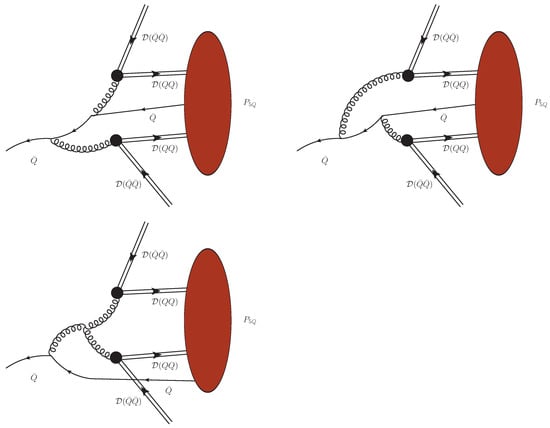
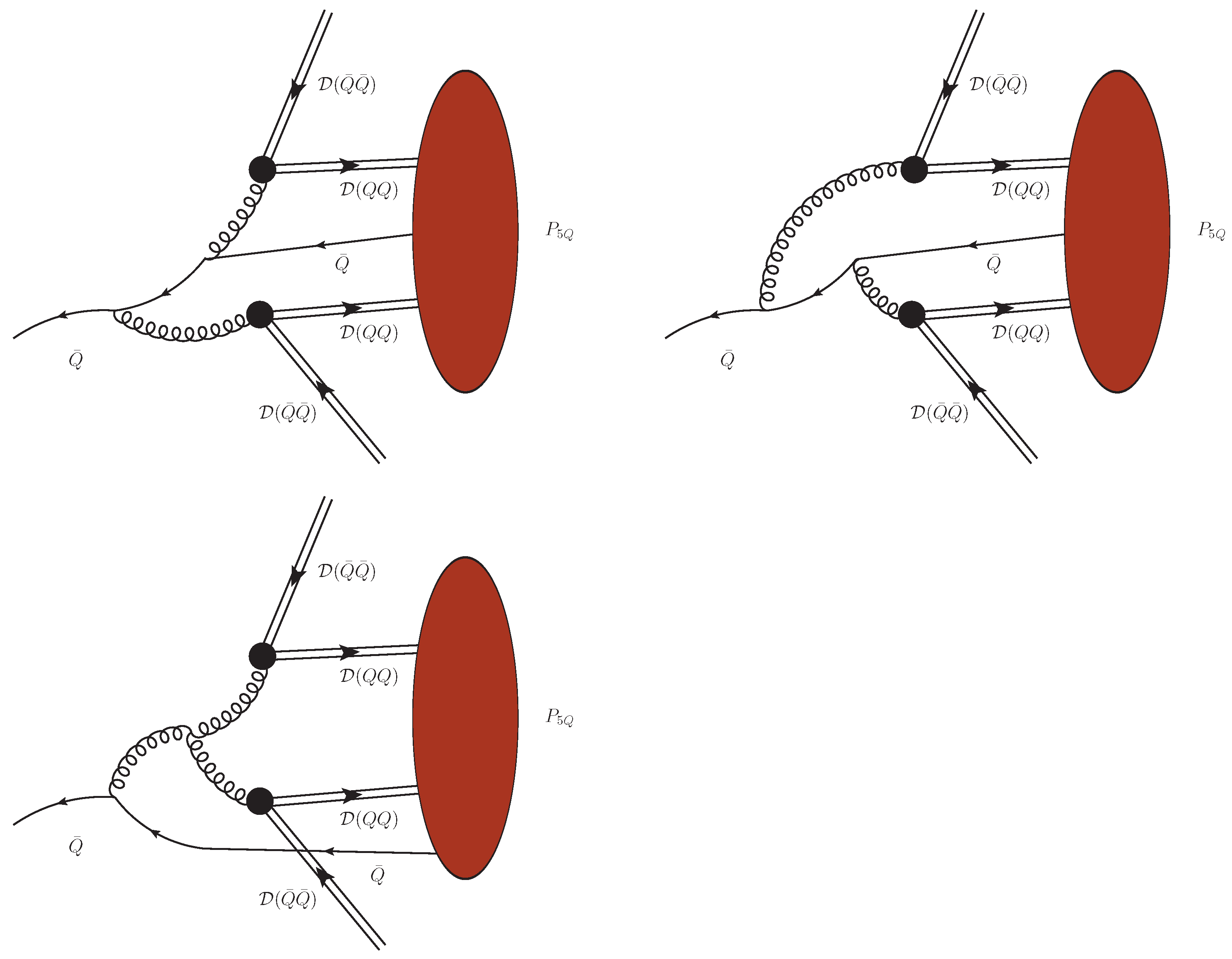
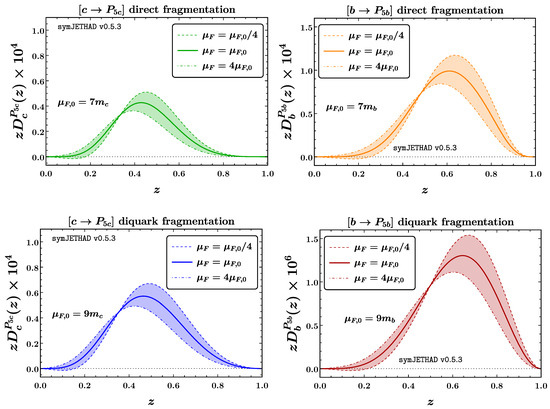
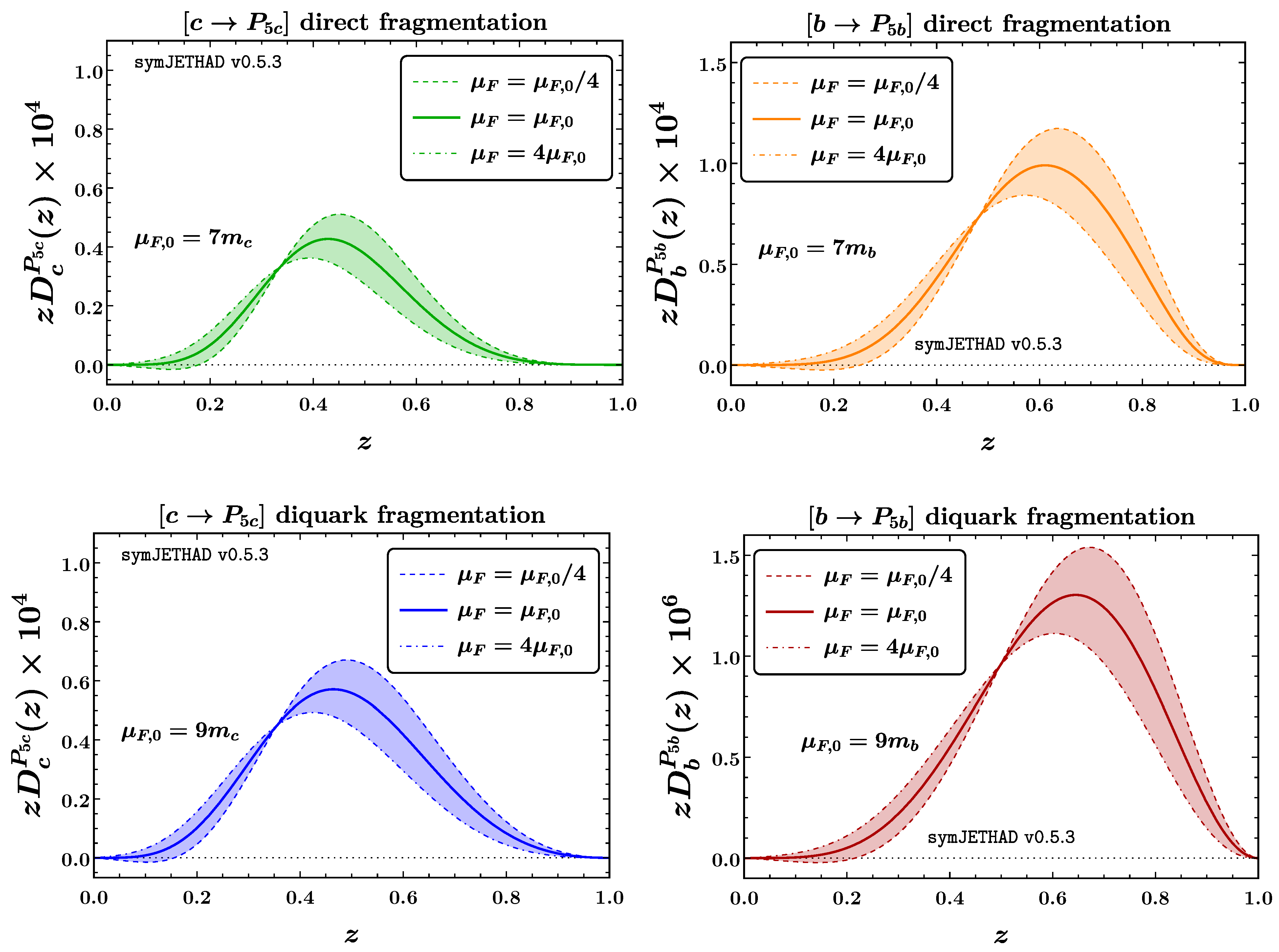
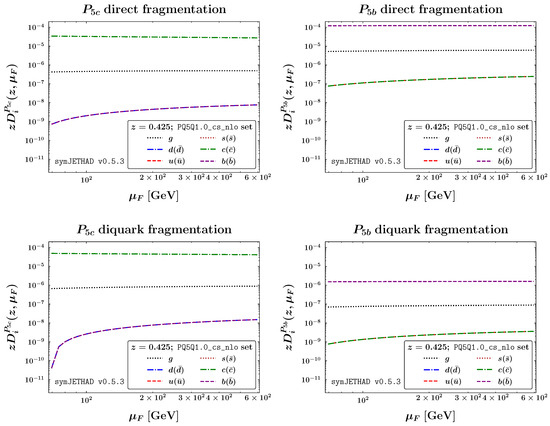
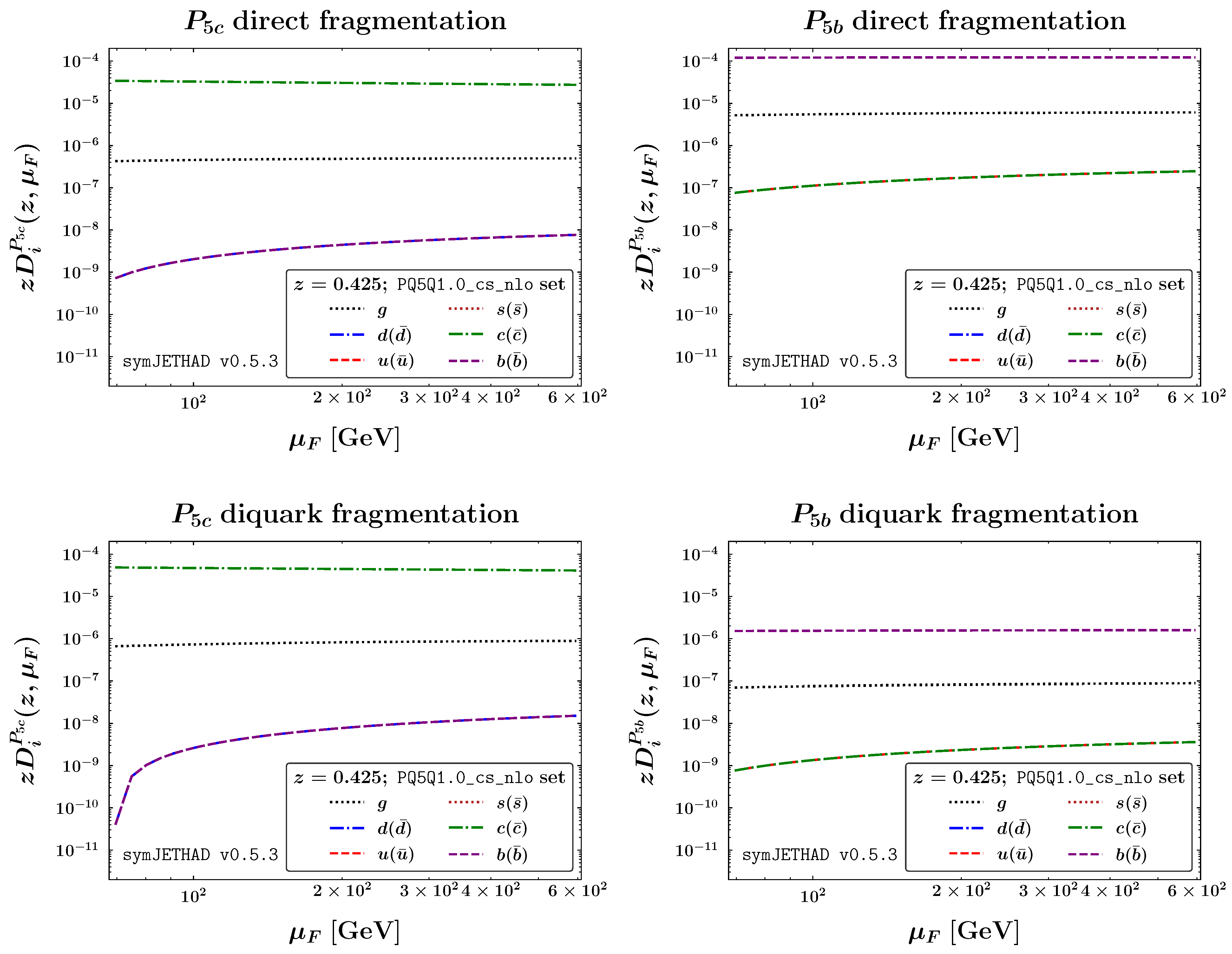
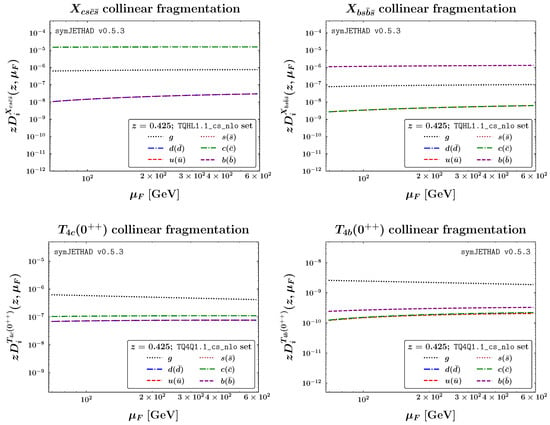
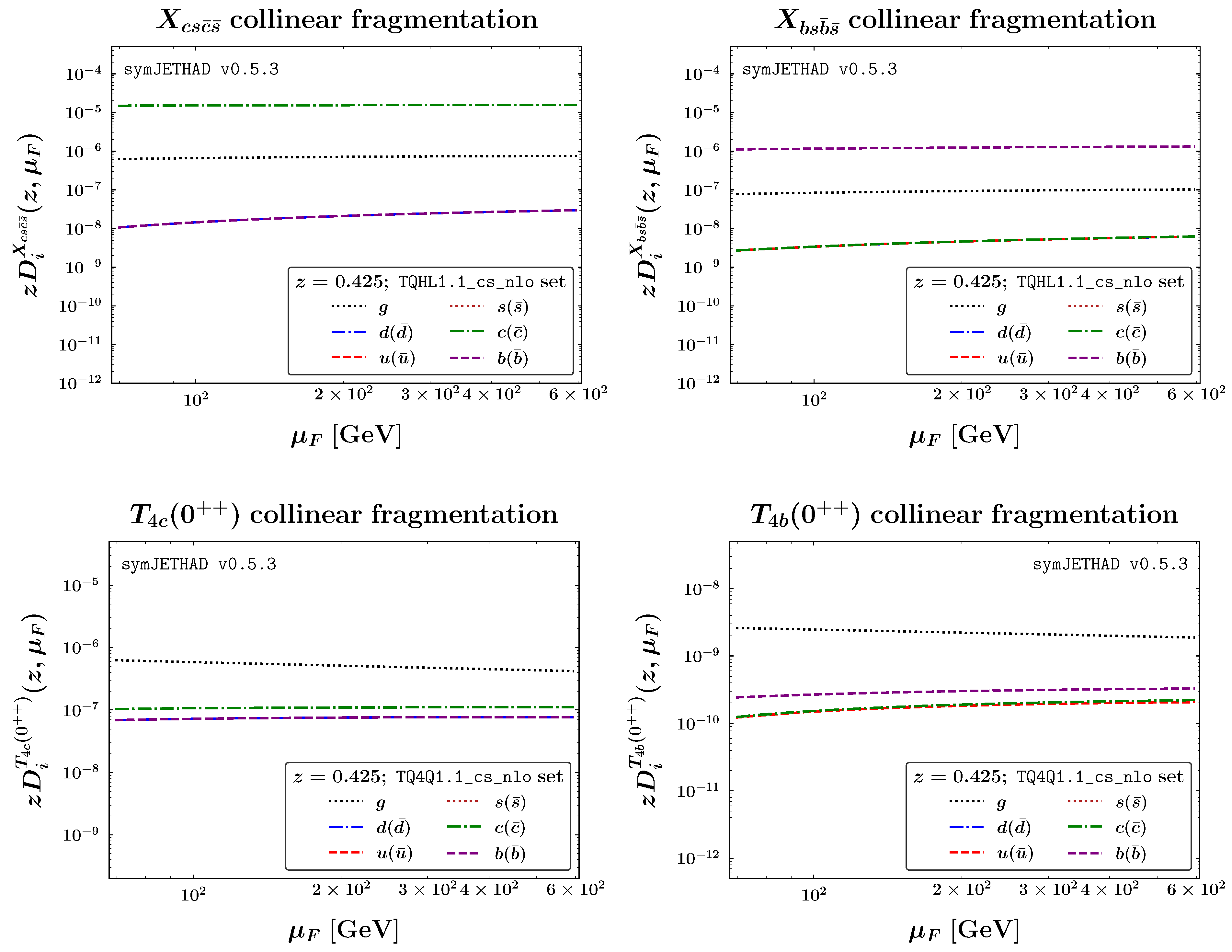
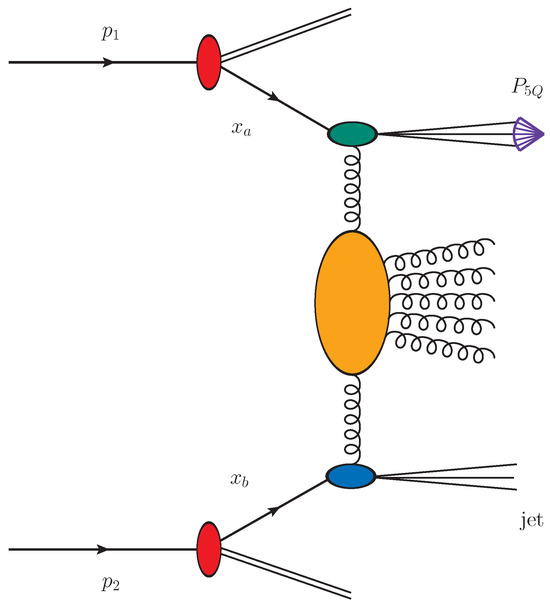
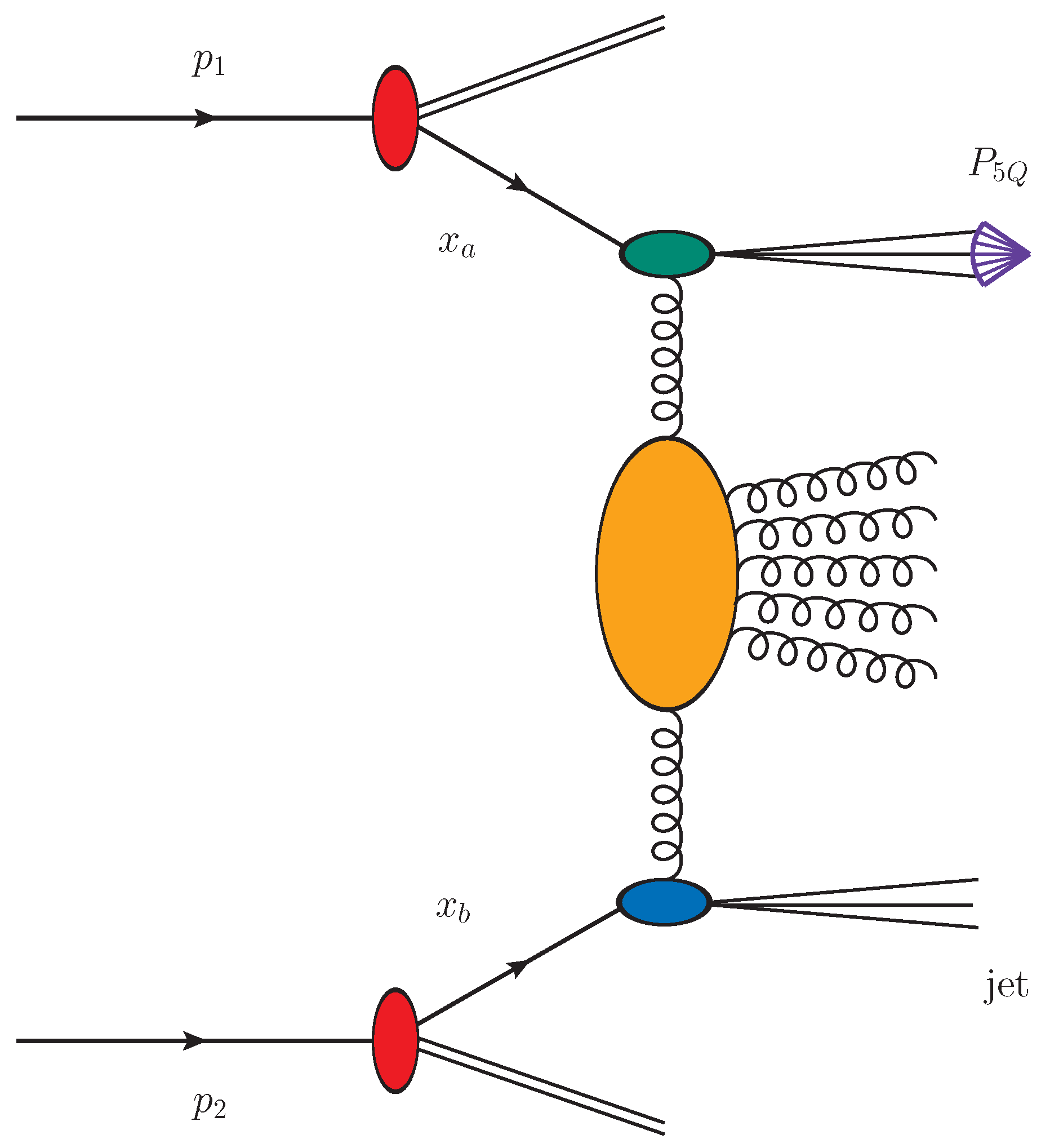
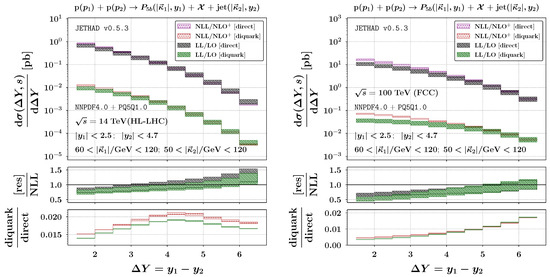
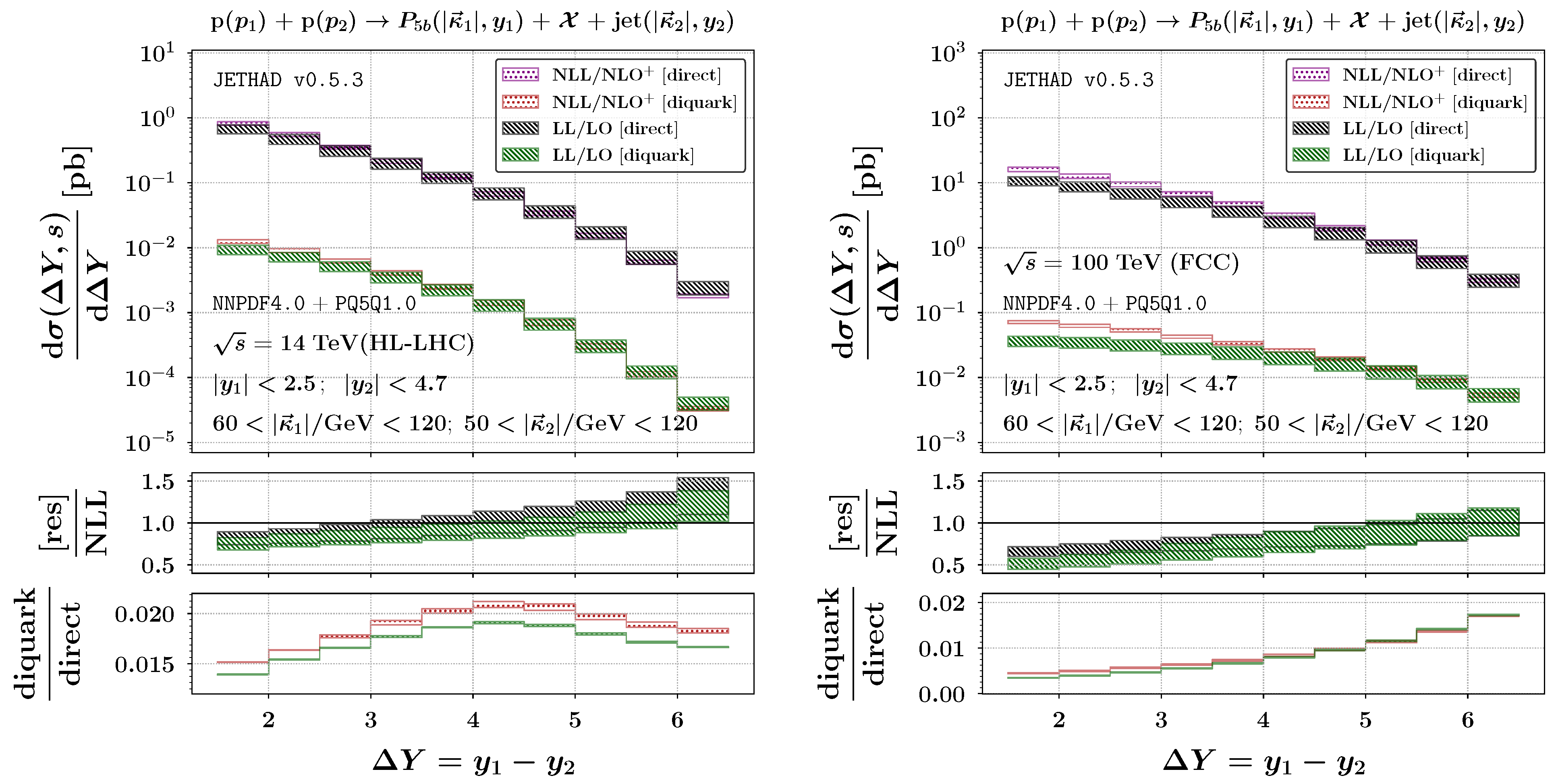
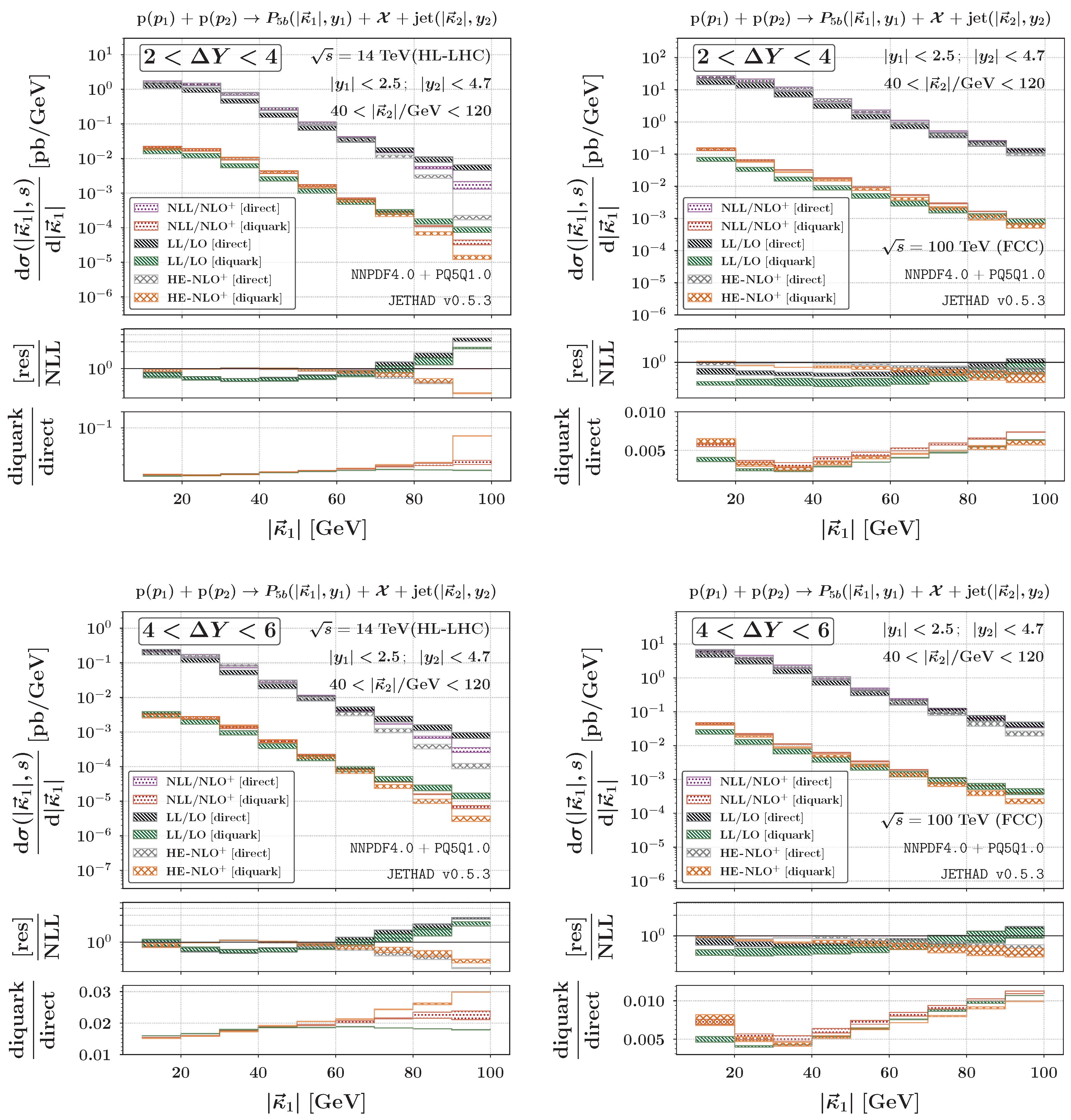
Disclaimer/Publisher’s Note: The statements, opinions and data contained in all publications are solely those of the individual author(s) and contributor(s) and not of MDPI and/or the editor(s). MDPI and/or the editor(s) disclaim responsibility for any injury to people or property resulting from any ideas, methods, instructions or products referred to in the content. |
© 2026 by the author. Licensee MDPI, Basel, Switzerland. This article is an open access article distributed under the terms and conditions of the Creative Commons Attribution (CC BY) license.