


Abstract
The proposed framework is based on a path-dependent entropic variational construction for nonlinear damped vibration systems. Accumulated mechanical spending and heat-transfer power are represented as history contributions to the action. Each irreversible mechanism is supplied as a force–power pair: the force acts on arbitrary mechanical test directions, while its realized non-negative power is assigned through a separate receiver-channel variation to the entropy/heat receiver. The damping law and the admissibility condition on its realized power are constitutive inputs; the proposed formulation supplies the common directional stationarity structure that links those inputs to the mechanical and thermodynamic balances. The continuum form is reviewed for thermoelastic vibration, and a finite-dimensional vibration formulation is presented separately. A frequency-resolved version based on response PSDs is derived for asymptotically stable linear systems under stationary random excitation, allowing response spectra to be converted into frequency-resolved contributions to mean dissipated power and entropy production. Numerical examples cover a linear oscillator, a Duffing oscillator with nonlinear damping, an oscillator with regularized Coulomb friction, a tuned mass damper with deterministic and spectral excitation, and a piezoelectric RC oscillator with resistive loading. The responses are also compared with analytical solutions or independently integrated classical equations. The computations verify energy closure and dissipative power accounting for the selected admissible models.
1. Introduction
Damping is a central modelling ingredient in vibration science and engineering. Hamilton’s principle supplies the conservative inertial and elastic structure, whereas viscous, hysteretic, and frictional effects are commonly appended as generalized non-conservative forces. Rayleigh’s dissipation function [1] remains the standard entry point for viscous damping, and the classical normal-mode result of Caughey and O’Kelly [2] continues to guide proportional and non-proportional damping models. Texts on vibration by Den Hartog [3] and Inman [4] emphasize their engineering use. These models are mechanically effective, but the damping force is often introduced without an equally explicit statement of where the corresponding mechanical power is converted, stored, or exported. This distinction becomes important when several loss mechanisms or thermodynamic receivers coexist.
For nonlinear vibration, the separation between a mechanical damping law and its thermodynamic consequence becomes more visible. Duffing-type oscillators are a standard setting for amplitude-dependent resonance and nonlinear damping [5]. Shahraeeni et al. showed that damping nonlinearity changes the performance of quasi-zero-stiffness isolation, Wang et al. characterized nonlinear damping in a Duffing–Holmes system, and recent testing and identification studies have extracted nonlinear damping directly from measured frequency responses [6,7,8,9]. Dry-friction systems require nonsmooth force laws or regularizations; the work of Moreau [10] and Brogliato [11] provides the relevant mechanics. Recent studies have gone beyond response prediction by examining Coulomb-friction energy transmission, friction-induced vibration, combined frictional–electromagnetic dissipation, and data-driven hysteretic particle damping [12,13,14,15]. Tuned mass dampers give another important class of dissipative vibration systems. The classical absorber theory of Den Hartog [3] and Warburton’s optimal-parameter formulas [16] show how auxiliary oscillators redirect and dissipate vibratory energy. Adaptive inertance, stiffness-controllable, and tuned viscous mass damper studies extend this mechanism to adjustable or application-specific devices [17,18,19].
In engineering applications, vibration data are often available as measured or specified spectra rather than as idealized deterministic histories. Random-vibration references such as Bendat and Piersol [20] show how response power spectral densities are used to characterize broadband excitation, root-mean-square response, and fatigue-relevant vibration levels. From the standpoint of dissipative modelling, the same spectral information can also be used to identify where vibratory input power is spent across frequency bands. The motivation is also practical for vibration energy harvesting. Electromechanical harvesters require simultaneous tracking of mechanical storage, electrical storage, mechanical loss, and exported electrical power [21]. Recent nonlinear and random-excitation studies show that multistability, material nonlinearity, and narrow-band stochastic forcing can substantially alter the dynamic response and harvested power [22,23,24,25,26].
The thermodynamic side has distinct literature. Onsager’s reciprocal relations [27] provide a systematic near-equilibrium description of irreversible processes, and the continuum treatment of de Groot and Mazur [28] remains a standard reference for local entropy production. The thermodynamic restrictions of Coleman and Noll [29] clarify how constitutive laws are restricted by the second law. Biot developed variational principles for irreversible thermodynamics and thermoelasticity [30], while constrained variational formulations by Gay-Balmaz and Yoshimura incorporate irreversible processes through explicit thermodynamic constraints [31]. More recent work has clarified thermodynamic interconnections and extended power-based port-Hamiltonian descriptions to irreversible and stochastic settings [32,33,34]. Although these approaches differ mathematically, they distinguish constitutive or interconnection structure from the resulting balance of stored, dissipated, and transferred power.
Path-dependent and nonconservative action principles offer another route for dissipative systems. Herglotz’s variational principle [35], together with a Noether-type development [36], and Galley’s doubled-variable construction for nonconservative mechanics [37] show that the action itself can be modified to represent irreversible effects. The path-dependent entropic Lagrangian (PDEL) framework used here was developed from the path-dependent energy Lagrangian introduced in Ref. [38] and the subsequent entropic formulation of Ref. [39]. Its channel operation for committed histories was developed further in Ref. [40]. The present paper uses this construction to formulate and verify damped vibration models while keeping the connection to standard engineering damping laws explicit. The emphasis is on showing how the mechanical force, the spent mechanical power, and the entropy/heat response can be organized and checked within a single variational structure. PDEL combines ordinary state variation, non-conservative mechanical virtual work, and channel variation of the path-dependent terms. The paper-specific developments are a generalized-coordinate formulation for vibration systems, explicit thermal accounting and electromechanical coupling, a frequency-resolved spending form based on response power spectral densities (PSDs) for stable linear stationary systems, and independent numerical checks against the corresponding classical equations.
The remainder of this paper is organized as follows. Section 2 reviews the continuum construction and directs the supporting channel calculations to Appendix A. Section 3 specializes the construction to finite-dimensional vibration systems and develops the frequency-resolved spending form from response PSDs for asymptotically stable linear systems under stationary random excitation. Section 4 defines the verification residuals and presents the numerical benchmarks, including a tuned mass damper comparison with frequency-resolved spending and an electromechanical RC benchmark with resistive loading. Section 5 discusses interpretation and limitations, and Section 6 summarizes what has been established.
2. Continuum PDEL Review
This section recalls the continuum ingredients needed for the vibration formulation. The underlying state variation, channel construction, and thermoelastic specialization were developed in Refs. [39,40]. Mechanically, dissipative forces retain the standard Lagrange–d’Alembert virtual-work pairing; thermodynamically, free-energy conjugacy and constitutive admissibility follow the established thermoelastic and nonequilibrium framework [29,30,31].
A key point is that three roles must be distinguished. Ordinary vertical variations probe arbitrary changes in the state fields and contribute to the mechanical balance while yielding the thermodynamic conjugacy relation. The prescribed dissipative force or stress enters separately through the Lagrange–d’Alembert one-form acting on arbitrary mechanical test fields. The receiver-channel variation acts on an already realized history and routes the current realized power to the thermodynamic receiver, while the donor calibration direction is used only to identify the same force–rate power. The main text explains this distinction at the level needed for the later vibration models; Appendix A provides the moving-endpoint calculation, admissible spaces, and coefficient-by-coefficient derivation.
2.1. State Variables and Continuum Action
Let be displacement, velocity, temperature, and entropy density in a body . The small-strain tensor is
The continuum action used in this review is
where is a Helmholtz-type free-energy density, is the heat flux, and is the local mechanical spending rate.
Their dependencies may be local or history-dependent; for example, and .
Here, the term “action” refers to the time-integrated path-dependent functional in Equation (2). In the PDEL statement, the ordinary vertical variation acts only on the designated state part, comprising the kinetic, free-energy, and entropic-product terms. The committed heat-flux and spending histories are not included in this operation. During the receiver-channel variation, their realized interior values are held fixed by definition and only the current receiver contribution is probed. Their constitutive dependence is retained when a different physical trajectory is considered.
The dissipative mechanical contribution is supplied separately through the Lagrange–d’Alembert force one-form. The corresponding moving-endpoint construction is described in Appendix A.1.
The ordinary mechanical and temperature directions are and . Here, is an arbitrary compatible displacement test field that vanishes at , T, and on the prescribed-displacement boundary, while is arbitrary. External loading and a prescribed body-damping force act through
Let denote the kinetic, free-energy, and entropic-product terms under ordinary state variation, and let denote the entropic product and committed histories evaluated only in the receiver direction. The composite stationarity statement is
This is the previously proposed PDEL directional statement [39,40] and is adopted here as the continuum basis for the vibration specialization. PDEL combines ordinary state variation, the Lagrange–d’Alembert force one-form, and the receiver-channel variation in one stationarity statement. In Equation (4), denotes the receiver-channel operation driven by , while is used for donor-side power calibration. The independent directions yield the momentum balance and natural traction condition, the thermodynamic conjugacy relation, and the corresponding entropy/heat balance. Appendix A.4 records the admissible directions and expands the corresponding stationarity calculation.
2.2. Entropy Channel and Spending Rule
Consider a committed scalar history . Once its interior history is fixed, define the oriented two-endpoint extension . Its diagonal calibration differential is
where is the receiver direction and is the donor calibration direction. The receiver term is the contribution used by . The donor term is the prescribed force–power relation evaluated on the realized rate; it introduces no additional constitutive relation. The opposite signs express a transfer of the same current power between the two directions; a common increment is null. These quantities are virtual directions with the dimension of time, not two physical clocks or additional state variables. Appendix A.2 derives Equation (5) from the moving-endpoint rule and states the limited uniqueness of the oriented extension under its calibration assumptions [40]. Within this history-locked construction, the admissible channel operation is constrained by the cocycle/additivity property, endpoint calibration to the realized power, and the null synchronized direction; Proposition A1 establishes uniqueness within that calibrated class.
The mechanical force one-form remains defined on arbitrary compatible tests. Its restriction to the realized velocity supplies the power used for donor calibration. For body damping,
The last identity is therefore a donor force–rate power calibration.
For strain-rate dissipation, the analogous force–power pair is
The donor calibration increment is defined directly in the local symmetric-tensor rate space. If varies in space, applying the compatible-strain operator to would additionally generate ; it would therefore not represent the intended local power calibration. Appendix A.3 gives this calculation explicitly.
On the receiver side, entropy follows the realized trajectory during the channel increment, while the ordinary temperature variation remains independent. Thus,
Here, is a trajectory-tangent increment, not an additional arbitrary vertical entropy variation; is held fixed only during this channel increment. The arbitrary direction still yields the thermodynamic conjugacy relation below. Combining Equations (5) and (8) gives the receiver contribution
The independent stationarity directions are , , and . The distinction between these vertical and tangential directions is summarized in Appendix A.3.
2.3. Stationarity and Thermoelastic Specialization
With the ordinary vertical directions and the receiver direction separated from donor calibration, the stationarity conditions follow by standard coefficient extraction. Set . For body damping, integration by parts gives the single stationarity identity
The arbitrariness of , , and yields
For strain-rate dissipation, Equation (7) gives
An expanded version of the same calculation is provided in Appendix A.4.
For small-strain thermoelastic vibration [30,39], take
where is the elasticity tensor, is the thermal-expansion tensor, and is the thermal-capacity parameter in the selected free energy. Equation (11b) gives
If and are temperature-independent, then
With Fourier heat flux,
where . Equation (11c) gives the classical local production statement [28,29]
provided and .
Equation (11c) yields the temperature form
Equation (19) is the temperature form of the entropy balance. It is obtained by substituting the entropy relation derived from stationarity into the entropy-channel equation, rather than by imposing a separate heat equation. The effective constant-strain heat-capacity coefficient must remain positive over the temperature range of interest. The short intermediate calculation is shown in Appendix A.5. These non-negativity and positivity requirements are constitutive admissibility conditions, not consequences generated by stationarity.
3. Finite-Dimensional Vibration and Frequency-Resolved Spending
The continuum review provides the field-level meaning of the entropic product, the heat-flux history, and the mechanical spending rule. The finite-dimensional equations below are introduced directly as a particle or generalized-coordinate model. Alternatively, a continuum approximation , followed by spatial integration, produces the mass matrix and potential. This section first gives the finite-dimensional entropic action and the corresponding damped equations. It then derives the associated energy and entropy identities and recasts the same spending terms as frequency-resolved contributions obtained from response PSDs for stationary random excitation. The spectral formulation is useful in engineering practice because broadband vibration tests and specifications are commonly given as force, acceleration, or displacement power spectral densities rather than as repeatable deterministic histories. The single temperature used here is a lumped, approximately uniform thermal variable, appropriate when internal thermal equilibration is fast relative to the resolved thermal evolution. Non-uniform temperature can be retained through the continuum model or represented by several coupled thermal nodes; that extension does not alter the force–power pairing used below.
3.1. Lumped Entropic Action
Let denote generalized vibration coordinates, generalized velocities, an effective temperature, and a lumped entropy variable. The reversible part is described by
where is symmetric positive definite. A convenient thermal free energy for a lumped heat capacity is
The finite-dimensional action is
The ordinary vertical directions are and , while is an arbitrary smooth receiver test function compactly supported in . The quantity denotes the donor calibration direction. External loading acts through
Let be an admissible damping force satisfying
Its arbitrary-direction mechanical one-form is . Using the same two-endpoint extension with , the calibration identity and donor force–rate contact are
Here, is the receiver direction used by the receiver-channel variation, whereas is the donor calibration direction. The heat outlet and entropy path satisfy
The composite directional stationarity condition becomes
Therefore,
3.2. Common Damping Laws
The following damping laws are used in the benchmark problems:
Here, is positive semidefinite, , , , and . In Equation (32), , and the generalized force acts along . The set-valued sign graph Sign is defined by
All three models are standard mechanically. Their role here is to demonstrate that the force and its dissipated power enter the variational structure as a matched pair.
3.3. Energy and Entropy Identities
3.4. Frequency-Resolved Spending from Response PSDs Under Stationary Random Excitation
The time-domain identities above are directly applicable when excitation and response histories are available. The spectral construction in this subsection is restricted to asymptotically stable linear time-invariant systems driven by zero-mean, second-order stationary inputs with finite prescribed spectra; it is not applied to the nonlinear Duffing or Coulomb-friction benchmarks. In many qualification tests, rotating-machinery measurements, vehicle and structural vibration assessments, and controller evaluations, the loading environment is instead represented by power spectral densities. Classical random-vibration theory uses frequency-response functions to map input spectra to response spectra and then evaluates variances, root-mean-square quantities, or fatigue-relevant measures [20]. Those operations are retained here. The additional step is to apply the same spectral response quantities to the mechanical spending term that appears in the entropic variational construction.
This distinction matters for damped systems with several loss paths. A conventional PSD calculation typically reports response reduction or acceleration levels; power accounting is often performed afterwards as a separate engineering interpretation. In the present formulation, the damping matrices used in the equations of motion are also the matrices that define the spectral spending densities. Thus, a tuned mass damper, an isolation layer, a local damper, or an electrical load can be assessed not only by its effect on response PSD, but also by the frequency bands in which it receives and dissipates input power.
Consider the stable linear system
with mechanical spending
Let denote the one-sided angular-frequency power spectral density of the excitation for . The convention used here is
for any stationary and constant of compatible size. The displacement frequency-response matrix is
and therefore,
The mean dissipated power follows from the same spending term used in the variational construction:
Thus, is the frequency-resolved contribution density to the mean dissipated power; it is not the power spectral density of the quadratic process . If the damping matrix is split into physical channels,
then each channel has a corresponding frequency-resolved spending contribution
This is a frequency-resolved representation of the same mean spending measure: the damping law used in the equations of motion also determines its contribution to the mean dissipated power.
For an isothermal vibration test at temperature , the frequency-resolved contribution to the mean entropy-production rate is
The quantity decomposes the mean entropy-production rate by response frequency; it is not the PSD of the instantaneous quadratic entropy-production process.
With the convention in Equation (40), the velocity–force cross spectrum and the independently evaluated mean input power are
For a stationary stable system,
only when the mean stored-energy rate vanishes, contains every internal power sink inside the declared boundary, and any exported mean power is either absent or written explicitly on the right-hand side. The TMD calculation below evaluates the two sides independently.
4. Numerical Verification and Benchmarks
4.1. Verification Protocol
For a finite-dimensional system, define the accumulated external work and dissipated energy as
The mechanical residual is
Let denote the stored-energy ledger used in a benchmark and let when no exported-power channel is present. A benchmark-specific characteristic energy is defined by
The normalized residual reported in the figures is
The maximum absolute residual is reported together with its normalized value for each benchmark.
If the coupled mechanical–thermal ledger is evolved, the total residual is
The entropy-production check is
The work and dissipation ledgers were integrated as augmented state variables. Adaptive RK45 used relative and absolute tolerances and for the linear oscillator and and for the other time-domain benchmarks. Separately implemented response-only equations were integrated with DOP853 at tolerances and . Spectral quantities were evaluated by composite trapezoidal integration on 1600 uniformly spaced frequencies over the prescribed band.
The numerical examples below are selected to test complementary aspects of the formulation. Table 1 summarizes the role of each benchmark, the dissipative or output channel being examined, and the corresponding verification quantity. The Python script used to regenerate the numerical results is provided as Supplementary File S1.
Table 1.
Benchmark structure for numerical verification.
For Table 2, the reported “maximum difference” is the maximum absolute pointwise difference
evaluated on the common output-time grid used for both the manuscript solution and the independent reference. The compared response variable and its unit are listed explicitly.
Table 2.
Independent response checks against an analytical solution or separately implemented classical equations.
These comparisons verify consistency with the stated classical models; they do not establish uniqueness or superiority of the variational construction.
4.2. Benchmark 1: Linear Single-Degree-of-Freedom Oscillator
The first benchmark is the classical free vibration of a linearly damped oscillator:
The variational data are
The mechanical energy is
which satisfies
Thus, the verification identity is
For the underdamped case, define
With initial data and , the exact solution is
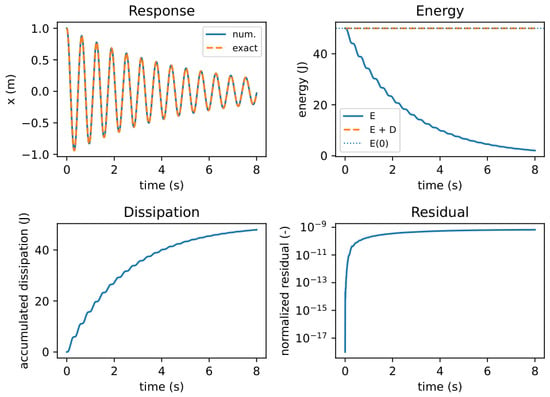
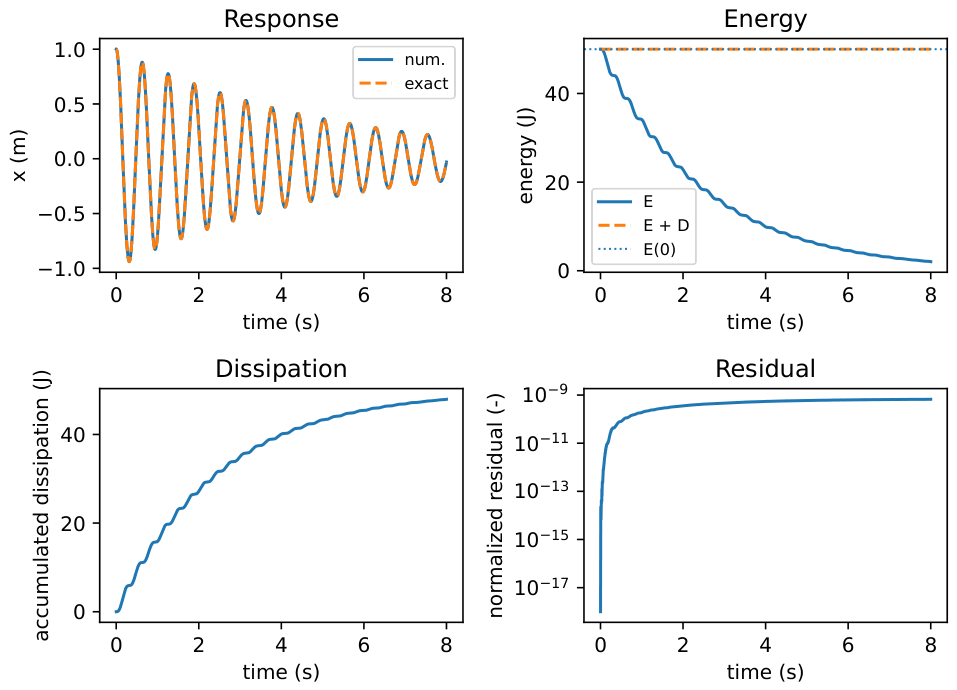
The numerical parameters were , , , , and . The maximum displacement error relative to Equation (61) was ; the maximum absolute and normalized energy residuals were and , respectively. Figure 1 compares the numerical and analytical displacement histories and reports the associated energy partition and residual.
Figure 1.
Linear oscillator verification. The numerical solution agrees with the analytical underdamped solution, while the sum of mechanical energy and accumulated viscous dissipation remains equal to the initial energy up to the reported residual.
A separate fixed-step RK4 calculation gives the convergence results in Table 3. The displacement error has observed order 4 on the two finest steps, while the ledger residual decreases consistently.
Table 3.
Fixed-step RK4 convergence for the linear SDOF benchmark.
If the oscillator is thermally closed instead of isothermal, the heat equation is
and therefore,
This identity is the thermal counterpart of the mechanical decay shown in Figure 1.
4.3. Benchmark 2: Duffing Oscillator with Nonlinear Damping
The second benchmark tests nonlinear stiffness and nonlinear velocity-dependent damping:
The potential, damping force, and dissipated power are
The mechanical energy is
which satisfies
The residual is
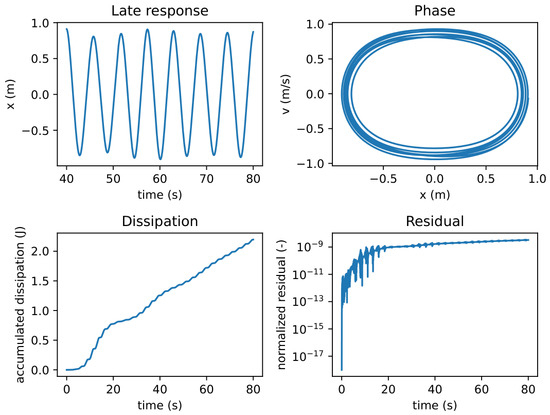
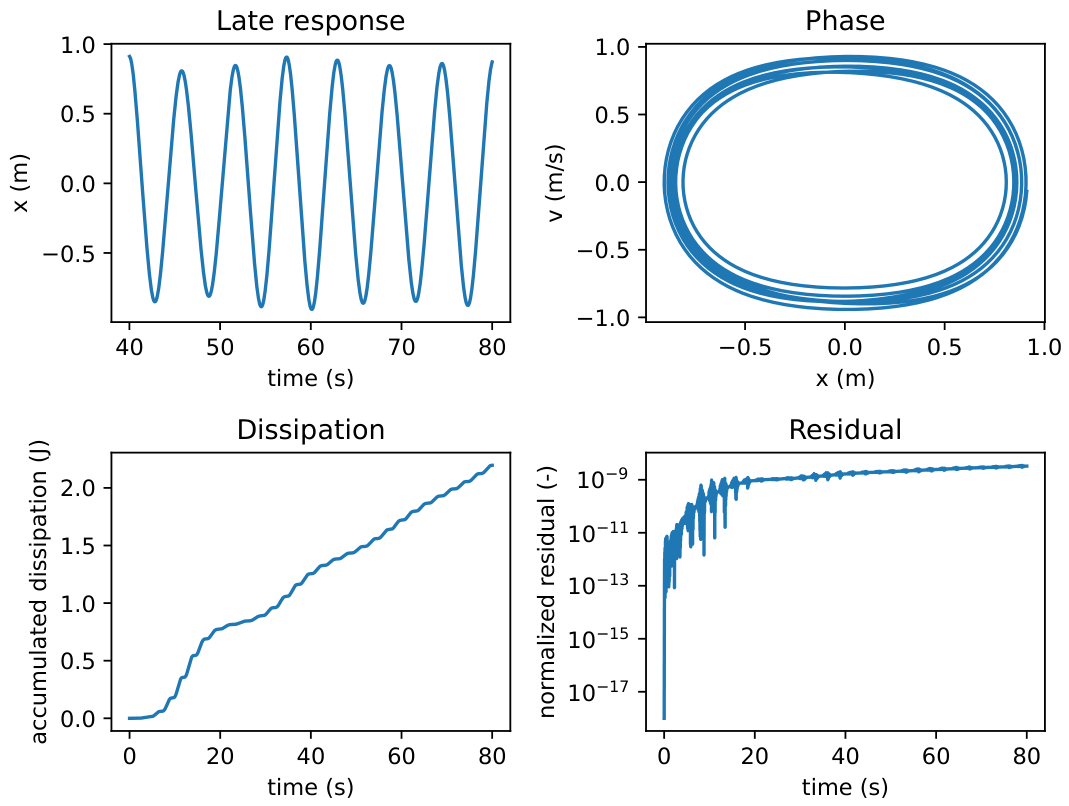
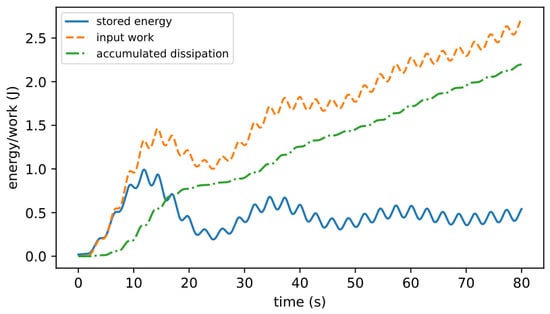
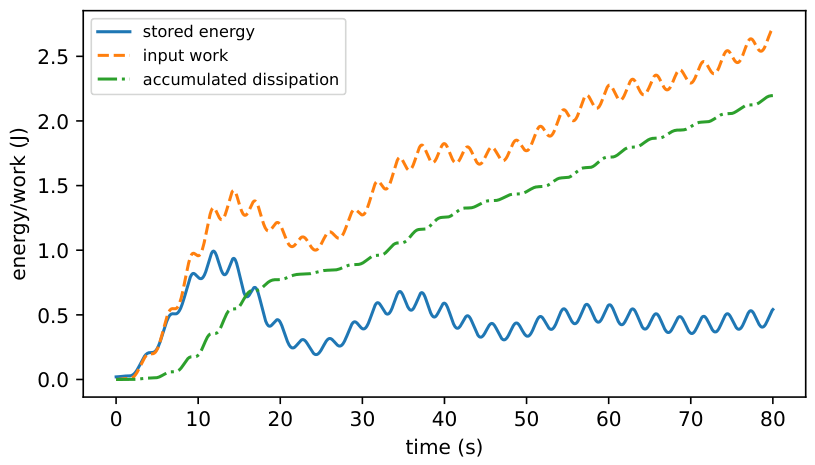
The numerical test used , , , , , , , and , with and . The maximum absolute and normalized residuals were and , respectively. The response was integrated to 80 s; the displayed late-time window shows a bounded forced nonlinear oscillation, while the residual remains at solver tolerance. Figure 2 shows the response-level verification, and Figure 3 separates the work, stored energy, and accumulated nonlinear damping contributions used in Equation (69).
Figure 2.
Duffing oscillator verification. The panels show the late response, phase portrait, accumulated dissipation, and normalized residual.
Figure 3.
Stored energy, input work, and accumulated dissipation for the Duffing residual check.
4.4. Benchmark 3: Oscillator with Regularized Coulomb Friction
Dry friction is represented mechanically by
with dissipated power
when slip occurs. At zero velocity, describes the sticking range. For the numerical test in this paper, the graph was regularized as
The mechanical energy is
For the unforced case, the residual is
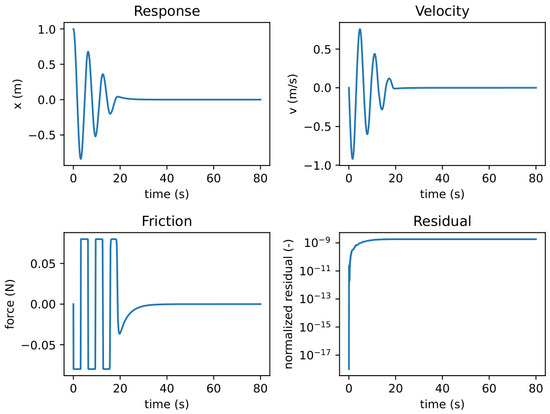
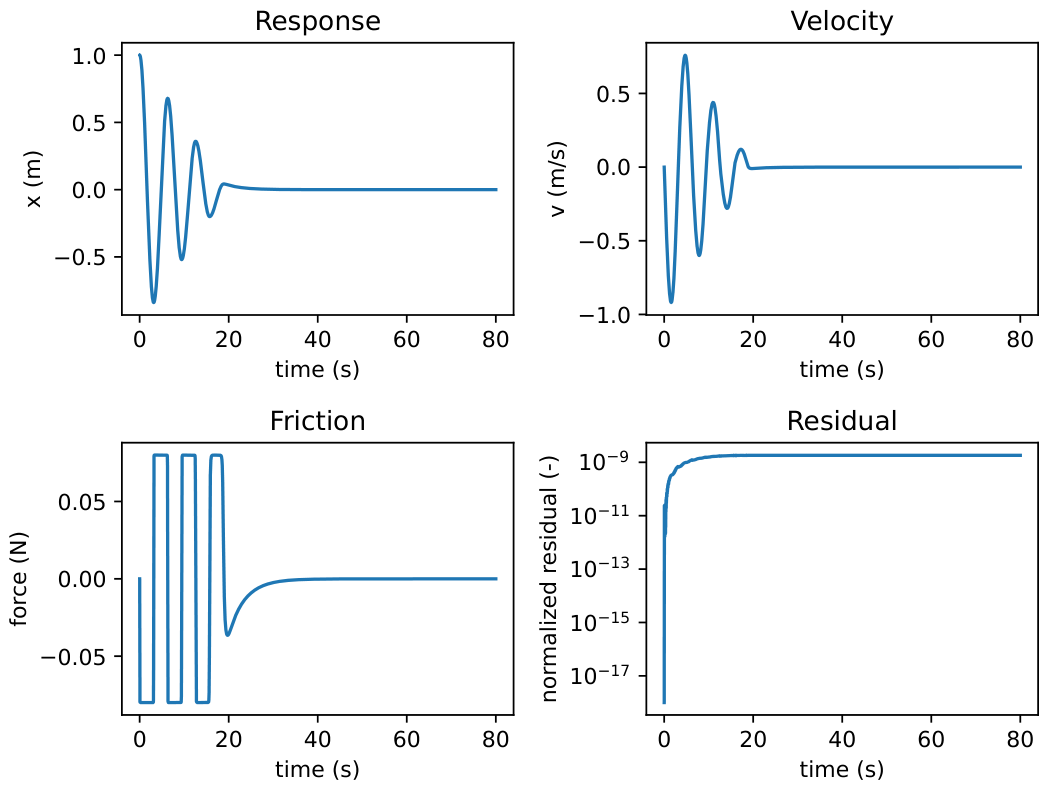
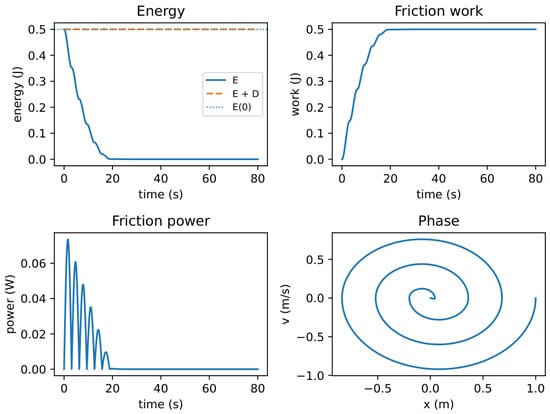
The numerical parameters were , , , , , and . The maximum absolute and normalized residuals were and , respectively. The final accumulated frictional work approaches the initial mechanical energy over the long-time decay of the smooth regularized law. Figure 4 displays the displacement, velocity, regularized friction force, and residual, while Figure 5 reports the energy closure and the frictional spending rate.
Figure 4.
Oscillator with regularized Coulomb friction. The panels show response, velocity, regularized friction force, and the normalized residual for frictional work balance.
Figure 5.
Frictional energy closure. The panels show mechanical energy, accumulated frictional work, frictional power, and the phase portrait.
The regularization was also evaluated for . The set-valued Coulomb inclusion was integrated exactly between velocity reversals, with sticking imposed when . For the stated data, the reference slip history stops at
Table 4 compares the regularized solutions with this reference over .
Table 4.
Convergence of the regularized Coulomb model over the slip interval.
The errors decrease systematically on the slip interval. Exact post-sticking equivalence is not claimed: for fixed , , so the smooth law has no static-friction interval and permits slow creep after .
4.5. Benchmark 4: Primary Structure with a Tuned Mass Damper
The fourth benchmark is a two-degree-of-freedom vibration-control system consisting of a primary oscillator and a tuned mass damper. It is compared with the corresponding uncontrolled primary oscillator under deterministic harmonic forcing and under a stationary broadband force spectrum. This example is included because it exposes a practical distinction between response reduction and power redistribution: the absorber reduces the primary response by redirecting input power into the absorber damper. Without the tuned mass damper, the primary structure satisfies
With the tuned mass damper, the coupled equations are
The stored mechanical energy of the controlled system is
The dissipated power is
Therefore,
The residual is
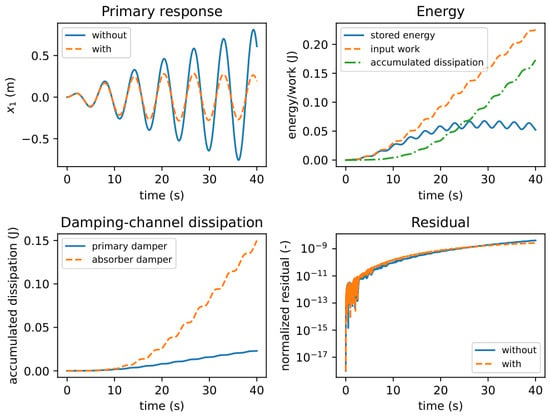
The numerical test used , , , a primary damping ratio of , and a harmonic force with and . The corresponding coefficients were , , and . The deterministic simulation was run to 40 s from and . Without the TMD, the maximum absolute and normalized residuals were and ; with the TMD, they were and . Over s, corresponding to the second half of the 40 s simulation, the primary displacement root-mean-square amplitude was reduced by , and the peak amplitude was reduced by . The absorber damper accounted for of the final accumulated damping loss in the controlled case. Figure 6 compares the controlled and uncontrolled time responses and gives the corresponding energy, channel-spending, and residual checks.
Figure 6.
Tuned mass damper benchmark. The panels compare primary response, stored energy and input work, accumulated dissipation in the primary and absorber dampers, and residuals over a 40 s simulation.
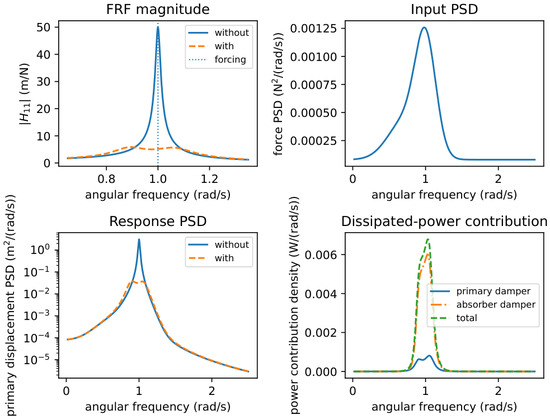
The primary compliance frequency-response functions (FRFs) and a frequency-domain test based on a one-sided input PSD were also computed for the same system. The input was a one-sided broadband force spectrum with most of its content near the primary resonance and a lower-frequency shoulder.
Specifically,
for . Here, is expressed in , and it was zero outside that band.
The response spectra were computed from Equation (42), and the primary and absorber spending densities were computed from Equation (45). The resulting primary-response RMS reduction was . The mean dissipated power without the absorber was . With the absorber, the mean primary damping power was , the mean absorber damping power was , and the absorber channel accounted for of the total mean dissipated power. The independently integrated input powers were and ; their relative discrepancies from total damping power were and . Figure 7 shows the FRF and PSD results, including the redistribution of broadband input power from the primary damping channel to the absorber damping channel.
Figure 7.
Frequency-domain TMD assessment. The primary compliance FRF shows the split resonance, while the PSD panels show the input spectrum, primary response spectra, and frequency-resolved spending in the primary and absorber damping channels.
4.6. Benchmark 5: Piezoelectric Oscillator with Resistive Loading
The final benchmark considers electromechanical vibration with resistive loading. Let be mechanical displacement, the circuit flux variable, and the voltage. Because the electromechanical coupling is velocity dependent, this benchmark applies the finite-dimensional PDEL construction directly to the electromechanical Lagrangian rather than to the separated mechanical specialization used above. A conservative electromechanical Lagrangian is
where is capacitance and is the electromechanical coupling coefficient. The thermodynamic system is taken to include the load resistor. The internal irreversible power is therefore
In direct correspondence with the lumped action in Equation (22), the path-dependent electromechanical action for the internal transducer is
Thus, relative to Equation (22), the separated mechanical term is replaced by the electromechanical Lagrangian , while the internal thermal, entropy, and spending-history terms retain the same form. With and , define
The ordinary electromechanical part of the stationarity statement is therefore
while the receiver-channel variation gives . The two independent components of then yield the coupled mechanical and circuit equations below.
The coupled equations are
The stored electromechanical energy is
The velocity-linear coupling term cancels from the Legendre energy , giving Equation (87). The energy balance is
The verification residual is
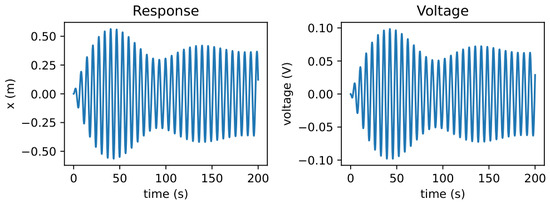
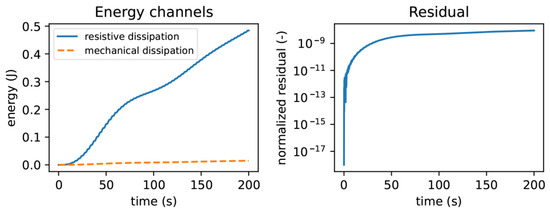
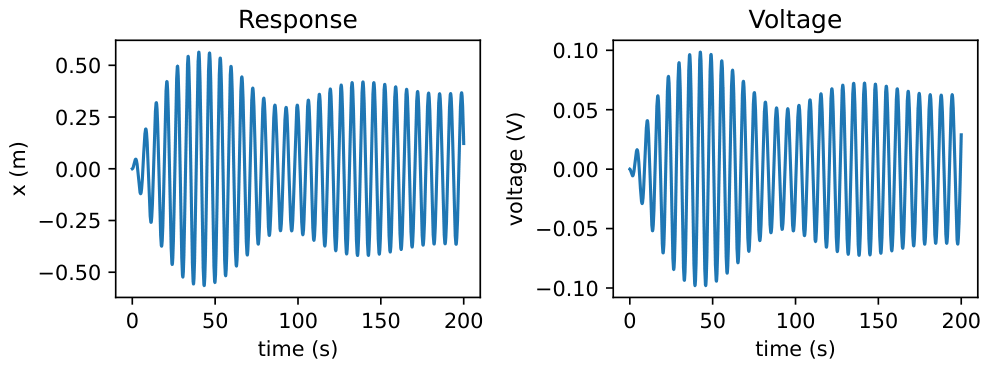
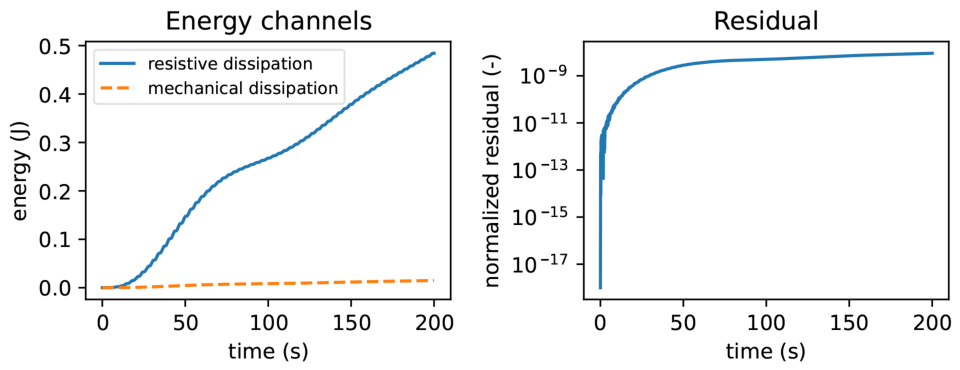
The numerical parameters were , , , , , (equivalently ), , and . The forcing was , the initial state was , , and , and the simulation was run to 200 s. The mechanical damping was deliberately kept small so that the resistive dissipation is visible in the energy partition. The maximum absolute and normalized residuals were and , respectively. The final accumulated resistive dissipation was , the final accumulated mechanical damping loss was , and the resistive contribution represented of their sum. Figure 8 reports the displacement and voltage histories together with the mechanical-loss, resistive-dissipation, and residual curves.
Figure 8.
Piezoelectric RC benchmark with resistive loading over 200 s. The panels show displacement, voltage, accumulated resistive and mechanical dissipation, and the coupled energy residual.
5. Discussion
The construction is related to virtual work and Lagrange–d’Alembert formulations for non-conservative mechanics, while the path-dependent history and channel variation provide the additional PDEL structure. The donor calibration evaluates the prescribed force–power relation on the realized rate; the same realized internal power then enters the entropy/heat receiver through the channel variation.
The upper-limit history term records accumulated quantities along the path already traversed. During , the committed interior history is held fixed while the current receiver contribution is probed; the corresponding donor-side force–rate power is fixed by the separate donor calibration. True material memory, such as viscoelastic internal-variable evolution, would require enlarging the state space and assigning admissible free energy and dissipation to the added variables.
The examples test different aspects of the construction. The single-degree-of-freedom oscillator provides an exact solution and an analytical energy identity. The Duffing oscillator shows that nonlinear stiffness and nonlinear velocity-dependent dissipation do not alter the residual structure. The regularized Coulomb oscillator tests a nonsmooth-limit damping mechanism. The tuned mass damper example connects the formulation to vibration control and demonstrates how energy is transferred from the primary oscillator to the absorber damper. Its frequency-resolved version further shows that response spectra can be converted into frequency-resolved contributions to mean spending. The piezoelectric RC oscillator includes both mechanical damping and resistive Joule dissipation in the internal power balance. The spectral formulas apply only to stable linear time-invariant systems under stationary excitation, and the examples are verification cases rather than optimized or experimentally calibrated designs.
The temperature field is treated either through the continuum thermoelastic formulation or through a lumped thermal variable. Distributed thermal nonequilibrium, fluid–structure interaction, material memory, and other extensions require additional fields or constitutive choices.
6. Conclusions
This paper applied the PDEL construction to damped vibration systems. After specifying a free energy, a heat-flux law, and an admissible dissipative force–power pair, the PDEL stationarity statement yields the corresponding mechanical equation of motion, the temperature–entropy conjugacy relation, and the heat or entropy balance. Ordinary state variation supplies the reversible and conjugacy equations, the prescribed force one-form supplies the dissipative mechanical term, and the receiver-channel variation introduces the realized internal power into the entropy/heat balance. The frequency-resolved form based on response PSDs is restricted to stable linear systems under stationary excitation.
The numerical benchmarks check the energy closure and power accounting for five representative vibration settings.
The linear oscillator matches the analytical solution and closes the viscous energy balance. The Duffing oscillator and the oscillator with regularized Coulomb friction verify the corresponding residuals for nonlinear damping and frictional work. The tuned mass damper example verifies the controlled two-degree-of-freedom energy balance, quantifies the reduction in primary response relative to the uncontrolled oscillator, and demonstrates a frequency-resolved interpretation of how broadband input contributes to mean spending across damping channels. The piezoelectric RC example checks the coupled electromechanical energy balance with mechanical and resistive dissipation. Time-step, independent-solver, cross-spectral input-power, and friction-regularization checks provide additional verification of the stated models.
The formulation has been demonstrated for standard damping, friction, vibration control, and a basic electromechanical RC model. Broader multiphysics applications require additional fields and constitutive choices. Such extensions should be assessed through the same balance, residual, and power-accounting checks.
Supplementary Materials
The following supporting information can be downloaded at https://www.mdpi.com/article/10.3390/vibration9040067/s1: Supplementary File S1: pdel_vibration_numerics.py, the Python script that regenerates the eight numerical PDF figures and the scalar verification values.
Author Contributions
H.R.: Conceptualization, Methodology, Software, Formal analysis, Investigation, Writing—Original Draft, Writing—Review and Editing, Supervision, Project administration, Funding acquisition. Y.L.: Investigation, Data Curation, Formal analysis, Visualization, Writing—Review and Editing. All authors have read and agreed to the published version of the manuscript.
Funding
This research received no external funding.
Data Availability Statement
No external datasets were used. Supplementary File S1 contains the reproducibility script.
Acknowledgments
The authors would like to express their sincere gratitude to the Editor-in-Chief and the anonymous reviewers for their insightful comments and constructive suggestions.
Conflicts of Interest
The authors declare no conflicts of interest.
Appendix A. Calibrated Channel Differentials and Admissible Directions
This appendix adapts the calibrated channel construction of Ref. [40] to the notation of the present vibration problem. It supplies the mathematical details used in Section 2 and distinguishes ordinary vertical variation, the receiver-channel variation, the donor calibration direction, and the rate-generated donor increment associated with the realized trajectory. The general PDEL construction and the standard virtual-work and thermodynamic ingredients are taken from earlier work [30,31,39,40].
Appendix A.1. Vertical Variation and History Locking
Let X be a real Banach space, let , and write . A conventional vertical variation is
For sufficiently regular z, , and a continuously differentiable integrand , the ordinary moving-endpoint rule is
The history-locked endpoint operation sets the vertical direction identically to zero, , on the committed interval . Hence, and throughout the interior history, so
It is the interior variation contribution, not the integrand P itself, that vanishes. Only the moving-endpoint term remains. Here, is a dimensionless directional parameter and is distinct from the Coulomb regularization parameter in Equation (72).
Appendix A.2. Calibrated Two-Endpoint History
Let and define
The synchronized physical history corresponds to the diagonal . To represent the receiver direction and donor calibration direction separately while preserving the committed interior history, introduce the oriented two-endpoint extension used in Ref. [40].
Proposition A1
(adapted from Ref. [40]; calibrated spending differential). Suppose that satisfies the following:
- (i)
- The cocycle identity ;
- (ii)
- Absolute continuity of for fixed b;
- (iii)
- Endpoint calibrationat every Lebesgue point t of D.
- Then, the extension is unique within this calibrated cocycle class and is given by
- Consequently, at every Lebesgue point of D,
Proof.
An explicit one-parameter realization is
It satisfies and
which is the precise endpoint realization of the two-endpoint calibration identity in Equation (5). The common direction is null, , so synchronized advancement creates no net channel transfer.
For a continuum power density , the receiver direction and donor calibration direction can be localized. For bounded and ,
At each time, local calibration may use smooth compactly supported directions. They are virtual test fields with the dimension of time. Only the receiver direction is an independent stationarity direction; the donor calibration direction calibrates the realized power.
Appendix A.3. Tangential Entropy and Mechanical Directions
Let the realized entropy path satisfy . The receiver-channel increment is
This is a tangential, history-generated increment rather than an independent vertical entropy variation. In the ordinary variation in , the arbitrary term supplies the conjugacy relation . The remaining channel increment is therefore
with held fixed only in this tangential direction. This gives the entropic part of Equation (8).
For a realized rate , a conjugate effort , and
the donor calibration identity is
Equation (A12) evaluates the supplied effort on the realized rate-generated direction.
For strain-rate dissipation, take X as the local symmetric-tensor rate space and define
This increment is defined directly in rate space. It is not obtained by inserting a tangential displacement into the compatible-strain operator. Indeed, for a spatially varying donor calibration direction,
The additional gradient term shows why the donor calibration increment and are not interchangeable. The dissipative mechanical pairing remains for arbitrary compatible .
Appendix A.4. Stationarity Conditions by Admissible Direction
For body damping, the independent continuum test directions are
where vanishes at , T, and on the prescribed-displacement boundary, is arbitrary, and . Entropy is not assigned an additional arbitrary vertical variation in this construction; its admissible channel increment is . The time-local dissipative force pairing is
With the committed copies of and fixed only for the receiver-channel operation, ordinary integration by parts of the designated state part gives
Arbitrariness of , , and yields, respectively, the momentum equation and traction condition, the conjugacy relation , and the entropy-channel balance. For strain-rate damping, replaces Equation (A16); the bulk stress becomes and the natural traction is .
Appendix A.5. Thermoelastic Differentiation
References
- Rayleigh, J.W.S. The Theory of Sound; Macmillan: London, UK, 1877; Volume I. [Google Scholar]
- Caughey, T.K.; O’Kelly, M.E.J. Classical normal modes in damped linear dynamic systems. J. Appl. Mech. 1965, 32, 583–588. [Google Scholar] [CrossRef] [Scilit]
- Den Hartog, J.P. Mechanical Vibrations, 4th ed.; McGraw-Hill: New York, NY, USA, 1956. [Google Scholar]
- Inman, D.J. Engineering Vibration, 4th ed.; Pearson: Boston, MA, USA, 2014. [Google Scholar]
- Kovacic, I.; Brennan, M.J. (Eds.) The Duffing Equation: Nonlinear Oscillators and their Behaviour; Wiley: Chichester, UK, 2011. [Google Scholar]
- Shahraeeni, M.; Sorokin, V.; Mace, B.; Ilanko, S. Effect of damping nonlinearity on the dynamics and performance of a quasi-zero-stiffness vibration isolator. J. Sound Vib. 2022, 526, 116822. [Google Scholar] [CrossRef] [Scilit]
- Wang, M.; Zhou, L.; Chen, E.; Liu, P. Dynamical characterization of a Duffing–Holmes system containing nonlinear damping under constant excitation. Chaos Solitons Fractals 2023, 175, 113926. [Google Scholar] [CrossRef] [Scilit]
- Debeurre, M.; Benacchio, S.; Grolet, A.; Grenat, C.; Giraud-Audine, C.; Thomas, O. Phase resonance testing of highly flexible structures: Measurement of conservative nonlinear modes and nonlinear damping identification. Mech. Syst. Signal Process. 2024, 215, 111423. [Google Scholar] [CrossRef] [Scilit]
- Breunung, T.; Balachandran, B. Frequency response based identification of nonlinear oscillators. J. Sound Vib. 2025, 594, 118651. [Google Scholar] [CrossRef] [Scilit]
- Moreau, J.J. Unilateral contact and dry friction in finite freedom dynamics. In Nonsmooth Mechanics and Applications; Moreau, J.J., Panagiotopoulos, P.D., Eds.; Springer: Vienna, Austria, 1988; pp. 1–82. [Google Scholar]
- Brogliato, B. Nonsmooth Mechanics: Models, Dynamics and Control, 3rd ed.; Springer: Cham, Switzerland, 2016. [Google Scholar]
- Dai, W.; Yang, J.; Wiercigroch, M. Vibration energy flow transmission in systems with Coulomb friction. Int. J. Mech. Sci. 2022, 214, 106932. [Google Scholar] [CrossRef] [Scilit]
- Chen, F.; Ouyang, H.; Wang, X. A new mechanism for friction-induced vibration and noise. Friction 2023, 11, 302–315. [Google Scholar] [CrossRef] [Scilit]
- Huang, X.; Huang, Z.; Hua, X.; Chen, Z. Investigation on vibration mitigation methodology with synergistic friction and electromagnetic damping energy dissipation. Nonlinear Dyn. 2023, 111, 18885–18910. [Google Scholar] [CrossRef] [Scilit]
- Ye, X.; Ni, Y.-Q.; Ao, W.K.; Yuan, L. Modeling of the hysteretic behavior of nonlinear particle damping by Fourier neural network with transfer learning. Mech. Syst. Signal Process. 2024, 208, 111006. [Google Scholar] [CrossRef] [Scilit]
- Warburton, G.B. Optimum absorber parameters for various combinations of response and excitation parameters. Earthq. Eng. Struct. Dyn. 1982, 10, 381–401. [Google Scholar] [CrossRef] [Scilit]
- Sadeghian, M.A.; Yang, J.; Wang, F.; Wang, X. Structural Vibration Control Using Novel Adaptive Tuned Mass Inertance Damper (ATMID) with Adjustable Inertance. Appl. Sci. 2022, 12, 4028. [Google Scholar] [CrossRef] [Scilit]
- Yeh, S.W.; Lu, L.Y.; Lin, G.L.; Yu, T.Z. Real-time hybrid testing validation of a stiffness-controllable mass damper for reducing vibrations in nonlinear structures. Structures 2024, 70, 107910. [Google Scholar] [CrossRef] [Scilit]
- Zhu, Z.; Zhou, Y.; Tan, Z.; He, H.; Zhou, X. Application of tuned viscous mass damper isolation systems for equipment-induced vibration control of industrial buildings. Structures 2023, 51, 1934–1943. [Google Scholar] [CrossRef] [Scilit]
- Bendat, J.S.; Piersol, A.G. Random Data: Analysis and Measurement Procedures, 4th ed.; Wiley: Hoboken, NJ, USA, 2010. [Google Scholar]
- Erturk, A.; Inman, D.J. Piezoelectric Energy Harvesting; Wiley: Chichester, UK, 2011. [Google Scholar]
- Chen, K.; Zhang, X.; Xiang, X.; Shen, H.; Yang, Q.; Wang, J.; Litak, G. High performance piezoelectric energy harvester with dual-coupling beams and bistable configurations. J. Sound Vib. 2023, 561, 117822. [Google Scholar] [CrossRef] [Scilit]
- Qian, F.; da Silva, L.S.P.; Liao, Y.; Zuo, L. Statistical linearization for random vibration energy harvesting with piezoelectric material nonlinearity. Mech. Syst. Signal Process. 2023, 188, 109985. [Google Scholar] [CrossRef] [Scilit]
- Zhang, Y.; Jin, Y.; Zhang, Z. Dynamics of a tri-stable hybrid energy harvester under narrow-band random excitation. Int. J. Non-Linear Mech. 2023, 148, 104294. [Google Scholar] [CrossRef] [Scilit]
- Litak, G.; Klimek, M.; Giri, A.M.; Wolszczak, P. Dynamics of a 3D Piezo-Magneto-Elastic Energy Harvester with Axisymmetric Multi-Stability. Micromachines 2024, 15, 906. [Google Scholar] [CrossRef] [Scilit] [PubMed]
- El-Bahrawy, F.T.; Hussein, R.K.; EL-Sayed, A.T.; Wafaie, M. Piezoelectric Harvester Proportional–Derivative (PHPD) Control for Nonlinear Dynamics Reduction in Underactuated Hybrid Systems. Machines 2025, 13, 830. [Google Scholar] [CrossRef] [Scilit]
- Onsager, L. Reciprocal relations in irreversible processes. I. Phys. Rev. 1931, 37, 405–426. [Google Scholar] [CrossRef] [Scilit]
- de Groot, S.R.; Mazur, P. Non-Equilibrium Thermodynamics; North-Holland: Amsterdam, The Netherlands, 1962. [Google Scholar]
- Coleman, B.D.; Noll, W. The thermodynamics of elastic materials with heat conduction and viscosity. Arch. Ration. Mech. Anal. 1963, 13, 167–178. [Google Scholar] [CrossRef] [Scilit]
- Biot, M.A. Thermoelasticity and irreversible thermodynamics. J. Appl. Phys. 1956, 27, 240–253. [Google Scholar] [CrossRef] [Scilit]
- Gay-Balmaz, F.; Yoshimura, H. A Lagrangian variational formulation for nonequilibrium thermodynamics. Part II: Continuum systems. J. Geom. Phys. 2017, 111, 194–212. [Google Scholar] [CrossRef] [Scilit]
- Gay-Balmaz, F.; Yoshimura, H. Systems, Variational Principles and Interconnections in Non-Equilibrium Thermodynamics. Philos. Trans. R. Soc. A 2023, 381, 20220280. [Google Scholar] [CrossRef] [Scilit] [PubMed]
- Ramirez, H.; Le Gorrec, Y. An overview on irreversible port-Hamiltonian systems. Entropy 2022, 24, 1478. [Google Scholar] [CrossRef] [Scilit] [PubMed]
- Cordoni, F.; Di Persio, L.; Muradore, R. Stochastic port-Hamiltonian systems. J. Nonlinear Sci. 2022, 32, 91. [Google Scholar] [CrossRef] [Scilit]
- Herglotz, G. Berührungstransformationen; Lectures at the University of Göttingen: Göttingen, Germany, 1930. [Google Scholar]
- Georgieva, B.; Guenther, R.B. First Noether-Type Theorem for the Generalized Variational Principle of Herglotz. Topol. Methods Nonlinear Anal. 2002, 20, 261–273. [Google Scholar] [CrossRef] [Scilit]
- Galley, C.R. Classical mechanics of nonconservative systems. Phys. Rev. Lett. 2013, 110, 174301. [Google Scholar] [CrossRef] [Scilit] [PubMed]
- Ren, H. Path-Dependent Energy Lagrangian for Irreversible Thermomechanical Systems. arXiv 2025, arXiv:2511.00571. [Google Scholar]
- Ren, H. A Variational Formulation for Irreversible Thermodynamics with Path Dependence. Entropy 2026, 28, 94. [Google Scholar] [CrossRef] [Scilit] [PubMed]
- Ren, H. Spending Operators and Weak Power-Port Decompositions for Path-Dependent Entropic Lagrangians. arXiv 2026, arXiv:2607.12860v2. [Google Scholar]

Disclaimer/Publisher’s Note: The statements, opinions and data contained in all publications are solely those of the individual author(s) and contributor(s) and not of MDPI and/or the editor(s). MDPI and/or the editor(s) disclaim responsibility for any injury to people or property resulting from any ideas, methods, instructions or products referred to in the content. |
© 2026 by the authors. Licensee MDPI, Basel, Switzerland. This article is an open access article distributed under the terms and conditions of the Creative Commons Attribution (CC BY) license.