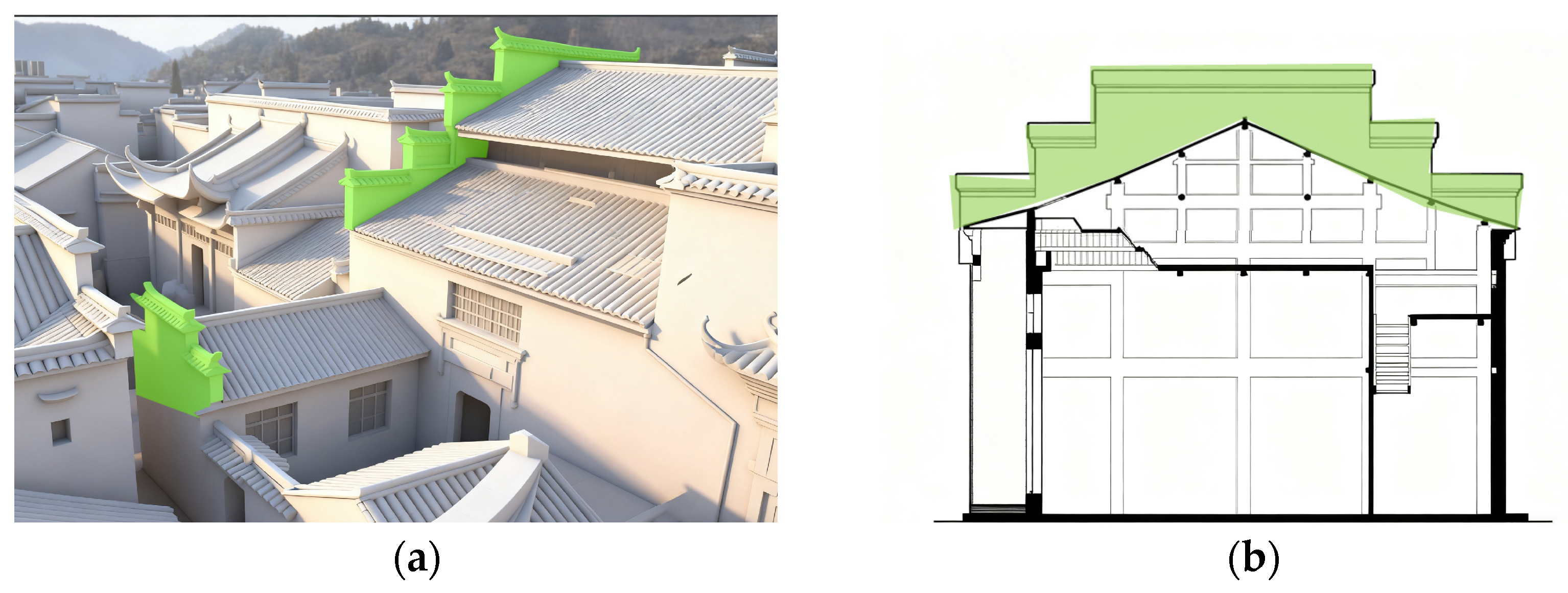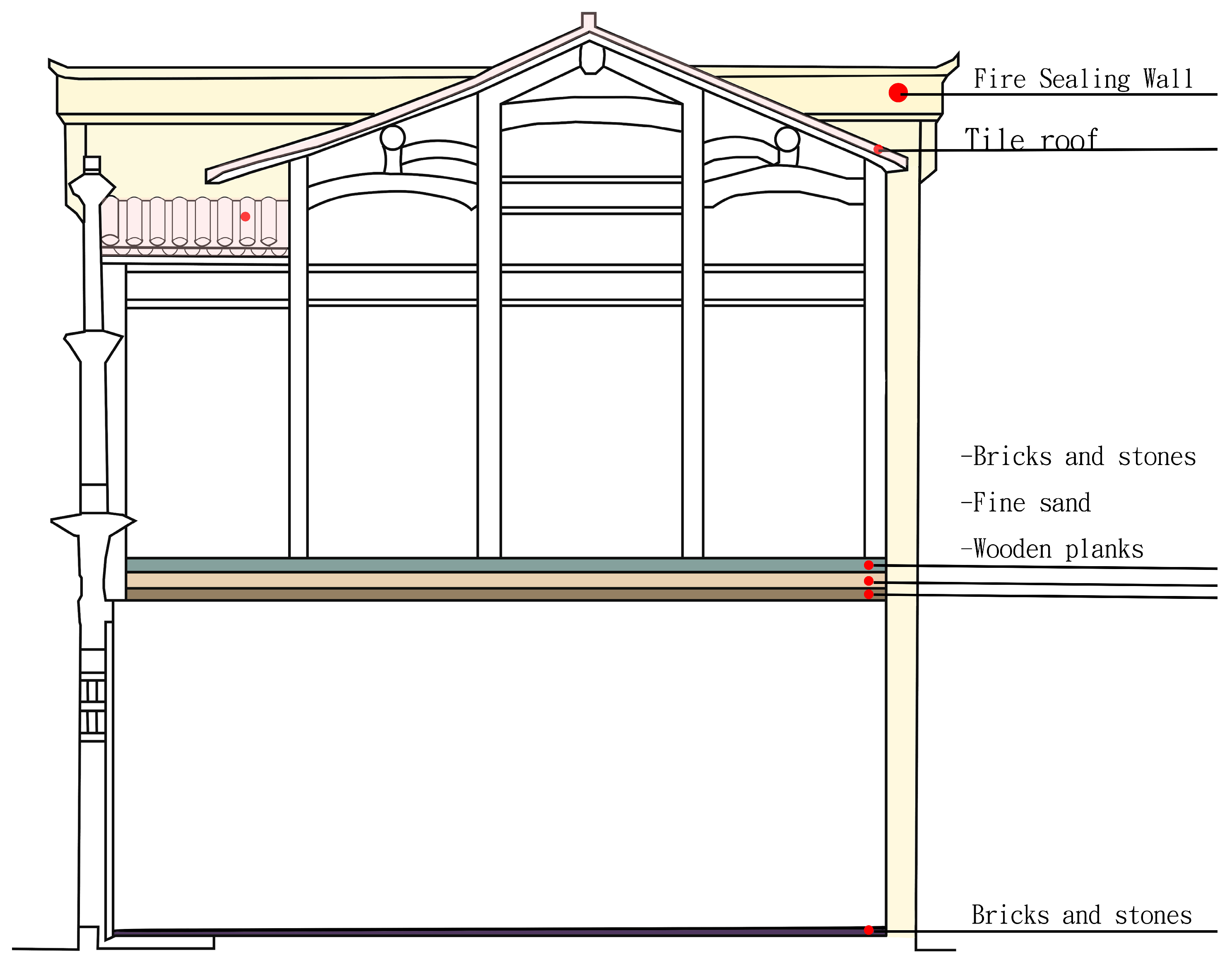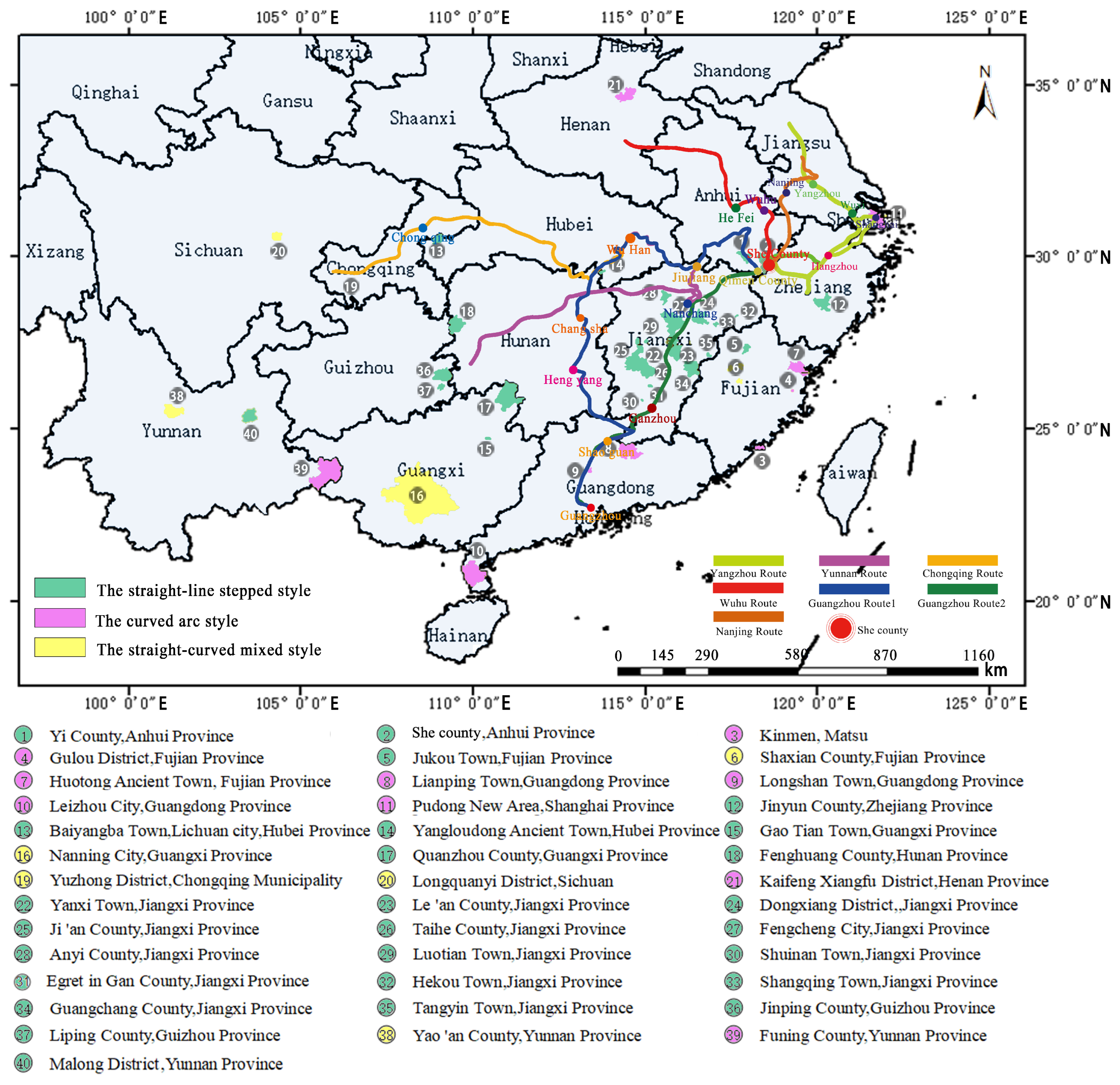

Fire-Prevention-Oriented Environmental Design and Governance: A Case Study Focusing on Vernacular Residential World Heritage Sites



Abstract
1. Introduction
1.1. Problem Awareness
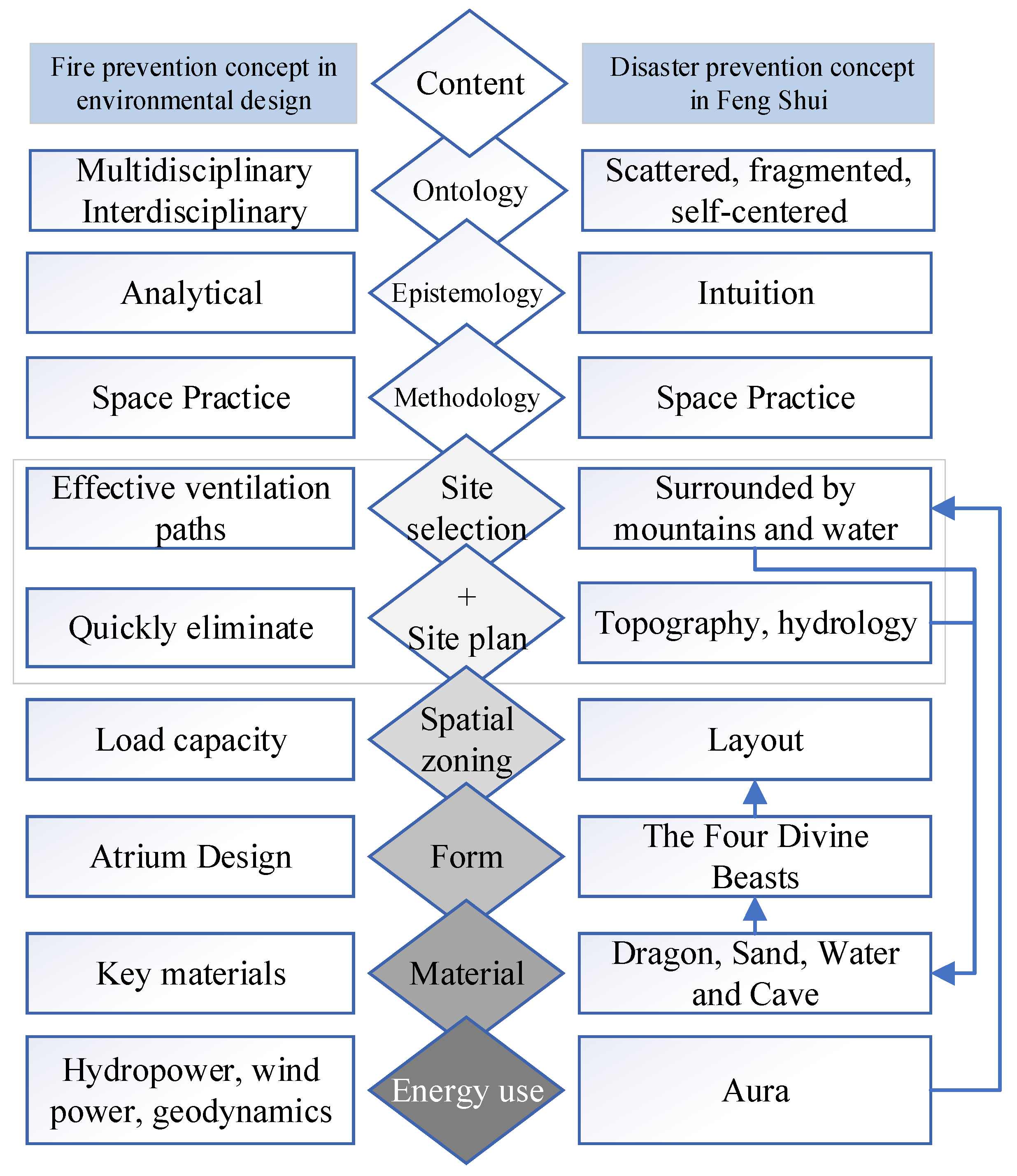
1.2. Analytical Framework for the Dialogue Between Environmental Design and Feng Shui
1.3. The Uniqueness and Value of Chinese Cases
2. Materials and Methods
2.1. Study Materials
2.2. Study Methods
3. Results
3.1. Site Selection and Site Planning
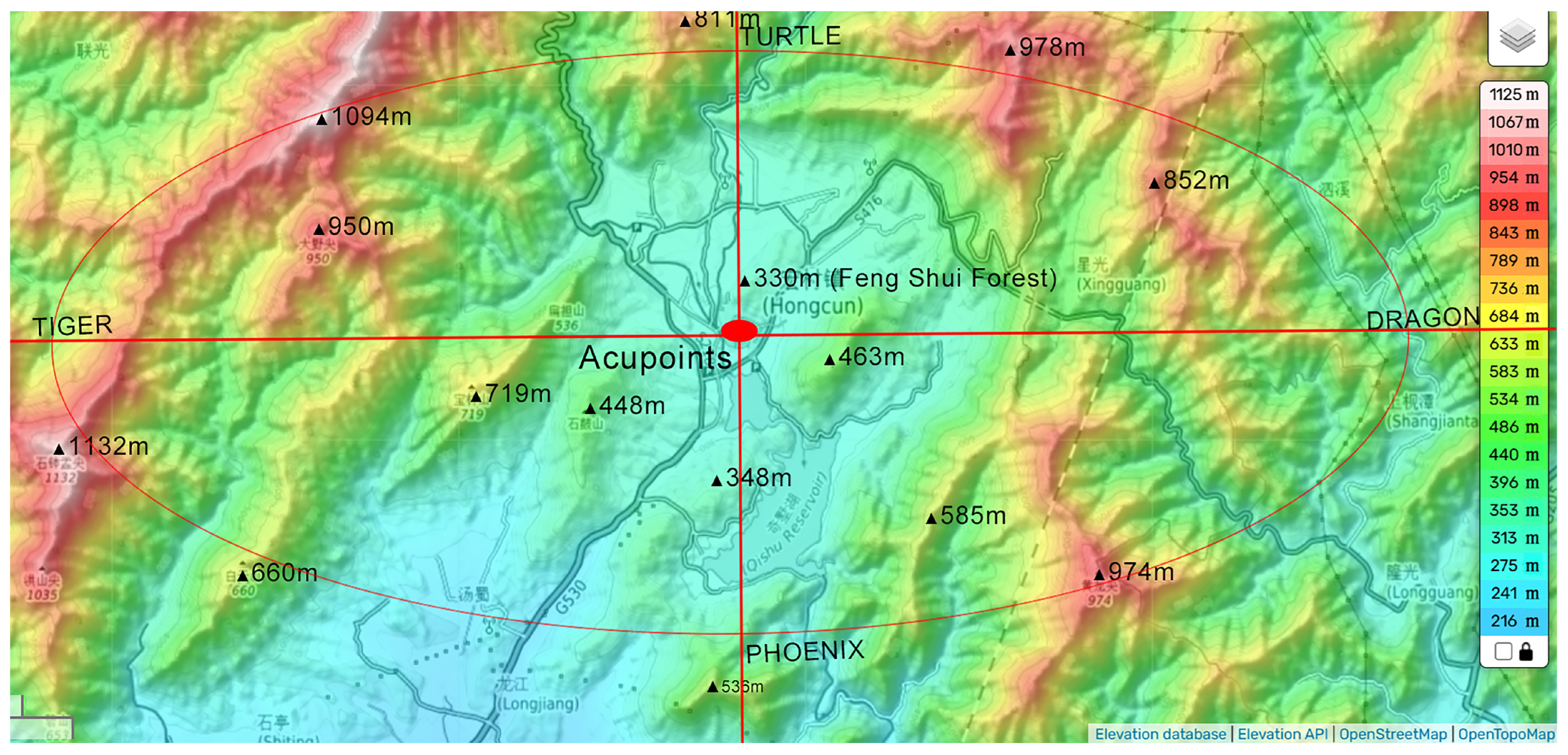
3.1.1. Site Selection: Topography
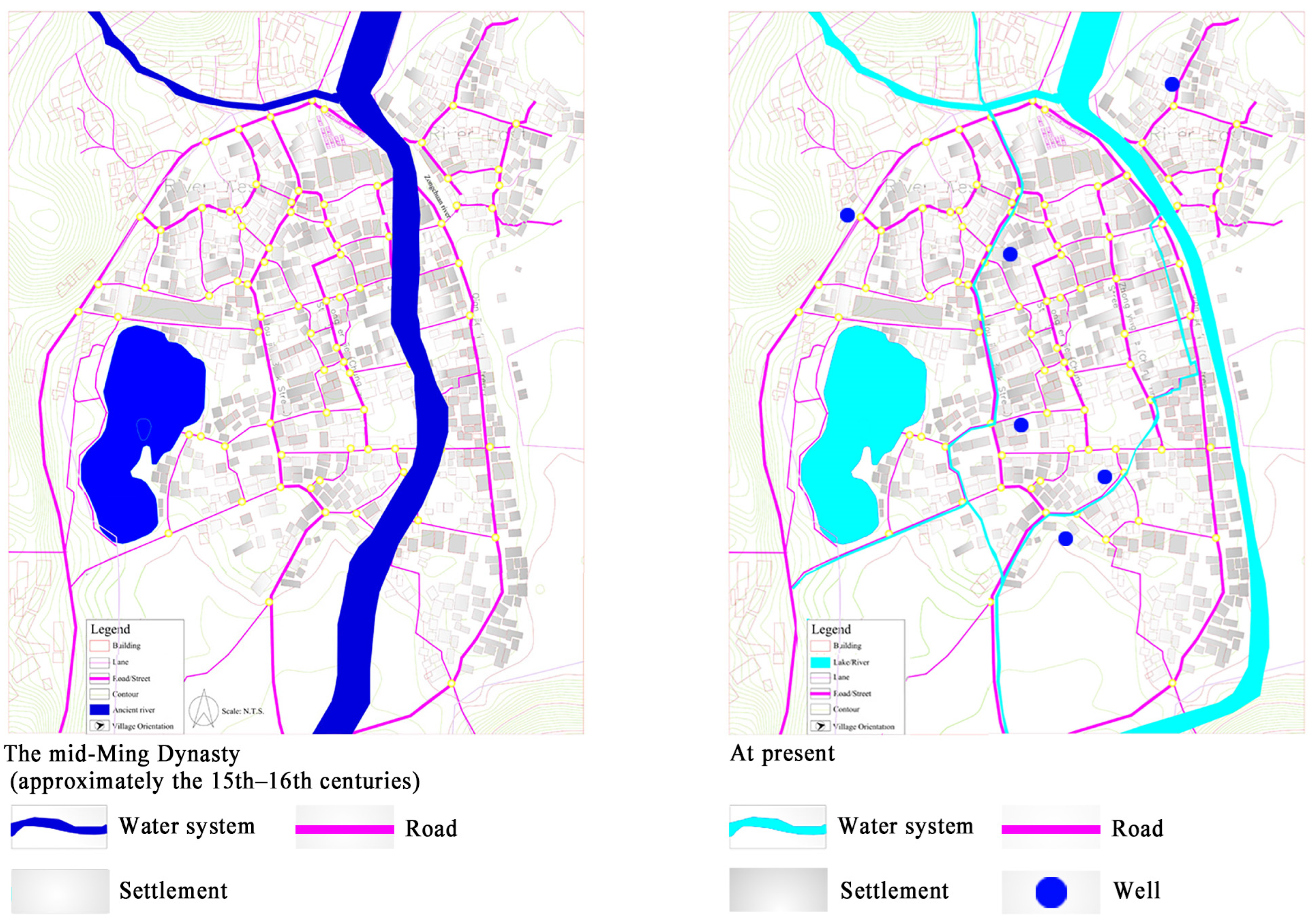
3.1.2. Site Planning: Hydrological and Engineering
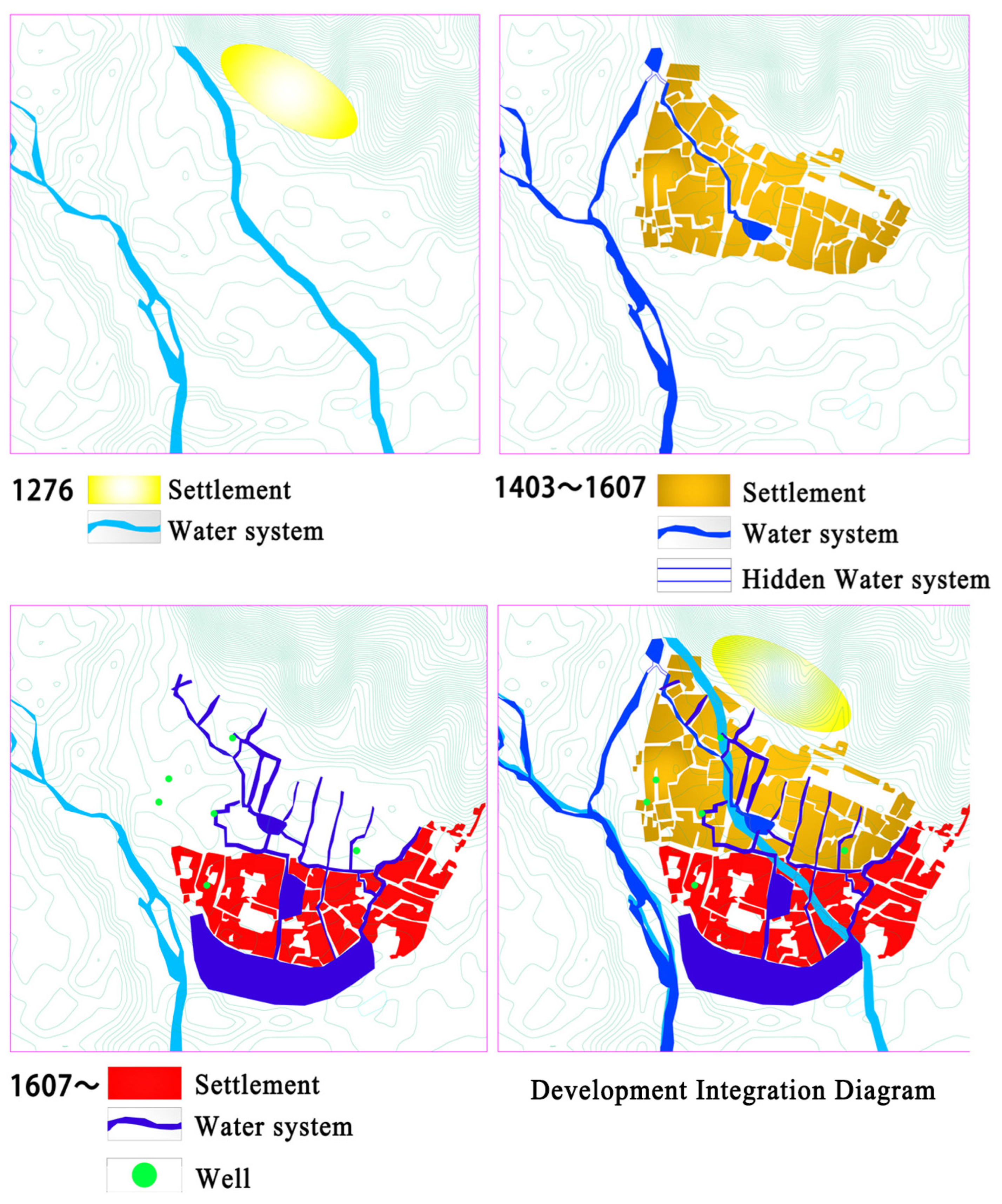
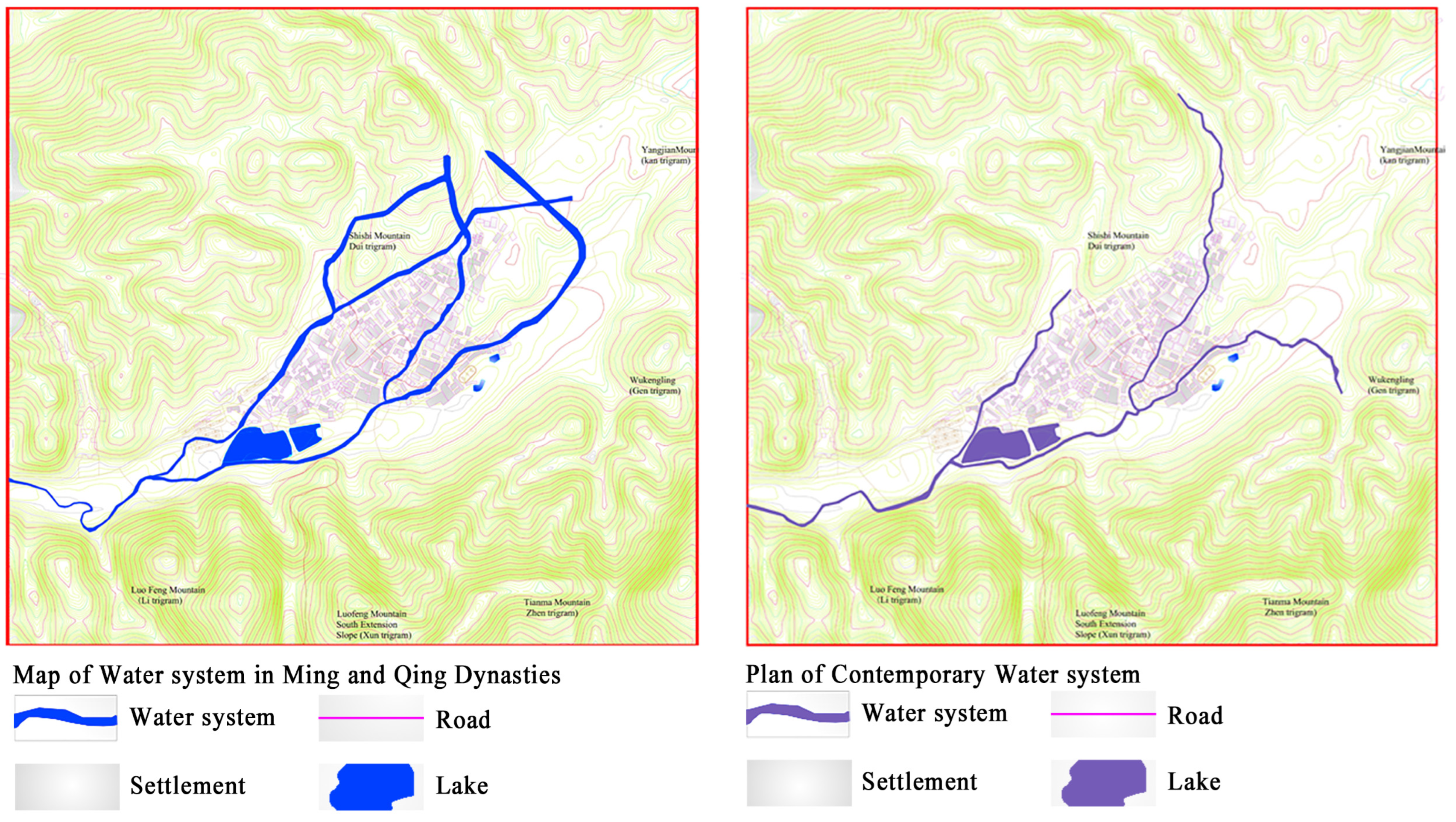

3.1.3. Site Planning: Spatial Planning
3.2. Spatial Zoning
3.3. Form of Building or Setlement
3.4. Materials
3.5. Energy Use
4. Discussion
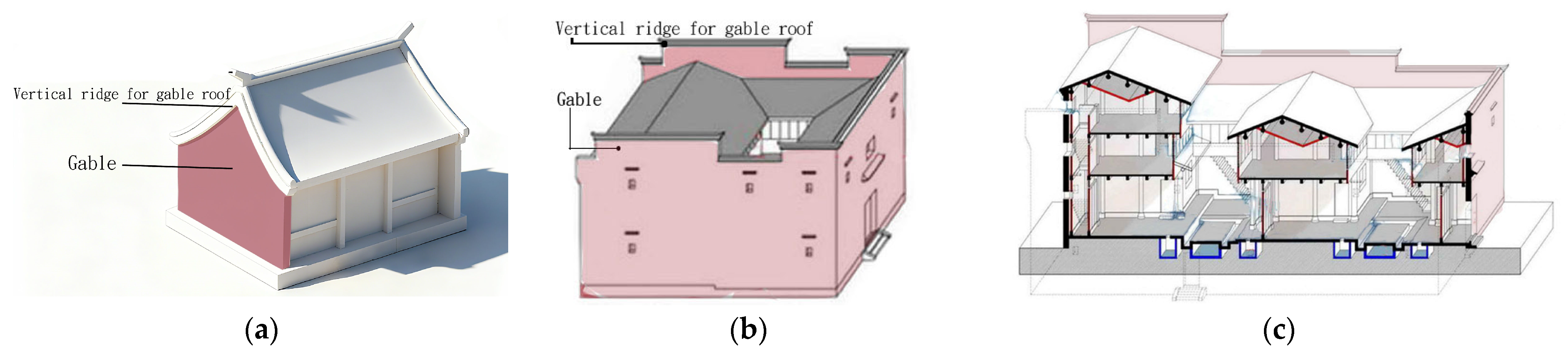
4.1. Spatial Dissemination of Traditional Environmental Knowledge: Represented by Fire-Sealing Walls
4.2. Fire Resilience in Traditional Environmental Planning Knowledge
4.3. Resilience Degradation of Fire Control and the Next?
5. Conclusions
Supplementary Materials
Author Contributions
Funding
Data Availability Statement
Acknowledgments
Conflicts of Interest
References
- Kastenholz, E.; Carneiro, M.J.; Marques, C.P.; Lima, J. Understanding and managing the rural tourism experience—The case of a historical village in Portugal. Tour. Manag. Perspect. 2012, 4, 207–214. [Google Scholar] [CrossRef] [Scilit]
- Sumadi, K. Tourism development basis in traditional village of Kuta. Int. J. Linguist. Lit. Cult. 2016, 2, 124–132. [Google Scholar] [CrossRef] [Scilit]
- Zhao, Y.; Zhan, Q.; Du, G.; Wei, Y. The effects of involvement, authenticity, and destination image on tourist satisfaction in the context of Chinese ancient village tourism. J. Hosp. Tour. Manag. 2024, 60, 51–62. [Google Scholar] [CrossRef] [Scilit]
- The Business Research Company. Heritage Tourism Market Global Report 2026; The Business Research Company: Philadelphia, PA, USA, 2026. [Google Scholar]
- 360 Research Reports. Heritage Tourism Market Size, Share, Growth, and Industry Analysis, By Type (Cultural Heritage, Natural Heritage, Intangible Heritage), By Application (30 & Under, 31 to 50, 51 to 70, 71 and Above), Regional Insights and Forecast to 2035; 360 Research Reports: Pune, India, 2025; p. 112. [Google Scholar]
- Spiegel, H. Merkblatt für den Brandschutz an historischen Wohnhäusern, Burgen und Schlössern. Burgen Schlösser-Z. Burgenforschung Denkmalpfl. 1964, 5, 11–17. [Google Scholar]
- Wild, M. Denkmalschutz-Kompendium; Springer Nature: Berlin/Heidelberg, Germany, 2023. [Google Scholar]
- Stemmle, J. Zwischen Instandhaltungsgebot und Privilegierung: Umnutzungen Landwirtschaftlicher Altgebäude im Spannungsfeld des Baurechts-eine Bewertung der Baurechtlichen Einflussfaktoren, Vertieft Betrachtet an Fallbeispielen im Östlichen Rhein-Neckar-Kreis. Doctoral Dissertation, Universität Rostock, Rostock, Germany, 2009. [Google Scholar]
- Fellin, L. Haus Nr. 17 in Burgeis im Vinschgau: Umnutzung eines Leerstehenden Denkmals Bäuerlicher Architektur. Master’s Thesis, Technische Universität Wien, Vienna, Austria, 2024. [Google Scholar]
- Fiby, A. Umbaukultur: Zwischen Erhaltung und Entwicklung-Kriterien und Umsetzung im Historischen Zentrum von Krems. Master’s Thesis, Technische Universität Wien, Vienna, Austria, 2023. [Google Scholar]
- Noell, M. Denkmalpflege als Kulturtechnik. Eine Verkomplizierung. Osterr. Z. Kunst Denkmalpfl. 2017, 71, 162–166. [Google Scholar]
- Figueiredo, P.J.F. Segurança Contra Incêndios em Edifícios de Centros Urbanos Antigos–Antigo Orfeão e o Centro Histórico de Viseu. Master’s Thesis, Instituto Superior de Engenharia de Coimbra, Coimbra, Portugal, 2018. [Google Scholar]
- Okubo, T.; Hasegawa, R.; Kim, D. Issues and Countermeasures of Fire Response for Japanese Castle with Wooden Rebuilt Buildings—To Protect Undesignated Cultural Heritages from Fire. Collect. Pap. Disaster Prev. Hist. Cities 2025, 19, 241–248. [Google Scholar]
- Hua, M. A Comparative Study of the Material Space of World Heritage Villages in China and Italy. Master’s Thesis, Suzhou University, Suzhou, China, 2016. [Google Scholar]
- Wan, H. How to ensure fire prevention in traditional villages and ancient buildings in my country. China Fire Prot. 2021, 45–46. [Google Scholar]
- Lin, Z. A 400-Year-Old Village in Yunnan Was Nearly Completely Destroyed in a Fire. Experts Say That Tourism Development Has Led to a Separation of People and Villages, Which Is a Weakness. Available online: https://www.hk01.com/article/587882?utm_source=01articlecopy&utm_medium=referral (accessed on 16 April 2026).
- Zheng, H. How Can Traditional Villages Help Us Preserve Our Nostalgia? (Cultural Pulse). Available online: http://culture.people.com.cn/BIG5/n/2015/0115/c87423-26388330.html (accessed on 16 April 2026).
- Wu, Y.; Chen, S.; Wang, D.; Zhang, Q. Fire risk assessment of heritage villages: A case study on Chengkan village in China. Fire 2023, 6, 47. [Google Scholar] [CrossRef] [Scilit]
- Lan, K.; Buranaut, I.; Hsu, W.-L. Sustainable development strategies for historic building museumization based on UGC data. J. Asian Archit. Build. Eng. 2025, 1–20. [Google Scholar] [CrossRef] [Scilit]
- Kincaid, S. Fire prevention in historic buildings—Approaches for safe practice. Hist. Environ. Policy Pract. 2022, 13, 361–380. [Google Scholar] [CrossRef] [Scilit]
- Yuan, C.; He, Y.; Feng, Y.; Wang, P. Fire hazards in heritage villages: A case study on Dangjia Village in China. Int. J. Disaster Risk Reduct. 2018, 28, 748–757. [Google Scholar] [CrossRef] [Scilit]
- Zhang, F.; Shi, L.; Liu, S.; Zhang, C.; Liu, Z. CFD-based validation study on the fire prevention wisdom of ancient village houses in western Hunan. Fire 2023, 6, 144. [Google Scholar] [CrossRef] [Scilit]
- Li, H.Q.; Yu, Y.; Yu, X. On fire protection problems and its countermeasures about chinese ancient architecture. Appl. Mech. Mater. 2012, 204, 3365–3368. [Google Scholar] [CrossRef] [Scilit]
- Li, J.; Li, H.; Zhou, B.; Wang, X.; Zhang, H. Investigation and Statistical Analysis of Fire Loads of 83 Historic Buildings in Beijing. Int. J. Archit. Herit. 2020, 14, 471–482. [Google Scholar] [CrossRef] [Scilit]
- Du, F. “Planning First” for the Holistic Protection and Utilization of Local Heritage: A Case Study of the Implementation Plan for the Protection and Utilization of the Ancient Architectural Complex in Chengkan Village, Huizhou District, Huangshan City, Anhui Province. Herit. Conserv. Res. 2016, 60–66. [Google Scholar]
- Tozo Neto, J.; Ferreira, T.M. Assessing and mitigating vulnerability and fire risk in historic centres: A cost-benefit analysis. J. Cult. Herit. 2020, 45, 279–290. [Google Scholar] [CrossRef] [Scilit]
- Cristaldo, P.P. Prevenir Para Preservar. Os Desafios da Prevenção a Incêndios em duas Igrejas do Triângulo Mineiro. Master’s Thesis, Universidade Federal de Uberlândia, Uberlândia, Brazil, 2022. [Google Scholar]
- Will, T.; Meier, H.-R. Cultural Heritage and Natural Disasters: Risk Preparedness and the Limits of Prevention. In Proceedings of the Cultural Heritage and Natural Disasters, Risk Preparedness and the Limits of Prevention, Leipzig, Germany, 27–28 October 2006; pp. 9–20. [Google Scholar]
- Ferreira, T.M. Notre Dame Cathedral: Another case in a growing list of heritage landmarks destroyed by fire. Fire 2019, 2, 20. [Google Scholar] [CrossRef] [Scilit]
- Tsai, S.-C.; Lee, S.-H. Disaster-Resilient Communities on Flood Plains and Their Agricultural Regeneration: A Case Study inMeinong Plain, Taiwan. In Proceedings of the INTERPRAEVENT 2023 International Symposium, Taichung, Taiwan, 17 April 2023. [Google Scholar]
- Zhang, F.; Shi, L.; Liu, S.; Zhang, C.; Xiang, T. The traditional wisdom in fire prevention embodied in the layout of ancient villages: A case study of high chair village in Western Hunan, China. Buildings 2022, 12, 1885. [Google Scholar] [CrossRef] [Scilit]
- Li, S. Analysis of fire risk and fire prevention of architectural heritage: A case study of mount wutai in China. Appl. Comput. Eng. 2023, 26, 137–144. [Google Scholar] [CrossRef] [Scilit]
- Li, M.; Hasemi, Y.; Nozoe, Y.; Nagasawa, M. Study on strategy for fire safety planning based on local resident cooperation in a preserved historical mountain village in Japan. Int. J. Disaster Risk Reduct. 2021, 56, 102081. [Google Scholar] [CrossRef] [Scilit]
- Li, G.; Yuan, H.; Shan, Y.; Lin, G.; Xie, G.; Giordano, A. Architectural cultural heritage conservation: Fire risk assessment of ancient vernacular residences based on FAHP and EWM. Appl. Sci. 2023, 13, 12368. [Google Scholar] [CrossRef] [Scilit]
- Serpa, F.B. A Segurança Contra Incêndio como Abordagem de Conservação do Patrimônio Histórico Edificado: A Aplicação do Sistema de Projeto Baseado em Desempenho em Edifícios Históricos em Florianópolis, SC. Master’s Thesis, Universidade Federal de Santa Catarina, Florianópolis, Brazil, 2012. [Google Scholar]
- Santos, C.; Ferreira, T.M.; Vicente, R.; da Silva, J.R.M. Building typologies identification to support risk mitigation at the urban scale–Case study of the old city centre of Seixal, Portugal. J. Cult. Herit. 2013, 14, 449–463. [Google Scholar] [CrossRef] [Scilit]
- McHarg, I.L. Design with Nature; American Museum of Natural History: New York, NY, USA, 1969. [Google Scholar]
- Caves, R.W. Encyclopedia of the City; Routledge: London, UK, 2004. [Google Scholar]
- Thomas, R. Environmental Design: An Introduction for Architects and Engineers; Taylor & Francis: London, UK, 2006. [Google Scholar]
- Rao, P. Feng Shui Theory in the Architectural Environment of Xidi Folk Houses in the Huizhou Style. Decoration 2004, 66–67. [Google Scholar] [CrossRef]
- Lin, K. Feng Shui as a Spatial Practice: An Anthropological Reflection. Taiwan J. Anthropol. 2007, 5, 63–122. [Google Scholar]
- Hu, C.-T. Application of Chinese Geomancy on the Site Planning. Master’s Thesis, National Kaohsiung First University of Science and Technology, Kaohsiung City, Taiwan, 2003. [Google Scholar]
- Huang, C.-L. The Study of Chinese Traditional Feng-Shui and Future Development—Based on the Interior Design and Architecture. Master’s Thesis, Fo Guang University, Yilan County, Taiwan, 2008. [Google Scholar]
- Chuan-Hsiung, C. On the Relationship Between the Thoughts of Feng Shul In I-Ching, Traditional Architecture, Landscape and Architecture Planning. Master’s Thesis, National Taiwan University, Taipei City, Taiwan, 2001. [Google Scholar]
- Yang, R. The Temporal Dimension in Traditional Geomancy Spatial Theory—Taking Xuan Kong Flying Star Theory as an Example. Master’s Thesis, Nanhua University, Chiayi County, Taiwan, 2004. [Google Scholar]
- Jhunag, J.-J. The Study on The Composition of Feng Shui from Environmental Planning Perspective. Master’s Thesis, Chaoyang University of Technology, Taichung City, Taiwan, 2016. [Google Scholar]
- Chen, H.T. “Feng Shui” the Thoughts to Select and Decide in Traditional Architecture. Master’s Thesis, Shu-Te University of Science and Technology, Kaohsiung City, Taiwan, 2006. [Google Scholar]
- Liu, Z. Research on the Spatial Construction of Feng Shui. Master’s Thesis, Fu Jen Catholic University, New Taipei city, Taiwan, 2024. [Google Scholar]
- Kim, N.S. Topography terrain of Dalseong county and feng shui environmental management associated with it. J. Assoc. Korean Photo-Geogr. 2016, 26, 41–53. [Google Scholar] [CrossRef] [Scilit]
- Yu, X. Feng Shui and the Emerging Science of Environmental Geography. People’s Daily (Overseas Edition), 24 August 2010.
- Yu, K. Schemas in Biological and Cultural Genes—The Profound Meaning of Feng Shui and Ideal Landscapes; GARDEN CITY PUBLISHING LTD.: Taipei, Taiwan, 1998. [Google Scholar]
- Needham, J.; Wang, L.; Price, D.J.D.S. Heavenly Clockwork: The Great Astronomical Clocks of Medieval China; Cambridge University Press: Cambridge, UK, 1986. [Google Scholar]
- Needham, J. Science and civilization. China 1956, 2, 472. [Google Scholar]
- Choi, C. The Principles of the Land and the Way of Man; Locus Publishing: Taipei, Taiwan, 2006. [Google Scholar]
- Guo, Z.; Horiko, K. Chinese Urban Development; Sagami Shobo: Tokyo, Japan, 1980. [Google Scholar]
- Watanabe, Y. Fungsui: Ki no Keikan-Chirigaku; Jinbun Shoin: Kyoto, Japan; Landscape Publishing: Kyoto, Japan, 2000. [Google Scholar]
- Kim, G.J. A Study on the Feng Shui Geographical Characteristics of Large-Scale Fires in the Daegu Region. Master’s Thesis, Yeungnam University, Daegu, Republic of Korea, 2013. [Google Scholar]
- Guo, S.-S. The Application of Feng Shui in Fire Disaster Prevention. Master’s Thesis, Weixin Shengjiao College, Nantou City, Taiwan, 2025. [Google Scholar]
- Borisovich, S.A.; Alexandrovich, B.A.; Abdukadirovich, M.B.; Maratovich, A.M.; Kuandykovich, M.Z.; Rakhmetulin, B.Z. Fire Hazard and Fire Resistance of Wooden Structures; Springer: Berlin/Heidelberg, Germany, 2023. [Google Scholar]
- UNESCO World Heritage Centre 1992–2025. Ancient Villages in Southern Anhui—Xidi and Hongcun. Available online: https://whc.unesco.org/en/list/1002/ (accessed on 23 July 2025).
- Ouyang, Y. Application of Huizhou Architectural Style in Modern Houses. In Proceedings of the 2nd Global Conference on Civil, Structural and Environmental Engineering (GCCSEE 2013), Shenzhen, China, 28–29 September 2013; Trans Tech Publications Ltd.: Stafa, Switzerland, 2014; pp. 2883–2886. [Google Scholar]
- She, W.; Jones, M.R.; Zhang, Y.S.; Shi, X. Potential Use of Foamed Mortar (FM) for Thermal Upgrading of Chinese Traditional Hui-Style Residences. Int. J. Archit. Herit. 2015, 9, 775–793. [Google Scholar] [CrossRef] [Scilit]
- Zhang, Y.; Li, H.; Bi, S. Historical continuity, spirit of place, and formal aesthetics: A study on the spatial construction mechanism of the Guangyu-tang gateway in Huizhou. Art Des. 2025, 142–144. [Google Scholar] [CrossRef]
- Hu, X.; He, F.; Zhang, S.; Zhou, G. Vulnerability of traditional vernacular dwellings: Connotation, assessment and case studies. J. Nat. Sci. Hunan Norm. Univ. 2025, 48, 40–49. [Google Scholar]
- Chen, P.; Zhao, Y.; Zuo, D.; Kong, X. Tourism, water pollution, and waterway landscape changes in a traditional village in the Huizhou region, China. Land 2021, 10, 795. [Google Scholar] [CrossRef] [Scilit]
- Shi, S.; Yu, K. Structural Characteristics and Contemporary Value of Traditional Water Cultural Landscapes in Huizhou Region. Landsc. Archit. Front. 2021, 9, 28–50. [Google Scholar] [CrossRef] [Scilit]
- Yuan, C.; Yin, H.; Li, T.; Zeng, Z. Rethinking placemaking through rural tourism in Chengkan Village, China. Tour. Geogr. 2026, 28, 191–220. [Google Scholar] [CrossRef] [Scilit]
- Bi, Z.; Chen, C.; Li, Y.; Cheng, P. Analysis on the human settlement environment of huizhou ancient villages based on the heritage of ancient roads—A case study of chengkan village. In Proceedings of the E3S Web of Conferences, Paris, France, 18–19 May 2021; p. 04025. [Google Scholar]
- Liu, H. Ancient Village Space Under the Sightseeing Gaze: Spatial Production and Cultural Resistance in Hongcun Tourism in Huizhou. Master’s Thesis, National Taiwan University, Taipei, Taiwan, 2004. [Google Scholar]
- Sun, J.; Zhou, K. Water and fire, Huizhou settlements. J. Anhui Inst. Archit. Technol. Nat. Sci. Ed. 2008, 16, 42–45. [Google Scholar]
- Song, Q. Fire Prevention Research on Wooden Structures of Ancient Huizhou Dwellings (Villages). Master’s Thesis, Hefei University of Technology, Hefei, China, 2006. [Google Scholar]
- Shou, T. Research on the Construction System of Huizhou Vernacular Architecture. Dissertation, Southeast University, Nanjing, China, 2020. [Google Scholar]
- China Fire Protection. A Century-Old “Fire Prevention and Night Watchman’s Team” Protecting an Ancient Village; National Fire Rescue Administration: Beijing, China, 2020. Available online: https://www.119.gov.cn/qmxf/119xfj/2022/959.shtml (accessed on 16 April 2016).
- Huangshan City Huizhou Culture Research Institute. Studies on Huizhou Culture; Anhui People’s Publishing House: Hefei, China, 2004; Volume 2. [Google Scholar]
- Li, J. Huizhou Fire Protection Documents. Huizhou Stud. 2002, 2, 392–410. [Google Scholar]
- Tao, S. An Analysis of Huizhou Vernacular Dwelling Morphology through the Lens of Huizhou Cultural Concepts. Lit. Art Crit. 2012, 12, 142–144. [Google Scholar] [CrossRef]
- Song, Y.; Zhou, X. The culture and value of Huizhou horse-head gables. Jianghuai Trib. 2021, 1, 106–111. [Google Scholar] [CrossRef]
- Chao, X. Inheritance and development of the “horse-head gable” in Hui-style architecture. New Build. Mater. 2019, 46, 166–167. [Google Scholar]
- Wu, Y.; Hua, B.; Chen, S.; Yang, J. FDS-Based Study of the Fire Performance of Huizhou Fire Seal Walls in Traditional Residential Buildings in Southern China. Fire 2023, 6, 388. [Google Scholar] [CrossRef] [Scilit]
- Xue, L.; Pan, X.; Wang, X.; Zhou, H. Traditional Chinese Villages: Beautiful Nostalgia; Springer Nature: Berlin/Heidelberg, Germany, 2021. [Google Scholar]
- Li, C.; Editorial Committee. China Fire Encyclopedia; Shanghai Science and Technology Press: Shanghai, China, 1997. [Google Scholar]
- Xiao, D. On fire-prevention measures for mixed-structure buildings in ancient China. J. South China Univ. Technol. (Nat. Sci. Ed.) 1991, 2, 89–100. [Google Scholar]
- UNESCO. Ancient Villages in Southern Anhui—Xidi and Hongcun; UNESCO World Heritage Centre 1992–2026: Paris, France, 2026; Available online: https://whc.unesco.org/en/list/1002 (accessed on 30 April 2026).
- UNESCO. The Criteria for Selection; UNESCO World Heritage Centre 1992–2026: Paris, France, 2026. Available online: https://whc.unesco.org/en/criteria/ (accessed on 30 April 2026).
- China Global Television Network. Ming Dynasty Architecture in Chengkan Village. 2022. Available online: https://news.cgtn.com/news3d3d414e7849544f31457a6333566d54/index.html (accessed on 30 June 2026).
- Zhu, H.; Zhu, D. (Eds.) Exploring the Development and Protection Mode of Chengkan, a Bagua Village in China Renowned as the “Hometown of National Treasures”. In Proceedings of the 2023 9th International Conference on Humanities and Social Science Research (ICHSSR 2023), Beijing, China, 21–23 April 2023; pp. 1092–1100. [Google Scholar]
- Jiangdong Wang Lang. Hu Zhong, a “Heroine” and the Chief Designer of the Hongcun Water System! Available online: https://zhuanlan.zhihu.com/p/128062948 (accessed on 28 June 2026).
- He, X. Exploring the Origins of Feng Shui; Southeast University Press: Nanjing, China, 1990. [Google Scholar]
- Yin, R.K. Case Study Research: Design and Methods, 4th ed.; Sage: Thousand Oaks, CA, USA, 2009. [Google Scholar]
- Wang, Y. Principles of Landscape Ecological Planning, 2nd ed.; China Architecture & Building Press: Beijing, China, 2013. [Google Scholar]
- Zhuang, J. Exploring the Environmental Assessment Elements of Feng Shui Site Selection from an Environmental Planning Perspective. Master’s Thesis, Chaoyang University of Technology, TaiChung, Taiwan, 2016. [Google Scholar]
- Xiong, D.; Li, C. Deforestation and Mining: Another Perspective on the Environmental Crisis in Huizhou during the Ming and Qing Dynasties. J. Beijing For. Univ. (Soc. Sci. Ed.) 2024, 24, 111–119. [Google Scholar]
- Wang, H. Water System Planning and Its Control Mechanism of Hong Village. Huazhong Archit. 2008, 26, 224–228. [Google Scholar]
- Shan, D. Anhui Dwellings (Chinese Dwelling Architecture Series); China Architecture & Building Press: Beijing, China, 2009; p. 35. [Google Scholar]
- Ni, Q.; Wang, Y.; Shigetomo, K. Traditional Village Space Constitution Principle with the Core of Water System in Chinese Huizhou Areas—Investigation Report on Chengkan Village of Huizhou Area in Huangshan City. Urban. Archit. Sch. 2008, 107–108. [Google Scholar] [CrossRef]
- Wang, A. Why Does Hong Village, a Village Nestled in Picturesque Landscapes, Always Remain Undisturbed When Torrential Rains Strike? Xinhua Daily Telegraph, 21 November 2025.
- Tang, L.; Tang, X. Research on the Genetic Characteristics and Development of Xidi Village Cultural Landscape. West. Tour. 2023, 5, 39–41. [Google Scholar]
- Dawei, X. Research on fire-prevention and disaster-mitigation measures in ancient Chinese cities. J. Catastrophology 1995, 4, 63–68. [Google Scholar]
- Xiao, D. Fire Prevention Measures in Ancient Chinese Mixed Architecture. J. South China Univ. Technol. (Nat. Sci. Ed.) 1991, 2, 89–100. [Google Scholar]
- Xu, S.; Liu, L.; Diao, Z.; Shu, D. Song Huiyao Collection, Volume 25: Official Posts; Shanghai Ancient Books Publishing: Shanghai, China, 2014. [Google Scholar]
- Long, W. Numerical Simulation Study on Fire Separation Distance of Wooden Structures in Ancient Commercial Streets. Master’s Thesis, University of Science and Technology of China, Hefei, China, 2020. [Google Scholar]
- Lin, L.; Kenan, Z.; Qi, L. Evolution of Fire-sealing Gable Walls’ Diversity in Leizhou Traditional Vernacular Red-brick Dwellings. J. Landsc. Res. 2016, 8. [Google Scholar]
- Li, J. Exploring the Ancient Dwellings of Huizhou; Shanghai Science and Technology Press: Shanghai, China, 2003. [Google Scholar]
- Liu, B. The discovery of Huizhou documents and the reasons for their survival. In Proceedings of the International Symposium on “Regional China: Social Historical Interpretation of Folk Documents” and the 11th Annual Meeting of the Chinese Society for Social History, Huangshan, China, 18–22 August, 2006; p. 24. [Google Scholar]
- Xu, C. Hui-Stule Architecture “Matou Mound” exhibition. New Constr. Mater. 2019, 46, 166–167. [Google Scholar]
- Li, L. Horse-head wall—“Hui” chair design. Packag. Eng. 2019, 40, 298. [Google Scholar]
- Xi, J.; Zhang, C. Interpretation of the Horse-Head Wall Elements in Hui-Style Architecture. J. Hunan City Univ. (Nat. Sci. Ed.) 2014, 35, 71–74. [Google Scholar]
- Chen, K.; Li, Y.; Cao, Y. A Study on the Space Characteristics of Ancient Ancestral Temples in the Taiping District of East China. J. Asian Archit. Build. Eng. 2016, 15, 365–372. [Google Scholar] [CrossRef] [Scilit]
- Zhang, X. A Preliminary Exploration and Research on the Wok-Ear Wall, an Element of Ancient Lingnan Architecture. Cult. Stud. J. 2019, 10, 67–69. [Google Scholar]
- Zhu, G. Banyan Trees, Rivers, and Wok-Eave Walls—A Brief Discussion of the Landscape Characteristics of Lingnan Water Towns. Lingnan Cult. Hist. 2003, 4, 41–46. [Google Scholar]
- Wang, L. A study on the modeling art of fire Sealing walls in Lingnan dwelling. J. Pu’er Univ. 2016, 32, 110–111. [Google Scholar]
- Wang, D.; Lyu, Q.; Wu, Y.; Fan, Z. The characteristic of regional differentiation and impact mechanism of architecture style of traditional residence. J. Nat. Resour. 2019, 34, 1864–1885. [Google Scholar] [CrossRef] [Scilit]
- Li, H. Henan Catholic Seminary. Root Explor. 2010, 72–75. [Google Scholar]
- Sun, D. A Brief History of Ancient Chinese Architecture; Joint Publishing (Hong Kong) Limited: Hong Kong, China, 2018. [Google Scholar]
- Chou, Y.-S.; Theodossopoulos, D. From lost crafts to delicate crafts: The development of Traditional Chinese Brick Architecture in Taiwan, from 1662 to 1895. In Proceedings of the Red-Brick Architecture in Southern Fujian Province and influenced area, Quanzhou, China, 23 November 2013. [Google Scholar]
- Jiang, Z. A Study on Spatial Design of Traditional Huizhou Villages from the Perspective of Resilient Disaster Prevention: Taking Hongcun, Chengkan, and Yangchan as Examples. Master’s Thesis, Anhui University of Architecture, Hefei, China, 2025. [Google Scholar]
- Deqi, S. Anhui Folk Houses; China Architecture & Building Press: Beijing, China, 2010. [Google Scholar]
- Odeen, K. Fire resistance of wood structures. Fire Technol. 1985, 21, 34–40. [Google Scholar] [CrossRef] [Scilit]
- cher. Chengkan Bagua Village. Available online: https://snowing0921.pixnet.net/blog/posts/10329202345 (accessed on 30 April 2026).
- Rex, G.R. Earth Acupuncture: Healing the Living Landscape; Simon and Schuster: New York, NY, USA, 2016. [Google Scholar]
- Matthews, M.R. Feng Shui: Teaching About Science and Pseudoscience; Springer: The Netherlands, 2019. [Google Scholar]
- Brown, S. The Feng Shui Bible: The Definitive Guide to Improving Your Life, Home, Health, and Finances; Sterling Publishing Company, Inc.: New York, NY, USA, 2005; Volume 4. [Google Scholar]
- Huang, B. All the Land and Water Routes Under Heaven; Shanxi People’s Publishing House: Taiyuan, China, 1992. [Google Scholar]
- Wang, Z. Architecture China: From a Half Tile to Ten-li Towers; Zhonghua Book Company: Beijing, China, 2021; p. 29. [Google Scholar]
- González Martínez, P. The ‘preservation by relocation’of Huizhou vernacular architecture: Shifting notions on the authenticity of rural heritage in China. Int. J. Herit. Stud. 2022, 28, 200–215. [Google Scholar] [CrossRef] [Scilit]
- Pei, L.; Cao, Z. Aesthetic Appreciation Is Different: Aesthetic Pleasure in Architectural Aesthetics. Buildings 2025, 15, 543. [Google Scholar] [CrossRef] [Scilit]
- Wiweka, K.; Demolingo, R.H.; Karyatun, S.; Adnyana, P.P.; Nurfikriyani, I. Tourist Village Rejuvenation and Overtourism Management: The Desa Wisata Nglanggeran Lifecycle Experience, Yogyakarta, Indonesia. Int. J. Tour. Hosp. Rev. eISSN 2021, 8, 2395–7654. [Google Scholar] [CrossRef] [Scilit]
- Long, J.W.; Lake, F.K.; Goode, R.W. The importance of Indigenous cultural burning in forested regions of the Pacific West, USA. For. Ecol. Manag. 2021, 500, 119597. [Google Scholar] [CrossRef] [Scilit]
- Mariani, M.; Connor, S.E.; Theuerkauf, M.; Herbert, A.; Kuneš, P.; Bowman, D.; Fletcher, M.S.; Head, L.; Kershaw, A.P.; Haberle, S.G. Disruption of cultural burning promotes shrub encroachment and unprecedented wildfires. Front. Ecol. Environ. 2022, 20, 292–300. [Google Scholar] [CrossRef] [Scilit]
- Greenler, S.M.; Lake, F.K.; Tripp, W.; McCovey, K.; Tripp, A.; Hillman, L.G.; Dunn, C.J.; Prichard, S.J.; Hessburg, P.F.; Harling, W. Blending I ndigenous and western science: Quantifying cultural burning impacts in K aruk A boriginal T erritory. Ecol. Appl. 2024, 34, e2973. [Google Scholar] [PubMed]
- Dehghani-Sanij, A.; Sayigh, A. The Indigenous Water-Engineering Structures in Iran. In Cisterns; River Publishers: Aalborg, Denmark, 2022; pp. 23–46. [Google Scholar]
- Al Habsi, F.H.A. The Architecture of Traditional Urban Settlements in Oman: Harat as-Saybani, Harat al-Yemen & Harat al-Aqr. Master’s Thesis, Hamad Bin Khalifa University (Qatar), Doha, Qatar, 2022. [Google Scholar]
- Wang, L. A Flash Flood Struck an Ancient Town in Huizhou, Severely Damaging National Treasures and Cultural Relics. Available online: http://art.people.com.cn/BIG5/n/2013/0702/c226026-22042581.html (accessed on 30 June 2026).
- Qu, Y.; Bai, B. A National Key Cultural Relic Site in Huangshan, Anhui Province, Suffered Partial Collapse Due to Flooding. Available online: https://www.news.cn/local/20240621/2bc80b57a825444aa309b984639291e8/c.html (accessed on 30 June 2026).
- Up Stream News. A Photographer Set Fire to Take Photos Inside a Nationally Protected Ancient House in Huizhou; Police Have Intervened and the Photographer Has Apologized. Available online: https://www.163.com/dy/article/K5L8CCVV053469M5.html (accessed on 30 June 2026).
- Yu, R.; Liang, L.; Li, D.; Zhu, H.; Zhu, S. A Study on the Invasion, Succession and Spatial Order Reorganization of Tourist Populations in Ancient Villages: A Case Study of Hongcun Ancient Village in Huizhou. Econ. Geogr. 2013, 33, 165–170. [Google Scholar] [CrossRef]

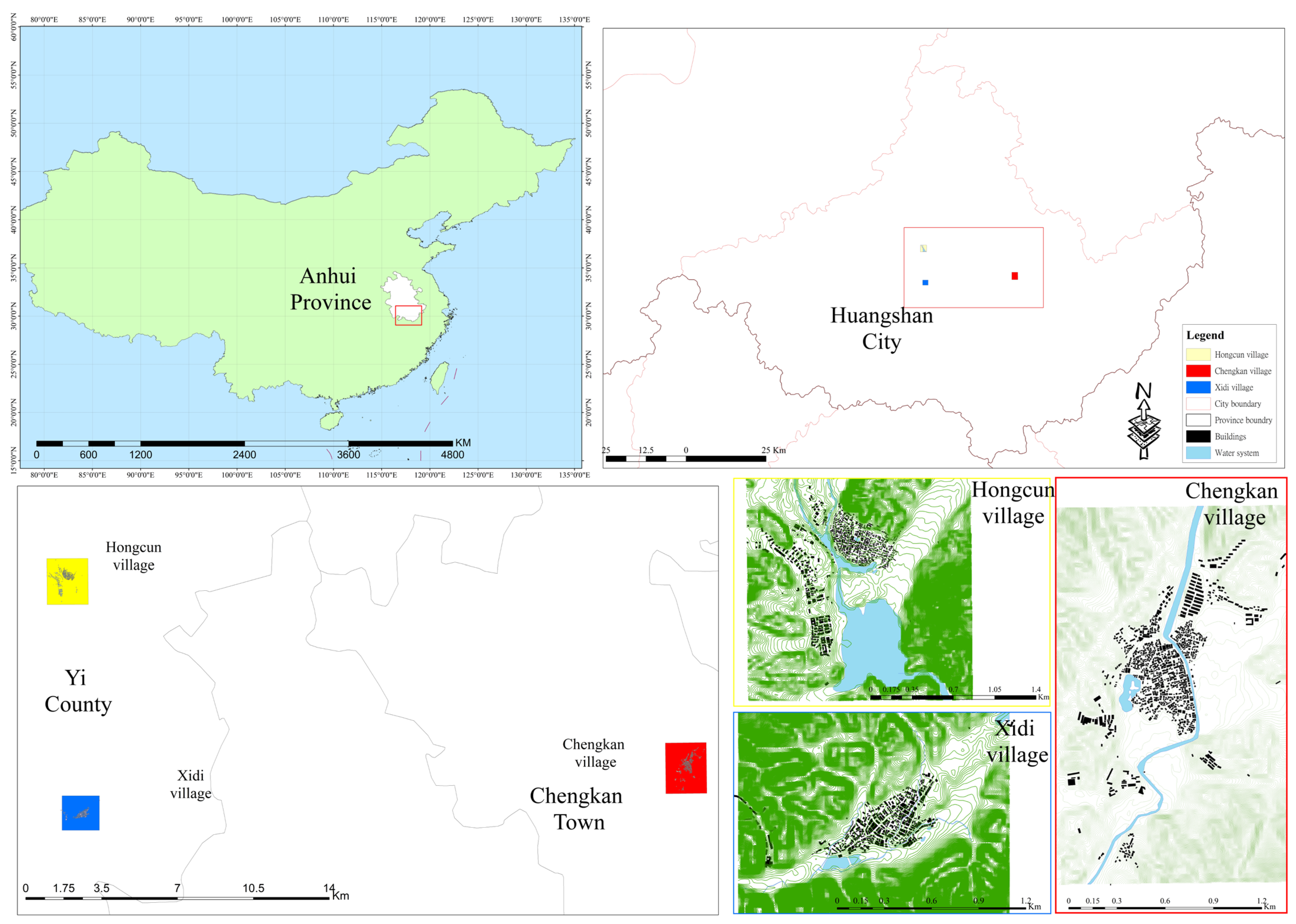

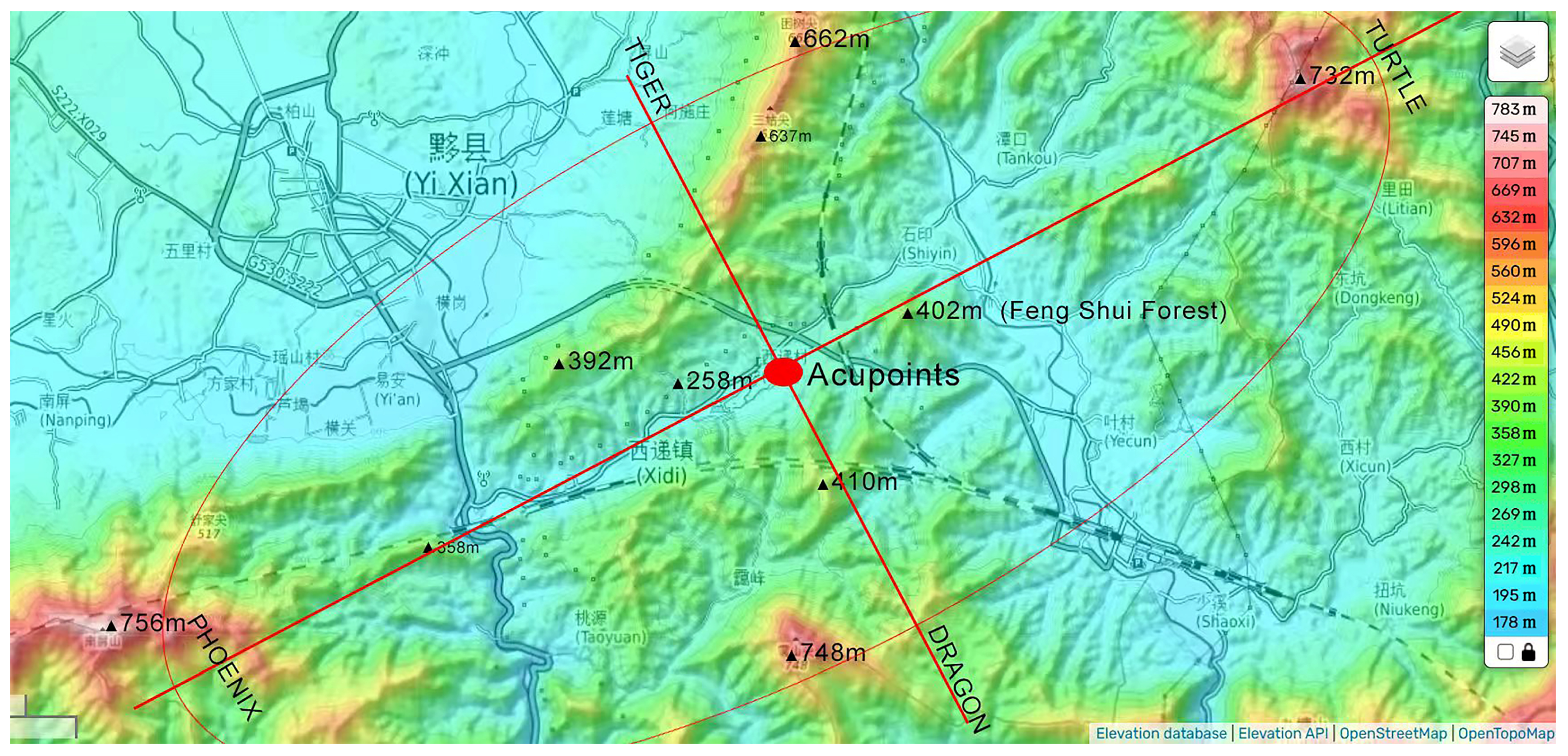
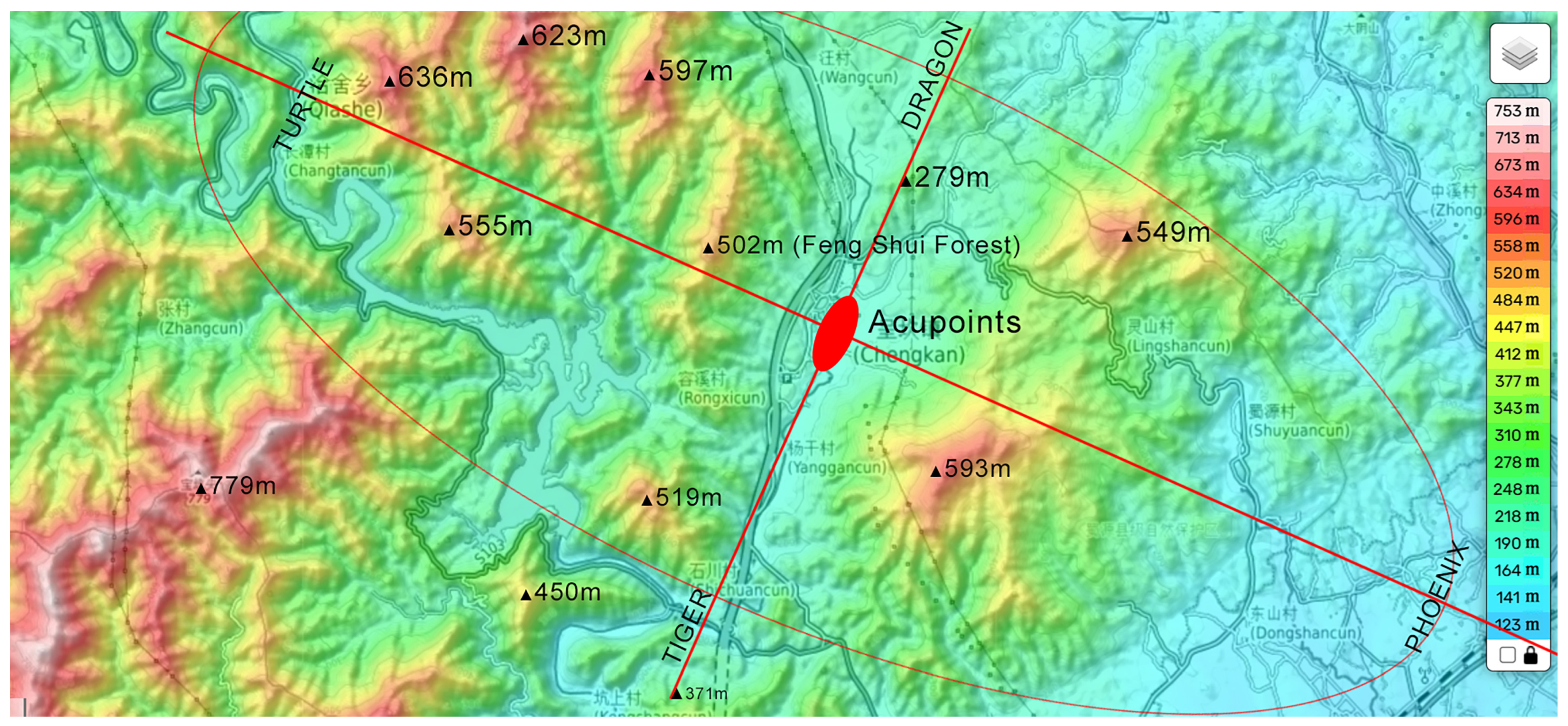



| No. | Subjects | Village Founding Era | Spatial Description (Core Area) | Remark |
|---|---|---|---|---|
| 1 | Hongcun Village | 1131–1162 AD | The entire village is laid out in the shape of an ox—the mountains represent the ox’s head, the irrigation ditches its intestines, and the streets its tendons—symbolizing prosperous Feng Shui and abundant harvests. | Designated by UNESCO |
| 2 | Xidi Village | 11th Century Northern Song Dynasty (1077–1100 AD) | A main road runs east–west through Xidi Village, with two parallel streets on either side, winding through numerous narrow alleys to form the village’s street network, primarily oriented eastward but extending north–south. | Designated by UNESCO |
| 3 | Chengkan Village | 220 AD | The terrain slopes from north to south, and the core of the settlement is traversed by three main streets. The river flows from north to south, passing through the village in a large “S” shape, naturally dividing the village into east and west parts. | National Key Cultural Relics Protection Unit |
| Index | Data | Hongcun | Xi-Di | Chengkan |
|---|---|---|---|---|
| Feng Shui Pond | Water area (m2) | 1207.5 (Moon Pond) +20,200 (South Lake)m2 | 21,048.2 m2 | 17,773.5 m2 |
| Water System | Waterway length | 700 + 400 m | 3368.9 m | 4984.7 m |
| Main Mt. | slope | 811/226.3583 = 3.58% | 402/554.73 = 73.79% | 502/188.3152 = 2.67% |
| Feng Shui Forest | Forest coverage | 26.5% | 18.7% | 12.1% |
| Settlement Orientation | Points of the compass | Facing south | Northeast–southwest | Northwest–southeast |
| Street and Alley Layout | Connectivity | 30,894/200 = 154.4 | 12,098/99 = 122.2 | 16,231/103 = 157.6 |
| Street and alley scale | 6/1.5 (height–width); 498/3 (length–width) | 6/1.5–2 (height–width); 692.7/3 (length–width) | 6/1–3 (height–width); 680.1/3 (length–width) | |
| Space Complexity | Node | 200 | 99 | 103 |
| No. | Cultural Interpretation | Objective Fire Resistance Performance |
|---|---|---|
| 1 | Feng Shui ponds and water systems | Natural firefighting water storage and nearby water access system within the village |
| 2 | Main mountain, Feng Shui forest | Greenbelts to slow the spread of wildfires and conserve water resources |
| 3 | Street layout, spatial connectivity, and spatial complexity | Smoke-proof fire-blocking spaces and resident evacuation routes during a fire |
Disclaimer/Publisher’s Note: The statements, opinions and data contained in all publications are solely those of the individual author(s) and contributor(s) and not of MDPI and/or the editor(s). MDPI and/or the editor(s) disclaim responsibility for any injury to people or property resulting from any ideas, methods, instructions or products referred to in the content. |
© 2026 by the authors. Licensee MDPI, Basel, Switzerland. This article is an open access article distributed under the terms and conditions of the Creative Commons Attribution (CC BY) license.
Share and Cite
Tsai, S.-C.; Chi, M.-X.; Luo, W.-M. Fire-Prevention-Oriented Environmental Design and Governance: A Case Study Focusing on Vernacular Residential World Heritage Sites. Fire 2026, 9, 335. https://doi.org/10.3390/fire9080335
Tsai S-C, Chi M-X, Luo W-M. Fire-Prevention-Oriented Environmental Design and Governance: A Case Study Focusing on Vernacular Residential World Heritage Sites. Fire. 2026; 9(8):335. https://doi.org/10.3390/fire9080335
Chicago/Turabian StyleTsai, Shu-Chen, Meng-Xin Chi, and Wei-Min Luo. 2026. "Fire-Prevention-Oriented Environmental Design and Governance: A Case Study Focusing on Vernacular Residential World Heritage Sites" Fire 9, no. 8: 335. https://doi.org/10.3390/fire9080335
APA StyleTsai, S.-C., Chi, M.-X., & Luo, W.-M. (2026). Fire-Prevention-Oriented Environmental Design and Governance: A Case Study Focusing on Vernacular Residential World Heritage Sites. Fire, 9(8), 335. https://doi.org/10.3390/fire9080335