


Abstract
Fire plays an important role in shaping forested ecosystems around the globe. Unlike many other fire-driven forest types, our understanding of pre-settlement fire behavior in quaking aspen (Populus tremuloides) systems is limited. To better understand the frequency and severity of fires in a putatively stable quaking aspen forest, a small, key watershed was selected for sediment coring to reconstruct fire history, vegetation change, and climatic variability. The study aim was to explore the fire–climate–vegetation linkages in an aspen-dominated catchment. For the past ~4000 years this basin has been dominated by quaking aspen but also subalpine fir (Abies lasiocarpa), and their relative composition has shifted inversely over this period. Large, stand-replacing fires occurred, on average, every ~178 years, with individual fire-free intervals ranging from 132 to 323 years. The occurrence of fire was not related to climatic conditions as characterized by either cool-season or warm-season moisture availability (drought proxies). Rather, fire occurrence was most strongly related to fuel accumulation associated with the predictable successional shift in species dominance from quaking aspen to subalpine fir. Unlike in climate-limited systems where managers have little control over fire occurrence due to climatic conditions (e.g., drought), fuel-limited systems are controlled from the bottom up, where the explicit reduction or redistribution of long-term fuel buildup is an effective approach to reducing the likelihood and/or effects of fire in the short-term.
1. Introduction
Management of quaking aspen (Populus tremuloides Michx.) forests has come under increased scrutiny due to their important contributions to regional biodiversity [1], landscape aesthetics [2], wildlife habitat [3,4], and their potential role in fire control [5,6]. In dry montane forest ecosystems of western North America, quaking aspen is one of few hardwood species to form closed canopy stands. Closed forest structure plays a crucial role in water retention [7] and supports ungulate browsing habitat [8], yet this canopy structure also promotes understory growth of shade-tolerant conifers during succession [9] that increase both ladder and surface fuel loads [10]. As western North America continues to experience protracted drought [11] and amplified forest disturbance regimes [12], quaking aspen’s putative role as both a fire-resistant and a fire-prone forest type [13] calls into question whether the principal drivers of wildfire are aligned with fuel limitations, climate limitations [14], or both, especially over longer timescales [15]. The natural range of variability of fire in quaking aspen forests prior to the settlement era is of considerable interest for better understanding and management of the fire–climate–vegetation interactions in these important forests.
A predictable outcome of advanced stand development in any forest ecosystem, in the absence of disturbance, is increased biomass and concordant enhanced risk (probability) of a fire being severe or stand-replacing [16], especially over very long timescales (e.g., centuries to millennia [15]). A stand-replacing fire is ideal for a species like quaking aspen that has multiple adaptive traits to survive after fire. Establishment and growth of conifers and other understory plants, regardless of their composition [17], into previously aspen-dominated stands are associated with increases in surface fuel loading and ladder fuels, and an increasing probability that a surface fire can readily transition to the canopy [10], or that surface fuel loading is sufficient to create heat necessary to kill thin-barked aspen. Unfortunately, however, in western North America, large fires tend to be suppressed in accordance with prevailing land management policies [18]. In fact, over a century of fire-suppression efforts in the US have likely contributed to declines in quaking aspen health, generally, across large areas of the landscape [19,20].
Contemporary fire and, in particular, fuels planning and management are often guided by the best available reconstructions of pre-settlement-era fire behavior, i.e., return interval and fire severity [21]. Reconstructions of fire return intervals in fuel-limited systems, where wildfires were primarily of low severity, have been widely applied and are crucial for improved management, e.g., in giant sequoia (Sequoiadendron giganteum (Lindl.) J. Buchholz, [22,23]) and ponderosa pine (Pinus ponderosa Lawson & C. Lawson, [24]). Reconstructing fire regimes in climate-limited systems, often high-elevation forests, where fires were conventionally much larger and infrequent, is rare, and therefore fire management in these systems has less guidance [25]. While it has been suggested that management of fuels in climate-limited systems has little effect on fire hazard, and that management in fuel-limited systems can reduce fire hazard [26,27], a longer-term perspective posits that it is possible that both fuel and climate limitations may drive fire regimes [15]. Unfortunately, due to the short lifespan and relatively rapid decay of quaking aspen, virtually no reconstructions of pre-settlement fire regimes exist. Not surprisingly, whether quaking-aspen-dominated systems exhibit climate-limited or fuel-limited fire regimes has been largely unquestioned.
Fire’s role in promoting quaking aspen suckering is paramount; its ability to sucker vegetatively virtually guarantees a response to fire, or a fire surrogate (e.g., coppice silvicultural system [28]). While recent work has suggested that quaking aspen persistence can be maintained in the absence of fire [17], more study is needed to detail and validate this functional relationship. It may be the case that younger quaking aspen stands are less flammable, but their “fireproof” reputation is confusing for managers, and a lack of better characterization of fire regimes obscures the science [6]. Given the incomplete knowledge of the climate conditions that govern quaking aspen dominance over centennial to millennial timescales, coupled with a lack of understanding of the potential controls on disturbances, one could posit that the fire regimes for quaking-aspen-dominated systems are climate-limited, like has been found for other mid- to high-elevation forested systems [29,30]. That is, the buildup of fuel is necessary, but not sufficient, for the occurrence of a high-severity (stand-replacing) fire. What is also necessary is an ignition during a suitable climatic period such as drought, when fuel is dry [31].
Beyond the historical record, the potential linkages among climate, fire, and vegetation in quaking-aspen-dominated landscapes are largely unknown. Only recently have retrospective studies examined the longer-term interactions of quaking aspen and its environmental determinants primarily using ecological proxy records from lake sediments [13,32,33]. The limited number of paleoecological studies that address aspen ecology is due to the relative scarcity of perennial wetlands that favor preservation of terrestrial biological materials, like pollen, plant remnants, and charcoal. While these studies offer new insight into longer-term dynamics of fire, climate, and vegetation in quaking-aspen-dominated forests, they specifically raise questions regarding how fire may have initiated and maintained quaking aspen dominance in montane settings. For example, quaking aspen dominated the landscape during a period of frequent fires (~109-year fire return interval), above-average precipitation, and average temperature [33]. By contrast, aspen pollen increased over a multi-millennial period where increased effective moisture limited fire occurrence [32].
In this paper, the possible linkages between fire, climate, and vegetation are assessed for a quaking-aspen-dominated forest. If quaking aspen fire regimes are climate-driven, fire occurrence would be expected to be more likely during periods of suitable climate, i.e., cool-season moisture deficit, or warm-season moisture deficit, in both cases indicative of drought conditions. Conversely, if the fire regime is fuel-limited then fires would be expected to occur predictably during times of fuel buildup or high biomass. Accordingly, we asked the following questions: (1) What is the long-term variability in fire return interval, vegetation composition, and climate for this aspen forest? (2) Were fire events predictably fuel-limited or climate-limited? Specifically, we hypothesized that (1) quaking aspen has not been dominant in this watershed for the last 4000 years, and that fire events controlled that instability, and (2a) fire occurrence will be predictably related to variability in seasonal moisture deficit, or, (2b) alternatively, fire occurrence could be predictably related to fuel availability.
2. Materials and Methods
2.1. Study Area
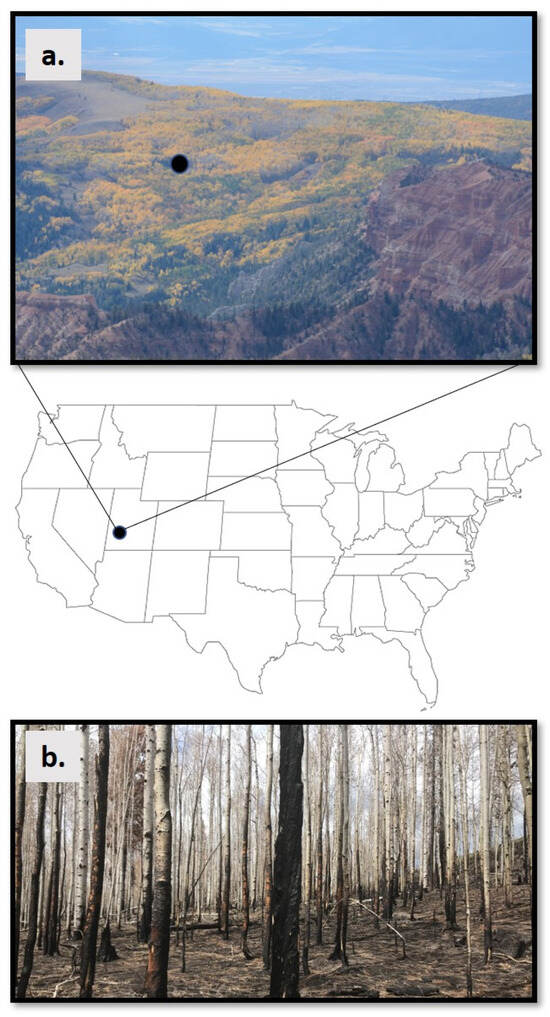
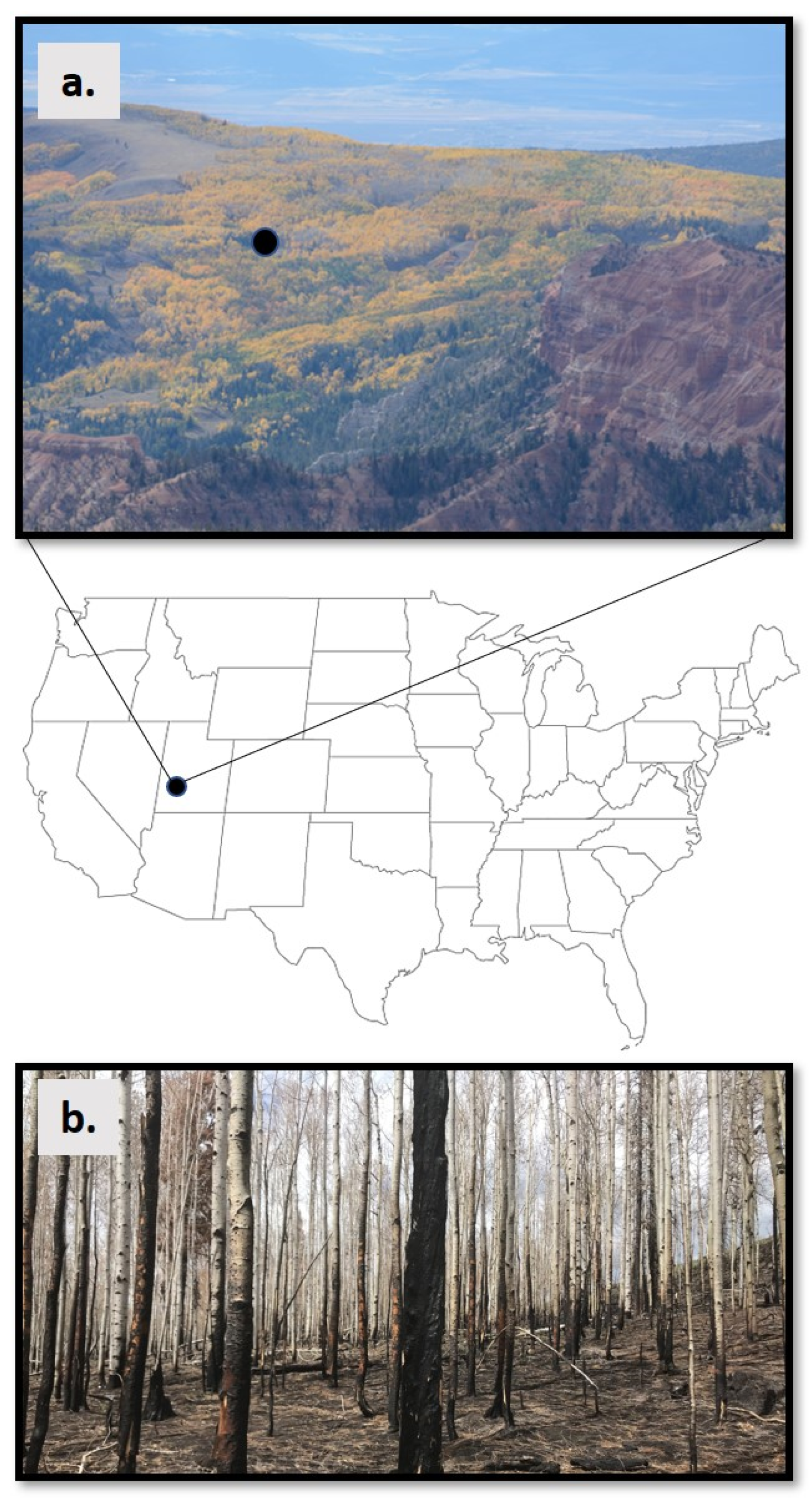
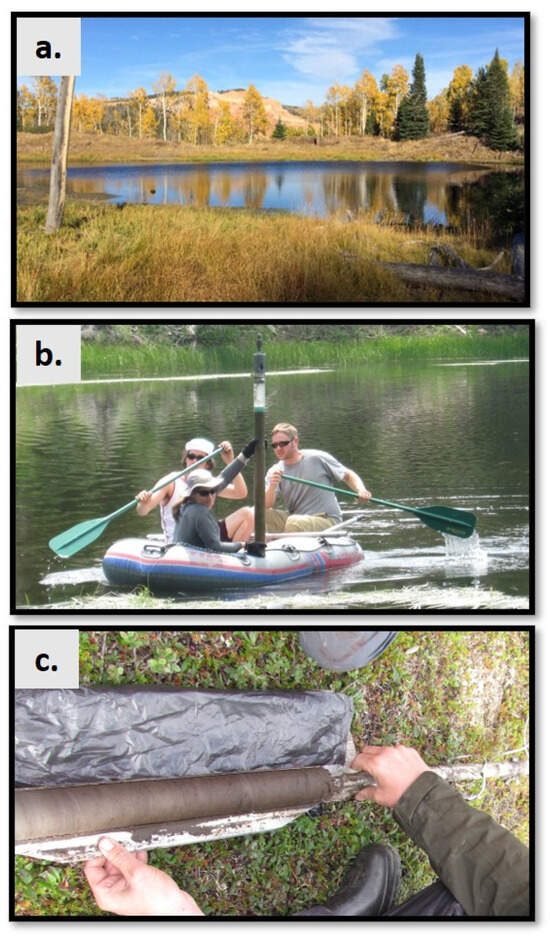
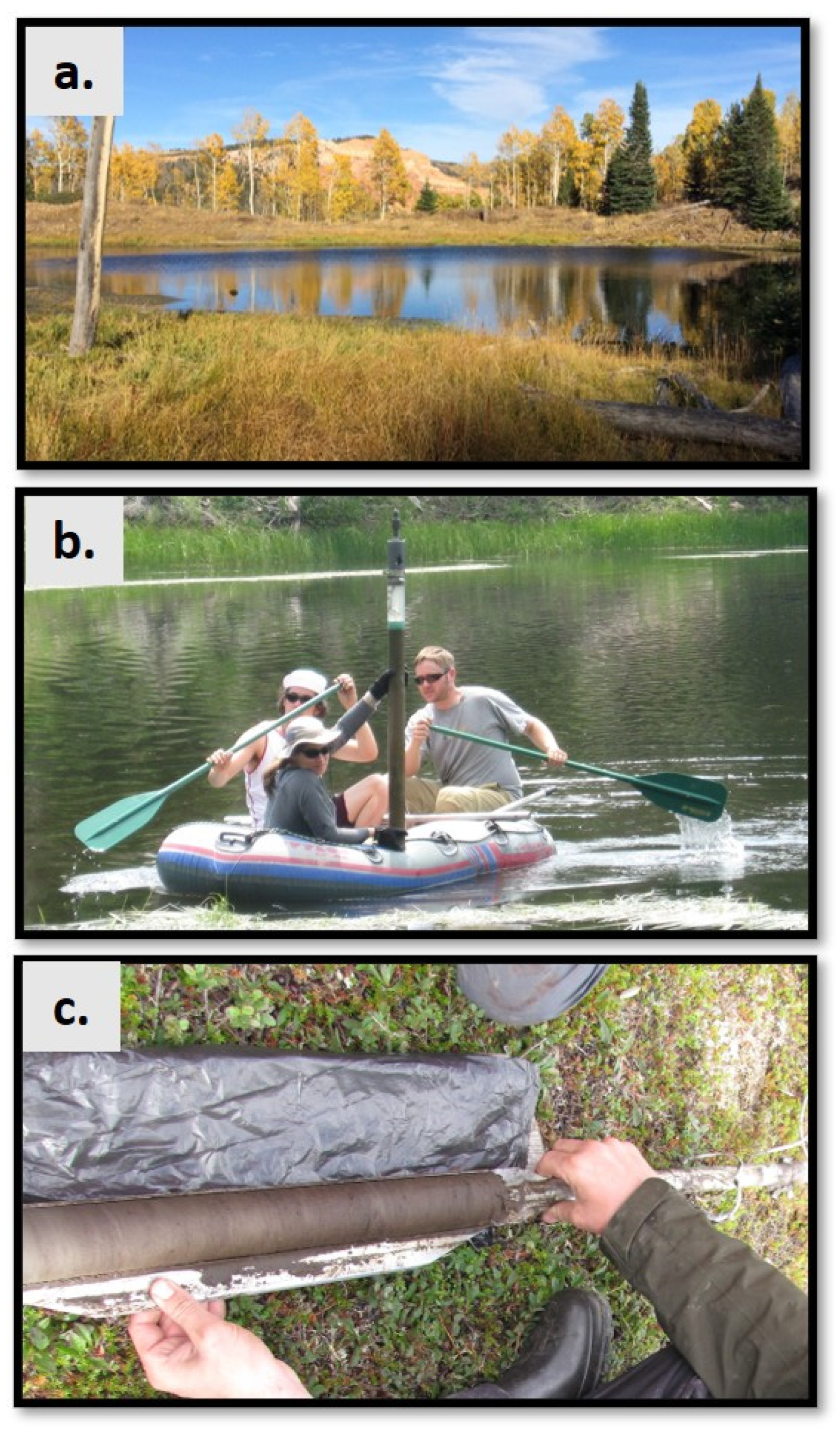
An unmodified (i.e., intact), east-facing cirque lake situated in a stable aspen community [17] in the Dixie National Forest of southwestern Utah was located for sampling. At the time of coring in September 2015, Sugarloaf Pond (37°40′20.47″ N, 112°54′13.29″ W, 2886 m asl) had a relatively small surface area (0.27 ha) and water depth of ~8 m (Figure 1). The western edge of the pond had evidence of a past possible seasonal outflow channel, but the deep pond had shallow shorelines where substantial opportunity for Cyperaceae development exists. A 2.75 m long sediment core was retrieved using a modified Livingstone corer [34] deployed from a pontoon raft anchored at the lake center (Figure 2). The watershed draining into Sugarloaf Pond is spatially small (<1 km2), and is a tributary to Lake Creek and Coal Creek, where the latter terminates into the Cedar Valley Aquifer in the eastern Great Basin [35]. The modern vegetation community at Sugarloaf Pond is dominated by a nearly pure, mature aspen forest (Figure 1 and Figure 2) with canopy-dominant stems that are approximately 170 years in age as indicated by increment cores that were collected in September 2015 [13].
Figure 1.
Location of the study area. (a) Sugarloaf Pond situated in a landscape of quaking aspen (black dot), and (b) example of a recently burned (fall 2019) aspen stand located in the Central Rocky Mountains (photo credit: the authors).
Figure 2.
Sediment core sampling at Sugarloaf Pond. (a) Sugarloaf Pond landscape, (b) sampling from raft, and (c) portion of sediment core (photo credit: the authors).
2.2. Climatic Context
The upland landforms in southwestern Utah receive significant warm-season precipitation derived from the North American Monsoon (NAM) and during the cool-season from Pacific frontal storms [36,37]. Despite broad seasonal trends across the region, monthly precipitation maxima are heterogeneous due to complex topography and steep elevation gradients [36]. Cool-season precipitation is modified by El Niño–Southern Oscillation (ENSO) modality [38,39]. ENSO modes are described as positive (or negative) indicating warm (or cool) sea surface temperatures in the southern Pacific Ocean. During an El Niño episode the southwestern US tends to receive greater-than-average winter precipitation, whereas arid, cool-season conditions prevail during La Niña, but long-term ENSO frequency and intensity is variable [40]. Long-term ENSO variability generally increased over the course of the Holocene (i.e., the last 11,200 years). In southern Utah, elevated risk and recurrence of wildfire aligns with La Niña modality [41,42] and this sensitivity is reflected in vegetation and fire history reconstructions from sites located in the same region as Sugarloaf Pond [32,43,44,45]. Warm-season precipitation is modified by NAM variability [36], but in this region of Utah, warm-season precipitation historically never accounted for more than ~30% of the total annual precipitation.
Previous work on Sugarloaf Pond found that the successional dynamics were characterized by quaking aspen succeeding to subalpine fir (Abies lasiocarpa (Hook.) Nutt) over centennial time periods [13], consistent with well-known vegetation successional dynamics of seral aspen communities in North America [17]. This successional dynamic is likely indicative of quaking aspen resilience, and it has been speculated that the process controlling the maintenance of aspen resilience is the occurrence of stand-replacing fires [13]. While the presence of fire events throughout the Sugarloaf Pond record have been noted previously [13], the conditions under which those fires occurred has not been explored.
2.3. Sampling Approach
To reconstruct the fire and vegetation history at Sugarloaf Pond, sediment subsamples (5 cm3) were collected contiguously at 1 cm intervals. These subsamples were analyzed for charcoal and macrofossils following standard protocols, processed with 125 um sieves, and then counted using light microscopy [46,47,48]. During macrofossil analysis, conifer needles were collected and identified, and nine were submitted for radiocarbon (14C) analysis to establish age-depth control [13], calibrated in Calib 7.1 (http://calib.org, accessed 1 August 2017 [49], and modeled using the CLAM package [50]. To reconstruct fire events and recurrence intervals (i.e., the fire regime), we converted charcoal counts to concentration (particles/cm) and then charcoal accumulation rates (CHAR, particles cm−1 y−1). The charcoal concentrations were binned using the median sediment deposition time (10 years/cm) to minimize variations resulting from shifting sedimentation rates. Binned concentrations were then converted to CHAR and decomposed into the background (BCHAR) and peak components using CharAnalysis [51]. BCHAR is the slowly varying CHAR trend, and fire peaks are positive deviations from BCHAR, which are interpreted as originating from a fire episode (i.e., a fire event). Peaks were determined using a loess smoother, robust to outliers, within a 500-year window [52]. BCHAR values for each time interval were subtracted from total CHAR. Peaks were defined as intervals with CHAR values above BCHAR, and were tested for significance using a Gaussian distribution, where peaks that exceeded the 95th percentile were considered significant. This procedure was applied for every 500-year overlapping portion of the record, resulting in a unique threshold for each sample. All peaks were screened to eliminate those that may have resulted from statistically insignificant CHAR variations [53]. If the maximum count in a CHAR peak had a greater than 5% chance of coming from the same Poisson-distributed population as the minimum of the preceding 75 years, the peak was rejected. We used a signal-to-noise index > 3 to indicate that CharAnalysis results were statistically robust [54]. To bolster confidence in our detection of peaks, the CharAnalysis was repeated at the 90, 95 and 99% levels, all of which resulted in nearly identical timing of peak detection. Charcoal peaks were interpreted as large-scale (either locally severe and/or spatially large) fire events in the Sugarloaf Pond watershed.
2.4. Pollen Analysis
Sediment subsamples (1 cm3) for pollen were processed, including the introduction of a known quantity of tracers (Lycopodium spp.), and counted at 2 cm intervals (i.e., every other cm) using light microscopy (400× [55]). Pollen data for species was used to indicate the dominance of overstory vegetation type (i.e., quaking aspen or conifer [13]). To determine the proportional change in vegetation and characterize the accumulation of fuel buildup over time, pollen count data were converted to percentage of the terrestrial sum pollen in C2 version 1.7.7 [56]. The ratio of fir to aspen pollen (fir: aspen) was normalized using the formula (a − b)/(a + b), where a = fir and b = aspen (e.g., [57]). To address fuel limitation, fuel buildup (e.g., biomass) was proxied by the fir: aspen ratio, where it was assumed that the higher proportion of fir pollen indicated a later forest successional stage and, therefore, higher fuel accumulation such that fuel would not be a limiting factor after fire ignition. Because pollen percentages were not directly correlated to overstory or aboveground biomass [45], fir: aspen ratios were interpreted directly as more or less fuel at a given point in time. Collectively, the percentage of fir and aspen pollen comprised the vast majority of arboreal pollen in this sediment core, and therefore it is likely that the dominance of these two species on the landscape indicates higher aboveground biomass. The ratio of arboreal pollen to non-arboreal pollen (AP: NAP) was also calculated as a general indicator of ecosystem vegetation structure.
Pollen percentage data were also used as proxies for climate conditions. In this region, cool-season moisture arriving as snow is generally responsible for water table recharge [58]. Cool-season climate was assumed to be predictable by the presence and quantity of Cyperaceae (e.g., sedges), which is often used as a proxy for cool and moist conditions [1,59]. Cool-season precipitation influences lake level and water tables, i.e., wetter soils and expanded marshes on the lake fringe support high Cyperaceae. We expected that when Cyperaceae was high it indicated moist conditions when biomass accumulation was likely high (indicated by a high fir: aspen ratio) and concordant drought-caused drying of that biomass was rare. When Cyperaceae was low, moisture was lacking and we would expect fires to be more likely if they were driven by dry climate conditions (e.g., drought).
Summer moisture availability (i.e., NAM) was assessed using the sagebrush (Artemisia spp.) to ragweed (Ambrosia spp.) ratio (sagebrush: ragweed) as a proxy [32]. Sagebrush prefers later seasonal arrival of precipitation, while ragweed prefers moisture arriving earlier in the growing season [60,61]. We assumed that the sagebrush: ragweed ratio is a useful qualitative proxy for the NAM because a greater amount of late season precipitation from an intensified monsoon would favor sagebrush over ragweed (higher ratio), and declining late season moisture would favor ragweed over sagebrush (lower ratio). A low ratio likely indicated increased drying during the warm season, which in the Sugarloaf Pond area would indicate lower monsoon-delivered moisture, and therefore higher chance for seasonally dry conditions and fire in the late summer through fall. Species like sagebrush and ragweed are wind-dispersed types that are prolific pollen producers. Given the landscape structure of the Colorado Plateau and Great Basin (i.e., valley/range), where the pollen source area is broad, it is reasonable to assume that there is some attenuation in the pollen signal for these types that is reflective of prevailing climate conditions, and that is not significantly influenced by singular and/or local disturbance events.
Historical climate data from the region was also explored using the Parameter-elevation Regression on Independent Slopes Model at monthly resolution for the period 1901–2020 [62] extracted with ClimateWNA [63] in order to characterize the cool-season climate (non-growing season, ~October–May), and warm-season climate (June–September), which is the time period when the NAM materialized, historically, to provide context to the longer-term proxy climate data.
2.5. Fire Event Analysis
A composite analysis was employed to test whether fire events occurred more or less often than expected. Correspondence of fires to cool-season climate, the primary driver of annual production in this region, was assessed using Cyperaceae (see above). The correspondence of summer moisture to fires was tested using the sagebrush: ragweed. The correspondence of fuel buildup to fire, as stands fluctuated in composition from quaking aspen to subalpine fir, was tested using fir: aspen. For all proxies, pollen percentages were used to accentuate the vegetation conditions that were present during a given fire event. Fire events indicated by CHAR analysis (n = 20 events) were binned in their closest associated calendar year at the resolution of the pollen record (median = 10 years). Because time series of climate and vegetation data were not stationary over the nearly 4000 years of record, they were smoothed using a 5-year low-pass filter with a 50% frequency cut-off and standardized to their mean and standard deviation before compositing the individual fire event dates and the associated sign of each of the proxy time series. To calculate expected events, the observed shift in climate or vegetation data as counts were tallied when the value changed sign and passed the mean observation (0 in z-score value). The counts of fire events that were observed in either the positive or negative direction associated with each of the proxy time series were also tallied. Counts of expected and observed events were then analyzed using a boot-strapped (n = 2000) chi-squared analysis. The chi-square test statistic reports possible differences between counts of observed values when compared to their expected occurrence. Significance was assessed at the p < 0.05 level.
The compositing and chi-square analysis between fire events was repeated using an independent gridded climate reconstruction data set, the Palmer Drought Severity Index (PDSI) record for southwest Utah (grid point 087 [64]), which allowed verification over the latter half of the Sugarloaf Pond record (~2000 years, n = 11 fire events). The annual drought record was smoothed using a 100-year cubic smoothing spline with a 50% frequency cut-off, standardized to its mean and standard deviation. Pearson correlation coefficients between time series of pollen data and charcoal data were calculated to determine possible relationships. Pearsons r and exact p-values are reported.
3. Results
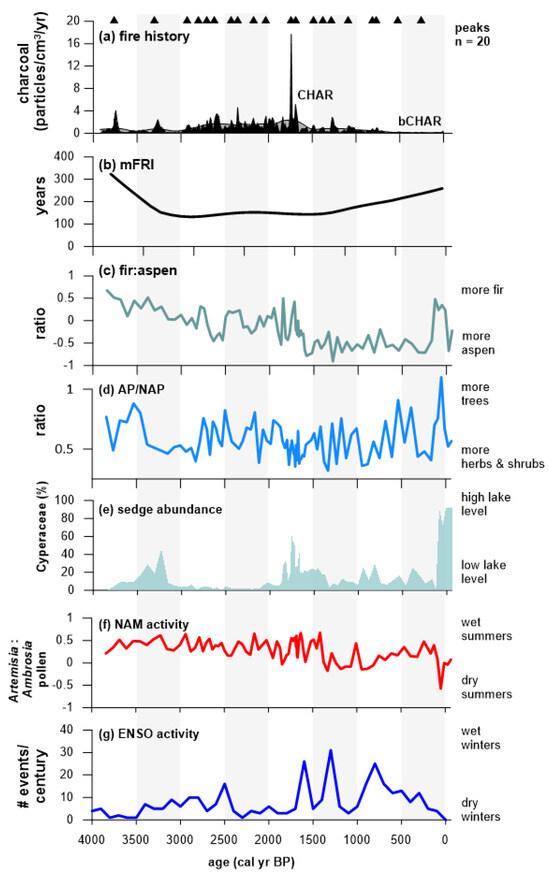
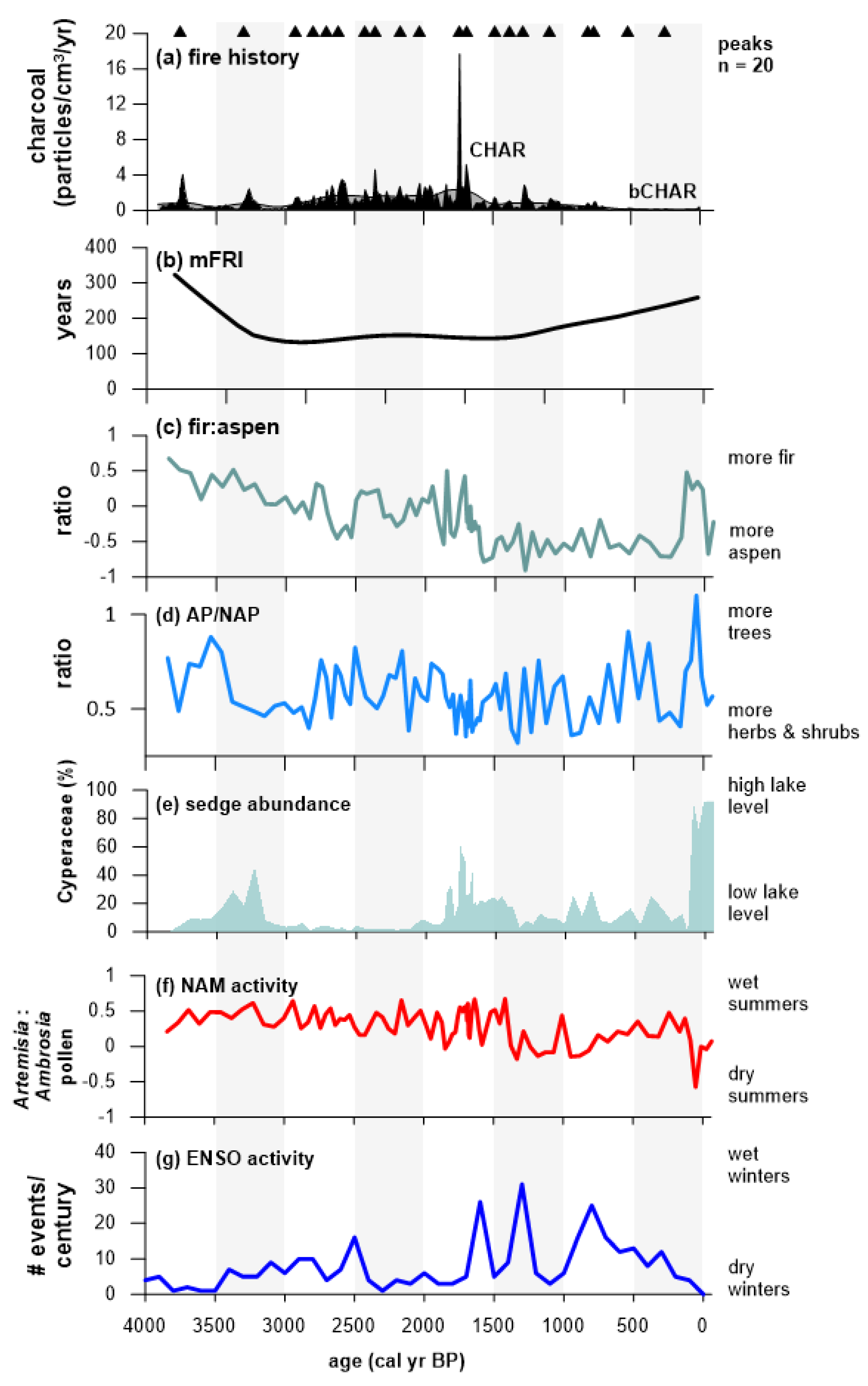
Charcoal influx was a persistent and continuous feature of Sugarloaf Pond and decreased only toward the present (Figure 3a). Robust, and repeated CharAnalysis indicated that there were 20 distinct “peak” fire events that were either local, and/or severe (e.g., stand-replacing), that occurred at Sugarloaf Pond (Figure 3a). The fire return interval calculated from the peak events ranged from 132 to 323 years, with a mean of ~178 over the 4000-year period (Figure 3b). Background char values indicated that other fires occurred within this interval but were not likely to drastically change overstory species composition and structure (i.e., low-severity fires). The subtly shifting fire regime mirrored the fir: aspen ratio in general, where more quaking aspen corresponded to shorter fire return intervals and more subalpine fir corresponded to longer fire intervals, particularly very early and very late in the record (Figure 3b,c).
Figure 3.
Sediment-core-based charcoal and pollen data from Sugarloaf Pond. (a) Fire history events (▲), (b) mean fire return interval, (c) ratio of fir (Abies) to aspen (Populus), (d) ratio of arboreal to non-arboreal pollen, (e) sedge (Cyperaceae) abundance, (f) ratio of sagebrush (Artemisia) to ragweed (Ambrosia) pollen, (g) # of El Niño–Southern Oscillation (ENSO) events per century. The fire history panel (a) is composed of charcoal influx (CHAR), background charcoal influx (bCHAR), and charcoal peaks (▲) that were identified as statistically significant deviations of CHAR above bCHAR. Mean fire interval (b), or fire frequency, is the number of peak fire events (a) per century. The presence of Cyperaceae (e) is a proxy for cool-season moisture. The Artemisia: Ambrosia ratio (f) is a proxy for the North American Monsoon activity. Number of ENSO events per century (g) reconstructed from Laguna Pallcacocha as a proxy for winter precipitation [40].
The major arboreal components of the Sugarloaf Pond record included quaking aspen and subalpine fir, which are both found in the watershed today. The fir: aspen ratio exhibited a generally monotonic decline from 2500–4000 cal y BP with a stepwise decrease towards relatively more aspen after ~1700 cal y BP. Quaking aspen pollen was generally more prevalent towards the present time (Figure 3c). Subalpine fir pollen over the entire record was negatively correlated to quaking aspen pollen (r = 0.67, p < 0.0006). The AP: NAP was relatively stable over the record, although there was a period of sustained greater shrub abundance between 2800 and 3500 cal y BP (Figure 3d). A conspicuous shift in the AP: NAP ratio towards greater forest cover occurred towards the modern period, likely driven by increased fir pollen (Figure 3c,d).
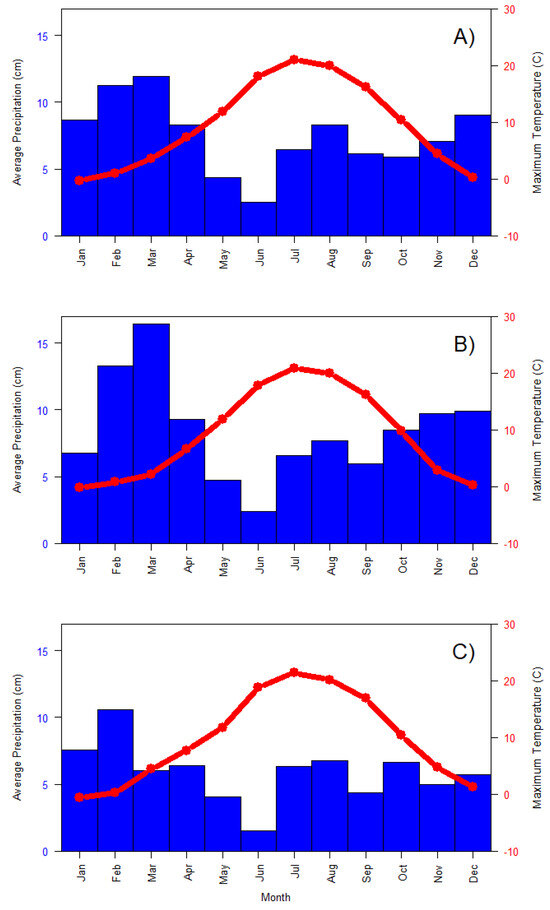
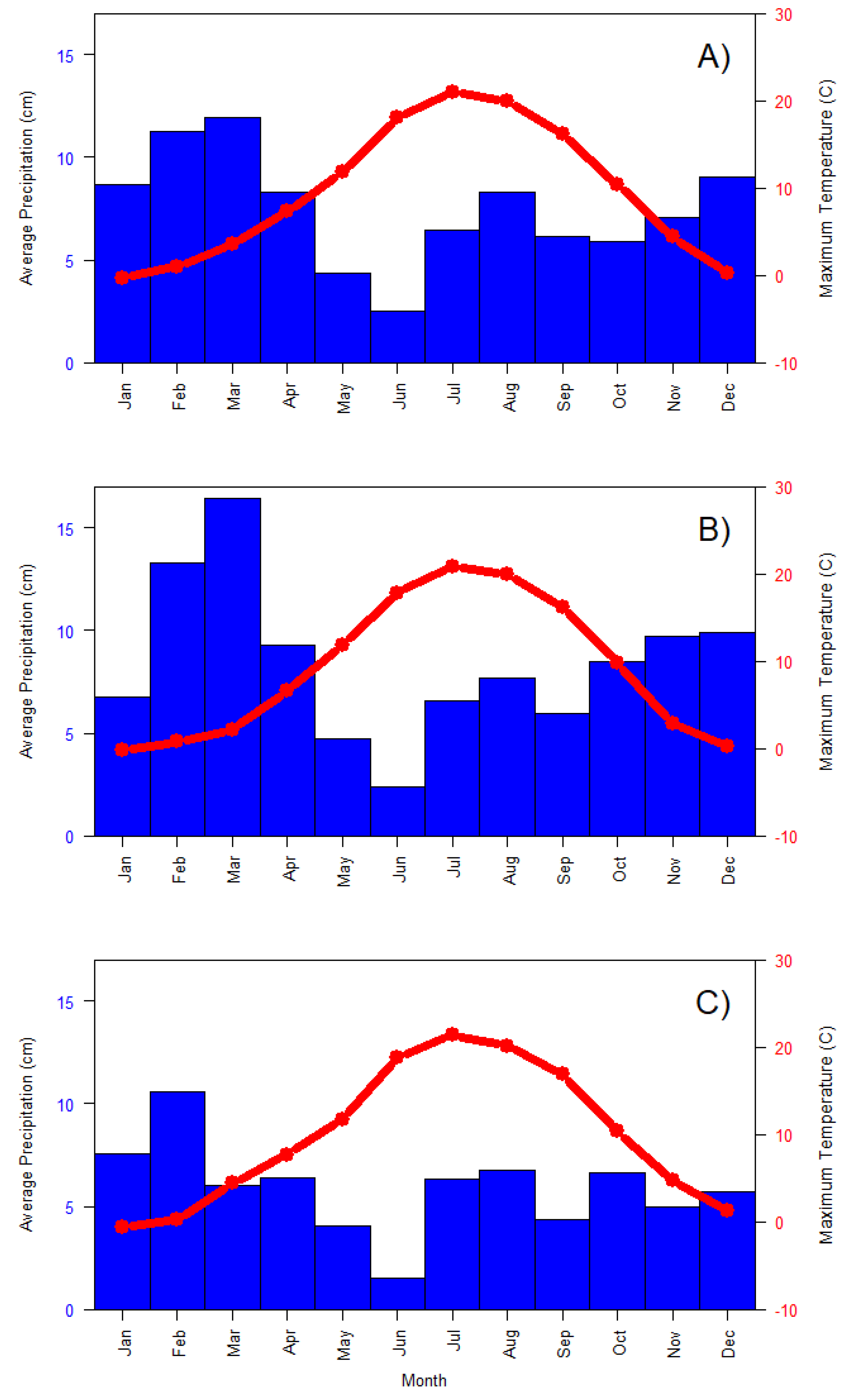
Cool-season moisture was the primary source of annual moisture, having contributed 74% annually, on average, over the historical record, but that varied from very low (dry winters) to very high (wet winters) (Figure 4). The warm-season moisture proxy (sagebrush: ragweed), exhibited wide variability but generally decreased over time, with higher moisture early in the record and relatively lower moisture later (Figure 3f). In the historical record, the four months of the warm season (June–September) only accounted for one-quarter (~26%) of the annual moisture received, on average (Figure 4).
Figure 4.
Average monthly precipitation (dark blue bars) and average monthly maximum temperatures (red line) over 1901–2020 for (A) all years at Sugarloaf Pond, (B) the 10-highest ranked El Niño years, and (C) the 10-highest ranked La Niña years. El Niño–Southern Oscillation January, February, and March data were used for (B,C) (https://psl.noaa.gov/enso/climaterisks/years/top24enso.html, accessed 11 February 2022).
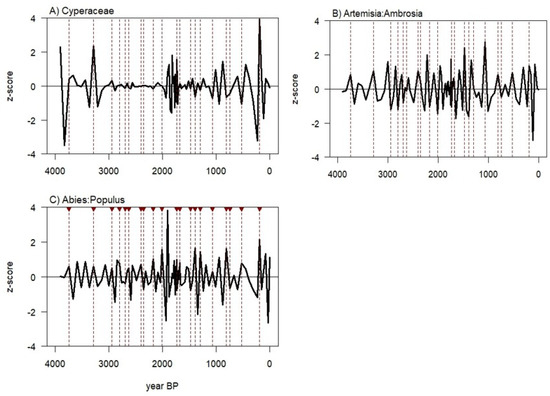
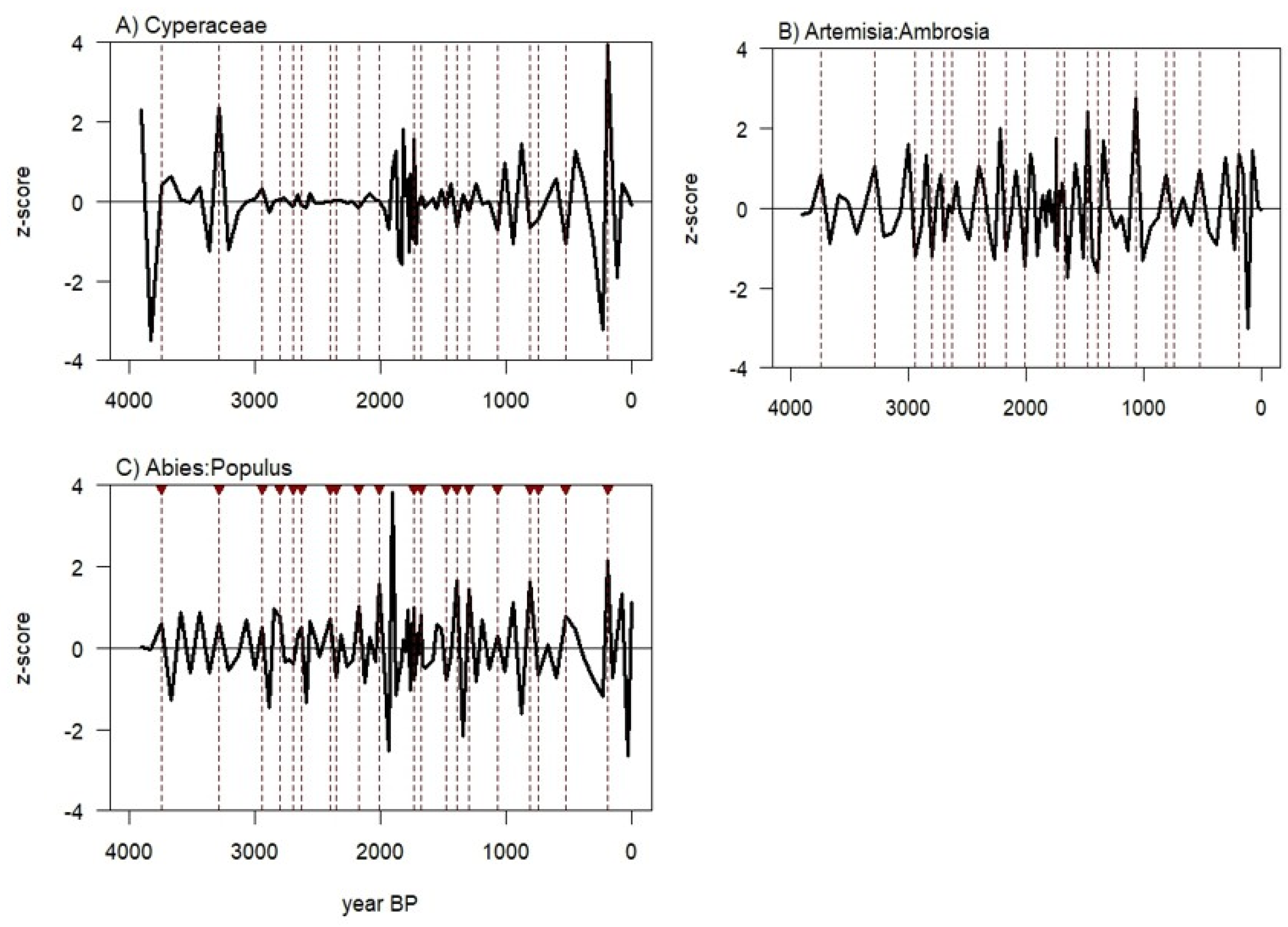
Fire events at Sugarloaf Pond were not predictably related to cool-season moisture based on their occurrence with Cyperaceae pollen (p = 0.769). Thirty-eight percent of the time, fire occurred during high cool-season moisture, and 62% otherwise (Figure 5A). Fire events were not related to warm-season moisture based on their occurrence with the sagebrush: ragweed ratio; rather, they were equally likely to occur in seasons of high moisture (47%) versus seasons with lower moisture (53%, Figure 4B, p = 0.786). Fire events occurred much more commonly during periods of high subalpine fir dominance. Seventy-six percent of fires occurred during higher fir: aspen ratio, whereas only 24% occurred when the fir: aspen ratio was low (p < 0.017, Figure 5C).
Figure 5.
Standardized and smoothed proxy data for (A) cool-season moisture availability (Cyperaceae), (B) warm-season moisture availability (sagebrush: ragweed), and (C) fuel buildup (fir: aspen), with fire events (n = 20) from CharAnalysis plotted as red triangles in (C), and vertical dashed lines throughout.
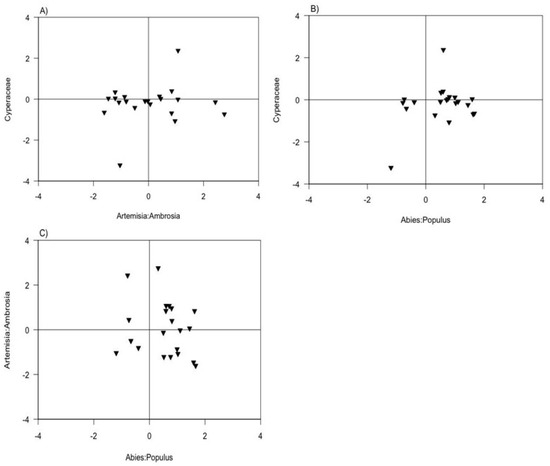
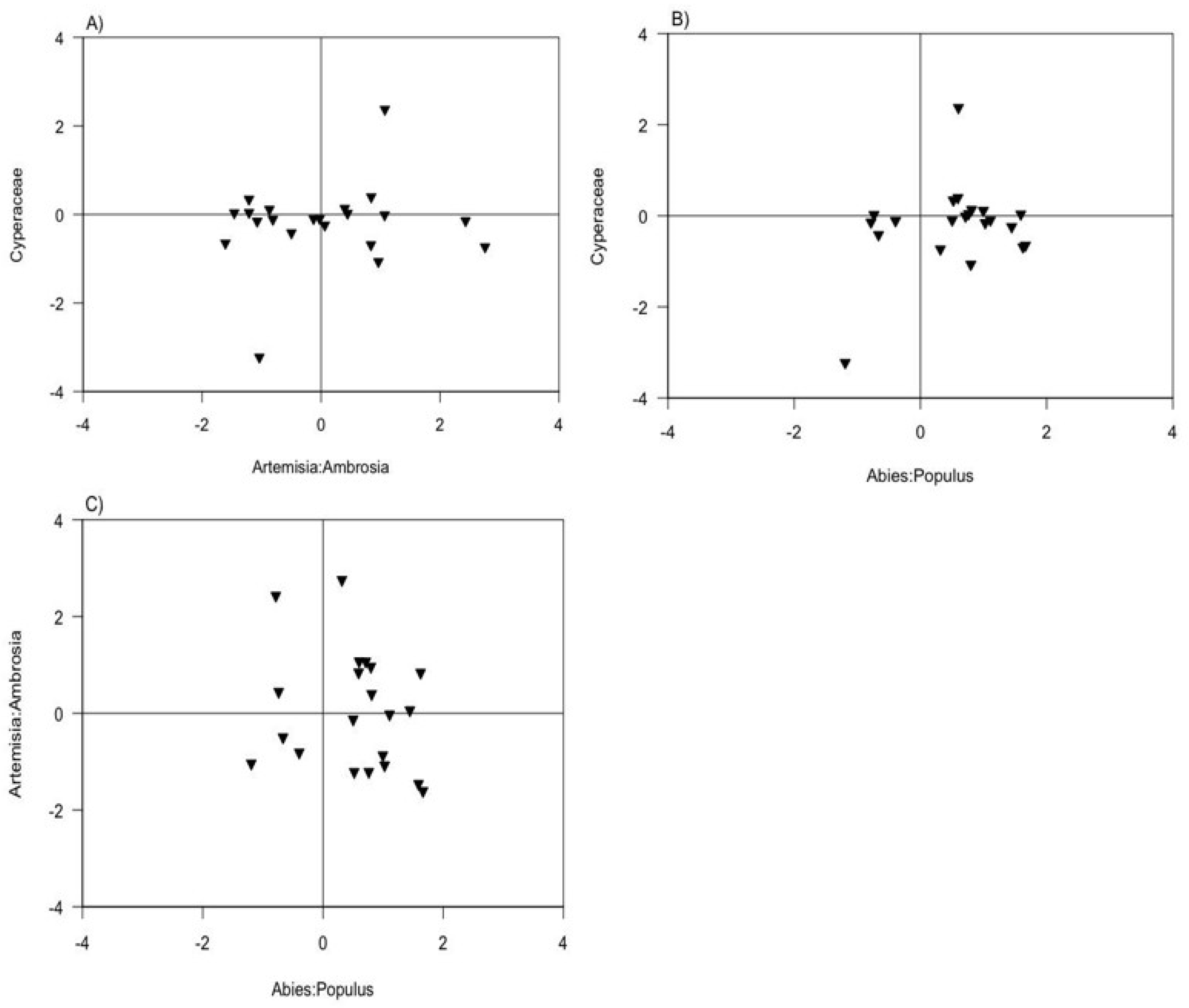
The timing of fire events that did not occur during subalpine fir dominance (n = 5) was distributed uniformly across the last ~4000 years of the record (Figure 5C) and was unrelated to the sagebrush: ragweed ratio (Figure 6C). However, four of these five fire events occurred when cool-season moisture was below average (Figure 6B).
Figure 6.
Biplots of the standardized and smoothed proxy climate and vegetation data associated with fire event dates (n = 20). (A) Cool-season moisture (Cyperaceae) over warm-season moisture (sagebrush: ragweed), (B) cool-season moisture (Cyperaceae) over fuel accumulation (fir: aspen), and (C) warm-season moisture (sagebrush: ragweed) over fuel accumulation (fir: aspen).
Although fire events were not related to cool-season moisture, the fire return interval was strongly and significantly related to cool-season moisture over the entire ~4000-year record (r = 0.48, p < 0.0001), and when considering only years with fire events (n = 20), the relationship remained strong (r = 0.60, p < 0.0037). The fire return interval was also positively correlated with the fir: aspen ratio, but was not significant (r = 0.36, p = 0.125).
Eleven fire events were not predictably related to PDSI over the last 2000 years. Fifty-five percent of these fires occurred during wet periods, while 45% of the events occurred during dry periods (p = 0.783).
4. Discussion
We hypothesized that the quaking-aspen-dominated forest that surrounded Sugarloaf Pond has not always been dominated by aspen, and that stand-replacing fire was a possible mechanism that controlled that change. The decadal-scale resolution and difficulty in interpreting causality in paleoecological studies are both reasons to be cautious of the support for this hypothesis. We also hypothesized that the fire events would be predictably related to time periods characterized by moisture deficit (i.e., drought), either in the cool season or the warm season. Counterintuitively, no relationship was found between fire events and moisture deficit. There was, however, a strong correspondence that indicated that fire events were much more likely to occur when the composition of the forest was dominated by subalpine fir, presuming that total stand biomass was relatively high and fuel loading sufficient to support a fire large enough to be recorded as charcoal peak in Sugarloaf Pond. To complicate the story, the fire return interval was strongly positively correlated to the cool-season moisture proxy, Cyperaceae pollen, for the entire ~4000 years of record, and this relationship strengthened when considering only the dates in which the fire events occurred. In combination, these results suggest that in this high-elevation quaking aspen forest, fuel buildup was associated with individual fire events, offering support for the fuel-limited hypothesis. In the longer term, fire frequency was associated with cool-season moisture, offering support for the climate-limited hypothesis—where wetter periods exhibited longer intervals between fires and subsequently became increasingly dominated by subalpine fir.
The long-term record indicated that the drainage was likely in flux between quaking aspen and subalpine fir as biomass-dominant trees for virtually the entire ~4000 years of study. Fire likely contributed to the relatively rapid shifts from high biomass in the overstory to quaking aspen dominance on a scale of 1–2 centuries, on average. High biomass accumulation was both necessary and sufficient to create the conditions for fire. There was no evidence in the dataset that drought was a limiting factor for fire occurrence. Droughty regional conditions, whether in the cool season or warm season, did not coincide with subalpine fir overstory dominance during fire events. Fire events putatively led to post-fire dominance by quaking aspen, but on the scale of centuries, aspen always eventually succeeded to subalpine fir. Of the metrics tested, the occurrence of fire events was much more likely at high subalpine fir composition and did not predictably occur during cool-season or warm-season moisture deficits.
The significant and positive relationship between the fire return interval and the fir: aspen ratio was secondary evidence that, when there was a high preponderance of subalpine fir, the fire interval was longer, and when there was a high preponderance of quaking aspen, the likelihood of fire events was lower. This observation may be due to the nature of quaking aspen forests holding more moisture, which is likely earlier in stand development [6], but is also possibly related to the increased biomass associated with later stages of succession. Fire that was not stand-replacing in the vicinity of Sugarloaf Pond no doubt occurred, evident by the background charcoal. However, these fires likely encountered either low fuel accumulation or moist conditions, or both, and were not likely to build to events that were recorded as charcoal peaks in the lake sediment. The occurrence of the biggest fires likely acted to shift composition from subalpine fir dominance back to quaking aspen. The fires themselves likely acted on mostly non-aspen biomass (Figure 1b), but the presence of quaking aspen root stock on or near the site guaranteed that it will predictably respond to the opening of growing space as would be expected of a pioneering species that vegetatively reproduces [18].
The reconstructed fire return interval for Sugarloaf Pond was as short as 132 years, or as long as 323 years, consistent with some previous research that speculated on the range of probable fire frequencies in aspen-dominated forest types [18]. Age structure analysis in Colorado aspen forests estimated that the fire return interval prior to human settlement was ~140 years and required over a century for an area the size of their study to burn (~76 km2), understanding that some would burn more than once, and some never [65]. In contrast, the modeled fire regime condition class characterization of the aspen biophysical settings for Southern Rocky Mountain quaking aspen communities suggested that fire return intervals were ~10–120 years, whereas those for Northern Rocky Mountain quaking aspen communities ranged from 10 to 165 years [66]. The average fire return interval over the last ~4000 years at Sugarloaf Pond is at the upper end of the model-based estimates [66]. Carter et al. [33] found that the fire return interval averaged ~109 years when the landscape around Long Lake in southeast Wyoming was dominated by quaking aspen but averaged ~166 when dominated by lodgepole pine (Pinus contorta Doug. ex Loud. var. latifolia Engelm. ex S. Watson). However, at 2700 m in elevation and at higher latitude, it is likely that the climate–fire–vegetation interactions at Long Lake differ from Sugarloaf Pond. Perhaps most important is that, unlike at Sugarloaf Pond, when quaking aspen presence decreased at Long Lake, it gave way to lodgepole pine, another fire-driven species, instead of other shade-tolerant conifers. As a result, the interaction between overstory dominance and fire return interval would be somewhat less dichotomized than what was observed at Sugarloaf Pond.
Large variability in cool-season moisture (Cyperaceae) can be seen across the past ~4000 years and likely influenced the fir: aspen ratio regionally. The fact that the wettest winters in the entire 4000-year record occurred over the last ~100 years likely corresponded to the well-documented phenomenon of relatively high moisture during the 20th century. This high level of moisture might confound the interpretation that the fire suppression era is (solely) responsible for 20th century fuel build-up and documented 21st century fire severity and fire extent increases [67,68]. Rather, superimposed over a century of fire suppression is a period of relatively moist conditions that would have further exacerbated fire behavior had they occurred. Indeed, Sugarloaf Pond is currently dominated by aging aspen, nearly 170 years old [13]. In the absence of disturbance, it is only a matter of time before subalpine fir establishes in the understory of the quaking aspen, given the centennial-scale increase in moisture that is dominated by snowpack. Fire risk will continue to build as long as subalpine fir composition and associated biomass increases.
Regionally, other montane lakes have recorded the last ~2500 years as being wetter than previously in the Holocene, except during periods of exceptional drought (e.g., Medieval Climate Anomaly [32,69]), and this could be one reason we see decreasing charcoal influx to the present, increasing subalpine fir at the expense of quaking aspen, and an increasing AP: NAP at Sugarloaf Pond. While ENSO is one driver of cool-season moisture, it is not the only driver. Jiménez-Moreno & Anderson [70] reported that an insolation-driven shift in precipitation state (i.e., rain vs. snow) over the Holocene likely occurred in western Colorado. However, in the case of this ~4000-year record from Sugarloaf Pond, winter insolation has decreased over the period of record [71]. Generally, a trend of decreasing insolation during winter is likely responsible for the genesis of Sugarloaf Pond because water tables in this region—and, therefore, lake levels—are largely modulated by snowpack [58]. Therefore, it is unlikely that there have been substantial state changes in winter precipitation variability over the last 4000 years at Sugarloaf Pond.
Although the four months of the warm season (June–September) accounted for just 26% of the annual moisture, historically (Figure 5), this additional seasonal moisture is likely important for fuel buildup, especially in comparison to a strictly continental climate that has predictable seasonal droughts, and possibly ameliorated the drought conditions that are conducive to increased fire risk. Furthermore, it has been speculated that the occurrence and intensity of the NAM has likely been highly variable, where periods of failed monsoon might be expected to increase drought and fire chances and vice versa. However, it has been noted that the NAM variability is coupled with cool-season moisture changes [72], and, therefore, the effect of the warm-season monsoon drying could be buffered when the cool season is inversely correlated with the NAM, or exacerbated when the cool season is positively correlated with NAM. Studies focused on the potential relationship between NAM and antecedent snowpack (i.e., ENSO) have suggested that there is a negative correlation between the strength and northward propagation of the NAM during years with above average snow cover and depth (i.e., El Niño, [73,74,75]). Because 26% of the moisture in this region was associated with the warm season, the sagebrush: ragweed proxy likely reflects a weakening monsoon over the past ~4000 years. For example, at ~1K BP there is a conspicuous peak in the sagebrush: ragweed ratio that coincided with a lull in ENSO activity. In the southwest, lower snowpack years corresponded to the La Niña phase, and El Niño brought greater snowpack. We speculate that the relationship between the NAM and cool-season moisture likely buffers or exacerbates the likelihood of fire depending on modality. That is, El Niño periods were wetter, having a suppressive effect on fire events, and therefore a compensatory effect, whereas La Niña’s likely had drier springs that could result in drying of fuel that might result in a higher chance of a fire event.
Variation in the relative role of top-down and bottom-up controls on fire activity has been found in previous work [76] and, as in this work, has been hypothesized to be associated with the temporal scale of observation [15]. Climate-driven fire events were not implicated in any of the analyses, suggesting that the fire events in this basin were less sensitive to climatic variability than to available fuel loading. While we cannot attribute the cause of any of the fire events, it is possible, and likely, that many ignitions occurred during periods of both favorable and unfavorable climate, especially considering that Indigenous People were responsible for cultural burning during the entire period of our record up until the late-1800s both regionally [77] and continent-wide [78,79]. It is very likely that many fires started during dry climatic periods but did not build into fires large enough to be detected by the charcoal analysis. Only when fuel loading was high were stand-replacing fires significantly recorded as peaks of charcoal in the sediment record at Sugarloaf Pond, providing evidence for hypothesis 2b. Conversely, the fire return interval was significantly related to our cool-season moisture proxy, and more strongly so when considering the relationship for the observed fire events, which suggested a protracted fire interval when moisture was high, and shortened interval between events when moisture was low.
Finally, while climate conditions would be expected to be regional, fuel buildup and stand development has the potential to vary locally and will depend on stand-scale disturbance history. We could speculate that forest structure was relatively constant over the last ~4000 years at Sugarloaf Pond given that both fir and aspen are prevalent on the modern landscape and that their relative pollen percentages in the context of the entire record are roughly similar. However, comparison of these results to previously published records in the region, including Morris Pond on the nearby Markagunt Plateau [32], Purple Lake on the Aquarius Plateau [80], and Blue Lake and Emerald Lake on the Wasatch Plateau [45,81], offers some insight into the vegetation community composition change during the Holocene. While these sites occur at higher elevations (>3000 m), the increase in quaking aspen in the subalpine zone in south-central Utah that began ~3000 years ago suggests that aspen was well established at mid-montane elevations in the region. Increasing evidence of quaking aspen in the subalpine zone throughout the Holocene is accompanied by general declines in wildfire in recent millennia [32], similar to what was observed at Sugarloaf Pond. However, the presence of charcoal in forest soils was also found to be related to aspen persistence in the nearby Pando clone of Utah [82].
4.1. Management Implications
With just under 4000 years of fire history reconstruction for a currently aspen-dominated landscape, there is ample information to guide how contemporary management might view suppressing fire, setting fire, or the risk of fire in the quaking-aspen-dominated forests around Sugarloaf Pond. This study quantitatively indicated that the fuel accumulation associated with the shift between quaking aspen to subalpine fir resulted in a higher likelihood of stand-replacing fire, and, therefore, a shift back to quaking aspen dominance. However, it has taken well over a century at Sugarloaf Pond for sufficient fuel buildup before a large fire was likely to occur. Moreover, the amount of charcoal in the record was strongly related to overall biomass production, further suggesting that fire events were driven by fuel buildup. Therefore, the observation that stable aspen communities are self-replacing [17], and that fire is less common in the short term (i.e., decades to centuries), does not preclude the longer-term (i.e., centuries to millennia) possibility that fire becomes more likely with fuel accumulation, regardless of species composition. The absence of fire events during periods of quaking aspen dominance in the Sugarloaf Pond record suggests the possibility that fuel reduction approaches could effectively limit high-severity fire behavior in the short term.
The range of stand-replacing, fire return intervals for this quaking-aspen-dominated forest was not unexpected (132–323 years) but does span the higher end of that expected for aspen, generally (i.e., ~10–165 years [66]). While the lower end of this range (~130 years) is a good approximation of the age of maturing aspen stands, over 300 years is beyond the lifespan of an individual quaking aspen stem. At nearly three centuries between fires, it is not hard to imagine a senescent quaking aspen forest succeeding to subalpine fir, along with the associated increase in ladder fuels, canopy fuels, etc. Additionally, this is a time when large woody fuel accumulation would be expected to be on the increase due to a combination of large canopy gaps from dying aspen, increased light penetration to the understory, increased grass and herbaceous components, and, perhaps most importantly, the establishment of subalpine fir. At this advanced age, and in the continued absence of fire, the aspen will succeed to conifers, which will come to dominate the site. Even at the longest fire regime interval measured here, i.e., ~500 years, early in the record, fire is still likely associated with the turnover of forest biomass.
4.2. Study Limitations
While the sediment-core-based reconstruction exceeds the estimated fire return interval by millennia, important for accurately characterizing fire regimes, its inherent point-based nature does not likely characterize the full magnitude of individual large fires, except to the extent that the Sugarloaf Pond watershed, which is relatively small, captures charcoal from primarily local fires. For this reason, inference based on the results should be considered carefully if applied to other geographic areas. Similarly, the fact that forest type, structure, and composition on the landscape are things that shift over long time periods makes conclusive interpretation of multi-millennial records over large areas more tenuous than typical fire history reconstructions (i.e., centuries). While technically feasible, the reproduction of the methodological approach taken here for other lakes may prove difficult given site-specific differences in vegetation assemblages and charcoal preservation.
5. Conclusions
Directly testing proxies for cool- and warm-season climate and fuel accumulation against reconstructed fire events presented the possibility to better understand natural dynamics of quaking aspen fire regimes, and specifically the putative climate- versus fuel-limited drivers. Long-term records of quaking aspen fire regimes are sorely lacking, and studies like this greatly improve the understanding of the ecology of fuel-limited vegetation systems, which can influence the approach to quaking aspen fire and fuels management. Counterintuitive to expectations that the fire regime would be limited by climate, strong evidence was found that the occurrence of stand-replacing fires in this ecosystem was fuel-limited, i.e., predictably related to the accumulation of fuel necessary to support a large fire. However, cool-season moisture was positively related to fire return interval, especially during fire events, which confirmed that climate is playing a long-term, top-down role–-through its effect on fuel accumulation.
Author Contributions
J.L.M. and R.J.D. designed the study, obtained the funding, oversaw and contributed to data collection and development, performed analysis and writing, and approved the final manuscript. All authors have read and agreed to the published version of the manuscript.
Funding
This research was funded by the state of Utah, Cedar Mountain Initiative (R.J.D.). The research effort was supported in part by a National Science Foundation award #EAR-2102997 (J.L.M.). This research was supported by the Utah Agricultural Experiment Station, Utah State University, and approved as journal paper number 9688.
Institutional Review Board Statement
Not applicable.
Informed Consent Statement
Not applicable.
Data Availability Statement
Data collected for this study are available upon request to the authors.
Acknowledgments
We thank the Center for Applied Isotope Studies at the University of Georgia for radiocarbon analysis, Stacy Morris for laboratory work, and John Israelsen and Dan Mckenna for fieldwork assistance.
Conflicts of Interest
The authors declare no conflicts of interest. The funders had no role in the design of the study; in the collection, analyses, or interpretation of data; in the writing of the manuscript; or in the decision to publish the results.
References
- Kuhn, T.J.; Safford, H.D.; Jones, B.E.; Tate, K.W. Aspen (Populus tremuloides) Stands and Their Contribution to Plant Diversity in a Semiarid Coniferous Landscape. Plant Ecol. 2011, 212, 1451–1463. [Google Scholar] [CrossRef] [Scilit]
- McCool, S.F. Quaking Aspen and the Human Experience: Dimensions, Issues, and Challenges. In Proceedings of the Sustaining Aspen in Western Landscapes: Symposium Proceedings, Grand Junction, CO, USA, 13–15 June 2000; U.S. Department of Agriculture, Forest Service, Rocky Mountain Research Station: Fort Collins, CO, USA, 2001; p. 147. [Google Scholar]
- Madritch, M.D.; Greene, S.L.; Lindroth, R.L. Genetic Mosaics of Ecosystem Functioning across Aspen-Dominated Landscapes. Oecologia 2009, 160, 119–127. [Google Scholar] [CrossRef] [Scilit] [PubMed]
- LaRade, S.; Bork, E. Short Communication: Aspen Forest Overstory Relations to Understory Production. Can. J. Plant Sci. 2011, 91, 847–851. [Google Scholar] [CrossRef] [Scilit]
- DeByle, N.V.; Bevins, C.D.; Fischer, W.C. Wildfire Occurrence in Aspen in the Interior Western United States. West. J. Appl. For. 1987, 2, 73–76. [Google Scholar] [CrossRef] [Scilit]
- Nesbit, K.A.; Yocom, L.L.; Trudgeon, A.M.; DeRose, R.J.; Rogers, P.C. Tamm Review: Quaking Aspen’s Influence on Fire Occurrence, Behavior, and Severity. For. Ecol. Manag. 2023, 531, 120752. [Google Scholar] [CrossRef] [Scilit]
- LaMalfa, E.M.; Ryle, R. Differential Snowpack Accumulation and Water Dynamics in Aspen and Conifer Communities: Implications for Water Yield and Ecosystem Function. Ecosystems 2008, 11, 569–581. [Google Scholar] [CrossRef] [Scilit]
- Lindroth, R.L.; Clair, S.B.S. Adaptations of Quaking Aspen (Populus tremuloides Michx.) for Defense against Herbivores. For. Ecol. Manag. 2013, 299, 14–21. [Google Scholar] [CrossRef] [Scilit]
- Clements, F.E. The Life History of Lodgepole Burn Forests. USDA For. Serv. Bull. 1910, 79, 7–56. [Google Scholar]
- DeRose, R.; Leffler, A. Simulation of Quaking Aspen Potential Fire Behavior in Northern Utah, USA. Forests 2014, 5, 3241. [Google Scholar] [CrossRef] [Scilit]
- Anderegg, W.R.L.; Schwalm, C.; Biondi, F.; Camarero, J.J.; Koch, G.; Litvak, M.; Ogle, K.; Shaw, J.D.; Shevliakova, E.; Williams, A.P.; et al. Pervasive Drought Legacies in Forest Ecosystems and Their Implications for Carbon Cycle Models. Science 2015, 349, 528. [Google Scholar] [CrossRef] [Scilit]
- Aukema, B.H.; Carroll, A.L.; Zheng, Y.; Zhu, J.; Raffa, K.F.; Moore, R.D.; Stahl, K.; Taylor, S.W. Movement of Outbreak Populations of Mountain Pine Beetle: Influences of Spatiotemporal Patterns and Climate. Ecography 2008, 31, 348–358. [Google Scholar] [CrossRef] [Scilit]
- Morris, J.L.; DeRose, R.J.; Brussel, T.; Brewer, S.; Brunelle, A.; Long, J.N. Stable or Seral? Fire-Driven Alternative States in Aspen Forests of Western North America. Biol. Lett. 2019, 15, 20190011. [Google Scholar] [CrossRef] [Scilit] [PubMed]
- Turner, M.G.; Gardner, R.H. Landscape Disturbance Dynamics. In Landscape Ecology in Theory and Practice: Pattern and Process; Turner, M.G., Gardner, R.H., Eds.; Springer: New York, NY, USA, 2015; pp. 175–228. ISBN 978-1-4939-2794-4. [Google Scholar]
- Whitlock, C.; Higuera, P.E.; McWethy, D.B.; Briles, C.E. Paleoecological Perspectives on Fire Ecology: Revisiting the Fire-Regime Concept. Open Ecol. J. 2010, 3, 6–23. [Google Scholar] [CrossRef] [Scilit]
- Martin, R.E.; Sapsis, D.B. Fires as Agents of Biodiversity: Pyrodiversity Promotes Biodiversity. In Proceedings of the Symposium on Biodiversity of Northwestern California, Santa Rosa, CA, USA, 28–30 October 1991; pp. 150–157. [Google Scholar]
- Rogers, P.C.; Landhäusser, S.M.; Pinno, B.D.; Ryel, R.J. A Functional Framework for Improved Management of Western North American Aspen (Populus tremuloides Michx.). For. Sci. 2014, 60, 345–359. [Google Scholar] [CrossRef] [Scilit]
- Shinneman, D.J.; Baker, W.L.; Rogers, P.C.; Kulakowski, D. Fire Regimes of Quaking Aspen in the Mountain West. For. Ecol. Manag. 2013, 299, 22–34. [Google Scholar] [CrossRef] [Scilit]
- DeByle, N.V.; Winokur, R.P. Aspen: Ecology and Management in the Western United States; General Technical Report RM-119; U.S. Department of Agriculture, Forest Service, Rocky Mountain Forest and Range Experiment Station: Fort Collins, CO, USA, 1985. [Google Scholar]
- Mueggler, W.F. Age Distribution and Reproduction of Intermountain Aspen Stands. West. J. Appl. For. 1989, 4, 41–45. [Google Scholar] [CrossRef] [Scilit]
- Kaufmann, M.R.; Veblen, T.T.; Romme, W.H. Historical Fire Regimes in Ponderosa Pine Forests of the Colorado Front Range, and Recommendations for Ecological Restoration and Fuels Management; U.S. Department of Agriculture Forest Service, Rocky Mountain Research Station: Fort Collins, CO, USA, 2006; Available online: https://cfri.colostate.edu/wp-content/uploads/sites/22/2018/03/Kaufmann_HistoricalFireRegimesFrontRange1.pdf (accessed on 23 November 2022).
- Stephenson, N.L. Reference Conditions for Giant Sequoia Forest Restoration: Structure, Process, and Precision. Ecol. Appl. 1999, 9, 1253–1265. [Google Scholar] [CrossRef]
- Swetnam, T.W.; Baisan, C.H.; Caprio, A.C.; Brown, P.M.; Touchan, R.; Anderson, R.S.; Hallett, D.J. Multi-Millenial Fire History of the Giant Forest, Sequoia National Park, California, USA. Fire Ecol. 2009, 5, 120–150. [Google Scholar] [CrossRef] [Scilit]
- Stoddard, M.T.; Roccaforte, J.P.; Meador, A.J.S.; Huffman, D.W.; Fulé, P.Z.; Waltz, A.E.M.; Covington, W.W. Ecological Restoration Guided by Historical Reference Conditions Can Increase Resilience to Climate Change of Southwestern U.S. Ponderosa Pine Forests. For. Ecol. Manag. 2021, 493, 119256. [Google Scholar] [CrossRef] [Scilit]
- Hood, S.M.; Harvey, B.J.; Fornwalt, P.J.; Naficy, C.E.; Hansen, W.D.; Davis, K.T.; Battaglia, M.A.; Stevens-Rumann, C.S.; Saab, V.A. Fire Ecology of Rocky Mountain Forests. In Fire Ecology and Management: Past, Present, and Future of US Forested Ecosystems; Greenberg, C.H., Collins, B., Eds.; Managing Forest Ecosystems; Springer International Publishing: Cham, Switzerland, 2021; pp. 287–336. ISBN 978-3-030-73267-7. [Google Scholar]
- Sharik, T.L.; Adair, W.; Baker, F.A.; Battaglia, M.; Comfort, E.J.; D’Amato, A.W.; Delong, C.; DeRose, R.J.; Ducey, M.J.; Harmon, M. Emerging Themes in the Ecology and Management of North American Forests. Int. J. For. Res. 2010, 2010, 964260. [Google Scholar] [CrossRef] [Scilit]
- Stevens-Rumann, C.; Shive, K.; Fulé, P.; Sieg, C.H. Pre-Wildfire Fuel Reduction Treatments Result in More Resilient Forest Structure a Decade after Wildfire. Int. J. Wildland Fire 2013, 22, 1108–1117. [Google Scholar] [CrossRef] [Scilit]
- Frey, B.R.; Lieffers, V.J.; Landhausser, S.M.; Comeau, P.G.; Greenyway, K.J. An Analysis of Sucker Regeneration of Trembling Aspen. Can. J. For. Res. 2003, 33, 1169–1179. [Google Scholar] [CrossRef] [Scilit]
- Margolis, E.Q.; Swetnam, T.W. Historical Fire–Climate Relationships of Upper Elevation Fire Regimes in the South-Western United States. Int. J. Wild. Fire 2013, 22, 588–598. [Google Scholar] [CrossRef] [Scilit]
- Rocca, M.E.; Brown, P.M.; MacDonald, L.H.; Carrico, C.M. Climate Change Impacts on Fire Regimes and Key Ecosystem Services in Rocky Mountain Forests. For. Ecol. Manag. 2014, 327, 290–305. [Google Scholar] [CrossRef] [Scilit]
- Hessilt, T.D.; Abatzoglou, J.T.; Chen, Y.; Randerson, J.T.; Scholten, R.C.; van der Werf, G.; Veraverbeke, S. Future Increases in Lightning Ignition Efficiency and Wildfire Occurrence Expected from Drier Fuels in Boreal Forest Ecosystems of Western North America. Environ. Res. Lett. 2022, 17, 054008. [Google Scholar] [CrossRef] [Scilit]
- Morris, J.L.; Brunelle, A.; DeRose, R.J.; Seppä, H.; Power, M.J.; Carter, V.; Bares, R. Using Fire Regimes to Delineate Zones in a High-Resolution Lake Sediment Record from the Western United States. Quat. Res. 2013, 79, 24–36. [Google Scholar] [CrossRef] [Scilit]
- Carter, V.A.; Brunelle, A.; Minckley, T.; Shaw, J.D.; DeRose, R.J.; Brewer, S. Climate Variability and Fire Effects on Quaking Aspen in the Central Rocky Mountains, USA. J. Biogeogr. 2017, 44, 1280–1293. [Google Scholar] [CrossRef] [Scilit]
- Wright, H.E. A Square-Rod Piston Sampler for Lake Sediments. J. Sediment. Res. 1967, 37, 975–976. [Google Scholar] [CrossRef] [Scilit]
- Eisinger, C. A Summary of the Geology and Hydrogeology of the Cedar Valley Drainage Basin, Iron County, Utah; Utah Geological Survey: Salt Lake City, UT, USA, 1998. [Google Scholar]
- Mock, C.J. Climatic Controls and Spatial Variations of Precipitation in the Western United States. J. Clim. 1996, 9, 1111–1125. [Google Scholar] [CrossRef] [Scilit]
- Adams, D.K.; Comrie, A.C. The North American Monsoon. Bull. Amer. Meteor. Soc. 1997, 78, 2197–2214. [Google Scholar] [CrossRef] [Scilit]
- Ropelewski, C.F.; Halpert, M.S. North American Precipitation and Temperature Patterns Associated with the El Niño/Southern Oscillation (ENSO). Mon. Weather Rev. 1986, 114, 2352–2362. [Google Scholar] [CrossRef] [Scilit]
- McCabe, G.J.; Dettinger, M.D. Decadal Variations in the Strength of ENSO Teleconnections with Precipitation in the Western United States. Int. J. Climatol. A J. R. Meteorol. Soc. 1999, 19, 1399–1410. [Google Scholar] [CrossRef] [Scilit]
- Moy, C.M.; Seltzer, G.O.; Rodbell, D.T.; Anderson, D.M. Variability of El Nino/Southern Oscillation Activity at Millennial Timescales during the Holocene Epoch. Nature 2002, 420, 162–165. [Google Scholar] [CrossRef] [Scilit]
- Schoennagel, T.; Veblen, T.T.; Romme, W.H.; Sibold, J.S.; Cook, E.R. ENSO and PDO Variability Affect Drought-Induced Fire Occurrence in Rocky Mountain Subalpine Forests. Ecol. Appl. 2005, 15, 2000–2014. [Google Scholar] [CrossRef] [Scilit]
- Brown, P.M.; Heyerdahl, E.K.; Kitchen, S.G.; Weber, M.H. Climate Effects on Historical Fires (1630–1900) in Utah. Int. J. Wildland Fire 2008, 17, 28–39. [Google Scholar] [CrossRef] [Scilit]
- Feiler, E.J.; Anderson, R.S.; Koehler, P.A. Late Quaternary Paleoenvironments of the White River Plateau, Colorado, USA. Arc. Alp. Res. 1997, 29, 53–62. [Google Scholar] [CrossRef] [Scilit]
- Morris, J.L.; le Roux, P.C.; Macharia, A.N.; Brunelle, A.; Hebertson, E.G.; Lundeen, Z.J. Organic, Elemental, and Geochemical Contributions to Lake Sediment Deposits during Severe Spruce Beetle (Dendroctonus rufipennis) Disturbances. For. Ecol. Manag. 2013, 289, 78–89. [Google Scholar] [CrossRef] [Scilit]
- Morris, J.L.; DeRose, R.J.; Brunelle, A.R. Long-Term Landscape Changes in a Subalpine Spruce-Fir Forest in Central Utah, USA. For. Ecosys. 2015, 2, 35. [Google Scholar] [CrossRef] [Scilit]
- Clark, J.S. Particle Motion and the Theory of Charcoal Analysis: Source Area, Transport, Deposition, and Sampling. Quat. Res. 1988, 30, 67–80. [Google Scholar] [CrossRef] [Scilit]
- Whitlock, C.; Millspaugh, S.H. Testing the Assumptions of Fire-History Studies: An Examination of Modern Charcoal Accumulation in Yellowstone National Park, USA. Holocene 1996, 6, 7–15. [Google Scholar] [CrossRef] [Scilit]
- Gardner, J.J.; Whitlock, C. Charcoal Accumulation Following a Recent Fire in the Cascade Range, Northwestern USA, an Its Relevance for Fire-History Studies. Holocene 2001, 11, 541–549. [Google Scholar] [CrossRef] [Scilit]
- Stuiver, M.; Reimer, P.J. Extended 14C Data Base and Revised CALIB 3.0 14C Age Calibration Program. Radiocarbon 1993, 35, 215–230. [Google Scholar] [CrossRef] [Scilit]
- Blaauw, M. Methods and Code for ‘Classical’ Age-Modelling of Radiocarbon Sequences. Quat. Geochron. 2010, 5, 512–518. [Google Scholar] [CrossRef] [Scilit]
- Higuera, P.E.; Brubaker, L.B.; Anderson, P.M.; Hu, F.S.; Brown, T.A. Vegetation Mediated the Impacts of Postglacial Climate Change on Fire Regimes in the South-central Brooks Range, Alaska. Ecol. Monogr. 2009, 79, 201–219. [Google Scholar] [CrossRef] [Scilit]
- Higuera, P.E.; Gavin, D.G.; Bartlein, P.J.; Hallett, D.J. Peak Detection in Sediment-Charcoal Records: Impacts of Alternative Data Analysis Methods on Fire-History Interpretations. Int. J. Wildland Fire 2010, 19, 996–1014. [Google Scholar] [CrossRef] [Scilit]
- Gavin, D.G.; Hu, F.S.; Lertzman, K.; Corbett, P. Weak Climatic Control of Stand-scale Fire History during the Late Holocene. Ecology 2006, 87, 1722–1732. [Google Scholar] [CrossRef] [Scilit]
- Kelly, R.F.; Higuera, P.E.; Barrett, C.M.; Hu, F.S. A Signal-to-Noise Index to Quantify the Potential for Peak Detection in Sediment–Charcoal Records. Quat. Res. 2011, 75, 11–17. [Google Scholar] [CrossRef] [Scilit]
- Faegri, K.; Kaland, P.E.; Krzywinski, K. Textbook of Pollen Analysis; John Wiley & Sons Ltd.: Hoboken, NJ, USA, 1989; ISBN 0-471-93719-3. [Google Scholar]
- Juggins, S. C2 Version 1.5: Software for Ecological and Palaeoecological Data Analysis and Visualisation; University of Newcastle: Newcastle upon Tyne, UK, 2007. [Google Scholar]
- Simpson, G.L. Modelling Palaeoecological Time Series Using Generalised Additive Models. Front. Ecol. Evol. 2018, 6, 149. [Google Scholar] [CrossRef] [Scilit]
- Bowen, G.J.; Kennedy, C.D.; Liu, Z.; Stalker, J. Water Balance Model for Mean Annual Hydrogen and Oxygen Isotope Distributions in Surface Waters of the Contiguous United States. J. Geophys. Res. Biogeosciences 2011, 116, G04011. [Google Scholar] [CrossRef] [Scilit]
- Chen, Y.; Qing, H.; Velez, M.I.; Liu, M.; Wei, D.; Cai, Y. Climatic Response of Vegetation Inferred from Surface Pollen from Dalianhai Lake, Gonghe Basin, Northeastern Tibetan Plateau. Acta Geosci. Sin. 2014, 35, 85–92. [Google Scholar]
- Maher, L.J. Pollen Analyses of Surface Materials from the Southern San Juan Mountains, Colorado. Geol. Soc. Am. Bull. 1963, 74, 1485–1503. [Google Scholar] [CrossRef] [Scilit]
- Cable, D.R. Soil Water Changes in Creosotebrush and Bur Sage during a Dry Period in Southern Arizona. J. Ariz. Acad. Sci. 1977, 12, 15–20. [Google Scholar] [CrossRef] [Scilit]
- PRISM. PRISM Climate Group 2018. Available online: http://www.prism.oregonstate.edu/ (accessed on 11 February 2022).
- Wang, T.; Hamann, A.; Spittlehouse, D.; Carroll, C. Locally Downscaled and Spatially Customizable Climate Data for Historical and Future Periods for North America. PLoS ONE 2016, 11, e0156720. [Google Scholar] [CrossRef] [Scilit]
- Cook, E.R.; Krusic, P.J. The North American Drought Atlas; Lamont-Doherty Earth Observatory and the National Science Foundation: Palisades, NY, USA, 2004. Available online: http://www.ncdc.noaa.gov/paleo/pdsi.html (accessed on 11 February 2022).
- Romme, W.H.; Floyd-Hanna, L.; Hanna, D.D.; Bartlett, E. Aspen’s Ecological Role in the West; Shepperd, W.D., Binkley, D., Bartos, D.L., Stohlgren, T.J., Eds.; U.S. Department of Agriculture, Forest Service, Rocky Mountain Research Station: Fort Collins, CO, USA, 2001; pp. 243–260. [Google Scholar]
- Hann, W.J.; Havlina, D.W.; Shlisky, A. Complete Interagency FRCC Guide Book, FRAMES. Available online: https://www.frames.gov/catalog/343 (accessed on 24 April 2023).
- Holden, Z.A.; Swanson, A.; Luce, C.H.; Jolly, W.M.; Maneta, M.; Oyler, J.W.; Warren, D.A.; Parsons, R.; Affleck, D. Decreasing Fire Season Precipitation Increased Recent Western US Forest Wildfire Activity. Proc. Natl. Acad. Sci. USA 2018, 115, E8349–E8357. [Google Scholar] [CrossRef] [Scilit]
- Parks, S.A.; Abatzoglou, J.T. Warmer and Drier Fire Seasons Contribute to Increases in Area Burned at High Severity in Western US Forests from 1985 to 2017. Geophys. Res. Lett. 2020, 47, e2020GL089858. [Google Scholar] [CrossRef] [Scilit]
- Anderson, L.; Skipp, G.; Strickland, L.; Honke, J.; Havens, J.; VanSistine, D.P. Holocene Paleohydrology from Alpine Lake Sediment, Emerald Lake, Wasatch Plateau of Central Utah, USA. Quat. Res. 2023, 112, 1–19. [Google Scholar] [CrossRef] [Scilit]
- Jiménez-Moreno, G.; Anderson, R.S. Pollen and Macrofossil Evidence of Late Pleistocene and Holocene Treeline Fluctuations from an Alpine Lake in Colorado, USA. Holocene 2013, 23, 68–77. [Google Scholar] [CrossRef] [Scilit]
- Berger, A.; Loutre, M.F. Insolation Values for the Climate of the Last 10 Million Years. Quat. Sci. Rev. 1991, 10, 297–317. [Google Scholar] [CrossRef] [Scilit]
- Notaro, M.; Zarrin, A. Sensitivity of the North American Monsoon to Antecedent Rocky Mountain Snowpack. Geophys. Res. Lett. 2011, 38, L17403. [Google Scholar] [CrossRef] [Scilit]
- Gutzler, D.S.; Preston, J.W. Evidence for a Relationship between Spring Snow Cover in North America and Summer Rainfall in New Mexico. Geophys. Res. Lett. 1997, 24, 2207–2210. [Google Scholar] [CrossRef] [Scilit]
- Gutzler, D.S. Covariability of Spring Snowpack and Summer Rainfall across the Southwest United States. J. Clim. 2000, 13, 4018–4027. [Google Scholar] [CrossRef] [Scilit]
- Zhu, C.; Lettenmaier, D.P.; Cavazos, T. Role of Antecedent Land Surface Conditions on North American Monsoon Rainfall Variability. J. Clim. 2005, 18, 3104–3121. [Google Scholar] [CrossRef] [Scilit]
- Gill, L.; Taylor, A.H. Top-Down and Bottom-Up Controls on Fire Regimes Along an Elevational Gradient on the East Slope of the Sierra Nevada, California, USA. Fire Ecol. 2009, 5, 57–75. [Google Scholar] [CrossRef] [Scilit]
- Carter, V.A.; Brunelle, A.; Power, M.J.; DeRose, R.J.; Bekker, M.F.; Hart, I.; Brewer, S.; Spangler, J.; Robinson, E.; Abbott, M. Legacies of Indigenous Land Use Shaped Past Wildfire Regimes in the Basin-Plateau Region, USA. Comm. Earth Environ. 2021, 2, 72. [Google Scholar] [CrossRef] [Scilit]
- Long, J.W.; Lake, F.K.; Goode, R.W. The Importance of Indigenous Cultural Burning in Forested Regions of the Pacific West, USA. For. Ecol. Manag. 2021, 500, 119597. [Google Scholar] [CrossRef] [Scilit]
- Stewart, O.C.; Lewis, H.T.; Anderson, K. Forgotten Fires: Native Americans and the Transient Wilderness; University of Oklahoma Press: Norman, OK, USA, 2002; ISBN 978-0-8061-3423-9. [Google Scholar]
- Morris, J.L.; Brunelle, A.; Munson, A.S.; Spencer, J.; Power, M.J. Holocene Vegetation and Fire Reconstructions from the Aquarius Plateau, Utah, USA. Quat. Int. 2013, 310, 111–123. [Google Scholar] [CrossRef] [Scilit]
- Morris, J.L.; Brunelle, A.R.; Munson, A.S. Pollen Evidence of Historical Forest Disturbance on the Wasatch Plateau, Utah. West. N. Am. Natur. 2010, 70, 175–188. [Google Scholar] [CrossRef] [Scilit]
- Novák, J.; Kusbach, A.; Šebesta, J.; Rogers, P.C. Soil Macrocharcoals Reveal Millennial-Scale Stability at the Pando Aspen Clonal Colony, Utah, USA. For. Ecol. Manag. 2022, 521, 120436. [Google Scholar] [CrossRef] [Scilit]
Disclaimer/Publisher’s Note: The statements, opinions and data contained in all publications are solely those of the individual author(s) and contributor(s) and not of MDPI and/or the editor(s). MDPI and/or the editor(s) disclaim responsibility for any injury to people or property resulting from any ideas, methods, instructions or products referred to in the content. |
© 2026 by the authors. Licensee MDPI, Basel, Switzerland. This article is an open access article distributed under the terms and conditions of the Creative Commons Attribution (CC BY) license.