


Abstract
Underground coal fires in steeply inclined extra-thick coal seams evolve through coupled coal–oxygen reaction, gas seepage, heat and species transport, and thermo-mechanical fracture. Taking the Laojunmiao SA7 coal-fire area in Xinjiang, China, as a representative case, this study develops a sequential COMSOL–Abaqus coupling framework to investigate seepage-controlled thermal migration, thermally induced fracture development, and fracture feedback. The transient temperature field calculated in COMSOL is mapped to Abaqus to obtain displacement, stress, and cohesive damage; dominant fracture zones are then reconstructed as preferential transport pathways for re-propagation analysis. Increasing inlet seepage velocity from 0.001 to 0.003 m/s raises the simulated peak temperature at 1000 d from approximately 635 to 1050 K and enlarges the CO2 migration range. Thermal stress and fracture damage preferentially develop along goaf boundaries and coal–rock interfaces, with broader damage and stronger local connectivity at higher seepage velocity. After fracture reconstruction, fractures mainly promote smoke exhaust and heat dissipation at low seepage velocity but form coupled oxygen-supply, heat-transfer, and product-discharge pathways at high seepage velocity. The results reveal a staged mechanism of seepage-controlled combustion, thermally induced cracking, fracture-enhanced permeability, and amplified re-propagation.
1. Introduction
Underground coal fires are typical mining-related thermal hazards formed by the combined effects of coal-seam outcrop oxidation, spontaneous combustion of residual coal in goafs, air leakage through abandoned roadways, and surface collapse fractures. Compared with conventional mine fires, underground coal fires are characterized by concealed combustion spaces, complex oxygen-supply pathways, long-term heat accumulation, uncertain migration boundaries, and a high risk of re-ignition after treatment. In recent years, coal-fire identification and monitoring have shifted from single-surface thermal-anomaly interpretation toward thermal infrared remote sensing, unmanned aerial vehicle inspection, and multi-source information fusion. He et al. [1] applied UAV thermal infrared remote sensing to identify coal fire areas and showed that near-ground, high-resolution thermal anomaly information can improve boundary recognition. Liu et al. [2] investigated underground-coal-fire detection and monitoring using thermal infrared remote sensing, indicating that the spatial distribution of temperature anomalies can reflect the intensity of underground combustion. Yu et al. [3] used satellite thermal infrared data for dynamic coal-fire monitoring and revealed spatial differences in the temporal evolution of thermal anomalies. Deng et al. [4] integrated multi-source remote-sensing data for coal-fire risk identification and dynamic monitoring, emphasizing the combined influence of thermal anomalies, land cover, and topography. He et al. [5] further reviewed advances in coal-fire remote-sensing identification and monitoring. These studies demonstrate that surface thermal anomalies are important indicators for identifying underground coal fires; however, their spatial responses are commonly controlled by coal-seam structure, goaf connectivity, and fracture pathways. Taking the Daquanhu underground coalfield fire in Xinjiang as an example, Li et al. [6] analyzed the influence of pore/fracture environments on heat propagation and showed that pore/fracture channels can change both heat-transfer directions and the affected fire area. Therefore, in steeply inclined extra-thick coal seams, temperature anomalies alone are insufficient to explain the feedback among underground thermal migration, gaseous-product transport, and fracture networks.
The formation and expansion of underground coal fires are primarily controlled by heat release from coal–oxygen reactions, oxygen supply, heat migration, and gaseous-product transport. Rúa et al. [7] used numerical simulations of heat transfer and chemical reaction rates in coal-seam fires and indicated that airflow velocity, temperature, and fracture conditions are key factors controlling fire propagation. Onifade and Genc [8] systematically reviewed coal spontaneous combustion and concluded that coal oxidation tendency, oxygen supply, and heat accumulation jointly determine spontaneous-combustion risk. Li et al. [9] numerically evaluated gas-explosion risk in longwall goaf areas and showed that internal flow-field structure fundamentally controls gas accumulation and hazardous-zone distribution. Recent high-quality studies have further quantified these controls. Yi et al. [10] showed that maximum air-leakage intensity is strongly correlated with coal temperature during spontaneous combustion in underground goafs; Li et al. [11] demonstrated that pore evolution changes oxygen transport and heat accumulation. Zhou et al. [12] coupled DEM and COMSOL to reproduce air-leakage migration and spontaneous-combustion evolution; Wang et al. [13] experimentally identified the strong dependence of fire propagation direction on leakage conditions. Zhang et al. [14] quantified thermal-radiation-induced changes in coal mass loss, gas release, and apparent activation energy, and Zhou et al. [15] established a recent THM-C multi-field model specifically for spontaneous combustion in a steeply inclined coal-seam goaf. Collectively, these studies confirm that oxygen supply, pore/fracture connectivity, reaction kinetics, and heat–mass transport must be treated as interacting controls rather than isolated factors.
Goaf structure, steep coal-seam occurrence, and overburden-fracture evolution can significantly alter seepage pathways and stress distributions inside coal–rock masses. Wang et al. [16] studied coal-mine goaf detection and interpretation, demonstrating that goaf identification is important for evaluating mining disturbance, hydraulic connectivity, and engineering risk. Yin et al. [17] proposed an innovative gangue-backfilling method for steep coal mines and highlighted the engineering particularity of goaf control and surrounding-rock stability under complex dip conditions. Lv et al. [18] analyzed roof migration in a backfilled longwall face within a steeply dipping coal seam, revealing the effects of seam dip, mining depth, and backfilling ratio on roof failure position and deformation mode. Wang et al. [19] monitored mining-induced movement in ultra-thick hard sandstone strata using boreholes and showed that internal overburden fractures can close, migrate, and redistribute under mining disturbance. Tian et al. [20] revealed spatial differences in goaf internal structure from the perspective of overburden porosity distribution in adjacent working-face goafs. Qu et al. [21] used field monitoring in deep mining to analyze rock-mass and pore–fluid responses, indicating that underground fluids can migrate through mining-induced fractures. These studies show that goafs and mining-induced fractures are not static geometric boundaries, but dynamic structures that control stress, porosity, seepage channels, and hazard evolution.
Mining-induced stress and fracture evolution also modify permeability structures and channel connectivity within coal–rock masses. Xie et al. [22] examined the influence of key strata on mining-induced stress evolution during deep large-scale mining and found that key-strata structures significantly control working-face stress distribution. Chen et al. [23] analyzed hydraulic-fracturing patterns in hard roofs under mining-induced stress, showing that mining stress can modify fracture geometry and propagation direction. Liu et al. [24] studied the dynamic evolution of mining-induced stress and displacement in floor coal–rock under protective-layer mining and found that stress release promotes fracture development and improves seam permeability. Yang et al. [25] simulated fracture evolution in overlying strata during repeated mining of shallow coal seams and revealed the expansion and connectivity characteristics of fracture zones under repeated disturbance. Zhang et al. [26] investigated overburden breakage and surface-damage evolution induced by coal mining, showing a clear correspondence between overburden failure and surface deformation. Zhang et al. [27] reviewed compaction and seepage characteristics of broken coal–rock masses in goafs and demonstrated that pore structure and compaction state significantly influence seepage capacity. For underground coal fires, this mechanical evolution is especially important because mining-induced fractures determine the initial permeability architecture before combustion, while subsequent heating can further modify their aperture, connectivity, and transport function. Thus, the fracture network should be considered not only as a pre-existing geometric boundary but also as an evolving pathway that couples stress redistribution with oxygen supply, smoke exhaust, and thermal migration.
In addition to mining-induced fractures, thermal damage and thermal-stress cracking of coal–rock masses are key factors in the sustained development of underground coal fires. Long-term combustion subjects coal–rock masses to non-uniform heating. Differences in thermal conductivity, thermal expansion coefficient, and mechanical properties among coal, sandstone, and mudstone induce interfacial deformation incompatibility, causing coal–rock interfaces, goaf boundaries, and pre-existing fracture tips to become thermal-stress concentration zones. Yan et al. [28] developed a two-dimensional coupled thermal-hydro-mechanical FDEM model for simulating rock fracturing under multi-physical-field driving. Joulin et al. [29] proposed a three-dimensional finite-discrete element thermo-mechanical coupling approach for thermal expansion and thermal fracturing. Si et al. [30] established an adaptive multi-patch isogeometric phase-field cohesive-zone model for mixed-mode thermo-mechanical fracture, while Wang et al. [31] used a phase-field coupled cohesive-zone model to reproduce thermal-shock cracking in quasi-brittle materials. These studies establish that temperature gradients, differential thermal deformation, tensile–shear interaction, and interface constraints jointly govern crack initiation and propagation. However, they generally focus on the mechanical response to a prescribed thermal load and do not close the feedback loop from combustion-induced fracture development back to the evolving seepage and heat/gas-transport field of an underground coal fire.
In summary, previous studies have provided an important foundation for understanding thermal migration, gas transport, goaf-fracture evolution, coal-oxidation kinetics, and thermally induced rock cracking in underground coal fires. Recent work has substantially improved the description of air leakage, spontaneous-combustion propagation, indicator-gas evolution, and multi-field coupling, including conditions representative of steeply inclined seams [10,12,13,14,15]. Nevertheless, the process by which combustion-induced heating produces coal–rock interfacial damage and new fracture connectivity and how those newly formed pathways subsequently reorganize oxygen supply, smoke exhaust, and heat transfer remain insufficiently resolved. Existing coal-fire propagation models commonly prescribe goaf fractures, abandoned roadways, or surface collapse channels as fixed boundaries. Accordingly, taking the Laojunmiao SA7 steeply inclined extra-thick coal-seam fire area in Xinjiang as the study object, this study develops a sequential thermal-flow–mechanical–chemical framework with three objectives: (1) to quantify the effects of seepage velocity on temperature and CO2 migration; (2) to identify displacement, stress, and cohesive-damage evolution under the mapped thermal field; and (3) to return the Abaqus-derived damage zones to COMSOL as evolving preferential transport pathways and evaluate fracture-mediated re-propagation. The methodological novelty is therefore not the independent use of COMSOL or Abaqus, but the explicit propagation–fracturing–re-propagation feedback chain that allows for thermally generated structural damage to modify the subsequent transport field.
2. Materials and Methods
2.1. Engineering Geological Conditions and Physical Model of the Fire Area
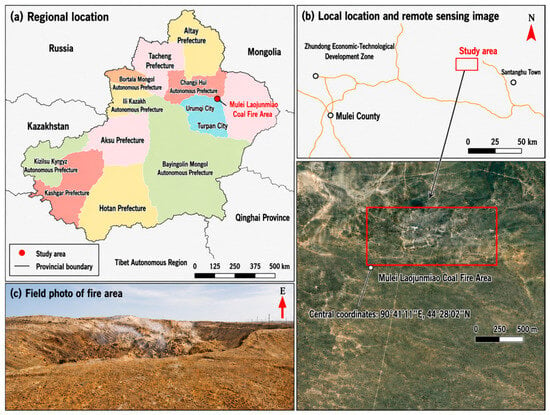
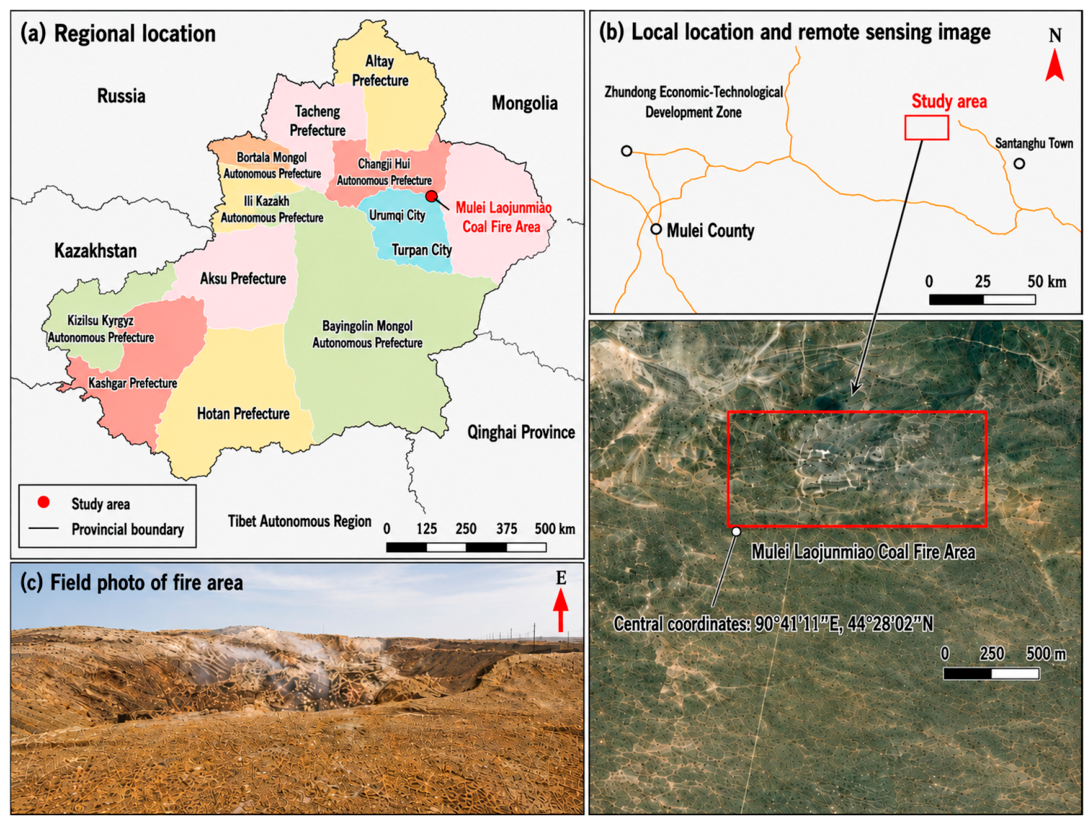
The Laojunmiao fire area is located in Mulei Kazakh Autonomous County, Xinjiang, China, and represents a typical mining-induced underground coal fire (Figure 1). Several closed mines, abandoned shafts, goafs, and collapse fractures occur within the fire area. Detailed exploration data indicate that the fire area is approximately 4000 m long from east to west and 180 m wide from north to south, covering an area of approximately 643,686 m2. The combustion depth ranges from 40 to 135 m, and local temperatures can reach 818.5 °C. The main burning seam is the SA7 coal seam, with a thickness of 24.86–36.11 m, an average thickness of approximately 29.43 m, and a dip angle of 55–65°, representing a steeply inclined extra-thick coal seam. The roof is mainly sandstone and the floor is mainly mudstone, accompanied by burnt rock and collapse-fracture development.
Figure 1.
The geographic location of the fire area.
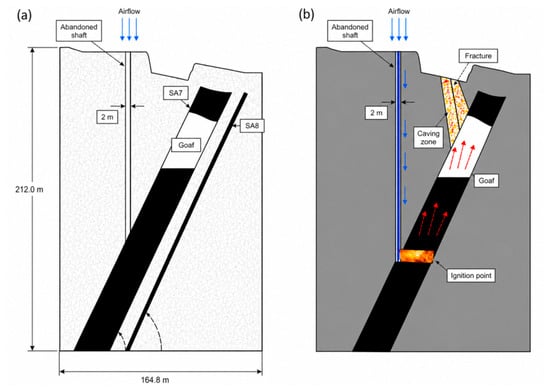
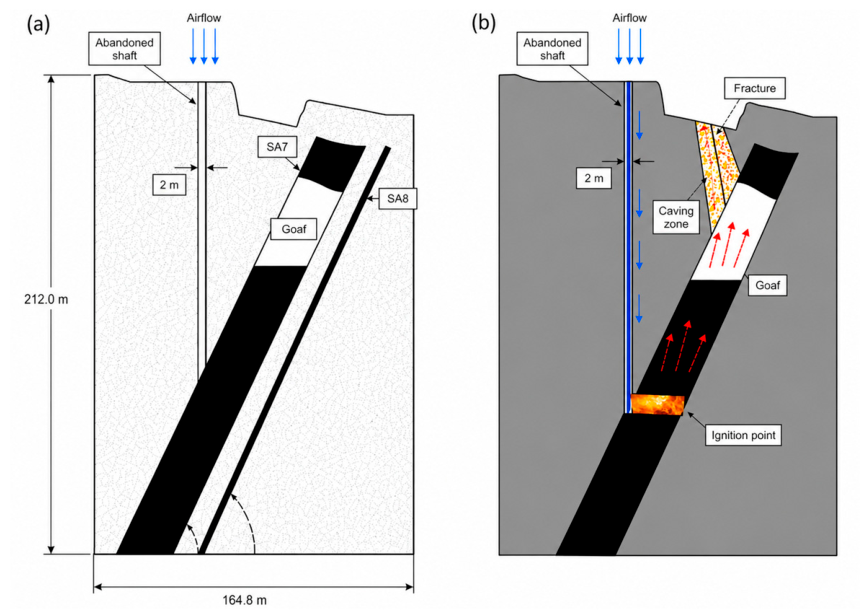
Based on the detailed exploration profile of the fire area and the ignition position of the SA7 coal seam, a two-dimensional physical model with a width of 164.8 m and a height of 212.0 m was established, and the coal-seam dip angle was set to 60°. The model retains the SA7 coal seam, adjacent thin coal seams, surrounding rock, goaf, abandoned roadway, vertical oxygen-supply channel, and initial ignition zone. Goaf collapse and surface fractures were treated as preferential oxygen-supply and smoke-exhaust channels, and the local area of the SA7 coal seam connected with the roadway was defined as the initial fire source. Figure 2a shows the SA7 coal-seam distribution, and Figure 2b shows the constructed physical model containing the initial fire source and surface fractures. This physical model describes three dominant processes: abandoned roadways and fractures control oxygen supply, coal-seam dip controls thermal-migration direction, and coal–rock interfaces and goaf boundaries control thermally induced fracture propagation.
Figure 2.
Coal-seam distribution and physical model of the Laojunmiao SA7 fire area: (a) geological model; (b) physical model.
The two-dimensional section was selected because the local SA7 fire zone is approximately continuous along strike, whereas the dominant heat migration, smoke exhaust, and structural response occur along the steep seam dip in the representative exploration profile. The section therefore preserves the principal controls required for the present mechanism analysis. The model dimensions (164.8 m × 212.0 m), 60° seam dip, goaf position, abandoned roadway, initial ignition zone, and surface collapse/oxygen-supply pathways were taken from the exploration profile rather than prescribed arbitrarily. Initial preferential fracture locations were assigned from documented goaf boundaries, abandoned workings, collapse fissures, and coal–rock contacts; these same structural zones were treated as potential cohesive-damage paths in the thermo-mechanical model.
2.2. Governing Equations for Coal-Fire Propagation
Underground-coal-fire propagation involves multi-physical-field coupling among heat release from coal oxidation, gas seepage, species transport, heat conduction–convection, and dynamic pore/fracture evolution. Abandoned roadways, goaf-collapse fractures, and primary pores in the coal–rock mass jointly form oxygen-supply and combustion-product migration pathways. Heat released by coal oxidation changes the temperature field and further reconstructs the seepage field through thermal damage, coal consumption, and pore-structure evolution. Recent high-quality studies have quantified indicator-gas/temperature relationships, coupled thermal–oxygen–gas migration, oxidation kinetics under oxygen-deficient conditions, pre-oxidation thresholds, and CFD-based multi-field representations of coal spontaneous combustion [32,33,34,35,36]. Together with earlier underground-coal-fire models, these studies support an engineering-scale framework in which chemical reaction, gas seepage, species transport, heat transfer, and pore/fracture evolution are solved as interacting processes.
2.2.1. Governing Equation for Heat Release from Coal Oxidation and Combustion
Coal oxidation and combustion are complex chain reactions in which multiple active functional groups are progressively oxidized in an oxygen-containing environment. Because the complete microscopic reaction network cannot be resolved at engineering scale, an equivalent global-reaction approach was adopted to represent the macroscopic relationships among coal consumption, gaseous-product generation, and heat release. This simplification is consistent with established underground-coal-fire modeling and with recent kinetic studies showing that apparent oxidation behavior varies systematically with temperature, oxygen concentration, and prior thermal exposure [14,34,35,37,38,39]:
where the coal molecular formula represents a typical coal composition and the oxidation products include solid char and gaseous products such as CO2, CO, H2O, and SO2. The solid product is deposited in the reaction zone, whereas gaseous products migrate by convection and diffusion under the seepage field.
C48H65S1O26 + 26O2 → C26H17O10 + 24H2O + 2CO + 20CO2 + SO2
The coal-oxidation reaction rate is described using a temperature-dependent Arrhenius-type kinetic form. The activation-energy and pre-exponential-factor ranges were selected from established underground-coal-fire/coal-combustion studies [37,38,39] and were checked against recent experimental evidence showing strong temperature- and oxygen-dependent kinetic behavior during coal spontaneous combustion [14,34,35].
where rcoal is the coal-oxidation reaction rate, mol/(m3·s); Ccoal and CO2 are the coal and oxygen concentrations, mol/m3, respectively; A is the pre-exponential factor, s−1; E is the activation energy, J/mol; R is the ideal gas constant, J/(mol·K); and T is the absolute temperature, K.
Considering that coal oxidation and combustion proceed through different reaction stages, the kinetic parameters were defined piecewise using a combined temperature–oxygen-concentration criterion. This stage-dependent treatment is consistent with the optimized thermal–hydraulic–chemical coal-fire model of Tang et al. [38], the oxygen-lean coal-combustion analysis of Su et al. [39], and recent experiments showing that apparent kinetic parameters and gas-release behavior vary with thermal exposure, oxygen concentration, and oxidation history [14,34,35]. The pre-exponential factor A is expressed as follows:
The activation energy E is expressed as follows:
The heat-release power of coal oxidation is jointly determined by the reaction rate and molar reaction enthalpy:
where Qh is the volumetric heat-release power, W/m3, and ΔH is the molar reaction enthalpy, J/mol.
Qh = −rCoalΔH
The kinetic and empirical relations used in the propagation model are engineering-scale constitutive descriptions rather than microscopic reaction mechanisms. Their applicable domain is therefore defined by the simulated state range: temperatures up to approximately 1050 K, the prescribed oxygen-supply conditions, and porosity/permeability states evolved from the measured/assigned initial values. The oxidation kinetics are supported by underground-coal-fire models and coal-oxidation experiments [14,34,35,37,38,39], while the pore-permeability evolution is used only to describe the corresponding continuum-scale transport response. No extrapolation beyond these thermal and transport states is used in the comparative analysis.
2.2.2. Heat-Transfer Governing Equation
The heat released by underground coal fires mainly diffuses through heat conduction in the coal–rock skeleton and convective heat transfer in pores and fractures. Studies on porous-media flow and heat transfer show that pore structure, seepage velocity, and thermophysical parameters jointly affect convective-diffusive transport [40,41,42]. For the surrounding-rock region, thermal migration can be expressed as follows:
where Crock is the volumetric heat capacity of the surrounding rock, J/(m3·K); U is the gas seepage velocity vector, m/s; ρg is gas density, kg/m3; Cg is the specific heat capacity of gas at constant pressure, J/(kg·K); and λ is thermal conductivity, W/(m·K).
For the coal-seam combustion region, the heat-release term from coal oxidation must be considered in addition to heat conduction and gas convection:
where Ccoal is the volumetric heat capacity of coal, J/(m3·K); ε is porosity; and r is the coal-oxidation reaction rate, mol/(m3·s).
2.2.3. Governing Equations for Gas Seepage and Species Transport
Goafs, abandoned roadways, and surface collapse fractures provide continuous oxygen supply for coal-fire development. To describe gas flow in the pore/fracture dual medium of the combustion zone, a Brinkman-type porous-media momentum equation was used to characterize the seepage process [40,41,42,43]:
where μ is gas dynamic viscosity, kg/(m·s); κ is the permeability tensor, m2; P is pressure, Pa; g is the gravitational acceleration vector, m/s2; and T0 is the ambient temperature, K.
During coal oxidation, oxygen is continuously supplied from external channels as a reactant, while gaseous products such as CO2 and CO migrate with the seepage field. The species-transport process is described in an advection-diffusion form [40,41]:
where C is species concentration, mol/m3; D is the diffusion coefficient, m2/s; U is the seepage velocity vector, m/s; and r is the source/sink term associated with the coal-oxidation reaction.
2.2.4. Governing Equations for Pore/Fracture Evolution Under High-Temperature Combustion
The high temperature generated by coal-fire combustion can induce mineral dehydration, thermal shrinkage, coal consumption, and structural damage, thereby modifying porosity and permeability in the combustion zone and surrounding rock. Recent multi-field and goaf studies show that air leakage, residual-coal oxidation, pore evolution, and compaction jointly regulate temperature and gas migration [10,12,15,32,33,34,35,36,44]. Based on high-temperature constitutive trends, the relationship between rock volumetric shrinkage and temperature can be expressed as follows:
where V is the rock volumetric shrinkage and T is temperature, K.
V = −10−7T2 + 10−4T + 0.9562
Under skeleton-volume variation, the real-time porosity n of the surrounding rock can be expressed as follows:
where n0 is the initial porosity.
n = 1 − V(1 − n0)
Changes in surrounding-rock porosity further affect permeability, and their relationship is as follows:
where k0 is the initial permeability, m2.
k = k0exp(14.8n)
For the coal seam, pore-structure evolution is mainly controlled by oxidative coal consumption. At the engineering scale, the geometric influence of combustion-induced mass loss is represented through an equivalent-continuum update of porosity and permeability. Coal consumption, char/residual-solid generation, and burned-out void development increase effective porosity, which directly changes oxygen-supply capacity, combustion-product discharge, and convective heat transfer. This treatment preserves the transport effect of coal loss within the fixed computational geometry while maintaining stable sequential mapping between COMSOL and Abaqus. The evolution equation is as follows:
where Mcoal is the relative molecular mass of coal, kg/mol; ρcoal is coal density, kg/m3; Mresidual is the relative molecular mass of combustion residue, kg/mol; and ρresidual is residue density, kg/m3.
The relationship between real-time coal permeability and porosity was described using a Kozeny–Carman-type relationship to characterize the amplification effect of porosity change on permeability [44,45]:
where k is the real-time permeability of the coal seam, m2, and k0 is the initial permeability of the coal seam, m2. The key parameters used in the multi-physical-field propagation model are summarized in Table 1.
Table 1.
Key parameters of the multi-physical-field propagation model.
2.3. Sequential Coupling and Fracture-Feedback Method
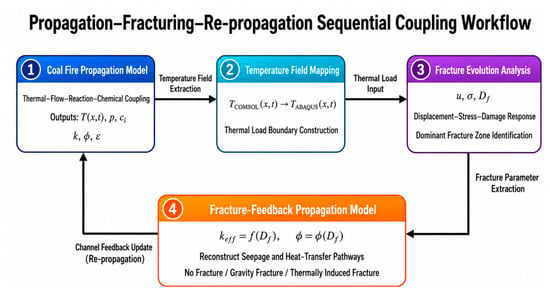
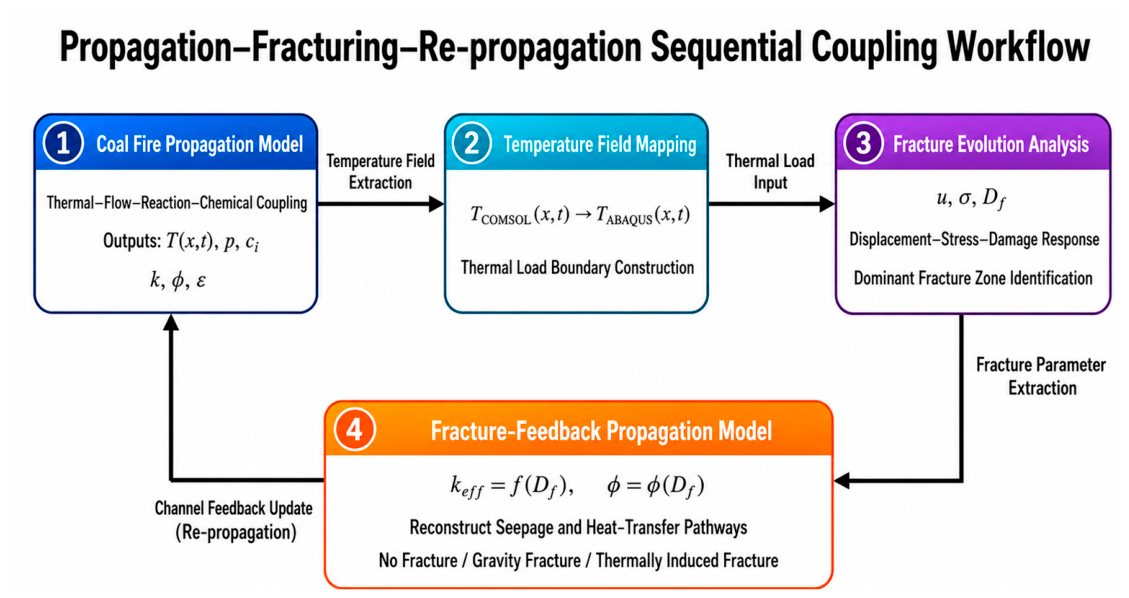
Based on the established multi-physical-field underground-coal-fire propagation model, a sequential COMSOL–Abaqus coupling procedure was developed (Figure 3). At selected combustion times, COMSOL exports the transient temperature field together with the corresponding seepage and reaction-zone state in the common two-dimensional physical coordinate system. The temperature field is interpolated onto the Abaqus mesh through coordinate-based field mapping and applied as the thermal load for the implicit temperature–displacement analysis. Abaqus then calculates thermal strain, displacement, stress redistribution, and cohesive-element damage. After each thermo-mechanical stage, connected/high-damage zones are extracted from the SDEG field and returned to the propagation model as local high-permeability regions and preferential heat/gas-transfer paths. The updated COMSOL model is subsequently used to evaluate re-propagation under fracture-feedback conditions. This procedure retains the strengths of the two solvers while providing an explicit variable-transfer chain from propagation to fracture response and back to propagation.
Figure 3.
Propagation–fracturing–re-propagation sequential coupling workflow.
The Abaqus thermo-mechanical model used the mapped temperature field as the input thermal load to calculate thermal strain, stress redistribution, and interfacial damage in the coal–rock mass. The governing formulation combines transient heat conduction, mechanical equilibrium, strain decomposition, and temperature-dependent constitutive relations. Recent International Journal of Rock Mechanics and Mining Sciences studies have independently demonstrated the suitability of coupled thermo-mechanical phase-field formulations for reproducing temperature-gradient-driven tensile, shear, and mixed-mode fracture in rock-like materials [46,47]:
where ρs is the density of the solid medium; Cs is its specific heat capacity; λs is thermal conductivity; QT is the volumetric heat-source term; T is temperature; t is time; σ is the stress tensor; b is the body-force term; ε is total strain; εe, εth, and εp are elastic strain, thermal strain, and plastic strain, respectively; αT is the linear expansion coefficient; T0 is the initial temperature; I is the identity tensor; and D(T) is the temperature-dependent elastic matrix.
∇⋅σ + b = 0
ε = εe + εth + εp
εth = αT(T − T0)I
σ = D(T):[ε − εth − εp]
To characterize fracture initiation and propagation along coal–rock interfaces, goaf boundaries, and abandoned-roadway margins, zero-thickness cohesive elements were arranged along potential fracture paths. In recent years, phase-field cohesive-zone models and thermo-mechanical cohesive-interface models have been widely used to describe crack initiation, propagation, and interfacial degradation in rock or quasi-brittle materials [48,49,50]. Before damage occurs, the interface traction and separation displacement satisfy a linear elastic relationship:
where t is the interface traction vector, K is the initial interface stiffness matrix, and δ is the interface separation-displacement vector.
t = Kcδ
Damage initiation was described using the maximum nominal stress criterion [48,49,50]:
where tn, ts, and tt are the normal and two tangential tractions, respectively; tn0, ts0, and tt0 are the corresponding nominal interface strengths; and the Macaulay bracket ensures that compressive normal traction does not trigger tensile-interface damage.
Damage evolution was described using a degradation relationship based on equivalent separation displacement [48,49,50]:
where D is the scalar damage variable, with D = 0 denoting an undamaged interface and D = 1 complete interfacial failure; is the equivalent separation at damage initiation; is the equivalent separation at complete failure; δmmax is the maximum equivalent separation attained during loading; and Gc is the fracture energy.
High temperature weakens the elastic modulus, tensile strength, cohesion, and interfacial bonding strength of coal–rock masses. To describe the degradation of mechanical parameters with increasing temperature, a temperature-weakening coefficient was introduced [28,29,30,31]:
where P(T) is the material parameter at temperature T, representing elastic modulus, tensile strength, cohesion, or interface strength; P0 is the initial material parameter; ψ(T) is the temperature-weakening coefficient; and aT and bT are temperature-weakening parameters.
The temperature-weakening relationships were selected from published high-temperature thermo-mechanical and fracture studies for rock or comparable quasi-brittle materials [28,29,30,31,46,47,48,49,50]. These references consistently show that increasing temperature and thermal gradients reduce effective stiffness/strength and promote localized cracking. In the present model, the relationships are used as normalized degradation functions for elastic modulus, tensile strength, cohesion, and interface bonding rather than as mineral-specific laboratory regressions for SA7. Their site-specific application is constrained by the mapped SA7 lithological geometry, and the resulting stress/SDEG localization at coal–sandstone contacts, coal–mudstone contacts, and goaf boundaries is physically consistent with differential thermal deformation of the actual coal–rock assemblage.
The COMSOL–Abaqus sequential coupling and feedback mapping relationship can be expressed as follows:
where is the thermal–seepage–chemical reaction field obtained from the COMSOL propagation model at time t; is the temperature field mapped from COMSOL to Abaqus; ΩTM-Abaqus(t) is the temperature-displacement response field calculated in Abaqus; Ωf(t) is the fracture-damage field; and is the next-step propagation field corrected by fracture feedback. Through this mapping relationship, thermally induced fracture-propagation results can be converted into the basis for updating local permeability, seepage boundaries, or preferential channels, thereby realizing sequential coupling between coal-fire propagation and fracture response.
2.4. Numerical Discretization and Solver Settings
The COMSOL propagation model was discretized with 198,993 finite elements. The maximum and minimum element sizes were 11.6 m and 0.52 m, respectively; the maximum element-growth rate was 1.2. The curvature factor was 0.4; the narrow-region resolution was 1, and the minimum and average element-quality values were 0.2365 and 0.8407. Mesh refinement was concentrated around the coal seam, goaf, abandoned roadway, collapse-fracture zone, and other high-gradient regions. The Abaqus model used the same representative section geometry and contained 110,358 cohesive elements along the predefined potential fracture paths. The temperature-displacement analysis employed an implicit solution with automatic adaptive time incrementation; the initial increment was 0.01 s. The maximum and minimum increments were 0.1 s and 1 × 10⁻⁹ s, respectively, and the total analysis-step time was 10 s for each mapped thermal-load stage. The same production meshes, coordinate-mapping procedure, and adaptive solver controls were maintained for all three seepage-velocity cases. Thus, the reported cross-condition differences are not introduced by changing discretization or solver settings, and the numerical-resolution basis of the submitted simulation series is now explicitly traceable.
2.5. Model Validation
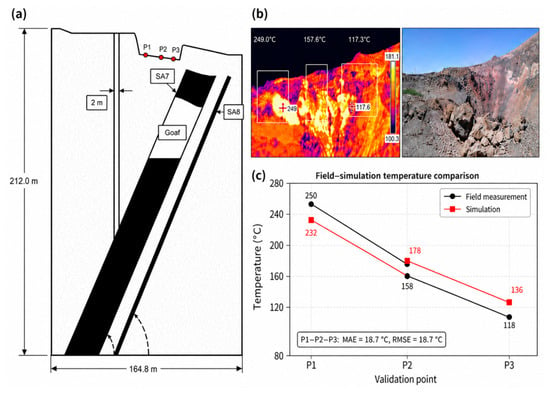
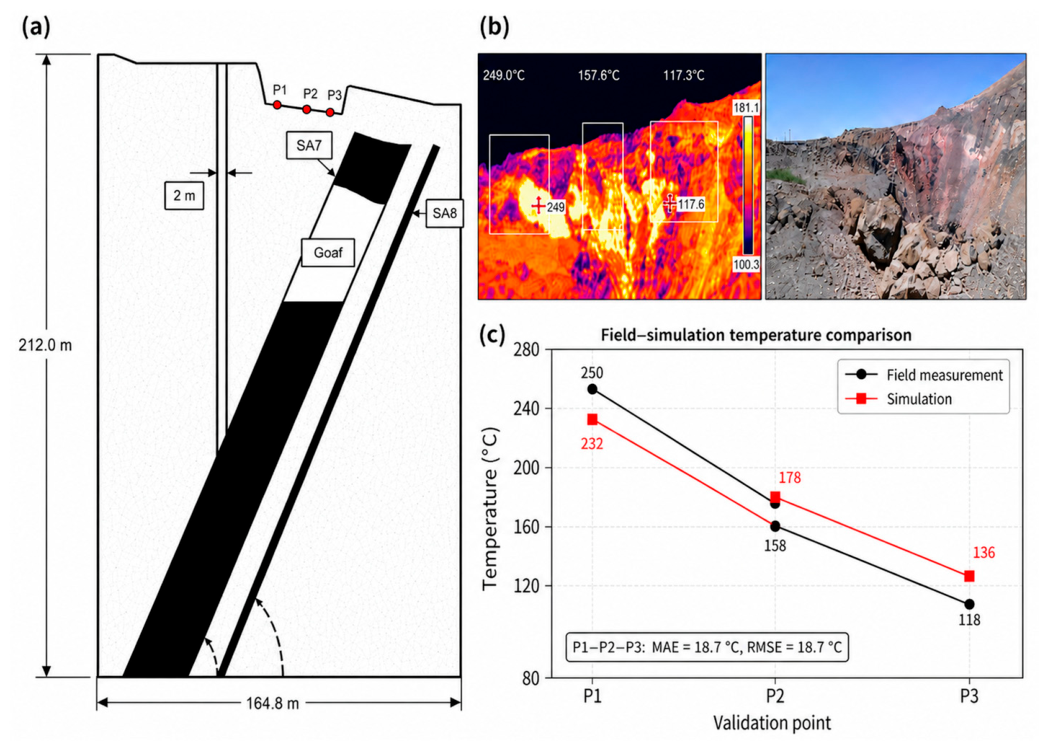
To verify the ability of the model to represent thermal-migration direction and surface thermal response in the fire area, three points, P1, P2, and P3, along the surface thermal-anomaly transect were selected for validation (Figure 4). The field-measured temperatures were approximately 250, 158, and 118 °C, whereas the corresponding simulated values were approximately 232, 178, and 136 °C. The resulting mean absolute error (MAE) and root-mean-square error (RMSE) were both approximately 18.7 °C. In addition, both field and simulated results show a consistent monotonic temperature decrease from the thermal-anomaly core toward the periphery. The agreement in magnitude and spatial attenuation supports the use of the model for comparative analysis of underground-coal-fire thermal migration and fracture feedback.
Figure 4.
Model validation: (a) validation-point locations; (b) field thermal image and photograph; (c) comparison of measured and simulated temperatures.
3. Results
3.1. Seepage-Controlled Coal-Fire Propagation
The sustained propagation of underground coal fires depends on heat release from coal–oxygen reactions, oxygen supply, combustion-product discharge, and heat migration in coal–rock media. For the Laojunmiao fire area, which contains abandoned roadways, goafs, and collapse fractures in a steeply inclined extra-thick coal seam, inlet seepage velocity controls not only oxygen flux entering the combustion zone but also gas-convective heat transfer and product-discharge efficiency. Recent experiments and multi-field simulations likewise identify air leakage/oxygen supply as dominant controls on goaf temperature, fire propagation direction, and coupled thermal-gas evolution [10,13,15,32,33,34,35,36]. Therefore, three inlet seepage velocities, V0 = 0.001, 0.002, and 0.003 m/s, were selected as comparative cases to quantify their effects on temperature and CO2 migration and to establish the subsequent thermal loading conditions for fracture analysis.
For all cross-condition figures in this section, the same physical units, variable definitions, and caption/legend conventions are used for each field. Because the absolute ranges evolve substantially with time and seepage velocity, quantitative comparison is based on reported maxima, affected-area ratios, and spatial boundaries rather than color alone; this preserves low-gradient features while maintaining consistent interpretation across cases.
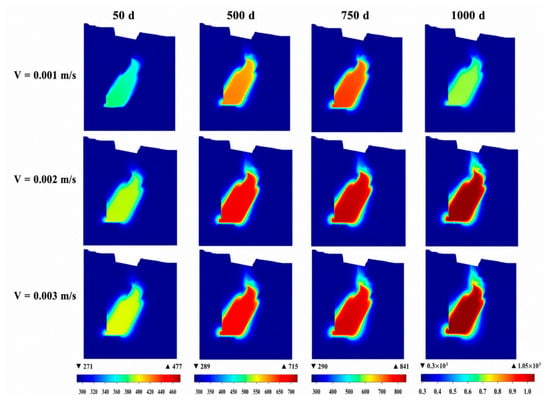
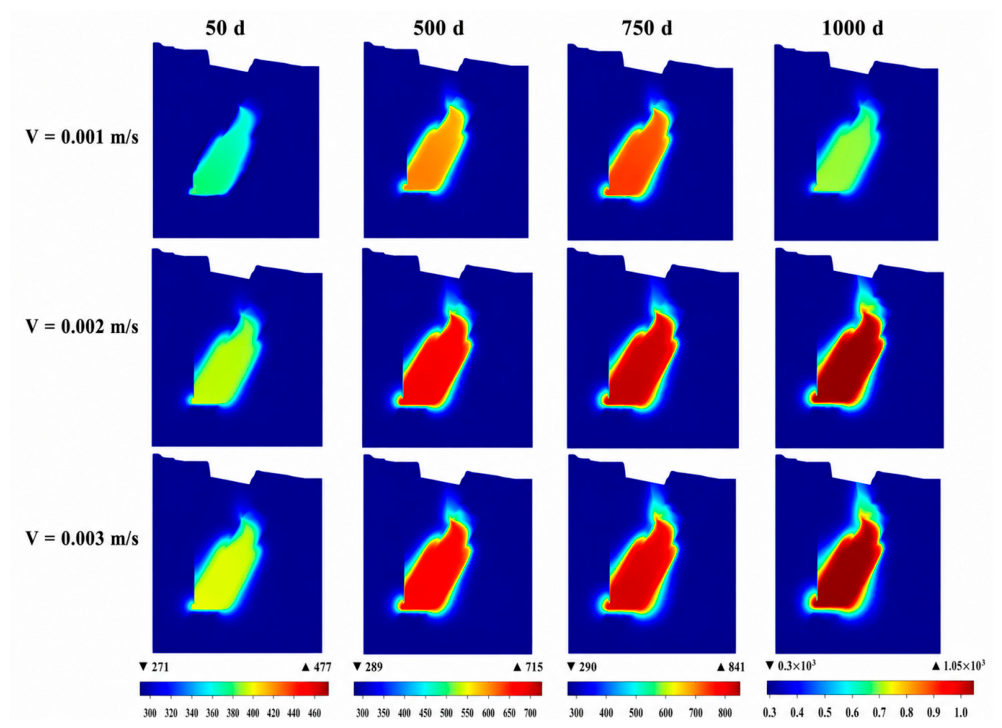
Figure 5 shows the temporal evolution of the coal-fire temperature field under different seepage velocities. At 50 d, the high-temperature zone was mainly concentrated in the initial burning coal seam and below the goaf, and the temperature field expanded upward along the coal-seam dip. This indicates that heat in the early stage of fire development did not diffuse uniformly into the surrounding rock but preferentially migrated toward the upper coal body and goaf under the constraints of coal-seam dip and gas seepage pathways. As seepage velocity increased, the boundary of the high-temperature zone bent earlier toward fractures and the upper goaf, indicating that gas thermal convection began to participate in heat transport. After 500 d, differences in temperature distribution among the three cases became more pronounced. Under V0 = 0.001 m/s, the high-temperature zone continued to expand but remained mainly inside the coal seam and adjacent regions, with weak thermal disturbance toward the ground surface. Under V0 = 0.002 and 0.003 m/s, the high-temperature zone formed a more continuous expansion belt along the coal seam and goaf, and local high-temperature areas were significantly intensified. At 750 and 1000 d, the high-temperature zone under higher seepage velocity developed toward the upper goaf and near-surface region, indicating that stronger gas supply enhanced heat release from coal–oxygen reactions, while gas convection transported heat over a broader area.
Figure 5.
Evolution characteristics of the coal-fire temperature field under different seepage velocities.
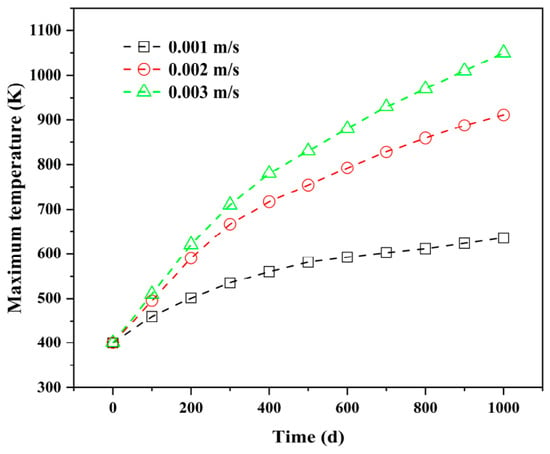
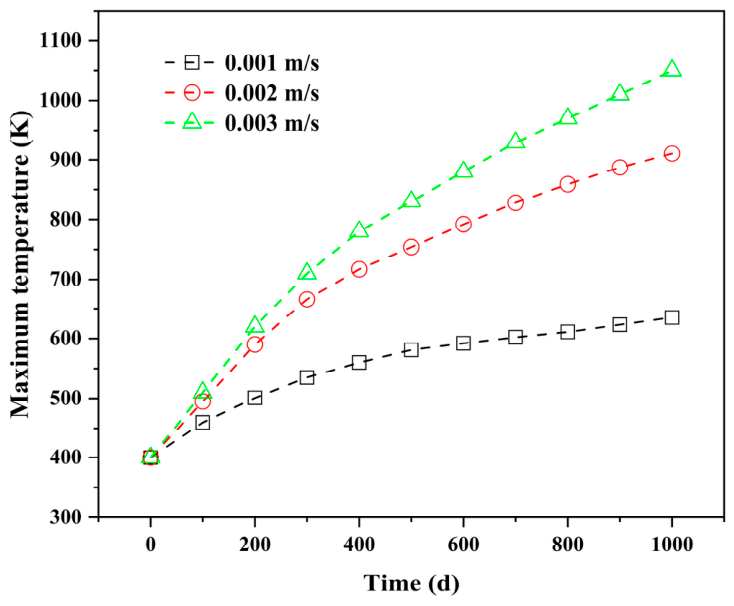
The temporal variation in maximum temperature further illustrates the controlling effect of seepage velocity (Figure 6). All three cases showed rapid early heating followed by a slower heating rate, which is related to the presence of goaf and fractures above the initial combustion zone and favorable gas-exchange conditions. This behavior is also consistent with the basic understanding of coupled oxygen transport and heat release during coal self-heating. In the early fire stage, oxygen rapidly entered the combustion zone, the coal fire expanded from the local ignition source toward the upper coal body, and heat-generation intensity increased rapidly. As the coal below the goaf gradually burned, heat migrated outward along fractures and the coal seam, convective heat loss intensified, and the temperature-growth rate decreased. At 1000 d, the maximum temperatures under V0 = 0.001, 0.002, and 0.003 m/s were approximately 635, 911, and 1050 K, respectively. Compared with the low-velocity case, the maximum temperature increased by approximately 276 K (43.5%) under V0 = 0.002 m/s and by approximately 415 K (65.4%) under V0 = 0.003 m/s. However, when seepage velocity increased from 0.002 to 0.003 m/s, the maximum temperature at 1000 d increased by approximately 139 K, lower than the temperature increment from 0.001 to 0.002 m/s. This indicates that at higher oxygen-supply levels, peak temperature is no longer controlled solely by oxygen flux but is jointly constrained by combustion-zone expansion, heat dissipation, and coal consumption.
Figure 6.
Temporal variation in maximum temperature under different seepage velocities.
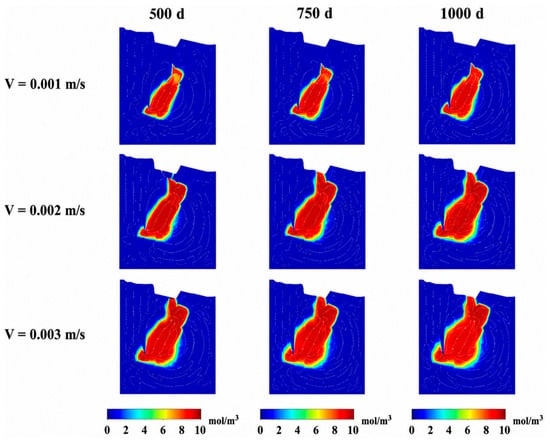
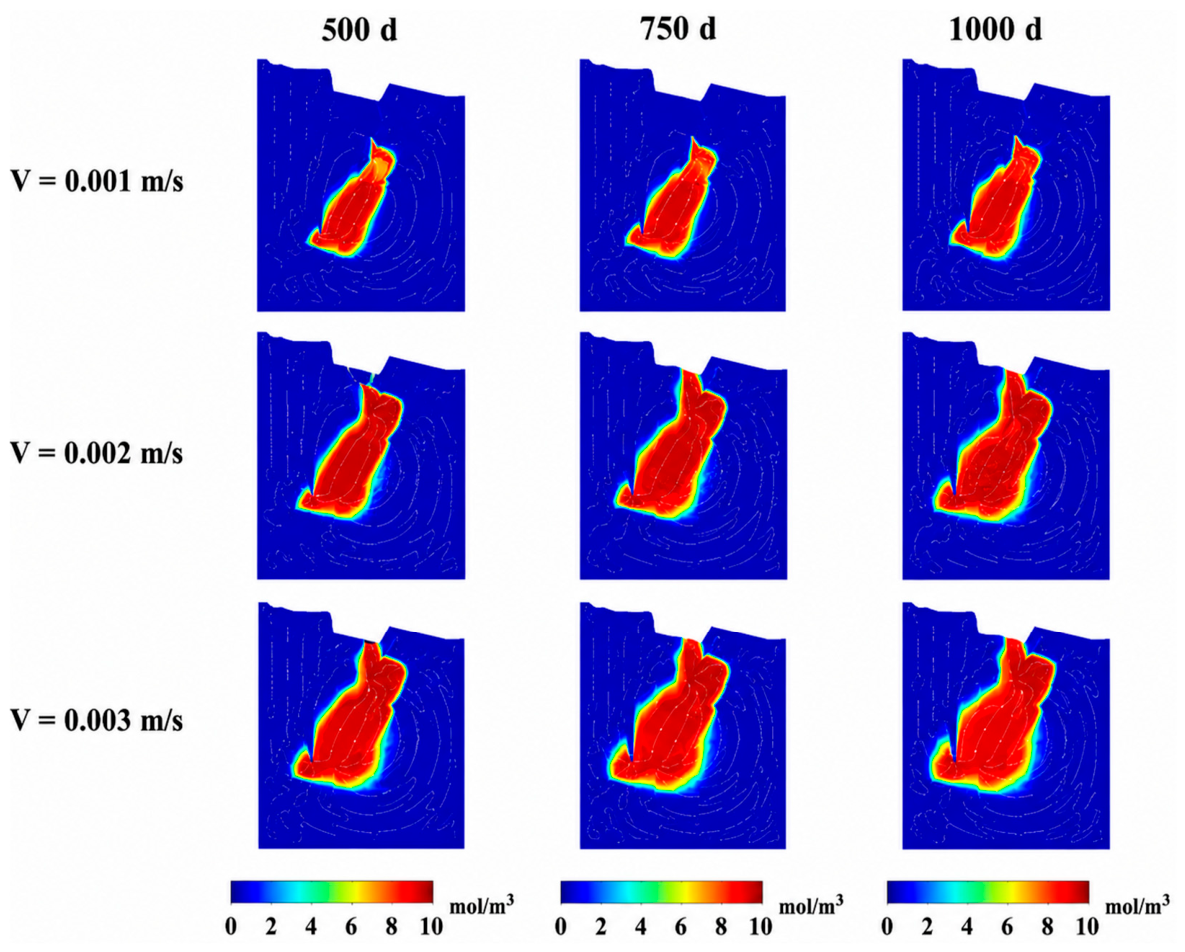
The CO2 concentration field further reflects combustion-product discharge pathways and gas-exchange directions. Compared with the temperature field, the CO2 distribution range is particularly sensitive to internal seepage connectivity because its spatial evolution depends on both reaction generation and transport through roadways, goafs, and fracture channels. Figure 7 shows that by 500 d, the high-concentration CO2 zone had formed a continuous up-dip distribution and expanded more strongly toward the goaf at higher seepage velocities. From 750 to 1000 d, the migration range continued to enlarge with increasing seepage velocity. This behavior agrees with recent studies showing that air leakage, oxygen concentration, temperature, and structural connectivity jointly regulate indicator-gas generation and migration during coal spontaneous combustion [10,12,13,32,33,34,35,36]. The result therefore supports the use of CO2 here as a transport/connectivity indicator rather than as a stand-alone measure of combustion intensity.
Figure 7.
Evolution characteristics of the CO2 concentration field under different seepage velocities.
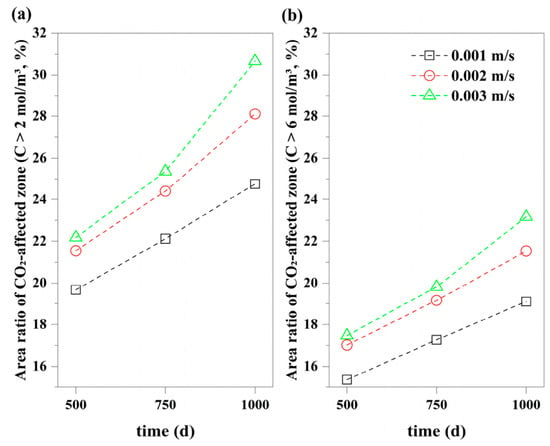
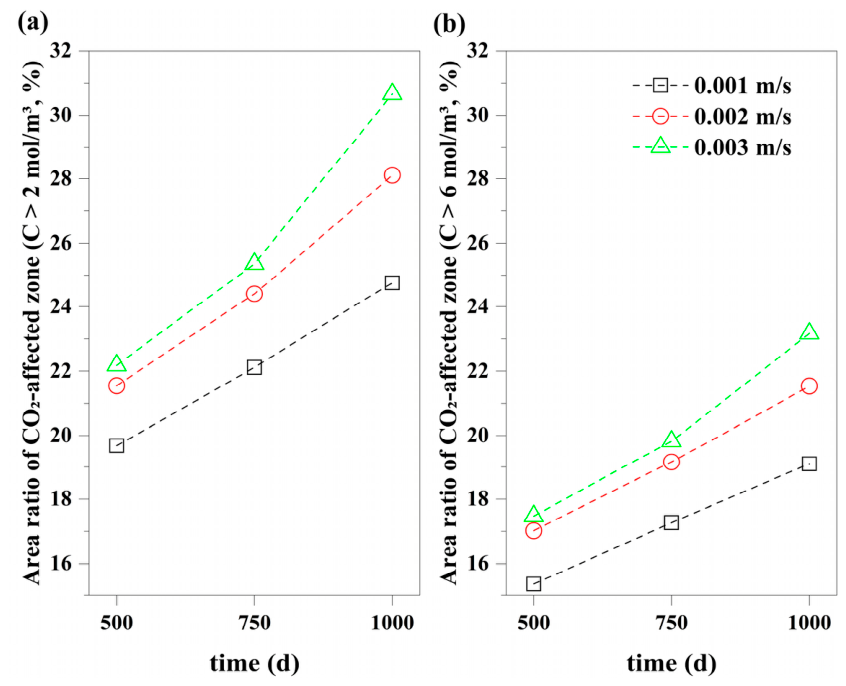
In Figure 8, C > 2 mol/m3 is used to delineate the outer boundary of combustion-product enrichment relative to the low-background concentration field, whereas C > 6 mol/m3 identifies the principal CO2-enrichment and smoke-exhaust pathway around the combustion zone and connected structural channels. Applying the same two concentration isolines to all seepage cases provides a consistent basis for comparing plume expansion, enrichment intensity, and pathway connectivity. From 500 to 1000 d, the area proportions of both zones increased with seepage velocity, confirming the increasing importance of channelized gas transport.
Figure 8.
Spatial statistics of the CO2 concentration field under different seepage velocities: (a) C > 2 mol/m3; (b) C > 6 mol/m3.
3.2. Thermo-Mechanical Fracture Development
To reveal how the coal-fire temperature field drives fracture development in coal–rock masses around the goaf, this section uses the temperature field under the high-seepage-velocity case (V0 = 0.003 m/s) from Section 3.1 as the thermal load to analyze the thermo-mechanical response and fracture-damage evolution around the goaf. Pore/fracture changes in the COMSOL model are mainly used to equivalently characterize medium porosity and permeability evolution, whereas the Abaqus model further describes differential deformation, stress concentration, and cohesive-element damage under thermal loading, thereby identifying preferential fracture-development positions and propagation trends under thermo-mechanical coupling.
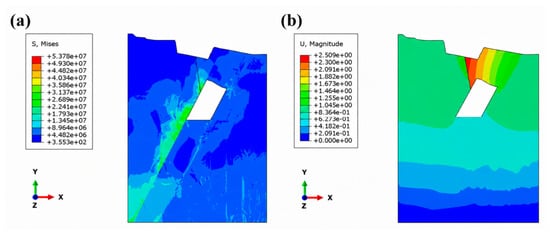
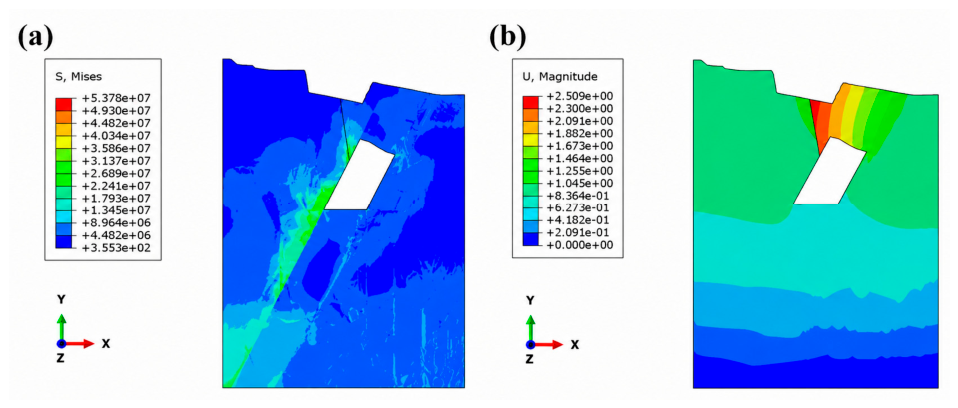
Before applying the temperature load, the goaf cavity had already caused stress redistribution near coal–rock interfaces and cavity boundaries and induced asymmetric displacement responses in the roof and surrounding rock on both sides (Figure 9). This indicates that mechanically weak zones controlled by cavity disturbance and interfacial constraints exist around the goaf. As the temperature field continued to act, differential thermal expansion further intensified stress concentration in these zones, making fractures more likely to propagate along goaf boundaries and coal–rock interfaces. This is consistent with the understanding from mining-induced and thermal-stress fracture studies that structural boundaries control preferential fracture development.
Figure 9.
Initial stress and displacement responses around the goaf: (a) von Mises stress; (b) displacement magnitude.
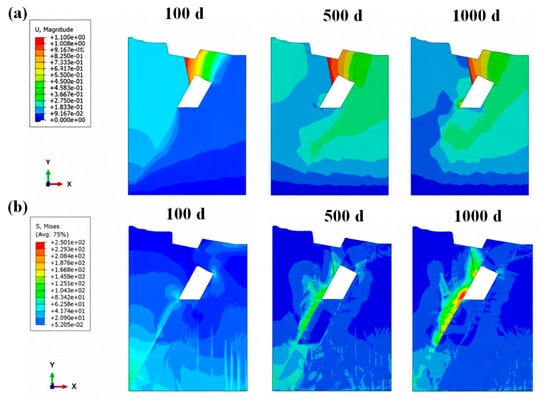
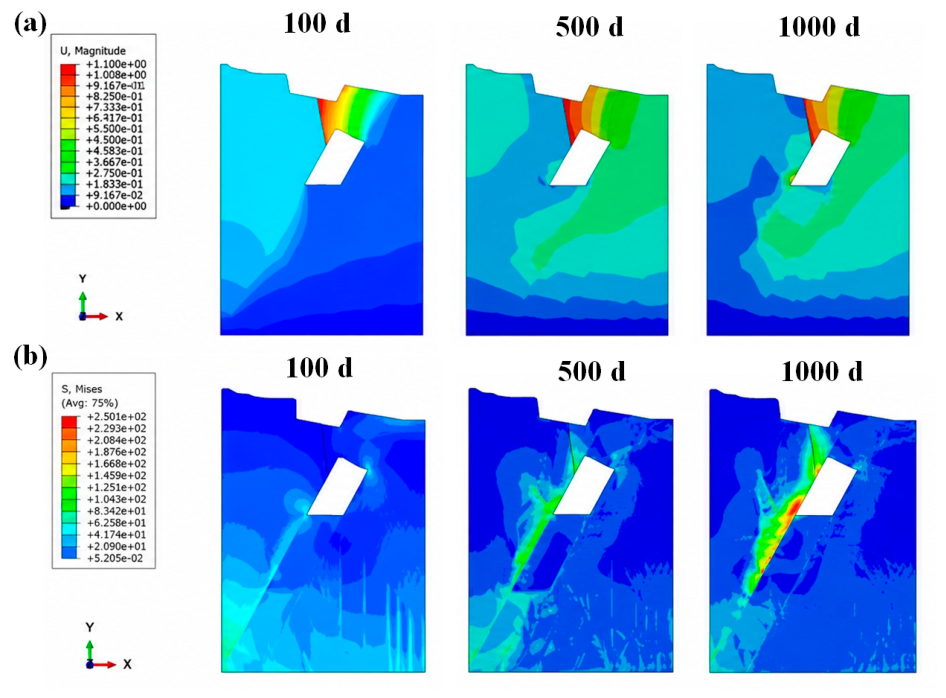
After the temperature field was introduced, the displacement distribution around the goaf gradually changed from initial settlement adjustment to composite deformation under constrained thermal expansion (Figure 10a). At 100 d, the displacement response was mainly concentrated above the goaf and along the coal–mudstone contact zone, indicating that early thermal disturbance had begun to alter deformation compatibility at the coal–rock interface. As the heated region expanded, more obvious horizontal compression and shear displacement appeared in the coal body below the goaf and in the surrounding rock on both sides after 500 d, showing that thermal-expansion effects were transmitted toward the goaf along coal–rock interfaces. By 1000 d, the rock strata around the goaf further squeezed toward the void, with horizontal displacement in the lower-left corner reaching 21 cm and shear displacement in the lower-right corner reaching approximately 20.92 cm. The continuous increase in differential displacement indicates that coal-fire heating changes not only the local thermal state but also the deformation conditions required for fracture expansion along goaf boundaries and coal–rock interfaces.
Figure 10.
Evolution of displacement and stress fields around the goaf under thermo-mechanical coupling: (a) displacement magnitude; (b) von Mises stress.
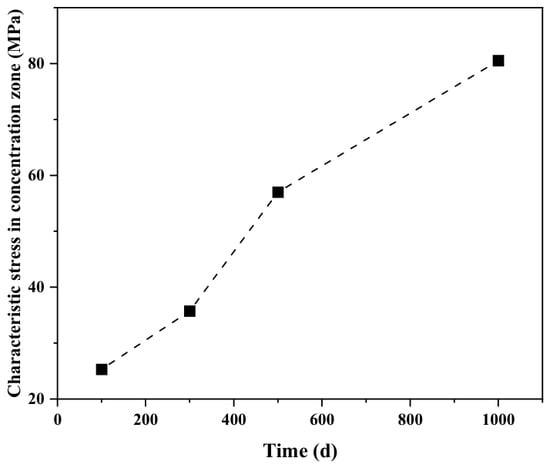
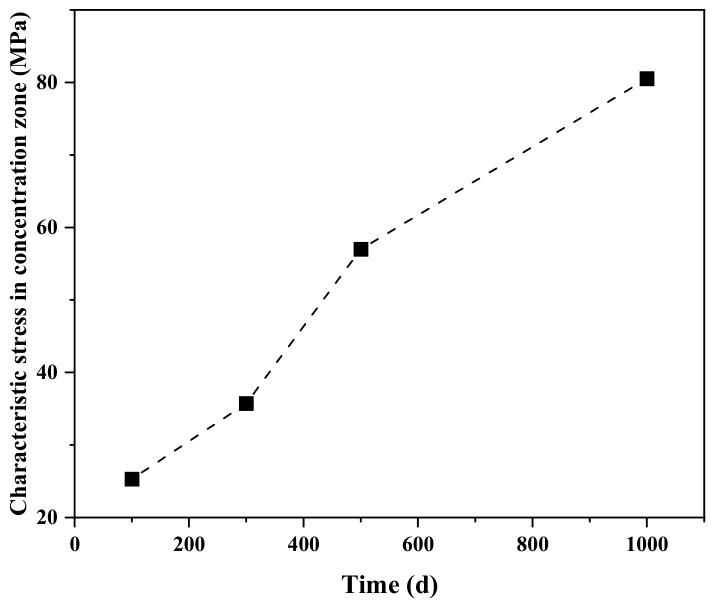
Stress-field evolution further indicates that fracture-development positions are jointly controlled by thermal-load expansion and goaf geometric disturbance (Figure 10b). At 100 d, stress concentration began to develop along the temperature-affected zone and coal–rock interfaces, with a characteristic maximum stress of approximately 25.3 MPa and local values up to 50.78 MPa. After 300 d, a new stress-concentration zone formed below the goaf fracture, with a characteristic stress of approximately 35.72 MPa. At 500 d, the stress-concentration zone continued to extend into the rock strata and upward, and stress around the goaf reached approximately 57.01 MPa, with local values of 62.19 MPa. By 1000 d, stress was mainly concentrated along the coal–sandstone contact zone and the lower-left corner of the goaf, and local stress reached 80.53 MPa. Figure 11 shows that the characteristic stress in the goaf stress-concentration zone increased continuously with combustion time, indicating that temperature-field expansion continuously intensified mechanical instability along coal–rock interfaces and goaf boundaries, providing a sustained driving force for fracture propagation.
Figure 11.
Evolution of characteristic stress in the stress-concentration zone with time. The dashed curve represents the characteristic stress.
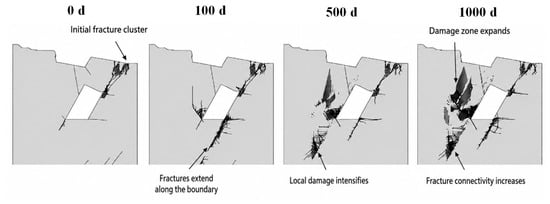
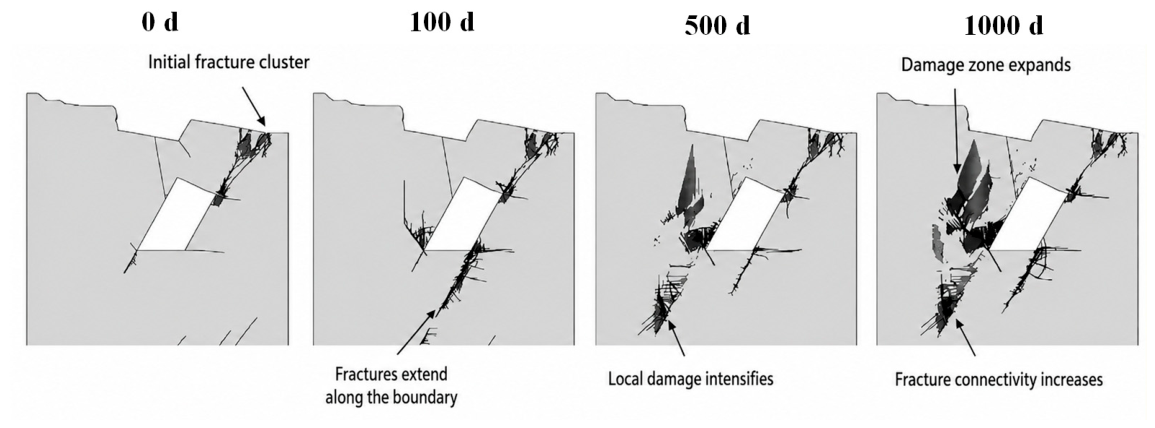
The fracture-damage analysis focuses on the area adjacent to the goaf and the coal–rock contact zones to identify local rupture responses within the coal-fire temperature-controlled region (Figure 12). The black linear areas in the figure represent fracture paths formed after cohesive-element damage degradation. At 0 d, newly formed thermally induced damage near the goaf was not obvious. After 300 d, fracture paths began to extend along the goaf boundary and coal–rock contact zones. At 750 d, damage fractures increased significantly near the lower-left corner of the goaf and the upper contact zone, showing good spatial consistency with the stress-concentration zone. By 1000 d, local damage further developed toward deeper surrounding rock and the ground surface; however, the overall pattern remained dominated by segmented expansion and local connectivity, and a through-going fracture zone had not yet formed.
Figure 12.
The evolution of fracture-damage paths around the goaf under thermo-mechanical coupling.
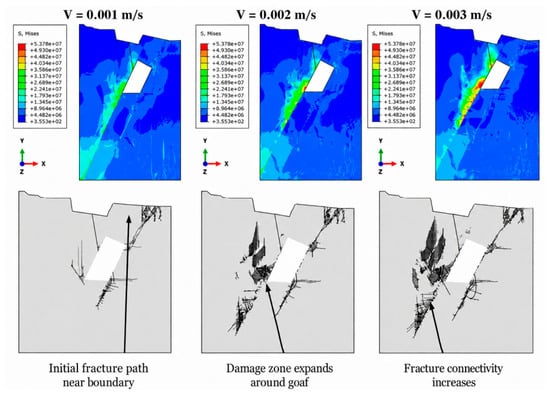
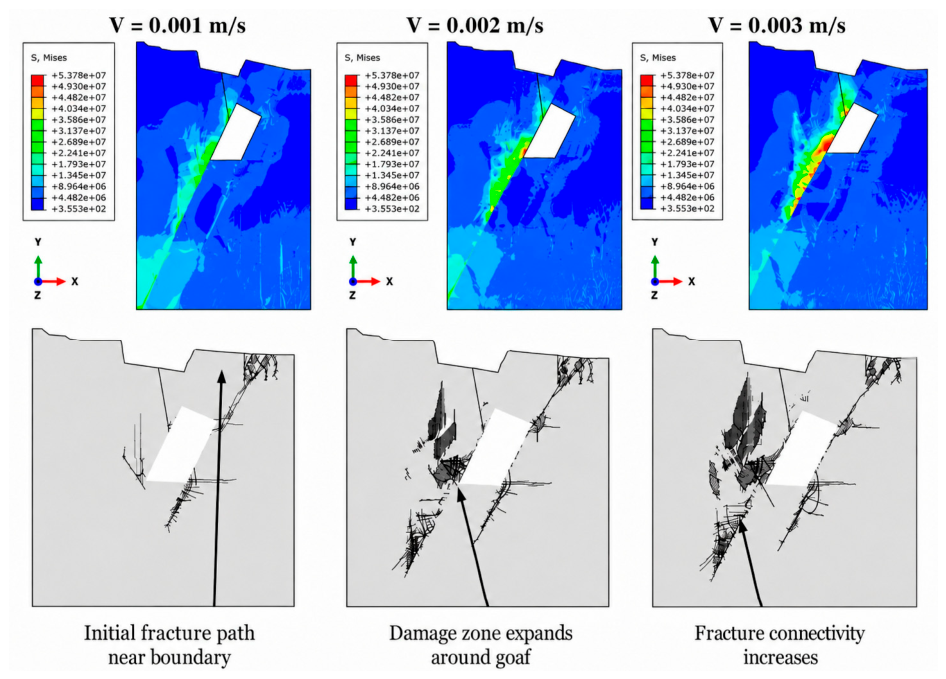
The displacement, stress, and local fracture-damage results indicate that fracture development under thermo-mechanical coupling has obvious spatial selectivity. Goaf boundaries, coal–sandstone contact zones, and coal–mudstone contact zones are the main damage areas, controlled by initial goaf disturbance, differential thermal expansion induced by temperature gradients, and coal–rock interfacial constraints. Figure 12 focuses on the temporal mechanism of fracture initiation, extension, damage intensification, and local connectivity under the representative thermo-mechanical loading condition, whereas Figure 13 provides the direct cross-condition comparison at 1000 d. This separation avoids duplicating figure content while still demonstrating that higher seepage velocity increases damage extent and connectivity. The observed localization is consistent with both established thermo-mechanical fracture studies [28,29,30,31] and recent rock-fracture models in high-quality rock-mechanics literature [46,47], which identify temperature gradients and material/interface constraints as primary controls on crack initiation and propagation.
Figure 13.
Comparison of stress-field and fracture-damage-field distributions at 1000 d under three seepage velocities.
3.3. Fracture-Feedback Re-Propagation
Section 3.1 shows that seepage velocity controls the expansion range of the underground-coal-fire temperature field and CO2 migration field by changing oxygen supply and convective heat-transfer intensity. Section 3.2 further reveals that differential thermal expansion of coal and rock induced by fire-area heating forms stress concentration and fracture damage near goaf boundaries and coal–rock contact zones. Therefore, fractures are not merely mechanical failure products during underground-coal-fire evolution. Once connected with goafs, abandoned roadways, or near-surface channels, fractures alter oxygen-supply, smoke-exhaust, and heat-transfer boundaries, causing coal-fire propagation to gradually shift from original pore-seepage control to coupled pore/fracture channel control. Based on this understanding, this section further discusses the response characteristics of coal-fire propagation after thermo-mechanically induced fracture reconstruction.
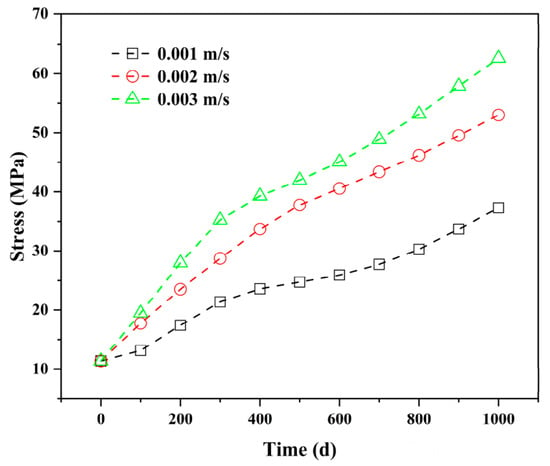
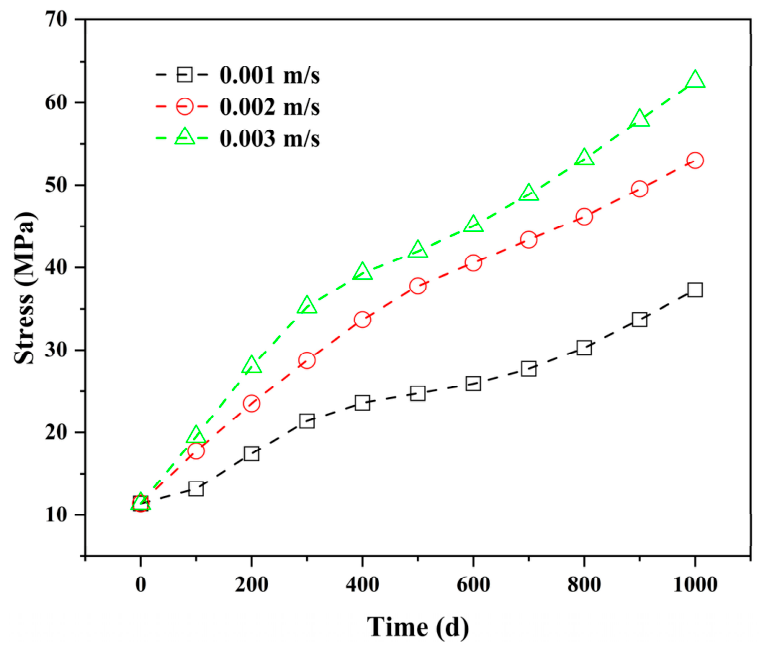
The mechanical basis for fracture-channel reconstruction must first be clarified. Figure 14 shows that the maximum stress in the goaf stress-concentration zone increased with combustion time under different seepage velocities, but the growth magnitude was clearly controlled by seepage velocity. Under low seepage velocity, stress increased relatively slowly and reached approximately 37 MPa at 1000 d. When V increased to 0.002 m/s, the final stress increased to approximately 53 MPa. Under high seepage velocity, stress increased from approximately 11 MPa initially to approximately 63 MPa and still maintained rapid growth in the later stage. This result indicates that enhanced seepage improves oxygen input and convective heat-transfer capacity, further enlarges the fire-area temperature gradient and coal–rock deformation difference, and thereby intensifies stress concentration around the goaf and coal–rock interfaces.
Figure 14.
The evolution of maximum stress in the goaf stress-concentration zone under different seepage velocities.
As shown in Figure 13, under low seepage velocity, stress concentration and fracture damage remain relatively localized near the left side of the goaf and the coal–rock contact zones. At V = 0.002 m/s, the high-stress region extends farther along the coal-seam dip and the associated damage zone expands. At V = 0.003 m/s, both the number of fracture branches and the degree of local connectivity increase markedly, producing a clearer preferential propagation path on the left side of the goaf. This cross-condition comparison confirms that increasing seepage velocity intensifies the magnitude and spatial extent of thermo-mechanical damage, whereas the preferential fracture locations remain governed by goaf geometry and coal–rock interfaces. The spatial correspondence between stress-concentration and SDEG-damage zones provides the mechanical basis for the fracture paths subsequently reconstructed in the propagation model.
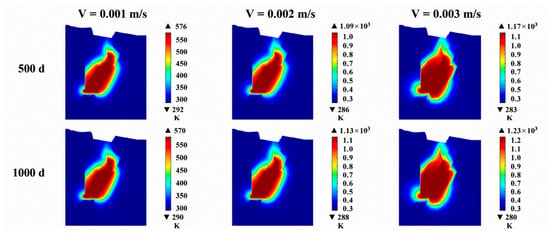
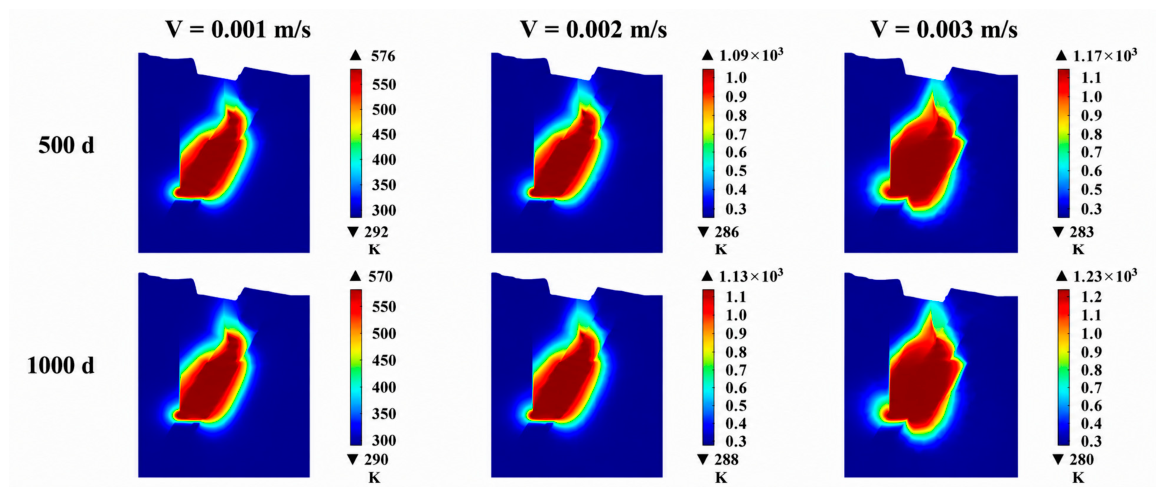
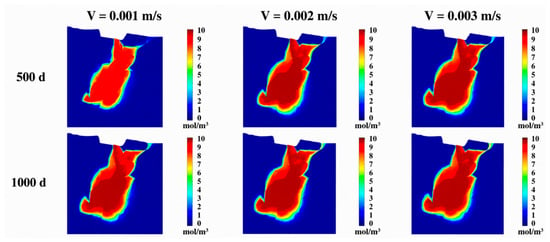
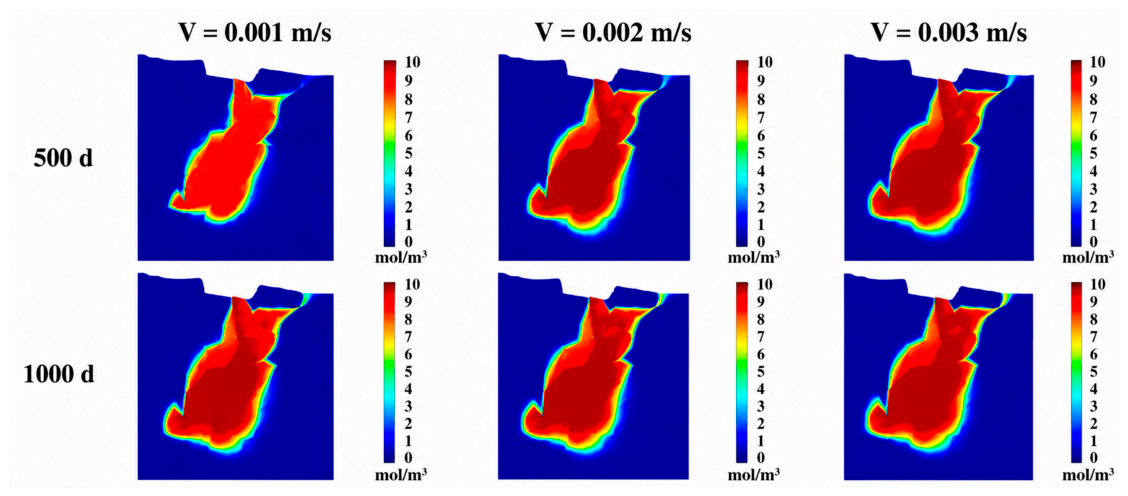
After fracture channels participate in seepage, subsequent fire-area evolution is more strongly reflected by adjustments in heat-propagation range and gas-migration pathways. Figure 15 shows the temperature-field distribution after continued evolution for 500 and 1000 d based on the first 1000 d of fire-area development, while Figure 16 shows the CO2 concentration field during the same stages to characterize combustion-product migration along fracture channels. Together, these results reveal the feedback effect of fracture reconstruction on continued coal-fire propagation from the perspectives of heat migration and gas transport.
Figure 15.
The evolution of the fire-area temperature field under different seepage velocities after thermo-mechanically induced fracture reconstruction.
Figure 16.
The evolution of the CO2 concentration field under different seepage velocities after thermo-mechanically induced fracture reconstruction.
Figure 15 shows that under V = 0.001 m/s, the maximum fire-area temperature decreased slightly from approximately 576 K to 570 K between 500 and 1000 d, but the high-temperature zone still maintained some expansion along the coal-seam dip and goaf boundary. This indicates that under low seepage velocity, oxygen supply is insufficient and fractures mainly act as smoke-exhaust and heat-dissipation channels. Under V = 0.002 m/s, the maximum temperature increased from approximately 1.09 × 10³ K to 1.13 × 10³ K, and the boundary of the high-temperature zone expanded above the goaf, indicating that fractures began to exert a stronger regulatory effect on thermal-migration pathways. Under V = 0.003 m/s, the maximum temperature further increased from approximately 1.17 × 10³ K to 1.23 × 10³ K, and the high-temperature zone expanded more obviously toward the upper coal–rock mass and near-surface region. This indicates that when oxygen supply is sufficient, the fracture network is no longer only a heat-dissipation boundary but gradually becomes a composite pathway for oxygen supply, smoke exhaust, and convective heat transport. Therefore, the influence of fracture feedback on the temperature field is condition-dependent: At low flow rates, fractures mainly enlarge the heat-affected range but do not necessarily increase peak temperature; at medium flow rates, fractures modify the spatial distribution of high-temperature zones and reorganize heat along the goaf and coal–rock interfaces. At high flow rates, fracture channels couple with external oxygen-supply boundaries, producing stronger channelized thermal migration.
Figure 16 shows that after fractures participated in seepage, CO2 no longer diffused only around the combustion-zone margin but migrated directionally along the coal-seam dip, goaf boundary, and preset fracture network. Under low seepage velocity, the high-concentration CO2 zone was mainly concentrated in the burning coal seam and local fractures, indicating that inlet flow still limited the smoke-exhaust capacity of fracture channels. Under medium seepage velocity, CO2 expanded along the coal-seam dip and goaf-fracture direction, and internal gas-exchange capacity was enhanced. Under high seepage velocity, CO2 showed the most obvious connectivity toward the upper coal seam, goaf, and near-surface region, indicating that the fracture network had become an important channel for combustion-product discharge and fresh-air supply. The combined temperature-field and CO2 concentration-field results indicate that fracture feedback cannot be simply interpreted as “temperature increase” or “temperature decrease”. Its essence is the reconstruction of energy-migration pathways and gas-exchange boundaries within the fire area, causing coal-fire propagation to shift from original pore-seepage control to coupled pore/fracture channel control.
The stress-field, fracture-damage-field, temperature-field, and CO2 concentration-field results collectively show that after thermo-mechanically induced fracture reconstruction, underground-coal-fire propagation shifts from being jointly controlled by original coal-seam pore seepage and goaf structure to being controlled by the combined effects of “original pore seepage—goaf structural fractures—thermo-mechanical fracture networks”. Once the fracture network becomes effectively connected with the goaf or near-surface channels, it simultaneously changes oxygen-supply, smoke-exhaust, and convective heat-transfer boundaries, resulting in obvious path dependence during coal-fire propagation. This result corresponds to the control of seepage velocity on temperature and CO2 migration in Section 3.1 and the preferential fracture development along goaf boundaries and coal–rock contact zones in Section 3.2, indicating the existence of a feedback process of “seepage-controlled fire—thermally induced cracking—fracture-enhanced permeability—amplified re-propagation” in underground coal fires in steeply inclined extra-thick coal seams.
4. Discussion
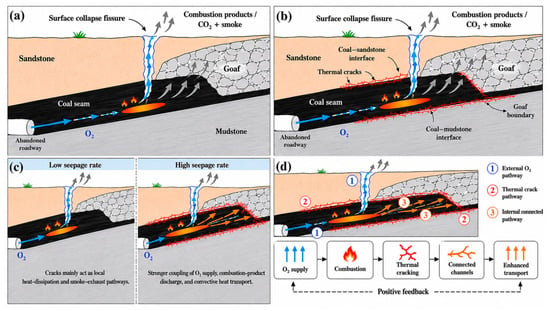
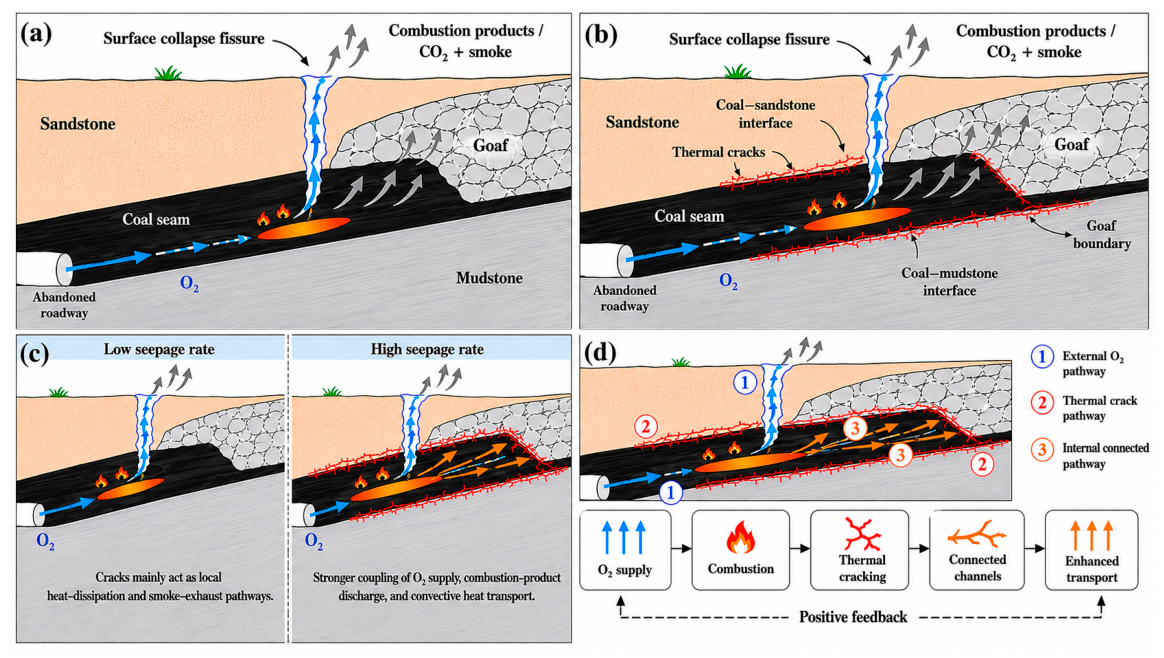
Integrating the temperature, CO2, stress, and fracture results reveals a staged and condition-dependent feedback chain rather than a single monotonic fracture effect. The process can be summarized as initial seepage control → combustion heating → thermally induced interfacial cracking → fracture-mediated transport reorganization → channel coupling. This interpretation is consistent with recent goaf studies showing that spontaneous-combustion evolution depends strongly on air leakage, oxygen availability, multi-field interactions, and connected transport pathways [10,13,15,32,33,34,35,36], while the present study extends that understanding by explicitly allowing for the thermally generated damage field to reconstruct the subsequent transport field. This sequence explains why the same fracture network may act mainly as a dissipation/exhaust pathway at low seepage velocity but become a coupled oxygen-supply, heat-transfer, and product-discharge pathway when external airflow and fracture connectivity are both sufficient (Figure 17).
Figure 17.
Mechanism of fracture-mediated transport and channel coupling in underground coal fires: (a) oxygen supply and product discharge; (b) thermally induced interfacial cracking; (c) seepage-dependent fracture feedback; (d) channel coupling and positive feedback.
In the initial oxygen-supply stage, abandoned roadways, goafs, and surface collapse fractures jointly form gas-exchange boundaries between the fire area and the external environment, as shown in Figure 17a. Abandoned roadways provide lateral O2 supply to the internal combustion zone of the coal seam, while surface collapse fractures and goafs provide upward pathways for CO2, smoke, and combustion-product discharge. Because oxygen supply, smoke exhaust, and convective heat transport occur simultaneously, the combustion zone is not a local heat source in a closed system but continuously exchanges matter and energy with external channels. Therefore, early underground-coal-fire development depends not only on heat-release intensity within the combustion zone but also on O2 input paths, combustion-product discharge paths, and heat-migration directions.
As combustion heating continues, coal-fire propagation pathways gradually transform from original pore seepage to interfacial fracture seepage, as shown in Figure 17b. In steeply inclined extra-thick coal seams, differences in thermophysical properties between the coal seam and surrounding rock, structural discontinuity at coal–rock interfaces, and the goaf cavity boundary jointly induce local stress concentration, causing fractures to preferentially develop along coal–sandstone interfaces, coal–mudstone interfaces, and goaf boundaries. Thus, thermally induced fractures are not merely a subsidiary phenomenon of temperature-field evolution but a thermo-mechanical response jointly controlled by temperature gradients, structural interfaces, and goaf disturbance. As these interfacial fractures continue to expand and gradually connect with existing gas channels, local damage zones begin to transform into new channels for oxygen supply, smoke exhaust, and thermal migration, thereby reconstructing coal-fire expansion pathways.
In the fracture-feedback stage, seepage conditions determine how fracture channels influence coal-fire propagation, as shown in Figure 17c. Under low seepage conditions, external O2 supply is limited, and fractures mainly act as local heat-dissipation and smoke-exhaust pathways. Although they can change local heat release and combustion-product discharge, their promotion of sustained combustion-zone expansion is relatively weak. Under high seepage conditions, external oxygen-supply intensity increases. The connectivity among fracture channels, abandoned roadways, goafs, and surface collapse fractures is strengthened, and O2 supply, combustion-product discharge, and convective heat transport are simultaneously enhanced. Consequently, high-temperature zones and CO2-enriched zones are more likely to expand along the upper goaf, coal–rock interfaces, and near-surface fractures. Therefore, the core function of fracture feedback is not simply to increase or decrease fire-area temperature, but to alter internal energy- and mass-migration pathways and promote the transition of coal fires from local combustion to channelized expansion.
In the channel-coupling stage, external O2 channels, thermally induced fracture channels, and internal connected channels jointly control the sustained propagation of underground coal fires, as shown in Figure 17d. External O2 channels determine the oxygen-supply conditions of the combustion zone and are the basis for maintaining combustion reactions. Thermally induced fracture channels determine preferential directions of gas and heat migration and are critical for transforming the fire area from local damage to connected expansion. Internal connected channels link the combustion zone, goaf, coal–rock interfaces, and near-surface fractures, promoting the simultaneous outward expansion of high-temperature zones, CO2-enriched zones, and smoke-exhaust pathways. After coupling among the three types of channels, a positive feedback chain of “O2 supply—combustion heating—thermally induced cracking—channel connection—intensified migration” forms, causing underground-coal-fire propagation to evolve from local expansion into a heterogeneous migration process controlled by channel networks.
The above mechanism indicates that fire control in steeply inclined extra-thick coal seams should not focus solely on peak-temperature regions. Instead, identification and blockage of key migration channels should be treated as a central control objective. For external O2-supply channels, the oxygen-supply boundaries formed by abandoned roadways and surface collapse fractures should be controlled. For thermally induced fracture channels, attention should be paid to fracture propagation and connectivity risks along coal–sandstone interfaces, coal–mudstone interfaces, and goaf boundaries. For internal connected channels, potential migration-path reconstruction caused by high-temperature-induced pore-permeability evolution in the coal seam should be emphasized. Zoned sealing, fracture isolation, and smoke-exhaust control can weaken the positive feedback among oxygen supply, smoke discharge, and convective heat transport, thereby reducing the risk of sustained underground-coal-fire expansion and post-treatment re-ignition.
5. Conclusions
(1) Seepage velocity controls the magnitude and pathway of underground-coal-fire thermal migration. Increasing the inlet velocity from 0.001 to 0.003 m/s raised the simulated peak temperature at 1000 d from approximately 635 to 1050 K and promoted expansion toward the up-dip coal seam, goaf boundary, and near-surface region. CO2 migration showed the same channel-controlled tendency, with the affected and high-concentration zones reaching approximately 30.7% and 23.2%, respectively, at V = 0.003 m/s.
(2) Thermo-mechanical damage is spatially selective. Differential thermal deformation and goaf disturbance concentrate stress along coal–sandstone interfaces, coal–mudstone interfaces, and goaf boundaries. The temporal analysis shows progressive fracture initiation, extension, and local connectivity, while the three-condition comparison at 1000 d shows that higher seepage velocity increases fracture branching, damage extent, and local connectivity without changing the principal structural control zones.
(3) Fracture feedback is condition-dependent. At low seepage velocity, fractures mainly facilitate smoke exhaust and heat dissipation; at medium seepage velocity, they reorganize heat and gas migration along the goaf and coal–rock interfaces. At high seepage velocity, connected fracture paths couple with external oxygen-supply boundaries and promote channelized propagation toward the upper goaf and near-surface region.
(4) The sequential COMSOL–Abaqus propagation–fracturing–re-propagation framework links coal-fire transport, thermo-mechanical fracture response, and fracture feedback within one engineering-scale analysis. The resulting mechanism—seepage-controlled combustion, thermally induced cracking, fracture-enhanced permeability, and amplified re-propagation—provides a basis for preferential-pathway identification, fracture sealing, oxygen-supply control, and zoned fire-area mitigation.
Author Contributions
Conceptualization, Z.L. and Y.L.; methodology, Y.L. and Y.T.; software, Y.L. and W.W.; validation, Z.L., Y.T. and C.L.; formal analysis, Y.L.; investigation, Z.L. and C.L.; resources, Y.T. and W.W.; data curation, Y.L.; writing—original draft preparation, Y.L.; writing—review and editing, Z.L., Y.T. and W.W.; visualization, Y.L.; supervision, Y.T.; project administration, Y.L. All authors have read and agreed to the published version of the manuscript.
Funding
This study was funded by the Science & Technology Fundamental Resources Investigation Program, grant number 2025FY101700.
Data Availability Statement
The data presented in this study are available from the corresponding author upon reasonable request.
Acknowledgments
The authors acknowledge the field investigation and data support related to the Laojunmiao coal-fire area.
Conflicts of Interest
The authors declare no conflicts of interest.
References
- He, X.; Yang, X.; Luo, Z.; Guan, T. Application of unmanned aerial vehicle (UAV) thermal infrared remote sensing to identify coal fires in the Huojitu coal mine in Shenmu city, China. Sci. Rep. 2020, 10, 13895. [Google Scholar] [CrossRef] [Scilit] [PubMed]
- Liu, J.; Wang, Y.; Yan, S.; Zhao, F.; Li, Y.; Dang, L.; Liu, X.; Shao, Y.; Peng, B. Underground coal fire detection and monitoring based on Landsat-8 and Sentinel-1 data sets in Miquan Fire Area, Xinjiang. Remote Sens. 2021, 13, 1141. [Google Scholar] [CrossRef] [Scilit]
- Yu, B.; She, J.; Liu, G.; Ma, D.; Zhang, R.; Zhou, Z.; Zhang, B. Coal fire identification and state assessment by integrating multitemporal thermal infrared and InSAR remote sensing data: A case study of Midong District, Urumqi, China. ISPRS J. Photogramm. Remote Sens. 2022, 190, 144–164. [Google Scholar] [CrossRef] [Scilit]
- Deng, J.; Cullen, J.L.T.; Xue, Y.; Zhou, F.; Shi, B. Spatial-temporal analysis of coal fire risk identification and suppression assessment with satellite time series mapping 2013–2020 in Midong coalfield, Xinjiang, China. Int. J. Remote Sens. 2023, 44, 2236–2272. [Google Scholar] [CrossRef] [Scilit]
- Anghelescu, L.; Diaconu, B.M. Advances in Detection and Monitoring of Coal Spontaneous Combustion: Techniques, Challenges, and Future Directions. Fire 2024, 7, 354. [Google Scholar] [CrossRef] [Scilit]
- Li, Y.; Su, H.; Ji, H.; Fu, S.; Gao, L.; Zhang, X. Influence of pore-crack environment on heat propagation of underground coalfield fire: A case study in Daquanhu, Xinjiang, China. Therm. Sci. Eng. Prog. 2024, 48, 102373. [Google Scholar] [CrossRef] [Scilit]
- Bustamante Rúa, M.O.; Daza Aragón, A.J.; Bustamante Baena, P. A study of fire propagation in coal seam with numerical simulation of heat transfer and chemical reaction rate in mining field. Int. J. Min. Sci. Technol. 2019, 29, 873–879. [Google Scholar] [CrossRef] [Scilit]
- Onifade, M.; Genc, B. A review of research on spontaneous combustion of coal. Int. J. Min. Sci. Technol. 2020, 30, 303–311. [Google Scholar] [CrossRef] [Scilit]
- Li, Y.; Su, H.; Ji, H.; Cheng, W. Numerical simulation to determine the gas explosion risk in longwall goaf areas: A case study of Xutuan Colliery. Int. J. Min. Sci. Technol. 2020, 30, 875–882. [Google Scholar] [CrossRef] [Scilit]
- Yi, X.; Zhang, M.; Deng, J.; Xiao, Y.; Chen, W.; Zeinali Heris, S. Effects on environmental conditions and limiting parameters for spontaneous combustion of residual coal in underground goaf. Process Saf. Environ. Prot. 2024, 187, 1378–1389. [Google Scholar] [CrossRef] [Scilit]
- Li, J.; Xu, H.; Wu, G. Study on the effect of pore evolution on the coal spontaneous combustion characteristics in goaf. Fire 2024, 7, 164. [Google Scholar] [CrossRef] [Scilit]
- Zhou, A.; Yang, Y.; Wang, K.; He, Y.; Wang, S.; Yuan, Y.; Wang, Y. Air leakage migration and coal spontaneous combustion evolution in goaf: A coupled DEM–COMSOL modeling approach. Therm. Sci. Eng. Prog. 2025, 68, 104261. [Google Scholar] [CrossRef] [Scilit]
- Wang, G.; Yang, Y.; Zhang, Y.; Li, P.; Gao, K. Experimental study on the development and bidirectional propagation characteristics of spontaneous coal combustion in goaf. Int. Commun. Heat Mass Transf. 2024, 159, 108313. [Google Scholar] [CrossRef] [Scilit]
- Zhang, Y.; Guo, Q.; Zhang, Y.; Deng, J.; Li, Y.; Li, H. Study on transformation characteristics and oxidation kinetics of coal spontaneous combustion induced by thermal radiation. Therm. Sci. Eng. Prog. 2025, 64, 103767. [Google Scholar] [CrossRef] [Scilit]
- Zhou, C.; Niu, H.; Wang, H.; Yang, Y. Dynamic evolution mechanism and prevention of spontaneous combustion in steeply inclined coal seam goaf based on multi-field coupling (THM-C). Appl. Therm. Eng. 2025, 279, 127854. [Google Scholar] [CrossRef] [Scilit]
- Wang, N.; Wang, Z.; Sun, Q.; Hui, J. Coal mine goaf interpretation: Survey, passive electromagnetic methods and case study. Minerals 2023, 13, 422. [Google Scholar] [CrossRef] [Scilit]
- Yin, Y.; Zhao, T.; Zhang, Y.; Tan, Y.; Qiu, Y.; Taheri, A.; Jing, Y. An innovative method for placement of gangue backfilling material in steep underground coal mines. Minerals 2019, 9, 107. [Google Scholar] [CrossRef] [Scilit]
- Lv, W.; Wu, Y.; Ming, L.; Yin, J. Migration law of the roof of a composited backfilling longwall face in a steeply dipping coal seam. Minerals 2019, 9, 188. [Google Scholar] [CrossRef] [Scilit]
- Wang, X.; Zhu, W.; Xie, J.; Han, H.; Xu, J.; Tang, Z.; Xu, J. Borehole-based monitoring of mining-induced movement in ultrathick-and-hard sandstone strata of the Luohe Formation. Minerals 2021, 11, 1157. [Google Scholar] [CrossRef] [Scilit]
- Tian, S.; Mao, J.; Li, H. Porosity distribution law of overlying strata in the goaf of the adjacent working face: From the perspective of section coal pillar types. Minerals 2022, 12, 782. [Google Scholar] [CrossRef] [Scilit]
- Qu, Q.; Guo, H.; Yuan, L.; Shen, B.; Yu, G.; Qin, J. Rock mass and pore fluid response in deep mining: A field monitoring study at inclined longwalls. Minerals 2022, 12, 463. [Google Scholar] [CrossRef] [Scilit]
- Xie, J.; Ning, S.; Zhu, W.; Wang, X.; Hou, T. Influence of key strata on the evolution law of mining-induced stress in the working face under deep and large-scale mining. Minerals 2023, 13, 983. [Google Scholar] [CrossRef] [Scilit]
- Chen, J.; Qu, Z.; Zhou, L.; Su, X. Numerical study on the hydraulic fracturing pattern in the hard roof in response to mining-induced stress. Minerals 2023, 13, 308. [Google Scholar] [CrossRef] [Scilit]
- Liu, C.; Man, Z.; Li, M. Study on the dynamic evolution of mining-induced stress and displacement in the floor coal-rock induced by protective layer mining. Minerals 2024, 14, 1084. [Google Scholar] [CrossRef] [Scilit]
- Yang, D.; Sun, Y.; Xu, J.; Zhao, L. Study on the evolution of fractures in overlying strata during repeated mining of coal seams at extremely close distances. Front. Earth Sci. 2024, 12, 1472939. [Google Scholar] [CrossRef] [Scilit]
- Zhang, H.; Zhang, J.; Xu, Z.; Zhang, J.; Du, S.; Wei, S.; Li, X. Overburden breakage and surface damage evolution under high-intensity mining of shallow coal seams: Evidence from Shendong mining area. Sci. Rep. 2025, 15, 10925. [Google Scholar] [CrossRef] [Scilit] [PubMed]
- Zhang, C.; Chen, Y.; Ren, Z.; Wang, F. Compaction and seepage characteristics of broken coal and rock masses in coal mining: A review in laboratory tests. Rock Mech. Bull. 2024, 3, 100102. [Google Scholar] [CrossRef] [Scilit]
- Yan, C.; Xie, X.; Ren, Y.; Ke, W.; Wang, G. A FDEM-based 2D coupled thermal-hydro-mechanical model for multiphysical simulation of rock fracturing. Int. J. Rock Mech. Min. Sci. 2022, 149, 104964. [Google Scholar] [CrossRef] [Scilit]
- Joulin, C.; Xiang, J.; Latham, J.P. A novel thermo-mechanical coupling approach for thermal fracturing of rocks in the three-dimensional finite-discrete element method. Comput. Part. Mech. 2020, 7, 935–946. [Google Scholar] [CrossRef] [Scilit]
- Si, Z.; Hirshikesh; Yu, T.; Fang, W.; Natarajan, S. Mixed-mode thermo-mechanical fracture: An adaptive multi-patch isogeometric phase-field cohesive zone model. Comput. Methods Appl. Mech. Eng. 2024, 431, 117330. [Google Scholar] [CrossRef] [Scilit]
- Wang, T.; Han, H.; Wang, Y.; Ye, X.; Huang, G.; Liu, Z.; Zhuang, Z. Simulation of crack patterns in quasi-brittle materials under thermal shock by a phase-field coupled cohesive zone model. Eng. Fract. Mech. 2022, 276, 108889. [Google Scholar] [CrossRef] [Scilit]
- Lei, C.; Feng, Q.; Zhu, Y.; Cui, C.; Bao, R.; Deng, C. Multiple indicator gases and temperature prediction of coal spontaneous combustion oxidation process. Fuel 2025, 393, 134991. [Google Scholar] [CrossRef] [Scilit]
- Liu, S.; Yang, Y.; Wu, L.; Zhai, Y.; Yang, W.; Li, L.; Lei, J. Coupled thermal–oxygen–methane field evolution and coordinated prevention strategy in goaf under surface borehole drainage. Process Saf. Environ. Prot. 2025, 203, 107897. [Google Scholar] [CrossRef] [Scilit]
- Cao, W.; Zhong, X.; Wang, D.; Zhou, K.; Wang, Y.; Hou, F. CO release characteristics of coal spontaneous combustion in low-temperature oxygen-deficient environments: Coupling effects of temperature, oxygen concentration and time. J. Hazard. Mater. 2025, 495, 139073. [Google Scholar] [CrossRef] [Scilit] [PubMed]
- Hao, M.; Qin, B.; Yang, H.; Shi, Q. Critical thresholds of pre-oxidation in coal spontaneous combustion: Microstructural drivers and kinetic implications. Energy 2025, 334, 137598. [Google Scholar] [CrossRef] [Scilit]
- Wu, X.; Dong, J.; Hu, R.; Pang, B.; Si, G. CFD modelling of prevention and mitigation of coal spontaneous combustion in longwall goaf—A comprehensive review and future outlook. Arch. Comput. Methods Eng. 2026, 33, 3789–3835. [Google Scholar] [CrossRef] [Scilit]
- Wolf, K.-H.; Bruining, H. Modelling the interaction between underground coal fires and their roof rocks. Fuel 2007, 86, 2761–2777. [Google Scholar] [CrossRef] [Scilit]
- Tang, Y.; Zhong, X.; Li, G.; Yang, Z.; Shi, G. Simulation of dynamic temperature evolution in an underground coal fire area based on an optimised Thermal-Hydraulic-Chemical model. Combust. Theory Model. 2019, 23, 127–146. [Google Scholar] [CrossRef] [Scilit]
- Su, H.; Kang, N.; Shi, B.; Ji, H.; Li, Y.; Shi, J. Simultaneous thermal analysis on the dynamical oxygen-lean combustion behaviors of coal in an O2/N2/CO2 atmosphere. J. Energy Inst. 2021, 96, 128–139. [Google Scholar] [CrossRef] [Scilit]
- Soulaine, C. Micro-continuum modeling: An hybrid-scale approach for solving coupled processes in porous media. Water Resour. Res. 2024, 60, e2023WR035908. [Google Scholar] [CrossRef] [Scilit]
- Yang, G.; Xu, R.; Tian, Y.; Guo, S.; Wu, J.; Chu, X. Data-driven methods for flow and transport in porous media: A review. Int. J. Heat Mass Transf. 2024, 235, 126149. [Google Scholar] [CrossRef] [Scilit]
- Yu, X.; Lin, B.; Zhai, C.; Zhu, C.; Regenauer-Lieb, K.; Chen, X. Enhanced coalbed methane extraction by geothermal stimulation in deep coal mines: An appraisal. Geomech. Geophys. Geo-Energy Geo-Resour. 2021, 7, 23. [Google Scholar]
- Carrillo, F.J.; Bourg, I.C.; Soulaine, C. Multiphase flow modeling in multiscale porous media: An open-source micro-continuum approach. J. Comput. Phys. X 2020, 8, 100073. [Google Scholar] [CrossRef] [Scilit]
- Li, B.; Zou, Q.; Liang, Y. Experimental Research into the Evolution of Permeability in a Broken Coal Mass under Cyclic Loading and Unloading Conditions. Appl. Sci. 2019, 9, 762. [Google Scholar] [CrossRef] [Scilit]
- Zhang, Y.; Qin, B.; Liu, J.; Liu, L.; Li, W.; Yang, C. A method to identify coal spontaneous combustion-prone regions based on goaf flow field under dynamic porosity. Fuel 2021, 289, 119819. [Google Scholar] [CrossRef] [Scilit]
- Yue, Q.; Wang, Q.; Rabczuk, T.; Zhou, W.; Zhuang, X.; Chang, X. A thermo-mechanical phase-field model for mixed-mode fracture and its application in rock-like materials. Int. J. Rock Mech. Min. Sci. 2024, 183, 105907. [Google Scholar] [CrossRef] [Scilit]
- Wang, Z.; Zhang, C. Computational modelling of microwave-induced fractures in igneous rocks using phase field method. Int. J. Rock Mech. Min. Sci. 2024, 176, 105719. [Google Scholar] [CrossRef] [Scilit]
- Baktheer, A.; Martínez-Pañeda, E.; Aldakheel, F. Phase-field cohesive zone modeling for fatigue crack propagation in quasi-brittle materials. Comput. Methods Appl. Mech. Eng. 2024, 422, 116834. [Google Scholar] [CrossRef] [Scilit]
- Shi, T.; Yang, Q.; Xie, Y.; Zhang, J. A strength based thermo-mechanical coupled cohesive zone model for imperfect interfaces. Compos. Struct. 2023, 320, 117190. [Google Scholar] [CrossRef] [Scilit]
- Xu, X.; Wu, T.; Qian, G.; Kang, F.; Patrick, G.E.; Shi, W. Numerical modeling of quasi-brittle materials using a phase-field regularized cohesive zone model with optimal softening law. Appl. Sci. 2022, 12, 12077. [Google Scholar] [CrossRef] [Scilit]
Disclaimer/Publisher’s Note: The statements, opinions and data contained in all publications are solely those of the individual author(s) and contributor(s) and not of MDPI and/or the editor(s). MDPI and/or the editor(s) disclaim responsibility for any injury to people or property resulting from any ideas, methods, instructions or products referred to in the content. |
© 2026 by the authors. Licensee MDPI, Basel, Switzerland. This article is an open access article distributed under the terms and conditions of the Creative Commons Attribution (CC BY) license.