


Abstract
The interactions between multiple-pool fires can lead to significantly higher burning rates and flame heights compared to single-pool fires, increasing the likelihood of a domino effect and greater environmental impact. This study investigates the burning characteristics of multiple-pool fires relative to isolated fires, focusing on the interactions between adjacent fires and the effects of height differences. Using isooctane as the fuel, experiments were conducted with pools of varying sizes and heights. The results demonstrated that burning rates and flame heights exhibit nonlinear variations, while flame temperatures exhibit linear changes. Flame merging was most pronounced at a pool height of H = 10 cm. Based on the behavior of elevated pool fires, an energy analysis was performed to assess their burning rate. A model was developed to express the burning rate as a function of pool size, height, and the burning rate and flame height of single-pool fires. The proposed equation was validated against experimental data and literature, demonstrating reasonable reliability and consistency.
1. Introduction
Statistics indicate that pool fires account for 42% of all fire incidents [1]. Among the key parameters influencing such fires, the mass burning rate of fuel [2,3,4,5] and the flame height [6,7,8,9] are particularly critical. Compared to extensive studies on single-pool fires, research on multi-pool fires remains relatively limited. The defining feature of multi-pool fires, unlike single-pool fires, is the interactive combustion between two or more adjacent pool fires. Once one pool ignites another, a domino effect can be triggered [10]. Radiative heat transfer between adjacent flames accelerates their combustion rates, while reduced air entrainment between flames lowers local pressure and promotes flame coalescence [11] leading to increased flame heights [12].
Heat transfer in pool fires involves conduction, convection, and radiation [13]. The classical description of diameter-dependent burning behavior and dominant heat-transfer mechanisms in liquid pool fires is commonly attributed to the work of Blinov and Khudiakov [14], and was later summarized in subsequent studies [15]. In general, convection is more important for smaller pool fires, whereas radiative feedback becomes increasingly significant as pool size increases [16]. However, for multi-pool fires, spacing emerges as another significant influencing factor [17,18,19]. In the work of Wan et al. [20] as the distance between two oil pools increases, flame height first increases markedly and then decreases, with combustion rate following a similar trend. Chen [21] and Liu [22] investigated the effect of wind speed on dual pool fires at different spacings. When multiple fires are present, each fuel pool receives thermal feedback not only from its own flames but also from the adjacent fires, accelerating fuel evaporation and thereby increasing the combustion rate. In recent years, pool-fire research has continued to develop in relation to flame structure, burning behavior, and heat-transfer mechanisms. Recent review work has summarized advances in pool-fire dynamics, including scale effects, air entrainment, radiative feedback, and multi-fire interaction [23]. In addition, recent experimental and numerical studies have further improved the understanding of flame structure and burning behavior under different fire configurations [24]. Vasanth et al. [25] used CFD to investigate pool fires located at different elevations, and showed that the numerical results agreed well with available experimental data. Their study indicated that vertically separated pool-fire configurations can significantly affect flame temperature and radiative behavior, and also demonstrated that CFD can be used as an effective tool to analyze such configurations.
Compared with previous studies that mainly focused on the influence of horizontal spacing on the combustion behavior of pool fires, investigations on the effect of vertical height difference between pool fires remain relatively limited. A few experimental studies have examined the burning characteristics of dual pool fires arranged on different horizontal planes. For example, Fukuda et al. [26] experimentally investigated the burning behavior of two small-scale pool fires located at different elevations, and examined parameters such as mass burning rate, flame height, and flickering frequency, thus providing an early experimental basis for understanding the interaction of vertically separated pool fires. However, overall research on dual pool fires with different height differences is still relatively scarce. Existing studies have mainly focused on phenomenological observations and basic burning characteristics, while more systematic experimental understanding is still lacking regarding the variation of flame merging, temperature distribution, flame height, and mass loss rate with vertical separation. Meanwhile, the related experimental database remains insufficient, which also limits the development of engineering-oriented correlations for combustion behavior. In practical fire scenarios, fire sources are not always located at the same elevation. Liquid fuel fires may occur at different heights in multi-level spill situations, tiered storage systems, offshore platforms, decks, equipment levels, and compartment spaces. Under such conditions, vertical separation can affect flame interaction, thermal feedback, burning intensity, smoke accumulation, and hazard assessment. Previous studies have shown that fire-source location can significantly influence species generation and toxicity, and that elevated pool fires can strongly affect burning rate, flame behavior, smoke-layer height, doorway flow, and global equivalence ratio [27,28]. Therefore, understanding the effect of vertical height variation is of clear importance for fire safety engineering analysis and design.
This study examines the combustion rates and flame morphologies of two identical iso-octane pool fires. The mass burning rate and flame characteristics, including flame merging behavior, flame temperature, and flame height were measured and compared at different height differences (H = 0, 5, 10, 15, 30, 45, 60 cm). Based on thermal-feedback mechanisms and energy-balance principles, a preliminary engineering correlation is established to describe the relationship between burning rate and vertical height difference.
2. Materials and Methods
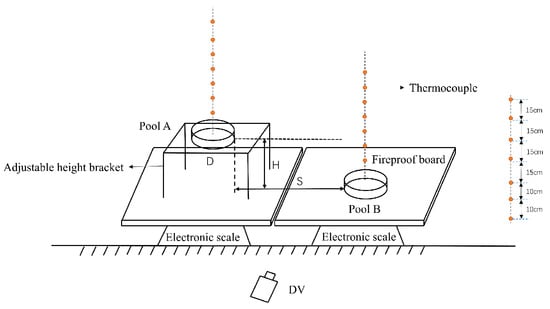
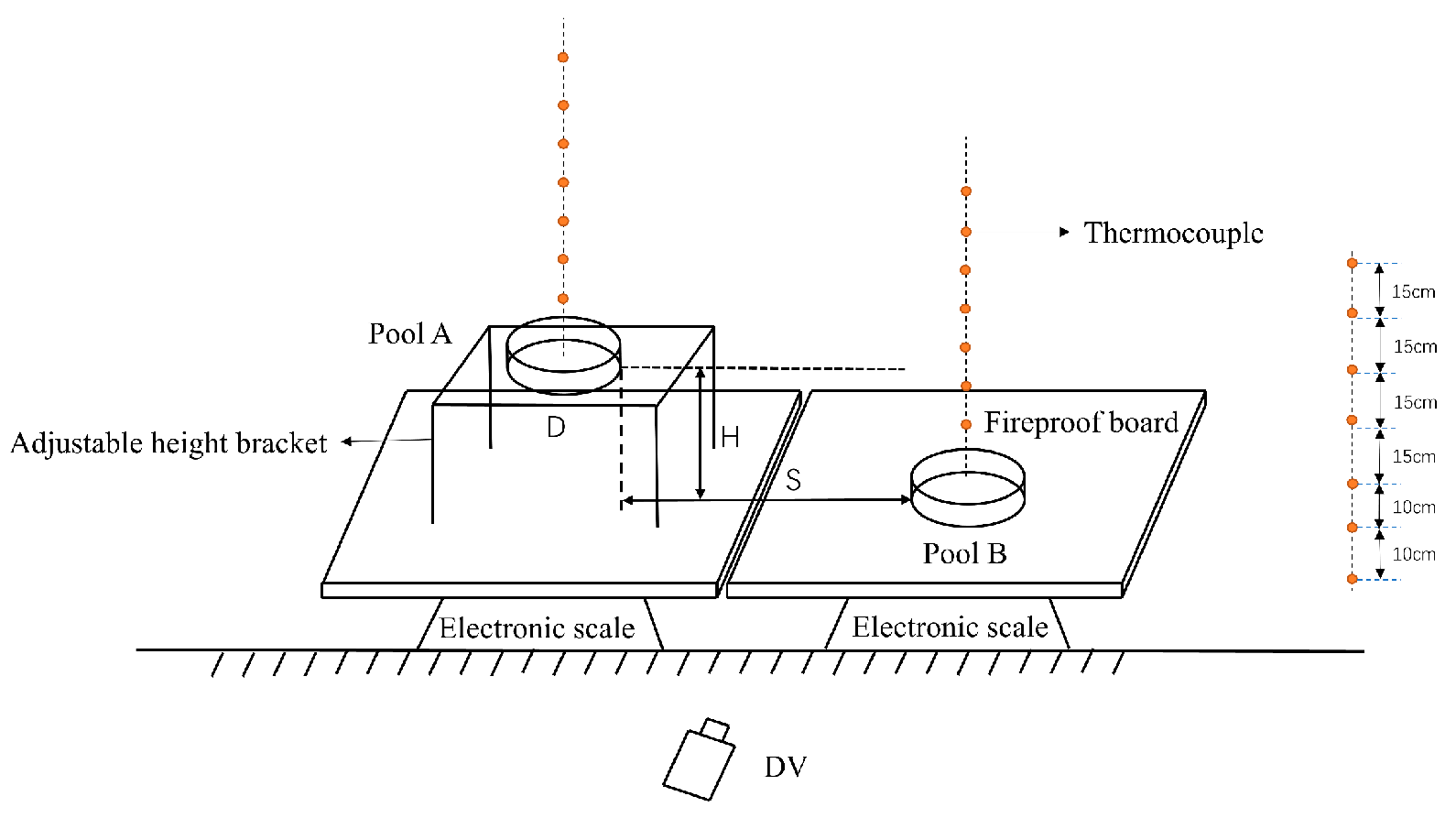
Figure 1 illustrates the experimental setup. Two identical circular oil pools, designated Pool A and B, were placed parallel on a fireproof board (40 cm × 40 cm) and positioned on an electronic balance to record the mass loss histories at 1 s intervals. The balance has a mass resolution of 0.01 g, with an estimated uncertainty in the measured mass loss rate below 3%. Both pools have identical diameter (D) and a depth of 3 cm, fabricated from 3 mm thick stainless steel plates. This study focuses on the mutual interaction between two pool fires under a strongly interacting configuration. Following Wan et al. [8], the experiments were conducted at a fixed spacing-to-diameter ratio of S/D = 1, corresponding to a continuously merged flame regime under the present conditions. In this way, the effect of vertical height difference can be examined without introducing additional variation in the horizontal interaction regime. Iso-octane was selected as the fuel in this study because it is a well-characterized liquid fuel widely used in pool-fire experiments, with relatively stable physicochemical properties and good repeatability in burning behavior. In addition, iso-octane produces a luminous flame with appreciable soot formation and radiative feedback during combustion, which is suitable for studying flame interaction and burning behavior in dual pool fires. It should also be noted that the conclusions obtained in the present work are most directly applicable to small-scale sooting liquid pool fires with similar combustion characteristics, while their broader applicability to other fuels still requires further investigation. The two pools were placed at different heights, as listed in Table 1.
Figure 1.
Experimental setup.
Table 1.
Experimental details.
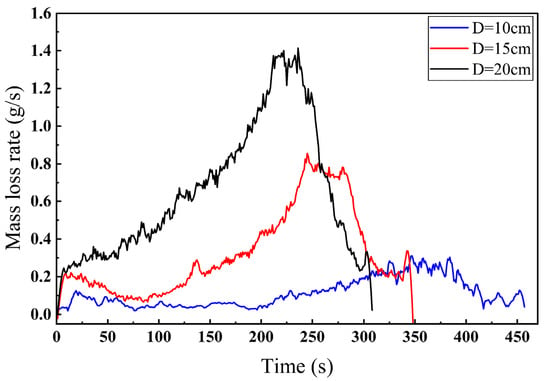
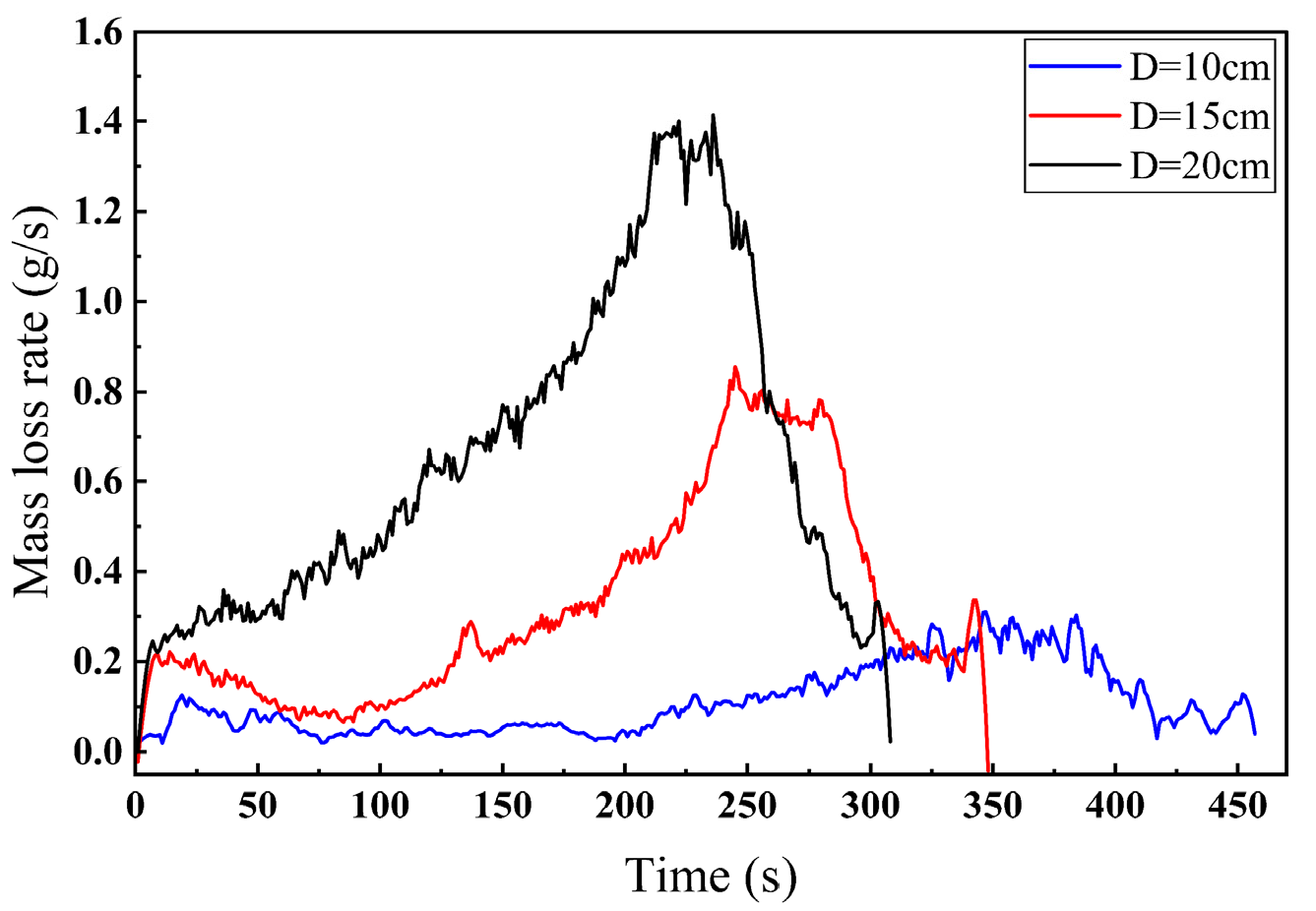
As shown in Figure 1, each oil pool is equipped with a vertical column of seven K-type thermocouples (0.4 mm diameter), spaced 10 cm or 15 cm apart and aligned with the pool center. Flame shape was recorded from the front using a digital camera (EOS 650D) at 1920 × 1080 resolution and 30 fps. The ambient temperature and humidity during the experiment were approximately 295 K and 65%, respectively. The mass loss variations for three circular pools of different diameters are presented in Figure 2. Larger pools exhibit greater mass loss of iso-octane per unit time and higher combustion rates, with combustion durations ranging from 0.24 g/s for the 10 cm pool to an average of 1.34 g/s for the 20 cm pool. As the pool diameter increases, the fuel is consumed more rapidly and the overall combustion duration becomes shorter. Under the present conditions, the total burning duration decreases from about 420 s for the 10 cm pool to about 320 s for the 20 cm pool. It should be noted that these values refer to the overall burning duration, rather than the beginning time of the steady-burning stage. Because the total burning duration is limited for the present small-scale pool fires, the steady-burning stage shown in Figure 2 is relatively short. Flame heights were processed in MATLAB R2019b using the Otsu binarization method proposed by Zukoski et al. [29]; each experimental condition was repeated twice.
Figure 2.
Fuel loss variation with different liquid pool sizes.
3. Results
3.1. Flame
3.1.1. Flame Merging Behavior
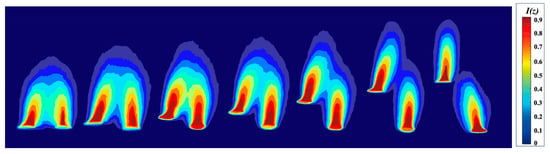
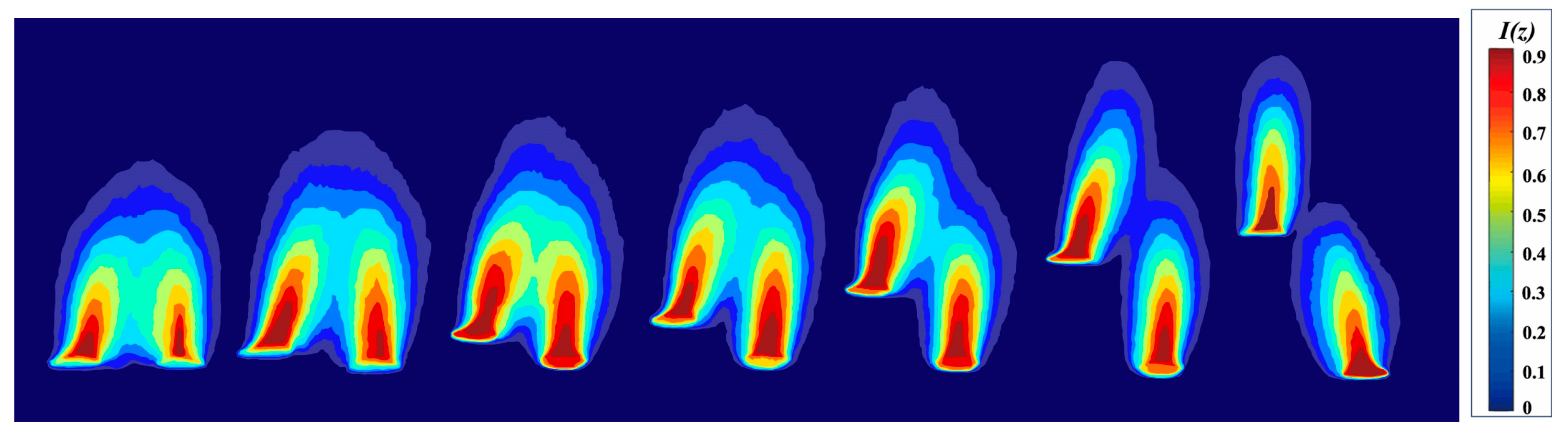
Taking the D = 20 cm liquid pool as an example, Figure 3 shows the frequency distribution of flame merging as the height difference increases. During merging, a deviation in flame occurrence was observed. Maximum merging occurred at H = 10 cm, while at H = 3D the flames began to separate. Similar trends were observed for other liquid pool dimensions (D = 10 cm and 15 cm).
Figure 3.
Spatial distribution profile of flame appearance derived from binarization.
This behavior may be related to the change in air entrainment and plume interaction under different height differences. When H increases from zero to a small non-zero value, the upward hot plumes from the two fires are more likely to interact strongly in the intermediate region, causing the flame bodies to deflect inward and enhancing the merged state. At the same time, the space between the two flames is more easily occupied by high-temperature gases, which weakens the direct penetration of ambient air into the gap between them. As a result, flame merging becomes most pronounced at H = 10 cm under the present conditions. When the height difference increases further, the two flame bodies become progressively misaligned, the plume interaction weakens, and ambient air can more easily enter the space between the flames, so the merged flame gradually breaks down and separation appears.
3.1.2. Flame Temperature
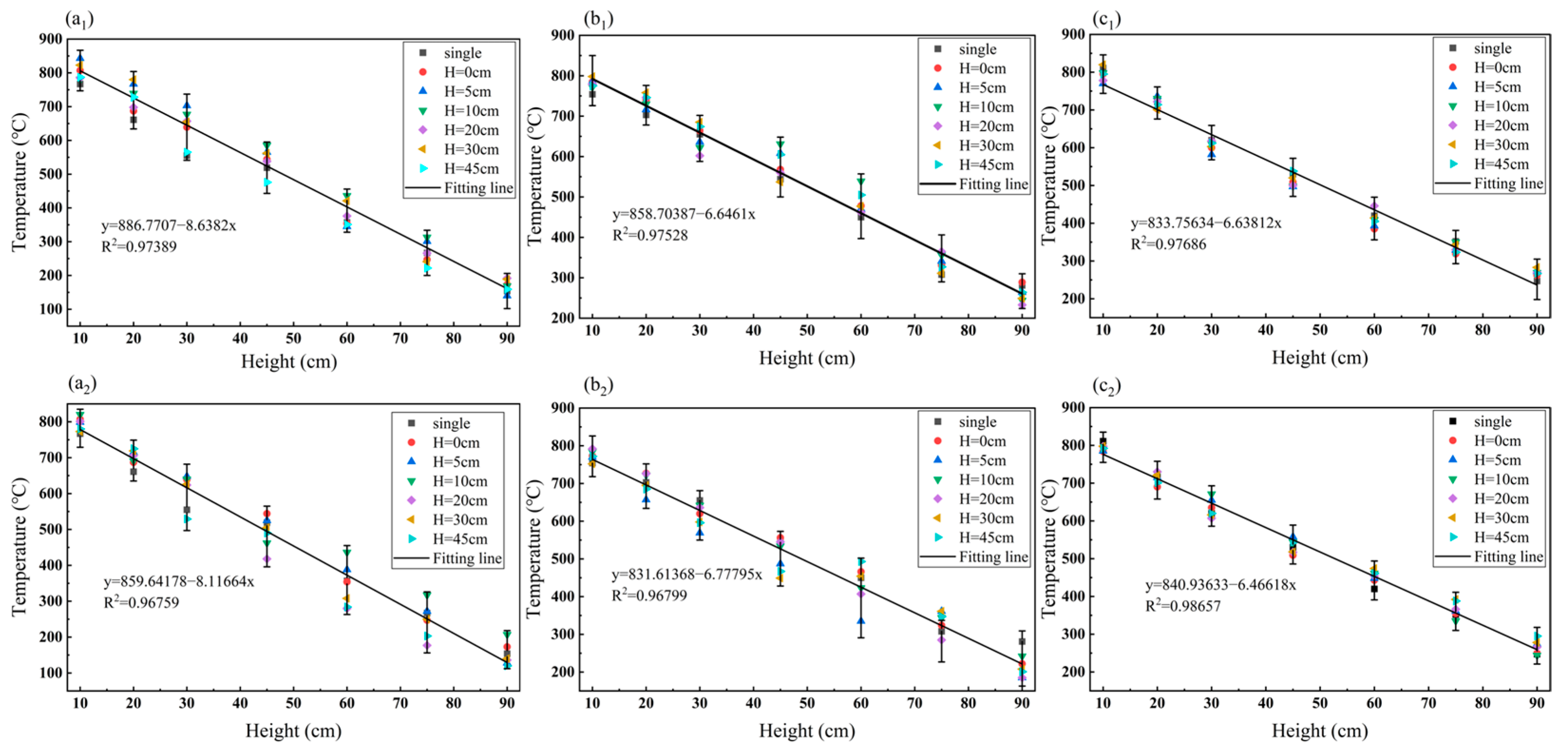
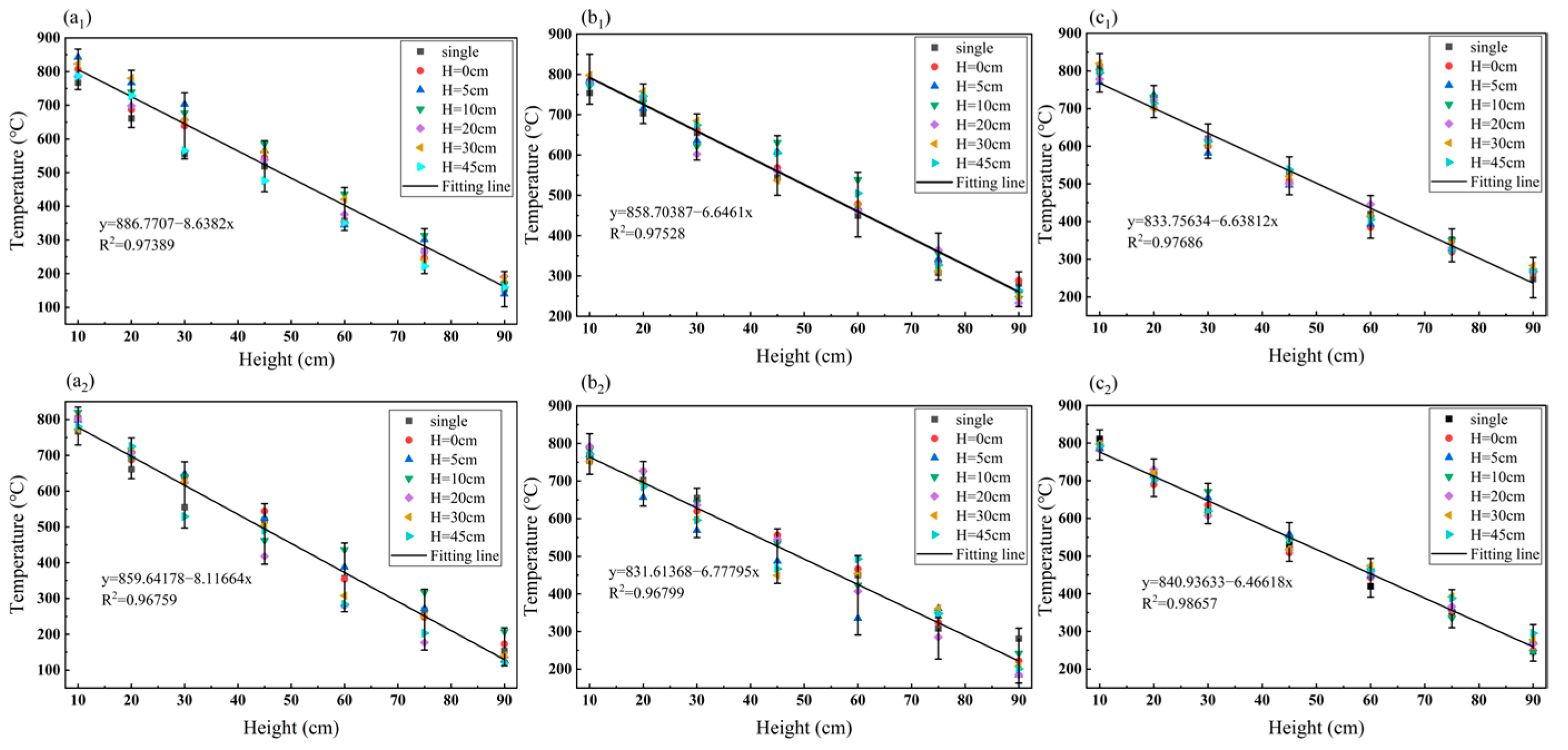
The flame centerline temperature (Tf) was measured using a vertical array of K-type thermocouples. Due to flame oscillations, thermocouple readings may deviate, generally reporting values lower than the actual flame temperature. In this study, the measurement uncertainty ranges from 18 °C to 89 °C. The larger uncertainties mainly occur under conditions with strong flame oscillation, large local temperature gradients, or when the thermocouple is located near the flame edge. Therefore, thermocouple temperatures should be corrected. After temperature correction for thermocouple readings, the ambient boiling point is and the flame temperature is . Given , the approximation holds and introduces negligible numerical error for subsequent simplifications.
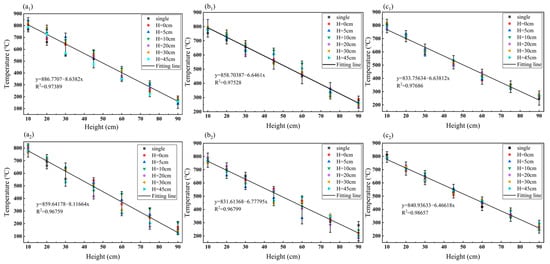
Flame temperatures at various heights during the steady-burning phase were recorded, revealing a decrease in temperature with increasing height, as shown in Figure 4. The results indicate that the measured temperature decreases with increasing measurement height. This trend suggests that, as the flame develops upward, the high-temperature core gradually weakens, while mixing between the flame plume and the surrounding air becomes stronger, resulting in a reduction in temperature. Pool diameter affects flame height and plume development, and therefore also influences the peak temperature distribution. At the same height, the temperature difference between pools A and B is about 50–120 °C, indicating that vertical height difference changes the interaction between the two flames and may lead to asymmetry in the local flow field and heat-transfer conditions, thereby producing differences in temperature distribution between the two pools. The relatively large uncertainty is closely related to the unsteady nature of the flame, especially the strong oscillation and the continuously changing thermal-flow structure around the thermocouple junction. Subscripts 1 and 2 represent Pool A and Pool B, respectively.
Figure 4.
Temperature fitting curves: (a1) 10 cm pool A; (a2) 10 cm pool B; (b1) 15 cm pool A; (b2) 15 cm pool B; and (c1) 20 cm pool A; (c2) 20 cm pool B.
3.1.3. Flame Height
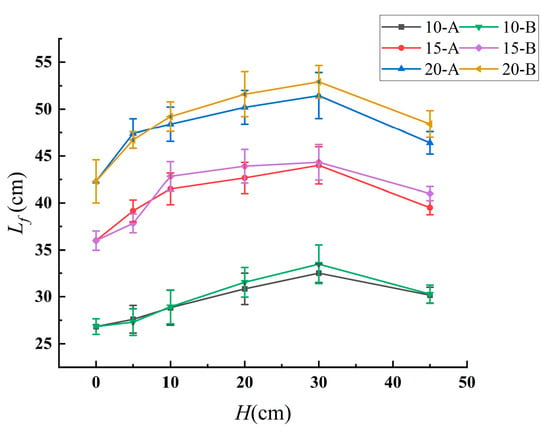
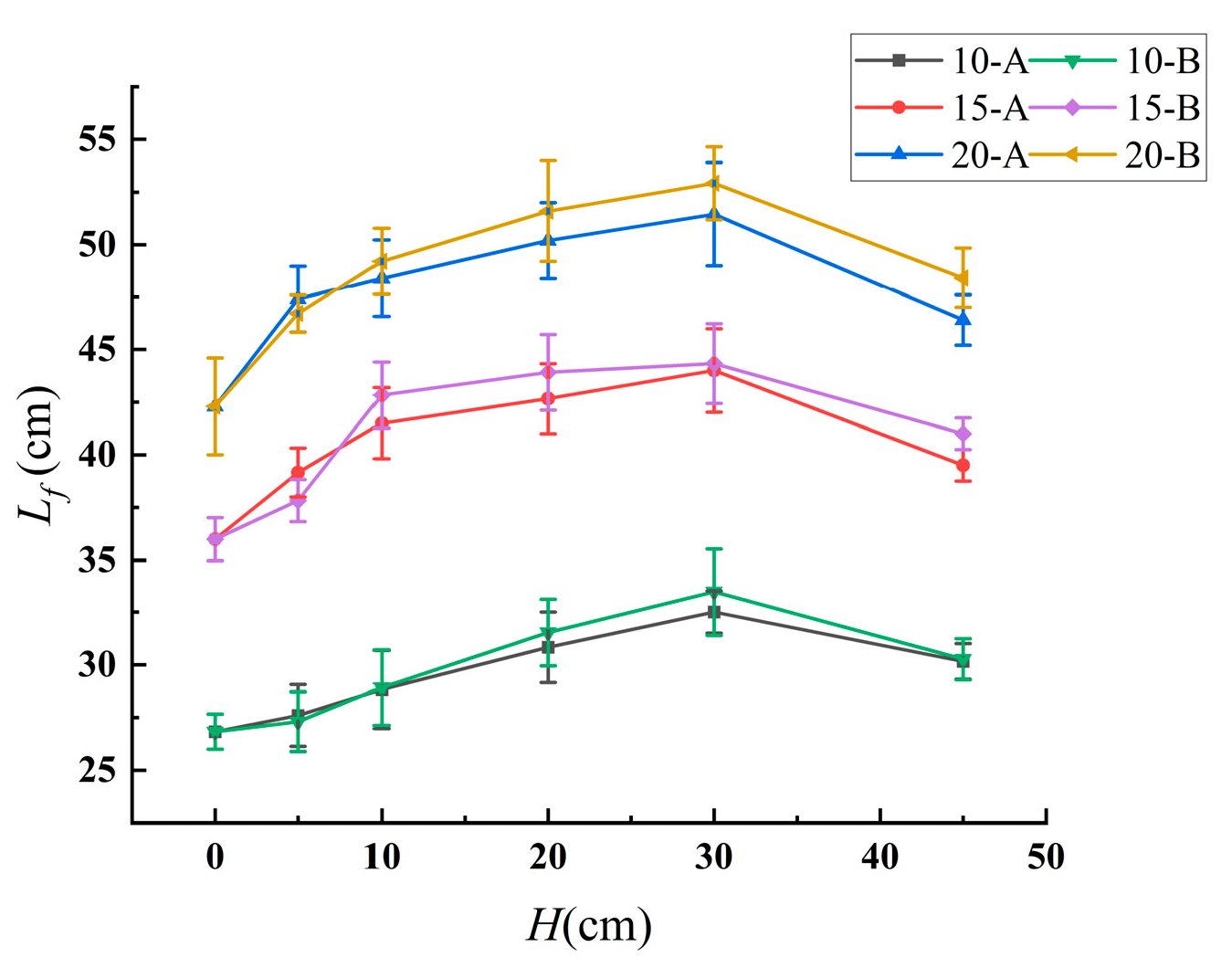
Flame height was processed using MATLAB, with the average flame height selected at an intermittency of I(z) = 0.5 [30]. Figure 5 presents the average flame height at different elevations for liquid pools of varying diameters. Overall, flame height increases with increasing pool diameter. As the height difference increases, the flame height (Lf) first rises, peaks at H = 30 cm, and then declines, eventually approaching the flame height of a single pool. This behavior suggests that a moderate height difference enhances the interaction between the two flames and promotes upward flame extension, whereas a larger height difference causes increasing misalignment of the flame bodies, reduces the interaction strength, and therefore leads the flame height to decrease and gradually approach the single-pool-fire condition. The flame heights of pools A and B differ only slightly, indicating that under the present conditions the two flames still maintain strong mutual influence in most cases.
Figure 5.
Average flame height of small-scale pool fires at different heights.
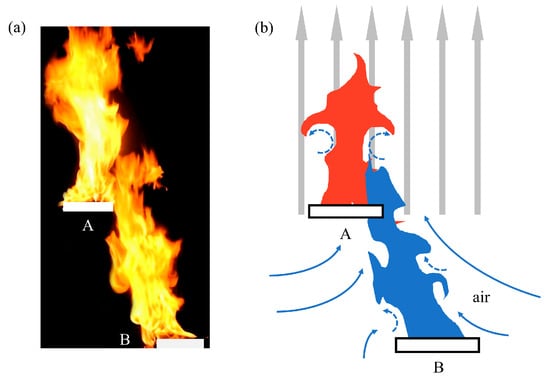
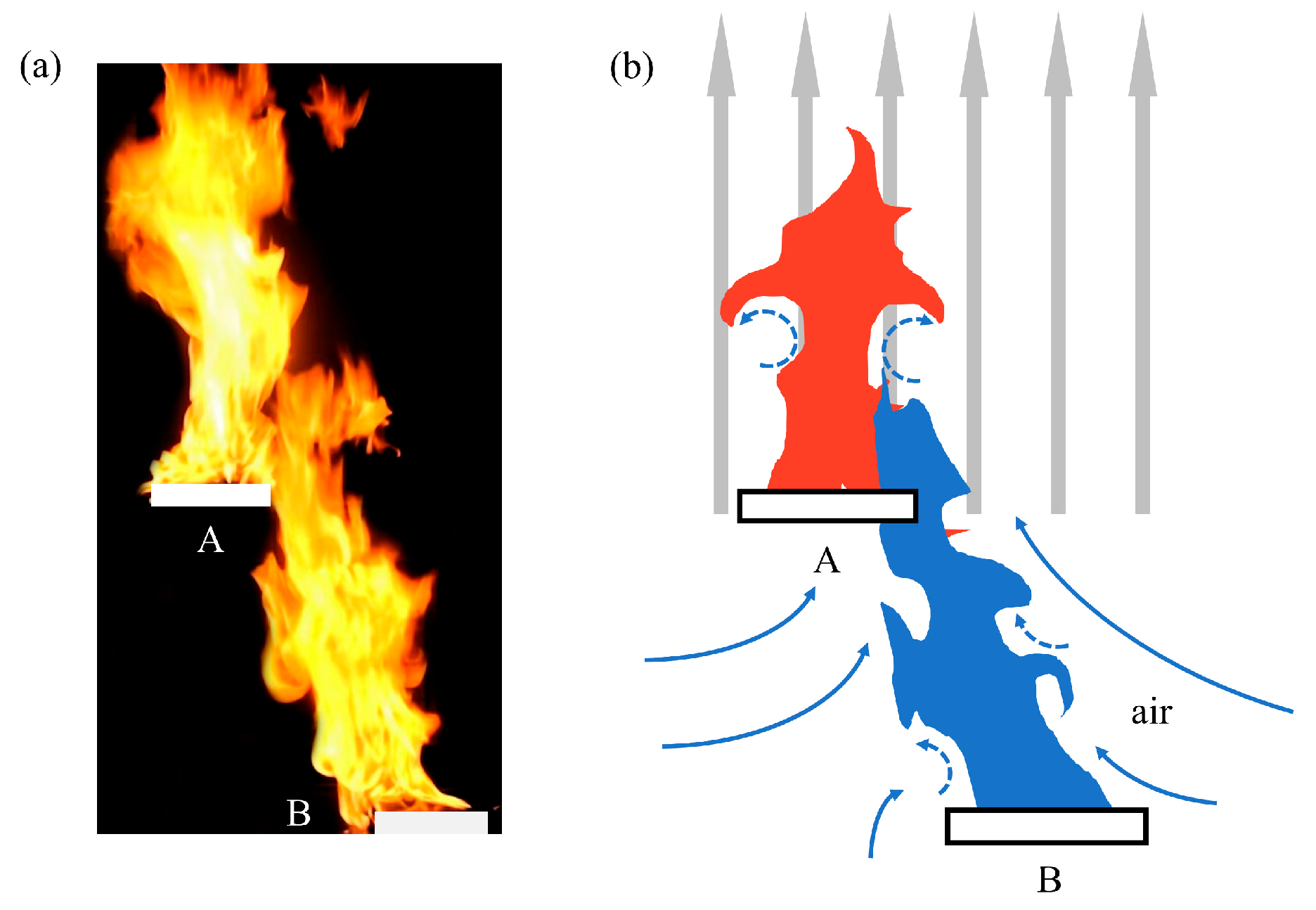
Air entrainment exists between the two pool fires, and vertical height difference can alter the entrainment pattern. Following the treatment proposed by Wan et al. [31], the parameter λ is introduced as a correction parameter for entrainment variation, and is used here to help interpret the influence of vertical separation on flame height. In Wan’s study, (1 + λ) represents the ratio of air entrainment under separated and non-separated fire configurations, so λ reflects the enhancement or reduction of entrainment relative to a reference condition. In the present work, the ratio between the flame height of the dual-pool fire and that of the corresponding single-pool fire is about 0.81–0.97, and the corresponding estimated range of λ is from −0.28 to 0.3 based on the empirical relation reported in the literature. It should be noted that λ is not directly measured in this study, but is inferred from the flame-height results using an existing empirical framework. Therefore, it should be understood as a semi-empirical parameter used to reflect the trend of entrainment variation, rather than a directly measured physical quantity. The parameter λ is adopted here only for analogical interpretation of flame height trend, based on the common feature that both configurations involve modified air entrainment between two pools, as shown in Figure 6. It is not rigorously derived or physically verified for vertical configurations.
Figure 6.
Schematic diagram of flame shape and gas flow, (a) frame captured from video, (b) model analysis plot.
3.2. Mass Loss Rate
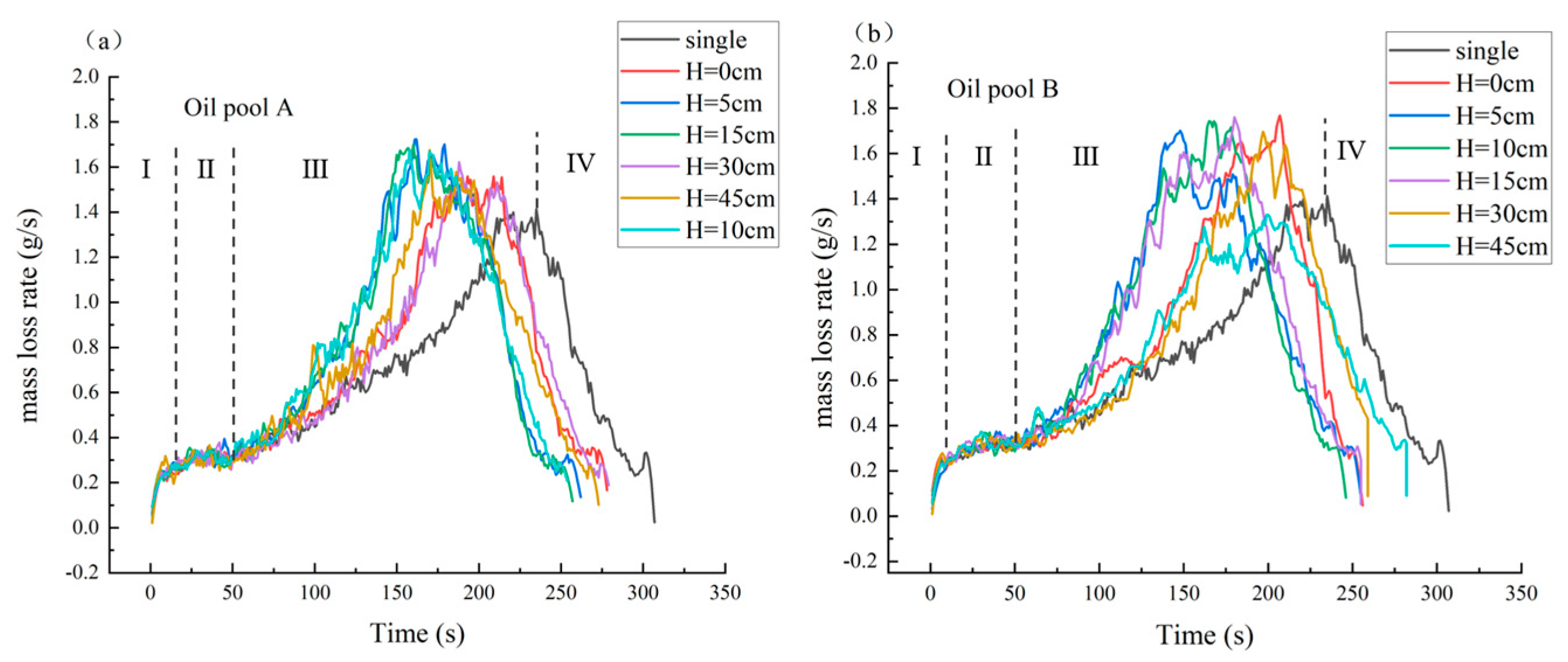
Figure 7 shows the mass burning rates of oil pools A and B in the 20 cm liquid pool at different heights (). It is evident that does not vary monotonically with H [13,17], showing a significant increase compared to a single pool.
Figure 7.
The 20 cm liquid pool mass combustion rate of oil pools A and B at different heights (), (a) pool A; (b) pool B.
The combustion process can be divided into four distinct stages [32], (I) the initial, (II) the steady, (III) the boiling-up, and (IV) the decay stage, as shown in Figure 7 (taking a single as an example). These stages reflect the overall process of fuel heating, evaporation, and combustion development. Under the present conditions, the transition from the steady stage to the boiling-up stage may be associated with progressive liquid heating and enhanced evaporation. The boiling phase exhibits the most pronounced variation due to: (1) enhanced oxygen supply from rising gas flows at higher elevations, accelerating combustion; and (2) exposure of the oil pool bottom, where rapid heat transfer rapidly elevates fuel temperature and further intensifies combustion, as shown in Figure 8. Together, these effects produce a substantially stronger combustion trend than in other scenarios. Next, we quantify the combustion rates of the two interacting pool fires from a thermal feedback mechanism.
Figure 8.
Mass loss per unit area of liquid pool at different heights , (a1) 10 cm pool A; (a2) 10 cm pool B; (b1) 15 cm pool A; (b2) 15 cm pool B; and (c1) 20 cm pool A; (c2) 20 cm pool B.
For dual pools, consistently exceeds for single pools; larger pool diameters yield higher values. For the 20 cm liquid pool, the rate increases with height initially and then decreases; the 15 cm liquid pool exhibits greater variation; and the 10 cm liquid pool reaches its maximum at H = 0 cm and then stabilizes. The difference between Pool A and Pool B is small in most cases, indicating that the burning intensities of the two pools remain broadly similar under the present conditions. Considering that the uncertainty of the balance is below 3%, some of the small differences may fall within the experimental uncertainty. Only under some larger height differences may a limited asymmetry appear.
The following mass-loss-rate correlation analysis mainly focuses on the variation in thermal feedback caused by the interaction of two pool fires at different height differences. To highlight the effect of flame interaction on the variation in mass loss rate, the thermal-feedback process is treated in a simplified manner in the present study. For the small-scale pool fires considered here, convective heat feedback may still be an important component of the total thermal feedback. However, in the present formulation, the convective term is not further developed as a parameter that varies explicitly with height difference H. In addition, some heat-loss mechanisms, including conductive heat loss to the pan and radiative loss from the flame to the surroundings, are not explicitly separated in the subsequent formulation. Therefore, the resulting relation should be understood as an approximate description under the present experimental conditions rather than a complete rigorous energy-balance model.
At steady state, the heat conservation at the fuel surface can be expressed as follows:
where is the latent heat of vaporization, and and represent the convective and radiative heat fluxes received by the oil pool, respectively. Based on the analysis by Hottel et al. [15] concerning thermal feedback in pools of varying diameters, the pools utilized in this experiment fall within the diameter range of 9–25.5 cm. Therefore, conductive heat feedback is neglected throughout this study.
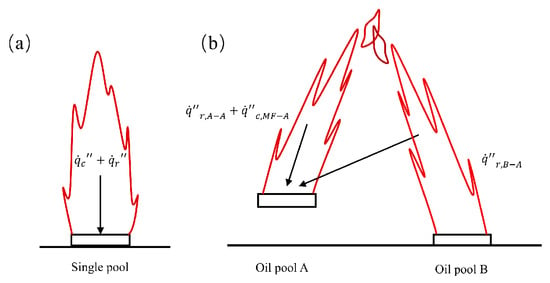
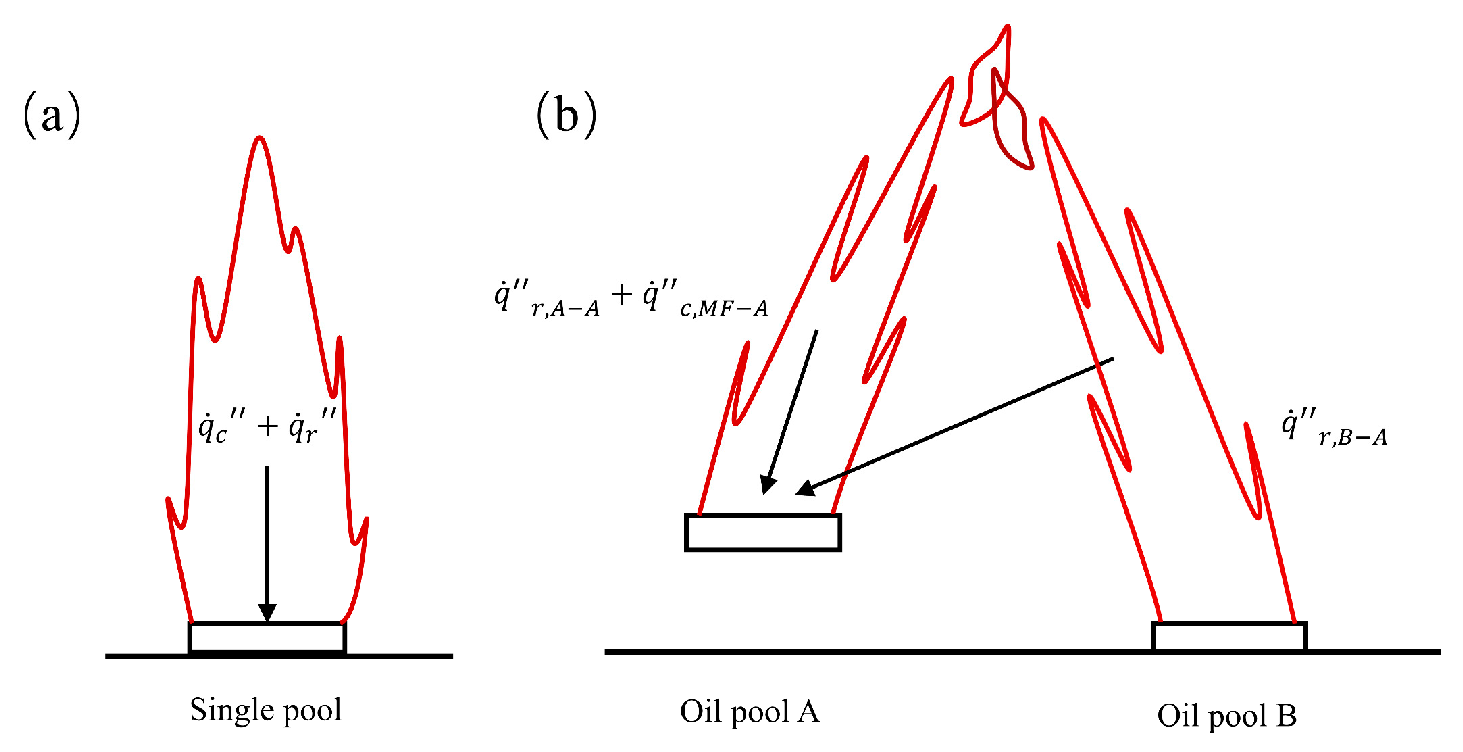
Figure 9 illustrates the thermal feedback from flames to fuel for different pool heights and configurations involving single and multiple pools. For a single-pool fire (Figure 9a), the thermal feedback equation is given by Equation (1). In the case of two interacting pool fires (Figure 9b), the oil pool with the altered height is designated as Pool A, and its thermal feedback is described by the following equation:
where the subscripts SF and MF denote single-pool and multiple-pool fires, respectively. The convective heat flux is given by , where h is the convective heat transfer coefficient, is the flame temperature, and is the fuel-surface temperature. Convective heat feedback is primarily determined by h and T (the temperature difference between the fluid and the solid wall). Studies indicate that vertical temperatures based on central plumes are nearly identical, while the convective coefficient h is influenced by flow conditions, including flame temperature () and flow velocity (). Given that the velocity ratio is close to one, under the conditions of small scale, flame merging, and fixed horizontal spacing in this study, the local flow and thermal boundary conditions near the fuel surface do not change significantly with the height difference H. Therefore, the convective heat transfer coefficient h can be approximately regarded as a constant. This correlation is only valid for small-scale strongly merged dual-pool fires under fixed-spacing conditions. Future work will aim to independently measure near-surface flow velocity and convective heat flux under various vertical offsets, so as to quantify the variation in h and further reduce this simplification-induced error. Therefore, convective heat feedback in this paper is considered to be .
Figure 9.
Schematic of flame heat feedback received by single and dual pools. (a) Single-pool fire and (b) Two interacting pool fires.
By combining Equations (1) and (2), the mass loss increment relative to a single pool can be expressed as follows:
The radiative heat flux in Equation (4) can be expressed as follows:
where τ is the radiative transmissivity between flames, ε is the flame emissivity, σ is the Stefan–Boltzmann constant, and F is the angular coefficient between the surface of oil Pool A and oil Pool B. Substituting Equation (4) into Equation (3) yields
From Equation (6), it is evident that the flame emissivity ε and angular coefficient F should be determined. The total radiant energy of the flame can be expressed as
where is the flame radiation fraction, is the heat of combustion, and is the flame surface area. The fuel employed in this experiment is iso-octane, which produces sooty flames during combustion. Due to the influence of fuels producing sooty flames, the energy radiated by the flame accounts for 0.2–0.4 times the total HRR [33]. Gore et al. [16] demonstrated that is approximately 0.3 for n-heptane pool fires with diameters ranging from 4.6 to 30 cm. Therefore, in this experiment, can be assumed constant. Since the liquid pool used in this study is circular, the flame shape is assumed to be cylindrical, . Consequently, Equation (6) is transformed to
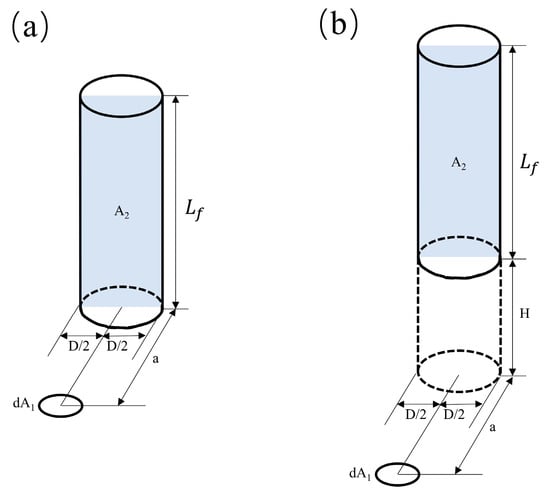
Equation (7) shows that the effective radiation parameter of the flame is related to parameters such as the mass burning rate and the flame area. Since the single-pool fire (SPF) and multiple-pool fire (MPF) differ in burning rate and flame configuration, their corresponding effective overall radiative behavior may theoretically be different, as shown in Figure 10.
Figure 10.
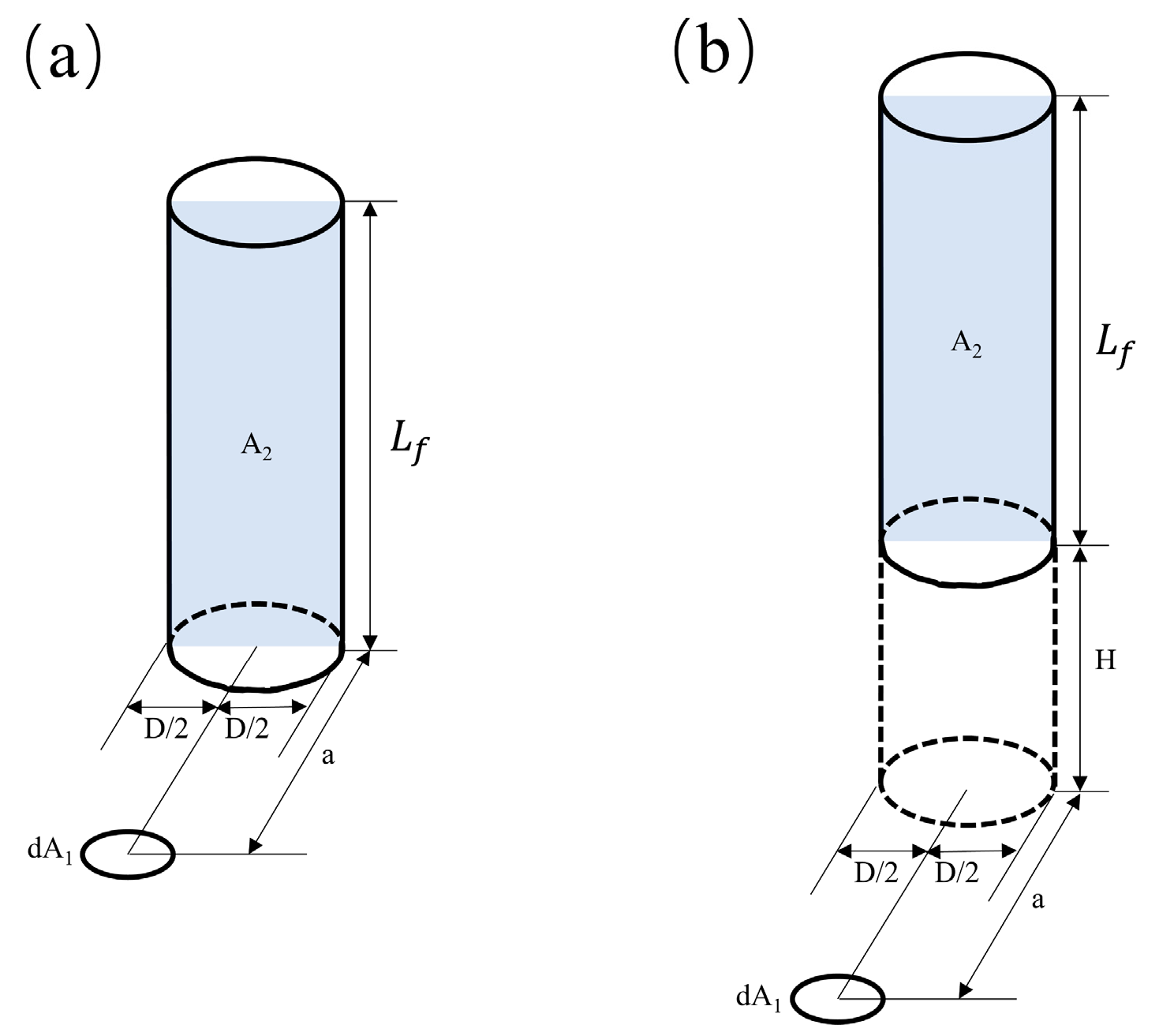
Angular coefficient diagram, (a) zero height difference; (b) non-zero elevation difference.
This study adopts the cylindrical flame and uniform radiation assumptions, ignoring flame distortion, non-axisymmetry, and surface non-uniformity induced by vertical height differences. Such simplifications will introduce errors in flame surface area, view factor, and radiative heat flux calculations. Restricted by the difficulty of characterizing asymmetric flame geometries, the proposed model is only applicable for trend prediction in small-scale, strongly merged pool fires, rather than high-precision quantitative radiation analysis. The angular coefficient F can be expressed as follows [32]:
where , and substituting Equations (7) and (8) into Equation (5) yields the following:
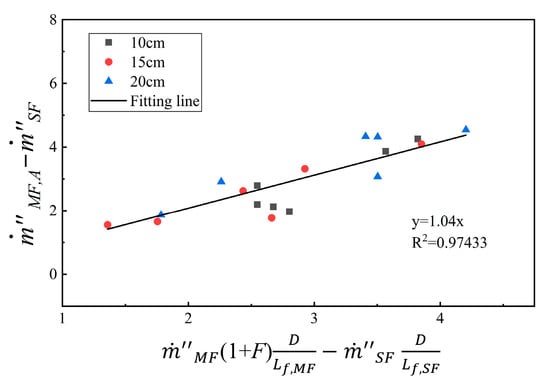
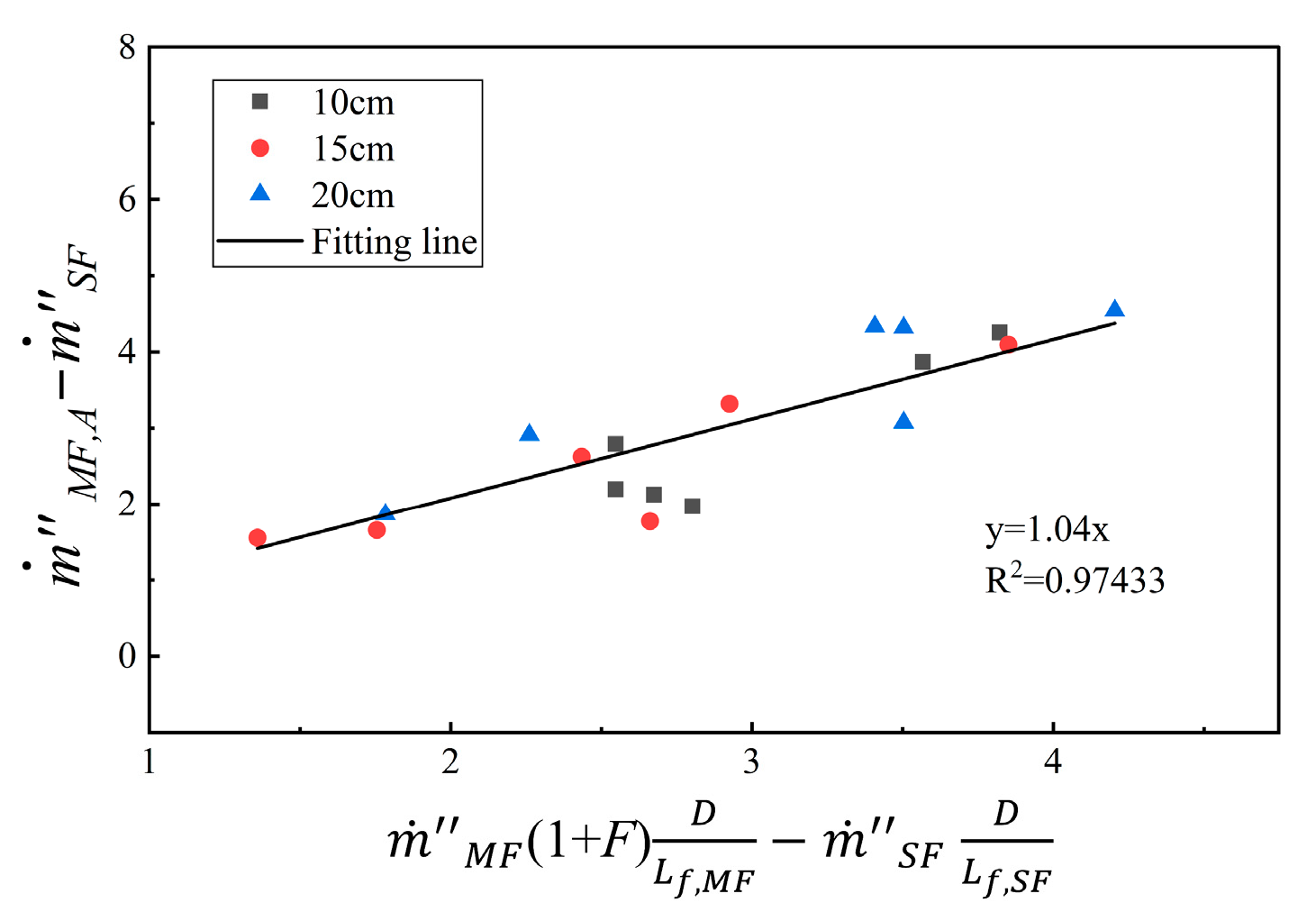
Based on experimental data, the calculation results of Equation (9) are presented in Figure 11.
Figure 11.
vs. Correlation.
The scattered data points at different heights have converged, and the linear fitting curve yields the following:
Equation (9) can be rearranged as follows:
Based on the relation F = f (D, S, H, Lf,SF), Equation (11) establishes a correlation between the mass loss rate of interacting dual pool fires and the corresponding flame height and geometric parameters. Equation (11) is only suitable for predicting the burning rate of the relatively higher pool in two pool fires with different vertical heights in the open space. It should be noted that the present relation still requires the flame height of the multiple-pool-fire configuration and therefore is more appropriately regarded as a preliminary engineering correlation for relating burning rate to flame height, pool size, and height difference, rather than a fully independent predictive model. Its practical applicability remains subject to the availability or estimation of the corresponding flame-height information. Therefore, the proposed correlation is only valid for predicting the mass loss rate of the higher pool provided that the single-pool burning rate, single-pool flame height, and flame height of the elevated pool are given.
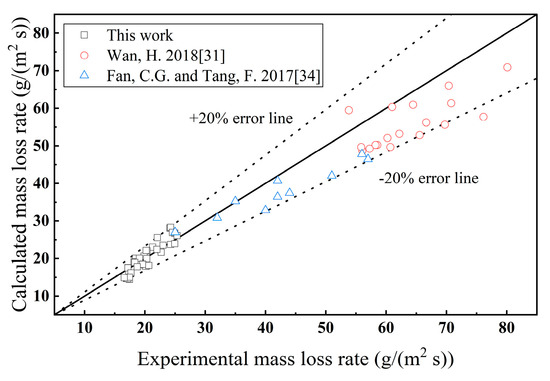
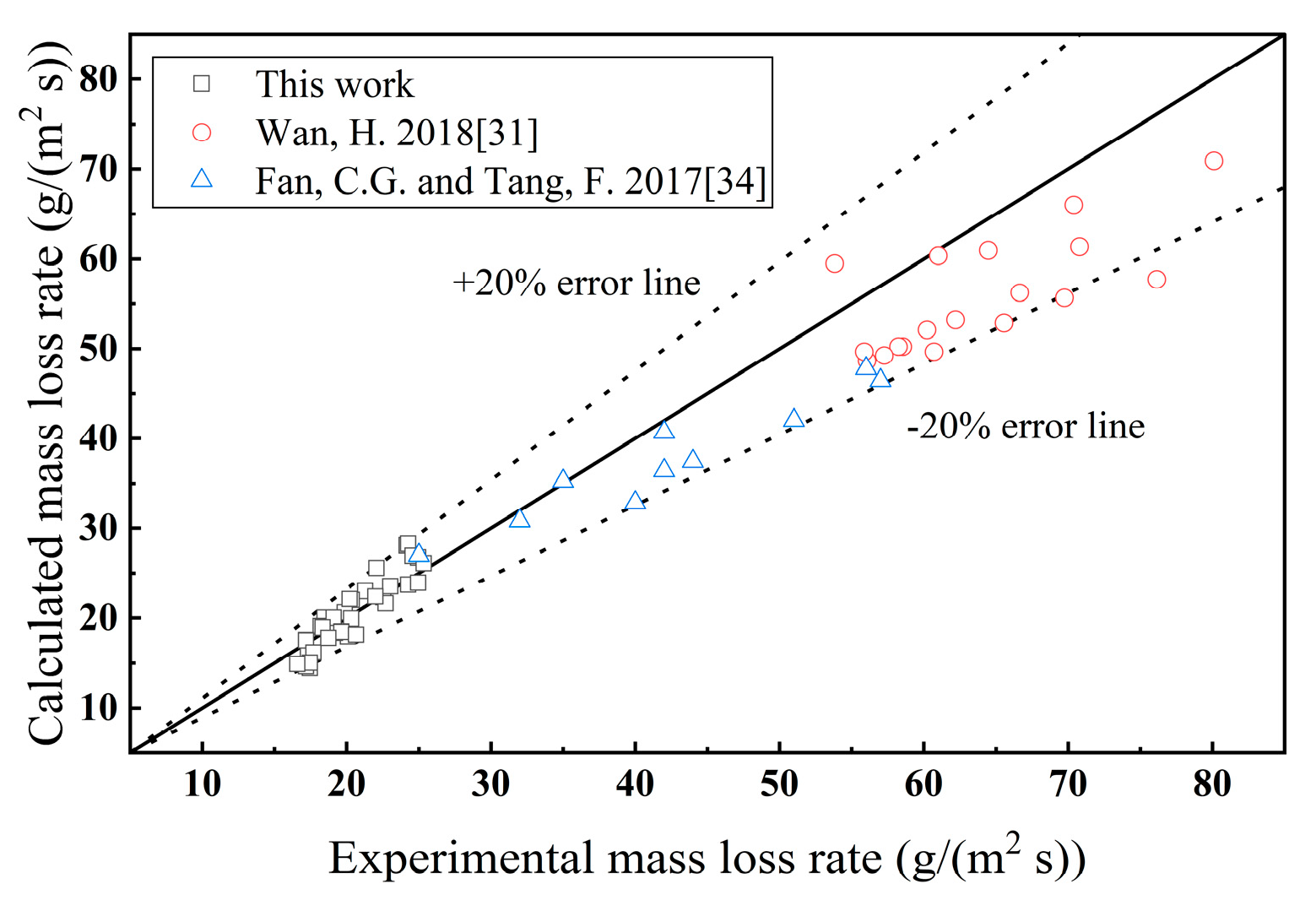
To assess the applicability of Equation (11), the calculated results were compared not only with the present experimental data but also with available literature datasets, including the studies of Wan [31] and Fan and Tang [34]. As shown in Figure 12, the calculated values are in reasonable agreement with the corresponding experimental results. However, it should be noted that experimental data for dual pool fires with vertical height difference are still limited in the open literature. Therefore, the present validation should be regarded as a preliminary verification of the proposed correlation rather than a comprehensive demonstration of its general applicability. It should be particularly emphasized that the proposed equation is best interpreted as a preliminary engineering correlation. The validation dataset is limited: tests are restricted to small-scale iso-octane pool fires under open-atmosphere conditions with a fixed spacing-to-diameter ratio (S/D = 1). Good predictive performance observed in Figure 12 cannot be directly extrapolated to other fuels, different horizontal-spacing ratios, larger-scale fires or confined-space fire conditions. Additional experimental data covering broader parameter spaces are required to further examine and improve its general applicability.
Figure 12.
Comparison of calculated and experimental mass loss for pool fires, Redrawn based on Wan, H. 2018 [31] and Fan, C.G., Tang, F. 2017 [34].
4. Discussion
Several key simplifying assumptions are embedded within the present semi-empirical derivation, and their constraints on model applicability deserve explicit clarification.
First, conductive heat feedback transferred from the pan wall to the fuel surface is neglected. This treatment is valid for pool diameters ranging from 10 cm to 20 cm in this study, where convective and radiative terms dominate the total heat input. For much smaller pool sizes where pan conduction becomes non-negligible, larger prediction errors are expected.
Second, the convective heat-transfer coefficient h is treated as approximately constant. This holds only under the condition of fixed (S/D = 1) and fully merged flames. If flames become partially separated under large vertical offset, near-surface flow structures change substantially and this assumption breaks down.
Third, each flame is idealized as a cylindrical radiator with uniform surface radiation, disregarding flame tilt, asymmetric distortion and heterogeneous radiation induced by vertical height misalignment. This geometrical simplification introduces errors in flame-surface-area and view-factor computations; accordingly, the correlation is intended for trend-oriented prediction instead of high-accuracy radiative calculation.
Fourth, a constant flame radiation fraction = 0.3 is adopted for sooty iso-octane flames. Potential variations in soot yield and radiative fraction caused by plume-to-plume interaction are ignored. Hence the model is only suitable for hydrocarbon liquid-pool fires with comparable radiative properties.
Fifth, the view-factor F is calculated based on ideal cylindrical flame geometry without correction for real deformed flame shapes. Part of the resulting geometrical error is absorbed by the empirical fitting coefficient, yet cannot be fully eliminated. Collectively, these assumptions define the model’s application envelope: it is restricted to small-scale dual-pool fires with (S/D = 1), fully merged flames and open-atmosphere conditions. Deviations will increase when extrapolating beyond these bounds.
Uncertainties from model simplifications (cylindrical flame assumption, view factor assumption, flame merging/overlap, constant radiative fraction, and neglect of conduction and convection) range from 10% to 20%. Using the root-sum-square method, the overall uncertainty is 12.5–21.4%, consistent with Figure 12, where most data fall within the ±20% error band.
This semi-empirical model is physics-based. It characterizes the radiative heat-feedback effect induced by vertical height difference via the view-factor, and couples flame morphology and burning rate using physically meaningful parameters. Cross-validated against self-generated experimental data and published literature datasets, it yields prediction errors within ±20% under strongly merged-flame conditions, and provides preliminary quantitative evaluation for burning enhancement of elevated pool fires in staggered-layout liquid-fuel fire scenarios.
This correlation remains a preliminary engineering tool, and further experimental validation is required to confirm its broader applicability across diverse fire configurations.
5. Conclusions
A series of experiments were conducted in an open space to investigate the flame characteristics and mass burning rates of two identical circular pool fires. The height of pool A was varied to create different elevation differences. The main findings of this study are as follows:
- (1)
- As the height difference H increases, flame merging and flame height vary non-monotonically, while flame temperature shows monotonic variation. Flame coalescence reaches a maximum at H = 10 cm and begins to separate at H = 3D. Flame height reaches a maximum at H = 30 cm.
- (2)
- A preliminary engineering correlation was established to relate the mass loss rate of interacting dual pool fires to flame height and geometric parameters under the present experimental conditions. It should be noted that the correlation is based on several simplifying assumptions regarding thermal feedback, and therefore should be understood as an approximate relationship rather than a universally applicable predictive model. Owing to the limited availability of experimental data for vertically separated dual pool fires, the present validation of Equation (11) remains preliminary, and its broader applicability still requires further verification.
Changes in pool size can alter air-entrainment and thermal-feedback mechanisms, potentially limiting the direct applicability of the present model. Variations in pool size alter air entrainment and thermal feedback mechanisms, which may limit the direct applicability of the present model. Investigating the combustion behavior of fires in pools of different scales carries significant theoretical and practical value and will be a key focus for future research.
Author Contributions
Y.W.: Writing—review and editing, Writing—original draft, Methodology, Formal analysis, Conceptualization. L.W.: Writing—review and editing, Validation. H.D.: Resources, Investigation. All authors have read and agreed to the published version of the manuscript.
Funding
This work was supported by the Opening Project of Oil & Gas Field Applied Chemistry Key Laboratory of Sichuan Province (YQKF202102).
Institutional Review Board Statement
Not applicable.
Informed Consent Statement
Not applicable.
Data Availability Statement
The original contributions presented in this study are included in the article. Further inquiries can be directed to the corresponding author.
Conflicts of Interest
The authors declare no conflicts of interest.
References
- Planas-Cuchi, E.; Montiel, H.; Casal, J. A Survey of the Origin, Type and Consequences of Fire Accidents in Process Plants and in the Transportation of Hazardous Materials. Process Saf. Environ. Prot. 1997, 75, 3–8. [Google Scholar] [CrossRef] [Scilit]
- Tang, F.; Li, L.; Zhu, K.; Qiu, Z.; Tao, C. Experimental study and global correlation on burning rates and flame tilt characteristics of acetone pool fires under cross air flow—ScienceDirect. Int. J. Heat Mass Transf. 2015, 87, 369–375. [Google Scholar] [CrossRef] [Scilit]
- Vali, A.; Nobes, D.S.; Kostiuk, L.W. Fluid motion and energy transfer within burning liquid fuel pools of various thicknesses. Combust. Flame 2015, 162, 1477–1488. [Google Scholar] [CrossRef] [Scilit]
- Tu, R.; Fang, J.; Zhang, Y.M.; Zhang, J.; Zeng, Y. Effects of low air pressure on radiation-controlled rectangular ethanol and n-heptane pool fires. Proc. Combust. Inst. 2013, 34, 2591–2598. [Google Scholar] [CrossRef] [Scilit]
- Zhou, Z.; Wei, Y.; Li, H.; Yuen, R.; Jian, W. Experimental analysis of low air pressure influences on fire plumes. Int. J. Heat Mass Transf. 2014, 70, 578–585. [Google Scholar] [CrossRef] [Scilit]
- Vasanth, S.; Tauseef, S.M.; Abbasi, T.; Abbasi, S.A. Assessment of the effect of pool size on burning rates of multiple pool fires using CFD. J. Loss Prev. Process Ind. 2014, 30, 86–94. [Google Scholar] [CrossRef] [Scilit]
- Sugawa, O.; Takahashi, W. Flame height behavior from multi-fire sources. Fire Mater. 1993, 17, 111–117. [Google Scholar] [CrossRef] [Scilit]
- Wan, H.; Ji, J.; Li, K.; Huang, X.; Sun, J.; Zhang, Y. Effect of air entrainment on the height of buoyant turbulent diffusion flames for two fires in open space. Proc. Combust. Inst. 2016, 36, 3003–3010. [Google Scholar] [CrossRef] [Scilit]
- Tao, C.; Ye, Q.; Wei, J.; Shi, Q.; Tang, F. Experimental Study on Flame–Flame Interaction and Its Merging Features Induced by Double Rectangular Propane Diffusion Burners With Various Aspect Ratios. Combust. Sci. Technol. 2019, 191, 1416–1429. [Google Scholar] [CrossRef] [Scilit]
- Leite, R.M.; Centeno, F.R. Effect of tank diameter on thermal behavior of gasoline and diesel storage tanks fires. J. Hazard. Mater. 2018, 342, 544–552. [Google Scholar] [CrossRef] [Scilit] [PubMed]
- Wan, H.; Gao, Z.; Ji, J.; Fang, J.; Zhang, Y. Experimental study on horizontal gas temperature distribution of two propane diffusion flames impinging on an unconfined ceiling. Int. J. Therm. Sci. 2019, 136, 8. [Google Scholar] [CrossRef] [Scilit]
- Weng, W.; Kamikawa, D.; Hasemi, Y. Experimental study on merged flame characteristics from multifire sources with wood cribs. Proc. Combust. Inst. 2015, 35, 2597–2606. [Google Scholar] [CrossRef] [Scilit]
- Huffman, K.G.; Welker, J.R.; Sliepcevich, C.M. Interaction effects of multiple pool fires. Fire Technol. 1969, 5, 225–232. [Google Scholar] [CrossRef] [Scilit]
- Blinov, V.I.; Khudyakov, G.N. Diffusion Burning of Liquid; Army Engineer Research and Development Labs: Fort Belvoir, VA, USA, 1961. [Google Scholar]
- Hottel, H.C. Certain Laws Governing Diffusive Burning of Liquids. Fire Res. Abstr. Rev. 1959, 1, 41–44. [Google Scholar]
- Gore, J.; Klassen, M.; Hamins, A.; Kashiwagi, T. Fuel Property Effects On Burning Rate And Radiative Transfer From Liquid Pool Flames. Fire Saf. Sci. 1991, 3, 395–404. [Google Scholar] [CrossRef] [Scilit]
- Liu, N.; Liu, Q.; Lozano, J.S.; Shu, L.; Zhang, L.; Zhu, J.; Deng, Z.; Satoh, K. Global burning rate of square fire arrays: Experimental correlation and interpretation. Proc. Combust. Inst. 2009, 32, 2519–2526. [Google Scholar] [CrossRef] [Scilit]
- Liu, N.; Liu, Q.; Deng, Z.; Kohyu, S.; Zhu, J. Burn-out time data analysis on interaction effects among multiple fires in fire arrays. Proc. Combust. Inst. 2007, 31, 2589–2597. [Google Scholar] [CrossRef] [Scilit]
- Liu, N.; Liu, Q.; Lozano, J.S.; Zhang, L.; Deng, Z.; Yao, B.; Zhu, J.; Satoh, K. Multiple fire interactions: A further investigation by burning rate data of square fire arrays. Proc. Combust. Inst. 2013, 34, 2555–2564. [Google Scholar] [CrossRef] [Scilit]
- Wan, H.; Gao, Z.; Ji, J.; Zhang, Y.; Li, K.; Wang, L. Effects of pool size and spacing on burning rate and flame height of two square heptane pool fires. J. Hazard. Mater. 2019, 369, 116–124. [Google Scholar] [CrossRef] [Scilit] [PubMed]
- Chen, Y.; Zhang, X.; Miao, Y.; Hu, L. Effects of cross airflow and burner distance on temperature profile and flame morphology of dual tandem pool fires. Fuel 2022, 317, 123220. [Google Scholar] [CrossRef] [Scilit]
- Liu, S.; Zhang, X.; Fang, X.; Hu, L. Experimental study on tilting behavior and blow out of dual tandem jet flames under cross wind. Process Saf. Environ. Prot. 2022, 158, 1–9. [Google Scholar] [CrossRef] [Scilit]
- Chen, Y.; Miao, Y.; Tao, S.; Li, Q.; Yuan, Y.; Zhang, X.; Hu, L. Flame structure and dynamics in pool fires of different geometries: Experimental and numerical investigation. Energy 2024, 304, 131996. [Google Scholar] [CrossRef] [Scilit]
- Shi, C.; Deng, L.; Ren, F.; Tang, F. Experimental study on the flame height evolution of two adjacent hydrocarbon pool fires under transverse air flow. Energy 2023, 262, 125520. [Google Scholar] [CrossRef] [Scilit]
- Vasanth, S.; Tauseef, S.M.; Abbasi, T.; Abbasi, S.A. CFD simulation of pool fires situated at differing elevation. Process Saf. Environ. Prot. 2015, 94, 89–95. [Google Scholar] [CrossRef] [Scilit]
- Fukuda, M. Characteristics of Two Small Pool Fires Arranged Two Different Horizontal Planes. In Proceedings of the 5th Asia-Pacific Conference on Combusion, Adelaide, Australia, 17–20 July 2005. [Google Scholar]
- Tiwari, M.K.; Gupta, A.; Kumar, R.; Sharma, P.K. Experimental Investigation on Diesel Fire Toxicity in a Compartment Under Different Pool Locations. Fire Technol. 2021, 57, 2205–2233. [Google Scholar] [CrossRef] [Scilit]
- Tiwari, M.K.; Gupta, A.; Kumar, R.; Sharma, P.K. Effects of elevated pool fire in a naturally ventilated compartment. J. Therm. Anal. Calorim. 2020, 146, 341–353. [Google Scholar] [CrossRef] [Scilit]
- Zukoski, E.; Cetegen, B.; Kubota, T. Visible structure of buoyant diffusion flames. Symp. Combust. 1985, 20, 361–366. [Google Scholar] [CrossRef] [Scilit]
- Guo, Y.; Xiao, G.; Deng, H.; Wang, L.; Xiong, X.; Chen, J.; Liu, X. Mini but Mighty: Oscillations in diffusion flames at sub-atmospheric conditions. Fuel 2024, 360, 130571. [Google Scholar] [CrossRef] [Scilit]
- Wan, H.; Gao, Z.; Ji, J.; Sun, J.; Zhang, Y.; Li, K. Predicting heat fluxes received by horizontal targets from two buoyant turbulent diffusion flames of propane burning in still air. Combust. Flame 2018, 190, 260–269. [Google Scholar] [CrossRef] [Scilit]
- Guo, Y.; Xiao, G.; Chen, J.; Xiong, X.; Deng, H.; Liu, X.; Wang, L.; Li, Y. Characterizing burning behaviour of convection-controlled pool fires at sub-atmospheric pressure by stagnation theory. Energy 2024, 287, 129689. [Google Scholar] [CrossRef] [Scilit]
- Ji, J.; Fan, C.G.; Zhong, W.; Shen, X.B.; Sun, J.H. Experimental investigation on influence of different transverse fire locations on maximum smoke temperature under the tunnel ceiling. Int. J. Heat Mass Transf. 2012, 55, 4817–4826. [Google Scholar] [CrossRef] [Scilit]
- Fan, C.G.; Tang, F. Flame interaction and burning characteristics of abreast liquid fuel fires with cross wind. Exp. Therm. Fluid Sci. 2017, 82, 160–165. [Google Scholar] [CrossRef] [Scilit]

Disclaimer/Publisher’s Note: The statements, opinions and data contained in all publications are solely those of the individual author(s) and contributor(s) and not of MDPI and/or the editor(s). MDPI and/or the editor(s) disclaim responsibility for any injury to people or property resulting from any ideas, methods, instructions or products referred to in the content. |
© 2026 by the authors. Licensee MDPI, Basel, Switzerland. This article is an open access article distributed under the terms and conditions of the Creative Commons Attribution (CC BY) license.