


Abstract
Membrane technology is a highly efficient, cost-effective, and chemical-free process, leading to its widespread application across various fields. However, the high capital cost of traditional ceramic benchmarks remains a barrier. This study addresses this challenge by engineering a low-cost, waste-derived geopolymeric membrane functionalized with a silver molybdate (Ag2MoO4) catalytic coating for the removal of trimethoprim (TMP), a persistent emerging contaminant. Systematic filtration assays for the removal of TMP (100 mg·L−1, pH 4) revealed the role of the Ag2MoO4 layer as a performance intensifier, yielding a 26% increase in initial permeate flux and a 33% improvement in the selectivity compared to the pristine support, while maintaining robust rejection efficiency. Comprehensive characterization attributes these enhancements to synergistic effects between increased surface hydrophilicity and favorable solute–catalyst interfacial interactions. Furthermore, a fouling analysis using Hermia’s models indicated the simultaneous operation of multiple blocking mechanisms, a phenomenon linked to the non-uniform nature of the coating and subsequent formation of preferential flow paths. Overall, the incorporation of the silver molybdate coating effectively improved the membrane’s flux performance and selectivity. These findings demonstrate that integrating catalytic coatings onto waste-based geopolymer frameworks provides a scalable, circular-economy-aligned strategy for advanced wastewater treatment, balancing high-flux performance with the efficient removal of recalcitrant pharmaceuticals.
1. Introduction
The increasing detection of pharmaceutical compounds in natural water sources has raised significant environmental and public health concerns over recent decades, largely due to inadequate disposal practices and incomplete removal during conventional wastewater treatment processes [1]. Among these compounds, trimethoprim (TMP) is a widely administered antibiotic for both human and veterinary applications, frequently prescribed to combat bacterial infections [2]. As a consequence of its strong resistance to biodegradation, TMP has been widely reported in aquatic environments, including surface water, groundwater, seawater, drinking water, irrigation water, municipal, industrial, and livestock wastewaters—at concentrations reaching up to 28 mg·L−1 [1,3,4]. Furthermore, exposure to TMP has been associated with adverse effects on aquatic organisms such as bacteria, algae, and crustaceans, as well as potential risks to human health [2].
Among the advanced treatment technologies investigated for pharmaceutical removal, membrane filtration has demonstrated high rejection efficiency and operational reliability [5]. Membrane separation processes are induced by differences in the physicochemical properties between the membrane material and the target solutes, driven by gradients of pressure, concentration, temperature, or electrical potential [6]. Thanks to their modular design, relatively low chemical demand, and ease of operation, membrane technologies have been increasingly adopted across multiple industrial sectors, including water and wastewater treatment [7].
In this context, ceramic membranes have emerged as a robust alternative for treating challenging effluents, particularly under extreme operating conditions. Their superior chemical and thermal stability, mechanical strength, and resistance to fouling allow for stable operation in highly acidic or alkaline media, at elevated temperatures and pressures, and in corrosive or hypersaline environments [8,9].
However, the typical ceramic membrane fabrication requires expensive pure or blended inorganic materials (such as alumina, titania, zirconia, among others). Aside from that, these materials normally need to be subjected to high sintering temperatures to achieve the physicochemical properties suitable for their application [9]. Thus, the production costs of commercial ceramic membranes can be very high, achieving up to 1000 $·m−2, which might restrict their economic feasibility in many applications [9].
To overcome these limitations, geopolymeric membranes (GPMs) have attracted attention as a sustainable and low-cost alternative. Geopolymers are amorphous or semi-crystalline aluminosilicate-based inorganic polymers formed through dissolution, gelation, and polycondensation reactions [10]. In fact, by being derived from industrial by-products or waste materials [9,11], GPMs can significantly reduce production costs by up to a factor of 31 compared to conventional ceramic membranes, while maintaining comparable physicochemical properties after curing [12,13]. Previous studies have shown that they can exhibit high mechanical strength, chemical and thermal stability, suitable permeability, and long-term durability, making them promising candidates for water treatment applications [10,14]. Additionally, GPMs have shown effective removal of a wide range of contaminants, including dissolved metals, dyes, oil emulsions, and suspended and organic matter [14,15].
Furthermore, membranes’ surface modification strategies, such as coating, represent an effective approach to further enhance their performance by modulating properties such as porosity, permeability, selectivity, surface wettability, fouling resistance, and catalytic activity [16,17]. Although surface functionalization has been extensively explored for ceramic and polymeric membranes, its application to GPMs remains relatively limited. Nevertheless, recent studies have reported encouraging results. Huang et al. (2025) [18], obtained excellent results with their functional geopolymer coated with a copper mesh composite membrane. The synthesized material not only showed high hydrophilicity (water contact angle of 0°) and hydraulic specific flux (4936 L·m−2·h−1·bar−1) but was also able to achieve almost complete removal efficiencies for five different oil–water emulsions (>99%) and dye solutions (>98%).
Silver molybdate (Ag2MoO4) has attracted considerable interest as a functional coating, due to its antimicrobial properties and catalytic activity in processes such as photocatalysis, electrocatalysis, catalytic ozonation, and Fenton-like reactions [19,20,21,22]. This semiconductor exists in two main crystalline phases: the metastable tetragonal α-phase and the thermodynamically stable cubic β-phase, with phase transformation occurring at temperatures above 280 °C [23]. The coexistence of α-Ag2MoO4 and β-Ag2MoO4 can form a heterojunction with a favorable electronic structure, enhancing charge separation and suppressing electron–hole recombination through a mechanism analogous to a Z-scheme system [24] for photocatalytic application. In terms of its application to membrane modification, Li et al. (2022) [22] developed ZnIn2S4/Ag2MoO4 composite nanofibers and evaluated their hydrophilicity with different percentages of Ag2MoO4. A significant decrease in the contact angle, up to 11° for ZnIn2S4-coated and 14° for uncoated nanofibers, evidenced a positive effect on the wettability of the composite membranes as the Ag2MoO4 mass percentage increased (0–20 wt%).
At the same time, fouling control remains one of the main drawbacks of membrane filtration. One strategy to overcome this challenge is to incorporate ozonation technology into the system, since it not only offer high performance in degrading organic foulants, microorganisms, and colloids but also requires low energy consumption [25]. This occurs because ozone reacts with the organic contaminants, altering their molecular weight/size, zeta potential, and hydrophobicity, which directly influences hydrophobic interaction, size blocking, and electrostatic fouling mechanisms [25].
Moreover, the presence of a catalyst can intensify the formation of reactive oxidation species (ROS) by the decomposing of ozone into radicals with higher oxidation potential, such as •OH (2.80 eV). In fact, a previous study from our group [20] demonstrated that Ag2MoO4 is capable of rapidly achieving high TMP degradation levels in catalyzed ozonation reactions under acidic media (up to 76%, 1 h, pH = 4) and slurry conditions. Therefore, it rises as a suitable material for membrane catalytic coating.
In summary, while surface engineering of geopolymer membranes and the utilization of Ag2MoO4 have shown promise, their synergistic integration remains largely unexplored. This issue represents a significant knowledge gap, particularly regarding the development of multifunctional filtration platforms. To address this issue, the present study investigated the fabrication, characterization, and catalytic application of a low-cost waste-derived GPM coated with Ag2MoO4. The research focuses on elucidating the effect of catalytic layer in the filtration dynamics and removal efficiency of the recalcitrant pharmaceutical trimethoprim.
2. Materials and Methods
2.1. Chemicals and Materials
Kaolin (Caulisa Kaolin Industry, Campina Grande, Brazil) was calcined at 900 °C for 1 h, with a 5 °C·min−1 heating rate in a muffle oven (Fornitec brand, São Paulo, SP, Brazil, model F2) to obtain metakaolin (MK). Magnetic mining waste (MMW) from phosphate mining was granted by a company in Catalão, GO, Brazil. Before its use, MMW was dried in an oven at 110 °C for 12 h to remove moisture. Next, at room temperature, the waste was sieved (200-mesh), followed by the separation of the fine solids for the geopolymer synthesis. MK composition was 54% of SiO2, 44% of Al2O3 and <2% of other oxides, while MMW was 74% of Fe2O3, 10%, of TiO2, 6% of SiO2, 4% of P2O5, 2% CaO, 1% Al2O3, and <3% of other oxides [26]. Sodium hydroxide (NaOH, 98% purity) and neutral sodium silicate (SiO2:Na2O, 3:2 molar ratio, analytic purity) were purchased from Vetec (Duque de Caxias, RJ, Brazil) and Quimidrol (Joinville, SC, Brazil), respectively. Silver nitrate (AgNO3, analytic purity), ammonium molybdate ((NH4)6Mo7O24, analytic purity), polyvinylpyrrolidone (PVP, Mw = 40,000 g·mol−1, 99.80% purity), and nitric acid (HNO3, 65%, analytical purity) were supplied by NEON (Suzano, SP, Brazil). Pharmaceutical trimethoprim (≥98% purity, HPLC) was obtained from Sigma-Aldrich (St. Louis, MO, USA). All reagents were used without any further purification.
2.2. Geopolymeric Membrane Synthesis
The formulation of the pristine GPM was strategically selected based on a multi-parameter optimization of mechanical integrity, hydraulic permeability, and separation efficiency, as established in our previous work [27]. The composition of the synthesized GPM is presented in Table 1. Briefly, the aluminosilicate precursor consisted of binary blend of metakaolin (MK) (18 wt%) and magnetic mining waste (MMW) (50 wt%) originating from phosphorus mining process [27]. To ensure structural stability and optimal pore architecture, the stoichiometric molar ratios were precisely adjusted: SiO2/Al2O3 = 3.8, Na2O/H2O = 14, Na2O/SiO2 = 0.3, and Na2O/Al2O3 = 1.0 [28].
Table 1.
Summary of the synthesis conditions and main properties of unmodified GPM.
The GPM synthesis followed a previously established geopolymerization route [26]. Initially, an alkaline activator was prepared by dissolving NaOH (4 wt%) in distilled water (8 wt%) and blending it with Na2SiO3 (20 wt%). Then, the solid precursors (MK and MMW) were gradually incorporated into the alkaline activating solution under vigorous magnetic stirring (Fisatom, São Paulo, SP, Brazil, 752A model, ~600 rpm) to ensure a homogenous suspension. The resulting slurry was mechanically stirred (IKA LABORTECHNIK, Staufen, BW, Germany, RW 20.n model, 200 rpm) for 15 min to achieve complete homogenization before being cast into acrylic molds (external diameter = 27 mm and height = 48 mm). The curing protocol was carried out in two stages: an initial thermal stage (65 °C for 48 h), followed by second step performed at environmental conditions (26 days at ±20 °C submerged in deionized water to prevent micro-cracking). After the curing step, the monoliths were precisely sectioned into 1 mm thick flat-sheet membranes using a low-speed precision saw (ISOMET, Buehler, Lake Bluff, IL, USA). These substrates, hereafter designated as GPM, were subsequently prepared for catalyst functionalization and permeation assays. The comprehensive physicochemical and mechanical properties of this specific GPM framework, derived from our prior characterizations [23,24], are summarized in Table 1.
2.3. Silver Molybdate Synthesis
The α-Ag2MoO4/β-Ag2MoO4 heterojunction catalyst was synthesized through the control precipitation method, following an optimized protocol previously showed to yield superior catalytic ozonation performance [20]. The selection of this specific heterostructure was dictated by its precise phase ratio, high atomic percentage of surface Ag on the powder, and proven efficacy in advanced oxidation processes.
Briefly, 1 mmol of AgNO3 was dissolved in 50 mL of deionized water under magnetic stirring (Fisatom, 752A model, ~600 rpm). Subsequently, PVP was slowly added to the solution until a final concentration of 3.5 mmol·L−1 was reached. After its complete homogenization, 2.5 mL of (NH4)6Mo7O24 (0.0285 M) were added dropwise, resulting in the formation of a white precipitate. Then, the pH of the suspension was adjusted to 5 (HNO3, 1 M). Next, the resulting solids were filtered in PVDF membranes (Durapore, 3M Company, St. Paul, MN, USA 0.22 μm) and dried in an oven at 60 °C for 12 h. Finally, the powder was washed (3 times with deionized water and 3 times with ethanol), centrifuged (Anco, Araucária, PR, Brazil, CD20000 model, 7500 rpm) and, once again, dried in an oven at 60 °C for 12 h. To ensure sample homogeneity and to reduce particle size, all synthesized batches were combined and manually ground prior to their use.
2.4. Geopolymeric Membrane Superficial Modification with Silver Molybdate
The surface functionalization of the GPM was achieved via a vacuum-assisted slip-casting technique, where an aqueous suspension of the described α-Ag2MoO4/β-Ag2MoO4 heterojunction (10 g·L−1, 10 mL) was prepared in distilled water and ultrasonicated (UNIQUE, Indaiatuba, SP, Brazil, USC-1650A model, 25 kHz) for 15 min to ensure homogeneous dispersion. The as-prepared GPM was fixed into a vacuum filter system and sealed with a silicon ring (Sylgard 184, Dow, Dow Way, MI, USA) to avoid leakage. Then, the vacuum pump was switched on (0.7 ± 0.05 bar), and the suspension was fed incrementally to increase the homogeneity of the coating layer. After all the water was drained, the membranes were dried in an oven (65 °C) for 18 h. The resulting composite membranes, designated as GPM-SM, exhibited an average mass of the coating layer of 80 ± 8 mg. Minor mass losses of the Ag2MoO4 were attributed primarily to the adhesion of its particles to the walls of the glassware used in the catalyst deposition process. The coating layer did not substantially affect the membrane thickness (1 mm ± 0.02), showing that the Ag2MoO4 powder was successfully compressed into the membrane surface.
2.5. Membranes Characterization
The surface morphology and pore structure of the uncoated and coated membranes were examined by scanning electron microscopy (SEM) (JEOL, Akishima-shi, Tokyo, Japan, JSM-6390LV model, 0.5–30 kV). Crystalline phase identification of the coating layer was carried out by X-ray diffraction (XRD) using a Rigaku (Akishima-shi, Tokyo, Japan) Miniflex 600 diffractometer (30 kV, 15 mA) with CuKα radiation (λ = 1.5418 Å). To elucidate the chemical environment and surface functional groups, Fourier transform infrared (FTIR) spectroscopy was performed in attenuated total reflectance (ATR) mode (PerkinElmer, Shelton, CT, USA, Spectrum Two model) across the 550–4000 cm−1 spectral range. Complementary vibrational analysis was conducted via Raman spectroscopy (Anton Paar, Graz, ST, Austria, Cora 5001 model) using a 785 nm excitation laser (388 mW) from 100 to 2000 cm−1 to confirm the structural spectral features associated with the α/β heterojunction on the geopolymer matrix.
2.6. Filtration Experiments
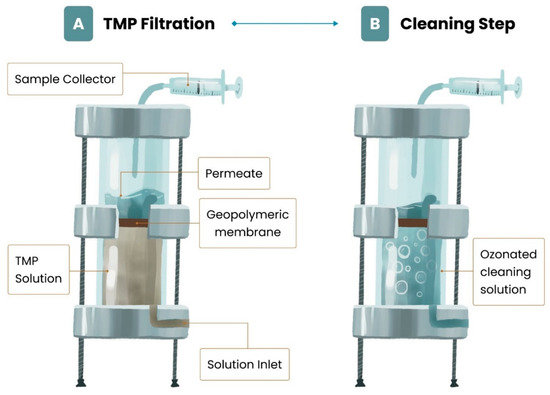
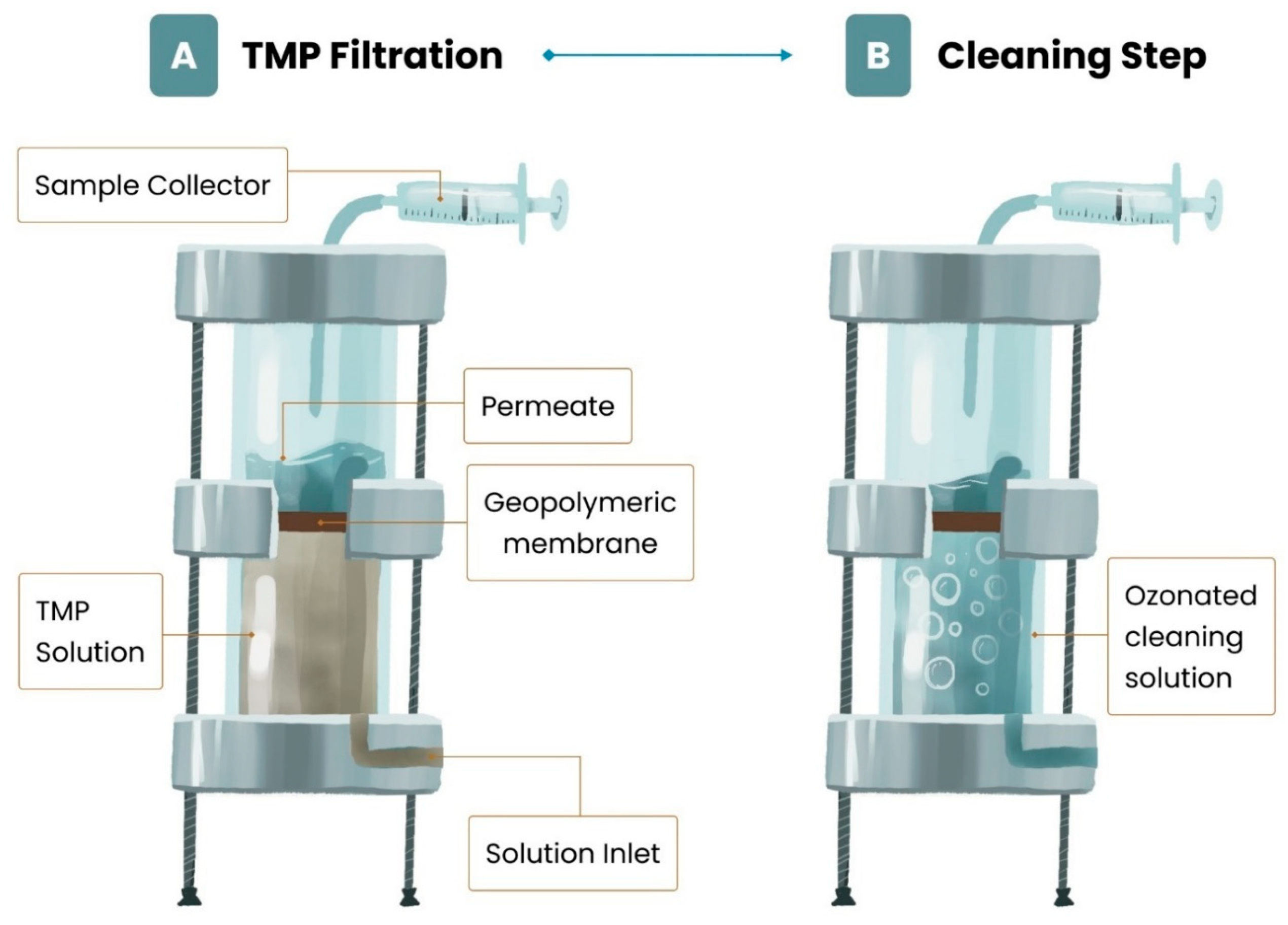
Membrane filtration experiments were conducted using the module illustrated in Figure 1. The membrane (pristine GPM or functionalized GPM-SM) was centrally positioned within the filtration cell sealed using a silicone hollow cylinder (Sylgard 184, Dow), which was compressed between two polytetrafluoroethylene plates to eliminate potential peripheral bypass. All experiments were performed in batch mode at a controlled transmembrane pressure of 1.2 ± 0.2 bar. This specific pressure was intentionally selected as the minimum stable gradient of the system to maximize the hydraulic residence time (HRT) and allow prolonged interfacial contact between the catalytic surface and the target solute. Feed solution delivery was maintained via a precision diaphragm pump (Pentair, London, United Kingdom, Shurflo 8090-511-246 model) coupled with a pulse dampener (EMEC, São Bernardo do Campo, SP, Brazil, model SOIM1/V) to ensure constant hydrodynamic conditions throughout the filtration cycle.
Figure 1.
Scheme of the system for the membrane reactor operation, considering the filtration (A) and the cleaning (B) steps. Modified from Della Rocca et al. (2023) [27].
Prior to each filtration run, the system was operated for 30 min to stabilize the permeate flux and allow mechanical compaction of the membrane (Figure 1). The feed solution consisted of TMP at a concentration of 100 mg·L−1 prepared in a pH 4 buffer (NaH2PO4/H3PO4, 100 mM). Acidic conditions were selected due to the increased sensitivity and rejection efficiency of antibiotics reported at lower pH values [29]. Filtration was then conducted for 360 min, after which the system was shut down, drained, and cleaned.
After filtration, a cleaning step was added to re-establish the membrane initial flux. The cleaning solution (pH 4 buffer, NaH2PO4/H3PO4, 100 mM) was previously ozonized for 15 min to achieve complete aqueous ozone saturation. In the sequence, the pump was turned on (1.2 ± 0.2 bar) and the cleaning was conducted for 15 min. The feeding solution was continuously maintained under ozonation until the end of this procedure. It is important to highlight here that ozone was used only as a cleaning agent to remove TMP from the surface of the composite rather than coupled with the membrane filtration process, in order to reduce energy costs with ozone generation. Duplicates of the tests were conducted. Subsequently, filtration experiments, exactly as described previously, were performed to evaluate the cleaning efficiency of the process. It is worth noting that these operational conditions were chosen for comparison with previous data reported for the uncoated membrane [27]. However, filtration and cleaning efficiencies could be influenced by many non-evaluated parameters (such as flow rate, transmembrane pressure, pH, initial TMP concentration, ozone concentration, solution saturation time, among others), requiring further investigation in future studies.
The permeation flux (J, m·s−1) was determined according to Equation (1) [15]:
in which Q and A are the permeate volumetric flow rate (m3·s−1) and membrane area (m2).
The membrane rejection efficiency (R, %) was evaluated by monitoring the concentration of the target pollutant as follows in Equation (2) [15]:
where Cp is the concentration in the permeate flux (mg·L−1) and Cf is the feed concentration (mg·L−1). The TMP concentration was monitored in its maximum absorption wavelength (275 nm) in a UV-Vis spectrophotometer (HACH, Loveland, CO, USA, model DR5000).
To further assess the filtration dynamics and the impact of the Ag2MoO4 coating, the flux decline (FD, %), flux recovery (FR, %), and the selection parameter (SP, m·s−1) were calculated using Equations (3)–(5) [30,31]:
where J0 (m·s−1), Js (m·s−1), and Jc (m·s−1) correspond to the initial, stationary, and after cleaning permeate fluxes, respectively.
The fouling mechanisms governing the dead-end filtration process were analyzed using Hermia’s models [32]. The kinetic behavior is described by a general semi-empirical equation based on the decrease in permeate flux over time [33] (Equation (6)). Fouling calculations were made for the filtration experiments before the cleaning step.
In Equation (6), t represents the time (s), V is the volume (m3), K is a permeation parameter, and n is a dimensionless parameter characterizing the specific fouling mechanism. K was calculated by the least squares method. The value of n identifies four distinct blocking modes: cake formation (n = 0), intermediate blocking (n = 1), standard blocking (n = 1.5), and complete blocking (n = 2). The analytical solutions for the different values of n are, respectively, disposed in Equations (7)–(10) [33]:
3. Results and Discussion
3.1. Characterizations
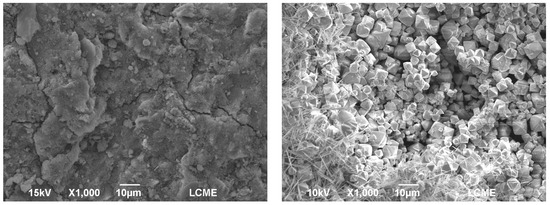
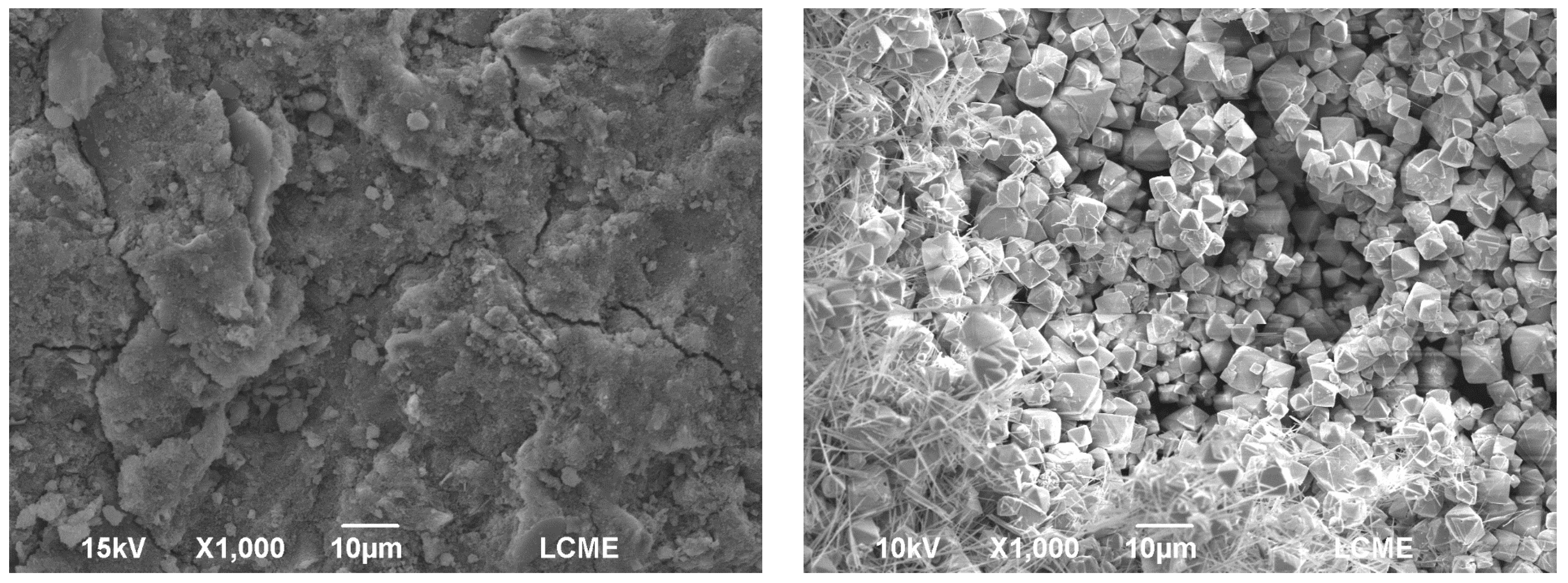
The morphology of the uncoated membrane exhibited a rough and irregular texture with microcracks identified on its surface (Figure 2). In hydrophilic membranes, such as GPM, enhanced roughness increases the interfacial hydration repulsion barrier, thus reducing fouling [34]. On the other hand, the coated membrane showed an even distribution of the Ag2MoO4 across its surface, with octahedra (5.5 ± 2.2 μm) and micro-rods (9.9 ± 3.5 μm) structures. These morphologies had previously been described for the α-Ag2MoO4/β-Ag2MoO4 heterojunction and are in accordance with previous results reported with the catalyst powder [20]. Thus, the SEM images suggest that a uniform coating layer modification was successfully achieved in the GPM surface.
Figure 2.
SEM images of the membranes GPM (on the (left)) and GPM-SM (on the (right)) in the ×1000 amplification.
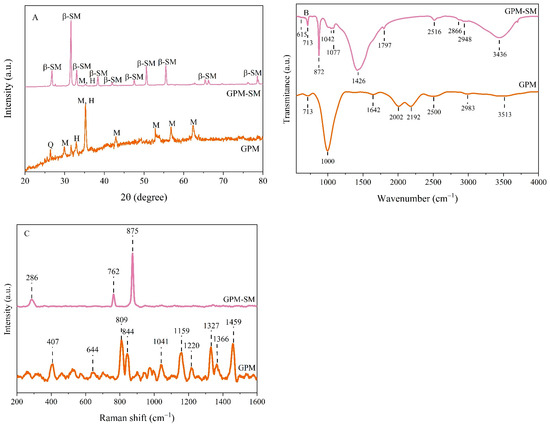
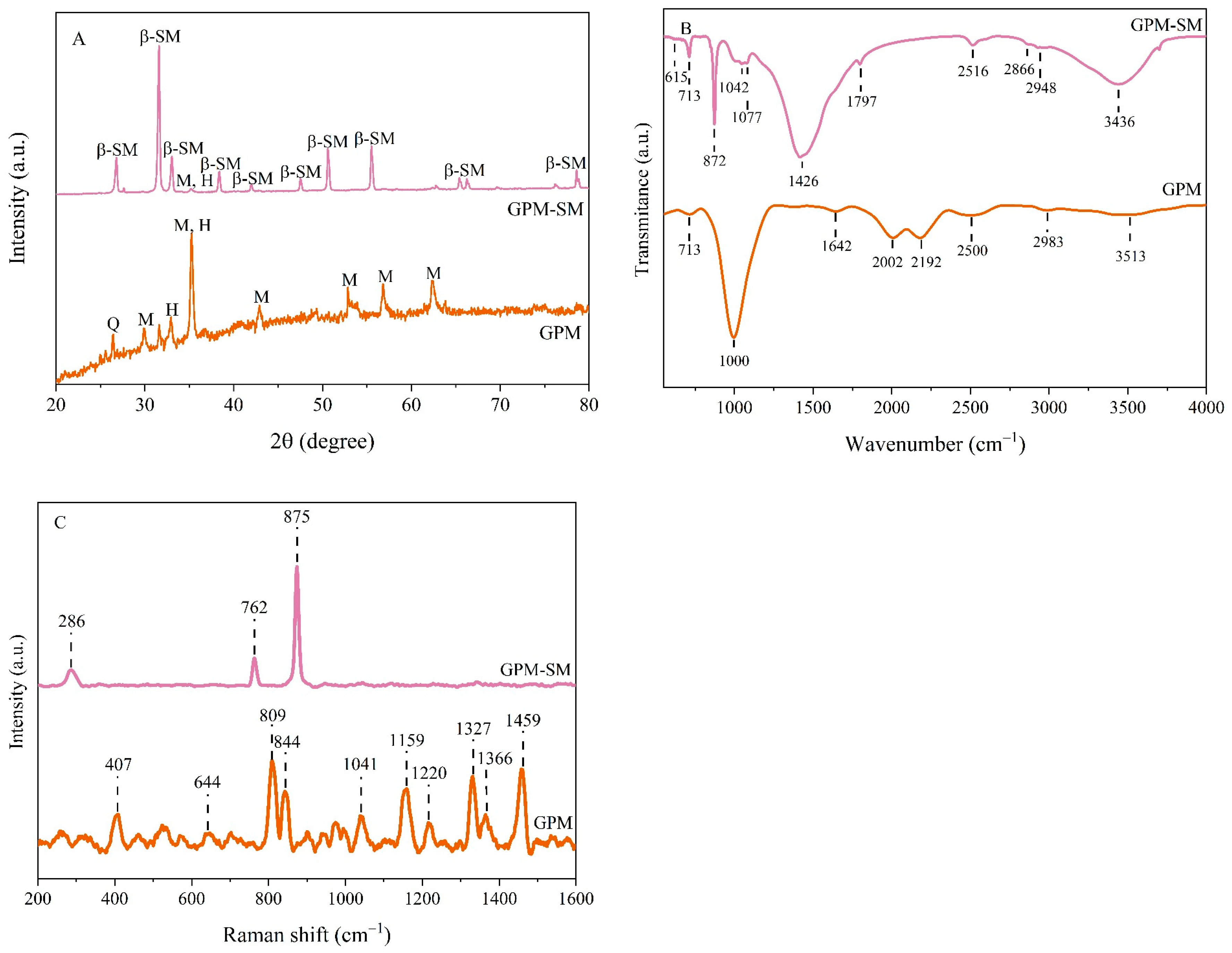
In terms of crystallinity (Figure 3A), for the uncoated membrane, peaks were observed and ascribed to the crystallographic patterns of quartz (SiO2−JCPDS 46–1045), magnetite (Fe3O4–JCPDS 75–1609), and hematite (α-Fe2O3−JCPDS 01-085-0987). On the other hand, the coated surface corresponded to almost pure β-Ag2MoO4 (JCPDS 08–0473) with only a residual magnetite/hematite peak detected, suggesting uniform membrane coverage. In addition, in the uncoated membrane a halo was observed, which is related to the presence of amorphous phases in the geopolymer. In the synthesized GPM, in particular, in addition to amorphous sodium aluminosilicate hydrate (N-A-S-H gel), silicate and aluminum-phosphate networks are expected to be formed due to the materials applied as precursors (MK and MMW from phosphate mining) [35,36]. Furthermore, residual traces from amorphous phases from unreacted precursor materials are also commonly reported in geopolymers [35]. In this sense, the XRD results represent another piece of evidence of the successful coating, since the amorphic halo was not perceptible after the GPM modification.
Figure 3.
XRD patterns (A), FTIR (B), and Raman spectra (C) of the modified GPM-SM sample. In the XRD, β-Ag2MoO4, M, H, and Q correspond to β-Ag2MoO4, magnetite, hematite, and quartz, respectively.
Furthermore, unexpectedly, no reflections corresponding to tetragonal α-Ag2MoO4 were detected, in contrast to the powder sample where this phase was predominant [20]. This phase transformation can be explained by interfacial interaction mechanisms, such as ion exchange, cation interdiffusion, and lattice distortion, between the catalyst and the membrane [37]. Similar behaviors have already been described for metastable/stable polycrystalline structures [38]. A structure forming a new layer at the interface leads to the formation of metastable phases (amorphous, quasi-crystalline, or crystalline). However, as the layer develops, a stable crystalline phase starts to form at the interface. Thus, phenomena such as adsorption, exchange, or diffusion of positively or negatively charged ions onto the semiconductor surface, grain boundary, or crystalline lattice can cause changes in the interface properties of the semiconductor [38].
In fact, Bai, Lu, and Liu (2016) [39] evidenced a similar transformation during the synthesis of Ag@Ag2MoO4–AgBr composite, where Br− replaced the MoO42− in a crystal lattice node, consequently altering the material’s crystallinity. Therefore, it can be concluded that the ions in the GPM surface were able to overcome the resistance of the electron transition from the α-Ag2MoO4/β-Ag2MoO4 heterojunction, thus leading to its complete transformation into the stable β-phase.
At the same time, the FTIR spectrum from the coated membrane (Figure 3B) presents overlapped peaks of GPM and Ag2MoO4. For example, the Fe–O stretching of the magnetite (≈570 cm−1) and maghemite (630–660 cm−1) [40], a defective form of magnetite, and Ag–O stretching (550–720 cm−1) bands [41] occur in similar regions; therefore, the 615 cm−1 peak cannot be identified as a specific molecule. Similarly, the peak at 872 cm−1 could refer to Al–O stretching (≈876 cm−1) [42], Si–O–Si stretching (≈873 cm−1) [43], or O–Mo–O anti-symmetric stretching vibrations (730–950 cm−1) [44]. However, as these peaks were not observed in the uncoated membrane, they are more likely to originate from the Ag2MoO4 layer.
Meanwhile, the 713, 1042, and 1077 cm−1 bands that refer to typical bonds observed in geopolymers were also identified in both materials. The first one was ascribed as Al–O–Si symmetrical elongation, and the last ones as Si–O−T asymmetric stretching (where T = tetrahedral Si or Al) [26].
Additionally, H–O–H bending (1150–1850 cm−1) and O–H stretching (2500–3800 cm−1) bands were observed for both materials, associated with adsorbed water. However, these bands presented considerably greater intensity and wider wavelengths bands in the spectrum of the coated membrane. This is associated with a strong hydrogen-bonding of the water molecules on the GPM-SM surface [44], suggesting that the composite presents a high affinity for water. Moreover, it is known from previous studies that water bonds might become wider and even dislocated by interactions with carbonates, due to dipole–dipole coupling with increasing CO-surface coverage [44]. Considering that CO adsorption is normally observed between 2000 and 2200 cm−1 [45], which was observed for GPM, these results suggest the CO adsorption on its surface.
Furthermore, analyzing the Raman spectrum (Figure 3C) from the unmodified sample, two peaks corresponding to maghemite (407 and 1327 cm−1) and one to magnetite (644 cm−1) were identified, with the first two correspond to Eg modes and the last one to T2g mode [46]. Additionally, two peaks were observed between 700 and 900 cm−1 (809 and 844 cm−1). In particular, this region is normally ascribed to in the literature as symmetric Si–O or Al–O stretching modes [46]. Nonetheless, the other identified bands (1041, 1159, 1220, 1366, and 1459 cm−1) were assigned to asymmetric Si–O–T bond (where T is Si or Al) stretching modes, given that as the wavenumber increases so does the n-coordination type of Qn, i.e., the polymerization degree [46,47]. Taking into account that the magic angle spinning nuclear magnetic resonance (MAS-NMR) revealed this GPM possesses the Q4(4Al), Q4(3Al), Q4(2Al), Q4(1Al), Q4(0Al), Q2, Q1, and Q0 resonance states [26], it is reasonable to expect so many peaks in the Raman analysis as well.
In contrast, none of these bands were noticeable in the coated membrane, suggesting that the presence of a homogeneous catalyst layer. The three observed peaks (286, 762, and 875 cm−1) (Figure 3C) are related to Eg, T2g, and A1g, respectively, of transitions from the cubic Ag2MoO4 structure [48]. The first transition is attributed to the lattice and external structural vibrations of the [AgO6] octahedral clusters, whereas the other two bands are assigned to the asymmetric and symmetric stretching modes of the O–Mo–O bonds in the undistorted tetrahedral [MoO4] units, respectively [48]. Since the modes corresponding to the metastable α-phase (841 and 921 cm−1) were not observed in the spectrum of the modified sample [48], the Raman results reinforce the XRD findings, evidencing the complete conversion of α-phase into the β-phase.
3.2. TMP Filtration Performance
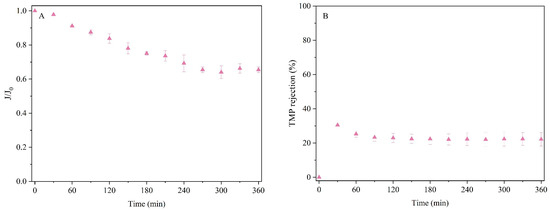
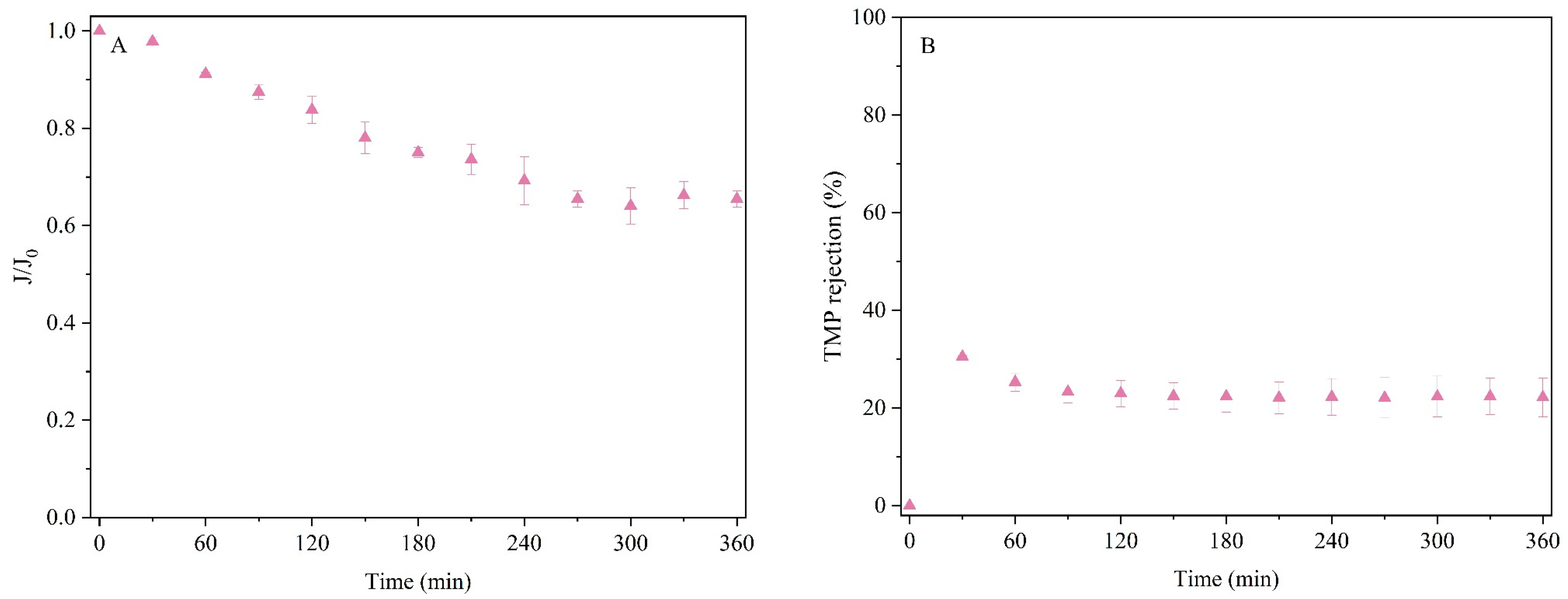
The TMP filtration results (Figure 4 and Table 2) presented evident similarities between the coated and uncoated GPMs. The FD and rejection levels remained practically the same. Therefore, it can be concluded that the coating layer did not significantly seal the pores of the membrane, which could increase the retention of molecules of smaller molecular weight/size and also increase the fouling effects, causing a more considerable decrease in flux. This behavior is attributed to the size of the particles in suspension, which tend to agglomerate due to electrostatic interactions [20], and to the coating method selected (slip-casting). These factors favor the formation of a surface layer, leading mainly to the blockage of the external pores of the membrane, without reaching the internal pores. Therefore, rejects are limited by size exclusion mechanisms, which contributed to the low TMP removal rates (22%).
Figure 4.
Relative flux (A) and rejection rate (B) for the geopolymeric membrane coated with silver molybdate.
Table 2.
Properties and filtration parameters for modified GPM.
Conversely, a considerable rise in the membrane flux was observed (Table 2). The initial flux increased by 26%, which is associated with the modification of the surface’s properties of the membrane, such as surface charge and hydrophilicity, which facilitate the permeation of the aqueous solution. Moreover, it is worth mentioning that the coating of the membrane surface caused an enhancement of 33% on the membrane selection performance.
Thus, considering these promising results, the feasibility of scaling up the syntheses and modifications associated with this composite should be considered in future studies. Geopolymer production can be scaled up due to low production cost, wide availability of raw materials, straightforward processing conditions, and increasing demand for sustainable materials [11]. On the other hand, the production of Ag2MoO4 may introduce challenges related to cost, synthesis consistency, and phase/crystallinity control, requiring process optimization and strict operation protocols. In other words, it is still necessary to evaluate the cost–benefit of the coated and uncoated GPM performances compared to other commercial membrane options to treat real wastewater effluents.
3.3. Fouling Formation Mechanism
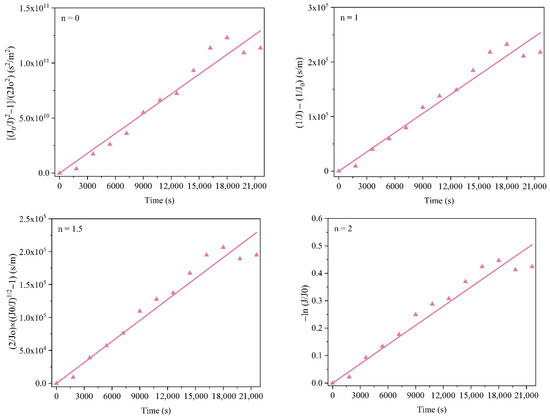
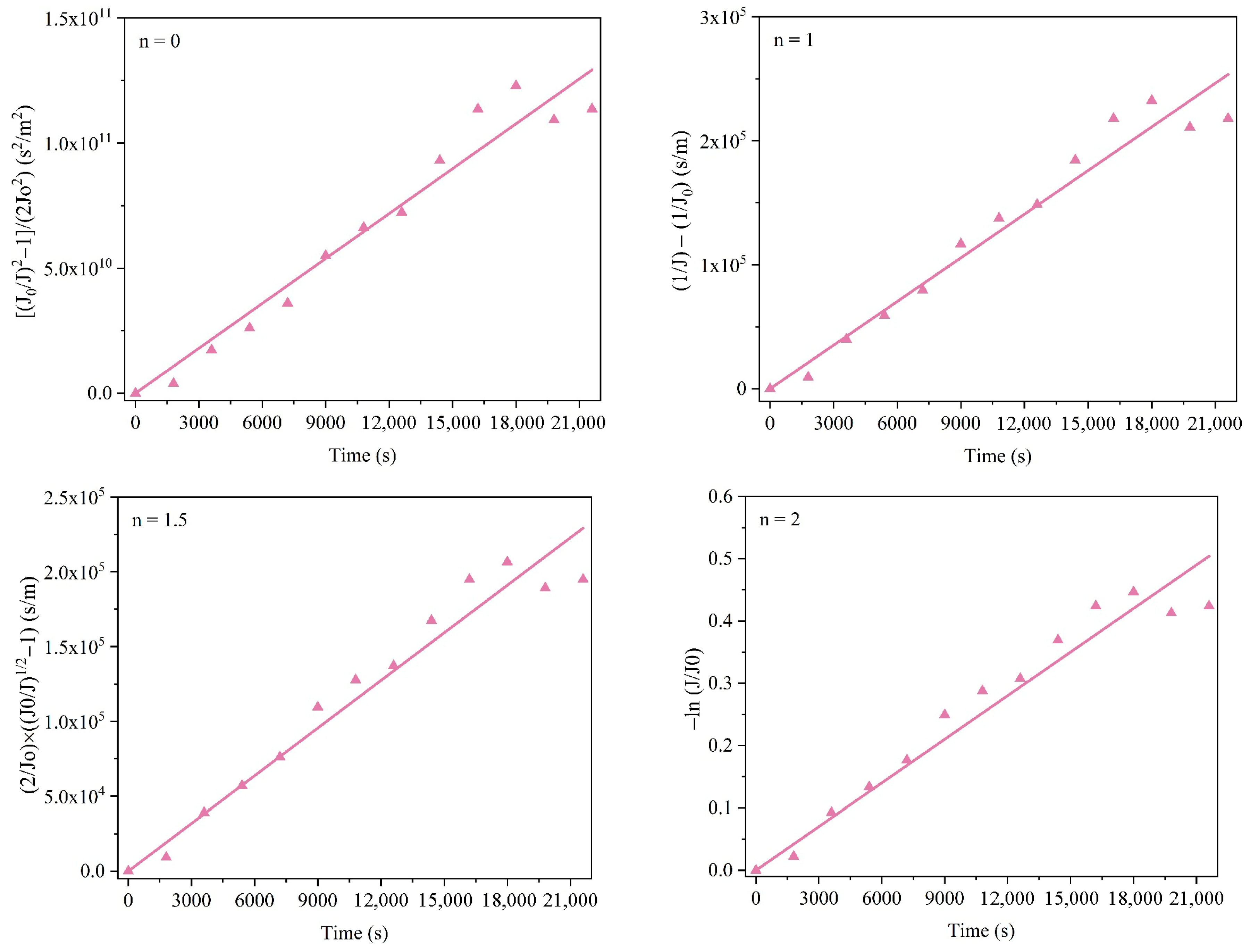
Moreover, the fouling mechanism was also investigated, following the previously described Equations (6)–(10) [32,33]. The uncoated membrane presented a clear fouling control mechanism, complete pore blocking, where each pore is blocked by a single particle [27]. In contrast, for GPM-SM, the fouling control mechanism could not be identified (Figure 5 and Table 2), as the determination coefficients were very high (>0.99) and were similar. Statistical analysis suggests that multiple fouling mechanisms occurred simultaneously. This hybrid behavior can be related to the catalyst coating, which could cause the solvent flow through preferred pathways, consequently producing uneven pores sealing. Therefore, irregular pores dimensions can be formed. Moreover, the coating probably modified the membrane’s surface charge and wettability. Thus, considering that the TMP molecule is highly affected by its molecular electrostatic potential map [49], this also potentially interfered with previously existing fouling mechanisms.
Figure 5.
Fouling mechanisms adjustments for the GPM-SM modified membrane, where cake filtration, intermediate blocking, standard blocking, and complete blocking, where n corresponds, respectively to 0, 1, 1.5, and 2.
Although it might seem unusual for multiple fouling mechanisms to be similarly present in a filtration system, this behavior can be explained by the electrochemical properties of TMP. First, since the TMP molecule is much smaller than the membrane pores, standard blocking fouling is expected. On the other hand, TMP is suitable for forming organic complexes with other TMP molecules or with buffer components, due to hydrophobic/hydrophilic, electrostatic, and van der Waals interactions. This could lead to the formation of larger particles, which could cause complete pore blockage. Following this same line of reasoning, these complexes could accumulate on the membrane surface, consequently forming a cake layer. Finally, as intermediate fouling represents an intermediary mechanism between standard and complete blocking, its occurrence is also suitable. Thus, the simultaneously occurrence of all four fouling mechanisms is justifiable for the studied process [50].
Finally, it is relevant to highlight that GPM-SM reduced fouling coefficients (Table 2) for cake formation, intermediate blocking, and standard blocking by 26%, 8%, and 8%, respectively [27]. The substantial reduction in cake layer formation can be attributed to the previously reported low catalyst-TMP adsorption interaction [20]. Reducing the amount of TMP on the membrane surface highly affects adsorbate-adsorbate multilayer formations, as the TMP molecule presents a highly disproportionate electronic balance, with positive charges from the benzene ring and negative charges from the pyrimidine ring [50], which may interact with each other. Nevertheless, the complete pore blocking coefficient increased by 15%, which can be associated with the pores sealing by the catalyst, reducing their dimensions and making them to be more easily clogged. Therefore, these results indicate that the Ag2MoO4 coating was overall beneficial not only for permeate flux, but also for fouling prevention.
3.4. Ozonation Cleaning Efficiency
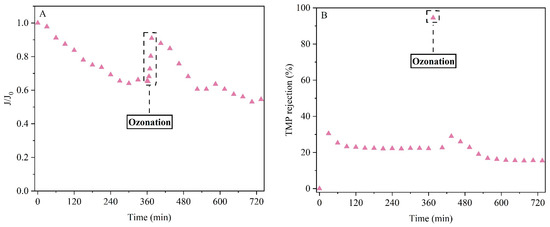
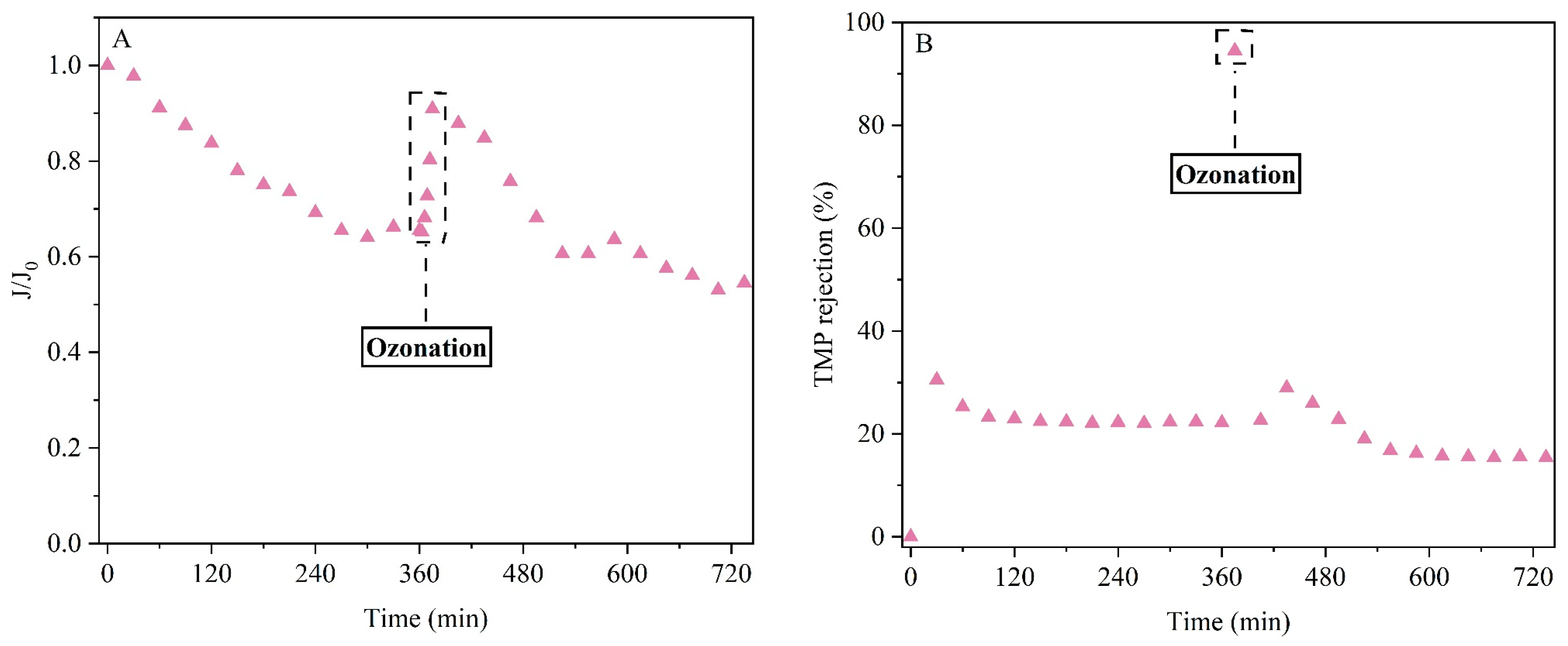
It can be noticed that ozone cleaning was able to provide an almost FR (64%) in 15 min (Figure 6 and Table 2). First of all, ozone itself is able to interact with aromatic rings, double bonds, and heteroatomic bonds such as C-N and C-O, causing the molecules oxidation by a direct mechanism [51]. TMP, specifically, is composed by the groups diaminopyrimidine (DAPD) and 1,2,3-trimethoxybenzene (TMBz) connected by a methylene bridge. Thus, DAPD ring, more particularly the amine groups linked to the aromatic ring, are very susceptible to direct ozone attack [52]. Furthermore, the addition of an ozone decomposing catalyst may cause O3 to undergo reactions on its surface to generate various free radicals (such as •OH, •O2H, and •O2−), due to the oxygen lattices on their structure [53]. In this way, a generic mechanism for ozone decomposition through heterogeneous catalysis can be proposed (Equations (11)–(17)) [27,53]. The mechanism involves the interaction between -OH groups and adsorbed H2O present in the catalyst surface and O3 (Equations (11) and (13)), leading to the formation of hydrogen trioxy radical (•OH3) and surface catalytic radicals. Subsequently, surface catalytic radicals might continue to react with adsorbed H2O (Equation (14)), leading to the formation of hydroxyl radical (•OH). Moreover, •OH3 might also decompose into •OH and O2 (Equation (15)). Lastly, •OH can also interact directly with O3, causing other less reactive oxidizing species to be formed such as •OH2− and •O2− (Equations (16) and (17)).
Figure 6.
Relative flux (A) and rejection rate (B) before and after ozonation cleaning step.
However, after cleaning, the FD was much faster, reaching fluxes close to the end of the first filtration in just only 150 min. Moreover, the final FD increased (45%) and rejection rates decreased (16%). These results demonstrate that, differently from GPM [27], the cleaning time was insufficient to completely remove the TMP from the GPM-SM surface.
Two factors can possibly contribute to these results. The first one refers to the modification on the surface properties (average pore size, surface area, roughness, number of available active sites, among other) from the uncoated GPM. In particular, reducing pore sizes and/or porosity might create significant mass transfer and diffusion resistance for aqueous ozone [54,55], which probably occurred during the coating procedure, since it is suitable to assume that the catalyst percolated the membrane pores. Moreover, specific surface area and surface roughness directly affect the availability of active sites. A decrease in these parameters is expected to reduce the TMP/Ozone/Active site contact, therefore hindering the adsorption/desorption and the free radical generation, which might limit the reaction kinetics and efficiency [54,55].
The second factor is connected with the catalytic activity of Ag2MoO4, which is probably lower than the metal oxides (Al2O3, Fe3O4, and Fe2O3) present in the geopolymeric matrix. Metal oxides are widely applied in catalytic ozonation due to their high active-site density, their greater ozone decomposition capacity, appropriate surface charge, and their resistance to surface poisoning [56]. Thus, while Ag2MoO4 demonstrated a catalytic effect under similar conditions for degrading TMP [20], considering it is a semiconductor, its effectiveness might be lower than that of the metal oxides present in the original GPM. Therefore, the Ag2MoO4 layer limited access to its active sites, leading to a reduction in ROS generation and TMP removal.
In this sense, taking into consideration the semiconductor and optical properties of Ag2MoO4 [18], UV/Solar irradiation might represent another suitable cleansing solution for the modified GPM-SM. Since the synthesized catalyst demonstrated absorption in the UV and Visible regions (230–800 nm) [20], light can be used to activate the catalyst by photocatalysis, leading to ROS generation and TMP removal from the membrane surface. Thus, this alternative cleaning solution should be explored more deeply in future investigations.
4. Conclusions
In this study, a geopolymeric membrane was successfully modified with silver molybdate catalyst. Surface characterizations indicated a smooth and homogeneous coating layer. Moreover, considering the permeation results it can be concluded that the geopolymeric membrane coating with silver molybdate was beneficial for the filtration system. Although, rejection rates remained stable, permeate flux and the selection parameter increased considerably and flux decrease was slightly reduced. These results are a consequence of the surface interactions between the membrane–Ag2MoO4, and TMP, in particular permeability and hydrophilicity. Finally, fouling mechanisms were also evaluated. Unlike the uncoated membrane, it was not possible to pinpoint a specific control mechanism, since all the permeation models investigated show adequate agreement with the experimental data. These results are correlated with the irregular distribution of the coating layer, which sealed the pores unevenly, creating preferred channels and blocking some on the external surface of the membrane.
Author Contributions
Conceptualization, D.G.D.R. and R.d.F.P.M.M.; methodology, D.G.D.R., V.d.A.P. and F.C.F.; validation, A.d.S., R.A.P., E.R.-C., B.F.O. and R.d.F.P.M.M.; formal analysis, D.G.D.R., V.d.A.P., F.C.F. and E.R.-C.; investigation, D.G.D.R., V.d.A.P. and F.C.F.; resources, A.d.S., R.A.P., E.R.-C., N.U.Y. and R.d.F.P.M.M.; data curation, N.U.Y. and B.F.O.; writing—original draft preparation, D.G.D.R.; writing—review and editing, V.d.A.P., F.C.F., A.d.S., R.A.P., E.R.-C., N.U.Y., B.F.O. and R.d.F.P.M.M.; visualization, D.G.D.R., V.d.A.P. and F.C.F.; supervision, R.d.F.P.M.M.; project administration, R.d.F.P.M.M.; funding acquisition, D.G.D.R., E.R.-C. and R.d.F.P.M.M. All authors have read and agreed to the published version of the manuscript.
Funding
This research was funded by Coordination of Improvement of Higher Education Personnel (CAPES-Brazil) [Grant code 001] and the Brazilian Council for Scientific and Technological Development (CNPq-Brazil). E. Rodríguez-Castellón thanks Ministry of Science and Innovation of Spain for the grant PID2021-126235OB-C32 financed by MCIN/AEI/10.13039/501100011033 501100011033 and the FEDER funds.
Institutional Review Board Statement
Not applicable.
Informed Consent Statement
Not applicable.
Data Availability Statement
Data will be available upon reasonable request.
Acknowledgments
The authors are grateful to the Central Laboratory of Electronic Microscopy (LCME) for the SEM images analyses. The authors would like to acknowledge João Eduardo Salmória da Silva for designing the graphical abstract for this manuscript.
Conflicts of Interest
The authors declare no conflicts of interest.
References
- Federigi, I.; Bonetta, S.; Tesauro, M.; De Giglio, O.; Oliveri, G.; Tariku, N.; Bagordo, F.; Bonetta, S.; Consonni, M.; Diella, G.; et al. A Systematic Scoping Review of Antibiotic-Resistance in Drinking Tap Water. Environ. Res. 2024, 263, 120075. [Google Scholar] [CrossRef] [Scilit]
- Mpatani, F.M.; Aryee, A.A.; Kani, A.N.; Han, R.; Li, Z.; Dovi, E.; Qu, L. A Review of Treatment Techniques Applied for Selective Removal of Emerging Pollutant-Trimethoprim from Aqueous Systems. J. Clean. Prod. 2021, 308, 127359. [Google Scholar] [CrossRef] [Scilit]
- Medha, I.; Chandra, S.; Chauhan, S.; Ajay, P.; Sekhar, C.; Mujawar, N.; Bevara, S. Distribution of Antibiotics in Water Resources and the Role of Biochar in Advanced Water Treatment Techniques for Antibiotics Removal in the Quest for Cleaner Water. Sep. Purif. Technol. 2025, 377, 134194. [Google Scholar] [CrossRef] [Scilit]
- Dolar, D.; Vukovic, A.; Asperger, D.; Kosutic, K. Efficiency of RO/NF Membranes at the Removal of Veterinary Antibiotics. Water Sci. Technol. 2012, 65, 317–323. [Google Scholar] [CrossRef] [Scilit]
- Alfonso-Muniozguren, P.; Serna-Galvis, E.A.; Bussemaker, M.; Torres-Palma, A.; Lee, J. Ultrasonics Sonochemistry A Review on Pharmaceuticals Removal from Waters by Single and Combined Biological, Membrane Filtration and Ultrasound Systems. Ultrason. Sonochem. 2021, 76, 105656. [Google Scholar] [CrossRef] [Scilit]
- Azmi, L.S.; Jabit, N.A.; Ismail, S.; Ishak, K.E.H.K.; Abdullah, T.K. Membrane Filtration Technologies for Sustainable Industrial Wastewater Treatment: A Review of Heavy Metal Removal. Desalin. Water Treat. J. 2025, 323, 101321. [Google Scholar] [CrossRef] [Scilit]
- Kanth, M.S.; Rani, S.L.S.; Raja, V.K. Advancing Ceramic Membrane Technology in Chemical Industries Applications by Evaluating Cost-Effective Materials, Fabrication and Surface Modification Methods. Hybrid Adv. 2025, 8, 100380. [Google Scholar] [CrossRef] [Scilit]
- Ivanets, I.; Azarova, T.A.; Agabekov, V.E.; Azarov, S.; Batsukh, C.; Batsuren, D.; Prozorovich, V.G.; Rat’ko, A.A. Effect of Phase Composition of Natural Quartz Raw Material on Characterization of Microfiltration Ceramic Membranes. Ceram. Int. 2016, 42, 16571–16578. [Google Scholar] [CrossRef] [Scilit]
- Satyannarayana, K.V.V.; Singh, R.; Rani, S.L.S.; Sreekanth, M.; Raja, V.K.; Ahn, Y. A Paradigm Assessment of Low-Cost Ceramic Membranes: Raw Materials, Fabrication Techniques, Cost Analysis, Environment Impact, Wastewater Treatment, Fouling, and Future Prospects. J. Water Process Eng. 2024, 68, 106430. [Google Scholar] [CrossRef] [Scilit]
- Nurlina, N.; Pratama, J.H.; Pambudi, A.B.; Rahmawati, Z.; Subaer, S.; Abdullah, M.M.A.B.; Gusrizal, G.; Fansuri, H. A Review of Geopolymer Membrane for Water Treatment. Appl. Clay Sci. 2024, 251, 107301. [Google Scholar] [CrossRef] [Scilit]
- Pundienė, I.; Pranckevičienė, J.; Mažeikienė, A.; Du, Y.; Korniejenko, K.; Bagočius, V.; Ivanauskas, E. Synthesis and Characterization of a Wood Biomass Ash-Derived Multipurpose Sustainable Lightweight Geopolymer: A Pilot Study in Wastewater Treatment. Sustainability 2026, 18, 2128. [Google Scholar] [CrossRef] [Scilit]
- Mehta, A.; Siddique, R. An Overview of Geopolymers Derived from Industrial By-Products. Constr. Build. Mater. 2016, 127, 183–198. [Google Scholar] [CrossRef] [Scilit]
- Shao, N.; Tang, S.; Li, S.; Chen, H.; Zhang, Z. Defective Analcime/Geopolymer Composite Membrane Derived from Fly Ash for Ultrafast and Highly Efficient Filtration of Organic Pollutants. J. Hazard. Mater. 2020, 388, 121736. [Google Scholar] [CrossRef] [Scilit]
- Della Rocca, D.G.; Peralta, R.M.; Peralta, R.A.; Rodríguez-Castellón, E.; de Fatima Peralta Muniz Moreira, R. Adding Value to Aluminosilicate Solid Wastes to Produce Adsorbents, Catalysts and Filtration Membranes for Water and Wastewater Treatment. J. Mater. Sci. 2021, 56, 1039–1063. [Google Scholar] [CrossRef] [Scilit]
- de Sousa, F.A.; Della Rocca, D.; De Amorim, S.M.; Salla, J.S.; Peralta, R.A.; Rodríguez-Castellón, E.; Moreira, R.d.F.P.M. Development of Membranes Based on Alkali-Activated Phosphate Mine Tailings for Humic Acid and Copper Removal from Water. Water Air Soil Pollut. 2021, 232, 496. [Google Scholar] [CrossRef] [Scilit]
- Goswami, K.P.; Pakshirajan, K.; Pugazhenthi, G. Process Intensification Through Waste Fly Ash Conversion and Application as Ceramic Membranes: A Review. Sci. Total Environ. 2022, 808, 151968. [Google Scholar] [CrossRef] [Scilit] [PubMed]
- Samadi, A.; Gao, L.; Kong, L.; Orooji, Y.; Zhao, S. Waste-Derived Low-Cost Ceramic Membranes for Water Treatment: Opportunities, Challenges and Future Directions. Resour. Conserv. Recycl. 2022, 185, 106497. [Google Scholar] [CrossRef] [Scilit]
- Huang, C.; Li, Z.; Pan, Y.; Li, Z.; Ge, Y. Geopolymer Armor-Reinforced Composite Membranes for Efficient Oil–Water Separation and Dye Degradation. Chem. Eng. J. 2025, 507, 160876. [Google Scholar] [CrossRef] [Scilit]
- Della Rocca, D.G.; Victória, H.F.V.; Moura-Nickel, C.D.; Scaratti, G.; Krambrock, K.; De Noni, A.; Vilar, V.J.P.; José, H.J.; Moreira, R.F.P.M. Peroxidation and Photo-Peroxidation of Pantoprazole in Aqueous Solution Using Silver Molybdate as Catalyst. Chemosphere 2021, 262, 127671. [Google Scholar] [CrossRef] [Scilit] [PubMed]
- Della Rocca, D.G.; Fraga, F.C.; De Noni, A., Jr.; Peralta, R.A.; Moreira, R.F.P.M. Enhancing Ag2MoO4 Catalytic Activity: An Investigation on Synthesis, Characterization, and Application in Catalytic Ozonation Reactions. J. Phys. Chem. Solids 2024, 185, 111725. [Google Scholar] [CrossRef] [Scilit]
- Alomar, T.S.; Almasoud, N.; Ali, M.; Al-wallan, A.A.; Muhammad, H.; Farid, T.; El-bahy, Z.M. International Journal of Hydrogen Energy Enhanced Electrocatalytic Activity of Ag2MoO4/PANI Composite for Robust Water Splitting. Int. J. Hydrogen Energy 2025, 116, 190–199. [Google Scholar] [CrossRef] [Scilit]
- Li, S.; Dong, Z.; Wang, Q.; Zhou, X.; Shen, L.; Li, H.; Shi, W. Antibacterial Z-Scheme ZnIn2S4/Ag2MoO4 Composite Photocatalytic Nanofibers with Enhanced Photocatalytic Performance under Visible Light. Chemosphere 2022, 308, 136386. [Google Scholar] [CrossRef] [Scilit]
- Beltrán, A.; Gracia, L.; Longo, E.; Andrés, J. First-Principles Study of Pressure-Induced Phase Transitions and Electronic Properties of Ag2MoO4. J. Phys. Chem. C 2014, 118, 3724–3732. [Google Scholar] [CrossRef] [Scilit]
- Ferreira, E.A.C.; Neto, N.F.A.; Santiago, A.A.G.; Paskocimas, C.A.; Bomio, M.R.D.; Motta, F.V. Synthesis and Characterization of α-Ag2MoO4/β-Ag2MoO4 Heterostructure Obtained by Fast and Simple Ultrasonic Spray Pyrolysis Method at Different Temperatures. J. Mater. Sci. Mater. Electron. 2020, 31, 4271–4278. [Google Scholar] [CrossRef] [Scilit]
- Tian, K.; Xu, X.; Zhu, J.; Cao, S.; Yin, Z.; Li, F.; Yang, W. A Critical Review of Oxidation for Membrane Fouling Control in Water Treatment: Applications, Mechanisms and Challenges. J. Environ. Chem. Eng. 2024, 12, 114718. [Google Scholar] [CrossRef] [Scilit]
- Gier Della Rocca, D.; Santos e Sousa, F.A.; Domingos Ardisson, J.; Peralta, R.A.; Rodríguez-Castellón, E.; Peralta Muniz Moreira, R.d.F. Magnetic Mining Waste Based-Geopolymers Applied to Catalytic Reactions with Ozone. Heliyon 2023, 9, e17097. [Google Scholar] [CrossRef] [Scilit]
- Gier Della Rocca, D.; Hedel, B.; Rodríguez-Castellón, E.; Moreira, R.F.P.M. Magnetic Mining Waste Based-Membranes for Trimethoprim Removal and Fouling Mitigation with Ozone. Chem. Eng. J. 2023, 468, 143566. [Google Scholar] [CrossRef] [Scilit]
- Davidovits, J.; Davidovics, M.; Davidovits, N. Process for Obtaining a Geopolymeric Alumino-Silicate and Products Thus Obtained. U.S. Patent 5,342,595, 30 August 1994. [Google Scholar]
- Michael, S.G.; Drigo, B.; Michael-kordatou, I.; Michael, C.; Thomas, J. The Effect of Ultrafiltration Process on the Fate of Antibiotic-Related Microcontaminants, Pathogenic Microbes, and Toxicity in Urban Wastewater. J. Hazard. Mater. 2022, 435, 128943. [Google Scholar] [CrossRef] [Scilit]
- Hatimi, B.; Mouldar, J.; Loudiki, A.; Hafdi, H.; Joudi, M.; Daoudi, E.M.; Nasrellah, H.; Lançar, I.; El Mhammedi, M.A.; Bakasse, M. Low Cost Pyrrhotite Ash/Clay-Based Inorganic Membrane for Industrial Wastewaters Treatment. J. Environ. Chem. Eng. 2020, 8, 103646. [Google Scholar] [CrossRef] [Scilit]
- Das, B.; Chakrabarty, B.; Barkakati, P. Separation of Oil from Oily Wastewater Using Low Cost Ceramic Membrane. Korean J. Chem. Eng. 2017, 34, 2559–2569. [Google Scholar] [CrossRef] [Scilit]
- Hermia, J. Constant Pressure Blocking Filtration Laws—Application to Power-Law Non-Newtonian Fluids. Trans. Inst. Chem. Eng. 1982, 60, 183–187. [Google Scholar] [CrossRef] [Scilit]
- Iritani, E.; Katagiri, N. Developments of Blocking Filtration Model in Membrane Filtration. KONA Powder Part. J. 2016, 33, 179–202. [Google Scholar] [CrossRef] [Scilit]
- Zhao, D.; Chen, L.; Peng, M.; Xue, B.; Yao, Z.; Huang, W.; Wang, Z.; Liu, J. The Complex Influence of Membrane Roughness on Colloidal Fouling: A Dialectical Perspective. J. Memb. Sci. 2025, 725, 124014. [Google Scholar] [CrossRef] [Scilit]
- Costa, L.M.; Almeida, N.G.S.; Houmard, M.; Cetlin, P.R.; Silva, G.J.B.; Aguilar, M.T.P. Influence of the Addition of Amorphous and Crystalline Silica on the Structural Properties of Metakaolin-Based Geopolymers. Appl. Clay Sci. 2021, 215, 106312. [Google Scholar] [CrossRef] [Scilit]
- Zribi, M.; Samet, B.; Baklouti, S. Structural Characterization of Phosphate-Based Geopolymer. In Advances in Materials, Mechanics and Manufacturing; Chaari, F., Barkallah, M., Bouguecha, A., Zouari, B., Khabou, M.T., Kchaou, M., Haddar, M., Eds.; Springer International Publishing: Cham, Switzerland, 2020; pp. 36–42. [Google Scholar] [CrossRef] [Scilit]
- Barah, O.O.; Natukunda, F.; Bori, I.; Ukagwu, K.J. Mechanisms and Modelling of Diffusion in Solids: A Multiscale Framework with Industrial Case Studies and AI Enhancements. Discov. Sustain. 2025, 6, 804. [Google Scholar] [CrossRef] [Scilit]
- Grushko, B.; Shechtman, D. On the Model of Metastable Phase Formation by a Diffusion Process. J. Appl. Phys. 1990, 67, 2904–2907. [Google Scholar] [CrossRef] [Scilit]
- Bai, Y.-Y.; Lu, Y.; Liu, J.-K. An Efficient Photocatalyst for Degradation of Various Organic Dyes: Ag@Ag2MoO4–AgBr Composite. J. Hazard. Mater. 2016, 307, 26–35. [Google Scholar] [CrossRef] [Scilit] [PubMed]
- Namduri, H.; Nasrazadani, S. Quantitative Analysis of Iron Oxides Using Fourier Transform Infrared Spectrophotometry. Corros. Sci. 2008, 50, 2493–2497. [Google Scholar] [CrossRef] [Scilit]
- Ananth, A.; Mok, Y.S. Dielectric Barrier Discharge (DBD) Plasma Assisted Synthesis of Ag2O Nanomaterials and Ag2O/RuO2 Nanocomposites. Nanomaterials 2016, 6, 42. [Google Scholar] [CrossRef] [Scilit]
- Ji, Z.; Pei, Y. Immobilization Efficiency and Mechanism of Metal Cations (Cd2+, Pb2+ and Zn2+) and Anions (AsO43− and Cr2O72−) in Wastes-Based Geopolymer. J. Hazard. Mater. 2020, 384, 121290. [Google Scholar] [CrossRef] [Scilit]
- Poojalakshmi, E.S.; Nagarajan, P.; Sudhakumar, J.; Thomas, B.S. Impact of Alkaline Activator Concentration on Mechanical Properties and Microstructure of a Ternary Blended One-Part Geopolymer Cement. Sci. Rep. 2025, 15, 33808. [Google Scholar] [CrossRef] [Scilit] [PubMed]
- Mojet, B.L.; Ebbesen, S.D.; Lefferts, L. Light at the interface: The potential of attenuated total reflection infrared spectroscopy for understanding heterogeneous catalysis in water. Chem. Soc. Rev. 2010, 39, 4643–4655. [Google Scholar] [CrossRef] [Scilit] [PubMed]
- Kawtharani, F.; Thomas, S.; Marie, O. In Situ Fourier-Transform Infrared Spectroscopy Study of Carbon Monoxide Adsorption on Silver Nanoparticles Contained in BETA Zeolite Nanocrystals. Langmuir 2025, 41, 28825–28835. [Google Scholar] [CrossRef] [Scilit]
- Krolop, P.; Jantschke, A.; Gilbricht, S.; Niiranen, K.; Seifert, T. Mineralogical Imaging for Characterization of the Per Geijer Apatite Iron Ores in the Kiruna District, Northern Sweden: A Comparative Study of Mineral Liberation Analysis and Raman Imaging. Minerals 2019, 9, 544. [Google Scholar] [CrossRef] [Scilit]
- Moutaoukil, G.; Sobrados, I.; Alehyen, S. Study of Thermomechanical Properties of Foamed and Unfoamed Fly Ash-Based Geopolymer Using FT Raman Spectroscopy and 29 Si MAS NMR. Mater. Lett. 2023, 330, 133261. [Google Scholar] [CrossRef] [Scilit]
- Arora, A.K.; Nithya, R.; Misra, S.; Yagi, T. Behavior of Silver Molybdate at High-Pressure. J. Solid State Chem. 2012, 196, 391–397. [Google Scholar] [CrossRef] [Scilit]
- Jodeh, S.; Jaber, A.; Hanbali, G.; Massad, Y.; Safi, Z.S.; Radi, S. Experimental and Theoretical Study for Removal of Trimethoprim from Wastewater Using Organically Modified Silica with Pyrazole-3-Carbaldehyde Bridged to Copper Ions. BMC Chem. 2022, 16, 17. [Google Scholar] [CrossRef] [Scilit]
- Huang, B.; Gu, H.; Xiao, K.; Qu, F.; Yu, H.; Wei, C. Fouling Mechanisms Analysis via Combined Fouling Models for Surface Water Ultrafiltration Process. Membranes 2020, 10, 149. [Google Scholar] [CrossRef] [Scilit] [PubMed]
- Audran, G.; Marque, S.R.A.; Santelli, M. Ozone, Chemical Reactivity and Biological Functions. Tetrahedron 2018, 74, 6221–6261. [Google Scholar] [CrossRef] [Scilit]
- Yang, X.; Ding, X.; Zhou, L.; Zhao, Q.; Ji, Y.; Wang, X.; Chovelon, J.M.; Xiu, G. Direct Oxidation of Antibiotic Trimethoprim by Unactivated Peroxymonosulfate via a Nonradical Transformation Mechanism. Chemosphere 2021, 263, 128194. [Google Scholar] [CrossRef] [Scilit]
- Issaka, E.; AMU-Darko, J.N.O.; Yakubu, S.; Fapohunda, F.O.; Ali, N.; Bilal, M. Advanced Catalytic Ozonation for Degradation of Pharmaceutical Pollutants―A Review. Chemosphere 2022, 289, 133208. [Google Scholar] [CrossRef] [Scilit] [PubMed]
- Rame, R.; Purwanto, P.; Sudarno, S. A Comprehensive Review on Catalytic Ozonation: Emerging Trends and Future Perspectives. Desalin. Water Treat. 2023, 315, 260–279. [Google Scholar] [CrossRef] [Scilit]
- Psaltou, S.; Zouboulis, A. Catalytic Ozonation and Membrane Contactors—A Review Concerning Fouling Occurrence and Pollutant Removal. Water 2020, 12, 2964. [Google Scholar] [CrossRef] [Scilit]
- Issaka, E.; Baffoe, J.; Adams, M. Exploring Heterogeneous Catalytic Ozonation: Catalyst Types, Reaction Mechanisms, Applications, Challenges, and Future Outlook. Sustain. Chem. Environ. 2024, 8, 100185. [Google Scholar] [CrossRef] [Scilit]

Disclaimer/Publisher’s Note: The statements, opinions and data contained in all publications are solely those of the individual author(s) and contributor(s) and not of MDPI and/or the editor(s). MDPI and/or the editor(s) disclaim responsibility for any injury to people or property resulting from any ideas, methods, instructions or products referred to in the content. |
© 2026 by the authors. Licensee MDPI, Basel, Switzerland. This article is an open access article distributed under the terms and conditions of the Creative Commons Attribution (CC BY) license.