


Abstract
Simultaneously realizing high room temperature permittivity and X8R temperature stability (−55 °C to 150 °C, ΔC/C25 °C ≤ ±15%) remains a significant obstacle for lead-free BaTiO3-based dielectrics. Herein, a synergistic strategy combining Curie-point shifting and weak relaxor engineering is demonstrated. A single composition, 0.95BaTi0.8Hf0.2O3-0.05Bi(Zn0.5Ti0.5)O3 is prepared via solid-state reaction. The ceramic possesses a pure perovskite structure and a dense and chemically homogeneous microstructure. At 1 kHz and room temperature, it delivers a high dielectric constant exceeding 1000 and a low loss below 0.02, while the capacitance variation remains within ±15% from −100 °C to 313 °C, fully satisfying the X8R specification. Moreover, an ultrafast discharge time of 39 ns, a power density of 315 MW/cm3, and a discharge energy density of 3.3 J/cm3 are achieved at 300 kV/cm. The synergy between Hf-driven peak shifting and minimal relaxor incorporation yields a composition that balances high polarization, thermal stability, and rapid energy release, offering a promising route for high-performance temperature-stable and pulsed-power capacitors.
1. Introduction
The simultaneous achievement of high room temperature permittivity and X8R temperature stability (−55 °C to 150 °C, ΔC/C25 °C ≤ ±15%) remains a critical challenge for lead-free BaTiO3-based multilayer ceramic capacitors [1,2]. Shifting the Curie point to near room temperature via Hf4+ doping maximizes the permittivity, yet the resulting sharp phase transition invariably fails the X8R criterion [3]. Incorporating relaxor end-members [4,5,6,7] such as Bi(M1M2)O3 broadens the permittivity peak effectively but often at the expense of a considerable reduction in the absolute permittivity [5,6,7]. For instance, compositions designed to meet the X8R specification typically exhibit room temperature permittivity values below 1000, thereby severely limiting the volumetric efficiency of capacitance [8]. Consequently, a persistent trade-off exists: the relaxor modification needed to achieve temperature stability inevitably sacrifices the high permittivity that constitutes the primary advantage of BaTiO3-based dielectrics.
Whether this trade-off can be circumvented by locating a composition precisely at the ferroelectric-relaxor boundary, where long-range order is sufficiently disrupted to flatten the permittivity peak but not so extensively that the intrinsic polarization is destroyed has not been systematically explored. Our prior work on the BaTi0.8Hf0.2O3-Bi(Zn0.5Ti0.5)O3 system identified the two extremes: the pure Hf-shifted host exhibits an ultrahigh permittivity but poor stability, while a 12 mol% addition induces strong relaxor behavior favorable for energy storage but with low permittivity [9]. This naturally raises the question of whether an intermediate composition can capture the best of both regimes.
Here, we target the composition precisely at the boundary between these two regimes, namely 0.95BaTi0.8Hf0.2O3-0.05Bi(Zn0.5Ti0.5)O3, and demonstrate that this minimal relaxor modification synergistically retains a high relative dielectric constant (εr) of ~103, a low dielectric loss (tanδ) of ~0.02 at 1 kHz, confines the capacitance variation strictly within the X8R window, and, surprisingly, imparts an excellent pulse discharge capability. The correlations among the crystal structure, microstructure, dielectric behavior, and discharge performance are discussed, highlighting this composition as a promising candidate for high-performance, temperature-stable MLCCs and pulsed power systems.
2. Materials and Methods
The ceramics with a nominal composition of 0.95BaTi0.8Hf0.2O3-0.05Bi(Zn0.5Ti0.5)O3 were prepared by a conventional solid-state reaction route using BaCO3 (99%, Macklin, Shanghai, China), TiO2 (99.9%, Macklin, Shanghai, China), HfO2 (99.9%, Macklin, Shanghai, China), Bi2O3 (99.9%, Macklin, Shanghai, China), and ZnO(99.9%, Macklin, Shanghai, China) as starting materials. Stoichiometric powder blends were subjected to wet ball milling for 12 h with zirconia grinding media in ethanol, achieving submicron-level homogeneity. The resulting slurry was first dried at 150 °C for 16 h and then calcined by heating to 1050 °C at a ramp rate of 3 °C/min and holding for 3 h. The calcined powders underwent a second, identical milling step and were subsequently granulated using 5 wt% polyvinyl alcohol (PVA) as a binder. The granulated material was uniaxially compacted at 200 MPa into green disks of 12 mm diameter and roughly 1.1 mm thickness. Densification was accomplished by sintering at 1300 °C for 3 h. Silver electrodes were fired on both surfaces for electrical measurements. Phase analysis was performed using an X-ray diffractometer (XRD, Rigaku SmartLab, Rigaku Corporation, Tokyo, Japan, Cu Kα radiation) over a 2θ range of 10–80°. The microstructure and elemental distribution were examined by scanning electron microscopy (SEM, Hitachi SU8010, Hitachi High-Tech Corporation, Tokyo, Japan) equipped with an energy-dispersive X-ray spectrometer (EDS). The dielectric permittivity and loss (tanδ) were recorded from −100 °C to 350 °C at 1 kHz, 5 kHz, 10 kHz, 50 kHz, 100 kHz, and 500 kHz using a precision LCR meter (Agilent E4980A, Agilent Technologies, Santa Clara, CA, USA) connected to a temperature-controlled chamber. For the pulse discharge test, a commercial charge–discharge platform (CFD-003, Gogo Instruments Technology (Shanghai) Co., Ltd., Suzhou, China) was employed.
3. Results
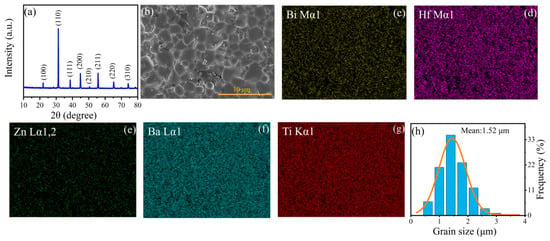
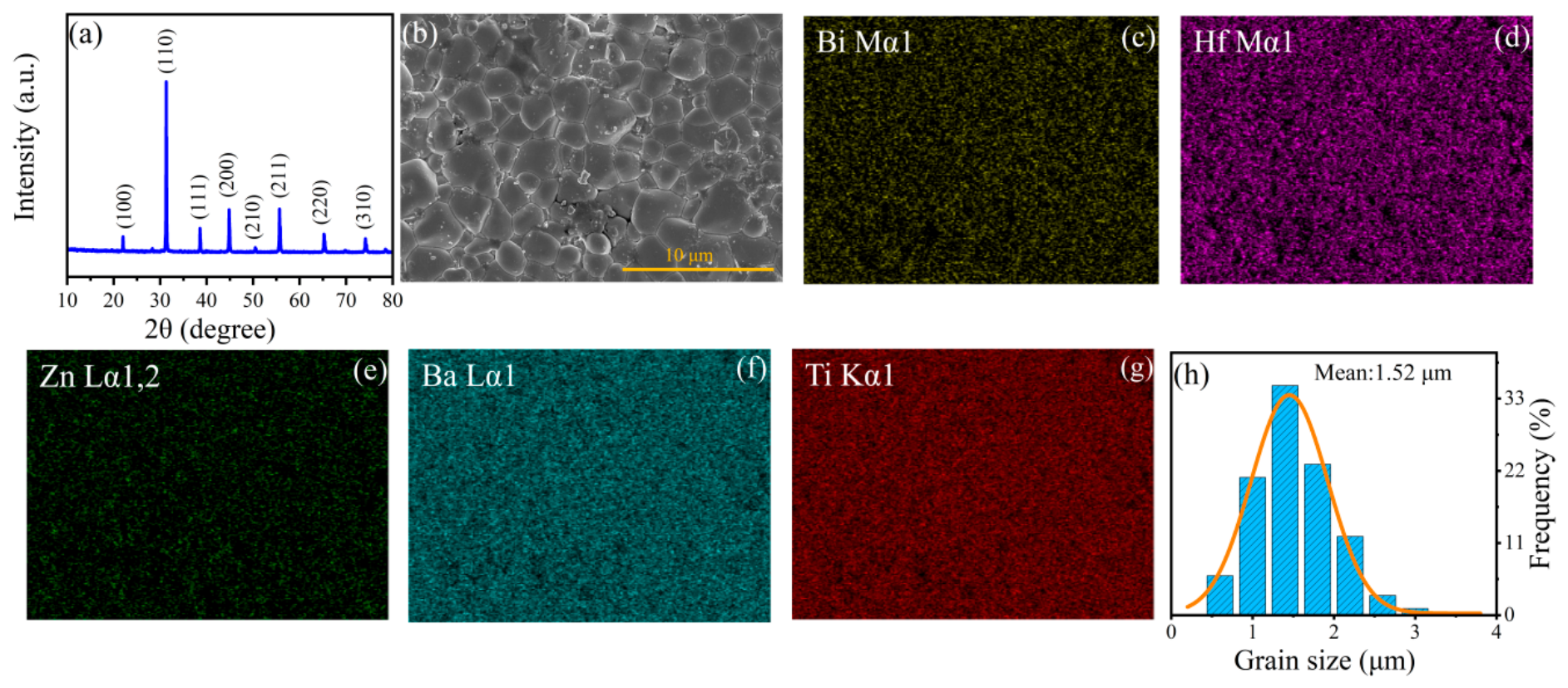
Figure 1a shows the room temperature XRD pattern of the as-sintered 0.95BaTi0.8Hf0.2O3-0.05Bi(Zn0.5Ti0.5)O3 ceramic. All diffraction peaks are sharp and well-defined, indicating a high degree of crystallinity. No reflections attributable to secondary phases are detected. The calculated lattice parameter is a = 4.032 Å, which is consistent with the incorporation of Bi3+ and Zn2+ into the perovskite lattice. Combined with the homogeneous elemental distribution observed by EDS, these results suggest the formation of a single-phase solid solution within the detection limit of XRD. Figure 1b presents a representative SEM micrograph of the thermally etched surface. The ceramic exhibits a dense microstructure with polyhedral grains and minimal porosity. The relative density, determined by the Archimedes method, is approximately 95.8%, confirming the high degree of densification. Furthermore, the grains are relatively uniform in size, and no abnormal grain growth is observed. The average grain size, determined by the linear intercept method using Nano Measurer software (version 1.2.5) based on over 200 grains (Figure 1h), is approximately 1.52 μm. Figure 1c–g display the EDS elemental mapping for Bi, Hf, Zn, Ba, and Ti. Each element is homogeneously distributed across the examined region, and no local agglomeration or segregation is evident. This uniform elemental distribution corroborates the incorporation of both Hf4+ and Bi(Zn0.5Ti0.5)O3 into the perovskite host, and such microstructural homogeneity is beneficial for reducing dielectric loss and improving breakdown strength, consistent with the low tanδ and excellent discharge performance observed in this work.
Figure 1.
(a) XRD pattern. (b) SEM micrograph of the thermally etched surface. EDS elemental mapping of (c) Bi, (d) Hf, (e) Zn, (f) Ba, (g) Ti, respectively. (h) Grain size distribution of 0.95BaTi0.8Hf0.2O3-0.05Bi(Zn0.5Ti0.5)O3 ceramic.
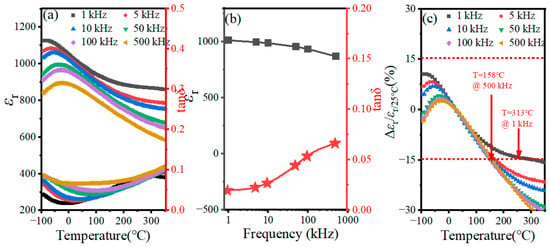
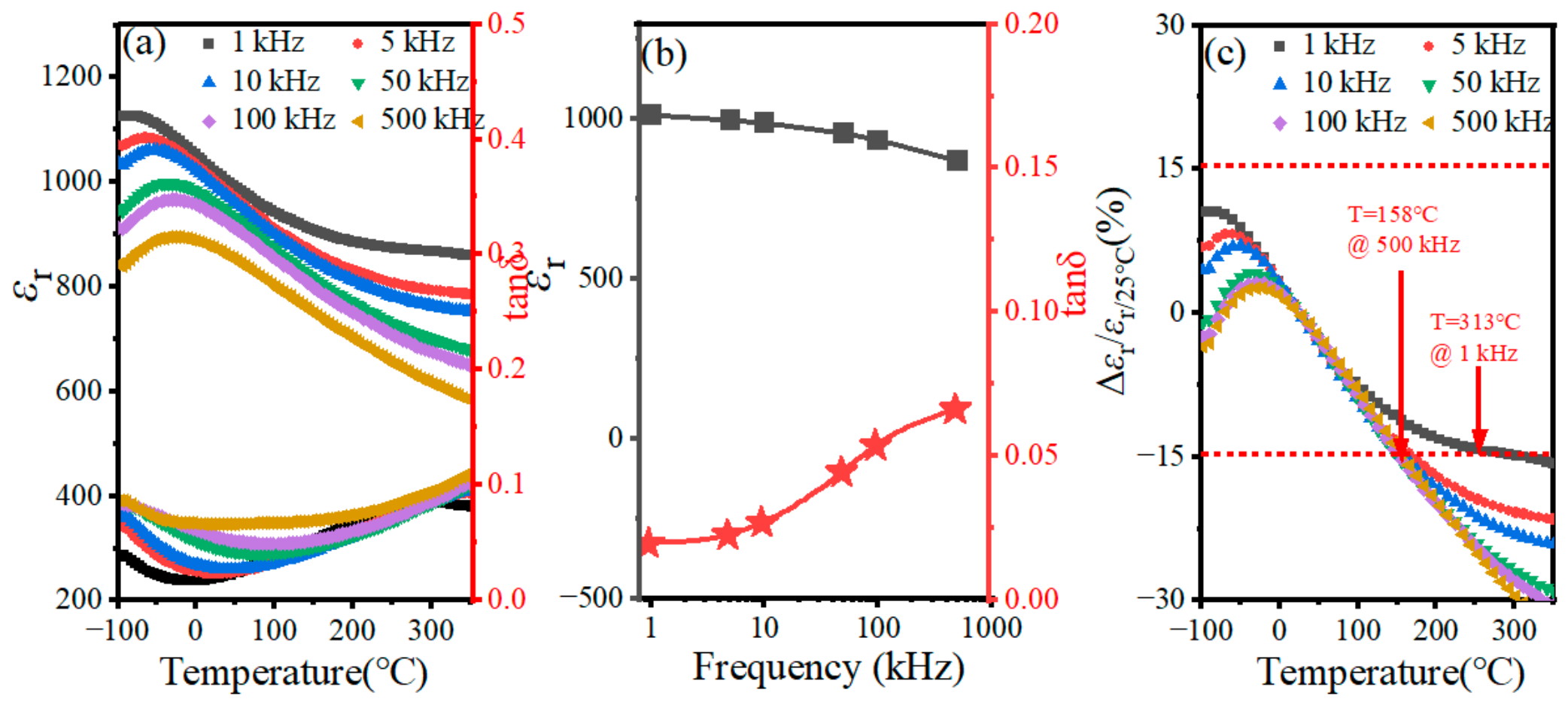
Figure 2a presents the temperature dependence of the relative dielectric constant (εr) and tanδ measured from −100 °C to 350 °C at selected frequencies ranging from 1 kHz to 500 kHz. A pronounced frequency dispersion is observed: as the measuring frequency increases, the εr maximum shifts progressively toward higher temperatures and its magnitude decreases, accompanied by a corresponding shift in the loss peak. This behavior is a characteristic signature of relaxor ferroelectrics. The presence of polar nanoregions is directly evidenced by TEM observation (Figure S1), and the diffuse phase transition is quantitatively confirmed by the modified Curie-Weiss fitting, which yields a diffuseness parameter γ = 1.73, as seen in Figure S2. The frequency dispersion and diffuse phase transition originate from the disruption of long-range ferroelectric order by the incorporation of Bi(Zn0.5Ti0.5)O3, which introduces compositional disorder and thermally activated PNR dynamics [3]. The frequency-dependent εr and loss at 25 °C are extracted and displayed in Figure 2b. At 1 kHz, the ceramic exhibits a room temperature εr exceeding 1000 with a low tanδ below 0.02. The high permittivity is primarily attributed to the Hf4+-induced shift in the Curie point to near room temperature. Importantly, the high εr is retained because the minimal relaxor modification only partially disrupts the long-range polar order, thereby preserving a substantial polarization response. With increasing frequency, the εr decreases moderately while the loss increases, yet the overall variation in permittivity across the measured frequency range remains within 15%. Figure 2c further evaluates the temperature coefficient of capacitance () over the range of −100 °C to 350 °C at different frequencies. At 1 kHz, the εr variation stays within the ±15% limit over an exceptionally wide temperature span from −100 °C to 313 °C, outperforming some reported lead-free dielectric ceramic systems [10,11,12,13,14,15,16,17,18], as seen in Table 1. This excellent temperature stability arises from the flattened permittivity plateau associated with the weak relaxor state, which is further supported by the dense and chemically homogeneous microstructure that minimizes local fluctuations in the dielectric response. As the frequency increases, the stable temperature window narrows but still extends from −100 °C to 158 °C at 500 kHz, satisfying the X8R specification (−55 °C to 150 °C) with a high εr and low tanδ retained. The low tanδ is consistent with the high relative density (95.8%) and uniform elemental distribution, which reduce defect concentrations and leakage pathways.
Figure 2.
(a) Temperature-dependent εr and tanδ measured from −100 °C to 350 °C at frequencies between 1 kHz and 500 kHz. (b) Frequency-dependent permittivity and loss at 25 °C. (c) Temperature coefficient of capacitance () over the same temperature range at selected frequencies, and the dashed lines in (c) mark the ±15% limits.
Table 1.
A comparison of temperature range (ΔT, ) between the present 0.95BaTi0.8Hf0.2O3-0.05Bi(Zn0.5Ti0.5)O3 ceramic and some reported lead-free dielectric ceramic systems [10,11,12,13,14,15,16,17,18].
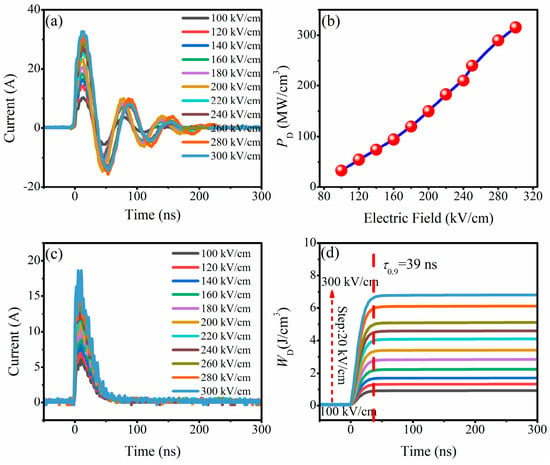
The pulsed charge–discharge performance of the 0.95BaTi0.8Hf0.2O3-0.05Bi(Zn0.5Ti0.5)O3 ceramic was investigated to explore its suitability for high-power applications. Figure 3a displays the underdamped discharge current waveforms captured at ambient temperature under progressively increasing electric fields. Each waveform exhibits a typical damped oscillatory profile, and the amplitude of the first current peak rises steadily with increasing field, ultimately reaching approximately 32.7 A at 300 kV/cm. Based on the recorded waveforms, the power density (PD) is derived from the following relation [19]:
where Imax denotes the peak current, S is the electrode area, and E represents the applied electric field, and the charge–discharge measurements were performed using a circular electrode with an effective diameter of approximately 1.4 mm. The dependence of PD on the electric field is summarized in Figure 3b. As the field increases, PD climbs to a high value of 315 MW/cm3. Moreover, the discharge energy density (WD) was further evaluated using an overdamped circuit configuration according to [19]:
in which R = 100 Ω is the load resistance and V is the volume of the specimen. As shown in Figure 3c,d, the discharge time τ0.9, defined as the time required to release 90% of the maximum WD, exhibits a slight increase with the applied field and reaches approximately 39 ns at 300 kV/cm, while WD attains a value of around 3.3 J/cm3. The fast discharge time together with the high WD underscores the rapid energy release capability and robust power-handling characteristics of this composition. Moreover, the stable discharge response over 104 consecutive cycles demonstrates good operational reliability, making it a promising candidate for pulsed power applications, as seen in Figure S3. Collectively, these findings demonstrate that the 0.95BaTi0.8Hf0.2O3-0.05Bi(Zn0.5Ti0.5)O3 ceramic delivers excellent charge–discharge performance, positioning it as a strong candidate for pulsed power systems.
PD = EImax/2S
WD = R∫I(t)2dt/V
Figure 3.
(a) Underdamped discharge current waveforms recorded at room temperature under various electric fields. (b) Variations in PD with applied electric field. (c) Overdamped discharge current curves recorded at room temperature under various electric fields. (d) WD measured at different electric fields.
4. Conclusions
In summary, a dense and chemically homogeneous 0.95BaTi0.8Hf0.2O3–0.05Bi(Zn0.5Ti0.5)O3 ceramic with a pure perovskite structure was prepared. The material exhibits typical relaxor-ferroelectric characteristics with pronounced frequency dispersion. At 1 kHz, a high relative permittivity exceeding 1000 and a low loss (<0.02) are retained at room temperature, and the capacitance variation stays within the ±15% X8R window over an exceptionally broad temperature range from −100 °C to 313 °C. Importantly, even at 500 kHz the stable range (−100 °C to 158 °C) still exceeds the X8R requirement. Coupled with these superior dielectric properties, the ceramic delivers outstanding pulse discharge performance, as evidenced by a high power density of 315 MW/cm3, a discharge energy density of 3.3 J/cm3, and an ultrafast discharge time of only 39 ns. The multifunctional response of this composition originates from the synergistic interplay between the Curie-point shift imparted by Hf4+ and the weak relaxor character introduced by a minimal amount of Bi(Zn0.5Ti0.5)O3. This work identifies a promising candidate for X8R MLCCs and high-power systems and suggests that compositional tailoring near critical boundaries may offer an effective route for property optimization.
Supplementary Materials
The following supporting information can be downloaded at: https://www.mdpi.com/article/10.3390/ceramics9100115/s1, Figure S1: TEM image of the 0.95BaTi0.8Hf0.2O3-0.05Bi(Zn0.5Ti0.5)O3 ceramic; Figure S2: Modified Curie-Weiss fitting of the dielectric data measured at 500 kHz; Figure S3: Overdamped discharge current curves recorded at room temperature under various consecutive cycles.
Author Contributions
T.P.: Investigation, resources, writing—original draft. J.W.: Investigation, writing—original draft. T.L.: Validation, resources, review and editing. All authors have read and agreed to the published version of the manuscript.
Funding
The authors acknowledge financial support from the National Natural Science Foundation of China (Grant No. 52302130), the Natural Science Foundation of Anhui Provincial Education Department (Grant No. 2025AHGXZK30243 and 2024AH050218).
Data Availability Statement
The original contributions presented in this study are included in the article/Supplementary Material. Further inquiries can be directed to the corresponding author.
Conflicts of Interest
The authors declare no conflicts of interest.
References
- Ma, Y.C.; Li, L.X.; Cui, B.H.; Huang, K.W.; Du, M.K. Achieving X8R specifications and enhanced anti-reduction in fine-grained BaTiO3: The multiple roles of chemical coating erbium. Ceram. Int. 2026, 52, 28510–28519. [Google Scholar] [CrossRef] [Scilit]
- Li, D.; Ren, P.R.; Wu, H.N.; Yin, Q.; Wan, Y.H.; Guo, S.H.; Qiao, W.J.; Wang, X. Enhanced resistivity and temperature stability of dielectric properties of Yb3+-doped 0.97BaTiO3-0.03K0.5Na0.5NbO3-MgO-Bi4Ti3O12 ceramics. J. Mater. Sci. 2025, 60, 13917–13930. [Google Scholar] [CrossRef] [Scilit]
- Soare, E.; Stanciu, C.; Patru, R.; Surdu, V.; Padurariu, L.; Horchidan, N.; Nicoara, A.; Trupina, L.; Vasile, B.; Trusca, R.; et al. Grain size effects in BaTi0.90Hf0.10O3 ceramics with phase coexistence: The influence of nanostructuring and of the internal stress on the functional properties. J. Mater. Res. Tech. 2025, 38, 5389–5408. [Google Scholar] [CrossRef] [Scilit]
- Premwichit, P.; Yimsabai, S.; Bunpang, K.; Chia, J.Y.; Horprathum, M.; Nuntawong, N.; Raengthon, N.; Prasertpalichat, S. Novel high-entropy perovskite oxide (Bi0.2Na0.2Ba0.2Sr0.2Ca0.2)TiO3-Ba(Mg1/3Ta2/3)O3 ceramics with enhanced energy storage performance and thermal stability. Ceram. Int. 2026, 52, 30075–30086. [Google Scholar] [CrossRef] [Scilit]
- Zeb, A.; Milne, S.J. Temperature-stable dielectric properties from 20 °C to 430 °C in the system BaTiO3-Bi(Mg0.5Zr0.5)O3. J. Eur. Ceram. Soc. 2014, 34, 3159–3166. [Google Scholar] [CrossRef] [Scilit]
- Li, T.Y.; Yang, X.F.; Xie, A.W.; Jiang, X.W.; Rahman, A.; Zhang, Y.; Zuo, R.Z. Lead-free X8R-type 0.92Ba0.8Sr0.2TiO3-0.08Bi(Mg0.5Zr0.5)O3 dielectric energy-storage ceramics for pulsed power capacitors. J. Mater. Sci. 2023, 58, 11761–11770. [Google Scholar] [CrossRef] [Scilit]
- Rehman, M.U.; Manan, A.; Khan, M.A.; Uzair, M.; Qazi, I.; Iqbal, Y.; Ullah, A.; Ahmad, A.S. Improved energy storage performance of Bi(Mg0.5Ti0.5)O3 modified Ba0.55Sr0.45TiO3 lead-free ceramics for pulsed power capacitors. J. Eur. Ceram. Soc. 2023, 43, 2426–2441. [Google Scholar] [CrossRef] [Scilit]
- Zan, P.F.; Long, Y.T.; Pu, L.Y.; Huang, X.; Liu, J.S. Dielectric temperature stability and energy storage performance of BST-based lead-free ceramics for X8R capacitors. J. Mater. Sci. Mater. Electron. 2024, 35, 23. [Google Scholar] [CrossRef] [Scilit]
- Li, T.Y.; Yin, J.J.; He, J.H. Superior energy-storage performance in lead-free BaTiO3-based ceramics achieved via compositional engineering for pulsed power capacitors. Ceram. Int. 2025, 51, 57800–57806. [Google Scholar] [CrossRef] [Scilit]
- Li, T.Y.; Qiao, Z.L.; Zuo, R.Z. X9R-type Ag1-3xBixNbO3 based lead-free dielectric ceramic capacitors with excellent energy-storage properties. Ceram. Int. 2022, 48, 2533–2537. [Google Scholar] [CrossRef] [Scilit]
- Peng, H.; Liang, P.F.; Wu, D.; Zhou, X.B.; Peng, Z.H.; Xiang, Y.C.; Chao, X.L.; Yang, Z.P. Simultaneous realization of broad temperature stability range and outstanding dielectric performance in (Ag+, Ta5+) co-doped TiO2 ceramics. J. Alloys Compd. 2019, 783, 423–427. [Google Scholar] [CrossRef] [Scilit]
- Li, X.; Chen, X.L.; Zhou, H.F.; Sun, J.; Li, X.X.; Yan, X.; Liu, G.F. Phase evolution, microstructure, thermal stability and conductivity behavior of (Ba1-xBi0.67xK0.33x)(Ti1-xBi0.33xSn0.67x)O3 solid solutions ceramics. J. Alloys Compd. 2019, 777, 1066–1073. [Google Scholar] [CrossRef] [Scilit]
- Muhammad, R.; Camargo, J.; Prado, A.; Castro, M.S. Temperature stable relative permittivity from -60 to 200 °C in 75BaTiO3-(25-x)BiMg0.5Ti0.5O3-xNaNbO3 ceramics with X9R like characteristics. Mater. Lett. 2018, 233, 258–262. [Google Scholar] [CrossRef] [Scilit]
- Kim, J.; Ryu, J.; Jo, S.-H.; Lee, H. Thermal stability and local atomic structure of (Na0.5K0.5)NbO3 doped BaTiO3 ceramics. Ceram. Int. 2016, 42, 11739–11742. [Google Scholar] [CrossRef] [Scilit]
- Wang, X.; Reng, P.R.; Wang, J.L.; Xu, J.Q.; Xi, Y.X. Multi-phase coexistence and temperature-stable dielectric properties in BaTiO3/ZnO composite ceramics. J. Eur. Ceram. Soc. 2020, 40, 1896–1901. [Google Scholar] [CrossRef] [Scilit]
- Sun, Y.; Liu, H.X.; Hao, H.; Song, Z.; Zhang, S.J. Structure Property Relationship in BaTiO3-Na0.5Bi0.5TiO3-Nb2O5-NiO X8R System. J. Am. Ceram. Soc. 2015, 98, 1574–1579. [Google Scholar] [CrossRef] [Scilit]
- Dittmer, R.; Jo, W.; Damjanovic, D.; Rödel, J. Lead-free high-temperature dielectrics with wide operational range. J. Appl. Phys. 2011, 109, 034107. [Google Scholar] [CrossRef] [Scilit]
- Ren, P.R.; Liu, Z.C.; Wei, M.Y.; Liu, L.J.; Shi, J.; Yan, F.X.; Fan, H.Q.; Zhao, G.Y. Temperature-insensitive dielectric and piezoelectric properties in (1-x)K0.5Na0.5Nb0.997Cu0.0075O3-xSrZrO3 ceramics. J. Eur. Ceram. Soc. 2017, 37, 2091–2097. [Google Scholar] [CrossRef] [Scilit]
- Wang, Q.Y.; He, J.H.; Chen, W.T.; Li, T.Y. Enhanced energy-storage properties in Bi0.5Na0.5TiO3-SrTiO3 lead-free ceramics by high-entropy engineering. Ceram. Int. 2026, 52, 26663–26670. [Google Scholar] [CrossRef] [Scilit]

Disclaimer/Publisher’s Note: The statements, opinions and data contained in all publications are solely those of the individual author(s) and contributor(s) and not of MDPI and/or the editor(s). MDPI and/or the editor(s) disclaim responsibility for any injury to people or property resulting from any ideas, methods, instructions or products referred to in the content. |
© 2026 by the authors. Licensee MDPI, Basel, Switzerland. This article is an open access article distributed under the terms and conditions of the Creative Commons Attribution (CC BY) license.