


Abstract
Optimal sizing and design of renewable microgrids and hybrid renewable energy systems require balancing renewable resource variability, demand uncertainty, storage operation, reliability, and techno-economic constraints. Artificial intelligence and metaheuristic optimization strategies have been increasingly used to address these challenges; however, the evidence remains methodologically heterogeneous. This scoping review maps the literature on artificial intelligence, learning-based, metaheuristic, heuristic, and optimization-based strategies for renewable microgrid sizing and design. The review followed PRISMA-ScR guidelines. Searches were conducted in Scopus and the Web of Science Core Collection for research articles published between 2009 and March 2026. A total of 69 studies were included. Metaheuristics dominated the field, appearing in 63 studies, with particle swarm optimization and genetic algorithm-based strategies as the most frequent methodological families. Artificial intelligence and learning-based strategies were mainly used to support forecasting, surrogate modeling, uncertainty handling, and energy management. The most recurrent configurations involved photovoltaic, wind, and battery storage systems, often with diesel backup in stand-alone or off-grid contexts. The literature is strongly oriented toward metaheuristic sizing of PV–wind–battery microgrids, with emerging integration of AI-assisted prediction and decision-support strategies. Future studies should address reproducibility, uncertainty modeling, real-world validation, degradation assessment, explainability, and scalability.
1. Introduction
1.1. Background
The transition toward low-carbon energy systems has increased interest in renewable microgrids and hybrid renewable energy systems, particularly for rural, remote, island, and community applications [1]. Microgrids can be understood as low-voltage distribution systems that integrate distributed generation, energy storage, local loads, and control resources, with the capacity to operate either connected to the main grid or in island mode [2]. In this context, hybrid renewable energy systems combine resources such as photovoltaic generation, wind energy, biomass, battery storage, and conventional backup units to improve supply reliability, renewable penetration, and operational flexibility [3].
However, the integration of variable renewable energy sources introduces technical and operational challenges. Photovoltaic generation depends on solar irradiance and temperature, whereas wind power output is conditioned by wind speed and its temporal variability [4]. These fluctuations complicate the balance between generation and demand, especially in autonomous or weak-grid systems. Therefore, energy storage, load management, and the appropriate selection of installed capacities are central aspects of the design of renewable microgrids.
Optimal sizing aims to determine the capacity of components such as photovoltaic panels, wind turbines, battery banks, converters, backup generators, electrolyzers, fuel cells, and other distributed energy resources. These decisions directly affect total cost, reliability, autonomy, renewable energy utilization, and environmental performance. Thus, sizing is not only a technical selection task but also a constrained optimization problem involving multiple objectives, uncertain inputs, and operational requirements [5]. Advanced computational methods have been increasingly applied across different areas of energy engineering, including numerical modeling, sensitivity analysis, optimization, and artificial intelligence-based approaches. These methods have supported the analysis of complex nonlinear phenomena in both conventional and renewable energy systems [6,7].
In renewable microgrids, artificial intelligence and metaheuristic optimization methods have been widely used to address sizing, uncertainty, forecasting, and operational challenges [8]. Genetic algorithms, particle swarm optimization, multi-objective particle swarm optimization, and non-dominated sorting genetic algorithm II have been applied to sizing problems involving economic, technical, environmental, and reliability criteria [9]. These methods are suitable for nonlinear, restricted, and high-dimensional search spaces, where deterministic methods may face computational or formulation limitations [10]. In addition, learning-based methods have expanded the possibilities for renewable resource forecasting, load modeling, uncertainty representation, and energy management in microgrids [11]. Their integration with metaheuristics has led to hybrid frameworks that combine prediction, optimization, and decision support for renewable microgrid design [12].
1.2. Rationale
The optimal sizing of renewable microgrids is complex because it involves the interaction of renewable resource variability, demand uncertainty, technical constraints, investment costs, and reliability requirements. Solar and wind resources fluctuate at hourly, daily, and seasonal scales, which increases uncertainty in estimating available generation [13]. Load profiles also vary according to user type, application context, consumption patterns, and socioeconomic conditions [14].
This complexity is greater in autonomous or islanded systems, where supply continuity depends on the appropriate combination of renewable generation, storage, and backup resources [15]. Undersizing may lead to supply deficits, while oversizing increases investment costs, energy surplus, and underutilization of assets. Consequently, capacity definition must balance cost, reliability, autonomy, renewable energy utilization, and operational feasibility.
The problem is also inherently multi-objective. Sizing studies commonly consider economic indicators such as net present cost, levelized cost of energy, annualized cost, initial investment, and operation and maintenance costs. At the same time, they include technical and reliability metrics such as loss of power supply, loss of load probability, energy not supplied, battery state of charge, and supply continuity. Broader formulations also incorporate environmental objectives, including greenhouse gas emissions, carbon footprint, and other system-related impacts [16].
Technical and operational restrictions add further complexity. These include component capacity limits, power balance, voltage and frequency constraints, battery operating limits, depth of discharge, charge and discharge rates, backup availability and minimum reliability requirements [5]. The simultaneous presence of continuous, discrete, nonlinear and non-convex variables makes optimal sizing difficult to solve through classical approaches when system scale, technological diversity or scenario uncertainty increases.
In this context, metaheuristics and artificial intelligence-based methods provide methodological advantages. They do not require explicit gradient information, can handle discontinuous or non-convex search spaces, and can be adapted to single- and multi-objective formulations [10]. Nevertheless, the literature reports a wide diversity of algorithms, technological configurations, objective functions, constraints, computational tools, data sources, and application contexts. This heterogeneity makes it difficult to identify dominant trends, methodological roles, and research gaps in the field.
1.3. Why a Scoping Review
Despite the growing literature on artificial intelligence and metaheuristics for the optimal sizing of renewable microgrids, the field remains methodologically and technologically heterogeneous. Studies differ in terms of system configurations, optimization criteria, performance metrics, computational tools, data sources, and application contexts, which limits direct comparison and makes it difficult to identify dominant methodological patterns and research gaps [17].
A scoping review is appropriate for mapping the extent, nature, and characteristics of evidence in broad or heterogeneous research areas [18,19]. Unlike systematic reviews focused on estimating effects or comparing specific interventions, a scoping review allows concepts, methods, types of evidence, and knowledge gaps to be organized descriptively [20]. The PRISMA-ScR framework supports transparent reporting of the search, selection, data charting, and synthesis processes [21].
Accordingly, this review maps the literature on optimal sizing of renewable microgrids and hybrid renewable energy systems using artificial intelligence, learning-based methods, metaheuristics, and related optimization algorithms. It focuses on the methods used, technological configurations addressed, objective functions and constraints considered, tools and data sources reported, and application contexts covered.
1.4. Objectives and Review Questions
The objective of this scoping review is to analyze the scientific literature on artificial intelligence, learning-based methods, metaheuristics, and optimization algorithms applied to the optimal sizing of renewable microgrids and hybrid renewable energy systems. Specifically, the review seeks to identify methodological trends, technological configurations, objective functions, constraints, performance metrics, computational tools, data sources, and application contexts reported in the included studies. The main review question was:
How have artificial intelligence, learning-based methods, metaheuristics and optimization algorithms been applied to the optimal sizing of renewable microgrids and hybrid renewable energy systems based on photovoltaic, wind or PV–wind technologies?
The specific review questions were:
RQ1. What artificial intelligence, learning-based, metaheuristic, and optimization techniques have been used for sizing renewable microgrids and hybrid renewable energy systems?
RQ2. What technological configurations have been most frequently addressed, considering photovoltaic systems, wind systems, PV–wind architectures, batteries, hydrogen storage, grid connection, backup generators, and other distributed energy resources?
RQ3. What objective functions, constraints, and performance metrics are used in sizing studies, considering economic, technical, environmental, energy-related, and reliability criteria?
RQ4. What computational tools, simulation platforms, modeling environments, and data sources are reported in the literature?
RQ5. In which application contexts have these studies been developed, particularly in residential, community, rural, remote, off-grid, commercial, industrial, university, and hospital microgrids?
Unlike previous reviews that mainly classify optimization algorithms and technological configurations, this scoping review examines methodological limitations in renewable microgrid sizing studies. The analysis covers reproducibility, algorithm-parameter reporting, uncertainty treatment, degradation modeling, benchmark selection, code and data availability, and real-world validation. These dimensions support the critical interpretation of methodological consistency, reporting quality, and practical applicability of the included studies.
2. Materials and Methods
2.1. Protocol and Registration
This scoping review was conducted following methodological guidance for scoping reviews [20] and reported according to PRISMA-ScR guidelines [21]. The review procedures were defined before data extraction, but the protocol was not formally registered in a public repository.
2.2. Eligibility Criteria
Eligibility criteria were defined according to the review scope and are summarized in Table 1. The review included research articles published between 2009 and 2026 that addressed optimal sizing, capacity optimization, optimal design, or optimal configuration of microgrids or hybrid renewable energy systems with a renewable energy component. Eligible studies had to apply artificial intelligence, learning-based methods, metaheuristics, heuristics, or related optimization algorithms. Records outside the defined period, non-research articles, studies unrelated to microgrids or hybrid renewable energy systems, and works focused only on operation, control, dispatch, or forecasting without sizing or design were excluded.
Table 1.
Eligibility criteria used in the review.
Studies combining capacity sizing with dispatch, energy management, stochastic operation, demand response, or control were included when component capacities or system configuration were explicit optimization variables or reported outcomes. Studies addressing only operation, forecasting, dispatch, or control without a sizing or design component were excluded.
2.3. Information Sources
The bibliographic search was conducted in Scopus and the Web of Science Core Collection. These databases were selected because of their broad coverage of peer-reviewed literature related to microgrids, hybrid renewable energy systems, optimal sizing, metaheuristic optimization, and artificial intelligence applied to energy systems. Scopus was used as the main source, while the Web of Science Core Collection was used as a complementary source to improve coverage and reduce the limitations of relying on a single database. The final search was conducted on 30 March 2026.
2.4. Search Strategy
The search strategy was developed to retrieve studies on microgrids or hybrid renewable energy systems, optimal sizing or design, renewable energy technologies, and computational optimization methods. The same conceptual search structure was applied in Scopus and the Web of Science Core Collection, with database-specific syntax adjustments. The search was restricted mainly to title fields for the system, sizing, and method terms. Database-specific field options were used for the renewable-energy block: in Scopus, these terms were searched in the article title, abstract, and keywords, whereas in Web of Science, the All Fields option was used. The remaining search blocks were restricted to the title field. Screenshots of the database-specific field configurations are provided in Supplementary Figures S1 and S2. The Scopus search string used as the reference strategy was:
TITLE(microgrid* OR “micro-grid*” OR “hybrid energy system*” OR “hybrid renewable energy system*” OR HRES OR “stand-alone energy system*” OR “standalone energy system*” OR “off-grid energy system*” OR “islanded microgrid*” OR “autonomous microgrid*” OR “distributed energy system*”)
AND TITLE (“optimal sizing” OR “optimizing the sizing” OR “sizing optimization” OR “microgrid sizing” OR “system sizing” OR “component sizing” OR “capacity sizing” OR “capacity optimization” OR “optimal design” OR “design optimization” OR “optimal configuration”)
AND TITLE-ABS-KEY (photovoltaic OR PV OR solar OR wind OR “PV/wind” OR “PV-wind” OR “solar-wind” OR “wind-solar” OR “renewable energy”)
AND TITLE (“artificial intelligence” OR “machine learning” OR “deep learning” OR “reinforcement learning” OR “genetic algorithm*” OR “particle swarm optimization” OR PSO OR “grey wolf optimizer” OR GWO OR “whale optimization algorithm” OR WOA OR “ant colony optimization” OR ACO OR “differential evolution” OR DE OR “firefly algorithm” OR “bat algorithm” OR “cuckoo search” OR “harmony search” OR “simulated annealing” OR metaheuristic* OR “meta-heuristic*” OR heuristic* OR “multi-objective optimization” OR “NSGA-II” OR NSGAII OR MOPSO).
The title-field restriction was applied as a methodological criterion to improve precision and retain studies in which sizing, system design, and computational methods constituted the central research focus. A broader title–abstract–keyword search would have retrieved a larger number of records in which these elements appeared only as secondary aspects.
2.5. Selection of Sources of Evidence
The selection process followed the PRISMA flow structure, including identification, duplicate removal, title and abstract screening, full-text retrieval, and eligibility assessment. Records retrieved from Scopus and the Web of Science Core Collection were merged into a single database, and duplicates were removed before screening. Unique records were assessed by title and abstract according to the eligibility criteria. Potentially eligible reports were then sought for full-text retrieval, and unavailable documents were recorded as not retrieved. Full-text reports were assessed in detail, reasons for exclusion were documented, and studies meeting all criteria were included in the final synthesis.
Title and abstract screening and full-text eligibility assessment were conducted by two reviewers. Potential disagreements regarding study inclusion were resolved through discussion and consensus.
2.6. Data Charting Process
Data were extracted using a charting matrix designed for this scoping review and aligned with the review objective and questions. The matrix was preliminarily checked to ensure clear fields, adequate categories, and consistent coding before being applied to all included studies.
2.7. Data Items
Data items were defined according to the review questions and included bibliographic information, system configuration, technologies, optimization method, sizing problem, objective functions, constraints, performance metrics, computational tools, data sources, and application context.
2.8. Critical Appraisal of Individual Sources
A formal critical appraisal of methodological quality or risk of bias was not conducted, as the purpose of this scoping review was to map methods, technological configurations, optimization criteria, tools, application contexts, and research gaps rather than to assess intervention effects or rank evidence quality.
2.9. Synthesis of Results
Results were synthesized using a descriptive and narrative approach consistent with the purpose of a scoping review. Extracted data were organized into categories derived from the review questions, including methodological approaches, technological configurations, objective functions, constraints, performance metrics, computational tools, data sources and application contexts. Findings were presented through narrative synthesis, classification tables and descriptive figures where appropriate.
3. Results
3.1. Selection of Sources of Evidence
The search identified 133 records. After removing 38 duplicates, 95 records were screened by title and abstract, and 4 were excluded. Of the 91 reports sought for full-text retrieval, 15 could not be obtained in full text and were therefore not assessed against the eligibility criteria. The remaining 76 reports were assessed for eligibility. Seven full-text reports were excluded: 4 did not address sizing, design, or installed capacity; 1 was a review; 1 was a duplicate; and 1 was outside the technological scope of microgrids or hybrid renewable energy systems. Finally, 69 studies met the eligibility criteria and were included in the review, as shown in Figure 1. These 69 studies constitute the final evidence corpus analyzed in the scoping review; the larger reference list also includes methodological guidance, background literature, previous reviews, and other supporting sources.
Figure 1.
PRISMA flow diagram of the identification, screening, eligibility, and inclusion process.
3.2. Characteristics of Included Studies
The included studies were published between 2011 and March 2026. Although the eligibility period began in 2009, no studies published in 2009 or 2010 met the inclusion criteria. Therefore, the final evidence corpus covers publications from 2011 to March 2026.
As shown in Figure 2, publication output was limited before 2020 and increased thereafter, with the highest concentration between 2022 and 2025. The largest number of studies was published in 2025, with 13 studies, followed by 2022 with 9 studies, and 2023 and 2024 with 8 studies each. Regarding database sources, 65 studies were retrieved from Scopus and 4 from the Web of Science Core Collection. Most studies were published in English, while one study was published in Chinese and one in Spanish.
Figure 2.
Annual distribution of the included studies.
3.3. Bibliometric Overview
The 69 included studies were distributed across 55 publication sources, indicating a dispersed literature. As shown in Table 2, Energies was the most frequent source, with four records, followed by Energy, with three records. Several journals contributed two studies each, while most remaining sources contributed only one study.
Table 2.
Main publication sources for the included studies.
Regarding geographical distribution, the analysis was based on the affiliation countries reported in the records and full-text documents. China showed the highest frequency, with 13 studies, followed by India with 9, Iran with 6, Egypt with 5, and Iraq with 4. Contributions from Morocco, Brazil, the United States, Malaysia, South Africa, and Nigeria were also identified. These counts refer to affiliation countries and should not be interpreted as the countries where the case studies were conducted, as shown in Table 3.
Table 3.
Distribution of included studies by affiliation country.
The keyword analysis showed that the most frequent terms were renewable energy, optimal sizing, particle swarm optimization, microgrid, multi-objective optimization, genetic algorithm and hybrid renewable energy systems. The strongest co-occurrences were observed between particle swarm optimization and renewable energy, optimal sizing and renewable energy, microgrid and renewable energy, and microgrid and optimal sizing. These patterns indicate that the corpus is mainly concentrated on the optimal sizing of renewable microgrids and hybrid renewable energy systems using metaheuristic approaches, particularly swarm-based and multi-objective optimization methods.
Figure 3 presents the overlay visualization of the keyword co-occurrence network derived from the author keywords of the included studies. The network shows that the most central and strongly connected terms were “optimal sizing”, “microgrid”, “renewable energy”, “optimization”, “multiobjective optimization”, and “particle swarm optimization”. These keywords form the core thematic structure of the reviewed literature and confirm the predominance of optimization-oriented approaches for renewable microgrid design. The temporal overlay further indicates that established topics such as particle swarm optimization, genetic algorithms, wind power, and solar energy were more frequent in earlier studies, whereas more recent publications increasingly incorporated terms related to energy management, learning algorithms, cost-effectiveness, and optimization algorithms. Overall, the map suggests a gradual evolution from conventional metaheuristic sizing approaches toward broader frameworks integrating data-driven methods, energy management, and techno-economic considerations.
Figure 3.
Overlay visualization of the keyword co-occurrence network of the included studies.
3.4. AI, Metaheuristic and Optimization Methods for Optimal Sizing
3.4.1. Overview of Methodological Approaches Used for Optimal Sizing
Figure 4 summarizes the methodological approaches identified in the included studies. The methods were grouped according to their predominant role in the sizing process, including dominant metaheuristics, alternative and emerging metaheuristics, AI-assisted sizing frameworks, mathematical or stochastic optimization approaches, and software-based comparative tools. These categories provide an overview of how different techniques support optimization, prediction, uncertainty handling, benchmarking, and decision-making in renewable microgrid and hybrid energy system sizing.
Figure 4.
Overview of methodological families and predominant roles in optimal sizing studies.
3.4.2. Artificial Intelligence, Metaheuristic and Optimization Techniques Used for Optimal Sizing
The findings for RQ1 show that optimal sizing of renewable microgrids and hybrid renewable energy systems was mainly addressed using metaheuristic algorithms. Of the 69 included studies, 63 used at least one metaheuristic, confirming the predominance of these methods over artificial intelligence, learning-based, and mathematical optimization approaches [22,23,24,25,26].
Particle swarm optimization (PSO) and its multi-objective variants were the most frequent family, appearing in 31 studies. As shown in Table 4, these methods were applied to a wide range of configurations, including PV–wind–diesel–battery systems [22,26,27], PV–wind–battery systems [25,28,29], hydrogen-based systems [24,30], biomass or biogas-supported systems [23,31], and electric vehicle-integrated microgrids [3,32]. Methodologically, PSO/MOPSO-based techniques were used mainly as core sizing algorithms [22,33,34], although some studies employed them for benchmarking [3,24], multi-objective optimization [25,26,35], forecasting-assisted sizing [29,36] or comparison with tools such as HOMER [37,38].
As shown in Table 5, GA/NSGA-II-based approaches and their variants represented the second most frequent methodological family for optimal sizing. These methods were identified in studies involving stand-alone hybrid renewable energy systems, PV–wind–biomass configurations, PV–wind–diesel–battery microgrids, hydrogen-storage systems, energy storage microgrids, and electric vehicle charging applications [23,24,25,27,39,40].
Table 4.
PSO/MOPSO-based techniques and variants used for optimal sizing in the included studies.
GA and NSGA-II were used in classical, multi-objective and hybrid forms, including improved NSGA-II, GA-VNS, MOGA, HGA, SAGA and GA combined with surrogate or metamodeling approaches. Their methodological role was mainly associated with main sizing, multi-objective optimization, and comparative benchmarking, particularly in problems involving cost, reliability, emissions, and component selection trade-offs [26,28,48,49,50]. Table 5 provides the study-level mapping of GA/NSGA-II-based techniques, system configurations, and methodological roles.
Table 5.
GA/NSGA-II-based techniques and variants used for optimal sizing in the included studies.
In addition to PSO/MOPSO- and GA/NSGA-II-based approaches, several other metaheuristics were identified for optimal sizing, as shown in Table 6. These included established algorithms such as the grey wolf optimizer, differential evolution, cuckoo search, harmony search, firefly algorithm, bat algorithm, artificial bee colony, and whale optimization algorithm, as well as more recent or less conventional approaches such as the artificial hummingbird algorithm, transient search optimization, coot optimization, child drawing optimization, and golden ratio optimization [24,57,58,59,60,61].
These techniques were applied to different microgrid and hybrid renewable energy system configurations, including PV–wind systems, grid-connected microgrids, hydrogen-based systems, PV–diesel–battery systems, wind–battery systems, and electric vehicle-integrated microgrids [41,51,62,63,64,65]. In most cases, these methods were used as main sizing algorithms, although some studies used them for benchmarking, comparison with other metaheuristics, or predictive/surrogate-assisted sizing [3,43,66,67]. Table 6 provides the study-level mapping of alternative and emerging metaheuristic techniques, system configurations, and methodological roles.
Table 6.
Other metaheuristic techniques and variants used for optimal sizing in the included studies.
As shown in Table 7, artificial intelligence, machine learning, deep learning, and reinforcement learning techniques appeared less frequently than classical metaheuristics. These methods were mainly used as complementary components of the sizing process, particularly for forecasting, uncertainty modeling, surrogate modeling, energy management, and hybrid optimization support [29,36,76,77,78].
The identified techniques included deep reinforcement learning, multi-agent deep reinforcement learning, neural networks, long short-term memory models, support vector regression, random forest, gradient boosting models, fuzzy logic, and hybrid learning–optimization schemes. Only a few studies used these approaches as the main sizing algorithm [39,79,80], while most integrated them with metaheuristics or optimization models to improve input data quality, represent uncertainty or support decision-making [29,50,81]. Table 7 provides the study-level mapping of AI- and learning-based techniques, system configurations, and methodological roles.
Table 7.
AI- and learning-based techniques used for optimal sizing in the included studies.
As shown in Table 8, mathematical optimization, uncertainty analysis, multicriteria decision-making, and HOMER-based approaches appeared less frequently than metaheuristics, but they played relevant complementary roles in the sizing process. These methods were mainly used to formulate constraints, assess uncertainty, compare alternatives, support decision-making, and validate proposed configurations [3,32,49,83,84].
Table 8.
Mathematical, uncertainty, multicriteria, and HOMER-based approaches used for optimal sizing in the included studies.
The identified approaches included mixed-integer linear programming, robust or stochastic optimization, Monte Carlo simulation, multicriteria decision-making, TOPSIS, and HOMER/HOMER Pro. HOMER-based approaches were used mainly as simulation, benchmarking, or comparison tools rather than as advanced optimization algorithms [37,38]. Table 8 provides the study-level mapping of mathematical, uncertainty, multicriteria, and HOMER-based approaches, system configurations, and methodological roles.
3.4.3. Relationship Between Methodological Family and Technique Role
Figure 5 shows the relationship between methodological family and technique role in the included studies. Metaheuristics were mainly used as primary sizing algorithms, with 49 family–role co-occurrences. In contrast, AI- and learning-based methods were more frequently associated with forecasting, surrogate modeling, and predictive support. Mathematical, stochastic, and multicriteria approaches showed lower frequencies but covered a broader set of roles, including uncertainty assessment, formal optimization, and decision support. Software-based tools were mainly used for benchmarking or comparison. Overall, the heatmap confirms that metaheuristics were not only the most frequent methods but also the central methodological approach in optimal sizing studies.
Figure 5.
Relationship between methodological family and predominant technique role in the included studies. Note. Cell values represent the number of family–role co-occurrences. A single study may include more than one methodological family or technique role; therefore, frequencies are not mutually exclusive and should not be interpreted as article counts.
3.5. Technological Configurations Addressed in Optimal Sizing Studies
The technological configurations identified in the included studies were mainly concentrated on hybrid renewable systems combining photovoltaic or solar generation, wind energy, and battery storage. As shown in Table 9, the most frequent configuration was PV/solar + wind + battery/BESS + diesel/backup, identified in 12 studies and mainly associated with stand-alone, off-grid, islanded or autonomous systems [22,26,34,39,47]. In these architectures, diesel backup was commonly incorporated to improve supply reliability and compensate for renewable resource variability.
Table 9.
Main technological configurations identified in the included studies.
The second most frequent configuration was PV/solar + wind + battery/BESS, reported in 8 studies [25,27,29,57]. This pattern reflects the central role of battery storage in balancing renewable generation, reducing supply deficits, and increasing autonomy in rural, remote, or community applications. Less frequent but relevant configurations included PV/solar + battery/BESS + diesel/backup [44,53,64], hydrogen- or fuel-cell-based systems [24,30,68], bioenergy-supported systems [35,66,67], wind–battery systems [63,75], and architectures integrating thermal loads, electric vehicles, or grid/distribution interaction [32,56,74,80].
Overall, the results show that optimal sizing studies have focused primarily on PV–wind–battery/BESS architectures, with diesel backup frequently used when reliability in isolated systems is prioritized. Hydrogen, biomass, thermal loads, electric vehicles, and grid-connected configurations appear as more specific or emerging extensions within the field. Table 9 provides the study-level mapping of the main technological configurations, article codes, and typical application contexts.
Representative architectures included off-grid PV–wind–battery–diesel systems, in which photovoltaic and wind generation supplied the primary renewable energy, batteries balanced short-term variability, and diesel generators provided backup during prolonged renewable deficits. PV–wind–battery systems operated without conventional backup and therefore required greater storage capacity or controlled load curtailment to maintain reliability. Hydrogen-based architectures incorporated electrolyzers to convert surplus renewable electricity into hydrogen, storage tanks for long-term energy storage, and fuel cells for electricity recovery during periods of low renewable generation. Grid-connected microgrids combined distributed renewable generation, battery storage, local loads, and bidirectional power exchange with the utility grid, which acted as an additional balancing and reliability resource.
3.6. Objective Functions, Constraints and Performance Metrics
Because several objective functions and performance metrics were repeated across multiple studies, Table 10 reports representative articles for each category. The identified objective functions, constraints, and metrics were grouped into six dimensions: economic, reliability, technical/operational, environmental, energy-related, and algorithmic. Economic criteria were among the most recurrent, indicating that optimal sizing was frequently formulated as a cost-minimization problem. Common indicators included net present cost, total net present cost, levelized cost of energy, cost of energy, annualized cost, life cycle cost, investment cost, and operation and maintenance cost [22,23,85].
Table 10.
Main objective functions, constraints, and performance metrics identified in the included studies.
Reliability was another central dimension, usually represented by loss of power supply probability, loss of load probability, loss of load expectation, expected energy not supplied, unmet load, and interruption duration [32,62,63]. Technical and operational criteria were mainly used as feasibility constraints, including battery state of charge, depth of discharge, charge/discharge limits, energy balance, and voltage or frequency stability [28,80].
Environmental and energy-related criteria appeared mainly in multi-objective formulations. These included carbon dioxide emissions, greenhouse gas emissions, carbon footprint, environmental cost, renewable fraction, renewable penetration, and excess, dumped, or curtailed energy [23,38,48,85]. In addition, some studies reported algorithmic metrics such as convergence curves, computation time, best fitness value, and number of iterations to compare optimization performance [49,50,68]. Overall, the reviewed literature shows a strong economic–reliability orientation, while environmental, energy-related, technical, and algorithmic criteria indicate a gradual transition toward broader multi-objective formulations. Table 10 summarizes the main categories, roles, and representative studies.
3.7. Computational Tools, Data Sources
Figure 6 shows the distribution of the main computational tools and platforms across the grouped technological configurations. MATLAB was the most widely reported environment and appeared across nearly all configuration groups, particularly in PV–wind–battery, PV–wind–battery–diesel, hydrogen/fuel-cell, and other hybrid systems. HOMER/HOMER Pro was the second most frequent platform and was mainly associated with techno-economic simulation, configuration comparison, and validation of hybrid renewable energy systems.
Figure 6.
Computational tools, modeling environments, and analytical approaches reported across grouped technological configurations.
The use of computational tools varied according to system architecture. Deep-learning frameworks were concentrated in PV–wind–battery–diesel, PV–wind–battery, thermal or special-load, and other configurations, whereas Monte Carlo simulation appeared mainly in configurations requiring uncertainty or scenario analysis. Python, DOE/metamodel approaches, PVsyst, and Simulink were reported less frequently and were linked to more specific tasks, including surrogate modeling, photovoltaic performance assessment, dynamic simulation, and computational support.
Overall, the heatmap indicates that tool selection depends on both methodological requirements and technological configuration. MATLAB provides broad implementation flexibility, while HOMER/HOMER Pro offers a more standardized environment for simulation and benchmarking. The less frequent use of Python, DOE/metamodel, PVsyst, and Simulink suggests that customized, data-driven, or specialized modeling workflows remain comparatively limited in the reviewed literature.
Figure 7 shows how the main data-source categories were distributed across the grouped technological configurations. Cost and component databases, local meteorological data, measured or real load profiles, and Monte Carlo or scenario-based data were the most consistently reported sources across the reviewed configurations. Their prevalence confirms that optimal sizing studies depend primarily on techno-economic assumptions, renewable-resource characterization, demand representation, and uncertainty-related inputs.
Figure 7.
Data-source categories reported across grouped technological configurations. Note. Each cell shows the number and percentage of studies within the corresponding configuration group reporting the data source. Percentages are calculated by row and are not mutually exclusive because a single study may report multiple data-source categories.
The distribution nevertheless varied by technological architecture. PV–wind–battery–diesel, PV–wind–battery, hydrogen/fuel-cell, and wind–battery systems showed broad use of meteorological, load, cost, and scenario data. In contrast, electricity tariff data, HOMER databases, water or thermal demand data, and NASA/NASA POWER were less frequent and were concentrated in specific configurations. Grid-connected systems relied comparatively more on measured load and scenario-based information, while thermal, electric-vehicle, and other special-load configurations showed a more heterogeneous combination of data sources.
Overall, the heatmap indicates that data-source selection is strongly conditioned by the technological configuration and application requirements. Conventional hybrid systems rely mainly on cost, meteorological, load, and scenario data, whereas specialized configurations require additional sources related to tariffs, thermal demand, electric mobility, or external databases.
Figure 8 shows the distribution of reported data types across the main technological configurations. Battery/SOC parameters and economic data were consistently reported in most configuration groups, confirming their central role in techno-economic sizing studies. Load profiles, grid/network data, and meteorological variables were also widely used, although their frequency varied according to the system architecture. Solar resource data was more common in PV-based configurations, whereas wind resource data was more prominent in wind-integrated systems.
Figure 8.
Data types reported across grouped technological configurations.
Hydrogen/fuel-cell configurations showed broad use of economic, load, solar, environmental, and battery-related data, reflecting the larger number of components and operating assumptions required for their assessment. Thermal, water, and EV charging data remained concentrated in specialized configurations and were rarely reported in conventional PV–wind–battery systems. Overall, the heatmap shows that data requirements are strongly conditioned by technological architecture and that most studies still rely on conventional techno-economic, demand, storage, and meteorological inputs.
3.8. Reproducibility and Reporting Assessment
Table 11 shows the results of the reproducibility and reporting assessment across the nine evaluated criteria. Load profile resolution and component cost assumptions were the most frequently reported items, identified in 57 and 61 studies, respectively. Benchmark comparisons were also common, appearing in 52 studies. In contrast, algorithm parameters, convergence criteria, uncertainty treatment, and code or data availability were reported less consistently. Only 8 studies provided sufficient information on algorithm parameters, 20 reported explicit convergence or stopping criteria, and 23 incorporated formal uncertainty scenarios. Public code or data availability was identified in only one study, while 54 studies did not report any repository or availability statement.
Table 11.
Reporting and reproducibility indicators across the included studies.
Battery degradation was explicitly modeled in 6 studies and partially addressed in 38 through battery lifetime, replacement, depth-of-discharge, or cycle-life assumptions. Twenty-one battery-based studies did not report degradation-related information, while four studies were classified as not applicable because their configurations did not include battery storage. These results indicate that the main reporting gaps are concentrated in algorithm reproducibility, convergence specification, uncertainty representation, degradation modeling, and open access to code and data.
3.9. Application Contexts
Figure 9 shows the distribution of the main application contexts reported in the included studies. Rural, remote, community, and residential applications accounted for the largest share of the reviewed literature, followed by industrial or critical-infrastructure settings. This distribution reflects the strong orientation of optimal sizing studies toward decentralized energy systems in which autonomy, supply continuity, renewable-resource utilization, and reduced dependence on the main grid are central design requirements.
Figure 9.
Primary application contexts reported in the included studies.
Off-grid, islanded, and stand-alone applications were also prominent, confirming that much of the literature addresses systems operating under limited or absent grid support. In contrast, commercial buildings, electric-vehicle-integrated systems, grid-connected applications, thermal/water/CHP configurations, hospitals, and university campuses were reported less frequently. Their limited representation indicates that sizing methods have been evaluated less extensively in complex demand environments, sector-coupled systems, and critical-load applications, where operational constraints, temporal variability, and reliability requirements may differ substantially from those of conventional rural or residential microgrids.
4. Discussion
4.1. Principal Findings and Comparison with Previous Reviews
This scoping review mapped 69 studies on the optimal sizing of renewable microgrids and hybrid renewable energy systems using artificial intelligence, learning-based methods, metaheuristics, and related optimization algorithms. The evidence shows a clear increase in publications after 2020 and a strong concentration on PV–wind–battery/BESS architectures, off-grid or stand-alone systems, rural or community applications, and economic–reliability-oriented formulations.
The predominance of metaheuristics confirms that optimal sizing continues to be treated mainly as a nonlinear, constrained, and multi-objective optimization problem. PSO/MOPSO-based approaches were the most frequent family, followed by GA/NSGA-II and other bioinspired or evolutionary algorithms. This pattern is consistent with previous reviews that identified high methodological diversity in hybrid renewable energy systems and the widespread use of heuristic and metaheuristic methods for sizing and configuration problems [17,89]. However, the present review extends those contributions by mapping the methodological role of each technique, distinguishing between main sizing algorithms, benchmarking tools, forecasting-assisted approaches, uncertainty-support methods, and software-based comparisons.
The technological configurations also confirm the central role of hybrid PV–wind systems with battery storage. Earlier reviews highlighted the diversity of hybrid renewable architectures and the difficulty of comparing configurations because of differences in objectives, metrics, and assumptions [89]. The present review shows that, despite this diversity, most recent studies still prioritize a limited set of architectures, particularly PV–wind–battery/BESS systems with or without diesel backup. Diesel generators remain relevant in isolated systems because they provide reliability support under renewable variability, although their inclusion conflicts with decarbonization objectives.
Compared with previous reviews, the present study also provides a more detailed characterization of the scale and application context of the analyzed systems. The reviewed literature is strongly concentrated on stand-alone, off-grid, rural, remote, and community-scale HRES, whereas grid-connected, industrial, commercial, hospital, university-campus, hydrogen-based, and electric-vehicle-integrated configurations remain comparatively underrepresented. This distinction is relevant because methodological requirements, reliability constraints, demand profiles, and component interactions differ substantially across application scales and operating contexts.
The geographical distribution also shows an uneven evidence base. Most studies were associated with a limited group of countries, particularly China, India, Iran, Egypt, and Iraq, while contributions from Latin America, Europe, Sub-Saharan Africa, and other regions were less frequent. This concentration may limit the transferability of the reported configurations and optimization results, since renewable resources, demand patterns, technology costs, regulatory conditions, and infrastructure constraints vary considerably across regions. Therefore, future studies should extend validation to a broader range of geographical and socioeconomic contexts.
4.2. Methodological Implications
A central finding is that metaheuristics remain the dominant primary sizing methods, whereas AI and learning-based approaches are less frequent and mainly perform supporting functions. Most PSO/MOPSO, GA/NSGA-II and alternative metaheuristic approaches were used as core sizing algorithms rather than auxiliary methods. This suggests that the field still relies heavily on flexible search-based approaches capable of handling discrete and continuous decision variables, nonlinear constraints, multiple objectives and technology combinations.
PSO/MOPSO-based methods appear to have become reference approaches for renewable microgrid sizing, especially in PV–wind–battery/BESS, PV–wind–diesel–battery, hydrogen-based and electric vehicle-integrated systems [22,25,26,32,33]. GA/NSGA-II-based methods represent a second consolidated family, particularly in multi-objective formulations involving cost, reliability, emissions and component selection trade-offs [23,26,39,40,48]. Other metaheuristics, such as GWO, DE, HS, FA, BAT, ABC, WOA and more recent algorithms, show that the literature continues to explore alternatives for convergence improvement, search diversification and benchmarking [24,58,59,60,61].
From a computational perspective, no algorithmic family can be considered consistently superior across the reviewed studies because execution times, stopping criteria, hardware platforms, population sizes, and test systems were not standardized. PSO-based methods are relatively simple to implement and often converge rapidly, which makes them suitable for continuous sizing variables and conventional PV–wind–battery configurations; however, they may be sensitive to parameter selection and premature convergence. GA- and NSGA-II-based methods offer greater flexibility for discrete decisions and multi-objective formulations, but they generally require larger populations and more function evaluations.
Alternative metaheuristics may improve diversification or convergence in specific cases, although their reported advantages are difficult to generalize because benchmark conditions are heterogeneous and independent replication is limited. Mathematical optimization is more appropriate when the problem can be represented through linear or mixed-integer formulations, whereas stochastic, robust, and hybrid AI–optimization approaches are better suited to uncertainty-intensive or high-dimensional configurations, at the cost of greater computational and data requirements. Algorithm suitability therefore depends on problem dimensionality, variable type, objective structure, uncertainty treatment, and technological complexity.
In contrast, artificial intelligence, machine learning, deep learning and reinforcement learning methods appeared less frequently as standalone sizing methods. Their main contribution was complementary: forecasting renewable resources or demand, supporting surrogate modeling, representing uncertainty, assisting energy management or improving hybrid optimization frameworks [29,36,76,77,78]. This indicates that the field is moving gradually from isolated optimization algorithms toward integrated frameworks that combine prediction, optimization and decision support.
Economic and reliability indicators were reported across many studies; however, their values are not directly comparable without harmonized definitions and assumptions. NPC, LCOE, COE, LPSP, LOLP, EENS, renewable fraction, and emissions depend on system boundaries, load profiles, temporal resolution, discount rates, component lifetimes, replacement assumptions, reliability thresholds, battery models, and renewable-resource datasets. Variations in these inputs can materially affect the calculated values. Cross-study comparisons should therefore be limited to cases with equivalent formulations and boundary conditions.
MATLAB was the most frequently reported environment because it supports customized implementation of metaheuristics, hybrid models, and component-level simulations. However, reproducibility is limited when source code, algorithm parameters, initialization procedures, random seeds, and stopping criteria are not reported. HOMER and HOMER Pro provide more standardized techno-economic simulation and facilitate benchmarking across system configurations, but their predefined structure can restrict the implementation of customized objective functions, constraints, and control strategies. Therefore, the choice of computational tool involves a trade-off between modeling flexibility and reproducibility.
4.3. Implications for Microgrid Design and Application Contexts
The application contexts identified in this review indicate that optimal sizing has been developed mainly for rural, remote, community, residential, off-grid and stand-alone systems. In these contexts, the main design challenge is not only minimizing cost but also ensuring supply continuity under variable renewable generation and uncertain demand. Therefore, the frequent use of battery storage, diesel backup and reliability metrics such as LPSP, LOLP, LOLE and unmet load is consistent with the operational needs of isolated and weak-grid systems.
For rural and community microgrids, the results reinforce the importance of local data quality. Sizing outcomes depend strongly on load profiles, solar irradiance, wind speed, component costs, battery parameters and reliability assumptions. For residential systems, the main implications are related to the representation of hourly demand, self-consumption, storage operation, tariff structures and battery degradation. For industrial or critical infrastructure, sizing methods require stricter reliability constraints, reserve capacity, continuity requirements and, ideally, real or hardware-in-the-loop validation.
Battery storage dominates the reviewed configurations because it is technically mature, widely available, and supported by established cost and performance data. Hydrogen-based storage and fuel-cell systems appear less frequently because their sizing requires higher capital investment, lower round-trip efficiency, more complex operational constraints, and additional component models for electrolyzers, hydrogen tanks, and fuel cells. Their assessment is also affected by limited validated data on degradation, replacement, efficiency variation, and long-term operation. In addition, the economic value of seasonal or long-duration hydrogen storage depends strongly on the study horizon, renewable-resource variability, demand profile, and backup requirements, which complicates direct comparison with battery-based systems.
Less frequent contexts, such as hospitals, university campuses, commercial buildings, thermal/CHP systems, water-related loads and electric vehicle-integrated microgrids, represent emerging areas. These applications require broader formulations that integrate electricity, heat, water, mobility, grid interaction and demand-side management. Therefore, future sizing frameworks should move beyond conventional PV–wind–battery configurations and address multi-energy and sector-coupled microgrids.
4.4. Research Gaps and Future Directions
Several gaps were identified. First, reproducibility remains limited. Many studies report the algorithm and final configuration, but provide incomplete information on parameter settings, stopping criteria, random seeds, input datasets, code availability or simulation assumptions. Future studies should report computational settings in a standardized way and provide traceable data and code whenever possible.
Second, real-world validation remains insufficient. Most studies rely on simulations, case studies or historical data, while experimental validation, pilot microgrids, hardware-the-loop testing and long-term monitoring are less common. This limits the assessment of sizing solutions under real operating conditions, including forecast errors, battery degradation, equipment failures, control constraints and load variability.
Practical deployment also depends on the computational and hardware requirements of the proposed sizing and management frameworks. High-dimensional optimization, detailed component models, and real-time adaptive methods may require substantial processing capacity, memory, reliable communication infrastructure, and accurate sensing. Deployment in embedded controllers or resource-constrained microgrids may therefore be limited by computational latency, data availability, communication failures, and interoperability with existing energy management and control systems. These constraints should be considered when assessing the scalability and operational feasibility of optimized configurations.
Third, uncertainty treatment should be strengthened. Although some studies used Monte Carlo simulation, sensitivity analysis, stochastic formulations or robust optimization, many sizing models still rely on deterministic load, weather, cost or tariff assumptions. Future research should incorporate probabilistic and robust frameworks that account for climate variability, demand uncertainty, component degradation, energy price changes and contingency scenarios.
Fourth, explainability is becoming increasingly important. As learning-based and hybrid AI methods enter the sizing process, decision transparency becomes relevant, especially for critical infrastructure, hospitals, industrial facilities and isolated communities. Explainable artificial intelligence could help identify which variables, constraints and operating assumptions most influence the selected configuration.
Fifth, scalability and transferability remain open challenges. Many studies validate methods in a single case study, which limits evidence on performance across climates, load profiles, regions, scales and regulatory conditions. Future work should include cross-context validation, benchmark cases, multi-microgrid applications, distributed optimization, and transferable models.
Finally, future research should explore digital twins and real-time adaptive optimization for renewable microgrid sizing and operation. Digital twins can support continuous model updating, scenario evaluation, predictive maintenance, and validation using real operating data. Real-time adaptive optimization can allow sizing and energy management decisions to respond dynamically to changing demand, renewable generation, component degradation, and market conditions. These developments should be integrated with uncertainty-aware and explainable models to improve transparency, robustness, and operational applicability.
4.5. Limitations of the Review
This review has limitations. The search was restricted to Scopus and the Web of Science Core Collection; therefore, relevant studies indexed in other databases, institutional repositories, conference proceedings or grey literature may not have been retrieved. The search strategy focused on terms related to optimal sizing, optimal design, capacity optimization, microgrids, hybrid renewable energy systems, PV, wind, artificial intelligence, and metaheuristics. As a result, studies using alternative terminology, such as expansion planning, resource allocation, or configuration planning, may have been excluded.
The review focused on research articles and excluded reviews, book chapters, duplicated documents, and studies centered only on operation, dispatch, control, or forecasting without explicit sizing or design. In addition, data extraction depended on the information reported in each article. When tools, datasets, assumptions, constraints, or methodological roles were unclear, conservative coding was applied.
A formal critical appraisal of methodological quality or risk of bias was not conducted, which is consistent with the purpose of a scoping review. Finally, some categories were not mutually exclusive. A single study could include multiple optimization methods, configurations, objectives, data sources, or application contexts. Therefore, some frequencies should be interpreted as coded occurrences rather than exclusive article counts.
5. Conclusions
This scoping review mapped 69 studies on the optimal sizing of renewable microgrids and hybrid renewable energy systems using artificial intelligence, learning-based methods, metaheuristics, and related optimization algorithms. The evidence shows a clear growth of the field after 2020, with most studies focused on PV–wind systems, battery storage and stand-alone, off-grid, rural, or community applications.
Metaheuristics were the dominant methodological family. PSO/MOPSO- and GA/NSGA-II-based approaches were the most frequently used methods, while alternative bioinspired algorithms were also widely reported. In contrast, artificial intelligence and learning-based methods appeared less frequently as primary sizing tools and were mainly used to support forecasting, uncertainty modeling, surrogate modeling, and energy management.
Technologically, the most recurrent configurations were PV/solar–wind–battery/BESS systems, with or without diesel backup. This confirms that the literature has prioritized autonomy, reliability and the management of renewable variability, especially in isolated or weak-grid contexts. The main objective functions and performance metrics were concentrated on economic and reliability criteria, although environmental, energy-related, technical and algorithmic indicators are increasingly incorporated in multi-objective formulations.
MATLAB and HOMER/HOMER Pro were the most reported computational tools, while the most common data inputs were battery/SOC parameters, economic costs, load profiles, grid data, environmental factors, and meteorological variables. These findings show that optimal sizing depends strongly on the quality of storage, demand, cost, and renewable resource data.
The study-level assessment identified substantial methodological and reporting gaps. Battery degradation was explicitly modeled in only 6 studies and partially represented in 38 through battery lifetime, replacement, depth-of-discharge, or cycle-life assumptions; 21 studies did not report degradation-related information, while 4 were classified as not applicable. Formal uncertainty scenarios were incorporated in 23 studies, and benchmark comparisons were reported in 52. Only 8 studies provided sufficient algorithm-parameter information, 20 reported explicit convergence or stopping criteria, and one study provided publicly accessible code or data.
These findings support the need to improve reproducibility through open code, traceable datasets, and standardized reporting of algorithm parameters. Future research should improve reproducibility through open code, traceable datasets and standardized reporting of algorithm parameters. Further work is also needed to strengthen real-world validation, incorporate uncertainty and degradation more systematically, improve explainability in AI-assisted models, and assess the scalability and transferability of sizing methods across regions, applications, and technological architectures.
Supplementary Materials
The following supporting information can be downloaded at: https://www.mdpi.com/article/10.3390/asi9080165/s1, Figure S1: Scopus search-field configuration and database-specific search strategy; Figure S2: Web of Science Core Collection search-field configuration and database-specific search strategy; Table S1: Less common algorithm-specific abbreviations used in the manuscript; Table S2: Study-level reproducibility and reporting assessment.
Author Contributions
Conceptualization, E.Z.-P.; methodology, E.Z.-P. and C.S.-M.; investigation, E.Z.-P. and C.S.-M.; data curation, E.Z.-P. and C.S.-M.; formal analysis, E.Z.-P.; writing—original draft preparation, E.Z.-P.; writing—review and editing, E.Z.-P., C.S.-M., E.R.-A. and P.C.; visualization, E.Z.-P. and C.S.-M.; supervision, E.R.-A. and P.C.; project administration, E.Z.-P. All authors have read and agreed to the published version of the manuscript.
Funding
This research received no external funding.
Data Availability Statement
The data supporting the findings of this study are included within the article. No new datasets were generated during this scoping review.
Acknowledgments
The authors acknowledge CONCYTEC Peru for facilitating access to scientific databases, which supported the literature search and development of this scoping review.
Conflicts of Interest
The authors declare no conflicts of interest.
Abbreviations
The following abbreviations are used in this manuscript. Less common algorithm-specific abbreviations are listed in Supplementary Table S1.
| Abbreviation | Definition |
| AC/DC | Alternating current/direct current |
| AI | Artificial intelligence |
| ASC | Annualized system cost |
| BESS | Battery energy storage system |
| CHP | Combined heat and power |
| COE | Cost of energy |
| DDQN | Double deep Q-network |
| DG | Distributed generation |
| DL | Deep learning |
| DOD | Depth of discharge |
| DOE | Design of experiments |
| DRL | Deep reinforcement learning |
| EENS | Expected energy not supplied |
| ESS | Energy storage system |
| EV | Electric vehicle |
| GA | Genetic algorithm |
| GHG | Greenhouse gas |
| GWO | Grey wolf optimizer |
| H2 | Hydrogen |
| HES | Hybrid energy system |
| HESS | Hybrid energy storage system |
| HOMER | Hybrid Optimization of Multiple Energy Resources |
| HRES | Hybrid renewable energy system |
| LCC | Life cycle cost |
| LCOE | Levelized cost of energy |
| LOLE | Loss of load expectation |
| LOLP | Loss of load probability |
| LPSP | Loss of power supply probability |
| LSTM | Long short-term memory |
| MADRL | Multi-agent deep reinforcement learning |
| MCDM | Multi-criteria decision-making |
| MILP | Mixed-integer linear programming |
| ML | Machine learning |
| MOGA | Multi-objective genetic algorithm |
| MOPSO | Multi-objective particle swarm optimization |
| NASA POWER | NASA Prediction of Worldwide Energy Resources |
| NN | Neural network |
| NPC | Net present cost |
| NSGA-II | Non-dominated sorting genetic algorithm II |
| O&M | Operation and maintenance |
| PRISMA-ScR | Preferred Reporting Items for Systematic Reviews and Meta-Analyses extension for Scoping Reviews |
| PSO | Particle swarm optimization |
| PV | Photovoltaic |
| PVsyst | Photovoltaic system simulation software |
| RF | Random forest |
| RL | Reinforcement learning |
| SA | Simulated annealing |
| SOC | State of charge |
| SVR | Support vector regression |
| TAC | Total annualized cost |
| TNPC | Total net present cost |
| TOPSIS | Technique for Order Preference by Similarity to Ideal Solution |
| VAR | Vector autoregression |
| WOA | Whale optimization algorithm |
| WtE | Waste-to-energy |
| XGBoost | Extreme gradient boosting |
References
- Parvin, M.; Yousefi, H.; Noorollahi, Y. Techno-Economic Optimization of a Renewable Micro Grid Using Multi-Objective Particle Swarm Optimization Algorithm. Energy Convers. Manag. 2023, 277, 116639. [Google Scholar] [CrossRef] [Scilit]
- Kerdphol, T.; Fuji, K.; Mitani, Y.; Watanabe, M.; Qudaih, Y. Optimization of a Battery Energy Storage System Using Particle Swarm Optimization for Stand-Alone Microgrids. Int. J. Electr. Power Energy Syst. 2016, 81, 32–39. [Google Scholar] [CrossRef] [Scilit]
- Mohseni, S.; Khalid, R.; Brent, A.C. Stochastic, Resilience-Oriented Optimal Sizing of off-Grid Microgrids Considering EV-Charging Demand Response: An Efficiency Comparison of State-of-the-Art Metaheuristics. Appl. Energy 2023, 341, 121007. [Google Scholar] [CrossRef] [Scilit]
- Mquqwana, M.A.; Krishnamurthy, S. Particle Swarm Optimization for an Optimal Hybrid Renewable Energy Microgrid System under Uncertainty. Energies 2024, 17, 422. [Google Scholar] [CrossRef] [Scilit]
- Sadeghi Sarcheshmeh, M.; Taher, S.A.; Mazidi, M. A Stochastic Frequency Security Constrained Optimization Model for Day-Ahead Energy and Reserve Scheduling of Islanded Multi-Microgrids Systems. Int. Trans. Electr. Energy Syst. 2020, 30, e12386. [Google Scholar] [CrossRef] [Scilit]
- Li, Q.; Li, Q.; Wu, J.; He, K.; Xia, Y.; Liu, J.; Wang, F.; Cheng, Y. Wellhead Stability During Development Process of Hydrate Reservoir in the Northern South China Sea: Sensitivity Analysis. Processes 2025, 13, 1630. [Google Scholar] [CrossRef] [Scilit]
- Li, Q.; Li, Q.; Wang, F.; Wu, J.; Wang, Y.; Jin, J. Effects of Geological and Fluid Characteristics on the Injection Filtration of Hydraulic Fracturing Fluid in the Wellbores of Shale Reservoirs: Numerical Analysis and Mechanism Determination. Processes 2025, 13, 1747. [Google Scholar] [CrossRef] [Scilit]
- Talaat, M.; Elkholy, M.H.; Alblawi, A.; Said, T. Artificial Intelligence Applications for Microgrids Integration and Management of Hybrid Renewable Energy Sources. Artif. Intell. Rev. 2023, 56, 10557–10611. [Google Scholar] [CrossRef] [Scilit]
- Phommixay, S.; Doumbia, M.L.; Lupien St-Pierre, D. Review on the Cost Optimization of Microgrids via Particle Swarm Optimization. Int. J. Energy Environ. Eng. 2020, 11, 73–89. [Google Scholar] [CrossRef] [Scilit]
- Wang, F.; Zhou, L.; Wang, B.; Wang, Z.; Shafie-khah, M.; Catalão, J.P.S. Modified Chaos Particle Swarm Optimization-Based Optimized Operation Model for Stand-Alone CCHP Microgrid. Appl. Sci. 2017, 7, 754. [Google Scholar] [CrossRef] [Scilit]
- Sankarananth, S.; Karthiga, M.; Suganya, E.; Sountharrajan, S.; Bavirisetti, D.P. AI-Enabled Metaheuristic Optimization for Predictive Management of Renewable Energy Production in Smart Grids. Energy Rep. 2023, 10, 1299–1312. [Google Scholar] [CrossRef] [Scilit]
- Rahman, M.; Saha, S.; Hasan, M.; Alam, M.; Dadon, S.H.; Suki, T.T. Scheduling of Electric Vehicle Charging in a Solar-Wind Powered Microgrid Using Machine Learning. In Proceedings of the 2024 IEEE International Women in Engineering (WIE) Conference on Electrical and Computer Engineering (WIECON-ECE), Chennai, India, 6–7 December 2024; pp. 293–296. [Google Scholar] [CrossRef] [Scilit]
- Babinec, S.; Baring-Gould, I.; Bender, A.N.; Blair, N.; Li, X.; Muehleisen, R.T.; Olis, D.; Ovaitt, S. Techno-Economic Analysis of Renewable Energy Generation at the South Pole. Renew. Sustain. Energy Rev. 2024, 193, 114274. [Google Scholar] [CrossRef] [Scilit]
- Fadaee, M.; Radzi, M.A.M. Multi-Objective Optimization of a Stand-Alone Hybrid Renewable Energy System by Using Evolutionary Algorithms: A Review. Renew. Sustain. Energy Rev. 2012, 16, 3364–3369. [Google Scholar] [CrossRef] [Scilit]
- Kerdphol, T.; Qudaih, Y.; Mitani, Y. Battery Energy Storage System Size Optimization in Microgrid Using Particle Swarm Optimization. In Proceedings of the IEEE PES Innovative Smart Grid Technologies, Europe, Istanbul, Turkey, 12–15 October 2014. [Google Scholar] [CrossRef] [Scilit]
- Zarate-Perez, E.; Santos-Mejía, C.; Sebastián, R. Reliability of Autonomous Solar-Wind Microgrids with Battery Energy Storage System Applied in the Residential Sector. Energy Rep. 2023, 9, 172–183. [Google Scholar] [CrossRef] [Scilit]
- Hlal, M.I.; Ramachandaramurthya, V.K.; Padmanaban, S.; Kaboli, H.R.; Pouryekta, A.; Bin, T.A.; Abdullah, T. NSGA-II and MOPSO Based Optimization for Sizing of Hybrid PV/Wind/Battery Energy Storage System. Int. J. Power Electron. Drive Syst. 2019, 10, 463–478. [Google Scholar] [CrossRef] [Scilit]
- Arksey, H.; O’Malley, L. Scoping Studies: Towards a Methodological Framework. Int. J. Soc. Res. Methodol. 2005, 8, 19–32. [Google Scholar] [CrossRef] [Scilit]
- Levac, D.; Colquhoun, H.; O’Brien, K.K. Scoping Studies: Advancing the Methodology. Implement. Sci. 2010, 5, 69. [Google Scholar] [CrossRef] [Scilit] [PubMed]
- Peters, M.D.J.; Godfrey, C.; McInerney, P.; Soares, C.M.; Parker, K.L.; Munn, D.C. Updated Methodological Guidance for the Conduct of Scoping Reviews. JBI Evid. Synth. 2020, 18, 2119–2126. [Google Scholar] [CrossRef] [Scilit] [PubMed]
- Tricco, A.C.; Lillie, E.E.; Zarin, W.; O’Brien, K.K.; Colquhoun, H.; Levac, D.; Moher, D.; Peters, M.D.J.; Horsley, T.; Weeks, L.; et al. PRISMA Extension for Scoping Reviews (PRISMA-ScR): Checklist and Explanation. Ann. Intern. Med. 2018, 169, 467–473. [Google Scholar] [CrossRef] [Scilit] [PubMed]
- Ma, Y.; Yang, P.; Wang, Y.; Zhao, Z.; Zheng, Q. Optimal Sizing and Control Strategy of Islanded Microgrid Using PSO Technique. In Proceedings of the Asia-Pacific Power and Energy Engineering Conference (APPEEC), Hong Kong, China, 7–10 December 2014. [Google Scholar]
- Sawle, Y.; Gupta, S.C.; Bohre, A.K. Optimal Sizing of Standalone PV/Wind/Biomass Hybrid Energy System Using GA and PSO Optimization Technique. Energy Procedia 2017, 117, 690–698. [Google Scholar] [CrossRef] [Scilit]
- Phan-Van, L.; Takano, H.; Nguyen Duc, T. A Comparison of Different Metaheuristic Optimization Algorithms on Hydrogen Storage-Based Microgrid Sizing. Energy Rep. 2023, 9, 542–549. [Google Scholar] [CrossRef] [Scilit]
- Nkalo, U.K.; Inya, O.O.; Ifeanyi, O.P.; Bola, A.U.; Ewean, D.I. A Modified Multi-Objective Particle Swarm Optimization (M-MOPSO) for Optimal Sizing of a Solar–Wind–Battery Hybrid Renewable Energy System. Sol. Compass 2024, 12, 100082. [Google Scholar] [CrossRef] [Scilit]
- Slama, A.H.; Saidi, L.; Saidi, M. AI-Driven Optimal Sizing for a Stand-Alone Hybrid Renewable Energy Systems: A Multi-Objective Comparison of NSGA-II and PSO. In Proceedings of the 2025 International Conference on Control, Automation and Diagnosis, ICCAD 2025, Barcelona, Spain, 1–3 July 2025. [Google Scholar]
- Kouihi, M.; Moutchou, M.; Elmahjoub, A.A. Sizing Optimization of a Standalone PV/Wind Hybrid Energy System with Battery Storage Using a Genetic Algorithm. Int. J. Power Electron. Drive Syst. 2025, 16, 1208–1218. [Google Scholar] [CrossRef] [Scilit]
- Deeum, S.; Charoenchan, T.; Bhumkittipich, P.; Janjamraj, N.; Romphochai, S.; Bhumkittipich, K.; Baum, S.; Mithulananthan, N. Optimal Sizing and Location of PV/BESS for Microgrid System in Remote Area Using Multi-Objective Based Genetic Algorithm. In Proceedings of the 2023 International Conference on Power, Energy and Innovations, ICPEI 2023, Phrachuap Khirikhan, Thailand, 18–20 October 2023; pp. 130–135. [Google Scholar]
- Musa, B.; Yimen, N.; Abba, S.I.; Adun, H.H.; Dagbasi, M. Multi-State Load Demand Forecasting Using Hybridized Support Vector Regression Integrated with Optimal Design of off-Grid Energy Systems—A Metaheuristic Approach. Processes 2021, 9, 1166. [Google Scholar] [CrossRef] [Scilit]
- Rashidi, H.; Niazi, S.; Khorshidi, J. Optimal Sizing Method of Solar-Hydrogen Hybrid Energy System for Stand-Alone Application Using Fuzzy Based Particle Swarm Optimization Algorithm. Aust. J. Basic Appl. Sci. 2012, 6, 249–256. [Google Scholar]
- Moghaddas-Tafreshi, S.M.; Zamani, H.A.; Hakimi, S.M. Optimal Sizing of Distributed Resources in Micro Grid with Loss of Power Supply Probability Technology by Using Breeding Particle Swarm Optimization. J. Renew. Sustain. Energy 2011, 3, 043105. [Google Scholar] [CrossRef] [Scilit]
- Sadeghi, D.; Hesami Naghshbandy, A.; Bahramara, S. Optimal Sizing of Hybrid Renewable Energy Systems in Presence of Electric Vehicles Using Multi-Objective Particle Swarm Optimization. Energy 2020, 209, 118471. [Google Scholar] [CrossRef] [Scilit]
- Navaeefard, A.; Kamali, R.; Tafreshi, S.M.; Babayi, O. Microgrid Sizing along with Reliability Consideration Using Particle Swarm Optimization. Int. Rev. Model. Simul. 2011, 4, 3070–3078. [Google Scholar]
- Al-Shammari, Z.W.J.; Azizan, M.M.; Rahman, A.S.F.; Hasikin, K. Optimal Sizing of Standalone for Hybrid Renewable Energy System by Using PSO Optimization Technique. Int. J. Power Electron. Drive Syst. 2023, 14, 426–432. [Google Scholar] [CrossRef] [Scilit]
- Roldán-Blay, C.; Escrivá-Escrivá, G.; Roldán-Porta, C.; Dasí-Crespo, D. Optimal Sizing and Design of Renewable Power Plants in Rural Microgrids Using Multi-Objective Particle Swarm Optimization and Branch and Bound Methods. Energy 2023, 284, 129318. [Google Scholar] [CrossRef] [Scilit]
- González Cusa, Y.; Hidalgo Suárez, J.; Moya Rodríguez, J.L.; Hernández Ramírez, T.; Vieira de Melo, S.A.B.; Andrade Torres, E. Optimal Sizing of an Off-Grid Hybrid Energy System with Metaheuristics and Meteorological Forecasting Based on Wavelet Transform and Long Short-Term Memory Networks. Energies 2025, 18, 5371. [Google Scholar] [CrossRef] [Scilit]
- El Mrini, Y.; Khouili, O.; Zerouaoui, J.; Ettaki, B. Comparative Analysis of PSO and HOMER Pro for Optimizing Hybrid Energy System Sizing in Residential Applications. In Proceedings of the 2025 International Conference on Advanced Technologies and Interdisciplinary Innovation, ICAT2I 2025, Fez, Morocco, 25–26 December 2025. [Google Scholar]
- El Bakali, S.; Ouadi, H.; Gheouany, S.; Mounir, N.; Lahrarti, Y.; Asnai, F. Multi-Objective Optimization of Microgrid Sizing Integrating a Water Heating System under a Tranche Electricity Tariff. IFAC-PapersOnLine 2025, 59, 357–362. [Google Scholar] [CrossRef] [Scilit]
- Jarso, A.K.; Jin, G.; Ahn, J. Hybrid Genetic Algorithm-Based Optimal Sizing of a PV–Wind–Diesel–Battery Microgrid: A Case Study for the ICT Center, Ethiopia. Mathematics 2025, 13, 985. [Google Scholar] [CrossRef] [Scilit]
- An, S.; Chen, M.; Wei, Z.; Qiu, F. Optimal Configuration of Energy Storage Microgrid Based on Chaos Optimization Multi-Objective Genetic Algorithm. In Proceedings of the 32nd Chinese Control and Decision Conference, CCDC 2020, Hefei, China, 22–24 August 2020; pp. 5118–5124. [Google Scholar]
- Ramli, M.A.; Bouchekara, H.; Alghamdi, A.S. Optimal Sizing of PV/Wind/Diesel Hybrid Microgrid System Using Multi-Objective Self-Adaptive Differential Evolution Algorithm. Renew. Energy 2018, 121, 400–411. [Google Scholar] [CrossRef] [Scilit]
- Kilic, U.; Kekezoglu, B.; Durusu, A. Optimal Sizing of Rooftop Photovoltaic System in Microgrid with Hidro-Based Energy Storage: A Particle Swarm Optimization Aproach. In Proceedings of the IEEE Global Energy Conference, GEC 2022, Batman, Turkey, 26–29 October 2022; pp. 42–46. [Google Scholar]
- Nuvvula, R.S.; Devaraj, E.; Elavarasan, R.M.; Taheri, S.I.; Irfan, M.; Teegala, K.S. Multi-Objective Mutation-Enabled Adaptive Local Attractor Quantum Behaved Particle Swarm Optimisation Based Optimal Sizing of Hybrid Renewable Energy System for Smart Cities in India. Sustain. Energy Technol. Assess. 2022, 49, 101689. [Google Scholar] [CrossRef] [Scilit]
- Liu, K.; Cai, Y.; Sun, W.; Feng, Q.; Wang, G.; Yang, W. Optimal Configuration of a Stand-Alone PV/Diesel/Battery Hybrid Energy System Based on Modified PSO for a Translational Sprinkler Irrigation Machine Applied in Remote and Water-Scarce Areas. Energy 2025, 320, 135113. [Google Scholar] [CrossRef] [Scilit]
- Zhang, Q.; Xu, X.; Wang, T.; Sun, H.; Yang, C.; Pan, H. Optimal Configuration of Wind/Solar/Diesel/Storage Microgrid Capacity Based on PSO-GWO Algorithm. In Proceedings of the IECON Proceedings (Industrial Electronics Conference), Brussels, Belgium, 17–20 October 2022. [Google Scholar]
- Hafez, A.A.; Abdelaziz, A.Y.; Hendy, M.A.; Ali, A.F. Optimal Sizing of Off-Line Microgrid via Hybrid Multi-Objective Simulated Annealing Particle Swarm Optimizer. Comput. Electr. Eng. 2021, 94, 107294. [Google Scholar] [CrossRef] [Scilit]
- Castro, R.C.C. Hybrid Particle Swarm Optimization and Gravitational Search Algorithm for Optimal Sizing of Hybrid Renewable Energy Systems. In Proceedings of the Asia-Pacific Power and Energy Engineering Conference (APPEEC), Macao, China, 1–4 December 2019. [Google Scholar]
- Shi, Z.; Peng, Y.; Wei, W. Optimal Sizing of DGs and Storage for Microgrid with Interruptible Load Using Improved NSGA-II. In Proceedings of the 2014 IEEE Congress on Evolutionary Computation, CEC 2014, Beijing, China, 6–11 July 2014; pp. 2108–2115. [Google Scholar]
- Holzbach, M.; Fredy Franco Baquero, J.; Resener, M. Optimal Sizing of a Hybrid Renewable Energy System for Auxiliary Services in Substations Through Genetic Algorithm and Variable Neighborhood Search. IEEE Access 2025, 13, 94740–94760. [Google Scholar] [CrossRef] [Scilit]
- Cherif, H.; Belhadj, J. Metamodel-Based on Meta-Heuristic Design Optimization of Renewable Energy Microgrid. In Proceedings of the 2024 International Conference on Connected Innovation and Technology, ICCITX 2024, Rabat, Morocco, 22–24 April 2024. [Google Scholar]
- Zhao, J.; Nian, H.; Kong, L. Multiobjective Sizing Optimization for Combined Heat and Power Microgrids Using a Triangular Evaluation Model and the Self-Adaptive Genetic Algorithm. In Proceedings of the 2019 IEEE PES Innovative Smart Grid Technologies Asia, ISGT 2019, Chengdu, China, 21–24 May 2019; pp. 1840–1845. [Google Scholar]
- Abed, F.T.; Abed, N.K.; ALRubeei, I.R.N.; Alrikabi, A.R.H. Using Genetic Algorithm for Optimal Sizing of Stand-Alone Hybrid Energy System. Herit. Sustain. Dev. 2024, 6, 287–300. [Google Scholar] [CrossRef] [Scilit]
- Boghdady, T.A.; Bakhoum, S.R.; Sayed, M.M. Microgrid Optimal Sizing and Economic Operation for Rural Area in Assiut (Egypt) Using Meta-Heuristic Optimization Techniques. In Proceedings of the International Telecommunications Conference, ITC-Egypt 2022—Proceedings, Alexandria, Egypt, 26–28 July 2022. [Google Scholar]
- Chauhan, S.S.; Seethalekshmi, K. Optimal Sizing of Off Grid Hybrid System for DC Microgrid Using Genetic Algorithm Based Approach. In Proceedings of the 2024 IEEE 11th Uttar Pradesh Section International Conference on Electrical, Electronics and Computer Engineering, UPCON 2024, Lucknow, India, 29 November–1 December 2024. [Google Scholar]
- Torres-Madroñero, J.L.; Nieto-Londoño, C.; Sierra-Pérez, J. Hybrid Energy Systems Sizing for the Colombian Context: A Genetic Algorithm and Particle Swarm Optimization Approach. Energies 2020, 13, 5648. [Google Scholar] [CrossRef] [Scilit]
- Demolli, H.; Dokuz, A.S.; Ecemis, A.; Gokcek, M. Location-Based Optimal Sizing of Hybrid Renewable Energy Systems Using Deterministic and Heuristic Algorithms. Int. J. Energy Res. 2021, 45, 16155–16175. [Google Scholar] [CrossRef] [Scilit]
- Jasim, A.M.; Jasim, B.H.; Bureš, V. A Novel Grid-Connected Microgrid Energy Management System with Optimal Sizing Using Hybrid Grey Wolf and Cuckoo Search Optimization Algorithm. Front. Energy Res. 2022, 10, 960141. [Google Scholar] [CrossRef] [Scilit]
- Pakaya, I.; Has, Z.; Putra, A.A. Sizing Optimization and Operational Strategy of Hres (PV-WT) Using Differential Evolution Algorithm. In Proceedings of the International Conference on Electrical Engineering, Computer Science and Informatics (EECSI), Malang, Indonesia, 16–18 October 2018; pp. 182–188. [Google Scholar]
- Liang, G.; Li, S.; Li, B.; Zhang, Q.-Q.; Wang, J.; Wang, Y. Capacity Optimization Configuration Method for Multi-Microgrids with Shared Hydrogen Storage Based on Improved Multi-Objective Whale Optimization Algorithm. Front. Energy Res. 2026, 14, 1658840. [Google Scholar] [CrossRef] [Scilit]
- Abdelsattar, M.; Mesalam, A.; Diab, A.A.Z.; Fawzi, A.; Hamdan, I. Optimal Sizing of a Proposed Stand-Alone Hybrid Energy System in a Remote Region of Southwest Egypt Applying Different Meta-Heuristic Algorithms. Neural Comput. Appl. 2024, 36, 16251–16269. [Google Scholar] [CrossRef] [Scilit]
- Thirunavukkarasu, M.; Lala, H.; Sawle, Y. Reliability Index Based Optimal Sizing and Statistical Performance Analysis of Stand-Alone Hybrid Renewable Energy System Using Metaheuristic Algorithms. Alex. Eng. J. 2023, 74, 387–413. [Google Scholar] [CrossRef] [Scilit]
- Yi, J.; Li, X.; Gao, L.; Chen, Y. Optimal Design of Photovoltaic-Wind Hybrid Renewable Energy System Using a Discrete Geometric Selective Harmony Search. In Proceedings of the 2015 IEEE 19th International Conference on Computer Supported Cooperative Work in Design, CSCWD 2015, Calabria, Italy, 6–8 May 2015; pp. 499–504. [Google Scholar]
- Liu, H.; Li, D.; Xiao, Z.; Qiu, Q.; Tao, X.; Qian, Q.; Jiang, M.; Yu, W. Power Allocation and Capacity Optimization Configuration of Hybrid Energy Storage Systems in Microgrids Using RW-GWO-VMD. Energies 2025, 18, 4215. [Google Scholar] [CrossRef] [Scilit]
- Yahiaoui, A.; Fodhil, F.; Benmansour, K.; Tadjine, M.; Cheggaga, N. Grey Wolf Optimizer for Optimal Design of Hybrid Renewable Energy System PV-Diesel Generator-Battery: Application to the Case of Djanet City of Algeria. Sol. Energy 2017, 158, 941–951. [Google Scholar] [CrossRef] [Scilit]
- Mohseni, S.; Khalid, R.; Brent, A.C. Metaheuristic-Based Isolated Microgrid Sizing and Uncertainty Quantification Considering EVs as Shiftable Loads. Energy Rep. 2022, 8, 11288–11308. [Google Scholar] [CrossRef] [Scilit]
- Alshammari, N.; Asumadu, J. Comparative Analysis of Meta-Heuristic Algorithms for Optimal Sizing of Hybrid Renewable Energy System. In Proceedings of the 2020 IEEE International Conference on Electro Information Technology (EIT), Chicago, IL, USA, 31 July–1 August 2020; pp. 1–6. [Google Scholar] [CrossRef] [Scilit]
- Ahirwar, R.; Paliwal, P.; Thakur, T. Analysis of Differential Evolution Variants for Optimal Sizing of Autonomous Microgrid. In Proceedings of the 2021 4th International Conference on Recent Developments in Control, Automation and Power Engineering, RDCAPE 2021, Noida, India, 7–8 October 2021; pp. 113–117. [Google Scholar]
- Diab, A.A.Z.; El-Rifaie, A.M.; Zaky, M.M.; Tolba, M.A. Optimal Sizing of Stand-Alone Microgrids Based on Recent Metaheuristic Algorithms. Mathematics 2022, 10, 140. [Google Scholar] [CrossRef] [Scilit]
- Kurundkar, K.; Karve, G.; Vaidya, G.A. Techno-Economic Analysis and Optimal Sizing of Stand-Alone Hybrid AC-DC Microgrid by Nature Inspired Firefly Algorithm and Particle Swarm Optimization. In Proceedings of the 2021 International Conference on Intelligent Technologies, CONIT 2021, Hubli, India, 25–27 June 2021. [Google Scholar]
- Tukkee, A.S.; Bin Abdul Wahab, N.I.; Binti Mailah, N.F. Optimal Sizing of Autonomous Hybrid Microgrids with Economic Analysis Using Grey Wolf Optimizer Technique. E-Prime-Adv. Electr. Eng. Electron. Energy 2023, 3, 100123. [Google Scholar] [CrossRef] [Scilit]
- Sanajaoba, S.; Fernandez, E. Maiden Application of Cuckoo Search Algorithm for Optimal Sizing of a Remote Hybrid Renewable Energy System. Renew. Energy 2016, 96, 1–10. [Google Scholar] [CrossRef] [Scilit]
- Zhu, W.; Guo, J.; Zhao, G.; Zeng, B. Optimal Sizing of an Island Hybrid Microgrid Based on Improved Multi-Objective Grey Wolf Optimizer. Processes 2020, 8, 1581. [Google Scholar] [CrossRef] [Scilit]
- Sanajaoba, S. Optimal Sizing of Off-Grid Hybrid Energy System Based on Minimum Cost of Energy and Reliability Criteria Using Firefly Algorithm. Sol. Energy 2019, 188, 655–666. [Google Scholar] [CrossRef] [Scilit]
- Bahmani-Firouzi, B.; Azizipanah-Abarghooee, R. Optimal Sizing of Battery Energy Storage for Micro-Grid Operation Management Using a New Improved Bat Algorithm. Int. J. Electr. Power Energy Syst. 2014, 56, 42–54. [Google Scholar] [CrossRef] [Scilit]
- Sun, X.; He, H.; Ma, L. Harmony Search Meta-Heuristic Algorithm Based on the Optimal Sizing of Wind-Battery Hybrid Micro-Grid Power System with Different Battery Technologies. J. Energy Storage 2024, 75, 109582. [Google Scholar] [CrossRef] [Scilit]
- Keyvandarian, A.; Saif, A.; Pelot, R. Robust Optimal Sizing of a Stand-Alone Hybrid Renewable Energy System Using Machine Learning-Based Uncertainty Sets. Energies 2025, 18, 1130. [Google Scholar] [CrossRef] [Scilit]
- Tannous, A.; Razi, R.; Binot, F.; Francois, B. Scaling a Deep Learning-Based Control for a BESS to Various Microgrid Sizing Configurations Through Transfer Learning. In Proceedings of the 2025 IEEE Kiel PowerTech, Kiel, Germany, 29 June–3 July 2025. [Google Scholar]
- Bukar, A.L.; Menesy, A.S.; Kassas, M.; Abido, M.A.; Modu, B.; Hamza, M.F. Optimal Design of Hydrogen Storage-Based Microgrid Employing Machine Learning Models. Int. J. Hydrogen Energy 2025, 159, 150539. [Google Scholar] [CrossRef] [Scilit]
- Ye Myint, K.P.; Khortsriwong, N.; Deanseekeaw, A.; Boonraksa, T.; Boonraksa, P.; Marungsri, B. Optimal Design and Sizing of Microgrid with Hybrid Renewable Energy Sources Using Multi-Agent Deep Reinforcement Learning Techniques. In Proceedings of the ICPEI 2024—6th International Conference on Power, Energy and Innovations, Nakhon Ratchasima, Thailand, 16–18 October 2024; pp. 151–156. [Google Scholar]
- Khezri, R.; Razmi, P.; Mahmoudi, A.; Khooban, M.H. Deep Learning-Based Optimal Sizing of a Grid-Tied Microgrid Under Real-Time Pricing. IET Smart Grid 2026, 9, e70055. [Google Scholar] [CrossRef] [Scilit]
- Abdullah, H.M.; Park, S.; Seong, K.; Lee, S. Hybrid Renewable Energy System Design: A Machine Learning Approach for Optimal Sizing with Net-Metering Costs. Sustainability 2023, 15, 8538. [Google Scholar] [CrossRef] [Scilit]
- Azeem, F.; Ahmad, A.; Gondal, T.M.; Arshad, J.; Rehman, A.U.; Eldin, E.M.T.; Shafiq, M.; Hamam, H. Load Management and Optimal Sizing of Special-Purpose Microgrids Using Two Stage PSO-Fuzzy Based Hybrid Approach. Energies 2022, 15, 6465. [Google Scholar] [CrossRef] [Scilit]
- Lu, L.; Chu, G.; Zhang, T.; Yang, Z. Optimal Configuration of Energy Storage in a Microgrid Based on Improved Multi-Objective Particle Swarm Optimization. Dianli Xitong Baohu YU Kongzhi/Power Syst. Prot. Control 2020, 48, 116–124. [Google Scholar] [CrossRef]
- Merchan, N.; Romero-Quete, D.; Cortes, C. Tool for Optimal Sizing of Hybrid Microgrids PV/Battery/Wind/Diesel with Hybrid Inverters; [Herramienta Para El Dimensionamiento Óptimo de Microrredes Híbridas PF/Baterías/Viento/Diésel Con Inversores Híbridos]. In Proceedings of the 2022 IEEE Biennial Congress of Argentina, ARGENCON 2022, San Juan, Argentina, 7–9 September 2022. [Google Scholar]
- Bade, S.O.; Tomomewo, O.S.; Meenakshisundaram, A.; Dey, M.; Alamooti, M.; Halwany, N. Multi-Criteria Optimization of a Hybrid Renewable Energy System Using Particle Swarm Optimization for Optimal Sizing and Performance Evaluation. Clean Technol. 2025, 7, 23. [Google Scholar] [CrossRef] [Scilit]
- Suhane, P.; Rangnekar, S.; Mittal, A. Optimal Sizing of Hybrid Energy System Using Ant Colony Optimization. Int. J. Renew. Energy Res. 2014, 4, 683–688. [Google Scholar]
- Ghazvini, M.; Abbaspour-Tehrani-Fard, A.; Fotuhi-Firuzabad, M. A Particle Swarm Optimization-Based Approach to Achieve Optimal Design and Operation Strategy of Standalone Hybrid Energy Systems. Turk. J. Electr. Eng. Comput. Sci. 2015, 23, 335–353. [Google Scholar] [CrossRef] [Scilit]
- Tooryan, F.; Collins, E.R.; Ahmadi, A.; Rangarajan, S.S. Distributed Generators Optimal Sizing and Placement in a Microgrid Using PSO. In Proceedings of the 2017 6th International Conference on Renewable Energy Research and Applications, ICRERA 2017, San Diego, CA, USA, 5–8 November 2017; pp. 614–619. [Google Scholar]
- Sharafi, M.; Elmekkawy, T.Y. Multi-Objective Optimal Design of Hybrid Renewable Energy Systems Using PSO-Simulation Based Approach. Renew. Energy 2014, 68, 67–79. [Google Scholar] [CrossRef] [Scilit]
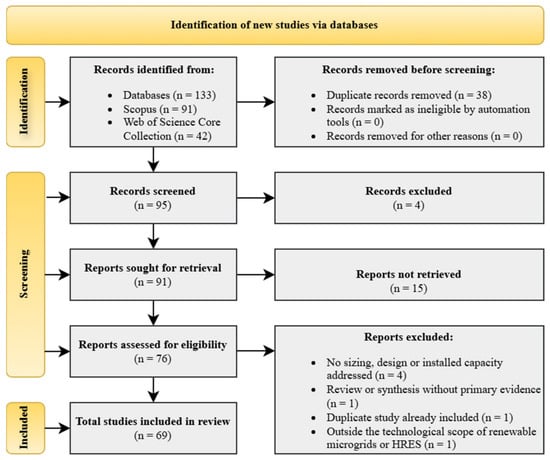
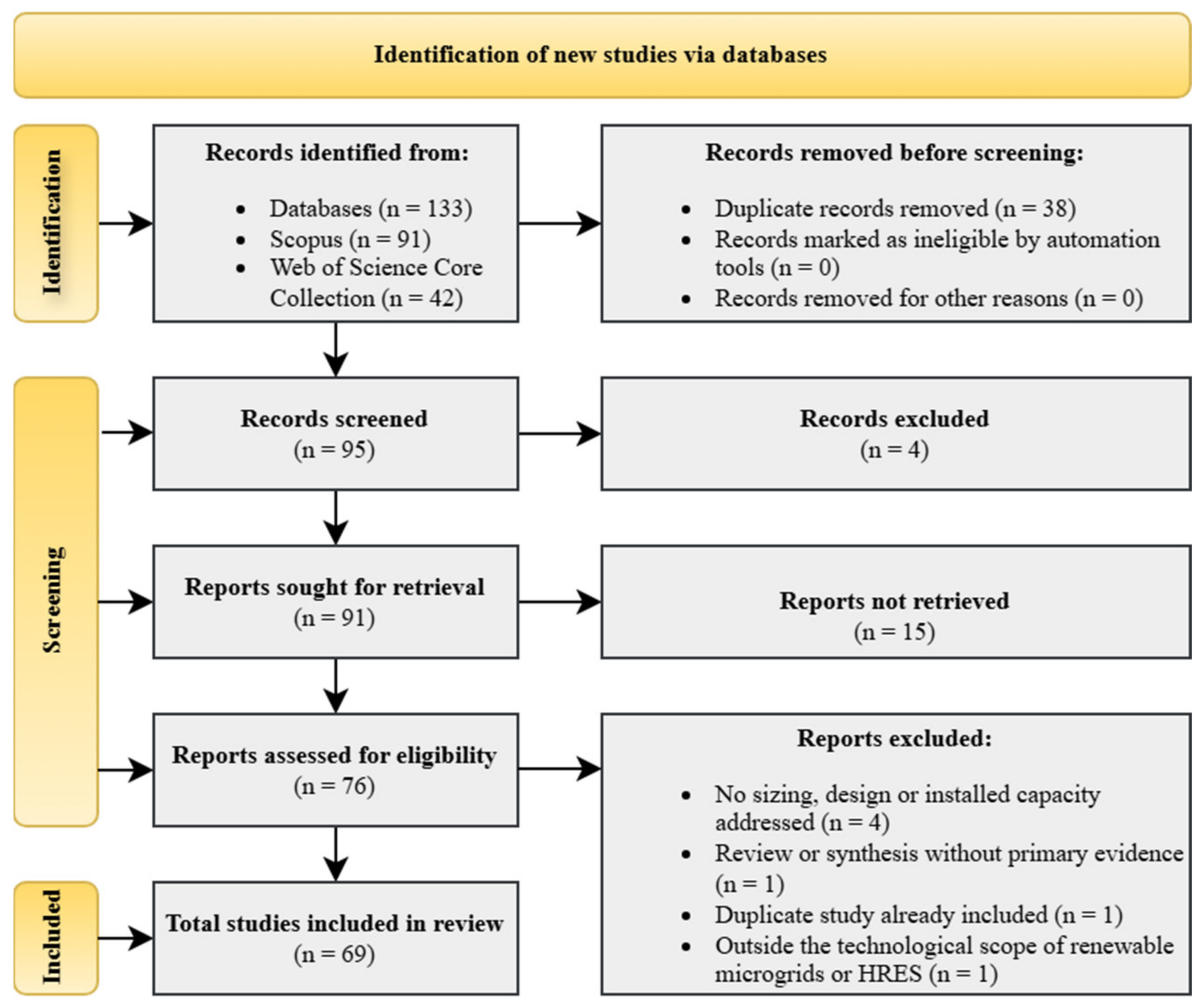
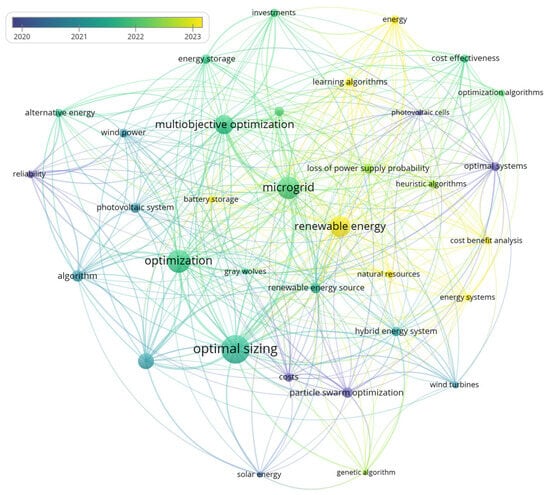
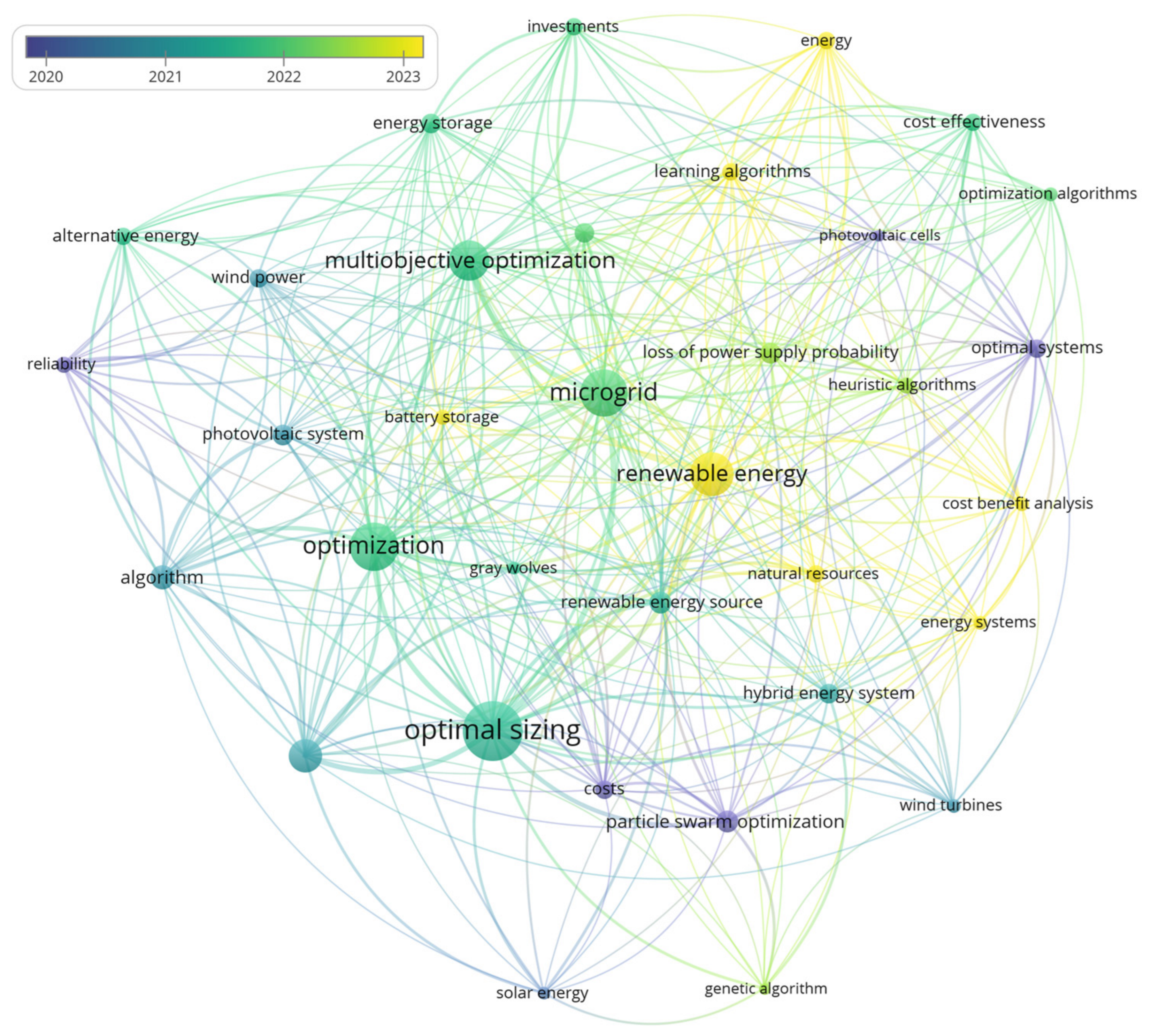
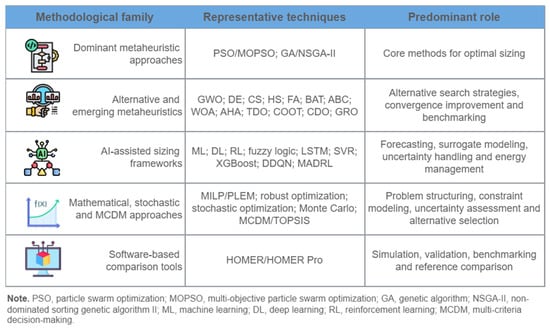
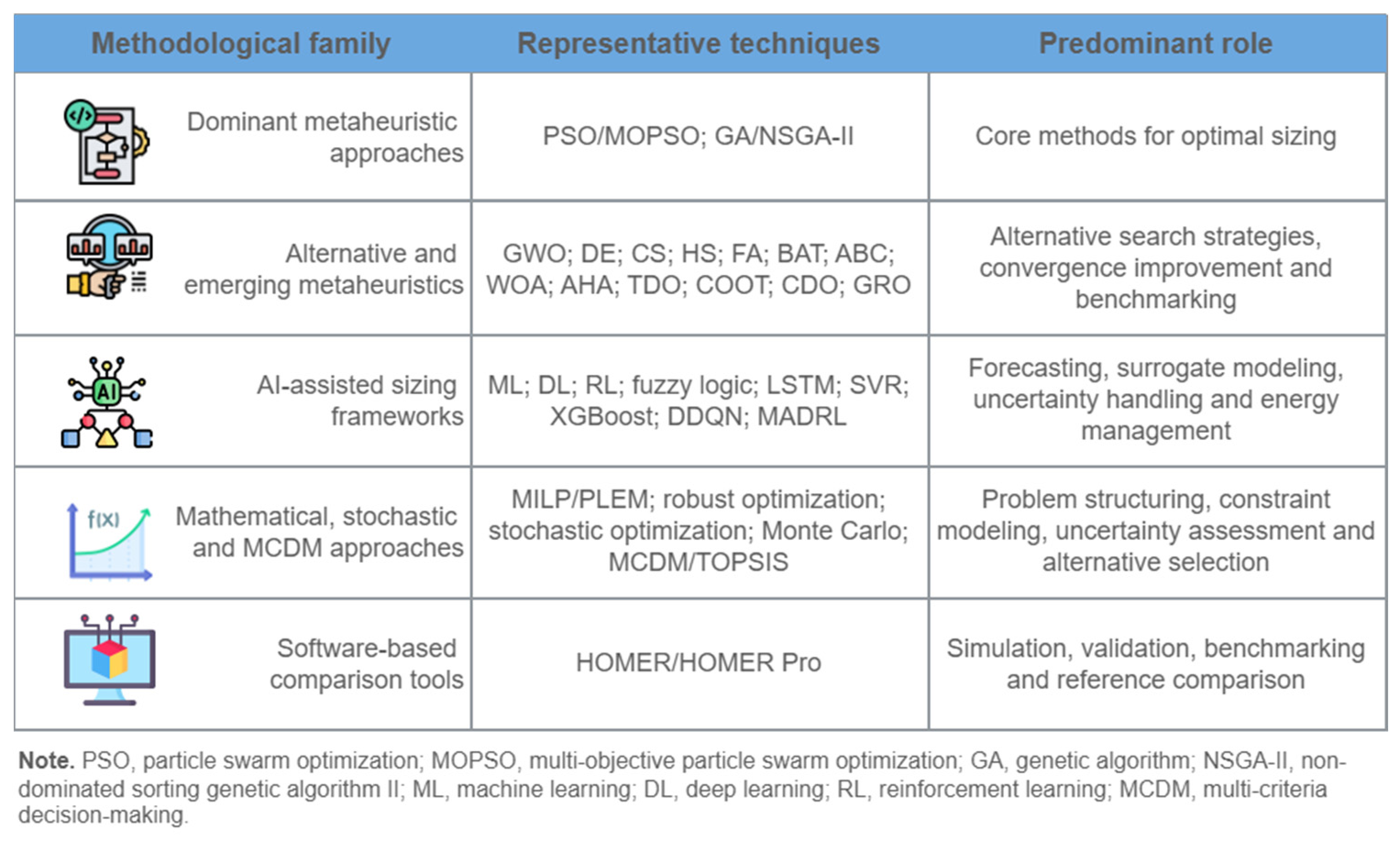
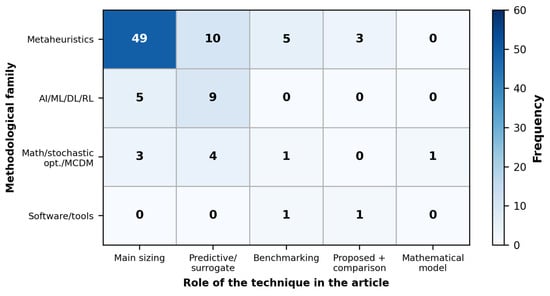
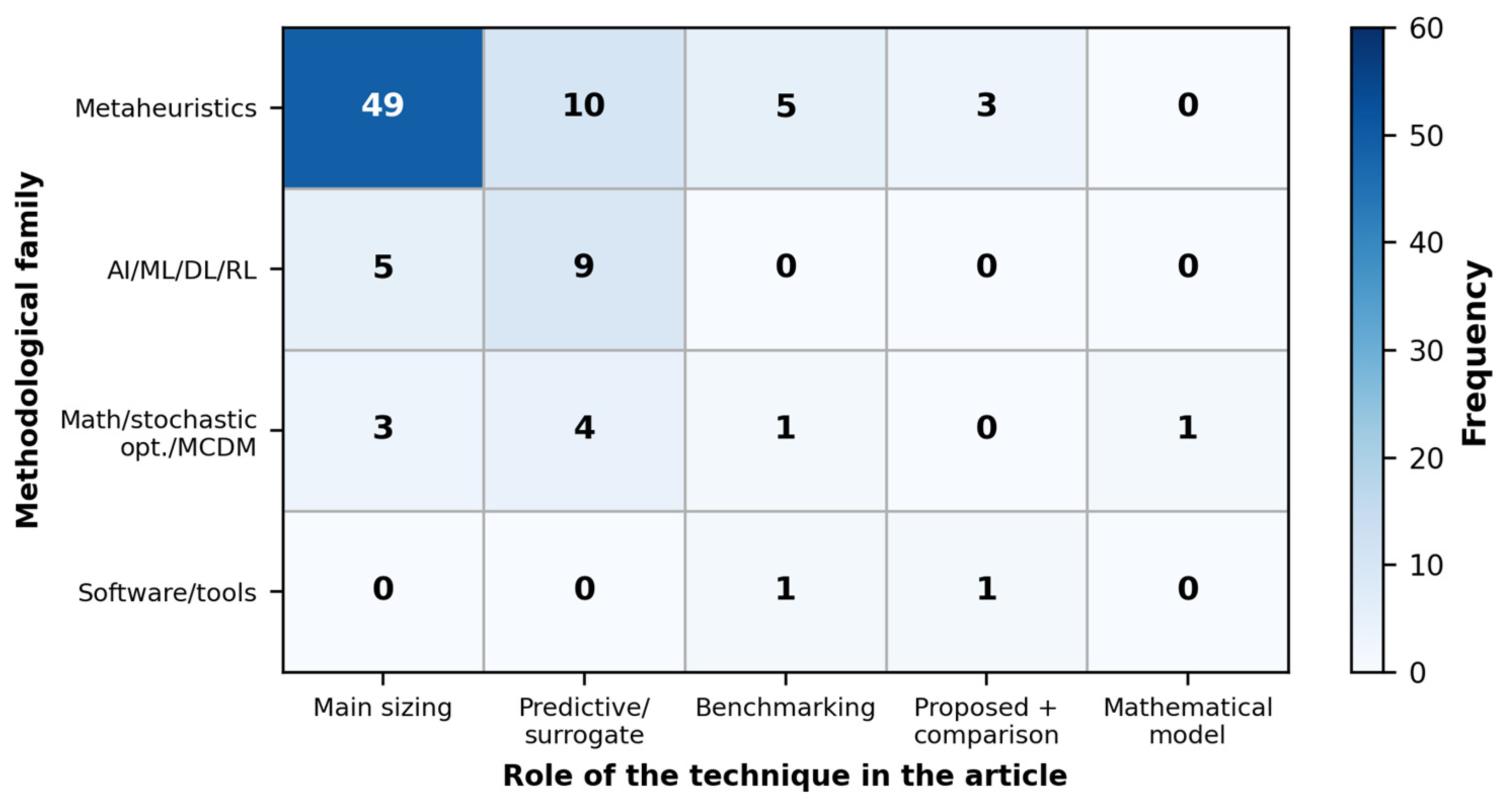
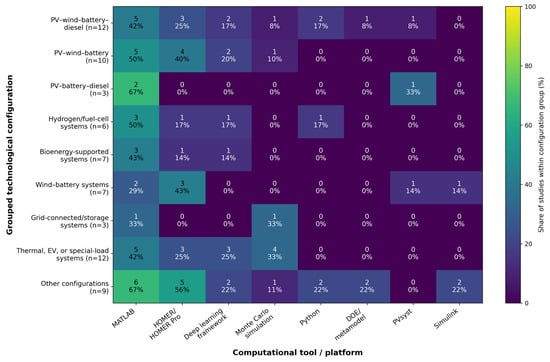
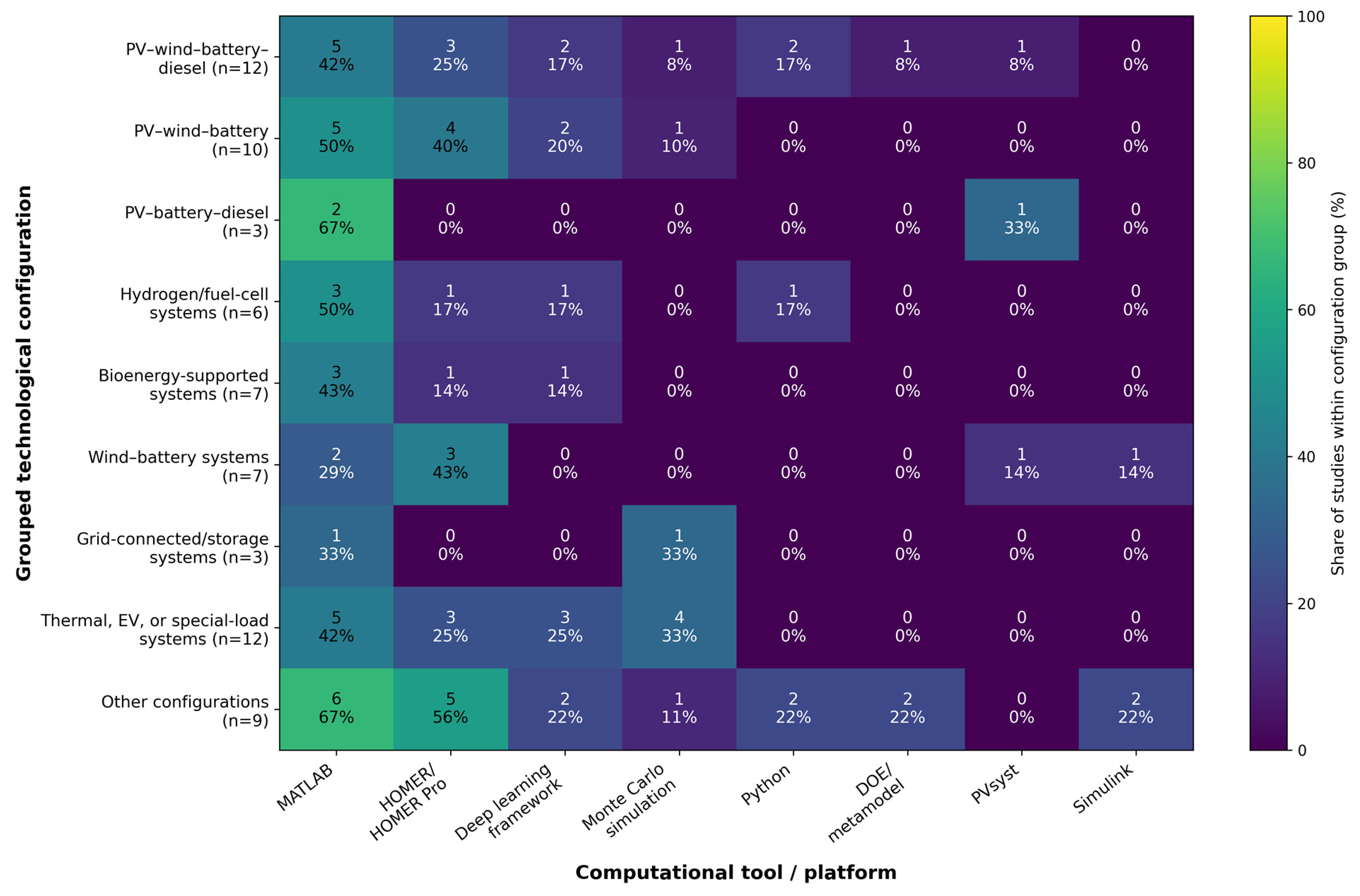
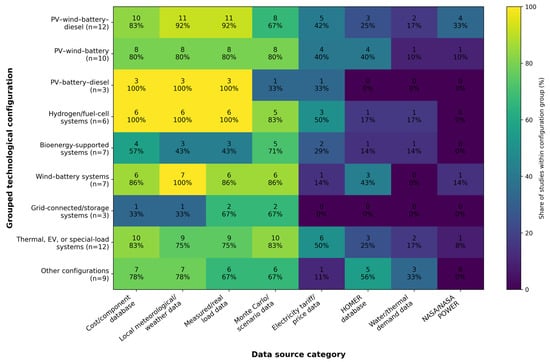
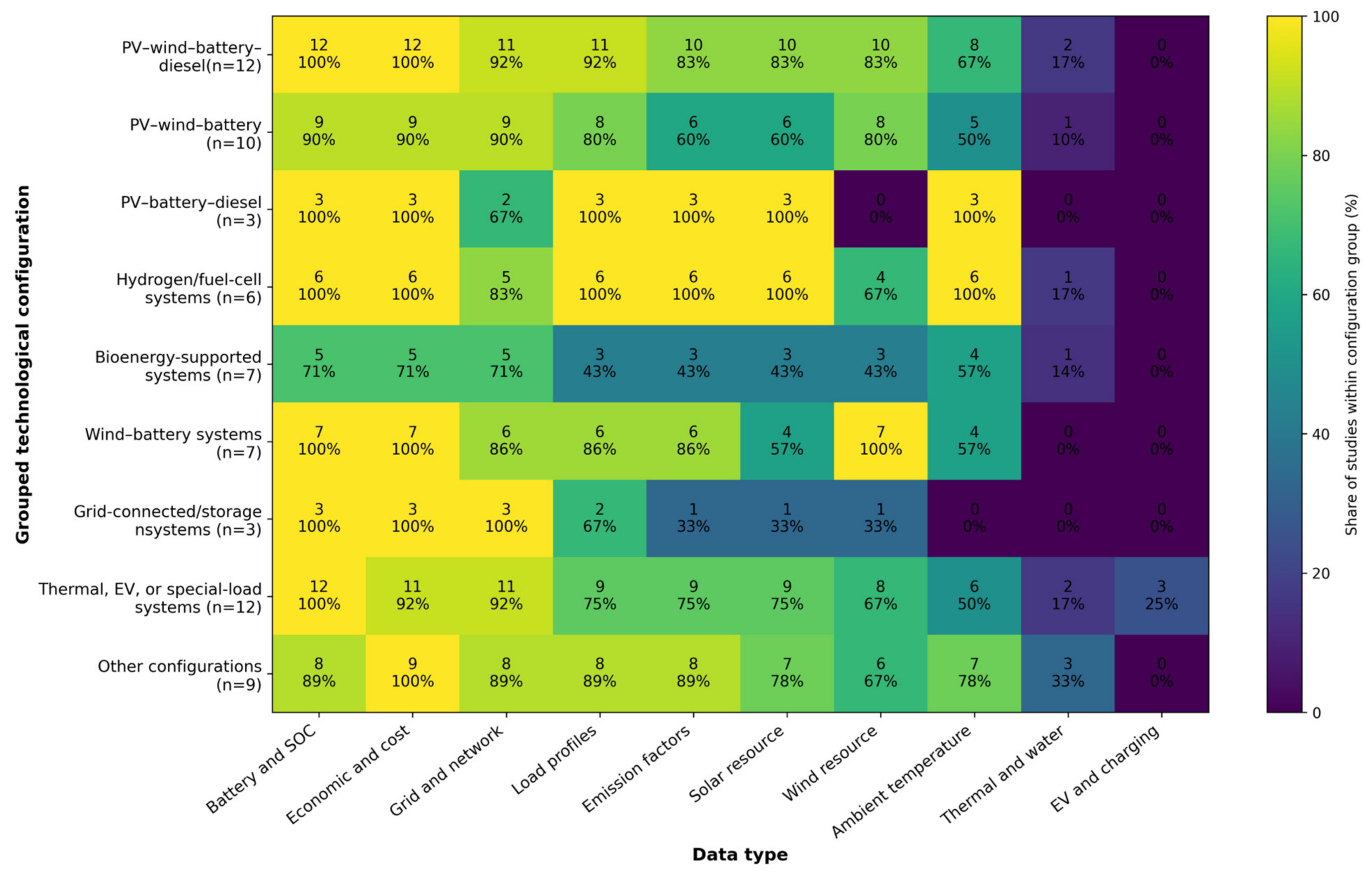
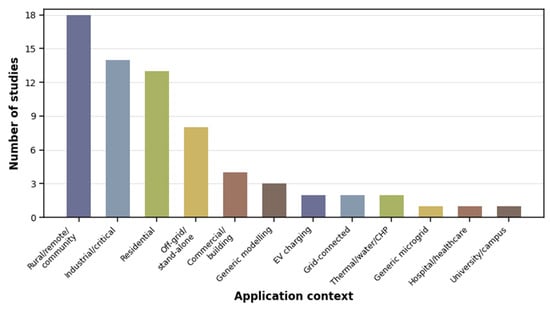

Disclaimer/Publisher’s Note: The statements, opinions and data contained in all publications are solely those of the individual author(s) and contributor(s) and not of MDPI and/or the editor(s). MDPI and/or the editor(s) disclaim responsibility for any injury to people or property resulting from any ideas, methods, instructions or products referred to in the content. |
© 2026 by the authors. Published by MDPI on behalf of the International Institute of Knowledge Innovation and Invention. Licensee MDPI, Basel, Switzerland. This article is an open access article distributed under the terms and conditions of the Creative Commons Attribution (CC BY) license.