


Abstract
The European Middle Pleistocene represents a critical spatiotemporal interval in human evolution, marked by increasing morphological variability and ongoing debate regarding the evolutionary processes leading to the emergence of Neandertals. In particular, it remains unclear whether this variability reflects the coexistence of multiple evolutionary lineages within Europe or structured variation within a single, evolving lineage. Within this context, the site of Bilzingsleben (Thuringia, Germany) provides a key contribution to discussions of European Middle Pleistocene population structure. This study presents a detailed morphological assessment of the Bilzingsleben E7 mandibular fragment, integrating qualitative anatomical observations with quantitative analyses of discrete characters. The Bilzingsleben mandible was examined directly and evaluated within a broad comparative framework including European Middle Pleistocene hominins, Neandertals, and selected African and Asian specimens. Multivariate analyses, including Principal Coordinates Analysis (PCoA) and neighbor-joining cluster analysis based on Gower distances, were used to explore patterns of morphological affinity. Qualitative analysis indicates that the Bilzingsleben mandible exhibits a mosaic combination of predominantly primitive features—such as multiple mental foramina, marked lateral relief of the corpus, and a weakly developed submandibular fossa—together with a limited number of incipiently derived traits, including posterior extension of the corpus and a downward orientation of the digastric fossae. Quantitative results consistently place Bilzingsleben within the morphological variability of European Middle Pleistocene hominins but outside the compact Neandertal cluster. In the PCoA, Bilzingsleben occupies an intermediate (PCo1) and peripheral position (PCo2), contrasting with more centrally positioned specimens such as Mauer. Taken together, these results support an interpretation of Bilzingsleben as part of a European Middle Pleistocene set of populations exhibiting mosaic morphology, rather than considering Bilzingsleben as evidence for a distinct evolutionary lineage. When integrated with evidence from other anatomical elements from Bilzingsleben, the mandibular morphology supports interpreting this population within the broader evolutionary context of the Neandertal lineage.
1. Introduction
The Middle Pleistocene constitutes a key period in human evolution, yet the evolutionary meaning of its fossil record remains actively under discussion [1,2]. Specifically, the European Middle Pleistocene (EMP) paleoanthropological record is currently the subject of debate. Two contrasting interpretations frame discussions of hominin diversity during this period. One view holds that Middle Pleistocene populations across Europe represent a single evolutionary lineage, within which increasing morphological variability reflects population-level differentiation along a shared evolutionary trajectory ultimately leading to Neandertals [3,4,5,6,7,8]. An alternative interpretation argues that the observed diversity documents the coexistence of multiple evolutionary lineages, some of which may have followed parallel or independent evolutionary paths rather than contributing directly to Neandertal ancestry [9,10,11,12,13]. The progressive enlargement of the European fossil record—including mandibular and cranial remains from sites such as Aroeira [14], Balanica [15], and Payre [16]—has intensified this debate by revealing complex and heterogeneous combinations of morphological traits [8,17]. These so-called mosaic patterns, characterized by the association of features expressing different evolutionary states within individuals or populations, have been variously interpreted depending on analytical perspective. Trait-based approaches often treat such heterogeneity as evidence of taxonomic or phylogenetic discontinuities [9,18], whereas frameworks grounded in organismic integration and morphogenetic dynamics allow for substantial morphological diversity to arise within a single evolving lineage [7]. Resolving how these heterogeneous morphologies should be incorporated into evolutionary models remains central to understanding the emergence of Neandertals in Europe.
Within this broader debate, the site of Bilzingsleben (Thuringia, Germany) occupies a distinctive position in discussions of European Middle Pleistocene human evolution. It represents one of the few Central European localities preserving human fossil remains in association with abundant faunal assemblages and archeological evidence within a well-documented travertine context. Systematic excavations, conducted primarily during the second half of the twentieth century under the direction of Dietrich Mania and collaborators [19], generated an extensive multidisciplinary body of research addressing the geological, paleoenvironmental, archaeological, and anthropological dimensions of the site [19,20,21,22]. Stratigraphically, the Bilzingsleben deposits consist of multiple phases of travertine accumulation formed in a spring-fed lacustrine–palustrine environment at the margin of a fluvial terrace system [19,20,21,22]. Despite this sedimentological complexity, archaeological materials—including lithics, faunal remains, and hominin fossils—derive predominantly from a single principal occupation horizon located near the base of the travertine sequence. This horizon, often described as a “living floor”, represents a relatively stable surface formed under interglacial environmental conditions and subsequently sealed by continued carbonate precipitation. Extensive excavations have documented a broad, laterally continuous occupation surface rather than a sequence of clearly stratified archaeological levels [22].
Human remains from Bilzingsleben are limited in number and highly fragmentary, comprising cranial fragments; isolated dental remains, attributed to two individuals [23]; and a mandibular fragment attributed to a third individual. All hominin remains are consistently associated with the principal occupation horizon, and there is no stratigraphic evidence to suggest that they derive from different depositional phases. Early assessments by E. Vlček, reflecting prevailing taxonomic frameworks of the time, broadly assigned the Bilzingsleben hominins to Homo erectus [23,24], also proposing a distinct subspecies (H. erectus bilzingslebenensis) based on perceived similarities with African and Asian Middle Pleistocene fossils from Olduvai, Zhoukoudian, and Sangiran, combined with regional particularities [23,25]. According to Stringer [26], Bilzingsleben, together with Mauer, Vértesszöllös, Arago, and Petralona, as well as Broken Hill 1, Bodo, and possibly Dali, forms the stem group for both Neandertals and modern humans and could therefore be classified as a distinct species, Homo heidelbergensis. Other authors have alternatively interpreted the material as representing pre-Neandertals [3], late European archaic Homo sapiens or H. heidelbergensis [27], highlighting the persistent lack of consensus regarding its taxonomic attribution. More recent studies have emphasized the inherent difficulty of drawing firm taxonomic conclusions from such fragmentary remains [5,28].
Chronological assessments based on uranium-series and electron spin resonance (ESR) dating of travertines and associated faunal remains place the Bilzingsleben occupation firmly within the Middle Pleistocene, most likely between Marine Isotope Stages (MISs) 11 and 9 [29], with age estimates ranging approximately between 320 and 412 ka and a minimum age of around 350 ka suggested by subsequent U/Th analyses [30]. This time interval corresponds to a critical phase in European human evolution, frequently discussed in relation to the emergence and consolidation of the Neandertal lineage [5,31].
From a morphological standpoint, the available human remains from Bilzingsleben do not exhibit unequivocal Neandertal-derived traits [32,33]. Comparative assessments have suggested that the Bilzingsleben material is less morphologically derived than some other European Middle Pleistocene fossils often interpreted as pre-Neandertal, and instead reflects a more generalized or archaic condition within the broader spectrum of Middle Pleistocene European variability [5,28,31]. Some authors, however, have pointed out close similarities to other EMP hominins presenting Neandertal apomorphies [3,14,34].
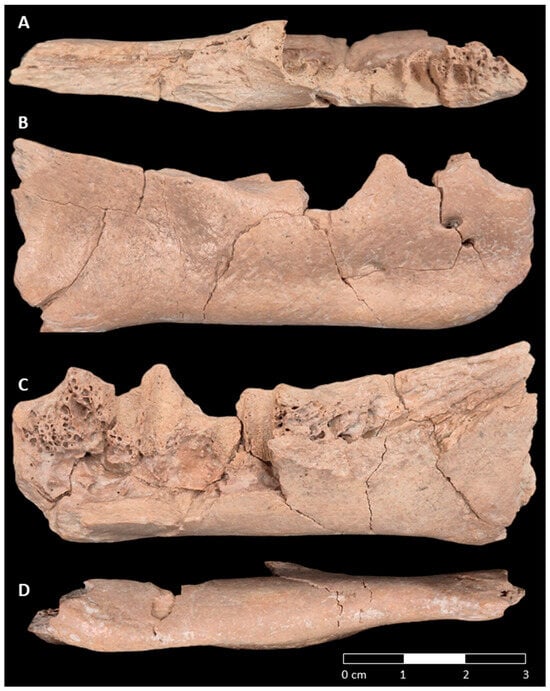
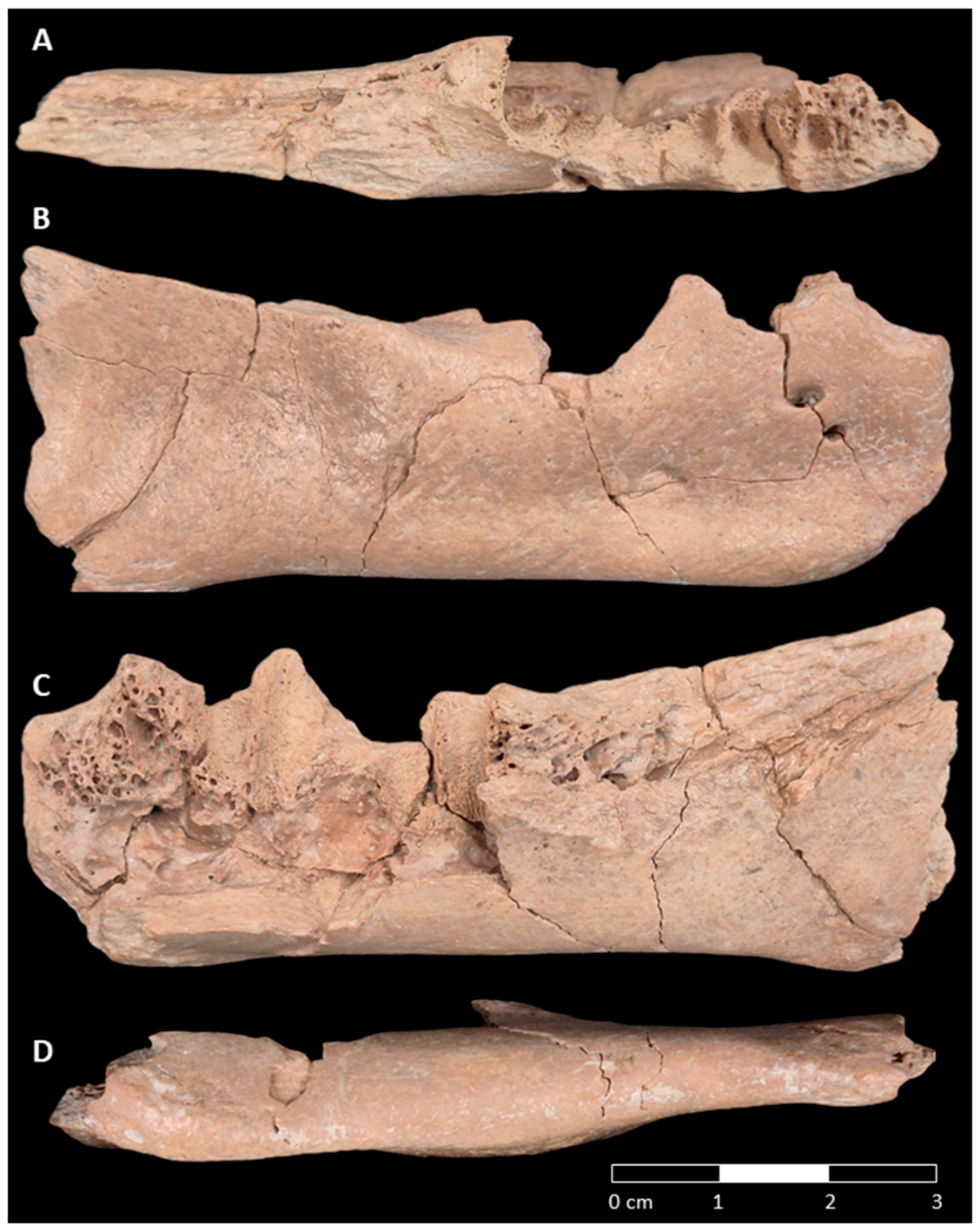
Of particular relevance is the mandibular fragment Bilzingsleben E7 (Figure 1), which was described relatively late in the research history of the site [25] and still lacks a detailed morphological analysis. Although detailed microstratigraphic information for this specimen is limited in the published literature, it is generally considered part of the main find-bearing layer excavated in the Steinrinne locality [19,20]. No evidence has been presented to suggest a distinct stratigraphic origin or intrusive deposition for this specimen. Mandibular morphology is especially informative, as it is known to develop Neandertal-derived characteristics earlier than other cranial systems [35], often expressed in a characteristic mosaic pattern [8,10]. The possibility of direct comparison with other key European Middle Pleistocene hominins—such as Mauer (the holotype of H. heidelbergensis (Schoetensack 1908), Arago, Montmaurin, and the mandibles from Sima de los Huesos (Atapuerca)—provides an excellent opportunity to evaluate the phylogenetic position of the Bilzingsleben sample.
Figure 1.
Several views of the Bilzingsleben mandibular fragment E7. (A) Superior view; (B) external view; (C) internal view; (D) inferior view.
Against this background, a fundamental question emerges: can the population represented at Bilzingsleben be considered part of the evolutionary lineage leading to Neandertals? Addressing this question is essential not only for interpreting the evolutionary significance of Bilzingsleben itself, but also for broader discussions of population structure, regional continuity, and morphological diversity in Europe during the Middle Pleistocene. The present study addresses this issue through a detailed analysis of the mandibular morphology attributed to Bilzingsleben E7, evaluated within a comparative framework that includes other European Middle Pleistocene fossils.
2. Material and Methods
2.1. Sample and Comparative Material
The original Bilzingsleben mandibular specimen was examined directly. The comparative sample includes fossil human mandibles from the European Middle Pleistocene, Neandertals, and selected African and Asian hominins. Mandibles attributed to H. sapiens were not included in the comparative analyses, in order to focus on patterns of morphological variation within Neandertal morphology and its broader ancestral background. The full composition of the comparative sample is provided in Table 1.
Table 1.
Specimens used in the analyses and morphological traits analyzed, indicating the categories used to classify the degree of expression.
Due to the fragmentary nature of the fossil record, not all mandibular features could be scored for every specimen. Missing data were retained in the dataset and explicitly considered in the analytical procedures rather than being imputed.
2.2. Mandibular Morphological Features
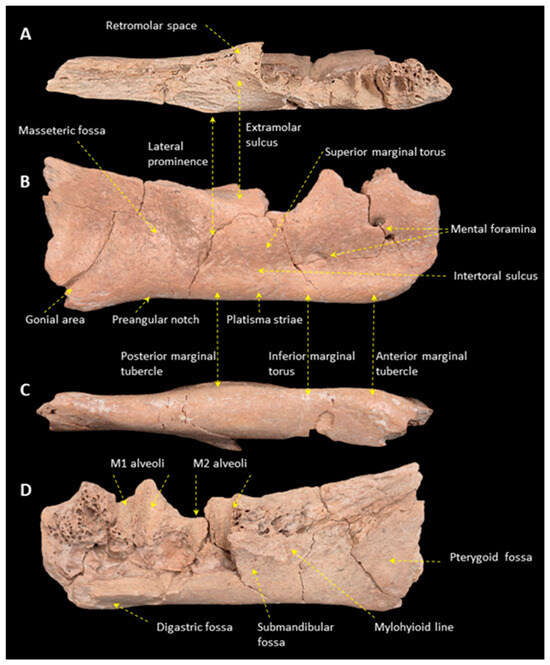
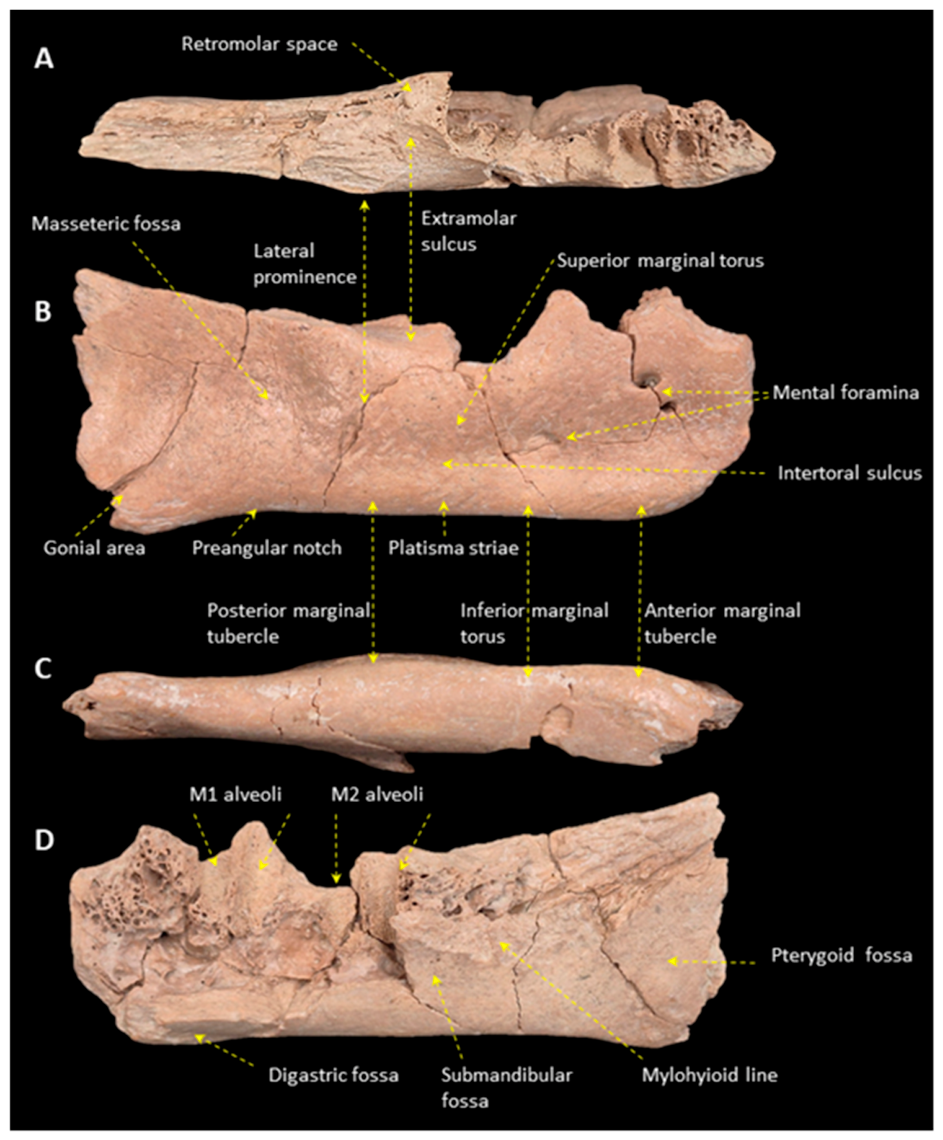
Mandibular features were defined and scored following established descriptive frameworks, primarily those proposed by de Lumley (1973) [36] and subsequently developed by Rosas (1995) [37] (see Figure 2). Both descriptive and numerical analyses considered a set of discrete mandibular morphological traits (Figure 2). All traits were coded as ordinal qualitative variables, reflecting discrete morphological states rather than continuous metric variation, as follows (see also Table 1): number of mental foramina (1 = 0, 2 = 1, >2 = 2), position of the mental foramina (P3 and P3-P4 = 0, P4 = 1, P4-M1 and M1 = 2), anterior marginal tubercle position (Absent = 0, C-P3 and P3 = 1, P3-P4 and P4 = 2, P4-M1 = 3), anterior marginal tubercle relief (Absent/Weak = 0, Moderate = 1, Strong = 2), intertoral sulcus relief (Shallow = 0, Deep = 1), inferior transverse torus (Weak = 0, Strong = 1), lateral prominence position (M2 = 0, M2-M3 = 1, M3 = 2), last molar–ascending ramus relationship (Covered = 0, Partially covered = 1, Uncovered = 2), extramolar sulcus (Shallow = 0, Deep = 1), relief of the masseteric fossa (Flat = 0, Shallow = 1, Deep = 2), relief of the pterygoid fossa (Shallow = 0, Deep = 1), and morphology of the basal border.
Figure 2.
Morphological features used for the comparative analyses. (A) Superior view; (B) external view; (C) inferior view; (D) interior view.
2.3. Numerical Analyses
Morphological affinities among specimens were assessed using the Gower similarity coefficient [38], which is particularly suited for datasets comprising variables of mixed types (qualitative, ordinal, and quantitative). This method estimates the average similarity between pairs of specimens based on all shared variables. For qualitative and ordinal variables, similarity is calculated according to the degree of correspondence between characteristic states, whereas quantitative variables are standardized using their observed range (min–max normalization) to ensure equal weighting across characteristics and to prevent scale-dependent bias. The overall similarity coefficient is obtained as a weighted mean of the partial similarities across variables.
This approach allows the combination of variables with different scoring ranges without prior standardization and is especially advantageous in paleoanthropological contexts. Importantly, it accommodates missing data by calculating pairwise distances exclusively from variables that are scored in both specimens, thereby avoiding distortions caused by incomplete preservation. The resulting Gower distance matrix constituted the basis for both ordination and clustering analyses.
A Principal Coordinates Analysis (PCoA) [39] was performed on the Gower distance matrix to explore patterns of mandibular morphological variation in a low-dimensional space. The first three principal coordinates were examined, and results are presented as two-dimensional plots (Figure 3). PCoA was selected over metric ordination methods (e.g., Principal Component Analysis) because it does not assume Euclidean distances and is therefore more appropriate for ordinal morphological data. The ordination results were used to visualize morphological affinities, dispersion patterns, and intermediate positions among European Middle Pleistocene specimens, Neandertals, and non-European hominins.
Figure 3.
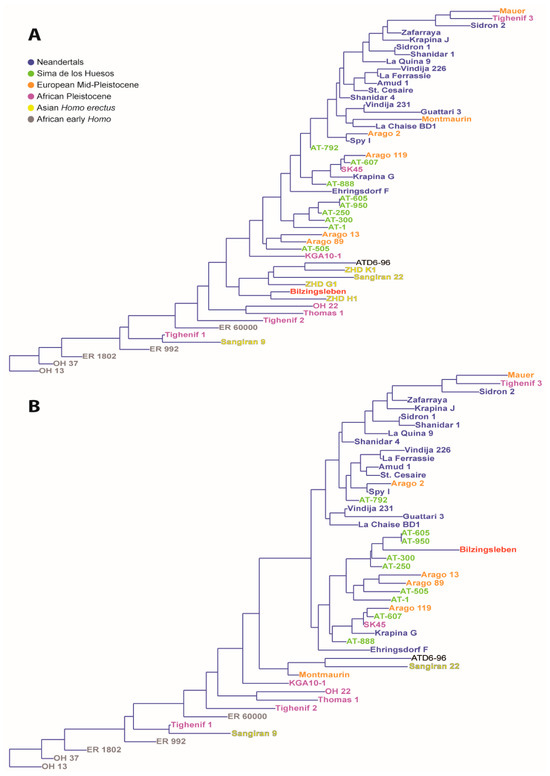
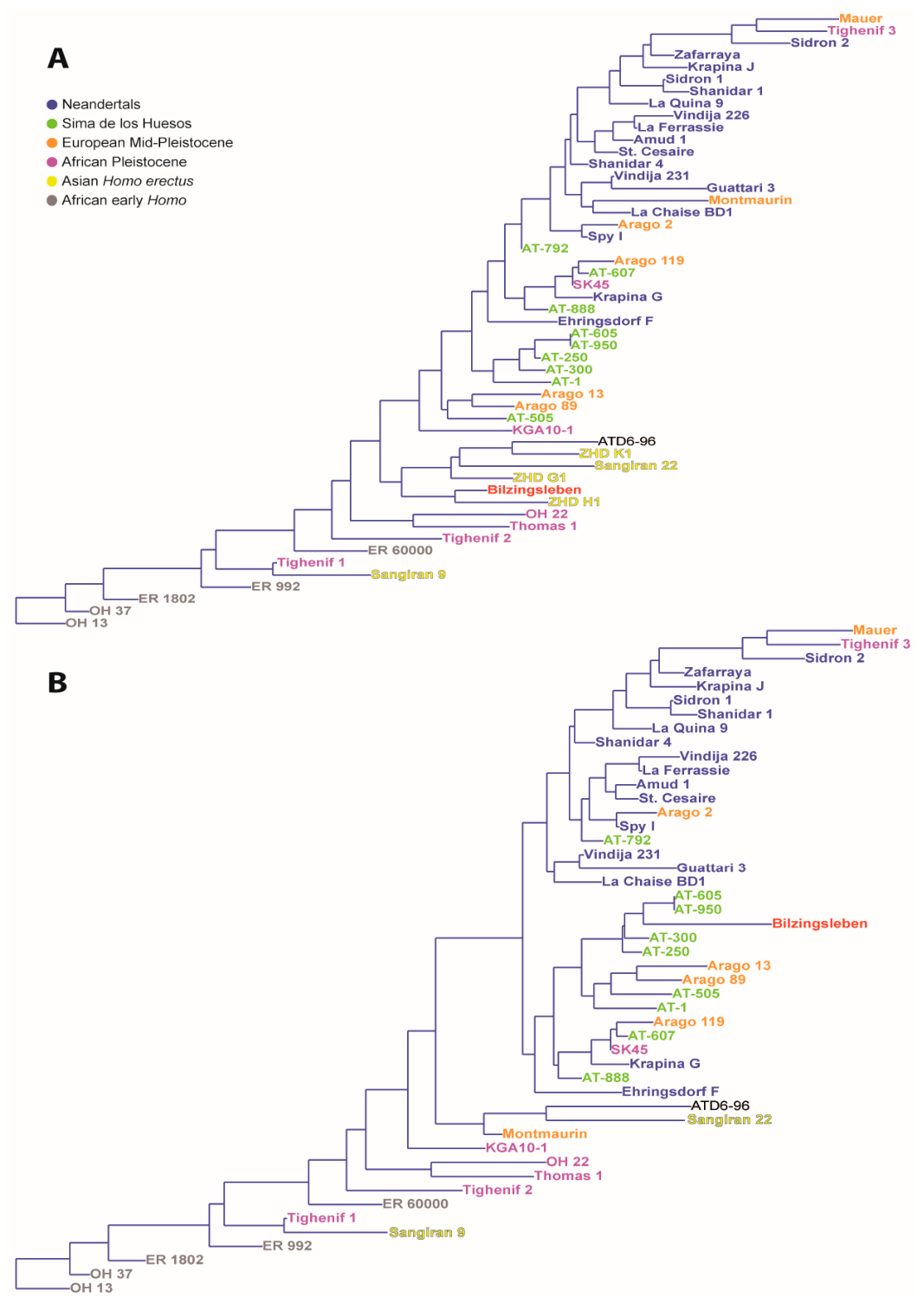
Neighbor-joining dendrograms based on Gower distances. (A) Overall separation between Neandertals and other fossil groups. (B) Finer-scale relationships within the European Middle Pleistocene sample are better resolved after removing the Zhoukoudian specimens.
Hierarchical neighbor joining cluster analysis [40] was conducted using the Gower distance matrix. This approach was chosen for its robustness when applied to qualitative morphological datasets and its frequent use in comparative paleoanthropological studies. The number of clusters was not defined a priori. Instead, clustering results were interpreted based on dendrogram topology, relative branch lengths, and biological coherence. Additional exploratory analyses excluding highly incomplete specimens were performed to assess the stability of the clustering structure.
Both ordination and clustering analyses were treated as exploratory analytical tools aimed at assessing morphological affinities and patterns of variability rather than reconstructing explicit phylogenetic relationships. Particular attention was paid to the relative positions of European Middle Pleistocene specimens within the broader mandibular morphological space.
All statistical analyses, including the calculation of Gower distances, Principal Coordinates Analysis (PCoA), and hierarchical cluster analysis, were performed using the software PAST (PAlaeontological Statistics, version 5.3) [41]. All multivariate analyses were performed in Q-mode, focusing on similarities among specimens based on Gower distances.
3. Results
3.1. State of Preservation
The mandibular remains from Bilzingsleben consist of a fragment of the right mandibular corpus preserving most of the lateral and basal surfaces, while the ramus and symphyseal region are largely absent (Figure 1). The specimen reaches a maximum preserved length of approximately 82 mm. Preservation of the alveolar margin is incomplete, and no teeth are present, which complicates reconstruction of the original dental sequence. Nevertheless, the degree of morphological differentiation suggests that the specimen corresponds to an adult individual.
3.2. Attribution of the Molar Series
Two pairs of alveoli are preserved, separated by well-defined interalveolar septa spaced approximately 14.5 mm apart, and corresponding to two distinct molar positions. Vlček et al. (2000) [25] identified the presence of roots associated with the posterior molar, although they did not specify which molar position was involved. However, the precise identification of the molar elements represented by the preserved alveoli visible on the medial surface of the mandible is not straightforward.
Several alternative interpretations can be considered. First, the preserved alveoli may correspond to the roots of M1 and M3, with M2 absent, possibly due to antemortem loss. In this scenario, the orientation of the roots associated with the anterior molar appears somewhat atypical, as their main axis is directed slightly mesially, whereas a vertical or slightly distal orientation would be expected. Such a configuration could be compatible with antemortem loss of M2 followed by secondary reorientation of M1. Second, the preserved alveoli may correspond to M1 and M2, with M3 absent due to agenesis. This interpretation would imply an unusually large spacing between M1 and M2 alveoli, suggesting relatively large molar dimensions. Third, the specimen could represent an immature individual, in which case one of the preserved alveoli might correspond to a deciduous molar. However, this hypothesis is not supported by the available morphological evidence and appears unlikely given the overall degree of mandibular development.
Given this uncertainty, the Bilzingsleben mandible was superimposed onto other European Middle Pleistocene mandibles in order to assess the most plausible dental attribution of the preserved alveoli. The relative positions of the mental foramen, the anterior marginal tubercle, and the lateral prominence, as well as the transition toward the masseteric fossa, were used as anatomical reference points. In the comparative specimens considered (including Mauer, Montmaurin, and Arago XIII), the spatial relationships between these morphological landmarks and the molar series are relatively consistent. On this basis, it is most parsimonious to interpret the preserved alveoli in the Bilzingsleben mandible as corresponding to the M1 and M2 positions.
If this interpretation is correct, it would imply agenesis of M3 in the Bilzingsleben individual. Although M3 agenesis is relatively uncommon, it is not exceptional in the fossil record of Homo prior to the Upper Paleolithic, where such cases become more frequent. Documented examples of M3 agenesis include the mandibles D2735 (Dmanisi, Georgia), KNM-WT 15000 (Kenya), LB1 (Homo floresiensis, Liang Bua, Flores), Penghu 1 (Taiwan), and Arago 119 (France).
3.3. Morphological Characteristics of the Bilzingsleben Mandible (Figure 2)
The mandibular corpus is relatively low and slender. The height of the corpus measured at the level of the distal molar is 22.4 mm, a value that falls within the range documented for medium- to small-sized mandibles in the Atapuerca-SH sample and overlaps with measurements reported for specimens such as AT-1 and AT-950 [42]. A low mandibular body was considered characteristic of EMP hominins [43].
The basal border of the mandibular corpus is remarkably straight in lateral view, lacking the pronounced inferior curvature often described in classic H. erectus s.l. mandibles [44]. Striations associated with the attachment of the platysma muscle are present but only weakly expressed. In inferior view, the basal border also appears straight along the preserved portion, showing a configuration comparable to that observed in Arago XIII and later Neandertals. A rectilinear basal border has been associated with a marked frontalization of the anterior mandible, particularly in the symphyseal region, in contrast to mandibles exhibiting a more parabolic outline [6].
The gonial region, although only partially preserved at its junction with the corpus, suggests a subtly everted and expanded gonion. This configuration is consistent with the morphology observed in European Middle Pleistocene mandibles such as Mauer and Arago II, as well as in several specimens from the Atapuerca–Sima de los Huesos assemblage [38,42]. Anteriorly, a small portion of the left digastric fossa is preserved, sufficient to indicate a downward orientation of the digastric muscle attachment. This derived condition is also present in Arago XIII and is frequently observed in mandibles attributed to the Neandertal lineage [45].
The lateral surface of the basal border exhibits a marked relief, with both posterior and anterior marginal tubercles well developed, particularly the anterior one. This tubercle is positioned at the level of P4, corresponding to an intermediate condition between the more anterior placement (P3–P4 or P3) typically observed in early Homo and Asian H. erectus, and the derived Neandertal condition in which the tubercle is located posterior to P4 (P4–M1 or M1) (Table 1). In addition, the pronounced development of the anterior marginal tubercle may have phylogenetic significance. This structure is frequently absent or weakly expressed in East African Pleistocene mandibles, whereas it tends to be more strongly developed in North African and European Middle Pleistocene hominins (Table 1). In this respect, the Bilzingsleben mandible conforms to this latter pattern, showing a degree of development comparable to that observed in Mauer, AT-300, Krapina, and other Neandertal mandibles.
A distinctive feature of the Bilzingsleben mandible is the presence of three mental foramina. Two main foramina are located at the level of P4 and are separated by a bony septum, a configuration frequently observed in Middle and Upper Pleistocene European mandibles. A third, smaller accessory foramen is positioned more posteriorly. The occurrence of multiple mental foramina (three or more) has been widely documented in Asian Pleistocene hominins, as well as in the Homo antecessor specimen ATD6-96 and in Mauer (Table 1). By contrast, multiple mental foramina are uncommon in African hominins, European Middle Pleistocene hominins, and Neandertals. In this respect, Bilzingsleben differs from the more stabilized condition observed in Arago, Atapuerca–Sima de los Huesos mandibles, and later Neandertals, in which a single foramen or a dominant single/double configuration is more typical. Nevertheless, it should be noted that while the paired main mental foramina conform to the European Middle Pleistocene morphological pattern, the third, smaller accessory foramen may be interpreted as a vestigial structure.
The lateral surface of the mandibular corpus exhibits a deep intertoral sulcus separating the superior and inferior lateral tori, the latter being particularly well developed. A pronounced intertoral sulcus is frequently observed in mandibles attributed to H. erectus s.l. (Table 1), as well as in some European Middle Pleistocene specimens such as Mauer and AT-605. By contrast, this feature tends to be much less developed in early Homo and in Neandertals. More generally, a marked relief of the external surface of the mandibular corpus is characteristic of H. erectus mandibles and is also observed in Middle Pleistocene representatives from Africa, Asia (e.g., Penghu) [46], and Europe (e.g., Mauer, Arago 2).
The lateral prominence is moderately developed in the Bilzingsleben mandible and is located posterior to the last preserved molar position. The absence of a third molar complicates direct comparisons; however, it can be assessed that the lateral prominence occupies a relatively posterior position along the mandibular corpus. In addition, posterior extension of the corpus beyond the M2 alveolus suggests the possible presence of a limited retromolar area. This configuration does not necessarily imply a fully developed Neandertal-type retromolar gap, but rather reflects a posterior elongation of the mandibular corpus relative to the molar row. Comparable conditions have been described in European Middle Pleistocene mandibles, including Mauer and Arago II, as well as in medium-sized mandibles from the Atapuerca–Sima de los Huesos assemblage, in which a retromolar space may be present without forming a distinct gap in lateral view [42,47]. Such configurations tend to be associated with the presence of a shallow extramolar sulcus, with the exception of the more robust Mauer mandibles, which more closely resemble the primitive condition observed in early Homo and in robust specimens of H. erectus.
A significant feature in Bilzingsleben is its ample and deep masseteric fossa similar to Arago 13, Sima de los Huesos and H. erectus s.l. mandibles. This can be considered a primitive feature, which become modified late in the Neandertal lineage to produce a very shallow or even absent masseteric fossa [45].
On the medial aspect of the mandibular corpus (Figure 2D), preservation is very limited; however, the available morphology indicates a weakly developed submandibular fossa. At the level of the last molar, the mylohyoid line does not appear sharply incised, suggesting a relatively primitive internal relief of the corpus. This pattern closely matches that described for earlier Homo specimens, and similar configurations have also been reported in Middle Pleistocene mandibles from Atapuerca–Sima de los Huesos, reinforcing the interpretation of this morphology as plesiomorphic within the genus Homo [48]. By contrast, a more deeply excavated submandibular fossa is typical of Neandertals [6,42] and of H. sapiens.
Regarding the pterygoid fossa, the Bilzingsleben mandible exhibits a shallow depression (Figure 2D), in contrast to other European Middle Pleistocene hominins such as Mauer, Arago II, and Montmaurin, which display a more deeply excavated fossa. This latter condition is interpreted here as the derived state of the feature.
The preserved mandibular region exhibits a mosaic of morphological traits, combining predominantly primitive features with a limited number of incipient derived characteristics. Among the primitive traits are the presence of multiple mental foramina, a marked external relief of the corpus, a deep masseteric fossa, and a weakly developed submandibular fossa. By contrast, the downward inclination of the digastric fossa and the posterior extension of the corpus beyond the molar row can be regarded as incipient derived features. The prominent anterior marginal tubercle, while not strictly derived, represents a condition frequently observed in European and North African Middle Pleistocene mandibles. Overall, this suite of traits falls well within the range of morphological variability documented for European Middle Pleistocene hominins. In this respect, the Bilzingsleben mandible shows close affinities with specimens such as Mauer, Arago II, and Arago XIII, as well as with mandibles within the lower to medium size range of the Atapuerca–Sima de los Huesos assemblage [25,37,42].
3.4. Quantitative Analyses of Discrete Mandibular Morphological Features
Figure 3 presents a graphical representation of morphological affinities based on overall similarity, derived from cluster analysis and rooted using the Homo habilis OH 13 mandible, which is considered representative of the primitive morphological condition within the genus Homo. Comparison of the neighbor-joining dendrograms (Figure 3A,B) shows that while Neandertals consistently form a compact and well-defined cluster, European Middle Pleistocene specimens display a more heterogeneous internal structure. Panel A highlights the overall separation between Neandertals and other fossil groups, whereas panel B reveals finer-scale relationships within the European Middle Pleistocene sample (excluding mandibles from Zhoukoudian). In this context, Bilzingsleben occupies a peripheral yet integrated position within European variability, lacking a stable association with any single specimen and reflecting a mosaic morphological configuration. Mauer also appears distally positioned within the late Middle Pleistocene European group, showing closer affinities to Neandertals, while remaining clearly distinct in other features. The eccentric position of Tighenif 3 is also noteworthy.
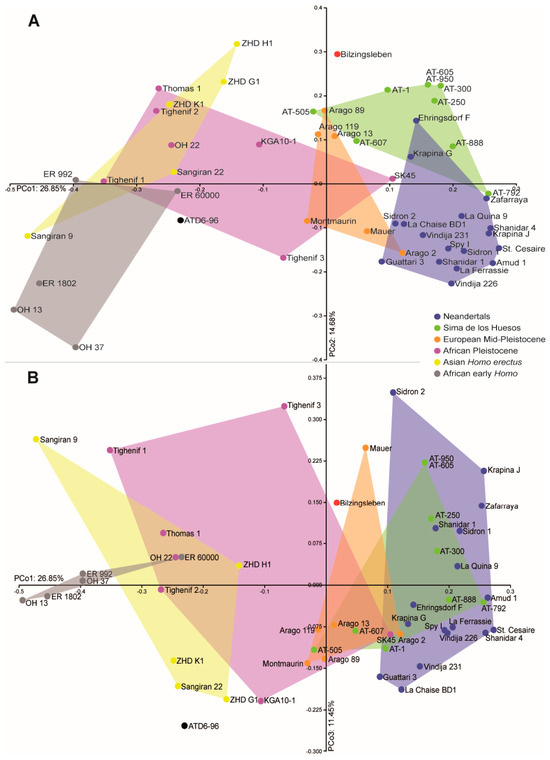
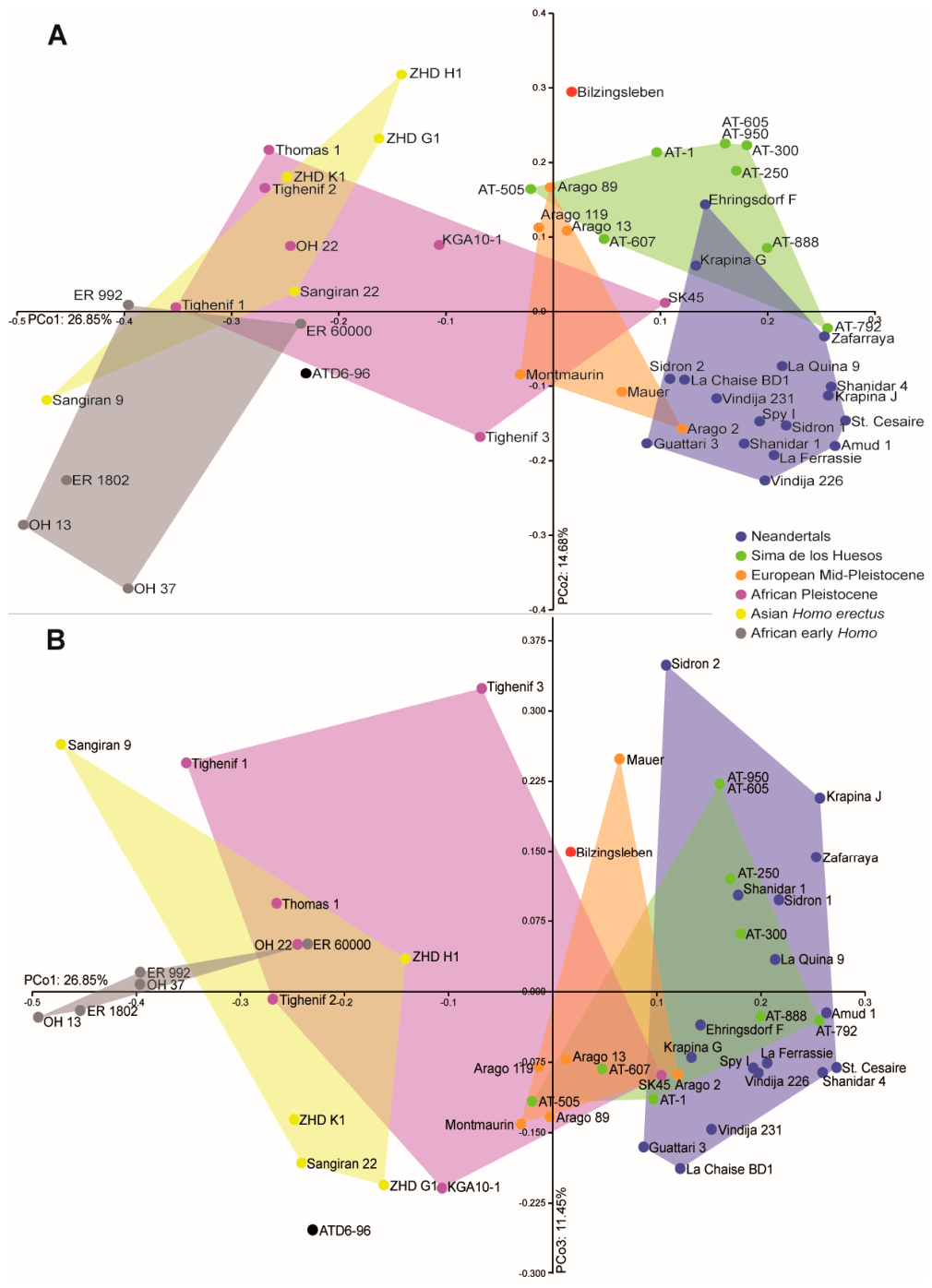
Figure 4 graphically summarizes the covariation among discrete traits. The Principal Coordinates Analysis (PCoA) based on Gower distances reveals a clear structuring of mandibular morphological variability. In both projections (PCo1–PCo2 and PCo1–PCo3), Neandertals form a compact cluster, reflecting a high degree of morphological coherence (Figure 4A,B). By contrast, European Middle Pleistocene specimens occupy a broader and more diffuse region of the morphospace, indicating increased variability and heterogeneous combinations of traits. PCo1 primarily separates Neandertals from more generalized Middle Pleistocene morphologies, whereas PCo2 and PCo3 capture finer-scale variation within the European sample. In this context, the Bilzingsleben mandible occupies an intermediate but peripheral position within the European Middle Pleistocene morphospace, lacking a stable association with any single specimen. A similar pattern is observed for the Mauer mandible, which also falls outside the European Middle Pleistocene variability along PCo3.
Figure 4.
Principal Coordinates Analysis (PCoA) derived from a Gower distance matrix based on ordinal mandibular morphological characteristics. (A) Projection of specimens onto the first two principal coordinates (PCo1 and PCo2). (B) Projection onto the first and third principal coordinates (PCo1 and PCo3). The analysis illustrates the distribution of fossil specimens within the morphological space defined by European Middle Pleistocene, Neandertal, and non-European hominin mandibles. In both figures, the convex hull of each group is represented by shading the polygon defined by its outermost points using the corresponding group color; overlapping regions are represented by blended colors.
4. Discussion
The combined qualitative and quantitative analyses presented here provide new insight into the evolutionary significance of the Bilzingsleben E7 mandible within the broader context of European Middle Pleistocene human evolution. Both the PCoA and the cluster analyses consistently show that Neandertals form a morphologically coherent group, whereas European Middle Pleistocene hominins occupy a wider and more heterogeneous morphological space. This pattern strongly suggests that the emergence of Neandertal morphology was preceded by a prolonged phase of increased variability, rather than by the coexistence of multiple fully differentiated lineages within Europe [8,42].
Within this framework, the position of Bilzingsleben is particularly informative. In both ordination and clustering analyses, Bilzingsleben does not align with the Neandertal core but instead occupies an intermediate and relatively peripheral position within the European Middle Pleistocene morphospace. This position reflects a mosaic combination of traits, dominated by plesiomorphic features and complemented by a limited number of incipiently derived characteristics. Importantly, such a configuration is not unique to Bilzingsleben but is shared, to varying degrees, by other European Middle Pleistocene specimens, including Mauer, Arago, and several mandibles from the Atapuerca–Sima de los Huesos assemblage.
The Bilzingsleben mandible shows its closest morphological affinities with Mauer and with the Arago 13 and Arago 119 mandibles, and in some characteristics, it also resembles AT-300 from the Atapuerca–Sima de los Huesos assemblage. These similarities are consistent with the existence of a set of mandibular traits shared by European Middle Pleistocene populations which, although they cannot be identified individually as clear autapomorphies, collectively define a total morphological pattern that confers a certain degree of individuality to this group [7]. Among the traits most frequently developed in European Middle Pleistocene mandibles, and distinguishing them from African assemblages, is the presence and development of an anterior marginal tubercle.
The posterior position of the lateral prominence, a feature often discussed in relation to Neandertal morphology, cannot be properly evaluated in Bilzingsleben due to the agenesis of the third molar, a condition that it shares with Arago 119. Taken together, these observations could be interpreted as fitting a European Middle Pleistocene variant—or deme sensu Tattersall (2011) [9] characterized by the absence of clearly expressed Neandertal-derived traits.
However, two important considerations must be emphasized. First, specific anatomical details of the configuration of the basal border of the Bilzingsleben mandible, as well as the downward orientation of the digastric fossae, correspond closely to the anatomical pattern observed in Neandertals. Second, the mosaic character of evolutionary change during the European Middle Pleistocene implies that different anatomical regions did not evolve synchronously, with some traits appearing earlier than others. In the Arago mandibles, for example, one of the most distinctive features is a divided condyle, a characteristic typically associated with Neandertals (Rosas, 2001) [45]. Other derived traits are expressed in the truncated gonial region of Arago 13 or in the posterior position of the mental foramen in Arago 2, to cite only a few complementary examples.
A similar situation can be recognized in the Montmaurin mandible. In this specimen, the region of the mandibular corpus corresponding to that preserved in Bilzingsleben does not exhibit clearly derived features. Nevertheless, other anatomical regions, including the dentition and the position of the condyle, are unmistakably derived [17]. These cases illustrate that the absence of derived traits in a specific mandibular region does not necessarily imply exclusion from the evolutionary processes leading to Neandertals, but rather reflects the mosaic and regionally asynchronous nature of morphological evolution during the European Middle Pleistocene.
Although the mandibular morphology of Bilzingsleben is dominated by primitive features, other anatomical systems from the same individuals and populations display derived traits that are widely regarded as characteristic of the Neandertal lineage. In Bilzingsleben, the frontal specimen B75/199 (or Bilzingsleben 81) exhibits a continuous supraorbital torus across the glabellar region, closely resembling the condition observed in several crania from the Atapuerca–Sima de los Huesos assemblage and in Neandertals [33]. This frontal morphology also shows strong similarities to the Aroeira cranium, which has been interpreted as representing an intermediate derived form between the Neandertal pattern and that observed in some European Middle Pleistocene fossils such as Arago [14].
Similarly, the right temporal bone from Bilzingsleben 7589/03 displays a Neandertal apomorphy in the form of an inclined anterior wall of the glenoid fossa. This derived trait has been documented in Neandertals as well as in specimens such as Steinheim, Petralona, Castel di Guido, and Reilingen, and is consistently present in the Atapuerca–Sima de los Huesos sample [34]. The occurrence of such derived cranial features in Bilzingsleben reinforces the interpretation that this population shares anatomical affinities with the Neandertal lineage that are not readily apparent from mandibular morphology alone. In addition, the Bilzingsleben deposits formed in a low-energy, spring-fed travertine system that promotes rapid preservation and limits disturbance. The hominin remains are therefore consistent with primary deposition, with no evidence of reworking or intrusion, supporting the integrity of the assemblage.
From a dental perspective, phenetic analyses have also identified similarities between Bilzingsleben and Neandertals. According to Weber et al. (2016) [49], both Mauer and Bilzingsleben exhibit dental features that align them more closely with Neandertals than with other Middle Pleistocene populations. In the case of Mauer, Rosas and Bermúdez de Castro (1998) [47] argued that the buccolingual dimensions of the incisors, the morphology of the premolars, and variables related to the position of the mental foramen and the presence of a retromolar space clearly indicate that the Mauer mandible should be classified as a member of the evolutionary lineage leading to classic Neandertals.
When viewed within a broader evolutionary framework, the mandibular corpus in the genus Homo follows recognizable patterns of morphological change. Primitive forms tend to show a close integration between the corpus and the ramus, resulting in a wide extramolar sulcus and an anterior placement of lateral structures such as the lateral prominence, anterior marginal tubercle, and mental foramen, together with strongly developed lateral relief. In H. erectus, separation between the corpus and the ramus becomes more variable, ranging from configurations retaining a broad extramolar sulcus to more derived conditions with increased posterior separation. This variability is accompanied by changes in the anteroposterior position of lateral structures, an increased number of mental foramina, and enhanced relief of the external lateral surface of the corpus.
In European Middle Pleistocene mandibles, a marked development of the anterior marginal tubercle becomes common, along with a general tendency toward more posterior positions of lateral structures. These trends reach their maximum expression in the Atapuerca–Sima de los Huesos assemblage and in Neandertals. The orientation of the digastric fossae is variable but, in several cases, shows a downward inclination comparable to that observed in Neandertals. The Bilzingsleben mandible retains a largely primitive corpus configuration similar to that of H. erectus, but also exhibits subtle markers characteristic of European Middle Pleistocene morphology. Its association with derived cranial traits in the frontal and temporal bones allows Bilzingsleben to be directly linked to anatomical features widely considered diagnostic of the Neandertal lineage.
Finally, the close morphological affinities observed between Bilzingsleben and Mauer strengthen arguments supporting the involvement of the Mauer mandible in the evolutionary processes leading to Neandertals. In this sense, Bilzingsleben represents a particularly informative example of the mosaic and regionally asynchronous nature of morphological evolution during the European Middle Pleistocene, in which mandibular, dental, and cranial systems evolved at different rates within a single, structured evolutionary lineage.
Author Contributions
Conceptualization, A.R.; Methodology, A.G.-T., J.F.P. and T.T.-M.; Software, A.G.-T.; Investigation, A.R., A.G.-T., J.F.P., J.A.A., T.S. and T.T.-M.; Resources, A.R., A.G.-T. and T.T.-M.; Data Curation, T.S. and A.G.-T.; Writing—Original Draft Preparation, A.R.; Writing—Review and Editing, A.G.-T., T.T.-M., T.S., J.A.A. and J.F.P.; Project Administration, A.R.; Funding Acquisition, A.R. All authors have read and agreed to the published version of the manuscript.
Funding
This research was funded by the Ministry of Science and Innovation of Spain through projects PID2021-122356NB-I00 (to AR).
Data Availability Statement
Data will be made available upon reasonable request.
Acknowledgments
We are grateful to the staff of the Landesamt für Denkmalpflege und Archäologie (Weimar) for their hospitality during the study of the original fossils. During the preparation of this work the author(s) used ChatGPT 5.1 (OpenAI, USA) in order to correct the English. The authors have reviewed and edited the output and take full responsibility for the content of this publication.
Conflicts of Interest
The author declares no conflicts of interest.
References
- Harvati, K.; Reyes-Centeno, H. Evolution of Homo in the Middle and Late Pleistocene. J. Hum. Evol. 2022, 173, 103279. [Google Scholar] [CrossRef] [Scilit]
- Isaac, G.L.L. Sorting out the muddle in the middle: An anthropologist’s post-conference appraisal. In After the Australopithecines: Stratigraphy, Ecology, and Cultural Change in the Middle Pleistocene; Butzer, K., Isaac, G.L.L., Eds.; Mouton Publishers: Berlin, Germany, 1975; pp. 875–888. [Google Scholar]
- Dean, D.; Hublin, J.-J.; Holloway, R.; Ziegler, R. On the phylogenetic position of the pre-Neandertal specimen from Reilingen, Germany. J. Hum. Evol. 1998, 34, 485–508. [Google Scholar] [CrossRef] [Scilit]
- Hublin, J.-J. Climatic changes, paleogeography, and the evolution of the Neandertals. In Neandertals and Modern Humans in Western Asia; Akazawa, T., Aoki, K., Bar-Yosef, O., Eds.; Plenum Press: New York, NY, USA, 1998; pp. 295–310. [Google Scholar]
- Hublin, J.-J. The origin of Neandertals. Proc. Natl. Acad. Sci. USA 2009, 106, 16022–16027. [Google Scholar] [CrossRef] [Scilit]
- Rosas, A. Ontogenia y Filogenia de la Mandíbula en la Evolución de los Homínidos. Aplicación de un Modelo de Morfogénesis a las Mandíbulas Fósiles de Atapuerca. Doctoral Dissertation, Universidad Complutense, Madrid, Spain, 1992. [Google Scholar]
- Rosas, A.; Bastir, M.; Alarcón, J.A. Tempo and mode in the Neandertal evolutionary lineage: A structuralist approach to mandible variation. Quat. Sci. Rev. 2019, 217, 62–75. [Google Scholar] [CrossRef] [Scilit]
- Rosas, A.; Bastir, M.; García-Tabernero, A.; Alarcón, J.A. Mosaic evolution. An example in the origin of Neandertals. Span. J. Palaeontol. 2025, 40, 97–114. [Google Scholar] [CrossRef] [Scilit]
- Tattersall, I. Before the Neanderthals: Hominid Evolution in Middle Pleistocene Europe. In Continuity and Discontinuity in the Peopling of Europe: One Hundred Fifty Years of Neanderthal Study; Condemi, S., Weniger, G.-C., Eds.; Springer: Dordrecht, The Netherlands, 2011; pp. 47–53. [Google Scholar]
- Arsuaga, J.L.; Martínez, I.; Arnold, L.J.; Aranburu, A.; Gracia-Téllez, A.; Sharp, W.D.; Quam, R.M.; Falguères, C.; Pantoja-Pérez, A.; Bischoff, J.; et al. Neandertal roots: Cranial and chronological evidence from Sima de los Huesos. Science 2014, 344, 1358–1363. [Google Scholar] [CrossRef] [Scilit]
- Conde-Valverde, M.; Quam, R.; Martínez, I.; Arsuaga, J.-L.; Daura, J.; Sanz, M.; Zilhão, J. The bony labyrinth in the Aroeira 3 Middle Pleistocene cranium. J. Hum. Evol. 2018, 124, 105–116. [Google Scholar] [CrossRef] [Scilit]
- Bermúdez de Castro, J.M.; Martinón-Torres, M.; Martínez de Pinillos, M.; García-Campos, C.; Modesto-Mata, M.; Martín-Francés, L.; Arsuaga, J.L. Metric and morphological comparison between the Arago (France) and Atapuerca-Sima de los Huesos (Spain) dental samples, and the origin of Neanderthals. Quat. Sci. Rev. 2019, 217, 45–61. [Google Scholar] [CrossRef] [Scilit]
- Martín-Francés, L.; de Castro, J.M.B.; de Pinillos, M.M.; Martinón-Torres, M.; Arsuaga, J.L.; Bertrand, B.; Vialet, A. Middle Pleistocene hominin teeth from Biache-Saint-Vaast, France. Archaeol. Anthropol. Sci. 2022, 14, 215. [Google Scholar] [CrossRef] [Scilit]
- Daura, J.; Sanz, M.; Arsuaga, J.L.; Hoffmann, D.L.; Quam, R.M.; Ortega, M.C.; Santos, E.; Gómez, S.; Rubio, A.; Villaescusa, L.; et al. New Middle Pleistocene hominin cranium from Gruta da Aroeira (Portugal). Proc. Natl. Acad. Sci. USA 2017, 114, 3397–3402. [Google Scholar] [CrossRef] [Scilit]
- Roksandic, M.; Mihailović, D.; Mercier, N.; Dimitrijević, V.; Morley, M.W.; Rakočević, Z.; Mihailović, B.; Guibert, P.; Babb, J. A human mandible (BH-1) from the Pleistocene deposits of Mala Balanica cave (Sićevo Gorge, Niš, Serbia). J. Hum. Evol. 2011, 61, 186–196. [Google Scholar] [CrossRef] [Scilit]
- Verna, C.; Détroit, F.; Kupczik, K.; Arnaud, J.; Balzeau, A.; Grimaud-Hervé, D.; Bertrand, S.; Riou, B.; Moncel, M.-H. The Middle Pleistocene hominin mandible from Payre (Ardèche, France). J. Hum. Evol. 2020, 144, 102775. [Google Scholar] [CrossRef] [Scilit] [PubMed]
- Vialet, A.; Modesto-Mata, M.; Martinón-Torres, M.; Martínez de Pinillos, M.; Bermúdez de Castro, J.-M. A reassessment of the Montmaurin-La Niche mandible (Haute Garonne, France) in the context of European Pleistocene human evolution. PLoS ONE 2018, 13, e0189714. [Google Scholar] [CrossRef] [Scilit] [PubMed]
- Buck, L.T.; Stringer, C.B. Homo heidelbergensis. Curr. Biol. 2014, 24, R214–R215. [Google Scholar] [CrossRef] [Scilit]
- Mania, D.; Mania, U.; Vlček, E. Dernières découvertes de restes humaines dans le travertin du pléistocène moyen de Bilzingsleben. État actuel des recherches. L’Anthropologie 1995, 99, 42–54. [Google Scholar]
- Mai, D.H.; Mania, D.; Nötzold, T.; Toepfer, V.; Vlček, E.; Heinrich, W.-D. Bilzingsleben II; Landesmuseum für Vorgeschichte: Halle, Germany, 1983; Volume 36. [Google Scholar]
- Mania, D. Bilzingsleben: Homo erectus; Deutscher Verlag der Wissenschaften: Berlin, Germany, 1983. [Google Scholar]
- Mania, D.; Weber, T. Bilzingsleben III; Deutscher Verlag der Wissenschaften: Berlin, Germany, 1986. [Google Scholar]
- Vlček, E. A new discovery of Homo erectus in central Europe. J. Hum. Evol. 1978, 7, 239–251. [Google Scholar] [CrossRef] [Scilit]
- Mania, D.; Vlček, E. Homo erectus from Bilzingsleben (GDR)—His culture and his environment. Anthropologie 1987, 25, 1–45. [Google Scholar]
- Vlček, E.; Mania, D.; Mania, U. A new find of a Middle Pleistocene mandible from Bilzingsleben, Germany. Naturwissenschaften 2000, 87, 264–265. [Google Scholar] [CrossRef] [Scilit]
- Stringer, C. The status of Homo heidelbergensis (Schoetensack 1908). Evol. Anthropol. 2012, 21, 101–107. [Google Scholar] [CrossRef] [Scilit]
- Hardt, T.; Henke, W. Zur stammesgeschichtlichen Stellung des Homo heidelbergensis. In Homo Heidelbergensis—Schlüsselfund der Menschheitsgeschichte; Wagner, G.A., Rieder, H., Zöller, L., Mick, E., Eds.; Theiss: Stuttgart, Germany, 2007; pp. 184–202. [Google Scholar]
- Street, M.; Terberger, T.; Orschiedt, J. A critical review of the German Paleolithic hominin record. J. Hum. Evol. 2006, 51, 551–579. [Google Scholar] [CrossRef] [Scilit]
- Schwarcz, H.P.; Grün, R.; Latham, A.G.; Mania, D.; Brunnacker, K. The Bilzingsleben archaeological site: New dating evidence. Archaeometry 1988, 30, 5–17. [Google Scholar] [CrossRef] [Scilit]
- Mallick, R.; Frank, N. A new technique for precise uranium-series dating of travertine micro-samples. Geochim. Cosmochim. Acta 2002, 66, 4261–4272. [Google Scholar] [CrossRef] [Scilit]
- Rightmire, G.P. Human Evolution in the Middle Pleistocene: The Role of Homo heidelbergensis. Evol. Anthropol. 1998, 6, 218–227. [Google Scholar] [CrossRef] [Scilit]
- Arsuaga, J.L.; Gracia, A.; Lorenzo, C. The Sima de los Huesos crania (Sierra de Atapuerca, Spain). A comparative study. J. Hum. Evol. 1997, 33, 219–281. [Google Scholar] [CrossRef] [Scilit]
- Vandermeersch, B. The origin of the Neandertals. In Ancestors: The Hard Evidence; Alan R. Liss, Inc.: New York, NY, USA, 1985; pp. 306–309. [Google Scholar]
- Martinez, I.; Arsuaga, J.L. The temporal bones from Sima de los Huesos Middle Pleistocene site (Sierra de Atapuerca, Spain). A phylogenetic approach. J. Hum. Evol. 1997, 33, 283–318. [Google Scholar] [CrossRef] [Scilit]
- Rosas, A.; Bermúdez de Castro, J.M.; Aguirre, E. Mandibules et dents d’Ibeas (Espagne) dans le contexte de l’evolution humaine en Europe. L’Anthropologie 1991, 95, 89–102. [Google Scholar]
- Lumley, M.-A.d. Anténéandertaliens et Néandertaliens du Bassin Méditerranéen Occidental Européen: Cova Negra, Le Lazaret, Bañolas, Grotte du Prince..., Marseille; Éditions du Laboratoire de Paléontologie Humaine et de Préhistoire: Paris, France, 1973; Volume 2. [Google Scholar]
- Rosas, A. Seventeen new mandibular specimens from the Atapuerca/Ibeas Middle Pleistocene hominids sample (1985–1992). J. Hum. Evol. 1995, 28, 533–559. [Google Scholar] [CrossRef] [Scilit]
- Gower, J.C. A general coefficient of similarity and some of its properties. Biometrics 1971, 27, 857–871. [Google Scholar] [CrossRef] [Scilit]
- Davis, J.C. Statistics and Data Analysis in Geology; John Wiley & Sons: Hoboken, NJ, USA, 1986. [Google Scholar]
- Saitou, N.; Nei, M. The neighbor-joining method: A new method for reconstructing phylogenetic trees. Mol. Biol. Evol. 1987, 4, 406–425. [Google Scholar] [CrossRef] [Scilit]
- Hammer, Ø.; Harper, D.A.T.; Ryan, P.D. PAST: Paleontological Statistics Software Package for Education and Data Analysis. Palaeontol. Electron. 2001, 4, 1–9. [Google Scholar]
- Rosas, A. A gradient of size and shape for the Atapuerca sample and Middle Pleistocene hominid variability. J. Hum. Evol. 1997, 33, 319–331. [Google Scholar] [CrossRef] [Scilit]
- Aguirre, E.; de Lumley, M.-A. Fossil men from Atapuerca, Spain: Their bearing on human evolution in the Middle Pleistocene. J. Hum. Evol. 1977, 6, 681–688. [Google Scholar] [CrossRef] [Scilit]
- Rightmire, G.P. The Evolution of Homo erectus: Comparative Anatomical Studies of an Extinct Human Species; Cambridge University Press: Cambridge, UK, 1990. [Google Scholar]
- Rosas, A. Occurrence of Neanderthal features in mandibles from the Atapuerca-SH site. Am. J. Phys. Anthropol. 2001, 114, 74–91. [Google Scholar] [CrossRef]
- Chang, C.-H.; Kaifu, Y.; Takai, M.; Kono, R.T.; Grün, R.; Matsu’ura, S.; Kinsley, L.; Lin, L.-K. The first archaic Homo from Taiwan. Nat. Commun. 2015, 6, 6037. [Google Scholar] [CrossRef] [Scilit]
- Rosas, A.; Bermúdez de Castro, J.M. The Mauer mandible and the evolutionary significance of Homo heidelbergensis. Geobios 1998, 31, 687–697. [Google Scholar] [CrossRef] [Scilit]
- Rosas, A.; Bermúdez de Castro, J.M. On the taxonomic affinities of the Dmanisi mandible (Georgia). Am. J. Phys. Anthropol. 1998, 107, 145–162. [Google Scholar] [CrossRef]
- Weber, G.W.; Fornai, C.; Gopher, A.; Barkai, R.; Sarig, R.; Hershkovitz, I. The Qesem Cave hominin material (part 1): A morphometric analysis of the mandibular premolars and molar. Quat. Int. 2016, 398, 159–174. [Google Scholar] [CrossRef] [Scilit]

Disclaimer/Publisher’s Note: The statements, opinions and data contained in all publications are solely those of the individual author(s) and contributor(s) and not of MDPI and/or the editor(s). MDPI and/or the editor(s) disclaim responsibility for any injury to people or property resulting from any ideas, methods, instructions or products referred to in the content. |
© 2026 by the authors. Licensee MDPI, Basel, Switzerland. This article is an open access article distributed under the terms and conditions of the Creative Commons Attribution (CC BY) license.