


Abstract
Background/Objectives: Percutaneous tibial nerve stimulation (PTNS) is a minimally invasive intervention for overactive bladder (OAB) typically utilized in patients for whom behavioural and pharmacological therapies do not work. The aim of this study is to identify predictors of progression to alternate minimally invasive treatment options following PTNS in patients with OAB refractory to medical and behavioural therapy. In addition, the aim of this study is to determine predictors of maintenance therapy after completing PTNS induction. Methods: This study is a retrospective cohort analysis of patients that underwent PTNS between March 2018 and June 2023 for management of overactive bladder. The primary outcome of this study is progression to alternate minimally invasive treatment options following PTNS, such as sacral neuromodulation or intradetrusor onabotulinum toxin injections. The secondary outcome of this study is the continuation of maintenance therapy following the initial 12-week PTNS treatment course. Results: A total of 49 patients were included for analysis. Overall, 33% (16/49) of patients had further alternate minimally invasive treatment. Multivariate logistic regression analysis identified only age (odds ratio (OR) = 1.06; p = 0.05) as a significant predictor of progression to alternate minimally invasive OAB treatment following PTNS. Overall, 27 (55%) patients continued with ongoing monthly maintenance PTNS after completing initial weekly treatment for OAB. Multivariate logistic regression only identified sex as a predictor of ongoing maintenance PTNS (OR = 13.2; p = 0.017). Conclusions: The present study identifies younger age as a significant predictor of progression to further minimally invasive OAB treatments after PTNS. Furthermore, female sex was found to be a significant predictor of ongoing maintenance PTNS.
1. Introduction
Overactive bladder (OAB) is characterised by urinary urgency with or without urge incontinence and usually accompanied by urinary frequency and nocturia [1]. The prevalence of OAB in the general adult population is estimated to be between 15 and 20%. This prevalence increases with age, affecting up to 42% of men and 31% of women aged 75 years or older [2,3]. The condition can cause significant impacts to quality of life and lead to social isolation, increased incidence of depression and high healthcare resource utilisation and associated costs [4].
Behavioural therapy, often in conjunction with pharmacologic therapy such as anti-muscarinics or beta-3-agonists are considered the first-line management of OAB. If these treatments fail, minimally invasive options for OAB include intradetrusor onabotulinum toxin A injection, sacral neuromodulation and percutaneous tibial nerve stimulation (PTNS) [5]. Patients that benefit from initial weekly PTNS sessions often transition to maintenance therapy to provide ongoing symptomatic relief for OAB, although in the real world, some patients may have symptomatic improvement but opt to not undergo maintenance therapy [6]. Predictors of patients undergoing further maintenance PTNS currently remain inconsistent in the available literature.
In addition, patient decision making around the different minimally invasive options has been studied [7]. PTNS is often considered advantageous for its minimally invasive approach compared to intradetrusor botox injections or sacral neuromodulation, although the need for ongoing repeat clinic visits may lead patients to opt for other options [8]. Nonetheless, factors that drive patients to pursue alternate minimally invasive treatment options for OAB after completing PTNS treatment are poorly elucidated. We hypothesized factors that influence a patient to proceed to alternate minimally invasive therapy may include poor subjective response, whereas factors that influence patients to continue maintenance PTNS may include the completion of more sessions at time of induction.
Thus, this study aims to identify predictive factors of patients progressing to alternate minimally invasive OAB treatment after undergoing treatment with PTNS. Additionally, this study also aims to identify predictive factors of patients that continued with maintenance PTNS treatment after completing initial induction.
2. Methods
2.1. Study Design
This quality improvement study is a retrospective analysis of data collected from patients that underwent PTNS between March 2018 and June 2023 for management of overactive bladder. This study was reviewed by the Sydney Adventist Hospital Institutional Review Board and considered exempt.
2.2. Procedure
Upon initial consultation, patient history and examination were performed to assess baseline symptoms including urinary frequency, nocturia episodes, number of urge incontinence episodes, basic demographic information including distance from the clinic, medical and surgical history. After clinical diagnosis, patients were then trialled on conservative therapies such as lifestyle modifications, timed voiding, pelvic floor physiotherapy and bladder retraining and/or concurrent OAB medical therapy. Patients that had failed conservative therapies and medical therapy or were not suitable for them were offered minimally invasive therapies such as PTNS, onabotulinum toxin injection or sacral neuromodulation. Patients that opt for PTNS therapy are then scheduled for a series of 12 weekly sessions, each involving a 30 min PTNS each session.
During these sessions, a small needle was placed through the skin at the stimulation site superior and medial to the medial malleolus. The stimulation voltage was adjusted until the patients registered a sensation of stimulation. Patients had weekly PTNS sessions during the first 12 weeks of treatment, then if successful, could have opted to proceed to a tapering course of treatment, which occurs at increasingly longer intervals over the next three months, and then transition to maintenance therapy, which occurs at even longer intervals, usually monthly. Patients that did not note improvement following PTNS could reconsider other options such as onabotulinum toxin injection or sacral neuromodulation for management of OAB.
2.3. Data Collection
A chart review was conducted to obtain baseline demographic information, distance from home to treatment clinic, bladder diary outcomes before and after PTNS treatment, self-reported subjective improvement, history of prior surgery including spine surgery and urogynaecological surgery, prior medical history including diabetes, hypertension, peripheral neuropathy and depression, and urodynamics parameters if they had undergone prior testing. Bladder diary outcomes recorded include urinary frequency throughout the day and overnight, episodes of urge incontinence, number of pads used each day, and degree of urgency on a scale of 1–10. Objective success of PTNS treatment was defined as a ≥50% reduction in symptoms after completing the treatment course of PTNS. Symptom reduction was based on daytime and nocturnal frequency of voids as recorded on the bladder diary. Information on whether patients went on to have maintenance PTNS therapy or opted for an alternative minimally invasive management option of OAB (onabotulinum toxin or sacral neuromodulation) was also recorded. Subjective improvement was determined during patient consultation and encoded as either “yes” or “no”.
2.4. Inclusion and Exclusion Criteria
Patients were included in this study if they underwent PTNS for management of overactive bladder, returned for clinical follow up after completing at least 1 treatment session of PTNS and provided completed bladder diaries.
2.5. Outcomes
The primary outcome of this study is progression to alternate minimally invasive treatment options following PTNS. The alternate minimally invasive treatment options for OAB that were offered were either onabotulinum toxin injection or sacral neuromodulation. The secondary outcome of this study is the rate of continuation with maintenance therapy following an initial 12-week treatment course.
2.6. Statistical Analysis
Continuous variables were summarised using mean and standard deviation. Categorical variables were summarised as frequency and percentage. Paired t-tests were performed for changes within the same patient in OAB outcomes. A Chi-square test and Student’s t-test were used for categorical and continuous variables respectively. Potential predictors were identified through the use of bivariate Spearman tests for correlation to generate a correlation matrix and also based on subject matter expertise. Predictors of progression to alternate minimally invasive overactive bladder therapy was examined through multivariable logistic regression analysis. Similarly, predictors of progression to maintenance therapy after 12 sessions of PTNS were also identified through multivariable logistic regression analysis. All statistical analyses were conducted using R version 3.4.3.
3. Results
A total of 49 patients were identified to have undergone PTNS therapy for OAB between March 2018 and June 2023. All 49 patients were included in the analysis.
3.1. Demographics
Overall, the mean age of all participants included in the study was 68.9 (standard deviation (SD) = 18.8). There were 28 female and 21 male patients. All patients lived 15.7 (SD = 7.31) km far from the clinic where PTNS treatment was performed. Forty (80%) patients completed all 12 initial weekly treatment sessions of PTNS. Further patient demographic details are available in Table 1.
Table 1.
Patient characteristics of individuals that underwent PTNS therapy for OAB T2DM, type 2 diabetes mellitus; PTNS, percutaneous tibial nerve stimulation; SNM, sacral neuromodulation; OAB, overactive bladder; CNS, central nervous system; SD, standard deviation.
3.2. PTNS Outcomes
Paired t-tests were conducted to determine improvement after an initial 12-week induction phase of PTNS. Patient-reported outcomes seen on bladder diary entries demonstrated a significant reduction in the number of daytime voids pre and post treatment (p < 0.001). Similarly, there was also a significant reduction in the number of nighttime voids pre and post treatment (p < 0.001). However, there was no significant difference identified in episodes of urge incontinence (p = 0.10) and pad usage (p = 0.14) before and after PTNS treatment.
Objective treatment success of OAB occurred in 61% of patients. Subjective treatment success of OAB using PTNS occurred in 69% of included patients. Of the patients that experienced subjective improvement, 74% progressed to maintenance PTNS. Comparatively, of the patients that did not experience subjective improvement, only 13% progressed to maintenance PTNS (χ2 = 15.24, p < 0.001).
3.3. Predictors of Progression
In this cohort of patients, 16 (33%) patients progressed to an alternate minimally invasive treatment option of OAB after completing initial PTNS. Of these patients, nine patients pursued sacral neuromodulation after PTNS and eight patients pursued onabotulinum toxin injection. There was one patient who initially trialled sacral neuromodulation, who subsequently was treated with ongoing onabotulinum toxin injections.
Univariate analysis was performed to identify potential predictors of progression to an alternate minimally invasive therapy for OAB after PTNS. This identified a significant correlation between younger age, history of diabetes and previous onabotulinum toxin injection, with progression to further minimally invasive treatment after initially undergoing PTNS.
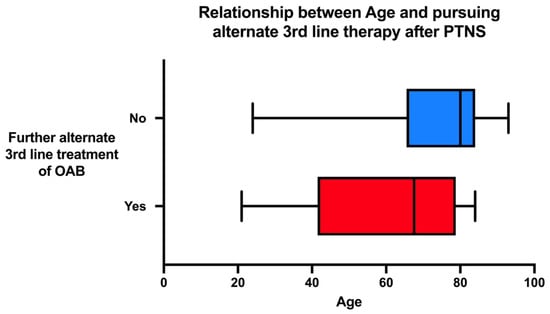
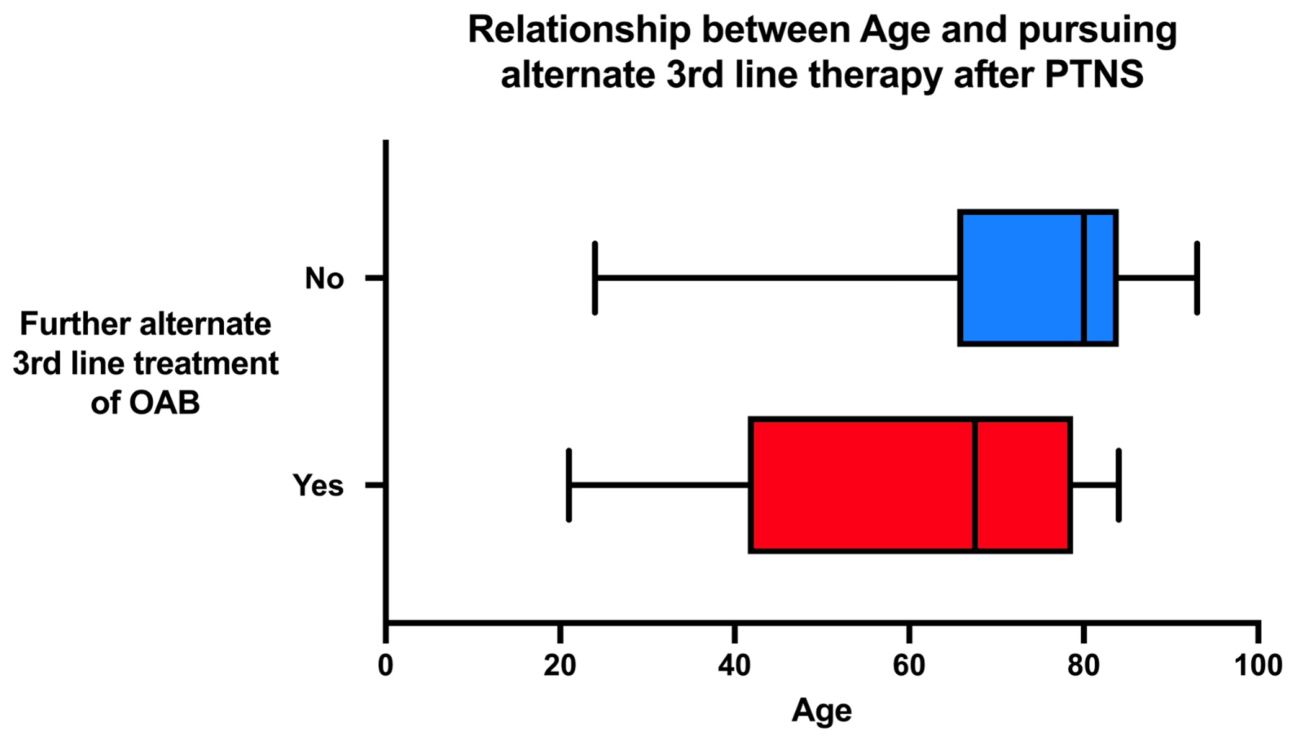
Multivariate logistic regression analysis was performed, which identified only younger age (odds ratio (OR) = 1.06; 95% confidence interval (CI) 1.00–1.14, p = 0.05) as a significant predictor of progression to alternate minimally invasive OAB treatment following PTNS. The mean age of the group that progressed to an alternate minimally invasive OAB management option was 62.6 (SD = 20.6), whereas the group that did not progress to an alternate minimally invasive OAB management option was 73.7 (SD = 17.01) (Figure 1). Student’s t-test confirmed that patients in the group that progressed to alternate minimally invasive OAB management options were significantly younger than those that did not opt for further minimally invasive OAB management (t = 2.01, p = 0.05) (Figure 1).
Figure 1.
Relationship between age and pursuing alternate minimally invasive therapy after percutaneous tibial nerve stimulation. OAB, overactive bladder; PTNS, percutaneous tibial nerve stimulation.
3.4. Predictors of Ongoing Maintenance PTNS
Overall, 27 (55%) patients continued with ongoing monthly maintenance PTNS after completing initial weekly treatment for OAB.
Univariate analysis was also performed to identify potential predictors of ongoing maintenance PTNS therapy after completing an initial 12-week course. This identified a significant correlation between patient-reported subjective improvement, female sex, and a greater number of PTNS sessions completed, with continuing onto maintenance PTNS.
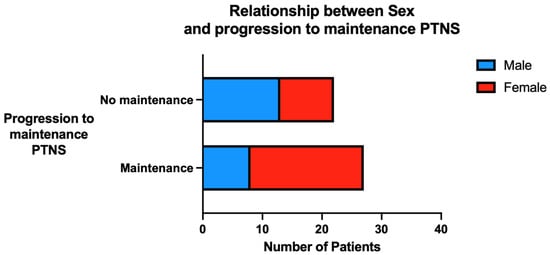
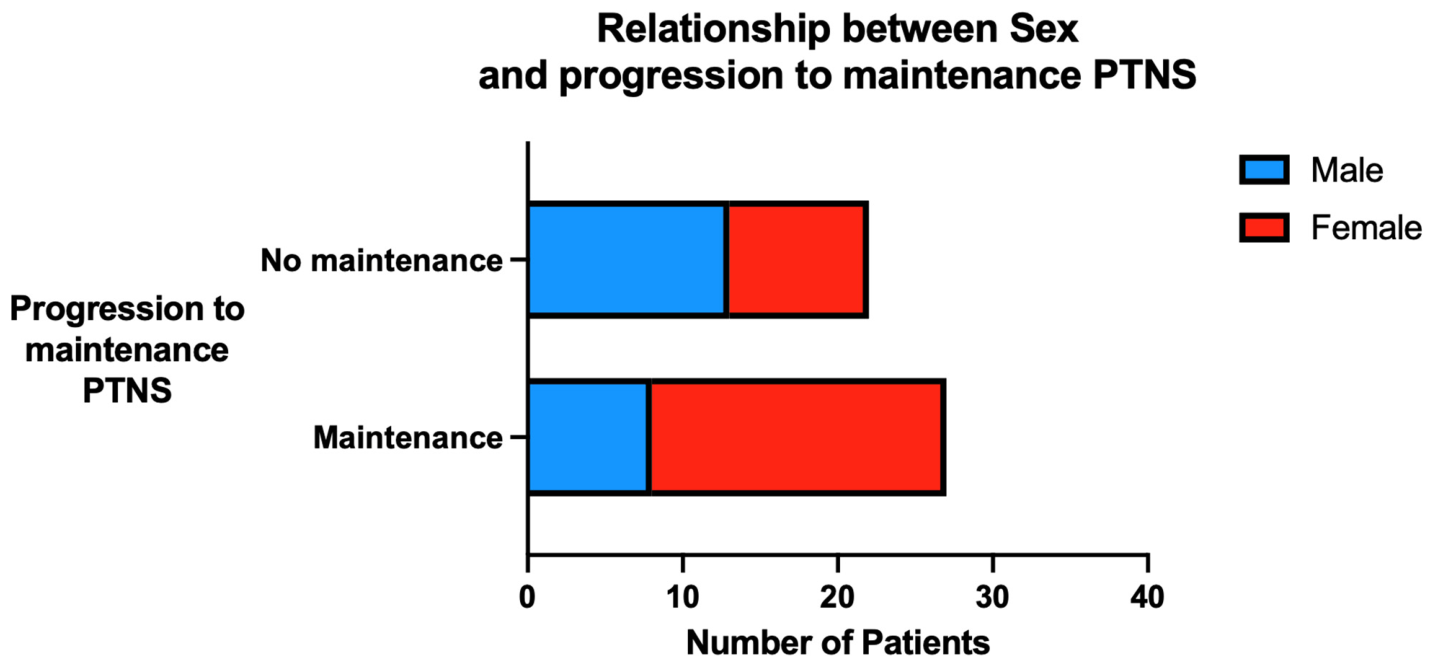
Multivariate logistic regression identified that only sex, specifically being female (OR = 13.3; 95% CI 1.6–110.7, p = 0.017), was a predictor of participating in ongoing maintenance PTNS after completing the initial therapy. In the group that did not progress to maintenance therapy, 45% of patients were female, whereas, in the group that did progress to maintenance therapy, 70% of patients were female. Chi-squared analysis demonstrated a significantly greater proportion of female patients in the cohort of patients that progressed with maintenance therapy (χ2 = 4.3, df = 1, p = 0.038) (Figure 2).
Figure 2.
Relationship between sex and progression to maintenance percutaneous tibial nerve stimulation. PTNS, percutaneous tibial nerve stimulation.
4. Discussion
The present study identified that 33% of patients progressed to an alternate minimally invasive OAB treatment after treatment with PTNS. Younger age was identified as a predictor of patients who progressed to an alternate minimally invasive treatment for OAB after undergoing PTNS. Additionally, patients with a history of diabetes and previous onabotulinum toxin injection were correlated with progressing to an alternate minimally invasive treatment option. Amongst those that completed initial PTNS therapy for OAB, 55% of patients continued with ongoing monthly maintenance PTNS. Female sex was a significant predictor for continuing with maintenance PTNS. Other factors that correlated with maintenance PTNS include subjective improvement and having completed a greater number of PTNS sessions. This series also affirms the improvement in OAB symptoms after completing an initial 12-week phase of PTNS with significant reductions in the number of daytime and nighttime voids.
Percutaneous tibial nerve stimulation remains an important tool in the armamentarium of clinicians for the management of OAB. Peters et al. conducted a landmark randomized controlled trial that compared outcomes of patients with OAB that were given either PTNS or sham treatment. They identified that 55% of patients that underwent PTNS had symptomatic improvement compared to 21% of patients in the sham treatment arm [9]. In another randomized controlled trial comparing PTNS to medical therapy, Peters et al. were also able to demonstrate patient-reported improvement in 80% of patients that underwent PTNS compared to 55% of patients that only had tolterodine [10]. Similarly, Iyer et al. demonstrated 62% of patients that underwent PTNS had ≥50% symptomatic improvement [11]. Our results reflect the wider literature with 61% of patients reporting ≥50% symptomatic improvement and 69% of patients reporting subjective improvement. In addition, patients had significantly improved symptoms when comparing groups pre and post PTNS treatment.
Progression to maintenance therapy after 12 weekly PTNS treatment sessions is a joint decision between the urologist and patient, although currently, factors that influence progression to maintenance therapy are not clearly elucidated in the literature. Studies evaluating the rate of continuation to maintenance therapy have demonstrated that this occurs at rates of between 55% and 80% [12,13,14,15,16,17,18]. In a study of over 400 patients that underwent PTNS for OAB, Te Dorsthorst et al. identified that 57% of patients proceeded to maintenance therapy. Common reasons for discontinuation were logistical or due to physical strain; however, they did not identify any significant predictors of continuing maintenance therapy [6]. Our study demonstrated that 55% of patients elected to continue with maintenance PTNS therapy and that this was associated with subjective improvement. As such, it aligns with our hypothesis and previous publications suggesting improvement on PTNS is one of the driving factors that motivate patients to pursue maintenance therapy.
Patients that continue with maintenance therapy often have a good initial response and there is a strong likelihood of maintaining this treatment benefit. Indeed, the Sustained Therapeutic Effects of Percutaneous Tibial Nerve Stimulation (STEP) study demonstrated that 77% of patients maintained marked or moderate improvement in OAB symptoms at 3 years [19]. Similarly, Van der Pal et al. identified that routine maintenance sessions were associated with continued urinary relief [20]. As such, identifying predictors of progression to maintenance therapy can be useful in pre-treatment discussions when considering OAB management options. A study of 163 patients by Du et al. demonstrated that patient-perceived improvement was an important factor, on both univariate and multivariate analysis, associated with participation in maintenance therapy [21]. They also identified neurological history had correlation with maintenance therapy on univariate analysis, though this was not significant on multivariate analysis. Though our study identified subjective improvement as a factor associated with maintenance therapy on univariate analysis, female sex was the only predictor that was significantly associated with maintenance PTNS on both univariate and multivariate analysis. This particular variable has not been well explored in the literature and may be an important contributor to patients continuing with maintenance PTNS for both behavioural and anatomical reasons, although, this remains inadequately investigated. Furthermore, this result should be interpreted cautiously due to the small sample size and wide confidence intervals and should be considered exploratory and hypothesis-generating rather than definitive.
PTNS is an office-based and cheap treatment option that has relatively few side effects compared with other management options for OAB [8]. This may drive patient preference to trial PTNS prior to an alternative minimally invasive management option of OAB such as intradetrusor botox or sacral neuromodulation due to the increased side effect profile of these more invasive treatments [7,22]. Our study aimed to identify any potential predictors of patients progressing to an alternative minimally invasive treatment option of OAB after PTNS and found that younger age was associated with greater odds of progressing to an alternate minimally invasive therapy of OAB on multivariate analysis. Similar results have been reported with a study of 356 patients that underwent PTNS, which identified older age as a significant predictor of success of PTNS [23]. These patients would likely not have required progression to alternate therapy for OAB. A potential explanation for these findings is that younger patients may be more willing to trial more invasive surgical therapies or be more appropriate due to improved baseline fitness compared to older patients. Alternatively, younger patients may be more motivated to pursue complete resolution or symptomatic improvement compared to their older counterparts. As such, our study outlines an area that requires further investigation, whereby age is a potential determinant of patients opting for further OAB management and why this association exists.
This study does have limitations that need to be addressed. Firstly, this is a retrospective study, and thus, there is inherent selection bias that may come from the study design. We attempted to limit this by including all patients that underwent PTNS so that those who did not complete the initial 12 sessions were also included to reflect likely real-world practices. In addition, not all patients had bladder diaries pre and post treatment available for review during data collection. This may impair the ability to determine the objective success of PTNS and introduce further selection bias, as those patients that did not comply with bladder diaries may have been more likely to have had a dissatisfactory result. Subjective success was also determined as a binary question posed to the patient as there were no validated symptom scores available for analysis in the present retrospective study. Future prospective studies will aim to incorporate validated questionnaires to reflect patient-subjective improvement outcomes. This is a study performed at a single institution, making for strong internal validity, but poor external validity, meaning results may not be generalisable to all other patients. Patient selection is also affected by this as most patients would have come from a similar catchment area, which does not holistically reflect socioeconomic and cultural differences that may play a role in determining if patients persist with PTNS or opt for an alternate option. In addition, health systems and health insurance variation across countries may affect the accessibility and generalisability of the results of this study. Finally, this study had a total of 49 patients, making it a relatively small study. As such, multivariate analysis should be interpreted with care due to potential risks of overfitting. Nonetheless, the presented results reflect an exploratory analysis to identify predictors of progression to alternate minimally invasive therapies following PTNS that require larger prospective studies to confirm. Future prospective studies would be beneficial to further explore the factors that influence patients to continue on maintenance PTNS or elect to undergo an alternate therapy for OAB.
5. Conclusions
To conclude, PTNS was an effective minimally invasive treatment option for OAB in the cohort that was analysed. Of the patients that underwent PTNS, 55% opted to continue maintenance therapy, with female sex being a significant predictor for ongoing PTNS treatment. Patients that proceeded to alternate minimally invasive treatment options of OAB, specifically onabotulinum toxin injection or sacral neuromodulation, occurred at a rate of 33%. Younger age was significantly associated with progression to alternate minimally invasive treatment on multivariate analysis.
Author Contributions
Conceptualization, A.A.G. and A.C.; methodology, A.A.G. and A.C.; software, A.A.G.; validation, A.A.G. and A.C.; formal analysis, A.A.G.; investigation, A.A.G.; resources, A.A.G.; data curation, A.A.G., B.R. and P.K.; writing—original draft preparation, A.A.G. and B.R.; writing—review and editing, B.R., P.K. and A.C.; visualization, A.A.G. and A.C.; supervision, A.C.; project administration, A.A.G. and A.C. All authors have read and agreed to the published version of the manuscript.
Funding
This research did not receive any specific grant from funding agencies in the public, commercial, or not-for-profit sectors.
Institutional Review Board Statement
Ethical review and approval were waived for this study as determined by the Adventist Healthcare Research Ethics Committee due to meeting criteria 5.1.17 set out by the National Statement on Ethical Conduct in Human Research [24], whereby the research conducted was determined to be negligible risk research where there is no foreseeable risk of harm or discomfort; and any foreseeable risk is no more than inconvenience, and involves the use of existing collections of data or records that contain only non-identifiable data about human beings.
Informed Consent Statement
As per the NSW Health Privacy Manual for Health Information [25] Section 11.2.5, health information may be used for secondary purposes including research or the compilation or analysis of statistics in the public interest, which was applied to this de-identified retrospective analysis.
Data Availability Statement
The data presented in this study are available on request from the corresponding author due to privacy reasons.
Conflicts of Interest
A.C. has the following disclosures: Medtronic: Speaker Honoraria, Proctor (sacral neuromodulation), Clinical Advisor; Coloplast—Speaker Honoraria, Proctor (penile prosthesis); Boston Scientific—Proctor (artificial urinary sphincter, sling, penile prosthesis), Clinical Trial Investigator; Australis Scientific—Clinical Advisor; no other authors have any disclosures.
References
- D’Ancona, C.; Haylen, B.; Oelke, M.; Abranches-Monteiro, L.; Arnold, E.; Goldman, H.; Hamid, R.; Homma, Y.; Marcelissen, T.; Rademakers, K.; et al. The International Continence Society (ICS) report on the terminology for adult male lower urinary tract and pelvic floor symptoms and dysfunction. Neurourol. Urodyn. 2019, 38, 433–477. [Google Scholar] [CrossRef] [Scilit]
- Ouslander, J.G. Management of Overactive Bladder. N. Engl. J. Med. 2004, 350, 786–799. [Google Scholar] [CrossRef] [Scilit]
- Stewart, W.; Van Rooyen, J.; Cundiff, G.; Abrams, P.; Herzog, A.; Corey, R.; Hunt, T.; Wein, A. Prevalence and burden of overactive bladder in the United States. World J. Urol. 2003, 20, 327–336. [Google Scholar] [CrossRef] [Scilit]
- Jimenez-Cidre, M.; Costa, P.; Ng-Mak, D.; Sahai, A.; Degboe, A.; Smith, C.P.; Tsai, K.; Herschorn, S. Assessment of treatment-seeking behavior and healthcare utilization in an international cohort of subjects with overactive bladder. Curr. Med. Res. Opin. 2014, 30, 1557–1564. [Google Scholar] [CrossRef] [Scilit]
- Gormley, E.A.; Lightner, D.J.; Faraday, M.; Vasavada, S.P. Diagnosis and treatment of overactive bladder (non-neurogenic) in adults: AUA/SUFU guideline amendment. J. Urol. 2015, 193, 1572–1580. [Google Scholar] [CrossRef] [Scilit]
- te Dorsthorst, M.J.; Heesakkers, J.P.F.A.; van Balken, M.R. Long-term real-life adherence of percutaneous tibial nerve stimulation in over 400 patients. Neurourol. Urodyn. 2020, 39, 702–706. [Google Scholar] [CrossRef] [Scilit]
- Kapur, A.; Harandi, A.A.; Cohen, T.; Ruan, H.; Dabrowski, C.; Anderson, R.; Hwang, K.; Lee, E.; Weissbart, S.; Kim, J. An analysis of factors that influence patient preference of third-line therapy for overactive bladder. Neurourol. Urodyn. 2022, 41, 1906–1913. [Google Scholar] [CrossRef] [Scilit] [PubMed]
- Speed, J.; Welk, B.; Comiter, C.; Elliott, C. Determining patient preferences in the treatment of medication-refractory overactive bladder. Neurourol. Urodyn. 2023, 42, 419–426. [Google Scholar] [CrossRef] [Scilit]
- Peters, K.M.; Carrico, D.J.; Perez-Marrero, R.A.; Khan, A.U.; Wooldridge, L.S.; Davis, G.L.; MacDiarmid, S.A. Randomized trial of percutaneous tibial nerve stimulation versus Sham efficacy in the treatment of overactive bladder syndrome: Results from the SUmiT trial. J. Urol. 2010, 183, 1438–1443. [Google Scholar] [CrossRef] [Scilit] [PubMed]
- Peters, K.M.; MacDiarmid, S.A.; Wooldridge, L.S.; Leong, F.C.; Shobeiri, S.A.; Rovner, E.S.; Siegel, S.W.; Tate, S.B.; Jarnagin, B.K.; Rosenblatt, P.L.; et al. Randomized trial of percutaneous tibial nerve stimulation versus extended-release tolterodine: Results from the overactive bladder innovative therapy trial. J. Urol. 2009, 182, 1055–1061. [Google Scholar] [CrossRef] [Scilit] [PubMed]
- Iyer, S.; Laus, K.; Rugino, A.; Botros, C.; Lozo, S.; Botros, S.M.; Goldberg, R.; Tomezsko, J.; Gafni-Kane, A.; Wroblewski, K.; et al. Subjective and objective responses to PTNS and predictors for success: A retrospective cohort study of percutaneous tibial nerve stimulation for overactive bladder. Int. Urogynecology J. 2019, 30, 1253–1259. [Google Scholar] [CrossRef] [Scilit]
- Govier, F.E.; Litwiller, S.; Nitti, V.; Kreder, K.J.; Rosenblatt, P. Percutaneous afferent neuromodulation for the refractory overactive bladder: Results of a multicenter study. J. Urol. 2001, 165, 1193–1198. [Google Scholar] [CrossRef] [Scilit]
- Karademir, K.; Baykal, K.; Sen, B.; Senkul, T.; Iseri, C.; Erden, D. A peripheric neuromodulation technique for curing detrusor overactivity: Stoller afferent neurostimulation. Scand. J. Urol. Nephrol. 2005, 39, 230–233. [Google Scholar] [CrossRef] [Scilit]
- Klingler, H.C.; Pycha, A.; Schmidbauer, J.; Marberger, M. Use of peripheral neuromodulation of the S3 region for treatment of detrusor overactivity: A urodynamic-based study. Urology 2000, 56, 766–771. [Google Scholar] [CrossRef] [Scilit]
- Nuhoğlu, B.; Fidan, V.; Ayyıldız, A.; Ersoy, E.; Germiyanoğlu, C. Stoller afferent nerve stimulation in woman with therapy resistant over active bladder; a 1-year follow up. Int. Urogynecology J. 2006, 17, 204–207. [Google Scholar] [CrossRef] [Scilit]
- Sirls, E.R.; Killinger, K.A.; Boura, J.A.; Peters, K.M. Percutaneous Tibial Nerve Stimulation in the Office Setting: Real-world Experience of Over 100 Patients. Urology 2018, 113, 34–39. [Google Scholar] [CrossRef] [Scilit]
- van Balken, M.R.; Vandoninck, V.; Gisolf, K.W.H.; Vergunst, H.; Kiemeney, L.A.L.M.; Debruyne, F.M.J.; Bemelmans, B.L.H. Posterior tibial nerve stimulation as neuromodulative treatment of lower urinary tract dysfunction. J. Urol. 2001, 166, 914–918. [Google Scholar] [CrossRef] [Scilit] [PubMed]
- Vandoninck, V.; Van Balken, M.R.; Agró, E.F.; Petta, F.; Caltagirone, C.; Heesakkers, J.P.F.A.; Kiemeney, L.A.L.M.; Debruyne, F.M.J.; Bemelmans, B.L.H. Posterior tibial nerve stimulation in the treatment of urge incontinence. Neurourol. Urodyn. 2003, 22, 17–23. [Google Scholar] [CrossRef] [Scilit] [PubMed]
- Peters, K.M.; Carrico, D.J.; Wooldridge, L.S.; Miller, C.J.; MacDiarmid, S.A. Percutaneous tibial nerve stimulation for the long-term treatment of overactive bladder: 3-year results of the STEP study. J. Urol. 2013, 189, 2194–2201. [Google Scholar] [CrossRef] [Scilit]
- Van Der Pal, F.; Van Balken, M.R.; Heesakkers, J.P.F.A.; Debruyne, F.M.J.; Bemelmans, B.L.H. Percutaneous tibial nerve stimulation in the treatment of refractory overactive bladder syndrome: Is maintenance treatment necessary? BJU Int. 2006, 97, 547–550. [Google Scholar] [CrossRef] [Scilit] [PubMed]
- Du, C.; Berg, W.; Siegal, A.R.; Huang, Z.; Jeong, R.; Hwang, K.; Kim, J. Real-world Compliance With Percutaneous Tibial Nerve Stimulation Maintenance Therapy in an American Population. Urology 2021, 153, 119–123. [Google Scholar] [CrossRef] [Scilit]
- Iyer, S.; Amegashie, C.; deMartelly, V.; Letko, J.; Glass, D.; Fetzer, L.; Botros, S.; Wroblewski, K.; Valaitis, S. Patient perceptions impact progression to third-line therapy for treatment of overactive bladder. J. Urol. 2021, 206, 1240–1247. [Google Scholar] [CrossRef] [Scilit] [PubMed]
- Zeno, A.; Handler, S.J.; Jakus-Waldman, S.; Yazdany, T.; Nguyen, J.N. Percutaneous tibial nerve stimulation in diabetic and nondiabetic women with overactive bladder syndrome: A retrospective cohort study. Female Pelvic Med. Reconstr. Surg. 2021, 27, 686–690. [Google Scholar] [CrossRef] [Scilit] [PubMed]
- National Health and Medical Research Council, Australian Research Council and Universities Australia. National Statement on Ethical Conduct in Human Research. 2025. Available online: https://www.nhmrc.gov.au/about-us/publications/national-statement-ethical-conduct-human-research-2025 (accessed on 8 March 2026).
- NSW Health. Privacy Manual for Health Information. 2026. Available online: https://www.health.nsw.gov.au/policies/manuals/Pages/privacy-manual-for-health-information.aspx (accessed on 8 March 2026).

Disclaimer/Publisher’s Note: The statements, opinions and data contained in all publications are solely those of the individual author(s) and contributor(s) and not of MDPI and/or the editor(s). MDPI and/or the editor(s) disclaim responsibility for any injury to people or property resulting from any ideas, methods, instructions or products referred to in the content. |
© 2026 by the authors. Published by MDPI on behalf of the Société Internationale d’Urologie. Licensee MDPI, Basel, Switzerland. This article is an open access article distributed under the terms and conditions of the Creative Commons Attribution (CC BY) license.