


Abstract
Background/Objectives: Contemporary minimally invasive surgical therapies (MISTs) for benign prostatic hyperplasia carry retreatment rates up to 32%, with holmium laser enucleation of the prostate (HoLEP) increasingly used as salvage therapy. Prior reviews focused on salvage HoLEP (sHoLEP) following transurethral resection; however, technical challenges specific to the post-MIST field remain uncharacterised. We aimed to characterise technical barriers during sHoLEP following contemporary MISTs, with secondary evaluation of efficacy, safety and feasibility. Methods: Following preferred reporting items for systematic reviews and meta-analyses (PRISMA) guidelines (PROSPERO: CRD420261321711), five databases were searched from inception to February 2026. Studies reporting sHoLEP outcomes in adults with prior MIST were included. Qualitative findings were synthesised thematically; quantitative outcomes reported by three or more studies underwent random-effects meta-analysis. Risk of bias was assessed using methodological index for non-randomized studies methodological index for non-randomized studies (MINORS) and certainty of evidence using grading of recommendations, assessment, development, and evaluation (GRADE). Results: Ten studies (354 sHoLEP, 3618 primary HoLEP (pHoLEP) patients) were included. Technical difficulty was MIST-type dependent: thermoablative procedures and prostatic artery embolisation preserved the enucleation plane, while prostatic urethral lift (PUL) introduced morcellation-specific challenges including blade jamming and staged procedures. Meta-analysis revealed no difference in operative time or tissue weight, but reduced enucleation efficiency (weighted mean difference; WMD −0.11 g/min, p = 0.027) and peak urinary flow improvement (WMD −3.0 mL/s, p < 0.001). Both findings were sensitive to analysis, losing significance on restriction to predominantly MIST cohorts, and the enucleation efficiency result additionally lost significance on removal of the most heavily weighted study (p = 0.94). Complication rates were equivalent (odds ratio (OR) 0.92, p = 0.787). Conclusions: sHoLEP is safe and efficacious following contemporary MIST. Surgeons should anticipate MIST-specific challenges, particularly morcellation difficulties after PUL requiring tailored instrumentation. Prospective MIST-specific studies are needed.
1. Introduction
Benign prostate hyperplasia (BPH) is the most common cause of bladder outlet obstruction in men over 50 years old, with surgery remaining a definitive treatment for moderate to severe lower urinary tract symptoms refractory to medical therapy [1,2]. Over the past two decades, contemporary minimally invasive surgical therapies (MISTs) such as prostatic urethral lift (PUL), water vapour thermal therapy (WVTT), prostatic artery embolisation (PAE), waterjet aquablation therapy (WJAT), transurethral microwave thermotherapy (TUMT), and transurethral needle ablation (TUNA) have emerged offering reduced anaesthetic requirements and lower procedural morbidity, and are frequently selected by patients specifically to preserve functional quality of life, in particular urinary continence and sexual function, including the avoidance of ejaculatory dysfunction [3,4,5]. Despite this, retreatment rates remain a large limitation, ranging up to 32%, resulting in a significant proportion requiring salvage intervention [2,6].
Holmium laser enucleation of the prostate (HoLEP) dissects along the anatomical planes of the adenoma, analogous to a simple prostatectomy, offering extremely low retreatment rates (1–3%), making it an attractive salvage option [7]. However, prior MIST, especially those that are tissue-remodelling, ablative or implant-based, may introduce a surgically hostile field not encountered in primary HoLEP (pHoLEP), including fibrosis, adhesions, distorted anatomical planes, and obscured landmarks [8]. Furthermore, as HoLEP is not an ejaculation-sparing procedure, the functional consequences of salvage HoLEP (sHoLEP) on the very continence and sexual outcomes the index MIST was chosen to protect are of direct relevance to patient counselling yet remain poorly characterised.
Previous reviews have primarily focused on sHoLEP following prior transurethral resection of the prostate (TURP), which represents a fundamentally different surgical predecessor removing tissue rather than remodelling it [9]. Prior reviews have also primarily reported functional efficacies and complication rates, demonstrating that sHoLEP is safe, efficacious and feasible with outcomes comparable to pHoLEP [10,11,12]. However, none have addressed the technical challenges of operating in the post-MIST surgical environment, a gap which limits the utility of existing evidence for surgical planning, patient counselling and trainee education. This mixed-methods review aims to comprehensively characterise technical barriers encountered during sHoLEP following contemporary MIST including qualitative intraoperative findings and quantitative markers of operative difficulty, with secondary evaluation of efficacy, safety, and feasibility.
2. Materials and Methods
We included English language studies of any design, including conference proceedings, reporting outcomes of sHoLEP in adult males with prior MIST (TUMT, TUNA, PAE, PUL, WVTT and WJAT) for BPH. We required a minimum of five sHoLEP patients per study, with ≥25% of the cohort undergoing an eligible prior MIST. This threshold was established as we anticipated that the existing literature would have pooled sHoLEP outcome data with patients undergoing prior TURP, greenlight laser therapy or other non-MIST procedure which was not the primary focus of this review. A mean retreatment interval of ≥3 months was required to ensure sHoLEP was performed on a stable operative field. Studies must report at least one extractable technical outcome. Single case reports, reviews, editorials and non-human studies were excluded.
Risk of bias was assessed using methodological index for non-randomized studies (MINORS) [13]. Qualitative data was synthesised thematically, and for quantitative outcomes reported by ≥3 studies random-effects meta-analysis was performed using DerSimonian–Laird or Mantel–Haenszel tests [14]; missing variances were imputed and continuity corrections applied per the Cochrane Handbook [15], and median/interquartile range (IQR) values converted to means using Wan et al. [16]. Certainty of evidence was assessed using grading of recommendations, assessment, development, and evaluation (GRADE) for quantitative outcomes [17] and an adapted four-component narrative framework for qualitative findings, informed by CERQual [18] and ConQual [19] (Supplemental Material S5). To accommodate word count limits, further details of evidence acquisition as well as portions of the evidence synthesis are provided in the Supplementary Materials where mentioned.
3. Results
3.1. Study Selection
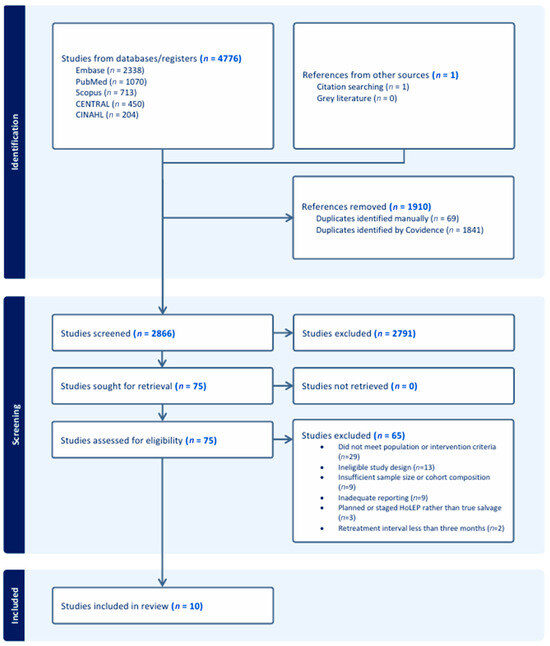
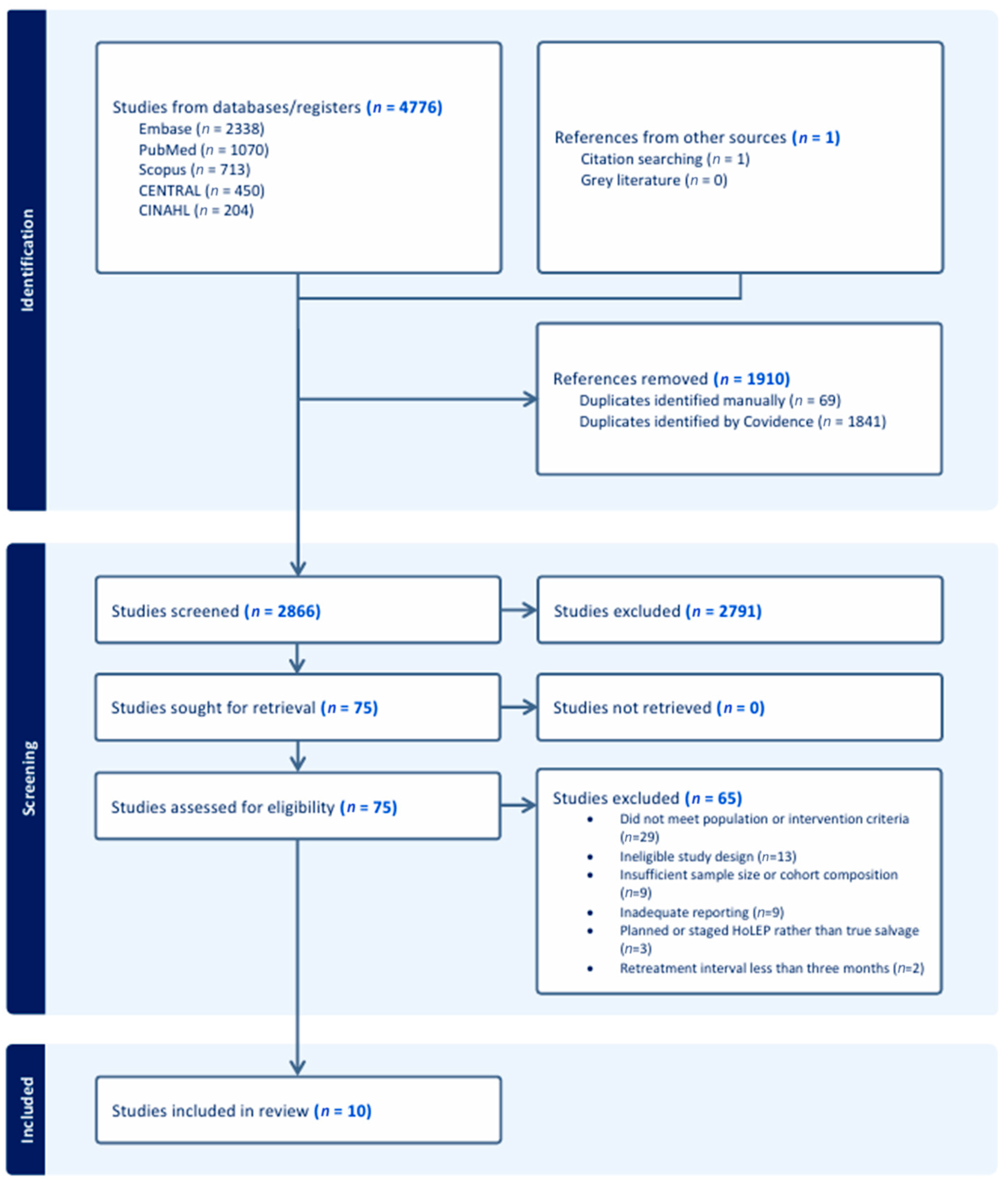
The search of the literature rendered 4775 records across five databases (Embase, n = 2338; PubMed, n = 1070; Scopus, n = 713; Cochrane Central Register of Controlled Trials (CENTRAL), n = 450; Cumulative Index to Nursing and Allied Health Literature (CINAHL), n = 204), with one additional record identified via citation searching, bringing the total to 4776. After removing duplicates 2866 papers underwent title and abstract screening excluding 2791 records with a moderate inter-rater agreement (κ = 0.57, proportionate agreement 98.3%). Seventy-five studies underwent full-text screening including ten papers in the final review, with a substantial inter-rater agreement (κ = 0.70, proportionate agreement 92.0%). Of the ten included records, six were published as full texts [7,20,21,22,23,24], while four were conference proceedings [25,26,27,28]. Reasons for exclusion included the following: did not meet population or intervention criteria (n = 29), ineligible study designs (case reports, n = 12, meta-analysis/systematic review, n = 1), insufficient sample size or cohort composition (n = 9), inadequate reporting (n = 9), planned or staged HoLEP rather than true salvage (n = 3), and retreatment interval less than three months (n = 2). A preferred reporting items for systematic reviews and meta-analyses (PRISMA) flow diagram is provided in Figure 1 [29].
Figure 1.
Preferred Reporting Items for Systematic reviews and Meta-Analyses (PRISMA) flow diagram. CENTRAL, Cochrane Central Register of Controlled Trials; CINAHL, Cumulative Index to Nursing and Allied Health Literature; HoLEP, holmium laser enucleation of the prostate.
3.2. Study Characteristics, Quality and Baseline Patient Demographics
Across ten studies, 354 patients with prior MIST underwent sHoLEP, and six studies included a pHoLEP comparator group totalling 3618 patients. The most common prior MIST was TUMT (n = 162, 45.8%), followed by PUL (n = 86, 24.3%), TUNA (n = 53, 15.0%), PAE (n = 26, 7.3%), WVTT (n = 14, 4.0%), and WJAT (n = 13, 3.7%). The weighted mean interval between MIST and sHoLEP was 52.3 ± 21.8 months (n = 354). Mean age was 71.0 ± 1.2 years (n = 328) for sHoLEP and 69.9 ± 0.2 years (n = 2847) for pHoLEP. Mean prostate volume was 96.4 ± 13.7 mL (n = 308) and 98.9 ± 5.5 mL (n = 3163), respectively. Mean baseline international prostate symptom score (IPSS) was 20.1 ± 0.9 (n = 297) and 20.1 ± 0.7 (n = 3163), respectively. Mean baseline maximum flow rate (Qmax) was 9.1 ± 1.6 mL/s (n = 282) and 8.2 ± 1.0 mL/s (n = 3163), respectively. Mean baseline post-void residual (PVR) was 175.9 ± 36.9 mL (n = 282) and 244.2 ± 48.9 (n = 3163), respectively. An overview of individual study characteristics, quality and baseline sHoLEP variables can be found in Table 1.
Table 1.
Overview of studies and baseline salvage sHoLEP patient demographics.
3.3. Intraoperative Anatomical Findings
Intraoperative anatomical findings were reported in nine of ten included studies [7,20,21,22,23,24,26,27]. The surgical enucleation plane was most consistently reported and addressed for all eligible prior MIST. Fibrosis and adhesions from prior MIST were not reported despite their relevance in the reoperative field representing a notable omission. A full summary of qualitative findings can be found in Table 2.
Table 2.
Summary of qualitative anatomical, difficulty and technique findings.
3.3.1. Surgical Enucleation Plane
Following prior thermoablative procedures (TUMT and TUNA), the surgical enucleation plane was consistently reported as well preserved across three studies [7,22,26]. Jaeger and Krambeck et al. explicitly expressed no difficulty in defining the anatomical plane, noting that the surgical capsule was readily identified [22], corroborated by Gnessin et al. who described that tissue planes between prostatic adenoma and capsule were well preserved despite prior MIST [26]. Marien et al. offered a mechanistic explanation suggesting that prior treatments focused on bladder necks and prostate floors, preserving apical landmarks which facilitated identification of the surgical enucleation planes with ease [7]. Prior PAE induced gross endoscopic changes including cavitations and necrotic tissue; however, Parmar et al. suggested that there was no difficulty in finding or maintaining the plane of enucleation [20]. Similarly, prior WJAT was reported to not complicate plane identification [27].
In contrast prior WVTT and PUL offered challenges. PUL was associated with distortion of prostatic anatomy leading to difficulties in defining the true sulcus of the prostatic lobes and surgical enucleation plane [24,25]. Prior WVTT was associated with plane obscuration making these cases more challenging [23].
3.3.2. Residual Implants
Residual PUL implant components represented a unique intraoperative anatomical finding during sHoLEP. Three distinct themes were identified across two studies: implant aberrancy, implant-related tissue calcification and impaired implant visibility and localisation [21,24].
Implant aberrancy was the most consistently documented finding across both studies [21,24]. McAdams et al. reported that for a cohort of seven patients, six of the 22 device implants were found outside expected locations. Authors reported that outer nitinol tabs designed to sit outside the prostatic capsule were unexpectedly encountered within the enucleation plane near the bladder neck while suture components were identified at the 3–8 O’clock positions rather than the manufacturer recommended 10:30–1:30 locations [21]. Similarly, Das et al. reported discovering an aberrant implant in the posterior bladder wall [24].
Implant-related calcification was reported as an intraoperative finding in two cases. In one case a large four-centimetre piece of calcified adenoma surrounding a PUL implant was unable to be morcellated and too large to be removed transurethrally, ultimately requiring sHoLEP abandonment with a planned return to theatre seven days later for completion using bipolar loop resection [24]. The second case where there was aberrant migration of the implant into the posterior bladder, adherent calcification developed requiring pre-enucleation auxiliary removal of residual implants [24].
Poor implant visibility and localisation was reported as a common trend between both studies. One author explicitly stated that inner nitinol tabs were only visible on initial cystoscopy in one of the seven cases and were further complicated by the degree of haematuria and severity of bladder trabeculations [21]. Das et al. also corroborated this notion suggesting that extensive operative and morcellation time resulted in poor visualisation and difficulty locating residual implants [24].
3.4. Difficulty and Technique Modification
Surgeon-reported difficulty and technique modification data were reported across six of ten included studies [7,21,22,24,25,28]. Findings demonstrated MIST-specific patterns where sHoLEP after thermoablative techniques (TUMT, TUNA) were comparative to pHoLEP requiring no technique modification, while sHoLEP after PUL and WVTT were associated with greater operative challenges and technique modifications.
3.4.1. Overall Operative Difficulty
Following TUMT and TUNA, sHoLEP was not reported as significantly more difficult than pHoLEP across two studies [7,22]. Marien et al. introduced an important nuance that shorter operative times in sHoLEP may reflect greater attending surgeon participation rather than true procedural ease, as altered prostatic anatomy and morphology was considered more difficult for trainees [7]. Collectively, for experienced clinicians sHoLEP following thermoablative MISTs (TUMT, TUNA) is not significantly more challenging than pHoLEP; however, the reoperative field may present a learning curve for less experienced surgeons [7,22].
Prior PUL was consistently reported as uniquely challenging across two studies [24,25], though these challenges were contextualised to morcellation rather than enucleation, during which holmium lasers can easily cut residual implants and sutures without altering technique [21,24]. In this context, HoLEP’s ability to easily cut PUL implants may make it potentially preferable over other salvage procedures [21,24]. Only one study reported that sHoLEP after WVTT was more challenging, due to difficulty identifying the surgical capsule [23].
3.4.2. Morcellation Technique
Though HoLEP managed PUL implants with ease during enucleation, morcellation was consistently reported as a prominent challenge. The core issue was jamming of morcellator blades by residual implant components. McAdams et al. reported that in every case implants became lodged in the morcellator requiring temporary cessation and manual removal of foreign bodies from the blade [21]. Though this was described as generally quick, this process interrupted continuous bladder irrigation, providing the opportunity for clot formation and reduced visibility [21]. Das et al. similarly reported brief pauses to disassemble and clear the blade with three cases experiencing morcellator malfunction necessitating continuous blade replacement [24]. In one case, Han et al. reported that implants prevented effective morcellation entirely, requiring a staged procedure seven days later [25]. Assmus et al. attributed their poor morcellation efficiency to frequent jamming requiring multiple sets of morcellator blades per case [28]. One study observed that oscillating morcellators were less prone to jamming than reciprocating systems as stainless steel tabs tended to rebound rather than become entrapped, though this comparison is limited [21].
3.4.3. Auxiliary Manoeuvres
To overcome challenges experienced in the post-PUL operative field, additional auxiliary manoeuvres were employed to retrieve implants in the majority of cases across two studies [21,24]. McAdams et al. reported using foreign body graspers in five of seven cases to remove residual components [21]. Das et al. reported that 54.5% of cases required the use of a Perc NCircle nitinol tipless stone extractor to remove free implants or implant-embedded adenoma fragments, and 13.6% of cases required a foreign body grasper for removal of fragmented implant components [24]. Auxiliary manoeuvres were not exclusively required prior to morcellation; one case of an aberrantly migrated implant required a foreign body grasper prior to enucleation highlighting that auxiliary instrumentation may be required at any stage during sHoLEP after PUL [24].
3.5. Quantitative Markers of Procedure Difficulty
Quantitative operative parameters are summarised in Table 3. Meta-analysis demonstrated no evidence of a difference in operative times between cohorts (pooled weighted mean difference (WMD) +3.7 min, 95% confidence interval (CI): −16.4 to +23.8, p = 0.717) with substantial heterogeneity (I2 = 79.2%, Cochran Q p = 0.002; Supplemental Figure S3). Similarly, enucleated tissue weight did not differ between cohorts (pooled WMD −6.6, 95% CI: −15.1 to +1.9, p = 0.128; Supplemental Figure S4). However, meta-analysis revealed evidence of a reduction in enucleation efficiency for sHoLEP compared to pHoLEP (pooled WMD −0.11 g/min, 95% CI: −0.21 to −0.01, p = 0.027; Supplemental Figure S5), with no evidence of heterogeneity (I2 = 0.0%, Cochran Q p = 0.426). Collectively, these findings suggest that sHoLEP removes comparable tissue volume to pHoLEP but less efficiently, indicating the enucleation phase takes marginally longer without compromising completeness of tissue resection.
Table 3.
Operative parameters, efficacy, feasibility and safety: sHoLEP vs. pHoLEP.
3.6. Efficacy, Safety and Feasibility
Functional outcomes, feasibility measures and complication rates are summarised in Table 3. Meta-analysis revealed no evidence of a difference in IPSS improvement between sHoLEP and pHoLEP (pooled WMD +1.4, 95% CI: −0.8 to +3.6, p = 0.201; Supplemental Figure S6), with substantial heterogeneity (I2 = 74.8%, Cochran Q p = 0.003). There was very strong evidence that sHoLEP Qmax improved less than pHoLEP (pooled WMD −3.0, 95% CI: −4.7 to −1.3, p < 0.001; Supplemental Figure S7), with low heterogeneity (I2 = 12.7%, Cochran Q p = 0.333). Meta-analysis revealed no evidence of a difference in postoperative PVR between both cohorts (pooled WMD −3.3, 95% CI: −13.8 to +7.2, p = 0.534; Supplemental Figure S8), though there was very strong evidence of greater absolute PVR reduction in pHoLEP (pooled WMD +55.5, 95% CI: +26.9 to +84.2, p < 0.001; Supplemental Figure S9). This reflects the substantially higher baseline PVR in the pHoLEP cohort (244 vs. 176 mL), as a larger absolute reduction is expected from a higher starting value; postoperative PVR was equivalent between groups (42.3 vs. 42.7 mL, p = 0.534), indicating comparable functional endpoints.
Overall complication rates were 12.8% and 11.7% for sHoLEP and pHoLEP respectively. Meta-analysis revealed little or no evidence of a difference in complication rates between cohorts (Supplemental Figures S10–S13).
3.7. Sensitivity Analysis and Certainty of Evidence
Sensitivity analysis and GRADE assessment were performed for all meta-analysis outcomes (Supplemental Tables S1 and S2; Table 3). The studies contributing to each meta-analysed outcome and the prior MIST types represented are detailed in Supplemental Table S3. Fixed-effect model for IPSS improvement yielded a significant difference favouring pHoLEP (pooled WMD +1.8, 95% CI: +0.9 to +2.7, p < 0.001), and leave-one-out analysis identified Parmar et al. as influential [16]. Exclusion achieved significance (pooled WMD +2.1, 95% CI: +1.2 to +3.0, p < 0.001) and eliminated heterogeneity (I2 = 0.5%) suggesting the non-significant primary result is driven by a single small PAE cohort (n = 10). For enucleation efficiency, leave-one-out analysis identified Das et al. as influential, with exclusion abolishing significance (pooled WMD −0.007, p = 0.94), indicating the finding was dependent on a single study (pooled weight 72.1%) [20]. For IPSS improvement, the fixed-effect model yielded a significant difference favouring pHoLEP (pooled WMD +1.8, 95% CI: +0.9 to +2.7, p < 0.001) and leave-one-out analysis identified Parmar et al. as influential [16], suggesting the non-significant primary result was driven by a single small PAE cohort (n = 10). On restriction to predominantly MIST cohorts (≥50% prior MIST), the reductions in enucleation efficiency, Qmax improvement and PVR reduction lost significance, with confidence intervals encompassing the primary estimates, consistent with reduced power rather than reversal of effect. Postoperative PVR was the only outcome whose conclusion changed in the opposite direction. The primary random-effects model showed no difference (pooled WMD −3.3, p = 0.534) with substantial heterogeneity (I2 = 83.0%); both the fixed-effect model (pooled WMD +7.6, 95% CI: +6.4 to +8.8, p < 0.001) and the predominantly MIST analysis (pooled WMD −18.8, 95% CI: −29.8 to −7.8, p < 0.001) reached significance, the latter coinciding with resolution of the heterogeneity (I2 83.0% to 0.0%). This is consistent with the minority-MIST cohorts diluting a MIST-specific effect in the primary analysis. Complication outcomes were not estimable in the predominantly MIST subset (single contributing study). Exclusion of conference abstracts, although pre-specified, was not applicable as no conference abstract contributed to any meta-analysis; all pooled estimates were derived solely from the five published comparative studies.
4. Discussion
This is the first mixed-methods systematic review to characterise the technical challenges of sHoLEP specifically following contemporary MISTs. By integrating qualitative intraoperative descriptions with meta-analysis, we demonstrated that sHoLEP is safe, efficacious and feasible following prior MIST but that technical difficulty is MIST-type dependent. Thermoablative procedures (TUMT, TUNA) pose minimal additional challenge, while implant-based (PUL) and tissue-remodelling (WVTT) MISTs introduce distinct operative complexities not encountered in pHoLEP.
Meta-analysis demonstrated evidence of reduced enucleation efficiency for sHoLEP compared to pHoLEP (WMD −0.11 g/min, p = 0.027); however, sensitivity analysis revealed this finding to be fragile: significance was abolished both on exclusion of Das et al. (p = 0.94) [24] and on restriction to predominantly MIST cohorts (WMD −0.10, p = 0.165), though the point estimate was essentially unchanged in the latter. At the individual study level, enucleation efficiency was identical to pHoLEP following thermoablative procedures (1.32 vs. 1.36 g/min) and PAE (0.50 vs. 0.50 g/min), where surgeons reported well-preserved surgical planes [20,22,26]. In contrast, Das et al., with 72.1% of the pooled weight, examined prior PUL patients exclusively, where the enucleation plane was reported as distorted with obscured anatomy complicating sulcus identification [24]. Hence, the reduction in enucleation efficiency in this cohort (0.28 vs. 0.40 g/min, p = 0.008) is not a generalisable feature of all sHoLEP but a PUL-specific consequence of plane distortion [24]. Importantly, enucleated tissue weight did not differ regardless of prior MIST type (pooled WMD −6.6 g, p = 0.128, I2 = 0.0%), indicating that the entire adenoma can still be removed despite MIST-specific challenges during plane identification, further suggesting that the cost is operative time not therapeutic outcome.
Morcellation was the most consistently reported challenge; however, qualitative findings revealed this to be exclusive to prior PUL. Across four studies, morcellator blade jamming, malfunction and continuous blade replacement necessitating pauses and auxiliary manoeuvres were universally reported [21,24,25,28]. Descriptive quantitative data corroborated this; morcellation efficiency was lower in sHoLEP (6.26 vs. 8.44 g/min) with notably greater variability in morcellation time (17.7 ± 6.1 vs. 12.2 ± 1.1 min), consistent with some prior MISTs proceeding uneventfully while PUL cases introduced unpredictable delays. No study reported morcellation difficulty after thermoablative MISTs, PAE or WJAT. The distinction between enucleation and morcellation difficulty after PUL is clinically significant, as the ability of holmium lasers to easily transect metallic implants without technique modification may make HoLEP paradoxically preferable to alternative salvage procedures for post-PUL patients, provided that oscillating morcellator systems, spare blade sets and foreign body retrieval instruments are available [21,24]. Notably, a video-abstract that did not meet our inclusion criteria described practical morcellation adaptations including slow controlled morcellation and a ‘catch-and-release’ technique of releasing the morcellator pedal upon implant contact [30]. A conference abstract that did not meet our inclusion criteria also corroborated these findings. Patel et al. with a post-PUL cohort of 70 patients confirmed that morcellation was longer in the PUL arm while enucleation was not, with no differences in postoperative outcomes compared to matched controls [31]. Notably a case report by Lim et al. reported fibrotic changes in the transitional zone after WVTT that obscured surgical planes at the anterior commissure and apex, necessitating an en bloc technique with early apical release [32]. These findings further validate the MIST-type dependent pattern identified in this review that implant-based procedures complicate morcellation while tissue remodelling therapies obscure enucleation planes.
The only significant functional difference in the primary analysis was a modest reduction in Qmax improvement (WMD −3.0 mL/s, p < 0.001; Low GRADE, I2 = 12.7%). However, both cohorts achieved postoperative values well above the obstructive threshold (20.0 vs. 24.0 mL/s) and IPSS improvement did not differ (p = 0.201), suggesting this objective flow difference does not translate into a perceptible difference in symptom experience. Supporting this, the difference attenuated to non-significance when restricted to predominantly MIST cohorts (WMD −1.0, 95% CI −8.4 to +6.4), suggesting it was partly driven by the inclusion of non-MIST patients and is unlikely to represent a clinically meaningful MIST-specific effect. Postoperative PVR, non-significant in the primary analysis, reached significance favouring sHoLEP when restricted to predominantly MIST cohorts with resolution of heterogeneity (I2 83.0% to 0.0%), consistent with minority-MIST cohorts diluting a MIST-specific effect. Complication rates were equivalent across all Clavien–Dindo grades (overall odds ratio (OR): 0.92, p = 0.787). Three prior systematic reviews reached similar conclusions regarding sHoLEP safety and efficacy [10,11,12]; however, their cohorts were 49–60% post-TURP and none characterised the technical challenges that constitute our primary outcome. Pyrgidis et al. and Wang et al. both reported substantial heterogeneity in operative time (I2 = 66% and 72% respectively) but could not account for it [10,11]. Our findings suggest this heterogeneity reflects the underlying variation in technical difficulty across different prior MIST types. Notably, in the present review heterogeneity was concentrated in the operative difficulty outcomes (operative time I2 = 79.2%) while remaining low for outcomes expected to be MIST-independent (enucleation efficiency I2 = 0.0%; Qmax improvement I2 = 12.7%). This pattern is consistent with intraoperative difficulty being prior MIST-specific rather than uniform and indicates that pooling across MIST types does not obscure this signal but rather reveals it through the heterogeneity structure itself.
Notably, none of the included studies reported continence or sexual function outcomes following sHoLEP. This represents a significant evidence gap, as the preservation of these functional domains is a principal reason patients elect a MIST in the first instance. The available evidence therefore cannot inform whether sHoLEP compromises the very outcomes the index MIST was chosen to protect, a question of direct counselling importance for patients considering a MIST with the knowledge that salvage may later be required.
Our findings carry practical implications for surgical planning. sHoLEP following thermoablative MISTs and PAE can be approached with confidence by experienced surgeons with the expectation of preserved anatomical planes and operative parameters comparable to pHoLEP. Altered prostatic anatomy was considered more difficult for trainees, which suggests that sHoLEP cases may benefit from experienced operator involvement or close supervision [7]. Patient counselling should communicate that sHoLEP after MIST achieves equivalent symptom relief and complication rates to pHoLEP, with modest reductions in Qmax improvement which is unlikely to affect perceived outcomes.
This review is not devoid of limitations. All included studies were retrospective; GRADE certainty was very low for 10 of 11 outcomes; and the total sHoLEP sample was modest (n = 354). All procedures were performed by experienced surgeons at high-volume centres, limiting generalisability to lower-volume settings. Evidence for WVTT and WJAT was limited to one and two studies respectively. Cohort contamination in the minority-MIST meta-analysis studies (Marien 35%, Durant 44%, Jaeger 27%; Table 1), where the salvage cohort included a majority of non-MIST patients, may have diluted MIST-specific effects [7,22,23]; consistent with this, restriction to predominantly MIST cohorts strengthened the postoperative PVR effect. Importantly, qualitative findings were extracted from incidental operative descriptions rather than formal qualitative studies. Likewise, our framework for assessing the confidence of qualitative findings is not validated and must be interpreted with scrutiny. In addition, no included study reported continence or sexual function outcomes, precluding any synthesis of these clinically important endpoints. Finally, most included studies reported outcomes for mixed prior MIST cohorts without stratification by individual MIST type, so the pooled quantitative estimates reflect mixed cohorts and cannot be fully disaggregated by MIST type; the MIST-specific pattern of technical difficulty is therefore established principally through the qualitative synthesis (Table 2).
Prospective MIST-specific studies should incorporate standardised continence and sexual function endpoints (e.g., validated incontinence, erectile and ejaculatory function instruments) alongside symptom and flow measures, given that these are the principal outcomes motivating initial MIST selection. Similarly, head-to-head comparison of morcellator systems in the post-PUL setting, investigation of the trainee learning curve for post-MIST cases and dedicated studies of WVTT and WJAT as their adoption increases would strengthen the evidence base for this field.
5. Conclusions
sHoLEP following contemporary MISTs is safe, efficacious and feasible with functional outcomes and complication rates comparable to pHoLEP. Technical difficulty is MIST-specific; thermoablative techniques and PAE preserve the surgical enucleation plane, while PUL poses morcellation specific challenges and WVTT may obscure the plane. Enucleation completeness is preserved regardless of prior MIST type, and the modest reduction in enucleation efficiency was not robust to sensitivity analysis, losing significance both on exclusion of the most heavily weighted study and on restriction to predominantly MIST cohorts. These findings suggest that HoLEP is a viable salvage option, though the evidence base remains limited by retrospective designs, small sample sizes and lack of post-WVTT and -WJAT data.
Supplementary Materials
The following supporting information can be downloaded at: https://www.mdpi.com/article/10.3390/siuj7030034/s1, S1: PRISMA 2020 checklist; S2: Search string syntax; S3: Full-text screen exclusion reasons; S4: Supplemental methods; S5: Confidence in qualitative findings; S6: Supplemental figures and tables; S7: References.
Author Contributions
Conceptualization, K.O., S.H., D.L. and K.S.; Methodology, K.O., S.H., D.L. and K.S.; Validation, K.O., S.H., D.L. and K.S.; Formal Analysis, K.O., S.H., D.L. and K.S.; Investigation, K.O., S.H., D.L. and K.S.; Data Curation, K.O., S.H., D.L. and K.S.; Writing—Original Draft Preparation, K.O., S.H., D.L. and K.S.; Writing—Review and Editing, K.O., S.H., D.L. and K.S.; Visualisation, K.O., S.H., D.L. and K.S.; Supervision, K.S.; Project Administration, K.O. and K.S. All authors have read and agreed to the published version of the manuscript.
Funding
This research received no external funding.
Institutional Review Board Statement
Not applicable.
Informed Consent Statement
Not applicable.
Data Availability Statement
The data presented in this study are available within the article and Supplementary Materials.
Conflicts of Interest
The authors declare no conflicts of interest.
References
- Langan, R.C. Benign Prostatic Hyperplasia. Prim. Care 2019, 46, 223–232. [Google Scholar] [CrossRef] [Scilit] [PubMed]
- Morton, A.; Williams, M.; Perera, M.; Teloken, P.E.; Donato, P.; Ranasinghe, S.; Chung, E.; Bolton, D.; Yaxley, J.; Roberts, M.J. Management of Benign Prostatic Hyperplasia in the 21st Century: Temporal Trends in Australian Population-Based Data. BJU Int. 2020, 126, 18–26. [Google Scholar] [CrossRef] [Scilit] [PubMed]
- Cornu, J.-N.; Zantek, P.; Burtt, G.; Martin, C.; Martin, A.; Springate, C.; Chughtai, B. Minimally Invasive Treatments for Benign Prostatic Obstruction: A Systematic Review and Network Meta-Analysis. Eur. Urol. 2023, 83, 534–547. [Google Scholar] [CrossRef] [Scilit]
- Srinivasan, A.; Wang, R. An Update on Minimally Invasive Surgery for Benign Prostatic Hyperplasia: Techniques, Risks, and Efficacy. World J. Mens Health 2020, 38, 402–411. [Google Scholar] [CrossRef] [Scilit]
- Sandhu, J.S.; Bixler, B.R.; Dahm, P.; Goueli, R.; Kirkby, E.; Stoffel, J.T.; Wilt, T.J. Management of Lower Urinary Tract Symptoms Attributed to Benign Prostatic Hyperplasia (BPH): AUA Guideline Amendment 2023. J. Urol. 2024, 211, 11–19. [Google Scholar] [CrossRef] [Scilit] [PubMed]
- Lourenco, T.; Pickard, R.; Vale, L.; Grant, A.; Fraser, C.; MacLennan, G.; N’Dow, J.; the Benign Prostatic Enlargement team. Minimally Invasive Treatments for Benign Prostatic Enlargement: Systematic Review of Randomised Controlled Trials. BMJ 2008, 337, a1662. [Google Scholar] [CrossRef] [Scilit]
- Marien, T.; Kadihasanoglu, M.; Tangpaitoon, T.; York, N.; Blackburne, A.T.; Abdul-Muhsin, H.; Borofsky, M.S.; Krambeck, A.E.; Humphreys, M.R.; Lingeman, J.E.; et al. Outcomes of Holmium Laser Enucleation of the Prostate in the Re-Treatment Setting. J. Urol. 2017, 197, 1517–1522. [Google Scholar] [CrossRef] [Scilit]
- Elshal, A.M.; Elmansy, H.M.; Elhilali, M.M. Feasibility of Holmium Laser Enucleation of the Prostate (HoLEP) for Recurrent/Residual Benign Prostatic Hyperplasia (BPH). BJU Int. 2012, 110, E845–E850. [Google Scholar] [CrossRef] [Scilit]
- Busetto, G.M.; Checchia, A.; Recchia, M.; Tocci, E.; Falagario, U.G.; Annunziata, G.; Annese, P.; d’Altilia, N.; Mancini, V.; Ferro, M.; et al. Minimally Invasive Surgical Therapies (MISTs) for Lower Urinary Tract Symptoms (LUTS): Promise or Panacea? Asian J. Androl. 2024, 26, 135–143. [Google Scholar] [CrossRef] [Scilit]
- Wang, L.; Chen, X.; Li, K.; Yin, S.; Zhu, P. Perioperative and Functional Outcomes of Salvage versus Primary Holmium Laser Enucleation of the Prostate: Evidence-Based on Controlled Studies. Asian J. Surg. 2023, 46, 5411–5420. [Google Scholar] [CrossRef] [Scilit]
- Pyrgidis, N.; Mykoniatis, I.; Lusuardi, L.; Schulz, G.B.; Sokolakis, I.; Stief, C.; Sountoulides, P. Enucleation of the Prostate as Retreatment for Recurrent or Residual Benign Prostatic Obstruction: A Systematic Review and a Meta-Analysis. Prostate Cancer Prostatic Dis. 2023, 26, 693–701. [Google Scholar] [CrossRef] [Scilit]
- Kallidonis, P.; Spinos, T.; Peteinaris, A.; Somani, B.; Liatsikos, E. Salvage Holmium Laser Enucleation of the Prostate after Previous Interventions: A Systematic Review. BJU Int. 2024, 133, 141–151. [Google Scholar] [CrossRef] [Scilit]
- Slim, K.; Nini, E.; Forestier, D.; Kwiatkowski, F.; Panis, Y.; Chipponi, J. Methodological Index for Non-Randomized Studies (MINORS): Development and Validation of a New Instrument. ANZ J. Surg. 2003, 73, 712–716. [Google Scholar] [CrossRef] [Scilit] [PubMed]
- DerSimonian, R.; Laird, N. Meta-Analysis in Clinical Trials Revisited. Contemp. Clin. Trials 2015, 45, 139–145. [Google Scholar] [CrossRef] [Scilit] [PubMed]
- Higgins, J.; Thomas, J.; Chandler, J.; Cumpston, M.; Li, T.; Page, M. Cochrane Handbook for Systematic Reviews of Interventions, 2nd ed.; John Wiley & Sons: Chichester, UK, 2019; ISBN 978-1-119-53660-4. [Google Scholar]
- Wan, X.; Wang, W.; Liu, J.; Tong, T. Estimating the Sample Mean and Standard Deviation from the Sample Size, Median, Range and/or Interquartile Range. BMC Med. Res. Methodol. 2014, 14, 135. [Google Scholar] [CrossRef] [Scilit]
- Guyatt, G.H.; Oxman, A.D.; Vist, G.E.; Kunz, R.; Falck-Ytter, Y.; Alonso-Coello, P.; Schünemann, H.J. GRADE: An Emerging Consensus on Rating Quality of Evidence and Strength of Recommendations. BMJ 2008, 336, 924–926. [Google Scholar] [CrossRef] [Scilit]
- Wainwright, M.; Zahroh, R.I.; Tunçalp, Ö.; Booth, A.; Bohren, M.A.; Noyes, J.; Cheng, W.; Munthe-Kaas, H.; Lewin, S. The Use of GRADE-CERQual in Qualitative Evidence Synthesis: An Evaluation of Fidelity and Reporting. Health Res. Policy Syst. 2023, 21, 77. [Google Scholar] [CrossRef] [Scilit]
- Munn, Z.; Porritt, K.; Lockwood, C.; Aromataris, E.; Pearson, A. Establishing Confidence in the Output of Qualitative Research Synthesis: The ConQual Approach. BMC Med. Res. Methodol. 2014, 14, 108. [Google Scholar] [CrossRef] [Scilit]
- Parmar, M.; Katz, J.E.; Blachman-Braun, R.; Smith, N.A.; Oneto, S.M.; Bhatia, S.; Kryvenko, O.N.; Shah, H.N. Safety and Efficacy of Holmium Laser Enucleation of Prostate as Salvage Procedure for Persistent or Recurrent Lower Urinary Tract Symptoms Secondary to Bladder Outlet Obstruction after Prior Prostate Artery Embolization: A Match Analysis. World J. Urol. 2021, 39, 4199–4206. [Google Scholar] [CrossRef] [Scilit] [PubMed]
- McAdams, S.; Funk, J.T.; Navetta, A.F.; El Tayeb, M.M.; Humphreys, M.R. Holmium Laser Enucleation of the Prostate After Prostatic Urethral Lift Surgery: Feasibility and Technical Considerations from a Multi-Institutional Case Series. J. Endourol. 2017, 31, 774–779. [Google Scholar] [CrossRef] [Scilit]
- Jaeger, C.D.; Krambeck, A.E. Holmium Laser Enucleation of the Prostate for Persistent Lower Urinary Tract Symptoms After Prior Benign Prostatic Hyperplasia Surgery. Urology 2013, 81, 1025–1029. [Google Scholar] [CrossRef] [Scilit]
- Durant, A.M.; Moore, J.; Voleti, S.; Wu, S.; Mi, L.; Narang, G.; Cheney, S.; Humphreys, M. Salvage versus Primary Holmium Laser Enucleation of the Prostate: Trends, Outcomes and Safety Analysis. World J. Urol. 2022, 40, 2305–2312. [Google Scholar] [CrossRef] [Scilit]
- Das, A.; Han, T.M.; Rudnick, B.; Hardacker, T.; Shenot, P.J.; Shvero, A. Holmium Laser Enucleation of the Prostate Following Previous Prostatic Urethral Lift. J. Endourol. 2022, 36, 111–116. [Google Scholar] [CrossRef] [Scilit] [PubMed]
- Han, T.; Glick, L.; Hardacker, T.; Perez, T.; Shenot, P.; Das, A. PD61-11 Initial Experience of Holmium Laser Enucleation of the Prostate Following Previous Prostatic Urethral Lift for Management of Benign Prostatic Hyperplasia. J. Urol. 2020, 203, e1284. [Google Scholar] [CrossRef] [Scilit]
- Gnessin, E.; Miller, N.L.; Handa, S.E.; Lingeman, J.E. Holmium Laser Enucleation of the Prostate (HoLEP) as Re-Treatment Following Prior BPH Intervention. J. Endourol. 2010, 24, A207. [Google Scholar] [CrossRef] [Scilit]
- Gardezi, M.; Sanekommu, G.; Choksi, A.; Dora, C.; Ghiraldi, E.; Humphreys, M.; Kellner, D. Transurethral Enucleation of the Prostate after Aquablation: Results from the LUMEN Network. J. Endourol. 2025, 39, e233. [Google Scholar]
- Assmus, M.; Dean, N.; Lee, M.; Guo, J.; Krambeck, A. MP13-08 Holmium Laser Enucleation of the Prostate (HoLEP) Outcomes After Minimally Invasive Surgical Therapies (MIST) for BPH. J. Urol. 2023, 209, e176. [Google Scholar] [CrossRef] [Scilit]
- Page, M.J.; McKenzie, J.E.; Bossuyt, P.M.; Boutron, I.; Hoffmann, T.C.; Mulrow, C.D.; Shamseer, L.; Tetzlaff, J.M.; Akl, E.A.; Brennan, S.E.; et al. The PRISMA 2020 Statement: An Updated Guideline for Reporting Systematic Reviews. BMJ 2021, 372, n71. [Google Scholar] [CrossRef] [Scilit]
- Parikh, K.A.; Dora, C.D. Holmium Laser Enucleation of the Prostate After Failed UroLift: Surgical Considerations for the Management of Nonabsorbable Implants. Urology 2019, 132, 212. [Google Scholar] [CrossRef] [Scilit]
- Patel, A.; Guo, J.N.; Xu, P.; McDonald, A.; Fadl-Alla, A.; Krambeck, A. Holmium Laser Enucleation of the Prostate after Prostatic Urethral Lift: The State of Bother. Int. Urol. Nephrol. 2026. [Google Scholar] [CrossRef] [Scilit]
- Lim, W.S.; Lim, T.C.; Omar, S. When Steam Isn’t Enough: Salvage HoLEP after Inadequate Response to Rezum. BJU Int. 2025, 136, S5. [Google Scholar]

Disclaimer/Publisher’s Note: The statements, opinions and data contained in all publications are solely those of the individual author(s) and contributor(s) and not of MDPI and/or the editor(s). MDPI and/or the editor(s) disclaim responsibility for any injury to people or property resulting from any ideas, methods, instructions or products referred to in the content. |
© 2026 by the authors. Published by MDPI on behalf of the Société Internationale d’Urologie. Licensee MDPI, Basel, Switzerland. This article is an open access article distributed under the terms and conditions of the Creative Commons Attribution (CC BY) license.