


Abstract
The utilisation of wood-processing residues in particleboard production provides an opportunity to improve resource efficiency. However, limited research has systematically examined the combined influence of material characteristics and fabrication parameters on panel performance. This study investigates the joint influence of particle mix, resin content and processing method on the performance of particleboards manufactured from radiata pine (Pinus radiata) wood residues. Single-layer panels were fabricated using coarse particles, thin particles, and a thin–fine particle blend at three resin contents via dry and water-conditioned fabrication methods, targeting a constant density of 600 kg/m3. Panels were evaluated for modulus of rupture (MOR), modulus of elasticity (MOE), thickness swelling (TS) and water absorption (WA). The results revealed statistically significant interaction effects among the factors, with particle geometry primarily governing bending performance, and fabrication route exerting the strongest influence on dimensional stability. Thin-particle panels exhibited the highest bending performance, with the 12 wt.% dry-fabrication method achieving an average MOE of 1862 MPa and MOR of 14.65 MPa. In contrast, fine-particle incorporation reduced bending performance but improved dimensional stability, with micro-CT analysis showing lower porosity and smaller pore features in the selected fines-containing panel, reaching a minimum porosity of 3.6%. Overall, the findings demonstrate that coordinated optimisation of material composition and processing parameters can enhance the performance of residue-based particleboards.
1. Introduction
The construction industry is shifting towards sustainable alternatives to building materials as a response to global carbon emissions, resource depletion and waste generation. Composite wood panels have gained prominence as versatile, resource-efficient alternatives to traditional solid timber. Particleboards, a popular form of composite wood panels, are engineered by binding wood particles together with adhesives under heat and pressure, allowing for efficient use of raw materials and customisation of properties to meet specific application needs [1,2].
In this context, the utilisation of wood waste and wood-processing residues for particleboard production is a key strategy to address several challenges in the construction and wood-processing industries [3,4]. Wood waste (also referred to as recovered wood or post-consumer wood) comprises wood and wood-based products discarded after their end use, whereas wood processing residues (hereafter referred to as ‘wood residues’) are by-products generated during mechanical and chemical processing in the forest industry [5]. Globally, an estimated 300–400 million tonnes of wood waste and wood residues are generated annually, much of which remains untapped for high-value applications [6]. Redirecting these material streams into wood composites offers the potential to mitigate the increasing landfill accumulation while reducing reliance on virgin wood resources for panel production [7].
Previous studies have demonstrated that particleboards produced from wood waste in the form of construction and demolition timber [8,9], reclaimed wood composite boards [10,11], wood pallets [12] and discarded furniture [13] can meet or exceed mechanical and dimensional stability requirements when appropriately engineered. However, such panels often require additional pre-treatment steps to address variability and contamination associated with the post-consumer materials [14]. In contrast, wood residues—most commonly derived from sawmill operations—are more readily integrated into particleboard production, due to its relatively homogeneous characteristics and low contamination levels [15]. Particleboards produced with varying proportions of wood residues are therefore adopted in industrial production [16], and typically exhibit adequate physical and mechanical properties that satisfy standard requirements for construction applications [17].
Nevertheless, optimising the performance of wood residue-based particleboards remains challenging due to the inherent variability in material characteristics and processing conditions. Panel performance is governed by complex interacting factors—including particle geometry, resin distribution, and processing conditions—which collectively influence the physical and mechanical properties of the final panel. Among these, particle geometry has been identified as a critical determinant of the bending strength and stiffness [18]. Studies comparing coarse and fine particles consistently demonstrate that coarse particles enhance bending performance, whereas finer particles improve dimensional stability [19,20]. The slenderness ratio of particles (length-to-thickness) is particularly influential, with higher slenderness ratios improving modulus of rupture (MOR) and modulus of elasticity (MOE) through enhanced particle alignment and load transfer [21]. Recent advances in 3D scanning technology have enabled more precise evaluation of geometric effects, with Engehausen, et al. [22] demonstrating that, at constant surface-specific adhesive amount (SSAA) and density profile, increasing slenderness ratio results in higher MOR and MOE but lower internal bond strength (IB).
The interaction between particle geometry and resin content has also been examined to some extent, with studies highlighting how adhesive efficiency is influenced by particle size, slenderness and surface area. Particles with higher aspect ratios provide larger surface area for adhesive contact, whilst the smaller particles act as fillers occupying the void formed by larger particles [23]. Arabi, et al. [24] developed analytical equations to predict the mechanical properties based on slenderness ratio and resin content at constant density, concluding that the increases in resin content had a greater positive correlation when the slenderness ratios of the particles are high. Moreover, increases in resin content have been shown to reduce thickness swelling (TS), improving dimensional stability [25].
However, most existing studies consider single particle types in isolation. While the effect of particle geometry and inclusion of fines have been considered individually, studies on the combined effect of these factors remain poorly understood. Although studies such as Choupani Chaydarreh, et al. [23] explore blends of agricultural residues with commercial particles, relatively few controlled factorial studies have examined the combined effects of different particle geometries and particle mixtures under comparable density and resin conditions.
Beyond material composition, fabrication conditions also play a crucial role in determining panel performance. Although the effects of parameters such as pressing time and temperature have been extensively studied [26,27], the use of water-conditioned fabrication approaches has received comparatively less attention in particleboard manufacturing. Increased particle moisture resulting from such conditioning can enhance particle compressibility and facilitate mat consolidation [28]. From a manufacturing perspective, while dry particles are generally preferred due to their efficiency and controlled moisture content, particles at elevated moisture contents can reduce the extent of energy-intensive pre-drying required before particleboard production [29]. Nakato, et al. [30] demonstrated that increased particle moisture also can shorten the time required for the particleboard mat core to reach approximately 100 °C and promoted surface-layer densification through thermal and hygro-plasticisation of the wood particles. Water-conditioning of particles can also lead to distinct shifts in microstructural development that strongly influence both mechanical and moisture-related properties [31]. However, despite these potential advantages, limited information is available on how water-conditioned fabrication compares with conventional dry-particle processing under comparable manufacturing conditions, particularly when variations in particle geometry, fines content, and resin loading are considered simultaneously.
Wood residues are available in a wide range of geometries and therefore offer significant potential for particleboard manufacturing. However, current industrial production relies predominantly on virgin wood particles as the primary raw material [28,32]. This reliance can be largely attributed to the limited understanding of the combined effect of different material and fabrication parameters on panel performance. As a result, the adoption of alternative particle mixtures derived from different wood particles remains constrained in the current practice.
Therefore, the present study aims to address these research gaps by investigating how particle geometry, the inclusion of fines, resin content and fabrication method jointly influence the mechanical and physical performance of particleboards fabricated using wood residues. Specifically, it seeks to understand the effects of particle geometry and fine-particle content on bending stiffness, strength and dimensional stability by comparing panels fabricated from wood residue with distinct geometrical properties, supported by microstructural analysis. The study further examines the role of resin content and fabrication method in mediating these effects and evaluates whether these particleboards can meet minimum performance requirements specified in relevant standards, thereby identifying the mechanisms governing compliance or non-compliance.
2. Materials and Methods
To isolate the effects of particle composition, resin content, and fabrication route, all panels were manufactured at a constant target density of 600 kg/m3 using a single wood species and a single-layer panel configuration. Maintaining a constant panel density is consistent with comparable experimental studies investigating the influence of material and manufacturing parameters on particleboard performance, where fixed target densities within the range of 600–650 kg/m3 are commonly adopted for laboratory-scale particleboards to provide sufficient panel consolidation while enabling direct comparison among the investigated variables [22,33,34].
Radiata pine (Pinus radiata) was selected as the wood species due to its widespread use in the Australian wood products industry. Panels were fabricated using both dry and water-conditioned processing routes and with three different resin percentages (8 wt.%, 10 wt.%, 12 wt.%), expressed on a dry resin solids basis relative to the oven-dry mass of the wood particles. Detailed procedures for material preparation, panel fabrication, and testing are provided in the following subsections.
2.1. Wood Particle Preparation and Characterisation
Three types of wood residues were sourced from Pollards Sawdust Supplies, Plenty, Victoria, Australia, a local sawdust and wood shavings supplier. These materials originate from the processing and screening of radiata pine timber by-products generated during sawmilling, and are often used for energy generation or for low-value applications such as animal bedding and spill absorption [35]. The three wood residue types were commercially supplied as wood chips, wood flakes, and sawdust. However, to avoid ambiguity associated with conventional industrial particle classifications and to more accurately reflect their measured geometrical characteristics, the three fractions are referred to throughout this study as coarse particles (CP), thin particles (TP), and fine particles (FP), respectively.
Moisture content was measured in accordance with AS/NZS 4266.1:2017—Reconstituted wood-based panels—Methods and testing, by oven-drying representative samples at 103 °C until constant mass was achieved [36]. The bulk density was calculated from the mass and measured volumes for each particle category.
Particle size categorisation was carried out using mechanical sieving for all wood particles. Coarse and thin particles passing through a 9.5 mm screen and retained on a 1.18 mm screen were selected, and fine particles passing through a 1.0 mm screen and retained on a 0.075 mm screen were used. The selected sieve fractions were chosen to ensure consistent mat formation and pressing behaviour, and in line with previous studies on wood-based panel materials [37,38,39].
Particle Geometry Characterisation Using Image Analysis
To quantify particle geometry, 250 particles from each category were randomly selected and analysed using ImageJ (Version 1.54t). For each particle, the length (l), width (w), and thickness (t) were measured. Using this dimensional data, the basic shape factors, namely the degree of slenderness (λs), flatness (ψ), width coefficient (m) and specific surface area (Fω) were calculated following the equations (Equations (1)–(4)) defined by Dukarska, et al. [40],
where l is the mean length of wood particles (mm), t the mean thickness (mm), w the mean width (mm), the mean weight of dry wood particles (g), n the number of particles analysed, and 0.002 is a coefficient accounting for the presence of two surfaces and a unit converter from mm to m.
2.2. Adhesive and Additives Used
The adhesive used for all panels was Sylvic 5072, an industrially available melamine urea-formaldehyde (MUF) resin sourced from Hexion Pty Ltd., Deer Park, Victoria, Australia. Details of the adhesive properties are given in Table 1. Paraffin wax and Ammonium Sulphate were supplied in powder form and were used as an additive and resin hardener, respectively.
Table 1.
Properties of the adhesive used in particleboard fabrication.
2.3. Mix Design and Panel Fabrication
Particleboards were manufactured using three particle compositions. Mix A used 100% coarse particles (CP) (control), Mix B used 100% thin particles (TP), and Mix C used a blend of 50% thin particles (TP) and 50% fine particles (FP). The 50:50 TP–FP ratio was selected as a balanced mixed-particle composition to investigate the effect of substantial fines inclusion while retaining a significant proportion of larger particles. For each composition, panels were fabricated to reach a target density of 600 kg/m3 and a nominal thickness of 16 mm using three resin contents (8 wt.%, 10 wt.% and 12 wt.%) and two fabrication processes: dry and water-conditioned. A balanced 3 × 3 × 2 full factorial design was employed, with three independently fabricated replicate panels produced for each of the 18 treatment combinations, resulting in a total of 54 panels. The experimental design is summarised in Table 2.
Table 2.
Experimental design of particleboards.
The material quantities for these mixes were calculated using a mix design outlined by Tawasil, et al. [41]. A sample calculation for Mix A under dry conditions with 8 wt.% resin content is given in Table A1.
2.3.1. Dry Fabrication
Each panel was prepared as an independent batch. For the dry fabrication, the wood residue particles were first oven dried at 80 °C for 24 h before mixing with adhesive. Following drying, the moisture content of representative particles was determined immediately before blending (Table 3). The required quantity of MUF adhesive, corresponding to nominal dry-resin-solids contents of 8, 10, or 12 wt.% relative to the oven-dry mass of the wood particles, was sprayed evenly onto the particles using a handheld spray bottle and manually blended in a laboratory mixer (Hobart N50-619 5 Quart Planetary Mixer, Troy, OH, USA) for 5 min. Paraffin wax and water were added in amounts of 1 wt.% and 5 wt.%, respectively, based on the dry weight of the wood particles. Additionally, 3 wt.% of ammonium sulphate hardener was added based on the solid resin content.
Table 3.
Moisture content of wood particle fractions immediately before resin blending for the two fabrication routes.
After blending, the mixture was laid out into an aluminium mould (281 × 206 mm) lined with non-stick paper. The mats were initially pre-pressed at room temperature with the aid of a wooden mould to retain its shape under a constant pressure of 0.9 N/mm2 for 60 s using a 25-ton laboratory press (Dake model 944226, Grand Haven, MI, USA). The wooden mould was removed, and a solid aluminium plate was placed on top of the mat. The aluminium mould incorporated peripheral openings that allowed any moisture vapour generated during hot pressing to escape from the mat. The mat was subsequently hot pressed at 180 °C under a constant pressure of 3.1 N/mm2 until the target panel thickness of 16mm was reached. At the end of the pressing cycle, the applied pressure was released directly, and the press was fully opened.
2.3.2. Water-Conditioned Fabrication
For the water-conditioned fabrication, the wood particles were first fully immersed in water and stored in closed containers for 4 h at room temperature. The 4 h period was selected as a fixed conditioning duration based on comparable water-conditioning procedures reported in literature [42,43]. The excess water was then drained, and the moisture content of representative particles was determined immediately prior to resin blending (Table 3). The required quantity of MUF adhesive was subsequently added to provide nominal dry-resin-solids contents of 8, 10, or 12 wt.% relative to the oven-dry mass of the wood particles. Solid paraffin wax and ammonium sulphate hardener were added at 1 wt.% relative to the oven-dry wood mass and 3 wt.% relative to the dry resin-solids content, respectively. No additional water was added during adhesive blending. The furnish was blended for 5 min using the same laboratory mixer and blending procedure employed for the dry fabrication route.
Following blending, pressing of the mat was conducted to consolidate the mat using the same procedure as the dry fabrication route. The mat mass was recorded immediately before and after pre-pressing to quantify any material loss during consolidation. The percentage mass loss during pre-pressing was calculated from the difference between the initial and final mat masses. Across the water-conditioned formulations, the average pre-press mass loss was 3.47 ± 1.20%. Although some variation among particle compositions was observed, the overall material loss during consolidation remained relatively limited. Accordingly, the effective resin loading was assumed to remain close to the nominal resin-solids addition.
After pre-pressing, the water-conditioned mats were subsequently hot-pressed at 180 °C under a maximum applied pressure of 3.1 N/mm2 until the target panel thickness of 16 mm was attained. The same hot-pressing procedure was applied to both fabrication routes. No mat blowout or visible panel delamination was observed during hot pressing or upon press opening under the conditions employed in this study.
2.4. Panel Conditioning, Cutting and Testing
After fabrication, all panels were conditioned at 20 °C and 65% relative humidity for 7 days to achieve moisture equilibrium before testing. Test specimens were prepared and the mechanical and physical properties were determined in accordance with AS/NZS 4266.1:2017, Reconstituted wood-based panels—Methods of test [36]. The evaluated properties included density, modulus of rupture (MOR), modulus of elasticity (MOE), thickness swelling (TS) and water absorption (WA).
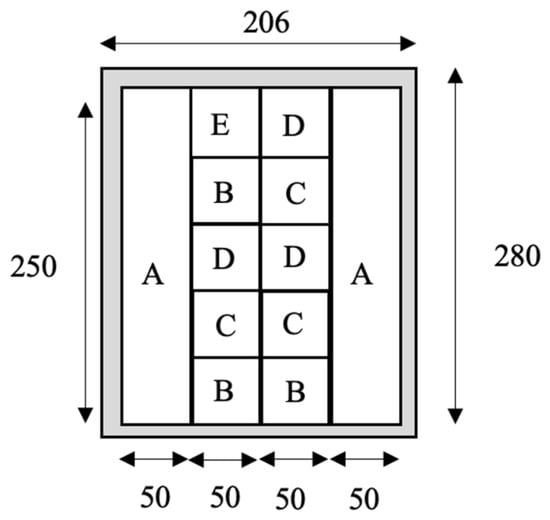
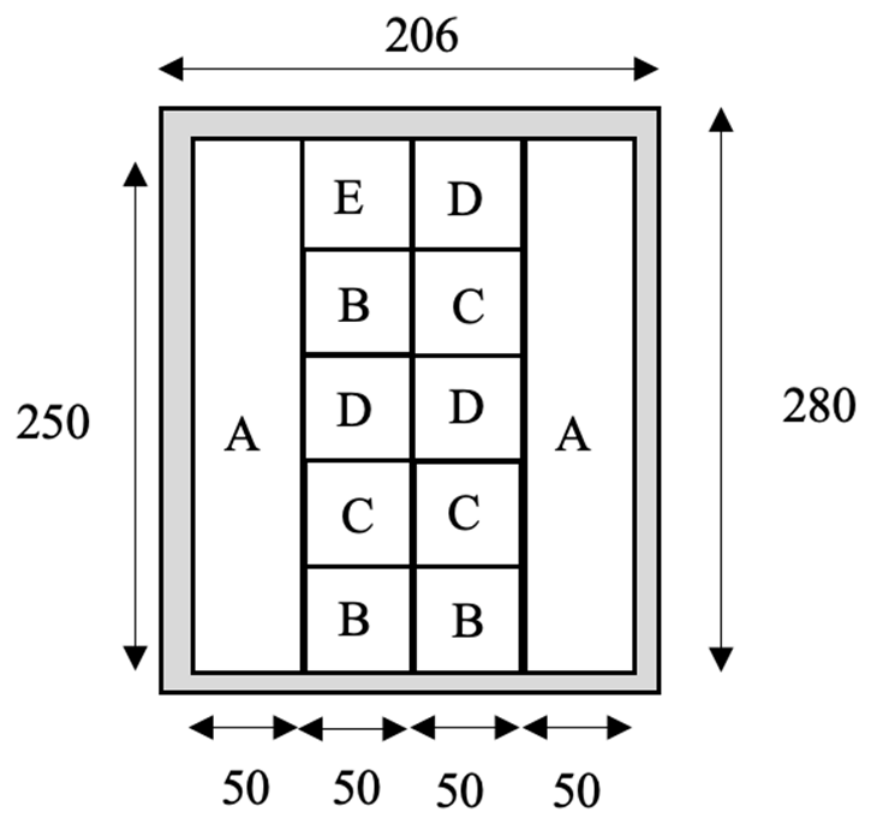
The measured MOE and MOR values were compared with the corresponding performance requirements specified in AS/NZS 1859.1:2017 for standard particleboard intended for dry service conditions (STD) within the nominal thickness range 12–22 mm [44]. The cutting layout used to obtain the required test specimens is shown in Figure 1, and the specimen dimensions and number of samples are given in Table 4.
Figure 1.
Cutting scheme of the fabricated panels designed according to AS/NZS 4266.1.
Table 4.
Sample details from cutting scheme for panel testing.
2.4.1. Physical Properties
The density of each specimen was determined by measuring its mass and volume, calculated as the ratio of oven-dry mass to specimen volume (kg/m3). The thickness swelling (TS) was evaluated by water immersion for 2 h and 24 h periods. After immersion, excess surface water was removed using a damp cloth, and the final sample thickness was measured. Equation (5) was used to express the TS of the test pieces;
where t1 and t2 are the thickness of the test piece before and after immersion, respectively.
Water absorption (WA) of the particleboard specimen was measured alongside the thickness swelling test. Test specimens were oven-dried at 103 °C until a constant mass was achieved, and the oven-dry mass was recorded. The specimens were then fully immersed in distilled water for 24 h, after which excess surface water was removed, and the wet mass was recorded. Water absorption was calculated as the percentage increase in mass relative to the oven-dry mass.
2.4.2. Mechanical Properties
The modulus of rupture (MOR) and modulus of elasticity (MOE) were determined using a 3-point bending test in accordance with AS/NZS 4266.1 2017. Testing was conducted using an Instron 5569A universal testing machine (Instron, Norwood, MA, USA) equipped with a 50 kN load cell. Each specimen was supported on two rollers, and a central load was applied at a constant crosshead speed of 10 mm/min until failure. The equations used for calculating MOE and MOR are provided in Appendix B.
2.5. Microstructural Characterisation
2.5.1. Scanning Electron Microscopy (SEM)
SEM analysis was conducted at two stages of the study. First, the surface morphology of the three wood particles was examined to identify differences in microstructure, surface characteristics, and fibre fragmentation, to complement the quantitative particle-geometry characterisation. Second, representative fabricated panels were examined to compare inter-particle contact and any apparent void morphology between the dry and wet fabrication routes. The wood particles and panel specimens were mounted on aluminium stubs with carbon tape and imaged with a Hitachi FlexSEM 1000 (Hitachi High-Tech Corporation, Minato-ku, Tokyo, Japan). Imaging was performed under a vacuum of 30 Pa, at an accelerating voltage of 15 kV and a working distance of 5.6 mm.
2.5.2. Micro-Computed Tomography (Micro-CT) Scanning and Analysis
Micro-computed tomography (micro-CT) was used to characterise the internal pore structure of the panels made from the three mix designs. Micro-CT scanning was performed with a Phoenix Nanotom M (Waygate Technologies, Wunstorf, Germany) operated using XS Control and Phoenix Datos|x 2.0 acquisition software.
Samples of 50mm × 50mm × 16mm particleboard were prepared and scanned for 15 min, collecting 1799 projections through a full 360-degree rotation of the specimen. An X-ray tube voltage and current of 85 kV and 300 microAmp was used, respectively, with a 0.1 mm aluminium filter to pre-harden the X-ray. The voxel resolution of scans was optimised to 30 µm. Volume reconstruction of the micro-CT data was performed using the Phoenix Datos|x reconstruction software, applying an inline median filter, ROI-CT filter and beam hardening correction filter during reconstruction. Data was exported in 32-bit and imported to Avizo3D Pro (Thermo Fisher Scientific, Waltham, MA, USA) for further analysis. Data was converted to 16-bit using consistent scaling parameters prior to analysis.
Data were imported to Avizo3D Pro (Version 2024.2, Thermo Fisher Scientific, Waltham, MA, USA) for further analysis. Data were reoriented so the sample was cross-sectioned parallel to the large interface (50 mm × 50 mm), and a consistent area of 45 mm × 45 mm was cropped within the sample boundaries to remove areas near the sample edges produced by cutting the smaller sections out of a larger board. Pores between wood particles were segmented using a combination of a grey-value threshold and Avizo’s interactive top-hat tool to improve the selection of narrow porous features using consistent thresholding parameters. The segmented pores were then quantified relative to the filled sample mask to give porosity as a function of distance passing through one interface to the opposite interface using Avizo’s Volume Fraction tool.
2.6. Statistical Analysis
All experimental data obtained from the physical and mechanical testing of the panels were statistically analysed using IBM SPSS Statistics (Version 30, IBM Corp., Armonk, NY, USA) to determine the influence of particle composition, resin content, and processing method on panel performance. A three-way analysis of variance (ANOVA) was conducted to evaluate the significance of the three factors on particleboard properties. All statistical analyses were performed at a 95% confidence level, with statistical significance assessed at p ≤ 0.05. Where significant three-way interactions were identified, simple-effect comparisons of estimated marginal means were performed to examine differences among factor levels within specific combinations of the remaining factors. Pairwise comparisons were adjusted using Tukey’s method, with statistical significance assessed at p < 0.05. Prior to analysis, data were screened for outliers and inconsistencies. Normality of the model residuals was assessed using the Shapiro–Wilk test, while Levene’s test was used to verify homogeneity of variance.
3. Results and Discussion
3.1. Particle Geometry and Microstructural Characteristics
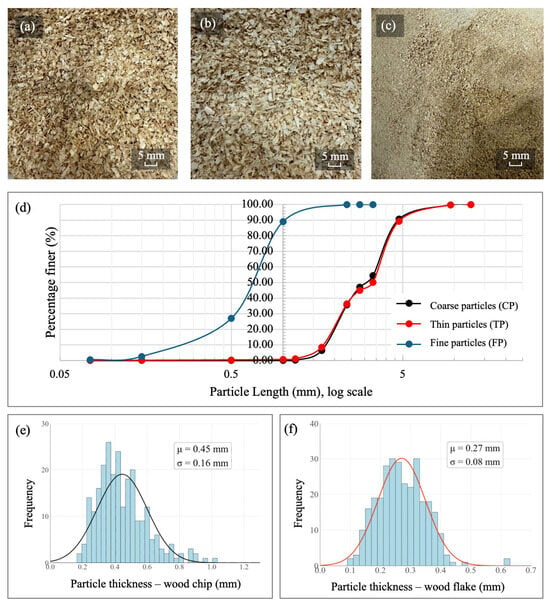
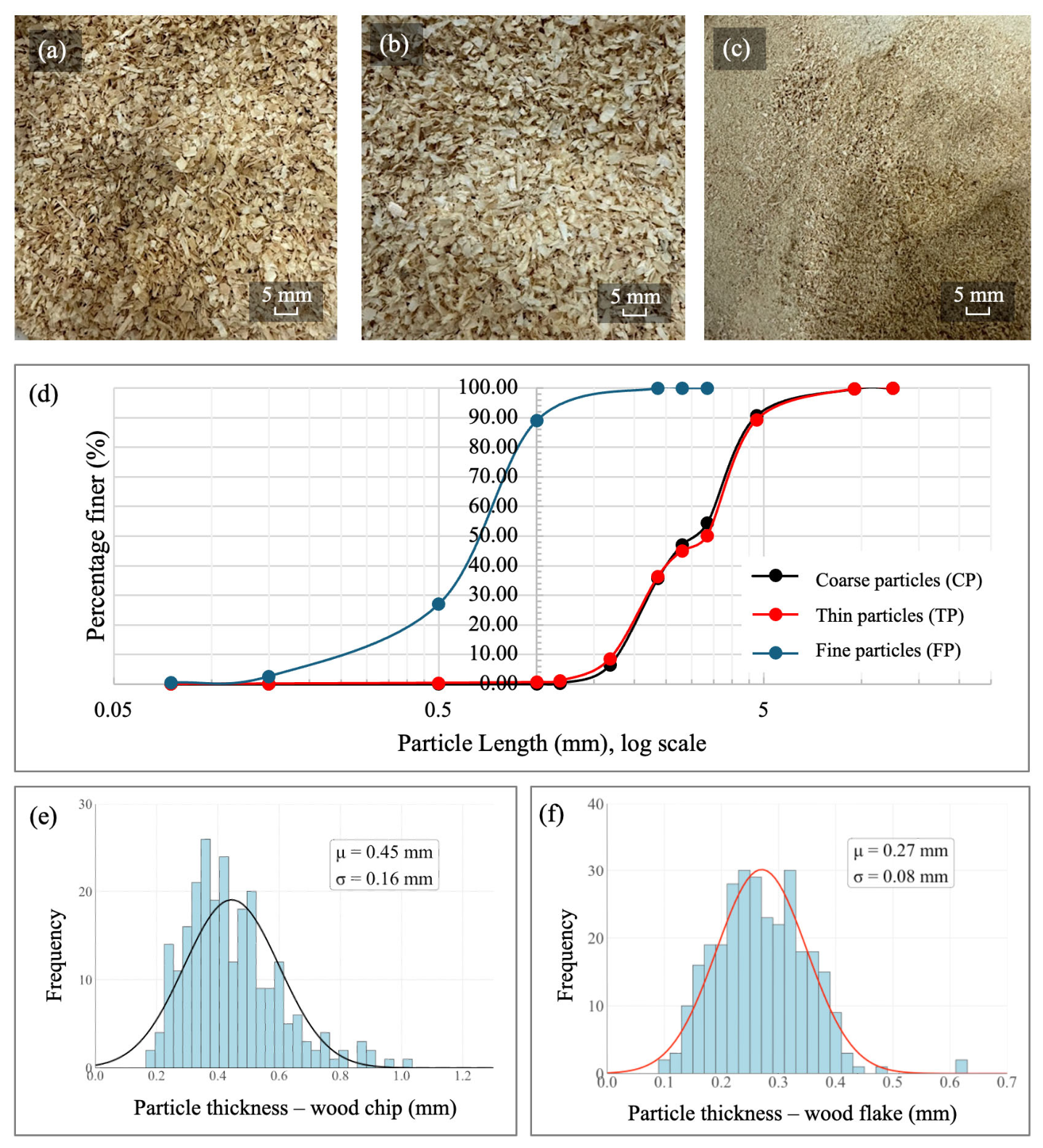
The three wood residue types—coarse particles (CP), thin particles (TP) and fine particles (FP) (Figure 2a–c)—exhibited distinct morphological and geometric characteristics. The bulk density, moisture content and particle geometry of each material are shown in Table 5. Fine particles exhibited the highest density and moisture content, followed by coarse particles and thin particles.
Figure 2.
Wood residue particle composition and characterisation: (a) coarse particles, (b) thin particles, (c) fine particles. (d) particle size distribution via sieve analysis, particle thickness distribution of (e) coarse particles, (f) thin particles.
Table 5.
Bulk density and moisture content of the three wood residues.
From the sieve analysis, fine particles had a clearly differentiated and narrower particle size distribution, whereas the coarse and thin particles followed relatively similar size distribution patterns (Figure 2d). However, image-based dimensional analysis revealed clear geometric differences between the two larger particle types. CPs had an average thickness of 0.45 mm (Figure 2e), while the TPs were thinner and indicated a more uniform particle distribution, as shown in Figure 2f. These geometrical differences can be attributed to their production methods, with thin particles typically produced using specialised flaking equipment that yields consistent, thin particles, whereas coarse particles are produced by splitting larger pieces of wood using a knife or hammer [18].
The geometrical difference between the two larger wood residues is further evaluated by the calculated shape factors in Table 3. Thin particles exhibited a higher degree of slenderness and flatness than the coarse particles. While the width coefficients were nearly identical for both CP and TP, the specific surface area was higher for TP and expected to be beneficial for adhesive distribution and bonding efficiency [28,45].
Scanning Electron Microscopy Analysis
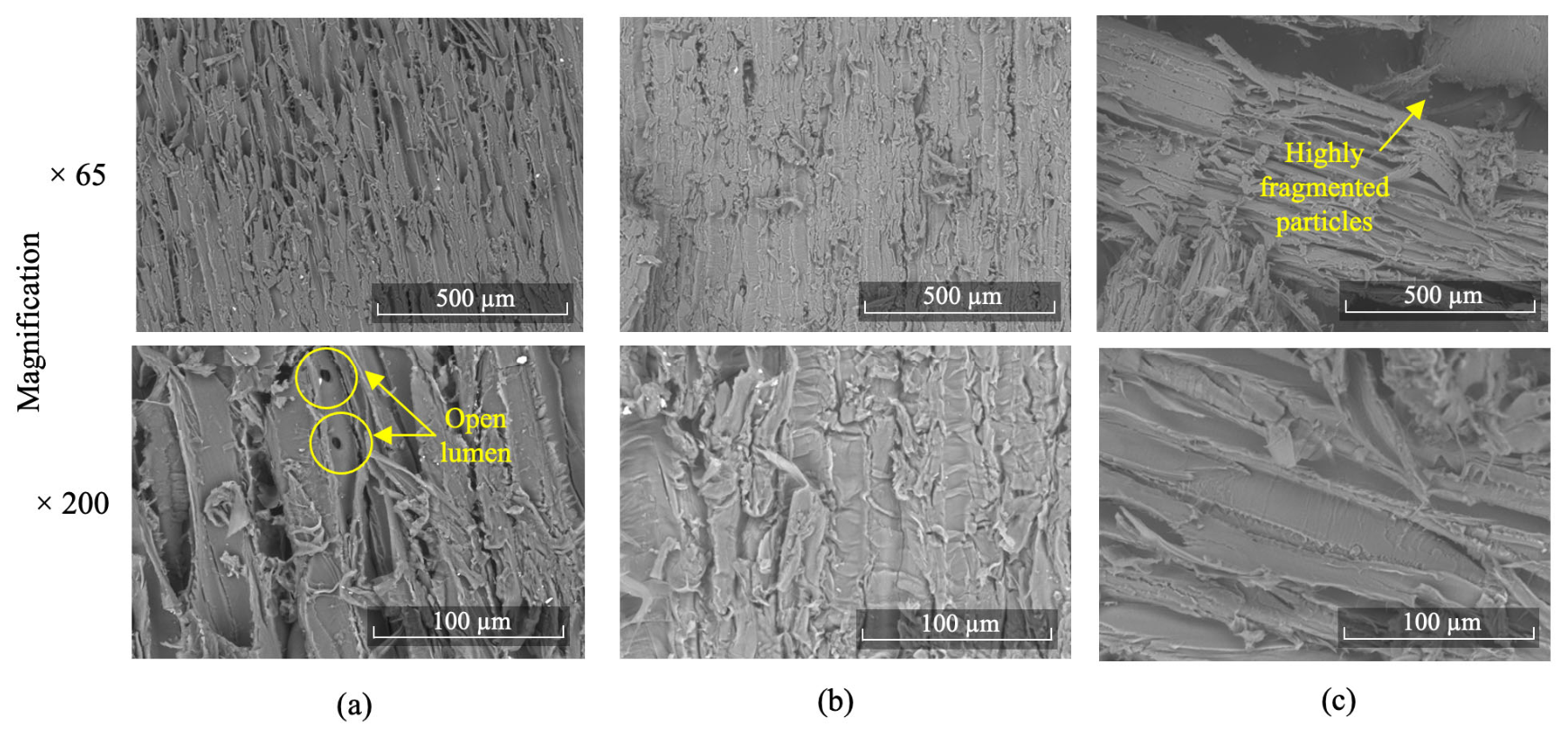
The SEM micrographs reveal distinct surface morphologies among the three wood residue particles (Figure 3). Coarse particles exhibited a relatively coarse irregular surface dominated by large, elongated tracheid bundles typical of softwood tissue, with clear open-lumen channels (Figure 3a). In comparison, thin particles (Figure 3b) exhibited a more open and fibrillated morphology consisting of thin cell walls with partially torn cell boundaries, and noticeable surface roughness caused by mechanical tearing during flaking [46]. Fine particles (Figure 3c) present a highly fragmented and porous microstructure comprising small fibres and irregular particles. Similar morphological variations have been reported for mechanically processed wood particles, in which finer fractions are characterised by individual, fragmented fibres, whereas coarser fractions retain more compact, multicellular wood structures [47,48]. This structure reflects the increased specific surface area, observed in Section 3.1, and can provide a more favourable morphology for adhesive wetting and mechanical interlocking between adjacent particles [22].
Figure 3.
Scanning electron microscopy (SEM) characterisation for (a) coarse particles; (b) thin particles; (c) fine particles.
3.2. Mechanical and Physical Properties of the Particleboards
The results of the mechanical and physical properties of the fabricated panels show that the density of the boards ranged between 597 kg/m3 and 622 kg/m3, showing good agreement with the expected design value.
3.3. ANOVA Results
The three-way ANOVA demonstrated that all three process factors—particle mix, resin percentage and fabrication process—had a statistically significant effect on the modulus of elasticity (MOE) and modulus of rupture (MOR) of the particleboards (Table 6). Particle mix was the dominant factor in both analyses, highlighting the control of particle mix and fines content in the mechanical performance of particleboards. Significant two-way interactions were detected for MOE across all factor combinations, while mix × resin and resin × process interactions were found to be significant for MOR, indicating that the effectiveness of resin addition depends strongly on the particle mix used, and that the resin contributed differently to stiffness development under the dry and wet fabrication processes.
Table 6.
Three-way ANOVA results for MOE and MOR.
For the panel densities, the three-factor ANOVA identified that out of the three factors examined only the fabrication process had a statistically significant effect on the panel density (F = 37.56, p < 0.001). Similarly, for the water absorption (WA) after 24 h immersion, only the fabrication process had a significant effect (F = 50.03, p < 0.001) (Table A2).
The three-way ANOVA for the 2 h and 24 h thickness swelling (TS) revealed that all three individual factors had statistically significant effects (Table 7). The fabrication process was found to be the dominant factor, exhibiting the highest F values for both 2 h and 24 h TS, confirming the strong influence of water-conditioned versus dry fabrication process on dimensional stability.
Table 7.
Three-way ANOVA results for TS after 2 h and 24 h immersion.
The influence of resin content increased substantially at 24 h immersion (F = 942.11), indicating that higher resin loading plays a more critical role in long-term moisture resistance. Significant two-way interactions were observed for mix × resin and mix × process for both TS responses. However, resin × process was only significant for TS after 24 h immersion, suggesting that long-term moisture resistance is strongly dependent on the coordinated effects of resin loading and processing conditions.
Importantly, the three-way interaction was significant for MOE, MOR and TS for both 2 h and 24 h immersion periods, suggesting that optimal panel performance cannot be achieved by adjusting individual factors independently, but rather through coordinated selection of Mix Composition, resin content and processing method. To further resolve these interaction effects, Tukey-adjusted simple-effect comparisons of estimated marginal means were performed for each factor within specific combinations of the remaining factors, with the results presented in Table 8.
Table 8.
Tukey-adjusted simple-effect comparisons for MOE, MOR, TS–2 h and TS–24 h following significant three-way interactions.
3.4. Interaction Effects and Performance Trends
3.4.1. Interaction Effects on Mechanical Performance of the Panels
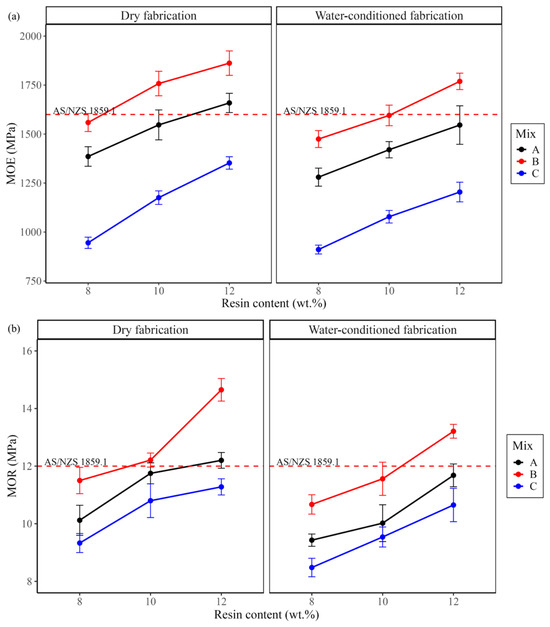
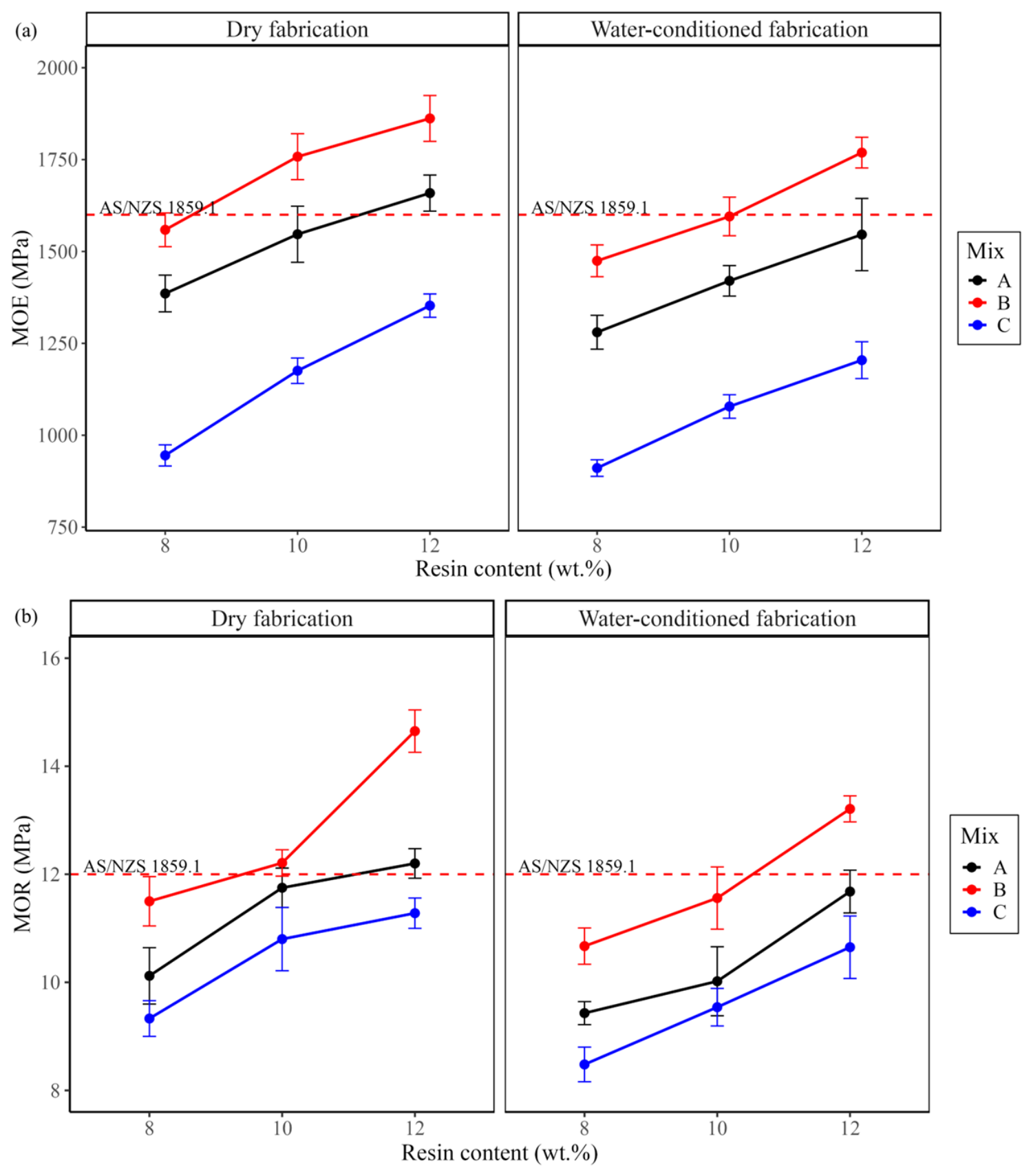
The interaction plots for the modulus of elasticity (MOE) and modulus of rupture (MOR) (Figure 4) illustrate the combined influence of particle mix, resin content and fabrication process on bending performance. Consistent with the ANOVA results, particle mix showed significant influence on the bending strength and stiffness of the particleboards, with panels fabricated from Mix B (100% thin particles) consistently exhibiting the highest MOE and MOR across all resin contents and fabrication routes. The maximum performance was achieved for panel B5, (12 wt.% resin, dry-processed), reaching average values of 1887 MPa for MOE and 14.8 MPa for MOR, which were comparably higher than the minimum requirements specified for standard particleboard intended for dry service conditions (STD) within the nominal thickness range 12–22 mm in AS/NZS 1859.1:2017 (1600 MPa and 12 MPa, respectively). The superior performance of Mix B confirms the mechanical advantage of thin particles with higher slenderness ratios and surface areas as observed in Section 3.1, which promote improved interlocking and stress transfer [22,43].
Figure 4.
Interaction plots of mechanical properties of particleboards (a) MOE and (b) MOR. Mix A = 100% WC, Mix B = 100% WF, Mix C = 50% WF, 50% SD. Error bars indicate 95% confidence intervals.
Increasing the resin content from 8 wt.% to 12 wt.% resulted in a systematic increase in the MOE and MOR for all panels, consistent with the positive influence of increased resin availability on bending performance reported in literature [49,50]. At 8 wt.% resin content, none of the panels produced from the three mixes achieved both the benchmark MOE and MOR values specified for STD particleboard in AS/NZS 1859.1:2017, suggesting that the nature of the wood residues requires higher resin loadings. At higher resin contents (10 wt.% and 12 wt.%), Mix B panels satisfied the requirements for MOE and MOR under both fabrication routes. Mix A (100% WC) panels exceeded these limits only under dry processing conditions.
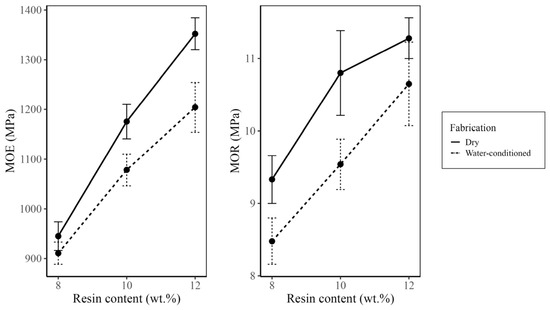
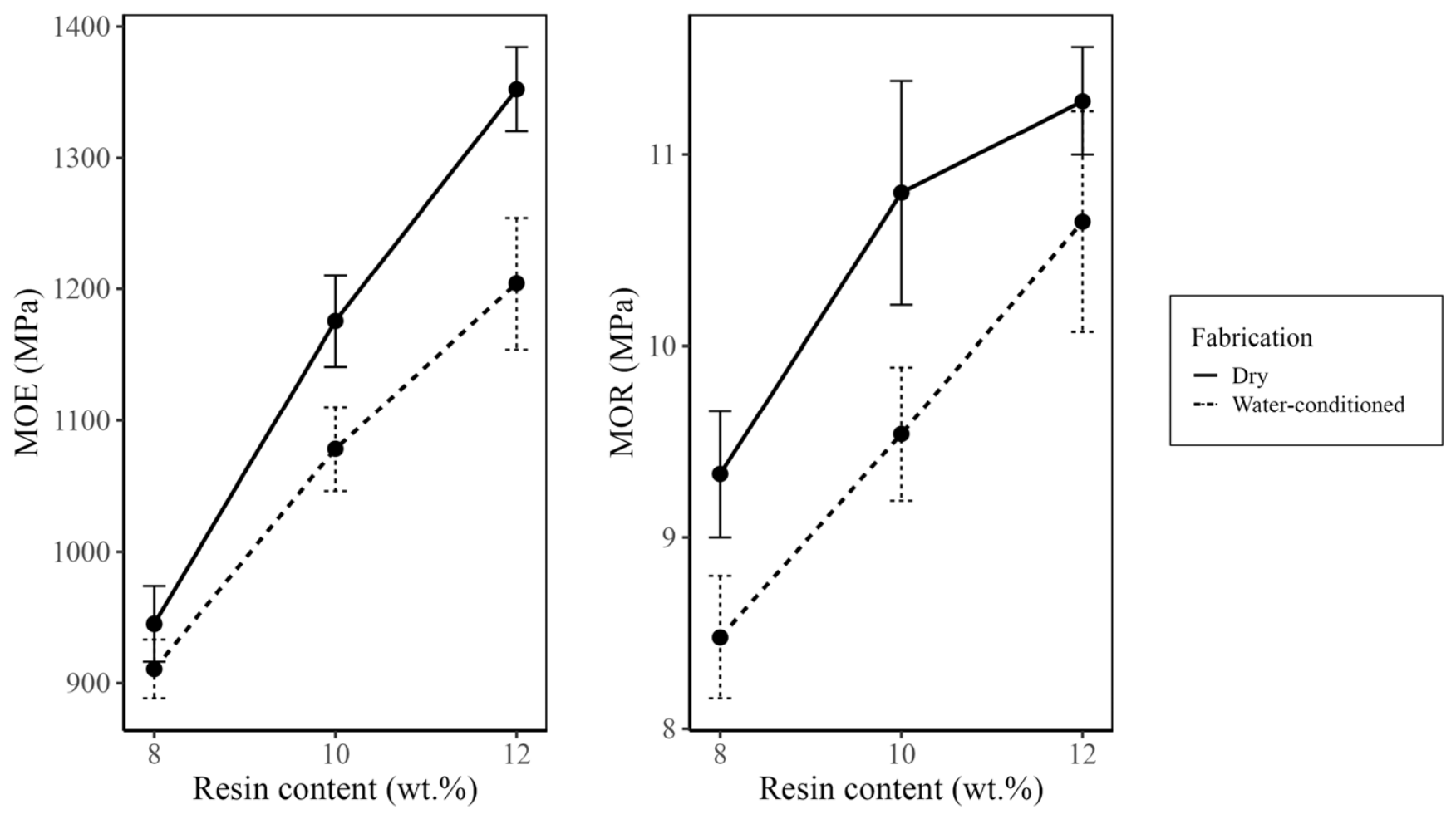
Panels fabricated from Mix C (50% TP and 50% FP) consistently yielded the lowest MOE and MOR values, attributed to the increased resin demand associated with high-fines systems, where insufficient adhesive availability limits effective particle coating and inter-particle bond formation [51]. However, the negative effect of fines can be partially mitigated through coordinated increases in resin content and appropriate selection of fabrication route. The progressive increase of resin content for Mix C panels led to substantial recovery of MOE and MOR (Figure 5). Notably, under dry processing conditions, this rate of improvement diminished between 10 wt.% and 12 wt.% resin, suggesting that the benefit of additional resin decreased at the higher loading.
Figure 5.
Effect of resin content on MOE and MOR of Mix C (50% WF and 50% SD) panels. Error bars indicate 95% confidence intervals.
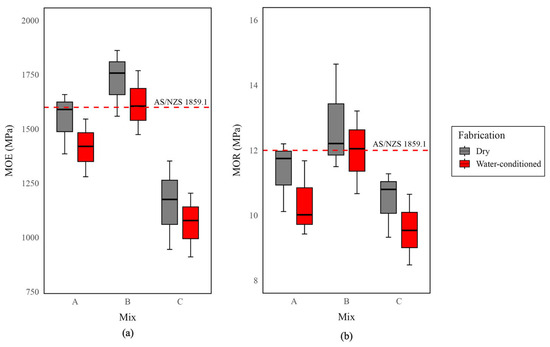
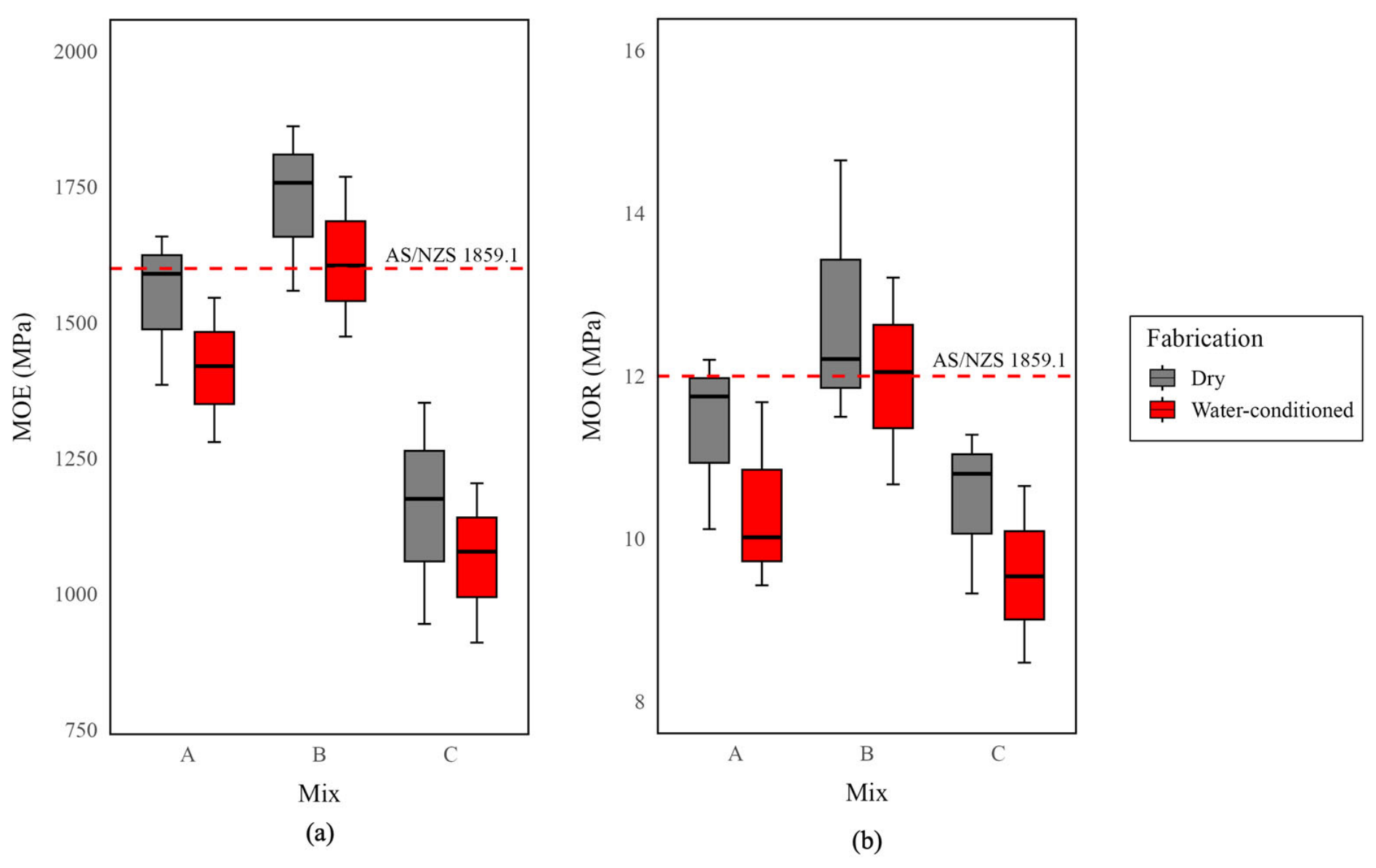
Across all mixes, dry-processed panels achieved higher MOE and MOR values than water-conditioned panels (Figure 6). Nemli, et al. [52] reported a similar observation for particleboards with varied moisture contents (9–17%), with panels with higher moisture contents having lower MOR and MOE values. Mat moisture content is known to influence wood particle plasticisation and consolidation behaviour during hot pressing, which can subsequently affect the bending properties [53].
Figure 6.
Boxplot of (a) MOE and (b) MOR values across different mix types (Mix A = 100% WC, Mix B = 100% WF, Mix C = 50% WF and 50% SD). Error bars indicate 95% confidence intervals.
However, the present results further reveal that although water-conditioned panels showed lower absolute strength values, their response to increasing resin content was more substantial than that of dry-process panels, as evidenced by the steeper slopes of the interaction curves in Figure 4. Importantly, these findings highlight the potential to incorporate higher proportions of wood residue fines in particleboard production without permanently compromising structural performance, provided resin loading and fabrication route are appropriately coordinated.
3.4.2. Interaction Effects on Physical Performance of the Panels
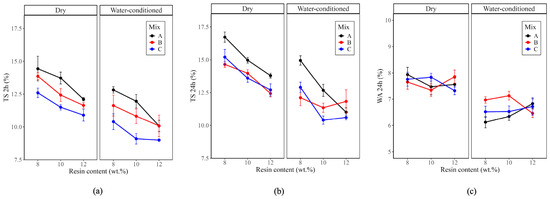
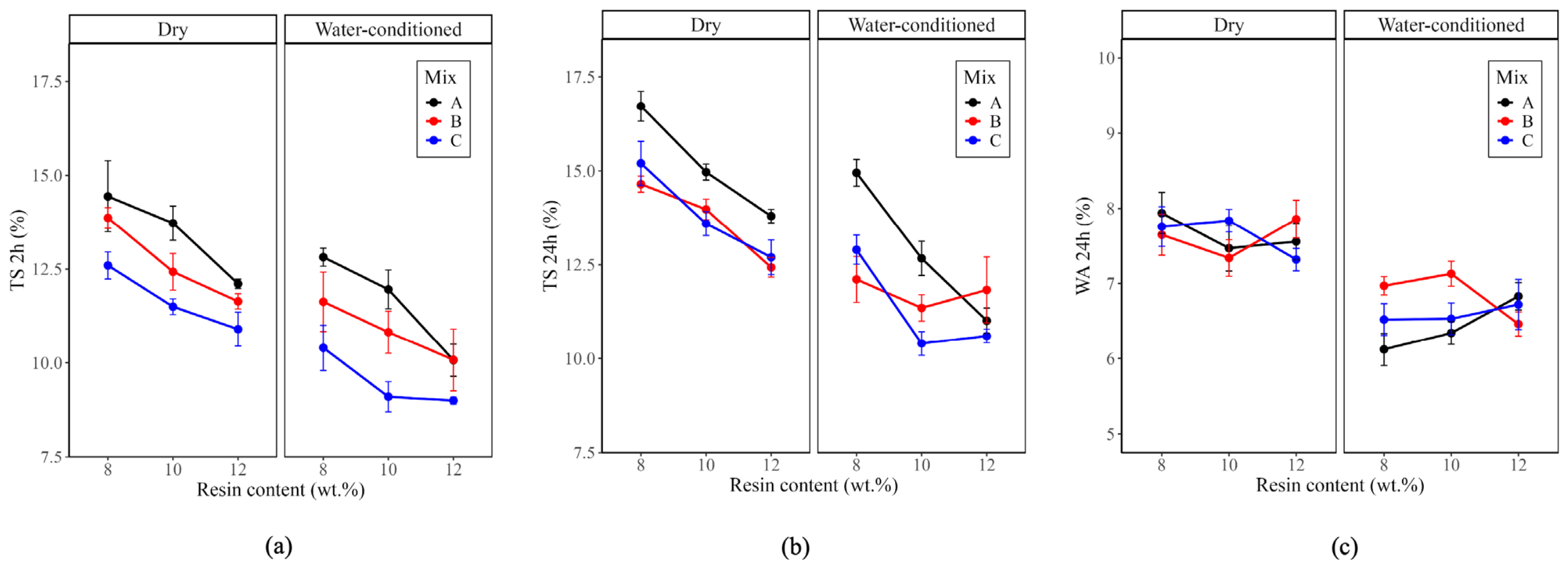
The interaction plots, supported by the ANOVA results, indicate that the thickness swelling (TS) of the panels after 2 h and 24 h immersion is governed by the coupled effects of particle mix, resin content, and fabrication process (Figure 7). Among the three formulations, Mix C (50% TP and 50% FP) exhibited the lowest TS values at both immersion durations, followed by Mix B (100% FP). These results demonstrate the influence of particle composition on the dimensional stability of the fabricated panels. In contrast to the TS, water absorption (WA) was less sensitive to particle mix and showed relatively small variations across the three mixes. Across all formulations, the 24 h water absorption values remained below 8%, ranging from 6.12% to 7.94%, with the water-conditioned panels generally exhibiting lower WA than the corresponding dry-route panels.
Figure 7.
Interaction plots for (a) Thickness swelling (TS) after 2 h immersion, (b) Thickness swelling (TS) after 24 h immersion, and (c) Water absorption (WA) after 24 h immersion. Mix A = 100% CP, Mix B = 100% TP, Mix C = 50% TP, 50% FP. Error bars indicate 95% confidence intervals.
Resin content had a secondary but beneficial effect on the particle mix and fabrication process, where higher resin loadings led to modest reductions in moisture uptake and thickness swelling across all mixes due to improved inter-particle bonding and higher effective resin distribution on particle surfaces [54]. Reflecting the significant mix × resin interaction for TS, for the panels containing fine particles (Mix C), increasing resin content produced a greater reduction in TS compared with mixes composed of larger particles, suggesting that higher binder loading is required to sufficiently encapsulate the increased surface area associated with fines to limit water uptake more efficiently.
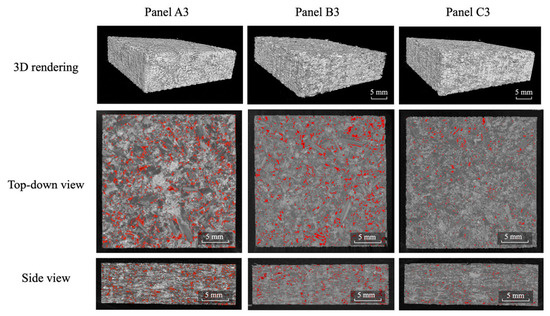
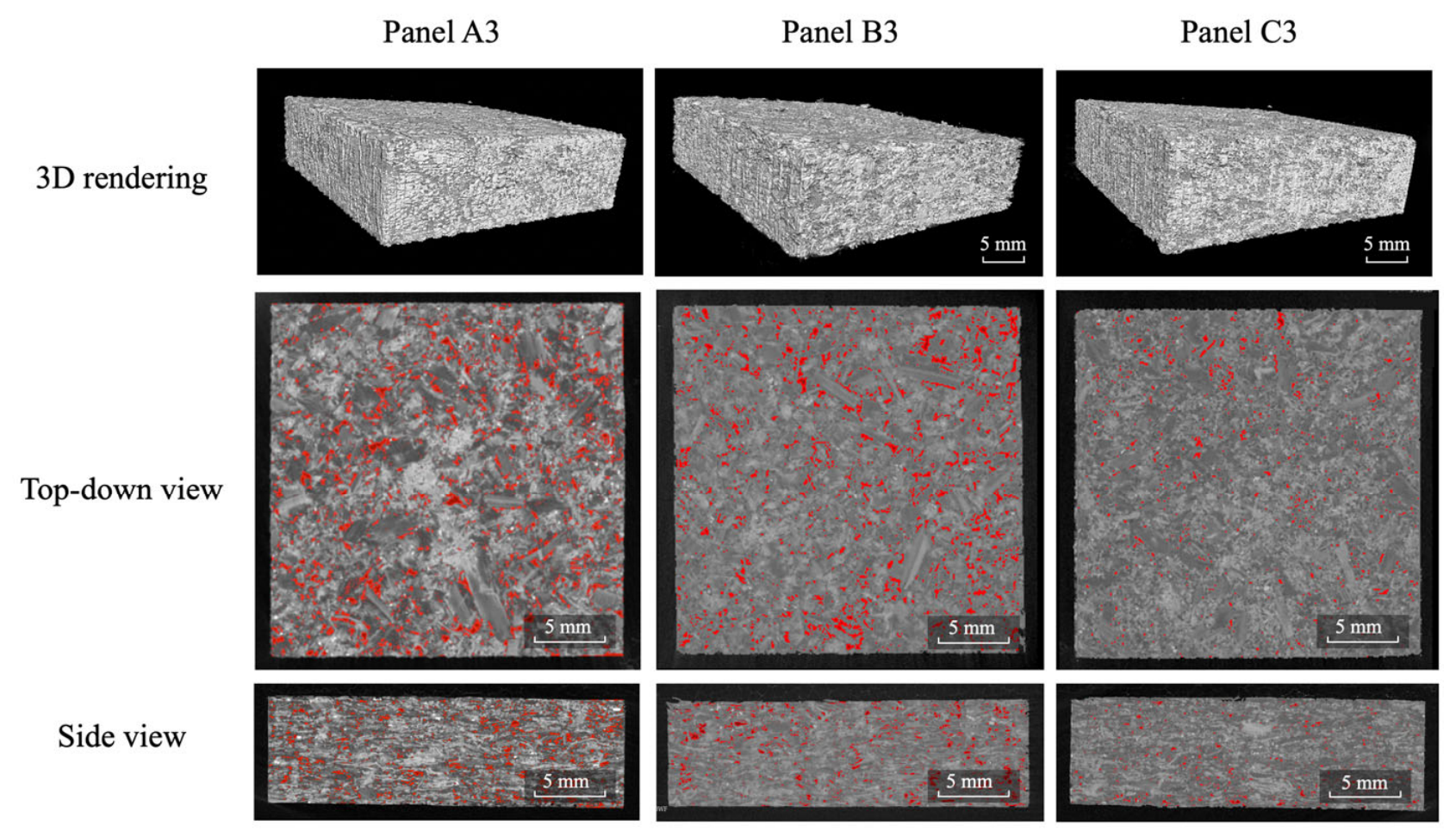
Similar to the trends observed in bending performance, the reduction of TS of Mix B compared with Mix A is attributed to improved mechanical interlocking associated with the high slenderness ratio of the thin particles, which promoted a more stable internal structure. The improved dimensional stability of Mix C panels can be attributed to reduced porosity by the presence of fine particles, which restricts water ingress [15,55]. To directly compare this effect, micro-CT observations of panels A3, B3, and C3 fabricated from the three different particle compositions and bonded with 10 wt.% resin content under dry processing conditions were analysed (Figure 8). The images confirmed that panel C3 exhibited a denser internal structure with lower porosity compared to panel A3 and B3. Quantitative image analysis showed that panel C3 also had the smallest average pore diameter (0.25 mm) among the three panel types. The 100% thin particle panel (A3) showed the highest porosity and average pore diameter, reflecting the relatively higher TS observed in the Mix A panels. The comparison of the porosity and average pore diameters between the three panels is given in Table 9. The inclusion of fine particles in panel C3 effectively filled macro pores between the larger wood particles, and a finer, more compact pore structure is observed. This microstructural refinement observation, supported by the measured lower porosity and pore sizes, suggests limited void space for water ingress, contributing to the reduced TS in the Mix C panels.
Figure 8.
Micro-CT observations of panels with three different particle compositions, bonded with 10 wt.% resin and fabricated using the dry process: A3 (100% WC), B3 (100% WF), and C3 (50% WF and 50% SD). Red regions indicate internal voids within the panel structure.
Table 9.
Porosity comparison between the panels with the three different particle compositions.
Importantly, this behaviour contrasts with the mechanical trends, where fines inclusion reduced bending performance. The results therefore highlight a performance trade-off: while thin particles enhance stiffness and strength, fine particles improve dimensional stability through pore refinement.
Also, in contrast with the mechanical performance, the panels produced using the water-conditioned process exhibited lower WA and TS values than dry-processed panels. For TS, this improvement reached up to 23.5% (Table A3).
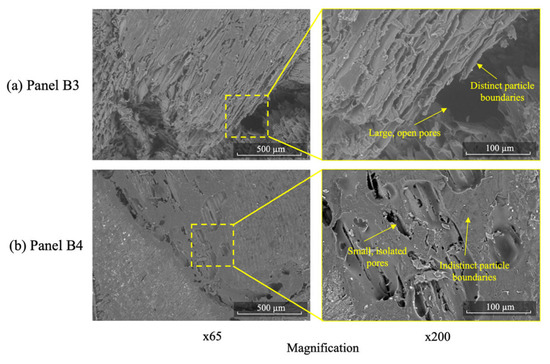
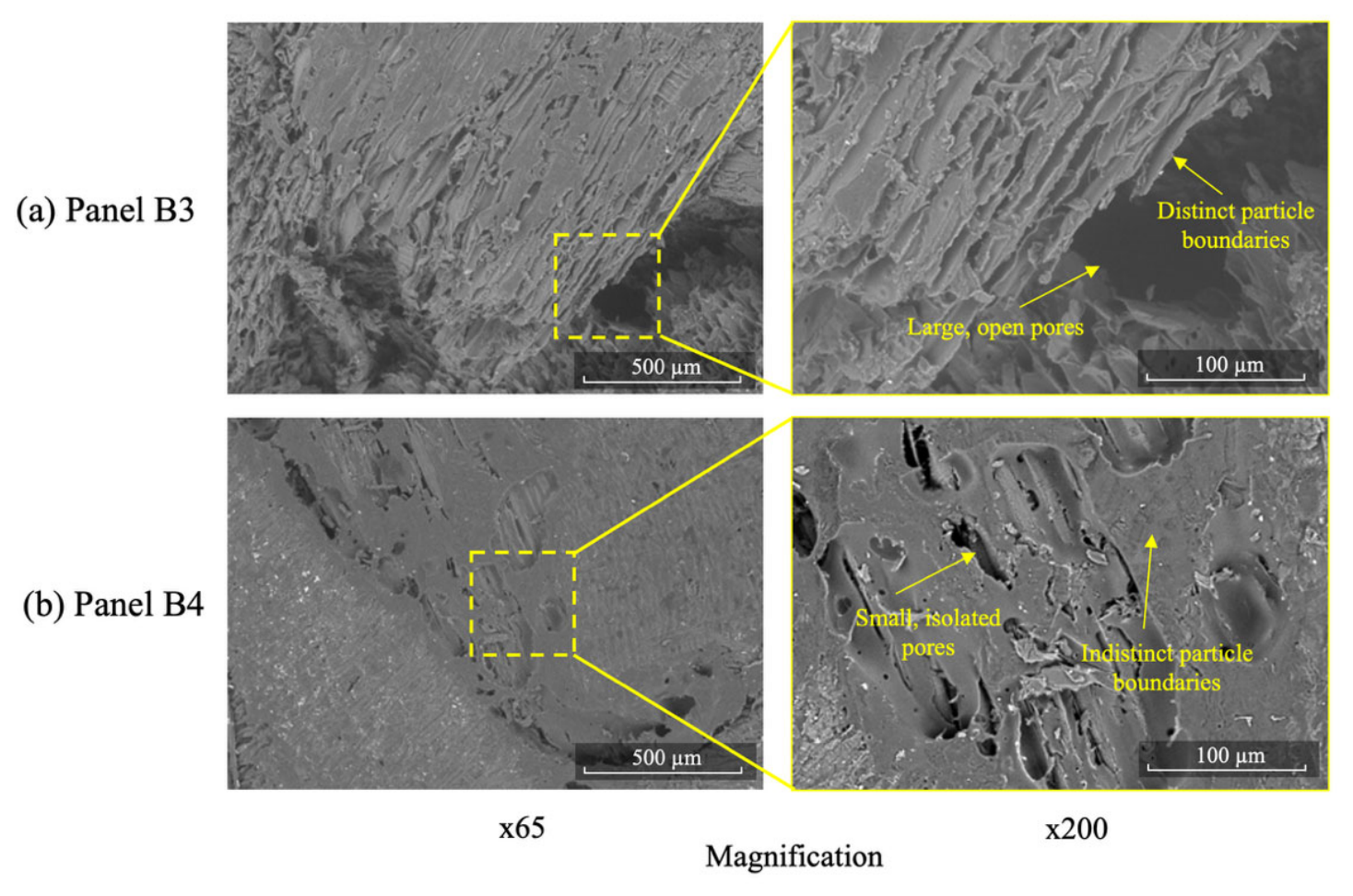
SEM observations of representative dry- and water-conditioned panels revealed qualitative differences in internal morphology (Figure 9). The dry-processed particleboards exhibited more distinct particle boundaries and comparatively larger apparent inter-particle voids, whereas the water-conditioned panels displayed a much denser morphology, with considerably smaller, isolated pores and indistinct particle boundaries. The observed microstructure suggests differences in particle rearrangement, where particles appear partially embedded into each other. Such local compaction could have contributed to the improved dimensional stability observed in the water-conditioned panels. Similar trends have been reported for medium density fibreboards (MDF) by Cai, et al. [56] and Popescu, et al. [57].
Figure 9.
SEM micrographs of (a) Panel B3—100% WF with 10 wt.% resin fabricated using dry fabrication, (b) Panel B4—100% WF with 10 wt.% resin fabricated using water-conditioned fabrication.
Overall, these findings indicate that dimensional stability in residue-based particleboards is strongly influenced by processing-induced structural characteristics, indicating that stability can be significantly engineered through coordinated material and fabrication design.
4. Conclusions and Recommendations
This study investigates how particle mix (particle geometry and inclusion of fines), resin content and fabrication route (dry vs. water-conditioned) jointly influence the mechanical and physical performance of engineered particleboards manufactured from radiata pine wood residues. The three-way ANOVA showed that particle mix, resin content and fabrication route had statistically significant effects on the modulus of elasticity (MOE), modulus of rupture (MOR), and thickness swelling (TS) after 2 h and 24 h immersion of the panels. In contrast, panel density and 24 h water absorption (WA) were significantly influenced only by the fabrication route. Strong interaction effects for the mechanical properties and TS further demonstrated that panel performance was governed by coupled mechanisms rather than single factors. Several key overall observations were made;
- Particle geometry was the dominant factor controlling bending performance, while the fabrication process had the highest statistical significance on the physical properties of the panels. Panels fabricated using thin particles with high slenderness ratios and surface areas exhibited the highest MOE and MOR, while panels fabricated using the water-conditioned process had the highest dimensional stability.
- Fine particle inclusion resulted in a distinct trade-off between strength and dimensional stability. Although the high fine particle content reduced MOE and MOR, micro-CT analysis showed a denser internal structure characterised by lower porosity and smaller pore features, which was associated with reduced thickness swelling. The reduction in bending performance associated with high fines content was partially mitigated through increased resin loading and appropriate selection of fabrication method.
- Fabrication route influenced contrasting effects on the mechanical and moisture-related properties of the panels. Dry-processed panels generally achieved higher bending strength and stiffness, while water-conditioned panels demonstrated lower thickness swelling (TS) and water absorption (WA). Although water-conditioned panels showed lower absolute strength values, their mechanical response to increasing resin content was more substantial than that of dry-process panels.
- Significant interaction effects highlighted the need for coordinated optimisation. The resin × process interaction revealed process-sensitive dimensional stability of the panels, while the mix × process interaction demonstrated that fabrication route modified the structural role of particle geometry—enhancing the mechanical advantage of thin particles under dry processing and amplifying the dimensional stability benefits of fines under water-conditioned processing.
Because panel density was maintained at approximately 600 kg/m3 throughout the experimental programme, the observed trends may not be reflected in particleboards with substantially lower or higher densities. Future studies should therefore incorporate density as an additional experimental factor to determine whether the identified material–process interactions are maintained across different density levels. Another limitation of the present study is that internal bond strength was not evaluated, restricting the assessment of through-thickness bonding performance. Accordingly, future research should investigate internal bond properties, while also extending the study to wider fines proportions, multi-layer panel configurations and a greater number of independent panel replicates to improve statistical power and better evaluate the balance between strength and dimensional stability. Long-term durability studies can also be undertaken to assess service-life reliability in construction applications. Such studies would support the development of predictive design frameworks for the industrial-scale adoption of wood-residue particleboards.
Author Contributions
Conceptualization, I.T.A. and P.M.; methodology, I.T.A. and T.G.; software, I.T.A.; validation, I.T.A.; formal analysis, I.T.A. and Y.Q.; investigation, I.T.A. and Y.Q.; data curation, I.T.A. and Y.Q.; writing—original draft preparation, I.T.A., Y.Q., T.G. and B.B.; writing—review and editing, I.T.A., Y.Q., T.G. and B.B.; visualisation, I.T.A. and B.B.; supervision, T.G., P.M. and B.B.; funding acquisition, P.M. All authors have read and agreed to the published version of the manuscript.
Funding
This research received no external funding.
Data Availability Statement
Data will be made available upon request.
Acknowledgments
This work was supported by the University of Melbourne Research Scholarship. The authors would also like to acknowledge Robbie Currie of Hexion Pty Ltd., Australia for the raw material acquisition, and the Material Characterisation and Fabrication Platform at the University of Melbourne, Australia, for their support in the experimental work. The authors would also extend their appreciation to the Melbourne Trace Analysis for Chemical, Earth and Environmental Sciences (TrACEES) Platform for access to the micro-CT scanner and Jay Black for technical support in running scans and analysing data. During the preparation of this work, the authors used ChatGPT-5.6 (16 July 2026) to improve readability and language. After using this tool, the authors reviewed and edited the content as needed and take full responsibility for the content of the published article.
Conflicts of Interest
The authors declare no conflicts of interest.
Abbreviations
The following abbreviations are used in this manuscript:
| CP | Coarse particles |
| TP | Thin particles |
| FP | Fine particles |
| MOR | Modulus of rupture |
| MOE | Modulus of elasticity |
| TS | Thickness swelling |
| WA | Water absorption |
| MC | Moisture content |
| SEM | Scanning electron microscopy |
| FT-IR | Fourier transform infrared spectroscopy |
| Micro-CT | Micro-computed tomography |
Appendix A
Table A1.
Sample calculation for Mix A with 8% resin content under dry process.
Appendix B
The modulus of elasticity (MOE) and modulus of rupture (MOR) were determined from the three-point bending test data in accordance with AS/NZS 4266.1:2017. The equations used for the calculations are provided below for completeness.
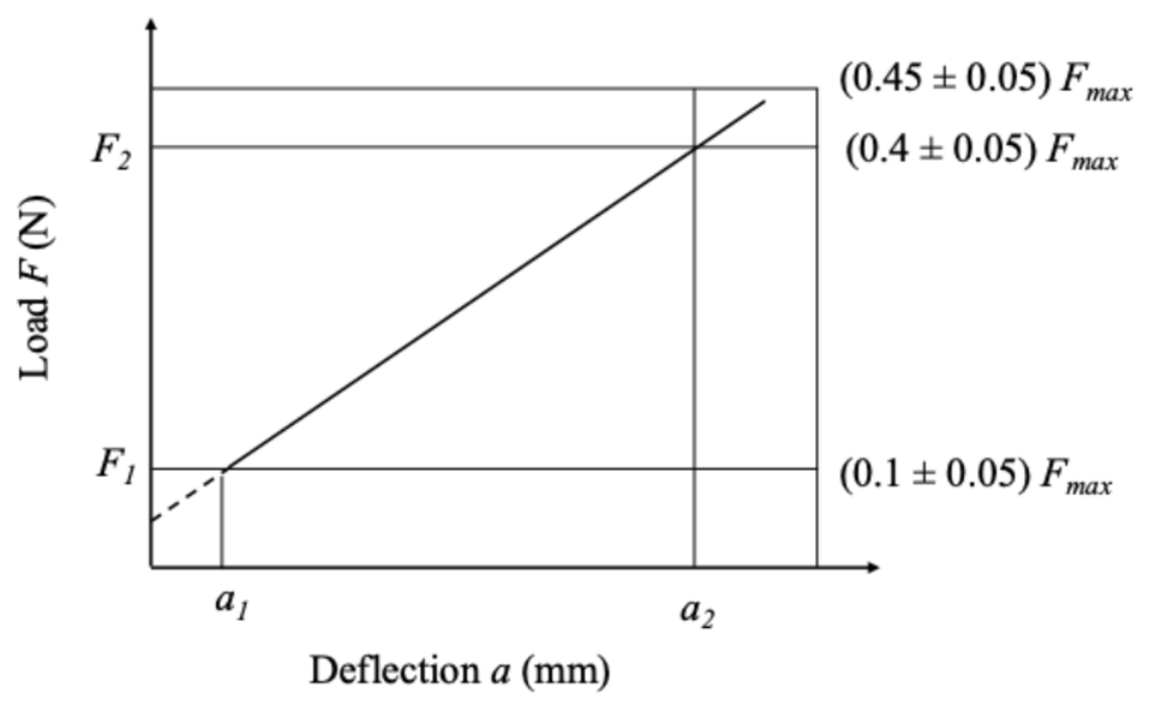
where l is the distance between the centres of the supports (mm), b and t are the width and thickness of the test piece, respectively. F1, F2, and a1, a2 are the loads and deflections corresponding to the load-deflection curve within the range of elastic deformation (Figure A1).
Figure A1.
Load-deflection curve within the range of elastic deformation, with a maximum load Fmax.
Appendix C
Table A2.
Three-way ANOVA results for density and water absorption (WA) of particleboards.
Appendix D
Table A3.
Percentage improvement for TS under 2 h and 24 h immersion periods under dry and water-conditioned fabrication process.
References
- Irle, M.; Barbu, M.; Niemz, P.; Carvalho, L.; Martins, J.; Costa, C.; Muszyski, L.; Launey, M.; Sernek, M.; Dunky, M.; et al. Wood-Based Panels: An Introduction for Specialists; Brunel University Press: London, UK, 2010. [Google Scholar]
- Niemz, P.; Teischinger, A.; Sandberg, D. Springer Handbook of Wood Science and Technology; Springer Nature: Cham, Switzerland, 2023; p. 2094. [Google Scholar]
- ABARES. Australian Forest and Wood Products Statistics, March and June Quarters 2022; ABARES Series Report; ABARES: Canberra, Australia, 2022. [Google Scholar]
- Nguyen, D.L.; Luedtke, J.; Nopens, M.; Krause, A. Production of wood-based panel from recycled wood resource: A literature review. Eur. J. Wood Wood Prod. 2023, 81, 557–570. [Google Scholar] [CrossRef] [Scilit]
- Saal, U.; Weimar, H.; Mantau, U. Wood Processing Residues. Adv. Biochem. Eng. Biotechnol. 2019, 166, 27–41. [Google Scholar] [CrossRef] [Scilit] [PubMed]
- Lenkiewicz, Z.; United Nations Environment Programme (UP). Global Waste Management Outlook 2024; United Nations Environment Programme (UP): Nairobi, Kenya, 2024. [Google Scholar]
- Jahan, I.; Zhang, G.; Bhuiyan, M.; Navaratnam, S. Circular Economy of Construction and Demolition Wood Waste—A Theoretical Framework Approach. Sustainability 2022, 14, 10478. [Google Scholar] [CrossRef] [Scilit]
- Cavalcanti, W.M.; de Oliveira, L.S.; Maziero, R.; Campos Rubio, J.C. The Feasibility of Producing Particleboards with Waste Wood from Civil Construction and Epoxidized Waste Cooking Oils. Fibers 2022, 10, 62. [Google Scholar] [CrossRef] [Scilit]
- Azambuja, R.d.R.; de Castro, V.G.; Trianoski, R.; Iwakiri, S. Utilization of construction and demolition waste for particleboard production. J. Build. Eng. 2018, 20, 488–492. [Google Scholar] [CrossRef] [Scilit]
- Czarnecki, R.; Dziurka, D.; Łęcka, J. The use of recycled boards as the substitute for particles in the centre layer of particleboards. Electron. J. Pol. Agric. Univ. 2003, 6, #01. [Google Scholar]
- Laskowska, A.; Mamiński, M. Properties of particleboard produced from post-industrial UF- and PF-bonded plywood. Eur. J. Wood Wood Prod. 2018, 76, 427–435. [Google Scholar] [CrossRef] [Scilit]
- Iždinský, J.; Reinprecht, L.; Vidholdová, Z. Particleboards from Recycled Pallets. Forests 2021, 12, 1597. [Google Scholar] [CrossRef] [Scilit]
- Zamarian, E.H.C.; Iwakiri, S.; Trianoski, R.; Albuquerque, C.E.C.d. Production of Particleboard from Discarded Furniture. Rev. Árvore 2017, 41, e410407. [Google Scholar] [CrossRef] [Scilit]
- Andrade, P.I.; Araújo, S.d.O.; Neiva, D.M.; Vital, B.R.; Carneiro, A.d.C.O.; Gominho, J.; Pereira, H. Strength properties and dimensional stability of particleboards with different proportions of thermally treated recycled pine particles. Holzforschung 2016, 70, 467–474. [Google Scholar] [CrossRef] [Scilit]
- Mirski, R.; Dukarska, D.; Derkowski, A.; Czarnecki, R.; Dziurka, D. By-products of sawmill industry as raw materials for manufacture of chip-sawdust boards. J. Build. Eng. 2020, 32, 101460. [Google Scholar] [CrossRef] [Scilit]
- Strategic Waste Management Board Western Australia. Wood Waste Recovery and Reuse Study; Strategic Waste Management Board Western Australia: Perth, Australia, 2007; Available online: https://www.emrc.org.au/profiles/emrc/assets/clientdata/documents/page_content/resource_recovery_project/woodwaste-recovery-and-reuse-study-july-2007.pdf (accessed on 22 January 2026).
- Amarasinghe, I.T.; Qian, Y.; Gunawardena, T.; Mendis, P.; Belleville, B. Composite Panels from Wood Waste: A Detailed Review of Processes, Standards, and Applications. J. Compos. Sci. 2024, 8, 417. [Google Scholar] [CrossRef] [Scilit]
- Maloney, T.M. Modern Particleboard & Dry Process Fiberboard Manufacturing; Miller Freeman Publications: San Francisco, CA, USA, 1993. [Google Scholar]
- Hashim, R.; Saari, N.; Sulaiman, O.; Sugimoto, T.; Hiziroglu, S.; Sato, M.; Tanaka, R. Effect of particle geometry on the properties of binderless particleboard manufactured from oil palm trunk. Mater. Des. 2010, 31, 4251–4257. [Google Scholar] [CrossRef] [Scilit]
- Fehrmann, J.; Belleville, B.; Ozarska, B.; Gutowski, V.; Wilson, D. Influence of particle granulometry and panel composition on the physico-mechanical properties of ultra-low-density hemp hurd particleboard. Polym. Compos. 2023, 44, 7363–7383. [Google Scholar] [CrossRef] [Scilit]
- Arabi, M.; Haftkhani, A.; Pourbaba, R. Investigating the Effect of Particle Slenderness Ratio on Optimizing the Mechanical Properties of Particleboard Using the Response Surface Method. BioResources 2023, 18, 2800–2814. [Google Scholar] [CrossRef] [Scilit]
- Engehausen, N.; Benthien, J.T.; Lüdtke, J. Influence of Particle Size on the Mechanical Properties of Single-Layer Particleboards. Fibers 2024, 12, 32. [Google Scholar] [CrossRef] [Scilit]
- Choupani Chaydarreh, K.; Lin, X.; Guan, L.; Hu, C. Interaction between particle size and mixing ratio on porosity and properties of tea oil camellia (Camellia oleifera Abel.) shells-based particleboard. J. Wood Sci. 2022, 68, 43. [Google Scholar] [CrossRef] [Scilit]
- Arabi, M.; Faezipour, M.; Layeghi, M.; Enayati, A.; Zahed, R. Prediction of bending strength and stiffness strength of particleboard based on structural parameters by Buckingham’s p-theorem. J. Indian Acad. Wood Sci. 2010, 7, 65–70. [Google Scholar] [CrossRef] [Scilit]
- Rahman, W.M.N.W.A.; Yatim, A.; Zlan, A.; Kasim, J.; Mohd Yunus, N.Y. Effects of the resin content and particle size on the properties of particleboard made of Neolamarckia and Leucaena particles. BioResources 2019, 14, 6079–6087. [Google Scholar] [CrossRef] [Scilit]
- Shi, L.; Hu, C.; Zhang, W.; Lin, X. Effect of hot-pressing and hydrothermal parameters on recycled wood particles and particleboards. Wood Mater. Sci. Eng. 2023, 18, 1741–1748. [Google Scholar] [CrossRef] [Scilit]
- Nirdosha, G.; Setunge, S. Formulation and process modeling of particleboard production using hardwood sawmill wastes using experimental design. Compos. Struct. 2006, 75, 520–523. [Google Scholar] [CrossRef] [Scilit]
- Dukarska, D.; Rogozinski, T.; Antov, P.; Kristak, L.; Kmieciak, J. Characterisation of Wood Particles Used in the Particleboard Production as a Function of Their Moisture Content. Materials 2021, 15, 48. [Google Scholar] [CrossRef] [Scilit] [PubMed]
- Jiang, J.; Lu, X. Effect of blocked polyurethane prepolymer on properties of MUF-particleboard made from high moisture particles. Int. J. Adhes. Adhes. 2017, 78, 189–194. [Google Scholar] [CrossRef] [Scilit]
- Nakato, K.; Sadoh, T.; Kimura, H.; Hattori, N.; Ohta, A.; Takano, K. On the Stratification of Particle Mat by Hot-Pressing. For. Res. Kyoto 1973, 45, 252–270. [Google Scholar] [CrossRef] [PubMed]
- Arévalo, R.; Peijs, T. Binderless all-cellulose fibreboard from microfibrillated lignocellulosic natural fibres. Compos. Part A Appl. Sci. Manuf. 2016, 83, 38–46. [Google Scholar] [CrossRef] [Scilit]
- Lee, S.H.; Lum, W.C.; Boon, J.G.; Kristak, L.; Antov, P.; Pędzik, M.; Rogoziński, T.; Taghiyari, H.R.; Lubis, M.A.R.; Fatriasari, W.; et al. Particleboard from agricultural biomass and recycled wood waste: A review. J. Mater. Res. Technol. 2022, 20, 4630–4658. [Google Scholar] [CrossRef] [Scilit]
- Rathke, J.; Sinn, G.; Harm, M.; Teischinger, A.; Weigl-Kuska, M.; Müller, U. Effects of alternative raw materials and varying resin content on mechanical and fracture mechanical properties of particle board. BioResources 2012, 7, 2970–2985. [Google Scholar] [CrossRef] [Scilit]
- Sam-Brew, S.; Smith, G. Flax Shive and Hemp Hurd Residues as Alternative Raw Material for Particleboard Production. BioResources 2017, 12, 5715–5735. [Google Scholar] [CrossRef] [Scilit]
- Pollards Sawdust Supplies. Available online: https://www.sawdust.com.au (accessed on 22 January 2026).
- AS/NZS 4266; 2017 Reconstituted Wood-Based Panels—Methods of Testing Base Panels. Standards Australia: Sydney, Australia, 2017.
- Wronka, A.; Kowaluk, G. The Influence of Multiple Mechanical Recycling of Particleboards on Their Selected Mechanical and Physical Properties. Materials 2022, 15, 8487. [Google Scholar] [CrossRef] [Scilit] [PubMed]
- Viana de Souza, M.; Silva, S.; Cazella, P.; Reis Rodrigues, F.; Bonfim, K.; Sanches, A.; De Araujo, V.; Santos, H.; Pinto, E.; Christoforo, A.; et al. Particleboards manufactured from Tectona grandis wood waste with homogeneous and three-layer heterogeneous compositions for commercial purposes. Bioresources 2022, 17, 5011–5020. [Google Scholar] [CrossRef] [Scilit]
- Schild, A.; Cool, J.; Barbu, M.-C.; Smith, G.D. Feasibility of substituting core layer strands in randomly OSB with contaminated waste wood particles. Wood Mater. Sci. Eng. 2021, 16, 170–177. [Google Scholar] [CrossRef] [Scilit]
- Dukarska, D.; Pędzik, M.; Rogozińska, W.; Rogoziński, T.; Czarnecki, R. Characteristics of straw particles of selected grain species purposed for the production of lignocellulose particleboards. Part. Sci. Technol. 2021, 39, 213–222. [Google Scholar] [CrossRef] [Scilit]
- Tawasil, D.N.; Aminudin, E.; Abdul Shukor Lim, N.H.; Nik Soh, N.; Leng, P.; Ling, G.; Ahmad, M. Coconut Fibre and Sawdust as Green Building Materials: A Laboratory Assessment on Physical and Mechanical Properties of Particleboards. Buildings 2021, 11, 256. [Google Scholar] [CrossRef] [Scilit]
- Antoun, K.; Besserer, A.; El Hage, R.; Segovia, C.; Sonnier, R.; Brosse, N. Environmentally-friendly, binder-free, non-flammable particleboard with enhanced properties. Ind. Crops Prod. 2024, 222, 119578. [Google Scholar] [CrossRef] [Scilit]
- Kawalerczyk, J.; Kuliński, M.; Majlingová, A.; Dukarska, D.; Mirski, R. The effect of wood particles polyesterification with sorbitol and citric acid on the properties of particleboard produced with the use of PF/pMDI adhesive. Eur. J. Wood Wood Prod. 2024, 82, 1725–1737. [Google Scholar] [CrossRef] [Scilit]
- AS/NZS 1859.1: 2017; Reconstituted Wood-Based Panels—Specifications. Standards Australia: Sydney, Australia, 2017.
- Engehausen, N.; Benthien, J.T.; Lüdtke, J. Investigation on the influence of particle size and surface-specific adhesive amount on mechanical properties and sorption behavior of particleboard. Eur. J. Wood Wood Prod. 2025, 83, 123. [Google Scholar] [CrossRef] [Scilit]
- Ross, R.J.; USDA Forest Service, Forest Products Laboratory; U.S. Department of Agriculture, Forest Service, Forest Products Laboratory. Wood Handbook: Wood as an Engineering Material; U.S. Department of Agriculture, Forest Service, Forest Products Laboratory: Madison, WI, USA, 2010.
- Martins, C.I.; Gil, V.; Rocha, S. Thermal, Mechanical, Morphological and Aesthetical Properties of Rotational Molding PE/Pine Wood Sawdust Composites. Polymers 2022, 14, 193. [Google Scholar] [CrossRef] [Scilit] [PubMed]
- Mazzoli, A.; Favoni, O. Particle size, size distribution and morphological evaluation of airborne dust particles of diverse woods by Scanning Electron Microscopy and image processing program. Powder Technol. 2012, 225, 65–71. [Google Scholar] [CrossRef] [Scilit]
- Tayo, L.T.; Nayaka, D.S.; Cárdenas-Oscanoa, A.J.; Euring, M. Enhancing physical and mechanical properties of single-layer particleboards bonded with canola protein adhesives: Impact of production parameters. Eur. J. Wood Wood Prod. 2024, 83, 6. [Google Scholar] [CrossRef] [Scilit]
- Maraghi, M.M.; Tabei, A.; Madanipoor, M. Effect of board density, resin percentage and pressing temprature on particleboard properties made from mixing of poplar wood slab, citrus branches and twigs of Beech. Wood Res. 2018, 63, 669–682. [Google Scholar]
- Olupot, P.W.; Menya, E.; Lubwama, F.; Ssekaluvu, L.; Nabuuma, B.; Wakatuntu, J. Effects of sawdust and adhesive type on the properties of rice husk particleboards. Results Eng. 2022, 16, 100775. [Google Scholar] [CrossRef] [Scilit]
- Nemli, G.; Aydın, I.; Zekoviç, E. Evaluation of some of the properties of particleboard as function of manufacturing parameters. Mater. Des. 2007, 28, 1169–1176. [Google Scholar] [CrossRef] [Scilit]
- Wong, E.D.; Zhang, M.; Wang, Q.; Kawai, S. Effects of mat moisture content and press closing speed on the formation of density profile and properties of particleboard. J. Wood Sci. 1998, 44, 287–295. [Google Scholar] [CrossRef] [Scilit]
- Lee, S.H.; Chen, L.W.; Antov, P.; Can, A.; Fatriasari, W.; Chotikhun, A. Influence of Wax and Resin Content on the Properties of Three-Layer Rubberwood Particleboard. Bioresour. Environ. 2023, 1, 12–24. [Google Scholar] [CrossRef] [Scilit]
- Dadzie, P.K.; Awotwe-Mensah, M.; Amoah, M. Materials mix ratio and binder type effects on physical and mechanical properties of particleboard from mixed-wood sawdust and Cocos nucifera (Coconut) husks. J. Indian Acad. Wood Sci. 2021, 18, 128–140. [Google Scholar] [CrossRef] [Scilit]
- Cai, Z.; Muehl, J.; Winandy, J. Effects of panel density and mat moisture content on processing medium density fiberboard. For. Prod. J. 2006, 56, 20–25. [Google Scholar]
- Popescu, C.-M.; Jones, D.; Schalnat, J.; Segerholm, K.; Henriksson, M.; Westin, M. Structural characterization and mechanical properties of wet-processed fibreboard based on chemo-thermomechanical pulp, furanic resin and cellulose nanocrystals. Int. J. Biol. Macromol. 2020, 145, 586–593. [Google Scholar] [CrossRef] [Scilit] [PubMed]

Disclaimer/Publisher’s Note: The statements, opinions and data contained in all publications are solely those of the individual author(s) and contributor(s) and not of MDPI and/or the editor(s). MDPI and/or the editor(s) disclaim responsibility for any injury to people or property resulting from any ideas, methods, instructions or products referred to in the content. |
© 2026 by the authors. Licensee MDPI, Basel, Switzerland. This article is an open access article distributed under the terms and conditions of the Creative Commons Attribution (CC BY) license.