


Abstract
A ternary CdS–MoS2–rGO photocathode was developed to enhance visible light-driven hydrogen evolution through interfacial heterostructure engineering. The composite was fabricated via a solution-based deposition method followed by thermal conversion, resulting in crystalline CdS and MoS2 phases that were uniformly integrated within a conductive reduced graphene oxide (rGO) framework. Structural and surface analyses (XRD and XPS) confirmed the coexistence of Cd2+, Mo4+, and S2− chemical states without detectable secondary phases. Photoelectrochemical measurements revealed that the ternary architecture significantly improves charge separation efficiency and interfacial charge-transfer kinetics compared to binary and single-component films. The CdS–MoS2–rGO photocathode exhibited the highest photocurrent density, reduced charge-transfer resistance, and favorable Tafel slope under visible-light irradiation (0.25 sun, neutral electrolyte). Gas chromatography measurements verified that these electrochemical enhancements translate into increased hydrogen production rates, following the trend: CdS–MoS2–rGO > CdS–rGO > MoS2–rGO >> rGO. Applied bias photon-to-current efficiency (ABPE) analysis further confirmed improved photon utilization efficiency in the ternary system. The enhanced performance is attributed to synergistic integration of CdS (light harvesting), rGO (rapid electron transport), and MoS2 (catalytic edge sites), which suppresses recombination and accelerates proton reduction kinetics. These findings demonstrate that rational multi-component heterostructure design is an effective strategy for improving hydrogen evolution rate under mild operating conditions.
1. Introduction
Photoelectrochemical (PEC) hydrogen evolution has attracted significant interest as a long-term solution to the transformation of solar light to chemical fuel [1]. An efficient photocathode of PEC must have an optimal alignment of band edges, efficient light harvesting, rapid charge transfer, and photocorrosion that is not affected by aqueous environments [1,2]. Cadmium sulfide (CdS) has been widely used as visible light-responsive semiconductors because it has a suitable bandgap and a sufficiently negative conduction band edge (CB) edge which allows proton reduction [2,3]. Nonetheless, pure CdS is prone to severe photocorrosion and fast recombination of electrons and holes and therefore has poor long-term stability and practical use.
To address these drawbacks, a range of strategies have been extensively investigated, such as the heterojunction of CdS with cocatalysts and conductive material, which could enhance charge separation and inhibit recombination [4,5]. Specifically, molybdenum disulfide (MoS2) has become a viable non-precious cocatalyst in the hydrogen evolution reaction (HER) [6,7] because the edges of MoS2 materials offer near-optimal energy in the hydrogen adsorption procedure, and defective or metallic spaces can also be used to improve electron transfer characteristics. However, the light absorption and charge transport efficiency of MoS2 remain limited, and thus it must be combined with appropriate photoabsorbers and conductive scaffolds [7,8]. MoS2 remains one of the most effective earth-abundant HER cocatalysts, where activity is strongly linked to exposed edge sites, phase/defect engineering, and improved electronic coupling to conductive supports. Recent studies have further refined the understanding of MoS2 active sites and activity–stability relationships, highlighting the need for architectures that combine (i) efficient light harvesting (photoabsorber), (ii) fast electron extraction/transport (conductive scaffold), and (iii) high-density catalytic sites (MoS2) [9,10]. In this context, ternary composites integrating a visible-light absorber with MoS2 and a conductive carbon network have emerged as a powerful strategy to accelerate interfacial charge transfer and enhance HER performance under mild (neutral) electrolytes [11,12].
Reduced graphene oxide (rGO) is commonly used to enhance conductivity in PEC system because it is highly electrically conductive, has a large surface area, and can form percolating networks that allow the transfer of electrons. In conjunction with semiconductors, rGO may serve as an effective electron extraction material, which decreases charge buildup and prevents photocorrosion. Introduction of rGO to composite photocathodes has thus been demonstrated to enhance photoelectrochemical activity as well as operational stability [13,14,15].
Here, the development of a tri-composite with CdS as the light absorber, rGO as the electron transport network and MoS2 as the HER cocatalyst is a logical solution for improving the hydrogen evolution of PEC [16]. This type of setup will likely enhance the process of vectorial charge transfer, in which photogenerated electrons are pumped out of CdS, carried by rGO, and absorbed at the MoS2 catalytic site [17]. Concurrently, CdS can be inhibited by rGO and MoS2, thereby preventing interfacial charge concentration [18,19]. The recent literature has shown that CdS-based photocathodes can exhibit an improved hydrogen evolution performance in the presence of appropriate cocatalysts and conductive supports. Specifically, MoS2 has been extensively known as a good and earth-abundant cocatalyst to reduce protons, whereas reduced graphene oxide is a major role in transporting charges and inhibiting recombination. To expand on these findings, the current research presents a CdS–MoS2rGO composite system that can be used to enhance photoelectrochemical activity and stability under neutral pH condition [19].
In the current paper, a CdS-MoS2-rGO thin-film photocathode was produced by a drop-spin-coating technique with simple solution and subsequent thermal treatment in the presence of nitrogen.
The photoelectrochemical performance of the ternary system was systematically compared with binary and single-component control films under neutral pH conditions. Hydrogen evolution under neutral/near-neutral conditions is attractive for practical photoelectrochemical operation due to improved compatibility with many photoelectrodes and reduced corrosion compared with strongly acidic/alkaline media. However, neutral pH HER typically suffers from slower kinetics because proton availability is lower and water dissociation/transport limitations become more pronounced, making interfacial charge transfer and catalytic site utilization critical. Recent reviews emphasize that overcoming these constraints requires catalysts/cocatalysts that lower kinetic barriers while simultaneously minimizing charge-transfer resistance across the electrode–electrolyte interface [20].
Charge-transfer kinetics, interfacial properties, and operational stability have been given special attention. Recent studies have emphasized the importance of comprehensive evaluation, including long-term stability, Faradaic efficiency, and accurate gas quantification, to validate photocatalytic performance [12]. The findings offer an understanding of the synergistic functions of every part and show the prospects of the CdS—MoS2-rGO architecture in mild aqueous hydrogen evolution.
2. Materials and Methods
All the chemicals were of analytical grade and are employed without subsequent purification. Potassium permanganate (KMnO4 Sigma-Aldrich, St. Louis, MO, USA), sulfuric acid (H2SO4 Merck, Darmstadt, Germany), hydrochloric acid (HCl Merck, Darmstadt, Germany), hydrogen peroxide (H2O2, 30% Sigma-Aldrich, St. Louis, MO, USA), cadmium nitrate tetrahydrate (Cd(NO3)2·4H2O Alfa Aesar, Ward Hill, MA, USA)), sodium molybdate dihydrate (Na2MoO4·2H2O Sigma-Aldrich, St. Louis, MO, USA), thiourea (Sigma-Aldrich, St. Louis, MO, USA), ethanol and aqueous ammonia from Merck, Darmstadt, Germany. Conductive supports were made out of fluorine-doped tin oxide (FTO, 15 Ω sq−1) glass substrates cut into 2 × 2 cm2 pieces. After a copper wire connection and epoxy glue protection had been applied around the film’s edges, the geometric area was roughly 1 cm2.
2.1. Preparation of Graphene Oxide (GO)
The modified Hummers method was used in the literature to prepare graphene oxide (GO) [1,2]. The suspension of the graphite flakes in concentrated H2SO4 was stirred by maintaining a low temperature of less than 10 °C in a typical procedure. KMnO4 was slowly added to the suspension and then allowed to heat at 35–45 °C and stirred until 2 h. The reaction mixture was subsequently cooled, followed by a very gradual dilution with ice water and the quenching of the reaction process by the gradual addition of H2O2 to the reaction mixture to produce a bright-yellow suspension. The product thus obtained was repeatedly washed using dilute HCl and deionized water until the product attained a near neutral pH. Sonication and centrifugation produced the last GO dispersion, which was a stable aqueous suspension (approximately 3.5–4 mg mL).
2.2. Preparation of Substrates of FTO
Before the deposition of the films, FTO substrates were washed under ultrasonic deionized water, isopropanol, and acetone conditions for 10 min each. The substrates were dried under the flow of nitrogen and they were then treated using UV-ozone in a ratio of 15 min to increase the wettability of the surface. A short plasma cleaning treatment was used to create a hydrophilic surface that was capable of uniformly depositing thin film.
2.3. CdS–MoS2-rGO Composite Ink Was Prepared by Adding 500.00 g of CdS, CdS to 100.00 g of MoS2 and Then 0.25 g of rGO
A precursor ink containing a composite was dissolved in solutions prepaired from the calculated quantities of Cd (NO3)2·4H2O, Na2MoO4·2H2O, and thiourea in deionized water with stirring until a clear solution was formed. The amounts in Table 1 were determined by considering the target wt% ratio of CdS, MoS2, and rGO at a constant total solid loading and 15 min of aging to form metal–thiourea complexes. The amount of thiourea added was tenfold in the molar ratio of the total amount of metal mass to be thoroughly sulfurized in the thermal treatment. Ethanol [3] was then used to obtain an ethanol water co-solvent ratio of 85:15 (v/v). The required percentage of rGO in the final composite was added by the addition of a measured volume of GO dispersion. Poly(vinylidene fluoride) (PVDF) (0.01–0.03 wt) was used as a binder to enhance the adhesion of the film. The last ink was sonicated for 30 min in order to make it homogeneous (see Table 1).
Table 1.
Calculated A, B, C, D composite components in 10 mL ink, (1.2 mg mL−1), EtOH:H2O 85:15 v/v.
The four compositions that were investigated in this work were chosen in order to provide a systematic measure of the effect of differing MoS2 and rGO content, with CdS remaining the main light absorber. Additional catalytic edge sites to promote hydrogen evolution are given by increasing the content of MoS2, and rGO increases the charge transport and inhibits recombination. The compositions can be used to determine an optimal ratio between light absorption, electron transport and catalytic activity by changing the relative proportions of these components. This strategy provides a reasonable comparison of structure–performance correlation within the tertiary system. Experimentally, pure CdS and pure MoS2 films were tested on FTO substrates but both of them showed poor mechanical stability and irreproducible behavior in terms of photoelectrochemical performance because both peeled off during operation. Hence, binary films that were supported using rGO were used as reliable and stable samples of control for comparison.
2.4. CdS-MoS2-rGO Film and Other Control Films Deposition (Three Thin Coats) and Thermal Conversion
Lastly, the composite ink was drop-casted on an FTO slide and spin-coated three times instantly. Every coat was applied for 3000 rpm at 60° and then the slide was soft-baked at (110–120) °C to dry off the solvent and setting binder before the next coat was applied. Following annealing of the third film of the slide, the films of N2 gas were annealed according to the following procedure: 90–120 °C (10 min)-160 °C (10 min)-210–230 °C (45 min) (ramp/°C min−1). The above-mentioned steps decreased GO→ rGO and hidden CdS–thiourea complexes to CdS and created catalytically active MoS2 and minimized oxidation; thus, annealing in air is not advised [13,14,18]. The annealing temperature range of 210–230 °C was chosen to enhance semiconductor crystallinity and interfacial coupling while avoiding thermal degradation of rGO. Temperatures above ~250 °C may result in sulfur volatilization from CdS/MoS2 phases and structural damage to the carbon network under ambient conditions. Thus, moderate annealing was applied to optimize structural ordering without compromising phase stability [21,22,23].
2.5. Measurement Techniques
X-Ray Powered Diffraction (XRD): XRD of CdS-MoS2-rGO and other control samples has been conducted on a GBC MMA XRD (GBC Scientific Equipment Pty Ltd., Melbourne, Australia) at wavelength of 1.54 Å whilst the supplied voltage and current were maintained at −40 kV, 25 mA, respectively. Scanning Electron Microscopy (SEM): The morphology of the surface of the sample under examination was analyzed under JEOL-7500F field emission (JEOL Ltd., Tokyo, Japan). It had a working distance of 8 mm and a 5 kV operating procedure. It was conducted in X-ray photoelectron spectroscopy XPS on PHI660 where the beam source was a monochromatic Mg K 3 X-ray. High-resolution regions on the scan were 200 eV according to the pass energy survey scan (C 1s, O 1s, Cd 3d, S 2p, Mo 3d). The UV-Vis spectrum was taken at UV-1800 SHIMADZU (UV-1800, Shimadzu Corporation, Kyoto, Japan). between 400 and 800 nm. Thickness of the film and conductivity: the film thickness was measured using a Vccco Dektak 150 profiler (Veeco Instruments Inc., Plainview, NY, USA). and the conductivity was measured using four point probes (Jandel Engineering Ltd., Leighton Buzzard, UK). Photoelectrochemical (PEC) measurements were conducted using a quartz cell (5 × 5 × 5 cm³) placed inside a closed enclosure functioning as a Faraday cage. An agglomeration of CdS, MoS2 and rGO/FTO on top of FTO-coated glass was created and then silver glue was applied to paste copper wire on the top of the electrode; this served as the working electrode (WE). A conventional three-electrode photoelectrochemical cell was set up and it included the CdS, MoS2 and rGO/FTO on top of FTO-coated glass, platinum mesh counter electrode and Ag/AgCl reference electrode. Then, FTO-film aged was covered with Epoxy resin with pasted area. Pt-Mesh (1 × 1 cm2) was used as a counter electrode (CE). An Ag/AgCl electrode with an aqueous salt bridge (3 M KCl) was used as the reference electrode (RE). A 0.5 M Na2SO₄ solution buffered with phosphate to pH 7.0 was employed as the electrolyte. Prior to each measurement, the electrolyte was purged with N2 gas for 30 min to remove dissolved oxygen. Cyclic voltammetry (CV), chronoamperometry, and electrochemical impedance spectroscopy (EIS) were performed under both dark and illuminated conditions. The source of light was followed by an I.R bandpass filter (315–710 nm) placed at 1.5 cm. It was illuminated with a solar simulator (50 watts, 0.25 sun). To obtain details, LSV was measured in the presence of illumination and absence of illumination at the range of (0.0–1.25) V vs. Ag/AgCl (3 M KCl) with scan rate 5 mV s−1. the photocorrosion of CdS-containing films may shift the photocurrent onset to more negative potentials (−1.30 V vs. Ag/AgCl) [22]. Chronoamperograms experiments: The measurements were conducted at the potential of −0.75 V vs. Ag/AgCl with chopped light with and without illumination every 2 min for 60 min. Additional tests in a more negative bias range (−0.8–0.95) V were done to obtain increased photocurrent efficiency [22]. In other experiments, GC was linked to H2 quantification with hydrogen evolution gas that had been linked to Faradic efficiency. EIS was done at illumination of −0.82 vs. Ag/AgCl at frequencies rage of (10–200) KHz. Data, spectrum and fitting, respectively, were collected using EIS model EC-Lab V10.44 and Z-View 3.5C software [23].
2.6. Photoelectrochemical Measurements
Experimental photoelectrochemical measurements were conducted in a three-electrode setup in a quartz cell. The working electrode was CdS2-MoS2-rGO/FTO film, the counter electrode was a platinum mesh and the reference electrode was an Ag/AgCl (3 M KCl) electrode. The electrolyte was made out of 0.5 M Na2SO4 which was brought down to a pH of 7.0. The electrolyte was purged with nitrogen before measurements were performed by turning on a 50 W halogen lamp which is equal to about 0.25 of the sun’s intensity. Under dark and bright conditions, linear sweep voltammetry, chronoamperometry, and electrochemical impedance spectroscopy were used. The hydrogen evolution was determined by solution in X 10 mL ink, (1.2 mg mL−1): EtOH: H2O 85:15 v/v. The amount of thiourea is equal to a molar excess of ten times compared to the total proportion of metal.
The geometrically exposed active area of each working electrode was fixed at X cm2 (e.g., 1.0 cm2) using epoxy masking to ensure that the effective surface area was identical across all samples. Current densities were normalized to this area for direct comparison. All measurements were performed in 0.5 M Na2SO4 (pH 7.0), and the electrolyte concentration was kept constant to ensure consistent ionic strength and interfacial conditions. A systematic investigation of the concentration effects is beyond the scope of the present study and will be explored in future work.
Aliquots of CdS-MoS2 solution were added to the solution of ethanol: water in a ratio of 85:15 (v/v) to regulate the thickness constraint and prevent cracking via the coating effect on FTO glass in (1.0–1.2 mg mL−1) total solid loading. Then, ethanoic GO dispersion was used to get ((1–5 depending on film control) wt% GO) in the final composite; 6–10 µL ink was generally enough for a thin film. A trace of (0.01–0.03 wt%) poly (vinylidene fluoride) (PVDF) binder was added to enhance the adhesion of films on the FTO glass substrate (relative to the projected film composite) and the mixture was sonicated up to 30 min to get homogenous ink [5,11,12].
Moreover, pristine CdS and MoS2 thin films were also deposited under exactly the same conditions for comparative studies. In both cases, the films showed poor adhesion to the substrates along with low mechanical stability, thus resulting in partial or complete delamination of the films during processing and/or immersion into the electrolyte solution. Such behavior is typical for thin-film sulfides due to the weak interaction between such films and the conductive substrates, as well as their structural instability in the presence of water solutions. Consequently, it was impossible to obtain reliable and reproducible electrochemical/photoelectrochemical/photocatalytic data for such thin films independently. Thus, the binary CdS-rGO and MoS2-rGO composites were used as reliable controls since they provide enhanced stability and improved properties for functional applications.
3. Results and Discussion
3.1. Linear Sweep Voltammetry (LSV) and Photocurrent Density
The calculations presented in Table 1 show the LSV of CdS-rGO-MoS2 at various ratios and other control films; see Figure S1 of the Supplementary Materials. Pure CdS and pure MoS2 films pre-prepared on FTO were not mechanically stable when used in the conditions of PEC, as they were delaminated and unstable in their current responses; hence, binary films based on rGO were used as control electrodes. Table 2 presented the results of LSV. So as observed in Table 2 and Figure 1: under the dark state all under dark conditions, the film on all working electrodes exhibit only a few electrochemical current densities at more negative potential. Nonetheless, ternary film CdS-MoO2-rGO exhibited a small kinetic superiority in the dark current densities. It nearly rises in (193 ± 12–209 ± 12) µA cm−2 of film of a–d (86:9:5 CadS; MoS2; rGO). And the potential of onset shifted by −0.68 (a) to −0.64 V (d). The compared rGO control film in the form of remains had the lowest current density (~30 µA cm−2). Other control films (Cntr.2 and contr.3) displayed greater current densities (150 ± 11 and 160 ± 11 µA cm−2, respectively), with a more negative potential than ternary film.
Table 2.
The outcome results of LSV.
Figure 1.
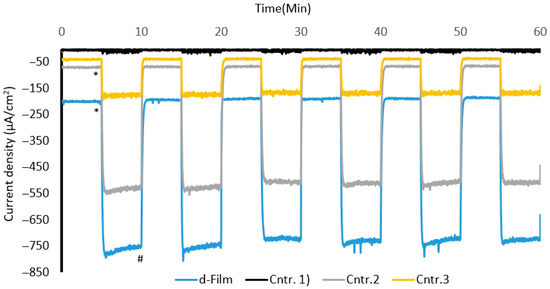
Chronoamperograms at −0.75 V (vs. Ag/AgCl) over 1 h of operation, with and without light illumination (0.25 sun), of FTO slides coated with thin films of d-film, Cntr.1, Cntr.2 and Cntr.3 (* = “light on”; # = “light off”).
The current densities at the cathode are plotted negatively in the traditional representation of a photocathode where hydrogen evolution is under reductive bias. In light, the photocurrent density of ternary electrodes improved by 516, 561, and 627 µA cm−2 at a–c, respectively. As can be seen the highest current density reached to836 ± 11 µA cm−2 as, compared to other controls, d-film is significantly superior. It increases rGO by 8.72-fold, MoS2-rGO by 4.1 and CdS-rGO by 3.0 times, respectively, under the same conditions. Such data indicate that when light is absorbed by CdS, it is not sufficient for HER. Thus, the availability of electron transport-accelerator and edge sites to the MoS2 is necessary to maintain the HER centers [24,25]. Moreover, light also pushed the onset potential toward more negative values that decreased the HER overpotential. As an example, the optional onset shifted from −0.68–0.66 to −0.54 V in a-film, −0.68–0.66 to −0.52 V in b-film, −0.64–0.65 to 0.52 V in c-film and −0.49–0.64 to −0.52 V in d-film. D-film (86:9:5) is sufficient to drive rapid extraction and in-plane conduction of MoS2 (as we attempted to increase the amount of rGO in rGO/MoS2, leading to the creation of electronic traps or parasitic absorption [26]).
The second step was to check the chronoamperometry of CdS-MoS2-rGO photocathode film; the current was applied at −0.75 vs. Ag/AgCl, and the light was turned off every 5 min for 1 h. In normal conditions, with the light being turned on, d-film (CdSMoS2-rGO) had the largest and most stable cathodic photocurrent density, as can be observed in Figure 1. It provided the largest and most stable cathodic photocurrent density at −0.78 mA cm−2, and the dark current was at the level of −0.22 mA cm−2. The on/off contrast (ΔJ) was approximately (−0.56 mA cm−2), surpassing all other controls (see Table 3). Indicatively, Cntr.1 cathodic current exhibited very weak traces of substantial current even in the light. In Cntr. 3 control film, the current was raised by 184 ua instead of 44 ua as the light was switched on to Cntr. 2. The light increased the system’s efficacy by 467 ua instead of 144 ua when the current was raised by 72 to 639 ua. Over 60 min of PEC operation, d-film lost approximately 4 percent of its initial rate of photocatalyst efficiency under the current light. This made it preferable to films using CdS photocathodes in long-run continuous mode. Mechanistically, the excellent performance of the film is attributed to the synergistic functions of its individual components. CdS nanoparticles provide strong light absorption, while MoS2 offers abundant active sites for the hydrogen evolution reaction (HER) and facilitates the transfer of photogenerated electrons with low resistance. It provides a viable trade-off between the activity and stability of CdS-based photocathodes operated at a neutral pH. In such circumstances, fast extraction of electrons by rGO and catalytic turnover at MoS2 edge sites imply the prevention of accumulation of charges and catalytic photocorrosion, allowing hydrogen evolution to be sustained. The operational advantage boundary characterizes such behavior in the CdS of MoS2 of rGO system in mild aqueous conditions.
Table 3.
Electrochemical impedance spectroscopy (EIS) fitting parameters of rGO, binary, and ternary photocathodes under dark (d) and illuminated (L) conditions. note: (Rs (Ro): solution resistance, representing electrolyte and contact resistance; Rct: charge-transfer resistance associated with the hydrogen evolution reaction (HER); QCPE: constant phase element parameter describing non-ideal interfacial capacitance behavior; nCPE: exponent of the constant phase element (0 ≤ n ≤ 1), indicating surface homogeneity (n → 1 corresponds to ideal capacitive behavior); Cdl: double-layer capacitance, proportional to electrochemically active surface area; kct: (c) charge-transfer rate constant; (d) represents the sample tested in the dark, and (l) represents the sample tested under light illumination.
The 60 min stability test was performed as an initial evaluation of the operational durability of the system under neutral aqueous conditions. The CdS–MoS2–rGO photocathode maintained 346 ± 18 approximately 96% photocurrent retention throughout the measurement, indicating stable interfacial charge-transfer behavior, indicating excellent stability under neutral aqueous conditions. This enhanced durability can be attributed to efficient electron extraction through the conductive rGO network and rapid catalytic turnover at MoS2 edge sites, which suppress charge accumulation and mitigate photocorrosion of CdS. In addition, operation in neutral electrolyte reduces dissolution of Cd2+ species compared to acidic environments, further improving long-term stability. Operation in neutral electrolyte mitigates CdS photocorrosion compared to acidic environments, as the dissolution rate of Cd2+ species is reduced. Furthermore, rapid electron extraction through the conductive rGO network and catalytic turnover at MoS2 edge sites suppress surface charge accumulation, limiting photo-oxidative degradation. Extended long-term durability testing (>10 h) will be explored in future studies to further evaluate the practical reliability.
3.2. UV–Visible Absorption and X-Ray Diffraction Analysis
3.2.1. UV–Visible Optical Properties
The optical absorption behavior of the prepared films was investigated using UV–Vis spectroscopy, and the spectra are presented in Figure S2. The ternary CdS–MoS2–rGO film (d-composition) exhibits the highest and broadest absorption across the visible region compared with the binary and single-component controls. The enhanced optical response of the ternary system arises from the combined contributions of the direct bandgap semiconductor CdS, the characteristic excitonic transitions of layered MoS2, and the broadband absorption background of rGO. In particular, the optimized 86:9:5 composition shows significant absorption up to approximately 675 nm [24], indicating effective visible-light harvesting. Compared to the ternary film, the CdS–rGO control (Cntr.2) displays slightly reduced absorbance intensity, reflecting the absence of MoS2-related excitonic contributions [25]. The MoS2–rGO film (Cntr.3) exhibits characteristic MoS2 excitonic features in the 600–700 nm region, whereas rGO alone shows a broad but relatively featureless absorption background. The observed absorption trend follows the order:
CdS–MoS2–rGO > CdS–rGO ≳ MoS2–rGO > rGO
This trend is consistent with the photocurrent hierarchy obtained from LSV and chronoamperometric measurements, indicating that improved light harvesting contributes to enhanced photoelectrochemical performance. Although explicit Tauc-plot bandgap calculations were not included, the absorption edge of CdS-containing films aligns well with the reported bandgap of hexagonal CdS (~2.3–2.4 eV). The incorporation of MoS2 and rGO does not significantly alter the intrinsic bandgap of CdS but improves interfacial charge separation and light utilization efficiency.
In more detail, UV-Vis spectroscopy was used to evaluate the optical absorption bandgap of the samples prepared according to the Tauc method (see Table S1) and found a direct bandgap of 2.26 eV in CdS–rGO film, which is highly comparable with the previously reported values of CdS-based materials [25]. Nevertheless, the introduction of MoS2 and rGO caused the bandgap of CdS-MoS2-rGO composite to narrow down slightly to approximately 2.22 eV. This transformation could have been the result of CdS/MoS2 interface films that enhanced charge transport using rGO framework. To make this comparison, the indirect bandgap of the MoS2-rGO control sample was about 1.48 eV, which is consistent with multilayer MoS2. One can typically observe this behavior in hybrid CdS/MoS2 systems since interfacial electronic interactions are attributed to this behavior, though no distinct bandgap edge can be seen in rGO because it is semi-metallic [26].
3.2.2. X-Ray Diffraction (XRD) Structural Analysis
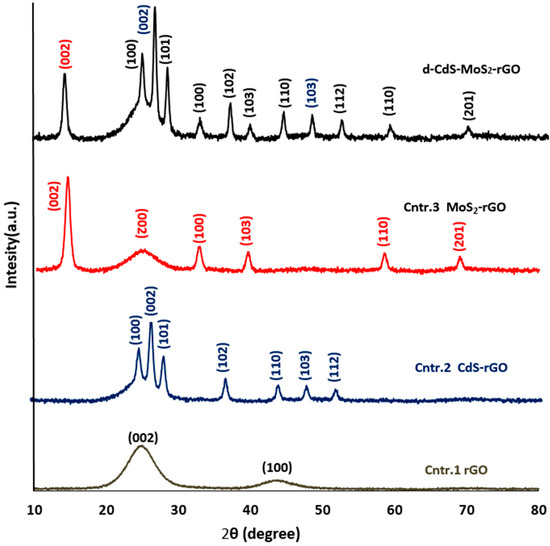
The crystalline structure of the prepared films was examined by X-ray diffraction, and the corresponding patterns are shown in Figure 2. The rGO control film exhibits a broad diffraction peak centered at 2θ ≈ 24.8°, corresponding to the (002) plane of reduced graphene oxide, indicating successful reduction in GO. A weak reflection around 43–45° can be attributed to the (100) in-plane ordering of graphitic domains. For the CdS–rGO composite (Cntr.2), distinct diffraction peaks at approximately 26.5°, 28.2°, 36.7°, 43.9°, 47.8°, and 51.8° are observed, which are consistent with the hexagonal (wurtzite) phase of CdS. These reflections confirm the successful formation of crystalline CdS after thermal conversion. The MoS2–rGO composite (Cntr.3) shows a dominant peak at 2θ ≈ 14.4°, corresponding to the (002) plane of layered 2H-MoS2, along with weaker reflections associated with other crystallographic planes. Importantly, the ternary CdS–MoS2–rGO film exhibits characteristic reflections from both CdS and MoS2 superimposed on the rGO background. No additional impurity peaks are detected, confirming successful co-assembly of the three components without undesired secondary phases. The coexistence of crystalline CdS and MoS2 within a conductive rGO matrix supports the formation of an integrated heterostructure, which is essential for efficient interfacial charge transfer during photoelectrochemical operation [26].
Figure 2.
Powder X-ray diffraction (XRD) of Cntr.1 (rGO), Cntr.2 (CdS-rGO), Cntr.3 (MoS2-rGO) and d-(CdS-MoS2-rGO) film.
Additional weak diffraction peaks observed at approximately 32.7° (100), 39.5° (103), and 58.5° (110) further confirm the crystalline nature of the CdS phase. The characteristic rGO peak at 2θ ≈ 24.8° corresponding to the (002) plane is also present, indicating successful reduction of GO. Importantly, the ternary CdS–MoS2–rGO (d-film) exhibits diffraction peaks corresponding to both CdS and MoS2 phases superimposed on the rGO background, without the presence of any additional impurity peaks. This confirms the successful formation of a well-integrated ternary composite without secondary crystalline phases.
3.3. SEM Measurement and Surface Morphology
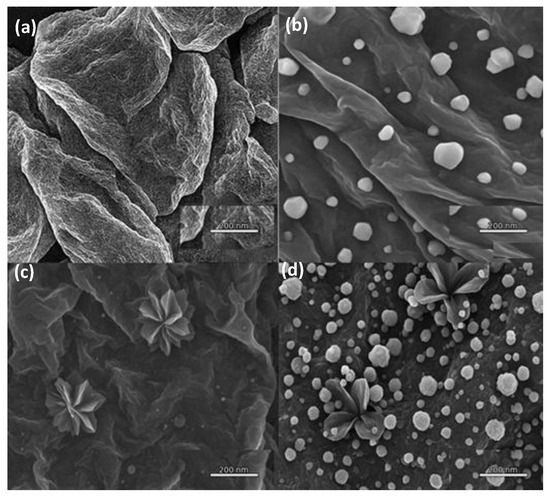
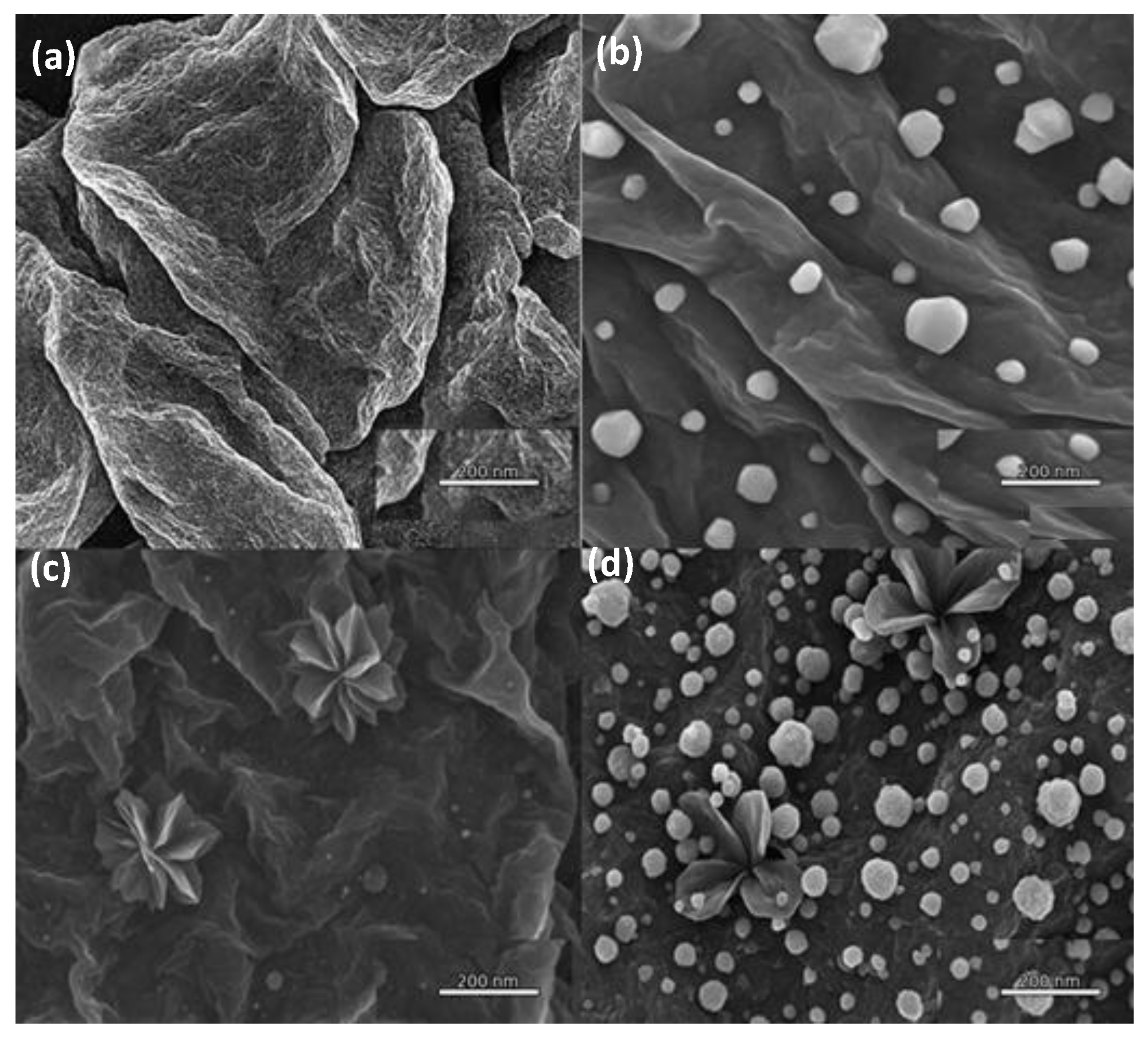
Figure 3 depicts SEM images of (a) rGO, (b) rGO-CdS, (c) rGO-MoS2 and (d) rGO-CdS-MoS2 films. rGO film has wrinkled sheets, with the corrugation creating inter-sheets with High roughness factors enhance electrochemical surface accessibility, generate edge-defect sites favorable for heterogeneous nucleation, and construct a continuous sp²-carbon network that facilitates efficient lateral electron transport. In the rGO–CdS film, CdS nanoparticles are uniformly dispersed across the rGO scaffold, forming a well-integrated hybrid structure. The great concentration of the nucleation sites on rGO can ensure the access of the electrolyte, the minimization of photo-blocking of the carbon network, and the existence of a variety of CdS/rGO hetero-interfaces that lead to the transfer of electrons on the photoexcited CdS to the conductive rGO. rGO MoS2 discrete flower rosettes can be observed at a scale of at least 150,300 nm, providing an edge-rich morphology that is useful in HER activities, with distinct inter-rosette separation that restricts restacking. This edge-rich anisotropic morphology is beneficial to HER. Unsaturated S-edge sites prevail in the exposed site. Moreover, the rGO backbone was used as an electron sink and reduces charge accumulation.
Figure 3.
SEM image of (a) rGO showing multilayer-wrinkled (b) rGO–CdS (CdS nanoparticles around (∼40–120 nm) providing CdS/rGO heterojunctions; (c) rGO–MoS2 flower-like MoS2 rosettes around (∼150–300 nm) exposed edge-rich catalytic sites; (d) tri-composites of rGO–CdS–MoS2 film.
3.4. X-Ray Photoelectron Spectroscopy
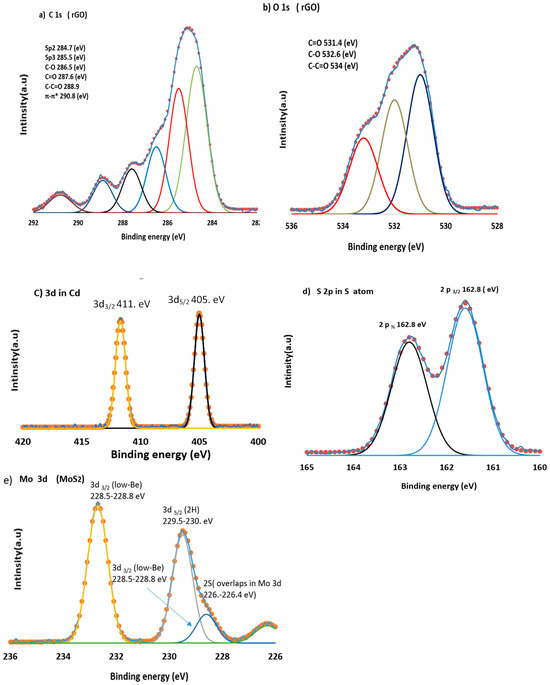
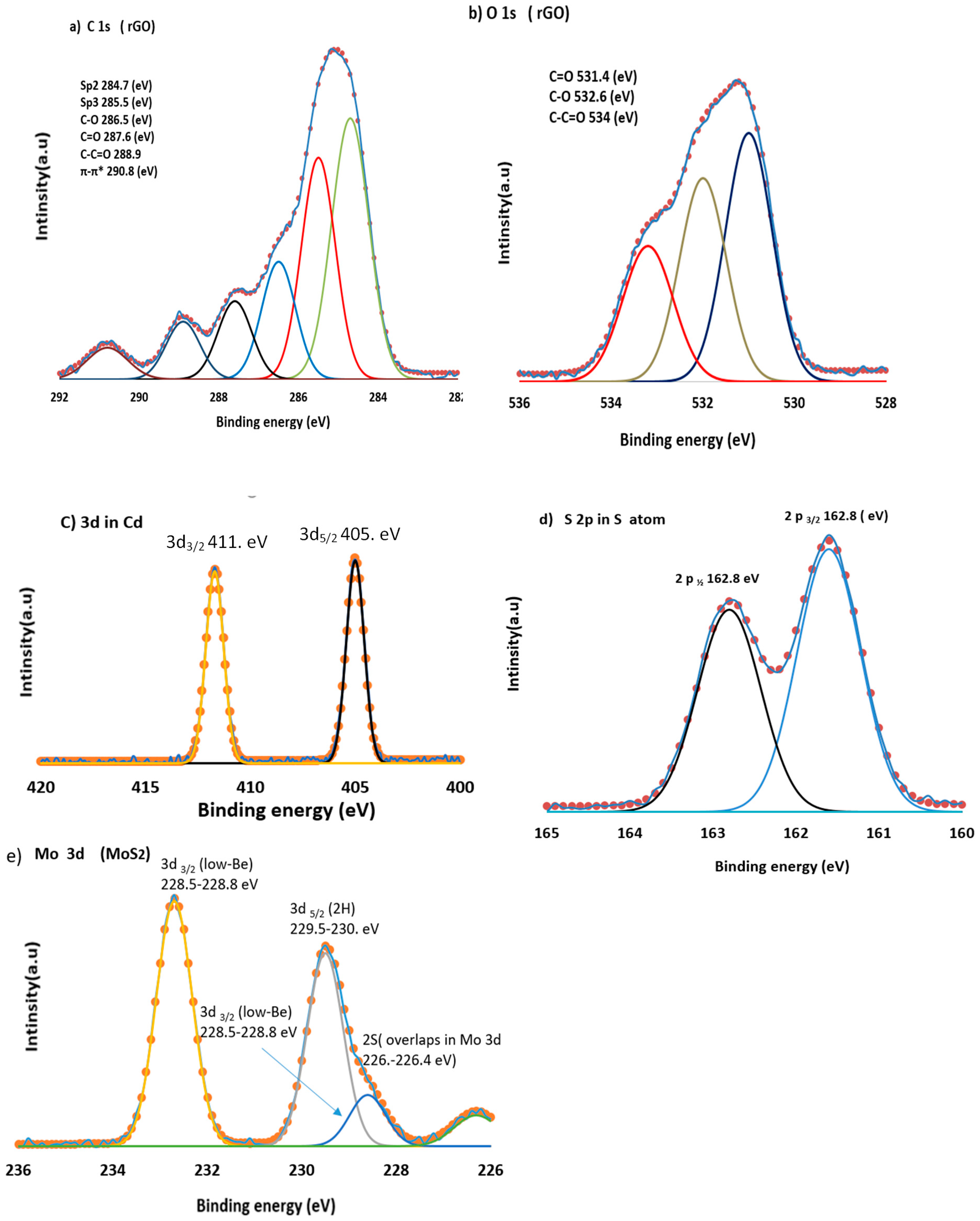
X-ray photoelectron spectroscopy (XPS) was conducted to investigate the surface chemical states and confirm the coexistence of CdS, MoS2, and rGO within the ternary composite (Figure 4). The C 1s spectrum exhibits multiple components centered at approximately 284.7, 285.5, 286.5, 287.6, 288.9, and 290.8 eV, corresponding to C=C (sp2), C–C (sp3), C–O, C=O, O–C=O, and π–π* satellite transitions, respectively. The predominance of the sp2 carbon peak confirms the effective reduction of graphene oxide during thermal treatment. The O 1s spectrum shows contributions at approximately 531.4, 532.6, and 534.3 eV, attributed to C=O, C–O, and carboxyl-related oxygen species, further supporting successful reduction of GO to rGO. The Cd 3d region displays a characteristic spin–orbit doublet at binding energies of approximately 405.0 eV (Cd 3d5/2) and 411.7 eV (Cd 3d3/2), consistent with Cd2+ in CdS and indicating the formation of phase-pure CdS without significant oxidation [27]. The Mo 3d spectrum exhibits a well-defined doublet at approximately 229.5 eV (Mo 3d5/2) and 232.7 eV (Mo 3d3/2), characteristic of Mo4+ in 2H-MoS2, with a minor low-binding-energy shoulder (~228.6 eV) that may be attributed to defect-associated or partially reduced Mo species. Importantly, a single S 2p spectrum is obtained from the composite film, as XPS detects all sulfur species simultaneously. Therefore, the S 2p region was deconvoluted into multiple spin–orbit doublets corresponding to sulfur atoms associated with both CdS and MoS2 phases. The fitted components include a doublet centered at ~161.6–162.2 eV (S 2p3/2) with the corresponding S 2p1/2 peak approximately 1.2 eV higher, attributable to S2− species in CdS, as well as a slightly shifted doublet at ~162.0–162.8 eV assigned to sulfur in MoS2 [28]. A minor high-binding-energy contribution (~163.6–164.0 eV) is observed and can be attributed to surface S0/S–S species or slight oxidation (SOₓ) resulting from brief air exposure. The partial overlap of sulfur signals from CdS and MoS2 is expected due to their similar chemical environments; however, careful peak fitting confirms the coexistence of both sulfide phases within the composite film [27]. Overall, the presence of Cd2+, Mo4+, and S2− species, together with the reduced graphene framework, confirms the successful formation of the ternary heterostructure and supports efficient interfacial electron transfer from photoexcited CdS to rGO and, subsequently, to MoS2 catalytic edge sites, in agreement with the improved charge-transfer resistance observed in EIS measurements. For completeness, the XPS spectra of the corresponding reference samples (CdS–rGO and MoS2–rGO) are provided in (Figure 4). The Cd 3d and S 2p binding energies observed in the CdS–rGO reference sample are consistent with those detected in the ternary composite, confirming that Cd remains in the Cd2+ oxidation state. Similarly, the Mo 3d and S 2p spectra of the MoS2–rGO control exhibit binding energies characteristic of Mo4+ in 2H-MoS2, comparable to those observed in the composite film. The slight binding energy shifts (≤0.2 eV) detected in the ternary system may be attributed to interfacial electronic interactions among CdS, MoS2, and rGO, suggesting electronic coupling within the heterostructure.
Figure 4.
XPS spectra of the CdS–MoS2–rGO composite film: (a) C 1s and (b) O 1s spectra associated with the rGO component; (c) Cd 3d spectrum; (d) S 2p spectrum deconvoluted into contributions for S atom related to CdS and MoS2.
3.5. Electrochemical Impedance Spectroscopy (EIS) and Tafel Plots Studies
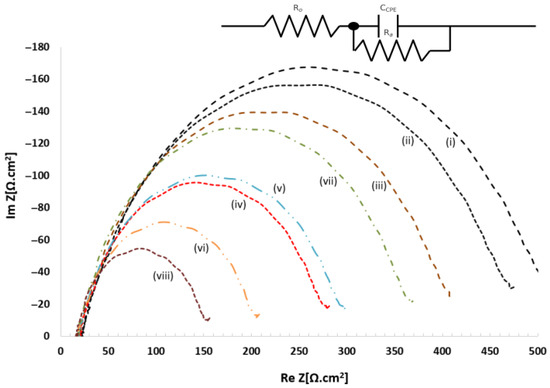
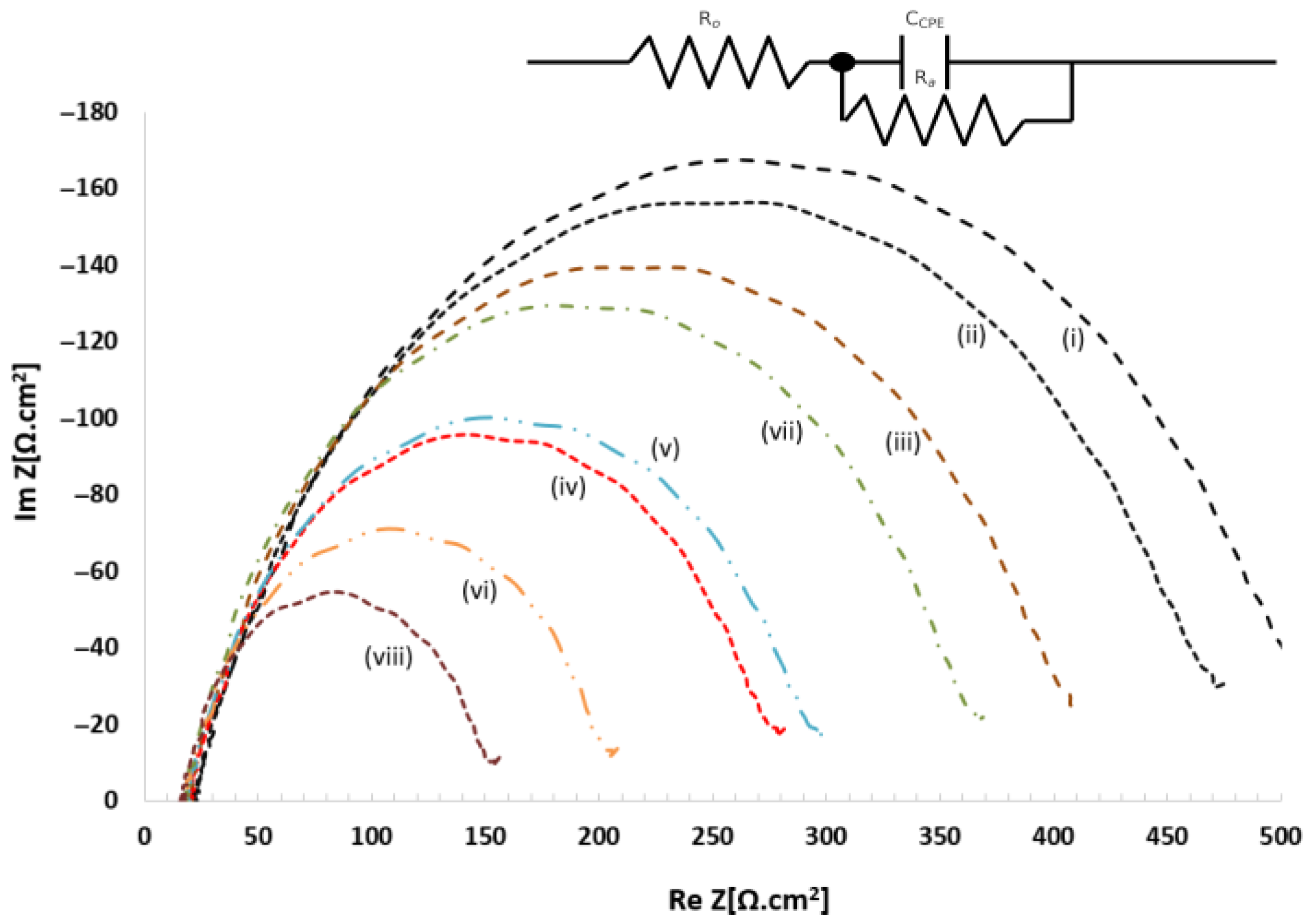
To study the interfacial charge-transfer characteristics and the kinetic properties of the developed photocathodes in the dark and light conditions, electrochemical impedance spectroscopy (EIS) was used. Figure 5 (labeled i to vii) shows the typical semicircular characteristics of the Nyquist plots, which were well modeled with an equivalent circuit of a single-time-constant Randles, denoted as (Rs R1 (R2 CPE)) as shown in the inset of Figure 5. The model is sufficient to explain the electrochemical events that take place at the electrode–electrolyte interface.
Figure 5.
(i)-rGO in dark and (ii)-rGO in the light, (iii)-MoS2-rGO in dark and (vii)-CdS-MoS2-rGO-dark, and (v)-CdS-rGO-dark and (iv) MoS2-rGO light, and (vi)-CdS-rGO light and finally (viii)-CdS-MoS2-rGO. The inset electrical circuit model single-time constant Randles circuit type (Rs-R1-(R2∥CPE)).
In the low- to intermediate-frequency regime, the neutral pH impedance response is mainly linked to interfacial charge-transfer and ion adsorption effects, which entail the movement of charge carriers in the diffuse layer towards the photocathode interface. Rs (or R0) in this model is the solution resistance when none of the compensations are provided, and Rct is the charge-transfer resistance of the hydrogen evolution reaction (HER). The constant phase element (CPE) was used to explain the non-ideal capacitive behavior attributed to the heterogeneity of the surface and it is defined by QCPE and nCPE. The apparent rate constant of charge transfer is proportional to 11/Rct and the electrochemically active surface area (ECSA) is reflected in the double-layer capacitance (Cdl).
The determined parameters that have been fitted in Table 3 show that the solution resistance (Rs) is relatively the same in all samples (3640 Ω cm2) and hence represents similar conditions of electrolytes and electrical contact. On the contrary, there are significant differences in charge-transfer resistance. The ternary CdS-rGO photocathode is associated with the lowest Rct (~120 Ω cm2) compared to CdS rGO (~155 Ω cm2), MoS2 rGO (~220−1) and rGO (~360−1). This dramatic drop in Rct confirms the concept that the ternary structure is more efficient at transferring interfacial electrons, and, consequently, accelerates the rate of HER kinetics.
Further, the light causes a linear decrease in Rct in all the samples, with the relative reductions in rGO, MoS2-rGO, CdS rGO, CdS MoS2-rGO electrodes approximated to be 19, 28, 33 and 53, respectively. This move indicates that the ternary system has a high photo-response and is more competent at utilizing photogenerated charge carriers.
In addition to the Rct, the ternary electrode possesses a high Cdl (approximately 11 µF·cm−2 in case of illumination), which means the number of active sites and the concentration of charges on the interface is high. The rise in the values of QCPE and nCPE (0.82–0.92) is an indication of a rise in the surface homogeneity and capacitive behavior. In addition, the charge-transfer rate constant (kct) is at its maximum (~758 s−1) between the ternary electrode when it is illuminated, which substantiates much faster electron-transfer rates than binary and control electrode systems.
The exchange current density (i0), estimated using the relation
where ) is the exchange current density in unit (A·cm−2), R is the gas constant (8.314 J·mol−1·K−1), T is the absolute temperature (K), n refers to the number of electrons involved in the hydrogen evolution reaction (n = 2), F is the Faraday constant (96,485 C·mol−1), and finally Rct is the charge-transfer resistance (Ω·cm2), These findings are consistent with the observed electrochemical trends. The ternary electrode shows the highest i₀ value, reaching approximately 28 µA·cm⁻² in the dark (rGO) and 107 µA·cm⁻² under light illumination (CdS–MoS2–rGO), highlighting its enhanced intrinsic catalytic activity toward the hydrogen evolution reactiond.
Tafel plots based on polarization measurements are also presented in Figure S4 to further explain the reaction kinetics. Ternary CdS–MoS2–rGO is the sample with the lowest Tafel slope 85 mV·dec−1 with illumination), which means that the kinetics of HER are the most favorable in this sample. The ternary system has a relatively low Tafel slope (approximately 110–120 mV·dec−1 even in the dark, which indicates that the system has efficient charge-transfer pathways that are not reliant on photoexcitation.
Comparatively, the CdS-rGO electrode performs moderately in terms of its kinetic performance with Tafel slopes of approximately 126 mV·dec−1 (light) and 146 mV·dec−1 (dark) indicating the enhanced activity with the combination of light absorption and conductive support. The Tafel slopes of the MoS2-rGO system are higher (176–211 mV·dec−1, which means that the kinetics are slower, which can be explained by the insufficient absorption of light despite the availability of catalytic sites. The rGO control electrode has the worst performance with Tafel slopes of over 250 mV·dec−1, which confirms that it has low catalytic activity without a semiconductor component. The general trend of HER activity based on Tafel analysis is as follows
which is consistent with the trends observed in photocurrent density, EIS parameters, and hydrogen evolution measurements. The excellent electrochemical behavior of the ternary system can be explained by the synergistic interaction of the system components. CdS is the primary photoabsorber under visible-light irradiation, which produces electron–hole pairs. The electrons produced by the photogeneration process are efficiently transported to the conductive rGO network that supports the fast transport of electrons and inhibits recombination. These electrons are further supplied to MoS2 edge sites, where proton reduction is achieved with high efficiency because of the high catalytic activity of these sites.
CdS–MoS2–rGO > CdS–rGO > MoS2–rGO >> rGO,
The drastic decrease in Rct, rise in Cdl and kct, and an improvement in Tafel slope all testify that the improved performance of HER is not only determined by the catalytic power of MoS2, but also by the synergistic action of an efficient light-gathering (CdS), fast electron transfer (rGO), and high catalytic sites (MoS2). Development of a well-integrated heterostructure allows directional charge transfer, reduces interfacial recombination and increases proton reduction kinetics.
Both EIS and Tafel analyses substantiate the fact that the CdS-MoS2-rGO ternary photocathode has better interfacial charge-transfer properties and increased reaction kinetics, making it the most active system to evolve hydrogen using photoelectrochemical methods in neutral conditions [29].
The quantitative kinetic parameters derived from the EIS and Tafel analyses are
CdS–MoS2–rGO > CdS–rGO > MoS2–rGO >> rGO,
The results of the EIS and Tafel analyses of the quantitative kinetic parameters are summarized in Table 4, including the charge-transfer resistance (Rct), exchange current density (i0), and values of the Tafel slopes of all the investigated electrodes in the dark and light conditions. The ternary CdS–MoS2–rGO electrode has the lowest Rct (≈118 ± 6 Ω·cm2 illuminated), the largest exchange current density, and the lowest Tafel slope (≈85 mV·dec−1) and hence is clearly seen to be the most active catalyst and interfacial charge-transfer kinetics, as illustrated in the Table 4.
Table 4.
Charge-transfer resistance (Rct), exchange current density (i0), and Tafel slope of d-film and other control film.
3.6. Gas Chromatography (GC) and Hydrogen Evolution Rates
In a direct attempt to confirm that the measured photocurrent responses are directly proportional to real generation of hydrogen, the evolved gas was subjected to gas chromatography with all the same photoelectrochemical conditions across all the studied films. The measurements were made at Ag/AgCl vs. an electrolyte of neutral composition and under illumination of 0.25 sun (25 mW-cm−1).
Thus, the effect of the catalytic output of the various electrodes could be directly compared. The formation of molecular hydrogen in operation was confirmed by a distinct hydrogen signal in the chromatograms at a retention time of about 2.0 min. Control experiments carried out with blank electrolyte under equal bias and light terms gave no hydrogen result, ruling out the possibility that the observation was due to parasitic side reactions or the instrumental background. These measurements validate that the observed current cathodic current is in connection with the hydrogen evolution reaction and not only with non-Faradaic or capacitive currents.
The quantitative GC results demonstrate a definite compositional dependence of the hydrogen generation. The ternary CdS–MoS2–rGO photocathode (d-film) had the highest hydrogen evolution rate of 58.6 ± 2.9 µmol h−1 in the light with its dark hydrogen evolution rate of 14.1 ± 0.7 µmol h−1. Comparatively, CdS-rGO film is binary and was found to yield 41.2 ± 2.1 µmol h−1 in the light, MoS2-rGO film was found to yield 24.0 + 1.2 µmol h−1 and the rGO control film yielded only a weak response of approximately 5–6 + 0.3 µmol h −1 in the light. Thus, the hydrogen production activity follows the order:
CdS–MoS2–rGO > CdS–rGO > MoS2–rGO >> rGO.
This trend is consistent with the hierarchy observed in the electrochemical measurements, suggesting that the ternary architecture represents the most effective configuration for the present photoelectrochemical hydrogen evolution system.
The significant enhancement of hydrogen generation on the ternary film when it is illuminated is an indication that visible-light activation significantly contributes to proton reduction. Specifically, the hydrogen evolution rate increased from 14.1 ± 0.7 (unit) in the dark to 58.6 ± 2.9 (unit) under light illumination, representing an approximately fourfold enhancement. fourfold, meaning that the photoexcited state of the semiconductor-coated electrode significantly boosts the rate of hydrogen evolution. This is significant in that it indicates the ternary photocathode is not merely an electrocatalyst that works under bias, but a photoelectrochemical system, where light absorption is a direct contributor to increased catalytic performance. This is further verified by the fact that all samples show reduced hydrogen production in the dark, which is further evidence that illumination is required to realize the maximum reaction rate, especially in the CdS-containing electrodes.
Our detailed comparison of the ternary and binary films offers additional understanding of the input of all elements. The CdS-rGO electrode demonstrates a significantly greater hydrogen evolution compared to MoS2-rGO, so it may be concluded that the addition of CdS enhances the light-driven part of the reaction significantly. Nevertheless, the additional growth, which is observed when MoS2 is added to create the ternary composite, proves that CdS and rGO cannot be used alone as the most effective catalysts to achieve the best results. The ternary film is significantly superior to CdS rGO, indicating that the addition of MoS2 is another kinetic benefit directly reflected in the measured hydrogen production rate. Simultaneously, the lack of efficiency of rGO in itself proves that conductivity is not a sufficient factor to produce efficient hydrogen generation without a suitable photoabsorber and a catalyst phase containing sulfur. Consequently, the GC data have offered direct product-related evidence that all the three constituents work in cooperation with the ultimate photocatalytic product.
Notably, the outcomes of the hydrogen evolution are in very good correlation with the linear sweep voltammetry and chronoamperometric results obtained earlier in the manuscript. It was demonstrated earlier that the ternary film had the greatest photocurrent density under illumination of about 836 ± 42 µA cm−2, compared to the control films which had much lower values. Likewise, the chronoamperometric data showed that the ternary electrode had the largest and most constant cathodic photocurrent response under testing of chopped light, and minimal decay only during long operation. The rates of hydrogen generation using the GC hence confirm the electrochemical results by showing that the enhanced photocurrent response of the ternary system is converted into actual hydrogen generation. Such coincidence of the present response and the quantification of the product enhances the accuracy of the entire photoelectrochemical assessment.
The same consistency is noticed when the GC data are contrasted with the impedance results. The electrochemical impedance spectroscopy analysis revealed that ternary CdS–MoS2 rGO film had the lowest illuminated charge-transfer resistance of 118 ± 6 Ω·cm2, as opposed to 157 ± 8 Ω·cm2 in CdS-rGO, 217 ± 11 Ω·cm2 in MoS2-rGO. Simultaneously, the ternary system had the highest values of Cdl and kct in the light. These parameters show more efficient interfacial charge transfer and faster reaction kinetics at the electrode–electrolyte interface. The high importance of the lowest Rct being the highest rate of hydrogen production is very important, as it shows that lower interfacial resistance is directly translated into better catalytic product formation. That is, the GC results are not in isolation, but are well supported by the kinetic and interfacial trends obtained as a result of the impedance analysis.
The trend in hydrogen evolution is also consistent with the reported Tafel behavior and with the larger photoelectrochemical metrics of performance reported in the manuscript. The positive Tafel slope of the tertiary film is an indication of better HER kinetics than the binary and control electrodes, and the ABPE analysis further confirms that the tertiary architecture has a better use of incident photons under applied bias. The GC results in this case provide the clearest evidence that the increases in photocurrent, interfacial impedance and kinetic slope are not just instrumental effects, but are manifested in an increased rate of hydrogen formation. Internal consistency of GC, LSV, chronoamperometry, EIS, Tafel, and ABPE thus create a strong structure–performance correlation throughout the entire study.
Compositionally, the high yield of hydrogen of the d-film provides confirmation that the 86:9:5 CdS:MoS2:rGO ratio offers the best blend of light harvesting, the presence of catalytic sites, and electron movement. Overloading of MoS2 would saturate the amount of catalytically active HER sites, and an overly small amount of rGO would decrease the efficiency of the collection and transfer of electrons.Conversely, an excess of conductive additive may either dilute the portion of photoactive semiconductor or add parasitic optical losses. The ternary composition that is optimized incurs such trade-offs and achieves a well-measurable product evolution improvement. The GC data are particularly useful due to the fact that they allow the optimum composition to be determined not only based on the electrochemical proxies, but also on the real hydrogen output.
The other significant fact is that these findings were achieved in comparatively friendly operating conditions; that is, with a neutral electrolyte and less than AM1.5 illumination intensity. In this case, hydrogen evolution is typically more difficult than in highly acidic media due to the decreased availability of protons and increased interfacial charge-transfer restraints. The rate of hydrogen production of the ternary film observed, therefore, is remarkable, particularly when taken in conjunction with the stability behavior exhibited, which were the same as those observed during chronoamperometric experiments. The fact that the ternary photocathode can sustain significant hydrogen production in the neutral environment supports the practical applicability of this architecture for mild aqueous photoelectrochemical operation.
Altogether, the GC analysis provides direct and quantitative evidence that the ternary CdS-MoS2-rGO photocathode is the most efficient hydrogen-evolving electrode among the samples under study. The product evolution rates are consistent with the trends obtained based on photocurrent density, interfacial resistance, kinetic parameters, and photon-to-current efficiency and, thus, internal coherence is high throughout the whole manuscript. A combination of results indicates that rational assembly of CdS, MoS2, and rGO produces a photocathode architecture in which optimal harvesting of visible light and efficient transfer of charges and catalytic turnover are achieved simultaneously, resulting in the optimum generation of hydrogen under the selected operating conditions (Table 5).
Table 5.
Quantitative hydrogen production rates measured by GC for all investigated films under identical photoelectrochemical conditions.
3.7. Applied Bias Photon-to-Current Efficiency (ABPE)
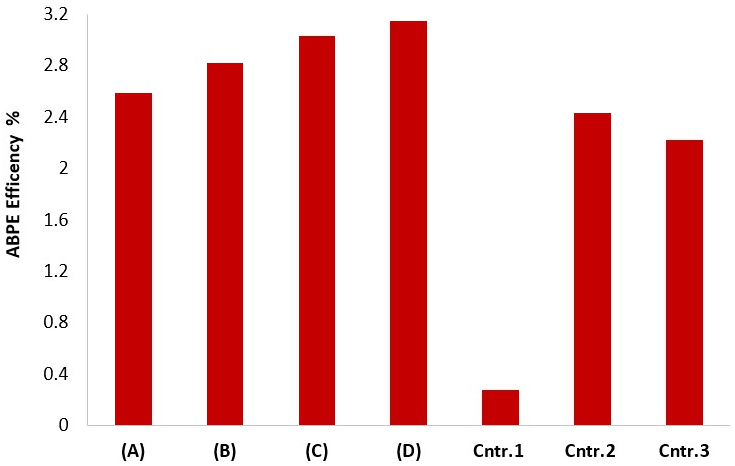
The applied bias photon-to-current efficiency (ABPE) was evaluated to assess the overall photoelectrochemical energy conversion performance of the investigated photocathodes under visible-light irradiation. ABPE provides a direct measure of the fraction of incident photon energy that is converted into chemical energy under an applied bias. The ABPE values were calculated according to:
where Jph is the photocurrent density (A cm−2), Vapp is the applied potential versus the reversible hydrogen electrode (RHE), and Plight is the incident light power density [30].
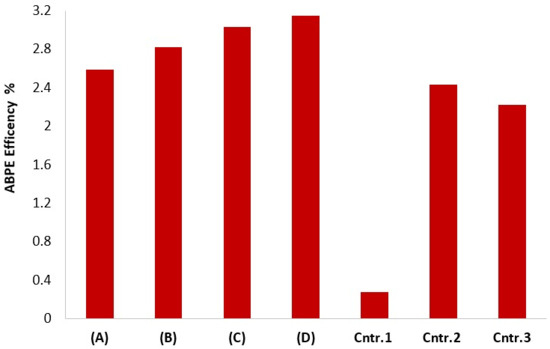
The ABPE curves for all investigated samples are presented in Figure 6. The ternary CdS–MoS2–rGO photocathode exhibits the highest ABPE values across the examined potential range, confirming its superior photoelectrochemical performance. The maximum ABPE is observed at moderate applied bias, where an optimal balance between photocurrent density and thermodynamic driving force is achieved.
Figure 6.
ABPE of (d) film and other controls.
The enhanced ABPE of the ternary system arises primarily from its improved charge separation efficiency and reduced interfacial charge-transfer resistance, as previously evidenced by EIS analysis. Compared to the binary CdS–rGO and MoS2–rGO films, the ternary architecture facilitates more efficient extraction and utilization of photogenerated electrons. The conductive rGO network suppresses recombination losses, while MoS2 provides catalytically active sites that lower the kinetic barrier for proton reduction. As a result, the higher photocurrent density directly translates into improved photon-to-current conversion efficiency.
It is important to note that ABPE depends strongly on both the applied bias and the incident light intensity. Under the present experimental conditions (0.25 sun illumination and neutral electrolyte), the absolute ABPE values remain moderate compared to systems operated under standard AM 1.5G irradiation or acidic media. Nevertheless, the relative efficiency trend among the samples is consistent with the LSV, chronoamperometry, EIS, and GC analyses, demonstrating strong internal coherence across all performance metrics. Thus, ABPE analysis confirms that compositional engineering within the CdS–MoS2–rGO heterostructure enhances not only photocurrent generation but also the effective utilization of absorbed photons for hydrogen production under applied bias.
Overall, the photoelectrochemical performance trends observed for the different compositions can be directly correlated with their structural and interfacial characteristics. Variations in MoS2 and rGO content influence catalytic site density and charge-transport pathways, as reflected by changes in charge-transfer resistance, reaction kinetics, and hydrogen evolution rates. This consistent behavior across structural, electrochemical, and catalytic analyses establishes a clear structure–performance relationship within the CdS–MoS2–rGO system. CdS-based photocathodes are known to suffer from photocorrosion under prolonged illumination, particularly in acidic environments. In the present ternary architecture, the incorporation of rGO and MoS2 provides partial surface protection and rapid charge extraction pathways, which reduce hole accumulation at CdS surfaces. This interfacial synergy contributes to improved short-term stability under neutral conditions. Nevertheless, further optimization strategies such as surface passivation or protective overlayers may enhance long-term durability.
While the present electrochemical impedance spectroscopy (EIS), photocurrent, and onset potential data collectively indicate enhanced charge separation and interfacial transfer in the CdS–MoS2–rGO ternary composite, we acknowledge that the proposed charge-transfer pathway remains largely inferential without direct electronic structure characterization. To provide a more complete mechanistic picture, future work will include band structure analysis and charge carrier dynamics measurements such as Mott–Schottky plots to determine flat-band potentials and carrier densities, photoluminescence (PL) and time-resolved PL (TRPL) to probe recombination dynamics, and ultraviolet photoelectron spectroscopy (UPS) to directly assess valence band positions. These techniques have been widely used in the field to validate charge separation mechanisms and heterojunction effects in complex nanocomposites; for example, recent comprehensive studies on binary and ternary nanocomposites for photoelectrochemical water splitting highlight the importance of combining band alignment and carrier dynamics analyses to elucidate enhanced PEC performance and synergistic effects in multi-component systems [31].
4. Conclusions
A CdS–MoS2–rGO ternary heterostructure was developed to enhance photoelectrochemical hydrogen evolution through interfacial charge-transfer engineering. XRD and XPS analyses confirmed the formation of crystalline CdS and MoS2 phases with preserved Cd2+, Mo4+, and S2− chemical states within a reduced graphene framework.
Electrochemical analysis revealed a significant reduction in charge-transfer resistance and Tafel slope for the ternary photocathode, indicating accelerated proton reduction kinetics. The improved performance is attributed to efficient extraction of photogenerated electrons from CdS into the conductive rGO matrix, followed by their transfer to catalytically active MoS2 edge sites. This interfacial electron cascade suppresses recombination and enhances catalytic turnover.
Quantitative GC measurements verified that enhanced charge-transfer kinetics correlate directly with increased hydrogen production under neutral conditions. These findings establish a clear relationship between heterostructure design, interfacial kinetics, and catalytic output in visible light-driven hydrogen evolution systems.
Supplementary Materials
The following supporting information can be downloaded at: https://www.mdpi.com/article/10.3390/jcs10050220/s1. Figure S1. (LSV) of (a) Cntr.1 rGO in dark and light, (b) Cntr.2 CdS-rGO in dark and light, (c) Cntr.3 MoS2-rGO in dark and light, (d) film CdS MoS2-rGO in dark and light, (e) film CdS-MoS2 in dark and light, (f) CdS-MoS2-rGO in dark and light, and (g) film CdS-MoS2-rGO in dark and light (their ratios are noted in the inset). Figure S2. UV–visible absorbance of Cntr.1 (rGO), Cntr.2 (CdS-rGO), Cntr.3(MoS2-rGO) and d-film CdS-MoS2-rGO. Figure S3. Tauc plots derived from UV–visible absorption spectra of (a) CdS–rGO, (b) CdS–MoS2–rGO, and (c) MoS2–rGO thin films. Direct allowed transitions were assumed for CdS-containing films using (αhν)2 versus photon energy, while an indirect allowed transition (α hν)1/2 was applied for MoS2–rGO. The optical bandgaps were determined by linear extrapolation of the absorption edge to zero absorption. Figure S4. Tafel plots for: (a) Cntr.1 rGO (with light(L) and without illumination (dark (D)), (b) Cntr.2 CdS−rGO with light (L) and without illumination (dark (D), (c) Cntr.3 rGO (with light (L) and without illumination (dark (D)), and finally, (d) d-CdS−MoS2−rGO (with light (L) and without illumination (dark D)). Figure S5. Gas chromatography traces of the collected gas from d-film CdS-MoS2-rGO: (a) Ar carrier only, (b) H2 evolution under external bias in dark, and (c) H2 evolution under external bias under illumination. Figure S6. Working electrode sample. Table S1. Optical band gap parameters of the prepared samples were determined from Tauc plot analysis. The table summarizes the composition, applied Tauc model, transition type (direct or indirect), estimated band gap energy (Eg), fitting energy range, and corresponding coefficient of determination (R2) for each sample. Table S2. Electrochemically active surface area parameters. References [32,33,34] are located in the Supplementary Materials file.
Author Contributions
Conceptualization, investigation and methodology M.A. software, formal analysis, resources and data curation, A.S.; writing—original draft preparation, writing—review and editing and visualization, M.Y.; supervision, project administration, H.A. All authors have read and agreed to the published version of the manuscript.
Funding
This research received no external funding.
Data Availability Statement
The original data are presented in this study. For any further queries, please contact the corresponding author.
Acknowledgments
We thank the University of Mosul for its support.
Conflicts of Interest
The authors declare no conflicts of interest.
References
- Escalera-López, D.; Iffelsberger, C.; Zlatar, M.; Novčić, K.; Maselj, N.; Van Pham, C.; Jovanovič, P.; Hodnik, N.; Thiele, S.; Pumera, M.; et al. Allotrope-dependent activity-stability relationships of molybdenum sulfide hydrogen evolution electrocatalysts. Nat. Commun. 2024, 15, 3601. [Google Scholar] [CrossRef] [Scilit] [PubMed]
- Nasir, J.A.; Rehman, Z.-U.; Shah, S.N.A.; Khan, A.; Butler, I.S.; Catlow, C.R.A. Recent developments and perspectives in CdS-based photocatalysts for water splitting. J. Mater. Chem. A 2020, 8, 20752–20780. [Google Scholar] [CrossRef] [Scilit]
- Ali, M.B. Reduced graphene oxide as an efficient support for CdS-MoS2 heterostructures for enhanced photocatalytic H2 evolution. Int. J. Hydrogen Energy 2017, 42, 16449–16458. [Google Scholar]
- Voiry, D.; Salehi, M.; Silva, R.; Fujita, T.; Chen, M.; Asefa, T.; Shenoy, V.B.; Eda, G.; Chhowalla, M. Conducting MoS2 nanosheets as catalysts for hydrogen evolution reaction. Nano Lett. 2013, 13, 6222–6227. [Google Scholar] [CrossRef] [Scilit]
- Lu, K.-Q.; Li, Y.-H.; Tang, Z.-R.; Xu, Y.-J. Roles of graphene oxide in heterogeneous photocatalysis. ACS Mater. Au 2021, 1, 37–54. [Google Scholar] [CrossRef] [Scilit]
- Hummers, W.S., Jr.; Offeman, R.E. Preparation of graphitic oxide. J. Am. Chem. Soc. 1958, 80, 1339. [Google Scholar] [CrossRef] [Scilit]
- Liu, C.; Li, X.; Liu, Z.; Zhang, L.; Jiang, S.; Jiao, T. Recent Progress on High-Efficiency Hydrogen Evolution Electrocatalysis of Heteroatom-Doped MoS2: A Review. Catalysts 2025, 15, 520. [Google Scholar] [CrossRef] [Scilit]
- Najm, A.S.; Naeem, H.S.; Alwarid, D.A.R.M.; Aljuhani, A.; Hasbullah, S.A.; Hasan, H.A.; Sopian, K.; Bais, B.; Al-Iessa, H.J.; Majdi, H.S.; et al. Mechanism of chemical bath deposition of CdS thin films: Influence of sulphur precursor concentration on microstructural and optoelectronic characterizations. Coatings 2022, 12, 1400. [Google Scholar] [CrossRef] [Scilit]
- Du, X.; Xu, Y.; Shan, A.; Wang, R. Recent Progress in the Synthesis and Engineering of High-Performance MoS2 Electrocatalysts for the Hydrogen Evolution Reaction. Catalysts 2025, 15, 626. [Google Scholar] [CrossRef] [Scilit]
- Sun, F.; Yang, K.; Qin, X.; Wu, W.; Lu, Y. Achieving highly efficient electrocatalytic hydrogen evolution with Co-doped MoS2 nanosheets. Nanoscale Horiz. 2025, 10, 1120–1130. [Google Scholar] [CrossRef] [Scilit]
- Wu, B.; Wang, C.; Wang, Z.; Shen, K.; Wang, K.; Li, G. Coupling Z-Scheme g-C3N4/rGO/MoS2 Ternary Heterojunction as an Efficient Visible Light Photocatalyst for Hydrogen Evolution and RhB Degradation. Langmuir 2024, 40, 1931–1940. [Google Scholar] [CrossRef] [Scilit] [PubMed]
- Meng, A.; Li, Z.; Xiong, G.; Li, Z.; Zhang, J. S-scheme heterojunction Al6Si2O13/BiOBr with enhanced charge transfer effect for efficient and stable photocatalytic degradation of Triazophos and Dichlorvos pesticides. Acta Phys.-Chim. Sin. 2026, 42, 100186. [Google Scholar] [CrossRef] [Scilit]
- Mondal, A.; Prabhakaran, A.; Gupta, S.; Subramanian, V.R. Boosting photocatalytic activity using reduced graphene oxide (RGO)/semiconductor nanocomposites: Issues and future scope. ACS Omega 2021, 6, 8734–8743. [Google Scholar] [CrossRef] [Scilit] [PubMed]
- Yin, Y.; Han, J.; Zhang, Y.; Zhang, X.; Xu, P.; Yuan, Q.; Samad, L.; Wang, X.; Wang, Y.; Zhang, Z.; et al. Contributions of phase, sulfur vacancies, and edges to the hydrogen evolution reaction catalytic activity of porous molybdenum disulfide nanosheets. J. Am. Chem. Soc. 2016, 138, 7965–7972. [Google Scholar] [CrossRef] [Scilit]
- Weidling, A.M.; Turkani, V.S.; Akhavan, V.; Schroder, K.A.; Swisher, S.L. Large-area photonic lift-off process for flexible thin-film transistors. npj Flex. Electron. 2022, 6, 14. [Google Scholar] [CrossRef] [Scilit]
- Jaramillo, T.F.; Jørgensen, K.P.; Bonde, J.; Nelsen, J.H.; Horch, S.; Chorkendorff, I. Identification of active edge sites for electrochemical H2 evolution from MoS2 nanocatalysts. Science 2007, 317, 100–102. [Google Scholar] [CrossRef] [Scilit]
- Wei, M. Mechanistic insights of rGO/CdS-MoS2 heterostructure for a 23.1% capacity boost in photo-rechargeable lithium-sulfur batteries. Chem. Eng. J. 2025, 514, 163211. [Google Scholar] [CrossRef] [Scilit]
- Low, J. Heterojunction Photocatalysts. Adv. Mater. 2017, 29, 1601694. [Google Scholar] [CrossRef] [Scilit]
- Shah, S.A.; Khan, I.; Yuan, A. MoS2 as a Co-Catalyst for Photocatalytic Hydrogen Production: A Mini Review. Molecules 2022, 27, 3289. [Google Scholar] [CrossRef] [Scilit]
- Zhou, Z.; Pei, Z.; Wei, L.; Zhao, S.; Jian, X.; Chen, Y. Electrocatalytic hydrogen evolution under neutral pH conditions: Current understandings, recent advances, and future prospects. Energy Environ. Sci. 2020, 13, 3185–3206. [Google Scholar] [CrossRef] [Scilit]
- Yücel, E.; Kahraman, S.; Güder, H.S. Effects of different annealing atmospheres on the properties of cadmium sulfide thin films. Mater. Res. Bull. 2015, 68, 227–233. [Google Scholar] [CrossRef] [Scilit]
- Senthil, K.; Mangalaraj, D.; Narayandass, S.K. Structural and optical properties of CdS thin films. Appl. Surf. Sci. 2001, 169, 476–479. [Google Scholar] [CrossRef] [Scilit]
- Eda, G.; Yamaguchi, H.; Voiry, D.; Fujita, T.; Chen, M.; Chhowalla, M. Photoluminescence from chemically exfoliated MoS2. Nano Lett. 2011, 11, 5111–5116. [Google Scholar] [CrossRef] [Scilit] [PubMed]
- Zong, X.; Wu, G.; Yan, H.; Ma, G.; Shi, J.; Wen, F.; Wang, L.; Li, C. Photocatalytic H2 evolution on MoS2/CdS catalysts under visible light irradiation. J. Phys. Chem. C 2010, 114, 1963–1968. [Google Scholar] [CrossRef] [Scilit]
- Seo, D.B.; Trung, T.N.; Bae, S.-S.; Kim, E.-T. Improved Photoelectrochemical Performance of MoS2 through Morphology-Controlled Chemical Vapor Deposition Growth on Graphene. Nanomaterials 2021, 11, 1585. [Google Scholar] [CrossRef] [Scilit]
- Sumair Ahmed, S. Improved Performance of CuFe2O4/rGO Nanohybrid as an Anode Material for Lithium-ion Batteries Prepared Via Facile One-step Method. Curr. Nanosci. 2019, 15, 420–429. [Google Scholar]
- Yan, Z.; Du, L.; Phillips, D.L. Multilayer core–shell MoS2/CdS nanorods with very high photocatalytic activity for hydrogen production under visible-light excitation and investigation of the photocatalytic mechanism by femtosecond transient absorption spectroscopy. RSC Adv. 2017, 7, 55993–55999. [Google Scholar] [CrossRef] [Scilit]
- Yao, Y.; Ao, K.; Lv, P.; Wei, Q. MoS2 Coexisting in 1T and 2H Phases Synthesized by Common Hydrothermal Method for Hydrogen Evolution Reaction. Nanomaterials 2019, 9, 844. [Google Scholar] [CrossRef] [Scilit]
- Macdonald, J.R. Impedance spectroscopy: Emphasizing solid materials and systems. Appl. Opt. 1989, 28, 1083. [Google Scholar]
- Turner, J.A. Sustainable Hydrogen Production. Science 2004, 305, 972–974. [Google Scholar] [CrossRef] [Scilit]
- Manohar, A.; Suvarna, T.; Chintagumpala, K.; Ubaidullah, M.; Mameda, N.; Kim, K.H. Exploring progress in binary and ternary nanocomposites for photoelectrochemical water splitting: A comprehensive review. Coord. Chem. Rev. 2025, 522, 216180. [Google Scholar] [CrossRef] [Scilit]
- Trasatti, S.; Petrii, O. Real surface area measurements in electrochemistry. J. Electroanal. Chem. 1992, 327, 353–376. [Google Scholar]
- Fang, Z.J. Asymmetric synthesis of axially chiral isoquinolones: Nickel‐catalyzed denitrogenative transannulation. Angewandte Chemie 2015, 127, 9664–9668. [Google Scholar]
- Voiry, D. The role of electronic coupling between substrate and 2D MoS2 nanosheets in electrocatalytic production of hydrogen. Nature Mater. 2016, 15, 1003–1009. [Google Scholar]

Disclaimer/Publisher’s Note: The statements, opinions and data contained in all publications are solely those of the individual author(s) and contributor(s) and not of MDPI and/or the editor(s). MDPI and/or the editor(s) disclaim responsibility for any injury to people or property resulting from any ideas, methods, instructions or products referred to in the content. |
© 2026 by the authors. Licensee MDPI, Basel, Switzerland. This article is an open access article distributed under the terms and conditions of the Creative Commons Attribution (CC BY) license.