


Abstract
This study investigates the effect of a 30 wt.% solid-content colloidal nano-silica (CNS) suspension, incorporated at 0–6 wt.% of cement, on the early-age (7 and 14 days) and later-age (28 and 56 days) compressive strength and microstructure of pumice aggregate lightweight concrete (PALC). The corresponding effective solid nano-silica content ranges from 0 to 1.8 wt.% of cement. Compressive strength increased with CNS dosage up to 5 wt.%, after which a plateau behavior was observed. At 7 days, compressive strength increased from 19.93 MPa to 26.81 MPa, corresponding to an improvement of approximately 34.5%. Although the 6 wt.% mixture showed slightly higher strength at early age, this trend was not sustained at later ages. The highest compressive strength at 56 days was obtained at 5 wt.% CNS (39.68 MPa), with a slight decrease at 6 wt.% CNS. X-ray diffraction (XRD) analysis indicated a reduction in calcium hydroxide (CH) peak intensity with increasing CNS content, suggesting the occurrence of pozzolanic reactions; however, this interpretation remains qualitative. Scanning electron microscopy (SEM) observations revealed a denser and more homogeneous matrix structure at 5 wt.% CNS, corresponding to improved mechanical performance. Slump values decreased from 9.0 cm to 6.6 cm with increasing CNS dosage, indicating reduced workability, while water absorption values slightly decreased from 18.51% to 17.20%.
1. Introduction
The experimental results demonstrate that the incorporation of colloidal nano-silica (CNS) suspension significantly influences both the mechanical behavior and microstructural characteristics of pumice aggregate lightweight concrete (PALC). These improvements can be attributed to the combined effects of nucleation, pozzolanic reactions, and pore structure refinement, which are well-established mechanisms for nano-silica in cementitious systems [1,2,3,4,5,6,7,8,9,10].
The compressive strength results indicate that strength increases progressively with increasing CNS content at early ages, with the mixture containing 6% suspension exhibiting the highest strength at 7 days. This behavior can be associated with the nucleation effect of nano-silica, which promotes the early formation of hydration products, particularly C–S–H gel [3,5]. However, in the absence of calorimetric data, this interpretation should be considered as indirect evidence based on mechanical performance rather than a direct measurement of hydration kinetics. At later ages, the strength development tends to stabilize, and a slight reduction is observed when the CNS content increases from 5% to 6%. Considering that these differences fall within experimental variability, this trend suggests that increasing nano-silica content beyond a certain level does not necessarily lead to proportional strength gains. Similar observations have been reported in the literature, where the effectiveness of nano-silica is shown to be strongly dependent on dosage, dispersion quality, and mixture characteristics [11,12,13,14,15,16].
In pumice aggregate lightweight concrete, the role of CNS becomes more complex due to the highly porous structure and high water absorption capacity of the aggregate. Previous studies have shown that the high porosity and water absorption characteristics of pumice aggregates significantly influence the mechanical performance and durability of lightweight concrete systems [17,18,19,20,21,22,23]. The results suggest that CNS contributes to improving matrix continuity and interfacial bonding; however, the distribution of nano-silica within such a porous system may be influenced by internal moisture transfer and localized absorption effects. This may partially explain why strength improvement does not increase proportionally beyond a certain dosage.
XRD results provide important insight into the hydration processes. The gradual reduction in calcium hydroxide (CH) peak intensity with increasing CNS content indicates the occurrence of pozzolanic reactions; however, this interpretation remains qualitative due to the absence of quantitative phase analysis. The presence of hydration-related phases, including those associated with C2S and C3S reactions, as well as calcium carbonate and ettringite, confirms the continued evolution of hydration products within the cementitious matrix, which is consistent with well-established cement hydration and microstructural development mechanisms [24,25,26].
Although CH consumption continues up to 6% CNS, no further increase in compressive strength is observed beyond 5%. This indicates that strength development is not governed solely by CH reduction. At higher dosages, particle agglomeration and reduced dispersion efficiency may limit the effectiveness of additional C–S–H formation, as also reported in previous studies [11,12]. Consequently, despite ongoing pozzolanic activity, the slight reduction in long-term strength at 6% CNS can be attributed to localized heterogeneity within the matrix.
SEM observations support these interpretations. Compared to the reference mixture, the CNS-modified mixtures exhibit a denser and more homogeneous matrix structure with fewer visible voids, indicating improved microstructural integrity. However, these observations remain qualitative and do not provide direct information on pore size distribution.
FTIR analysis further confirms that the primary hydration products remain similar in both mixtures, while subtle variations in silicate-related bands indicate modifications in the structure of C–S–H, which is consistent with its known structural characteristics in cement-based materials [27,28].
From an engineering perspective, the use of moderate CNS dosages (around 5 wt.%) is recommended to achieve a balanced improvement in strength and microstructural properties without compromising material efficiency. Future studies should focus on advanced characterization techniques, such as calorimetry, mercury intrusion porosimetry (MIP), and dispersion analysis, to further clarify the underlying mechanisms governing nano-silica behavior in porous lightweight concrete systems.
2. Materials and Methods
2.1. Materials
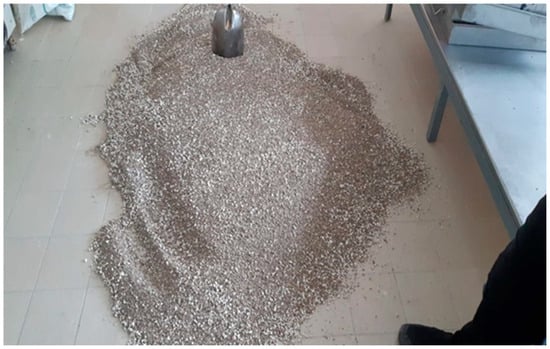
CEM I 42.5 R Portland cement conforming to TS EN 197-1 [29] was used as the binder in all mixtures. Potable water complying with TS EN 1008 [30] was used for concrete production. Pumice aggregate obtained from the Sarıkamış region, Türkiye, was used as the lightweight aggregate. The maximum aggregate size was 8 mm. A representative image of the pumice aggregate is shown in Figure 1.
Figure 1.
Commercial colloidal nano-silica suspension supplied by Silika Kimya (Konya, Türkiye).
The colloidal nano-silica used in this study was commercially supplied by Silika Kimya, Konya, Türkiye. The product consisted of 30 wt.% solid SiO2 dispersed in water. The main physical and chemical properties provided by the manufacturer are summarized in Table 1.
Table 1.
Physical and chemical properties of the colloidal nano-silica.
The nano-silica suspension was incorporated into the mixtures at dosages of 0%, 1%, 2%, 3%, 4%, 5%, and 6% by weight of cement. These percentages refer to the suspension mass. Accordingly, the effective solid nano-silica content corresponds to 0–1.8% by weight of cement.
The water contained in the nano-silica suspension was deducted from the total mixing water in order to maintain a constant water-to-cement ratio of 0.54 in all mixtures. To maintain a constant total mixture volume, the mass of nano-silica suspension was compensated by reducing the aggregate content accordingly.
2.2. Physical Properties of Pumice Aggregate
The pumice aggregate was separated into three size fractions: 0–2 mm, 2–4 mm, and 4–8 mm. These fractions were used at proportions of 30%, 50%, and 20%, respectively, to ensure a continuous grading in the concrete mixtures. The same aggregate grading was used for all mixtures so that the experimental results would primarily reflect the effect of nano-silica addition.
The physical properties of the pumice aggregate, including specific gravity, water absorption, and particle density, were determined in accordance with relevant standards. Owing to the porous structure and high water absorption capacity of the pumice aggregate, these characteristics were taken into account during the mix design process.
2.3. Mix Proportions
Colloidal nano-silica (CNS) suspension was used as the nano-additive. The suspension contained approximately 30 wt.% solid SiO2 and 70 wt% water. CNS was incorporated at dosages corresponding to 1–6 wt.% of cement (as suspension dosage). For clarity, the equivalent solid nano-silica contents were 0.30–1.80 wt.% of cement, which correspond to 1.11–6.66 kg of solid nano-silica per 1 m3 for a cement content of 370 kg/m3 (Table 2).
Table 2.
Mixture proportions of the concrete mixes (kg/m3).
During mix proportioning, the water present in the CNS suspension was deducted from the total mixing water to keep the effective water-to-cement ratio constant. To maintain a consistent total batch mass/volume, the added CNS mass was compensated by reducing the pumice aggregate mass while keeping the cement content constant (Table 2).
Percentages refer to the mass of colloidal nano-silica suspension (30% solid content) by weight of cement. The water contained in the suspension was deducted from the total mixing water, and the aggregate content was proportionally reduced to maintain constant mixture volume.
The control mixture without nano-silica was designated as REF (reference lightweight concrete). Mixtures containing colloidal nano-silica suspension were labeled as NS1, NS2, NS3, NS4, NS5, and NS6, corresponding to 1%, 2%, 3%, 4%, 5%, and 6% colloidal nano-silica suspension by weight of cement, respectively.
2.4. Specimen Preparation and Curing Conditions
Concrete mixtures were prepared in a laboratory mechanical mixer. The fresh concrete was cast into steel cube molds with dimensions of 50 mm × 50 mm × 50 mm. The selected specimen size was considered appropriate due to the maximum aggregate size of 8 mm, ensuring adequate aggregate-to-specimen size ratio. Specimens were compacted in accordance with TS EN 12390-2 [31]. After 24 h, the specimens were demolded and cured in water at 20 ± 2 °C until the testing ages.
Compressive strength tests were performed in accordance with TS EN 12390-3 [32] at curing ages of 7, 14, 28, and 56 days. For each mixture and curing age, three specimens were tested and the average value was reported.
2.5. Experimental Method
2.5.1. Compressive Strength Test
Compressive strength tests were performed in accordance with TS EN 12390-3 [32]. The 50 mm × 50 mm × 50 mm cube specimens were placed in the testing machine with the loading direction perpendicular to the casting direction. The load was applied continuously at a rate of 0.6 MPa/s until failure.
For each mixture and curing age, three specimens (n = 3) were tested. The compressive strength was calculated as the arithmetic mean of the three results. No size conversion factor was applied, as the study focuses on comparative evaluation among mixtures tested under identical conditions.
2.5.2. Microstructural Analyses
Microstructural analyses were performed for all mixtures, while representative results are presented for clarity and to avoid unnecessary repetition. After the compressive strength tests, specimens were subjected to XRD, SEM, and FTIR analyses to evaluate hydration products and matrix characteristics.
All microstructural investigations were carried out on 56-day specimens, corresponding to the curing age at which the highest compressive strength values were obtained.
For X-ray diffraction (XRD) analysis, crushed powder samples were obtained from the inner portions of the specimens to avoid surface carbonation effects. The samples were scanned over a 2θ range of approximately 5–80° to identify the main crystalline phases and hydration products.
Scanning electron microscopy (SEM) was performed on small fractured pieces taken from the interior of the specimens. The samples were dried prior to testing and coated with a thin conductive layer to enhance image quality. Observations were carried out at different magnifications to evaluate the morphology and relative compactness of the cement matrix, with particular attention to matrix regions and aggregate–matrix interfaces.
Fourier transform infrared (FTIR) spectroscopy was performed to identify the main chemical bonds within the hydration products. Spectra were recorded over a wavenumber range of approximately 4000–900 cm−1.
Microstructural results are presented for the reference mixture (REF) and the mixture exhibiting the highest compressive strength at 56 days (NS5). Intermediate mixtures showed similar qualitative trends; therefore, repetitive data are not included for brevity.
2.5.3. Workability Test
The workability of fresh concrete mixtures was evaluated using the slump test in accordance with TS EN 12350-2 [33]. The test was performed immediately after mixing, and slump values were recorded to assess the consistency of the mixtures.
2.5.4. Water Absorption Test
Water absorption of hardened concrete specimens was determined in accordance with TS EN 12390-7 [34]. Specimens were conditioned and tested to evaluate the moisture uptake behavior of the mixtures.
Note: Water absorption was calculated according to TS EN 12390-7 [34] using the following equation:
where is the saturated surface-dry mass and is the oven-dry mass of the specimen.
3. Results
3.1. Workability (Slump)
The workability of the fresh concrete mixtures was evaluated using the slump test in accordance with TS EN 12350-2 [33]. The test was carried out immediately after mixing, and the slump values were recorded to assess the consistency of the mixtures.
The slump results are presented in Table 3. A gradual decrease in slump was observed with increasing colloidal nano-silica suspension content, which can be attributed to the high specific surface area of nano-silica particles increasing water demand and enhancing particle packing within the matrix.
Table 3.
Slump values of lightweight concrete mixtures containing colloidal nano-silica suspension.
Despite this reduction, all mixtures remained within the S2 consistency class, indicating that the workability was maintained at an acceptable level for lightweight concrete production. This behavior is associated with maintaining a constant water-to-cement ratio and adjusting the effective mixing water by considering the water contained in the nano-silica suspension.
3.2. Water Absorption
Water absorption of hardened concrete specimens was determined in accordance with TS EN 12390-7 [34]. The specimens were first dried in an oven at 105 ± 5 °C until constant mass was achieved, after which the dry mass was recorded. Subsequently, the specimens were immersed in water for 24 h to reach a saturated condition, and the saturated surface-dry mass was measured.
The water absorption results of the mixtures are presented in Table 4. The reference mixture exhibited a water absorption value of 18.51%, while mixtures containing colloidal nano-silica suspension showed slightly lower values ranging between 17.20% and 18.32%.
Table 4.
Water absorption results of hardened lightweight concrete mixtures determined according to TS EN 12390-7 (mean ± SD, n = 3).
A gradual decrease in water absorption was observed with increasing nano-silica suspension content, although the overall variation remained relatively limited. This behavior can be attributed to the inherently high absorption capacity of pumice aggregate, which governs the overall moisture uptake of the lightweight concrete system. The incorporation of colloidal nano-silica suspension may have contributed to partial pore refinement; however, the dominant influence of the porous aggregate limited the magnitude of change.
Values are reported as mean ± standard deviation based on three replicate measurements. The relatively low standard deviation values indicate good repeatability and consistency of the water absorption measurements.
3.3. Compressive Strength
The compressive strength results of the reference and nano-silica-modified lightweight concrete mixtures at 7, 14, 28, and 56 days are presented in Table 5 as mean values with standard deviation (n = 3).
Table 5.
Compressive strength of nano-silica-modified lightweight concretes at different curing ages (mean ± SD, MPa; n = 3).
The relatively low standard deviation values indicate good repeatability and reliability of the experimental measurements.
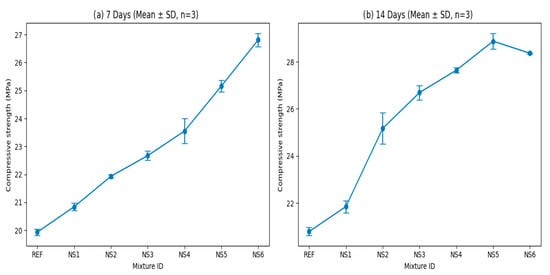
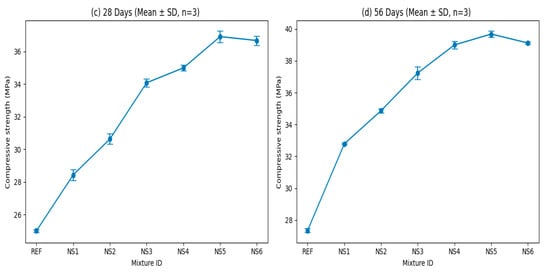
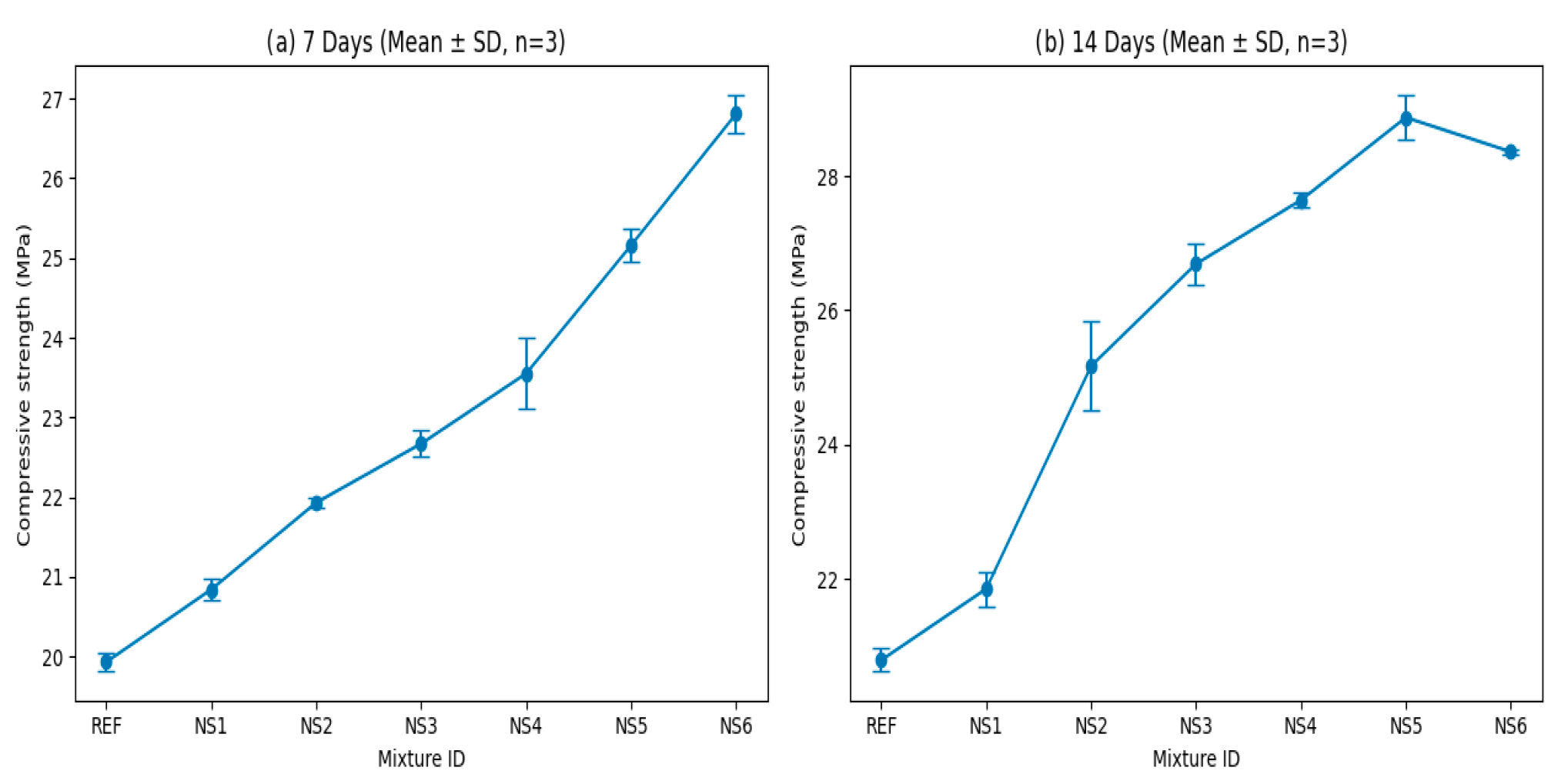
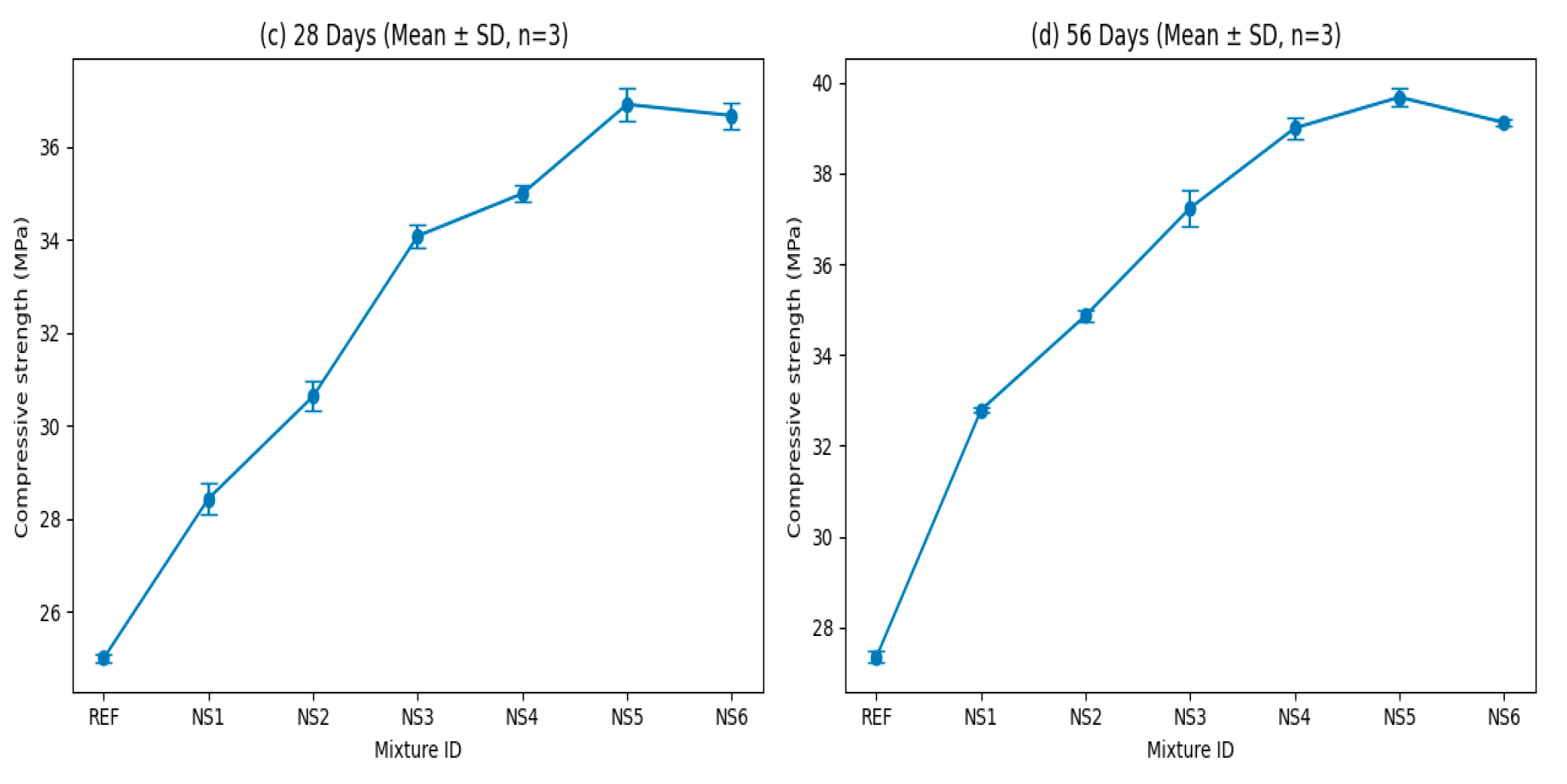
The compressive strength results of the reference (REF) and colloidal nano-silica suspension–modified lightweight concrete mixtures at curing ages of 7, 14, 28, and 56 days are presented in Table 5 as mean values with standard deviation (n = 3). The corresponding variations with error bars are illustrated in Figure 2.
Figure 2.
Compressive strength of lightweight concrete mixtures modified with colloidal nano-silica suspension at different curing ages: (a) 7 days, (b) 14 days, (c) 28 days, and (d) 56 days (mean ± SD, n = 3).
The relatively low standard deviation values indicate good repeatability and reliability of the experimental measurements. In all curing periods, the incorporation of colloidal nano-silica suspension led to an increase in compressive strength compared to the reference mixture.
At 7 days, compressive strength increased progressively with increasing colloidal nano-silica suspension dosage. The strength rose from 19.93 MPa (REF) to 26.81 MPa at 6% suspension, corresponding to an approximate 34.5% increase. Notably, the 6% suspension mixture exhibited slightly higher strength than the 5% mixture at this early age, suggesting an accelerated hydration effect associated with higher nano-silica availability.
At 14 days, a similar trend was observed up to 5% suspension, where the maximum value of 28.87 MPa was recorded. A slight reduction was observed at 6% suspension (28.36 MPa), although this difference falls within the standard deviation range.
At 28 days, the highest compressive strength was obtained at 5% suspension (36.92 MPa). The value at 6% suspension (36.68 MPa) was slightly lower; however, the difference is within the standard deviation range, indicating that the reduction is not statistically meaningful based on variability.
At 56 days, compressive strength increased up to 5% suspension (39.68 MPa) and slightly decreased at 6% suspension (39.12 MPa). Considering the overlapping standard deviation intervals, the difference between the 5% and 6% suspension mixtures is minor.
Overall, the colloidal nano-silica suspension significantly enhanced the compressive strength development of pumice aggregate lightweight concrete, particularly between 3% and 5% suspension dosage levels. Beyond 5%, the rate of strength improvement tended to stabilize.
The average dry density of the lightweight concrete mixtures was approximately 1710 kg/m3 for mixtures containing 0–6% colloidal nano-silica suspension.
3.4. X-Ray Diffraction (XRD) Analysis
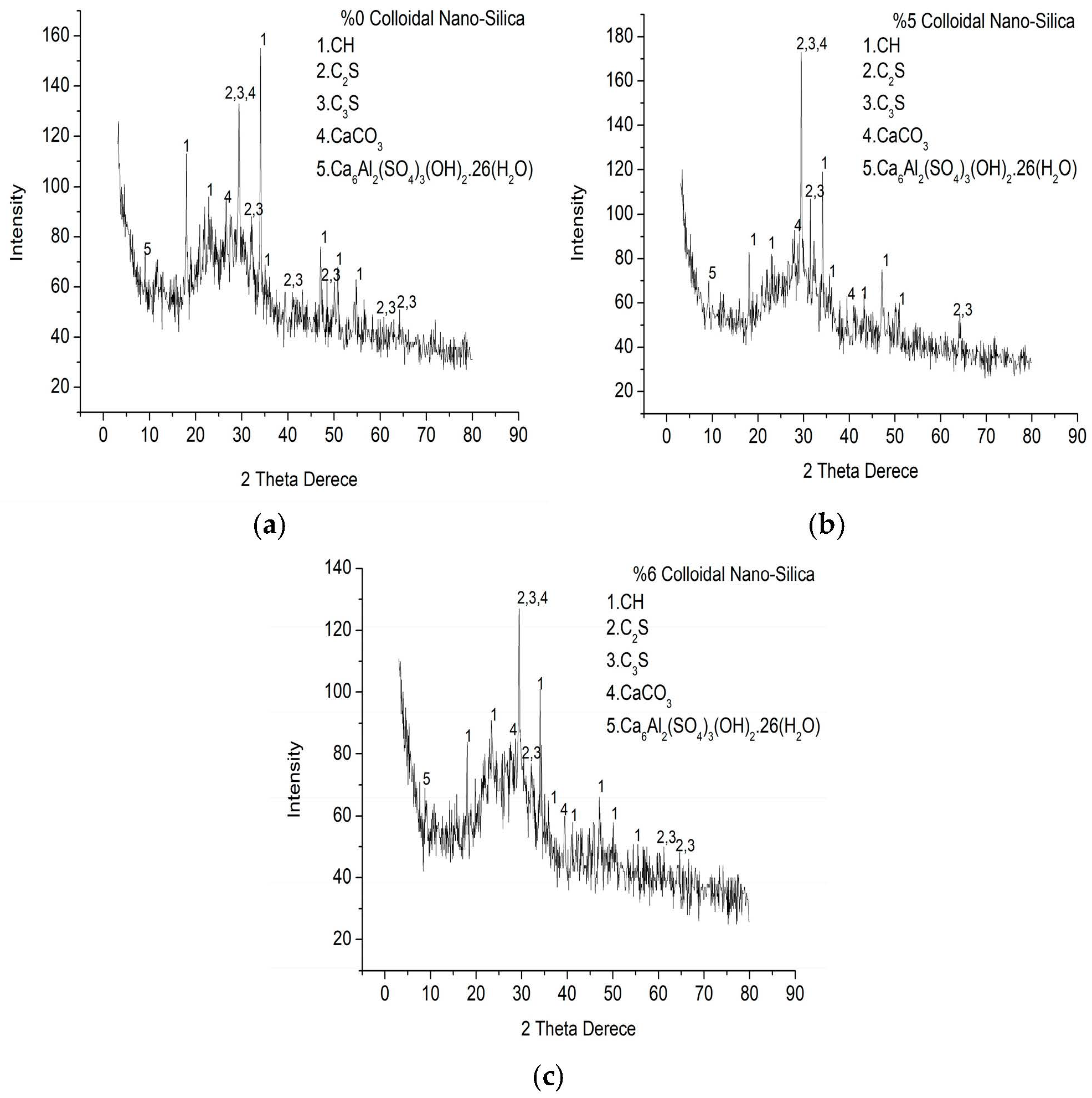
The X-ray diffraction patterns of the reference mixture (REF) and the mixtures incorporating colloidal nano-silica suspension (NS5 and NS6) at 56 days are presented in Figure 3. The main crystalline phases identified include calcium hydroxide (CH), calcium silicate phases (C2S and C3S), calcium carbonate (CaCO3), and ettringite.
Figure 3.
XRD patterns of lightweight concrete incorporating colloidal nano-silica suspension at 56 days: (a) reference mixture (REF), (b) 5% suspension (NS5), and (c) 6% suspension (NS6). Major phases including CH, C-S-H, and quartz are identified.
A gradual reduction in the intensity of CH peaks was observed with increasing colloidal nano-silica suspension content up to 6%, indicating the consumption of portlandite through pozzolanic reactions. This behavior suggests that the nano-silica suspension promotes the formation of additional C–S–H gel, contributing to a denser microstructure. The presence of C2S and C3S phases supports the continued hydration and development of strength-bearing products.
Peaks corresponding to calcium carbonate are also detected, which may be attributed to carbonation during curing or sample preparation. The detection of ettringite indicates ongoing hydration reactions and the stability of sulfate phases within the matrix.
Although the CH content decreases and C–S–H formation is enhanced at higher suspension dosages, the compressive strength shows a slight reduction when the dosage increases from 5% to 6%. This behavior can be associated with possible agglomeration of nano-silica particles at higher concentrations, which may lead to local heterogeneities, reduced dispersion efficiency, and slight disruption of the microstructural uniformity. Similar observations have been reported in the literature, where excessive nano-silica content can result in particle clustering and inefficient packing, limiting further strength improvement.
XRD measurements were carried out using a Rigaku D/Max 2200 diffractometer located at the Scientific and Technological Research Center of İnönü University. The scans were performed over a 2θ range of approximately 5–80°, as indicated in the diffraction patterns, to identify the crystalline phases and hydration products.
3.5. Scanning Electron Microscopy (SEM) Analysis
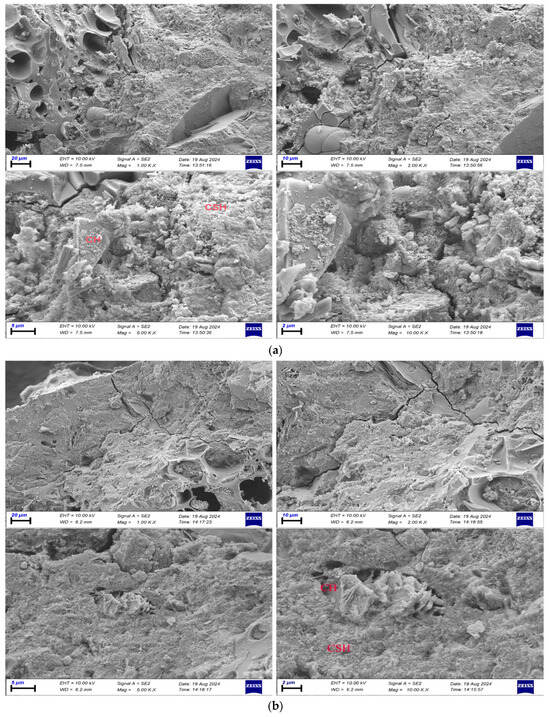
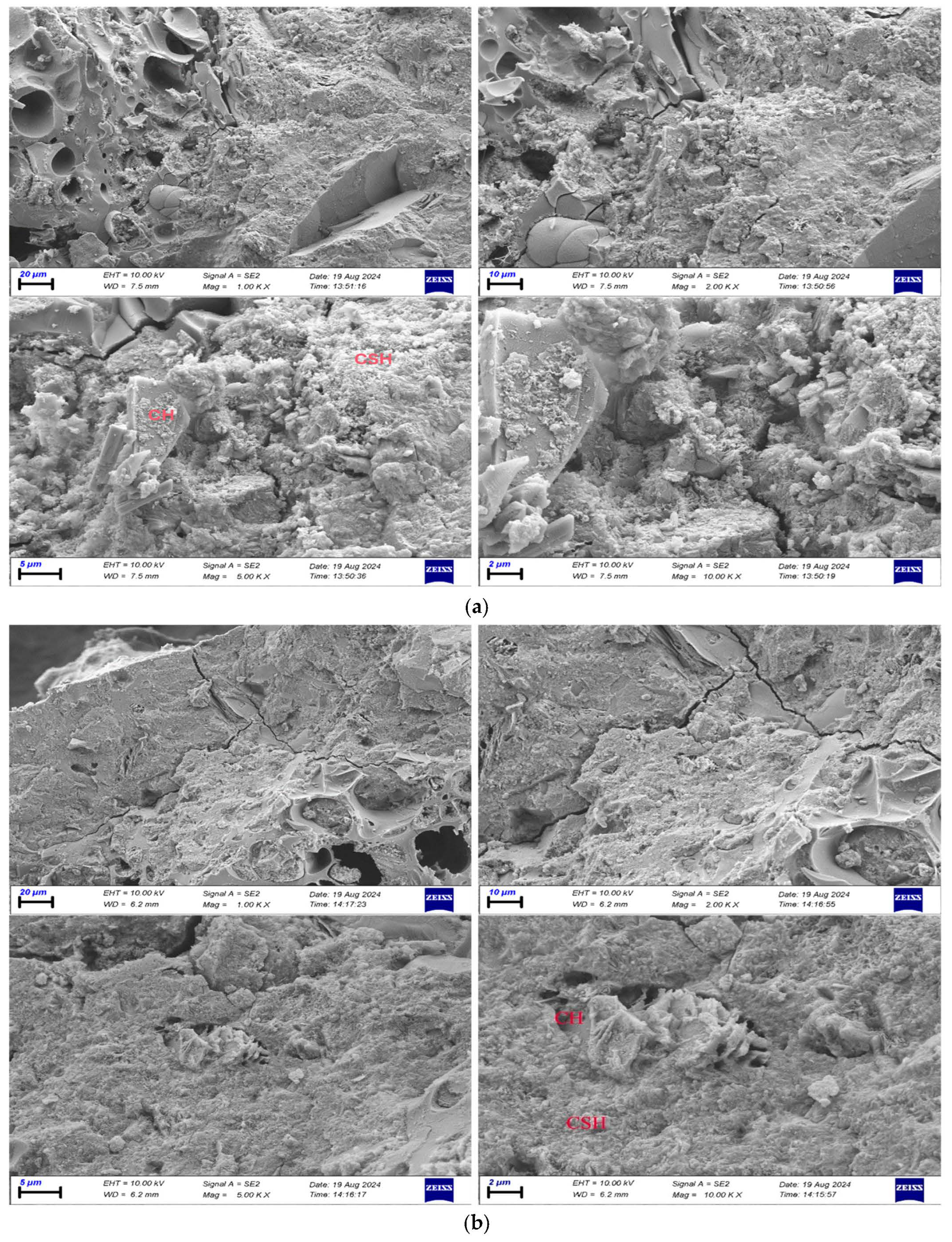
SEM micrographs of the control mixture (REF) and the mixture containing 5% colloidal nano-silica suspension at 56 days are shown in Figure 4.
Figure 4.
Scanning electron microscopy (SEM) images of lightweight concretes at 56 days: (a) control mixture (REF); and (b) mixture containing 5% colloidal nano-silica (NS5). Compared to the control mixture, the nano-silica-modified mixture exhibits a relatively denser and more uniform matrix structure.
The SEM micrographs of the reference mixture (REF) and the mixture containing 5% colloidal nano-silica suspension (NS5) at 56 days show observable differences in the morphology of the cementitious matrix. The reference mixture appears to exhibit a comparatively more open microstructure with visible voids and less uniformly distributed hydration products. In contrast, the NS5 mixture presents a more compact and homogeneous texture, with hydration products appearing more closely packed.
Gel-like features consistent with C–S–H morphology are observed in both mixtures, while the distribution of crystalline phases appears less pronounced in the nano-silica-modified sample. These observations qualitatively suggest that the incorporation of colloidal nano-silica suspension may influence the microstructural arrangement of hydration products. However, the SEM analysis is interpreted in a qualitative manner and is used primarily to support the trends observed in mechanical and other microstructural results.
These observations are consistent with the general understanding of nano-silica effects reported in the literature.
3.6. Fourier Transform Infrared (FTIR) Analysis
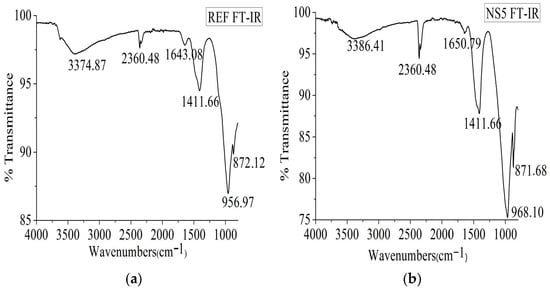
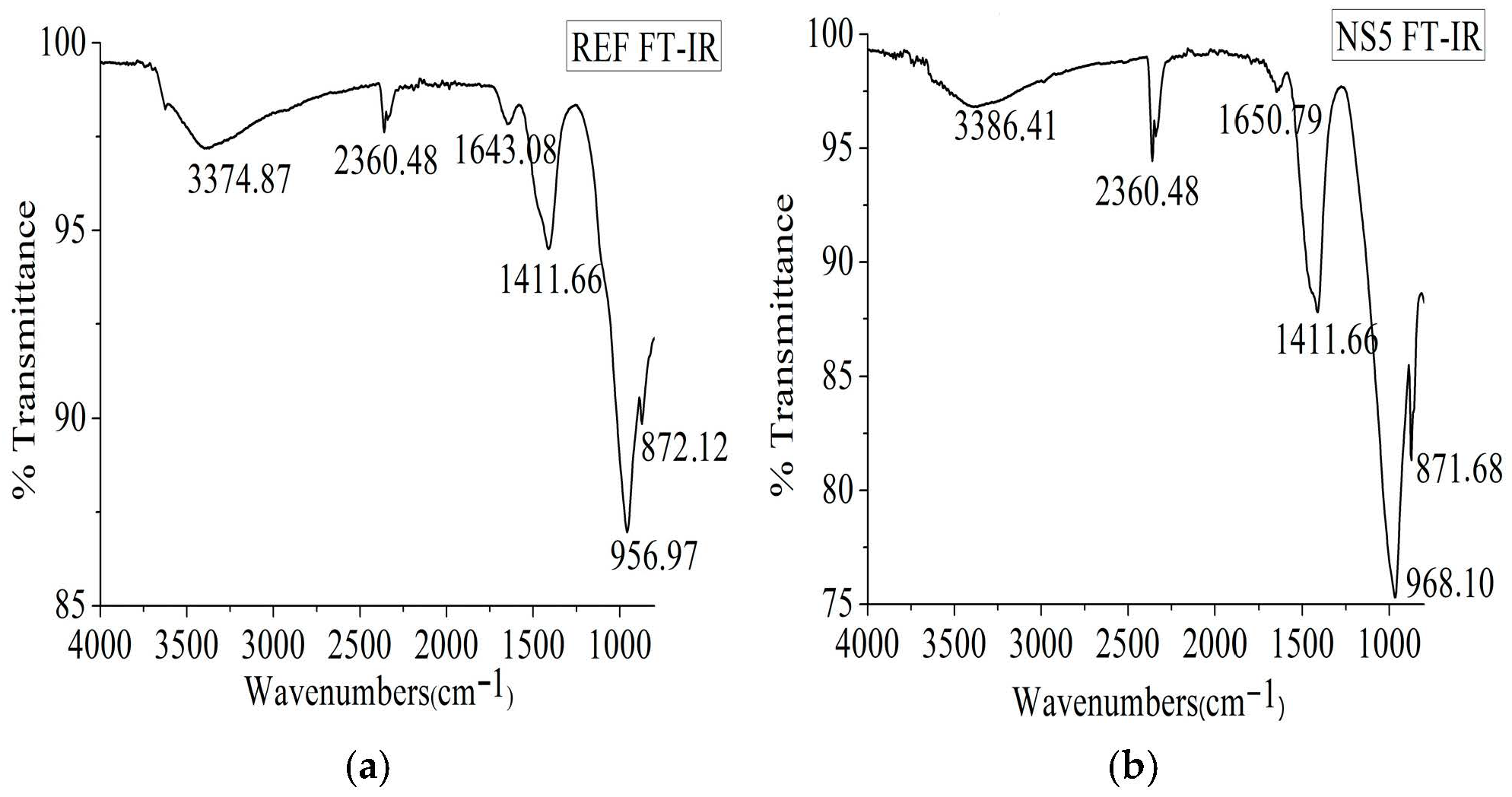
The spectra of the reference mixture (REF) and the mixture containing 5% colloidal nano-silica suspension (NS5) at 56 days are presented in Figure 5. Both spectra exhibit characteristic absorption bands associated with cement hydration products, indicating that similar hydration phases are present in both mixtures.
Figure 5.
Fourier transform infrared (FTIR) spectra of lightweight concretes at 56 days: (a) control mixture (REF); and (b) mixture containing 5% colloidal nano-silica suspension (NS5). The main absorption bands associated with cement hydration products are observed in both mixtures, while the colloidal nano-silica suspension-modified mixture shows slight variations in the silicate-related bands.
The broad band observed at approximately 3374 cm−1 is attributed to O–H stretching vibrations of bound water in hydration products. The band near 1643 cm−1 corresponds to the H–O–H bending vibrations of molecular water.
The main silicate-related absorption band assigned to Si–O–T (T = Si, Al) stretching vibrations of C–S–H gel appears at approximately 956.97 cm−1 for the REF mixture and shifts to approximately 968.10 cm−1 for the NS5 mixture. This shift toward higher wavenumbers may indicate slight modifications in the silicate structure of the C–S–H gel associated with the incorporation of colloidal nano-silica.
In addition, carbonate-related bands observed at approximately 1411 cm−1 and 871–872 cm−1 are present in both mixtures, indicating comparable carbonation behavior. Overall, the FTIR results are interpreted qualitatively and provide supportive evidence consistent with the XRD and SEM observations.
3.7. Overall Evaluation of Results
Based on the combined evaluation of mechanical and microstructural results, nano-silica addition significantly improves the compressive strength and microstructural characteristics of pumice aggregate lightweight concrete. However, increasing the colloidal nano-silica suspension content beyond 5% does not result in a substantial enhancement in mechanical performance despite increased CH consumption. This finding highlights the importance of determining an optimum nano-silica dosage for lightweight concrete systems.
4. Discussion
The experimental results demonstrate that the incorporation of colloidal nano-silica (CNS) suspension significantly influences both the mechanical behavior and microstructural characteristics of pumice aggregate lightweight concrete (PALC). These improvements can be attributed to the combined effects of nucleation, pozzolanic reactions, and pore structure refinement, which are well-established mechanisms for nano-silica in cementitious systems [1,2,3,4,5,6].
The compressive strength results indicate that strength increases progressively with increasing CNS content at early ages, with the mixture containing 6% suspension exhibiting the highest strength at 7 days. This behavior can be associated with the nucleation effect of nano-silica, which promotes the early formation of hydration products, particularly C–S–H gel [3,5]. However, in the absence of calorimetric data, this interpretation should be considered as indirect evidence based on mechanical performance rather than a direct measurement of hydration kinetics.
At later ages, the strength development tends to stabilize, and a slight reduction is observed when the CNS content increases from 5% to 6%. Considering that the differences fall within the range of experimental variability, this trend suggests that increasing nano-silica content beyond a certain level does not necessarily lead to proportional strength gains. Similar observations have been reported in the literature, where the effectiveness of nano-silica is shown to be strongly dependent on dosage, dispersion quality, and mixture characteristics [13,14,15,16]. This behavior has also been associated with particle agglomeration and dispersion-related limitations at higher nano-silica contents [11,12].
In pumice aggregate lightweight concrete, the role of CNS becomes more complex due to the highly porous structure and high water absorption capacity of the aggregate. Previous studies have shown that these characteristics significantly influence the mechanical performance and durability behavior of lightweight concrete systems [21,22,23].
The results of this study suggest that CNS contributes to improving matrix continuity and interfacial bonding; however, its distribution within such a porous system may be affected by internal moisture transport and localized absorption effects. In particular, the high water absorption capacity of pumice aggregates may influence the migration and redistribution of colloidal nano-silica within the matrix, potentially leading to localized enrichment or depletion zones.
This system-specific behavior provides a plausible explanation for the observed plateau in strength development beyond 5 wt.% CNS and highlights the importance of considering aggregate porosity when evaluating nano-silica performance in lightweight concrete systems.
XRD results provide important insight into the hydration processes. The gradual reduction in calcium hydroxide (CH) peak intensity with increasing CNS content indicates the occurrence of pozzolanic reactions; however, this interpretation remains qualitative due to the absence of quantitative phase analysis. The presence of hydration-related phases, including those associated with C2S and C3S reactions, as well as calcium carbonate and ettringite, confirms the continued evolution of hydration products within the cementitious matrix, which is consistent with well-established cement hydration and microstructural development mechanisms [24,25,26].
Although CH consumption continues up to 6% CNS, no further increase in compressive strength is observed beyond 5%. This indicates that strength development is not governed solely by CH reduction. At higher dosages, particle agglomeration and reduced dispersion efficiency may limit the effectiveness of additional C–S–H formation. Consequently, despite ongoing pozzolanic activity, the slight reduction in long-term strength at 6% CNS can be attributed to localized heterogeneity within the matrix.
SEM observations support these interpretations. Compared to the reference mixture, the CNS-modified mixtures exhibit a denser and more homogeneous matrix structure with fewer visible voids, indicating improved microstructural integrity. However, these observations remain qualitative and do not provide direct information on pore size distribution. In addition, although direct ITZ characterization was not performed, the observed matrix densification and improved homogeneity suggest that colloidal nano-silica may contribute to enhancing the interfacial transition zone by reducing local porosity and improving particle packing in the vicinity of aggregate surfaces.
FTIR analysis further confirms that the primary hydration products remain similar in both mixtures, while subtle variations in silicate-related bands indicate modifications in the structure of C–S–H, which is consistent with its known structural characteristics in cement-based materials [27,28].
From an engineering perspective, the use of moderate CNS dosages (around 5 wt.%) is recommended to achieve a balanced improvement in strength and microstructural properties without compromising material efficiency. Future studies should focus on advanced characterization techniques, such as calorimetry, mercury intrusion porosimetry (MIP), and dispersion analysis, to further clarify the underlying mechanisms governing nano-silica behavior in porous lightweight concrete systems.
5. Conclusions
In this study, the influence of colloidal nano-silica (CNS) suspension on the mechanical performance and microstructural characteristics of pumice aggregate lightweight concrete (PALC) was systematically investigated. Based on the experimental results, the following conclusions can be drawn:
- (1)
- The incorporation of CNS significantly enhanced the compressive strength of PALC, particularly at early ages. At 7 days, compressive strength increased from 19.93 MPa to 26.81 MPa, corresponding to an improvement of approximately 34.5%.
- (2)
- The optimum CNS dosage was identified as 5 wt.% of cement (approximately 1.5 wt.% solid nano-silica), which provided the highest compressive strength at later ages (39.68 MPa at 56 days). Increasing the dosage to 6 wt.% did not result in further strength improvement, indicating a plateau behavior.
- (3)
- XRD results revealed a reduction in calcium hydroxide (CH) peak intensity with increasing CNS content, suggesting the occurrence of pozzolanic reactions; however, this interpretation remains qualitative due to the absence of quantitative phase analysis.
- (4)
- SEM observations showed a denser and more homogeneous matrix structure in CNS-modified mixtures, while FTIR analysis indicated modifications in the structure of C–S–H without the formation of new hydration phases.
- (5)
- Despite continued CH consumption at higher dosages, no proportional increase in compressive strength was observed beyond 5 wt.%, which can be attributed to possible agglomeration effects and reduced dispersion efficiency at higher nano-silica contents.
- (6)
- The results highlight that, in pumice aggregate lightweight concrete, the effectiveness of nano-silica is influenced not only by its intrinsic reactivity but also by the porous nature and water absorption capacity of the aggregate, which may affect the distribution of nano-silica within the matrix.
From an engineering perspective, the use of moderate CNS dosages (around 5 wt.%) is recommended to achieve a balanced improvement in strength and microstructural properties without compromising material efficiency.
Future studies should focus on advanced characterization techniques, such as calorimetry, mercury intrusion porosimetry, and dispersion analysis, to further clarify the underlying mechanisms governing nano-silica behavior in porous lightweight concrete systems.
Author Contributions
Conceptualization, S.Y. and R.G.; methodology, S.Y.; investigation, S.Y.; writing—original draft preparation, S.Y.; writing—review and editing, S.Y. and R.G.; supervision, R.G. All authors have read and agreed to the published version of the manuscript.
Funding
This research received no external funding.
Data Availability Statement
The raw data supporting the conclusions of this article will be made available by the authors on request.
Conflicts of Interest
The authors declare no conflict of interest.
References
- Sanchez, F.; Sobolev, K. Nanotechnology in concrete—A review. Constr. Build. Mater. 2010, 24, 2060–2071. [Google Scholar] [CrossRef] [Scilit]
- Kawashima, S.; Hou, P.; Corr, D.J.; Shah, S.P. Modification of cement-based materials with nanoparticles. Cem. Concr. Compos. 2013, 36, 8–15. [Google Scholar] [CrossRef] [Scilit]
- Li, H.; Xiao, H.-G.; Yuan, J.; Ou, J. Microstructure of cement mortar with nano-particles. Compos. Part B Eng. 2004, 35, 185–189. [Google Scholar] [CrossRef] [Scilit]
- Hou, P.; Kawashima, S.; Kong, D.; Corr, D.J.; Qian, J.; Shah, S.P. Effects of colloidal nano-SiO2 on cement hydration and its gel property. Compos. Part B Eng. 2013, 45, 440–448. [Google Scholar] [CrossRef] [Scilit]
- Björnström, J.; Martinelli, A.; Matic, A.; Börjesson, L.; Panas, I. Accelerating effects of colloidal nano-silica for beneficial calcium–silicate–hydrate formation in cement. Chem. Phys. Lett. 2004, 392, 242–248. [Google Scholar] [CrossRef] [Scilit]
- Kontoleontos, F.; Tsakiridis, P.E.; Marinos, A.; Kaloidas, V.; Katsioti, M. Influence of colloidal nanosilica on ultrafine cement hydration. Constr. Build. Mater. 2012, 35, 347–360. [Google Scholar] [CrossRef] [Scilit]
- Jo, B.-W.; Kim, C.-H.; Tae, G.; Park, J.-B. Characteristics of cement mortar with nano-SiO2 particles. Constr. Build. Mater. 2007, 21, 1351–1355. [Google Scholar] [CrossRef] [Scilit]
- Quercia, G.B.; Spiesz, P.; Hüsken, G.; Brouwers, H.J.H. SCC modification by use of amorphous nano-silica. Cem. Concr. Compos. 2014, 45, 69–81. [Google Scholar] [CrossRef] [Scilit]
- Amin, M.; El-Hassan, A. Effect of using different types of nano materials on mechanical properties of high strength concrete. Constr. Build. Mater. 2015, 80, 116–124. [Google Scholar] [CrossRef] [Scilit]
- Najigivi, A.; Khaloo, A.; Iraji Zad, A.; Rashid, S.A. Investigating the effects of using different types of SiO2 nanoparticles on the mechanical properties of binary blended concrete. Compos. Part B Eng. 2013, 54, 52–58. [Google Scholar] [CrossRef] [Scilit]
- Kong, D.; Su, Y.; Du, X.; Yang, Y.; Wei, S.; Shah, S.P. Influence of nano-silica agglomeration on fresh properties of cement pastes. Constr. Build. Mater. 2013, 43, 557–562. [Google Scholar] [CrossRef] [Scilit]
- Hou, P.; Qian, J.; Cheng, X.; Shah, S.P. Effects of pozzolanic reactivity of nano-SiO2 on cement-based materials. Cem. Concr. Compos. 2015, 55, 250–258. [Google Scholar] [CrossRef] [Scilit]
- Zhang, L.; Bian, M.; Xiao, Z.; Wang, X.; Han, B. A Comprehensive Review of Cementitious Composites Modified with Nano Silica: Fabrication, Microstructures, Properties and Applications. Constr. Build. Mater. 2023, 409, 133922. [Google Scholar] [CrossRef] [Scilit]
- AlTawaiha, H.; Alhomaidat, F.; Eljufout, T. A Review of the Effect of Nano-Silica on the Mechanical and Durability Properties of Cementitious Composites. Infrastructures 2023, 8, 132. [Google Scholar] [CrossRef] [Scilit]
- Zeng, P.; Abbas, M.A.A.M.; Ran, X.; Li, P. Impermeability, strength and microstructure of concrete modified by nano-silica and expansive agent. J. Compos. Sci. 2025, 9, 108. [Google Scholar] [CrossRef] [Scilit]
- Choi, Y.-C. The effect of colloidal nano-silica on the initial hydration of high-volume fly ash cement. Materials 2025, 18, 2769. [Google Scholar] [CrossRef] [Scilit] [PubMed]
- Chandra, S.; Berntsson, L. Lightweight Aggregate Concrete; Elsevier: Oxford, UK, 2002. [Google Scholar]
- ACI Committee 213. Guide for Structural Lightweight-Aggregate Concrete (ACI 213R-03); American Concrete Institute: Farmington Hills, MI, USA, 2003. [Google Scholar]
- Gomes, M.G.; Almeida, R.M.R.; de Brito, J. Thermal performance of structural lightweight aggregate concrete. Sustainability 2023, 15, 11105. [Google Scholar] [CrossRef] [Scilit]
- Hossain, K.M.A. Properties of volcanic pumice-based lightweight concrete. Cem. Concr. Res. 2004, 34, 283–291. [Google Scholar] [CrossRef] [Scilit]
- Tuncer, M.; Bideci, A.; Çomak, B.; Durmuş, G.; Sallı Bideci, Ö. Experimental investigation of durability properties of polymer coated pumice aggregate lightweight concretes. Polymers 2025, 17, 253. [Google Scholar] [CrossRef] [Scilit]
- Elyiğit, B.; Ekinci, C.E. Investigation of the mechanical and physical properties of acidic pumice aggregate-reinforced lightweight concrete under high-temperature exposure. Buildings 2025, 15, 2505. [Google Scholar] [CrossRef] [Scilit]
- Wang, H.; Chen, Y.; Wang, H. Mechanical performance of lightweight aggregate concrete with silica content. Symmetry 2024, 16, 275. [Google Scholar] [CrossRef] [Scilit]
- Bentz, D.P.; Snyder, K.A. Protected paste volume in concrete: Extension to internal curing using saturated lightweight fine aggregate. Cem. Concr. Res. 1999, 29, 1863–1867. [Google Scholar] [CrossRef] [Scilit]
- Scrivener, K.L.; Snellings, R.; Lothenbach, B. A Practical Guide to Microstructural Analysis of Cementitious Materials; CRC Press: Boca Raton, FL, USA, 2016. [Google Scholar]
- Mehta, P.K.; Monteiro, P.J.M. Concrete: Microstructure, Properties, and Materials, 4th ed.; McGraw-Hill: New York, NY, USA, 2014. [Google Scholar]
- Taylor, H.F.W. Cement Chemistry, 2nd ed.; Thomas Telford: London, UK, 1997. [Google Scholar]
- Richardson, I.G. The calcium silicate hydrates. Cem. Concr. Res. 2008, 38, 137–158. [Google Scholar] [CrossRef] [Scilit]
- TS EN 197-1; Cement—Part 1: Composition, Specifications and Conformity Criteria for Common Cements. Turkish Standards Institution (TSE): Ankara, Türkiye, 2012.
- TS EN 1008; Mixing Water for Concrete—Specification for Sampling, Testing and Assessing the Suitability of Water, Including Water Recovered from Processes in the Concrete Industry. Turkish Standards Institution (TSE): Ankara, Türkiye, 2009.
- TS EN 12390-2; Making and Curing Specimens for Strength Tests. Turkish Standards Institution (TSE): Ankara, Türkiye, 2019.
- TS EN 12390-3; Testing Hardened Concrete—Part 3: Compressive Strength of Test Specimens. Turkish Standards Institution (TSE): Ankara, Türkiye, 2019.
- TS EN 12350-2; Testing Fresh Concrete—Part 2: Slump Test. Turkish Standards Institution (TSE): Ankara, Türkiye, 2019.
- TS EN 12390-7; Testing Hardened Concrete—Part 7: Density of Hardened Concrete. Turkish Standards Institution (TSE): Ankara, Türkiye, 2019.

Disclaimer/Publisher’s Note: The statements, opinions and data contained in all publications are solely those of the individual author(s) and contributor(s) and not of MDPI and/or the editor(s). MDPI and/or the editor(s) disclaim responsibility for any injury to people or property resulting from any ideas, methods, instructions or products referred to in the content. |
© 2026 by the authors. Licensee MDPI, Basel, Switzerland. This article is an open access article distributed under the terms and conditions of the Creative Commons Attribution (CC BY) license.