


Abstract
The sustainable stabilization of clayey soils has become a critical strategy for improving their mechanical performance while reducing environmental impact. This study compares two distinct stabilization systems applied to the same low-plasticity clay (CL) from Cartagena de Indias, Colombia: (i) lime catalyzed with sodium chloride (NaCl) and (ii) xanthan gum (XG) reinforced with polypropylene fibers (PPF). A series of laboratory tests was performed to evaluate the unconfined compressive strength (qu) and small-strain stiffness (Go) of both systems under controlled compaction and curing conditions. The lime–NaCl system demonstrated accelerated early-age strength and stiffness development, reaching qu values above 2.5 MPa and Go exceeding 10 GPa after 28 days of curing, mainly attributed to enhanced pozzolanic reactions catalyzed by NaCl. Conversely, the XG–PPF blends exhibited progressive improvements in mechanical performance, achieving notable gains after 90 days due to the polymeric bonding of XG and the fiber–matrix reinforcement that enhanced ductility and post-peak behavior. When normalized through the porosity–binder index, both systems exhibited power-law trends, with the lime–NaCl mixtures displaying higher exponents indicative of cementation-controlled behavior, while the XG–PPF mixtures showed lower exponents consistent with interparticle bonding and network formation. These results highlight the complementary mechanisms of chemical and biopolymeric stabilization, providing insights into the selection of sustainable binders tailored to specific design requirements in tropical clays. This research demonstrated that the implementation of machine learning models enhanced the fitting accuracy of the two soil stabilization methods when compared with traditional mathematical regression models commonly used in geotechnical engineering. Among the tested approaches, the neural network and Gaussian process regression models exhibited the best performance, achieving R2 values ranging from 0.917 to 0.980 during the validation stage.
1. Introduction
Over the past two decades, the development of sustainable soil stabilization techniques has garnered increasing attention as part of global efforts to mitigate the environmental impact of civil infrastructure. Conventional stabilizers such as lime and cement are effective in improving the mechanical performance of fine-grained soils but are associated with significant CO2 emissions and extended curing times. Consequently, alternative binders—including biopolymers, chemical catalysts, and industrial by-products like ashes—have been explored to achieve comparable mechanical performance with lower environmental costs [1].
Xanthan gum is capable of forming cohesive polymeric networks that enhance the mechanical properties of soil samples. Conversely, lime combined with sodium chloride (NaCl) can promote rapid pozzolanic reactions, thereby improving the early development of strength and stiffness [2]. Recently, machine learning (ML) techniques have proven effective in capturing the nonlinear relationships between predictors (such as soil properties, binder content, and curing conditions) and the mechanical responses of soil. Hence, ML can be employed to predict the performance of soil stabilization under various conditions. In this regard, ML can also be utilized to develop hybrid models by integrating data obtained from experimental programs, thereby improving the understanding of the interplay between chemical and biopolymeric mechanisms influencing soil behavior [3].
Lime stabilization remains one of the most widely adopted chemical techniques for improving the engineering behavior of fine-grained soils, particularly clays with moderate plasticity [4]. The reaction mechanism involves cation exchange, flocculation–agglomeration, and subsequent pozzolanic reactions between lime-derived calcium and the silica–alumina phases of the clay minerals. These reactions form cementitious products such as calcium silicate hydrates (C–S–H) and calcium aluminate hydrates (C–A–H), which progressively increase the soil’s stiffness and unconfined compressive strength (qu). However, the kinetics of these processes are slow at early curing stages, requiring several weeks to achieve significant gains [1].
To overcome this limitation, recent studies have explored the use of chemical catalysts such as sodium chloride (NaCl) to accelerate lime–soil reactions. The presence of chloride ions modifies the ionic environment, promoting the release of Si4+ and Al3+ from the clay lattice and facilitating the early formation of C–S–H gels. Experimental evidence has shown that small NaCl additions (about 2%) can substantially increase early-age qu and G0 values while maintaining long-term stability. This approach offers a compelling balance between mechanical efficiency and implementation simplicity, particularly in tropical environments where rapid strength gain is often necessary or field construction [5,6,7].
Parallel to advances in chemical stabilization, the use of biopolymers has emerged as a promising sustainable alternative that minimizes the carbon footprint of soil improvement. Among these materials, xanthan gum (XG) has demonstrated outstanding potential due to its ability to form viscoelastic networks through hydrogen bonding and electrostatic interactions with clay particles. XG enhances soil cohesion, reduces permeability, and improves the soil’s tensile resistance by coating and binding fine particles. Nevertheless, the brittle nature of pure biopolymer matrices often limits their ductility and post-peak performance [8,9].
To mitigate this issue, researchers have incorporated synthetic fibers, such as polypropylene fibers (PPF), into XG-treated soils [10]. The fiber reinforcement introduces a secondary mechanism of mechanical interlocking and crack bridging, which enhances both the residual strength and energy absorption capacity of the composite. Studies have reported significant improvements in qu (up to 50–60%) and small-strain stiffness (Go) with relatively low fiber dosages (0.25–0.5%) [11,12]. Furthermore, when the results are normalized through the porosity–binder index (η/Biv), both polymeric and hybrid (XG–fiber) systems exhibit consistent power-law relationships similar to those observed in cemented soils, indicating that soil densification and binder distribution remain the governing parameters of mechanical performance [13].
A key challenge in comparing different stabilization mechanisms lies in the diverse nature of the physicochemical bonds generated within the soil matrix. The porosity–binder index, initially proposed by Consoli et al. [14] provides a robust framework to unify the interpretation of strength and stiffness across chemically and physically stabilized soils. By incorporating both the degree of densification (porosity, η) and the volumetric content of binder like lime and cement (Liv or Biv), this index allows the identification of universal trends in mechanical performance. Previous studies have demonstrated that and follow power-law relationships of the form: and , where the exponents and represent the efficiency of the stabilization mechanism. For lime-treated soils, higher exponents are associated with strong cementation and interparticle bonding, whereas for biopolymer-treated soils, smaller exponents reflect a more flexible and cohesive network. Applying this framework to both lime–NaCl and XG–PPF systems on the same base clay enables a direct and quantitative comparison of their efficiency and mechanical response, beyond simple qu or stiffness metrics [15].
Despite the growing interest in sustainable soil stabilization [16,17], existing research remains fragmented in two critical aspects. First, chemical systems such as lime–salt catalysts have been studied largely independently from biopolymer–fiber systems, leaving unclear how their fundamentally different bonding mechanisms compare when applied to the same soil under standardized conditions [18]. Second, most studies evaluate only strength or stiffness separately, without integrating both responses into a unified framework that enables cross-mechanism comparison or data-driven prediction. Furthermore, very few investigations combine experimental testing with machine-learning approaches [19] to quantify the relative influence of density, curing time, and binder content in chemically and biologically stabilized fine-grained soils. These gaps limit our ability to select the most efficient and sustainable stabilization strategy for regions dominated by tropical silty clays, such as the Caribbean coastal zone of Colombia.
Recently, machine learning (ML) has emerged as a valuable tool not only for analyzing soil behavior but also for predicting it. ML algorithms are capable of identifying complex relationships between predictors (e.g., binder content, density, curing time, porosity) and responses (, ). These algorithms can be broadly categorized into linear regression models, decision tree techniques, neural networks (NN), support vector machine (SVM) formulations, and Gaussian process regression (GPR), among others. Each category may include submodels that differ according to the internal characteristics defined within the selected algorithm.
All these techniques can be applied to predict the strength and stiffness of lime-, cement-, and polymer-stabilized soils. The successful implementation of ML algorithms relies on selecting the most suitable model, not only during the validation stage but also during testing, to minimize the risk of overfitting. Hoque et al. [20] applied a neural network to estimate the unconfined compressive strength (qu) of polypropylene-stabilized soft soils using experimental datasets. Similarly, Zhang et al. [21] employed a database containing 566 cement-stabilized soil samples and compared eight ML algorithms, obtaining a coefficient of determination (R2) of 0.93.
ML algorithms also offer the ability to compute Shapley values, which can be used to determine the relative importance of predictors in influencing the model response. In this regard, cement content, water content, curing time, and fine fraction have shown strong correlations with qu. Mustafa et al. [22] utilized SVM and decision tree (DT) models for both stabilized and natural soils, reporting excellent correlations with R2 > 0.99. Likewise, Mohammed et al. [23] employed six ML algorithms to predict the quantity of ground granulated blast furnace slag-GGBS-required for soft-soil stabilization, finding that the XGB (Extreme Gradient Boosting) model outperformed others and explained approximately 90% of the variance. Their Shapley value analysis indicated that curing time, optimum moisture content, and dry density were the most influential predictors in determining the mechanical performance of soils.
The understanding of stabilization mechanisms can be further enhanced by integrating ML models with the porosity–binder index concept. In this sense, the analysis of the lime–NaCl stabilization method is expected to show a direct dependence on binder content and curing time, whereas the XG–PPF stabilization method is expected to correlate more strongly with density and water content. This research explored ML predictive models for estimating and using experimental datasets comprising 108 and 72 data points for the XG–PPF and lime–NaCl methods, respectively.
This research aims to conduct a comparative experimental and computational investigation of two distinct stabilization mechanisms—lime–NaCl catalyzed reactions and xanthan gum–polypropylene fiber (XG–PPF) reinforcement—applied to the same low-plasticity clay (CL). The mechanical response of both systems, evaluated through unconfined compressive strength (qu) and small-strain shear modulus (Go), was analyzed within a unified porosity–binder index framework and subsequently modeled using machine learning algorithms to identify the key parameters influencing strength and stiffness development. The integration of ML allowed the prediction of material performance across varying curing times, densities, and binder dosages, offering a quantitative comparison between chemical and biopolymer-based stabilization mechanisms. Ultimately, this study seeks to establish a predictive, data-driven approach for selecting sustainable and efficient soil stabilization strategies tailored to tropical fine-grained soils. The research introduces three innovations: a unified porosity–binder index framework used to normalize and compare the mechanical response of chemically and biopolymer-reinforced soils; a systematic evaluation of early- and long-term curing effects for both stabilization routes, highlighting their fundamentally different strength- and stiffness-development pathways; and the integration of machine-learning models to identify the key predictors governing soil performance and to provide reliable, data-driven strength and stiffness predictions across varying binders and curing times.
2. Materials
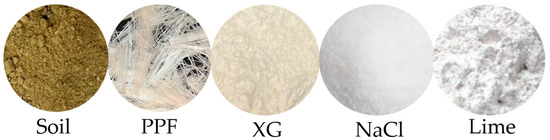
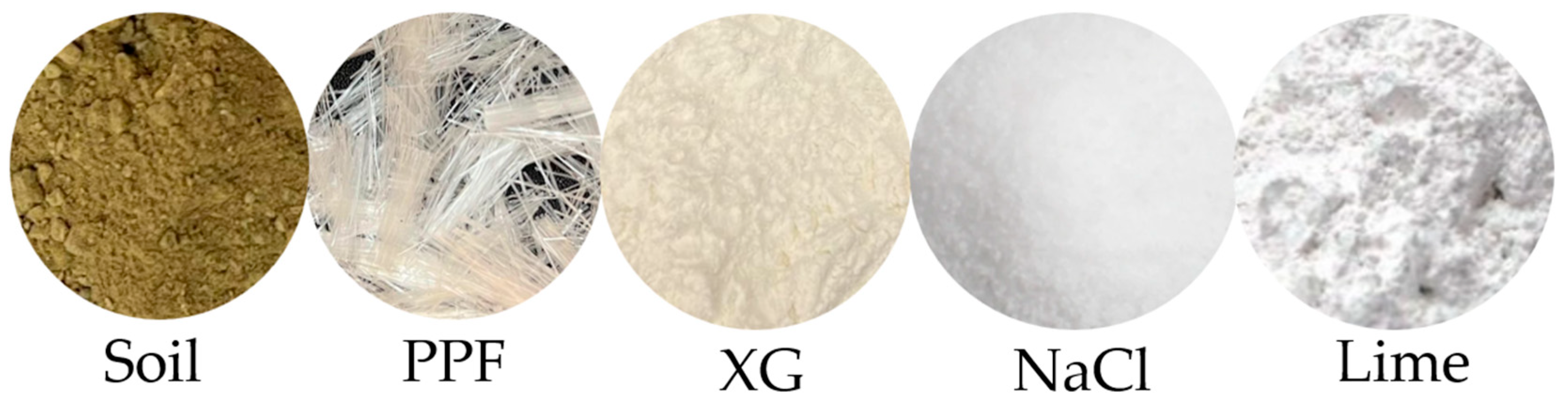
Figure 1 presents the raw materials. The soil exhibits a light brown color, while the other materials—polypropylene fibers (PPF), xanthan gum (XG), sodium chloride (NaCl), and lime—are white in appearance. The soil, PPF, and lime were used in solid form, whereas the powdered XG was dissolved in water, as was the NaCl, following the procedure described below.
Figure 1.
Raw materials.
2.1. Fine Soil
The soil used in this study was collected from the northern expansion coastal area of Cartagena de Indias, Colombia, at a depth of approximately 2.5 m. The selected soil presents characteristics that are representative of the fine-grained coastal deposits commonly encountered in the northern expansion zone of Cartagena de Indias, Colombia. This region is known for low-plasticity marine–alluvial silty clays, which typically exhibit high silt contents, moderate plasticity, and relatively low shear strength.
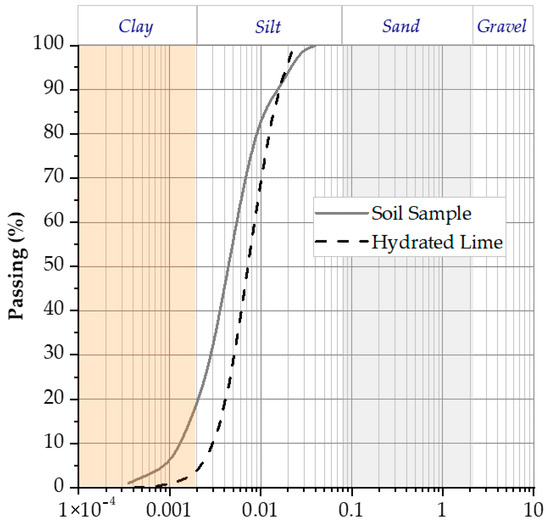
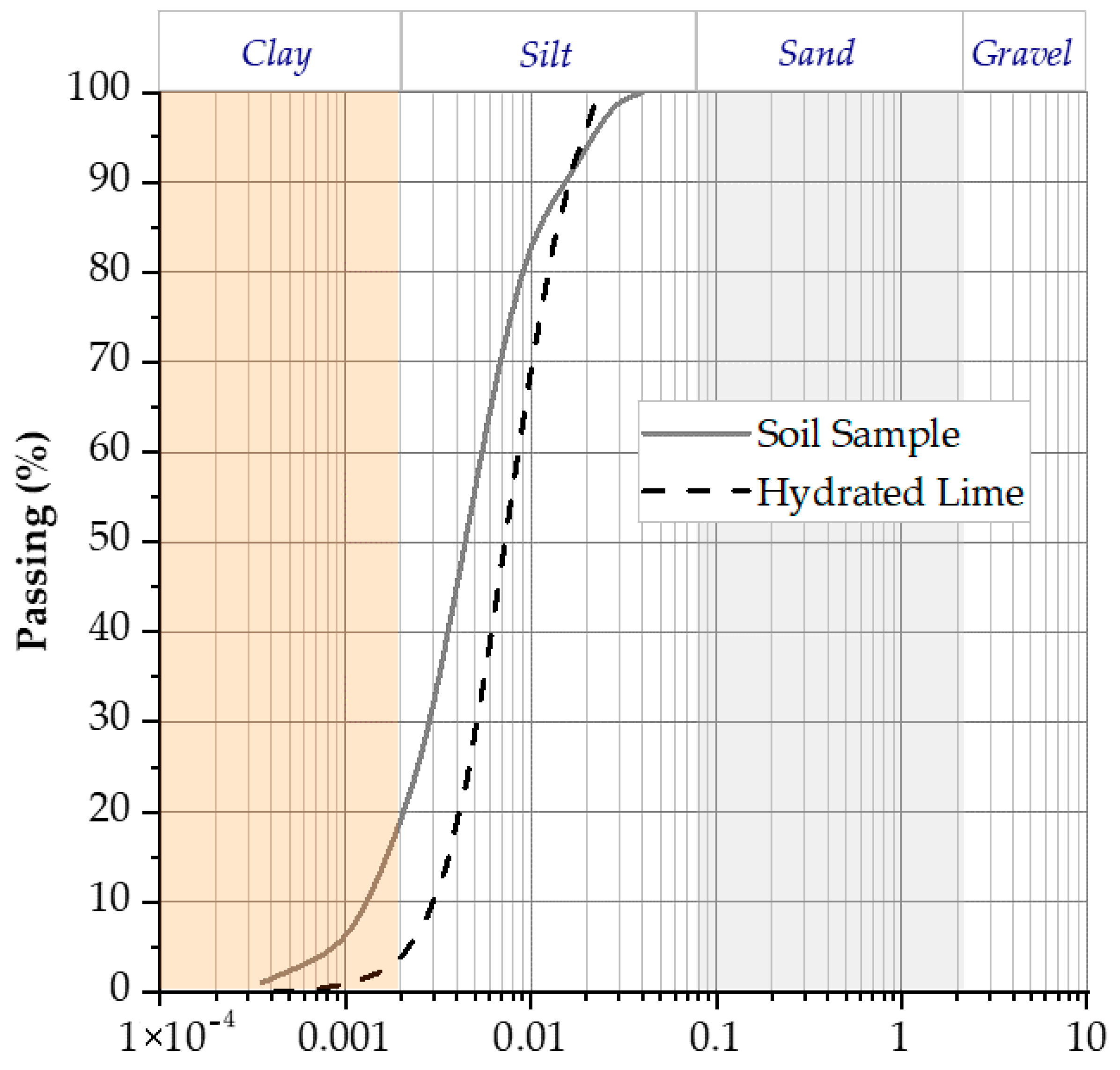
The physical and geotechnical properties of soil are presented in Table 1. Figure 2 shows the granulometric curve of lime and the soil sample. According to the Unified Soil Classification System (USCS, ASTM D2487 [24]), the soil sample was classified as a low-plasticity clay (CL). The soil presented a specific gravity of 2.73, a liquid limit of 53.1%, and a plastic limit of 29.0%, yielding a plasticity index PI of 24.1%. The grain-size distribution consisted of 10% clay (diameter < 0.002 mm), 78% silt (0.002–0.075 mm), and 12% fine sand (0.075–0.425 mm), with a uniformity coefficient (Cu) of 7.14 and a curvature coefficient (Cc) of 0.96. The maximum dry unit weight was 13.95 kN/m3, and the optimum water content, OMC = 26%, for the standard Proctor compaction energy [25]. Mineralogical characterization through X-ray diffraction (XRD) (Shimadzu XRD-7000 diffractometer, Tokyo, Japan) and X-ray fluorescence (XRF) (Shimadzu DX720/800HS, Tokyo, Japan) revealed that the clay fraction is mainly composed of kaolinite, with dominant oxides being SiO2 (66%), Al2O3 (21%), and minor contents of CaO (3%) and Fe2O3 (1%). This mineralogical composition reflects that of a representative clay coastal deposit from Cartagena de Indias.
Table 1.
Physical properties of the soil sample.
Figure 2.
Granulometric curve of soil and lime samples.
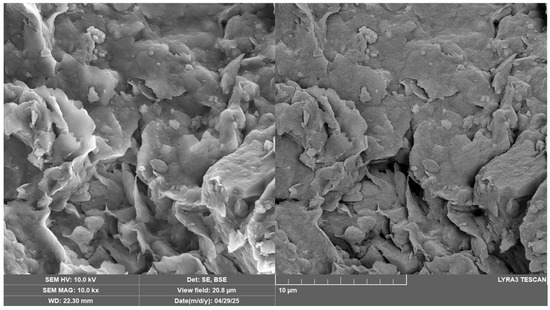
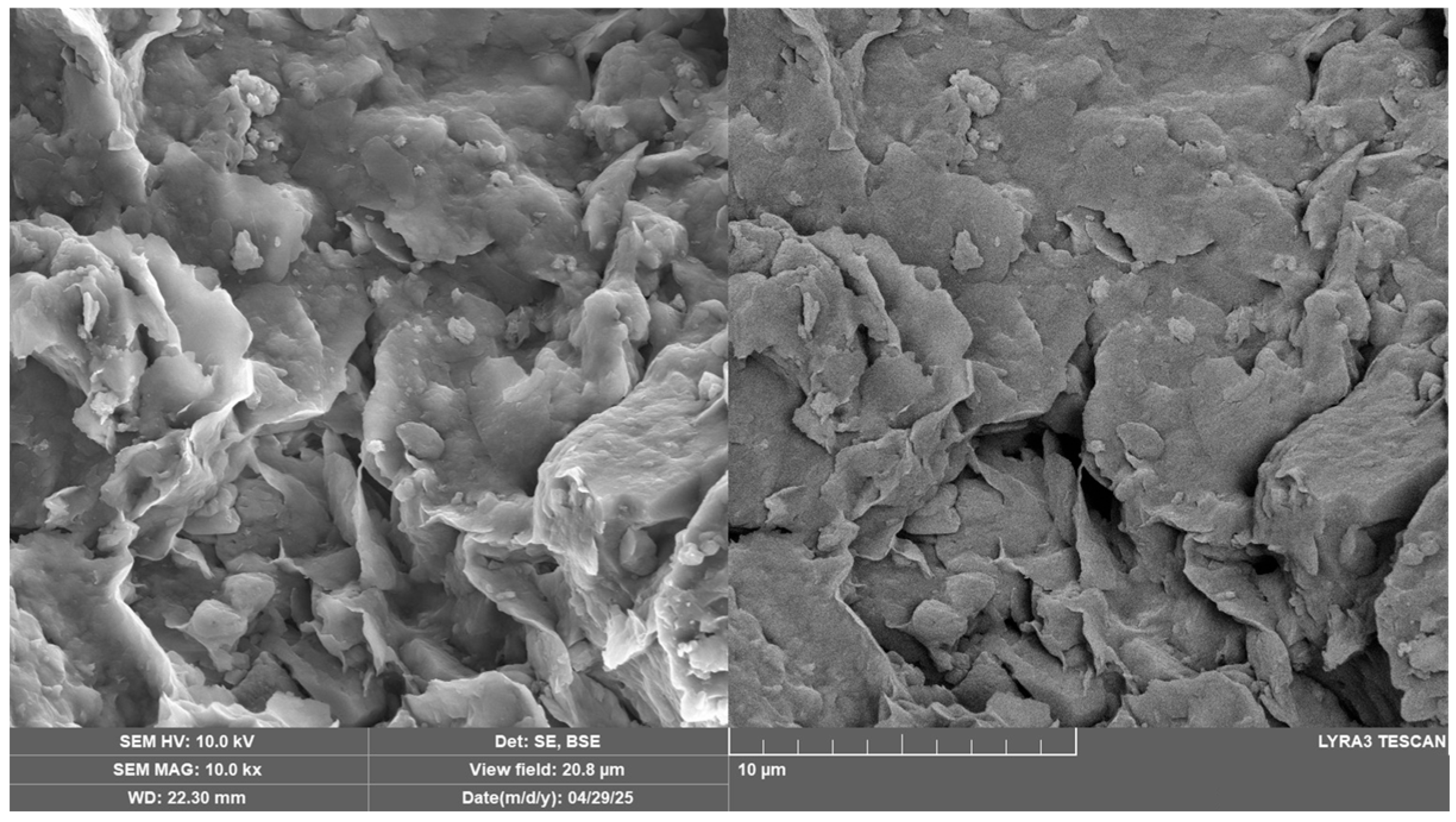
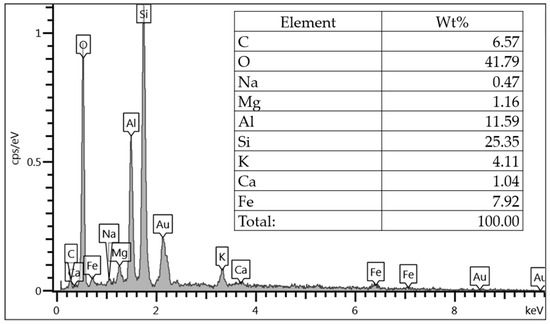
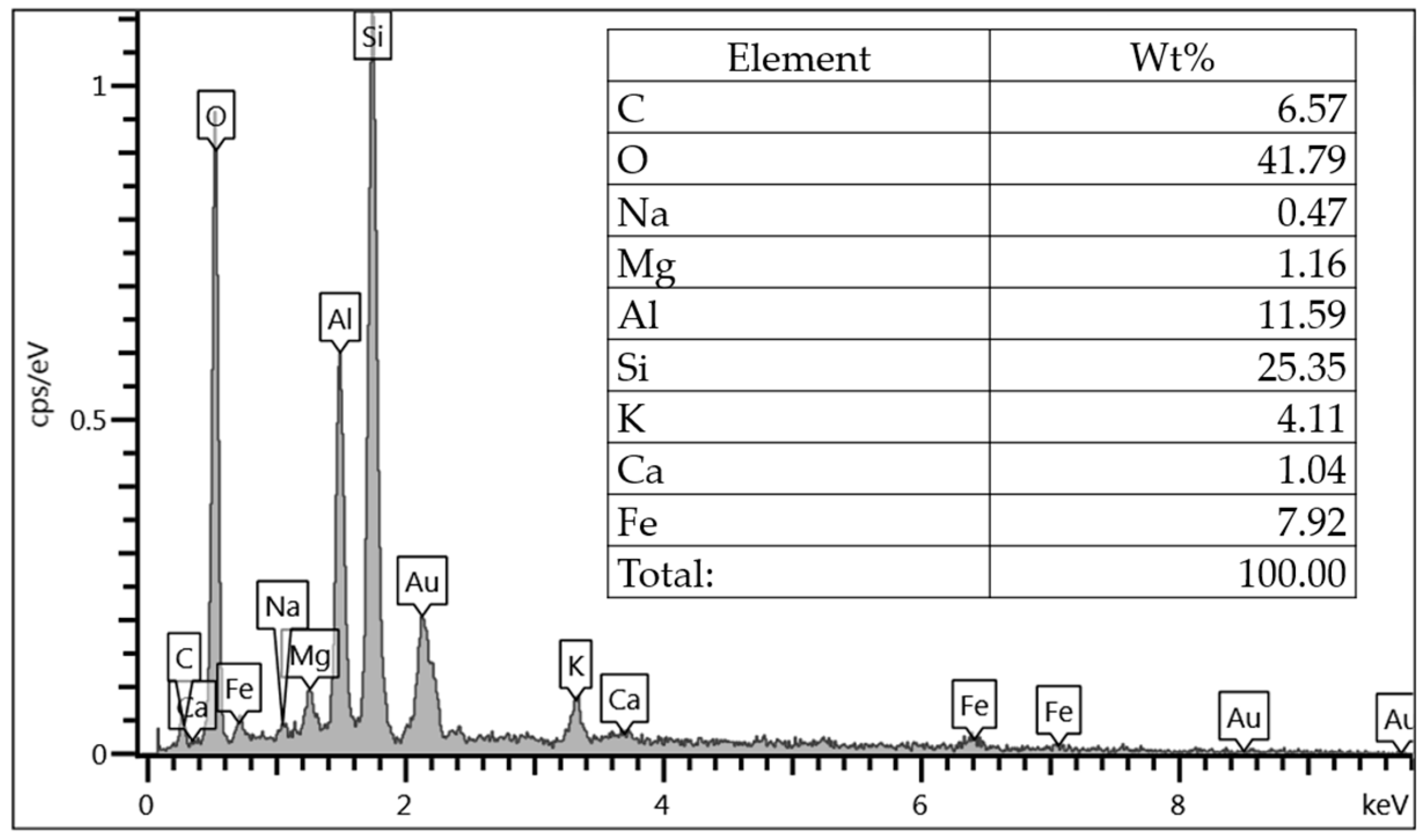
Figure 3 presents the microstructure (via scanning electron microscopy, SEM (TESCAN ORSAY HOLDING, Brno Kohoutovice, Czech Republic)) of clay soil, and Figure 4 presents the EDX microanalysis of SEM. Soil is composed mainly of silicon, aluminum, and iron, elements that are constituents in similar soils of northern Cartagena de Indias, Colombia [30].
Figure 3.
Microscopy photo of a soil sample.
Figure 4.
EDS microanalysis of a soil sample.
2.2. Lime and Sodium Chloride
Figure 2 also presents the granulometric curve of the hydrated lime sample obtained via a laser analyzer. The hydrated lime (Ca(OH)2) employed was of analytical grade, with a calcium oxide purity above 90%. The sodium chloride (NaCl) used as a catalyst was a commercial reagent of 99.5% purity. Based on a preliminary study on the stabilization lime of the same soil [27], the lime contents of 3%, 6%, and 9% by dry weight of soil were investigated, with a fixed NaCl content of 2% adopted as the optimal catalytic dosage.
The addition of NaCl aimed to accelerate the early pozzolanic reactions between lime and clay minerals, thereby enhancing the formation of calcium–silicate–hydrate (C–S–H) and calcium–aluminate–hydrate (C–A–H) during the initial curing stages. The mixtures were prepared under controlled moisture conditions (near optimum) and compacted to target γd = 14.0 kN/m3, representing different degrees of compaction. The NaCl was fixed at 2% by dry mass of soil, considering previous studies and pilot study [31]. In this preliminary evaluation and pilot study, the lime content was fixed at its previously identified optimum of 9%, and mixtures compacted at a γd = 14 kN/m3 and cured for 14 days were tested with NaCl contents ranging from 0.5% to 2.5% in increments of 0.5%. The qu increased from 801 kPa at 0.5% NaCl to 829 kPa at 1.0% and 850 kPa at 1.5%, reaching a maximum of 880 kPa at 2.0%. Beyond this level, no further improvement was observed (qu = 879 kPa at 2.5%). This plateau behavior indicates that NaCl enhances the catalytic dissolution of lime and accelerates early pozzolanic reactions only up to a threshold concentration of 2%. Therefore, 2% NaCl was selected as the optimal catalytic dosage for combination with 3%, 6%, and 9% lime, providing the best balance between strength development and overall mixture performance.
2.3. Xanthan Gum and Polypropylene Fibers
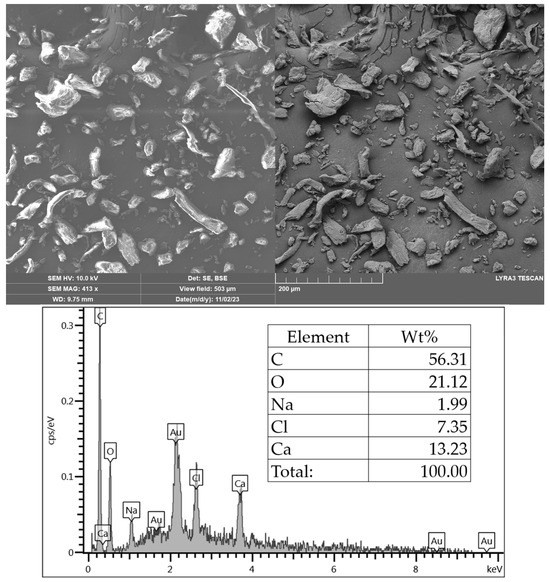
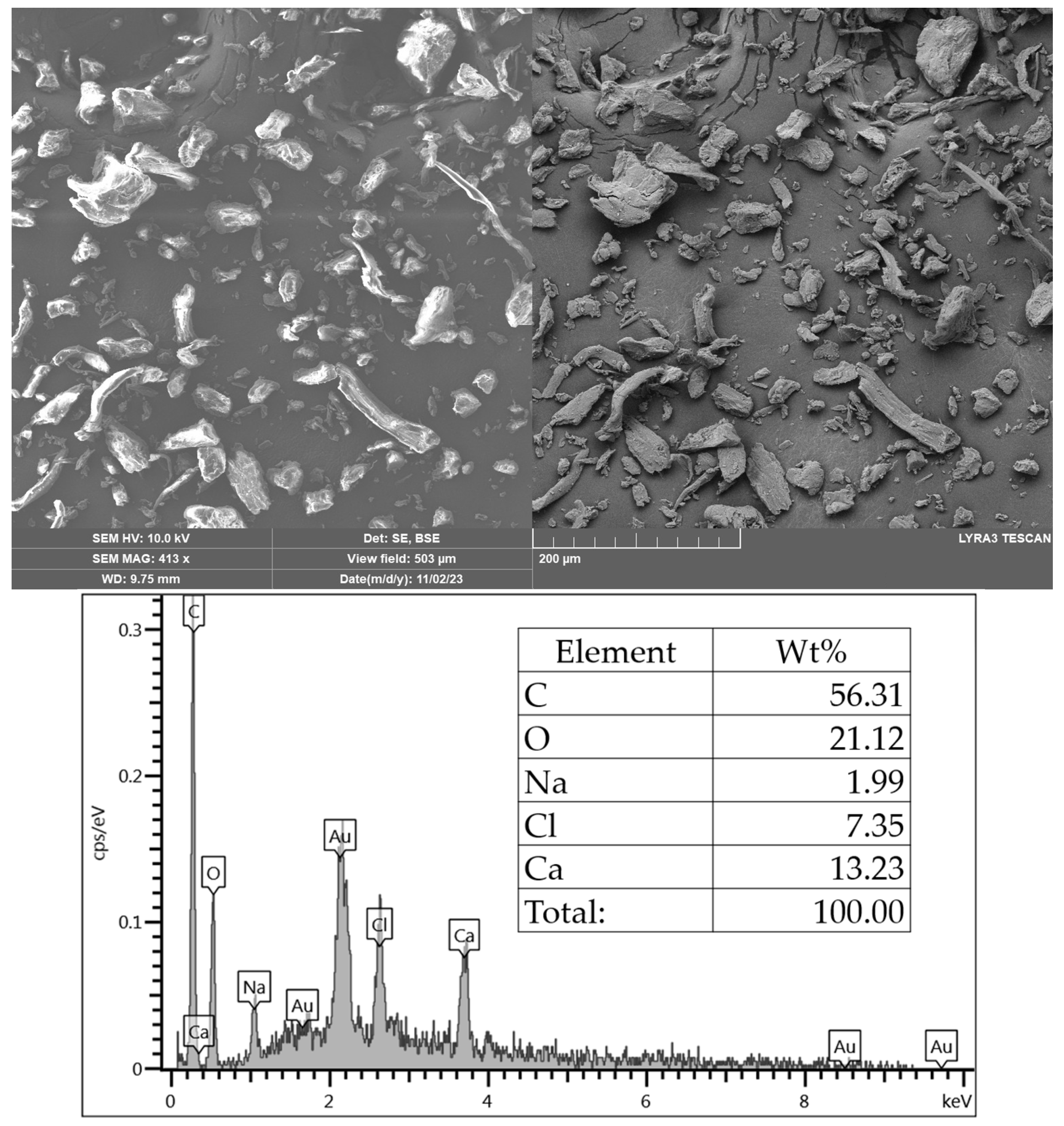
Xanthan gum (XG) is a polysaccharide biopolymer produced by Xanthomonas campestris and supplied as a fine powder. Its molecular structure consists of repeating pentasaccharide units with a glucose–mannose–glucuronic acid molar ratio of 2:2:1, a density of 1.5 g/cm3, and a viscosity of 1200 mPa·s (pH 6.3). XG dosages of 1%, 3%, and 5% (by dry weight of soil) were selected based on previous studies and preliminary qu results reported recently by Baldovino et al. [30]. Figure 5 provides the SEM-EDX analysis of XG in power. The image shows irregular organic particles, and EDX reveals organic elements, such as carbon, as well as other elements like Na, Cl, and Ca.
Figure 5.
SEM-EDX analysis of xanthan gum sample.
In addition, polypropylene fibers (PPF) with a length of 20 mm, a diameter of 35–40 µm, and a density of 0.91 g/cm3 were incorporated at a fixed dosage of 0.5% relative to the dry soil mass. The inclusion of fibers aimed to improve ductility, post-peak strength, and control of cracking during drying and loading. A recent study concluded that at a 0.5% concentration of flotation of fibers occurred [13].
2.4. Water and Mixing Procedure
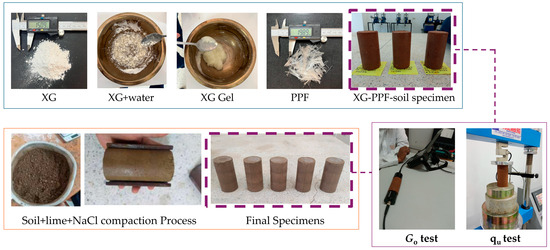
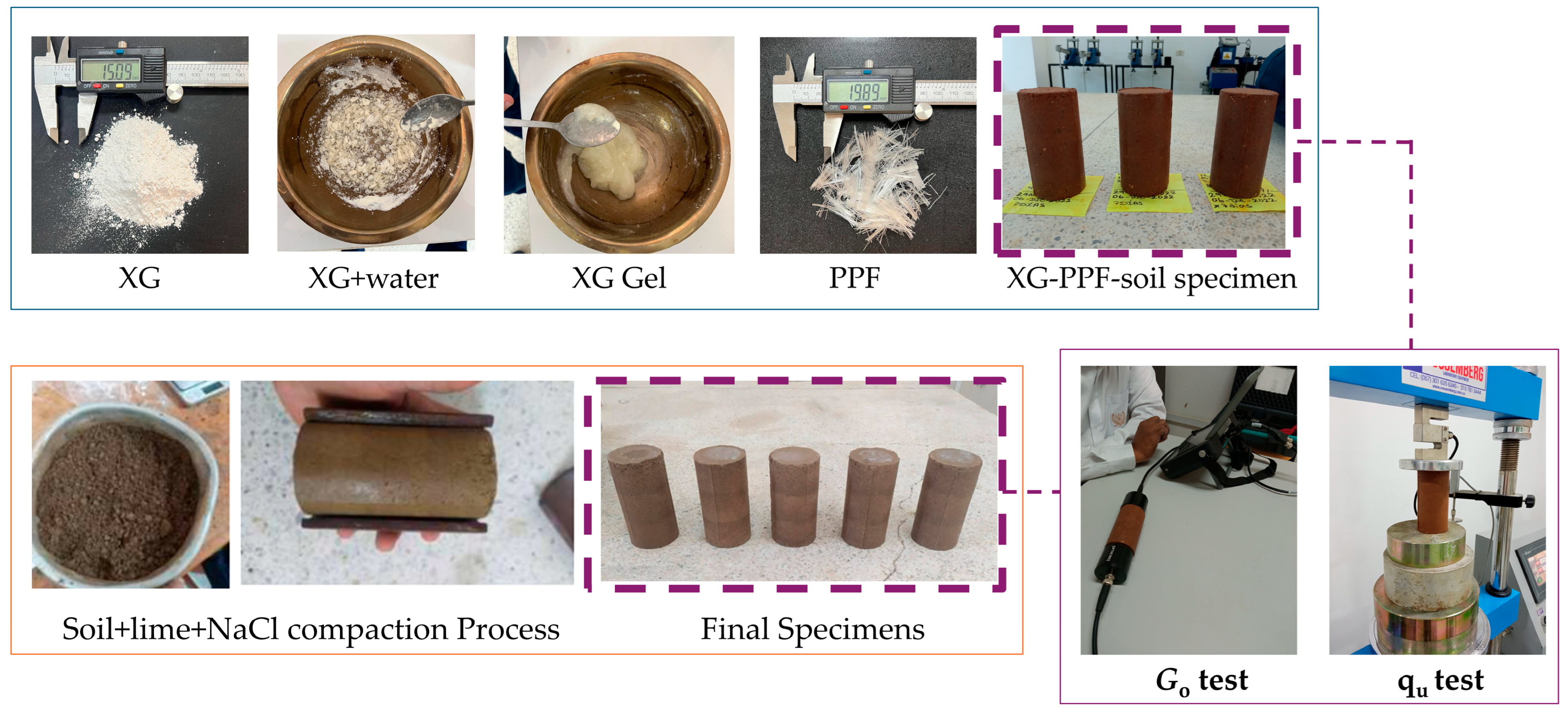
Distilled water was used in all mixtures to avoid ionic interference. For the lime–NaCl system, dry soil, lime, and NaCl were thoroughly mixed before adding water to reach the target moisture content. For the XG–PPF system, xanthan gum was first dissolved in water under manual stirring until full hydration was achieved. The solution was then gradually incorporated into the dry soil, followed by the addition of fiber to ensure uniform distribution. All specimens were compacted in metallic molds with a diameter of 50 mm and a height of 100 mm (1:2 ratio), in three layers. Each layer was lightly scarified to promote bonding between lifts. Compaction and molding were performed according to ASTM D1633 [32] procedures. Figure 6 presents the flowchart of the specimens’ preparation and molding, and complete procedures to unconfined compressive and stiffness of soil-lime-NaCl and soil-XG-PPF blends.
Figure 6.
Schematic diagram of the sample preparation process for Go and qu test.
2.5. Curing Conditions
All samples were sealed in plastic film and stored at 23 ± 2 °C and relative humidity above 95% to prevent moisture loss. The lime–NaCl specimens were tested after 14 and 28 days, while the XG–PPF specimens were cured for 28 and 90 days, allowing evaluation of both early and long-term effects. Table 2 provides the mixed proportion of blends containing soil-lime-NaCl and soil-xanthan-PPF.
Table 2.
A mixed proportion design is employed for blends of compacted soil, lime, and NaCl.
The curing periods of 14 and 28 days were selected for the lime–NaCl system because chemically stabilized soils typically exhibit rapid early strength development due to cation exchange, lime dissolution, and the accelerated formation of C–S–H and C–A–H gels promoted by chloride ions. Previous studies [33,34] and the pilot testing showed that the majority of strength gain in lime-treated soils occurs within the first 28 days, after which the rate of pozzolanic reaction decelerates substantially.
In contrast, the XG–PPF system was evaluated at 28 and 90 days because biopolymer–soil interactions follow a different time-dependent behavior. Xanthan gum forms a hydrogel network whose mechanical contribution increases gradually as water redistribution occurs and polymer chains reorganize within the pore structure [8,35]. Similarly, fiber–matrix interactions become more pronounced over prolonged curing. Therefore, longer curing periods (up to 90 days) are necessary to capture the true evolutionary response of the biopolymer–fiber reinforcement mechanism.
3. Methods
3.1. Experimental Program Overview
The experimental program was designed to evaluate and compare the mechanical and microstructural behavior of a low-plasticity clay (CL) stabilized using two different approaches: (i) a lime–NaCl system, where NaCl acted as a catalyst for lime-induced pozzolanic reactions, and (ii) a xanthan gum–polypropylene fiber (XG–PPF) system, which aimed to enhance bonding and tensile resistance through biopolymer–fiber synergy.
Each system was studied independently under controlled laboratory conditions, maintaining consistent specimen geometry, compaction energy, curing temperature, and moisture control to ensure comparability. The tests focused on unconfined compressive strength (qu) and small-strain shear modulus (Go).
3.2. Specimen Preparation of Lime–NaCl Mixtures
The dry soil was first pulverized and sieved through a 2 mm (#10) mesh. The required amount of hydrated lime (3%, 6%, or 9% by dry soil mass) and sodium chloride (2%) was added and manually blended to ensure uniform distribution. The lime contents of 3%, 6%, and 9% were selected based on previous experimental studies performed on similar tropical clays [36,37], where these dosages were shown to effectively capture the transition from cation exchange and flocculation (at low lime contents) to the onset of significant pozzolanic activity (at medium to high contents). Distilled water was subsequently incorporated to achieve the optimum water content (26%), as determined from the Standard Proctor test (ASTM D698 [29]).
The mixtures were compacted into cylindrical molds (50 mm diameter × 100 mm height) in three equal layers, with each layer lightly scarified before the addition of the next to minimize interfacial weaknesses. Target dry unit weights of 12.7 and 14.0 kN/m3 were adopted to simulate different field compaction levels. After extrusion, specimens were wrapped in polyethylene film and sealed in airtight containers to prevent moisture loss during curing at 23 ± 2 °C and relative humidity above 95%. Testing ages were set at 14 and 28 days to capture both early and intermediate curing stages influenced by NaCl catalysis.
3.3. Specimen Preparation of Xanthan Gum-PP Mixex
The xanthan gum powder was dissolved in distilled water at room temperature and stirred until a homogeneous viscous solution was obtained. The solution was then gradually incorporated into the dry soil in dosages of 1%, 3%, and 5% (by dry soil mass). Polypropylene fibers (0.5% by dry weight) were introduced after complete XG hydration to prevent clustering and ensure uniform dispersion throughout the matrix. The xanthan gum dosages of 1%, 3%, and 5% (by dry soil mass) were chosen following the previous studies on biopolymer-treated soils, which indicate that contents below 1% provide limited bonding [35,38].
The mixtures were compacted using the same procedure as for the lime–NaCl system, maintaining equivalent moisture and density conditions. A total of 108 cylindrical specimens were prepared and cured for 28 and 90 days at 23 ± 2 °C and 95% relative humidity. More extended curing periods were included to evaluate the time-dependent development of polymeric bonding and fiber–matrix interactions.
3.4. Unconfined Compressive Strength (qu) Testing and Go Measurements
The qu tests were performed in accordance with ASTM D2166 [39] on triplicate specimens for each mix condition. The loading rate was controlled at 1.14 mm/min until failure, and the maximum axial stress qu was recorded. For each mixture, the mean qu and coefficient of variation were calculated to assess reproducibility. To examine the influence of curing time, binder content, and density, the results were analyzed using both direct comparison and normalized strength parameters based on the porosity–binder index (η/Biv or η/Liv).
The small-strain shear modulus, Go, was determined using two complementary non-destructive techniques in accordance with ASTM C597 [40]. For lime–NaCl and XG-PP specimens, bender element (BE)(Proceq SA, Zurich, Switzerland) testing was employed, with excitation and receiver transducers (5 kHz–10 kHz range) embedded in the specimen ends. The shear wave velocity (Vₛ) was obtained from the first arrival time of the transmitted wave, and Go was computed as: Go = γ⋅Vs2, where γ is the unit weight of the specimen.
For all experimental conditions, three specimens (n = 3) were prepared and tested. The reported values of unconfined compressive strength (qu) and small-strain shear modulus (Go) correspond to the average of these triplicate measurements.
3.5. Machine Learning Methodology
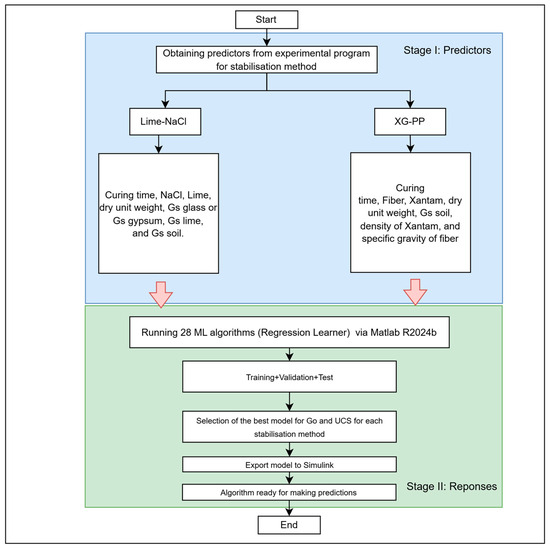
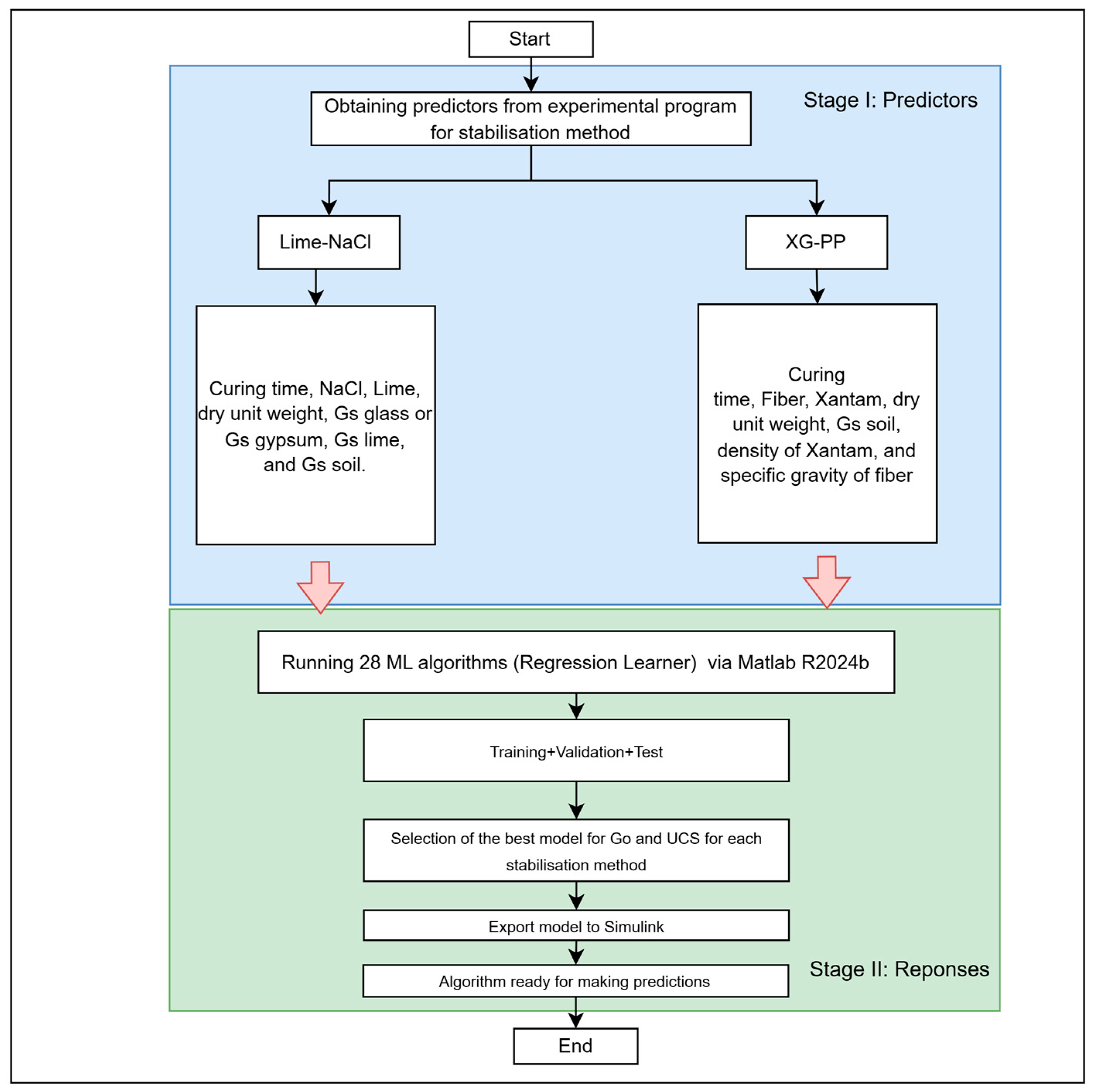
This section presents the methodology employed, which utilizes machine learning algorithms, as illustrated in Figure 7. The methodology consists of two main parts. The first part involves the computation of predictors, which were obtained from the experimental program developed in this research.
Figure 7.
A machine learning methodology was employed in this study.
For the lime–NaCl stabilization method, the predictors considered were curing time, NaCl content, dry unit weight, specific gravity of glass or gypsum (Gs glass or Gs gypsum), Gs lime, and Gs soil. In contrast, for the XG–PP stabilization method, the predictors included: curing time, fiber content, xanthan, dry unit weight, xanthan density, and specific gravity of fiber.
Subsequently, the Regression Learner application in MATLAB R2024b was employed to train and evaluate 28 machine learning algorithms. The algorithms assessed were: Linear (L), Interactions Linear (IL), Robust Linear (RL), Stepwise Linear (SL), Fine Tree (FT), Medium Tree (MT), Coarse Tree (CT), Linear SVM (LSVM), Quadratic SVM (QSVM), Cubic SVM (CSVM), Fine Gaussian SVM (FGSVM), Medium Gaussian SVM (MGSVM), Coarse Gaussian SVM (CGSVM), Efficient Linear Least Squares (ELLS), Efficient Linear SVM (ELSVM), Boosted Trees (BT), Bagged Trees (BaT), Squared Exponential GPR (SEGPR), Matern 5/2 GPR (MGPR), Exponential GPR (EGPR), Rational Quadratic GPR (RQGPR), Narrow Neural Network (NNN), Medium Neural Network (MNN), Wide Neural Network (WNN), Bilayered Neural Network (BNN), Trilayered Neural Network (TNN), SVM Kernel (SVMK), and Least Squares Regression Kernel (LSRK).
To ensure model robustness, a 5-fold cross-validation scheme was employed. In this approach, the model was trained using experimental tests within each fold, and its performance was evaluated for every partition. At the end of the procedure, the validation error was computed for each fold. This scheme was selected considering the number of available experimental tests, which is suitable considering the dataset presented in the experimental program [41]. During the training stage, 10% of the data was reserved to monitor potential overfitting issues. The selection of the most suitable algorithm was based on the coefficient of determination (R2) for both validation and testing phases, computed using the following Equation:
where represents the true values obtained from the experimental program (for both stabilization methods regarding Go and qu), denotes the values predicted by the machine learning algorithms, is the average of each response, and is the total number of observations.
In addition, the Root Mean Square Error (RMSE) was also assessed:
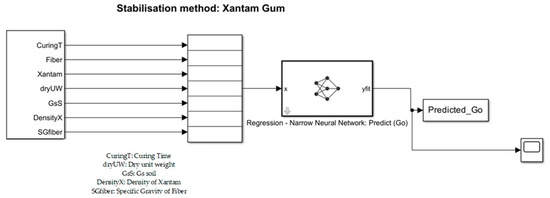
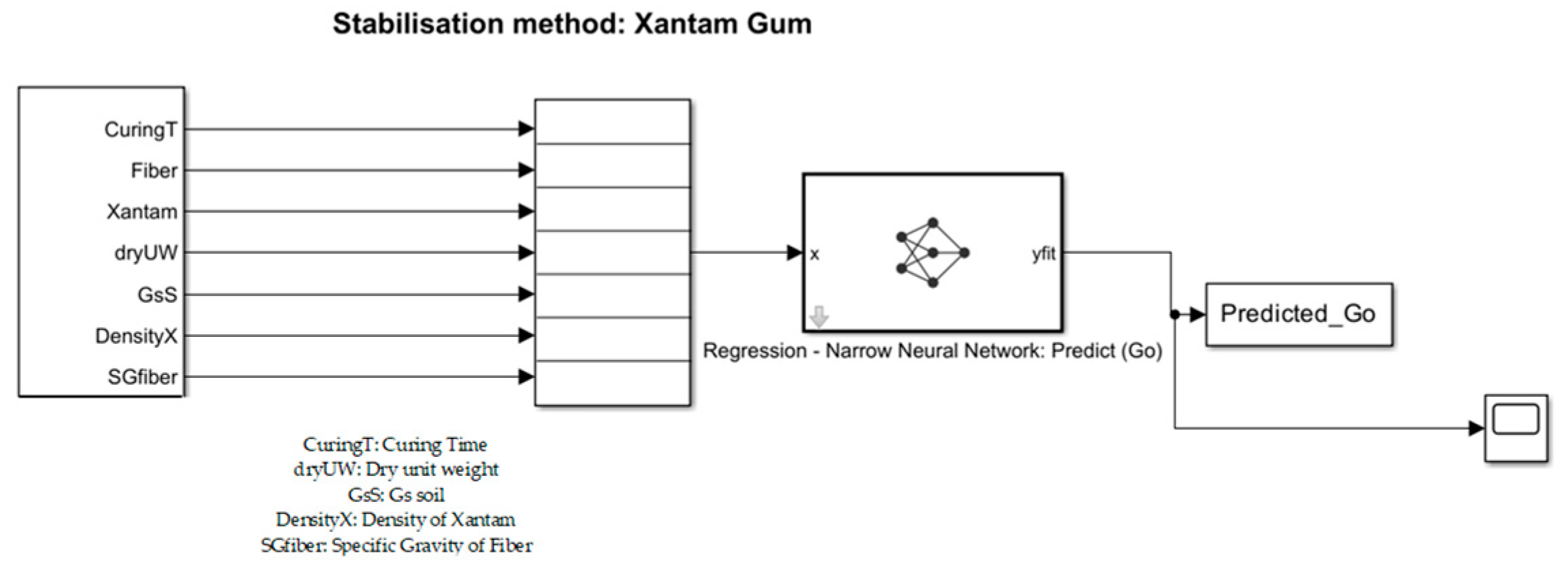
The best-performing algorithm for each stabilization method was exported to Simulink to enable predictive simulations. Figure 8 shows the configuration of the Narrow Neural Network implemented in this research. This configuration is particularly relevant, as it can serve as a practical tool for engineers and designers to estimate Go and qu for different stabilization methods.
Figure 8.
Configuration of the Narrow Neural Network in the Simulink environment.
4. Results and Discussions
4.1. Effects of XG-PPF and Lime-NaCl on Unconfined Compressive Strength and Stiffness of Improved Soil
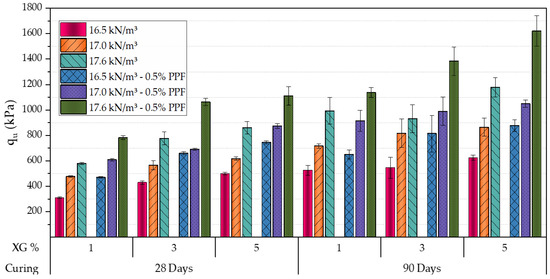
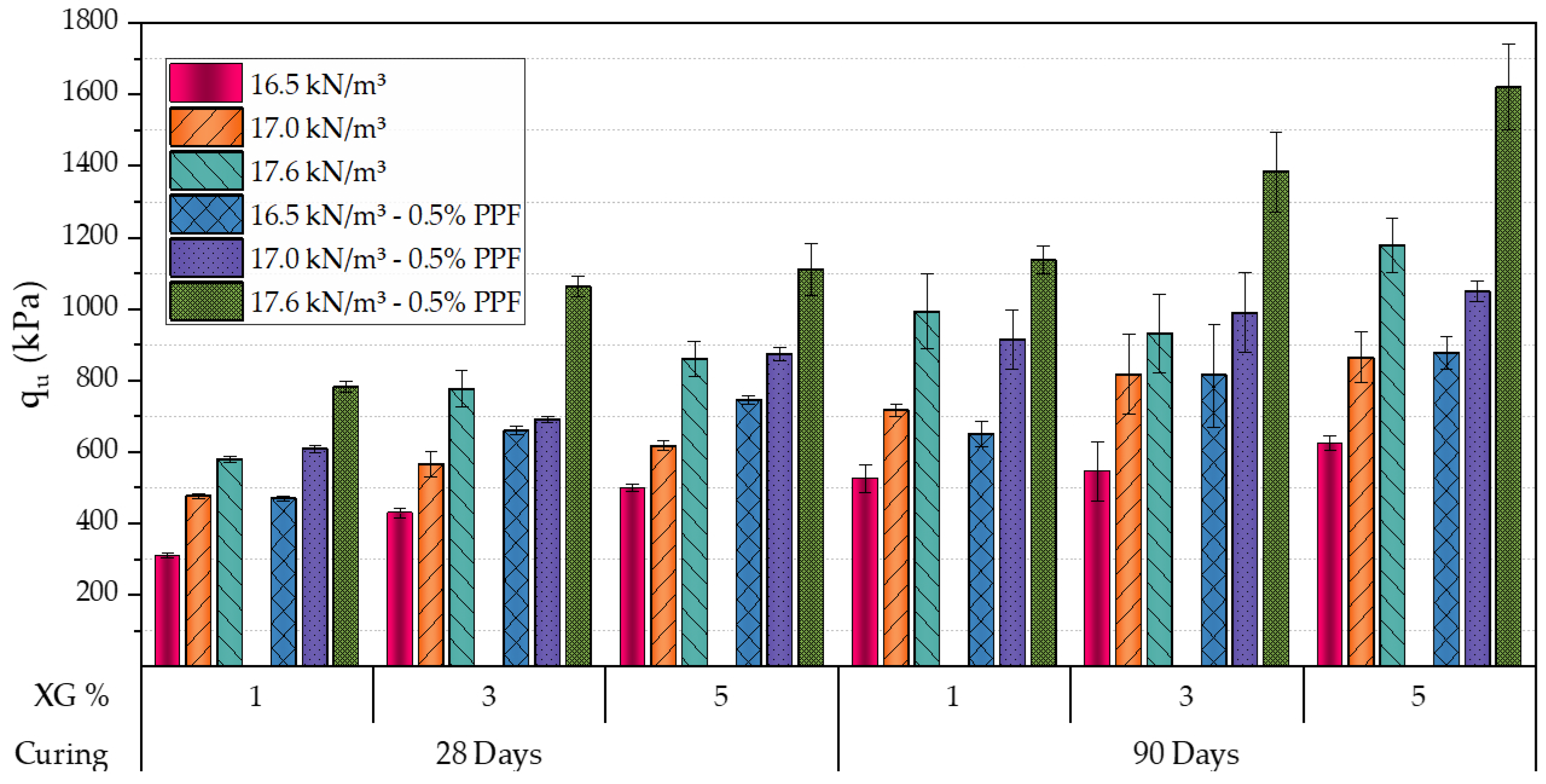
Figure 9 presents the results of qu for the soil-XG-PPF compacted blends and cured for 28 and 90 days. The unconfined compressive strength (qu) of the xanthan gum–fiber stabilized soil exhibited an explicit dependency on both the xanthan gum (XG) content and the level of compaction. Values represent mean results obtained from triplicate specimens.
Figure 9.
Influence of curing time, dry unit weight (kN/m3), XG, and PPF on strength of stabilized Clayey Soil.
At 28 days, the mixtures without fibers showed qu values ranging from approximately 310 kPa at 1% XG and 16.5 kN/m3 to 860 kPa at 5% XG and 17.6 kN/m3. The inclusion of 0.5% polypropylene fibers (PPF) further improved strength, achieving qu values between 470 and 1100 kPa within the same curing period. The increase in qu with density and XG content reflects the formation of a denser polymeric matrix and stronger interparticle adhesion. With prolonged curing to 90 days, additional gains were observed due to continued hydration and rearrangement of the biopolymer network. The best-performing mixture, containing 5% XG and 0.5% PPF at 17.6 kN/m3, achieved a qu of approximately 1620 kPa, representing a nearly 95% increase compared to the 28-day condition.
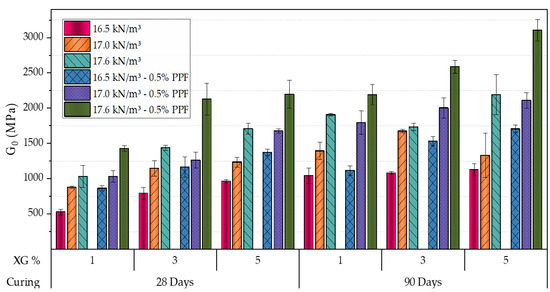
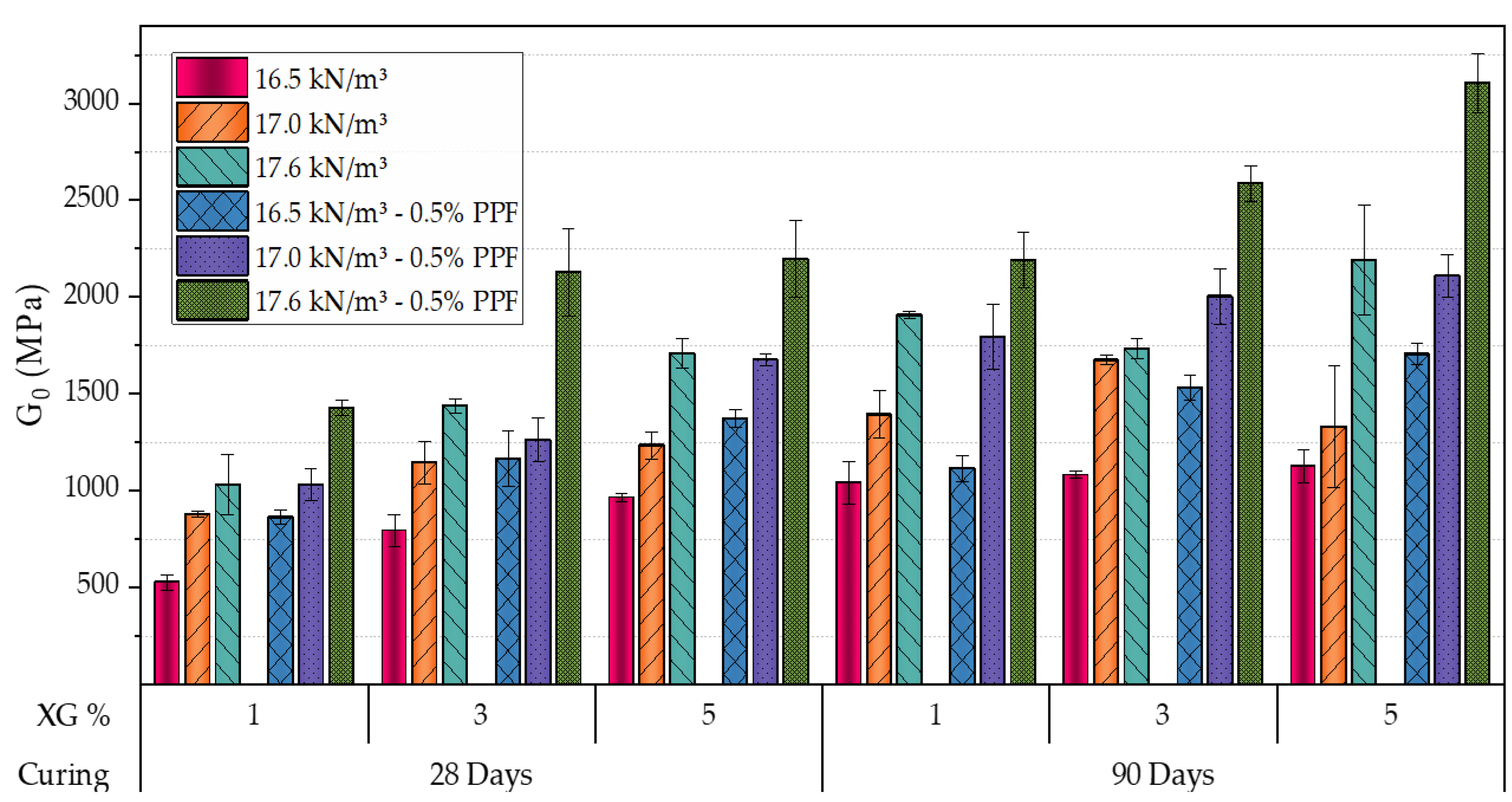
Figure 10 presents the results of the soil-XG-PPF compacted blends, cured for 28 and 90 days. The evolution of the small-strain shear modulus (G0) followed a similar trend to qu, but with even greater sensitivity to xanthan gum content, curing time, and fiber reinforcement. At 28 days, G0 ranged from approximately 528 MPa for the weakest mixture (1% XG, no fiber, low density) to about 1710 MPa for the densest and most concentrated blend (5% XG, no fiber, 17.6 kN/m3). When 0.5% PPF was added, G0 values increased substantially, exceeding 2100 MPa for the 5% XG mixture at 28 days and reaching up to 3100 MPa after 90 days of curing. The larger sensitivity of G0 compared to qu indicates that the small-strain response is strongly affected by the formation of continuous polymeric bridges and by the restraining effect of the fibers. The increase in G0 with curing time suggests a progressive strengthening of the polymer–soil interface, where the biopolymer chains undergo secondary bonding and partial crystallization, improving the elastic stiffness of the stabilized matrix.
Figure 10.
Influence of curing time, dry unit weight (kN/m3), XG, and PPF on stiffness (Go) of stabilized Clayey Soil.
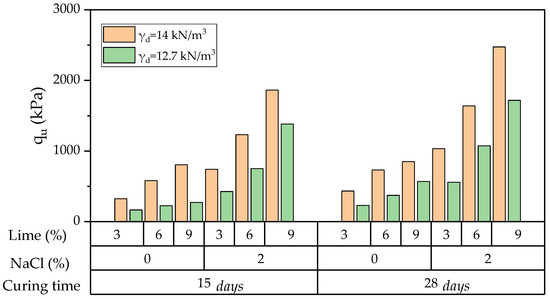
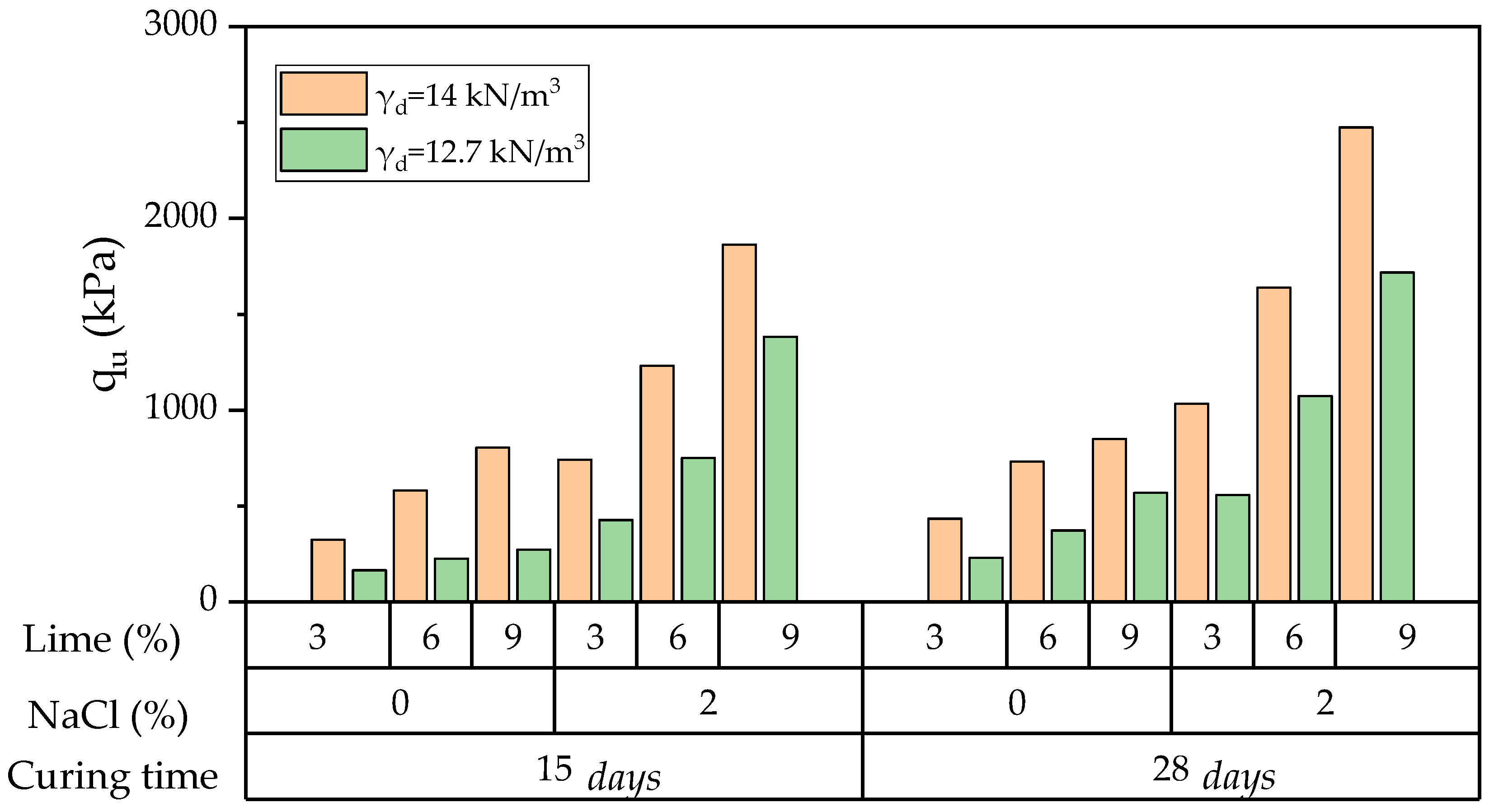
Figure 11 presents the qu of lime-soil-NaCl of compacted soil. The unconfined compressive strength (qu) of the lime–NaCl-stabilized clay exhibited a strong dependency on lime content, dry unit weight, and curing time. At 15 days, mixtures without NaCl reached qu values of 166–805 kPa at 12.7–14.0 kN/m3, while those containing 2% NaCl exhibited substantially higher strengths ranging from 426 to 1862 kPa. This early-age acceleration is attributed to the catalytic effect of NaCl in promoting ion exchange and the rapid formation of calcium silicate and aluminate hydrates (C–S–H and C–A–H). After 28 days of curing, qu continued to increase in all mixtures, with maximum values reaching 2475 kPa for the blend containing 9% lime and 2% NaCl at 14.0 kN/m3, representing nearly a threefold increase relative to the lime-only system under the same conditions. The combined effect of higher lime dosage and salt activation enhanced the pozzolanic reaction kinetics, improving both early and medium-term strength development.
Figure 11.
Influence of curing time, NaCl, lime, and dry unit weight on unconfined compressive strength (qu) of stabilized Clayey Soil.
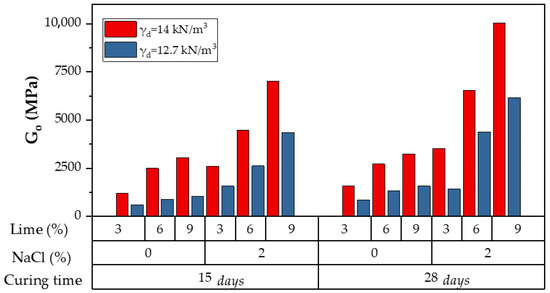
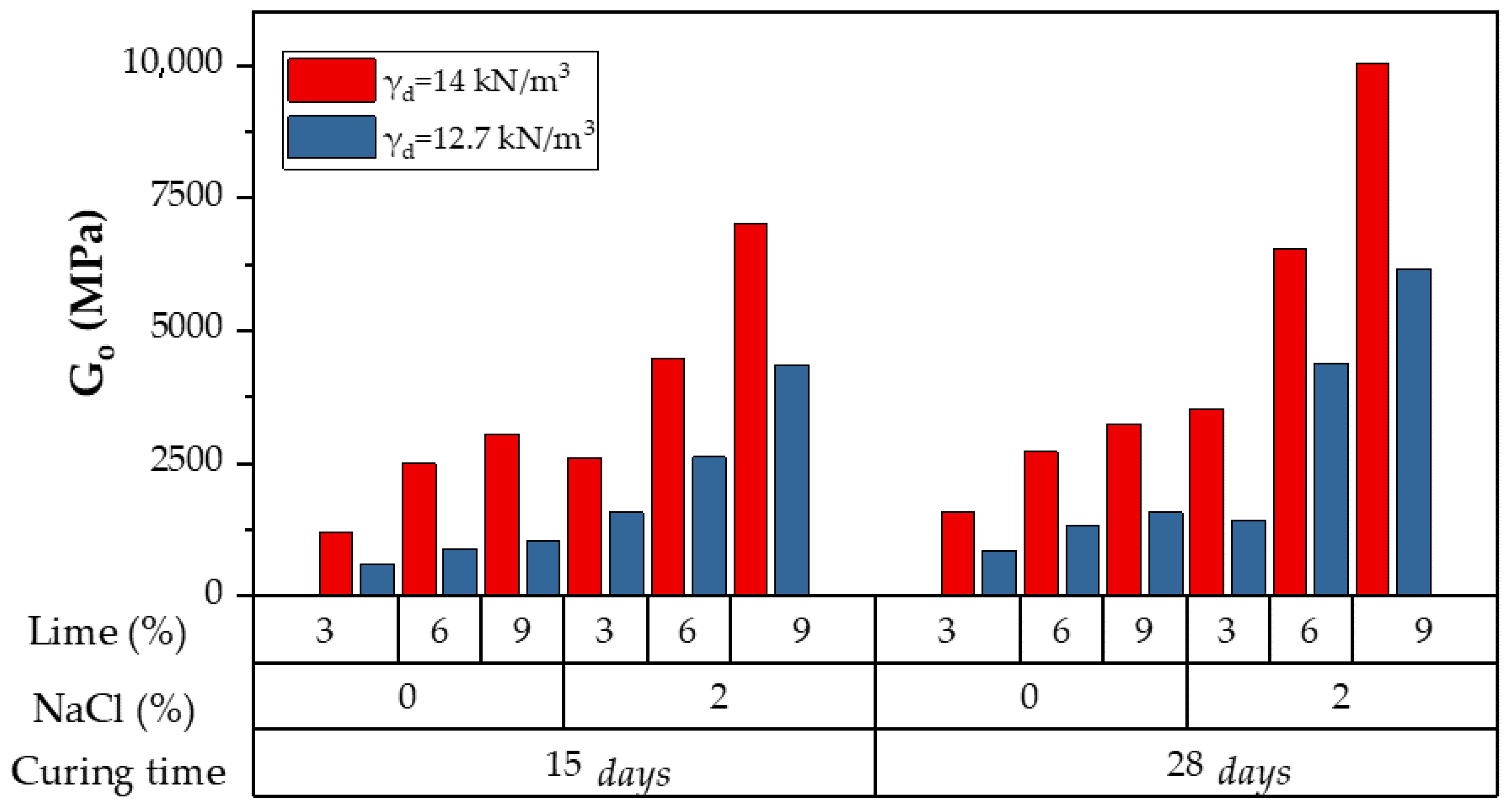
Figure 12 presents the results of the stiffness of soil-lime-NaCl of compacted soil. The small-strain shear modulus (Go) followed similar trends to compressive strength but displayed even greater sensitivity to the presence of NaCl and lime content. At 15 days, lime-only mixtures exhibited Go values between 608 and 3057 MPa, while NaCl-activated specimens reached 1565–7033 MPa under the same curing period. After 28 days, Go values increased markedly, attaining up to 10,036 MPa for the mixture with 9% lime and 2% NaCl at 14.0 kN/m3. This remarkable stiffness gain reflects the rapid nucleation and growth of cementitious products that bond clay particles and fill pore spaces. The enhancement of Go with NaCl addition is particularly evident in high-density specimens, suggesting that the catalytic reactions are favored by reduced porosity and improved contact among reactive surfaces.
Figure 12.
Influence of curing time, NaCl, lime, and dry unit weight on stiffness (Go) of stabilized Clayey Soil.
It is acknowledged that the lime–NaCl and XG–PPF systems were not evaluated at identical curing ages. While lime–NaCl exhibits rapid early-age stabilization, the XG–PPF system shows a delayed strength and stiffness evolution that requires extended curing. This methodological distinction limits direct comparison of early-age performance; however, it reflects the fundamental mechanistic differences between chemical and biopolymer-based stabilization.
4.2. Comparative Analysis of Strength and Stiffness Development in XG–PPF and Lime–NaCl Stabilized Clays
The evolution of unconfined compressive strength (qu) exhibited distinct patterns in the two stabilization systems due to their different bonding mechanisms. In the lime–NaCl system, qu values ranged from 166 to 2475 kPa, exhibiting a steep increase with lime content, density, and curing time. The addition of 2% NaCl substantially accelerated early strength formation, with 15-day strengths comparable to or exceeding those of the 28-day lime-only mixtures. Conversely, the XG–PPF system displayed qu values ranging from 310 to 1620 kPa, indicating a more gradual strength evolution controlled by polymeric bonding and water redistribution dependent on curing. At 28 days, the lime–NaCl system achieved roughly double the qu of the XG–PPF mixtures under equivalent densities; however, by 90 days, the gap narrowed as the biopolymer–fiber network continued to mature and strengthen. The chemical cementation induced by lime–NaCl yields rapid and high early strength, while the biopolymer–fiber stabilization provides slower but sustained strength development, which may be advantageous for long-term durability and ductility.
The small-strain stiffness (Go) also revealed contrasting trends between the two systems, reflecting their different microstructural formation processes. The lime–NaCl stabilized clay reached Go values from 608 to 10,036 MPa, indicating intense cementation and rapid growth of C–S–H and C–A–H products within the first 28 days. The inclusion of NaCl enhanced the ionic exchange capacity and promoted the crystallization of cementitious phases, resulting in a denser and more rigid skeleton even at short curing times. In contrast, the XG–PPF mixtures presented Go values from 528 to 3105 MPa, with the highest stiffness observed in mixtures containing 5% XG and 0.5% PPF after 90 days of curing. The increase in stiffness in the biopolymer-treated system is primarily attributed to the gradual thickening of xanthan gum films and the reinforcement effect of fibers, which restrict local deformations and enhance the soil’s energy absorption capacity. Although the absolute Go values of the lime–NaCl system are notably higher, the G0 growth rate with time is more consistent and sustained in the XG–PPF system, suggesting that biopolymeric bonding continues to evolve after the main chemical hydration reactions of lime have stabilized.
The comparative analysis between the lime–NaCl and XG–PPF systems reveals two fundamentally different stabilization mechanisms that result in distinct strength–stiffness relationships. The lime–NaCl treatment is governed by chemical cementation, where ionic exchange and pozzolanic reactions rapidly form rigid C–S–H and C–A–H compounds, resulting in high qu and G0 values but a more brittle response. Conversely, the XG–PPF system develops through physico-chemical bonding, where xanthan gum forms a viscoelastic matrix around clay particles, and fibers bridge potential cracks, leading to enhanced ductility and resilience. When normalized by dry density and curing time, the qu ratios (lime–NaCl or XG–PPF) range from approximately 1.5 to 2.5, whereas the Go ratios extend from 2.0 to 3.5, underscoring the superior stiffness efficiency of the chemically cemented system. However, the Go/qu ratio remains higher in the biopolymer–fiber blends (2000–3000) compared to the lime–NaCl mixtures (between 1500–2000), suggesting that the polymeric network offers greater elasticity and energy dissipation under small-strain conditions. Overall, the lime–NaCl system is optimal for applications demanding rapid strength gain and rigidity, while the XG–PPF approach offers a sustainable and ductile alternative, maintaining significant stiffness improvement with enhanced deformability and lower environmental impact.
4.3. Influence of Porosity-to-Lime Index on Unconfined Compressive Strength and Stiffness of Compacted Blends
The porosity–binder index emerged as a fundamental descriptor governing the compressive strength of both XG–PPF and lime–NaCl stabilized clays. Initially, the index was introduced by Consoli et al. [14] for sand-cement mixes, but continues to be used to control the strength, durability, and stiffness of several types of soils improved by various binders (e.g., [42,43,44]). In these cases, qu is expressed as a power function of the porosity-to-lime ratio, where a constant A (in kPa) is multiplied by the porosity-to-lime ratio raised to an exponent x, as shown in Equation (3).
A, x, and B values depend on the soil and lime properties, as well as their interaction. Constant A is expressed in kPa. The initial stiffness (Go) of improved soil mixtures is also controlled by the porosity-to-binder index, following a power-type relationship as expressed in Equation (4):
The constants A, x, and B depend on the soil and lime properties, as well as their interaction.
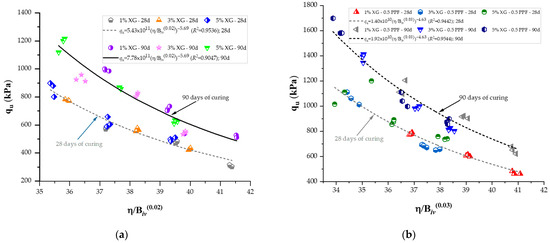
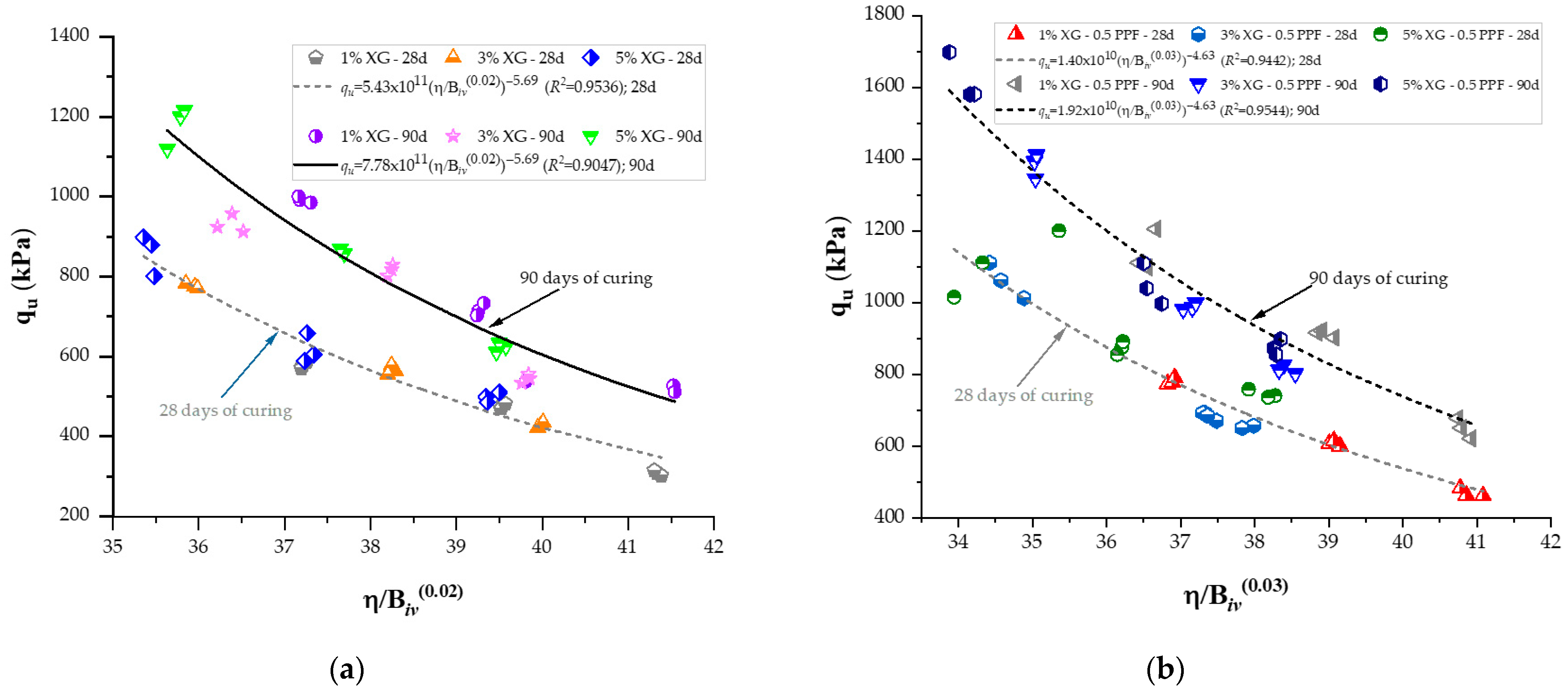
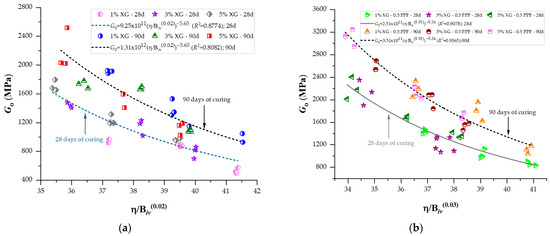
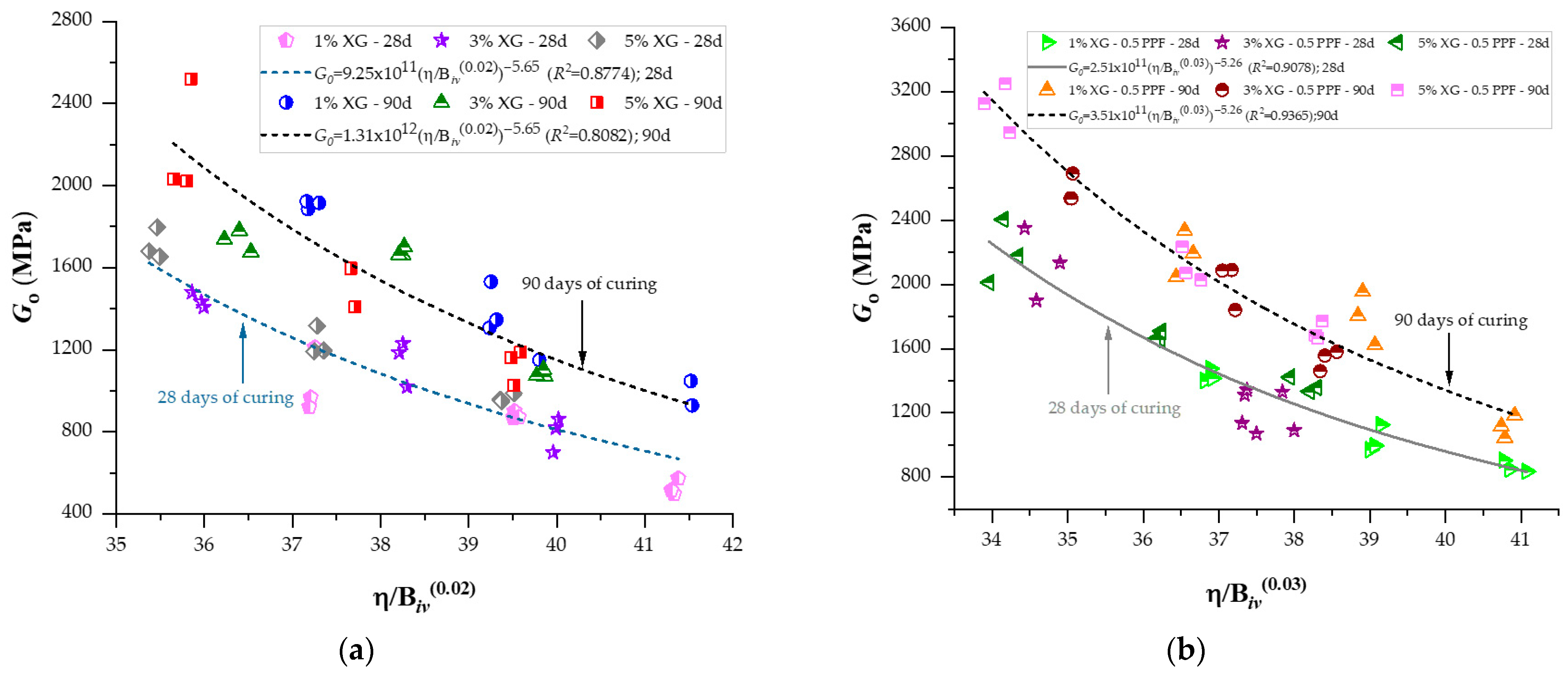
Figure 13 and Figure 14 illustrate the influence of the porosity-to-binder index on qu and Go, respectively, of clay-XG-PPF compacted blends, considering 28 and 90 days of curing, with 0% and 0.5% PPF. For the biopolymer-fiber system, a clear exponential relationship was observed between qu and the porosity-to-binder ratio (η/Biv), indicating that decreasing porosity or increasing xanthan gum concentration markedly enhances strength. The incorporation of 0.5% polypropylene fibers further amplified this trend, producing higher qu values under equivalent densities and curing times. The mixture containing 5% XG and 0.5% PPF, cured for 90 days at a dry density of 1.76 g/cm3, exhibited the maximum strength (=1620 kPa), demonstrating the synergistic action between the biopolymer matrix and fiber reinforcement. Regression analyses confirmed that the porosity–binder index accurately captures this mechanical evolution, with higher coefficients of determination for qu than for Go, reflecting the direct sensitivity of compressive strength to matrix densification and binder distribution.
Figure 13.
Influence of porosity-to-binder index on unconfined compressive strength (qu) of clay-XG-PPF compacted blends considering 28 and 90 days of curing: (a) including 0% PPF; (b) including 0.5% PPF.
Figure 14.
Influence of porosity-to-binder index on stiffness (Go) of clay-XG-PPF compacted blends considering 28 and 90 days of curing: (a) including 0% PPF; (b) including 0.5% PPF.
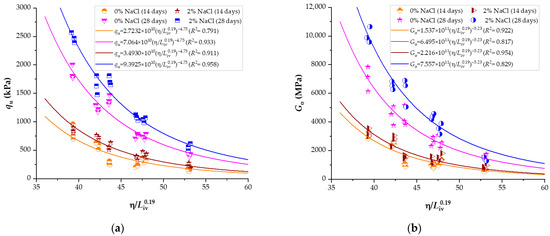
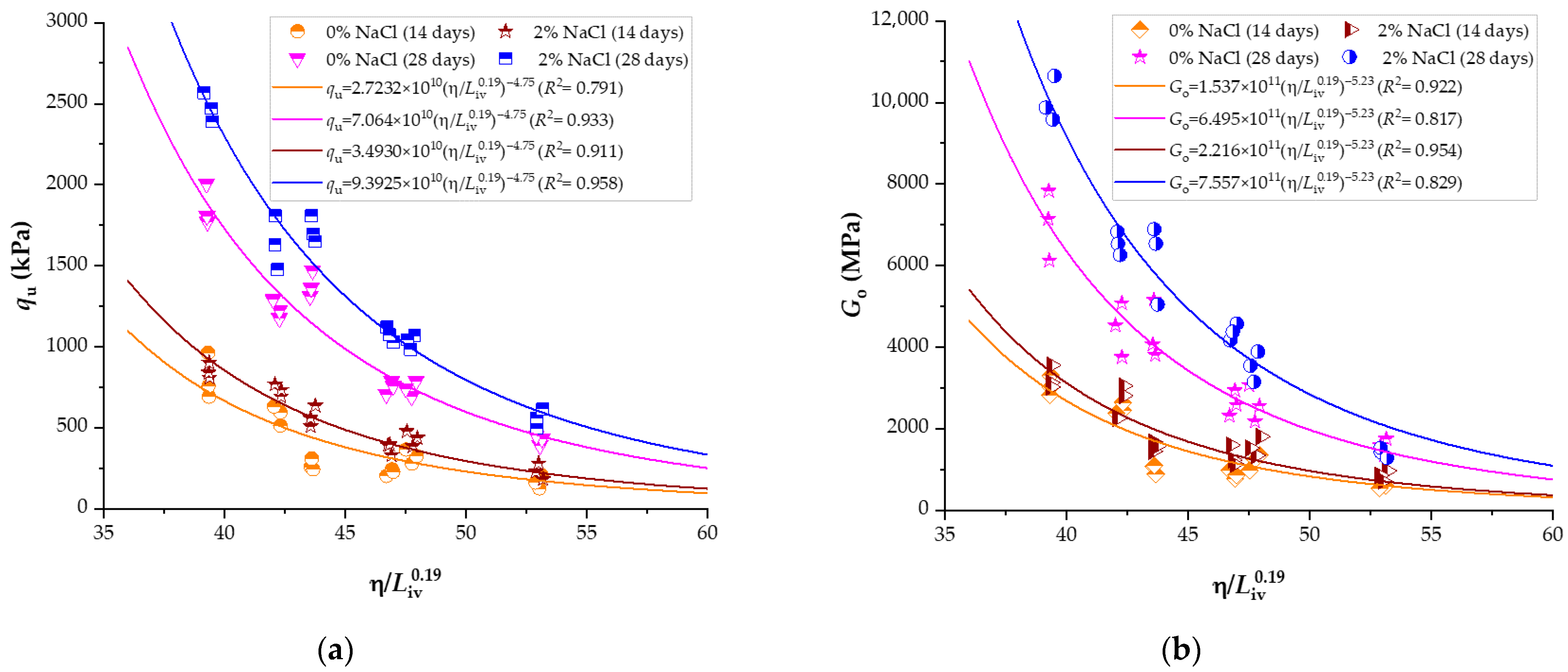
Figure 15 presents the impact of porosity-lime index on unconfined compressive strength and stiffness of soil-lime-NaCl compacted blends, considering 15 and 28 days of curing. In the lime–NaCl system, the porosity-to-lime index (η/) provided an equally robust framework for interpreting the influence of lime content, NaCl addition, and curing time on qu. The best-fit exponent, x = 0.19, obtained by nonlinear regression, minimized the residuals between measured and predicted values and aligned with reported values for both cemented and pozzolanic soils. The regression equations exhibited high determination coefficients (R2 > 0.79) and a consistent slope of −4.75, confirming that qu varies as a power function of the porosity-to-lime index. Increasing the curing period from 14 to 28 days raised the regression constant A by approximately threefold, while the addition of 2% NaCl further increased it by 40–50%, underscoring the catalytic effect of chloride ions on early pozzolanic reactions. The steep exponent highlights the strong sensitivity of qu to changes in porosity and binder content—small decreases in η/ lead to disproportionately large strength gains, highlighting the combined role of physical compaction and chemical cementation in the mechanical performance of lime–NaCl-treated soils.
Figure 15.
Effects of porosity-lime index on (a) unconfined compressive strength and (b) stiffness of soil-lime-NaCl compacted blends considering 15 and 28 days of curing.
The porosity–binder framework also proved highly effective in describing the evolution of small-strain stiffness (Go) in both stabilization systems. In the XG–PPF mixtures, Go increased consistently with higher density, binder content, and curing time, following a power-type dependency on η/Biv similar to that of qu. Although the correlation coefficients were slightly lower, the overall trends demonstrated that decreasing porosity and increasing xanthan gum concentration resulted in a substantial stiffness enhancement. The inclusion of PPF led to a pronounced increase in Go, particularly at longer curing times, due to the fibers’ ability to restrict localized deformations and provide microstructural reinforcement. The maximum recorded G0 value of 3100 MPa corresponded to the mixture with 5% XG and 0.5% PPF after 90 days, confirming the biopolymer–fiber composite’s capacity to sustain small-strain deformations with high elasticity and energy dissipation.
For the lime–NaCl stabilized soils, Go exhibited a similar but steeper dependency on the porosity-to-lime index, governed by the Equation . The exponent (−5.23) indicates a high sensitivity of stiffness to changes in porosity and lime concentration, consistent with the formation of a rigid cementitious skeleton dominated by C–S–H and C–A–H gels. The prefactor A increased markedly with curing—by a factor of 4.2 without NaCl and 3.4 with NaCl—while the presence of 2% NaCl enhanced early-age stiffness by approximately 40%. The results suggest that while curing time has a dominant influence on long-term stiffness gain, NaCl accelerates the initial formation of cementitious bonds, leading to higher early-age Go values. This relationship demonstrates that Go is more sensitive than qu to early microstructural changes, capturing subtle increases in bonding density even before macroscopic strength is fully mobilized.
The porosity–binder index serves as a unifying analytical tool for understanding the mechanical evolution of both stabilization systems, despite their distinct bonding mechanisms. In the lime–NaCl mixtures, the index captures a chemically driven process characterized by the rapid development of strength and stiffness due to pozzolanic hydration and ionic exchange. In contrast, the XG–PPF system evolves through a combination of physical and physico-chemical interactions, where xanthan gum progressively forms polymeric bridges among clay particles and fibers enhance tensile reinforcement and crack control. While the lime–NaCl system yields higher absolute values of both qu and Go, the XG–PPF mixtures exhibit smoother, more sustained growth curves and higher G0/qu ratios (=2000–3000), reflecting their superior elasticity and ductility compared with the more brittle response of the cemented matrix (G0/qu between 1500–2000).
A higher Go/qu ratio is associated with enhanced elastic deformation capacity, improved energy absorption, and superior crack resistance—attributes directly linked to toughness. This behavior reflects the ability of the polymeric matrix and discrete fibers to redistribute stresses and delay microcrack propagation. From an engineering standpoint, such a response is advantageous in applications where cyclic loading, stress redistribution, or tensile–shear interactions dominate, including pavement subgrades, slope reinforcements, and embankments subjected to traffic or environmental loading. Therefore, although the lime–NaCl system may reach higher absolute strength values, the XG–PPF system offers a more ductile and resilient stress–strain response.
The microstructural observations conducted by Baldovino et al. [15,30,45,46] support the mechanical trends of both systems. Lime–NaCl specimens show C–S–H/C–A–H gel formation and matrix densification, directly explaining the higher qu and Go values. In contrast, XG–PPF mixtures exhibit a polymeric hydrogel coating and fiber interlocking, which correlate with their gradual strength development and higher Go/qu ratios linked to improved toughness.
4.4. Machine Learning Implementation
This section presents the results of the machine learning (ML) approaches employed in this study. In total, twenty-eight algorithms were tested to predict the unconfined compressive strength (qu) and small-strain stiffness (Go) variables. Table 3 summarizes the coefficients of determination (R2) obtained for the two stabilization methods, namely lime–NaCl and XG-PP. The analysis was carried out for both the validation and testing phases.
Table 3.
Results of the coefficient of determination (R2) and root mean square error (RMSE) of machine learning algorithms.
According to the results, the bilayered neural network achieved the best performance for the lime–NaCl stabilization method when predicting Go, with R2 values of 0.958 and 0.985 for the validation and testing stages, respectively. For the same stabilization method, the qu predictions yielded R2 values of 0.980 and 0.992 for the validation and testing phases, respectively, confirming the robustness of the model. Regarding the XG-PP-based stabilization, the narrow neural network produced the highest correlations for Go, with R2 values of 0.917 and 0.892 in the validation and testing phases, respectively. For qu prediction using this method, the exponential Gaussian process regression (exponential GPR) provided the most accurate results, achieving R2 values of 0.943 and 0.986 for the validation and testing stages, respectively. In addition, the Root Mean Square Error (RMSE) also confirms that the best selected methods for qu and Go.
Overall, Table 3 reveals that neural network architectures and Gaussian process regression (GPR) models outperformed classical linear, kernel, support vector machine (SVM), and tree-based algorithms.
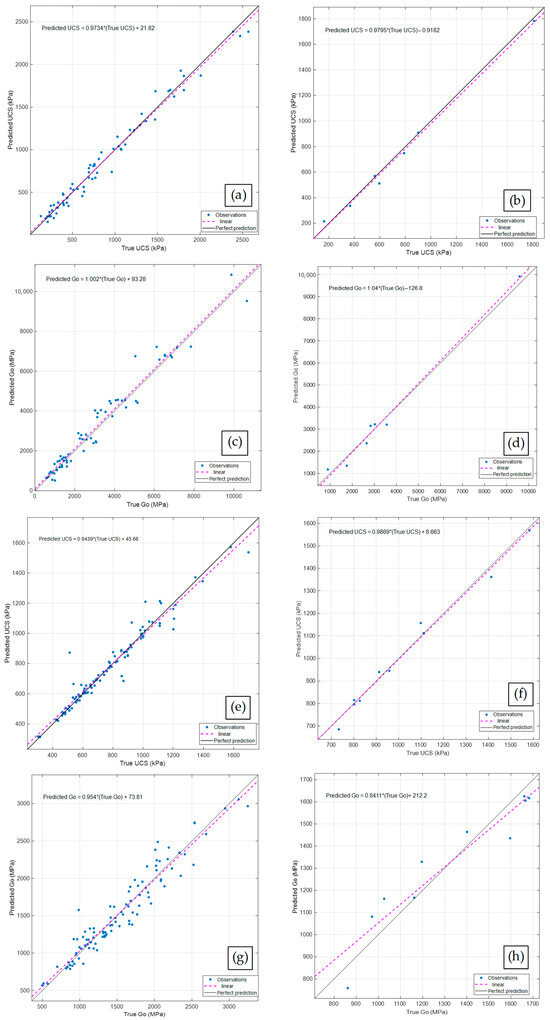
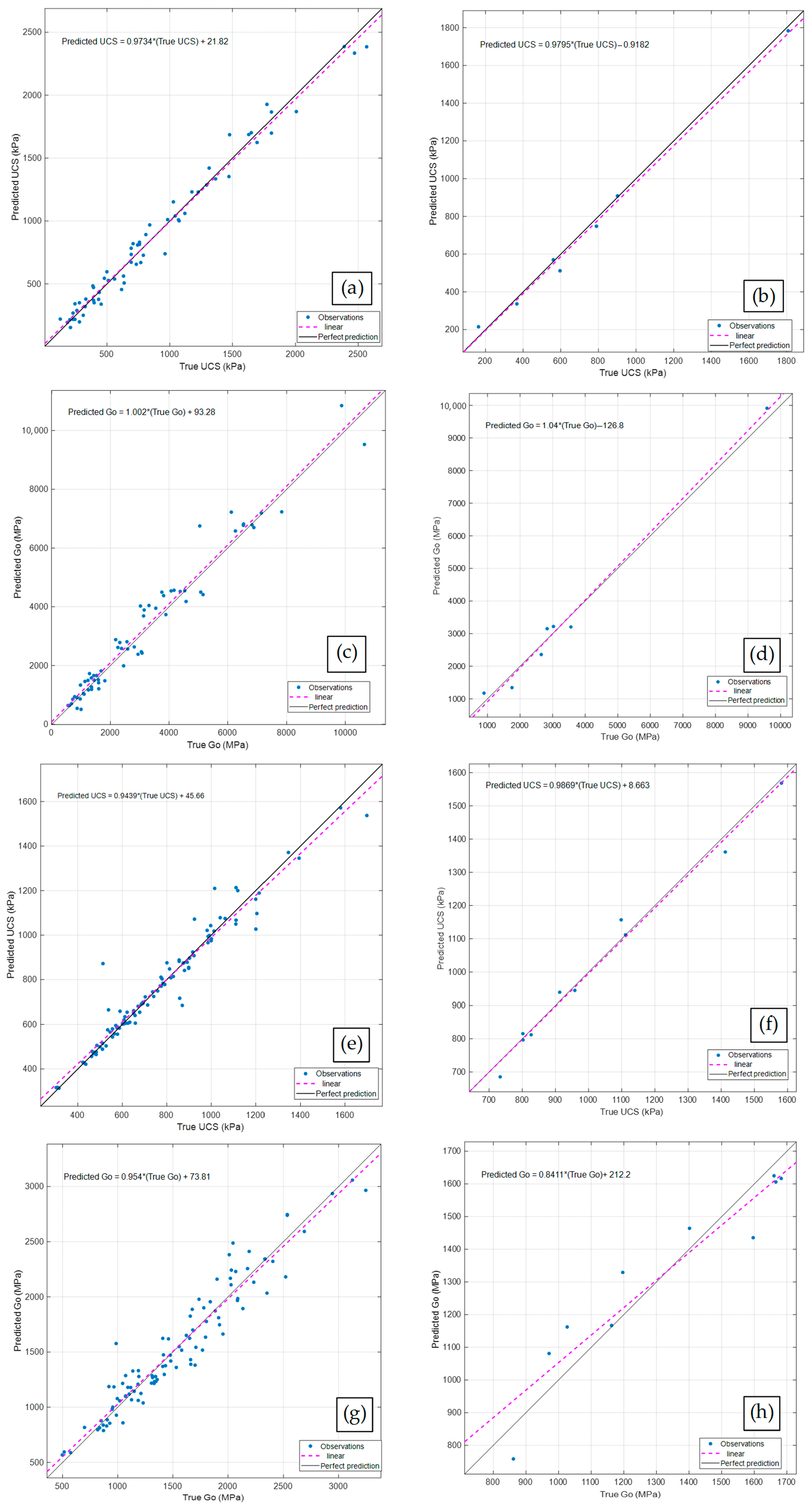
Figure 16 presents a comparison between the measured values obtained during the experimental stage (referred to as true values) and the predicted values computed using the selected machine learning (ML) algorithms—namely, the bilayered and narrow neural networks, and the exponential Gaussian process regression. The comparison is shown for both stabilization methods (lime–NaCl and XG-PP) and for the two response variables, qu and Go. In each plot, the black 45° line represents the ideal perfect-fit condition, whereas the magenta dashed line depicts the regression line obtained from the ML predictions.
Figure 16.
Comparison between predicted and true values for: (a) validation of qu using the lime–NaCl stabilization method (BNN); (b) testing of qu using the lime–NaCl method (BNN); (c) validation of Go using the lime–NaCl method (BNN); (d) testing of Go using the lime–NaCl method (BNN); (e) validation of qu using the XG-PP stabilization method (EGPR); (f) testing of qu using the XG-PP method (EGPR); (g) validation of Go using the XG-PP method (NNN); and (h) testing of Go using the XG-PP method (NNN).
A total of 110 experimental data points were collected, with 10% of them reserved for testing and the remaining 90% used for validation. In all cases, the testing data are well distributed along the linear trend, confirming that no overfitting occurred and that the models generalized adequately. Furthermore, the correlation between predicted and true values was quantified through linear regression. For instance, in the validation stage using the lime–NaCl stabilization method for qu, the relationship between predicted and true values was expressed as:
The strong linear relationship and close clustering of points around the 45° line indicate an excellent predictive performance of the ML models.
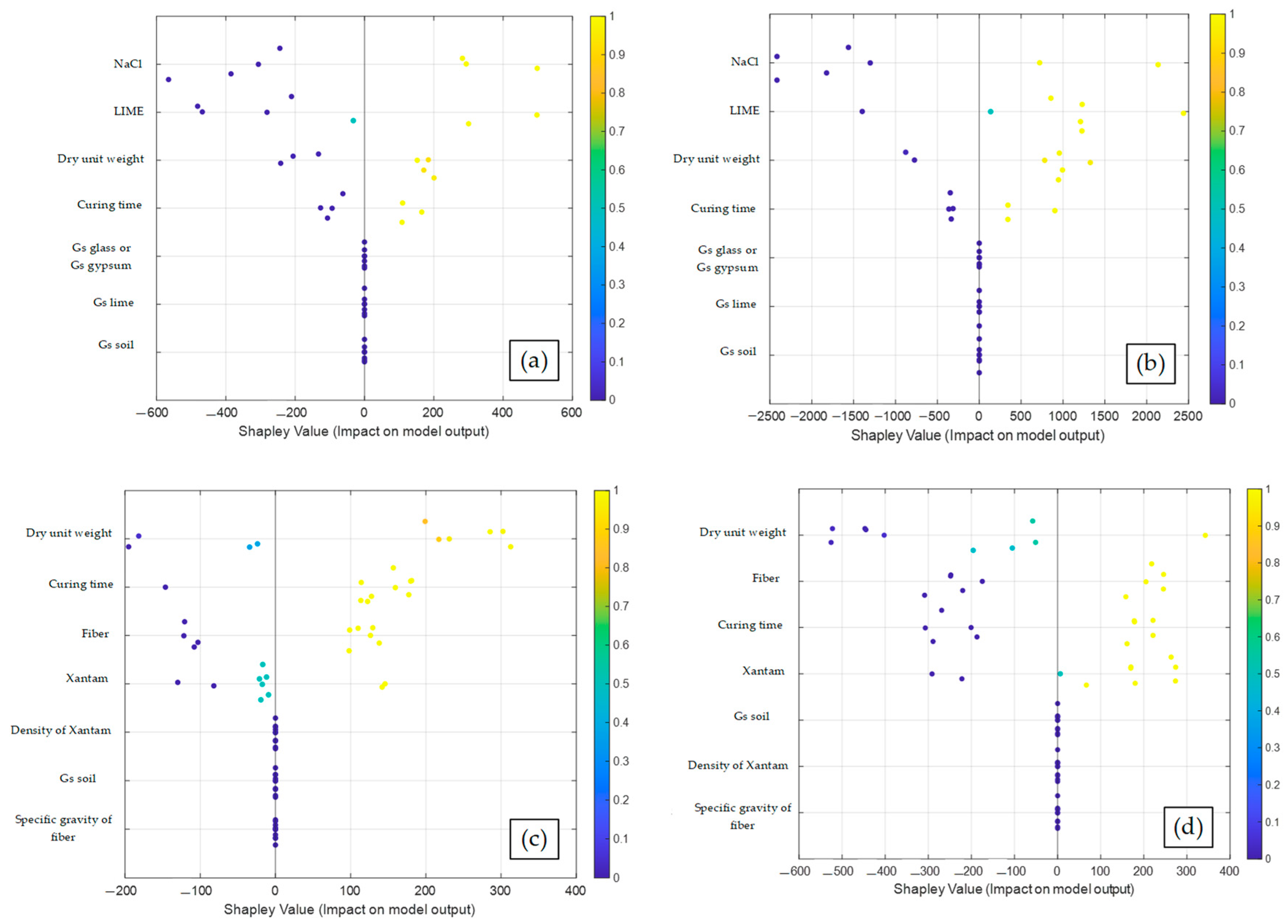
To assess the relative importance of the predictors in the computation of qu and Go values for both stabilization methods, Shapley values were calculated, as illustrated in Figure 17. For the lime-NaCl-based stabilization method, the most influential predictors were, in descending order, NaCl content, LIME, dry unit weight, curing time, and specific gravity (Gs) of glass or gypsum (see Figure 17a,b). The remaining parameters were kept constant throughout the experimental program; consequently, they exhibited no significant influence on the ML modeling, as expected.
Figure 17.
Computation of Shapley values for: (a) lime-NaCl—qu, (b) NaCl—Go, (c) XG-PPF—qu, (d) XG-PP—Go.
Similarly, for the XG-PP-based stabilization method, the order of predictor importance for both response variables (qu and Go) was: dry unit weight, curing time, fiber content, and Xantam dosage. The remaining predictors showed negligible sensitivity since they were held constant during the experiments (see Figure 17c,d).
One of the main advantages of using ML algorithms is their low training time. Table 4 presents the training times of all ML models. The cubic SVM model exhibited the highest training time at 7.9 s (XG-PP for Go), whereas the medium and coarse Gaussian GPR models and the medium tree showed the shortest training times for some combinations, with values of 0.5 s.
Table 4.
Computation of training times of machine learning algorithms.
The selected algorithms achieved the following training times: for qu and Go in the Lime–NaCl stabilization using the BNN method, the training times were 1.3 s and 1.2 s, respectively; while for qu and Go in the XG-PP stabilization, the best-performing algorithms were the NNN and EGPR models, both presenting a training time of 1.1 s.
This research demonstrates that the implementation of ML models serves as an effective tool for enhancing the fitting accuracy of the two soil stabilization methods examined. In this regard, Table 5 presents a comparison between the typical mathematical expressions employed in the current literature and the machine learning models. In all cases, the application of ML improved the results, as evidenced by higher coefficients of determination, indicating a better fit compared with the mathematical models. For instance, when computing qu using the lime–NaCl stabilization method, the R2 values obtained from the bilayered neural network were 0.980 and 0.992 for the validation and testing phases, respectively. In contrast, the corresponding mathematical regression yielded R2 values ranging from 0.791 to 0.958.
Table 5.
Equations controlling the strength and stiffness of soil-lime-NaCl and soil-XG-PPF compacted blends.
4.5. Limitations
This study presents some limitations. First, although all experimental tests were performed in triplicate, the sample size remains relatively small and may not fully capture the inherent variability of natural soils. Second, the investigation was conducted on a single fine-grained soil classified as CL, representative of coastal silty clays in northern Colombia; therefore, the findings may not be directly generalizable to soils with markedly different mineralogical or plasticity characteristics. Third, environmental factors such as temperature fluctuations, humidity variations, and wetting–drying cycles were not considered in the curing process, even though these factors can significantly influence long-term performance in field conditions.
Additionally, the lime–NaCl and XG–PPF systems were evaluated over different curing periods due to their distinct stabilization mechanisms, which limits direct early-age comparability. Machine learning models were employed to support predictive understanding; however, ML identifies statistical relationships and does not explain physicochemical mechanisms.
Despite these limitations, the study provides a robust comparative framework and valuable insights into the mechanical behavior of chemical and biopolymer-stabilized soils. Future research should incorporate larger datasets, multiple soil types, environmental conditioning, and matched curing ages to enhance external validity and field-scale applicability.
5. Conclusions
- −
- The lime–NaCl mixtures achieved unconfined compressive strength (qu) values ranging from 166 to 2475 kPa and small-strain shear modulus (Go) between 608 and 10,036 MPa after 28 days, while the XG–PPF system developed qu values between 310 and 1620 kPa and Go between 528 and 3105 MPa after 90 days. Both treatments significantly improved stiffness and strength compared with the untreated soil (i.e., qu = 120 kPa and Go = 300 MPa).
- −
- The lime–NaCl system demonstrated superior early-age performance. At 15 days, adding 2% NaCl increased qu by approximately 140% and Go by 170% compared to lime-only mixtures, reaching up to 1862 kPa and 7033 MPa at 14.0 kN/m3 dry unit weight. When curing times exceed 28 days, an improvement of between 30 and 40% is achieved, which is of utmost importance for confirming the catalytic effect of chloride ions on early pozzolanic reactions.
- −
- Assessment of the XG–PPF method revealed an increasing trend in strength and stiffness with curing time. In this regard, the system assessed after 28 d (with 5% XG and 0.5% PPF) achieved values of 109 kPa and Go = 2198 MPa, which increased to 1620 kPa and 3105 MPa, respectively, after 90 d, at a dry density of 17.6 kN/m3. When fibers were incorporated into the mixture, both qu and Go exhibited improvements ranging from approximately 40–60% and 30–60%, respectively, compared with fiber-free samples.
- −
- The porosity–binder index effectively unified the strength of compacted blends. For lime–NaCl stabilization, regression exponents of −4.75 (qu) and −5.23 (Go) yielded high coefficients of determination (R2 > 0.79). In the XG–PPF mixtures, similar power-law trends were observed, confirming that both systems follow exponential increases in strength and stiffness with decreasing porosity. A 10% reduction in the porosity–binder index produced gains of 60% in qu and 80% in Go, demonstrating the high sensitivity of both responses to compaction and binder dosage.
- −
- Machine learning models provided accurate predictions of the experimental behavior. The neural network and Gaussian process regression models achieved R2 values ranging from 0.917 to 0.980 and from 0.892 to 0.986 for the validation and testing phases, respectively, which were higher than those obtained using traditional regression models. These models effectively captured the nonlinear influences of porosity, binder content, and curing time, thereby confirming their suitability for predictive design and parameter optimization in soil stabilization. It is of utmost importance to emphasize that ML models are fundamentally mathematical tools that identify correlations; they do not elucidate the underlying physical or chemical stabilization mechanisms.
- −
- The higher Go/qu ratios observed in the XG–PPF mixtures demonstrate their superior toughness and enhanced resistance to cracking when compared with lime–NaCl mixtures of similar qu. This characteristic makes the biopolymer–fiber system particularly suitable for field applications where there is deformation control and energy dissipation.
Author Contributions
Conceptualization, J.A.B., and O.E.C.-H.; methodology, J.A.B., and O.E.C.-H.; validation, J.A.B., and O.E.C.-H.; formal analysis, J.A.B., and O.E.C.-H.; investigation, J.A.B., and O.E.C.-H.; resources, J.A.B. and O.P.C.; writing—original draft preparation, J.A.B. and O.E.C.-H.; writing—review and editing, J.A.B., O.E.C.-H. and O.P.C.; visualization, J.A.B. and O.E.C.-H.; supervision, J.A.B. and O.P.C.; funding acquisition, J.A.B. and O.E.C.-H. All authors have read and agreed to the published version of the manuscript.
Funding
This research received no external funding.
Institutional Review Board Statement
Not applicable.
Informed Consent Statement
Not applicable.
Data Availability Statement
The original contributions presented in this study are included in the article. Further inquiries can be directed to the corresponding authors.
Acknowledgments
The authors want to thank the Universidad de Cartagena for the support provided.
Conflicts of Interest
The authors declare that they have no conflicts of interest.
References
- Favretto, F.; Bruschi, G.J.; Secco, M.P.; Festugato, L. Strength and Stiffness of High-Moisture Content Kaolin–Bentonite Blends Cemented with an Alternative Lime. Indian Geotech. J. 2025. [Google Scholar] [CrossRef] [Scilit]
- Godoy, V.B.; Tomasi, L.F.; Benetti, M.; de Araújo, M.T.; Dalmolin, D.A.; Heineck, K.S. Effects of Curing Temperature on Sand-Ash-Lime Mixtures with Fibres and NaCl. Geotech. Geol. Eng. 2023, 41, 2221–2235. [Google Scholar] [CrossRef] [Scilit]
- Saad, A.H.; Nahazanan, H.; Yusuf, B.; Toha, S.F.; Alnuaim, A.; El-Mouchi, A.; Elseknidy, M.; Mohammed, A.A. A Systematic Review of Machine Learning Techniques and Applications in Soil Improvement Using Green Materials. Sustainability 2023, 15, 9738. [Google Scholar] [CrossRef] [Scilit]
- Shaji, S.; Divya, P.V. Sustainable Ground Improvement of Soft Clay Using Eggshell Lime and Rice Husk Ash. Constr. Build. Mater. 2024, 441, 137460. [Google Scholar] [CrossRef] [Scilit]
- Mohd Yunus, N.Z.; Wanatowski, D.; Marto, A.; Jusoh, S.N. Strength Improvement of Lime-Treated Clay with Sodium Chloride. Geotech. Res. 2017, 4, 192–202. [Google Scholar] [CrossRef] [Scilit]
- Parameswaran, T.G.; Sivapullaiah, P.V. Influence of Sodium and Lithium Monovalent Cations on Dispersivity of Clay Soil. J. Mater. Civ. Eng. 2017, 29, 04017042. [Google Scholar] [CrossRef] [Scilit]
- Baščarević, Z.; Komljenović, M.; Miladinović, Z.; Nikolić, V.; Marjanović, N.; Petrović, R. Impact of Sodium Sulfate Solution on Mechanical Properties and Structure of Fly Ash Based Geopolymers. Mater. Struct./Mater. Constr. 2014, 48, 683–697. [Google Scholar] [CrossRef] [Scilit]
- Chang, I.; Im, J.; Prasidhi, A.K.; Cho, G.C. Effects of Xanthan Gum Biopolymer on Soil Strengthening. Constr. Build. Mater. 2015, 74, 65–72. [Google Scholar] [CrossRef] [Scilit]
- Bagheri, P.; Gratchev, I.; Rybachuk, M. Effects of Xanthan Gum Biopolymer on Soil Mechanical Properties. Appl. Sci. 2023, 13, 887. [Google Scholar] [CrossRef] [Scilit]
- Saldarriaga, C.F.A.; Vega, D.L.; Fontalvo, J.E.S.; Jimeno, S.P. Influence of Polypropylene Derivatives on Soil Mechanical Properties. Civ. Eng. Archit. 2023, 11, 741–751. [Google Scholar] [CrossRef] [Scilit]
- Qiu, X.; Yang, J.; Wu, Y.; Yan, L.; Liu, Q. Effect of Fiber Content on Mechanical Properties of Fiber-Reinforced CGF All-Solid-Waste Binder-Solidified Soil. Materials 2024, 17, 388. [Google Scholar] [CrossRef] [Scilit]
- Pasche, E.; Bruschi, G.J.; Specht, L.P.; Aragão, F.T.S.; Consoli, N.C. Fiber-Reinforcement Effect on the Mechanical Behavior of Reclaimed Asphalt Pavement–Powdered Rock–Portland Cement Mixtures. Transp. Eng. 2022, 9, 100121. [Google Scholar] [CrossRef] [Scilit]
- Ordoñez Muñoz, Y.; Luis dos Santos Izzo, R.; Leindorf de Almeida, J.; Arrieta Baldovino, J.; Lundgren Rose, J. The Role of Rice Husk Ash, Cement and Polypropylene Fibers on the Mechanical Behavior of a Soil from Guabirotuba Formation. Transp. Geotech. 2021, 31, 100673. [Google Scholar] [CrossRef] [Scilit]
- Consoli, N.C.; Foppa, D.; Festugato, L.; Heineck, K.S. Key Parameters for Strength Control of Artificially Cemented Soils. J. Geotech. Geoenviron. Eng. 2007, 133, 197–205. [Google Scholar] [CrossRef] [Scilit]
- Baldovino, J.d.J.A.; de la Rosa, Y.E.N.; Calabokis, O.P.; Vergara, J.A.A.; López, L.C.S. Geotechnical Behavior of Xanthan Gum-Stabilized Clay Reinforced with Polypropylene Fibers. Polymers 2025, 17, 363. [Google Scholar] [CrossRef] [Scilit]
- Soldo, A.; Miletić, M.; Auad, M.L. Biopolymers as a Sustainable Solution for the Enhancement of Soil Mechanical Properties. Sci. Rep. 2020, 10, 267. [Google Scholar] [CrossRef] [Scilit]
- Ardejani, M.S.; Pourkhorshid, M.; Shalchian, M.M.; Khajeh, A. Bio-Cementitious Stabilization of Problematic Soils Using Xanthan Gum, Calcium Carbide Residue, and Bamboo Fibers. Case Stud. Constr. Mater. 2025, 23, e05568. [Google Scholar] [CrossRef] [Scilit]
- Burhan, S.; Mohammed, A.S. Novel Geotechnical Properties of Lime-Stabilized Clay Strength via Hydrothermal Solidification: Impact of Leaching Coefficient, Chemical Interactions, and Silica-Sesquioxide Ratio for Sustainable Geotechnics. Sustain. Chem. Pharm. 2025, 44, 101929. [Google Scholar] [CrossRef] [Scilit]
- Sari-Ahmed, B.; Benzaamia, A.; Ghrici, M.; Moghal, A.A.B. Strength Prediction of Fiber-Reinforced Clay Soils Stabilized with Lime Using XGBoost Machine Learning. Civ. Environ. Eng. Rep. 2024, 34, 157–176. [Google Scholar] [CrossRef] [Scilit]
- Hoque, M.I.; Hasan, M.; Islam, M.S.; Houda, M.; Abdallah, M.; Sobuz, M.H.R. Machine Learning Methods to Predict and Analyse Unconfined Compressive Strength of Stabilised Soft Soil with Polypropylene Columns. Cogent Eng. 2023, 10, 2220492. [Google Scholar] [CrossRef] [Scilit]
- Zhang, C.; Zhu, Z.; Liu, F.; Yang, Y.; Wan, Y.; Huo, W.; Yang, L. Efficient Machine Learning Method for Evaluating Compressive Strength of Cement Stabilized Soft Soil. Constr. Build. Mater. 2023, 392, 131887. [Google Scholar] [CrossRef] [Scilit]
- Mustafa, Y.M.H.; Wudil, Y.S.; Zami, M.S.; Al-Osta, M.A. Machine Learning Approach for Assessment of Compressive Strength of Soil for Use as Construction Materials. Eng 2025, 6, 84. [Google Scholar] [CrossRef] [Scilit]
- Mohammed, A.M.A.; Husain, O.; Abdulkareem, M.; Mohd Yunus, N.Z.; Jamaludin, N.; Mutaz, E.; Elshafie, H.; Hamdan, M. Explainable Artificial Intelligence for Predicting the Compressive Strength of Soil and Ground Granulated Blast Furnace Slag Mixtures. Results Eng. 2025, 25, 103637. [Google Scholar] [CrossRef] [Scilit]
- ASTM D2487-11; Standard Practice for Classification of Soils for Engineering Purposes (Unified Soil Classification System). ASTM International: West Conshohocken, PA, USA, 2017; pp. 1–5. [CrossRef] [Scilit]
- ASTM D698-12e1; Standard Test Methods for Laboratory Compaction Characteristics of Soil Using Standard Effort (12,400 Ft-Lbf/Ft3 (600 KN-m/M3)). ASTM International: West Conshohocken, PA, USA, 2012. [CrossRef]
- ASTM 4318; Standard Test Methods for Liquid Limit, Plastic Limit and Plasticity Index of Soils. ASTM International: West Conshohocken, PA, USA, 2010.
- ASTM D854; Standard Test Methods for Specific Gravity of Soil Solids by Water Pycnometer. ASTM International: West Conshohocken, PA, USA, 2014.
- ASTM D7928; Standard Test Method for Particle-Size Distribution (Gradation) of Fine-Grained Soils Using the Sedimentation (Hydrometer) Analysis. ASTM International: West Conshohocken, PA, USA, 2021.
- ASTM D698-12(2021); Test Method for Laboratory Compaction Characteristics of Soils Using Standard Effort (12.400 Ft-Lbf / Ft 3 (600 KN-m/m3)). ASTM International: West Conshohocken, PA, USA, 2012. Available online: https://store.astm.org/d0698-12r21.html (accessed on 14 December 2025).
- Baldovino, J.d.J.A.; Palma Calabokis, O.; Saba, M. From Bibliometric Analysis to Experimental Validation: Bibliometric and Literature Review of Four Cementing Agents in Soil Stabilization with Experimental Focus on Xanthan Gum. Sustainability 2024, 16, 5363. [Google Scholar] [CrossRef] [Scilit]
- Saldanha, R.B.; Mallmann, J.E.C.; Consoli, N.C. Salts Accelerating Strength Increase of Coal Fly Ash-Carbide Lime Compacted Blends. Geotech. Lett. 2016, 6, 23–27. [Google Scholar] [CrossRef] [Scilit]
- ASTM D1633-00; Standard Test Methods for Compressive Strength of Molded Soil-Cement Cylinders. ASTM International: West Conshohocken, PA, USA, 2007.
- Consoli, N.C.; da Silva Lopes, L.; Foppa, D.; Heineck, K.S. Key Parameters Dictating Strength of Lime/Cement-Treated Soils. Proc. Inst. Civ. Eng.-Geotech. Eng. 2009, 162, 111–118. [Google Scholar] [CrossRef] [Scilit]
- Dempsey, B.J.; Thompson, M.R. Durability Properties of Lime-Soil Mixtures; Highway Research Board: Washington, DC, USA, 1968. [Google Scholar]
- García-Ochoa, F.; Santos, V.E.; Casas, J.A.; Gómez, E. Xanthan Gum: Production, Recovery, and Properties. Biotechnol. Adv. 2000, 18, 549–579. [Google Scholar] [CrossRef] [Scilit]
- Baldovino, J.D.J.A.; Izzo, R.L.D.S.; Moreira, E.B.; Rose, J.L. Optimizing the Evolution of Strength for Lime-Stabilized Rammed Soil. J. Rock Mech. Geotech. Eng. 2019, 11, 882–891. [Google Scholar] [CrossRef] [Scilit]
- Umar, I.H.; Tarauni, Z.A.; Bello, A.B.; Lin, H.; Hassan, J.I.; Cao, R. Performance Prediction and Optimization of High-Plasticity Clay Lime–Cement Stabilization Based on Principal Component Analysis and Principal Component Regression. Appl. Sci. 2025, 15, 7150. [Google Scholar] [CrossRef] [Scilit]
- Dehghan, H.; Tabarsa, A.; Latifi, N.; Bagheri, Y. Use of Xanthan and Guar Gums in Soil Strengthening. Clean. Technol. Env. Policy 2019, 21, 155–165. [Google Scholar] [CrossRef] [Scilit]
- ASTM D2166-03; Standard Test Method for Unconfined Compressive Strength of Cohesive Soil 1. ASTM International: West Conshohocken, PA, USA, 2003.
- ASTM C597-22; Standard Test Method for Ultrasonic Pulse Velocity Through Concrete. ASTM International: West Conshohocken, PA, USA, 2022; pp. 1–4.
- Mathworks Statistics and Machine Learning ToolboxTM User’s Guide R2020a; MATLAB Mathworks Inc.: Natick, MA, USA, 2020.
- Scheuermann Filho, H.C.; Dias Miguel, G.; Cesar Consoli, N. Porosity/Cement Index over a Wide Range of Porosities and Cement Contents. J. Mater. Civ. Eng. 2022, 34, 06021011. [Google Scholar] [CrossRef] [Scilit]
- Hanafi, M.; Javed, I.; Ekinci, A. Evaluating the Strength, Durability and Porosity Characteristics of Alluvial Clay Stabilized with Marble Dust as a Sustainable Binder. Results Eng. 2025, 25, 103978. [Google Scholar] [CrossRef] [Scilit]
- Román Martínez, C.; Nuñez de la Rosa, Y.E.; Estrada Luna, D.; Baldovino, J.A.; Jordi Bruschi, G. Strength, Stiffness, and Microstructure of Stabilized Marine Clay-Crushed Limestone Waste Blends: Insight on Characterization through Porosity-to-Cement Index. Materials 2023, 16, 4983. [Google Scholar] [CrossRef] [Scilit] [PubMed]
- Baldovino, J.A.; Durán, A.P.; Rosa, Y.E.N. de la Sustainable Stabilization of Soil–RAP Mixtures Using Xanthan Gum Biopolymer. Sustainability 2025, 17, 4601. [Google Scholar] [CrossRef] [Scilit]
- Baldovino, J.A.; Parra, J.D.T.; Nuñez de la Rosa, Y.E. Effects of Sodium Chloride in Soil Stabilization: Improving the Behavior of Clay Deposits in Northern Cartagena, Colombia. Sustainability 2025, 17, 8715. [Google Scholar] [CrossRef] [Scilit]

Disclaimer/Publisher’s Note: The statements, opinions and data contained in all publications are solely those of the individual author(s) and contributor(s) and not of MDPI and/or the editor(s). MDPI and/or the editor(s) disclaim responsibility for any injury to people or property resulting from any ideas, methods, instructions or products referred to in the content. |
© 2026 by the authors. Licensee MDPI, Basel, Switzerland. This article is an open access article distributed under the terms and conditions of the Creative Commons Attribution (CC BY) license.